
Brunswick County Unincorporated
City Zoning Code
City Zoning Code
ARTICLE 5
- PERMITTED USES
Characteristics: Commercial uses, varying in size, providing daily or regularly scheduled recreation or entertainment-oriented activities. Such activities may take place outdoors or within a number of structures. Principal UsesAccessory UsesUses Not included Athletic, tennis, swim or health club
Campground, summer camp, recreational vehicle (RV) park
Commercial stables
Drive-in theater
Firing range such as rifle range, archery range, handgun, or skeet shooting
Golf course, country club, swim club, tennis club
Hunting/fishing camp, dude ranch
Outdoor entertainment activity such as batting cage, golf driving range, amusement park, miniature golf facility, swimming pool, tennis court or water park
Paintball
Skateboard or BMX bicycle park
Stadium or arena, commercial amphitheater, ballfield Ancillary indoor storage
Associated offices
Caretaker or security person housing
Classroom
Clubhouse
Concessions
Day care facility
Equipment storage
Food preparation or dining area
Maintenance facility
Pro shop or sales of goods related to the on-site activities of the specific use
Rain shelter Botanical garden, nature preserve (see Parks and Open Areas)
Indoor recreational facility (see Indoor Recreation)
Marina, boating facility (see Water Oriented Commercial Uses)
D.
Overnight Accommodation
E.
Commercial Parking
F.
Restaurants
G.
Retail Sales and Service
H.
Self Service Storage
I.
Vehicle Sales and Service
J.
Water Oriented Commercial Uses
K.
Microbrewery
(Ord. of UDO-17-01 , §§ 11, 12)
5.1.5. Office Uses
A.
All Office Uses
(Ord. No. UDO-20-01 , 11-16-20)
5.1.6. Industrial Uses
A.
Heavy Industrial
B.
Light Industrial
C.
Research and Development
D.
Resource Extraction
E.
Warehouse and Freight Movement
F.
Waste Related Service
G.
Wholesale Trade
H.
Business Parks
I.
Industrial Parks
(Ord. of UDO-17-01 , §§ 5, 6, 14)
5.1.7. Outdoor Lodging
A.
All Outdoor Lodging
5.1 - USE INTERPRETATION
As set forth in the Permitted Use Table (Section 5.2) certain uses are grouped together based on common functional, product, or physical characteristics. Characteristics include the type and amount of activity, the type of customers, how goods or services are sold or delivered, likely impact on surrounding properties, and site conditions. Grouping uses provides a systematic basis for assigning uses to appropriate general use districts. Any use not specifically set forth in this Article is expressly prohibited, unless determined otherwise as set forth in Section 5.2.1, Uses not Specifically Listed.
5.1.1. Agricultural Uses
A.
All Agricultural Uses
(Ord. of 5-1-17 , § 13)
5.1.2. Residential Uses
A.
Household Living
B.
Group Living
5.1.3. Public and Civic Uses
A.
Community Service
B.
Day Care
C.
Educational Facilities
D.
Government Facilities
E.
Medical Facilities
F.
Parks and Open Areas
G.
Passenger Terminal
H.
Place of Worship
I.
Social Service Facility and Emergency Shelter
J.
Utilities
5.1.4. Commercial Uses
A.
Funeral Home
B.
Indoor Recreation
C.
Outdoor Recreation
5.2 - USE TABLE
5.2.1. Uses Not Specifically Listed
A.
Any use not specifically listed in this chapter is expressly prohibited, unless the Planning Director determines in accordance with Section 9.7, Written Interpretation, that the use is similar to a permitted individual use or permitted group of uses as listed in this Article. Where such similar permitted individual use or permitted group of uses is subject to a limited use standard contained in this Article or special use permit review, the proposed use shall also be subject to such standard or approval. The Planning Director shall not amend this chapter by adding to or eliminating any use standard for the proposed use.
B.
Where a use not listed is found by the Planning Director not to be similar to any other permitted individual use or permitted group of uses, the use shall be permitted only following a text amendment in accordance with Section 3.7, Ordinance Text Amendment. The decision of the Planning Director may be appealed to the Board of Adjustment.
C.
When considering the appropriate districts for a use not listed in the Permitted Use Table, the district intent statements (see Article 4, Zoning Districts) shall be taken into consideration.
D.
Determination of an appropriate group of uses for a proposed use not currently listed shall be made by applying the following criteria.
1.
The actual or projected characteristics of the activity in relationship to the stated characteristics of each use category.
2.
The relative amount of site area or floor space and equipment devoted to the activity.
3.
Relative amounts of sales from each activity.
4.
The customer type for each activity.
5.
The relative number of employees in each activity.
6.
Hours of operation.
7.
Building and site arrangement.
8.
Types of vehicles used and their parking requirements.
9.
The relative number of vehicle trips generated.
10.
Signs.
11.
How the use is advertised.
12.
The likely impact on surrounding properties.
13.
Whether the activity is likely to be found independent of the other activities on the site.
( Ord. No. UDO-21-01 , § 23, 5-17-21)
5.2.2. Developments with Multiple Principal Uses
A.
When all principal uses of a development fall within one use category (see Section 5.1, Use Interpretation) the entire development shall be assigned to that use category.
B.
When the principal uses of a development fall within different group of uses or no group of uses, each principal use shall be classified in the applicable group of uses or treated as an individual use and each use shall be subject to all applicable regulations for that group of uses or individual use.
C.
A development comprised of uses regulated by separate rows on the Permitted Use Table shall be reviewed using the most restrictive process from among the proposed uses.
Commentary: If a proposed development includes a gas station, library and a restaurant, including outparcels, and one of those uses is only permitted with a special use permit in the district, then the entire development requires special use permit review.
D.
Where a use requiring approval as a limited use or a special use lies on a separate legal parcel, only the building containing the use and its separate parcel shall be subject to review, not the entire project. However, where the separate legal parcel is an outparcel, the application shall describe the relationship of the outparcel to the remaining site.
Commentary: For example, where a vehicle repair shop in a C-LD District (subject to special use review) is an outparcel within a larger retail development, the special use shall review the outparcel only — not the entire development. However, where a special use is proposed in a building that contains a variety of other uses, the entire building and its associated parcel(s) of land shall require special use review.
E.
Multiple dwellings as principal uses on a single parcel shall be subject to Section 5.4.3.
( Ord. No. UDO-21-01 , § 24, 5-17-21)
5.2.3. Use Table
The following principal uses are permitted by right, permitted subject to limited use standards, or permitted subject to a Special Use Permit. See Section 4.8.2 for Conditional Zoning option.
(Ord. No. UDO-16-02 , § 17, 3-7-16; Ord. of UDO-17-01 , §§ 7, 8, 15; Ord. No. UDO-18-01 , § 1, 3-19-18; Ord. No. UDO-19-02 , § 2, 9-19-19; Ord. No. UDO-20-01 , 11-16-20)
5.3 - LIMITED USE STANDARDS
5.3.1. General
A.
These standards shall only apply to those districts and uses where the "L" or "SUP" is designated on the use table in Section 5.2. If a "P" is designated in the use table, these standards shall not apply and the use shall be permitted in compliance with the general development standards of the underlying zoning and other applicable requirements of this Ordinance. If a blank cell is designated, then the use is not permitted.
B.
Unless specifically exempted within this Section, all other applicable requirements of this Ordinance apply. These include:
1.
Zoning District Standards: Article 4;
2.
Design and Performance Standards: Article 6;
3.
Landscaping and Buffering Standards: Article 6;
4.
Subdivision Standards: Article 8;
5.
Flood Damage Prevention: Article 1;
6.
Signs Standards: Article 8.
5.3.2. Agricultural Use Standards
A.
Agricultural Industry
Agricultural industry shall be permitted in accordance with the use tables in Section 5.2, subject to the following:
1.
With the exception of bona fide farming operations, agricultural industry shall be subject to the general requirements of the subject zoning district including maximum height, yard requirements, and applicable design and performance standards in Article 6.
B.
Agricultural Tourism
Agricultural tourism shall be permitted in accordance with the use tables in Section 5.2, subject to the following:
1.
The general zoning requirements of the underlying zoning district shall apply to all permanent structures unless located on a bona fide farm.
2.
The Planning Director may waive (but is not obligated to) the following ordinance requirements for temporary activities such as hay rides, corn mazes, pumpkin patches, and other similar functions provided a temporary use permit has been obtained (see Section 5.5):
i.
District yard requirements;
ii.
District height requirements;
iii.
Buffer requirements;
iv.
Parking requirements provided sufficient parking spaces are available (either on-site or, with Planning Director approval, off-site) so that no parking associated with the use shall take place within a public right-of-way.
3.
Any paved parking areas shall not be located within a required buffer or yard. However, unpaved parking areas and overflow parking areas may be located within a required buffer, but not in a required yard.
4.
Property that is subject to a conservation agreement under G.S. 106-743.2 that remains in effect may receive up to twenty-five percent (25%) of its gross sales from the sale of non-farm products and still qualify as a bona fide farm that is exempt from zoning regulations under N.C.G.S. 160D-903. The Planning Director or his/her designee may periodically request documentation to establish that property's sale of non-farm products does not exceed twenty-five percent (25%) of its gross sale.
5.
Agricultural Tourism in the R-7500, R-6000, SBR-6000, and MR-3200 zoning districts must be a part of a bona fide farm.
C.
Bona Fide Farms
Bona fide farms shall be permitted in accordance with the use tables in 5.2, subject to the following:
1.
The use shall meet the definition of a bona fide farm.
2.
Bona fide farming uses shall be exempt from all zoning requirements in this UDO. However, non-bona fide farming uses shall be required to comply with the requirements of the underlying zoning district.
3.
Bona fide farms may be permitted to have more than one principal structure.
4.
Bona fide farms shall be permitted to have accessory structures without a principal structure.
5.
Residential structures are exempt from zoning district requirements.
6.
Development of sufficient on-site parking is encouraged to allow unobstructed movement into and out of each parking space without interfering with fixed objects such as lighting, fixtures, dumpsters, signage, or vehicles and without requiring the use of a public street or alley.
7.
Federal, state and/or other local permits and approvals may be required including, but not limited to, N.C. Department of Transportation, US. Army Corps of Engineers, Building Inspections, Environmental Health, and Stormwater.
D.
Private Stables
Private stables shall be permitted in accordance with the use tables in Section 5.2, subject to the following:
1.
A 100-foot separation shall be maintained between the outdoor areas where animals are kept and any property line of any adjacent residential district.
2.
The facility shall be designed, located and constructed on the site to minimize noise, odor and other impacts on adjoining properties.
3.
Adequate waste disposal methods shall be provided to maintain sanitary conditions and control odor.
(Ord. of UDO-17-01 , § 10, 5-15-17; Ord. No. UDO-19-02 , § 10, 9-19-19; Ord. No. UDO-21-01 , § 25, 5-17-21)
5.3.3. Residential Use Standards
A.
Family Care Home
Family Care homes shall be permitted in accordance with the use tables in Section 5.2, subject to the following:
1.
A family care home may be no closer than one-half mile radius, measured lot line to lot line, from any existing and/or permitted family care, group care home, or emergency shelter.
2.
The structure of a family care home may be no more than two stories high and none of the aged or physically disabled persons being served there may be housed in the upper story without provision for two direct exterior ground-level accesses to the upper story (G.S. § 168-22).
3.
The home shall meet all State requirements, and all applicable housing and North Carolina Building Codes requirements.
B.
Group Care Home
Group care homes shall be permitted in accordance with the use tables in Section 5.2, subject to the following:
1.
A group care home may be no closer than one-half mile radius, measured lot line to lot line, from any existing and/or permitted family care home, group care home, or emergency shelter.
2.
The home shall be operated in a manner that is compatible with the neighborhood and shall not be detrimental to adjoining properties as a result of traffic, noise, refuse, parking or other activities.
3.
The home shall maintain a residential appearance compatible with the neighborhood.
4.
The home shall meet all State requirements, and all applicable housing and North Carolina Building Codes requirements.
C.
Mobile Homes: Class A, B, and C
Class A, B, and C mobile homes shall be permitted in accordance with the use tables in Section 5.2, subject to the following:
1.
Restriction from Planned Developments
Mobile homes shall not be permitted within a Planned Development.
2.
Mobile Homes Constructed prior to October 27, 1987
Mobile homes constructed prior to October 27, 1987 may not be moved into the County from outside the County's geographic boundaries. Mobile homes constructed prior to October 27, 1987 and currently set-up within the County may be relocated provided the unit complies with North Carolina Building Codes and other applicable requirements. Inspection by a Licensed Home Inspector in North Carolina is recommended and in some instances may be required by the Building Inspector.
Commentary: Verification by a Licensed Home Inspector in North Carolina to be submitted at time of Property Development Application. Home Inspectors are licensed by N.C. Home Inspector Licensure Board. Go on-line to www.ncdoi.com/OSFM/Engineering/HILB/NCHILB.asp for a directory of inspectors, an inspection checklist and other information or contact the Board at 919.662.4480.
3.
Class A Mobile Home (Doublewide)
A Class A Mobile Home is a movable or portable residential structure that:
i.
Is built and transported on two or more separate chassis, designed to be joined into one integral unit and is designed for year-round occupancy;
ii.
is oriented on the site in such a manner that the side having the main entrance, and by design intended to be the front of the mobile home, is generally parallel to the street abutting the site, provided there is sufficient property to do so;
iii.
Has all its wheels, axles, transportation lights and towing apparatus removed after placement on the lot; and
iv.
Shall be permanently affixed to continuous solid underpinning unpierced except for required ventilation and access after placement on the lot, but before occupancy.
Commentary: "Solid Underpinning" means that one cannot see through the underpinning to objects on the other side. Consistent with the North Carolina Building Codes, skirting must be of material that is acceptable for exterior construction, durable and suitable for exterior exposures. Any wood framing used in the support skirting must be approved pressure treated wood. Manufactured skirting material should be installed in accordance with the skirting manufacturer's instructions.
4.
Class B Mobile Home (Singlewide)
A Class B Mobile Home is a movable or portable residential structure that:
i.
Is built and transported on one chassis and is designed for year-round occupancy;
ii.
Is oriented on the site in such a manner that the side having the main entrance, and by design intended to be the front of the mobile home, is generally parallel to the street abutting the site, provided there is sufficient property to do so;
iii.
Has all its wheels, axles, transportation lights and towing apparatus removed after placement on the lot;
iv.
Shall be permanently affixed to continuous solid underpinning unpierced except for required ventilation and access after placement on the lot, but before occupancy; and
v.
Does not comply with the North Carolina Building Codes.
Commentary: "Solid Underpinning" means that one cannot see through the underpinning to objects on the other side. Consistent with the North Carolina Building Codes, skirting must be of material that is acceptable for exterior construction, durable and suitable for exterior exposures. Any wood framing used in the support skirting must be approved pressure treated wood. Manufactured skirting material should be installed in accordance with the skirting manufacturer's instructions.
5.
Class C Mobile Homes
Mobile homes built prior to July 1, 1976 shall be considered Class C Mobile Homes and may not be brought into or relocated in Brunswick County. However, existing Class C Mobile Homes may remain subject to the requirements of Section 10.4, Nonconforming Structures.
6.
Certification of Mobile Homes
i.
Applicability
The Building Inspector shall determine that a mobile home, date of manufacturing of mobile home, or a model of mobile homes meets the requirements of this Ordinance.
ii.
Application Requirements
An application for Certification shall be submitted in accordance with Section 3.17, Application Requirements.
iii.
Action by Building Inspector
(a)
The Building Inspector shall review and evaluate the request in light of the text of this Ordinance and any other relevant information;
(b)
Following completion of any technical reviews by staff, the Building Inspector shall render an opinion;
(c)
The interpretation shall be provided to the applicant in writing.
iv.
Appeal
Final action on Certification may be appealed to the Board of Adjustment in accordance with Section 9.8, Appeal of Administrative Decision.
7.
Park Model Units
Occupancy in park model type units is allowed only in campgrounds or recreational vehicle parks, such occupancy to be strictly temporary in nature.
D.
Mobile Home Park
Mobile home parks shall be permitted in accordance with the use tables in Section 5.2, subject to the following:
1.
Parks Developed in Phases
i.
When a mobile home park is to be developed in stages, a mobile home park plan shall be submitted for the entire development, and an application for plan approval shall be made for each stage of development.
ii.
When a mobile home park is to be developed in stages, the proposed park plan shall be submitted for the entire development and application for a zoning certificate of compliance may be made for each stage developed.
2.
Expiration of Planning Board Approval
Mobile home park construction must begin within 12 months of Board approval. This expiration period may be extended by the Planning Board for an additional 12 months if the extension is applied for before the end of the original 12 month period. If the construction of the park has not begun within the time permitted, the approval shall expire and all permits shall be null and void. In such case, the applicant shall be required to resubmit the application in conformance with the most current ordinance.
3.
General Standards
i.
Mobile homes shall comply with the standards listed in Section 5.3.3.C, Mobile Homes: Class A, B, and C unless specifically exempted.
ii.
Only Class A or B mobile homes may be erected in a mobile home park, existing Class C mobile homes may remain as a nonconforming use.
iii.
A minimum of 15 spaces are required to create a mobile home park.
iv.
Mobile homes located within a mobile home park shall be exempt from the requirement to provide a masonry foundation. However, all other skirting requirements shall apply.
v.
An administrative office may be located in one mobile home located in the park in compliance with Section 5.4.4, Home Occupations.
vi.
The transfer of title of a mobile home site or sites either by sale or by any other manner shall be prohibited within a mobile home park as long as the mobile home park is in operation.
vii.
All structural additions to mobile homes other than those which are built into the unit and designed to fold out or extend from it shall be erected only after a building permit shall have been obtained, and such additions shall conform to the North Carolina Building Codes and the setback requirements of this Ordinance. An Existing Septic system check shall be required to ensure the proposed addition(s) do not encroach on any part of the septic system.
viii.
All mobile home parks shall comply with regulations for signs within the zoning district they are located.
ix.
Convenience establishments of a commercial nature shall be limited to food stores, coin-operated laundries and beauty parlors, and barber shops. These may be permitted in mobile home parks subject to the permitted use table and the following restrictions:
(a)
Such establishments must be permissible and comply with the applicable requirements for the district in which they are located.
(b)
Such establishments shall be subordinate to the residential use and character of the park.
(c)
Such establishments shall present no visible evidence of commercial character from any portion of any residential district outside the park.
(d)
Such establishments shall require Planning Board approval as a part of the required park plan.
(e)
Such establishments shall be designed to serve the trade and service needs of the park residents only.
x.
All mobile home units shall be placed individually on approved mobile home sites where all design standards and utilities have been completed.
xi.
No junked wrecked vehicles may remain in a mobile home park.
xii.
Unless located in designated storage areas, campers, recreational vehicles, travel trailers and other temporary dwelling structures are not permitted in Mobile Home Parks.
xiii.
No more than one mobile home will be allowed on each approved mobile home site. In no case shall any mobile home be placed on any open space or recreation area within the park.
4.
Park Design Standards
i.
All Mobile Home Parks shall have a gross land area of at least five acres.
ii.
A minimum of 5% of the total land area shall be devoted to accessible common open space intended for recreational use. These areas are separate from the mobile home lot areas, and shall be grouped and of character suitable for active and passive recreation and shall be reasonably located for safe and convenient access to residents.
iii.
No designated mobile home spaces shall include any areas required for screening in accordance with this Ordinance.
iv.
Each mobile home shall be located at least 40 feet from the edge of the right-of-way of any publicly-maintained street or road.
v.
Mobile Home Site Area
The minimum mobile home site area in mobile home parks shall be determined by the availability of public water and sewer facilities. The following minimum space requirements also takes into account the need for adequate space to prevent overcrowding, prevent fire hazards, provide sufficient light and air, and provide a safe and pleasant environment for park residents.
vi.
Accessory Structures
(a)
Accessory to a Particular Home
(1)
Structures accessory to a particular mobile home shall be located only on the site space containing that mobile home and may not be located in any required Home Site yard. All such structures shall be residential in character.
(2)
Any accessory structure within a mobile home park shall be located at least 60 feet from the public road centerline or 30 feet from the edge of the public road right-of-way, whichever is greater.
(b)
Community Accessory Structure
Accessory structures of benefit to all residents of the mobile home park shall be permitted elsewhere within the park, subject to the Brunswick County Zoning Ordinance. In addition to the setback requirements, said structures (e.g., community pools, club houses, etc.) shall be located at least 20 feet from any internal street and 30 feet from any mobile home located within the park.
vii.
Each home site shall have the front and rear corners clearly, permanently marked so that visual establishment of the boundaries of each site can be made.
viii.
Each mobile home site shall be identified by a permanent number which shall not be changed. The appropriate number of each mobile home site must be permanent and visibly displayed on each site once the site is occupied by a mobile home. Each number shall be placed on a concrete, wood, metal, or any permanent post and conspicuously located on the site.
5.
Screening and Buffering
i.
At minimum, mobile home parks must provide and maintain a project boundary buffer with a minimum opacity of 0.4 when adjoining an undeveloped lot and a minimum opacity of 0.8 when adjoining a developed lot (see 6.3.A, Landscaping and Buffering).
ii.
For purposes of this Section, a lot shall be considered developed if it contains at least one principal structure used for commercial purposes other than a mobile home park or for any industrial, institutional, governmental, or residential purpose and is located within 300 feet of the lot line separating it from the mobile home park.
iii.
Street Buffers shall be provided and maintained in accordance with 6.2.2, Landscaping and Buffering.
iv.
It shall be the responsibility of the mobile home park owner to functionally maintain any required screening.
6.
Utilities
i.
Water
(a)
An accessible, adequate, safe and potable supply of water shall be required.
(b)
Where public, municipal, or community water systems exist within 1,000 feet of the park (the County Utilities Policies may require connection even when separated by greater distances), the developer shall connect to such system. If connected, a separate meter shall be used for each individual lot. If the water distribution system is installed in accordance with minimum county standards, the developer may be permitted to dedicate the system to the County to operate.
(c)
When a public water supply is not available, a community water supply may be developed and its supply used exclusively in accordance with local and state regulations and standards of the Division of Environmental Management, NC Department of Environment, Health, and Natural Resources codified in 15A NCAC 2C. Each water supply well shall be located so as to maintain a minimum pollution-free radius as specified in G.S. § 15A-18C-0203. Siting of well locations should be discussed with the local health authority.
(d)
Internal water distribution systems shall be installed in accordance with minimum County Standards.
ii.
Sewer
(a)
Approval by the Brunswick County Health Services shall be required for any installation, alteration or use of a sewage disposal system. All sewage wastes from each park, including wastes from toilets, showers, bathtubs, lavatories, wash basins, sinks, and water using appliances not herein mentioned, shall be disposed of by an approved sewage disposal system.
(b)
Adequate and safe sewage disposal facilities shall be provided in all mobile home parks. Where public, municipal, or community sewer systems exist within 1,000 feet of the mobile home park, the developer shall connect to such system (the County Utilities Policies may require connection even when separated by greater distances).
(c)
When a public, municipal, or community system does not exist within 1,000 feet, a community sewage disposal and treatment system complying with the requirements of the North Carolina Department of Environment, Health and Natural Resources shall be provided. Individual septic tank systems may be permitted in accordance with the requirement of the State Health Sewage Disposal Regulations.
7.
Parking and Streets
i.
Off-Street Parking Requirements
Two off-street parking spaces with not less than four inches of stone on a well compacted sub-base shall be provided and maintained for each mobile home site. Required parking spaces may be included within the minimum required site area for each mobile home site and may be located in the required front yard for each site.
ii.
Public Street Access
No mobile home site within a mobile home park shall directly access a public road. Access to all mobile homes and accessory structures within the mobile home park shall be made using internal streets.
iii.
Internal Street Standards
(a)
Maintenance of all internal streets and drainage facilities shall be the responsibility of the owner of the mobile home park. Such streets shall be maintained in a manner to be free from pot holes, breaks in the pavement, rough surfaces, ponding of water and associated problems which would impede or cause hazards to motor vehicles. Speed reduction bumps on paved internal streets are permissible, but they shall be painted and appropriate signs indicating the bump must be placed along the street.
(b)
All streets shall be paved to NCDOT minimum pavement (cross section construction) standards. Streets shall have a minimum paved width of 20 feet.
(c)
Any dead-end shall be provided with a permanent turnaround with a minimum radius of 40 feet.
(d)
All internal streets within the mobile home park shall be improved with adequate and suitable drainage facilities.
(e)
Mobile home parks containing 20 or more mobile home sites shall provide two-way streets throughout the mobile home park except in instances where one-way streets would serve as a better means to channel vehicular traffic in the park.
(f)
Each mobile home space shall abut a driveway within the park.
(g)
All parking within the mobile home park shall take place off from the internal street within designated parking areas only. All internal streets within the park shall be equipped with adequate and suitable drainage facilities.
iv.
External Access
In general, mobile home parks should not be located on through lots. When located on a through lot, the park shall be designed to discourage through-traffic. Mobile home parks with only one point of external access shall provide at least one permanent turnaround within the park. All external access shall be approved by the North Carolina Department of Transportation.
8.
Mobile Home Park Operations
i.
Refuse Collection
(a)
The mobile home park owner shall be responsible for refuse collection. Arrangements may be made for a private vendor or other sources to collect refuse either from individual sites or from conveniently located dumpster sites. Individual refuse receptacles shall be waterproof and rodent proof. The method of garbage disposal shall be noted on the plan and approved by the Planning Board. Refuse/garbage shall be collected and disposed to prevent the creation of nuisance and public health hazards.
(b)
Refuse receptacles shall be screened in conformance with Section 6.18.3.
(c)
Building and grounds shall be maintained free of rodent/insect harborage and infestation. Extermination methods and other control measures shall be in accordance with the requirements of licensed pest control operators. The mobile home park owner shall be responsible for pest extermination and pest control measures to prevent the development of unsanitary conditions.
ii.
Inspection
(a)
The Brunswick County Environmental Health Services, the Brunswick County Building Inspections Department and the Brunswick County Planning Department are hereby authorized and directed to make such inspections as are necessary to determine satisfactory compliance with this Ordinance. If connecting to County water the developer must comply with minimum county standards. Utilities staff must be present during pressure test and chlorination along with the design engineer. It shall be the duty of the owners or occupants of mobile home parks to give these agencies free access to such premises at reasonable times for inspections.
(b)
The person to whom an operating permit for a mobile home park is issued shall operate the park in compliance with this Ordinance and shall provide adequate supervision to maintain the park, its facilities and equipment in good repair and in a clean and sanitary condition.
(c)
The park owner shall notify park occupants of all applicable provisions of this Ordinance and inform them of their responsibilities under this Ordinance.
E.
Multifamily
Multifamily housing shall be permitted in accordance with the use tables in Section 5.2, subject to the following:
1.
Multifamily residential projects having more than 100 dwelling units shall be equipped throughout with two separate and approved fire apparatus access roads. However, multifamily residential projects having up to 200 dwelling units may be allowed to provide a single approved fire apparatus access road when all buildings (including nonresidential occupancies) are equipped throughout with approved automatic sprinkler systems installed in accordance with Section 903.3.1.1 or 903.1.2 of the International Fire Code.
2.
Except for multifamily buildings located within a Viewshed Overlay, the maximum height limit of a multifamily building may be increased by the total height of any structured parking facilities integrated into and located underneath the building. The height of a structured parking facility is deemed to be the distance from the preconstruction ground elevation to the top plate of the portion of the building devoted to parking.
F.
Nursing Home Facilities
Nursing home facilities shall be permitted in accordance with the use tables in Section 5.2, subject to the following:
1.
In the C-LD and N-C zoning districts, a minimum lot width of 150 feet shall be required instead of the district base requirements.
2.
In the C-LD and N-C zoning districts, nursing home facilities that are not served by water and sewer facilities shall require a minimum lot area of 15,000 square feet.
G.
Assisted Living Facilities
Assisted living facilities shall be permitted in accordance with the use tables in Section 5.2, subject to the following:
1.
In the C-LD and N-C zoning districts, a minimum lot width of 150 feet shall be required, instead of the district base requirements.
2.
In the C-LD and N-C zoning districts, assisted living facilities that are not served by water and sewer facilities shall require a minimum lot area of 15,000 square feet.
H.
Semi-Attached (see Section 4.15, Housing Types)
Semi-attached shall be permitted in accordance with the use tables in Section 5.2, subject to the following:
1.
A side yard of zero shall be allowed on the side of attachment.
2.
No more than two dwelling units may be allowed per structure or building.
3.
Off-street parking requirements must be met for each dwelling unit.
I.
Townhouse (see Section 4.15, Housing Types)
Townhouses shall be permitted in accordance with the use tables in Section 5.2, subject to the following:
1.
A side yard of zero shall be allowed on the side of attachment to an adjoining townhouse.
2.
Up to eight dwelling units may be allowed in one structure or building.
3.
Off-street parking requirements must be met for each dwelling unit.
J.
Traditional House (see Section 4.15, Housing Types)
An alley shall be provided to the rear of all traditional houses. All vehicular access and off-street parking shall take place from the alley.
K.
Upper Story Residential
Upper story residential shall be permitted in accordance with the use tables in Section 5.2, subject to the following:
1.
Upper story residential may only be allowed in conjunction with Personal Service Establishments, Professional Offices/Studios, Performing Arts Studios or Restaurants or Retail Sales less than 10,000 square feet only.
2.
Residential use may only be located on an upper story;
3.
Ingress and egress to the residential portion shall be provided from the ground level;
4.
Parking shall be based on both residential and commercial development design standards;
5.
All North Carolina Building Codes requirements shall apply; and
6.
Commercial buffering standards shall apply to the structure.
L.
Zero Lot Line House (see Section 5.15, Housing Types)
Zero lot line homes shall be permitted in accordance with the use tables in Section 5.2, subject to the following:
1.
A single side yard shall be provided comprising the equivalent of two side yards of a conventional detached house. This reduction shall not be allowed on the front yard or to the side yard adjoining lots that are not part of the zero lot line project.
2.
An easement between the two property owners to allow for maintenance or repair of the house shall be required when the roof overhang or side wall of the house are within four feet of the adjoining property line (no roof overhang shall be permitted to extend across the property line). The easement on adjoining property must provide at least five feet of unobstructed space. The easement shall be recorded on the subdivision plat.
3.
If the side wall of the house is on the property line, or within three feet of the property line, windows or other openings that allow for visibility into the side yard of adjoining lot shall not be allowed. Windows that do not allow visibility into the side yard of the adjoining lot, such as a clerestory window or a translucent window, shall be allowed.
M.
Residential/Personal/Non-Commercial Storage Structure
A residential/personal/non-commercial storage structure shall be a stand-alone structure for the sole personal/non-commercial use of the property owner on which the structure is located. The structure may be used for the storage of personal items only and may not be used as a dwelling; and is subject to the following additional requirements:
1.
Permitted in the Rural Low Density Residential (RR) Zoning District only;
2.
Meets all setback requirements for residential uses;
3.
Must be placed on the parcel in such a manner that at such time the structure becomes an accessory to a primary structure, it is compliant with all of the requirements for accessory structures, consistent with Section 5.4.1 of the UDO;
4.
May not exceed the height limit for the zoning district in which it is located;
5.
For one (1) Stand-Alone Residential/Personal/Non-Commercial Storage Structure for lots up to one (1) acre, two (2) Stand-Alone Residential/Personal/Non-Commercial Storage Structures for lots greater than one (1) acre up to ten (10) acres and one (1) additional Stand-Alone Residential/Personal/Non-Commercial Storage Structure for each additional ten (10) acres of lot size beyond ten (10) acres; and
6.
Use of a travel trailer, recreational vehicle (RV), or any type of camping as an accessory use shall be prohibited. No RV or travel trailer shall be permanently connected to public or private utilities.
(Ord. of UDO-17-01 , § 9; Ord. No. UDO-19-02 , § 11, 9-19-19)
5.3.4. Public and Civic Uses
A.
Auditorium, Civic Center, or Exposition Center
Auditoriums, civic centers, or exposition centers shall be permitted in accordance with the use table in Section 5.2, subject to the following:
1.
Auditoriums, civic centers, or exposition centers shall not be located adjoining residential uses.
2.
Auditoriums, civic centers, or exposition centers shall be located so that access is taken from a major thoroughfare.
B.
Correctional Facility
Correctional facilities shall be permitted in accordance with the use table in Section 5.2, subject to the following:
1.
The facility shall be established at least 650 feet from the nearest property which is residentially zoned or used.
2.
The facility shall not be established within 1,320 feet of a public or private school, day care, or place of worship.
3.
The facility may not be located in the 100-year flood plain.
4.
Site development shall be in conformance with the landscaping and dimensional requirements of the zoning district.
5.
The approving body may deny the permit when the use would be detrimental to nearby properties or may add conditions or safeguards to the approval in order to protect the health and welfare of citizens.
C.
Day Care Facility
Day care facilities shall be permitted in accordance with the use table in Section 5.2, subject to the following:
1.
General
i.
The facility shall meet all applicable State requirements for standards, licensing and inspections.
ii.
Day care facilities shall provide for safe and convenient access by patrons of the facility.
iii.
Care shall be administered for a period not to exceed 24 hours.
iv.
24-hour day care facilities shall be allowed in the C-LD or N-C districts only.
v.
When located in a residential district, hours of operation shall be limited to between 6:00 AM and 12:00 PM (midnight).
vi.
Section 3.5, Special Use Permit, may include a reduction in the maximum number of individuals to be cared for on site, restrictions on the hours of operation to less than that allowed by State or federal regulations, and such other conditions as may be required to address the findings required for the permit. When the facility is located within an industrial area, the Fire Marshall shall review the proposal prior to approval and make a recommendation.
2.
Additional Standards for Adult Facilities
The following additional standards shall apply to facilities serving adults:
i.
Any day care facility providing services for adults shall be no closer than one-half mile radius from any existing and/or permitted day care facility providing service for adults. The distance shall be measured by following a straight line from the nearest point of the lot line of the proposed use to the nearest point of the lot line for the lot on which the existing facility is located.
ii.
Transportation to and from the service facility shall be provided or arranged for when needed and not otherwise available within the geographical area specified by the day health program.
iii.
Programs meeting any of the following criteria shall be exempted from these requirements and may be permitted in accordance with the use tables in Section 5.1 without the issuance of a special use permit.
(a)
Adult day care/health services caring for fewer than four people;
(b)
Adult day care/health services caring for two or more persons, all of whom are related by blood or marriage to the operator of the facility; or
(c)
Adult day care/health services that are required by State statutes other than G.S. § 131D-6 to be licensed by the State Department of Human Resources.
D.
Day Care—In Home
Day care homes shall be permitted in accordance with the use tables in Section 5.2, subject to the following:
1.
The facility shall meet all applicable State requirements for standards, licensing and inspections.
2.
24-hour day care homes shall be allowed in the C-LD or N-C districts only.
3.
The day care home shall provide care for no more than five preschool children (including the caregiver's children), and/or three school-aged children (not including the caregiver's children), or three adults at any one time.
4.
For the purpose of this Ordinance, the day care home shall meet all requirements for home occupations.
5.
In addition to the parking requirements of the principal use, two additional spaces shall be provided for pickup and drop-off.
E.
Educational Facilities
Educational facilities shall be permitted in accordance with the use tables in Section 5.2, subject to the following:
Commentary: Applicants are encouraged to consult with the North Carolina State Board of Education Department of Public Instruction and the document entitled The School Site Planner for guidance.
F.
Social Service Facility and Emergency Shelter (excluding temporary emergency shelters during states of emergency)
Social service facilities and emergency shelters shall be permitted in accordance with the use tables in Section 5.2, subject to the following:
1.
Location Consideration
A facility shall be no closer than one-half mile radius from any existing and/or permitted social service facility or emergency shelter, Group Home, or Family Care Home. The distance shall be measured by following a straight line from the nearest point of the lot line of the proposed use to the nearest point of the lot line for the lot on which the existing facility is located.
2.
Facility or Shelter Management
i.
Temporary shelter shall be available to residents for no more than six months.
ii.
Staff and services shall be provided to assist residents to obtain permanent shelter and income.
The provider shall have a written management plan including, as applicable, provisions for staff training, neighborhood outreach, security, screening of residents to insure compatibility with services provided at the facility, and for training, counseling, and treatment of programs for residents.
iii.
Each facility or shelter must indicate as part of the written management plan how the following services will be provided (if applicable):
(a)
Food service.
(b)
Job counseling.
(c)
Alcohol and drug addiction screening and counseling.
(d)
Domestic abuse counseling.
(e)
Health Care.
(f)
Mental Health Care.
(g)
Case Management.
(h)
Transportation.
(i)
Safety Plan.
3.
Development Standards
i.
Common Facilities
The development may provide one or more of the following specific common facilities for the exclusive use of the residents and staff:
(a)
Central cooking and dining room(s).
(b)
Recreation room.
(c)
Counseling center.
(d)
Childcare facilities.
ii.
Security
Parking and outdoor facilities shall be designed to provide security for residents, visitors and employees.
iii.
External Lighting
Any lighting shall be internally oriented and shall not exceed 40 feet in height in commercially zoned areas and 30 feet in height in residentially zoned areas.
iv.
Recreational Areas
If overnights occupants are housed in the facility or shelter, outdoor recreation areas should be provided. If families are housed, a play area for children should be provided.
v.
Outdoor Activity
For the purposes of noise abatement in residential districts, organized outdoor activities may only be conducted between the hours of eight a.m. and ten p.m.
vi.
Unit Density
Minimum of 200 gross square feet per person.
vii.
Hours of Operation
Facilities and shelters may remain open 24 hours per day.
viii.
Separation of Clients
If overnight occupants are housed in the facility or shelter, separate spaces for families should be provided from individuals and special needs clients.
ix.
Buffering
Buffering shall be consistent with the requirements outlined in Section 6.2. No activities shall occur in the buffer area except for maintenance of the buffer and the installation of water, sewer, electrical and other utility systems.
x.
Off-Street Parking
Off-street parking shall be in accordance with Section 6.12, Off-Street Parking and Loading Spaces.
G.
Government and Community Buildings:
Government and community buildings shall be permitted in accordance with the use tables in Section 5.2, subject to the following:
H.
Hospitals
Hospitals shall be permitted in accordance with the use tables in Section 5.2, subject to the following:
I.
Cemeteries, Memorial Gardens, Mausoleums, Columbaria
Cemeteries, memorial gardens, mausoleums, and columbaries shall be permitted in accordance with the use tables in Section 5.2, subject to the following:
1.
Facilities shall comply with the requirements of the NC Cemetery Commission and all other applicable requirements.
2.
Structures associated with the facility shall be constructed with minimum impact to surrounding areas.
3.
Facilities shall meet the setbacks of the underlying zoning district.
4.
When located in the CP District, only one enclosed structure, not exceeding 5,000 square feet in total floor area, may be associated with the use.
J.
Individual Burial Sites
Individual burial sites shall be permitted in accordance with the use tables in Section 5.2, subject to the following:
1.
Located within a lot minimum one acre in size.
2.
Limited to internment of family members of property owner.
3.
Minimum 50-foot separation from any property line.
4.
Must comply with all other applicable local and state requirements.
Commentary: The Planning Department will maintain a permanent record of individual burial sites to include information sufficient for entry into the Brunswick County Geographic Information System.
K.
Place of Worship
Places of worship shall be permitted in accordance with the use tables in Section 5.2, subject to the following:
1.
The dimensional standards contained in the table above apply to the structure containing the place of worship. Additional structures containing other uses such as classrooms or offices shall be considered additional principal uses and shall conform to the standards applicable to that particular use.
L.
TV/HDTV/AM/FM Broadcast Antennae
Broadcast antenna-supporting structure and/or towers, including replacements, which contain antennae/towers that transmit signals for radio and television communications shall be permitted in accordance with the use tables in Section 5.2, subject to the following additional requirements. (Note: for Wireless Telecommunication Facilities, see 5.3.4.O)
1.
Any antenna supporting structure, equipment enclosures and ancillary structures shall meet the setback requirements of the underlying zoning district plus an additional six inches for every one foot of antenna support structure height.
2.
A plan indicating potential tower fall zones shall be provided with the application. This plan shall be sealed or signed by a licensed professional engineer.
3.
The entire antenna-supporting structure or tower and all appurtenances shall be designed pursuant to the wind speed design requirements of ASCE 7-95, including any subsequent modification to those specifications.
4.
Any facility shall be illuminated in accordance with FAA requirements to provide aircraft obstruction lighting, where required. Any lighting required by the FAA must be of the minimum intensity and number of flashes per minute (i.e. the longest duration between flashes) allowable by the FAA. No strobes or other lighting shall be permitted unless required by the FAA.
5.
A landscaped buffer shall surround the base of the broadcast antenna equipment compound. Existing trees and shrubs on the site should be preserved and may be used in lieu of required landscaping where approved by the Planning Director, or designee. Grading shall be minimized and limited only to the area necessary for the new broadcast antenna.
i.
If the proposed broadcast antenna is the principal use of the property then landscaping per Section 6.2, Landscaping and Buffering, shall be applicable. Additionally a buffer equivalent to that required for an Industrial use adjoining a Residential use shall be provided around the broadcast antenna equipment compound in the RR district; and a buffer equivalent to that required for a Light Industrial use adjoining a Residential use around the broadcast antenna equipment compound in all other districts.
ii.
If the proposed broadcast antenna is to be located in front of an existing structure on the same zone lot, a street buffer shall also be required.
iii.
On sites in residential districts adjoining public rights-of-way an opaque fence consistent with the requirements of Section 6.10.4 shall surround the broadcast antenna equipment compound.
6.
The only signage that shall be permitted upon an antenna-supporting structure/tower, equipment enclosures, or fence (if applicable) shall be informational, and for the purpose of identifying the antenna-supporting structure, (such as ASR registration number) as well as the party responsible for the operation and maintenance of the facility, its current address and telephone number, security or safety signs, and property manager signs (if applicable).
7.
New antenna-supporting structures/tower shall be configured and located in a manner that minimizes adverse effects including visual impacts on neighboring properties. The applicant shall demonstrate that alternate locations, configurations, and facility types have been examined and shall indicate the impact of these options in relation to adjoining properties with regard to mass and scale, height, materials and color, and illumination.
M.
Utility Facilities
Utility facilities (including water, sewer, storm sewers, gas, electric, communication facilities, and other utilities, see the table titled "Utilities" in Section 5.1.3) shall be permitted in accordance with the use tables in Section 5.2, subject to the following:
Commentary: Utility Facilities generally includes water, sewer, storm sewers, gas, electric, communication facilities, and other utilities, see the table titled "Utilities" in Section 5.1.3.
1.
All utility equipment and sub-stations less than 600 square feet in size shall be exempt from minimum lot requirements in any zoning district. The district minimum yard measurements shall remain in effect. Utility equipment and sub-stations 600 square feet or larger shall comply with all lot area and yard requirements.
2.
Utility facilities in residential areas or adjoining residential uses shall maintain residential setbacks (where applicable), be fenced (unless totally enclosed with a structure), and either be screened from view or designed to have a residential appearance.
N.
Vocational and Business Schools
Vocational and business schools shall be permitted in accordance with the use tables in Section 5.2, subject to the following:
O.
Wireless Telecommunication Facility (WTF)
1.
Purpose
The purpose of this section is to:
i.
Minimize the impacts of wireless communication facilities (WTFs) on surrounding areas by establishing standards for location, structural integrity and compatibility;
ii.
Encourage the location and collocation of wireless communication equipment on existing structures thereby minimizing new visual, aesthetic and public safety impacts, effects upon the natural environment and wildlife, and to reduce the need for additional antenna-supporting structures;
iii.
Encourage coordination between suppliers of wireless communication services in Brunswick County;
iv.
Respond to the policies embodied in the Telecommunications Act of 1996 in such a manner as not to unreasonably discriminate between providers of functionally equivalent personal wireless service or to prohibit or have the effect of prohibiting personal wireless service in the County;
v.
Protect the unique natural beauty and rural character of the County while meeting the needs of its citizens to enjoy the benefits of wireless communications services; and
vi.
Encourage the use of public lands, buildings and structures as locations for wireless telecommunications infrastructure as a method to establish a precedence for quality concealment products that will minimize the aesthetic impact of related infrastructure while generating revenue for the County.
2.
Exemptions
The following are exempt from this WTF section:
i.
Satellite dishes (see Section 5.4.6).
ii.
Regular maintenance and/or upgrade of antenna elements of any existing wireless communications facility that does not include the addition of any new antenna elements, feed lines, and associated support equipment on the facility or the placement of any new wireless communications facility.
iii.
A government-owned wireless communications facility, upon the declaration of a state of emergency by federal, state, or local government, and a written determination of public necessity by the County; except that such facility must comply with all federal and state requirements. No wireless communications facility shall be exempt from the provisions of this division section beyond the duration of the state of emergency.
iv.
Antenna supporting structures, antennae and/or antenna arrays for AM/FM/TV/HDTV broadcasting transmission facilities that are licensed by the Federal Communications Commission (see Section 5.3.4.L).
v.
Non-commercial, amateur radio antennas, non-commercial, amateur ham radio or citizen's band antenna supporting structures with an overall height less than 90 feet. (See Section 5.3.4.P.).
3.
Standards
WTFs and associated equipment shall be permitted in accordance with the use table in Section 5.2 subject to the following:
i.
Nonconforming Towers
All non-conforming WTFs existing as of May 1, 2007 may be replaced if damaged by natural causes by a new WTF required to adhere to current wind guidelines and follow an aesthetic plan to make the site more pleasing to the eye.
ii.
Siting
(a)
Siting of a WTF shall be in accordance with the following siting alternatives hierarchy:
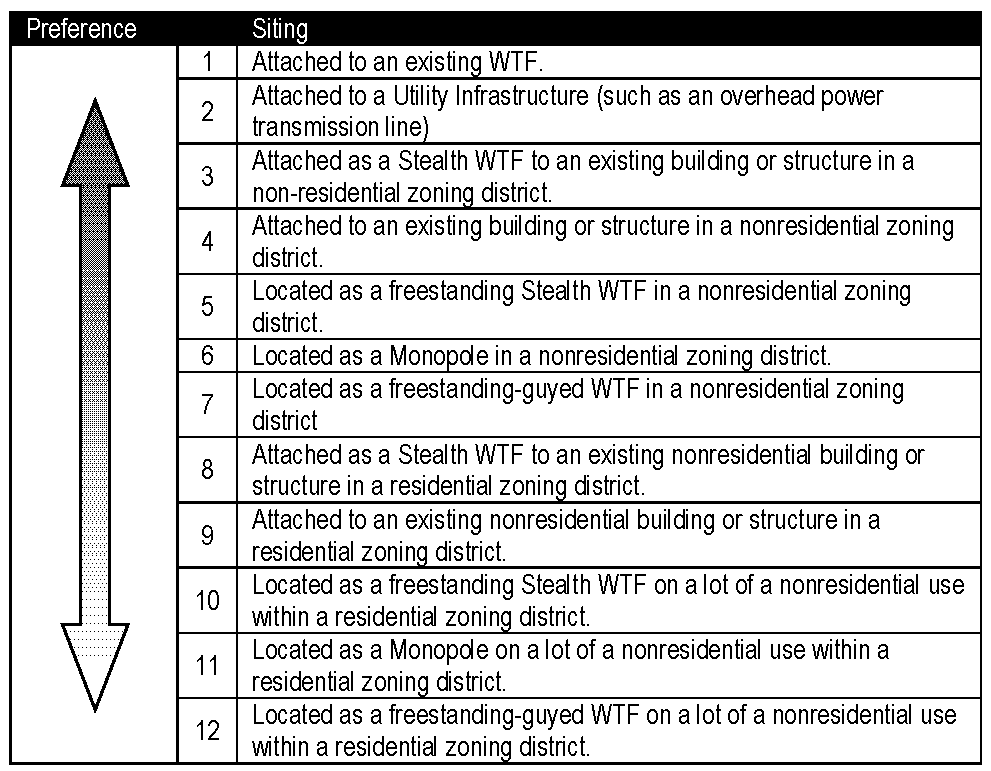
(b)
In determining the order of ranking preference, the facility/structure type shall be evaluated first, and only after the facility/structure type has been identified shall the location be evaluated. Where a lower ranked alternative is proposed, the applicant must file relevant information as indicated in paragraph 4 below, including, but not limited to an affidavit by a radio frequency engineer demonstrating that despite diligent efforts to adhere to the established hierarchy within the Geographic Search area, as determined by a qualified radio frequency engineer, higher ranked options are not technically feasible, practical, or justified given the location of the proposed WTF and the existing land uses of the subject property and surrounding properties within 300 feet of the subject property.
(c)
The WTF and all supporting cables and anchors shall be contained within one parcel.
(d)
When located in an SBR-6000 zoning districts, no minimum lot size shall be required, provided the proposed WTF is attached to an existing WTF or an existing building or structure.
iii.
Dimensions
WTFs shall conform to the following dimensional requirements:
(a)
Height
(1)
Attached WTF: The top of the WTF may not be more than 30 feet above the building or structure to which it is attached.
(2)
Freestanding WTF Measurement: This measure shall include the foundation of the WTF, but exclude lightning rods for the dissipation of lighting or lights required by the FAA that do not provide support for any antennae.
(3)
Freestanding WTF in Residential Districts: In the RR District, the maximum height shall be 250 feet. In the R-7500, R-6000, and SBR-6000 Districts, the maximum height shall be 200 feet. However, increases in height of up to 20% may be allowed by Board of Adjustment as part of the special use permit approval with a certification by a registered engineer that the setbacks provide adequate fall area in case of a tower collapse.
(4)
Freestanding WTF in Nonresidential Districts: In the N-C District, the C-I and C-LD, and all other nonresidential districts the maximum height shall be 300 feet. However, increases in height of up to 20% may be allowed by Board of Adjustment as part of the special use permit approval with a certification by a registered engineer that the setbacks provide adequate fall area in case of a tower collapse.
(5)
Mitigation of an existing WTF (see paragraph 6 "Mitigation" on page 5-50). The maximum height of a new WTF arising from mitigation shall not exceed 125% of the height of the tallest WTF that is being mitigated.
(b)
Setbacks
(1)
Attached WTF: The building or structure to which the WTF will be attached shall maintain the normal setbacks of the district.
(2)
Freestanding Concealed WTF: In the N-C district and all residential districts, setbacks shall be determined according to the underlying zoning district, plus an additional six inches for every one-foot of tower height. In all other districts, setbacks for WTFs shall be determined according to the underlying zoning district.
(3)
Freestanding Nonconcealed WTF: Setbacks for WTFs shall be determined according to the underlying zoning district, plus an additional six inches of setback (on each side) for every one-foot of tower height. The Board of Adjustment may approve reductions to this setback requirement as a part of the special use permit approval with a certification by a registered engineer that the resulting setbacks provide adequate fall area in case of a tower collapse.
(4)
Mitigation of an existing WTF: A new WTF approved as mitigation shall not be required to meet setback requirements so long as the new WTF is no closer to any property lines or dwelling units as the WTF being mitigated.
Commentary: Refer to Section 4.3.3.B for the underlying zoning district setbacks for WTFs proposed in residential zoning districts. See Section 4.5.3.B for the underlying zoning district setbacks in commercial zoning districts. See Section 4.6.3.B for the underlying zoning district setbacks in industrial zoning districts.
(c)
Buffers
(1)
A landscaped buffer shall surround the base of the WTF equipment compound. Existing trees and shrubs on the site should be preserved and may be used in lieu of required landscaping where approved by the Planning Director. Grading shall be minimized and limited only to the area necessary for the new WTF.
(2)
If the proposed WTF is the principal use of the property then landscaping per Section 6.2, Landscaping and Buffering, shall apply. Additionally, when a freestanding nonconcealed WTF is located in a residential district, a buffer with opacity 0.8 (80%) shall be provided around the WTF equipment compound.
(3)
If the proposed WTF is to be located in front of an existing structure on the same lot, a street buffer (see Section 6.3.2.A) shall also be required.
iv.
Aesthetics
(a)
Stealth attached WTFs, including feed lines and antennae, shall be designed so as to be compatible with the facade, roof, wall or structure on which it is affixing so that it matches the existing structural design, color and texture.
(b)
Freestanding WTFs shall be designed so as to be compatible with neighboring structures and landscapes to the extent feasible with specific design considerations as to height, scale, color and texture.
(c)
Commercial messages may not be displayed on any WTF.
4.
Application Requirements
In addition to all of the requirements of Section 3.2, Site Plan Review, and Section 3.5, Special Use Permit (if required), the following information must be supplied with the site plan and special exception permit (if required) application for WTFs:
i.
Identification of the intended user(s) of the WTF.
ii.
A report of diligent efforts to locate based on the hierarchy established elsewhere in this Section.
iii.
Certification by a registered engineer that, in the event of a collapse, the proposed WTF facility has been engineered to fall in a radius of less than the provided setback.
iv.
Certification by a registered engineer or other qualified professional regarding service gaps or service expansions that are addressed by the proposed WTF ("the proposed service"), and accompanying maps and calculations.
v.
(In the case of a new WTF) Evidence that no existing WTF can accommodate the applicant's proposed antenna(e); or that use of such existing WTFs would prohibit personal wireless services in the area of the County to be served by the proposed WTF structure. Evidence may consist of any of the following:
(a)
No existing wireless communications facilities located within the Geographic Search Area meet the applicant's engineering requirements.
(b)
Existing wireless communications facilities are not of sufficient height to meet the applicant's engineering requirements, and cannot be increased in height.
(c)
Existing wireless communications facilities do not have sufficient structural strength to support the applicant's proposed wireless communications facilities and related equipment, and the existing facility cannot be structurally improved at a reasonable cost.
(d)
Other limiting factors that render existing wireless communications facilities unsuitable.
vi.
A report regarding the adequacy of alternative existing facilities or the mitigation of existing facilities to meet the applicant's need or the needs of the service providers desiring to locate on the proposed WTF, if the applicant is not a service provider, and the reasons these existing facilities cannot be used. Alternative existing facilities include all potentially useable utility distribution towers and other elevated structures within the proposed service area that would provide additional service to the users of the WTF. Documentation included in the report may include such things as calculations regarding coverage capability of supporting necessary equipment, or other relevant data; lease negotiations; or other information. Technical data included in such documentation shall be certified by a registered engineer or other qualified professional. The report shall include, in narrative form, the feasibility of any alternatives the applicant may have considered and their impact on neighboring properties, including, but not limited to:
(a)
Height;
(b)
Configuration;
(c)
Location;
(d)
Mass and scale;
(e)
Materials and color;
(f)
Illumination; and
(g)
Information addressing the following items:
(1)
The extent of any commercial development within the Geographic Search Area of the proposed facility;
(2)
The proximity of the antenna support structure to any residential dwellings;
(3)
The proximity of the antenna support structure to any public buildings or facilities; and
(4)
The existence of tall and like antenna support structures within the Geographic Search Area of the proposed structure.
vii.
Certification that the facility meets or exceeds applicable American National Standards Institute (ANSI) standards as adopted by the FCC in order to protect the public from unnecessary exposure to electromagnetic radiation
viii.
A statement that the proposed facility is the Least Visually Obtrusive, as defined herein, and that the proposed facility conforms with State of the Art, as defined herein, or alternatively, that State of the Art technology is unsuitable for the proposed facility. Costs of State of the Art technology that exceed customary facility development costs shall not be presumed to render the technology unsuitable.
Commentary: Certification by a registered engineer that the WTF has sufficient structural integrity to accommodate multiple users, and the number of additional users that can be accommodated on the proposed WTF will be required in conjunction with the building permit application and approval process.
5.
Third Party Review
Where due to the complexity of the methodology or analysis required to review an application for a wireless communication facility, the Planning Director may require the applicant to pay for a technical review by a third party expert, the costs of which shall be in addition to other applicable fees. Based on the results of the expert review, the approving authority may require changes to the applicant's application or submittals.
6.
Mitigation
The intent of WTF mitigation is to reduce the number of WTFs (especially nonconforming facilities) and replace existing WTFs with new facilities to improve network functionality and increase overall compliance with this Section. To qualify as WTF mitigation, a proposal shall accomplish a minimum of one of the following:
i.
Reduce the number of overall WTFs;
ii.
Reduce the number of nonconforming WTF types; or,
iii.
Replace an existing WTF with a new WTF resulting in compliance with this section.
7.
Approval Authority
i.
The Planning Director shall be responsible for WTF approvals.
ii.
In determining whether a WTF is in harmony with the area, or the effects and general compatibility of a WTF with neighboring properties, the staff may consider the aesthetic effects of the WTF as well as mitigating factors concerning aesthetics. The Planning Director may disapprove an application on the grounds that the WTFs aesthetic effects are unacceptable, or may condition approval on changes in WTF height, design, style, buffers, or other features of the WTF or its surrounding area. Such changes need not result in performance identical to that of the application. Factors relevant to aesthetic effects are: the protection of the view in sensitive or particularly scenic areas and areas specially designated in adopted plans such as unique natural features, scenic roadways and historic sites, the concentration of WTFs in the proposed area, and whether the height, design, placement or other characteristics of the proposed WTF could be modified to have a less intrusive visual impact.
8.
Construction and Operation
i.
WTFs shall be constructed and maintained in conformance with all applicable building code requirements.
ii.
WTFs may not interfere with normal radio and television reception in the vicinity.
iii.
Lighting may not exceed the FAA minimum standard. Lights shall be oriented so as not to project directly onto surrounding residential property, consistent with FAA requirements.
iv.
The WTF equipment compound may not be used for the storage of any excess equipment or hazardous materials, nor be used as habitable space. No outdoor storage yards shall be allowed in a WTF equipment compound.
9.
Interference with Public Safety Communications
i.
In order to facilitate the County's regulation, placement, and construction of WTFs and their interaction with the County's Public Safety and Emergency Services Communications Equipment, all applicants requesting a permit for a WTF under this section shall agree in a written statement, to the following:
(a)
Compliance with Good Engineering Practices as defined by the FCC in its Rules and Regulations;
(b)
Compliance with FCC regulations regarding susceptibility to radio frequency interference (RFI), frequency coordination requirements, general technical standards for power, antenna, bandwidth limitations, frequency stability, transmitter measurements, operating requirements, and any and all other federal statutory and regulatory requirements relating to RFI; and
(c)
In the case of co-location of telecommunications facilities, the applicant, together with the owner of the site, shall provide a composite analysis of all users of the site to determine that the applicant's proposed facilities will not cause RFI with the County's Public Safety and Emergency Services Communications Equipment.
ii.
When a specific base station is identified as causing RFI with the County's Public Safety and Emergency Services Communications Equipment, the following steps shall be taken:
(a)
Upon notification by the County of interference with Public Safety and Emergency Services Communications equipment, the owners of the WTF equipment shall utilize the hierarchy and procedures set forth in the FCC's Wireless Telecommunications Bureau's Best Practices Guide. If the WTF owner fails to cooperate with the County in applying the procedures set forth in the Best Practices Guide in order to eliminate the interference, then the County may take steps to contact the FCC to eliminate the interference.
(b)
If there is a determination of RFI with the County's Public Safety and Emergency Services Communications Equipment, the party which caused the interference shall be responsible for reimbursing the County for all costs associated with ascertaining and resolving the interference, including, but not limited to, any engineering studies obtained by the County to determine the source of the interference.
P.
Amateur Wireless Facility
Non-commercial, amateur, ham radio or citizen's band antenna supporting structures, antennas or antenna arrays with an overall height less than 90 feet in all zoning districts may be developed in accordance with standards for Accessory Structures and Uses in Section 5.4 and the following additional requirements. Said facility shall be accessory to a legal, principal use on a site (e.g. residence).
1.
Structures, excluding towers, shall meet the setback requirements for accessory uses for the zoning district in which the proposed facility shall be located. Towers shall meet the setback requirements for accessory uses for the zoning district in which the proposed facility shall be located or 100% of the tower height, whichever is greater.
2.
Applicant shall commit in writing that the facility will be erected in accordance with manufacturer's recommendations.
Non-commercial, amateur, ham radio or citizen's band antenna support structures, equal to or greater than 90 feet shall be regulated in accordance with the Standards for Wireless Telecommunication Facilities found in Section 5.3.4.O. of this Ordinance.
Q.
Solar Farm
A Solar Farm shall be permitted in accordance with Section 5.2., subject to the following:
1.
Reserved
2.
Setbacks
Solar farms shall meet the minimum zoning setbacks for the zoning district in which located.
Solar farm equipment/structures, not including perimeter fencing, shall meet the following minimum setbacks:
(a)
Thoroughfare roads - 200 feet
(b)
Residential district or residential uses - 100 feet
(c)
Institutional uses - 100 feet
(d)
Commercial districts or uses - 50 feet
(e)
Industrial districts - 25 feet
(f)
Minimum 500 feet from Scenic Byways
3.
Height
20 feet maximum.
4.
Screening & Buffering
(a)
Solar farms shall require screening and buffering as follows:
(i)
Street yard screening and buffer: Section 6.3.8. with Required Opacity 1.0 per Section 6.3.9.A.4.
(ii)
All other yard screening and buffers: Section 6.3.9. with Required Opacity 0.6 per Section 6.3.9.A.4.
(iii)
Where possible, existing vegetation should be utilized for screening and buffer.
(b)
Native evergreen shrubs and trees, such as wax myrtles, magnolias, red cedar, and holly species, should be used to reduce weed growth around the tree base and to control weeds in the screening area.
(c)
A buffer as wide as possible from areas managed for conservation purposes should be maintained to avoid conflict with controlled burning of such managed areas.
5.
Installation and Design
(a)
Approved Solar Components—Electric solar energy system components must have a UL listing and must be designed with anti-reflective coating(s).
(b)
Compliance with Building and Electrical Code—All solar farms shall meet all requirements of the North Carolina Building Codes.
Commentary: Compliance with the North Carolina Building Codes includes meeting the wind load requirements for Brunswick County, which are 120 miles per hour on the western side of US 17 (Ocean Highway) and 130 miles per hour on the eastern side of US 17.
(c)
Grading and tree removal on the site should be minimized.
(d)
Natural Heritage Natural Areas should be avoided.
(e)
Minimum separation of 100 feet from named streams and rivers; and 50 feet from 404 wetlands is encouraged whenever possible.
(f)
Use of native, low-growing grasses and flowers either before (optimal) or after panel installation are strongly recommended.
(g)
Solar farms should be positioned such that they do not completely cut-off wildlife corridors.
Commentary: The N.C. Wildlife Resources Commission provides free, non-regulatory technical guidance regarding several solar farm designs. Suggestions include how to best establish low-growing native plant ground cover, security wildlife fencing and other solar farm features. Natural Heritage Natural Areas is a map layer available on the Brunswick County GIS website.
6.
Application Requirements
(a)
A site plan denoting the dimensions of the parcel, proposed solar farm location (arrangement of panels), distance from the proposed area to all property lines and location of the driveway(s). No portion of the system area may encroach into the required setbacks and any buffer area(s).
(b)
The site plan should also show any street buffer(s) and any project boundary buffer(s).
(c)
Horizontal and vertical (elevation) to-scale drawings with dimensions. The drawings must show the location of the system on the property.
(d)
State and Local Stormwater permits may be required based upon ground cover.
(e)
If applicable, the applicant must apply and receive from the North Carolina Department of Transportation (NCDOT) a driveway permit, or submit documentation from NCDOT that the existing site access is acceptable for the required use prior to final project approval.
(f)
Maintenance and Security Plan
An approved Maintenance and Security Plan is required for all Solar Farm facilities. The Plan shall, at a minimum, include the following:
(i)
Environmentally-friendly vegetative management practices to be employed; use of herbicides should be avoided; provided however, spot herbicide treatment may occasionally be needed to deter growth of new trees on the site.
(ii)
Incorporate the elements and principles from N.C. Wildlife Resources Commission publication 'Recommendations for Establishing Native Pollinator Habitat on Solar Farms in North Carolina.'
(iii)
Utilize security wildlife fencing as recommended by the N.C. Wildlife Commission; minimum seven feet in height with no barbed wire.
(iv)
Landscape screening, fencing, gates, and warning signs shall be maintained in good condition until the facility is decommissioned.
(g)
Decommissioning Plan
An approved Decommissioning Plan is required for all Solar Farm facilities. The Plan shall, at minimum, include the following:
(i)
The decommissioning obligation shall be part of the lease between the property owner and developer. The obligation shall be reviewed by County staff for compliance with standards listed below prior to signatures by party responsible for decommissioning and the landowner (if different) and recordation in the County's Registry of Deeds. Decommissioning Obligation shall include:
(1)
Removal of solar panels, buildings, cabling, electrical components, roads, and any other associated facilities down to 36 inches below grade.
(2)
Disturbed earth shall be re-seeded, unless the landowner requests in writing that the access roads or other land surface areas not be restored.
(3)
Description of any agreement (e.g. lease) with landowner regarding decommissioning and acknowledgment by the land owner, that land owner shall be held ultimately responsible for decommissioning.
(4)
List the type of panels, storage facilities and material specifications being utilized at the site.
(5)
The identification of the party currently responsible for decommissioning.
(6)
Estimated cost of removal prepared by a licensed engineer.
(7)
Prior to issuance of the building permit, approved decommissioning obligation shall be recorded in the County Registry of Deeds and shall run with the land until decommissioning is completed.
(ii)
Decommissioning Obligation shall be updated upon change of ownership and re-recorded in the County's Registry of Deeds.
(iii)
The County shall periodically require proof of the continuous operation of the solar farm from the applicant/owner.
(iv)
The solar farm shall have 12 months to complete decommissioning of the solar facility if no electricity is generated for a continuous period of 12 months. For the purpose of this section, this 12-month period shall not include delay resulting from force majeure. Failure to timely decommission the site in accordance with the obligation shall result in all actions available at law or in equity, including, but not limited to; Breach of contract, specific performance, mandatory injunctions, fines, abatement, nuisance, liens, assessments and judicial sale of the property.
R.
Wind Farms
Wind Farms developed as a principal use shall be permitted in accordance with Section 5.2., subject to the following:
1.
Setbacks
Wind turbines must be setback from all property lines a distance equal to two and one-half (2.5) linear feet for every foot of height of the turbine. All other structures must be setback consistent with the setback requirements for the zoning district in which it is located.
2.
Height
Five hundred feet (500') maximum.
3.
Rotor blades on wind turbines must maintain at least twenty-four feet (24') of clearance between their lowest point and the ground.
4.
Visibility
(a)
Wind farms with wind turbines located at least 150 feet from an adjacent public street right-of-way, residentially-zoned property, or residential use shall not require screening.
(b)
Wind farms with wind turbines located less than 150 feet from an adjacent public street right-of-way, residentially-zoned property, or residential use must meet the requirements of Section 6.3.8, Street Buffers and Section 6.3.9, Project Boundary Buffers.
5.
Wind Farm Facility Noise, Shadow Flicker, and Electromagnetic Interference
(a)
Audible sound from a Wind Turbine shall not exceed fifty-five (55) dBA, as measured at any occupied building of a Non-Participating Landowner.
(b)
Shadow flicker at any occupied building on a Non-Participating Landowner's property caused by a Wind Energy Facility located within 2,500 feet of the occupied building shall not exceed thirty (30) hours per year.
(c)
Wind turbines may not interfere with normal radio and television reception in the vicinity. The applicant shall minimize or mitigate any interference with electromagnetic communications, such as radio, telephone or television signals caused by any wind energy facility.
6.
Application Requirements
(a)
Identification and location of the property on which the proposed wind farm will be located.
(b)
A site plan denoting the dimensions of the parcel, proposed wind farm location (arrangement of turbines and related equipment), distance from the proposed area to all property lines and location of the driveway(s). No portion of the wind farm area may encroach into the required setbacks and any buffer area(s).
(c)
The site plan should also show any street buffer(s) and any project boundary buffer(s).
(d)
The representative type and height of the wind turbine in the form of horizontal and vertical (elevation) to-scale drawings, including its generating capacity, dimensions and respective manufacturer, and a description of ancillary facilities.
(e)
Evidence of compliance with applicable Federal Aviation Administration regulations.
(f)
State and Local Stormwater permits may be required based upon ground cover.
(g)
If applicable, the applicant must apply and receive from the North Carolina Department of Transportation (NCDOT) a driveway permit, or submit documentation from NCDOT that the existing site access is acceptable for the required use prior to final project approval.
(h)
An applicant for a site permit shall include with the application an analysis of the potential impacts of the wind power project, proposed mitigative measures, and any adverse environmental effects that cannot be avoided, in the following areas:
i.
Demographics including people, homes, and businesses.
ii.
Noise.
iii.
Visual impacts.
iv.
Public services and infrastructure.
v.
Cultural and archaeological impacts.
vi.
Recreational resources.
vii.
Visual impacts.
viii.
Public services and infrastructure.
ix.
Cultural and archaeological impacts.
x.
Recreational resources.
xi.
Topography.
xii.
Soils.
xiii.
Geologic and groundwater resources.
xiv.
Surface water and floodplain resources.
xv.
Wetlands.
xvi.
Vegetation.
xvii.
Avian, impact assessment that includes an indication of the type and number of birds that are known or suspected to use a project site and the area surrounding that site.
xviii.
Wildlife.
xix.
Rare and unique natural resources.
(i)
The applicant shall state in the application whether a Certificate of Public Convenience and Necessity for the system is required from the North Carolina Utilities Commission and, if so, the anticipated schedule for obtaining the certificate. The County may ask the Utilities Commission to determine whether a Certificate of Public Convenience and Necessity is required for a particular wind power project for which the County has received an application. The County shall not approve a project requiring a certificate unless and until such certificate is issued by the Utilities Commission. If a certificate is not required from the Utilities Commission, the permit shall include with the application a discussion of what the applicant intends to do with the power that is generated.
7.
Installation and Design
(a)
The installation and design of the Wind Farm shall conform to applicable industry standards, including those of the American National Standards Institute.
(b)
All electrical, mechanical and building components of the Wind Farm shall be in conformance with the North Carolina Building Codes.
Commentary: Compliance with the North Carolina Building Codes includes meeting the wind load requirements for Brunswick County, which are 120 miles per hour on the western side of US 17 (Ocean Highway) and 130 miles per hour on the eastern side of US 17 (Ocean Highway).
(c)
Any on-site collection and distribution lines shall, to the maximum extent possible, be installed underground.
(d)
Attachment to a building of any kind shall be prohibited.
8.
Visual Appearance
(a)
The wind turbine shall be constructed of a corrosion resistant material that will not fade, show rust spots or otherwise change the appearance as a result of exposure to the elements and be a non-obtrusive color such as white, off-white or gray; and
(b)
The wind turbine shall not be artificially lit, except to the extent required by the Federal Aviation Administration or other applicable authority that regulates air safety.
9.
Any Wind Farm that is not functional shall be repaired by the owner within a 6 month period or be removed. In the event that the County becomes aware of any wind farm that is not operated for a continuous period of 6 months, the County will notify the landowner by certified mail and provide 30 days for a written response. In such a response, the landowner shall set forth reasons for the operational difficulty and provide a reasonable timetable for corrective action. If the County deems the timetable for corrective action as unreasonable, the County shall notify the landowner and such landowner shall remove the turbine(s) with 180 days of receipt of said notice. Any disturbed earth shall be graded and re-seeded, unless the landowner requests in writing that the access roads or other land surface areas not be restored.
10.
Decommissioning
(a)
The applicant must remove the Wind Farm if, after the completion of the construction, the Wind Farm fails to begin operation, or becomes inoperable for a continuous period of one (1) year.
(b)
The one-year period may be extended upon a showing of good cause to the Brunswick County Board of Adjustment.
(c)
The applicant must provide to the County a form of surety equal to 125% of the entire cost, as estimated by the applicant and approved by the Director of Engineering Services, either through a surety performance bond, irrevocable letter of credit or other instrument readily convertible into cash at face value, either with the County or in escrow with a financial institution designated as an official depository of the County, to cover the cost of removal in the event the applicant is unable to perform any required removal and the County chooses to do so. Following initial submittal of the surety, the cost calculation shall be reviewed every 12 months by the applicant and adjusted accordingly based upon the estimated decommissioning costs in current dollars. The adjustment must be approved by the Director of Engineering Services.
(Ord. No. UDO-16-02 , § 18, 3-7-16; Ord. No. UDO-18-01 , § 2, 3-19-18; Ord. No. UDO-19-02 , § 11, 9-19-19; Ord. No. UDO-21-01 , §§ 26—28, 5-17-21)
5.3.5. Commercial Uses
A.
Adult and Sexually Oriented Businesses
Adult and sexually oriented businesses shall be permitted in accordance with the use tables in Section 5.2, subject to the following:
1.
Authority
The provisions of these regulations are adopted by the Brunswick County Board of Commissioners under authority granted by the General Assembly of the State of North Carolina, in N.C.G.S. 160D-902. From and after the effective date and hereof, these regulations shall apply to every building, lot, tract, or parcel of land within Brunswick County.
2.
Intent
It is recognized that there are some uses which, because of their very nature, are recognized as having serious objectionable operational characteristics, particularly when several of them are concentrated under certain circumstances, thereby having a deleterious effect upon neighboring areas. Special regulation of these uses is necessary to insure that these adverse effects will not contribute to the blighting or downgrading of the surrounding neighborhood. For the purpose of promoting the health, safety, morals and general welfare of the citizenry of Brunswick County, this article is adopted by the Board of Commissioners to regulate adult and sexually oriented businesses, as hereby defined, located in the jurisdiction of the county. Further the regulations of this article have been made with reasonable consideration, among other things, as to the character of the County and its areas and their peculiar suitability for these businesses.
3.
Abrogation
These regulations shall not repeal, impair, abrogate or interfere with any existing easements, covenants, deed restrictions, setback requirements, rules, definitions, regulations previously adopted pursuant to law in any established zoning district in Brunswick County. However, where these regulations impose greater restrictions, the provisions of these regulations shall govern.
4.
Application of Regulations
Adult and sexually oriented businesses shall be regulated as to location in the following manner in addition to any other requirements of this code:
i.
No adult or sexually oriented business shall be permitted in any building located within 1,500 feet, measured in any direction, from:
(a)
A building used as a dwelling.
(b)
A building in which an adult business or a sexually oriented business is located.
(c)
A building used as a church, synagogue, other house of worship or cemeteries.
(d)
A building used as a public school or as a state licensed day care center.
(e)
Any lot or parcel on which a public playground, public swimming pool, or public park is located.
(f)
Any publicly owned or operated facility.
ii.
No more than one adult or sexually oriented business establishment shall be located in the same building or structure or on the same lot.
iii.
All minimum lot requirements of the I-G Zoning District shall be met.
iv.
Except for signs as permitted in Article 8, promotional displays and presentations shall not be visible to the public from sidewalks, walkways or streets.
5.
Nonconforming Adult Business and Sexually Oriented Businesses
Any adult business or sexually oriented business lawfully operating as of the May 1, 2007 that is in violation of any provision of this Ordinance shall be deemed a nonconforming use. Any use which is determined to be nonconforming by application of the provisions of this section shall be permitted to continue for a period not to exceed two years. Such nonconforming uses shall not be increased, enlarged, extended or altered, except that the use may be changed to a conforming use. If a nonconforming use is discontinued for a period of 180 days or more it may not be reestablished. If two or more adult businesses or sexually oriented adult businesses are within 1,500 feet of one another and otherwise in a permissible location, the business which was first established and continually operating at its present location shall be considered the conforming use and the later established business(es) shall be considered nonconforming. An adult business or sexually oriented adult business lawfully operating as a conforming use shall not be rendered nonconforming by the subsequent location of a dwelling, church, house of worship, day care center, school, playground, public swimming pool or public park.
B.
Car Wash
Car washes shall be permitted in accordance with the use tables in Section 5.2, subject to the following:
1.
No storage, repair, or sales of vehicles shall be allowed on the site.
2.
Provisions shall be made for an on-site drainage system to capture water used to wash vehicles; or provide connections to an approved sanitary sewer system.
3.
Vehicle stacking shall be provided as required by Section 6.12.8, Vehicle Stacking Areas.
C.
Commercial Parking Facilities
Commercial parking facilities shall be permitted in accordance with the use tables in Section 5.2, subject to the following:
1.
The facility shall be landscaped in conformance with the vehicular use area landscaping (Section 6.12.10) in addition to the landscaping and buffering standards in Article 6.
2.
No storage, repair, or sales of vehicles shall be allowed on the site.
3.
Driveways shall be designed with sufficient depth (20 feet minimum) to prevent vehicles from backing up into the street when entering.
4.
Adequate lighting shall be provided in conformance with Section 6.9, Outdoor Lighting.
D.
Commercial Recreational Facilities and Uses
Commercial recreational facilities and uses shall be permitted in accordance with the use tables in Section 5.2, subject to the following:
1.
All food sales shall be for customers of the recreational facility. Off-site sale of food shall not be permitted.
2.
When located in the CP District, only one enclosed facility is allowed, not to exceed 5,000 square feet in area. Retail sales shall be limited to those directly related to the recreational activity (e.g. public or private kayak launch, sales, and rental facility).
E.
Drive-Through Facility
Drive-through facilities shall be permitted in accordance with the use tables in Section 5.2, subject to the following:
1.
The primary presence along the major street frontage should be the building, not the menu board, drive-through aisle, or parking lot.
2.
Where no street separates the use and a residentially zoned property, at least 40 feet of separation shall be maintained between the residential lot line and the drive-through facility.
3.
The location of drive-through windows and associated facilities (for example: communications systems and access aisles) shall be identified on all site plans. Drive through menu signs shall be identified on all site plans.
4.
Any speaker systems associated with a drive-through facility shall be designed and located so as not to adversely affect adjoining uses.
5.
Drive-through alleys between the right-of-way of a roadway and a building shall require a parking buffer pursuant to Section 6.12.10 if the drive-through alley is within 50 feet of, and visible from, the roadway. Such buffer shall be installed and maintained along the entire length of the drive-through alley and the adjoining roadway.
6.
Vehicle stacking areas shall be provided in accordance with Section 6.12.8, Vehicle Stacking Areas.
F.
Golf Course
Golf courses shall be permitted in accordance with the use tables in Section 5.2, subject to the following:
1.
Instructional facilities such as golf training shall be allowed.
2.
Retail pro shops, restaurants, conference centers and other uses shall be considered a separate principal use and may be allowed to operate in conjunction with the facility where permitted in the use table (see Section 5.2), subject to any restrictions on those uses.
G.
Hotels, Motels
Hotels and motels shall be permitted in accordance with the use tables in Section 5.2, subject to the following:
1.
The parcel shall be directly accessible to a major or minor thoroughfare.
2.
All hotel and motel buildings and vehicular use areas shall be located at least 50 feet from any property line adjoining a residential district or use.
3.
Any accessory commercial activities such as restaurants shall not be located along the side of the property adjoining a residential district or use.
4.
Any outdoor recreation facilities, such as swimming pools, shall not be located along the side of the property adjoining a residential district or use. If the outdoor recreation facility is a swimming pool, it shall meet the standards of Section 5.4.8, Swimming Pools, with regard to fencing.
5.
A permit to sell alcohol shall be required for all alcohol sales operations associated with a hotel, motel, or other overnight accommodation.
H.
Mobile and Modular Home Sales and Services
Mobile and modular home sales lots shall be permitted in accordance with the use tables in Section 5.2, subject to the following:
1.
If a Special Use permit is required, on site sales office must be in operation within 180 days of the date of the Special Use or the Special Use becomes null and void.
2.
Storage and repair area(s) shall be screened from view. Replacement or discarded parts and accessories shall also be screened from view.
3.
Shall conform to sign regulations of the zoning district in which the use is located. In addition, each display home may have an informational sign not to exceed three square feet in area, directly adjoining the home, which gives information about the home.
4.
Display homes shall maintain a minimum separation of at least 10 feet between each home. Display homes shall be leveled and blocked.
5.
Display homes, which are visible from the street right-of-way, shall be provided with some type of material and/or landscaping around the base which will prevent open views underneath the display home. Access to the display homes shall be through a stairway or other means that has a permanent appearance.
6.
The property owner is responsible for the removal of any vestige upon cessation of the business, including signage. Per G.S. 153A-140, should the property owner decline removal, such situations may be declared a "public nuisance".
I.
Military Auxiliary Service Clubs and Halls (VFW, USO, etc.)
Military auxiliary service clubs and halls shall be permitted in accordance with the use tables in Section 5.2, subject to the following:
J.
Nightclub, Tavern, or Bar
Nightclubs, taverns, or bars shall be permitted in accordance with the use tables in Section 5.2, subject to the following:
1.
The applicant shall demonstrate that no existing place of worship is located within 250 feet of the proposed nightclub or similar establishment. Measurements shall be made from the property line of the proposed establishment and from the property line of any separate parking lots to be used by the nightclub or similar establishment along the shortest straight line that may be drawn on a map.
2.
No outside storage shall be allowed on the site.
K.
Outdoor Sales or Display Areas, other than Mobile and Modular Home Sales Lots, and Vehicle and Heavy Equipment Sales, Service and Rentals
Outdoor sales or display areas shall be permitted in accordance with the use tables in Section 5.2, subject to the following:
1.
The outdoor display area shall be located on the same property as the primary sales or rental area and shall be shown on an approved site plan.
2.
A transition area shall be established along any side of the property where a permanent outdoor sales or display area abuts or is across the street from a residential use or residential zoning district in a manner that is consistent with one of the alternatives in the table below.
3.
The merchandise shall not be located in any buffer area.
4.
Permanent sales or display areas shall not block sidewalks or parking areas, and may not impede vehicular or pedestrian traffic.
5.
Permanent outdoor sales or display areas may not be located in any required parking space.
6.
Adequate public restrooms and/or toilet facilities in accordance with the requirements of the North Carolina Building Codes apply.
L.
Personal Service Establishments
Personal service establishments shall be permitted in accordance with the use tables in Section 5.2, subject to the following:
M.
Private Club or Lodge (Private, Nonprofit, Civic or Fraternal)
Private clubs or lodges shall be permitted in accordance with the use tables in Section 5.2, subject to the following:
1.
If a proposed club or lodge is to be included in a development existing prior to May 1, 2007, a Special Use Permit (see Section 3.5) shall be required.
2.
In all subdivisions proposed on or after the May 1, 2007, a club or lodge may be allowed in compliance with the dimensional requirements in the table below (if applicable).
N.
Repair, Remodeling, And Renovation Of Farm Equipment, Whether For Profit Or As A Hobby:
Repair, remodeling, and renovation of farm equipment shall be permitted in accordance with the use tables in Section 5.2, subject to the following:
1.
Any such activity shall be kept at least 100 feet away from any property line which abuts the R-7500, R-6000, or SBR-6000 Zoning Districts.
O.
Restaurants
Restaurants shall be permitted in accordance with the use tables in Section 5.2, subject to the following:
1.
When located in the N-C District, a minimum lot width of 75 feet is required. Additionally, a minimum lot area of 10,000 square feet is required if the facility is not connected to public water and sewer. If connected to public water and sewer, the minimum lot area requirements of the base district apply.
2.
In all other districts where restaurants are permitted, the minimum lot width and area requirements of the base district shall apply.
3.
Drive through facilities shall be permitted separately as a principal use in accordance with the use table in Section 5.1 and the standards found in Section 5.3.5.E.
P.
Retail Stores, Sales, and Display Rooms and Shops > 10,000 sf
Retail stores, sales, and display rooms and shops shall be permitted in accordance with the use tables in Section 5.2, subject to the following:
1.
All individual uses with an enclosed floor area in excess of 60,000 square feet shall comply with Section 6.7.1, Large Scale Commercial.
2.
Retail sales development projects with an aggregate enclosed floor area in excess of 75,000 square feet shall be required to comply with Section 6.7.1, Large Scale Commercial.
3.
Permanent outdoor storage and display shall be permitted subject to the use table and the standards found in Section 6.22, Outdoor Display and Storage. Temporary outdoor display may be permitted subject to the standards found in Section 5.5.3.F.
4.
When vehicle service facilities are included as an accessory use to a primary retail use, such accessory service facilities should be located to the side or rear of the primary use. To the maximum extent possible, the accessory service facility should not be visible from the roadway.
Commentary: For example, if an auto center is associated with a larger retail store, the auto center shall be located to the side or rear of the larger store.
5.
Additional dimensional standards shall apply in certain zoning districts as follows:
6.
Drive through facilities shall be permitted separately as a principal use in accordance with the use table in Section 5.1 and the standards found in Section 5.3.5.E.
Q.
Retail Sales and Service in Industrial Establishments
Retail sales and service incidental to manufacturing or light industrial is permitted in the I-G and C-I districts subject to the following:
1.
Area devoted to retail sales and service must clearly be subordinate to manufacturing or light industrial activity.
2.
Must comply with parking requirements for retail sales; however, parking spaces may also be used to meet manufacturing or light industrial parking requirements.
3.
Signage for retail sales and service use limited to one building sign and one off-premise directional sign.
R.
Self-Storage/Mini-Storage Facility
1.
Vehicle sales, leasing, and rental shall be permitted separately as a principal use in accordance with the use table in Section 5.2 and the standards found in Section 5.3.5.S.
2.
All storage shall be contained within a fully-enclosed building. However, outdoor storage of boats, travel trailers, recreational vehicles, and other noncommercial occasional use vehicles may be permitted in conformance with Section 6.22, Outdoor Display and Storage, when located in a designated area. Said area shall be identified on all site plans.
3.
A landscaped buffer not less than 25 feet in width shall be established along any side of the property where the self-storage facility abuts or is across the street from a residential use.
4.
A 100 percent opaque barrier or screen between six and eight feet in height shall be provided around the perimeter of the property. Where the barrier of the self-storage facility is visible from a public right-of-way, the barrier shall be buffered by a hedge that has a mature height of at least four feet.
5.
Adequate lighting shall be provided in conformance with Section 6.9, Outdoor Lighting.
6.
The following activities shall be prohibited on the premises:
i.
Commercial, wholesale or retail sales, flea markets or peddling, or miscellaneous or garage sales. However, once a month, the management of the self-storage mini-warehouse complex may conduct a one-day auction or sale of abandoned or stored materials to settle unpaid storage bills in accordance with State of North Carolina regulations.
ii.
Servicing, repair, or fabrication or motor vehicles, boats, trailers, lawn mowers, appliances, or other similar equipment.
iii.
Operation of a transfer-and-storage business.
iv.
Operation of power tools, spray painting equipment, table saws, lathes, compressors, welding equipment, kilns, or other similar equipment except when needed for maintenance of the use.
v.
Any activity that is noxious or offensive because of odors, dust, noise, fumes, or vibrations.
vi.
Storage of hazardous chemicals, flammable liquids, or combustible and explosive materials.
vii.
Habitation of storage units by humans or animals.
S.
Vehicle and Heavy Equipment Sales, Leasing, and Rentals
Vehicle sales, leasing, and rentals shall be permitted in accordance with the use tables in Section 5.2, subject to the following:
1.
Automobile and light truck sales and rentals are permitted as an Accessory Use to a Vehicle Wrecking, Junk or Salvage Yard only in the I-G Zoning District.
2.
Junked or inoperable vehicles/heavy equipment shall not be on the premises unless such is within an enclosed building or screened area.
3.
Vehicle or equipment repairs made on-site shall be subject to the same restrictions under Section 5.3.5.T, Vehicle Service and Garage.
4.
Adequate on-site area shall exist for the loading and unloading of vehicles from car carriers to ensure that no such loading or unloading occurs in any public right-of-way.
5.
Vehicle sales, leasing, and rental facilities shall meet the following landscaping standards rather than those of Section 6.12.10, Vehicular Use Area Landscaping:
i.
Trees shall be planted at the rate of one tree per 75 linear feet, and shrubs at the rate of one shrub per ten linear feet of display area.
ii.
Plants may be grouped together, provided that at least 250 square feet of contiguous growing area, not encroached upon by impervious surfaces, surrounds each planted tree.
iii.
Project boundary buffers shall be provided as required by Section 6.3.9, Plantings required in paragraphs i. and ii. above may not be counted towards the project boundary planting requirements.
6.
The provisions of Section 6.22, Outdoor Display, shall not apply.
7.
Vehicles may not be located in any required yard or buffer area, even for temporary display purposes.
8.
Permanent vehicle sales areas may not be located in any required parking spaces.
9.
Vehicle sales or display areas may not block sidewalks or parking areas, and may not impede vehicular or pedestrian traffic.
10.
Adequate lighting shall be provided in conformance with Section 6.9, Outdoor Lighting.
11.
Aircraft and boat sales and rentals are permitted as an Accessory Use to an aircraft or boat manufacturing facility only in the I-G Zoning District.
T.
Garage Service and/or Automobile Repair
Vehicle service and garages shall be permitted in accordance with the use tables in Section 5.2, subject to the following:
1.
Fuel pumps shall be at least 15 feet from property lines.
2.
Any repair, servicing, maintenance or other work on vehicles shall be conducted within an enclosed structure or behind an opaque fence or wall.
3.
However, outdoor storage may be permitted in conformance with Section 6.22, Outdoor Display and Storage, when located in a designated area behind a 100% opaque wall or fence. Said area shall be identified on all site plans.
4.
Storage of customer vehicles, vehicles with expired tags, unlicensed vehicles, junk vehicles, or any vehicle not used in the conduct of business operations (tow trucks for example) for 15 days or more shall be prohibited.
U.
Veterinary Clinics, Animal Hospitals, and Kennels
Veterinary clinics, animal hospitals, and kennels shall be permitted in accordance with the use tables in Section 5.2., subject to the following:
1.
In the RR district, the use shall be permitted as a limited use subject to the standards in this Section.
2.
A 300-foot separation shall be maintained between the outdoor areas where animals are kept and any property line of any adjacent residential use in a residential district.
3.
A minimum six-foot high wall shall be installed and maintained between outdoor areas where animals are kept and any property line of an adjacent residential use in a non-residential district.
4.
The facility shall be constructed, designed, and located on the site to minimize noise, odor, and other impacts on neighboring properties. Adequate waste disposal shall be required to maintain sanitary conditions and control odor.
5.
All facilities shall be licensed by the Animal Health Division of the North Carolina Department of Agriculture and Consumer Services, Article 3, and all other required permits or certificates shall be acquired and maintained.
V.
Flea Market
Flea Markets shall be permitted in accordance with the use table in Section 5.2., subject to the requirements of this Ordinance and the following:
1.
The flea market site shall contain sufficient land area to meet all applicable design standards;
2.
The parcel shall be directly accessible to a public or private road;
3.
Parking spaces and aisle(s) shall be adequately delineated and separated from vendor areas to ensure safe circulation;
4.
No vehicle storage, vehicle repair and/or sales of vehicles shall be allowed on the site;
5.
The outdoor display area shall be located on the same property as the primary sales or rental area and shall be shown on an approved site plan;
6.
Buffering must be provided at 0.6 opacity, consistent with the requirements outlined in Section 6.3.9.A "Buffer Alternatives" of the UDO, for any side of the property that abuts or is across the street from a residential zoning district or residential use. The Board of Adjustment may reduce this requirement if the flea market operation does not include outdoor sales space;
7.
Merchandise displayed outdoors shall not be located in any buffer area;
8.
Unless specifically approved in a site plan, an outdoor sound or public address system is not permitted;
9.
Adequate public restrooms and/or toilet facilities in accordance with the requirements of the North Carolina Building Codes apply;
10.
Permanent sales or display areas shall not block sidewalks or parking areas, and may not impede vehicular or pedestrian traffic;
11.
Permanent outdoor sales or display areas may not be located in any required parking spaces;
12.
Open-air flea markets may store tables, stands and/or other display equipment on-site in a permitted accessory structure. Enclosed flea markets may store tables, stands and/or other display equipment within their assigned area with the permission of the property owner/manager. Otherwise, all tables, stands and/or other display equipment and all vehicles shall be removed from the parcel any time that the flea market is not open to the public;
13.
No overnight camping or permanent occupancy shall be permitted unless specifically authorized in an approved site plan;
14.
Hours of operation shall be limited to 7:00 a.m. through 7:00 p.m. 7 days per week; and
15.
All outdoor lighting must be consistent with Section 6.9, "Outdoor Lighting" of the UDO.
W.
Electronic Gaming Operation
Electronic Gaming Operations shall be permitted in accordance with the use tables in Section 5.2., subject to the following:
1.
Electronic Gaming Operations shall be regulated as to location in the following manner in addition to any other requirements of the UDO:
i.
Electronic gaming operations shall be located a minimum of 1,500 feet measured in any direction, from:
(a)
A place of worship or other religious institution.
(b)
A day care center, public or private school.
(c)
A public park, playground, public library, cemetery.
(d)
A skating rink, video arcade, or motion picture theater which shows G or PG-rated movies to the general public on a regular basis.
(e)
Electronic gaming operations, tattoo and body piercing establishments or adult and sexually oriented businesses.
2.
Hours of operation shall be limited to 8:00 a.m. through 12:00 Midnight, 7 days per week.
3.
The maximum number of machines/terminals/computers for any electronic gaming operation business is 20.
4.
Off-Street Parking must comply with Section 6.12. of the UDO.
X.
Convenience Store
Convenience stores shall be permitted in accordance with the use tables in Section 5.2., subject to the following:
1.
When located in the CP and MR-3200 Zoning Districts, convenience stores shall be limited to less than or equal to 10,000 square feet.
(Ord. of UDO-17-01 , § 17; Ord. No. UDO-19-02 , § 11, 9-19-19; Ord. No. UDO-21-01 , § 29, 5-17-21)
5.3.6. Office Uses
A.
Offices and Studios
Offices and studios shall be permitted in accordance with the use tables in Section 5.2, subject to the following:
B.
Banks and Financial Institutions
Banks and financial institutions shall be permitted in accordance with the use tables in Section 5.2, subject to the following:
1.
Drive through facilities shall be permitted separately as a principal use in accordance with the use table in Section 5.1 and the standards found in Section 5.3.5.E.
2.
Vehicle stacking areas shall be provided in accordance with Section 6.12.8, Vehicle Stacking Areas.
5.3.7. Industrial Uses
A.
Contractor's Office and Storage Operations
Contractor's office and storage operations shall be permitted in accordance with the use tables in Section 5.2, subject to the following:
1.
When adjacent to residences, outside storage of equipment, construction materials or other goods shall be screened by means of a solid wall or slated fence. A vegetative row shall also be provided on the exterior of the wall or fence.
2.
When adjacent to a public roadway, outdoor storage of equipment, construction materials or other goods shall be screened by a perimeter vegetative buffer row, such buffer to be installed on the exterior of walls or fences, if any.
3.
The vegetative buffer shall reach a minimum of 0.6 opacity and a height of eight feet within five years.
4.
Screening shall not be required for portions of the operation adjacent to expansive water features, wetland areas, natural areas, utilities or industrial uses.
B.
Craft and Woodworking Shops and Similar Uses
Craft and woodworking shops and similar uses shall be permitted in accordance with the use tables in Section 5.2, subject to the following:
1.
Outside processing or compounding treatment shall not be permitted.
C.
Hazardous Materials Treatment Facility
Hazardous materials treatment facilities shall be permitted in accordance with the use tables in Section 5.2, subject to the following:
1.
The following activities may not be permitted at a hazardous materials treatment facility:
i.
Manufacture of hazardous materials from component non-hazardous materials;
ii.
Long term or perpetual storage of hazardous materials; or
2.
The facility shall comply with all applicable state and federal regulations.
3.
The facility shall be located at least 1,500 feet from the property line of any residentially used or zoned property.
4.
Maps and engineering drawings shall be provided showing proposed drainage, proposed sewer system design, the depth of the water table, soil composition, all existing surface water, and all existing uses within ¼-mile of the property line.
5.
The site shall be enclosed by a fence or wall of between six and eight feet in height of a minimum opacity of 75%. Entrance and exit shall be through a gate which shall be locked during non-business hours.
6.
A hazardous materials treatment facility may not be operated as a secondary use.
D.
Incinerators for the Disposal of Animal Remains
Incinerators for the Disposal of Animal Remains (e.g. pet crematories), shall be permitted in accordance with the use tables in Section 5.2., subject to the following:
1.
In all permitted zoning districts, the incinerator apparatus (called a retort) must be a certified apparatus, installed and located within an enclosed building.
E.
Junkyards
Junkyards and mobile home salvage and storage shall be permitted in accordance with the use tables in Section 5.2, subject to the following:
1.
General Requirements
i.
One caretaker residence shall be permitted as an accessory use in compliance with Section 5.4.2, Accessory Dwellings.
ii.
Open burning shall be prohibited.
iii.
Any gasoline, oil, or other materials spilled or collected on the site shall be contained and disposed of in accordance with State and federal laws.
iv.
Disposal of garbage unrelated to motor vehicles shall be in an approved container and regularly maintained. Open dumping of garbage is prohibited.
v.
Stock piling of tires and batteries shall be prohibited.
vi.
Weeds and vegetation shall be kept at a height not to exceed 12 inches.
vii.
Drainage of junkyards shall be adequate to assure that no standing water shall exist.
viii.
Notarized assurance from both the lot owner(s) and any party(ies) contracted to operate such junkyard shall be provided warranting no materials from such operation will be permitted to seep into the ground, whether it be oils, eroded dissolving base metals.
ix.
Access to any roadway must be paved.
x.
Access shall be provided by paved road to the lot.
xi.
A junkyard shall not be placed within 1,000 linear feet of a major thoroughfare, place of worship, day care, or elementary or secondary education facility.
xii.
Junkyards may not be located within 1,500 feet, measured in any direction, of any publicly owned or operated facility.
2.
Fencing:
i.
An opaque fence or wall shall be erected along the entire perimeter of the lot except for one point of ingress and egress, which shall not be over 30 feet in width of opening of the wall, and over which space a gate of solid material shall be provided and closed during non-operating hours, or the lot be enclosed by fence with similar gate and the view on all sides be screened by natural objects grassed earthen berms, or heavy tree and shrubbery plantings. All business activity, including storage of vehicles or other materials, shall be conducted within the fence. Fencing requirements shall be one of the following:
(a)
Within 50 feet of Right-of-Way. An eight foot solid fence is required for all portions located within 50 feet of the right-of-way boundary; or,
(b)
All other locations. A six foot high solid fence is required.
ii.
Fences shall not contain advertising or other lettering other than lettering or a sign which identifies the operation carried on within the enclosure.
F.
Mobile Home Salvage and Storage Yard
Mobile home salvage and storage operations shall be permitted in accordance with the use tables in Section 5.2, subject to the following:
1.
All mobile home salvage and storage operations shall comply with the requirements for Junkyards found in Section 5.3.7.E, above.
G.
Mining Operations, Class I
Class I mining operations shall be permitted in accordance with the use tables in Section 5.2, subject to the following:
1.
Class I Mining Operations are limited to no more than 20 acres (including required buffer areas) of the site upon which the operations are located. A copy of the approved State permit and accompanying documentation must be provided prior to initiating the operation.
2.
Soil or other unconsolidated material (i.e. sand, marl, rock, fossil deposits, peat, fill or topsoil) may be removed for use off-site. However, no further on-site processing is permitted (i.e. use of conveyor systems; screening machines; crushing; or other mechanical equipment). Mining activities where other on-site processing activities are conducted are considered Class II Mining Operations.
3.
The use of explosives is not permitted.
4.
All mining operations and their associated activities shall comply with the following standards when dewatering occurs:
i.
Must be located a minimum of 100 feet from all property lines.
ii.
The depth of each excavation pit shall not exceed 35 feet.
Commentary: The pumping of surface waters from one excavation pit to another excavation pit when located on the same parcel of land as the mining operation shall not be considered dewatering.
5.
Temporary sand and soil mining activities undertaken in conjunction with land development may be considered a Temporary Mining or Borrow Pit subject to compliance with Section 5.5.4.
H.
Mining Operations, Class II
Class II mining operations shall be permitted in accordance with the use tables in Section 5.2, subject to the following:
1.
The minimum lot size shall be one acre.
2.
Soil or other unconsolidated material (i.e. sand, marl, rock, fossil deposits, peat, fill or topsoil) may be removed for use off-site. Additional on-site processing shall be permitted (i.e. use of conveyor systems; screening machines; crushing; or other mechanical equipment).
3.
The use of explosives is not permitted.
4.
All mining operations and their associated activities shall comply with the following standards when dewatering occurs:
i.
Must be located a minimum of 100 feet from all property lines.
ii.
The depth of each excavation pit shall not exceed 35 feet.
Commentary: The pumping of surface waters from one excavation pit to another excavation pit when located on the same parcel of land as the mining operation shall not be considered dewatering.
5.
Temporary sand and soil mining activities undertaken in conjunction with land development may be considered a Temporary Mining or Borrow Pit subject to compliance with Section 5.5.4.
I.
Public or Private Waste Disposal Site, Non-hazardous Solid or Liquid
Public or private non-hazardous solid or liquid waste disposal sites (including municipal waste) shall be permitted in accordance with the use tables in Section 5.2, subject to the following:
1.
No waste material deposited in the waste disposal site may originate outside of the County borders.
2.
All federal, state, and local guidelines and regulations regarding site design, construction, and operation shall apply.
J.
Wood Waste Grinding Operations with the following minimum requirements:
Wood waste grinding operations shall be permitted in accordance with the use tables in Section 5.2, subject to the following:
1.
The minimum lot size shall be ten acres.
2.
The activity (including storage) must be separated from all property lines or right-of-way lines by a minimum 50 feet. A separation of minimum 660 feet is required from any road right-of-way located in Corridor Development Standard.
3.
Driveways and internal circulation must be designed so that no queuing of vehicles occurs on public roadways.
4.
All traffic areas, including entrances and exits, within the area of operation must be graveled or covered with a similar dust reduction material. Storage areas for mulch, dirt, wood waste or other similar materials need not be graveled.
5.
Large permanent, industrial grinders of less than 350 horsepower and curtain burners must be located a minimum of 300 feet from any residential dwelling with the exception of one residential dwelling for use of an on-site manager or watchman. Large permanent grinders of 350 horsepower or more must be located a minimum of 500 feet from any residential dwelling with the exception of one residential dwelling for use of an on-site manager or watchman. All other permanent grinders, screeners, or similar equipment must be located a minimum of 100 feet from any residential dwelling with the exception of one residential dwelling for use of an on-site manager or watchman. The site plan must include a footprint demonstrating where the equipment will be located in relation to dwellings located on adjoining properties.
6.
Any permanent grinder, screener, or similar equipment must be set back at least 50 feet from the property lines. Any mulch, dirt, wood waste, or other similar material stored on the property must be located at least 50 feet from any property or road right-of-way lines.
7.
No grinders, screeners, loaders, dozers, or other similar equipment shall be operated at the site except between 7:00 a.m. and 9:00 p.m. Monday through Saturday. In the event that a state of emergency has been declared for Brunswick County and/or a natural disaster occurs, the Board of Adjustment may permit extension of the hour of operation for Wood Waste Grinding Operations for a period of time not to exceed 90 days. Natural disasters called for the necessity of extended Wood Waste Grinding Operation hours may include hurricanes, floods, tornadoes, nor'easters, thunderstorms, severe winter storms, wildfires, earthquakes, and landslides. Natural disasters and/or declared state of emergencies not resulting in the need for the assistance of Wood Waste Grinding Operations shall not prompt an extension in the hours of operation for Wood Waste Grinding Operations.
8.
Buffering and landscaping requirements shall be in accordance with Section 6.1.5, Design of Landscaping and Buffers.
9.
The grinding operation must comply with any applicable regulations enforced by the North Carolina Department of Environment and Natural Resources.
K.
L.P. Gas Filling Facility > 1,000 gal. (Principal use)
L.P. Gas Filling Facilities with storage capacity greater than 1,000 gallons shall be permitted as a principal use in accordance with the Use Tables in Section 5.2, subject to the following:
1.
Storage tanks may not exceed 30,000 gallons.
2.
Maximum aggregate capacity per site 60,000 gallons.
3.
Planted screen row required when adjacent to residential zoning, existing residence or public roadway. Must be 100% and minimum height of six feet within five years.
4.
Must comply with all requirements established by the latest edition of the Liquefied Petroleum Gas Code NFPA 58.
5.
Provide documentation of licensure by the North Carolina Department of Agriculture and Consumer Services prior to the issuance of permits by Brunswick County.
L.
L.P. Gas Filling Facility (Accessory)
L.P. Gas Filling Facilities shall be permitted as an accessory use in accordance with the Use Tables in Section 5.2., subject to the following:
1.
The storage tank(s) may not exceed 1,000 gallons in aggregate capacity.
2.
Must comply with all requirements established by the latest edition of the Liquefied Petroleum Gas Code NFPA 58.
3.
Provide documentation of licensure by the North Carolina Department of Agriculture and Consumer Services prior to the issuance of permits by Brunswick County.
(Ord. No. UDO-16-02 , § 19, 3-7-16)
5.3.8. Outdoor Lodging
Commentary: For the purpose of this Ordinance, see Definitions of the Unified Development Ordinance (UDO), under the subheading of "Outdoor Lodging Camping Unit" for the definition of a recreational vehicle and a travel trailer.
A.
Campground (including Government-Operated)
Campgrounds shall be permitted in accordance with the use tables in Section 5.2, subject to the following:
1.
Nude Campgrounds
In addition to the standards contained in this Section, nude campgrounds shall comply with the standards found in Section 5.3.8.B, Nude Campgrounds, Colonies, or Resorts.
2.
Applicability
All proposed developments utilizing a campground or modifications to an approved campground shall be subject to the review and approval procedures found in this Section. Additional review or permits, including a Traffic Impact Analysis may be required.
3.
Neighborhood Meeting
4.
Design Standards
i.
A campground shall require minimum gross land area of three acres.
ii.
A minimum of 8% of the total land area shall be devoted to accessible common open spaces intended for recreational use. These open spaces are separate from individual campsites, and shall be grouped and of character suitable for active and passive recreation and shall be reasonably located for safe and convenient access to residents.
iii.
A street buffer of at least ten feet in width shall be maintained along all road frontages (see Section 6.3.8). In addition, a project boundary buffer of 0.4 opacity (see Section 6.3.9) shall be required along the perimeter of all campgrounds in C-LD and RR Zoning Districts. Campgrounds in a MR-3200 Zoning District shall be required to have a project boundary buffer of 0.8 opacity (see Section 6.3.9). These buffers shall be free of all encroachment by campsites, buildings or structures, parking areas or impervious coverage.
iv.
A campground shall contain at least 10 campsites.
v.
All campsites shall be located on land with elevations that are not susceptible to flooding. Campsites shall be graded to prevent any water from ponding or accumulating within the park. Each campsite shall be properly graded to obtain a reasonably flat area and to provide adequate drainage away from the space. This requirement is not intended to circumvent FEMA regulations or Article 7, Flood Damage Prevention.
vi.
Each campsite shall be located at least 30 feet from the edge of any publicly-maintained street or road.
vii.
Campgrounds shall be designed to prevent overcrowding, fire hazards, and to provide sufficient light and air. In no case shall an individual campsite shall be no less than 1,250 square feet in area or have a minimum average width of less than 25 feet.
viii.
No campsite shall have direct vehicular access to a public road.
ix.
Each campsite shall be identified by a permanent number which may not be changed. The appropriate number of each campsite must be permanent and visibly displayed on each space. Each number shall be placed on a concrete, wood, metal, or any permanent post and conspicuously located on the campsite.
x.
For Campgrounds located in a MR-3200 Zoning District, only campsites for recreational vehicles and/or travel trailers are permitted. Tent sites or other primitive campsites are prohibited.
xi.
No permanent accessory structures such as carports, cabanas or decks requiring a building permit may be attached or unattached to any recreational vehicle or other vehicular accommodations within the Campground. At-grade patios and uncovered steps are permissible.
xii.
Each new campground and additions to existing campgrounds must meet the minimum standards and requirements set forth in the International Building Codes with North Carolina Amendments for sanitation and plumbing installations, accommodations, use and any associated parking.
xiii.
Service structures may also contain a retail sales counter and/or coin operated machine for the campground residents use, provided there is no exterior advertising. Vending machines also may be permitted in a sheltered area provided there is no exterior advertising on the structure. All service structures shall be maintained in a clean and sanitary condition and kept in good repair at all times. Structures shall be safely and adequately illuminated. Facilities shall be easily accessible and conveniently located to all users of the campground. All structures shall be constructed in accordance with the North Carolina Building Codes and UDO setback requirements.
xiv.
Up to 40% of the campsites in a campground may contain camping cabins. Only one camping cabin per campsite is permitted.
Commentary: See the North Carolina Building Codes for dependent and independent camper definitions.
5.
Parking and Streets
i.
Parking shall be provided in compliance with Section 6.12, Off Street Parking and Loading. Parking within the campground shall take place off an internal street within designated parking areas only.
ii.
No campsite within a campground may directly access a public road. Access to all campsites and accessory structures within the campground shall be made using internal streets.
iii.
Internal Street Standards
(a)
One or two-way streets shall be used throughout the campground. Such streets shall be well-maintained and clearly identified. All streets within the campground shall be privately owned and maintained. Each campsite shall abut an internal street within the campground.
(b)
Minimum street width requirements are as follows:
(c)
Any dead-end shall be provided with a permanent turnaround with a minimum radius of 35 feet.
(d)
Additional Internal Street Standards for Campgrounds:
(1)
All internal streets within the campground shall be surfaced with a minimum of six inches of compacted stone and shall be capable of supporting the imposed load of fire apparatus in accordance with the Fire Apparatus Access Roads Standard in the North Carolina Building Codes and be equipped with adequate and suitable drainage facilities.
Commentary: According to the North Carolina Building Codes, Fire Apparatus Access Roads shall be capable of supporting the imposed load of the fire apparatus weighing at least 75,000 pounds.
(e)
Maintenance of all internal streets and drainage facilities shall be the responsibility of the owner of the campground. Such streets shall be maintained in a manner to be free from pot holes, breaks in the pavement, rough surfaces, ponding of water and associated problems which would impede or cause hazards to motor vehicles. Speed reduction bumps on paved internal streets are permissible, but they shall be painted and appropriate signs indicating the bump must be placed along the street.
(f)
All internal roads shall be subject to annual inspections by the Brunswick County Fire Marshal per North Carolina Building Codes.
iv.
External Access
(a)
In general, campgrounds should not be located on through sites. When located on a through site, the campground shall be designed to discourage through-traffic.
(b)
Campgrounds with only one point of external access shall provide at least one permanent turnaround within the campground. All external access must be approved by the North Carolina Department of Transportation.
(c)
Any proposed electronic vehicular access gates or barricades must be siren activated for Emergency Vehicle access.
6.
Utilities
i.
Water
(a)
An accessible, adequate, safe and potable supply of water shall be required. Where public, municipal or community water systems exist within 1,000 feet of the park, the developer shall connect to such system (the Sewer Use Ordinance may require connection even when separated by greater distances). Any waiver(s) to the Brunswick County Utility Policy must be approved by the Brunswick County Board of Commissioners.
(b)
When a public water supply is not available, a community water supply may be developed and its supply used exclusively in accordance with local and state regulations and standards of the Division of Environmental Management, NC Department of Environment, Health, and Natural Resources codified in 15A NCAC 2C. Each water supply well shall be located so as to maintain a minimum pollution-free radius as specified in G.S. § 15A-18C-0203. Siting of well locations should be discussed with the local health authority.
(c)
Internal water distribution systems shall be installed in accordance with minimum County Standards.
ii.
Sewer
(a)
Approval by the Brunswick County Health Department shall be required for any installation, alteration or use of a sewage disposal system. All sewage wastes from each park, including wastes from toilets, showers, bathtubs, lavatories, wash basins, sinks, and water using appliances not herein mentioned, shall be disposed of by an approved sewage disposal system.
(b)
Adequate and safe sewage disposal facilities shall be provided in all campgrounds. Where public, municipal, or community sewer systems exist within 1,000 feet of the campground, the developer shall connect to such system (the Sewer Use Ordinance may require connection even when separated by greater distances). Any waiver(s) to the Brunswick County Utility Policy must be approved by the Brunswick County Board of Commissioners.
(c)
When a public, municipal, or community system does not exist within 1,000 feet, a centralized sewage disposal and treatment system complying with the requirements of the North Carolina Department of Environment, Health and Natural Resources shall be provided. Individual septic tank systems may be allowed in accordance with the requirements of Title 15A - Department of Environment, Health and Natural Resources, Chapter 18 - Environmental Health Subchapter 18A - Sanitation Section .1900 - Sewage Treatment and Disposal Systems.
(d)
Each campground shall provide at least one sewage dumping station for each 100 campsites which are not equipped with individual sewer and water connections. Sewage dumping stations shall be approved by the Brunswick County Health Department or the North Carolina Division of Water Quality.
7.
Campground Operation
i.
General
(a)
The person to whom an operating permit for a campground is issued shall operate the campground in compliance with this Ordinance and shall provide adequate supervision to maintain the campground, its facilities and equipment in good repair and in a clean and sanitary condition.
(b)
The campground owner shall notify campground visitors of all applicable provisions of this Ordinance and inform them of their responsibilities under this Ordinance.
(c)
The campground owner shall be responsible for refuse collection. Storage, collection, and disposal of refuse shall be so managed as not to create health hazards, rodent harborage, insect-breeding areas, accident, fire hazards, or air pollution. The method of garbage disposal shall be noted on the plan and approved by the Brunswick County Planning Board.
(d)
Swimming pools or bathing areas shall be installed, altered, improved, and used in compliance with applicable County and State Health Services regulations. Any bathing area shall require the approval of the Brunswick County Health Department. For Campgrounds located in a MR-3200 Zoning District, bathing areas or community restrooms shall be located at least 100 feet inside the property lines of the Campground.
(e)
Except as specifically permitted by this paragraph, it shall be unlawful to locate a mobile home in a campground. With the exception of the MR-3200 Zoning District, up to two mobile homes shall be permitted to be located within a campground to be used as residences of persons responsible for the operation and/or maintenance of the campground, consistent with Section 5.3.3.C (Mobile Homes: Class A, B, and C).
(f)
No more than one camper may be parked on any one campsite. Campers shall not be permitted on sites or spaces other than those approved through these regulations.
(g)
The transfer of title of campsites, either by sale or by any other manner shall be prohibited within a campground as long as the campground is in operation.
(h)
All campers must be placed individually on approved campsites where all design standards and utilities have been completed.
(i)
Junked or wrecked vehicles shall be prohibited in a campground.
ii.
Inspection
The Brunswick County Health Department, the Brunswick County Building Inspections Department, the Brunswick County Fire Marshal and the Planning Department are hereby authorized and directed to make such inspections as are necessary to determine satisfactory compliance with this Ordinance. It shall be the duty of the owners of campgrounds to give these agencies free access to such premises at reasonable times for inspections.
B.
Nude Campgrounds, Colonies, Resorts or Similar Facilities
Nude campgrounds, colonies, resorts, or similar facilities shall be permitted in accordance with the use tables in Section 5.2, subject to the following:
1.
The standards of Section 5.3.8.A, Campgrounds shall apply to all campgrounds.
2.
Must meet all applicable county and state regulations including but not limited to, Campground, Mobile Home Park and PUD ordinances.
3.
Must operate as private organization with no access by the general public. Only members or guests members may be permitted on site.
4.
Must provide visual and noise screening and/or buffering to completely obscure view of colonists and internal activities from adjoining properties and any external streets.
5.
No part of any facility or structure shall be:
i.
Located within 1,500 feet, measured in any direction, from a building used as a dwelling.
ii.
Located within 1,500 feet, measured in any direction, from a building in which an adult business or a sexually oriented business is located.
iii.
Located within 1,500 feet, measured in any direction, from a building used as a church, synagogue, other house of worship or cemeteries.
iv.
Located within 1,500 feet, measured in any direction, from a building used as a public school or as a state licensed day care center.
v.
Located within 1,500 feet, measured in any direction, from any site on which a public playground, public swimming pool, or public park is located.
C.
Outdoor RV Resorts
1.
Intent
The intent of an Outdoor Recreational Vehicle (RV) Resort is to provide sites for the placement and occupancy of recreational vehicles and self-contained travel trailers on campsites with the necessary accessory uses and amenities. Design standards are intended to ensure adequate utilities and facilities and to promote compatibility with adjacent uses. Campsites may be subdivided and sold to individuals.
2.
Applicability
3.
Ownership of Development Site
The development site to be subdivided may be held in single ownership or in multiple ownership. If held in multiple ownership, the site shall be developed according to a single plan with common authority and common responsibility.
Where sites are being sold to individuals, the developer/owner of the sites shall include in the title transfer document a covenant attesting to the fact that the site cannot be used as a place of permanent occupancy.
4.
Project Planning Session
All applicants seeking Outdoor RV Resort approval shall schedule a project planning session with the Planning Director in accordance with Section 3.1.7. At the project planning session, Planning Staff shall review the proposed plan.
Once the project planning session is complete, the applicant will prepare a Preliminary Master Plan of the entire Outdoor RV Resort. The Preliminary Master Plan will consist of both a preliminary site plan and a preliminary utilities plan.
5.
Neighborhood Meeting
i.
Applicants seeking approval of modifications and/or expansions to an existing Outdoor RV Resort in all zoning districts shall be required to hold a neighborhood meeting.
6.
Application Requirements
The applicant will complete and submit to the Planning Department the Preliminary Master Plan compliance sheet along with an application for a Special Use Permit (see Section 3.5) following the Project Planning Session with Planning Staff and the Neighborhood Meeting (where required).
i.
An application for Outdoor RV Resort plan review shall be submitted in accordance with Section 3.1.8, Application Requirements.
ii.
A Traffic Impact Analysis may be required if the proposed site plan meets the thresholds established in Section 6.16, Traffic Impact Analysis.
iii.
Preliminary Master Plan
(a)
The Preliminary Master Plan will consist of and be labeled, at a minimum: major thoroughfares, cross-section of proposed road type(s), recreational space, golf courses, natural or man-made lakes, setbacks, RV/Travel Trailer sites, cabin sites, vicinity map, drainage and topography, approximate delineation of wetlands (404 jurisdictional wetlands) by Corps of Engineers or certified designee, environmentally sensitive areas, north arrow, adjoining land owners, and commercial area. Other relevant information such as the total number of acres within the Outdoor RV Resort, and the total number of sites (broken down into various phases and acreage), density, and Flood Zone(s). A proposed timetable of each development phase should also be included.
(b)
All site specific plans shall clearly indicate all required open space and/or recreation area that has been dedicated or reserved to conform with the requirements of Section 6.4.4, Open Space and Recreation Area.
(c)
A heritage tree survey must be submitted in accordance with Section 6.1.3.A.
(d)
A detailed landscaping plan must be submitted that indicates the location of all required buffers and the minimum number of required plantings (canopy trees, understory trees, shrubs) that are required in each buffer area.
(e)
The Preliminary Master Plan shall be accompanied with a preliminary utilities plan which consists of size and location of water and/or sewer lines, fire hydrant locations and spacing, estimated fire flows, utility easements/rights-of-way, drainage and topography, location and/or type of solid waste disposal containers and shall be approved by the Director of Engineering Services and/or Public Utilities Director.
(f)
A mechanism and/or instrument guaranteeing adequate maintenance and continued operation of all assured open space and other private service facilities shall be submitted as part of the Preliminary Master Plan requirement and then properly recorded upon Planning Board approval of the Preliminary Master Plan. Assured open space and other facilities shall not be dedicated for public purpose or maintenance.
iv.
Notice and Public Hearings
(a)
The County shall hold all required public hearings and give notice in accordance with Section 9.1, Notice and Public Hearings.
7.
General Design Standards
i.
An Outdoor RV Resort shall require a minimum gross land area of three (3) acres.
ii.
A minimum of eight percent (8%) of the total land area shall be devoted to accessible common open spaces intended for recreational use. Clubhouses, swimming pools, tennis courts and other similar facilities may be used in common and made available to the residents of the entire Outdoor RV Resort. See Sections 6.4.4.C.iii., iv., and v., Open Space and Recreation Area Standards, for additional requirements applicable to all open space and recreational areas.
iii.
Some areas are to be reserved and included within the common area of the Outdoor RV Resort, regardless of whether reservation of these areas would exceed the minimum open space dedication requirements. See Section 6.4.5 for other Areas to be Reserved.
iv.
A minimum of 15 sites for RV/Travel Trailer use must be provided.
v.
Some campsites within the Resort may be used for site-built or modular cabins. No RV/Travel Trailer may be parked on a cabin site. All cabins must conform to North Carolina Building Codes.
vi.
Sites must be graded to prevent water from ponding or accumulating around the location of the RV/Travel Trailer.
vii.
Minimum campsite requirements are as follows:
viii.
Each Outdoor RV Resort must meet the minimum standards and requirements set forth in the North Carolina Building Codes for sanitation and plumbing installations, accommodations, use and any associated parking.
ix.
Amenities/service structures may contain a retail sales counter and/or coin operated machines for the resort residents use, provided there is no exterior advertising. Vending machines also may be permitted in a sheltered area provided there is no exterior advertising on the structure. All service structures shall be maintained in a clean and sanitary condition and kept in good repair at all times. Structures shall be safely and adequately illuminated. Facilities shall be easily accessible and conveniently located to all users of the resort. All structures shall be constructed in accordance with the International Building Code with North Carolina Amendments and shall meet Building Code and/or UDO setback requirements.
x.
No permanent accessory structures such as carports, cabanas or decks may be attached or unattached to any recreational vehicle or other vehicular accommodations within the Outdoor RV Resort. At-grade patios and uncovered steps are permissible. A detached storage structure no greater than 100 square feet may be permitted on each site, provided the building setbacks and structural separation requirements are met.
xi.
Up to 40% of the campsites in an Outdoor RV Resort may contain camping cabins, cabins, yurts and/or tiny homes. Only one camping structures per campsite is permitted.
8.
Outdoor RV Resort Perimeter Compatibility
Commentary: Generally, the perimeter buffer is required along all boundaries, even if the adjacent property is vacant. This is intended to provide visual protection for residents of the Outdoor RV Resort and any development which may occur on adjacent properties. It is preferable that all buffers be natural undisturbed wooded areas, where possible.
i.
A street buffer shall be required along all boundaries of an Outdoor RV Resort fronting on a street or roadway. See Section 6.3.8 of the Brunswick County UDO for street buffer alternatives.
9.
Parking and Streets
i.
A minimum of 2 parking spaces per campsite shall be provided.
ii.
No Outdoor RV Resort campsite may directly access a public road. Access to all parcels and accessory structures within the resort shall be made using internal streets.
iii.
Internal Street Standards for all Zoning Districts
(a)
One or two-way streets shall be used throughout the Outdoor RV Resort. Such streets shall be well-maintained and clearly identified. All streets within the Outdoor RV Resort shall be privately owned and maintained. Each campsite shall abut an internal street with the Outdoor RV Resort.
(b)
Minimum right-of-way (ROW) and street width requirements are as follows:
(c)
Any dead-end shall be provided with a permanent turnaround with a minimum radius of 35 feet.
(d)
Terminal streets within an Outdoor RV Resort shall not exceed 800 feet in length unless necessitated by topography or property accessibility.
(e)
All streets shall be maintained in a manner to be free from potholes, breaks in the pavement (if applicable), rough surfaces, ponding of water and associated problems which would impede or cause hazards to motor vehicles.
(f)
All internal roads shall be subject to annual inspections by the Brunswick County Fire Marshal per North Carolina Building Codes.
iv.
Additional Internal Street Standards for Outdoor RV Resorts in the RR and C-LD Zoning Districts.
(a)
All internal streets within the Outdoor RV Resort shall be surfaced with a minimum of six inches of compacted stone and shall be maintained in a smooth, well-graded condition. All internal roads shall be capable of supporting the imposed load of fire apparatus in accordance with the Fire Apparatus Roads Standard in the North Carolina Building Codes.
Commentary: According to the North Carolina Building Codes, Fire Apparatus Access Roads shall be capable of supporting the imposed load of fire apparatus weighing at least 75,000 pounds.
v.
Additional Internal Street Standards for Outdoor RV Resorts in the R-7500, R-6000, and MR-3200 Zoning Districts.
(a)
All internal streets shall meet or exceed North Carolina Department of Transportation (NCDOT) Standards for Subdivision Roads and must be paved or surfaced with a pervious pavement system that meets or exceeds NCDOT's strength and durability standards for Subdivision Roads.
vi.
External Access
(a)
In general, Outdoor RV Resorts should not be located on through sites. When located on a through site, the Outdoor RV Resort shall be designed to discourage through-traffic.
(b)
Outdoor RV Resorts with only one point of external access shall provide at least one permanent turnaround within the Outdoor RV Resort. All external access must be approved by the North Carolina Department of Transportation.
(c)
Any proposed electronic vehicular access gates or barricades must be siren activated for emergency vehicle access.
vii.
Outdoor Lighting
The developer shall install outdoor lighting consistent with the standards set forth in Section 6.9 of the UDO.
10.
Utilities
i.
Water
All utilities may be included within designated right-of-way areas according to the following:
(a)
An accessible, adequate, safe and potable supply of water shall be required. Where public, municipal, or community water systems exist within 1,000 feet of the Outdoor RV Resort, the developer shall connect each campsite to such system (the Sewer Use Ordinance may require connection even when separated by greater distances). Any waiver(s) to the Brunswick County Utility Policy must be approved by the Brunswick County Board of Commissioners.
(b)
When a public water supply is not available, a community water supply may be developed and its supply used exclusively in accordance with local and state regulations and standards of the Division of Environmental Management, NC Department of Environment, Health, and Natural Resources codified in 15A NCAC 2C. Each water supply well shall be located so as to maintain a minimum pollution-free radius as specified in G.S. § 15A-18C-0203. Siting of well locations should be discussed with the local health authority.
(c)
Internal water distributions systems shall be installed in accordance with minimum County Standards.
ii.
Sewer
(a)
Approval by the Brunswick County Health Department shall be required for any installation, alteration or use of a sewage disposal system. All sewage wastes from each Outdoor RV Resort, including wastes from toilets, showers, bathtubs, lavatories, wash basins, sinks, and water using appliances not herein mentioned, shall be disposed of by an approved sewage disposal system.
(b)
Adequate and safe sewage disposal facilities shall be provided in all Outdoor RV Resorts. Where public, municipal, or community sewer systems exist within 1,000 feet of the Outdoor RV Resort, the developer shall connect to such system (the Sewer Use Ordinance may require connection even when separated by greater distances). Any waiver(s) to the Brunswick County Utility Policy must be approved by the Brunswick County Board of Commissioners.
(c)
When a public, municipal, or community system does not exist within 1,000 feet, a centralized sewage disposal and treatment system complying with the requirements of the North Carolina Department of Environment, Health and Natural Resources shall be provided. Individual septic tank systems may be allowed in accordance with the requirements of Title 15A - Department of Environment, Health and Natural Resources, Chapter 18 - Environmental Health Subchapter 18A - Sanitation Section .1900 - Sewage Treatment and Disposal Systems.
11.
RV Resort Operations
i.
General
(a)
The entity to which a special use permit is issued for an Outdoor RV Resort shall operate the Outdoor RV Resort in compliance with this Ordinance and shall provide adequate supervision to maintain the Outdoor RV Resort, its facilities and equipment in good repair and in a clean and sanitary condition.
(b)
The Outdoor RV Resort Owner(s) shall notify Resort visitors of all applicable provisions of this Ordinance and inform them of their responsibilities under this Ordinance.
(c)
The Outdoor RV Resort Owner(s) shall be responsible for refuse collection. Storage, collection, and disposal of refuse shall be so managed as not to create health hazards, rodent harborage, insect-breeding areas, accident, fire hazards, or air pollution. The method of garbage disposal shall be noted on the plan and approved as part of the special use permit.
(d)
Swimming pools or bathing areas shall be installed, altered, improved, and used in compliance with applicable County and State Health Services regulations. Any bathing area shall require the approval of the Brunswick County Health Department. See Section 5.4.8 for pool requirements.
(e)
With the exception of the MR-3200 Zoning District, up to two permanent units shall be permitted to be located within an Outdoor RV Resort to be used as residences of persons responsible for the operation and/or maintenance of the Resort, consistent with Section 5.3.3.C (Mobile Homes: Class A, B, and C).
(f)
No more than one recreational vehicle or travel trailer may be parked on any one campsite. Recreational vehicles and travel trailers shall not be permitted on campsites other than those approved through these regulations.
(g)
All recreational vehicles and travel trailers must be placed individually on approved sites where all design standards and utilities have been completed.
(h)
All RVs within the Outdoor RV Resort shall be maintained in a roadworthy condition and shall display proper state registration.
(i)
Junked or wrecked vehicles shall be prohibited in an Outdoor RV Resort.
12.
Dedication and Improvements
i.
The applicant shall bear the costs of the installation of all on-site and off-site improvements as required by this Ordinance, including provision for surface drainage, pavement, landscaping and utilities consistent with Article 6.
(Ord. No. UDO-16-02 , § 1, 20—22, 3-7-16; Ord. No. UDO-18-06 , 12-17-18; Ord. No. UDO-19-02 , §§ 7, 11, 9-19-19; Ord. No. UDO-21-01 , § 30, 5-17-21)
5.3.9. Malting house
Malting house operations shall be permitted in accordance with the use tables in Section 5.2., subject to the following:
1.
Malting houses located at least 150 feet from an adjacent public street right-of-way or residential use shall not require screening.
2.
Malting houses located less than 150 feet from an adjacent public street right-of-way or residential use must screen any outdoor area related to the malting process, including malting-related equipment and goods necessary to complete the malting process. Screening may be provided by means of a solid wall, solid fence, or an evergreen hedge with a minimum of 1.0 opacity and a height of 8 feet within 5 years.
3.
Malting houses must comply with all Federal, State and local requirements regarding the conversion of grain into malt for the purpose of making alcoholic beverages.
(Ord. of UDO-17-01 , § 16)
5.4 - ACCESSORY STRUCTURES AND USES
Accessory uses shall be permitted as a subordinate use to the primary use existing on the site. Certain accessory uses shall be subject to the additional standards described in this Section. Accessory uses shall be operated in a way that presents no nuisance to the surrounding properties or larger community.
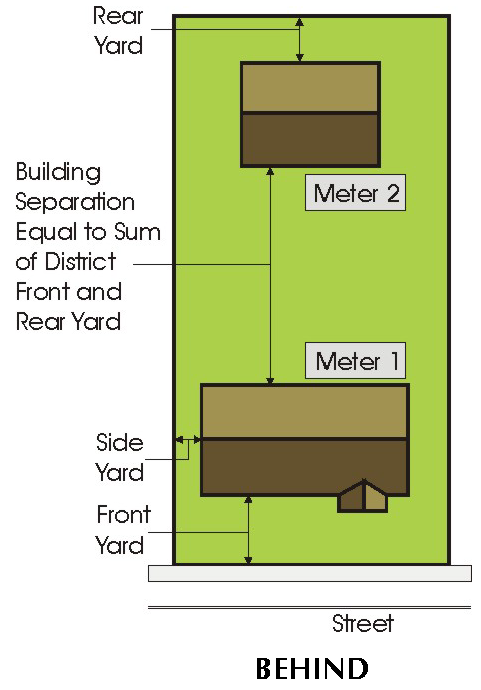
5.4.1. Accessory Structures
All accessory buildings and structures, including accessory dwellings (see below) shall be subject to the following additional requirements:
A.
In all residential districts except RR, the building or structure shall not be located between the front wall of the primary structure and the street, except in instances where a designated Viewshed Protection Overlay watercourse, as defined in Section 4.8.7 of the UDO, is adjacent to a parcel. The public waterway must be clearly denoted on the site plan submitted at the time of application for a building permit for the accessory structure and all applicable setbacks must be met. The addressing of the parcel will be based on the street on which the parcel is accessed.
B.
The building or structure may be located in a required side or rear yard. However, a separation of at least five feet shall be required between the building or structure and an adjoining lot line.
C.
In all Residential districts accessory buildings or structures may not exceed the height limit for the zoning district.
[1] Exception in instances where designated Viewshed Protection Overlay is adjacent to a parcel. See Section 5.4.1.A. for details.
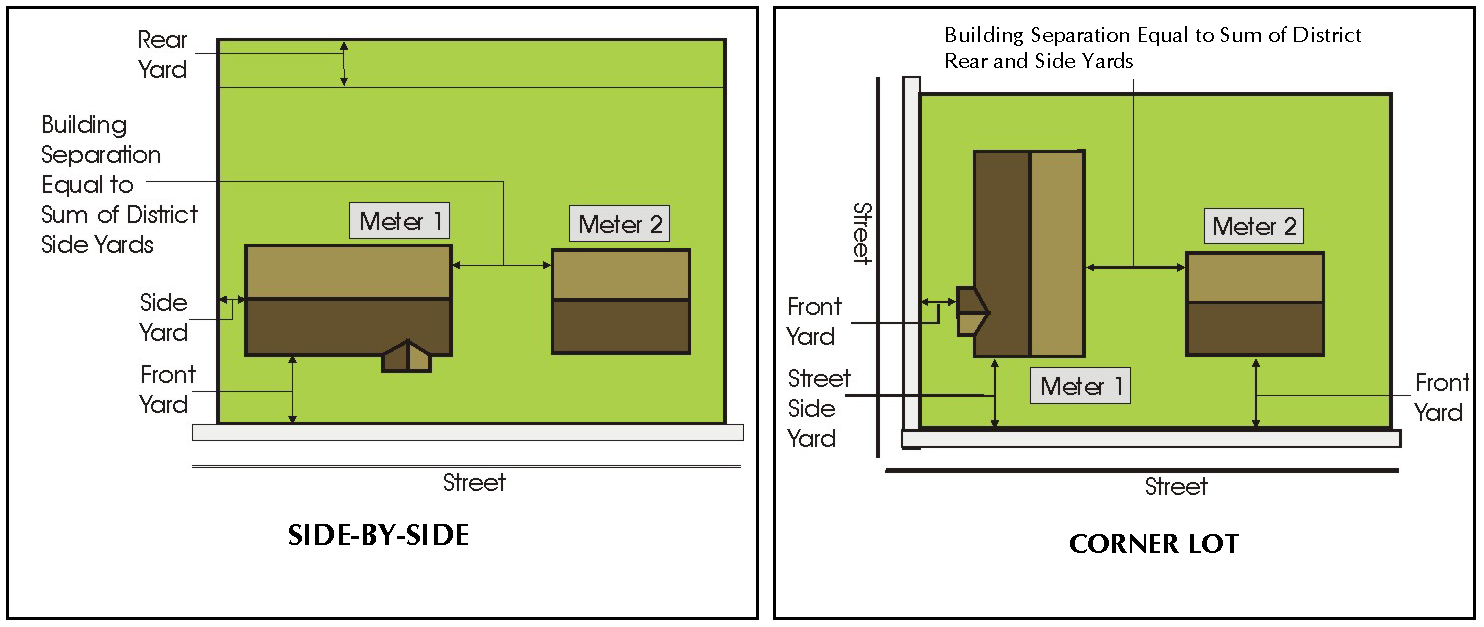
D.
Generally, buildings or structures accessory to detached single-family and two-family dwellings shall provide water, sanitary sewer, and/or any other utilities by branching service from the principal building. However, the Planning Director may permit an accessory structure to be provided with independent metered service when the applicant demonstrates that the following criteria will be met (see diagram):
1.
No structure may be located in a required yard (except those allowed as permitted obstructions, Section 4.14.4.E).
2.
When the subject accessory structure is located behind the principal structure (as viewed from the fronting roadway), a minimum separation equal to the sum of the minimum front and rear yard requirements for the subject district must be provided.
3.
When the subject accessory structure is located to either side of the principal structure (as viewed from the fronting roadway), a minimum separation equal to the sum of the minimum side yard requirements for the subject district must be provided maintained between the two structures.
Commentary: Accessory structures that receive utility service by branching from the main structure are not required to maintain these larger separations.
(Ord. No. UDO-16-02 , § 23, 3-7-16; Ord. No. UDO-19-02 , § 4, 9-19-19)
5.4.2. Accessory Dwellings
When permitted, accessory dwellings shall be subject to the following additional requirements:
A.
The accessory dwelling shall be located within the primary dwelling (e.g. accessory apartment) or shall meet the locational and dimensional requirements for accessory structures (see above).
B.
Only one accessory dwelling may be allowed.
C.
The primary dwelling shall be located on a lot which meets the minimum area requirements of the zoning district.
D.
The property shall retain a single-family appearance from the street.
E.
One additional off-street parking space shall be provided.
F.
Use of a travel trailer or recreational vehicle (RV) as an accessory dwelling shall be prohibited within a Residential district or on property devoted to residential use. No RV or travel trailer shall be permanently connected to public or private utilities.
5.4.3. Multiple Principal Dwellings on Single Parcel
Multiple principal single-family dwellings on a single lot shall be permitted in all residential and commercial districts subject to the following requirements:
A.
The lot size shall be minimum one acre in size, unless modified by the Planning Director.
B.
A site plan must be provided showing that the development site for each new residence meets or exceeds all dimensional and area requirements of the associated zoning district.
C.
No more than three residences as principal structures shall be permitted on a single lot, except in the RR District. Additional residences may be allowed in the RR district as follows:
D.
All other requirements, such as adequate water and sewer service, must be met.
(Ord. No. UDO-19-02 , § 2, 9-19-19)
5.4.4. Home Occupations
This activity shall be an accessory use which is clearly incidental and secondary to a residential use of the dwelling unit and shall be subject to the following restrictions:
A.
No display of goods, products or services shall be visible off site. There shall be no external evidence of the activity such as commercial vehicles, window displays, outside storage, smoke, noise, odors or other nuisances emitted from the premises.
B.
Only handmade items, foodstuffs, and crafts made on the premises may be offered directly for sale. No goods, products or commodities bought or secured for the express purpose of resale shall be sold at retail or wholesale on the premises. Catalog and electronic business orders may be received for goods, products or commodities bought or secured for the express purpose of resale at retail and wholesale when the products are received and shipped from the premises to fulfill catalog or electronic business orders.
C.
Traffic and parking associated with the use shall not be detrimental to the neighborhood or create congestion on the street where the home occupation is located. Vehicles used primarily as passenger vehicles shall be permitted in connection with the home occupation. Only one commercially licensed vehicle shall be allowed. This vehicle may not exceed 1-ton capacity.
D.
The home occupation shall occupy an area not to exceed 50% of the gross floor area of the dwelling unit. All activities shall be conducted entirely within the dwelling unit and are not permitted in a detached garage or other accessory structure.
E.
Not more than two persons that are not a resident of the home is permitted to conduct business in the home occupation.
Commentary: The business may employ others that do not reside in the home as long as they do not conduct business at the home occupation location.
F.
One sign is permitted. Such sign to be no larger than 3 square feet of commercial quality and design and shall be limited to the business name and address only.
G.
No infrastructure demands shall be generated by the home occupation in greater volumes that would normally be expected with a residential use.
H.
Instruction in music, dance, and similar subjects shall be limited to no more than two students at a time.
I.
No hazardous materials may be mobile, stored, processed or disposed of on the premises.
J.
See Section 5.4.7 for retail sales of produce grown on the premises.
(Ord. No. UDO-16-02 , § 24, 3-7-16)
5.4.5. Junk Vehicles
Junk vehicles shall be allowed in conformance with the Abandoned and Junked Motor Vehicles Ordinance available from the Planning Department.
5.4.6. Satellite Dishes
Satellite dishes that are less than one meter (39.37 inches) in diameter in Residential districts and less than two meters in diameter in all other zoning districts shall be exempt from the standards of this Ordinance. Satellite dishes exceeding these dimensions shall be subject to the following additional requirements:
A.
The provisions of Section 5.3.4.L, TV/HDTV/FM/AM Antennae or, Section 5.3.4.O, Wireless Communication Facility as applicable.
B.
If attached to a roof or building, a letter certifying the roof's and building's structural stability shall be written and sealed by a licensed engineer, prior to any approval of a roof-mounted satellite earth station. No commercial messages shall be placed on the dish.
5.4.7. Retail Sale of Produce Grown on the Premises (when not associated with a Bona Fide Farm Use)
A.
When conducted as an accessory use, retail sales are not anticipated to generate substantial amounts of vehicle traffic.
B.
Sales are limited to produce grown on the premises.
C.
Sufficient on-site parking shall be provided so that no parking associated with the retail sales shall take place within a public right-of-way or in a required yard.
D.
For sales activities associated with a bona fide farm use, see Section 5.3.2.C.
5.4.8. Swimming Pools
When allowed, in-ground and above ground swimming pools designed to utilize mechanical filtering system(s) which have a water depth over 24 inches and have a surface area of at least 100 square feet shall be subject to the following additional requirements:
A.
All Pools
1.
Outdoor swimming pools shall be enclosed with a wire fence or other equivalent-type barrier at least four feet (4') high designed to protect public safety. The fence or barrier may enclose either the pool area only or the full property boundary area or any part of the property which includes the pool.
2.
Private swimming pools (as well as the decking and equipment associated with the pool) on single-family, duplex, and triplex lots shall not be located in the front yards and not be closer than five feet to any property line.
B.
Outdoor Community Pools, Private Club Pools, or Pools in Multifamily Complexes
1.
Where swimming pools are an accessory, they may be located in the side and rear yards of all zoning districts.
2.
Outdoor pools including decking shall be setback from the property lines consistent with Section 4.4.4. Nonresidential Uses in Residential Districts of the UDO. A project boundary buffer of 0.6 consistent with Section 6.3.9.A.4 of the UDO must be provided where property lines adjoin a single-family Residential district or use. Buffers may be located and constructed within the required yard.
3.
When the pool is adjacent to off-site residences, the playing of music detectable off-site on a public address system is prohibited. Informational announcements shall be permitted. This requirement may be waived if a permit has been issued for a special event.
5.4.9. Temporary Worker Housing
When located on a bona fide farm, accessory residential housing structures for the temporary use and occupancy by temporary workers employed in farming activities shall be exempt from the requirements of Section 5.4.1 and Section 5.4.2. However, other permits, including a certificate of occupancy (see Section 9.4.1) may be required.
5.4.10. Vehicle Repair
Up to two vehicles may be repaired simultaneously on a residential property if the vehicles are registered to an occupant of the residence. Vehicle repair and storage may not be conducted in the required front yard. Other than emergency repairs, vehicle repair shall not be permitted within a public right-of-way.
5.4.11. Solar Collector (Accessory)
Solar Collectors shall be permitted as an accessory use to existing structures or facilities in any zoning district under the following standards:
A.
Roof-Mounted Solar Systems—The collector surface and mounting devices for roof-mounted solar systems shall not extend beyond the exterior perimeter of the building on which the system is mounted or built.
1.
Pitched Roof Mounted Solar Systems—For all roof-mounted systems other than a flat roof the elevation must show the highest finished slope of the solar collector and the slope of the finished roof surface on which it is mounted.
2.
Flat Roof Mounted Solar Systems—For flat roof applications a drawing shall be submitted showing the distance to the roof edge and any parapets on the building.
B.
Ground-Mounted Solar Systems—Ground-mounted solar collectors (accessory) may not exceed six feet (6') in height and shall meet the minimum zoning setback for the zoning district in which located, except it may be located within the front yard setback. Screening shall be required consistent with Section 6.4.2.A.1 of the UDO.
C.
Approved Solar Components—Electric solar system components must have a UL listing and must be designed with anti-reflective coating(s).
D.
Application Requirements—Plan applications for solar energy systems shall be accompanied by horizontal and vertical (elevation) to-scale drawings with dimensions. The drawings must show the location of the system on the building for a roof-mounted system or on the property for a ground-mounted system, including the property lines.
E.
.....Compliance with Building and Electrical Codes—All solar collector systems shall be in conformance with the North Carolina Building Codes.
Commentary: Compliance with the North Carolina Building Codes includes meeting the wind load requirements for Brunswick County, which are 120 miles per hour on the western side of US 17 (Ocean Highway) and 130 miles per hour on the eastern side of US 17.
(Ord. No. UDO-19-02 , § 11, 9-19-19)
5.4.12. Wind Energy Generator (Accessory)
Wind Energy Generators (Accessory) designed to supplement other electricity sources shall be permitted as an accessory use to existing structures or facilities in any zoning district under the following standards:
A.
A wind energy generator (accessory) must be setback from all property lines a distance equal to one and one-half (1.5) linear feet for every foot of height of the highest structure that is part of the facility or the minimum setback for the zoning district, whichever is greater.
B.
A wind turbine may not be located between the front wall of the primary structure and the street.
C.
Rotor blades on wind turbines must maintain at least 24 feet of clearance between their lowest point and the ground.
D.
Maximum height of wind turbines shall be 175 feet.
E.
Application Requirements
1.
Identification and location of the property on which the proposed wind energy generator will be located.
2.
A site plan showing the planned location of the wind turbine and associated equipment, property lines, setback lines, driveway locations, and location of all existing structures on the parcel.
3.
Drawings to-scale showing the representative type and height of the wind turbine to be constructed, including its generating capacity, dimension and respective manufacturer, and a description of ancillary facilities.
F.
Installation and Design
1.
The installation and design of the Wind Energy Generator (Accessory) shall conform to applicable industry standards, including those of the American National Standards Institute.
2.
All electrical, mechanical and building components of the Wind Energy Generator (Accessory) shall be in conformance with the International Building Code with North Carolina Amendments.
Commentary: Compliance with the International Building Code includes meeting the wind load requirements for Brunswick County, which are 120 miles per hour on the western side of US 17 (Ocean Highway) and 130 miles per hour on the eastern side of US 17 (Ocean Highway).
3.
Any on-site electrical lines shall, to the maximum extent possible, be installed underground.
4.
Attachment to a building of any kind shall be prohibited.
G.
The visual appearance of Wind Energy Generator (Accessory) shall:
1.
Be constructed of a corrosion resistant material that will not fade, show rust spots or otherwise change the appearance as a result of exposure to the elements and be a non-obtrusive color such as white, off-white or gray; and
2.
Not be artificially lit.
H.
Any wind energy generator (accessory) that is not functional shall be repaired by the owner within a 3 month period or be removed. In the event that the County becomes aware of any wind energy system that is not operated for a continuous period of 3 months, the County will notify the landowner by certified mail and provide 30 days for a written response. In such a response, the landowner shall set forth reasons for the operational difficulty and provide a reasonable timetable for corrective action. If the County deems the timetable for corrective action as unreasonable, the County shall notify the landowner and such landowner shall remove the turbine within 30 days of receipt of said notice. Any disturbed earth shall be graded and re-seeded, unless the landowner requests in writing that the access roads or other land surface areas not be restored.
5.5 - TEMPORARY USES
5.5.1. General
Certain uses are temporary in character. They vary in type and degree, as well as length of time involved. Such uses may have little impact on surrounding and nearby properties or they may present questions involving potential incompatibility of the temporary use with existing uses. Unless otherwise specified in this chapter, the following regulations shall govern temporary uses.
5.5.2. Temporary Uses Exempt from Permit
The following permitted temporary uses do not require temporary use permits.
A.
Christmas tree sales lots.
B.
Garage or yard sales are permitted only by the property owner on their property and are allowed once every four months at any given location. The sale may not exceed three consecutive days in length. Advertising signs may not be placed on any rights-of-way or off-site locations without the applicable property owners' permission.
C.
Storage containers or pods for off-site storage or transfer of household or other goods located in any required front yard are permitted for a maximum of seven consecutive days.
5.5.3. Temporary Use Permit Required
In addition to any specific requirements, a temporary use permit (see Section 9.4.3) shall be required for any use not explicitly exempted in Section 5.5.2 above.
A.
All temporary uses shall provide adequate off street parking for the intended use.
B.
Emergency Temporary Housing Associated with a Major Disaster
Emergency temporary housing following a major disaster will be allowed temporarily on a case-by-case basis. Temporary housing and/or other relief organization housing may be placed anywhere in the County with permission of the property owner for a period of up to 4 months without obtaining a temporary use permit. The 4 month period begins with the official declaration of the major disaster. After the expiration of the original 4 month period, the temporary housing may remain on the lot for a period of 6 months with the issuance of a temporary use permit. The Zoning Administrator may extend the temporary use permit on a case-by-case basis, up to a maximum of eighteen (18) months from the date of the official major disaster declaration.
C.
Emergency Temporary Housing Associated with a Minor Disaster
Temporary use permits for temporary housing associated with emergency construction, repair, or restoration work of the permanent residential building on a site shall expire within six (6) months after the date of issuance and must be occupied by persons intending to live in permanent residence. Additionally, the Zoning Administrator may extend the Temporary Use Permit on a case-by-case basis, up to a maximum of eighteen (18) months if it is determined that the renewal is reasonably necessary to allow the proposed occupants of the permanent residential building to complete the work necessary to make the building habitable.
D.
Farmers markets are allowed two days a week. When issuing the temporary use permit authorizing the farmers market, the Planning Director may approve up to 12 consecutive farmers markets that will occur on the same site. When occurring in the RR zoning district, a farmers market shall not require a temporary use permit and there shall be no limit on the number of days a farmers market may operate.
E.
The following temporary uses are allowed in the frequency stated below except that no property shall have more than four of the events listed in E.1 through E.7 in a calendar year, unless the parcel includes an adequate permanent parking lot as determined by the Planning Director.
Example: A temporary use permit for a carnival would be counted in considering whether to issue a temporary use permit for a subsequent non-profit special event on the same property.
1.
Commercial Circuses, Carnivals or Fairs
Commercial circuses, carnivals or fairs, for not more than two consecutive weeks in any calendar year.
2.
Temporary Religious or Revival Activities
Temporary religious or revival activities in tents in association with a place of worship, for not more than two consecutive weeks in any calendar year.
3.
Non-Profit Special Events
Special events run by non-profit, charitable organizations occurring no longer than seven consecutive days once every three months.
4.
Tent Sales
Tent sales by merchants occupying the premises on which the sale is conducted and having a valid certificate of occupancy, and occurring no longer than seven consecutive days once every three months.
5.
Grand Opening Sales
Grand opening sales, including outside food and beverage vending, for three consecutive days, once per certificate of occupancy.
6.
Outdoor Vehicle Show or Sale
Outdoor motor vehicle or recreational vehicle show or sale, for three consecutive days, twice per calendar year.
7.
Other Temporary Uses
Other temporary uses similar in nature to the ones listed above, with corresponding limitations, as determined by the Planning Director.
F.
Outdoor Display of Merchandise
1.
The requirements of this Section do not supersede the outdoor display or storage requirements of Section 6.22.
2.
Outdoor display of merchandise in nonresidential districts is allowed subject to issuance of a temporary use permit and all of the following conditions.
i.
Merchandise shall only be displayed in front of the premises occupied by the merchant. The merchant must hold a valid certificate of occupancy for the premises.
ii.
Merchandise may be displayed up to four times per year. Each time, merchandise may be displayed up to nine consecutive days.
iii.
Merchandise shall not be displayed closer than five feet to any entrance to the premises.
iv.
Merchandise shall only be displayed in a manner that does not obstruct pedestrian or vehicular circulation or traffic.
v.
Merchandise shall not be displayed in parking lots.
vi.
The display of merchandise shall not exceed eight feet in height.
vii.
Merchandise shall only be displayed during the merchant's hours of operation, and must be taken inside the premises at closing.
viii.
No payment (collection of monies) shall occur outside. All sales must occur within a completely enclosed building.
ix.
Merchandise shall only be displayed in an area not wider than 50 percent of the total linear foot frontage of the building occupied by the merchant.
x.
The required temporary use permit must be visibly displayed at the main entrance of the associated merchant.
xi.
A violation of any conditions set out in this section shall constitute a violation of the temporary use permit and cause said temporary use permit to be revoked. Once revoked, a temporary use permit shall not be issued for the same temporary use for a period of one year.
3.
Any temporary use permit issued under paragraphs E.4 through E.7 above shall be counted in the maximum number of temporary use permits allowed for the outdoor display of merchandise.
G.
Temporary Use Permit for Large Events with 1,000 Guests or More
1.
Temporary uses occurring on property outside of the public right-of-way with more than 1,000 guests shall obtain a large event temporary use permit. The permit shall outline conditions of operations to protect the public health, safety, and welfare. See Section 9.4.4. of this Ordinance for the permitting process.
2.
Large Events are limited to two (2) consecutive days. Hours of operation are limited to no earlier than 7:00 a.m. and no later than 11:00 p.m.
3.
Prior to the submittal of the application, the applicant must schedule a meeting with the County for a Pre-Project Planning Session. The purpose of the session is to understand the project and clarify with the applicant the requirements and timeline for the project.
4.
An application packet for a temporary use permit for a Large Event with 1,000 Guests of More shall include the following information.
i.
A completed application and site plan that addresses all items in the Planning Department Commercial Development Check List.
ii.
A completed Security Plan for the event, including Crowd Managers.
iii.
A complete Traffic Control Plan.
iv.
A completed plan addressing how each requirement outlined in Appendix F will be met.
v.
A copy of the NCDOT Special Event Permit application submitted to the North Carolina Department of Transportation.
vi.
A copy of the event notification submitted to the local fire and rescue departments.
vii.
Proof of liability insurance.
H.
Neighborhood Sales Home
Neighborhood Sales Home must meet the following:
1.
The residential dwelling must be completed, furnished, landscaped and/or decorated.
2.
The residential character of the surrounding neighborhood must be maintained.
3.
Limited commercial office space for real estate sales and transactions activity shall not exceed 30% of the gross square area of the home (heated and unheated space).
4.
Modifications to the dwelling and to the site are allowed to accommodate commercial activities. Common modifications include garage conversions, office spaces, and parking lots.
5.
There shall not be events or large gatherings held within the dwelling or on-site other than showings, viewings, tours, or open houses.
6.
Hours shall be limited from 9:00 A.M. to 8:00 P.M. daily.
7.
Placement of the Neighborhood Sales Home must meet the following criteria:
i.
Placed within a new or undeveloped section/phase of a development.
ii.
If locating adjacent to an established home in a different section/phase, a one (1) lot separation is required.
8.
All parking shall be provided to accommodate on-site personnel and Guests and constructed in accordance with the following:
i.
Parking spaces shall be provided at the rate of 3 spaces for the first 300 sq. ft. of commercial floor area, plus 1 space per 300 sq. ft. of commercial floor area after that.
ii.
Parking spaces that do not require vehicles to back-up into a street or alleyway are encouraged.
iii.
Use of conventional residential driveways for parking is allowed.
iv.
Use of a separate parking lot is allowed but not required. If opting to install a parking lot, then the area must meet the design standards outlined in Section 6.12.5. of the UDO.
v.
All parking maybe located off-site.
vi.
On-street parking is strongly discouraged to be used as overflow parking.
9.
Signage shall be allowed to aid in guiding guests to the Neighborhood Sales Homes and shall be installed in accordance with the following:
i.
The site is limited to one (1) on-premises freestanding sign and wall signage not to exceed a cumulative total of 32 sq. ft.
ii.
Signs may not be illuminated and must be of commercial quality and design.
iii.
Temporary Real Estate Signs (Section 8.7.10.) and On-Premises Directional Signs (Section 8.7.19) are allowed.
10.
Temporary Use Permits for Neighborhood Sales Homes shall expire 10-years after the date of issuance. Upon expiration, all commercial activity must cease. The Zoning Administrator may grant two (2) extensions to the temporary use permit, on a case-by-case basis. Each permit extension may not exceed 5-years for a maximum of 10-years.
11.
All residential dwelling requirements must be met per the zoning district in which it is located and constructed in conformance with all applicable North Carolina Building Codes and Environmental Health Codes.
(Ord. No. UDO-18-02 , § 1, 3-19-18; Ord. No. UDO-19-02 , § 1, 9-19-19; Ord. No. UDO-20-01 , 11-16-20)
5.5.4. Temporary Mining and Borrow Pit
A.
This permit applies to temporary (sand and soil) excavation and movement activities during the land development process that are not required for the construction of internal roadways or structures during the construction of a major subdivision or PUD. Permanent excavation activities shall be considered Mining Operations (Class 1 or Class 2 as applicable), or Quarries, and are not permitted through the Temporary Use Permit process.
B.
Excavation activities that involve removing material from the development site shall require a permit from the NC State Board of Mines.
C.
Approval of the temporary use permit shall require the applicant to submit a detailed site plan of the area proposed for disturbance drawn to scale. At a minimum, this plan shall show areas proposed for excavation and deposition of material, including the height of fill or depth of cut proposed. The plan must also show any existing trees larger than four inches diameter measured at four feet above ground that will be removed during the process. The Planning Director may consult with the Director of Engineering Services to determine the extent of external impacts (such as water ponding or flooding) that may be caused by the proposed activity. Additionally, a Brunswick County Stormwater Permit may be required.
D.
A temporary use permit may be issued for a maximum period of nine months. The Planning Director may extend this period up to nine months by request of the original applicant. Subsequent permits or changes in ownership require the resubmission of an application in conformance with this Section.
E.
As an alternative to the Temporary Use Permit process, applicants may elect to submit an application to perform excavation and relocation of sand and soil as part of the Site Plan, Major Subdivision, or PUD application process.
F.
The Planning Director may require the construction of a separate construction entrance as a prerequisite for approval of the Temporary Mining and Borrow Activity.
5.5.5. Temporary Use in Conjunction with Special Event Permit
Where a valid permit has been issued by the County for use of adjoining right-of-way that makes the street unavailable to vehicular traffic, a temporary use permit may be issued in accordance for events on the grounds or in the parking lot of any adjoining parcel during the period of the special event permit.
5.5.6. Prohibited Temporary Uses
1.
The use of a camper or recreational vehicle for temporary housing or contractor's office while a single-family residence is being constructed or where a residential building permit has been issued is prohibited.
2.
[Reserved]

