
Brunswick County Unincorporated
City Zoning Code
City Zoning Code
ARTICLE 8
- SIGNS
8.1 - PURPOSE AND INTENT
8.1.1. It is the intent of this section to permit signs of a commercial, industrial, and residential nature in districts which have uses with appropriate need for signs and to regulate the size and placement of signs intended to be seen from a public right-of-way or public waters.
8.1.2. Signs including outdoor advertising structures are herein regulated for the intent of regulating excess signage, encouraging the positive economic development of the County, preserving and improving tourism views, promoting the safety of the traveling public, protecting existing property values in both residential and non-residential areas, preventing the overcrowding of land and protecting the aesthetics of the County.
8.1.3. The regulations are designed to prevent overconcentration, improper placement, and excessive height, bulk number and area of signs. It is recognized that, unlike on-premise identification signs which are (in actuality) a part of a business, off-premise outdoor advertising is a separate and distinct use of the public thoroughfare. Because of these fundamental differences, off-premises outdoor advertising signs are regulated differently from on-premise signs.
8.2 - PERMITS AND PLANS
8.2.1. Sign Permit
A.
Applicability
1.
Except as otherwise provided in this Ordinance, a sign permit shall be required to erect, construct, enlarge, move or replace any sign or cause the same to be done, as required by this Article.
2.
Notwithstanding the above, changing or replacing the permanent copy on an existing lawful sign shall not require a permit, provided the copy change does not change the nature of the sign such as to render the sign in violation of these regulations.
B.
Application Requirements
1.
An application for a Sign Permit shall be submitted in accordance with Section 3.1.8, Application Requirements. Additionally, applications for permits shall contain or have attached to it the following information:
i.
The street number where the sign is to be erected, and the tax parcel number for the zoning lot onto which the sign is to be located;
ii.
Names, addresses, and telephone numbers of the applicant, owner of the property on which the sign is to be erected or affixed, the owner of the sign, and the licensed contractor erecting or affixing the sign;
iii.
If the applicant is not the owner of the property on which the sign will be located, a copy of the lease agreement between the property owner and the applicant;
iv.
A site or plat plan of the property involved, showing accurate placement of the proposed sign including setbacks, all structures, access easements, and other relevant site information;
v.
Two blueprints (one original and one copy) or scaled drawings of the plans and specifications of the sign to be erected or affixed. Such plans may include but shall not be limited to details of dimensions, materials, copy, and size of the proposed sign. For wall signs, dimensions of the building wall on which the sign is to be affixed and the location and the size of existing wall signs shall also be included. All signs shall meet the North Carolina Building Codes;
vi.
Applications for permits for outdoor advertising structures, in addition to the above information shall contain a detailed site plan with setbacks and dimensions showing at least the following: the location of all outdoor advertising structures on the same side of the street, existing structures, driveways, etc.
vii.
Other information as the Zoning Administrator may require to determine full compliance with this and other applicable codes.
C.
Action by Zoning Administrator
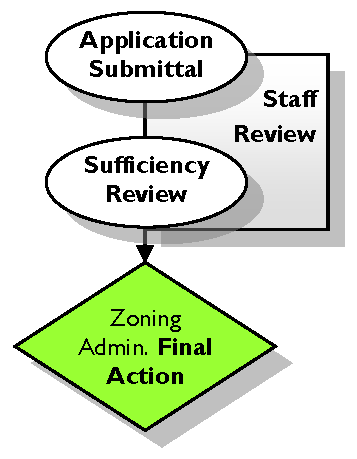
Following completion of the technical reviews by staff, the Zoning Administrator shall approve the sign permit provided the sign meets all requirements of this Ordinance, and all other applicable requirements related to North Carolina Building Codes.
D.
Revocation and Removal
1.
Any sign permit issued in accordance with this Ordinance shall automatically become null and void unless the work for which the permit was issued has visibly been started within six months of the date of issue or if the work authorized by it is suspended or abandoned for one year.
2.
The Zoning Administrator and or Building Inspector shall have the authority to order the painting, repair, alteration or removal of a sign which constitutes a hazard to the health, safety or public welfare by reason of inadequate maintenance, dilapidation, or obsolescence. Notice to the owner shall be by personal service or registered mail, return receipt requested. Upon notification, the owner shall have 60 days to complete repairs. Failure to complete repairs with appropriate time frame may result in the County proceeding with legal actions pursuant to Article 9, Administration and Enforcement.
3.
Any sign(s) determined to be erected or posted not in accordance with provisions contained in this Article may be subject to immediate removal and enforced pursuant to Article 9, Administration and Enforcement.
4.
On determining that a violation exists, the owner, applicant or business shall be given written notice of the initial violation and notification that the sign(s) may be held at a designated location for collection by the owner, applicant or business for a period of no more than ten days.
5.
Any sign(s) determined to be in violation of this Article and not collected by the owner, applicant or business within the ten day period of initial notice of violation, or where it is determined that there are subsequent violations by same owner, applicant or business beyond the initial notification, may be subject to immediate removal and destroyed.
E.
Appeal
Final action on a sign permit may be appealed to the Board of Adjustment in accordance with Section 9.8, Appeal of Administrative Decision.
(Ord. No. UDO-19-02 , § 11, 9-19-19)
8.2.2. Common Signage Plan
Commentary: The common signage plan ensures that all signs in a development have a consistent 'look'. This doesn't mean that the County will have any input over the actual message in the sign above the current sign standards.
A.
Description
A common signage plan is a plan for all signs associated with a project that consists of several buildings or businesses which are related in a single development. The signage plan shall include all signs within the development, including outparcels. Communal signs may be increased up to 148 square feet.
B.
Applicability
1.
Planned Unit Development
Planned Unit Development projects wishing to install specialty or ornamental traffic identification signs shall require approval of a common signage plan.
2.
Nonresidential and Mixed Use Projects
Prior to the issuance of a sign permit for one or more buildings or businesses in the same project, common signage plan approval shall be required, except as follows:
i.
Internally-oriented signs not visible from the public right-of-way shall not be required to submit an approved common signage plan; and
ii.
Applications for temporary sign permits shall not be required to submit an approved common signage plan.
C.
Application Requirements
A common signage plan application shall be submitted in accordance with Section 3.1.8, Application Requirements.
D.
Required Plan Elements
The common signage plan shall consist of five elements:
1.
Location
Identification of sign locations on buildings or property.
2.
Materials and Illumination
Description of the type of sign and sign materials, including construction materials and proposed lighting if any. This description shall not include the copy, text, or message to be displayed on the sign, but may instead include random alphanumeric characters for illustration purposes.
Commentary: You have to be careful that you are not making decisions on sign applications based on the content of the sign.
3.
Size
i.
Itemization of sign size or band area at identified locations.
ii.
Allocation of sign area for multi-tenant structures may favor one tenant or series of tenants over another, provided the property owner identifies the available sign area per tenant.
4.
Color
i.
Listing of the colors to be used on each sign.
ii.
A maximum of three colors plus either black or white are allowed in a single common plan. Any neon lighting for building signage shall be matched to an approved color specified on the signage plan in order to be included as a part of the color scheme.
E.
Action by the Zoning Administrator
1.
Upon review of the application, the Zoning Administrator shall approve the common signage plan provided the plan meets all the requirements of this section.
2.
The Zoning Administrator may allow modifications to the lettering style to accommodate state and federally registered trademarks (logos) if the Zoning Administrator feels that the intent of the common signage plan requirements shall be maintained. In allowing the modifications, the Zoning Administrator may limit the logo size. The requirements of a common signage plan shall apply to all businesses within a related project, even if the properties have been subdivided.
3.
Minor alterations in sign locations resulting from unexpected conditions on the site may be approved by the Zoning Administrator.
F.
Variations
The Zoning Administrator may approve variations in any element or elements of a common signage plan on a case-by-case basis.
G.
Revisions and Amendments
Revisions or amendments to the common signage plan shall require documentation from all tenants on the property prior to approval.
H.
Appeal
Final action on a common signage plan may be appealed in accordance with Section 9.8, Appeal of Administrative Decision.
8.3 - CONSTRUCTION AND MAINTENANCE PROVISIONS
8.3.1. Every sign and its supports, braces, guys, anchors, and electrical equipment shall be maintained in safe condition at all times. All signs shall be kept free from defective or missing parts or peeling paint and shall be able to withstand wind.
8.3.2. The immediate premises around a sign shall be kept free from debris. However, no person may damage, destroy, or remove any trees, shrubs or other vegetation located within the right-of-way of any public street or road for the purpose of increasing or enhancing the visibility of any sign.
8.3.3. Any sign permitted under this Ordinance must comply with any applicable requirements of the North Carolina Building Codes, electric safety code, and other applicable federal, state or county codes.
(Ord. No. UDO-19-02 , § 11, 9-19-19)
8.4 - DEFINITIONS
For the purpose of this Article (Signs), the following words and phrases are defined as follows:
Awning: A structure made of cloth, metal, or other material affixed to a building in such a manner that the structure may be raised or retracted from a building to a flat position against the building. An awning is not a canopy.
Banner: A sign intended to be hung either with or without a frame, possessing characters, letters, illustrations, or ornamentations applied to plastic or fabric of any kind, excluding flags and emblems of political, professional, religious, education, or corporate organizations.
Building Wall: The entire surface area, including windows and doors, of an exterior wall of a building. For the purposes of these regulations, the area of a wall will be calculated for only the first three stories, or 40 feet maximum height of a building, whichever is less.
Business Sign: A sign that directs attention to a business, profession, or industry located on the premises where the sign is displayed; to type of products sold, mobile or assembled; and/or to services or entertainment offered on the premises.
Canopy: A permanent structure other than an awning made of cloth, metal or other material attached or unattached to a building for the purpose of providing shelter to patrons or automobiles, or as a decorative feature on a building wall. A canopy is not a completely enclosed structure.
Changeable Copy: Copy that is or can be changed 1) manually in the field, 2) through mechanical means. (e.g., readerboards with changeable letters), or 3) electronically.
Copy: Any words, letters, numbers, figures, characters, symbols, logos, or insignia that are used on a sign display surface area.
Free-Standing: The general term for any sign which is supported from the ground and not attached to a building.
Grade: The height of the top of the curb, or if no curb exists, the height of the edge of the roadway surface.
Ground Mounted Sign: A free-standing sign which extends from the ground or which has a support which places the bottom of the sign less than 2 feet from the ground.
Identification Sign: A sign which displays only the name, address, and/or crest, or insignia, trademark, occupation or profession of an occupant or the name of any building on the premises.
Illuminated Sign: A sign either internally or externally lighted.
Linear Frontage: The length of a property abutting a public right-of-way measured from one side lot line to another.
Logo: A business trademark or symbol.
Noncommercial Copy: A sign message through pictures, illustrations, symbols, and/or words, or any combination thereof, which does not contain any reference to a business or product but displays a substantive message, statement or expression that is protected by the First Amendment to the Constitution of the United States.
Nonconforming Sign: Any sign which was lawfully erected in compliance with applicable code provisions and maintained prior to the May 1, 2007, and which fails to conform to all applicable standards and restrictions of these regulations.
Off-Premises Sign: A sign that directs attention to a business commodity, service, or establishment conducted, sold, or offered at a location other than the premises on which the sign is erected.
On-Premises Sign: A sign that directs attention to a business commodity, service, or establishment conducted, sold, or offered on the premises on which the sign is erected.
Outdoor Advertising Structure: A sign or billboard designed to carry outdoor advertising including all free standing, off-premise signs.
Parapet: That portion of a building wall or false front that extends above the roof line.
Premises: A parcel or lot of real property with a separate and distinct number or designation shown on a recorded plat, record of survey, parcel map, subdivision map, or a parcel legally created or established pursuant to applicable land use regulations. (Outparcels of shopping centers shall be considered on the premises of the shopping center for the purpose of these regulations.)
Public Emergency Message/Public Service Announcement: Public Emergency Messages/Public Service Announcements may include Amber Alert emergency information and information about terrorist attacks, natural disasters, public infrastructure failures and public safety emergencies. Also included may be messages that promote programs, activities, or services of federal, state, or local governments or the programs, activities or services of nonprofit organizations and other announcements regarded as serving community interests, excluding time signals, routine weather announcements and promotional announcements. Public Emergency Messages/Public Service Announcements shall be displayed in accordance with protocols developed by the county in conjunction with the issuing agencies and the qualified sign owners.
Roof Line: The highest point of a flat roof and mansard roof and the lowest point of a pitched roof, excluding any cupolas, chimneys or other minor projections.
Sign: Any object, device, or structure, or part thereof, situated outdoors, which is used to advertise, identify, display, direct, or attract attention to an object, person, institution, organization, business, product, service, event or location by any means, including words, letters, figures, designs, symbols, fixtures, colors, illumination, or projected images. Signs do not include the flag or emblem of any nation, organization of nations, state, city, or any fraternal, religious or civic organizations; works of art which in no way identify a product; or a scoreboard located on athletic fields.
Sign Structure or Support: Any structure that supports or is capable of supporting a sign, including decorative cover.
Temporary Sign: A sign which is not permanently installed in the ground or affixed to any structure or building, and which is erected for a period of time as permitted in this Ordinance.
Wall Sign: Any sign directly attached to an exterior wall of a building or dependent upon a building for its support with its exposed face parallel or approximately parallel to the plane of the building or structure on which the sign is affixed. Signs directly painted on walls, canopies signs, and awning signs shall be considered wall signs.
8.5 - SIGN MEASUREMENT AND COMPUTATION
8.5.1. Location of Freestanding Signs
A.
On-premises freestanding signs shall be located at least five feet behind the right-of-way (see Section 8.8.1, Outdoor Advertising Structures and Off-Premises Signs for standards). Commercial and subdivision signs may be located within private rights-of-way or driveways.
B.
No sign may be permitted in any sight distance triangle (Section 6.13.4).
8.5.2. Double-Decking
With the exception of onsite directional signs, stacking signs on top of one another (double-decking) is prohibited.
8.5.3. Sign Height
The vertical distance measured from the highest point of a sign, including any molding, trim, border, or frame above the roadway surface from which the sign is to be viewed.
8.5.4. Sign Area
The area within a single, continuous perimeter enclosing the extreme limits of characters, lettering, logos, illustrations, or ornamentations, together with any material or color forming an integral part of the display or to differentiate the sign from the background to which it is placed. Structural supports bearing no sign copy are not included in the sign area. If a sign is attached to an entrance wall or fence, only that portion of that wall or fence onto which the sign face or letters are placed is included in the sign area.
A.
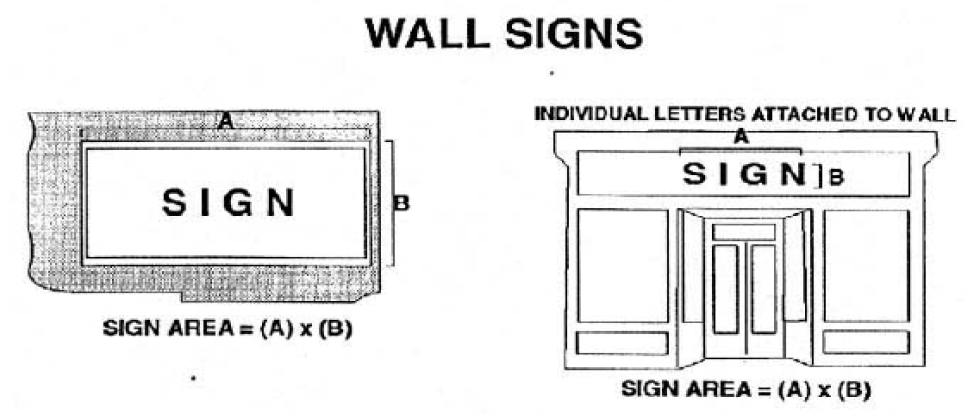
Area of wall signs is computed as indicated in the graphic below:
B.
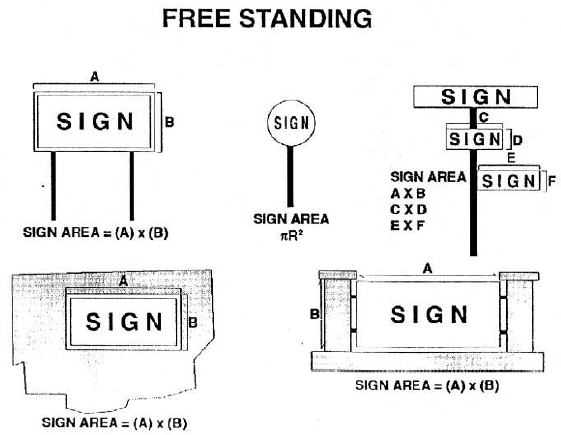
Area of one-sided free standing signs is computed as indicated in the graphic below:
C.
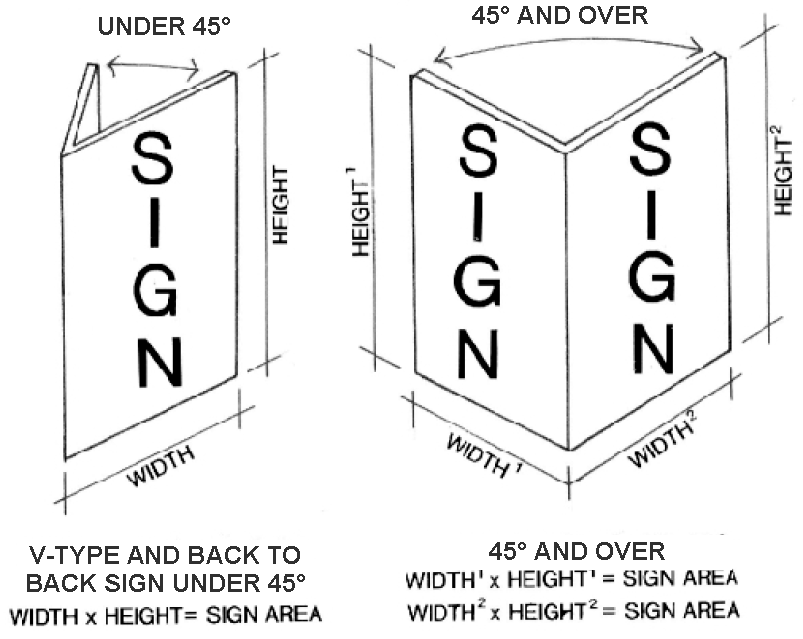
Signs may be placed back-to-back, side-by-side, or in V-type construction. Side-by-side signs must be structurally tied together and considered as one sign. V-type and back-to-back signs must be considered as two signs if the angle between the faces is 45 degrees or more.
8.6 - PROHIBITED SIGNS
The following signs are prohibited in all Zoning Districts:
8.6.1. Signs Located within the Site Triangle
Signs may not be located within a required clear site triangle (Section 6.13.4).
8.6.2. Signs Obstructing View
Signs may not obstruct the view of pedestrians, bicyclists and or motorists using any street or approaching any street intersection. Signs interfering with the effectiveness of or obscuring any traffic sign, device, or signal shall be prohibited. Any sign located in such a way as to deny a visual access to an existing sign.
8.6.3. Moving Signs
Signs, other than government and public educational facility signs, which contain oscillating, fluctuating, flashing or blinking lights, rotating disks, words and other devices not erected by a public authority which may be erroneously construed as government signs or emergency warning signs. An example of this is a sign which contains a picture of a traffic sign plus the word "Stop, "Yield", etc.
8.6.4. Signs Obstructing Pedestrian Traffic
Any sign located outdoors which interferes with free passage from or obstructs any fire escape, downspout, window, door, stairway, ladder, or opening intended as a means of ingress or egress or providing light or air.
8.6.5. Signs Located on a Street or Right-Of-Way
Any sign (other than a government sign) placed on any curb, sidewalk, post, pole, hydrant, bridge, tree, or other surface and located in, over, or across any public street or right-of-way.
8.6.6. Animated or Motion Signs
Flashing signs, signs with flashing or reflective disks, flashing lights or lights of changing degree of intensity or color or signs with electrically scrolled messages. Government and public educational facility signs and portions of a sign that display time and/or temperature shall be exempt from this prohibition provided such signs are in conformance with all other applicable requirements.
8.6.7. Temporary, Nonpermanent Signs
Temporary, nonpermanent signs, including over-head streamers, are not permitted in any zoning district, unless otherwise specified in these regulations.
8.6.8. Portable or Moveable Signs
A sign that is not permanently attached to the ground, a structure, or a building that can easily be moved from one location or another. (For example, a sign on wheels.)
8.6.9. Scenic Corridor Off-Premise Signs
Off-premise signs designed to be visible from a road designated as a Scenic Byway by the North Carolina Department of Transportation.
8.6.10. Roof Signs
A sign erected or maintained in whole or in part upon or over the roof or parapet of a building; except that signs may be placed on the side of mansard roofs but shall not extend above the roof line.
8.6.11. Illegal Activity
Signs that display or advertise an illegal activity in North Carolina.
8.6.12. Windblown or Inflated Signs
Fluttering, spinning, windblown or inflated devices including pennants, propeller discs, flags or banners which do not conform with the requirements of this Ordinance.
8.7 - SIGNS ALLOWED IN ALL DISTRICTS WITHOUT A PERMIT
The following signs may be allowed in all Zoning Districts without a permit:
8.7.1. Government Signs
A.
Description
Any temporary or permanent sign erected and maintained by a federal, state, or local government, or governmental entity that does not display a commercial message.
B.
Standards
Government signs including graphics usually of a commemorative nature such as obelisks and triumphal arches.
8.7.2. Grave Markers
Grave markers which are noncommercial in nature.
8.7.3. Flags
A.
Description
A piece of durable fabric of distinctive design attached to a permanent pole that is used as a symbol or decorative feature.
B.
Standards
Flags or pennants that do not display a logo, message, statement, or expression relating to commercial interests in conformance with the requirements of Section 4.13.2.C.3, Flags and Flagpoles.
8.7.4. Architectural Features of Buildings
Integral decorative or architectural features of buildings and works of art, so long as such features or works do not contain letters, trademarks, or moving parts.
8.7.5. On-Premises Instructional Signs
A.
Description
On-premises instructional signs giving information or direction for the convenience and necessity of the public. Business logo may be included; however, no commercial message is permitted.
B.
Standards
Such signs shall not exceed six square feet in area or four feet in height. Any commercial message or logo contained in the sign shall not be legible from the public roadway or neighboring properties.
8.7.6. Identification Signs for Residential Uses
A.
Description
On-premises instructional signs giving information or direction for the convenience and necessity of the public. See the Definition in Section 8.4 for further description.
B.
Standards
When associated with a residential use, identification signs not to exceed four square feet on any lot. (See Section 8.8, Signs Requiring Permits, for signs associated with a commercial use or larger than four square feet in size).
8.7.7. Campaign/Political Signs
A.
Description
A sign without a commercial message that relates to an election or other event.
B.
Standards
Within seven days of the election (closing of polls), all signs must be removed.
8.7.8. On Premise Fuel Price Signs
A.
Description
Price signs at automobile service stations or other establishments engaged in the retail sales of gasoline or other fuel for automobiles.
B.
Standards
One such sign is allowed for each side of a lot fronting on a public street, provided it does not exceed 15 square feet in area. Any such sign shall be affixed to a permitted freestanding identification sign, to a canopy support in the vicinity of the gasoline pumps, or flat-mounted against the wall of a building.
8.7.9. Gasoline Service Pump Signs
A.
Description
Signs announcing the location of gasoline pumps at any establishment engaged in the retail sale of gasoline.
B.
Standards
Such signs shall be located in the vicinity of the pumps and shall not exceed four square feet in area.
8.7.10. Temporary Personal Property and Real Estate Signs
A.
Description
1.
Personal Property Sign: Sign advertising specific property for sale, lease, rent or development.
2.
Real Estate Sign: Sign used to offer for sale, lease, or rent the premises upon which such sign is placed.
B.
Standards
1.
One sign for each side of a lot fronting on a public street, advertising real estate or personal property "For Sale", "For Rent", "For Lease" or "For Development" not greater than six square feet in area in a Residential District and 32 square feet in area in nonresidential districts may be located on the property being advertised so long as said sign is located behind the street right-of-way line. If the property so advertised lies on a corner lot or double frontage lot, then a second sign may be allowed along the second street.
2.
In addition to the on-site real estate sign(s), a maximum of three directional signs, each not exceeding four square feet in area, shall allowed in other locations. The message of said signs shall be limited to the name of the property, and the terms "Lot/Home For Sale", "For Rent", "For Lease", "For Development", etc. All of these signs shall be located off the street right-of-way.
3.
All such temporary signs shall be removed within seven days after the property has been sold, rented, leased, etc.
4.
No sign allowed under this subsection shall be lighted.
8.7.11. [Reserved]
8.7.12. Temporary Construction Signs
A.
Description
A sign placed at a construction site identifying or announcing the project or the name of the architect, engineer, contractor, financier, or others involved in the development of the project.
B.
Standards
Such signs:
1.
May not exceed ten square feet each, which are in conjunction with any residential use. Signs in conjunction with all other uses shall have a maximum area of 50 square feet each.
2.
May not be illuminated.
3.
May only appear at the construction site.
4.
Shall be removed within seven days after final approval or a certificate of occupancy has been issued.
8.7.13. Temporary Farm Product Signs
A.
Description
Seasonal sale of farm products raised on the premises where products are raised as an accessory to an agricultural use.
B.
Standards
1.
One on-premises sign may be allowed. Said sign shall be located off the street right-of-way and at least nine feet away from any side lot line. Such sign may have a maximum area of 32 square feet and may not be illuminated.
2.
A maximum of two off-premises signs shall be allowed. Said off-premises signs may have a maximum area of 32 square feet each and may not be illuminated. No such sign may be placed in a right-of-way.
8.7.14. Temporary Holiday/Special Events Signs
A.
Description
Temporary special event signs, holiday decorations or banners for religious, charitable, civic, fraternal or similar nonprofit or not for profit organizations,
B.
Standards
1.
Signs may be erected no sooner than 30 days and shall be removed no later than seven days after the event.
2.
Signs may not exceed 32 square feet.
3.
Signs may not be illuminated.
4.
Signs may not be located in street right-of-way.
8.7.15. Other Temporary Banners
A.
Description
On-premises banners; balloons and other inflatable objects, pennants; and flags for special events and grand openings
B.
Standards
1.
A temporary use permit (see Section 9.4.3 shall be required prior to sign installation.
2.
Signs may not be erected for longer than 14 days.
3.
Signs may not be located in a street right-of-way.
4.
Within any calendar year, any use may be allowed temporary signs of this nature for no greater than three 14-day periods.
8.7.16. Yard Sales
One on-premise and three off-premises yard sale signs per yard sale. All such signs shall be removed within 24 hours after the yard sale has been terminated. No such sign shall be greater than four square feet in area. All such signs shall be located off the street right-of-way.
8.7.17. Traffic Control Signs on Private Property (Specialty Signs in a PUD)
Commentary: This is primarily to allow the installation of specialty signs in a PUD.
A.
Description
Any public notice or warning required by applicable federal, state or local law, regulation or ordinance.
B.
Standards
1.
Planned Unit Developments may be permitted to install ornamental or specialty traffic control signs on all internal streets that will not be dedicated to NCDOT.
2.
Approval of a Common Signage Plan (see Section 8.2.2) is required.
3.
The bottom of the sign blade shall be a minimum of eight feet from the ground.
4.
The letters and background shall be of contrasting colors.
5.
All sign letters shall be capitalized. For streets with a posted speed limit of 25 miles or less, the sign letters shall be a minimum of four inches in height.
6.
Highway Gothic C front is preferred, however alternative fonts may be considered during the Common Signage Plan approval process.
7.
Street name signs should be reflective or illuminated (not internally lit however) to show the same shape and similar color both day and night.
8.
Punctuation marks should not be used.
9.
Signs shall not be located closer than six feet to the back of curb (measured along the ground) and may not interfere with utility easements.
10.
Proposed logos should be on the same blade as the street sign and should not be attached separately.
11.
The face shall meet North Carolina Department of Transportation standards.
8.7.18. Bulletin Boards
A.
Description
A sign used to announce meetings or programs to be held on the premises of a church, school, auditorium, library, museum, community recreation center, or similar noncommercial places of public assembly. Bulletin boards are permitted in communities at the entrance, amenity centers, cluster mailboxes, etc.; however, such bulletin boards shall not contain messages of a commercial nature.
B.
Standards
Bulletin boards with a maximum area of 50 square feet.
8.7.19. On-Premises Directional Signs
A.
Description
A sign designed to guide vehicular and/or pedestrian traffic by using such words as "Entrance", "Exit", "One-Way", or similar directional instruction, but not including any advertising message.
B.
Standards
Directional Signs (for commercial and public and semi/public uses) provided that:
1.
The name or logo of the business or use to which the sign is giving direction may not be included on the sign.
2.
The maximum aggregate area shall be six square feet.
3.
All such signs shall be located off the road right-of-way.
4.
All such signs greater than three feet in height as measured from the grade of the road upon which it fronts shall be located outside the required sight triangle (Section 6.13.4).
5.
There shall be no greater than four signs on separate supports at any means of ingress and egress.
6.
More than one sign may be placed on the same supports.
7.
No two signs hung from separate supports may be located within five feet of each other.
8.7.20. Cemetery Sign
One (1) directional/informational sign of six (6) square feet or less, not to exceed 10 feet in height, used as a navigational aid may be located adjacent to each public road accessing a cemetery. The sign copy is limited to the name of the cemetery and a directional arrow only and must be located a minimum of five (5) feet from all property lines. The sign must be located in such a manner that it does not encroach into the sight triangle of an intersection.
8.8 - SIGNS REQUIRING PERMITS
The following sign types are allowed in conformance with a Sign Permit (see Section 8.2.1) and any applicable standards:
8.8.1. Outdoor Advertising Structures and Off-Premises Signs
A.
Outdoor Advertising Structures
A sign or billboard designed to carry outdoor advertising including all free-standing off-premise signs. On-premise signs existing as of May 1, 2007 that exceed the maximum requirements allowed shall be considered as Outdoor Advertising Structures.
B.
Existing Outdoor Advertising Structures
Existing outdoor advertising structures shall be considered a legal nonconforming use and shall be allowed to remain, but may not be altered in any way.
C.
Location Restricted
Permits for new outdoor advertising structures may only be issued in the C-LD, C-I, and I-G zoning districts.
D.
Maximum Number of Sign Faces
One per side of sign not to exceed two sign faces.
E.
Maximum Sign Area
The maximum sign area of an off premises ground sign is limited, depending on location as follows:
1.
On US 17, US 74/76, and NC 211, the maximum sign area is 378 square feet.
2.
On NC 87, NC 133, NC 130, NC 179, and NC 904, the maximum sign area is 300 square feet.
3.
On all other public roads in the County, the maximum sign size is 100 square feet.
4.
Off-Premises Wall Signs
An off-premises wall sign may not exceed 30% of the total surface area of the wall on which the sign is located. Only one off-premises wall sign is allowed on a single wall.
F.
Height
Signs may not extend more than 35 feet above the roadway surface from which the sign is to be viewed.
G.
Separation Between Signs
1.
On US 17, US74/76 and NC 211, the minimum separation between off-premise signs is 3,000 linear feet.
2.
On NC 87, NC 133, NC 130, NC 179, NC 904, and NC 906, the minimum separation between off-premises signs is 2,000 linear feet.
3.
On all other public roads in Brunswick County, the minimum separation requirements between off-premises signs is 1,000 linear feet.
Commentary: Sign separation requirements apply to the primary road within a roadway facility and not to a secondary road (including frontage roads, on and off ramps, or turning roadways) as the primary road has higher traffic volumes and is the intended to be the area from which the traveling public will view the signage. For example, in situations where an outdoor advertising structure is located along a frontage road and viewable from the primary road, the sign separation requirements apply to the primary road and not the frontage road.
H.
Distance from Centerline
Free standing signs must be located within 660 feet of the centerline of the adjoining roadway.
I.
Distance from Property Lines
Signs must be set back a minimum of fifteen feet from any property line.
J.
Signs in Sight Distance Triangle
No sign may be permitted in any sight distance triangle (Section 6.13.4).
K.
Distance from Residential Zoning Districts
Free-standing signs must be separated from residentially zoned property as follows:
1.
50 feet from any structure located in a residential zoning district;
2.
50 feet from any residential zone adjoining a permitted zone away from the roadway.
L.
Additional Spacing
Signs must be separated from the features listed below as follows:
1.
500 liner feet from the centerline of an intersection;
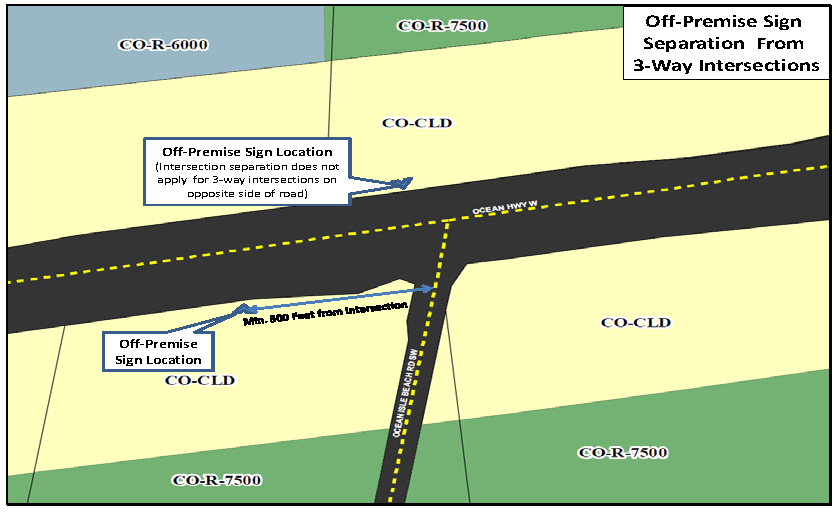
2.
500 feet from any bridge over a public waterway;
3.
150 feet from any existing on premise sign on the same side of the road;
4.
250 feet from cemeteries, churches and public parks.
M.
Requirements for Off-Premises Electronic Changeable Copy Signs
1.
The copy content of all Electronic Changeable Copy signs shall be in compliance with Section 8.6 (Prohibited Signs).
2.
All electronic changeable copy signs shall be installed with light sensitive automatic dimming controls.
3.
All electronic changeable copy signs shall be designed and equipped to freeze the sign in one position with no more than the maximum allowable illumination if a malfunction occurs.
4.
Signs may not exceed a maximum illumination level of 0.3 foot candles above ambient light, regardless of the method of illumination. The 0.3 foot candles above ambient light shall be measured at a distance from the subject sign equal to the following equation:

5.
Sign copy changes shall be instantaneous without the use of animation, movement or scrolling and shall not change or alternate displays more frequently than once every 8 seconds.
6.
All electronic changeable copy signs shall be located at least 250 feet from any residential zoning district.
7.
Prior to permitting, the applicant shall submit a signed letter from the sign manufacturer stating that the sign is equipped with the ability to comply with these regulations. The applicant shall also submit a signed letter from the sign owner or operator stating that they have read the regulations and will not tamper with the manufacturer preset illumination settings.
(Ord. No. UDO-16-02 , § 30, 3-7-16; Ord. No. UDO-19-02 , §§ 6, 11, 13, 9-19-19)
8.8.2. On Premises Signs
A.
General
On-premises signs are permitted subject to the following standards:
B.
Additional Requirements for On-Premises Wall Signs
1.
With the exception of wall signs supported by hanging brackets, wall signs may not project more than twelve inches from the building wall, canopy or supporting structure.
2.
A wall sign or its supporting structures may not cover any window or part of a window.
3.
Wall signs may not extend over a right-of-way or public easement.
C.
Requirements for On-Premises Electronic Changeable Copy Signs
1.
Electronic Changeable Copy signs shall be freestanding only.
2.
The copy content of all Electronic Changeable Copy signs shall be in compliance with Section 10.6 (Prohibited Signs).
3.
All Electronic Changeable Copy signs shall be installed with light sensitive automatic dimming controls.
4.
All digital changeable copy signs shall be designed and equipped to freeze the sign in one position with no more than the maximum allowable illumination if a malfunction occurs.
5.
Signs may not exceed a maximum illumination level of 0.3 foot candles above ambient light, regardless of the method of illumination. The 0.3 foot candles above ambient light shall be measured at a distance from the subject sign equal to the following equation:

6.
Sign copy changes shall not change displays more frequently that once every 8 seconds. Public Emergency Messages/Public Service Announcements may change displays as frequently as once every 5 seconds only if the entirety of the sign face is comprised of the Public Emergency Message/Public Service Announcement and no commercial message is displayed.
7.
Prior to permitting, the applicant shall submit a signed letter from the sign manufacturer stating that the sign is equipped with the ability to comply with these regulations. The applicant shall also submit a signed letter from the sign owner or operator stating that they have read the regulations and will not tamper with the manufacturer preset illumination settings.
(Ord. of UDO-17-01 , §§ 21, 22)
8.8.3. Subdivision, Mobile Home Park, and Campground Identifications Signs
A.
Description
On-premises instructional signs identifying a permanent subdivision, mobile home park, or campground for the convenience and necessity of the public. See Section 8.4 for further description.
B.
Standards
No more than two signs shall be permitted per entrance road and the combined square footage of the signs may not exceed 64 square feet total per entrance road.

