
Brunswick County Unincorporated
City Zoning Code
City Zoning Code
ARTICLE 9
- ADMINISTRATION AND ENFORCEMENT
This Article outlines procedures for the administration and implementation of this Ordinance and is organized as follows:
1.
Notice and Public Hearings
2.
Neighborhood Meeting
3.
Development Permit Requirements
4.
Other Permits and Certificates
5.
Determination of Vested Rights
6.
Administrative Adjustments
7.
Written Interpretation
8.
Appeal of Administrative Decision
9.
Abatement of Nuisance Caused by Mobile Homes
10.
Enforcement and Penalties
11.
Enforcement Procedures
9.1 - NOTICE AND PUBLIC HEARINGS
A.
Summary of Notice and Public Hearing Required
Notice and public hearings shall be required for applications for approval as shown in the table below.
B.
Public Notice Requirements
1.
Published Notice
For public hearings by the Board of Commissioners, a distinctive advertisement shall be placed by the County in a local newspaper of general circulation once a week for two successive weeks, the first notice being published not less than ten days nor more than 25 days before the date fixed for the public hearing. For public hearings by the Planning Board, a distinctive advertisement shall be placed by the County in a local newspaper of general circulation once before the date fixed for the public hearing.
2.
Posted Notice (Sign)
Where posted notice is required, a sign shall be posted by the Planning Director not less than ten days prior to the public hearing at which the application shall be reviewed. The sign shall be posted on the property or at a point visible from the nearest public street.
3.
Mailed Notice
i.
Where any mailed notice is required, the County shall notify by both first class mail all property owners on the subject property and adjoining properties. Adjoining properties shall include properties separated from the subject parcel(s) by street, railroad or other transportation corridor. In rezoning cases where properties have been added to a rezoning application by the County (in addition to properties in the original application), owners of the added properties must be notified by both certified mail and first class mail.
ii.
The notice shall be mailed at least 10 but not more than 25 days prior the date of the public hearing.
iii.
Mailed notice under this section shall not be required if a rezoning directly affects more than 50 properties owned by a total of at least 50 different property owners, and the County elects to use the following expanded published notice requirements:
(a)
A distinctive advertisement may be placed once a week for four successive calendar weeks in a local newspaper of general circulation. The advertisement shall not be less than one-half of a newspaper page in size.
(b)
In addition to the published notice, the Planning Director shall post a sign in accordance with the posted notice requirements of this Section.
(c)
Mailed notice shall be provided by first class mail to property owners who reside outside of the newspaper's circulation area.
iv.
If the action would result in changes to the zoning map, text amendment, or would change or affect the permitted uses of land located five miles or less from the perimeter boundary of a military base, written notice of the proposed changes shall be provided to the commander of the military base by certified mail, return receipt requested. Notice shall be provided at least 10 days, but not more than 25 days prior to the date of the public hearing (N.C.G.S. 160D-601(b)).
4.
Content of Notice
The notice listed above shall contain the following specific information.
i.
Published or Mailed Notice
A published or mailed notice shall provide at least the following:
(a)
Parcel Identification Number(s);
(b)
The address of the subject property (if available);
(c)
The general location of the land that is the subject of the application, which may include, a location map;
(d)
A description of the action requested;
(e)
Where a zoning map amendment is proposed, the current and proposed districts;
(f)
The time, date and location of the public hearing;
(g)
A phone number to contact the County; and
(h)
A statement that interested parties may appear at the public hearing.
ii.
Posted Notice
Required posted notices shall indicate the following:
(a)
A case number;
(b)
Type of action; and
(c)
A phone number to contact the County.
C.
Constructive Notice
Minor defects in notice shall not impair the notice or invalidate proceedings pursuant to the notice if a bona fide attempt has been made to comply with applicable notice requirements.
(Ord. No. UDO-19-04 , § 10, 11-18-19; Ord. No. UDO-21-01 , §§ 36, 51, 5-17-21)
9.1.2. Decisions
Unless specifically provided elsewhere, all decisions on land use changes, including rezoning, shall require an affirmative vote. Tie votes shall be considered denials of any requested change.
9.1.3. Notice of Decision
After a decision is made, a copy of the decision shall be sent to the applicant within reasonable time and filed in the Planning Department, where it shall be available for public review during regular office hours.
9.2 - NEIGHBORHOOD MEETING
Commentary: The neighborhood meeting is an opportunity for an applicant to inform
the community on the proposed project and hear comments. At these meetings, the community
has an opportunity to review the proposal and may offer suggestions. Community suggestions
are not binding but the meeting can result in a better final project.
While the meeting is not a requirement for new projects, it is good planning practice
and it is our experience that most in the development community are already holding
meetings like this. These guidelines are intended to provide a framework for applicants
who are not familiar with the process.
A neighborhood meeting is required for all modifications to an approved or existing
Planned Development or Major Subdivision.
An example of the benefit of these meetings is the preservation of a pedestrian trail
to a nearby school. Although children had been using the path for years, it didn't
show up on any property maps or aerial photos and the developer wasn't aware of it.
The developer agreed to preserve the trail and the community actually advocated for
the project at the public hearing because the project improved child safety. Other
examples of when a neighborhood meeting would be required are when open space is proposed
to be converted to another land use such as single-family residential or when a single-family
residential use is proposed to be converted to a multi-family residential use.
A.
After the project planning session, the applicant is encouraged to hold a neighborhood meeting prior to submitting an application for any of the following approvals:
1.
Rezoning (Section 3.8);
2.
Planned Development review (Section 3.3.3); and
3.
Special Use Permit (Section 3.5).
B.
A neighborhood meeting is required (MANDATORY) for Conditional Zoning, all modifications to an existing Planned Development or an existing Major Subdivision, except in situations where the Planning Director is authorized to approve the modification administratively.
Commentary: Examples of situations where a neighborhood meeting is required include a change in land use from open space to single-family or single-family to multi-family.
C.
The purpose of the neighborhood meeting is to inform the neighborhood of the nature of the proposed land use and development features, explain the plan (if any), and receive comments. Comments from the neighborhood are not binding on the applicant. However, the applicant may elect to revise elements of the project to incorporate suggestions.
D.
When a neighborhood meeting is required, a neighborhood meeting verification form shall be obtained from the Planning Department prior to holding said meeting.
E.
At the meeting, the applicant should present a concept plan and provide a narrative description of the proposed project. This meeting may be conducted in multiple formats, including:
1.
A single presentation or workshop before the attendees;
2.
An open house where individuals may receive information on the proposal and offer comments. If this option is used, the open house should be available multiple days including at least one weekend day; or
3.
Other format deemed appropriate with consultation of the Planning Director.
F.
When a neighborhood meeting is held, the meeting must occur at least ten days prior to the first public hearing where the application is to be considered.
G.
When a neighborhood meeting is held, the applicant should provide notice in conformance with the following:
1.
Mailed
i.
Notice shall be delivered by first class mail to owners of all adjoining properties; and
ii.
Notice shall be delivered by first class mail to the president and/or secretary of the property owner's association.
2.
Posted
Notice shall be provided by posting a sign on the site at least ten days prior to the date of the neighborhood meeting. When posted, signs shall satisfy the following criteria:
i.
The sign must be six square feet in size and the bottom of sign must be at least four feet off the ground.
ii.
The sign must include the title 'PRE-APPLICATION NEIGHBORHOOD MEETING' at the top of the sign.
iii.
The sign should include a brief narrative of the project proposal/request.
iv.
The sign should include the time, date, and place of the neighborhood meeting (if applicable).
v.
The sign should include a statement on where concerned citizens can contact the applicant for more information, including phone number and/or e-mail address.
vi.
The applicant must remove the sign within 24 hours after the neighborhood meeting.
vii.
No sign may be placed within the right-of-way or within 50 feet of any street intersection.
viii.
No sign may be placed or mounted on utility, traffic or other similar structures.
H.
When a neighborhood meeting is required, a completed neighborhood meeting verification form must be submitted along with all other required application materials.
(Ord. No. UDO-16-02 , § 1, 3-7-16)
9.3 - DEVELOPMENT PERMIT REQUIREMENTS
A.
Applicability
1.
No excavation shall be commenced, no wall, structure, premises, or land used, building or part thereof shall be built, constructed or altered, nor shall any building be moved, nor shall any sign be erected or structurally altered (unless exempted), until application has been made and the property permit has been obtained. When the Zoning Administrator, with the technical assistance of other County departments or upon direction by the Brunswick County Planning Board or Board of Adjustment, has determined that the proposed land use may be permitted under the provisions of this Code, a permit for the proposed use shall be issued in print or electronic form.
2.
It shall be unlawful to change the type of use of land, or to change the type of use or type of occupancy of any building, or to extend any use or any lot on which there is a nonconforming use, until the Zoning Administrator has issued a development permit for such intended use, including a determination that the proposed use, in all respects, conforms to the provisions of this Ordinance.
B.
Development Permit Automatic with Site Plan, Special use, or PD Approval
Any activity for which a Site Plan approval (Section 3.2), Special Use Permit (Section 3.5), or Planned Development approval (Section 3.3.3) has been issued shall be considered to have met the requirements of this section automatically.
C.
Timing of Application
In all cases where a building permit is required, application for a development permit shall be made coincidentally with the application for a building permit. In all other cases, application shall be made before initiating any of the activities that trigger compliance with this Section.
D.
Application Requirements
All applications for a development permit shall be submitted in accordance with Section 9.3, Application Requirements.
E.
Setback Certification shall be required to certify setback requirements for all residential principal structures and accessory structures consistent with Section 3.1.4.
F.
Action by Zoning Administrator
1.
If the proposed excavation, construction, moving, alteration or use of land, as set forth in an application for a development permit, is in conformity with the provisions of this Ordinance, the Zoning Administrator shall issue a development permit, provided that all of the following conditions shall apply:
i.
Issuance of a development permit shall in no case be construed as waiving any provisions of this Ordinance;
ii.
The Zoning Administrator shall not grant any exceptions to the actual meaning of any clause, standards, or regulation contained in this Ordinance to any person making application to excavate, construct, move, alter or use buildings, structures or land;
iii.
The Zoning Administrator shall issue a permit when the imposed conditions of this Ordinance are complied with by the applicant regardless of whether the use of the permit would violate contractual or other arrangements (including, but not by way of limitation, restrictive covenants) among private parties; and
iv.
The development permit shall include a determination that plans, specifications and the intended use of such structure and land do, in all respects, conform to the provisions of this Ordinance. Prior to the issuance of a development permit, the Zoning Administrator shall consult with other applicable departments, as necessary.
2.
If the proposed excavation, construction, moving, alteration or use of land, as set forth in an application for a development permit, is not in conformity with the provisions of this Ordinance, the Zoning Administrator shall not issue a development permit. If an application for a development permit is disapproved, the Zoning Administrator shall state in writing the cause of such disapproval and provide written notice to the applicant.
G.
Expiration
Once a development permit has been issued, all activities pursuant to such permit shall be commenced within 12 months. If the proposed excavation, construction, moving, alteration or use of land, as set forth in an application for a development permit, is discontinued for a period of 12 months or more, the development permit shall lapse and be of no further force and effect.
H.
Appeal
Final action on a development permit may be appealed to the Board of Adjustment in accordance with Section 9.8, Appeal of Administrative Decision.
(Ord. No. UDO-18-04 , § 2, 6-8-18; Ord. No. UDO-21-01 , § 53, 5-17-21)
9.4 - OTHER PERMITS AND CERTIFICATES
Other permits or certificates beyond those included in this Section may be required. Consult with the Planning Director.
9.4.1. (Final) Certificate of Occupancy/Compliance
No certificate of occupancy or compliance shall be issued by the Building Inspector until:
1.
Division of Coastal Management approval and Division of Water Quality approval have been obtained.
2.
Applicable standards of this Ordinance have been met.
3.
Alternatively, the Building Inspector may issue a certificate of occupancy or compliance provided written assurances are provided to the Building Inspector that applicable standards of this Ordinance will be met within a reasonable period of time. Assurances shall include posting of a surety financial guarantee or submission of a notarized letter of credit for the value of the incomplete improvements required.
4.
However, the issuance of a Certificate of Occupancy shall in no case by construed as waiving any provisions of this Ordinance.
9.4.2. Temporary Compliance Permit/Temporary Certificate of Occupancy
A.
Applicability
A Temporary Zoning Compliance Permit and a Temporary Certificate of Occupancy may be issued prior to actual amendment to the Zoning Ordinance where all of the following criteria have been met:
1.
A condition is discovered either through the application process, petition, or field observations, which prevents strict compliance with the Zoning Ordinance and issuance of a Certificate of Occupancy and the condition was not caused or brought about by an individual action of an owner or owners seeking amendment;
2.
The condition which would prevent strict compliance with this Ordinance applies to a number of similarly situated lots, not just to one lot;
3.
Either the owner or owners petition for change or the Zoning Administrator initiate the necessary change to this Ordinance to correct the condition; and
4.
The petition for change in the opinion of the Zoning Administrator is likely to be allowed.
If the Zoning Administrator determines the above criteria have been met, a Temporary Certificate of Compliance and when necessary a Temporary Certificate of Occupancy may be issued. The Zoning Administrator shall make and report the Findings of Fact necessary to support this action in each such instance at the next meeting of the Planning Board together with a request for said Board to expedite whatever amendment is deemed necessary to correct the situation.
B.
Period of Validity
1.
A Temporary Certificate of Compliance or Temporary Certificate of Occupancy shall be considered null and void should the amendment not be adopted within six months from initiation of the amendment.
2.
The owner of the property shall be deemed to take with knowledge that a permit issued under this section may become null and void and require immediate actual compliance or removal of any offending structure.
C.
Indemnification
No officer issuing a permit under this section shall be liable to any party for his actions unless done willfully and outside the scope of his authority. The County shall indemnify and save harmless any official incurring liability for his actions under this section unless done willfully and outside the scope of his authority.
9.4.3. Temporary Use Permit for Events with Less Than 1,000 Guests
Commentary: A Temporary Use Permit shouldn't be confused with a Temporary Certificate
of Compliance (see above).
Temporary outdoor uses should not be confused with permanent outdoor activities (for
example, a car sales lot) that are only allowed in certain districts and require site
plan approval, nor should they be confused with an outdoor display area (for example,
a garden center that is part of a building supply store) that may be a part of a retail
store and require site plan approval.
A.
Applicability
Temporary uses occurring on property outside of the public right-of-way shall obtain a temporary use permit from the Zoning Administrator. The permit shall outline conditions of operations to protect the public, health, safety and welfare subject to the standards of Section 5.5, Temporary Uses.
B.
Application Requirements
An application for a temporary use permit shall be submitted in accordance with Section 5.5, Application Requirements.
C.
Action by Zoning Administrator
1.
After receiving the application, the Zoning Administrator shall have up to 30 days to review the application.
2.
Following completion of technical reviews by staff, the Zoning Administrator shall approve the issuance of a temporary use permit subject to the following:
i.
No lighting or electrical service shall be provided without an electrical permit;
ii.
No temporary use structure shall be erected without a building permit;
iii.
No temporary use structure shall block fire lanes or pedestrian or vehicular access;
iv.
The site of the temporary use shall be cleared of all debris at the end of the temporary use. All temporary structures shall be cleared from the site within five days after the use is terminated;
v.
Written permission of the property owner for the temporary use shall be provided;
vi.
Adequate parking shall be provided;
vii.
Required parking for other uses shall remain available;
viii.
Adequate traffic control measures shall be provided;
ix.
Adequate provisions for trash disposal and sanitary facilities shall be provided; and
x.
When appropriate, adequate provisions for crowd control shall be provided.
D.
Revocation of a Temporary Use Permit
A temporary use permit shall be revoked if the Zoning Administrator finds that the terms of the permit have been violated or that there is a hazard to the public health, safety and welfare.
E.
Appeal
Final action on a temporary use permit may be appealed to the Board of Adjustment in accordance with Section 9.8, Appeal of Administrative Decision.
(Ord. No. UDO-18-02 , § 3, 3-19-18)
9.4.4. Temporary Use Permit for Large Events with 1,000 Guests or More
A.
Applicability
Temporary uses occurring on property outside of the public right-of-way with more than 1,000 guests shall obtain a large event temporary use permit from the Zoning Administrator. The permit shall outline conditions of operations to protect the public health, safety, and welfare subject to the standards of this Section.
B.
A pre-application meeting is required prior to the submittal of an application. The Zoning Administrator will schedule the meeting for a time acceptable to the applicant and all potentially impacted agencies.
C.
Permit Application
A completed application for a large event temporary use permit shall be submitted to the Zoning Administrator a minimum of 90 days prior to the event, and include the following:
1.
All items outlined in Section 5.3.3.G.3. of this Ordinance.
2.
An application signed by the individual responsible for the event and each property owner whose property will be used in conjunction with the event.
D.
Action by the Zoning Administrator
1.
After receiving the application, the Zoning Administrator and other impacted staff shall have up to 30 days for the initial technical review of the application.
2.
Following completion of technical reviews, the Zoning Administrator will respond to the applicant in writing. The applicant shall submit any other information needed for approval within two weeks.
3.
A temporary use permit for a large-scale event shall be approved by the Zoning Administrator in consultation with the impacted parties, once all information has been reviewed and deemed acceptable to the County, subject to the following conditions:
i.
The project shall proceed in conformity with all amended plans and design features submitted as part of the application and kept on file by the Planning Department.
ii.
No lighting or electrical service shall be provided without an electrical permit, which may include electrical plans and a scope of work.
iii.
No temporary use structure shall be erected without a building permit, which may include structural plans and a scope of work.
iv.
No temporary use structure shall block fire lanes or pedestrian or vehicular access.
v.
All inspection requests shall be submitted to Brunswick County Central Permitting 24-hours in advance. All final inspections shall be requested, inspected, and approved by Code Officials prior to 24-hours before the start of the event. Failure to obtain final approvals 24-hours prior to the start of the event may result in failure to obtain a certificate compliance to conduct the event.
vi.
The site shall be cleared of all debris at the end of the temporary use. All temporary structures shall be cleared within five days after the use is terminated.
vii.
Required parking for other uses shall remain available.
viii.
Adequate provisions for trash disposal and sanitary facilities shall be provided.
ix.
No person other than event staff or government employees shall willfully possess any weapon or any item reasonably capable of being so used at the event.
x.
Any authorized agent or representative of Brunswick County shall have the power to enter a special event upon any private property to inspect conditions relating to the enforcement of this event and any conditions imposed on a permit therein.
E.
Revocation of a Temporary Use Permit
A temporary use permit shall be revoked if the Zoning Administrator finds that the terms of the permit have been violated or that there is a hazard to the public health, safety, and welfare. Nothing in this Ordinance shall in any way limit the powers or duties of law enforcement in protecting the public safety.
F.
Appeal
Final action on a temporary use permit may be appealed to the Board of Adjustment in accordance with Section 9.8, Appeal of Administrative Decisions.
(Ord. No. UDO-18-02 , § 4, 3-19-18)
9.5 - DETERMINATION OF ZONING VESTED RIGHT
9.5.1. Establishment
A.
With Site-Specific Vesting Plan
1.
Upon approval by the appropriate approval authority, site plans constituting a Site-Specific Vesting Plan shall be automatically vested for a period of three years unless a greater period is requested.
2.
Each map, plat, site plan or other document evidencing a site-specific vesting plan shall contain the following notation: "Approval of this plan established a zoning vested right under N.C.G.S. 160D-108. Unless terminated at an earlier date, the zoning vested right shall be valid until (date)."
B.
With Special Use Permit
1.
Pursuant to N.C.G.S. 160D-108, Vesting Rights and Permit Choice vested right to undertake and complete the development and use of property under the terms and conditions as approved pursuant to this Ordinance shall be established with respect to any property upon the approval of a Special Use Permit.
2.
The approved plans and conditions for a Special Use Permit constitute, for purposes of N.C.G.S. 160D-108, site-specific vesting plans.
C.
Multiphase Development
1.
A multiphase development shall be vested for the entire development with the zoning regulations, subdivision regulations, and unified development ordinances in place at the time a site plan approval is granted for the initial phase of the multiphase development. This right shall remain vested for a period of seven years from the time a site plan approval is granted for the initial phase of the multiphase development. For purposes of this section, "multiphase development" means a development containing 25 acres or more that (i) is submitted for site plan approval for construction to occur in more than one phase and (ii) is subject to a master development plan with committed elements, including a requirement to offer land for public use as a condition of its master development plan approval.
D.
All Other Development Approvals
Consistent with the issuance of a development permit, all other development approvals shall be automatically vested for a period of 1 year.
( Ord. No. UDO-21-01 , §§ 37, 38, 56, 5-17-21)
9.5.2. Approving Authority
Commentary: In order to determine the approving authority, refer to the Summary of Review Authority in Section 2.14
( Ord. No. UDO-21-01 , § 57, 5-17-21)
9.5.3. Application Requirements
A.
An application for vested rights determination in excess of three years shall be submitted in accordance with Section 3.1.8, Application Requirements. Applications shall include, at a minimum, the following information in addition to the standard information required:
1.
Information on the proposed uses of the property that the applicant wishes to vest;
2.
The length of time for which vesting is requested;
3.
A listing of those provisions of this Ordinance from which vesting is requested;
4.
Identification of the portions of the development plan for which vesting is requested;
5.
Indication of the impact on the ability of the project to proceed as originally approved if vesting is not granted; and
6.
The proposed timetable for the construction of the phases of the project for which vesting is requested.
7.
If the owner considers prior expenditures and economic impact to be relevant to the governing body's determination, then any economic information regarding expenditures shall be accompanied by information regarding benefits or profits realized resulting from phases of the development previously built.
B.
Pursuant to G.S. 160D-403(c), unless otherwise specified in this section, all other local development approvals expire one year after issuance unless work has substantially commenced.
C.
An extension of vested rights not to exceed five years may be sought. The applicant must submit an application which contains the identical information, fee, and plans required for a complete site plan application and any required fee for a vested rights evidentiary hearing.
( Ord. No. UDO-21-01 , §§ 39, 58, 5-17-21)
9.5.4. Action by the Zoning Administrator
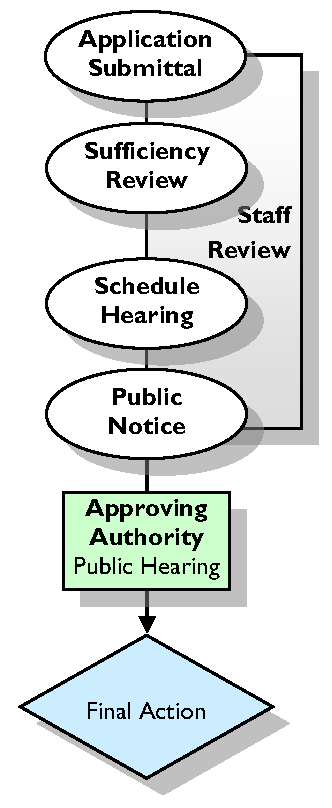
Once the application has been determined complete, the Zoning Administrator shall schedule a public hearing before the appropriate body, give public notice as set forth in Section 9.1, and forward a copy of the application with all related materials to the approving authority.
9.5.5. Action by the Approving Authority
Commentary: In order to determine the approving authority, refer to the table of permitted uses in Section 5.2
A.
Upon receipt of a complete application the Zoning Administrator shall schedule an evidentiary hearing before the appropriate body, give public notice as set forth in Section 9.1, and forward a copy of the application with all related materials to the approving authority.
B.
The approving authority shall hold the vested rights public hearing at the same time that the site plan is considered for approval.
C.
Approval by the approving authority shall confer upon the owner of the property a zoning "vested right" as defined in N.C.G.S. 160D-108, effective on the date of approval. The approving authority may condition the approval upon terms and conditions reasonably necessary to protect the public health, safety, and welfare. Such conditional approval shall result in a vested right, although failure to abide by its terms and conditions will result in a forfeiture of vested rights.
( Ord. No. UDO-21-01 , §§ 40, 59, 5-17-21)
9.5.6. Duration
A.
A right which has been vested as provided for in this section shall remain vested for a period of three years, unless a longer period, not to exceed five years, is granted by the approval authority. Modifications or amendments to an approved plan do not extend the period of vesting unless specifically so provided by the Board of Adjustment or the Planning Board upon approval of the modification and or amendment.
B.
The Board of Adjustment or the Planning Board may approve an extension of a zoning vested right for a period of two years resulting in a total vesting period of five years if warranted by the size and phasing of development, the level of investment, the need for the development, economic cycles, and market conditions, or other considerations. Applications to extend a vesting period shall be considered by the same authority that approved the original vested right determination.
C.
A multiphase development shall be vested for the entire development at the time a site plan approval is granted for the initial phase of the multiphase development. This right shall remain vested for a period of seven years from the time a site plan approval is granted for the initial phase of the multiphase development. For purposes of this section, "multiphase development" means a development containing 100 acres or more that is submitted for site plan approval for construction to occur in more than one phase and is subject to a master development plan with committed elements, including a requirement to offer land for public use as a condition of its master development plan approval.
( Ord. No. UDO-21-01 , § 60, 5-17-21)
9.5.7. Effect of Zoning Vested Rights
A.
Following approval or approval of a site-specific vesting plan, nothing in this section shall exempt such a plan from subsequent reviews and approvals to ensure compliance with the terms and conditions of the original approval, provided that such reviews and approvals are not inconsistent with the original approval.
B.
Nothing in this section shall prohibit the revocation of the original approval or other remedies for failure to comply with applicable terms and conditions of the approval or with this Ordinance.
C.
The establishment of a zoning vested right shall not preclude the application of new laws or regulations as is allowed under N.C.G.S. 160D-108. In addition, it shall not preclude overlay zoning that imposes additional requirements, but does not affect the allowable type or intensity of use, or ordinances or regulations that are general in nature and are applicable to all property subject to land use regulation. Otherwise applicable new or amended regulations shall become effective with respect to property that is subject to a site-specific vesting plan upon the expiration or termination of the vested right in accordance with this section.
D.
A vested right obtained under this section is not a personal right, but shall attach to and run with the subject property. After approval of a site-specific vesting plan, all successors to the original landowner shall be entitled to exercise such right while applicable.
( Ord. No. UDO-21-01 , §§ 41, 61, 5-17-21)
9.5.8. Termination
A vested right as provided in this section shall terminate when any one of the following circumstances apply:
A.
At the end of the applicable vesting period with respect to buildings and uses for which no valid building permit applications have been filed;
B.
With the written consent of the affected landowner;
C.
Upon findings by the Board of Adjustment or the Planning Board by ordinance and after notice and an evidentiary hearing, that natural or man-made hazards on or in the immediate vicinity of the property, if uncorrected, would pose a serious threat to the public health, safety, and welfare if the project were to proceed as contemplated in the site-specific vesting plan;
D.
The extent to which the affected landowner receives compensation for all costs, expenses, and other losses incurred by the landowner, including, but not limited to, all fees paid in consideration of financing, and all architectural, planning, marketing, legal, and other consulting fees incurred after approval by the local government, together with interest as is provided in N.C.G.S. 160D-106. Compensation shall not include any diminution in the value of the property that is caused by such action;
E.
Upon findings by the Board of Adjustment or the Planning Board by ordinance and after notice and an evidentiary hearing, that the landowner or the landowner's representative intentionally supplied inaccurate information or made material misrepresentations which made a difference in the approval by the approving authority of the site-specific vesting plan; or
F.
Upon the enactment or promulgation of a State or federal law or regulation that precludes development as contemplated in the approved vested right, in which case the Board of Adjustment or the Planning Board may modify the affected provisions, upon a finding that the change in State or federal law has a fundamental effect on the plan, after notice and an evidentiary hearing.
( Ord. No. UDO-21-01 , § 62, 5-17-21)
9.6 - ADMINISTRATIVE ADJUSTMENT
9.6.1. Applicability
The Planning Director is authorized to approve modifications to the requirements of this Ordinance in conjunction with the Design Flexibility provided in Section 6.1, the approval of Site Plan Amendments referenced in Section 3.2.9 and elsewhere in the ordinance. Additionally, the Planning Director shall be authorized to approve minor specified deviations as specified in paragraph a. below where, owing to special conditions, strict enforcement of the provisions of this Ordinance would be physically impractical.
9.6.2. Action by Planning Director
A.
The Planning Director shall have the authority to authorize the following administrative adjustments:
1.
A reduction of up to ten percent of the required front, side or rear yard setback for any encroachments into required setback;
2.
Minor adjustments to site plans consistent with the requirements of Section 3.2.9.
B.
Any request for deviation from the provisions of this Ordinance not listed above shall be reviewed by the Board of Adjustment as provided in Section 3.6, Variance.
9.6.3. Administrative Adjustment Criteria
To approve an administrative adjustment, the Planning Director shall make an affirmative finding that all of the following criteria are met:
A.
That granting the administrative adjustment will not have an adverse impact on land use compatibility;
B.
That granting the administrative adjustment will not materially and adversely affect adjoining land uses and the physical character of uses in the immediate vicinity of the proposed development;
C.
That granting the administrative adjustment will be consistent with the purposes and intent of this Ordinance; and
D.
That the strict enforcement of this Ordinance would be unreasonable and detrimental to the owner or applicant.
9.6.4. Appeal
Final action on an administrative adjustment may be appealed to the Board of Adjustment in accordance with Section 9.8, Appeal of Administrative Decision.
9.6.5. Annual Report
The Planning Director shall submit an annual written report to the Planning Board and the County Manager annually outlining the administrative adjustment requests and associated findings for the preceding year.
9.7 - WRITTEN INTERPRETATION
9.7.1. Applicability
When uncertainty exists, the Planning Director shall be authorized to make all interpretations concerning the provisions of this Ordinance.
Commentary: All interpretations of matters relating to the North Carolina Building Codes shall be made by the Building Official or designee.
(Ord. No. UDO-19-02 , § 11, 9-19-19)
9.7.2. Application Requirements
An application for a written interpretation shall be submitted in accordance with Section 3.1.8.J, Application Requirements.
9.7.3. Action by Planning Director
A.
The Planning Director shall review and evaluate the request in light of the text of this Ordinance, the Zoning Map, the CAMA Land Use Plan, any adopted land use documents, and any other relevant information;
B.
Following completion of any technical reviews by staff, the Planning Director shall render an opinion;
C.
The interpretation shall be provided to the applicant in writing.
9.7.4. Official Record
The Planning Director shall maintain an official record of all interpretations. The record of interpretations shall be available for public inspection during normal business hours.
9.7.5. Appeal
Final action on a written interpretation may be appealed to the Board of Adjustment in accordance with Section 9.8, Appeal of Administrative Decision.
9.8 - APPEAL OF ADMINISTRATIVE DECISION
9.8.1. Applicability
As specified in N.C.G.S. 160D-405, an appeal by any person aggrieved by a final order, interpretation or decision of the Zoning Administrator, Planning Director or other administrator in regard to the provisions of this Ordinance may be taken to the Board of Adjustment.
( Ord. No. UDO-21-01 , § 42, 5-17-21)
9.8.2. Application Requirements
A.
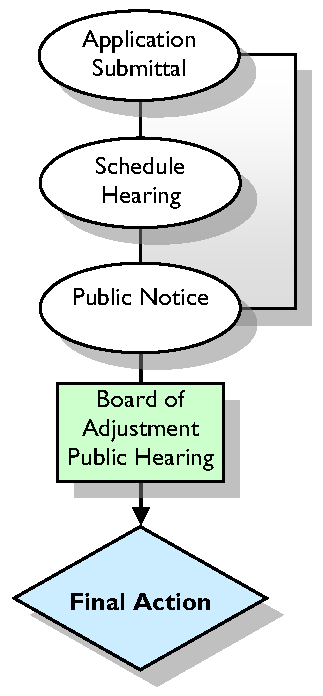
An appeal of an administrative decision shall be taken by filing a written notice of appeal specifying the grounds for the appeal with the Zoning Administrator and the Board of Adjustment.
B.
An application for appeal of an administrative decision shall be submitted in accordance with Section 3.1.8.J, Application Requirements.
C.
A notice of appeal of an administrative decision shall be considered filed when a complete application is delivered to the Zoning Administrator. The date and time of filing shall be entered on the notice.
9.8.3. Deadline for Submission of Application
An appeal of an administrative decision shall be filed with the Zoning Administrator and Board of Adjustment within 30 days of issuance of the decision.
9.8.4. Notice and Public Hearings
The County shall hold all required public hearings and give notice in accordance with Section 9.1, Notice and Public Hearings. Upon application of an Appeal of an Administrative Decision, adjoining property owners shall be notified via both certified mail and first class mail. In addition to the mailed notice, the Zoning Administrator shall post a sign at the subject property or at a location generally visible to the traveling public indicating that an application has been submitted for an Appeal of an Administrative Decision.
9.8.5. Action by Board of Adjustment
A.
The Board of Adjustment may reverse or affirm (wholly or partly) or may modify the order, requirement, decision, or determination appealed from and shall make any order, requirement, decision or determination that in its opinion ought to be made in the case before it. To this end, the Board of Adjustment shall have all the powers of the officer from whom the appeal is taken.
B.
A motion to reverse, affirm, or modify the order, requirement, decision, or determination appealed from shall include, insofar as practicable, a statement of the specific reasons or findings of fact that support the motion.
C.
If a motion to reverse or modify is not made, or fails to receive the affirmative vote of a majority of members present, then appeal shall be denied.
D.
Any motion to overturn a decision shall state the reasons or findings of fact that support the motion.
9.8.6. Effect of Appeal
A.
An appeal shall stay all proceedings in furtherance of the action appealed, unless the administrative official from who the appeal is taken certifies to the Board of Adjustment that, because of facts stated in the certificate, a stay would, in their opinion, cause imminent peril to life or property or that because the violation is transitory in nature a stay would seriously interfere with the effective enforcement of this Ordinance. In that case, proceedings shall not be stayed except by order of th Board of Adjustment or a court, issued on application of the party seeking the stay, for due cause shown, after notice to the administrative official.
B.
An appeal shall not stop action lawfully approved (including construction activities authorized by a building permit); only actions presumed in violation of this Ordinance are stayed.
9.9 - RESERVED
Editor's note— Ord. No. UDO-19-02 , § 11, adopted September 19, 2019, repealed article 9, § 9, which pertained to abatement of nuisance caused by abandoned mobile homes.
9.10 - ENFORCEMENT AND PENALTIES
9.10.1. Purpose
This Section sets forth the procedures by which the County seeks correction of violations of this Ordinance. It also sets forth the remedies and penalties the County may apply where necessary to ensure correction of violations. The provisions in this section are intended to encourage the voluntary correction of violations.
9.10.2. Applicability
The Zoning Administrator may revoke any permit or other authorization granted under this Ordinance for failure to comply with the provisions of this Ordinance or the terms and conditions of the permit or authorization, or for false statements or misrepresentations made in securing the permit or authorization, or if the permit or authorization was mistakenly granted in violation of applicable State or local law. If the Zoning Administrator determines an imminent hazard exists, he may summarily revoke this permit.
9.10.3. Violations
Any failure to comply with a requirement, prohibition, or limitation imposed by the provisions of this Ordinance, or the terms and conditions of any permit or other authorization granted pursuant to this Ordinance, shall constitute a violation of this Ordinance. Responsible Persons
One or more of the following persons may be held responsible for a violation of this Ordinance and be subject to the remedies and penalties provided in this section:
A.
An architect, engineer, builder, contractor, agent, or any other person who participates in, assists, directs, creates, or maintains a situation that constitutes a violation of this Ordinance, and
B.
An owner of the property on which a violation of this Ordinance occurs, or any tenant or occupant of that property who has control over, or responsibility for, its use or development.
9.11 - ENFORCEMENT PROCEDURES
9.11.1. Investigation
On receiving complaints or other information suggesting a violation of this Ordinance, the Zoning Administrator, or other official(s) designated by the Board of County Commissioners shall investigate the situation and determine whether a violation exists.
9.11.2. Initial Notice of Violation
A.
On determining that a violation exists, the Zoning Administrator shall issue a written notice of the violation in conformance with statutory procedures to both the violator and landowner if different by personal delivery, email, or by certified or registered mail, return receipt requested. The notice shall describe the nature of the violation, state the actions necessary to correct the violation, and invite the alleged violator to meet with the Zoning Administrator within ten (10) days to discuss the violation and how it may be corrected. The Zoning Administrator must certify that the notice was provided, and the certificate shall be deemed conclusive in the absence of fraud. The Zoning Administrator may provide the alleged violator additional written notices of violation.
B.
If reasonable attempts have been made to effect service of the written notice upon the responsible person(s) by personal delivery, email, or by certified or registered mail have been unsuccessful, then notice may be provided by posting the written notice upon the property in a conspicuous place for a period of not less than ten (10) days.
( Ord. No. UDO-21-01 , § 48, 5-17-21)
9.11.3. Final Notice of Violation; Correction Order
The Zoning Administrator's final written notice of violation (which may be the initial notice) shall be served upon the responsible person(s) in the same manner as the Initial Notice of Violation and shall order correction of the violation not to exceed thirty 30 days, state which of the remedies and penalties authorized in Subsection 9.11.9 the Zoning Administrator may pursue if the violation is not corrected within the specified time limit, and state that the correction order may be appealed to the Board of Adjustment.
9.11.4. Reinstatement of Permit by Zoning Administrator
The holder of a revoked permit or authorization may, within 90 days after the revocation, submit to the Zoning Administrator a written request to reinstate the revoked permit or authorization. On determining that the conditions justifying the revocation have been eliminated and that the development fully complies with all applicable requirements of this Ordinance, the Zoning Administrator may reinstate the permit or authorization.
9.11.5. Appeal to the Board of Adjustment
A.
Any person aggrieved by the Zoning Administrator's determination of a violation or correction order may appeal that determination or order to the Board of Adjustment in accordance with the provisions of Section 9.8, Appeal of Administrative Decision. As provided by that section, an appeal generally stays all further actions to enforce a correction order until the Board of Adjustment has decided the appeal.
B.
If the recipient of a correction order does not appeal the order to the Board of Adjustment within the time limit specified in Section 9.8, Appeal of Administrative Decision, that person may not later appeal to the Board of Adjustment the subsequent imposition of any remedy or penalty specified in the order.
9.11.6. Extension of Time Limit to Correct Violation
The recipient of a correction order, or the owner of the property on which the violation occurs, may submit to the Zoning Administrator a written request for extension of the order's specified time limit for correction of the violation. On determining that the request includes enough information to show that the violation cannot be corrected within the specified time limit for reasons beyond the control of the person requesting the extension, the Zoning Administrator may extend the time limit as reasonably necessary to allow timely correction of the violation.
9.11.7. Enforcement Action after Time Limit to Correct Violation
Following the time limit for correction of the violation, including any stay or extension thereof, the Zoning Administrator shall determine whether the violation has been corrected. If the violation has been corrected, the Zoning Administrator shall take no further action against the alleged violator. If the violation has not been corrected, the Zoning Administrator may act to impose one or more of the remedies and penalties specified in the correction order.
9.11.8. Emergency Enforcement without Notice
If delay in correcting a violation would seriously threaten the effective enforcement of this Ordinance or pose a danger to the public health, safety, or welfare, the Zoning Administrator may seek immediate enforcement without prior written notice through any of the remedies or penalties authorized in Subsection 9.11.9, below.
9.11.9. Remedies and Penalties
The Zoning Administrator may pursue one or more of the following remedies and penalties to prevent, correct, or abate a violation of this Ordinance. Use of one of the authorized remedies and penalties does not preclude the Zoning Administrator from using any other authorized remedies of penalties, nor does it relieve any party to the imposition of one (remedy or penalty from imposition of any other authorized remedies or penalties.
A.
Permit Revocation
In accordance with the provisions of Section 9.10.2 of this Ordinance and the provisions of N.C.G.S. 160D-403(f) and 160D-1115, development approvals may be revoked. The Zoning Administrator may revoke any permit by the County by notifying the permit holder in writing stating the reason for revocation. The County shall follow the same development review and approval process required for issuance of the development approval, including any required notice or hearing, in the review and approval of any revocation of that approval. The revocation of an administrative development approval may be appealed pursuant to G.S. 160D-4-5.
Before revoking a permit or other authorization, the Zoning Administrator shall give the holder of the permit or authorization ten days notice of intent to revoke the permit or authorization. The notice shall state the reasons for the intended revocation and state that the holder may have an informal hearing on the intended revocation before the Zoning Administrator. On revoking a permit or authorization, the Zoning Administrator shall give the holder of the permit or authorization a written notice of the revocation and the reasons for it.
B.
Permit Denial
As long as a violation of this Ordinance remains uncorrected, the Zoning Administrator may deny or withhold approval of any permit or other authorization provided for in this Ordinance that is sought for the property on which the violation occurs.
C.
Civil Penalty
1.
Violation of this Ordinance subjects the violator to a civil penalty in the amount of $100.00. The Zoning Administrator may impose a civil penalty by giving the violator a written citation, either in person or by certified or registered mail, return receipt requested. The citation shall describe the nature of the violation, specify the amount of the civil penalty being imposed, and direct the violator to pay the civil penalty to the County within ten days of the date the citation is received. If the violator fails to either pay the civil penalty or correct the violation within this time limit, the Zoning Administrator may institute a civil action in the nature of a debt in a court of competent jurisdiction to recover the civil penalty.
2.
For purposes of assessing the amount of a civil penalty, each day the violation remains uncorrected after receipt of the correction order (or the receipt of the citation itself in the case of emergency enforcement) shall constitute a separate violation that subjects the violator to additional civil penalty.
D.
Criminal Penalty
As provided in Section 14-4 of the North Carolina General Statutes, violation of this Ordinance constitutes a misdemeanor, punishable by a fine of up to $500.00.
E.
Injunction and Abatement Order
The Zoning Administrator may institute action in a court of competent jurisdiction for a mandatory or prohibitory injunction and order of abatement commanding the violator to correct or cease a violation of this Ordinance. Under Section 153A-123 of the North Carolina General Statutes, if the violator fails to comply with a court injunction or order of abatement and the County executes the order, the County will have a lien on the property on which the violation occurred for the County's costs in executing the order.
F.
Other Equitable Relief
In addition to the above remedies and penalties, the Zoning Administrator may institute any other appropriate equitable action or proceeding in a court of competent jurisdiction to prevent, correct, or abate a violation of this Ordinance.
( Ord. No. UDO-21-01 , §§ 43, 49, 5-17-21)
9.11.10. Statute of Limitations for Legal Action
Legal action cannot be taken against the owner of an interest in real property by a unit of local government for a land use violation related to a land-use statute, ordinance, or permit or any other official action concerning land use carrying the effect of law (N.C.G.S. 1-51 and 1-49).
1.
Five Years Limitation
Legal action cannot be taken against the owner of an interest in real property for a violation if the violation is known to the governing body, an agent, or an employee of the unit of local government or if the violation can be determined from the public record of the unit of local government.
2.
Seven Years Limitation
Legal action cannot be taken against the owner of an interest in real property for a violation if the violation is apparent from a public right-of-way or the violation is in plain view from a place to which the public is invited.
3.
This section does not limit any of the following:
(a)
Enforcement remedies for violations that are injurious or dangerous to the public health or safety.
(Ord. No. UDO-19-02 , § 10, 9-19-19)

