
Carpentersville City Zoning Code
CHAPTER 16
40 - SIGNS3
Editor's note— Ord. No. 12-08, §§ 2, 3, adopted Feb. 21, 2012, repealed the former Ch. 16.40, §§ 16.40.010—16.40.060, and enacted a new Ch. 16.40 as set out herein. The former Ch. 16.40 pertained to sign regulations and derived from prior code §§ 5-25—5-30; Ord. 02-46, 2002; Ord. 06-15, 2006; Ord. 07-26, 2007; Ord. No. 09-14, 4-7-2009; Ord. No. 10-30, 7-20-2010; Ord. No. 11-05, 1-4-2011; Ord. No. 11-38, 9-6-2011.
16.40.010 - Title.
This chapter shall be known as and may be cited and referred to as the "Carpentersville Sign Code."
(Ord. No. 12-08, § 3, 2-21-2012)
16.40.020 - Purpose.
The regulation of signs by this chapter is intended to promote and protect the public health, safety and welfare. With this in mind, this chapter is adopted for the following purposes:
A.
To create the legal framework for a comprehensive but balanced system of signage;
B.
To create a viable economic and business climate within the commercial and industrial areas of the village by promoting the reasonable, orderly, and effective display of signage, and encouraging better communication with the public;
C.
To preserve the non-commercial character of residential areas of the village;
D.
To reduce the depreciation of property values caused by signs that are incompatible with surrounding land uses and to encourage the use of signs that are compatible with surrounding land uses;
E.
To enhance and protect the physical appearance of all areas of the village and eliminate visual clutter;
F.
To reduce distractions, obstructions and hazards to pedestrians and vehicular traffic caused by the placement and use of signs.
(Ord. No. 12-08, § 3, 2-21-2012)
16.40.030 - Scope.
The regulations of this chapter shall govern and control the installation, erection, enlargement, expansion, alteration, operation, maintenance, replacement, relocation and removal of all signs within the village and any sign not expressly permitted by these regulations shall be prohibited. Additionally, the construction and erection of all such signs shall be subject to the building and construction code in Title 15.
(Ord. No. 12-08, § 3, 2-21-2012)
16.40.040 - Definitions.
For the purpose of this chapter, the following words and terms shall have the meanings respectively ascribed to them by this section,
"Animated or moving sign" means any sign or part of a sign which changes physical position by any movement or rotation.
"Attention-getting device" means any device including, but not limited to, moving, rotating or undulating signs, or light beams, strobe lights, flashing lights, or animated light displays, pennants, banners, flags, balloons, or inflatables designed for the purpose of attracting attention, promoting or advertising, except code-compliant electronic changeable copy signs.
"Awning" means a structure typically made of cloth, canvas or fabric (or sometimes of metal) which is tightly stretched over a frame or truss and securely attached to a building without any support posts or columns, and is permanently attached to the building in a fixed position or erected as to permit its being raised or retracted to a position against the building when not in use.
"Awning sign" means any sign painted, stamped, perforated, or stitched, or otherwise applied on the vertical surface of an awning (i.e. the front and side portions thereof).
"Banner sign" means a temporary sign made of lightweight fabric or similar material either enclosed or not enclosed in a rigid frame, secured or mounted so as to allow the movement of the sign caused by movement of the atmosphere. National flags, state or municipal flags, or the official flag of any institution or business shall not be considered banners.
Billboard. See "Off-premises advertising sign."
"Building facade or wall" means all window and wall area of a building in one plane.
"Building memorial marker" means any sign indicating not more than the name of a building, the date of construction, and/or other incidental information about the construction of the building, which sign is cut into a masonry surface or made of bronze or other permanent material that is permanently attached to a building.
"Canopy" means a fixed structure, other than an awning, made of cloth, metal, or other material attached to a frame or truss that projects over the ground, and is securely attached to a building on one site and carried by support posts or columns connected to the ground on the opposite side.
"Canopy sign" means any sign that is mounted on or attached to a canopy that is otherwise permitted by this section.
"Construction sign" means a temporary sign identifying the participants taking part in a construction project on the property on which the sign is located, and including parties such as the architect, engineer, contractor, subcontractor, owner, developer, sponsor, and financial supporter.
"Changeable copy sign, electronic" means a type of sign or portion thereof that is capable of displaying words, symbols or alphanumeric characters which are defined by a small number of matrix elements using different combinations of light emitting diodes (LEDs), fiber optics, light bulbs or other illumination devices that can be electronically or automatically programmed and may be changed by remote or automatic means. The following terms for such electronic changeable copy signs shall be defined as follows:
1.
Dissolve: A mode of message transition on an electronic changeable copy sign accomplished by varying the light intensity or pattern, where one message gradually appears to dissipate and lose legibility simultaneous to the gradual appearance and legibility of a subsequent message.
2.
Fade: A mode of message transition on an electronic changeable copy sign accomplished by varying the light intensity, where one message gradually reduces intensity to the point of not being legible and a subsequent message gradually increases intensity to the point of legibility.
3.
Nits: A luminance unit equal to one candle per square meter measured perpendicular to the rays from the source.
4.
Scroll: A mode of message transition on an electronic changeable copy sign where the message is changed by the apparent vertical movement of the letters or graphic elements of the message.
5.
Static: Graphics on an electronic changeable copy sign having no motion or movement of any type.
6.
Travel: A mode of message transition on an electronic changeable copy sign where the message is changed by the apparent horizontal movement of the letters or graphic elements of the message.
7.
Transition: A visual effect used on an electronic changeable copy sign to change from one message to a subsequent message.
"Changeable copy sign, manual" means a permanent sign whereon provision is made for letters or characters to be placed in or upon the surface area of the sign manually to provide a message or picture without altering the surface of the sign.
"Daily temporary sign" means a sign that is placed in front of a business during the hours of operation of the business on a daily basis and taken in nightly. Such signs are intended to benefit and to attract the attention of pedestrians.
"Directional sign" means a sign directing and guiding vehicular or pedestrian traffic, ingress, egress, or parking on private property, but not including incidental signs as defined in this section.
Electronic changeable copy sign. See "Changeable copy sign, electronic."
"Exempt sign" means a sign for which no permit is required.
"Festoon lighting" means a group of two or more incandescent light bulbs hung or strung overhead, not on a building or structure, which are exposed to persons on a public right-of-way, or which are not shaded or hooded to prevent the direct rays of light from being visible from the property line.
"Flashing sign" means any illuminated sign, either stationary or animated, on which the artificial light is not maintained stationary or constant in intensity and color at all times when such is in use. Flashing signs do not include code-compliant electronic changeable copy signs.
"Foot-candle" means a unit of illuminance or illumination, equivalent to the illumination produced by a source of one candle at a distance of one foot and equal to one lumen incident per square foot.
"Freestanding sign" means a sign completely independently supported of any building or other structure and anchored in or upon the ground. (This term also includes those signs commonly known as ground signs and monument signs.)
"Governmental sign" means a sign erected and maintained to identify or serve any government function or control, including essential service signs which provide legal notice, identification, information, directions, or are related to traffic, utility locations or emergency services or otherwise related to a public purpose.
Ground sign. See "Freestanding sign."
"Illuminated sign" means a sign from which artificial light emanates either by means of exposed lighting on the surface of the sign or through transparent or translucent material from a source within the sign, or a sign which reflects artificial light from a source intentionally directed upon it.
"Institutional sign" means an exterior sign of public, charitable, or religious institutions, where such signs are located on the premises of said institutions.
"Lot" or "premises" means a parcel or group of parcels of land used for a common purpose.
"Marquee" means a roof-like structure of permanent construction extending over a pedestrian way and projecting out from the wall of a building but not supported by the ground or sidewalk, for the purpose of providing shelter and protection from the weather.
"Marquee sign" means a sign mounted, attached, or otherwise incorporated into a marquee.
"Menu sign" means a freestanding or wall sign which is accessory to a drive-through facility and exhibits, displays or identifies food and beverages offered for purchase.
Monument sign. See "Freestanding sign."
"Nameplate" means a sign which displays only the name and address of a building or the name of the occupant thereof, is non-electrical, and does not exceed four square feet in area.
"Non-commercial sign" means a sign containing a message which conveys a particular point of view or philosophical message and does not direct attention to a business, profession, or commercial enterprise; to a commodity sold, serviced or manufactured; or to any type of for-profit entertainment.
"Off-premise sign" means a freestanding sign displayed in any manner whatsoever out of doors which directs attention to a business, commodity, service or entertainment conducted, sold or offered elsewhere than upon the premises on which such sign is located or to which it is affixed.
"On-premise sign" means a freestanding sign which directs attention to a business or profession conducted, or to an organization or institution, or to a commodity or service sold, offered or manufactured, or to an entertainment offered upon the premises where such a sign is located or to which it is affixed.
"Political campaign sign" means a sign or poster announcing candidates seeking public political office and data pertinent thereto.
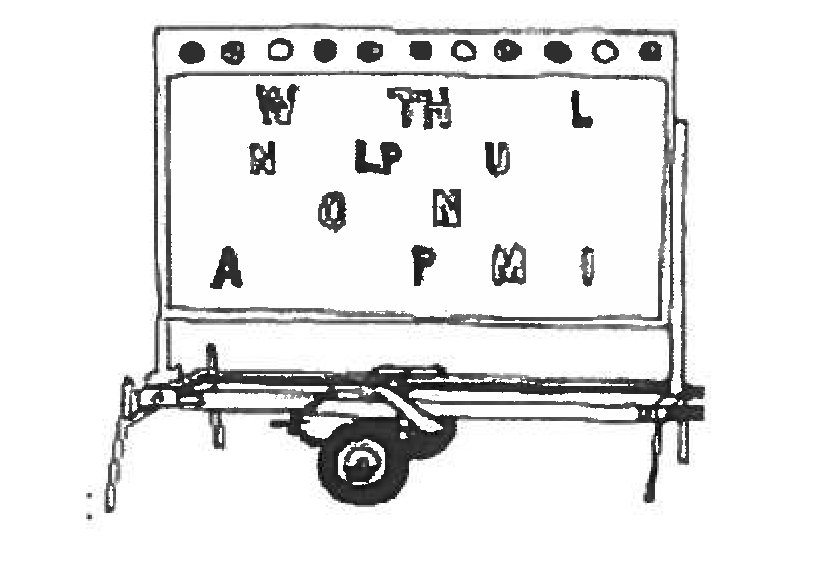
"Portable sign" means a sign that is not permanently affixed to a building structure or the ground, but is designed to be moved from place to place, is commonly attached to or displayed on a trailer or wheels, and that is used for the expressed purpose of temporarily advertising a business establishment, product, service, or entertainment. An example of a type of portable sign is shown below:
"Projecting sign" means any sign other than an awning sign or canopy sign that is attached to and projects from the wall or face of a building or structure by more than 12 inches.
"Public agency or unit of government special event signage" means temporary signage for festivals, programs, or special events hosted by a public body.
"Real estate sign" means a sign indicating the status of the sale, rental, lease, or development of a building or lot, or a portion thereof, on which the sign is located. A real estate sign may be a freestanding, wall or window sign. Such a sign may also include related details such an indication of whether the building or lot is "Sold," "Under Contract," etc.
"Right-of-way" means the perpendicular distance across a public street, measured from property line to property line.
"Roof sign" means any sign erected upon, against, or directly above a roof or roof eave, or on top or above the parapet, or on a functional architectural appendage above the roof or roof eave.
"Shopping center" means a commercial development under unified control (by restrictive covenant, unified property ownership, approval of a planned unit development, or otherwise) consisting of four or more separate commercial establishments sharing a common building, or which are in separate buildings that share a common entranceway or parking area.
"Sign" means any object, device, display or structure consisting of any letter, figure, character, mark, point, plane, marquee sign, design, poster, pictorial, picture, stroke, stripe, line, trademarks, reading matter, or illuminating device; constructed, attached, erected, fastened, or manufactured in any manner whatsoever so that the sign shall be used for the attraction of the public to any place, subject, person, public performance, article, machine, or merchandise whatsoever and displayed in any manner whatsoever for recognized advertising purposes.
"Sign area" means the smallest rectangle which encloses the extreme limits of the writing, copy, representation, emblem, or other display, including separate letters or characterizations connected in meaning, and including any material or color forming an integral part of the background of the display or used to differentiate the sign from the back drop or structure against which it is placed.
"Site relevant incidental sign" means an informational sign that has a relevant purpose secondary to the use of the lot on which it is located. Site relevant incidental signs include directional signs, address signs, and include "no parking," "entrance," "rest rooms," "loading only," "telephone," and other similar directives. No sign with a commercial message shall be considered a site relevant incidental sign.
"Temporary sign" means a sign, banner, or other display constructed of cloth, canvas, fabric, wood, or other temporary material, with or without a structural frame, and intended for a limited period of display; a sign that is intended for use for only a limited period of time.
"Undeveloped lot" means any lot upon which no building or structure is located.
"Vehicle sign" means any advertising or business sign attached to a motor vehicle or to a trailer which is parked or placed in position for the purpose of displaying the same to the public.
"Wall sign" means a sign mounted or attached to the exterior wall of a building or structure in a plane parallel to that of the supporting wall; also any sign that is temporarily affixed to or displayed on an exterior building wall. A wall sign may not project more than 12 inches from the plane of the structure to which it is attached.
"Window sign" means a sign painted, stenciled, or affixed on a window, which is visible from the street right-of-way.
"Work of art" means a two-dimensional or three-dimensional object, including but not limited to paintings photographs, and sculptures, created solely for an aesthetic purpose and not conveying a commercial message or a part of a commercial message, graphic or logo.
(Ord. No. 12-08, § 3, 2-21-2012)
16.40.050 - General provisions.
A.
Permits Required.
1.
Unless otherwise provided in this chapter, it shall be unlawful for any person to install, construct, erect, alter, enlarge, replace, or move any sign for any reason within the village prior to receiving a permit therefor, and such signs shall only be constructed in accordance with a properly authorized and issued permit.
2.
Applications for permits shall be in writing, on a fully completed application form provided by the village. At a minimum, the following information shall be submitted with each permit application:
a.
An accurate plat of survey or other accurate and scaled drawing indicating: the exact location of the proposed sign; the property lines; the distance of the proposed sign to the property lines; the location and dimensions of all buildings existing on the site; all easements; and, the street lines, driveways, parking lots, sidewalks and walkways.
b.
Two copies of detailed specifications of the sign including the sign area, height, color, construction materials, and construction methods.
3.
The zoning administrator shall promptly review the application upon the receipt of a completed permit application and required submittals by the applicant. The zoning administrator shall grant or deny the permit application in writing, within20 days from the date the completed application and permit fee was filed. If the permit application is not granted or denied within the prescribed time period, the permit application shall be deemed denied.
4.
The zoning administrator shall approve the sign permit if it is in compliance with the provisions of this title and if it complies with all building, electrical or other applicable codes of the village.
5.
Any applicant who is denied a permit shall have the right to file an appeal pursuant to Section 2.52.040 of the Municipal Code. An application for an appeal shall be based on a claim that the true intent of this chapter has been incorrectly interpreted, or the provision(s) of this title or this chapter do not fully apply.
6.
No sign permit shall be issued until after the required permit fee as set forth in Chapter 20.02 of this code has been paid in full.
7.
No sign shall be erected, constructed or maintained upon any property without the written consent of the owner or person entitled to possession of the property. Written consent must accompany the application for sign permit.
B.
Inspections. The zoning administrator or his or her designee shall perform an inspection of each permitted sign during the last month the permit is valid or at such earlier date as the owner may request. If the construction is not substantially complete at the time of the inspection, the permit shall be subject to lapsing and becoming void. If the construction is complete and in full compliance with this section and with the building and construction codes of the village, the village shall provide written notification of the completed and approved sign to the property owner and the permit applicant, and shall maintain a copy or digital scan of this written notification in the permanent permit records of the village. If the construction is substantially complete but not in full compliance with this section and applicable codes of the village, the village shall give the property owner or permit applicant notice of the deficiencies and shall allow an additional 30 days from the date of inspection for the deficiencies to be corrected. If the deficiencies are not corrected by such date, the permit shall be void. If the construction is then complete, the village shall provide written notification as described above.
C.
Sign Area. The following principals shall control the computation of sign area within the village:
1.
Individual Signs. The sign area of a sign shall be the smallest rectangle which encloses the extreme limits of the writing, copy, representation, emblem, or other display, including separate letters or characterizations connected in meaning, and including any material or color forming an integral part of the background of the display or used to differentiate the sign from the back drop or structure against which it is placed, but excluding the supporting framework, bracing, or decorative ornamentation that is clearly incidental to the sign display itself.
2.
Multiple-faced Signs. The sign area for a sign with more than one surface shall be computed by adding together the sign area of all sign surfaces visible from any one point. When two identical sign surfaces are placed back to back, so that both faces cannot be viewed from any point at the same time, and when such sign surfaces are part of the same sign structure and are not more than18 inches apart, the sign area shall be computed by the measurement of one of the sign surfaces.
D.
Sign Height. The height of sign shall be the distance measured between the top of the nearest public street curb and the highest point of the sign for freestanding signs. For all other signs, the distance measured between finished grade adjoining the wall on which a wall, awning, or window sign is attached and the highest point of said sign. The purpose of regulating the sign height is to promote the effective display of signage, specifically by limiting the height of signs to avoid conflict with the canopy of mature shade trees.
E.
Illumination. An illuminated sign is any sign from which artificial light emanates either by means of exposed lighting on the surface of the sign or through transparent or translucent material from a source within the sign, or a sign which reflects artificial light from a source intentionally directed upon it.
1.
Illuminated signs permitted in residential districts or located within 100 feet of a residential zoned lot shall not be illuminated between the hours of ten p.m. and seven a.m., unless the establishment is engaged in the operation of business during that period, in which case the sign may be lit during the hours of operation only.
2.
No illuminated sign shall be positioned or maintained so as to permit the beams and illumination therefrom to be directed or beamed upon any adjacent property nor to cause glare or reflection that may constitute a nuisance or traffic hazard.
3.
A photometric plan may be required by the village in order to confirm that light emitted by the sign does not exceed one foot-candle at or beyond the property line of the parcel or lot on which the sign is located.
4.
Neon illumination of any signage is not permitted.
F.
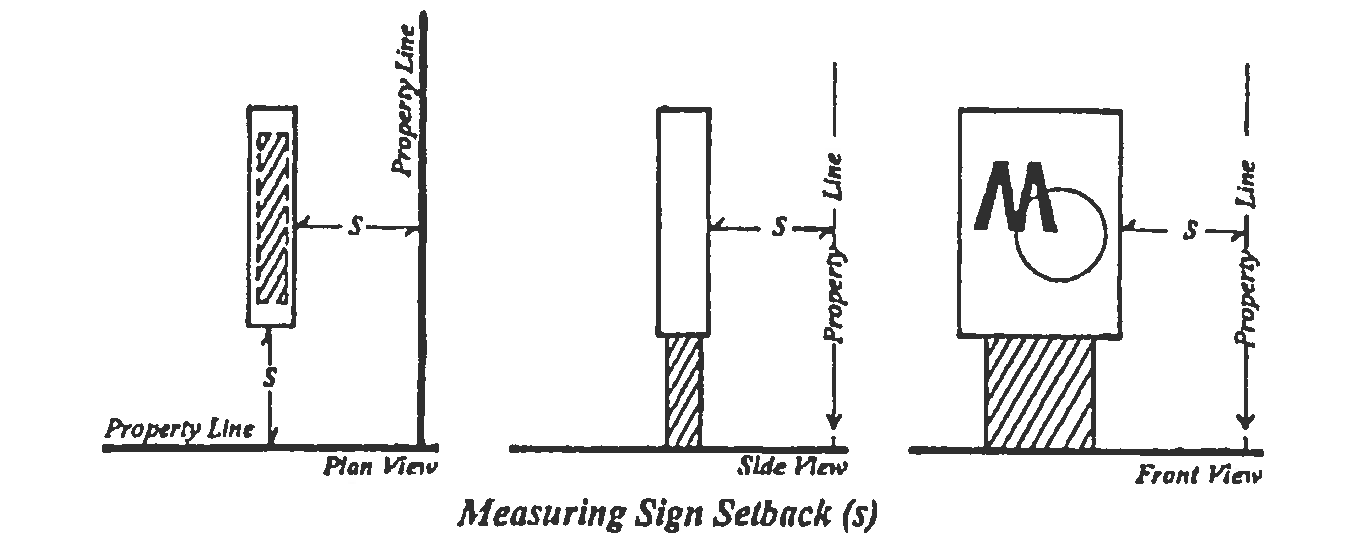
Setback. Except as otherwise provided herein, freestanding signs shall be located at least ten feet from any right-of-way line and five feet from any property line. The setback of a sign shall be measured as the distance between the point of reference specified and the closest point on the sign.
G.
Electrical Elements. All wiring, fittings, and materials used in the construction, connection and operation of electrically illuminated signs shall be in accordance with the provisions of the buildings and construction code in Title 15 of this code.
H.
Structural Elements. The construction and structural components of all signs shall be in accordance with the standards and regulations of the buildings and construction code in Title 15 of this code.
I.
Sign Maintenance. The owner of a sign and the owner of the premises on which such sign is located shall be liable for maintenance of such sign, including but not limited to its source(s) of illumination, its neat and orderly condition (free of any debris), maintenance to ensure good working order at all times (i.e. functional light bulbs), and for preventing deterioration of the physical appearance (i.e. sign fading, missing letters, cracked sign face, etc.) and the safe condition of such sign. Manual changeable copy signs must be designed in such a manner that the message area is resistant to damage by wind and vandalism.
J.
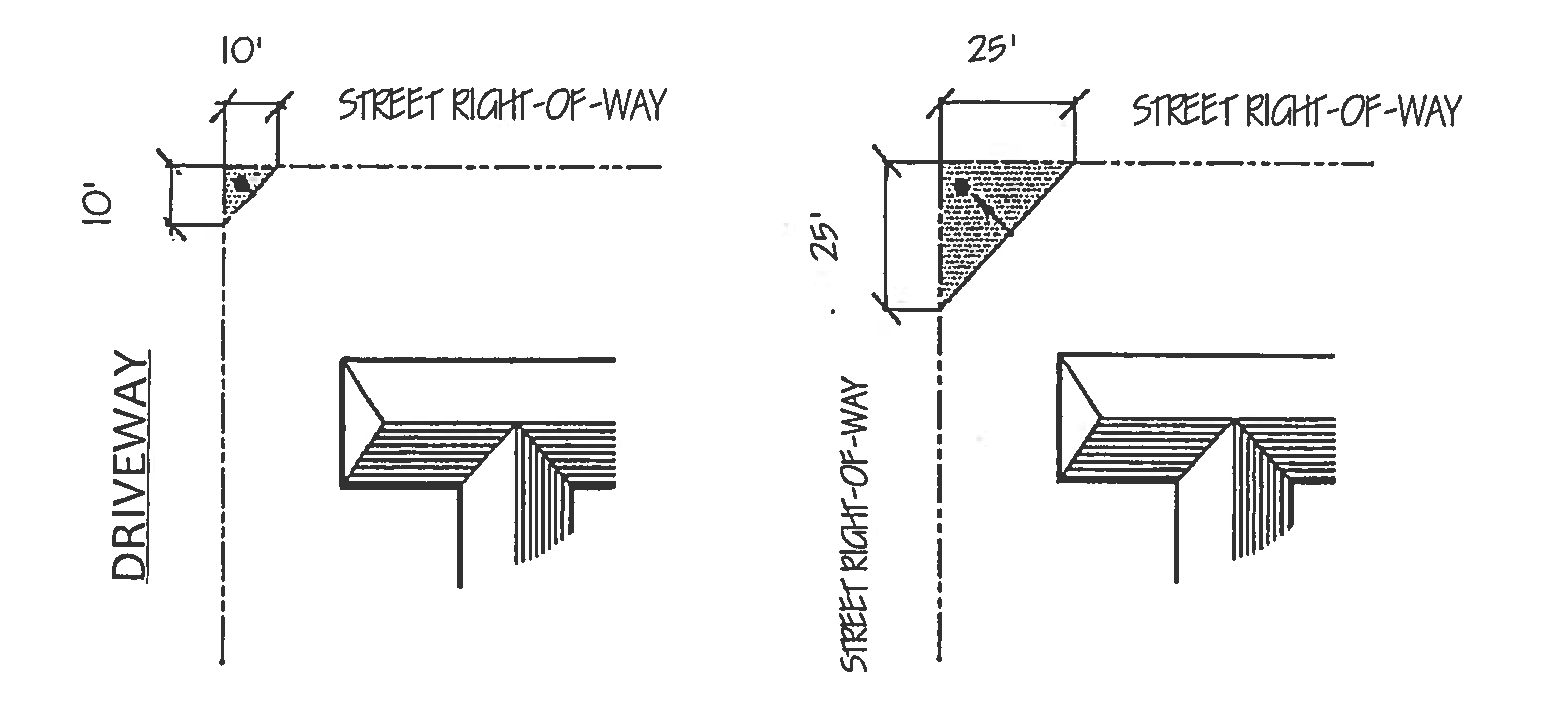
Sight Triangle. No sign shall obstruct visibility at the intersection of two or more roadways and/or driveways. There shall be no significant obstruction to visibility located above three feet in height within the following areas:
1.
A sight triangle having legs of 25 feet along the right-of-way lines when two streets intersect.
2.
A sight triangle having legs of ten feet along the right-of-way line and the driveway edge when a street and a driveway intersect.
K.
Overhang. Except awning and canopy signs, no sign may overhang any part of a structure, sidewalk, parking or loading space, driveway or maneuvering aisle.
(Ord. No. 12-08, § 3, 2-21-2012)
16.40.060 - Prohibited signs.
The following signs shall not be permitted with the Village of Carpentersville:
A.
Flashing signs, except code-compliant electronic changeable copy signs;
B.
Projecting signs;
C.
Animated or moving signs;
D.
Signs painted directly on the facade or wall of any building or other structure not built for such purpose;
E.
Signs which constitute a hazard to public health or safety;
F.
Vehicle signs mounted on trailers or motor vehicles, provided that signs containing the name, address or business identification of the owner or user and displayed on a motor vehicle in use and portable signs defined herein are exempt from this section;
G.
Roof signs;
H.
Signs on fences, trees, utility poles, or walls which are not a part of a building structure;
I.
Attention-getting devices, unless they are specifically permitted by another section of this chapter;
J.
Signs which, by reason of size, location, content, color, or manner of illumination, obstruct the vision of motorists or interfere with the visibility or effectiveness of any traffic sign or control device on public streets;
K.
Signs which make use of words such as "Stop," "Look," "One-Way," "Danger," "Yield," or any similar word, phrase, symbol or light so as to interfere with or confuse pedestrian or vehicular traffic or signs which by reason of their size, location, coloring or manner of illumination may be confused with a traffic control device emergency vehicle or which hide or interfere with any street sign, signal or device;
L.
Signs displayed within or extended over public right-of-way, except those erected or authorized by a government authority having jurisdiction of the public right-of-way;
M.
Signs which obstruct ingress or egress from any fire escape, door, window, other exit or entrance, driveway, utility line or create a traffic hazard;
N.
Advertising, business, or identification signs on light poles of establishments;
O.
Festoon lighting; and
P.
Signs which emit audible sound, odor or visible matter.
(Ord. No. 12-08, § 3, 2-21-2012)
16.40.070 - Permits not required—Exemptions.
A.
The following activities shall not require a permit:
1.
A change or replacement of the advertising copy or message of an existing approved sign. A permit shall be required if additional signs are being requested or current signs are being changed with regards to size or height;
2.
Painting, repainting, cleaning or normal maintenance of an existing approved sign;
3.
Erection of a permitted exempt sign as provided herein.
B.
The following signs shall be exempt from the permit requirements of this chapter. All such signs shall conform to all bulk requirements of this title and shall conform to all building, structural and electrical regulations of the village.
1.
Flags. Provided the number of such flags shall not exceed four in commercial or manufacturing districts and one in residential districts. Flags shall be flown in accordance with protocol established by the Congress of the United States for the Stars and Stripes.
2.
Decorations customarily and commonly associated with a national, local or religious holiday, or recognized local special event, provided that such decorations shall not be displayed for more than 60 days.
3.
Site relevant incidental signs not exceeding two square feet in sign area including signs bearing only the name or logo of the occupant, or address of the lot, or indicating building entrances or exits. Only one such sign per occupant entrance or exit shall be permitted. Such signs may be illuminated.
4.
Governmental Signs.
5.
Building memorial markers not exceeding four square feet of sign area per building.
6.
Non-illuminated signs displayed on windows of buildings in commercial or manufacturing districts provided the sign area of all window signs occupy no more than 40 percent of the window surface area. For the purposes of calculating window signage, window surface area shall be defined as all the glass surfaces, including windows and doors of a single tenant building or of a space in a multiple tenant building occupied by a single user, that make up the street-facing facade.
7.
Signs in construction areas shall be allowed in accordance with the following standards:
a.
Not more than one sign per premise shall be allowed.
b.
Signs shall not exceed six square feet in area in residential areas and 32 square feet in area in non-residential areas.
c.
Signs shall not exceed five feet in height in residential areas and 8 feet in height in non-residential areas.
d.
Signs shall be removed at the time of issuance of a certificate of occupancy for the subject property.
8.
Real Estate Signs. Said signs, as defined in this chapter, must be located on the same property as the real estate being advertised, and may remain in place during the time the property is actually for sale, rent, or lease, or available for development. Real estate signs are allowed as follows:
a.
No more than one real estate sign is allowed per lot except that a corner lot may have one such real estate sign per street front.
b.
Real estate signs in residential districts shall not exceed six square feet in area.
c.
Except as noted in subsection d below, real estate signs for commercial or manufacturing districts shall not exceed thirty-two (32) square feet in area.
d.
In addition to the real estate sign noted in subsection c above, one real estate sign banner not exceeding one hundred twenty (120) square feet in area may be attached to any non-residential building of twenty-five thousand (25,000) square feet or larger. Such banners shall be securely attached to the subject building and shall be removed or replaced if they become frayed or damaged.
e.
Such real estate signs must be removed within two days of a closing or lease transaction, as applicable.
9.
Signs attached to the underside of a permanent building overhang in a commercial or manufacturing district intended generally to attract pedestrian traffic, provided such signs comply with the following standards:
a.
One sign attached to the underside of a permanent building overhang shall be permitted for each tenant space in a building.
b.
Such signs shall not exceed five square feet in sign area.
c.
Such signs shall be mounted at right angles to the building facade.
d.
Such signs shall maintain a minimum clearance of eight feet above the ground surface.
e.
Such signs shall not be illuminated.
f.
No portion of such sign shall be located within one foot of the edge of the building overhang.
10.
Site relevant incidental signs upon public telephone booths, gasoline pumps and vending machines.
11.
Works of art.
12.
Commemorative plaques of recognized historical agencies, no greater than six square feet in sign area.
13.
Institutional signs not exceeding thirty-two (32) square feet in sign area, which signs may include a manual changeable copy sign area. Institutional signs shall be limited to two per lot.
14.
Permanent public park and pathway signs no greater than thirty-two (32) square feet in sign area.
15.
Public agency or unit of government special event signage. Signs shall not exceed thirty-two (32) square feet in sign area and eight feet in height.
16.
Political Campaigning Signs. Such signs shall be limited to a sign area of six square feet in residential districts and thirty-two (32) square feet in commercial and manufacturing districts. Political campaigning signs may displayed on residential property during any period of time. In commercial and manufacturing districts, political campaigning signs may be displayed for no more than 60 days and shall be removed within forty-eight (48) hours after the election. No political campaign signs shall be allowed upon public property.
17.
Nameplates not exceeding four square feet in area.
18.
Daily Temporary Signs.
a.
One daily temporary sign, as defined in this chapter, may be displayed for each business located on property within commercial or manufacturing districts.
b.
Daily temporary signs shall not exceed the following total display area.
i.
Sandwich board (also known as A-frame) maximum size twenty-four inches by thirty-six inches (24" × 36") per side with display copy on two sides, not to exceed 12 square feet total.

ii.
Three-legged easel with a single-side display area of thirty-six inches by thirty-six inches (36" × 36"), nine square feet.
iii.
Pedestal sign with a maximum size of twenty-four inches by thirty-six inches (24" × 36") per side with display copy on two sides, not to exceed 12 square feet total, with a maximum height of four feet.

c.
A daily temporary sign may be placed anywhere on the property, but shall not create an obstruction for vehicular and pedestrian traffic, and shall not obstruct the vision of drivers.
d.
Daily temporary signs shall be constructed with durable materials designed to withstand outdoor weather conditions, and paper or similar easily decomposed displays are not allowed. Other materials designed to draw further attention to the sign (such as balloons, streamers, pennants, etc) are prohibited.
(Ord. No. 12-08, § 3, 2-21-2012)
16.40.080 - Permitted signs—Commercial and manufacturing districts.
Unless otherwise provided elsewhere in these regulations, only the following signs shall be permitted in the village as accessory structures in commercial or manufacturing zoning districts, subject to the following and all other applicable standards:
A.
Awning Signs. Awning signs shall be permitted subject to the following:
1.
Number. Not more than one awning sign shall be permitted on each awning.
2.
Location. Individual letters, words or symbols may be affixed or applied only on the vertical surface of an awning (i.e. the front and side portions thereof).
3.
Sign Display Area Limits. The awning sign shall not extend beyond the awning surface on which the sign is located, or beyond the premises of a particular establishment.
4.
Sign Area. The sign area of an awning sign shall not exceed 25 percent of the area of the individual surface on which such text and/or graphic is placed.
5.
Illumination. An awning sign may be illuminated by artificial light from a source intentionally directed upon it subject to the standards in Section 16.40.050.E, but shall not be illuminated through transparent or translucent material from a source within or underneath the awning.
6.
Clearance. A minimum clearance of eight feet shall be provided between finished grade and the lowest point of an awning, and in no instance shall an awning sign extend below the lowest point of the awning to which the sign is attached.
7.
Projection. No awning sign and the awning to which it is affixed shall project more than eight feet from the building wall, but shall not project into or over the roadway of any street or driveway or parking space. Awnings signs shall be designed to provide unobstructed flow of pedestrian traffic along any sidewalk.
8.
Setback From Curb. No awning sign and the awning to which it is affixed shall project within two feet of the curb of a street or driveway or parking space.
B.
Canopy Signs. Canopy signs shall be permitted subject to the following:
1.
Number. Not more than one canopy sign shall be permitted per building or tenant space having an exterior public entrance.
2.
Location. Canopy signs shall be mounted on the face of a canopy.
3.
Height. The maximum height of a canopy sign shall be the highest point of the canopy to which said sign is attached or18 feet, whichever is less.
4.
Sign Display Area Limits. The canopy sign shall not extend beyond the canopy face on which the sign is located, or beyond the premises of a particular establishment.
5.
Sign Area. The sign area of a canopy sign shall not exceed 25 percent of the area of the individual surface on which such text and/or graphic is placed.
6.
Illumination. Canopy signs may be illuminated subject to the standards in Section 16.40.050.E.
7.
Clearance. A minimum clearance of eight feet shall be provided between finished grade to the lowest point of a canopy sign, but in no instance shall a canopy sign extend below the lowest point of the canopy on which the sign is attached.
8.
Projection. No canopy sign shall project more than 12 inches from the canopy to which it is attached.
9.
Setback. A canopy shall not encroach upon the required building setbacks on a lot.
C.
Freestanding Signs. Freestanding signs shall be permitted subject to the following:
1.
Number. Each lot of record or other lot created prior the enactment of this code section shall be permitted one freestanding sign. Each such lot that abuts more than one street shall be permitted not more than two freestanding signs total, and not more than one such sign shall be located along each street frontage.
2.
Setback. No freestanding sign shall be located closer than ten feet from any right-of-way line or five feet from any other property line.
3.
Distance Between Signs. No freestanding sign shall be located closer than 24 feet to another permanent freestanding sign.
4.
Height. No freestanding sign shall exceed 12 feet in height.
5.
Sign Area. The maximum sign area shall be 60 square feet per sign face.
6.
Illumination. Freestanding signs may be illuminated subject to the standards in Section 16.40.050.E.
7.
Electronic Changeable Copy Signs. Electronic changeable copy signs shall be permitted as an integral and subordinate portion of a freestanding business sign subject to all applicable standards herein, and the following conditions:
a.
The electronic changeable copy sign shall be included in the calculation of the maximum allowable sign area for the freestanding sign to which it is attached.
b.
Electronic changeable copy signs shall be permitted for all legally permitted uses or purposes located within the C-1, C-2, C-2A, M-1 and M-2 zoning districts, except on those lots within the boundaries of the Mixed Use Town Center as delineated on the Old Town Subarea Plan component of the Comprehensive Plan.
c.
Electronic changeable copy signs shall display static messages only with no animation, no effects simulating animation, and no video. The messages shall not flash, spin, revolve or shake.
d.
The sign area of the display face of electronic changeable copy signs shall not exceed 30 square feet or 50 percent of the sign area of the primary freestanding sign to which it is attached, whichever is less.
e.
The interval (the amount of time in between the event) of change of any such static messages shall be no less than15 seconds, i.e., each message displayed shall be displayed for a minimum period of15 seconds.
f.
The sign shall be equipped with photosensitive equipment that is programmed to automatically adjust the brightness and contrast of the sign in direct relation to the ambient outdoor illumination. Maximum brightness levels for electronic changeable copy signs shall not exceed five thousand (5,000) nits when measured from the sign's face at its maximum brightness, during daylight hours, and 500 nits when measured from the sign's face at its maximum brightness between dusk and dawn, i.e., the time of day between sunrise and sunset.
g.
The sign shall be programmed or set in a manner such that the display will turn dark and emit no light in case of a malfunction.
h.
Limited to Conforming Freestanding Sign. An electronic changeable copy sign may be located only as part of a freestanding sign which is in compliance with all applicable requirements of this chapter and other applicable requirements of law. No electronic changeable copy sign may be located as part of a nonconforming sign.
8.
Distance From Buildings. No freestanding sign shall be located closer than ten feet from a building.
9.
Sign Landscaping. All freestanding signs shall be located within a landscaped area separated and protected from vehicular circulation and parking areas. A minimum of one square foot of landscaping area shall be required for every one square foot of sign area provided, but no freestanding sign landscape area shall be less than fifty (50) square feet in area. The plantings within these areas shall include a combination of shrubs, perennials and groundcovers. Not more than fifty (50) percent of the landscaped area shall include seeded or sodded lawn, and large expanses of mulch are prohibited.
10.
Decorative Sign Base. All freestanding signs shall be designed and constructed with an integral decorative base constructed of wood, metal, masonry, or ornamental stone to conceal the sign's support structure(s) and to visually compliment the building materials used on the principal building(s) on the lot. The decorative base shall be equal to at least seventy-five (75) percent of the width of the sign face, and shall be equal to 100 percent of the distance measured between finished grade adjoining the sign and the bottom of the sign display area. The area of the decorative sign base shall not be computed as part of the sign area.
D.
Freestanding Signs Within Shopping Centers.
1.
Number. In addition to the freestanding signs allowed for each lot, freestanding signs shall be allowed in shopping centers (as defined in this chapter) as follows:
a.
Shopping centers having less than ten acres of area shall be permitted not more than one freestanding sign.
b.
Shopping centers having ten acres of area or greater shall be permitted one freestanding sign for each public right-of-way abutting the shopping center, but in no case shall more than three such signs be permitted per shopping center.
c.
Not more than one freestanding sign shall be located along each street frontage.
2.
Setback. No freestanding sign shall be located closer than ten feet from any right-of-way line or five feet from any other property line, and shall be located not less than 25 feet from any residential zoned lot.
3.
Distance Between Signs. No freestanding sign shall be located closer than 24 feet to another permanent freestanding sign.
4.
Height. No freestanding sign shall exceed 12 feet in height. However, decorative architectural elements that incorporate details and building materials used in the principal building(s) may be added above the sign surface area and may exceed the maximum height limit by one foot.
5.
Sign Area. The maximum sign area shall be 80 square feet.
6.
Illumination. Freestanding signs may be illuminated subject to the standards in Section 16.40.050.E.
7.
Electronic Changeable Copy Signs. Electronic changeable copy signs shall be permitted as an integral and subordinate portion of a freestanding sign subject to the conditions in Section 16.40.080.C.7.
8.
Distance From Buildings. No freestanding sign shall be located closer than ten feet to a building.
9.
Sign Landscaping. All freestanding signs shall be located within a landscaped area separated and protected from vehicular circulation and parking areas. A minimum of one and one-half square feet of landscaping area shall be required for every one square foot of sign area provided, but no freestanding sign landscape area shall be less than 50 square feet in area. The plantings within these areas shall include a combination of shrubs, perennials and groundcovers. Not more than 50 percent of the landscaped area shall include seeded or sodded lawn, and large expanses of mulch are prohibited.
10.
Decorative Sign Base. All freestanding signs shall be designed and constructed with an integral decorative base constructed of wood, metal, masonry, or ornamental stone to conceal the sign's support structure(s) and to visually compliment the building materials used on the principal building(s) on the lot. The decorative base shall be equal to at least 50 percent of the width of the sign face, and shall be equal to 100 percent of the distance measured between finished grade adjoining the sign and the bottom of the sign display area. The area of the decorative sign base shall not be computed as part of the sign area.
E.
Portable Signs. Portable signs shall be permitted subject to the following:
1.
Number. No more than one portable sign shall be permitted on a lot at any one time.
2.
No portable sign shall be located closer than ten feet from any right-of-way line or five feet from any other property line.
3.
Height. No portable sign shall exceed eight feet in height.
4.
Sign Area. The sign area of a portable sign shall not exceed thirty-two (32) square feet.
5.
Illumination. Such signs may or may not include electrical equipment for use as illuminated signs. All illuminated portable signs shall be wired with a UL approved ground fault interrupter, and all service connections shall be approved by a village electrical inspector. No flashing lights or other moving displays shall be permitted on such sign, and all illumination shall comply with the standards in Section 16.40.050.E.
6.
Such signs may or may not include manual changeable copy signs.
7.
Duration of Display. A permit must be obtained for all portable signs, and such permits shall be limited to two weeks. Such sign shall be removed within 24 hours after the expiration of the permit. No more than two such permits shall be issued for one lot in any calendar year.
8.
Fees. The permit fee for any portable sign shall be as provided in Chapter 20.02, "Fees." In addition, every applicant for a permit for a portable sign shall pay a "portable sign deposit" to the village at the time of application in the amount provided in Chapter 20.02, "Fees."
F.
Temporary Signs. temporary signs shall be permitted subject to the following:
1.
No temporary sign may be displayed except with a valid sign permit.
2.
Number. Except as otherwise allowed by this chapter not more than one temporary sign shall be displayed for any use at any one time. No more than one-third of the businesses on any lot may display temporary signs concurrently.
3.
Height. Temporary signs shall comply with the height requirements for freestanding, awning, canopy, and wall signs.
4.
Sign Area. No temporary sign shall exceed thirty-two (32) square feet in sign area.
5.
Illumination. Temporary signs shall not be illuminated.
6.
Duration of Display:
a.
Temporary signs shall be permitted for no more than 30 consecutive days.
b.
Temporary signs shall not be displayed more than three times in any one calendar year by an establishment on a lot. The three permits may be issued consecutively.
c.
All temporary signs shall be removed within 24 hours after the expiration of the permit unless a new permit is obtained, or if, in the opinion of the zoning administrator, the sign becomes damaged or poses an immediate danger to the general health, safety, and welfare of the community.
7.
Inflatable Devices. Any cold air inflatable device, including balloons, identifying a sale or promotional event for a business or a nonprofit entity shall be considered a temporary sign. In addition to the standards for temporary signs set forth herein, such cold air inflatable devices:
a.
Shall not exceed twenty-five (25) feet in height.
b.
Shall not exceed fifteen (15) feet in diameter.
c.
Shall not be located on the roof of a building or atop any other structure.
d.
Shall be securely anchored to the ground.
8.
Feather/Teardrop Signs. A form of temporary sign composed of durable, lightweight fabric with a sturdy frame enclosing only a portion of the material's edge so that it can remain upright and still be flexible in the wind. In addition to the standards for temporary signs set forth herein. such feather/teardrop signs:
a.
Shall not exceed ten (10) feet in height.
b.
Shall not be located closer than ten (10) feet from any right-of-way line or ten (10) feet from any other property line.
c.
Shall only be permitted for up to sixty (60) days per calendar year per business applying for the temporary sign permit, not per vendor supplying the sign to the business.
d.
Only two feather/teardrop signs will be permitted to be installed per temporary sign permit application.
G.
Wall Signs. Wall signs shall be permitted subject to the following:
1.
Number. Not more than one wall sign per street frontage or per building wall having a public entrance per establishment shall be permitted, provided no canopy sign for the same establishment is directed to the same street frontage, except that:
a.
Not more than one wall sign may be permitted on walls not facing a street or having a public entrance, provided the wall does not face a residential lot and is at least 60 feet from the nearest property line or another building.
b.
No wall signs shall be allowed for individual tenants in a multi-story or a multi-tenant building having no exterior building entrance for each tenant.
2.
Height. The maximum height of a wall sign shall be 30 feet from finished grade adjacent the wall to which the sign is attached.
3.
Sign Display Area Limits. The wall sign display area shall not extend above the wall of a building, beyond the premises of a particular establishment in a building, or over clear breaks in an architectural facade on the wall face. No wall sign shall cover or interrupt major architectural features such as doors, exits and windows.
4.
Sign Area. The total sign area of all wall signs on each wall of a single-tenant building, or on the wall space applicable to a tenant space in a multi-tenant building, shall not exceed one and one-half times the lineal front footage thereof, and the total sign area of any single wall sign shall not exceed 80 square feet. Exception, single tenant buildings or tenant spaces containing at least thirty-five thousand (35,000) square feet of interior floor area shall be allowed to increase the wall sign on the primary facade to one hundred sixty (160) square feet.
5.
Illumination. Wall signs may be illuminated subject to the standards in Section 16.40.050.E.
6.
Wall signs may be attached flat to or pinned away from the wall and shall not project from the wall more than 12 inches.
7.
A marquee sign shall be considered a wall sign attached to the same wall to which the marquee is attached. A building wall with an attached marquee may, therefore, have only one wall sign or one marquee sign.
H.
Window Signs, Illuminated., Illuminated signs may be placed or positioned within three feet of the interior of window glass subject to the following:
1.
Location. Window signs may be displayed only in windows facing a public street, or in windows in a wall having a public entrance, but in no instance in any windows facing a residential lot.
2.
Sign Display Area. Each illuminated window sign shall be located within the exterior glass surface area of all permitted windows, but excluding doors and superficial borders or trim.
3.
Sign Area. All window signs shall occupy no more than 40 percent of each individual pane of glass, and no more than15 percent of the total window surface area of a storefront facing the public street.
4.
Illumination. Window signs may be illuminated subject to the standards in Section 16.40.050.E.
I.
Undeveloped Property. Signs upon undeveloped property in commercial and industrial districts shall only be allowed in accordance with following standards:
1.
One freestanding sign shall be allowed with a sign area not greater than thirty-two (32) square feet.
2.
The total area of all signs upon any undeveloped lot shall be not greater than 60 square feet.
3.
The height of any sign shall not exceed eight feet.
4.
No sign shall be located closer than ten feet from any right-of-way line or five feet from any other property line.
(Ord. No. 12-08, § 3, 2-21-2012; Ord. No. 24-08, § 1, 2-13-2024)
16.40.090 - Sign area bonuses.
A.
To encourage higher quality of design and increased effectiveness of graphics in the village on developed property in commercial and manufacturing districts, the village will reward the use of certain design features and criteria by permitting the property owner to increase the sign area of signs permitted in Section 16.40.080 if any of the following design criteria are employed. Such bonuses shall be granted cumulatively for compliance with each of the criterion, up to a maximum of 50 percent. The percentage increase shall be based on the original permitted maximum sign area.
1.
Twenty-five (25) percent bonus for preparation of a comprehensive sign plan for a lot having more than one principal building or more than one tenant in the principal building. The comprehensive sign plan shall specify the standards for consistency among all signs on the lot with regard to color, lettering or graphic style, illumination, decorative lighting, materials, location of signs on the building(s) and on the lot, and dimensions of signs.
2.
Fifteen (15) percent bonus for any sign using natural material in the construction of the sign surface area.
3.
Fifteen (15) percent bonus for any freestanding sign which utilizes an opaque or non-illuminated background sign surface.
4.
Ten (10) percent bonus for any wall sign if the background color matches the color of the building material behind the sign.
B.
Signs erected under the bonus provisions contained in this section shall be adequately and continuously maintained, including landscaping as provided herein, by the owner and such successors and assign as benefit from the bonus provisions in this section.
(Ord. No. 12-08, § 3, 2-21-2012)
16.40.100 - Signs in residential districts.
Unless otherwise provided elsewhere in these regulations, only the following signs shall be permitted in the village on any lot in residential zoning districts, subject to the following and all other applicable standards:
A.
Site Relevant Incidental Signs. Not more than two site relevant incidental signs less than or equal to two square feet in area each may be installed for the purpose of displaying the street address of the property.
B.
Window Signs. Not more than one window sign with an area less than or equal to three square feet may be displayed.
C.
Temporary Signs. Temporary signs shall be permitted subject to the following:
1.
Number. Not more than one temporary sign shall be displayed at one time.
2.
Height. Temporary signs shall not be higher than four feet in height.
3.
Sign Area. No temporary sign shall exceed six square feet in sign area.
4.
Location. No temporary signs shall be located closer than five feet from the right of way line and five feet from any property line.
5.
Illumination. Temporary signs shall not be illuminated.
6.
Duration of Display:
a.
Temporary signs shall be permitted for no longer than forty-five (45) consecutive days.
b.
All temporary signs shall be removed within forty-eight (48) hours after the event for which the sign has been erected has been completed.
D.
Political campaign signs in accordance with the provisions of Section 16.40.070.
E.
Real estate signs in accordance with the provisions of Section 16.40.070.
(Ord. No. 12-08, § 3, 2-21-2012)
16.40.110 - Special signs.
In addition to the signs regulated elsewhere in this chapter, the following signs shall be permitted subject to the following:
A.
Automobile Fuel/Filling Stations. Each automobile fuel/filling station shall be allowed:
1.
One sign per pump island, the total sign area of which shall not exceed two square feet per automobile fuel/filling pump and no such sign may be located more than eight feet above grade. For the purposes of this section, a pump is the above ground equipment used to dispense and measure multiple grades of automobile fuel for full-service or self-service use of the customer and may have one or more pump nozzles attached thereto for dispensing fuel to up to two customers at one time.
2.
The total sign area shall not exceed six square feet per automobile fuel/filling pump island.
3.
Signs located at the pump island shall not be illuminated, unless the sign being incorporated is an electronic screen and such screen cannot be read past the property line.
4.
For the purpose of this section, a pump island shall mean one or more pumps arranged in a row. More than one pump island may be located under a protective canopy or other roof-like structure.
5.
Up to three signs may be attached to the face of the canopy structure, one sign per face of the canopy. Each sign shall not exceed thirty-five (35) square feet in sign area. The sign may be illuminated and all illumination shall comply with the standards in Section 16.40.050.E. of the Zoning Code.
6.
No automobile fuel/filling station signs may be displayed except with a valid sign permit.
B.
Motor Vehicle and Recreational Vehicle Dealership. Each such dealership shall be allowed a second freestanding sign only if the lot is used for both new and pre-owned vehicles, or if two or more makes or product lines are offered for sale on the same lot. No more than two such signs shall be allowed. Each sign shall otherwise conform to the height, sign area and location requirements, herein.
C.
Temporary and Portable Signs for Areas of Newly Completed Construction. The village recognizes a genuine need for greater quantities of temporary and portable signs in areas of newly completed construction work. Therefore, only within six months of issuance of a certificate of occupancy, any combination of portable and temporary signs shall be allowed in accordance with the following standards:
1.
Permit Required. No signs may be displayed except with a valid sign permit.
2.
Portable Signs:
a.
Number. No more than one portable sign shall be permitted on a lot at any one time.
b.
Location. Portable signs shall comply with all location requirements for freestanding signs.
c.
Height. No portable sign shall exceed eight feet in height.
d.
Sign Area. The sign area of a portable sign shall not exceed thirty-two (32) square feet.
e.
Illumination. Portable signs may be illuminated subject to the standards in Section 16.40.050.E.
3.
Temporary Signs.
a.
Number. A maximum of two temporary signs shall be displayed on the premises, plus flags, pennants and streamers.
b.
Sign Area. No temporary sign attached to a freestanding sign shall exceed thirty-two (32) square feet in sign area and eight feet in height. No temporary sign attached to a wall, canopy, or awning shall exceed thirty-two (32) square feet in sign area and shall conform to the sign area limits for such awning, canopy and/or wall signs.
c.
Location. Temporary signs shall comply with all location requirements for awning, canopy, freestanding, and wall signs.
d.
Illumination. Temporary signs shall not be illuminated.
4.
Duration of Display.
a.
No portable and/or temporary sign(s) shall be displayed for more than one period of time not exceeding 60 consecutive days within a calendar year and shall be displayed only within six months of new occupancy of a building or tenant space.
b.
Temporary signage shall be removed within forty-eight (48) hours after the event for which it was erected.
D.
Model Homes. For the purpose of this section, a model home sales area shall mean one or more lots or dwellings arranged, developed and displayed in such a manner as to showcase on a temporary basis various dwelling styles, features, exteriors, and other design options to the general public, and at least one such model home or a temporary structure may be used for sales presentations, consultations and displays for prospective purchasers. A model home sales area shall provide accessory off-street parking, and may include model homes for sale by more than one builder. A model home sales area is usually located in the same recorded subdivision as the lot(s) on which the dwellings are to be constructed. Model homes may be furnished and decorated.
1.
Master Sign Plan Required. A master sign plan for model home sales areas shall be provided by the builder and/or subdivides The master sign plan shall specify the standards for consistency among all signs in the model home sales area and subdivision, if applicable, with regard to color, lettering or graphic style, illumination, decorative lighting, materials, location of signs on the building(s) and in the model home sales area and subdivision, and dimensions of all signs, subject to the following:
a.
Model home sales area freestanding sign:
i.
Number. One freestanding sign in the model home sales area shall be permitted.
ii.
Height. The freestanding model home sales area sign shall not exceed15 feet in height.
iii.
Sign Area. The maximum sign area of the model home area sign shall be 60 square feet, provided that if the model home sales area consists of two or less adjacent lots or buildings, or the recorded subdivision has a development gateway sign(s), said freestanding sign shall not exceed thirty-two (32) square feet in sign area.
b.
Temporary Signs. Temporary signs may be displayed in a model home sales area subject to the requirements of this subchapter. In addition, flags, banners, pennants and streamers may be displayed in a model home sales area provided same are kept in good appearance.
c.
Additional Model Home Sales Area Signs. Additional signs shall be permitted in model home sales areas provided the total sign area of such signs shall not exceed 16 square feet per model home and no individual sign shall exceed six square feet in sign area and six feet in height. Said signs may be freestanding or wall signs.
2.
Illumination. Freestanding signs in model home sales areas may be illuminated subject to the standards in Section 16.40.050.E.
3.
Duration of Display. The model home sales area signs shall be displayed as long as the model home(s) is(are) open to the general public and are actively marketed. In no instance shall such signs be displayed continuously for more than two years. The village board may grant extensions of time for no more than one year for each request by the developer.
4.
Permit Required. No model home sales area signs shall be displayed except with a valid sign permit.
E.
Directional Signs. Signs which direct and guide vehicular or pedestrian traffic, ingress, egress, or parking on private property, shall comply with the following:
1.
No directional sign shall be installed except with a valid sign permit.
2.
Setback. No directional sign shall be located closer than ten feet from any right-of-way line or five feet from any other property line.
3.
Number:
a.
A lot with only one driveway that intersects an adjacent street shall be limited to two freestanding directional signs at the entrance to the lot.
b.
A lot with more than one driveway that intersects an adjacent street shall be limited to one freestanding directional signs at each entrance from the lot.
c.
Directional signs located elsewhere on a lot besides where a driveway intersects an adjacent street shall be limited to a minimal number, as is necessary and approved by the village.
4.
No directional sign shall exceed four square feet in sign area.
5.
Freestanding directional signs shall be limited to three feet in height from finished grade, and wall mounted directional signs shall to eight feet in height from finished grade.
F.
Residential Development Signs (Subdivision Signs). Each residential development shall be allowed one freestanding sign per entrance at no more than three entrances. Such a sign shall not exceed thirty-two (32) square feet in area for the single main entrance to a residential subdivision or planned development that contains 50 or fewer subdivided lots and not to exceed 50 square feet in area for the single main entrance to the residential subdivision or planned development that contains in excess of 50 subdivided lots. Secondary subdivision signs are permitted for secondary entrances to a residential subdivision but shall not exceed 16 square feet in area. The community development department shall determine which subdivision entrance is the main entrance and which are the secondary entrances. One sign is allowed per subdivision entrance only when secondary entrance signs are permitted. A permit is required for any and all such signs.
G.
Drive-through Restaurants.
1.
Number. In addition to the signs otherwise allowed by this chapter, a drive-through restaurant shall be allowed not more than two additional signs to be located adjacent to each separate legally authorized drive through lane.
2.
Height. Such sign shall not exceed six feet in height.
3.
Sign Area. The sign area of the first sign to be installed along a drive-through lane shall not exceed 50 square feet. If a second sign is installed on the same drive-through lane it shall not exceed thirty-two (32) square feet.
4.
Each of the two signs installed along a drive-through lane may include an illuminated ordering display screen and may include electronic changeable copy signage subject to the following conditions:
a.
The sign area of the display face of electronic changeable copy signs may cover up to one hundred (100) percent of the sign area of the freestanding sign to which it is attached.
b.
Electronic changeable copy signs shall display static messages only with no animation, no effects simulating animation, and no video. The messages shall not flash, spin, revolve or shake.
c.
The sign shall be equipped with photosensitive equipment that is programmed to automatically adjust the brightness and contrast of the sign in direct relation to the ambient outdoor illumination. Maximum brightness levels for electronic changeable copy signs shall not exceed five thousand (5,000) nits when measured from the sign's face at its maximum brightness, during daylight hours, and five hundred (500) nits when measured from the sign's face at its maximum brightness between dusk and dawn, i.e., the time of day between sunrise and sunset.
5.
Illumination. The signs may be illuminated subject to the standards in Section 16.40.050.E.
6.
Projection. No wall-mounted sign shall project more than 12 inches from the wall to which it is attached.
7.
Setback. The sign shall not encroach upon the required building setbacks on a lot.
8.
Sign Landscaping. All freestanding signs shall be located within a landscaped area separated and protected from vehicular circulation and parking areas. The plantings within these areas shall include a combination of shrubs, perennials and groundcovers.
9.
Decorative Sign Base. All freestanding signs shall be designed and constructed with an integral decorative base constructed of wood, metal, masonry, or ornamental stone to conceal the sign's support structure(s) and to visually compliment the building materials used on the principal building(s) on the lot. The area of the decorative sign base shall not be computed as part of the sign area.
(Ord. No. 12-08, § 3, 2-21-2012; Ord. No. 18-42, § 3, 11-6-2018; Ord. No. 24-22, § 1, 5-7-2024)
16.40.120 - Non-commercial signs.
A non-commercial message may be set forth upon any sign allowed under the provisions of this chapter.
(Ord. No. 12-08, § 3, 2-21-2012)
16.40.130 - Non-conforming signs.
A.
Legal Nonconforming Signs—Defined. A sign which was lawfully erected and maintained prior to the time it became subject to this code and any amendment thereto, and which fails to conform to all applicable regulations and restrictions of this code, or a nonconforming sign for which a special permit has been issued, shall be a legal nonconforming sign.
B.
Signs Eligible for Characterization as "Legal Nonconforming." Any sign located within the village limits on the effective date of this code, or located in an area annexed to the village thereafter, which does not conform with the provisions of this code, is eligible for characterization as a "legal nonconforming" sign and is permitted, provided it also meets the following requirements:
1.
The sign was covered by a sign permit on the date of adoption of this code, if one was required under applicable law; or
2.
The sign was in all respects in compliance with applicable law on the date of adoption of this code.
C.
Loss of Legal Nonconforming Status. A legal nonconforming sign shall immediately lose its legal nonconforming status if:
1.
The sign is altered in any way in structure or copy, except changeable copy signs and normal maintenance, unless otherwise allowed by this chapter; or
2.
The sign is relocated; or
3.
The sign is replaced.
D.
Upon the occurrence of any one of the three instances above in subsection 16.40.130.C, the sign shall be immediately brought into compliance with this code and a new permit secured therefor, or shall be removed.
E.
Legal Nonconforming Sign Maintenance and Repair. Nothing in this section shall relieve the owner or user of a legal nonconforming sign or owner of the property on which the legal nonconforming sign is located from the provisions of this code regarding safety, maintenance and repair of signs. However, any repainting, cleaning and other normal maintenance or repair of the sign or sign structure may not modify the sign structure or copy in any way which makes it more nonconforming, or the sign shall lose its legal nonconforming status.
F.
Electronic Changeable Copy Signs. In addition to the other regulations regarding nonconforming graphics and signs provided for in this section, nonconforming electronic changeable copy signs installed prior to the effective date of the most recent ordinance codified in this section shall be adjusted as necessary to comply with the following standards:
1.
Electronic changeable copy signs shall display static messages only with no animation, no effects simulating animation, and no video. The messages shall not flash, spin, revolve or shake.
2.
Interval of Change:
a.
The interval (the amount of time in between the event) of change of any messages on an electronic changeable copy sign that is part of a freestanding sign shall be no less than15 seconds, i.e., each message displayed shall be displayed for a minimum period of15 seconds.
b.
The interval (the amount of time in between the event) of change of any messages on an electronic changeable copy window sign shall occur no less than once every15 seconds, i.e., each message displayed shall be displayed for a minimum period of15 seconds.
3.
If an existing non-conforming electronic changeable copy sign has existing programming capabilities to control and adjust the brightness levels of the sign, the maximum brightness levels for the sign shall not exceed five thousand (5,000) nits when measured from the sign's face at its maximum brightness, during daylight hours, and 500 nits when measured from the sign's face at maximum brightness between dusk and dawn, i.e., the time of day between sunrise and sunset.
(Ord. No. 12-08, § 3, 2-21-2012)
16.40.140 - Violations.
Any of the following shall be a violation of these sections and shall be subject to the enforcement remedies and penalties provided by this chapter, and by state law:
A.
To install, create, erect, or maintain any sign in a way that is inconsistent with any plan or permit governing such sign on the zoning lot on which the sign is located.
B.
To install, create, erect, or maintain any sign requiring a permit without such a permit.
C.
To fail to remove any sign that is installed, created, erected, or maintained in violation of this section, or for which the sign permit has lapsed.
D.
To continue any such violation. Each such day of a continued violation shall be considered a separate violation when applying the penalty portions of this chapter and of this code.
(Ord. No. 12-08, § 3, 2-21-2012)
16.40.160 - Administration and enforcement.
Any violation or attempted violation of this section of any condition or requirement adopted pursuant hereto may be restrained, corrected, or abated, as the case may be, by injunction or other appropriate proceedings pursuant to village codes and state law. A violation of this section shall be considered a violation of this code. The remedies of the city shall include the following:
A.
Issuing a stop work order for any and all work on any sign on the same lot.
B.
Seeking an injunction or other order of restraint or abatement that requires the removal of the sign(s) or the correction of the nonconformity.
C.
Imposing any penalties that can be imposed directly by the village according to this code.
D.
Seeking in court the imposition of any penalties that can be imposed by such court according to this zoning code of the village.
E.
In the case of a sign that poses an immediate danger to the public health or safety, taking such measures as are available to the village under the applicable provisions of this code for such circumstances.
(Ord. No. 12-08, § 3, 2-21-2012)

