
Chanhassen City Zoning Code
ARTICLE 20
XXIII GENERAL SUPPLEMENTAL REGULATIONS
DIVISION 20-XXIII-11 DESIGN STANDARDS FOR THE CENTRAL BUSINESS DISTRICT (CBD) ZONING DISTRICT
Sec 20-1094 Purpose
These design standards regulate site design and building design to enhance the quality of all new development and redevelopment. These design standards will:
- Promote high-quality site design, include placement of buildings, front yards, off-street parking areas, private usable open space, walk/bike connections, waste storage, and mechanical equipment.
- Promote high-quality building design including building massing, building facades, parking structure facades, roof design, and exterior building materials.
- Create a unified, harmonious, and high-quality visual environment throughout the downtown.
- Foster a distinctive and positive community image, thereby identifying downtown Chanhassen as a special place with a unique identity in the Twin Cities Region as a whole.
Sec 20-1095 Intent
The city intends that all development within the downtown should strive toward the highest level of quality in both design and construction. The criteria by which new development in the downtown shall be evaluated are as follows:
a) Consistency with all provisions of the comprehensive plan, as amended from time to time; the surface water protection program; all provisions of the zoning ordinance and subdivision ordinance not specifically overridden by the provisions of these design standards; and all other applicable land use regulations.
b) Preservation of the natural conditions found on each site to the greatest extent possible, through minimized removal of trees and other vegetation and soil, minimized site grading, and application of the practices found in the city's surface water management plan.
c) Establishment throughout the downtown of harmonious physical and visual relationships among existing, new, and proposed buildings, open spaces, natural terrain, and plant materials and placement with the intent of creating a unique and unified appearance for the downtown.
d) Use of appropriate materials, lighting, textures, colors, and architectural and landscape forms to create a unified, high-quality design concept for each site that is compatible with adjacent and neighboring structures and functions, including but not limited to natural areas, city-owned property, and vacant land subject to future development in accordance with the comprehensive plan.
e) Creation of unified site designs, each with a sense of internal order, that provide desirable environments for site users and visitors and the community as a whole and that consider all site elements including: the relationship of buildings to surrounding landforms; grading; architectural design; building, parking and loading dock orientation; building height; use of manmade materials, including paving; site furnishings (lighting, outdoor seating, signage, etc.); landscaping (retention of natural vegetation, plant selection and placement, retention and incorporation of water features, etc.); and other visible outdoor site elements.
f) Creation of a suitable balance between the amount and arrangement of open space, landscaping, and view protection and the design and function of man-made features on the other. Achieving this balance shall take into account screening, buffering, size and orientation of open spaces, personal and property security, localized wind and solar effects, and protection of important public ways.
g) Provision of safe and adequate access to and from sites giving ample consideration to the location and number of access points from public streets, the safety and convenience of merging and turning movements, and traffic management and mitigation.
h) Provision of on-site vehicular, bicycling, and pedestrian circulation by way of interior drives, parking areas, pathways, and walkways adequate to handle anticipated needs and to safety buffer pedestrians and cyclists from motor vehicles. Ample consideration shall be given to the width of interior drives, internal traffic movement and flow, separation of pedestrian, cycling, automobile, and delivery traffic, and the safe, convenient, and practical arrangement of parking spaces.
i) Adequate separation and protection of each site from adjacent properties, through reasonable provisions for surface water drainage, sound and sight buffers, view protection, privacy, and other aspects of design that may not be specifically covered by these or other regulations but are found to have significant effect on any or all of the properties and roadways.
Sec 20-1096 District Applications
a) The design standards shall apply to all development in the Central Business District. The design standards apply with the following exceptions:
i. Internal alterations to buildings that affect less than 50 percent of the building's gross floor area and do result in a change to the building height, roof line or footprint.
ii. Replacement or repair of existing materials.
iii. The standards shall apply only to the building or site elements being developed or altered. A proposal for changes to a building would be required to meet only those standards that pertain to buildings while changes to a parking area would only be required to meet standards for parking areas.
b) The Street Typologies diagram establishes the street type designation for each downtown street including expansion of the future downtown street network.
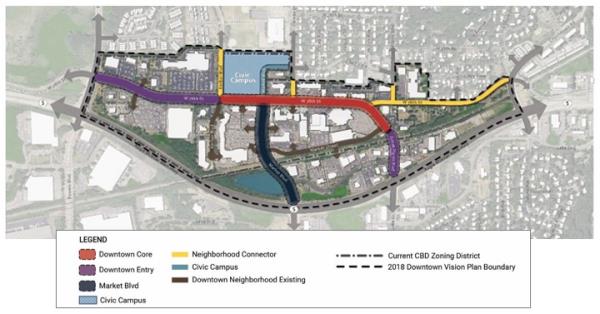
c) The city shall apply the design standards proportionately to the degree of change proposed. Minor improvements may be made to existing uses without costly upgrades or a complete change to the site. The Community Development Director may waive specific design standards based on the scale of the project.
Sec 20-1097 Definitions
a) Build-to-Zone means the area on the lot where all or a portion of the street-facing building facade must be located, established as a minimum and maximum front yard setback range.
b) Occupied Space means an interior building space regularly occupied by the building users. It does not include storage areas, utility space, or parking.
c) Street Frontage means the building and yard area facing and directly adjacent to a street right-of-way line.
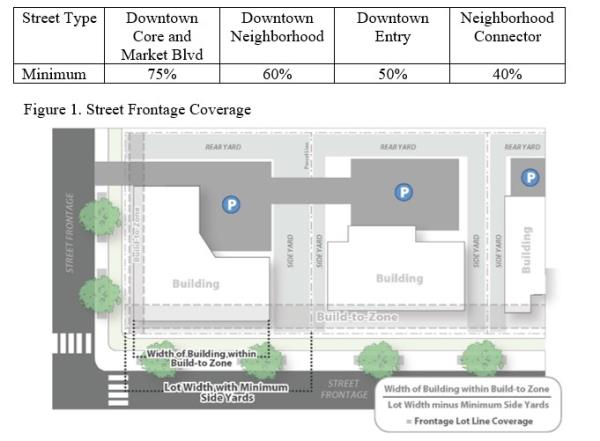
d) Street Frontage Coverage means the minimum percentage of the lot line that must have a building façade located within the build-to zone.
Sec 20-1098 Site Design Standards
a) Building Placement and Yard Standards
1) Street frontage coverage: A minimum percentage of all building fronts are required to be placed within a lot’s build-to-zone. To determine compliance with the street frontage coverage requirement, the total length of the building or building portion(s) located in the build-to-zone is divided by the length of the lot or parcel on which the building is located. The remainder of a building may be placed outside the maximum front setback but shall not be located closer to the street than the minimum front setback.
Front/corner yard areas:
i) Front/corner yard areas along streets shall be designed as a unified streetscape that may include but is not limited to sidewalks, plantings, open space, public or private seating areas that are required to be installed and maintained by the building owner or homeowners’ association.
ii) Walls, fences, monument signs, lighting, elevated private outdoor spaces, stairs leading to residential entries, guardrails, handrails and other similar building and landscape elements are allowed encroachments within the front/corner yard areas.
iii) Utilities, transformers, and telecommunications equipment shall, to the extent feasible, not be located in the front/corner yard and shall be architecturally integrated or screened by landscaping or decorative fencing.
iv) Awnings, canopies, marquees, signs, shading devices, cornices and lighting are permitted encroachments within the public right-of-way and setback areas but must be a minimum of eight (8) feet above sidewalk grade.
b) Off-Street Parking and Loading Area Standards
1) Off-street vehicle parking areas:
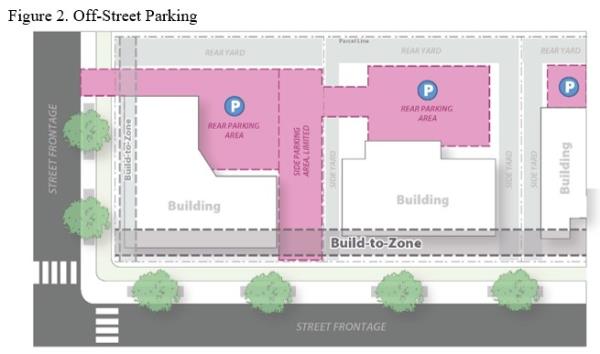
i) For Downtown Core Streets and Downtown Neighborhood Streets, including future downtown street extensions, off-street parking areas shall not be permitted between the building and the street unless approved by the City due to unique site circumstances which shall include but are not limited to, existing access easements or parking easements.
ii) Vehicular entrances and exits to parking areas shall have a maximum linear width of 12 feet if accommodating one direction of travel, and a maximum linear width of 24 feet if accommodating both an exit and entrance within the same curb cut.
iii) Screening along the edges of off-street parking areas shall be high enough to screen vehicle headlights from adjacent properties, streets, and walkways, which shall be considered a minimum of three (3) feet high but shall not impact vehicle or pedestrian sight lines.
2) Off-street loading areas:
i) All loading areas shall be screened to minimize visibility from all streets and neighboring buildings. Screening shall be provided by architectural elements, landscaping, fencing, or walls that are consistent with the building’s architecture.
ii) In the Downtown Mixed Use character area established within City Code Section 20-737, loading areas shall have exterior lighting to increase safety for vehicular and pedestrian movement.
c) Private Usable Open Space Standards
1) Private usable open space: Each development, both residential and non-residential, shall provide a minimum of 10% of the lot area as private usable open space. Private usable open spaces will not count toward public open space dedication requirements. Usable open space means designed outdoor space that is either on the ground floor or in an upper level or building rooftop that is intended for passive or active recreation that is accessible and suited to the needs of the development’s residents, employees, and/or business patrons, and shall generally have the following characteristics:
i) Functional and aesthetic design that relates to the principal building or buildings, with clear edges, including seating, landscaping, recreational facilities, sidewalk connections, and other amenities;
ii) May be designed as courtyards, plazas, picnic areas, swimming pools, play areas, rooftop patios/gardens, or trails within natural areas;
iii) Compatible with or expands upon existing pedestrian connections and public parks or open space;
iv) May include both private common areas for use by all residents of that development, as well as a private unit’s open space for exclusive use by that unit’s residents; and
v) Does not include driveways, parking areas, steep slopes, or stormwater ponds.
d) On-Site Walk/Bike Connection Standards
1) Provision of internal site pedestrian and bicycle connections to all existing or planned public sidewalks and trails adjacent to the site.
e) Waste Storage Standards
1) Storage of waste containers shall be accommodated inside buildings when feasible. 2) Waste storage is allowed outdoors if adequately screened either through architectural elements or with landscaping, fencing, or walls. The location shall minimize visibility from all streets and neighboring buildings. No waste storage is allowed between the building and the street.
f) Mechanical Equipment Standards
1) To avoid noise and air quality impacts on open space areas, mechanical ducts or vents, with the exception of residential kitchen and bathroom vents, shall not be located adjacent to areas designated for common courtyards or activity areas.
2) Rooftop mechanical equipment greater than four feet in height or visible from the adjacent public right-of-way shall be screened in an enclosure that also considers views of adjacent buildings. All screening shall be at least of equal height to the mechanical equipment that it screens.
Sec 20-1099 Building Design Standards
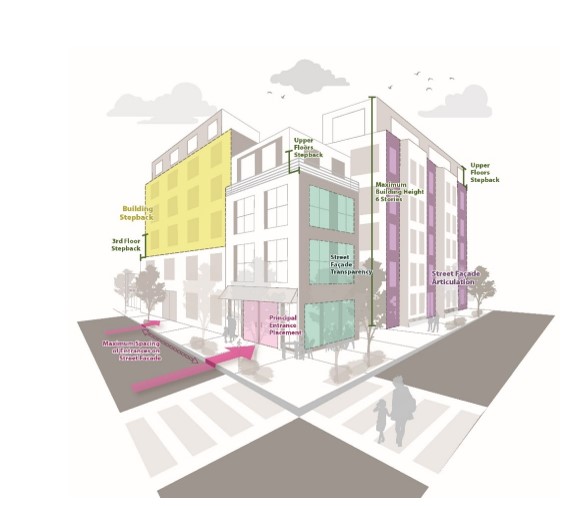
Figure 3. Building Design
a) Building Massing Standards
1) Building Length: Maximum of 250 feet without a major break in the building facade.
2) Lower and Upper Floor Stepbacks: Portions of the building’s lower and upper floors shall be stepped back from the ground floor façade along street frontages a minimum of 5 feet. Lower and upper floor stepbacks shall provide vertical articulation to ground floor commercial spaces and architectural design features and/or provide vertical relief for the adjacent pedestrian environment as deemed appropriate by the City.
b) Building Façade Standards
1) All buildings shall be constructed to meet the building façade standards in the following table:
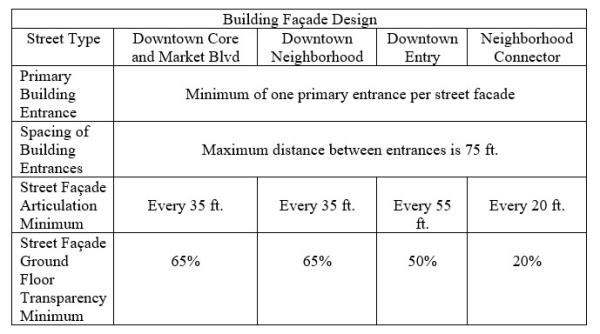
1) Linear parking uses along street façades: All off-street parking structures that front a public street must be lined with occupied space at the ground floor, at least 18 feet in depth, between the parking area and exterior wall of the building. 2) All other frontages must visually screen the interior from the exterior under daylighting and night lighting conditions.
d) Roof Design Standards
1) Flat roof only with a decorative parapet.
e) Exterior Building Materials Standards
1) Exterior building materials are classified as primary, secondary or accent materials and are allowed as follows:
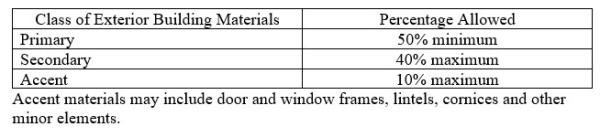
2) The classes of materials consist of the following:
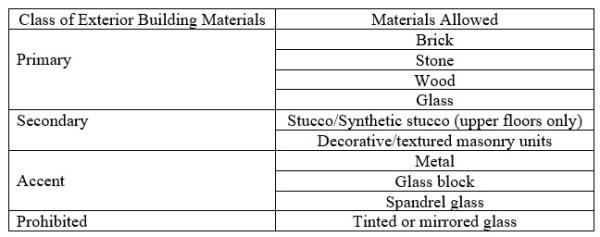
Amended by Ord. 731 on 7/22/2024
744
752
765
692
694
691
710
698
726
661
693
672
741
731
Sec 20-901 Overhead Transmission Lines
Installation of overhead transmission lines in excess of 69 kilovolts shall require the issuance of a conditional use permit through any district located in the city. The city council, in addition to the standards established in article IV, may also impose other conditions as deemed necessary to protect the public health, safety and welfare.
(Ord. No. 80, Art. VI, § 2, 12-15-86)
Sec 20-902 Multiple Principal Buildings On Same Lot
In any single-family detached residential district, business, commercial, office, or industrial district not more than one principal building shall be permitted to be erected on a single building lot. Groupings of buildings may be permitted in planned unit development districts.
(Ord. No. 80, Art. VI, § 3, 12-15-86; Ord. No. 619, § 15, 2-27-17)
Sec 20-903 Zoning Lots
- The designation of a zoning lot shall be approved by the city planner if it complies with the lot requirements of the district in which it is located and has a single tax identification number.
- Interior lot lines within a zoning lot shall be disregarded in applying setbacks and other zoning ordinance standards.
- After designation of a zoning lot the lot may not be subdivided without complying with the city's subdivision regulations.
(Ord. No. 129, § 2, 6-4-90)
Sec 20-904 Accessory Structures
- A detached accessory structure shall be located in the buildable lot area or required rear yard. No accessory use or structure in any residential district shall be located in any required front, side or rear setback with the following exceptions:
- In the RSF, RLM and R4 districts these structures may encroach into the rear setback as follows:
- Less than 140 square feet, minimum rear setback is five feet.
- One hundred forty-one to 399 square feet, minimum rear setback is ten feet.
- Four hundred square feet and above, minimum rear setback is 30 feet, except in the RLM district where the minimum rear setback is 25 feet.
- Tennis courts and swimming pools may be located in rear yards with a minimum side and rear yard setback of ten feet, but must comply with ordinary high water mark setbacks.
- In the RSF, RLM and R4 districts these structures may encroach into the rear setback as follows:
- Properties up to 1.00 acres in size, the total square footage of all accessory structures shall be limited to 1,000 square feet.
- Properties between 1.01 and 2.50 acres in size, the total square footage of all accessory structures shall be limited to 1,200 square feet.
- Properties 2.51 acres or larger, the total square footage of all accessory structures shall be limited to 1,500 square feet.
- Properties which are at least 10.00 acres in size, and which are zoned as Agricultural Estate (A2) shall be exempt from a square foot maximum if constructing an Agricultural Building, as defined by Minnesota State Statute, but shall adhere to all other applicable standards, including but not limited to impervious lot cover and minimum building setbacks.
- On riparian lots, detached garages and storage buildings may be located in the front or rear yard, but must comply with front, side and applicable ordinary high water mark setbacks but may not occupy more than 30 percent of the yard in which it is built.
- No detached accessory structure may be used for a home occupation as outlined by City Code Section 20-977.
- For parcels with less than three acres in any residential or agricultural district, no accessory structure or use shall be erected, constructed or commenced prior to the erection, construction or commencement of the principal permitted structure or use, but may be erected or commenced simultaneously. If the principal structure or use is subsequently removed, destroyed or discontinued, the accessory structure or use must be removed or discontinued within 12 months.
- Shall comply with the Freedom to Breathe Provision of the Minnesota Clean Indoor Air Act contained in M.S. §§ 1144.411 to 1144.417.
- Docks, which shall comply with section 20-920.
- Pursuant to authority granted by M.S. § 462.3593 subdiv. 9, the City of Chanhassen opts-out of the requirements of M.S. § 462.3593.
(Ord. No. 80, Art. VI, § 5, 12-15-86; Ord. No. 145, § 1, 4-8-91; Ord. No. 215, § 1, 8-8-94; Ord. No. 377, § 112, 5-24-04; Ord. No. 451, § 9, 5-29-07; Ord. No. 474, § 16, 10-13-08; Ord. No. 595, § 6, 5-12-14; Ord. No. 614, § 1, 8-22-16)
Amended by Ord. 744 on 5/12/2025
Amended by Ord. 752 on 10/27/2025
Sec 20-905 Single-Family Dwellings
All single-family detached homes shall:
- Be constructed upon a continuous perimeter foundation that meets the requirements of the state building code.
- Have a minimum area of 960 square feet.
- Have an earth covered, composition, shingled or tiled roof or other materials approved by the Minnesota State Building Code as adopted and amended by the city.
- Receive a building permit. The application for a building permit in addition to other information required shall indicate the height, size, design and the appearance of all elevations of the proposed building and a description of the construction materials proposed to be used.
- Meet the requirements of the Minnesota State Building Code, as adopted and amended by the city or the applicable manufactured housing code.
- Where access doors are proposed from a dwelling to the outdoors, which does not connect directly to a sidewalk or stoop, a minimum ten feet by ten feet area of patio shall be assumed. This patio area must be shown to comply with required property line, lake and wetland setbacks; may not encroach into conservation or drainage and utility easements; and shall not bring the site's lot coverage above that permitted by ordinance.
- Where the main entrance does not connect directly to the driveway, a walkway constructed of bituminous, concrete, or other hard surface material at least four feet in width connecting the driveway and main entrance is required. This walkway must be shown to comply with required property line, lake and wetland setbacks; may not encroach into conservation or drainage and utility easements; and shall not bring the site's lot coverage above that permitted by ordinance.
(Ord. No. 80, Art. VI, § 6, 12-15-86; Ord. No. 240, § 22, 7-24-95; Ord. No. 377, § 113, 5-24-04; Ord. No. 423, § 5, 6-12-06; Ord. No. 628, § 41, 12-11-17; Ord. No. 651, §§ 25, 26, 12-9-19)
Cross reference(s)—Technical codes, § 7-16 et seq.
Amended by Ord. 765 on 7/13/2026
Sec 20-906 Alternate Lot Size Requirements In A-2 And RR Residential Zoning Districts
Minimum lot size requirements in the A-2 and RR residential zoning districts located outside of the Metropolitan Council's Urban Service Area shall be regulated by article IX and article X of this chapter, respectively, or in the alternative may be 15,000 square feet if the following conditions are met:
- A one-unit per ten-acre density is maintained. This requirement shall not apply to lots of record in existence on January 15, 1987, or lots created thereafter, if they were subject to a pending subdivision application on that date and the lots were created as a result of that application.
- All lots must have soil and water conditions which permit a well.
- All lots must have conditions which will permit two on-site sewer systems installed in conformance with chapter 19, article IV.
- The one-unit per ten-acre density applies to contiguous property under single ownership. Acreage under single ownership, which is not contiguous, cannot be combined for increased density/building eligibility on one of the parcels. Transfer of development rights from one parcel of land to another is not allowed, except as permitted in subsection (g) below.
- Once a building eligibility has been used for a property, a development contract must be recorded with the county establishing the number of building eligibilities remaining or documenting that no building eligibility remains. Transfer of development rights from one parcel of land to another is not allowed.
- Each site must have an area which can support two septic system sites, on a slope of less than 25 percent.
- Parcels which do not have public street frontage and are landlocked may transfer building eligibilities to an adjacent parcel which does have public street frontage and meets other provisions of this section.
(Ord. No. 80, Art. VI, § 7, 12-15-86; Ord. No. 170, § 3, 6-8-92; Ord. No. 194, § 3, 10-11-93; Ord. No. 240, § 23, 7-24-95; Ord. No. 307, § 1, 7-24-00)
Sec 20-907 Height Regulations
- Where the average slope of a lot is greater than one foot rise or fall in seven feet of horizontal distance from the established street elevation at the property line, one story in addition to the number permitted in the district in which the lot is situated shall be permitted on the downhill side of any building.
- The height limitations stipulated elsewhere in this chapter shall not apply to the following:
- Barns, silos or other farm buildings or structures on farms; church spires, belfries, cupolas and domes, monuments, water towers, fire and hose towers, observation towers, chimneys, smoke stacks, flag poles, masts and aerials; communication transmission towers; parapet walls extending not more than four feet above the limiting height of the building.
- Places of public assembly in churches, schools and other public and semipublic buildings, provided that these are located on the first floor of such building and provided that for each three feet by which the heights of such building exceeds the maximum height otherwise permitted in the district, its side and rear yards shall be increased in width or depth by an additional foot over the side and rear yards required for the highest building otherwise permitted in the district.
(Ord. No. 80, Art. VI, § 10, 12-15-86)
Sec 20-908 Yard Regulations
The following requirements qualify or supplement district regulations. Yard measurements shall be taken from the nearest point of the wall of a building to the lot line in question, subject to the following qualifications:
- Every part of a required yard or court shall be open and unobstructed.
- A yard, court, or other open space of one building used to comply with the provisions of this chapter shall not again be used as a yard, court, or other open space for another building.
- Except as provided in the business, industrial and office districts, the front yard setback requirements shall be observed on each street side of a corner lot; provided, however, that the remaining two yards will meet the side yard setbacks.
- On double frontage lots, the required front yard shall be provided on both streets. Whenever possible, structures should face the existing street.
- The following architectural elements of the principal structure or if the structure is attached to the principal structure shall not be considered to be obstructions (variances granted from a required setback are not entitled to the following additional encroachments):
- Into any required front yard, or required side yard adjoining a side street lot line, cornices, canopies, eaves, cantilevers, or other architectural features may project a distance not exceeding two feet, six inches; fire escapes may project a distance not exceeding four feet, six inches; an uncovered stair and necessary landings may project a distance not to exceed six feet, provided such stair and landing shall not extend above the entrance floor of the building; bay windows, balconies, open porches and chimneys may project a distance not exceeding three feet; unenclosed decks and patios may project a distance not exceeding five feet. The encroachments listed in this paragraph cannot be applied cumulatively (i.e. the edge of the roof of an open porch may project three feet into a required setback, its eaves are not entitled to an additional two feet, six inches of encroachment).
- The above-named features may project into any required yard adjoining an interior lot line, subject to the limitations cited above.
- Porches that encroach into the required front yard and which were in existence on February 19, 1987, may be enclosed or completely rebuilt in the same location, provided that any porch that is to be completely rebuilt must have at least a ten-foot minimum front yard.
- Subject to the setback requirements in section 20-904, the following are permitted in the rear yard: enclosed or open off-street parking spaces; accessory structures, toolrooms, and similar buildings or structures for domestic storage. Balconies, breezeways and open porches, unenclosed decks and patios, and one-story bay windows may project into the rear yard a distance not to exceed five feet.
- Into any required front, rear or side yard: driveways, sidewalks, fences and retaining walls.
- The intent of this section is to allow homes built prior to February 19, 1987, to add an open porch as an architectural feature to define the entrance into a residence or update a front elevation.
- Homes built prior to February 19, 1987, may have open porches and/or balconies that encroach into the required front yard a distance not exceeding ten feet, provided they maintain a minimum front yard setback of 20 feet. The ten feet shall include the roof line, support columns and steps. This area shall not be enclosed nor screened with mesh, glass, or other similar material. Homes that are on the national register listing or have been considered eligible for listing on the national register shall be excluded from this ordinance unless approved by the national historical registrar's office.
- Habitable structures shall maintain a minimum 20-foot setback from any gas transmission pipeline easement.
(Ord. No. 80, Art. VI, § 11, 12-15-86; Ord. No. 144, § 2, 4-8-91; Ord. No. 274, § 1, 9-22-97; Ord. No. 303, § 2, 5-8-00; Ord. No. 377, §§ 114, 115, 5-24-04; Ord. No. 409, § 5, 1-9-06; Ord. No. 478, §§ 1, 2, 6-22-09; Ord. No. 595, § 7, 5-12-14)
Amended by Ord. 692 on 6/13/2022
Amended by Ord. 694 on 8/8/2022
Sec 20-909 Outdoor Storage
As otherwise regulated, all outdoor storage is prohibited except:
- Clothes line poles and wires.
- Construction and landscaping material currently being used on the premises.
- Swings, slides and other play equipment.
- Outdoor furniture and lawn and garden equipment.
- Wood for burning in a fireplace, stove or furnace provided it is stored as follows:
- In a neat and secure stack, not exceeding four feet.
- The wood stack is not infested with rodents.
- The wood is not kept in a front yard.
- Storage of these items is limited to the rear or side yard and may not extend beyond the front of the principle structure, save that between April 1 and October 1 one watercraft trailer and associated watercraft may be stored on the driveway so long as it can be stored without crossing into the public right-of-way.
- On corner and double frontage lots the provisions in Section 20-909(f)(1) apply and the front yard shall be determined by the location of the driveway, additionally storage in other yards with street frontage must be outside of the sight distance triangle.
- Outside storage of tires is prohibited.
- PODS (personal on demand storage) and roll-off dumpsters may be located a property a minimum of six feet away from the house for fire protection and at least ten feet from any property line. Such containers may be kept on-site for a maximum of 30 days per year. An extension of the 30 days may be granted by the city if the container is used in conjunction with a valid and ongoing building permit.
(Ord. No. 80, Art. VI, § 13, 12-15-86; Ord. No. 377, §§ 116, 117, 5-24-04; Ord. No. 423, § 6, 6-12-06; Ord. No. 595, § 8, 5-12-14)
Amended by Ord. 691 on 5/9/2022
Sec 20-910 Storage Of Recreation Vehicles
Recreational vehicles may be parked or stored in a residential or agricultural district provided the following conditions are met:
- No more than one recreational vehicle may be parked or stored outside on a residential lot. Additional recreational vehicles may be kept within an enclosed structure which otherwise conforms to the zoning requirements of the district.
- Recreational vehicles must be maintained in a clean, well-kept, operable condition.
- Recreational vehicles shall be mobile and shall not be permanently affixed in the ground in a manner that would prevent removal.
- Recreational vehicles may be parked or stored only on the rear or side yard behind the required front yard setback. The parking or storage of recreational vehicles on the rear or side yard, as permitted herein, may be on surfaced or unsurfaced areas.
- Recreational vehicles may be stored on a lot without regard to the location on the lot for the sole and express purpose of loading and unloading for a period not to exceed 24 hours.
- Unmounted slide-in pickup campers must be stored no higher than 20 inches above the ground and must be securely supported at least at four corners by solid support blocks or support mechanisms.
- Recreational vehicles may not be occupied or used for living, sleeping or housekeeping purposes for more than seven consecutive days or more than 21 days within a 365-day period.
- Except for routine maintenance or during emergency conditions when power supply is disrupted, the operation of a recreational vehicle power generator plant shall not be permitted in residential districts. Routine maintenance periods shall not exceed 60 minutes per month.
(Ord. No. 80, Art. VI, § 14, 12-15-86; Ord. No. 533, 5-29-12)
Sec 20-911 Accessory Fuel Storage Tanks
An accessory fuel storage tank is permitted in any zoning district. Fuel storage tanks shall be located in the buildable area of the lot or the rear yard, subject to fire code regulations. Any such fuel storage tank shall be fenced in accordance with the fire code regulations and, in addition, shall be painted in earth tone colors or landscaped with low hedges, evergreens, or other suitable screening material.
(Ord. No. 80, Art. VI, § 15, 12-15-86)
Sec 20-912 Storage Of Garbage And Trash
- No exterior incineration of trash or garbage is permissible.
- No exterior storage of trash or garbage is permissible except in an accessory building enclosed by walls and roof, or in closed containers within a totally screened area.
- Subsection (b) does not apply to covered garbage cans in agricultural and Single-Family Districts.
(Ord. No. 80, Art. VI, § 16, 12-15-86; Ord. No. 639, § 7, 3-11-19)
Sec 20-913 Lighting
- Glare, whether direct or reflected, as differentiated from general illumination shall not be visible beyond the limits of the site from which it originates.
- No light which is flashing, revolving or otherwise resembles a traffic-control signal shall be allowed in any area where it could create a hazard for passing vehicular traffic.
State law reference(s)—Similar provisions, M.S. § 169.073. - Lighting fixtures on poles shall comply with the following:
- All fixtures on properties not containing a residential dwelling must be shielded, high-pressure sodium or light-emitting diode (LED), with a total cutoff angle equal to or less than 90 degrees. Pole-mounted fixtures on properties containing a residential dwelling must comply with Section 13-2(c)(24).
- Fixture height shall not exceed 30 feet. Recreational facility light poles shall not exceed 75 feet in height.
- Photometrics shall incorporate existing light fixtures, public or private, that may impact the site.
- All outdoor light fixtures existing and legally installed prior to February 22, 1999, are exempt from the requirements of this articleunless work is proposed in any one-year period so as to replace 50 percent or more of the existing outdoor light fixtures, or to increase to the extent of 50 percent or more the number of outdoor light fixtures on the premises.
- Wall-mounted lighting in commercial, industrial and institutional districts shall comply with the following:
- All wall-mounted light fixtures shall be shielded with a total cutoff angle equal to or less than 90 degrees.
- Lighting shall not be directed skyward except for lighting designed for illuminating the United States of America flag.
(Ord. No. 80, Art. VI, § 17, 12-15-86; Ord. No. 290, § 2, 2-22-99; Ord. No. 377, § 118, 5-24-04; Ord. No. 479, § 1, 6-22-09; Ord. No. 533, 5-29-12)
Amended by Ord. 710 on 6/5/2023
Sec 20-914 Private Swimming Pools
No private swimming pool shall be allowed in any residential district except as an accessory structure for the enjoyment of the occupants of the principal building of the property on which it is located and their guests. Fence requirements as stipulated in division 5 of this article shall be met.
(Ord. No. 80, Art. VI, § 18, 12-15-86)
Sec 20-915 Antennas, Satellite Dishes And Amateur Radio Towers
- Satellite dishes, television antennas and ground-mounted vertical antennas shall be permitted accessory uses within all zoning districts.
- Amateur radio towers shall receive a conditional use permit in all districts prior to installation.
- In all residential districts, only one of the following are permitted per lot:
- Satellite dish.
- Amateur radio tower.
- Ground-mounted vertical antenna.
- A ground-mounted satellite dish shall not exceed 15 feet in height above ground level.
- No ground-mounted satellite dish, amateur radio tower, or ground-mounted vertical antenna shall be located within the required front yard setback or side yard setback.
- Ground-mounted satellite dishes, amateur radio towers and ground-mounted vertical antennas shall be set back from all adjoining lots a distance equivalent to the height of the dish, tower or antenna. If a portion of the tower or antenna is collapsible or securely fastened to a building, only the portion which can fall will be used to determine the setback from property lines. Location shall not adversely obstruct views from adjacent property.
- A building permit shall be required for the installation of any satellite dish, amateur radio tower or ground cover-mounted vertical antenna. Building permit applications shall require the submission of a site plan and structural components. When a satellite dish or radio antenna is located on the roof of a building, the applicant shall furnish the city building official with building plans and structural components displaying the means of securing it to the building. The building official must approve the building plans before installation.
- Each satellite dish, amateur radio tower and ground-mounted vertical antenna shall be grounded to protect against natural lightning strikes in conformance with the National Electrical Code, as adopted and amended by the city.
- Satellite dish, amateur radio tower and ground-mounted vertical antenna, electrical equipment and connections shall be designed and installed in adherence to the National Electrical Code, as adopted and amended by the city.
(Ord. No. 80, Art. VI, § 21, 12-15-86; Ord. No. 90, § 8, 3-14-88)
Cross reference(s)—Technical codes, § 7-16 et seq.
Sec 20-916 Rooftop Screening
All roof-mounted equipment on buildings located within the business, office and industrial districts shall provide for screening which is consistent with the exterior of the principle structure.
(Ord. No. 80, Art. VI, § 22, 12-15-86)
Sec 20-917 Chemical Toilets (Portable Toilets)
Chemical toilets are permitted only on a temporary basis on construction sites, on city-owned parkland in conjunction with city park functions, or as part of an outdoor sale or event approved under section 20-964. These portable toilets must be models designed to minimize the potential for spilling, and those associated with construction sites must be removed within 24 hours of the completion of construction activities.
(Ord. No. 80, Art. VI, § 23, 12-15-86; Ord. No. 619, § 16, 2-27-17)
Sec 20-918 Landfills
Hazardous and solid waste landfills, including landfills for low level radioactive contaminants and sludge ash, are prohibited in all districts.
(Ord. No. 80, Art. VI, § 24, 12-15-86)
Sec 20-919 Telephone Equipment Buildings
Telephone equipment buildings are allowed in all zoning districts as an ancillary use subject to the following standards:
- The site must provide landscaping as required in article XXV.
- The driveway surface shall be surfaced with a hard, all-weather, dust-free and durable surfacing material.
- The applicant shall receive an access permit from the regulating agency.
- The building shall meet the required setbacks of the district in which it is located.
- The equipment building shall be architecturally consistent with surrounding structures.
(Ord. No. 80, Art. VI, § 26, 12-15-86; Ord. No. 80-B, § 1, 6-15-87; Ord. No. 377, § 119, 5-24-04)
Sec 20-920 Structures, Boats And Waterways
- Exemption. This article does not apply to any lakeshore property owned or leased by the city.
- Nonconforming docks.
- Permanent docks existing on July 11, 1983, and which do not comply with the structure limitations set forth in this article, shall be deemed to be nonconforming uses. Seasonal docks utilized by privately owned commercial resorts or commercial boat landings prior to July 11, 1983, and which do not comply with the structure limitations set forth in this article shall also be deemed to be nonconforming uses.
- No nonconforming dock shall be enlarged or altered or increased, or occupy a greater area than that occupied by such dock on September 7, 1983, or on the effective date of or any amendment to this article. A nonconforming dock shall not be moved to any other part of the lakeshore site upon which the same is erected unless it is relocated in such a manner as to conform to the dock setback zone requirements of this chapter. Any nonconforming dock which is partially or totally destroyed by any cause may be restored to its former use and physical dimensions, if the restoration is completed within one year of its partial or total destruction. Maintenance and necessary structural repairs of a nonconforming dock are permitted provided that any such maintenance or repairs do not extend, enlarge or intensify such dock.
- All docks must conform to dock setback requirements.
- Location restrictions. No dock, mooring or other structure shall be so located as to:
- Obstruct the navigation of any lake;
- Obstruct reasonable use or access to any other dock, mooring or other structure authorized under this chapter;
- Present a potential safety hazard; or
- Be detrimental to significant fish and wildlife habitat or protected vegetation.
- Construction and maintenance generally. Docks, moorings and other structures may be constructed of such materials and in such a manner as the owner determines, provided that they shall be so built and maintained that they do not constitute a hazard to the public using the waters of the lake and they shall be maintained in a workman-like manner.
- Docks.
- No more than one dock shall be permitted on any lakeshore site.
- No dock shall exceed six feet in width and no dock shall exceed the greater of the following lengths:
- 50 feet; or
- The minimum straight-line distance necessary to reach a water depth of four feet.
- The width (but not the length) of the crossbar of any dock shall be included in the computation of length described in the preceding sentence. The crossbar of any such dock shall not measure in excess of 25 feet in length. No dock shall encroach upon any dock setback zone; provided, however, that the owners of any two abutting lakeshore sites may erect one common dock within the dock setback zone appurtenant to the abutting lakeshore sites, if the dock is the only dock on the two lakeshore sites and if the dock otherwise conforms with the provisions of this chapter.
- No person shall store fuel upon any dock.
- No oscillating, rotating, flashing or moving sign or light may be used on any dock.
- No advertising signs shall be displayed from any dock.
- Access across wetlands shall be subject to the standards set forth in section 20-405. Docks shall be elevated a minimum of six to eight inches above the ordinary high water elevation.
- Mooring, docking, etc., of watercraft.
- Except for privately owned commercial resorts or commercial boat landings established prior to July 11, 1983, no person shall moor overnight, dock overnight, or store overnight, more than three watercraft on any lakeshore site or upon the waters of any lake. Docking of watercraft at any lakeshore site or storage of watercraft upon any lakeshore site is permissible however at any time other than overnight.
- No watercraft shall be moored or docked overnight on the water of any lake unless it is currently registered pursuant to M.S. ch. 86B, either in the name of the owner of the lakeshore site in from of which the watercraft is moored or docked, or in the name of a blood relative of the owner.
- Except as provided in subsection (f)(2) above, no watercraft or boat lift shall be kept, moored, docked or stored in the dock setback zone.
- Swimming rafts, ski jumps, diving towers, etc.
- Swimming rafts may only be located directly in front of a lakeshore site owned by the raft owner or with the written approval of the owner of the lakeshore site. All swimming rafts shall meet the minimum standards in this subsection. Their size shall not exceed 144 square feet. Swimming rafts shall project over the water surface not less than one foot and not more than five feet, measured vertically, above the surface of the lake. Swimming rafts shall not be located in areas with a depth of less than seven feet. Swimming rafts shall be reflectorized as provided in subsection (g)(2). Their distance from the ordinary high water mark shall not exceed 100 feet.
- Swimming rafts, ski jumps, diving towers and other structures surrounded by the waters of any lake, whether floating or on posts, shall be lighted with a light visible in all directions, or have attached thereto, sufficient reflectorized material so as to reflect light in all directions. The material shall be capable of retaining 80 percent of its dry weather reflective signal strength when wet.
- Fueling facilities. Installation of fueling facilities on docks, moorings and other structures shall be prohibited. Any fueling facilities which were in active use prior to September 7, 1983, shall be deemed to be nonconforming uses. No such nonconforming fueling facility shall be enlarged or altered or increased or occupy a greater area than occupied on September 7, 1983. Any nonconforming fueling facility which is partially or totally destroyed by any cause, may be restored to its former use and physical dimension if said restoration is completed within one year of its partial or total destruction. Maintenance and necessary structural repairs of a nonconforming fueling facility are permitted provided that any such maintenance or repairs do not extend, enlarge or intensify such fueling facility.
- Removal of seasonal docks, moorings, etc. All seasonal docks, moorings, and other structures shall be removed from the lake before November 1 of each year. All nonconforming structures, except legally nonconforming docks and swimming rafts, once removed may not be returned to the lake. Legal nonconforming moorings, docks and swimming rafts, e.g., the "Carver Beach" raft, may be returned to the lake.
- All structures shall comply with the department of natural resources regulations.
(Ord. No. 483, § 1, 8-10-09)
Sec 20-921 Pervious Pavement
Properly designed, installed, and maintained pervious pavements have the capacity to allow for stormwater detention and/or infiltration. When not properly designed, installed, and maintained pervious pavements fail to facilitate the detention and/or infiltration of stormwater. Additionally, pervious pavements contribute to the creation of heat islands and do not provide the same surface water management benefits as native vegetative cover. For these reasons, it is necessary to regulate the lot coverage, design, installation, and maintenance of these systems.
- Lot coverage: Pervious pavements are considered to constitute lot coverage; however, when built to the standards espoused in this section they do not constitute impervious surfaces. Systems not built to the standards espoused in this section are considered to constitute impervious surfaces.
- Location restrictions:
- Pervious pavements may not be installed in areas where trash or garbage receptacles will be stored.
- Design and installation:
- A building permit is required for the instillation of pervious pavement systems.
- Pervious pavement systems must be designed to provide for rate and volume control for the first half-inch of treatment area. Treatment area includes the total square footage of the pervious pavement system plus the total square footage of impervious surface draining directly to the pervious pavement system.
- To meet the city's definition of pervious pavement the system must: 1) be designed in compliance with standards established by the Interlocking Concrete Pavement Institute (ICPI); 2) be installed by an ICPI certified installer; and 3) be designed to meet or exceed the standards listed in paragraph (c)(2).
- The city engineer may permit pervious pavement technologies other than permeable interlocking concrete pavers, so long as the city engineer determines: 1) they are functionally equivalent or better; 2) the system is designed in compliance with accepted guidelines and is installed by an appropriately certified installer; and 3) the system will meet or exceed the standards listed in paragraph (c)(2).
- Maintenance:
- The owner of a pervious paver system must enter into a maintenance agreement with the city to ensure the system performs as designed in perpetuity. This agreement must conform to the manufactures guidelines, and stipulate the frequency and type of maintenance to be performed.
- District restrictions:
- Planned Unit Developments Residential Districts (PUDR) are limited to the lot coverage specified by their ordinance and/or compliance table. For PUDRs created before June 11, 2018, the terms hardcover, hard surface, impervious surface, and similar phrases, shall be understood to mean lot cover inclusive of both pervious pavements and impervious surfaces, and in no circumstance shall the failure of the ordinance or compliance table to mention pervious pavements be understood to mean that pervious pavements are not subject to the lot cover, hardcover, hardscape, or similarly identified limits that govern the PUDR.
- (Ord. No. 633, § 4, 6-25-18; Ord. No. 651, § 27, 12-9-19)
Amended by Ord. 765 on 7/13/2026
Sec 20-922 Designation Of Alternate Front Lot Lines For Single-Family Dwellings
For single-family dwellings, the front yard shall be the line nearest the public right-of-way that provides access to the parcel unless:
- The city council designates an alternate front lot line as part of the subdivision, or,
- For subdivisions created prior to May 13, 2019, the community development director may designate an alternate front lot line consistent with the subdivision's development pattern and the orientation of other structures within the neighborhood.
(Ord. No. 641, § 5, 5-13-19)
Sec 20-923 Improvements And Encroachments In Public Easements
The purpose of this section is to ensure that any improvements property owners make within easements are compatible with the easements' intended functions. To this end, the placement of any structure within easements is prohibited, except as specified below:
- A driveway and/or walkway from the street to the house may be placed within a front yard drainage and utility easement, so long as they meet all other applicable requirements of this chapter.
- Fences are permitted within drainage and utility easements that do not contain active utilities and infrastructure if they do not alter the intended use of the easement. Fences may be allowed within an easement containing active infrastructure and utilities with an encroachment agreement if they do not alter the intended use of the easement and at the discretion of the City Engineer or designee, and so long as they meet all other applicable requirements of this chapter. Fences within a drainage and utility easement must provide removable fence panels in areas where the fence encroaches on existing utilities and/or installation of gates having a clear span the width of the easement for City access to its easement areas and the fence must allow water to pass under it so as not to impede overland water flow during rain events.
- Retaining walls, fire pits, walkways, pathways, patios, signs, and other encroachments may be allowed within an easement with an encroachment agreement if they do not alter the intended use of the easement and at the discretion of the City Engineer or designee, and so long as they meet all other applicable requirements of this chapter.
Any work within an easement including grading, landscaping, or the construction of improvements, with or without an encroachment agreement, is conducted at the property owner's risk. Any improvements or landscaping placed within a drainage and utility easement is subject to removal by the City or utility company if required for maintenance or improvement of the drainage or utility. In such cases, costs for removal and replacement shall be the responsibility of the property owner. The City or utility shall not be liable for damage or destruction of the improvements or landscaping if removed in order to facilitate the use use of the easement for its intended purpose.
Adopted by Ord. 694 on 8/8/2022
Sec 20-951 Noise
Noise shall be muffled or otherwise controlled so as not to become a nuisance. Noise levels shall be regulated by the standards of the state pollution control agency.
(Ord. No. 80, Art. VI, § 1(6-1-1), 12-15-86)
Sec 20-952 Smoke And Particulate Matter
The ambient air quality standards of the state pollution control agency shall apply to the release of airborne materials within the city.
(Ord. No. 80, Art. VI, § 1(6-1-2), 12-15-86)
Sec 20-953 Toxic Or Noxious Matter
The state pollution control agency standards governing toxic or noxious matter shall apply in the city.
(Ord. No. 80, Art. VI, § 1(6-1-3), 12-15-86)
Sec 20-954 Odors And Air Pollution
The state pollution control agency standards governing odors and air pollution shall apply in the city.
(Ord. No. 80, Art. VI, § 1(6-1-4), 12-15-86)
Sec 20-955 Nuisances
No land, existing building or proposed structure shall be used or occupied in any manner creating dangerous, noxious or otherwise objectionable conditions which could adversely affect the surrounding area.
(Ord. No. 80, Art. VI, § 1(6-1-5), 12-15-86)
Sec 20-956 Radiation And Electrical Emissions
No activities shall be permitted that emit dangerous radioactivity beyond enclosed areas. There shall be no electrical disturbance (except from domestic household appliances) adversely affecting the operation at any point of any equipment including, but not limited to, radio and television reception other than that of the creator of the disturbance.
(Ord. No. 80, Art. VI, § 1(6-1-6), 12-15-86)
Sec 20-957 Vibration
- Any use creating periodic earth-shaking vibrations, such as may be created from a drop forge shall be prohibited if such vibrations are perceptible beyond the lot line of the site on which the use is located.
- Subsection (a) does not apply to vibrations created during the process of construction.
(Ord. No. 80, Art. VI, § 1(6-1-7), 12-15-86)
Sec 20-958 Glare Or Heat
Any use requiring an operation producing an intense heat or light transmission shall be performed with the necessary shielding to prevent such heat or light from being detectable at the lot line of the site on which the use is located. Lighting in all instances shall be diffused or directed away from R districts and public streets.
(Ord. No. 80, Art. VI, § 1(6-1-8), 12-15-86)
Sec 20-959 Explosives
Any use requiring the storage, use or manufacturing of products which could decompose by detonation shall be located not less than 400 feet from any R district line, provided that this section shall not apply to the storage or use of liquefied petroleum or natural gas for normal residential or business purposes.
(Ord. No. 80, Art. VI, 1(6-1-9), 12-15-86)
Sec 20-960 Surface Water Management
All development shall comply with the city's most recently adopted surface water management plan, which is incorporated herein by this reference.
(Ord. No. 227, § 1, 10-24-94; Ord. No. 595, § 9, 5-12-14)
Sec 20-961 Short-Term Rentals
- Reserved
Amended by Ord. 698 on 10/10/2022
Amended by Ord. 726 on 5/13/2024
Sec 20-962 Camping Facilities
- Camping or occupying camp facilities in the following areas is prohibited unless in a city-approved campground or with prior city authorization:
- Any park;
- Any street;
- Any publicly owned parking lot or publicly owned area, improved or unimproved.
- Camping, occupying camp facilities on a lot or parcel for more than seven consecutive days or more than 21 days in a 365-day period is prohibited.
(Ord. No. 377, § 120, 5-24-04; Ord. No. 377, § 120, 5-24-04)
Sec 20-963 Temporary Real Estate Office Or Model Home
- Purpose. It is the intent of this section to provide for the erection of model homes, which may include temporary real estate offices, in new residential developments. As model homes represent a unique temporary commercial use within a residential context, standards must be applied to ensure their compatibility with this environment and to prevent the creation of nuisances.
- Permit requirements. A building permit may be issued for a model home upon approval and recording of the final plat, provided that:
- If constructed prior to the completion of public infrastructure improvements, access must be provided by at least a maintainable Class 5 aggregate base structurally sufficient to allow the public safe access to the proposed building site. The proposed access must be approved by the City Engineer prior to the issuance of a building permit; and
- The parcel must be located within 150 feet of a paved road surface (either concrete or bituminous roadway) or be served by a construction road meeting the road design and standards necessary to support a fire truck; and
- Adequate utility services must be provided to the model home, which shall include fire hydrants for fire suppression needs as required by the Fire Code.
- Standards and limitations. Model homes within a residential development are subject to the following:
- A temporary certificate of occupancy may be issued for model homes provided the public infrastructure improvements, excluding the final lift of asphalt and final restoration, if applicable, have been completed. These improvements must include approved sewer and water connections to in-service public mains. No permanent certificate of occupancy will be issued for a model home until all of the public infrastructure improvements have been completed and approved by the City Engineer, including final grading and stabilization in accordance with the building permit and development plans as approved by the City.
- Model homes and temporary real estate offices shall be utilized solely for selling lots and/or homes within the residential development in which it is located.
- Temporary off-street parking facilities equal to three (3) paved spaces per model home dwelling unit or a model home with a temporary real estate office shall be provided. The head-in parking area on the driveway for the model home may be used to satisfy the off-street parking requirement provided that the stalls are not in a tandem arrangement and no portion of the stall encroaches into the public right-of-way. The overall design, drainage, and surfacing of the temporary off-street parking facility shall be subject to City approval.
- Use of a structure as a model home shall terminate three years from the date of the issuance of a temporary or permanent certificate of occupancy or when 90 percent of the building permits for the residential development have been issued, whichever comes first unless the period for use of a structure as a model home is extended by the Community Development Director.
- No residential certificate of occupancy shall be issued for a model home or model home with a temporary real estate office until such time as the structure has been fully converted to a residence in compliance with the adopted Building Code. Additionally, such conversion shall include, but not be limited to, parking lot restoration and the removal of signage
Editor's note(s)—Ord. No. 628, § 42, adopted Dec. 11, 2017, deleted § 20-963 entitled "Drive-through facilities," which derived from Ord. No. 474, § 17, adopted Oct. 13, 2008.
Amended by Ord. 710 on 6/5/2023
Sec 20-964 Temporary Outdoor Events, Sidewalk Sales, Seasonal Sales And Special Events
- Purpose. It is the intent of this section to provide for temporary outdoor events, sidewalk sales, seasonal sales and special events which are distinguished from permanent outside business activities that are allowed only by conditional use permit or interim use permit approved by the city council. It is the intent of this section to promote the health, safety, general welfare, aesthetics, and image of the community by facilitating and regulating temporary outdoor events, sidewalk sales, seasonal sales and special events in the following manner:
- Establish standards which permit businesses and organizations to conduct temporary outdoor events, sidewalk sales and seasonal sales in zoning districts where they are permitted accessory uses, and permit businesses, organizations, and individuals to sponsor special events while:
- Ensuring that temporary outdoor events, sidewalk sales, seasonal sales and special events do not create safety hazards by occupying required parking spaces, emergency access, by impeding the efficient movement of pedestrian and vehicular traffic, or by placing an excessive burden on city services.
- Ensuring that appropriate and necessary insurances and licenses for temporary outdoor events, sidewalk sales, seasonal sales and special events are obtained.
- Providing open and transparent standards, guidelines, and procedures for an administrative review of temporary events, sidewalk sales, seasonal sales and special events.
- Allow temporary events and sidewalk sales which require an outdoor location, while providing standards that will assure compatibility with the underlying zoning district and adjacent property uses. These events and sidewalk sales can include, but are not limited to, product demonstrations or promotions, employee or customer appreciation events, corporate anniversary celebrations and grand openings.
- Allow certain uses which are seasonal in nature, while providing standards that will assure compatibility with the underlying zoning district and adjacent property uses. These uses can include, but are not limited to, farmers' markets, produce stands, and outdoor sales associated with public or religious holidays.
- Limit temporary outdoor sales to activities which are short-term or seasonal and which do not require permanent improvements to the site.
- Allow for special events, while providing standards that assure the health, safety, general welfare, aesthetics, and image of the community. Special events can include, but are not limited to, concerts, car shows, races and walks, parades and festivals.
- Establish standards which permit businesses and organizations to conduct temporary outdoor events, sidewalk sales and seasonal sales in zoning districts where they are permitted accessory uses, and permit businesses, organizations, and individuals to sponsor special events while:
- Findings. The city recognizes that temporary outdoor events, sidewalk sales, seasonal sales and special events play an important role in the success of businesses and in fostering an active, integrated, and appealing community. The city finds it necessary for the promotion and preservation of the public health, safety, welfare and aesthetics of the community that the location, size and appearance of temporary outdoor events, sidewalk sales, seasonal sales and special events be controlled. Further, the city finds that:
- Temporary outdoor events, sidewalk sales, seasonal sales and special events are an integral component of economic development.
- Temporary outdoor events, sidewalk sales, seasonal sales and special events have a direct impact on and a relationship to the image of the community.
- Temporary outdoor events, seasonal or sidewalk sales activities may present an obstacle to effective firefighting and other emergency services by blocking necessary exits, fire lanes or turnaround areas.
- Uncontrolled and unlimited temporary outdoor events, sidewalk sales, seasonal sales and special events can adversely impact the image and aesthetics of the community and, thereby, undermine economic value and growth.
- Uncontrolled temporary outdoor events, sidewalk sales, seasonal sales and special events may conflict with existing and neighboring uses.
- Temporary outdoor events, sidewalk sales, seasonal sales and special events can exceed the city's capacity to provide municipal services. These municipal services include, but are not limited to, sanitary facilities, fire, police and utility services. Regulation is needed to ensure that the health, safety and general welfare of the community are not negatively impacted.
- Permit required. No person shall sponsor, host, or organize a temporary outdoor event, sidewalk sale, seasonal sale or special event without the relevant permit issued pursuant to this section.
- A temporary outdoor event permit shall be required for an activity which will be entirely confined to the applicant's property, will last no longer than 72 hours, and is not reasonably expected to impact traffic, parking, public safety, or other municipal services. Typically, temporary events and sidewalk sales requiring an outdoor location would require this permit.
- A seasonal sales permit shall be required for a commercial activity which will be entirely confined to the applicant's property, will last longer than 72 hours, and is not reasonably expected to impact traffic, parking, public safety, or other municipal services. Typically, seasonal sales requiring an outdoor location would require this permit.
- A special event permit shall be required for an activity which will require the use of public spaces or services, or which is reasonably expected to impact traffic, parking, public safety, or other municipal services.
- Exemptions. The following events shall not require a permit under this section:
- Indoor events not reasonably expected to impact traffic, parking, public safety, or other municipal services.
- Noncommercial private events, including, but not limited to, weddings, wedding receptions, anniversaries, birthdays, family reunions, funeral processions and graduation parties.
- Events for which a public gathering permit has been issued as provided for in section 14-58; provided that, the event is entirely confined to a city park and cannot be reasonably expected to impact traffic, parking, public safety, or other municipal services.
- Community events organized by or in partnership with the City of Chanhassen.
- Application for permit. The applicant shall submit an application for the relevant permit to the city manager or their designee. Applications for temporary outdoor events and seasonal sales permits shall be submitted on forms provided by the city at least ten business days prior to the date of the requested activity. Applications for special events shall be submitted on forms provided by the city at least 60 days prior to the date of the requested activity. The city manager or their designee may waive the ten or 60-day requirement if they find extenuating circumstances require a shorter review period. Included with application should be:
- A signed letter of permission from the owner of the property, if different than applicant, stating that the applicant has permission to conduct the event.
- A concise statement describing the purpose and nature of the activity, description of any commercial activity, dates and times of operation, number of employees or volunteers involved, estimated number of attendees, provisions for on-site parking and security, and any other pertinent information required by the city manager or their designee to fully evaluate the application.
- A site plan or aerial photo of the property showing sufficient detail to evaluate the event's location and the placement of any temporary structures associated with the event. The city manager or their designee may require a copy of an approved site plan, drawn to scale, or an "as-built" survey, which accurately represents existing conditions on the site, including entrances and exits, and bona fide parking and driving areas, and which accurately indicates any proposed temporary structures, including tents, stands, chemical toilets and signs, when, in their judgement, such a plan is necessary to properly evaluate the permit.
- An accurate floor plan of any building on the property, when, in the judgment of the city manager or their designee, such a plan is necessary to properly evaluate the location of the activity and the effectiveness of building entrances and exits.
- Proof of liability insurance. The certificate of insurance must name the city, its officials, employees and agents as additional insured. The limits of insurance will not be less than: $1,000,000.00 each occurrence; $2,000,000.00 general aggregate. The city may waive or reduce this requirement in the event that:
- The applicant signs a verified statement that the required insurance coverage cannot be obtained; or
- The city manager or their designee determines that the insurance requirements are in excess of the risk presented by the proposed activity.
- Applications or valid permits for all regulated activities associated with the event including, but not limited to, loudspeaker or similar device, temporary lifting of no parking requirements, street closures for neighborhood events, race addendum and those required for the sale of produce, prepared food, and/or alcohol.
- If applying for a special event permit the applicant shall also provide:
- A list of public spaces or services the event requires.
- A statement detailing the events expected impact on traffic, parking, public safety, and any other relevant public services. A detailed plan for how the applicant will manage and mitigate these impacts shall also be included.
- A nonrefundable fee which shall be imposed in accordance with the fee schedule established by the city council. The intent of this section is to recover costs associated with administering the ordinance from which this section derives. Permit fees shall reflect the costs of reviewing and processing permits, as well as costs associated with periodic enforcement activities and compliance checks.
- Procedure. The application will be processed as follows:
- The city manager or their designee shall review applications for administrative permits and shall determine if the proposal is in compliance with all applicable codes, ordinances, and the specific standards for temporary outdoor events, seasonal sales, or special events as set forth in this section. The application shall also be reviewed by the public safety department and any other appropriate review agencies.
- If the proposal is in compliance with all applicable codes, ordinances, and the general and specific standards for temporary outdoor events, seasonal sales or special events as set forth in this section, a written permit shall be issued to the applicant. Any conditions necessary to assure compliance with applicable codes, ordinances, and the standards in this section shall be attached to the permit.
- If the city manager or their designee finds grounds for denying the permit, these findings shall be communicated to the applicant and the application for the permit shall be considered denied; unless, within ten days of the date of such notice, the applicant submits revised plans and/or information with which brings the proposal into compliance.
- If the city manager or their designee deny an application for a temporary outdoor event, seasonal sale or special event, the applicant may appeal the decision to the city council. Such an appeal must be submitted to the city manager in writing no later than ten days from the date of the decision.
- Grounds for denial. A sales or event permit application may be denied if based on the application and other relevant information, the city finds that:
- Information contained in the application or otherwise submitted by the applicant is false or insufficient to allow for an effective evaluation of the proposed sale or event.
- The applicant fails to provide required or requested supplemental information after having been notified by the city that additional documentation is required.
- The applicant fails to agree to all conditions and terms of permit.
- The applicant has outstanding fees due to the city, unresolved code enforcement or noncompliant building permit issues, has violated the terms and conditions of a previously issued sale or event permit, or has had a previously issued sale or event permit revoked by the city.
- The type of sale or event is not permitted by zoning or other statute.
- The time, hours, location, size, or nature of the sale or event will substantially disrupt or burden traffic, parking, public safety, or other municipal services and the city does not have sufficient resources to mitigate these impacts.
- The location or time of the sale or event conflicts with previously scheduled sales or events, and the city does not have sufficient resources available to adequately support both sales or events and/or normal operation of the city.
- The location of the sale or event would interfere with construction or maintenance work scheduled to take place upon or along public property or right-of-way.
- The location of the sale or event would cause undue hardship for adjacent uses.
- The sale or event is likely to endanger public safety, health or property.
- The applicant does not have the required liability insurance.
- The sale or event proposes to sell merchandise not normally sold or stocked by the occupants of the premises. Seasonal sales permits are exempted from this requirement, as is the sale of goods determined to be accessory to a proposed event (i.e. food truck or concession sales during an event or the limited sale of goods as part of a charity event).
- Permit conditions. The city may place conditions on the time, place, and other aspects of any sale or event allowed by this section as deemed necessary to mitigate the activity's impact on traffic, parking, public safety, or other municipal services. These conditions may include, but are not limited to:
- Changing the date(s), time(s), route, or location of the proposed activity.
- Removing or altering an aspect of the activity which cannot be mitigated sufficiently to ensure public safety and welfare, or which causes liability to the city.
- Alterations to the traffic control or safety/emergency plan.
- Limiting the activity's maximum attendance.
- Restricting the sale or consumption of food or alcohol.
- Removal of advertising/promotional materials.
- Requirements for the cleanup and restoration of any public property.
- The applicant may be required to provide the city with an escrow in order to guarantee the cleanup and restoration of public property. The amount of the escrow shall be determined by the engineering department for potential impacts to streets and areas with the city right-of-way and by the park and recreation department for potential impacts to parks and trails.
- Requirements for appropriate sanitation facilities, waste receptacles, and availability of potable water.
- Requirements designed to ensure compliance with applicable local, state and federal laws.
- Any other conditions which the city deems necessary.
- Limitations; general conditions.
- All activities allowed by this section:
- The site shall be cleared and all remaining debris removed from the sales or event site on the last remaining day of the permit.
- Acceptable space for off-street parking and traffic circulation generated by the use must be provided. Curb and gutter with drive approaches is desired to provide safe turn movements.
- Lighting shall be compatible with surrounding adjacent uses.
- Signage should be limited to window signs, and one outdoor sign no greater than 24 square feet. Other signage for purposes of traffic direction and control may be authorized by the city manager or their designee.
- Front yard, side yard and rear yard setbacks shall be a minimum of ten feet.
- All other pertinent city and state permits must be obtained.
- The approved permit shall be kept on the premises for the duration of the activity.
- No outdoor speaker system shall be allowed without permission from the city.
- Temporary outdoor events:
- Shall be permitted for the period specified in the administrative permit.
- Shall not exceed 15 days per calendar year per property or center.
- Shall have a maximum duration of three days.
- Seasonal sales:
- Permitted temporary outdoor sales activities are limited to the following:
- Christmas tree sales.
- Seasonal holiday markets.
- Seasonal produce stands.
- Shall be for the period specified in the administrative permit.
- Shall not exceed 120 days per calendar year per property or center.
- There shall be no more than three sales activities per year per property or center.
- Permitted temporary outdoor sales activities are limited to the following:
- Special events:
- Shall be permitted for the period specified in the administrative permit.
- Shall have a maximum duration of seven days.
- There shall be no more than four special event permits issued per property or center per calendar year.
- All activities allowed by this section:
- Administration and enforcement.
- The city may inspect the property on which the sale or event is being held before the start of the sale or event and/or during the sale or event to verify compliance with the provisions of this section or any permit conditions.
- The city manager or their designee may, upon written notice, suspend or revoke the sale or event permit of any person who violates any of the provisions of this section or any of the conditions of the permit.
- Any sale or event permit issued may be summarily revoked by the city's chief law enforcement officer or fire chief at any time when by reason of an emergency, the law enforcement officer or fire chief determines that the safety of the public or property requires such revocation.
- If, at any time, a permit under the provisions of this section is suspended or revoked, it shall thereafter be unlawful for that person or organization to operate, open, maintain, manage or conduct any temporary outdoor event, seasonal sale or special event.
- Violation of an issued permit or the provisions of this section may be grounds for denial of future permit applications during a calendar year.
(Ord. No. 511, § 1, 10-11-10; Ord. No. 619, § 17, 2-27-17; Ord. No. 651, § 28, 12-9-19)
Sec 20-965 Continuing Care Retirement Facility
The following applies to the continuing care retirement facilities:
- The facility shall maintain state licensing.
- The facility shall conform to the requirements of the Minnesota State Building Codes and Fire Codes.
- The facility shall be connected to municipal services.
- The facility shall be of residential style and character with a maximum structure height of 35 feet.
- Parking areas shall be screened from public or private right-of-way and adjacent single-family residential areas.
- One-third parking space per bed shall be provided with an additional parking space for every employee on the largest single shift.
- The facility shall be located in a medium or high-density district with a gross density not exceeding 16 beds per acre.
- Access to the site shall be from a collector or arterial street as defined in the comprehensive plan.
(Ord. No. 574, § 3, 10-22-12)
Sec 20-966 Adult Day Care
- The site shall have loading and drop-off points designed to avoid interfering with traffic and pedestrian movements.
- The adult day care shall obtain all applicable state, county and city licenses.
(Ord. No. 628, § 43, 12-11-17)
Sec 20-967 Microdistillery Operated In Conjunction With A Cocktail Room
The following applies to all microdistilleries operated in conjunction with a cocktail room:
- The microdistillery shall not produce more than 40,000 proof gallons of distilled spirits per year.
- An outdoor seating area is permitted provided it has an enclosure and the enclosure is not interrupted; access to the seating area must be through the principle building; its hours of operation shall be no later than 10:00 p.m. Sunday—Thursday and 12:00 a.m. Friday - Saturday; and the outdoor seating area must be located and designed so as not to interfere with pedestrian and vehicular circulation.
- Shipping and receiving areas shall be located behind the facility or otherwise screened from view.
(Ord. No. 632, § 16, 6-11-18)
Sec 20-968 Brew Pub
The following applies to all brew pubs:
- The brew pub shall not produce more than 3,500 barrels per year.
- An outdoor seating area is permitted provided it has an enclosure and the enclosure is not interrupted; access to the seating area must be through the principle building; its hours of operation shall be no later than 10:00 p.m. Sunday—Thursday and 12:00 a.m. Friday - Saturday; and the outdoor seating area must be located and designed so as not to interfere with pedestrian and vehicular circulation.
- Shipping and receiving areas shall be located behind the facility or otherwise screened from view.
(Ord. No. 632, § 16, 6-11-18)
Sec 20-969 Brewery Operated In Conjunction With A Taproom, Producing Less Than 3,500 Barrels Of Malt Liquor Per Year
The following applies to all breweries operated in conjunction with a taproom:
- The brewery shall not produce more than 3,500 barrels of malt liquor per year.
- An outdoor seating area is permitted provided it has an enclosure and the enclosure is not interrupted; access to the seating area must be through the principle building; its hours of operation shall be no later than 10:00 p.m. Sunday—Thursday and 12:00 a.m. Friday - Saturday; and the outdoor seating area must be located and designed so as not to interfere with pedestrian and vehicular circulation.
- Shipping and receiving areas shall be located behind the facility or otherwise screened from view.
(Ord. No. 632, § 16, 6-11-18)
Sec 20-970 Outlots
Outlots are intended to be preserved either as open space, used for a designated use, or reserved for future development through replatting. To this end, no building permit, zoning permit, or sign permit maybe issued to allow the construction of a structure on an outlot unless one of the following criteria is met:
- The outlot is a recreational beach lot operating under a non-conforming use permit or a conditional use permit. If the recreational beach lot is operating under a non-conforming use permit, no zoning or building permit may be issued unless the structure is expressly permitted by the non-conforming use permit. If the recreational beach lot is operating under a conditional use permit, no zoning or building permit may be issued unless the structure is permitted by the conditional use permit and allowed under section 20-266 of the City Code.
- The outlot is a park. If the subdivision approval included a site plan or description of the park, no zoning or building permit may be issued unless the structure is consistent with the subdivision's plan for the park. If no plan was approved for the outlot as part of the subdivision, no zoning building permit may be issued unless the structure is consistent with park's existing nature and intensity of use.
- The outlot was created with the intent of providing a specific single-family residence with riparian rights. If the outlot and lot specified in the subdivision approval are under common ownership a building or zoning permit may be issued for the construction of a water-oriented accessory structure, stairway, lift and/or landing meeting the criteria of section 20-481 of the City Code.
- The outlot is owned by a developer, homeowners association, or the city and the outlot was intended to provide a location for the development's monument sign. If the outlot was identified and approved for sign placement as part of subdivision or site plan approval, a permit may be issued for a sign meeting the criteria of the approval.
(Ord. No. 661, § 2, 10-12-20)
Adopted by Ord. 661 on 10/12/2020
Sec 20-971 Commercial Kitchen Operated In Conjunction With A Taproom Or Cocktail Room
The following applies to all commercial kitchens operated in conjunction with a brewery taproom or microdistillery cocktail room.
- The brewery or microdistillery may not apply for or be issued an on-sale intoxicating liquor license.
- The commercial kitchen must be clearly accessory to the taproom or cocktail room.
- May not be licensed as a brew pub.
Amended by Ord. 661 on 10/12/2020
Amended by Ord. 693 on 7/11/2022
Sec 20-972 Mobile Food Vending
- Purpose and Intent. It is the purpose and intent of this section is to provide conditions under which certain Mobile Food Vending is allowed while ensuring a minimum negative impact to neighboring land uses.
- General Requirements.
- Mobile Food Vending. A mobile food vending operation (also known as food truck) is defined as a self-contained vehicle or trailer that is readily movable without disassembling, and is used to prepare and serve food. All mobile food venders shall be subject to the following conditions:
- At all locations, the vendor must have written permission from the property owner.
- The vendor shall comply with all other applicable provisions of the City Code, including, but not limited to, those regulations regarding parking, signage, lighting, and sound.
- The vending operation shall comply with the National Fire Protection Association Food Truck Safety Standards.
- Mobile Food Vendors shall be approved by the Minnesota Department of Health and/or the Minnesota Department of Agriculture. A certificate indicating approval shall be posted and current MNDOT # posted.
- All current business licenses, DOT number, and required state labor posters should be visible.
- Vendors must park in a designated parking lot and must not impede normal traffic flow. The vehicle must be located on paved surfaces, but not on parking stalls (unless the spaces exceed the required number of parking spaces per City Code) and not on any street, alley, sidewalk, or boulevard. The vending operation may not block sidewalks or drive aisles, impede pedestrian or vehicular traffic, or interfere with public safety.
- Mobile food vendors must be located at least ten feet from all principal and accessory structures as well as five feet from side and rear yard property lines.
- Overnight parking and storage by the vendor is prohibited. The vendor must vacate the location when not engaging in vending operations. Vending operations on properties located in Residential Zoning Districts are limited to an eight-hour time period.
- The vending operation shall be located on an impervious surface unless circumstances prohibit it.
- The vendor must provide and remove trash and recycling receptacles for customer use and keep the site in a neat and orderly fashion.
- Vending operations on properties located in Residential Zoning Districts must limit sales to the property owner and other private parties associated with the private event. The vending operation shall not serve the general public unless a special event permit is approved by the City.
- The placement, duration, or any other applicable requirements for operation under this section may be superseded by the provisions of an approved special event permit.
- Mobile Food Vending. A mobile food vending operation (also known as food truck) is defined as a self-contained vehicle or trailer that is readily movable without disassembling, and is used to prepare and serve food. All mobile food venders shall be subject to the following conditions:
Adopted by Ord. 672 on 6/14/2021
Sec 20-973 Cannabis Business Uses
(a) Purpose
The purpose of this Section is to establish provisions for the opportunity as well as controls of cannabis business uses within the City.
(b) General Performance Standards.
(1) A cannabis business must be registered in accordance with Chapter 10 of the City Code to operate within the city.
(2) A cannabis business must provide evidence of a state license issued under Minnesota Statues, section 342.14 and all applicable state laws and regulations.
(3) All cannabis businesses must be in compliance with the provisions of Chapter 20 of the City Code and all applicable state laws and regulations related to the operation of the cannabis business. (4) Advertising
a. The size, number, and location of signs for cannabis businesses must meet the regulations of the City of Chanhassen’s sign ordinance.
(c) Performance Standards for Cannabis Uses in Commercial Zoning Districts
(1) The cannabis business shall be conducted entirely within a principal structure and all outside storage is prohibited. (2) All waste and recycling containers shall be kept within a principle or accessory building. (3) Hours of operation: Must operate within the hours specified in Minnesota Statutes, section 342.27. (4) Sufficient measures and means of preventing any gas, vapors, odors, smoke, debris, dust, fluids or other substances from exiting a cannabis business shall be provided for at all times. (5) Cannabis or associated products shall not be perceptible from the exterior of the building in which cultivation occurs. (6) Minimum Buffer Requirements
a The City shall prohibit the operation of a cannabis retail business within 500 feet of a school or residential treatment facility in the Highway Business District, Central Business District, and General Business District. The buffer distance shall be measured from the perimeter of the principal structure of the school or residential treatment facility to the perimeter of the cannabis retailer. In the instance of a multi-tenant building, the buffer measurement shall be measured to the physical location of the tenant requesting the cannabis retail license and not the exterior of the overall multitenant commercial building.
b. Nothing in Section shall prohibit an active cannabis business or a cannabis business seeking registration from continuing operation at the same site if a school, or residential treatment facility that is regularly used by minors moves within the minimum buffer zone.
(7) Security:
a. Burglary alarm systems with audible and police notification components that are professionally monitored and maintained in good working condition shall be installed on all doors, windows, and access points. b. Surveillance cameras shall be installed and operate twenty-four (24) hours a day, seven (7) days a week, with thirty (30) day video storage, to monitor all entrances and trash receptacles, along with the interior and exterior of the premises shall be required. c. Exterior lighting shall be required sufficient for observers to see and for cameras to record, that is either constantly on or activated by motion detectors. d. Deadbolt locks shall be installed and utilized on all exterior doors and locks shall be installed on all other windows or access points. e. Additional security requirements including, but not limited to, security guards, fencing, steel doors, and steel window coverings may be required as determined by city staff.
(d) Performance standards for Cannabis Uses in Industrial Zoning Districts
(1) The cannabis business shall be conducted entirely with a principal structure and all outside storage is prohibited. (2) All waste and recycling containers shall be kept within a principle or accessory building. (3) Hours of operation: Must operate within the hours specified in Minnesota Statutes, section 342.27. (4) All on-site consumption of cannabis (in a microbusiness licensed facility only) shall be entirely indoors. (5) Sufficient measures and means of preventing any gas, vapors, odors, smoke, debris, dust, fluids or other substances from exiting a cannabis business shall be provided for at all times. (6) Cannabis, associated products, or cultivation shall not be perceptible from the exterior of the building in which cultivation occurs. (7) Security:
a. Burglary alarm systems with audible and police notification components that are professionally monitored and maintained in good working condition shall be installed on all doors, windows, and access points. b. Surveillance cameras are required and must operate twenty-four (24) hours a day, seven (7) days a week, with thirty (30) day video storage, to monitor all entrances and trash receptacles, along with the interior and exterior of the premises. c. Exterior lighting shall be required sufficient for observers to see and for cameras to record, that is either constantly on or activated by motion detectors. d. Deadbolt locks shall be installed and utilized on all exterior doors and locks shall be installed on all other windows or access points. e. Additional security requirements including, but not limited to, security guards, fencing, steel doors, and steel window coverings may be required as determined by city staff.
(8) Vehicles:
a) All vehicles stored on site shall comply with provisions in Chapter 20 of this title and shall be enclosed in a secured fenced area. No non-business related vehicles shall be stored on site.
Adopted by Ord. 693 on 7/11/2022
Amended by Ord. 741 on 3/10/2025
Sec 20-974 Attached Or Internal Accessory Dwelling Units
Sec 20-974 Attached or Internal Accessory Dwelling Units
- Purpose and Intent. In order to accommodate the housing needs of residents while protecting the public health, safety, and general welfare of the community, the Council finds that these regulations are necessary in order to:
- Create new housing units while respecting the appearance and character of single-family dwellings;
- Provide housing that responds to changing family needs, privacy standards, and household sizes;
- Make more efficient use of existing housing stock and infrastructure: and
- Standards
- Zoning district. Attached or Internal Accessory Dwelling Units may only be located within the A2, RR, RSF, R-4, RLM, and PUD-R residential zoning districts.
- Location. An accessory dwelling unit may be attached to or internal to a single-family dwelling with building permit approval.
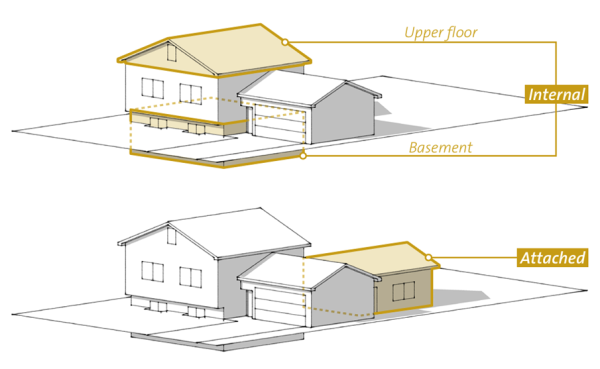
- Design and access. Accessory Dwelling Units may be separate from the single-family dwelling unit by means of a wall or floor and have a separate entrance than the primary dwelling unit. The separating wall may have a door connecting the accessory dwelling unit to the primary dwelling unit.
- Size. Accessory Dwelling Units must meet the following size standards:
- Minimum size. Accessory Dwelling Units must be at least 200 square feet in area.
- Maximum size. Accessory Dwelling Units must be less than 960 square feet in area.
- Bedrooms. No more than one bedroom is permitted in the accessory dwelling unit.
- Number of Accessory Dwelling Units. Not more than one accessory dwelling unit shall be allowed per single-family detached lot.
- Setbacks. Any accessory dwelling unit shall comply with the same minimum building setback requirement as required for the principal dwelling unit.
- Stairways. Stairways leading to an internal accessory dwelling unit located above the ground floor of a principal residential structure shall be enclosed or located entirely to the rear of the principal residential structure.
- Height. The maximum height for an accessory dwelling unit shall be as prescribed for principal structures in the applicable zoning district.
- Impervious Lot Coverage. The allowed area for an attached accessory dwelling unit shall be determined by the permitted hardcover percentage in the applicable zoning district as well as any restrictions associated with applicable shoreland regulations.
- Architectural Design. An accessory dwelling unit shall be a clearly incidental and subordinate use. The exterior design of an accessory dwelling unit shall incorporate similar architectural styles, roof pitch, colors, and materials as the principal building on the lot, and shall be compatible with the character of the surrounding residential buildings, subject to approval by the Community Development Director or their designee.
- Parking. No additional off-street parking spaces are required with the construction of an accessory dwelling unit.
- Owner Occupancy. An owner of the property that includes an accessory dwelling unit that is internal or attached to a principal residential structure, and where the accessory dwelling unit is not a separate dwelling unit under the Minnesota State Building Code, must occupy at least one (1) dwelling unit on the zoning lot as their primary place of residence. If an owner is unable or unwilling to fulfill the requirements of this section, the owner shall remove those features of the accessory dwelling unit that make it a dwelling unit. Failure to do so will constitute a violation of this section.
- Rental. Accessory Dwelling Units may not be used as rental properties, including short-term rentals, as defined by the City Code.
- Utilities. Unless otherwise approved by the City Engineer, the accessory dwelling unit shall not have separate public sewer or water utility services from the principal structure.
- Building Code Compliance. The principal dwelling unit and accessory dwelling unit shall be created and maintained in compliance with Chapter 7-II of the City Code. The accessory dwelling unit and the associated single-family dwelling unit shall also meet current State Building Code provisions, including, but not limited to, fire resistance standards between units.
- Fire Code Compliance. The principal dwelling and accessory dwelling unit shall be created and maintained in compliance with Chapter 5 of the Minnesota State Fire Code.
- Property Maintenance Code. The principal residential structure and the accessory dwelling unit shall be constructed and maintained in compliance with the property maintenance requirements set forth in the City Code.
- Shoreland and Watershed District. All applicable state shoreland and watershed district requirements must be met.
- Accessory Dwelling Unit application requirements. Any application for an accessory dwelling unit must be accompanied by:
- Existing conditions survey showing property lines, existing and proposed structures, existing and proposed impervious surface areas, and setbacks.
- Elevation drawings depicting the proposed structure from all four directions; and
- A floor plan of the accessory dwelling unit indicating points of entrance and floor areas.
- In the event an accessory dwelling unit is proposed entirely within the existing floor area of a single-family dwelling, the existing conditions survey is not required, and elevations drawings are required only for those elevations proposed to be altered.
- Temporary family health care dwellings. Pursuant to the authority granted by M.S. 462.3593, subd. 9, as it may be amended from time to time, the city opts-out of the requirements of M.S. 462.3593, which defines and regulates temporary family health care dwellings.
Adopted by Ord. 744 on 5/12/2025
Sec 20-976 Purpose
The purpose of this division is to regulate home occupations in residential zoning districts to ensure that they are incidental to the primary residential use of the property and to establish standards by which home occupations can be conducted without compromising the character of the residential neighborhood.
(Ord. No. 302, § 2, 5-8-00)
Sec 20-977 Subordinate Use
The use of a dwelling unit for any home occupation shall be clearly incidental and subordinate to its residential use. Not more than 25 percent of the floor area of one floor of a dwelling unit shall be used in the conduct of the home occupation. No garage or accessory buildings except accessory agricultural buildings existing on February 19, 1987, shall be used for any home occupation.
(Ord. No. 302, § 2, 5-8-00)
Sec 20-978 Occupations Prohibited
Contractors' yards/landscaping businesses are prohibited.
(Ord. No. 302, § 2, 5-8-00; Ord. No. 377, § 121, 5-24-04)
Sec 20-979 Outside Appearance
The home occupation shall be conducted entirely within a fully enclosed building. No change in the outside appearance of the building or land, or other visible evidence of the conduct of the home occupation shall be permitted. Outdoor storage of anything is prohibited in connection with a home occupation.
(Ord. No. 302, § 2, 5-8-00)
Sec 20-980 Hours Of Operation
The hours of operation of any home occupation shall be limited to between 8:00 a.m. and 8:00 p.m.
(Ord. No. 302, § 2, 5-8-00)
Sec 20-981 Use Of Equipment
No mechanical or electrical equipment requiring the use of voltage in excess of 220 volts single phase shall be used in the conduct of a home occupation.
(Ord. No. 302, § 2, 5-8-00)
Sec 20-982 Traffic And Parking
- No traffic shall be generated by any home occupation in greater volume than would be normally be expected in a residential neighborhood, and no home occupation involving the need for more than three parking spaces for the occupants and visitors shall be permitted.
- Adequate off-street parking facilities required to service the home occupation shall be provided on the premises, but no such parking facilities shall be established within any required front or side yard, except upon an established driveway.
(Ord. No. 302, § 2, 5-8-00)
Sec 20-983 Retail And Wholesale Sales Prohibited
No commodities, merchandise or supplies shall be sold or offered for sale upon or from the premises, whether at retail or wholesale.
(Ord. No. 302, § 2, 5-8-00)
Sec 20-984 Nonresident Employee
Only one nonresident of the dwelling unit may be employed upon the premises of a home occupation.
(Ord. No. 302, § 2, 5-8-00)
Sec 20-985 Commercial Equipment And Vehicles
Exterior parking of trailers, steer skid loaders, landscaping equipment, cement mixers, and other similar types of equipment used in conjunction with the home occupation is prohibited. Parking of commercial vehicles in excess of 22 feet in length is prohibited. No commercial vehicles in excess of 9,000 pounds gross weight shall be used in connection with the home occupation or parked on the property.
(Ord. No. 302, § 2, 5-8-00)
Sec 20-1001 Keeping
The following animals may be kept in the city:
- Household pets are an allowed use in all zoning districts.
- Horses in the A-2, RR and RSF zoning districts in accordance with chapter 5, article III.
- Honey bees in accordance with chapter 5, article IV.
- Chickens in accordance with chapter 5, article V.
- Farm animals are an allowed use on all farm property zoned A2 or RR, which permit agricultural use, with a minimum parcel area of ten acres, except as otherwise specifically provided in the City Code. Farm animals may not be confined in a pen, feed lot or building within 100 feet of any residential dwelling not owned or leased by the farmer.
- Wild animals may not be kept in the city.
- Animals may only be kept for commercial purposes if authorized in the zoning district where the animals are located.
- Animals may not be kept if they cause a nuisance or endanger the health or safety of the community.
(Ord. No. 80, Art. VI, § 9(6-9-1), 12-15-86; Ord. No. 480, § 2, 6-22-09; Ord. No. 612, § 6, 12-14-15; Ord. No. 634, § 3, 6-25-18; Ord. No. 639, § 8, 3-11-19)
Sec 20-1002 Care And Treatment
Animals kept within any zoning district shall be subject to the following requirements:
- The size, number, species, facilities for and location of animals kept shall be maintained so as not to constitute a danger or nuisance by means of odor, noise or otherwise.
- Facilities for housing animals shall be:
- Constructed of such material as is appropriate for the animals involved.
- Maintained in good repair.
- Controlled as to temperature, ventilated and lighted compatible with the health and comfort of the animals.
- Of sufficient size to allow adequate freedom of movement. Inadequate space may be indicated by evidence of malnutrition, poor condition of debility, stress or abnormal behavior patterns.
- Cleaned as often as necessary to prevent contamination of the animals contained therein and to minimize disease hazards and reduce odors.
- Animals shall be provided wholesome, palatable food and water free from contamination and of sufficient quantity and nutritive value to maintain all animals in good health.
- Animals kept in pet shops or kennels shall be kept in accordance with regulations for pet shops and kennels in addition to the regulations provided by this division. Pet shop or kennel owners shall receive a license as required by the city.
(Ord. No. 80, Art. VI, § 6-9-2, 12-15-86)
Sec 20-1016 Intent
The intent of this division is to provide standards for fences along the perimeter of lots that may be decorative or act as boundaries and/or barriers.
(Ord. No. 80, Art. VI, § 12(6-12-1), 12-15-86)
Amended by Ord. 692 on 6/13/2022
Sec 20-1017 Permit
A zoning permit shall be obtained for any permanent fence installed for any purpose, other than an agricultural purpose prior to installation of same. The installation of temporary or seasonal fencing, e. g., snow fencing, garden fencing, etc., without permanent posts is exempt from this requirement. A site plan showing the location of the fence shall be submitted with the permit application. The city may require a permit applicant to provide a registered land survey establishing property lines. A building permit, in lieu of a zoning permit, shall be required for fences in excess of seven feet in height and retaining walls in excess of four feet in height.
(Ord. No. 80, Art. VI, § 12(6-12-2, 6-12-4, 6-12-5), 12-15-86; Ord. No. 377, § 122, 5-24-04)
Amended by Ord. 692 on 6/13/2022
Sec 20-1018 Commercial And Industrial Fences
- Fences for screening or storage purposes installed on property used for commercial or industrial uses may have a maximum height of eight feet. When commercial or industrial uses abut property used or zoned for residential uses, a fence at least six feet in height may be placed between the residential and the commercial and industrial property if the city determines that there is a need for a fence. The city may elect to use landscaping consisting of berms and vegetation to provide screening. If a fence is used, such fence must be 100 percent opaque. Commercial or industrial fences over eight feet shall require a conditional use permit.
- Fences utilizing barbed wire in all commercial and industrial districts shall require a conditional use permit.
(Ord. No. 80, Art. VI, § 12(6-12-10), 12-15-86; Ord. No. 90, § 3, 3-14-88; Ord. No. 255, § 2, 7-22-96)
Sec 20-1019 Location
- Generally. All fences and retaining walls shall be located entirely upon the property of the fence or retaining wall owner unless the owner of the adjoining property agrees, in writing, that said fence or retaining wall may be erected on the property line of the respective properties. Such agreement shall be submitted at the time of building permit application. Encroachment into a city easement must comply with Section 20-923. Fences shall not be placed within the public right-of-way.
- Wetlands. No fences shall be permitted below the ordinary high water mark of a wetland or within the required wetland buffer area.
- Landscape Buffers. No fences shall be permitted between the landscaping approved in a subdivision's landscape plan within a required landscape buffer and a collector or arterial street.
- Temporary fences. Temporary fencing, such as fencing installed to enclose a seasonal garden or snow fencing in winter, may not be located within the front yard setback. Snow fencing shall not be located within any drainage or utility easement.
- Bluffs. No fences shall be permitted within the 30-foot bluff setback.
- Shoreline Fences. No fences shall be permitted within the structure setback from the ordinary high water mark stipulated in Section 40-481.
(Ord. No. 80, Art. VI, § 12(6-12-3), 12-15-86; Ord. No. 181, § 1, 3-8-93; Ord. No. 255, § 3, 7-22-96; Ord. No. 377, § 123, 5-24-04; Ord. No. 423, § 7, 6-12-06)
Amended by Ord. 692 on 6/13/2022
Amended by Ord. 694 on 8/8/2022
Sec 20-1020 Construction And Maintenance
Every fence shall be constructed in a substantial, workmanlike manner and of material reasonably suited for the purpose for which the fence is proposed to be used. Every fence shall be maintained in such condition as to not become a hazard, eyesore, or public or private nuisance. All fences shall be constructed so that the side containing the framing supports and cross pieces face the interior of the fence owner's lot. Any fence which does not comply with the provisions of this chapter or which endangers the public safety, health or welfare shall be considered a public nuisance. Abatement proceedings may be instituted by the proper city official after 15 days' notification, if the owner of such fence has not undertaken the necessary repairs to abate the nuisance. Link fences shall be constructed in such a manner that no barbed ends shall be exposed.
(Ord. No. 80, Art. VI, § 12(6-12-6), 12-15-86)
Sec 20-1021 Swimming Pool Fences
All in-ground swimming pools shall be protected by a fence not less than five feet in height. All gates shall have a self-closing and self-latching latch installed on the pool side of the fence. All fences shall be nonclimbable and shall have intermediate rails or ornamental pattern such that a sphere four inches in diameter cannot pass through. This section does not apply to pools which are located on property which are completely enclosed by perimeter fence five feet in height.
(Ord. No. 80, Art. VI, § 12(6-12-7), 12-15-86; Ord. No. 110, § 2, 8-28-89)
Sec 20-1022 Reserved
(Ord. No. 80, Art. VI, § 12(6-12-8), 12-15-86)
Amended by Ord. 692 on 6/13/2022
Sec 20-1023 Height
Residential fences are limited to six and one-half feet in height. The fence height is measured from grade to the highest point on the fence. All other residential fences shall meet the following standards:
- Side yards and rear yards. In any side or rear yard on lots, the height of fences shall not exceed six and one-half feet.
- Front yards. Fences in the required front yard setback area that are opaque shall not exceed three feet in height. Chain link fences in this area shall not exceed four feet in height. All other open fences in this area shall not exceed six and one-half feet in height.
- Corner or double fronted lots. In addition to the other provisions contained in this section, fences located on corner or double fronted lots shall be subject to the following provisions:
- Any fence within the required front yard setback area shall not exceed three feet in height if opaque construction, four feet if chain link, or six and one-half feet in height if open construction.
- The maximum height of a fence shall conform to the requirements of fences in front yards within the sight distance triangle of street intersections and neighboring driveways.
- The front yard shall be determined by the location of the property's access by a driveway to the public street.
(Ord. No. 80, Art. VI, § 12(6-12-9), 12-15-86; Ord. No. 181, § 2, 3-8-93; Ord. No. 240, § 25, 7-24-95)
Amended by Ord. 692 on 6/13/2022
Sec 20-1024 Barbed Wire And Electric Fences
Barbed wire and electric fences are prohibited in all residential districts. Barbed wire and electric fences are permitted on properties being used for agriculture.
(Ord. No. 90, § 4, 3-14-88; Ord. No. 451, § 10, 5-29-07)
Amended by Ord. 692 on 6/13/2022
Sec 20-1025 Retaining Walls
Retaining walls exceeding four feet in height, including stage walls which cumulatively exceed four feet in height, must be constructed in accordance with plans prepared by a registered engineer or landscape architect and shall be constructed of a durable material. A permit is required for the construction of such retaining walls.
(Ord. No. 377, § 124, 5-24-04)
Sec 20-1041 Purpose
The purpose of this division is to establish standards and procedures by which the installation and operation of WECS shall be governed.
(Ord. No. 80, Art. VI, § 20(6-20-1), 12-15-86)
Sec 20-1042 Ornamental Wind Devices
Ornamental wind devices that are not a WECS shall be exempt from the provisions of this division and shall conform to other applicable provisions of this chapter.
(Ord. No. 80, Art. VI, § 20(6-20-8), 12-15-86)
Sec 20-1043 When Allowed
Wind conversion systems may be allowed as a conditional use subject to the regulations and requirements of this division, provided the property upon which the system is to be located is zoned agricultural, commercial or industrial and is constructed and maintained on any parcel of at least two and one-half acres in size.
(Ord. No. 80, Art. VI, § 20(6-20-2), 12-15-86)
Sec 20-1044 Declaration Of Conditions
The planning commission may recommend and the city council may impose such conditions on the granting of WECS conditional use permit as may be necessary to carry out the purpose and provisions of this division.
(Ord. No. 80, Art. VI, § 20(6-20-3), 12-15-86)
Sec 20-1045 Site Plan
All applications for a WECS conditional use permit shall be accompanied by a detailed site plan drawn to scale and dimensioned, displaying the following information:
- Lot lines and dimensions.
- Location and height of all buildings, structures, above-ground utilities and trees on the lot, including both existing and proposed structures and guy wire anchors.
- Location and height of all adjacent buildings, structures, above-ground utilities and trees located within 350 feet of the exterior boundaries of the property in question.
- Existing and proposed setbacks of all structures located on the property in question.
- A sketch evaluation of the premises accurately depicting the proposed WECS and its relationship to structures on adjacent lots.
(Ord. No. 80, Art. VI, § 20(6-20-4), 12-15-86)
Sec 20-1046 Inspection
The city reserves the right upon issuing any WECS conditional use permit to inspect the premises on which the WECS is located. If a WECS is not maintained in operational condition and poses a potential safety hazard, the owner shall take expeditious action to correct the situation.
(Ord. No. 80, Art. VI, § 20(6-20-9), 12-15-86)
Sec 20-1047 Abandonment
Any WECS or tower which is not used for six successive months shall be deemed abandoned and shall be dismantled and removed from the property at the expense of the property owner.
(Ord. No. 80, Art. VI, § 20(6-20-10), 12-15-86)
Sec 20-1048 Compliance With Technical Codes
- Standard drawings of the structural components of the wind energy conversion system and support structures, including base and footings shall be provided along with engineering data and calculations to demonstrate compliance with the structural design provisions of the Minnesota State Building Code as adopted. Drawings and engineering calculations shall be certified by a registered engineer.
- WECS electrical equipment and connection shall be designed and installed in adherence to the National Electrical Code as adopted and amended by the city.
(Ord. No. 80, Art. VI, § 20(6-20-5, 6-20-6), 12-15-86; Ord. No. 377, § 125, 5-24-04)
Cross reference(s)—Technical codes, § 7-16 et seq.
Sec 20-1049 Height
- The permitted maximum height of a WECS shall be determined in one of two ways. In determining the height of the WECS the total height of the system shall be included. System height shall be measured from the base of the tower to the highest possible extension of the rotor.
- A ratio of one foot to one foot between the distance of the closest property line to the base of the WECS to the height of the system.
- A maximum system height of 175 feet.
- The shortest height of the two above-mentioned methods shall be used in determining the maximum allowable height of a WECS system. The height of a WECS must also comply with FAA Regulation part 77 "Objects Affecting Navigable Air Space" and/or MnDOT Rule 14, MCAR 1.3015 "Criteria for Determining Obstruction to Air Navigation."
(Ord. No. 80, Art. VI, § 20(6-20-7(1)), 12-15-86)
Sec 20-1050 Setbacks
No part of a WECS (including guy wire anchors) shall be located within or above any required front, side or rear yard setback. WECS towers shall be set back from the closest property line one foot for every one foot of system height. WECS shall not be located within 30 feet of an aboveground utility line.
(Ord. No. 80, Art. VI, § 20(6-20-7(2)), 12-15-86)
Sec 20-1051 Rotors
All WECS rotors shall not have rotor dimensions greater than 26 feet. Blade arcs created by the WECS shall have a minimum of 30 feet of clearance over any structure or tree within a 200-foot radius. Each WECS shall be equipped with both a manual and automatic braking service capable of stopping the WECS operation in high winds (40 miles per hour or greater).
(Ord. No. 80, Art. VI, § 20(6-20-7(3)—(5)), 12-15-86)
Sec 20-1052 Lightning Protection
Each WECS shall be grounded to protect against natural lightning strikes in conformance with the National Electrical Code as adopted and amended by the city.
(Ord. No. 80, Art. VI, § 20(6-20-7(6)), 12-15-86)
Cross reference(s)—Technical codes, § 7-16 et seq.
Sec 20-1053 Tower Access
To prevent unauthorized climbing, WECS towers must comply with one of the following provisions:
- Tower climbing apparatus shall not be located within 12 feet of the ground.
- A locked anti-climb device shall be installed on the tower.
- Tower capable of being climbed shall be enclosed by a locked, protective fence at least six feet high.
(Ord. No. 80, Art. VI, § 20(6-20-7(7)), 12-15-86)
Sec 20-1054 Signs
WECS shall have one sign, not to exceed two square feet posted at the base of the tower and said sign shall contain the following information:
- Warning high voltage.
- Manufacturer's name.
- Emergency phone number.
- Emergency shutdown procedures.
(Ord. No. 80, Art. VI, § 20(6-20-7(8)), 12-15-86)
Sec 20-1055 Lighting
WECS shall not have affixed or attached any lights, reflectors, flashers or any other illumination, except for illumination devices required by FAA Regulations part 77 "Objects Affecting Navigable Air Space" and FAA Advisory Circular 70/7460-1K CHG1 April 15, 2000.
(Ord. No. 80, Art. VI, § 20(6-20-7(9)), 12-15-86; Ord. No. 377, § 126, 5-24-04)
Sec 20-1056 Electromagnetic Interference
WECS shall be designed and constructed so as not to cause radio and television interference.
(Ord. No. 80, Art. VI, § 20(6-26-7(10)), 12-15-86)
Sec 20-1057 Noise Emissions
Noises emanating from the operation of WECS shall be in compliance with and regulated by the state pollution control standards, Minnesota Regulations NPC 1 and 2, as amended.
(Ord. No. 80, Art. VI, § 20(6-20-7(11)), 12-15-86)
Sec 20-1058 Utility Company Interconnection
No WECS shall be interconnected with a local electrical utility company until the utility company has reviewed and commented upon it. The interconnection of the WECS with the utility company shall adhere to the National Electrical Code as adopted and amended by the city.
(Ord. No. 80, Art. VI, § 20(6-20-7(12)), 12-15-86)
Cross reference(s)—Technical codes § 7-16 et seq.
Sec 20-1060 Purpose
These design standards govern site planning, placement of building masses, use of materials, enable the city to enhance what otherwise might result in low quality development. These design standards will:
- Promote high-quality architectural and site design.
- Protect creek corridors, wetlands, and significant stands of mature trees through the use of careful site design, protective easements, sensitive alignment and design of roadways and utilities, incorporation of natural features, landscaping and massing of trees that enhance existing natural features and views, and the practices delineated in the city's surface water management plan.
- Create a unified, harmonious and high-quality visual environment throughout the city.
- Foster a distinctive and positive community image, thereby identifying Chanhassen as a special place with a unique identity in the Twin Cities Region as a whole.
(Ord. No. 327, § 1, 9-24-01; Ord. No. 445, § 1, 2-12-07)
Sec 20-1061 Intent
The city intends that all commercial, industrial, and office-institutional development within the city should strive toward the highest level of quality in both design and construction. The criteria by which new development in the city shall be judged are as follows:
- Consistency with all provisions of the comprehensive plan, as amended from time to time; the surface water protection program; all provisions of the zoning ordinance and subdivision ordinance not specifically overridden by the provisions of these design standards; and all other applicable land use regulations.
- Preservation of the natural conditions found on each site to the greatest extent possible, through minimized removal of trees and other vegetation and soil, minimized site grading, and application of the practices found in the city's surface water management plan.
- Establishment throughout the district of harmonious physical and visual relationships among existing, new, and proposed buildings, open spaces, natural terrain, and plant materials and placement with the intent of creating a unique and unified appearance for the entire city.
- Use of appropriate materials, lighting, textures, colors, and architectural and landscape forms to create a unified, high-quality design concept for each site that is compatible with adjacent and neighboring structures and functions, including but not limited to natural areas, city-owned property, and vacant land subject to future development in accordance with the comprehensive plan.
- Creation of unified site designs, each with a sense of internal order, that provide desirable environments for site users and visitors and the community as a whole and that consider all site elements including: the relationship of buildings to surrounding landforms; grading; architectural design; building, parking and loading dock orientation; building height; use of manmade materials, including paving; site furnishings (lighting, outdoor seating, signage, etc.); landscaping (retention of natural vegetation, plant selection and placement, retention and incorporation of water features, etc.); and other visible outdoor site elements.
- Creation of a suitable balance between the amount and arrangement of open space, landscaping, and view protection and the design and function of man-made features on the other. Achieving this balance shall take into account screening, buffering, size and orientation of open spaces, personal and property security, localized wind and solar effects, and protection of important public ways.
- Provision of safe and adequate access to and from sites giving ample consideration to the location and number of access points from public streets, the safety and convenience of merging and turning movements, and traffic management and mitigation.
- Provision of on-site vehicular, bicycling, and pedestrian circulation by way of interior drives, parking areas, pathways, and walkways adequate to handle anticipated needs and to safety buffer pedestrians and cyclists from motor vehicles. Ample consideration shall be given to the width of interior drives, internal traffic movement and flow, separation of pedestrian, cycling, automobile; and delivery traffic, and the safe, convenient, and practical arrangement of parking spaces.
- Adequate separation and protection of each site from adjacent properties, through reasonable provisions for surface water drainage, sound and sight buffers, view protection, privacy, and other aspects of design that may not be specifically covered by these or other regulations but are found to have significant effect on any or all of the properties and roadways.
(Ord. No. 327, § 1, 9-24-01; Ord. No. 445, § 2, 2-12-07)
Sec 20-1062 District Applications
The design standards shall apply to all commercial, industrial and Office institutional development. Within each zoning district the design standards shall be in addition to the underlying requirements. single-family residential lots are exempt from the design standards. The design standards apply with the following exceptions:
- Internal alterations to buildings that affect less than 50 percent of the building's gross floor area and do result in a change to the building height, roof line or footprint.
- Replacement or repair of existing materials.
- The standards shall apply only to the building or site elements being developed or altered. A proposal for changes to a building would be required to meet only those standards that pertain to buildings while changes to a parking area would be required to meet all standards for parking areas not for buildings.
The planning commission shall apply the design standards proportionately to the degree of change proposed. Minor improvements may be made to existing uses without costly upgrades or a complete change to the site. The planning commission may make a recommendation to waive specific design standards based on the scale of the project.
(Ord. No. 327, § 1, 9-24-01)
Sec 20-1063 Architectural Style/Building Character
Architectural style shall not be restricted. Evaluation of the appearance of a project shall be based on the quality of its design and on its relationship to its surroundings, guided by the provisions of this section. Site characteristics to be evaluated for this purpose include building and plant materials, colors, textures, shapes, massing, rhythms of building components and details, height, roof-line and setback. Designs that are incompatible with their surroundings or intentionally bizarre or exotic are prohibited.
Monotony of design, both within projects and between any project and its surroundings, is prohibited. Variation in detail, form, and siting shall provide visual interest. Site characteristics that may be used for this purpose include building and plant materials, sizes, colors, textures, shapes, massing, rhythms of building components and details, height, roof-line, and setback.
Building Character
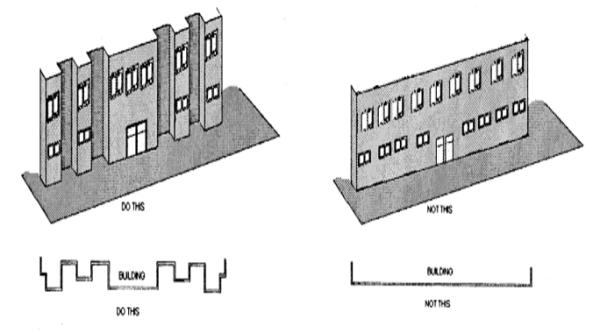 (Ord. No. 327, § 1, 9-24-01)
Sec 20-1064 Size, Portion, And Placement
Site designs and configurations that tend to catch and accumulate trash, leaves, and dirt shall be avoided. In addition, provisions for washing and cleaning buildings, other structures, and building grounds shall be considered and included in the design.
All building components, such as windows, doors, eaves, soffits, and parapets, shall have good proportions that relate to the facade of the building and shall relate well with one another.
All buildings shall be located as close as possible to the principal building setback line and the majority of parking shall be to the rear or side of the building or screened area. Building entrances shall be as close as possible to abutting streets.
Size, Portion and Placement
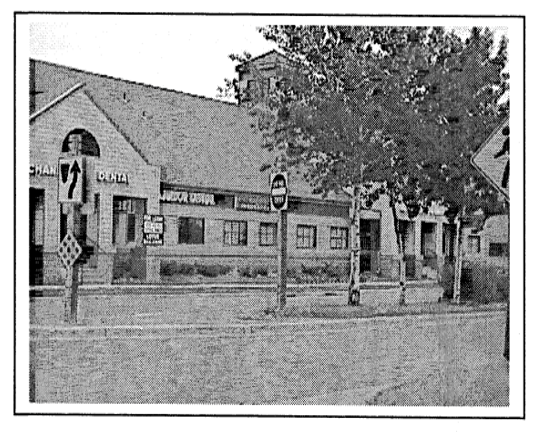
- Entries. The main entrance should always face the primary street with secondary entrances to the side or rear. In the case of a corner building or a building abutting more than one street, the planning commission will determine which street should be considered "primary" based on the visibility and access patterns. The main entrance shall be placed at grade. Main entries shall be designed, with one or more of the following:
- Canopy, portico, overhang or arch above the entrance
- Recesses or projections in the building facade surrounding entrance
- Peaked roof or raised parapet over the door
- Display windows surrounding the entrance
- Architectural detailing such as tile work or ornamental moldings
- Permanent planters or window boxes for landscaping
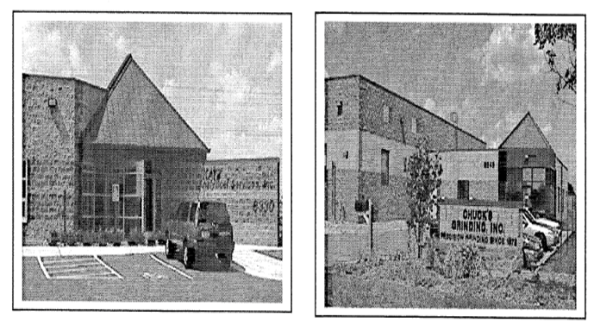
- Articulation. To avoid long unbroken expanses, buildings of more than 40 feet in width shall be divided into smaller increments (between 20 and 40 feet) through articulation of the facade. This can be achieved through combinations of the following techniques:
- Facade modulation-stepping back or forward or extending a portion of the facade
- Vertical divisions using different textures or materials
- Division into storefronts with separate display windows and entrances
- Variation in the rooflines by alternating dormers and stepped roofs. Gables or other roof elements to reinforce the modulation or articulation intervals equal to the articulation interval
- Providing a lighting fixture, trellis, tree, or other landscape feature with each interval
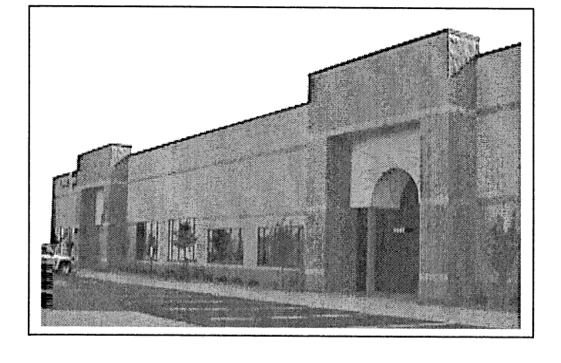
- The ground level of any multi-story structure must be visually distinct from the upper stories. This can be achieved through the use of one or more of the following techniques, and others may meet the objective:
- An intermediate cornice line
- A sign band
- An awning arcade or portico
- A change in building materials, texture or detailing
- A change in window shape or treatment
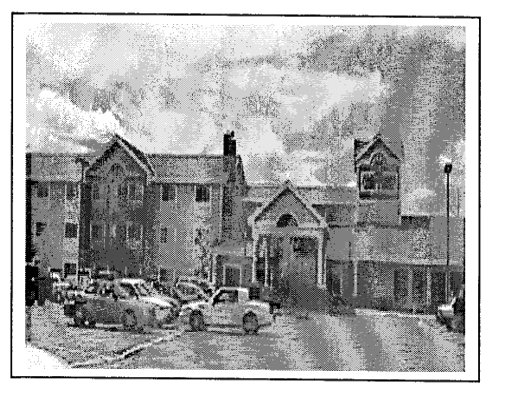 (Ord. No. 327, § 1, 9-24-01)
Sec 20-1065 Material And Detail
- All manmade architectural, landscape, and paving materials shall reflect the highest quality possible and should be used in a manner suitable to the nature of the material, its role in the design, general durability, expected level of use or abuse, weathering characteristics, and ease and frequency of maintenance. The following materials or equivalent materials are acceptable:
- Brick
- Stone
- Glass
- Textured masonry units
- Wood, consisting of lap siding with an exposure no greater than seven inches or wood shakes; surfaces must be painted
- Stucco
- Tilt up concrete panels that are grid or brick like in appearance
- Accent material may occupy up to 15 percent of the building's facade. These may include metal, glass block, spandrel glass or similar materials approved by the city.
The following may not be used in any visible exterior application except when specifically permitted by the city in areas with limited public view or accent areas: - Plain poured concrete panels "cast in place"
- Reserved
- Reserved
- Reserved
- Unadorned plain concrete block
- Tilt-up concrete panel that are ribbed or corduroy in appearance
- Prefabricated steel or sheet metal panels
- Reflective glass
- Aluminum, vinyl, fiberglass, asphalt or fiberboard siding
- EIFS (exterior insulation and finish system) may be used as an accent but not a primary material
- Plain poured concrete panels "cast in place"
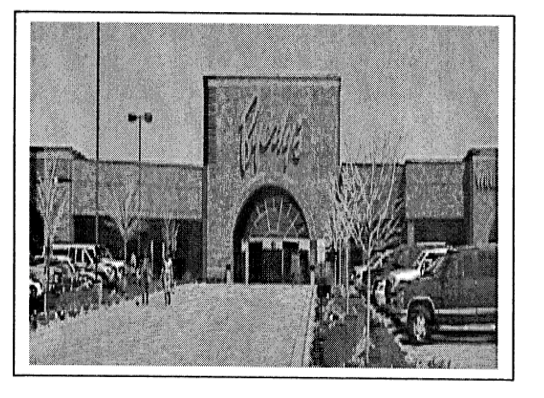
(Ord. No. 327, § 1, 9-24-01; Ord. No. 377, § 127, 5-24-04)
Amended by Ord. 692 on 6/13/2022
Sec 20-1066 Color
Colors shall be harmonious. Building colors shall consist of muted colors with low reflectance. Recommended colors include browns, grays, tans, beiges and dark or muted green, blues and reds. Bright or brilliant colors and sharply contrasting colors may be used only for accent purposes occupying a maximum of ten percent of building facades.
Color
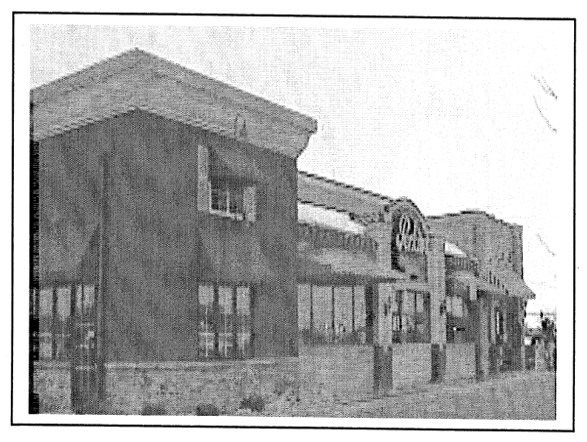 (Ord. No. 327, § 1, 9-24-01)
Sec 20-1067 Height And Roof Design
Building heights shall be limited to three stories or 40 feet in the Highway 5 Corridor District. Otherwise building heights shall be consistent with the standards of the underlying zoning district. Measurement of the highest point shall exclude antennas for television and radio reception, but shall include architectural details (e.g., parapet walls), transmission antennas, satellite dishes and transmission equipment, microwave-transmission equipment, and other nonstructural building elements.
Pitched roofs should have a minimum roof pitch of one rise to four feet of run. Flat roofs should be defined with an ornamental parapet or cornice. Average parapet height shall not exceed 15 percent of the height of the supporting wall and maximum parapet height at any point shall not exceed one-third of the support wall.
Mechanical equipment, satellite dishes, and other utility hardware, whether located on the roof or exterior of the building or on the ground adjacent to it, shall be screened from the public view and with materials identical to or strongly similar to building materials or by heavy landscaping that will be effective in winter or they shall be located so as not to be visible from any public way. Use of parapet walls or pitched roof elements to screen equipment is encouraged. In no case shall wooden fencing be used as a rooftop equipment screen.
Each building shall contain one or more pitched elements (pitched roof, awnings, entries, etc.).
Height and Roof Design
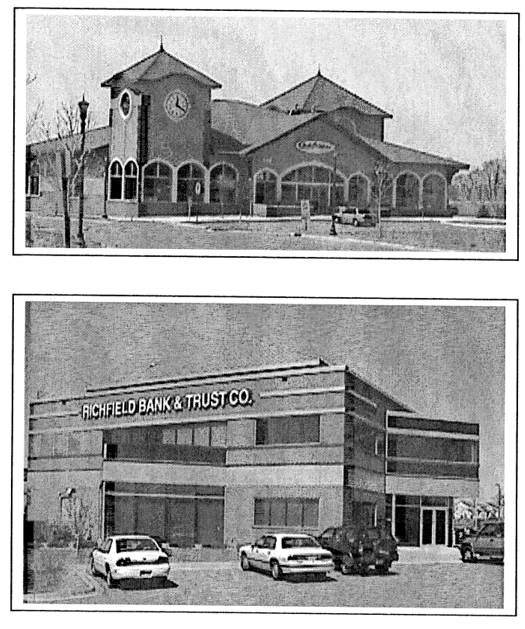 (Ord. No. 327, § 1, 9-24-01)
Sec 20-1068 Facade Transparency
Fifty percent of the first floor facade that is viewed by the public shall be designed to include transparent windows and/or doors to minimize expanses of blank walls. (Reflective glass is not permitted.) If the building is a one-story design and the first floor elevation exceeds 12 feet, then only the first 12 feet in building height shall be included in calculating the facade area.
The remaining 50 percent of the first floor facade that is viewed by the public shall be designed to include any or all of the following:
- Landscape materials (plant material, vertical trellis with vines, planter boxes, etc.).
- Architectural detailing and articulation that provides texture on the facade and/or parking structure openings.
Facade Transparency
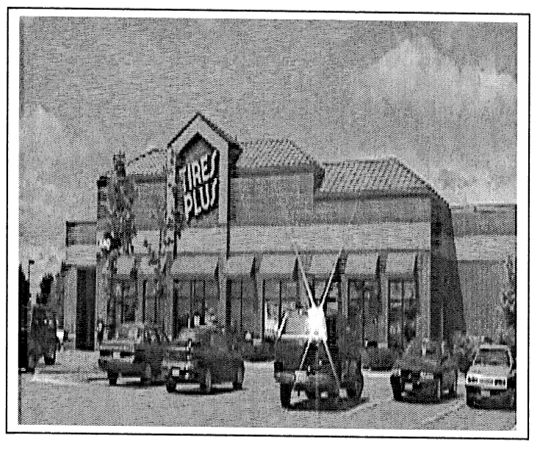 For buildings with a use or function that does not readily allow windows, e.g., cooler or freezer areas, mechanical rooms, security areas, storage areas or warehouse or manufacturing space in commercial or industrial buildings, the fenestration standards may be reduced. However, the architecture detailing must be provided by the use of upper level windows, the use of spandrel glass or architectural detailing which provides arches, patterning, recesses and shadowing that provide aesthetic interest.
Architectural detailing may include such things as change in materials, change in color, and other significant visual relief provided in a manner or at intervals in keeping with the size, mass, and scale of the wall. Architectural detailing may include arcades, arches, bosses, buttresses, clerestories, colonnades, columns, corbeling, loggias, pilasters, portals, quoins, silos, tiling and towers. Additional architectural elements may include the use of awnings, canopies, embrasures, lunettes, plant boxes, recesses and shutters.
For buildings that were built prior to September 24, 2001, the city will encourage the use of transparent windows or doors as part of any building expansion. However provided the expansion, at a minimum, maintains the existing patterns and details of the existing building architecture, the proposed expansion would not be required to meet the 50 percent transparency requirement.
(Ord. No. 327, § 1, 9-24-01; Ord. No. 377, § 128, 5-24-04; Ord. No. 452, § 2, 7-9-07)
Sec 20-1069 Site Furnishing
Site furnishings located on private property shall be designed as part of the site's architectural concept and landscape. Materials and colors shall be in harmony with buildings, surroundings, and other furnishings; scale shall be appropriate to the site and the design; and proportions shall be attractive.
Site furnishings, community features and landscaping located in any public way or on other public property shall be harmonious with the design of adjacent buildings and with the generally character of the city.
Lighting in connection with site furnishings (e.g., to highlight a ground sign) shall meet the criteria applicable to site, landscape, buildings, and signs.
Benches, tables and chairs or similar features shall be required with all new developments.
(Ord. No. 327, § 1, 9-24-01)
Sec 20-1070 Franchise Architect
Franchise architecture (building design that is trademarked or identified with a particular chain or corporation and is generic in nature) shall be revised if it does not comply with the design standards.
Franchise Architect
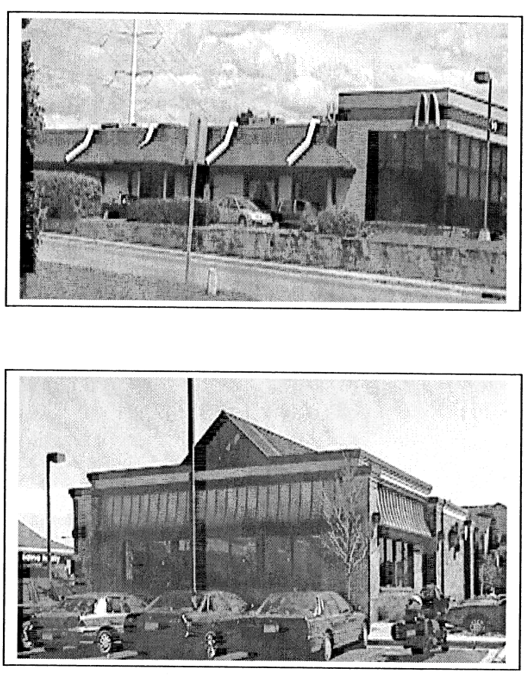 (Ord. No. 327, § 1, 9-24-01)
Sec 20-1071 Loading Areas, Refuse Areas, Etc.
Screening of service yards, refuse, and waste-removal areas, loading docks, truck parking areas, and other areas which tend to be unsightly shall be accomplished by use of walls, fencing, dense planting, or any combination of these elements. Screening shall block views from public right-of-way (pedestrian views) and shall be equally effective in winter and summer.
Screening
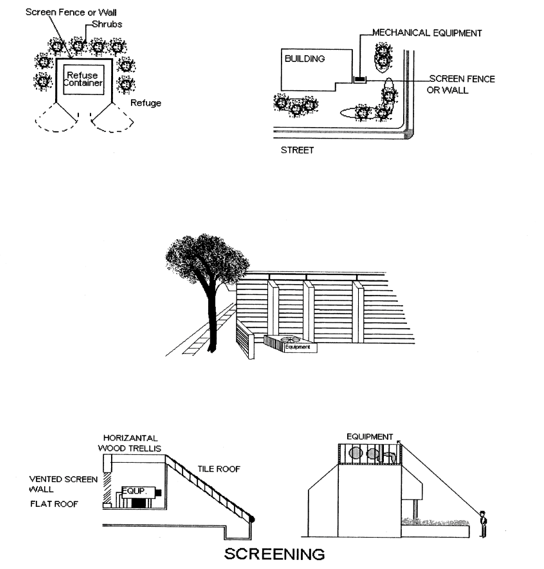 (Ord. No. 327, § 1, 9-24-01)
Sec 20-1072 Landscaping
- Where natural or existing topographic patterns contribute to the beauty or utility of a development, they shall be preserved to the greatest extent possible. Modification to topography will be permitted where and to the extent that it contributes to good design. All topographic modifications shall adhere to the practices delineated in the city's surface water management plan.
- The grades of all walks, parking spaces, terraces, and other paved areas shall conform with the requirements of the Americans with Disabilities Act. In addition, they shall provide an inviting and stable appearance for walking. Stairs and ramps may be substituted for slanted pavement when necessary.
- All landscape shall preserve and enhance natural features (such as wetlands, drainage ways, mature stands of trees, and the like), enhance architectural features, strengthen vistas and important axes, and provide shade.
- Landscaping shall emphasize massing of plant materials over isolated or scattered placement of individual specimens. Reforestation as prescribed by the city's tree preservation and reforestation ordinance is encouraged.
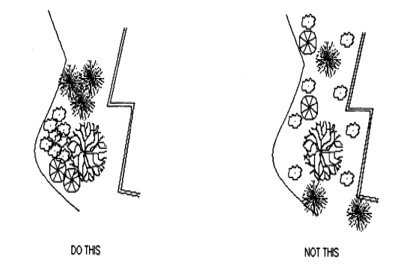
- Unity of design shall be achieved by repetition of certain plant varieties and other materials, and by correlation with natural existing materials and adjacent developments where appropriate.
Unity of Design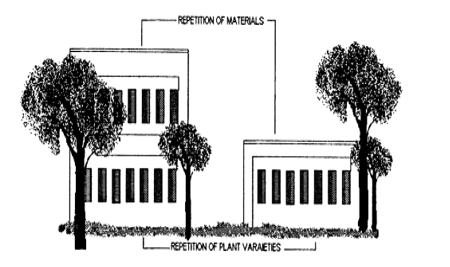
- Plant material shall be selected for interest in its structure, texture and color, and for its ultimate growth size. Plants that are indigenous to the area and others that will be hardy, harmonious to the design of good appearance, and of relatively easy maintenance shall be used.
- In locations where plants will be susceptible to injury by pedestrian or motor traffic, they shall be protected by appropriate curbs, tree guards, or similar devices.
Tree Diagram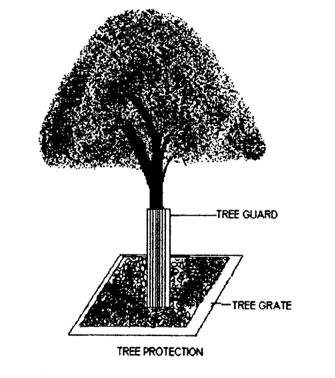
- Where building sites limit planting, the placement of trees in parkways, gardens, or paved areas is encouraged. Trees should be clustered whenever possible, and consideration shall be given to the special needs of plants surrounded by impervious surfaces. In these instances, preference is given to surrounding plantings with pervious pavement to allow for the infiltration of stormwater into the root zone.
Tree Placement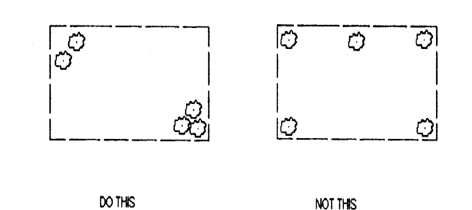
- In areas where general planting will not prosper, other solutions—such as fences, walls, rock gardens, raised planters, or paving of wood, brick stone, gravel, or cobbles—shall be used. Carefully selected plants shall be included.
Rock Gardens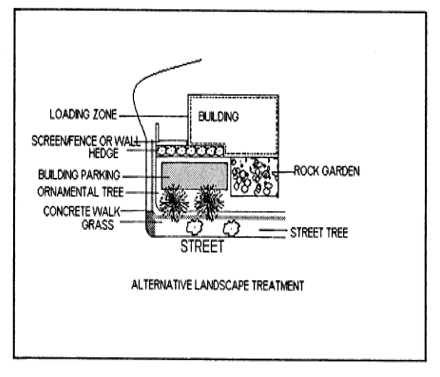
- Landscaping and tree removal shall be consistent with article XXV in the City Code.
(Ord. No. 327, § 1, 9-24-01; Ord. No. 452, § 3, 7-9-07; Ord. No. 628, § 45, 12-11-17)
Sec 20-1073 Lot Frontage And Parking Location
- Highway 5 corridor district.
- In any lot that abuts Highway 5, directly, the lot line abutting the highway shall be considered the front lot line.
- In any lot that abuts either of the access boulevards parallel to Highway 5, the lot line abutting the boulevard shall be considered the front lot line.
- In any lot that abuts both Highway 5 and one of the access boulevards, the lot shall be regarded as having two front lot lines. The lot lines abutting the boulevard shall take design precedence. Such a lot shall be regarded as having no rear lot line or yard.
- One row of parking shall be allowed within the required minimum front (primary or secondary) yard setback of any lot. The majority of parking shall be located to the side or rear of the building.
- All other commercial, industrial or office-institutional districts. Parking areas should be distributed around large buildings in order to shorten the distance to other buildings and reduce the overall scale of the paved surface. No more than 50 percent of the parking area for the entrance of the site shall be located between the front facade of the principal building and the primary abutting street.
Highway 5 Corridor Parking
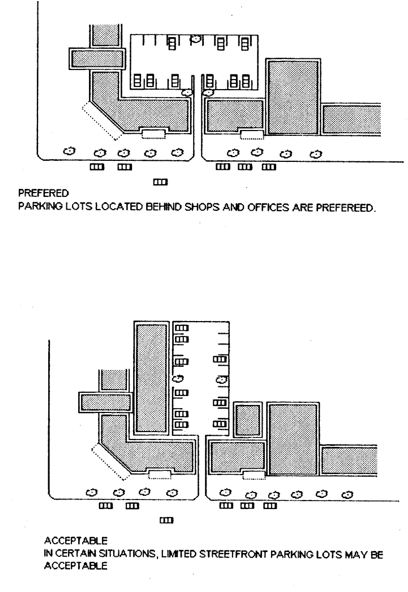 Highway 5 Corridor District Map
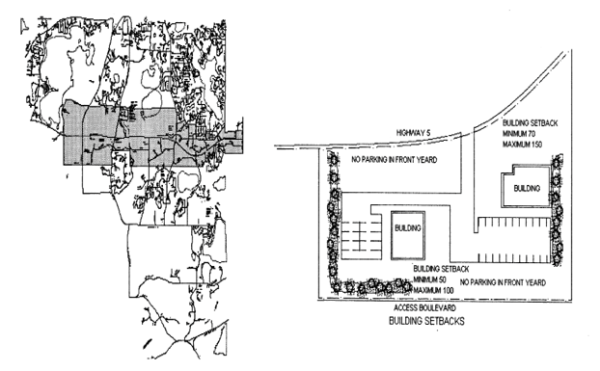 (Ord. No. 327, § 1, 9-24-01)
Sec 20-1080 Location Of Business
- In addition to the licensing requirements of chapter 10 of this Code, sexually oriented businesses shall not be located within 500 feet of:
- A public or private elementary or secondary school;
- A licensed day care center;
- A residential district;
- A multifamily residential building.
- A public park adjacent to a residential district;
- A church;
- City hall;
- Public libraries; or
- Another sexually oriented business.
- For the purposes of subsection (a), measurement shall be made in a straight line, without regard to intervening structures or objects, from the nearest portion of the building or structure used as a part of the premises where a sexually oriented business is conducted, to the nearest property line of the premises of a church or public or private elementary or secondary school or licensed day care center, or to the nearest boundary of an affected public park, residential district, or residential lot, or the nearest portion of a building or structure used for multifamily residential which is not located within a residential district.
- For purposes of subsection (b) of this section, the distance between any two sexually oriented businesses shall be measured in a straight line, without regard to intervening structures or objects, from the closest exterior wall of the structure in which each business is located.
- Any sexually oriented business lawfully operating on the effective date of this ordinance that is in violation of subsections (a), (b), or (c) of this section shall be deemed a nonconforming use. The nonconforming use will be permitted to continue. Such nonconforming uses shall not be increased, enlarged, extended or altered except that the use may be changed to a conforming use. If two or more sexually oriented businesses are within 500 feet of one another and otherwise in a permissible location, the sexually oriented business which was first established and continually operating at a particular location is the conforming use and the later-established business(es) is nonconforming.
- A sexually oriented business lawfully operating as a conforming use is not rendered a nonconforming use by the location, subsequent to the grant or renewal of the sexually oriented business license, of a use or residential district listed in subsection (a) of this section within 500 feet of the sexually oriented business. This provision applies only to the renewal of a valid license, and does not apply when an application for a license is submitted after a license has expired or has been revoked.
(Ord. No. 377, § 129, 5-24-04)
Sec 20-1085 Purpose
These design standards govern site planning, placement of building masses, use of materials, and enables the city to enhance what otherwise might result in low quality development. These design standards will:
- Promote high-quality architectural and site design.
- Create a unified, harmonious and high-quality visual environment throughout the city.
- Protect creek corridors, wetlands, and significant stands of mature trees through the use of careful site design, protective easements, sensitive alignment and design of roadways/access and utilities, incorporation of natural features, landscaping and massing of trees that enhance existing natural features and views, and the practices delineated in the city's surface water management plan.
- Foster a distinctive and positive community image, thereby identifying Chanhassen as a special place with a unique identity in the Twin Cities Region as a whole.
(Ord. No. 385, § 1, 11-8-04; Ord. No. 452, § 4, 7-9-07)
Sec 20-1086 Intent
The city intends that all multifamily developments within the city should strive toward the highest level of quality in both design and construction. The criteria by which new development in the city shall be judged are as follows:
- Consistency with all of the provisions of the comprehensive plan, as amended from time to time; the surface water management plan; all provisions of the zoning ordinance and subdivision ordinance not specifically overridden by the provision of these design standards; and all other applicable land use regulations.
- Preservation and enhancement of the natural conditions found on each site to the greatest extent possible, through minimized removal of trees and other vegetation and soil, minimized site grading, and application of the practices found in the city's Best Management Practices Handbook.
- Establishment throughout the district of harmonious physical and visual relations among existing, new and proposed buildings, open spaces, natural terrain, and plant materials and placement with the intent of creating a unique and unified appearance for the entire city.
- Use of appropriate materials, lighting, textures, colors, and architectural and landscape forms to create a unified, high-quality design concept for each site that is compatible with adjacent and neighboring structures and functions, including but not limited to natural area, city-owned property, and vacant land subject to future development in accordance with the comprehensive plan.
- Creation of unified site designs, each with a sense of internal order, that provide desirable environments for site users and visitors and the community as a whole and that consider all site elements including the relationship of buildings to surrounding landform, grading, architectural design, building orientation, entry treatment, use of material including variety, articulation detail roof pitch and lighting, landscaping and site elements.
- Creation of suitable balance between the amount and arrangement of open space, landscaping, and view protection and the design and function of man-made features. Achieving this balance shall take into account screening buffering, size and orientation of open spaces, personal and property security, wind and solar effects and the protection of important public ways.
- Provision of safe and adequate access to and from sites giving ample consideration to the location and number of access points from public streets, the safety and convenience of merging and turning movements and traffic management mitigation.
- Provision for on-site vehicular, bicycling, and pedestrian circulation by the way of interior drives, parking areas, pathways, and walkways adequate to handle anticipated needs to safely buffer pedestrians and cyclists from motor vehicles. Consideration shall be given to the width of interior drives, internal traffic movement and flow, separation of pedestrian, cycling, and automotive traffic, and the safe, convenient and practical arrangement of parking spaces based on three of units and building orientation.
- Adequate separation and protection of each site from adjacent properties through reasonable provisions of surface water drainage, sound and sight buffer, view protection privacy, and other regulations that are found to have significant effect on any or all of the properties and roadways.
(Ord. No. 385, § 1, 11-8-04)
Sec 20-1087 District Applications
The design standards shall apply to multifamily developments. With each zoning district the design standards shall be in addition to the underlying requirement. Single-family lots are exempt from the design standards.
(Ord. No. 385, § 1, 11-8-04)
Sec 20-1088 Architectural Style
- Architectural style shall not be restricted. Evaluation of the appearance of a project shall be based on the quality of its design and in relationship to its surroundings, guided by the provisions of this section. Site characteristics to be evaluated for this purpose include building and landscaping, colors, textures, shapes, massing of rhythms of building components and detail, height of roof line, setback and orientation. Designs that are incompatible with their surroundings or intentionally bizarre or exotic are not acceptable.
- Monotony of design, both within projects and between adjacent projects and its surroundings, is prohibited. Variation in detail, form, and siting shall provide visual interest. Site characteristics that may be used for this purpose include building and landscaping, colors, textures, shapes, massing of rhythms of building components and detail, height of roof line, setback and orientation.
- All building shall have a minimum of 20 percent of accent material. Accent material may include brick, stone cut face block or shakes. The use of any EFIS shall not be on the first story of any building or one story in height.
(Ord. No. 385, § 1, 11-8-04)
Sec 20-1089 Land Use
All development shall create a unified design of internal order that provides desirable environments for site uses, visitors and the community. The following design elements shall be incorporated into a project:
- The project shall create a unique neighborhood identity.
- Creation of interconnecting neighborhoods in collaboration with adjoining landowners (street, walkways, preservation of natural features, parks and gathering places).
- Each neighborhood has a focal point or gathering place including parks, greens, squares, entrance monuments, historic structures (silos/barns) or public furniture (gazebos, benches, pergolas).
Monument, Gazebo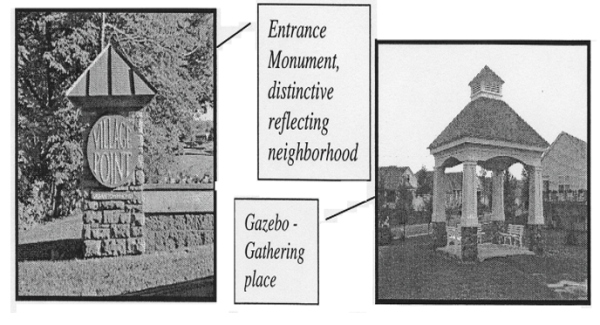
- Recreation facilities (playgrounds, tot lots, swimming pools and gardens).
Fountain, Playground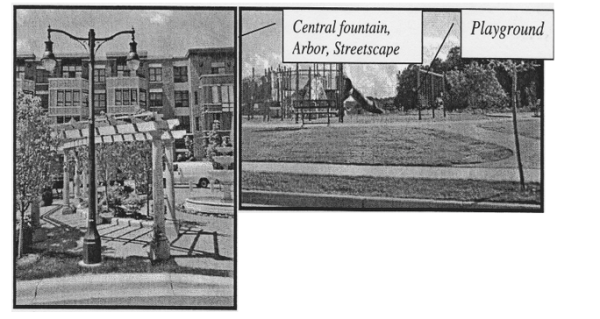
- Diversity of product type and design to accommodate different age groups and individuals in different socio-economics circumstances.
- Broad variety of housing choices—twin homes, row houses, town homes, flats above garages, apartments over shops, garden apartments, senior living opportunities and condominiums.
(Ord. No. 385, § 1, 11-8-04)
Sec 20-1090 Curb Appeal
To encourage roadway image or curb appeal projects shall create a variety of building orientation along the roadways; attractive streetscape and architectural detail. All projects shall incorporate two or more of the following design elements:
- Orientation to the street or access road:
- Setbacks
- Spacing between buildings and view sheds.
Curb Appeal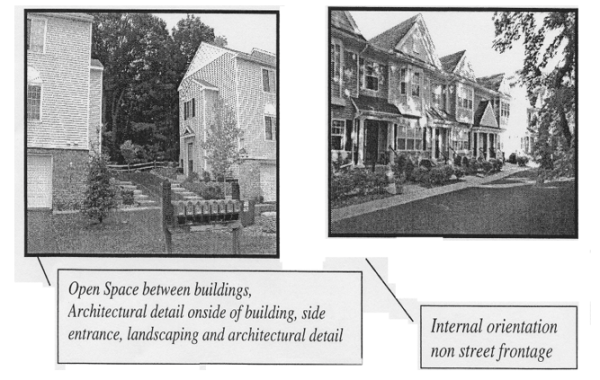
- Architectural detail/decorative features.
- Windows.
- Flower boxes.
- Porches, balconies, private spaces.
Porches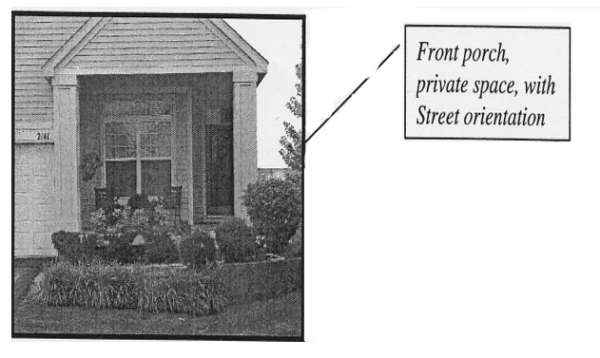
- Location and treatment of entryway.
Location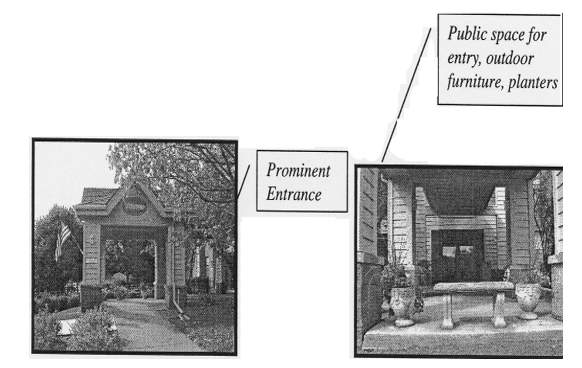
- Surface materials, finish and texture.
Surface Materials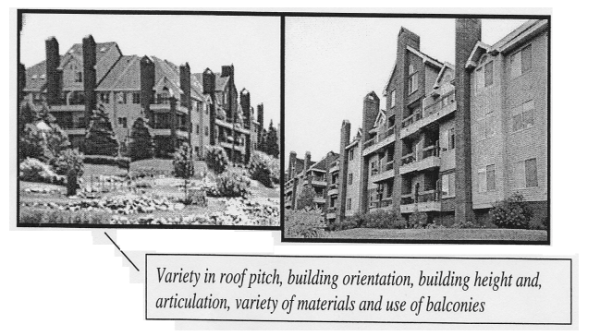
- Roof pitch.
- Building height and orientation.
- Location of garages.
Garages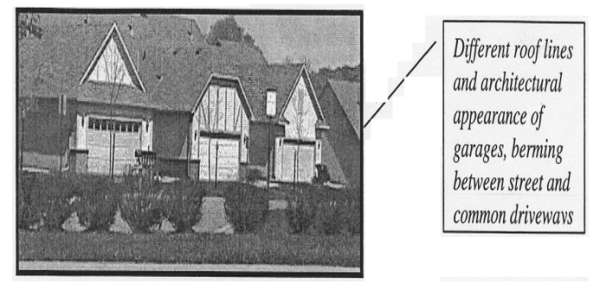
- Landscaping including fencing and berming.
- Street lighting.
Street Lighting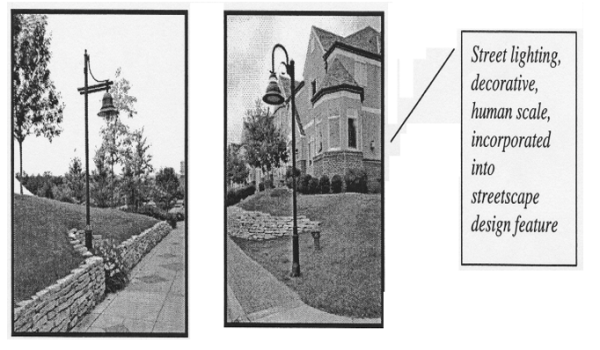
- Screening of parking, especially in apartment and condominium developments.
Parking Lot Screening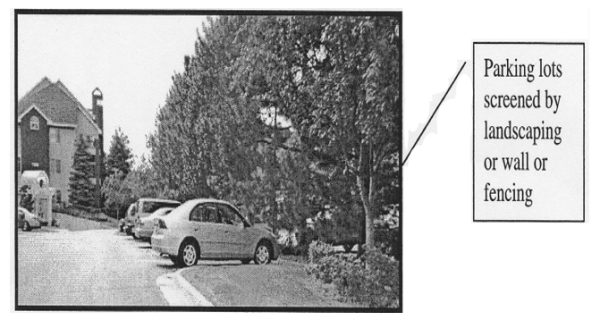
- Variations/differentiations in units including, but not limited to, color, material, articulation etc.
(Ord. No. 385, § 1, 11-8-04)
Sec 20-1091 Transportation Diversity
All developments shall be incorporate multi-modal transportation including two or more of the following elements:
- Streets with trails incorporated.
- Off road trails and bike paths.
- Provisions for mass transit with bus stops and shelters incorporated into the developments.
Bus Shelter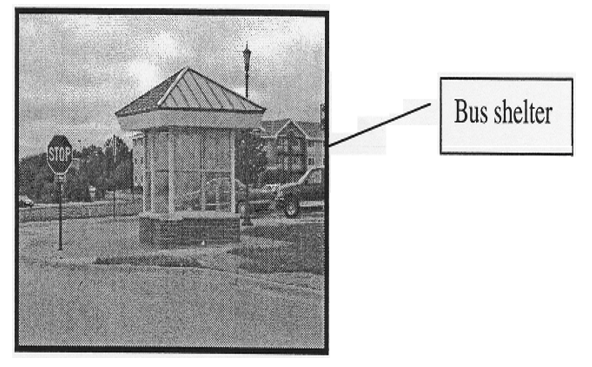
- Sidewalk connecting internal developments.
- Undulating sidewalks. Use of pavers or stamped concrete.
Sidewalks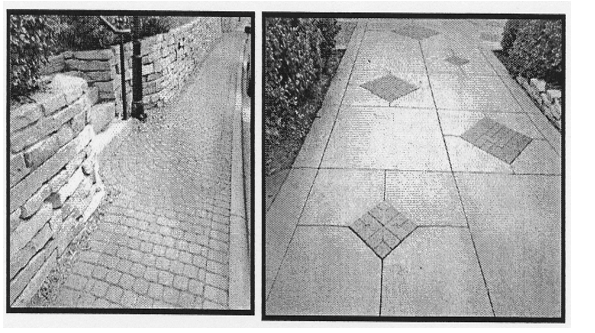
- On-street parking and use of roundabouts.
Roundabout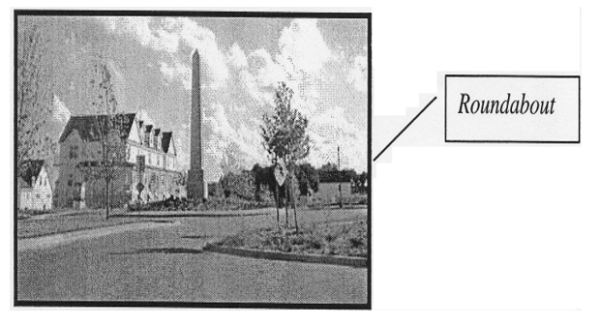
- Landscaped boulevards or medians.
Boulevards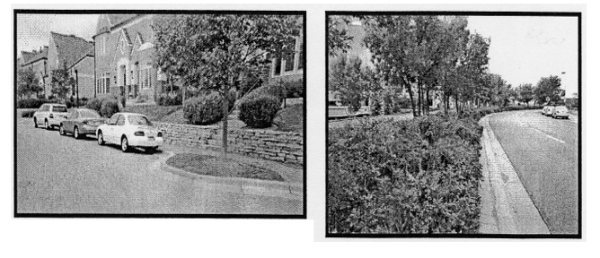
- Undulating sidewalks. Use of pavers or stamped concrete.
(Ord. No. 385, § 1, 11-8-04)
Sec 20-1092 Integration Of Parks, Open Space, Natural Historic Or Cultural Resources
- Integrate nature and wildlife with urban environment.
- Trails and sidewalks.
Trails and Sidewalks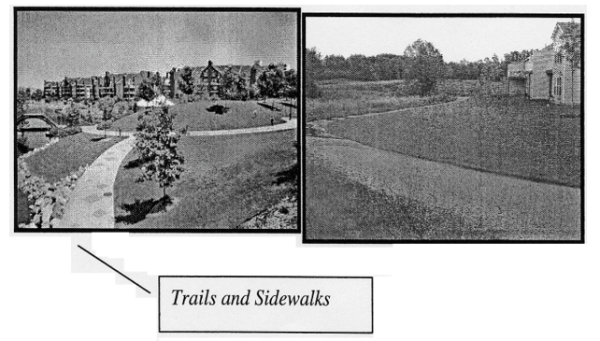
- Vistas.
- Historic features.
Barns, Silos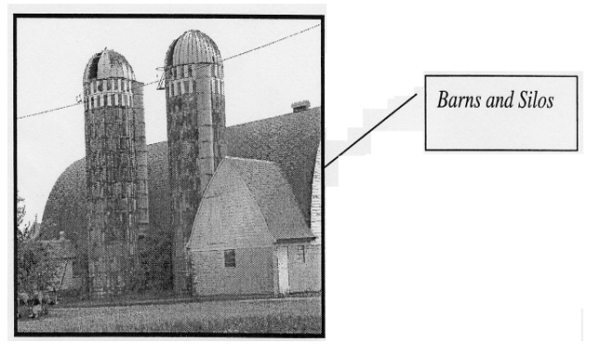
- Trails and sidewalks.
- Preservation of natural features that support wildlife and native plants (slopes, trees, wetlands).
Wetlands
(Ord. No. 385, § 1, 11-8-04)
Sec 20-1093 Accessory Solar Energy Systems
- Purpose. It is the intent of this section to meet the goals of the comprehensive plan and preserve the health, safety, and welfare of the community's citizens by facilitating the safe, effective, and efficient use of accessory solar energy systems installed to reduce the on-site consumption of utility-supplied electric energy. The following solar energy standards specifically implement the following goal from the comprehensive plan:
- Support residential and business solar development that maintains community character.
- Definitions. In this division, the following terms have the stated meanings:
Active solar energy systems means a solar energy system whose primary purpose is to harvest energy by transforming solar energy into another form of energy or transferring heat from a collector to another medium using mechanical, electrical, or chemical means.
Building-integrated solar energy systems means an active solar energy system that is an integral part of a principal or accessory building, rather than a separate mechanical device, replacing or substitution or an architectural or structural component of the building. Building-integrated systems include, but are not limited to, photovoltaic or hot water solar energy systems that are contained within roofing materials, windows, skylights, and awnings.
Passive solar energy system means a solar energy system that captures solar light or heat without transforming it to another form of energy or transferring the energy via a heat exchanger.
Solar collector means a device, structure, or a part of a device or structure for which the primary purpose is to transform solar radiant energy into thermal, mechanical, chemical, or electrical energy.
Solar collector surface means any part of a solar collector that absorbs solar energy for use in the collector's energy transformation process. Collector surface does not include frames, supports, and mounting hardware.
Solar energy means radiant energy received from the sun that can be collected in the form of heat or light by a solar collector.
Solar Energy System means a device or structural design feature, a substantial purpose of which is to provide daylight for interior lighting or provide for the collection, storage and distribution of solar energy for space heating or cooling, electricity generating, or water heating. - Standards.
- Applicability. A system is considered an accessory solar energy system only if it supplies electrical or thermal power primarily for on-site use, except that when a property upon which the facility is installed also receives electrical power supplied by a utility company, excess electrical power generated and not presently needed for on-site use may be used by the utility company.
- Exemption. Passive or building-integrated solar energy systems are exempt for the requirements of this section and shall be regulated as any other building element.
- Location.
- Whenever practical, all accessory solar energy systems shall be attached to a building. If not designed to be attached to a building, the applicant shall demonstrate by credible evidence that such systems cannot feasibly be attached to a building due to structural limitations of the building.
- In residential zoning districts, no portion of any accessory solar energy system shall be located within or above any front or side yard or within any required setback of any property, save that they may be located within rear yards so long as they maintain a minimum rear setback of ten feet. Ground-mounted systems on corner lots may not be located in any yard abutting a street.
- In nonresidential zoning districts, ground-mounted systems must comply with the district's setbacks.
- Height.
- Building- or roof-mounted solar energy systems shall comply with the maximum height requirements in the applicable zoning district. Roof-mounted systems on pitched or hipped roofs may not extend above the peak of the roof.
- Ground-mounted solar energy systems shall not exceed the maximum accessory structure height within the underlying zoning district.
- Glare.
- Reflection angles from accessory solar energy system surfaces shall be oriented away from neighboring windows.
- Accessory solar energy systems shall be designed and located in order to prevent reflective glare towards adjacent street right-of-way.
- Screening.
- Ground-mounted solar energy systems shall be screened from view to the extent possible without reducing their efficiency. Screening may include walls, fences, or landscaping.
- Design.
- Roof-mounted solar collectors shall be flush mounted on pitched or hipped roofs, and shall not extend beyond the exterior perimeter of the building on which the system is mounted.
- Roof- and building-mounted solar energy systems shall use dark unobtrusive colors or colors that blend with the color of the roof or building.
- All exterior electrical and/or plumbing lines must be buried below the surface of the ground and shall be placed in a conduit.
- Permit and installation:
- A building permit is required and shall be obtained for any solar energy system prior to installation.
- If roof-mounted, documentation shall be provided verifying that the roof can safely support the proposed system.
- The design and installation of accessory solar energy systems shall conform to applicable industry standards, including those of the American National Standards Institute (ANSI), Underwriters Laboratories (UL), or other similar certifying organizations, and shall comply with the Municipal Building Code and with all other applicable fire and life safety requirements. The manufacture specifications shall be submitted as part of the application.
- All grid connected systems shall have an agreement with the relevant utility prior to the issuance of a building permit. A visible external disconnect must be provided if required by the utility.
- Abandonment. If the solar energy systems remain nonfunctional or inoperative for a continuous period of one year, the system shall be deemed to be abandoned and shall constitute a public nuisance. The owner shall remove and recycle the abandoned system at their expense after a demolition permit has been obtained. Removal includes the entire structure including transmission equipment.
(Ord. No. 651, § 29, 12-9-19)

