
Chanhassen City Zoning Code
ARTICLE 20
XXV LANDSCAPING AND TREE REMOVAL
Editor's note(s)—Section 1 of Ord. No. 153, adopted Nov. 4, 1991, amended Art. XXV to read as set out herein. Prior to amendment, Art. XXV contained §§ 20-1176—20-1179, 20-1191—20-1194, 20-1211—20-1214, 20-1231—20-1234, which pertained to similar subject matter and derived from Ord. No. 80, Art. VIII, §§ 1—7, adopted Dec. 15, 1986.
692
765
667
723
Sec 20-1176 Intent, Scope And Compliance
- The intent of this ordinance is to improve the appearance of vehicular use areas and property abutting public rights-of-way; to require buffering between noncompatible land uses; and to protect, preserve and promote the aesthetic appeal, character and value of the surrounding neighborhoods; to promote public health and safety through the reduction of noise pollution, air pollution, visual pollution and glare.
- Except for buffer yard requirements specified in subsection 20-1176(f) below, this article does not apply to single-family developments in A2, RR, RSF, RLM, and R4 zoning districts which are regulated by landscaping requirements contained in the subdivision ordinance (chapter 18).
- No new site development, building, structure or vehicular use area is allowed, unless landscaping is provided as required in this ordinance.
- No property lines shall be altered nor shall any building, structure or vehicular use area be expanded, unless the minimum landscaping required by the provisions of this ordinance is provided for the entire property.
- The landscaping standards shall provide for screening for visual impacts associated with a given use, including but not limited to:
- Truck loading areas;
- Trash storage;
- Parking lots, interior lot areas and perimeters;
- Large unadorned building massing;
- Garage doors associated with auto oriented uses; and
- Vehicular stacking areas for drive through uses.
- Buffering shall be provided between high intensity and low intensity uses, between a site and major streets and highways, and in areas where buffering is required by the comprehensive plan. Such buffering shall be located within a required buffer yard. The buffer yard is a unit of yard together with the planting required thereon. The amount of land and the type and amount of planting specified for each buffer yard required by this subsection are designed to ameliorate nuisances between adjacent land uses or between a land use and a public road. The planting units required of buffer yards have been calculated to ensure that they do, in fact, function to "buffer."
- Buffer yards shall be located on the outer perimeter of a lot or parcel extending to the lot or parcel boundary line, except where easements, covenants or natural features may require the buffer yard to be set back from the property line. Subject to review and approval by the city engineering department, buffer yards that are compatible with the typical city boulevard planting requirements may be located within a portion of an existing municipal public collector or arterial right-of-way.
- To determine the buffer yard required between two adjacent parcels or between a parcel and a street, the following procedure shall be followed:
- Identify the proposed land use of the parcel and the land use of the adjacent parcel or functional classification of abutting right-of-way based on the city future land use plan.
- Determine the buffer yard required on each boundary, or segment thereof, of the property by referring to the following table of buffer yard requirements and illustrations set at the end of subsection (2), which specify the buffer yard required between adjacent uses and streets.
- Buffer yard requirements are stated in terms of the width of the buffer yard and the number of plant units required per 100 linear feet of buffer yard. Each illustration depicts the minimum buffer yard required between two uses or adjacent to a collector or arterial right-of-way. The project developer shall be responsible for providing 75 percent of the required plantings. If abutting property owner(s) desire to bring the buffering to 100 percent of the required buffer yard plantings, then the adjacent property owner(s) may install the remaining 25 percent of the required plantings on their own property. When the parcel abuts public property, such as roads or parks, the developer shall be responsible for 100 percent of the required plantings.
- Whenever a wall, fence, or berm is required within a buffer yard, these are shown as "structure required" in the buffer yard illustrations. The erection and maintenance of all required structures shall be the responsibility of the buffer yard provider (project developer). Maintenance of the structure shall be the responsibility of the landowner on whose property the structure is located.
- All buffer yards shall be maintained free from all forms of development or storage of equipment or materials. A ground cover of vegetative or organic material shall be provided. Buffer yards shall be maintained free from junk and debris. Dead or diseased vegetation shall be removed and replaced with healthy vegetation. The responsibility to maintain, remove or replace plant materials shall be that of the landowner on whose property the plant material needing maintenance or replacement is located.
TABLE OF BUFFER YARD REQUIREMENTSThe land use abbreviations are as follows:Proposed Development Adjacent Land Use LL/DD MD HD OFF MIX COM PUB ACT PASS OFF/IND LL/LD none B C C C D B B A D MD none A B B C D B B A D HD none A A B C D B B A D OFF none B B A B B B B B B MIX none C C B B B C C C B COM none C D B B A C C C B PUB none A A B C C A A A C ACT none A B B B C A A A C PASS none A A B B C A A A C OFF/IND none C C B B B C B B B ROAD B B B B B B B B B C
LL/LD—Large lot and low density residential
MD—Medium density residential
HC—High density residential
OFF—Office
MIX—Mixed use
COM—Commercial
PUB—Public/semi-public
ACT—Active park/open space
PASS—Passive park/open space
OFF/IND—Office/industrial
ROAD—Collector and arterial road
Bufferyard A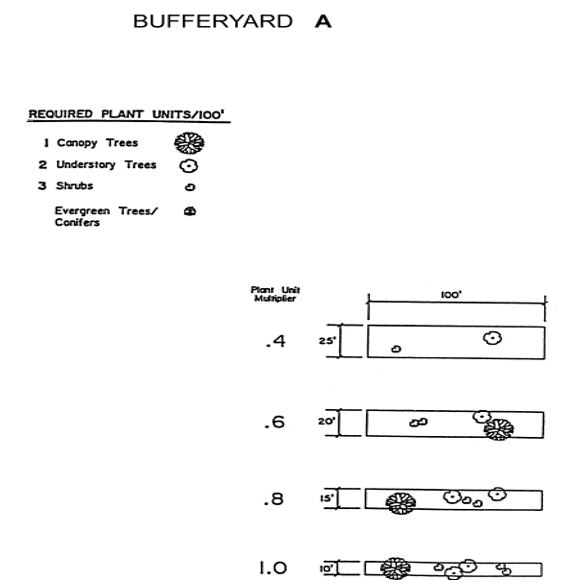
Bufferyard B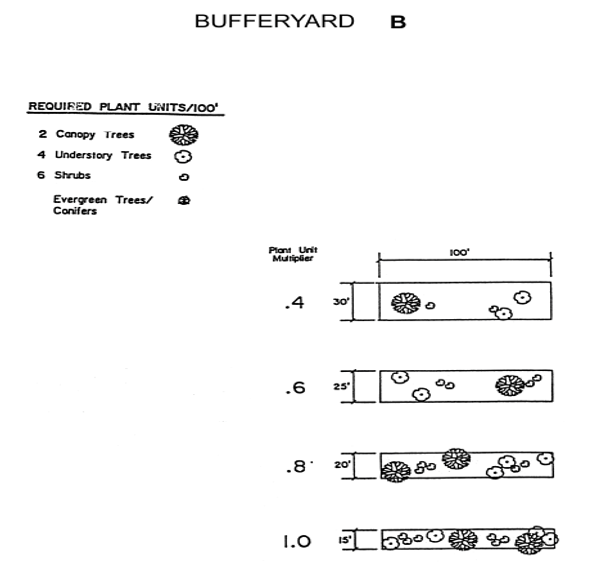
Bufferyard C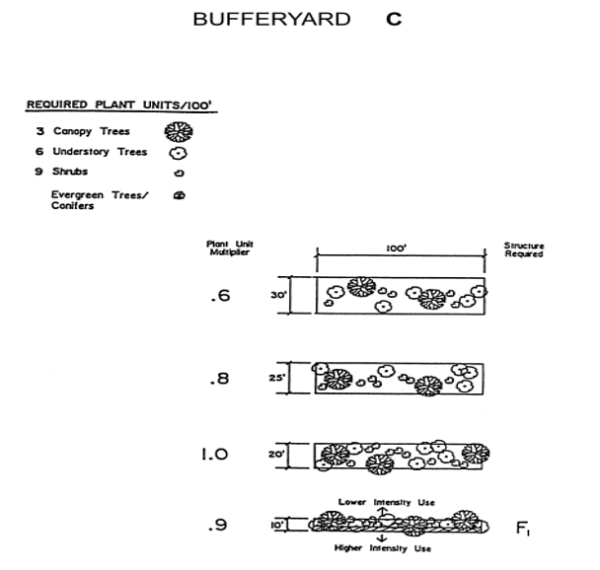
Bufferyard D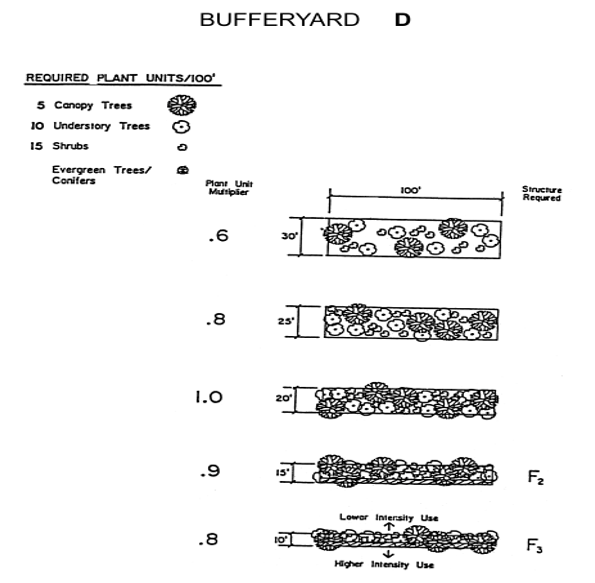
Fences
| Symbol | Height | Minimum Opacity | Typical Material |
| F1 | 44" | 25% | Wood, chain-link, or split wood rail |
| F2 | 48" | 50% | Wood, chain-link, or vinyl |
| F3 | 6' | 95% | Wood or vinyl privacy |
| F4 | 8' | 95% | Wood or vinyl privac |
- Plant material existing on a parcel which meets the buffer yard planting requirements of location, size and species may be counted toward the total buffer yard plant material requirement. Existing natural features such as slopes, woodlands or wetlands which provide physical separation between developments or between a development and a collector and arterial road may satisfy the buffering function of the required buffer yard. If approved by the city, proposed berms three feet and higher in the buffer yard may be substituted for up to one-half of the required understory trees and shrubs, depending on the length of the berm. For instance, if a berm runs the entire length of the buffer yard, the understory and shrub plantings may be reduced by one-half. Any boulevard trees or reforestation plantings required in the buffer yard can be counted towards required overstory buffer yard plantings if there is insufficient room for both types of plantings.
- Buffer yards may be used for passive recreation and may contain a trail, provided that no plant material is eliminated, the total width of the buffer yard is maintained, and all other regulations of this subsection are met. Utility easements may be included within buffer yards, provided that the utility requirements and buffer yard requirements are compatible and canopy trees are not planted within such easement.
- Where front, side and rear yards are required by this subsection, buffer yards may be established within such required yards.
- Canopy trees are defined as those trees specified as primary or secondary deciduous trees or conifers in the city's subdivision ordinance. Conifers to be used as overstory trees shall have a minimum height of eight feet when planted. Arborvitae shall not be used as an overstory tree.
- Understory trees are defined as those trees specified as ornamental or conifer trees in the city's subdivision ordinance. Conifers to be used as understory trees shall have a minimum height of six feet when planted.
- In instances in which the city deems it necessary to provide year-round screening, the city may designate that all planting be of conifers.
- The city shall encourage reforestation through boulevard and streetscape planting.
- Mature stands of trees shall be preserved.
- Reforestation shall be pursued as appropriate.
(Ord. No. 153, § 1, 11-4-91; Ord. No. 250, §§ 2, 3, 4-8-96; Ord. No. 309, § 1, 8-14-00; Ord. No. 377, § 134, 5-24-04)
Amended by Ord. 692 on 6/13/2022
Amended by Ord. 765 on 7/13/2026
Sec 20-1177 Plan Submission; Time Of Completion; Financial Guarantees
The property owner or developer shall prepare a landscape plan drawn by a registered landscape architect or other professional acceptable to the city for review by the city. The city shall apply the following conditions in approval or disapproving the plan:
- The contents of the plan shall include the following:
- Plot plan, drawn to an easily readable scale, showing and labeling by name and dimensions, all existing and proposed property lines, easements, buildings, and other structures, vehicular use areas (including parking stalls, driveways, service areas, square footage), water outlets and landscape material (including botanical name and common name, installation size, on-center planting dimensions where applicable, and quantities for all plants used).
- Typical elevations and/or cross sections as may be required.
- Title block with the pertinent names and addresses (property owner, person drawing plan, and person installing landscape material), scale date, north arrow (generally orient plan so that north is to top of plan), and zoning district.
- Existing landscape material shall be shown on the required plan and any material in satisfactory condition may be used to satisfy this ordinance in whole or in part.
- Where landscaping is required, no building permit shall be issued until the required landscaping plan has been submitted and approved, and no certificate of occupancy shall be issued until the landscaping is completed as certified by an on-site inspection by the building inspector, unless a financial guarantee acceptable to the city has been submitted.
- When screening, landscaping or other similar improvements to property are required by this ordinance, a letter of credit or cash escrow shall be supplied by the owner in an amount equal to at least 110 percent of the value of such screening, landscaping or other improvements. The security must be satisfactory to the city and shall be conditioned upon reimbursement of all expenses incurred by the city for engineering, legal or other fees in connection with making or completing such improvements. The guarantee shall be provided prior to the issuance of any building permit and shall be valid for a period of time equal to one full growing season after the date of installation of the landscaping. In the event construction of the project is not completed within the time prescribed by building permits and other approvals, the city may, at its option, complete the work required at the expense of the owner and the surety.
The city may allow an extended period of time for completion of all landscaping if the delay is due to conditions which are reasonably beyond the control of the developer. Extensions which may not exceed nine months, may be granted due to seasonal or weather conditions. When an extension is granted, the city shall require such additional security as it deems appropriate.
(Ord. No. 153, § 1, 11-4-91)
Sec 20-1178 Generally
- It is the policy of the city to preserve natural woodland areas throughout the city and with respect to specific site development to retain as far as practical, substantial tree stands which can be incorporated into the overall landscape plan.
- No clearcutting of woodland areas shall be permitted except as approved in a subdivision, planned unit development or site plan application.
- The standards in City Code subsection 18-61(d) shall be used in evaluating site plans.
(Ord. No. 153, § 1, 11-4-91; Ord. No. 204, § 4, 5-9-94)
Sec 20-1179 Landscape Budget
- Landscaping shall be provided that meets the minimum landscaping budget provided in the table below:
Project Value Minimum Landscape Value (Including building construction, site preparation, and site improvements) Below $1,000,000 2% $1,000,001—2,000,000 $20,000 + 1% of project value in excess of $1,000,000 $2,000,001—3,000,000 $30,000 + 0.75% of project value in excess of $2,000,000 $3,000,001—4,000,000 $37,500 + 0.25% of project value in excess of $3,000,000 Over $4,000,000 1% - At the city's discretion, the value of tree preservation may be utilized to offset landscaping requirements.
(Ord. No. 153, § 1, 11-4-91)
Sec 20-1180 Screening For Visual Impacts
- Undesirable visual impacts must be screened. Undesirable visual impacts include, but are not limited to, truck loading areas, trash storage, parking lots, interior lot areas and perimeters, outdoor storage areas, large unadorned building massing, garage doors associated with auto-oriented uses and vehicular stacking areas for drive-through uses.
- Required screening for any visual impact may be achieved with fences, walls, earth berms, hedges or other landscape materials. All walls and fences shall be architecturally harmonious with the principal building. The use of wooden screen fences or chain link fences equipped with slats is prohibited. Earth berms shall not exceed a slope of 3:1 unless provided with landscaping designed to minimize maintenance. The screen shall be designed to provide effective visual barrier during all seasons.
- All required screening shall be located on the lot occupied by the use, building, facility or structure to be screened. No landscape screening shall be located on any public right-of-way or within eight feet of the traveled portion of any street or highway.
- Screening required by this section shall be of a height needed to accomplish the goals of this section. Height of plantings required under this section shall be measured at the time of installation.
- Parking lot screening shall limit direct views of pavement and direct views of vehicles parked near the exterior of the site. It is not intended that this requirement result in significantly obscuring views of principal structures or permitted signage.
- The city may make special allowances for establishing screening requirements for long term parking areas such as those developed for transit related park-and-ride facilities. Due to their characteristics of long duration parking coupled with long hours having little or no activity, these lots may present special problems related to safety that require enhanced visibility.
- The following uses shall be screened in accordance with the requirements of this subdivision:
- Principal buildings and structures and any building or structure accessory thereto located in any business, industrial or planned unit development district containing nonresidential uses shall be buffered from lots used for any residential purpose.
- Principal buildings and structures and any building or structure accessory thereto located in any RLM, R8, R12, R16, or planned unit development district containing residential development at densities exceeding four units per acre shall be screened from lots located in any R4, A2, RR or RSF district.
- Additional buffer yard requirements are established by the city comprehensive plan and listed in individual district standards.
- Outside storage in any district subject to these provisions and allowed by other provisions of this ordinance, shall be screened from all public views.
(Ord. No. 153, § 1, 11-4-91; Ord. No. 195, § 1, 11-11-93)
Amended by Ord. 692 on 6/13/2022
Sec 20-1181 Vehicular Areas
- When parking lot perimeters where vehicular areas, including driveways and drive aisles, are not entirely screened visually by an intervening building or structure or land mass from any abutting right-of-way, there shall be provided landscaping designed to buffer direct views of cars and vehicular use areas. The landscaping must break up expanses of vehicular use areas, help to visually define boulevards and soften direct views of parking areas and provide for reforestation with overstory tree from the approved tree species list identified for parking or other species as approved by city staff. All new planting areas must have an irrigation system installed. Publicly owned and operated parking lots used for long duration parking may be exempt from this requirement when there is a demonstrated concern regarding security safety.
Illustration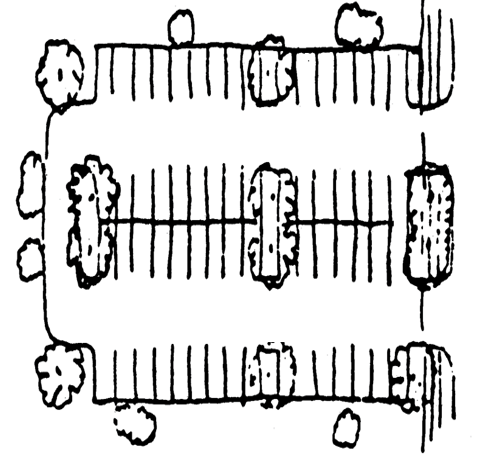
- Interior landscaping for vehicular use areas:
- Any open vehicular use areas containing more than 6,000 square feet of area, or 20 or more vehicular parking spaces, shall provide interior landscaping in accordance with this division in addition to "perimeter" landscaping. Interior landscaping may be peninsular or island types. Landscaped area shall include all parking lot and drive islands and perimeter green spaces. Required setback areas shall be excluded.
- For each 100 square feet, or fraction thereof, of vehicular use area, eight square feet of landscaped area shall be provided.
- The minimum landscape area permitted shall be 200 square feet, with a six-foot minimum dimension to all trees from edge of pavement where vehicles overhang and a four-foot minimum dimension to all trees where vehicles do not overhang.
- In order to encourage the required landscape area to be properly dispersed, a minimum of one peninsular, island, or boulevard type landscaped area shall be located within each 6,000 square feet of vehicular use area.
- A minimum of one tree shall be required for each 250 square feet or fraction thereof, of required landscape area. Trees shall have a clear trunk of at least five feet above the ground, and the remaining area shall be landscaped with shrubs, or ground cover (not to include rocks or gravel except as a mulch around shrubs and ground cover), not to exceed two feet in height.
- The inside width, behind the curb in landscape islands or peninsulas, shall be a minimum of ten feet.
- All landscaped areas shall be protected by concrete curbing.
- All landscaping area shall have the proper soil preparation to ensure the viability of the vegetation to survive. The landscaping plan shall provide specifications for proper soil preparation.
(Ord. No. 153, § 1, 11-4-91; Ord. No. 195, § 2, 11-11-93; Ord. No. 219, § 1, 9-12-94; Ord. No. 377, § 135, 5-24-04; Ord. No. 628, § 47, 12-11-17)
Sec 20-1182 Foundation And Aesthetic Plantings
- Landscaping plans shall provide for an appropriate mix of plantings around the exterior footprint of all buildings. The intent of this section is to improve the appearance of the structures and, where necessary, break up large unadorned building elevations. These plantings are not intended to obscure views of the building or accessory signage.
- All undeveloped areas of the site, excluding protected wetlands and tree preservation areas, shall be seeded or sodded. In addition, an appropriate mix of trees and other plant material shall be provided to create an aesthetically pleasing site.
- Where undeveloped or open areas of a site are located adjacent to public right-of-way, the plan shall provide for over-story boulevard trees. A minimum of one tree for every 30 feet of frontage is required. The city may approve alternatives if it meets the intent of the ordinance.
(Ord. No. 153, § 1, 11-4-91)
Sec 20-1183 Landscaping Materials
- The landscaping materials shall consist of the following:
- Walls and fences. Walls shall be constructed of natural stone, brick or other appropriate materials. Fences shall be constructed of wood. Chain link fencing will be permitted only if covered with plant material or otherwise screened.
- Earth berms. Earth berms shall be physical barriers which block or screen the view similar to a hedge, fence or wall. Mounds shall be constructed with proper and adequate plant material to prevent erosion. A difference in elevation between areas requiring screening does not constitute an existing earth mound, and shall not be considered as fulfilling any screening requirement.
- Plants. All plant materials shall be living plants; artificial plants are prohibited. Plant materials shall meet the following requirements:
- Deciduous trees. Shall be species having an average crown spread of greater than 15 feet and having trunk(s) which can be maintained with over five feet of clear wood in areas which have visibility requirements, except at vehicular use area intersections where an eight-foot clear wood requirement will control. Trees having an average mature spread of crown less than 15 feet may be substituted by grouping of the same so as to create the equivalent of a 15-foot crown spread. A minimum of ten feet overall height or minimum caliper (trunk diameter, measured six inches above ground for trees up to four inches caliper) of at least two and one-half inches immediately after planting shall be required. Trees of species whose roots are known to cause damage to public roadways or other public works shall not be placed closer than 15 feet to such public works, unless the tree root system is completely contained within a barrier for which the minimum interior containing dimensions shall be five feet square and five feet deep and for which the construction requirements shall be four inches thick, reinforced concrete.
- Evergreen trees. Evergreen trees shall be a minimum of six feet high with a minimum caliper of one and one-half inches when planted when counted as an understory tree. Overstory evergreens shall be a minimum of eight feet high.
- Tree Diversity. No more than ten percent of the trees may be from any one tree species, no more than 20 percent of the trees may be from any one genus, and no more than 30 percent of trees from any one family.
- Shrubs and hedges. Deciduous shrubs shall be at least two feet in average height when planted, and shall conform to the opacity and other requirements within four years after planting. Evergreen shrubs shall be at least two feet in average height and two feet in diameter.
- Vines. Vines shall be at least 12 inches high at planting, and are generally used in conjunction with walls or fences.
- Grass or ground cover. Grass shall be planted in species normally grown as permanent lawns, and may be sodded, plugged, sprigged, or seeded; except in swales or other areas subject to erosion, where solid sod, erosion reducing net, or suitable mulch shall be used, nurse-grass seed shall be sown for immediate protection until complete coverage otherwise is achieved. Grass sod shall be clean and free of weeds and noxious pests or diseases. Ground cover such as organic material shall be planted in such a manner as to present a finished appearance and 75 percent of complete coverage after two complete growing seasons, with a maximum of 15 inches on center. In certain cases, ground cover also may consist of rocks, pebbles, sand and similar materials if approved by the city.
- Managed natural landscapes. Managed natural landscapes may include plants and grasses in excess of eight (8) inches in height and which have gone to seed but may not include noxious weeds and must be maintained so as to not include unintended vegetation. All natural landscapes must meet the following conditions:
- A minimum of 5 feet of maintained area (i.e., vegetation under 8 inches or mulch) is required between natural landscapes on private properties and any roadway, sidewalk, trail, or lot line except any portion of the property which has a privacy fence of at least five feet in height or the adjacent property is also a managed natural landscape.
- Plants, trees, and shrubs must be planted through transplanting or seed by human or mechanical means. Managed natural landscapes shall not include turf-grass lawns left unattended for the purpose of returning to a natural state.
(Ord. No. 153, § 1, 11-4-91; Ord. No. 195, § 4, 11-11-93; Ord. No. 377, § 136, 5-24-04)
Amended by Ord. 667 on 3/22/2021
Amended by Ord. 723 on 4/15/2024
Sec 20-1184 Generally
The owner, tenant, and their respective agents shall be held jointly and severally responsible to maintain their property and landscaping in a condition presenting a healthy, neat and orderly appearance and free from refuse and debris. Plants and ground cover which are required by an approved site or landscape plan and which have died shall be replaced within three months of notifications by the city. However, the time for compliance may be extended up to nine months by the director of planning in order to allow for seasonal or weather conditions.
(Ord. No. 153, § 1, 11-4-91)

