
Chanhassen City Zoning Code
ARTICLE 20
XXXI BLUFF CREEK OVERLAY DISTRICT
Sec 20-1551 Purpose
The Bluff Creek Watershed Area and the development within it have a major influence on environmental quality in the city and the region. Development within the corridor must be designed with utmost sensitivity to the environment and the development pattern must be of a quantity and quality other than what might occur in the absence of specific standards. The purpose of the district is to:
- Protect the Bluff Creek Corridor, wetlands, bluffs, and significant stands of mature trees through the use of careful site design, protective covenants, sensitive alignment and design of roadways and utilities, incorporation of natural features, landscaping, techniques outlined in the city's surface water management plan, and the practices delineated in the city's surface water management plan.
- Encourage a development pattern that allows people and nature to mix spanning multiple ecosystems. Development in the corridor should be ecologically designed and built around natural features such as trees, wetlands, and bluffs. Significant natural features should impact development rather than development impacting significant natural features. The natural qualities of the corridor should be preserved to ensure sufficient habitat area for wildlife.
- Promote innovative development techniques such as cluster development and open space subdivisions to measurably reduce the amount of impervious cover compared to traditional development practices resulting in significant portions of a site being retained as permanent, protected open space.
- Foster the creation of a greenway connecting Lake Minnewashta Regional Park and the Minnesota River Valley. The greenway will serve as an uninterrupted pedestrian trail, bikeway system, and wildlife corridor affording opportunities for recreation, education, physical fitness and nonmotorized transportation.
- Encourage cost effective site development. Open space design practices can reduce infrastructure engineering and construction costs because of lot configurations, shortened streets, and reduced utility runs. Long term cost savings can also be realized by the City of Chanhassen associated with infrastructure maintenance costs.
- Implement the policies and recommendations found in the Bluff Creek Watershed Natural Resources Management Plan. The terms, definitions and appendices found in the management plan are incorporated herein.
(Ord. No. 286, § 8, 12-14-98; Ord. No. 445, § 6, 2-12-07)
Sec 20-1552 Intent
The city intends that all development within the district including commercial, industrial and residential uses should blend into the natural environment while protecting Bluff Creek and sensitive land areas abutting and in the vicinity of the watercourse and its tributaries. The criteria by which new development in the district shall be judged are as follows:
- Consistency with all provisions of the Comprehensive Plan which includes the Bluff Creek Watershed Natural Resources Management Plan, as amended from time to time; the surface water management plan; all provisions of the zoning ordinance and subdivision ordinance not specifically overridden by the provisions of this district; and all other applicable land use regulations.
- Preservation of the natural conditions found in the primary zone and to the greatest extent possible, preserving significant resources and minimizing impacts in the secondary zone through cluster development and other practices which minimize the removal of vegetation, minimize site grading, and application of practices found in the city's surface water management plan.
- Creation of a suitable balance between the amount and arrangement of open space, landscaping, view protection, bluff protection, and vegetation protection and the design and function of manmade features.
- Creation of an interconnected open space network that preserves migratory patterns for wildlife.
- Creation of an interconnected open space network that provides recreational and educational opportunities for people.
(Ord. No. 286, § 8, 12-14-98; Ord. No. 445, § 7, 2-12-07)
Sec 20-1553 District Application
The BCO District shall be applied or superimposed (overlaid) upon all zoning districts as contained herein as existing or amended by the text and map attached to this ordinance. The regulations and requirements imposed by the BCO District shall be in addition to those established for districts which jointly apply. Under the joint application of the districts, the more restrictive requirements shall apply.
(Ord. No. 286, § 8, 12-14-98)
Sec 20-1554 Conditional Use Permits
- A conditional use permit shall be issued by the city for all subdivisions, site plans, and prior the erection or alteration of any building or land within the BCO.
- All lots of record in existence and parcels of land located within the Bluff Creek Overlay District on which a principal structure has been constructed prior to December 14, 1998, are exempt from requiring a conditional use permit. Further subdivision of the property will require a conditional use permit and shall comply with the Bluff Creek Overlay District.
(Ord. No. 286, § 8, 12-14-98; Ord. No. 364, § 1, 1-12-04)
Sec 20-1555 Boundary Delineation
- Generally. Primary and secondary zones shall be subject to the requirements established herein, as well as restrictions and requirements established by other applicable city ordinances and regulations. The Bluff Creek Overlay District regulations shall not be construed to allow anything otherwise prohibited in the zoning district where the overlay district applies.
- Boundaries; maps. The primary and secondary zones include land that is generally defined in this ordinance and in the Bluff Creek Watershed Natural Resources Management Plan. Boundaries as established by officially adopted city maps shall be prima facie evidence of the location and type of watershed zone. The official maps shall be developed and maintained by the planning department. The applicant shall provide appropriate technical information, including but not limited to a topographical survey, flora and fauna survey and soil data deemed necessary for the city to determine the exact watershed zone boundary. The community development director shall make a determination to maintain the officially designated watershed zone boundary or if the boundaries need to be corrected on city plans and maps based upon the data that is supplied. Data for watershed zone delineation shall be generated and provided by a qualified professional specializing in watershed management, environmental science or other related profession. The applicant may appeal the community development director's determination of the watershed zone boundary and type to the city council.
(Ord. No. 286, § 8, 12-14-98; Ord. No. 377, § 155, 5-24-04)
Sec 20-1556 Impervious Surface, Lot Coverage And Slopes
- To the greatest extent possible, all development shall minimize the amount of lot coverage by clustering development, using common access drives and utility corridors and minimizing building footprint size. Roads, walkways, bike trails, and parking areas must be designed parallel to natural contours with consideration to maintaining consolidated areas of natural topography and vegetation. Management of surface runoff caused by impervious surfaces shall be designed using practices delineated in the city's surface water management plan.
- Within the secondary zone of the BCO district, areas with average slopes exceeding 25 percent shall be preserved in their natural state and maintained as permanent open space. Areas with average slopes less than 25 percent but greater than ten percent shall not exceed 25 percent lot coverage. Lot coverage for areas where average slopes are less than ten percent shall be governed by the underlying zoning district.
(Ord. No. 286, § 8, 12-14-98; Ord. No. 445, § 8, 2-12-07; Ord. No. 628, § 51, 12-11-17)
Sec 20-1557 Bluffs
Bluffs shall be preserved as provided for under article XXVIII.
(Ord. No. 286, § 8, 12-14-98)
Sec 20-1558 Site Views
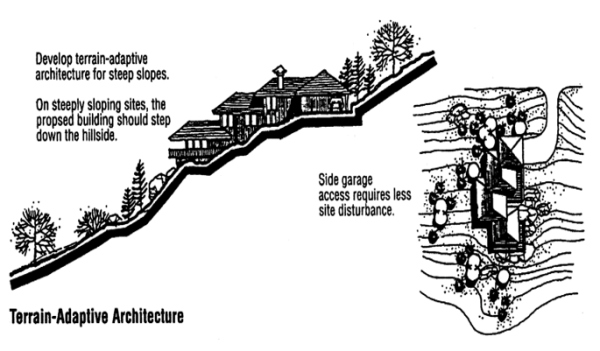
Through environmentally sensitive design such as "terrain adaptive architecture" (see Figure 1), landscaping and site planning, site views both to and from the BCO district shall be preserved and enhanced to the greatest extent possible so as to maintain views that reflect and protect the natural beauty of the BCO district. Special attention should be given to views that are highly accessible to the public such as scenic overlooks, ridges and trails. Clustering of development away from natural overlooks is encouraged.
Figure 1. "Published in APA PAS Report #466"
 (Ord. No. 286, § 8, 12-14-98; Ord. No. 377, § 156, 5-24-04)
Sec 20-1559 Density Clustering
Density clustering shall be allowed as a tool to facilitate cluster development within the Bluff Creek Overlay District. Density clustering may be used in areas where portions of the site are unsuitable for development because of the location of the primary zone. Density clustering shall not be allowed for areas that are otherwise considered unbuildable due to wetlands, lakes and other areas not suitable for building purposes.
In areas where density clustering is applicable, density may be transferred to unconstrained parts of the site within land included in the secondary zone, subject to the restrictions of this ordinance, and within land lying outside of identified zone areas. Additionally, the following conditions may qualify for density clustering:
- Land slopes in the secondary zone that exceed 25 percent on average.
- Land in the secondary zone containing stands of native trees.
- Land with suitable natural habitat to endangered or threatened species or a fragile ecosystem.
Traditional Development Pattern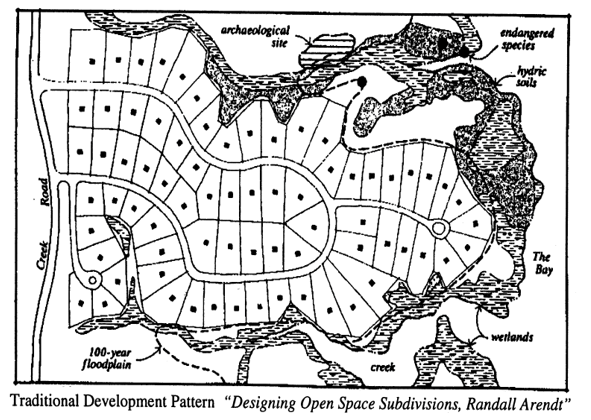
Cluster Development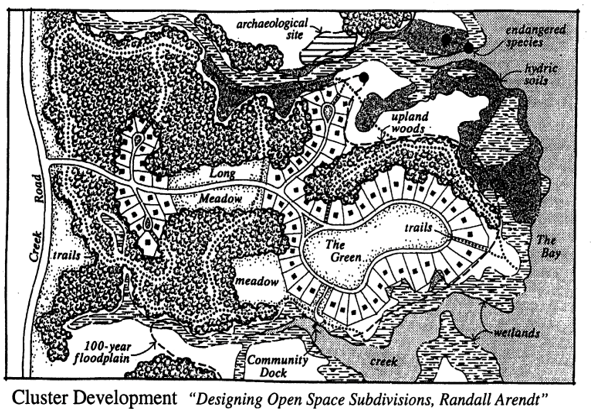
Industrial Cluster Development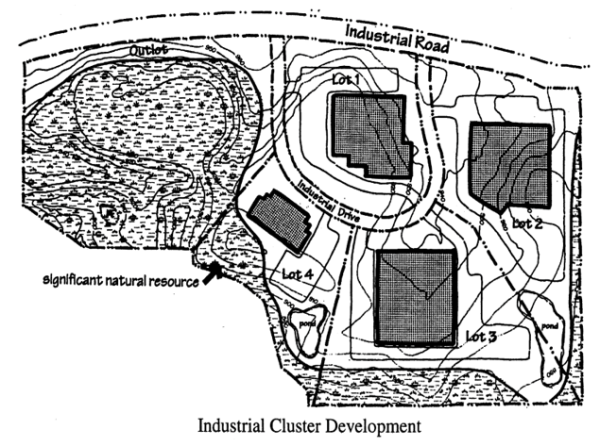
(Ord. No. 286, § 8, 12-14-98; Ord. No. 377, § 157, 5-24-04)
Sec 20-1560 Standards And Guidelines For Single-Family Attached Or Cluster-Home PUDs
Single-family attached, cluster, zero lot line, and similar dwelling types shall only be allowed on sites designed for low, medium or high density residential uses by the City of Chanhassen Comprehensive Plan.
(Ord. No. 286, § 8, 12-14-98)
Sec 20-1561 Natural Habitat Preservation
- Natural habitat areas within the primary zone shall be preserved as permanent open space. Any development that occurs shall be directly related to the development of a continuous greenway along the creek from the Minnesota River to Lake Minnewashta as outlined in the Bluff Creek Watershed Natural Resources Management Plan.
- Where possible, any disturbances of natural habitat areas within the secondary zone shall be avoided. Any alterations to the natural habitat within the secondary zone shall adhere to the practices delineated in the city's surface water management plan.
(Ord. No. 286, § 8, 12-14-98; Ord. No. 377, § 158, 5-24-04; Ord. No. 445, § 9, 2-12-07)
Sec 20-1562 Natural Habitat Restoration Plan
If natural habitat areas located within the secondary zone will be disturbed during any stage of development, the applicant shall submit a detailed plan identifying the resources that will be disturbed and a corresponding restoration and/or mitigation plan. Such restoration might include wetland mitigation and replanting of habitat significant to endangered and threatened species.
(Ord. No. 286, § 8, 12-14-98)
Sec 20-1563 Open Space Requirements
Open space shall comprise 100 percent of the area located within the primary zone. The city will establish the boundary for the primary zone using data provided by the applicant.
(Ord. No. 286, § 8, 12-14-98)
Sec 20-1564 Structure Setbacks
- All structures shall be set back a minimum of 40 feet from the primary zone, except as specified below. No disturbances of the site shall occur within the first 20 feet of such setback from the primary zone boundary.
- On parcels of land located within the Bluff Creek Overlay District on which a principal structure has been constructed prior to December 14, 1998:
- The minimum setback from the primary zone shall be the existing principal structure setback, if less than 40 feet.
- If the existing principal building or structure setback is less than 40 feet and greater than or equal to 20 feet, then the first 50 percent of the established primary zone setback shall remain undisturbed.
- If the existing principal building or structure setback is less than 20 feet there shall be no grading or alterations beyond the existing setback.
(Ord. No. 286, § 8, 12-14-98; Ord. No. 364, § 2, 1-12-04; Ord. No. 377, § 159, 5-24-04; Ord. No. 394, § 1, 4-25-05)

