
Chattahoochee Hills
City Zoning Code
City Zoning Code
ARTICLE XIV
STORMWATER AND INFRASTRUCTURE
Sec. 14-1.- Relationship to other regulations.
The following standards shall apply in addition to those of chapter 14, Land Development and Environmental Protection.
(Ord. No. 21-10-228, § 1, 10-5-2021)
Sec. 14-2. - Drainage and stormwater management.
A.
General requirements. An adequate drainage system shall be required, separate and independent of any sanitary sewer system and including any necessary ditches, pipes, culverts, intersectional drains, and drop inlets. The planning commission shall not approve any preliminary subdivision plat that does not make adequate provision for stormwater and floodwater runoff channels or basins as determined by the zoning administrator. No building permit shall be issued for any building within a subdivision or development permit issued for the development of land, if there is not present throughout the subdivision or to the land development an adequate system of drainage and stormwater management. Inlets, bridges, etc., shall be provided for the proper drainage of all surface water for all subdivisions and land developments. Sizing and location of all drainage structures shall be the responsibility of a registered professional engineer. Stormwater should be detained on site when possible.
B.
Method of design and capacity. Storm sewers, where required, shall be designed by the rational method, or other methods as approved by the city, and a copy of design computations shall be submitted along with required plans. Drainage improvements shall accommodate potential runoff from the entire upstream drainage area within the site and shall be designed to prevent increases in downstream flooding. Capacity for a ten-year storm or rain shall be provided for all thoroughfare drainage structures such as catch basin, inlets cross-drains, etc. Capacity for a 100-year frequency storm event shall be provided for all main drainage structures such as retention basins, principal storm sewers, and all types of flood protection works.
C.
District-wide site design that incorporates stormwater detention, retention, and infiltration in the common areas or open space is preferred. Shallow stormwater features that are designed to appear natural and that serve alternate uses in dry periods can be site amenities and should be incorporated when possible.
D.
Stormwater facilities shall meet the following requirements:
1.
Designed as formal or natural amenities and integrated with the landscape, rather than being designed as single-purpose ponds or other facilities;
2.
Not fenced or enclosed by walls over 30 inches in height; and
3.
Designed to be consistent with the light imprint handbook.
E.
Stormwater detention and retention ponds shall be planted with appropriate trees, shrubs, and grasses. Plants in basin areas prone to submersion shall be hydrophilic.
F.
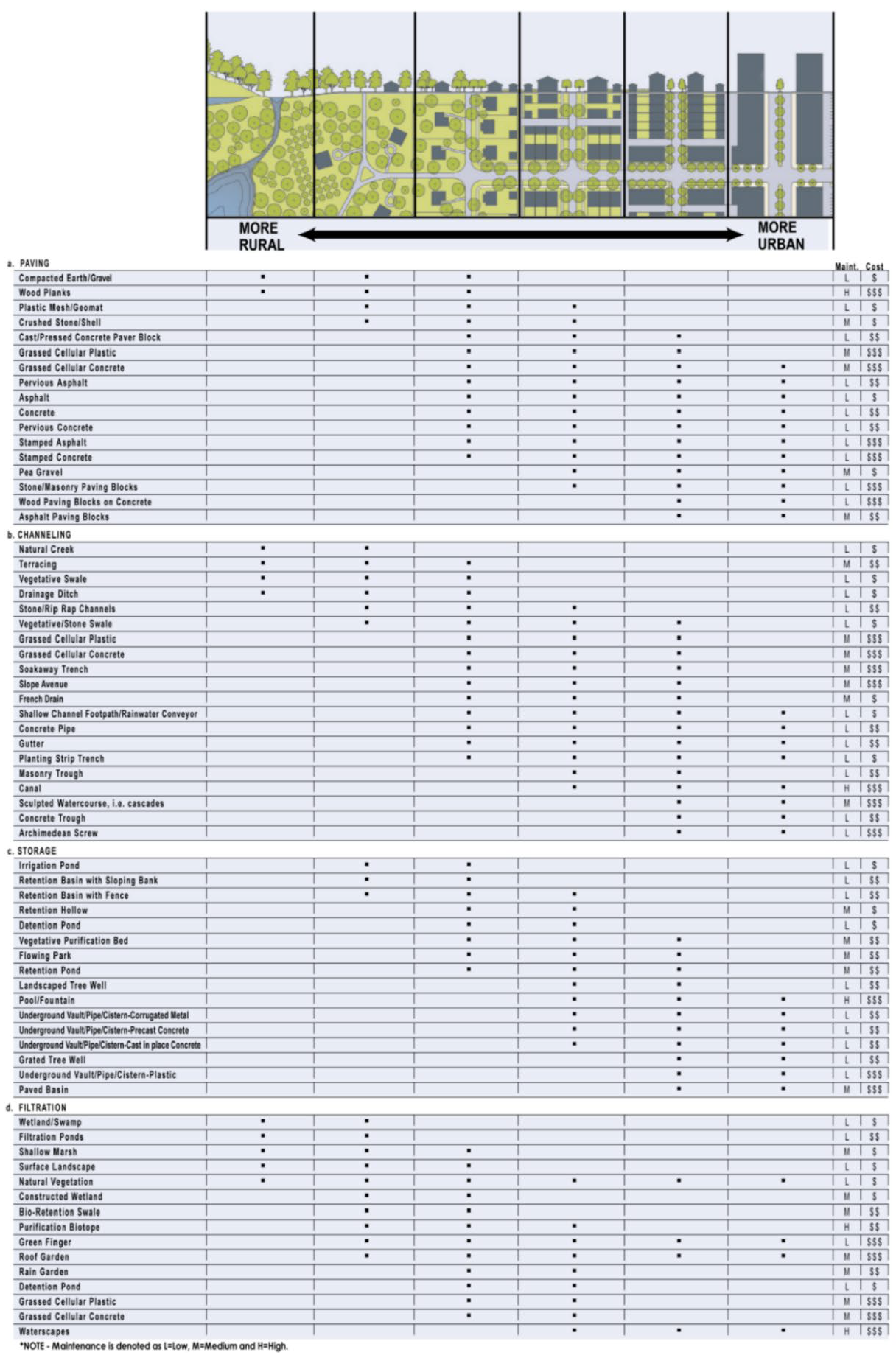
Light imprint stormwater management methods shall be used. Stormwater management methods employed shall be appropriate for the development intensity of the neighborhood as generally shown in subsection (G) below.
G.
Light imprint stormwater matrix.
H.
Location of drainage facilities. Drainage facilities shall be located in the thoroughfare right-of-way or access easement where feasible and shall be constructed in accordance with standards and specifications of the city. Catch basins shall be located at low points of thoroughfares. Where topography or other conditions are such as to make impractical the inclusion of drainage facilities within thoroughfare rights-of-way, perpetual, unobstructed easements at least 15 feet in width for drainage facilities shall be provided across property outside the thoroughfare right-of-way and with satisfactory access to the thoroughfare.
I.
Discharge. Drainage shall be designed so as to avoid concentration of storm drainage water from each lot or land development site to adjacent lots, land development sites, or vacant properties. Stormwater shall not be discharged directly to perennial streams. It shall be directed toward natural drainages. If water must be discharged to a stream, the water quality flowing into the stream must meet or exceed the water quality in the receiving waters. The water quantity flowing into the stream must be evaluated to ensure the stream channel can accommodate the increased flows and not disrupt or degrade the ecology of the water body.
J.
Grading and site drainage. Lots or land development sites shall be laid out so as to provide positive drainage away from all buildings, and drainage for individual lots or land development sites shall be coordinated with the general storm drainage pattern for the area. Buildings and parking lots shall be appropriately drained so as to prevent damage to abutting properties or public thoroughfares. All disturbed or graded ground areas of a building site not used for buildings or open storage areas shall be appropriately stabilized and grassed or covered with plants or landscaping materials.
K.
Cross-drainpipes. Where a watercourse separates the buildable area of a lot from the thoroughfare by which it has access, provisions shall be made for installation of a culvert or other structure, the design of which shall be approved by the city. Cross-drains shall be provided to accommodate all natural waterflow and shall be of sufficient length to permit full-width thoroughfare and the required slopes. Cross-drainpipes shall have head walls of an approved type on inlet and outlet ends of the pipe. Pipe installed within the right-of-way shall be reinforced concrete pipe. All storm drainpipes shall be minimum 18 inches in diameter. Storm sewer slopes shall be equal to or greater than one percent.
L.
Drop inlets. Drop inlets shall be generally three-foot by three-foot boxes with two-foot by three-foot grates unless otherwise specified by the city. Grate openings shall run perpendicular to the direction of travel.
M.
Easements. Where an irrigation ditch or channel, natural creek, stream, or other drainage way crosses a subdivision or land development, the subdivider or developer shall provide an easement sufficient for drainage and maintenance. Easements shall be provided for all drainage facilities as approved by the city. When a subdivision or land development is traversed by a watercourse, drainage way, channel, or intermittent stream, a stormwater or drainage easement of at least 20 feet in width shall be provided.
(Ord. No. 21-10-228, § 1, 10-5-2021)
Sec. 14-3. - Water.
A.
Generally. No permit shall be issued for any building within a subdivision or for the development of land, if there is not an adequate water supply, as determined by the city engineer.
B.
Water main requirements. When a public water main is accessible, the developer shall install adequate water facilities, including fire hydrants, according to specifications of the city. All water mains shall normally be at least six inches in diameter except that pipe of lesser size may be used if properly looped and adequate water pressure is maintained in accordance with standards established by the Southeastern Fire Underwriters Association. Pipe of less than four inches shall not be used except in unusual cases. Water lines shall be installed at least 30 inches below grade. Water mains within subdivisions and land developments must be provided with connections to each lot in the subdivision and each land development, except as otherwise specifically provided.
C.
Community water system. If a county and/or municipal water supply is not available to the subdivision or land development at the time of constructing improvements for a subdivision or land development, then the subdivider or developer shall provide an adequate alternative water source and an adequate water storage facility. Any community water system, if permitted, shall provide a minimum flow of 400 gallons per day per each lot platted, whether or not each lot is to be immediately developed; shall be sanitary; and shall have a minimum pressure of 45 pounds per square inch at each lot in the subdivision or each land development to be served. For all common non-public water supply systems, acceptable management, maintenance, and distribution policies and procedures shall be established. These policies and procedures shall be required to guarantee the provision of adequate supplies to each perspective lot owner on a continuing, ongoing basis, and to provide acceptable means for repairs and unforeseen events. The community water system plan shall be approved by the county health department. This approval and a letter of approval from DNR shall accompany the final plat or land development application.
D.
Fire hydrants. Fire hydrants shall be required for all land developments and all subdivisions except those permitted to be served by individual on-site wells or community wells that serve six or fewer homes. Fire hydrants with appropriate water pressure at appropriate intervals throughout the subdivision or land development shall be provided by the subdivider or land developer as required by the city fire department. Fire hydrants shall be located no more than 500 feet apart and within 400 feet of any principal dwelling. Hydrants, fittings, valves, and fire department connections shall be approved by the city's fire department. Fire department connections shall be not less than 18 inches or more than 36 inches above the level of the adjoining ground or paving. The thread of such connections shall be uniform with that used by the fire department. The agency having jurisdiction shall determine the sufficiency of hydrant type, placement, and hydrant pressure.
(Ord. No. 21-10-228, § 1, 10-5-2021)
Sec. 14-4. - Sanitary sewer.
A.
Connection to public sewerage system. When a public sanitary sewerage system is reasonably accessible, as determined by the city, the subdivider or land developer shall connect with it and provide sewers accessible to each lot in the subdivision.
B.
Cluster systems. A cluster system is a subsurface sewage disposal system that serves more than one property or dwelling. Cluster systems shall be governed by the following provisions:
1.
The approval and permitting of all cluster systems shall conform to all state and county requirements.
2.
The system shall be licensed and fully operational before final plat approval. No lot served by the system shall be sold nor shall any building permit be issued before the cluster system is approved for operation.
3.
The disposal field shall not be located on any 100-year floodplain or within 200 feet of any groundwater recharge area.
4.
Ownership, maintenance, and operation of a cluster system.
a.
Upon transfer of title by the developer, a homeowners' association comprised of the owners of each lot serviced by the system, or a separate authority, shall own, maintain, operate, repair and replace, system components located outside of individual property lot lines. In the event the homeowners' association includes owners whose properties are not serviced by the system, those owners shall not be responsible for maintenance, operation, repair, and replacement of the system. Homeowners' association covenants shall specify the ownership, maintenance, and operation of the system in the event that the association is dissolved or the system is sold or otherwise disposed of.
b.
The by-laws and methods of enforcement and collection of delinquent assessments and dues of the homeowners' association insofar as they pertain to maintenance, operation, repair, and replacement of the cluster system shall be submitted to and approved by the city prior to or as a condition of final plat approval.
c.
Declaration of covenants, conditions, restrictions, and by-laws shall be recorded with the county clerk of superior court prior to final plat approval or the first conveyance of any realty improvements to be serviced by a cluster system.
d.
The city shall not be responsible for any dry sewer lines installed as part of major subdivision approval and used for the transfer or pumping of sewage to any cluster system. During the period of such use, the legal entity responsible for maintenance, operation, repair, and replacement of the system shall remain fully responsible for the system.
e.
Prior to final plat approval, the owner of a cluster system shall submit to the city as-built plans and a manual explaining in detail the operation and maintenance of the system. Such a manual shall be kept at all times by the owner and shall be updated as necessary. Copies of any and all updates shall be provided to the city.
f.
All costs of any testing or monitoring of a cluster system or its components shall be borne by the applicant or association, as the case may be.
5.
Access to cluster systems.
a.
As a condition to approval of a cluster system, the applicant shall provide to the city all necessary easements (by deed) granting the city and its authorized agent access to all properties upon which the system is located and/or which the system services for the purpose of monitoring and inspecting the system and, where necessary, disconnecting a component of the system in order to protect the integrity of the system as a whole. This provision shall not be construed to be in derogation of any authority to enter premises the city and its authorized agent may otherwise have by reason of statute, rule, or ordinance.
b.
As a condition to approval of a cluster system, the applicant shall provide to the owner of the system, and its successors, assigns and agents, all necessary easements (by deed) granting the owner access to all properties upon which the system is located and/or which the system services for the purpose of monitoring, inspecting, and pumping and cleaning the system in order to protect the integrity of the system as a whole.
C.
Septic tanks. Where individual wastewater disposal systems are allowed and proposed, individual lot sizes and shapes must exhibit appropriate regard for the lot's peculiar health, drainage, and maintenance characteristics. No building permit shall be issued for a lot with a septic system, or a proposed septic system, without the approval of the county department of environmental health. No certificate of occupancy shall be issued without a final inspection by and approval of the county department of environmental health, and receipt of as-built drawings of the septic system.
(Ord. No. 21-10-228, § 1, 10-5-2021)
Sec. 14-5. - Utilities.
A.
In any hamlet (HM) or village (VL) district, all utility facilities, including, but not limited to, gas, electric power, fiber optic, telephone, and cable television, shall be located underground throughout the subdivision or land development.
B.
Whenever existing utility facilities in HM and VL districts (other than major transmission lines) are located above ground, except when existing with public thoroughfare rights-of-way, they shall be removed and placed underground. Where this is not feasible, utilities shall be located on easements at least ten feet wide and centered on rear lot lines, or in a location with satisfactory access as approved by the city engineer.
(Ord. No. 21-10-228, § 1, 10-5-2021)
Sec. 14-6. - Oversizing of improvements and utilities.
A.
The subdivider or land developer shall construct such oversized improvements and utilities that the city determines are necessary, provided that the subdivider or land developer shall not be obligated for the additional cost of improvements and utilities that are not uniquely required for that development, and provided the subdivider agrees to a proposal by the city to share in the cost arrangements for over-sizing improvements and utilities.
B.
A formula may be developed by the city to provide for a sharing of the cost of other improvements needed to serve the subdivision or land development when certain of the improvements are necessary to serve future subdivisions or developments in the vicinity.
(Ord. No. 21-10-228, § 1, 10-5-2021)

