
Chattahoochee Hills
City Zoning Code
City Zoning Code
ARTICLE VII
USES
Sec. 7-1.- Use definitions.
The following words, terms, and phrases, when used in this article, shall have the meanings ascribed to them in this section, except where the context clearly indicates a different meaning:
Accessory use means a subordinate use incidental to and customarily associated with a specific principal use, located on the same lot.
Agricultural retail means the sale of agricultural products of value-added agricultural products grown and produced on the premises.
Agritourism means agricultural uses as defined under general farming, but which are open to visiting members of the public, and which may include such activities as petting zoos, corn mazes, hayrides, horseback riding, farm stands, pay fishing, pick-your-own vegetable and fruit gardens or orchards, food and beverage tastings or samplings, and classes or training in agricultural practices or the preparation of agricultural and value-added agricultural products.
Air transportation; airport, private means industries that provide air transportation of passengers and/or cargo using aircraft, such as airplanes and helicopters.
Amusement center means an indoor or outdoor establishment primarily engaged in operating amusements (mini golf, go cart track, billiard parlor, batting cages, game arcades, and similar uses).
Amusement theme park means outdoor recreation facilities consisting of amusement rides, games, water slides, amusement vehicles, golf driving ranges, miniature golf, batting cages, water slides or any similar commercial outdoor recreation. Includes associated food service and indoor amusements.
Assisted living facility means a facility having six or more beds and which offers accommodations that range from independent residential housing options to housing options with personal services. A residential use is to be considered an assisted living facility if it is registered with or licensed by the state as an assisted living home. Any dwelling, facility or structure which for any reason is not required to be or fails to be licensed by the state as an assisted living home, but provides housing, food service, and one or more personal services for any person and which also provides beds for six or more persons, who are not related to the owner or administrator by blood, marriage or adoption shall also be considered an assisted living facility. Personal services include, but are not limited to, individual assistance with or supervision of self-administered medication, and essential activities of daily living such as bathing, grooming, dressing and toileting. For the purposes of this UDC, a continuing care retirement community (CCRC) shall be considered an assisted living facility, and a "child caring institution" or "group-care facility" as defined in O.C.G.A. § 49-5-3 (as amended) with six or more beds shall also be considered an assisted living facility.
Bed and breakfast means a principal and/or accessory dwelling in which ten or fewer rooms are provided for sleeping accommodations for transient guests, for a daily fee and for no more than 30 consecutive days. The property owner must live on the premises. Breakfast and refreshments are the only food typically served and are served only to guests. A bed and breakfast is not a country inn or hotel.
Business service center (including copy shops) means an establishment generally known as a copy center or shop primarily engaged in providing retail photocopying, duplicating, blueprinting, and other document copying services, without also providing printing services (e.g., offset printing, quick printing, digital printing, 3D printing, prepress services) and establishments (except private mail centers) engaged in providing a range of office support services (except printing services), such as document copying services, facsimile services, word processing services, computer rental services, and office product sales.
Caterer means a facility primarily engaged in providing event-based food services. These facilities generally have equipment and vehicles to transport meals and snacks to events and/or prepare food at an off-premises site.
Cemetery or mausoleum means an establishment primarily engaged in operating sites or structures reserved for the interment of human or animal remains.
Check cashing establishment means a business other than a bank, savings and loan, or similar financial institution that cashes checks for a fee as a business activity and may or may not also make title loans as part of that business activity.
Clinic means a use where medical examination and treatment is administered to persons, including ambulatory patients, on an outpatient basis, with the facilities and equipment not being the most significant part of the production process. No patient shall be lodged on an overnight basis.
Cohousing means a residential use in which individual rooms are rented or sold to the general public to reside in for a period of 30 days or longer, and in which all occupants of such rooms share one or more common kitchens or living spaces. Cohousing is not a bed and breakfast or country inn.
College, university, or professional school means any educational facility that provides training or education beyond the 12th grade, including, but not limited to, trade, business and vocational schools; any institution of higher learning or assemblage of colleges, affording instruction in the arts and sciences and the learned professions, and conferring degrees. Such facilities may also include uses related to energy production, room, board, and food services related to the primary educational purpose of the use but which may also be open to the general public.
Compost facility means a commercial processing operation for the treatment of vegetative matter into humus-like material that can be recycled as a soil fertilizer amendment such as trees leaves and plant material. Organic animal waste, food, municipal sludge, solid waste, and other non-farm or non-vegetative type wastes are not included.
Cottage court means a group of detached single-family dwellings or live-work units organized around a shared internal mews.
Country inn or farm stay means a lodging facility in which 6-50 rooms are provided for sleeping accommodations for transient guests, for a daily fee and for no more than 30 consecutive days. Meals may be served to guests and the general public. Guests may participate in agricultural activities. Rooms may be provided in a single building or multiple buildings with design features and accessory uses that support the rural character of the city, to distinguish it from a hotel/motel.
Craft manufacturing meansa facility whose primary use is the shared or individual use of hand-operated tools for the manufacturing of products or parts, including their design, processing, fabrication, assembly, treatment, and packaging. Craft manufacturing may also include the incidental storage, sale and distribution of said products or parts. Craft manufacturing specifically includes, but is not limited to, the manufacturing of electronic goods, food and bakery products, beverages, printmaking, leather products, jewelry and clothing, metal work, furniture, glass or ceramics, and paper.
Data processing services means establishments primarily engaged in providing infrastructure for data/communications hosting or processing services.
Day care center, small means a use in which shelter, care, and supervision is provided for six or fewer children or adults on a regular basis away from their residence for less than 24 hours a day. The term "small day care center" includes pre-kindergarten instruction but shall not include any school offering education at or beyond the level of pre-kindergarten.
Day care center, large means a use in which shelter, care, and supervision is provided for seven or more children or adults on a regular basis away from their residence for less than 24 hours a day. A large day care center may provide basic educational instruction. The term "large day care center" includes pre-kindergarten instruction but shall not include any school offering education at or beyond the level of pre-kindergarten.
Drive-through or drive-in means a facility or structure that is designed to allow drivers to remain in their vehicles before and during an activity on the property. Drive-through facilities are usually found in conjunction with a quick vehicle servicing use or other retail sales and service use. Examples include, but are not limited to, drive-through windows, menu boards, car wash facilities, and quick oil change facilities.
Dwelling means one or more rooms constructed with cooking, sleeping, and sanitary facilities designed for and limited to use as living quarters for one family for periods of more than 30 consecutive days.
Dwelling, accessory, means a dwelling contained within an accessory structure or within a principal structure when separated from the principal use and served by a separate entrance.
Dwelling, caretaker/employee means a single dwelling used as a residence for a caretaker or watchman accessory to a permitted use.
Dwelling, duplex means a residential structure which contains two dwellings. Duplexes shall consist of two side-by-side or stacked dwellings, both facing a thoroughfare and sharing the same front setback, and both within a single building massing.
Dwelling, multifamily, means a structure containing three or more dwellings not including townhouses.
Dwelling, single-family detached, means one dwelling on its own lot that is not attached to any other dwelling by any means.
Dwelling, townhouse, means a single-family dwelling built to its lot lines or a portion of its lot lines.
Event center, large means a commercial facility or assembly hall available for lease by private parties or special events, such as weddings, and holding more than 14 days of events within a calendar year or any event with a capacity of more than 50 attendees.
Event center, small means a commercial facility or assembly hall available for lease by private parties or special events, such as weddings, and holding 14 or fewer days of events within a calendar year and with a capacity of 50 or fewer attendees.
Farming, general, means a parcel of land which is used for the raising of animals (including fish) on a commercial basis, such as ranching, dairy farming, piggeries, poultry farming and fish farming; a facility for the business of boarding or renting horses to the public, or areas for the housing and riding of horses; the keeping and raising of all farm animals and fowl and use of private stables. Other uses include, but are not limited to, the establishment, cultivation, or harvesting of products of the field or orchard; the preparation and planting of pasture land; farm ponds; dairy operations; livestock and poultry management practices; the construction of farm buildings; the plowing, tilling, or preparation of soil at an agricultural facility; the planting, growing, fertilizing, harvesting, or otherwise maintaining of crops; the application of pesticides, herbicides, or other chemicals, compounds, or substances to crops, weeds, or soil in connection with the production of crops, livestock, animals, or poultry; the breeding, hatching, raising, producing, feeding, keeping of livestock, hogs, horses, chickens, turkeys, poultry or other fowl normally raised for food, mules, cattle, sheep, goats, rabbits, or similar farm animals for commercial purposes; the production and keeping of honeybees, the production of honeybee products; and the keeping and raising of farm animals and fowl shall be subject to all regulations promulgated by the county health department. Concentrated animal feeding operations (CAFOs) as defined by the U.S. Environmental Protection Agency are not included in this definition.
Festival or event, occasional, outdoor/indoor, means the periodic gathering of large groups of people for cultural performances, exhibitions, competitions, celebrations, and similar events.
Fitness and recreational sports center means an establishment primarily engaged in operating fitness and recreational sports facilities featuring exercise and other active physical fitness conditioning or recreational sports activities, such as swimming, skating, or racquet sports. Uses include, but are not limited to, tennis courts, recreation centers, basketball courts, ice rink, hockey rink, soccer, field hockey and football fields, baseball and softball fields, gymnasiums, spas, group exercise and fitness centers, yoga, karate, and similar facilities.
Food processing and production means establishments primarily engaged in transforming livestock and agricultural products into products for intermediate or final consumption, including establishments that slaughter and prepare meats. The food and beverage products manufactured in these establishments are typically sold to wholesalers or retailers for distribution to consumers, but establishments primarily engaged in retailing bakery and candy products made on the premises not for immediate consumption are included.
Forestry and logging means an operation on a tract or parcel of land involving the growing, conserving, and managing of forests and forest lands (includes the term "silviculture"). Forestry operations or practices include the raising and harvesting of timber, pulp woods and other forestry products for commercial purposes. The term "forestry and logging" does not include the cutting of timber associated with approved land development or the processing of timber into finished or semi-finished products or storage of logs other than temporary storage of logs harvested on the site.
Fruit, vegetable, and fresh food markets means establishments primarily engaged in retailing fresh, frozen, or cured meats and poultry; fresh, frozen, or preserved fruits and vegetables; or dairy products; and incidental related goods. Delicatessen-type establishments primarily engaged in retailing fresh meat are included in this industry.
Fueling station means a use that sells and dispenses vehicle fuel, including diesel, gasoline, hydrogen, electricity, and other alternative fuels, and which may sell automotive accessories, and which may provide minor repair and maintenance services. Such stations shall be limited to four or fewer bays excluding no more than one attached or detached bay for washing cars. The term "fueling station" may also incorporate general retail.
Funeral home or funeral services means an establishment primarily engaged in preparing the dead for burial or interment and conducting funerals (i.e., providing facilities for wakes, arranging transportation for the dead, selling caskets and related merchandise), not including a crematory.
Garage, residential parking means an enclosed structure accessory to one dwelling, designed or used for storing a vehicle or vehicles used by the occupants of the dwelling.
General freight trucking, local, means establishments primarily engaged in providing local general freight trucking. General freight establishments handle a wide variety of commodities, generally palletized and transported in a container or van trailer. Local general freight trucking trips are same-day return.
General medical and surgical hospitals means establishments primarily engaged in providing diagnostic and medical treatment (both surgical and nonsurgical) to inpatients with any of a wide variety of medical conditions. These establishments maintain inpatient beds and provide patients with food services that meet their nutritional requirements. These hospitals have an organized staff of physicians and other medical staff to provide patient care services. These establishments usually provide other services, such as outpatient services, anatomical pathology services, diagnostic X-ray services, clinical laboratory services, operating room services for a variety of procedures, and pharmacy services.
General retail means an establishment primarily engaged in the sale, lease, or rental of new or used products to the general public not regulated elsewhere in this UDC. Auction houses are included in general retail.
General warehousing and storage means establishments primarily engaged in operating merchandise warehousing and storage facilities. These establishments generally handle goods in containers, such as boxes, barrels, and/or drums, using equipment, such as forklifts, pallets, and racks, rather than bulk products of any type (regulated in open yard storage).
Golf course or country club means a use of land for playing the game of golf; which may include a country club and a driving range as an accessory use.
Greenhouse or nursery means any land used to raise trees, shrubs, flowers and other plants for sale or transplanting. No more than ten percent of the income from the use shall be derived from the retail sale of related garden supplies such as chemical fertilizer, tools and other similar goods and/or equipment, and the retail sale of plants not grown on the property.
Group home means a dwelling containing up to six unrelated persons who are mentally or physically impaired who are protected under the Fair Housing Act, including any support or supervisory personnel or family members who reside at the facility. The term mental or physical impairment includes conditions such as blindness, hearing impairment, mobility impairment, HIV infection, mental retardation, alcoholism, drug addiction, chronic fatigue, learning disability, head injury, and mental illness. Current users of illegal controlled substances, persons convicted for illegal manufacture or distribution of a controlled substance, sex offenders, and juvenile offenders are not considered to be mentally or physically impaired under the Fair Housing Act.
Heavy manufacturing means an industrial facility that involves dangerous, noxious or offensive uses, or a facility that has smoke, odor, noise, glare, fumes, gas, vibration, threat of fire or explosion, emission of particulate matter, interference with radio, television reception radiation or any other likely cause.
Home-based business means an accessory business use of a dwelling in any zoning district.
Hotel means a lodging facility in which rooms are provided for sleeping accommodations for transient guests, for a daily fee and for no more than 30 consecutive days.
Industrial launderers means establishments primarily engaged in supplying, on a rental or contract basis, laundered industrial work uniforms and related work clothing, such as protective apparel (flame and heat resistant) and clean room apparel; dust control items, such as treated mops, rugs, mats, dust tool covers, cloths, and shop or wiping towels.
Interurban and rural bus or rail transportation means establishments primarily engaged in providing bus or rail passenger transportation over regular routes and on regular schedules, principally outside a single metropolitan area and its adjacent nonurban areas.
Landscaping business means a business whose primary operation is the sale and/or storage of organic and inorganic materials, plants, mulch, pine straw, and other limited related accessory products for the landscape industry and the storage and use of associated landscape vehicles with an approved use permit for landscaping business, plant nursery, or garden center with indoor retail component.
Library or archives means establishments engaged in maintaining collections of documents (e.g., books, journals, newspapers, and music) and facilitating the use of such documents (recorded information regardless of its physical form and characteristics) as are required to meet the informational, research, educational, or recreational needs of their user. These establishments may also acquire, research, store, preserve, and generally make accessible to the public historical documents, photographs, maps, audio material, audiovisual material, and other archival material of historical interest. All or portions of these collections may be accessible electronically.
Light manufacturing means an industrial facility that involves food and beverage production; land-intensive outdoor sales and services; or repair or servicing of industrial, business, or consumer machinery, equipment, or products mainly by providing centralized services for separate retail outlets.
Live-work meansnonresidential activity conducted wholly within a dwelling that allows employees, customers, or clients to visit.
Manufactured home means a single-family dwelling constructed in accordance with the National Manufactured Housing Construction and Safety Standards Act of 1974 (42 U.S.C. 5401-5426) and which bears an insignia issued by the U.S. Department of Housing and Urban Development (HUD); or a structure, transportable in one or more sections, which is built on a permanent chassis. A manufactured home is not a modular home, which is built to applicable state and local building codes.
Motion picture or sound recording industries means establishments primarily involved in the production and distribution of motion pictures or sound recordings.
Medical laboratory means establishments primarily engaged in providing analytic or diagnostic services, including body fluid analysis and diagnostic imaging, generally to the medical profession or to the patient on referral from a health practitioner.
Mini-warehouse or self-storage unit means a structure or group of structures containing separate spaces/stalls which are leased or rented on an individual basis for the storage of goods.
Mixed-use means development with a mix of residential and non-residential uses.
Mobile food services means establishments primarily engaged in preparing and serving meals and snacks for immediate consumption from motorized vehicles or non-motorized carts. The establishment is the central location from which the caterer route is serviced, not each vehicle or cart.
Motion picture or sound recording industries means establishments primarily involved in the production and distribution of motion pictures or sound recordings that do not meet the qualifications of motion picture or sound recording industries, large.
Motion picture or sound recording industries, large means establishments primarily involved in the production and distribution of motion pictures or sound recordings, occupying more than 50 acres or containing more than 250,000 square feet of floor area, and surrounded by a security perimeter.
Motion picture theater means an establishment primarily engaged in operating motion picture theaters and/or exhibiting motion pictures or videos at film festivals, and so forth.
Motor vehicle or recreational vehicle sales and rental means establishments primarily engaged in retailing or rental of automobiles and light trucks, such as sport utility vehicles, and passenger and cargo vans, and of vehicles used for leisure time activities and/or as a dwelling while traveling. Examples include a camper, a motor home, a travel trailer, and a boat, or retailing these vehicles in combination with activities, such as repair services, retailing used cars, and selling replacement parts and accessories.
Museum, historical site, or similar institution means an establishment primarily engaged in the preservation and exhibition of objects, sites, and natural wonders of historical, cultural, and/or educational value.
Nature park or similar institution means an establishment primarily engaged in the preservation and exhibition of natural areas or settings.
Open yard storage means any activity which involves the sale or storage of any externally stored bulk material; the sale or storage, wrecking, dismantling, processing or sorting of waste, discarded or salvaged paper, rags, machinery, equipment or other junk, including automobiles, trucks and similar motor vehicles, including the temporary parking or storage of machinery utilized for heavy construction, earth moving, timber harvesting, tree or building maintenance, and other heavy, working vehicles; where those materials are commonly stored in an open area outside any building; provided, however, that businesses engaged predominantly in the repair or sale of new or used motor vehicles and other machines shall not be included in the term "open yard storage" if those vehicles and machines are in operating condition and ready for sale or, if non-operational, those vehicles or machines are stored in a building; any property with more than ten vehicles shall be considered open yard storage. Accessory office use of buildings on the property is not evidence that a use should not be considered open yard storage.
Outdoor dining means an accessory area for seating on a portion of the sidewalk or lot outside of a business establishment for the purpose of eating, drinking, or otherwise socializing.
Parking and storage of large vehicles means parking or storage of any vehicle in excess of 24 feet in length, eight feet in width or eight feet in height.
Parking deck means a partially or fully enclosed building designed for the parking of vehicles. A parking deck is not a residential parking garage.
Parking lot means an unenclosed surface area used for the parking of vehicles.
Pawn shop means an establishment engaged in a business involving in any part of the pledge, pawn, or exchange of any goods, wares, merchandise, or any kind of personal property or title as security for the repayment of money lent.
Personal care home means any dwelling, facility, or structure ("facility") required to be licensed by or registered with the state as a personal care home with no more than five beds. Any facility which for any reason is not required to be licensed by or registered with the state as a personal care home, or fails to be licensed by or registered with the state as a personal care home but which, through its ownership or management, undertakes for a fee or accepts a grant or utilizes its own funding to provide or arrange for the provision of housing, food service, and one or more personal services for two other persons, who are not related to the owner or administrator by blood, marriage, or adoption shall also be considered a personal care home for the purpose of this definition. Personal services include, but are not limited to, individual assistance with or supervision of self-administered medication, and essential activities of daily living such as bathing, grooming, dressing and toileting. The term "personal care home" shall apply without regard to whether any fee charged is paid by the individual to whom the services are provided or by another person, the source of the grant, or the funding source for the operational costs and without regard to whether the facility is operated for profit or not for profit. For the purposes of this UDC, a "child caring institution" or "group-care facility" as defined in O.C.G.A. § 49-5-3 (as amended) shall also be considered a personal care home.
Pet care services means establishments primarily engaged in providing pet care services (except veterinary), such as boarding, grooming, sitting, and training pets.
Professional offices means establishments primarily engaged in processes that specialize in performing professional, scientific, and technical activities for others, including, but not limited to, medical and dental services, legal advice and representation; real estate sales and rental agencies; financial services (not including banks, check-cashing and/or payday loans), collection agencies, accounting, bookkeeping, and payroll services; architectural, engineering, and specialized design services; computer services; consulting and counseling services; research services; advertising services; photographic services; publishing, print shops, translation and interpretation services; plumbers, exterminators, and other technical services; veterinary services; and other professional, scientific, office service, and technical services.
Recreation field means an outside area designed and equipped for the conduct of sports and leisure-time activities, including, but not limited to, softball, soccer, football, and field hockey, playgrounds, recreation areas, playing fields, and other similar uses or facilities.
Recreational vehicle (RV) park or campground means a facility which leases lots or areas for recreational vehicles or camping.
Recycling center means establishments primarily engaged in collecting, sorting, or processing materials to be recycled, including, but not limited to, plastics, glass, paper, and aluminum materials. Recycling bins shall not be included in this definition.
Rehabilitation center means a facility providing rehabilitative services in the facility whether operated for profit or not for profit. Rehabilitative services in the facility include counseling services, therapeutic services offered as a part of any organized program for the mental, psychological, and substance abuse recovery. Uses such as halfway houses, drug rehabilitation centers or other facilities for treatment of drug dependency shall be included in this definition. The term "rehabilitation center" shall not apply to occupational or physical rehabilitation of any person, hospitals or services located on the premises of a hospital, services offered to individuals by one or more licensed medical professionals in a private office setting, or personal services offered as part of a permitted home-based business.
Renewable energy facility means a facility generating electricity using renewable energy generation technologies including: solar arrays, solar collection systems, or geothermal energy systems where the total combined area dedicated to such technology exceeds 10,000 square feet; and/or wind energy systems where the total number of generating devices exceeds two.
Research and development means establishments primarily engaged in conducting original investigation undertaken on a systematic basis to gain new knowledge (research) and/or the application of research findings or other scientific knowledge for the creation of new or significantly improved products or processes (experimental development).
Restaurant means an establishment located wholly or partially within a building and primarily engaged in the preparation and serving of food to patrons. A cafeteria shall also be considered to be a restaurant.
Roadside stand means a use offering either farm-grown, prepared food products such as fruits, vegetables, canned foods, or prepared packaged meats or dairy products for sale from a vehicle or an open-air structure. The consumption of food at the stand is prohibited.
School pre-K through 12, large, means an establishment primarily engaged in furnishing academic courses and associated course work that comprise a basic preparatory education ranging from pre-kindergarten through 12th grade for 100 or more total students.
School pre-K through 12, small, means an establishment primarily engaged in furnishing academic courses and associated course work that comprise a basic preparatory education ranging from pre-kindergarten through 12th grade for less than 100 total students.
Senior housing means a single-family or multifamily development intended for, operated for, and designed to accommodate residents 55 years of age and older. Senior housing communities are designed for seniors to live on their own, but with the security and conveniences of community living. Some provide communal dining rooms and planned recreational activities (congregate living or retirement communities), while others provide housing with only minimal amenities or services.
Services, personal and household, means appliance and home and garden equipment repair and maintenance, barber shops and beauty salons, garden centers; household, home, garden, and pool services.
Sexually oriented business means a use meeting the definition of sexually oriented business in chapter 10, article XI of the city's Code of Ordinances.
Short term rental is defined in chapter 10, article XIII. Short term rentals shall not be a part of a bed and breakfast, country inn, or hotel.
Storage tank, bulk, flammable liquids or gasses, means establishments primarily engaged in the storage of flammable liquids or gasses.
Storm shelter means structures providing shelter from dangerous or inclement weather.
Support activities for air transportation (including airports) means establishments primarily engaged in providing specialized services for air transportation, except air traffic control and other airport operations.
Temporary structure means structures intended for short-term use.
Temporary uses, commercial retail, means commercial structures of a seasonal or temporary nature, including, but not limited to, food stands, vendors, or similar uses, permitted only in those districts allowing similar uses on a permanent basis.
Theater, amphitheater, stadium, or arena, large means an indoor or outdoor facility for artists, athletes, speakers, or performers with an audience capacity of more than 400 people.
Theater, amphitheater, stadium, or arena, small means an indoor or outdoor facility for artists, athletes, speakers, or performers with an audience capacity of 400 or fewer people.
Timeshare means a dwelling that is subject to or operates under any arrangement, plan, or design whereby occupancy rights to the dwelling are segmented over time, and the rights of occupancy by owners, lessees, or holders (regardless of the form of ownership or the form in which the right to occupy is expressed), including their guests, are recurring (either on a fixed schedule or a floating schedule), such that in any one year a change or turnover of occupancy occurs three or more times.
Use, accessory, means a subordinate use which is customarily incidental to the principal use of a lot, and which is located on the same lot as a principal use.
Use, principal, means the primary or main purpose or function of a lot or structure. The term "principal use" is synonymous with "main" and "primary."
Utility substation, telephone, electric, gas, etc., means establishments primarily engaged in the provision of electric power, natural gas, steam supply, water supply, and sewage removal through a permanent infrastructure of lines, mains, and pipes.
Wholesale trade means establishments primarily engaged in wholesaling products, such as motor vehicles, furniture, construction materials, machinery, and equipment (including household-type appliances), metals and minerals (except petroleum), sporting goods, toys and hobby goods, recyclable materials, and parts.
Yard sale means the general sale, open to the public, conducted from or on any property for the purpose of disposing of personal property, including, but not limited to, all sales entitled "garage," "lawn," "yard," "attic," "porch," "room," "backyard," "patio," or "rummage" sale. The term "personal property" means items which are owned, utilized, and maintained by an individual or members of their family and acquired in the normal course of living in or maintaining a residence.
Zoo or botanical gardens means establishments primarily engaged in the preservation and exhibition of live plant and animal life displays.
(Ord. No. 21-10-228, § 1, 10-5-2021; Ord. No. 22-03-234, § 3, 3-1-2022; Ord. No. 23-02-254, §§ 23, 24, 2-7-2023; Ord. No. 25-08-287, § 7, 8-5-2025)
Sec. 7-2. - Permitted uses.
A.
The permitted principal uses and special permit uses identified in the table in subsection (H) shall be permitted only as listed within each zoning district and consistent with the approved concept plan, as applicable. Any change of use, including a change of a single use within a multiple use structure, shall comply with the requirements of this UDC and any conditions of zoning.
B.
Principal and accessory uses allowed by district are shown in the table below. All uses are subject to all applicable requirements of this UDC.
1.
(P) Use permitted. Indicates a use is permitted in the respective district.
2.
(A) Use allowed only with special administrative permit. Indicates a use may be permitted in the respective district only with an approved by special administrative permit.
3.
(U) Use allowed only with special use permit. Indicates a use may be permitted in the respective district only where approved by the city council.
4.
(A/U) Use allowed only with a special administrative permit when occupying 4,000 square feet or less or when located more than 1,000 feet from any off-site dwelling (as measured in a straight line between the closest points of the two lots); Use allowed only with a special use permit when occupying more than 4,000 square feet and located 1,000 feet or less from any off-site dwelling (as measured in a straight line between the closest points of the two lots).
5.
(X) Use prohibited. A use is not permitted in the respective district.
C.
Any use listed with a "yes" in the column headed by the words "supp" (supplemental regulations shall:
1.
Satisfy the applicable supplemental use standards established in section 7-4 in addition to all other UDC requirements.
2.
Schedule a pre-application meeting with the zoning administrator as delineated in section 3-2.
D.
Multiple uses are allowed within a lot, structure, or business are allowed. Each use shall be regulated according to the associated provisions set forth within this UDC.
E.
Where a use includes two or more defined uses and neither is subordinate or accessory to the other, the permission and use requirements of both shall apply.
F.
A use not specifically listed is prohibited unless the zoning administrator determines the use to be similar to a listed use. When determining whether a proposed use is similar to a listed use, the zoning administrator must consider the following criteria:
1.
Actual or projected characteristics of the proposed use;
2.
Amount of site area or floor area and equipment devoted to the proposed use;
3.
Sales volume;
4.
Type of customer;
5.
Number of employees;
6.
Hours of operation;
7.
Building and site arrangement;
8.
Types of vehicles used and their parking requirements;
9.
Number of vehicle trips generated;
10.
How the proposed use is advertised;
11.
Likely impact on surrounding properties; and
12.
Whether the activity is likely to be found independent of the other activities on the site;
G.
Where a use not listed is found by the zoning administrator not to be similar to any other permitted use, the use is only permitted following a text amendment per section 3-3.
H.
Permitted use table.
a.
Use must be located on a parcel of 10 acres or more. Any structure containing this use must be set back at least 200 feet from any property line of a lot containing a residential use.
b.
Use must be located on a parcel of 70 acres or more. Any structure containing this use must be set back at least 200 feet from any property line or a lot containing a residential use
(Ord. No. 21-10-228, § 1, 10-5-2021; Ord. No. 23-02-254, § 25, 2-7-2023; Ord. No. 25-08-287, § 7, 8-5-2025)
Sec. 7-3. - Accessory uses and structures.
A.
Principal structure. Accessory uses shall be located on the same lot as the principal structure to which they are accessory.
B.
Accessory structure. No accessory structure shall be constructed upon a lot until construction of the principal structure has commenced.
C.
Uses accessory to residential uses. Accessory uses to residential development may generally be considered to include private garages, stables, storehouses, greenhouses, home-based businesses, children's playhouses, summerhouses, home workshops, accessory dwellings, swimming pools, yard sales, and similar appurtenant uses.
D.
Accessory agricultural uses to residential or non-residential uses include, but are not limited to, slaughtering or processing of animals, petting zoos, educational tours, picnicking, pay fishing, and pick-your-own vegetable and fruit gardens or orchards. Concentrated animal feeding operations (CAFOs) as defined by the U.S. Environmental Protection Agency are not allowed as accessory agricultural uses. See supplemental use provisions in section 7-4.
E.
Uses accessory to agricultural uses. Accessory uses to agricultural uses include all uses accessory to residential uses, including a single accessory dwelling as limited below in subsection (E). Agricultural housing beyond a single dwelling shall only be allowed with a special use permit and subject to the use provisions of section 7-4A.
F.
Uses accessory to non-residential uses. Accessory uses for non-residential development shall include those normally appurtenant to such development, except as shown in section 7-2.
G.
Accessory dwellings.
1.
On lots where the floor area of the principal dwelling is 3,200 square feet or less, accessory dwellings shall be limited to a floor area no greater than 960 square feet or 60 percent of floor area of the principal dwelling (whichever is less).
2.
On lots where the floor area of the principal dwelling exceeds 3,200 square feet, accessory dwellings shall be limited to a floor area no greater than 30 percent of the floor area of the principal dwelling.
3.
No more than one accessory dwelling shall be allowed on a lot.
H.
Accessory uses and accessory structures except for outdoor dining, fences, and walls shall not be permitted within the first layer, except that accessory uses and accessory structures in the rural (RL) district or required open space shall be exempt from this provision when:
1.
Located more than 600 feet from the right-of-way of a thoroughfare, excluding alleys, lanes, or bicycle facilities; or
2.
Fully screened from view from any thoroughfare by topography.
(Ord. No. 21-10-228, § 1, 10-5-2021)
Sec. 7-4. - Supplemental use provisions—Specific.
The regulations set forth in this UDC within each zoning district are the minimum regulations that apply uniformly to each class or kind of structure or land. The following regulations also shall apply to each use or type of use listed, whether such use is authorized as of right or by special permit.
A.
Agricultural housing.
1.
A single accessory dwelling shall be allowed by right (see section 7-3) accessory to all agricultural uses.
2.
For agricultural uses on lots 50 acres and larger, one additional accessory housing unit shall be allowed for every 50 acres, up to a maximum of five total units.
3.
The head of household of all agricultural housing units must be either related by blood to or a full time or seasonal employee of the property owner and responsible for agricultural production on the property.
4.
All such housing shall meet applicable city and county regulations regarding housing, water, and septic tanks.
5.
All such housing shall meet the requirements of Occupational Safety and Health Administration (OSHA) Standard 1910.142.
6.
All such housing shall meet applicable rules and regulations regarding agricultural worker housing of the Georgia Department of Labor.
7.
All agricultural housing units shall meet the requirements of accessory dwellings in section 7-3G.
B.
Agricultural retail.
1.
At least 80 percent of the displayed inventory of the products sold shall be agricultural or value-added agricultural products grown and produced on the premises or within 100 miles.
2.
Only one agricultural retail facility shall be allowed per parcel.
3.
Agricultural retail may occur inside buildings or outdoors.
4.
On parcels up to 100 acres in size, buildings or portions of buildings devoted to agricultural sales shall not exceed 1,000 square feet in floor area.
5.
On parcels 100 acres in size or larger, buildings or portions of buildings devoted to agricultural sales shall not exceed 2,000 square feet in floor area. Such buildings, parking, and related improvements shall not be located within 200 feet of the property line of any off-site dwelling.
C.
Air transportation; airport, private.
1.
For fixed wing aircraft, a 1,500-foot clear zone extending from the end of all runways shall be secured through ownership or easement, but in no case shall the end of a runway be located within 1,000 feet of the property line of any off-site dwelling or 500 feet of a property line of any other use.
2.
For both fixed and rotary-wing aircraft, neither the landing area nor any building, structure, or navigational aid shall be located within 500 feet of the property line of any off-site dwelling.
3.
Establishments primarily engaged in providing air transportation of passengers or cargo over regular routes and on regular schedules such as air commuter carriers, scheduled air passenger carriers, scheduled air cargo carriers, and scheduled helicopter passenger carriers, are prohibited.
D.
Amusement center.
1.
An amusement center use shall not occupy more than five acres.
2.
Outdoor recreation activities shall be limited to between 10:00 a.m. and 10:00 p.m.
E.
Amusement theme park. Outdoor recreation activities shall be limited to between 10:00 a.m. and 10:00 p.m.
F.
Assembly uses. No assembly use, including places of worship, clubs, and theaters, may be designed to accommodate more than 1,000 people indoors.
G.
Assisted living facility.
1.
The approval and/or issuance of any special permit by the city for operation of an assisted living facility may precede the issuance of permits or licenses from the state, provided that any special permit granted shall be conditioned on the issuance of the appropriate permits, licenses, or registrations required by the state.
2.
No such facility shall be located within 2,000 feet (as measured in a straight line between the closest points of the two lots) of any community service facility as defined in O.C.G.A. § 37-4-2, rehabilitation center, or supportive housing facility.
3.
All assisted living facilities must provide at least 80 square feet of personal living space per resident or provide that amount required by the state for the licensing of assisted living homes, whichever is greater.
4.
Each location shall be required to provide transportation service for its occupants.
H.
Communications towers. See article X.
I.
Compost facility.
1.
Hours of operation shall be limited to between 7:00 a.m. and 8:00 p.m., Monday through Saturday.
2.
Compost facilities shall maintain a buffer of not less than 150 feet adjacent to all property lines. When compost facilities handle and process food waste delivered from off-site sources, such facilities shall maintain a buffer of not less than 300 feet adjacent to all property lines. Buffers shall provide an effective year-round visual buffer.
3.
Collection, storage containers, or receptacles shall not be allowed in minimum yards.
J.
Cottage court.
1.
Cottage court developments shall provide a landscaped mews of at least 40 feet in width and 3,000 square feet in total area for every ten units or fraction thereof. No more than ten dwellings may face any mews.
2.
No principle dwelling in a cottage court shall exceed 1,500 square feet in floor area.
3.
The mews shall not be parked or driven on, except for emergency access and permitted temporary events.
K.
Craft manufacturing.
1.
No individual business shall exceed 4,000 square feet in of floor area.
2.
No equipment or process shall be used that creates, without limitation, noise, dust, vibration, glare, fumes, odors, or electrical interference detectable to the normal senses, off the premises.
L.
Crematory.
1.
The crematory shall have no more than one cremation unit per location.
2.
The crematory will be owned and operated by a licensed funeral home. The crematory will be used solely by the funeral home for customers having services at the location of the licensed funeral home and operate as an off-site accessory type use to the funeral home and not as a customer-based independent business.
M.
Day care center, small or large.
1.
Shall comply with all applicable state day care requirements for standards, licensing, and inspections.
2.
Shall provide at least 100 square feet of outdoor recreation area per child. Such outdoor areas shall be permitted to utilize off-site open space for meeting this requirement when agreements for using such areas are obtained and provided.
3.
Hours of operation shall be limited to between 6:00 a.m. and 7:00 p.m.
4.
When located within the RL district, shall be separated by a minimum distance of 3,000 feet from any other such use (as measured in a straight line between the closest points of the primary structures).
N.
Dry cleaning and laundry services (except self-service).
1.
Facilities which make use of class I solvents shall be prohibited.
2.
Facilities which make use of class II and III solvents shall not be located in buildings with other occupancy and shall only be located in buildings which are set back at least 20 feet from any side or rear property line and any other building.
3.
The applicant for such a facility shall certify in writing at the time of application that all the above conditions shall be met.
O.
Event center, small or large. Event hours shall be limited to between 8:00 a.m. and 10:00 p.m. Sunday through Thursday, and between 8:00 a.m. and 11:00 p.m. Friday and Saturday, or as permitted by city council.
P.
Festivals or events, occasional, outdoor/indoor.
1.
As applicable, special events are subject to the requirements of other city departments.
2.
No more than eight permits shall be granted per year, and no permit shall be effective for more than 21 consecutive days or 16 nonconsecutive days in a 30-day period for a single event on the same property. An application for said permit shall be made no less than 14 days prior to the event.
3.
Festival or event hours shall be limited to between 8:00 a.m. and 10:00 p.m. Sunday through Thursday, and between 8:00 a.m. and 11:00 p.m. Friday and Saturday, or as permitted by city council.
4.
The minimum lot size and maximum attendance hours shall be as adopted in the city's adopted fee ordinances.
Q.
Fitness and recreational sports centers.
1.
These criteria shall apply to any fitness and recreational sports center within 1,000 feet of the property line of any off-site dwelling.
2.
No outdoor storage shall be permitted.
3.
The supplemental use provisions for recreation fields shall apply to all outdoor activities associated with fitness and recreation sports centers.
R.
Forestry and logging.
1.
Such activities shall be conducted consistent with "Georgia's Best Management Practices for Forestry" as established by the Georgia Environmental Protection Division (EPD).
2.
Forestry and logging activities taking place on property that is adjacent to occupied residential property shall preserve a 50-foot buffer from the property line of any off-site dwelling. Up to 50 percent thinning may be permitted in the buffer.
3.
In hamlet (HM) and village (VL) districts, forestry and logging activities shall maintain a buffer of not less than 70 feet adjacent to any thoroughfare. Up to 50 percent thinning may be permitted in the buffer.
4.
Nothing in these standards shall be interpreted to prevent standard silviculture practices that promote healthy forest-keeping practices.
5.
Where forestry and logging uses count toward required open space, they shall provide publicly accessible pedestrian amenities throughout and which connect to adjacent uses.
S.
Gas stations.
1.
All repair and maintenance activities shall be carried on entirely within an enclosed building.
2.
Outdoor storage is prohibited.
3.
Only minor automotive repair and maintenance is allowed and shall be confined within the principal structure, out of public view.
4.
Above-ground tanks for the storage of gasoline, liquefied petroleum gas (other than single-service sizes), oil, and other flammable liquids or gases shall be prohibited.
5.
Overnight accommodations, showers, and overnight customer parking shall be prohibited.
6.
The use shall not be combined with any other use or facility so as to create a truck stop.
7.
No more than 16 total fueling positions are permitted for each individual use.
8.
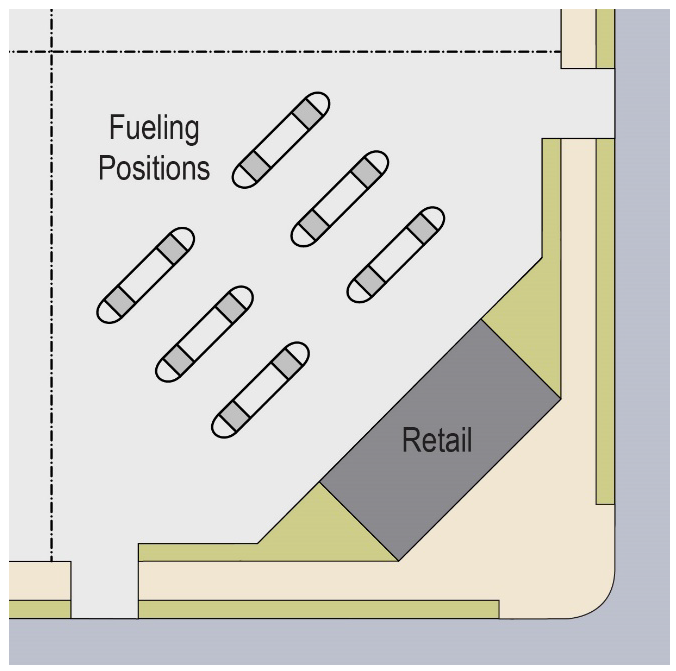
All fueling positions shall be located to the rear of the structure and be shielded from the adjacent road by the structure and shall be located so as to limit visibility from any adjacent thoroughfare to the greatest possible degree (see illustration), except that a maximum of one fuel pump that dispenses petroleum fuels and its associated canopies and service areas shall be permitted to be located between the building and an adjacent thoroughfare. Alternative fuels like biodiesel, hydrogen, and electricity may be provided on additional pumps in front, with a maximum of one fueling position per alternative fuel type permitted in front.
9.
The front and rear of the building should be designed as primary facades, complete with fenestration and entryways (no false facades, false windows, or false doors).
10.
Fueling station canopies shall have pitched roofs as regulated in subsection 6-2.F.1.i.
T.
General retail.
1.
Within a historic crossroads (HC) district only, general retail may also sell motor vehicle fuels but shall be limited to a maximum of one fueling position.
2.
General retail shall not provide repair, maintenance services, or other vehicular services in any zoning district.
U.
Greenhouse or nursery. Where greenhouses or nurseries count toward required open space, their total floor area shall not exceed 100 gross square feet per acre.
V.
Group home.
1.
No more than one group home shall be allowed within any individual hamlet (HM), or historic crossroads (HC) zoning district.
2.
No more than two groups homes shall be allowed within any individual village (VL) district.
3.
No group home in the rural (RL) district shall be located closer than 3,000 feet from another existing group home (as measured in a straight line between the closest points of the primary structures).
W.
Home-based business.
1.
The smaller of 25 percent or 750 square feet of the gross floor area of a dwelling may be used for activities devoted to home-based businesses.
2.
No more than 75 percent of the area of any accessory structure shall be devoted to home-based businesses.
3.
Signs identifying home-based businesses shall be limited to one two-square-foot wall sign per lot as defined in Art. VIII.
4.
There shall be no storage, display or activity associated with the home-based business visible outside the structure.
5.
The following uses are not allowed as home-based businesses: restaurants, funeral homes and funeral services, all retail uses except for live-work units, personal care homes, short term rental, and any other use found incompatible with the intent of this UDC.
6.
A maximum of two vehicles used for taxi or limousine services shall be permitted on the lot when such use occurs as a home-based business.
7.
Resident participants in a home-based business must have the appropriate occupational licensing, including business licenses.
8.
No home-based business shall generate traffic, sound, smell, vibration, light, or dust that is offensive.
9.
No more than two nonresident employees, nor more than six people in total including working residents, employees, clients, or patrons are allowed on the premises at the same time in conjunction with home-based businesses.
10.
Vehicles kept on the lot in association with the home-based business shall be used by residents only.
11.
The transporting of goods by trucks with more than two axles is prohibited. Incoming vehicles related to the home-based business shall be parked off-street within the confines of the residential driveway or other permitted off-street parking area.
12.
When home-based businesses include the use of instruments, machinery or equipment that emit sounds (i.e., musical instruments, sewing machines, saws, drills) that are detectable beyond the unit, noise levels shall be regulated as follows: Between 8:00 a.m. and 6:00 p.m., the average peak sound pressure level, when measured off the subject property, of noise created by the home-based business shall not exceed the greater of 60 dB(A) or the ambient noise level. During all other hours, the home-based business shall not create noise detectable to normal sensory perception off the subject property.
13.
No home-based business shall be operated so as to create or cause a nuisance.
14.
Auto repair, farm equipment repair, or similar operations shall not be visible from a thoroughfare or neighboring properties; all repair activities and storage of vehicles shall be fully enclosed in a structure, with the exception that one vehicle may be stored outside for up to 24 hours upon delivery or awaiting pick-up. All such storage is subject to any vehicle storage regulation herein or elsewhere in this UDC.
X.
Mini-warehouses and self-storage units.
1.
Lots containing mini-warehouses and self-storage units shall be located a minimum of 1,500 feet from the property line of any other lot containing a mini-warehouse or self-storage use.
2.
No doors for individual storage units shall be visible from any adjacent open space or adjacent thoroughfare except lanes or alleys.
3.
A manager shall be employed at the facility and shall be responsible for the operation of the facility in conformance with conditions of approval.
4.
No sale of merchandise or flea markets shall be conducted on the property.
5.
No outdoor storage is permitted.
6.
No outdoor speakers or amplification shall be permitted.
Y.
Mobile food services.
1.
Mobile food services includes mobile food concession stands, food trucks, mobile canteens, mobile refreshment stands, mobile food carts and mobile snack stands.
2.
Such uses shall be prohibited from operation within thoroughfares, except for areas of thoroughfares designated for on-street parking.
3.
Such uses shall be prohibited from operation on sidewalks, except for areas of sidewalks designated as outdoor dining. See outdoor dining supplemental use provision in section 7-4BB.
4.
Such uses shall not be allowed to stay in one location for more than 16 hours without moving.
Z.
Motor vehicle or recreational vehicle sales and rental.
1.
All vehicles shall be parked on an all-weather surface.
2.
No more than 50 vehicles may be displayed outside in areas that are visible from any public or private street.
3.
No vehicles may be displayed outside in a way as to be visible from any public street.
AA.
Open yard storage.
1.
An additional 40-foot setback and 30-foot landscaped buffer shall be provided interior to existing zoning setbacks adjacent to all thoroughfares, open spaces, and residential uses. A 20-foot landscaped buffer shall be provided adjacent to all other uses.
2.
Interior to the landscaped buffer the use shall be surrounded by an opaque wall or fence no less than six feet tall.
3.
The landscaped buffer shall be planted with evergreen plant material to obscure the wall as much as possible. Dead plant material shall be replaced promptly to maintain the buffer.
4.
In no case shall the contents of the open yard storage be visible from property lines of any thoroughfare, dwelling, or open space.
BB.
Outdoor dining.
1.
Outdoor dining may encroach into sidewalk areas when the following criteria are being met:
a.
Shall provide a minimum unobstructed sidewalk clear walking area of:
i.
Eight feet along any commercial street, avenue, or boulevard thoroughfare type.
ii.
Six feet in width along all other thoroughfare types.
b.
No permanent structure or ornamentation shall be located within the area where encroachment is permitted, and no element shall be attached to the sidewalk in any way;
c.
At such time as the outdoor dining use is discontinued, sidewalks shall comply with all requirements of this UDC; and
d.
Outdoor dining may be separated from the sidewalk only with movable planters, fencing, or similar non-fixed barriers provided they do not exceed a height of 42 inches including any plant material.
CC.
Parking and storage of large vehicles.
1.
Vehicles may park within a fully enclosed structure that meets all other criteria of the zoning district.
2.
Vehicles may park when fully screened and obstructed from view from any thoroughfare or open space.
3.
Vehicles may park on the side or to the rear of the primary residential structure on the lot, provided that the lot is three acres or larger, but shall not be closer than 100 feet from any property line.
4.
This section shall not apply to vehicles that park or stand in RL zoning districts for less than eight hours while engaged in the loading or unloading of the vehicle.
DD.
Pawn shops.
1.
Pawn shops shall be separated by a minimum of 2,000 feet from all other pawn shops (as measured in a straight line between the closest points of the lots).
2.
If the pawn shop involves title pawn, then associated vehicles shall be stored at another location which allows for the long-term storage of such vehicles through the open yard storage or parking and storage of large vehicles use categories.
EE.
Personal care homes.
1.
The approval and/or issuance of any special permit for operation of a personal care home by the city shall precede the issuance of permits or licenses from the state; provided, however, that any special permit granted under the terms of this part shall be conditioned on the issuance of the appropriate permits, licenses or registrations required by the state.
2.
When personal care homes include halfway houses, drug rehabilitation centers or other facilities for treatment of drug dependency, such facilities shall not be located within 2,000 feet of any personal care home, community service facility as defined in O.C.G.A. § 37-4-2(6), nursing home, rehabilitation center, or supportive housing facility (as measured in a straight line between the closest points of the two lots containing the facilities).
3.
An application for a personal care home must specify the number of beds for which personal services will be made available. Any increase in the number provided shall require a new application.
4.
Personal care homes must provide at least 80 square feet of personal living space per resident or that amount required by the state for the licensing of personal care homes, whichever is greater.
5.
No signs shall be permitted other than those permitted by the regulations of the zoning district within which such personal care home is located.
6.
Each location shall be required to provide transportation service for its occupants.
7.
In RL districts, no more than four residents, not including owner and owner's family, may reside on the premises.
FF.
Pet care services.
1.
Buildings housing animals shall be a minimum of 100 feet from any property line.
2.
Any animal pens and runs shall be a minimum of 200 feet from any property line.
GG.
Places of worship.
1.
In addition to the accessory uses and structures that are permitted in article VII for the zoning district in which the place of worship is located, additional accessory uses and structures are permitted that are customarily associated with places of worship and intended primarily for the use of worshipers; such as a chapel, library, administrative offices, religious educational facilities for worshipers, fellowship hall and related kitchen and dining area, ornamental gardens, or outdoor recreational facilities occupying less than 10,000 square feet.
2.
Places of worship shall be subject to the assembly use size restrictions in subsection (F).
3.
The following additional uses may be permitted as accessory to the place of worship only upon approval of a special use permit, and provided that they meet all regulations specific to the proposed use or structure contained in this UDC. No signage shall be permitted for accessory uses except door signs.
a.
Day care center.
b.
Health and social services, including counseling, out-patient clinics, transitional housing, homeless shelter, soup kitchen, and the like.
c.
Indoor recreation facilities such as gymnasiums, health, and fitness facilities.
d.
Kindergarten.
e.
Outdoor recreation facilities 10,000 square feet or larger.
f.
Private school (K-12).
HH.
Recreation fields.
1.
Loudspeakers/paging systems are prohibited within 200 feet of the property line of any off-site dwelling.
2.
The hours of operation shall be limited to daylight hours when said facility is not associated with a school K-12 (private or public) and when located within 1,000 feet of the property line of any off-site dwelling (as measured in a straight line).
3.
When located within required open space areas, shall be limited to 70,000 square feet and shall be located a minimum distance of 1,000 feet of any other such use within required open space (as measured in a straight line).
II.
Recreational vehicle (RV) park or campground.
1.
Minimum lot size shall be ten acres.
2.
A minimum 100-foot vegetative, visual buffer shall be required around the entire perimeter of the property.
3.
Only accessory services and parking related exclusively to the recreational operations shall be allowed.
4.
Length of the stay for all but permanent staff shall not exceed 30 consecutive days.
5.
No outdoor public address system shall be allowed.
6.
Sanitary facilities, sewage dump stations, and trash receptacles shall be located a minimum of 200 feet from the property line of any off-site dwelling.
JJ.
Recycling center.
1.
Hours of operation shall be limited to between 7:00 a.m. and 8:00 p.m., Monday through Saturday.
2.
Recycling centers shall maintain a buffer of not less than 150 feet adjacent to all property lines.
3.
All recyclable materials shall be stored in containers with no stockpiling outside the containers.
4.
Collection, storage containers, or receptacles shall not be allowed in minimum yards. Storage shall be screened with a six-foot-high solid wall or fence, including access gates.
5.
The processing of recyclable materials must be done within an enclosed building.
KK.
Rehabilitation centers.
1.
When rehabilitation centers include halfway houses, drug rehabilitation centers or other facilities for treatment of drug dependency, such facilities shall not be located within 2,000 feet of any personal care home (as measured in a straight line between the closest points of the two lots), assisted living facility, community service facility as defined in O.C.G.A. § 37-4-2, nursing home, rehabilitation center, or supportive housing facility.
2.
No signs other than those permitted by the regulations of the zoning district within which such rehabilitation center is located.
3.
Each location shall be required to provide transportation service for its occupants.
4.
Any rehabilitation center applying for a special permit relating to the location or relocation of a halfway house, drug rehabilitation center, or other facility for treatment of drug dependency shall be required to complete the application, sufficiently in advance of the date that final action is expected on the decision, to ensure compliance with the public hearing and posted notice requirements of section 3-7.
LL.
Renewable energy facility.
1.
No more than 30 percent of a site may be dedicated to this use.
2.
All structures associated with the use, except fences and walls, must be set back at least 400 feet from any property line.
3.
Structures shall be exempt from the height restrictions of the zoning district.
MM.
Roadside stands.
1.
Hours of operation shall be limited to between 8:00 a.m. and either 8:00 p.m. or sunset, whichever is later.
2.
The total area of all permanent and temporary structures shall not exceed 1,200 gross square feet.
3.
No temporary sanitary facility or trash receptacle may be located within 100 feet of the property line of any off-site dwelling or visible from any city street.
4.
No tent, table or other temporary structure shall be located within 100 feet of the property line of any off-site dwelling.
NN.
Rooming and boarding houses.
1.
No more than six occupants, not including the owner and owner's family, may reside on the premises.
2.
Parking, when provided, must be provided in an enclosed garage or in the rear or side yard.
3.
The outer appearance of the building shall be compatible in height, style, facade setback, roof type, fenestration, and floor area with buildings on the same block.
4.
If meals are served on the premises, meals may only be served to residents and owner's family members if present.
5.
At least 1,000 feet shall separate a rooming and boarding house from another rooming house and boardinghouse, transitional housing facility, or personal care home (as measured in a straight line between the closest points of the two lots containing the facilities).
OO.
Sexually oriented business.
1.
All sexually oriented businesses shall be prohibited unless properly licensed in accordance with the city's licensing requirements for such businesses.
2.
All sexually oriented businesses shall meet the requirements of chapter 10.
3.
All sexually oriented businesses shall remain in full compliance with its city license and all other state laws applicable thereto.
4.
All property lines of such uses shall be located a minimum of 1,000 feet from the property line of any rural (RL) district.
5.
All sexually oriented businesses shall submit with the application for a building or occupancy permit a certified boundary survey by a licensed surveyor of the lot and the property lines of surrounding lots identifying the use of properties at or within all distance requirements imposed by the sexually oriented business licensing provisions and this UDC.
6.
All sexually oriented businesses shall be directly accessible from a highway, boulevard, or avenue.
7.
No actual or depicted specified anatomical areas or specified sexual activities shall be visible from outside the structure or on signage outside the structure or visible from outside the structure.
PP.
Shipping containers.
1.
Shipping containers may be used for accessory storage.
2.
Containers shall be limited to the rear yard.
3.
Containers shall be painted a color that blends into the background and screened from view from all property lines with an opaque fence or an evergreen vegetative screen. Application may be made to the planning commission to approve an alternative design that would be at least as effective as a fence or vegetative screen in promoting the vision for the city expressed in the comprehensive plan.
4.
Any occupation of a shipping container shall require a building permit and shall comply with all applicable building codes.
5.
If the skin of the shipping container is significantly altered, use of the container shall require a building permit.
QQ.
Storage tank, bulk, flammable liquids.
1.
No tank or other structure used for storage of flammable or toxic liquids shall be closer than 100 feet to any property line.
2.
A fire prevention, evacuation and safety plan must be approved by the city fire department.
3.
A spill containment and noise and air pollution abatement plan must be approved by the zoning administrator.
4.
An application fee for such uses shall be established by the city council.
RR.
Temporary structure.
1.
Temporary structures (whether tents, site-built, mobile, or manufactured structures) utilized for construction offices, ticket booths, security guard shelters, storage structures in association with construction, emission inspection stations, portable toilets and other similar uses may be permitted.
2.
Temporary structures shall be located outside of any required buffers and landscape areas and shall maintain the principal structures' setback of the district.
3.
Temporary structures must be removed prior to the issuance of a certificate of occupancy or within five days of completion of the temporary event or activity for which the structure was approved.
4.
A permit for a temporary structure shall expire no more than three years from the date of approval at which time the structure shall be removed unless a new permit is obtained within 30 days of the expiration date.
5.
When located within a required open space, must not be in place for more than 90 days within any 365-day period.
SS.
Temporary use, commercial retail.
1.
Hours of operation shall be limited to between 8:00 a.m. and either 8:00 p.m. or sunset (whichever is later), Sunday through Thursday, and between 8:00 a.m. and 10:00 p.m., Friday through Saturday.
2.
Any display or sales activity shall maintain a minimum 20-foot setback from the right-of-way and shall not be located within a required landscape strip or buffer. Said displays shall also maintain a minimum setback of ten feet from any internal drive or permitted curb cut.
3.
No temporary sanitary facility or trash receptacle may be located within 100 feet from the property line of any off-site dwelling.
TT.
Theater, amphitheater, stadium, or arena.
1.
No amplified outdoor sound system speaker may be located closer than 200 feet from the property line of any off-site dwelling.
2.
No amphitheater structure shall exceed 40 feet in height.
UU.
Utility substations.
1.
All substation structures shall be contained within the boundaries of the subject parcel and meet the minimum development standards of the district.
2.
Utility substations measuring more than 35 square feet and greater than five feet in height from finished grade, unless fully enclosed in a building detailed to fit into the streetscape and meeting all frontage and fenestration requirements, shall meet the following regulations:
a.
Minimum setback of all utility structures from a dwelling shall be:
i.
Electric: 200 feet.
ii.
Gas and telephone: the applicable minimum setback for the district in which located.
b.
A minimum ten-foot-wide landscape strip planted to buffer standards shall be required around the perimeter of all utility sites except along lines where buffers are required.
c.
Electric substations shall provide a minimum 50-foot-wide replanted or natural buffer adjacent to the property lines of any property used for single-family.
VV.
Wastewater pump stations. Wastewater pump and lift stations shall provide a minimum 50-foot setback (including adequate visual screening) adjacent to the rural (RL) district.
WW.
Yard sales.
1.
Only three yard sales are permitted per property per year.
2.
A yard sale shall not exceed four consecutive days.
3.
Vehicular parking shall not be permitted in locations otherwise prohibited by this UDC or other city regulations.
XX.
Motion picture or sound recording facility, large.
1.
Fences and walls in all layers may be a maximum height of ten feet. Fences that exceed the height limits in subsection 5-11(P) shall be decorative where visible from public right-of-way and neighboring properties.
2.
Vehicular parking areas may be located between a building and an adjacent thoroughfare if the parking area is not visible outside of the studio's security perimeter.
3.
Surface parking areas may be larger than one and one-half acres.
4.
individual lots inside a studio's security perimeter shall not be included in calculations of the clustering requirement in section 6-2.A.
5.
Maximum building heights may be increased to 80 feet using TDRs, when located 600 feet or more from a thoroughfare and from adjacent property, or when not visible outside of the studio's security perimeter. Any such additional building height shall require TDRs as described in subsection 6-2.E.2.d.
6.
Studio buildings inside of the security perimeter are exempt from the standards in subsection 6-2.F except that the maximum building footprint shall be 60,000 gross square feet.
YY.
Data processing services.
1.
Fences and walls in all layers may be a maximum height of ten feet. Fences that exceed the height limits in subsection 5-11(P) shall be decorative where visible from public right-of-way and neighboring properties.
2.
Notwithstanding only the conflicting standards of subsection 6-2.F.3:
a.
No data processing service building footprint shall exceed 100,000 gross square feet unless approved by city council.
b.
Data processing services are not required to have their primary frontage along a boulevard or avenue thoroughfare types.
c.
Data processing services do not count towards the restrictions on the number of large-scale non-residential uses.
(Ord. No. 21-10-228, § 1, 10-5-2021; Ord. No. 23-02-254, §§ 26, 27, 2-7-2023; Ord. No. 25-08-287, § 7, 8-5-2025)

