
Chattahoochee Hills
City Zoning Code
City Zoning Code
ARTICLE V
- GENERAL PROVISIONS
The requirements of this article shall apply in all zoning districts, except as otherwise noted.
Sec. 5-1.- Measurement of distance.
All distance measurements of this UDC that do not specify the method of measurement shall be measured in a straight line from the nearest property line to the nearest property line.
(Ord. No. 21-10-228, § 1, 10-5-2021)
Sec. 5-2. - Required open space and civic space.
(Ord. No. 21-10-228, § 1, 10-5-2021; Ord. No. 25-08-287, § 5, 8-5-2025)
Sec. 5-3. - Required open space.
A.
It is the purpose of these open space standards to:
1.
Preserve undeveloped land in hamlets and villages in perpetuity;
2.
Provide residents of developments with opportunities to view and experience nature, including meadows, trees, hiking trails, streams and other wetlands, wildlife in the natural habitat, and granite outcroppings. Nature also includes outdoor places for gatherings and recreation;
3.
Provide residents of developments with opportunities to view agriculture, including livestock, gardens, orchards, and produce;
4.
Provide residents of developments with opportunities to access to a variety of open spaces;
5.
Minimize the environmental and visual impacts of new development on critical natural resources and historically and culturally significant sites and structures;
6.
Provide an interconnected network of permanent open space;
7.
Encourage a more efficient form of development that consumes less open land, conforms to existing topography and natural features, and minimizes external impacts;
8.
Reduce erosion and sedimentation by minimizing land disturbance and removal of vegetation;
9.
Promote construction of convenient and accessible walking trails and bike paths both within a development and to nearby areas in order to reduce reliance on automobiles; and
10.
Provide civic space as an amenity that promotes physical health and social interaction within the community and that provides a variety of active gathering spaces.
B.
Open space shall be required as set forth in this section and shall be calculated as a percentage of total land area within a site.
C.
Open spaces intended for public assembly or gathering shall provide points of access for emergency vehicles.
D.
Land permanently protected as regulated in section 5-5 prior to being rezoned into a hamlet (HM) or village (VL) district shall not be allowed to count toward required open space, nor shall it count toward total district area for the purpose of calculating open space requirements though it shall be included for the purpose of meeting district size minimums and for calculating density controls in section 6-3C.
E.
Except in a historic crossroads (HC) district, all required open space must be located on parcels used exclusively as open space.
F.
All open space lots must meet the minimum lot size requirements of section 6-3E.
G.
Allowed open space uses:
1.
Buffers required by section 5-8 and any required stream buffers;
2.
Sites of historic, cultural, or archeological significance, including burial grounds;
3.
Utility crossings, transit rights-of-way;
4.
Unpaved thoroughfares or driveways;
5.
Greenhouse or nursery (see section 7-4T);
6.
Farming, horse stables, keeping and raising of farm animals, livestock quarters and enclosures;
7.
Solar farms (total solar panel area shall not exceed five percent of total required open space area);
8.
District geothermal or ground source loop fields, water wells;
9.
Nature preserves;
10.
Parks, open fields, or wooded areas;
11.
Recreation fields;
12.
Pedestrian ways, pedestrian trails, pedestrian paths, including those used by bicycles and/or horses;
13.
Recreational access to the Chattahoochee River;
14.
Amphitheater without significant hardscape area;
15.
Floodplains, wetlands, and water bodies;
16.
Critical wildlife habitat;
17.
Botanical gardens;
18.
Campsites without utility connections;
19.
Occasional festivals or events;
20.
Areas with steep slopes;
21.
Roadside stands up to 800 square feet footprint;
22.
Temporary structure (see section 7-4RR);
23.
Pervious parking areas designed as allowed open space uses 6, 8, 9, or 19;
24.
Timber harvesting areas (not to exceed 30 percent of the total required open space) (also see section 7-4R);
25.
Golf courses (not to exceed 30 percent of the total required open space); and
26.
Stormwater management facilities, drain fields, or sewage treatment facilities (not to exceed 30 percent of the total required open space) that meet the criteria of section 5-10(B)(12).
H.
Open space must incorporate the following features where they are present:
1.
Habitats for endangered or threatened species as defined by DNR;
2.
Wetlands identified by the National Wetlands Inventory maps prepared by the U.S. Fish and Wildlife Service, the county soil survey prepared by the USDA Natural Resources Conservation Service, or a certified wetlands delineation using data from the U.S. Army Corps of Engineers;
3.
Alluvial soils identified by FEMA and 100-year floodplain;
4.
Rivers, streams, lakes, existing ponds, naturalistic stormwater management ponds/facilities with pedestrian amenities, creeks, including, but not limited to, blue line tributaries and state waters;
5.
Required stream buffers;
6.
Existing steep slopes greater than 25 percent on average and with an area greater than 5,000 square feet identified as part of a site analysis conducted by a registered engineer, land surveyor, or landscape architect; and
7.
Sites of historic, cultural, or archaeological significance.
I.
Open space demarcation. Property lines separating open spaces from other uses shall be demarcated with permanent visible monuments or other features which achieve permanent visual differentiation. Any improvements used to meet this requirement shall be continually maintained.
(Ord. No. 21-10-228, § 1, 10-5-2021; Ord. No. 23-02-254, §§ 8, 9, 2-7-2023; Ord. No. 25-08-287, § 1, 8-5-2025)
Sec. 5-4. - Open space networks.
A.
Parcels designated as open space shall be configured to create or maintain a network of open space.
B.
All portions of open spaces used to satisfy zoning district requirements shall be at least 50 feet in length and width, except where providing a buffer required under section 5-8, a required stream buffer, or within portions of the site that are less than 50 feet in length or width.
C.
Except for agriculture, open space must not be isolated. Pedestrian circulation networks must provide access from the open space to existing and proposed thoroughfare networks, both inside and outside of the district.
D.
Paths located in floodplains, stream buffers, or within 25 feet of wetlands shall be constructed of pervious materials. Boardwalks may be approved by the zoning administrator where appropriate.
E.
Where path networks cross internal subdivision thoroughfares or public thoroughfares, access points shall be directly across from each other.
F.
Crossings and access points shall be clearly identified as pedestrians and motorists and may include traffic control devices, bridges, and tunnels.
(Ord. No. 21-10-228, § 1, 10-5-2021; Ord. No. 25-08-287, § 6, 8-5-2025)
Sec. 5-5. - Open space protection and maintenance.
A.
Proposed open spaces included in approved zoning plans shall also include information delineating the entity responsible for the ownership, maintenance, and for resolution of issues related to such areas.
B.
The entity designated by "A" immediately above shall provide adequate maintenance of the open space improvements and shall replace dead plantings when necessary.
C.
Required open space areas shall be protected in perpetuity from further development or unauthorized use by one or more of the following means: a conservation easement established in accordance with the Georgia Uniform Conservation Easements Act (Georgia Code §§ 44-10-1, et seq.), grant of full and irrevocable fee simple ownership of the property to a governmental body empowered to hold an interest in real property or to a qualified land trust, or grant of a covenant pursuant to Georgia Code § 44-5-60(c). Such legal instrument ("agreement") must be acceptable to and approved by the city, shall be recorded in the public records in every county in which any portion of the real property is located, and shall at a minimum:
1.
Clearly delineate open space areas;
2.
Describe the baseline conditions and features of the subject property, including those to be permanently protected from development;
3.
List the parties, that is, the owners of the property, any easement holders, grantees, and the city as a third party beneficiary with rights to enforce the agreement if the city is not the holder or grantee. Holders and grantees must be independent from and unaffiliated with the property owners;
4.
Specify how any agreement may be transferred in the case of the dissolution of a homeowners association or other party;
5.
Clearly identify the boundaries of the property by survey and a metes and bounds legal description;
6.
Clearly list restrictions;
7.
Provide for inspections of the property by the owner, any easement holders, grantees, and the city to ensure that the land is not being developed and complies with the agreement and this chapter;
8.
Provide for maintenance of the property; and
9.
Provide for amendments only with the express written permission of all parties to the instrument that further the open space purposes of this chapter.
D.
Concurrency. It is the intent of this subsection that required open space is preserved as phases within a district are completed rather than at full build out. The following shall apply within individual hamlet (HM), village (VL), and historic crossroads (HC) districts.
1.
Nine percent of the property that is intended to be protected as open space must be permanently protected according to the requirements of this section prior to the issuance of the initial land disturbance permit.
2.
When building permits have been issued on 80 percent of the density units allocated to an individual phase, then at least 80 percent of the open space required for that phase must be permanently protected according to the requirements of this section.
3.
Prior to the issuance of building permits on the last 10 percent of the density units allocated to an individual phase or when the master developer of the phase is no longer actively marketing lots in that phase and there have been no sales of lots to home owners, home builders, or commercial developers within the preceding 180 days, then 100 percent of the open space required for that phase musts be permanently protected.
4.
An open space progress report shall be submitted for multi-phase developments to ensure consistency with the approved rezoning and any associated conditions and to demonstrate compliance with the city's UDC and comprehensive plan.
a.
This report shall identify all required open spaces permanently protected within each phase where there are active development or building permits for new construction, a timeline for anticipated open space protection concurrent with remaining building permits for new construction, and a compliance statement detailing consistency with the applicable district regulations and conditions of approval.
b.
This report shall be submitted to the city zoning administrator upon issuance of 50 percent of building permits for new construction within a phase, but no less frequently than annually (no later than the 15th of January of each calendar year).
c.
The zoning administrator shall review the report and, upon acceptance of the report, place the item on the agenda of the next available regular meeting of the city council.
d.
The developer or a designated representative shall present the report and respond to questions from council members.
5.
Failure to meet the above standards may result in the city withholding further development permits, building permits, and/or certificates of occupancy in the entire development until the standards are met.
E.
Open space may be maintained and/or improved through reforestation, agriculture, sustainable forestry, pasture management, buffer replantings, stream bank protection and wetlands management or by other acceptable means as described in this UDC. The owner of the open space shall be responsible for maintenance, insurance, and taxes on the open space. The city may require a bond for maintenance.
F.
An open space management plan shall be submitted with the preliminary plat application. The open space management plan shall include the anticipated ownership and use of all protected open space parcels, along with a financial plan that demonstrates that the management expenses, taxes, and insurance will be covered by income derived from the property or other source of revenue.
(Ord. No. 21-10-228, § 1, 10-5-2021; Ord. No. 25-08-287, § 1, 8-5-2025)
Sec. 5-6. - Off-site open space.
Required open space may be transferred to an off-site parcel when meeting the following requirements. For the purpose of this section, an off-site parcel shall be a parcel outside the geographic area within which conformance with district requirements is set.
A.
The city finds that the transferred open space provides demonstrably greater value to the community than if the open space were not transferred off site. The zoning administrator will consider the following in making its determination:
1.
Whether the amount of off-site open space is sufficient to maintain the open space protection ratio required for the district in section 5-2 as calculated on the acreage of the district and the off-site open space property taken together;
2.
Whether the off-site open space protects a site currently identified as within a scenic view area;
3.
Whether the off-site open space connects elements of the city's greenspace network;
4.
Whether the off-site open space provides public Chattahoochee River access; and
5.
Whether the off-site open space protects and/or provides public access to some valued landscape, view, historic site, cultural feature, or other valued amenity unique to its site.
B.
The following transfer methods may be utilized:
1.
The purchase of property and subsequent application of a conservation easement to that property in accordance with the open space protection standards of this article;
2.
The purchase of development rights via the transferable development rights (TDR) program (see article XIII), where one TDR shall equal one acre of transferred open space requirement; or
3.
A payment in lieu of direct preservation as regulated under density transfer charges in article XIII.
C.
In no case shall the transfer of required open space result in development that does not comply with the remaining regulations of this district.
D.
The off-site parcel ("open space parcel") shall contain the amount of open space otherwise required for any permitted development on that parcel. No transferred open space may satisfy the open space requirement for more than one site.
E.
Open space requirements fulfilled on an off-site parcel shall be documented on approved zoning and development plans. Such documentation shall include the total amount of open space relocated and the location of the open space parcel.
F.
Once transferred to an open space parcel, the square footage of the transferred open space shall not be used or credited toward future open space transfers or other open space or TDR requirements.
G.
The maximum amount of the open space requirement that can be transferred off-site is as listed in the following table.
(Ord. No. 21-10-228, § 1, 10-5-2021; Ord. No. 23-02-254, §§ 10, 11, 2-7-2023)
Sec. 5-7. - Required civic space.
A.
Civic space shall be provided in the minimum amounts shown in the table in section 5-2.
B.
Civic space must be designed to:
1.
Provide active or passive recreational amenities;
2.
Be visible and accessible from the adjacent sidewalk; and
3.
Permit and encourage pedestrians to walk on a minimum of 60 percent of the surface of the area excluding fountains, pedestrian furniture, public art, and similar elements.
C.
Location. Civic spaces must be located in developable areas. Every use, except for agricultural uses, shall be located within 800 feet of a civic space (as measured in a straight line between the closest points of the property lines of the civic space and the property lines of the use). Individual civic spaces shall be at least 5,000 square feet in area or at least as large as the smallest parcel located within 800 feet of the civic space.
D.
All dwellings within a hamlet (HM) or village (VL) zoning district shall be connected by a sidewalk or pedestrian way to every civic space within the development.
E.
Civic space types. All civic space shall also comply with one of the open space uses defined by subsections K through N. The zoning administrator may allow the following to count as civic space when operated or managed by the city or through a memorandum of understanding with the city: City hall, fire station, police station, library, museum, community center, or nature center. These uses shall be limited to a maximum of 25 percent of the total land area of all civic spaces in a development. These uses also count toward the civic use bonus (see section 6-3).
F.
Each village (VL) district shall be required to reserve a transit station site, for service to that district, along with a transit corridor linking the transit station site to the South Fulton Parkway Right-of-Way. The transit station site shall count toward required civic space. The transit corridor shall count toward required open space.
G.
Size measurement. The size of the civic space shall include all landscape and paving areas associated directly with the civic space.
H.
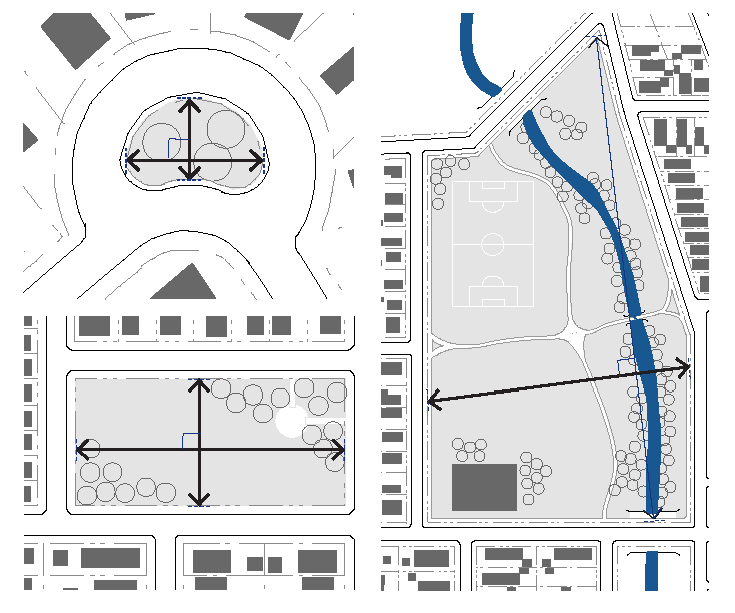
Minimum dimension measurement. The minimum length or width of the civic space, as measured along the longest two straight lines intersecting at a right angle defining the maximum length and width of the lot.
I.
Fully enclosed structures. Fully enclosed structures include such uses as small cafes, kiosks, community centers, and restrooms. They are only permitted in certain civic space types. Open-air structures, such as gazebos, are permitted in all civic space types.
J.
Stormwater management facilities must be designed by a registered landscape architect as formal or natural amenities, and may not be fenced or enclosed by walls over 30 inches in height.
K.
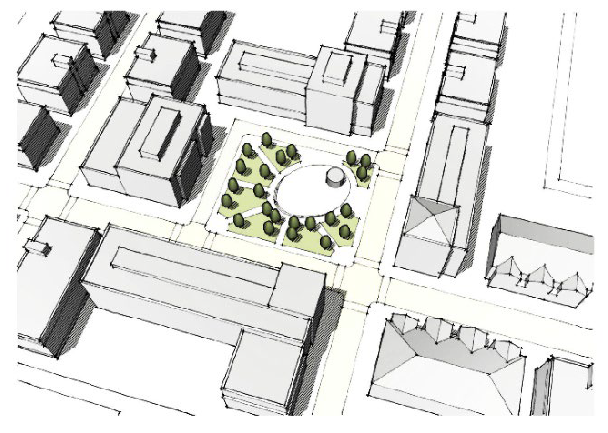
Plaza. The intent of the plaza is to provide a formal civic space type of medium scale to serve as a gathering place for civic, social, and commercial purposes. Special features, such as fountains, playgrounds, and public art installations, are encouraged.
L.
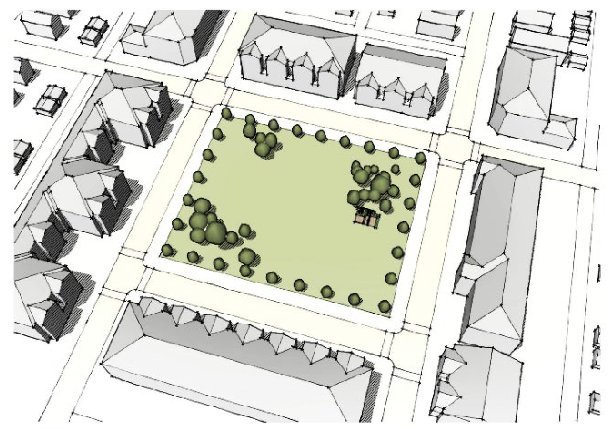
Green. The intent of the green is to provide informal, medium scale active or passive recreation for building occupants and visitors within walking distance, mainly fronted by streets.
M.
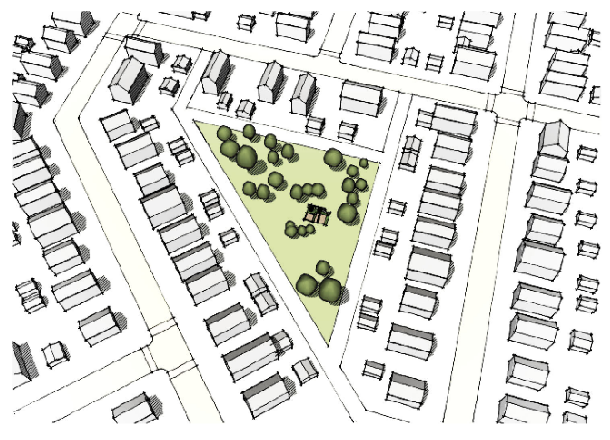
Commons. The intent of the commons is to provide an informal, small to medium scale space for active or passive recreation for a limited area. Commons are typically internal to a block and tend to serve adjacent building occupants.
N.
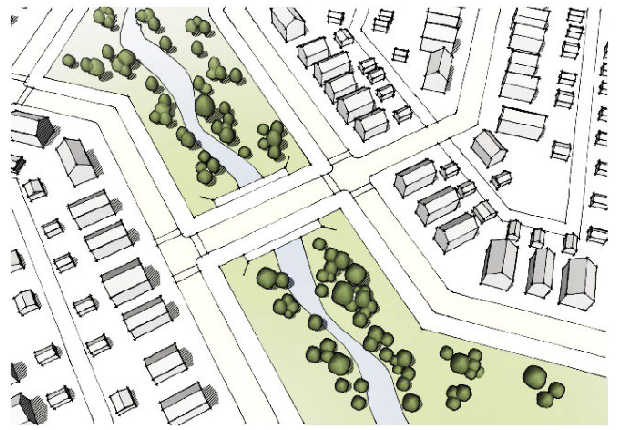
Park. The intent of the park is to provide informal active and passive large-scale recreational amenities to local residents and the city. Parks have primarily natural plantings and are frequently created around an existing natural feature such as a water body or stands of trees.
(Ord. No. 21-10-228, § 1, 10-5-2021; Ord. No. 23-02-254, § 12, 2-7-2023)
Sec. 5-8. - Required buffers and screens.
A.
Buffers shall be required between any hamlet (HM) or village (VL) district and the rural (RL) district, and where a hamlet (HM), or village (VL) district abuts a thoroughfare, except as specified in subsection (F) below. The intent of the buffers shall be to preserve rural views from thoroughfares and adjacent properties as part of the preservation of rural character in the city.
B.
Adjacent to scenic roads as designated on the city's official scenic road map, buffers shall consist of a wooded area consisting of existing or newly planted trees. Adjacent to non-scenic roads, buffers may be wooded, open, or agricultural areas. Buffers shall not include any buildings or pavement, except as specified in subsection (F).
C.
Where non-wooded buffers are provided, a screen shall be required. This screen shall consist of native trees and native plants at a density sufficient to provide an effective year-round visual screen such that buildings and parking are not visible from the adjacent thoroughfare or adjacent district.
D.
Other standards.
1.
The parking of vehicles and the placement of structures is not allowed in any required buffer.
2.
No grading shall occur within any buffer. No retaining walls shall be constructed within any buffer.
3.
Fences and walls shall be allowed in buffers subject to the requirements of section 5-11 but may not be used to satisfy the visual screening requirement.
4.
Buildings shall be set back at least ten feet from all required buffers.
E.
Required buffers shall have the minimum depths listed in the following table. Where there are conflicting requirements, the greater requirement shall apply.
F.
Exceptions.
1.
No buffer is required in any rural (RL) or historic crossroads (HC) district, except as specified section 11-5 for farmette subdivisions.
2.
Thoroughfares and utility crossings may cross and interrupt buffers where approved by the zoning administrator. Such crossings must be designed to minimize the impact on the visual effectiveness of the buffer.
3.
Signs which conform to the requirements of article VIII may be located in buffers.
4.
Where existing topography is adequate to provide an effective visual buffer, the zoning administrator may reduce the requirements of this section.
5.
Where adjacent property owners agree to the reduction of the buffer, in written recordable form acceptable to the city attorney, the zoning administrator may reduce the requirements of this section.
6.
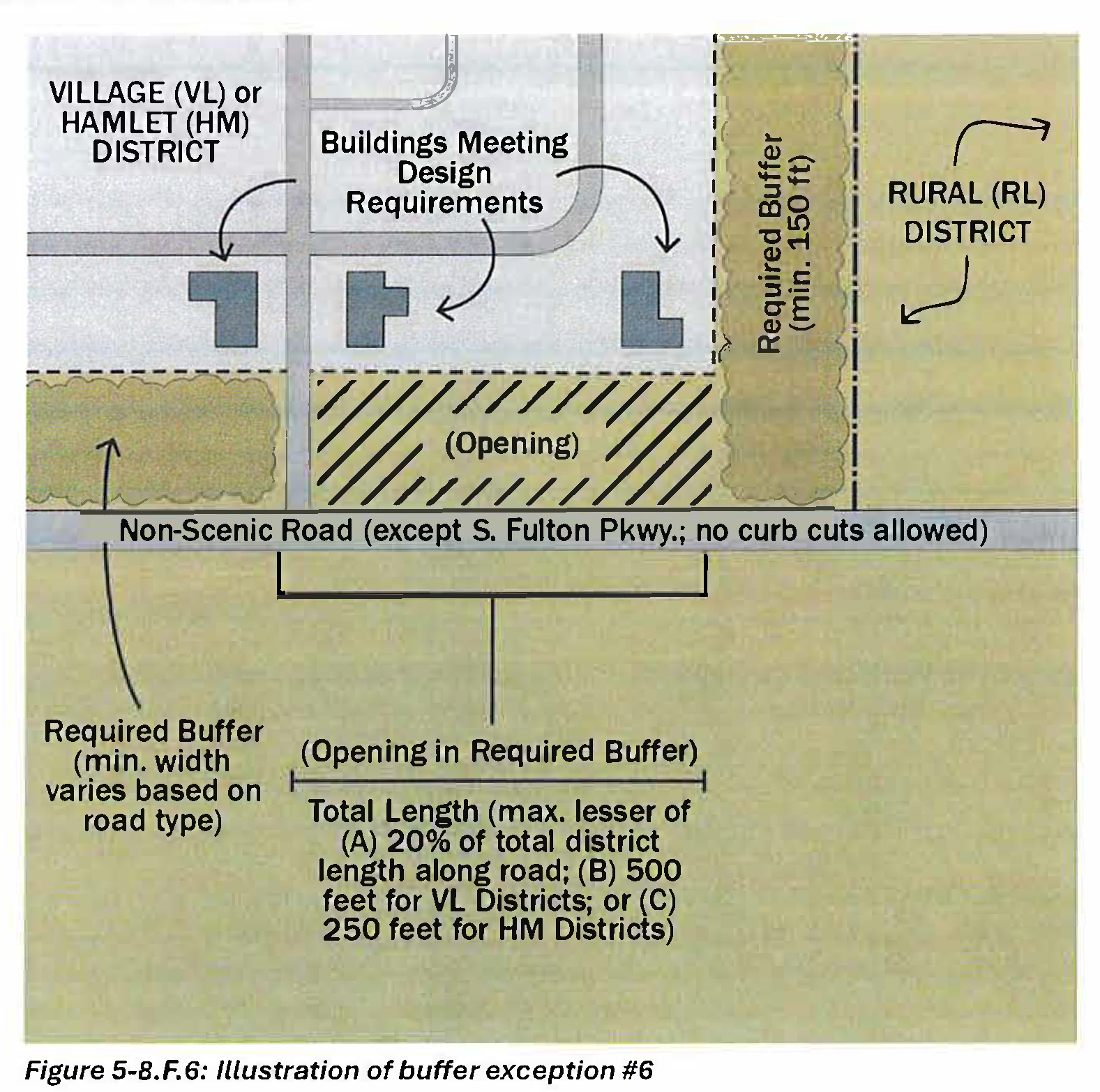
Along existing non-Scenic roads and excluding South Fulton Parkway, openings within the buffer are allowed for up to 20 percent of the total length that a district fronts an individual thoroughfare, but not to exceed 500 feet per thoroughfare for any village (VL) district or 250 feet per thoroughfare for any hamlet (HM) district. This opening may be open land, rather than wooded, and may contain agricultural uses, but may not include any structures or pavement. Any buildings visible from a thoroughfare through such an opening must be designed consistently with an architectural style found within 250 miles of the site between the years of 1800 and 1935.
7.
Along existing non-scenic roads, excluding South Fulton Parkway, the city council may approve alternative buffer standards when:
a.
The city council finds, at its sole discretion, that such alternative standards are either: i) in keeping with the comprehensive plan, or ii) otherwise in the interest of the public health, safety, and general welfare; and
b.
The alternative standards do not apply within 150 feet of any adjacent RL district; and
c.
Any buildings on any thoroughfare in such an area must be designed consistently with an architectural style found within 250 miles of the site between the years 1800 and 1935.
8.
Agricultural uses in a VL or HM district may be visible from an adjacent property or thoroughfare. Farmhouses directly associated with these visible agricultural uses also may be visible as long as no more than one residential lot is visible per 20 acres of visible agricultural uses. All other VL and HM uses must be fully screened from view by vegetation or topography unless another exception in this section applies.
G.
Measurement. Buffers shall be measured as a linear depth from the edge of the property boundary or zoning district boundary.
(Ord. No. 21-10-228, § 1, 10-5-2021; Ord. No. 22-03-234, § 2, 3-1-2022; Ord. No. 23-02-254, § 13, 2-7-2023; Ord. No. 25-08-287, § 3, 8-5-2025)
Sec. 5-9. - Greenway trail connections.
Chattahoochee Hill Country Regional Greenway Trail. Within hamlet (HM) and village (VL) districts, at the time of application for a land disturbance permit or building permit, development projects with frontage adjacent to the roads identified on the Chattahoochee Hill Country Regional Greenway Trail Master Plan shall incorporate a multi-use path subject to the approval of the zoning administrator. Such path shall conform to the entry and exit points of the development as designated in the master plan map or as approved by the zoning administrator, but the detail of the alignment within the development may be amended to suit the needs of the development, provided that in no case shall more than ten percent of the path alignment consist of shared vehicular lanes or bicycle lanes without a physical barrier to separate them from vehicular traffic.
(Ord. No. 21-10-228, § 1, 10-5-2021)
Sec. 5-10. - Landscape standards.
The landscape standards in this article shall apply in all historic crossroads (HC) districts and in developable areas of all hamlet (HM) and village (VL) districts. See section 5-13F.4 for parking lot landscaping requirements.
A.
Landscape design standards.
1.
All landscape plans must be prepared by a registered landscape architect.
2.
Native or edible plants are preferred. Invasive species shall be prohibited.
3.
The spacing and placement of plants shall be adequate and appropriate for the typical size, shape, and habit of the plant species at maturity.
4.
Proposed trees and understory trees shall be centered horizontally; and minimally:
a.
Two feet from walkways, curbing, and other impervious pavements when planted in a tree well or continuous planter;
b.
Three feet from walkways, curbing and other impervious pavements when planted in a continuous swale;
c.
Five feet from thoroughfare lights, underground utilities, utility meters and service lines, fences, walls, and other ground level obstructions;
d.
Six feet from porch eaves, and awnings and similar overhead obstructions associated with the ground level of buildings;
e.
Eight feet from balconies, verandas, building eaves and cornices, and similar overhead obstructions associated with the upper stories of buildings.
5.
All proposed trees shall be a minimum of two inches in caliper.
6.
Proposed shrubs shall be of a five-gallon container minimum. Shrubs shall be 18 inches to 24 inches minimum clear from any sidewalk or pavement edge at the lot line.
7.
Bare and exposed ground and/or in landscaped areas shall be covered with live plant materials and/or mulch, with the following exceptions:
a.
Naturally occurring, creek beds, rock outcroppings or similar landscape features typically lacking in vegetation.
b.
Agricultural fields seasonally tilled for cultivation.
c.
Hiking trails and/or traces.
d.
Clay or sand surfaces associated with recreation fields and facilities.
8.
Porous paving materials should be used to improve stormwater infiltration on site.
9.
Artificial plants or artificial turf are prohibited except for the following applications:
a.
Rear yards of single-family residential lots; and
b.
Active recreation fields that are subject to intense use and soil compaction, and where paving or grass paving systems will not suffice given the area's purpose and level of use.
10.
Where non-native species or other plantings require regular watering, they shall be irrigated by an automatic underground irrigation system. Wherever possible, bubbler, drip, and soaker hose systems shall be utilized.
11.
The size and limits of existing vegetation shall be indicated on the landscape plan.
12.
The property owner shall be responsible for maintaining all required landscaping, including replacing any dead or diseased plantings or trees.
B.
Landscape construction standards.
1.
All plant materials shall meet with the minimum container size, class and other requirements outlined in American Standard for Nursery Stock (ANSI Z60.1-2004) published by the American Nursery and Landscape Association (ANLA).
2.
Open spaces shall remain fenced and protected with a temporary construction/silt fence during all adjacent thoroughfare and site work and construction activities unless alterations to them are otherwise specified by the plans.
3.
The soil structure of planting strips shall be protected from compaction with a temporary construction fence. Standards of access, excavation, movement, storage, and backfilling of soils in relation to the construction and maintenance of deep utilities and manholes shall be specified.
4.
The topsoil within the construction area's limits of disturbance shall be removed, stored, and amended with organic soil additives as recommended by a landscape soils test prior to being redistributed.
5.
Wind erosion shall be mitigated and controlled though dust abatement and similar practices during the period of site work and construction.
6.
All landscape soils that have been compacted during construction activities shall be loosened, aerated, and reconditioned to a depth of at least six inches before planting to provide an arable topsoil layer that can support the long-term health and vitality of landscaping.
7.
Plants shall have normal, well-developed branches and vigorous root systems.
8.
Temporary spray irrigation systems may be used to establish seeded areas for grass and groundcover.
9.
Existing trees and vegetation should be preserved when possible. Such preservation may be used to fulfill the landscape requirements.
10.
During construction, the root zones of existing trees and vegetation to be preserved shall be enclosed by a temporary protective fence and protected from clearing or construction activities.
C.
Landscape maintenance.
1.
Native ground covers that do not require irrigation or fertilization are preferred.
2.
No disturbed ground shall be left exposed. Turfgrass and other approved and appropriate groundcovers or mulch shall cover all non-paved and non-built developed areas.
3.
It shall be the responsibility of the property owner or his assigned agent to:
a.
Maintain and keep all screening and fencing in good condition at all times;
b.
Maintain landscaping by keeping turfgrass lawns properly mowed and edged, plants properly pruned and disease-free, and planting beds mulched, groomed, and weeded, except in rural (RL) districts or required open spaces, and other areas of naturally occurring vegetation and undergrowth; and
c.
Replace any required plantings that are significantly damaged, missing, infested, disease-ridden, or dead, within one year or the next planting season, whichever occurs first, except in rural (RL) districts, required open spaces, and areas of naturally occurring vegetation and undergrowth.
(Ord. No. 21-10-228, § 1, 10-5-2021)
Sec. 5-11. - Fences and walls.
A.
This section shall regulate permanent fences and walls. See outdoor dining supplemental use provisions in section 7-4BB for regulations pertaining to fences and walls for outdoor dining when located within sidewalks. The requirements of this section shall not apply to temporary fences and walls associated with permitted land disturbance or building activities, or temporary tree protection in accordance with chapter 14, article IX.
B.
Fences and walls which conform to the provisions stated herein shall be permitted by the city's community development department. Fences erected for agricultural uses shall be exempt from permit requirements.
C.
Heights of fences, walls, hedges, and other continuous foliage shall be measured from the adjacent top of the thoroughfare curb, surface of an alley, or the official established grade thereof, whichever is higher. Along interior lot lines, the measurement shall be from the average grade of the lot line of the parcel on which the fence is located.
D.
Fences, walls, and vegetative materials must not obstruct the sight visibility triangle. (see section 12-1E)
E.
The zoning administrator may permit retaining wall heights in excess of the requirements of this section where existing topography so requires.
F.
Vehicle gates.
1.
No part of a vehicle gate shall be located within 20 feet of a public right-of-way, nor shall any gate obstruct a public right-of-way, required open space, or sight visibility triangle.
2.
Vehicle gates shall be further limited according to subsection (O) below and section 12-5E.
G.
Fences and walls shall be located a minimum of three feet from any public right-of-way.
H.
The use of broken glass, projecting nails, concertina or razor wire, spikes or similar materials on fences and walls shall be prohibited.
I.
Barbed wire may only be used when associated with agricultural uses and shall be prohibited from use for any single-family uses.
J.
Walls and fences shall be limited to brick, wire, wood (or synthetic materials designed to have the appearance of natural wood) or stone materials.
K.
Fences and walls constructed along all property lines shall be constructed with a finished side toward any adjacent property.
L.
Street screens used for screening parking areas shall be located co-planar with the building facade line.
M.
Permanent fences and walls are prohibited directly beneath cantilevered portions of buildings.
N.
Fences are prohibited in the first layer and between any building facade and an adjacent open space except as follows:
1.
Within the rural (RL) district;
2.
Within any required open space;
3.
Surrounding outdoor dining; and
4.
For any residential or agricultural use.
O.
Only poles and beams shall be permitted to be located above the top of fences and walls and in excess of the established height limits of this section. Such vertical structures shall be:
1.
A maximum width and depth of one foot by one foot;
2.
Located a minimum distance of six feet from any other such vertical structure; and
3.
Permitted to have a canopy affixed. See section 6-2D.
P.
No fence or wall shall exceed four feet in height in any required buffer or the first layer, or eight feet in height in any second or third layer, except that fences made of transparent deer netting or similar materials are allowed up to 12 feet in height only when associated with agricultural uses.
Q.
Fence and wall materials and design shall be as set forth in the following table.
P = Permitted (allowed)
X = Not permitted
L = Permitted (allowed) only in second or third layers
R = Permitted (allowed) only for public recreational uses
(Ord. No. 21-10-228, § 1, 10-5-2021; Ord. No. 25-08-287, § 8, 8-5-2025)
Sec. 5-12. - Traffic impact study.
A traffic impact study shall be submitted for any development that exceeds 50 percent of the thresholds for developments of regional impact in metropolitan regions as established by the Atlanta Regional Commission.
(Ord. No. 21-10-228, § 1, 10-5-2021)
Sec. 5-13. - Vehicular parking.
A.
No vehicular parking area, including those used for vehicular sales, leasing, or storage, shall be located between any building and an adjacent thoroughfare without an intervening building.
B.
Within the rural (RL) district, up to two vehicles may be parked between a building and a thoroughfare where the building is within 200 feet of the thoroughfare. There shall be no limitation on the number of parked vehicles in the rural (RL) district where those vehicles are located more than 200 feet from a thoroughfare, unless otherwise prohibited by subsection (E).
C.
Remote parking. Any parking spaces reserved for the exclusive use of a use on another lot shall be counted toward the maximum parking for that use.
D.
Off-street parking requirements shall be as set forth in the following table.
E.
Limitation on trucks and specialty equipment.
1.
Trucks and/or trailers exceeding four tons empty weight shall not be stored or parked outdoors, with the following exceptions:
a.
Trucks used in farming the property on which they are located.
b.
Trucks used in conjunction with a permitted use.
c.
Trucks engaged in moving household goods or making deliveries.
d.
A single tractor trailer may be parked on a lot if the owner and driver reside at the address, and it is parked on the buildable area of the lot, in the side or rear yard, at least 200 feet from the footprint of any dwelling on another lot (as measured in a straight line).
2.
Earth moving equipment, tractors, or other heavy construction vehicles shall not be stored or parked outdoors, with the following exceptions:
a.
During construction under an active building permit and/or land disturbance permit.
b.
Equipment used in farming the property on which they are located.
3.
Recreational vehicles, campers, buses (including school buses), trailers, boats, and boat trailers may be parked or stored only under the following conditions:
a.
That such vehicles are not used as living quarters.
b.
That the location of the parking or storage area shall be in the buildable area of the lot.
F.
Specific to developable areas.
1.
General.
a.
Off-street parking or loading area shall not be used for the repair, or dismantling of any vehicle or equipment, or for storage of materials or supplies, except when located within an enclosed garage.
b.
No surface parking area shall be larger than one and one-half acres unless separated by a thoroughfare, lane, alley, or building.
c.
Porous paving materials are encouraged in order to increase stormwater infiltration on site.
2.
Parking decks and structures.
a.
Parking decks adjacent to a thoroughfare shall be continuously lined for their entire width and height by occupiable space with a depth of at least 30 feet. Occupiable space shall not include parking, storage, mechanical areas, or digital equipment.
b.
Parking decks shall be constructed to conceal vehicles.
c.
Parking decks shall have the appearance of a horizontally storied building from any adjacent thoroughfare.
d.
Parking decks shall include architectural detailing and finish compatible with surrounding buildings.
3.
Site design.
a.
Off-street parking spaces shall be located with sufficient room for safe and convenient parking without infringing on any public thoroughfare, open space, or sidewalk.
b.
Parking areas on adjoining lots may share curb cuts, driveways, and parking spaces subject to a recorded covenant running with the property on which the facilities are located.
c.
All parking lots and parking decks shall provide pedestrian walkways to connect parking spaces to adjacent sidewalks, open spaces, and building entrances. These walkways shall be five feet wide in parking lots or decks with fewer than 120 spaces, and eight feet wide in parking lots and decks with 120 or more spaces. Walkway pavements shall be differentiated from parking area pavement with a change in surface texture, material, style, and/or color.
d.
On lots where the principal use is a parking lot, passenger car rental uses, or motor vehicle sales use, no more than 40 percent of the total area used for parking lots shall be impervious pavement.
4.
Landscaping and screening.
a.
When surface parking abuts a thoroughfare right-of-way:
i.
A street screen shall screen the parking area, at a minimum height of two feet and a maximum height of three feet; or
ii.
A minimum four-foot-wide landscape area shall screen the parking area. Within the landscape area, a continuous planting of evergreen shrubs is to be installed at a minimum height of two feet and maintained to a maximum height of four feet.
b.
Parking lots shall provide minimum ten-foot-wide landscape islands at the end of each parking bay. Such islands shall have a minimum of one tree with a planting area a minimum area of 50 square feet and a minimum width of five feet and shall be planted or covered with other landscape materials.
c.
Parking rows with more than five parking spaces shall provide an additional landscape island for every six spaces in the row.
d.
Landscape islands shall be distributed throughout the lot and may incorporate stormwater management using light imprint methods.
e.
Landscape islands may be omitted for solar panel installations or other shading structures of equal or greater coverage.
f.
All required trees shall be minimum two-inch caliper when planted and shall be of a native shade tree variety which shall attain a minimum mature crown spread greater than 15 feet. A pre-approved list of native shade trees is available from the zoning administrator.
5.
Electric vehicle charging stations.
a.
Parking lots or decks shall include two electric vehicle charging stations for each 50 parking spaces or portion thereof.
b.
Where golf cart parking is allowed on the street, a GFCI outlet shall be installed on the street side of the curb or in the curb in order to eliminate the hazard of extension cords across the sidewalk. The outlet may be controlled by a switch inside the adjacent building.
(Ord. No. 21-10-228, § 1, 10-5-2021)
Sec. 5-14. - Bicycle parking.
A.
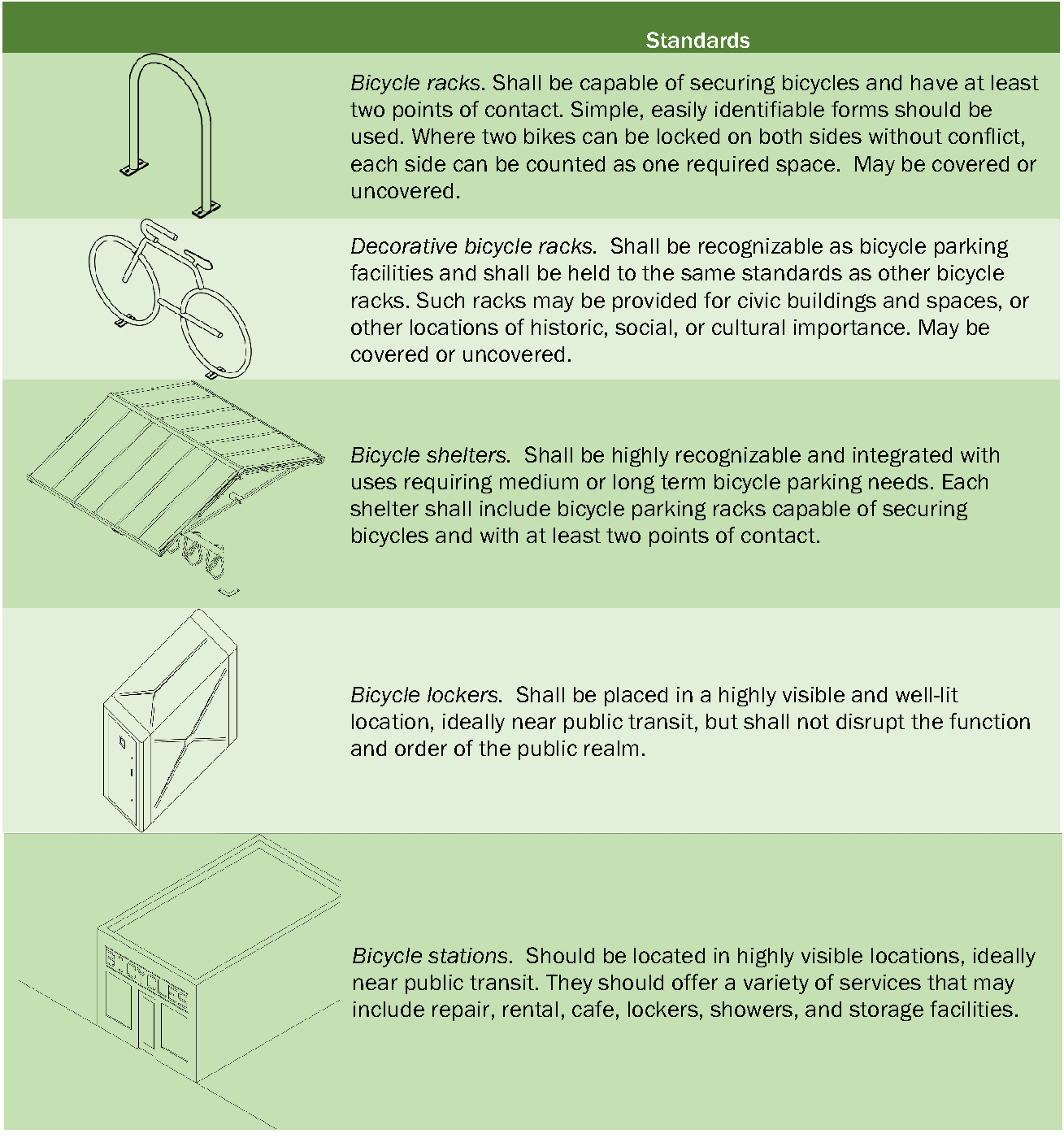
Bicycle parking facilities shall be provided as listed in the following table. Requirements shall be calculated based on gross floor area and shall be calculated separately for separate buildings. Allowed bicycle parking types are shown in subsection B.
B.
Allowed bicycle parking types shall be as shown in the following table.
C.
The zoning administrator may reduce the bicycle parking requirements where the character or use of the building is such as to make unnecessary the full provision of bicycle parking facilities or where such regulations would impose an unreasonable hardship upon the use of the lot.
D.
Bicycle parking may be located on a lot or in a thoroughfare planter and shall be accessible to all building occupants and provided in a safe, accessible, and convenient location in relation to building entrances. Bicycle parking shall provide clear and maneuverable access to a thoroughfare and shall be located at least as close to the building entrance as the closest car parking space serving that building, except for handicapped parking spaces.
E.
When located in a public right-of-way, bicycle parking facilities shall not impede pedestrian use of the sidewalk and shall only be located within a thoroughfare planter a maximum distance of 100 feet from the building entrance the parking is intended to serve. When located in the public right-of-way, bicycle racks shall be of a type specified by the city.
F.
Buildings containing over 10,000 gross square feet of office space shall provide showering facilities, including showers and lockers, available to all tenants and their employees.
G.
At least ten percent of bicycle parking spaces shall be designed to accommodate cargo bikes, long-tail bikes, or bikes with trailers.
(Ord. No. 21-10-228, § 1, 10-5-2021)
Sec. 5-15. - Loading and dumpsters.
A.
Specific to developable areas.
1.
Loading.
a.
Loading areas, service yards, mechanical and electrical equipment, and other utilities, including roof-top equipment, shall be screened with evergreen plant material, opaque fences, or structural screens of materials and design matching the exterior building facades.
b.
Off-street loading and service areas shall be located in the third layer, shall be accessed from alleys where available, and shall be prohibited from facing commercial streets, boulevards, or avenues.
2.
Dumpsters.
a.
Dumpsters shall be placed on concrete pads of sufficient size and strength to support the weight of service vehicles. Restaurants shall place dumpsters on concrete pads that are designed to slope into a drain that is equipped with a grease trap.
b.
Dumpster areas shall be screened to their full height on all sides with evergreen plant material, opaque fences, or structural screens of materials and design matching the building facades.
c.
Dumpsters shall be located in the second or third layer, shall be accessed from alleys where available, and shall be prohibited from facing any thoroughfare without an intervening building.
3.
Residential waste receptacles.
a.
Residential waste receptacles and recycling bins intended to serve detached single-family lots smaller than one-half acres shall either be shared between two adjacent residential lots or located underground.
(Ord. No. 21-10-228, § 1, 10-5-2021)
Sec. 5-16. - Inoperative vehicles.
A.
Any automobile, truck, vehicle or trailer of any kind or type, which is inoperable, are hereby found to create a condition tending to reduce the value of private property, to promote blight and deterioration, and invite plundering and vandalism, to create fire hazards, to constitute a nuisance creating a hazard to the health and safety of minors, to create a harborage for rodents and insects, and to be injurious to the health, safety and general welfare and, when on city thoroughfares, to create a traffic hazard and endanger public safety.
B.
Such inoperable vehicles shall not be parked or stand on any private property or public thoroughfares, with the following limited exceptions.
1.
Such inoperable vehicles shall be permitted when located behind and fully screened from view of any public right-of-way by permissible fences or walls shall be permitted.
2.
A maximum of two such inoperable vehicles shall be permitted on an individual lot when used as rural ornamentation in the rural (RL) district.
C.
This section shall not be the exclusive regulation of abandoned, wrecked, dismantled, or inoperative vehicles or contrivances within the incorporated limits of the city, but shall be supplemental and in addition to the other regulations and regulatory codes, statutes, or provisions of law heretofore and hereinafter enacted by city, county, state, or other legal entity or agency having jurisdiction.
(Ord. No. 21-10-228, § 1, 10-5-2021)
Sec. 5-17. - Outdoor storage.
A.
Outdoor storage is permitted in side and rear yards only and shall be screened so as to prevent visibility from residential uses, thoroughfares, and open spaces.
B.
Outdoor displays for merchandise which is being offered for sale on premises shall be permitted for all uses except for residential and agricultural uses, provided that all associated devices or structures:
1.
Shall not be permanently secured to the ground; and
2.
Shall meet all applicable provisions of this UDC when located within open spaces and sidewalks.
(Ord. No. 21-10-228, § 1, 10-5-2021)
Sec. 5-18. - Cemeteries.
In a parcel with an existing or proposed cemetery, burial ground, human remains or burial objects, there shall be no land disturbing activity or timbering unless approved by the zoning administrator. The person or entity seeking a permit shall also comply with O.C.G.A. § 36-72-4. If a parcel is adjacent to a cemetery, there shall be no land disturbance in that parcel unless approved by the zoning administrator. The following development standards shall be required as a part of the application process for a land disturbance permit or building permit on any parcel with an existing or proposed cemetery or the first 50 feet of area on adjacent parcels:
A.
A report prepared by an archeologist determining the boundary of the cemetery and stating the number of graves believed to be present and their location as can be determined from the use of minimally invasive investigation techniques, including remote sensing methods and the use of metal probes.
B.
A survey of the cemetery prepared by or under the direction of a registered surveyor showing the location of the boundaries of the cemetery or burial ground based on an archeologist's report.
C.
A 25-foot setback shall be provided around the perimeter of the outermost burials, as determined by an archeologist, if a cemetery is located on the parcel of land to be developed. If a cemetery is within 25 feet of the parcel to be developed, a 25-foot setback shall be provided along common property lines on the parcel where the land disturbance permit or building permit is being sought.
D.
A temporary tree protection fence shall be installed on the outer perimeter of the 25-foot undisturbed buffer before any land-disturbing activity occurs. If the cemetery is located on an adjacent parcel, the tree protection fence shall be located along common property lines. The temporary tree protection fence shall remain in place until construction is completed.
E.
A permanent four-foot-high fence or wall with a gate shall be constructed along the perimeter of a cemetery on a parcel for which land-disturbing activity is sought. The location of the fence shall be as determined by an archaeologist. If the cemetery is located on an adjacent parcel, the fence shall be located interior to the required setback or along the common property lines as may be approved by the city arborist. The gate shall have a latch and be four feet wide if the cemetery is inactive or ten feet wide if active.
F.
A maintenance plan for a cemetery located on the parcel for which a land disturbance permit or building permit is sought shall be developed and implemented.
G.
The location of a cemetery, as identified by the surveyor, shall be included on the recorded plat.
H.
A small plaque/marker may be placed on the cemetery grounds.
(Ord. No. 21-10-228, § 1, 10-5-2021)
Sec. 5-19. - Night sky.
A.
Purpose and intent. The purpose and intent of this section is to provide a strategy for outdoor lighting that will permit reasonable uses of outdoor lighting for nighttime safety, utility, security, productivity, enjoyment and commerce; curtail and reverse the degradation of the nighttime visual environment and the night sky; preserve the dark night sky for astronomy; minimize glare, obtrusive light and artificial sky glow by limiting outdoor lighting that is misdirected, excessive or unnecessary; conserve energy and resources to the greatest extent possible; and help to protect the natural environment from the damaging effects of night lighting from manmade sources.
B.
Applicability. For all land uses, developments and buildings that require a permit, all outdoor lighting fixtures shall meet the requirements of this section, including the table in subsection (E). All building additions or modifications of 25 percent or more in terms of additional dwellings, gross floor area, or parking spaces, either with a single addition or with cumulative additions subsequent to the effective date of this provision, shall invoke the requirements of this section for the entire property, including previously installed and any new outdoor lighting. Cumulative modification or replacement of outdoor lighting constituting 60 percent or more of the permitted lumens for the parcel, no matter the actual amount of lighting already on a non-conforming lot, shall constitute a major addition for purposes of this section.
1.
Minor additions. Additions or modifications of less than 25 percent to existing uses, as defined in subsection (B) above, and that require a permit, shall require the submission of a complete inventory and site plan detailing all existing and any proposed new outdoor lighting. Any new lighting on the lot shall meet the requirements of this section with regard to shielding and lamp type.
2.
Exempt lighting. The following luminaries and lighting systems are exempt from these requirements:
a.
Lighting for pools used at night, controlled by timers and with dimmers;
b.
Underwater lighting used for the illumination of swimming pools and fountains, controlled by timers and with dimmers;
c.
Temporary holiday lighting (may be used no more than 60 days per lot per year);
d.
Lighting required and regulated by the Federal Aviation Administration, or other federal, state, or local agency;
e.
Emergency lighting used by police, fire, or medical personnel, or at their direction;
f.
All outdoor light fixtures producing light directly from the combustion of fossil fuels;
g.
Security lighting controlled and activated by a motion sensor device for a duration of five minutes or less.
C.
Prohibited lighting. The following lighting systems are prohibited:
1.
Aerial lasers;
2.
Searchlight style lights;
3.
Other very intense lighting, defined as having a light source exceeding 200,000 lumens or intensity in any direction of 2,000,000 candelas or more, except as used by police, fire, or medical personnel, or at their direction;
4.
Cobra and shoebox-type light fixtures; and
5.
Neon lighting not located in hamlet (HM) or village (VL) districts and not on commercial street, avenue, or boulevard thoroughfare types;
D.
Outdoor lighting standards. All nonexempt outdoor lighting fixtures shall meet the following criteria:
1.
Shall be full cutoff placed so as to allow no light above the horizontal as measured at the luminaire, except as herein noted in this section (as in the case of period fixtures, cutoff fixtures may be used).
2.
Shall be located, aimed, or shielded so as to minimize glare and stray light trespassing across property boundaries and into the public right-of-way.
3.
Light spill. Lighting levels at property lines shall be a maximum measurement as listed:
a.
Rural (RL) district: 0.5 footcandles.
b.
Hamlet (HM) district: 1.0 footcandle.
c.
Village (VL) district: 2.0 footcandles.
4.
Commercial parking areas.
a.
All lighting fixtures servicing parking lots, except floodlights, shall be cutoff fixtures, directed downward and not toward buildings or other areas.
b.
The minimum illumination level for a parking lot shall be 0.4 footcandles at grade level and the ratio of the average illumination to the minimum illumination shall not exceed 4:1.
c.
Floodlights should be aimed or shielded to minimize uplight.
d.
Light poles used in parking lots shall not exceed 20 feet in height.
5.
In cases of off-street parking lots, shall be located, aimed, or shielded so as to minimize glare and stray light trespassing across property boundaries and into the public right-of-way in accordance with the following standards:
E.
General lighting standards shall be as shown in the following table.
F.
Parking lot lighting standards shall be as shown in the following table.
1.
Flood or spot lamps must be positioned no higher than 45 degrees above straight down (half-way between the vertical and the horizontal) when the source is visible from another residential property or public thoroughfare.
2.
All light fixtures that are required to be shielded shall be installed and maintained in such a manner that the shielding is effective as described herein for fully shielded fixtures.
3.
Mixed-use development lighting must conform to the standards of its respective use.
4.
Illumination levels are measured from any height and orientation of the measuring device at any location along the property line, except the lighting of parking lots shall be measured at grade with the meter sensor held horizontally on the surface.
5.
Street lights. All street light fixtures new, repaired (outside of normal maintenance) or replaced fixtures shall be full cutoff.
G.
Special uses. All lighting not directly associated with the special use areas designated below shall conform to the general lighting standards described above.
1.
Outdoor sports, recreation fields, or performance areas. Lighting of outdoor recreational facilities (public or private), such as, but not limited to, outdoor athletic fields, courts, tracks, special event or show areas shall meet the following requirements:
a.
Facilities designed for municipal leagues, elementary to high school levels of play and training fields for recreational or social levels of play, college play, semi-professional, professional or national levels of play shall utilize luminaries with minimal uplight consistent with the illumination constraints of the design. Where fully shielded fixtures are not utilized, acceptable luminaries shall include those which:
i.
Are provided with internal and/or external glare control louvers or lenses, and are installed so as to minimize uplight and light trespass and glare; and
ii.
Are installed and maintained so as to avoid aiming no more than two and one-half times the mounting height.
b.
Illuminance. All lighting installations shall be designed to achieve the illuminance levels for the activity as recommended by the Illuminating Engineering Society of North America (IESNA RP-6).
c.
Light spill. The installation shall also limit the spill of light off the parcel containing the sports facility to the maximum extent possible consistent with the illumination constraints of the design. For all recreational or social levels of play and training fields, as well as, performance areas, illumination levels shall not exceed one-half footcandles at any location along any property line of a residential or agricultural use, and one and one-half footcandles at any other location along any property line of any other use.
d.
Curfew. All events shall be scheduled so as to complete all activity no later than 10:30 p.m. Illumination of the playing field, court or track shall be permitted after the curfew only to conclude a scheduled event that was unable to conclude before the curfew due to unusual circumstances. Field lighting for these facilities shall be turned off within 30 minutes after the last event of the night.
e.
Setback. All light poles shall be set back the greater of 50 feet or one foot for every foot in height from any residential property line or right-of-way.
2.
Service station canopies and parking structures.
a.
All luminaries mounted on or recessed into the lower surface of service station canopies and parking structures shall be fully shielded and utilize flat lenses.
b.
The total light output of luminaries mounted on the lower surface, or recessed into the lower surface of the canopy, and any lighting within signage or illuminated panels over the pumps, shall not exceed 50 footcandles.
c.
The total light output of illuminated areas of a service station other than as detailed in subsection (b), above, shall not exceed 15 footcandles.
d.
Illuminance levels for the interior of parking structures, where interior lighting is visible from outside the structure, shall conform to the IESNA recommendation (RP-20).
e.
Lights shall not be mounted on the top or sides of a canopy and the sides of a canopy shall not be illuminated.
3.
Security lighting.
a.
Security lighting shall be directed toward the targeted area.
b.
Sensor activated lighting must be located in such a manner as to prevent direct glare and lighting into properties of others or into a public right-of-way, and the light shall not be triggered by activity off the property. Such lighting shall be controlled and activated by a motion sensor device for a duration of five minutes or less.
4.
Pedestrian path lighting. Lighting posts shall not exceed a height of 16 feet above finished grade.
5.
Architectural accent lighting.
a.
Fixtures used to accent architectural features, materials, colors, style of buildings, landscaping, or art shall be located, aimed, and shielded so that light is directed only on those features. Such fixtures shall be aimed or shielded to minimize light spill into the dark night sky in conformance with these standards.
b.
Lighting fixtures shall not generate glare or direct light beyond the facade onto a neighboring property, streets or into the night sky.
6.
Temporary lighting permits.
a.
Permits for temporary lighting may be granted by the department of community development if the total output from the luminaries does not exceed 50 footcandles and the following conditions apply:
i.
The purpose for which the lighting is proposed can be completed within 30 days, except that the permit for a major construction project may extend to completion.
ii.
The proposed lighting is designed in such a manner as to minimize light trespass and glare.
iii.
Permits issued for temporary recreational lighting shall expire one hour after the permitted end of the event.
b.
The application for the temporary lighting permit shall include, but not be limited to, the following information:
i.
Name and address of applicant and property owner;
ii.
Location of proposed lighting fixture;
iii.
Date and times for the lighting;
iv.
Type, wattage, and lumen output of lamp;
v.
Type and shielding of proposed luminaries;
vi.
Intended use of the lighting;
vii.
Duration of time for requested exemption;
viii.
The nature of the exemption; and
ix.
The means to minimize light trespass and glare.
H.
Variances. Any person may apply to the city council for a variance from the provisions of this section. The application should include, but not be limited to, evidence about the following. The application may include the recommended practices of the Illuminating Engineering Society of North America, a professional engineer or other authority on outdoor lighting.
1.
How the proposed design and appearance of the lighting fixture are superior;
2.
How light trespass, uplighting and glare will be limited;
3.
How the proposed solution will provide a benefit without negative impact on the health, safety, or welfare of the community.
I.
Submission of plans and evidence of compliance.
1.
Outdoor lighting fixture applicants shall submit evidence that the proposed work will comply with this section. Even when no other permit is required, the installation or modification (except for routine servicing and same-type lamp replacement of any exterior lighting) shall require submission of the information described below. The application shall contain (but shall not be limited to) the following, in addition to any other permit requirements:
a.
Plans indicating the location on the premises of each illuminating device, both proposed and any already existing on the lot.
b.
Description of all illuminating devices, fixtures, lamps, supports, reflectors, both proposed and existing. The description may include, but is not limited to, catalog cuts and illustrations by manufacturers.
c.
Photometric data, such as that furnished by manufacturers or similar, showing the angle of cut off of light emissions.
2.
Additional submission. The above required plans, descriptions, and data shall be sufficiently complete to enable the department to determine compliance with the requirements of this section. If such plans, descriptions, and data cannot enable this determination, the applicant shall additionally submit as evidence of compliance to enable such determination such certified reports of tests as will do so provided that these tests shall have been performed and certified by a recognized testing laboratory.
3.
Subdivision plats. All new subdivided properties shall submit information as described herein for installed street lights and other common or public area outdoor lighting.
4.
Certification. For all projects, certification that the lighting as installed, conforms to the approved plans shall be provided by an illumination engineer/professional before the certificate of occupancy is issued. Until this certification is submitted, approval for use by the issuance of the certificate of occupancy shall not be issued.
(Ord. No. 21-10-228, § 1, 10-5-2021)

