
Chattahoochee Hills
City Zoning Code
City Zoning Code
ARTICLE II
DEFINITIONS
Sec. 2-1.- Generally.
A.
For the purpose of this UDC, certain words and terms used herein shall be defined and interpreted as follows. All other terms not defined shall have their customary dictionary definitions.
B.
The following shall apply to the use of all words in this UDC:
1.
Words used in the present tense shall include the future tense.
2.
Words used in the singular shall include the plural and vice versa.
3.
The words "shall" and "must" are mandatory.
4.
The word "should" implies a preference supportive of the city's interest rather than a requirement.
5.
The word "may" is permissive.
6.
The terms "zoning," "zoning district" and "district" have the same meaning and refer to the zoning districts established by this chapter.
7.
The phrase "used for" shall include the phrases "arranged for," "designed for," "intended for," "maintained for," and "occupied for."
(Ord. No. 21-10-228, § 1, 10-5-2021)
Sec. 2-2. - Abbreviations.
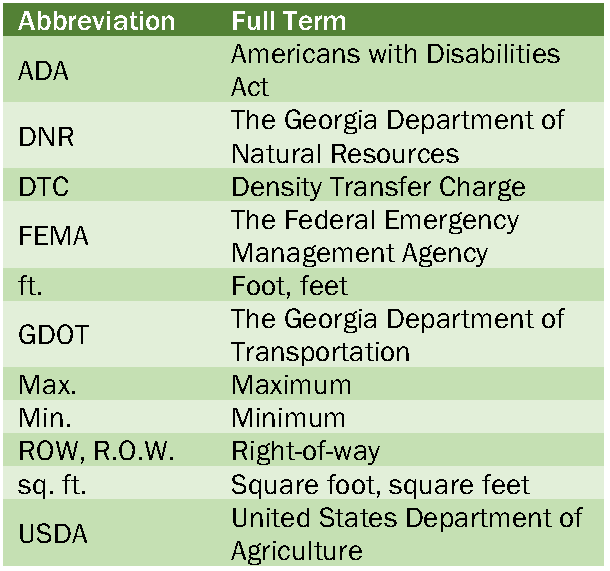
(Ord. No. 21-10-228, § 1, 10-5-2021)
Sec. 2-3. - Definitions.
Access means a way or means of approach to provide physical entrance to a property.
Access easement means an easement devoted to vehicular or pedestrian access which affords a principal means of access to abutting property.
Alley means a strip of land providing vehicular and pedestrian access to the rear of properties which abut and are served by another thoroughfare.
Antenna means any exterior apparatus designed for wireless telecommunication, radio, or television communications through the sending and/or receiving of electromagnetic waves.
Arcade means a private frontage conventional for retail use wherein the facade is a colonnade supporting floor area that overlaps the sidewalk, while the facade remains at the facade setback. An arcade does not encroach in the public right-of-way.
Art mural means an original work of visual art that is tiled, painted directly on, or affixed directly to a wall or building. An art mural may consist of mechanically produced or computer-generated prints or images. An art mural is not a sign.
Base area means the net area of a property from which development rights may be severed and sent.
Basement means a level below a floor of a building with a minimum of one-half of the total wall area below grade. A basement is not a story. The term "basement" is synonymous with "cellar."
Block means an area of land that is entirely surrounded by thoroughfares, public lands, railroad rights-of-way, watercourses, or other well defined and fixed boundaries.
Buildable area means the portion of a parcel of land where a building may be located, and which shall contain enough square footage to meet the requirements of the respective zoning district. That portion which is not located in the setbacks, utility corridors, driveways, slopes to build thoroughfares, tree save areas, landscape strips, specimen tree areas, state water buffers, buffer areas, wetlands, stormwater, and sanitary sewer easements.
Building means any structure with a roof designed or built for the support, enclosure, shelter, or protection of persons, animals, or property of any kind.
Building facade line means a line on a lot running immediately adjacent to and co-planar with a building facade.
Caliper means the diameter of a tree trunk. The term "caliper" is used for trees less than 12 inches in diameter. For trees less than four inches in diameter, it its measured six inches from the ground. For trees between four inches and 12 inches in diameter, it is measured 12 inches from the ground.
Comprehensive plan means the official adopted comprehensive plan of the City of Chattahoochee Hills as well as any thoroughfare plans, parks and recreation plans, or any other study, document, or written recommendation pertaining to subjects within the subject matter of a comprehensive plan as provided by the Georgia Planning Act of 1989, if formally adopted by the city.
Concept plan means a site plan that is general and flexible in nature and that meets the requirements of section 4-6.
Cul-de-sac means a thoroughfare having only one connection to another thoroughfare, and which is terminated by a vehicular turn-around.
Curb cut means a connection between a thoroughfare and a property for vehicular access. curb cut applies to access regardless of the existence of curbing.
Day means a calendar day unless otherwise indicated. When a time period is measured in days, it means a consecutive number of days.
Density transfer charge means an optional mechanism by which a receiving area property owner may increase density on a parcel by paying a standardized fee to the city. The city then uses the money to protect property. The DTC option provides speed and convenience to property owners and allows the city to protect the properties it considers most important.
Density unit means the unit of measurement representing the total amount of residential development permitted for any property.
Design speed means the velocity at which a thoroughfare tends to be driven without the constraints of signage or enforcement. In all situations where pedestrians are regularly present, lower speeds are safer, and preferred.
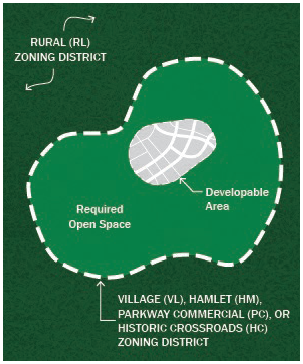
Developable area means all of the area within any hamlet (HM), village (VL), or historic crossroads (HC) zoning district except for the required open space. Developable area includes all required civic spaces.
Development permit means a permit issued by the city authorizing development work on a site, including permits for land disturbance and construction of infrastructure.
Driveway or drive means a vehicular access way that connects off-street parking to a thoroughfare.
Encroach means to break the plane of a vertical or horizontal regulatory limit with a structural element, so that it extends into a setback or above a height limit.
Facade means the building wall fronting a thoroughfare or open space that constitutes any side of a structure or building.
Facade, primary means the building facade representing the "front" of the building, complete with the primary pedestrian entrance, and facing the primary frontage of the lot.
Family means a person living alone, or any of the following groups living together as a single nonprofit housekeeping unit and sharing common living, sleeping, cooking, and eating facilities:
A.
Any number of persons related by blood, marriage, adoption, guardianship, foster or other duly authorized custodial relationship; or
B.
A maximum of six unrelated persons; or
C.
Two unrelated persons and any spouse, parents, or children related to either.
Farmette subdivision means a large-lot residential subdivision of rural land.
Floor area means the sum of all floors of a structure as measured to the outside surfaces of exterior walls or the center of connected or common walls, including common public areas, such as lobbies, rest rooms and hallways, spaces devoted exclusively to permanent mechanical systems, permanent storage areas, stairwells, elevator shafts, but excluding internal parking and loading areas, attics, porches, balconies and other areas outside of the exterior walls of the building.
Frontage means the area comprising both the private frontage and the public frontage of a lot. Private frontage and public frontage are divided by the property line. Lots with frontage on more than one side shall have designated primary frontages and may have secondary frontages. When a lot fronts a thoroughfare, its primary frontage shall be that frontage facing the thoroughfare of higher intensity based on traffic volume, number of lanes, or pedestrian activity, as determined by the zoning administrator.
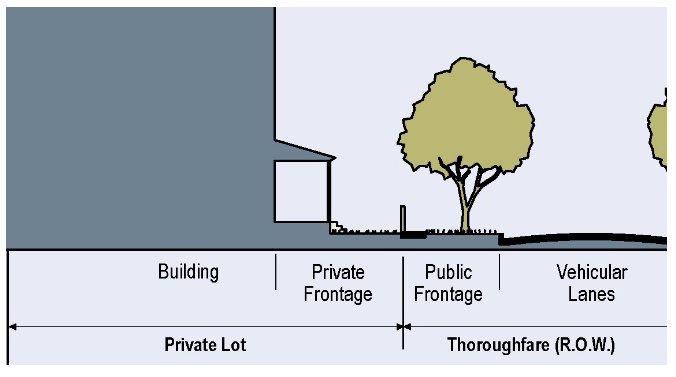
Frontage, private, means the area of a lot located within the first layer and in between the facade and the public frontage.
Frontage, public, means the area in the right-of-way or access easement located adjacent to a lot and its facade including curbs, sidewalks, and landscape strips.
Fueling position means the location next to the pump where a vehicle stops to refuel. A single pump may have a fueling position on both sides.
Full cutoff means a luminaire type that does not allow any light to be emitted or reflected above a horizontal plane.
Future development map means the map entitled future development map and contained within the comprehensive plan.
Geographic antenna placement area means the general vicinity within which the placement of an antenna is necessary to meet the engineering requirements of an applicant's cellular network or other broadcasting need.
Grade means the existing grade or elevation of the ground surface that exists or existed prior to manmade alterations, such as grading, grubbing, filling, or excavating.
Ground level means any building floor within five vertical feet of the adjacent sidewalk.
Height means the vertical distance measured from the finished grade along the primary facade of a structure to the highest point of the coping or parapet of a flat roof or to the average height between eaves and ridge for gable, hip, and gambrel roofs. When referring to an accessory structure or a tower, means the distance measured from ground level to the highest point on the accessory structure or a tower appurtenance.
Impervious means the prohibition or limitation of the drainage of water.
Inoperative vehicle includes, but is not limited to, any automobile, watercraft, vehicle, trailer of any kind or type, or contrivance or part thereof, the condition of which is one or more of the following: Wrecked, dismantled, partially dismantled, inoperative, abandoned, discarded; one which does not have a valid license plate attached thereto; or one which has not moved in a period of 90 days.
Landscape area means the area of a lot exclusive of building footprints, driveway, areas devoted to parking, and walkway pavements devoted to plants, shrubs, trees, and accessory ponds, pools, and water features.
Landscape strip means an area required by this UDC or by conditions of zoning that is reserved for the installation and/or maintenance of plant materials and/or street furniture.
Lane means a vehicular way located to the rear of lots providing access to service areas and parking consisting of gravel or landscaped edges, with no raised curb, and drained by percolation.
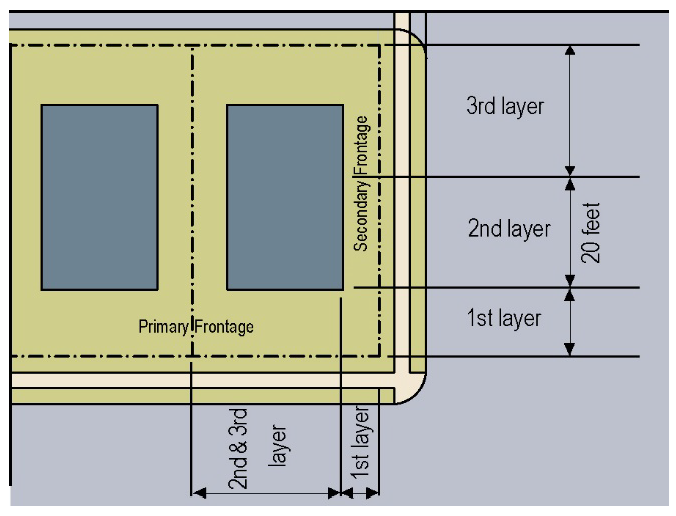
Layers means an area of a lot as shown in the figure below.
A.
On lots less than 20 acres containing single-family detached dwellings, the first layer shall be the area between the primary or secondary facade and the abutting thoroughfare or open space and shall extend from lot line to lot line.
B.
On vacant lots the first layer shall be the area between the required facade setback and the abutting thoroughfare or open space and shall extend from lot line to lot line.
C.
On lots other than identified in (A) or (B) above, the first layer shall be the area between the primary building facade and the abutting thoroughfare or open space and shall extend from lot line to lot line.
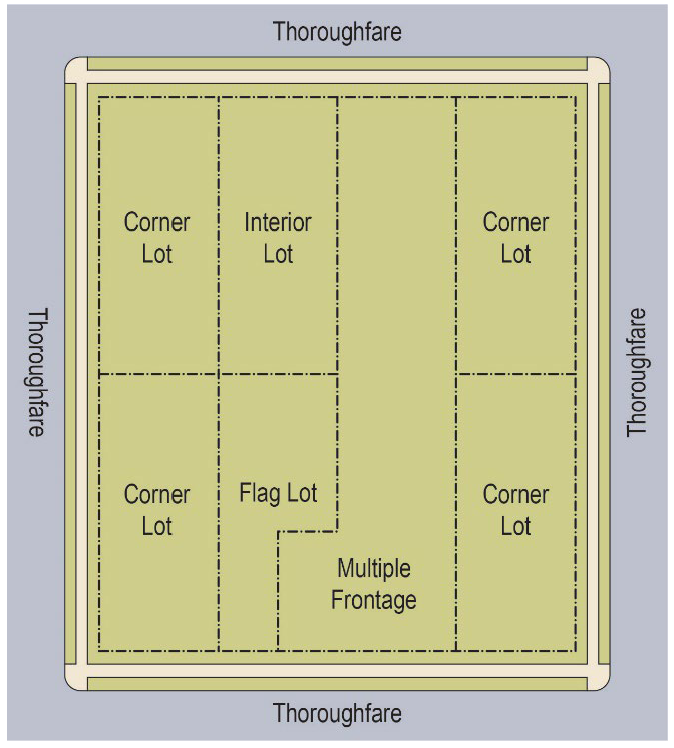
Lot, corner, means a multiple frontage lot adjoining two thoroughfares at their intersection. In situations where a multiple frontage lot has equal distance on thoroughfare frontages, the zoning administrator shall determine the legal lot frontage.
Lot, flag, means a tract or lot of land of uneven dimensions in which the portion fronting on a thoroughfare is less than the minimum width required for construction of a structure on that lot.
Lot frontage means the shortest property line oriented toward a thoroughfare. A property line adjoining a stub thoroughfare shall not be considered as frontage unless it is proposed for access or is the only thoroughfare frontage.
Lot line or property line means a line established through recordation of an approved plat, or a deed in the absence of a platting requirement, which separates a lot from other lots, or a lot from a right-of-way or thoroughfare.
Lot line, front means the lot line along the primary frontage.
Lot line, rear, generally means the lot line opposite and most distant from the front lot line. For a pointed or irregular lot, the rear lot line shall be an imaginary line, parallel to and the most distant from the front lot line, not less than 20 feet long, and wholly within the lot. True triangular lots do not have rear lot lines. The zoning administrator shall make the final determination of rear lot lines when in dispute or undefined by this definition.
Lot line, side, means a lot line which is not a rear or front lot line.
Lot, multiple frontage, means lots adjoining more than one thoroughfare.
Lot of record means lot which is part of a subdivision, a plat of which has been recorded in the records of the county clerk of superior court; or a parcel of land, the deed of which has been recorded in the same office as of the effective date of this UDC.
Massing means the variation of a building achieved by varying the surface planes of the building with porches, balconies, bay windows, and/or overhangs, and/or stepping-back the buildings from the second floor and above, and/or breaking up the roofline with different elements to create smaller compositions.
Mortgage lot means a lot which is created for the primary or sole purpose of meeting the requirement of a bank or lending institution for a loan or mortgage in cases where property descriptions must be smaller than the total acreage of the tract on which the principal building that is the subject of the loan is located.
Nonconforming means those situations defined and governed by section 1-15E.
Nonconforming characteristics means elements of buildings, structures, or uses regulated by this UDC, including, but not limited to, lots, building frontages, outdoor dining, fences, walls, blocks, thoroughfares, thoroughfare connectivity, open space, buffers, parking, dumpsters, loading, curbs, sidewalks, and landscape strips, as they apply to nonconforming situations defined and governed by section 1-15E.
Off-site or off-premises means the location of a structure or use outside of the subject development.
Off-site dwelling means the location of a principal structure with a residential use outside of the subject development.
On-site or on-premises means the location of a structure or use within a subject development.
Parcel. See Lot.
Path means a pedestrian way traversing an open space or rural (RL) district, with landscape matching the contiguous open space, ideally connecting directly with a sidewalk network.
Pavement width means the width of a given lane, thoroughfare, or other thoroughfare pavement, measured from back-of-curb to back-of-curb, or to the edge of pavement where no curbs are required or exist.
Performance bond means a type of subdivision improvement guarantee in the form of a bond, secured by the subdivider from a bonding company, in an amount specified by the zoning administrator to cover the costs of required improvements, and payable to the city. The city may call in the performance bond in the event the subdivider defaults on required improvements.
Performance guarantee means any financial deposit or other security that may be accepted by the city as a guarantee that improvements required as part of an application for subdivision or land development are satisfactorily completed in conformance with approved plans.
Plat, final, means the final drawing of a subdivision and, as applicable, dedication, prepared for filing for record with the county clerk of superior court, and containing all elements and requirements set forth in this UDC.
Plat, preliminary, means a drawing which shows the proposed layout of a subdivision in sufficient detail to clearly indicate its feasibility, but is not in final form for recordation pursuant to section 4-9.
Porch means a roofed open structure projecting from the exterior wall of a building and having at least 70 percent of the total area of the vertical planes forming its perimeter unobstructed in any manner except by insect screening.
Property means, when used in conjunction with zoning proposal applications, an area of land composed of less than one lot, or of accumulations of one or more lots, or parts thereof.
Receiving area means those properties which may receive development rights from a sending area.
Recycling bin means a container to temporarily hold recyclable materials until transferred to a recycling center by a recycling service, and with a holding a capacity of less than 100 gallons.
Right-of-way means a portion of land over which a local or state government has designated a right of use.
Rural ornamentation means any automobile, truck, vehicle or trailer of any kind or type, which is inoperable and without a valid attached license plate, that is unmistakably identifiable as having been operated specifically for purposes of agriculture or agriculture related activities.
Scenic view area is an area with a view of undisturbed natural lands exhibiting a unique or unusual feature that comprises an important or dominant portion of the viewshed. Scenic view areas may also be represented by a particular distant view that provides visual relief from less attractive views of nearby features. Other designated federal and state lands, as well as local open space or recreational areas, may also offer scenic views if they represent a valued aesthetic view within the surrounding landscape.
Screen means a fence, wall, hedge, landscaping, earthen berm, buffer area, or any combination of these that is designed to provide a visual and/or physical barrier.
Sending area means those properties from which development rights may be severed and transferred to a receiving area.
Sensitive natural area means any area, as identified now or hereafter by DNR, which contains one or more of the following: habitat, including nesting sites, occupied by rare or endangered species; rare or exemplary natural communities; significant landforms, hydroforms, or geological features; and/or other areas so designated by DNR that are sensitive or vulnerable to physical or biological alteration.
Setback means a space between a property line and a building or specified structure.
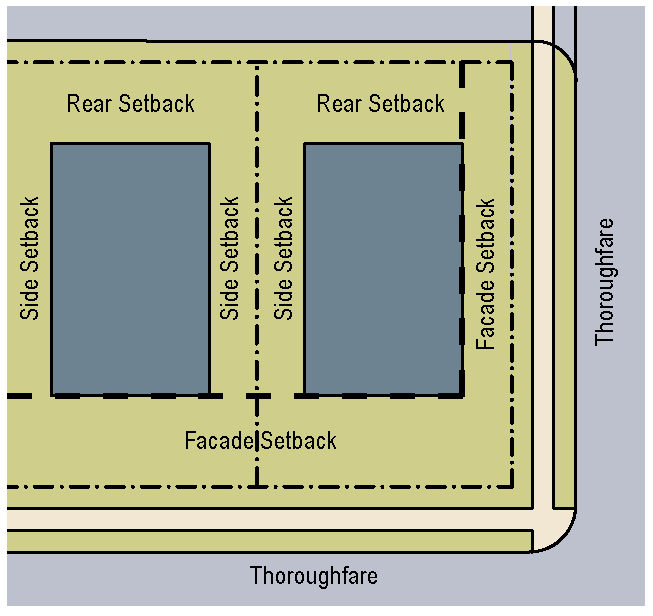
Setback, facade, means the portion of a lot located between any building facade and the thoroughfare or open space it faces. The facade setback area extends the entire length of an abutting thoroughfare or open space from intersecting lot line to intersecting lot line. Facade setback shall be synonymous with required front yard.
Sewage, community, means a decentralized system for the treatment and disposal of sewage for multiple lots owned and operated by a public or private entity such as a general improvement district, sanitation district, homeowners association or municipal government. Sewage systems are governed by the county and higher authorities.
Sewer, sanitary, means a sewer that carries sewage and residential or non-residential waste.
Sewer, storm, means a sewer that carries stormwater, surface water, and groundwater drainage but excludes sewage and residential, and non-residential wastes.
Sewer means an artificial and usually subterranean conduit designed to carry off sewage to a central treatment facility. The term "sewer" includes any pipe, manhole, connection, or other appurtenances thereto, located in a public right-of-way or easement that is designed to transport sewage and/or water.
Shrub means a deciduous or evergreen woody plant with single or multiple trunks or multiple leaders and with a mature height generally not expected to exceed 15 feet.
Sign means any device, fixture, placard, or structure affixed to, supported by, or suspended by a stationary object, building or the ground that uses any color, form, graphic, illumination, symbol, or writing to communicate information of any kind to the public. See article VIII for additional sign provisions.
Site means any lot or group of contiguous lots owned or controlled by the same person or entity, assembled for the purpose of a single development.
Slope means degree of deviation of a surface from the horizontal, usually expressed in percent or degree; the ratio of the difference in elevation between two points on the ground, and the horizontal distance between these two points.
Special permit is the term used in reference to both special administrative permits and special use permits.
Special administrative permit means the mechanism established in section 3-15 for uses that require additional review by the zoning administrator to determine the appropriateness and compatibility of locating within the city.
Special use permit means the mechanism established in section 3-16 for uses that require additional review by the city council to determine the appropriateness and compatibility of locating within the city.
Species, native means a plant occurring within the Piedmont region prior to foreign contact, according to the best scientific and historical documentation. This includes species that are considered indigenous, occurring in natural associations with habitats that existed prior to significant anthropogenic impacts and alteration to the landscape.
Specified anatomical areas means less than completely and opaquely covered human genitals, pubic regions, buttocks, or female breasts below a point immediately above the top of the areola; and human male genitals in a discernibly turgid state, even if completely and opaquely covered.
Specified sexual activities means human genitals in a state of sexual stimulation or arousal; acts of human masturbation, oral copulation, sexual intercourse or sodomy; fondling or other erotic touching of human genitals, pubic regions, buttocks or female breasts; excretory functions as a part of or in connection with any of these activities.
Story means a portion of a building between the surface of any floor and the floor or space above it, excluding basements and attics.
Street screen means a wing wall extension of a building facade utilized to screen parking or loading areas located on private property, matching the material and design of the adjacent adjoining building, and not located within an open space or sidewalk.
Structural soil means a load-bearing soil that resists compaction to allow for healthier tree root growth. Angular gravel within the soil mix allows air and water to permeate while supporting pavement loads.
Structure means anything built or constructed which occupies a location on, or is attached to, the ground. Driveways, surface parking lots, patios, and similar paved surfaces are not considered structures.
Structure, accessory, means a subordinate structure, customarily incidental to a principal structure or use and located on the same lot. Examples of structures in single-family dwelling districts include out-buildings, such as, tool sheds, woodsheds, workshops, outdoor kitchens, pool houses, gazebos, guest houses, storage sheds, detached garages, and detached carports, etc. Fences and retaining walls are not considered structures. Driveways, surface parking lots, patios, and similar paved surfaces are not considered structures.
Structure, principal, means a structure in which the principal use or purpose on a property occurs, and to which all other structures on the property are subordinate. Principal shall be synonymous with main and primary.
Structure, support, means any structure that is designed and constructed primarily for the purpose of supporting one or more antennas, including self-supporting lattice support structures, guy support structures, or monopole support structures. The term "support structure" includes radio and television transmission support structures, microwave support structures, common-carrier support structures, cellular telecommunication support structures, artificial trees, and other similar structures.
Subdivider means any person who undertakes the subdivision of land, and any person having such a proprietary interest in land to be subdivided under this UDC, or the authorized agent of such person.
Subdivision means:
A.
A division of a tract or parcel of land into two or more lots, building sites, or other divisions for the purpose of sale or building development, whether immediate or future, including all division of land involving the dedication of a new thoroughfare or a change in existing thoroughfares. The term "subdivision" includes resubdivision and, when appropriate to the context, relates either to the process of subdividing or to the actual land or area which is subdivided.
B.
A development consisting of subdivided lots.
Subdivision, major, means subdivision of land that does not qualify for the minor subdivision process. Major subdivisions may involve the construction of a new public or private thoroughfare or the upgrade of an existing private access way to city standards. Major subdivisions are processed in multiple steps including concept plan approval, preliminary plat approval (unless specifically exempted), approval of construction plans and issuance of development permits, and final plat approval.
Subdivision, minor, means a subdivision of five or fewer lots that is processed administratively by the zoning administrator as a final plat application that does not require preliminary plat approval.
Swale means a low or slightly depressed natural area for drainage.
Thoroughfare means public or private vehicular and/or pedestrian ways. The boundaries of the thoroughfare are defined by the property lines of the right-of-way or access easement, not by the thoroughfare improvements. The following types of vehicular ways shall constitute thoroughfares:
A.
Existing federal, state, county, or municipal thoroughfares;
B.
Those constructed as shown upon a plat approved pursuant to law and open to vehicle travel;
C.
Those constructed and open to vehicle travel as approved by other official action of the city council; or
D.
Those constructed and open to vehicle travel and shown on a plat duly filed and recorded in the office of the county clerk of superior court prior to the effective date of this UDC.
Thoroughfare, marginal access, means a residential thoroughfare parallel and adjacent to a major thoroughfare and which provides access to abutting properties with protection from through-traffic.
Thoroughfare, private, means a thoroughfare that has not been accepted for maintenance by the city and that is not owned and maintained by a state, county, city, or another public entity.
Thoroughfare, public, means a thoroughfare that is owned and maintained by a state, county, city, or another public entity.
Thoroughfare, stub-out, means a thoroughfare having one end open to traffic and being temporarily terminated at the other. This temporary termination is to provide connectivity to future developments.
Trail means a way designed for and used by equestrians, pedestrians, and/or cyclists using non-motorized bicycles.
Transferable development right (TDR) means a development right that has been severed from a sending area property according to the rules in this UDC. TDRs can be bought, sold, or exchanged; they can be held for conservation or investment purposes. When they are applied to a receiving area property they can increase the number of density units available to that property, up to the maximum density allowed by zoning.
Tree means any self-supporting, woody perennial plant usually having a single trunk diameter of three inches or more which normally attains a mature height of a minimum of 15 feet.
Tree, shade, means a deciduous tree planted primarily for its overhead canopy and the quality of the shade it provides.
Tree, specimen, means a particularly impressive or unusual example of a species due to its size, shade, age, or any other trait that epitomizes the character of the species as further defined in Ch. 14, Art. 9, Tree Preservation.
Tree, street, means a planted tree that is an element of a thoroughfare assembly.
Tree, understory, means a small to medium size tree with an expected mature height less than 30 feet and a canopy which may or may not offer a sufficient clearance height for pedestrians beneath.
Turfgrass means a continuous plant coverage consisting of a single grass species that is regularly mowed to maintain a desired height.
Use means the purpose or function arranged or intended for a structure or property.
Utility means public or private water or sewer piping systems, water or sewer pumping stations, electric power lines, fuel or gas pipelines, telephone lines, thoroughfares, cable telephone line, fiber optic cable, driveways, bridges, river/lake access facilities, stormwater systems and drainage ways, and railroads or other utilities identified by the city. As appropriate to the context, the term "utility" may also include all persons, companies, or governmental agencies supplying the same.
Variance means the mechanism established in section 3-17 for seeking relief from the terms of this UDC.
Vicinity map means a map, not necessarily to scale, showing the general location of the proposed subdivision or land development in relation to major thoroughfares, government boundaries, and/or natural features.
Viewshed is an area that can be seen from a given vantage point and viewing direction. A viewshed is composed of foreground items (items closer to the viewer) that are seen in detail and background items (items at some distance from the viewer) that frame the view.
Walkways means "sidewalk" when used within the public frontage.
Yard means an open, unoccupied land area extending between a structure and a lot line extending along the entire width or length of the lot. In addition to uses which may be provided for, conditioned, or excluded from yards by other provisions of this UDC, yards may be used for driveways, signs, fountains, flagpoles, yard ornaments, walls, fences, walkways, buffers, landscaping and trees, underground utilities, and stormwater management facilities. No part of any yard or use made thereof shall serve the requirements for any other lot or structure.
Yard, front means an open area of a lot situated between the front lot line and any principal or accessory structure extending the full width of the lot.
Yard, required front. See setback, façade.
Yard, rear means an open area between the rear lot line and any principal structure extending the full width of the lot. True triangular lots do not have rear yards. Lots with more than one front lot line do not have rear yards. The zoning administrator shall make the final determination of rear yards when in dispute or undefined by this definition.
Yard, side means an open area between a structure and any lot line adjacent to another parcel, extending from the front yard to the rear yard, which does not otherwise meet the definition of rear yard.
Zoning administrator means the city manager or their designee.
(Ord. No. 21-10-228, § 1, 10-5-2021; Ord. No. 23-02-254, § 1, 2-7-2023; Ord. No. 25-08-287, § 4, 8-5-2025)

