
Clarendon Hills City Zoning Code
ARTICLE 20
10 OFF-STREET PARKING AND LOADING
20.10.1: GENERAL APPLICATION
- Existing Facilities:
- The existing number of off-street vehicle and loading spaces may not be reduced below the minimum requirements of this Chapter. If the number of existing spaces is already less than the requirements of this Article, it may not be further reduced.
- If a building permit was lawfully issued prior to the effective date of this Chapter, and if substantial construction has begun within 90 days of the issuance of a permit, the number of off-street vehicle and loading spaces is that required by building permit and supersedes the requirements of this Chapter.
- New Construction: The construction of a new principal building must provide all required parking unless the site is eligible for a parking exemption or other parking flexibility allowed by this Article.
- Change In Use: When the existing use of a structure or land is changed to a new use, vehicle parking spaces must be provided as required for the new use.
- Change In Intensity Of Use: Whenever the intensity of a use is increased based on an increase in the number of dwelling units, floor area, seating capacity, or other unit of measurement used to calculate the number of required number of vehicle parking spaces, additional spaces must be provided for that increase.
- Provision Of Additional Spaces: The establishment of additional off-street parking or loading facilities above the minimum required by this Chapter is not prohibited.
- Use Of Parking Facilities:
- The sale, repair, or dismantling or servicing of any vehicles, equipment, materials, or supplies, or the display of goods in off-street parking areas is prohibited, unless otherwise permitted by this Chapter.
- The property owner is responsible for ensuring that parking and loading facilities are only used by tenants, employees, visitors, or other authorized persons.
- Space allocated to any off-street loading space may not be used to satisfy the requirement for any off-street vehicle parking space or access aisle or portion thereof. Conversely, the area allocated to any off-street vehicle parking space may not be used to satisfy the replacement for any off-street loading space or portion thereof.
(Ord. 19-10-26)
20.10.2: COMPUTATION OF REQUIREMENTS
This section describes how the number of vehicle and loading spaces is calculated based upon the requirements of this Article. The total number of required vehicle parking and loading spaces is based upon the requirements for the principal use or uses located on the lot.
- Where multiple uses with different parking requirements occupy the same structure or lot, the required vehicle parking and loading spaces is the sum of the requirements for each use computed separately, unless otherwise permitted by this Chapter.
- A fraction of less than one-half (1/2) is disregarded, and a fraction of one-half (1/2) or more is counted as one parking or loading space.
- For uses where patrons or spectators occupy benches, pews or open floor areas used for service, each forty eight (48) linear inches of benches, pews, or permanent seating areas, or five (5) square feet of open floor areas used for seating is counted as one seat for the purpose of determining the requirement for the required number of spaces.
- In the B-1 and B-2 Districts, the number of parking space required for business uses shall be one-half of that shown in Table 10.1. For dwelling units provided in the B-1 and B-2 Districts, one and one-half (1 1/2) spaces are required per unit. If the number of required parking spaces cannot be provided on the lot the use being served is located, the owner may request that the Village Board authorize a fee in lieu of parking provided to be assessed. Any such fees collected by the Village shall be used to provide parking for the downtown area.
(Ord. 19-10-26)
20.10.3: REQUIRED OFF-STREET VEHICLE SPACES
- General Requirements:
- Except as otherwise provided in this Chapter, the minimum number of off-street vehicle parking spaces to be provided for each use is listed in Table 10-1: Off-Street Vehicle Parking Requirements.
- Table 10-1 lists parking requirements for each use. In some cases, uses that are considered part of a generic use category are listed with specific vehicle parking requirements. These specific uses are listed only for the purposes of this section and do not indicate whether such uses are permitted or special uses within any district. Certain uses listed within the districts are not listed in Table 10-1 and therefore do not have vehicle parking requirements.
- Provision of Car- and Bike-Share Facilities:
- Spaces within parking lots and structures may include designated parking spaces for car-share facilities. A car-share facility is a membership-based car-sharing service that provides automobile rental to members, billable by the hour or day, and is not considered a vehicle rental establishment. Spaces reserved for car-share facilities may count toward minimum parking requirements of this Chapter.
- Spaces within parking lots and structures may include designated areas for bike-share facilities. A bike-share facility provides bicycle rentals to the public and it is not considered a vehicle rental establishment. When a minimum of fifteen (15) bicycles are provided for rental, such bike-share facilities may be substituted for up to four (4) automobile spaces or five percent (5%) of the required parking spaces, whichever is less.
- Provision Of Electric Vehicle Charging Stations: Spaces within parking lots and structures may include designated parking spaces for electric vehicle charging. Spaces reserved for electric vehicle charging count toward minimum parking requirements of this Chapter.
- Multi-Tenant Retail Center Parking Calculation: A multi-tenant retail center is defined as a group of three (3) or more separate commercial establishments, primarily retail, but also including personal service, restaurant, office, and similar non-residential uses, that is planned, owned, and/or managed as a single property. The two (2) main configurations of multi-tenant retail centers are large shopping centers and strip centers. Multi-tenant retail centers require a minimum of one parking space per three hundred (300) square feet of total gross floor area, rather than calculation by the individual uses.
- Accessible Parking: Accessible (handicapped) parking spaces shall be provided in conformance with the Illinois Accessibility Code.
TABLE 10-1: OFF-STREET VEHICLE PARKING REQUIREMENTS Use Minimum Required Amusement Facility - Indoor 1 per 500sf GFA Movie Theater 1 per 4 seats for first 400 seats + 1 per 6 seats after first 400 Amusement Facility - Outdoor 1 per 500sf of total site area Animal Care Facility 1 per 300sf GFA Animal Kennel: Commercial 5 spaces Animal Shelter 1 per 500sf GFA Art Gallery 1 per 300sf GFA Arts Studio 1 per 300sf GFA Body Modification Establishment 1 per 300sf GFA Bar 1 per 100sf GFA Brew Pub 1 per 250sf GFA Broadcasting Facility 1 per 1,000sf GFA Car Wash 1 per car wash bay + 3 stacking spaces per bay Cemetery 1 per 200sf of GFA of office, chapel/parlor, and/or preparation area Community Center 1 per 500sf GFA Community Garden No parking required Conservation Area No parking required Contractor Office – With or Without Outdoor Equipment Storage 1 per 300sf of GFA of office Cultural Facility 1 per 500sf GFA Day Care Center 1 per 500sf GFA Day Care Home Parking for single family use required Dwelling, Single-Family 2 per dwelling unit Dwelling, Two-Family 2 per dwelling unit Dwelling, Townhouse 2 per dwelling unit Dwelling, Multi-Family 2 per dwelling unit + 1 visitor space per 10 dwelling units Financial Institution 1 per 500sf GFA + 4 stacking spaces per drive-through lane Funeral Home 1 per 200sf GFA Gas Station 2 per pump (in addition to pump space) + 1 per 500sf GFA of retail area + 2 per service bay of accessory motor vehicle service and repair + 4 stacking spaces for car wash bay Golf Course/Driving Range 4 per golf hole and/or 4 per tee of driving range Government Facility 1 per 300sf GFA Group Home, Large and Small 1 per 2 beds Healthcare Facility 3 per room Heavy Retail, Rental & Service 1 per 500sf GFA (includes any outdoor display or sales) Hotel 1.5 per room Industrial Design 1 per 500sf GFA Landscape Business 1 per 300sf of GFA of office + 1 per work vehicle stored on-site Live Entertainment 1 per 200sf GFA Medical Cannabis Dispensing Organization 1 per 300sf GFA Medical/Dental Office 1 per 300sf GFA Micro-Brewery/Distillery/Winery 1 per 200sf of tasting room and retail areas + 1 per 1,000sf of production facility Nursery/Greenhouse - Retail 1 per 500sf of GFA (includes any outdoor display or storage) Office 1 per 500sf GFA Personal Service Establishment 1 per 500sf GFA Place of Worship 1 per 3 seats + 1 per 1,000sf of residential living component (convent, rectory, etc.) Private Club or Lodge 1 per 500sf GFA Public Safety Facility 1 per 500sf GFA Public Works Facility 1 per 500sf GFA Reception/Banquet Facility 1 per 300sf GFA Research & Development 1 per 300sf GFA Residential Care Facility To be calculated per facility type or combination of facilities provided below Independent Living Facility 0.75 per dwelling unit Assisted Living Facility 0.5 per dwelling unit Nursing Home, Hospice 1 per patient room Restaurant 1 per 100sf GFA Retail Goods Establishment 1 per 500sf GFA School – Primary or Secondary 2 per classroom and office School - University or College 2 per classroom and office + 1 per 4 students of maximum enrollment School - Vocational 2 per classroom and office + 1 per 8 students of maximum enrollment Self-Storage Facility 1 per 20 storage units Specialty Food Service 1 per 500sf GFA Vehicle Dealership 1 per 500sf GFA of indoor sales and display area + 4 per service bay Vehicle Operations Facility 1 per 300sf of GFA of office Vehicle Rental Agency 1 per 300sf of GFA of office Vehicle Repair 4 per service bay Wholesale 1 per 1,000sf GFA
(Ord. 19-10-26)
20.10.4: REQUIRED OFF-STREET LOADING SPACES
- Off-street loading spaces must be provided for any use that distributes or receives materials or merchandise by trucks or other commercial vehicles in accordance with Table 10-2: Off-Street Loading Requirements. In the case of multi-tenant developments, required loading spaces are calculated on the basis of each individual tenant. For example, if only one commercial tenant of a multi-tenant development is over 10,000 square feet, only one loading space is required; if all tenants are under 10,000 square feet, no loading is required.
- No structure is required to provide more than five (5) loading spaces.
TABLE 10-2: OFF-STREET LOADING REQUIREMENTS Use Type Number of Spaces Required Multi-Family Dwelling 40,000sf or more GFA 1 loading space Commercial and Institutional Use 20,000 - 100,000sf GFA 1 loading space 100,001 - 200,000sf GFA 2 loading spaces Each additional 50,000sf of floor area
(This applies only for each additional full 50,000 over 200,000sf)1 additional loading space
(Ord. 19-10-26)
20.10.5: REQUIRED BICYCLE SPACES
As of the effective date of this Chapter, new development is required to provide bicycle parking.
- Design:
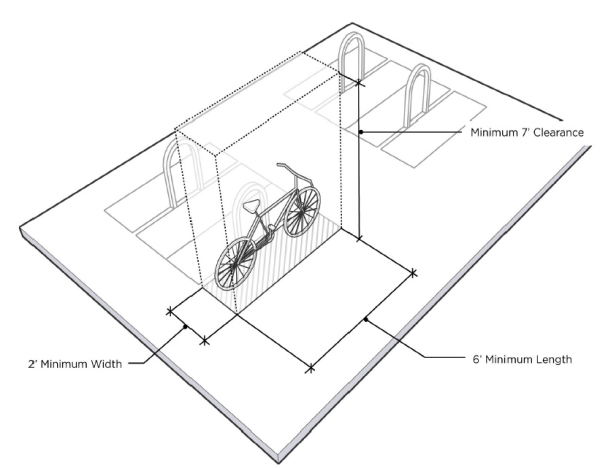
- Required bicycle spaces must have a minimum dimension of two feet (2') in width by six feet (6') in length, with a minimum overhead vertical clearance of seven feet (7'). Bicycle spaces are counted by the number of bicycles than can be stored on a rack, meeting these dimensions for a bicycle space.
- Bicycle parking facilities must provide racks where the bicycle may be locked by the user or lockable enclosed lockers. Structures that require a user-supplied locking device must be designed to accommodate U-shaped locking devices. All lockers and racks must be securely anchored to the ground or the structure to prevent the racks and lockers from being removed from the location.
- If required bicycle parking facilities are not readily visible, signs must be posted indicating their location.
- Areas used for required bicycle parking must be paved and drained to be free of mud, dust, and standing water, and must be well-lit.
- Location:
- All required bicycle spaces must be located on the same lot as the use served. However, the Zoning Administrator, upon consultation with other Village Departments, may approve the location of bicycle spaces in the public right-of-way.
- Required bicycle parking for residential uses may be provided in garages, storage rooms, and other resident-accessible secure areas. Space within dwelling units, including areas such as balconies, are not counted toward satisfying bicycle parking requirements.
- Required Number Of Bicycle Spaces: Where off-street parking facilities are provided, the number of bicycle parking spaces must be provided as indicated in Table 10-4: Required Bicycle Spaces. In all cases where bicycle parking is required, a minimum of two spaces is required. However, no more than a total of 50 bicycle parking spaces are required to be provided.
TABLE 10-3: REQUIRED BICYCLE SPACES Use Required Bicycle Spaces Multi-Family Dwelling 1 per 10 dwelling units Retail Goods Establishment, Personal Service Establishment, Office, or Multi-Tenant Retail Center over 10,000sf in GFA 1 per 10 parking spaces Indoor or Outdoor Amusement Facility 1 per 10 parking spaces School, Primary or Secondary 1 per 10 parking spaces School, University or Vocational 1 per 25 parking spaces
(Ord. 19-10-26)
20.10.6: DESIGN OF VEHICLE PARKING FACILITIES
- Location:
- Residential Uses:
- All required off-street vehicle parking spaces for residential uses and the residential component of mixed-use developments must be located on the same lot as the structure.
- For single-family (detached and attached) and two-family dwellings, required vehicle parking spaces are permitted in private driveways, but must not encroach onto the public right-of-way.
- Non-Residential Uses:
- Vehicle parking for a nonresidential use may be located on the same lot or within six hundred feet (600') of the building entrance of the principal building of the use being served, and must be within the same zoning district. The maximum six hundred (600) foot distance restriction does not apply to valet parking services. However, valet parking services must provide evidence of a lot reserved for vehicle parking within the same zoning district.
- Off-street parking facilities serving nonresidential uses of property may be permitted in the R-1, R-2, and R-3 Districts as a conditional use, subject to the following requirements and any other section of the Municipal Code that pertains to private parking lot standards:
- The parking lot must be accessory to and for use in connection with one or more nonresidential establishments located in adjoining zoning districts or in connection with one or more existing professional or institutional office buildings or institutions.
- The parking lot must be used solely for the parking of passenger automobiles.
- No commercial work or service of any kind may be conducted on the parking lot.
- No parking lot can access a residential area.
- Each entrance to and exit from the parking lot must be no less than twenty feet (20') from any adjacent property located in any residential district, except where egress and ingress to the parking lot is provided from a public way or public alley separating the residential areas from the proposed parking lot.
- The number of parking spaces is the minimum required by this Article.
- Parking facilities must be designed with appropriate means of vehicular access to a street or alley in such a manner that will least interfere with the movement of traffic.
- No driveway or curb cut in any zoning district can exceed twenty five feet (25') in width.
- Buffer yards as required by Section 11.8 must be on any lot line of a parking lot that adjoins a residential district.
- The parking lot must be located on property that is contiguous to the principal use. For purposes of this section, contiguity is not construed to include properties across public streets and rights-of-way unless a variance is granted.
- A parking lot cannot be less than one hundred thirty two feet (132') in width or cover more than seventy five percent (75%) of the lot.
- Any lighting used to illuminate a parking lot must be designed to direct light away from adjoining residential properties and must be approved by the Village Board.
- Parking lots must conform to any further requirements and conditions as may be required by the Village Board for the protection of properties adjacent to and in the vicinity of the proposed parking lot.
- The property on which such off-site parking is located must either be owned by the owner of the use being served, or secured by a long-term lease acceptable to the Village Board. Such lease shall require the maintenance of the number of parking spaces required to serve the use.
- Residential Uses:
- Dimensions Of Vehicle Parking Spaces: Off-street vehicle parking space dimensions must meet the standards of Table 10-4: Off-Street Parking Space Dimensions.
TABLE 10-4: OFF-STREET PARKING SPACE DIMENSIONS Parking Angle Stall Width Stall Depth Aisle Width Two-Way Aisle Width One-Way Vertical Clearance 0° (Parallel) 8' 18' 21' 12' 7’ 6” 90° (Head-In) 9' 18' 24' 20' 7’ 6” 60° 9' 21' N/A 18' 7’ 6” 45° 9' 19.8' N/A 18' 7’ 6” - Circulation Requirements For Off-Street Vehicle Parking Areas:
- Each off-street vehicle space must open directly upon an aisle or driveway of adequate width to provide access to a vehicle parking space. All off-street parking facilities must provide access in a manner that least interferes with traffic movement. For all uses except single-family detached and two-family dwellings, the parking area must be designed so that the driver of the vehicle proceeds forward into traffic rather than backs out.
- All required off-street parking facilities must have vehicular access from a street, alley, driveway, or cross-access easement.
- Clearly delineated crosswalks of paving, brick paver, bituminous brick pattern stamping, or painted striping must connect landscaped areas and parking lot islands to building entrances to improve safe passageway for pedestrians. Curb cuts must be included on landscaped areas or islands where such crosswalks are located.
- All parking lots must comply with the "ADA Accessibility Guidelines for Buildings and Facilities" regulations issued by federal agencies under the Americans with Disabilities Act (ADA) and State of Illinois and local requirements for the amount and design of accessible vehicle parking spaces required in parking lots and structures.
- Only one driveway is permitted on a through lot. Driveway access is permitted from only one right-of-way.
- Striping: Off-street parking areas must be marked by painted lines a minimum of four inches in width and maintained in clearly visible condition. Signs or markers should be used as necessary to ensure efficient and safe circulation within the lot. Vehicle parking spaces for handicapped persons must be identified with the appropriate sign and visible at all times of the year, regardless of plant growth or similar conditions.
- Curbing And Wheel Stops: Wheel stops or curbing are required when a parking space abuts a pedestrian walkway, landscape area, or fence.
- Surfacing: All parking lots must be surfaced with a durable all-weather material, such as asphalt, concrete, or other product, as approved by the Village. Pervious paving may be allowed, subject to review and approval by the Village.
- Drainage: Off-street parking facilities must be drained to eliminate standing water and prevent damage to abutting property and/or public streets and alleys. All drainage must comply with any stormwater management requirements.
- Maintenance: Off-street parking areas must be maintained in a clean, orderly, and dust-free condition at the expense of the owner or lessee.
- Lighting: Parking lot lighting must meet the exterior lighting standards of Article 9.
- Landscape And Screening: All parking lots must be landscaped and screened in accordance with Article 11.
- Turnaround Space: Dead end parking lots are prohibited. A turnaround space is required, and the minimum depth and width of such turnaround space must be nine feet and designated with signs stating "No Parking."
(Ord. 19-10-26)
20.10.7: DESIGN OF OFF-STREET LOADING SPACES
- Location: All off-street loading spaces must be located on the same lot as the use served. No off-street loading spaces may project into a public right-of-way. No off-street loading spaces are permitted in the front yard.
- Dimensions: All required off-street loading spaces must be a minimum of twelve feet (12') in width, a minimum of thirty five feet (35') in length, exclusive of aisle and maneuvering space, and have a minimum vertical clearance of fifteen feet (15').
- Surfacing: All off-street loading spaces must be paved with a durable, all-weather material paving.
- Drainage And Maintenance: Off-street loading facilities must be drained to eliminate standing water and prevent damage to abutting property and/or public streets and alleys. Off-street loading areas must be maintained in a clean, orderly, and dust-free condition at the expense of the owner or lessee.
- Access: Each required off-street loading space must be designed with adequate means of vehicular access to a street or alley and in a manner that will minimize interference with traffic movement.
- Lighting: Parking lot lighting must meet the exterior lighting standards of Article 9.
- Landscape And Screening: All parking lots must be landscaped and screened in accordance with Article 11.
(Ord. 19-10-26)
20.10.8: SHARED PARKING
- Off-street parking spaces for separate uses may be provided collectively if the aggregate number of spaces provided is not less than the sum of the spaces required in Table 10-5: Shared Parking Calculation. Multi-tenant retail centers are not eligible for shared parking. Mixed-use developments, multi-use office parks, and similar types of development, and property owners that establish cross-access easements are all eligible for shared parking.
- Table 10-5 is applied in the following manner:
- The required number of spaces for each use is calculated according Table 10-1.
- The required number of spaces for each use is then applied to the percentages for each timeframe according to the appropriate land use category in Table 10-5 to determine the number of required spaces. This is done for each timeframe category.
- The numbers are summed for within each timeframe and the highest sum total in a timeframe is the required number of spaces.
- Shared parking may be located off-site so long as it complies with the location requirements of this Article.
TABLE 10-5: SHARED PARKING CALCULATION LAND USE Weekday Weekend Mid- 7am 7am- 6pm 6pm- Mid Mid- 7am 7am- 6pm 6pm- Mid Residential 100% 100% 100% 100% 100% 75% Commercial 0% 100% 80% 0% 100% 60% Restaurant 50% 70% 100% 45% 70% 100% Hotel 100% 50% 90% 100% 65% 80% Office 5% 100% 5% 0% 40% 10%
(Ord. 19-10-26)
20.10.9: STORAGE OF COMMERCIAL AND RECREATIONAL VEHICLES
- Commercial Vehicles:
- No commercial vehicle may be parked outdoors on a lot in a residential district, with the exception of vehicles engaged in loading or unloading or current work being done to the adjacent premises. This does not include standard size passenger motor vehicles (including, but not limited to: vans, sports utility vehicles (SUVs), standard passenger size livery vehicles, and pick-up trucks), which are permitted to be stored or parked outdoors overnight on lots in residential districts. This includes vehicles owned and used for commercial purposes by the occupant of a dwelling or guest, provided that the vehicle is stored or parked in a permitted parking area. Permitted commercial vehicles may include the logo of the commercial business painted on or applied to the vehicle.
- All other commercial vehicles including, but not limited to, semi-truck tractor units, with or without attached trailers, commercial trailers, box vans and box trucks, buses, tow trucks, construction vehicles, livery vehicles that exceed standard passenger vehicle size, such as limousines, or other large commercial vehicles are not permitted to be stored or parked outside overnight on a lot in a residential district.
- For non-residential uses in the non-residential districts, commercial vehicles with the logo of the commercial business painted on or applied to the vehicle that are being operated and stored in the normal course of business, such as signs located on delivery trucks, promotional vehicles, moving vans, and rental trucks, are permitted to be stored on the lot in areas related to their use as vehicles, provided that the primary purpose of such vehicles is not the display of signs. All such vehicles must be in operable condition. Signs placed or painted on parked vehicles where the only purpose is to advertise a product or service, or to direct the public to a business or activity located on or off the premises, are prohibited.
- Trailers, Boats, And Recreational Vehicles: Except when located in a garage or fully enclosed structure, trailers, boats, and recreational vehicles may be parked or stored only in the rear yard of any zoning lot provided the following conditions also are met:
- Temporary Office: A trailer may be used as a temporary office or shelter incidental to construction on or development of the premises on which the trailer is located during the time when construction or development is actively under way.
- Yard Requirements: Trailers, boats, and RVs may be parked or stored on a zoning lot provided they are parked or stored so as to meet all yard requirements for accessory structures on the premises where parked or stored, and provided they are not used or occupied for living, sleeping, housekeeping, or business purposes.
- Bulk Regulations:
- Permitted travel trailers, pickup coaches, motorized homes and camping trailers constructed as temporary shelter for travel purposes shall not exceed eight feet (8') in width, eleven feet (11') in height, and thirty feet (30') in length including bumpers and hitches; and
- Permitted boats shall not exceed twenty feet (20') in length, eight feet (8') in width, or eleven feet (11') in height.
- Loading Or Unloading: Any trailer or boat may be parked anywhere on the premises for a forty eight (48) hour period for loading or unloading purposes. Any temporary storage container may be placed on a driveway for no more than seven (7) days in any consecutive thirty (30) day period for loading and unloading purposes.
- Licenses: State license plates and village vehicle licenses shall be current and properly displayed.
- Use: A recreational vehicle, boat, or commercial trailer shall not be used as a dwelling, or as a storage or accessory building, or as part of any business enterprise.
- Flammable Liquids: The owner of a boat, boat trailer, commercial trailer, or recreational vehicle shall not park, let stand or store such boat, boat trailer, commercial trailer, or recreational vehicle; and shall not leave flammable liquids aboard other than in Illinois department of transportation or United States department of transportation approved containers.
- Parked In Unsafe Or Dangerous Manner: The owner of a boat, boat trailer, commercial trailer, or recreational vehicle shall not park, store, or permit to stand such boat, boat trailer, commercial trailer, or recreational vehicle in such a manner as to create a dangerous or unsafe condition on the property where parked, stored, or permitted to stand. Parking, storing, or standing in such a fashion that the boat, boat trailer, commercial trailer, or recreational vehicle may tip or roll shall be considered a dangerous and unsafe condition.
- Maintained In Mobile Condition: A stored, parked, or standing recreational vehicle or boat trailer shall be maintained in mobile condition.
- Major Construction Or Repair: No major construction or major repair of a recreational vehicle, boat, or boat trailer shall be permitted in a residential district.
- Temporary Parking And Use: Temporary parking and use of recreational vehicles shall be permitted when a permit has been issued by the building commissioner when a recreational vehicle is used for lodging purposes on a lot containing a dwelling, provided it is not parked or used thereon more than seven (7) days in any consecutive thirty (30) day period.
(Ord. 19-10-26; amd. Ord. 21-12-35)

