
Clarendon Hills City Zoning Code
ARTICLE 20
11 LANDSCAPE
20.11.1: LANDSCAPE PLAN
- Landscape Plan Required: A landscape plan is required as part of a site plan review application for multi-family and non-residential (including mixed-use) development, and any planned unit development. The landscape plan approval is a condition of the issuance of a building permit.
- Content Of Landscape Plan:
- North arrow and graphic scale, the location and dimensions of all existing and proposed structures, property lines, easements, parking lots and drives, rights-of-way, refuse disposal and recycling areas, pedestrian and bicycle paths, fences, mechanical equipment, overhead utility wires, underground utilities, retention/detention facilities, and other drainage facilities, such as drainage swales.
- The location, quantity, size, name, and condition, both botanical and common, of all existing plant materials on-site, indicating plant material to be retained and to be removed.
- The location, quantity, size, and name, both botanical and common, of all proposed plant material.
- The existing and proposed grading of the site indicating contours at one foot intervals. Any proposed berming, earthwork, or stormwater management basins must also be indicated using one foot contour intervals.
- Elevations of all proposed fences, stairs, and retaining walls.
- Any other details as determined necessary by the Zoning Administrator.
- Minor Changes To Approved Landscape Plans: Minor changes to the landscape plan that do not result in a reduction in the net amount of plant material as specified on the approved landscape plan may be approved by the Zoning Administrator. Changes that reduce the amount of plant materials contained within an approved landscape plan are a major change and must be approved by the body granting approval of the landscape plan initially.
- Alternative Landscape Design: Alternative landscape design intended to improve stormwater quality and/or intended to decrease stormwater quantity will be considered if submitted as part of a site-specific stormwater management plan.
(Ord. 19-10-26)
20.11.2: ENFORCEMENT OF LANDSCAPE PLAN
- No certificate of occupancy will be issued until all the requirements of this Article and the landscape plan have been fulfilled. Failure to implement the landscape plan, or to maintain the lot in conformance with the landscape plan, may result in the application of fines and penalties, as established in this Chapter. All landscape is subject to periodic inspection.
- If weather prohibits the installation of landscape at the time a certificate of occupancy is applied for, a temporary certificate of occupancy may be issued with provision of funds equaling one hundred twenty five percent (125%) of the cost of the item(s) to be completed are held in escrow with a bank or title company or are available to be drawn down from an approved mortgage.
(Ord. 19-10-26)
20.11.3: SELECTION, INSTALLATION AND MAINTENANCE
- Plant Selection:
- All plant materials must be of good quality and meet American Horticulture Industry Association (AmericanHort) or its ANSI accredited successor's standards for minimum acceptable form, quality, and size for species selected.
- Species must be capable to withstand the seasonal temperature variations of northeastern Illinois, as well as the individual site microclimate.
- The use of species native or naturalized to northeastern Illinois is required.
- Size and density of plant material, both at the time of planting and at maturity, are additional criteria that must be considered when selecting plant material.
- The use of drought and salt tolerant plant material is preferred.
- Installation: All landscape materials must be installed in accordance with current nursery industry standards, and must be properly supported to ensure survival. Support devices such as guy wires or stakes must not interfere with pedestrian or vehicular movement. All plant materials must be free of disease and installed so that soil of sufficient volume, composition, and nutrient balance are available to sustain healthy growth. Installation of plant materials during the appropriate growing season is encouraged.
- Maintenance:
- Landscape materials depicted on approved landscape plans are considered a required site element in the same manner as structures, required parking, lighting, and other improvements. As such, the owner of record or the business or homeowner's association is responsible for the maintenance, repair, and replacement of all landscape materials, fences, steps, retaining walls, and similar landscape elements.
- All landscape materials must be maintained in good condition, present a healthy, neat, and orderly appearance, and be kept free of refuse and debris. Any dead, unhealthy, or missing plants must be replaced within sixty (60) days of notification, unless an extension is approved by the Zoning Administrator.
(Ord. 19-10-26)
20.11.4: LANDSCAPE DESIGN STANDARDS
- Minimum Planting Sizes:
- Shade trees must have a minimum trunk size of three inches (3") in caliper at planting.
- Evergreens trees must have a minimum height of six feet (6') at planting.
- Single stem ornamental trees must have a minimum trunk size of two and one-half inches (2 1/2") in caliper at planting. Multiple stem ornamental trees must have a minimum height of eight feet (8') at planting.
- Evergreen or deciduous shrubs must have a minimum height of twenty four inches (24") or thirty inches (30") in height at planting.
- Tree Species Diversity: Diversity among required trees planted is required for visual interest and to reduce the risk of losing a large population of trees due to disease. Table 11-1: Tree Diversity Requirements indicates the percentage of diversity required based on the total quantity of species being used. (For example, if a development requires forty five (45) shade trees, no more than eighteen (18) trees forty percent (40%) can be of one species, and there must be a minimum of five (5) different species within the forty five (45) trees. When the calculation of tree diversity requirements results in a fraction, the fraction is rounded up.)
TABLE 11-1: TREE DIVERSITY REQUIREMENTS Total Number of Trees Maximum Number of One Species Minimum Number of Species 1 - 4 100% 1 5 - 10 60% 2 10 - 15 45% 3 16 - 75 40% 5 76 - 500 25% 8 500 - 1,000 30% 10 1,000+ 15% 15
(Ord. 19-10-26)
20.11.5: PARKING LOT PERIMETER LANDSCAPE YARD
A perimeter landscape yard is required for all parking lots that abut a public right-of-way and must be established along the edge of the parking lot to screen vehicle parking. The landscape treatment must run the full length of the parking lot perimeter along the right-of-way and must be located between the lot line and the edge of the parking lot. The landscaped area must be improved as follows:
- Landscape Yard Width: The perimeter parking lot landscape area must be at least five feet (5') in width, excluding a minimum linear distance of two feet (2') along perimeter any wheels stops or curbs located next to the landscape area to accommodate vehicle bumper overhang.
- Shrub Screening: Shrubs to screen parked vehicles must be planted at the rate of one shrub for every three (3) linear feet of landscape yard. Alternatively, a mix of shrubs, perennials, native grasses, and other planting types that provide screening of a minimum of three (3) feet in height may be used.
- Tree Planting: A minimum of one shade tree must be provided for each fifty (50) linear feet of perimeter landscape yard. Two (2) ornamental trees may be substituted for one shade tree.
- Groundcover, Perennials Or Ornamental Grasses: Sixty percent (60%) of the landscape area outside of shrub and tree masses must be planted in live groundcover, perennials, or ornamental grasses.
- Decorative Metal Fencing: In any Business District, a four foot (4') high decorative metal fence, painted black, shall be installed located one foot inside the parking lot.
PARKING LOT PERIMETER LANDSCAPING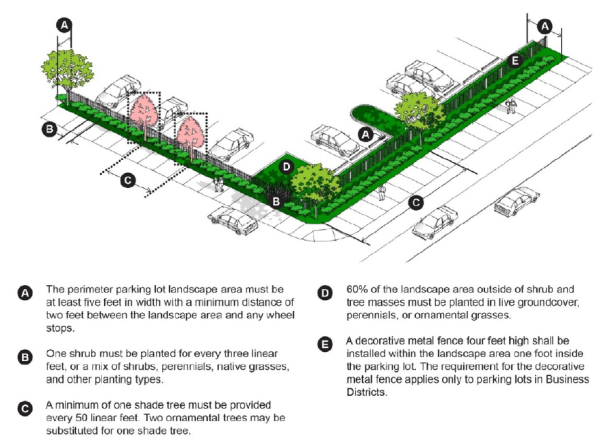
(Ord. 19-10-26)
20.11.6: INTERIOR PARKING LOT LANDSCAPE
All parking lots consisting of twenty (20) or more spaces require interior parking lot landscape as described in this section.
- All rows of parking stalls must terminate in a parking lot island or landscape area.
- Where more than twenty (20) parking stalls are provided in a row, one parking lot island must be provided between every twenty (20) parking spaces. As part of the landscape plan approval, parking lot island locations may be varied based on specific site requirements or design scheme, but the total number of islands must be no less than the amount required of one island for every twenty (20) spaces.
- Parking lot islands must be the same dimension as the parking stall. Double rows of parking must provide parking lot islands that are the same dimension as the double row.
- A minimum of one shade tree must be provided in every parking lot island or landscape area. If a parking lot island extends the width of a double row, then two (2) shade trees are required. In addition to the required shade trees, a minimum of sixty percent (60%) of every parking lot island must be planted in ornamental trees, live groundcover, shrubs, perennials, or ornamental grasses.
- The use of stormwater management techniques, such as rain gardens and bioswales, is encouraged in landscape areas. Parking lot islands and landscape areas are encouraged to be designed to accommodate stormwater infiltration.
- In addition to parking lot islands, additional landscape areas must be provided within the interior of parking lots when the parking area is 10,000 square feet or more in area. The minimum total landscape area of a parking lot, including parking lot islands, must be ten percent (10%) of the total parking lot area. Parking lot perimeter landscape is excluded from the calculation of total parking lot area square footage and is not counted toward required landscape area.
PARKING LOT INTERIOR LANDSCAPE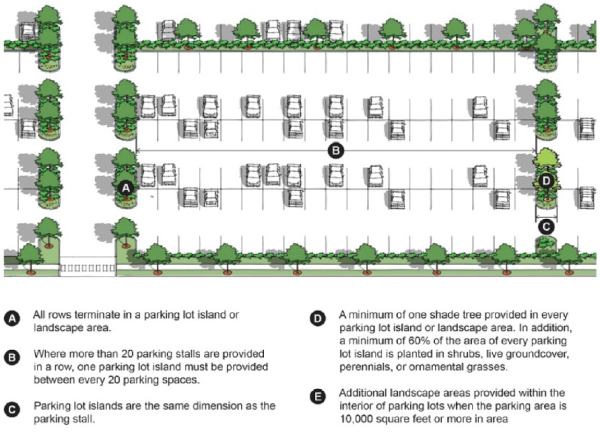
(Ord. 19-10-26)
20.11.7: SITE LANDSCAPE
- Areas of any lot that are not covered by structures or pavement must be planted with live landscaping. Stone, mulch, or other permeable landscape materials may be used to satisfy this requirement, but must not cover more than forty percent (40%) of the landscape area.
- Where multi-family and non-residential (including mixed-use) developments are located ten feet (10') or more from a street lot line and no parking is located in front of the structure and also where any the façade abuts any parking area, foundation landscape must be planted as described below. This planting area is required along sixty percent (60%) of the linear façade area. This percentage may be reduced to accommodate entry design and other building functional operations during landscape plan review.
- A single hedge row is required planted with one shrub every thirty six inches (36") on center, spaced linearly.
- Shade trees are required in the amount of one tree every forty feet (40'). Two (2) ornamental trees may be substituted for one shade tree and must be spaced one ornamental tree every twenty feet (20').
- Sixty percent (60%) of the landscape area outside of shrub and tree masses must be planted in live groundcover, perennials, or ornamental grasses. Stone, mulch, or other permeable landscape materials are required for any remaining area.
- Planted pots and/or planter boxes may be used to satisfy up to thirty percent (30%) of the total landscape area requirement.
SITE LANDSCAPE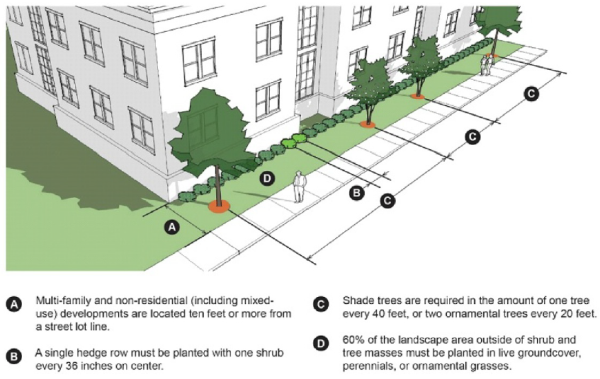
(Ord. 19-10-26)
20.11.8: BUFFER YARDS
This section establishes standards for the dimension and required landscape for buffer yards between land uses and/or zoning districts within the rear or interior side yard. Nothing in this section prevents the applicant's voluntary installation of buffer yards where they are not required.
- As of the effective date of this Chapter, buffer yards are required for new construction along interior side and rear yards in the following cases:
- Where a multi-family dwelling abuts a single-family, two-family, or townhouse dwelling.
- Where a non-residential use is located within a residential district. This does not include public parks.
- Where a non-residential district abuts a residential district.
- Buffer yards may be located within required yards, but must be reserved for the planting of material and installation of screening as required by this section. No parking, driveways, sidewalks, accessory structures, or other impervious surfaces are permitted within the buffer yard area.
- The required design of buffer yards is as follows:
- A buffer yard must be a minimum of ten feet (10') in width.
- One shade tree must be planted for every twenty five (25) linear feet of buffer yard length. As part of the landscape plan approval, trees may be spaced at various intervals based on specific site requirements, but the total number of trees planted must be no less than one per twenty five (25) linear feet of buffer yard length.
- Existing trees that are preserved may count toward the buffer yard tree requirement. This credit is a 1:1 ratio (one existing tree for one proposed tree) regardless of the size of the existing tree.
- Unless otherwise specifically required by the use standards of this Chapter, a solid fence or wall a minimum of six feet (6') and a maximum of eight feet (8') in height must be erected along one hundred percent (100%) of the buffer yard length.
- One shrub, measuring a minimum of eighteen inches (18") in height at planting and reaching a minimum of three feet (3') in height at maturity, must be planted for every three (3) linear feet of buffer yard length, spaced linearly.
- Sixty percent (60%) of the landscape area outside of shrub and tree masses must be planted in live groundcover, perennials, or ornamental grasses.
BUFFER YARD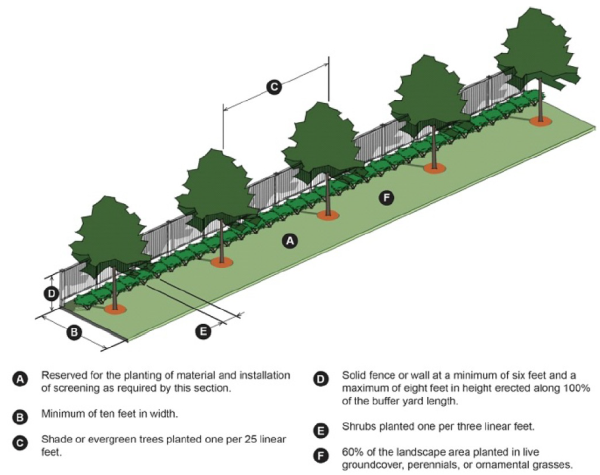
(Ord. 19-10-26)

