
Clarendon Hills City Zoning Code
ARTICLE 20
8 USES
20.8.1: GENERAL USE MATRIX REGULATIONS
Table 8-1: Use Matrix identifies principal and temporary uses allowed within each zoning district.
- P indicates that the use is permitted by-right in the district.
- C indicates that the use is a conditional use in the district and requires conditional use permit approval.
- If a cell is blank, the use is not allowed in the district.
- In the case of temporary uses, a T indicates the temporary use is allowed in the district and may require approval of a temporary use permit per Section 20.8.4.
- Accessory uses are prohibited without the establishment of a principal use.
(Ord. 19-10-26)
20.8.2: USE MATRIX
Table 8-1: Use Matrix identifies the principal and temporary uses allowed within each zoning district. For accessory uses, see Article 9. The code for Table 8-1 is as follows: P = permitted principal use; C = conditional principal use; T = allowed temporary use.
| Use | R-1 | R-2 | R-3 | B-1 | B-2 | B-3 | P-I | L-O | O-T | Use Standard |
| Amusement - Recreation Facility: Indoor | P | C | ||||||||
| Amusement - Recreation Facility: Outdoor | C | C | ||||||||
| Animal Care Facility | P | P | P | Sec. 20.8.3 A | ||||||
| Animal Kennel: Commercial | ||||||||||
| Animal Shelter | ||||||||||
| Art Gallery | P | P | P | |||||||
| Arts Studio (in the B-1 District at around level, setback at least 40 feet from the S. Prospect Ave public right-of-way and with no entrance front the S. Prospect Ave frontage except for the 100 Park Ave property; for the 100 Park Ave property the around level setback shall be at least 40 feet from the Park Ave public right-of-way frontage with no entrance from the Park Ave frontage) | P | P | P | |||||||
| Body Modification Establishment | C | C | ||||||||
| Broadcasting Facility - With Antenna | C | C | ||||||||
| Broadcasting Facility - No Antenna | C | P | P | |||||||
| Bar | P | P | P | |||||||
| Brew Pub | P | P | P | C | ||||||
| Car Wash | C | Sec. 20.8.3 B | ||||||||
| Cemetery | ||||||||||
| Community Center | P | |||||||||
| Community Garden | C | C | C | C | C | Sec. 20.8.3 C | ||||
| Contractor Office - No Outdoor Equipment Storage | ||||||||||
| Contractor Office - With Outdoor Equipment Storage | ||||||||||
| Conservation Area | C | |||||||||
| Cultural Facility | C | C | P | |||||||
| Day Care Center | C | C | C | Sec. 20.8.3 D | ||||||
| Day Care Home | P | P | P | Sec. 20.8.3 D | ||||||
| Drive-Through Facility | C | C | C | Sec. 20.8.3 E | ||||||
| Dwelling, Above the Ground Floor | P | P | C | |||||||
| Dwelling, Detached Single-Family | P | P | Sec. 20.8.3 G | |||||||
| Dwelling, Townhouse | P | P | C | Sec. 20.8.3 F | ||||||
| Dwelling, Two-Family | P | Sec. 20.8.3 G | ||||||||
| Dwelling, Multi-Family | P | P | C | C | Sec. 20.8.3 F | |||||
| Financial Institution | P | P | P | |||||||
| Funeral Home | C | C | C | |||||||
| Gas Station | C | P | Sec. 20.8.3 H | |||||||
| Golf Course/Driving Range | P | |||||||||
| Government Facility | P | P | P | P | ||||||
| Group Home - Small | P | P | P | Sec. 20.3.3 J | ||||||
| Group Home - Large | C | C | C | Sec. 20.8.3 I | ||||||
| Healthcare Facility | C | C | P | |||||||
| Heavy Retail, Rental & Service | C | |||||||||
| Hotel | P | P | P | |||||||
| Industrial Design | P | P | P | |||||||
| Landscape Business | C | |||||||||
| Live Entertainment | C | C | P | |||||||
| Medical Cannabis Dispensing Organization | C | Sec. 20.8.3 K | ||||||||
| Medical/Dental Office or Clinic (in the B-1 District at around level, setback at least 40 feet from the S. Prospect Ave public right-of-way and with no entrance front the S. Prospect Ave frontage except for the 100 Park Ave property; for the 100 Park Ave property the around level setback shall be at least 40 feet from the Park Ave public right-of-way frontage with no entrance from the Park Ave frontage) | P | P | P | P | P | |||||
| Medical/Dental Office or Clinic above the ground floor | P | P | P | P | P | |||||
| Micro-Brewery/Distillery/Winery | C | C | C | |||||||
| Nursery/Greenhouse - Retail | P | |||||||||
| Office (in the B-1 District at around level, setback at least 40 feet from the S. Prospect Ave public right-of-way and with no entrance front the S. Prospect Ave frontage except for the 100 Park Ave property; for the 100 Park Ave property the around level setback shall be at least 40 feet from the Park Ave public right-of-way frontage with no entrance from the Park Ave frontage) | P | P | P | P | P | |||||
| Office above the ground floor | P | P | P | P | P | |||||
| Outdoor Dining | P | P | P | Sec. 20.8.3 L | ||||||
| Outdoor Storage | C | Sec. 20.8.3 M | ||||||||
| Park | P | |||||||||
| Parking Lot (Principal) | C | C | Article 10 | |||||||
| Parking Structure (Principal) | C | Article 10 | ||||||||
| Personal Service Establishment (in the B-1 District at around level, setback at least 40 feet from the S. Prospect Ave public right-of-way and with no entrance front the S. Prospect Ave frontage except for the 100 Park Ave property; for the 100 Park Ave property the around level setback shall be at least 40 feet from the Park Ave public right-of-way frontage with no entrance from the Park Ave frontage) | P | P | P | |||||||
| Places of Worship | P | |||||||||
| Private Club or Lodge | C | P | P | Sec. 20.8.3 N | ||||||
| Public Safety Facility | P | P | P | |||||||
| Public Works Facility | P | |||||||||
| Reception/Banquet Facility | C | P | P | Sec. 20.8.3 O | ||||||
| Research & Development | P | |||||||||
| Residential Care Facility | P | P | Sec. 20.8.3 P | |||||||
| Restaurant | P | P | P | P | ||||||
| Retail Goods Establishment | P | P | P | P | ||||||
| School - Primary or Secondary | P | |||||||||
| School - College or University | P | P | ||||||||
| School - Trade or Vocational | C | C | P | |||||||
| Self-Storage | ||||||||||
| Specialty Food Service | P | P | P | P | ||||||
| Vehicle Dealership | P | Sec. 20.8.3 Q | ||||||||
| Vehicle Operation Facility | ||||||||||
| Vehicle Rental Agency | C | C | ||||||||
| Vehicle Repair | C | Sec. 20.8.3 R | ||||||||
| Wholesale | C | |||||||||
| Temporary Uses | ||||||||||
| Farmer’s Market | T | T | T | Sec. 20.8.4 A | ||||||
| Temporary Contractor’s Office | T | T | T | T | T | T | T | T | Sec. 20.8.4 B | |
| Temporary Mobile Food Sales | T | T | T | T | T | Sec. 20.8.4 C | ||||
| Temporary Outdoor Entertainment | T | T | T | T | T | Sec. 20.8.4 D | ||||
| Temporary Outdoor Sales | T | T | T | T | T | Sec. 20.8.4 E | ||||
| Garage Sales | T | T | T | Sec. 20.8.4 F |
(Ord. 19-10-26; amd. Ord. 22-10-22)
20.8.3: PRINCIPAL USE STANDARDS
Where applicable, principal uses are required to comply with all use standards of this section, whether a permitted or conditional use, in addition to all other regulations of this Code.
- Animal Care Facility, Animal Kennel: Commercial, And Animal Shelter:
- Exterior exercise areas must be located to the interior side or rear of the principal building on the lot. Exterior exercise areas must provide covered areas over a minimum of twenty five percent (25%) of the exterior area to provide shelter against weather.
- Exterior exercise areas are prohibited in required setbacks.
- Exterior exercise may be located on rooftop, when determined by the Village to be structurally sound for such use.
- All animal quarters and exterior exercise areas must be kept in a clean, dry, and sanitary condition.
- All animal overnight boarding facilities must be located indoors.
- Car Wash:
- Car wash facilities must be screened along interior side and rear lot lines with a privacy fence or wall, a minimum of six feet (6’) and a maximum of seven feet (7’) in height. One shrub a minimum of three feet (3’) in height at time of planting must be planted linearly every three feet (3’) on-center along such fence or wall.
- The site must be graded to drain away from adjoining properties.
- Community Garden:
- Community gardens are limited to the cultivation of herbs, fruits, flowers, or vegetables, including the cultivation and tillage of soil and the production, cultivation, growing, and harvesting of any agricultural, floricultural, or horticultural commodity. It may also include community-gathering spaces for active or passive recreation but playground equipment is prohibited.
- Greenhouses, including high tunnels/hoop-houses, cold-frames, and similar structures, are permitted to extend the growing season. Accessory structures such as sheds, gazebos, and pergolas are also permitted.
- Day Care Center And Day Care Home:
- Each day care center or home must comply with all applicable state and federal regulations. The operator of a day care must be licensed by the state.
- A day care home must maintain its original appearance as a residential dwelling.
- A day care center must provide a pickup/drop off area. When a day care center is part of a multi-tenant retail center, the pickup/drop off area must not interfere with vehicle circulation in the parking lot, including blocking of the drive aisle.
- Drive-Through Facility:
- All drive through facilities require site plan review by the Director of Community Development.
- All drive-through facilities must provide a minimum of three (3) stacking spaces per lane or bay, unless additional stacking spaces are specifically required by this Chapter. Stacking spaces provided for drive-through uses must be:
- A minimum of nine feet (9’) in width, as measured from the outermost point of any service window or bay entrance, to the edge of the driveway, and eighteen feet (18’) in length. In the case of a recessed service window, the measurement must be taken from the building wall.
- Stacking spaces must begin behind the vehicle parked at a final point of service exiting the drive through aisle, such as a service window or car wash bay (this does not include a menuboard). Spaces must be placed in a single line behind each lane or bay.
- All drive-through lanes must be located and designed to ensure that they do not adversely affect traffic circulation on adjoining streets. Drive-through lanes on corner lots must not route exiting traffic into adjacent residential neighborhoods.
- Drive-through facilities must be screened along interior side and rear lot lines with a wall or privacy fence, a minimum of six feet (6’) and a maximum of seven feet (7’) in height. One shrub a minimum of three feet (3’) in height at time of planting must be planted linearly every three feet (3’) on-center along such fence or wall. This standard does not apply to drive-through facilities within multi-tenant retail centers.
- A drive through lane must have bail out capability for all vehicles that enter the drive through lane. The bail out lane must be a minimum width of ten feet (10’) in width and run parallel to the drive through lane. If a bail out lane is also an interior access drive providing access to parking spaces, the bail out lane is limited to a one-way traffic pattern following the direction of the drive through lane.
DRIVE-THROUGH FACILITY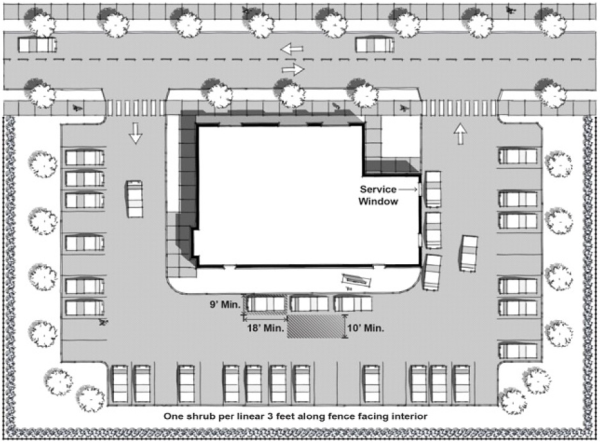
- Dwelling - Multi-Family Or Townhouse:
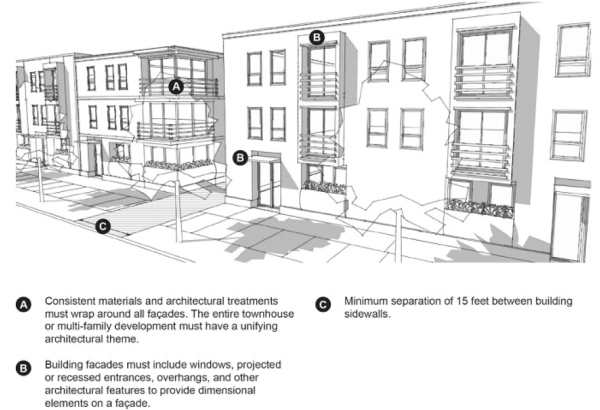
- Façades must be designed with consistent materials and treatments that wrap around all façades. There must be a unifying architectural theme for the entire multi-family or townhouse development, utilizing a common vocabulary of architectural forms, elements, materials, or colors in the entire structure.
- Building facades must include windows, projected or recessed entrances, overhangs, and other architectural features. Three-dimensional elements, such as balconies and bay windows, are encouraged to provide dimensional elements on a façade.
- The following minimum transparency requirements apply to any façade facing a street and are calculated on the basis of the entire area of the façade:
- Townhouse: 15%
- Multi-Family Dwelling: 25%
- There must be a minimum separation of fifteen feet (15’) between sidewalls of townhouse buildings. Where the front or rear wall of a townhouse faces the front or rear wall of another townhouse, the minimum required separation between such buildings must be thirty feet (30’). Driveways and parking areas may be located within this minimum separation area.
- The following building materials are prohibited on any façade. However, such materials may be used as decorative or detail elements for up to twenty five percent (25%) of the facade, or as part of the exterior construction that is not used as a surface finish material.
- The following building materials are prohibited on any part of any façade:
- Plain concrete block
- Plastic
- Exterior insulating finish systems (EIFS)
- The following building materials are prohibited as a primary surface finish material on any façade but may be used as decorative or detail elements for up to fifteen percent (15%) of the façade:
- Corrugated metal
- Aluminum, steel or other metal sidings
- Exposed aggregate (rough finish) concrete wall panels
- T-111 composite plywood siding
- Vinyl
- The following building materials are prohibited on any part of any façade:
- Dwelling - Single-Family Or Two-Family:
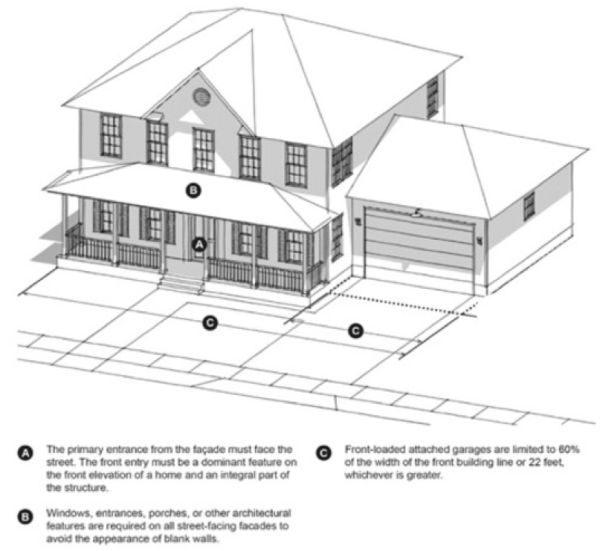
- A dwelling must have a primary entrance from the façade facing the street. The front entry must be a dominant feature on the front elevation of a home and an integral part of the structure, using features such as porches, raised steps and stoops with roof overhangs, or decorative railings to articulate the front façade.
- Windows, entrances, porches, or other architectural features are required on all street-facing facades to avoid the appearance of blank walls.
- A fifteen percent (15%) minimum transparency requirement applies to any façade and is calculated on the basis of the entire area of the façade.
- Front-loaded attached garages are limited to sixty percent (60%) of the width of the front building line or twenty two feet (22’), whichever is greater. Garage width is measure between garage doors; in the case of garages designed with multiple garage doors the distance is measure between the edge of the outmost doors.
- Gas Station:
- All gas station drive ways must be located and designed to ensure that they will not adversely affect the safety and efficiency of traffic circulation on adjoining streets.
- All structures and pump islands must be set back a minimum of twenty feet (20’) from interior side and rear lot lines. Structures are exempt from any build-to lines required by the district.
- Minor motor vehicle repair is permitted as part of a gas station use if allowed within the district. All repair work must be conducted entirely within an enclosed structure. Storage of all merchandise, auto parts, and supplies must be within an enclosed structure. Any vehicles awaiting repair must be stored so that no fluids will drain into the storm sewer system, such as the use of drip pans and other coverings.
- The ancillary uses of a retail goods establishment and one car wash bay are permitted in connection with the principal gas station use.
- The volume on any audio component must be maintained at a level so as not to be audible in adjoining properties. The volume on any audio component must comply with all local noise regulations. Audio components are permitted only on the gas station pump. Audio components are prohibited as part of any other structure, including canopies and buildings.
- Group Home - Large:
- Group homes must meet all federal, state, and local requirements including, but not limited to, licensing, health, safety, and building code requirements.
- The facility must retain a residential character, which is compatible with the surrounding residential neighborhood.
- The applicant must demonstrate that the occupants will either be persons with disabilities as defined by the Americans with Disabilities Act of 1990 (42 U.S.C. § 12102(4)) or professional support staff.
- The group home must provide professional staff as required by the occupants' evaluated needs.
- The applicant must obtain a business license as required by Chapter 31 of the Clarendon Hills, IL Code of ordinances.
- Dwelling units must meet the following minimum space requirements:
- Living Room: One hundred fifty (150) square feet.
- Dining Room: One hundred (100) square feet.
- Kitchen: Sixty (60) square feet.
- Bedroom: Seventy (70) square feet minimum plus seventy (70) square feet for the first occupant with fifty (50) square feet for each additional occupant.
- The group home must be located no closer than six hundred feet (600') from the next nearest group home. There will be no more than three (3) total group homes permitted under this section.
- The dwelling unit and proposed group home must meet all building, fire code and other Village health and safety code regulations.
- Group Home - Small:
- Group homes must meet all federal, state, and local requirements including, but not limited to, licensing, health, safety, and building code requirements.
- The facility must retain a residential character, which is compatible with the surrounding residential neighborhood.
- Medical Cannabis Dispensing Organization:
- In accordance with state law, medical cannabis dispensing organizations must comply with the required spacing and location requirements. Any subsequent amendment to state law that is more restrictive than this standard will control.
- A licensed medical marijuana dispensary may not be located within one thousand feet (1,000’) of a pre-existing educational facility – primary or secondary and/or day care center.
- A licensed medical marijuana dispensary may not be located within five hundred feet (500’) of any place of worship, amusement facility, or park/playground.
- A licensed medical marijuana dispensary may not be located within a residential dwelling or within a residential district.
- An operation plan must be submitted, which includes the security measures to be provided, the days and hours of operation, and a site plan that describes exterior lighting and parking capacity.
- In accordance with state law, medical cannabis dispensing organizations must comply with the required spacing and location requirements. Any subsequent amendment to state law that is more restrictive than this standard will control.
- Outdoor Dining: These standards address outdoor dining areas on private property only.
- Outdoor dining is considered a separate principal use. Outdoor dining may only be established when allowed as a use within the zoning district and in conjunction with another principal use, such as a restaurant.
- Outdoor dining must not interfere with any pedestrian access or parking spaces and aisles.
- Outdoor Storage:
- All parking, storage, or maneuvering areas must be paved with an impervious material.
- The storage area must be completely enclosed along all lot lines by a privacy fence or wall a minimum of six feet (6’) and a maximum of eight feet (8’) in height, including ingress and egress. Fences or walls along the front or corner side lot line must be set back a minimum of ten feet (10’). Within that setback, one shrub a minimum of three feet (3’) in height must be planted linearly every three feet (3’) on-center along such fence or wall.
- Storage of any kind is prohibited outside the fence or wall. No items stored within twenty five feet (25’) of the fence may exceed the height of the fence or wall.
- Any vehicles stored on-site must be operational.
- Salvage yards are not considered outdoor storage and are prohibited.
- Private Club Or Lodge:
- No more than thirty percent (30%) of the gross floor area may be used as office space.
- Private clubs and lodges are permitted to serve meals and alcohol on the premises for members and their guests only.
- Sleeping facilities are prohibited.
- Private clubs and lodges leased or used as reception/banquet halls must comply with the requirements for reception/banquet halls.
- Reception/Banquet Facility:
- A general admission fee or any other monetary donations (payment at the door to the general public) for entrance is prohibited, with the exception of fundraisers or events for bona fide non-profit organizations, places of worship, or schools.
- Outdoor areas are permitted for the use of guests.
- Residential Care Facility:
- Residential care facilities must meet all federal, state, and local requirements including, but not limited to, licensing, health, safety, and building code requirements.
- A copy of state license must be visible at all times.
- When located in a residential district, the facility must retain a residential character, which is compatible with the surrounding residential neighborhood. When located in a non-residential district, the structure must be designed with a lobby entrance along the primary frontage.
- Residential care facilities must meet all district design and dimensional standards for multi-family dwellings.
- Vehicle Dealership:
- Vehicle dealerships must have a minimum lot area of one acre.
- Any ancillary repair operations must be performed within a fully enclosed building. All equipment and parts must be stored indoors. Any vehicles awaiting repair must be stored so that no fluids will drain into the storm sewer system, such as the use of drip pans and other coverings.
- Vehicle Repair:
- Vehicle repair establishments may not store the same vehicles outdoors on the site for longer than twenty (20) days once repair is complete. Only vehicles that have been or are being serviced may be stored outdoors.
- All repair operations must be performed within a fully enclosed building. All equipment and parts must be stored indoors. Any vehicles awaiting repair must be stored so that no fluids will drain into the storm sewer system, such as the use of drip pans and other coverings.
- Vehicle repair establishments that abut a residential district must be screened along interior side and rear lot lines with a wall or privacy fence, a minimum of six feet (6’) and a maximum of seven feet (7’) in height.
- No partially dismantled, wrecked, junked, or discarded vehicles, or vehicles that sit on one or more flat tires or are inoperable in any manner may be stored outdoors on the premises. This standard does not apply to vehicles under repair.
- The sale of used or new vehicles is prohibited.
- No motor vehicles may be stored and no repair work may be conducted in the public right-of-way.
(Ord. 19-10-26; amd. Ord. 21-12-38; Ord. 22-10-22)
20.8.4: TEMPORARY USE STANDARDS
Temporary uses are required to comply with the use standards of this section, in addition to all other regulations of this Chapter. These regulations are for temporary uses located on private property only. Only those temporary uses permitted by this section are allowed in the Village; all other temporary uses are prohibited. Unless otherwise indicated, all temporary uses require a temporary use permit per Article 15.
- Farmers Market:
- The timeframe of a farmers market, including number of days per week and overall duration of the event, will be determined and approved as part of the temporary use permit. A temporary use permit for a farmers market can be issued on a yearly basis, which allows for a schedule of days per week and number of weeks per year.
- The timeframe of a farmers market, including number of days per week and overall duration of the event, will be determined and approved as part of the temporary use permit. A temporary use permit for a farmers market can be issued on a yearly basis, which allows for a schedule of days per week and number of weeks per year.
- A management plan is required for a farmers market, to be submitted as part of the temporary use permit application that demonstrates the following:
- The on-site presence of a manager during hours of operation who directs the operations of vendors participating in the market.
- An established set of operating rules addressing the governance structure of the market, hours of operation, and maintenance when open to the public.
- A general site plan of vendor stalls, visitor facilities, such as any seating areas and restrooms, and all ingress and egress points to the site.
- Provision for waste removal.
- The days and hours of internal operation, including vendor set-up and take-down times.
- Temporary Contractor's Office:
- A temporary contractor's office is allowed incidental to a development project.
- The temporary use permit is valid for the duration of the building permit, including any extensions.
- The temporary contractor's office must be removed within thirty (30) days of completion of the development project.
- Temporary Mobile Food Sales:
- A temporary mobile food sales use is permitted for a maximum of thirty (30) days per temporary use permit. There is no restriction on renewal of a temporary use permit, however no single permit may exceed thirty (30) days validity.
- The temporary use permit will be evaluated on the basis of the adequacy of the parcel size, parking provisions, traffic access, and the absence of undue adverse impact, including noise, on other properties.
- If the mobile food establishment operator is not the owner of the site where the truck or trailer will be located, written permission from the property owner must be submitted as part of the temporary use permit application.
- Sale of alcohol is prohibited.
- During business hours, the permit holder must provide a trash receptacle for customer use and must keep the area clear of litter and debris at all times.
- Outdoor seating may be provided on the site, but no seating may be permanently installed.
- A permanent water or wastewater connection is prohibited.
- Electrical service may be provided only by temporary service or other connection provided by an electric utility, or an on-board generator.
- Drive-through service is prohibited.
- Temporary Outdoor Entertainment: A temporary use permit is not required for outdoor entertainment events within public parks when organized by a public agency.
- A management plan is required as part of the temporary use permit application that demonstrates the following:
- The on-site presence of a manager during the event.
- A general site plan of performance areas, visitor facilities, such as any seating areas and restrooms, and all ingress and egress points to the site.
- Provision for recycling and waste removal.
- The days and hours of operation, including set-up and take-down times.
- A description of crowd control and security measures.
- Any temporary structures must be removed within seven (7) days of conclusion of the event.
- Temporary outdoor entertainment events are limited to three (3) events per calendar year on the same lot and a maximum duration of four (4) days per event, with a minimum of fifteen (15) days between events, with the following exception:
- A temporary use permit for a carnival or circus is valid for a period of two (2) events per calendar year on the same lot no more than fifteen (15) days in duration, with a minimum of thirty (30) days between events.
- A management plan is required as part of the temporary use permit application that demonstrates the following:
- Temporary Outdoor Sales: A temporary use permit is not required for outdoor sales within public parks when organized by a public agency.
- A management plan is required as part of the temporary use permit application that demonstrates the following:
- The on-site presence of a manager during hours of operation who directs the operations of all participating vendors.
- An established set of operating rules addressing the governance structure of the sales event, hours of operation, and maintenance.
- A general site plan of vendor stalls, visitor facilities, such as any seating areas and restrooms, and all ingress and egress points to the site.
- Provision for recycling and waste removal.
- The days and hours of operation, including vendor set-up and take-down times.
- Any temporary structures must be removed within seven (7) days of conclusion of the event.
- Temporary outdoor sales events are limited to three (3) events per calendar year and a maximum duration of seven (7) days per event, with a minimum of thirty (30) days between events, with the following exception:
- A temporary use permit for a seasonal sale, such as Christmas tree lots or pumpkin patches, are limited to three (3) events per calendar year and a maximum duration of forty-five (45) days. There is no minimum time between events.
- A management plan is required as part of the temporary use permit application that demonstrates the following:
- Garage Sales: Garage sales are allowed on residential properties in residential districts subject to the restrictions below. Garage sales may be located in a garage, basement or back yard.
- No more than two (2) garage sales may be conducted in any one calendar year upon the premises of a dwelling unit. No such sale shall extend over more than three (3) consecutive days.
- Garage sales are limited to household items and furnishings which have been in use in the dwelling located on the premises on which the sale is conducted or which have been in use in other dwellings in the same neighborhood. Handcrafted items, produced by a resident of the sale premises, may also be sold.
- Advertising And Display Restrictions:
- No signs indicating the address, location or direction of a garage sale are allowed upon any street, parkway or other public place or on any property other than the property where the garage sale is to take place.
- No flags, banners, or buntings shall be displayed in connection with the conduct of any garage sale.
- No sale items shall be displayed or offered for sale in that portion of the front yard beginning ten feet in front of the principal building and extending to the public right of way.
- No sale item shall be displayed or offered for sale on any public property or right of way.
(Ord. 19-10-26)

