
Clarendon Hills City Zoning Code
ARTICLE 20
12 SIGN REGULATIONS
20.12.1: PURPOSE
The regulations set forth in this section are established to promote and protect the public health, safety and welfare. To accomplish this, the following specific purposes are given:
- To regulate outdoor advertising and signs of all types, in an effort to reduce visual confusion and restrict signs which increase the probability of accidents by distracting attention, obstructing the vision, or otherwise adversely affecting the public good.
- To maintain the inherent right of business to communicate reasonably and identify their products and services by promoting the reasonable, orderly and effective display of signs and outdoor advertising.
- To maintain the inherent right of residents and organizations to effectively communicate through signage in a reasonable and orderly fashion.
- To protect the public from damage and injury which might be caused by the faulty and uncontrolled construction and use of signs within the Village.
- To enhance the physical appearance of the Village.
- To preserve the value of private property by assuring the compatibility of signs with surrounding land uses.
(Ord. 19-10-26)
20.12.2: GENERAL SIGN STANDARDS
All signs constructed, erected, modified, or altered must comply with the following standards.
- Prohibited Installations:
- No sign may be erected in a location that violates the building Article, fire Article, and other applicable Village Articles or Articles.
- No sign may obstruct the sight triangle, as described in Section 20.9.1 of this Chapter.
- Only signs that have been placed by or authorized by federal, state, or the Village may be installed on public property. Any sign installed on public property including rights-of-way without prior authorization may be removed by the Village without notice.
- No permanent sign may be erected on private property without the consent of the property owner or his/her authorized agent. When a sign permit applicant proposes to install a sign on property not owned by the applicant, written permission from the property owner or his/her authorized agent must be submitted as part of the sign permit application.
- No sign may be erected in a manner that obstructs access to any ingress or egress to a building, or obstruct access to fire escapes, or standpipes or similar fire safety connections.
- No sign may be attached to a utility pole, tree, standpipe, gutter drain, or fire escape, nor shall any sign be erected so as to impair access to a roof.
- No sign shall be erected, constructed or maintained where by reason of its position, shape, color or wording, it may interfere with, obstruct the view of, or be confused with any authorized traffic sign, signal device, nor shall it otherwise cause a safety hazard.
- Construction Standards:
- Supports and braces must be designed as an integral part of the overall sign and obscured from public view to the extent technically feasible.
- All signs attached to a building must be installed and maintained so that wall penetrations are watertight and the structure does not exceed allowable stresses of supporting materials. To the greatest extent feasible, such penetrations should be located at joints of masonry units, or at locations of structural members of wood or other like constructed facades.
- All signs must be designed and constructed in compliance with the building Article, electrical Article, and all other applicable Articles.
- All permanent signs must be constructed of rigid, weather-proof materials, as determined by the Zoning Administrator.
- No sign may be painted on a wall or any other structure.
- Glass comprising any part of a sign must be safety glass.
- All letters, figures, characters, or representations in cut-out or irregular form, maintained in conjunction with, attached to, or superimposed upon any sign must be safely and securely built into or attached to the sign structure.
- Audio components are prohibited on any sign, with the exception of menuboards. For menuboards, the audio component is limited to communication between the customer and service window.
- Electrical Wiring:
- All electrical fixtures, devices, circuits, conduits, raceways, or similar features must be installed and maintained in compliance with the current Village electrical Article.
- Conduits and other components of a sign illumination system must be designed as an integral part of the overall sign structure and obscured from public view to the extent technically feasible.
- Required Maintenance:
- All signs must be kept in a safe and well-maintained condition and appearance, and must be repainted or otherwise maintained by the property owner or business owner to prevent corrosion or deterioration caused by the weather, age, or any other condition.
- All signs must be maintained to prevent any kind of safety hazard, including faulty or deteriorated sign structures, a fire hazard, or an electrical shock hazard.
- All unused sign hardware or wiring must be removed. The Zoning Administrator will serve written notice to the permit holder and property owner that unused sign hardware or wiring must be removed within thirty (30) days of written notice for permanent signs or twenty four (24) hours for temporary signs. If the unused sign hardware or wiring is not removed within the required time period, the Zoning Administrator may enforce this order through permitted enforcement procedures.
- If a sign is maintained in an unsafe or unsecured condition, it must be removed or the condition corrected. The Zoning Administrator will serve written notice to the permit holder and property owner that the sign must be removed or the condition corrected within thirty (30) days of written notice for permanent signs or twenty four (24) hours for temporary signs. If the sign is not removed or the condition is not corrected within the required time period, the Zoning Administrator may enforce this order through permitted enforcement procedures.
- The Village may remove any sign that is an immediate public peril to persons or property summarily and without notice.
- Abandoned Signs:
- Whenever any business, service or other use moves from or vacates premises previously occupied by it, or for any reason renders a sign not applicable to the premises (an abandoned sign), all signs relating to such business, service or use shall be removed from such premises within ten (10) days of the date of such move, vacation or rendering.
- In the event that such sign is not removed by the owner or operator of such business, service or use, the owner of the premises upon which such sign is displayed shall be liable for such removal.
- Illumination Standards:
- Any sign illumination, including gooseneck reflectors, external illumination, and internal illumination, must be designed, located, shielded, and directed to prevent the casting of glare or direct light upon roadways and surrounding properties, and prevent the distraction of motor vehicle operators or pedestrians in the public right-of-way.
- The sign face of internally illuminated signs must function as a filter to diffuse illumination. The sign face must cover all internal illumination components so that no exposed bulbs are visible.
- All external illumination of a sign must concentrate the illumination upon the printed area of the sign face.
- No sign illumination may be combined with reflective materials, such as mirrors, polished metal, or highly-glazed tiles, which would increase glare.
- The use of neon or LED lighting is prohibited, including their use as a sign accent or outline.
- Neon or LED lighting to outline doors, windows, architectural features, and building facades is prohibited.
- For all signs with the exception of electronic message signs, the maximum allowable foot-candle at the lot line is one foot-candle unless such signs are allowed to extend over the lot line, where the maximum of one foot-candle is measured at the back of curb or edge of pavement.
- For electronic message signs, the maximum brightness is limited to five thousand (5,000) nits when measured from the sign's face at its maximum brightness, during daylight hours, and five hundred (500) nits when measured from the sign's face at its maximum brightness between dusk and dawn, i.e., the time of day between sunrise and sunset. The sign must have an ambient light meter and automatic or manual dimmer control that produces a distinct illumination change from a higher allowed illumination level to a lower allowed level for the time period between one-half hour before sunset and one-half hour after sunrise.
(Ord. 19-10-26)
20.12.3: PROHIBITED SIGNS
All signs not expressly permitted by this Article are prohibited. In addition, the following sign types are specifically prohibited:
- Banners used as permanent signs, including banners wrapped around a permanent sign structure, such as a ground sign, blade sign, or wall sign.
- Balloon signs, including air-infused/air-inflated signs.
- Bench signs.
- Billboards.
- Exposed neon signs.
- Flashing or animation.
- Home occupations signs within residential districts.
- Moving signs including any sign that rotates, revolves, or has any visible moving part. Any sign that gives the appearance of movement, including signs designed to be moved by wind or other natural elements. This excludes clocks and barber poles.
- Obsolete copy and obsolete signs. For any sign that becomes obsolete after the effective date of this Article, all obsolete copy must be removed within thirty (30) days of the discontinuance of the activity that is the subject of such copy. Compliance with the requirement to remove obsolete copy is not satisfied by reversing (i.e., turning such copy so that it faces inward), rotating, altering, covering, or otherwise hiding or obfuscating such copy. In the case of obsolete copy upon panels within a sign frame, such panels must be removed and replaced with a blank panel or panel with lawfully approved copy. No sign frame may remain unfilled or allow any internal part or element of the sign structure to be visible.
- Off-premise commercial signs – permanent. Also known as billboards.
- Off-premise commercial signs – temporary.
- Outlining of windows, doors, or architectural features with LED, neon, or any type of lighting.
- Pennants and streamers.
- Pylon signs.
- Portable reader-board signs.
- Roof signs.
- Strobe of flashing lights, moving or fixed spotlights, floodlights/searchlights.
- Signs that constitute a traffic hazard, including signs that:
- Interfere with, obstruct the view of, or may be confused with any authorized traffic sign, signal, or device because of its position, shape, or color, including signs illuminated in red, green, or amber color to resemble a traffic signal.
- Make use of the words STOP, LOOK, DETOUR, DANGER, CAUTION, WARNING, or any other word, phrase, symbol, or character in a manner that misleads, interferes with, or confuses traffic.
- Signs painted directly on the wall of the building, or on fences, walls or roofs. Artistic expressions painted onto a wall that have no advertising content are not considered signs.
- Vehicle signs on unlicensed, uninsured, or inoperable vehicles that are placed on the vehicle for the primary purpose of attracting attention to an occupant's presence within a building at which the vehicle is being parked. This prohibition does not include signs painted on or applied to vehicles, trucks, or buses that are being operated and stored in the normal course of business, such as signs located on delivery trucks, moving vans, and rental trucks, provided that the primary purpose of such vehicles is not the display of such sign, and that they are parked or stored in areas related to their use as vehicles and all such vehicles are in operable condition. Vehicle for-sale signs are exempt from this provision.
- Video display signs (electronic).
(Ord. 19-10-26)
20.12.4: EXEMPT SIGNS
- Exempt Alteration And Maintenance On Existing Signs: The following activities are exempt from requiring a sign permit:
- Painting, cleaning, or other normal maintenance and repair of a sign, not involving structural changes, or changes in the electrical components of the sign, including the removal and replacement of electrical components. Any activity that increases the sign area, sign height, or any sign dimension, or moves the location of a sign, requires a sign permit. The changing of a sign face is not exempt from a sign permit.
- Changing the copy of a changeable message sign or electronic message sign.
- Exempt Ancillary Signs:
- Signs not visible from any public right-of-way up to thirty two (32) square feet in sign area.
- Logos and labels located on mechanical equipment, recycling bins, trash containers, and the like, which are part of the equipment as manufactured and/or installed, are exempt.
- A maximum of one sign mounted on each gas station pump island is permitted and is limited to one and one half (1.5) square feet in sign area. Such signs must be oriented to face the vehicle fueling.
- Signs identifying only the address and name of a building or the name of an occupant thereof. A maximum of one such sign is allowed per street frontage or primary building entry, whichever is greater. Signs must be wall-mounted and no more than two (2) square feet in area, unless authorized by the Village.
- Exempt Permanent And Temporary Signs:
- A-Frame Sign:
- A-frame signs are permitted in the B-1 and B-2 Districts on private property.
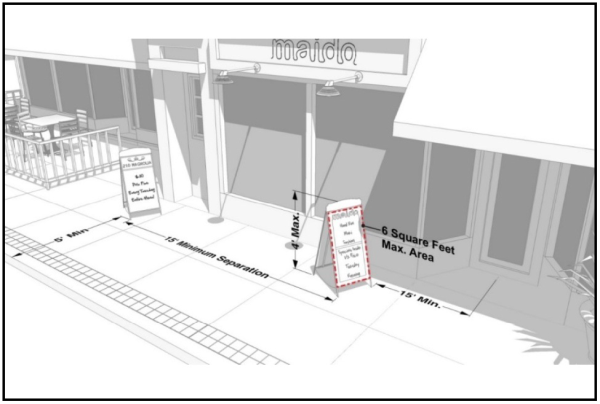
- One A-frame sign is permitted per establishment, including one for each tenant in a multi-tenant development. A minimum fifteen foot (15') separation is required between all A-frame signs.
- An A-frame sign must be placed within fifteen feet (15') of the primary entrance of the business, and must not interfere with pedestrian traffic or violate standards of accessibility as required by the ADA or other accessibility Articles. A-frame signs may be placed in the public right-of-way concurrent with the lot of the establishment being advertised, but must maintain a five foot (5') sidewalk clearance at all times.
- A-frame signs are limited to six (6) square feet in area per side and four feet in height.
- The placement of A-frame signs outdoors is limited to business hours only. A-frame signs must be stored indoors at all other times.
- A-frame signs must not be used outdoors when high winds, heavy rain, or snow conditions exist.
- Illumination of A-frame signs is prohibited.
- No A-frame sign may have any type of electronic component.
- Construction Activity Sign: On a lot where active construction is taking place, a temporary sign is permitted in conjunction with such construction and may identify the proposed use for the property even if such use is not yet established, subject to the following:
- Construction activity signs are permitted in all districts on all sites with active construction projects.
- Construction activity signs may be installed only after approval of a building permit for such activity. Construction activity signs must be removed as follows:
- For additions, alterations, or repairs to an existing structure: sixty (60) days or when the building permit expires, whichever occurs first.
- For new construction: once construction is complete or the building permit expires, whichever occurs first.
- Construction activity signs may be constructed as either freestanding signs, wall signs, or installed on accessory structures such as fences, and subject to the following:
- Signs are limited to sixteen (16) square feet in area for construction sites for individual single-family or two-family dwellings, and for any site of less than one acre in lot area. Signs are limited to thirty two (32) square feet in area for all other construction sites.
- Freestanding signs are limited to seven feet (7') in height and must be located five feet (5') from any lot line.
- Signs may not be illuminated.
- Flags: Flags are permitted in any district.
- Flags may be freestanding or wall-mounted.
- Flagpoles are limited to the maximum number of three (3) poles and a maximum height of thirty feet (30').
- Flagpoles must be setback a minimum of ten feet (10') from any lot line.
- Wall-mounted flags may not extend over the public right-of-way.
- External illumination of flags is permitted but must be focused on the flagpole and flag.
- All flags must be maintained in good condition.
- Government Sign: Federal, state, or local governments or taxing bodies may install signs in the public interest in any number, configuration, or size in any district. Such signs may be illuminated as required by the agency. Any electronic message signs require Village approval, with the exception of temporary roadway work, utility work, or emergency information signs.
- Holiday Decorations: Decorations on private property clearly incidental and customary, and commonly associated with, national, local, or religious holidays, are allowed but are limited to a maximum display period of forty five (45) days for each holiday.
- Light Pole Banner: Light pole banners on private property are allowed as follows:
- Light pole banners are permitted for light poles on private property and must be mounted so that they are held taut between support posts.
- Light pole banners are limited to a maximum area of ten (10) square feet.
- Light pole banners must be mounted to project perpendicular from light poles.
- Light pole banners must not be used as a temporary off-premise sign.
LIGHT POLE BANNER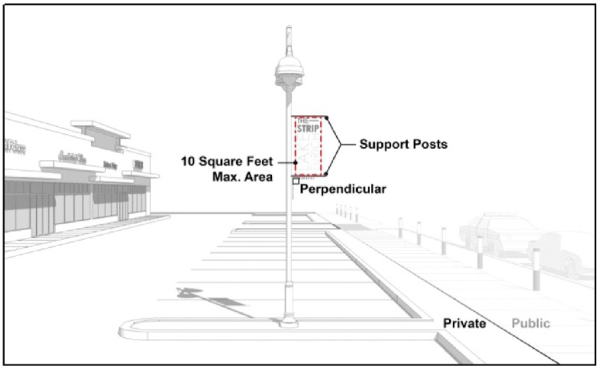
- Multiple Tenant Building Entryway Sign: Multiple tenant buildings, such as townhouse dwellings, multi-family dwellings, and non-residential developments with multiple tenants, are permitted an additional building entryway sign subject to the following.
- Multiple tenant building entryway signs may be constructed as either freestanding or wall signs, subject to the following:
- Signs are limited to six (6) square feet in area.
- Freestanding signs are limited to five feet (5') in height, and must be located within five feet (5') of the building entry and no less than five feet (5') from any lot line. Freestanding building entryway signs must be installed so that they are primarily viewable from the building entryway and not intended to be viewed from a public right-of-way.
- Signs may only be internally illuminated.
- Multiple tenant building entryway signs are limited to one per building entry.
- Multiple tenant building entryway signs may be constructed as either freestanding or wall signs, subject to the following:
- Noncommercial: Expressions of noncommercial ideas and messages, which include but are not limited to advocating a public issue, candidate, alerts, or warnings, are permitted in all districts.
- Noncommercial messages may be constructed as either freestanding, wall, or window signs. There is no limit on the number of signs permitted.
- Freestanding and wall-mounted noncommercial messages in all districts are limited to six (6) square feet in area.
- Window-mounted noncommercial messages must meet the coverage limitations of window signs. If no coverage is specified, the limitation is thirty percent (30%) of the window area.
- Freestanding noncommercial messages must be located five feet (5') from any lot line.
- Noncommercial messages posted on private property must have the permission of the property owner.
- Noncommercial messages may not be illuminated.
- Noncommercial messages cannot be used as a temporary off-premise sign.
- Not-For-Profit Community Event Signs:
- Not-for-profit community events are permitted temporary signs. Signs allowed for not-for-profit community events cannot be used as temporary off-premise signs, which are prohibited, that direct attention to a for-profit commercial activity.
- When located on private property, permission from the property owner is required. When located on public property, permission from the Village or other applicable authority is required.
- Signs for not-for-profit community events are limited to six (6) square feet in area.
- All signs for not-for-profit community events must be removed within forty eight (48) hours of the close of the event.
- Parking Lots and Structures: Additional Signs: Parking lots and structures are permitted additional signs, whether such parking lots or structures a principal or ancillary use.
- An additional sign is permitted at each entrance/exit, driveway intersection, drive-through lane, and other circulation points.
- Signs are limited to four (4) square feet in area.
- A freestanding sign is limited to six feet (6') in height and must be five feet (5') from any lot line that abuts a street.
- Signs located at an entrance/exit, driveway intersection, drive-through lane, and other circulation points may be internally or externally illuminated.
- Real Estate Activity Sign: When a structure or lot is offered for sale, lease, or rent, such lot is permitted an additional temporary sign as follows:
- Real estate activity signs are permitted in all districts. Real estate signs must be located on the site of the property for sale, lease, or rent.
- Real estate signs are limited to one per street frontage.
- Real estate activity signs may be constructed as either freestanding, wall, or window signs.
- Real estate activity signs are limited to six (6) square feet in residential districts and thirty two (32) square feet in all other districts.
- Freestanding signs are limited to five feet (5') in height and must be located at least five feet (5') from any lot line.
- Real estate activity signs may not be illuminated.
- Real estate activity signs must be removed within five (5) days of final closing, lease, or rental. If such real estate signs are used in conjunction with a promotional event related to the sale, lease or rent, such signs may be installed forty eight (48) hours prior to event and must be removed within twenty four (24) hours of the end of the event.
- Window Sign:
- Window signs are permitted for all non-residential uses in all districts.
- All window signs, whether temporary or permanent, are limited to no more than thirty percent (30%) of the surface of each window area. Window area is counted as a continuous surface until divided by an architectural or structural element. Mullions are not considered an element that divides window area.
- Up to five percent (5%) of window area may be an illuminated, but this area is included in the maximum total area of thirty percent (30%). Flashing or animation is prohibited.
WINDOW SIGNS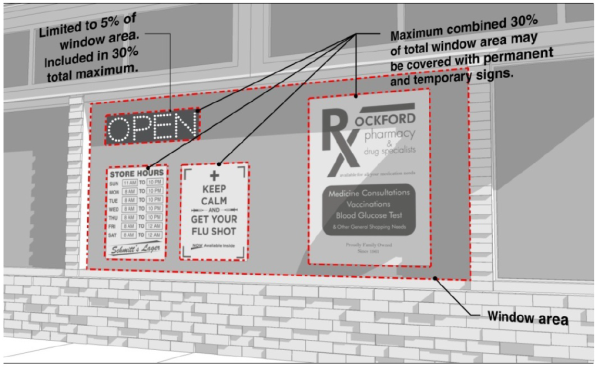
- A-Frame Sign:
(Ord. 19-10-26)
20.12.5: SIGN PERMIT REQUIRED FOR PERMANENT AND TEMPORARY SIGNS
This section describes the types of signs allowed with a sign permit. Specific regulations on each sign type may include further restrictions on which districts and/or uses within a district may utilize these sign types.
- Attention-Getting Device:
- Attention-getting devices are permitted for non-residential uses in the non-residential districts.
- Each establishment may have one attention-getting device installed or mounted at any one time.
- Attention-getting devices are limited to the following display periods:
- When the attention-getting device advertises an event that has a specific start and end time: A total display period of seven (7) days prior to the start of the event, the time period of the event, and three (3) days following the end of the event.
- All other attention-getting device advertises (non-time specific): fifteen (15) days.
- A maximum of four (4) display periods per year is permitted with a minimum of thirty (30) days between displays.
- Attention-getting devices for multi-tenant sites are subject to the following rules:
- The display period and separation period apply to each establishment individually rather than the site as a whole.
- For multi-tenant sites, the property owner(s) and/or tenants must coordinate display of attention-getting devices among tenants.
- Freestanding attention-getting devices are subject to the following:
- One freestanding attention-getting device is allowed for every seventy five (75) feet of street frontage. There must be a fifteen foot (15') separation between freestanding attention-getting devices.
- Freestanding attention-getting devices are limited to a maximum height of ten feet (10') and thirty two (32) square feet in area.
- Freestanding attention-getting devices must be located a minimum of five feet (5') from a lot line, as measured from the outermost portion of the sign. No part of a freestanding attention-getting device may extend over the lot line.
- Wall-mounted attention-getting devices are limited to thirty two (32) square feet.
ATTENTION GETTING DEVICE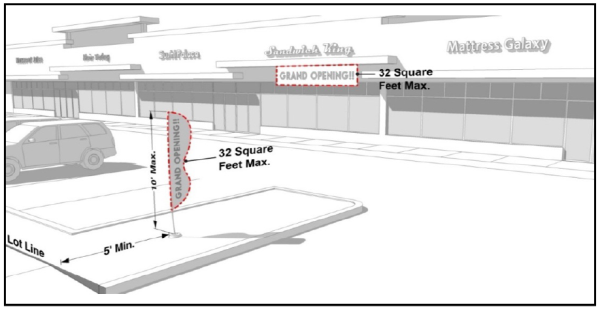
- Awning Sign:
- Awning signs are permitted for multi-family dwellings and non-residential uses in any district.
- Awning signs must maintain a minimum vertical clearance of seven feet six inches (7'6").
- Awning signs may encroach into the public right-of-way but must be located at least two feet (2') from the curb line.
- Awning signs must be made of a durable, weather-resistant material such as canvas, canvas-like material, nylon, vinyl-coated fabric, or permanent building material such as metal.
- Sign copy on any awning sign surface is limited to twenty five percent (25%) of each surface area. A valance is considered a separate surface area.
- Solid awnings are permitted lettering attached to and located above the top of the awning to a maximum height of twenty four inches (24").
- Awning signs may be externally illuminated and lighting must be focused on the printed area.
- Back-lit awnings are prohibited.
AWNING SIGN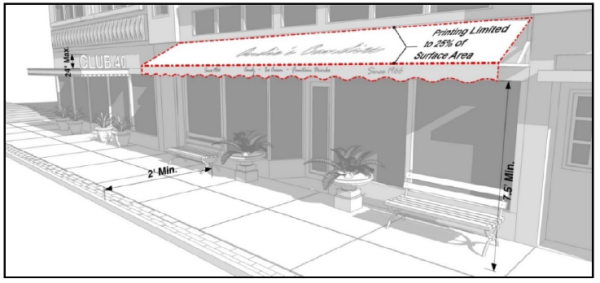
- Blade Sign (Projecting Signs):
- Blade signs are permitted only in the B-1 and B-2 Districts, subject to the following restrictions:
- One blade sign shall be permitted for each street frontage which the building/use abuts.
- The height shall not exceed five feet (5').
- The width shall not exceed three feet (3').
- The maximum projection from any wall may not exceed forty two inches (42").
- The sign depth/thickness shall not exceed three inches (3").
- The sign area shall not exceed seven and one half (7.5) square feet.
- No part of the sign may extend above the parapet wall of the building.
- No part of the sign, mounting apparatus, or light may extend more than twenty feet (20') from the ground.
- There shall be a minimum clearance of eight feet (8') between any part of the sign and finished grade.
- There shall be not less than four inches (4") between the sign and the wall of the building.
- No internal illumination is permitted.
- External light fixtures may not extend more than two feet (2') beyond the vertical centerline of the sign.
- Blade signs may encroach into the public right-of-way but must be located at least two feet (2') from the curb line.
- Blade signs must be constructed of wood or simulated wood, metal, durable, weather-resistant material like canvas, canvas-like material, nylon or vinyl-coated fabric, plastic, or high-density urethane (HDU) foam board or similar durable foam construction. Blade signs constructed of canvas or similar material must be mounted so that they are held taut between support posts.
BLADE SIGN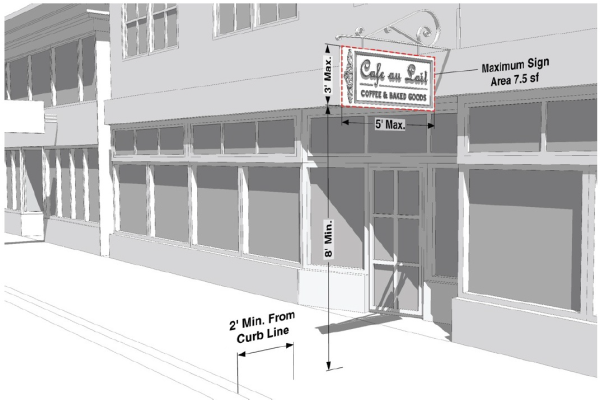
- Blade signs are permitted only in the B-1 and B-2 Districts, subject to the following restrictions:
- Electronic Message Sign:
- Electronic message signs are permitted in the P-I District only, however the following exception applies: motor vehicle service stations in any district are permitted an electronic message sign to display copy graphic that is required to be displayed by law, such as fuel prices.
- Electronic message signs are permitted as part of a ground sign.
- Electronic message signs must be a minimum of twenty five feet (25') from the lot line. This is measured from sign face to the lot line, including any public right-of-way.
- Electronic message signs must be integrated into the larger sign structure. The electronic component is limited to a maximum of seventy percent (70%) of the total area of a sign.
- Only one electronic message sign per lot is permitted.
- Electronic message signs must display static text messages only, with no animation or effects simulating animation or video. Any scrolling, flashing, spinning, revolving, or shaking animation, or movement of the message or any component of the sign is prohibited. Any message change sequence must be accomplished immediately by changing from one screen to another without transition by means of, for example, fade or dissolve mode. Video display screens are prohibited. Each message or image displayed on an electronic message sign must be static for a minimum of four (4) seconds. Multi-color messages and static images are permitted.
- The content of electronic message signs is limited to the time, outdoor temperature and public service messages.
ELECTRONIC MESSAGE SIGN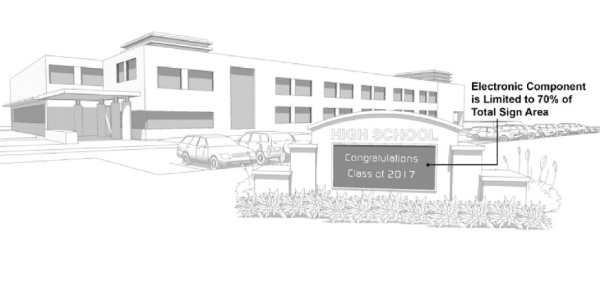
- Ground Sign:
- Ground Signs Permitted: Ground signs are permitted in the B-3 and O-T Districts only.
- General Ground Sign Regulations:
- Ground signs may be designed with the sign base installed at grade or mounted on posts.
- Ground signs must be set back five feet (5') from any lot line. No ground sign may project into, over, or otherwise encroach on a public right-of-way.
- Ground signs may be internally or externally illuminated. If externally illuminated, all light must be directed onto the sign face.
- Ground signs must be constructed of brick, wood or simulated wood, stone, concrete, metal, plastic, or high-density urethane (HDU) foam board or similar durable foam construction. The base on which a ground is principally supported should typically be constructed of masonry material.
GROUND SIGNS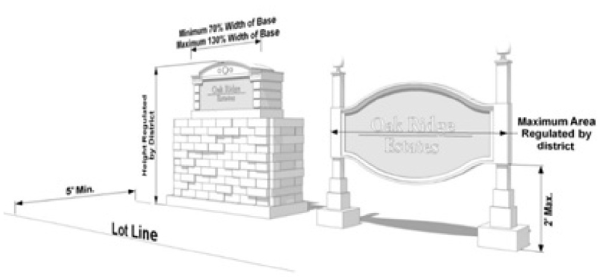
- Number of Signs Permitted: One ground sign shall be permitted per zoning lot.
- Permitted Height:
- In the B-3 District, ground signs shall not be higher than twenty four feet (24') above grade, with the maximum distance from grade to the bottom of the sign not more than eight feet (8').
- In the O-T District, ground signs shall not be higher than ten feet (10') above grade;
- Sign Area: The maximum sign area shall not exceed the lot's street frontage, or one hundred forty (140) square feet, whichever is less.
- Location: Ground signs are permitted in the front yard only.
- Ground Sign Landscaping: All ground signs must be landscaped at the base of the sign in accordance with the following:
- Landscape must extend a minimum of two feet from the sign base on all sides with small shrubs a minimum of eighteen inches (18") in height at planting in a single row around the perimeter of the sign base. The remainder of the required landscape area must be planted with trees, perennials, or other live groundcover.
- If a ground monument sign is designed with a decorative base and such decorative base extends to the ground, the single row of shrubs around the perimeter of the sign base is not required. Landscape must extend a minimum of two feet (2') from the sign base around a minimum of fifty percent (50%) of the perimeter of the sign base, and must be planted with shrubs, trees, perennials, or other live groundcover.
- If landscape is required on a site, ground sign landscape is included in the total amount of landscape required on a site. Where a sign is installed in any landscape area of a site, the specific landscape requirements of this section do not apply and the sign landscape must be integrated into the overall site landscape plan. Sign landscape must be shown on the landscape plan.
- All landscape must be maintained in good condition, and free and clear of rubbish and weeds.
GROUND SIGN LANDSCAPE REQUIREMENTS (NON-DECORATIVE BASE)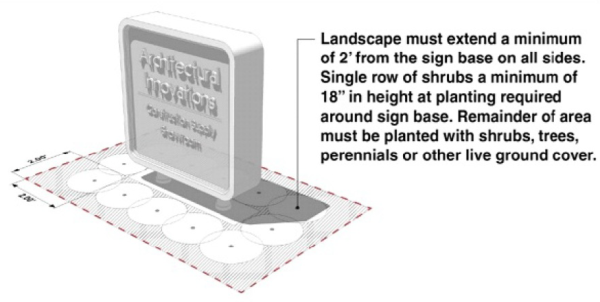
GROUND SIGN LANDSCAPE REQUIREMENTS (DECORATIVE BASE)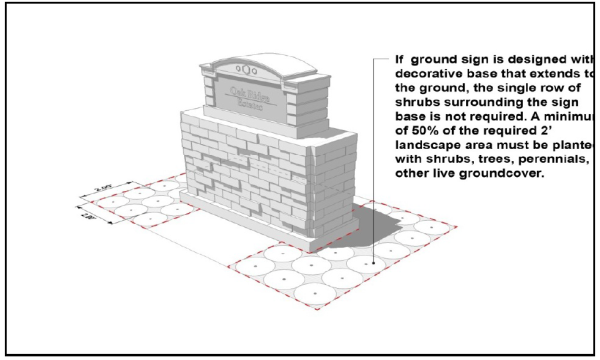
- Menuboard:
- Menuboards are permitted for all drive-through facilities in any district.
- Menuboards are limited to a maximum of two (2) per drive-through lane.
- Menuboards are limited to seventy five (75) square feet in sign area and eight feet (8') in height. The menuboard may be designed as separate freestanding signs grouped together and may include the use of preview boards designed as separate freestanding signs installed a distance earlier in the drive-through lane, however the total area of all signs must not exceed seventy five (75) square feet.
- Menuboards are permitted an additional ten (10) square feet of sign area for temporary signs attached to the top or sides of the menuboard.
- Menuboards must be located a minimum of fifteen feet (15') from any residential district lot line. This is measured from sign face to lot line, including any public right-of-way.
- Menuboards may be internally illuminated. Menuboards may also contain an electronic screen for interaction with each customer.
MENUBOARD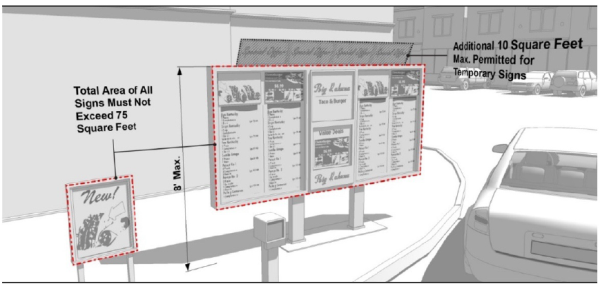
- Wall Signs:
- Districts Allowed: Wall signs are permitted in the B-1, B-2, and B-3 Districts only.
- Location: Wall signs are permitted on all walls/facades of a structure. On a site consisting of multiple structures, each structure is permitted wall signs per the regulations of this section. The square footage from different structures cannot be combined to create a larger sign on any one structure.
- Maximum Sign Area:
- B-3 District: The maximum sign area shall not exceed one and one half (1.5) times the length of:
- The wall on which the sign is located for a single tenant building; or
- The tenant space for a multi-tenant building.
- B-1 and B-2 Districts: The maximum sign area shall not exceed the length of:
- The wall on which the sign is located for a single tenant building;
- The tenant space for a multi-tenant building; or
- If a sign is mounted on the wall of the building facing an alley, the area of such sign shall not exceed five feet (5').
- B-3 District: The maximum sign area shall not exceed one and one half (1.5) times the length of:
- Sign Height: Wall signs shall not extend above the height of the wall.
- Vertical Dimension: The vertical dimension of wall signs shall not exceed six feet (6').
- Sign Projection: Wall signs shall not project more than twelve inches (12") from the face of the wall and must provide at least eight feet (8') of clearance above grade.
- Illumination: External illumination of wall signs is preferred. Halo/backlit illumination is permitted. Internally illuminated wall signs are not permitted.
WALL SIGN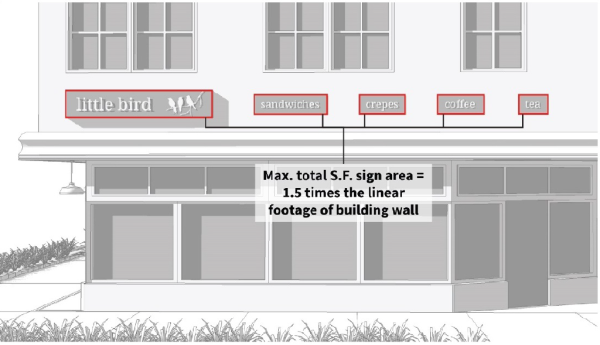
(Ord. 19-10-26)
20.12.6: SUMMARY OF ALLOWED SIGNS
Table 10-3: Summary of Allowed Signs catalogs the types of allowed signs, both permanent and temporary, and indicates whether such sign requires a sign permit. This table is provided for reference purposes; in the case of any conflict with the regulations of this Article, the specific sign regulations control over this table.
| TABLE 10-3: SUMMARY OF ALLOWED SIGNS | |||
| Sign Type | Exempt/No Permit Required (Section 20.12.9) | Permit Required (Section 20.12.10) | Sign Type P = Permanent T = Temporary |
| A-Frame Sign | • | T | |
| Attention Getting Device | • | T | |
| Awning Sign | • | P | |
| Blade Sign (Projecting Signs) | • | P | |
| Canopy Sign | • | P | |
| Construction Activity | • | T | |
| Electronic Message Sign | • | P | |
| Flag | • | P | |
| Government Sign | • | P, T | |
| Ground Sign | • | P | |
| Holiday Decorations | • | T | |
| Light Pole Banner | • | P, T | |
| Memorial | • | P | |
| Menuboard | • | P | |
| Multi-Tenant Building Entryway | • | P | |
| Noncommercial | • | T | |
| Parking Lot/Structure | • | P | |
| Not-for-Profit Community Event | • | T | |
| Real Estate Activity | • | T | |
| Wall Sign | • | P | |
| Window Sign | • | P, T | |
(Ord. 19-10-26)
20.12.7: SIGN ENFORCEMENT
- Relation To Other Laws And Regulations: Where there is a conflict between this Article and other Village statutes, Articles, or regulations, the more restrictive statute, Article, or regulation controls.
- Revocation And Termination Of Permit: The Zoning Administrator may revoke any sign permit where there has been a violation of the provisions of this Article or misrepresentation of fact on the sign permit application. Upon termination or revocation of a sign permit, the sign must be removed without cost or expense of any kind to the Village.
- Inspection: The Village may inspect all signs at any time. The purpose of the inspection is to ascertain whether the structure is secure or insecure, whether in need of repair or removal, whether it is in conformance with the sign permit and/or sign variance approval, or otherwise in violation of the provisions of this Article.
- Illegally Constructed Signs: If a sign is determined to have been constructed illegally without a required sign permit, the Zoning Administrator will serve notice to the property owner that such sign must be removed within thirty (30) days of notice for permanent signs or twenty four (24) hours for temporary signs. If the sign is not removed within the required time period, the Zoning Administrator may enforce this order through permitted enforcement procedures.
- Illegally Placed Signs: Any sign placed on public property or within the public right-of-way without authorization will be removed immediately by the Village without notice.
- Penalties: Any person who violates this Article may be fined for each offense. Each day that a violation continues constitutes a separate offense for the purposes of the penalties and remedies available to the Village. The accumulation of penalties for violations, but not the obligation for payment for violations already committed, ceases upon correction of the violation. Each violation, and each day that such violation continues, is subject to a fine as established in the Village Article.
(Ord. 19-10-26)

