
Clearwater City Zoning Code
APPENDIX B
US 19 ZONING DISTRICT AND DEVELOPMENT STANDARDS
Section B-101. - Intent and purpose.
The intent and purpose of the US 19 Zoning District and Development Standards ("Development Standards") is to guide the development and redevelopment of sites along US 19 consistent with strategies defined in the US 19 Corridor Redevelopment Plan. The standards are designed to accomplish the following.
• Promote employment-intensive and transit-supportive forms, patterns, and intensities of development;
• Encourage the development of mixed use destinations at major cross streets; and
• Provide for the design of safe, attractive, and accessible settings for working, living, and shopping.
(Ord. No. 8988-17, § 21, 2-2-17)
Section B-102. - Relation to the Community Development Code.
These Development Standards are part of Community Development Code Article 2, Division 11 and Article 3, Division 5. Wherever there appears to be a conflict between these Development Standards and other sections of this Code, these standards shall prevail. For standards not covered by these Development Standards, other applicable sections of the Community Development Code shall apply.
(Ord. No. 8988-17, § 21, 2-2-17)
Section B-103. - Organization of standards.
Standards regulating development in the US 19 District are organized as follows:
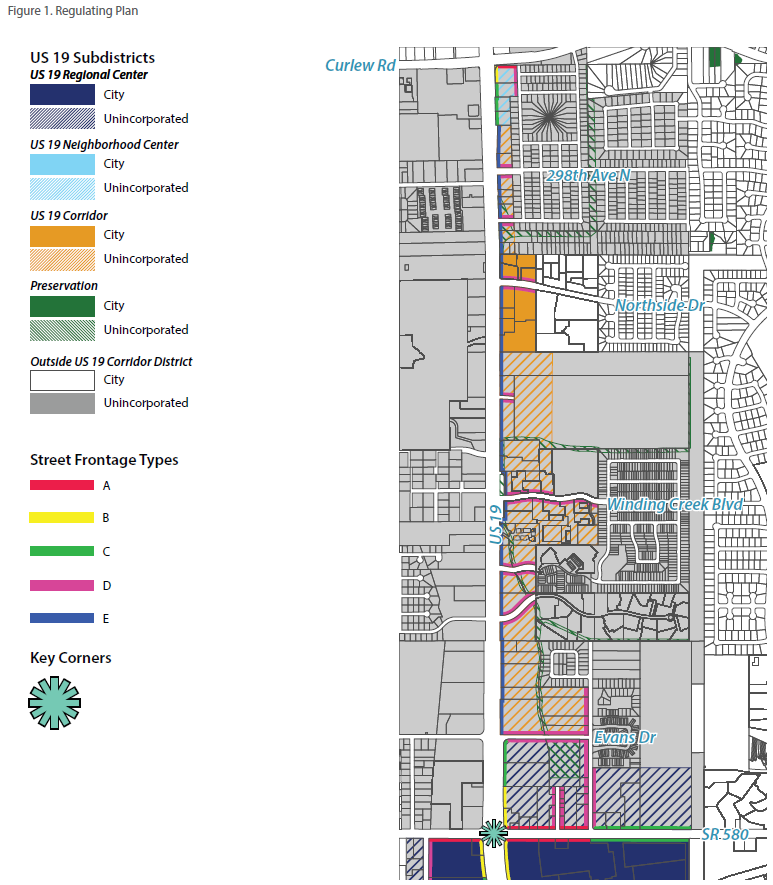
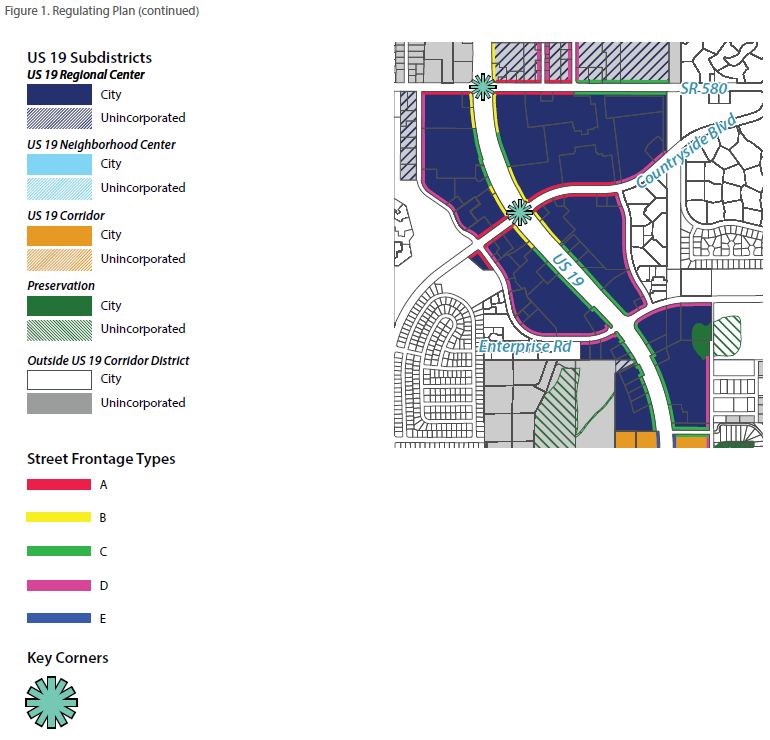
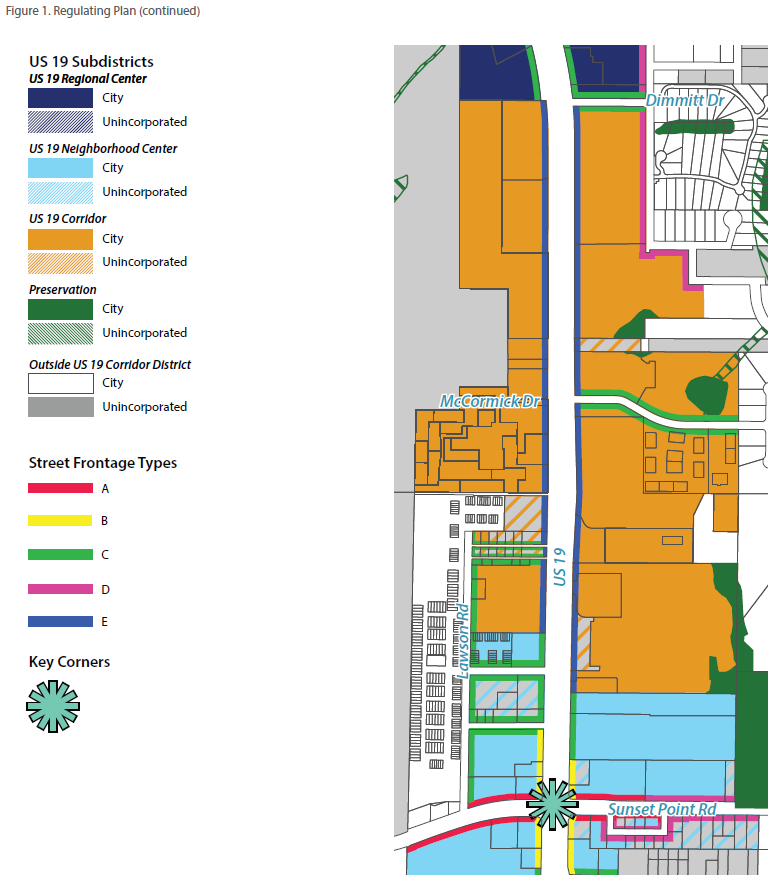
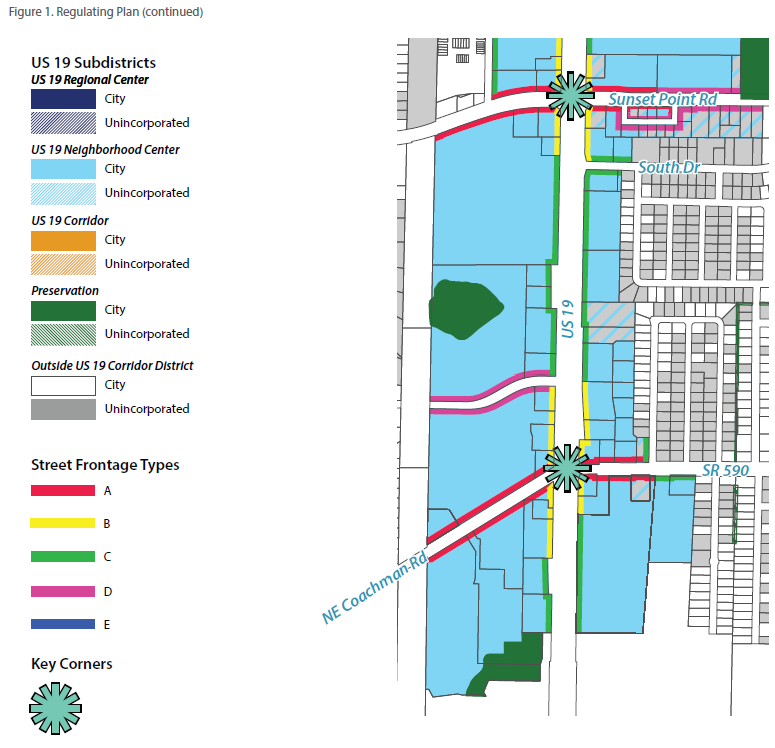
A) Regulating Plan
The regulating plan consists of maps indicating subdistrict limits and street frontage type assignments. Subdistrict standards regulate development intensity, building heights, uses, and parking requirements. The regulating plan also identifies the location of key corners which are subject to special requirements.
B) Development Standards
Standards regulating development in the US 19 District are included in Divisions 3, 4, 5, and 6 and are summarized below:
1.
The Subdistrict Standards in Division 3 regulate development potential, building heights, permitted uses, and parking requirements and reduction factors.
2.
The Street Frontage Standards in Division 4 regulate building location and facade treatments, landscaping, pedestrian improvements, and parking treatments along street frontages.
3.
The Site Design Standards in Division 5 regulate the configuration of improvements on sites, project phasing, pedestrian and vehicular circulation, parking and service areas, landscaping, and other features.
4.
The Building Design Standards in Division 6 regulate the treatment of front building facades, building entries, and other features related to the architectural design of buildings.
C) Flexibility Provisions
Division 7 provides processes and standards for the approval of flexibility in the application of the US 19 Zoning District and Development standards.
(Ord. No. 8988-17, § 21, 2-2-17; Ord. No. 9387-20, § 4, 8-6-20)
Section B-104. - Applicability of Development Standards.
A) General
The Development Standards in Appendix B, Divisions 3, 4, 5, and 6 are intended to ensure that new development and significant renovations and additions to existing developments are designed in accordance with the vision described in the US 19 Corridor Redevelopment Plan, while allowing for incremental improvements to existing buildings and sites. Provisions addressing flexibility in the application of these Development Standards are included in Appendix B, Division 7.
B) Conformity of Existing Structures
Existing structures within the US 19 District, including buildings and parking, shall not be considered nonconforming under the standards for nonconforming structures in Section 6-102.
C) Exemptions
The following types of development are exempt from all or a portion of the Development Standards as follows.
1.
Structures Damaged by Force Majeure. Notwithstanding anything to the contrary contained or implied herein, if a lawfully constructed structure is damaged or destroyed by fire, casualty or act of God, the owner of record on the date of the event may repair or rebuild said structure on the same building site and with the same building footprint by right. To qualify, the structure must have been legally permitted to have been built under this or other codes, or have legally existed as a non-conforming structure prior to the causative event. The structure shall not be added to or altered in any way, except to remedy the effects of such damage or destruction, unless such additions or alterations cause the structure to conform more closely with the provisions of these Development Standards. Permits for repair or replacement of such structures must be obtained within one year of the causative event.
2.
Restricted Access Sites. Parcels for which public access is prohibited due to health, safety, public security, and welfare reasons are exempt from the Development Standards in Appendix B, Divisions 4, 5 and 6.
3.
Detached Dwellings. Detached dwellings lawfully existing on the date of the original adoption of these Development Standards may continue to be repaired, remodeled and expanded consistent with the standards for detached dwellings in the Low Medium Density Residential District (LMDR) in Article 2, Division 2, provided that any enlargement or alteration to the structure does not create any additional dwelling units. New accessory structures may be constructed consistent with the setbacks for accessory structures in the LMDR District and standards in Article 3, Division 2. No lot of record upon which a detached dwelling existed on the date of adoption of these Development Standards may be expanded or reduced in size while occupied with a detached dwelling.
4.
Mobile Homes and Mobile Home Parks. Mobile homes and mobile home parks lawfully existing on the date of adoption of these Development Standards may continue to be repaired, remodeled and/or replaced consistent with the standards for mobile homes in Article 2, Division 6, or those standards in place at the time of mobile home park approval, provided that any modifications do not create any additional dwelling units. New accessory structures may be constructed consistent with the setbacks for accessory structures in Article 2, Division 6 and the standards for accessory structures in Article 3, Division 2. No lot of record upon which a mobile home or mobile home park existed on the date of adoption of these Development Standards may be expanded or reduced in size.
5.
Change of Use. Projects involving only a change in use are exempt from the Development Standards in Appendix B, Divisions 4, 5 and 6, but shall comply with the bicycle parking standards in Section B-303.D when the change of use results in an increase in the minimum number of bicycle parking spaces required. When applicable, this shall only apply to the increase in bicycle parking required for the new use.
6.
Improvement, Remodel, or Reconstruction. Building improvement and remodel projects, including reconstruction of buildings in the general location or footprint of buildings being replaced, with up to 5 percent additional gross floor area, shall be exempt from the development standards as follows:
a.
Building improvement, remodel, or reconstruction projects valued at less than 25 percent of the total assessed building value as reflected in the Property Appraiser's current records at the time of application are exempt from the development standards in Appendix B, Divisions 4, 5 and 6, except that the location of any new floor area, including accessory structures, shall be compliant with the setback requirements in Division 4 of these standards to the greatest extent practicable as determined by the Community Development Coordinator, and bicycle parking shall be provided for any new floor area consistent with the bicycle standards in Section B-303.D.
b.
Building improvement, remodel, or reconstruction projects valued at 25 percent or more of the total assessed building value as reflected in the Property Appraiser's current records at the time of application, are exempt from all but the pedestrian walkway standards in B-503.C, the surface parking and service area standards in B-504.A.1, and the landscape requirements in B-505.A of these standards, which shall be brought into compliance to the greatest extent practicable as determined by the Community Development Coordinator. Additionally, the location of any new floor area, including accessory structures, shall be compliant with the setback requirements in Division 4 of these standards to the greatest extent practicable as determined by the Community Development Coordinator, and bicycle parking shall be provided for any new floor area consistent with the bicycle standards in Section B-303.D. Landscape requirements in B.504.A.1 and B.505.A may be modified as part of a comprehensive landscape program pursuant to the criteria set forth in Section 3-1202.G.
7.
Internal Buildings and Additions. New buildings or additions to existing buildings located 200 feet minimum from the front property line shall be exempt from the street frontage standards in Division 4, except for side and rear setbacks, and the development pattern standards in Section B-502, the access and driveway consolidation standards in Section B-503.A, reconstruction of sidewalks and landscaping in Section B-503.B, and building entry location standards in Section B-604.A. The location of any new floor area as part of an addition shall be compliant with the setback requirements in Division 4 of these standards to the greatest extent practicable as determined by the Community Development Coordinator. Additionally, the location of new buildings or additions to existing buildings shall allow for future development compliant with all setback requirements.
8.
Parking and Landscaping. The following Community Development Code sections shall not apply: 3-1202.A.2, and 3-1401.B.2.
(Ord. No. 8988-17, § 21, 2-2-17; Ord. No. 9387-20, § 5, 8-6-20; Ord. No. 9643-23, § 18, 4-4-23; Ord. No. 9712-23, § 3, 11-2-23; Ord. No. 9740-24, § 3, 2-1-24)
Section B-201. - General.
Development within the US 19 District is regulated by subdistrict and street frontage type as shown in Figure 1. Regulating Plan and described below.
(Ord. No. 8988-17, § 21, 2-2-17)
Section B-202. - Subdistricts.
Standards and regulations for properties within the US 19 District apply to properties falling within one of three Subdistricts illustrated in Figure 1. Regulating Plan.
A) Regional Center Subdistrict
The Regional Center Subdistrict is applied to areas along US 19 planned to develop with a more urban character defined by taller, mixed use buildings aligned along streets. Standards are designed to create pedestrian-friendly streets and building frontages, and better connections among destinations.
B) Neighborhood Center Subdistrict
The Neighborhood Center Subdistrict is applied to areas along US 19 planned to serve as local shopping and employment destinations. Standards are designed to create more pedestrian-friendly streets and building frontages, and better connections among destinations.
C) Corridor Subdistrict
The Corridor Subdistrict is applied to areas along US 19 without direct access to interchanges. In these areas, a wide range of employment-intensive uses is favored over small-scale retail uses. Standards are designed to allow flexibility in site configurations and consistency in front landscape improvements.
(Ord. No. 8988-17, § 21, 2-2-17)
Section B-203. - Street frontage types.
A) Street Frontage Types on Regulating Plan
Select requirements in these Development Standards apply to properties along one of five street frontage types shown in Figure 1. Regulating Plan. These are further described in Division 4, where Street Frontage Type A is considered the most pedestrian- and transit-supportive and Street Frontage Type E is considered the least pedestrian- and transit-supportive.
B) Street Frontage Types Assignment
1.
Along new primary drives as defined in Section B-502.B and Table 5. Locational and Design Standards for New Drives, Street Frontage Type A is required.
2.
Along streets and drives where street frontage types are not depicted on the Regulating Plan, an appropriate street frontage type shall be established as part of an application for development approval.
(Ord. No. 8988-17, § 21, 2-2-17)
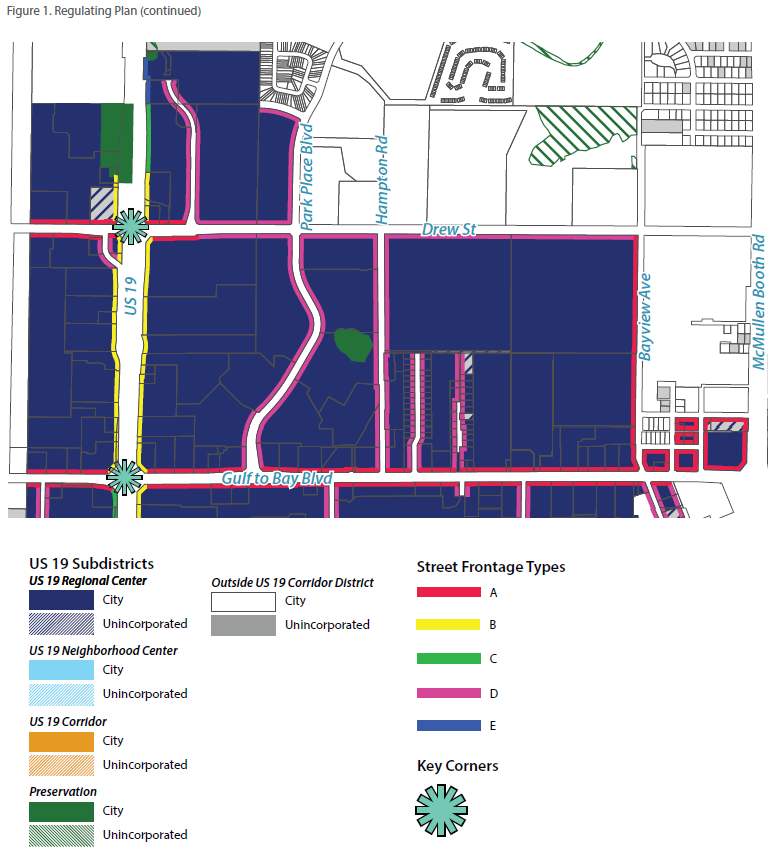
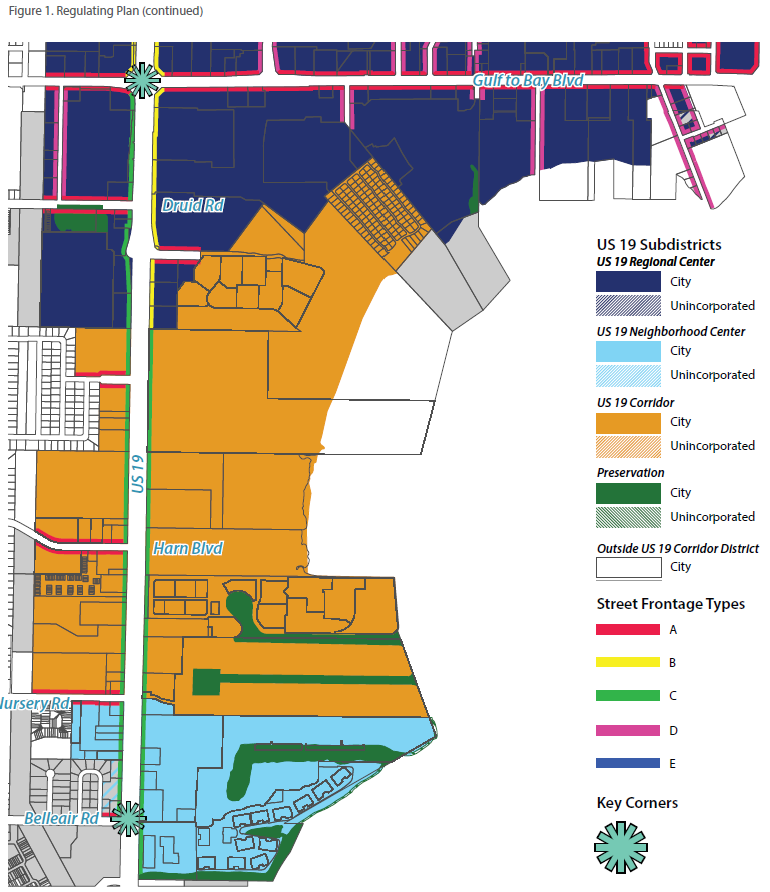
(Ord. No. 8988-17, § 21, 2-2-17; Ord. No. 9387-20, § 6, 8-6-20; Ord. No. 9643-23, § 19, 4-4-23)
Section B-301. - Development intensity.
A) Maximum Development Potential
The maximum development potential set forth for each Subdistrict is shown in Table 1. Permitted Intensities by Future Land Use Category. All allowable uses, including residential and overnight accommodations, are regulated by Floor Area Ratio (FAR).
B) Residential Density in Coastal Storm Area
Residential density on those portions of property located within the coastal storm area shall be limited to the density in place prior to the adoption of this Code, consistent with Policy CCM 2.4.3 and Map CCM 6 of the Comprehensive Plan.
(Ord. No. 8988-17, § 21, 2-2-17; Ord. No. 9758-24, § 25, 6-6-24)
Section B-302. - Building height.
A) Maximum Building Heights
Maximum heights for buildings are defined by Subdistrict as follows.
1.
Regional Center: 150 feet
2.
Neighborhood Center: 70 feet
3.
Corridor: 100 feet
B) Height Transitions and Setbacks
1.
Portions of buildings located less than 50 feet from adjacent properties zoned LDR, LMDR, or MDR shall be no greater than 35 feet in height.
2.
Portions of buildings located between 50 and 100 feet of adjacent properties zoned LDR, LMDR or MDR are allowed increases in height above 35 feet at a ratio of one foot in height for each additional one foot in distance from the adjacent property.
C) Minimum Heights at Key Corners
For properties within 100 feet of the following intersections measured along front property lines, the minimum floor-to-floor height for non-residential ground floor building space shall be 18 feet and the minimum building height for all buildings shall be 25 feet.
1.
US 19 and SR 580
2.
US 19 and Countryside Boulevard
3.
US 19 and Sunset Point Road
4.
US 19 and Coachman Road/SR 590
5.
US 19 and Drew Street
6.
US 19 and Gulf to Bay Boulevard
7.
US 19 and Belleair Road
(Ord. No. 8988-17, § 21, 2-2-17)
Section B-303. - Permitted uses and parking.
A) Use and Off-Street Parking Table
Permitted uses and approval levels by Subdistricts, along with off-street parking requirements, are listed in Table 2. Use & Off-Street Parking. Active uses are required at identified key corners, as defined in Section B-303.B. Pursuant to Section B-801, new construction projects on sites of 10 acres or more shall require at a minimum a Level One (flexible standard development) approval unless the proposed use or proposal otherwise requires a Level Two (flexible development) approval.
B) Active Uses at Key Corners
For properties within 100 feet of the following intersections measured along front property lines, ground floor building space along front facades to a depth of 20 feet minimum shall be occupied only by active uses including retail sales and services, bars, brewpubs, microbreweries, nightclubs, and/or restaurants in non-residential projects or ground floor amenity areas, lobbies, and/or fitness centers in residential projects.
1.
US 19 and SR 580
2.
US 19 and Countryside Boulevard
3.
US 19 and Sunset Point Road
4.
US 19 and Coachman Road/SR 590
5.
US 19 and Drew Street
6.
US 19 and Gulf to Bay Boulevard
7.
US 19 and Belleair Road
C) Parking Reduction
For all uses listed in Table 2. Use & Off-Street Parking, a reduction in the minimum number of parking spaces may be approved. The combined effect of all applicable reductions in this section shall not reduce the off-street parking required by more than 25 percent without a parking demand study pursuant to the flexibility provisions in Section B-703.A. Parking reduction factors are provided in Table 3. Parking Reduction Factors.
D) Bicycle Parking
1.
Short-term and long-term bicycle parking requirements are listed in Table 4. Bicycle Parking.
2.
All short-term bicycle parking areas shall be in highly visible locations along pedestrian walkways and near building entries.
3.
All bicycle parking provided shall comply with the bicycle parking standards in Section 3-1411 of this Development Code.
(Ord. No. 8988-17, § 21, 2-2-17; Ord. No. 9042-17, § 13, 12-7-17; Ord. No. 9161-18, § 1, 11-1-18; Ord. No. 9308-19, § 1, 11-7-19; Ord. No. 9514-22, § 6, 2-3-22; Ord. No. 9643-23, § 20, 4-4-23; Ord. No. 9712-23, § 4, 11-2-23; Ord. No. 9740-24, § 4, 2-1-24)
Section B-401. - General.
Street frontage standards in this section regulate conditions along the 5 street frontage types established in Section B-203. Street Frontage Types and include building setbacks and spacing, pedestrian and landscape improvements, parking and vehicular circulation, and front building facades and entries. The location and extent of each street frontage type is illustrated in Figure 1. Regulating Plan. Table 5. Summary of Street Frontage Standards provides an overview of requirements by street frontage type.
(Ord. No. 8988-17, § 21, 2-2-17; Ord. No. 9643-23, § 21, 4-4-23)
Section B-402. - Type A street frontage.
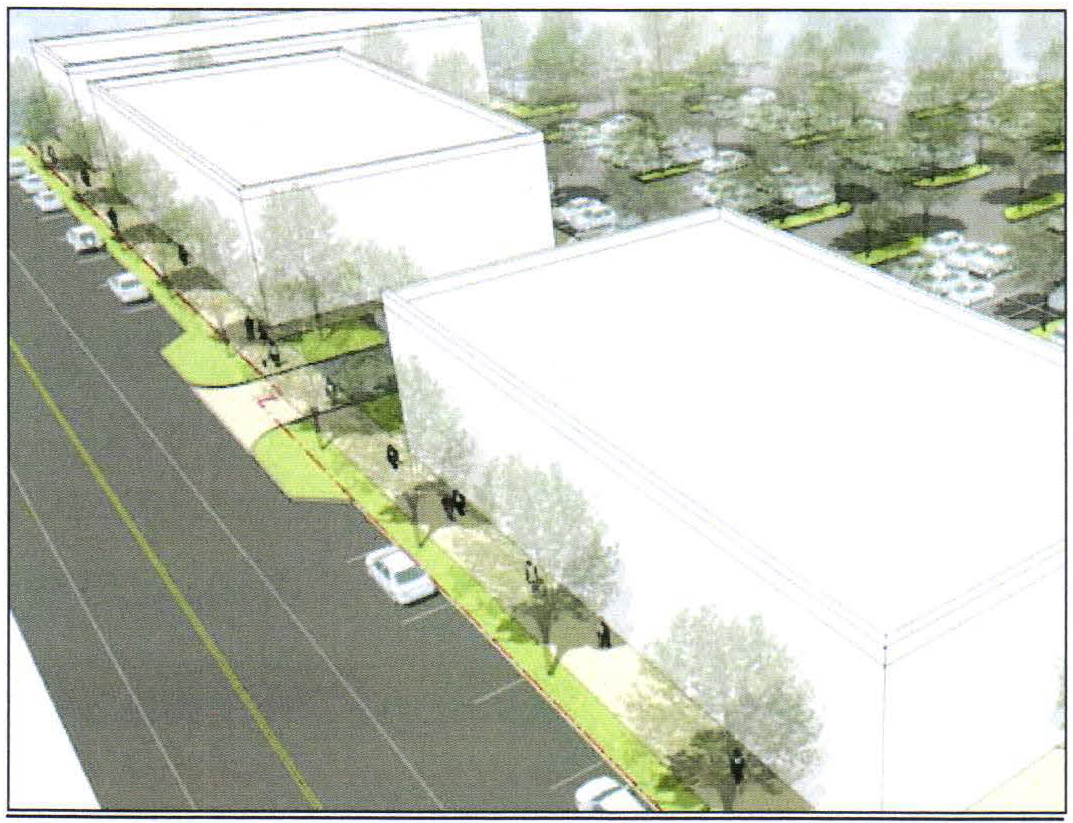
Figure 2. Type A Character Image
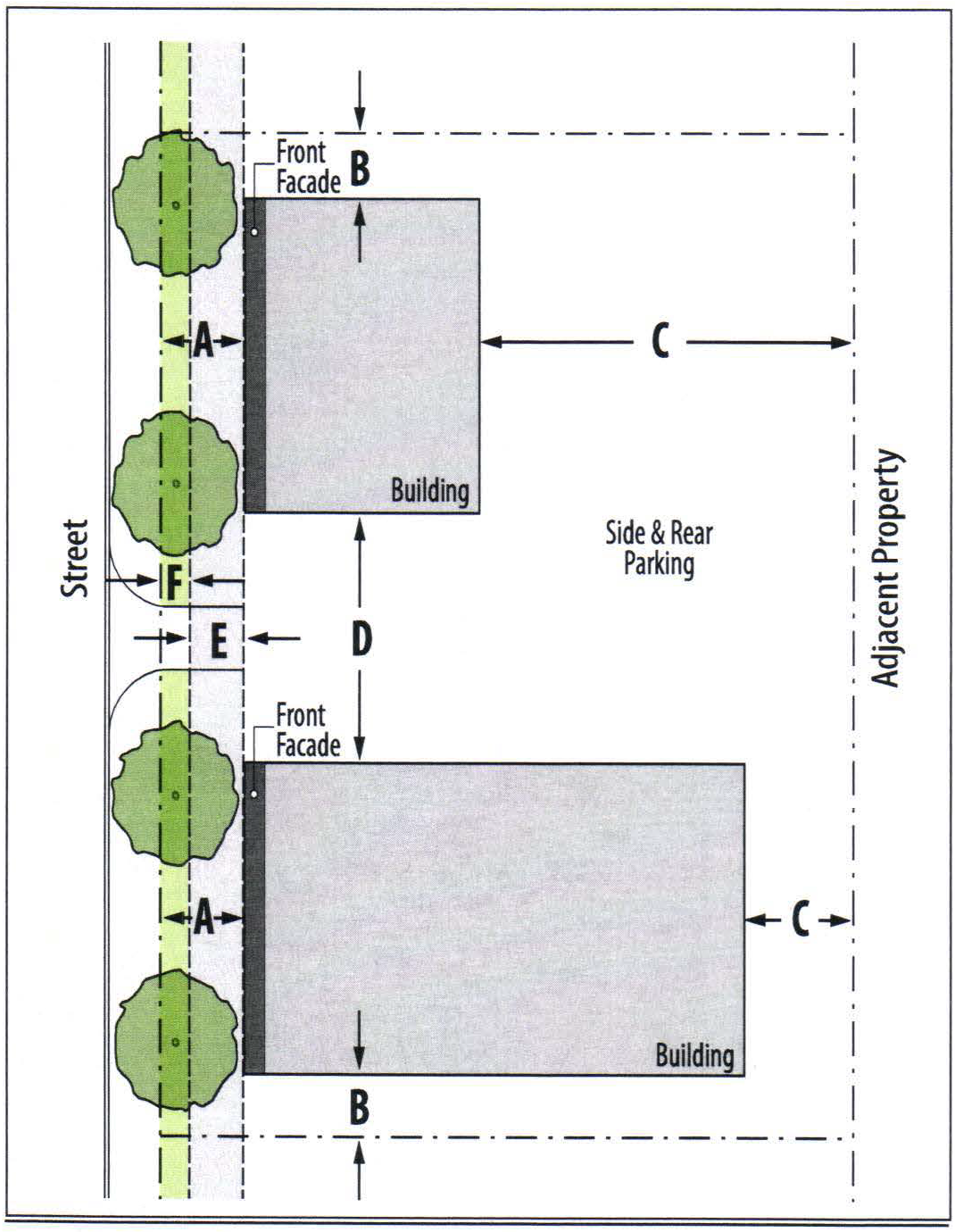
Figure 3. Type A Building Placement Diagram
A) General
Type A Street Frontage as shown in Figure 1. Regulating Plan identifies pedestrian- and transit-oriented frontages along major streets crossing US 19. In these locations, development standards limit front setbacks, prohibit parking in front of buildings, and require buildings oriented to public sidewalks and pedestrian areas along streets.
(In the sections below, the bold lettering in parentheses refers to the annotations in Figure 3. Type A Building Placement Diagram.)
B) Building Setbacks and Spacing
1.
Buildings shall be placed along street frontages consistent with the following setbacks from property lines.
a.
Front Setbacks (A): 15 feet minimum, 20 feet maximum
b.
Side Setbacks (B): 10 feet minimum or 0 feet if abutting adjacent building with blank side wall
c.
Rear Setbacks (C): 10 feet minimum
2.
Front setbacks may be reduced to 5 feet in locations where adjacent rights-of-way are improved with a 10-foot minimum wide landscape area adjacent to the street and a 10-foot minimum wide pedestrian area adjacent to building frontages. For the purpose of this section, the landscape area adjacent to the street shall include landscape material equivalent to what is required for front buffer areas in Article 3, Division 12 with the exception that the width shall be as set forth above.
3.
Front setbacks may be increased by 10 feet maximum extending 40 feet maximum along the front facade for projects with front courtyards or publicly-accessible front entry plazas.
4.
To promote continuity of building frontages along front setbacks, the space between individual buildings shall not exceed 100 feet (D).
C) Pedestrian and Landscape Improvements
1.
The area along front building facades shall be improved with a 10-foot minimum wide pedestrian area (E).
2.
Walkway connections shall be provided between public sidewalks and pedestrian areas along building facades. Such connections shall be 6 feet wide minimum and spaced 100 feet apart maximum.
3.
For areas where front setbacks are not reduced or eliminated, the area along the property line within the front setback shall be improved with a 5-foot minimum wide landscape area (F).
D) Parking and Vehicular Circulation
1.
Parking, vehicular circulation, and other vehicular use areas are prohibited between buildings and streets along front setbacks.
2.
Surface parking to the side of buildings along streets shall be set back 5 feet behind front building facades and screened from view with a low (24 to 36 inches) opaque hedge or wall.
3.
Structured parking, whether freestanding or attached to a building, shall be located to the rear of buildings.
4.
Ground level parking, vehicular circulation and other vehicular use areas incorporated in the ground floor of a building along street frontages shall be located behind fully-enclosed, occupied building space with a depth of 20 feet minimum.
5.
Surface and structured parking setbacks from side and rear property lines shall comply with building setback standards.
6.
With approval from appropriate City, County or State authorities, parallel parking may be constructed within the right-of-way along streets.
E) Front Building Facades and Entries
In addition to the building design standards in Division 6, the following standards for front building facades and entries shall apply.
1.
Ground floor front building facades shall generally be aligned along front setbacks parallel to streets and be designed to meet the following standards.
a.
For a building with a nonresidential use, a minimum of 40 percent of the total area of the ground floor facade shall be comprised of transparent windows or doors. Glass utilized to provide this transparency shall have visible light transmittance to the maximum allowed by the Energy Code, shall not have reflective or mirrored coating or other treatments including but not limited to dark tinting, colored or opaque films, boards or paint.
b.
For the ground floor front facades of buildings with residential uses, the finished floor elevation of ground floor residential space along front setbacks shall be elevated 18 inches minimum, 36 inches maximum above the grade of adjacent pedestrian walkways.
2.
Primary building entries shall be located along the front facades of buildings and be visible from streets, new primary drives, and sidewalks.
3.
For front entries to buildings with non-residential uses on the ground floor, thresholds at building entries shall generally match the grade of adjacent walkways and plaza areas.
4.
Overhead doors along front building facades are permitted for bars, nightclubs, brewpubs, microbreweries, restaurants and similar uses. Where provided, overhead doors must be fully integrated into the design of the building facade, be designed as an integral part of the food service component of the business, and provide direct access to or between dining and seating areas. Overhead doors for service purposes of any kind (e.g., loading, unloading, and deliveries) are prohibited.
(Ord. No. 8988-17, § 21, 2-2-17; Ord. No. 9643-23, § 21, 4-4-23)
Section B-403. - Type B street frontage.
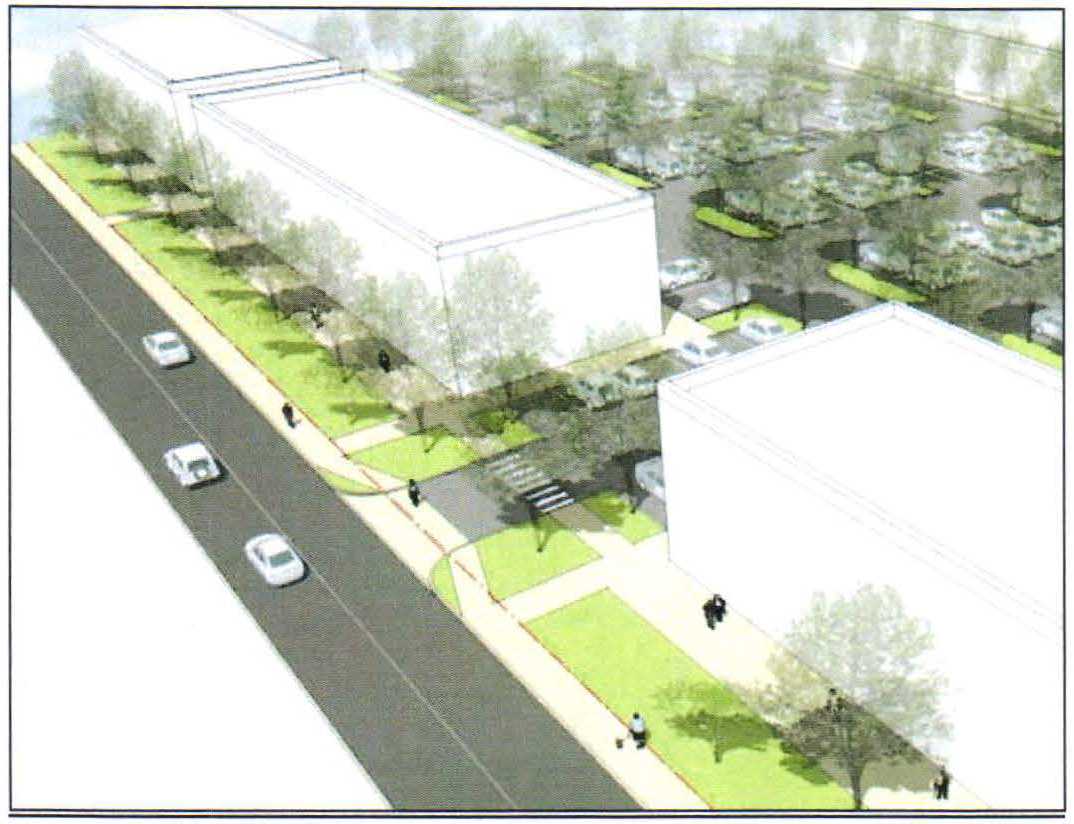
Figure 4. Type B Character Image
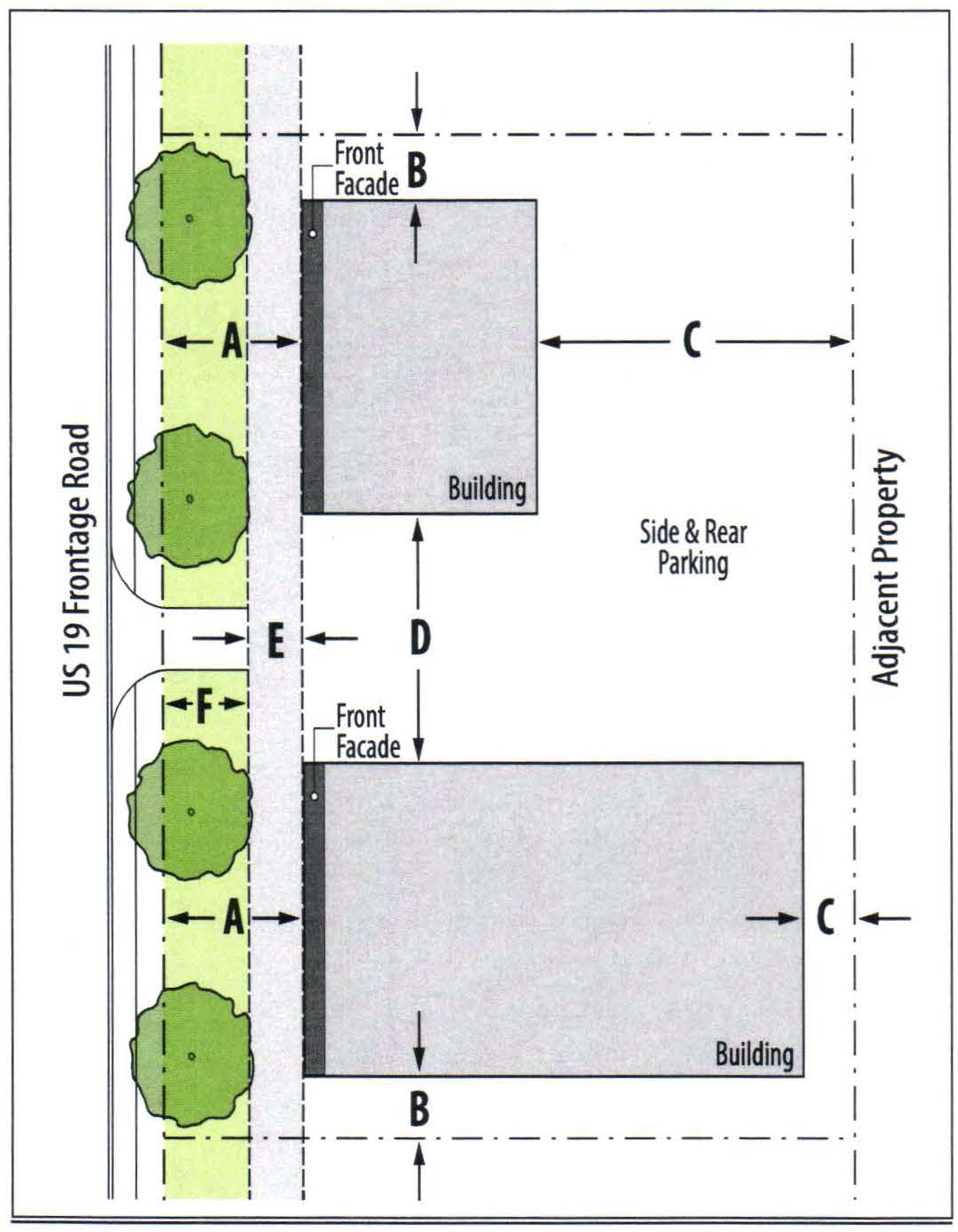
Figure 5. Type B Building Placement Diagram
A) General
Type B Street Frontage as shown in Figure 1. Regulating Plan identifies pedestrian- and transit-oriented locations along US 19 frontage roads. In these locations, development standards limit front setbacks, require consistent front landscape areas, prohibit parking in front of buildings, and require buildings oriented to public sidewalks and pedestrian areas along streets.
(In the sections below, the bold lettering in parentheses refers to the annotations in Figure 5. Type B Building Placement Diagram.)
B) Building Setbacks and Spacing
1.
Buildings shall be placed along street frontages consistent with the following setbacks from property lines.
a.
Front Setbacks (A): 25 feet minimum, 40 feet maximum
b.
Side Setbacks (B): 10 feet minimum or 0 feet if abutting adjacent building with blank side wall
c.
Rear Setbacks (C): 10 feet minimum
2.
Front setbacks may be increased by 10 feet maximum extending 40 feet maximum along the front facade for projects with front courtyards or publicly-accessible front entry plazas.
3.
To promote continuity of building frontages along front setbacks, the space between individual buildings shall not exceed 100 feet (D).
C) Pedestrian and Landscape Improvements
1.
The area along front building facades shall be improved with a 10-foot minimum wide pedestrian area (E).
2.
The area along the front property line within the front setback shall be improved with a 15-foot minimum, 20-foot maximum wide landscape area (F).
3.
Walkway connections shall be provided between public sidewalks and pedestrian areas along front building facades. Such connections shall be 6 feet wide minimum and spaced 100 feet apart maximum.
D) Parking and Vehicular Circulation
1.
Parking, vehicular circulation, and other vehicular use areas are prohibited between buildings and streets along front setbacks.
2.
Surface parking located to the side of buildings along streets shall be set back 5 feet behind front building facades and screened from view by a low (24 to 36 inches) opaque hedge or wall.
3.
Structured parking, whether freestanding or attached to a building, shall be located to the rear of buildings.
4.
Ground level parking, vehicular circulation and other vehicular use areas incorporated in the ground floor of a building along street frontages shall be located behind fully-enclosed, occupied building space with a depth of 20 feet minimum.
5.
Surface and structured parking setbacks from side and rear property lines shall comply with building setback standards.
6.
With approval from appropriate City, County or State authorities, parallel parking may be constructed within the right-of-way along streets.
E) Front Building Facades and Entries
In addition to the building design standards in Division 6, the following standards for front building facades and entries shall apply.
1.
Ground floor front building facades shall generally be aligned along front setbacks parallel to streets and be designed to meet the following standards.
a.
For a building with a nonresidential use, a minimum of 40 percent of the total area of the ground floor facade shall be comprised of transparent windows or doors. Glass utilized to provide this transparency shall have visible light transmittance to the maximum allowed by the Energy Code, shall not have reflective or mirrored coating or other treatments including but not limited to dark tinting, colored or opaque films, boards or paint.
b.
For the ground floor front facades of buildings with residential uses, the finished floor elevation of ground floor residential space along front setbacks shall be elevated 18 inches minimum, 36 inches maximum above the grade of adjacent pedestrian walkways.
2.
Primary building entries shall be located along the front facades of buildings and oriented to and streets, new primary drives, and sidewalks.
3.
For front entries to buildings with non-residential uses on the ground floor, thresholds at building entries shall generally match the grade of adjacent walkways and plaza areas.
4.
Overhead doors along front building facades are permitted for bars, nightclubs, brewpubs, microbreweries, restaurants and similar uses. Where provided, overhead doors must be fully integrated into the design of the building facade, be designed as an integral part of the food service component of the business, and provide direct access to or between dining and seating areas. Overhead doors for service purposes of any kind (e.g., loading, unloading, and deliveries) are prohibited.
(Ord. No. 8988-17, § 21, 2-2-17; Ord. No. 9643-23, § 21, 4-4-23)
Section B-404. - Type C street frontage.
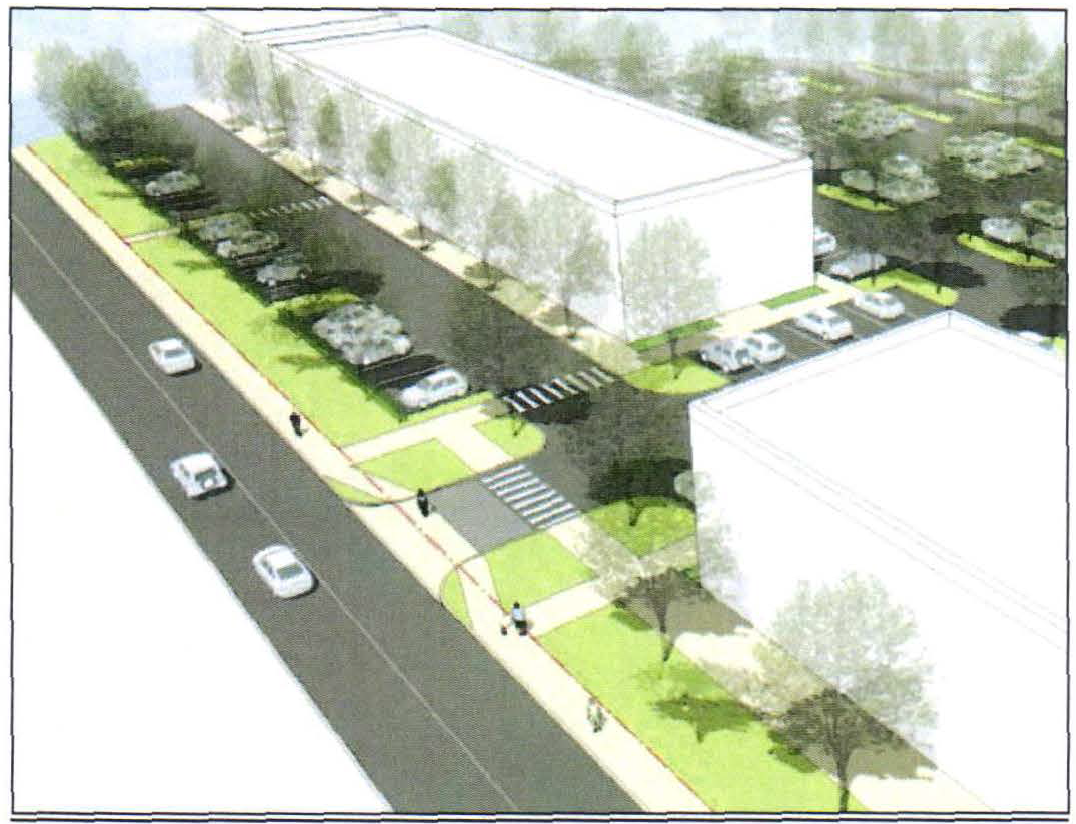
Figure 6. Type C Character Image
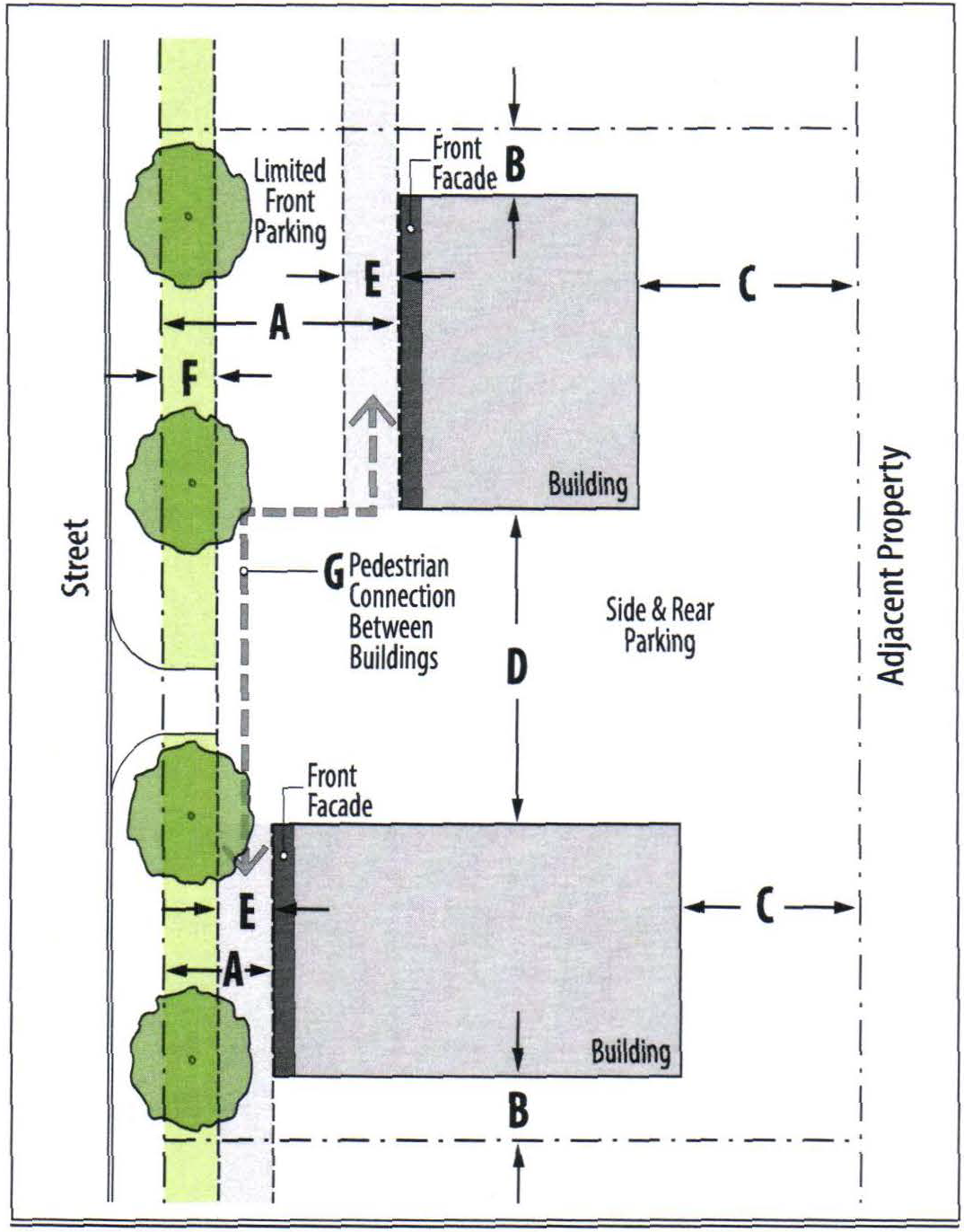
Figure 7. Type C Building Placement Diagram
A) General
Type C Street Frontage as shown in Figure 1. Regulating Plan identifies pedestrian and transit-oriented areas along US 19 frontage roads. In these locations, development standards provide for connections between public sidewalks and building frontages, consistent front yard landscape areas, buildings oriented to pedestrian ways, and limited front yard parking.
(In the sections below, the bold lettering in parentheses refers to the annotations in Figure 7. Type C Building Placement Diagram.)
B) Building Setbacks and Spacing
1.
Buildings shall be placed along street frontages consistent with the following setbacks from property lines.
a.
Front Setbacks (A): 25 feet minimum, 85 feet maximum
b.
Side Setbacks (B): 10 feet minimum
c.
Rear Setbacks (C): 10 feet minimum
2.
To promote continuity of building frontages along front setbacks, the space between individual buildings shall not exceed 160 feet (D).
C) Pedestrian and Landscape Improvements
1.
The area along front building facades within the front setback shall be improved with a 10-foot minimum, 20-foot maximum wide pedestrian area (E).
2.
The area along the front property line shall be improved with a 15-foot minimum, 20-foot maximum wide landscape area (F).
3.
Walkway connections shall be provided between public sidewalks and pedestrian areas along front building facades. Such connections shall be 6 feet wide minimum and spaced no more than 100 feet apart.
4.
Walkway connections shall be provided through landscape and parking areas to connect pedestrian areas along front building facades. Such connections shall be 6 feet wide minimum (G).
D) Parking and Vehicular Circulation
1.
Surface parking and vehicular circulation is permitted in front of buildings but limited to no more than one two-way drive aisle without parking, one two-way drive aisle with one row of perpendicular parking spaces, or a one-way drive aisle with angled parking on both sides.
2.
Surface parking located along public sidewalks shall be screened from view by a low (24 to 36 inches) opaque hedge or wall.
3.
Structured parking is prohibited between buildings and streets and shall be located to the side and rear of buildings.
4.
Structured parking located to the side of buildings along street frontage shall be designed with architectural and landscape treatments that contribute to the creation of quality pedestrian environments along pedestrian ways and public sidewalks.
5.
Ground level parking, vehicular circulation and other vehicular use areas incorporated in the ground floor of a building along street frontages shall be located behind fully-enclosed, occupied building space with a depth of 20 feet minimum.
6.
Surface and structured parking setbacks from side and rear property lines shall comply with building setback standards.
E) Front Building Facades and Entries
In addition to the building design standards in Division 6, the following standards for front building facades and entries shall apply.
1.
Ground floor front building facades shall generally be aligned along front setbacks parallel to streets and be designed to meet the following standards.
a.
For a building with a nonresidential use, a minimum of 40 percent of the total area of the ground floor facade shall be comprised of transparent windows or doors. Glass utilized to provide this transparency shall have visible light transmittance to the maximum allowed by the Energy Code, shall not have reflective or mirrored coating or other treatments including but not limited to dark tinting, colored or opaque films, boards or paint.
b.
For the ground floor front facades of buildings with residential uses, the finished floor elevation of ground floor residential space along front setbacks shall be elevated 18 inches minimum, 36 inches maximum above the grade of adjacent pedestrian walkways.
2.
Primary building entries shall be located along the front facades of buildings and oriented to and visible from streets, new primary drives, and sidewalks.
3.
Overhead doors along front building facades are permitted for bars, nightclubs, brewpubs, microbreweries, restaurants and similar uses. Where provided, overhead doors must be fully integrated into the design of the building facade, be designed as an integral part of the food service component of the business, and provide direct access to or between dining and seating areas. Overhead doors for service purposes of any kind (e.g., loading, unloading, and deliveries) are prohibited.
(Ord. No. 8988-17, § 21, 2-2-17; Ord. No. 9643-23, § 21, 4-4-23)
Section B-405. - Type D street frontage.
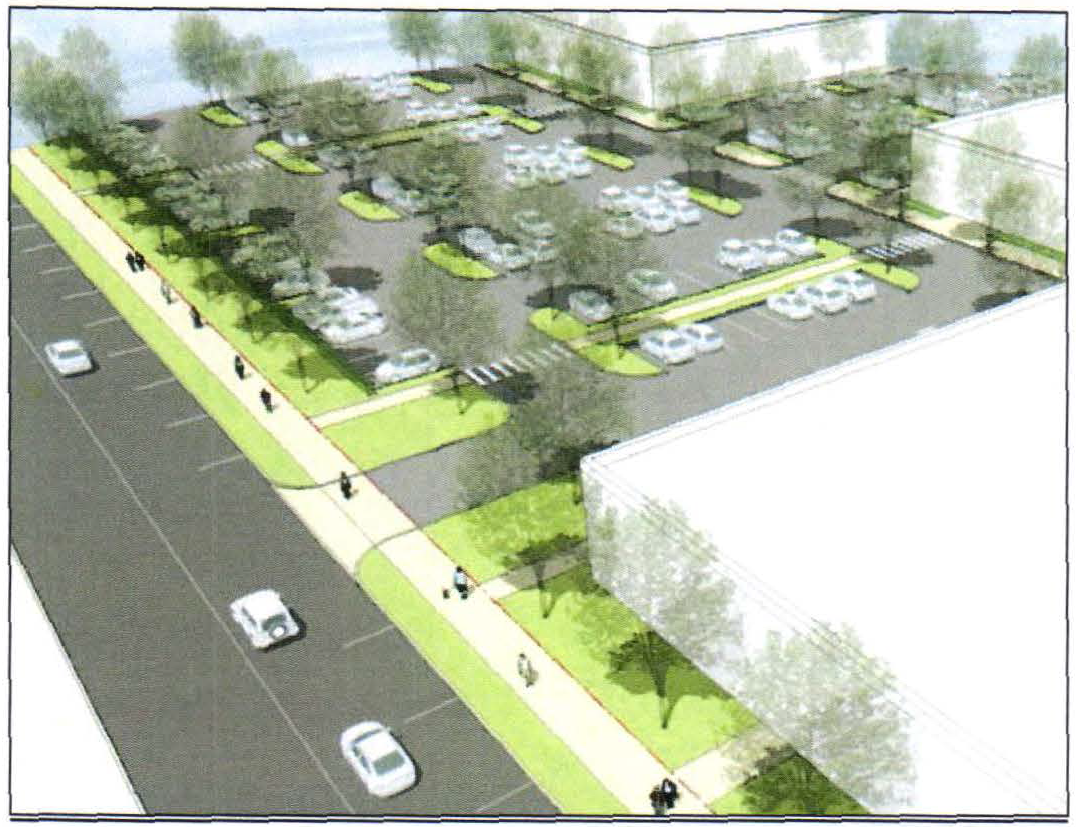
Figure 8. Type D Character Image
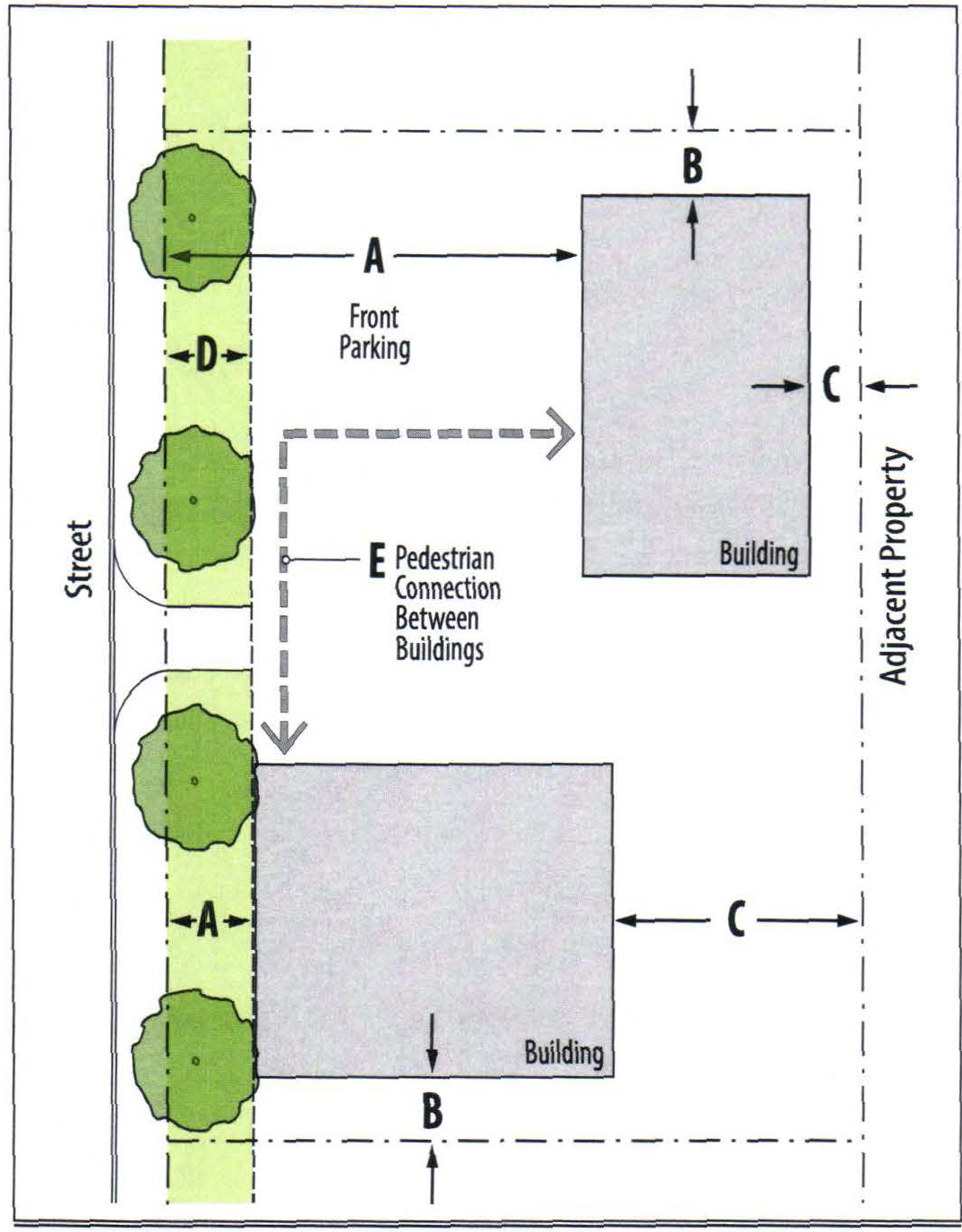
Figure 9. Type D Building Placement Diagram
A) General
Type D Street Frontage as shown in Figure 1. Regulating Plan identifies areas not directly abutting the US 19 corridor or major cross streets. In these locations, development standards provide for consistent front landscape areas, permit a range of front setbacks, and allow front yard parking while providing for improved pedestrian connections between sidewalks and building entries.
(In the sections below, the bold lettering in parentheses refers to the annotations in Figure 9. Type D Building Placement Diagram.)
B) Building Setbacks
1.
Buildings shall be placed along the front of sites consistent with the following setbacks from property lines.
a.
Front Setbacks (A): 15 feet minimum
b.
Side Setbacks (B): 10 feet minimum
c.
Rear Setbacks (C): 10 feet minimum
C) Pedestrian and Landscape Improvements
1.
The area along the front property line within the front setback shall be improved with a 15-foot minimum wide landscape area (D).
2.
The area along front building facades may be improved with an optional 10-foot wide pedestrian area.
3.
Walkway connections shall be provided between public sidewalks and primary building entries. Such connections shall be 6 feet wide minimum.
4.
Walkway connections shall be provided through landscape and parking areas to connect primary building entries. Such connections shall be 6 feet wide minimum (E).
D) Parking and Vehicular Circulation
1.
Surface parking and vehicular circulation are permitted in front of buildings.
2.
Surface parking, vehicular circulation and other vehicular use areas located along public sidewalks shall be screened from view by a low (24 to 36 inches) opaque hedge or wall.
3.
Structured parking located to the front or side of buildings along street frontage shall be set back 20 feet minimum and designed with architectural and landscape treatments that contribute to the creation of quality pedestrian environments along pedestrian ways and public sidewalks.
4.
Parking, vehicular circulation and other vehicular use areas incorporated in the ground floor of a building along public streets shall be located behind fully-enclosed, occupied building space with a depth of 20 feet minimum.
5.
Surface and structured parking setbacks from side and rear property lines shall comply with building setback standards.
(Ord. No. 8988-17, § 21, 2-2-17)
Section B-406. - Type E street frontage.
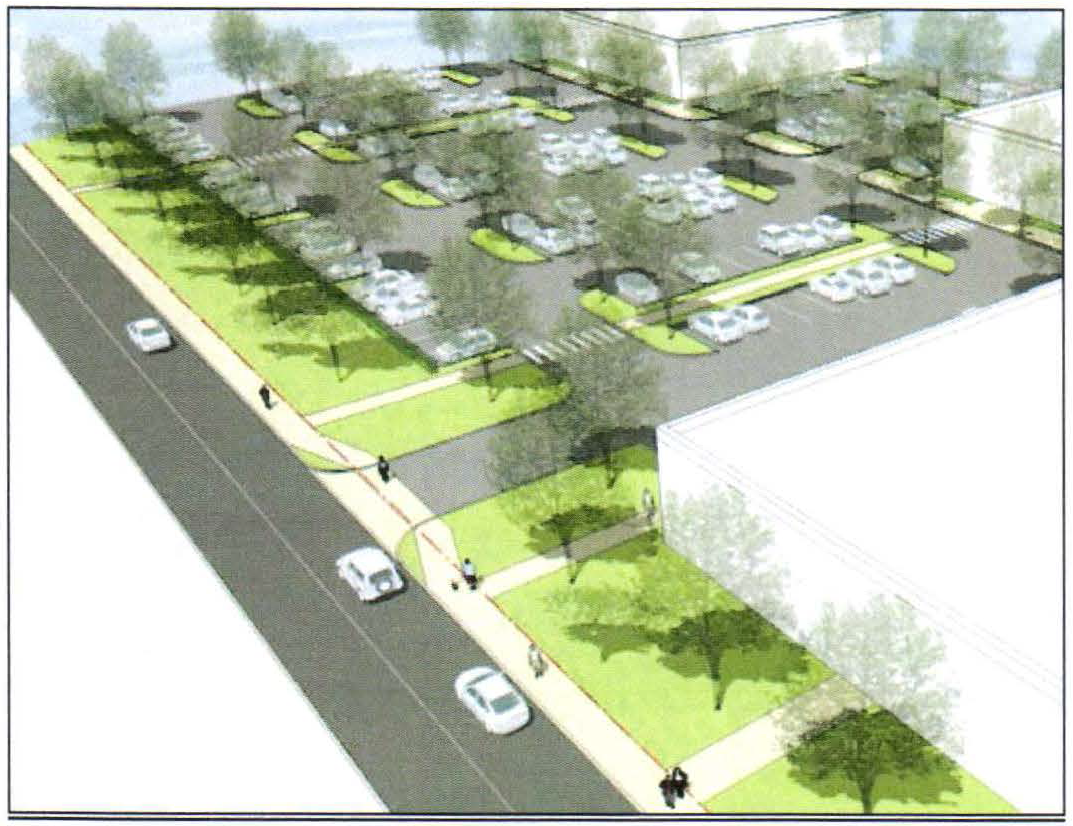
Figure 10. Type E Character Image
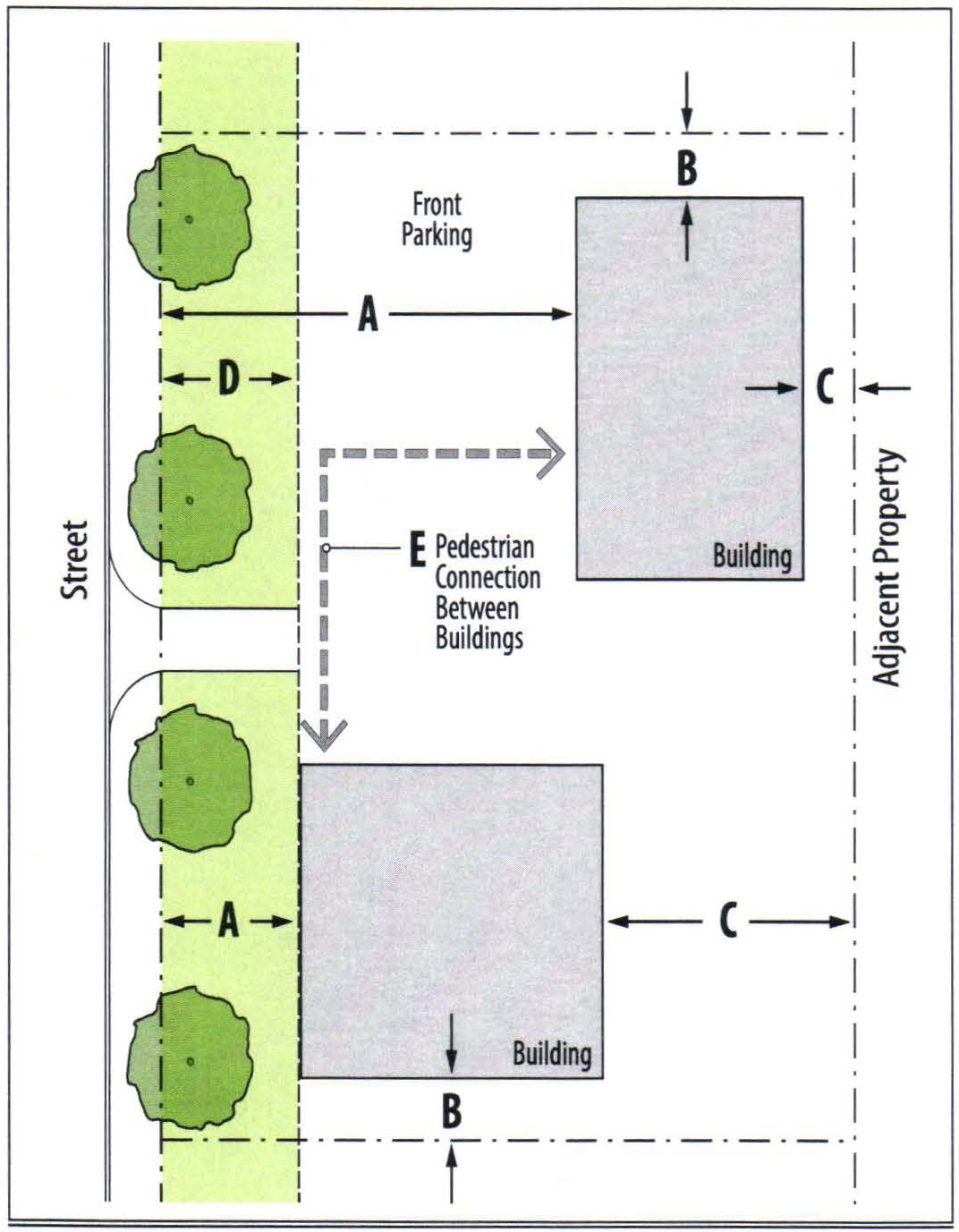
Figure 11. Type E Building Placement Diagram
A) General
Type E Street Frontage as shown in Figure 1. Regulating Plan identifies areas along US 19 frontage roads where development standards provide for consistent front landscape areas, pedestrian connections between public sidewalks and building entries, a range of front setbacks, and front yard parking.
(In the sections below, the bold lettering in parentheses refers to the annotations in Figure 11. Type E Building Placement Diagram.)
B) Building Setbacks
1.
Buildings shall be placed on sites consistent with the following setbacks from property lines.
a.
Front Setbacks (A): 30 feet minimum
b.
Side Setbacks (B): 20 feet minimum
c.
Rear Setbacks (C): 10 feet minimum
C) Pedestrian and Landscape Improvements
1.
The area along the front property line within the front setback shall be improved with a 30 feet minimum wide landscape area (D).
2.
The area along front building facades may be improved with an optional 10-foot wide pedestrian area.
3.
Walkway connections shall be provided between public sidewalks and primary building entries. Such connections shall be 6 feet wide minimum.
4.
Walkway connections shall be provided through landscape and parking areas to connect primary building entries. Such connections shall be 6 feet wide minimum (E).
D) Parking and Vehicular Circulation
1.
Surface parking and vehicular circulation are permitted in front of buildings.
2.
Surface parking, vehicular circulation and other vehicular use areas located along public sidewalks shall be screened from view by a low (24 to 36 inches) opaque hedge or wall.
3.
Structured parking located to the front or side of buildings along street frontage shall be set back 30 feet minimum and designed with architectural and landscape treatments that contribute to the creation of quality pedestrian environments along pedestrian ways and public sidewalks.
4.
Parking, vehicular circulation and other vehicular use areas incorporated in the ground floor of a building along public streets shall be located behind fully-enclosed, occupied building space with a depth of 20 feet minimum.
5.
Surface and structured parking setbacks from side and rear property lines shall comply with building setback standards.
(Ord. No. 8988-17, § 21, 2-2-17)
Section B-501. - General.
Projects shall be designed to maximize mobility, access, and safety. Projects shall provide for improved connectivity between adjacent destinations; improved pedestrian movement along public streets, new primary and secondary drives, sidewalks, and pedestrian ways; and safe and convenient pedestrian and vehicular connections between destinations, public sidewalks, and transit stops. Development sites shall be configured to minimize the visual impact of parking, loading, service, drive-through, and other vehicular use areas.
(Ord. No. 8988-17, § 21, 2-2-17)
Section B-502. - Development pattern.
A) Development Blocks
1.
Projects shall be configured with development blocks scaled to accommodate buildings, public spaces, and mid-block off-street parking and service areas as generally illustrated in Figure 12.
2.
Block dimensions shall generally be as follows but may be adjusted to account for irregularly shaped parcels, natural areas, utilities and utility easements, stormwater conveyance systems, and other features.
a.
Minimum block length: 200 feet
b.
Maximum block length: 600 feet
B) Drive Networks
1.
Projects on sites of 10 acres or more shall be configured to create interconnected networks of primary and secondary drives defining development blocks and providing for vehicle travel, pedestrian and cyclist movement, access to parking and drive aisles, access to transit facilities, and connections to surrounding destinations. Streets and drives shall be provided as follows.
a.
For every 660 feet of frontage at least one drive generally perpendicular to the frontage.
b.
For every 660 feet of lot depth at least one drive generally parallel to the frontage.
2.
New primary and secondary drives shall be configured to align with existing or planned streets or drives on adjacent sites to create an interconnected network. Drive stub outs shall be provided to allow future connections to adjacent sites.
3.
New primary and secondary drives shall be designed consistent with the standards in Table 6. Locational & Design Standards for New Drives.
_____
Table 6. Locational and Design Standards for New Drives
C) Project Phasing
1.
To allow for future phases of development that meet the maximum development intensities defined in Table 1. Permitted Intensities by Future Land Use Category, projects with development intensities lower than permitted in Division 3 shall be designed with buildings, site configurations, drive networks, and infrastructure configurations that allow for development intensification over time.
2.
Projects shall be designed with utilities and infrastructure, including stormwater conveyance systems, sewer and water lines, and electrical and communication lines, located along streets and drives so that areas of the site used for surface parking may accommodate future development.
3.
Projects shall be designed to permit future extensions of streets, drives, and pedestrian ways to and from surrounding properties.
(Ord. No. 8988-17, § 21, 2-2-17; Ord. No. 9643-23, § 22, 4-4-23)
Section B-503. - Access and circulation.
A) Access and Driveway Consolidation
Curb cuts and driveways shall be consolidated where possible and located to minimize impact on pedestrian circulation along public sidewalks and front building facades.
B) Reconstruction of Sidewalks and Landscaping
Reconstruction of existing sidewalks and landscape within rights-of-way shall be required. To the extent possible given right-of-way limits and utility conflicts, and with approval of the FDOT, Pinellas County, and/or the City, reconstruction shall follow the general standards for landscaping and sidewalks provided in Table 6. Locational and Design Standards for New Drives.
C) Pedestrian Walkways
1.
Pedestrian walkways shall be provided to access parking behind or to the side of buildings, connect destinations on adjacent properties, connect building frontages to adjacent sidewalks, and allow pedestrian circulation through parking lots to create a continuous pedestrian network.
2.
Pedestrian walkways shall be provided along individual or shared driveways connecting rights-of-way with side and rear yard parking.
3.
Pedestrian walkways shall be 6-foot wide minimum, free of obstructions, and if located between buildings, within a 15-foot wide corridor.
4.
Pedestrian walkways that cross a parking area, driveway, street or other vehicular use area shall be clearly marked with striping, contrasting paving materials (e.g., light-color concrete inlay between asphalt), textured or raised pavement, or other appropriate treatment as approved by City Staff.
D) Cross Parcel Connections
To facilitate circulation and improve accessibility, vehicle and pedestrian facilities on adjacent sites shall be interconnected. Existing and planned parking lot drive aisles and pedestrian walkways shall be aligned and connected with abutting sites. In cases where no connection exists on an abutting developed site, drive aisle and pedestrian walkway-stub outs shall be constructed to allow for future connections.
E) Reservation for Transit Facilities
The applicant for a development approval is responsible for coordinating with PSTA and the appropriate jurisdiction for the roadway on which development is proposed, to identify locations within and bordering the project boundary where current or planned transit stops are located. At those locations, space shall be reserved for transit shelters and any required improvements, including bicycle racks.
F) Connection to Duke Energy Trail
Connections to the Duke Energy Trail shall be incorporated into site plans where property is adjacent to the Trail.
(Ord. No. 8988-17, § 21, 2-2-17; Ord. No. 9643-23, § 22, 4-4-23; Ord. No. 9712-23, § 5, 11-2-23; Ord. No. 9740-24, § 5, 2-1-24)
Section B-504. - Parking and service areas.
A)
Surface Parking and Service Area
1.
Surface parking and service areas shall be designed to meet parking design, landscape, and screening requirements in Article 3, Divisions 12 and 14.
2.
Interior islands of parking lots in new projects shall be designed to utilize Low Impact Development techniques such as bioretention swales and native species. Where parking curbs and gutters are provided, they shall have breaks to allow water to enter the bioretention facilities within the parking landscape islands.
3.
Surface parking spaces provided between 85 percent and 125 percent of the minimum required in Table 2. Use & Off-Street Parking may utilize reinforced grass or other permeable surface (excluding artificial turf). All surface parking spaces provided in excess of 125 percent of the minimum required in Table 2. Use & Off-Street Parking shall utilize reinforced grass or other permeable surface. All driveways and/or access aisles shall be improved with a permanent all-weather paving material which is graded to drain stormwater, consistent with Section 3-1403.A.
4.
Where required parking is located adjacent to excess surface parking spaces, the Community Development Coordinator may permit the continuation of reinforced grass or permeable surface (excluding artificial turf) parking for the adjacent parking spaces within the same row.
5.
Developments which include a gross floor area of 100,000 square feet or more shall provide reinforced grass parking spaces along the perimeter of the parking area. The reinforced grass spaces shall be a minimum of 5 percent of the required number of spaces, but may not exceed 25 percent of the required number of spaces. For the purposes of this section, "development" includes projects which may include multiple separate parcels which may or may not be under common ownership and which function as a whole, such as a retail plaza.
6.
Reinforced grass parking spaces do not replace any landscape improvements required as set forth in Article 3, Division 12.
7.
Service areas, including areas providing access to loading docks and areas designated for the placement of waste containers and recycling equipment shall be located to the rear and/or side of buildings.
8.
Waste containers, recycling equipment, loading docks and overhead doors, and similar facilities shall be screened from public view by architecturally finished walls and gated enclosures, and be designed consistent with and complementary to the exterior facade of the building.
9.
Side and/or rear setbacks shall not apply between surface parking areas on adjacent properties which allow for shared access and use.
B) Structured Parking
1.
All structured parking, whether freestanding, attached to a building, or integrated into a building envelope, shall be designed to comply with requirements set forth in Article 3, Division 14, and design standards in Divisions 4 and 6.
2.
Structured parking setbacks from side and rear property lines may be reduced or eliminated where the structured parking abuts other structured parking or a building with blank side wall on an adjacent lot.
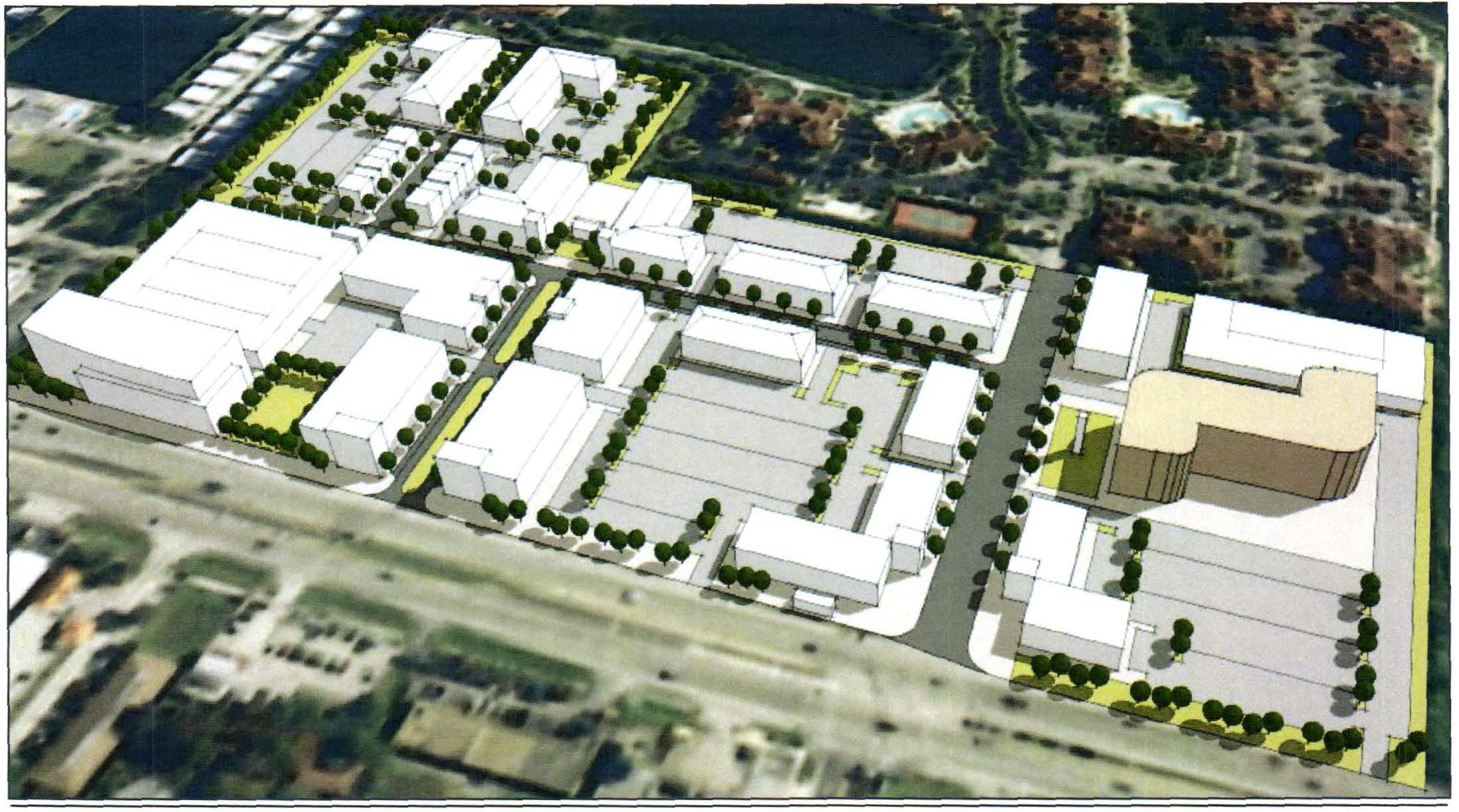
Figure 12. Illustration from the US 19 Corridor Redevelopment Plan showing a redeveloped
site designed blocks and an internal network of pedestrian-friendly streets and drives.
(Ord. No. 8988-17, § 21, 2-2-17; Ord. No. 9643-23, § 22, 4-4-23; Ord. No. 9805-25, § 6, 4-17-25)
Section B-505. - Landscape and fencing/walls.
A) Landscape Requirements in Article 3, Division 12
Landscape improvements shall meet the general landscaping standards set forth in Article 3, Division 12 with the exception that standards specific to street frontage types and landscape buffers for parking in Divisions 4 and 5 shall be adhered to.
B) Fences and Walls Along Street Frontages
Fences and walls are prohibited between buildings and streets along Street Frontage Types A, B, and C except as otherwise required for screening of parking in these Development Standards.
(Ord. No. 8988-17, § 21, 2-2-17)
Section B-506. - Stormwater management.
Stormwater retention and detention areas are not permitted in front setbacks or between any street and any building unless located underground in exfiltration trenches or open-bottomed underground storage and retention systems, or as part of a low impact development stormwater management system incorporating features such as rain gardens and vegetative swales, or pervious pavers or pavement for pedestrian use. Traditional stormwater facilities such as dry and/or wet retention/detention ponds are permitted to the rear and side of buildings.
(Ord. No. 8988-17, § 21, 2-2-17; Ord. No. 9643-23, § 22, 4-4-23)
Section B-507. - Open space.
A) Open Space Requirement
Development and redevelopment projects on sites 15 acres and larger within a Regional Center or Neighborhood Center Subdistrict shall provide a minimum of 3 percent of the developable area or not greater than 40,000 square feet as open space.
B) Open Space Types
Required open space shall be configured as a central gathering space or a series of smaller scale squares and plazas. Central gathering spaces shall be between 10,000 and 40,000 square feet, located at the intersection of important pedestrian-friendly streets and drives, and designed to include hardscape areas with amenities designed to support active use. Smaller scale squares and plazas shall be between 5,000 and 10,000 square feet and designed with a mix of hardscape and landscape areas with seating, shade trees, play equipment, lighting, and amenities designed to ensure security and support passive and small-scale active uses.
C) Open Space Design
Open spaces shall be designed as extensions of the streetscape environment with the grade or elevation of hardscape areas, lawn panels, and planting beds generally matching the grade of adjacent sidewalks, except where slightly raised or depressed areas are an integral part of a specific design.
D) Lighting and Lines of Site
Lighting and clear lines of sight shall allow for the formal and informal surveillance of the space.
(Ord. No. 8988-17, § 21, 2-2-17)
Section B-508. - Automobile service stations and drive-through facilities.
A) Automobile Service Stations
1.
Automobile service station facilities and improvements shall be located to the rear or on the non-street facing side of the principal building, set back 20 feet minimum from the front building facade, and screened from view with landscaping and a low (24 to 36 inches) wall designed to complement the exterior facade of the building.
2.
Standards in this section shall apply to all automobile service station facilities and improvements other than the primary building associated with a service station, including fuel islands, canopies, air and vacuum stations and equipment, car washes, and related directional and informational signage.
B) Drive-Through Facilities
Drive-through facilities along Street Frontage Types A, B, and C shall be located and designed to meet all of the following standards.
1.
Drive-through facilities shall be located to the rear or on the non-street facing side of the principal building, as illustrated in Figure 13. Drive Through Facilities with Side and Rear Pick Up Windows, set back 20 feet minimum from the front building facade, and screened from view with landscaping and a low (24 to 36 inches) wall designed to complement the exterior facade of the building.
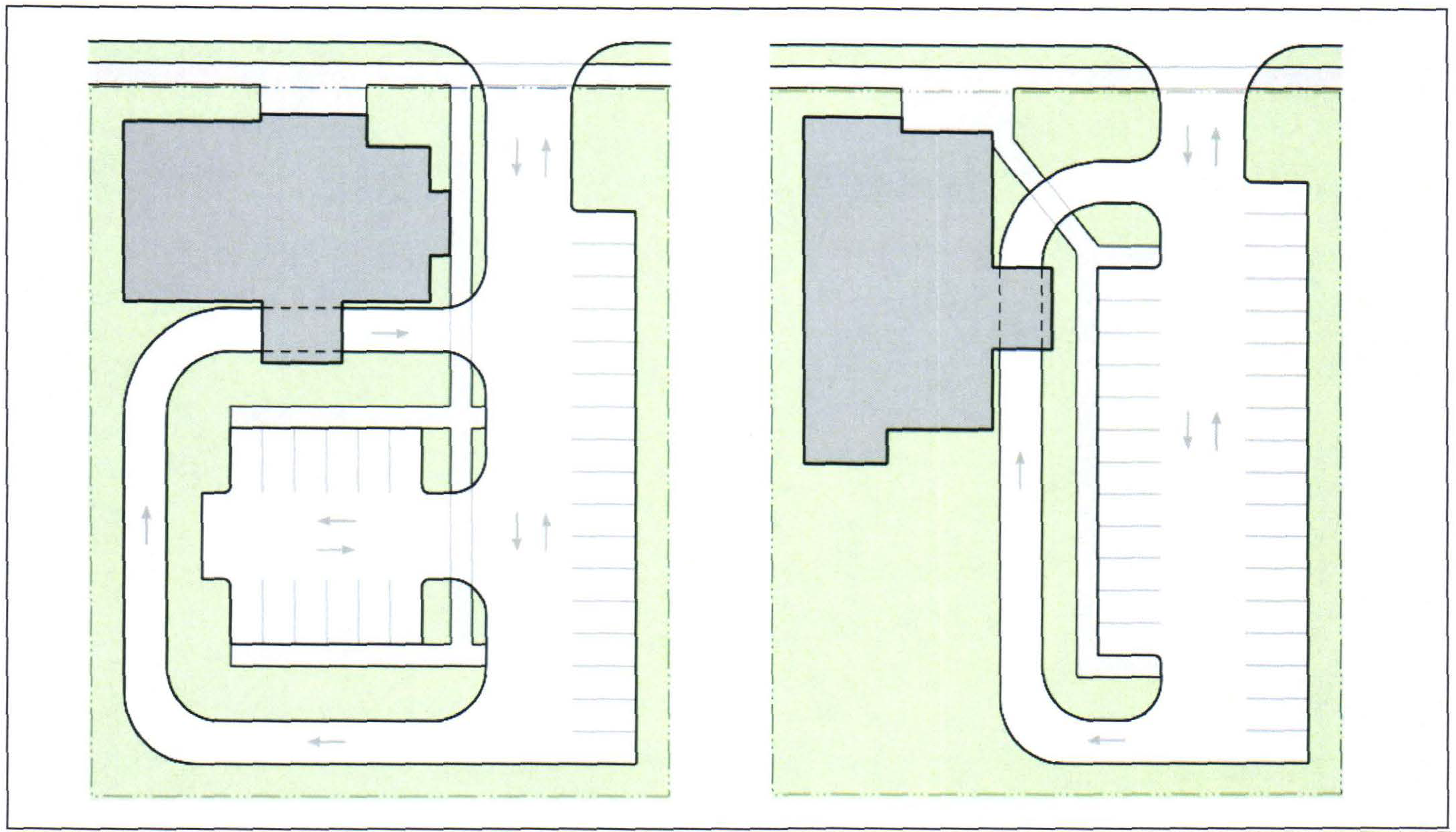
Figure 13. Drive-Through Facilities with Rear and Side Pick-up Windows
2.
Standards in this section shall apply to drive-through facilities serving restaurants, banks, pharmacies, car washes, and other uses and shall apply to all improvements associated with the drive-through activity including entry and exit drives, stacking lanes, service windows, canopies, menu boards, ATM kiosks, order kiosks, and informational signage.
3.
Stacking lanes shall be scaled to ensure queuing vehicles do not block driveways, access to parking areas, or pedestrian ways.
4.
Stacking lanes located along pedestrian walkways shall be screened with landscaping and a low (24 to 36 inches) wall designed to complement the exterior facade of the building.
5.
Sufficient on-site signage and pavement markings shall be provided to mark pedestrian ways and crossings, and to indicate direction of vehicular travel and other conditions required to ensure safe vehicular and pedestrian movement.
(Ord. No. 8988-17, § 21, 2-2-17)
Section B-601. - General.
To support the creation of more pedestrian- and transit-accessible destinations, buildings should be oriented toward adjacent streets, and designed to contribute to the creation of attractive, accessible destinations. Building facades along streets and public spaces shall be designed with attractive ground floor facades, well-defined building entries, and shall use quality building materials.
(Ord. No. 8988-17, § 21, 2-2-17)
Sec. B-602. - Facade treatment and design.
A) Complementary Design
All buildings and structures in projects with multiple buildings and structures, including parking structures, shall have complementary architectural details, materials, colors, and design treatments. For the purpose of this section, buildings and structures shall include primary buildings, buildings on outparcels, parking structures, open air enclosures, fences and walls, and other vertical improvements. The intent of this provision is not to require a single design theme or motif for projects with multiple buildings and/or multiple tenants but to ensure a consistent level of quality in the design and detailing of buildings, parking structures, and other vertical improvements.
B) Limited Blank Facades
Blank sections of ground floor building facades fronting or within view of streets, pedestrian walkways, or other public spaces shall not exceed 20 feet in length. Elements such as windows, doors, balconies, columns, pilasters, changes in material, or other architectural details that provide visual interest shall be distributed across the facade in a manner consistent with the overall design of the building.
_____
C) Facade Bays
To break up building facades along street frontages, facades shall be divided vertically into bays, as illustrated in Figure 14. Facade Bays & Articulation. Facade bay widths shall range from 15 to 40 feet establishing a rhythm of vertical modules unified by a complementary rhythm of windows and window groupings. Facade bays shall be distinguished by varying fenestration patterns, recessing wall planes, varying building materials, or establishing a rhythm of architectural elements such as pilasters or window bays.
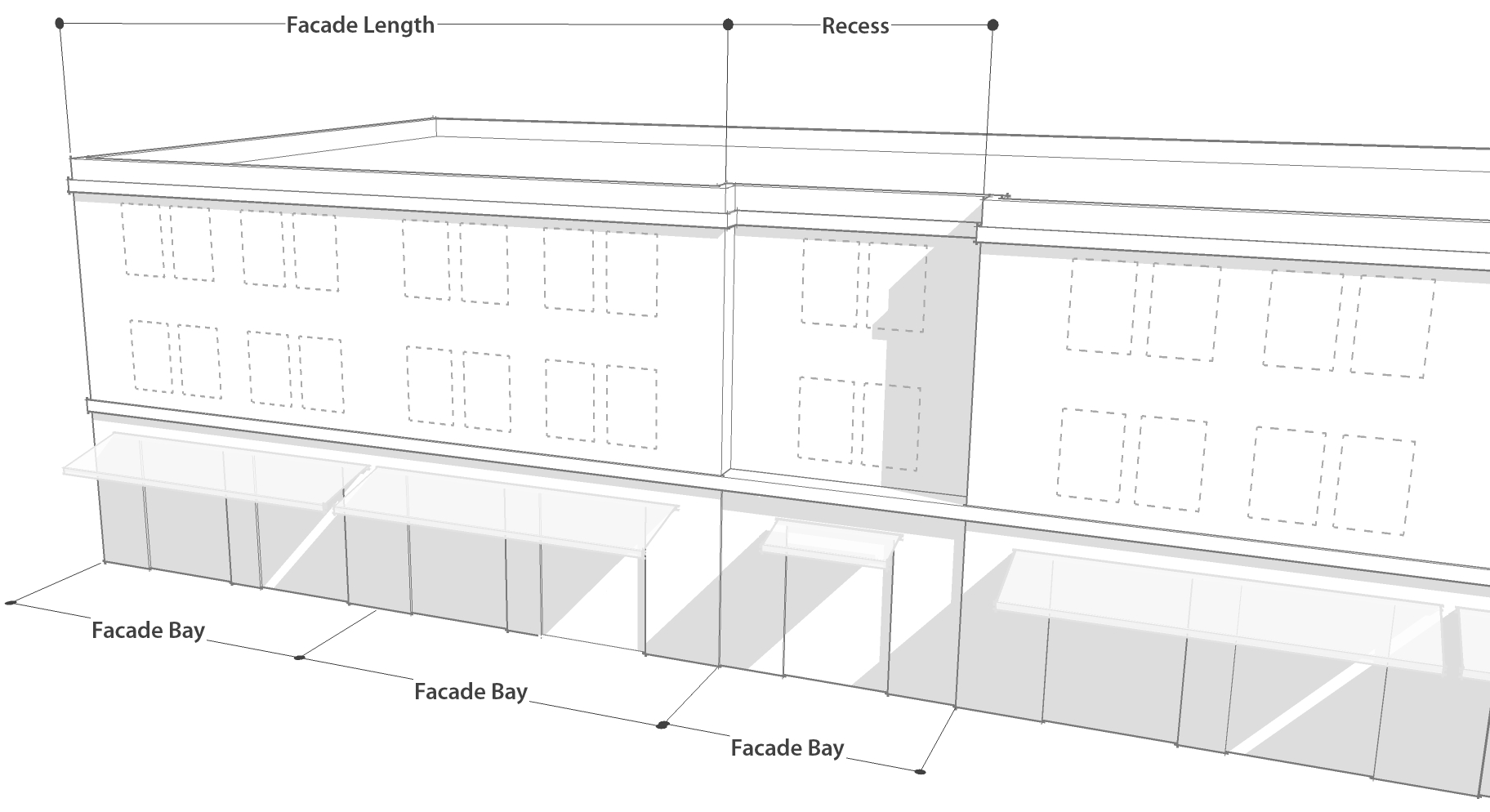
Figure 14. Facade Bays & Articulation
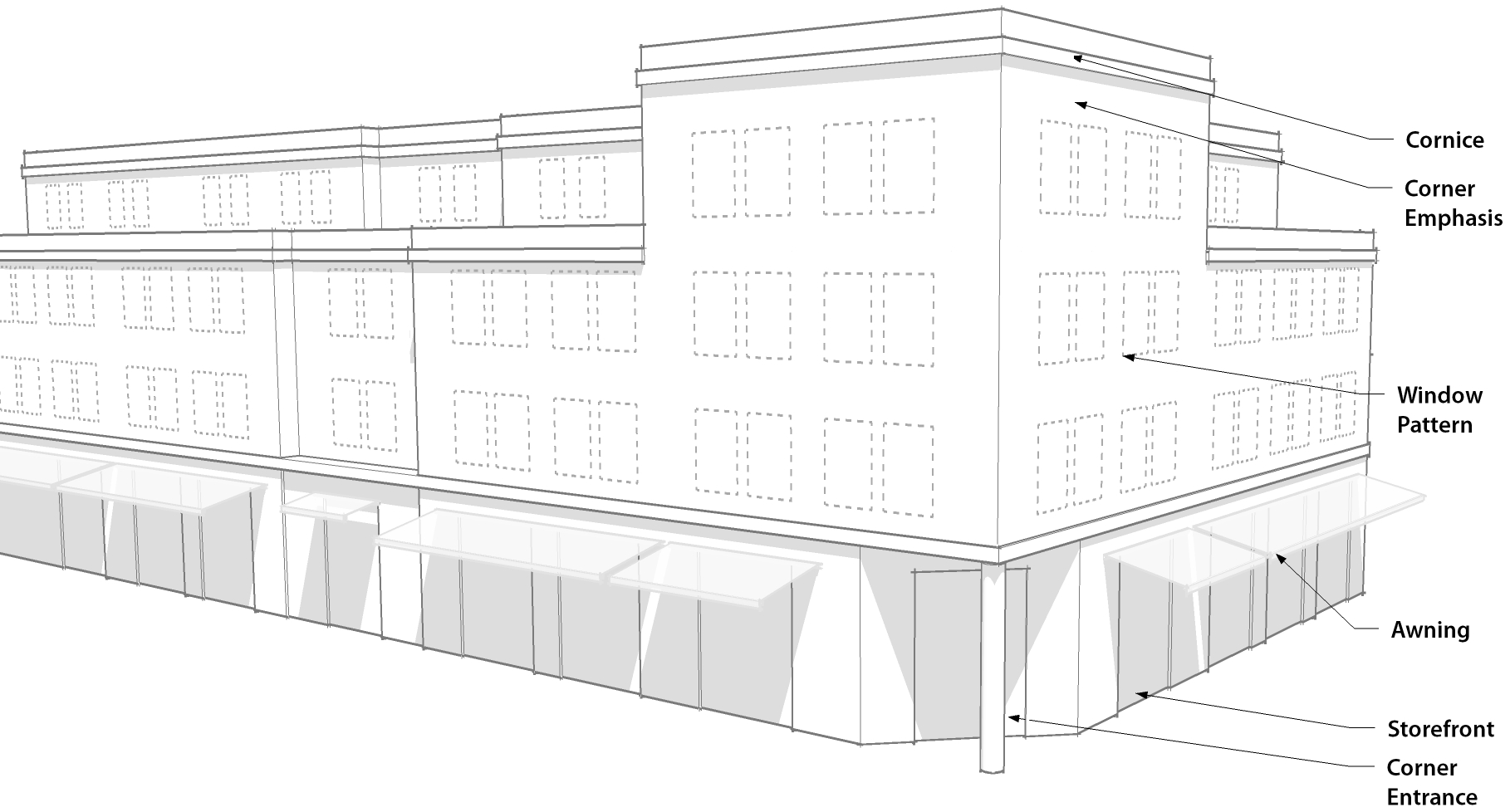
Figure 15. Corner Locations
_____
D) Parking Structures
1.
Parking structures shall be designed to contribute positively to the overall character of the project. Parking structures shall be designed with architecturally-finished facades that complement the details, materials, colors, and design treatments of buildings in the project.
2.
The ground level facades of parking structures along pedestrian ways and public sidewalks where street frontage requirements in Division 4 are not applicable shall be designed with architectural screening of openings, trellis or canopy projections, or other architectural treatments to create safe, comfortable, and quality pedestrian environments.
3.
Architectural screening of openings along facades visible from streets, new primary drives, and sidewalks shall be required.
E) Upper Floor Facade Articulation and Fenestration
1.
To avoid flat, continuous facades, the length of an upper floor facade bay shall generally be between 80 and 120 feet.
2.
Articulation between upper floor facade bay sections shall be accomplished by recessing the facade 2 feet minimum for a distance of at least 10 feet as illustrated in Figure 14. Facade Bays & Articulation.
3.
To minimize blank facade areas along street frontages, facades fronting streets and new primary drives shall provide fenestration (doors, windows or other openings) to an extent of a minimum of 20 percent of each floor's facade area as measured between finished floor and finished ceiling.
F) Corner Locations
1.
To create a seamless transition between the facades of a building at a street corner, both street-facing facades shall be designed with equal architectural quality and detail as illustrated in Figure 15. Corner Locations.
2.
Facade materials, window and wall treatments, and design elements such as signs and awnings shall be included on both sides of the building facade. Additional corner emphasis with chamfered or rounded facades, corner entries accentuated through changes in design treatments, materials, canopy projections, roof or parapet forms, or through other architectural method is required.
G) Awnings and Canopies
Awnings or canopies designed to provide weather protection are encouraged and may project 5 feet minimum, 8 feet maximum from the front facade into any required setback and over street rights-of-way, and shall be located 8 feet minimum above adjacent sidewalks and walkways. In no case shall such projection be closer than 5 feet from the curbline or the shoulder of the roadway. Any awning with supports may be located up to the property line and any awning that projects into a right-of-way shall be cantilevered.
H) Security
Security bars are not permitted on windows or doors visible from streets, new primary drives, and sidewalks.
(Ord. No. 8988-17, § 21, 2-2-17; Ord. No. 9643-23, § 23, 4-4-23; Ord. No. 9712-23, § 6, 11-2-23; Ord. No. 9740-24, § 6, 2-1-24)
Section B-603. - Roof design.
Commercial, mixed use, and multi-family buildings, including apartments and townhouses, may have flat or pitched roofs; however, mansard roofs are discouraged and shall not be permitted on single story buildings. All edges of pitched roofs shall be accentuated with eaves in a manner proportionate to the size of the building and length of the wall. Buildings with flat roofs shall have parapet walls, decorative cornices, and/or other architectural features as appropriate to the building's architectural style.
(Ord. No. 8988-17, § 21, 2-2-17)
Section B-604. - Building entries.
A) Locations
Building entries, including entries to individual tenant spaces in larger buildings, shall be located along the front facades of buildings and be oriented to and visible from streets, new primary drives, and sidewalks.
B) Design Treatment
Building entries shall be distinguished by facade design accomplished through the use of a combination of materials, articulation, or other architectural treatments such as variation in building height, arches, canopies, columns, towers, or similar treatments that provide interest to the building facade and draw attention to the entrance.
C) Residential Entries
For front entries to buildings with residential uses, entry features such as stoops, porticos, and other similar features may project into front setbacks 4 feet minimum, 8 feet maximum; shall be covered; and shall have exterior floor areas raised 18 inches minimum, 36 inches maximum above the grade of adjacent walkways to generally match interior floor elevations.
(Ord. No. 8988-17, § 21, 2-2-17; Ord. No. 9643-23, § 23, 4-4-23)
Section B-605. - Building materials.
Predominant exterior building materials shall be applied consistent with all of the following standards.
A) Facade Materials
All building facades within public view of a street, pedestrian walkway, or other public space, including side and rear facades, shall be constructed of high quality materials such as brick, stone, architectural block, concrete with an architectural finish, and traditional cementitious stucco. Side and rear facades shall use materials and design features similar to or complementary to those of the front facade.
B) Prohibited Glass Treatments on Ground Floors
The use of reflective, translucent, fritted, and other forms of non-transparent glass in wall and window systems on ground floor facades is not permitted.
(Ord. No. 8988-17, § 21, 2-2-17)
Section B-606. - Mechanical equipment.
Outdoor mechanical, electrical, and communication equipment, including heating, air conditioning, and ventilation equipment; venting and vent terminations for commercial hoods; electric meters; mechanical penthouses; electrical and communication equipment, panels, and cabinets; satellite dishes; and similar features shall be located and designed to meet all of the following standards.
A) Equipment Placement
Equipment shall be placed on roofs or to the rear or side of buildings and shall not be placed in front setbacks or between any street and any building.
B) Equipment Screening
1.
Ground-mounted mechanical equipment shall be screened from public view by landscape screens or architecturally-finished walls and enclosures designed consistent with the exterior facade of the building.
2.
Rooftop-mounted mechanical equipment shall be screened by a parapet wall, articulated roofline or other roof screen, or similar device that is integrated into the building's architectural design and of a height equal to or exceeding the height of the mechanical equipment being screened.
3.
Elevator penthouses shall be designed to complement the design of street-facing building facades and shall be clad on all sides in material used on street-facing facades.
(Ord. No. 8988-17, § 21, 2-2-17; Ord. No. 9643-23, § 23, 4-4-23)
Section B-701. - General.
Flexibility in the application of Development Standards may be approved by the Community Development Coordinator or Community Development Board as provided below. Where flexibility is allowed, the level of flexibility permitted shall be the minimum extent required to address flexibility standards and requirements.
(Ord. No. 8988-17, § 21, 2-2-17; Ord. No. 9387-20, § 7, 8-6-20)
Section B-702. - Process.
Authority to grant flexibility shall follow the approval levels indicated by use in Table 2, Use and Parking and shall be administered consistent with the provisions of Article 4, Development Review and Other Standards. The Community Development Coordinator shall have authority to grant flexibility for Level One approvals and the Community Development Board shall have authority to grant flexibility for Level Two approvals. Where flexibility is being requested for a Level One Minimum Standard Development use, the request shall be processed as a Level One Flexible Standard Development.
(Ord. No. 8988-17, § 21, 2-2-17; Ord. No. 9387-20, § 7, 8-6-20)
Section B-703. - Flexibility provisions.
Flexibility may be approved subject to the standards below.
A) Subdistrict Standards—Off-Street Parking
Flexibility to further reduce the minimum number of parking spaces to less than what may be approved through Table 3, Parking Reduction Factors in Section B-303.C may be requested with the provision of a parking demand study. Prior to the preparation of such study, the methodology shall be approved by the Community Development Coordinator and City Engineer, and in accordance with accepted traffic engineering principles. The findings of the study will be used in determining whether or not additional flexibility to the required parking may be approved.
B) Street Frontage Standards—Building Setbacks
1.
Front building setbacks less than the minimums or greater than the maximums allowed in Appendix B, Division 4 may be approved for projects with site constraints such as shape irregularities and/or the presence of natural features, existing utilities, utility easements, or access easements making meeting setback requirements impractical or infeasible. Where front building setbacks are reduced, required pedestrian areas along front building facades may be reduced by no more than 20 percent, and the landscape area may be modified as part of a comprehensive landscape program pursuant to the criteria set forth in Section 3-1202.G.
2.
Existing developments with front building setbacks greater than the maximums allowed in Appendix B, Division 4 may be expanded in a manner that does not comply with front setback requirements provided the addition does not substantially change the general configuration of the site and meets the requirements of Section B-104.C.6.
C) Street Frontage Standards—Building Spacing
The maximum spacing between individual buildings along Street Frontage Types A, B, and C may be increased or waived for projects that meet the requirements of B-703.C.1, B-703.C.2, and B-703.C.3.
1.
The project must have one or more of the following characteristics:
a.
The proposed site configuration is designed to incorporate natural features such as a stand of mature trees, body of water, wetland or other similar feature.
b.
Placement of existing buildings and/or site access and circulation constraints make it infeasible to meet the standard.
c.
The placement of publicly-accessible outdoor plaza spaces to the side of the building results in increased building spacing to accommodate the plaza.
2.
A plan for phased development shall be submitted that indicates how planned and future buildings will be placed consistent with the goals and policies of the Comprehensive Plan; the planning and design recommendations of the US 19 Corridor Redevelopment Plan; and the general purpose, intent and basic planning objectives of these Development Standards.
3.
Where flexibility in the standard is allowed, enhanced landscaping and the use of low walls along street frontages to screen parking and define the edge of pedestrian ways shall be required.
D) Street Frontage Standards—Parking and Vehicular Circulation
1.
Flexibility in the application of landscape and wall requirements to screen surface parking, service areas, and structured parking, may be approved where alternative design treatments result in all of the following.
a.
The screening of vehicles from view along public sidewalks.
b.
The physical separation of pedestrian use and vehicular use areas.
c.
The creation of safe, comfortable, and quality pedestrian environments along pedestrian ways and public sidewalks.
d.
The planned location and configuration of parking areas and driveways may not be considered in allowing for flexibility under this section.
2.
Flexibility to allow parking structures to the side of buildings along Street Frontage Types A or B may be approved where the ground level of the parking structure along the street frontage has occupied ground floor building space and facades designed to meet applicable street frontage standards or architectural and landscape treatments that contribute to the creation of quality pedestrian environments along pedestrian ways and public sidewalks.
3.
Flexibility to allow parking structures to the front of buildings along Street Frontage Type C may be approved where the ground level of the parking structure along the street frontage has occupied ground floor building space and facades designed to meet applicable street frontage standards or where the following standards are met.
a.
The front setback of the parking structure is 85 feet minimum.
b.
The parking structure is designed with architectural and landscape treatments that contribute to the creation of quality pedestrian environments along pedestrian ways and public sidewalks.
c.
The project is designed to meet site design standards in Section B-503.
4.
Flexibility in the minimum right-of-way standard and lane width requirement in Section 3-1904 may be approved where the reduction improves the project's pedestrian- and transit-orientation and does not negatively affect safety.
5.
Where temporary dead-end streets are provided, flexibility in the turnaround diameter and pavement width requirements in Section 3-1906 may be approved.
E) Street Frontage Standards—Front Building Facades and Entries
1.
For buildings on interior lots, front building facade and entry flexibility may be approved for only one of the following, as illustrated in Figure 16. Interior Lot Frontage Design Flexibility.
a.
For buildings along Street Frontage Types A, B, and C, the extent of transparent glazing along a building's ground floor front facade may be reduced to 25 percent if the building's ground floor side facade is designed to meet standards applicable to the front facade, including requirements for pedestrian and landscape improvements.
b.
Building entries along a side facade may be approved in lieu of entries on the front facade, as required in Appendix B, Division 4 and in Section B-604.A, if the entries are clearly visible from and within 40 feet of the street frontage and both facades are designed to meet all standards applicable to front facades, including requirements for transparency and pedestrian and landscape improvements.
2.
For buildings on corner lots, front building facade and entry flexibility provisions for corner lots may be approved for only one of the following, as illustrated in Figure 17. Corner Lot Frontage Design Flexibility.
a.
The extent of transparent glazing along the building's ground floor front facade with the lowest level of existing or planned pedestrian activity may be reduced to 25 percent.
b.
Building entries along one front facade may be approved in lieu of entries on both front facades, as required in Appendix B, Division 4 and in Section B-604.A, if the entries are clearly visible from and within 40 feet of the street frontage and both facades are designed to meet all standards applicable to front facades, including requirements for transparency and pedestrian and landscape improvements.
3.
For projects on sloping sites where site grades make meeting the requirements for finished floor elevation standards for residential buildings in Appendix B, Division 4 impractical or infeasible, a finished floor elevation of up to 48 inches may be approved. For those portions of a residential building that are used for nonresidential uses such as lobbies, fitness centers, or similar shared spaces, a finished floor elevation of less than 18 inches may be approved.
Figure 16. Frontage Design Flexibility—Interior Lot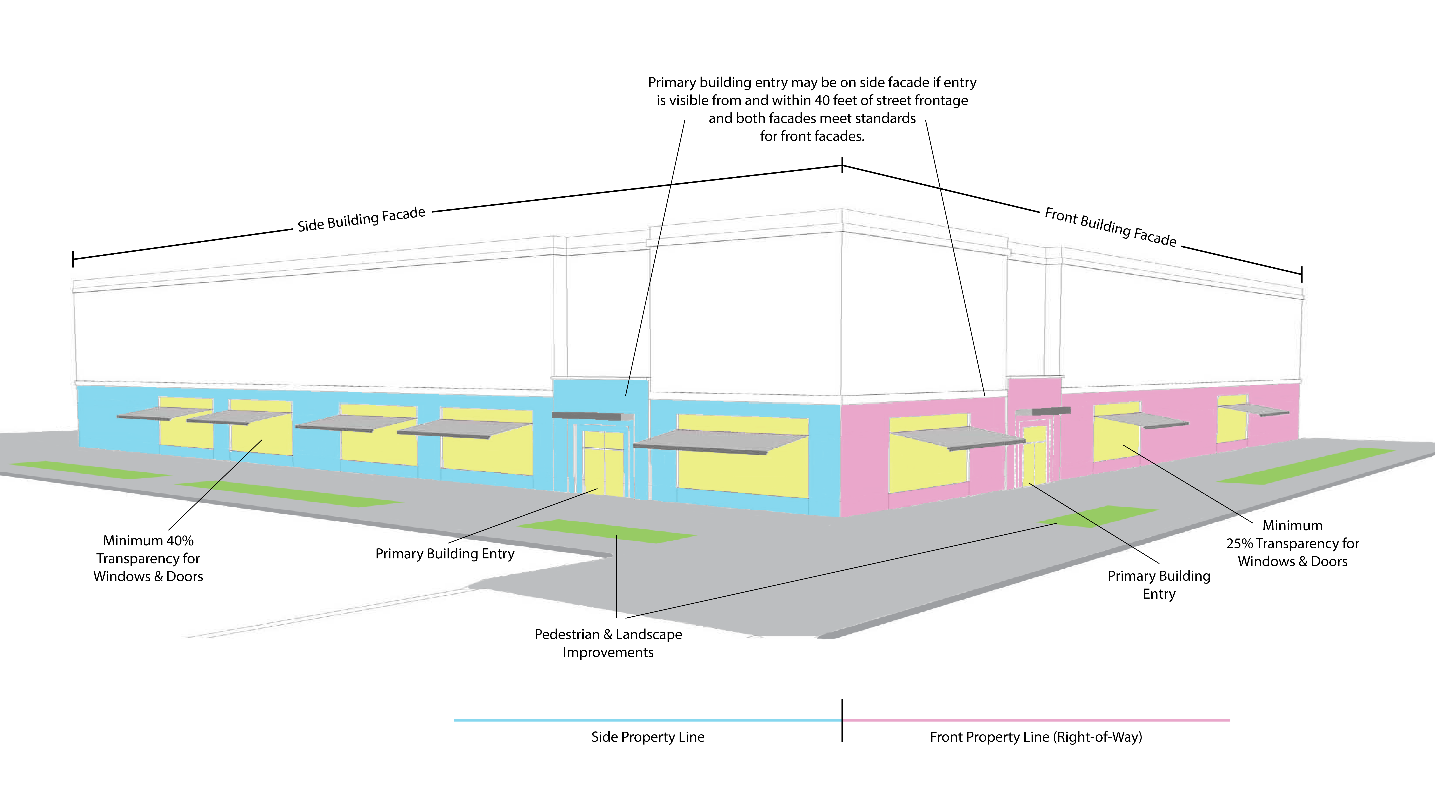
Figure 17. Frontage Design Flexibility—Corner Lot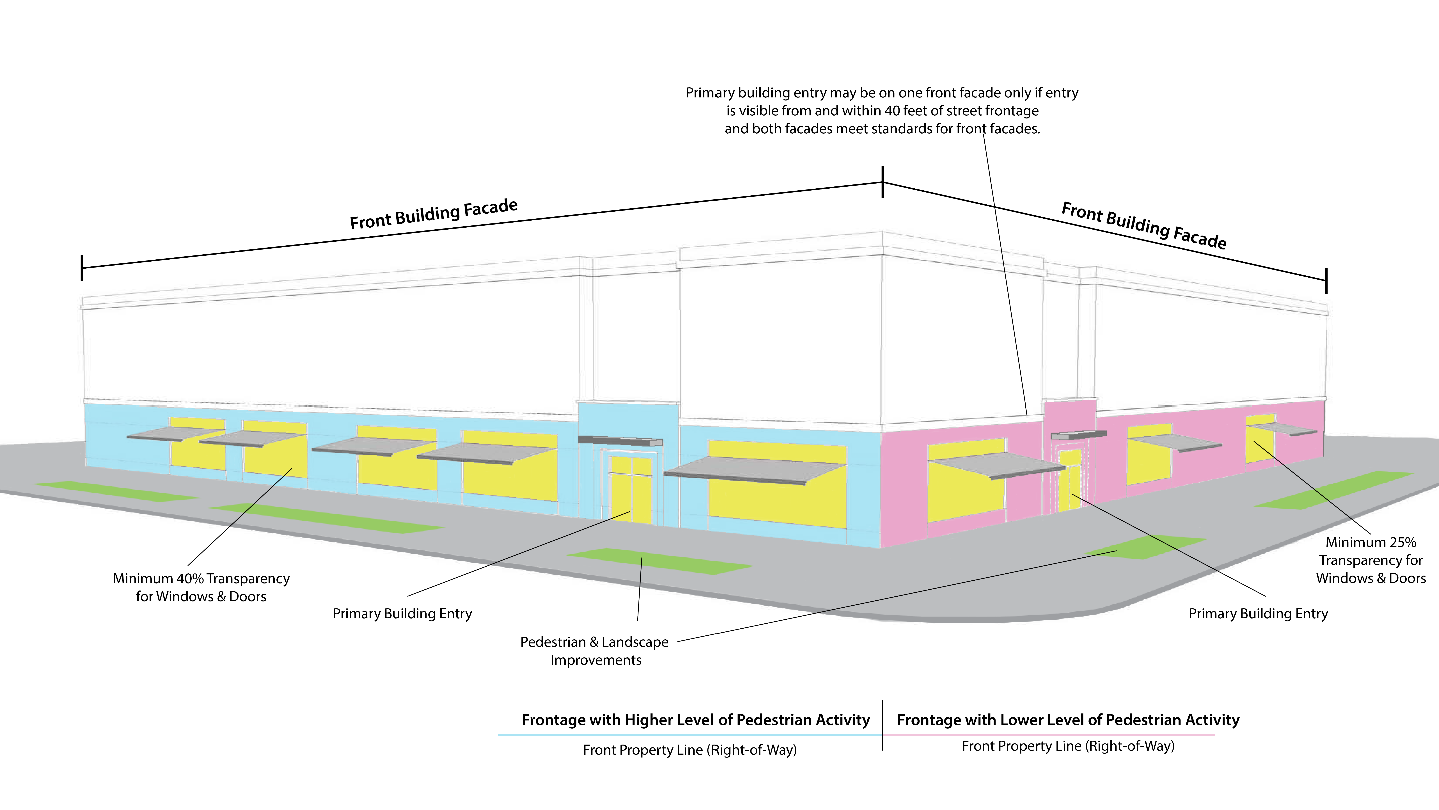
F) Site Design Standards—Development Pattern
Flexibility in the application of requirements for development blocks and drive networks found in Section B-502.A and Section B-502.B may be approved for projects on sites where the applicant demonstrates that site size, dimension, shape, or presence of constraints such as natural areas, utilities or utility easements, or other existing features make meeting these requirements infeasible.
G) Site Design Standards—Cross Parcel Connections
1.
Flexibility in the provision of cross parcel connections may be approved under one or more of the following circumstances.
a.
Where a new or improved connection could result in cut-through traffic on streets serving residential uses.
b.
Where site grades, natural areas, or other site constraints make meeting the requirements impractical or infeasible.
c.
Where applicants can satisfactorily demonstrate to the Community Development Coordinator that the characteristics or layout of abutting properties would make development of a unified or shared access and circulation system impractical or where the applicant demonstrates that all reasonable steps were taken to secure joint and cross access easements and that such steps failed.
2.
Where flexibility in the standard is allowed, pedestrian connections shall be provided.
H) Site Design Standards—Pedestrian Walkways through Parking Lots
Flexibility in the provision of pedestrian walkways through parking areas required in Section B-503.C for vehicle sales/displays uses may be approved provided the project's pedestrian- and transit- orientation and connectivity to adjacent parcels is not negatively affected.
I) Site Design Standards—Fences and Walls Along Street Frontages
Flexibility in the prohibition of fences and walls in front of buildings along Street Frontage Types A, B, and C in Section B-505.B may be approved where the placement of a fence or wall in front of the building does not negatively affect the project's pedestrian- and transit orientation, or connectivity to adjacent parcels. This provision shall not apply to low (24 to 36 inches) opaque walls required for screening of parking or automobile service stations.
J) Site Design Standards—Stormwater Management
Flexibility in the location of stormwater facilities may be approved in one or more of the following circumstances.
1.
Where natural drainage features are maintained and conserved as an integral part of the project's site design.
2.
Where placement of stormwater facilities in front setbacks or between front building facades and public sidewalks does not negatively affect the project's pedestrian- and transit-orientation, limit connections between building entries and public sidewalks, or require building placement and front building facade designs that do not comply with requirements.
K) Building Design Standards—Facade Design and Articulation
Flexibility in meeting the facade design and articulation standards for limited blank facades in Section B-602.B, facade bays in Section B-602.C, and upper floor facade articulation in B-602.E may be approved where the alternative design treatment provides a varied and interesting design, and the alternative treatment is integral to the building's design and results in facades of equal or better quality than the standards would produce.
(Ord. No. 8988-17, § 21, 2-2-17; Ord. No. 9387-20, § 7, 8-6-20; Ord. No. 9643-23, § 24, 4-4-23)
Section B-704. - Flexibility provisions for special project types.
A) Special Project Types
1.
Flexibility in meeting the frontage, site, and building standards in Divisions 4, 5, and 6 for large-scale mixed use projects and projects with employment-intensive land uses may be approved by the Community Development Board. Projects meeting the following criteria are defined as special project types for the purpose of this section.
a.
Projects on sites greater than 20 acres with a mix of land uses including at least two of the following uses: retail, including restaurants, retail plazas, and retail sales and services; multi-family residential; overnight accommodations; or office.
b.
Projects on sites greater than 10 acres with a proposed FAR greater than 1.25 and a mix of land uses including at least two of the following uses: retail, including restaurants, retail plazas, and retail sales and services; multi-family residential; overnight accommodations: or office.
c.
Projects on sites greater than 2.5 acres with employment-intensive land uses meeting the criteria for such uses as defined in the Economic Development Strategic Plan and providing opportunity for significant economic contribution to the city by diversifying the local economy; by creating jobs with average wages exceeding the annual average wage of Pinellas County; and which attract, retain, and expand primary industries.
B) Finding of Consistency with Plans and Policies
In reviewing requests for flexibility for special project types, the Community Development Board shall assess the project's overall consistency with all of the following planning and design objectives and criteria.
1.
The project will be consistent with the goals and policies of the Comprehensive Plan; the planning and design recommendations of the US 19 Corridor Redevelopment Plan; and the general purpose, intent and basic planning objectives of these Development Standards; and the provisions of the Economic Development Strategic Plan, if applicable.
2.
The project is otherwise impractical without deviations from the design standards; the design, scale and intensity of the proposed development supports the established or emerging character of the subdistrict; the project will not impede the normal and orderly development and improvement of surrounding properties; and adjoining properties will not suffer substantial detriment as a result of the project.
(Ord. No. 8988-17, § 21, 2-2-17; Ord. No. 9387-20, § 7, 8-6-20; Ord. No. 9643-23, § 24, 4-4-23)
Section B-801. - Site plan approvals.
A) Required Pre-Application Conference
A pre-application conference shall be required for all development applications within the US 19 District unless the development is exempt from the development standards pursuant to Section B-104.C or this requirement is otherwise waived by the Community Development Coordinator.
B) Approval Authority
The final decision-making authority for site plans is either the Community Development Coordinator for Level One approvals or the Community Development Board for Level Two approvals, as specified in Article 4. The level of approval required varies by use and subdistrict as specified in Table 2. Use & Off-Street Parking, which identifies whether a use can be approved as a Building Construction Permit (Level 1 Minimum Standard), or if Community Development Coordinator (Level One Flexible Standard Development) or Community Development Board (Level Two Flexible Development) approval is required. Projects on sites of 10 acres or more shall require at a minimum a Level One (flexible standard development) approval. Projects requesting flexibility in the application of design standards shall follow the process established in Section B-702.
(Ord. No. 8988-17, § 21, 2-2-17; Ord. No. 9643-23, § 25, 4-4-23; Ord. No. 9712-23, § 7, 11-2-23; Ord. No. 9740-24, § 7, 2-1-24)
Section B-802. - Amending districts and frontage types.
A) Future Land Use Map
Requests to amend the Future Land Use Map will be processed in accordance with Section 4-603. Amendments to the Future Land Use Map also require an amendment to the Countywide Land Use Map, which must be approved by Forward Pinellas, in its role as the Pinellas Planning Council, and the Countywide Planning Authority.
B) US 19 Subdistricts
Changing a designated US 19 subdistrict requires an amendment to Figure 1. Regulating Plan, which is a text amendment. Text amendments will be processed in accordance with Section 4-601. A request to amend the Subdistrict also requires a request to amend the Future Land Use Map. A companion Zoning Atlas amendment is not required because the US 19 District is applied to all properties in the corridor.
C) Street Frontage Type on the Regulating Plan
Requests to amend the designated street frontage type require an amendment to Figure 1. Regulating Plan, which is a text amendment. Text amendments will be processed in accordance with Section 4-601. A request to amend the street frontage type must also include an application for development approval.
(Ord. No. 8988-17, § 21, 2-2-17)
Section B-803. - Annexation of property.
A) Annexation
Figure 1. Regulating Plan depicts properties that are in unincorporated Pinellas County's jurisdiction and also within the City's Planning Area. Petitions for annexation will be processed in accordance with Section 4-604. Upon annexation, the parcel will be assigned the US 19 District on the Zoning Atlas and the subdistrict and street frontage type shown on Figure 1. Regulating Plan will apply. In addition, the consistent future land use category will be designated through an amendment to the Future Land Use Map upon annexation, and a separate application to amend the Future Land Use Map will not be required.
B) Countywide Plan Map
Upon annexation into the City of Clearwater, the City will transmit to Forward Pinellas, in its role as the Pinellas Planning Council, an application to amend the Countywide Plan Map to achieve consistency with the Regulating Plan.
(Ord. No. 8988-17, § 21, 2-2-17)
Section B-804. - Regulating plan adjustments.
A) Minor Regulating Plan Adjustments
Transitions between street frontage types along front property lines may be adjusted up to 100 feet administratively by the Community Development Coordinator provided that such adjustments do not negatively affect the project's pedestrian- and transit-orientation.
B) New Primary Drives
Upon approval of a development project with new primary drives, the Community Development Coordinator will make an administrative adjustment to Figure 1. Regulating Plan to reflect the new primary drive location and related street frontage type(s).
C) Street Frontage Type on Existing Streets
Upon approval of a development project which includes streets where a street frontage type was not previously depicted in Figure 1. Regulating Plan, the Community Development Coordinator will make an administrative adjustment to Figure 1. Regulating Plan to reflect the approved street frontage type(s).
D) Annexations
Upon annexation of a parcel into the City, the Community Development Coordinator will make an administrative adjustment to Figure 1. Regulating Plan to reflect the change in jurisdiction for the subject parcel(s).
(Ord. No. 8988-17, § 21, 2-2-17)

