
Clearwater City Zoning Code
ARTICLE 4
- DEVELOPMENT REVIEW AND OTHER PROCEDURES
_____
DIVISION 1. - REQUIRED PERMITS AND APPROVALS
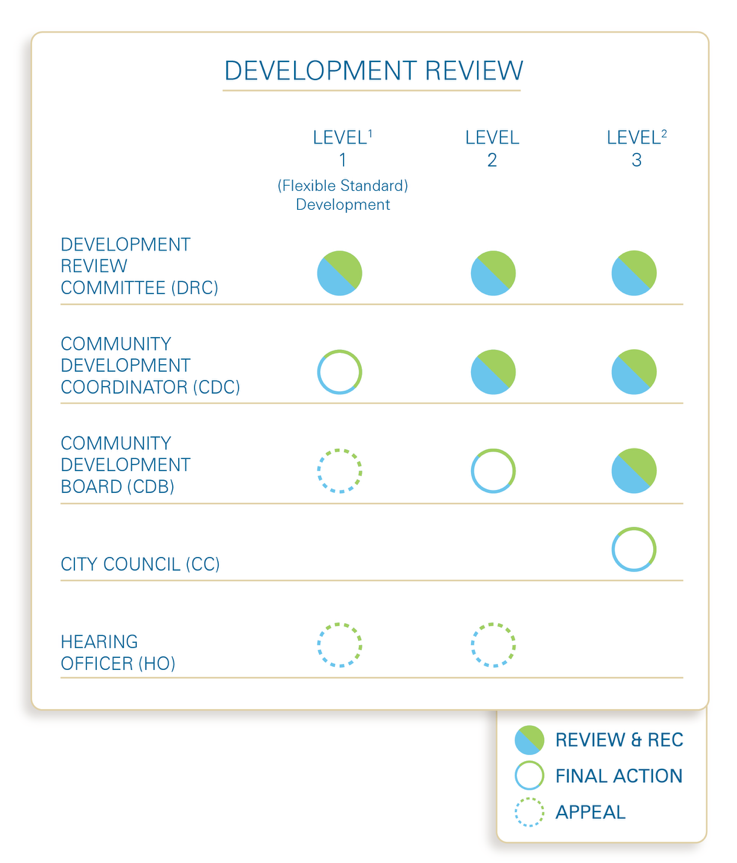
This Development Code establishes the following types of development approvals: Level One (Flexible Standard Development), Level Two, and Level Three. Level One (Flexible Standard Development) approvals involve those development proposals which are reviewed and approved by the city's professional staff. Level Two approvals are those development proposals which are more complex and involve the use of greater discretion by an appointed board accountable, through the appointment process, to the city council. Level Three approvals are those approvals which state law requires action by the city council because they involve issues of public policy in the first instance. The following graphic portrays this concept of different levels of approval:
1.
Building permit applications that meet the requirements for Level One (Minimum Standard Development) shall not be required to complete a development application and may proceed through the building permit application review process.
2.
Hotel Density Reserve Development Agreements are not reviewed by the Community Development Board. Both required public hearings take place before City Council.
The divisions in this article establish the requirements for each type of approval beginning with general procedures which are applicable to all three levels of approval and a graphic (flow chart) describing the process for each type of approval.
(Ord. No. 8423-13, § 4, 8-14-13; Ord. No. 9857-25, § 2, 12-4-25)
_____
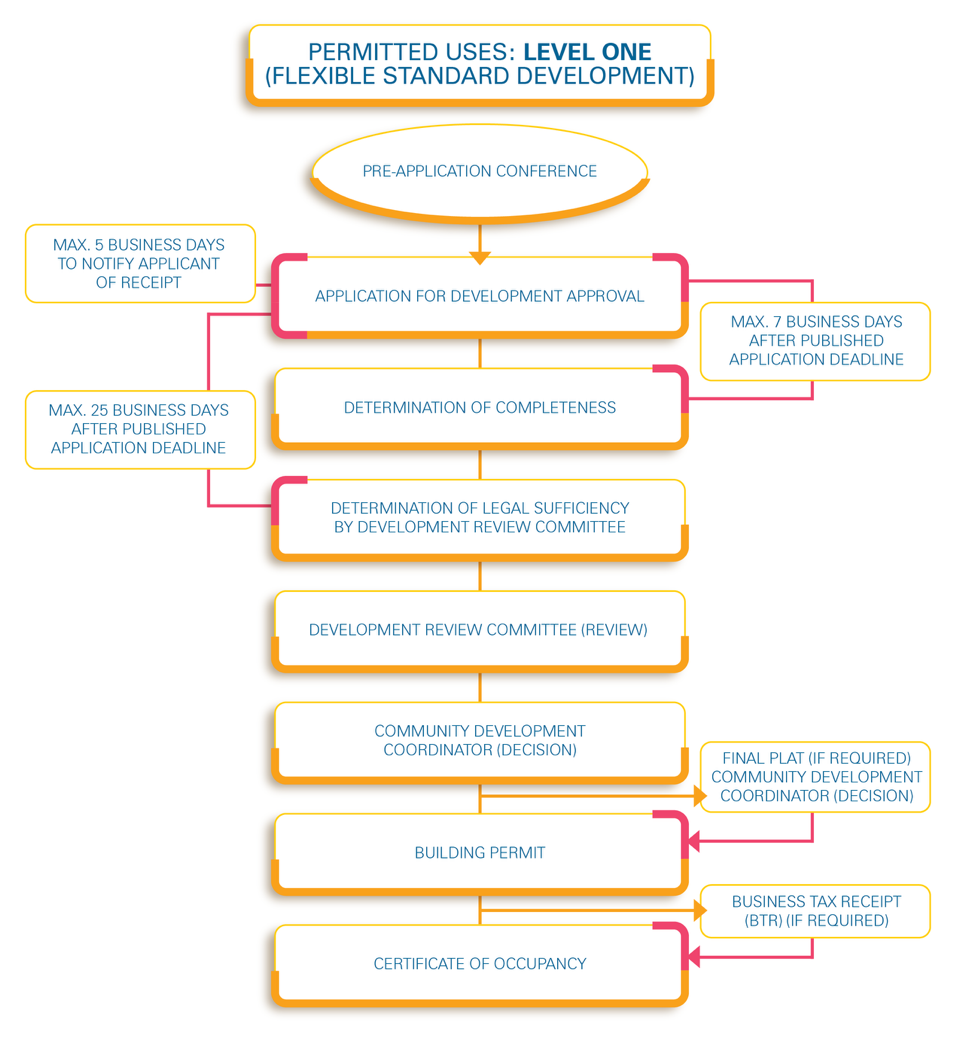
DIVISION 3. - PERMITTED USES: LEVEL ONE
(Ord. No. 6526-00, § 1, 6-15-00; Ord. No. 6928-02, § 98, 5-2-02; Ord. No. 7106-03, § 15, 9-18-03; Ord. No. 9857-25, § 4, 12-4-25)
_____
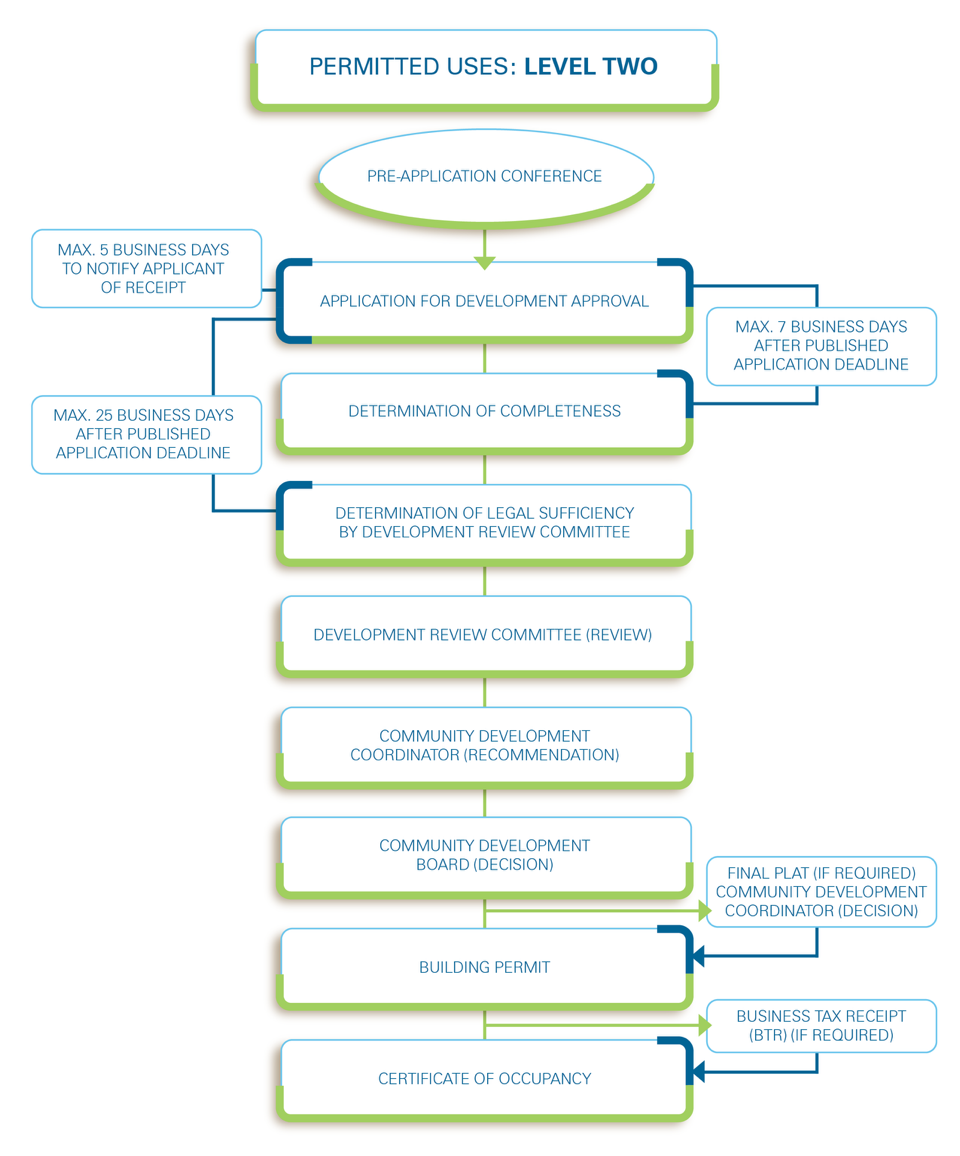
DIVISION 4. - PERMITTED USES: LEVEL TWO
(Ord. No. 6526-00, § 1, 6-15-00; Ord. No. 7106-03, § 19, 9-18-03; Ord. No. 9857-25, § 5, 12-4-25)
_____
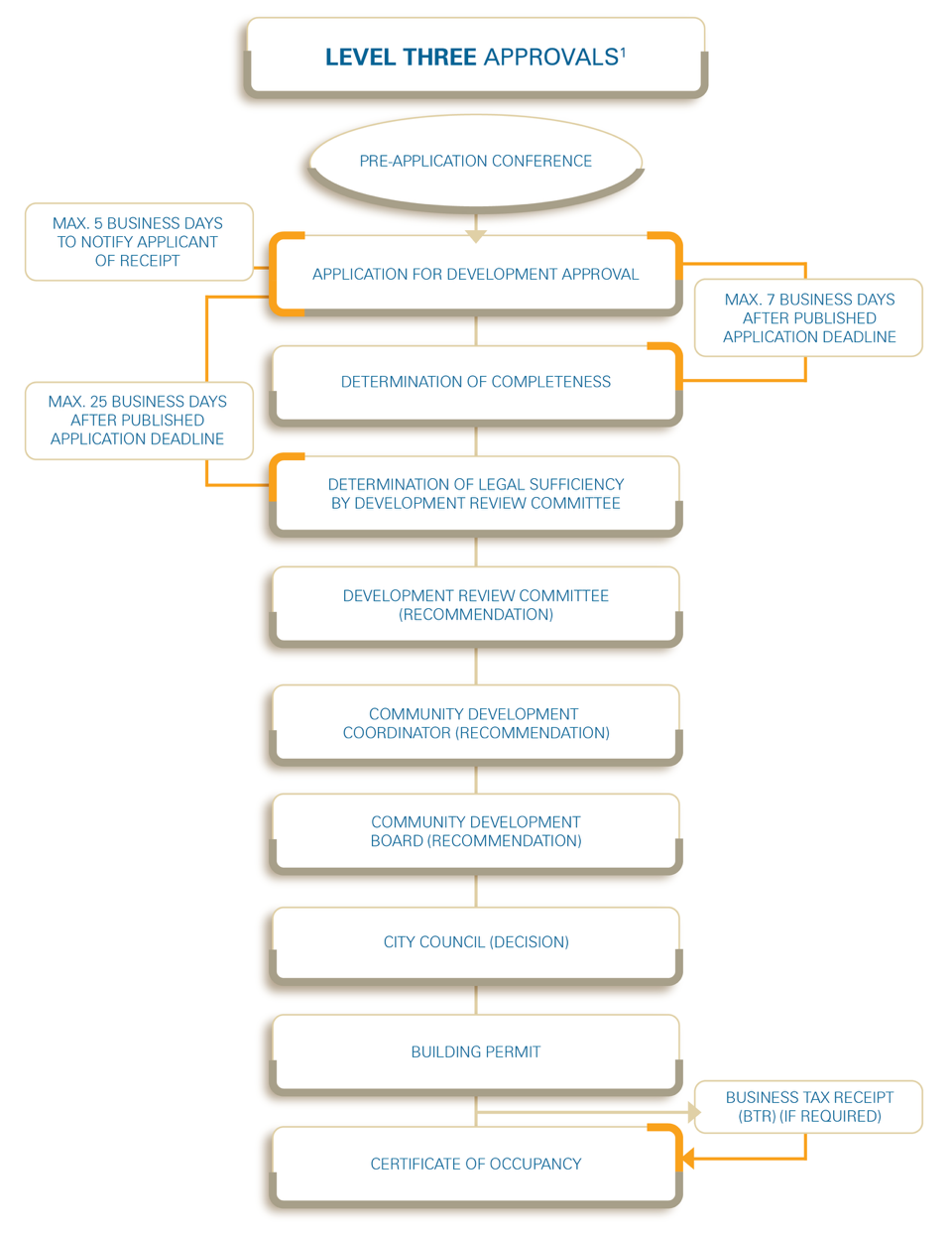
DIVISION 6. - LEVEL THREE APPROVALS
1.
Hotel Density Reserve Development Agreements follow a slightly different process and have both public hearings at City Council instead of one at the Community Development Board and one at City Council.
(Ord. No. 6526-00, § 1, 6-15-00; Ord. No. 8423-13, § 5, 8-14-13; Ord. No. 9857-25, § 7, 12-4-25)
_____
DIVISION 9. - MOBILITY MANAGEMENT[1]
Editor's note—Ord. No. 9758-24, § 23, adopted June 6, 2024, amended Div. 9 in its entirety to read as herein set out. Former Div. 9, §§ 4-901—4-905, pertained to concurrency and mobility management, and historical notation has been retained where possible for reference use. Former §§ 4-901—4-903 were repealed and pertained to authority and applicability; application and procedures; and standards for certificate of concurrency/capacity, respectively, and derived from Ord. No. 6526-00, § 1, adopted June 15, 2000; Ord. No. 7718-06, § 1, adopted Nov. 15, 2006; Ord. No. 8028-09, § 2, adopted June 4, 2009; Ord. No. 8070-09, adopted Dec. 3, 2009; Ord. No. 8346-12, § 1, adopted Nov. 1, 12; and Ord. No. 8806-16, adopted May 5, 2016.
Section 4-201. - Pre-application conference.
A.
Applicants for a proposed development in the US 19 or downtown zoning districts shall have a pre-application conference with the Community Development Coordinator or his/her designee prior to development application, unless otherwise waived by the Community Development Coordinator, to review the preliminary site plan, building elevations, and other materials required by the Community Development Coordinator. Those development projects that are exempt from the US 19 Zoning District and development standards pursuant to Section B-104.C or the Downtown District and development standards pursuant to Section C-104.B shall be exempt from this requirement.
B.
Projects in all other zoning districts. An applicant for development approval may request an informal conference with the Community Development Coordinator prior to filing an application for the purpose of discussing the proposed development and to identify the views and concerns of the applicant and the city's professional staff.
(Ord. No. 9643-23, § 15, 4-4-23; Ord. No. 9712-23, § 2, 11-2-23; Ord. No. 9740-24, § 2, 2-1-24)
Section 4-202. - Applications for development approval.
A.
All applications for development approval shall include the following information in addition to the information that the Community Development Coordinator may generally require unless waived or modified by the Community Development Coordinator:
1.
An application with plans and relevant support materials (the number to be established by the Community Development Coordinator).
2.
Data sheet.
3.
Written responses (or narrative) explaining how compliance with the general applicability criteria and applicable flexibility criteria is being achieved by the development proposal.
4.
Affidavit to authorize agent/representative.
5.
If the application would result in the removal or relocation of mobile home owners residing in a mobile home park as provided in F.S. § 723.083, the application must provide information sufficient to show that adequate mobile home parks or other suitable facilities exist for the relocation of the mobile home owners. Mobile home owners shall be defined as those persons who own their coach but rent a lot space within the subject property and are subject to the provisions and protections provided for in F.S. Ch. 723. The application shall include the following information:
a.
The total number of mobile homes in the park that are owned by mobile home owners; and
b.
Monthly rent charged for each space occupied by a mobile home owner; and
c.
A list of the names and mailing addresses of the present mobile home owners within the subject property. This list should identify those units that are suitable for moving and for which only vacant replacement lots will be identified; and
d.
Household profile for each owner-occupied mobile home within the park, including number of adults, number of children, and whether pets have been allowed in the park. Replacement units identified should be suitable for similar household profiles; and
e.
A list of other mobile home parks or other suitable facilities with vacant units available at the time of application that are of a similar cost profile to which owners residing in the subject property could reasonably expect to relocate. This list will include, at a minimum, name and address of the park, park contact name and phone number, the number of vacant spaces available and the cost of those spaces, park guidelines on age and condition of acceptable units, number of rental units available and the cost of those rentals. All parks or other suitable facilities must be located within a ten-mile radius of the subject property and serve the same age, household, and occupancy profiles as the subject property.
f.
Any other information that the applicant deems necessary to demonstrate that adequate mobile home parks or other suitable facilities exist for the relocation of the mobile home owners.
B.
Simultaneous applications. If more than one approval is required (for example, Level One (Flexible Standard Development) and Level Three) for a particular development proposal, with the exception of an application for a building permit, certificate of occupancy or business tax receipt, an applicant may be required to submit all applications for development approval at the same time if the Community Development Coordinator determines it would be in the best interest of development of the city.
C.
Determination of completeness.
1.
Determination of completeness. Within five business days after receiving an application, the Community Development Coordinator shall notify the applicant of receipt of the application using contact information provided by the applicant. Within seven business days after the published application deadline, the Community Development Coordinator shall determine whether an application is complete.
a.
Application complete. If the Community Development Coordinator determines that the application is complete, they shall notify the applicant in writing that the application has been accepted for filing.
b.
Notice of application to abutting property owners. After the Community Development Coordinator has accepted a Level One (Flexible Standard Development) or Level Two (Flexible Development) application for filing, notice of the application shall be mailed to each owner of record of any land within a 200-foot radius of the perimeter boundaries of the subject property. Notice shall also be mailed to any affected registered local neighborhood association and to any citywide neighborhood association. Notice shall be mailed no less than ten calendar days prior to the review of the application before the development review committee (determination of sufficiency). All notices shall include a summary of the proposal under consideration, the procedure for consideration of the application, the address of the subject property, and contact information for both the applicant and the city.
c.
Application not complete. If the Community Development Coordinator determines that the application is not complete, they shall notify the applicant, specifying the deficiencies of the application, and provide 30 calendar days for the applicant to submit the required information. No further development review shall be taken until the application is deemed complete. If the required information is not submitted within the 30-day timeframe, the application will be deemed withdrawn. Further completeness timeline procedures are as governed by F.S. § 166.033, as may be amended from time to time.
2.
Determination of legal sufficiency: Level One (Flexible Standard Development), Level Two or Level Three approvals.
a.
Within 25 business days after the published application deadline unless an application is incomplete, the members of the development review committee in the case of Level One (Flexible Standard Development), Level Two, or Level Three approvals shall determine whether a completed application is legally sufficient, that is whether the required application materials have been prepared in a substantively competent manner. If any member of the development review committee determines that any portion of the application is insufficient, the Community Development Coordinator shall notify the applicant of the reasons that the application is legally insufficient and shall either (1) inform the applicant that no further development review shall be conducted until the application is resubmitted or (2) if the application is determined to be legally insufficient in such a way that cannot be remedied, deny such application for legal insufficiency. Any denial of an application for legal insufficiency shall constitute an administrative decision which may be appealed to the Community Development Board pursuant to Section 4-501.A.2 for a determination regarding whether or not the application is legally sufficient.
b.
If a Level One (Flexible Standard Development) application remains legally insufficient for 120 days after being deemed complete, the Community Development Coordinator shall deny the application unless the applicant and the city mutually agree to an extension of time.
c.
If a Level Two or Level Three (Zoning Atlas Amendment only) application remains legally insufficient for 180 days after being deemed complete, the Community Development Coordinator shall deny the application unless the applicant and the city mutually agree to an extension of time.
d.
The applicant may request to withdraw a Level One (Flexible Standard Development), Level Two, or Level Three application at any time during the development review process up until a final decision is rendered on the application.
D.
Review by development review committee. After an application for development approval is determined to be complete and legally sufficient, the development review committee shall review the application in accordance with Division 3 of this Article if a Level One (Flexible Standard Development) approval, Division 4 if a Level Two approval and Division 6 if a Level Three approval.
E.
Issuance of development order.
1.
The Community Development Coordinator shall issue a development order for a Level One (Flexible Standard Development) approval or denial.
2.
The Community Development Coordinator shall issue a development order for a Level Two approval or denial after a decision is rendered on a Level Two application by the Community Development Board which shall contain all findings and conditions required by the board.
F.
Fees. Except for those applications submitted on behalf of governmental agencies, all applications for development approval shall be accompanied by the payment of a fee established from time-to-time by the city council and maintained as Appendix A to the City Code.
G.
Resubmission of application affecting same property.
1.
No application shall be accepted during the following time periods after the denial of a substantially similar application affecting the same property or any portion thereof:
a.
Nine months for Level Two approvals, except in the case of Level Two applications denied for legal insufficiency not appealed to the Community Development Board.
b.
Twelve months for Level Three approvals, except in the case of Level Three applications denied for legal insufficiency not appealed to the Community Development Board.
2.
The time periods specified in this subsection shall be deemed to have commenced only after the completion of any administrative or judicial review which may have been sought.
(Ord. No. 6526-00, § 1, 6-15-00; Ord. No. 6928-02, §§ 94—97, 5-2-02; Ord. No. 6998-02, § 1, 7-18-02; Ord. No. 7106-03, §§ 12—14, 9-18-03; Ord. No. 7449-05, §§ 27—30, 12-15-05; Ord. No. 7616-06, § 2, 5-18-06; Ord. No. 7725-07, § 2, 2-15-07; Ord. No. 7835-07, § 20, 1-17-08; Ord. No. 8042-09, § 4, 6-4-09; Ord. No. 8310-12, § 5, 2-2-12; Ord. No. 8746-15, § 1, 7-16-15; Ord. No. 9758-24, § 21, 6-6-24; Ord. No. 9857-25, § 3, 12-4-25)
Section 4-203. - Building permit.
A.
Permit required.
1.
No person shall commence any construction, demolition, modification or renovation of a building or structure without first obtaining a building permit.
2.
No seawall, bulkhead, groin, marine improvement, bridge or other similar marine structure shall be built within the city until the building official has issued a building permit for such work.
3.
A building permit shall authorize only the use, arrangement and/or construction permitted under Level One (Minimum Standard Development), a Level One (Flexible Standard Development) approval, or a Level Two approval and no other use, arrangement or construction.
4.
Complete engineering and architectural plans for each component of a development project shall be required to be submitted prior to the issuance of a building permit. For any phased project, such plans shall be required for each phase of the development.
B.
Procedure. All applications for building permits shall be submitted in a form required by this Development Code and the building official. Upon receipt of an application, including a declaration of unity of title, in accordance with Article 4 Division 16, the building official shall forward a copy to the Community Development Coordinator in order to determine whether the application conforms to the Level One (Minimum Standard Development) requirements of this Community Development Code or conforms with a Level One (Flexible Standard Development) or Level Two approval. Upon receipt of the determination of the Community Development Coordinator, the building official shall determine whether the application conforms to all applicable requirements contained in the building code. If the building official and the Community Development Coordinator determines that the application does conform to all applicable standards, the building permit shall be issued. If the building official determines that the application does not conform to applicable building code provisions, or the Community Development Coordinator determines that the application does not conform to the applicable provisions of this Development Code or applicable development approval, they shall identify the application's deficiencies and deny the application.
C.
Appeal. A denial of a building permit may be appealed in the manner provided in Article 4, Division 5.
(Ord. No. 6526-00, § 1, 6-15-00; Ord. No. 9857-25, § 3, 12-4-25)
Section 4-204. - Occupancy permit.
A.
Applicability.
1.
A certificate of occupancy shall be required for the following:
a.
Occupancy and use of land or a building hereafter improved, erected, structurally altered, reconstructed, enlarged or moved.
b.
Change in occupancy or use of an existing nonresidential building.
c.
Change in the use of land, building or structure.
2.
No occupancy permit shall be issued unless it has been determined that the building or structure and the site complies with the provisions of the Building Code, this Development Code and all prior approvals upon which the building permit was based.
B.
Procedure.
1.
All applications for occupancy permits shall be submitted in a form required by the building official.
2.
In the event a valid building permit is not in effect, upon receipt of an application for the occupancy permit, the building official shall forward a copy of the application to the Community Development Coordinator in order to determine whether the application conforms to an approved Level One or Level Two approval. Upon receipt of the determination of the Community Development Coordinator that the application does conform, the building official shall determine whether the application conforms to all applicable requirements contained in the building code.
3.
If a valid building permit is still in effect, upon receipt of an application for an occupancy permit, the building official shall determine by inspection whether the work authorized by the building permit has been completed in accordance with the approved plans.
4.
If the building official determines that the work does conform, the occupancy permit shall be issued. If the building official determines that the application does not conform, he shall identify the application's deficiencies and deny the application.
C.
Appeal. A denial of a certificate of occupancy may be appealed in the manner provided in Article 4 Division 5.
(Ord. No. 6417-99, § 12, 8-19-99)
Section 4-205. - Business tax receipt.
A.
Applicability. Any person required to obtain a business tax receipt in order to conduct business within the city pursuant to the provisions of Chapter 29, Article II of the City's Code, shall obtain such license after the issuance of an occupancy permit.
B.
Procedure.
1.
All applications for business tax receipts shall be prepared on forms available from the city manager.
2.
Upon receipt of an application for a business tax receipt, the city manager shall forward a copy of the application to the Community Development Coordinator who shall review the application to determine if the business conforms to applicable provisions of this Development Code and any prior approvals.
3.
Upon receipt of a determination by the Community Development Coordinator that the business does conform to applicable provisions of this Development Code and prior approvals, then the city manager shall review the application and determine whether the business conforms to all applicable requirements of Chapter 29, Article II of the City's Code.
4.
Following review and determination as to conformance by both the Community Development Coordinator and the city manager, the city manager shall either issue the business tax receipt or deny the application.
C.
If the business tax receipt is for a home occupation, then an executed affidavit must be submitted in which the business owner(s):
1.
Agree to comply with all standards contained in Article 3, Division 2 and any other conditions of the home occupation that may be established in authorizing same;
2.
Recognize the need to renew the requisite business tax receipt annually or as may otherwise be required;
3.
Acknowledge that any departure from the conditions authorizing the use shall be grounds for the revocation of the applicable business tax receipt; and
4.
Agree to permit reasonable inspection of the premises of the home occupation to ensure compliance with the conditions thereof.
(Ord. No. 6526-00, § 1, 6-15-00; Ord. No. 7725-07, § 2, 2-15-07; Ord. No. 8310-12, § 6, 2-2-12)
Section 4-206. - Notices and public hearings.
A.
Applicability. The procedures set out in this section shall be applicable to all public hearings required by any provision of this development code. All public hearings shall be conducted in accordance with Florida law.
B.
Types of hearings. There are two types of public hearings required under Florida law: quasi-judicial hearings and non-quasi-judicial or legislative hearings. All public hearings required pursuant to this Development Code, except for hearings required for amendments to the Comprehensive Plan, text amendments, development agreements and annexations, are quasi-judicial and the procedures set out in Section 4-206(D) shall apply.
C.
Notice of hearings. The city clerk shall be responsible for providing notices for all required public hearings.
1.
All notices of public hearings shall include:
a.
The date, time and place of the hearing.
b.
A summary of the proposal under consideration.
c.
The address of the property and a locational map graphically portraying the location of the property (if required by Florida Statute).
d.
A contact in the city and telephone number in order to obtain further information.
2.
All notices of public hearings shall be provided:
a.
For Level Two approvals:
1.
By sending a copy of the notice by mail to each owner of record of any land within a 200-foot radius of the perimeter boundaries of the subject property. Notice shall also be mailed to any affected registered local neighborhood association and to any citywide neighborhood association. Notice shall be provided no less than ten days prior to the review of the application before the Community Development Board.
2.
By posting a sign at least three square feet in area and not exceeding six feet in height facing the street(s) on the parcel proposed for development. The sign shall include the case number, property address, hearing dates and a contact phone number.
b.
For Level Three approvals:
1.
By publication of a copy of the notice in one or more newspapers with general circulation in the City of Clearwater.
2.
By sending a copy of the notice by mail to each owner of record of any land within a 200-foot radius of the perimeter boundaries of the subject property. Notice shall also be mailed to any affected registered local neighborhood association and to any citywide neighborhood association. Notice shall be provided no less than ten days prior to the review of the application before the city council. If more than 30 owners of property are involved, unless otherwise directed by the city council, in-lieu of mailing such notice, the clerk may publish the notice at least twice in a newspaper of general circulation in the City of Clearwater.
3.
By posting a sign at least three square feet in area and not exceeding six feet in height facing the street(s) on the parcel proposed for development. However, if a single application includes more than 25 contiguous parcels and/or is greater than ten acres, then no sign shall be required to be posted.
4.
By certified mail to the property owner for the voluntary annexation of a noncontiguous property in an enclave as defined in F.S. § 171.031(13)(a), within the city's service area. The certified mailing shall be sent prior to each reading of the ordinance.
3.
Where an advertising requirement is set forth in Florida Statutes, notices shall be provided in accordance with that requirement. Where no advertising requirement is set forth in Florida Statutes, all notices shall be provided at least ten but not more than 45 days in advance of the public hearing.
D.
Conduct of quasi-judicial hearing.
1.
Staff report/recommendation. At least five days in advance of the hearing, the Community Development Coordinator's report and recommendation regarding the application for development approval which is the subject of the hearing shall be delivered to the Community Development Board and the applicant, and be available to the general public.
2.
Ex parte communications and expert opinions. Except as provided in this subsection, no member of the Community Development Board or the city commission shall engage in any ex parte communications with any person in regard to the substance of a quasi-judicial matter which is to be considered by the board or commission, as the case may be.
a.
Members of the Community Development Board may conduct personal investigations with regard to a quasi-judicial matter pending before them provided that the existence of such investigation or site visit, is disclosed at a public hearing and made a part of the record before final action on the matter.
3.
Opening matters and preliminary remarks:
a.
The Community Development Coordinator shall describe the application and identify the applicant and announce the order of presentation.
b.
The chair of the Community Development Board or the hearing officer shall inquire of those attending the hearing if there is any person who wishes to seek party status and explain that party status entitles the party to:
i.
Personally testify.
ii.
Present evidence by documentary submittal.
iii.
Present witnesses.
iv.
Conduct cross examination of any witness.
v.
Present argument.
vi.
Appeal the decision.
Party status shall be granted by the Community Development Board or the hearing officer, as the case may be, if the person requesting such status demonstrates that he is a substantially affected person. Any other interested person (not a party) shall be entitled to participate in the hearing, subject to the control by the body conducting the hearing and may be requested to respond to questions from the body conducting the hearing, but need not be subject to cross-examination or qualified as an expert witness.
c.
Disclosure of the substance of the subject of any ex parte communications, including the identity of the person, group, or entity with whom the communication took place and all written communications to the Community Development Board, or the hearing officer, if any, which shall be made a part of the record.
d.
The witnesses shall be sworn.
4.
Burden of proof. The burden of proof is upon the applicant to show by substantial competent evidence that he is entitled to the approval requested.
5.
Presentation of case. The applicant, the city and any other party may present testimony, examine witnesses, and present documentation at the public hearing and may cross-examine other witnesses. Other interested persons may present comments or argument in support of or in opposition to the application.
a.
Any expert witness testifying shall submit a resume for the record before or during the public hearing.
6.
Order/recommended order. In the case of a Level Two approval or an appeal, the Community Development Board or the hearing officer shall issue an order and, in the case of a Level Three approval, a recommended order, which shall include:
a.
Findings of fact in regard to any questions of fact which were presented during the proceedings.
b.
Conclusions of law in regard to the applicable provisions of the comprehensive plan and the community development code.
c.
Approval or approval with conditions or a recommended approval or approval with conditions, in the case of a Level Three approval.
7.
City commission decision.
a.
In the event the city commission is required to render a final approval, such case shall be heard within six months of the Community Development Board recommendation or the case shall be deemed to be withdrawn.
b.
In the event the city commission is required to render a final approval, the record adduced before the Community Development Board shall be presented to the city commission for their review. The city commission may hear public comment and argument, but no additional testimony shall be allowed, and any comment or argument will not be considered evidence. The city commission shall issue a final decision in the form of a resolution or ordinance which shall include: findings of fact and listings of any conditions, requirements or limitations on the approval.
E.
Continuances. A hearing may be continued to a specified date, time and place; in this case, the date, time and place of the rescheduled hearing must be announced prior to or at the conclusion of the advertised hearing. Additional notice shall not be required for hearings which have action deferred in this manner for a period of 45 days or less. Renotification for any subsequently scheduled public hearing dates shall be required for hearings which have action deferred for a period of more than 45 days, in accordance with the requirements contained in Section 4-206C(2)(b), (c) and (d). A hearing may also be continued to a date uncertain; in this case, renotification for any subsequently scheduled public hearing dates shall be required in accordance with the requirements contained in Section 4-206C.
F.
Application amendments. If an application is amended to a less intensive request, such application may continue to proceed through the development review process. If an application is amended to a more intensive request, such application shall be readvertised to all persons originally entitled to notice and shall include the date, time and place of such hearing in the same manner as specified in Section 4-206(C) and reheard in accordance with the procedures specified in Section 4-206(D).
G.
Record of hearing. The city clerk shall ensure that the proceedings are recorded by appropriate means. If a sound recording is made, any person shall be entitled to listen to the recording at any reasonable time or to make copies at his own expense. The record shall consist of the recording of testimony, all applications, exhibits and papers submitted in any proceeding with respect to the matter being considered, the report and recommendation of the Community Development Coordinator, the Comprehensive Plan, and this Development Code.
H.
Reconsideration or rehearing. After a final decision, reconsideration or rehearing may be granted only upon a determination by the Community Development Board or the hearing officer, as the case may be, at the next regularly scheduled meeting of the Community Development Board or within ten days of a hearing officer's that the decision, was based upon mistake, fraud or misrepresentation. If reconsideration or rehearing is granted, notice shall be provided in the same manner as the original proceeding.
I.
Other rules. Any other matters pertaining to the public hearing shall be governed by the provisions of this Development Code applicable to the Community Development Board and city commission and their adopted rules of procedure.
J.
Absence of applicant at hearing. If neither the applicant nor the applicant's representative is present at a public hearing, the Community Development Board, the city commission or a hearing officer, may continue consideration of the matter upon the timely receipt of a request to continue the matter because of exigent circumstances which preclude the attendance of an applicant or his or her representative which request is received by the decision maker prior to the noticed time of consideration of the matter, or shall deny the application unless such application involves the annexation of property developed or to be developed with one detached dwelling, property which is the subject of an approved annexation agreement or unless the application for development approval constitutes competent substantial evidence in support of the application.
(Ord. No. 6526-00, § 1, 6-15-00; Ord. No. 6835-01, § 1, 9-20-01; Ord. No. 6928-02, §§ 99, 100, 5-2-02; Ord. No. 7449-05, §§ 31, 32, 12-15-05; Ord. No. 8746-15, § 2, 7-16-15; Ord. No. 9042-17, § 11, 12-7-17)
Section 4-207. - Time frames for review of applications.
A.
Level One (Flexible Standard Development), Level Two, and Level Three approvals. Consistent with the time limits and other requirements established in this Community Development Code, the Community Development Coordinator shall prepare an annual schedule based upon those requirements that specify the time frames for review of applications submitted for Level One (Flexible Standard Development), Level Two, and Level Three approvals. The schedule shall utilize the calendar for the year and shall reflect the regular schedule of meetings of the development review committee, the Community Development Board, and the city council.
B.
Extensions of time frames. An applicant and the city may mutually agree to extend the established time frames for review especially in the case of extraordinary circumstances such as force majeure events. Substantive changes to an application made by the applicant shall restart the timeframes provided in this Development Code. A "substantive change" is defined as an applicant-initiated change of 15 percent or more in the proposed density, intensity, or square footage of a parcel.
C.
Denial of applications. Any denial of an application shall be evidenced by a written order or notice to the applicant that includes citation to the applicable portions of the ordinance, rule, statute, or other legal authority for the denial of the application. Such a denial may be appealed as set forth in the provisions of Section 4-501, except denials by the city council shall be appealed to circuit court in accordance with applicable Florida law.
(Ord. No. 6998-02, § 2, 7-18-02; Ord. No. 9857-25, § 3, 12-4-25)
_____
Section 4-301. - Purpose and applicability.
This division establishes the approval process for Level One approvals and affordable housing developments pursuant to Section 3-920. Depending on the proposed use and the zoning district in which the parcel proposed for development is located, the Level One approval submittal requirements and the scope of administrative review may vary. Depending on the nature and character of the use, the development project may require a site plan, plat approval, transportation management plan and/or a traffic impact study as part of its application for approval. After a Level One approval is obtained, a building and an occupancy permit are required, as well as any required licenses.
(Ord. No. 9857-25, § 4, 12-4-25)
Section 4-302. - Application/approval by Community Development Coordinator.
A.
Level One (Minimum Standards Development).
1.
Building permit applications that meet the requirements for Level One (Minimum Standard Development) shall not be required to complete a development application and may proceed through the building permit application review process. Building permit applications not satisfying Level One (Minimum Standard Development) shall require approval of a requisite development application as provided under Community Development Code Section 4-202 before further processing. The determination that a development application is required shall constitute an administrative decision which may be appealed to the Community Development Board pursuant to Section 4-501.A.2.
2.
It is acknowledged that changes of use may be proposed whereby conformance with all of the applicable general and specific requirements set out in Article 2 may not be possible or practicable. In those situations, the following provisions shall apply:
a.
If there is no difference in the established development standards between an existing use and a proposed use that is permissible as a Level One (Minimum Standard Development) use in the zoning district of the subject property, then the change of use may be processed without need for a development approval even if the structures and/or properties involved are nonconforming with regard to said development standards, provided that the site is brought into compliance to the greatest extent practicable with the parking and landscaping standards set out in Article 3 as determined by the Community Development Coordinator.
b.
If there is a difference in the established development standards between an existing use and a proposed use that is permissible as a Level One (Minimum Standard Development) use in the zoning district of the subject property, but the proposed use would have a lesser impact, then the change of use may be processed without need for a development approval even if the structures and/or properties involved are nonconforming with regard to said
c.
If there is a difference in the established development standards between an existing use and a proposed use that is permissible as a Level One (Minimum Standard Development) use in the zoning district of the subject property and the proposed use would have a greater impact, but still meet the parameters established below, then the change of use may be processed without need for a development approval even if the structures and/or properties involved are nonconforming with regard to the development standards, provided the site is brought into compliance to the greatest extent practicable with the parking and landscape standards set forth in Article 3.
1.
The building or tenant space, as applicable, is less than 5,000 square feet; and
2.
The change of use cannot create a nonconforming situation with regard to the provision of off-street parking. In the instance where the existing use is currently nonconforming with regard to the provision of off-street parking, the resulting change of use cannot exacerbate this nonconformity by more than ten percent; and
3.
Eligible uses include only offices, retail sales and services, and mixed-use (the commercial component of which may only include office or retail sales and services); and
4.
If the existing development was part of a Level Two development approval, then the proposed change of use must comply with the provisions of Section 4-406.
d.
With regard to the above provisions, "lesser impact" and "greater impact" shall be based upon the difference in development standards between the two uses.
B.
Level One (Flexible Standard Development) approval. An applicant for Level One (Flexible Standard Development) approval shall submit an application in accordance with the requirements of Section 4-202. A. and F., to the Community Development Coordinator who shall review the application with the development review committee in accordance with the requirements of Section 4-202.C. and D., and determine whether the application demonstrates compliance with this Development Code. Within 20 business days of a determination of legal sufficiency, the Community Development Coordinator shall approve the application, or approve with conditions necessary to make the proposed development conforming with the applicable general and specific requirements set out in Articles 2 and 3, including the provisions of Section 3-913 in regard to general standards for approval conditions, or deny the application for failure to meet the applicable requirements and standards. Notwithstanding the foregoing, a Level One (Flexible Standard Development) application shall be approved, approved with conditions, or denied by the Community Development Coordinator within 120 days after being deemed complete unless the city and the applicant agree to an extension of time.
(Ord. No. 6526-00, § 1, 6-15-00; Ord. No. 6998-02, § 3, 7-18-02; Ord. No. 7106-03, §§ 16, 17, 9-18-03; Ord. No. 8349-12, § 34, 9-6-12; Ord. No. 9857-25, § 4, 12-4-25)
Section 4-303. - Effect of Level One (Flexible Standard Development) approval.
A Level One (Flexible Standard Development) approval authorizes only the particular use approved and entitles the recipient to apply for a building permit or any other permit required by this Development Code, the city or regional, state or federal agencies. Such approval shall be evidenced by a written development order issued by the Community Development Coordinator and shall be effective upon the date the development order is issued. Unless otherwise specified in the Level One (Flexible Standard Development) approval, an application for a building permit shall be made within one year of the date of the Level One (Flexible Standard Development) approval or such approval shall expire. Upon application for a building permit within the timeframe provided in this section, the Level One (Flexible Standard Development) approval shall remain valid unless the building permit is denied or revoked. In the event a building permit is denied or revoked within six months of the submittal of the initial building permit application, the Level One (Flexible Standard Development) approval shall expire at the end of the six-month period unless a subsequent building permit application is filed before the expiration of this period. Otherwise, a Level One approval shall expire with denial or revocation of a building permit.
Permitted time frames do not change with successive owners and an extension of time to initiate a building permit may be granted by the Community Development Coordinator for a period not to exceed one year and only within the original period of validity. The Community Development Coordinator may approve an additional extension of time not to exceed one year for good cause shown and documented in writing. The coordinator must receive the request for this extension within the one-year period of validity after the original time extension.
Good causes may include, but are not limited to, an unexpected national crisis (acts of war, significant downturn in the national economy, etc.), excessive weather-related delays, and the like. The Community Development Coordinator may also consider whether significant progress on the project is being made and whether or not there are pending or approved Code amendments which would significantly affect the project. In the event a project is governed by a development agreement, the timeframes established in the agreement shall supersede these requirements.
(Ord. No. 6526-00, § 1, 6-15-00; Ord. No. 7106-03, § 18, 9-18-03; Ord. No. 7449-05, § 33, 12-15-05; Ord. No. 7835-07, § 21, 1-17-08; Ord. No. 9857-25, § 4, 12-4-25)
_____
Section 4-401. - Purpose and applicability.
This division establishes the approval required to commence development of a use in a zoning district which is identified in that district as requiring a Level Two approval. A Level Two approval is granted by the Community Development Board, based on a recommendation of the Community Development Coordinator. As with Level One approvals, depending on the nature and character of the use, the application may require a site plan, plat approval, transportation management plan and/or a traffic impact study, as part of its application for approval. After a Level Two approval is obtained, a building and an occupancy permit are required, as well as any required licenses.
(Ord. No. 8313-12, § 3, 7-19-12; Ord. No. 9857-25, § 5, 12-4-25)
Section 4-402. - Application.
An applicant for a Level Two approval shall submit an application in accordance with the requirements of Section 4-202.A. and F., to the Community Development Coordinator who shall review the application in accordance with the requirements of Section 4-202.C. and D.
(Ord. No. 9857-25, § 5, 12-4-25)
Section 4-403. - Staff review, report and recommendation.
After the Community Development Coordinator has reviewed the application with the development review committee in accordance with the provisions of Section 4-202(C) and (D), the coordinator shall transmit a written recommendation to the Community Development Board, or the hearing officer, if applicable, with a copy to the applicant, setting forth recommended findings of fact regarding whether the application conforms to the flexibility criteria in the zoning district in which the property is located, proposed conclusions of fact and law and recommended conditions concerning the application.
Section 4-404. - Community development board decision.
A.
Upon receipt of the recommendation of the Community Development Coordinator, the Community Development Board shall review the application, the recommendation of the Community Development Coordinator, conduct a quasi-judicial public hearing on the application in accordance with the requirements of Section 4-206, make findings of fact, and may grant the approval, grant the approval subject to specified conditions, or deny the application for development approval. Level Two approvals shall not be considered or construed as special exceptions or variances. The burden of proof in a Level Two case shall be upon the applicant to demonstrate to the Community Development Board that all required criteria for approval are met. The review and public hearing shall be held within 38 business days after determination of legal sufficiency, unless the time frame is extended by mutual consent of the applicant and the city. The Community Development Board shall render a decision not later than 70 days after the initial hearing unless the time frame is extended by mutual consent of the applicant and the city. The Community Development Board shall attach such conditions to the approval which are necessary to ensure compliance with the applicable general and specific flexibility requirements and standards set out in Articles 2 and 3.
B.
Notwithstanding subsection A., a legally sufficient Level Two application shall be approved, approved with conditions, or denied by the Community Development Board within 180 days after being deemed complete unless an extension of time is agreed to by the city and the applicant.
(Ord. No. 6526-00, § 1, 6-15-00; Ord. No. 6998-02, § 4, 7-18-02; Ord. No. 7106-03, § 20, 9-18-03; Ord. No. 7413-05, § 19, 5-5-05; Ord. No. 9857-25, § 5, 12-4-25)
Section 4-405. - Effect of a Level Two decision.
Approval of a level two approval shall be deemed to authorize only the particular use for which it is issued and shall entitle the recipient to apply for a building permit or any other approval that may be required by this development code, the city or regional, state or federal agencies. Such approval shall be evidenced by a written development order issued by the Community Development Coordinator that confirms the Community Development Board's decision and shall be effective upon the date of the board meeting when the decision was rendered.
(Ord. No. 7106-03, § 21, 9-18-03)
Section 4-406. - Changes to Level Two development approvals.
A.
Minor revisions. The Community Development Coordinator is authorized to allow minor revisions to an approved Level Two application after receipt of comments from the development review committee. A minor revision is one which:
1.
Does not result in conflicts in on-site circulation and/or negative impacts with ingress/egress.
2.
Does not change the use unless such change is of a similar or less intensity, as determined by the Community Development Coordinator.
3.
Does not increase the density or intensity of the development
4.
Does not result in a reduction of setback or previously required landscape area except in the case of the Downtown or US 19 Districts where a reduction in setback is permissible as a minor revision but an increase in setback will not be considered a minor revision.
5.
Does not result in a substantial change to the location of a structure previously approved.
6.
Does not result in a substantial modification or the cancellation of any condition placed upon the application as originally approved.
7.
Does not add property to the parcel proposed for development.
8.
Does not increase the height of the buildings in a manner that will change the overall height of the project, will not alter the scale of the project, does not exceed the maximum height permitted in by the applicable special area plan and zoning district.
9.
Any other minor revision that does not substantially alter the character and design of the project.
B.
Other revisions. Any other adjustments or changes not specified as "minor" shall be granted only in accordance with the procedures for original approval.
(Ord. No. 7106-03, § 22, 9-18-03; Ord. No. 7631-06, § 1, 11-2-06; Ord. No. 9857-25, § 5, 12-4-25)
Section 4-407. - Expiration of a Level Two approval.
Unless otherwise specified in the approval, an application for a building permit shall be made within one year of the date of the Level Two approval or such approval shall expire. Upon application for a building permit within the timeframe provided in this section, the Level Two approval shall remain valid unless the building permit is denied or revoked. In the event a building permit is denied or revoked within six months of the submittal of the initial building permit application, the Level Two approval shall expire at the end of the six-month period unless a subsequent building permit application is filed before the expiration of this period. Otherwise, a Level Two approval shall expire with denial or revocation of a building permit. Permitted time frames do not change with successive owners.
An extension of time to initiate a building permit may be granted by the Community Development Coordinator provided it is for a period not to exceed one year, is for the project originally approved and provided good cause is shown and documented in writing within the original period of validity. The Community Development Coordinator may also consider whether significant progress on the project is being made and whether or not there are pending or approved Code amendments which would significantly affect the project.
The Community Development Board may approve one additional extension of time after the Community Development Coordinator's extension to initiate a building permit application. Such extension shall not exceed one year, shall be for the project originally approved and shall be for good cause shown and documented in writing. The Community Development Board must receive the request for this extension within the one-year period of validity after the original extension approved by the Community Development Coordinator.
Good causes may include but are not limited to an unexpected national crisis (acts of war, significant downturn in the national economy, etc.), excessive weather-related delays, and the like. In the event a project is governed by a development agreement, the timeframes established in the agreement shall supersede these requirements. Transfer of development rights are exempt from this provision.
(Ord. No. 6526-00, § 1, 6-15-00; Ord. No. 7106-03, § 23, 9-18-03; Ord. No. 7835-07, § 22, 1-17-08; Ord. No. 9857-25, § 5, 12-4-25)
Section 4-501. - Authority and purpose.
A.
The Community Development Board has the authority to hear appeals from:
1.
Administrative interpretations of this development code.
2.
Orders, requirements, decisions or determinations made by an administrative official in the administration of this development code, except for enforcement actions.
3.
Level One approval decisions.
4.
Denials of any permit or license issued under the provisions of this Code.
5.
Any denials deemed to have occurred as a result of the failure of the Community Development Coordinator to act within the time limits provided in this Community Development Code.
B.
The hearing officer has the authority to hear appeals from:
1.
Decisions of the Community Development Board regarding Level Two approvals.
2.
Decisions of the Community Development Board regarding Level One approvals.
3.
Any denials deemed to have occurred as a result of the failure of the Community Development Board to act within the time limits provided in this Community Development Code, or as a result of the failure of any other administrative official or body (other than the Community Development Coordinator or the city commission) to act within the time limits provided by any other applicable law, rule, policy, or regulation then in effect.
(Ord. No. 6526-00, § 1, 6-15-00; Ord. No. 6998-02, § 5, 7-18-02)
Section 4-502. - Application/notice of appeal.
A.
An appeal of a Level One (Flexible Standard Development) decision may be initiated by an applicant or property owners within the required notice area and who presented competent substantial evidence in the Level One review, which is the subject of the decision within seven days of the date the development order is issued. The filing of an application/notice of appeal shall stay the effect of the decision pending the final determination of the case.
B.
Appeal of all other applications other than a Level One (Flexible Standard Development) decision may be initiated by the applicant, or by any person granted party status within 14 days of the decision. Such application shall be filed with the city clerk in a form specified by the Community Development Coordinator identifying with specificity the basis for the appeal and accompanied by a fee as required by Section 4-202.F. The filing of an application/notice of appeal shall stay the effect of the decision pending the final determination of the case.
C.
No building permit shall be issued for a Level Two or Level Three approval prior to the expiration of the appeal period.
(Ord. No. 6526-00, § 1, 6-15-00; Ord. No. 6928-02, §§ 101, 102, 5-2-02; Ord. No. 9857-25, § 6, 12-4-25)
Section 4-503. - Staff review, report and recommendation.
After the Community Development Coordinator has reviewed the application/ notice of appeal in accordance with the provisions of Section 4-202(C) and (D), the coordinator shall send a written recommendation to the Community Development Board, or the hearing officer, if applicable, with a copy to the applicant, setting forth whether the appeal should be granted or denied and the grounds for such recommendation.
(Ord. No. 6526-00, § 1, 6-15-00)
Section 4-504. - Community development board appeals.
A.
Upon receipt of the recommendation of the Community Development Coordinator regarding appeals from decision set out in Section 4-501(A), the Community Development Board shall review the application, the recommendation of the Community Development Coordinator, conduct a quasi-judicial public hearing on the application in accordance with the requirements of Section 4-206 and render a decision in accordance with the provisions of Section 4-206(D)(5) granting the appeal, granting the appeal subject to specified conditions, or denying the appeal. The hearing before the Community Development Board shall be scheduled at the first available meeting of the board sufficient to provide notice under Section 4-206, and may be continued at that meeting to the next regularly scheduled meeting of the board so that the board may receive more information, clarification, or research. The Community Development Board shall render a decision at the meeting but not later than 70 days from the receipt of the notice of appeal, unless the parties by mutual consent extend the time frame for the board's decision until a subsequent meeting.
B.
In order to grant an appeal, overturning or modifying the decision appealed from, the Community Development Board shall find that based on substantial competent evidence presented by the applicant or other party that each and every one of the following criteria are met:
1.
The decision appealed from misconstrued or incorrectly interpreted the provisions of this development code: and
2.
The decision of the Community Development Board will be in harmony with the general intent and purpose of this development code; and
3.
The decision of the Community Development Board will not be detrimental to the public health, safety and general welfare.
(Ord. No. 6928-02, § 103, 5-2-02; Ord. No. 6998-02, § 6, 7-18-02; Ord. No. 7413-05, § 20, 5-5-05)
Section 4-505. - Hearing officer appeals.
A.
Upon receipt of a notice of appeal regarding decisions set out in Section 4-501(b), the hearing officer shall, in concert with the city clerk, establish a date , hour and location for hearing to consist solely of:
1.
Reception of the record before the Community Development Board; and
2.
Oral argument.
The record before the Community Development Board shall consist of the following: the Planning Department file concerning the application; the agenda packet for the Community Development Board meeting(s); all exhibits accepted into evidence before the Community Development Board; and the streaming video of the hearing posted on the city's website. Any motion to supplement the record shall be filed with the hearing officer and served on all other parties to the proceedings within 30 days of filing the notice of appeal. The hearing shall be held within 60 days of receipt of the notice of appeal, unless the appellant requests or agrees to a continuance. The city clerk shall give notice of the hearing to the appellant, applicant, city, and any person granted party status by the Community Development Board.
B.
At the hearing, the record before the Community Development Board shall be received by the hearing officer. Additionally, oral argument may be presented by the appellant, applicant, city, the Community Development Board, and any person granted party status by the Community Development Board.
C.
The burden shall be upon the appellant to show that the decision of the Community Development Board cannot be sustained by substantial competent evidence before the board, or that the decision of the board departs from the essential requirements of law.
D.
The persons entitled to present oral argument as set forth in subsection B. above may submit proposed final orders to the hearing officer within 20 days of the hearing. The hearing officer shall render a decision within 45 days of the hearing. The decision of the hearing officer shall include conclusions of law and a determination approving, approving with conditions, or denying the requested development application. The decision of the hearing officer shall be final, subject to judicial review by common law certiorari to the circuit court. The filing of a petition for certiorari stays the decision of the hearing officer pending the final determination of the case.
(Ord. No. 6928-02, § 104, 5-2-02; Ord. No. 6998-02, § 7, 7-18-02; Ord. No. 7413-05, § 21, 5-5-05; Ord. No. 8043-09, § 31, 9-3-09; Ord. No. 8931-16, § 22, 9-1-16)
_____
Section 4-601. - Text amendments.
A.
Purpose and applicability. The purpose of this section is to establish the procedures for amending the text of this Development Code in accordance with the Florida Statutes.
B.
Application/initiation. Amendments to the text of this Development Code may be initiated by the city commission, the Community Development Coordinator, the Community Development Board and by any person in conjunction with an application for development approval. Proposed text amendment applications shall include such information as is applicable in Section 4-202(A) and the fee required by Section 4-202(E).
C.
Staff review and recommendation. After the Community Development Coordinator has reviewed the application with the development review committee in accordance with the provisions of Section 4-202(C) and (D), the coordinator shall send a written report and recommendation to the Community Development Board, with a copy to the applicant, if any, setting forth whether the application should be approved, approved with conditions or denied and the grounds for such recommendation.
D.
Community development board review/recommendation. Upon receipt of the recommendation of the Community Development Coordinator, the Community Development Board shall conduct a public hearing on the application in accordance with the requirements of Section 4-206 and issue a recommended order to the city commission setting forth the board's findings in regard to whether the proposed amendment will satisfy the standards set forth in Section 4-601(F) and may include any proposed modifications or conditions to the proposed amendment.
E.
City commission review/decision. Upon receipt of the recommended order of the Community Development Board, the city commission shall conduct a public hearing in accordance with the provisions of Section 4-206 and shall approve, approve with conditions or deny the amendment.
F.
Standards for review. In reviewing the application for a text amendment, the city commission shall consider whether the proposed amendment is consistent with and furthers the goals, policies and objectives of the Comprehensive Plan, and furthers the purposes of this development code and other city ordinances and actions designed to implement the plan.
Section 4-602. - Zoning Atlas amendments.
A.
Purpose and applicability. It is the purpose of this section to establish a procedure for amending the Zoning Atlas of the city in accordance with Florida Statutes.
B.
Application/initiation requirements. An application for an amendment of the Zoning Atlas of the city may be initiated by the city council, the Community Development Coordinator, the Community Development Board or by the owner of the property or his representative which is the subject of the amendment. Proposed Zoning Atlas amendment applications shall include such information as is applicable in Section 4-202.A and the fee required by Section 4-202.F.
C.
Staff review and recommendation. After the Community Development Coordinator has reviewed the application with the development review committee in accordance with the provisions of Section 4-202.C. and D., they shall send a written report and recommendation to the Community Development Board, with a copy to the applicant, if any, setting forth whether the application should be approved, approved with conditions or denied and the grounds for such recommendation.
D.
Community development board review/recommendation. Upon receipt of the recommendation of the Community Development Coordinator, the Community Development Board shall conduct a public hearing on the application in accordance with the requirements of Section 4-206 and issue a recommended order to the city council setting forth the board's findings in regard to whether the proposed amendment will satisfy the standards set forth in Section 4-602.F. and may include any proposed modifications or conditions to the proposed amendment.
E.
City council review/decision. Upon receipt of the recommended order of the Community Development Board, the city council shall conduct a public hearing in accordance with the provisions of Section 4-206 and shall approve, approve with conditions, or deny the amendment. Upon adoption of an ordinance amending the Zoning Atlas, the Zoning Atlas shall be deemed amended as of the effective date of the ordinance from . The Community Development Coordinator shall revise and may republish from time to time the Zoning Atlas or portions thereof as amended, but a failure to revise or republish shall not affect the validity of any ordinance amending the Zoning Atlas. A legally sufficient Zoning Atlas amendment application shall be approved, approved with conditions, or denied by the city council within 180 days after being deemed complete unless an extension of time is agreed to by the city and the applicant.
F.
Standards for review. No amendment to the Zoning Atlas shall be approved unless the city council finds that such amendment complies with the following standards:
1.
The proposed amendment is consistent with and furthers the goals, policies and objectives of the comprehensive plan and furthers the purposes of this Development Code and other city ordinances and actions designed to implement the plan.
2.
The available uses to which the property may be put are appropriate to the property which is subject to the proposed amendment and compatible with existing and planned uses in the area.
3.
The amendment does not conflict with the needs and character of the neighborhood and the city.
4.
The amendment will not adversely or unreasonably affect the use of other property in the area.
5.
The amendment will not adversely burden public facilities in an unreasonable or disproportionate manner.
6.
The district boundaries are appropriately drawn with due regard to locations and classifications of streets, ownership lines, existing improvements and the natural environment.
(Ord. No. 6928-02, § 105, 5-2-02; Ord. No. 8310-12, § 7, 2-2-12; Ord. No. 8806-16, § 2, 5-5-16; Ord. No. 9857-25, § 7, 12-4-25)
Section 4-603. - Comprehensive plan amendments.
A.
Purpose and applicability. The city commission is hereby authorized to amend the text of the City of Clearwater's Comprehensive Plan and the Future Land Use Map in accordance with the procedures in this section and Florida law.
B.
Application requirements/initiation.
1.
An amendment to the City of Clearwater's Comprehensive Plan and the Future Land Use Map may be initiated by the city commission, the Community Development Board or the city manager. An amendment to the future land use map may be proposed by the owner of the property or his representative which is the subject of the amendment. An amendment to any other element of the plan may be proposed by an owner of property who has applied for development approval when an amendment to the plan appears necessary to resolve a conflict between one or more provisions of the plan and the application for development approval.
2.
An application shall be submitted in a form provided by the Community Development Coordinator, setting forth the purpose, scope and provisions of the proposed amendment. An application for a comprehensive plan amendment which does not affect an individual parcel of land, shall be accompanied by such data and analysis as would be required to support such an amendment under Florida Statutes. An application for a comprehensive plan amendment which does affect an individual parcel of land shall include the basic information required in Section 4-202(A), the fee required in Section 4-202(E) and the following:
a.
The proposed city future land use map classification or text amendment.
b.
An assessment, conducted in accordance with specific requirements of the Community Development Coordinator, of the impact of the proposed change on the adequacy of public facilities, the environment, community character and the fiscal condition of the city.
c.
Such other information as may be required to demonstrate the proposed amendment complies with the standards set forth in 4-603(F).
C.
Staff review and report. After the community development coordinator has reviewed the application with the development review committee in accordance with the provisions of Section 4-202(C) and (D), he shall send a written report and recommendation to the community development board, with a copy to the applicant, setting forth whether the application should be approved, approved with conditions or denied and the grounds for such recommendation.
D.
Community development board review/recommendation. Upon receipt of the recommendation of the community development coordinator, the community development board shall conduct a public hearing on the application in accordance with the requirements of Section 4-206 and issue a recommended order to the city commission setting forth the board's findings in regard to whether the proposed amendment will satisfy the standards set forth in Section 4-603(F) and may include any proposed modifications or conditions to the proposed amendment.
E.
City commission review/decision. Upon receipt of the recommended order of the community development board, the city commission shall conduct a public hearing in accordance with the provisions of Section 4-206 in order to determine if the proposed amendment should be transmitted to other agencies and governmental entities for review if required by Florida Statutes. If transmittal to other agencies is required, the city commission shall conduct another public hearing after such transmittal in accordance with the provisions of Section 4-206 in order to determine if the proposed amendment should be adopted. In acting on a proposed amendment, the city commission may accept, accept with modifications or conditions, or reject the proposed amendment.
F.
Standards for review. No amendment to the comprehensive plan or future land use map shall be approved unless it complies with the following standards:
1.
The amendment will further implementation of the comprehensive plan consistent with the goals, policies and objectives contained in the plan.
2.
The amendment is not inconsistent with other provisions of the comprehensive plan.
3.
The available uses, if applicable, to which the property may be put are appropriate to the property in question and compatible with existing and planned uses in the area.
4.
Sufficient public facilities are available to serve the property.
5.
The amendment will not adversely affect the natural environment.
6.
The amendment will not adversely impact the use of property in the immediate area.
Section 4-604. - Annexation.
A.
Purpose and applicability. The city council is authorized to annex property to the city pursuant to the provisions of this section and Florida Statutes, in order to establish an orderly and equitable process for expanding the territorial limits of the city consistent with the planning and service areas of the city as set forth in the comprehensive plan and to ensure the provision of sound urban services to newly annexed areas.
B.
Application/petition. An application/petition for annexation shall be filed in a form prescribed by the community development coordinator and shall include the information required by Section 4-202(A), where applicable, the fee required by Section 4-202(F) and the following:
1.
A signed and sworn disclosure-of-interest statement.
2.
If development is to be initiated prior to the effective date of the annexation then requisite site plans, plats, and engineering plans shall be submitted together with the petition or agreement to annex.
3.
A proposed land use and zoning category, if different from the categories assigned to the property in the comprehensive plan.
4.
The terms of a proposed agreement to annex, if any.
C.
Staff review and recommendation. Upon receipt of an application/petition, the community development coordinator shall review the application/petition in accordance with the standards in Section 4-604E and submit a recommendation on the proposed annexation to the city council.
D.
City council decision. The city council shall consider the recommendation of the community development coordinator and after a public hearing conducted in accordance with the provisions of 4-206, approve or disapprove the proposed annexation. If the annexation requires review by the county planning council, because the proposed annexation exceeds the acreage threshold established by the county planning council or otherwise, the community development coordinator shall coordinate such review and the city council shall take such action as is necessary after such review is completed to ensure that the county land use categories are consistent with those the city assigned to the property.
E.
Standards for annexation. In considering whether to annex a particular parcel of property, the city shall consider the extent to which:
1.
The proposed annexation will impact city services.
2.
The proposed annexation is consistent with the comprehensive plan.
3.
The proposed annexation requires a change in the land use classification and zoning category assigned to the property and the justification for such change.
4.
The proposed or existing development, if any, is consistent with city regulations.
5.
The terms of a proposed annexation agreement, if any, promotes the city's comprehensive plan.
F.
Standards for noncontiguous annexation. In considering whether to annex a particular parcel of property that is not contiguous to city limits, the city shall consider the extent to which:
1.
The proposed annexation meets the definition of an enclave as defined in F.S. § 171.031(13).
2.
The proposed annexation meets the definition of noncontiguous as defined in F.S. § 171.031(11).
3.
The proposed annexation is voluntary through the submission of a petition for annexation by the current property owner.
4.
The proposed annexation is not an existing agreement to annex.
5.
The proposed annexation will impact city services.
6.
The proposed annexation requires a change in the land use classification and zoning category assigned to the property and the justification for such change.
7.
The proposed or existing development, if any, is consistent with the city regulations.
8.
The terms of a proposed annexation agreement, if any, promotes the city's comprehensive plan.
G.
Impact fees. The annexation of property by city council shall not be effective until the owner of the property to be annexed has paid applicable impact fees to the city.
(Ord. No. 7449-05, § 34, 12-15-05; Ord. No. 7631-06, § 2, 11-2-06; Ord. No. 8654-15, § 25, 2-5-15)
Section 4-605. - Developments of regional impact.
A.
Purpose and applicability. The city commission is hereby authorized to issue development orders for developments of regional impact in accordance with the requirements of Chapter 380, Fla. Stat. and this section.
B.
Application.
1.
Initiation of proposal. An application for approval of a development of regional impact may be proposed by the owner of the property which is the subject of the application, the city commission or the city manager.
2.
Application. Any proposed development of regional impact shall be filed with the community development coordinator on forms provided containing the information necessary to demonstrate that the proposed development meets the criteria of Section 4-605(F).
C.
Staff review and report and recommendation. Upon receipt of an application, the community development coordinator shall review the application with the development review committee in accordance with the procedures of Section 4-202(C) and (D) and the standards in Section 4-605(F) and submit a recommendation to the community development board.
D.
Community development board review. The community development board shall conduct such public hearings as required by Chapter 380, Fla. Stat. in accordance with the provisions of Section 4-206 to review the proposed development order, and shall consider the recommendation of the community development coordinator, the testimony at the public hearing, the standards in Section 4-605(F) and issue a recommended order to the city commission.
E.
City commission review and decision. The city commission shall conduct such public hearings as required by Chapter 380, Fla. Stat. to review the development order in accordance with the provisions of Section 4-206 and shall consider the recommended order of the community development board, the testimony at the public hearing, the standards in Section 4-605(F), and render a decision in accordance with the provisions of Section 4-206(D6).
F.
Standards for review. In reviewing the application for a development of regional impact order, the community development coordinator, the community development board, and the city commission shall consider whether and the extent to which:
1.
The development will interfere with the achievement of the objectives of the adopted county-wide plan applicable to the area.
2.
The development is consistent with the City of Clearwater's Comprehensive Plan.
3.
The development is consistent with the report and recommendations of the regional planning agency.
4.
The development is consistent with the State Comprehensive Plan.
G.
Changes to development orders. Any changes to development orders shall be processed and reviewed in the same manner as the original approval.
Section 4-606. - Development agreements.
A.
Purpose and applicability. The city council may enter into a general development agreement or a hotel density reserve development agreement in accordance with the provisions of this section and applicable Florida law to encourage a stronger commitment to comprehensive and capital facilities planning, ensure the provision of adequate public facilities for development, encourage the efficient use of resources, and reduce the economic cost of development.
B.
Application requirements. In addition to the basic information required by Section 4-202.A. and the fee required by Section 4-202.F., an application for approval of any type of development agreement shall be accompanied by:
1.
A statement of the requested duration of the agreement, which shall not exceed ten years for a hotel density reserve development agreement and 30 years for a general development agreement.
2.
A description of all existing and proposed public facilities and services that serve or will serve the development.
3.
A description of the uses desired to be permitted on the land, including population densities and building intensities and heights.
4.
Identification of zoning district changes, code amendments and comprehensive plan amendments that will be required if the proposed development proposal were to be approved.
5.
The zoning and land use categories of all adjoining properties.
6.
The complete names and addresses of all owners of properties abutting or lying within 200 feet of the subject property as currently listed in the county records as of one week prior to the filing of an application.
C.
Staff review and report.
1.
Hotel Density Reserve Development Agreements. The community development coordinator shall review the application for a hotel density reserve development agreement with the development review committee in accordance with the provisions of Section 4-202(C) and (D) and shall prepare a written recommendation to the City Council.
2.
General development agreements. The community development coordinator shall review the application for a development agreement with the development review committee in accordance with the provisions of Section 4-202(C) and (D) and shall prepared a written recommendation to the community development board.
D.
Community development board review of general development agreements. The community development board shall review the proposed general development agreement, the recommendation of the community development coordinator, and the testimony at the public hearing, the standards in Section 4-606(F) and shall issue a recommendation to the city council for approval or denial of the development agreement.
E.
City council review.
1.
Hotel Density Reserve Development Agreements. The city council shall conduct both required public hearings in accordance with the provisions of 4-206. Upon conclusion of the public hearings, the council shall review the proposed hotel density reserve development agreement, the recommendation of the community development coordinator, the testimony at the public hearings and approve, approve with modifications, or deny approval of the proposed hotel density reserve development agreement.
2.
General Development Agreements. The city council shall conduct the final required public hearing in accordance with the provisions of 4-206. Upon conclusion of the public hearing, the council shall review the proposed general development agreement, the recommendation of the community development coordinator, the recommendation of the community development board, the testimony at the public hearing and approve, approve with modifications, or deny approval of the proposed general development agreement.
F.
Standards for review. In reaching a decision as to whether or not the hotel density reserve development agreement or the general development agreement should be approved, approved with changes, approved with conditions, or disapproved, the city council shall determine whether the development agreement is consistent with and furthers the goals, policies and objectives of the Comprehensive Plan.
G.
Contents of development agreement/recording.
1.
Contents. The approved development agreement shall contain, at a minimum, the following information:
a.
A legal description of the land subject to the development agreement.
b.
The names of all persons having legal or equitable ownership of the land.
c.
The duration of the development agreement, which shall not exceed ten years for a hotel density reserve development agreement or 30 years for a general development agreement.
d.
The development uses proposed for the land, including population densities, building intensities and building height.
e.
A description of the public facilities and services that will serve the development, including who shall provide such public facilities and services; the date any new public facilities and services, if needed, will be constructed; who shall bear the expense of construction of any new public facilities and services; and a schedule to assure that the public facilities and services are available concurrent with the impacts of the development. The development agreement shall provide for a cashier's check, a payment and performance bond or letter of credit in the amount of 115 percent of the estimated cost of the public facilities and services, to be deposited with the city to secure construction of any new public facilities and services required to be constructed by the development agreement. The development agreement shall provide that such construction shall be completed prior to the issuance of any certificate of occupancy.
f.
A description of any reservation or dedication of land for public purposes.
g.
A description of all local development approvals approved or needed to be approved for the development.
h.
A finding that the development permitted or proposed is consistent with the comprehensive plan and the community development code. Additionally, a finding that the requirements for concurrency as set forth in Article 4 Division 9 of these regulations have been satisfied.
i.
A description of any conditions, terms, restrictions or other requirements determined to be necessary by the city council for the public health, safety or welfare of the citizens of the City of Clearwater. Such conditions, terms, restrictions or other requirements may be supplemental to requirements in existing codes or ordinances of the city.
j.
A statement indicating that the failure of the development agreement to address a particular permit, condition, term or restriction shall not relieve the developer of the necessity of complying with the law governing said permitting requirements, conditions, terms or restrictions.
k.
The development agreement may provide, in the discretion of the city council, that the entire development or any phase thereof be commenced or be completed within a specific period of time. The development agreement may provide for liquidated damages, the denial of future development approvals, the termination of the development agreement, or the withholding of certificates of occupancy for the failure of the developer to comply with any such deadline.
l.
A statement that the burdens of the development agreement shall be binding upon, and the benefits of the development agreement shall inure to, all successors in interest to the parties to the development agreement.
m.
All development agreements shall specifically state that subsequently adopted ordinances and codes of the city which are of general application not governing the development of land shall be applicable to the lands subject to the development agreement, and that such modifications are specifically anticipated in the development agreement.
2.
Recording. No later than 14 days after the execution of a development agreement by all parties thereto, the city shall record the development agreement with the Clerk of the Circuit Court in Pinellas County. The applicant for a development agreement shall bear the expense of recording the development agreement. Additionally, the city shall submit a recorded copy of the development agreement to the State of Florida Department of Community Affairs no later than 14 days after the development agreement is recorded. A development agreement shall not be effective until it is properly recorded in the public records of the county and until 30 days after having been received by the department of community affairs.
H.
Effect of decision.
1.
The codes and ordinances of the city governing the development of land subject to a development agreement, in existence at the time of the execution of a development agreement, shall govern the development of the land for the duration of the development agreement. Upon the expiration or termination of a development agreement, all codes and ordinances of the city in existence upon the date of expiration or termination shall become applicable to the development regardless of the terms of the development agreement.
2.
The city may apply codes and ordinances adopted subsequent to the execution of a development agreement to the subject property and development only if the city council, upon holding a public hearing, has determined that such subsequent codes and ordinances are:
a.
Not in conflict with the laws and policies governing the development agreement and do not prevent development of the land uses, intensities or densities in the development agreement.
b.
Are essential to the public health, safety or welfare, and expressly state that they shall apply to a development that is subject to a development agreement.
c.
Are specifically anticipated and provided for in the development agreement.
d.
The city demonstrates that substantial changes have occurred in pertinent conditions existing at the time of approval of the development agreement.
e.
The development agreement is based on substantially inaccurate information supplied by the developer.
I.
Changes to development agreements. A development agreement may be amended by mutual consent of the parties, provided the notice and public hearing requirements of Section 4-206 of this Development Code are followed.
1.
Revisions to conceptual site plans, site plans and/or building elevations attached as exhibits to any type of development agreement shall be governed by the provisions of Section 4-406. Minor revisions to such plans may be approved by the Community Development Coordinator. Other revisions not specified as minor shall require an amendment to the development agreement.
2.
A party to a development agreement may request one extension of the duration of the development agreement, not to exceed one year from the date of expiration of the initial term of the development agreement, by submitting an application to the community development coordinator at least 60 days prior to the expiration of the initial term of the agreement. The application shall address the necessity for the extension and shall demonstrate that the extension is warranted under the circumstances. The community development coordinator shall schedule the requested extension as a proposed amendment to the development agreement for public hearing before the community development board and city council, in accordance with Section 4-206 of this Development Code.
J.
Expiration or revocation of approval. The city manager shall review all lands within the city subject to a development agreement at least once every 12 months to determine if there has been demonstrated good-faith compliance with the terms of the development agreement. The city manager shall report to the city council as to the results of this review in the event a finding is made that a property owner has not demonstrated good-faith compliance with the agreement terms. In the event the city council finds, on the basis of substantial competent evidence, that there has been a failure to comply with the terms of the development agreement, the development agreement may be revoked or modified by the city council upon giving at least 15 days written notice to the parties named in the development agreement. Such termination of a development agreement shall occur only after compliance with the public hearing and notice requirements of Section 4-206.
(Ord. No. 6526-00, § 1, 6-15-00; Ord. No. 7835-07, § 23, 1-17-08; Ord. No. 8310-12, § 8, 2-2-12; Ord. No. 8423-13, § 6, 8-14-13; Ord. No. 9643-23, § 16, 4-4-23)
Section 4-607. - Historic designation.
A.
Purpose and applicability. The city commission is authorized to designate historic properties and districts in order to meet the following objectives:
1.
To protect, enhance and preserve those historic properties and districts which represent or reflect the city's cultural, social, economic, political and architectural history.
2.
To preserve and enhance property values, stabilize neighborhoods and other areas of the city, increase economic benefits to the city and its inhabitants, continue the redevelopment of the original center of the city, and promote and enrich the city's educational and cultural environment.
B.
Application. An application for historic designation may be initiated by the city or by a property owner based on a report which includes, at a minimum, the following:
1.
The location and boundaries of the property or district.
2.
The historic, architectural, or archaeological value of the property or district, and its relationship to the history, government or culture of the city.
3.
Present and projected economic trends and conditions relating to the maintenance, development or redevelopment of the property or district.
4.
A list of contributing and noncontributing properties within a district.
C.
Staff review and report. After the community development coordinator has reviewed the application with the development review committee in accordance with the provisions of Section 4-202(C) and (D), he shall send a written report and recommendation to the community development board, with a copy to the applicant setting forth whether the application should be approved, approved with conditions or denied and the grounds for such recommendation.
D.
Community development board review/recommendation. Upon receipt of the recommendation of the community development coordinator, the community development board shall conduct a public hearing on the application in accordance with the requirements of Section 4-206 and issue a recommendation to the city commission setting forth the board's findings in regard to whether the proposed designation will satisfy the standards set forth in Section 4-607(G) and may include any proposed modifications or conditions to the proposed designation.
E.
City commission review/decision. Upon receipt of the recommendation of the community development board, the city commission shall conduct a public hearing in accordance with the provisions of Section 4-206 and shall approve, approve with conditions or deny the designation. Upon adoption of an ordinance designating a property or district as historic, the owner shall be given written notice of such designation by the city clerk. A suitable sign or marker indicating the historic designation shall be erected on or near the property or district.
F.
Standards for designation.
1.
Historic properties may include but are not limited to Indian habitations, ceremonial sites, artifacts, and other properties, or any part thereof, having intrinsic historical, architectural, or archaeological value relating to the history, government and culture of the city.
2.
The following criteria shall be used in evaluating proposed historic properties and districts:
a.
Whether the property or district is associated with events that have made a significant contribution to the broad pattern of city, state or national history.
b.
Whether the property or district is associated with the lives of persons significant in history.
c.
Whether the property or district possesses distinctive characteristics of a type, period or method of construction, or the representation of the work of as master, or the possession of artistic values.
d.
Whether the property or district has yielded or may be likely to yield information important in prehistory or history.
3.
Properties and districts shall be classified additionally as follows:
a.
Exceptional - Satisfies each of the four criteria.
b.
Excellent - Satisfies three of the above criteria.
c.
Notable - Satisfies two of the above criteria.
d.
Of value as part of the scene - Satisfies one of the above criteria.
4.
Properties need not be contiguous.
5.
Contributing properties are those properties that meet the following criteria:
a.
The structure's location, design, setting, materials, workmanship, feeling and association add to the district's sense of time and place and historical development, and contributes to the historical significance of the historical district, and
b.
Structures that have been built since 1940 shall not be considered to contribute to the historical significance of a district unless a strong justification concerning their historical or architectural merit is given, or the historical attributes of the district or structure are considered to have arisen since 1940.
G.
Removal of designation. The removal of the historic designation from a property or district shall follow the same procedures as were used for its designation.
(Ord. No. 8070-09, § 11, 12-3-09)
Section 4-608. - Neighborhood conservation overlay district.
A.
Purpose. The purpose of the neighborhood conservation overlay district is to provide a means of ensuring that infill and redevelopment activities in existing, stable residential neighborhoods or neighborhoods requiring special consideration are consistent with the protection of the existing character of the neighborhood. This is accomplished by the neighborhood working with the city to develop a special area plan for the neighborhood, which specifies development standards beyond those from the city's Community Development Code, that would otherwise apply. It is not a purpose of this section that the city would become, in any way, involved in the enforcement of neighborhood deed restrictions.
B.
Designation criteria. The community development director shall be responsible for determining whether a neighborhood is eligible for Neighborhood Conservation Overlay District Designation based on the following criteria:
1.
The area proposed to be designated as a neighborhood conservation district is fully developed and well-maintained, and
2.
Less than ten percent of the land area of the area proposed to be designated as a neighborhood conservation district is made up of vacant lots, and
3.
The value of improvements and land in the area proposed to be designated as a neighborhood conservation district have been generally stable or increasing during the preceding three years, and
4.
Any significant planned road improvements within the boundaries of the area proposed to be designated as a neighborhood conservation overlay district shall be acknowledged by the neighborhood, and no amendments to the standards of this Development Code, nor any specified standards particular to this neighborhood conservation district shall conflict with those plans; and
5.
No more than ten percent of the structures within the area proposed to be designated as a neighborhood conservation district have been the subject of code enforcement proceedings, and
6.
No more than ten percent of the structures within the area proposed to be designated as a neighborhood conservation district are non-conforming structures,
7.
No more than ten percent of the structures within the area proposed to be designated as a neighborhood conservation district are used as non-conforming uses.
8.
The size of the area proposed to be designated as a neighborhood conservation district is sufficient to warrant such designation; and
9.
The cohesiveness of the area proposed to be designated as a neighborhood conservation district is sufficient to warrant such designation.
C.
Neighborhood conservation district elements. The designation of an area as a neighborhood conservation district shall specify additional restrictions or requirements which are necessary in order to protect the public health, safety and welfare of the area proposed for designation.
D.
Designation process.
1.
The process for the designation of a particular area as a neighborhood conservation district shall be commenced by a pre-application conference with the development services director and initiated by a petition signed by the owners of at least 60 percent of the real property within the area proposed for designation as a neighborhood conservation district which shall be filed with the community development coordinator. In addition to the petition, a list of at least 11 persons who have agreed to serve on a study committee, and proof of the existence, for at least the past two years, of an active homeowner's association with authority over the area proposed for designation as a neighborhood conservation district.
2.
Within 30 days after receipt of a petition, the city manager shall submit a written recommendation as to whether the neighborhood conservation district designation process should be commenced for the area proposed for designation. If the city manager recommended that the commission commence the neighborhood conservation district designation process, the city manager shall include the nomination of 11 persons to serve as a neighborhood conservation study committee for the area proposed for designation with the recommendation. If the city manager recommends that the designation not be commenced, the city manager shall specify the reasons for his recommendation.
3.
Upon receipt of the recommendation of the city manager, the city commission shall consider the petition at a public meeting and determine whether to commence the neighborhood conservation district designation process for the area proposed for designation and shall appoint a neighborhood conservation study committee made up of a chairman and six members selected from the persons nominated by the city manager. The study committee may also include a maximum of four alternate committee members.
4.
When a neighborhood conservation study committee is appointed, the city manager shall initiate a minimum 90-day special area planning process for the area proposed for designation. The time frame set for the plan study shall be reflective of the extent of the area under consideration and the complexity of the issues that may be addressed. The scope of the study shall be identified through a joint process involving the neighborhood services manager, community development coordinator and the leadership of the study committee. The study committee shall serve as an advisory body during the special area planning process and shall hold at least four public meetings during the process. The city manager shall provide staff assistance to the study committee and the study committee shall approve a special area plan including the goals, policies and objectives for the proposed neighborhood conservation district, a specification of the provisions of this Development Code which would otherwise be applicable which should be modified for the proposed neighborhood conservation district and a specification of additional development standards which are necessary and appropriate to protect the health, safety and welfare of the proposed neighborhood conservation district. The owners of real property within the proposed neighborhood conservation district shall vote on each development standard proposed to be included in the neighborhood conservation district. The format of the ballot and method of voting shall be approved by the community development coordinator. The results of the vote shall be provided to the community development board and the city commission to be considered when reviewing the proposed development standards. Each development standard forwarded for consideration shall have the support of at least 51 percent of the votes cast. Any costs associated with the conduct of such election shall be paid by the neighborhood.
5.
Upon completion of a special area plan for a proposed neighborhood conservation district, the city manager shall schedule the special area plan for the proposed neighborhood conservation overlay district for approval, as well as the necessary text amendments and zoning atlas amendment, which are necessary and appropriate to implement the special area plan for the proposed neighborhood conservation district.
6.
In the event a neighborhood wants to amend the development standards established in a neighborhood conservation district or eliminate the neighborhood conservation district, a petition signed by the owners of at least 60 percent of the real property within the neighborhood conservation district shall be submitted to the community development coordinator. Along with the petitions, the neighborhood shall also submit the purpose of the amendment(s) and reason(s) why a neighborhood conservation district should be revised or eliminated. Within 30 days after receipt of such petition and explanation, the city manager shall submit a written recommendation to the commission as to whether the neighborhood conservation district amendment or elimination process should be commenced. Upon receipt of the recommendation of the city manager, the city commission shall consider the petition at a public meeting and determine whether to commence the amendment or elimination process. The amendment or deletion of the overlay district shall follow the same process and notice requirements as the original adoption.
E.
Requirements of the neighborhood. Any neighborhood which receives neighborhood conservation overlay district designation shall be a partner with the city in implementing the provisions of such overlay district by committing to the following:
1.
Educating neighborhood property owners of the requirements of the overlay district at least two times a year through neighborhood association meetings and/ mailing or any other methods approved by the community development director; and
2.
Providing the initial means of enforcement for any violation of the requirements of the overlay district. If compliance can not be gained by the neighborhood, the city shall commence code enforcement efforts.
(Ord. No. 6526-00, § 1, 6-15-00; Ord. No. 6835-01, § 2, 9-20-01; Ord. No. 7582-06, §§ 1—3, 4-6-06; Ord. No. 7835-07, § 24, 1-17-08)
Section 4-609. - Vested rights.
A.
Authority and applicability. Notwithstanding the comprehensive plan of the city or the provisions of this development code, an owner of land may be entitled to develop or to complete the development of property upon the receipt of a determination of vested rights in accordance with the provisions of this division.
B.
Application.
1.
An application for a vested rights determination shall be submitted in a form required by the community development coordinator, including the information required in Section 4-202(A) and the fee required in Section 4-202(E), and the following information:
a.
Identification by specific reference to each provision in the comprehensive plan with which the development or the continued development of the property appears to be inconsistent.
b.
Identification by specific reference to any ordinance, resolution or other action of the city or failure to act by the city, upon which the applicant relied and which the applicant believes support the owner's right to develop or continue the development of the property, notwithstanding an apparent conflict with the comprehensive plan or this development code.
c.
Identification of applicable standards or threshold guidelines in Section 4-609(F).
d.
Statement of facts which the applicant intends to prove in support of the application.
e.
Such other relevant information that the community development coordinator may request.
C.
Staff review and recommendation. After the community development coordinator has reviewed the application with the development review committee in accordance with the provisions of Section 4-202(C) and (D), he shall send a written report and recommendation to the community development board, with a copy to the applicant, setting forth whether the application should be approved, approved with conditions or denied and the grounds for such recommendation.
D.
Community development board review/recommendation. Upon receipt of the recommendation of the community development coordinator, the community development board shall conduct a public hearing on the application in accordance with the requirements of Section 4-206 and issue a recommendation to the city commission setting forth the board's findings in regard to whether the application will satisfy the standards set forth in Section 6-609(F) and may include any proposed modifications or conditions to the application.
E.
City commission review/decision. Upon receipt of the recommendation of the community development board, the city commission shall conduct a public hearing in accordance with the provisions of Section 4-206 and shall approve, approve with conditions or deny the application.
F.
Standards for review/threshold guidelines.
1.
The right to develop or to continue the development of property shall be found to exist if any of the following threshold guidelines are satisfied:
a.
The development is an approved development of regional impact and is consistent with the current development order for the project, or the development order as it may subsequently be amended, provided that no additional level of service impacts are created as a result of the amendment to the development order.
b.
A valid and unexpired final development order was issued by the city not more than 180 days prior to May 31, 1990.
c.
A valid unexpired final development order was issued by the city more than 180 days prior to May 31, 1990, construction commenced within 180 days after the issuance of the development order and construction is continuing in good faith.
d.
The development is consistent with an expired certified site plan for which all applicable impact fees have been paid, or substantial site improvements, such as but not necessarily limited to the following, have been installed to city standards in a manner consistent with the certified site plan: water, sewer, and drainage facilities; roads; and parking facilities unless a refund of impact fees paid by the developer, and compensation for improvements made, where appropriate, is made by the city or a third party.
e.
The development is consistent with an approved final site plan that has not been certified but can meet all requirements for certification and for which all applicable impact fees have been paid, or substantial site improvements, such as but not necessarily limited to the following, have been installed to city standards and in a manner consistent with the approved final site plan: water, sewer and drainage facilities; roads; and parking facilities.
f.
The development is consistent with an approved, recorded subdivision plat for which all applicable impact fees have been paid, or substantial site improvements such as but not necessarily limited to the following have been installed to city standards and in a manner consistent with the subdivision plat: water, sewer and drainage facilities; roads; and parking facilities.
g.
The development of the property is the subject of a final judgment entered by a court in which the owner was adjudicated to have certain development rights specified in the final judgment notwithstanding any ordinance of the city to the contrary, but the right of continued development shall be limited to the development rights specified in the final judgment.
h.
The development of the property is the subject of a final development order or certified site plan for which a complete and acceptable application was received by the planning and development department on or before February 15, 1990, provided that the final development order or certified site plan was approved on or before July 30, 1990, and all applicable impact fees have been paid on or before the date of approval.
2.
The threshold guidelines set forth in subsection (F1) of this section shall not be deemed an exclusive statement of the grounds for determining that the right to develop or to continue the development of property exists.
3.
The right to develop or to continue the development of property shall not be based solely and exclusively upon any preliminary development order including but not limited to the following:
a.
A Level One approval.
b.
A Level Two approval.
c.
An amendment to the Zoning Atlas.
d.
The approval of a preliminary plat.
e.
A land use designation in any comprehensive plan.
4.
The threshold guidelines set forth in subsection (F3) of this section shall not be deemed a limitation upon the ability of the applicant to demonstrate by competent substantial evidence that such rights exist, and the guidelines shall not be deemed an exhaustive listing of acts of the city which are insufficient to establish such rights.
G.
Rule of equitable estoppel; rule against taking of property.
1.
Each decision relating to a vested rights determination shall be in accordance with either or both of the following rules, as determined by the facts of each case:
a.
A right to develop or to continue the development of property notwithstanding the comprehensive plan shall be found to exist whenever the applicant proves by competent, substantial evidence that the owner, relying in good faith upon some act or omission of the city, has made such a substantial change in position or has incurred such extensive obligations and expenses that it would be highly inequitable and unjust to destroy the right to develop or to continue the development of the property.
b.
Private property shall not be taken without due process of law and the payment of just compensation. In this context the term "taken" does not mean that the owner has been deprived of the highest and best use of the property, but that the owner has been deprived of all reasonable use of the property, whether temporarily or permanently.
2.
The rules of equity set out in this subsection are derived from the state constitution and the common law of the state, and in any case in which it is made to appear that a decision will violate either rule, that result shall be avoided.
(Ord. No. 6526-00, § 1, 6-15-00)
Section 4-610. - Governmental action affecting mobile home owners.
A.
Purpose and applicability. It is the purpose of this section to establish a procedure for determining that adequate mobile home parks or other suitable facilities exist for the relocation of the mobile home owners pursuant to F.S. § 723.083 (hereinafter referred to as "the Determination"), when an applicant has filed for rezoning or any other official action that would result in the removal or relocation of mobile home owners residing in a mobile home park other than a resident-owned park. This section shall apply to any application for Level One, Two or Three approval that would result in the removal or relocation of mobile home owners residing in a mobile home park other than a resident-owned park, hereinafter referred to as a qualifying official governmental action ("QOGA"). Resident-owned parks involved in legally sanctioned and voluntary applications for changes of zoning are specifically excluded from the provisions of this ordinance. Level One or Two approvals shall be contingent upon the determination required herein. If the application includes more than one Level Three approval the hearing shall be conducted concurrently.
B.
Application/initiation requirements. An application for Level One, Two or Three approval that would result in the removal or relocation of mobile home owners residing in a mobile home park other than a resident-owned park, shall include such information as is applicable in Section 4-202(A).
C.
Staff review and recommendation. After the community development coordinator has reviewed the application with the development review committee in accordance with the provisions of Section 4-202(C) and (D), he shall send a written report and recommendation to the community development board, with a copy to the applicant, setting forth a recommended determination of approval, approval with conditions or denial and the grounds for such recommendation.
D.
Community development board review/recommendation. Upon receipt of the recommendation of the community development coordinator, the community development board shall conduct a public hearing on the Determination request in accordance with the requirements of Section 4-206 and issue a recommended order to the city council setting forth the board's findings in regard to whether the applicant has demonstrated that adequate mobile home parks or other suitable facilities exist for the relocation of the mobile home owners based on the standards set forth in Section 4-610 G. and may include any proposed conditions.
E.
City council review/decision. Upon receipt of the recommended order of the community development board, the city council shall conduct a public hearing in accordance with the provisions of Section 4-206. If the council is satisfied that the evidence indicates that adequate mobile home parks or other suitable facilities exist for the relocation of the eligible displaced mobile home owners, it shall make a finding of such and the condition for approval shall be met. If the council is not satisfied that the evidence indicates the existence of adequate mobile home parks or other suitable facilities for the relocation of the eligible displaced mobile home owners, the finding shall state such and the QOGA shall be denied or approved conditionally as provided in subsection F. below.
F.
Upon determining that there is a lack of competent substantial evidence to support an affirmative finding under F.S. § 723.083, Florida Mobile Home Act, the council may grant a conditional approval under the following conditions:
1.
The applicant shall deposit monies into the Supplemental Rental Assistance Payment Fund (Chapter 34, Article I, Code of Ordinances) for purposes of assuring that rental assistance is available for all eligible mobile home owners for whom affordable mobile home parks or other suitable facilities cannot be identified, and
2.
The full supplemental rental assistance payment amount must be deposited prior to issuance of any permits for the site, and
3.
No notice of eviction for change of use of property shall be given or effective unless the mobile home park owner shall have first paid to the city an amount equal to the city's actual out-of-pocket cost to qualify mobile home owners and provide initial counseling times the number of owner-occupied mobile homes located in the mobile home park as provided in Article 34 of the Code of Ordinances, and
4.
No later than the date the notice of eviction for change of use is given to mobile home owners, the applicant will notify mobile home owners of their rights under Article 34 including possible eligibility for rental assistance payments if affordable replacement or relocation facilities cannot be identified.
5.
Alternatively, an applicant may provide an alternative means of meeting the requirements of F.S. § 723.083 by addressing in a manner acceptable to the council any affordability gap, using the criteria defined herein, between the cost of the identified replacement unit and the affordable rent as published by the State of Florida's State Housing Initiative Partnership Program for the mobile home owner's household income category. Any such alternative means shall meet the spirit and intent of the supplemental rental assistance payment fund.
The granting of such conditional approval pursuant to this section will provide a presumption that the provisions of F.S. Ch. 723.083 have been satisfied.
G.
Standards for review.
1.
The proposed determination is consistent with and furthers the goals, policies and objectives of the comprehensive plan and furthers the purposes of this Development Code and other city ordinances and actions designed to implement the plan.
2.
The council shall review all information provided and shall make its decision based on substantial and competent evidence.
(Ord. No. 7616-06, § 3, 5-18-06)
Section 4-701. - Purpose and applicability.
The purpose of this division is to establish procedures and standards for the subdivision of land to ensure the orderly layout of property, to ensure proper legal descriptions and monumenting of subdivided property, and to implement the comprehensive plan. In the event of conflict between the provisions of this division and other provisions of this Community Development Code regarding the processing of plat applications, this division shall govern.
A.
A plat shall be required for all subdivisions and condominiums within the corporate limits of the city, except where a project qualifies as a minor lot adjustment under one of the following scenarios:
1.
The reversion, combination, or recombination of portions of previously platted lots. Such action shall not create new parcels. Such platted lots may be smaller than the applicable minimum lot area requirements of this Development Code.
2.
The conveyance of a lot or tract to an adjacent lot or tract which neither reduces any lot or tract to an area or width less than required in Article 2 of this Development Code for the zoning district in which the lot or tract is located nor is inconsistent with any other provision of this development code.
3.
Real property (platted or otherwise) is divided in a manner where:
a.
Not more than two tracts or lots are created;
b.
No new street, alley, additions, or re-subdivisions are proposed or additional right-of-way is required or proposed;
c.
No vacation or elimination of streets, alleys, setback lines, access control or easements is required or proposed;
d.
All easement requirements have been or will be satisfied;
e.
The division will not result in a tract or lot that does not have direct access to a street; and
f.
The division complies with all the provisions of this Development Code.
B.
Applications for minor lot adjustments shall include a survey of the existing lots and a survey and legal description of the proposed new lots. The community development coordinator shall process applications as a Level One (minimum standard) approval and all new lots shall comply with the minimum lot size, width, setback, ISR and FAR requirements required by the zoning district in which the property is located. After such new lots are recorded in the county, the applicant shall file copies of the recorded legal descriptions and survey with the community development director. The city engineer shall be responsible for recording such approved lot adjustments on the city's Zoning Atlas.
(Ord. No. 6526-00, § 1, 6-15-00; Ord. No. 9856-25, § 1, 12-4-25)
Section 4-702. - Required platting approvals.
Plat approval is obtained in two stages: preliminary and final plat approval. Such approval is intended to be processed simultaneously with other required development approvals. Both preliminary plat approval and final plat approval are granted by the community development coordinator. The approval process for final plats is ministerial, assuming the final plat complies with the preliminary plat and all requirements of the City Code.
(Ord. No. 6928-02, § 106, 5-2-02; Ord. No. 8654-15, § 26, 2-5-15; Ord. No. 9856-25, § 2, 12-4-25)
Section 4-703. - Application requirements.
A.
Preliminary plat. The preliminary plat shall be prepared by a surveyor, architect, landscape architect or engineer, shall be drawn to a scale not smaller than one inch equals 100 feet, and shall include the following:
1.
Title under which the proposed plat is to be recorded;
2.
Name, address and telephone number of the applicant, property owner if other than the applicant, and person preparing the plat;
3.
Identification clearly stating that the drawing is a preliminary plat;
4.
Legal description of the property, U.S. Survey section, township and range lines;
5.
Existing and proposed rights-of-way and easements;
6.
Proposed street names;
7.
Names, appropriately positioned, of adjoining plats;
8.
Approximate (to the nearest foot) dimensions and area of:
a.
The overall plat;
b.
Each lot;
c.
Street rights-of-way, including radii of culs-de-sac;
d.
Common open space or other land to be dedicated for a public purpose if any;
9.
North arrow, scale and date.
B.
Final plat. The final plat shall be suitable for recording at the office of the clerk of the circuit court. It shall be prepared and sealed by a land surveyor registered by the state and shall conform with the requirements of F.S. ch. 177, and the requirements of this subsection. It shall be drawn at a scale of one inch equals 50 feet or other scale determined appropriate by the city engineer. The overall sheet size of the plat shall be consistent with the standards established by the clerk of the circuit court for recording. Each sheet shall be provided with a one-inch margin on each of three sides and a three-inch margin on the left side of the plat for binding purposes.
1.
Content. Information required on the final plat in a form satisfactory to the city shall include:
a.
Name of plat.
b.
Location of the plat by U.S. Survey System and political subdivision, including section, township, range, county and state.
c.
Names of existing streets abutting or giving access to the proposed plat.
d.
All plat boundaries based on an accurate transverse, with all angular and linear dimensions shown. Error of enclosure of such boundary survey shall not exceed one foot for each 10,000 feet or perimeter survey.
e.
All blocks, lots, streets, crosswalks, easements and waterways, within and adjacent to the plat, all of which shall have all angular and linear dimensions given and all radii, internal angles, bearings, points of curvature, tangents and lengths of all curves, so that no dimensions or data are missing which are required for the future location of any of the corners or boundaries of blocks, lots or streets, as listed above. When any lot or portion of the plat is bounded by an irregular line, the major portion of that lot or plat shall be enclosed by a witness line showing complete data, with distances along such lines extended beyond the enclosure to the irregular boundary shown with as much certainty as can be determined or as "more or less," if variable. All dimensions shall be given to the nearest hundredth of a foot. True angles and distances shall be drawn to the nearest established official monuments, not less than three of which shall be accurately described on the plat. The intended use of all easements shall be clearly stated.
f.
Curvilinear lots shall show arc distances, and radii, chord, and chord bearing. Radial lines shall be so designated. Direction of nonradial lines shall be indicated.
g.
Sufficient angles and bearings shall identify the direction of all lines and shall be shown to the nearest second.
h.
All right-of-way centerlines shall be shown with distances, angles, bearings or azimuth, points of curvature, points of tangency points of reverse curvature, points of compound curvature, arc distance, central angles, tangents, radii, chord, and chord bearing or azimuth, or both.
i.
All easements or rights-of-way provided for public services or utilities, and any limitations of such easements.
j.
All lot numbers and lines. Lot lines shall be marked with accurate dimensions in feet and hundredths of feet, and bearings or angles to street lines.
k.
Accurate descriptions of any area to be dedicated or reserved for public use with the purpose indicated thereon.
l.
Title, date of survey, graphic scale of map and north arrow. The bearing or azimuth reference shall be clearly stated on the face of the plat in the notes or legend.
m.
Permanent reference monuments shall be placed in accordance with requirements of the State of Florida.
n.
Each plat shall show a description of the lands platted, and the description shall be the same in the title certification. The description shall be so complete that from it, without reference to the plat, the starting point and boundary can be determined.
o.
The circuit court clerk's certificate and the land surveyor's certificate and seal.
p.
All section lines and quarter section lines occurring in the map or plat shall be indicated by lines drawn upon the map or plat, with appropriate words and figures. If the description is by metes and bounds, the point of beginning shall be indicated, together with all bearings and distances of the boundary lines. If the platted lands are in a land grant or are not included in the subdivision of government surveys, then the boundaries are to be defined by metes and bounds and courses. The point of beginning in the description shall be tied to the nearest government corner or other recorded and well-established corner.
q.
All contiguous properties shall be identified by plat title, plat book and page or, if unplatted, land shall be do designed. If the area platted is a replatting of a part or the whole of a previously recorded plat, sufficient ties shall be shown to controlling lines appearing on the earlier plat to permit an overlay to be made and reference to the replatting shall be stated as a subtitle following the name of the plat wherever it appears on the plat.
r.
All lots shall be numbered either by progressive numbers or, if in blocks, progressively numbered or lettered in each block, except that blocks in numbered additions bearing the same name may be numbered consecutively throughout the several additions.
s.
Park, recreation and open space parcels shall be so designated.
t.
All interior excepted parcels shall be clearly indicated and labeled "Not a part of this plat. "
u.
The purpose of all areas dedicated must be clearly indicated or stated on the plat.
v.
When it is not possible to show curve detail information on the map, a tabular form may be used.
2.
Documentation. The following documentation shall accompany the final plat:
a.
A title opinion of an attorney licensed in the state or a certification by an abstractor or a title company stating that the court records identify that the title to the land as described and shown on the plat is in the name of the person executing the dedication. In addition, a document entitled consent to platting of lands and partial release of mortgage shall be filed together with the final plat for each person or corporation holding a mortgage on all land included on the plat, where such person has not signed the final plat. The title opinion or certification shall show all mortgages not satisfied or released of record nor otherwise terminated by law.
b.
Certification by a registered land surveyor that the plat represents a survey made by that individual that all the necessary survey monuments, lot sizes and lot dimensions are correctly shown thereon, and that the plat complies with all of the survey requirements of Chapter 177 and this Development Code. Impressed on the plat and affixed thereto shall be the personal seal and signature of the registered land surveyor including the registration number of the surveyor, by whom or under whose authority and direction the plat was prepared.
c.
A boundary survey of the platted lands. However, a new boundary survey for a replat is required only when the replat affects any boundary of the previously platted property or when improvements have been made on the lands to be replatted or adjoining lands. The boundary survey must be performed and prepared under the responsible direction and supervision of a professional surveyor and mapper preceding the initial submittal of the plat to the local governing body. This subsection does not restrict a legal entity from employing one professional surveyor and mapper to perform and prepare the boundary survey and another professional surveyor and mapper to prepare the plat, except that both the boundary survey and the plat must be under the same legal entity.
d.
Certification that all real estate taxes have been paid.
e.
Every plat of a subdivision or condominium filed for record shall include any required dedication by the applicant. The dedication shall be executed by all owners having a record interest in the land being platted, in the same manner in which deeds are required to be executed. All mortgagees having a record interest in the land platted shall execute, in the same manner in which deeds are required to be executed, either the dedication contained on the plat or in separate instrument joining in the ratification of the plat and all dedication and reservations thereon in the form of a consent to plat from all mortgage interests acceptable to the city attorney. When a tract or parcel of land has been platted and a plat thereof bearing the dedication executed by the developer and approval of the city has been secured and recorded in compliance with this division, all streets, alleys, easements, rights-of-way and public areas shown on such plat, unless otherwise stated, shall be determined to have been dedicated to the public for the uses and purposes stated thereon, notwithstanding any separate action by resolution of the city commission to formally accept such offers of dedication.
f.
Any existing or proposed private restrictions and trusteeships and their periods of existence shall be filed as a separate instrument and reference to such instrument shall be noted on the final plat.
g.
After a final plat has been approved, three prints of as-built drawings showing the improvements that have been constructed according to the approved subdivision construction plans and a copy of the financial guarantee for completion of required improvements shall be filed with the city engineer before such plat shall be recorded.
3.
Financial guarantee. Unless all required improvements have been satisfactorily completed, an acceptable financial guarantee for required improvements shall accompany every plat which is to be recorded to ensure the actual satisfactory completion of construction of all required improvements within not more than two years following the date of recording, or one year if sidewalks are the only required improvement to be completed following the date of recording. An acceptable financial guarantee for required improvements shall be in an amount not less than the estimated cost of the improvements, as approved by the city engineer, and may be required to be increased if the city engineer determines it appropriate, and may be reduced from time to time in proportion to the work completed, and may take one of the following forms, subject to the approval of the city engineer and the city attorney:
a.
Cash, to be held in a separate escrow account by the city; or
b.
An irrevocable letter of credit written by a bank chartered by the state, the United States government, or any other state of the United States if the bank is authorized to do business in the State of Florida, and acceptable to the city manager. The letter of credit shall include among other things, an expiration date not earlier than one year from the date of issuance; a provision required the issuer of the letter of credit to give at least 30 days' written notice to the city prior to expiration or renewal of the letter; and a provision that the letter is automatically renewed for a period of time equaling its original term if the required notice is not given; or
c.
A surety bond issued by a surety company authorized to do business in the state. The surety bond shall include, as a minimum, the provisions required for letters of credit.
Section 4-704. - Submittal of platting application.
Within seven business days of receipt of a plat application, the applicant shall be provided a written notice acknowledging receipt of the application and identifying any missing documents or information necessary to process the application. The notice shall provide information regarding the approval process including completeness requirements and the timeframes for review.
(Ord. No. 9856-25, § 3, 12-4-25)
Section 4-705. - Preliminary plat staff and community development coordinator review.
The community development coordinator shall review an application for a preliminary plat with the development review committee to determine compliance with this community development code and state law. If compliance is determined, the coordinator shall approve the preliminary plat to proceed to the final plat review phase.
(Ord. No. 9856-25, § 4, 12-4-25)
Section 4-706. - Final plat review and community development coordinator decision.
After a preliminary plat approval is granted, the applicant shall submit a final plat for review.
Unless the applicant requests an extension of time, the plat shall be approved, approved with conditions, or denied within the timeframe identified in the written notice provided to the applicant under Community Development Code Section 4-704. The community development coordinator, an official, an employee, an agent, or any other designee of the city, may not request or require the applicant to file a written extension of time.
If the community development coordinator determines that the final plat is in substantial conformity with the preliminary plat and complies with all the provisions of this Development Code and state law, the coordinator shall approve the final plat setting forth findings concerning the application.
If the community development coordinator does not approve the plat, they must notify the applicant in writing of the reasons for declining to approve the submittal. The notice must identify all areas of noncompliance and include specific citations to each requirement the plat submittal fails to meet.
(Ord. No. 9856-25, § 5, 12-4-25)
Section 4-707. - Recording of final plat.
A.
Prior to the recording of a final plat, the applicant shall have completely installed to the satisfaction of the city engineer all of the following improvements in accordance with the standards set forth in this Development Code and the approved final plat:
1.
All utility facilities and stormwater drainage facilities which are required to be installed underground;
2.
All curbs, gutters and base materials for all streets, whether public or private;
3.
All excavations for detention ponds and necessary open ditches; and
4.
For property being platted within a two-mile radius of any existing or planned public school facility, the developer(s) shall be responsible for the construction of required sidewalk(s) along the corridor contiguous to the property being developed that directly serves the public school facility. Such sidewalk(s) shall be constructed according to city specifications.
B.
All other required improvements shall either be completely and satisfactorily installed prior to the recording of the final plat or secured by the furnishing of an acceptable financial guarantee as described in Section 4-703(B)(3).
C.
Evidence of recording a final plat shall be submitted prior to the issuance of the first building permit. The community development coordinator may allow certain types of permits such as demolition, site and utility permits to be issued for construction prior to recording the final plat, upon written request by the subdivider, provided the final plat has been approved.
(Ord. No. 6928-02, § 107, 5-2-02; Ord. No. 8028-09, § 1, 6-4-09; Ord. No. 9856-25, § 5, 12-4-25)
Editor's note— Ord. No. 9856-25, § 5, adopted Dec. 4, 2025, repealed the former s; 4-707, and renumbered the former §§ 4-708 and 4-709 as §§ 4-707 and 4-708, respectively. The former § 4-707 pertained to city commission review/decision/final plat. Historical notation has been retained with renumbered provisions for reference purposes.
Section 4-708. - Standards for review.
All plats shall be in conformity with Article 3 of this Development Code.
(Ord. No. 9856-25, § 6, 12-4-25)
Editor's note— See editor's note at § 4-707.
Section 4-801. - Purpose and applicability.
A.
The purpose of the traffic impact study is to examine the effect of a proposed development on the roadways of the city in accordance with an established methodology. If a traffic impact study is required pursuant to Article 4, Division 9, the methodology to be used shall be discussed and agreed upon at a pre-application conference held in accordance with Section 4-201.
B.
Except as provided in subsection C below, a traffic impact study shall be required for development projects within a deficient road corridor pursuant to Article 4, Division 9. Trip generation shall be based on the most recent edition of the Institute of Transportation Engineers Trip Generation Manual.
C.
No traffic impact study will be required for the following:
1.
The development is an approved development of regional impact, and is consistent with the development order for the project if the development order was approved prior to May 17, 1990.
2.
The development is consistent with an unexpired certified site plan that was certified prior to May 17, 1990.
3.
The development is consistent with an approved final site plan that is certified not later than July 16, 1990 and is not allowed to expire by the developer.
4.
The development is consistent with an approved, recorded subdivision plat which meets all currently applicable requirements of this development code, if the plat was recorded prior to May 17, 1990.
5.
The development is consistent with a building permit approved prior to May 17, 1990.
6.
The development has been determined to have vested development rights.
(Ord. No. 6526-00, § 1, 6-15-00; Ord. No. 9758-24, § 22, 6-6-24)
Section 4-802. - Procedures.
A.
The impact of the proposed development shall be analyzed to determine if the proposed development may degrade the acceptable level of service as adopted in the Comprehensive Plan.
B.
Typically, the examination shall be made for the a.m. and p.m. peak hours of the roadway; if a proposed use or mix of uses has peaking characteristics which fall outside of the normal a.m. and p.m. peak hours, the traffic engineer may require an analysis of the particular peak period of the proposed use or mix of uses.
C.
The projections of site-related traffic shall be based on the most recent edition of the Institute of Transportation Engineers Trip Generation Manual or local empirical observations approved by the traffic engineer.
(Ord. No. 6526-00, § 1, 6-15-00; Ord. No. 9758-24, § 22, 6-6-24)
Section 4-803. - Standards for study.
A.
Traffic characteristics to be analyzed. The following traffic characteristics shall be analyzed for any development for which a traffic impact study is required:
1.
Study area roadways, intersections, and traffic study requirements shall be established during a pre-application conference.
2.
Existing (data collected within the last two years) and projected traffic volumes and levels of service.
3.
Trip distribution including origination and destination projections for the proposed development.
4.
Average daily trips and peak hour trips projected to be generated at buildout and full occupancy.
5.
Amounts and projected growth of background traffic in five years after build-out (including an annual growth rate and any developments specified by City of Clearwater staff).
6.
Existing and future, no-build and build, roadway, and intersection levels of service.
7.
Proposed improvements or alterations to roadways, intersections, or traffic control in the study area.
8.
Appropriate trip generation adjustments including internal shared-use trips, pass-by trips, and transit mode share.
B.
Additional traffic analyses which may be required. The following analyses of site-related traffic may be required by the traffic engineer as part of the traffic impact study:
1.
Effects of phasing of the proposed development.
2.
Mitigation of traffic impacts by methods such as ridesharing, carpooling, or staggered work hours.
3.
Provisions for access management or alternative access means.
4.
Development contributions or site-related improvements which will mitigate impacts.
5.
Accident rates, patterns, and crash mitigations at intersections.
6.
Other improvements or alternatives.
C.
Traffic studies shall be conducted in accordance with NCHRP Highway Capacity Manual (TRB Report 209).
D.
Minimum required standards. A traffic impact study for a development shall demonstrate that the infrastructure requirements and standards set forth in the Comprehensive Plan of the city are or shall be satisfied to the extent that such requirements apply to the development.
E.
If a traffic impact study has been approved by the department of transportation of the State of Florida, and such study evaluates the same issues the city requires to be evaluated, it shall be deemed to satisfy the requirements of this section.
(Ord. No. 6526-00, § 1, 6-15-00; Ord. No. 9758-24, § 22, 6-6-24)
Section 4-904. - Mobility management system.
A.
Purpose and intent. The purpose of this section is to provide a more flexible and efficient alternative to the traditional form of transportation concurrency management, which ties development approvals to maintaining adopted roadway level of service standards, while facilitating multi-modal transportation solutions.
B.
Applicability. The mobility management system shall apply to all developments in the City of Clearwater, pursuant to the requirements of 4-904.C.
C.
General requirements. All development projects within the City of Clearwater that generate new peak hour trips are subject to the provisions of this section to address their development impacts. Determination of trip generation associated with an application for development shall be based on Schedule A or B in Section 150-40 of Pinellas County Land Development Code, or the latest edition of the Institute of Transportation Engineers Trip Generation Manual. As an alternative to the fee schedule and Trip Generation Manual, the applicant may submit a trip generation study in accordance with Section 4-905.C.4.a. and b.
1.
Deficient road corridors include parcels, all or a portion of which lie within a corridor, and are defined as:
a.
Sole direct access. A condition where the only means of site ingress/egress is directly onto the road facility, regardless of the distance of that site from the facility;
b.
Direct access. A condition in which one or more existing or potential site ingress/egress points makes a direct connection to the road facility and the site is within one-half mile of the road facility; and
c.
Sole indirect access. A condition where the only point of site ingress/egress is onto a public non-arterial roadway which makes its first and shortest arterial level connection onto a road facility regardless of the distance of that site from the facility.
2.
Deficient road corridors are listed within the most recent Pinellas County Metropolitan Planning Organization's annual Level of Service Report.
3.
Development projects that generate less than 51 new peak hour trips are required to pay a multi-modal impact fee in accordance with Section 4-905. They are not required to submit a transportation management plan or study.
4.
Tier 1 projects. Tier 1 projects are development projects that generate between 51 and 300 new peak hour trips.
a.
Developers of Tier 1 projects located within deficient road corridors are required to submit a transportation management plan designed to address their impacts while increasing mobility and reducing the demand for single occupant vehicle travel.
b.
The cost of transportation management strategies implemented for Tier 1 projects are creditable toward their multi-modal impact fee assessment. If the cost of the improvement exceeds the assessment, the development project would not be subject to payment of the fee.
5.
Tier 2 projects. Tier 2 projects are development projects that generate more than 300 new peak hour trips.
a.
Developers of Tier 2 projects within deficient road corridors are required to conduct a traffic study and submit an accompanying report. The report shall include the results of the traffic study and a transportation management plan identifying improvements necessary to mitigate the impacts of the project.
b.
The cost of transportation management strategies implemented for Tier 2 projects may be applied as credit toward the project's multi-modal impact fee assessment or payment of the fee could be included as part of a transportation management plan.
6.
Development projects that generate more than 50 new peak hour trips on non-deficient road corridors shall be reviewed by the city to determine if the impacts of the project adversely affect the level of service of the surrounding road network. If it is determined that approval of the development project reduces the level of service of the adjacent road(s) to peak hour level of service E or F or would cause the volume-to-capacity ratio to reach or exceed 0.9, a transportation management plan is required. The applicant may submit a traffic study to verify whether their project would affect the level of service of adjacent road(s). A transportation management plan is required if the results of the traffic study confirm the finding of the city, and the transportation management plan for such developments shall comply with the requirements of Tier 1 or Tier 2 projects, as described in Sections 4-904.C.2. and 3.
7.
Transportation management plans. At the time of site plan review, the city shall analyze the development impacts of a project. A transportation management plan is required for development applications subject to Sections 4-904C.3, 4, and 5, utilizing transportation management strategies/improvements to address their development impacts. The extent of the strategies/improvements included in an approved transportation management plan in terms of the scale of the project(s) and roadway capacity and/or mobility benefits provided shall be based primarily on the project(s) impact on the surrounding traffic circulation system. Specific conditions of the deficient road corridor impacted by the development shall also be considered.
Transportation management plans must be developed by the applicant and accepted by the city. If the project impacts a State road, the applicant shall also submit the transportation management plan to the Florida Department of Transportation District 7 Office. Transportation management plans seeking to implement strategies that do not involve structural improvements, such as ride sharing and transit incentive programs, must include a monitoring program to ensure the strategies are carried out in accordance with the plan. Site-related improvements are not eligible for inclusion in transportation management plans. Transportation management plan strategies/improvements include, but are not limited to, those listed below:
a.
Intensity reduction. The intensity of the proposal may be reduced through an across-the-board reduction of the permitted floor area ratio, as it would otherwise normally apply to the proposal. Other such corrective actions that would reduce the intensity of the proposal may also apply.
b.
Density reduction. The density of the proposal may be decreased by a reduction in the number of units per acre below that which would otherwise normally apply to the proposal.
c.
Project phasing. A project may be divided into logical phases of development by area, with later phases of the development proposal's approval withheld until the needed facilities are available.
d.
Outparcel deletion. Those portions of the proposal characterized as outparcels that create separate and unique impacts may be deleted from the total proposal.
e.
Physical highway improvements. A project may construct link capacity improvements, acceleration/deceleration lanes, intersection improvements, or frontage roads.
f.
Operational improvements (signal). This includes efforts involving signal removal or signal timing improvements.
g.
Access management strategies. These include access management controls such as the preclusion of a direct connection to a level of service deficient facility, right-in/right-out driveways, alternative driveway locations, reduction of a driveway, single point access, shared access, or the implementation of median controls.
h.
Mass transit initiatives. A project may implement a plan to encourage transit (e.g., employer-issued bus passes). Other mass transit initiatives may include, but are not limited to, the construction of bus stop amenities, bus pull-off areas, and dedication of park and ride parking spaces.
i.
Demand management/commuter assistance. These include efforts to encourage ride-sharing (e.g., designated parking spaces for carpools, employer-sponsored carpool programs, participation in transportation management organization/initiative programs), and implementing flexible work hour and telecommuting programs.
j.
Bicycle/pedestrian improvements. These would involve structural improvements or construction of a bikeway or sidewalk connecting an existing bikeway/sidewalk network or providing access to a school, park, shopping center, etc. These improvements may also include pedestrian treatments in parking areas, sidewalks connecting developments with adjacent land uses, trail improvements and bicycle rack and on-street bicycle lane installations, and the planting of trees to provide shade canopy along sidewalks.
k.
Intelligent transportation system improvements. This includes improvements pertaining to computerized traffic signal systems that automatically adjust to maximize traffic flow and to permit emergency vehicles to pass through intersections quickly. It also includes freeway management systems, such as electronic message signs, and electronic fare payment on public buses that reduce passenger boarding time.
l.
Livable community site design features. These include, but are not limited to, implementation of pedestrian friendly site design features such as orienting buildings toward the street and parking lots to the side or rear of buildings.
(Ord. No. 8806-16, § 7, 5-5-16)
Editor's note— Ord. No. 8806-16, § 7, adopted May 5, 2016, repealed the former § 4-904, and enacted a new § 4-904 as set out herein. The former § 4-904 pertained to proportionate fair-share program and derived from Ord. No. 7718-06, § 2, 11-15-06.
Section 4-905. - Multi-modal impact fee.
A.
Purpose and intent. The purpose of this section is to establish the required payment of multi-modal impact fees, the computation of those fees, fee credits, disposition of funds, refunding of fees, and exemptions of fees.
B.
Fee required. The payment of a multi-modal impact fee shall be required in the manner and amount set forth in this section.
1.
Any person who seeks a certificate of occupancy for any land development activity or seeks to change a use by applying for issuance of a building permit which will generate additional traffic shall be required to pay a multi-modal impact fee.
2.
No certificate of occupancy or building permit requiring payment of a multi-modal impact fee pursuant to Section 4-905.C. shall be issued unless and until the multi-modal impact fee has been paid.
3.
Any person who has submitted a site plan or building permit application in accordance with land development codes prior to the adoption of Ord. No. 8806-16 shall be subject to the terms of the ordinance that was in effect at the time the site plan or building permit application was submitted.
C.
Computation of amount. The amount of the multi-modal impact fees imposed under this section will depend on a number of factors, including the type of land development activity, and several fixed elements, such as the average cost to construct one lane-mile of roadway ($2,216,466.00) and the average capacity of one lane-mile of roadway (6,900 vehicles per day).
1.
The following formula shall be used by the city to determine the impact fee per unit of development:
TGR × %NT × TL × CST (RF)
CAP × 2
WHERE:
TGR = Trip generation rate, as per fee schedule
%NT = percent new trips
TL = Average trip length, varies by land use
CST = The cost to construct one lane-mile of roadway ($2,216,466.00)
CAP = The capacity of one lane-mile of roadway (6,900 vehicles per lane, per day)
2 = Allocation of one-half the impact to the origin and one-half to the destination
RF = Reduction factor (0.268)
2.
At the option of the feepayer, the amount of the multi-modal impact fee may be determined by the Impact Fee Schedule A or B in Section 150-40 of the Pinellas Land Development Code.
3.
In the case of a new use, redevelopment, or modification of an existing use, the impact fee shall be based upon the net increase in the impact fee for the new use as compared to the impact fee for the highest previous use in existence on or after the adoption of the ordinance from which this section derives. The city shall be guided in this determination by the County's transportation impact fee study (February 1990), independent study trip generation data, or the Institute of Transportation Engineers Trip Generation, sixth (or successor) edition.
4.
If a feepayer opts to not have the impact fee determined according to subsections 1 or 2 of this section, then the feepayer shall prepare and submit to the city for approval of an independent fee calculation study for the land development activity for which a certificate of occupancy or building permit is sought. The traffic engineering and/or economic documentation submitted, which will require a pre-application meeting with the city, shall show the basis upon which the independent fee calculation was made, including, but not limited to the following:
a.
Traffic engineering studies:
1.
Documentation of trip generation rates appropriate for the proposed land development activity.
2.
Documentation of trip length appropriate for the proposed land development activity.
3.
Documentation of the cost per land mile for roadway construction for the proposed land development activity.
b.
Economic documentation studies:
1.
Documentation of the cost per lane per mile for roadway construction for the proposed land development activity.
2.
Documentation of credits attributable to the proposed land development activity which the feepayer will make available to replace the portion of the service volume used by the traffic generated by the proposed land development activity.
5.
Trip generation documentation other than traffic engineering or economic documentation studies, as described in Section 4-905.C.4.a and b may be submitted by the applicant in consideration of an independent fee calculation.
D.
Payment of fees and credits. The person applying for the issuance of a certificate of occupancy or building permit shall pay the multi-modal impact fee to the city prior to the issuance of such permit. Fees for mobile homes shall be payable prior to issuance of the permits which allow the mobile home to move on to a lot. Fees shall be collected as part of the normal permitting process of the city. The city manager or his designee shall have full collection authority as well as full discretion for approval of alternative methods for calculation of impact fees on a case-by-case basis. All funds collected under this section shall be promptly transferred for deposit into the appropriate impact fee trust account.
E.
Fee credits. The following improvements to the transportation system may be eligible for credit against the multi-modal impact fee or an impact fee adjustment or reduction. Certain site related improvements or land dedicated for related right-of-way shall not be given any credit towards the impact fee.
1.
Construction of on-site trail, pedestrian, or bicycle facility if part of a trail, bicycle, or pedestrian network identified in Metropolitan Planning Organization Long Range Transportation Plan or the Clearwater Comprehensive Plan is eligible for credit against impact fee assessment.
2.
All transportation improvements required under a city approved development order issued for a new development or a development of regional impact approved prior to the adoption date [May 5, 2016] of the ordinance from which this section derives shall be credited against multi-modal impact fees up to the total amount of the impact fee. Those improvements deemed as site-related or on-site, shall not be credited against the multi-modal impact fee.
3.
Mixed-use developments consisting of complementary land uses that are designed with connectivity to allow for a reduction in trip lengths and/or percent new trips are eligible for an impact fee rate adjustment based on trip generation data for similar uses.
4.
Commuter assistance programs with long-term contract(s) facilitating ride sharing activity are eligible for an impact fee rate reduction based on the reduction in the number of single-occupant vehicle trips that would otherwise be associated with the project.
5.
Bus stop shelters, including pads, are eligible for a credit against the impact fee assessment in an amount equal to the cost of the improvement or one percent of the fee, whichever is greater.
6.
Construction of shared driveway(s) between adjacent properties is eligible for a credit against the impact fee assessment in the amount that is 50 percent of the construction cost for the portion of the driveway that is located off-site.
7.
Construction of shared inter-connecting parking lots is eligible for a credit against the impact fee assessment in an amount that is 50 percent of the construction cost for the portion of the parking area located off-site.
8.
Sidewalks constructed for credit against impact fee assessments must provide connection between the site and surrounding sidewalk network and/or major destination point such as a park, shopping center, school, community center, etc.
9.
Pedestrian and bicycle facilities connecting neighboring properties may be eligible for credit against impact fees for the portion of the construction that is off-site.
10.
Off-site crosswalk enhancements, including curb bulb-out at intersection, pavement marking, or raised crossings are eligible for credit against impact fee assessment.
11.
The city manager or his or her designee may accept an offer by the feepayer to implement all or part of a transportation improvement project consistent with the Clearwater Comprehensive Plan or the metropolitan planning organization's long range transportation plan. The project(s) may be for any mode of transportation, including rail, transit, pedestrian, or bicycle, providing that it serves to add to the capacity of the surrounding transportation circulation system or to increase mobility and reduce the dependence on automobile travel. This offer shall not include site-related or on-site improvements. These transportation improvements must be in accordance with city, county, or state requirements, whichever are applicable. The feepayer shall provide the following to the city manager or his designee to determine consistency with city requirements:
a.
Submit an offer to make improvements in lieu of a fee payment; and
b.
A letter detailing the improvements to be made, improvement plans, and a construction cost estimate in sufficient detail.
If the city manager or his designee accepts such an offer, the cost of the improvement project, except for the improvements identified in Sections 4-905.E.5, 6, and 7, shall be credited against the multi-modal impact fee assessed on the proposed development. Upon satisfactory completion and construction approval of the transportation improvement made in lieu of all or a portion of the impact fee due, the improvement shall be accepted by the city for future maintenance. If the certificate of occupancy is requested prior to the completion of the approved project, then a performance bond shall be provided to the city manager or his designee to cover the balance of all work required following issuance of the certificate of occupancy.
12.
Sections 4-905.E.1 through 11 do not apply to development projects that are subject to the requirements of Sections 4-904.C.4 and 5.
F.
Disposition of funds. Funds collected from multi-modal impact fees shall be used exclusively for the purpose of projects that improve the capacity of the surrounding traffic circulation system. These projects may involve improvements to transportation modes such as transit, pedestrian, and bicycle travel as well as roadway expansion. Such improvements shall be of the type as are made necessary by the new development. Specific projects to receive funds from impact fees collected shall be determined by city council. Priorities for impact fee funded transportation improvements shall be established by city council in compliance with adopted plans and the transportation improvement program of the metropolitan planning organization.
1.
No funds collected under this article shall be used for periodic maintenance, as defined in F.S. Chapter 334, as amended.
2.
Fees collected within a community development or tax increment financing district shall be expended within such district. If the project(s) benefit the district from where the fees were collected, the fees can be expended in a neighboring district. Parking garages for general public purposes shall be considered eligible transportation improvements within such areas or districts.
3.
Multi-modal impact fees collected by the city shall be held by the city until the end of the fiscal year in which collected. At the beginning of each new fiscal year, one-half of all fees collected, and the accrued interest thereon, less the four percent retained from the total fee collected for administrative costs, shall be forwarded to the board of county commissioners for placement in the appropriate trust account. The remaining one-half shall be deposited in the city's multi-modal impact fee trust account. All fees must be disbursed, encumbered, or refunded by the city in a manner consistent with this section.
4.
If the city wishes to expend the portion of the fees which are due to the county, the city may do so with the approval of the county administrator and the city manager or his or her designee.
5.
Multi-modal impact fees collected on the state road network within the city may be made available for construction of improvements on the state road network within the city.
6.
Multi-modal impact fee funds shall be administered as an independent component of the capital improvement element of the Clearwater Comprehensive Plan, as required by F.S. Chapter 163. Each fiscal year, the city manager or his or her designee shall present to city council the district improvement programs for transportation expenditures. These programs shall assign transportation improvement costs and related expenses to the trust account for specific transportation improvement projects. Monies, including any accrued interest not assigned in any fiscal year, shall be retained in the same impact fee trust account until the next fiscal year, except as provided by the refund provisions of this section. The city shall retain four percent of the fees collected for administrative costs.
G.
Refund of fee paid. Any funds not expended or encumbered by the end of the calendar quarter immediately following ten years from the date that the multi-modal impact fee was paid, upon application of the feepayer, within 180 days of that date, be returned to the feepayer with interest at a yearly rate to be determined by the Consumer Price Index effective January 1, which is to be applied to the preceding year for each year the deposit is held.
H.
Exemptions. The following shall be exempted from payment of the multi-modal impact fee:
1.
Alteration or expansion of an existing building where no additional units or floor area are created, use is not changed, and where no additional vehicular trips will be produced over and above that produced by the existing use;
2.
The construction of accessory buildings or structures which will not produce additional vehicular trips over and above that produced by the principal building or use of the land;
3.
The replacement of a building or structure with a new building or structure of the same use provided that no additional trips will be produced over and above those produced by the original building or structure; and
4.
The construction of publicly-owned facilities used primarily for traditional government uses.
(Ord. No. 8806-16, § 8, 5-5-16)
Section 4-1001. - Purpose.
It is the purpose of this division to establish procedures for the review and approval of signs, and signs as part of a Comprehensive Sign Program, in accordance with the standards of Article 3, Division 18 and Appendix C, Division 7.
(Ord. No. 7835-07, § 25, 1-17-08; Ord. No. 9217-19, § 4, 1-17-19)
Editor's note— Pursuant to § 34 of Ord. No. 7835-07, the provisions of this section shall take effect March 1, 2008.
Section 4-1002. - Permit required.
No sign shall be located, placed, erected, constructed, altered or extended without first obtaining a sign permit, except for signs listed in Section 3-1806.
(Ord. No. 8654-15, § 27, 2-5-15)
Section 4-1003. - Application.
In addition to the basic information required by Section 4-202(A), where applicable, and the fee required by Section 4-202(E), an application for approval of a sign shall be treated as a Level One approval in accordance with the provision of Article 4, Division 3 and shall be accompanied by plans and specifications, drawn to scale and including the following:
A.
Legal description of the property where the sign is proposed to be located;
B.
Name, address and telephone number of the owner of the property where the sign is proposed to be located;
C.
Name, address and telephone number of the lessor of the property or building upon which the sign is proposed to be located, if applicable, and a notarized statement of authorization signed by the lessor consenting to the sign placement and a copy of the executed lease;
D.
Name, address and telephone number of the sign erector;
E.
Type of sign proposed;
F.
Surface area of the sign proposed;
G.
Value of sign proposed;
H.
Location of the sign in relation to property lines, public rights-of-way, easements, buildings and other signs on the property;
I.
Dimensions and elevations, including the message of the sign;
J.
Lot frontage on all street rights-of-way;
K.
Maximum and minimum height of the sign;
L.
Dimensions of the sign's supporting structures;
M.
For illuminated signs, the type, placement, intensity and hours of illumination;
N.
Construction and electrical specifications, to allow a determination that the sign meets all applicable structural and electrical requirements of the building code;
O.
Number, type, location and surface area of all existing signs on the same property and or building on which the sign is to be located.
Section 4-1004. - Procedures.
An application for approval of a sign shall be reviewed and approved by the community development coordinator as a Level One approval in accordance with the procedures in Article 4 Division 3. Upon approval of the sign as being in conformity with this development code, the coordinator shall forward the application to the building official who shall determine if the application complies with the provisions of the building code. Upon determining that an application conforms to the building code, a building permit shall be issued.
Section 4-1005. - Expiration.
Sign permits shall be valid for a maximum of 180 days after issuance. Failure to place the sign within the allotted time period shall void the permit and necessitate reapplication.
Section 4-1006. - Identification.
All signs requiring a permit shall have the permit number permanently marked on the sign in a visible location.
Section 4-1007. - Inspections.
The community development coordinator and the building official shall, as each may determine necessary, inspect the property to ascertain that the sign is in accord with all provisions of the development code and the building code and in accord with all terms upon which the sign permit may have been conditioned.
Section 4-1008. - Comprehensive sign program.
In accordance with Article 3, Division 18, Section 3-1808 Comprehensive Sign Program, the procedures for review and approval follow here.
A.
Information required for all applications. All applications for Comprehensive Sign Program approval shall include the following information:
1.
Legal description of the property where the sign is proposed to be located;
2.
Name, address and telephone and facsimile number, if any, of the owner of the property where the sign is proposed to be located;
3.
The name of the owner(s) representative or agent and consultants, if any, with mailing address, electronic mail address, telephone and facsimile, if any, number; and completed affidavit to authorize agent form;
4.
All street address(es) and parcel numbers of the parcel proposed for development;
5.
Ownership: A copy of a deed to the property proposed for development, a copy of a title insurance policy or an affidavit attesting to ownership;
6.
A signed and sealed survey of the property including the dimensions, acreage and location of the property prepared by a registered land surveyor showing all current structures/improvements;
7.
A site plan drawn to a minimum scale of one inch equals 50 feet on an overall sheet size not to exceed 24 inches by 36 inches and including the following:
a.
North arrow, scale (with bar scale) and date prepared;
b.
Location map;
c.
Show all property lines;
d.
Identification of watercourses, wetlands, tree masses and specimen trees, including description and location of under story, ground cover vegetation and wildlife habitats or other environmentally unique areas;
e.
Land areas expressed in square feet and acres;
f.
All required five-foot setbacks as measured from the property line;
g.
Location of all public and private easements and street rights-of-way within and adjacent to the site;
h.
Location of all existing and proposed points of access;
i.
The footprint and size of all existing and proposed buildings and structures on the site;
j.
Sight visibility triangles shown and labeled;
k.
Location of all existing and proposed sidewalks;
l.
Lot frontage on all street rights-of-way;
m.
The location of all proposed landscape material including size and species;
n.
Location of all attached and freestanding including directional signage, proposed and existing, indicating with labels if to be removed; and
o.
Location of the sign in relation to property lines, public rights-of-way, easements, buildings and other signs on the property;
8.
Sign Plan, to include:
a.
Date prepared;
b.
Bar scale;
c.
To scale drawings, in color, of all proposed signage (attached, freestanding, and directional signs) which include the following:
i.
dimensions, with dimensional arrows;
ii.
sign area in square feet;
iii.
height and width of sign and sign structure, measured in feet;
iv.
labels of all colors;
v.
surface area of the sign proposed;
vi.
text copy including the message of the sign;
vii.
changeable copy, if proposed; and
viii.
describe any illumination including the type, placement, intensity, hours of illumination and system to automatically turn off lighting when the business is closed, and sign area to be illuminated.
d.
Building elevation color drawings, to scale, for all sides of any building with proposed and existing attached signage;
e.
Master sign plan for shopping centers and office parks, to include all signs;
f.
Site data table, to include how all proposed signs (existing and new) meet code requirements, with a calculation worksheet; and
g.
Number, type, location and surface area of all existing signs on the same property and or building on which the sign is to be located;
9.
Completed written responses to the Comprehensive Sign Program criteria, set forth in Section 3-1808.
B.
Required submittal information for amended approvals. All applications for Comprehensive Sign Program amended approval shall include the following information:
1.
Section 4-1008 A., Items 1—5 and 9;
2.
Applicable attachments depending on the proposed amendment including any site plan replacement sheets necessary to indicate all amendment details;
3.
Applicable attachments depending on the proposed amendment including any sign plan replacement sheets necessary to indicate all amendment details.
4.
Written narrative explaining the amendment.
5.
Amendment fees, as applicable.
C.
Determination of completeness.
1.
Determination of completeness. Within seven working days after receipt of an application for Comprehensive Sign Program approval, the community development coordinator shall determine whether the application is complete.
a.
Application complete. If the community development coordinator determines that the application is complete, he shall notify the applicant in writing that the application has been accepted for filing.
b.
Application not complete. If the community development coordinator determines that the application is not complete, he shall notify the applicant, specifying the deficiencies of the application. No further review shall occur until the application is deemed complete. The applicant shall have seven business days from the date of the incomplete letter to address all deficiencies or the application shall be deemed withdrawn. If deficiencies are addressed, the community development coordinator shall notify the applicant in writing that the application has been accepted for filing.
D.
Application and design review. Upon determination that a Comprehensive Sign Program application is complete, the community development coordinator shall review the application and determine whether the application demonstrates compliance with the requirements of the comprehensive sign program set forth in Section 3-1808. Within ten working days of completeness, the community development coordinator may grant approval, grant the approval subject to specified conditions or deny the application for comprehensive sign program. The review period of ten days may be extended by mutual consent of the applicant and the community development coordinator to allow revised materials to be submitted and reviewed for compliance with the requirements of the comprehensive sign program. Revised materials shall be submitted within the timeframe established by the community development coordinator but no more than 30 working days based on the extent of the deficiencies identified. If materials are not received within that timeframe, the application shall be deemed denied. If the resubmission material is submitted within the timeframe specified, the community development coordinator shall determine whether the resubmission materials demonstrate compliance with the comprehensive sign program and shall either grant the approval, approve with conditions or deny the application.
E.
Effect of Comprehensive Sign Approval. Comprehensive Sign Program approval authorizes only the particular signs approved and entitles the recipient to apply for a building (sign) permit. Such approval shall be evidenced by a written development order issued by the community development coordinator and shall be effective upon the date the development order is issued. Unless otherwise specified in the Comprehensive Sign Program approval, an application for a building (sign) permit shall be made within one year of the date of the Comprehensive Sign approval, and all signs shall be installed and any conditions met within six months of issuance of a permit.
(Ord. No. 7835-07, § 25, 1-17-08; Ord. No. 8931-16, § 23, 9-1-16)
Editor's note— Pursuant to § 34 of Ord. No. 7835-07, the provisions of this section shall take effect March 1, 2008.
Section 4-1101. - Landscaping required.
Landscaping shall be required in accordance with the provisions of Article 3 Division 12 for the following development:
A.
Any landscaped area serving a new use or a change of use.
B.
If an existing use is improved or remodeled in a value of 25 percent or more of the valuation of the principal structure as reflected on the property appraiser's current records or if an amendment, other than a minor amendment, is required to an existing approved site plan.
C.
If a parking lot requires additional landscaping pursuant to the provisions of Article 3 Division 14.
(Ord. No. 6526-00, § 1, 6-15-00)
Section 4-1102. - Plan requirements.
An application for development approval for which landscaping is required by Article 3, Division 12 or by any other provision of this Development Code shall be accompanied by a landscape plan which includes whatever information the community development coordinator may generally require unless waived or modified by the community development coordinator.
(Ord. No. 8310-12, § 9, 2-2-12)
Section 4-1201. - Permit required.
No person may remove or cause to be removed any protected tree or palm without first having procured a permit.
(Ord. No. 6526-00, § 1, 6-15-00; Ord. No. 7835-07, § 26, 1-17-08)
Section 4-1202. - Removal permit—Application.
Any person who is required by this division to obtain a permit to remove a tree or palm shall make written application to the community development coordinator on application forms to be provided, accompanied by the fee required by Section 4-202(E) and including the following documentation:
A.
Requirements for multi-family and all non-residential properties, and subdivisions.
1.
A site plan showing the location of all protected trees and palms by size, canopy and species, distinguishing the tree or trees proposed to be removed, the scaled location of proposed tree barricades, existing and proposed structures, walks, driveways, and parking areas and other improvements.
2.
A tree inventory, prepared by a certified arborist, of all shade trees four inches DBH and greater, accent trees two inches DBH and greater, and any other tree as part of an approved landscape plan specifying the size, canopy, and condition of such trees.
3.
A tree preservation plan is prepared by a certified arborist, consulting arborist, landscape architect, or other specialist in the field of arboriculture specifying how each tree is to be protected and how site development impacts the critical root zones (drip lines) and how to address these impacts, i.e. crown elevating, root pruning and/or root aeration systems. The tree preservation plan must show the tree barricade limits (two-thirds of the drip line and in the root prune lines, if any), and the tree barricade detail and other pertinent tree preservation information.
4.
A topographical survey of the property, if the change in elevation of the grade is greater than five feet or if the property is one acre or more in area.
5.
Justification of tree removal.
B.
Requirements for single-family and two-family properties. A survey showing the location and size of all protected trees and palms, the tree(s) and/or palm(s) proposed to be removed and the reason for removal.
(Ord. No. 6526-00, § 1, 6-15-00; Ord. No. 6928-02, § 108, 5-2-02; Ord. No. 7449-05, § 35, 12-15-05; Ord. No. 8715-15, § 17, 6-18-15)
Section 4-1203. - Appeal from denial of removal permit.
A denial of a tree removal permit may be appealed in the manner provided in Article 4 Division 5 depending on whether the application seeks a Level One or Level Two approval.
Section 4-1204. - Removal permit—Term, expiration.
Any removal permit issued by the city shall expire if the work authorized by the permit is not completed within six months of the date the permit is issued. The holder of such an expired permit may apply for re-issuance of the permit within 30 days of such expiration, and the community development coordinator may cause the permit to be re-issued, waiving the fee therefor. Alternatively, application for a new permit shall be made.
Section 4-1205. - "No tree" statement; "no tree removal permit required" statement.
A.
If there are no protected trees on a site proposed for development, an applicant for a building permit shall submit a "no tree" statement.
B.
If protected trees exist on a site proposed for development but are not required to be removed for construction purposes, an applicant for a building permit shall submit a "no tree removal permit required" statement.
C.
No building permit shall be issued unless a tree removal permit, a "no tree" statement, or a "no tree removal permit required" statement is approved.
(Ord. No. 6526-00, § 1, 6-15-00)
Section 4-1301. - Permit required.
A land clearing and grubbing permit is required in order to clear or grub any land in the city. No land clearing and grubbing permit shall be granted prior to issuance of a Level One or Level Two approval in accordance with the provisions of Article 4, Divisions 3 and 4. If no Level One or Level Two approval is required a land clearing and grubbing permit shall be granted if the permit request is in conformance with the provisions of this division or the terms of a prior approval.
(Ord. No. 6526-00, § 1, 6-15-00; Ord. No. 6928-02, § 109, 5-2-02)
Section 4-1302. - Application/appeal.
A.
An application for a clearing and grubbing permit shall be submitted to the community development coordinator applications forms to be provided, accompanied by the fee required by Section 4-202(E), and including the following information:
1.
A legible scaled drawing or scaled aerial photograph and a tree survey showing property boundaries, physical or natural features, and limits of the proposed work.
2.
Purpose of clearing and/or grubbing.
3.
Types of equipment to be used.
4.
General description of existing vegetation, topography, and any surface waters present.
5.
Method of debris disposal.
6.
Anticipated date of commencement and completion of work.
7.
Methods of soil erosion and sedimentation control to be undertaken during earthwork activities and the means and timing of soil stabilization subsequent to the completion of the clearing and grubbing activities.
8.
No tree statement, no tree removal permit required or tree removal permit required.
B.
A denial of a clearing and grubbing permit may be appealed in the manner provided in Article 4 Division 5.
(Ord. No. 6526-00, § 1, 6-15-00)
Section 4-1303. - Criteria for issuance.
In determining whether or not to issue a permit to clear or grub land, the community development coordinator shall consider:
A.
The need for vegetation removal on the property for purposes of land surveying or land preparation for development or other economic uses.
B.
Whether visual access is necessary to comply with the tree survey requirements in Section 4-1302.
C.
Whether the applicant has filed a "no tree verification" form or "no tree removal permit required verification" form stating that there are no protected trees on the site or that protected trees exist but do not need to be removed for construction purposes.
D.
The applicant has provided protective barriers around all protected trees on the site.
E.
Whether the applicant has provided soil erosion and sedimentation control as required in Article 3, Division 7.
(Ord. No. 6526-00, § 1, 6-15-00)
Section 4-1401. - Purpose and authority.
It is the purpose of this division to establish procedures for the transfer of allocated development rights in the city in order to promote redevelopment of the district in a manner which minimizes the impacts of such transfers and protects the interests of all property owners and residents of the city.
Transfer of development rights may be used to: (1) implement the goals and policies of redevelopment plans and/or special area plans approved by the city, the Pinellas Planning Council and the countywide planning authority; (2) protect designated environmental, open space, archaeological, historical or architecturally significant sites.
(Ord. No. 6928-02, § 110, 5-2-02)
Section 4-1402. - Allocated development rights are freely transferable.
Development rights of a parcel of land may be transferred to any parcel of land at any time, to the same extent and in the same manner as any other interest in real property provided such transfer is in compliance with the subsections 1, 2, 3, and are permitted only in circumstances outlined in either 4 or 5 below.
1.
Any mortgage holder of the sending parcel shall consent to the transfer of development rights.
2.
The sending parcel shall be in compliance with all property maintenance standards specified in Article 3 of this Code.
3.
The transfer shall be in the form of a special warranty deed, which shall specify the amount of transferable development rights which are being conveyed or sold and the real property from which the rights are transferred. Additionally, the special warranty deed shall contain a covenant restricting in perpetuity the use of the parcel from which the rights have been transferred and the remaining density/intensity available pursuant to the property's Future Land Use Plan designation. Determination of available remnant use and density/intensity shall be consistent with the Clearwater Comprehensive Plan, Countywide Plan Map and Rules and/or governing special area plan.
4.
For parcels receiving density/intensity transferred from a designated environmental, open space, archaeological, historical or architecturally significant site, density/intensity may not exceed 20 percent of the permitted development potential of the site prior to the transfer.
5.
For parcels located within an area designated Central Business District (CBD) or Community Redevelopment District (CRD) on the Countywide Future Land Use Plan map or parcels governed by approved redevelopment or special area plans, a site may only receive density/intensity transferred from within the CBD, CRD, redevelopment plan area or special plan district from within the plan area or district in which the site is located.
a.
Transfer of development rights may be sent from vacant and/or existing developed parcels.
b.
For parcels receiving transferred density/intensity, the maximum applicable density/intensity may be exceeded pursuant to provisions set forth in such applicable special area plan or redevelopment plan.
c.
In the event such applicable special area plan or redevelopment plan does not specify the amount of density/intensity that can be received, the maximum permitted development potential shall not be exceeded by more than 20 percent.
d.
For parcels being developed with overnight accommodation uses on Clearwater Beach that are within the area governed by Beach by Design, there shall be no limit on the amount of density that can be received for the overnight accommodation uses provided that the project complies with all applicable code provisions and design guidelines.
e.
For mixed use projects located on Clearwater Beach and governed by Beach by Design that include overnight accommodation uses, the 20 percent limitation specified in Section 4-1402.5.b. above shall apply to the components of the project that do not include overnight accommodation uses.
6.
Where density/intensity cannot otherwise be determined for parcels designated as Preservation or Recreation/Open Space category on the City's Future Land Use Plan Map, such categories shall be assigned a maximum density/intensity of one dwelling unit per acre or five percent floor area ratio per acre, or both, as is applicable based on the use characteristics to be utilized in the receiving parcel.
(Ord. No. 6526-00, § 1, 6-15-00; Ord. No. 6835-01, § 3, 9-20-01; Ord. No. 6928-02, § 111, 5-2-02; Ord. No. 7449-05, § 36, 12-15-05; Ord. No. 8043-09, § 32, 9-3-09)
Section 4-1403. - Use of transferred development rights.
A.
Any development right which has been transferred may be used in the development of another parcel of land in the city if approved by the community development board as a Level Two approval in accordance with the applicable standards of the district and this section and the following criteria:
1.
The development of the parcel proposed for development will not reduce the fair market value of abutting properties;
2.
The uses within the project are otherwise permitted in the City of Clearwater;
3.
The uses or mix of uses within the project are compatible with adjacent land uses;
4.
The development of the parcel proposed for development will upgrade the immediate vicinity of the parcel proposed for development; and
5.
The design of the proposed project creates a form and function which enhances the community character of the immediate vicinity of the parcel proposed for development and the City of Clearwater as a whole.
B.
The use of transferable development rights shall not authorize uses not otherwise permitted in the city.
C.
The use of transferable development rights may be authorized to increase the permitted height of a building up to one and one-half times the maximum height otherwise permitted, provided that:
1.
The sending site and the receiving site must be located within the city.
2.
No building which exceeds 100 feet in height shall be located within 100 feet of any other building which exceeds 100 feet in height. No more than two buildings which exceed 100 feet in height shall be located within 500 feet of any building which exceeds 100 feet in height; and
3.
Appropriate view corridors are incorporated in the design of the parcel proposed for development and all design standards in Article 3 Division 5 are otherwise satisfied; and
4.
There shall be a reasonable relationship between the number of units transferred and any increases in building height. Compatibility with the surrounding area and feasibility of the project shall be considered when approving any increase in height.
D.
No development right may be transferred to or from any parcel designated as Low Density Residential or Low Medium Density Residential in the Zoning Atlas Density averaging is permitted within residential use categories depicted on the future land use plan. The entire area under consideration must be considered as one project and the total dwelling unit count shall not exceed what is otherwise allowed under the future land use plan for the total area under consideration.
E.
The use of transferable development rights shall be consistent with the following:
1.
Development rights transferred for the protection of environmental, open space, archaeological, historical or architecturally significant sites located on the mainland may be transferred to any parcel of land which is located on the mainland.
2.
Development rights transferred for the protection of environmental, open space, archaeological, historical or architecturally significant sites located on the barrier islands (any land west of the Memorial Causeway) may be transferred to any parcel of land located on the barrier islands.
3.
Development rights transferred within a Community Redevelopment District, Central Business District, or other designated redevelopment area governed by an approved redevelopment or special area plan, may be transferred only to property located within the same designated redevelopment area.
4.
There shall be no transfers of density/intensity from outside the coastal storm area into the coastal storm area.
F.
Development rights may be converted from one use to another on the basis of trip generation rates established by the most recent edition of the Institute of Transportation Engineers Trip Generation Manual.
G.
An affidavit of ownership shall be filed with community development coordinator at least 30 days prior to the submission of an application for development approval that involves the use of a transferred development right. Such affidavit shall contain:
1.
Evidence of recording of the special warranty deed conveying the development rights or if the applicant has entered into an option agreement for the transfer of development rights, a statement that the deed of transfer will be recorded in the event that the application is approved prior to the issuance of a building permit.
2.
A statement that the development rights reflected in the instrument of conveyance have not been conveyed to any person other than the applicant or his predecessor in title.
3.
A statement that the development rights have not been previously used or exercised by any person on the parcel of land from which the development rights have been transferred or any other parcel of land.
H.
The community development coordinator shall keep a record of such transfers and report them annually to the city commission and Pinellas Planning Council.
(Ord. No. 6526-00, § 1, 6-15-00; Ord. No. 6928-02, §§ 112, 113, 5-2-02; Ord. No. 8043-09, § 33, 9-3-09)
Section 4-1501. - Permit required; classification of permits.
A.
No new adult use establishment shall be allowed to commence business without first obtaining an adult use permit from the community development coordinator. Adult use establishments that established or commenced business at their existing locations prior to October 15, 1998 shall submit the application required by this section within 30 days from the effective date of this development code and may continue to operate pending a decision by the community development coordinator on such application or pending an appeal before the city manager.
B.
Adult use permits shall be classified as follows, based upon the information in the application and subject to subsequent inspection for verification:
1.
Adult bookstore or video store.
2.
Adult modeling or activity center.
3.
Adult photographic studio.
4.
Adult theater.
5.
Special cabaret.
C.
An adult use permit for a particular adult use establishment shall be limited to one classification for each permit. An adult use establishment desiring to operate an establishment with more than one classification of adult use activity shall submit an application and obtain a separate adult use permit for each adult use classification.
Section 4-1502. - Permit application.
A.
Any person desiring to operate an adult use establishment shall file with the community development coordinator an application on an application form to be provided by the community development coordinator and shall pay a non-refundable application fee in accordance with Section 4-202(E).
B.
The application shall contain the information required by Section 4-202(A) and the following:
1.
If the applicant is:
a.
A natural person, the applicant shall state his legal name, mailing address, residential address, residential telephone number and any aliases and submit satisfactory proof that he is not less than 18 years of age.
b.
A partnership, the applicant shall state its complete name and whether the partnership is general or limited, and shall state the legal names, aliases, and dates of birth of all general partners and of all limited partners having either direct, managerial, supervisory, or advisory responsibilities for day-to-day operations of the adult use.
c.
A corporation, the applicant shall state its complete name, the date of its incorporation and the name of the state where it was incorporated, the name of the registered agent and the address of the registered office for service of process, evidence that the corporation is in good standing, and the legal names, mailing address, residential address, residential telephone number, aliases, dates of birth and office or capacity of all officers, directors, and stockholders having either direct, managerial, supervisory, or advisory responsibilities for day-to-day operations of the adult use.
2.
Street address of the proposed or existing adult use.
3.
Legal description of the property occupied by the proposed or existing adult use, including the property boundaries.
4.
A survey or an accurate scale drawing prepared by a Florida registered surveyor, architect, or engineer, showing the locations of any churches, schools, residentially zoned property, and public recreation areas within 400 feet of the location of the proposed adult use establishment, and showing the locations of other existing adult use establishments within 750 feet of the location of the proposed or existing adult use establishment for which the certificate is being sought.
5.
If the applicant's proposed location is the location of an existing adult use establishment, the date the existing adult use establishment established or commenced business including documentation of commencement, such as certificates of occupancy, affidavits, receipts, or business records.
6.
If the applicant is not the record owner of the subject parcel, a letter from the record owner containing the notarized signature of the record owner and stating that the applicant is authorized to seek a permit as an adult use establishment.
7.
If the applicant intends to conduct the establishment under a name other than that of the applicant, the establishment's fictitious name and the certified copy of the applicant's registration with the division of corporations of the department of state pursuant to Section 865.09, Florida Statutes.
8.
The general nature of the type of adult use for which the applicant is seeking a permit, stating the specific classification of permit for which the applicant is filing, and including a statement concerning the degree to which the anticipated activities at the adult use meet the definitions of the enumerated adult use classifications. If the applicant is requesting an additional adult use permit, different from the existing adult use establishment's current classification, or the applicant is requesting multiple adult use permits for the same establishment, the applicant shall explain how the multiple adult use activities will interact. Such information shall serve as an initial basis for the permitted activities allowed under the permits issued.
9.
The legal names, aliases and dates of birth of the employees for the proposed establishment.
10.
A statement of whether the applicant or any other person listed pursuant to subsection (B)(1) above has, within the three year period immediately preceding the date of the application, been convicted of, or been incarcerated or been on probation or parole for committing, a specified criminal act and, if so, the specified criminal act involved, the date of conviction, and the place of conviction.
11.
For a new adult use establishment or for an existing adult use establishment that intends to convert to an adult modeling or activity center, an adult photographic studio, an adult theater, or a special cabaret, or to add any of the foregoing to its existing adult use, an interior floor plan demonstrating compliance with the requirements of Section 3-303, including all windows, doors, entrances and exits, fixed structural features, managers stations, walls, stages, partitions, projection booths, admission booths, private performance areas, adult booths, concession booths, stands, food service equipment, counters and similar structures, and a designation of any portion of the premises in which patrons will not be permitted.
12.
A sworn statement attesting to the accuracy of the information provided in the application and to the fact that the applicant will own, possess, operate, and exercise control over the proposed or existing adult use establishment.
C.
The community development coordinator shall grant or deny an application for a permit within 30 calendar days after the date of the filing of the complete application. The community development coordinator shall send notice to the applicant by certified mail return receipt requested no later than three calendar days after, informing the applicant of the decision. If there is no basis for denial of the application pursuant to subsection (D) of this section, the community development coordinator shall issue the permit to the applicant.
D.
The community development coordinator shall deny the application if:
1.
The application is incomplete; or
2.
The application contains materially false information; or
3.
The location of the proposed adult use establishment does not comply with the locational provisions of Section 3-302; or
4.
An applicant has been convicted of a specified criminal act and:
a.
Less than one year has elapsed since the later of the date of the conviction or the date of release from confinement, probation or parole imposed for the conviction of a misdemeanor offense.
b.
Less than three years have elapsed since the later of the date of conviction or the date of release from confinement, probation or parole imposed for the conviction of a felony offense.
5.
The fact that a conviction is being appealed shall have no effect on the disqualification of the applicant.
6.
An adult use establishment that established or commenced business on or before October 15, 1998, shall be exempt from the requirements of this Section 4-1502(D)(3) and (4).
7.
Any applicant aggrieved by any decision of the community development coordinator pursuant to this section shall have the right of appeal to the city manager. Such appeal shall be taken by filing with the city clerk, within 30 calendar days after the date the community development coordinator rendered the decision, a written statement setting forth fully the grounds for such appeal. The city clerk shall forthwith notify the city manager. The city manager shall hold a hearing within 15 calendar days after the applicant files the appeal. The applicant shall be given written notice of hearing at least seven calendar days prior to the hearing and shall have an opportunity to present evidence on the applicant's behalf, to cross examine witnesses, and to be represented by counsel. The city shall have the burden of proof by a preponderance of the evidence. A written decision by the city manager to affirm or overrule the decision of the community development coordinator shall be filed with the city clerk's office and served on the applicant within seven calendar days of the hearing. The written decision shall be based solely on the evidence presented at the hearing, shall contain findings of fact and conclusions of the legal basis for the decision, and shall be final and conclusive, subject to judicial review by common-law certiorari in the circuit court for Pinellas County. The city manager may delegate the authority to hold a hearing and to decide an appeal pursuant to this subsection to a deputy city manager or an assistant city manager, whose decision shall be as final and conclusive as if made by the city manager. The filing by an existing adult use establishment of a pleading seeking judicial review shall automatically stay the enforcement of the decision by the city manager until judicial review has been exhausted unless the city obtains injunctive relief.
Sec. 4-1503. - Transfer of permit.
A.
A permittee shall not transfer a permit to another person, or surrender ownership, possession, control, and operation of a permitted establishment to such other person, unless and until such other person submits an application in compliance with Section 4-1502 and obtains approval.
B.
No permit may be transferred pursuant to subsection (A) of this section when the city manager has notified the permittee that suspension or revocation proceedings have been or will be brought against a permittee.
C.
A permittee shall not transfer his permit to another location.
D.
Any attempt to transfer a permit, either directly or indirectly, in violation of this section is hereby declared void, and the permit shall be deemed abandoned and shall be subject to revocation pursuant to Article 7 of this Development Code.
Sec. 4-1504. - Changing name of establishment.
No permittee may change the name of an adult use establishment unless and until the permittee give the community development coordinator 30 days notice in writing of the proposed name change, pays the community development coordinator a $3.00 change of name fee, complies with Section 865.09, Florida Statutes, and presents evidence of compliance with such statute to the community development coordinator.
Sec. 4-1505. - Conflicting applications.
A.
Because the potential exists for the inadvertent issuance of permits to adult use establishments that violate the locational provisions of Article 3 Division 3, the community development coordinator shall develop a system for tracking applications and for ranking them by date and time of application and date that an adult use establishment existing on October 15, 1998, was established or commenced business.
B.
Between two applications being processed at the same time, the applicant who filed first shall be considered to be the operator of the conforming adult use establishment, if that application is approved and if no other reason exists to consider the establishment nonconforming. Between applicants, one of whom or both of whom operated adult use establishments that existed at the premises on or before October 15, 1998, the adult use establishment that first established or commenced business at the location shall be considered to be conforming if no other reason exists to consider the establishment nonconforming.
Section 4-1601. - Unity of title.
A.
Where it is necessary that two or more lots, plots, parcels, or portions thereof be added or joined, in whole or in part, to meet minimum plot area or plot dimensions required by this development code, or to ensure that a development is planned, developed and maintained as an integral project, an application for development approval for such property shall be accompanied by evidence of recording a unity of title declaration, as described in this section, in the public records of the county.
B.
All lots, plots, parcels, or portions thereof to be joined, in whole or in part, under a unity of title declaration shall be adjacent and shall not be physically separated by a public right-of-way greater than 100 feet in width.
C.
Two or more lots, plots, parcels or portions thereof may be joined, in whole or in part, if the lots, plots, parcels or portions thereof are physically separated only by a public right-of-way 100 feet or less in width unless approved as part of a Level One or Level Two approval. In such cases, the right-of-way shall not be included in determining the plot area, depth or width, or density of development. No land which is submerged or unbuildable under the building or zoning codes shall be included for the purposes of determining plot area, depth or width, or density of development.
D.
A unity of title declaration shall state unequivocally that the entire property created by the combination of recorded lots, plots, parcels, or portions thereof shall be regarded as unified under one title as an indivisible building site, and that the property shall be henceforth considered as one plot or parcel of land. The sale, assignment, transfer, conveyance or devise of a condominium parcel created by a recorded declaration of condominium subjecting the property to the condominium form of ownership shall not be deemed a breach of the declaration of unit of title; however, the entire property shall continue to be regarded as unified and as a single building site for all applicable code purposes. The parties to the declaration shall agree that the declaration of unity of title shall constitute a covenant to run with the land, as provided by law, and shall be binding upon the parties thereto, their heirs, successors and assigns, and all parties claiming under them until such time as the declaration may be released, in writing, by a properly authorized representative of the city.
E.
The city manager or a designated representative of the city manager is authorized to release a unity of title declaration, in whole or in part, when such declaration is no longer necessary due to the discontinuance or abandonment of the project.
(Ord. No. 6526-00, § 1, 6-15-00)

