
Clearwater City Zoning Code
ARTICLE 3
- DEVELOPMENT STANDARDS
DIVISION 2. - ACCESSORY USE/STRUCTURES[1]
Editor's note— Ord. No. 8931-16, § 11, adopted Sept. 1, 2016, repealed the former Div. 2 § 3-201, and enacted a new Div. 2 as set out herein. The former § Div. 2 pertained to similar subject matter and derived from Ord. No. 6526-00, § 1, 6-15-00; Ord. No. 6928-02, §§ 39, 40, 5-2-02; Ord. No. 7063-03, § 1, 4-3-03; Ord. No. 8042-09, §§ 1, 2, 6-4-09; Ord. No. 8498-13, § 1, 12-5-13; Ord. No. 8654-15, § 17, 2-5-15.
DIVISION 7. - EROSION AND SEDIMENTATION CONTROL[2]
Editor's note— Ord. No. 8931-16, § 12, adopted Sept. 1, 2016, changed the title of Div. 7 from "Erosion and Siltation Control" to "Erosion and Sedimentation Control"
DIVISION 11. - HOME-BASED BUSINESSES[3]
Editor's note— Ord. No. 9514-22, § 2, adopted Feb. 3, 2022, repealed the former Div. 11, §§ 3-1101 and 3-1102, and enacted a new Div. 11 as set out herein. The former Div. 11 pertained to home occupations and derived from Ord. No. 7449-05, § 18, adopted Dec. 15, 2005.
DIVISION 18. - SIGNS[4]
Editor's note— Ord. No. 8343-12, § 2, adopted August 16, 2012, repealed former Div. 18, §§ 3-1801—3-1807, which pertained to signs. Section 2(Exh. 1) of said ordinance enacted provisions designated as a new Div. 18, §§ 3-1801—3-1809, to read as herein set out. See also the Table of Amendments.
DIVISION 21. - TEMPORARY USES[5]
Editor's note— Ord. No. 8319-12, § 4, adopted February 2, 2012, amended Div. 21, in its entirety, to read as herein set out. Prior to inclusion of said ordinance Div. 21 pertained to similar subject matter. See also the Table of Amendments.
Section 3-101.- Purpose.
The purpose of this division is to set forth standards for managing access to development, while preserving the safety, capacity and speed of traffic. These standards are intended to balance the right of reasonable access to private property, with the right of the citizens of the City of Clearwater to safe and efficient travel.
Section 3-102. - Access management classification system and standards.
A.
Access classifications. The separation between access points, median openings, and traffic signals shall be in accordance with the access management classification system of the Florida Department of Transportation (FDOT) rules, Chapter 14-96 and Chapter 14-97 and the requirements of this Section.
B.
State maintained roads. The following access classifications have been assigned to state-maintained roads in the city:
C.
Roads under the county's jurisdiction.
1.
The county driveway and median opening classes are as follows:
Driveways:
Class 1 - Controlled Access Facility
Class 2 - Driveway Spacing must be greater than 680′
Class 3 - Driveway Spacing must be greater than 460′
Class 4 - Driveway Spacing must be greater than 240′
Class 5 - Driveway Spacing must be greater than 120′
Class 6 - Driveway Spacing must be greater than 0′
Median Openings:
Class 4 spacing of medians must be greater than 330′
Class 3 spacing of medians must be greater than 660′
Class 2 spacing of medians must be greater than 990′
Class 1 spacing of medians must be greater than 1,320′
2.
The following roads under the county's jurisdiction have been assigned the following access and median opening spacing classifications:
3.
Collectors and arterials under the jurisdiction of the City of Clearwater that have not been assigned an access classification are required to meet connection spacing standards based upon the posted speed limit, as shown below:
D.
Standards.
1.
All connections on city and state maintained roads that have been assigned an access classification shall meet or exceed the spacing requirements of that access classification. The following requirements are to be construed as minimum guidelines; other engineering and safety factors must be considered.
_____
*For roads with posted speed limits >45 mph.
**A "Restrictive" median physically prevents vehicle crossing. A "Non-Restrictive" median allows turns across any point.
_____
2.
Corner clearance for connections shall meet or exceed the minimum connection spacing requirements for that roadway.
3.
New connections shall not be permitted within the functional area of an intersection or interchange unless:
a.
No other reasonable access to the property is available, and
b.
The traffic engineer determines that the connection does not create a safety or operational problem upon review of a site specific study of the proposed connection prepared by a registered engineer and submitted by the applicant.
4.
Where no other alternatives exist, the traffic engineer may allow construction of an access connection along the property line farthest from the intersection. In such cases, directional connections (i.e., right in/out, right in only, or right out only) may be required.
E.
Measurement of driveway spacing. Driveway spacing shall be measured from the closest edge of the pavement to the next closest edge of the pavement.
F.
Exceptions.
1.
If the connection spacing of this division cannot be achieved, then a system of joint use driveways and cross access easements may be required in accordance with Section 3-103.
2.
Modifications to these standards shall be permitted where the effect would be to enhance the safety or operation of the roadway. Applicants may be required to submit a study prepared by a registered engineer to assist the city in determining whether the proposed change would exceed roadway safety or operational benefits of the prescribed standard.
(Ord. No. 9758-24, § 13, 6-6-24)
Section 3-103. - Joint and cross access.
A.
Adjacent nonresidential properties classified as major traffic generators shall provide a cross access drive and pedestrian access to allow circulation between sites.
B.
A system of joint use driveways and cross access easements shall be established wherever feasible along major arterials and the building site shall incorporate the following:
1.
A continuous service drive or cross access corridor extending the entire length of each block served to provide for driveway separation consistent with the access management classification system and standards;
2.
A design speed of ten mph and of sufficient width to accommodate two-way aisles designed to accommodate automobiles, service vehicles, and loading vehicles;
3.
Stub-outs and other design features to make it visually obvious that the abutting properties may be tied in to provide cross-access by means of a service drive;
4.
A unified access and circulation system plan that includes coordinated or shared parking areas is encouraged wherever feasible.
C.
A system of joint use driveways and cross access easements shall be implemented by:
1.
Recording an easement with the deed allowing cross access to and from other properties served by the joint use driveways and cross access or service drive;
2.
Recording an agreement with the deed that remaining access rights along the thoroughfare will be dedicated to the city and pre-existing driveways will be closed and eliminated after construction of the joint-use driveway;
3.
Recording a joint maintenance agreement with the deed defining maintenance responsibilities of property owners.
D.
The community development coordinator may reduce the required separation distance of access points where they prove impractical, provided all of the following requirements are met:
1.
Joint access driveways and cross access easements are provided wherever feasible;
2.
The site plan incorporates a unified access and circulation system;
3.
The property owner enters into a written agreement with the city, recorded with the deed, providing that pre-existing connections on the site will be closed and eliminated after construction of each side of the joint use driveway.
E.
The community development coordinator may modify or waive the requirements of this section where the characteristics or layout of abutting properties would make development of a unified or shared access and circulation system impractical or where the applicant demonstrates that all reasonable steps were taken to secure joint and cross access easements and that such steps failed.
Section 3-104. - Requirements for outparcels and phased development plans.
A.
Parcels of land under common ownership or consolidated for the purposes of development and comprised of more than one building site shall not be considered separate properties in relation to the access standards of this division.
B.
All access to an outparcel must be internalized using the shared circulation system of the principal development. Access to outparcels shall be designed to avoid excessive movement across parking aisles and queuing across surrounding parking and driving aisles.
C.
The number of outparcels shall not exceed one per ten acres of site area, with a minimum lineal frontage of 300 feet per outparcel or greater where access spacing standards for that roadway require. This frontage requirement may be waived where access is internalized using the shared circulation system of the principle development. In such cases the right of direct access to the roadway shall be dedicated to the city and recorded with the deed.
Section 3-105. - Flag lot standards.
Flag lots may be permitted for residential infill projects under the following conditions:
A.
Flag lot driveways shall be separated by at least twice the minimum frontage requirement of the applicable zoning district;
B.
The flag driveway shall have a minimum width of [14] feet and a maximum width of [24] feet;
C.
The lot area occupied by the flag driveway shall not be counted as part of the required minimum lot area of the applicable zoning district;
D.
No more than one flag lot shall be permitted per private right-of-way or access easement.
Section 3-106. - Emergency access.
In addition to minimum side, front, and rear setback and building spacing requirements specified in this Development Code, all buildings and other development activities such as landscaping, shall be arranged on-site so as to provide safe and convenient access for emergency vehicles.
Section 3-201.- Purpose and applicability.
The purpose of this division is to establish standards for accessory uses of land, water, and buildings and accessory structures so as to contribute to the comfort and convenience of the principal use/structure, while not detracting from the character of the neighborhood.
(Ord. No. 8931-16, § 11, 9-1-16)
Section 3-202. - Exemptions.
A.
For the purpose of calculating the gross floor area of the principal use as set forth in Section 3-203.C., the floor area of any attached garage or carport shall be included.
B.
A detached two-car garage that is accessory to a detached dwelling shall be exempt from the size limitations set forth in Section 3-203.C., provided there is no other garage located on the site.
C.
Garden centers shall be exempt from the size limitations set forth in Section 3-203.C.
D.
Swimming pools shall be exempt from the size limitations set forth in Section 3-203.C.
E.
A screen enclosure around a swimming pool shall be exempt from the maximum height requirement set forth in Section 3-203.D., with the limitation that it not exceed the height of the principal structure.
F.
Picnic tables, sheds, water pumps, etc., that are accessory to a community garden shall be exempt from the location requirement set forth in Section 3-203.A.
G.
Recreation equipment, including but not limited to: play apparatus, swing sets, slides, sandboxes, play houses and basketball hoops shall be exempt from the location requirement set forth in Section 3-203.A., as well as the size limitations set forth in Section 3-203.C. All such recreation equipment, however, must still meet applicable setbacks.
H.
Solid waste containers shall be exempt from the location requirement set forth in Section 3-203.A.
I.
Accessory dwelling units shall be exempt from the standards in this article, with the exception of Sections 3-203.A and 3-203.D and shall comply with the applicable standards in Article 2, Zoning Districts, for the zoning district in which it is located.
(Ord. No. 8931-16, § 11, 9-1-16; Ord. No. 9758-24, § 14, 6-6-24)
Section 3-203. - General standards.
A.
Accessory uses and/or structures shall not be located between the right-of-way and the principal structure except as may otherwise be permitted in Section 3-204.
B.
Accessory structures shall comply with those setbacks established in their respective zoning district.
C.
Accessory structures shall not cumulatively exceed 25 percent of the gross floor area of the principal use.
D.
Accessory structures shall not exceed 15 feet in height in any residential zoning district and no more than the height of the principal structure in any nonresidential zoning district. Accessory structures may be permitted up to 20 feet in height in any residential zoning district if approved through a Level One (flexible standard development) approval process. However, under no circumstances shall the height of an accessory structure exceed the height of the principal structure.
E.
Carports, garages or any structure used or intended to be used for the storage of any vehicle shall include a permanent and solid roof deck constructed with material such as asphalt shingles, metal, concrete tile, wood, or photovoltaic (PV) panels. Fabric, canvas, and canvas/fabric-like materials are prohibited.
F.
Accessory structures, with the exceptions as noted in this Section, which are used or intended to be used for recreational purposes such as shade structures for decks, patios, pools, hot tubs, playground equipment, gardens and the like may include flexible roof material appropriate and rated for outdoor use such as Sunbrella and Sailrite.
G.
Accessory structures shall not be separately metered for electricity or water.
H.
Accessory uses shall not cumulatively exceed 25 percent of the gross floor area of the principal use, except as may otherwise be permitted in this Code.
I.
An otherwise detached structure shall not be considered an accessory structure if it is connected to the principle structure by means of a breezeway, roofed passage or similar structure where the roofs are integrated.
(Ord. No. 8931-16, § 11, 9-1-16; Ord. No. 9758-24, § 14, 6-6-24)
Section 3-204. - Specific standards.
A.
Community gardens. Community gardens may be an accessory use and may be located between the right-of-way and the principal structure(s) provided that each of the following are met:
1.
The community garden shall not obstruct access to the primary use: and
2.
The community garden shall not be located within any required perimeter landscape buffer, interior landscape area, or foundation planting area.
B.
Detached garages for attached dwellings. Accessory detached garages may be located between the right-of-way and the principal structure(s) of an attached dwelling development containing more than 100 units. Such garages shall be reviewed and approved as part of a required Level One or Level Two development application for the attached dwellings as the case may be and shall demonstrate compliance with all of the following criteria and any other applicable provisions of the Community Development Code.
1.
The parcel proposed for development is not governed by any special area plan including but not limited to Beach by Design, the Clearwater Downtown Redevelopment Plan, the US 19 Corridor Redevelopment Plan, or located in any activity center, along a redevelopment corridor or view corridor identified on the Citywide Design Structure adopted in the Clearwater Comprehensive Plan.
2.
Such detached garages shall be setback at least 25 feet from the front property line and shall comply with the side setbacks of the zoning district in which the project is located.
3.
Such detached garages shall not obstruct access to the primary use.
4.
Such detached garages shall be designed as an integral part of the architectural design of the principal structures. The same materials, colors, roof design and other architectural details shall be incorporated into the design of the detached garages.
5.
Such detached garages that front along a street shall appear to contain habitable space through the use of windows, doors and other design elements consistent with the front façade of the principal structure(s).
6.
Such detached garages shall not exceed 80 feet in length and shall modulate horizontally or vertically by at least two feet for every 40 feet in length.
7.
Such detached garages shall not be converted to a residential dwelling unit.
C.
Garden centers.
1.
Garden centers shall be designed with columns that are consistent with the architecture of the principal structure, and are connected by either black vinyl coated chain-link fence or black aluminum fence. The chain-link or aluminum fencing may also include windscreen; however the color of the windscreen must be consistent with the color of the principal structure.
2.
The storage of materials within the garden center, including the racks, shall not be visible above any fencing, walls or other screening.
3.
All areas of the garden center located beneath a roof or canopy that includes combustible materials, shall include a sprinkler system unless otherwise not required by the Fire Marshal.
4.
There shall be no sale of prepared foods.
D.
Mechanical equipment.
1.
Equipment shall be placed on roofs or to the rear or side of buildings and shall not be placed between any right-of-way and the principal structure(s).
2.
Equipment screening.
a.
Ground-mounted mechanical equipment shall be screened from public view by landscape materials or architecturally finished walls and enclosures designed consistent with the exterior facade of the building or other fencing as approved by the Community Development Coordinator.
b.
Rooftop-mounted mechanical equipment shall be screened by a parapet wall, articulated roofline or other roof screen, or similar device that is integrated into the building's architectural design and of a height equal to or exceeding the height of the equipment being screened.
c.
Elevator equipment rooms or similar mechanical equipment enclosures shall be designed to complement the design of the street-facing building facades and shall be clad on all sides in material used on street-facing facades.
E.
Outdoor cafés. A bar, brewpub, community facility, indoor recreation/entertainment facility, microbrewery, museum, nightclub, restaurant, take-out food establishment with no indoor seating, or other use which includes the sale and or consumption of food or drink as determined by the Community Development Coordinator may establish on-site outdoor cafés as an accessory use. Such café areas shall be reviewed and approved through the applicable development review process as set forth in Article 4 of this Community Development Code and shall be exempt from off-street parking requirements.
F.
Outdoor retail sales and display.
1.
The outdoor retail sales and display area shall not encroach into any parking space, vehicular use area, landscape area, or right-of-way.
2.
The outdoor retail sales and display area shall not limit or restrict appropriate access to the building, including the provision of a required handicapped accessible route.
3.
The outdoor retail sales and display area shall not exceed four feet in height.
4.
Merchandise displayed outdoors must be items otherwise sold inside the principal building to which the outdoor retail sales and display area is associated with, or items sold within a garden center as may be allowable pursuant to Section 3-204.C.
5.
There shall be no sale of prepared foods.
G.
Solid waste containers.
1.
All solid waste containers, recycling or trash handling areas shall be completely screened on four sides by a fence, gate, wall, mounds of earth, or vegetation from view from public streets and abutting properties. If such screening is provided by means of a fence, gate, or wall, materials which are consistent with those used in the construction of and the architectural style of the principal building shall be utilized.
2.
Solid waste containers shall be of a size sufficient to serve the use to which they are accessory.
3.
If it is necessary in order to accommodate a solid waste container in the redevelopment of an existing building, the required number of parking spaces may be reduced by a maximum of two spaces.
4.
Solid waste containers and recycling or trash handling areas shall be located to facilitate easy and safe access for pickup and shall be provided in accordance with Chapter 32 of the Code of Ordinances.
H.
Swimming pools. Swimming pools and their associated decks that are 12 inches or less above grade shall be classified as an accessory structure. Swimming pools and their associated decks that are greater than 12 inches above grade shall be classified as a principal structure.
I.
Backyard Chickens
1.
Purpose. The purpose of this subsection is to allow the keeping of chickens within certain residential zoning districts while limiting the intensity and potential impact on neighboring properties.
2.
Applicability. The provisions of this subsection shall apply to the keeping of chickens as an accessory use to a detached dwelling on properties located in the LDR, LMDR, MDR, MHDR, and HDR zoning districts.
3.
Standards.
a.
General conditions for the keeping of chickens in the permitted zoning districts.
i.
Up to four chickens may be kept on any property with an occupied detached dwelling located in the permitted zoning districts. Chickens may not be kept on properties occupied by attached dwellings, or within mobile home parks.
ii.
A chicken coop and a connected chicken run are both required for the keeping of chickens pursuant to this subsection. Chickens shall be kept within the chicken coop or the chicken run connected thereto at all times.
iii.
Ducks, geese, turkeys, peafowl, adult male chickens/roosters, or any other poultry or fowl are not allowed under the provisions of this subsection of the Code.
iv.
Chickens shall be kept primarily for personal use. The selling of chickens, eggs or chicken manure, or the breeding of chickens for commercial purposes is generally prohibited. However, chicken eggs may be sold if the sales are conducted as a part of a lawful home-based business that has obtained all required permits and approvals for such activity.
v.
Chickens shall not be slaughtered on premises.
b.
Location and other requirements for chicken coops and chicken runs in the permitted zoning districts.
i.
The chicken coop shall be covered and ventilated. The chicken coop and chicken run must both be completely secured from predators, including all openings, ventilation holes, doors, and gates.
ii.
Any chicken coop and chicken run must be located in the rear yard of a property unless the property is a corner lot. For a corner lot, a chicken coup and chicken run must be located in the side yard of the property.
iii.
The chicken coop and chicken run shall comply with the zoning district's accessory structure setbacks.
iv.
The chicken coop and chicken run must be screened using an opaque fence or a landscape screen so that the coop and run cannot be seen from adjacent properties and public rights-of-way.
v.
The chicken coop shall provide a minimum area of three square feet per chicken and the chicken run shall provide a minimum area of eight square feet per chicken to ensure that the chicken living area is of sufficient size to permit free movement of the chickens.
vi.
Neither the chicken coop nor the chicken run may be taller than six feet measured from the natural grade and both structures must be accessible for cleaning and maintenance.
c.
Health, sanitation, and nuisance as applied to the keeping of chickens in the permitted zoning districts.
i.
No person shall release or set any chicken free from any chicken coop or chicken run.
ii.
All feed must be stored in a rodent and predator-proof container.
iii.
Chicken coops and chicken runs shall be maintained in a clean and sanitary condition at all times. All manure not used for composting or fertilizer shall be promptly removed. Chickens shall not be permitted to create a nuisance consisting of odor, noise or pests, or contribute to any other nuisance condition.
d.
Enforcement.
i.
In a public health emergency declared by the Director of the Pinellas County Health Department, including but not limited to an outbreak of Avian Flu or West Nile virus, the County or City may require immediate corrective action in accordance with applicable public health regulations and procedures.
ii.
No person convicted as a repeat violator of this section may be permitted to, or continue to, keep chickens on their premises.
J.
Solar energy systems.
1.
Roof mounted solar energy system.
a.
Panels shall be installed in a horizontal configuration and meet the following:
i.
On pitched roofs, panels shall be parallel to the roof and not project more than 12 inches above the roof.
ii.
On flat roofs, panels shall not exceed five feet in height when at maximum tilt angle and shall be set back from the edge of the roof to minimize visibility from the street, where technically feasible.
b.
Panels shall not exceed the maximum height permitted in the applicable zoning district, whether installed on a pitched or flat roof.
c.
Systems shall meet applicable building and fire codes.
2.
Floating solar energy system.
a.
At the time of application, a professional engineer shall provide a statement ensuring the proposed system will not cause degradation to the performance or any negative impacts to the biological community of the body of water in which the system will be located.
b.
Systems shall not exceed three feet in height above the surface of the body of water in which it is located.
(Ord. No. 8931-16, § 11, 9-1-16; Ord. No. 9488-21, § 1, 10-7-21; Ord. No. 9758-24, § 14, 6-6-24)
Section 3-301.- Applicability and authority.
A.
Purpose. The purpose and intent of the city council in adopting these regulations governing adult uses is to establish reasonable and uniform regulations that will protect the health, safety, and general welfare of the residents of the city. The provisions hereof, alone or together with the other applicable ordinances, are not intended to have the effect of imposing a limitation or restriction upon the content of any communicative materials, including adult materials. It is not the intent of this division to restrict or deny access by adults to adult materials or expression protected by the First Amendment, or to deny access by distributors and exhibitors of adult uses to their intended market, nor shall this division be construed as having such effect. Rather, it is the intent of this division to regulate the secondary effects of adult use establishments upon the public health, safety, and general welfare, and to impose only incidental restrictions on First Amendment freedoms which are no greater than are essential to the furtherance of such intent.
B.
Legislative findings. The city council finds and declares that:
1.
The findings set forth in the preamble to Ordinance 5490-93 are incorporated herein by reference.
2.
The concerns raised in the findings incorporated by reference in subsection 1 raise substantial governmental concerns.
3.
Adult use establishments have operational characteristics that should be reasonably regulated in order to protect those substantial governmental concerns.
4.
Requiring adult use establishments to obtain an adult use permit is an appropriate mechanism to ensure that the adult use establishment is operated in a manner consistent with the health, safety, and welfare of its patrons and employees as well as the residents of the city and the public at large. Among other things, it is appropriate to require reasonable assurances that the applicant is the actual owner or operator of the adult use establishment, fully in possession and control of the premises and the activities occurring therein. Moreover, because a substantial relationship exists between adult use establishments and the commission of sexually related crimes on the premises of those businesses, a substantial justification exists for barring those individuals convicted of certain sexually related crimes from managing adult use establishments until a limited disqualification period has transpired in which those individuals have demonstrated that they are no longer criminally inclined to commit certain sexually related crimes.
5.
Adult use establishments are a pervasively regulated industry making reasonable inspections and administrative searches necessary to enforce regulatory standards.
6.
Removing doors on adult booths and requiring sufficient lighting in adult theaters advances the substantial governmental interest in curbing the illegal and unsanitary sexual activity occurring at adult theaters.
7.
The prevention of sexual contact between patrons and employees at adult use establishments is unrelated to the suppression of free expression, but serves to address the concerns raised in the finding contained herein.
8.
Separating dancers from patrons and prohibiting dancers and patrons from engaging in sexual fondling and caressing in special cabarets would reduce the opportunity for prostitution, and this should deter prostitution and the spread of communicable diseases and infestations. Although a dancer's erotic message may be slightly less effective when viewed from the minimum distance prescribed herein, the ability to engage in the protected expression is not significantly impaired.
9.
Requiring that the facilities of adult theaters be constructed of materials that may be cleaned easily, that the facilities be cleaned on a regular basis, and that the employees cleaning facilities take reasonable precautions to avoid contact with possible disease-transmitting media is reasonably related to the protection of both employees and patrons from sexually transmitted diseases.
10.
Requiring operators of adult use establishments to keep information regarding current employees and certain past employees will help reduce the incidence of certain types of criminal behavior by facilitating the identification of potential witnesses or suspects and by preventing minors from working in such establishments.
11.
The disclosure of certain information by those persons ultimately responsible for the day-to-day operation and maintenance of the adult use establishment is substantially related to the significant governmental interest of reducing or eliminating the criminal activity associated with adult use establishments.
12.
It is desirable in the prevention of the spread of communicable diseases and in the investigation of criminal activity to obtain a limited amount of information regarding certain employees who either engage in the conduct that this ordinance is designated to prevent or are likely to be witnesses to such activity.
13.
Although the weight of evidence shows that adult bookstores or video stores selling or renting only adult material and having no adult booth/theater component have similar secondary effects as other adult uses, such bookstores or video stores do not promote the transmission of sexual diseases on the premises. Therefore, an exemption for such limited adult establishments from some of the requirements, but not the locational requirements of this ordinance, is appropriate.
14.
Requiring adult use establishments to locate only in the "IRT" District and on parcels of land with frontage on U.S. 19 that are located in the US 19 District—Corridor Subdistrict (US 19-C) and prohibiting adult use establishments from locating within 400 feet of any residentially zoned property, church, school, or public recreation area and within 750 feet of any other adult use establishment located within the City of Clearwater will create a reasonable balance between the constitutionally mandated need to provide a sufficient area for adult uses to locate and the need for protecting public health, safety, and welfare as well as the need to reduce the blighting and downgrading effects that adult uses have on surrounding residential and commercial properties—particularly those commercial properties located on State Road 60, which is the main route to Clearwater Beach.
15.
Requiring adult uses establishments to locate in the US 19 District—Corridor Subdistrict (US 19-C) only on parcels of land with frontage on U.S. 19 and prohibiting their location on State Road 60, which is the main route to Clearwater Beach, will provide adult use establishments with commercially desirable locations while contributing to the City's plan to beautify and revitalize State Road 60 so that State Road 60 will provide a more attractive corridor to Clearwater Beach thereby promoting tourism, which is the main economic base.
C.
Regulation of obscenity subject to state law. It is not the intent of the city commission to legislate with respect to matters of obscenity. These matters are regulated by state law, including Chapter 847, Florida Statutes.
D.
Regulation of massage establishments subject to state law. It is not the intent of the city commission to legislate with respect to matters of massage establishments. These matters are regulated by the Florida Department of Professional Regulation, Board if [of] Massage, and by state law Chapter 480, Florida Statutes.
E.
Regulation of public nudity. It is not the intent of the city commission to authorize the issuance of occupational permits and adult use permits to "adult modeling or activity centers," "adult photographic studios," or "special cabarets." The display of "specifies anatomical areas" within such establishments is prohibited by section 21.13, Clearwater Code of Ordinances, and, if such establishment is also an "alcoholic beverage establishment," by section 6.43, Clearwater Code of Ordinances. If the city's prohibition against displaying "specified anatomical areas" within such establishments is declared unconstitutional, then, an "adult modeling or activity center," an "adult photographic studio," and "special cabaret" shall comply with all of the requirements and prohibitions contained within this division.
(Ord. No. 8988-17, § 12, 2-2-17)
Section 3-302. - Location of adult uses.
A.
Adult use establishments shall comply with the following minimum distance requirements:
1.
No adult use establishment shall be located within 400 feet of any residentially zoned property, church, school, or public recreation area which is validly located or has previously received legal authority to operate at its location.
2.
No adult use establishment shall be located within 750 feet of any other adult use establishment.
3.
The distances specified herein shall be measures along a straight line from the nearest point of any structure or portion thereof occupied by an adult use establishment to the nearest property line of a residentially zoned property, church, school, or public recreation area, or to the nearest point of any structure or portion thereof occupied by another adult use establishment located within the City of Clearwater. In a multi-tenant or multi-user building, such as a shopping center, the distances shall be measured from the unit or closest portion of the building or structure utilized by and containing or being utilized by any facet of the adult use establishment.
B.
An adult use establishment shall be located only in the "IRT" District or on parcels of land with frontage on U.S. 19 that are located in the US 19 District—Corridor Subdistrict (US 19-C).
C.
An adult use establishment shall comply with all applicable requirements of the zoning district in which the establishment is located or proposed to be located, in addition to the requirements of this division. Nothing in this division shall be construed to permit the operation of any business or the performance of any activity prohibited under any other section of this division. Nothing in this division shall be construed to authorize, allow or permit the establishment of any business, the performance of any activity, or the possession of any item, which is obscene under the judicially established definition of obscenity.
(Ord. No. 8988-17, § 13, 2-2-17)
Section 3-303. - Operational requirements for adult uses.
A.
General requirements. Each adult use establishment shall observe the following general requirements:
1.
Conform to all applicable building statutes, codes, ordinance and regulations, whether federal, state or local.
2.
Conform to all applicable fire statutes, code, ordinances, and regulations, whether federal, state or local.
3.
Conform to all applicable health statutes, codes, ordinances, and regulations, whether federal, state or local.
4.
Conform to all applicable land use and zoning laws, ordinances, and regulations, whether state or local.
5.
Opaquely cover each non-opaque area through which a person outside the establishment may otherwise see inside the establishment.
6.
Maintain a record of all employees who are currently employed by the establishment and of all employees who are employed by the establishment during the preceding one year period, containing the employee's full legal name, aliases, and date of birth. For the purposes of this subsection, "employee" means as defined in Article 8.
B.
Adult theaters. In addition to the general requirements contained in section 3-304(A), an adult theater shall observe the following special requirements:
1.
If the adult theater contains a hall or auditorium area, the area shall comply with each of the following provisions:
a.
Have individual, separate seats, not couches, benches or the like;
b.
Have a continuous main aisle alongside of the seating areas in order that each person seated in the areas shall be visible from the aisle as well as from the manager's station at all times; and
c.
Have a sign posted in a conspicuous place at or near each entrance to the hall or auditorium area which lists the maximum number of persons who may occupy the hall or auditorium area, which number shall not exceed the number of seats within the hall or auditorium area.
2.
The adult theater shall have one or more manager's stations. The interior of the premises shall be configured in such a manner that there is an unobstructed view from a manager's station of every area of the premises to which any patron is permitted access for any purpose, excluding restrooms. Adult materials shall not be available or allowed in restrooms. If two or more manager's stations are designated, the interior of the premises shall be configured in such a manner that there is an unobstructed view of each area of the premises to which any patron is permitted access for any purposes from at least one of the manager's stations. The view required in this subsection shall be by direct line of sight from the manager's station.
3.
It shall be the duty of the operator present in the premises to ensure that the area specified in subsection (2) of this section remains unobstructed by any door, wall, merchandise, display rack or other material at all times that any patron is present in the premises and to ensure that no patron is permitted access to any area of the premises which has been designated in the application filed pursuant to Article 4, Division 15 as an area in which patrons will not be permitted.
4.
It is the duty of the operator to ensure that at least one employee is on duty and situated in each manager's station at all times that any patron is present inside the premises and that the employee is continually monitoring the activities in the adult theater for violations of the provisions of this article and of state law.
5.
The permittee of an adult use establishment may seek a hardship relief from the provisions of subsections (2), (3) or (4) of this section by filing a request for such relief with the city clerk. If upon presentation at a public hearing before the community redevelopment board following notice of the public hearing as provided in section 4-206, the community development board is satisfied that the permittee will utilize operational procedures or technology sufficient to guarantee, to a degree similar to the provisions of this section, that the areas of the establishment to which patrons have access are monitored for violations of this ordinance and of state law, the board may grant such relief. If sufficiently conditioned to assure monitoring and notice to patrons, the direct line of sight requirement of subsection (2) of this section may be varied by the substitution of video surveillance. The community development board may condition the hardship relief so as to ensure that the operational procedures or technology will be utilized. The failure to follow the conditions of the hardship relief may result in a review by the community development board, at a public hearing, with notice and opportunity for the permit to be heard. Revocation of the hardship relief may be justified if, based upon the presentation at the hearing, assurances serving as a basis for issuance of hardship relief are found to be not satisfied. Any decision of the community development board shall be final and conclusive, subject to judicial review by common-law certiorari in the circuit court for Pinellas County.
6.
The premises shall be equipped with overhead lighting fixtures of sufficient intensity to illuminate every place to which patrons are permitted access at an illumination of not less than one foot candle as measured at the floor level. It shall be the duty of the operator to ensure that such illumination is maintained at all times that any patron is present in the premises.
7.
If the adult theater contains adult booths, only one person shall be permitted to occupy the booth, and each adult booth shall comply with each of the following provisions:
a.
Have a sign posted in a conspicuous place at or near the entrance which states that only one person may occupy the booth;
b.
Have a permanently open entrance not less than two feet wide and not less than six feet high, which entrance shall not have any curtain rods, hinges, rails or the like which would allow the entrance to be closed or partially closed by any curtain, door, or other partition;
c.
Have an individual, separate seat, not couches, benches or the like, which permits only one person to occupy the booth;
d.
Have a continuous main aisle alongside the booth in order that each person situated in the booth shall be visible from the aisle as well as from the manager's station at all times; and
e.
Have, except for the entrance, walls or partitions of solid construction without any holes or openings in such walls or partitions.
C.
Refurbishing of adult theaters.
1.
Each adult theater shall cover the floors of areas accessible to patrons with smooth and non-permeable flooring material which can withstand frequent effective cleaning with industrial strength cleaning agents. Carpeting of any kind is prohibited.
2.
Each adult theater shall cover furniture permitted by this division for use by patrons with a smooth and non-permeable upholstery material that can withstand frequent cleaning with industrial strength cleaning agents.
3.
Each adult theater shall have, in areas accessible to patrons, interior wall surfaces which can withstand frequent cleaning with industrial strength cleaning agents.
4.
Each adult theater shall use only those shades, blinds and vertical blinds that can withstand frequent cleaning with industrial strength cleaning agents. Draperies are prohibited.
D.
Sanitation.
1.
All areas of each adult theater accessible to patrons shall be maintained in a clean and sanitary condition. The surfaces of all floors, furniture, counter tops, shades, blinds, vertical blinds, doors and walls of areas accessible to patrons shall be cleaned and sanitized a minimum of one time each 24 hours with an industrial strength cleaner.
2.
All floors, furniture, counter tops, shades, blinds, vertical blinds, doors and walls of areas accessible to patrons of adult theaters shall be renovated or be replaced as needed. All furniture shall be kept free from holes and rips.
3.
Any individual cleaning or sanitizing the areas accessible to patrons shall utilized an appropriate and effective adaptation of the U.S. Centers for Disease Control's universal precautions for the prevention of the transmission of the HIV and other diseases. Such procedure shall be reviewed and approved by the Pinellas County Health Department. A copy of the approved procedure shall be kept on file at the adult theater and a copy shall be provided to each person cleaning or sanitizing the areas accessible to the patrons. Each such individual shall certify that he has read and understood the procedures by signing a copy of the procedure. The signed copy shall be kept as a part of the records of the adult theater and open for inspection by the health department, law enforcement officers, or the community development coordinator.
4.
If the adult theater is designed to permit outdoor viewing by persons seated in automobiles, it shall have the motion picture so situated, or the perimeter of the establishment so fenced, that the material to be seen by those persons may not be seen from any public right-of-way, residential zoned property, church, school, or public recreation area.
E.
Adult modeling or activity centers, adult photographic studios, adult theaters, and special cabarets. In addition to the general requirements contained in Section 3-304(A), an adult modeling or activity center, adult photographic studio, adult theater, and a special cabaret shall observe the following special requirements:
1.
A stage shall be provided for the display or exposure of any specified anatomical area by an employee to a patron and shall consist of a permanent platform (or other similar permanent structure) raised a minimum of 18 inches above the surrounding floor and encompassing an area of as least 36 square feet; and
2.
The stage shall be at least three feet from the nearest table, chair or other accommodation where food or drink is served or consumed or patrons are located.
3.
Any area in which a private performance occurs shall:
a.
Have a permanently open entrance not less than two feet wide and not less than six feet high, which entrance shall not have any curtain rods, hinges, rails, or the like which would allow the entrance to be closed or partially closed by any curtain, door, or other partition; and
b.
Have a wall to wall, floor to ceiling partition of solid construction without any holes or openings, which partition may be completely or partially transparent, and which partition separates the employee from the patron viewing the display.
Section 3-304. - Prohibitions.
A.
It shall be a violation of this Development Code for any operator of an adult use establishment to operate such establishment where the person knows or should know that:
1.
The adult use establishment has no adult use permit or has an adult use permit that is under suspension; or
2.
The adult use establishment has an adult use permit that has been revoked or that has expired.
B.
It shall be a violation of this Development Code for any operator of an adult use establishment to operate without satisfying all or the requirements of this division.
C.
It shall be a violation of this Development Code for any operator of an adult use establishment to operate and to knowingly or with reason to know, permit or allow the entrance or exit of the adult use establishment to be locked when a person other than an employee is inside the establishment.
D.
It shall be a violation of this Development Code for any operator of an adult use establishment where alcoholic beverages area sold or consumed to operate and to knowingly or with reason to know, permit or allow any activity prohibited by Section 6.43 of the City Code to occur on the premises.
E.
It shall be a violation of this division for any operator of an adult use establishment to operate and to knowingly or with reason to know, permit or allow any employee:
1.
To engage in any specified sexual activity at the adult use establishment;
2.
To display or expose any specified anatomical area at the adult use establishment, unless such employee is continuously positions in an area as described in Section 3-303(E);
3.
To display or expose any specified anatomical area while simulating any specified sexual activity with any other person at the adult use establishment, including with another employee;
4.
To engage in a private performance unless such employee is in an area which complies with the special requirements of Section 3-303(E);
5.
To voluntarily be within three feet of any patron while engaged in the display or exposure of any specified anatomical area.
F.
It shall be a violation of this division for an operator of an adult use establishment to advertise the presentation of any activity prohibited by any applicable state statute or local ordinance.
G.
It shall be a violation of this division for an operator of an adult use establishment to operate the establishment and, knowingly or with reason to know, permit or allow a person under the age of 18 years to:
1.
Be admitted to the adult use establishment;
2.
Remain at the adult use establishment;
3.
Purchase good[s] or services at the adult use establishment; or
4.
Work at the adult use establishment as an employee.
H.
It shall be a violation of this division for any person to act as an employee of an adult use establishment that he or she knows or should know has no adult use permit issued by the City, or which has an adult use permit that is under suspension, has been revoked, or has expired.
I.
It shall be a violation of this division to operate an adult use establishment at which the records for employees required by section 3-303(A)(6) have not been compiled or are not available for inspection.
J.
It shall be a violation of this division for any employee of an adult use establishment to knowingly engage in any of the activities described in section 3-304(E) of this section.
K.
It shall be a violation of this division for any patron to voluntarily be within three feet of any employee displaying or exposing any specified anatomical area that the adult use establishment.
L.
It shall be a violation of this division for two or more persons to occupy an adult booth.
M.
Notwithstanding any provision of this division which may otherwise be construed to the contrary, it shall be a violation of this division for any employee of an adult use establishment to expose any specified anatomical area during the employee's bona fide use of a restroom, or during the employee's bona fide use of a dressing room which is accessible only to employees.
N.
It shall be a violation of this division for any operator of an adult use establishment to allow such adult use establishment to remain open for business, or to permit any employee to engage in a performance, solicit a performance, make a sale, solicit a sale, provide a service, or solicit a service between the hours of 2:00 a.m. and 8:00 a.m. of any day.
O.
It shall be a violation of this division for any employee of an adult use establishment to engage in a performance, solicit a performance, make a sale, solicit a sale, provide a service, solicit a service, between the hours of 2:00 a.m. and 8:00 a.m. of any day.
P.
It shall be a violation of this division for any employee of an adult use establishment to display or expose specified anatomical areas while situated outside any structure on the site of an adult use establishment or while situated at any other location on the site that is visible from any public right-of-way or sidewalk.
Section 3-401.- Height limitations.
The following height limitations are established to prevent the creation of airport obstructions and aviation obstructions which constitute a hazard to air navigation and, subsequently, jeopardize the welfare of those people on the land in proximity to such obstructions:
A.
Any building, structure, object of natural growth or use of land, which is located on the property within an airport height zone and identified on the Zoning Atlas of the city shall not be permitted a height in excess of the following:
1.
Within the primary zone. Except for landing and takeoff aids, no building, structure, object or use shall have a height projecting above a plane, i.e, a surface, which is at an elevation equal to the elevation of the nearest point on the runway centerline.
2.
Within the horizontal zone. No building, structure, object, or use shall have a height projecting above a plane, i.e., a surface, which is at an elevation of 150 feet over the airport elevation.
3.
Within the conical zone. No building, structure, object or use located on the inner boundary of the conical zone shall have a height projecting above a plane, i.e., a surface, which is at an elevation of 150 feet over the airport elevation; and no building, structure, object or use located outward from the inner boundary of the conical zone shall have a height projecting above a plane which rises one foot vertically for every 20 feet horizontally that such building, structure, object or use is located from such inner boundary, with the horizontal distance measured perpendicular to the closest point on the inner boundary and the height increase being cumulative to that allowed on the inner boundary.
4.
Within the approach zone. No building, structure, object or use located on the inner, or nearest runway, boundary line of an approach zone shall have a height projecting above a plane, i.e., a surface, which is at an equal elevation as the nearest point on the runway centerline; and no building, structure, object or use located outward from the inner boundary line of the approach zone shall have a height projecting above a plane which rises one foot vertically for every 20 feet horizontally that such building, structure, object or use is located from such line, with the horizontal distance measured perpendicular to the inner boundary line or inner boundary line extended and the height increase being cumulative to that allowed at the inner boundary line.
5.
Within the transitional zone. No building, structure, object or use located on the common boundary line of a transitional zone and either the primary zone or an approach zone shall have a height in excess of that specified for the particular location within the respective zone which shares the line; and moving outward from such common boundary line away from the runway, no building, structure, object or use shall have a height projecting above a plane, i.e., a surface, which rises one foot vertically for every seven feet horizontally that such building, structure, object or use is located from the common boundary line, with the horizontal distance measured perpendicular to the runway centerline or extended runway centerline, and height increase being cumulative to that allowed at the point at which the perpendicular projection to the runway intersects with the common boundary line.
B.
Any building, structure, object or use of land which is not within a designated airport height zone shall not be permitted at a height which creates for aircraft either a minimum obstruction clearance altitude, a minimum descent altitude, a minimum vectoring altitude or a decision height to be raised.
Section 3-402. - Uses interfering with aircraft.
Notwithstanding any other provision contained in this development code, no use may be made of land or water in a manner that interferes with the operation of an airborne aircraft, specifically:
A.
No use of lights or illumination shall be so arranged or operated in a manner that is misleading or dangerous to aircraft.
B.
No use shall produce smoke, glare or other visual hazard to aircraft within three statute miles of the airport.
C.
No use shall produce electronic interference with the navigational signals or radio communication between the airport and aircraft.
D.
All structures with a height of 200 feet or more shall be equipped with warning lights in accordance with Federal Aviation Administration Advisory Circular 70/7460-1, as amended.
Section 3-501.- Tourist district.
The design guidelines for development in the Tourist District located within the boundaries governed by Beach by Design are hereby incorporated by reference.
(Ord. No. 6680-01, § 8, 4-5-01)
Section 3-502. - Downtown.
The design standards for development in the Downtown (D) District are established in Appendix C, Downtown District and Development Standards.
(Ord. No. 7449-05, § 15, 12-15-05; Ord. No. 9149-18, § 3, 8-2-18)
Section 3-505. - US 19 district.
The design standards for development in the US 19 District are established in Appendix B, US 19 District & Development Standards.
(Ord. No. 8988-17, § 14, 2-2-17)
Section 3-601.- Docks.
A.
City approval and Pinellas County Water and Navigation Control Authority permit required. No dock may be constructed, added to, or structurally altered without first obtaining approval by the city and a permit from the Pinellas County Water and Navigation Control Authority.
B.
City approval procedures. Review and approval by the community development coordinator and/or the community development board shall be required prior to the issuance of a permit from the Pinellas County Water Navigation Control Authority. Such approval shall be considered a Level One (minimum standard or flexible standard approval) or a Level Two (flexible development) approval in accordance with the provisions of Article 4 Divisions 3 and 4.
C.
New docks.
1.
Docks, boatlifts and service catwalks that serve single-family or two-family dwellings.
a.
Setbacks. A dock shall be located in the center one-third of the lot or 20 feet from any property line as extended into the water, whichever is less, unless the dock is proposed to be shared by adjoining properties whereupon the dock may be constructed on the common property line provided that all other standards of this division are met. Boatlifts and service catwalks shall be a minimum of ten feet from any property line extended into the water. Tie poles shall be setback a minimum of one foot from any extended property line. Single pile davits and personal watercraft lifts are exempt from these setback requirements provided they are contained entirely within the extended property lines.
All watercraft must be contained entirely within the extended property lines.
b.
Length. The length of docks and boatlifts shall not exceed 25 percent of the width of the waterway or half of the width of the property measured at the waterfront property line, whichever is less, up to a maximum of 250 feet. Tie poles may extend beyond the dock, provided such poles do not project into the navigable portion of the waterway by more than an additional 50 feet or 25 percent of such waterway, whichever is less, and do not constitute a navigational hazard.
c.
Width. The width of docks, excluding boatlifts, shall not exceed 35 percent of the width of the property measured at the waterfront property line or 50 feet, whichever is less.
d.
Covered boatlifts. Covered boatlifts are permitted provided a permanent and solid roof deck is constructed with material such as asphalt shingles, metal, tile or wood. Canvas and canvas like roof materials are prohibited. Vertical sidewalls are prohibited on any boatlift or dock.
e.
Number of docks/slips.
i)
No more than one dock structure shall be located at a single-family or two-family dwelling.
ii)
In the event that two or more properties each already having a dock are combined, then only one dock may remain.
iii)
No dock shall provide more than two slips for the mooring of boats, except as houseboats may otherwise be permitted consistent with Chapter 33 of the City's Code of Ordinances. Slips shall be for the exclusive use of the residents of the contiguous upland property. Personal watercraft lifts are not considered to be boat slips.
f.
Width of catwalks. Service catwalks shall not exceed three feet in width.
g.
Deviations.
i)
The community development coordinator may grant deviations from the requirements of this section as a Level One (minimum standard) approval provided that signed and notarized statements of no objection are submitted from adjacent waterfront property owners, as well as signed and notarized statements on the Pinellas County Water and Navigation Control Authority permit application. In the event that such statements cannot be obtained, applications for deviations may be approved by the community development coordinator, provided that the proposed dock will result in no navigational conflicts. Such deviations may be approved through a Level One (flexible standard) approval process based on one of the following:
(a)
The proposed dock location needs to be adjusted to protect environmentally sensitive areas; or
(b)
The property configuration or shallow water depth precludes the placement of a dock in compliance with the required dimensional standards; however, the proposed dock will be similar in dimensional characteristics as surrounding dock patterns.
ii)
No dock shall be allowed to deviate from the length requirements specified in Section 3-601.C.1.b. by more than an additional 50 percent of the allowable length or project into the navigable portion of the waterway by more than 25 percent of such waterway, whichever length is less, except as stipulated in Section 3-601.C.1.g.iii. and iv. below.
iii)
Deviations for dock length in excess of that which is permitted in Section 3-601.C.1.g.ii. above may be approved through a Level Two (flexible development) approval process only under the following conditions:
(a)
A dock of lesser length poses a threat to the marine environment, natural resources, wetlands habitats or water quality; and
(b)
A literal enforcement of the provisions of this section would result in extreme hardship due to the unique nature of the project and the applicant's property; and
(c)
The deviation sought to be granted is the minimum deviation that will make possible the reasonable use of the applicant's property; and
(d)
The granting of the requested deviation will be in harmony with the general intent and purpose of this section and will not be injurious to the area involved or otherwise detrimental or of adverse effect to the public interest and welfare.
iv)
Docks located on the east side of Clearwater Harbor adjacent to the mainland may be allowed to deviate from the length requirements specified in Section 3-601.C.1.b. up to a maximum length equal to 25 percent of the navigable portion of the waterway.
2.
Multi-use docks. A multi-use dock, which is any dock owned in common or used by the residents of a multi-family development, condominium, cooperative apartment, mobile home park or attached zero lot line development shall be permitted as a Level One (minimum standard) use provided such dock is less than 500 square feet in deck area and complies with the dimensional standards set forth in Section 3-601.C.3.h. Deviations to the dimensional standards for multi-use docks may be reviewed and approved in accordance with Section 3-601.C.1.g.
3.
Commercial docks. A commercial dock is any dock, pier, or wharf, including boatlifts, that is used in connection with a hotel, motel or restaurant where the slips are not rented, leased or sold; or such facilities used in connection with a social or fraternal club or organization and used only by its membership; or such facilities constructed and maintained by the City of Clearwater, Pinellas County or by any state or federal agency; or any multi-use dock with a deck area exceeding 500 square feet which shall be treated as a commercial dock. Commercial docks shall only be permitted as a Level Two (flexible development) use, which requires approval by the Community Development Board (CDB). All commercial docks shall be reviewed for compliance with the following criteria.
a.
Use and compatibility.
i)
The proposed dock shall be subordinate to and contribute to the comfort, convenience or necessities of the users or the occupants of the principal use of the property.
ii)
The proposed dock shall be in harmony with the scale and character of adjacent properties and the neighborhood in general.
iii)
The proposed dock shall be compatible with dock patterns in the general vicinity.
b.
Impacts on existing water recreation activities. The proposed dock/tie poles or use thereof, shall not adversely impact the health, safety or well being of persons currently using the adjacent waterways for recreational and/or commercial uses. Furthermore, the dock shall not preclude the existing uses of the adjacent waterway. Such uses include but are not limited to non-motorized boats and motorized boats.
c.
Impacts on navigation. The existence and use of the proposed dock shall not have a detrimental effect on the use of adjacent waters for navigation, transportation, recreational or other public conveniences.
d.
Impacts on marine environment.
i)
Docks shall be sited to ensure that boat access routes avoid injury to marine grassbeds or other aquatic resources in the surrounding areas.
ii)
Docks shall not have an adverse impact upon natural marine habitats, grass flats suitable as nursery feeding grounds for marine life, or established marine soil suitable for producing plant growth of a type useful as nursery or feeding grounds for marine life; manatee sanctuaries; natural reefs and any such artificial reef which has developed an associated flora and fauna which have been determined to be approaching a typical natural assemblage structure in both density and diversity; oyster beds; clam beds; known sea turtle nesting site; commercial or sport fisheries or shell fisheries areas; and habitats desirable as juvenile fish habitat.
e.
Impacts on water quality.
i)
All turning basin, access channels, boat mooring areas and any other area associated with a dock shall have adequate circulation and existing water depths to ensure that a minimum of a one foot clearance is provided between the lowest member of a vessel (e.g. skegs, rudder, prop) and the bottom of the waterbody at mean or ordinary low water (-0.95 NGVD datum).
ii)
The dock shall not effectively cause erosion, extraordinary storm drainage, shoaling of channels, or adversely affect the water quality presently existing in the area or limit progress that is being made toward improvement of water quality in the area in which the dock is proposed to be located.
f.
Impacts on natural resources.
i)
The dock shall not have a material adverse impact upon the conservation of wildlife, marine life, and other natural resources, including beaches and shores, so as to be contrary to the public interest.
ii)
The dock shall not have an adverse impact on vegetated areas; vegetative, terrestrial, or aquatic habitats critical to the support of listed species providing one or more of the requirements to sustain their existence, such as range, nesting or feeding grounds; habitats which display biological or physical attributes which would serve to make them rare within the confines of the city; designated preservation areas such as those identified in the comprehensive land use plan, national wildlife refuges, Florida outstanding waters or other designated preservation areas, and bird sanctuaries,
g.
Impacts on wetlands habitat/uplands. The dock shall not have a material adverse affect upon the uplands surrounding.
h.
Dimensional standards.
i)
Setbacks for commercial and/or multi-use docks shall be as follows:
a)
If the commercial or multi-use dock is located adjacent to a waterfront property occupied by a detached dwelling or two-unit attached dwelling use and the use of said property conforms to the zoning district, the setback adjacent to the residential property line as extended into the water shall be a minimum of one-third of the applicant's waterfront property width measured from the side property lines;
b)
If a commercial or multi-use dock located on non-residentially zoned property is adjacent to any waterfront residentially zoned property, the setback adjacent to the residentially zoned property line as extended into the water shall be a minimum of 20 percent of the applicant's waterfront property width measured from the side property lines;
c)
In all other circumstances, commercial and multi-use docks shall be located so that the setback from any property line as extended into the water shall be a minimum of ten percent of the applicant's waterfront property width measured from the side property lines.
ii)
Length. The length of commercial and multi-use docks shall not extend from the mean high water line or seawall of the applicant's property more than 75 percent of the width of the applicant's property measured at the waterfront property line, up to a maximum of 250 feet. Tie poles may extend beyond the dock provided such poles do not project into the navigable portion of the waterway by more than an additional 50 feet or 25 percent of such waterway, whichever is less, and do not constitute a navigational hazard.
iii)
Width. The width of commercial and multi-use docking facilities shall not exceed 75 percent of the width of the applicant's property measured at the waterfront property line.
i.
Deviations. Applications for deviations to the dimensional standards set forth in Section 3-601.C.3.h. may be approved by the Community Development Board through a Level Two (flexible development) approval process based on the following:
i)
A dock of lesser length poses a threat to the marine environment, natural resources, wetlands habitats or water quality; and
ii)
The proposed dock location needs to be adjusted to minimize impacts relating to criteria set forth in Sections 3-601.C.3.b.—g.; and
iii)
A literal enforcement of the provisions of this section would result in extreme hardship due to the unique nature of the project and the applicant's property; and
iv)
The deviation sought to be granted is the minimum deviation that will make possible the reasonable use of the applicant's property. However, where an applicant demonstrates riparian or littoral rights which will affect the location of the dock, the minimum further deviation to provide for exercise of such rights shall be allowed; and
v)
The granting of the requested deviation will be in harmony with the general intent and purpose of this section and will not be injurious to the area involved or otherwise detrimental or of adverse effect to the public interest and welfare; and
vi)
No dock shall be allowed to deviate from the length requirements specified in Section 3-601.C.3.h. by more than an additional 50 percent of the allowable length or to project into the navigable portion of the waterway by more than 25 percent of such waterway, whichever length is less, except for those docks located on the east side of Clearwater Harbor adjacent to the mainland, which shall be allowed to deviate up to a maximum length equal to 25 percent of the navigable portion of the waterway.
j.
Covered boatlifts. Covered boatlifts are permitted provided a permanent and solid roof deck is constructed with material such as asphalt shingles, metal, tile or wood. Canvas and canvas like roof materials are prohibited. Vertical sidewalls are prohibited on any boatlift or dock.
k.
Publicly owned facilities. Roof structures shall be permitted on publicly owned boardwalks, observation platforms, elevated nature trails and other such structures not intended for use as a dock facility, however, vertical walls shall be prohibited.
D.
Repairs of existing docks and seawalls.
1.
Any repair made to an existing approved dock that does not extend, enlarge or substantially change the location of any portion of the dock does not require review and approval by the community development coordinator however, a permit may be required by the Pinellas County Water and Navigation Control Authority. If, however, such repair enlarges, extends, or substantially changes the location of any portion of the dock, such repair shall require the review and approval by the community development coordinator prior to the issuance of a permit by the Pinellas County Water and Navigation Control Authority. The review of a substantial repair shall be considered a new dock pursuant to the standards described in this section.
2.
If any dock, seawall, bulkhead, private bridge, or marina falls into a state of disrepair and becomes a dangerous structure creating an unreasonable risk of bodily injury to any person who may walk thereon, such structure shall be either removed or repaired so as to conform to the requirement of this division.
(Ord. No. 6526-00, § 1, 6-15-00; Ord. No. 6573-00, § 1, 8-3-00; Ord. No. 6795-01, § 1, 7-12-01; Ord. No. 6928-02, §§ 41, 42, 5-2-02; Ord. No. 8043-09, § 24, 9-3-09; Ord. No. 8132-10, § 1, 3-4-10; Ord. No. 8211-10, §§ 8, 9, 10-5-10; Ord. No. 8349-12, § 30, 9-6-12; Ord. No. 8654-15, § 18, 2-5-15)
Section 3-602. - Minimum elevation of seawalls on Clearwater Harbor.
The elevation of sea walls on the west shore of Clearwater Harbor or Clearwater Bay shall be not less than six feet above mean sea level. The elevation of sea walls on the east shore of Clearwater Harbor or Clearwater Bay and on the shore of the Gulf of Mexico shall be not less than six feet above mean sea level.
Section 3-603. - Marinas and marina facilities.
A.
All proposed activities including, but not limited to, fueling, pumping-out, chartering, living-aboard, launching, dry storage and the servicing of boats, motors and related marine equipment shall require approval in accordance with the provisions of the zoning district in which the marina or marina facility is proposed to be located.
B.
For marina facilities located adjacent to residential districts, no fueling or launching facilities shall be located within 20 feet of the residential property line, and no fueling or servicing of boats shall occur at such marinas after 9:00 p.m. or before 6:00 a.m.
C.
No fuel storage facility or sanitary pump-out station holding tank shall be located over water.
D.
The marina shall pose no hazard or obstruction to navigation, as determined by the city harbormaster.
E.
The marina shall not adversely affect the environment, including both onshore and offshore natural resources.
F.
Adequate sanitary facilities shall be provided landside and a sanitary pump-out station shall be provided and shall be available to marina users 24 hours a day.
G.
A manatee protection plan shall be provided and appropriate speed zone signs shall be posted to control boat speed for manatee protection.
H.
Adequate spill containment areas shall be provided on the property.
I.
Design of the marina shall maintain existing tidal flushing and aquatic circulation patterns.
J.
In the event of conflict between these standards and federal or state law or rules, the federal or state law or rules shall apply to the extent that these standards have been preempted; otherwise, the more stringent regulations shall apply.
Section 3-604. - Periodic inspections.
All marinas shall be inspected to determine their condition and compliance with the minimum standards of this development code, with such inspections to be conducted at three-year intervals by an engineer trained in the construction of such facilities. The owner of such marinas shall submit a report bearing the seal of such engineer to the building official demonstrating that such facilities comply with the minimum standards set forth in this development code.
Section 3-605. - Minimum construction standards for marinas and docks.
Marinas and docks shall be constructed in such a manner that equals or betters the construction requirements for marinas docks and the dimensional requirements of the county.
Section 3-701.- Purpose.
The purpose of this division is to achieve effective erosion and sediment control within the city; minimize the impact of land alteration, development, and construction activities on stormwater and surface water systems; maintain the hydrologic balance of watersheds and watercourses; protect the public health, safety and welfare; and conserve wildlife and aquatic habitats.
Section 3-702. - Minimum criteria and design guidelines.
The following erosion control standards and procedures shall apply to all development:
A.
Plan review. All erosion control methods to be employed during construction shall be shown on the final construction plans submitted for approval to the building official. If any land clearing or grubbing is proposed, a permit shall be required pursuant to Article 4, Division 13.
B.
Stabilization of denuded areas. No disturbed area may be left denuded, and every disturbed area must be covered by mulches such as straw, hay, filter fabric, seed and mulch, sod or other approved material to the extent necessary to cover otherwise denuded areas unless the community development coordinator determines that the circumstances do not require such covering. Within 30 days after the final grade is established on any portion of a project site, that portion of the site shall be provided with established permanent soil stabilization measures according to the original construction plan, whether by impervious surface or landscaping.
C.
Protection and stabilization of soil stockpiles. Soil stockpiles shall be protected at all times by onsite drainage controls which prevent erosion of the stockpiled material. Control of dust from such stockpiles may be required, depending upon their location and the expected length of time the stockpiles will be present.
D.
Protection of existing storm sewer systems. During construction, all storm sewer inlets receiving drainage from the project shall be protected by sediment traps, such as but not necessarily limited to synthetic hay bales, sod or stone, which shall be maintained and modified as required by construction progress and which shall be approved by the community development coordinator before installation. In no case shall sediment or debris be allowed to enter a public right-of-way or adjacent properties in such a manner as to create a traffic hazard, a public nuisance or a threat to existing drainage ways. Should the erosion and sedimentation controls shown on the plan be insufficient, it is the responsibility of the contractor to provide controls that perform adequately.
E.
Sediment trapping measures. Sediment basins and traps, perimeter berms, filter fences, berms, sediment barriers, vegetative buffers and other measures intended to trap sediment or prevent the transport of sediment onto adjacent properties or into storm sewer systems or existing water bodies shall be installed, constructed or, in the case of vegetative buffers, protected from disturbance, as the first step in the land alteration process. Such systems shall be fully operative and inspected by the community development coordinator before any other disturbance of the site begins. Earthen structures, including but not limited to berms, earth filters, dams or dikes, shall be stabilized and protected from drainage damage or erosion within one week of installation.
F.
Sedimentation basins. Areas of three acres or more shall be required to have temporary sedimentation basins as a positive remedy against downstream siltation, which shall be shown and detailed on construction plans. During development, permanent detention areas may be used in place of sedimentation basins, provided they are maintained to the satisfaction of the community development coordinator. The contractor shall prohibit the discharge of silt through the outfall structure during construction of any detention area and shall clean out the detention area before installing any permanent subdrain pipe. In addition, permanent detention areas shall be totally cleaned out and operating properly at the time of final inspection and at the end of any applicable warranty period. When temporary sedimentation basins are used, they shall be capable at all times of containing at least one cubic foot of sediment for each 100 square feet of area tributary to the basin. Such capacity shall be maintained throughout construction by regular removal of sediment from the basin.
G.
Working in or crossing waterways or water bodies. Land alteration and construction shall be minimized in all waterways and in a 25-foot-wide strip adjacent to the water, measured from the top of the bank of the waterway. Construction equipment and motor vehicles shall be kept out of waterways and the 25-foot buffer area whenever possible. Barriers shall be used to prevent access by construction equipment and motor vehicles. Where in-channel work cannot be avoided, precautions shall be taken to stabilize the work area during land alteration, development and construction to minimize erosion. If the channel or buffer area is disturbed during land alteration, it shall be stabilized within three calendar days after the in-channel work is completed. Silt curtains or other filter/siltation reduction devices shall be installed on the downstream side of the in-channel activity to alleviate increased turbidity. Wherever stream crossings are required, properly sized temporary culverts shall be provided and shall be removed when construction is completed. Upon completion of construction, the area of the crossing shall be restored to a condition reasonably equal to that which existed prior to the construction activity, or to a condition consistent with what is detailed in the development/building approval.
H.
Swales, ditches, and channels. All disturbed or constructed swales, ditches and channels leading from the site shall be sodded within three days of excavation. All interior swales and detention areas shall be sodded prior to issuance of a certificate of occupancy.
I.
Trench excavation. The construction of underground facilities shall be accomplished in an expeditious manner, with backfill and restoration lagging no more than 100 feet behind excavation and installation. Where appropriate, excavated materials shall be cast onto the uphill side of any trench and shall not be cast into any channel or channel bank.
J.
Maintenance. All erosion control devices shall be checked regularly and after each rainfall, and shall be cleaned or repaired as required.
(Ord. No. 6526-00, § 1, 6-15-00; Ord. No. 6928-02, § 43, 5-2-02; Ord. No. 8931-16, § 12, 9-1-16)
Section 3-801.- Purpose and applicability.
It is the purpose of this division to provide standards for fences and walls.
(Ord. No. 6526-00, § 1, 6-15-00; Ord. No. 8349-12, § 31, 9-6-12)
Section 3-802. - Materials.
A.
All fences shall be constructed of materials appropriate to their purpose and location.
B.
All walls shall have a decorative finish such as masonry, brick, stucco or paint.
C.
No fence or wall shall be made of corrugated or sheet metal.
D.
No electric or other potentially injurious, hazardous or noxious materials or construction techniques shall be permitted.
E.
Barbed wire fences are permitted if atop a chainlink fence at least six feet in height and oriented toward the interior of the property, when necessary to preclude entry into a hazardous location or facility or to protect the exterior storage of materials or equipment from vandalism or theft provided that the property is not located adjacent to residentially zoned or residentially used property.
F.
Wire fences shall be constructed of chain link wire.
G.
Chainlink fences shall not have exposed points, wires or prongs on the top of the fence.
(Ord. No. 6526-00, § 1, 6-15-00)
Section 3-803. - Design requirements.
A.
Where fences or walls are located in zoning districts governed by design standards established by Division 5 of this article, including the Downtown (D), US 19, or Tourist (T) Districts, or within either the Coachman Ridge Neighborhood Conservation Overlay District (CRNCOD) or Island Estates Neighborhood Conservation Overlay District (IENCOD), the guidelines or standards of those districts shall apply. Where the design standards or guidelines are silent, fences or walls shall adhere to the standards within this division.
B.
Fences and walls placed within a required setback area shall be oriented so that the side of the fence or wall facing or viewable from a street right-of-way or an adjoining property is the finished side, with all support posts and stringers facing inward toward the property upon which the fence or wall is located.
C.
If access to a portion of a fence is wholly or partially blocked by a building, fence, wall or other structure or by dense foliage located upon adjoining property and adjacent to, but not necessarily adjoining, the property line, the support posts for that portion of the fence, but not the stringers, may be installed on the outside of the fence, facing away from the property upon which the fence is located.
D.
A fence or wall which exceeds 100 feet in length in any single horizontal plane along a street right-of-way shall either be offset to create inset areas of at least eight feet in width and depth for landscaping treatment or non-opaque openings in the walls or fence shall be provided through the use of wrought iron or similar types of wall treatment or some architectural features such as a column or other feature is used to offset the unbroken nature of the fence or wall.
E.
All fences and walls located within a required setback area shall be provided with an opening or gate of sufficient width to allow access outside of the area enclosed by the fence or wall to such right-of-way for the purpose of facilitating maintenance of any required landscaping and the street right-of-way unless otherwise determined as impracticable by the Community Development Coordinator.
F.
Fences and walls shall comply with the sight visibility triangle requirements of Section 3-904.A.
(Ord. No. 6526-00, § 1, 6-15-00; Ord. No. 9643-23, § 6, 4-4-23)
Editor's note— Ord. No. 6526-00, § 1, adopted June 15, 2000, repealed §§ 3-803—3-807 and added provisions designated as new §§ 3-803—3-807. Former §§ 3-803—3-807 pertained to easements and rights-of-way; orientation; height/location; setbacks; and special requirements. See the Table of Amendments.
Section 3-804. - Height requirements.
The following height requirements shall apply to all fences and walls, except chain link fences.
A.
Front. Fences and walls located between the principal structure and front property line shall be permitted to a maximum height of four feet. Any fence or wall that exceeds three feet in height shall provide a three-foot-wide landscaped strip on the right-of-way side of the fence or wall consistent with the general landscaping standards in Section 3-1202 unless otherwise determined by the Community Development Coordinator. Additional fence height may be approved consistent with the following exceptions:
1.
In the LDR, LMDR, MDR and MHDR zoning districts, brick or other masonry walls with columns linked by substantial grill work may be permitted to a maximum height of six feet in a required front setback area as a Level One (flexible standard development) approval. Such walls shall be architecturally compatible with the principal structure on the property and compatible with the surrounding properties.
2.
a.
In the HDR, MHP, C, T, O, I, IRT, OSR, and P zoning districts, a fence or wall may be permitted up to a maximum height of six feet in front of a principal structure provided the fence or wall is primarily open style, with separated pickets or a combination of brick or other masonry columns linked by substantial grillwork. Any other style of fence or wall may be requested as a Level One (flexible standard development).
b.
In the area of the T District governed by Beach by Design residential uses may request a fence or wall up to a maximum height of six feet, and all other uses may request a fence or wall up to a maximum height of four feet as a Level One (flexible standard development) provided the fence or wall is primarily open style, with separated pickets or a combination of brick or other masonry columns linked by substantial grillwork, meets the design guidelines of Beach by Design, and is integrated into any required landscaping.
3.
Walls up to a maximum height of six feet, may be permitted for the perimeter of any residential subdivision located within any zoning district. Such walls shall be architecturally compatible with the building design within the subdivision.
4.
Corner and multi-frontage lots may be permitted a fence to a maximum height of six feet pursuant to Section 3-804.C.
Fences and Walls: Front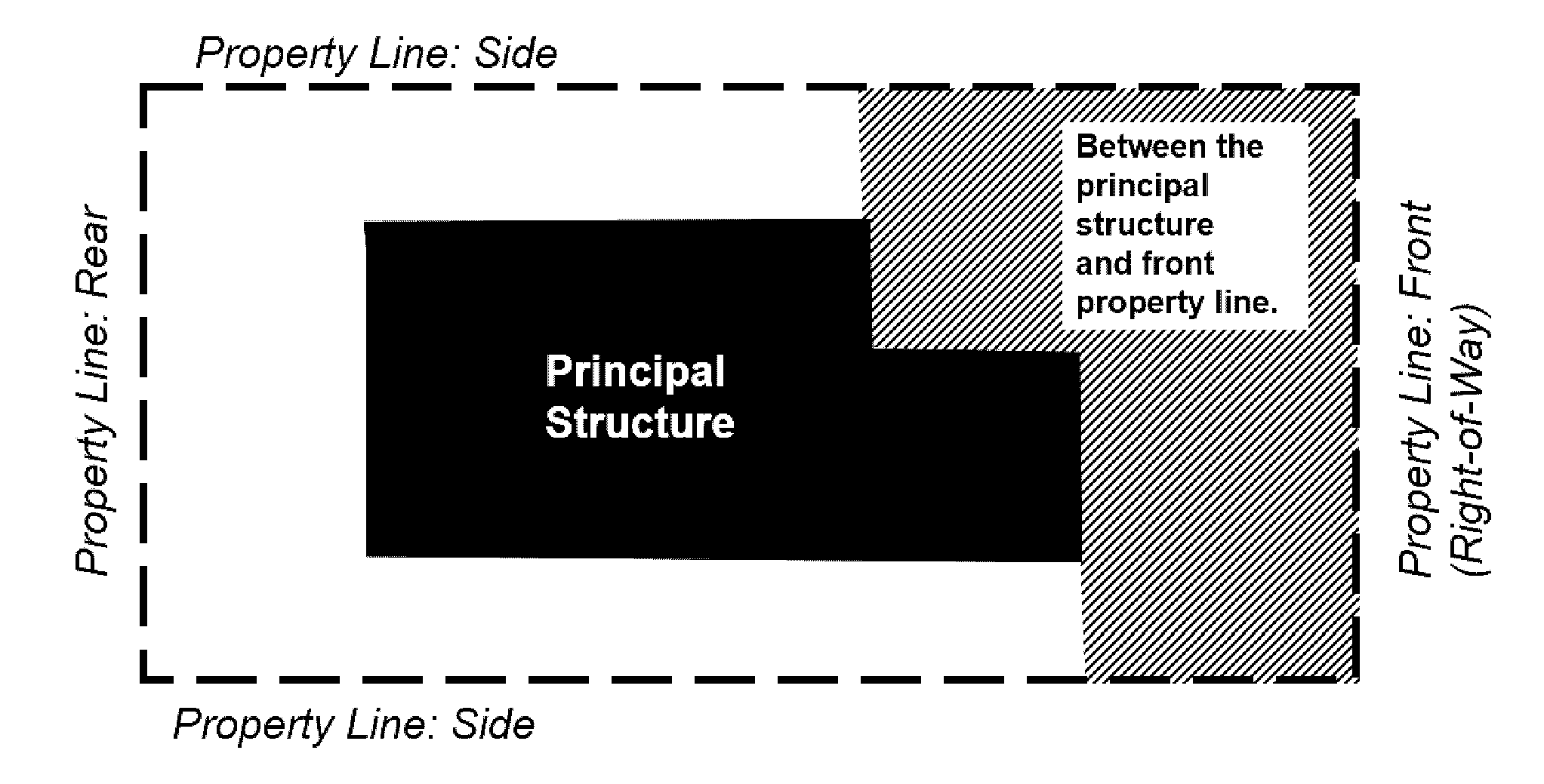
B.
Side and rear. Fences and walls shall be permitted to a maximum height of six feet between the principal structure and any side or rear property line with the following exceptions:
1.
Fences and walls may be permitted up to eight feet in height if located in the IRT District.
2.
Fences and walls may be permitted up to eight feet in height in the Commercial District through a Level One (Flexible Standard Development) approval to buffer uses with drive-thru facilities, vehicle sales/displays, automobile service stations, outdoor retail sales, display and/or storage and residential zoning districts. If any fence is part of a Level Two review, the decision to approve the fence will be made by the Community Development Board.
3.
On those properties adjacent to water, fences proposed to be located within 20 feet of the property line adjacent to the water or within the required setback, whichever is greater, must be non-opaque and cannot exceed four feet in height.
Fences and Walls: Side and Rear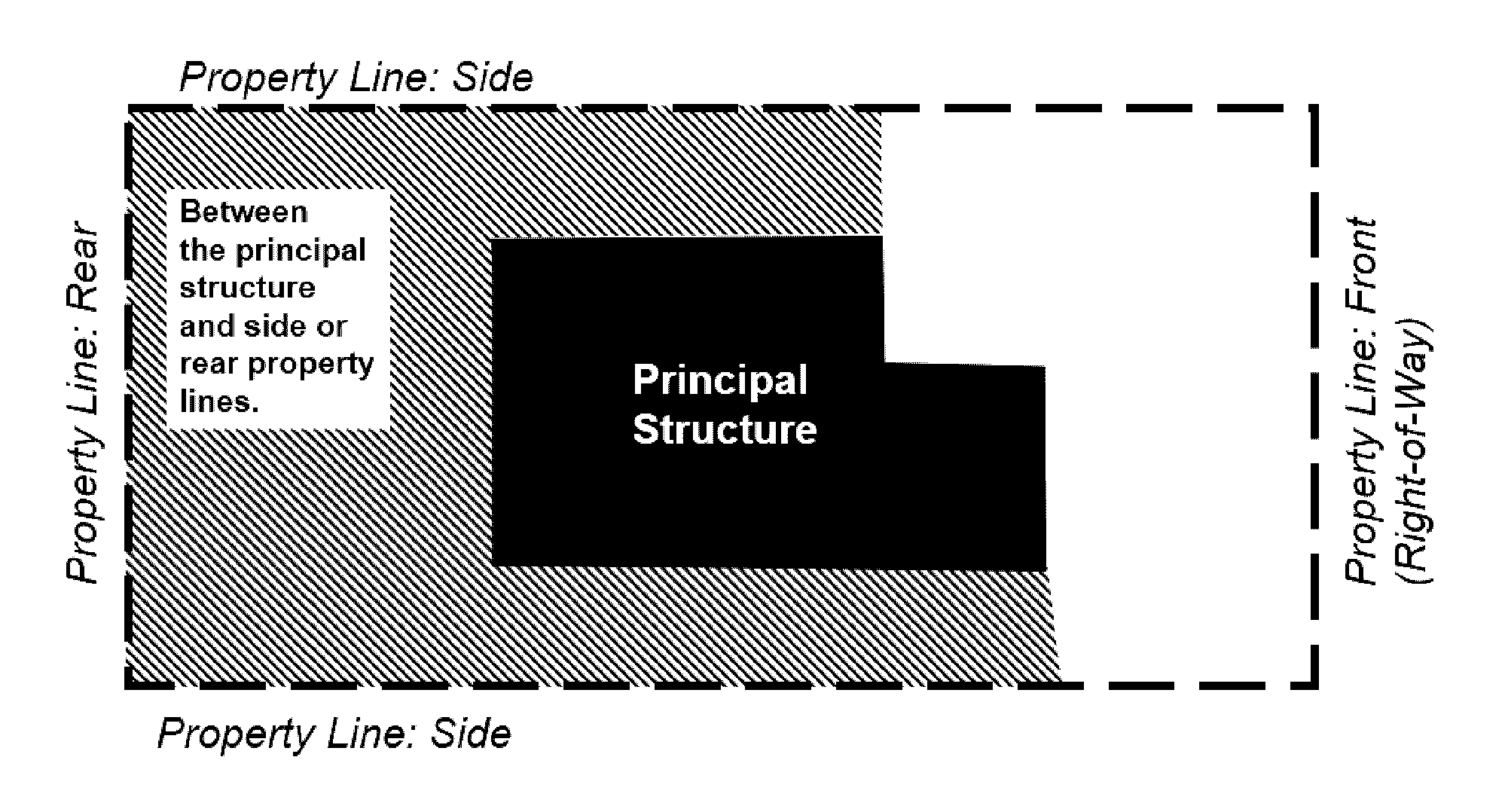
C.
Corner and multi-frontage lots. For the purposes of fence or wall placement on corner or multi-frontage lots, the front shall be the front property line from which the property is addressed, and all other front property lines will be treated as a side property line(s), as illustrated below for the purpose of fencing. The placement of any fence or wall on the front of the property shall adhere to the provisions in Section 3-804.A.1 through 3, above. A fence or wall may be permitted on the side property line in compliance with the provisions in Section 3-804.B., above, provided:
1.
The fence is consistent with the character and placement of any structures and setbacks on the adjoining properties, including the placement of the fence on the property line, as determined by the Community Development Coordinator.
2.
The fence or wall shall be primarily open style, with separated pickets.
3.
If the side of the property is adjacent to a right-of-way that would be classified as an arterial or collector right-of-way by the City Engineer, then the fence or wall may be constructed consistent with the provisions in Section 3-804.B., above, regardless of the placement of structures on and setbacks of adjoining properties, and may be solid/opaque.
4.
Any fence or wall that exceeds three feet in height shall provide a three-foot-wide landscaped strip on the right-of-way side of the fence or wall consistent with the general landscaping standards in Section 3-1202 unless otherwise determined by the Community Development Coordinator.
Fences and Walls: Corner Lots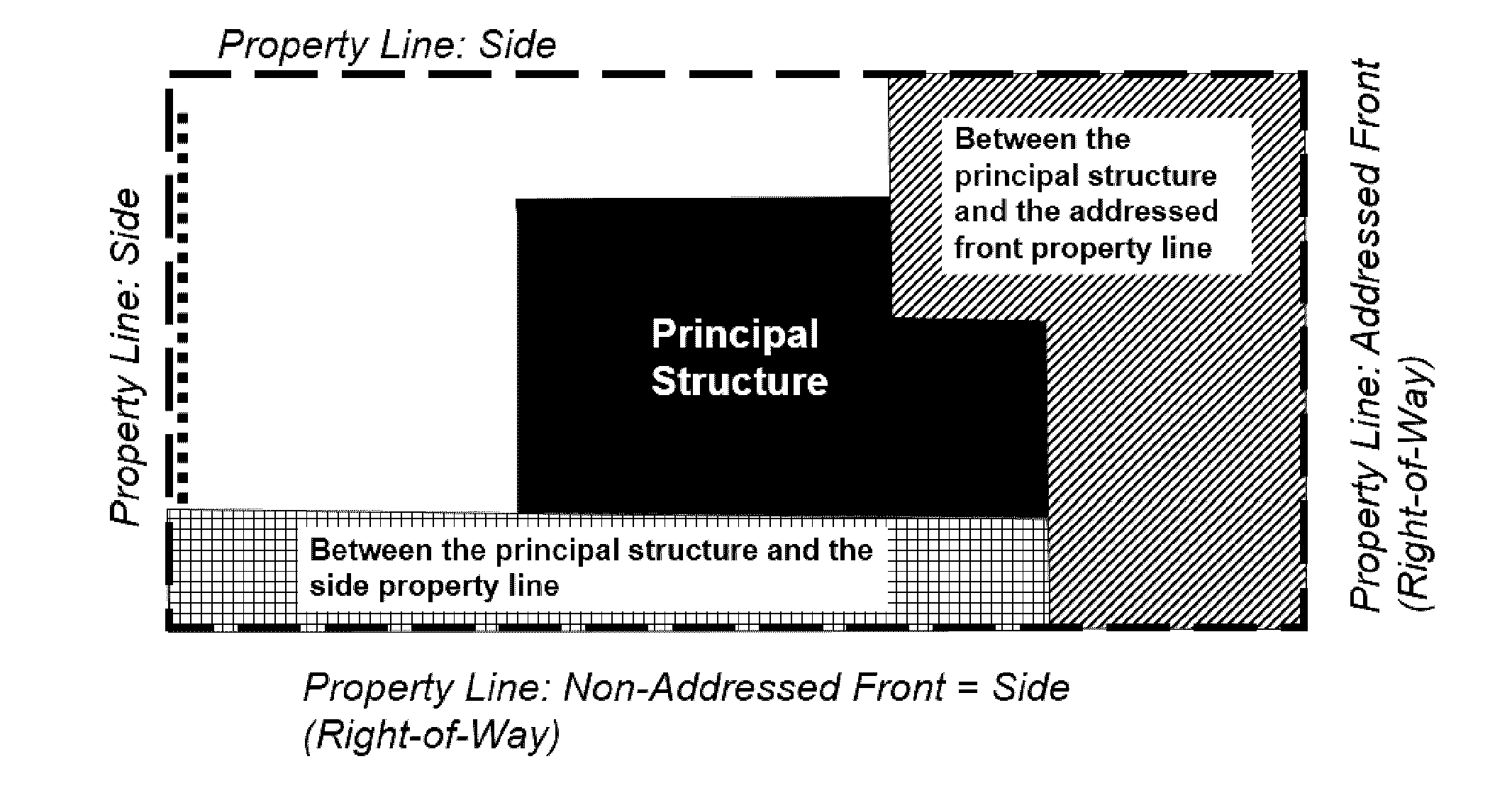
Fences and Walls: Multi-Frontage Lots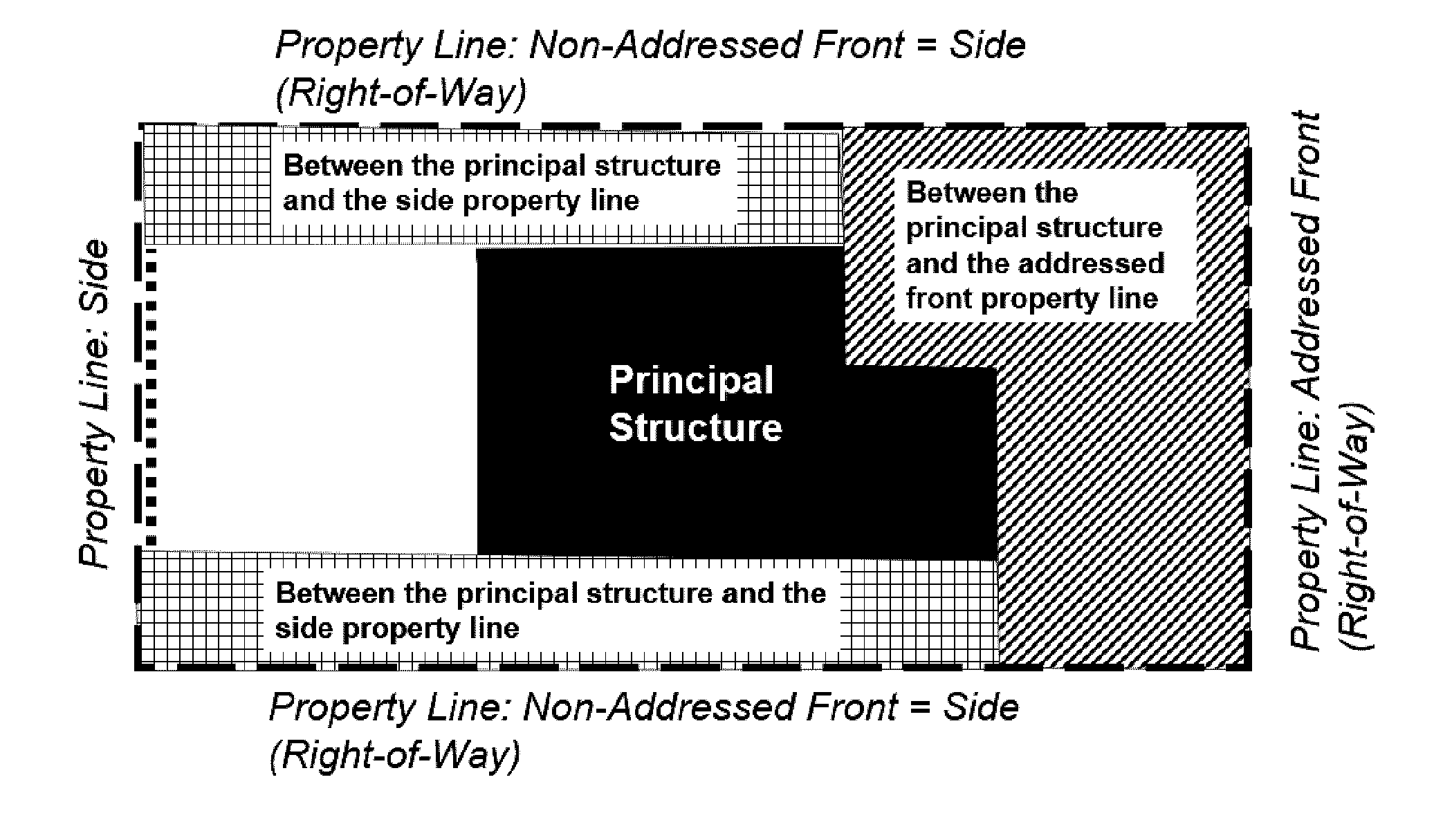
Non-Opaque/Open Style or Picket Fence Examples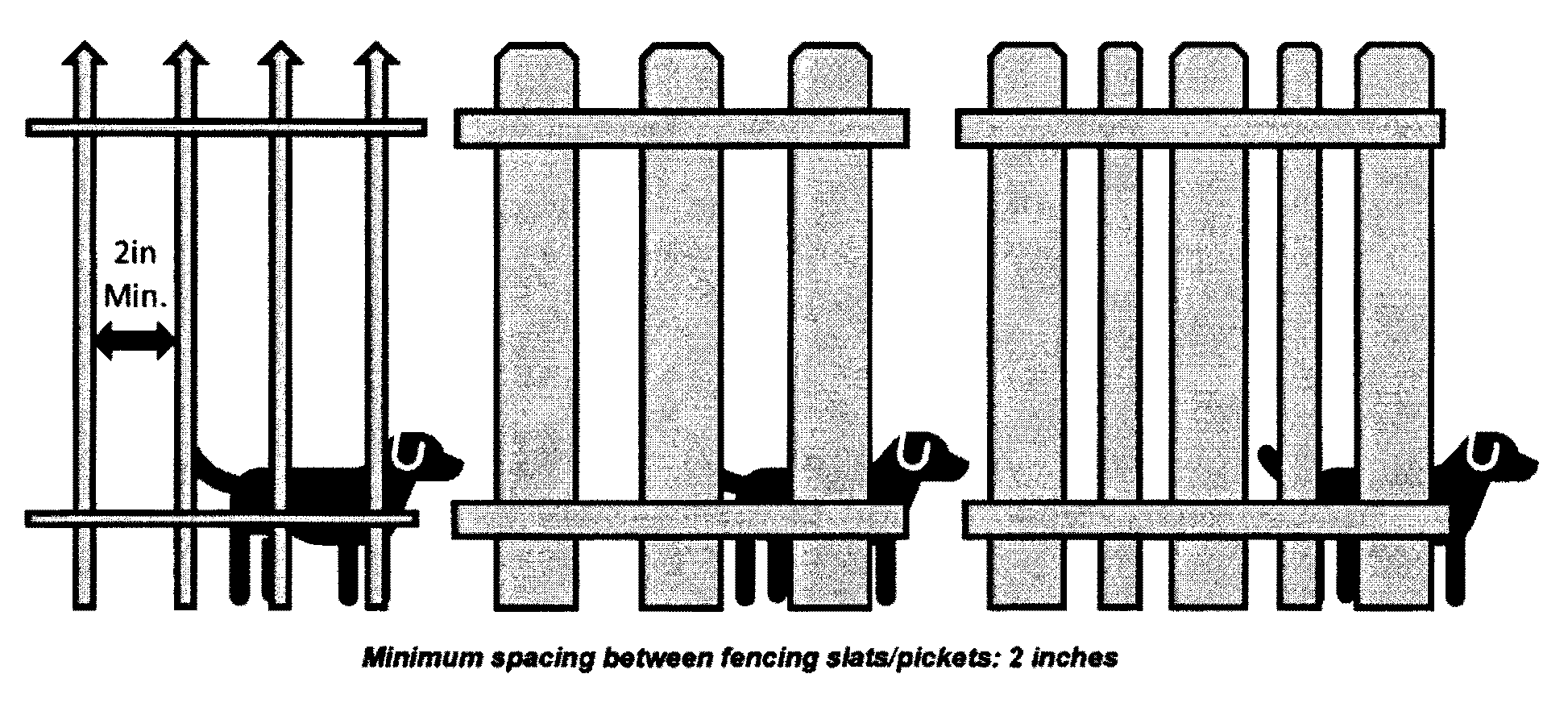
D.
Double frontage lots. For the purposes of fence or wall placement on double frontage lots, the front shall be the front property line from which the property is addressed, and the opposite front property line will be treated as a rear property line for the purpose of fencing as illustrated below. The placement of any fence or wall on the front of the property shall adhere to the provisions in Section 3-804.A., above. A fence may be permitted on the rear property line in compliance with the provisions in Section 3-804.B., above provided the following conditions exist:
1.
The rear of both the adjacent lots on the same side of the street are oriented the same as the lot on which the fence or wall is proposed; and
2.
The pattern of the dwellings across the street is also oriented with the rear facing the lots across the street.
3.
If both of the above conditions cannot be met, such fence or wall in the rear shall not exceed four feet in height.
4.
If the rear is adjacent to a right-of-way that would be classified as an arterial or collector right-of-way by the city engineer, then the fence or wall may be constructed consistent with the provisions in Section 3-804.B., above, regardless of any of the above conditions.
Fences and Walls: Double Frontage Lots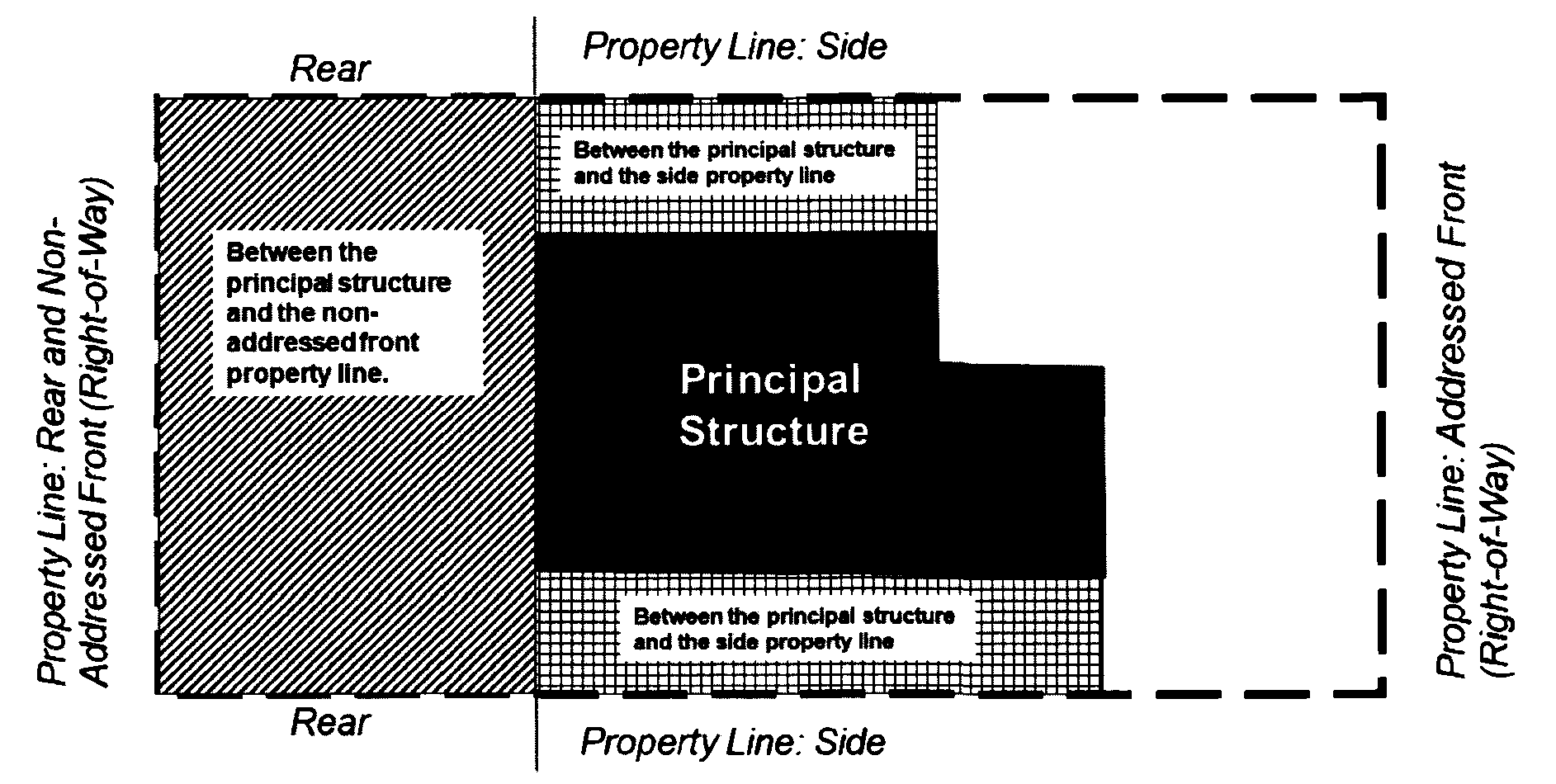
E.
Exception for attached dwellings. No fence or wall over six feet in height shall be permitted on any attached dwelling lot, except where the fence or wall is installed along the boundary of the property, in which case the fence or wall shall be uniformly designed and shall meet the height limits and other standards otherwise applicable to the fence or wall.
F.
Retaining walls, not including those walls associated with a detention pond which are regulated by Section 3-901, may be located between the principal structure and any front, side, or rear lot line, provided no portion of the wall that is located above grade exceeds 18 inches in height unless otherwise required to be of a greater height to satisfy and environmental or engineering need as determined by the city engineer.
G.
An equivalent combination of fence, wall, landscape berm or retaining wall may be utilized to achieve the maximum possible fence height; however, in no case shall the combined height of the structures exceed the maximum height provisions.
H.
Exception for gates, arbors, trellises, pergolas, and similar entry components. Gates, arbors, trellises, pergolas, and other similar entryway/access-enabling components incorporated into a fence or wall opening may include a height of no more than eight feet overall and may extend no more than one foot horizontally on each side of the opening and no more than three feet from the face of the fence or wall.
(Ord. No. 6526-00, § 1, 6-15-00; Ord. No. 6928-02, §§ 44—45A, 5-2-02; Ord. No. 7835-07, § 12, 1-17-08; Ord. No. 8070-09, § 4, 12-3-09; Ord. No. 8349-12, § 31, 9-6-12; Ord. No. 8715-15, § 13, 6-18-15; Ord. No. 9643-23, § 6, 4-4-23; Ord. No. 9758-24, § 15, 6-6-24)
Note— See the editor's note at § 3-803.
Section 3-805. - Chainlink fences.
The following requirements shall apply to chain link fences.
A.
Prohibited. Chainlink fences are prohibited within the Downtown District.
B.
Front. Chainlink fences shall not be permitted in front of a principal structure. Chainlink fences shall only be located on a parcel to the rear of the front building line of the principal structure.
C.
Side and rear. Chainlink fences located between the principal structure and any side or rear lot line shall not exceed 48 inches or six feet if clad with green or black vinyl. If such side or rear lot line is adjacent to a public right-of-way, however, such chainlink fence shall not be permitted.
D.
Landscaping requirements. Chainlink fences shall be landscaped with a continuous hedge or a nondeciduous robust growing vine at frequent intervals. Such landscaping may be located on the external or internal side of the fence along the entire length of the fence.
E.
Public or private recreational facilities. Chainlink fences for public or private tennis courts, golf courses and driving ranges, athletic fields, play courts, batting cages and other similar uses are exempt from height regulations contained in this section and the location restriction of Section 3-805.B., above.
F.
Vacant lots. In all zoning districts except for the Downtown District, chainlink fences, clad with green or black vinyl are permitted to secure any vacant lot. Such fences shall be limited to a maximum height of six feet and are subject to the requirements of 3-805.D., above. Upon development of the vacant lot, all chain link fencing shall be removed.
G.
Publicly owned landbanked properties. A six foot high green or black vinyl coated chainlink fence shall be permitted around the perimeter of any publicly owned landbanked property and shall be exempt from the landscaping requirements specified in Section 3-805.D., above.
(Ord. No. 6526-00, § 1, 6-15-00; Ord. No. 6928-02, § 46, 5-2-02; Ord. No. 7835-07, § 13, 1-17-08; Ord. No. 8349-12, § 31, 9-6-12)
Note— See the editor's note at § 3-803.
Section 3-806. - Easements and rights-of-way.
No fence or wall may be located within any easement or right-of-way or enclose any water meter box or manhole, except as follows:
A.
No fence or wall shall be located within any public right-of-way, right-of-way easement or drainage easement, unless specifically authorized by the city engineer.
B.
No fence or wall shall enclose a water meter box or manhole, unless specifically authorized by the city engineer.
C.
Fences and walls may be permitted within utility easements subject to:
1.
A suitable gate or opening being provided which enables access to any utilities, meters or similar facilities.
2.
The right of the city or franchised utility company to remove, without cost or obligation to replace or restore, any such fence or wall and landscaping as may be necessary to maintain the utilities located in the easement.
(Ord. No. 6526-00, § 1, 6-15-00)
Note— See the editor's note at § 3-803.
Section 3-807. - Special regulations.
A.
Fences for swimming pools. A swimming pool may be enclosed with a four foot high fence or wall.
B.
Visibility triangle. All fences and walls shall comply with the sight visibility triangle requirements in Article 3, Division 9.
C.
Subdivisions.
1.
Parcels of land within a subdivision which, in conjunction with the approval of the subdivision, were required to have a fence and/or wall shall not be permitted any additional or substitute fences or walls which otherwise contravene the general purpose and uniformity afforded by the approved plan.
2.
A six-foot high wall or fence, excluding chainlink, may be installed around the perimeter of any residential subdivision, provided such a wall or fence does not conflict with Section 3-807.C.1., above, or 3-804.A.
D.
Construction sites. Temporary fences around construction sites may be approved by the building official and such fences shall comply with any reasonable conditions, e.g., height, location, materials, as the building official may determine appropriate for a given property.
E.
Fences on publicly owned lands. Deviations from these fence requirements may be permitted for fences associated with public projects pursuant to the Level 1 (flexible standard) approval process.
(Ord. No. 6526-00, § 1, 6-15-00; Ord. No. 7631-06, § 21, 11-2-06; Ord. No. 8349-12, § 31, 9-6-12)
Note— See the editor's note at § 3-803.
Section 3-808. - Maintenance of fences and walls.
A.
All fences and walls constructed pursuant to this division shall be maintained in a structurally sound and aesthetically attractive manner. Specifically:
1.
A fence or wall shall be maintained in a vertical position, and shall not be allowed to sag or lean at more than ten degrees from vertical, unless the fence or wall is specifically designed and permitted to be maintained at such an angle.
2.
Rotten boards in a fence shall be replaced.
3.
Each support post or footer shall be solidly attached to the ground.
4.
Each fence stringer shall be securely fastened to the support posts and face of the fence.
5.
Each fence shall be securely fastened to the support post and fence stringers.
6.
All fence or wall surfaces shall be painted, stained, treated or otherwise maintained so as to present a uniform appearance; however, this section is not intended to prohibit the maintenance of fences in which a deteriorated section of the fence is replace with new material which will take some time to "age" or "weather" to replicate the appearance of the original fence.
B.
Fence boards may be replaced on any nonconforming fence provided the posts are not replaced.
(Ord. No. 6526-00, § 1, 6-15-00)
Section 3-901.- General/technical codes.
The following technical standards and codes are hereby incorporated by reference as if fully set out herein, and shall be maintained and kept on file in the office of the city manager:
A.
Florida Department of Transportation's Standard Specifications and Roadway and Traffic Design Standards (latest edition).
B.
City of Clearwater Subdivision Design Standards and Stormwater Drainage Criteria Manual.
C.
Sidewalk Construction Specifications.
Section 3-902. - Comprehensive plan densities/intensities.
A.
Notwithstanding any provision in Article 2 of this Community Development Code, no application for development approval shall be granted for any development which exceeds the densities and intensities for that development in the comprehensive plan, except applications for development approvals that include affordable housing bonus density dwelling units may be granted pursuant to standards set forth in Section 3-920.
B.
Density averaging is permitted provided the entire area under consideration is considered as one project in which the property is located and the total dwelling unit and transient accommodation count does not exceed what is otherwise allowed for the total area under consideration.
C.
Intensity averaging is permitted provided the entire area under consideration is considered as one project in which the property is located and the total amount of impervious surfaces and floor area located on the site does not exceed what is otherwise allowed for the total area under consideration.
D.
Any project utilizing density/intensity averaging shall require written evidence of the averaging in a document to be recorded in the public records with the Clerk of the Circuit Court for Pinellas County and a record copy of same shall be filed with the city and with Pinellas Planning Council (PPC).
E.
When calculating the lot area and/or density/intensity of a property, the total of either number shall not be rounded up to the next whole number.
F.
Mixed-use projects.
1.
A mixed-use determination will allow for nonresidential and residential land use to occur on the same lot. An application for a mixed-use development shall state the nonresidential gross floor area (GFA) and the number of proposed residential dwelling units.
2.
The application shall also provide the land area needed to support each land use based on the Future Land Use Plan classification. The combined land area needed to support the residential and nonresidential land use components shall not exceed the total existing land area. Vertical mixed-use projects in the Downtown District are exempt from this requirement.
G.
Submerged lands. The area of submerged lands cannot be used in calculating allowable density, FAR, or ISR.
(Ord. No. 6526-00, § 1, 6-15-00; Ord. No. 6928-02, § 47, 5-2-02; Ord. No. 7449-05, § 16, 12-15-05; Ord. No. 8043-09, § 25, 9-3-09; Ord. No. 8313-12, § 1, 7-19-12; Ord. No. 9643-23, § 7, 4-4-23)
Section 3-903. - Required setbacks.
A.
Except for fences, walls, outdoor lighting, signs, minimum door landing required by the Florida Building Code, walkways leading to building entrances, driveway access to garages, and/or vehicular cross access (driveways), shared parking, and trash staging areas, no building or structure shall be permitted in a setback required by the applicable zoning district. Sidewalks shall be no greater than 48 inches in width, nor greater in width than that required by the Florida Building Code.
B.
Irregularly shaped lots (i.e., those lots having property lines not generally parallel with or perpendicular to adjoining street rights-of-way or street right-of-way easements) shall have side and rear setbacks established by the community development coordinator generally consistent with the side or rear setback requirements for the applicable zoning districts and the orientation of the lots to adjoining properties and structures.
C.
A double frontage lot located within a plat of record which has a deed or plat restriction prohibiting access to the nonfrontage, i.e., the street with no address, may use the required rear setback for the "nonfrontage" portion of the lot.
D.
Corner lots shall have two front setbacks and two side setbacks.
E.
Properties traversed by the coastal construction control line shall be governed by the setback requirements of that line, if such requirements are more restrictive than those required in the applicable zoning district.
F.
Except for driveway access to garages, vehicular cross-access and shared parking, all of which are regulated by Subsection A., above; parking lots shall be set back from front property lines a distance of 15 feet, and shall be set back from all other property lines a distance that is consistent with the required perimeter landscape buffer width.
1.
While perimeter landscape buffers are not required in the Tourist (T) District, the above referenced setback shall be based upon Section 3-1202.D.1., or at a dimension consistent with the existing/proposed building setback, or at a dimension consistent with setbacks required or otherwise established by Beach by Design, whichever is less.
2.
As perimeter landscape buffers are not required in the Downtown (D) District, compliance with the above provision is not required. However, compliance with the applicable Development Standards as set forth in the Downtown District and Development Standards in this Development Code must still be achieved.
3.
Exceptions. Those setbacks to parking lots established above may be modified as part of a Comprehensive Landscape Program pursuant to the criteria set forth in Section 3-1204.G.
4.
This subsection is not applicable to detached dwelling uses where parking lots are not permissible. The applicable provisions of Article 3, Division 14 would apply.
G.
Freestanding, (i.e., not affixed on top of a building), radio and television antennas shall be set back from all property lines a distance equal to 50 percent of the height of the antenna.
H.
Swimming pools and screened pool enclosures shall comply with the setbacks required in the applicable zoning district for the principal use, unless otherwise permitted pursuant to flexibility criteria in that district.
I.
Mechanical equipment.
1.
Except as provided in subsection H(2) of this section, air conditioning equipment, pool equipment and similar mechanical equipment not enclosed within a building shall be exempt from side and rear setback requirements but shall be screened from any public right-of-way and adjacent properties.
2.
No air conditioning equipment, pool equipment or similar mechanical equipment shall be permitted within a reduced side setback which has been approved as a Level One flexible standard development or as a Level Two flexible development.
(Ord. No. 6526-00, § 1, 6-15-00; Ord. No. 7835-07, § 14, 1-17-08; Ord. No. 8310-12, § 2, 2-2-12; Ord. No. 8654-15, § 19, 2-5-15; Ord. No. 9149-18, § 4, 8-2-18; Ord. No. 9758-24, § 16, 6-6-24)
_____
Section 3-904. - Sight visibility triangle.
A.
To minimize traffic hazards at street or driveway intersections, no structure or landscaping may be installed which will obstruct views at a level between 30 inches above grade and eight feet above grade within the sight visibility triangle described in the following figure, unless otherwise approved by the City Engineer.
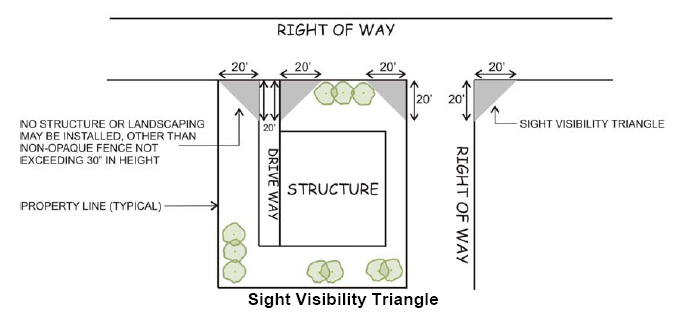
Sight Visibility Triangle
B.
To enhance views of the water from waterfront property, no structure or landscaping may be installed within the sight visibility triangle described in the following figure, with the exception of an at-grade swimming pool, at-grade deck, and a non-opaque fence not to exceed 48 inches in height.
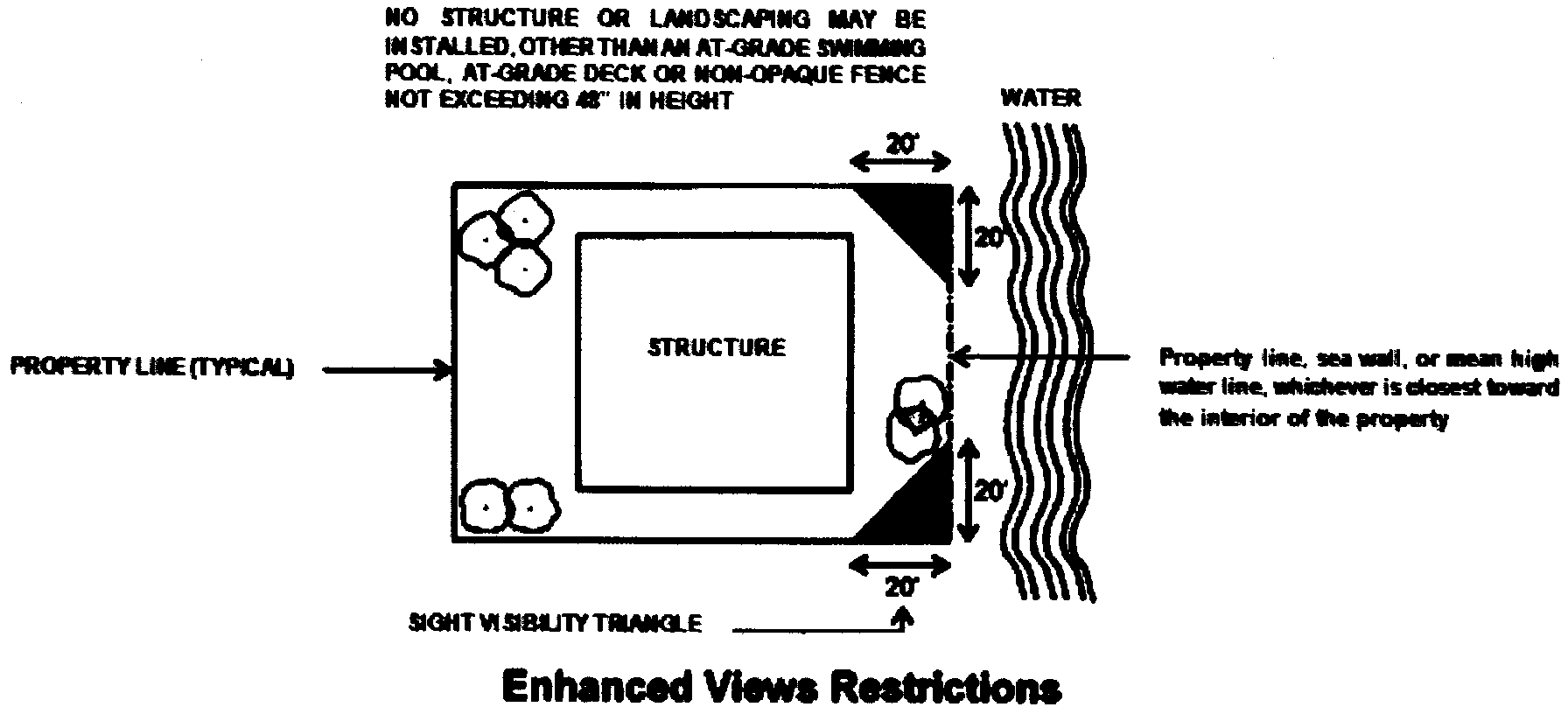
(Ord. No. 6526-00, § 1, 6-15-00; Ord. No. 6928-02, § 48, 5-2-02; Ord. No. 8043-09, § 26, 9-3-09; Ord. No. 8070-09, § 5, 12-3-09; Ord. No. 8931-16, § 13, 9-1-16; Ord. No. 9758-24, § 16, 6-6-24)
_____
Section 3-905. - Coastal construction control line.
A.
Purpose. This section establishes within the city the coastal construction control line as the line of reference from which setbacks shall be measured along the Gulf of Mexico for buildings and structures pursuant to F.S. § 161.053 in order to protect the safety, economic, environmental, recreational and community appearance objectives of the city.
B.
Required setback. No building or structure shall be located seaward of the coastal construction control line unless approved by the State of Florida.
C.
Interpretation. Nothing contained in this section shall be construed to conflict with or supersede the authority of the state in regard to establishing the location or relocation of the coastal construction control line, or any waiver or variance to the requirements relative thereto pursuant to F.S. ch. 161, or the requirements and authority of the city and the county construction licensing board pursuant to Chapter 47 and the city pursuant to Chapter 46. This section shall be administered according to the following requirements:
1.
Compliance with the provisions of this development code shall be independent of any action or authority of the State of Florida pursuant to Ch. 161 F.S. and no action by the state shall relieve any person from compliance with the requirements of this development code.
2.
Seawalls shall not be governed by the required setback identified in this section.
3.
Any request to modify the setback requirements contained in this section shall be considered as an application for a Level Two approval as provided for in Article 4 Division 4.
Section 3-906. - Scenic setbacks.
Notwithstanding any other provision of this development code, the following setbacks shall apply to development adjacent to the east side of Bayshore Boulevard so that views of Old Tampa Bay are not unreasonably obstructed or diminished from Bayshore Boulevard:
A.
No wall or fence in excess of three feet in height shall be permitted.
B.
Hedges or other groupings of shrubs shall be planted and maintained at a height of three feet or less.
Section 3-907. - Buffers provided for purposes other than landscaping.
A.
Vegetative buffer adjacent to preservation district or jurisdictional wetlands.
1.
A vegetative buffer shall be provided on all lands within 25 feet of any property designated on the Zoning Atlas as preservation (P), or any property determined to be wetlands under the jurisdiction of the State of Florida ("jurisdictional wetlands"); and all lands within 15 feet of the top of the bank of any creeks, channels, or related waterways which contain jurisdictional wetlands. This requirement shall not apply to existing seawalls or other structures creating an abrupt transition between any such property and the adjoining upland property. "Top of the bank" is that point on the slope at which the side slope becomes flatter than one foot vertical to four feet horizontal.
2.
The required buffer width may be reduced by not more than one-third in a portion of the buffer, by providing additional width in another portion of the buffer which will result in an equivalent or greater square footage of cumulative buffer area.
3.
No structure or other surface impervious to water shall be permitted within the vegetative buffer, with the exception of structures which would be allowed as a part of a Level One or Level Two approval within the preservation district.
4.
Within the vegetative buffer, any native vegetation shall be protected so that the buffer will retain the character of the immediately adjacent vegetation within the preservation district. Native vegetation within the buffer shall not be removed or altered unless the removal or alteration of the vegetation will not adversely affect the hydrological or ecological integrity of the adjacent wetland. All prohibited trees existing within the buffer shall be removed by the landowner and shall be prevented from re-emergence. This subsection shall not be construed to prohibit routine maintenance trimming of nonwetland vegetation in accordance with procedures developed by the city manager.
5.
If prior to October 4, 1990, the native vegetation within a vegetative buffer has been removed or altered, the owner shall not be required to restore the vegetation to its natural state. The owner shall not, however, impede the natural succession of native vegetation into the buffer.
B.
Buffer required within Transportation/Utility future land use category. A ten-foot buffer shall be provided on all lands designated Transportation/Utility on the Future Land Use Map that are adjacent to any other future land use classification other than Industrial. Lands designated Transportation/Utility that are adjacent to lands designated industrial future land use classifications are exempt from this requirement.
(Ord. No. 6526-00, § 1, 6-15-00; Ord. No. 8043-09, § 27, 9-3-09)
Section 3-908. - Permitted encroachments into setbacks and over street rights-of-way.
Certain building and other projections shall be permitted to extend into setback areas and may be permitted to encroach over street rights-of-way as follows:
A.
Building projections which are affixed solely to the building and not directly affixed to the ground such as building fascias, roof overhangs, eaves, canopies other than freestanding canopies, awnings, marquees, and other similar projections, shall be permitted to project into required setbacks as specified below.
1.
In the Tourist, Commercial and Downtown Districts, such projections shall be limited to ten feet and shall be permitted into any required setback and over street rights-of-way provided a clearance of eight feet over grade is maintained. In no case shall such projection be closer than five feet from the curbline or the shoulder of the roadway. Any awning with supports may be located up to the property line and any awning that projects into a right-of-way shall be cantilevered.
2.
In all other districts, such projects shall be limited to 40 percent of the setback or ten feet, whichever is less.
B.
The roof fascia of a freestanding canopy shall be set back a minimum of ten feet from a street right-of-way boundary and any side and rear property line. The supporting posts or columns of a freestanding canopy shall not encroach into required structural setbacks. No part of a freestanding canopy shall encroach into or over a street right-of-way.
C.
Open or unenclosed fire escapes and outside stairways shall be permitted to extend into a required setback area not more than three feet provided through access is not obstructed.
D.
1.
Balconies, decks, bay windows, and similar features that linearly extend 50 percent or less of the width of the building wall to which they are attached shall be permitted to extend into a required setback area not more than 24 inches provided through access is not obstructed.
2.
In the Downtown District, when associated with an indoor recreation/entertainment use that has a minimum of 650 seats, balconies shall be permitted to encroach into rights-of-way provided a clearance of eight feet over grade is maintained. In no case shall such encroachment be closer than two feet from the curbline or the shoulder of the roadway.
(Ord. No. 6526-00, § 1, 6-15-00; Ord. No. 6928-02, §§ 49, 49A, 5-2-02; Ord. No. 8070-09, § 6, 12-3-09; Ord. No. 8371-13, § 1, 3-6-13)
Section 3-909. - Outdoor cafés located within public right(s)-of-way.
A.
Applicability. A bar, brewpub, indoor recreation/entertainment facility, microbrewery, museum, nightclub, restaurant, take-out food establishment with no indoor seating, or other use which includes the sale and or consumption of food or drink as determined by the Community Development Coordinator, may establish an outdoor café. Outdoor cafés shall be exempt from parking requirements.
1.
Outdoor cafés are allowed only in/on:
a.
The Downtown District;
b.
Those properties located in the Tourist District on Clearwater Beach; and
c.
The east side of that area known as Beach Walk as existing on the east side of Gulfview Boulevard between the northerly terminus of Beachwalk south of the Gulfview/Coronado confluence and the southern terminus of Beach Walk approximately 330 feet south of Fifth Street and as located within the Beach Walk District as provided in Beach by Design and further located in the Open Space/Recreation [OS/R] District on Clearwater Beach provided the outdoor café is in conjunction with a permitted restaurant in the adjacent Tourist District.
2.
Special provisions of this section apply to outdoor cafés located within the Cleveland Street Café District.
B.
Outdoor café permits. The community development coordinator shall review all outdoor cafés as an allowable encroachment into the public right(s)-of-way subject to compliance with the location, design and operational requirements below.
1.
An outdoor café permit shall only be issued to a person who has paid the business tax for a business establishment and who wishes to provide tables and chairs on the right-of-way consistent with this section.
2.
Outdoor café permits expire on September 30th of each year and shall be renewed yearly to continue operation of the café.
C.
Location and design requirements.
1.
Outdoor cafés are restricted to the sidewalk frontage of the subject business applying for a permit. In the Cleveland Street Café District such cafés may also extend the linear distance of any adjacent business frontage, in accordance with the provisions of Section 3-909.D.10. If authorized by the city, outdoor cafés may also extend into the adjacent Cleveland Street right-of-way provided the street is closed to vehicular traffic and all applicable ADA requirements are met.
2.
Outdoor cafés shall be located in a manner that promotes efficient and direct pedestrian movement:
a.
An unobstructed pedestrian path at least five feet wide shall be maintained at all times.
b.
Within the Cleveland Street Café District the pedestrian path shall be maintained parallel to the abutting business.
c.
An unobstructed passage shall be provided to building entrances which shall include at least two feet of clearance on each side of all entrances.
d.
The community development coordinator may require a wider pedestrian path than established above, and/or that the pedestrian path is delineated by those means set forth in subsection 7, below.
e.
Failure to comply with any of the above requirements may result in the revocation of the outdoor café permit pursuant to Section 3-909.E.4.
3.
All furnishings shall be of good design and made of quality materials.
4.
No tables, chairs or any other furnishing or item shall be chained or attached to any building, sidewalk, tree, post, sign or other fixture.
5.
No furniture shall be permitted within the sight visibility triangle as required by the Community Development Code. Furniture shall not be placed within four feet of bus stops, telephone booths, fire hydrants, or counter service windows or within two feet of any entrances and/or exits.
6.
Outdoor cafés pursuant to Section 3-909.A.1.c, above, are restricted to sidewalk frontage of the subject business applying for a permit and may extend no more than 25 feet from the façade of the subject business. Under no circumstances may any portion of an outdoor café extend into or obstruct any portion of the main pedestrian thoroughfare (promenade) of Beach Walk.
7.
The perimeter of outdoor cafés may be defined through the use of self-supporting fencing, landscape planters, or other such devices and methods as presented to and approved by the City.
8.
Any area in which an outdoor café is permitted shall be clearly delineated on a drawing accurately depicting the area and specifically delineating where alcohol beverage sales are intended to occur. Such a drawing shall be submitted to and approved by the City as part of a Level One approval.
D.
Operational requirements.
1.
All furnishings shall be maintained by the outdoor café operator in a clean and attractive appearance and shall be in good repair at all times.
2.
No amplified music shall be allowed.
3.
No food storage or preparation shall be allowed within the right(s)-of-way.
4.
The hours of operation of an outdoor café shall coincide with those of the associated business.
5.
The outdoor café operator is responsible for repair of any damage to the right(s)-of-way caused by the restaurant or its patrons.
6.
By use of any permit granted hereunder, the outdoor café operator agrees to indemnify, defend, save and hold harmless the city, its officers, agents and employees from any and all claims, liability, lawsuits, damages and causes of action which may arise out of the use of the public right(s)-of-way. The outdoor café operator shall enter into a written agreement with the city to evidence this indemnification. Such agreement must have the written approval of the city attorney prior to issuance of permit.
7.
The outdoor café operator shall show evidence of:
a.
Comprehensive general liability insurance on an "occurrence" basis in an amount not less than $1,000,000 combined single limit bodily injury liability and property damage liability. The city is to be specifically included as an additional insured on the policy.
b.
Workers' Compensation insurance applicable to its employees, if any, for statutory coverage limits in compliance with Florida laws, including employers' liability which meets all state and federal laws.
8.
The outdoor café operator shall provide the city with the certificate(s) of insurance evidencing required coverages. Current certified copies of such required coverages shall be provided to the city when specifically requested in writing.
9.
All policies of insurance must be endorsed to provide the city with 30 days notice of cancellation or restriction.
10.
For outdoor cafés located within the Cleveland Street Café District that intend to use the public right(s)-of-way in front of an adjacent business, the applicant must submit a notarized statement from the adjacent property owner(s) indicating consent to use the right(s)-of-way in front of their business as an outdoor café.
11.
As necessitated by right(s)-of-way repairs, the city may require the temporary removal of outdoor cafés and all related furnishings. The outdoor café operator shall be responsible for removing all furnishings at least 24 hours prior to the date identified in writing by the city. The city shall not be responsible for any costs associated with the removal or the return and installation of any such furnishings.
12.
The city may cause the immediate removal or relocation of all or any part of the outdoor café in emergency situations. The city, its officers, agents and employees shall not be responsible for any damages or loss of furnishings used in association with an outdoor café relocated during emergency situations and shall not be responsible for any costs associated with the removal or the return and installation of any such furnishings.
13.
The city shall have the authority to secure or remove any furnishing(s) associated with the outdoor café if necessary in the interest of public safety.
14.
Alcoholic beverages may be served in conjunction with any lawfully permitted outdoor café provided the business to which the outdoor café is accessory is in possession of all required licenses.
15.
The outdoor café operator is responsible for maintaining the outdoor café area and five feet beyond its perimeters in a neat and orderly appearance at all times and shall clear all debris on a periodic basis during the day and at the close of each business day. City-owned waste receptacles shall not be used for café food and waste disposal.
E.
Revocation of permit. Upon revocation of a permit, the community development coordinator shall give written notice of such action by certified mail, return receipt requested, to the permittee at the address listed on the application, stating the reason(s) for revocation. The revocation shall become effective 15 days following mailing of the notice if not appealed as provided in section 4-501A. The community development coordinator may revoke a permit for any outdoor café if it is found that:
1.
Any necessary business or health permit has been suspended or revoked; or
2.
Changing conditions of pedestrian or vehicular traffic cause congestion necessitating the removal of the outdoor café. Such decision shall be based upon findings of the community development coordinator, after consulting with the city engineer, that the existing conditions represent a danger to the health, safety or general welfare of the public and cannot be resolved through modification to the outdoor café layout; or
3.
The outdoor café operator fails to comply with one or more requirements of the permit.
4.
The outdoor café is deemed to be a threat to public safety, in which case the permit may be revoked immediately without notice or compliance with the requirements described above.
5.
The outdoor café is deemed by the city to not be in the city's or the public's best interest, no longer meets the purpose and/or intent of the zoning district or any applicable overlay/special area plan and/or is simply no longer a desired use/activity.
(Ord. No. 8042-09, § 3, 6-4-09; Ord. No. 8331-12, § 1, 7-19-12; Ord. No. 8810-16, § 13, 1-21-16; Ord. No. 8931-16, § 14, 9-1-16; Ord. No. 9149-18, § 5, 8-2-18; Ord. No. 9487-21, §§ 1, 2, 10-7-21)
Section 3-910. - Newsracks.
A.
General requirements for newsracks and modular newsracks.
1.
Newsracks and modular newsracks may be located either on private property or within the public right-of-way.
2.
Newsracks and modular newsracks shall be maintained in an upright, neat and clean condition and in good repair at all times.
3.
No newsrack or modular newsrack shall obstruct the flow of pedestrian or vehicular traffic.
4.
No newsrack or modular newsrack shall be installed or maintained upon or over any part of a roadway or bicycle path or be located in a manner that impairs a motor vehicle operator's view of motor vehicles, bicycles, or pedestrians upon entering or exiting a right-of-way.
5.
No newsrack or modular newsrack shall reduce the width of a sidewalk to less than four feet.
6.
No newsrack or modular newsrack shall be used for advertising purposes other than advertising for the publication being distributed or sold. Lettering shall not exceed one and one-half inches in height and shall be located only on the front and back of the newsrack or the front and back of each compartment in a modular newsrack.
7.
No newsrack or modular newsrack shall be chained, bolted or attached in any other manner to a utility pole, traffic sign or other similar fixture, excluding pads designed to support newsracks, located in the public right-of-way.
8.
The telephone number of a working telephone service of a representative of the publication shall be affixed to each newsrack or modular newsrack in a readily visible place so that reports of malfunctioning newsracks/modular newsracks can be made and violations of these provisions can be reported.
B.
Location of newsracks and modular newsracks.
1.
No newsrack or modular newsrack shall be located in a visibility triangle or within five feet of a curb of the edge of roadway pavement.
2.
The location of any newsrack or modular newsrack shall not block the view of any historic building or scenic vista or major city entryway.
3.
The front of any newsrack located in landscaped areas of the public right-of-way or on a public sidewalk shall face toward the sidewalk and/or away from the street.
C.
Height, design, and separation requirements for newsrack and modular newsracks.
1.
Newsracks shall not exceed 50 inches in height and modular newsracks shall not exceed 55 inches in height.
2.
A 100-foot radius separation shall be maintained between all types of newsracks, except that two metal newsracks may be located side by side. Those newsracks located on public property shall be of the same color, however on private property this restriction shall not apply. A single newsrack that is located within a drive-through lane shall not be required to meet the 100 feet radius separation provided that the newsrack is accessible only by patrons of the drive-through lane while remaining in the vehicle.
3.
If three or more publications are grouped together in a single location, such publications shall be located in a metal modular newsrack.
4.
Modular newsracks may be used in combination provided that such racks located at the same location are of the same material. Those newsracks located on public property shall be of the same color, however on private property this restriction shall not apply.
5.
No single modular newsrack or grouping of modular newsracks shall exceed eight feet in length.
6.
Newsracks and modular newsracks are limited to a depth of a single unit. The back of a newsrack shall not be located against the back of another newsrack.
7.
Newsracks and modular newsracks shall be of uniform material and where located on public property shall be finished with muted, earthtone and uniform color.
D.
Construction requirements. All types of newsracks must be appropriately anchored or secured from potential hazards, in accordance with current engineering standards, and may be anchored to any concrete pad located in the public right-of-way provided all other provisions are met.
E.
Additional requirements for newsrack and modular newsracks in the tourist and downtown districts and scenic corridors. All types of newsracks located in the tourist and downtown districts shall be subject to the applicable adopted design guidelines governing Clearwater Beach and Downtown. The community development coordinator may extend the allowable length and height of modular newsracks (in the tourist and downtown districts only), provided the newsracks are compatible in terms of location, height and length with the surrounding environment.
(Ord. No. 6526-00, § 1, 6-15-00; Ord. No. 6795-01, § 2, 7-12-01; Ord. No. 8042-09, § 3, 6-4-09)
Section 3-911. - Color.
No building, or its projections and attachments, such as any sign or awning, shall be painted or otherwise finished with a predominant color which is garish, gaudy, loud, excessive, ostentatious or otherwise constitutes a glaring and unattractive contrast to surrounding buildings.
(Ord. No. 7605-06, § 30, 4-20-06; Ord. No. 8042-09, § 3, 6-4-09)
Section 3-912. - Underground utilities.
For development that does not involve a subdivision, all utilities including individual distribution lines shall be installed underground unless such undergrounding is not practicable.
(Ord. No. 8042-09, § 3, 6-4-09)
Section 3-913. - Outdoor display/storage.
Unless otherwise expressly permitted in the zoning district in which the property is located, the outdoor display and storage of goods and materials is prohibited.
(Ord. No. 6928-02, § 50, 5-2-02; Ord. No. 8042-09, § 3, 6-4-09)
Section 3-914. - General standards for Level One (Flexible Standard Development) and Level Two approvals.
A.
Level One (Flexible Standard Development) applications, in order to be approved by the Community Development Coordinator, and Level Two applications, in order to be approved by the Community Development Board, shall meet each and every one of the following criteria:
1.
The proposed development of the land will be in harmony with the scale, bulk, coverage, density, and character of adjacent properties in which it is located.
2.
The proposed development will not hinder or discourage the appropriate development and use of adjacent land and buildings or significantly impair the value thereof.
3.
The proposed development will not adversely affect the health or safety or persons residing or working in the neighborhood of the proposed use.
4.
The proposed development is designed to minimize traffic congestion.
5.
The proposed development is consistent with the community character of the immediate vicinity of the parcel proposed for development.
6.
The design of the proposed development minimizes adverse effects, including visual, acoustic and olfactory and hours of operation impacts, on adjacent properties.
B.
In the event of an express conflict between a particular flexibility criterion and a provision of Article 3, the flexibility criterion shall govern unless the context clearly implies that the Article 3 provision should control.
C.
The use of low impact development techniques for stormwater management, such as minimal land disturbance, the preservation of native vegetation, and the minimization of impervious cover, shall be required unless determined infeasible by the Engineering Department.
(Ord. No. 7413-05, § 18, 5-5-05; Ord. No. 8042-09, § 3, 6-4-09; Ord. No. 8070-09, § 7, 12-3-09; Ord. No. 9857-25, § 1, 12-4-25)
Section 3-915. - Stormwater detention facilities.
A.
Stormwater facilities required for attenuation purposes by the adopted standards and specifications (see section 3-901) but which in the opinion of the city engineer would be impractical because of the size of the property, the space available for such facilities, soil conditions or other site related conditions may be waived at the request of the applicant upon payment to the city of a fee in lieu thereof which shall be used by the city solely for drainage improvements and maintenance within the drainage basin in which the property is located. Such fees shall be determined by the market value of the area of land which would have otherwise been required to accommodate a stormwater attenuation facility, according to an appraisal made by the city or by a property appraiser holding either an MAI or SRPA designation, at the opinion of the property owner, and by the construction value of the stormwater attenuation facility that would have otherwise been provided, such construction value to be determined by the city engineer.
B.
Stormwater facilities required for water quality treatment purposes by the adopted standards and specifications (see section 3-901) but which in the opinion of the city engineer would be impractical because of the size of the property, the space available for such facilities, soil conditions or other site related conditions, may be waived at the request of the applicant upon payment to the city of a fee in lieu thereof, if the property is contained entirely within a designated regional retention district as approved by the city commission. Funds received in this manner shall be used by the city solely for water quality treatment improvements within the established regional retention district in which the property is located. Such fees shall be determined by an established schedule for the specific regional retention district in which the property resides. The schedule will be maintained and updated annually as necessary to take into account the market value of the area of land which would have otherwise been required to accommodate a stormwater treatment facility, according to an appraisal made by the city or by a property appraiser holding either an MAI or SRPA designation, at the opinion of the property owner, and by the construction value of the stormwater treatment facility that would have otherwise been provided, such construction value to be determined by the city engineer.
(Ord. No. 8042-09, § 3, 6-4-09)
Section 3-916. - Uses involving vehicles.
A.
No vehicle, recreation vehicle, travel trailer, camper or similar unit shall be used for living, sleeping or housekeeping purposes in the city except as recreation vehicles, travel trailers, or campers may be permitted within an approved recreational vehicle park.
B.
No vehicle shall be parked in a predominant location on a parking lot for the purpose of displaying such vehicle for sale, unless the lot is approved for vehicle sales pursuant to this development code.
C.
No repair of any vehicle is permitted in any residential zoning district unless such repair is confined within a completely enclosed building and limited to vehicle service involving vehicles owned by a person who resides at that residence, however, minor vehicle repairs are permitted anywhere on the property. Under no circumstance shall such repair be conducted as a commercial activity.
(Ord. No. 6526-00, § 1, 6-15-00; Ord. No. 6928-02, § 51, 5-2-02; Ord. No. 8042-09, § 3, 6-4-09)
Section 3-917. - Vending machines.
Vending machines installed on public and private property shall comply with the requirements of this subsection.
A.
No vending machine shall be installed or maintained within any part of a public right-of-way.
B.
Vending machines shall be placed only on properties for which there exists a building serving a principal use. Vending machines shall be placed within a building, or may be placed outside a building if the vending machine is under a roof adequate to protect the vending machine against rain and in compliance with the following conditions:
1.
The vending machine shall be placed upon flooring adequate in size and strength to support the vending machine;
2.
The vending machine shall be placed flush against the building;
3.
The vending machine shall not be located within a required setback, open space, view corridor, or landscaping area, or within a parking space or travel aisle within a parking lot;
4.
The vending machine shall not be located in such a manner to impair a motor vehicle operator's view of motor vehicles, bicycles, or pedestrians upon entering, or exiting a right-of-way;
5.
The vending machine shall not be located at a place where such vending machine unreasonably obstructs the flow of pedestrian or vehicular traffic; and
6.
Electric service to the vending machine shall comply with the edition of the National Electrical Code currently in effect.
C.
No more than two vending machines, per development site, shall be permitted outside of any building, unless such machines are not visible from any public right-of-way or any abutting property. Signage allowed on vending machines shall be flush with the machine and shall be limited to 35 percent of the machine's front face, including the selection choices. The remaining front face of the vending machine shall be of a similar color as the signage. No signage shall be allowed other than on the front of the vending machine.
(Ord. No. 6526-00, § 1, 6-15-00; Ord. No. 6928-02, § 52, 5-2-02; Ord. No. 8042-09, § 3, 6-4-09)
Section 3-918. - Maintenance in accordance with approved plans.
All improvements authorized by any Level One, Level Two, or Level Three approval shall be maintained in accordance with such approval. This includes, but shall not be limited to, approved landscaping, paved areas, stormwater facilities, retention/detention ponds, irrigation systems, and signage.
(Ord. No. 6526-00, § 1, 6-15-00; Ord. No. 8042-09, § 3, 6-4-09)
Section 3-919. - Prima facie evidence of certain uses in residential zoning district.
Prima facie evidence of certain uses located in any residential zoning district, consisting of rentals for periods of less than 31 days or one calendar month, whichever is less, and advertising or holding out to the public as a place rented for periods of less than 31 days or one calendar month, whichever is less, shall include but not be limited to one or more of the following:
(1)
Registration or licensing for short-term or transient rental use by the state under Florida Statutes, Chapters 212 (Florida Tax and Revenue Act) and 509 (Public Lodging Establishments);
(2)
Advertising or holding out a dwelling unit for tourist housing or vacation rental use;
(3)
Reservations, booking arrangements or more than one signed lease, sublease, assignment or any other occupancy agreement for compensation, trade, or other legal consideration addressing or overlapping any period of less than 31 days or one calendar month, whichever is less; or
(4)
Use of an agent or other third person to make reservations or booking arrangements.
(Ord. No. 7105-03, § 1, 4-17-03; Ord. No. 8042-09, § 3, 6-4-09)
Section 3-920. - Affordable housing incentives.
A.
Affordable housing density dwelling units.
1.
City review and approval process.
a.
City approval procedures. Such approval shall be considered a Level One (flexible standard development) approval in accordance with the provisions of Article 4 Division 3 of the Community Development Code. The use of the density bonus as provided within this section shall not be considered a land use plan amendment.
b.
Pre-application conference required. Prior to submitting an application for development review of a proposal that includes affordable housing bonus density dwelling units, the applicant shall meet with the city's economic development and housing department director for the purpose of determining that the proposed development meets the definition of "affordable housing unit" and to discuss affordable housing requirements as required by the city's economic development and housing department. The required pre-application conference shall occur no more than six months prior to application for development review. The application for development review shall include a letter from the city's economic development and housing department verifying that the development meets the criteria above.
2.
Coastal storm area. No affordable housing bonus density projects may be located in the coastal storm area.
3.
Density bonus.
a.
Mixed-income affordable housing developments. Mixed-income affordable housing developments contain a minimum of 15 percent affordable housing units and a maximum of 25 percent affordable housing units, the remainder being market-rate housing units. The percentage of bonus units awarded is based on the percentage of affordable housing units provided, as shown in the table below:
____________
For example: An applicant has a one-acre site with a future land use classification of Residential Medium (RM) (15 units per acre). The applicant proposes that 25 percent of the units will be affordable housing, therefore the density bonus awarded to the development will be 50 percent. This example is calculated below:
(1)
When the determination of the maximum total number of units allowed in the development results in a fractional dwelling unit, the number shall be rounded down to the nearest whole number: this is the allowable density of the development.
(2)
The number of reserved affordable housing units is based on the total number of units to be built on the site, including those awarded through the bonus. For the purpose of calculating the minimum number of reserved affordable housing units, when the maximum total number of units calculation results in a fraction, the figure shall not be rounded up or down. When the determination of the minimum number of reserved affordable housing units in the development results in a fractional dwelling unit, any fraction less than one-half unit shall be rounded down to the nearest whole number and any fraction of one-half unit or more shall be rounded up.
b.
Other affordable housing developments. Other affordable housing developments contain more than 25 percent affordable housing units. The percentage of bonus units awarded shall be 20 percent.
For example: An applicant has a one-acre site with a future land use classification of Residential Medium (RM) (15 units per acre). The applicant proposes that 75 percent of the units will be affordable housing, therefore a 20 percent bonus density is awarded. This example is calculated below:
(1)
When the calculation results in a fraction, the number shall be rounded down to the nearest whole number.
c.
Standards. In addition to the provisions for attached dwellings set forth in Article II, the following standards shall be met:
i.
Compatibility criteria.
a.
The project shall be consistent with existing special area plans, if any.
b.
Proportionality and scale of the proposed development shall be consistent with the community character of the immediate vicinity of the parcel proposed for development.
c.
The overall aesthetics of the proposed development shall be compatible with or an improvement to the community character as determined by the community development coordinator.
d.
The scale and coverage of the proposed development shall be compatible with adjacent properties. If the overall bulk is larger than the surrounding buildings, the bulk may be reduced with the help of design elements such as step backs and setbacks as illustrated below.
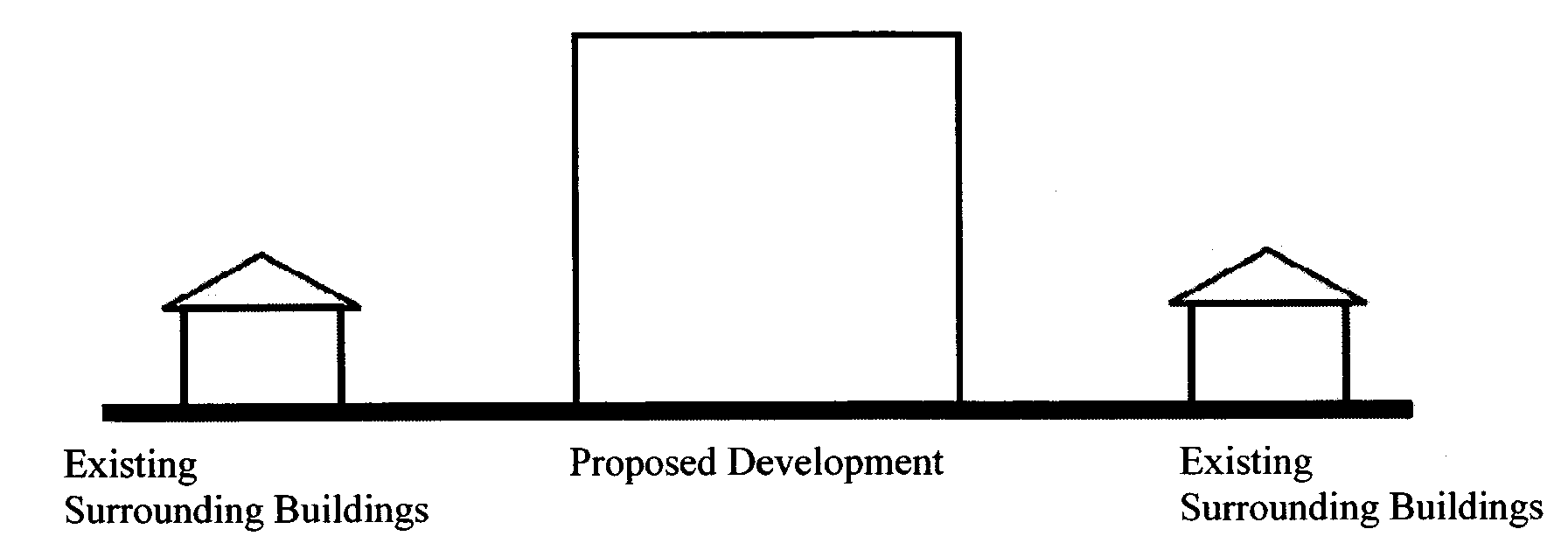
Prohibited- In this illustration, a big box building without step
backs is not compatible with surroundings.
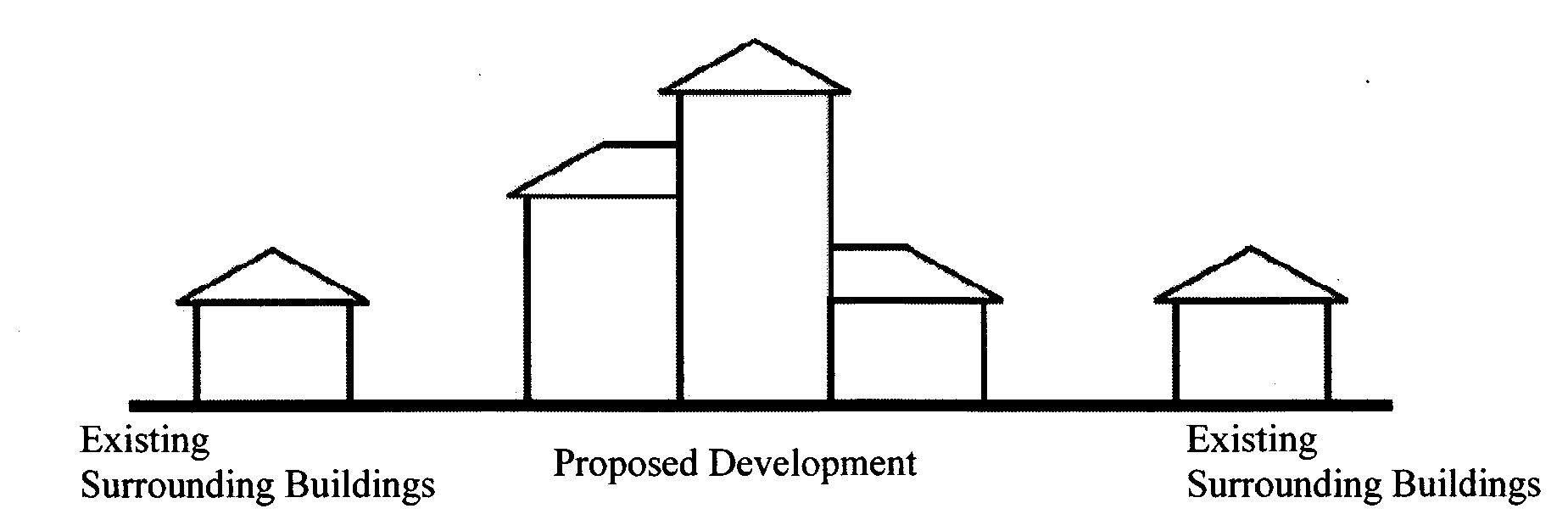
Permitted- In this illustration, step backs ensure
neighborhood compatibility and reduce bulkiness.
ii.
Design criteria.
a.
The reserved affordable housing dwelling units shall be mixed with, and not clustered together or segregated in any way from, market-rate units in the development.
b.
Building materials and finishes of the interior and exterior of the affordable housing dwelling units shall be consistent with market-rate units in the development.
c.
The architectural features of the buildings and each of the affordable housing dwelling units shall be equivalent to market-rate buildings and units in the development.
d.
All building façades, including fenestrations, in a development shall have a unified architectural treatment.
e.
The horizontal plane of a building may continue uninterrupted for no more than 50 linear feet. The vertical plane of a building may continue uninterrupted for no more than ten feet. The vertical plane interruptions may include but are not limited to awnings, arcades, balconies, niches, projections, etc.
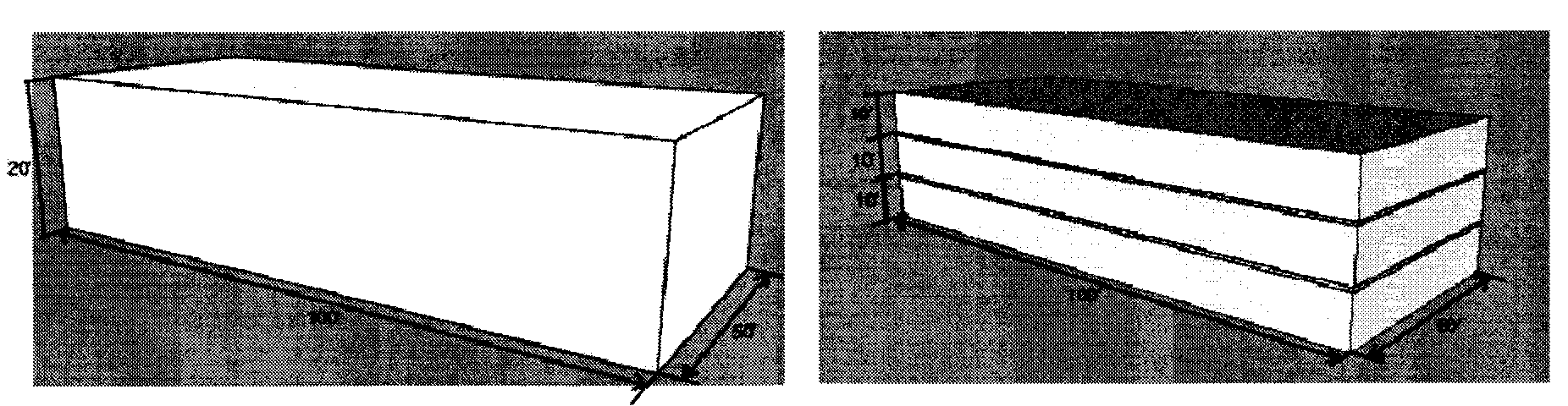
Prohibited
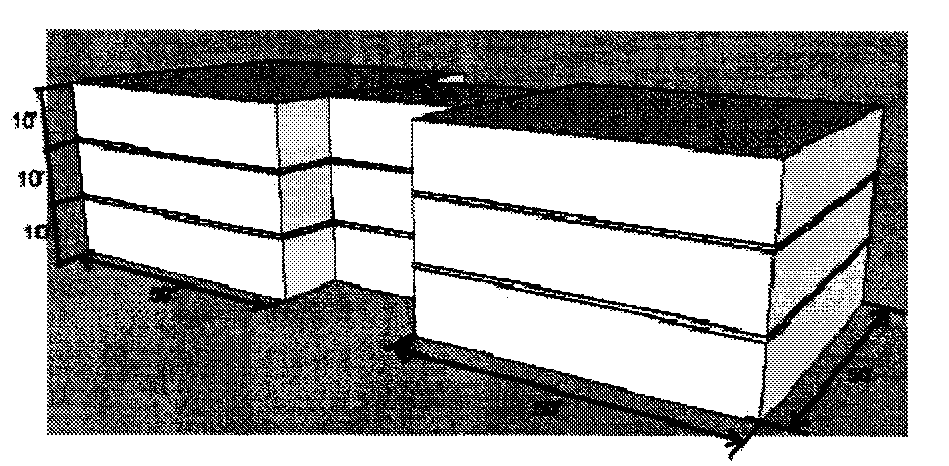
Permitted
_____
f.
There shall be no more than six units in any contiguous grouping of townhouse or multiplex units. No more than two abutting attached units shall have uniform roof lines or the same setback. Variations in setback of building faces shall be at least three feet.
g.
The minimum size for the affordable housing dwelling units shall be 400 square feet for efficiency units, 550 square feet for one bedroom units and 750 square feet for two bedroom units. An additional 200 square feet shall be provided for each additional bedroom in units with more than two bedrooms.
h.
The number and size of bedrooms for the affordable units shall reflect the same proportion as the market-rate units. For example, if a project contains 50 percent one bedroom units and 50 percent two bedroom units, then the set aside affordable units shall reflect these percentages. The bedroom size(s) of the affordable units shall be the same as the bedroom size(s) of the market-rate units.
iii.
Green building criteria. The following criteria shall be met for all dwelling units in the development (where this Code conflicts with provisions in the most recent Florida Building Code, the more stringent regulation shall apply):
a.
At least 50 percent of required plant materials shall be those which are native to Central Florida, considered Florida-friendly plant materials, requiring minimal amounts of water, fertilizers and pesticides, and which are recommended in the Plant Guide of the Southwest Florida Water Management District.
b.
Water conserving plumbing fixtures with the following maximums shall be installed: 1.6 gallons per flush (gpf) toilets, 2.0 gallons per minute (gpm) showerheads and 1.0 gallons per minute (gpm) faucet aerators.
c.
If appliances are provided, they shall be ENERGY STAR labeled appliances if available.
d.
Compact fluorescent (CFL) bulbs or light emitting diode (LED) bulbs for all ambient (household) lighting shall be installed.
e.
Roofing requirements:
i.
Roofing materials shall have a Solar Reflectance Index (SRI) equal to or greater than 78 for low-sloped roofs (≤2:12) or 29 for steep-sloped roofs (>2.12) for a minimum of 75 percent of the roof surface; or
ii.
Vegetated roofs shall cover a minimum of 50 percent of the total project roof area. Any combination of SRI compliant and vegetated roof may be used, provided they collectively cover 75 percent of the total development roof area.
4.
Required covenants to maintain affordability.
a.
Owner-occupied units.
i.
Covenant. Prior to obtaining a building permit, the applicant shall deliver to the community development coordinator a restrictive covenant, duly executed by the owner of the parcel(s), in a form approved by the city attorney, that shall address income restrictions, homebuyer or tenant qualifications, long-term affordability, and any other applicable restrictions and qualifications pertaining to the development and the reserved affordable housing units. The covenant shall be recorded in the Public Records of Pinellas County, Florida before it is delivered to the community development coordinator. This covenant shall run with the land and shall be binding on the assigns, heirs and successors of the applicant. Reserved affordable housing units that are provided under this section shall remain as affordable housing for a minimum of 20 years from the date of initial owner occupancy for ownership affordable housing units.
ii.
Sale or lease. No lease or sale shall be executed for any reserved affordable housing unit that is owner-occupied until the property owner(s) has submitted the required documentation for the household income for the proposed owner or occupant to the city's economic development and housing department for verification that it meets the applicable affordable housing requirements.
b.
Rental units.
i.
Covenant. Prior to obtaining a building permit, the applicant shall deliver to the community development coordinator a restrictive covenant, duly executed by the owner of the parcel(s), in a form approved by the city attorney, that shall address income restrictions, homebuyer or tenant qualifications, long-term affordability, and any other applicable restrictions and qualifications pertaining to the development and the reserved affordable housing units. The covenant shall be recorded in the Public Records of Pinellas County, Florida before it is delivered to the community development coordinator. This covenant shall run with the land and shall be binding on the assigns, heirs and successors of the applicant. Reserved affordable housing units that are provided under this section shall remain as affordable housing for a minimum of 30 years from the date of initial occupancy for rental affordable housing units.
ii.
Annual reports. Prior to June 1st of each year, the property owner(s) or authorized property manager of any reserved rental affordable housing dwelling unit shall submit to the city's economic development and housing department director an annual report for the preceding calendar year, in a format as approved by the city, in order for the city to verify that the tenants meet the income requirements for the reserved rental affordable housing dwelling units and that other stipulations in the covenant are being met.
B.
Affordable housing parking reductions.
1.
Any reduction in required off-street parking shall only apply to those dwelling units which are certified by the city's economic development and housing department as affordable housing. All other dwelling units not certified as affordable housing shall meet the minimum off-street parking requirements set out for the use in the applicable zoning district. Certified affordable housing projects may be eligible for a reduction in the required off-street parking consistent with the following:
a.
The parking requirement may be reduced to between one and one-half and one space per unit for projects located within 1,000 feet of a transit stop if the affordable housing units are designated for senior citizens or disabled persons.
b.
For all other affordable housing projects, the parking requirement may be reduced to between one and one-half and one and one-quarter space per unit for projects located within 1,500 feet of a transit stop with 30-minute or more frequent service during peak hours and 60 minute-minutes or more frequent service during off-peak hours.
c.
The distance a site is from a transit stop shall be measured from the nearest point of exit from the parcel based upon the shortest route of ordinary pedestrian travel.
2.
Long-term bicycle parking shall be provided to any affordable housing unit which is approved with reduced off-street parking consistent with the following:
a.
The following table sets forth the number of long-term bicycle spaces required for each unit for which the number of off-street parking spaces was reduced. When the determination of the number of required long-term bicycle parking spaces results in a requirement of a fractional space, any fraction less than one-half space shall be rounded down to the nearest whole number and any fraction of one-half space or more shall be rounded up.
b.
All bicycle spaces provided shall comply with the bicycle parking standards in Section 3-1411.
3.
In the case of attached dwellings, if parking is proposed adjacent to the building, a buffer that includes a four-foot sidewalk and a five-foot landscaped area shall be provided between the building and parking as illustrated below.
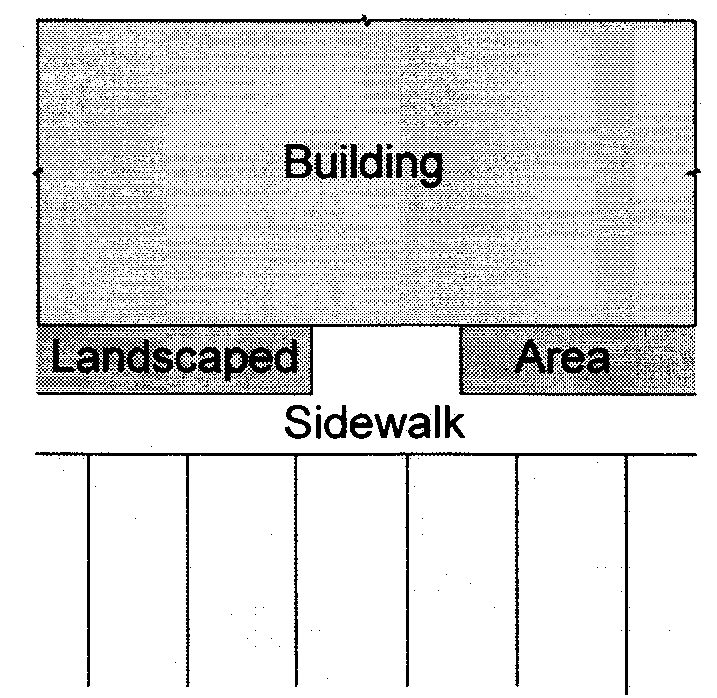
C.
Affordable housing fee reductions.
1.
Building permit fee reduction. Building plan review and permit fees may be reduced for certified affordable housing developments as set forth in the fee schedule, except where legal constraints prevent such waiving.
2.
Multimodal impact fee reduction. The multi-modal impact fee required pursuant to Section 4-905.C.2. may be reduced for qualified affordable housing projects meeting the requirements for the low-income household reduction as established by the Impact Fee Schedule A or B in Section 150-40 of the Pinellas County Land Development Code.
(Ord. No. 7449-05, § 17, 12-15-05; Ord. No. 8042-09, § 3, 6-4-09; Ord. No. 8313-12, § 2, 7-19-12; Ord. No. 9514-22, § 1, 2-3-22; Ord. No. 9758-24, § 16, 6-6-24)
Section 3-921. - Graywater system incentives.
A.
Graywater system density bonuses.
1.
City approval procedures. Such approval shall be considered a Level One (flexible standard development) approval in accordance with the provisions of Article 4, Division 3 of the Community Development Code.
2.
Requirements.
a.
Graywater system density bonuses shall be provided for a proposed or existing development that contains at least 25 detached dwellings or 25 attached dwelling units and shall not apply to those attached dwelling developments greater than five stories in height.
b.
Graywater technologies shall meet all applicable requirements provided under or by F.S. § 403.892, as amended, the Florida Building Code, the Department of Health, and any other applicable federal, state, or local governing law.
c.
The following bonuses shall be provided to the developer or homebuilder:
i.
A 25 percent density or intensity bonus for projects where a minimum of 75 percent of the development will have a graywater system installed; or
ii.
A 35 percent density or intensity bonus for projects where 100 percent of the development will have a graywater system installed.
iii.
Graywater density or intensity bonuses can be applied in addition to other density or intensity bonuses provided for in this code.
(Ord. No. 9758-24, § 16, 6-6-24)
Section 3-1001.- Purpose and applicability.
It is the purpose of this division to establish standards for approving changes to structures which have been designated historic in accordance with the provisions of section 4-607 of this development code.
Section 3-1002. - Alterations, demolitions, waiting periods.
A.
A historic property may be materially altered or relocated only after a six-month written notice has been given to the community development board by the affected property owner. A historic property may be demolished after 12 months written notice has been given to the community development board by the affected property owner. In either case, such notice may be given to the city clerk or to the community development coordinator.
B.
During the waiting period, the city may conduct negotiations with the owner, obtain a historic easement, or take other appropriate action in order to preserve the property.
C.
The community development board may waive any or all portions of the waiting period, provided the material alteration, relocation or demolition is undertaken subject to conditions agreed upon by the board and the owner which mitigate the adverse effects of the material alteration, relocation, demolition, or change of use, and ensure the continued maintenance of the character of the property or district.
Section 3-1003. - Certificates of appropriateness.
A.
Except as provided in this section, a certificate of appropriateness shall be required to:
1.
Materially alter a historic property.
2.
Erect a new building or structure on a historic property.
3.
Demolish a historic property.
4.
Relocate a historic property.
5.
Remove, destroy or materially and adversely disturb an archaeological site.
6.
A certificate of appropriateness may be required whether or not a building or demolition permit is required.
7.
A certificate of appropriateness shall not be required for ordinary maintenance or for necessary corrective action in any case in which the building official determines that corrective action is required to protect the public from an unsafe or dangerous condition.
B.
No building or demolition permit shall be issued for any historic property or for any property included within a historic district without the approval of a certificate of appropriateness by the community development board.
C.
An application for a certificate of appropriateness shall be reviewed as a Level Two approval by the community development board in accordance with the procedures in Article 4 Division 4. At the conclusion of the hearing, the board shall determine whether the proposed alteration or demolition is compatible with the historic, architectural, and archaeological qualities that resulted in the designation of the property or district as historic, and whether a feasible and prudent alternative to the proposed alteration or demolition exists.
1.
If the community development board determines that the proposed alteration or demolition is compatible with such qualities, it shall approve the issuance of the certificate of appropriateness.
2.
If the community development board determines that the proposed alteration or demolition is incompatible with such qualities and that no feasible and prudent alternative to the proposed alteration or demolition exists, the board may grant an exemption from the requirement for a certificate of appropriateness upon establishing that the owner will take timely steps to avoid or mitigate the adverse effects of the alteration or demolition.
3.
If the community development board determines that the proposed alteration or demolition is incompatible with such qualities and that a feasible and prudent alternative to the proposed alteration or demolition exists, it shall not approve the issuance of the certificate of appropriateness.
Section 3-1101.- Purpose.
It is the purpose of this division to establish criteria for certain businesses to operate in whole or in part from a residentially zoned property while limiting potential impacts on surrounding properties and maintaining residential character, pursuant to F.S. 559.955.
(Ord. No. 9514-22, § 2, 2-3-22)
Section 3-1102. - Standards.
A.
A home-based business shall not include uses such as alcoholic beverage sales, animal boarding, light assembly (other than hand-crafted products), manufacturing, outdoor storage, problematic uses as defined under Article 8, publishing and printing, restaurants, salvage yards, urban farms, vehicle sales/display major, vehicle service, vehicle service limited, vehicle service major, veterinary office, or wholesale/distribution/warehouse facility, or any like uses which are industrial in nature or like uses which require or generate significant parking, as such uses are not compatible with the residential character of the dwelling or the neighborhood.
B.
All home-based businesses shall conform to all of the following standards:
1.
The activities of the home-based business shall be clearly secondary to the property's principal use as a dwelling unit and must be conducted entirely within the dwelling or a legal accessory structure located on the premises.
2.
Home-based businesses are permitted in an attached garage provided the required parking is retained and accessible. Home-based businesses are prohibited in carports.
3.
There shall be no external modifications made to the dwelling unit or accessory structure to accommodate a home-based business that would not be compatible or appropriate to its residential use and architectural character.
4.
No display of products, operations, signs or nameplates shall be visible from outside the dwelling unit.
5.
No more than two employees or independent contractors who do not reside at the dwelling unit may work at the dwelling unit in addition to those living in the dwelling unit. The business may have additional remote employees that do not work at the dwelling unit.
6.
Retail transactions shall only be conducted from the dwelling unit.
7.
The need for parking generated by the home-based business shall be no greater than would normally be expected at a similar residence where no home-based business is conducted.
8.
Motor vehicles, trailers, or farm equipment used in conjunction with the home-based business shall be parked or stored consistent with all terms contained in Article 3, Division 14.
9.
The home-based business shall not create noise, vibration, heat, smoke, dust, glare, fumes, or noxious odors, detectable to the normal senses at the lot line, or beyond the lot line if the home-based business is conducted in a detached dwelling, or beyond the exterior or any common walls in an attached dwelling.
10.
All home-based business activities must comply with all local, county, state, and federal regulations related to the home-based business with respect to the use, storage, or disposal of any corrosive, combustible, or other hazardous or flammable materials or liquids.
11.
Home-based business involving the provision of day care services shall comply with the provisions regulating family day cares in accordance with Florida Statutes and obtain all required licenses.
(Ord. No. 9514-22, § 2, 2-3-22; Ord. No. 9643-23, § 8, 4-4-23)
Section 3-1201.- Purpose.
It is the purpose of this division to establish minimum landscaping/tree protection standards in order to promote the preservation of existing tree canopies, the expansion of that canopy and the enhancement of the quality of existing and future development in the city. This division also establishes parameters for the use of artificial turf.
(Ord. No. 9805-25, § 1, 4-17-25)
Section 3-1202. - General landscaping standards.
A.
Applicability.
1.
In general. All new landscaped areas shall be constructed in accordance with the standards in this division.
2.
New uses. Any landscaped area serving a new use or a change of use shall satisfy the standards of this division.
3.
Existing developed lots. Existing lots not meeting the requirements contained in this division shall be brought into full compliance to the greatest extent practicable as determined by the Community Development Coordinator under one or more of the following conditions:
a.
If an existing use except those uses identified in subsection d. below is improved or remodeled in a value of 25 percent or more of the total assessed valuation of the principal structure as reflected on the property appraiser's current records at the time of application or as established by a qualified independent appraiser using a recognized appraisal method.
b.
If an amendment, other than a minor amendment, is required to an existing approved site plan.
c.
If a parking lot requires additional landscaping pursuant to the provisions of Article 3, Division 14.
d.
If a single-family detached dwelling and two-family attached dwelling property not meeting the requirements contained in Section 3-1205.D.2 proposes an addition to the principal structure or new accessory structure exceeding 200 square feet, that lot shall be brought into full compliance with the tree requirements as established in that section.
4.
Residential landscaped area requirement. Any residential property that meets one of the below scenarios shall set aside a minimum of 25 percent of the gross land area of the front yard for landscaped areas, which shall contain living plant materials.
a.
New construction of detached or attached dwellings on property within a residential zoning district.
b.
Improvements within the front yard of a property within a residential zoning district that is developed with detached or attached dwellings.
c.
Any property proposing a new installation or repair/replacement of artificial turf in the front yard.
_____
B.
Plant material specifications. Except as provided in subsection (6) below, plant materials which are utilized to satisfy the landscaping required by this development code shall comply with the following minimum standards:
1.
Minimum plant material standards:
2.
Exception.
a.
Single-family detached and two-family attached dwellings. The above size requirements with regard to shade trees and accent trees shall not be applied to single-family detached dwellings and two-family attached dwellings. For those uses shade trees shall have minimum height of eight feet and minimum caliper of two inches, and accent trees shall have minimum height of six feet and minimum caliper of one inch.
3.
Organic mulch may be used as an integral, but minor, element of a landscaping plan as determined by the Community Development Coordinator.
4.
Required landscaping that incorporates existing trees, in particular any native plant material, is strongly encouraged and credit for the use of such materials shall be given against the requirements of this division.
5.
All plants shall be healthy, free of diseases and pests, and a native or a non-invasive plant naturalized to Central Florida. Plants recommended in the Guide of the Southwest Florida Water Management District, Florida Native Plant Society, Florida Yards.ORG, University of Florida or other entity as approved by the Community Development Coordinator shall be used.
6.
A minimum variety of tree species shall be provided: each species shall provide a minimum of ten percent of the total number of trees.
7.
Those species listed within Category I of the Florida Exotic Pest Plant Council's most recent List of Invasive Plant Species will not be accepted as a landscape material and shall not be permitted to be installed.
8.
While all citrus species of trees may be planted, they will not be accepted as a landscape material to meet landscape requirements.
9.
The city manager may modify the size specifications of the trees required in this section only if the applicant for development approval demonstrates to the city manager that such size is not readily available in the market area and that the proposed landscaping treatment is equal to or superior to the landscaping which would have been provided with the larger trees.
C.
Irrigation.
1.
For multifamily and nonresidential properties an automatic permanent irrigation system providing complete water coverage for all required and other landscaping materials shall be provided and maintained as a fully functioning system in order to preserve the landscaping in a healthy growing condition.
2.
If a single-family dwelling is required to install landscaping and an irrigation system is not installed to maintain that landscaping, then a hose bib shall be installed a maximum of 50 feet from the required landscaping.
3.
All irrigation systems connected to the public potable water supply system shall include a backflow preventer at the service connection.
4.
All irrigation systems shall be installed so as to minimize spray upon any impervious surface, such as sidewalks and paved areas.
5.
All irrigation systems shall include a rain sensor/shut off device to avoid irrigation during periods of sufficient rainfall.
6.
Underground irrigation shall not be installed within the driplines of existing trees unless root protection measures are provided.
7.
If available, reclaimed water shall be used for irrigation purposes.
8.
Low volume, drip, emitter, or target irrigation shall be used for trees, shrubs and groundcovers unless physically impossible to install.
9.
Natural turf areas shall be irrigated on separate irrigation zones from tree, shrub and groundcover beds.
10.
Retained trees, shrubs and native plant communities shall not be required to be irrigated, unless directed to do so by the Community Development Coordinator.
D.
Perimeter buffers. Except in the Downtown or Tourist Districts, excluding the Old Florida District where landscaping requirements are defined in Beach By Design: A Preliminary Design for Clearwater Beach and Design Guidelines, or in designated scenic corridors with approved special plans, landscaping shall be installed in a perimeter buffer in accordance with the standards in this division and the following table:
1.
Perimeter landscaping requirements:
_____
2.
Perimeter walls/fences within landscape buffers.
a.
In addition to the above perimeter landscaping requirements, a decorative perimeter wall or PVC fence that is six-feet in height shall be required and located adjacent to that portion of the property line of the non-residential use which is directly adjacent to any property designated as residential in the zoning atlas. The wall or PVC fence shall have only those openings as required to meet hurricane or severe storm construction standards, or pedestrian ways necessary for neighborhood connectivity.
b.
Exceptions: An exception to the above perimeter wall/fence requirement may be permitted, pursuant to the processing and approval of a Level One (Flexible Standard) application, where the wall would be redundant to a wall already in existence on the adjacent property, or where the wall would have a demonstrably negative impact on the adjacent property.
3.
Front slopes of stormwater retention areas may comprise up to 50 percent of any required landscape buffer width, provided that the slope is 4:1 or flatter. Shade or accent trees may be planted along the top of bank down to the seasonal high water line, provided that they are a minimum of 12 feet apart on center and at least five feet away from pipes and control structures. Groundcover and ornamental grasses may be planted in swales.
4.
Notwithstanding the provisions in subsection (1) above, any parcel of land subject to the provisions of this division, which exceeds one acre in size, shall have a minimum perimeter buffer width of ten feet.
5.
Notwithstanding the provisions in subsection (1) above, the required landscaping materials in a perimeter buffer may be increased if the prescribed landscaping has little buffering value for an adjacent less intensive use due to unusual topographic conditions or where other unique circumstances exist, such as swales, which merit special landscaping treatments.
6.
Plantings associated with community gardens cannot be counted toward meeting the perimeter landscaping requirements.
7.
The use of artificial turf in required perimeter buffers is prohibited.
E.
Interior landscaping.
1.
Foundation plantings.
a.
Foundation plantings shall be provided for 100 percent of a building façade with frontage along a street right-of-way, excluding space necessary for building ingress and egress, within a minimum five-foot wide landscaped area. A minimum of 50 percent of the area shall contain shrubs with the remainder to be ground cover.
b.
Landscape materials required by Section 3-1202.E.2., below, cannot be counted toward meeting these foundation planting requirements.
c.
Plantings associated with community gardens cannot be counted toward meeting a foundation planting requirement.
2.
Parking lots. If the paved vehicular use area is greater than 4,000 square feet, then landscaping for the interior of parking lots shall be provided in accordance with the following:
a.
Required interior islands.
1.
Ten percent of gross vehicular use area or 12 percent of gross vehicular area if parking spaces are greater than or equal to 110 percent of required parking shall be provided in an island.
2.
Interior islands shall be incorporated into parking lot designs so that no more than 20 parking spaces are provided in a row.
3.
Interior islands incorporating bioswales shall not be required to provide curbing; however:
i.
If curbing is provided, then breaks shall be incorporated that would allow water to enter the bioswales within the interior islands.
ii.
If curbing is not provided, then a two-foot-wide rock buffer shall be constructed between the edge of the pavement and the bioswale.
4.
Depth of interior islands. All interior landscape islands shall have a minimum depth that is consistent with the depth of the adjacent off-street parking space.
5.
Width of interior islands. All interior landscape islands shall have a minimum width of 17 feet as measured from back of curb to back of curb.
6.
Required trees/plants.
i.
A minimum of one shade tree, or accent/palm equivalent, shall be provided in each interior landscape island.
ii.
One shade tree, or accent/palm equivalent, shall be provided per 300 square feet of required greenspace.
iii.
Shrubs shall be provided in an amount to equal or exceed 50 percent of the required greenspace.
iv.
Groundcover shall be utilized for required greenspace in-lieu of natural turf.
v.
The use of artificial turf in interior landscaped islands is prohibited.
7.
Plantings associated with community gardens cannot be counted toward meeting the interior island requirements.
b.
Central landscape island.
1.
Where a central landscape island is provided to allow for low impact development techniques, the width of the central landscape island shall be as follows:
i.
A minimum of seven and one-half feet when no pedestrian path is provided; or
ii.
A minimum of 12.5 feet when a pedestrian path is provided. The pedestrian path shall be a minimum of five feet in width.
2.
Central landscape islands incorporating bioswales shall not be required to provide curbing; however:
i.
If curbing is provided, then breaks shall be incorporated that would allow water to enter the bioswale within the central landscape island.
ii.
If curbing is not provided, then a two-foot wide gravel buffer shall be constructed between the edge of the pavement and the bioswale.
3.
Required trees/plants.
i.
One shade tree, or accent/palm equivalent, shall be provided per 300 square feet of island area.
ii.
Shrubs shall be provided in an amount to equal or exceed 50 percent of the required greenspace.
iii.
Groundcover shall be utilized for required greenspace in-lieu of natural turf.
iv.
The use of artificial turf in central landscaped islands is prohibited.
4.
Plantings associated with community gardens cannot be counted toward meeting the central landscape island requirements.
F.
Fences and walls. If a fence or wall in the front setback for any use exceeds three feet, a three-foot-wide landscaped strip shall be provided on the right-of-way side of the fence or wall (but not within the right-of-way), consisting of a solid hedge or a mix of plantings such as shrubs, small trees, flowers and vines installed at intervals along the entire fence or wall, appropriate to the species, sufficient to provide coverage at maturity.
G.
Comprehensive landscaping program. The landscaping requirements of this division may be waived or modified as a part of a Level One or Level Two approval, as the case may be, if the application for development approval includes a comprehensive landscape program which satisfies each of the following criteria:
1.
Architectural theme.
a.
The landscaping in a comprehensive landscape program shall be designed as a part of the architectural theme of the principal buildings proposed or developed on the parcel proposed for development; or
b.
The design, character, location and/or materials of the landscape treatment proposed in the comprehensive landscape program shall be demonstrably more attractive than landscaping otherwise permitted on the parcel proposed for development under the minimum landscape standards.
2.
Lighting. Any lighting proposed as a part of a comprehensive landscape program is automatically controlled so that the lighting is turned off when the business is closed.
3.
Community character. The landscape treatment proposed in the comprehensive landscape program will enhance the community character of the City of Clearwater.
4.
Property values. The landscape treatment proposed in the comprehensive landscape program will have a beneficial impact on the value of property in the immediate vicinity of the parcel proposed for development.
5.
Special area or scenic corridor plan. The landscape treatment proposed in the comprehensive landscape program is consistent with any special area or scenic corridor plan which the City of Clearwater has prepared and adopted for the area in which the parcel proposed for development is located.
6.
Properties within the US 19 District. The landscape treatment proposed in the comprehensive landscape program for properties in the US 19 District shall not result in the reduction of the pedestrian and landscape improvements required in Appendix B, Division 4, Street Frontage Standards, except as provided for in Appendix B, Division 7, Flexibility.
7.
Properties within the Downtown District. The landscape treatment proposed in the comprehensive landscape program for properties in the Downtown District shall not result in the reduction of the pedestrian and landscape improvements required in Appendix C, Division 4, Frontage Standards, except as provided for in Appendix C, Division 7, Flexibility.
_____
H.
Tree inventory. All tree inventories shall be performed by a certified arborist, and shall comply with the following:
1.
Tree evaluation grades. The following grading system shall be utilized to evaluate existing trees and to indicate whether the tree is worthy of preservation and/or removal:
_____
2.
Tags. For sites greater than or equal to one acre in size, all trees shall be tagged with aluminum tags and aluminum nails, or other method specifically approved by the community development coordinator. The tag numbers must correlate to the numbers in the tree inventory.
3.
Off-site trees. All tree inventories shall include off-site trees up to 25 feet away from the property line of the subject property.
(Ord. No. 6526-00, § 1, 6-15-00; Ord. No. 6928-02, §§ 53, 54, 5-2-02; Ord. No. 7576-06, § 3, 2-2-06; Ord. No. 7631-06, § 15, 11-2-06; Ord. No. 7835-07, § 15, 1-17-08; Ord. No. 8070-09, § 8, 12-3-09; Ord. No. 8654-15, § 20, 2-5-15; Ord. No. 8810-16, § 14, 1-21-16; Ord. No. 8931-16, § 15, 9-1-16; Ord. No. 8988-17, § 15, 2-2-17; Ord. No. 9387-20, § 1, 8-6-20; Ord. No. 9643-23, § 9, 4-4-23; Ord. No. 9758-24, § 17, 6-6-24; Ord. No. 9805-25, § 1, 4-17-25)
Section 3-1203. - Artificial turf.
A.
General standards.
1.
The use of artificial turf is permitted on all properties upon approval of a building permit and must meet and maintain compliance with the provisions of this section.
2.
For properties in residential zoning districts, artificial turf shall not be counted towards the minimum required landscaped areas.
3.
The use of indoor or outdoor plastic or nylon carpeting as a replacement for artificial turf or natural turf on the ground shall be prohibited.
4.
Artificial turf may be used in lieu of plant materials required in Section 3-1202.B for parks and recreation facilities and athletic fields.
B.
Location standards.
1.
Artificial turf may be installed on approved concrete patios, porches, and rooftop patios or decks without a permit.
2.
Artificial turf may not be installed in a right-of-way unless otherwise approved by the city engineer. If such artificial turf is approved to be installed, a city right-of-way permit must be obtained prior to commencing work.
3.
Artificial turf may not be installed in permanent drainage features such as drainage swales or ponds unless otherwise approved by the city engineer.
4.
Artificial turf shall not be installed in perimeter buffers required by Section 3-1202.D or vegetative buffers adjacent to the Preservation District or jurisdictional wetlands required by Section 3-907.A.
5.
Artificial turf shall not be installed as required trees/plants in interior or central landscape islands consistent with Section 3-1202.E.
6.
Artificial turf is prohibited in any area that is used for the parking or driving of motor vehicles.
C.
Minimum design standards.
1.
Artificial turf shall consist of green lifelike individual blades of grass that emulate natural turf in look and color except where artificial turf is used in parks and recreation facilities and athletic fields.
2.
Artificial turf shall have a pile height of:
a.
A minimum of 1.5 inches for residential installations except for specialty artificial turf installations such as K-9 grass or putting greens located in the side or rear yards, which may be approved with a shorter pile height as determined to be deemed practicable by the Community Development Coordinator.
b.
A minimum of 0.5 inches for nonresidential installations.
3.
Artificial turf shall have a minimum face weight of 50 ounces per square yard.
4.
A minimum eight-year manufacturer's warranty that protects against color fading and a decrease in pile height is required for all artificial turf.
5.
Artificial turf shall be flame retardant and free of lead and PFAS.
D.
Permitting.
1.
Installation requires a building permit, and such supporting documentation as required the Community Development Coordinator.
2.
A building permit will not be required for installation of 100 square feet or less of artificial turf installed in the side or rear yard of private property if the requirements of this section are met. One installation of 100 square feet or less is allowed on a property and will be counted toward the property's total impervious surface ratio (ISR).
E.
Installation.
1.
All artificial turf shall, at a minimum, be installed according to the manufacturer's specifications.
2.
Artificial turf installations shall meet tree preservation and protection requirements pursuant to Section 3-1206.
3.
Installation around existing trees may be restricted to ensure tree roots are not damaged with the installation of the base material or artificial turf and that the overall health of the tree will not be compromised.
4.
Drainage shall be designed so that stormwater is discharged in a manner that does not adversely affect adjacent lots, rights-of-way (ROW), and/or other downstream or upstream properties and shall follow historic flow paths in the watershed.
5.
An appropriate barrier device (e.g. concrete mow strip, bender board, brick pavers), installed consistent with manufacturer's specifications, is required to separate artificial turf from live plant materials.
6.
Artificial turf seams shall be installed using a combination of seaming tape and glue with the grain of each piece of artificial turf running in the same direction.
7.
All edges shall be secured with staples or nails, trimmed to fit against all regular and irregular edges to resemble a natural look and tucked in and anchored consistent with the manufacturer's specifications.
8.
If installed immediately adjacent to a seawall, artificial turf shall be pinned or staked behind the seawall. No artificial turf or installation mechanism shall be attached directly to or placed on a seawall or seawall cap.
9.
After installation, artificial turf shall be visually smooth with the grain pointing in a single direction.
10.
If infill is recommended by the manufacturer, it shall consist of clean silica sand or sand-based product with no plastic pellets or crumb rubber with the exception of parks and recreation facilities and athletic fields which may use crumb rubber.
11.
Artificial turf installed by residential property owners shall be treated as impervious and count towards the property's impervious surface ratio (ISR).
12.
Artificial turf installed by a licensed general contractor or professional with experience in installation of artificial turf will be treated as pervious if the following installation standards are met:
a.
Artificial turf backing must be dual flow or hole punched to allow for drainage.
b.
For nonresidential installations, a leveling layer shall be provided consisting of one inch of decomposed limestone or granite.
c.
A subbase layer shall be provided consisting of four inches or more of clean stone, which consists of washed granite or limestone that meets FDOT #4, #57, or #89 stone specifications.
d.
To ensure adequate retention volume in the subbase layer, a minimum size of ⅜- to one-inch stone is required.
e.
The underlying soils must remain uncompacted.
F.
Inspection. The Community Development Coordinator shall inspect the property to verify that the artificial turf was installed in accordance with all provisions of the Development Code.
G.
Maintenance.
1.
Artificial turf shall be maintained by the property owner in a green fadeless condition and free of dirt, mud, sand, stains, odors, weeds, debris, tears, holes, seam separations, excessive wear, and impressions.
2.
Maintenance shall include but is not limited to regular rinsing with water to wash away pollen and seeds, brushing to keep the blades upright and protect against damage, debris removal, repair of depressions and ruts to maintain a visually smooth surface, elimination of odors or weeds, and ensuring edges are tucked and staked.
3.
Artificial turf must be maintained in a manner so that stormwater drainage does not adversely affect adjacent lots, ROWs, and/or other downstream or upstream properties and allows historical flow paths in the watershed to continue and function.
4.
Artificial turf must be replaced if it falls into disrepair with fading/discoloration, excessive wear, holes, seam separations, heat degradation, or surfaces that are no longer level due to depressions, ruts, air pockets, or loose areas.
a.
Repair of artificial turf areas shall be performed with like for like materials from the same manufacturer and done in a manner that results in a repair that blends in with the existing artificial turf.
b.
In the event a like material cannot be obtained, then the most similar material which still meets installation standards may be used; however, evidence that supports the unavailability of a like material from the same manufacturer must be provided.
c.
Repair or replacement of artificial turf requires a building permit as described in this section.
d.
Repair or replacement of artificial turf that is not in compliance with the regulations of this section must bring the property into conformance to the greatest extent practicable as determined by Community Development Coordinator.
H.
Existing artificial turf.
1.
Artificial turf installed before April 17, 2025 (the "enactment date") is permitted to remain on a property if the below conditions are met:
a.
Evidence is provided to the Community Development Coordinator demonstrating the artificial turf was installed before the enactment date. Such evidence may be provided in the form of a dated invoice identifying the purchase of the artificial turf before the enactment date or other compelling evidence deemed acceptable by the Community Development Coordinator.
b.
If artificial turf was installed in a right-of-way before the enactment date, an after the fact right-of-way permit must be applied for. The city engineer will determine if the artificial turf may remain and issue the right-of-way permit or deny the permit and require the artificial turf to be removed from the right-of-way.
c.
All existing artificial turf must comply with maintenance standards in Section 3-1203.G.
2.
Artificial turf permitted to remain on a property will count toward the calculation of stormwater fees and the property's ISR for purposes of future development and permitting and could impact future improvements to the property.
3.
Notwithstanding this section, properties meeting one of the conditions provided under Section 3-1202.A.3 shall be brought into conformance with this Code.
(Ord. No. 9805-25, § 1, 4-17-25)
Editor's note— Ord. No. 9805-25, § 1, adopted April 17, 2025, renumbered the former § 3-1203 as § 3-1206 and enacted a new § 3-1203 as set out herein. The historical notation has been retained with the amended provisions for reference purposes.
Section 3-1204. - Installation and maintenance.
A.
All required landscaping shall be installed in accordance with an approved landscape plan, including all specified conditions to a particular development approval, and inspected prior to the issuance of a certificate of occupancy or certificate of completion. In the event there are any changes to the approved landscape plan, such changes must be reviewed and approved and noted on the plan prior to notification for the final inspection for a certificate of occupancy or certificate of completion.
B.
All landscaped areas must be covered with shrubs, ground cover, natural turf, three inches of organic mulch, artificial turf (where permissible), or other suitable material which permits percolation.
1.
Where mulch is used, it must be protected from washing out of the planting bed.
2.
Landscape rock with a minimum size or ¾ inch to one inch in diameter shall be used to redirect stormwater from gutter systems to prevent erosion.
3.
Plastic sheets shall not be installed under mulches.
4.
Artificial turf shall be installed according to the standards in Section 3-1203.
C.
Trees which are balled and burlapped must have the burlap removed or folded down at the time of planting. All twine or rope must be removed. If wire baskets are used, the upper rows must be cut before planting. If stakes or guy wires are used to support a tree, the wire must be covered with protective material where it is in contact with the tree and the stakes or guy wires must be removed after one year.
D.
Except as provided for in Section 3-1202, all landscaping required by this division must be protected from vehicular and pedestrian traffic by the installation of curbing and wheel stops, or other protective devices along the perimeter of any landscaping which adjoins vehicular use areas or sidewalks. These protective devices shall have a minimum height of six inches above grade.
E.
Landscaping shall be installed in a manner which minimizes conflicts between the landscaping and signage and utilities.
F.
No parking, display of vehicles or outdoor storage or display of merchandise is permitted in or over any required landscaped area, nor are vehicles permitted to overhang any required landscaped area.
G.
Soil in which required landscaping is to be installed must be generally indigenous to the locale. Soil must be loose, friable and free of limestone and other construction materials, roadbase material, rocks, weeds, grasses, hardpan clay or other debris. pH shall be adjusted where necessary to be compatible with the plant species being installed. Soil shall be slightly swaled to retain surface stormwater. Backfill soil material shall be thoroughly watered in and around plant root balls to prevent any air pockets. The use of amended and enriched soils may be required where necessary to increase the water retention capabilities of soils in order to reduce the amount of watering needed to meet the landscaping's water requirements.
H.
To minimize traffic hazards, at street or driveway intersections, all landscaping installations must provide unobstructed views in accordance with the sight triangle requirements in Article 3, Division 9.
I.
The owner and tenant, if any, are jointly and severally responsible for the regular and continuous maintenance and protection of all required landscaping, including the irrigation system, which shall be maintained in a healthy growing condition so as to present a neat and orderly appearance, free from refuse, debris and weeds.
J.
Required shade trees planted shall not be topped, shaped or severely pruned, but must be allowed to grow to maturity and attain their natural form so that crown development is not inhibited.
K.
All landscaping near public sidewalks must be maintained to allow unobstructed passage of pedestrians.
L.
Dead, declining, missing and diseased plant material shall be replaced with healthy material of similar type in keeping with the landscaping requirements at the time of original planting and in accordance with the approved landscape plan.
M.
Landscaping will be inspected periodically by the City, but not less frequently than every three years to ensure that proper maintenance is provided.
(Ord. No. 6526-00, § 1, 6-15-00; Ord. No. 6928-02, § 55, 5-2-02; Ord. No. 8931-16, § 16, 9-1-16; Ord. No. 9805-25, § 1, 4-17-25)
Section 3-1205. - Tree protection.
A.
Removal permit - Required. No person may remove or cause to be removed any protected tree or any palm with a ten-foot clear and straight trunk without first having procured a permit as provided in Article 4, Division 12, with the noted exception of all citrus species of trees which do not require a permit for removal.
B.
Criteria for issuance of a removal permit.
1.
No permit shall be granted for the removal of a specimen or historic tree.
2.
In determining whether or not a required removal permit shall be granted, the community development coordinator shall consider the following:
a.
The condition and location of the protected tree, specimen tree stand, or palm with respect to species, tree structure, competition, disease, insect attack, danger of falling, proximity to existing or proposed structures and interference with utility services.
b.
Protected trees, specimen tree stands, and palms shall be preserved to the maximum extent possible and reasonable flexibility in the design of permitted uses shall be granted, within the parameters of the zoning district within which the property is located, in order to ensure such preservation.
c.
Whether protected trees or palms can be successfully relocated on-site in order to accommodate the proposed development.
d.
If a protected tree or palm must be removed in order to permit an economic use of the property which would otherwise be permitted, the applicant must give the city a reasonable opportunity to relocate the tree to another site in accordance with the provisions of Section 3-1205(C) and replace protected trees on-site in accordance with the provisions of Section 3-1205(D) or pay into the city's tree bank for every protected tree that is removed in accordance with the provisions in Section 3-1205(D).
3.
Expiration. Tree removal permits shall be valid for a period of six months from the date of issuance. Extensions may be granted by the community development coordinator or designee for good cause.
C.
Relocation by city or county. The applicant for a tree removal permit may authorize the city to enter upon the property and remove a tree or palm at the city's expense prior to the owner's proposed removal, if in the opinion of the city manager, such tree is of sufficient value to warrant relocation by the city. The city manager, in deciding whether to accept or reject such a donation, shall consider the tree's physical condition, health or other circumstances, such as potential damage to utility lines, that may be anticipated to occur during such relocation as well as the city's need for the proposed donation. Such donated trees will be utilized for landscaping on public lands or as otherwise determined by the city manager.
D.
Tree and palm requirements and replacements. Tree and palm replacements shall be in compliance with Section 3-1202.B. and the following:
1.
Attached dwellings and non-residential properties. The total amount of DBH removed from a multi-family or non-residential site shall be replaced on an inch-for-inch basis.
2.
Single-family detached dwelling and two-family attached dwelling properties. The total amount of DBH removed from single-family detached dwelling or two-family attached dwelling properties (e.g. lot, subdivision) shall be replaced on an inch-for-inch basis, or such deficit shall be met by paying a fee of $48.00 per inch of DBH to the tree bank. However, the number of trees on single-family detached dwelling or two-family attached dwelling properties (e.g. lot, subdivision) shall not be less than as follows unless otherwise determined by the Community Development Coordinator to be unfeasible or physically impossible:
3.
When the community development coordinator determines that there is not sufficient space available to replace the equivalent of all protected trees on-site in accordance with these requirements, the remaining DBH deficit shall be met by paying a fee of $48.00 per inch of DBH to the tree bank. The community development coordinator may determine that certain protected trees are not required to be replaced based on certain criteria, including but not limited to, species, health, hazards, or other conditions.
4.
Monies paid to the tree bank in this manner shall be used for tree planting projects on public lands within the city and for other urban forestry enhancement projects designated by the city manager.
5.
Conditions and specifications.
a.
Characteristics. The replacement trees shall have at least equal shade potential, screening properties and other characteristics comparable to those of the trees for which a removal request has been submitted. The specific locations and design of required replacement trees shall be in accordance with proper urban forestry practices and as approved by the city manager.
b.
Size. Replacement trees shall be in compliance with the size and quality standards set forth in Section 3-1202.B.1.
c.
Species. The city may require that the species of the replacement trees be the same as those for which removal is being requested, or may require such replacement trees to be of a species native to the West Central Florida area. Exotic, "naturalized" trees or palms may be used to meet replacement requirements only with the consent of the city manager.
d.
Native understory plant and enhanced tree protection credit. Native vegetation such as ground cover, shrubs and small trees growing as understory plants to large shade trees are often critical to the survival of a tree that is to remain after development. Therefore, to promote the survival of protected trees after construction, the city manager may reduce the total tree replacement requirements by ten percent if native understory vegetation is allowed to remain within allotted green areas around the subject trees and/or enhanced tree protection methods are utilized such as chain link fence barricades, root aeration systems, cabling and bracing, mulching, fertilization and water during construction activities. The city manager may allow such reduction only upon a determination that the understory vegetation contains valuable native plants that are desirable in an urban environment, and will significantly enhance the subject trees' chance of survival. Native vegetation utilized to meet tree replacement requirements will be noted on an approved site plan by size, species and total area covered. In addition, the native plant material will be maintained in a healthy growing condition, and replaced by comparable plants approved by the city manager should the plants decline.
e.
Credit for required landscaping. Any landscaping required to be installed by Section 3-1202 or 3-1203 may be used as credit against tree replacement requirements.
f.
Credit for undeveloped multi-family and commercial property. Twenty-five percent of the DBH of the trees existing on an undeveloped property zoned MHDR, HDR, or any commercially designated property shall be permitted to be removed with no requirements for tree replacements. This removal allowance may be used only one time on any particular site.
g.
Waiver of replacement trees' specifications. The community development director may waive the characteristics, or species, of the replacement trees only if the applicant for development approval demonstrates to the community development coordinator that such size is not readily available in the market area and that the proposed landscaping treatment with replacement trees is equal to or superior to the landscaping which would have been provided with the larger trees.
h.
Waiver of replacement requirements for public utilities projects. The community development coordinator may exempt the city from the tree replacement requirements solely for public utilities projects.
E.
Protective barrier requirements and protection during construction activities.
1.
A protective barrier shall be place around all protected trees prior to land preparation or construction activities according to the following:
a.
At or greater than the full dripline of all species of mangroves and sabal palm trees;
b.
At or greater than the full dripline of all protective native pine trees and other conifer tree species;
c.
At or greater than two-thirds of the dripline of all other protected species;
d.
At or greater than the full dripline of trees within a specimen tree stand.
2.
Protective barriers are to be constructed using no less than two-inch by two-inch lumber of upright posts. Upright posts are to be at least four feet in length with a minimum of one foot anchored in ground and three feet above ground. Upright posts are to be placed at a maximum distance of eight feet apart. Horizontal rails are to be constructed using no less than one inch by four inch lumber and shall be securely attached to the top of the upright post. The community development coordinator must approve any variation from the above requirements.
3.
Whenever a protective barrier is required, it shall remain in place until all construction activity is terminated. The area within the barrier limits shall remain undisturbed by any activity during construction. Native ground cover and understory vegetation existing within the barriers shall remain throughout construction. Exotic plant species may be removed providing written consent is obtained from the community development coordinator. Plant species removed with the consent of the coordinator may be removed only by manual labor utilizing hand tools or by other approved methods.
4.
Prior to the erection of any required protective barrier, all surface foreign material, trash or debris shall be removed from the area to be enclosed by the barrier, and after erection of the barrier no such material or litter shall be permitted to remain within the protected area. No equipment, chemicals, soil deposits or construction materials shall be placed within such protective barriers.
5.
Large areas on a development site, where land preparation and construction activities will not occur, or where heavy machinery will not venture, shall not require protective barriers as otherwise required by Section 3-1205(E)(1) above. Such areas shall be delineated at the point of interface, using a woven fabric ribbon or other materials approved by the community development coordinator. Approved materials shall be attached to two-inch by two-inch upright posts. Upright posts shall be made of wood or other suitable material approved by the community development coordinator, be at least four inches in height and be spaced no more than 50 feet apart. No ropes or ribbons shall be attached to any protected tree. The community development coordinator shall make the final determination as to the location of the protective barrier.
6.
No signs, building permits, wires or other attachments of any kind shall be attached to any protected tree or palm. Guy wires designed to protect trees are excluded, however, from this prohibition.
7.
At all times, due care shall be taken to protect the critical root zone of trees protected by this section, and root pruning requirements shall apply to such trees.
F.
Proper tree care; prohibited tree pruning.
1.
When construction activities affect protected trees so that the critical root zoned is disturbed, or when pruning must be performed on a tree's crown, adherence to the following arboricultural techniques is required:
a.
When the critical root zone will be disturbed, affected roots must be severed by clean pruning cuts at the point where construction impacts the roots. Roots can be pruned by utilizing trenching equipment designed for this purpose or by hand digging a trench and pruning roots with a pruning saw, chain saw or other equipment designed for tree pruning. Roots located within the critical root zone that will be impacted by construction must be pruned to a depth of 18 inches below the existing grade or to the depth of disturbance if less than 18 inches from the existing grade. When underground utility lines are to be installed within the critical root zone, the root pruning requirements may be waived if the lines are installed via tunneling or directional boring as opposed to open trenching.
b.
When pruning lateral branches of protected trees, the proper pruning techniques as described herein, must be followed. Flush cuts (pruning cuts that remove the branch collar) and stub cuts (cuts that leave a stub on the tree) are improper pruning techniques. Any tree that has been improperly pruned will not be recognized as a tree left on the property in a healthy growing condition; and therefore will not be utilized to meet tree replacement requirements.
2.
It shall be unlawful to remove from a protected tree more than 30 percent of a tree's foliage during a period of one year.
3.
It shall be unlawful to perform the techniques of topping or other pruning techniques that remove the vertical leader stems of protected trees except to the extent permitted by this section.
4.
When trees must be topped, such as in instances where there is interference with overhead wires or nearby structures, a tree removal permit shall first be obtained. The community development coordinator will determine if the tree can tolerate the necessary pruning, or if the tree should be removed. The community development coordinator will indicate on the permit that the removal of the tree will be permitted, or will modify the permit to allow the necessary pruning, or may deny the permit.
5.
When determining whether more than the allowed 30 percent of a tree's crown has been pruned, the community development coordinator shall use the following information to make a decision:
a.
The quantity and diameter of vertical stems pruned;
b.
Typical crown characteristics of the affected tree species;
c.
Aerial photographs or other recent photographs that would indicate the tree's appearance prior to pruning;
d.
Testimonials from eyewitnesses as to the tree's former appearance;
e.
Remains of foliage debris on the site.
6.
Based on the above information, a written report shall be prepared citing all evidence used to support the claim of violation. The violation shall be treated as an illegal tree removal and process accordingly.
G.
Protection of tree trunks. It shall be unlawful to use tree spikes or other devices that damage tree trunk tissue of protected trees.
(Ord. No. 6417-99, § 8, 8-19-99; Ord. No. 6526-00, § 1, 6-15-00; Ord. No. 6928-02, §§ 56—60, 5-2-02; Ord. No. 7835-07, § 16, 1-17-08; Ord. No. 8349-12, § 32, 9-6-12; Ord. No. 8654-15, § 21, 2-5-15)
Section 3-1206. - Scenic corridors.
A.
Purpose. The purpose of designating primary and secondary scenic corridors is to establish areas in the city which have particular significance, in terms of tourism, economic development or community character, and which therefore should have enhanced and differentiated landscaping requirements. It is anticipated that specific corridor plans will be approved by the city commission for each corridor and that when such plans are adopted, they shall constitute the requirements for landscaping along these corridors.
B.
Primary corridors.
1.
Bayshore Boulevard
2.
Belcher Road
3.
Causeway Boulevard
4.
Chestnut Street
5.
Cleveland Street
6.
Coronado Drive
7.
Court Street
8.
Courtney Campbell Causeway
9.
Druid Road
10.
East Shore Drive
11.
Fort Harrison Avenue
12.
Gulf Boulevard
13.
Gulf to Bay Boulevard
14.
Gulfview Boulevard
15.
Hamden Drive
16.
Mandalay Avenue
17.
Marine Street
18.
McMullen-Booth Road
19.
Memorial Causeway
20.
Missouri Avenue
21.
Pierce Boulevard
22.
Poinsettia Avenue
23.
State Road 580
24.
U.S. 19
C.
Secondary corridors.
1.
Bayshore Drive
2.
Belleair Road
3.
Countryside Boulevard
4.
Curlew Road
5.
Drew Street
6.
East Avenue
7.
Edgewater Drive
8.
Enterprise Road
9.
Hampton Road
10.
Hercules Avenue
11.
Highland Avenue
12.
Keene Road
13.
Lakeview Road
14.
Landmark Drive
15.
Myrtle Avenue
16.
Northeast Coachman Road
17.
Nursery Road
18.
Old Coachman Road
19.
State Road 590
20.
Sunset Point Road
(Ord. No. 9805-25, § 1, 4-17-25)
Editor's note— See editor's note at § 3-1203.
Section 3-1301.- Purpose.
The purpose of this division is to establish minimum standards for the provision and use of outdoor lighting in order to provide for the safe and secure night time use of public and private property while at the same time protecting adjacent land uses from intrusive light conditions.
_____
Section 3-1302. - Site lighting.
All outdoor lighting, other than outdoor recreational facility and street lighting, shall comply with the following requirements:
A.
Fixture-type. All light fixtures which are visible from the boundaries of the parcel of land, other than fixtures which are designed and installed to illuminate a wall and are directed away from adjacent properties, shall be cut-off lights where direct illumination is cut-off above 40 degrees below horizontal.
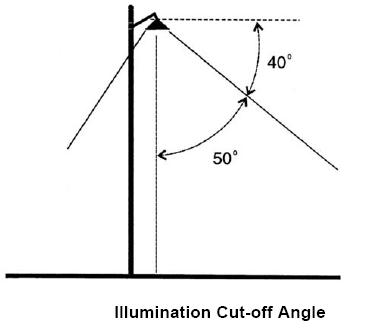
B.
Location. All outdoor light fixtures shall be located so that objects or land which are located beyond the boundaries of the parcel of land are not illuminated to an extent of producing more than a diffuse shadow.
C.
Height.
1.
Cut-off fixtures. The height of the lamp in a light fixture shall not exceed 35 feet, or one foot in height for each one foot the light fixture is setback from the setback in section 3-1202(B), whichever is less.
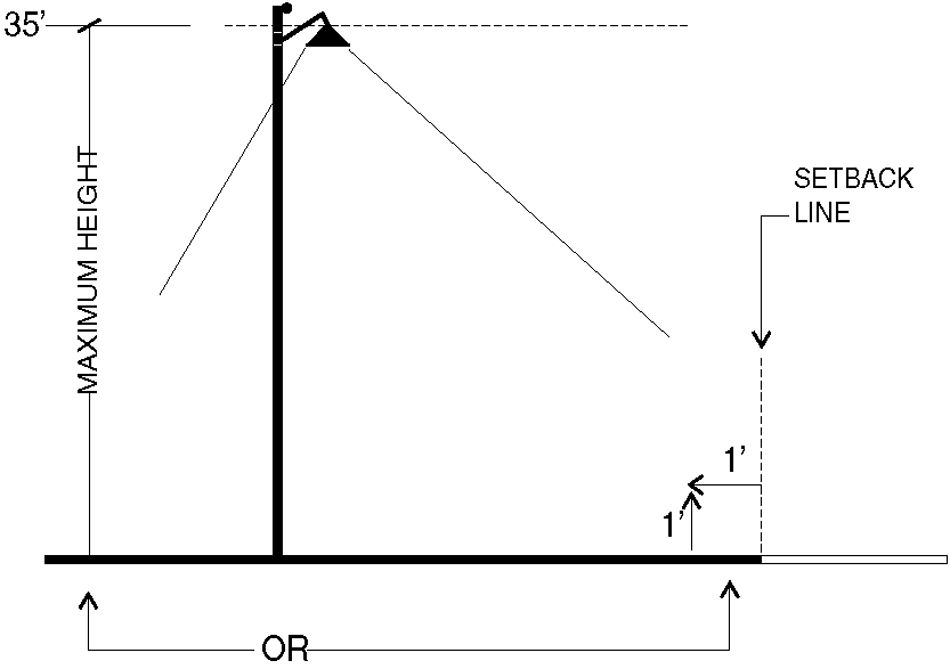
Cut-Off Fixtures
2.
Non-cut-off fixtures. The height of the lamp in a non-cut-off fixture shall not exceed 18 feet.
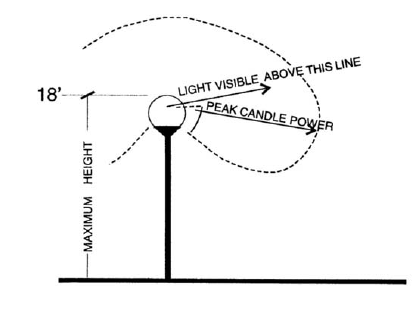
Non-Cut-Off Fixtures
3.
Down-lights. The height of a down-light shall not exceed 18 feet or two-thirds of the height of the structure or tree which is being downlighted, whichever is less.
4.
Up-lights. The height of the lamp in an up-light light fixture shall not exceed 18 feet or one-half of the height of the structure or tree which is being uplighted, whichever is less.
D.
Sea turtle nesting areas. In order to provide protection for nesting marine turtles and their hatchlings during the nesting season of May 1 to October 31 and to minimize artificial light illuminating areas of the beach, the following standards for public or private artificial light sources shall apply on Clearwater Beach and Sand Key:
1.
Controlled use, design and positioning of lights.
a.
Light fixtures shall be designed and/or positioned such that they do not cause direct illumination of the beach areas.
b.
The use of lights for safety and security purposes shall be limited to the minimum number required to achieve their functional role(s).
c.
Wall-mount fixtures, landscape lighting and other sources of lighting shall be designed and/or positioned such that light does not directly illuminate the beach areas.
d.
All lights on balconies shall be shielded from the beach.
e.
Lighting in parking lots within line of sight of the beach shall be positioned and/or shielded such that only deflected light may be visible from the ground level of the beach.
f.
The use of low pressure sodium vapor lights are permitted where security or safety problems can be demonstrated, and shielding is cost prohibitive, and visibility from the beach cannot be prevented.
2.
Lighting for pedestrian traffic.
a.
Beach access points, dune crossovers, beach walkways, piers or any other structure on the beach designed for pedestrian traffic shall use the minimum amount of light necessary to ensure safety.
b.
Pedestrian lighting shall be of low wattage, not over 25 watts, and recessed or shielded so that only deflected light may be directly visible from the beach.
3.
Lighting approval. Prior to the issuance of a certificate of occupancy, compliance with the lighting standards as set forth in this section shall be certified.
4.
Standards for existing lighting. Existing artificial light sources shall be repositioned, modified or replaced with alternatives consistent with the standards set forth herein so that only deflected light may be visible at ground level from the beach and/or the light does not directly illuminate areas of the beach.
5.
Publicly owned lighting. All publicly owned lighting shall comply with the standards set forth herein to the greatest extent possible.
(Ord. No. 6928-02, § 61, 5-2-02; Ord. No. 8043-09, § 28, 9-3-09)
Section 3-1303. - Outdoor recreational facility lighting.
A.
Orientation. All outdoor recreational facility lighting shall be located as close to the recreational facility to be lighted as possible and the light from such fixtures shall be oriented, to the maximum extent possible, away from adjacent residential areas.
B.
Operation. Outdoor recreational facility lighting installed at a recreational facility, located adjacent to residential areas, shall be operated only when such facilities are in use and a period of one half (½) hour before such use and one-half hour after such use.
C.
Location and intensity. Outdoor recreational facility lighting shall be located so that objects or land which are located beyond the boundaries of the parcel proposed for development are not illuminated to the extent of more than a diffuse shadow on the objects or land.
Section 3-1401.- Parking.
A.
Purpose. It is the purpose of this division to establish standards which promote the orderly, efficient, and safe layout of parking and loading areas.
B.
Applicability.
1.
In general. All off-street parking areas and loading spaces shall be constructed in accordance with the standards in this division.
2.
Parking lots serving a new use. Any parking area which is to serve a new use of land, shall satisfy the standards in this division and the landscaping standards in Article 3, Division 12.
3.
Existing parking lots. Existing parking lots not meeting the requirements contained in this division shall be brought into compliance to the greatest extent practicable as determined by the Community Development Coordinator under one or more of the following conditions:
a.
If an existing use is improved or remodeled in a value of 25 percent or more of the total assessed valuation of the existing principal structure as reflected on the property appraiser's current records at the time of application or as established by a qualified independent appraiser using a recognized appraisal method.
b.
If an amendment, other than a minor amendment, is required to an existing approved site plan.
C.
Parking demand study.
1.
If flexibility of the parking standards is requested that is greater than 50 percent of the top end of the range (excluding those standards where the difference between the top and bottom of the range is one parking space), then a parking demand study will need to be provided. Prior to the preparation of such study, the methodology shall be approved by the Community Development Coordinator and City Engineer, and in accordance with accepted traffic engineering principles. The findings of the study will be used in determining whether or not flexibility to the parking standards are approved.
(Ord. No. 6526-00, § 1, 6-15-00; Ord. No. 6928-02, § 62, 5-2-02; Ord. No. 8310-12, § 3, 2-2-12; Ord. No. 8810-16, § 15, 1-21-16; Ord. No. 9387-20, § 2, 8-6-20; Ord. No. 9758-24, § 18, 6-6-24; Ord. No. 9805-25, § 2, 4-17-25)
Section 3-1402. - Design standards for parking lots and parking garages.
All parking lots shall be designed to meet the following requirements:
A.
Off-street parking spaces, including aisles, shall be designed in accordance with the standards identified in the following table. Parking space dimensions shall be revised where necessary to provide safe and efficient vehicular movement where columns, walls, or other site conditions impede maneuverability or vision.
_____
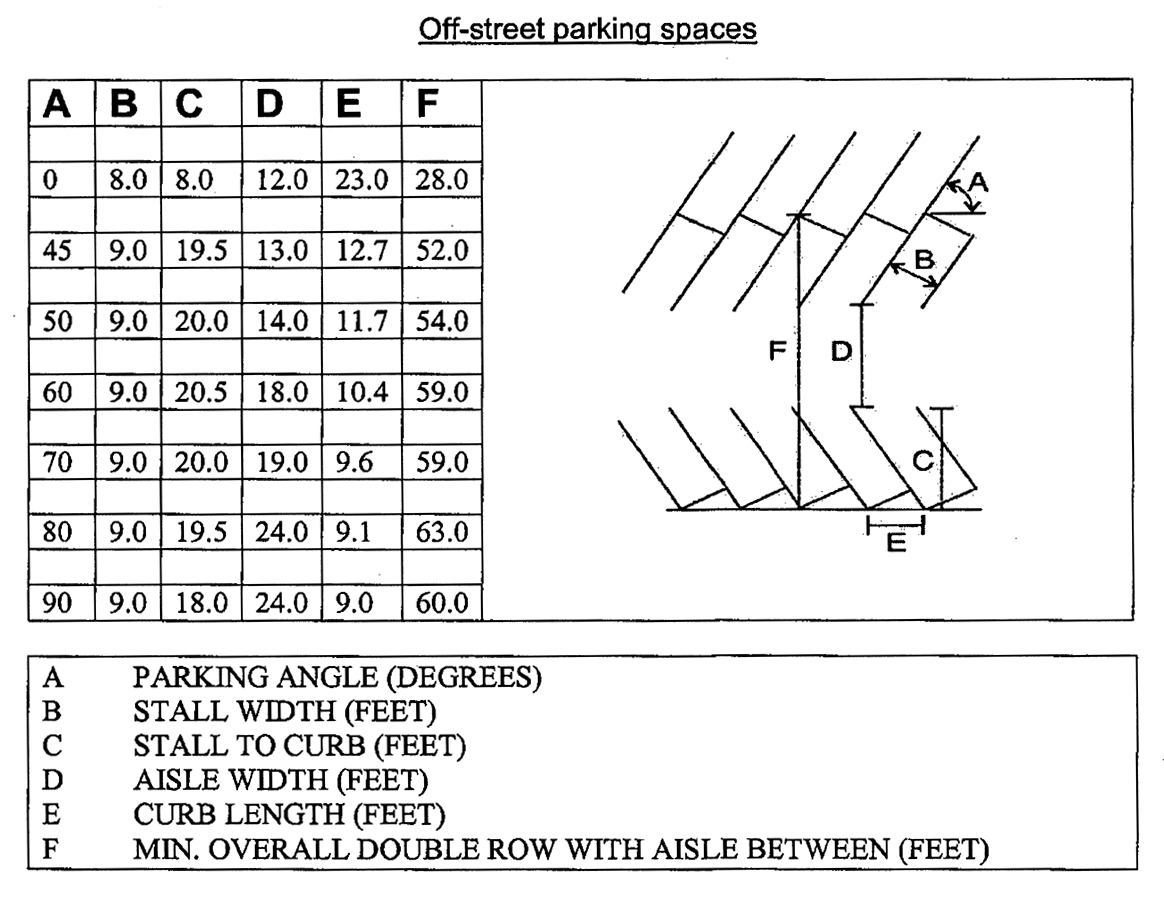
_____
B.
There shall be no more than one entrance and one exit or one combined entrance and exit per property along any street unless otherwise determined necessary by the traffic engineer to alleviate congestion and improve traffic flow.
C.
With the exception of parking spaces for detached dwellings, no off-street parking space shall be designed so that a vehicle is required to back into a public right-of-way.
D.
Stacking space for drive-through facilities shall be provided and designed in accordance with the requirements contained in section 3-1406 of this division.
E.
Required off-street parking spaces shall not be located within any right-of-way easement or within a drainage and/or utility easement abutting any public right-of-way.
F.
Directional signs and surface markings shall be provided as determined necessary by the traffic engineer.
G.
Fire lanes shall be provided as determined necessary by the fire marshal.
H.
Unenclosed parking lots shall be landscaped and buffered in accordance with the provisions contained in Article 3, Division 12.
I.
Structural supports located in parking garages shall not encroach into the required area of a parking space. Structural supports shall be located in a manner to provide maximum vehicular maneuverability and shall not obstruct passenger ingress and agree.
In addition to the other requirements of this section, parking garages shall comply with the following:
1.
The minimum clear height throughout the garage shall be seven feet zero inches and shall be eight feet two inches for van-accessible handicapped parking spaces including ingress and egress drive aisles to these spaces.
2.
Pedestrian - vehicular conflicts shall be avoided whenever possible. Where unavoidable, active warning devices such as traffic signals or flashing warning signs/devices and/or physical barriers such as vehicular actuated gates shall be provided to warn the pedestrian and slow vehicular traffic.
3.
Lighting levels in parking garages having public access shall meet or exceed the current minimum Illuminating Engineering Society (IES) standards.
4.
Columns shall not encroach into the required area of a parking space except at the end of a parking space where another parking space or a wall abuts the parking space. Such projection shall not encroach into the corner of a parking space by more than one foot in any direction, front to back or side to side as shown in the following figure.
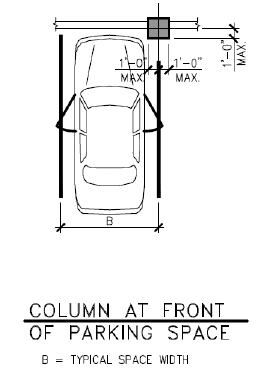
5.
Parking garages for attached dwellings with four or more units shall comply with all applicable ADA requirements.
6.
Mechanical vehicle lifts shall not be permitted in parking garages except in areas solely controlled for valet parking.
7.
Wheel stops shall not be used in parking garages.
8.
Whenever access control equipment or barrier gates are used at the entrance to a parking garage, a minimum stacking distance of 40 feet shall be provided from the back of sidewalk to the equipment or barrier gate.
9.
Maximum speed ramp slope shall not exceed 12 percent. A ten-foot long transition ramp with a slope equal to one-half of the change in slopes shall be provided at the bottom and top of all speed ramps with a slope of ten percent or greater.
10.
When parking spaces are provided on a ramp, the slope shall be less than 6 percent.
11.
A minimum of two entries and two exits shall be provided for any parking garage with more than 500 parking spaces. In certain circumstances, one reversible entry/exit lane may be acceptable in lieu of the second pair of entry and exit lanes.
12.
All electrical conduits, pipes, downspouts, columns or other features that could be subject to impact from vehicular traffic shall be protected from impact damage with pipe guards or similar measures. Measures used for protection shall not encroach into any parking space.
13.
Minimum dimensions of equipment islands at entry/exit lanes shall be as follows:
a.
Islands with cashier booth: Six feet four inches wide by 22 feet long.
b.
Islands without cashier booth: Three feet six inches wide by 18 feet three inches long.
J.
Dead-end parking aisles:
1.
Dead-end parking aisles are discouraged, but when site conditions dictate that there be dead-end parking aisles, they shall be designed so that there is a back-out maneuvering area at the end of the aisle. This maneuvering area shall not encroach upon any required landscape areas.
K.
Valet parking design. An overnight accommodations use located in either the Tourist (T) District, Downtown (D) District, or within a special area plan, may provide all or part of its required off-street parking as valet parking provided that attendants are available 24 hours per day to receive, park and deliver the automobiles of occupants, tenants, customers and visitors on a permanent basis. The design of this valet parking must meet all other requirements of this section with the following exceptions:
1.
Parking spaces need not be delineated with pavement marking; however stall and aisle dimensions shall be depicted on the site plan; and
2.
Parking stall dimensions shall be a minimum of eight and one-half feet wide and 16 feet deep with a maximum stacking of two vehicles: and
3.
Parking spaces may be provided within the drive-aisle of the valet parking area so long as they are located on only one side of the drive-aisle.
(Ord. No. 7449-05, § 19, 12-15-05; Ord. No. 7631-06, § 4, 11-2-06; Ord. No. 8043-09, § 29, 9-3-09; Ord. No. 8540-14, § 9, 4-3-14; Ord. No. 8988-17, § 16, 2-2-17)
Section 3-1403. - Parking lot surfaces.
A.
Permanent surface. Except as otherwise permitted in subsection (B) of this section, all unenclosed parking lots, spaces, vehicular accessways and driveways shall be improved with a permanent all-weather paving material which is graded to drain stormwater.
B.
Grass surface.
1.
No parking, displaying, or storing of motor vehicles shall be permitted on any grass or other unpaved area unless specifically authorized in this section.
2.
Eighty-five percent of parking required for places of worship, outdoor recreational facilities and other uses as determined by the community development coordinator may have a durable grass or other permeable surface.
3.
Community gardens may provide parking spaces on the grass, provided that the grass parking areas are clearly identified, dedicated and maintained in a clean and un-deteriorated manner.
4.
All surface parking spaces provided in excess of the minimum required pursuant to Article 2 may be surfaced with reinforced grass or other permeable surface as approved by the City Engineer. However, all vehicular accessways and driveways for these excess parking spaces shall be improved in a manner consistent with Section 3-1403.A.
5.
The city manager or the community development coordinator may permit parking on the grass or other permeable surface for public purpose needs, including reducing stormwater impacts.
6.
Any grass parking areas must be a minimum of ten feet from any tree.
7.
The use of artificial turf for a parking surface shall be prohibited.
(Ord. No. 6526-00, § 1, 6-15-00; Ord. No. 6928-02, §§ 63, 64, 5-2-02; Ord. No. 7605-06, § 25, 4-20-06; Ord. No. 8654-15, § 22, 2-5-15; Ord. No. 8931-16, § 17, 9-1-16; Ord. No. 9805-25, § 2, 4-17-25)
Section 3-1404. - Off-street parking spaces.
A.
Location. All required offstreet parking spaces shall be located within 600 feet of the principal and accessory uses they serve.
B.
Striping. All paved parking spaces, other than those located in driveways and serving detached dwellings or two attached dwellings, shall be marked by painted lines. If a parking lot serves a use which generates 2,500 or more vehicle trips a day, such parking spaces shall be marked by white thermoplastic lines.
C.
Availability. All required parking spaces, including appropriate access thereto, shall remain unobstructed and available for use in accordance with their purpose.
D.
Required number of spaces. The required number of parking spaces for each use is set out for each use in each zoning district in Article 2 of this Development Code or in this division. When the determination of the number of required offstreet parking spaces results in a requirement of a fractional space, any fraction less than one-half space shall be rounded down to the nearest whole number and any fraction of one-half space or more shall be rounded up.
E.
Protected trees. Notwithstanding any other provision of this Division, the number of required off-street parking spaces may be reduced by up to 25 percent in a Level One approval upon showing that the reduction in off-street parking spaces is necessary to preserve protected trees located on the parcel provided for development.
F.
Comprehensive parking program. Off-street parking requirements may be satisfied by participation in the availability of parking spaces through a comprehensive parking program which is established to provide off-street parking to the geographic area where the use is to be located.
G.
Payment in lieu of parking in the Downtown District. The community development coordinator may approve a payment in lieu of providing a portion of or the entire amount of required parking for any use in the Downtown District.
(Ord. No. 6526-00, § 1, 6-15-00)
_____
Section 3-1405. - Shared parking.
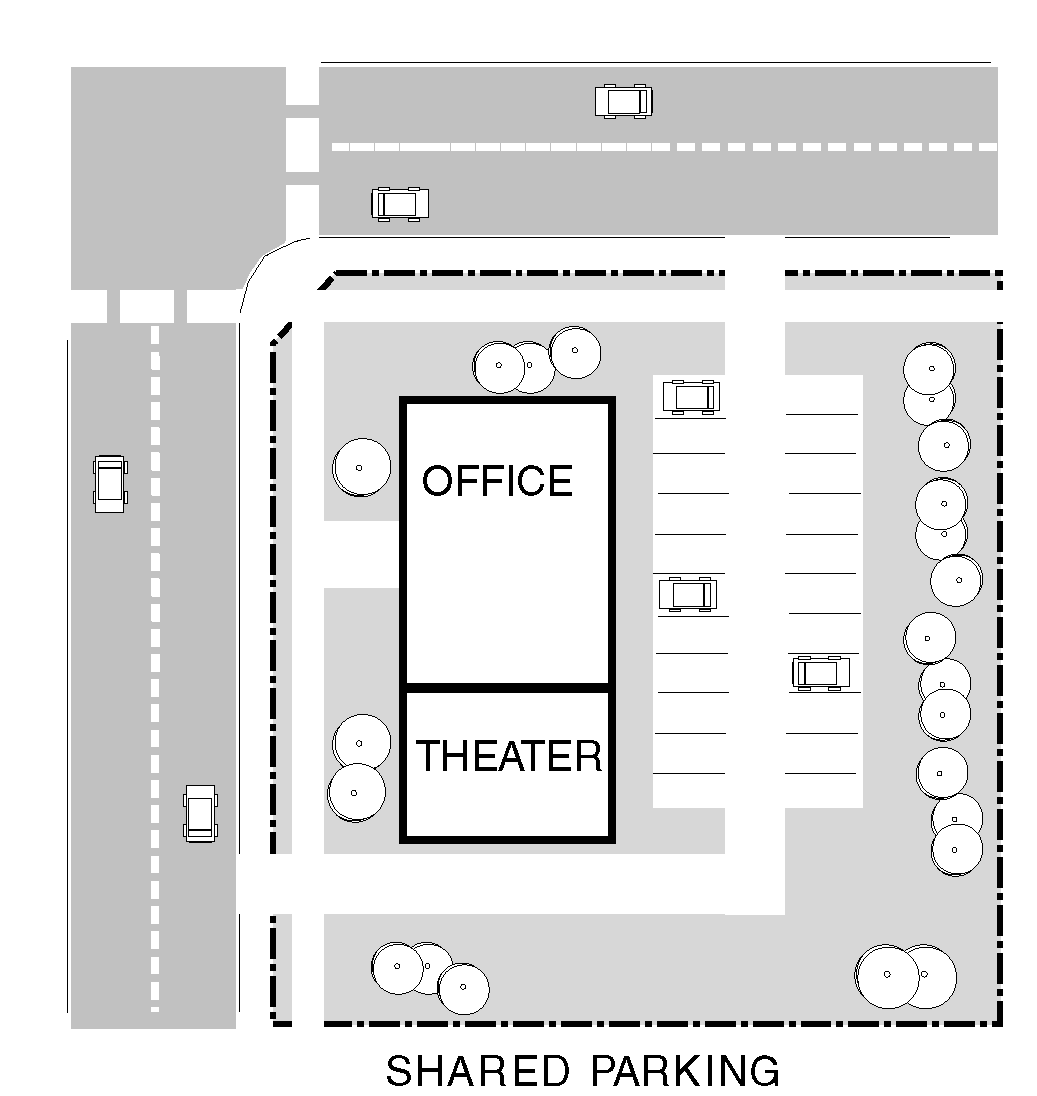
shared parking diagram
When any land, building or area is used for two or more uses which are listed below, the minimum total number of required parking spaces shall be determined by the following:
Multiply the minimum required parking spaces for each individual use, excluding spaces reserved for use by specified individuals or classes of individuals, by the appropriate percentage listed in the Table below for each of the designated time periods. Add the resulting minimum required parking spaces in each of the five vertical columns for the table. The minimum parking requirement is the highest sum of the vertical columns.
Section 3-1406. - Off-street loading and vehicle stacking spaces.
A.
Off-street loading:
1.
Design: Off-street loading spaces shall measure not less than 12 feet in width and 35 feet in length, exclusive of aisle and maneuvering space, and shall have a vertical clearance of at least 14 feet. Off-street loading shall be strategically located as near as possible to a service entrance and designed to accommodate all vehicles onsite without obstructing aisles or parking spaces.
2.
Guidelines: The following table sets forth the guidelines to be used in determining the adequacy of off-street loading for all proposed development, except for such development within the Downtown (D) District and those portions of the Tourist (T) District located on Clearwater Beach where such facilities are not required:
3.
Exceptions: Exceptions to the above loading requirements may be permitted, pursuant to the processing and approval of a Level 1 (Flexible Standard) or Level 2 (Flexible Development) application, and based upon the size of the site and the timing and frequency of deliveries.
B.
Stacking spaces: Provisions must be made for stacking and transition of incoming traffic from a public street, such that traffic may not back-up into the public street system.
1.
Provisions shall be made to provide for 40 feet of clear stacking in advance of all guardhouses or security gates.
2.
Drive-thru facilities for restaurants shall provide sufficient stacking distance to accommodate eight vehicles as measured from the first point of transaction.
3.
Drive-thru facilities for banks shall provide sufficient stacking spaces as measured from the first point of transaction in accordance with the following table:
4.
Additional stacking may be required as a condition of site plan approval. The length of the stacking area may be reduced when supported by a traffic study.
(Ord. No. 6526-00, § 1, 6-15-00; Ord. No. 7631-06, § 5, 11-2-06; Ord. No. 8043-09, § 30, 9-3-09; Ord. No. 8715-15, § 14, 6-18-15; Ord. No. 8810-16, § 16, 1-21-16)
_____
Section 3-1407. - Parking restrictions in residential areas.
A.
Restrictions. For the dual purpose of preserving attractive residential areas within the city and promoting safe unimpeded traffic circulation throughout such neighborhoods, the following parking restrictions shall apply except as provided in paragraph B of this section:
1.
Within street right-of-way. The following vehicles shall not be parked or stored on any public right-of-way in a residential zoning district, residentially designated downtown property, or on any right-of-way contiguous to such properties:
a.
Any boat or boat trailer;
b.
Any hauling trailer;
c.
Any of the following recreational vehicles: travel trailers, motor homes and camping trailers;
d.
Any commercial vehicle.
e.
Any race car, dune buggy, farm equipment, go kart, ATV, or other similar vehicle not designated for street operation.
2.
Between principal structure and right-of-way. The following vehicles shall not be parked or stored, in whole or in part, in a front setback and/or forward of the building line of the principal structure and any right-of-way line in a residential zoning district or on a residentially designated downtown property up to a maximum of two frontages:
a.
Boat in excess of 20 feet;
b.
Any boat trailer in excess of 25 feet total length or in excess of five feet longer than any boat occupying the trailer;
c.
Hauling trailer;
d.
Recreational vehicles, travel trailers, motor homes and camping trailers.
e.
Any commercial vehicle which measures in excess of 20 feet in total chassis and body length, seven feet in total width or seven feet in total height, including appurtenances, equipment and cargo.
f.
Any race car, dune buggy, farm equipment, go kart, ATV, or other similar vehicle not designated for street operation.
3.
Parking in the side or rear setback. The following vehicles may be parked or stored, in whole or in part, in a side or rear setback behind the front building line of the principal structure in a residential zoning district or on a residentially designated downtown property provided such vehicles are screened with a six-foot high solid fence, wall or hedge:
a.
Boat in excess of 20 feet;
b.
Boat trailer in excess of 25 feet;
c.
Hauling trailer;
d.
Recreation vehicles, trailers, motor homes and camping trailers; and
e.
Any race car, dune buggy, farm equipment, go kart, ATV, or other similar vehicle not designated for street operation.
4.
Large vehicles. The following vehicles shall not be parked or stored in any residential zoning districts or on any residentially designated downtown property:
a.
Commercial vehicles measuring in excess of 20 feet in total chassis and body length, seven feet in total width or seven feet in total height, including appurtenances, equipment and cargo are prohibited; and
b.
Semi-tractor trailer, semi-tractor cab or any garbage truck, pump-out truck, chemical truck, gasoline truck, fuel oil truck or similar vehicle designed to transport wastes or hazardous or noxious materials.
5.
Exception to prohibition of parking on unpaved areas on single-family and duplex residential property. One designated parking space may be located on the grass in a required front setback adjacent to and parallel to the driveway located on the property. Access to such designated parking space shall be by way of the property's driveway. If the designated parking space cannot be maintained as a grass area and is either reported by neighboring residents as a detrimental property or is identified by any code inspector as in violation of this provision, such designated parking area shall be filled in, by the property owner, with pavers, concrete, turf block or asphalt. Materials not permitted include artificial turf, crushed shell, mulch, millings, or similar material.
6.
Parking on unpaved area prohibited. No parking, displaying, or storing of vehicles, trailers and/or boats shall be permitted on any grass surface or other unpaved area zoned for any use unless specifically authorized in this section.
B.
Exception.
1.
Commercial vehicles during the actual performance of a service at the premises where the vehicle is parked.
2.
Loading, unloading, or cleaning of vehicles, but not including semitrailer trucks or cabs, provided such activity is fully completed within 24 hours and provided such activity does not occur at the same location more than two times per month.
3.
Emergency vehicles.
(Ord. No. 6526-00, § 1, 6-15-00; Ord. No. 6595-00, § 6, 9-7-00; Ord. No. 6928-02, §§ 65—70, 5-2-02; Ord. No. 7605-06, § 26, 4-20-06; Ord. No. 7835-07, § 17, 1-17-08; Ord. No. 8211-10, § 10, 10-5-10; Ord. No. 9643-23, § 10, 4-4-23; Ord. No. 9712-23, § 1, 11-2-23; Ord. No. 9740-24, § 1, 2-1-24; Ord. No. 9805-25, § 2, 4-17-25)
Sec. 3-1408. - Parking restrictions in nonresidential areas.
A.
Commercial trucks, semi-tractor trailers, cabs and other commercial vehicles shall be permitted to be parked or stored on commercial property only if such vehicles are associated with the property on which they are located.
B.
Boats or boat trailers, hauling trailers, and recreational vehicles shall not be parked or stored on any public right-of-way in nonresidential areas.
(Ord. No. 6526-00, § 1, 6-15-00; Ord. No. 9643-23, § 10, 4-4-23; Ord. No. 9712-23, § 1, 11-2-23; Ord. No. 9740-24, § 1, 2-1-24)
Section 3-1409. - Handicapped parking spaces.
A.
All new or expanded uses shall be provided with handicapped parking spaces based upon the number of spaces required to serve the new or expanded use, as follows:
All handicapped parking spaces shall be conspicuously outlined in blue paint and posted and maintained with permanent above-grade signs of a color and design consistent with standards established by the Florida Department of Transportation, bearing the international symbol of accessibility and the caption "PARKING BY DISABLED PERMIT ONLY". The required number of handicapped parking spaces shall be included in the total number of parking spaces required for the new or expanded use. All handicapped parking spaces shall be designed and located in accordance with the standards set forth in F.S. § 316.1955(3), as may be amended from time to time.
B.
For those properties that are currently developed, but are not in compliance with the above requirements, the number of off-street parking spaces may be reduced below the quantity which would otherwise be required pursuant to Article 2 as part of a Level One (minimum standard) approval in order to achieve compliance with Section 3-1409.A., above. Under no circumstances shall the number of off-street parking spaces being reduced be greater than the minimum necessary to achieve compliance.
_____
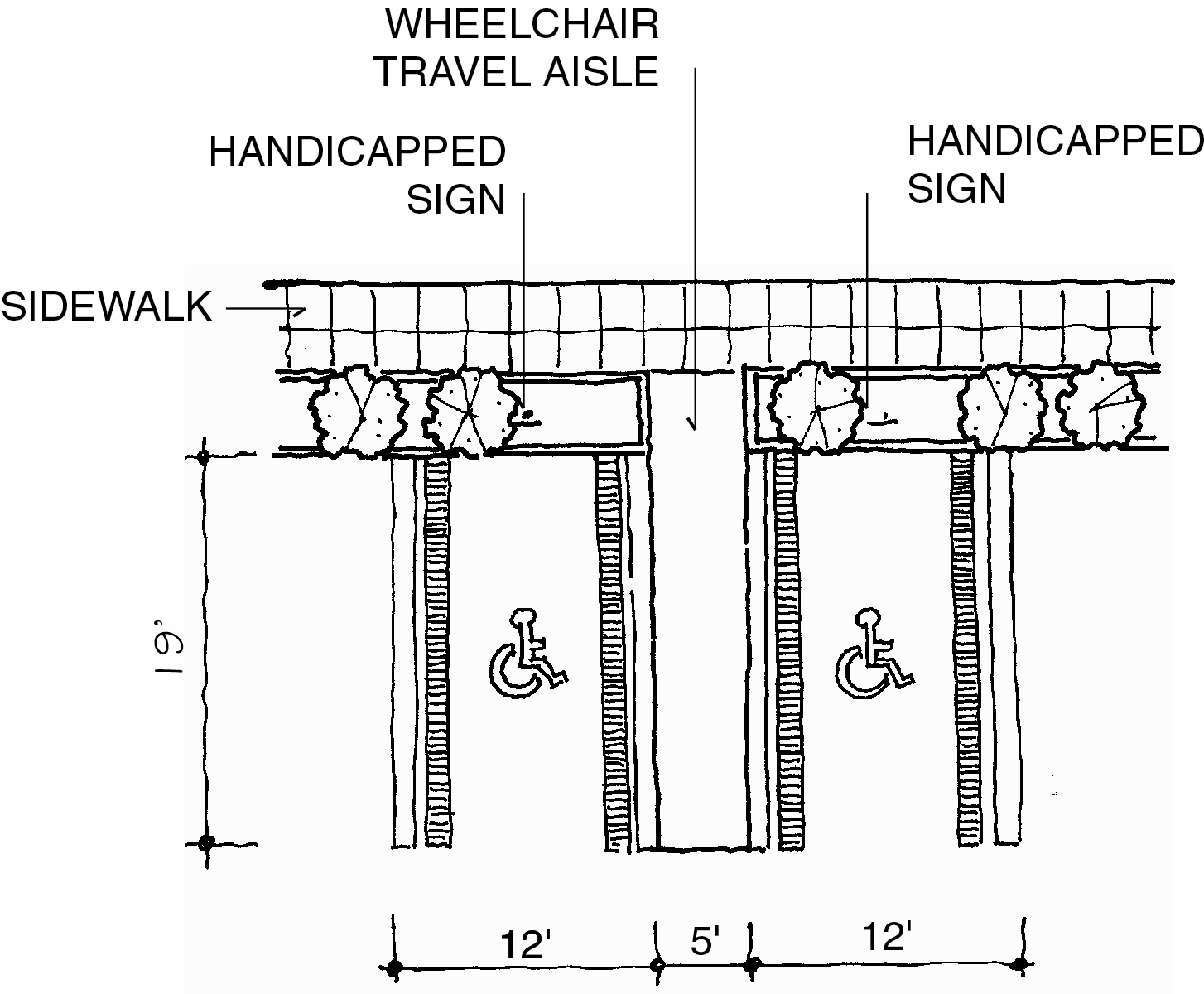
(Ord. No. 6526-00, § 1, 6-15-00; Ord. No. 7631-06, § 8, 11-2-06; Ord. No. 8715-15, § 15, 6-18-15)
Section 3-1410. - Conformance to uniform traffic control devices.
A.
For parking facilities containing 25 or more parking spaces, all aisles, approach lanes, and maneuvering areas shall be clearly marked with directional arrows and lines as approved by the city engineer. The city engineer may require additional signage to ensure the smooth and safe flow of traffic.
B.
Except as noted above, the installation and maintenance of uniform traffic control devices shall be required for all development and redevelopment pursuant to the standards set forth in the Manual on Uniform Traffic Control Devices (MUTCD) as adopted by the Department of Transportation under Rule 14-15.010, Florida Administrative Code.
(Ord. No. 6526-00, § 1, 6-15-00; Ord. No. 7631-06, § 6, 11-2-06)
Section 3-1411. - Bicycle parking.
A.
Short-term bicycle parking. Short-term bicycle parking encourages employees, shoppers, customers and other visitors to ride bicycles by providing a convenient, easily identifiable, and readily accessible location to park bicycles. Short term bicycle parking shall comply with the following standards:
1.
Bicycle racks shall be installed in highly-visible locations along pedestrian walkways, near main building entries and be publicly accessible at all hours of the day.
2.
Bicycle racks shall be installed at the same grade as the abutting sidewalk, or at a location that is ADA accessible.
3.
Bicycle rack locations shall not impede and/or obstruct ADA accessible routes, pathways or minimum clear widths of a sidewalk.
4.
Bicycle racks shall not be placed closer than 30 inches from each other and not closer than 36 inches from walls, edge of pavement, or any other obstructions.
B.
Long-term bicycle parking. Long-term bicycle parking provides a secure and weather-protected place to park bicycles for employees, students, residents, commuters and others who generally stay at a location for several hours. Long-term bicycle parking shall comply with the following standards:
1.
Long-term bicycle parking shall be provided on-site and shall not be located between the right-of-way and the principal structure except as may otherwise be approved by the Community Development Coordinator based on use characteristics.
2.
Long-term bicycle parking spaces shall be covered and may be located inside buildings; under roof overhangs, awnings, canopies or columnades; in bicycle lockers; or within or under other architecturally finished structures that are designed consistent with and complementary to the exterior façade of the primary building. Where the required covered bicycle parking is not within a building or locker, under roof overhangs, awnings, canopies or columnades, in bicycle lockers, or within under other structures, the covering provided shall be:
a.
Designed to protect the bicycle from exposure to sun and rainfall;
b.
Attached to permanent framing and include a permanent and solid roof deck constructed with material such as asphalt shingles, metal, concrete tile, or wood. Fabric, canvas and canvas/fabric-like materials are prohibited; and
c.
At least eight feet in height above the floor or ground.
3.
To provide security, long-term bicycle parking must provide the ability to lock individual bicycles and be in an area that is visible from an entry to the building, excluding service entries, an employee work area, or monitored by a security camera.
4.
Long-term bicycle parking shall be in an area lighted during non-daylight hours of business operations.
5.
Bicycle parking areas required by this section shall only be used for the parking of bicycles. Any other use of these areas is a violation of this Development Code.
C.
Bicycle racks standards.
1.
Ground or floor mounted bicycle racks shall be designed to allow support of a bicycle frame in at least two places and shall allow locking of the frame and one or both wheels with a U-shaped lock, as depicted in the following figure. The inverted "U" style bicycle rack that can hold two bicycles is the preferred type of rack (also known as a "staple", "hoop", or "U" rack).

Figure Source: APBP Bicycle Parking Guidelines, 2 nd edition, page 6, www.apbp.org, used with permission from the copyright holder.
2.
Bicycle racks and lockers shall be securely mounted on the ground, floor, wall, or ceiling.
3.
Bicycle rack design shall include materials and forms that are consistent with any required streetscape furnishings.
4.
Bicycle racks shall be constructed using durable finishes that cannot be damaged by the constant abrasion from the bicycles.
5.
The following styles of bicycle racks as depicted in the following figure shall be prohibited.
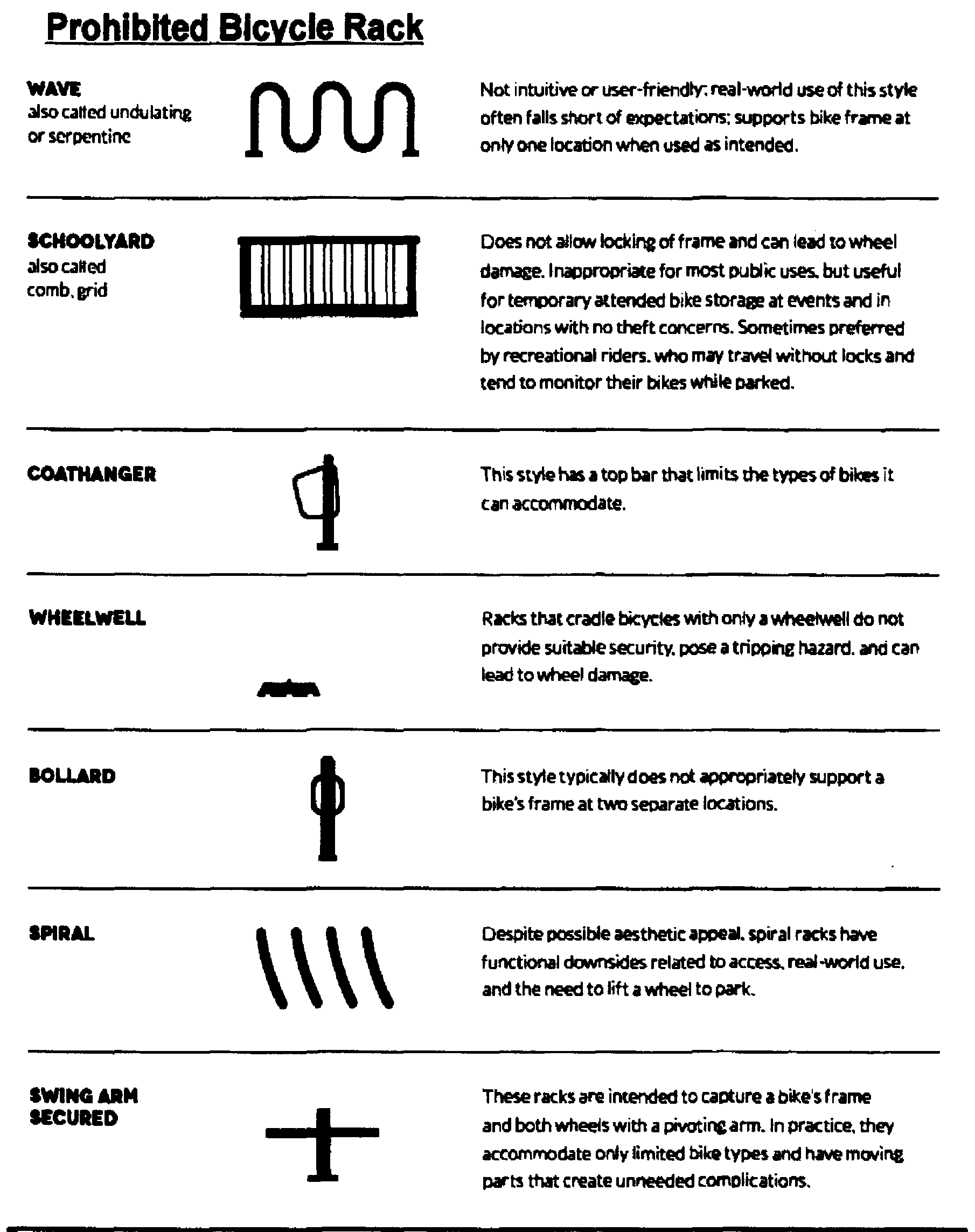
Figure Source: APBP Bicycle Parking Guidelines, 2 nd edition, page 10, www.apbp.org, used with permission from the copyright holder.
D.
Parking and maneuverability standards.
1.
Bicycle parking spaces shall be accessible without moving another bicycle.
2.
Each bicycle parking space shall be at least six feet long.
3.
An access aisle at least five feet wide shall be provided and maintained beside or between each row of bicycle parking.
4.
Bicycle parking spaces shall be on a hard surface constructed of asphalt or concrete material, brick, decorative pavers or similar materials.
5.
Bicycles racks shall be protected from motorized vehicles by location and/or physical barriers.
Bicycle Parking Diagram
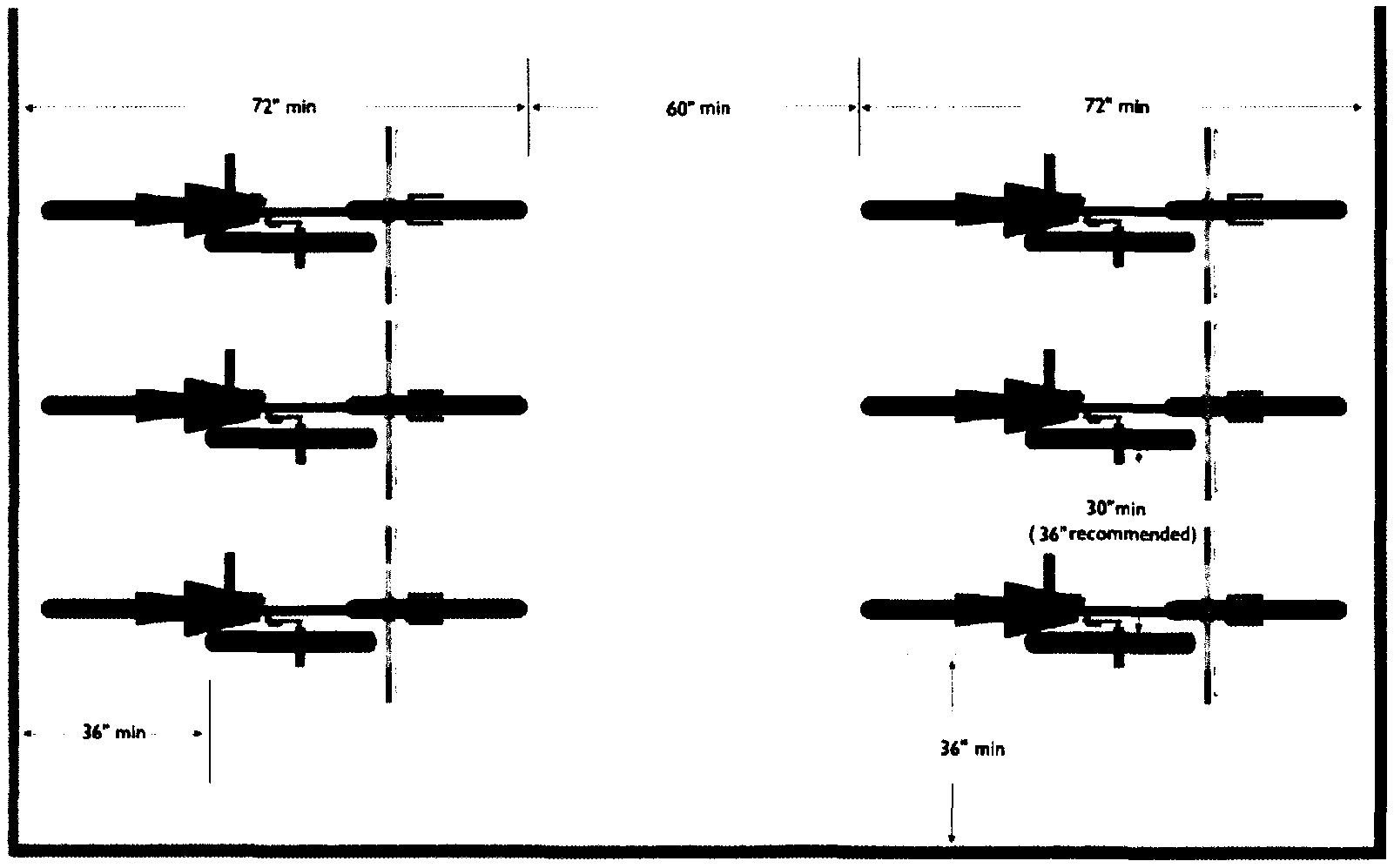
(Ord. No. 8988-17, § 17, 2-2-17; Ord. No. 9149-18, § 6, 8-2-18)
Section 3-1501.- Purpose.
The purpose of this division is to protect the comfort, health, repose, safety and general welfare of the citizens of the city by establishing minimum property and building maintenance standards for all properties and to provide for the abatement of nuisances affecting the general public.
Section 3-1502. - Property maintenance requirements.
A.
Minimum building and fire code requirements. All buildings shall be maintained in accordance with the Florida Building Code, the Florida Fire Prevention Code, and the International Property Maintenance Code.
B.
Exterior surfaces. All building walls shall be maintained in a secure and attractive manner. All defective structural and decorative elements of any building wall shall be repaired or replaced in a workmanlike manner to match as closely as possible the original materials and construction of the building. All exterior surfaces shall be free of:
1.
Mildew;
2.
Rust;
3.
Loose material, including peeling paint; and
4.
Patching, painting or resurfacing shall be accomplished to match the existing or adjacent surfaces as to materials, color, bond and joining.
All cornices, trim and window frames that are damaged, sagging or otherwise deteriorated shall be repaired or replaced to be made structurally sound. All exterior surfaces other than decay-resistant wood and other weather durable finishes, shall be protected from the elements by paint or other protective covering applied and maintained according to manufacturer's specifications and otherwise treated in a consistent manner.
C.
Door and window openings.
1.
All windows and doors shall be secured in a tight fitting and weatherproof manner and have sashes of proper size and design.
2.
Sashes with rotten wood, broken joints or deteriorated mullions or muntins must be repaired or replaced.
3.
Windows shall be maintained in an unbroken, and clean state. No windows shall be permanently removed and enclosed, covered or boarded up unless treated as an integral part of the building façade using wall materials and window detailing comparable with any upper floors and the building façade in general. All damaged or broken windows shall be promptly restored, repaired or replaced. All awnings, screens or canopies facing or visible from the public right-of-way or any other parcel shall be maintained in a good and attractive condition and torn, loose and/or bleached awnings, screens or canopies shall be promptly replaced, repaired or removed.
4.
Doors and windows not facing the public right-of-way and upper level window and door openings fronting a public right-of-way shall be similarly maintained and repaired as the doors and windows facing the public right-of-way, except that such doors and windows may be enclosed or removed provided the sills, lintels and frames are removed and the opening properly closed to match and be compatible with the design, material and finish of the adjoining wall of which the opening is a part.
D.
Roofs.
1.
All roofs shall be maintained in a safe, secure and watertight condition.
2.
Any new mechanical equipment, including replacement equipment placed on a roof, shall be so located as to be screened from view from the public right-of-way at street level from adjoining properties.
3.
Roofs shall be maintained in a clean, mildew-free condition and kept free of trash, loose shingles and debris or any other element, including grass or weeds, which is not a permanent part of the building or a functional element of its mechanical or electrical system.
4.
Tile roofs with peeling paint shall be repainted or have the paint removed.
5.
Any false roof, mansard or similar roof element or other auxiliary structure on the roof shall be finished and maintained in a condition comparable to and compatible with the exterior side of the building wall to which the roof element abuts.
E.
Auxiliary and appurtenant structures.
1.
Chimneys and elevator shafts, and mechanical and electrical structures shall be maintained in a satisfactory state of repair and their exterior finish must be architecturally consistent with the exterior side of the building wall from which they can be seen.
2.
Freestanding walls and fences shall be maintained in accordance with the provisions of section 3-808 of this development code.
3.
Fountains and other amenities shall be maintained in good working order and all structural components shall be maintained in a satisfactory state of repair, free of chipping, pitting, cracking, discoloration, peeling or fading.
F.
Exterior storage and display/ nonresidential properties.
1.
All equipment, materials and merchandise shall be stored and located at all times within an enclosed structure and no exterior storage of merchandise for sale shall be permitted unless expressly authorized pursuant to the provisions of this Development Code.
2.
Garbage and trash shall be deposited only in dumpsters or cans or other receptacles specifically manufactured and intended for such purpose, and secured at all times with a tight fitting cover or lid.
G.
Exterior storage and display for residential properties.
1.
As provided in Section 3-913 of this Development Code, outdoor storage is prohibited. For the purposes of this section, carports are subject to the outdoor storage provisions.
2.
Equipment, materials or furnishings not designed for use outdoors, such as automobile parts and tires, building materials, and interior furniture, may not be stored outdoors.
3.
Construction materials, unless such materials are related to an active building permit related to the property on which the materials are located, shall not be stored outdoors on a residentially zoned property.
4.
Bulk items intended for pick up by the city may not be placed at the curb more than 24 hours prior to the scheduled pick up.
5.
Any motor vehicle that is lawfully parked and is covered in a manner to protect the motor vehicle shall allow at least the bottom six inches of each tire to be visible. The required license plate shall be clearly visible from the right-of-way or the license plate number shall be printed legibly on the cover with characters not less than two inches in height so that it is clearly visible from the right-of-way. Covers shall not be faded and shall be in good condition, without tears, rips or holes.
H.
Yards, landscape areas, and artificial turf areas.
1.
All required landscaping materials shall be maintained in accordance with the provisions of Article 3, Division 12.
2.
Any portion of a lot not covered by a building or structure or otherwise devoted to parking, a service drive or a walkway shall be landscaped with grass or other appropriate ground cover and shall be maintained in a neat and orderly manner.
3.
Landscape materials, including natural turf, shrubs, and trees, excluding artificial turf, whether required or optional, shall be maintained in a healthy live condition so as to present a neat and attractive appearance and so as to discourage the accumulation of trash or debris and/or infestation by pests.
4.
Artificial turf shall be maintained according to Section 3-1203.G.
5.
No yard, landscape area, growth of landscape material, or artificial turf area (unless previously approved by the city engineer) shall encroach upon the public right-of-way so as to hinder safe and convenient vehicular or pedestrian movement in the public right-of-way.
6.
No yard shall be used for dumping or accumulation of any garbage, rubbish, dead animals, trash, waste vegetable or animal matter of any kind or construction debris.
I.
Signs. All signs shall be maintained in good condition in the form in which the signs were originally approved, free of mildew, rust, loose material, including peeling or fading paint or materials. Any loose, broken, peeling or faded parts of the sign shall be promptly repaired, painted or replaced.
J.
Vacant parcels.
1.
Vacant parcels of land shall be properly maintained consistent with section 3-1502 H and be free of weeds, litter, rubble or debris.
2.
Erosion and sedimentation mitigation measures may be required if it is determined that runoff from a vacant parcel causes harm to adjacent property, city drainage systems or navigable waters which receive the runoff.
3.
No temporary or permanent storage of materials or equipment shall be allowed on any vacant parcel except in compliance with the regulations for the use of such property as set forth under Article 2 and Article 3 Division 9 of this Development Code.
K.
Public rights-of-way and sidewalks and parking surfaces.
1.
Public rights-of-way and sidewalks adjoining an improved parcel of land which, because of its location and character, is used as if it were appurtenant to or an extension of the parcel of land, shall be maintained in a safe and clean condition by the owner of the parcel of land. The owner shall, at a minimum, keep such rights-of-way and sidewalks clear of litter, trash, debris, equipment, weeds, trees, shrubs and other vegetation and refuse and provide a height clearance of at least eight feet from the sidewalk pavement measured vertically from the pavement surface, unless an exception has been granted by the urban forester for protected trees. All unpaved areas shall be landscaped with grass or other ground cover unless alternative materials are approved by the city and such areas shall be regularly mowed or otherwise maintained in a neat and attractive condition.
2.
No person shall erect, place or locate any structure, display materials, merchandise, or similar objects within the limits of any street right-of-way unless specifically permitted pursuant to the provisions of this Development Code.
3.
No trash receptacles, newspaper racks or other dispensing machines shall be located in a public right-of-way unless specifically authorized by the city and other applicable agencies.
4.
Parking lot and driveway surfaces shall be maintained in a safe and clean condition by the owner of the parcel of land. The owner shall, at a minimum, keep such surface free of pot holes, litter, trash, debris, equipment, weeds, dead vegetation and refuse and shall promptly repair cracked or heaved parking lot surfaces.
5.
All sidewalks located on private property shall be maintained in a safe and clean condition by the owner of the parcel of land. The owner shall, at a minimum, keep sidewalks clear of litter, trash, debris, equipment, weeds, dead vegetation and refuse. Sidewalks that are cracked, heaved or otherwise unsafe for pedestrians shall be promptly replaced.
L.
Maintenance of seawalls. All seawalls shall be maintained in structurally sound condition and shall comply with applicable building and coastal construction codes.
M.
Adoption of the International Property Maintenance Code, 2018 edition. There shall be enforced in the city, by the building official, the "International Property Maintenance Code," 2018 Edition, a copy of which is kept with the office of the city clerk, which is incorporated into the Code and adopted by reference with the following local amendments:
1.
General amendments. The International Property Maintenance Code, 2018 addition is amended in that:
a.
Wherever the terms "International Building Code," "International Energy Conservation Code," "International Existing Building Code," "International Fire Code," "International Fuel Gas Code," International Mechanical Code." "International Plumbing Code," "International Residential Code," or "International Zoning Code" are found, the term "Florida Building Code" shall be substituted.
b.
Whenever the term "code official" is found it shall be replaced with the term "building official."
2.
Section 101.1 "Title" is amended to read as follows: These regulations shall be known as the City of Clearwater Property Maintenance Code, hereinafter referred to as "this code."
3.
Section 102.1 "General" is amended to read as follows: Where there is a conflict between a general requirement and a specific requirement, the specific requirement shall govern. Where differences occur between provisions of this code and the Clearwater Code of Ordinances or the Clearwater Community Development Code and any ordinance of the City which is not specifically set forth therein, the most restrictive shall apply. Where differences occur between provisions of this code and a referenced code other than the Clearwater Code of Ordinances or the Clearwater Community Development Code and any ordinance of the City which is not specifically set forth therein, the provisions of this code shall apply. Where, in a specific case, different sections of this code specify different requirements, the most restrictive shall apply.
4.
Section 102.3 "Application of other codes" is amended to read as follows: Repairs, additions, or alterations to a structure or changes of occupancy shall be done in accordance with the provisions of the Florida Building Code, Florida Fuel Gas Code, Florida Mechanical Code, and the National Fire Protection Act 70. Any conflict between this code and Chapter 553, Florida Statutes, as may be amended, the Florida Building Code, and the Florida Fire Prevention Code shall be resolved in favor of Chapter 553, Florida Statutes, the Florida Building Code, or the Florida Fire Prevention Code and nothing herein shall be deemed to be an amendment to those provisions of Florida law.
5.
Section 103.1 "General" is amended to read as follows: The provisions of this code shall be administered by the building official or such other person or persons designated by the building official or the community development coordinator.
6.
Section 103.2 "Appointment" is deleted in its entirety.
7.
Section 103.4 "Liability" is amended so that the term "board of appeals" is replaced with the terms "the municipal code enforcement board" and "the building/flood board of adjustment and appeals."
8.
Section 103.5 "Fees" is deleted in its entirety.
9.
Section 104.3 "Right of entry" is deleted in its entirety.
10.
Section 106.3 "Prosecution of violation" is amended to read as follows: The building official may, in addition to or in alternative of, any criminal or civil penalties or seeking injunctive relief, bring violations of this code for prosecution before the municipal code enforcement board or the building/flood board of adjustment and appeals. In any case in which either board finds that a violation has occurred, the board may order corrective action to be taken by a date certain, which corrective action may include the repair, improvement, vacation, or demolition of the building or structure. Both boards may also enter an order declaring that the city has the right to enter the property and have such work done on behalf of the owner at the owner's cost, including administrative costs, which shall become a lien against the property as provided in Section 7-103(G) of the Clearwater Community Development Code.
11.
Section 107.1 "Notice to person responsible" is amended to read as follows: Whenever the building official determines that there has been a violation of this code or has grounds to believe that a violation has occurred, notice shall be given in the manner prescribed in Sections 107.2 and 107.3 to the property owner for the violation as specified in this code. Notices for condemnation procedures shall comply with Section 108.3.
12.
Section 107.2 "Form" is amended to read as follows: Such notice prescribed in Section 107.1 shall be in accordance with Section 7-102(B) of the Clearwater Community Development Code.
13.
Section 107.3 "Method of Service" is amended to read as follows: Such notice prescribed in Section 107.3 shall be served upon the alleged violator as provided in Section 162.12, Florida Statutes (2018), and all subsequent amendments.
14.
Section 107.6 "Transfer of ownership" is deleted in its entirety.
15.
Section 108.2 "Closing of vacant structures" is deleted in its entirety.
16.
Section 108.3 "Notice" is amended to read as follows: Whenever the building official has condemned a structure or equipment under the provisions of this section, notice shall be given to the person responsible in a form substantially similar to that found in Section 7-102(B) of the Clearwater Community Development Code and served upon the property owner as provided in Section 162.12, Florida Statutes, and all subsequent amendments.
17.
Section 109 "Emergency Measures" is deleted in its entirety except for Section 109.2 "Temporary Safeguards" which is amended to read as follows: Notwithstanding other provisions of this code, whenever in the opinion of the building official there is imminent danger due to an unsafe condition, the building official shall order the necessary work to be done, including the boarding of openings, to render such building or structure temporarily safe whether or not the legal procedure herein described has been instituted and shall cause such other action to be taken as the building official deems necessary to meet such emergency. Any costs associated with this, including administrative costs, which shall become a lien against the property as provided in Section 7-103(G) of the Clearwater Community Development Code.
18.
Section 110.3 "Failure to Comply" is amended to read as follows: If the owner of a premises or the owner's authorized agent fails to comply with a demolition order or an unsafe notice given pursuant to Section 108.3 within the time prescribed, the building official in addition to or in alternative of any criminal or civil penalties or seeking injunctive relief, may request a hearing before the municipal code enforcement board or the building/flood board of adjustment and appeals. In any case in which either board finds that a building or structure is dangerous, unsafe, insanitary, or otherwise unfit for human habitation or occupancy, the board may order corrective action to be taken by a date certain, which corrective action may include the repair, improvement, vacation, or demolition of the building or structure. Both boards may also enter an order declaring that the city has the right to enter the property and have such work done on behalf of the owner at the owner's cost, including administrative costs, which shall become a lien against the property as provided in Section 7-103(G) of the Clearwater Community Development Code. Both boards may also issue fines as provided in Section 7-103(B) of the Clearwater Community Development Board.
19.
Section 111 "Means of Appeal" is deleted in its entirety except for Section 111.1 "Application for Appeal" which is amended to read as follows: Any person directly affected by a decision of the building official shall have the right to appeal that decision to the building/flood board of adjustment and appeals as provided in section 47.035 of the Clearwater Community Development Code.
20.
Section 112.2 "Issuance" is amended to read as follows: A stop work order shall be in writing and shall be given to the property owner. Upon issuance of a stop work order, the cited work shall immediately cease. The stop work order shall state the reason for the order and the conditions under which the cited work is authorized to resume.
21.
Section 112.4 "Failure to comply" is amended to read as follows: any personal who shall continue any work after having been served with a stop work order, except such work as that person is directed to perform to remove a violation or unsafe conditions, shall be prosecuted in any manner authorized by the Clearwater Code of Ordinances or the Clearwater Community Development Code.
22.
Section 302 "Exterior Property Areas" is deleted in its entirety.
23.
Section 303.2 "Enclosures" is deleted in its entirety.
24.
Section 304.2 "Protective Treatment" is deleted in its entirety.
25.
Section 304.3 "Premises identification" is deleted in its entirety.
26.
Section 304.14 "Insect screens" is amended to read as follows: Every window in a residential structure that is capable of being opened and every door, window, and other outside opening required for ventilation of habitable rooms, food preparation areas, food service areas, or any areas where products to be included or utilized in food for human consumption are processed, manufactured, packaged, or stored shall be supplied with approved tightly fitting screens of not less than 16 mesh per inch (16 mesh per 25 mm), and every screen door used for insect control shall have a self-closing device in good working condition. Screens shall not, however, be required where other approved means, such as air curtains or insect repellent fans, are employed.
27.
Section 304.18.1 "Doors" is amended to read as follows: Doors providing access to a dwelling unit, rooming unit, or housekeeping unit that is rented, leased, or let shall be equipped with a lock designed to be readily openable from the side from which egress is to be made without the need for keys, special knowledge, or effort. Such locks shall be installed according to the manufacturer's specifications and maintained in good working order. For the purpose of this section, a sliding bolt shall not be considered an acceptable lock.
28.
Section 308 "Rubbish and Garbage" is deleted in its entirety.
29.
Section 602.2 "Residential Occupancies" is amended to read as follows: Dwellings shall be provided with heating facilities capable of maintaining a room temperature of 68° F (20° C) in all habitable rooms, bathrooms, and toilet rooms. Cooking appliances shall not be used, nor shall portable unvented fuel-burning space heaters be used as a means to provide required heating. If the heating facility is a portable electric space heater, then it must have a tip-over switch with automatic shut-off capability and overheat protection with automatic shut-off capability.
30.
Section 602.3 "Heat Supply" is amended to require the supply of heat year-round and Exceptions Number 1 and 2 are hereby deleted in their entirety.
31.
Section 602.4 "Occupiable Work Spaces" is amended to require the supply of heat year-round.
32.
Section 603 "Mechanical Equipment" is deleted in its entirety.
33.
Section 606 "Elevators, escalators and dumbwaiters" is deleted in its entirety.
34.
Section 607 "Duct Systems" is deleted in its entirety.
35.
Chapter 7 "Fire Safety Requirements" is deleted in its entirety except for Section 702 "Means of Egress" and Section 704.1 "Inspection, testing and maintenance." Further, Section 704.1.3 "Fire protection systems" is amended to read as follows: The following fire protection systems shall be inspected, maintained, and tested in accordance with the Florida Building Code: 1) carbon monoxide alarms and carbon monoxide detection systems; and 2) single- and multiple-station smoke alarms.
36.
Chapter 8 "Referenced Standards" is deleted in its entirety.
37.
Appendix A101.1 "General" is amended to read as follows: Windows and doors shall be boarded in an approved manner to prevent entry by unauthorized persons.
38.
Appendix A102 "Materials," Appendix A103 "Installation." and Appendix A104 "Referenced Standard" are deleted in their entirety and replaced with the following specifications:
To secure structures: materials to be used are as follows:
Wire mesh ½ inch hardware cloth 19 gauge, galvanized to resist rust. Edges must be finished with no sharp projections.
Frame 1"×4" pressure treated wood pre-drilled for screws.
Installation: Wire will cover window and or door with mitered corners wood frame on the outside 2 inches of the perimeter of wire and be screwed no more than 12 inches apart in center of run and at each end of wood, frame, and screwed to solid surface of metal, wood, and or concrete walls.
(Ord. No. 6526-00, § 1, 6-15-00; Ord. No. 6928-02, §§ 71—75, 5-2-02; Ord. No. 7449-05, § 20, 12-15-05; Ord. No. 8211-10, § 11, 10-5-10; Ord. No. 8931-16, § 18, 9-1-16; Ord. No. 9349-20, § 1, 1-16-20; Ord. No. 9805-25, § 3, 4-17-25)
Section 3-1503. - Nuisances.
A.
No person owning, leasing, operating, occupying or having control of any premises within the city shall maintain, keep or permit any nuisance affecting the citizens of the city.
B.
The existence of any of the following specific conditions or conduct is hereby declared to constitute a public nuisance:
1.
A condition or use that causes a substantial diminution of value of property in the vicinity of the condition or use.
2.
Buildings which are abandoned, boarded up for a period of six months, partially destroyed for any period of time, or left for a period of three months in a state of partial construction, provided that any unfinished building or structure which has been under construction six months or more shall be deemed and presumed to have been left for an unreasonably long period of time in the sense of this subsection.
3.
Any attractive nuisance dangerous to children in the form of abandoned or broken equipment, accessible artificial bodies of water, excavations, or neglected machinery.
4.
Overt blocking of drainage pipes, ditches, channels, and streams, so as to cause flooding and adversely affect surrounding property.
5.
Accumulation and placement of nuisances.
a.
Any accumulation of weeds, debris, trash, garden trash, junk, untended growth of vegetation, or undergrowth of dead or living vegetation or hazardous swimming pools, or hazardous trees upon any private property, or on any public property without authorization to the extent and manner that such property contains or is likely to contain rodents, reptiles or other vermin, or furnishes a breeding place for flies, mosquitoes, or wood-destroying insects, or otherwise threatens the public health, safety or welfare.
b.
The placement of trash, debris or other items on public property without authorization.
6.
Except as provided in section 3-1506, the outdoor storage of all or part of any dismantled, partially dismantled, inoperative or discarded vehicle, recreational vehicle, machinery, appliance, farm equipment, aircraft, construction equipment, boat, personal watercraft, trailer, truck, motorcycle, bicycle, or scrap metal, on any public or private property, or of any abandoned vehicle, recreational vehicle, farm equipment, aircraft, boat, personal watercraft, trailer, truck, or motorcycle on any private property, within the city limits. This provision shall not apply to any vehicle, recreational vehicle, machinery, farm equipment, aircraft, construction equipment, boat, personal watercraft, trailer, truck, motorcycle, or bicycle which is located on the premises of a lawfully established storage yard or which is on the premises of a lawfully established vehicle service establishment and is in the process of repair or maintenance by that establishment.
7.
Excessive growth or accumulation of weeds, grass, undergrowth or other similar plant materials, reaching a height of more than 12 inches, or the accumulation of debris upon property within the City of Clearwater.
8.
The lack of maintenance by a property owner of property abutting any dedicated right-of-way in the city in a condition such that weeds or trash are found in and on the right-of-way or such that the weeds, shrubs, vegetation, trash, or any other accumulation extend over the sidewalk, bicycle path, curbline or edge of pavement of an improved right-of-way or private accessway or roadway by more than four inches.
9.
Any other condition or use that constitutes a nuisance to the public, generally, which is continually or repeatedly maintained, the abatement of which would be in the best interest of the health, safety and welfare of the citizens of the city.
10.
The lack of maintenance by a property owner abutting any dedicated right-of-way or easement in the city where a height clearance of less than eight feet from the sidewalk pavement measured vertically from the pavement surface is maintained, unless an exception has been granted by the urban forester.
11.
Any shopping carts, as defined in Florida Statutes Section 506.502(10), as amended from time to time, or parts of such carts, which are abandoned on public property including but not limited to streets, sidewalks, public rights-of-way, bus stops, municipal parking lots, parks, and similar places owned, leased, or operated by any public body, or are abandoned on private property where said carts or parts thereof are visible from public property may be removed by the city manager or designee. Such shopping carts or parts thereof shall be impounded and stored by the city at an appropriate location. Whenever the city shall impound a shopping cart of [or] part thereof containing identification of ownership or right to possession, a notice shall be sent by ordinary mail to such person advising that the shopping cart of [or] part thereof may be redeemed within thirty days upon payment of costs for removal and storage. Any shopping cart or part thereof so held shall be returned to its owner or person having right of possession upon proof of ownership or right to possession and payment of costs for removal and storage. If not claimed, a shopping cart or part thereof may be sold, destroyed, or otherwise disposed of by the city 31 days following impoundment. This section shall not be applicable to:
a.
Shopping carts or parts thereof which are located on private property and are completely enclosed within a building where they are not visible from public property;
b.
Shopping carts which are stored in a lawful manner on public or private property owned or leased by a retail business in connection with which the shopping carts are authorized to be used;
c.
Shopping carts or parts thereof which are stored in a lawful manner on private property in connection with the business of a licensed dismantler or junk dealer when such storage is necessary to the operation of a lawfully conducted business.
12.
Newsracks and vending machines. Any newsrack on public property not in compliance with the provisions of section 3-909, other than subsection 3-909(A)(5), or any newsrack or vending machine installed, used or maintained at a location which constitutes an imminent danger or safety hazard to pedestrians or vehicles or otherwise unreasonably interferes with the safe use of any public right-of-way.
13.
Seawalls. Any seawall in a condition where the structural integrity is not maintained.
14.
Graffiti. Graffiti on any wall, post, column, or other building or structure, or to a tree, or other exterior surface, publicly or privately owned, within the City of Clearwater.
C.
Violations of this Section may be enforced by action before the municipal code enforcement board as "nuisance cases" or "non-nuisance cases" pursuant to the corresponding procedures set forth in Section 7-102, or by citation pursuant to Code of Ordinances Section 1.12.
(Ord. No. 6417-99, § 9, 8-19-99; Ord. No. 6526-00, § 1, 6-15-00; Ord. No. 6573-00, § 2, 8-3-00; Ord. No. 6928-02, §§ 76—79, 5-2-02; Ord. No. 7449-05, §§ 21—23, 12-15-05; Ord. No. 7605-06, § 27, 4-20-06; Ord. No. 8211-10, § 12, 10-5-10)
Section 3-1504. - Graffiti prohibited; removal required.
A.
No person may paint, draw, or otherwise apply graffiti to any wall, post, column, or other building or structure, or to a tree, or other exterior surface, publicly or privately owned, within the City of Clearwater.
B.
Graffiti found upon privately-owned property within the city shall be removed by the property owner or, if the owner is not in possession of the property, by the tenant or any adult person acting as the agent or property manager for the owner or the tenant, within ten (10) calendar days following service of notice to such person of the existence of graffiti upon such property.
C.
Graffiti found upon city-owned public property shall be removed by the appropriate city department within ten (10) calendar days following discovery of the existence of such graffiti. If graffiti is found upon public property not owned by the city, the city manager shall give notice of such graffiti to the owner and shall request the prompt removal of the graffiti.
Section 3-1505. - Foreclosure property registry.
A.
Applicability. These sections shall be considered cumulative and not superseding or subject to any other law or provision for same, but rather be an additional remedy available to the city above and beyond any other state, county or city provisions for the same.
B.
Penalties. Violations of this section shall be subject to enforcement by any enforcement means available to the city.
C.
Registration of properties in foreclosure; duty to provide notice of properties in foreclosure.
1.
Within ten (10) calendar days of the filing of a lis pendens and/or an action to foreclose upon a mortgage or similar instrument, regardless of occupancy, or after the mortgagee has notified the borrower of default and the mortgagee finds evidence that the property is vacant or is consistent with the definition of an abandoned building, the mortgagee shall register the property.
2.
If the property is found by the city to be vacant or is consistent with the definition of an abandoned building, the mortgagee shall register the property within fifteen (15) calendar days of notice by the city. The process for registration under this section shall be as specified by the community development coordinator.
3.
Mortgagees who have existing registrable property on the effective date of the ordinance from which this section derives shall have forty-five (45) calendar days from the effective date to register the property.
4.
A separate registration is required for each property.
5.
Registration pursuant to this section shall contain the direct mailing address, a direct contact name, telephone number, and e-mail address for the mortgagee/trustee, the servicer, and the name and the all-hours contact phone number of the local property management company responsible for the security and maintenance of the property who has the authority to make decisions concerning the abatement of nuisance conditions at the property, as well as any expenditure in connection therewith.
6.
If the mortgage on a registrable property is sold or transferred, the new mortgagee is subject to all the terms of this section and must, within five (5) days of the transfer, register the property and pay a registration fee in accordance with this section. Any previous unpaid registration fees are the responsibility of the new mortgagee and are due and payable with their initial registration.
7.
All property registrations are valid for one year, from the date of the first action requiring registration as determined by the city. In the case of foreclosure, the date of interest shall be the filing of a lis pendens, and in the case of abandoned buildings, the date of interest shall be when the property is found abandoned by the city. An annual registration fee as specified in Appendix A shall accompany each registration form, and each successive annual period thereafter. All registration fees collected pursuant to this section, less administrative costs, shall be placed in a fund restricted for nuisance abatement purposes throughout the city, including but not limited to abandoned buildings, unsafe structures, unsecured properties and structures, and demolition. Subsequent annual registrations and fees are due within thirty (30) days of the expiration of the previous registration.
8.
Any person or other legal entity that has registered a property under this section must report any change of information contained in the registration within fifteen (15) calendar days of the change.
9.
Registration of the property will no longer be required upon the occurrence of either of the events set forth below:
a.
The property is transferred from the mortgagee to a third party intending to occupy or lease in an arm's length transaction and proof of the transfer is provided to the city.
b.
The property becomes occupied and evidence of occupancy is provided to the city. If the property subsequently becomes vacant prior to the transfer of the property as contemplated in paragraph 8.a. above, registration of the property will again be required.
There will not be a refund or prorating of any registration fee already paid to the city.
10.
Pursuant to the city's determination that any property is in violation of this section, the city may take the necessary action to ensure compliance and/or place a lien on the property for the cost of the work performed to benefit the property and bring it into compliance.
11.
Property owned or subject to the control of the city or any other governmental body is not subject to the registration requirement. In accordance with Ch. 718, Florida Statutes, individual units in condominium ownership or other individual units in common-interest communities where all exterior elements and common areas are jointly owned and maintenance is the joint responsibility of a community association are not subject to the registration requirement.
D.
Maintenance and security requirements.
1.
All mortgagees and/or owner(s) of record are responsible for maintaining registrable properties in accordance with the provisions specified in this section and all other applicable city ordinances.
2.
Unoccupied or vacant properties subject to this section shall maintain a visible posting with the name and all-hours contact number of the mortgagee's local agent. The sign shall be no less than 18 inches × 24 inches, and shall be of a font that is legible from a distance of forty-five (45) feet. The posting shall be secured to the exterior of the structure or affixed to the interior of a window so that the sign can be clearly read from the street. The posting shall contain the following language:
THIS PROPERTY IS MANAGED BY AND IS INSPECTED ON A REGULAR BASIS. THE PROPERTY MANAGER CAN BE REACHED AT (___)___-_______ OR BY EMAIL AT _______.
3.
Failure of the mortgagee, their agents, and/or owner(s) of record to properly maintain and secure the property and to post and maintain the signage specified is a violation of the Code and may be subject to enforcement by any means available to the city. Pursuant to a finding and determination, the City of Clearwater may take the necessary action to ensure compliance with its ordinances and place a lien(s) on the property and assign it as provided herein.
(Ord. No. 8996-17, § 1, 3-2-17)
Section 3-1506. - Exceptions.
The provisions of section 3-1503, relating to weeds, undergrowth or similar plant material shall not apply to the following:
A.
Any lands within the incorporated area of the city which are over five acres in area and in an undeveloped state; as used in this paragraph, the term "undeveloped state" shall mean land which is in a natural state and land which has never been cut or mowed;
B.
Wetlands and environmentally sensitive areas as designated in the city's comprehensive plan;
C.
Any parcel of land within the incorporated area of the city which is undeveloped and which is primarily in a natural state of vegetation, and which is not otherwise in violation of section 3-1505.
(Ord. No. 6526-00, § 1, 6-15-00; Ord. No. 7449-05, § 24, 12-15-05)
Section 3-1507. - Inoperative vehicles on public property.
A.
The keeping, storing, or parking of an inoperative vehicle on any public property is hereby declared to be a nuisance. It shall be unlawful for any person to keep, store, park, or allow to remain on public property any inoperative vehicle.
B.
This section may be enforced by any law enforcement officer, traffic infraction officer, or code enforcement inspector. A law enforcement officer, traffic enforcement officer or code enforcement inspector is authorized to remove, have removed, or impounded any inoperative vehicle which reasonably appears to be in violation of this section. Any law enforcement officer, traffic infraction enforcement officer, or code enforcement inspector who intends to remove, have removed, or impounded any inoperative vehicle under this section shall comply with the procedures provided for in F.S. Ch. 705, as that chapter relates to the impounding of property located on public property. Traffic infraction enforcement officers and code enforcement inspectors are hereby authorized and designated by the city to administer the provisions of F.S. Ch. 705, as they relate to lost, abandoned or inoperative vehicles.
C.
The provisions of section 3-1505 shall not apply to abandoned or inoperative motor vehicles or boats found upon the public streets or public property within the city, which shall be subject to the notice and removal procedures set forth in F.S. §§ 705.102 through 705.104.
(Ord. No. 7605-06, § 28, 4-20-06)
Section 3-1508. - Noise.
A.
Prohibited generally. It shall be unlawful for any person to willfully make, continue or cause to be made or continued any loud and raucous noise that through unaided, ordinary auditory senses can be heard upon the public streets, sidewalks, or rights-of-way, in any public park, in any school or public building, in any church or hospital, or in any occupied dwelling and that can be heard at a distance of 100 feet or more from the source of the noise, measured in a straight line from the radio, loudspeaker, motor, horn, or other noise source. The term "loud and raucous noise" shall mean any sound which because of its volume level and duration, annoys, disturbs, injures or endangers the comfort, health, peace or safety of reasonable persons of ordinary sensibilities within the limits of the city. The term includes, but is not limited to, the kinds of loud and raucous noise generated by the activities enumerated in subsection B. when the loud and raucous noise through unaided, ordinary auditory senses can be heard at a distance of 100 feet or more from the source of the noise, measured in a straight line from the radio, loudspeaker, motor, horn, or other noise source, but not including activities enumerated in subsection D. of this section. It is the intent of this section to regulate unreasonably excessive noise and not to interfere with or unduly burden the exercise of a person's freedom of speech, expression, or religion.
B.
The following noises, as limited by Section 3-1508.A, are declared to be public nuisances in violation of this section:
1.
Engine exhaust. The discharge into the open air of the exhaust of any stationary internal combustion engine except through a muffler or other device that will effectively prevent loud and raucous noises therefrom.
2.
Pile drivers, etc. The operation between the hours of 6:00 p.m. and 7:00 a.m. on any day or at any time on Sunday, of any pile driver, steam shovel, pneumatic hammer, derrick, dredge, steam or electric hoist or other heavy equipment so as to create a loud and raucous noise.
3.
Blowers, etc. The operation of any blower or power fan or any internal combustion engine between the hours of 6:00 p.m. and 7:00 a.m. on any day so as to create a loud and raucous noise.
4.
Horns, signaling devices, etc. The repeated sounding of any horn, whistle or other audible signaling device so as to create a loud and raucous noise.
5.
Radios, amplifiers, phonographs, etc. The using, operating or permitting to be played, used or operated any radio, amplifier, musical instrument, phonograph, music player, or other device for the producing or reproducing of sound such that the speech or music, including a rumbling or reverberating rhythmic bass type sound, emitted by the device creates a loud and raucous noise.
6.
Sound trucks. No amplifier or loudspeaker in, upon or attached to a truck or other device for amplifying sound shall be operated or permitted to operate within the city such that speech or music emitted by the device is identifiable in terms of words or melody so as to create a loud and raucous noise.
7.
Yelling, shouting, etc. Yelling, shouting, whistling or singing at any time or place so as to create a loud and raucous noise between the hours of 10:00 p.m. and 7:00 a.m. on any day.
8.
Animals, birds, etc. The keeping of any animal or bird which habitually makes a loud and raucous noise.
9.
Defect in vehicle or load. The use of any motor vehicle so out of repair, so loaded or in such manner as to create loud grating, grinding, rattling or other noise or disturbance which is not equipped with a muffler so as to prevent a loud and raucous noise.
10.
Construction or repairing of buildings. The erection including excavation, demolition, alteration or repair of any building so as to create a loud and raucous noise other than between the hours of 7:00 a.m. and 6:00 p.m. on any day or at any time on Sunday, except in case of urgent necessity in the interest of public health and safety and then only with a permit from the building official, which permit may be granted for a period not to exceed three working days or less while the emergency continues and which permit may be renewed for successive periods of three days or less while the emergency continues. If the building official should determine that the public health and safety necessitates the issuance of such a permit and will not be impaired by the erection, demolition, alteration or repair of any building or the excavation of streets and highways within the hours of 6:00 p.m. and 7:00 a.m. or on Sunday, the building official may grant permission for such work to be done within such hours or within a shorter time period during such hours, upon application being made at the time the permit for the work is issued or during the progress of the work.
11.
Commercial deliveries on property adjacent to residential property. Deliveries of goods and materials to commercial property adjacent to residentially zoned property other than between the hours of 7:00 a.m. and 9:00 p.m. so as to create a loud and raucous noise.
12.
Property maintenance equipment. The use of property maintenance equipment on any property adjacent to residentially zoned property other than between the hours of 7:00 a.m. and 9:00 p.m. so as to create a loud and raucous noise.
13.
Noises heard within schools, public buildings, churches, hospitals. The creation of any loud and raucous noise which when heard in a school, public building, church or hospital, or the grounds thereof, interferes with the workings of such institution, or which disturbs or annoys patients in the hospital.
14.
Noises to attract attention. The use of any drum or other instrument or device to attract attention that creates a loud and raucous noise.
C.
Persons responsible. Any person, owner, agent or entity in charge of operating, ordering, directing or allowing the operation or maintenance of a device, a machine, or any other noise source creating noise as prohibited in this section shall be subject to enforcement of the provision of this section as long as the person, owner, agent, or entity had knowledge or reason to know that the activity was occurring, failed to intervene in an attempt to prevent the activity from occurring, and had the power or authority to prevent the activity from occurring.
D.
Exceptions. The term "loud and raucous noise" does not include noise or sound generated by the following:
1.
Radios, sirens, horns and bells on police, fire and other emergency response vehicles, including the emission of any other sound for the purpose of alerting a person of the existence of an emergency;
2.
Parades, fireworks displays, outdoor music performances and other special events for which a permit has been obtained from the City pursuant to Division 2, Article III of Chapter 22, Clearwater Code of Ordinances, within such hours as may be imposed as a condition for the issuance of the permit;
3.
Activities on or in municipal and school athletic facilities and on or in publicly owned property and facilities, provided that such activities have been authorized by the owner of such property or facilities or its agent;
4.
Fire alarms and burglar alarms, prior to the giving of notice and a reasonable opportunity for the owner or tenant in possession of the premises served by any such alarm to turn off the alarm;
5.
Locomotives and other railroad equipment, and aircraft.
(Ord. No. 6526-00, § 1, 6-15-00; Ord. No. 7099-03, § 1, 4-3-03; Ord. No. 7449-05, § 25, 12-15-05; Ord. No. 8570-14, § 1, 8-7-2014; Ord. No. 9790, § 1, 9-17-24)
Section 3-1601.- Purpose.
It is the purpose of this division to provide appropriate development regulations for recreational vehicle parks.
Section 3-1602. - Location and occupancy.
Recreational vehicle parks shall be located in the Commercial District "C" as identified in Article 2 of this development code. Under no circumstance shall any recreational vehicle occupy a vehicle space within a recreational vehicle park for more than 180 consecutive days.
Section 3-1603. - Standards.
A.
Dimensional and numerical development requirements. The following dimensional and numerical development requirements shall apply to recreational vehicle parks:
1.
Maximum park density: 11.5 vehicle spaces per gross acre.
2.
Minimum park area: Five acres.
3.
Minimum park width at setback line: 100 feet.
4.
Minimum park depth: 200 feet.
5.
Minimum park vehicular drive widths:
a.
One-way drives shall have a minimum easement width of 20 feet and be provided with an improved travel surface having a width of not less than 12 feet.
b.
Two-way drives shall have a minimum easement width of 32 feet and be provided with an improved travel surface having a width of not less than 24 feet.
All vehicular drives shall be constructed in accord with specifications established by the city engineer.
B.
Off-street parking: There shall be a minimum of one off-street parking space for visitors per ten vehicle sites within the park.
C.
Recreation area: At least one recreation area shall be provided within the park, such area to be designed and improved to serve the recreational needs of the park occupants and to contain not less than 100 square feet per vehicle site within the park.
D.
Minimum separation, or setback, distances:
1.
No recreational vehicle shall be located closer than ten feet to any other recreational vehicle or closer than 40 feet to any street right-of-way.
2.
Minimum vehicle site area: 2,000 square feet.
3.
Minimum vehicle site width: 25 feet.
4.
Minimum vehicle site depth: 40 feet.
Section 3-1701.- Sidewalks required: new construction and major alterations or additions.
A.
Generally. To provide protection from traffic and other similar dangers, to provide areas which can be used by pedestrian traffic and to promote the general welfare and safety of the public, all development that abuts a public right-of-way shall provide a sidewalk or sidewalks constructed on, across or adjacent thereto as provided in this division.
B.
Plan considerations. Except as provided in subsection E hereof, in order to secure a building permit to erect a structure on vacant land, remodel an existing structure where such remodeling will exceed by 50 percent the assessed valuation of the property, or add an additional building or structure to land where a building or structure already exists and where the value of such additional building or structure will exceed by 50 percent the assessed valuation of the property, where a sidewalk does not exist, an applicant for development approval shall provide for construction of a sidewalk either in an easement where the property is abutting the public right-of-way, or upon such right-of-way. The building official, when reviewing the building plans and specifications, shall coordinate with the city engineer to insure that the plans meet all city sidewalk construction specifications and provide desirable, convenient and safe pedestrian routes.
C.
Specifications and construction. The design, materials, width and location of sidewalks shall be in accordance with city standards as established by the city engineer.
D.
Schedule of completion. Sidewalk construction shall be required to be completed at the property owner's expense before the building official may issue a certificate of occupancy for any building or structure for which sidewalks are required.
E.
Exceptions. The community development coordinator may grant an exception under one of the following conditions:
1.
If the natural topographical conditions; existing ditches, tree location, inadequate right-of-way or other similar physical conditions peculiar to the premises exist to prevent the reasonable construction of a sidewalk, or
2.
The property owner can demonstrate that the subject property would have the only sidewalk within 200 feet of the property on the streets which the property abuts, and that such sidewalk would not form a part of a route leading to a school or public park, and that the absence of a sidewalk would not create an imminent pedestrian hazard by reason of the proximity of the property to motor vehicle traffic.
3.
If the property owner qualifies for an exception, the property owner shall pay a fee in lieu of constructing the sidewalk to be used to construct a sidewalk at a future date. The fee will consist of the cost of the sidewalk construction which is excepted as indicated in the city's most recent contract for sidewalk construction plus ten percent for handling and record keeping.
Section 3-1801.- General principles.
The Florida Constitution provides that it is the policy of the state to conserve and protect its scenic beauty, and the regulation of signage for purposes of aesthetics directly serves that policy. Since 1985, the Florida Statutes have required that municipalities enact land development regulations that regulate signage. The city is a resort community on the west coast of the state with more than five miles of beaches on the Gulf of Mexico. This city has an economic base which relies heavily on tourism. In order to preserve the city as a desirable community in which to live, vacation and do business, a pleasing, visually attractive urban environment is of foremost importance. The regulation of signs within the city is a highly contributive means by which to achieve this desired end. These sign regulations are prepared with the intent of enhancing the urban environment and promoting the continued well-being of the city. The enhancement of the visual environment is critical to a community's image and its continued presence as a tourist destination, and the sign control principles set forth herein create a sense of character and ambiance that distinguishes the city as one with a commitment to maintaining and improving an attractive environment.
(Ord. No. 8343-12, § 2(Exh. 1), 8-16-12; Ord. No. 9029-17, § 2(Exh. A), 7-20-17)
Section 3-1802. - Purpose.
It is the purpose of this division to promote the public health, safety and general welfare through a comprehensive system of reasonable, consistent and nondiscriminatory sign standards and requirements. These sign regulations are intended to:
A.
Enable the identification of places of residence and business.
B.
Allow for the communication of information necessary for the conduct of commerce.
C.
Lessen hazardous situations, confusion and visual clutter caused by proliferation, improper placement, illumination, animation and excessive height, area and bulk of signs which compete for the attention of pedestrian and vehicular traffic.
D.
Enhance the attractiveness and economic well-being of the city as a place to live, vacation and conduct business.
E.
Protect the public from the dangers of unsafe signs.
F.
Permit signs that are compatible with their surroundings and aid orientation, and preclude placement of signs in a manner that conceals or obstructs adjacent land uses or signs.
G.
Encourage signs that are appropriate to the zoning district in which they are located and consistent with the category of use to which they pertain.
H.
Curtail the size and number of signs and sign messages to the minimum reasonably necessary to identify a residential or business location and the nature of any such business.
I.
Establish sign size in relationship to the scale of the lot and building on which the sign is to be placed or to which it pertains.
J.
Preclude signs from conflicting with the principal permitted use of the site or adjoining sites.
K.
Regulate signs in a manner so as to not interfere with, obstruct vision of or distract motorists, bicyclists or pedestrians.
L.
Require signs to be constructed, installed and maintained in a safe and satisfactory manner.
M.
Preserve and enhance the natural and scenic characteristics of this waterfront resort community.
N.
Implement the city's comprehensive plan and comply with the minimum requirements established by state law that requires the regulation of signage.
(Ord. No. 8343-12, § 2(Exh. 1), 8-16-12)
Section 3-1803. - Exempt signs.
The following signs are exempt from regulation under this Division 18:
A.
A sign, other than a window sign, located entirely inside the premises of a building or enclosed space.
B.
A sign on a car, other than a prohibited vehicle sign or signs.
C.
A statutory sign.
D.
A traffic control device sign.
E.
Any sign not visible from a public street, sidewalk or right-of-way or from a navigable waterway or body of water; except that the foregoing does not exempt a sign for a commercial use that is visible from an abutting residential use.
F.
A government sign.
G.
Banners erected within the public right-of-way or on public property if part of a city banner program.
(Ord. No. 8343-12, § 2(Exh. 1), 8-16-12; Ord. No. 9029-17, § 2(Exh. A), 7-20-17; Ord. No. 9758-24, § 19, 6-6-24)
Section 3-1804. - Prohibited signs.
The following types of signs are prohibited:
A.
Feather/flutter signs; wind-activated signs; air-dancer signs; sky-dancer signs.
B.
Bench signs.
C.
Billboards.
D.
Discontinued signs. A discontinued sign and/or sign structure which is determined to be nonconforming with the provisions of this Division 18 shall not be required to be removed if it is brought into conformity with the provisions of this Division 18 within three months after receipt of notification, or refusal to accept delivery of notification by certified mail that removal is required upon failure to bring the structure into conformity.
E.
Electronic changeable message signs unless otherwise allowed herein or those that are existing, legally nonconforming message signs. Legally nonconforming message signs shall only be either those that have general messages that change no more frequently than once every one hour and meet the requirements of this Division 18, or they are signs that only display a change in time and/or temperature no more frequently than once every minute, as necessary to correctly reflect accurate information and not be misleading.
F.
Reserved.
G.
Pavement markings, except street addresses.
H.
Portable signs.
I.
Roof and above roof signs.
J.
Sidewalk signs, except as provided herein.
K.
Signs attached to or painted on piers or seawalls, other than official regulatory or warning signs.
L.
Signs in or upon any river, bay, lake, or other body of water.
M.
Permanent signs located on publicly-owned land or easements or inside street rights-of-way. This prohibition does not apply to government signs or transit shelter signage authorized by law.
N.
Signs that emit sound, vapor, smoke, odor, particles, or gaseous matter.
O.
Signs that have unshielded illuminating devices or which reflect lighting onto public rights-of-way thereby creating a potential traffic or pedestrian hazard.
P.
Signs that move, revolve, twirl, rotate, flash, scintillate, blink, flutter, or appear to display motion in any way whatsoever, including animated signs, multi-prism signs, tri-vision signs, floodlights and beacon lights (except when beacon lights are required by the Federal Aviation Agency or other governmental agency for a public purpose involving public safety), unless otherwise expressly allowed by another provision within this Division 18.
Q.
Signs that obstruct, conceal, hide, or otherwise obscure from view any traffic control device sign or official traffic signal.
R.
Signs that present a potential traffic or pedestrian hazard, including signs which obstruct visibility.
S.
Signs attached to or placed on any tree or other vegetation.
T.
Signs carried, waved or otherwise displayed by persons either on public rights-of-way or in a manner visible from public rights-of-way. This provision is directed toward such displays intended to draw attention for a commercial purpose, and is not intended to limit the display of placards, banners, flags or other signage by persons participating in demonstrations, political rallies and similar events.
U.
Snipe signs.
V.
Three-dimensional objects that are used as signs.
W.
Vehicle signs, and portable trailer signs.
X.
Any permanent sign that is not specifically described or enumerated as permitted within the specific zoning district classifications in this Community Development Code.
(Ord. No. 8343-12, § 2(Exh. 1), 8-16-12; Ord. No. 9029-17, § 2(Exh. A), 7-20-17)
Section 3-1805. - General provisions for signs.
A.
Building code and electrical code compliance. all signs shall comply with applicable building and electrical code requirements.
B.
Viewpoint neutrality. Notwithstanding any other provision of this Community Development Code, no sign shall be subject to any limitation based upon the viewpoint of the message contained on such sign or displayed on such sign structure.
C.
Substitution of noncommercial speech for commercial speech. Notwithstanding anything contained in this Community Development Code to the contrary, any sign erected pursuant to the provisions of this Division 18 or this Community Development Code with a commercial message may, at the option of the owner, contain a noncommercial message in lieu of a commercial message and the noncommercial copy may be substituted at any time in place of the commercial copy. The noncommercial message (copy) may occupy the entire sign face or any portion thereof. The sign face may be changed from a commercial message to a noncommercial message, or from one noncommercial message to another, provided that the sign is not a prohibited sign or sign-type, provided that the manner or frequency of the change does not violate restrictions on electronic or illuminated signs, and provided that the size, height, setback and other dimensional criteria contained in this Division 18 and the Community Development Code have been satisfied. This provision does not permit design changes for a sign previously approved under the comprehensive sign program.
D.
Flagpoles and flags; flag brackets, flag stanchions, and Flags.
1.
Flagpoles and flags. For each parcel and development site in residential use with one principal structure, one flagpole may be installed and up to two flags may be displayed per flagpole. For each parcel and development site that is one-half acre or less in size and is in residential use with more than one principal structure or nonresidential use, one flagpole may be installed and up to two flags may be displayed per flagpole. For each parcel and development site that is over one-half acre in size and is in residential use with more than one principal structure or in nonresidential use, up to three flagpoles may be installed and up to two flags may be displayed per flagpole. A flag shall not exceed 24 square feet in size.
2.
Flag brackets, flag stanchions, and flags. For each principal structure on a parcel, up to two flag brackets or stanchions may be attached or placed for the display of flags. A flag displayed from a flag bracket or a flag stanchion shall not exceed 24 square feet in size.
3.
For the purpose of determining the size of a flag, only one side of the flag shall be counted as the display surface.
4.
Flags may be externally illuminated.
5.
Flagpoles shall not exceed 35 feet in height.
E.
Setback. No sign shall be located within five feet of a property line. Flexibility may be approved by the Community Development Coordinator if the setback cannot be met due to site constraints such as shape irregularities and/or the presence of natural features, existing utilities or easements, making complying with the setback requirement impractical or infeasible and provided sight visibility will not be negatively impacted at intersections or driveways.
F.
Neon and LED lighting; neon and LED signs.
1.
Neon and LED lighting shall not be regarded as signage when it is only used to emphasize the architectural features of a building, such as outlining doorways, windows, façades, or architectural detailing, or accentuating site landscaping, provided that the neon lighting does not change in intensity, brightness or color or direction.
2.
Neon and LED signs may be permitted as freestanding and attached signage as provided in this Division 18.
G.
Illuminated signs; brightness.
1.
Light from any illuminated sign shall be shaded, shielded, or directed away from adjoining street rights-of-way and properties. Light which illuminates a sign shall be shaded, shielded, or directed so that no structure, including sign supports, are illuminated by such lighting to the extent possible; however, the foregoing shall not be construed so as to prohibit an awning with signage from being externally illuminated.
2.
No sign shall have blinking, flashing, or fluttering lights or other illumination devices which have a changing light intensity, brightness, color, or direction or as otherwise prohibited by Section 3-1804. No colored lights shall be used at any location or in any manner so as to be confused with or construed as traffic-control devices. Neither the direct nor the reflected light from primary light sources shall create a traffic hazard to operators of motor vehicles on public thoroughfares.
3.
All self-luminous signs are subject to brightness levels consisting of surface luminosity limits, both during the daytime and nighttime hours. During the daytime (after sunrise and before sunset), the maximum limit of luminosity shall be 1,000 nits, or 1,000 cd/m2. During the nighttime hours (after sunset and before sunrise), there shall be a maximum limit of luminosity of 150 nits, or 150 cd/m2.
H.
Awnings. Awnings may be allowed a graphic element in addition to the permitted attached sign area provided such graphic does not exceed 25 percent of the awning surface area on which the graphic is placed or 16 square feet, whichever is less. If a graphic element is placed on an awning valance, such graphic element shall be limited to 25 percent of the valance surface. If text and a graphic element are proposed on an awning, such text and graphic element shall be governed by the provisions for attached signs set forth in Section 3-1807.B.3. This provision does not apply to back-lit awnings.
I.
Reserved.
J.
Menu signs at drive-through lanes. Attached menu signs of no more than six square feet of total sign face area located at the entrance or service window of a restaurant. One freestanding drive-through sign no more than 24 square feet in total sign face area and six feet in height oriented toward the vehicles utilizing drive-through service for the purpose of placing an order or picking up an order at a service window. Notwithstanding the foregoing, these signs may be subject to the comprehensive sign program.
K.
Street address signs.
1.
One street address sign of no more than two square feet of total sign face area for each parcel of land used for residential purposes. This is a required sign for each parcel of land used for residential purposes.
2.
One street address sign of no more than one square foot for each number contained in the property address for each parcel of land used for non-residential purposes. This is a required sign for each parcel of land used for non-residential purposes.
3.
The square footage for the street address sign shall be allowed in addition to the total square signage footage allowed in Section 3-1807.
L.
Onsite traffic control signs. Onsite traffic control signs of no more than four square feet of sign face area provided that non-traffic control symbols do not exceed 25 percent of the sign face area.
M.
Parking space signs. Signs identifying parking space numbers provided that such signs are painted on the paved surface of each space or do not exceed one-half square foot of sign face area per sign.
N.
Marina signs.
1.
Signs at a marina for slip numbers provided that such signs are painted on the dock in front of each slip or do not exceed one square feet of sign face area per sign. Each individual charter/commercial vessel slip located at a commercial marina may have one sign placed in the vicinity of the slip that does not exceed six square feet in total sign face area, and one additional sign of not more than eight square feet in total sign face area placed in the vicinity of the slip. No sign permit is required.
2.
Unless otherwise approved by the community development coordinator, two signs, not to exceed six square feet in total sign face area and not to exceed six feet in height may be displayed at any marina in coordination with the city for way finding and shall be considered a government sign. The community development coordinator may approve additional signs as necessary for pedestrian and vehicular traffic based on the following criteria: overall size of marina, number of pedestrian and vehicular access points, visibility of the site, intended and existing traffic circulation and consistency with Beach by Design, Clearwater Downtown Redevelopment Plan or any other applicable special area plan.
O.
Window signs. Window signs may be located on any window area provided such sign or combination of signs does not exceed 25 percent of the total window area on any façade. All signs located inside an enclosed area for purposes of advertising shall be construed to be window signs. In no case shall the cumulative area of all window signs on any façade exceed 50 square feet. No sign permit is required.
P.
Safety and warning signs. Safety or warning signs which do not exceed six square feet of total sign face area per sign are allowed on any parcel. No sign permit is required.
Q.
Maintenance of sign location and sign.
1.
Weeds and grass shall be kept cut in front of, behind, underneath, and from around the base of the sign for a minimum distance of ten feet from the sign base, and there shall be no rubbish or debris within ten feet of the sign base or underneath the sign.
2.
A sign shall be maintained in a state of good repair.
(Ord. No. 9029-17, § 2(Exh. A), 7-20-17)
Editor's note— Ord. No. 9029-17, § 2(Exh. A), adopted July 20, 2017, repealed the former § 3-1805, and enacted a new § 3-1805 as set out herein. The former § 3-1805 pertained to general standards and derived from Ord. No. 8343-12, § 2(Exh. 1), adopted Aug. 16, 2012; Ord. No. 8715-15, § 16, adopted June 18, 2015.
Section 3-1806. - Temporary signs.
A.
Within its zoning districts and subject to any applicable provisions with Section 3-1806, general provisions for signs, the city shall allow temporary signs that meet the criteria and limitations set forth in Table 3-1806.1a and Table 3-1806.1b, shown below.
B.
A temporary sign displayed on a window surface must be displayed on the inside of the window surface, shall cover no more than 25 percent of the aggregate window surface area, and shall not be illuminated. This temporary sign allowance shall be reduced by any window surface area already covered by signage allowed in Section 3-1805.O.
TABLE 3-1806.1a. CRITERIA AND LIMITATIONS FOR SIDEWALK SIGNS
1 Properties adjacent to a public construction project scheduled to last 180 days may also erect sidewalk signs in compliance with the following:
a. No more than two sidewalk signs per parcels.
b. Parcels with multiple businesses shall coordinate copy on the signs.
c. Sign size is limited to 4 feet in height and 8 square feet in area.
d. Signs must be constructed in a professional and workmanlike manner from treated wood or other durable material. Sign copy shall not be spray painted onto the signs.
e. No sidewalk sign shall block any public right-of-way, shall maintain a 4 foot clear path and shall not be located within the visibility triangle of intersections or driveways.
f. Sidewalk signs shall be removed within 7 days after City's final acceptance of the improvements or completion of the public project.
2 Design criteria.
a. All sidewalk sign frames shall:
i. Be made of durable wood, plastic, or metal only and shall present a finished appearance, and the color of such frames shall be limited to metallic silver/grey, black, white or stained wood.
ii. Support only black or green colored chalk boards, black, wet marker boards or professional design advertisement/posters made of durable material with clear, non-glare protective covering.
b. Sidewalk signs shall not be illuminated or incorporate fluorescent colors.
c. Sidewalk signs shall not be attached to any structure, pole, object, building, or other sign or contain moving parts or have balloons, streamers, pennants or similar adornment attached.
d. Only wind signs may be allowed to have wheels.
e. Flexibility with regard to sign style and size may be considered, provided the sign is designed as part of the architectural theme of the property and/or use using similar and coordinated design features, materials, and colors.
3 Permit information.
a. A permit shall be obtained on a yearly basis. Sidewalk sign permits expire on September 30th of each year and shall be renewed yearly to continue displaying a sidewalk sign.
b. A sketch, photo or drawing of the proposed sidewalk sign, along with the required fee, shall be submitted and approved prior to the placement of the sidewalk sign.
c. If proposed to be placed in a public right-of-way, evidence of general liability insurance in the amount of $1,000,000.00 in a form acceptable to the city, with the city named as additional insured shall also be provided.
TABLE 3-1806.1b. CRITERIA AND LIMITATIONS FOR ALL OTHER
TEMPORARY SIGNS IN ALL ZONING DISTRICTS
1 The number of temporary commercial signs per parcel shall be no more than two signs; however, no more than one temporary commercial sign per parcel may be a banner sign and a temporary commercial banner sign is limited to a maximum duration of display of no more than 30 days per calendar year per parcel.
2 The square footage limitation is per side for a back-to-back sign. For example, a four square foot limitation means that there is a limit of four square feet of surface area per side of a back-to-back sign, and an aggregate limit of eight square feet is allowed if the sign is a back-to-back temporary sign.
3 Not applicable to signs displayed on flagpoles.
4 Minimum sign setbacks do not apply to attached signs. Except as set forth in Section 3-1806 for sidewalk signs as allowed herein and for valet stands as allowed herein, all temporary signs are prohibited on public property and from public rights-of-way.
5 Not applicable to signs displayed on flagpoles.
6 There is no limit to the number of separate messages that may appear on the allowable surface(s) of any temporary sign. The maximum aggregate surface area allowed is subject to circumstances that may reduce the maximum aggregate surface area allowable on some parcels.
(Ord. No. 9029-17, § 2(Exh. A), 7-20-17; Ord. No. 9643-23, § 11, 4-4-23)
Editor's note— Ord. No. 9029-17, § 2(Exh. A), adopted July 20, 2017, repealed the former § 3-1806, and enacted a new § 3-1806 as set out herein. The former § 3-1806 pertained to general standards and derived from Ord. No. 8343-12, § 2(Exh. 1), adopted Aug. 16, 2012; Ord. No. 8402-13, § 1, adopted June 6, 2013.
Section 3-1807. - Permitted signs requiring development review.
A.
Residential. The following signs shall be permitted in all residential zoning districts, and for residential uses in the US 19 zoning district:
1.
Freestanding single-family subdivision and multi-family development signs.
a.
Unless otherwise approved by the community development coordinator one permanent freestanding sign up to 24 square feet of total sign face area and up to six feet in height may be erected at no more than two entrances into a single-family subdivision or multi-family development. In lieu of one 24 square foot sign, two permanent single-faced signs not exceeding 12 square feet in total sign face area each may be located at an entrance provided that such signs are placed in a symmetrical manner and/or are located on opposite sides of the entrance to which they are oriented, will meet all sight visibility triangle requirements under the provisions of Section 3-904, be installed and maintained in safe and neat manner and will not conflict with the principal permitted use of the site or adjoining sites. The community development coordinator may approve signs to be placed at additional entrances based on the following criteria: overall size of site, relationship between building setback and sign location, frontage, access and visibility of the site, intended and existing traffic circulation, hierarchy of signage, consistency with Beach by Design, Clearwater Downtown Redevelopment Plan or any other applicable special area plan and submittal of a master sign plan for the subdivision or development.
b.
Such sign(s) shall be erected on privately-owned property. In the event there is insufficient land owned by a single-family subdivision association or multi-family development developed prior to March 8, 1999, however, the community development coordinator may approve the location of such sign in a city right-of-way or on city-owned property provided that such signs are in compliance with Section 3-1807.A.l.a. above and will not obstruct the vision of motorists, bicyclists or pedestrians, be installed and maintained in safe and neat manner, will not conflict with the principal permitted use of the site or adjoining sites; and that a city right-of-way permit be obtained prior to the installation.
c.
All freestanding signs shall be installed in a landscaped area consisting of shrubs and/or ground cover not less than three feet in width around the entire base of the sign.
d.
A freestanding sign for any multi-family development shall include the address of the property on which the sign is to be located.
2.
Subdivision name/logo on street signs. Street signs incorporating single-family subdivision names/logos may be located in city rights-of-way within the subdivision provided by such signs do not exceed three and one-half square feet in area and are selected from the approved city street signs catalogue maintained by the manager of traffic operations. The city and the neighborhood shall enter into an agreement that prescribes the installation and maintenance requirements of such signs.
3.
Assisted living facilities, community residential homes with seven to 14 residents, congregate care facilities, and nursing homes signs.
a.
One freestanding sign at the primary entrance of the property up to 24 square feet in total sign face area.
b.
The height of a freestanding sign shall not exceed six feet in height.
c.
A freestanding sign shall be installed in a landscaped area consisting of shrubs and/or ground cover not less than three feet in width around the entire base of the sign and shall include the address of the property on which the sign is to be located.
B.
Non-residential. All signs must be architecturally integrated into the design of the building and/or site using similar and coordinated design and style features, materials and colors. Attached signs shall be horizontally and vertically proportionately located on each façade with no protrusions above roof lines, over windows, trim, cornices, or other building features. Signs for new shopping centers with three or more tenants, including all out parcels, office parks or any master plan development shall be reviewed and approved through the Comprehensive Sign Program set forth in Section 3-1808.
1.
Freestanding signs in the US 19, Commercial, Office, Institutional and Industrial Research and Technology Zoning Districts. The following shall govern permanent freestanding signs in the US 19, Commercial, Office, Institutional and Industrial, Research and Technology zoning districts. Certain uses in these districts may have additional sign restrictions set forth in the flexibility criteria contained in Article 2 and shall supersede these standards.
a.
One freestanding sign per parcel proposed for development with no more than two sign faces, unless located on a corner lot or through lot.
b.
Corner lots or through lots have the option of erecting one freestanding sign or two freestanding signs, one on each street frontage. The total maximum area of the sign faces of the one sign or of the two signs shall not exceed the total maximum allowable area allowed in Section 3-1807.B.1.d. or Section 3-1807.B.1.e. below plus an additional 15 square feet, provided that the maximum area remains no more than 64 square feet in total sign face area on all sign faces. Sign area is measured from the road frontage which results in the greater square footage.
c.
All freestanding signs shall be setback at least five feet from the property lines of the parcel proposed for development.
d.
The total sign face area of a freestanding sign shall not exceed 24 square feet unless in compliance with Section 3-1807.B.1.e. below.
e.
The total sign face area of a freestanding sign shall not exceed three percent of the building façade facing the street or one square foot of signage for every three feet of linear lot frontage, whichever is less, but in no case more than 36 square feet. Such sign design shall be consistent with or complement the architecture of the building through the use of colors, materials, textures, design features, and architectural style as set forth below.
i.
The sign design shall include a distinctive design or architectural element used on the building such as an arch, capstone, pediment, distinctive roof form/material, column, pilaster, cornice; or a shape, form or motif that portrays the business. Such elements shall be used on the top and/or side of the sign face/panels.
ii.
Defining materials, textures and colors used on the building shall be included on the sign.
iii.
The sign base and/or supports shall be with a width that creates proportionality to the overall sign design. Signs mounted on a single pole without any covering at least 36 inches in width shall be prohibited.
iv.
The sign shall be consistent with or complementary to the overall design, colors, font style of the attached sign on the property.
v.
The sign may include no more than two lines of zip track for manual changeable messages provided the zip track and letter colors are coordinated with the color of the sign.
vi.
In the event the building lacks architectural details or distinguishing design features or materials, the sign shall be designed to improve the overall appearance of the site. To achieve this, the sign shall include a distinctive design feature and use colors and materials that present a high quality finish.
f.
The total area of all sign faces on all freestanding signs shall not exceed 72 square feet per parcel proposed for development.
g.
The height of a freestanding sign shall not exceed one and one-half times the width of the sign structure or 14 feet whichever is less unless allowed in Section 3-1807.B.1.h. below.
h.
All freestanding sign structures shall be installed in a landscaped area consisting of shrubs and/or ground cover not less than three feet in width around the entire base of the sign.
i.
Sites which front on an elevated roadway (including US 19 and McMullen Booth Road) having limited visibility are permitted one freestanding sign to a maximum of 14 feet above the top of the barrier wall located on the elevated roadway as measured at its highest point adjacent to the sign location. Sites which front on US 19 or its frontage road that have a barrier wall located adjacent to the property either along the frontage road or within the center of the US 19 right-of-way are permitted one freestanding sign to a maximum of 14 feet above the top of either barrier wall whichever is higher.
2.
Monument signs in the Tourist District. The following shall govern permanent monument signs in the Tourist District as follows:
a.
One monument sign not exceeding six feet in height per parcel for development in the Tourist District with no more than two sign faces, unless located on a corner or through lot.
b.
Corner lots or through lots have the option of erecting one monument sign or two monument signs, one on each street frontage. The total maximum area of the sign faces of the one sign or of the two signs shall not exceed the total maximum allowable area allowed in Section 3-1807.B.2.c below plus an additional 15 square feet. Sign area shall be measured from the road frontage which results in the greater square footage.
c.
The area of a monument sign face shall not exceed three percent of the building façade facing the street or one square foot of signage for every three feet of linear lot frontage, whichever is less, but in no case less than 24 square feet and no more than 36 square feet.
d.
The total area of all sign faces on all monument signs shall not exceed 72 square feet per parcel proposed for development.
e.
Sign design shall be consistent with or complement the architecture of the building through the use of colors, materials, textures, design features and architectural styles as set forth below and as may be required by Beach by Design.
i.
The sign design shall include a distinctive design or architectural element used on the building such as an arch, capstone, pediment, distinctive roof form/material, column pilaster, cornice; or a shape, form or motif that portrays the business. The design elements shall be used on the top and/or side of the sign face/panels.
ii.
Defining materials, textures and colors used on the building shall be included on the sign.
iii.
The sign base and/or supports shall be of a width that creates proportionality to the overall sign design.
iv.
The sign shall be consistent with or complementary to the overall design, colors, font style of the attached sign on the property.
v.
The sign may include no more than two lines of zip track for manual changeable messages provided it does not exceed 25 percent of the sign face area and the zip track and letter colors are coordinated with the color of the sign.
vi.
In the event the building lacks architectural details or distinguishing design features or materials, the sign shall be designed to improve the overall appearance of the site. To achieve this, the sign shall include a distinctive design feature and use of colors and materials that present a high quality finish.
f.
All monument sign structures shall be installed in a landscaped area consisting of shrubs and/or ground cover not less than three feet in width around the entire base of the sign.
3.
Freestanding signs in the Downtown District. Freestanding signs in the Downtown District shall be governed by Appendix C, Division 7, Sign Standards.
4.
Attached signs in non-residential districts. The following attached signs shall be permitted in all non-residential districts, except that signage in the Downtown District shall be governed by Appendix C, Division 7, Sign Standards:
a.
One attached sign shall be permitted for each building structure. For any building structure with multiple business tenants on the ground floor, one attached sign may be permitted per business establishment with a principal exterior entrance. The area of an attached sign face shall not exceed:
i.
Twenty-four square feet in total sign face area; or
ii.
Three percent of the primary facade area not to exceed 36 square feet in total sign face area. Such signs are limited to one of the following sign types: channel letters mounted directly to the building, flat cut out letters, contour cabinet, illuminated capsule, sign applied to awning provided awning is externally illuminated, letters on backer panels if designed as an integral part of the sign and any other sign type of a higher quality of design if approved by the community development coordinator. Square/rectangular cabinet signs, back-lit awnings, and signs on raceways are prohibited.
b.
In addition to the attached sign allowed in Section 3-1807.B.3.a above, corner lots or through lots may erect one attached sign on each building wall (or façade) abutting a street frontage. Any such attached sign shall not exceed the sigh face area specified in Section 3-1807.B.3.a above.
c.
Where individual business establishments with exterior entrances are located in a single building, multi-tenant buildings, or as part of a business/office complex or shopping center, attached signs shall be designed according to a common theme including similar style, color, materials or other characteristics to provide a sense of uniformity. Changes to individual tenant signage shall be reviewed for compliance with the established or projected theme of the development site.
d.
Projecting signs may be used as a type of attached sign in the Tourist (T) District, unless otherwise permitted by the community development coordinator. They shall be installed with a minimum eight-foot clearance from the bottom of the sign to grade or the sidewalk. Projecting signs shall comply with encroachment into setback and rights-of-way Section 3-908. The community development director coordinator may permit such signs for second story or businesses above the first story in the Tourist District if they meet all other criteria for attached signage.
e.
Business establishments with rear façades with rear public entrances facing parking lots or rear public entrances facing Clearwater Harbor or Mandalay Channel with boating access may erect one additional attached sign not exceeding 16 square feet in area above or adjacent to the rear entrance provided such sign is not a traditional cabinet sign or channel letters erected on a raceway.
f.
Gasoline pump island canopies may be permitted one attached sign on the canopy fascia facing a public right-of-way provided such sign does not exceed eight square feet in total sign face area.
5.
Transit and shelter signs. Signs are permitted on transit shelters approved in accordance with Article 3Division 22 of this Community Development Code, subject to the following restrictions:
a.
The advertising contained in the transit shelter shall be limited to the "downstream" end wall (furthest from approaching transit vehicles) for a two-sided or flared and secured panel.
b.
Lighting of advertising materials shall be limited to back-lighting.
c.
No advertising poster shall exceed 24 square feet in area, or be greater than six feet in height and four feet in width.
d.
The total number of transit shelters containing advertising shall not exceed 50 within the Clearwater planning area provided in the interlocal agreement between the city and county in effect as of January 14, 1992.
6.
Certain changeable message and copy signs.
a.
Freestanding electronic changeable message signs shall be permitted for venues or facilities that seat 2,000 or more people, fuel price signs, menu signs, schools and places of worship provided: (a) the electronic changeable messages are part of a freestanding sign; (b) the electronic message area shall be limited to no more than 40 percent of the overall permitted freestanding sign face area, shall be located on the lower portion of the sign face and shall be contiguous to the other copy area of the sign face; (c) electronic message signs shall be architecturally integrated to the design of the freestanding sign face and (d) shall be consistent with the width and depth of the sign cabinet. The general message for electronic changeable message signs at schools, places of worship, venues/facilities that seat 2,000 or more people or on fuel price and menu signs may change no more frequently than once every 15 seconds.
b.
Freestanding electronic changeable message signs for a facility or venue that has seating for 2,000 or more people must also meet these additional criteria: (a) it is located on public property that exceeds 35 acres, (b) it serves a significant public purpose directly related to the facility or venue, and (c) the sign type will meet the following purposes of this Division 18, to wit: (1) the sign will not conceal or obstruct adjacent land uses or signs [Section 3-1802.F.], (2) the sign will not conflict with the principal permitted use of the site or adjoining sites [Section 3-1802.J.], (3) the sign will not interfere with or obstruct the vision of motorists, bicyclists or pedestrians [Section 3-1802.K.], and (4) the sign will be installed and maintained in a safe manner [Section 3-1802.L.]. Consistent with the general standards in Section 3-1805, the approval or disapproval by the city shall not be based on the content of the message contained (i.e., the viewpoint expressed) on such sign.
c.
Attached electronic changeable message signage may be permitted for performing arts theaters in the Downtown zoning district provided: (a) the electronic changeable message area shall be designed as an integral component of the attached sign, (b) the electronic message area shall be contiguous to the other copy area of the sign face, (c) the attached electronic changeable message sign shall be located on a building canopy or building marquee, and (d) the attached electronic changeable message sign shall be located on a building facade abutting a street frontage. Performing arts theaters located on more than one street frontage may have an electronic changeable message sign on no more than two street frontages. The general message for attached electronic changeable message signs at theaters may change no more frequently than once every 15 seconds.
d.
Any sign may include an area for manually changeable copy provided the sign meets all of the area and design requirements set forth in Division 18, including but not limited to any and all criteria that limits sign area by percentage or any requirement that requires any color coordination or other such design criteria.
7.
Nonconforming uses. Any nonconforming use, which would be entitled to a sign if it were conforming, shall be permitted to erect the maximum amount of allowable signage in the district in which the use is located.
C.
On-premise signs on school grounds. On any school grounds in any zoning district, except in the Downtown District, the following signs are permitted.
1.
One freestanding sign for each major entry into a school of not more than 50 square feet in total sign face area.
2.
The height of the sign shall not exceed 14 feet.
3.
A freestanding sign shall be installed in a landscaped area consisting of shrubs and/or ground cover not less than three feet in width around the entire base of the sign and shall include the address of the property on which the sign is to be located.
(Ord. No. 8343-12, § 2(Exh. 1), 8-16-12; Ord. No. 9030-17, § 1, 6-1-17; Ord. No. 9029-17, § 2(Exh. A), 7-20-17; Ord. No. 9217-19, §§ 1—3, 1-17-19; Ord. No. 9643-23, § 11, 4-4-23)
Section 3-1808. - Comprehensive sign program.
A.
General principles.
1.
The intent of the comprehensive sign program is to provide private property owners and businesses with flexibility to develop innovative, creative and effective signage and to improve the aesthetics of the City of Clearwater.
2.
The minimum sign standards established in this Division 18 ensure that signage will not have an adverse impact on the aesthetics, community character and quality of life of the City of Clearwater. The city recognizes, however, that in many circumstances, there are innovative and creative alternatives to minimum standard signage which are desirable and attractive and will enhance community character and individual property values.
3.
The purpose of the comprehensive sign program is to provide an alternative to minimum standard signage subject to flexibility criteria which ensure that alternative signage will not have an adverse impact on the aesthetics, community character and quality of life of the City of Clearwater.
B.
Permitted signage.
1.
Signage which is proposed as part of a Comprehensive Sign Program may deviate from the minimum sign standards in terms of number of signs per business or parcel of land, maximum area of a sign face per parcel of land and the total area of sign faces per business or parcel of land, subject to compliance with the flexibility criteria set out in Section 3-1808.C. A Comprehensive Sign Program shall be approved pursuant to the provisions set out in Section 4-1008. Prohibited signs in Section 3-1804 are not eligible for a Comprehensive Sign Program. Electronic changeable message signs, other than those allowed pursuant to Section 3-1807.B.6.c, back-lit awnings, cabinet signs, and raceway signs are not eligible to be utilized as signs as part of a Comprehensive Sign Program.
2.
As part of a comprehensive sign program, the community development coordinator shall review all sign types (freestanding, attached, windows, interior site directional, etc.) for the business and/or the development parcel to achieve compliance in so far as possible with these current regulations. A master sign plan for shopping centers, including all out parcels, and office complexes shall include all types of signs for all tenants/uses within the development parcel. The community development coordinator may allow for flexibility in reviewing the master sign plan if it results in a substantially improved and comprehensive proposal. With a master sign plan, the community development coordinator may permit interior site directional signs at a size and location(s) related to the development project, with up to a maximum height of six feet.
C.
Flexibility criteria.
1.
Architectural theme.
a.
The signs proposed in a comprehensive sign program shall be designed as a part of the architectural theme of the principal buildings proposed or developed on the parcel proposed for development and shall be constructed of materials and colors which reflect an integrated architectural vocabulary for the parcel proposed for development; or
b.
The design, character, location and/or materials of all freestanding and attached signs proposed in a comprehensive sign program shall be demonstrably more attractive than signs otherwise permitted on the parcel proposed for development under the minimum signs standards. All signs must be architecturally integrated into/with the design of the building and/or site using similar and coordinated design features, materials and colors, etc.
2.
The height of all freestanding signs proposed through the comprehensive sign program shall relate to the design of the sign and shall not exceed 14 feet in height, except in the D and T Districts, the height shall not exceed six feet in height except for signs associated with publicly-owned property and/or public projects which are architecturally and aesthetically integrated into a fence and/or wall.
3.
Lighting. Any lighting that is internal to the sign letters or graphic elements (e.g., internally lit or back-lit, or that is indirect exterior lighting, e.g., goose neck lighting) proposed as a part of a comprehensive sign program is automatically controlled so that the lighting is turned off at midnight or when the business is closed, whichever is later.
4.
Height, area, number and location of signs. The height, area, number and location of signs permitted through the comprehensive sign program shall be determined by the community development coordinator based on the following criteria: overall size of site, relationship between the building setback and sign location, frontage, access and visibility to the site, intended traffic circulation pattern, hierarchy of signage, scale and use of the project, consistency with Beach by Design, Clearwater Downtown Redevelopment Plan or any other applicable special area plan and submittal of a master sign plan for the development parcel/project. Additionally, the maximum permitted sign area shall be based on the following formula when evaluated against the above criteria:
a.
Attached signs. The maximum area permitted for attached signage shall range from one percent up to a maximum of six percent of the building façade to which the sign is to be attached. In no event shall the size of an attached sign exceed 200 square feet. For regional malls, the maximum size of any attached sign that is otherwise allowed shall not exceed six percent of the building façade facing the street, but in no case more than 300 square feet.
b.
Freestanding signs. The maximum permitted area of all freestanding signs on a site shall not exceed the range of sign area permitted by the street frontage or building façade calculation methods set forth below:
i.
One square foot per two linear feet of street frontage; or
ii.
One square foot per 100 square feet of building façade facing street frontage.
5.
Community character. The signage proposed in a comprehensive sign program shall not have an adverse impact on the community character of the City of Clearwater.
6.
Property values. The signage proposed in a comprehensive sign program will not have an adverse impact on the value of property in the immediate vicinity of the parcel proposed for development.
7.
Elimination of unattractive signage. The signage proposed in a comprehensive sign program will result in the elimination of existing unattractive signage and nonconforming signage and will result in an improvement to the appearance of the parcel proposed for development in comparison to signs otherwise permitted under the minimum sign standards.
8.
Special area or scenic corridor plan. The signage proposed in a comprehensive sign program is consistent with any special area or scenic corridor plan which the City of Clearwater has prepared and adopted for the area in which the parcel proposed for development is located.
(Ord. No. 8343-12, § 2(Exh. 1), 8-16-12; Ord. No. 8371-13, § 2, 3-6-13; Ord. No. 9643-23, § 11, 4-4-23)
Section 3-1809. - Severability.
A.
Generally; severability where less speech results. If any part, section, subsection, paragraph, subparagraph, sentence, phrase, clause, term, or word of this Division 18 is declared or held to be invalid or unconstitutional by any court of competent jurisdiction, such declaration or holding shall not affect any other part, section, subsection, paragraph, subparagraph, sentence, phrase, clause, term, or word of this Division 18 or in Article 8 (definitions and rules of construction) of this Community Development Code, even if such severability would result in less speech, whether by subjecting previously exempt signs to this Community Development Code's permitting requirements, or otherwise.
B.
Severability of provisions pertaining to billboards and other prohibited signs and sign-types. Without diminishing or limiting in any way the declaration of severability set forth above or elsewhere in this Division 18, or in the Community Development Code, or in any adopting ordinance, if any part, section, subsection, paragraph, subparagraph, sentence, phrase, clause, term, or word of this division or any other law is declared or held to be unconstitutional or invalid by any court of competent jurisdiction, such declaration or holding shall not affect any other part, section, subsection, paragraph, subparagraph, sentence, phrase, clause, term, or word of this Division 18 or Article 8 of this Community Development Code that pertains to prohibited signs, including specifically the prohibition on billboards and those signs and sign-types prohibited and not allowed under Section 3-1804 of this Article 3.
(Ord. No. 8343-12, § 2(Exh. 1), 8-16-12)
Section 3-1901.- General principles.
A.
The principles and standards contained in this division shall guide the city in the review of proposed subdivision and condominium plats.
B.
Land with features which may present a hazard to the safety of present or future inhabitants of the area to be platted or of adjacent property shall not be developed unless adequate methods are formulated by the applicant, and approved by the city, to solve the problems created by such unsuitable land conditions.
C.
Land which cannot be provided with adequate streets, water supply, sanitary sewer service, storm drainage facilities or other essential public services shall not be platted for purposes which require such services.
D.
The proposed name of the plat shall not duplicate, or too closely approximate phonetically, the name of any other plat in the county.
Section 3-1902. - Blocks.
A.
The length, width and shape of blocks shall be determined with due regard to the following:
1.
Provision of adequate building sites suitable for the type of use and building contemplated.
2.
Zoning requirements as to lot sizes and dimensions.
3.
Need for and ability to achieve convenient traffic access and circulation.
4.
Limitations and opportunities of topography and the environment.
B.
Blocks shall not be less than 500 feet and not more than 1,200 feet in length.
C.
In blocks of 800 feet or more in length, a public crosswalk for pedestrian travel may be required to provide access to public and private facilities. Such crosswalk shall have an easement width of not less than ten feet and extend entirely across the block at a location determined acceptable to the city engineer and constructed in accordance with the requirements for sidewalk improvements.
D.
Blocks shall be wide enough to allow two rows of lots except where double frontage lots are provided adjacent to arterial streets and highways. Such double frontage lots shall be afforded a depth consistent with the terms contained in Article 2 of this Development Code.
E.
Irregularly shaped blocks are encouraged provided they are harmonious with the overall pattern of blocks in the proposed plat, are designed to be consistent with all zoning requirements for lot standards, and are reflective of traffic flow and control considerations.
Section 3-1903. - Lots.
A.
Every lot shall have direct access to an approved street which is not less than the approved right-of-way width for the functional classification of the street.
B.
The size, shape and orientation of lots shall be appropriate for the location of the subdivision and for the type of development and use contemplated.
C.
The lot arrangement shall be such that there will be no foreseeable difficulties, for reasons of topography or other physical or environmental conditions, in securing building permits to build on all lots in compliance with the provisions of Article 2 and in providing driveway access to buildings on such lots from an approved street.
D.
Lot dimensions shall comply with the minimum standards of Article 2 of this Development Code.
E.
In general, side lot lines shall be at right angles to street lines and radial to curving street lines unless variation from this rule will provide a better street or lot plan in the judgment of the city.
F.
Depth and width of properties reserved or laid out for office, commercial or industrial purposes shall be adequate to provide for the off-street parking and loading facilities required for the type of use and development contemplated, as established in Article 3. Platting of individual lots shall consider and be reviewed in part on the overall design of the land to be used for such purposes.
G.
Where lots are more than double the minimum required area for the zoning district in which the subdivision is located, the city may require that such lots be arranged so as to allow further subdivision and the opening of future streets where they would be necessary to serve such potential lots.
H.
Double frontage lots on streets which are approximately parallel shall be avoided except where necessary to separate residential development from arterial roadways or to overcome disadvantages of topography and orientation.
I.
If double frontage lots are unavoidable, the primary frontage of such lots shall, where feasible, be on interior platted streets and shall be so designated on the subdivision plat. A landscaped buffer shall be provided along the secondary street frontage to afford screening of sight and sound and to prevent vehicular access to the double frontage lots from the secondary frontage. If the landscape buffer incorporates the use of a fence or wall, access for maintenance purposes shall be provided to the secondary street from each lot.
J.
Flag lots shall comply with the provisions of section 3-105.
(Ord. No. 6526-00, § 1, 6-15-00)
Section 3-1904. - Streets—Generally.
A.
The functional classification, arrangement, character, extent, width and location of all streets shall conform to the thoroughfare element of the comprehensive plan and shall be considered in their relation to existing and planned streets, topographical and environmental conditions, public convenience and safety, and their appropriate relationship to the proposed use of the land to be served by such streets.
B.
All Public and Private streets shall be classified according to the following as is appropriate and provide the minimum right-of-way and lane designation as noted for each classification:
_____
_____
Private streets may be permitted where through street access is inappropriate and sufficient guarantees are provided which, in the determination of the city attorney, ensure that the subdivider and successors in title to the property being subdivided will be perpetually responsible for the maintenance of the private streets and which shall be designed and constructed according to the same standards for public streets.
C.
Grading for streets shall be consistent with acceptable design practice and shall involve the minimum disturbance of the original site topography and environment. Combinations of steep grades and curves shall be avoided.
D.
The arrangement of streets in new subdivisions shall provide for a logical extension of existing dedicated streets where appropriate and shall consider provision for continuation of collector or local streets to adjoining property which has the potential to be similarly subdivided and to existing road systems.
E.
Major traffic generators such as business districts, high schools, shopping centers, and large multiple-family residential developments shall obtain primary access from streets classified as collectors, arterials or highways.
F.
Local streets shall be laid out to discourage the use of through or nonresidential traffic, permit efficient drainage and utility systems, and accommodate the width of pavement necessary to provide convenient and safe access to property. Curvilinear streets, cul-de-sacs, and loop streets are encouraged within residential neighborhoods.
G.
Proposed through streets shall be extended to the boundary lines of the tract to be platted, unless the city has determined that such extension is not necessary or desirable for the coordination of the layout of the plat with the existing system or the most advantageous future development of adjacent tracts.
H.
Provision should be made for through streets at intervals of approximately one-half mile or less. Offset streets and intersections should be avoided. Outlet streets from a subdivision to an arterial street or highway shall be located to provide sufficient sight distance to view oncoming traffic as determined by the traffic engineer.
I.
All streets or street widenings necessitated by this development code shall be dedicated to the city or be established as a private road right-of-way easement. In no case shall instruments be recorded which contain any clause causing reversion to any property except those properties adjacent to such right-of-way.
J.
If a plat abuts or contains an existing or proposed major or minor arterial street or expressway, the city may preclude individual lot access to such arterial and require a service street or other treatment as may be necessary for adequate protection of individual properties and to afford separation of through and local traffic.
K.
If a plat borders on or contains a railroad right-of-way, the city may require a street approximately parallel to and on each side of such right-of-way, at a distance suitable for the appropriate use of the intervening land. Such distances shall also be determined with due regard to approach grades and future grade separations.
L.
Reserve strips controlling access to streets shall be prohibited except where their control is placed with the city.
M.
Every platted lot or property shall have direct access to an improved street consistent with these street requirements.
N.
Every subdivision shall be served by an adequate system of publicly dedicated streets or private streets meeting all city standards as specified in this section. All such streets within any subdivision or segments of streets to be built as part of any land development shall be located, platted and built in such a manner that they may be dedicated to the city in accordance with the standards defined in this division.
O.
Additional right-of-way width and acceleration and deceleration lanes may be required to promote public safety and convenience to reflect unusual conditions, to provide for interchange areas and to ensure adequate and safe traffic access and circulation in high density residential, office, commercial and industrial areas.
P.
In a subdivision which abuts or contains an existing street of inadequate right-of-way width, additional right-of-way in conformance with these platting regulations shall be required.
Q.
No new subdivision streets will be allowed adjacent to the immediate rear of the existing lots of record, unless no other practical alternative exists.
R.
All road pavements, shoulders, drainage improvements and structures, curbs, turnarounds and sidewalks shall conform to all construction standards and specifications adopted by the city and shall be incorporated into the construction plans required to be submitted by the developer for plat approval.
S.
Improved bicycle lanes or other bicycle facilities shall be required by the city consistent with the bicycle element of the comprehensive plan.
T.
A street that continues the alignment of another already existing and named street shall bear the name of the existing street. All street names shall be approved by the city engineer and no name shall be approved which duplicates or is phonetically similar to another street within the city or a surrounding community.
(Ord. No. 7631-06, § 16, 11-2-06; Ord. No. 8931-16, § 19, 9-1-16)
Section 3-1905. - Intersection and alignment.
A.
Streets shall be laid out so as to intersect as nearly as possible at right angles. No street shall intersect any other street at an angle of less than 75 degrees.
B.
Nonperpendicular streets shall have a perpendicular approach at intersections of at least 100 feet. No more than two streets shall intersection at any one point.
C.
Where collector or arterial streets intersect other collector or arterial streets, the curb radius at the intersection measured to back of curb shall not be less than 35 feet.
D.
Local street intersections shall have a curb radius measured to back of curb of not less than 30 feet.
E.
Proposed new intersections with an existing street shall, whenever appropriate and practical, aligned with any existing intersection on the opposite side of the street. When exact alignment is not possible, a minimum distance between the centerline of the two intersecting streets shall be 100 feet.
F.
Intersections shall be designed with grades as level as possible, consistent with proper provision for drainage.
G.
The design of streets shall be in accordance with city standards established by the city engineer.
H.
Additional right-of-way and street paving in the form of turning lanes and acceleration/deceleration lanes may be required at the intersection of collectors and arterials with other collectors or arterials.
I.
Property line corners at street intersections shall be formed by straight lines and shall include a triangular sidewalk and utility easement configured by the two property lines and a third line made by connecting points on such property lines not less than 15 feet distant from their intersection.
Section 3-1906. - Dead-ends and culs-de-sac.
A.
Dead-end streets, designed to be so permanently, shall not exceed 600 feet in length, measured to the center of the turnaround.
B.
Cul-de-sac or hammerhead turnarounds shall be provided at the end of all permanent dead-end streets with a 60-foot right-of-way approach. Cul-de-sac turnarounds shall have a right-of-way diameter of 140 feet and a pavement width diameter of 100 feet. Hammerhead turnarounds shall be 48 feet long on each side of the roadway terminus.
C.
In the case of temporary dead-end streets, which are stub streets designed to provide future connections with unsubdivided adjacent areas, a temporary easement for a cul-de-sac or an appropriate area for a turnaround shall be required consistent with requirements established by the city.
(Ord. No. 8931-16, § 20, 9-1-16)
Section 3-1907. - Sidewalks/bicycle paths.
A.
Sidewalks shall be required along both sides of expressway, arterial, collector and local streets, including private streets, and shall be constructed to a width not less than as follows:
1.
Arterial: Five feet.
2.
Collector: Five feet.
3.
Local: Four feet
B.
Sidewalks shall be constructed of materials in conformance with specifications established by the city engineer.
C.
Unless otherwise required or permitted by the city, sidewalks shall be placed within the dedicated right-of-way and located approximately one foot from and parallel to the edge of the right-of-way.
D.
The city may waive the sidewalk requirements in approving a plat where the location or use renders a sidewalk impractical.
E.
In order to facilitate pedestrian access from the public right-of-way through adjoining private property to public or private facilities, the city may require perpetual unobstructed pedestrian easements at least ten feet in width. Such easements shall be indicated on the plat.
F.
Bicycle routes and paths designated in the bicycle element of the comprehensive plan shall be afforded a width consistent with the specifications contained in the plan and shall be provided with ramps as is necessary to allow a smooth transition at intersections with streets.
(Ord. No. 6526-00, § 1, 6-15-00)
Section 3-1908. - Utilities—Generally.
A.
All utility facilities, including but not limited to gas, water, wastewater collection, electric, telephone and television cables, except major transmission lines and transformers, shall be located underground. The city may require that existing aboveground utility facilities in the public rights-of-way be relocated and/or placed underground when the property which the utilities serve is redeveloped.
B.
All utility facilities existing and proposed throughout the property served or to be served shall be shown on the construction improvement plans.
Section 3-1909. - Easements.
A.
Ten-foot wide easements adjacent to street rights-of-way shall be provided for utilities, both private and municipal.
B.
Where topographical conditions, tree cover or existing utility locations make impractical the inclusion of utilities adjacent to street rights-of-way, perpetual unobstructed easements at least 15 feet in overall width shall be provided over rear lot lines and also side lot lines as necessary to provide satisfactory access to the road or rear lot lines as is determined appropriate by the city engineer.
C.
Any additional utility easements as may be required by the city engineer shall be provided of a size and in the location as is necessary for the city to serve the property. All easements shall be dedicated by the plat.
D.
No permanent structures, including masonry or block fences, shall be located in an easement.
Section 3-1910. - Water supply facilities.
A.
The developer shall install water mains to serve all of the property in the development. Water mains shall be looped so as to avoid dead-end service, unless otherwise approved by the city engineer.
B.
In addition to the water mains, the developer shall install adequate related water facilities, including valves, service lines and fire hydrants, subject to the specifications and standards of the city.
C.
Water main extensions shall be of a size, design and materials approved by the city.
D.
When new subdivisions are being developed at locations where reclaimed water will be available within seven years from the issuance of the development order, the developer shall provide internal reclaimed water systems that are constructed to City specifications.
(Ord. No. 8070-09, § 10, 12-3-09)
Section 3-1911. - Same—Sanitary sewer facilities.
A.
All wastewater collection facilities shall comply with all applicable governmental regulations.
B.
Wastewater collection lines shall be of a size, design and materials approved by the city.
Section 3-1912. - Stormwater drainage and retention.
A.
An adequate stormwater drainage system, designed by a state registered professional engineer and subject to approval by the city engineer, including necessary open ditches, retention/detention areas, pipes, culverts, bridges, swales, bioswales, intersectional drains and drop inlets, shall be provided for the proper drainage of all surface water. Submission of design calculations shall be submitted in accordance with the city's stormwater drainage criteria manual.
B.
Lots shall be laid out so as to provide positive drainage away from all buildings and individual lot drainage shall be coordinated with the general storm drainage plan for the development. Drainage shall be designed so that stormwater is discharged in a manner that does not adversely affect adjacent lots or other downstream properties.
C.
Stormwater retention basins shall be included within the boundaries of adjoining lots and shall not be lots unto themselves. Subdividers who wish to provide for the continuing maintenance of detention basins by a form of common responsibility assigned to a certain group or association having perpetual existence may do so by deed covenants or agreement instruments recorded in the public records.
D.
Lots may be laid out so as to allow for the onsite retention of stormwater through the use of swales, bioswales, vegetative areas, or other techniques utilizing low impact development.
(Ord. No. 8931-16, § 21, 9-1-16)
Section 3-1913. - Site work.
A.
Control measures for erosion caused by both water and wind and siltation control measures shall be implemented during construction consistent with the approved subdivision construction plans. No land clearing, including removal of existing structures or pavement, or grubbing shall commence unless authorized by a permit issued consistent with the provisions contained in Article 4 Division 13 which pertains to land disturbing activities.
B.
No financial guarantee for required site improvements shall be released and the dedication of public improvements shall not be accepted until grading has been completed and stabilized, where required, by sodding or planting in accordance with the approved subdivision construction plans.
C.
The financial guarantee shall include an amount to ensure completion of all required improvements as shown in the approved subdivision construction plans.
D.
Each subdivider and/or developer shall be required to furnish and install fences, landscaping and earthen berms wherever the city determines that it is necessary or appropriate to do so. All such required improvements shall be constructed according to standards established by the city.
E.
If a tract being platted contains a water body, or portion thereof, lot lines shall be so drawn as to distribute the entire ownership of the water body among the ownership of adjacent individual lots or the common elements of a condominium. The city may approve an alternative plan whereby the ownership of and responsibility for safe maintenance of the water body is so placed that it will not become a responsibility of the city. Where a watercourse separates the buildable area of a lot from the street to which it has access, provisions shall be made for installation of a culvert or other structure, or design approved by the city engineer.
F.
No cut trees, timber, debris, junk, rubbish or other waste materials of any kind shall be buried in any land, deposited in any water body, stream, wetland or floodplain, or deposited on any lot or street. Removal of such material shall be required prior to construction when so directed by the city or, absent such direction, shall be required prior to the release of any financial guarantee or acceptance of dedication of public improvements.
Section 3-1914. - Preservation of natural features and amenities - generally.
Existing features which would add value to residential development or the city as a whole, such as trees, watercourses, beaches, wetlands, aquifers, bluffs, wildlife habitats, historic sites and structures and similar irreplaceable assets, shall be preserved in the design of the subdivision. No tree shall be removed from any subdivision until a preliminary plat has been certified by the city clerk and no tree shall be removed other than in accordance with Article 4 Division 12 which pertains to tree protection. No shrubbery or ground cover vegetation shall be removed until a clearing of grubbing permit has been procured in accordance with Article 4 Division 13 which pertains to land disturbing activities. No change of grade shall be effected within any subdivision until a preliminary plat is certified by the city clerk.
Section 3-1915. - Public land reservation.
A.
Whenever a tract to be platted includes a proposed public school or governmental use as indicated on the comprehensive plan or any portion thereof, such area shall be suitably designated by the applicant on the preliminary plat.
B.
The community development coordinator shall refer the preliminary plat to the public jurisdiction or agency concerned with acquisition for its consideration and report and shall allow the public body or agency 45 days for reply. The agency's recommendation, if affirmative, shall include a map showing the boundaries and area of the parcel to be acquired and an estimate of the time required to complete the acquisition.
C.
Upon receipt of an affirmative report, the community development coordinator shall notify the applicant, who shall designate on the final plat that area proposed to be acquired by the public agency.
D.
The acquisition of land reserved by a public agency on the final plat shall be initiated within 12 months of notification, in writing, from the city that the final plat has been recorded. Such letter of notification shall be accompanied by a copy of the record plat of the proposed development and a tentative schedule for construction. Failure on the part of the public agency to initiate acquisition by having tendered a reasonable offer within the prescribed 12 months shall result in the release of the reserved designation from the property involved and permit the property to apply for approval to be developed otherwise as provided for in accordance with these platting regulations.
E.
Nothing contained in this section shall be construed to waive, alter or otherwise affect the required park land, park facilities and open space impact fees required by the city as provided for in Ordinance Nos. 3128-83 and 3129-83, as such ordinances may be subsequently amended, and as set out in Appendix A to the City's Code.
Section 3-1916. - Nonresidential plat.
A.
A nonresidential plat shall be subject to all the requirements of these platting regulations and shall conform to the proposed land use pattern and applicable standards established in the Comprehensive Plan in general and in particular Article 2 of this Development Code.
B.
In addition to the principles and standards in these platting regulations which are appropriate to all plats, the applicant shall demonstrate to the satisfaction of the city that the street, parcel and block pattern proposed is specifically adapted to the uses anticipated and takes into account other uses in the vicinity. The following principles and standards shall be observed:
1.
Proposed industrial parcels shall be suitable in area and dimensions to the types of industrial development anticipated.
2.
Street rights-of-way and pavement shall be adequate to accommodate the type and volume of traffic anticipated.
3.
Special requirements may be imposed by the city with respect to street, curb, gutter and sidewalk design and construction.
4.
Special requirements may be imposed by the city with respect to installation of public utilities, including water, sewer, and stormwater drainage.
5.
Every effort shall be made to protect adjacent residential areas from potential incompatibility and nuisance from a proposed commercial or industrial subdivision, including the provisions of extra depth in parcels backing up on existing or potential residential development and provisions for a permanently landscaped buffer strip as determined appropriate in a given location.
6.
Streets carrying nonresidential traffic, especially truck traffic, shall not normally be extended to the boundaries of adjacent existing or potential residential areas.
Section 3-2001.- Telecommunication towers and antennas.
A.
Purpose and goals. The purpose of this division is to establish general standards for the siting of telecommunications towers and antennas. The goals are to encourage the use of existing structures as an alternative to new tower construction, to encourage the joint use of new towers, to encourage the design and construction of towers and antennas which minimize the adverse visual impacts, and to enhance the ability of providers of telecommunications services to furnish such services within the city quickly, effectively and efficiently. It is not the intent of the city to discriminate among providers of functionally equivalent services, or to prohibit or have the effect of prohibiting the provision of personal wireless services.
B.
Applicability. Telecommunications towers and antennas installed and maintained in accordance with this division are exempt from the height limitations for buildings and structures set forth elsewhere in this development code. The requirements set forth in this division shall govern the height of towers and antennas. The installation of an antenna on a building which is nonconforming in terms of the height limitations of this division shall not be deemed to constitute the expansion of a nonconforming use. The installation of an antenna on an existing tower which is nonconforming in terms of the provisions of this division shall not be deemed to division shall not be deemed to constitute the expansion of a nonconforming use. Amateur radio antennas operated by a federally licensed amateur radio station operator are exempt from the provisions of this division. Home satellite dish antennas which are one meter or less in diameter and similar receive-only antennas are considered a residential accessory use, and are exempt from the requirements of this division.
C.
Antennas. Antennas are an accessory use in all zoning districts. Antennas may be installed on existing structures, such as buildings, or other freestanding structures, provided the installation adds no more than 20 feet to the height of the structure and the antennas and supporting electrical and mechanical equipment are neutral in color and identical to, or closely compatible with the color of the supporting structure so as to make the antennas and related equipment as visually unobtrusive as possible. Where possible, antennas should be architecturally screened or integrated into architectural elements. All antenna installations shall require a permit from the city. No lighting shall be permitted, except as may be required by the Federal Aviation Administration.
D.
Telecommunication towers.
1.
Anyone considering new tower construction must first explore the joint use of existing telecommunication towers or other existing buildings or structures as an alternative to new tower construction. Prior to the approval of a new tower, the community development coordinator shall make a determination that no existing tower or other structure is available as a reasonable alternative. An applicant requesting approval of a new tower shall submit evidence to the city that supports a conclusion that no reasonable use can be made of any existing tower or structure. The community development coordinator shall weigh and consider the following when determining whether approval of a telecommunication should be granted:
a.
No existing tower or structure is located within the geographic area required to meet the applicant's coverage requirements.
b.
Existing towers or structures are not of sufficient height to meet the applicant's engineering requirements.
c.
Existing towers or structures do not have sufficient structural strength to support the applicant's proposed antenna and related equipment.
d.
The applicant's proposed antenna would cause electromagnetic interference with or would be interfered with by other antennas if placed on any existing tower or structure.
e.
The fees, costs or contractual provisions required by the owner in order to share an existing tower or structure for a time period of 25 years, exceed the cost of developing a new tower.
f.
It is not financially feasible to modify or replace an existing tower to accommodate the proposed antenna.
g.
The applicant demonstrates that there are other legitimate limiting factors that render existing towers and structures unsuitable.
2.
Permitted use modifications or replacement of towers and utility structures to accommodate co-location by Level One approval (minimum standard).
a.
Modification or replacement of existing telecommunications towers. An existing telecommunications tower may be modified or replaced to accommodate the co-location of antennas as a permitted use, as follows:
i.
Telecommunications towers which, when modified or replaced, will conform to the requirements of this Development Code, may be modified or relocated on the same zoning lot.
ii.
Telecommunications towers which, when modified or replaced, will not conform tot he requirements of this development code, may be increased in height, up to forty feet above the originally approved height and/or relocated on the same zoning lot, one time, within 75 feet of the existing location without regard to setbacks or height related limitations.
iii.
After a telecommunications tower is replaced, as provided herein, the existing telecommunications tower shall be removed within 90 days.
iv.
The modified or replaced telecommunications tower shall be either of the same type as the existing telecommunications tower or a monopole.
b.
Modification or replacement of existing utility structures other than telecommunications towers. An existing utility structure, such as light poles, power poles, electrical transmission towers, and the like, may be modified or replaced to accommodate both its prior function, and to service the placement of antennas as follows:
i.
Such structures which, when modified or replaced, will conform to the height and placement requirements of this development code for the primary structure so modified or replaced, may be modified or relocated on the same zoning lot within the requirements of this Development Code
ii.
Such structures which, when modified or replaced will not conform to the height and placement requirements of the Development Code for the primary structure may be:
(1.)
Increased in height, one time,
(2.)
If a distance greater than 100 percent of the height of the modified structure from any single-family residential structure, up to 50 percent of the height of the existing structure or a total of 140 feet, whichever is less; or
(3.)
If a distance less than 100 percent of the height of the modified structure from any single-family residential structure, up to 25 percent of the height of the existing structure or a total of 140 feet, whichever is less; and/or
(4.)
Relocated on the same zoning lot, one time, within 50 feet of the existing location, with administrative review and without conformance with any other setback, separation or height related requirements contained herein.
(5.)
The modified or relocated structure shall comply with all applicable FCC and FAA regulations and applicable building codes.
3.
Joint use of new towers required. Joint use of any new telecommunications tower is required whenever feasible. In order to promote joint use of new towers, prior to the issuance of a building permit for a new tower, the applicant shall demonstrate a commitment to joint use as follows:
a.
Solicitation of additional users. The applicant requesting the permit shall submit evidence to the city demonstrating that a genuine effort has been made to solicit additional users for the proposed new tower. Evidence of this effort shall include, at minimum, copies of notices sent by registered mail, return receipt requested, to all other providers of cellular and personal communication services in Pinellas County, Florida, advising of the intent to construct a new tower, identifying the location, inviting the joint use and sharing costs, and requesting a written response within 15 days.
b.
Agreement to allow future joint use. The applicant shall sign an instrument, which shall be maintained by the city, agreeing to encourage and promote the joint use of telecommunications towers within the city and, to that extent, committing that there shall be no unreasonable act or omission that would have the effect of excluding, obstructing or delaying the joint use of any tower where fair and just compensation is offered for such use.
4.
Design standards.
a.
No telecommunication tower shall be located on Clearwater Beach.
b.
Height. Single user towers are allowed a maximum height of 120 feet. Towers designed for joint use may be greater in height provided the additional height is constructed coincident with the actual use. Furthermore, existing conforming towers may be increased in height to accommodate additional users with a Level One approval (minimum standard). Towers designed for two users are allowed a maximum height of 140 feet. Towers designed for three or more users are allowed a maximum height of 160 feet. Up to 25 feet of additional height may be approved based on evidence that increased height would eliminate the need for additional towers.
c.
Setbacks.
i.
From residential uses. Towers shall be set back from existing residential uses a distance equal to the height of the tower. The distance shall be measured from the base of the tower to the residential property line.
ii.
From historic districts and listed structures. Towers shall be set back a minimum of 500 feet from any National Register historic district and from any individual structure listed in the National Register of Historic Places.
iii.
From property lines. Towers shall be set back from property lines in accordance with the requirements set forth in the zoning district regulations.
d.
Color and finish. Except for painting or marking required by the FAA, towers and supporting structures shall be a neutral, non-glare color or finish, so as to reduce visual obtrusiveness.
e.
Fencing. Towers shall be enclosed by a six-foot high security, masonry or wood fence.
f.
Landscaping/screening.
i.
The perimeter of the tower site shall be buffered with shrubs selected and placed to screen the base of the tower and, to the extent possible, with trees selected and placed to minimize the vertical scale of the tower. A minimum of ten feet of landscape buffer shall be provided around the outside of the required fencing. The landscaping design requires approval of a landscaping plan by the community development coordinator as a Level One approval (minimum standard) in accordance with the provisions of Article 4 Division 3 of this development code.
ii.
If the telecommunication tower is located within a scenic corridor designated by the City of Clearwater or a scenic noncommercial corridor as designated in the Countywide Plan for Pinellas County, the applicant must demonstrate compliance with the design criteria in those designations.
g.
Illumination. Towers shall not be artificially lighted except as required by the FAA. At time of construction of a tower, in cases where there are residential uses located within a distance which is 300 percent of the height of the tower from the tower, dual mode lighting shall be requested from the FAA.
h.
Appurtenances. Appurtenant buildings and structures shall conform to the standards set forth in the zoning district regulations. Such buildings and structures shall be screened from adjacent properties and public streets. At a tower site, design of the buildings and related structures shall, when practicable, use materials, colors, textures, screening, and landscaping that will blend them into the natural setting and surrounding buildings to minimize the visual impact.
i.
Design. To the extent practicable, the tower shall be designed to blend into the surrounding environment in order to protect the aesthetics of the neighborhood where the tower is proposed.
j.
Waivers. The design standards identified above may be reduced or waived if such reduction or waiver would better satisfy the intent of this division and such modification or waiver is reviewed and decided by the community development coordinator in concert with the application for a Level One (minimum standard) approval.
5.
Advertising prohibited; required signage and security. No tower shall be used for advertising of any type, and the placement of signs, other than warning signs and small in/or mat on placecards with emergency and owner information, is prohibited. All towers must be reasonably posted, in accordance with the City of Clearwater Sign Ordinance, and secured to protect against trespass.
6.
Installation and maintenance standards. Owners shall install and maintain towers, telecommunications facilities, wires, cables, fixtures and other equipment in compliance with the requirements of the National Electric Safety Code and all FCC, state and local regulations, including adopted building codes. Prior to the issuance of a certificate of occupancy for a tower, the applicant shall provide an engineering certification that the proposed structure meets such regulatory standards, including adopted building code standards for wind velocity. All towers shall achieve and maintain compliance with current radio frequency emissions standards promulgated by the FCC.
7.
Removal of abandoned antennas and towers. Any telecommunication tower that does not support an operating antenna for a period of 12 consecutive months shall be considered abandoned and shall be removed or reactivated upon written notification by the city within 60 days of said notification. Failure to do so shall constitute a violation of this Development Code.
E.
Compliance with other codes and safety standards. Telecommunication towers and antennas shall comply with all applicable regulations and safety standards of the Federal Aviation Administration, the Federal Communications Commission, and any other agency with regulatory authority.
(Ord. No. 6526-00, § 1, 6-15-00; Ord. No. 8988-17, § 18, 2-2-17)
Section 3-2101.- Purpose.
It is the purpose of this division to provide for certain temporary uses and to ensure that such uses are compatible with adjacent land uses and consistent with the city's goals and objectives.
(Ord. No. 8310-12, § 4, 2-2-12)
Section 3-2102. - General standards.
All proposed temporary uses shall submit a conceptual plan depicting compliance with the following general standards:
A.
The temporary use will not create hazardous vehicular or pedestrian traffic conditions or encroach upon any existing landscape areas.
B.
The design and installation of all practicable temporary traffic control devices including signage to minimize traffic congestion.
C.
Adequate sanitary facilities, utility, drainage, refuse management, emergency services and access, and similar necessary facilities and services will be available to serve employees, patrons or participants.
D.
Where a tent or similar structure is to be used in conjunction with a temporary use, the following shall be met.
1.
Comply with all requirements of the fire marshal;
2.
Provide the city with a certificate of insurance to cover the liability of the applicant or sponsor; and
3.
Demonstrate that the tent is flame resistant by providing a certificate of flame resistance or other assurance that the structure has been properly treated with flame retarder and has been maintained as such.
E.
Where a tent or similar structure is to be used in conjunction with a temporary use, the tent shall be allowed to be set-up on the day before the temporary use is scheduled to begin, and shall be allowed to be taken down the day after the temporary use is scheduled to end. However, additional time may be allowed for circuses or carnivals as determined by the community development coordinator.
(Ord. No. 6573-00, § 5, 8-3-00; Ord. No. 8098-09, § 1, 10-22-09; Ord. No. 8310-12, § 4, 2-2-12; Ord. No. 9029-17, § 4, 7-20-17)
Section 3-2103. - Allowable temporary uses.
Unless otherwise noted, the following temporary uses are permitted subject to obtaining a Level One approval in accordance with the provisions of Article 4, Division 3 as well as the specific criteria pertaining to each temporary use:
A.
Block or neighborhood parties.
1.
Allowable within all residential zoning districts and within the US 19 District; and
2.
Maximum of two days, per calendar year.
3.
May be subject to review by the special events committee.
B.
Circuses or carnivals.
1.
Allowable within the C, US 19, IRT and I Districts; and
2.
Maximum of 14 days per property, per calendar year.
C.
Contractors office and/or construction sheds.
1.
Allowable within all zoning districts; and
2.
Allowable only in conjunction with a valid building permit and only for the time that the building permit is active.
D.
Evangelical and religious revivals or assemblies.
1.
Allowable within the C, D, T, US 19, I and IRT Districts; and
2.
Maximum of seven days per property, per calendar year.
E.
Garage, yard or estate sales.
1.
Allowable within all residential zoning districts and for all detached dwellings and duplexes;
2.
Allowable twice per property, per calendar year, but for no longer than three days per occurrence;
3.
Individual occurrences may not be consecutive; and
4.
Provided all of the applicable standards of this division are met, a permit is not required for this temporary use.
F.
Outdoor automobile, boat or recreational vehicle shows.
1.
Allowable only on properties located in the C and US 19 Districts that are at least 75 contiguous acres in size;
2.
Allowable four times per property, per calendar year, but for no longer than seven days per occurrence, inclusive of set-up and take down time for all related facilities. Individual occurrences may not be consecutive; and
3.
The sale of products displayed at the show is permitted, without regard to the primary use of the property.
G.
Outdoor bazaars, cookouts, special fund raising events and/or similar activities.
1.
Allowable within the C, D and I Districts; and
2.
Maximum of two days per property, per calendar year.
H.
Portable storage units.
1.
Allowable within all residential zoning districts four times per property, per calendar year, but for no longer than four days per occurrence;
2.
Allowable within all nonresidential zoning districts for the duration of an active building construction permit, or four times per property, per calendar year, but for no longer than 30 days per occurrence;
3.
Individual occurrences may not be consecutive;
4.
Provided all of the applicable standards of this division are met, a permit is not required for this temporary use within a residential zoning district;
5.
Portable storage units not exceeding eight feet in height, eight feet in width, and 16 feet in length may be permitted provided such units comply with the following provisions:
a.
One portable storage unit may be located on any lot occupied by a detached dwelling. The number of permitted portable storage units for all other uses shall be decided by the community development coordinator based upon the amount of construction, size of property and the ability to locate the portable storage unit in accordance with the requirements below;
b.
Portable storage units may be located in a required setback;
c.
Portable storage units shall not be located in such a manner to impair a motor vehicle operator's view of motor vehicles, bicycles or pedestrians upon entering or exiting a right-of-way;
d.
Portable storage units shall not be located in such a manner to obstruct the flow of pedestrian or vehicular traffic;
e.
A maximum of two signs no more than 12 square feet in area each may be located on parallel sides on a portable storage unit;
f.
A sticker shall be affixed to all portable storage units indicating the most recent delivery date, on which the portable storage unit was delivered to a property;
g.
If the National Weather Advisory Service or other qualified weather advisory service identifies weather conditions which are predicted to include winds of 75 mph or greater, all portable storage units shall be removed from all properties and placed in approved storage locations at least 24 hours prior to the predicted onset of such winds or as soon as reasonably practical if less notice is provided. This requirement may be modified by the building official upon receipt of adequate documentation from a registered architect or engineer or other professional qualified to give such opinion that a greater wind loading pertain to a particular portable storage unit model or manufacturer so that the portable storage unit is unlikely to be moved by winds greater than the predicted winds. As an alternative to removal, the portable storage vendor may submit a tie down proposal for approval by the building official and each portable storage unit not removed shall be tied down in the approved manner;
h.
Any portable storage unit which is not removed at the end of the time for which it may lawfully remain in place, or immediately upon the direction of a code enforcement officer for removal of such temporary structure for safety reasons, may be removed by the city immediately, without notice, and the cost of such removal, together with the cost of administration of its removal, may be assessed against the property on which the temporary structure was located and may be filed as a lien against such property by the city clerk; and
i.
The community development coordinator may allow portable storage units to be located on a property within a residential zoning district for a longer period of time than otherwise specified, but only in emergency situations. The community development coordinator may allow a period of 15 days for a portable storage unit to be located on such a property and may allow an additional 15 days if an extension is necessary to complete emergency repairs.
I.
Seasonal sales (sale of Christmas trees, pumpkins, or other seasonal holiday items).
1.
Allowable within all nonresidential zoning districts;
2.
Maximum of 45 days per property, per calendar year;
3.
A 1,000-foot separation shall be required between a seasonal business and any permanent business whose primary business is selling the same product as the seasonal business. The 1,000 feet shall be measured from property line to property line; and
4.
Only items traditionally considered as associated with the particular season, including plant materials and fireworks, are allowed to be sold and general merchandise not associated with the seasonal sale such as toys, tools, clothing, etc. are prohibited from being sold as a seasonal sale item.
J.
Sidewalk sales in conjunction with a special event.
1.
Allowable within the T and D Districts; and
2.
Maximum of seven days per property, per calendar year.
K.
Temporary buildings during construction.
1.
Allowable within the C, T, D, O, US 19, I and IRT Districts;
2.
Allowable only for the duration of an active building construction permit. All temporary buildings must be removed prior to the issuance of a Certificate of Completion or Certificate of Occupancy, as applicable, for the permanent building;
3.
All temporary buildings must meet the setbacks applicable to the permanent building;
4.
An adequate area for parking must be provided on-site that would accommodate the parking needs of the temporary building; and
5.
The temporary use permit may be revoked if it should be determined that construction on the permanent building has ceased.
L.
Temporary commercial parking lots.
1.
Allowable within all zoning districts;
2.
Allowable only in conjunction with another approved temporary use or an approved special event; and
3.
Allowable only for that time the temporary use or special event the parking will serve is authorized.
M.
Temporary recreational or entertainment events.
1.
Allowable within all nonresidential zoning districts; and
2.
Maximum of seven days per property, per calendar year.
N.
Temporary emergency housing.
1.
Upon declaration of a state of emergency by the Pinellas County Board of County Commissioners, City of Clearwater City Council, or the Governor, those provisions set forth in Chapter 34, Article II, of the Pinellas County Code of Ordinances with regard to emergency housing shall be applicable in those areas encompassed by the declaration, with the exception that the emergency housing shall be permitted for up to 36 months after the date of declaration or until a certificate of occupancy is issued on the permanent residential structure, whichever occurs first.
O.
Temporary real estate sales office or model home.
1.
Allowable within all zoning districts;
2.
Maximum of 24 months per development; and
3.
The office or required accessory uses shall not be equipped or used as a dwelling.
P.
Temporary retail sales and displays.
1.
Allowable within the C, T and D, and US 19 Districts;
2.
Allowable four times per property, per calendar year, but for no longer than seven days per occurrence; and
3.
Individual occurrences may not be consecutive, and must be separated by at least one day.
Q.
Temporary community garden sale.
1.
Allowable in association with all permitted community gardens;
2.
Items for sale are restricted to produce and other horticultural plants grown on-site and value-added products such as pickles and jams; and
3.
Allowable four times per property, per calendar year, but for no longer than five days per occurrence. Individual occurrences may not be consecutive.
(Ord. No. 6526-00, § 1, 6-15-00; Ord. No. 6573-00, § 6, 8-3-00; Ord. No. 6928-02, §§ 92, 93, 5-2-02; Ord. No. 7106-03, § 11, 9-18-03; Ord. No. 7449-05, § 26, 12-15-05; Ord. No. 7631-06, § 7, 11-2-06; Ord. No. 8098-09, § 2, 10-22-09; Ord. No. 8310-12, § 4, 2-2-12; Ord. No. 8349-12, § 33, 9-6-12; Ord. No. 8654-15, § 23, 2-5-15; Ord. No. 9387-20, § 3, 8-6-20; Ord. No. 9643-23, § 12, 4-4-23; Ord. No. 9758-24, § 20, 6-6-24)
Section 3-2201.- Purpose.
The purpose of this division is to establish regulations for the placement of transit shelter structures on public rights-of-way and on private property.
Section 3-2202. - Applicability.
Transit shelters may be permitted only in accordance with the standards contained in this division. Evidence of compliance with these standards shall be required prior to the issuance of a building permit and continued compliance with such standards shall be required during the existence of the use.
Section 3-2203. - Standards.
Transit shelters may be established in accordance with the following standards:
A.
Spacing. No shelter may be erected or maintained where in the reasonable judgment of the city's traffic engineer it interferes with a traffic control device. Transit shelters containing advertising shall be located a minimum of 1,000 linear feet from another transit shelter containing advertising measured along the same side of the right-of-way unless approved for locations by the city manager pursuant to subsection (F) below.
B.
Location.
1.
Transit shelters may be permitted in any commercial, office, mixed-use or industrial zoning district; or PSTA routes adjacent to hospitals, schools or other permitted non-residential uses in multifamily residential zoning districts. No transit shelters with advertising shall be permitted in single-family residential zoning districts.
2.
Transit shelters shall not be placed on rights-of-way less than ten feet wide and shall not be placed in a location which interferes with any traffic control device.
3.
Transit shelters may only be erected at approved bus stops on PSTA routes.
4.
In order for transit shelters to be placed on private property, a letter of authorization from the property owner must be included with the application to the city. Notification must also be received from the PSTA that a shelter is needed and is appropriate in a particular proposed location where adequate public right-of-way does not exist.
C.
Design. Shelter design and specifications shall meet the requirements of and be approved by the PSTA. The contractor shall be responsible for adhering to the southern building and electrical code standards for shelter design, construction and installation. PSTA and the city shall be entitled to inspect the work and enforce these standards. Materials shall be chosen for ruggedness and ability to withstand vandalism and weathering. Shelters will be maintained by the contractor in accordance with PSTA specifications. Transit shelters shall meet the following minimum design specifications:
1.
Transit shelters shall be not less than seven feet high (interior), no more than ten feet high (exterior), and shall have a minimum of two wall panels.
2.
Shelters shall provide protection from wind, sun and rain.
3.
Shelters shall offer see-through visibility, except for the sign panels.
4.
Access to shelters shall be provided at least through the front, the right-of-way side of the shelter.
5.
Shelters shall meet all ADA requirements with wheelchair space within the shelter and access to the interior of the shelter through at least a 30-inch wide opening, and shall not obstruct a wheelchair user boarding or alighting from an accessible vehicle.
6.
Shelters shall have seating that accommodates a minimum of four people unless a smaller shelter is approved by the PSTA. Seats shall be not less than 16 inches nor more than 24 inches high.
7.
Shelters shall contain a panel four feet wide by three feet high, in order to accommodate transit information, a route map, and other schedule information.
8.
Shelters shall be constructed of material designed to withstand vandalism and weathering, such as extruded aluminum with anodized finish.
9.
Transparent vertical panels shall be composed of a minimum one-quarter inch tempered glass except that the sign panel may be three sixteenths inch tempered glass. High impact strength polycarbon may be substituted for the tempered glass.
10.
Materials and design shall conform to city and state building code specifications and shall be able to withstand 120 mile per hour wind loads.
11.
A concrete pad which is a minimum of eight feet long by four feet wide shall be provided at each shelter.
12.
Where the transit shelter is erected within an area designated by a corridor plan adopted by the city, the city may require that the shelter comply with special design criteria.
D.
Shelters shall include a trash receptacle which shall be secured in a manner which ensures that the receptacle will not become a nuisance. Shelters may be equipped with a telephone.
E.
Utilities. If transit shelters are erected on the public right-of-way over underground public utility lines, then the city shall have the right of access to the underground public utilities in and under the transit shelters to repair any damage to the utilities. The owner of the transit shelter shall be responsible for repairing and replacing the transit shelters if the city damages them in connection with repairing underground utilities. Except in emergency situations, the city shall notify the owner of the transit shelter prior to commencing repair activities.
F.
The city manager may authorize the placement of transit shelters with advertising closer than 1,000 linear feet from another transit shelter with advertising in the following instances:
1.
Where two or more PSTA routes follow the same right-of-way and transit shelters are required by PSTA on the same side of the right-of-way; or
2.
Where the transit shelter is erected as a part of and in accordance with the requirements of a corridor plan or redevelopment plan adopted by the city, including, without limitation, any special design criteria adopted as part of the corridor or redevelopment plan; or
3.
Where the PSTA notifies the city that more than one transit shelter is desired along the same PSTA route less than 1,000 feet from another transit shelter erected pursuant to this division because of ridership or use demands, the close proximity of PSTA routes, requests from riders or other similar reasons. If a transit shelter is authorized by the city manager pursuant to this subsection, there shall be a minimum of 500 linear feet between transit shelters containing advertising and no more than three transit shelters containing advertising in any 2,000 foot linear segment measured from the two transit shelters located the greatest distance from each other.
(Ord. No. 6526-00, § 1, 6-15-00; Ord. No. 8988-17, § 19, 2-2-17)
Section 3-2301.- Applicability.
This division shall be applicable to the rental of all attached dwellings, detached dwellings, dwelling units, and accessory dwellings, as such terms are defined in section 8-102, within the City of Clearwater, but shall not apply to hotels, motels, resort condominiums, transient apartments, roominghouses, resort dwellings, or bed and breakfast inns as defined in F.S. § 509.242, nor to manufactured housing as defined in F.S. § 320.01(2)(b).
(Ord. No. 6932-02, § 1, 4-4-02)
Section 3-2302. - Business tax receipt required.
A business tax receipt shall be required for all rentals set forth in Section 3-2301. Business tax receipt procedures and requirements shall be as set forth in Code of Ordinances Chapter 29. The fee charged for such business tax receipt shall be as set forth in the Code of Ordinances Appendix A, Division XVIII.
(Ord. No. 6932-02, § 1, 4-4-02; Ord. No. 7725-07, § 1, 2-15-07)
Section 3-2303. - Local representation for business tax receipt applications for residential rentals.
Business tax receipt applications for residential rentals shall include a local contact or representative. Such contact or representative shall maintain a current working local telephone number and current local address, not a public or private post office box, and provide notification thereof of any changes to the city within 30 days for a physical location and telephone number within one of the following counties in Florida: Pinellas, Hillsborough, Pasco, Manatee or Sarasota.
(Ord. No. 6932-02, § 1, 4-4-02; Ord. No. 7725-07, § 1, 2-15-07)
Section 3-2304. - Residential rental compliance—Notice requirements of minimum applicable standards form acknowledging notice of housing and development standards.
Each owner of real property to which this division is applicable shall receive notice of and shall file, with an initial business tax receipt application or, for existing licensees, by October 1 of each business tax receipt year, a notice requirements of minimum applicable standards form with the development and neighborhood services department acknowledging receipt of housing and development standards contained in Section 28.82, the International Property Maintenance Code, 2018 edition, as adopted by section 3-1502(M) of the Clearwater Community Development Code, and the Development Standards, Divisions 8, 12, 13, 14, 15, 18, contained in Community Development Code, Article 3.
(Ord. No. 6932-02, § 1, 4-4-02; Ord. No. 7725-07, § 1, 2-15-07; Ord. No. 9349-20, § 2, 1-16-20)
Section 3-2305. - Inspections; noncompliance inspection fee.
Complaint-driven or inspector-initiated inspections of properties subject to this division shall be conducted by the city to ensure that such properties are in compliance with the provisions of the International Property Maintenance Code, 2018 edition, and the city's development standards; provided, however, this provision shall not be interpreted as authorizing the city to conduct inspections of properties without the consent of the owner or occupant or without a warrant.
If the inspection of a property reveals violations of three or more of the provisions of Section 28.82, the International Property Maintenance Code, 2018 edition, or the city's development standards contained within Division 8, 12, 13, 14, 15, and/or 18, or a combination thereof, this may trigger a code inspector's request with the consent of the owner/occupant or designee, for an inspection of the interior of the property and/or a random sampling of the properties involved which may include multiple units.
For inspections involving multiple units at one location and upon consent of owner or designee or issuance of inspection warrant, a random sampling of the properties will be inspected as follows:
• One—four units, all units
• Five—ten units, 50 percent of units
• 11—29 units, 20 percent of units
• 30—49 units, 15 percent of units
• 50 or greater, if one location, five percent of the units with a maximum of 20 units
In the case of 50 or greater units, buildings/developments if the inspector finds one or more, major, life safety or habitability violations in five percent of the units, the inspector may ask to see more units up to a total of 100 percent of the units in the community.
The development services director shall assess a noncompliance inspection fee of $50.00 per unit inspected per re-inspection if any violation still exists after allowance of a reasonable time period for compliance.
(Ord. No. 6932-02, § 1, 4-4-02; Ord. No. 9349-20, § 3, 1-16-20)
Section 3-2306. - Penalties.
Failure to obtain or maintain a business tax receipt as required by Section 3-2302 or failure to maintain a property in compliance with the code requirements set forth in Section 3-2304, shall subject the violator to enforcement proceedings and penalties in accordance with Article 7 of the Community Development Code and with Code of Ordinances Section 1.12. The provision of this division shall provide an additional means of enforcement, but shall not prohibit the city from taking enforcement action under other code provisions.
(Ord. No. 6932-02, § 1, 4-4-02; Ord. No. 7725-07, § 1, 2-15-07)
Section 3-2307. - Revocation or denial of business tax receipt.
In addition to the enforcement proceedings and penalties provided for in Section 3-2306, failure to comply with the provisions of this division shall be considered just cause for denial of the issuance of a business tax receipt for the subject property, and for revocation of an existing business tax receipt pertaining to the subject property in accordance with the procedure set forth in this section. The procedure for revocation or denial and appeal therefrom shall be as set forth in Code of Ordinances Sections 29.41 and 29.44. The filing of a pleading seeking judicial review shall automatically stay the revocation until judicial review has been exhausted unless the city obtains injunctive relief. Any residential rental taxpayer who has had a business tax receipt revoked or denied under this section or under Code of Ordinances Section 29.41 shall not be eligible to submit an initial or renewal application for business tax receipt to conduct residential rental business on the subject property in the city until one year has expired from the date the business tax receipt was revoked or denied by the city or, if an appeal is taken while the business continues in operation, until one year from the later of the date of the last decision or order affirming the revocation or denial or the date the business ceases operations in compliance with the decision or order.
(Ord. No. 6932-02, § 1, 4-4-02; Ord. No. 7725-07, § 1, 2-15-07)
Section 3-2401.- Public art and design program.
The City of Clearwater recognizes that providing for public art and enhancing the appearance of buildings and spaces provides benefits to the community by expanding the historical, cultural, and creative knowledge of citizens. In keeping with its concern for the arts and quality of its environment, not less than one percent of the total construction budget of each eligible city capital project shall be allocated as the city public art contribution for the incorporation of public works of art. Further, private development projects are encouraged to allocate not less than one percent of the aggregate job value for on-site public art to enhance the visual appeal of the project and city. An in-lieu-of contribution to the city's public art and design program, as provided for herein is encouraged as an alternative to the incorporation of art.
(Ord. No. 7489-05, § 1, 10-6-05; Ord. No. 8481-13, § 1, 11-7-13)
Section 3-2402. - Definitions.
The following words, terms and phrases, when used in this division, shall have the meanings ascribed to them in this division, except where the context clearly indicates a different meaning:
Affordable housing means housing development, which is supported in whole or part with funds from the housing division of the city's economic development and housing department.
Aggregate job value means the total of all construction costs associated with a particular site plan project regardless of the number of permits associated with the project, or whether it is a phased project. Construction costs include all labor, structural materials, plumbing, electrical, mechanical, infrastructure, and site work.
Annual public art and design plan means an itemized and prioritized list of anticipated art projects including the objectives, design approach, budgets and scheduling for the upcoming year. The annual public art and design program shall be developed by the public art and design board in consultation with city staff and shall be presented to the city council for approval during its annual budget review process.
Artist or professional artist means a practicing fine artist, generally recognized by critics and peers as a professional of serious intent and ability. Indications of a person's status as a professional artist include, but are not limited to, income realized through the sole commission of artwork, frequent or consistent art exhibitions, placement of artwork in public institutions or museums, receipt of honors and awards, and training in the arts.
Artwork or works of art means tangible creations by artists exhibiting the highest quality of skill and aesthetic principles and includes all forms of visual art conceived in any medium, material, or combination thereof, including paintings, sculptures, statues, engravings, carvings, frescos, stained glass, mosaics, mobiles, tapestries, murals, photographs, video projections, digital images, bas-relief, high relief, fountains, kinetic, functional furnishings such as artist designed seating and pavers, architectural elements designed by an artist, and artist designed landforms or landscape elements.
Eligible city capital improvement projects means projects included in the approved Clearwater Capital Improvement Program, commencing with the city's Fiscal Year 2006/07 budget, for any new facility construction or renovation projects equal to or greater than $500,000.00 including but not limited to buildings, greenways, roads, parking facilities, bridges or other above-ground projects. Specifically excluded from this definition are street resurfacing, major drainage, wastewater, below-grade utilities, annual repair and replacement projects and any other project where the funding source is restricted from being used for the purchase of public art.
Publicly accessible means locations that are open to the general public during normal business hours and visible by the general public at all times.
Public art and design board means the entity appointed by the city council to establish policy and administer the public art and design program.
Public art and design master plan means a master plan established by the public art and design board in cooperation with city staff. This plan will establish criteria, policies, and priorities for the public art and design program. The public art and design master plan will be subject to city council approval.
Renovation projects means those projects requiring a city building permit where 50 percent or more of the building footprint is being modified, rebuilt or improved by construction.
Total construction budget means the final approved budget amount for all eligible city capital improvement projects as submitted and approved by the city council in the city's annual capital improvement program budget.
(Ord. No. 7489-05, § 1, 10-6-05)
Section 3-2403. - Public art and design funds.
1.
The city shall maintain a separate accounting of monies received for the public art and design program which shall consist of the following:
a.
Allocations received from eligible city capital improvement projects;
b.
Allocations received from private development;
c.
All funds donated to the city for public art;
d.
Other funds allocated by the city through the budgetary process.
2.
Public art and design monies shall be used solely for expenses associated with the selection, commissioning, acquisition, installation, maintenance, administration, removal and insurance of the works of art or public education in relation thereto. Such funds shall be administered by the city. Custody of the public art and design funds shall at all times remain with the city and all city policies and procedures shall be strictly adhered to regarding the oversight of such funds.
3.
Programming of public art and design expenditures shall be included in the annual capital budget of the city as recommended by the public art and design board or as may otherwise be approved by the city council.
4.
Interest earned on funds for the public art and design program that was allocated from private development or donated from outside donors shall be deposited into the public art and design program accounts. Unless otherwise required by law, interest earned on funds received from or allocated by the city from capital improvement projects or other funds shall be returned to the original funding source (Penny for Pinellas, general fund, etc.). All funds shall be used only as permitted by law.
5.
Ten percent of all non-restricted public art and design program funds which are applied to city-owned public art projects shall be deposited into a public art and design program maintenance account. The maintenance account shall be administered as a public art and design program fund as set forth herein.
(Ord. No. 7489-05, § 1, 10-6-05)
Section 3-2404. - Appropriation of city capital improvement project (CIP) funds.
1.
Commencing with City of Clearwater Fiscal Year 2006/07, all appropriations for eligible city capital improvement projects shall include a city public art contribution of not less than one percent of the total construction budget before the addition of the public art cost but not to exceed the sum of $200,000.00 per project, subject to the city budgeting and appropriating such funds. If the funding source for the project is not legally permitted to be used for artwork or specifically prohibits the use of the monies for designed elements exposed to public view, then for the purpose of calculating the amount of the city public art contribution for the project only, the total construction budget shall be reduced by that portion of the funding so restricted.
2.
All appropriations for public art will be used solely for public art and design.
3.
Funds appropriated from the budget for one capital improvement project, but not deemed necessary or appropriate for that project, may be used for other areas in the city as prioritized by the public art and design master plan and as permitted by law and in accordance with restrictions on the original funding source.
4.
The city council shall review and approve a public art and design master plan, and amendments thereto, to be prepared by city staff and the public art and design board, for the expenditure of funds appropriated and fees collected for public art. The annual public art and design program shall be developed by the public art and design board in consultation with city staff and shall be presented to the city council for approval during its annual budget review process.
(Ord. No. 7489-05, § 1, 10-6-05)
Section 3-2405. - Public art and design allocations for private construction projects and developments.
1.
All projects and developments, as listed below, which are submitted for building permits are encouraged to allocate not less than one percent of the aggregate job value up to the sum of $200,000.00 per project for the provision of public art.
a.
New construction of, or renovation projects related to commercial, industrial, mixed-use projects and developments, and residential projects and developments.
2.
When choosing to incorporate works of public art or provide for a public art allocation, the developer has two options:
a.
The developer may contract with a professional artist to create a permanent public artwork as part of the development project. It is encouraged that artworks be located in publicly accessible locations. If desired, support will be available from both city staff and the public art and design board to assist in the selection of an artist. Some options for the artwork may include amenities such as streetscapes, paving treatments, architecturally integrated water features as well as mosaics, murals, or sculpture, etc.
b.
In lieu of an on-site project, a developer may contribute to the city's public art and design program.
(Ord. No. 7489-05, § 1, 10-6-05; Ord. No. 8481-13, § 1, 11-7-13)
Section 3-2406. - Ownership and maintenance.
1.
Ownership of all works of art acquired on behalf of the city shall be vested in the city, which shall retain title to each work of art.
2.
All contracts for artwork that will be acquired or accepted for ownership by the city must be reviewed and approved by the city's legal department.
3.
Ownership of all works of art incorporated into private construction projects shall be vested in the property owner who shall retain title to each work of art.
(Ord. No. 7489-05, § 1, 10-6-05; Ord. No. 8481-13, § 1, 11-7-13)
Section 3-2501.- Purpose and authority.
The purpose of this division is to allow patrons' dogs within certain designated outdoor portions of public food service establishments, with permits, in a manner consistent with The Dixie Cup Clary Local Control Act, F.S. § 509.233. Said Act grants the city the authority to provide exceptions from section 6-501.115, 2001 FDA Food Code, as adopted and incorporated by the Division of Hotels and Restaurants in Chapter 61C-4.010(6), as amended from time to time, which prohibits the presence of live animals in public food establishments.
(Ord. No. 8306-12, § 1, 2-2-12)
Section 3-2502. - Definitions.
The term "public food service establishment" as used in this division means a restaurant and/or outdoor café, as defined in section 8-102, which is also licensed as such an establishment pursuant to F.S. Ch. 509, Part I. The term "employee" or "employees" as used in this division includes, but is not limited to, the owner or owners of a public food service establishment. The term "dog friendly restaurant or outdoor café" as used in this Land Development Code means a public food service establishment which has received a permit under this division.
(Ord. No. 8306-12, § 1, 2-2-12)
Section 3-2503. - Application requirements.
Public food service establishments must apply for and receive a permit from the City of Clearwater Community Development Coordinator or his/her designee, before patrons' dogs are allowed on the premises. A fee to cover the cost of processing the initial application and renewals shall be charged to the applicant applying for the permit in accordance with Appendix A, Section VIII(1)(m) of this Code. The application for a permit shall require such information from the applicant as is deemed reasonably necessary to enforce the provisions of this division, but shall require, at a minimum, the following information:
(1)
The name, location, mailing address, and Florida Department of Business and Professional Regulation, Division of Hotels and Restaurants-issued license number of the public food service establishment.
(2)
The name, mailing address, and telephone contact information of the permit applicant.
(3)
A diagram and description of the outdoor area to be designated as available to patrons dogs, including: dimensions of the designated area; a depiction of the number and placement of tables, chairs, and restaurant equipment, if any; the entryways and exits to the designated outdoor area; the boundaries of the designated area and of other areas of outdoor dining not available for patrons' dogs; any fences or other barriers; surrounding property lines and public rights-of-way, including sidewalks and common pathways; and such other information reasonably required by the permitting authority. The diagram or plan shall be accurate and to scale but need not be prepared by a licensed design professional.
(4)
A description of the days of the week and hours of operation that patrons' dogs will be permitted in the designated outdoor area.
(Ord. No. 8306-12, § 1, 2-2-12)
Section 3-2504. - Regulations.
Public food service establishments that receive a permit to allow dogs in designated outdoor areas pursuant to this division shall require that:
(1)
All public food service establishment employees shall wash their hands promptly after touching, petting, or otherwise handling dogs. Employees shall be prohibited from touching, petting, or otherwise handling dogs while serving food or beverages or handling tableware or before entering other parts of the public service establishment.
(2)
Patrons in a designated outdoor area shall be advised that they should wash their hands before eating. Water-less hand sanitizer shall be provided at all tables in the designated outdoor area.
(3)
Employees and patrons shall be instructed that they shall not allow dogs to come into contact with serving dishes, utensils, tableware, linens, paper products, or any other item involved in food service operations.
(4)
Patrons shall keep their dogs on a leash at all times and shall keep their dogs under reasonable control.
(5)
Dogs shall not be allowed on chairs, tables, or other furnishings.
(6)
All table and chair surfaces shall be cleaned and sanitized with an approved product between seating of patrons. Spilled food and drink shall be removed from the floor or ground between seating of patrons.
(7)
Accidents involving dog waste shall be cleaned immediately and the area sanitized with an approved product. A kit with the appropriate materials for this purpose shall be kept near the designated outdoor area.
(8)
A sign or signs reminding employees of the applicable rules shall be posted on premises in a conspicuous manner and place frequented by employees within the public food service establishment.
(9)
A sign or signs reminding patrons of the applicable rules shall be posted on premises in a conspicuous manner and placed within the designated outdoor portion of the public food service establishment.
(10)
A sign or signs placing the public on notice that the designated outdoor area is currently available for the use of patrons and patrons' dogs shall be posted in a conspicuous manner near the entrance to the designated outdoor portion of the public food service establishment.
(11)
Dogs shall not be permitted to travel through indoor or nondesignated outdoor portions of the public food service establishment, and ingress and egress to the designated outdoor portions of the public food service establishment must not require entrance into or passage through any indoor area of the food establishment.
(Ord. No. 8306-12, § 1, 2-2-12)
Section 3-2505. - Permit expiration and revocation.
A.
A permit issued pursuant to this division shall not be transferred to a subsequent owner upon the sale of a public food service establishment but shall expire automatically upon the sale of the establishment. The subsequent owner shall be required to reapply for a permit pursuant to this section if the subsequent owner wishes to continue to accommodate patrons' dogs.
B.
Dog-friendly restaurant permits shall expire on September 30 of each year and shall be renewed yearly to continue operation as a dog-friendly restaurant.
C.
A permit may be revoked by the city community development coordinator or his/her designee if, after notice and reasonable time in which the grounds for revocation may be corrected, the public food establishment fails to comply with any condition of approval, fails to comply with the approved diagram, or is found to be in violation of any provision of this division.
D.
If a public food service establishment's permit is revoked, no new permit may be approved for the establishment until the expiration of 180 days following the date of revocation.
(Ord. No. 8306-12, § 1, 2-2-12; Ord. No. 9643-23, § 13, 4-4-23)
Section 3-2506. - Complaints and reporting.
A.
Complaints may be made in writing to the community development coordinator. The community development coordinator or his/her designee shall accept, document, and respond to all written complaints and shall report to the Florida Department of Business and Professional Regulation, Division of Hotels and Restaurants all complaints and the response to such complaints.
B.
The community development coordinator or his/her designee shall provide the Florida Department of Business and Professional Regulation, Division of Hotels and Restaurants with a copy of all approved applications and permits issued.
C.
All applications, permits and other related materials shall contain the Florida Department of Business and Professional Regulation, Division of Hotels and Restaurants-issued license number for the public food service establishment.
(Ord. No. 8306-12, § 1, 2-2-12)
Section 3-2601.- Purpose and intent.
It is the purpose and intent of this division to establish appropriate standards which allow for community gardens and urban farms, while mitigating any associated undesirable impacts. Community gardens and urban farms may create impacts which can be detrimental to the quality of life of adjacent property owners.
(Ord. No. 8654-15, § 24, 2-5-15)
Section 3-2602. - Operational requirements.
A.
Maintenance.
1.
The property shall be maintained in an orderly and neat condition consistent with City property maintenance standards. No trash or debris shall be stored or allowed to remain on the property.
2.
Tools and supplies shall be stored indoors or removed from the property daily.
3.
Large power tools (e.g., mowers, tillers) shall be stored at the rear of the property.
4.
Vegetative material (e.g., compost), additional dirt for distribution and other bulk supplies shall be stored to the rear or center of the property, shall be kept in a neat and orderly fashion and shall not create a visual blight or offensive odors.
5.
The community garden or urban farm shall be designed and maintained to prevent any chemical pesticide, fertilizer or other garden waste from draining off of the property.
6.
For the health and safety of all area residents, synthetic chemical fertilizers, herbicides, weed killers, insecticides, and pesticides are not permitted in community gardens. Herbicides and insecticides made from natural materials are permitted, but are to be used sparingly and with caution. Pesticides and fertilizers may only be stored on the property in a locked building and must comply with any other applicable requirements for hazardous materials.
B.
Limited on-site sales.
1.
On-site retail sales of the produce and horticultural plants grown in a community garden, including value-added products such as pickles and jams, and compost generated on-site are permitted as an accessory use only in the Commercial (C), Institutional (I), and Downtown (D) Districts.
2.
No retail sale activities shall take place before 7:00 a.m. or after 9:00 p.m. All activities shall comply with the city's noise ordinance.
C.
Equipment. Mechanical equipment used in the operation of a community garden or urban farm shall be limited to the following:
1.
Community gardens.
a.
Push mowers designed for personal household use.
b.
Hand-held equipment designed for personal household use.
2.
Urban farms.
a.
Riding/push mowers designed for personal household use.
b.
Hand-held tillers or edgers that may be gas or electrically powered.
c.
Other hand-held equipment designed for personal household use that creates minimal impacts related to the operation of said equipment, including noise, odors and vibration.
D.
Accessory structures. All accessory structures, including but not limited to picnic tables, sheds, and water pumps, shall comply with the requirements of the zoning district and the applicable provisions of Article 3, Division 2.
E.
Parking. Community gardens are not required to provide off-street parking; however off-street parking may still be provided. All off-street parking shall be grass parking, and shall be provided consistent with the applicable provisions of Section 3-1403.B.
F.
Trash. The property owner shall coordinate the location and type of trash container used on the site with the Department of Solid Waste. Trash containers shall be located in the least obtrusive location possible.
G.
Fences. Only the following standards shall apply to fences surrounding community gardens.
1.
Fences shall be permitted up to a maximum height of four feet along the front property line(s) abutting any rights-of-way. Fences may be permitted up to a maximum height of six feet provided the fence is primarily open style with separated pickets.
2.
Fences shall be permitted to a maximum height of six feet on any side or rear property line.
3.
Gates, arbors, trellises, pergolas, and similar entry components. Gates, arbors, trellises, pergolas, and other similar entryway/access-enabling components incorporated into a fence or wall opening may include a height of no more than eight feet overall and may extend no more than one foot horizontally on each side of the opening and no more than three feet from the face of the fence or wall.
(Ord. No. 8654-15, § 24, 2-5-15; Ord. No. 9643-23, § 14, 4-4-23)
Section 3-2603. - Establishment.
A.
Applications for community gardens or urban farms shall be processed as a Level One approval (minimum development standards).
B.
Applications shall include the contact information for the garden coordinator who shall be responsible for the management of the community garden or urban farm. The applicant shall be responsible for notifying the City of any updated contact information for the garden coordinator.
C.
Any community gardens or urban farms that are proposed to be located within 1,000 feet of a potable water supply well, shall obtain a wellhead protection permit in accordance with the applicable provisions of Code of Ordinances Chapter 24, Article III., Section 24.63.
D.
Upon the establishment of the community garden or urban farm, the applicant, garden coordinator, or designee shall have installed on the subject property and maintain a posting of the contact information for the community garden or urban farm. This posting shall not exceed four square feet in size.
(Ord. No. 8654-15, § 24, 2-5-15)

