
Clearwater City Zoning Code
APPENDIX C
DOWNTOWN DISTRICT AND DEVELOPMENT STANDARDS
Section C-101. - Intent and purpose.
The intent and purpose of the Downtown District and Development Standards is to guide the development and redevelopment of sites in Downtown Clearwater consistent with the vision, guiding principles, goals, objectives and policies in the Clearwater Downtown Redevelopment Plan to achieve quality urban and architectural design throughout Downtown and provide regulatory clarity and predictability for property owners, investors, residents, and business owners. The standards are designed to accomplish the following:
•
Encourage mixed use, pedestrian-oriented development;
•
Promote context-sensitive forms, patterns, and intensities of development;
•
Support a variety of new housing types to provide for a range of affordability and mix of incomes;
•
Preserve and celebrate the unique features of Downtown's community and neighborhoods;
•
Encourage the renovation, restoration and/or reuse of existing historic structures: and
•
Provide for the design of safe, attractive, and accessible places for working, living, and shopping.
(Ord. No. 9149-18, § 8, 8-2-18)
Section C-102. - Relation to the Community Development Code.
The Downtown District and Development Standards are part of Community Development Code (CDC) Article 2, Division 9 and Article 3. Division 5. Wherever there appears to be a conflict between the Downtown District and Development Standards and other sections of the CDC, the standards set forth in the Downtown District and Development Standards shall prevail. For conditions not covered by these standards, other applicable sections of the CDC shall apply.
(Ord. No. 9149-18, § 8, 8-2-18)
Section C-103. - Organization of standards.
Standards regulating development in the Downtown District are organized as follows:
A.
Regulating Plans. The Regulating Plans included in Division 2 determine how the Downtown District and Development Standards are applied by character district and street type. The Character District Regulating Plan defines the limits of five different character districts which determine the applicability of requirements in Division 3. The Street Type Regulating Plan defines six street types which determine the applicability of requirements in Division 4. The Street Type Regulating Plan also identifies the location of key corners which are subject to special requirements.
B.
Development Standards. Standards regulating development in the Downtown District are included in Divisions 3, 4, 5, 6, and 7 as described below:
1.
The Character District Standards in Division 3 regulate development potential, building heights, permitted uses, and parking requirements.
2.
The Frontage Standards in Division 4 regulate building setbacks, front setback improvements, ground floor façades and entries, and certain locational requirements for parking and vehicular circulation.
3.
The Site Design Standards in Division 5 regulate development patterns in Downtown, site access, circulation, parking design, service area location and design, garage location for residential uses, landscaping, fencing and walls, location of stormwater facilities, waterfront lots, and the design of drive-through facilities.
4.
The Building Design Standards in Division 6 regulate the treatment of front building façades and other features related to the architectural design of buildings.
5.
The Sign Standards in Division 7 regulate signage in the Downtown District.
C.
Flexibility Provisions. Division 8 provides processes and standards for the approval of flexibility in the application of Downtown District and Development Standards.
(Ord. No. 9149-18, § 8, 8-2-18)
Section C-104. - Applicability of development standards.
A.
General. The Development Standards in Appendix C, Divisions 3, 4, 5, and 6 are intended to ensure that new development and significant renovations and additions to existing developments are designed in accordance with the vision described in the Clearwater Downtown Redevelopment Plan, while allowing for incremental improvements to existing buildings and sites. Provisions addressing flexibility in the application of these Development Standards are included in Appendix C, Division 8.
B.
Exemptions. The following types of development are exempt from all or a portion of the Development Standards as follows:
1.
Change of Use. Projects involving only a change in use are exempt from the Development Standards in Appendix C, Divisions 4, 5 and 6 and bicycle parking requirements in Section C-303.C.
2.
Detached Dwellings. Detached dwellings lawfully existing on the date of the original adoption (August 2, 2018) of these Development Standards may be expanded or rebuilt. The location of any new or reconstructed floor area shall be compliant with all setback requirements in Division 4 of these standards to the greatest extent practicable as determined by the Community Development Coordinator. Existing driveways or parking that does not comply with the parking location standards for the applicable frontage type may remain. Existing carports may be enclosed, but new garages shall comply with Section C-505.
3.
Improvement or Remodel. Building improvement and remodel projects, including projects with up to 7.5 percent or 5,000 square feet of additional gross floor area, whichever is less, excluding detached dwellings, shall be exempt from the Development Standards as follows.
a.
Building improvement or remodel projects valued at less than 25 percent of the total assessed building value as reflected in the Property Appraiser's current records at the time of application or as established by a qualified independent appraiser using a recognized appraisal method are exempt from the Development Standards in Appendix C, Divisions 4, 5 and 6, except that the location of any new floor area, including accessory structures, shall be compliant with all setback requirements in Division 4 of these standards to the greatest extent practicable as determined by the Community Development Coordinator.
b.
Building improvement or remodel projects valued at 25 percent or more of the total assessed building value as reflected in the Property Appraiser's current records at the time of application or as established by a qualified independent appraiser using a recognized appraisal method are exempt from all but the existing street preservation standards in C-502.A, the pedestrian circulation and access standards in C-503.C, the parking and service area standards in C-504, and the landscaping and fencing/walls in C-506 of these standards, which shall be brought into compliance to the greatest extent practicable as determined by the Community Development Coordinator. Additionally, the location of any new floor area, including accessory structures, shall be compliant with all setback requirements in Division 4 of these standards to the greatest extent practicable as determined by the Community Development Coordinator.
4.
Historic Designated Structures. The Community Development Coordinator may waive the Development Standards for the renovation, expansion, or development of structures which have been designated historic in accordance with the provisions of Section 4-607. Changes to such structures shall comply with the standards for historic preservation in Article 3, Division 10.
5.
Parks and Recreation Facilities. Parks and Recreation Facilities on publicly owned land shall comply with the Development Standards in Appendix C, Divisions 3, 4, 5, 6, and 7 to the maximum extent practicable as determined by the Community Development Coordinator.
(Ord. No. 9149-18, § 8, 8-2-18; Ord. No. 9643-23, § 26, 4-4-23)
Section C-201. - General.
Development within the Downtown District is regulated by character district and street type, as shown in Figure 1. Character Districts and Figure 2. Regulating Plan—Street Types and Key Corners.
(Ord. No. 9149-18, § 8, 8-2-18)
Section C-202. - Character district regulating plan.
Standards and regulations in Appendix C, Division 3 related to land use and parking, development density and intensity, and building height within the Downtown District apply to properties falling within one of five character districts illustrated in Figure 1. Character Districts.
A.
Downtown Core Character District. The Downtown Core Character District is intended for high intensity mixed-use, office, and residential development in building with active ground floor uses opening onto pedestrian-friendly streetscapes. Standards are designed to support a dense urban pattern of development with buildings façades aligned along public sidewalks and parking primarily located within buildings behind active uses and behind buildings. Properties adjacent to the Pinellas Trail are designed to provide pedestrian and bicycle connections to the trail.
B.
Old Bay Character District. The Old Bay Character District is intended for moderate intensity residential development and mixed-use development in buildings with entries opening onto pedestrian-friendly streetscapes. Standards are designed to preserve the District's unique and charming character, while providing a transition between the high intensity mixed-use areas in the Downtown Core Character District and residential neighborhoods to the north outside of the Downtown District boundaries. Buildings with active ground floor uses along North Fort Harrison Avenue are designed with façades aligned along public sidewalks and parking and service areas primarily located behind buildings. In the remainder of the District, buildings are designed with façades aligned along streets with modest setbacks and with parking and service areas primarily located behind buildings. Properties adjacent to the Pinellas Trail are designed to provide pedestrian and bicycle connections to the Trail.
C.
South Gateway Character District. The South Gateway Character District is intended for moderate intensity residential and mixed-use development in buildings with active ground floor uses opening onto pedestrian-friendly streetscapes. Buildings are designed with façades aligned along public sidewalks with parking and service areas primarily located behind buildings. Properties adjacent to the Pinellas and Druid Trails are designed to provide pedestrian and bicycle connections to the Trail(s). This character district is intended to create a transition between higher intensity mixed-use areas in the Downtown Core Character District and residential neighborhoods to the southeast and Morton Plant Hospital farther south.
D.
Prospect Lake Character District. The Prospect Lake Character District is intended for high-intensity residential and mixed-use development in buildings with street-facing entries opening onto pedestrian-friendly streetscapes and with active ground floor uses along many streets. Buildings are designed with façades aligned along public sidewalks with parking and service areas primarily located behind buildings. This character district is intended to create a transition between higher intensity mixed-use areas in the Downtown Core Character District and residential areas to the east in the Downtown Gateway Character District.
Figure 1. Character Districts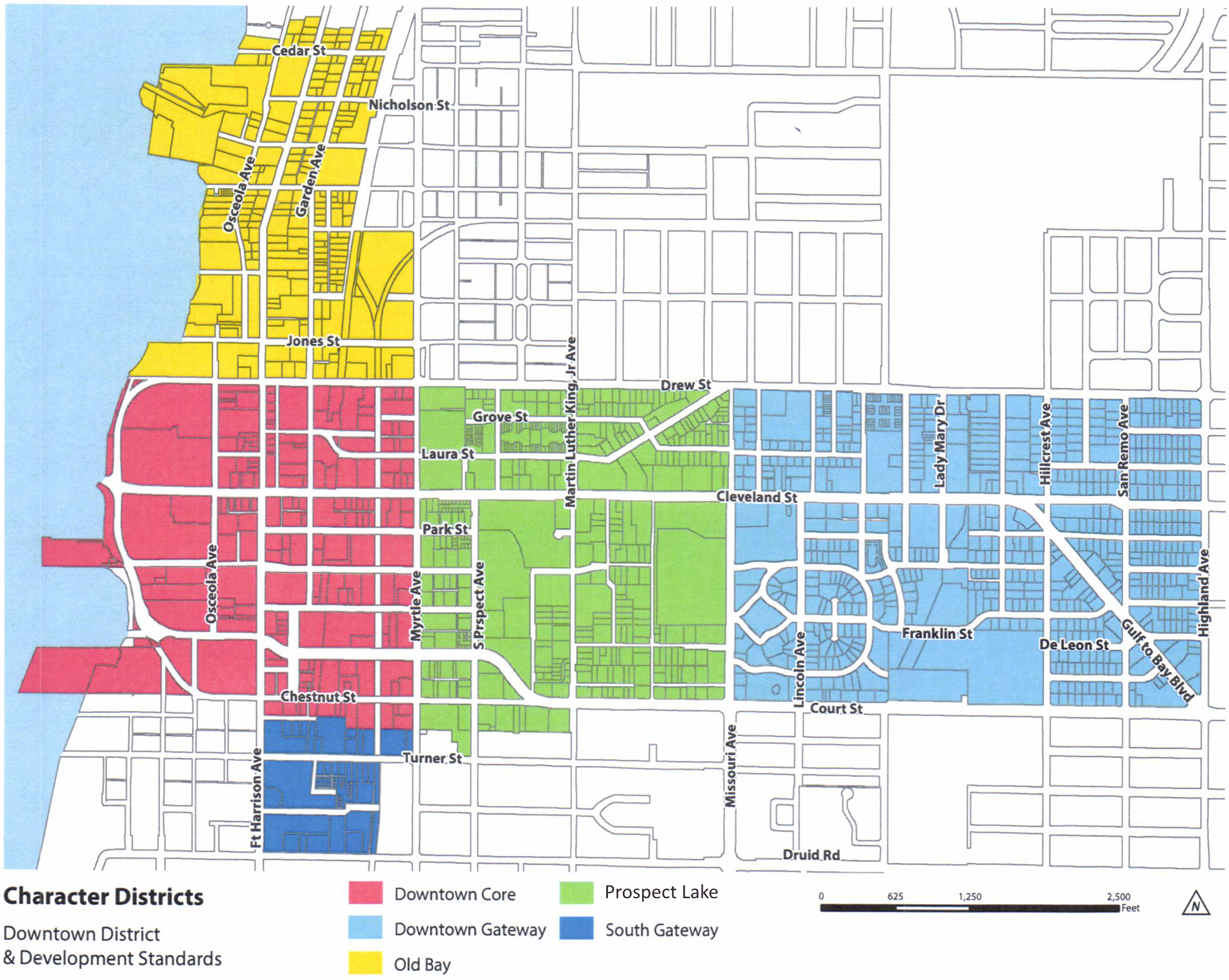
Source: City of Clearwater Planning & Development Department; Engineering Department;
Pinellas County Property Appraiser
Prepared by: City of Clearwater Planning & Development Department, May 2018
E.
Downtown Gateway Character District. The Downtown Gateway Character District is intended for moderate intensity residential and mixed-use development in buildings with street-facing entries opening onto pedestrian-friendly streetscapes. Buildings are designed with façades aligned along streets, modest setbacks, and parking primarily located behind buildings. This area is intended to create a transition between higher intensity mixed-use areas to the west in the Prospect Lake Character District and lower to medium intensity residential areas outside of Downtown to the east and northeast.
(Ord. No. 9149-18, § 8, 8-2-18; Ord. No. 9758-24, § 26, 6-6-24)
Section C-203. - Street type regulating plan.
A.
Street Types and Key Corner Locations.
Figure 2. Regulating Plan—Street Types and Key Corners establishes the applicability of development standards in Appendix C, Division 4 based on a site's location along streets and at key corner locations. As shown in Figure 2. Regulating Plan - Street Types and Key Corners, streets are assigned a street type in descending alphabetical order based upon intensity of pedestrian activity, or as determined by the Community Development Coordinator. High levels of existing and planned pedestrian activity are assigned Street Types A, B or C; streets with modest levels of existing and planned pedestrian activity are assigned Street Type D; and streets with residential uses and the least amount of existing and planned pedestrian activity are assigned Street Types E and F. For sites at locations identified as key corners, specific development standards related to ground floor uses are included in Appendix C, Division 4. The Service Street Type is applied to streets and alleys with very low levels of anticipated pedestrian activity that provide access to parking and service areas.
B.
Street Types Assignment.
1.
Along existing or proposed new streets or for properties where street types are not depicted on the Regulating Plan, an appropriate street type shall be established by the Community Development Coordinator as part of an application for development approval.
2.
If a property is landlocked, the Community Development Coordinator shall determine which street type shall be utilized for the purpose of establishing setbacks.
C.
View Corridors. The view corridor at the western terminus of Nicholson Street shall be preserved through an open space corridor the width of the Nicholson Street right-of-way. The corridor shall extend to the west to the mean high water line. Hardscaping improvements may occupy this space provided the height does not exceed the average pre-development grade of the property within the open space corridor. View corridors are shown on Figure 2. Regulating Plan—Street Types and Key Corners.
Figure 2. Regulating Plan—Street Types and Key Corners
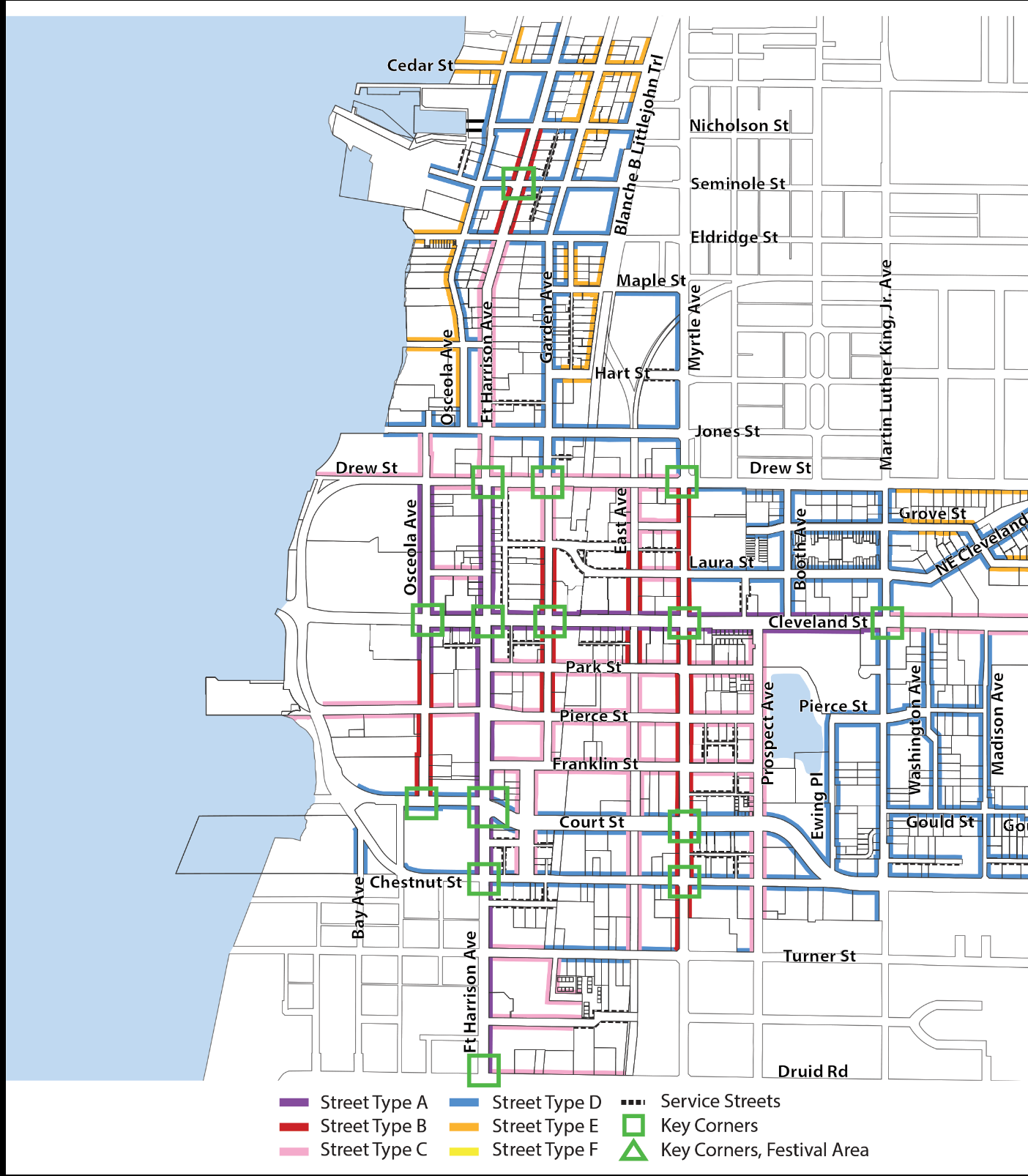
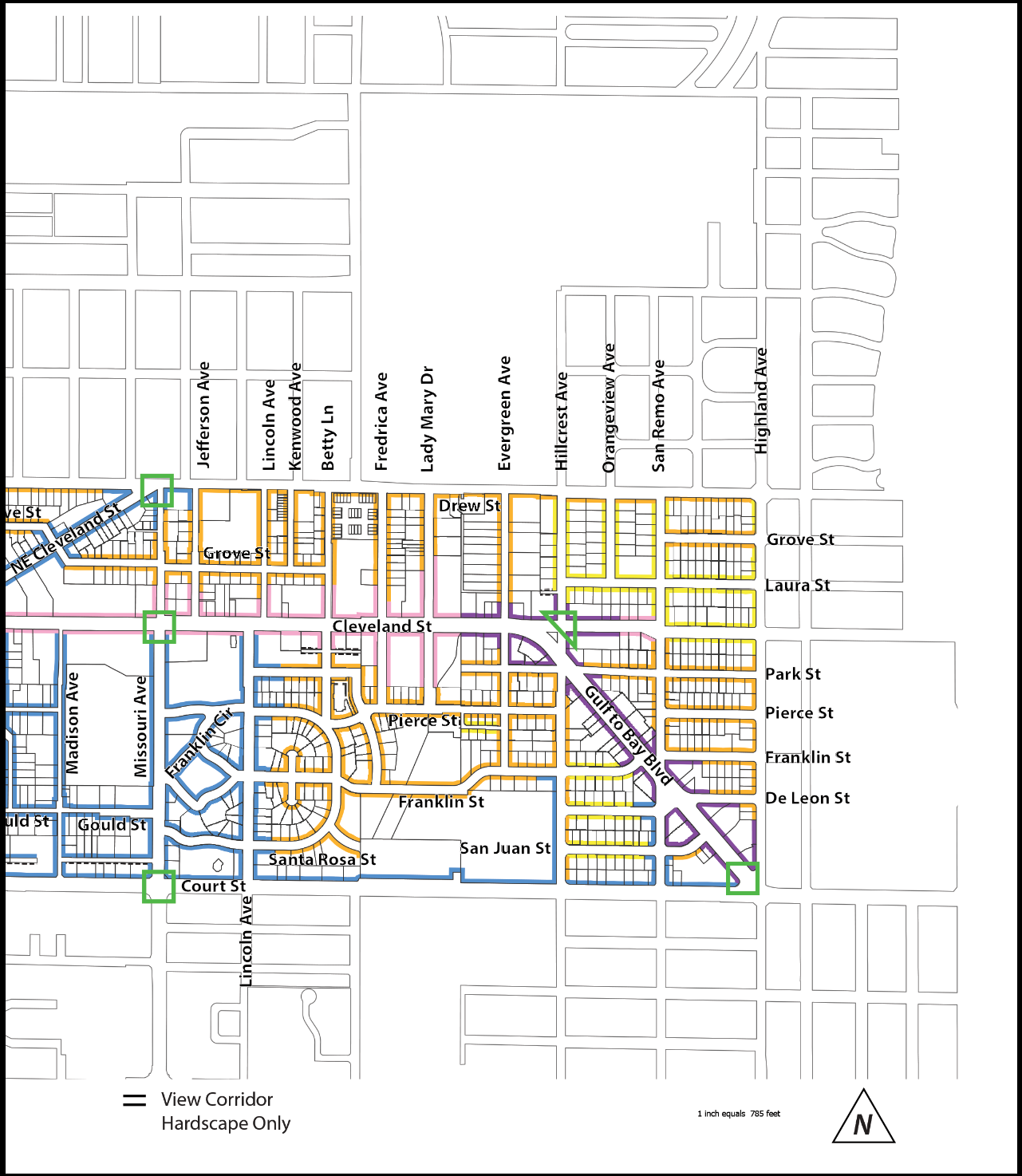
(Ord. No. 9149-18, § 8, 8-2-18; Ord. No. 9643-23, § 27, 4-4-23)
Section C-301. - Development potential.
A.
Maximum Development Potential.
1.
Development in the Downtown District shall be consistent with the development potential set forth by location in the Clearwater Downtown Redevelopment Plan. Properties within the Downtown District shall have a future land use of Central Business District (CBD), which is consistent with the Activity Center (AC) Countywide Plan Map category and the Special Center subcategory in the Countywide Plan for Pinellas County. The maximum development potential set forth for each established character district is shown on Figures 3 through 7. Residential uses and overnight accommodation uses are regulated by density, or units per acre, while nonresidential uses are regulated by intensity, or floor area ratio (FAR). The development potential for mixed-use projects shall be determined consistent with Section 3-902.
2.
The Public Amenities Incentive Pool and the Pool allocation process are established in the Clearwater Downtown Redevelopment Plan. The Pool allows for density and/or intensity increases in excess of the allowable maximum development potential established for a parcel for projects that meet the goals, objectives, and policies of the Redevelopment Plan and are consistent with the vision established for the character district in which the projects are located. There are two approval processes available for projects requesting an allocation of units or intensity from the Pool, established herein.
a.
Pursuant to Sections 4-201 and C-901, a pre-application conference shall be required for projects in the Downtown District. This meeting should also be used to vet any request for development potential from the Public Amenities Incentive Pool, the public amenities to be proposed, as well as any requested height bonus.
b.
Tier 1 - Streamlined Allocation Process: The Community Development Coordinator may approve allocations of density and/or intensity from the Public Amenities Incentive Pool for certain projects in the Downtown District as part of a Level One (Flexible Standard Development) approval, consistent with the following:
1.
Projects must meet the specific criteria listed in Table 1. Tier 1 Public Amenities Incentive Pool Criteria.
2.
Pursuant to Section 3-902, vertical mixed-use projects are permitted to utilize the full allocation of residential density and nonresidential intensity.
For example, a vertical mixed-use project on a 1.0-acre parcel in the Downtown Core that includes rental residential units and Class A office space, consistent with Table 1, could achieve a total density of 105 dwelling units per acre and a 5.0 FAR, as illustrated below.
c.
Tier 2 - Public Hearing Allocation Process: The Community Development Board may approve allocations of density and/or intensity from the Pool for projects as part of a Level Two (Flexible Standard Development) approval, including projects that do not qualify for the Tier 1 - Streamlined Allocation Process, consistent with the following:
1.
Projects must incorporate one or more improvements and/or payment of fees in-lieu of certain improvements, consistent with the eligible amenities listed in the Clearwater Downtown Redevelopment Plan.
2.
Pursuant to Section 3-902, vertical mixed-use projects are permitted to utilize the full allocation of residential density and nonresidential intensity.
d.
Projects requesting dwelling units and/or floor area through a Tier 1 or Tier 2 allocation process that are located on properties not identified as transitional properties on Figure 8. Maximum Height & Height Transitions may request an increase in height consistent with the following:
1.
The determination about the height bonus will be based on the extent of the major amenities provided, project design, and compatibility with surrounding properties. There shall be a reasonable relationship between the extent of the allocation requested and increases in height.
2.
Increased height shall not exceed 20 percent of the maximum permitted height or a minimum height of 10 feet.
e.
Where a project is approved to utilize a payment in-lieu of a public amenity, payment shall be made prior to issuance of any building permit to construct building foundation(s) or vertical improvements based on the total construction cost.
f.
Development potential obtained through this allocation process shall not be transferred to any other site under any circumstances.
3.
Residential density on parcels proposed for development within the Downtown Gateway Character District which have frontage along Street Type F shall be limited to no more than two dwelling units on local streets, including one duplex or a detached dwelling with carriage house only, or three dwelling units on collector streets, including one duplex and one carriage house.
B.
Residential Density in Coastal Storm Area. Where residential density was increased in 2018, residential density on those portions of property located within the coastal storm area (CSA) shall be limited to the density in place prior to the adoption of the Clearwater Downtown Redevelopment Plan (adopted March 2, 2018) consistent with Figure 7. Residential Density in the Coastal Storm Area. However, if development is located entirely outside of those portions of property located within the CSA, this provision shall not apply.
(Ord. No. 9149-18, § 8, 8-2-18; Ord. No. 9664-23, § 1, 5-4-23; Ord. No. 9726-23, § 1, 12-19-23)
Section C-302. - Building height.
A.
Maximum Building Heights. The maximum building height for each character district is shown on Figure 8. Maximum Height & Height Transitions.
B.
Height Transitions & Step Backs.
1.
Buildings greater than 75 feet in height shall provide at least a 15-foot minimum facade step back from the lower floor façade at or between floors 3 through 6 along their frontage or along their primary street frontage if site has multiple street frontages. Buildings greater than 150 feet in height shall have an additional 15-foot minimum façade step back at or between floors 12 through 15 along their frontage or along their primary street frontage if site has multiple street frontages.
2.
Those properties within the Downtown District for which the permissible maximum height would be greater than 10 feet higher than the permissible maximum height on an abutting parcel (see height transitions identified on Figure 8. Maximum Height & Height Transitions) shall have at least a 15-foot minimum façade step back from the lower floor façade between the 3rd and 6th floor along the property line(s) which abut the boundary and/or a property with a lesser permissible height.
3.
To avoid a monotonous streetscape, a building shall not replicate the step back configuration of the adjacent buildings including those directly across rights-of-way.
4.
In addition to the step back requirements above, buildings, or portions of buildings located on properties that are two acres or larger in size and located west of North Osceola Avenue and north of Seminole Street, but not fronting on Cedar Street, and are greater than 30 feet in height shall not be closer than 30 feet to any property.
Figure 3. Maximum Intensity—FAR
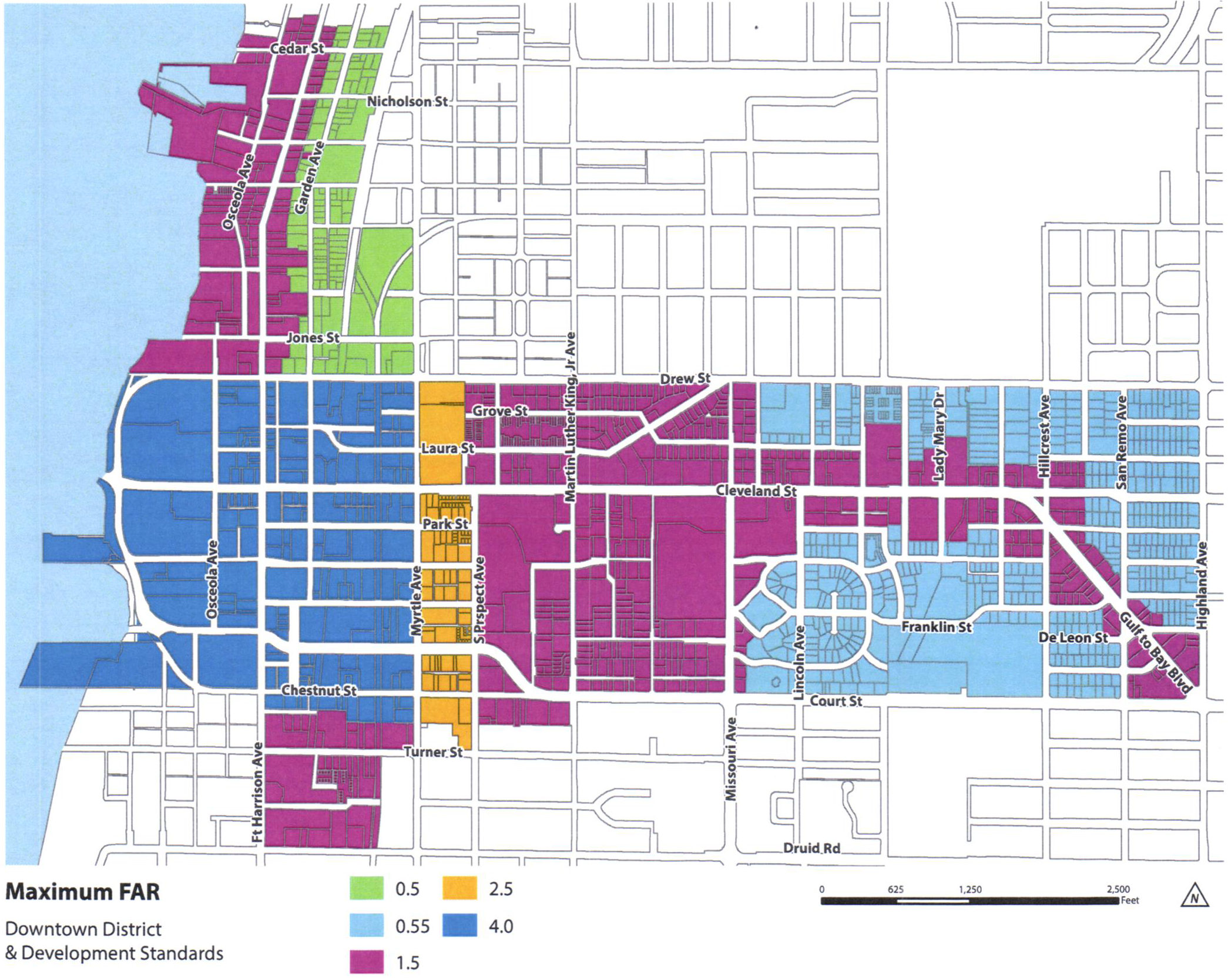
Figure 4. Maximum Residential Density
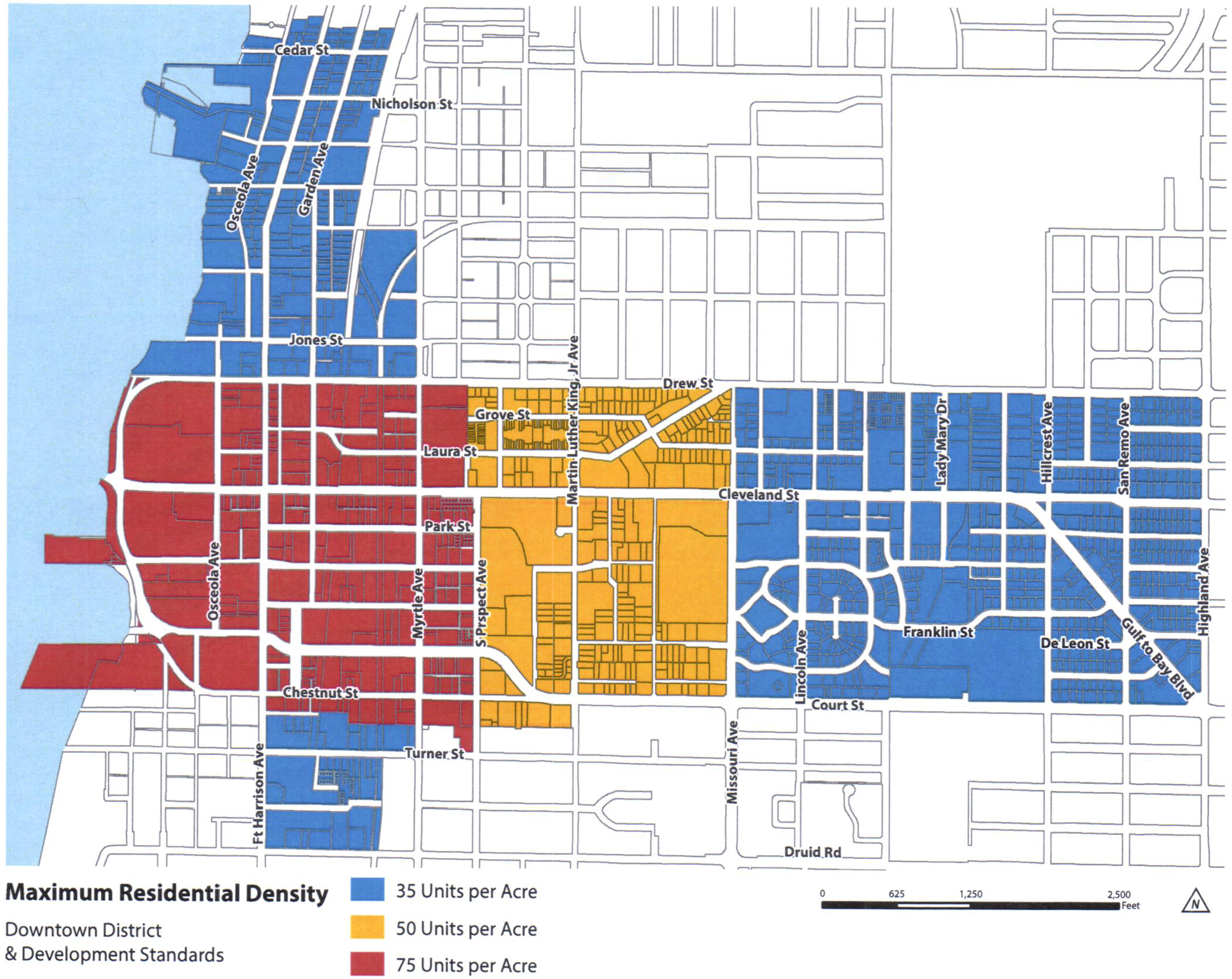
Figure 5. Maximum Hotel Density
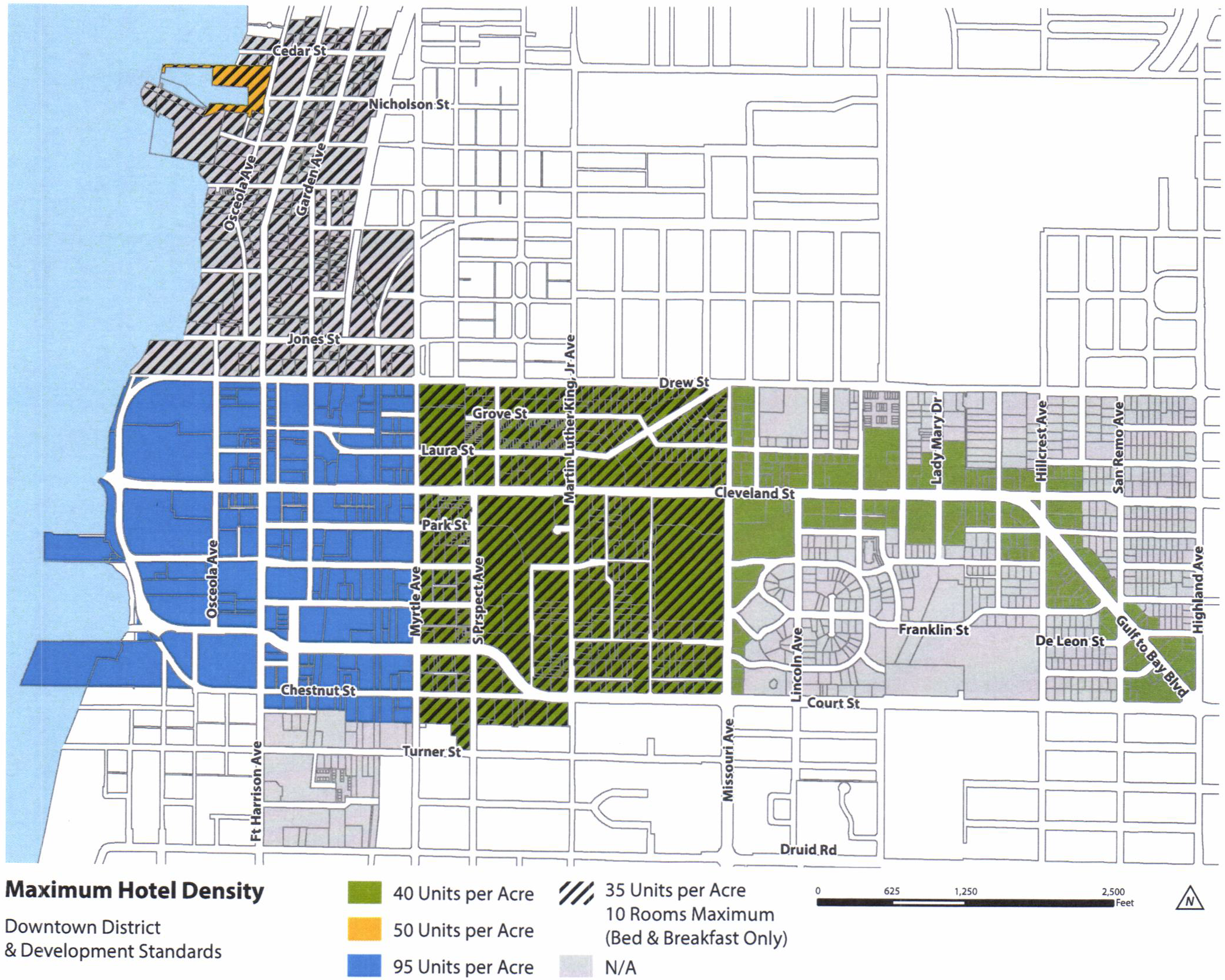
Figure 6. Maximum Mixed-Use Density
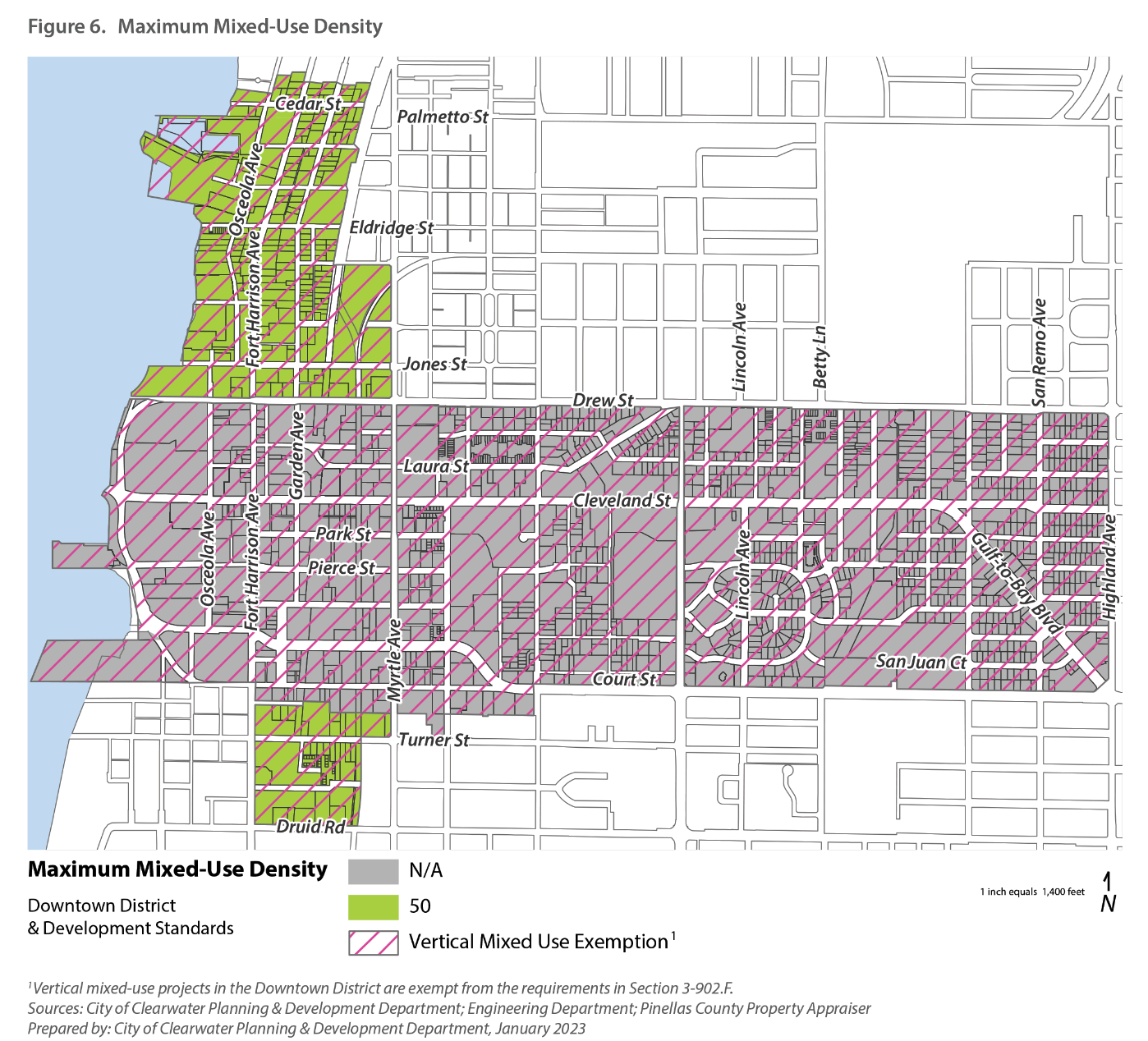
Figure 7. Residential Density in the Coastal Storm Area
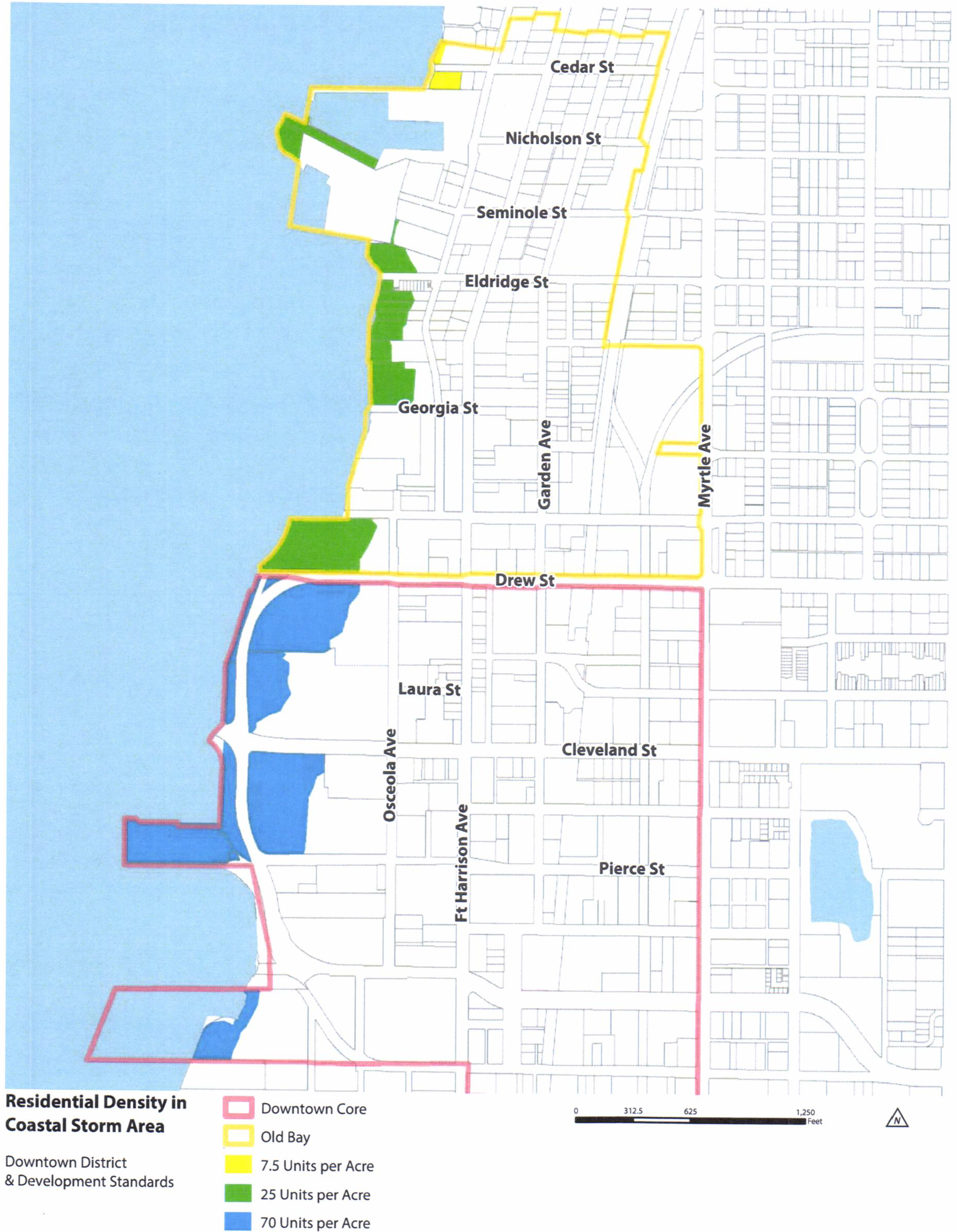
Figure 8. Maximum Height & Height Transitions
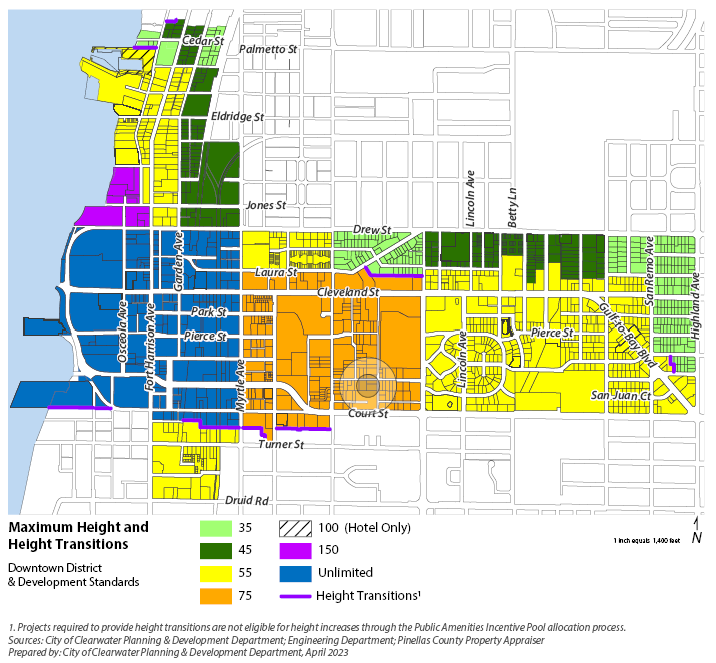
(Ord. No. 9149-18, § 8, 8-2-18; Ord. No. 9643-23, § 28, 4-4-23; Ord. No. 9664-23, § 2, 5-4-23)
Section C-303. - Permitted uses and parking.
A.
Use and Off-Street Parking Table. Permitted uses and approval levels by character district, along with off-street parking requirements, are listed in Table 2. Use and Off-Street Parking.
B.
Residential and Overnight Accommodation (bed and breakfast) use restrictions. Only residential and overnight accommodations (bed and breakfast) uses, where permitted, are allowed in the Urban Residential 2, Neighborhood Infill, and Neighborhood Conservation Frontages as defined in Appendix C, Division 4 except as provided for in Division 8. Flexibility.
C.
Bicycle Parking.
1.
Long-term bicycle parking requirements for new development, additions, and expansions are listed in Table 3. Long-Term Bicycle Parking
2.
Where provided, short-term bicycle parking areas shall be in highly visible locations along pedestrian walkways and near building entries.
3.
All short-term and long-term bicycle parking provided shall comply with the bicycle parking standards in Section 3-1411 of this Development Code.
(Ord. No. 9149-18, § 8, 8-2-18; Ord. No. 9643-23, § 28, 4-4-23; Ord. No. 9664-23, § 2, 5-4-23; Ord. No. 9712-23, § 8, 11-2-23; Ord. No. 9740-24, § 8, 2-1-24; Ord. No. 9758-24, § 27, 6-6-24)
Sec. C-401. - Relationship between street types and frontage standards and hierarchy of street types.
Street Frontage Types are described in Section C-403. Table 4. Frontages and Street Types shows which development standards in this division apply by the street types shown in Figure 2. Regulating Plan - Street Types and Key Corners. Multiple frontages can apply to a single project along a street type. Street types are organized by intensity of planned pedestrian activity with Street Type A being the highest level and Street Type F and Service Streets being the lowest level of planned pedestrian activity.
(Ord. No. 9149-18, § 8, 8-2-18; Ord. No. 9643-23, § 29, 4-4-23; Ord. No. 9664-23, § 2, 5-4-23)
Section C-402. - Properties with multiple street frontages.
A.
Definition of Primary and Secondary Street Frontages.
1.
A primary street frontage shall be established for project sites with multiple street frontages.
2.
The primary street frontage shall be defined as the street frontage with the highest level of designated street type or the highest level of existing and planned pedestrian activity as defined in the Clearwater Downtown Redevelopment Plan and consistent with Section C-203.A.
3.
All other street frontages shall be secondary street frontages. As provided in Division 8. Flexibility, a limited amount of flexibility in meeting requirements for frontages defined as secondary street frontages may be approved.
B.
Assignment of Street Frontages.
1.
For sites where the street type is the same on all frontages, the primary street frontage shall be assigned the frontage to which the majority of buildings on adjacent sites are oriented and addressed.
2.
In locations where the orientation of buildings on adjacent sites is unclear, the primary street frontage shall be determined by the Community Development Coordinator consistent with the vision of the area pursuant to the Clearwater Downtown Redevelopment Plan.
3.
Primary street frontage requirements may be applied for up to 50 percent of the linear street frontage of the secondary street frontage to wrap around the corner of a building that is located at the intersection of two different street types. The balance of the secondary street frontage shall revert to the standards of the applicable street type.
C.
Application of Setbacks
1.
Double-Frontage Lots. For project sites with frontage on two parallel streets, the side setbacks applicable to the primary street frontage shall apply.
2.
Corner Lots. Front setbacks shall be applicable to the street frontages of corner lots, and side setbacks shall apply to non-street frontages.
3.
Multi-Frontage Lots. Front setbacks shall be applicable to all street frontages on multi-frontage lots, and side setbacks shall apply to all non-street frontages.
(Ord. No. 9149-18, § 8, 8-2-18; Ord. No. 9643-23, § 29, 4-4-23)
Section C-403. - Key corner requirements.
For locations identified as Key Corners on Figure 2. Regulating Plan—Street Types and Key Corners, ground floor building space within 100 feet of the corner and to a depth of 20 feet minimum from the front façade (as measured along front property lines) shall be occupied only by active uses including retail sales and services, restaurants, bars, brewpubs, microbreweries, nightclubs, and/or lobbies to upper story building space. For buildings occupied only by residential uses, ground floor amenity areas such as offices, lobbies, or fitness centers shall count toward meeting this requirement only if the ground floor façade meets the requirements applicable to Storefront 1 or Storefront 2 frontages. Ground floor building space designed for open air dining or cafe use may count towards this requirement. Flexibility in meeting façade transparency requirements in these locations shall not be permitted. Key corner requirements shall not apply to publicly owned park and plaza space.
* Except as provided for in Division 8, Flexibility.
(Ord. No. 9149-18, § 8, 8-2-18; Ord. No. 9664-23, § 3, 5-4-23)
Section C-404. - Storefront 1 frontage.
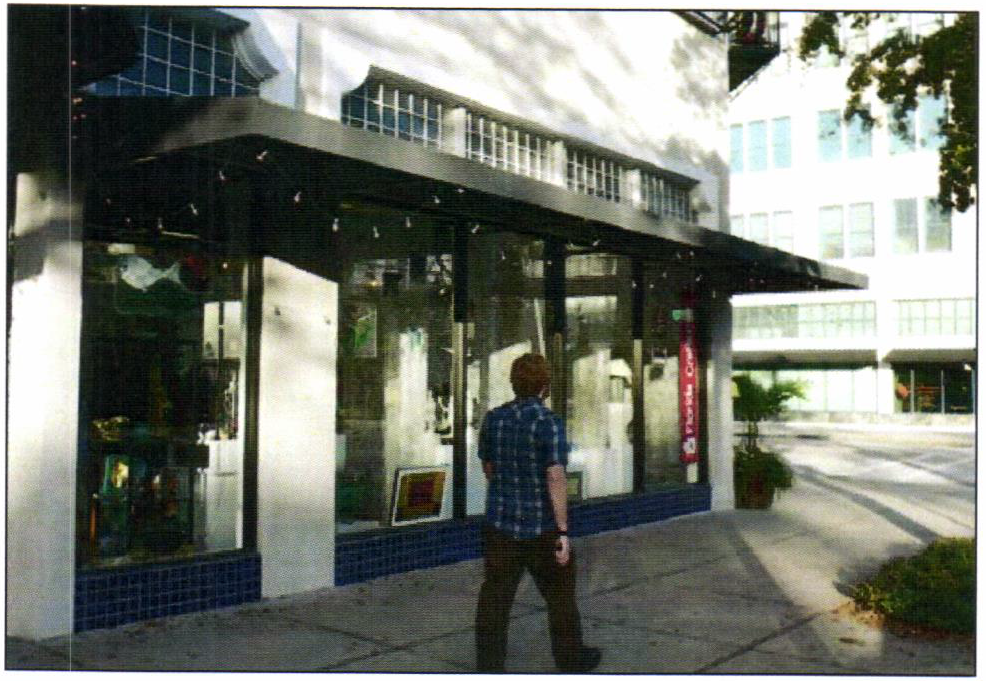 |
| Figure 9. Storefront 1 Example |
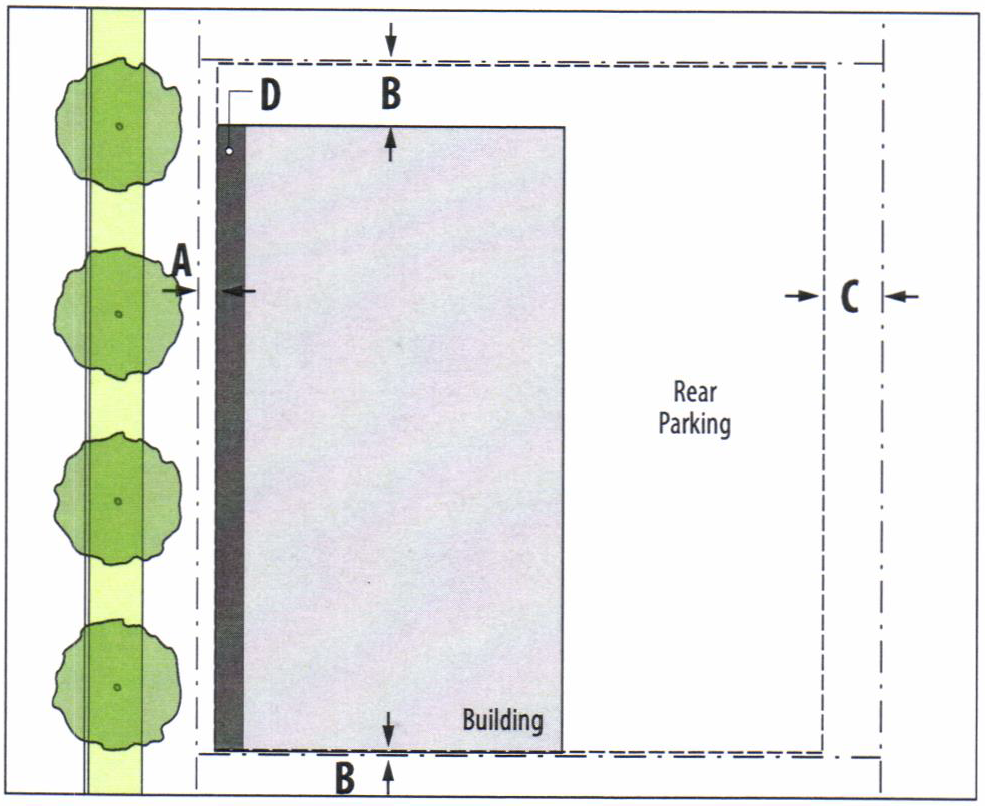 |
| Figure 10. Storefront 1 Building Placement |
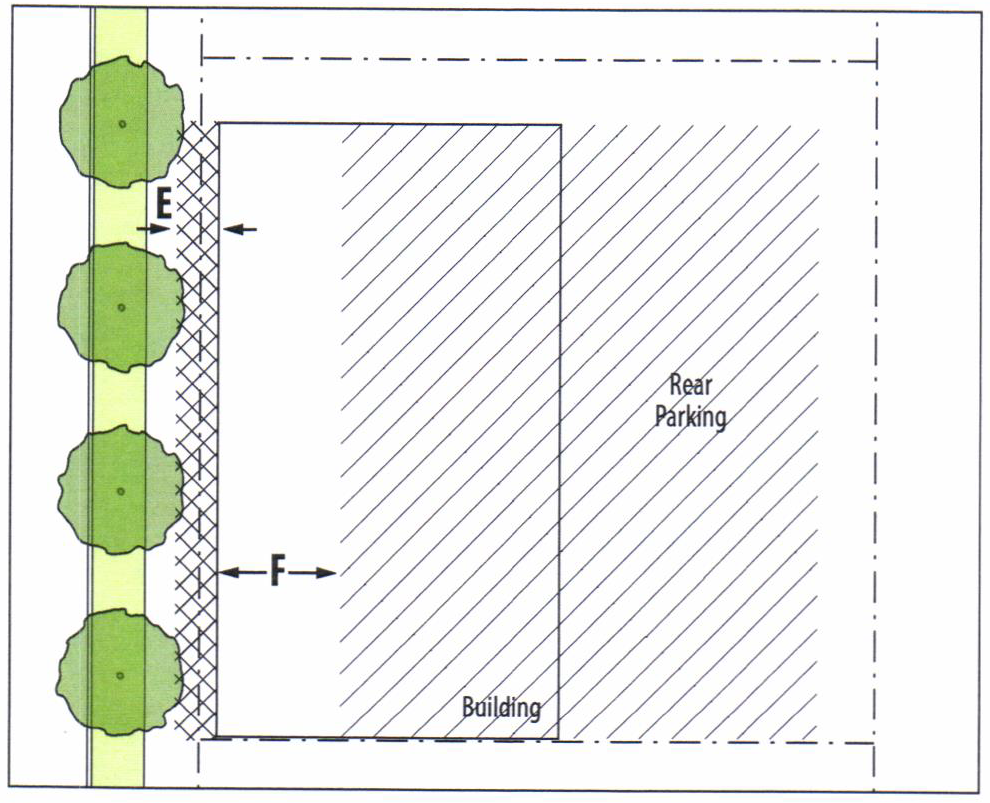 |
| Figure 11. Storefront 1 Parking & Projections |
A.
General. The Storefront 1 Frontage Standards are intended for application along Street Types A, B, and C which are identified as appropriate for high levels of existing or planned pedestrian activity and active ground floor uses. Development standards for this type of frontage require buildings aligned along adjacent streets, front building façades and building entries oriented to public sidewalks with traditional storefront design treatments with large, transparent display windows, building entries at sidewalk grade, awnings or canopies, minimal front setbacks, and parking to the rear of occupied building space.
(In the sections below, the bold lettering in parentheses refers to the annotations in Figures 10 and 11.)
B.
Building Setbacks
1.
Buildings shall be placed along street frontages consistent with the following building setbacks from property lines:
a.
Front Setbacks (A): 0 feet minimum, 3 feet maximum.
b.
Side Setbacks (B): 0 feet maximum, or as required by applicable building and fire codes.
c.
Rear Setbacks (C): 10 feet minimum.
2.
Front building setbacks on Fort Harrison Avenue, Cleveland Street, and Osceola Avenue shall be increased to the extent required to allow for the creation of sidewalks widths consistent with the Master Streetscape Plan within the Clearwater Downtown Redevelopment Plan.
3.
To promote continuity of frontages along front setbacks, the space between buildings on the same or adjacent sites shall be 20 feet maximum and may be occupied by a mid-block pedestrian passageway open for public use during regular business hours. Where such space is provided with no pedestrian passageway, a 6-foot minimum, 8-foot maximum high brick or other masonry wall, wall with masonry columns linked by substantial grill work, or wall designed to match the architectural design of the building shall be constructed in line with the front building façade.
C.
Front Setback Improvements. Where front setbacks are provided, the area within the setback shall be improved as a hardscape extension of the public streetscape with no change in elevation from adjacent sidewalks, no landscape areas, and no permanent physical obstructions such as a curbing, railing, or fencing. Movable furnishings, including tables, seats, and landscape planters, are permitted.
D.
Ground Floor Façades and Entries.
1.
Building façades along street frontages shall meet building design standards in Appendix C, Division 6.
2.
Ground floor front building façades shall meet the following standards (D):
a.
Building façades shall be located along front setbacks and aligned generally parallel to the primary street frontage property line.
b.
A minimum of 60 percent of the area of the ground floor façade between 2 and 10 feet in height above adjacent ground level shall be comprised of transparent windows or doors. Glass utilized to provide this transparency shall have visible light transmittance to the maximum allowed by the Energy Code, shall not have reflective or mirrored coating or other treatments including but not limited to dark tinting, colored or opaque films, boards or paint. Transom windows are encouraged above storefront display windows. Residential window types, with closely spaced mullions and recessed punched windows, are not allowed for storefront frontages. The bottom of storefront windows shall be no more than 2 feet above the adjacent ground level.
c.
Primary entries to individual ground floor tenant spaces and entries to shared lobbies for upper story spaces shall be located along the front façade and may be recessed 18 inches maximum.
d.
For sites with multiple frontages, there shall be at least one entry to individual ground floor tenant spaces or entries to shared lobbies on each street frontage unless provided on the corner of the primary street frontage and secondary street frontage.
e.
Thresholds at front building entries and the ground floor finished floor elevation shall match the elevation of the abutting public sidewalk or publicly accessible plaza.
f.
The ground floor floor-to-structural-ceiling height shall be 14 feet minimum and ground floor building space shall be designed to meet Florida Building Code requirements for commercial uses.
3.
Awnings, canopies, or other forms of weather protection shall be required along at least 80 percent of the front façade and shall meet the standards in Appendix C, Division 6 (E).
E.
Parking.
1.
In addition to the following standards, parking location, design and access shall meet the standards in Appendix C, Division 5.
2.
Parking shall be located to the rear of the property away from the primary street frontage and corner locations. Parking to the side of buildings is prohibited.
3.
Parking, vehicular loading/unloading areas, and passenger drop off areas are prohibited in front setbacks.
4.
Parking and vehicular circulation areas incorporated in the ground floor of a building along street frontages shall be located behind fully-enclosed, occupied building space with a depth of 20 feet minimum (F).
5.
Surface and structured parking shall comply with side and rear building setbacks. Side and/or rear setbacks shall not apply between surface parking areas on abutting properties which provide for shared access and use.
6.
With approval from appropriate City, County or State authorities, parallel parking may be constructed within the right-of-way along streets abutting the property.
(Ord. No. 9149-18, § 8, 8-2-18; Ord. No. 9643-23, § 29, 4-4-23)
Section C-405. - Storefront 2 frontage.
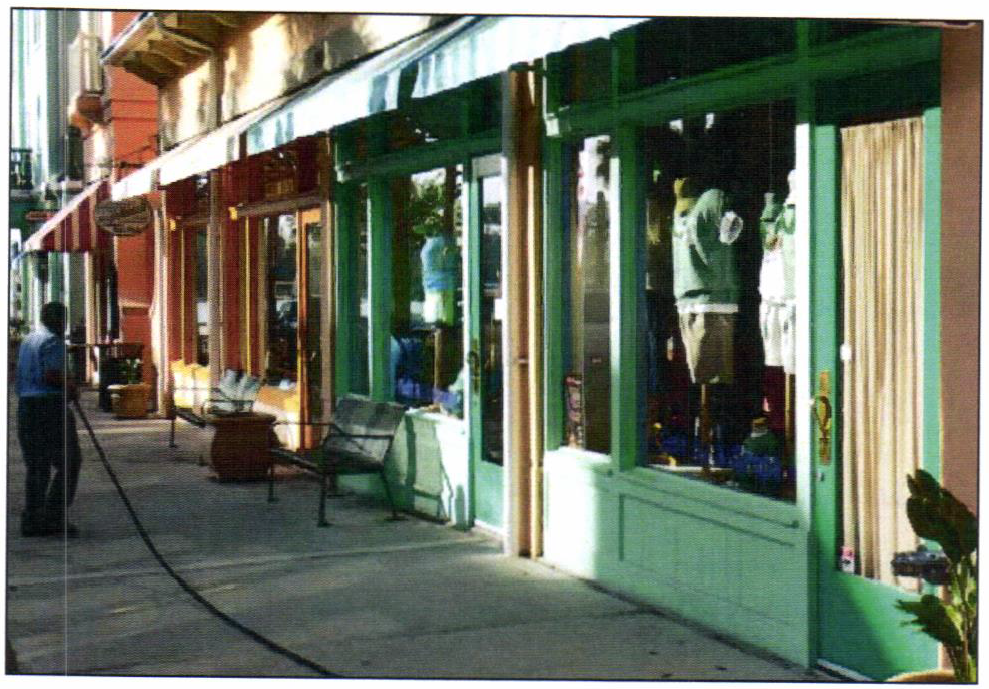 |
| Figure 12. Storefront 2 Example |
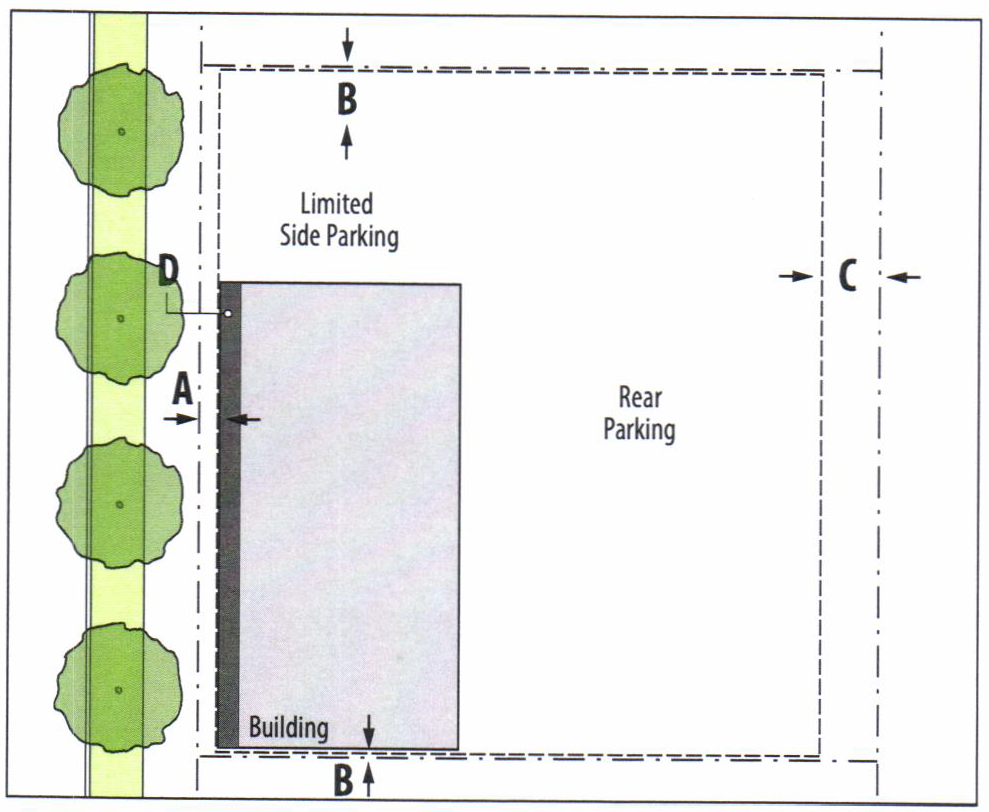 |
| Figure 13. Storefront 2 Building Placement |
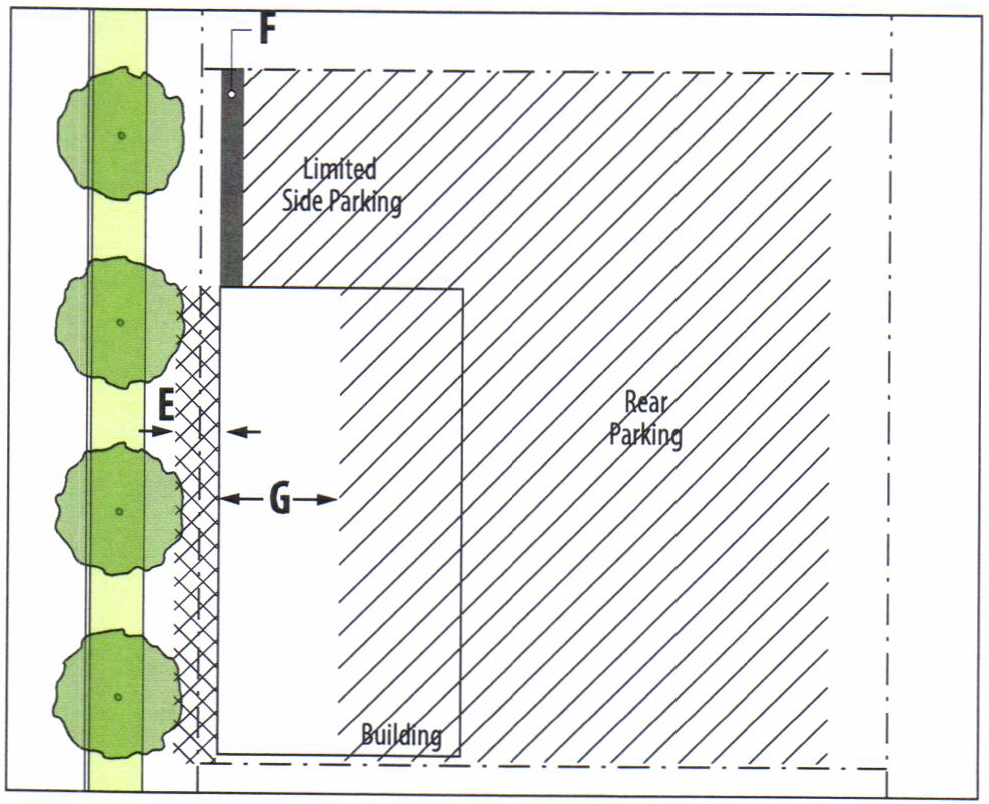 |
| Figure 14. Storefront 2 Parking & Projections |
A.
General. The Storefront 2 Frontage Standards are intended for application along Street Type C which is identified as appropriate for moderate levels of existing or planned pedestrian activity. Development standards for this frontage require buildings aligned along adjacent streets, front building façades and building entries oriented to public sidewalks with traditional storefront design treatments with large, transparent display windows, building entries at sidewalk grade, awnings or canopies, minimal front setbacks, and parking to the side and rear of occupied building space.
(In the sections below, the bold lettering in parentheses refers to the annotations in Figures 13 and 14.)
B.
Building Setbacks.
1.
Buildings shall be placed along street frontages consistent with the following building setbacks from property lines:
a.
Front Setbacks (A): 0 feet minimum, 3 feet maximum.
b.
Side Setbacks (B): 0 feet maximum, or as required by applicable building and fire codes.
c.
Rear Setbacks (C): 10 feet minimum.
2.
Front building setbacks on Fort Harrison Avenue, Cleveland Street, and Osceola Avenue shall be increased to the extent required to allow for the creation of sidewalks widths consistent with the Master Streetscape Plan within the Clearwater Downtown Redevelopment Plan.
3.
To promote the continuity of frontages along front setbacks, the space between buildings on the same or adjacent sites, or between building wings for "U"-shaped buildings, shall be 80 feet maximum.
C.
Front Setback Improvements.
1.
Where front setbacks are provided, the area within the setback shall be improved primarily as a hardscape extension of the public streetscape with no change in elevation from adjacent sidewalks.
2.
Landscape areas may account for 35 percent maximum of the front setback area. Such landscaping shall comply with landscape requirements in Section 3-1202.
3.
Low curbing up to 6 inches in height may be used to define the edge of landscape areas but no permanent physical obstructions such as walls, railing, or fencing are permitted.
D.
Ground Floor Façades and Entries.
1.
Building façades along street frontages shall meet building design standards in Appendix C, Division 6.
2.
Ground floor front building façades shall meet the following standards (D):
a.
Building facades shall be located along front setbacks and aligned generally parallel to the primary street frontage property line.
b.
A minimum of 50 percent of the area of the ground floor facade between 2 and 10 feet in height above adjacent ground level shall be comprised of transparent windows or doors. Glass utilized to provide this shall have visible light transmittance to the maximum allowed by the Energy Code, shall not have reflective or mirrored coating or other treatments including but not limited to dark tinting, colored or opaque films, boards or paint. Transom windows are encouraged above storefront display windows. Residential window types, with closely spaced mullions and recessed punched windows, are not allowed for storefront frontages. The bottom of storefront windows shall be no more than 2 feet above the adjacent ground level.
c.
Primary entries to individual ground floor tenant spaces and entries to shared lobbies for upper story spaces shall be located along the front façade and may be recessed 18 inches maximum.
d.
Thresholds at front building entries and the ground floor finished floor elevation shall match the elevation of the abutting public sidewalk or publicly accessible plaza.
e.
The ground floor floor-to-structural-ceiling height shall be 14 feet minimum and ground floor building space shall be designed to meet Florida Building Code requirements for commercial uses.
3.
Awnings, canopies, or other forms of weather protection shall be required along at least 80 percent of the front façade and shall meet the standards in Appendix C, Division 6 (E).
E.
Parking.
1.
In addition to the following standards, parking location, design and access shall meet standards in Appendix C, Division 5.
2.
Parking, vehicular loading/unloading areas, and passenger drop off areas are prohibited in front setbacks.
3.
Surface parking located to the side of buildings along streets shall be no greater than 1 bay in width or 60 feet maximum as measured along the street frontage and shall be set back 5 feet behind front building façades and screened from public sidewalks by an opaque hedge or wall 24 to 36 inches in height (F). Where provided, side surface parking shall be located along a single building side.
4.
Parking and vehicular circulation areas incorporated in the ground floor of a building along street frontages shall be located behind fully-enclosed, occupied building space with a depth of 20 feet minimum (G).
5.
Surface and structured parking shall comply with side and rear building setbacks. Side and/or rear setbacks shall not apply between surface parking areas on abutting properties which provide for shared access and use.
6.
With approval from appropriate City, County or State authorities, parallel parking may be constructed within the right-of-way along streets abutting the property.
(Ord. No. 9149-18, § 8, 8-2-18; Ord. No. 9643-23, § 29, 4-4-23; Ord. No. 9712-23, § 9, 11-2-23; Ord. No. 9740-24, § 9, 2-1-24)
Section C-406. - Workshop/flex frontage.
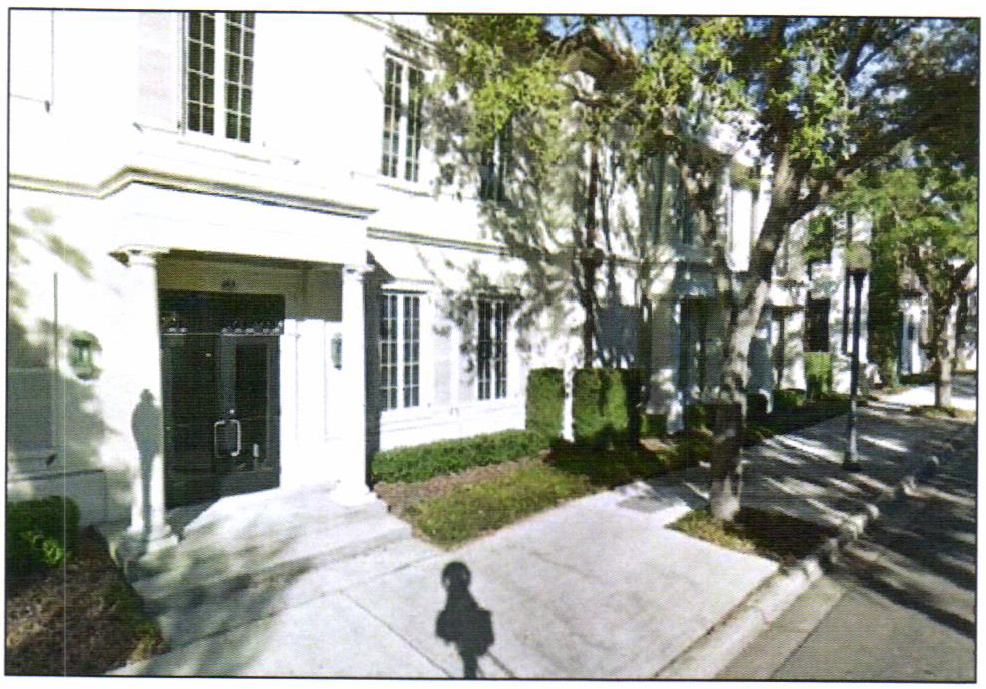 |
| Figure 15. Workshop/Flex Example |
 |
| Figure 16. Workshop/Flex Building Placement |
 |
| Figure 17. Workshop/Flex Parking & Projections |
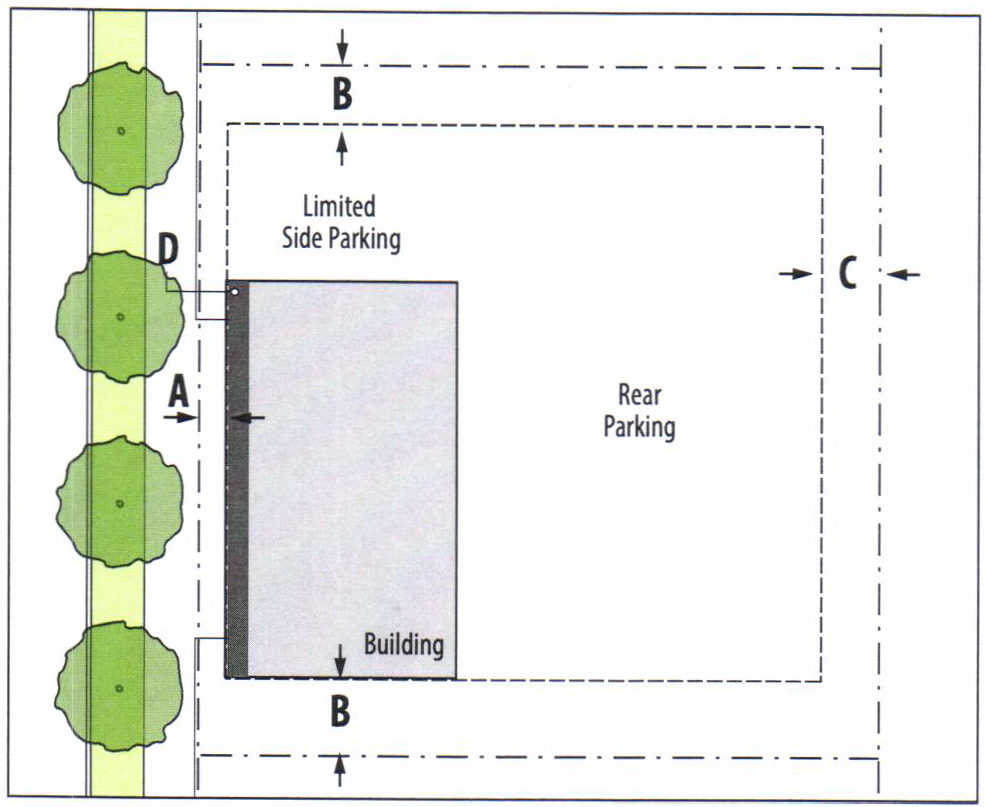
A.
General. The Workshop/Flex Frontage Standards are intended for application along Street Type D which is identified as appropriate for a mix of land uses and building types. Development standards for this frontage require buildings aligned along adjacent streets, front building façades and building entries oriented to public sidewalks with modest front setbacks and façade transparency, and parking to the rear or side of occupied building space.
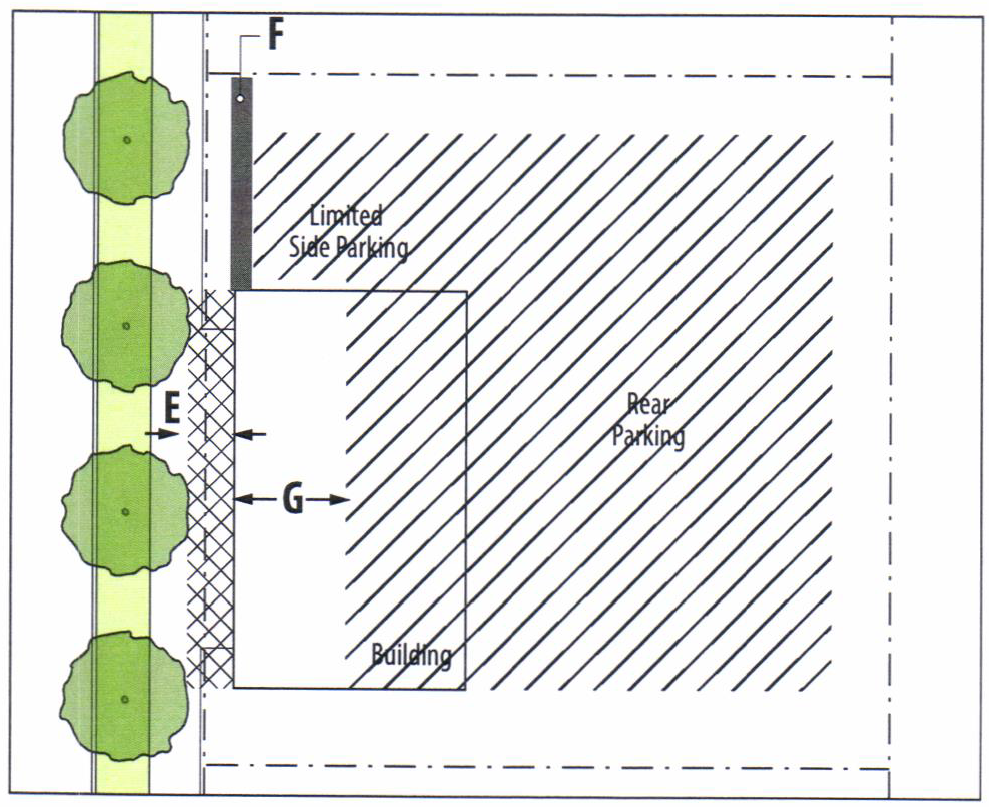
(In the sections below, the bold lettering in parentheses refers to the annotations in Figures 16 and 17.)
B.
Building Setbacks.
1.
Buildings shall be placed along street frontages consistent with the following building setbacks from property lines:
a.
Front Setbacks (A): 5 feet minimum, 10 feet maximum.
b.
Side Setbacks (B): 5 feet minimum or as required by applicable building and fire codes.
c.
Rear Setbacks (C): 10 feet minimum.
2.
Front building setbacks on Fort Harrison Avenue, Cleveland Street, and Osceola Avenue shall be increased to the extent required to allow for the creation of sidewalks widths consistent with the Master Streetscape Plan within the Clearwater Downtown Redevelopment Plan.
3.
To promote the continuity of frontages along front setbacks, the space between buildings on the same or adjacent sites, or between building wings for "U"-shaped buildings, shall be 80 feet maximum.
C.
Front Setback Improvements.
1.
The front setback area shall be improved as a landscape area with walkway connections between sidewalks and front building entries. Low curbing up to 6 inches in height may be used to define the edge of landscape areas but no permanent physical obstructions such as walls, railings, or fencing are permitted between the street and front building façade.
2.
Landscaping in the front setback area shall comply with landscape requirements in Section 3-1202.
3.
Hardscape areas improved as open air patio or café space may account for 50 percent maximum of the front setback area. Such areas may be defined by railings or low walls 36 inches maximum in height.
D.
Ground Floor Façades and Entries.
1.
Building façades along street frontages shall meet building design standards in Appendix C, Division 6.
2.
Ground floor front building façades shall be designed to meet the following standards (D):
a.
Building façades shall be located along front setbacks and aligned generally parallel to the primary street frontage property line.
b.
A minimum of 40 percent of the area of the ground floor façade between 2 and 10 feet in height above adjacent ground level shall be comprised of transparent windows or doors. Glass utilized to provide this transparency shall have visible light transmittance to the maximum allowed by the Energy Code, shall not have reflective or mirrored coating or other treatments including but not limited to dark tinting, colored or opaque films, boards or paint.
c.
Primary entries to individual ground floor tenant spaces and entries to shared lobbies for upper story spaces shall be located along the front façade and may be recessed 18 inches maximum.
d.
Thresholds at front building entries and the ground floor finished floor elevation may be elevated 18 inches maximum above the grade of the abutting public sidewalk or publicly accessible plaza.
e.
The ground floor floor-to-structural-ceiling height shall be 14 feet minimum and ground floor building space shall be designed to meet Florida Building Code requirements for commercial uses.
3.
Awnings, canopies, or other forms of weather protection shall be required at building entries and shall meet the standards in Appendix C, Division 6 (E).
E.
Parking.
1.
In addition to the following standards, parking location, design and access shall meet standards in Appendix C, Division 5.
2.
Parking, vehicular loading/unloading areas, and passenger drop off areas are prohibited in front setbacks.
3.
Surface parking located to the side of buildings along streets shall be no greater than 1 bay in width or 60 feet maximum as measured along the street frontage and shall be set back 5 feet behind front building façades and screened from public sidewalks by an opaque hedge or wall 24 to 36 inches in height (F). Where provided, side surface parking shall be located along a single building side.
4.
Surface parking and vehicular circulation areas incorporated in the ground floor of a building along street frontages shall be located behind fully-enclosed, occupied building space with a depth of 20 feet minimum (G).
5.
Surface and structured parking shall comply with side and rear building setbacks. Side and/or rear setbacks shall not apply between surface parking areas on abutting properties which provide for shared access and use.
6.
With approval from appropriate City, County or State authorities, parallel parking may be constructed within the right-of-way along streets abutting the property.
(Ord. No. 9149-18, § 8, 8-2-18; Ord. No. 9643-23, § 29, 4-4-23; Ord. No. 9664-23, § 3, 5-4-23; Ord. No. 9712-23, § 9, 11-2-23; Ord. No. 9740-24, § 9, 2-1-24)
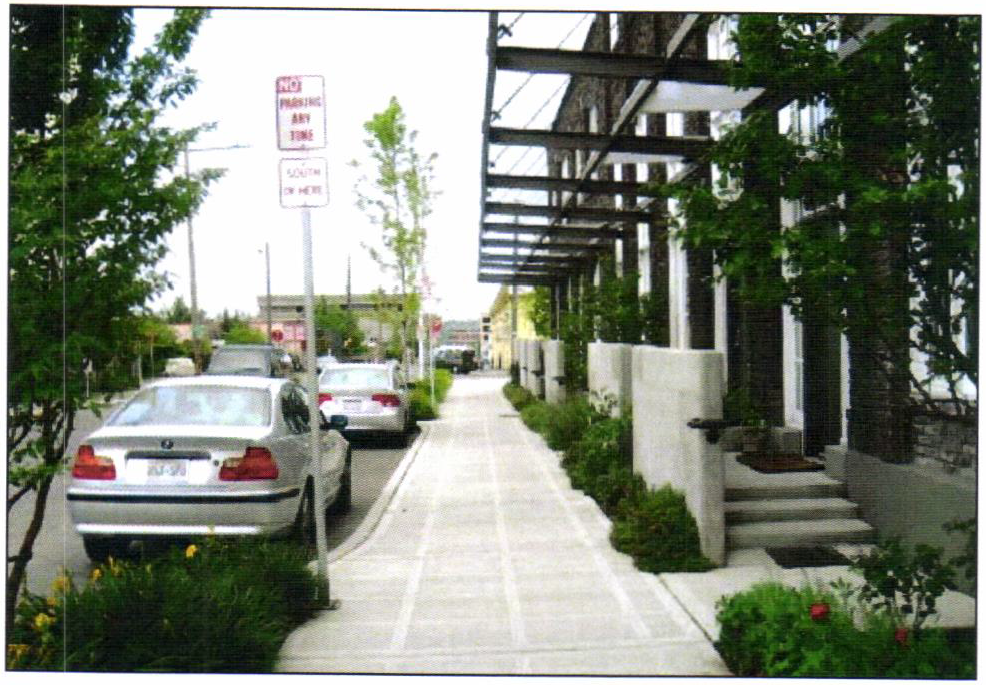
Section C-407. - Urban residential 1 frontage.
 |
| Figure 18. Urban Residential 1 Example |
 |
| Figure 19. Urban Residential 1 Building Placement |
 |
| Figure 20. Urban Residential 1 Parking & Projections |
A.
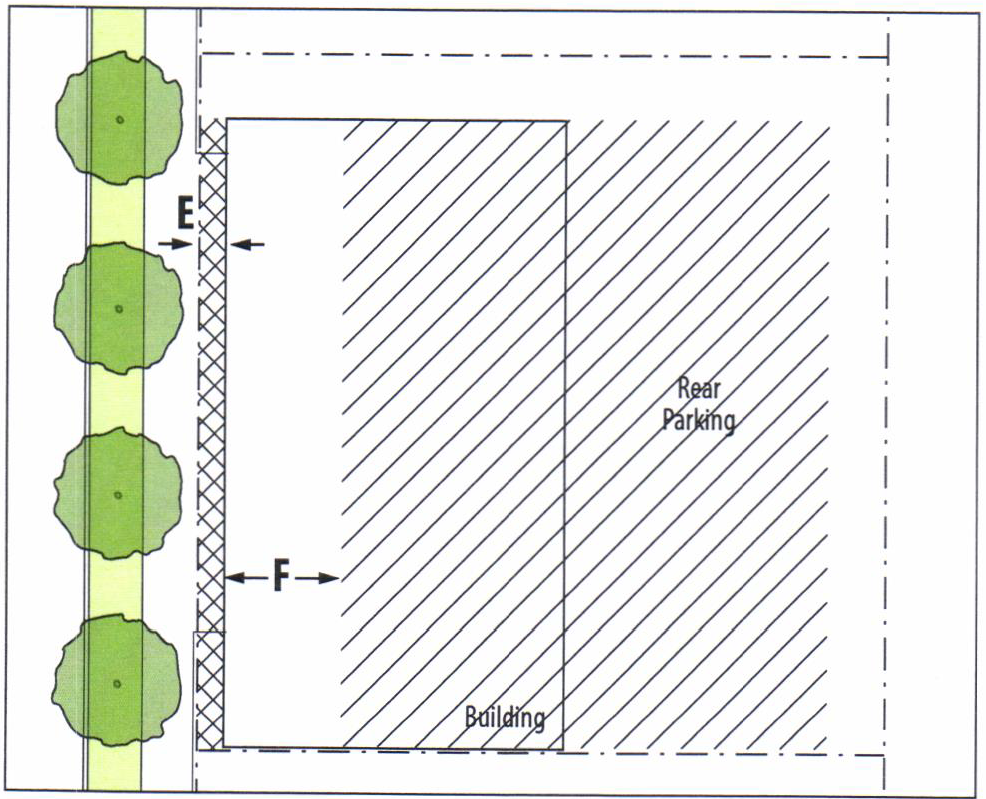
General. The Urban Residential 1 Frontage Standards are intended for application along Street Types B and C which are identified as appropriate for high levels of existing or planned pedestrian activity. Development standards for this frontage require buildings aligned along adjacent streets, oriented to public sidewalks with residential ground floor uses with minimal front setbacks, ground floors elevated above adjacent sidewalk grade, and parking to the rear of occupied building space.
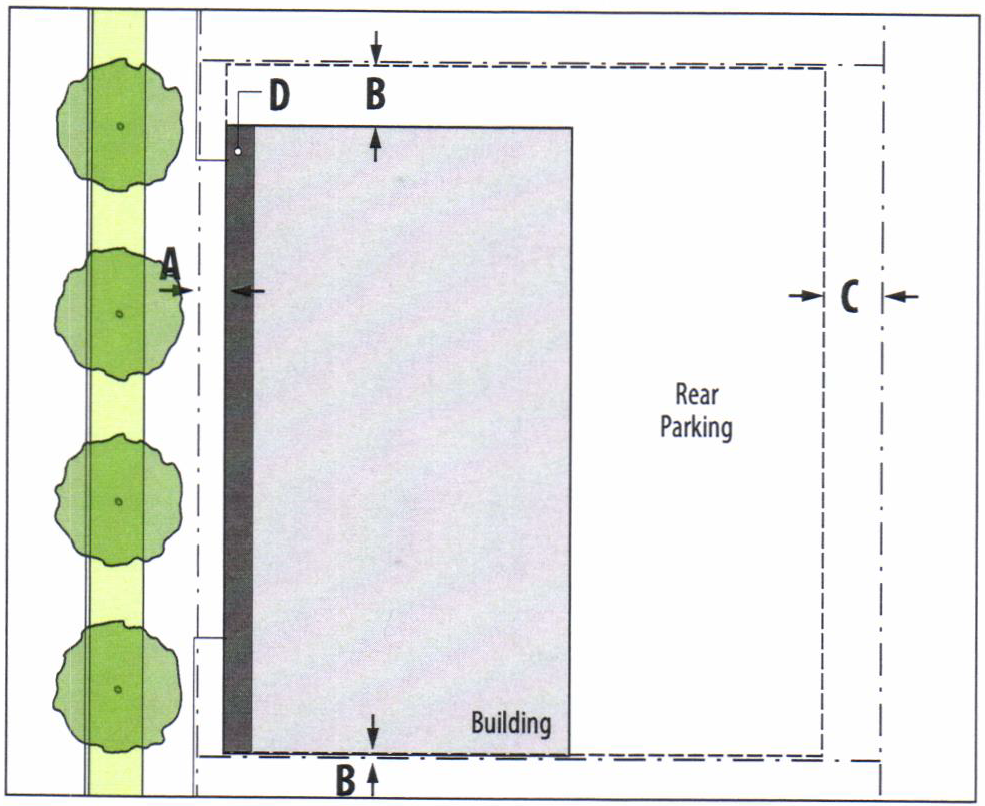
(In the sections below, the bold lettering in parentheses refers to the annotations in Figures 19 and 20.)
B.
Building Setbacks.
1.
Buildings shall be placed along street frontages consistent with the following building setbacks from property lines:
a.
Front Setbacks (A): 3 feet minimum, 5 feet maximum.
b.
Side Setbacks (B): 0 feet maximum, or as required by applicable building and fire codes.
c.
Rear Setbacks (C): 10 feet minimum.
2.
Front building setbacks on Fort Harrison Avenue, Cleveland Street, and Osceola Avenue shall be increased to the extent required to allow for the creation of sidewalks widths consistent with the Master Streetscape Plan within the Clearwater Downtown Redevelopment Plan.
3.
To promote continuity of frontages along front setbacks, the space between buildings on the same or adjacent sites, or between building wings for "U"-shaped buildings, shall be 20 feet maximum and may be occupied by a mid-block pedestrian passageway open for tenant use. Where such space is provided with no pedestrian passageway or to provide for a private courtyard, a 6-foot minimum, or 8-foot maximum high brick or other masonry wall, wall with masonry columns linked by substantial grill work, or wall designed to match the architectural design of the building shall be constructed in line with the front building façade.
C.
Front Setback Improvements.
1.
The front setback area shall be improved with landscape areas and walkways providing access to common building entries and to porches or stoops at entries to ground floor units. Walkways to building entries shall generally match sidewalk grade.
2.
Landscaping in the front setback area shall comply with landscape requirements in Section 3-1202.
3.
Walls, railings, fencing, or other similar improvements not part of a porch or stoop are prohibited within front setbacks.
4.
Fenced, walled, or otherwise enclosed patios or other forms of enclosed outdoor space are not permitted for ground floor units along street frontage.
D.
Ground Floor Façades and Entries.
1.
Building façades along street frontages shall meet building design standards in Appendix C, Division 6.
2.
Ground floor front building façades shall meet the following standards (D):
a.
Building façades shall be located along front setbacks and aligned generally parallel to the primary street frontage property line.
b.
The finished floor elevation of ground floor residential units along front setbacks shall be elevated 18 inches minimum, 36 inches maximum above the grade of adjacent sidewalks.
c.
Primary entries to individual ground floor units and shared lobby space providing access to upper story units shall be located along the front façade and be visible from streets and sidewalks.
3.
Stoops shall be provided at entries to individual ground floor units and be designed to meet the following standards (E):
a.
Stoops may project 5 feet maximum from front building façades into setbacks.
b.
Stoops shall include stairs and landings providing access to unit entries with low walls or railings on stairs and landings as required by Florida Building Code.
c.
No more than two front stoops serving adjacent units shall be connected.
d.
Landscape areas between stoops may be defined by curbing or low walls. Such landscaping shall comply with landscape requirements in Section 3-1202.
4.
Canopies or other forms of weather protection shall be provided at front building entries to shared ground floor lobby space and shall meet the standards in Appendix C, Division 6 (E).
E.
Parking.
1.
In addition to the following standards, parking location, design and access shall meet standards in Appendix C, Division 5.
2.
Parking shall be located to the rear of the property away from the primary street frontage and corner locations. Parking to the side of buildings is prohibited.
3.
Parking, vehicular loading/unloading areas, and passenger drop off areas are prohibited in front setbacks.
4.
Parking and vehicular circulation areas incorporated in the ground floor of a building along street frontages shall be located behind fully-enclosed, occupied building space with a depth of 20 feet minimum (F).
5.
Surface and structured parking shall comply with side and rear building setbacks. Side and/or rear setbacks shall not apply between surface parking areas on abutting properties which provide for shared access and use.
6.
With approval from appropriate City, County or State authorities, parallel parking may be constructed within the right-of-way along streets abutting the property.
(Ord. No. 9149-18, § 8, 8-2-18; Ord. No. 9643-23, § 29, 4-4-23)
Section C-408. - Urban residential 2 frontage.
 |
| Figure 21. Urban Residential 2 Example |
 |
| Figure 22. Urban Residential 2 Building Placement |
 |
| Figure 23. Urban Residential 2 Parking & Projections |
A.
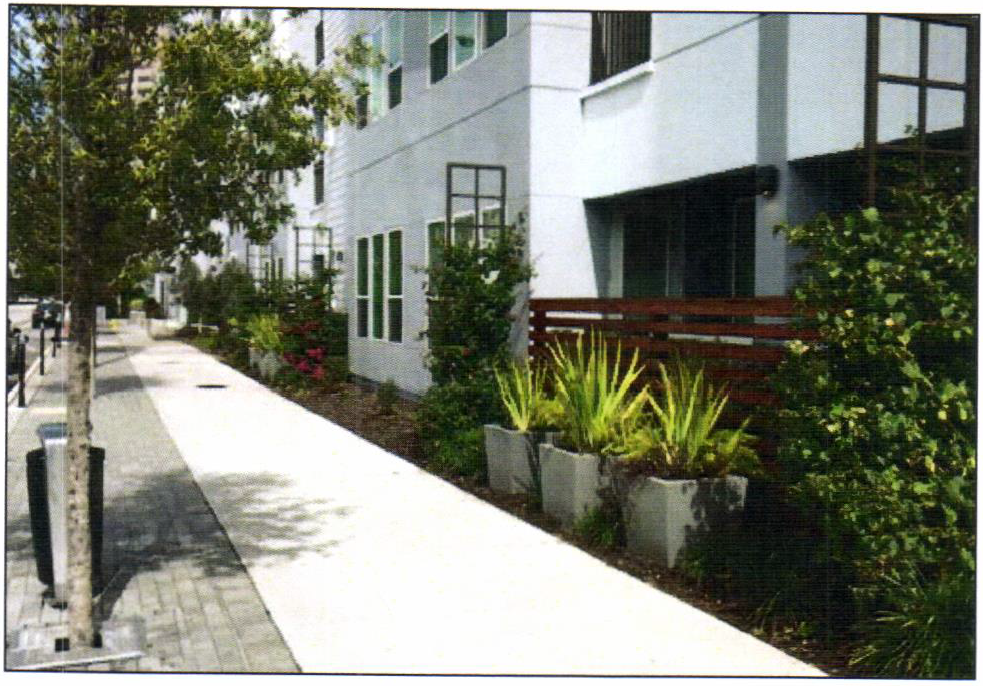
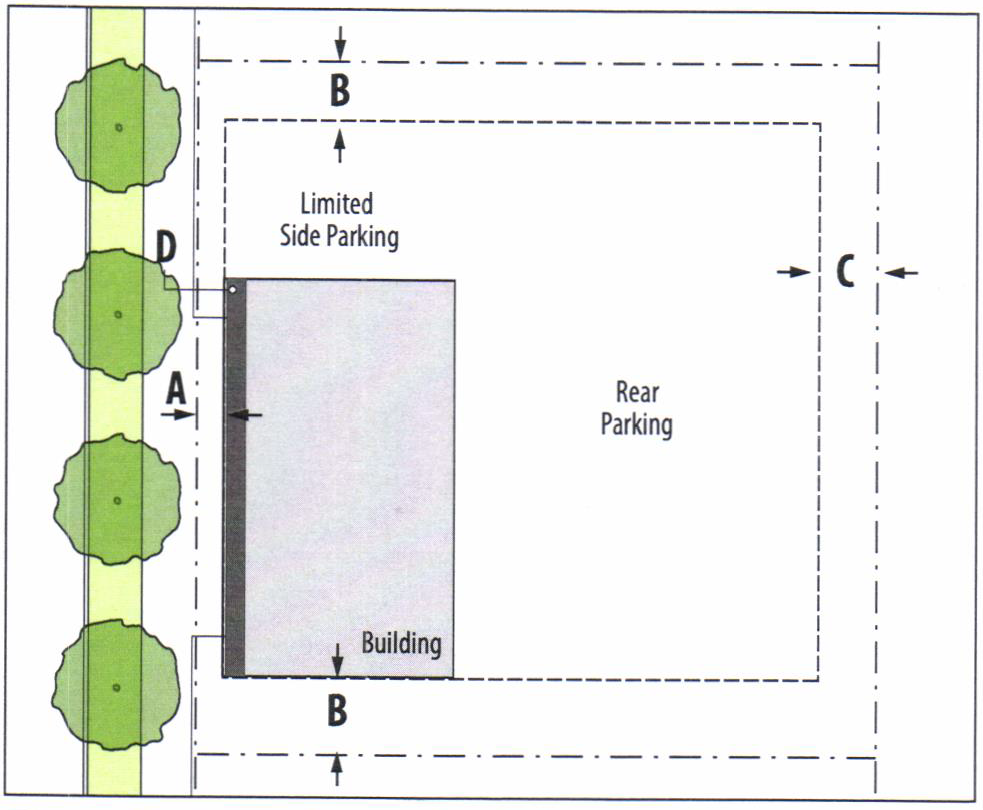
General. The Urban Residential 2 Frontage Standards are intended for application along Street Type D which is identified as appropriate for a mix of land uses and building types. Development standards for this frontage require buildings aligned along adjacent streets, oriented to public sidewalks with residential ground floor uses with modest front setbacks, ground floors elevated above adjacent sidewalk grade, and parking to the rear of occupied building space.
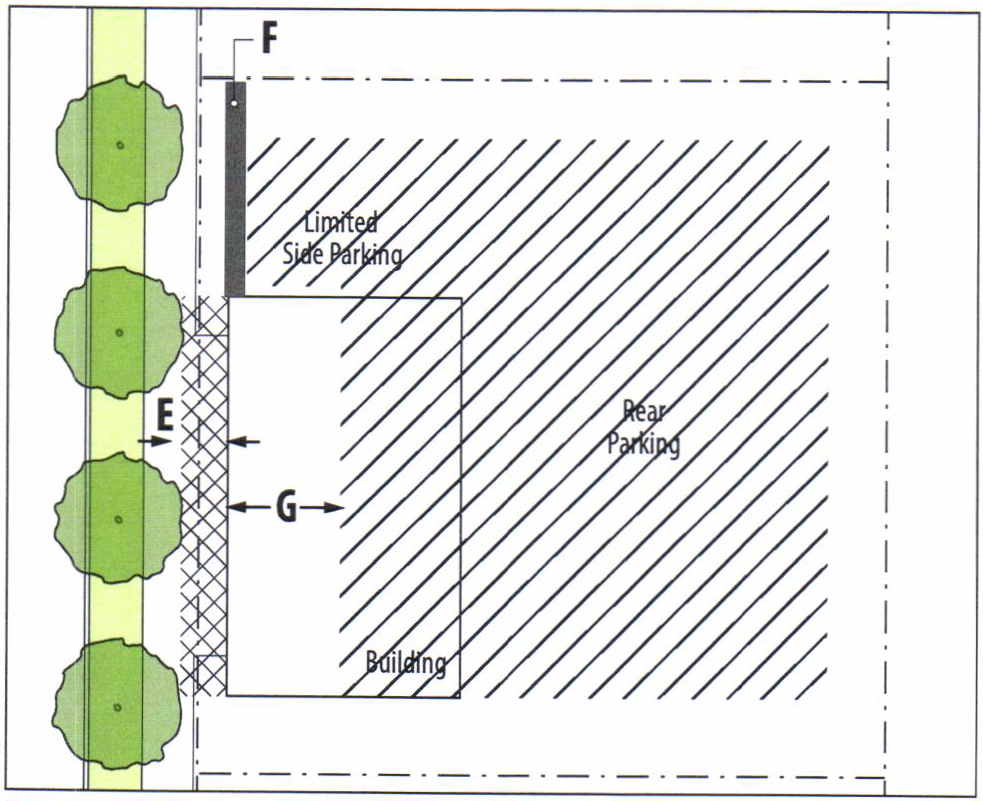
(In the sections below, the bold lettering in parentheses refers to the annotations in Figures 22 and 23.)
B.
Building Setbacks.
1.
Buildings shall be placed along street frontages consistent with the following building setbacks from property lines:
a.
Front Setbacks (A): 8 feet minimum, 15 feet maximum.
b.
Side Setbacks (B): 5 feet minimum or as required by applicable building and fire codes.
c.
Rear Setbacks (C): 10 feet minimum.
2.
Front building setbacks on Fort Harrison Avenue, Cleveland Street, and Osceola Avenue shall be increased to the extent required to allow for the creation of sidewalks widths consistent with the Master Streetscape Plan within the Clearwater Downtown Redevelopment Plan.
3.
To promote the continuity of frontages along front setbacks, the space between buildings on the same or adjacent sites, or between building wings for "U"-shaped buildings, shall be 80 feet maximum.
C.
Front Setback Improvements.
1.
The front setback area shall be improved with landscape areas and walkways providing access to common building entries and to porches or stoops at entries to ground floor units. Walkways to building entries shall generally match sidewalk grade.
2.
Landscaping in the front setback area shall comply with landscape requirements in Section 3-1202.
3.
Walls, railings, fencing, or other similar improvements not part of a porch or stoop are prohibited within front setbacks.
D.
Ground Floor Façades and Entries.
1.
Building façades along street frontages shall meet building design standards in Appendix C, Division 6.
2.
Ground floor front building façades shall meet the following standards (D):
a.
Building façades shall be located along front setbacks and aligned generally parallel to the primary street frontage property line.
b.
The finished floor elevation of ground floor residential units along front setbacks shall be elevated 18 inches minimum, 36 inches maximum above the grade of adjacent sidewalks.
c.
Primary entries to individual ground floor units, where provided, and shared lobby space shall be located along the front façade and be visible from streets and sidewalks.
3.
Where primary entries to individual ground floor units are located along the front façade, front porches or stoops shall be provided at entries and designed to meet the following standards (E):
a.
Porches and stoops may project 4 feet minimum, 8 feet maximum from front building façades into setbacks but shall be located no closer than 2 feet from public sidewalks.
b.
No more than two front porches or stoops serving adjacent units shall be connected.
c.
Landscape areas at least 8 feet in width as measured along the front building façade shall be provided between individual or connected porches or stoops.
4.
Canopies or other forms of weather protection shall be provided at front building entries to shared ground floor lobby space and shall meet the standards in Appendix C, Division 6 (E).
E.
Parking.
1.
In addition to the following standards, parking location, design and access shall meet standards in Division 5.
2.
Parking, vehicular loading/unloading areas, and passenger drop off areas are prohibited in front setbacks.
3.
Surface parking located to the side of buildings along streets shall be no greater than 1 bay in width or 60 feet maximum as measured along the street frontage and shall be set back 5 feet behind front building façades and screened from public sidewalks by an opaque hedge or wall 24 to 36 inches in height (F). Side surface parking shall be located along a single building side.
4.
Parking and vehicular circulation areas incorporated in the ground floor of a building along street frontages shall be located behind fully-enclosed, occupied building space with a depth of 20 feet minimum (G).
5.
Surface and structured parking shall comply with side and rear building setbacks. Side and/or rear setbacks shall not apply between surface parking areas on abutting properties which provide for shared access and use.
6.
With approval from appropriate City, County or State authorities, parallel parking may be constructed within the right-of-way along streets abutting the property.
(Ord. No. 9149-18, § 8, 8-2-18; Ord. No. 9643-23, § 29, 4-4-23; Ord. No. 9664-23, § 3, 5-4-23)
Section C-409. - Neighborhood infill frontage.
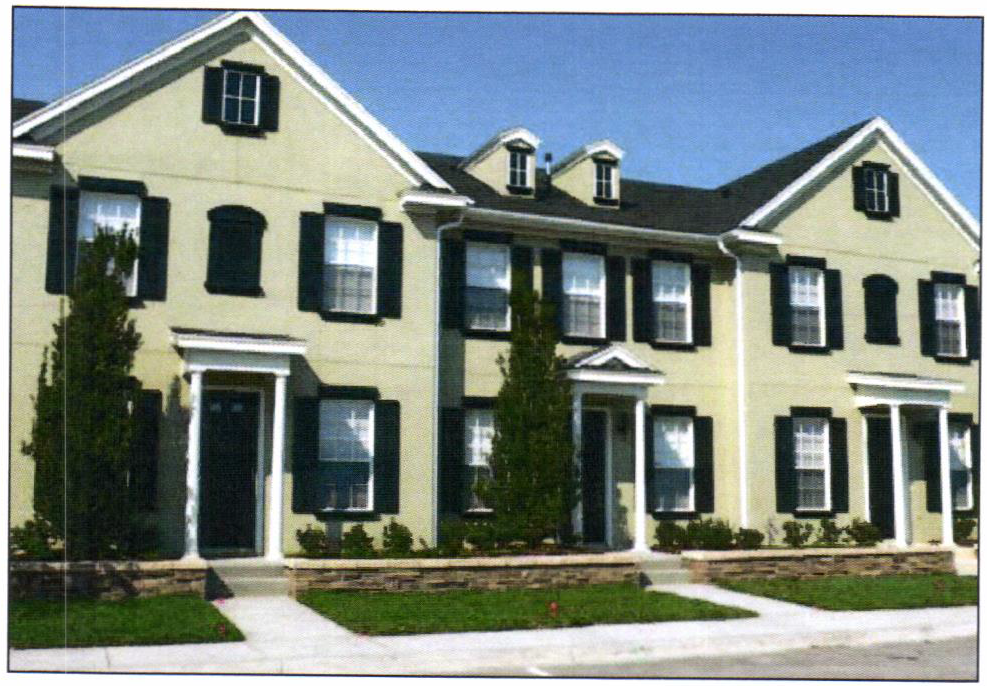 |
| Figure 24. Neighborhood Infill Example |
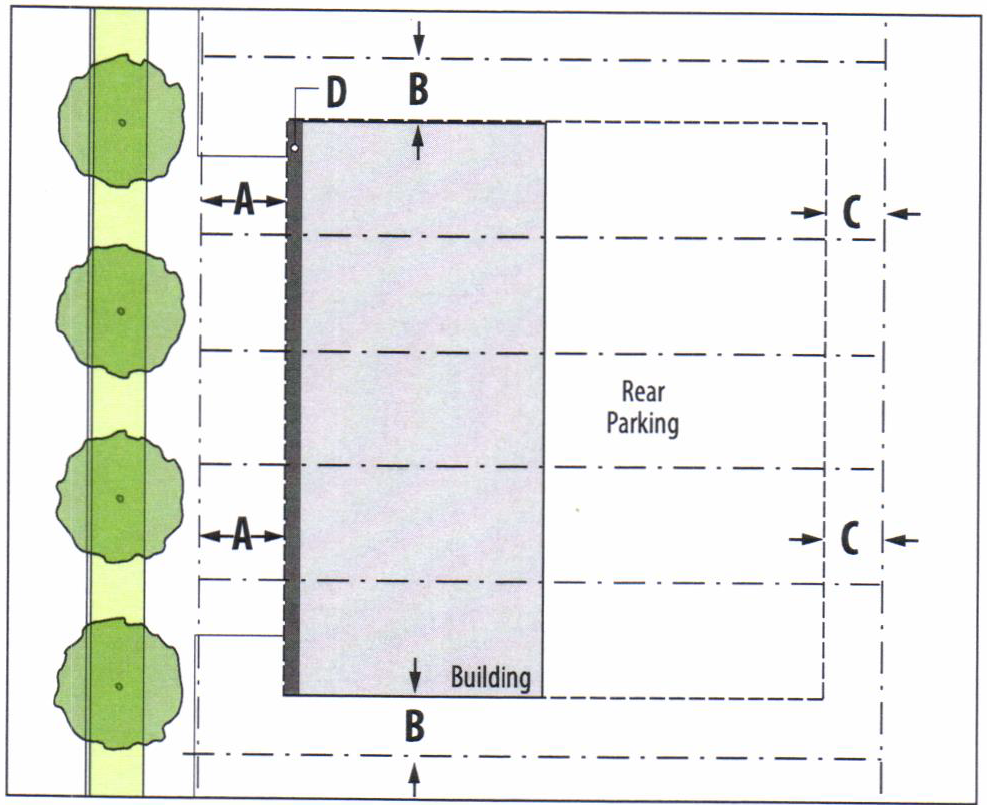 |
| Figure 25. Neighborhood Infill Building Placement |
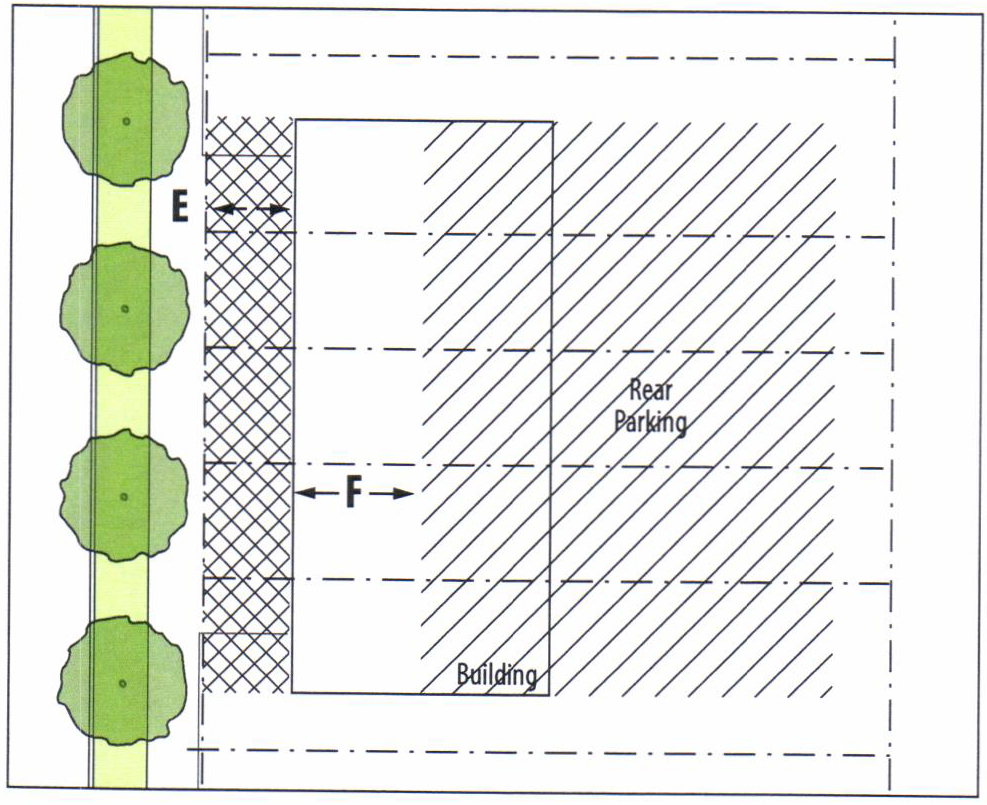 |
| Figure 26. Neighborhood Infill Parking & Projections |
A.
General. The Neighborhood Infill Frontage Standards are intended for application along Street Type E which is identified as appropriate for residential development and redevelopment. Development standards for this frontage require attached and detached dwellings oriented to public sidewalks with modest landscaped front setbacks and parking to the rear of occupied building space.
(In the sections below, the bold lettering in parentheses refers to the annotations in Figures 25 and 26.)
B.
Building Setbacks.
1.
Buildings shall be placed along street frontages consistent with the following building setbacks from property lines:
a.
Front Setbacks (A): 8 feet minimum, 15 feet maximum.
b.
Side Setbacks (B): 5 feet minimum or as required by applicable building and fire codes.
c.
Rear Setbacks (C): 10 feet minimum.
C.
Front Setback Improvements.
1.
The front setback area shall be improved with landscape areas and walkways providing access to common building entries and to porches or stoops at entries to ground floor units. Walkways to building entries shall generally match sidewalk grade.
2.
Walls, railings, fencing, or other similar improvements not part of a porch or stoop are not permitted within front setbacks.
3.
Fenced, walled, or otherwise enclosed patios or other forms of outdoor space are not permitted for ground floor units along street frontage.
D.
Ground Floor Façades and Entries.
1.
Building façades along street frontages shall meet building design standards in Appendix C, Division 6.
2.
Ground floor front building façades shall meet the following standards (D):
a.
Building façades shall be located along front setbacks and aligned generally parallel to the primary street frontage property line.
b.
The finished floor elevation of ground floor residential units along front setbacks shall be elevated 18 inches minimum, 36 inches maximum above the grade of adjacent sidewalks.
c.
Primary entries to ground floor units and shared lobby space shall be located along the front façade and be visible from streets and sidewalks.
3.
Front porches or stoops shall be provided at entries to individual ground floor units and be designed to meet the following standards (E):
a.
Porches may project 6 feet minimum, 10 feet maximum from front building façades into setbacks. Stoops may project 4 feet minimum, 6 feet maximum from front building façades into setbacks. Neither shall be located closer than 2 feet from front property line.
b.
For buildings at corner locations, porches shall be oriented to the primary street frontage and wrap around the façade a minimum of 6 feet along the secondary street frontage.
c.
No more than two front porches or stoops serving adjacent units shall be connected.
d.
Landscape areas shall be provided between individual or connected porches or stoops and shall be at least 8 feet in length as measured along the front building façade.
4.
Canopies or other forms of weather protection shall be provided at front building entries to shared ground floor lobby space and shall meet the standards in Appendix C, Division 6 (E).
E.
Parking.
1.
In addition to the following standards, parking location, design and access shall meet the standards in Appendix C, Division 5.
2.
Surface parking shall be located to the rear of buildings away from the primary street frontage and corner locations and shall comply with side and rear building setbacks.
3.
Parking to the side of buildings behind front building façades is permitted only for single family detached dwellings and duplex building types. Such parking shall be in single width private driveways perpendicular to the right-of-way and may be located in front and side setbacks but may be no closer than 2 feet from side lot lines.
4.
Surface parking lots serving multiple dwelling units shall comply with side and rear building setbacks. Side and/or rear setbacks shall not apply between surface parking lots on abutting properties which provide for shared access and use.
5.
Parking, vehicular loading/unloading areas, and passenger drop off areas are prohibited in front setbacks.
6.
Parking and vehicular circulation areas incorporated in the ground floor of a building or parking garage shall be located behind fully-enclosed, occupied building space along street frontages with a depth of 20 feet minimum (F).
7.
With approval from appropriate City, County or State authorities, parallel parking may be constructed within the right-of-way along streets abutting the property.
(Ord. No. 9149-18, § 8, 8-2-18; Ord. No. 9643-23, § 29, 4-4-23)
Section C-410. - Neighborhood conservation frontage.
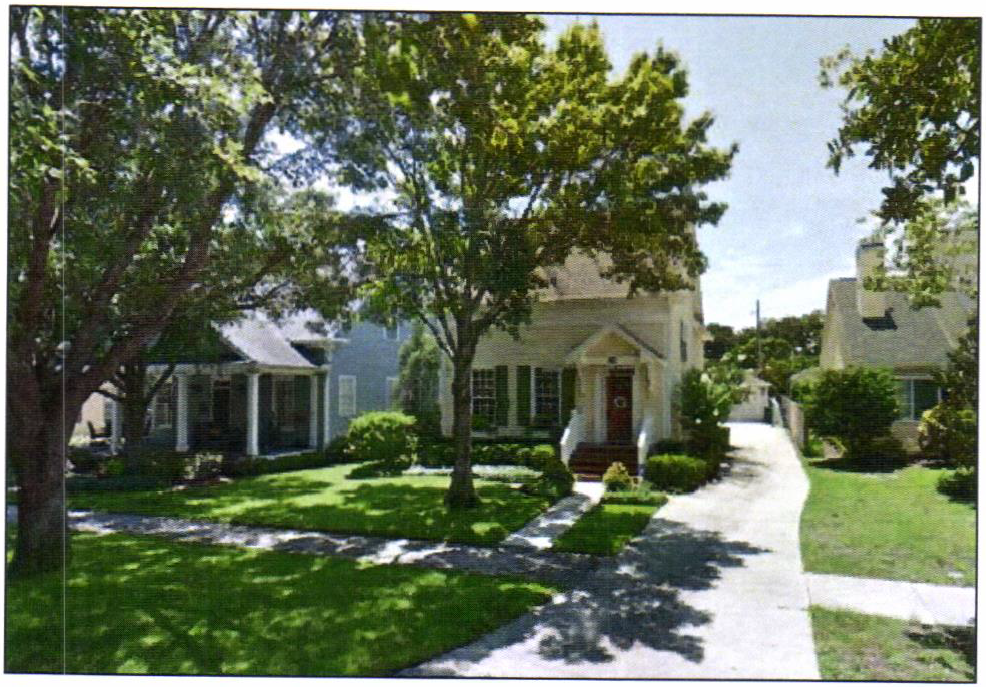 |
| Figure 27. Neighborhood Conservation Example |
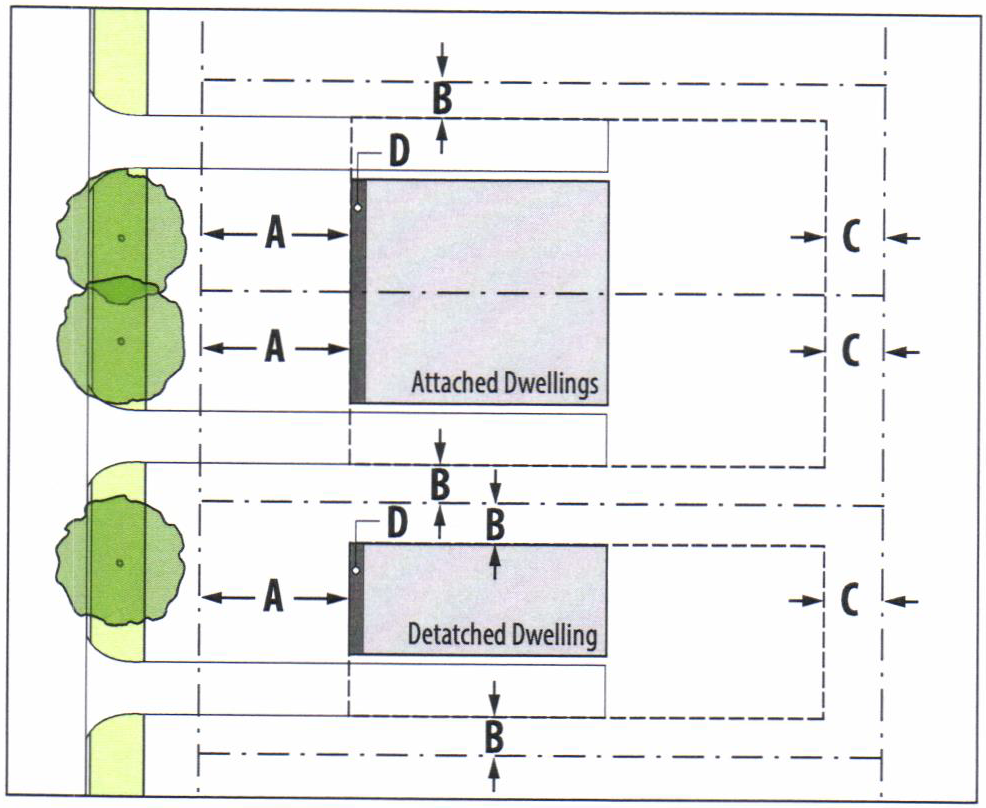 |
| Figure 28. Neighborhood Conservation Building Placement |
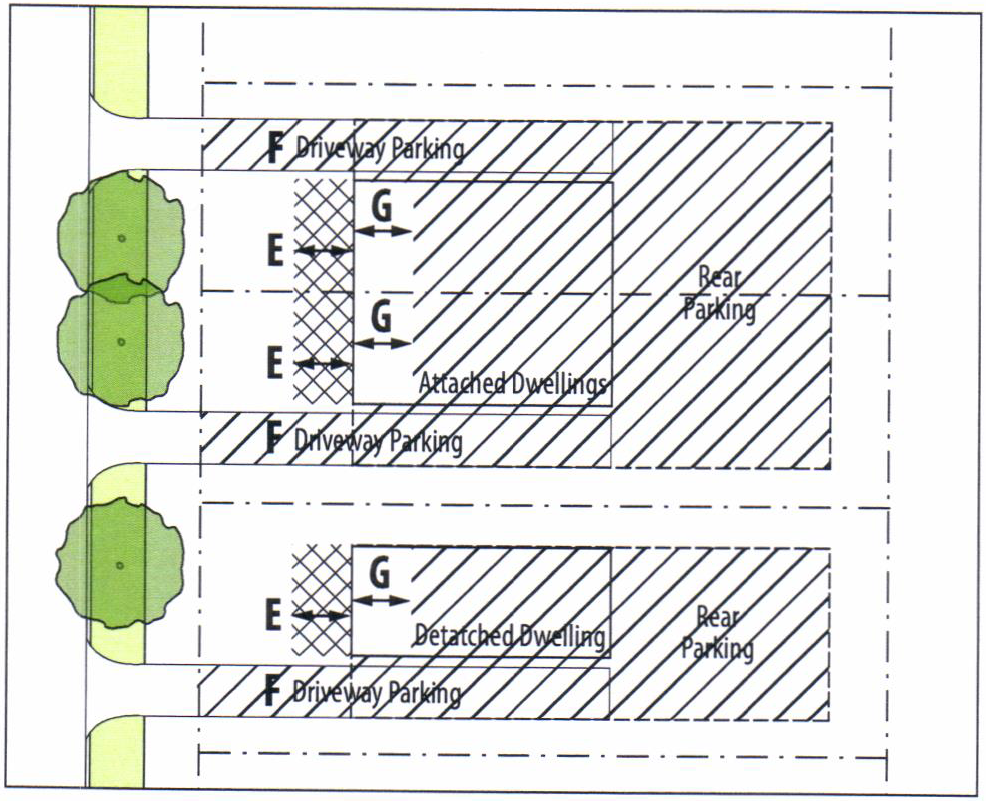 |
| Figure 29. Neighborhood Conservation Parking & Projections |
A.
General. The Neighborhood Conservation Frontage Standards are intended for application along Street Type F which is identified as appropriate for residential development and redevelopment. Development standards for this frontage require detached dwellings and attached dwellings, as described in Table 5. Attached Dwelling Types General, oriented to public sidewalks with front lawns and parking to the rear of occupied building space with allowance for limited parking in private driveways to the side of houses. On local streets, two units maximum may be permitted including one duplex or one detached dwelling with one carriage house. On collector streets, three units maximum may be permitted, including one duplex and one carriage house.
(In the sections below, the bold lettering in parentheses refers to the annotations in Figures 28 and 29.)
B.
Building Setbacks.
1.
Buildings shall be placed along street frontages consistent with the following building setbacks from property lines:
a.
Front Setbacks (A): 20 feet minimum.
b.
Side Setbacks (B): 5 feet minimum.
c.
Rear Setbacks (C): 10 feet minimum.
2.
Front setbacks shall be no greater than the average setback for buildings along the same block frontage.
C.
Front Setback Improvements.
1.
The front setback area shall be improved with lawn and landscape areas.
2.
Walkways may be provided to connect public sidewalks with porches or stoops at entries to ground floor units. Walkways to building entries shall generally match sidewalk grade.
3.
Walls, railings, fencing, or other similar improvements not part of a porch or stoop are not permitted within front setbacks except that picket fences no higher than 36 inches in height may be permitted to define the front yards of individual units.
4.
Fenced, walled, or otherwise enclosed patios or other forms of enclosed outdoor space are not permitted in front setbacks.
D.
Ground Floor Façades and Entries.
1.
Building façades along street frontages shall meet building design standards in Appendix C, Division 6.
2.
Ground floor front building façades shall meet the following standards (D):
a.
Building façades shall be located along front setbacks and aligned generally parallel to the primary street frontage property line.
b.
Primary entries to ground floor units shall be located along the front façade and be visible from streets and sidewalks.
3.
Front porches or stoops shall be provided at entries to individual units and be designed to meet the following standards (E):
a.
Porches may project 6 feet minimum, 10 feet maximum from front building façades into setbacks. Stoops may project 4 feet minimum, 6 feet maximum from front building façades into setbacks.
b.
For buildings at corner locations, porches shall be oriented to the primary street frontage and wrap around the façade a minimum of 6 feet along the secondary street frontage.
c.
No more than two front porches or stoops serving attached units shall be connected.
d.
Landscape areas shall be provided between individual or connected porches or stoops and shall be at least 8 feet in length as measured along the front building façade.
E.
Parking.
1.
In addition to the following standards, parking location, design and access shall meet the standards in Appendix C, Division 5.
2.
Surface parking lots shall be located to the rear of buildings away from the primary street frontage and corner locations and shall comply with side and rear building setbacks.
3.
Parking is permitted in single width private driveways. Such driveways shall meet the side setback requirement and be located to the side of buildings (F).
4.
Parking incorporated in enclosed garages or the ground floor of a detached or attached dwelling shall be set back 5 feet minimum from the front building façade (G).
5.
With approval from appropriate City, County or State authorities, parallel parking may be constructed within the right-of-way along streets abutting the property.
(Ord. No. 9149-18, § 8, 8-2-18; Ord. No. 9643-23, § 29, 4-4-23; Ord. No. 9664-23, § 2, 5-4-23)
Section C-411. - Frontage along service streets.
A.
Building Setbacks. Except as provided in Section C-402.C, buildings with frontage along streets designated as Service Streets on Figure 2. Regulating Plans - Street Types and Key Corners, shall be placed consistent with the following building setbacks from property lines:
1.
Front Setbacks: 5 feet minimum.
2.
Side Setbacks: 10 feet minimum.
3.
Rear Setbacks: 10 feet minimum.
B.
Front Setback Improvements. The front setback area may be improved with landscaping and fencing to buffer parking lot or parking structures and service areas. Such buffers and fencing shall comply with standards in Appendix C, Division 5.
C.
Parking and Vehicular Circulation. Parking, vehicular circulation, and other vehicular use areas are permitted along the frontage and shall be located and designed to meet standards in Appendix C, Division 5.
(Ord. No. 9149-18, § 8, 8-2-18; Ord. No. 9643-23, § 29, 4-4-23)
Section C-501. - General.
Projects within the Downtown District shall be designed to advance goals for the creation of active, attractive, safe, and comfortable streets, streetscapes, and public spaces in Downtown Clearwater. Projects shall be designed to contribute to and create a walkable urban environment with generally consistent setbacks along street frontages, active ground floor uses, front building entries, and attractive storefronts. Vehicular parking and service areas shall be located primarily to the rear of buildings and appropriately screened to minimize the visual impact on streets, streetscapes, and public spaces. The existing street grid shall be retained and expanded where possible, curb cuts shall be minimized, and streetscapes shall be improved to provide for a safe and convenient pedestrian network.
(Ord. No. 9149-18, § 8, 8-2-18)
Section C-502. - Development pattern.
A.
Existing Street Preservation. The existing street network shall be maintained. The vacation of existing public streets and alleys shall be discouraged unless new public streets and alleys are constructed to replace and serve the function of those vacated.
B.
Development Blocks and Lots.
1.
Projects shall be configured with development blocks scaled to accommodate buildings, public spaces, and mid-block off-street parking and service areas.
2.
Block dimensions shall generally be as follows but may be adjusted to account for irregularly shaped parcels, utilities and utility easements, stormwater conveyance systems, and other features.
a.
Minimum block length: 200 feet
b.
Maximum block length: 600 feet
3.
Lots shall maintain a consistent size, scale, pattern and rhythm of the surrounding block(s).
C.
New Private Drives. Projects on sites of 5 acres or more shall be developed with new private drives designed consistent with the following standards:
1.
New private drives shall be configured to create interconnected networks of drives defining development blocks as described in Appendix C, Section C-502.B and serve as secondary vehicular travel ways for vehicles and pedestrians.
2.
New private drives shall be designed as two-way drives designed with a minimum 6-foot wide landscape strip with shade trees between curbs and sidewalks, and a continuous pedestrian zone with a 6-foot minimum wide unobstructed sidewalk. These drives may include parallel parking, landscaped medians, bike lanes, and other features.
3.
New private drives shall be configured to align with existing or planned streets or drives on adjacent sites to create an interconnected network. Stub outs shall be provided to allow future connections to adjacent sites.
D.
New Private Service Drives. To access parking and service areas located behind buildings where access by public alley is not available, new private services drives shall be constructed and designed consistent with the following standards:
1.
New service drives shall be designed for one- or two-way travel.
2.
In locations where new service drives provide access to multiple lots and where rear lot solid waste collection is planned, new service drives shall be designed to accommodate through block travel with no dead end or cul-de-sac.
3.
For residential projects, new service drives shall be designed with sufficient space to allow for vehicle turning movements to access enclosed parking.
(Ord. No. 9149-18, § 8, 8-2-18)
Section C-503. - Access and circulation.
A.
Site Access.
1.
All vehicular access to parking lots, garages and service areas, shall occur from the rear of the property via a public alley (either existing or constructed as part of a development proposal), private service drive, or via a cross access easement from an adjacent property. Should none of these options be available or are determined to be infeasible by the City, vehicular access shall be permitted from a secondary street frontage. Vehicular access shall only be permitted from a primary street frontage when none of the above means of vehicular access is determined by the City to be available.
2.
Existing curb cuts shall be closed where possible and/or consolidated to minimize impacts on pedestrian circulation along public sidewalks.
3.
Establishing joint/common access drives, where such drives are permitted, is encouraged to minimize curb cuts and impacts on pedestrian circulation along public sidewalks.
B.
Streetscape Improvements. Improvements to streetscapes within rights-of-way along lot frontages, including reconstruction shall be required pursuant Section 3-1701. To the extent possible given right-of-way limits and utility conflicts, and with approval of the FDOT, Pinellas County, and/or the City, reconstruction shall follow the standards for streetscapes found in the Master Streetscape Plan within the Clearwater Downtown Redevelopment Plan.
C.
Pedestrian Circulation and Access.
1.
Except for duplexes and detached dwellings on internal lots along Street Type F, pedestrian walkways shall be provided to access parking lots and parking structures behind or to the side of buildings, connect destinations on adjacent properties, connect front building entries to adjacent sidewalks, and allow pedestrian circulation through parking lots to create a continuous pedestrian network.
2.
Pedestrian walkways shall be 6-foot wide minimum and free of obstructions.
3.
Pedestrian walkways that cross a parking area or other vehicular use areas shall be clearly marked with striping, contrasting paving materials (e.g., light-color concrete inlay between asphalt), textured or raised pavement, or other appropriate treatment as approved by City staff.
4.
Where specialty paving, such as pavers, decorative concrete, or other materials, is used for public sidewalks or other pedestrian walkways, the specialty paving shall continue across parking access drive aisles.
5.
Pedestrian walkways provided between buildings shall be designed to meet the following standards.
a.
Where blocks are longer than 600 feet, one mid-block pedestrian walkway open to the public during regular building hours shall be provided.
b.
Pedestrian walkways between buildings shall be at least 15-foot wide and 20-foot wide on average.
c.
Pedestrian scale lighting shall be provided.
D.
Cross Parcel Connections. To facilitate circulation and improve accessibility, vehicle and pedestrian facilities on adjacent sites shall be interconnected, except for detached dwellings and duplexes on interior lots along Street Type F. Existing and planned parking lot drive aisles, private drives, private service drives, and pedestrian walkways shall be aligned and connected with abutting sites. In cases where no connection exists on an abutting developed site, drive aisle and pedestrian walkway stub outs shall be constructed to allow for future connections.
E.
Connection to Trails. Pedestrian and bicycle connections to the Pinellas Trail and/or Druid Trail, or future trails, bikeways, or the like, that are visible from public rights-of-way and/or building entrances shall be incorporated into site plans where property is adjacent to the Trail(s).
(Ord. No. 9149-18, § 8, 8-2-18; Ord. No. 9643-23, § 30, 4-4-23; Ord. No. 9712-23, § 10, 11-2-23; Ord. No. 9740-24, § 10, 2-1-24)
Section C-504. - Parking and service areas.
A.
Surface Parking.
1.
Surface parking and services areas shall be designed to meet the landscaping standards set forth in Article 3, Division 12 and the parking and loading standards set forth in Article 3. Division 14.
2.
Surface parking lots shall be screened from abutting residential uses by fences or walls six feet in height.
3.
Interior islands of parking lots in new projects shall be designed to utilize Low Impact Development techniques such as bioretention swales and native species. Where parking curbs and gutters are provided, they shall have breaks to allow water to enter the bioretention facilities within the parking landscape islands. Parking lots with less than 20 spaces are exempt from interior island requirements in Section 3-1202.E.2 of this Development Code.
B.
Structured Parking. All structured parking, whether freestanding, attached to a building, or integrated into a building envelope, shall be designed to comply with requirements for parking garages set forth in Article 3, Division 14, and design standards in Divisions 4 and 6 in these standards.
C.
Service Areas. Service areas, including areas providing access to loading docks and areas designated for the placement of waste containers and recycling equipment, shall be located to the rear of buildings in the most unobtrusive location possible and screened from adjacent properties and rights-of-way with architecturally finished walls and gated enclosures designed consistent with and complementary to the exterior façade of the building.
(Ord. No. 9149-18, § 8, 8-2-18)
Section C-505. - Garages for attached or detached dwellings.
A.
Garages shall be located behind the principal building and accessed from public alleys, private drives, or private service drives.
B.
Where public alleys, private drives, or private service drives are not provided, single width private driveways no greater than 10 feet in width maximum are permitted and the following standards shall apply.
1.
Attached, front facing garages serving detached dwellings, where permitted, shall be set back 5 feet minimum from the front facade of the building.
2.
Detached garages shall be located to the rear of the property, not along the primary street frontage, and accessed from a single width private driveway.
3.
Attached or detached garages on corner sites shall be located to the rear of the property away from the primary street frontage, oriented toward a secondary street frontage, and accessed from a secondary street frontage by a single width private driveway.
(Ord. No. 9149-18, § 8, 8-2-18; Ord. No. 9643-23, § 30, 4-4-23)
Section C-506. - Landscape and fencing/walls.
A.
Landscape Requirements in Article 3, Division 12. Landscape improvements shall meet the general landscaping standards set forth in Article 3. Division 12 in addition to the frontage standards in Appendix C, Division 4 and landscape and parking standards in Appendix C, Division 5.
B.
Fences and Walls.
1.
Fences and/or walls, where permitted alongside and/or rear property lines, shall be located behind front building façades, and shall be painted, architecturally finished and designed consistent with and complementary to the exterior façade of the building.
2.
Chain link, razor wire, barbed wire, or other similar fences are prohibited.
C.
Utility/Infrastructure Facilities. Utility/infrastructure facilities other than telecommunication towers and utility distribution lines shall be screened from public view by landscape screens or architecturally-finished walls and enclosures.
(Ord. No. 9149-18, § 8, 8-2-18; Ord. No. 9643-23, § 30, 4-4-23)
Section C-507. - Stormwater management.
Stormwater retention and detention areas are not permitted in front setbacks or between any street and any building unless located underground in exfiltration trenches or open-bottomed underground storage and retention systems, or as part of a Low Impact Development stormwater management system incorporating features such as rain gardens and vegetative swales, or pervious pavers or pavement for pedestrian use. Traditional stormwater facilities such as dry and/or wet retention/detention ponds are permitted to the rear and side of buildings.
(Ord. No. 9149-18, § 8, 8-2-18; Ord. No. 9643-23, § 30, 4-4-23)
Section C-508. - Waterfront development.
Waterfront development shall be located and designed to meet all of the following standards.
A.
Waterfront Setback. Structures shall maintain a waterfront setback of 20 feet minimum from the sea wall, property line, or mean high water line, whichever is most interior to the property.
B.
Parking.
1.
Residential uses along Clearwater Harbor shall be designed with parking garages or with parking areas internal to the site/building and screened from Clearwater Harbor.
2.
Perimeter screening shall not be required for public parking located along waterfronts.
(Ord. No. 9149-18, § 8, 8-2-18; Ord. No. 9643-23, § 30, 4-4-23)
Section C-509. - Drive-through facilities.
Permitted ancillary drive-through facilities, including all improvements associated with the drive-through activity such as entry and exit drives, stacking lanes, service windows, canopies, ATM kiosks, and informational signage, shall be located and designed to meet all of the following standards.
A.
Location and Screening. Drive-through facilities shall be located to the rear of the principal building, as illustrated in Figure 30. Drive-Through Facilities.
B.
Stacking Lanes.
1.
Stacking lanes shall be scaled to ensure queuing vehicles do not block driveways, access to parking areas, or pedestrian walkways.
2.
Stacking lanes located along pedestrian walkways shall be screened with landscaping and a wall 24 to 36 inches in height designed to complement the exterior façade of the building.
C.
Signage. Sufficient on-site signage and pavement markings shall be provided to mark pedestrian walkways and crossings, and to indicate direction of vehicular travel and other conditions required to ensure safe vehicular and pedestrian movement.
Figure 30. Drive-Through Facilities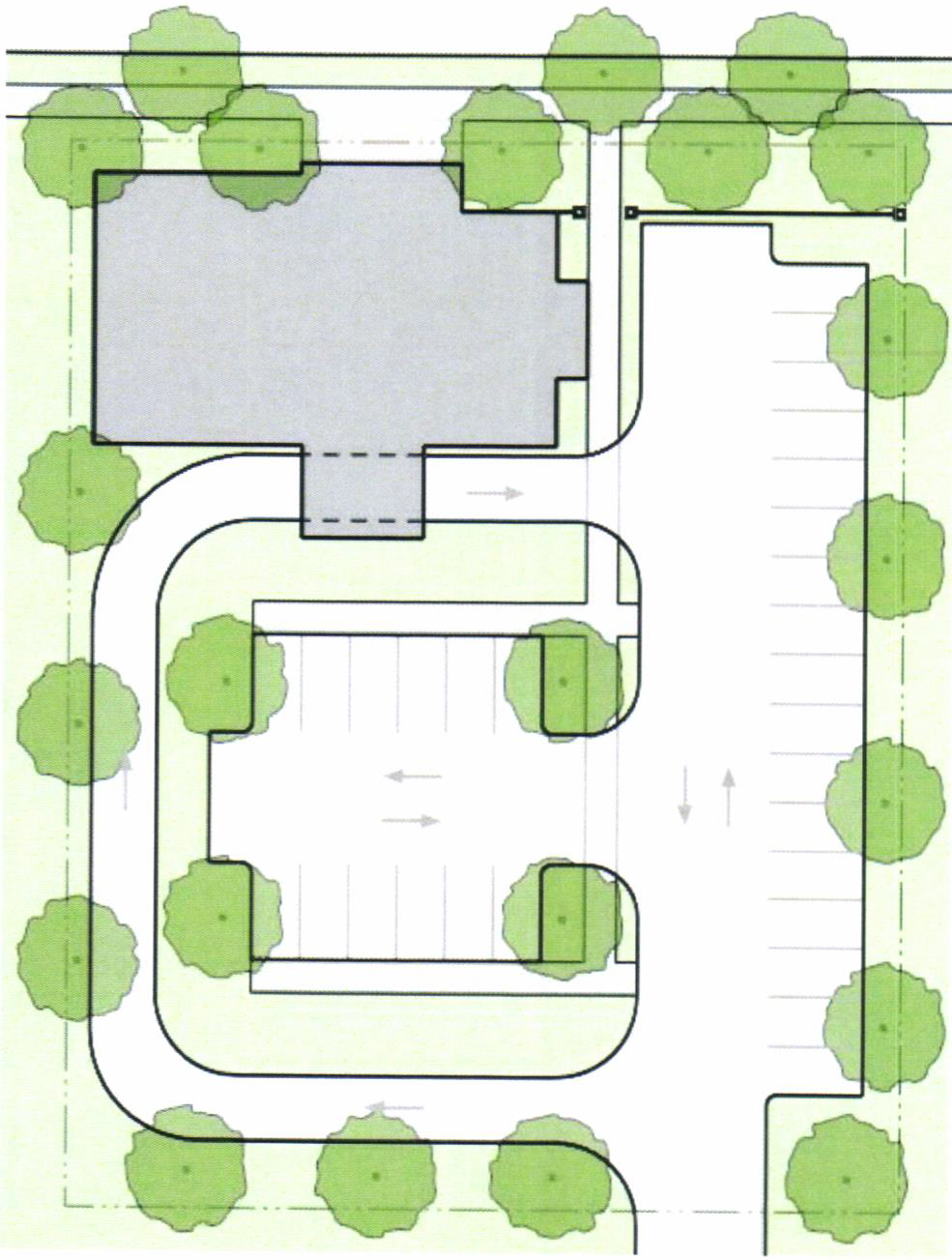
(Ord. No. 9149-18, § 8, 8-2-18)
Section C-510. - Swimming pools.
Swimming pools for all attached dwellings except duplexes, shall be located on the roof of the building or internal to the development site as a courtyard pool, surrounded on all 4 sides by building(s), and not along street frontages as illustrated in Figure 31. Swimming pools for detached dwellings and duplexes shall comply with the accessory structure provisions in Article 3, Division 2 of this code.
Figure 31. Swimming Pools
Rooftop Swimming Pool
Courtyard Swimming Pool
(Ord. No. 9740-24, § 10, 2-1-24)
Section C-601. - General.
To support the creation of more pedestrian- and transit-accessible destinations, buildings shall be located generally parallel to adjacent streets and designed to contribute to the creation of attractive, accessible destinations. Building facades along streets and public spaces shall be designed with attractive ground floor facades, well-defined building entries, and shall use quality building materials. Buildings shall occupy a substantial portion of the frontage and be located to minimize the visual impact of parking, loading, service and other vehicular use areas.
(Ord. No. 9149-18, § 8, 8-2-18; Ord. No. 9643-23, § 31, 4-4-23)
Section C-602. - Façade treatment and design.
A.
Complementary Design. All buildings and structures in projects with multiple buildings and structures, including parking structures, shall have complementary architectural details, materials, colors, and design treatments. For the purpose of this section, buildings and structures shall include primary buildings, accessory structures, parking structures, open air enclosures, fences and walls, and other vertical improvements. The intent of this provision is not to require a single design theme or motif for projects with multiple buildings and/or multiple tenants but to ensure a consistent level of quality in the design and detailing of buildings, parking structures, and other vertical improvements.
B.
Façade Articulation.
1.
Buildings shall be designed with clearly articulated bases to define the extent of the public realm, provide spatial enclosure, and mediate differences in scale between adjacent buildings. Building bases shall constitute the façades of the first one or two stories of the building. Distinctions between building bases and upper story façades shall be established through the use of changes in material and color, the use of minor step backs for upper story façades, and architectural molding, cornice lines, or other modest projections.
2.
To break up building façades along street frontages, façades shall be divided vertically into bays, as illustrated in Figure 31. Façade Bays & Articulation. Façade bay widths shall range between 20 to 35 feet establishing a rhythm of vertical modules unified by a complementary rhythm of windows and window groupings. Façade bays shall be distinguished by varying fenestration patterns, recessing wall planes, varying building materials, or establishing a rhythm of architectural elements such as pilasters or window bays.
Figure 32. Façade Bays & Articulation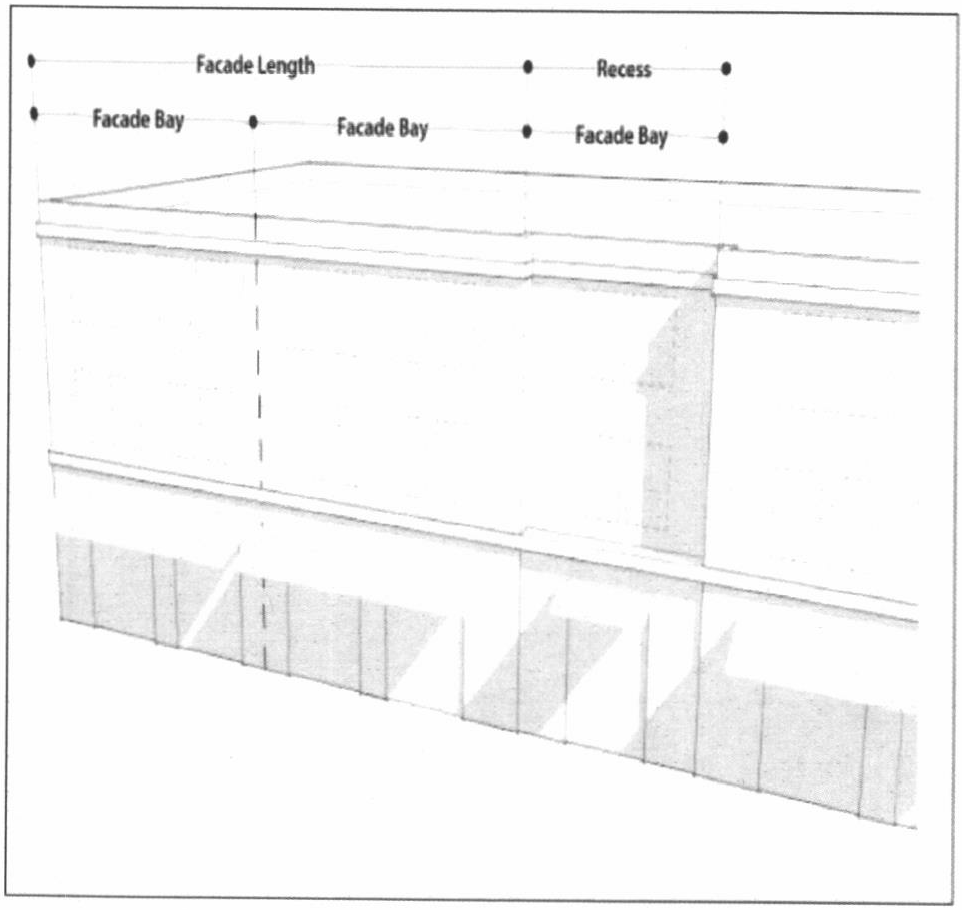
Figure 33. Corner Treatments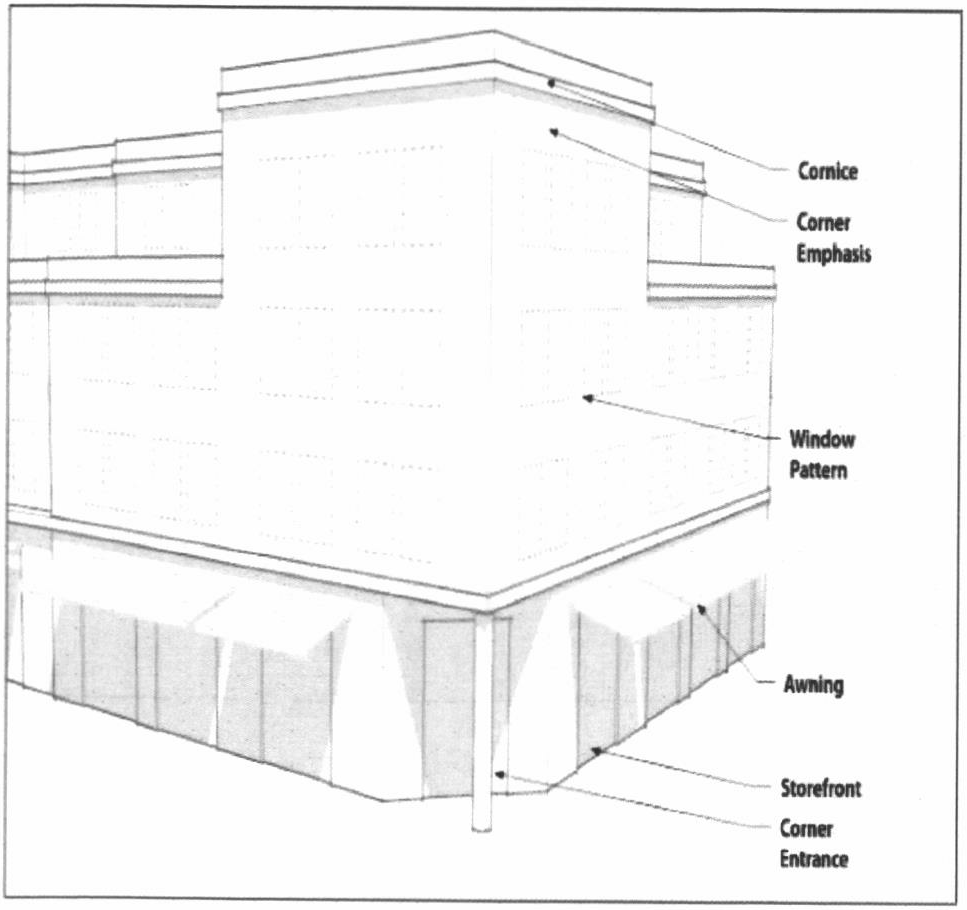
3.
To avoid flat, continuous façades above the ground floor on all building sides, the maximum length of an upper floor façade section shall be between 80 and 120 feet and the articulation between upper floor façade sections shall be accomplished by recessing the façade 2 feet minimum for a distance of at least 10 feet as illustrated in Figure 31. Façade Bays & Articulation.
4.
Vertical or horizontal changes in the plane of a building façade for step backs, façade articulation, or other purposes shall be differentiated by architectural features including but not limited to coping, balustrades, cornice lines, change in materials, or changes in color.
5.
Blank sections of ground floor building façades fronting streets, public spaces, and surface parking areas shall not exceed 20 feet in length. Elements such as windows, doors, balconies, columns, pilasters, changes in material, or other architectural details that provide visual interest shall be distributed across the façade in a manner consistent with the overall design of the building.
C.
Façade Materials. All building façades within view of a public street, pedestrian walkway, waterfront, or other public space, including side and rear façades, shall be constructed of high quality materials such as brick, stone, architectural block, concrete with an architectural finish, and traditional cementitious stucco. Side and rear façades shall use materials and design features similar to or complementary to those of the front façade. The use of metal façades shall not be permitted.
D.
Upper Floor Façade Fenestration. To minimize blank façade areas along street frontages, façades fronting streets and new primary drives shall provide fenestration (doors, windows or other openings) to an extent of a minimum of 20 percent of each floor's façade area as measured between finished floor and finished ceiling.
E.
Prohibited Glass Treatments on Ground Floors. The use of reflective, translucent, fritted, and other forms of non-transparent glass in wall and window systems on ground floor façades is prohibited.
F.
Corner Façades.
1.
To create a seamless transition between the façades of a building at a street corner, both street-facing façades shall be designed with equal architectural quality and detail as illustrated in Figure 32. Corner Treatments.
2.
Façade materials, window and wall treatments, and design elements such as signs and awnings shall be included on both sides of the building façade. Additional corner emphasis with chamfered or rounded façades, corner entries accentuated through changes in design treatments, materials, canopy projections, roof or parapet forms, or through other architectural methods is required.
G.
Parking Structures Design.
1.
Parking structures shall be designed with architecturally-finished façades that complement the details, materials, colors, and design treatments of buildings in the project to contribute positively to the overall character of a project.
2.
The ground level façades of parking structures along Service Street Types, public alleys, private drives, private service drives, and pedestrian walkways shall be designed with architectural screening of openings, trellis or canopy projections, or other architectural treatments to create safe, comfortable, and quality pedestrian environments.
H.
Security and Hurricane Protection.
1.
Security bars are prohibited on windows or doors visible from public streets, public sidewalks, or public spaces.
2.
Hurricane shutters, if provided, shall be fitted as an integral part of the storefront design, not visible when not in use, and only be used during the time frame in which a formally issued hurricane warning is in effect.
I.
Façade Lighting. Light emitting diode (LED) rope/ribbon lighting, neon lighting, or other types of lighting used to outline windows, or other architectural features shall be prohibited.
(Ord. No. 9149-18, § 8, 8-2-18; Ord. No. 9643-23, § 31, 4-4-23; Ord. No. 9712-23, § 11, 11-2-23; Ord. No. 9740-24, § 11, 2-1-240)
Section C-603. - Awnings, canopies, and balconies.
1.
Ground floor awnings, canopies, and other forms of shading devices or structures, where provided, shall comply with the following standards.
a.
Such devices and structures shall project 5 feet minimum, 10 feet maximum from the front façade with the exception that in no case shall such projection be closer than five feet from the curbline.
b.
Such devices and structures shall be permitted into required setbacks and over street rights-of-way provided a clearance of eight feet over grade is maintained.
c.
Such devices and structures with supports may be located up to the property line.
d.
Such devices and structures that project into rights-of-way shall be cantilevered or suspended from the building façade.
2.
Awnings, canopies, or other forms of shading devices or structures are permitted on upper stories and shall not extend further than 36 inches from the façade.
3.
Awnings, canopies, or other forms of shading devices or structures shall not be backlit or constructed of high-gloss material or fabric which appears to be plastic, or be clad with barrel tiles, asphalt shingles, or other standard roofing materials.
4.
Balconies or other projections may encroach into front setbacks. Awnings or canopies provided for balconies shall not extend forward of the balcony.
(Ord. No. 9149-18, § 8, 8-2-18)
Section C-604. - Roof design.
Flat or pitched roofs are permitted for all building types. Edges of pitched roofs shall be accentuated with eaves and flat roofs shall have parapet walls, decorative cornices, and/or other architectural features. Mansard roof forms are prohibited.
(Ord. No. 9149-18, § 8, 8-2-18)
Section C-605. - Building entries.
A.
Location.
1.
Building entries opening onto parking located to the side or rear of buildings shall not be considered primary building entries.
2.
For sites with multiple frontages, the primary building entry or entries shall be located along the primary street frontage or at the corner of the primary street frontage and secondary street frontage.
B.
Design Treatment. Primary building entries, including main entries to individual tenant spaces and to lobbies used to access upper story building space, shall be distinguished by façade design accomplished through the use of a combination of materials, articulation, or other architectural treatments such as variation in building height, arches, columns, towers, or similar treatments that provide interest to the building facade and draw attention to the entrance.
(Ord. No. 9149-18, § 8, 8-2-18; Ord. No. 9643-23, § 31, 4-4-23)
Section C-606. - Mechanical equipment.
A.
Equipment Placement. Equipment, shall be placed on roofs or to the rear or side of buildings and shall not be placed in front setbacks or between any street and any building.
B.
Equipment Screening.
1.
Ground-mounted mechanical equipment shall be screened from public view by landscape screens or architecturally-finished walls and enclosures designed consistent with the exterior façade of the building.
2.
Rooftop-mounted mechanical equipment shall be screened by a parapet wall, articulated roofline or other roof screen, or similar device that is integrated into the building's architectural design and of a height equal to or exceeding the height of the mechanical equipment being screened.
3.
Elevator equipment room or similar mechanical equipment enclosures shall be designed to complement the design of street-facing building façades and shall be clad on all sides in material used on street-facing façades.
(Ord. No. 9149-18, § 8, 8-2-18; Ord. No. 9643-23, § 31, 4-4-23; Ord. No. 9758-24, § 28, 6-6-24)
Section C-607. - Attached dwelling types.
Table 5. Attached Dwelling Types General provides an overview of several types of attached dwellings which could be permitted in the Downtown District, consistent with the applicable frontage standards in Division 4. Attached dwellings may also be part of mixed-use projects at various scales, where residential uses are integrated vertically.
| Table 5. Attached Dwelling Types General | ||
|---|---|---|
| Attached Dwelling Type | Description | Building Frontage |
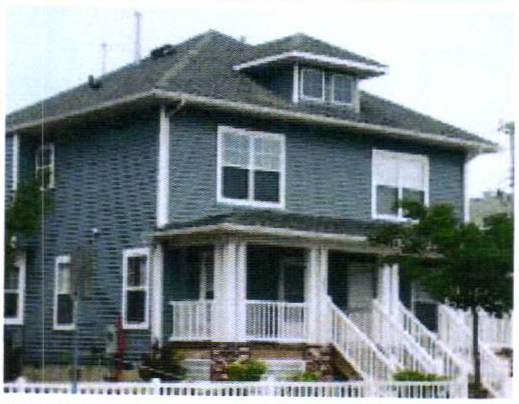 | Duplex: A residential building with the design character of a large single family home, but occupied by two households living separately in attached units. Said units may be attached front-to-back, side-to-side, or be stacked (up and downs). | Urban Residential 2 Neighborhood Infill Neighborhood Conservation |
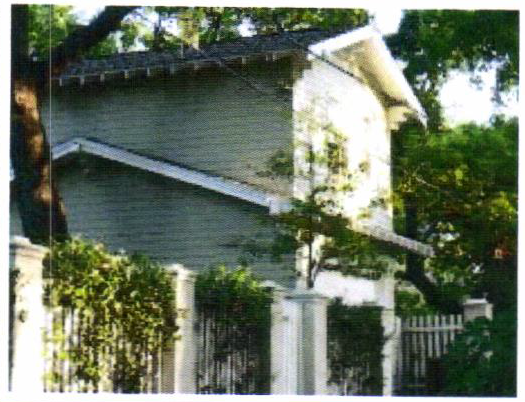 | Carriage House: An accessory dwelling unit to a primary dwelling unit on the same site. A carriage house provides permanent provisions for living, sleeping, eating, cooking and sanitation, and can be on the ground floor or above a garage, but shall be attached to the garage. | Neighborhood Infill Neighborhood Conservation |
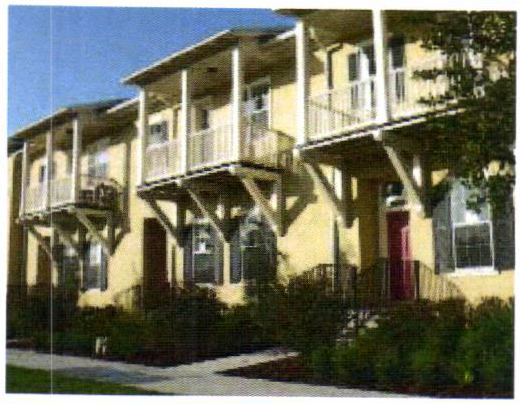 | Townhomes: Also called townhouses, a residential building occupied by households living separately in three or more attached units. Said units are attached side-by-side in a two to three story configuration. | Urban Residential 1 Urban Residential 2 Neighborhood Infill |
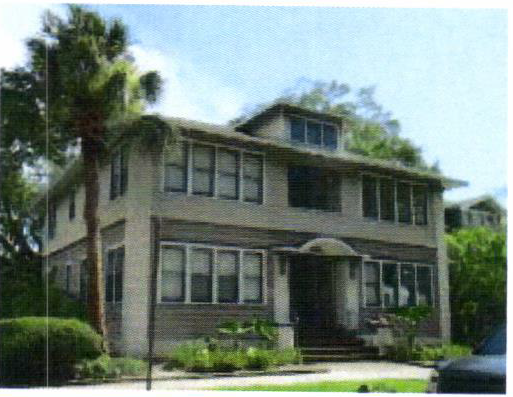 | Fourplex: A residential building occupied by four households in four separate units with two on the ground floor and two above while sharing a single entryway. | Urban Residential 2 Neighborhood Infill |
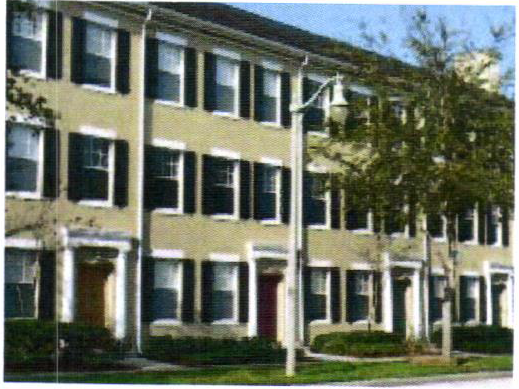 | Small Multiplex: A residential building typically occupied by five to ten households living separately in five to ten attached units. Units within a small multiplex may have a variety of configurations, including side-by-side, front-to-back, and stacked. | Urban Residential 2 Neighborhood Infill |
 | Large Multiplex: A residential building typically occupied by 11 to 20 households living separately in 11 to 20 attached units. Units within a large multiplex may have a variety of configurations, including side-by-side and stacked, typically with one shared entry. | Urban Residential 1 Urban Residential 2 |
 | Mid Rise: A residential building typically occupied by multiple households living separately. Mid-rise buildings typically are five to seven stories in height, and contain structured parking for residents and guests. | Urban Residential 1 Urban Residential 2 |
 | High Rise: A residential building typically occupied by multiple households living separately. High rise buildings are typically greater than seven stories in height, and contain structured parking for residents and guests. | Urban Residential 1 Urban Residential 2 |
(Ord. No. 9149-18, § 8, 8-2-18; Ord. No. 9664-23, § 2, 5-4-23)
Section C-701. - Intent and purpose.
The intent and purpose of this section is to establish specific standards for the Downtown District that implement Section 3-1801. General Principles, Section 3-1802, Purpose of the Sign Regulations as well as the following:
A.
Establish reasonable and improved sign standards for Downtown that encourages the use of a hierarchy of signs appropriately sized for a well-organized visual Downtown environment.
B.
Ensure that signs are complementary to the architectural design of Downtown.
C.
Ensure that signage is pedestrian oriented and appropriately scaled for the Downtown environment.
D.
Facilitate creative and innovative approaches to signs consistent with the intent and purpose of Section C-101 of the Downtown District.
E.
Encourage uniquely designed signs that exhibit a high degree of thoughtfulness, imagination and inventiveness.
(Ord. No. 9217-19, § 6, 1-17-19)
Section C-702. - Applicability.
No sign may be erected, or may thereafter be altered or otherwise modified, in the Downtown District except in accordance with the requirements of this section. Requirements not specifically addressed in Appendix C, Division 7 are subject to the signage requirements set forth in Article 3, Division 18, Signs and Article 4, Division 10, Sign Permit. If there are any conflicts between these regulations and those in Article 3, Division 18, these standards shall govern.
(Ord. No. 9217-19, § 6, 1-17-19)
Section C-703. - General standards.
A.
Exempt and prohibited sign provisions set forth in Sections 3-1803 and 3-1804 shall apply in the Downtown District.
B.
General provisions for signs set forth in Section 3-1805 shall apply unless otherwise superseded by regulations contained in this Appendix C, Division 7.
C.
Temporary sign provisions set forth in Section 3-1806 shall apply in the Downtown District.
D.
Properties in the Downtown District shall be eligible for the Comprehensive Sign Program as set forth in Section 3-1808.
(Ord. No. 9217-19, § 6, 1-17-19)
Section C-704. - General principles for sign planning and design standards.
Vibrant, well designed signs promote business activity, provide visual interest and create an interesting environment that attracts people. To ensure signage has a positive impact consistent with the vision and guiding principles established in the Clearwater Downtown Redevelopment Plan, the following general principles and design standards shall apply in addition to those set forth in Section C-705, below.
A.
Hierarchy of Signs. Signs are the graphic representation of a business in the built environment, therefore, they should be designed in a concise manner to deliver essential information quickly, efficiently and at the point where it is needed. If more than one sign is erected on a single building/business facade a clear hierarchy should be used to ensure the important content is the most prominent. All signs shall be scaled in a clear hierarchy and shall address different viewer orientations and audiences. The most important information on a sign should be the most prominent and emphasized component of the sign. The more important the information, the higher its visibility should be with regard to sign size and placement. Layering information helps customers obtain the information they need while ensuring that every sign has an objective. Larger signs, which are intended to be viewed from farther distances should be strategically placed on the building facade over storefronts and entrances. Smaller signs can provide information at a smaller scale and be intended for view from shorter distances at the pedestrian level.
Figure 34. Hierarchy of Signs Example
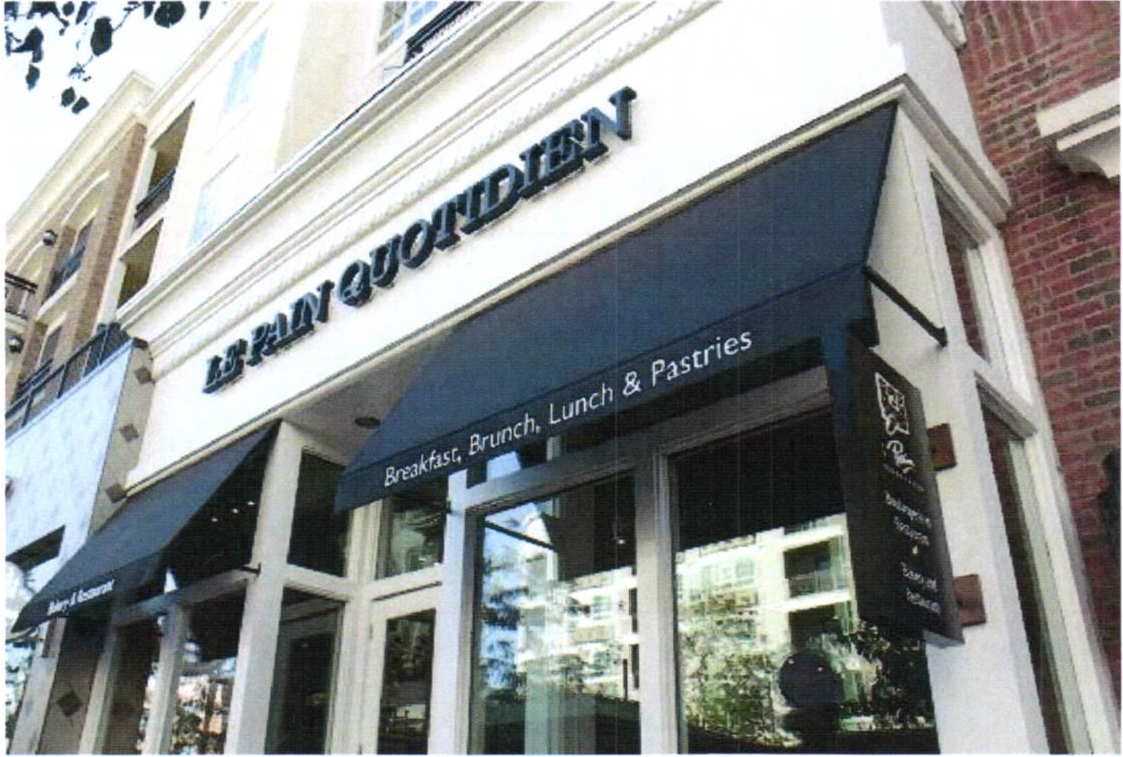
Figure 35. Hierarchy of Signs Example
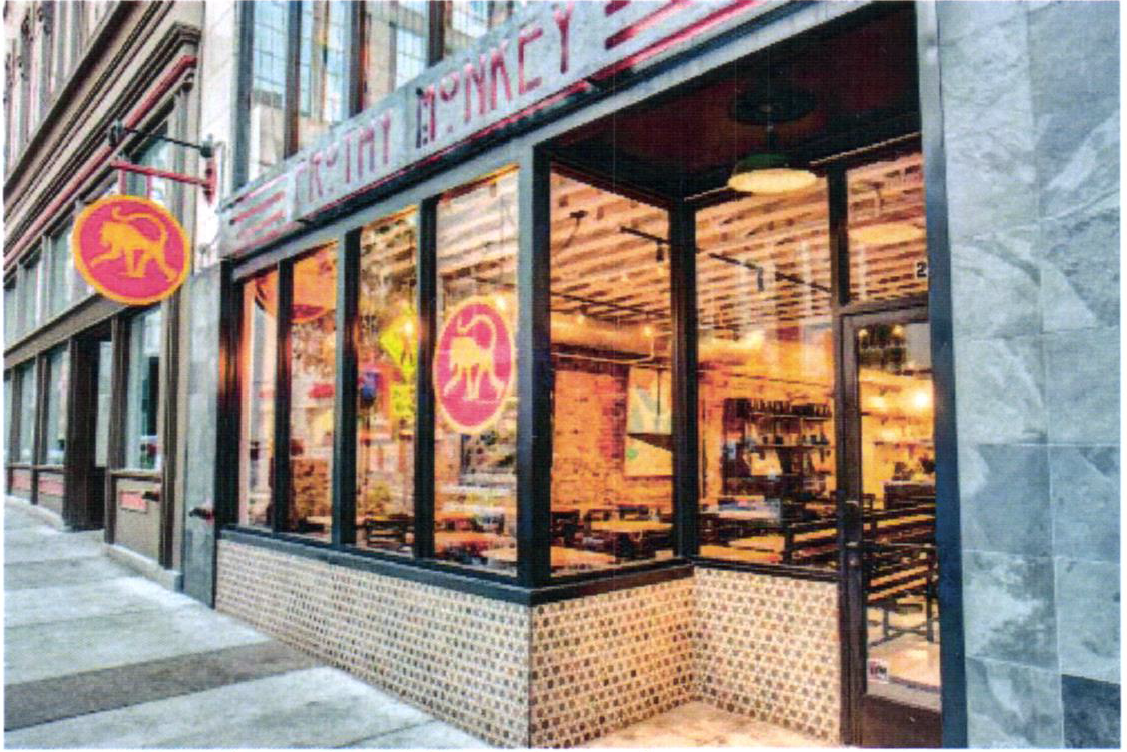
Figure 36. Hierarchy of Signs Example
B.
Location and Alignment. Signs shall comply with the following location and alignment standards in addition to any specific standards specified in Section C-705.D, Sign Types.
1.
Signs shall be placed in a manner that is proportional to the space on which it is located. This includes building signs as well as freestanding signs.
2.
Signs shall be positioned to emphasize or accent elements such as entrances or storefront openings.
3.
Signs shall not obstruct important architectural features.
4.
Signs shall not obstruct any window or door, except for window signs allowed pursuant to Section C-705.D.7.
5.
Signs shall not extend above the roofline, parapet or above the eave line.
6.
No portion of a sign shall extend beyond the ends of the wall to which it is attached, unless it is a projecting or shingle sign.
7.
Signage for occupants located on the second floor and above shall be located on signage by the primary entrance to those floors, unless otherwise allowed in Section C-705.
8.
Signage shall be integrated into signs bands if provided.
C.
Materials.
1.
Signs shall be made of permanent, durable materials such as sealed wood, metals, metal composites, acrylic, polycarbonate, flexible face, brick, stucco, stone and other high-quality materials as approved by the Community Development Coordinator.
2.
Prohibited materials include plexiglass, plywood, and vinyl unless located on windows.
3.
Signs shall not incorporate reflective materials.
4.
Neon paint is prohibited.
5.
No paper or poster signs unless it is an allowable temporary sign pursuant to Section 3-1806.
D.
Illumination. All illuminated signs shall comply with the following standards. Certain sign types may have additional limitations set forth in Section C-705.D, Sign Types.
1.
External light sources intended to illuminate the sign face shall be fully shielded and placed close to, and directed upon, the sign face.
2.
Light fixtures and mounting devices shall complement the color and design of the sign.
3.
Exposed neon tube may be used.
4.
Illumination shall not cast excessive lighting on upper-floor residences or on adjacent properties.
5.
Ground mounted uplighting shall be permitted provided light does not spill off of the sign face.
6.
Transformer boxes shall not be visible on any facade facing a street.
(Ord. No. 9217-19, § 6, 1-17-19)
Section C-705. - Allowable sign area, number and types of signs.
A.
Sign Area and Number of Signs. The total maximum sign area and number of allowable signs shall be as determined in Table 6 below. For each cell in the table, there is a maximum allowed sign area that may be utilized with any combination and any number of signs associated with that cell, unless otherwise noted. The measurements for linear feet shall be at grade. Specific requirements for the allowable sign types are set forth in Section C-705.C and D.
B.
Calculating Allowable Sign Area. The following figures illustrate how to determine street frontage for the purposes of calculating sign area and how to calculate and apply allowable signage.
Figure 37. Building Frontage Determination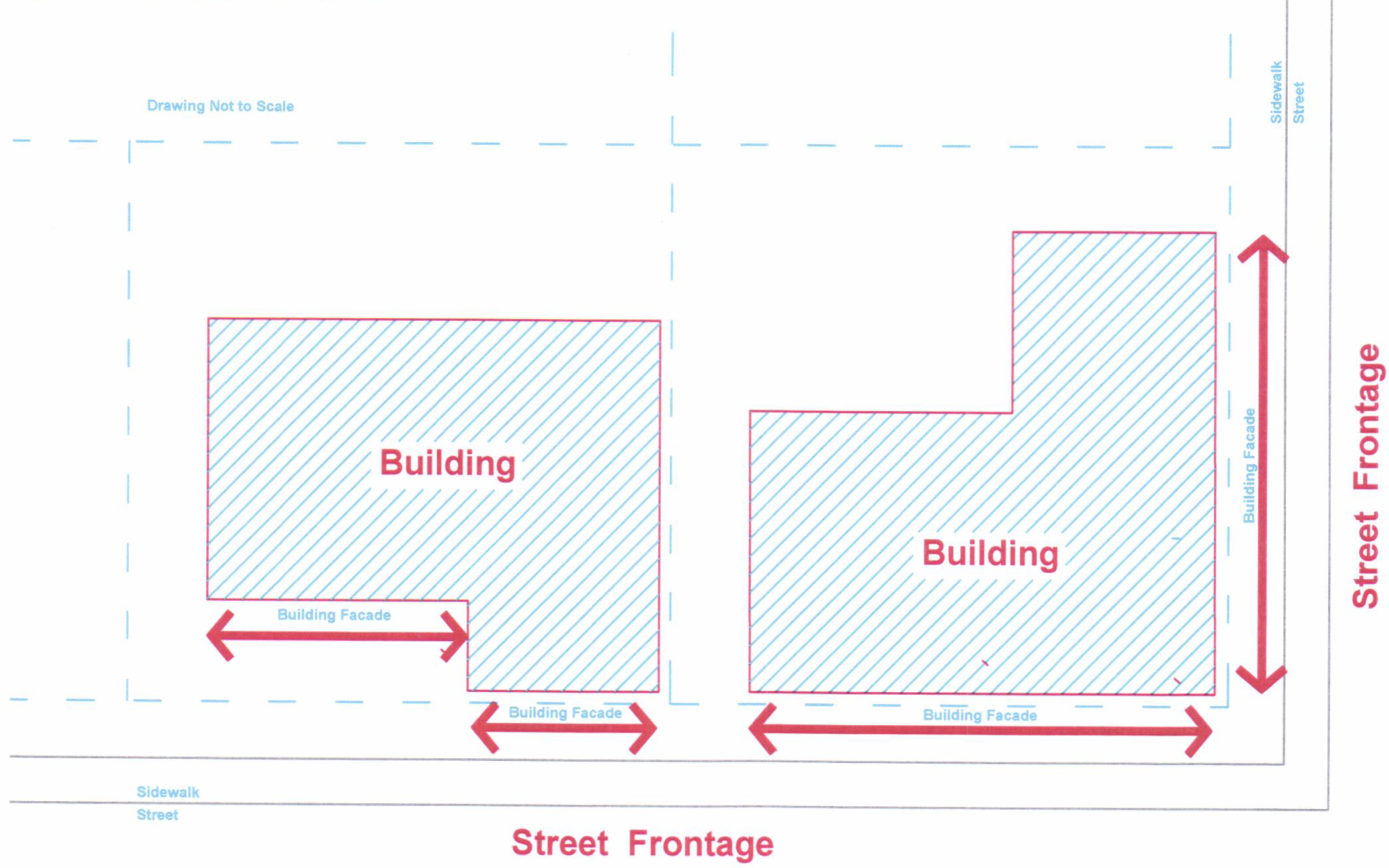
Figure 38. Calculations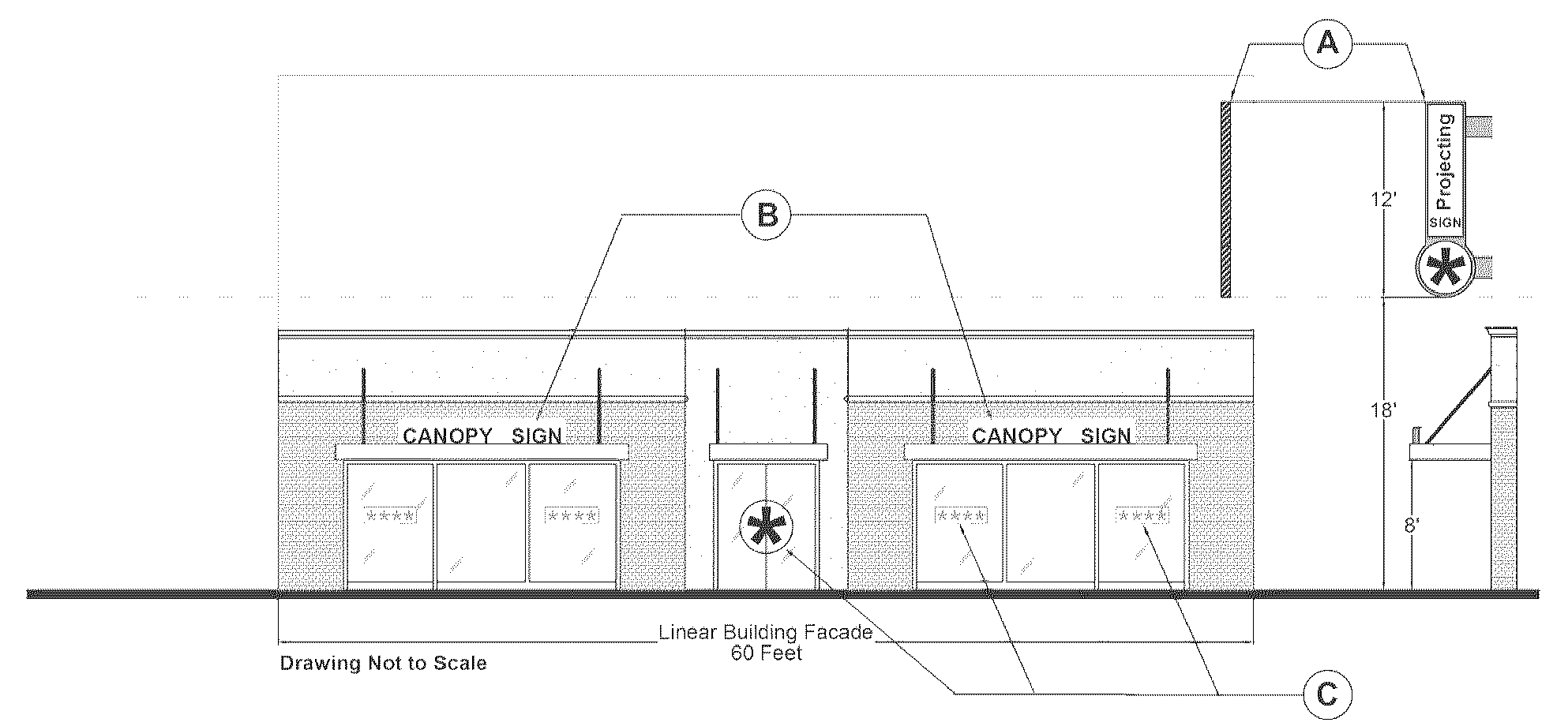
Figure 39. Calculations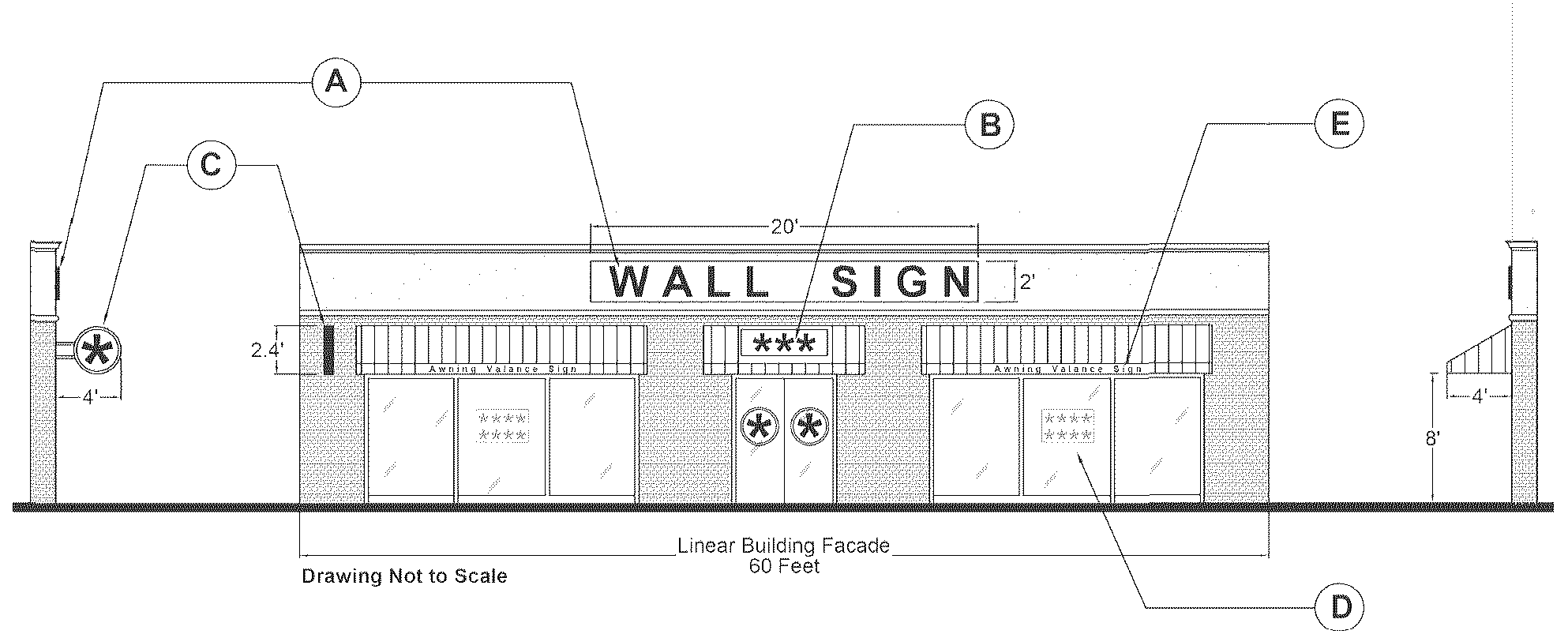
C.
Sign Design and Styles.
1.
Allowable sign styles/designs include flat cut out letters, shoebox cabinet signs, contour cabinet signs, capsule signs, push-through signs, signs sewn to or screen printed on awnings, open face channel letters, back-lit/halo channel letters, or other designs/styles that produce a high-quality appearance as approved by the Community Development Coordinator.
2.
In addition to those prohibited signs set forth in Section 3-1804, the following sign designs and types shall not be permitted in the Downtown District.
a.
Standard cabinet signs.
b.
Back-lit awning signs.
c.
Internally illuminated channel letters/front-lit letters.
d.
Signs painted on buildings.
e.
Raceways and wireways, unless designed as an integral part of the sign design.
f.
Paper/poster/etc., unless allowed pursuant to Section 3-1806, Temporary Signs.
D.
Sign Types. The following sign types are permitted in the Downtown District subject to the requirements below.
|
| Figure 40. Wall Sign Diagram |
 |
| Figure 41. Wall Sign Example |
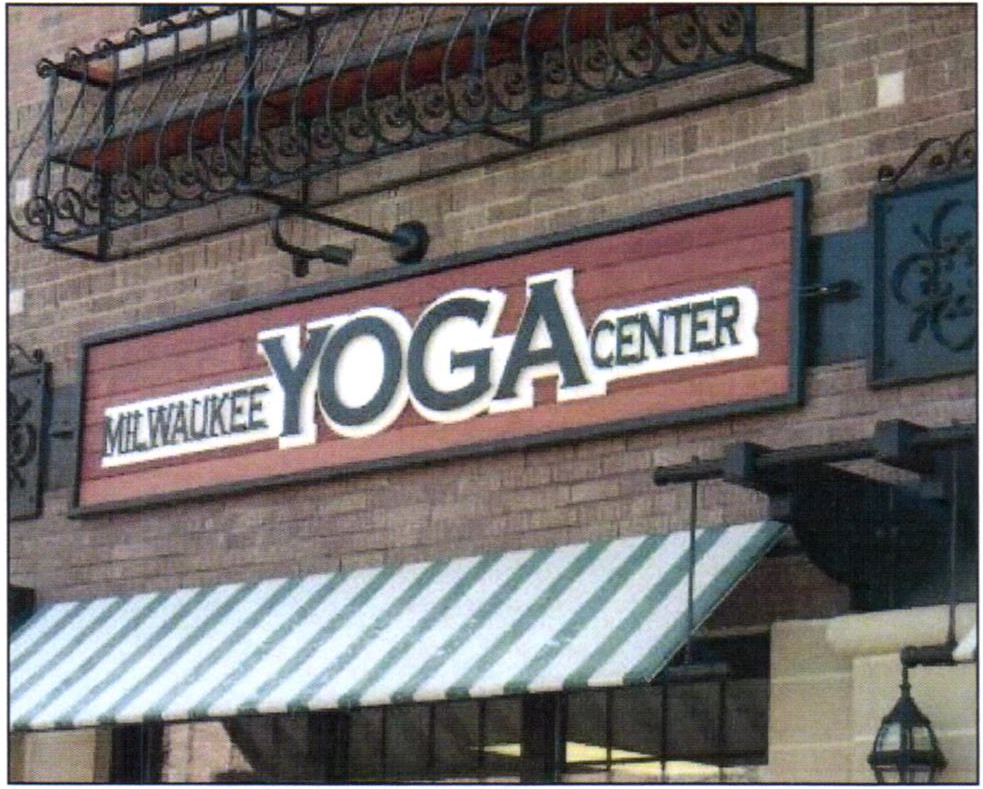 |
| Figure 42. Wall Sign Example |
1.
Wall Signs.
a.
Description: A sign attached parallel to and placed either directly on or attached to the exterior wall of a building.
b.
Number of Signs: No more than 3 per establishment facing a street frontage.
c.
Dimensional Requirements.
1.
The width of a wall sign shall not exceed 75 percent of the length of the façade along a street.
2.
Wall signs shall not project more than 12 inches from the building façade.
d.
Standards.
1.
Wall signs shall be located on the upper portion of the storefront, within or just above the storefront opening.
2.
One main wall sign is permitted per facade facing a street. Smaller walls signs are permitted in compliance with Section C-705, Table 6.
3.
Wall signs may be externally or internally illuminated in accordance with Section C-704.D and Section C-705.C.
4.
No wall sign may extend above the top of the first floor or the finished floor line of the second floor, unless otherwise approved by the Community Development Coordinator.
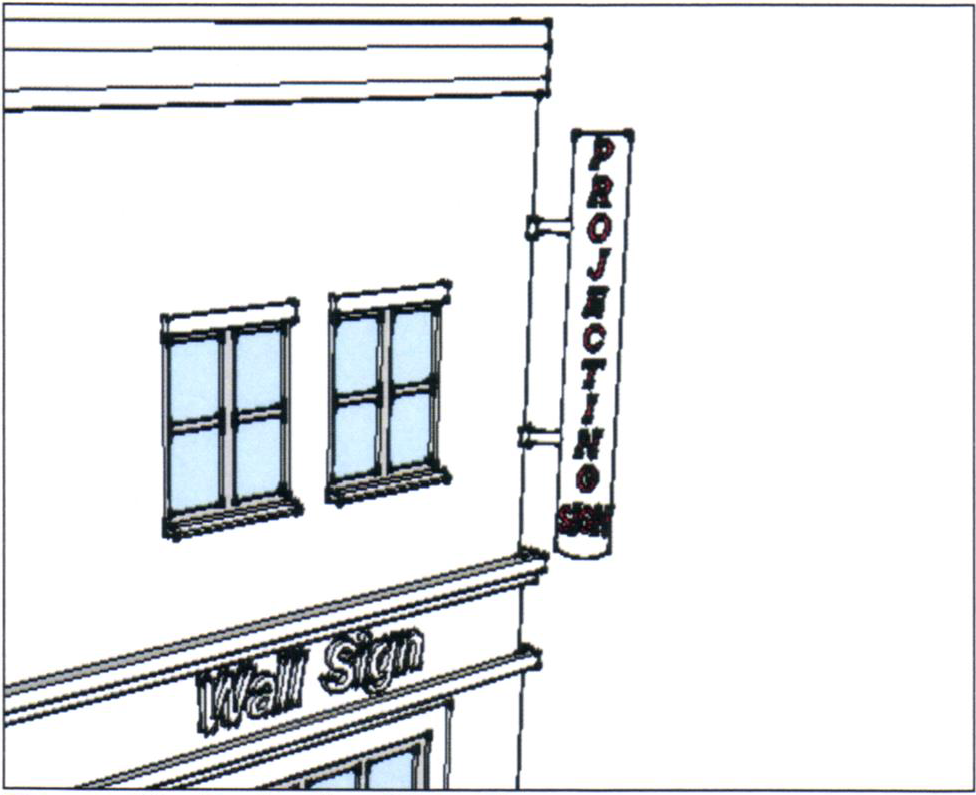 |
| Figure 43. Projecting Sign Diagram |
 |
| Figure 44. Projecting Sign Example |
 |
| Figure 45. Projecting Sign Example |
2.
Projecting Signs.
a.
Description: A two-sided sign that is attached to and projects outward from the building. It is generally vertical in orientation and projects perpendicular to the building.
b.
Number of Signs: No more than 1 projecting sign per establishment.
c.
Dimensional Requirements.
1.
The width of a projecting sign shall not exceed 4 feet.
2.
Sign brackets shall not extend more than 18 inches from the building wall.
3.
Projecting signs shall be setback 5 feet from the curb line.
d.
Standards.
1.
A projecting sign shall be located a minimum of 30 feet from another projecting sign.
2.
Projecting signs shall be located between the finished floor of the 2nd and 3rd story or between the 2nd story and roof.
3.
A projecting sign may be located on a building corner and may incorporate sign area from both frontages provided the remaining allowable sign area is split proportionally among the two frontages.
4.
Projecting signs may be externally or internally illuminated in accordance with Section C-704.D and Section C-705.C.
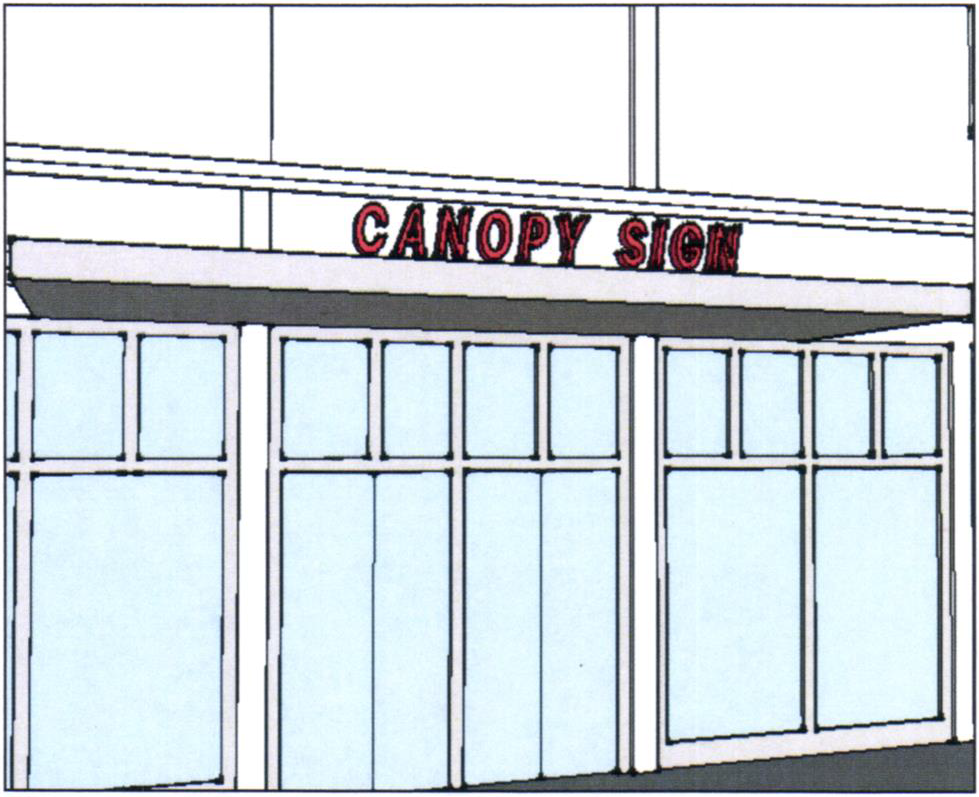 |
| Figure 46. Canopy Sign Diagram |
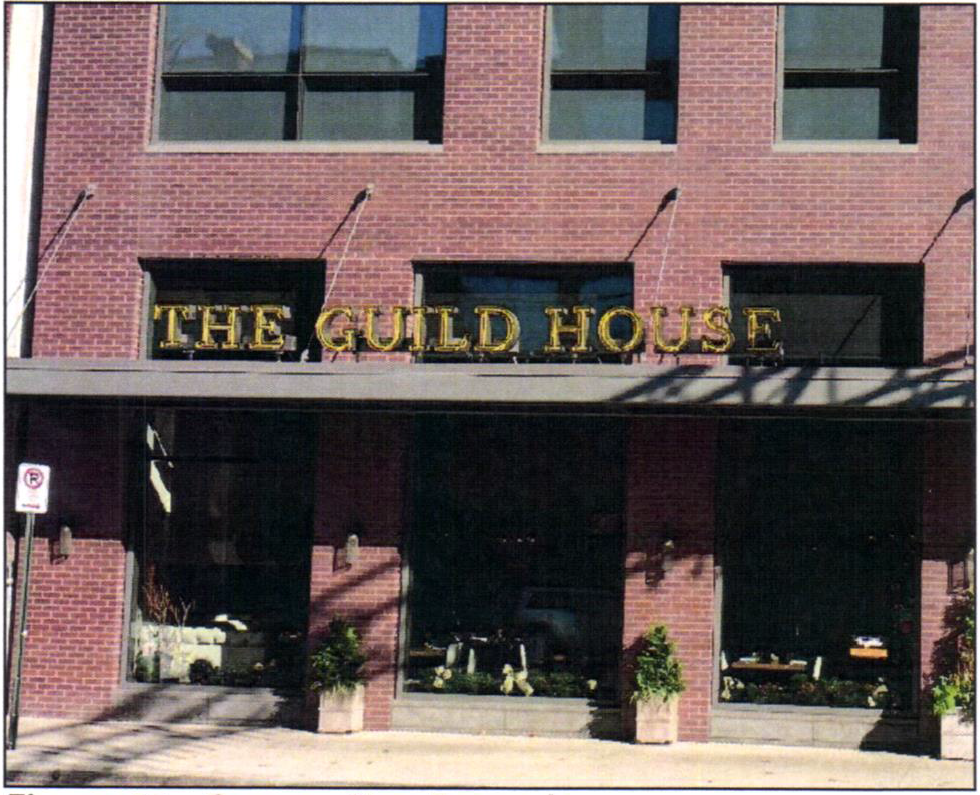 |
| Figure 47. Canopy Sign Example |
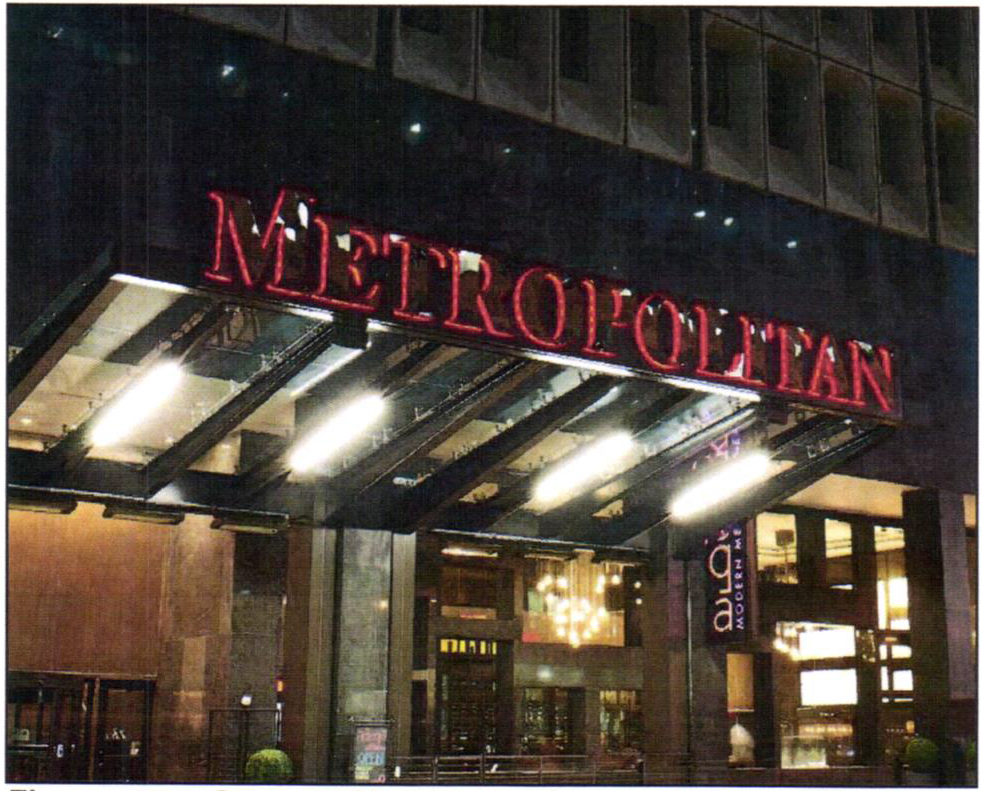 |
| Figure 48. Canopy Sign Example |
3.
Canopy Signs.
a.
Description: A sign that is attached to, applied to or affixed to the visible surface of an attached canopy.
b.
Number of Signs: No more than 2 canopy signs per establishment facing a street frontage.
c.
Dimensional Requirements.
1.
No more than 75 percent of the width of the canopy may be occupied by signage.
2.
Letters attached to and projecting above the canopy shall be limited to 2 feet in height.
3.
The vertical clearance from the sidewalk to the lowest point of the canopy shall be 8 feet.
4.
The canopy shall be setback 5 feet from the curb line.
d.
Standards.
1.
Signs may be located on the face of the canopy or extend above it.
2.
A raceway may be used to attach a canopy sign erected above a canopy provided it is concealed from view behind the canopy.
3.
Canopy signs may be illuminated in accordance with Section C-704.D and Section C-705.C.
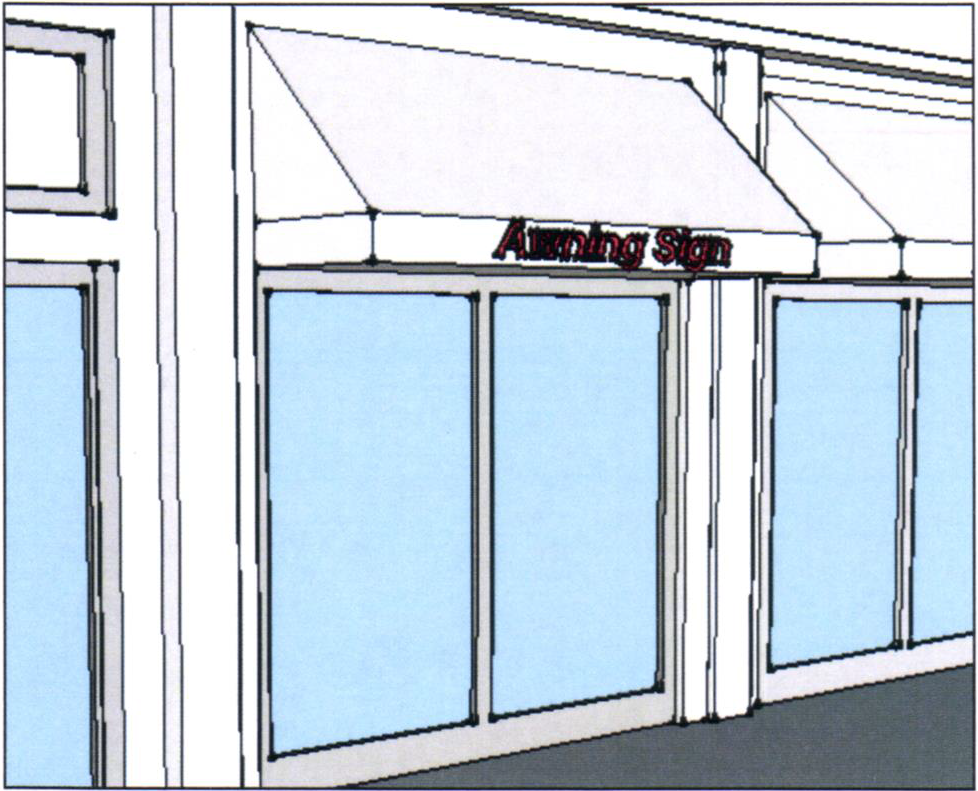 |
| Figure 49. Awning Sign Diagram |
 |
| Figure 50. Awning Sign Example |
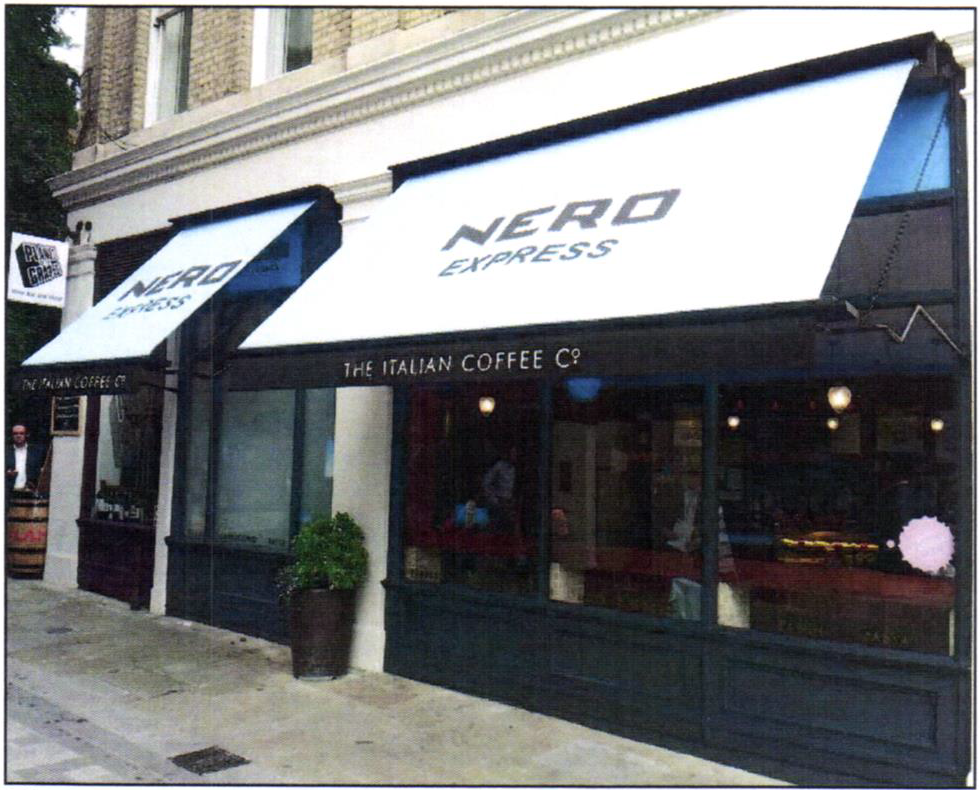 |
| Figure 51. Awning Sign Example |
4.
Awning Signs.
a.
Description: A sign that is affixed flat to the valance or the shed of an awning. Such sign may be screen printed or appliqued to the awning.
b.
Number of Signs: No more than 1 awning sign shall be allowed on each awning shed and valance.
c.
Dimensional Requirements.
1.
No more than 30 percent of the shed area (sloping plane) of the awning may be occupied by signage.
2.
Signs on awning valances 10 inches or less in height are exempt from the maximum allowable sign area and maximum number of permitted signs.
3.
No more than 75 percent of the awning valance may be used for signage.
4.
The vertical clearance from sidewalk to the lowest point of awning shall be 8 feet.
5.
The awning shall be setback 5 feet from the curb line.
d.
Standards.
1.
Awning signs shall only be allowed on awnings erected over ground floor doors and/or windows.
2.
Awning signs shall only be externally illuminated.
3.
Signage is only allowed on the shed or valance of the awning along a street frontage.
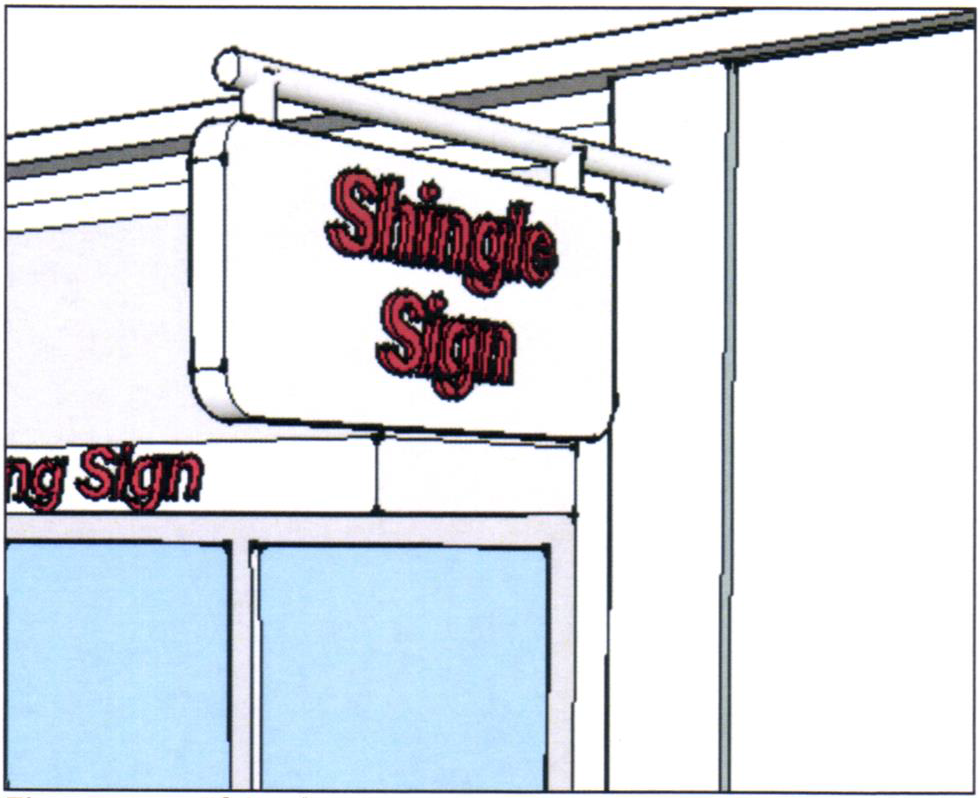 |
| Figure 52. Shingle Sign Diagram |
 |
| Figure 53. Shingle Sign Example |
 |
| Figure 54. Shingle Sign Example |
5.
Shingle Signs.
a.
Description: A small projecting sign that extends outward at a 90 degree angle and may either hang from brackets or be mounted with brackets to the building façade.
b.
Number of Signs: No more than 1 shingle sign per establishment along a street frontage.
c.
Dimensional Requirements.
1.
Shingle signs shall not exceed 6 square feet in area.
2.
Shingle signs, including sign brackets, shall not extend more than 4 feet from the building wall.
3.
The vertical clearance from the sidewalk to the lowest point of the shingle sign shall be 8 feet.
4.
Shingle signs shall be setback 5 feet from curb line.
d.
Standards.
1.
A shingle sign shall be located a minimum of 15 feet from a projecting sign or another shingle sign.
2.
Shingle signs shall be located below the finished floor level of the second story.
3.
Shingle signs may be externally or internally illuminated in accordance with Sections C-704.D and C-705.C.
 |
| Figure 55. Under Canopy Sign Example |
 |
| Figure 56. Under Canopy Sign Example |
 |
| Figure 57. Under Canopy Sign Example |
6.
Under Canopy Signs.
a.
Description: A sign that is suspended from, and located entirely under a covered porch, covered walkway or canopy supported by a building.
b.
Number of Signs: No more than 1 per establishment facing a street frontage.
c.
Dimensional Requirements.
1.
Under canopy signs shall not project beyond the limitations of the covered porch or canopy.
2.
The vertical clearance from the sidewalk to the lowest point of the under canopy sign shall be 7 feet.
3.
Under canopy signs shall be setback 5 feet from the curb line.
d.
Standards.
1.
Under canopy signs shall be used only at ground floor locations except for upper floor businesses with covered entry porches or balconies.
2.
Under canopy signs may be externally illuminated.
3.
Under canopy signs shall be securely fixed to the underside of the canopy or porch.
 |
| Figure 58. Window Sign Example |
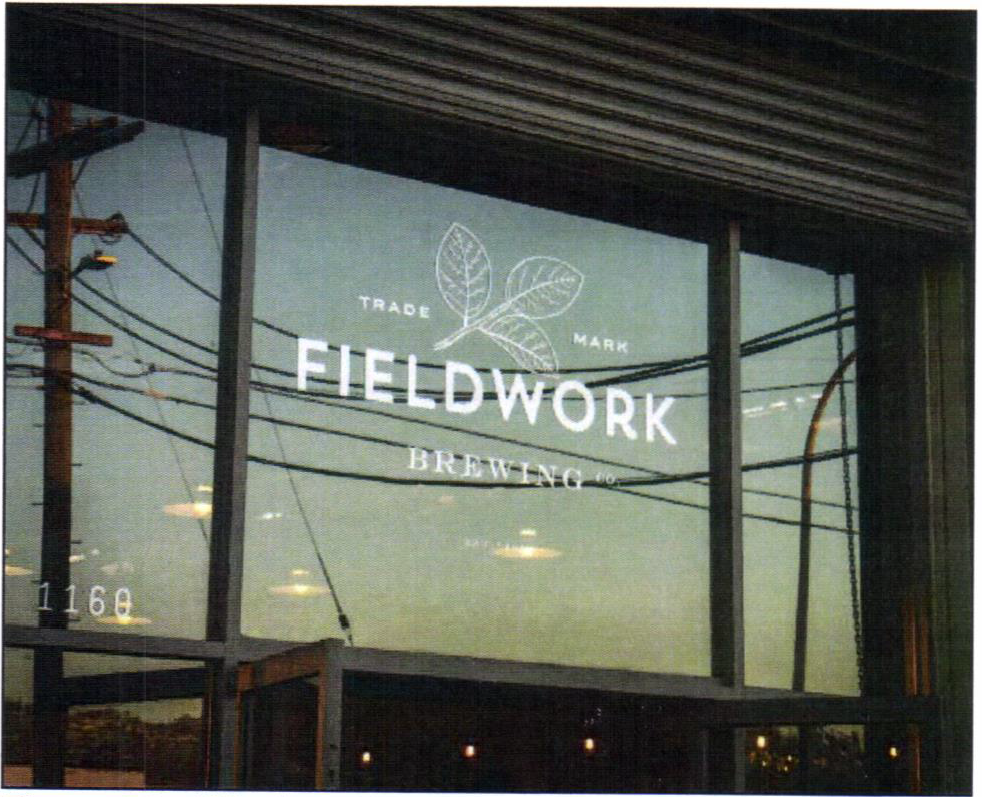 |
| Figure 59. Window Sign Example |
 |
| Figure 60. Window Sign Example |
7.
Window Signs.
a.
Description: A sign that is affixed or attached to the inside of a window facing the street.
b.
Number of Signs: N/A.
c.
Dimensional Requirements.
1.
Window signs shall not exceed 25 percent of any window or glass door opening.
2.
Where multiple windows present as one large window, the window grouping will be treated as one window for the purpose of calculating allowed signage.
3.
The total area of window signs erected along a street frontage shall not exceed 50 square feet.
d.
Standards.
1.
Window signs shall be limited to windows and doors on the ground floor.
2.
Window signs should be applied directly to the interior face of the glazing or hung inside the window, thereby concealing all mounting hardware and equipment.
3.
Window signs shall not obscure views into a business.
4.
Window signs should complement the merchandise display without obscuring it.
5.
Window signs should be scaled to the pedestrian instead of vehicular traffic.
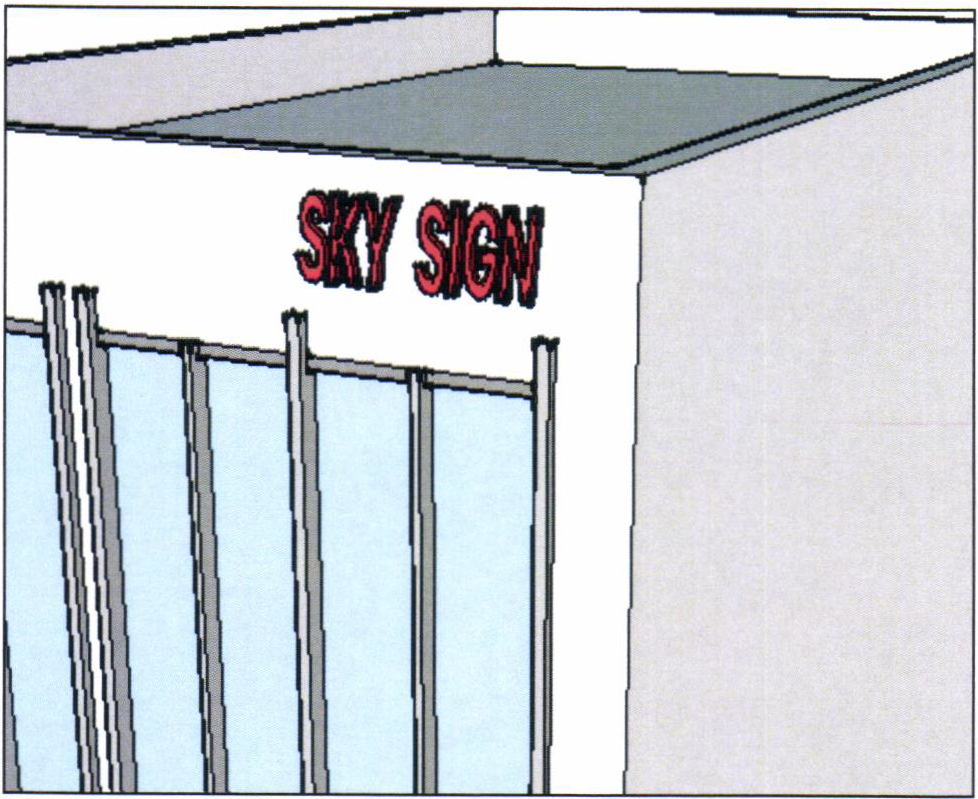 |
| Figure 61. Skyline Sign Diagram |
 |
| Figure 62. Skyline Sign Example |
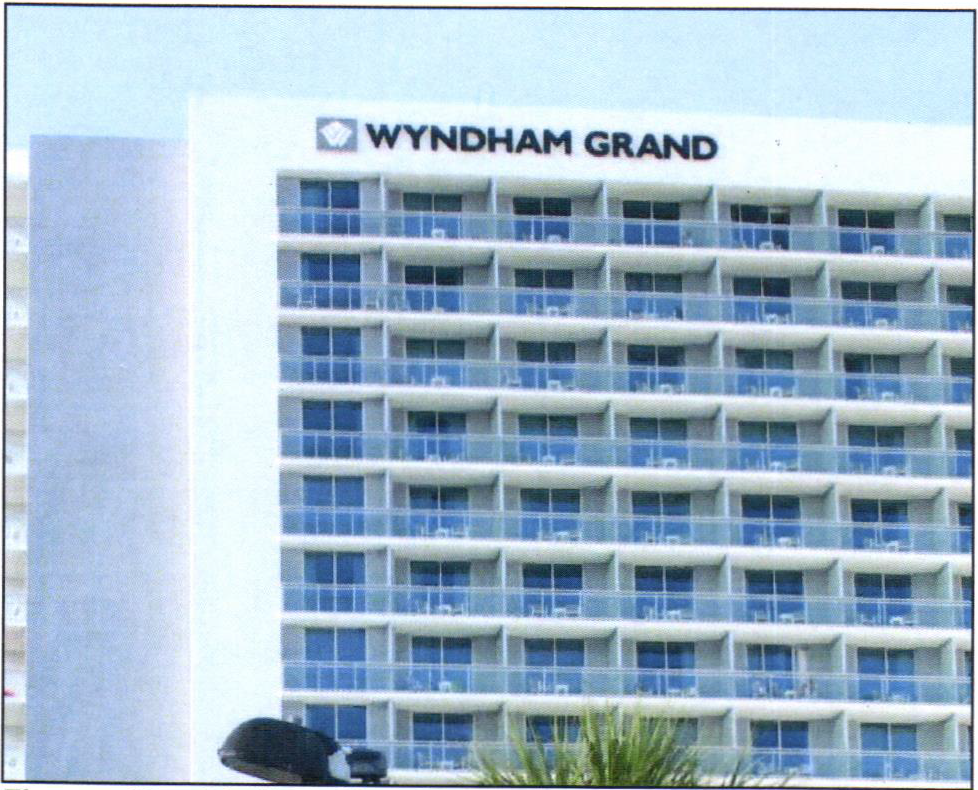 |
| Figure 63. Skyline Sign Example |
8.
Skyline Signs.
a.
Description: A building sign that is attached to the exterior wall of the upper band of a building.
b.
Number of Signs: No more than 1 sign per façade along a street frontage.
c.
Dimensional Requirements: The maximum height of a skyline sign shall not exceed an average of 4 feet.
d.
Standards.
1.
Skyline signs may be oriented horizontally or vertically.
2.
Skyline signs shall not be externally illuminated. Internally illuminated signs are permitted provided the sign is in compliance with Sections C-704.D and C-705.B.
3.
An allowable skyline sign may be located on any side of the building.
4.
The design of a skyline sign shall be complementary and not compete with or detract from any sculpted roof design.
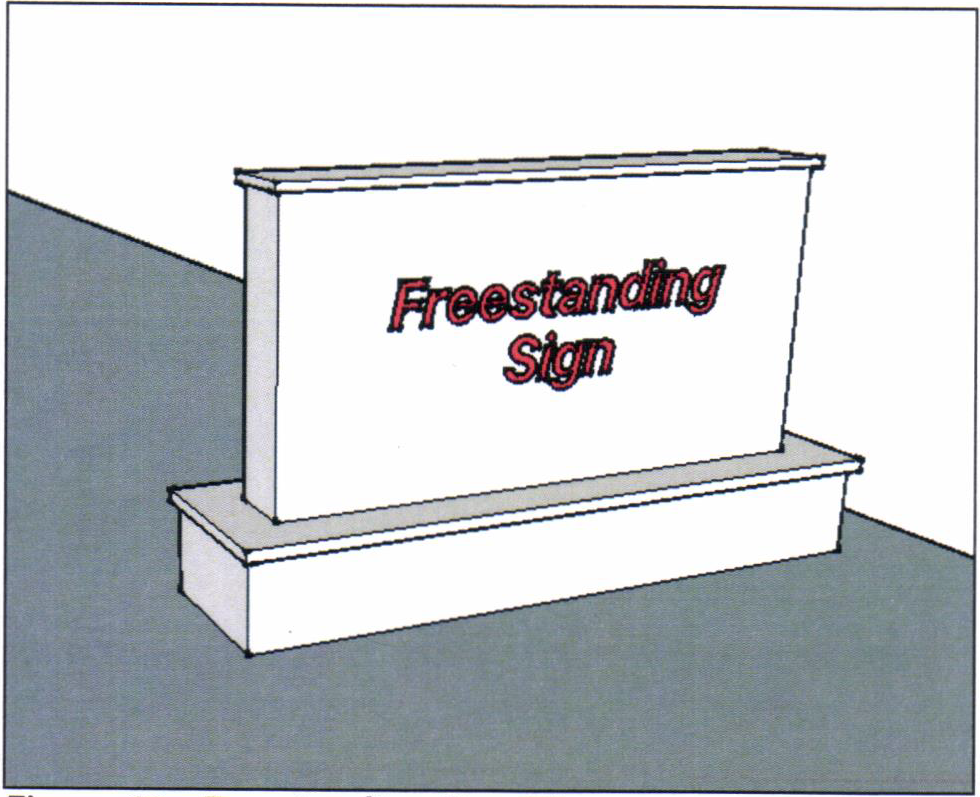 |
| Figure 64. Freestanding Sign Diagram |
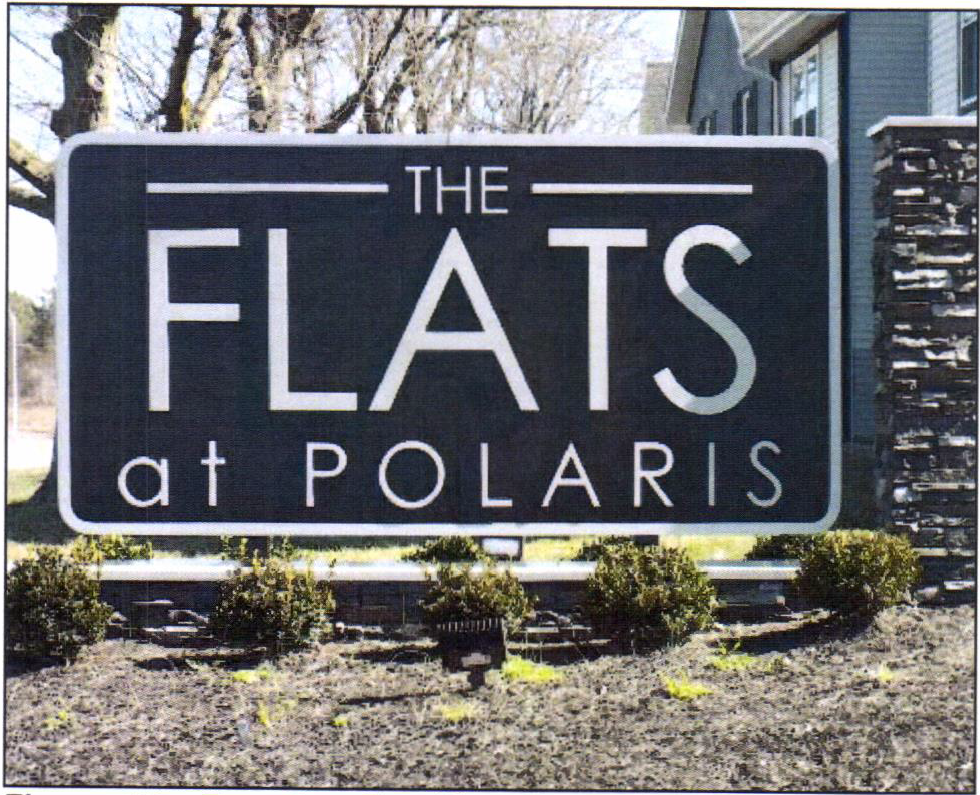 |
| Figure 65. Freestanding Sign Example |
 |
| Figure 66. Freestanding Sign Example |
9.
Freestanding Sign.
a.
Description: A sign supported by a structure or supports that are permanently placed on or anchored in the ground that are independent of any building.
b.
Number of Signs: No more than 1 freestanding sign per parcel.
c.
Dimensional Requirements.
1.
Freestanding signs shall not exceed 6 feet height.
2.
Freestanding signs shall be located in a landscaped area consisting of shrubs and/or ground cover at least 3 feet in width around the entire sign base.
3.
Freestanding signs shall be setback 5 feet from any property line.
d.
Standards.
1.
Freestanding signs shall be designed with a distinctive design that is complementary to the building or with an architectural element used on the building such as an arch, capstone, pediment, distinctive roof form/material, etc., defining materials, textures and colors used on the building; or a shape, form or motif that portrays the business.
2.
Freestanding signs shall be consistent with or complementary to the overall design, colors, materials and font style of the building signage.
3.
Freestanding signs may be externally illuminated. Internally illuminated signs may be permitted only if the letters and graphics on the sign are illuminated.
4.
The base and/or supports of freestanding signs shall be of a width that creates proportionality to the overall sign design.
5.
No more than 25 percent of sign face area may contain two lines of zip track for manual changeable area. Such area and letters shall be coordinated with the color of the sign.
 |
| Figure 67. Sidewalk Sign Example |
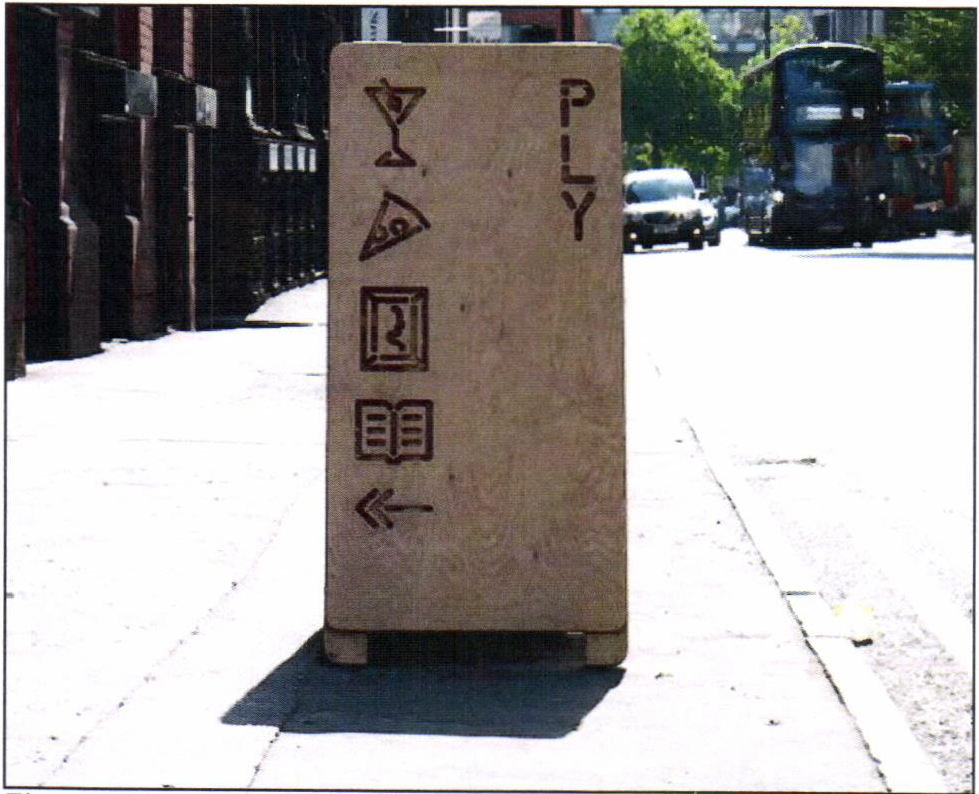 |
| Figure 68. Sidewalk Sign Example |
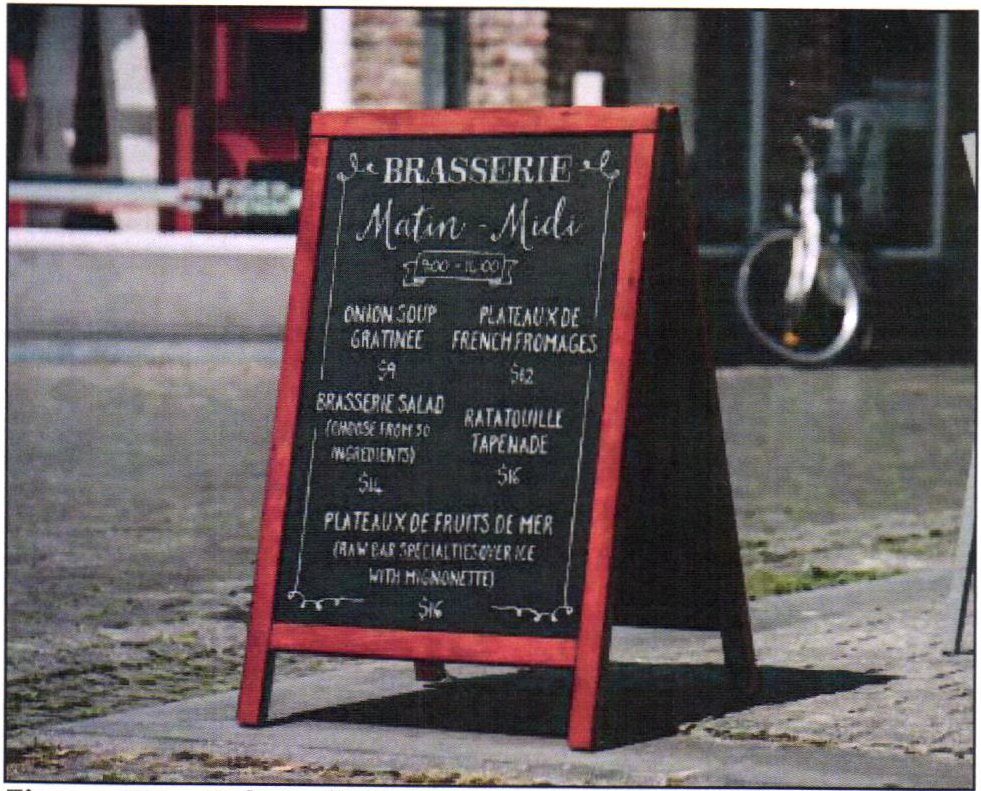 |
| Figure 69. Sidewalk Sign Example |
10.
Sidewalk Signs.
a.
Description: A freestanding sign which placed upon the ground and that is portable and readily moved from place to place.
b.
Number of Signs: The allowable number of signs is set forth in Table 3-1806.1.a.
c.
Dimensional Requirements: Sidewalk signs shall comply with the dimensional requirements set forth in Table 3-1806.1.a.
d.
Standards: Sidewalk signs shall comply with the design standards set forth in Table 3-1806.1.a.
(Ord. No. 9217-19, § 6, 1-17-19; Ord. No. 9643-23, § 30, 4-4-23; Ord. No. 9791-24, § 2, 12-5-24)
Section C-801. - General.
Flexibility in the application of development standards in Appendix C, Divisions 3, 4, 5, and 6 may be approved by the Community Development Coordinator or Community Development Board as provided below. Where flexibility is allowed, the level of flexibility permitted shall be the minimum extent required to address flexibility standards and requirements.
(Ord. No. 9149-18, § 8, 8-2-18)
Section C-802. - Process.
Authority to grant flexibility shall follow the approval levels indicated by use in Table 2. Use and Off-Street Parking and shall be administered consistent with the development review procedures in Article 4 of this Development Code. The Community Development Coordinator shall have authority to grant flexibility for Level One approvals and the Community Development Board shall have authority to grant flexibility for Level Two approvals. Where flexibility is being requested for a Level One Minimum Standard Development use, the request shall be processed as a Level One Flexible Standard Development.
(Ord. No. 9149-18, § 8, 8-2-18)
Section C-803. - Flexibility provisions.
Flexibility may be approved subject to the standards below.
A.
Character District Standards—Height Transitions.
1.
Flexibility in meeting required building step backs along street frontages in Section C-302.B may be approved where the alternative design provides visual and spatial relief similar to a step back, a varied an interesting design, and the alternative treatment is integral to the building's design and results in facades of equal or better quality than the standards would produce.
2.
Flexibility in meeting required building step backs along street frontages in Section C-302.B may be approved for parking garages where providing a step back in the required location is impractical or infeasible. Where flexibility in this standard is allowed, building step backs should be provided on a lower or higher floor, or the garage shall have a varied and interesting design providing visual and spatial relief that meets the intent of a step back.
B.
Frontage Standards—Properties with Multiple Street Frontages. Flexibility in the standards for orientation of front building facades for attached and detached dwellings in Appendix C, Division 4 may be approved to allow for frontage orientation consistent with typical frontage orientation on surrounding blocks.
C.
Frontage Standards—Building Setbacks.
1.
Front building setbacks less than the minimums or greater than the maximums allowed in Appendix C, Division 4 may be approved for projects with a publicly-accessible outdoor open space or site constraints such as shape irregularities and/or the presence of natural features, existing utilities, utility easements, or access easements making meeting setback requirements impractical or infeasible. Where approved, the increase or reduction in front building setbacks shall be to the smallest extent practicable as determined by the Community Development Coordinator.
2.
Flexibility in the application of front setback requirements in Appendix C, Division 4 may be approved to allow new development setbacks compatible with the traditional character of development on adjacent sites and block frontages.
3.
Flexibility in the application of front setback requirements in Appendix C, Division 4 to provide 10-foot minimum sidewalk widths may be approved to allow new development setbacks compatible with the traditional character of development on adjacent sites and block frontages.
4.
Side and rear setbacks less than the minimum allowed in Appendix C, Division 4 may be approved for projects to allow for innovative site designs that advance the goals and objectives for the Clearwater Downtown Redevelopment Plan.
5.
The maximum spacing between individual buildings along Storefront 1 and Urban Residential 1 Street Frontages in Section C-404.B. and Section C-407.B may be increased or waived for projects with one or more of the following characteristics.
a.
The proposed site configuration is designed to incorporate natural features such as a stand of mature trees, body of water, wetland or other similar feature.
b.
Placement of existing buildings and/or site access and circulation constraints make it infeasible to meet the standard.
c.
The placement of publicly-accessible outdoor plaza spaces to the side of the building results in increased spacing to accommodate the plaza.
Where flexibility in the standard is allowed, enhanced landscaping and the use of low walls along street frontages to screen parking and define the edge of pedestrian walkways shall be required.
6.
The maximum spacing between building frontages or between building wings for "U"-shaped buildings may be increased to 100 feet along Street Type C when on a secondary frontage or Street Type D when on a primary or secondary frontage to allow for a private courtyard.
D.
Frontage Standards—Front Setback Improvements.
1.
Flexibility in the prohibition of walls, railings, fencing or other similar improvements in front of buildings with Workshop/Flex, Urban Residential 2, Neighborhood Infill or Neighborhood Conservation Frontages along Street Types D, E, and F may be approved where the placement of a wall, railing, fence or other similar improvement in front of the building does not negatively affect the project's pedestrian orientation or is found to be compatible with front setback conditions on abutting and nearby properties. Where flexibility is approved, wall, railing, fence or other similar improvement height shall be 6 feet maximum, and any portion above 3 feet in height shall be at least 50 percent open (i.e., picket style).
2.
Flexibility in the application of landscaping standards in front setbacks on buildings with Storefront 2, Urban Residential 1, Urban Residential 2, Neighborhood Infill and Neighborhood Conservation Frontages found in Section C-407.C, Section C-408.C, Section C-409.C, and Section C-410.C may be approved if pedestrian orientation is not adversely impacted and site functionality is improved.
E.
Frontage Standards—Ground Floor Facades & Entries.
1.
For buildings with multiple street frontages, required glazing below 4 feet along secondary street frontages may be exempt from the daylight reduction (tinting) standard required for buildings with Storefront 1, Storefront 2 or Workshop/Flex Frontages. No reflective or mirrored coating or treatments are permitted. These flexibility provisions are illustrated in Figure 70. Frontage Design Flexibility.
2.
For buildings on corner lots, flexibility in locating primary building entries on secondary street frontages may be approved as long as facades on primary and secondary street frontages are designed to meet applicable standards in Appendix C, Division 4. and the primary building entry is located within 20 feet of the primary street frontage or corner.
3.
For projects on sloping sites where site grades make meeting the requirements for finished floor elevation standards for residential buildings in Appendix C, Division 4 impractical or infeasible, a finished floor elevation of up to 48 inches may be approved. This maximum height shall not apply to projects approved prior to January 1, 2023. For those portions of a residential building that are used for nonresidential uses such as lobbies, fitness centers, or similar shared spaces, a finished floor elevation of less than 18 inches may be approved.
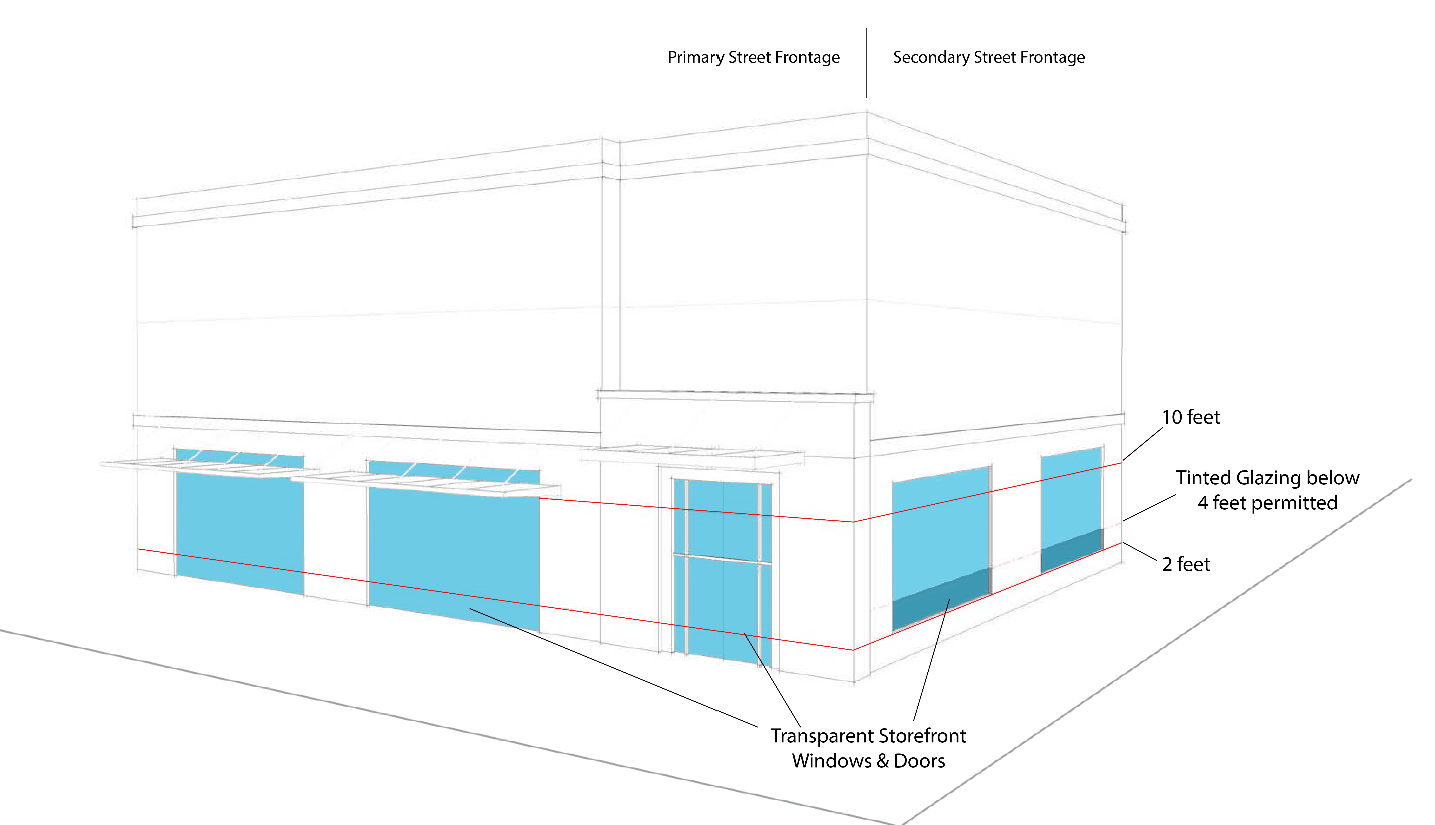
Figure 70. Frontage Design Flexibility
F.
Frontage Standards—Parking.
1.
Flexibility in the application of landscape and wall requirements in Appendix C, Division 4 to screen surface parking, service areas, and structured parking, may be approved where alternative design treatments result in all of the following.
a.
The screening of vehicles from view along public sidewalks.
b.
The physical separation of pedestrian use and vehicular use areas.
c.
The creation of safe, comfortable, and quality pedestrian environments along pedestrian walkways and public sidewalks.
2.
Flexibility in the applicability of parking location requirements may be approved consistent with one of the following.
a.
Surface parking lots for office buildings lawfully existing on the original date of adoption (August 2, 2018) of these Development Standards located outside of the Downtown Core Character District and on primary frontages may continue to be repaired or expanded consistent with the provisions set forth in Article 3, Division 12, provided that the new parking area must meet required landscaping provisions, site access is consistent with Section C-503.A, and a low wall 24-36 inches in height shall be installed to screen and connect the entire parking area. The expansion of surface parking shall be limited to the addition of contiguous parcels, and this flexibility shall not apply to parcel(s) separated from the existing office property by any rights-of-way.
b.
Flexibility to allow surface or structured parking and other vehicular use areas, including vehicular loading/unloading areas and passenger drop off areas, may be approved along secondary street frontages. If approved, such areas shall be set back from primary street frontages 20 feet minimum and include architectural and landscape screening and other treatments that contribute to the creation of safe and comfortable pedestrian environments along pedestrian walkways and public sidewalks. Curb cuts from secondary street frontage to access such locations shall be minimized.
3.
Flexibility to allow single width private driveways located in side setbacks no closer than 2 feet from side lot lines may be approved along Street Type F for projects where the adjacent property's driveway is not located within the side setback on the shared property line for which the flexibility is required.
G.
Frontage Standards—Attached and Detached Dwellings along Street Types E and F. Flexibility in meeting frontage requirements found in Section C-409 and Section C-410 for attached or detached dwelling projects may be approved if a project utilizes innovative building types or styles such as bungalow court configurations, carriage houses, or the like.
H.
Site Design Standards—Development Pattern. Flexibility in the application of requirements found in Section C-502.B regarding development blocks and lots, Section C-502.C. regarding new private drives, and Section C-502.D. regarding new private service drives may be approved for projects on sites where the applicant demonstrates that site size, dimension, shape, or presence of constraints such as natural areas, utilities or utility easements, or other existing features make meeting these requirements infeasible.
I.
Site Design Standards—Access and Circulation.
1.
A reduction in the minimum width for pedestrian walkway(s) found in Section C-503.C.2 may be approved where site and/or development constraints make meeting the requirements impractical or infeasible. Pedestrian walkway width shall comply to the greatest extent practicable as determined by the Community Development Coordinator.
2.
Flexibility in provision of cross parcel connections found in Section C-503.D may be approved under one or more of the following circumstances.
a.
Where site grades, natural areas, or other site constraints make meeting the requirements impractical or infeasible.
b.
Where applicants can satisfactorily demonstrate to the Community Development Coordinator that the characteristics or layout of abutting properties would make development of a unified or shared access and circulation system impractical or where the applicant demonstrates that all reasonable steps were taken to secure joint and cross access easements and that such steps failed.
J.
Site Design Standards—Service Areas. Flexibility in the application of service area location requirements found in Section C-504.C may be approved where vehicular access to the rear of the property is not possible as determined by the City. Screening requirements are still applicable.
K.
Site Design Standards—Swimming Pools. Flexibility in the application of swimming pool requirements in Section C-510 may be approved consistent with one of the following.
1.
For buildings at corner locations, flexibility may be approved to allow at-grade swimming pools within in a courtyard of a "U"-shaped or "L"-shaped building along a secondary street frontage. Where flexibility in this standard is allowed, non-opaque or picket-style fencing may be permitted to a maximum height of 6 feet in line with or setback from the front building façade.
2.
For buildings on through lots or multi-frontage lots, flexibility may be approved to allow at-grade swimming pools within a courtyard of a "U"-shaped building along Street Type D. Where flexibility in this standard is allowed, non-opaque or picket-style fencing may be permitted to a maximum height of 6 feet in line with or setback from the front building façade.
L.
Building Design Standards—Façade Design and Articulation. Flexibility in meeting the façade design and articulation standards in Appendix C, Division 6, may be approved where the alternative design treatment provides a varied and interesting design and the alternative treatment is integral to the building's design and results in facades of equal or better quality than the standards would produce.
M.
Building Design Standards—Glass Treatments. Flexibility in applying glass treatment standards in Section C-602.D may be permitted for buildings that incorporate stained or art glass as an integral part of the building design and still provide for the minimum level of glazing as required under Appendix C, Division 4.
N.
General Flexibility Provisions.
1.
Flexibility in the application of development standards for governmental uses, places of worship, certain indoor recreation uses such as auditoria, museums, and stadiums, public transportation facilities, public utilities uses, and for projects on parcels not fronting on a street may be approved if the proposed development is consistent with the vision, guiding principles, goals, objectives, and policies of the Clearwater Downtown Redevelopment Plan. Buildings and improvements shall include architectural details, landscape screening, and other treatments that contribute to the creation of safe and comfortable pedestrian environments along pedestrian walkways and/or public sidewalks and shall meet the development standards to the greatest extent practicable as determined by the Community Development Coordinator.
2.
Flexibility in the application of frontage standards required under Appendix C, Division 4 may be approved when strict adherence would conflict with base flood elevation standards. Where flexibility is approved, buildings and improvements shall include architectural details, landscape screening, and other treatments that contribute to the creation of safe and comfortable pedestrian improvements along pedestrian walkways and public sidewalks.
3.
Flexibility in the application of development standards for any new structures or improvements on properties which have been designated historic in accordance with the provisions of Section 4-607 may be approved, provided that the new structures or improvements preserve the historic character and design of the site.
O.
Character District Standards—Residential Use Restrictions. Flexibility in the application of residential use restrictions for projects along Street Type D or limited segments of frontage designated Street Type E may be approved to permit office use where the applicant demonstrates that the hours of operation, parking demand, and other use related impacts are minimized, primary entries to individual ground floor units are provided, and the office use and architectural character are consistent with the character of the surrounding area. Flexibility on frontage designated Street Type E shall only be permitted on: Drew Street between Martin Luther King, Jr. Avenue and Missouri Avenue; Grove Street between Martin Luther King. Jr. Avenue and Missouri Avenue; and on Garden Avenue north of Seminole Street.
(Ord. No. 9149-18, § 8, 8-2-18; Ord. No. 9643-23, § 32, 4-4-23; Ord. No. 9664-23, § 4, 5-4-23; Ord. No. 9712-23, § 12, 11-2-23; Ord. No. 9726-23, § 2, 12-19-23; Ord. No. 9740-24, § 12, 2-1-24; Ord. No. 9758-24, § 29, 6-6-24)
Section C-901. - Site plan approvals.
A.
Required Pre-Application Conference. A pre-application conference shall be required for all development applications within the Downtown District unless the development is exempt from the development standards pursuant to Section C-104.B or this requirement is otherwise waived by the Community Development Coordinator.
B.
Approval Authority. The final decision-making authority for site plans is either the Community Development Coordinator for Level One approvals or the Community Development Board for Level Two approvals, as specified in Article 4. The level of approval required varies by use and character district as specified in Table 1. Use & Off-Street Parking, which identifies whether a use can be approved as a Building Construction Permit (Level 1 Minimum Standard), or if Community Development Coordinator (Level 1 Flexible Standard Development) or Community Development Board (Level 2 Flexible Development) approval is required. Projects requesting flexibility in the application of development standards shall follow the process established in Appendix C, Section C-802.
(Ord. No. 9149-18, § 8, 8-2-18; Ord. No. 9643-23, § 33, 4-4-23; Ord. No. 9712-23, § 13, 11-2-23; Ord. No. 9740-24, § 13, 2-1-24)
Section C-902. - Amending street types and key corners.
Changing a designated street type or key corner designation requires an amendment to Figure 2. Regulating Plan—Street Types and Key Corners, which is a text amendment. Text amendments will be processed in accordance with Section 4-601. A request to amend a street type or key corner designation must also include an application for development approval.
(Ord. No. 9149-18, § 8, 8-2-18)
Section C-903. - Regulating plan adjustments.
A.
Minor Street Type Adjustments. The street type designation along front property lines may be adjusted up to 200 feet by the Community Development Coordinator through a Level 1 Flexible Standard Development application, provided that such adjustments do not negatively affect the project's pedestrian- and transit-orientation, and advance the goals and objectives of the Clearwater Downtown Redevelopment Plan.
B.
Street Type on Existing or New Streets. Upon approval of a development project which includes new streets or existing streets where a street type was not previously depicted in Figure 2. Regulating Plan-Street Types and Key Corners, the Community Development Coordinator will make an administrative adjustment to Figure 2. Regulating Plan-Street Types and Key Corners to reflect the approved street type(s).
(Ord. No. 9149-18, § 8, 8-2-18; Ord. No. 9643-23, § 33, 4-4-23; Ord. No. 9712-23, § 13, 11-2-23; Ord. No. 9740-24, § 13, 2-1-24)

