
College Station City Zoning Code
ARTICLE 11
- Definitions
Sec. 11.1.- General.
A.
For the purpose of this UDO, certain words shall be interpreted as follows:
1.
Words in the present tense include the future tense.
2.
Words used in the singular number include the plural, and words used in the plural number include the singular, unless the natural construction of the wording indicates otherwise.
3.
The word "person" includes a firm, association, corporation, trust, and company, as well as an individual.
4.
The word "structure" shall include the word "building."
5.
The word "lot" shall include the words, "plot," "parcel," or "tract."
6.
The words "will" and "shall" are always mandatory and not merely directory.
B.
Words not specifically defined in the Defined Terms Section below shall take their common dictionary meaning, except as modified by use as terms of art in planning or engineering.
(Ord. No. 2023-4453, Pt. 1(Exh. A), 8-10-2023)
Sec. 11.2. - Defined Terms.
Accessory Use, Structure, or Building: A residential or non-residential use, structure, or building which:
(1)
is subordinate to and serves a primary use or principal structure;
(2)
is subordinate in area, extent, or purpose to the primary use served;
(3)
contributes to the comfort, convenience, or necessity of occupants of the primary use served;
(4)
is located within the same zoning district as the primary use; and
(5)
is not used for commercial purposes other than legitimate home occupations in residential districts.
Examples of accessory buildings, structures, or uses include but are not limited to private garages, greenhouses, living quarters, tool sheds, radio or television antennae, or bathhouses.
Access Way: An access way consists of a minimum fifteen (15) foot wide public access easement or public right-of-way. A minimum five (5) foot sidewalk shall be constructed in the center of the access way, except where the access way provides a connection to a multi-use path, a minimum eight (8) foot sidewalk shall be provided.
Administrator: The Director of Planning and Development Services of the City of College Station, or their designee.
Adult Arcade: Any business enterprise that offers or maintains one (1) or more adult video viewing booths.
Adult Cabaret: Any business enterprise which regularly features or offers to the public, customers, or members, performances by persons who appear nude or semi-nude, or live performances that are characterized by their emphasis on the exposure, depiction, or description of specified anatomical areas, or the conduct or simulation of specified sexual activities.
Adult Motel: A hotel, motel, or similar commercial establishment which:
(1)
Offers accommodations to the public for any form of consideration. Adult motels provide patrons with closed-circuit television transmissions, films, motion pictures, video cassettes, slides, or other photographic reproductions which are distinguished or characterized by an emphasis on matter depicting, describing, or relating to "specified sexual activities" or "specified anatomical areas;" or
(2)
Offers a sleeping room for rent for a time period that is less than ten (10) hours; or
(3)
Allows a tenant or occupant of a sleeping room to sub-rent room for a time period that is less than ten (10) hours.
Adult Movie Theater: Any business enterprise which regularly features or offers to the public the presentation of motion picture films, movies, or sound recordings which are characterized by their emphasis on the description or depiction of specified anatomical areas or specified sexual activities and which are presented to a common audience of more than five (5) persons in an enclosed common area or are presented in a common area of more than one hundred fifty (150) square feet.
Adult Retail Store: A business enterprise that meets any of the following tests:
(1)
Offers for sale or rental items from any two (2) of the following categories:
(a)
Sexually oriented materials;
(b)
Lingerie; or
(c)
Leather goods that are marketed or presented in a context to suggest their use in connection with specified sexual activities;
(2)
Offers for sale sexually oriented toys and novelties, except a business enterprise which devotes less than ten (10) percent of its stock in trade and sales and display area to sexually oriented materials, with all sexually oriented toys and novelties separated from other sales and display areas by an opaque wall at least eight (8) feet in height with a management-controlled system of access to ensure that only persons over the age of eighteen (18) years are allowed to enter the area;
(3)
Devotes more than ten (10) percent of its stock in trade or sales and display area to sexually oriented materials without having all sexually oriented materials separated from other sales and display areas by an opaque wall at least eight (8) feet in height with a management-controlled system of access to ensure that only persons over the age of eighteen (18) years are allowed to enter the area;
(4)
Devotes more than forty (40) percent of its stock in trade or sales and display area to sexually oriented materials; or
(5)
Advertises or holds itself out in signage visible from the public right-of-way as "X…," "adult," "sex," or otherwise as a sexually oriented business.
Adult Retail Store, Limited: Any business enterprise which offers for sale or rental sexually oriented materials, and which devotes at least ten (10) percent and not more than forty (40) percent of its stock in trade or sales and display area to sexually oriented materials, provided that:
(1)
The following items are not also offered for sale:
(a)
Lingerie; or
(b)
Leather goods that are marketed or presented in a context to suggest their use in connection with specified sexual activities;
(2)
All sexually oriented materials are separated from other sales and display areas by an opaque wall at least eight (8) feet in height with a management-controlled system of access to ensure that only persons over the age of eighteen (18) years are allowed to enter the area; and
(3)
The business enterprise does not advertise or hold itself out in signage visible from the public right-of-way as "X…" "adult," "sex" or otherwise as a sexually oriented business.
Adult Theater: A theater, concert hall, auditorium, or similar commercial establishment which regularly features persons who appear in a state of nudity or live performances which are distinguished or characterized by an emphasis on "specified sexual activities" or "specified anatomical areas."
Adult Video Viewing Booth: Coin or slug-operated, or electronically or mechanically controlled, still or motion-picture machines, projectors, or other image-producing devices which present to five (5) or fewer persons per machine at any time visual or audio material of any kind which is characterized by its emphasis on the description or depiction of specified anatomical areas or specified sexual activities. No part of this definition shall be construed to permit more than one (1) person to occupy an adult video viewing booth at any time.
Alley: A minor public way that provides a secondary means of vehicular access to the abutting property otherwise served from a public street.
Alternative Mounting Structure: Any building or structure, other than a tower, which can be used for the location of telecommunication antennas and facilities. Antennas located on these structures may include attached wireless transmission facilities or stealth antennae.
Animal Care Facilities: A place where animals are boarded and/or bred including but not limited to stables and kennels.
Antenna: Any system of poles, panels, rods, reflecting discs, or similar devices used for the transmission or reception of radio frequency signals.
Antenna, Directional ("Panel" Antenna): An antenna that transmits and receives radio frequency signals in a specific directional pattern of less than three hundred sixty (360) degrees.
Antenna, Omni-Directional ("Whip" Antenna): An antenna that transmits and receives radio frequency signals in a three hundred sixty (360) degree radial pattern.
Antenna, Parabolic ("Dish" Antenna): A bowl-shaped device for the reception and/or transmission of radio frequency signals in a specific directional pattern.
Appeal: A request for a review of the Administrator, or other administrative official's interpretation, of any provisions of this UDO or a request for a variance.
Architectural Element: An element, design, or motif, that is installed, attached, painted, or applied to the exterior of a building or structure for the purpose of ornamentation or artistic expression, and not relating to a specific sign, logo, or identity of any specific business tenant.
Area of Special Flood Hazard: The land adjacent to a clearly defined channel within a community subject to a one (1) percent or greater chance of flooding in any given year. The area may be designated as Zone A on the Federal Emergency Management Agency (FEMA) Flood Hazard Boundary Map. After detailed ratemaking has been completed in preparation for publication of the Flood Insurance Rate Map, Zone A usually is refined into Zones A, AE, AH, AO, A1-99, VO, V1-30, VE, or V.
Art Studio or Gallery: A structure where objects of art are created or displayed for public enrichment or where said objects of art are displayed for sale including but not limited to the teaching of photography, painting, sculpturing, and other similar skills as the primary use of the structure.
Assisted Living/Residential Care Facility: A building used or designed for the housing of the aged, and/or mentally or physically handicapped persons who need assistance with activities of daily living and/or health care and/or personal care in a homelike setting and duly licensed by the State for such purpose.
Attached Wireless Telecommunication Facility: A wireless telecommunication facility that is affixed on an existing structure that is not primarily used for the support or attachment of a wireless telecommunication facility and is not a normal component of such a facility.
Banner/Flag: A piece of fabric used for decoration (contains no copy or logo) or for identification (contains copy and/or logo).
Banner, Commercial: A sign made of cloth, canvas, or other flexible material which directs attention to a business, commodity, service, entertainment, or attraction sold, offered, or existing.
Base Flood: The flood having a one (1) percent chance of being equaled or exceeded in any given year, often referred to as the one hundred (100) year flood.
Bed and Breakfast: A residential structure where two (2) or fewer rooms are rented to transient paying guests on an overnight basis with no more than one (1) meal served daily, where no cooking facilities are provided in the rooms and the total number of permanent and transient occupants does not exceed four (4) at any time.
Best Management Practices (BMP): Schedules of activities, practices, maintenance procedures, and other management practices to prevent or reduce the pollution of the municipal stormwater drainage system and waters of the United States. Best management practices also include treatment requirements, operating procedures, and practices to control plant site runoff, spillage or leaks, sludge or waste disposal, or drainage from raw material storage.
Block: A tract or parcel designated as such on a duly recorded plat. Blocks are surrounded by streets or a combination of streets and other physical obstructions such as a railroad or one hundred (100) year floodplain.
Block Length: A measurement of the linear distance of land along a blockface that is bounded on both ends by public through streets or by a combination of a public through street, public way, railroad, or one hundred (100) year floodplain. As such, gated streets, private streets, culs-de-sac, alleys, private driveways, or access ways do not divide land into separate blocks.
Example of Different Block Lengths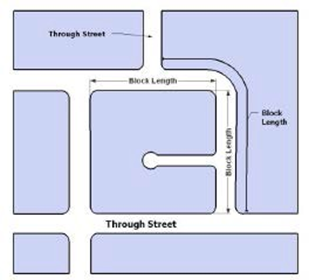
Blockface: That portion of a block or tract of land facing the same side of a single street and lying between the closest intersection streets.
Body Rub Parlor: Any business enterprise where body rub services are provided to induce relaxation or for other purposes.
Building: Any structure having a roof supported by columns or walls and built for the support, shelter, or enclosure of persons, chattel, or movable property of any kind and which is affixed to the land.
Building Height: The vertical distance measured from the finished grade and the height of the roof as described below. For buildings with multiple roof levels, the highest of the various roof levels must be used to determine the building height. The average height of multiple roof levels is not to be used to determine building height. Unless indicated in the figures below, the building height shall be the highest point of equipment located on top of a structure such as satellite dishes, heating, and air conditioning units. See below for a list of figures showing how to calculate the building height for different roofs.
Building Height for a Cross Gable, Gable, Gambrel, or Hip Roof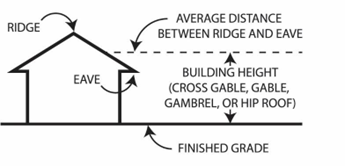
Building Height for a Mansard Roof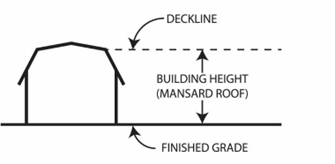
Building Height for a Flat or Shed Roof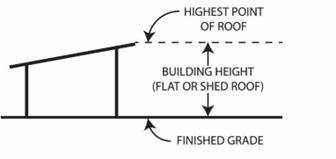
Building Official: The person designated by the Administrator as Building Official of the City of College Station, or their designee.
Building Plot: All of the land within a project, whether one (1) or more lots, developed according to a common plan or design for similar or compatible uses that may have shared access or parking and that singularly or in phases is treated as such for site plan purposes. The determination of the boundaries of a building plot shall be made as the first step in the site plan or project review unless such determination has previously been made at the time of plat approval. For development not subject to site plan review, the building plot or premises shall be the exterior boundary of any included lots in the event the structure sits astride two (2) or more lots. In the event two (2) or more lots are under single ownership and the structure does not meet the required side yard setback, both lots shall be considered the building plot or premises. Demolished sites located in larger parking lots that may not have previously been considered part of a larger building plot will be considered part of the plot if access is shared with the site.
Bulb-Out: Extension of the curb line to physically narrow a street. Allows for delineation of on-street parking and reduces the distance of pedestrian crossing.
Caliper: The width of the trunk of a tree measured at twelve (12) inches above grade.
Carport: A structure that has enclosing walls for less than fifty (50) percent of its perimeter covered with a roof and constructed specifically for the storage of one (1) or more motor vehicles.
Car Wash: A place containing facilities for washing automobiles which may include the automatic or semiautomatic application of cleaner, brushes, rinse water, and heat for drying.
Certificate of Compliance: A letter signed by the Development Engineer indicating compliance with all plans and specifications applicable to the subject project and completion of all stormwater management and soil erosion protection measures.
City: The City of College Station, Texas, which is enabled the Texas Constitution and the Texas Local Government Code, as amended, to adopt land development regulations and processes.
City Attorney: The person employed as City Attorney of the City of College Station, or their designee.
City Council: The duly and constitutionally elected governing body of the City of College Station.
City Engineer: The person employed as City Engineer of the City of College Station, or their designee.
City Manager: The person employed as City Manager of the City of College Station, or their designee.
Classification Amendment: An amending zoning ordinance that pertains to the rezoning of a particular parcel or parcels of land, as distinguished from a change in the provisions of the ordinance relevant and pertaining to the entire city.
Clinic: A facility operated by one (1) or more physicians, dentists, chiropractors, or other licensed practitioners of the healing arts for the examination and treatment of persons solely on an outpatient basis.
Cluster Development: A residential subdivision in which the lots are allowed to be smaller (in area and width) than otherwise required for the underlying, base zoning district, but in which the overall density of all the lots collectively does not exceed the maximum density limit for the underlying zoning district.
Cold Storage Plant: A commercial establishment where foods or other commodities are stored either in lockers, rented or leased, or in vaults in bulk for distribution to the home or other commercial businesses. No slaughtering of animals or fowl is allowed on the premises.
Collocation: When more than one (1) wireless telecommunications provider shares a wireless telecommunications support structure.
Commercial Garden: The retail or wholesale handling of any article, substance, or commodity related to the planting, maintenance, or harvesting of garden plants, shrubs, trees, packaged fertilizers, soils, chemicals, or other nursery goods and related products.
Commercial Greenhouse: A structure or location where plants, vegetables, flowers, and similar materials are grown for sale.
Commercial Amusements: Any enterprise whose main purpose is to provide the general public with an amusing or entertaining activity where tickets are sold, or fees are collected, at the gates of the activity. Commercial amusements include zoos, carnivals, expositions, miniature golf courses, arcades, fairs, exhibitions, athletic contests, rodeos, tent shows, Ferris wheels, children's rides, roller coasters, skating rinks, ice rinks, traveling shows, bowling alleys, indoor shooting ranges, and similar enterprises. Sexually oriented businesses and nightclubs, bars, and taverns are excluded from this definition.
Common Open Space: A parcel or parcels of land, area of water, or a combination of land and water within a development site provided and made legally available for the use and enjoyment of residents of a proposed project.
Comprehensive Plan: The City of College Station's Comprehensive Plan, including any associated plans or studies adopted by the City Council.
Concept Plan: A written and graphic plan submitted for consideration of a P-MUD Planned Mixed-Use District or a PDD Planned Development District that indicates the proposed land uses and their overall impact on the subject land and surrounding lands in a conceptual form.
Conditional Use: A use which may be permitted or denied in a district, on a case-by-case basis, subject to meeting certain conditions or procedures set forth in, or imposed under, this UDO.
Condominium: A dwelling unit available for sale contained within a multi-family development subject to covenants, conditions, or restrictions placing control over the common facilities owned by the condominium. This definition includes condominiums, cooperatives, trusts, partnerships, or other similar associations.
Construction Plans: The construction documents required to accompany the final plat or the building and site plans required for the issuance of a development permit and/or building permit.
Construction Site Notice: A written submission to the Municipal Separate Storm Sewer System (MS4) operator from an applicant stating that a small construction activity will be commencing and will operate under the provisions of the Texas Commission on Environmental Quality (TCEQ) General Permit TXR150000.
Country Club: Land area and buildings containing golf courses or other recreational facilities, a clubhouse, and customary accessory uses open to members and their guests.
Courtyard House: One of a group of small detached single-family dwelling units arranged around a shared open courtyard accessible to the units. Each courtyard house shall be individually platted and oriented so that the front entrances are accessed from the shared courtyard. The courtyard shall be jointly owned and managed by an owners association and preserved as a common open space. Vehicular access and garages shall be accessed via an alley or private drive.
Cul-de-Sac: A street having one (1) outlet to another street and terminating on the other end in a vehicular turnaround.
Cupola: A small dome and the shaft that supports it on top of a building.
Day Care - Commercial: Any facility or premises where a total of seven (7) or more children under sixteen (16) years of age, and/or elderly adults, regularly attend for purposes of custody, care, or instruction. Said children or elderly adults are not members of the family of any person operating the facility or premises.
Day Care - In-Home: Any private residence where a total of six (6) or fewer persons regularly attend for purposes of custody, care, or instruction. Said persons are not members of the family living in the residence. Nothing in this definition shall conflict with the provisions of Chapter 123 of the Texas Human Resources Code, as amended.
Density: The number of dwelling units per gross acre.
Detention: The temporary storage and controlled release of stormwater flows.
Development: Any manmade change to improved or unimproved real estate that requires a permit or approval from any agency of the City or county including but not limited to buildings or other structures, mining, dredging, filling, grading, paving, excavation, clearing, drilling operations, storage of materials, or the subdivision of property. Routine repair and maintenance activities are exempted.
Development Engineer: The person designated by the City Engineer as Development Engineer of the City of College Station.
Dormer: Projecting framed structure set vertically on the rafters of a pitched roof, with its own roof (pitched or flat), sides, and a window set vertically in the front.
Dormitory: A residential structure designed for the exclusive purpose of housing students of a university, college, school, church, or non-profit organization, excepting resident staff, but which does not include complete, independent living facilities, including cooking, in each dwelling unit. Common kitchen facilities and/or gathering rooms for social purposes may also be provided.
Drainage Area: The area, measured in a horizontal plane, which contributes stormwater flows by gravity flow along natural or man-made pathways to a single designated point along a pathway.
Drainage Facility: Any element necessary to convey stormwater flows from its initial contact with the earth to its disposition in an existing watercourse. Drainage facilities include but are not limited to both public and private storm sewers (closed conduits), streets, improved channels constructed in accordance with the adopted Bryan/College Station Unified Design Guidelines, Technical Specifications and Standard Details, unimproved drainage ways left in their natural condition, areas covered by drainage easements for the purpose of providing concentrated or overland sheet flow, and all appurtenances to the foregoing, including inlets, manholes, junction boxes, headwalls, energy dissipaters, and culverts.
Drainage System, Primary: The system of natural, improved, or channelized watercourses including all closed conduits, culverts, bridges, detention facilities, and retention facilities associated with the watercourses. All components of the primary drainage system are shown or indicated in the Bryan/College Station Unified Design Guidelines, Technical Specifications, and Standard Details.
Drainage System, Secondary: The system of conveyance of rainfall from the point that it becomes concentrated flow to the point where it reaches the primary drainage system. This system includes all swales, ditches, minor channels, streets, gutters, inlets, culverts, detention or retention facilities, or other means of conveyance of stormwater flows.
Drip Molding: A horizontal molding placed over an exterior door or window frame to divert rainwater.
Drive-In/Thru: A building opening, inducing windows, doors, or mechanical devices, designed and intended to be used to provide for sales to and/or service to patrons who remain in their vehicles.
Duplex: A structure providing two (2) dwelling units on a single lot or building plot.
Dwelling Unit: A residential unit providing complete, independent living facilities for one (1) family including permanent provisions for living, sleeping, cooking, eating, and sanitation.
Earth Change: A man-made change in the natural cover or topography of land, including cutting or filling activities, which may result in or contribute to soil erosion or sedimentation.
Easement: A grant of reservation by the owner of land for the use of such land by others for a specific purpose or purposes, and which must be included in the conveyance of land affected by such easement.
Easement, Drainage: An interest in land granted to others for maintenance of a drainage facility on which certain uses are prohibited. Drainage easements provide for the entry and operation of machinery and vehicles for maintenance.
Easement, Historic Preservation: An easement that protects a significant historic, archaeological, or cultural resource. It provides assurance that a property's intrinsic values will be preserved through future ownership. A building, a portion of a building (such as the façade), or a bridge, dam, or any other kind of structure may qualify. A historic preservation easement may also protect a historic landscape, battlefield, traditional cultural place, or archaeological site.
Easement, Maintenance: A private easement that is dedicated by plat specifically for zero lot line construction in a single-family residential development. Maintenance easements shall be a minimum of seven and one-half (7.5) feet in width.
Easement, Utility: An interest in land granted to the City, the public generally, and/or a private utility company for the installation or maintenance of utilities across, over, or under private land, together with the right to enter thereon with machines and vehicles as necessary for the maintenance of such utilities.
Educational Facility, Instruction Indoor: Any facility or premises regularly attended by one (1) or more persons for the purpose of instruction. All instruction and activity must be fully contained within the building. Such types of instruction include classes in acting, art, dance, music, photography, and martial arts.
Educational Facility, Instruction Outdoor: Any facility or premises regularly attended by one (1) or more persons for the purpose of instruction. Activities are allowed outside of a building.
Educational Facility, Primary and Secondary: Any public or private school licensed by the State which is designed, constructed, or used for the education or instruction of students below the age of twenty (20). Auxiliary uses to these schools are included herein.
Educational Facility, Tutoring: Any facility or premises regularly attended by one (1) or more persons for the purpose of instruction. All instruction and activity must be fully contained within a building.
Educational Facility, Vocational/Trade: Any public or private secondary or higher education facility primarily teaching usable skills that prepare students for jobs in a vocation or trade and meeting the state requirements as a vocational facility. All instruction and activity must be fully contained within the building.
Educational Facility, College/University: A college or university authorized by the State to award degrees.
Elevation: The vertical distance from a datum, usually the National Geodetic Vertical Datum (NGVD), to a point or object. If the elevation of point A is eight hundred two and forty-six hundredths (802.46) feet, the point is eight hundred two and forty-six hundredths (802.46) feet, above some datum.
Encroachment: An intrusion, obstruction, or other infringement on an area reserved for a specific purpose such as an easement or floodway.
Engineer: A person duly authorized and licensed under the provisions of the Texas Engineering Registration Act to practice the profession of engineering.
Enhanced Paving: Earth-toned (not gray) decorative pavers, stamped concrete, or dyed concrete.
Entry Portico: Covered porch consisting of a series of columns placed at regular intervals supporting a roof, normally attached as a colonnade.
Erosion: The process whereby the surface of the earth is broken up and carried away by the action of wind, water, gravity, ice, or a combination thereof.
Escort: A person who, for consideration as part of a business enterprise, agrees, offers to, or models lingerie, performs a striptease, or performs nude or semi-nude for another person at a location other than a sexually oriented business.
Escort Agency: A person or business enterprise that furnishes, offers to furnish, or advertises to furnish, for consideration, escorts who perform any escort services in the city. An escort agency that advertises or holds itself out in signage visible from the public right-of-way as "X…", "adult", or "sex" shall be considered an adult retail store.
Excavation: Any act by which soil or rock is cut into, dug, quarried, uncovered, removed, displaced, or relocated purposely by man and shall be taken to include the conditions resulting therefrom.
Existing Construction: Structures for which the start of construction commenced prior to the effective date of the Flood Insurance Rate Map (FIRM). Existing construction may also be referred to as existing structures.
Existing Development: Any development which existed or was permitted prior to the date on which this UDO became effective.
Existing Tree: Any self-supporting woody plant, with one (1) or more well-defined trunks, two (2) inch caliper or greater.
Extended Care Facility, Convalescent Home, or Nursing Home: A building, or portion thereof, used or designed for the housing of the aged, and/or mentally or physically handicapped persons who are under daily medical, psychological, or therapeutic care. This definition shall not include rooms in any residential dwelling, hotel, or apartment hotel not ordinarily intended to be occupied by said persons.
Extraterritorial Jurisdiction: Within the terms of the Texas Municipal Annexation Act, the unincorporated area, not a part of any other city, which is contiguous to the city limits, the outer boundaries of which are measured from the extremities of the city limits, outward for such distances as may be stipulated in the Texas Municipal Annexation Act, in which area, within the terms of the act, the City may enjoin the violation of its subdivision control provisions.
Façade: The exterior face of a building.
Façade, Primary: The primary entrance façade of a principal building (not accessory buildings) or any façade of a principal building that faces a public right-of-way, private right-of-way, or public way.
Façade Work: The removal, replacement, substitution, or change of any material or architectural element on the exterior face of a building, which includes, but is not limited to, painting, material change, awning or canopy replacement, signage, or other permanent visible façade treatment.
Family: A family is any number of persons occupying a single dwelling unit. The term family shall not be construed to mean a club, a lodge, or a fraternity or sorority house.
Federal Emergency Management Agency (FEMA): An agency of the Department of Homeland Security which administers the National Flood Insurance Program (NFIP).
Feeder Line: Any line, wire, or cable and appurtenances which distributes, transmits, or delivers a utility service from a source to a general area or multiple developments, and not to a specific end user.
Field Size: That portion of a driving range property measured from the tee boxes to the end of the driving range area of the site.
Filed: The point at which an application has been determined to be complete and all required fees have been paid.
Flood or Flooding: A temporary rise in the level of water that results in inundation of areas not ordinarily covered by water from:
(1)
The overflow of inland or tidal waters; or
(2)
The unusual and rapid accumulation or runoff of surface waters from any source.
Flood Hazard Boundary Map: An official map of a community, issued by the Federal Emergency Management Agency (FEMA), where the areas within the boundaries of special flood hazards have been designated.
Flood Insurance Rate Map (FIRM): An official map of a community on which the Federal Emergency Management Agency (FEMA) has delineated both the areas of special flood hazards and the risk premium zones applicable to the community.
Flood Insurance Study (FIS): The official report provided by the Federal Emergency Management Agency (FEMA). The report contains flood profiles, the water surface elevation of the base flood, as well as the Flood Hazard Boundary Map.
Floodplain or Flood-Prone Area: Any land susceptible to being inundated by water from any source.
Flood Protection System: Those physical structural works for which funds have been authorized, appropriated, and expended and which have been constructed specifically to modify flooding to reduce the extent of the areas within a community subject to special flood hazard and the extent of the depths of associated flooding. Such systems typically include hurricane tidal barriers, dams, reservoirs, levees, or dikes. These specialized flood modifying works are those constructed in conformance with sound engineering standards.
Floodway: The channel of a river or other watercourse and the adjacent land areas that must be reserved to discharge the base flood without cumulatively increasing the water surface elevation by more than one (1) foot.
Floodway, Zero-Rise: The channel of a stream and that portion of the adjoining floodplain which is necessary to contain and discharge the base flood flow without any measurable increase in flood height. A measurable increase in base flood height means a calculated upward rise in the base flood elevation, equal to or greater than one-hundredths (.01) feet, resulting from a comparison of existing conditions and changed conditions directly attributable to development in the floodplain. This definition is broader than that of the Federal Emergency Management Agency (FEMA) floodway but always includes the Federal Emergency Management Agency (FEMA) floodway. The boundaries of the one hundred (100) year floodplain are considered the boundaries of the zero-rise floodway unless otherwise delineated by a sensitive area special study.
Floodway Fringe: That part of the base floodplain outside the floodway.
Floor Area Ratio: A non-residential land use intensity measure analogous to density. It is the sum of the areas of several floors of a building compared to the total area of the site.
Fraternity or Sorority: An organization of university students formed chiefly to promote friendship and welfare among the members.
Fraternal Lodge: A structure where a group of people meets who are organized for a common interest, usually cultural, religious, or entertainment with regular meetings, rituals, and formal written membership.
Garage, Commercial: Any premises or structure with an enclosed work area for servicing and repair of four (4) or more standard-size automobiles or light (standard size) trucks, or for one (1) or more vehicles of larger size, or where any number of vehicles are kept for remuneration, hire or sale, and where motor vehicle fuels and supplies may be sold as a secondary use.
Gated Community: A residential area requiring mandatory membership in an owners association and having its primary means of access controlled by an electric or manual gate administered by the owners association.
Government Facilities: A building or structure owned, operated, or occupied by a governmental agency to provide a governmental service to the public.
Grading: Any act by which soil is cleared, stripped, stockpiled, excavated, scarified, filled, or any combination thereof.
Greenway: A linear open space that follows natural features like the floodplains of creeks and rivers or human-made features such as utility, road, or rail corridors.
Greenway - Rural: The least developed greenway, typically located on the periphery of the developed community. This greenway exists mostly in a natural state with the primary functions being flood control, wildlife protection, and aesthetic value. This greenway is defined by the entire width of the floodplain.
Greenway - Suburban: These are the greenways located in the developing portions of the community. The primary functions served by this greenway are flood control, recreation, transportation, and economic and aesthetic purposes.
Greenway - Urban: The most highly developed greenway located in fully developed areas of the community. The primary functions served by this greenway are flood control, recreation, transportation, and economic and aesthetic purposes.
Greenways Program Manager: The Greenways Program Manager of the City of College Station as designated by the Administrator.
Groundcover: A spreading plant including sods and grasses less than eighteen (18) inches in height.
Group Home: A home serving six (6) or fewer mentally or physically handicapped persons provided the home provides care on a twenty-four (24) hour basis and is approved or licensed by the State for that purpose. A group home shall be considered a single-family home and is defined pursuant to Chapter 123 of the Texas Human Resources Code, as amended.
Health Care Facility: A facility or institution, whether public or private, principally engaged in providing services for health maintenance, diagnosis or treatment of disease, pain, injury, or deformity of physical conditions. This definition does not include a medical clinic or hospital as defined herein.
Health Club/Sports Facility: A building designed and equipped for the conduct of sports, exercise, or other customary and usual recreational activities, operated for profit or not-for-profit which is open only to members and guests of the club or facility.
Historic Association: Link of a property that contributes to an HP Historic Preservation Overlay with a historic event, activity, or person. Also, the quality of integrity through which a property is linked to a particular past time and place.
Historic Contributing Resource: A building, site, structure, or object in an HP Historic Preservation Overlay that supports the Overlay's historical significance through historic location, design, setting, materials, workmanship, feeling, or association.
Historic Design: Quality of integrity applying to the elements that create the physical form, plan, space, structure, and style of a property in an HP Historic Preservation Overlay.
Historic Feeling: Quality of integrity through which a property that contributes to an HP Historic Preservation Overlay evokes the aesthetic or historic sense of past time and place.
Historic Integrity: Authenticity of the historic identity of a property that contributes to an HP Historic Preservation Overlay, evidenced by the survival of physical characteristics that existed during the property's historic or prehistoric period.
Historic Location: Quality of integrity retained by a property that contributes to an HP Historic Preservation Overlay historic property existing in the same place as it did during the period of significance.
Historic Materials: Quality of integrity applying to the physical elements that were combined or deposited in a particular pattern or configuration to form a property that contributes to an HP Historic Preservation Overlay.
Historic Non-Contributing Resource: A building, site, structure, or object in an HP Historic Preservation Overlay that does not support the Overlay's historical significance through historic, location, design, setting, materials, workmanship, feeling, or association.
Historic Setting: Quality of integrity applying to the physical environment of a property that contributes to an HP Historic Preservation Overlay.
Historic Workmanship: Quality of integrity applying to the physical evidence of the crafts of a particular culture, people, or artisan on a property that contributes to an HP Historic Preservation Overlay.
Home Occupation: An occupation, profession, activity, or use that is clearly a customary, incidental, and secondary use of a residential dwelling unit and which does not alter the exterior of the property or affect the residential character of the neighborhood.
Home Tour Event: Real estate events such as open houses, as well as the touring of occupied residences for the entertainment of a targeted audience.
Hospital: A building, or portion thereof, used or designed for the medical or surgical treatment of the sick, mentally ill, or injured persons, primarily on an inpatient basis, and including as an integral part, related facilities such as laboratories, outpatient facilities, or training facilities. This definition shall not include rooms in any residential dwelling, hotel, or apartment hotel not ordinarily intended to be occupied by said persons.
Hotel/Motel/Extended Stay Facility: A building, or group of buildings, used or intended to be used as living quarters for transient guests, but not excluding permanent guests, and may include a café, drugstore, clothes pressing shop, barber shop, or other service facilities for the guests for compensation. A transient guest is any visitor or person who owns, rents, or uses a lodging or dwelling unit, or a portion thereof, for less than thirty (30) days and whose permanent address for legal purposes is not the lodging or dwelling unit occupied by the visitor.
Impervious Cover: The percentage of a lot's area that is covered, or proposed to be covered, by impervious surfaces.
Impervious Surface: Any portion of a site occupied by materials or construction that limits the absorption of water by covering the natural land surface including, but not limited to, buildings, sidewalks, drives, all-weather surfaces, parking, rooftops, patios, decking, masonry, stone, and other alternative pavements. Alternative materials used for landscaping purposes in non-load bearing areas and the water surface area within the walls of pools are not considered impervious surfaces. An area of gapped decking shall be calculated as fifty (50) percent of the proposed decked area for the purpose of impervious cover.
Industrial, Light: A use engaged in the manufacture, predominantly from previously prepared materials, of finished products or parts, including processing, fabrication, assembly, treatment, packaging, incidental storage, sales, and distribution of such products, but excluding basic industrial processing.
Industrial, Heavy: A use engaged in the basic processing and manufacturing of materials or products or parts, predominantly from extracted raw materials, or a use engaged in the storage of, or manufacturing processes using flammable or explosive materials, or storage or manufacturing processes that potentially involve hazardous or commonly recognized offensive conditions.
Industrial, Municipal: A municipal use or structure that serves a public need and is primarily engaged in the provision, distribution, collection, transmission, or disposal of water, storm and sanitary sewage, electricity, information, and telecommunication, including structures associated with private utilities, research and laboratory activities, warehousing and distribution, bulk storage facilities operation, storage and maintenance of service vehicles, cleaning of equipment, solid waste management, municipal recycling, public works yards, container storage, or similar activity. Ordinarily, these areas have low parking turnover and few pedestrians, but a large amount of truck traffic.
Irrigation System: A permanent, artificial watering system designed to transport and distribute water to plants.
Land Use: A use of land that may result in an earth change, including, but not limited to, subdivision, residential, commercial, industrial, recreational, or other development, private and public highway, road and street construction, drainage construction, logging operations, agricultural practices, oil and gas exploration, exploitation, extraction, and mining.
Lateral Line: Any line, wire, or cable and appurtenances used to distribute, transmit, or deliver service from a feeder line to two (2) or more sites or end users of the utility service within a specific development.
Levee: A manmade structure, usually an earthen embankment, designed and constructed in accordance with sound engineering practices to contain, control, or divert the flow of water to protect from temporary flooding.
Levee System: A flood protection system that consists of a levee, or levees, and associated structures, such as closure and drainage devices, which are constructed and operated in accordance with sound engineering practice.
Live-Work Unit: A mixed-use structure with a ground-level workspace or commercial space and one upper-level dwelling unit occupied by the proprietor.
Lot: The physical and undivided tract or parcel of land as shown on a duly recorded plat.
Lot, Corner: A lot located at the intersection of and abutting upon two (2) or more streets.
Lot, Double Frontage or Through: A lot, other than a corner lot, which has frontage on more than one (1) street.
Lot, Flag: A lot that does not meet the minimum lot width requirements where access is derived from a narrow, private driveway.
Lot, Interior: A lot other than a corner lot.
Lot Area: The horizontal land area within lot lines, excluding any wetlands and/or drainage easements.
Lot Coverage: A measure of the intensity of land use that represents the portion of a site that is impervious. This portion includes but is not limited to all areas covered by buildings, parked structures, gravel or paved driveways, roads, and sidewalks.
Lot Line Construction: A development where houses on a common street frontage are shifted to one (1) side of their lot to maximize the side yard area on the opposite side of the lot. Planning for all house locations is done at the same time to ensure proper building separations.
Lot of Record: A part of a recorded subdivision or a parcel of land that exists as shown or described on a plat or deed in the records of the local registry of deeds.
Lot Width: The width of the lot measured between side lot lines along a line that is parallel to the front lot line or its chord located at the front setback line.
Lowest Floor: The lowest floor of the lowest enclosed area (including a basement). An unfinished or flood-resistant enclosure, usable solely for parking of vehicles, building access, or storage, in an area other than a basement area, is not considered a building's lowest floor, provided that such enclosure is not built to render the structure in violation of the applicable non-elevation design requirements of this UDO.
Major Recreational Equipment: For the purpose of these regulations, major recreational equipment is defined as including boats and boat trailers, travel trailers, pick-up campers or coaches (designed to be mounted on automotive vehicles), motorized dwellings, tent trailers, and the like, and cases or boxes used for transporting recreational equipment, whether occupied by such equipment or not. No such equipment shall be used for living, sleeping, home occupation, or household purposes when parked or stored on a residential lot or in any location not approved for such use.
Manufactured Home: A structure constructed after June 15, 1976, in accordance with the rules of the United States Department of Housing and Urban Development, transportable in one (1) or more sections, which, in the traveling mode, is eight (8) body feet or more in width or forty (40) body feet or more in length, or, when erected on site, is three hundred twenty (320) or more square feet, and which is built on a permanent chassis and designed to be used as a dwelling with or without a permanent foundation when connected to the required utilities, and includes the plumbing, heating, air-conditioning, and electrical systems. The term does not include a recreational vehicle as that term is defined by 24 Code of Federal Regulations, Section 3282.8(g).
Manufactured Home Lot: A parcel of land in a manufactured home park for the placement of a single HUD-code manufactured home and the exclusive use of its occupants.
Manufactured Home Park: A parcel of land under single ownership that has been planned and improved for the placement of HUD-code manufactured homes for non-transient use.
Massage Establishment: A business enterprise offering massage conducted by persons engaged in the practice of medicine, nursing, osteopathy, physiotherapy, chiropractic, podiatry, or massage therapy for which they are licensed by the State, or persons under the direct supervision and control of such licensed persons.
Mean Sea Level: The National Geodetic Vertical Datum (NGVD) of 1929 or another datum to which the base flood elevations shown on a community's Flood Insurance Rate Map are referenced.
Micro-Industrial: A use engaged in basic processing and/or manufacturing of materials or products or parts on a limited scale, predominantly from extracted raw materials, entirely contained within a building and not deemed to be a public nuisance, as determined by the Administrator.
Mixed-Use Structure: A structure containing both residential and non-residential uses.
Mobile Food Vendor: Any business operating more than twenty-one (21) days per calendar year that sells edible goods from a non-stationary location within the City of College Station. The term shall include, but shall not be limited to, mobile food trucks, carts, or trailers.
Mobile Home: A structure that was constructed prior to June 15, 1976, transportable in one (1) or more sections, which, in the traveling mode, is eight (8) body feet or more in width or forty (40) body feet or more in length, or, when erected on site, is three hundred twenty (320) or more square feet, and which is built on a permanent chassis and designed to be used as a dwelling with or without a permanent foundation when connected to the required utilities and includes the plumbing, heating, air-conditioning, and electrical systems.
Motor Vehicle: A self-propelled device that can be used to transport or draw persons or property not exclusively on stationary rails or tracks.
Multiplex, Medium: A residential structure that consists of five (5) to twelve (12) dwelling units, either side by side or stacked. Primary entry to the structure is allowed only through a shared primary entrance. The land underneath is a single platted lot or building plot. Condominiums are included in this definition.
Multiplex, Small: A residential structure that consists of three (3) to four (4) dwelling units, either side by side or stacked. Primary entry to the structure is allowed only through a shared primary entrance. The land underneath is a single platted lot or building plot. Condominiums are included in this definition.
Multi-Family: A structure providing three (3) or more dwelling units on a single lot or building plot. Condominiums are included in this definition.
National Flood Insurance Program (NFIP): A federal program enabling property owners to purchase flood insurance. This program is based on an agreement between local communities and the federal government that if a community will implement programs to reduce future flood damages, the federal government will make flood insurance available within the community as a financial protection against flood losses. The United States Congress established the NFIP with the National Flood Insurance Act of 1968 and later modified and broadened the program. The NFIP is administered by the Federal Emergency Management Agency (FEMA).
National Geodetic Vertical Datum (NGVD): The nationwide reference surface for elevations throughout the United States made available to local surveyors by the National Geodetic Survey with the establishment of thousands of benchmarks throughout the continent. It was obtained through a least-squares adjustment in 1929 of all first order leveling in the United States and Canada. The adjustment included the twenty-six (26) tide stations and thus referenced the NGVD to mean sea level.
Natural: The cover and topography of land prior to any manmade changes, or in areas where there have already been manmade modifications, the state of the area and topography of land at the date of the adoption of this UDO.
Neighborhood: A subarea of the city in which the residents share a common identity focused around a school, park, community business center, or other feature. For the purposes of a single-family overlay district, a neighborhood must contain at least thirty (30) single-family structures in a compact, contiguous area, or be an original subdivision or phase of a subdivision if the subdivision contains fewer than thirty (30) single-family structures. Boundary lines must be drawn to include blockfaces on both sides of a street, and to the logical edges of the area or subdivision, as indicated by a creek, street, subdivision line, utility easement, zoning boundary line, or another boundary.
Neighborhood Character: The atmosphere or physical environment which is created by the combination of land use and buildings within an area. Neighborhood character is established and influenced by use types and intensity, traffic generation, and also by the location, size, and design of structures as well as the interrelationship of all these features.
New Construction: For floodplain management purposes, structures for which the start of construction commenced on or after the effective date of a floodplain management regulation adopted by a community.
Night Club: A commercial establishment including, but not limited to, bars, coffee houses, or similar establishments where a dance floor, music, games, or other entertainment is provided and where the serving of food is not the principal business. Specifically included in this classification are establishments that derive seventy-five (75) percent or more of their gross revenue from the on-site sale of alcoholic beverages. Sexually oriented businesses/enterprises are not included in this definition.
Notice of Change: The notification of changes to the stormwater pollution prevention plan (SWP3) that is required by the Texas Pollutant Discharge Elimination System (TDPES) Stormwater Permits.
Notice of Intent: The advance notification that is required by the Texas Pollutant Discharge Elimination System (TDPES) Stormwater Permits prior to commencement of work.
Notice of Termination: The notification that is required by the Texas Pollutant Discharge Elimination System (TDPES) Stormwater Permits upon completion of work.
Nude: The showing of the human male or female genitals, pubic area, vulva, anus, anal cleft, or cleavage with less than a fully opaque covering, or the showing of the covered male genitals in a discernibly turgid state.
Nude Modeling Studio: Any place where a person who appears in a state of nudity or displays specific anatomical areas is provided to be observed, sketched, drawn, painted, sculptured, photographed, or similarly depicted by other persons who pay money or any form of consideration.
Office: A room or group of rooms used for conducting the affairs of a business, profession, service, industry, or government and generally furnished with desks, tables, files, and communication equipment.
One (1) Ownership: Property which although belonging to one (1) or more owners, has not been partitioned or subdivided to be owned separately by more than one (1) person, whether or not related or participating in a joint enterprise.
Outdoor Display: The placement of goods for active sale outside a building.
Overlay: A zoning district that encompasses one (1) or more underlying zones and that imposes additional requirements above those required by the underlying zone.
Owners Association: An association or organization, whether or not incorporated, which operates under and pursuant to recorded covenants or deed restrictions, through which each owner of a portion of a subdivision—whether a lot, parcel site, unit plot, condominium, or any other interest—is automatically a member as a condition of ownership, and each such member is subject to a charge or assessment for a prorated share of expense of the association, which may become a lien against the lot, parcel, unit, condominium, or other interest of the member. Homeowners associations and property owners associations are included in this definition.
Pad Site: The portion of a building plot that is located on the periphery of the site and has at least seventy-five (75) feet of frontage on a public street classified as a collector or higher on the Comprehensive Plan Functional Classification & Context Class Map. A pad site contains a standalone single or multiple tenant structure and meets all site plan requirements within the pad site area. The total area of all pad sites within a defined building plot may not be more than thirty-three (33) percent of the total area of the building plot.
Parking, Interior: Parking rows which are not located on the periphery of the proposed project site and further, where none of the parking spaces abut any property line associated with the proposed project site.
Parking, Overflow: Parking in excess of the minimum required by this ordinance and in excess of what is utilized regularly by the development.
Parking, Peripheral: Parking rows that abut the periphery or property lines associated with the proposed project site.
Parking, Side or Rear Yard: Required parking that is provided, in its entirety, behind a setback line of fifty (50) percent of the applicable zoning district's minimum lot depth.
Parking Row, Single: One (1) row of spaces for the parking of motor vehicles.
Parking Row, Double: Two (2) parallel rows of spaces for the parking of motor vehicles arranged so that when parked, the front end of each motor vehicle faces the front end of another motor vehicle.
Parking Space: A space used for the parking of a motor vehicle not on the paved or regularly traveled portion of a public street or within private access easements and which meets the requirements of this UDO as to size, location, and configuration.
Pasturage: Land used primarily for the grazing of animal stock.
Pavement Width: The portion of the surface of the street available for vehicular traffic. Where curbs are used, it is the portion between the back of the curbs.
Person: Every natural person, firm, partnership, joint venture, association, corporation, or other groups which conducts activities regulated hereunder as a single entity, whether same be a legal entity or not, venture, or trust.
Personal Service Shop: An establishment that provides services related to grooming, appearance, care, or repair of personal apparel which may sell products used or recommended for those same purposes incidental to the services provided.
Place of Worship: A building or structure, or group of buildings or structures, that by design and construction are primarily intended for conducting organized religious services and associated accessory uses.
Planning and Zoning Commission: The duly appointed Planning and Zoning Commission of the City of College Station.
Plat: A map of a subdivision intended to be filed for record with the applicable County Clerk's Office showing the location and boundaries of individual parcels of land subdivided into lots, with streets, alleys, easements, etc., drawn to scale. This definition includes final plats, replats, amending plats, minor plats, development plats, and vacating plats meeting the requirements of this UDO.
Plat, Minor: As defined by Chapter 212 of the Texas Local Government Code, as amended. A subdivision involving four (4) or fewer lots fronting an existing street that does not require the creation of any new street or the extension of municipal facilities.
Portable Storage: Any unit, including but not limited to a trailer, box, or another enclosed shipping container which is used primarily as storage space whether the unit is located at a facility-owned establishment or operated by the owner at another location designated by the tenant.
Porch: A roofed open area that projects from the main wall of a building that may be unenclosed or screened and may or may not use columns or other ground supports for structural purposes.
Public, Civic, and Institutional Use, Structure, or Building: A use, structure, or building belonging to or used by the public for the transaction of public or quasi-public business including but not limited to parks, places of worship, hospitals, public or private schools, libraries, museums, post offices, police and fire stations, public utilities, governmental services, and other public services.
Public Way: A public way provides circulation and through movement similar to a public street but is a privately maintained drive, constructed to certain street standards, and granted unrestricted access via a public access easement. The drive shall be designed to the geometric design, construction standards, and driveway spacing of a commercial street in accordance with the Bryan/College Station Unified Design Guidelines with the following modifications:
(1)
The public access easement shall be a minimum of forty (40) feet in width or wider to incorporate the entire width of the pavement section and sidewalks on each side.
(2)
A public way shall have a minimum pavement structure constructed to the City's fire lane standards, a minimum drive width of twenty-four (24) feet back-to-back when no parking is provided, and a minimum horizontal curve radius of two hundred (200) feet.
(3)
No head-in parking is permitted but parallel parking is allowed if the drive is widened an additional ten (10) feet for each row of parallel parking provided. Parking on the drive may count toward the minimum off-street parking requirements of this UDO.
(4)
Five (5) foot sidewalks shall be provided on each side of the drive and placed a minimum of three (3) feet from the back of the curb.
Quoin: Units of stone or brick used to accentuate the corners of a building.
Recyclable Materials: Those materials specifically listed at a particular site as acceptable. Such materials may include but are not limited to aluminum products, clean glass containers, bimetal containers, newspapers, magazines, periodicals, plastic containers, yard waste, paper and cardboard, phone books, and scrap metal.
Recycling: The separation, collection, processing, recovery, and sale of metals, glass, paper, plastics, and other materials which would otherwise be disposed of as solid waste, which are intended for reuse, re-manufacture, or re-constitution for the purpose of using the altered form.
Recycling Bin: A container used to collect recyclable materials, at which no fee is collected from the person depositing the materials.
Recycling Facility, Large: A recycling facility located on an independent site, or larger than five hundred (500) square feet, where limited mechanical processing may or may not occur, depending on the zoning district in which the facility is located.
Recycling Facility, Small: A facility that occupies no more than five hundred (500) square feet and provides containers for collection only of source-separated recyclables, with no power-driven processing equipment on site. Small collection facilities are normally located in parking lots of the host use. These may include but are not limited to bulk reverse vending machines, a grouping of reverse vending machines that exceed fifty (50) square feet, kiosk-type structures that may include permanent structures, and unattended recycling bins placed for the donation of recyclable materials.
Redevelopment: The revision or replacement of an existing land use or existing site through acquisition or consolidation, or the clearance and rebuilding of an area consistent with the Comprehensive Plan, including any associated plans or studies adopted by the City Council.
Regulated Activity: An activity occurring at an industrial facility or construction site which qualifies the facility or site to acquire a permit to discharge stormwater under the Clean Water Act.
Rehabilitation: The process of returning a structure to a state of utility, through repair or alteration, which make possible an efficient contemporary use while preserving those portions and features of the property which are significant to its historic, architectural, and cultural value.
Release: Any spilling, leaking, pumping, pouring, emitting, emptying, discharging, injecting, escaping, leaching, dumping, or disposing into the municipal stormwater drainage system, the water of the State, the waters of the United States.
Remote Emergency Access: A semi-permanent all-weather surface in accordance with the City of College Station Site Design Standards. An access is remote when the two (2) access points are placed a distance apart equal to not less than fifty (50) percent of the length of the maximum overall diagonal dimension of the property or area to be served, measured in a straight line between the points.
Repair Shop: A shop exclusively for the repair of household goods and home equipment, within a building with no outdoor storage of items or equipment, and where no noise, dust, or vibration is discernible beyond the property line.
Research Laboratory: An establishment or facility used for carrying on investigations in the natural, physical, or social sciences which may include engineering and product development.
Residential Sales Office/Model Home: A dwelling unit built by a builder or developer to allow potential purchasers to see what the finished product will look like.
Restaurant: An establishment that serves food and beverages primarily to persons seated within the building. This includes but is not limited to café's, tea rooms, and outdoor café's.
Restaurant, Casual Dining: A restaurant with a market segment between Fast Food and Fine Dining restaurants usually characterized by table service, a relatively fully stocked and full-service bar, and a bill per dinner averaging ten dollars ($10.00) to thirty dollars ($30.00) for an evening meal and slightly less for lunch and does not provide drive-thru service.
Restaurant, Fast Food: An establishment that offers quick food which is accomplished through a limited menu of items already prepared and held for service or prepared quickly. Orders are not generally taken at a customer's table and food is generally served in disposable wrapping or containers.
Restaurant, Fine Dining: A restaurant serving formal-style dinners, and services where food and drink are prepared and served. Customer turnover rates are typically one (1) hour or longer. Such establishments serve dinner but generally do not serve breakfast and may or may not serve lunch or brunch. These restaurants usually have a dress code and do not provide drive-thru service.
Retail Sales: Establishments engaged in selling goods or merchandise to the general public for personal or household consumption and rendering services incidental to the sale of such goods.
Retail Sales, Alcohol: Establishments, except nightclubs and restaurants as defined, engaged in selling beer, wine, or other alcoholic beverages for where more than seventy-five (75) percent of sales are derived from the sale of such beverages for off-site consumption. Exempt from this definition are temporary retail sales of alcohol associated with special events, or events held on City-owned property.
Retention: The storage of stormwater flows in a facility that has a permanent pool of water.
Retention Facility: A facility that provides for the storage of stormwater flows in a permanent pool of water or permanent pool in conjunction with a temporary storage component.
Reverse Vending Machine: An automated mechanical device that accepts at least one (1) or more types of beverage containers including but not limited to aluminum cans or glass and plastic bottles that issue cash refunds or redeemable credit slips. Sorting and processing occur entirely within the machine.
Reverse Vending Machine, Bulk: A reverse vending machine that is larger than fifty (50) square feet and is designed to accept more than one (1) container at a time and to pay by weight. For the purpose of these restrictions, bulk reverse vending machines will be considered small collection facilities.
Reverse Vending Machine, Single Feed: A reverse vending machine that accepts materials one (1) item at a time.
Rooming/Boarding House: A group of rooms provided for persons other than members of the occupant family for compensation either in a converted single-family home or in a structure specifically designed for such purpose where there are no cooking facilities provided in individual living units and where meals may be provided daily.
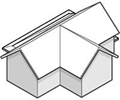
Roof, Cross Gable: Two (2) perpendicular gable roofs.
Roof, Flat: A roof with only enough pitch to allow drainage.

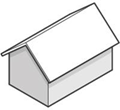
Roof, Gable: A ridged roof having one (1) or two (2) gabled ends (gable: the portion of the end of a building that extends from the eaves to the peak or ridge of the roof).
Roof, Gambrel: A roof whose slope on each side is interrupted by an obtuse angle that forms two (2) pitches on each side, the lower slope being steeper than the upper.

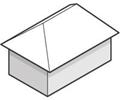
Roof, Hip: A roof formed by several adjacent inclining planes, each rising from a different wall of a building and forming hips at their adjacent sloping sides.
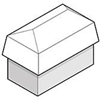
Roof, Mansard: A roof with a double pitch on all four (4) sides, the lower level having the steeper pitch.
Roof, Shed: A roof having a single-sloping plane.
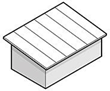
Salvage Yard: A facility or area for storing, keeping, selling, dismantling, shredding, compressing, or salvaging material or equipment. Materials include but are not limited to lumber, pipes, metal, paper, rags, tires, bottles, motor vehicle parts, machinery, structural steel, equipment/vehicles, and appliances.
Satellite Dish: A broadcast receiver that receives signals directly from a satellite rather than another broadcast system and amplifies the signal at a focal point in front of the receiving component.
Sediment: Soils or other surficial materials transported or deposited by the action of wind, ice, or gravity as a product of erosion.
Service Line: Any line, wire, or cable and appurtenances used to distribute, transmit, or deliver a utility service from a source of supply, feeder line, or lateral line directly to an end user.
Service Provider: Any company, corporation, alliance, individual, or other legal entity that provides a wireless telecommunication service directly to the public for a fee or to such classes of users as to be effectively available directly to the public regardless of the facilities used; services include, but are not limited to, portable phones, car phones, pagers, digital data transmission, or radio or television communications.
Setback Line: A line that marks the minimum distance a structure must be located from the property line, and establishes the minimum required front, side, or rear yard space of a lot or building plot.
Sexually Oriented Books and Videos: Books, magazines, pamphlets, pictures, drawings, photographs, video tapes, digital video disks, motion picture films, or sound recordings, or printed, visual or audio material of any kind which are characterized by their emphasis on the description or depiction of specified anatomical areas or specified sexual activities.
Sexually Oriented Business: Any business whether in public, semi-public, or private premises which offers the opportunity to feel, handle, touch, paint, be in the presence of, or be entertained by the unclothed body or the unclothed portion of the body of another person, or to observe, view, or photograph any such activity. Except as provided herein, this definition is not intended to regulate:
(1)
Any business operated by or employing licensed psychologists, licensed physical therapists, licensed athletic trainers, licensed cosmetologists, or licensed barbers performing functions authorized under the licenses held.
(2)
Any business operated by or employing licensed physicians, licensed practical nurses, or licensed chiropractors engaged in practicing the healing arts.
(3)
Any bookstore, movie theater, or video store, unless that business includes sexually oriented materials.
Sexually oriented businesses include, but are not limited to, adult retail stores, limited adult retail stores, adult arcades, adult cabarets, adult movie theaters, adult theaters, adult motels, body rub parlors, nude modeling studios, sexual encounter centers, and escort agencies.
Sexually Oriented Materials: All sexually oriented toys and novelties and sexually oriented books and videos.
Sexually Oriented Toys and Novelties: Instruments, devices, or paraphernalia either designed as representations of human genital organs or female breasts or designed or marketed primarily for use to stimulate human genital organs, except medical devices approved by the Food and Drug Administration (FDA).
Shared Housing: A residential structure, known as a congregate living facility, as defined by the International Building Code (IBC). Such use may be identified and differentiated from other residential uses by considering a combination of structure or property characteristics that may be used to increase occupancy, such as:
(1)
A residential structure containing more than four (4) bedrooms generally of a similar size or able to house more than four (4) people using other rooms such as dens, offices, game rooms, or similar spaces that have the potential to be used for sleeping purposes in accordance with the International Building Code (IBC) definition of habitable space;
(2)
A residential structure containing a similar bedroom-to-bathroom parity in excess of four (4);
(3)
A residential structure containing a high quantity of bathrooms, usually in excess of four (4), of which most can only be accessed through a bedroom or other room such as a den, office, game room, or similar space;
(4)
A residential structure that is in excess of one (1) story for the purpose of limiting the building footprint on the lot to meet impervious cover requirements;
(5)
The property where the residential structure is located does not contain a garage, or if it contains a garage, can support additional living space; and/or
(6)
The property where the residential structure is located contains a parking area that will allow parking in excess of four (4) vehicles.
Shared Primary Entrance: A common front/primary entry to the interior of a structure through which all occupants enter. Separate dwelling units in the structure take access off a shared internal corridor.
Shopping Center: A building plot developed or ultimately to be developed with two (2) or more stores, shops, or commercial enterprises which has shared parking facilities or access.
Shooting Range: A facility to be utilized for discharging firearms for purpose of testing the firearm or ammunition, developing or enhancing shooter skills for recreation or other need, which is organized and equipped for the safety of persons utilizing the facility and the general public.
Shrub: A woody perennial plant differing from a perennial herb by its woodier stem and from a tree by its low stature and habit of branching from the base.
Sign: Any written or graphic representation, decoration, form, emblem, trademark, flag, banner, or other feature or device of a similar character that is used for the communication of commercial information, or communication of ideas or subjects of political significance.
Sign, Apartment/Condominium/Manufactured Home Park Identification: An attached sign or a freestanding monument sign with permanent foundation or moorings, designed for identification of a multi-family residential project or a manufactured home park project, and where adequate provision is made for permanent maintenance.
Sign, Area Identification: A freestanding monument or wall sign with permanent foundation or moorings, designed for identification of subdivisions of ten (10) to fifty (50) acres, or identification of a distinct area within a subdivision, and where adequate provision is made for maintenance.
Sign, Attached: A sign attached to, or applied on, and totally supported by a part of a building or mounted to site lighting poles located on private property.
Sign, Campus/Wayfinding: A sign utilized as a traffic control device in off-street or access areas whose primary purpose is to direct traffic within a PDD Planned Development District or unified development that may include the names of tenants or businesses but does not contain any commercial logo or graphics.
Sign, Commercial: A sign which directs attention to a business, commodity, service, entertainment, or attraction sold, offered, or existing.
Sign, Development: A sign announcing a proposed subdivision or a proposed building project.
Sign, Directional Traffic Control: A sign utilized as a traffic control device in off-street parking or access areas whose primary purpose is not for advertisement.
Sign, Freestanding Commercial: A sign supported by one (1) or more columns, poles, or bars extended from the ground or an object on the ground, or that is erected on the ground. This term includes all signs which are not substantially supported by a building or part thereof, or which are substantially supported by a building or part thereof, when the sole significant purpose of the building or part thereof, is to support or constitute the sign.
Sign, Fuel Price: A sign used to advertise the current price of fuel at locations where fuel is sold.
Sign, Hanging: A sign suspended from the underside of a canopy or awning and located in front of building entrances, perpendicular to the façade.
Sign, Home Occupation: A sign used to identify the name and occupation of a person with a legal home occupation.
Sign, Low Profile: A sign with a permanent foundation that is not attached to a building but is a stand-alone sign which does not exceed sixty (60) square feet in area and four (4) feet in height.
Sign, Non-Commercial: A work of art or message which is political, religious, or pertaining to a point of view, expression, opinion, or idea that contains no reference to the endorsement, advertising of, or promotion of patronage, of a business, commodity, service, entertainment, or attraction that is sold, offered, or existing.
Sign, Off-Premise Commercial: A sign which directs attention to a business, commodity, service, entertainment, or attraction sold, offered, or existing elsewhere than upon the premises where such sign is displayed.
Sign, On-Premise Commercial: A sign which directs attention to a business, commodity, service, entertainment, or attraction sold, offered, or existing upon the premises where such sign is displayed.
Sign, Political: Any sign which promotes a candidate for any public office, or which advocates a position on any social issue as its primary purpose. Political signs shall be considered in the category of non-commercial signs except where there are regulations pertaining to their removal after an election.
Sign, Portable: A sign which is not affixed or attached to real property by poles, stakes, or other members which are placed into the ground, or upon some other type of permanent foundation; trailer signs, any sign with wheels or skids, and any sign which is constructed to sit upon the surface of the ground, without subsurface attachment or extension.
Sign, Projection: An attached sign end-mounted or otherwise attached to an exterior wall of a building and extends in whole or part more than twelve (12) inches beyond the face of the building.
Sign, Real Estate, Finance, and Construction: An attached or freestanding sign erected upon a lot or parcel of land for the purpose of advertising the same for sale or lease, or for advertising the furnishing of interim or permanent financing for a project, or for the furnishing of labor, materials or the practice of crafts on the job site.
Sign, Roof: An outdoor advertising display sign erected, constructed, or maintained on the roof of a building or which is wholly dependent upon a building for support, and which projects above the point of a building with a flat roof, six (6) feet above the eave line of a building with a shed, gambrel, gable or hip roof, or the deck line of a building with a mansard roof.
Sign, Special District Identification: An official, permanent, on-premise sign authorized by the City of College Station, which is used to identify a pedestrian or vehicular entrance to a design district or Overlay, as set forth in the Design Districts and Overlay Districts Sections of Article 5, District Purpose Statements and Supplemental Standards of this UDO. The sign shall be used to display only the name, logo, or identifying information about the district, and no other commercial information.
Sign, Subdivision Identification: A freestanding monument or wall sign with permanent concrete foundation or moorings, designed for permanent identification of a subdivision of greater than fifty (50) acres, and where adequate provision is made for permanent maintenance.
Single-Family: A structure providing one (1) dwelling unit on a single lot or building plot.
Single-Unit Dwelling: A detached structure, located within a larger development on a common lot, providing one (1) dwelling unit.
Site Development: Any excavation, landfill, or land disturbance, including new construction, reconstruction, relocation, or change of use. For the purposes of the Northgate districts only, site development includes the installation of walls, accessory structures, and other similar additions.
Site Plan: A site development plan showing the use of the land including locations of buildings, drives, sidewalks, parking areas, drainage facilities, and other structures to be constructed, and any other details required by the City in the Site Plans Section of Article 3, Development Review Procedures of this UDO.
Sitwall: A combination of seating with perimeter protection and/or screening in a subtle, attractive, and functional way.
Specified Anatomical Area: Any showing of the human male or female genitals, pubic area, or buttocks with less than a fully opaque covering, or showing of the female breast with less than a fully opaque covering of any portion thereof below the top of the areola, or the depiction of covered male genitals in a discernibly turgid state.
Specified Sexual Activities: Actual or simulated acts of masturbation, sexual intercourse, oral or anal copulation or sadomasochism; fondling or other erotic touching of or physical contact with one's own or another's genitals, pubic area, buttocks, or female breasts, whether clothed or unclothed; human male or female genitals when in a state of sexual stimulation or arousal; or excretory functions or acts with animals as part of or in conjunction with any of the activities set forth herein. Activities that are commonly referred to by the slang terms lap dance, straddle dance, face dance, or table dance shall be included in this definition. For purposes of this definition, sadomasochism means the infliction of pain, flagellation, or torture, or the condition of being bound, fettered, or otherwise physically restrained.
Split-Lot Duplex: Two (2) attached dwelling units where each dwelling unit is located on a separately platted lot.
Start of Construction: Includes substantial improvement, and means the date the building permit was issued, provided the actual start of construction, repair, reconstruction, placement, or other improvement was within one hundred eighty (180) days of the permit date. The actual start means the first placement of permanent construction of a structure on a site, such as the pouring of a slab or footings, the installation of piles, the construction of columns, or any work beyond the stage of excavation, or the placement of a HUD-code manufactured home on a foundation. Permanent construction does not include land preparation, such as clearing, grading, and filling; nor does it include the installation of streets and/or walkways; nor does it include excavation for a basement, footings, piers, or foundations or the erection of temporary forms; nor does it include the installation on the property of accessory buildings, such as garages or sheds not occupied as a dwelling unit and not part of the main structure.
State: The State of Texas.
Stealth Antenna: A telecommunication antenna located on an alternative mounting structure that is effectively camouflaged or concealed from view and blends into the surrounding environment. Examples include architecturally screened roof-mounted antennas, building-mounted antennas painted and/or textured to match the existing structure, and antennas integrated into architectural elements.
Stealth Technology or Facility: Design technology that blends the wireless telecommunications facility into the surrounding environment; examples of stealth facilities include, but are not limited to, architecturally screened roof-mounted antennas, building-mounted antennas painted and/or textured to match the existing structure, antennas integrated into architectural elements such as church spires or window wall, and antenna structures designed to resemble light poles or flag poles.
Stealth Tower: A manmade tree, clock tower, church steeple, bell tower, utility pole, light standard, identification pylon, flagpole, or similar structure, that is camouflaged to be unrecognizable as a telecommunications facility, designed to support or conceal the presence of telecommunication antennas and blends into the surrounding environment.
Storage Garage: Any premises and structure used exclusively for the storage of more than five (5) automobiles.
Storage, Outdoor: The keeping of any goods, junk, material, or merchandise in the same place for more than twenty-four (24) hours in an unenclosed area.
Storage, Self-Service: A structure containing separate, individual, and private storage spaces of varying sizes.
Storage Tank: A container for the storing of chemicals, petroleum products, grains, and other materials for subsequent resale to distributors or retail dealers or outlets.
Stormwater Management: All ordinances, standards, plans, and studies to ensure the timely and effective construction of:
(1)
A system of vegetative and structural measures that control the increased volume and rate of surface runoff caused by man-made changes to the land; and
(2)
A system of vegetative, structural, and other measures that reduce or eliminate pollutants that might otherwise be carried by surface runoff.
Stormwater Pollution Prevention Plan (SWP3): A plan required by a Texas Pollutant Discharge Elimination System (TDPES) permit to discharge stormwater associated with industrial activity or construction activity and which describes and ensures the implementation of practices that are to be used to reduce the pollutants in stormwater discharges from industrial facilities and construction sites.
Street: A way for vehicular traffic to move, whether designated as a highway, arterial street, collector street, or local street.
Street, Minor Arterial: A street that collects traffic from the collector system and connects with the major arterial system.
Street, Major Arterial: A street that collects traffic from the collector and minor arterial system and connects with the freeway system.
Street, Collector: A street that collects traffic from local streets and connects with minor and major arterials. This includes minor and major collectors.
Street, Local: A street that provides vehicular access to abutting property.
Stringcourse: A narrow, continuous ornamental band set in the face of a building as a design element; also known as a cordon.
Stripping: Any activity which removes or significantly disturbs the vegetative surface cover, including clearing and grubbing operations.
Structure: Anything constructed, built, or erected.
Structure, Principal: The principal structure which fulfills the purpose for which the building plot is intended.
Subdivider: Any person(s), firm, or corporation subdividing a tract or parcel of land to be sold or otherwise handled for their gain or use.
Subdivision: The division of a lot, tract, or parcel of land into two (2) or more parts, lots, or sites, for the purpose, whether immediate or future, of sale, division of ownership, or building development. This also includes the resubdivision of land or lots that are part of a previously recorded subdivision. Divisions of land for agricultural purposes, where no building construction is involved, in parcels of five (5) acres or more, shall not be included within this definition unless such subdivision of five (5) acres or more includes the planning or development of a new street or access easement. An addition is a subdivision as defined herein.
Subdivision Marker: A subdivision logo of no more than one (1) square foot in area, that is attached to an architectural element such as a column, fence post, wall, mail kiosk, bus stop, or similar community structure, and whose purpose is to provide continuity and identity throughout the subdivision.
Subdivision, Rural Residential: A subdivision that is predominately single-family lots and where one (1) acre is the minimum lot size of the base zoning district. Included are developments where lots are clustered to smaller than one (1) acre as permitted by the Lots Subsection of the General Requirements and Minimum Standards of Design for Subdivisions within the City Limits Section of Article 8, Subdivision Design and Improvements of this UDO.
Substantial Improvement: Any repair, reconstruction, or improvement of a structure, the cost of which equals or exceeds fifty (50) percent of the market value of the structure either:
(1)
Before the improvement or repair is started, or
(2)
If the structure has been damaged and is being restored before the damage occurred.
For the purposes of this definition, "substantial improvement" is considered to occur when the first alteration of any wall, ceiling, floor, or another structural part of the building commences, whether or not that alteration affects the external dimensions of the structure. The term does not, however, include either:
(1)
Any projects for the improvement of a structure to comply with existing state or local health, sanitary, or safety code specifications that are solely necessary to assure safe living conditions, or
(2)
Any alterations of a structure listed on the National Register of Historic Places or a State Inventory of Historic Places.
Surveyor: A person duly authorized and licensed under the Texas Professional Land Surveying Practices Act to practice the profession of land surveying, either as a Registered Professional Land Surveyor or a Licensed State Land Surveyor.
Taxicab Service: Any business associated with the storage or dispatch of vehicles for the transportation of passengers for hire.
Taxicab, Commercial Vehicle: Any motorized passenger vehicle permitted or should be permitted pursuant to the provisions of Chapter 8, Businesses of the City of College Station Code of Ordinances.
Texas Pollutant Discharge Elimination System (TDPES): The regulatory program delegated to the State of Texas by the Environmental Protection Agency (EPA) pursuant to 33 USC § 1342(b).
Texas Pollutant Discharge Elimination System (TDPES) Permit: A permit issued by the Texas Commission on Environmental Quality (TCEQ) under authority delegated pursuant to 33 USC § 1342(b) that authorizes the discharge of pollutants to waters of the state, whether the permit is applicable on an individual, group, or general area-wide basis.
Theater: A building or part of a building devoted to showing motion pictures or for dramatic, dance, musical, or other live performances.
Townhouse: One (1) of a group of no less than three (3), no more than twelve (12), attached dwelling units, with each dwelling unit located on a separate lot and thereby distinguished from condominium units.
Transom: Horizontal opening or window element framed across a window or door forming part of the frame.
Tree, Canopy: An overstory tree that exhibits a layer or multiple layers of branches and foliage at its top or crown and extends a distance outward from its trunk or trunks. This tree's overall appearance is dominated by its tall stature (often over eighty (80) feet), its broad canopy, and the shade that it produces.
Tree, Non-Canopy: A tree that may reach canopy tree height but does not have the same dominance of canopy as the canopy tree or an understory tree that does not reach canopy tree height but does exhibit a similar dominance of canopy size and structure.
Transmission Tower: A wireless telecommunications support structure designed primarily for the support and attachment of a wireless telecommunications facility.
Transmission Tower, Monopole: A self-supporting structure composed of a single spire used to support telecommunications antenna and/or related equipment.
Transmission Tower, Lattice: A self-supporting three (3) or four (4) sided, open, steel frame structure used to support telecommunications antenna and/or related equipment.
Transmission Tower, Guyed: An open, steel frame structure that requires wires and anchor bolts for support.
Truck Stop: Any building, premises, or land in which or upon which a business, service, or industry involving the maintenance, servicing, storage, or repair of commercial vehicles is conducted or rendered, including the dispensing of motor fuel or other petroleum products directly into motor vehicles and the sale of accessories or equipment for trucks and similar commercial vehicles. A truck stop also may include overnight accommodations and restaurant facilities primarily for the use of truck crews. For the purposes of this definition, a use is classified as a truck stop when more than ten (10) fuel pumps are used.
Two-Unit Dwelling: A detached structure, located within a larger development on a common lot, providing two (2) dwelling units.
Use: The actual use(s) of a parcel of ground, whether conducted within or without structures, buildings, or improvements. An unoccupied and unused structure is not a use, irrespective of its design, purpose, or utility.
Utility Facility: Infrastructure services and structures necessary to deliver basic utilities essential to public health, safety, and welfare. This includes all lines and facilities provided by a public or private agency and related to the provision, distribution, collection, transmission, or disposal of water, storm and sanitary sewage, oil, gas, power, information, telephone cable, electricity, and other services provided by the utility. This does not include wireless telecommunication facilities.
Vehicle Repair and Service Shop: Any premises or structures when used for the servicing and/or repair of motor vehicles, including paint and body work, engine rebuilding, and minor maintenance activities, irrespective of commercial gain derived therefrom. Excepted from this definition are residential premises where not more than two (2) motor vehicles belonging to the lawful residents thereof are involved in such activities at any one (1) time, and not in operating condition, or where not more than one (1) motor vehicle, whether or not in operating condition, and not belonging to the lawful residents thereof are involved in such activities for more than one (1) week, and only one (1) motor vehicle may be serviced and/or repaired each month.
Vehicle Sales and Rental: Any premises or structures used for the sale and or rental of motor vehicles.
Violation: The failure of a structure or other development to be fully compliant with the community's floodplain management regulations. A structure or other development without the elevation certificate, other certifications, or other evidence of compliance required by this UDO is presumed to be in violation until that documentation is provided.
Water Surface Elevation: The height, in relation to the National Geodetic Vertical Datum (NGVD) of 1929 (or another datum if specified), of floods of various magnitudes and frequencies in the floodplains of coastal or riverine areas.
Watercourse: Any natural or artificial stream, river, creek, ditch, channel, canal, conduit, culvert, drain, waterway, gully, ravine, or wash, in and including any area adjacent thereto, which is subject to inundation because of the overflow of flood water.
Wireless Telecommunication Facility: An unstaffed facility operating for the transmission and reception of low-power radio signals consisting of an equipment shelter or cabinet, a support structure, antennas, and related equipment.
Wholesale Sales: Establishments or places of business primarily engaged in selling merchandise to retailers; to industrial, commercial, institutional, or professional business users; to other wholesalers; or acting as agents or brokers and buying merchandise for, or selling merchandise to, such individuals or companies.
Yard: Open spaces on the lot or building plot on which a building is situated that are open and unobstructed to the sky by any structure except as herein provided.
Yard, Exterior Side: A yard that faces and is parallel to a side street.
Yard, Front: A yard facing and abutting a street and extending across the front of a lot or building plot between the side property lines and having a minimum horizontal depth measured from the front property line to a depth of the setback specified for the district in which the lot is located.
Yard, Rear: A yard extending across the rear of the lot or building plot between the side property lines and having a minimum depth measured from the rear property line as specified for the district in which the building plot is located.
Yard, Side: A yard located on a lot or building plot extending from the required rear yard to the required front yard having a minimum width measured from the side property line as specified for the district in which the building plot is located.
Zoning: A method of land use control requiring the categorization of land use of every tract of land within the city in accordance with this UDO and consistent with the Comprehensive Plan Future Land Use & Character Map which is intended to preserve the quality of life and orderly development of the city.
(Ord. No. 2023-4453, Pt. 1(Exh. A), 8-10-2023; Ord. No. 2025-4619, Pt. 1(Exh. A), 9-11-2025; Ord. No. 2026-4675, Pt. 1(Exh. A), 4-23-2026)

