
College Station City Zoning Code
ARTICLE 6
- Use Regulations
Sec. 6.1.- Purpose.
The intent of this Article is to provide patterns of land use consistent with the Comprehensive Plan, and to encourage the arrangement of land uses to minimize conflicts among various types of land use activities while recognizing the City's need for such activities.
(Ord. No. 2023-4453, Pt. 1(Exh. A), 8-10-2023)
Sec. 6.2. - Applicability.
The provisions of this Article shall not apply to property zoned BioCorridor Planned Development District.
(Ord. No. 2023-4453, Pt. 1(Exh. A), 8-10-2023)
Sec. 6.3. - Types of Use.
A.
Uses of land or structures which are not expressly listed in the Use Table as permitted uses (P), permitted uses subject to specific use standards (P*), or conditional uses (C) in a zoning district or planned development are prohibited uses and shall not be established in that district or planned development.
B.
The Administrator shall determine whether or not an unlisted use, that is otherwise prohibited, as stated above should be processed. In doing so, the Administrator shall utilize purpose statements adopted herein in conjunction with the applicable zoning district, and consideration of the following criteria:
1.
The actual or anticipated characteristics of the activity based on known characteristics of similar projects in standard planning practice;
2.
The relative amount of site area, floor space, and equipment;
3.
Relative volumes of sales from each activity;
4.
The customer type for each activity;
5.
The relative number of employees in each activity;
6.
Hours of operation;
7.
Building and site arrangement;
8.
Vehicles used with the activity and the relative number of vehicle trips generated by the use; and
9.
How the use advertises itself.
C.
Use Table.
Except where otherwise specifically provided herein, regulations governing the use of land and structures with the various zoning districts and classifications of planned developments are hereby established as shown in the following Use Table.
1.
Permitted Uses.
A "P" indicates that a use is allowed by right in the respective district. Such uses are subject to all other applicable regulations of this UDO.
2.
Permitted Uses Subject to Specific Standards.
A "P*" indicates a use that will be permitted, provided that the use meets the provisions in the Specific Use Standards Section below. Such uses are also subject to all other applicable regulations of this UDO.
3.
Conditional Uses.
A "C" indicates a use that is allowed only where a conditional use permit is approved by the City Council. The Council may require that the use meet the additional standards enumerated in the Specific Use Standards Section below. Conditional uses are subject to all other applicable regulations of this UDO.
Notes:
(a)
Multi-family residential uses located in stories or floors above retail commercial uses are permitted by right.
(b)
Hotels are only allowed when accessory to a country club development and are limited to a maximum of fifteen (15) rooms.
(c)
Permitted in live-work units only.
(Ord. No. 2023-4453, Pt. 1(Exh. A), 8-10-2023; Ord. No. 2023-4468, Pt. 1(Exh. D), 9-14-2023; Ord. No. 2023-4478, Pt. 1(Exh. A), 10-26-2023; Ord. No. 2024-4557, Pt. 1(Exh. D), 10-24-2024; Ord. No. 2025-4620, Pt. 1(Exh. E), 9-11-2025; Ord. No. 2026-4675, Pt. 1(Exh. B), 4-23-2026)
Sec. 6.4. - Specific Use Standards.
The following specific use standards shall apply to uses identified in the Types of Use Section above with a "P*". A site plan review, as required by the Site Plans Section of Article 3, Development Review Procedures of this UDO, is required for all specific uses identified herein. For the purposes of this Section, buffers shall comply with the Buffer Requirements Section of Article 7, General Development Standards of this UDO unless specified herein. For the purposes of this Section, residential areas or uses shall mean existing developed or developing (platted) residential uses including single-family and multi-family dwelling units, townhomes, and duplexes.
A.
Animal Care Facilities.
Any animal care facilities with defined outdoor uses and/or facilities shall be located a minimum of five hundred (500) feet from existing or developing residential areas. Animal care facilities with outdoor facilities for large animals shall be permitted in R Rural, only.
B.
Car Wash.
Vacuums shall be located a minimum of one hundred (100) feet from any adjacent residential use.
C.
Commercial Amusements.
All outdoor activity must be located a minimum of three hundred (300) feet from an existing residential use.
D.
Commercial Garden/Greenhouse/Landscape Maintenance.
1.
Outdoor storage and display of unpackaged or bulk materials, including but not limited to topsoil, manure, and aggregate materials, shall be screened and located at least fifty (50) feet from all property lines and not closer than one hundred fifty (150) feet from an existing residential use.
2.
No processes and business activities associated with commercial gardens may be conducted outside of buildings except in BP Business Park.
E.
Courtyard House.
Courtyard house developments are also subject to the following requirements:
1.
A courtyard house development shall not have more than twelve (12) units around one courtyard.
2.
The width of the courtyard green, independent of the individual lots, shall be no less than thirty (30) feet. The courtyard shall include a walkway of at least five feet in width providing a direct path of pedestrian access to each residential lot along the courtyard. The design of the courtyard should be open and welcoming to the street, with any fencing and landscaping no higher than thirty-six (36) inches along the courtyard.
3.
All courtyard houses must be served by rear or side alleys, with at least one side of the development having frontage to a public street as shown in the diagram below:
Example Courtyard House Development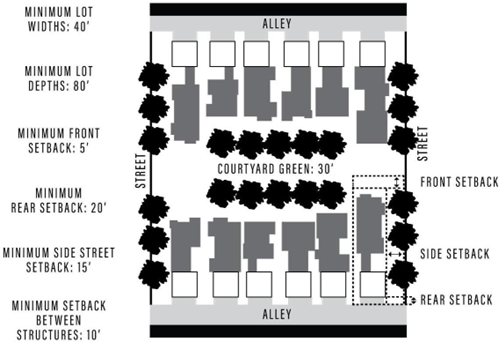
F.
Drive-In/Thru.
1.
In all Northgate zoning districts, all site designs and elevations for drive-in/thru windows shall be reviewed by the Design Review Board as part of the site plan review process. All outside activities and appurtenances related to drive-in/thru service shall be located wholly underneath a habitable structure, screened from view from the University Drive right-of-way, and designed to be sensitive to the pedestrian environment.
2.
In SC Suburban Commercial, drive-in/thru windows and message boards may not be located on the side of the building adjacent to single-family land use and zoning.
3.
In SC Suburban Commercial, restaurants with a drive-in/thru window must be located a minimum of one hundred fifty (150) feet from any single-family use or zoning district. Additionally, associated drive-in and drive-thru facilities (speaker box, message board, and pick-up window) may not be located between the restaurant and any single-family use or zoning district; except when the single-family use or zoning district is located across a public street.
G.
Dry Cleaners/Laundry.
All activity must be wholly contained within a building not to exceed three thousand (3,000) square feet in size.
H.
Fuel Sales.
1.
Any vehicle repair uses must comply with the Vehicular Sales, Rental, Repair, and Service Subsection below.
2.
All activities except those associated with fuel pumping must be conducted within an enclosed building.
3.
Ice and vending machines must be enclosed in a building.
4.
No signage, in addition to the signage allowed in the Signs Section of Article 7, General Development Standards of this UDO, may be allowed within view of the right-of-way.
5.
No outside storage or display of vehicles for any purpose.
6.
A drive-thru car wash designed to accommodate one (1) vehicle shall be permitted as an accessory use.
7.
In C-3 Light Commercial, fuel sales shall be limited to facilities designed to accommodate a maximum of four (4) vehicles obtaining fuel simultaneously.
8.
Minimum setback requirements shall be as follows:
9.
Storage tanks must be located below grade.
10.
In WC Wellborn Commercial, fuel sales will be considered a permitted land use on properties with existing fuel sales as of April 14, 2011.
I.
Golf Course or Driving Range.
1.
All driving ranges shall be a minimum of ten (10) acres and have a minimum field size of two hundred seventy-five (275) yards.
2.
Driving ranges are classified as commercial enterprises and must comply with the Buffer Requirements Section of Article 7, General Development Standards of this UDO.
3.
For driving ranges, all balls must remain on the property through proper orientation of the tee boxes, adequate buffering or screening, and barrier nets.
4.
No building, structure, or outdoor activity of a driving range shall be located within one hundred (100) feet of residentially zoned property.
5.
All ground-level lighting of a driving range's landing area shall be directed away from adjacent properties and screening shall be provided with plantings, berms, or other means to limit nuisances associated with lighting and resulting glare.
J.
Government Facilities and Utilities.
Activities not wholly contained within a building shall not be located within one hundred (100) feet of a single-family residential use unless buffered by a twenty-five (25) foot buffer yard and a six (6) foot privacy fence in accordance with the Buffer Requirements Section of Article 7, General Development Standards of this UDO.
K.
Health Club/Sports Facility (Outdoor).
In MU Mixed-Use and all NG Northgate Zoning Districts, outdoor health clubs/sports facilities shall only be allowed on rooftops.
L.
Live-Work Unit.
1.
The square footage of the live-work unit may not be greater than as set forth in the International Building Code, as adopted. Currently, said maximum size is three thousand (3,000) square feet. Further, the non-residential use may not be more than fifty (50) percent of each live-work unit.
2.
Each live-work unit shall not contain more than one (1) dwelling unit. The residential unit must be attached to the non-residential use and may be accessed separately from the non-residential use.
3.
In a two-story building, the residential unit must be located on the second floor.
4.
If a residential garage is provided, it must be attached and not visible from the public right-of-way.
M.
Manufactured Homes.
1.
The placement of an individual manufactured home, where permitted, or the replacement of an existing manufactured home shall be subject to obtaining a location permit issued by the Building Official and Administrator. The application for such a permit shall be accompanied by a location plan including the following information:
a.
Location plan showing the dimension of the site, required setback lines, the placement of the manufactured home, the designated parking, and any existing structures on the same or adjoining lots;
b.
A signed and dated application, requesting permission to locate the structure on the lot; and
c.
A legal description of the location of the property within the city.
2.
All manufactured homes shall be skirted with brick, vinyl, or other solid skirting materials within four (4) months of occupancy of the lot.
3.
All trailer hitches and other devices designed to aid in the transport of the manufactured homes must be removed within four (4) months of occupancy of the lot.
N.
Micro-Industrial Uses.
1.
All production activities must be conducted within an enclosed building. No outside storage is allowed.
2.
All micro-industrial uses are limited in size to no more than five thousand (5,000) gross square feet.
3.
Accessory uses are permitted, provided that they are subordinate and incidental to the primary use.
4.
In the CI Commercial Industrial and BPI Business Park Industrial zoning districts, an accessory restaurant, nightclub, bar, or tavern is not permitted.
O.
Mobile Food Court.
Mobile food court shall mean a land use approved through a conditional use permit and developed in conformity with an approved site plan, where two or more mobile food vendors congregate to offer edible goods for sale to the public, and amenities are provided for all vendors' customers.
1.
Mobile Food Court Categories.
a.
Short-Term.
1)
A short-term food court is temporary, intended to be an interim use on previously developed land where long-term utilization of the property or redevelopment is being investigated and/or pursued. A conditional use permit for a short-term mobile food court may be granted for a period of up to two (2) years.
2)
A short-term mobile food court may allow for:
a)
The establishment of a site that provides for the gathering of two (2) to five (5) mobile food vendors.
b)
The mobile food vendors within the mobile food court to remain on their pad sites overnight. Note: Mobile food vendors are required to leave the mobile food court at least once a year to retain mobile food vendor status.
c)
Tables, chairs, and canopies for court customers.
d)
Signage for the mobile food court in accordance with the Signs Section of Article 7, General Development Standards of this UDO.
e)
Small-scale entertainment and accessory uses for mobile food court customers, such as music (live acoustic or recorded) that is played or broadcast at a reasonable volume inside the court's property boundaries and small playground area so as not to disturb other surrounding property owners.
3)
A short-term mobile food court shall:
a)
Be located a minimum of one hundred (100) feet from a single-family, duplex, or townhouse zoning district.
b)
Have a site manager that will remain on the property during the hours of operation.
c)
Have all valid permits and licenses as required by the Brazos County Health Department.
d)
Allow only mobile food vendors that hold valid permits and licenses as required by the City of College Station and the Brazos County Health Department to operate within the mobile food court.
e)
At a minimum, not operate between the hours of 3:00 a.m. and 5:00 a.m.
f)
Provide only portable or temporary improvements to a site. Long-term or permanent improvements to a site are not allowed.
g)
Provide adequately maintained trash receptacles for customer use.
h)
Comply with general site plan requirements described in the Site Plans Section of Article 3, Development Review Procedures of this UDO, the applicable requirements of Article 7, General Development Standards of this UDO, and the Specific Use Standards for Mobile Food Courts Subsection below.
b.
Long-Term.
1)
Long-term mobile food courts are intended to have more permanency than short-term mobile food courts and shall be held to the same development standards as restaurant developments, with the exceptions identified in the specific use standards below.
2)
A long-term mobile food court may allow for:
a)
The establishment of a site that provides for the gathering of two (2) or more mobile food vendors.
b)
The mobile food vendors within the mobile food court to remain on their pad sites overnight. Note: Mobile food vendors are required to leave the mobile food court or move within the court at least once a year to retain mobile food vendor status.
c)
Mobile food vendors to access potable water and sewage disposal facilities onsite. If these utilities are made available, they shall be located in a manner to necessitate the movement of each mobile food vendor to access the utilities.
d)
Tables, chairs, and canopies or enclosed seating areas for court customers.
e)
Signage for the mobile food court in accordance with the Signs Section of Article 7, General Development Standards of this UDO.
f)
Small-scale entertainment and accessory uses for mobile food court customers, such as music (live acoustic or recorded) that is played or broadcast at a reasonable volume inside the court's property boundaries and small playground area so as not to disturb surrounding property owners.
g)
Larger-scale entertainment and accessory uses for court customers, such as a volleyball court and bar, at a scale so as not to disturb surrounding property owners.
h)
Accessory structures.
i)
Alcohol sales with approved permits and licenses from the Texas Alcoholic Beverage Commission.
3)
A long-term mobile food court shall:
a)
Be located a minimum of one hundred (100) feet from a single-family, duplex, or townhouse zoning district.
b)
Have a site manager that will remain on the property during the hours of operation.
c)
Have all valid permits and licenses as required by the Brazos County Health Department.
d)
Allow only mobile food vendors that hold valid permits and licenses as required by the City of College Station and the Brazos County Health Department to operate within the mobile food court.
e)
At a minimum, not operate between the hours of 3:00 a.m. and 5:00 a.m.
f)
Comply with general site plan requirements described in the Site Plans Section of Article 3, Development Review Procedures of this UDO, the applicable requirements of Article 7, General Development Standards of this UDO, and the Specific Use Standards for Mobile Food Courts Subsection below.
c.
Restroom and Hand Washing Facilities for Short-Term and Long-Term Mobile Food Courts.
1)
Mobile food courts will provide at least two (2) handicapped accessible porta potties with one (1) mobile handwashing station for every ten (10) mobile food vendors.
2)
Mobile food courts that are within one hundred (100) feet of a public restroom facility may be exempted from the requirement for porta potties.
3)
Mobile food vendors shall comply with the Brazos County Health Department's requirements for hand washing facilities.
2.
Specific Use Standards for Mobile Food Courts.
The following shall apply to all short-term and long-term mobile food courts unless otherwise noted:
a.
Mobile food courts shall designate pad site locations for mobile food vendors.
b.
Mobile food vendor pad sites and dining areas shall be setback a minimum of one hundred (100) feet from rights-of-way and public ways.
c.
All mobile food vendor pad sites shall be separated from other pad sites, dining areas, and structures by a minimum of ten (10) feet.
d.
Pad sites and dining areas shall not be located within fire lanes, easements, setbacks, buffers, or visibility triangles.
e.
All mobile food vendors located in a mobile food court shall be on an improved, permanent surface as described in the Off-Street Parking Standards Section of Article 7, General Development Standards of this UDO.
f.
A minimum of two (2) off-street parking spaces shall be provided per mobile food vendor pad site.
g.
A minimum of a twenty (20) foot fire apparatus access route is required around a mobile food court.
h.
Mobile food vendors, portable restroom trailers, and other temporary structures shall not be subject to the Non-Residential Architectural Standards Section of Article 7, General Development Standards of this UDO.
i.
Electrical connections shall be provided for all mobile food vendors on site. Use of generators shall not be allowed in a mobile food court.
j.
Short-term mobile food courts only.
1)
Short-term mobile food courts shall not impede vehicular circulation or block fire lanes or sanitation routes through the existing sites upon which they are located.
2)
Short-term mobile food courts shall not be subject to the requirements of the Landscaping and Tree Protection Section of Article 7, General Development Standards of this UDO.
3)
Short-term mobile food courts shall utilize existing solid waste collection sites on the properties on which they are located and provide proof of permission to do so.
k.
Long-term mobile food courts only.
If water and wastewater facilities are provided to mobile food vendors in a long-term mobile food court, the site shall be designed to require all mobile food vendors to remain mobile to access these amenities. Additional tanks or portable tanks for wastewater are prohibited.
P.
Mobile Home.
After the effective date of this UDO, a mobile home may not be located within the city limits of College Station for residential use. A mobile home legally located within the city limits of College Station may continue to be used as a residential dwelling but shall not be relocated or enlarged. A mobile home may be replaced by a manufactured home.
Q.
Parking as a Primary Use.
In all Northgate zoning districts, parking as a primary use shall be permitted when all of the parking is located within a multi-level garage.
R.
Places of Worship.
1.
Where the parking lot abuts residential development, a ten (10) foot buffer yard with buffer plantings and a minimum six (6) foot privacy fence is required pursuant to the Buffer Requirements Section of Article 7, General Development Standards of this UDO.
2.
When outdoor accessory uses including but not limited to playgrounds, recreational areas, and special event areas abut residential uses, a minimum fifteen (15) foot buffer yard with buffer plantings and a six (6) foot privacy fence is required pursuant to the Buffer Requirements Section of Article 7, General Development Standards of this UDO.
S.
Radio/TV Station/Studios.
In all Northgate zoning districts, outdoor transmission facilities shall be completely screened from view from any right-of-way.
T.
Recreational Vehicle Park Standards (RV Parks).
1.
Recreational vehicle parks shall allow for the temporary occupancy of vehicles that are built on a single chassis that are designed to be self-propelled or permanently towable by a light-duty truck and are primarily for use as temporary living quarters for recreational, travel, or seasonal use.
2.
Recreational vehicle parks shall be considered a non-residential use and shall meet the Buffer Requirements Section of Article 7, General Development Standards of this UDO as a commercial use, regardless of zoning.
3.
No person shall operate a recreational vehicle park unless they hold valid permits and licenses as required by the State of Texas and the Brazos County Health Department.
4.
Development of any recreational vehicle park shall comply with the general site plan requirements of the Site Plan Review Section of Article 3, Development Review Procedures of this UDO, and shall meet the following supplemental criteria:
a.
The minimum area of a recreational vehicle park shall be ten (10) acres and shall consist of two (2) or more recreational vehicle pad sites that are intended for temporary occupancy by recreational vehicles for the purposes of recreation or vacation.
b.
All recreational vehicle parks shall have direct access to a public road and shall include sufficient entrances and exits to facilitate the safe movement of recreational vehicles in and out of the site. Internal drives shall have a minimum paved width of twelve (12) feet for one-way traffic and twenty-four (24) feet for two-way traffic. All internal drives shall be built to City pavement standards and shall be privately maintained.
c.
All recreational vehicle parks shall designate specific pad site locations for recreational vehicles.
1)
Each pad site location shall have a minimum area of one thousand five hundred (1,500) square feet with provisions for wastewater disposal, public water hook-up, and electrical supply.
2)
All pad sites shall be sequentially numbered. Reflective site numbers shall be a minimum of four (4) inches in height and placed on a separate post on the site. A map of the site layout with site numbers shall be placed at the entrance to the park in such a manner as to be clearly visible to entrants.
d.
Recreational vehicle pad sites shall be separated from each other by a minimum of ten (10) feet.
e.
Recreational vehicle pad sites shall be separated from the recreation area in the park by a minimum of fifteen (15) feet.
f.
All recreational vehicle pad sites shall be setback a minimum of fifty (50) feet from the right-of-way line of all adjacent public roads and any recreational vehicle park boundaries.
g.
All recreational vehicle pad sites shall be setback a minimum of ten (10) feet from any internal drives in the park.
h.
A minimum of two (2) parking spaces shall be provided per recreational vehicle pad site. One (1) space shall be located on the recreational vehicle site, the remainder may be located in an approved parking area. The size and paving of all parking spaces shall conform to the requirements in the Off-Street Parking Standards Section of Article 7, General Development Standards of this UDO.
i.
In all recreational vehicle parks, a recreation area shall be provided that shall be centrally located, free of traffic hazards, and easily accessible to all park residents. Recreation areas shall constitute a minimum of fifteen (15) percent of the gross recreational vehicle park site area and shall contain open space for recreational uses. Recreational areas shall also contain benches and landscaping. The area shall be adequately lit to ensure the safety of users.
j.
Recreational vehicle parks shall permit only seasonal placement and habitation of recreational vehicles. No recreational vehicle shall remain in a recreational vehicle park for more than one hundred twenty (120) days in any twelve (12) month period.
U.
Recycling Facilities.
1.
Any facility located within five hundred (500) feet of property zoned or developed for residential use shall not be in operation between 7:00 p.m. and 7:00 a.m.
2.
Light processing, including compacting, baling, and shredding, must be directly related to efficient temporary storage and shipment of materials. No recycling facility shall abut property zoned or developed for single-family residential use.
3.
A minimum of six (6) parking spaces shall be provided, plus one (1) space per employee and for each vehicle of the facility.
4.
Each container shall be clearly marked to specify materials that are accepted. The name and telephone number of the operator and the hours of operation shall be conspicuously displayed. All sign regulations of the district in which the facility is located shall apply.
5.
Each facility shall be screened from the public right-of-way by operating in an enclosed building with no outside storage or by operating within an area enclosed by an opaque fence at least eight (8) feet in height.
V.
Restaurant.
1.
In C-3 Light Commercial and WC Wellborn Commercial, drive-ins and drive-thrus are prohibited.
2.
In SC Suburban Commercial restaurants with a drive-in or drive-thru must be located a minimum of one hundred fifty (150) feet from any single-family use or zoning district. Drive-in and drive-thru facilities (speaker box, message board, and pick-up window) may not be located between the building and any single-family use or zoning district, except when the single-family use or zoning district is located across a public street.
3.
In C-3 Light Commercial, the maximum size shall be two thousand five hundred (2,500) square feet.
4.
In WC Wellborn Commercial, restaurants (including waiting and outdoor dining areas) may not exceed eight thousand (8,000) square feet and are permitted at the following maximum sizes based on the adjacent thoroughfare and access:
a.
Freeway/expressway and four- or six-lane major arterial: eight thousand (8,000) square feet;
b.
Four-lane minor arterial and four-lane major collector: seven thousand (7,000) square feet; or
c.
Two-lane major collector and smaller: five thousand (5,000) square feet.
5.
In SC Suburban Commercial and WC Wellborn Commercial, restaurants shall not locate outdoor seating or playgrounds between the structure and a single-family land use and zoning.
W.
Retail Sales of Manufactured Homes.
Manufactured homes undergoing repair and remaining on-site for more than forty-eight (48) hours shall be screened from public view in an enclosed area.
X.
Sales and Service (Retail and Wholesale).
The following sales/storage matrix shall be used to determine the most appropriate zoning district for sales and service uses.
Sales/Storage Matrix
1.
Storage is allowed in GC General Commercial if the square footage of storage is less than fifty (50) percent of the total gross building area, exclusive of office areas.
2.
Storage is allowed in WC Wellborn Commercial if the square footage of storage is less than fifty (50) percent of the total gross building area.
3.
Sales are allowed in CI Commercial Industrial if the square footage of sales is less than fifty (50) percent of the total gross building area, exclusive of the office area.
4.
Each sales use in a shopping center must meet the storage square-foot criteria above to be permitted in that zoning district.
5.
In SC Suburban Commercial, the gross floor area of a single structure shall not exceed fifteen thousand (15,000) square feet.
6.
In WC Wellborn Commercial, the gross floor area of a single structure shall not exceed ten thousand (10,000) square feet.
Y.
Salvage Yard.
1.
Salvage or junkyards shall be visually screened on the front, rear, and all sides utilizing a solid eight (8) foot high wooden privacy fence.
2.
Material that is not salvageable shall not be permitted to accumulate. In no case shall material that is not salvageable be buried or used as fill.
3.
In any open storage area, it shall be prohibited to keep any ice box, refrigerator, deep-freeze locker, clothes washer, clothes dryer, or similar air-tight unit having an interior storage capacity of one and one-half (1.5) cubic feet or more, from which the door has not been removed.
Z.
Sexually Oriented Business.
1.
General.
These requirements apply to all sexually oriented businesses as defined in this UDO.
A business is not exempt from regulation under this UDO because it holds a license or permit under the Alcoholic Beverage Code authorizing the sale or service of alcoholic beverages or because it contains one (1) or more coin-operated machines that are subject to regulation or taxation, or both under State law.
Regulations contained within this UDO applying to sexually oriented businesses are based on evidence concerning the adverse secondary effects of adult uses on the communities presented in findings incorporated in City of Renton v. Playtime Theaters, Inc., 475 U.S. 41 (1986) and in studies set out below:
a.
Detroit, Michigan;
b.
Amarillo, Texas;
c.
Los Angeles, California;
d.
Indianapolis, Indiana;
e.
Phoenix, Arizona;
f.
St. Paul, Minnesota;
g.
Beaumont, Texas;
h.
Seattle, Washington;
i.
Austin, Texas.
2.
Permitted Locations.
A sexually oriented business is a permitted use at the following location only and is subject to the specific standards located in this Section and is subject to other applicable regulations of this UDO.
Area 3: State Highway 6 Commercial Tract
All that certain tract or parcel of land lying and being situated in the R. Stevenson Survey, Abstract No. 54, Tract 61, being all of that 2.116-acre tract conveyed to the Blue Dolphin Club, Inc. by deed recorded in volume 2079, page 133 in the Official Records of Brazos County, Texas.
Map of the Potential Location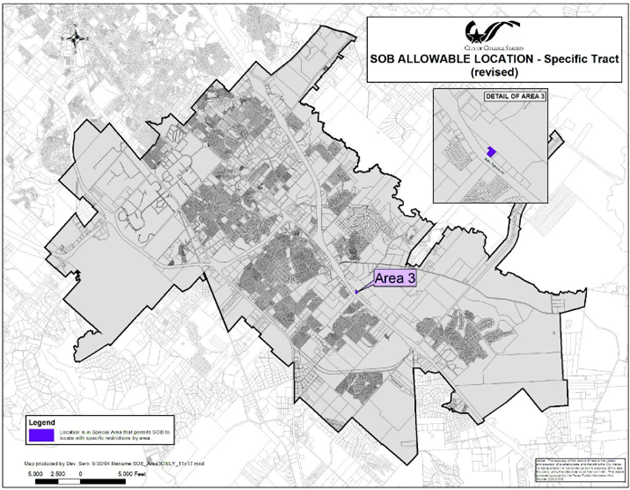
3.
Single Adult Use Per Location.
There shall only be one (1) sexually oriented business permitted per area.
4.
Measurement.
a.
Stock in Trade.
Stock in trade shall be the number of items in stock in the sales and display area at the time of a site inspection. The number of sexually oriented items shall be calculated as a percentage of total items.
b.
Sales and Display Area.
1)
The sales and display area shall be the entire interior floor space of a business establishment devoted to sales and display, including aisles, measured in square feet at the time of a site inspection. The floor space devoted to sales and display of sexually oriented materials shall be calculated as a percentage of total sales and display area.
2)
Where sexually oriented materials are physically separated from other materials by an eight-foot wall, the separate sales and display area (including any aisles) shall be compared to the total sales and display floor area.
3)
Where the floor area includes a mixture of sexually oriented material with any other material, it shall be counted as sexually oriented. Any such area shall include fifty (50) percent of the area of any aisles adjacent to the display or sales of sexually oriented materials.
5.
Specific Standards.
a.
Adult Cabaret or Adult Retail Store.
Any performance area shall be elevated at least twenty-four (24) inches above the level of the patron seating areas and shall be separated by a distance of at least six (6) feet from all areas of the premises to which patrons have access. A continuous railing at least three (3) feet in height, securely attached to the floor, and located at least six (6) feet from all points of the live performance area shall separate performance areas and patron areas.
b.
Adult Arcade; Adult Movie Theater.
1)
All aisles shall have theater runway and aisle lighting which illuminates the entire floor surface of the aisle at a level of not less than two-tenths (0.2) foot-candles.
2)
All theater viewing areas, projection rooms, and viewing booths or rooms shall be equipped with overhead lighting fixtures of sufficient intensity to illuminate every place to which patrons are permitted access at an illumination so that any patron may be observed from a manager's or employee's station.
3)
The interior of an adult arcade, and/or adult viewing booth or room, shall be configured in such a way that there is an unobstructed view from a manager's or employee's station of every interior area of the adult arcade and/or viewing booth or room.
4)
All ventilation devices in or between adult viewing booths, viewing stations, and rooms must be covered by a permanently affixed ventilation cover or grill. Ventilation holes, portals, or airways may only be located one (1) foot from the top of the station, room, or booth walls or one (1) foot from the bottom of the station, room, or booth walls. There may not be any other holes or openings in the station, room, or booth walls or between stations, rooms, or booths.
c.
Limited Adult Retail Store.
The store shall separate all sexually oriented material from other sales and display areas using an opaque wall at least eight (8) feet in height. Such an area shall incorporate a management-controlled system of access to ensure that only persons over the age of eighteen (18) years are allowed to enter.
6.
Lighting.
Any sexually oriented business shall be equipped with overhead lighting fixtures of sufficient intensity to illuminate every place to which patrons are permitted access so that any patron may be observed from a manager's or employee's station.
7.
Amortization.
A sexually oriented business in operation prior to the effective date of this UDO which does not conform to the regulations listed above shall be considered to be nonconforming. The nonconforming sexually oriented business shall be permitted to continue for one (1) year after the effective date of this ordinance unless voluntarily discontinued for thirty (30) days or more. One (1) year after the effective date of this UDO the nonconforming sexually oriented business shall be illegal and shall terminate, except as provided herein.
a.
Additional Time for Amortization.
In the event an owner of a nonconforming sexually oriented business is unable to recoup their investment in their sexually oriented business by the date for the termination of such uses, the owner may request additional time by making an application with the Administrator no later than the date for termination of the use.
b.
Application for Additional Time.
The owner shall file, with their request for additional time, all data they wish considered in support of the request. The owner shall also supply all materials requested by the Administrator, City Attorney, or City Council to determine if the investment has been recouped.
c.
Determination by the City Council.
Upon application by the owner, the City Council may, at its discretion, allow additional time to amortize the investment in a sexually oriented business if it makes the following findings:
1)
The owner has made every effort to recoup their investment in the sexually oriented business;
2)
The owner will be unable to recoup their investment in a sexually oriented business by the end of the amortization period; and
3)
That all applicable provisions of this UDO will be observed.
If the City Council grants additional time, the grant shall be for a period not to exceed one (1) year.
d.
Exemption from Amortization Requirements.
Any owner of a sexually oriented business wishing to claim an exemption from the amortization requirements of this UDO may apply for an exemption. The City must receive an application no less than sixty (60) days prior to the expiration of the amortization period.
The City Council may grant an exemption if it makes the following findings:
1)
That the location of the sexually oriented business will not have a detrimental effect on nearby properties or be contrary to the public health, safety, or welfare;
2)
That the granting of the exemption will not violate the spirit and intent of this UDO;
3)
That the location of the sexually oriented business will not downgrade the property values or quality of life in the adjacent areas or encourage the development of urban blight;
4)
That the location of the sexually oriented business will not be contrary to any program of neighborhood conservation, nor will it interfere with any efforts of urban renewal or restoration; and
5)
That all other applicable provisions of this UDO will be observed.
If an exemption is granted, such exemption shall be valid for one (1) year from the date of the City Council action. Upon expiration of an exemption, a sexually oriented business shall be in violation of this UDO, shall be illegal, and shall terminate, unless the owner receives another exemption. Additional applications for exemptions shall be submitted at least sixty (60) days prior to the expiration of the exemption period.
The granting of an exemption does not alleviate the owner of a sexually oriented business from adhering to all other applicable provisions of this UDO.
AA.
Storage (Self-Service).
1.
Accessory uses are prohibited.
2.
In SC Suburban Commercial, self-service storage and outdoor storage must be located a minimum of one hundred fifty (150) feet from any single-family uses or zoning district; except when the single-family use or district is located across a public street. Additionally, the one hundred fifty (150) foot separation is not applicable when only interior access (climate-controlled storage) is provided, subject to other provisions of this UDO.
3.
In WC Wellborn Commercial, self-service storage will be considered a permitted land use on properties with existing self-service storage as of April 14, 2011.
AB.
Utilities.
Activities not wholly contained within a building that abuts single-family residential uses shall construct a twenty (20) foot buffer yard with a six (20) foot privacy fence, in accordance with the Buffer Requirements Section of Article 7, General Development Standards of this UDO.
AC.
Vehicular Sales, Rental, Repair, and Service.
1.
Vehicles undergoing repair, painting, or body work that will remain on-site for more than forty-eight (48) hours shall be screened from public view or stored indoors.
2.
Inoperable vehicles shall not be allowed to remain on-site for more than thirty (30) days.
3.
All parts, including automobile body parts, shall be stored within an area that is completely screened from public view.
AD.
Wireless Telecommunication Facility.
1.
Purpose.
The purpose of this Section is to establish regulations for wireless telecommunications facilities that are consistent with federal and state law. The City Council finds that:
a.
It is in the public interest to promote competition in high-quality telecommunications services and the availability of broadband transmission services to all residences and businesses;
b.
It is in the public interest for the City to protect the public safety and welfare, safeguard community land values, promote orderly planning and development, and preserve historic sites, structures, and areas. Wireless telecommunications facilities should not be allowed to detract aesthetically from the visual quality of surrounding properties or the City; and
c.
The proliferation of wireless telecommunications facilities negatively impacts the appearance, character, and property values of the community. Therefore, the City should endeavor to minimize the size, number, and obtrusiveness of antennas and towers. Collocation and stealth technologies are strongly encouraged to mitigate negative visual impacts and reduce the total number of towers within the City.
2.
Wireless Telecommunication Facility Categories.
To expedite the siting and review process, wireless telecommunications facilities have been divided into use categories. The review process is more thorough as the intensity of the use increases.
a.
Unregulated Facilities.
The wireless telecommunications facilities listed below are not regulated by this ordinance and do not require review or approval. This does not exempt these facilities from other applicable City of College Station codes, ordinances, and permits.
1)
Over-the-air reception devices exempted from local ordinances by the Federal Communications Commission (FCC).
2)
Parabolic antenna less than two (2) meters in diameter.
3)
Omni-directional antenna ("whip" antenna) six (6) inches or less in diameter and not extending more than twelve (12) feet above the support structure.
4)
Directional antenna one (1) meter or less measured across the longest dimension and not extending over twelve (12) feet above the support structure.
5)
Public safety tower or antenna.
b.
Intermediate Facilities.
1)
New transmission tower less than thirty-five (35) feet (ten and one-half (10.5) meters) in height.
2)
New transmission tower that does not extend more than thirty-five (35) feet (ten and one-half (10.5) meters) in height above a support structure and that meets the definition of a stealth facility.
3)
Parabolic antenna over two (2) meters in diameter.
4)
Omni-directional antenna ("whip" antenna) greater than six (6) inches in diameter and/or extending twelve (12) feet above the support structure.
5)
Directional antenna more than one (1) meter measured across the longest dimension and extending over twelve (12) feet above the support structure.
6)
Attached wireless telecommunications facilities.
7)
Antenna collocating on an existing tower.
c.
Major Facilities.
New transmission tower greater than thirty-five (35) feet (ten and one-half (10.5) meters) in height.
3.
Requirements for Attached Wireless Telecommunication Facilities.
a.
Wireless telecommunications facilities may attach to the exterior of any non-residential building within any zoning district provided the antenna and antenna support structure or equipment are mounted flush with the vertical exterior of the building or project no more than twenty-four (24) inches from the surface of the building to which it is attached and does not raise the height of the building more than ten (10) feet and does not violate the maximum height restriction of that zoning district.
b.
Any antenna meeting the stealth antenna definition of this ordinance and located on an alternative mounting structure may attach to the exterior of any non-residential building within any zoning district with the approval of the Administrator.
c.
If an antenna is installed on a support structure other than a tower, the antenna and supporting electrical and mechanical equipment must be of a neutral color that is identical to, or closely compatible with, the color of the supporting structure to make the antenna and related equipment as visually unobtrusive as possible.
d.
Application Procedures.
1)
An inventory of the applicant's existing and future towers that are within the city limits, the extraterritorial jurisdiction, and within at least one (1) mile of the city limits. The inventory shall include specific information about the location, design, and height of each tower. The owner must have on file with the Planning and Development Services Department a master list of all existing tower structures owned or controlled by the owner. Such list must specify the name, address, and telephone number of the owner of record, the tower locations by address and legal description, tower height, the number of antenna arrays on the tower, and the names, addresses, and telephone numbers of all other users of the tower structures. The Administrator may share such information with other applicants or organizations seeking to locate antennas within the City.
2)
A site plan drawn to scale clearly indicating the location, height, and design of the proposed facility, equipment cabinets, transmission buildings and other accessory uses, access, parking, fences, and landscaped areas.
3)
A visual impact analysis, presented as color photo simulations, showing the proposed site of the wireless telecommunications facility. At least four (4) views shall be submitted looking toward the site (typically north, south, east, and west) including views from the closest residential property and adjacent roadways. The photo-realistic representation shall depict a "skyline" view showing the entire height of the proposed tower or wireless telecommunications facility to scale, and the structures, trees, and any other objects contributing to the skyline profile.
4)
Plans for the antenna and the antenna tower shall be prepared and signed by a licensed professional engineer and designed to withstand sustained winds of at least ninety (90) miles per hour.
5)
All telecommunication facilities must meet or exceed the current standards and regulations of the Federal Aviation Administration (FAA), the FCC, and any other agency of the federal government with the authority to regulate telecommunication facilities. An applicant for a permit shall submit an affidavit confirming compliance with applicable regulations.
4.
Requirements for Collocation.
a.
Intermediate facilities shall not exceed thirty-five (35) feet.
b.
If the existing tower has been determined to be stealth, the antenna must be integrated into the tower design to retain the stealth designation. The Administrator will determine if the antenna is a stealth antenna.
c.
If an antenna is installed on a support structure other than a tower, the antenna and supporting electrical and mechanical equipment must be of a neutral color that is identical to, or closely compatible with, the color of the supporting structure to make the antenna and related equipment visually unobtrusive as possible.
d.
Application Procedures.
1)
If not completely located within an existing, fenced mechanical area, a site plan drawn to scale is required, clearly indicating the location, height, and design of the existing facility, equipment cabinets, transmission buildings and other accessory uses, access, parking, fences, and landscape areas.
2)
Plans for the antenna shall be prepared and signed by a licensed professional engineer and designed to withstand sustained winds of at least ninety (90) miles per hour.
3)
All telecommunication facilities must meet or exceed the current standards and regulations of the FAA, the FCC, and any other agency of the federal government with the authority to regulate telecommunication facilities. An applicant for a permit shall submit an affidavit confirming compliance with applicable regulations.
5.
Requirements for New Transmission Towers.
a.
Setbacks.
The standard setbacks for each zoning district will apply to wireless telecommunications facilities with additional setbacks or separation being required in the Subsections below. To protect citizens in their homes, transmission towers shall be placed at a distance equal to the height of the tower away from any residential structure. Non-stealth towers shall be set back at a distance equal to the height of the tower away from any GS General Suburban, R-1B Single-Family Residential, or D Duplex zone boundary.
b.
Proximity to Major Thoroughfares.
To preserve and protect the appearance of the City's major thoroughfares and entrances to the city, additional setbacks are placed on wireless telecommunications facilities proposed to be placed near these areas. The setback for these areas is determined by measuring from the centerline of the right-of-way of the thoroughfare. Applicable thoroughfares include freeways and expressways, major arterials, and minor arterials as shown on the Comprehensive Plan Functional Classification & Context Class Map.
1)
Intermediate wireless telecommunications facilities must be one hundred fifty (150) feet from applicable thoroughfares.
2)
Major wireless telecommunications facilities must be setback from applicable thoroughfares by the height of the tower multiplied by three (3).
c.
Separation Between Towers.
To prevent tower proliferation and protect the city's natural beauty and skyline, the number of transmission towers per square mile has been limited. New transmission towers must be placed a minimum distance from existing towers as described here:
1)
New transmission towers thirty-five (35) feet or less in height shall be separated from existing towers by a minimum distance of one thousand five hundred (1,500) feet.
2)
New transmission towers more than thirty-five (35) feet and less than seventy-five (75) feet in height shall be separated from existing towers by a minimum distance of two thousand five hundred (2,500) feet.
3)
New transmission towers seventy-five (75) feet or more in height shall be separated from existing towers by a minimum distance of three thousand five hundred (3,500) feet.
d.
Height Limitations.
1)
Intermediate wireless telecommunications facilities are subject to the normal height restrictions for each zoning district where they are permitted by right. In any zoning district where a tower is a conditional use, the requested height may be reduced through the review of the visual impact analysis.
2)
In no case shall a proposed transmission tower exceed one hundred fifty (150) feet within the city limits, except where a height variance is granted by the Zoning Board of Adjustments to allow a tower or antenna that demonstrates a hardship that can only be remedied by locating a tower or antenna exceeding such height on a proposed site within the city limits.
e.
Stealth Towers.
Any tower determined to meet the stealth tower definition of this ordinance by the approving authority may be located in any zoning district with a conditional use permit. Approved stealth towers do not have to meet the tower separation or thoroughfare setback requirements of this Section.
f.
Landscaping, Screening, and Aesthetic Standards.
The following requirements shall govern any transmission tower or any parabolic antenna larger than two (2) meters.
1)
Landscaping: Refer to the Landscaping and Tree Protection Section of Article 7, General Development Standards of this UDO. Plant materials and/or fencing that effectively screen the wireless telecommunications facility site from the view of the public right-of-way will be required.
2)
New transmission towers shall maintain a flat (not shiny, reflective, or glossy) finish or be painted in accordance with any applicable standards of the FAA (unfinished galvanized steel is not acceptable).
3)
Wireless telecommunications facilities shall not be artificially lighted with the exception of motion detectors as security lighting unless required by the FAA or other applicable authorities. If lighting is required, the City may review the available lighting alternatives and approve the design that would cause the least disturbance to the surrounding properties.
4)
Towers may not be used to exhibit any signage or other advertising.
g.
Application Procedures.
An application for administrative approval or a conditional use permit for a wireless telecommunications facility shall include the following items (in addition to the site plan and other information required for a standard conditional use permit application):
1)
An inventory of the applicant's existing and future towers that are within the city limits, the extraterritorial jurisdiction, and within at least one (1) mile of the city limits. The inventory shall include specific information about the location, design, and height of each tower. The owner must have on file with the Planning and Development Services Department a master list of all existing tower structures owned or controlled by the owner. Such list must specify the name, address, and telephone number of the owner of record, the tower locations by address and legal description, tower height, the number of antenna arrays on the tower, and the names, addresses, and telephone numbers of all other users of the tower structures. The Administrator may share such information with other applicants or organizations seeking to locate antennas within the City.
2)
Site plan drawn to scale clearly indicating the location, height, and design of the proposed tower, equipment cabinets, transmission buildings and other accessory uses, access, parking, fences, and landscaped areas.
3)
The linear separation distance from other transmission towers within a one (1) mile radius of the proposed tower site. The linear separation distance from all residentially zoned properties, residential structures, and applicable thoroughfares as set forth in the Proximity to Major Thoroughfares Subsection above, within five hundred (500) feet of the proposed tower.
4)
A visual impact analysis, presented as color photo simulations, showing the proposed site of the wireless telecommunications facility. At least four (4) views shall be submitted looking toward the site (typically north, south, east, and west) including views from the closest residential property and adjacent roadways. The photo-realistic representation shall depict a "skyline" view showing the entire height of the proposed tower or wireless telecommunications facility to scale, and the structures, trees, and any other objects contributing to the skyline profile.
5)
Plans for the antenna and the antenna tower shall be prepared and signed by a licensed professional engineer and designed to withstand sustained winds of at least ninety (90) miles per hour.
6)
All telecommunication facilities must meet or exceed the current standards and regulations of the FAA, the FCC, and any other agency of the federal government with the authority to regulate telecommunication facilities. An applicant for a permit shall submit an affidavit confirming compliance with applicable regulations.
7)
Grid plan (propagation map) of the service area for existing and future structures for not less than two (2) years. The submission should include a map showing the "search ring" that was required for siting the proposed facility.
8)
No new tower shall be built, constructed, or erected in the city unless the tower is capable of supporting additional wireless telecommunication facilities. The applicant must submit a letter addressed to the City declaring an intent and willingness to construct a proposed tower that would allow additional service providers to locate on the new tower.
9)
No new communications tower shall be permitted unless the applicant demonstrates to the reasonable satisfaction of the approving authority that no existing tower, building, structure, or alternative technology can accommodate the applicant's proposed antenna. The applicant shall submit information related to the availability of suitable existing towers, other structures, or alternative technology that can accommodate the applicant's proposed antenna. The Administrator or approving authority may request information necessary to demonstrate that reasonable alternatives do not exist. The applicant must submit:
a)
The names, addresses, and telephone numbers of all owners of other towers or usable antenna support structures within a one-half (0.5) mile radius of the proposed new tower site, including City-owned property.
b)
An affidavit attesting to the fact that the applicant made diligent but unsuccessful efforts to obtain permission to install or collocate the new facility on existing towers or antenna support structures located within a one-half (0.5) mile radius of the proposed tower site. The affidavit shall spell out the efforts taken by the applicant.
c)
A description of the design plan proposed by the applicant to the City. The applicant must demonstrate the need for towers and why technological design alternatives, such as the use of microcells, cannot be utilized to accomplish the provision of telecommunications services.
6.
Conditional Use Permits.
Major wireless telecommunications facilities must apply for a conditional use permit as set forth in the Types of Use Section above, under the procedures set forth in the Conditional Use Permit Section of Article 3, Development Review Procedures of this UDO. In addition to the standard guidelines, the following additional factors shall be considered by the Planning and Zoning Commission when determining whether to grant a conditional use permit for wireless telecommunications facilities:
a.
Height of the proposed tower, surrounding topography, and surrounding tree coverage and foliage as they relate to:
1)
Skyline impact, examining whether the massing of the structure appears to dominate or blend in with the surrounding environment.
2)
Shadow impact, whether or not the proposed tower will cast shadows that would prevent the reasonable use or enjoyment of surrounding properties.
b.
Design of the tower, with particular reference to design characteristics that have the effect of reducing or eliminating visual obtrusiveness.
c.
Proximity of the tower to residential structures and residential district boundaries.
d.
Economic impact on adjacent and nearby properties.
e.
Proposed ingress and egress.
f.
Availability of suitable alternatives and/or existing support structures.
g.
All the information submitted as part of the site plan.
7.
Abandonment.
Any wireless telecommunications facility that is not operated for a continuous period of twelve (12) months shall be considered abandoned, and the owner of the facility shall remove same within sixty (60) days of receipt of notice from the City notifying the owner of such abandonment. If such facility is not removed within said sixty (60) days, the City may remove such facility at the property owner's expense. If there are two (2) or more users of a single wireless telecommunications facility, then this provision shall not become effective until all users cease operations on the tower.
(Ord. No. 2023-4453, Pt. 1(Exh. A), 8-10-2023)
Sec. 6.5. - Accessory Uses.
A.
Accessory Uses.
Accessory uses are allowed with permitted, established primary structures and uses subject to the following:
1.
The use or structure is subordinate to and serves a primary use or principal structure;
2.
The accessory use shall be subordinate in area, extent, and purpose to the primary use served;
3.
The accessory use shall contribute to the comfort, convenience, or necessity of occupants of the primary use served;
4.
The accessory use shall be located within the same zoning district as the primary use is permitted; and
5.
Accessory uses located in residential districts shall not be used for commercial purposes other than permitted home occupations.
B.
Accessory Structures.
1.
In combination, all accessory uses shall contain no more square footage than twenty-five (25) percent of the habitable floor area of the principal structure or four hundred (400) square feet, whichever is greater. Garage or carport areas devoted to the storage of vehicles shall not be included in the calculation of the twenty-five (25) percent restriction.
2.
No accessory structure shall be erected in any required setback area. Excluded from this requirement is any portable storage building or structure if the Building Official has determined that it does not require a building permit.
3.
On lots with approved rear access all setbacks shall be measured from the nearest boundary of the access easement or alley. On all other lots, rear setbacks shall be measured from the rear property line. In no event shall more than thirty (30) percent of the rear yard area (that portion of the yard between the rear setback line of the principal structure and the rear property line) be covered with accessory buildings, structures, or uses.
4.
The maximum impervious cover of the lot's applicable zoning district, as defined in the Residential Dimensional Standards Section of Article 5, District Purpose Statements and Supplemental Standards of this UDO, shall not be exceeded by the addition of accessory uses or structures.
5.
The following restrictions shall apply to accessory buildings, structures, or uses other than garages, carports, and living quarters.
a.
A minimum rear setback of fifteen (15) feet; and,
b.
A maximum building eave height of eight (8) feet.
6.
Garage and Carports.
Garages and carports in residential zoning districts, including those of a temporary nature, shall have a minimum rear setback of twenty (20) feet. A minimum side yard setback of twenty (20) feet shall also be applied when garages and carports, including those of a temporary nature, gain access from a side street. All other setbacks shall be applied as required in the district in which the structure is located. The following restrictions shall apply to garages and carports:
a.
A minimum rear setback of twenty (20) feet; and,
b.
A minimum side street setback of twenty (20) feet is required for garages or carports that face onto side streets.
7.
Living Quarters.
In areas zoned and used for single-family residential use, accessory living quarters are allowed subject to the following:
a.
The property owner resides on-site and uses the subject property as their primary residence.
b.
There is a limit of one (1) accessory living quarter per building plot.
c.
No more than two (2) unrelated persons live in the accessory living quarters; and
d.
One (1) additional off-street parking space is provided for the living quarters.
C.
Home Occupation.
A home occupation is an accessory use of a dwelling that shall constitute all or some portion of the livelihood of a person or persons living in the dwelling.
1.
In-Home Day Care (six (6) or fewer people).
2.
Bed and Breakfast.
A bed and breakfast facility shall be considered accessory to a single-family dwelling.
a.
No more than four (4) unrelated individuals may occupy the property overnight.
b.
The facility must maintain a residential appearance and be the permanent residence of the proprietor.
c.
Limit the number of rooms to four (4) where shared/common bathrooms may be provided.
d.
No cooking facilities are permitted in individual rooms.
3.
Taxicab Services.
Taxicab services may be permitted as a home occupation provided that no more than two (2) commercial vehicles associated with a taxicab service are parked or stored on- or off-street at any time.
4.
Exclusions to Home Occupations.
No home occupation shall be permitted that results in any of the following:
a.
Changes the outside appearance of the dwelling;
b.
Is visible from the street;
c.
Generates traffic, parking, water use, or wastewater use in excess of what is normal in the residential neighborhood;
d.
Results in the off-street or on-street parking of more than two (2) vehicles at any time not owned by members of the occupant family;
e.
Creates a hazard to persons or property;
f.
Results in electrical interference;
g.
Is a nuisance;
h.
Results in any outside storage or display; or
i.
Includes employment within the home or on the premise of persons other than members of the occupant's family.
5.
Prohibited Home Occupations.
The following are prohibited as home occupations:
a.
Barber, beauty, and other personal service shops;
b.
Animal care facilities;
c.
Dance studios or schools;
d.
Mortuaries;
e.
Private clubs;
f.
Repair shops;
g.
Restaurants;
h.
Automobile paint or repair shops;
i.
Doctor, dentist, veterinarian, or other medically related offices; or
j.
Rooming/boarding house.
D.
Recycling Facilities - Small.
1.
Single-Feed Reverse Vending Machines.
Single-feed reverse vending machines may be located with a permit either in the interior or immediate exterior of commercial, industrial, or public facilities.
2.
Small Collection Facilities.
Small collection facilities may be permitted when established on an improved surface in conjunction with an existing commercial or industrial use or public facility. The host facility must comply with all City codes. No facility may occupy more than five hundred (500) square feet, nor occupy more than five (5) parking spaces of the host site. All vehicular and pedestrian circulation aisles shall be unobstructed.
a.
Setbacks.
Each facility shall be set back at least ten (10) feet from any right-of-way line when located in front of the host use. Side, side street, and rear setbacks established for commercial uses shall be maintained.
Containers intended for twenty-four-hour donation of materials shall be a minimum of forty (40) feet from property zoned or developed for residential use. Attended facilities within one hundred (100) feet of residentially zoned or developed property shall operate between the hours of 9:00 a.m. and 7:00 p.m.
b.
Landscaping.
A small collection facility shall not be placed on the host site in such a manner as to impair the landscaping required for the subject site.
c.
Parking.
One (1) space will be required if an attendant is provided. Occupation of parking spaces by the collection facility and attendant shall not reduce available parking spaces below the minimum number required by ordinance for the host site.
d.
Noise.
Noise levels shall not exceed sixty (60) dBA as measured at the property line of residentially zoned or developed property; otherwise, noise levels shall not exceed seventy (70) dBA.
e.
Signage.
Each container must be clearly labeled with a sign, limited to one (1) per container and no larger than twenty (20) percent of the side upon which the sign is placed, to provide information about the type of material to be collected within the container, and the name and telephone number of a person responsible for maintenance who may be contacted at all times.
E.
Portable Storage Structures.
1.
General Provisions.
a.
A permit shall be obtained prior to placing a portable storage container on the property unless otherwise exempted herein.
b.
The following are exempt from the requirements of this Section:
1)
Property with an active building or development permit.
2)
Properties zoned M-2 Heavy Industrial or BPI Business Park Industrial. M-2 Heavy Industrial and BPI Business Park Industrial that abut residential zoning districts or uses shall comply with this exemption.
3)
Sites in which storage containers constitute a principal use, as determined by the Administrator.
4)
Containers that receive site plan approval per the Development of a Permanent Storage Container Area Subsection below.
c.
Placing material on top of, or the vertical stacking of, portable storage containers is prohibited.
d.
Permits shall be posted on the storage container. If a container is replaced by another during the permit period, the permit shall be removed and placed on the newly placed container. If the container is visible from a right-of-way, then the permit shall be posted visibly from the right-of-way.
e.
Storage containers shall be placed outside of the right-of-way and the sight triangle as established in the Visibility at Intersections in all Districts Subsection of the General Provisions Section of Article 7, General Development Standards of this UDO.
f.
Storage containers shall be placed on an improved surface as specified in the Surfacing Subsection of the Off-Street Parking Standards Section of Article 7, General Development Standards of this UDO.
g.
In the event of a natural disaster or extenuating circumstance, the Administrator may grant that a permit be extended up to thirty (30) additional days.
h.
An application for a permit for a storage container shall be accompanied by a fee as established by a resolution of the City Council.
2.
Additional Provision for Residential Property.
a.
No more than one (1) portable storage container shall be allowed at a time per dwelling unit.
b.
A permit is not required for the first fourteen (14) days a storage container is located on residential property. An extension for up to an additional fourteen (14) days may be obtained through an approved permit. A storage container shall not be located on residential property for longer than twenty-eight (28) days.
c.
No more than two (2) permits may be issued to a dwelling unit per calendar year and there shall be a minimum of thirty (30) days between issuance of permits.
d.
No storage container shall exceed a height of eight (8) feet, a width of eight (8) feet, or a floor area of one hundred thirty (130) square feet.
e.
Storage containers may be screened from view of the right-of-way and adjacent properties instead of being placed on an improved surface.
3.
Additional Provisions for Non-Residential Property.
a.
Temporary Placement.
1)
Each address shall be allowed one (1) storage container. Additional storage containers are permissible provided that all containers do not utilize the area of more than five (5) percent of the existing parking spaces, or sixteen (16) spaces, whichever is smaller.
2)
Storage container(s) shall not be allowed more than three (3) separate periods per calendar year and there shall be a minimum of thirty (30) days between the issuance of permits.
3)
A permit shall remain valid for a maximum of forty-five (45) days. If multiple permits are allowed, all containers must be removed within forty-five (45) days of the date the initial permit is issued.
4)
Storage containers shall not be placed in the front yard of a site, adjacent to right-of-way, or interfere with on-site traffic flow. If rear or side yard placement is not possible, the alternate location shall be approved by the Administrator.
5)
Storage containers shall meet front and side street setbacks as stated in the Non-Residential Dimensional Standards Section of Article 5, District Purpose Statements and Supplemental Standards of this UDO. Storage containers shall also meet side and/or rear setbacks when the property line abuts a residential use.
b.
Development of a Permanent Storage Container Area.
1)
In lieu of a permit, site plan approval identifying the location of an area to be used for the placement of storage container(s) for an indefinite period shall be obtained prior to placing container(s) on the property.
2)
Storage container(s) shall be screened from view when visible from a right-of-way or adjacent property. If required, screening shall be accomplished by landscaping and an eight-foot wooden fence or wall.
3)
Additional parking shall be provided based on the square footage of the screened area for the container(s) according to the Off-Street Parking Standards Section of Article 7, General Development Standards of this UDO.
(Ord. No. 2023-4453, Pt. 1(Exh. A), 8-10-2023)
Sec. 6.6. - Temporary Uses.
Temporary uses, as set forth below, are declared to have characteristics that require certain controls to ensure compatibility with other uses in the district within which they are proposed for location.
A.
Particular Temporary Uses Permitted.
1.
Garage sales;
2.
Indoor and outdoor art and craft shows, exhibits, and sales;
3.
Sales of Christmas trees or other seasonal goods;
4.
Religious revival tents;
5.
Temporary buildings and equipment for uses incidental to construction work on premises in any zone that shall be removed upon the completion or abandonment of construction work. None shall be located on any public street or public right-of-way at any time during construction;
6.
Temporary facilities for manufacturing concrete or concrete products may be located in all zoning districts where they are directly associated with construction in the area. Retail sales of concrete products shall be prohibited in conjunction with temporary concrete plants. The production site must be returned to its pre-construction state following the completion of the associated project; and
7.
Farmers' markets complying with the following requirements:
a.
Temporary outdoor sales of products in an unrefined state, by a State Certified Farmers' Market may be operated for a maximum of two (2) days per week and are permitted on:
1)
Public properties, with locations approved by the Administrator, and
2)
Private property in zoning districts that allow for retail sales as a permitted use.
b.
The market must be located within a paved parking lot and shall not utilize more than ten (10) percent of the required number of parking spaces on private property. The market may not be located within drive aisles, fire lanes, or parking setbacks, and in no case shall the market be located within the public right-of-way.
c.
The market must comply with the Signs Section of Article 7, General Development Standards of this UDO. Attached signs advertising the market, or any products for sale, must be securely attached to the sales area. Temporary freestanding signs and commercial banners, as described in the Signs Section of Article 7, General Development Standards of this UDO, are not permitted.
d.
The market shall have the approval of the City prior to location or sales.
B.
Temporary Residential Sales Offices and Model Homes.
The following regulations shall apply to the conduct of temporary residential sales offices and model homes within residential zoning districts:
1.
Temporary residential sales offices and model homes may be located within a residential district as part of an ongoing residential development; however, they shall only be located at the end of a residential block on the periphery of a subdivision or at the entrance to a subdivision;
2.
Any temporary residential sales office or model home shall be removed or converted to a use permitted within the district when certificates of occupancy have been issued to ninety-five (95) percent of the associated residential units or when used as a sales office or model home has ceased; and
3.
Model homes for new subdivisions shall only be occupied for residential habitation after all business activities have ceased and upon the sale of the home.
(Ord. No. 2023-4453, Pt. 1(Exh. A), 8-10-2023)

