
Colleton County Unincorporated
City Zoning Code
City Zoning Code
ARTICLE 14
08-3. - CONDITIONAL USES
14.08-3.010. - Purpose.
A.
The county finds that there are certain uses that exist which may be constructed, continued, and/or expanded provided they meet certain conditions for approval specific to their design and/or operation. Such conditions ensure compatibility among other uses. This article specifies those requirements that must be met by all the uses listed as conditional or special exception uses in any zoning district.
B.
Each use shall be permitted in compliance with all conditions listed for the use in this article, plus any additional conditions deemed necessary by the director to make the conditional use more compatible with the surrounding properties and/or uses. Certain uses are also classified as special exceptions and require approval by the zoning board of appeals. These special exceptions may also be conditioned by the director for the board's approval, and the board may add conditions of their own as deemed appropriate.
(Ord. No. 22-O-05, § 2, 5-3-2022)
14.08-3.020. - Conditional use regulations.
A.
Accessory structures and uses.
1.
Manufactured homes, campers, trailers or recreational vehicles cannot be used for storage or as any type of accessory structure, and only one shipping container may be used as an accessory structure per lot.
2.
No accessory use shall occupy any part of a dedicated easement, a required setback, a buffer yard, a landscaped area or any areas designated as parking and loading zones or areas.
3.
Unless specifically stated in subsections A.5, A.6 and A.7 and Table 8 of this section, all accessory uses and structures shall observe all required setbacks, yard, and other requirements applicable to the principal building or use for the district where they are located.
4.
Accessory structures shall be located within the buildable area on the same lot as the principal structure and observe the height limits for the district where they are located, but in no instance exceed the height of the principal structure.
5.
Farm structures up to 5,000 square feet located on parcels two acres or larger in the RC-1, RC-2, RD-1 and RD-2 zones may be located no closer than 150 feet from the front property line; otherwise, no accessory structure may be located in a front yard. Please also see paragraphs A.6 and A.7 and Table 8 below for more information.
6.
In the RD-1 and RD-2 Zoning Districts only, accessory structures of any size on agricultural properties of five acres or more, may be located in the front yard between the principal structure and be no closer than 50 feet from the front property line, if provided with a natural landscaped buffer which has the opacity of a solid wall in accordance with subsection 14.08-4.020(D)(3), to ensure complete concealment of the structure from any public/private rights-of-way and on the sides facing any residential dwelling units located within 300 feet of the structure on any abutting properties.
7.
Waterfront properties with or without an OCRM Critical Line may locate only one accessory structure in the designated front yard under the following circumstances:
a.
One accessory structure may be located in front of the principal dwelling unit (between the street and the front of the principal dwelling unit) when the minimum lot area is 50 percent larger than the minimum lot area requirement for the zoning district.
b.
When the accessory structure is to be located to the side or rear of the principal dwelling unit the accessory structure shall adhere to the minimum principal structure side yard setbacks for the zoning district and a minimum of 30 feet from the OCRM Critical Line or rear property line.
c.
Accessory structures shall be located a minimum of 15 feet from all other structures.
8.
Where an accessory structure is erected in the required rear yard on a corner lot, it shall not be located any closer to the secondary street than the required primary front yard setback.
9.
Customarily incidental accessory uses shall be located on the same lot as the principal structure or use, and except for properties utilized for agricultural purposes, a permanent accessory structure shall not be placed on the lot prior to the principal structure.
10.
Table 8 below describes the setbacks allowed and other information necessary for specific types of residential, waterfront, commercial and industrial accessory uses and structures.
_____
*See subsections A.5, A.6 and A.7 of this section, for the requirements for accessory structures, including waterfront accessory structures, and farm structures allowed in the front yard setback.
_____
B.
Animal production.
1.
No livestock shall be kept on less than one acre of land.
2.
All livestock shall be kept within a fenced area. Any structure used for boarding or feeding livestock shall be located not less than 75 feet from any property line.
Structures for boarding or feeding livestock existing at the time of adoption of this chapter are exempt.
3.
This section shall not apply to dogs, cats, rabbits, small potbellied pigs, chickens (not to exceed 23 in number), or other similar household pets. Exotic pets are excluded from this list.
4.
All commercial livestock operations, including poultry, are required to meet SCDHEC regulations for operation.
C.
Animal services with outdoor kennels.
1.
In any place or premises, used in whole or in part for the purpose of keeping, housing, or raising 24 or more animals in any combination whether commercially boarded, rescued, or household pets, they shall be kept a minimum of 300 feet from any property line, and the outdoor kennel place or premises shall meet in full the screening requirements of Section 14.08-4.020 for commercial buffers. If allowed to roam freely on the property, outside of their kennels, those outside roaming areas shall also meet the same setback and screening requirements as the outdoor kennels.
2.
All outdoor kennels and roaming areas shall be located only in the rear or side yard area of any lot, whichever is determined by the director to be farthest from any abutting residences.
3.
Animal waste shall be regularly collected and contained in containers with lids to minimize noxious odors and the accumulation of flies and other disease carrying insects and vermin to minimize deleteriously affecting neighboring properties. Waste containment, and removal from the property at regular intervals, shall be as approved by the director, to minimize the spreading of diseases, the contamination of neighboring properties, the quality of air, and/or any waterways or water bodies.
D.
Automotive services or other non-automotive repair services.
1.
Gas station pumps or other appliances shall be set back at least ten feet from the property line, and all service, storage, or similar activities connected with such use shall be conducted entirely on premises.
2.
Wrecked, damaged or inoperable vehicles, boats, heavy equipment, appliances, or above-ground fuel storage tanks shall be located behind the principal structure and shall not be visible from any public right-of-way. Such areas shall be screened in accordance with subsection 14.08-4.020(D) within 12 months of the adoption of these regulations. This conditional use cannot be grandfathered [in] as a legal nonconforming use and shall be brought up to code as mentioned herein.
3.
A permanent structure with permanent restroom facilities must be provided on premises.
4.
No outdoor sound system shall be permitted which can be heard beyond the boundaries of the property.
5.
Nothing shall be stored or displayed within the public right-of-way.
E.
Bed and breakfast inns. These inns are intended to provide a unique transient lodging experience in predominantly residential environs and care shall be taken to protect the environs that contribute to the experience of such lodging while promoting their use. Bed and breakfast inns, where permitted by this title, shall:
1.
Be occupied by the resident/owner.
2.
Serve no regularly scheduled meal other than breakfast.
3.
Maintain the interior architectural integrity and arrangement of the structure and shall not increase the number of guestrooms above the number of bedrooms in the original structure.
4.
Maintain the exterior architectural integrity of the structure and grounds and make changes only if compatible with the residential character of the area.
5.
Provide off-street parking of one space per guest room, plus two spaces for the resident, and sufficient off-street parking to accommodate private gatherings, when proposed by the applicant.
6.
Be permitted one non-illuminated identification sign, not to exceed four square feet in sign face area.
F.
Boarding and rooming houses.
1.
The maximum number of bedrooms shall be six rooms for guests plus one for the resident manager.
2.
The use shall be located in a structure which was originally constructed as a dwelling, with only one kitchen which shall only serve meals on premises to overnight residents and guests of the facility.
3.
Provide one off-street parking space per guest room and two spaces for the resident manager.
G.
Building, trade, and heavy construction contractors. All outdoor storage of materials and equipment associated with a heavy construction contractor business shall be set back a minimum of 25 feet from property lines, 50 feet from any residential use, and be screened in accordance with subsection 14.08-4.020(D).
H.
Campgrounds and recreational vehicle parks.
1.
The site shall be at least nine contiguous acres.
2.
The site shall be developed in a manner that preserves natural features and landscape.
3.
Maximum cumulative (total) stay is 30 days. However, campers must leave the park for seven days after reaching the maximum cumulative (total) stay.
4.
The development shall not exceed the following dimensional requirements.
a.
Maximum impervious surface ratio shall not exceed 15 percent of the project site.
b.
Minimum setbacks for all structures and recreational vehicles shall be at least 100 feet from any street frontage and 50 feet from all other property lines.
c.
Maximum density shall not exceed eight vehicles per acre, with the minimum lot size per unit shall be a minimum of 20 feet by 30 feet.
d.
Minimum spacing between units shall be a minimum of 35 feet.
e.
Buffer yards shall meet the requirements of Section 14.08-4.020 for commercial uses.
5.
Areas designated for parking, loading and driveways for travel lanes shall be separated from public streets by a distance of at least 150 feet from any street intersection and designed in a manner conducive for safe vehicular ingress and egress.
6.
All streets within RV parks shall be private and shall comply with the requirements of Chapter 14.04.
7.
Each park site shall be serviced by public water and sewer or other systems approved by DHEC.
8.
All land disturbance activities in the creation of a campground or RV park or expansions must obtain all necessary permits, including storm water, sediment control permits, coastal consistency determination through SCDHEC before land disturbance can begin.
9.
RVs that are deemed uninhabitable by the county will not be allowed to be placed, parked, or stored on any RV parks in the county.
10.
The wheels or similar devices for transportation of any RV shall not be removed except for repairs lasting no longer than ten days.
Modifications of existing RV parks that are made after the date of this regulation shall meet the same requirements as set forth above.
11.
RV parks and campgrounds shall comply with the Americans with Disability Act, (ADA), [having] level, accessible sites of the appropriate size.
12.
Areas of disturbed ground shall be covered or protected with vegetative growth capable of preventing soil erosion, and preserving natural features and landscape as much as possible.
13.
Each campsite shall be serviced by public water and sewer or other systems approved by DHEC or shall not be located less than 150 feet from a drinking water supply or 500 feet from a bathhouse.
14.
Durable, watertight, refuse containers, with fly-tight covers sufficient to contain all refuse, shall be provided at each service building and sanitary waste station, or at a central storage area readily accessible and located not more than 500 feet from any camp or picnic site unless provided at the campsite. Refuse containers shall be provided at the rate of eight cubic feet or 60 gallons for each five campsites or the equivalent thereof if containers are provided at individual sites. All camp trash and debris must be disposed of by a private qualified third-party contractor.
15.
No structure or addition can be attached to or supported by a recreational vehicle that would render the vehicle immobile. All structures and construction associated with campgrounds or recreational vehicle parks must be permitted and inspected by the Colleton County Building Codes Department.
16.
Each campsite shall be plainly marked and identified by a numbering system approved by the Colleton County E-911 Office.
17.
All electrical services supplying power for camping units must meet the following requirements:
a.
Maximum service size of 100 amps or be designated and approved by the building official.
b.
All campers must be cord and plug connected to their service.
c.
Electrical outlets must be provided in accordance with the most current state adopted National Electrical Code.
18.
Water and sewer requirements.
a.
Campgrounds shall be provided with safe public drinking water systems. Such systems shall be sized, installed and maintained in accordance with latest state and Colleton County adopted International Plumbing Code and DHEC regulations.
b.
Sewage shall discharge into an approved public collection, treatment and disposal system, if available. Where the use of on-site wastewater treatment and disposal systems is necessary, the systems shall be installed and operated in accordance with applicable regulations and standards of DHEC.
c.
Each campsite which serves recreational vehicles having self-contained toilet and/or bathing facilities must be provided either with an individual sewer riser, or with an approved sanitary dump station at a convenient location within the camp.
i.
For those campsites where sewer risers are provided, the risers must be part of an approved sewage collection system and be equipped with removable, tight-fitting covers.
ii.
If sewer risers are not provided, sanitary dump stations are required at the ratio of one dump station for each 100 sites or fraction thereof.
(1)
A dump station shall consist of one or more trapped four-inch sewer risers surrounded by a concrete apron having a diameter of at least two feet, and sloped to the drain. Risers must be equipped with removable, tight-fitting covers; and
(2)
Each dump station shall be equipped with an adequate water outlet for the wash down of the immediate area. The outlet shall be protected by a vacuum breaker or a check valve installed at its highest point, or by other approved means; and
(3)
A sign shall be placed near the water outlet indicating: "DANGER - THIS WATER NOT TO BE FOR DRINKING OR DOMESTIC PURPOSES."
19.
Bathhouse requirements.
a.
If every campsite within a camp is provided with pressurized drinking water and a sewer connection or dump station and only recreational vehicles containing self-contained bathing facilities are allowed use of the campsites, then this section's requirement can be omitted.
b.
All campgrounds shall have adequate toilet and bathing facilities.
c.
No campsite shall be located more than 500 feet from an approved bathhouse.
d.
The following chart shall be used to determine the minimum number of water closets, urinals, lavatories and showers to be provided in bathhouses.
_____
_____
e.
Bathhouses and other toilet and bathing facilities shall be constructed of durable materials and shall be kept in good repair.
i.
Structures must be made handicap accessible in accordance with the current adopted building codes; and
ii.
Floors, walls, and ceilings shall be constructed of durable, easily cleanable materials and shall be kept clean and in good repair; and
iii.
Adequate ventilation shall be provided to control odors and help prevent the accumulation of condensation; and
iv.
Adequate interior lighting shall be provided to facilitate cleaning operations; and
v.
Toilet tissue shall be provided at each toilet; and
vi.
All showers and other bathing facilities shall be supplied with hot and cold water under pressure; and
vii.
Hand lavatories shall provide water.
20.
The owner of the property or the operating agent shall be responsible for maintaining the camp in compliance with these regulations.
I.
Commercial fishing and seafood operation. May include processing, cold storage, packaging, wholesaling, and distribution, as well as cellular aquaculture, but not to include hatcheries.
J.
Conservation subdivisions. A conservation subdivision is a subdivision of five acres or more that preserves agricultural and forestry lands, natural and cultural features, and the rural character that would likely be lost through conventional development practices, which allows the lot sizes to be reduced, subject to the following requirements:
1.
The density shall not exceed that permitted for the zoning district. A yield plan shall be provided at the pre-application meeting to demonstrate that the maximum permissible density has not been exceeded. Yield plans are conceptual in nature and they shall be realistic and not show development in areas that would not be permitted in a conventional subdivision, such as in wetlands, or where streets should be located.
2.
A minimum of 50 percent of the total area of the subdivision shall be set aside as common open space.
3.
Each site plan for a conservation subdivision shall follow a four-step design process as described below. When the conceptual site plan is submitted, applicants shall be prepared to demonstrate that these four steps were followed in determining the layout of their proposed streets, lots and open space conservation areas.
a.
Step #1. All conservation areas (primary and secondary) shall be identified, using an existing conditions survey. Primary areas shall consist of wetlands and other environmentally protected areas and secondary areas shall include the most sensitive and noteworthy natural, scenic and cultural resources.
_____
FIG 3.1: EXAMPLE OF AN EXISTING CONDITIONS SURVEY
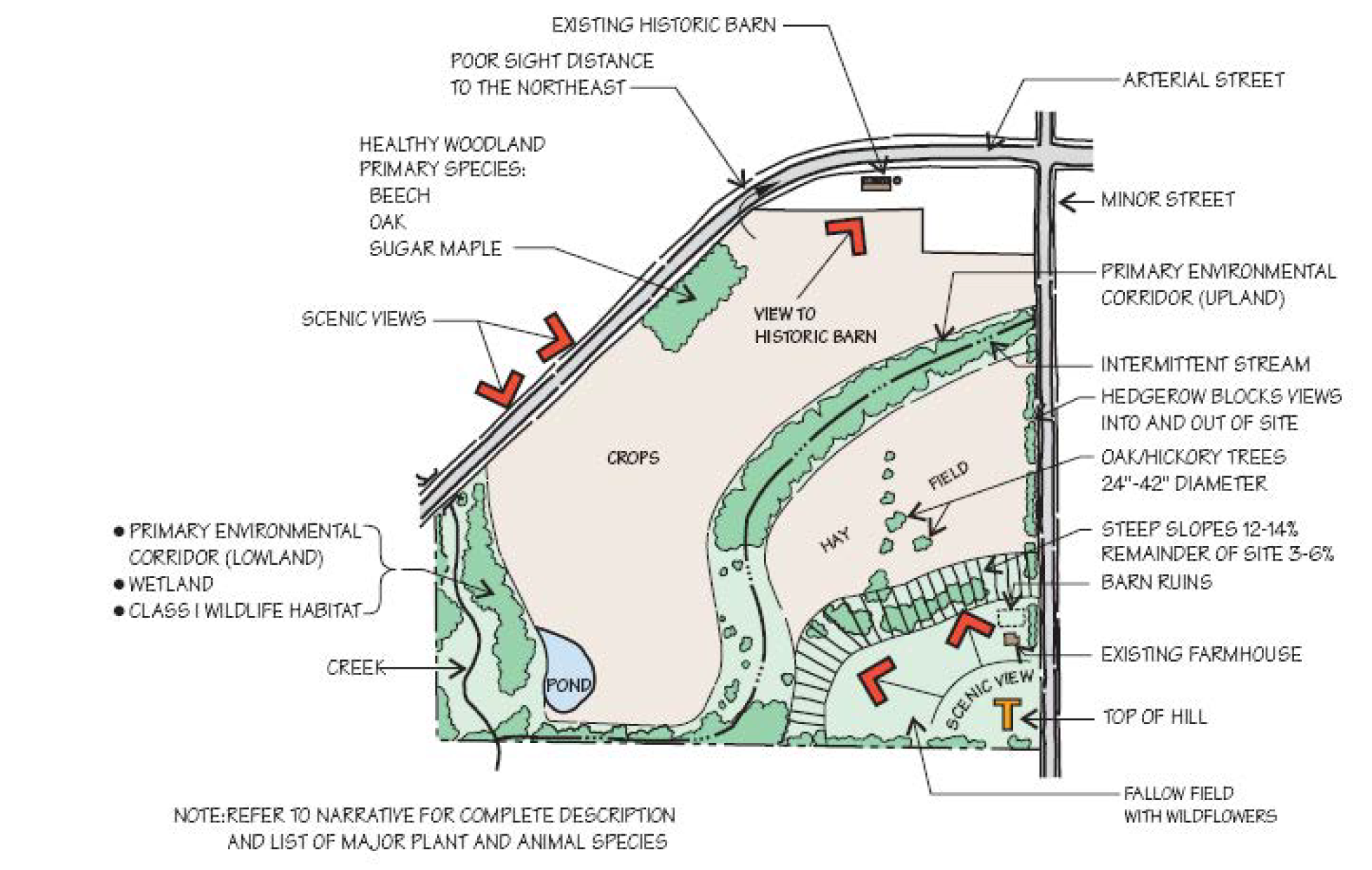
Source: Southeastern Wisconsin Regional Planning Commission (SEWRPC). "Conservation
Subdivision Design." 2002.
conservationsubdivisions/pdfs/conservation_subdivision_design_process.pdf
_____
b.
Step #2. Potential house sites and lots are tentatively located since the proposed location of the houses on the lots represents a significant decision with potential impacts on the ability of the subdivision to meet the evaluation criteria, and the applicant shall show these on the conceptual sketch plan. House sites should be located no closer than 30 feet to primary conservation areas.
c.
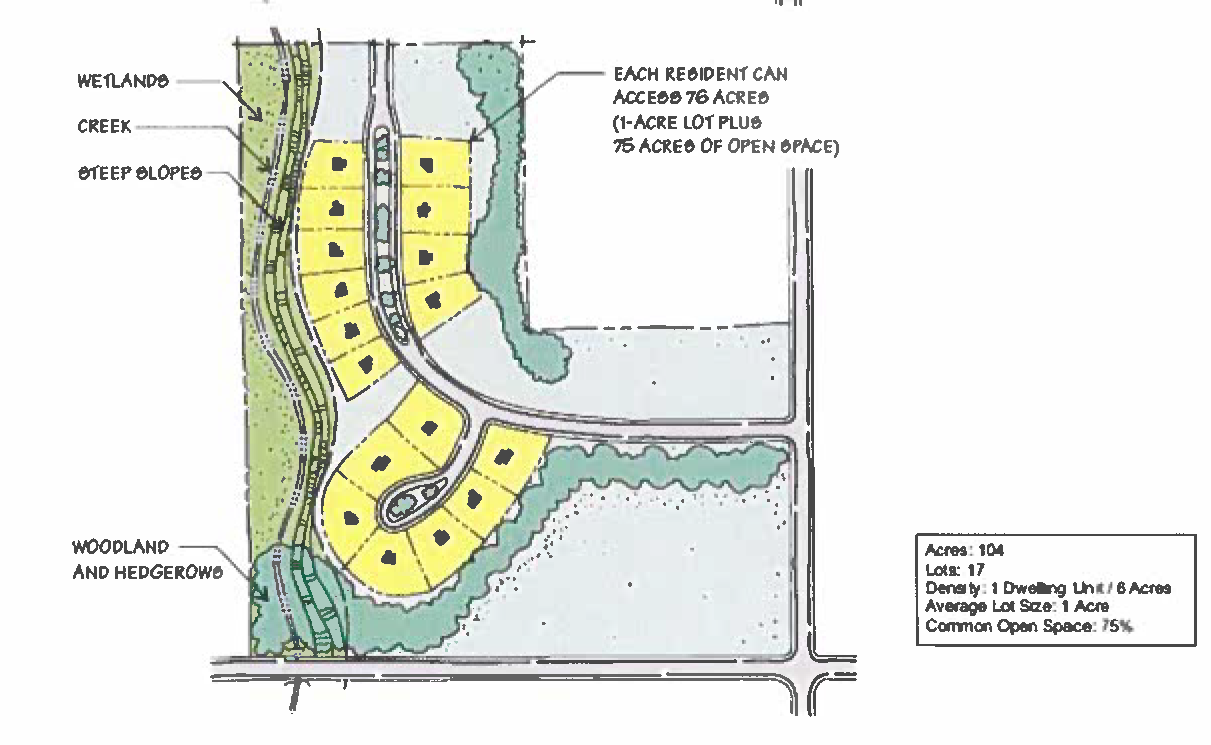
Step #3. Aligning proposed streets to provide vehicular access to each house in the most reasonable way that avoids, or minimizes, adverse impacts on the primary and secondary conservation areas. Wetland crossings shall be avoided. Street connections shall be provided to minimize the number of cul-de-sacs and facilitate easy access to and from homes throughout the subdivision.
_____
_____
K.
Data centers.
1.
Data center development. A "data center development" shall refer to the entire contiguous tract of land presented for development as a data center.
2.
Height regulations. Principal buildings shall not exceed 75 feet in height, measured from structure pad level. This height limitation shall not apply to accessory structures such as water towers, conveyor belts, or other incidental and uninhabited structures. Structures proposed to be located within the Airport Compatibility Overlay Zone (AC-O) - Lowcountry Regional Airport shall follow prescriptions for the Airport Overlay Zone (AC-0), section 14.08-2.150.
3.
Setbacks. For prescribed yards as defined in section 14.04-63.040 with specific parameters outlined in subsection 14.08-2.010.D.2.
a.
Front yard setback: 200 feet.
b.
Side yard setback: 200 feet.
c.
Rear yard setback: 200 feet.
4.
Minimum lot requirements.
a.
Lot frontage: Minimum of 110 feet adjoining a street.
b.
Lot width at building line: Minimum of 400 feet.
c.
Lot acreage: Minimum of 300 acres in non-industrial zoning designations.
5.
Buffer requirements.
Specific to RD-1 and RD-2 zoning designations: A minimum 150 foot-wide forested buffer to provide 100 percent opacity from surrounding thoroughfares and adjoining properties. This buffer may be located within required building setbacks.
Specific to industrial zoning designations: A minimum 50-foot wide forested buffer in addition to prescribed industrial zone buffer requirements to provide 100 percent opacity from surrounding thoroughfares and adjoining properties not zoned industrial. This buffer may be located within required building setbacks.
6.
HVAC and mechanical screening. All air conditioning units and HVAC systems shall be thoroughly screened from view from public rights-of-way and adjacent properties using buildings, walls, fencing, roof elements, or landscaping.
7.
Front building façade. The front building façade of principal structures shall be oriented toward street fronts or adjacent arterial street fronts. This requirement does not apply where the building is more than 500 feet from the public right-of-way or not visible from it.
8.
Security fencing. Security fencing and walls along the right-of-way shall not be located within the required buffer unless they comply with section 14.08-4.030.
9.
Accessory structures. Accessory structures shall comply with applicable Colleton County Code provisions. However, accessory structures that meet the buffer setbacks outlined in section 14.08-2.050 are permitted. Guardhouses and secure entry features are expressly permitted at public road entrances.
10.
Internal subdivision flexibility. Required setbacks and buffers apply only to the external boundaries of the overall data center development. Minimum frontage, lot width, and lot acreage do not apply to subdivided lots within the development, provided:
a.
The overall tract meets the requirements of this section; and
b.
Each subdivided lot has adequate access via public or private roads.
11.
Private roads. Private roads within the data center development are permitted and shall be designed and constructed in accordance with county public road standards under the Colleton County Code.
12.
Alternative power sources. Onsite power generation through the use of natural gas, solar or other renewables shall be permitted. All applicable construction permits (air, building, etc.) shall be obtained.
13.
Conflicting provisions. In the event of a conflict between this section and any other provisions of the Colleton County Code, this section shall govern.
14.
Prohibited use. Cryptocurrency processing is not permitted under the provisions of this section.
15.
Lighting. All outdoor lighting shall be downcast and arranged to prevent light trespass onto adjacent properties.
16.
Noise. Sound levels at any property line shall not exceed 65 decibels, except during emergency generator testing. Such emergency generator testing shall be limited to once per week, conducted only on weekdays between the hours of 11:00 a.m. and 1:00 p.m.
L.
Day cares. The following shall apply to commercial day cares not operated as a home occupation:
1.
The facility must be registered or licensed by the state, as required.
2.
There must be at least 100 square feet of outdoor play area for each child, with the play area being fenced to a height of at least four feet.
3.
All play equipment shall be located in the fenced area. Front yards shall not be used as play areas.
4.
Hours of operation shall be limited to 6:00 a.m. to 8:00 p.m. unless approved as a special exception, the hours of operation may be specified by the zoning board of appeals.
5.
No parking areas shall be permitted in the required setbacks.
6.
For loading and unloading children, one on-street space shall be provided for each 20 children enrolled, or fraction thereof.
M.
Event venue is a commercial facility rented to individuals, groups, or organizations, and used to host gatherings such as, but not limited to, weddings, receptions, parties, meetings, and conferences. An event venue may be comprised of a permanent structure(s), temporary structure(s), uncovered outdoor gathering area(s), or any combination thereof. This definition does not include lodges, civic clubs, community centers, religious facilities, or publicly-owned facilities. Event venues are subject to the following conditions:
1.
An on-site manager shall be present and available for the duration of all events occurring at the venue. Up-to-date contact information for the on-site manager shall be included on the venue's website, on marketing materials for the venue, and in the venue's operational plan. Updated contact information shall be provided to the zoning administrator any time the on-site manager's contact information changes.
2.
An operational plan shall be submitted with the special exception application describing generally how the facility will operate. Substantive changes to the operational plan shall require additional approval by the ZBA. The operational plan shall include, at a minimum, the following items:
a.
Maximum capacity of the facility, based on building code, fire code, and/or parking requirements;
b.
Contact information for the on-site facility manager;
c.
Whether the venue will operate seasonally or year-round;
d.
Type(s) of events anticipated/marketed;
e.
Anticipated annual number of events; and
f.
How solid waste will be disposed of (private vs. public collection).
3.
The facility is located on a parcel of at least five acres in size.
4.
Vehicular access to the site shall be adequate in terms of width, vertical clearance, and construction to support emergency vehicles, and shall meet all applicable provisions of the Zoning Ordinance and Fire Code.
5.
Notwithstanding the provisions of Article 14.08-5, parking associated with an event venue may be constructed of pervious materials; however, handicap parking spaces shall be constructed in accordance with ADA standards for accessible design.
6.
All outdoor areas associated with an event venue or large capacity event venue shall be located at least 200 feet from all dwelling units not located on the same parcel as the venue. This distance shall be measured in a straight line from the edge of the outdoor area nearest the dwelling unit to the dwelling unit. Outdoor areas include, but are not limited to, parking areas, decks, patios, gazebos, fire pits, and docks.
7.
With the exception of parking areas, outdoor areas associated with an event venue or large capacity event venue and located within 300 feet of a dwelling unit not located on the same parcel as the venue shall cease operation by 10:00 p.m. This distance shall be measured in a straight line from the edge of the outdoor area nearest the dwelling unit to the dwelling unit.
8.
Amplified music or other sound is permitted in all outdoor areas, provided it ends no more than 30 minutes past sunset.
9.
The maximum number of users an event venue or large capacity event venue may accommodate at one time shall be limited to the maximum capacity of the venue, as determined by applicable building code, fire code, and/or parking requirements.
N.
Family care homes for the handicapped. In accordance with S.C. Code 1976, § 6-29-770(E), family care homes for the handicapped are deemed residential uses and permitted in all districts where single-family homes are permitted, subject to the following conditions:
1.
The homeowner and immediate family plus up to nine mentally or physically handicapped residents are permitted to live in the home.
2.
The operator of the home shall give prior notice to the local governing body advising of the exact site of the proposed home and identify the individual responsible for site selection.
3.
If the county objects to the selected site, it must notify the individual responsible for site selection within 15 days of receiving notice and must appoint a representative to assist in selecting a comparable alternate site. This triggers the following:
a.
The site selection representative of the entity proposing the project and the county representative select a third mutually agreeable person.
b.
The three people have 45 days to make a final site selection by majority vote.
c.
This final site selection is binding for both the proposing entity and the governing body.
d.
In the event that no selection has been made at the end of the 45-day period, the entity selecting the site may select the site without further proceedings.
4.
A home shall be licensed with the state before operating.
5.
Prospective residents of these homes must be screened by the licensing agency to ensure that the placement is appropriate.
6.
The licensing agency shall conduct reviews of these homes no less frequently than every six months for the purpose of promoting the rehabilitative purposes of the homes and their confirmed compatibility with their neighborhoods.
7.
No exterior signage is permitted.
8.
No lockdown, violent, or dangerous residents.
9.
Only incidental and occasional medical care may be provided.
O.
Family group development.
1.
Family group developments may incorporate up to a maximum of six dwelling units of family members related by blood, marriage, or adoption on a single lot of record.
2.
The maximum of six dwelling units on a single lot only applies if the development density of dwelling units per acre, and the setbacks for every unit complies with the zoning district for the subject property.
3.
Each dwelling unit shall be placed a minimum of 15 feet away from any other unit and be accessed by a minimum 15 foot wide driveway for the passage of emergency services vehicles.
4.
A special exception is required for any family group development that exceeds this threshold of six dwelling units on a single lot. The special exception can only be requested if the subject single lot has enough acreage to allow all six units to comply with the density, setback, access way, and space between units requirements.
5.
A notarized family group development declaration/affidavit shall be recorded at the county register of deeds stating that all residents on the single lot are related by either blood, marriage or adoption and the land will not be subdivided in the future unless all of the requirements of this chapter and Chapter 14.04 are met.
P.
Farm implement and heavy construction equipment. Manufacturing, assembly, and storage of whole equipment limited to HID district and subject to the manufacturing use conditions below. Assembly and manufacturing of parts, storage, and distribution limited to the ID district and subject to the manufacturing use conditions. Parts warehousing, distribution, logistics, and similar activities limited to LID district.
Q.
Freight container storage and repair. Limited to indoor only in the LID district.
R.
Fuel supply service. Generally bulk storage and distribution including fueling of large farm or construction equipment and fleet vehicles, and excluding fueling or gas stations for automobiles or boats.
S.
Gun clubs, outdoor shooting ranges and turkey shoots. The unique nature of this use is such that the following criteria shall be observed in siting any such use in the county:
1.
It shall be located west of I-95 and no closer than one-fourth mile to any existing residential use. Gunfire shall be oriented away from habitable areas. Areas east of I-95 shall require special exception approval by the zoning board of appeals. Hours of operation shall be extended to accommodate law enforcement training and certification for low-light conditions.
2.
The site upon which the use is proposed shall be suitable in size and topography, and preferably contain a wooded perimeter to buffer noise and improve the safety of any surrounding residents.
3.
Seasonal "turkey shoots." Separately, turkey shoots are temporary in nature, not lasting more than 60 days, shall meet the following requirements:
a.
Gunfire shall be no closer than 500 feet from any residential use, and not allowed from 11:00 p.m. until 8:00 a.m.
b.
Gunfire oriented towards residential uses shall be no closer than one-half mile. This distance may be reduced by the use of licensed engineer approved projectile absorbing barriers on the subject property.
c.
A site plan submitted to the director illustrating the shooting range, orientation of fire, topography of the land, and distances and locations of adjacent residential uses.
d.
Turkey shoots are allowed in the UD-2, RD-1, RD-2 and RC-1 zoning districts as a conditional use.
T.
Heavy construction contractors. All outdoor storage of materials and equipment associated with a heavy construction contractor business shall be set back a minimum of 25 feet from property lines, 50 feet from any residential use, and be screened in accordance with subsection 14.08-4.020(D).
U.
Home occupations.
1.
Customary home occupations (RS and UD-1 district only).
a.
The home occupation shall be carried on wholly within the dwelling and occupy no more than 25 percent of the principal building floor area, up to a maximum of 400 square feet.
b.
No exterior signs, merchandise, storage or articles shall be visible from outside the building.
c.
No more than one person not residing in the residence may be employed on-site.
d.
No alteration away from the residential nature of the buildings or property is allowed.
e.
Only cars, vans and pickup trucks used primarily as passenger vehicles shall be allowed in the daily operations of the home occupation.
f.
The occupation shall not create any noxious fumes or odors, light emissions, noises or interference with radio or television reception that can be detected off of the premises.
g.
Home occupations may operate between the hours of 7:00 a.m. and 8:00 p.m. with no merchandise manufactured off premises and brought in for retail sales.
2.
Child care home occupation. In addition to the requirements for a customary home occupation, the following requirements shall apply to a child care home occupation:
a.
Child care home occupations shall be limited to a maximum of six children in addition to any children of the operator.
b.
A minimum of 100 square feet of outdoor play area per child shall be provided in the rear yard which shall be fenced to a minimum height of four feet.
3.
Rural home occupations. For residential lots located in the RC-1, RC-2, RD-1, RD-2, and UD-2 districts, and in addition to the requirements for a customary home occupation, the following requirements shall also apply to a rural home occupation:
a.
A rural home occupation may be carried on within the principal dwelling or an accessory building, not to exceed 400 square feet. Any accessory building used for a rural home occupation shall meet the principal structure setbacks for the district.
b.
Rural home occupations include carpentry, metal working, electrical, welding, plumbing, repair shops, professional and technical services, insurance and real estate services, personal care services, and retail, excluding the sale of firearms.
4.
Motor vehicle repairs and sales home occupations. In addition to the requirements for a customary home occupation, the following requirements shall apply to motor vehicle repairs and sales home occupations:
a.
The repair of motor vehicles at a place of residence is subject to the following restrictions:
i.
Only minor repairs and maintenance may be performed, which for the purposes of this subsection are defined as the:
(1)
Changing and replenishment of fluid levels, such as hydraulic fluid, windshield washer fluid, and lubricating oil.
(2)
Replacement of spark-plugs and wires.
(3)
Rotation of tires and checking of adequate pressure.
(4)
Replacement of drive belts and hydraulic lines.
ii.
Any other repairs shall be restricted to totally enclosed spaces and only accomplished on privately registered vehicles having current state license plates, or motor vehicles designated by the state as qualifying for any antique or horseless carriage designation.
b.
The sale of motor vehicles at a place of residence is subject to the following restrictions:
i.
No more than two vehicles at any given time.
ii.
The vehicle may be displayed by appropriate window or other attached signage.
iii.
The vehicle and associated signage may not be located in the public right-of-way.
V.
Hunting and fishing camps.
1.
A maximum density of ten campers per acre is allowed.
2.
Any structure or camper shall be setback a minimum of 50 feet from property lines.
3.
Demonstrate compliance with SCDHEC waste treatment.
4.
All structures and campers within 100 feet of the front property line shall meet the buffer requirements found in subsection 14.08-4.020(B), Street yard.
W.
Lumber and saw mills, and pellet production. All outdoor storage of materials and equipment shall be set back a minimum of 200 feet from the property boundary and screened in accordance with subsection 14.08-4.020(D.3). In addition, these operations shall be subject to the provisions of the manufacturing use conditions.
X.
Manufactured homes (on individual lots). Manufactured homes on individual lots shall:
1.
Be built according to the Federal Manufactured Housing Construction and Safety Standards Code (245 CFR 3280), enacted June 15, 1976. Manufactured housing built prior to the effective date of the code shall not be permitted for reasons of safety.
2.
Be installed in accordance with the manufacturer's installation manual. In the absence of such a manual, the home must be installed in accordance with the requirements of the state manufactured housing board regulations.
3.
Be under-skirted around the entire home with brick, masonry, vinyl, or similar materials designed and manufactured for outdoor installation.
4.
Have landing steps installed or constructed at each exterior doorway, in accordance with applicable building codes.
5.
Be provided with a sanitary sewer system approved by SCDHEC.
6.
It shall be unlawful for any such home to receive electricity except by use of this separate meter. It shall be unlawful for any public utility or electrical supplier to connect power to any manufactured home in the absence of all approved permits.
Y.
Manufactured home parks. The establishment and operation of a manufactured home park shall comply with the following design and development standards:
1.
The park site shall not be less than two acres, and have not less than 200 feet frontage on a publicly maintained street or road.
2.
The park shall be served by public water and sewer systems or other systems as approved by local DHEC officials. A storm drainage plan is required and subject to compliance with subsection 14.04-5.070(L).
3.
All manufactured home spaces shall abut upon an interior all-weather roadway subject to subsection 14.04-5.070(K)1 and shall have unobstructed access to a public street or road.
4.
All on-site roadway intersections shall be provided with a street light.
5.
Each individual home site shall be at least 25 feet from any other site and at least 25 feet from the right-of-way of any street or drive providing common circulation.
6.
All homes shall be installed in accordance with the installation requirements of the state manufactured housing board regulations.
7.
Not less than 15 percent of the park site shall be set aside and developed for common open space and recreational usage.
8.
Permanent space numbers shall be provided on each space and located to be visible from the street or driveway. Signs identifying space locations shall be provided at each street or driveway intersection.
9.
The maximum number of spaces shall not exceed eight per acre.
10.
Two parking spaces shall be provided for each designated space. Parking may be provided at the designated space or in community parking areas.
11.
Existing trees and other natural site features shall be preserved to the extent feasible.
12.
Buffer yards shall be provided on the perimeter of the park or court in accord with the requirements of Section 14.08-4.020.
13.
The zoning permit may be revoked by the director or his designee for a violation of this title or other applicable ordinances and regulations governing the operations of such uses.
14.
A site plan showing the above required data, and in all other respects meeting the minimum requirements for a building permit shall accompany all applications to establish a manufactured home park.
15.
All pre-existing manufactured home parks at the time of the adoption of the ordinance from which this chapter is derived are considered legal nonconforming uses, and any expansions must comply with these requirements.
Z.
Manufacturing. All proposed manufacturing uses shall meet the following performance standards:
1.
Vibration.
a.
No vibration shall be produced which is transmitted through the ground and is discernible without the aid of instruments at any point beyond the property boundary of the subject facility; nor shall any vibration produced exceed the following particle levels, as measured by a qualified technician using a vibration monitor in inches per second at the nearest:
i.
Residential property line .....0.02
ii.
Nonresidential property line .....0.10
Vibration emanating from construction activities between 7:00 a.m. and 9:00 p.m. shall be exempt from these regulations.
2.
Noises.
a.
All noise shall be muffled so as not to be objectionable due to intermittence, beat frequency or shrillness. In no event shall the sound pressure level of noise radiated continuously from a facility exceed at the lot line the values given in Table 3 in any octave band or frequency. Sound pressure level shall be measured with a sound meter and an octave band analyzer that conforms to specifications published by the American Standards Association. (See Table 3).
_____
TABLE 3
Maximum permissible sound pressure levels at the lot line for noise radiated continuously from a facility between the hours of 9:00 p.m. and 7:00 a.m.
Day time schedule. Maximum permissible sound pressure levels at the lot line for noise radiated from a facility between the hours of 7:00 a.m. and 9:00 p.m. shall not exceed the limits of the preceding table except as specified and corrected below.
Noises emanating from construction activities between 7:00 a.m. and 9:00 p.m. shall be exempt from these requirements.
_____
3.
Air Pollution.
a.
The emission of visible smoke, dust, dirt, fly ash, particulate matter from any pipes, vents, or other openings, or from any other source into the air, shall comply with the regulations of the South Carolina Department of Health and Environmental Control.
4.
Odors.
a.
There shall be no emission of odorous gases or other odorous matter in such quantities as to be offensive at the outer property boundary of the subject facility. Any process, which may involve the creation or emission of any such odor, shall be provided with both a primary and a secondary safeguard system so that control may be maintained in the event of failure of the primary safeguard system.
i.
Odorous matter. Solid, liquid or gaseous material which produces an olfactory response in a human being.
ii.
Odor threshold concentration. The lowest concentration of odorous matter which will produce an olfactory response in a human being. Odor thresholds shall be determined in accordance with American Society for Testing and Materials Test Method DI 391-57 (1967).
iii.
Emission of odorous matter. Odorous matter released from any operation or activity shall not exceed the odor threshold concentration across a protected property line measured at ground or habitable elevation.
5.
Toxic matters and hazardous waste.
a.
Toxic matter. Materials or substances which, either singly or in combination with other materials or substances, through synergistic action, poses a threat to the health of human beings, either acutely or chronically.
b.
Hazardous waste. Materials or substances which are not biodegradable and which, due to such fact, pose a threat to living organisms through chemical contamination of the ecosystem.
c.
Determination of material status. The determination that a material or substance is either toxic or poses a threat as a hazardous waste shall be based upon the listing published by the Environmental Protection Agency under the Toxic Substances Control Act of 1976, as amended, and the rules and regulations promulgated for identification of such by SCDHEC.
d.
Compliance with existing statutes. Any facility proposing to locate within the jurisdiction of the ordinance which would utilize toxic matter or produce hazardous waste in the process of manufacturing, fabricating, assembling, packaging or any related activity, shall provide to the zoning administrator for Colleton County a certificate from either the Bureau of Solid and Industrial Waste Management for the Compliance and Enforcement Division of the NPDES Permits Administration of DHEC, or both, indicating compliance with the rules and regulations administered by those agencies. Only until such certification is received from SCHEC shall the facility be permitted for occupancy.
i.
Nothing contained herein shall be intended to preempt or abrogate the requirement for a user of toxic matter or generator of hazardous waste to adhere to the administrative and procedural requirements of state or federal agencies with regard to environmental protection.
e.
Special requirements. Notwithstanding the requirements of state and federal agencies charged with the administration of the rules and regulations governing the operation of facilities utilizing toxic matter or generating or storing hazardous waste, any facility involved in such identified material shall provide an on-site containment area for the material so that a leak or spill is contained entirely on the facility's property and thus prevented from entering the surface or subsurface drainage system, man-made or natural, within the county. The review of the containment structure as to its design and acceptability shall remain with the zoning administrator who may rely upon the expertise provided by the county building official or any other agency as necessary to ascertain satisfaction that the proposed structure will provide compliance with the intent of this section.
f.
List of materials. Materials and substances considered as either toxic matter or hazardous waste shall be those contained within the listing published by the Environmental Protection Agency, as amended, under the provision of the Toxic Substances Control Act of 1976. A further listing of such materials is found in Regulation No. 61-79.1 of the Rules and Regulations for the State of South Carolina, appended to the 1976 Code of Laws, as amended.
6.
Fire and explosive hazards.
a.
Activities involving the storage, utilization, or manufacture of materials or products which are considered detonable (non-atomic), flammable, or ignitable shall be subject to the rules and regulations of the South Carolina Department of Health and Environmental Control (SCDHEC) for such.
b.
Particular requirements for Colleton County. Vehicular fuels shall be stored in accordance with the following storage capacity limits:
_____
_____
7.
Light and glare.
a.
Foot candle. A unit of illumination. Technically, the illumination at all points one foot distant from a uniform point source of one candlepower.
b.
Glare. The disturbing quality of direct illumination which, although not necessarily providing a measurable amount of light from a given vantage point, nonetheless is an attractive nuisance to the eye to the point of causing discomfort when viewed.
c.
All outdoor light fixtures shall be fully shielded and installed to prevent any light trespass onto any abutting property. Light-emitting-diode (LED) lighting shall be used. Light sources visible in residential or medical areas shall not exceed one-tenth footcandle, and in all other areas, shall not exceed one-half footcandle, measured at the property line.
8.
Electromagnetic interference. In all districts, no operations or activities shall be conducted that cause electrical disturbances to be transmitted across protected property lines.
9.
Smoke and particulate matter. Activities which produce smoke or particulate matter shall abide by the regulations of the South Carolina Department of Health and Environmental Control under authority granted by the Pollution Control Act. (Reference Regulation 61-62 appended to the South Carolina Code of Laws of 1976, as amended.)
10.
Fumes. There shall be no emission of any fumes or vapors of a noxious, toxic or corrosive nature, which can cause damage or irritation to health, animals, vegetation, or to any form of property.
11.
Compliance guarantee. The applicant of a permit for a manufacturing or processing plant which would produce any of the above "objectionable elements" shall acknowledge in writing his understanding of the performance standards applicable to the proposed use and shall submit with the permit application, an agreement to conform with such standards at all times. Any violation of the agreement shall constitute a violation of this article and shall be treated accordingly. Enforcement of this agreement shall be precipitated by complaint from any person allegedly aggravated by failure of the industrial use to comply with the provisions of this section. Where there is a potential problem in meeting any one of these performance criteria in this section, the applicant shall be required to request a variance before the board of zoning appeals in accordance with the provisions of Article 14.08-7.
AA.
Commercial mining and extraction.
1.
Minimum lot size shall be 25 acres.
2.
All land disturbing activity shall be located at least 100 feet from any property line and at least 500 feet from any residential, religious, civic, community service or day care use, school, or public park.
3.
All extractive uses shall be surrounded by a solid fence or berm at least eight feet high, located no less than 100 feet from any public right-of-way, and no less than 50 feet from any adjacent property.
4.
Blasting may only be conducted between the hours of 8:00 a.m. and 5:00 p.m., Monday through Friday. Loading and hauling operations are not permitted between the hours of 9:00 p.m. and 7:00 a.m.
5.
Operations shall not create any light, noise, smoke, odors, or dust at a level which creates a nuisance to any person of normal sensitivities at the property line.
BB.
Mixed use buildings. Dwelling units in a mixed use building shall not be located on the ground floor.
CC.
Multi-family residential.
1.
Such projects shall have a minimum of one acre.
2.
Not more than eight, nor fewer than three, townhouses may be joined together, with approximately the same (but staggered) front line.
3.
Minimum distance between buildings shall be 20 feet.
4.
Minimum lot width shall be 18 feet.
5.
Sidewalks not less than five feet in width, to meet ADA standards, shall be provided along the front property line and the parking area side of each building.
6.
Not less than ten percent of the site shall be dedicated as common open space.
7.
No building shall exceed a length of 150 feet.
8.
All trash containers shall have a lid and be completely screened from view from the street and adjacent properties with fencing and/or landscaping.
DD.
Outdoor markets (including farmers markets, flea markets, etc.).
1.
Any sale of items where booths or spaces may be rented on the same property or by the same organizers more than four days per calendar year shall be considered an outdoor market, and all sales shall be conducted under cover of an approved structure or tent.
2.
Approved SCDHEC restroom facilities shall be provided but not located between the permanent structure or tent and the street right-of-way and be screened from view.
3.
Trailers for delivery or pickup may be stored temporarily on-site for not more than three days at a time and shall be parked to the side or rear of the permanent structure.
4.
When the outdoor retail market is not open for business, all items shall be removed or screened from view from the street and any adjacent residentially zoned properties.
EE.
Outdoor storage. Outdoor storage as an accessory use may be permitted provided such storage area does not occupy over 20 percent of the lots' buildable area, is not located in any required setback yard, and is screened from public view as set forth in subsection 14.08-4.020(D).
FF.
Park model trailers, campers and RVs as temporary living accommodations (on individual lots).
1.
All units must retain their axles, wheels and towing hitch and remain road-ready. Units are not to have a permanent foundation nor can they have any structurally and permanently attached additions, such as porches, decks, platforms, coverings, steps, stairs, landings, supports or related elements.
2.
Only one camper, park model trailer or RV is permitted per lot as a principal use and it shall comply with all district setbacks and buffers established for the principal use, not accessory use.
3.
Units may not be renter-occupied for income generation.
4.
Units must demonstrate compliance with all applicable restrictive covenants.
5.
No park model trailer, camper or RV may be permitted as a principal use on an individual lot of record within the unincorporated portion of Edisto Island.
6.
Units will comply with all provisions of the county's Floodplain Ordinance when located in a special flood hazard area. Units located in a floodway must receive a permit for each three day stay, and up to six three-day permits may be issued per calendar year per unit. Units located in a floodway in excess of three days per stay or 18 days per year must comply with the completion of a no-rise-no-impact study performed by a licensed professional engineer.
7.
No more than 100 amp electrical service is to be provided on-site, and only after the site has a SCDHEC approved septic system installed.
8.
Units located within the Urban Development-1 district shall have a minimum of one acre lot size.
9.
These units are designed as temporary housing units only, and not recognized by the International Residential Codes as a permanent residential dwelling unit, where they can only be used as temporary housing for up to one year, such as during construction or reconstruction of an active permitted on-site residence, where they are allowed in all zoning districts, unless prohibited by restrictive covenants, and may be granted an additional six months extension upon review of the zoning board of appeals. They are considered temporary uses and must comply with the above stated conditions of approval, except where they are prohibited to be placed on Edisto Island.
GG.
Produce stands (year-round and permanent).
1.
All produce grown on a lot under the same ownership as the lot upon which the produce stand is located is exempt for the provisions of this chapter.
2.
All other produce stands shall be considered temporary uses and shall follow the special requirements for temporary uses.
HH.
Recreational group quarters.
1.
Recreational group quarters are located on lands intended for outdoor recreational purposes in combination with on-site residential dwellings.
2.
A minimum of 100 acres is required.
3.
Accessory uses and structures including golf courses, marinas, horse stables, trails, tennis courts, hunting preserves, shooting ranges, and similar type uses are permitted.
4.
All structures shall be set back a minimum of 500 feet from any property line.
5.
Hotels, motels, condominiums, apartments, and townhomes are not permitted.
II.
Residential care facilities.
1.
A minimum of two acres is required for a residential care facility.
2.
Structures shall be set back a minimum of 50 feet from all property lines.
JJ.
Restaurant and/or retail. Specific to the LID and ID zoning district. Either use permitted as an accessory "front of house" use to a related manufacturing or production use.
KK.
Salvage yards, junkyards, and recycling operations. The location of these uses shall be regulated by the following:
1.
No such use shall be located closer than 500 feet to any residential use, church, school, historical place or public park or within 50 feet of a public street right-of-way.
2.
No material because it is discharged and incapable of being reused in some form shall be placed in open storage.
3.
No material shall be placed in open storage in such a manner that it is capable of being transferred out by wind, water, or other causes.
4.
All paper, rags, cloth and other fibers, and activities involving the same, other than loading and unloading, shall be within fully enclosed buildings.
5.
All materials and activities not within fully enclosed buildings shall be enclosed by an opaque fence or wall or vegetative material, excluding points of ingress or egress, at least eight feet in height. No items may be stacked in a manner so that they protrude above the top of the opaque screen within 50 feet of the screen.
6.
Disposal of garbage unrelated to motor vehicles shall be in an approved container and regularly maintained. Open dumping of garbage is prohibited.
7.
Disposal of toxic/hazardous matter is prohibited without a state permit.
8.
Storage of items shall be so arranged as to permit easy access for firefighting purposes.
LL.
Seasonal worker housing.
1.
Seasonal worker housing shall be permitted on agricultural land of greater than 20 acres.
2.
Seasonal worker housing shall be either permanent residential structures built to South Carolina Building Codes, HUD approved manufactured homes, or park model homes. Recreational vehicles may only be used for seasonal worker housing if they are located on the property no more than three months per calendar year.
3.
There shall be a minimum 30-foot easement and driveway to the housing that is suitable for access by emergency personnel.
4.
All seasonal worker housing shall be set back a minimum of 100 feet from all property lines.
5.
The farm operator shall provide a site plan showing the proposed location of seasonal worker housing.
6.
Sanitary sewer and water supply shall be provided as approved by the SCDHEC.
MM.
Sexually oriented businesses.
1.
This section regulates sexually oriented businesses to uphold the health, safety, morals and general welfare of the county residents, and to establish reasonable and uniform regulations to prevent the deleterious location and concentration of sexually oriented businesses in the county. The provisions of this section have neither the purpose nor effect of imposing a limitation or restriction on the content of any communicative materials including sexually oriented materials. Similarly, it is not the intent or effect of this section to restrict or deny access by adults to sexually oriented materials protected by the First Amendment, or to deny access by the distributors and exhibitors of sexually oriented entertainment to the intended market. Neither is it the intent of this section to condone or legitimize the distribution of obscene material.
2.
The county has conducted an extensive review of land use studies concerning the secondary effects of sexually oriented businesses in other cities including, Palm Beach Co., FL (2007), Ellicottville, NY (1998), Cleburne, TX (1997), Dallas, TX (1997), Houston, TX (1997), Newport News, VA (1996), New York, NY (1994), St. Croix Co., WI (1993), Oklahoma City, OK (1992), Garden Grove, CA (1991), Tucson, AZ (1990), and Indianapolis, IN (1984).
3.
The clear conclusions to be drawn from these reports are that in areas surrounding adult-entertainment establishments crime increases, property values decrease, and the quality of life for residents declines. Specifically, the reports indicate that sex-related crimes and property crimes increase significantly in close proximity to sexually oriented businesses, including prostitution, pandering, exposing minors to harmful materials, possession and distribution of obscene materials and child pornography, possession and distribution of controlled substances and violent crimes against persons and property. Owing to the potentially objectionable operational characteristics of sexually oriented or adult uses, and the deleterious effect of such uses on existing businesses and/or residential areas around them, the location of such uses, where permitted by Article 14.08-2, shall be tempered by the supplemental siting criteria of this section.
4.
No property line of such use shall be located within 1,000 feet (measured in a straight line, without regard to intervening structures or objects, from the nearest property line of any lot on which contains a building or structure from which any part is used as a sexually oriented business) of the nearest property line of the uses listed below and documented on a map drawn to scale of:
a.
A residence or an RS zone;
b.
A church or religious institution;
c.
Public or private schools and educational facilities;
d.
Public parks and recreational facilities;
e.
U.S. Highways 15, 17A, 17, and 21, and S.C. Highways 61, 63, 64, 174, 303, 641, and the Walterboro Bypass, and Interstate 95;
f.
Another sexually oriented business;
g.
Day care facilities; or
h.
Licensed nursing home.
5.
It shall be a misdemeanor for a person to operate a sexually oriented business without a valid permit, issued by the responsible governing authority for the particular type of business. An application for a permit must be made on forms provided by the director. The premises must be inspected and found to be in compliance with the law by health, fire and building officials.
6.
Each permit shall expire at the end of each calendar year and may be renewed only by making application as provided herein prior to the end of each consecutive calendar year. If an application and permit fee are not received within 30 calendar days from the end of the previous year, the permit has expired and the business shall be required to shut down until a new application and fee are received before the end of the current year, to have a permit for the following calendar year.
7.
The annual permit fee for a sexually oriented business permit shall be $1,000.00.
8.
An applicant or permittee shall allow representatives of the county planning and development department, county sheriff's office, SCDHEC and/or county fire rescue or other governmental departments or agencies involved in code enforcement to inspect the premises of a sexually oriented business for the purpose of ensuring compliance with the law, at any time it is occupied or open for business.
9.
A person who operates a sexually oriented business and/or his agent or employee commits a misdemeanor if he refuses to permit such lawful inspection of the premises at any time it is occupied or open for business.
10.
The director shall suspend a permit and/or license for a period not to exceed 30 days if he determines that a permittee and/or licensee has:
a.
Violated or is not in compliance with any section of this chapter; or
b.
Refused to allow an inspection of the sexually oriented business premises as authorized by this section.
11.
Revocation. The director shall revoke a permit and/or license if he determines that:
a.
A permittee gave false or misleading information in the material submitted as part of the application process.
b.
A permittee or an employee has knowingly allowed possession, use or sale of controlled substances on the premises.
c.
A permittee or an employee has knowingly allowed prostitution on the premises.
d.
A permittee or an employee knowingly operated the sexually oriented business during a period of time when the permittee's permit and/or license was suspended or revoked.
e.
A permittee or an employee has knowingly allowed any act of sexual intercourse, sodomy, oral copulation, masturbation, or other sexual conduct to occur in or on the permitted premises.
f.
On two or more occasions within a 12-month period, a person or persons committed an offense, occurring in or on permitted premises, constituting a specified criminal act for which a conviction has been obtained, and the person or persons were employees of the sexually oriented business at the time the offenses were committed. The fact that a conviction is being appealed shall have no effect on the revocation of the permit.
g.
A permittee is delinquent in payment to the county for any taxes or permit fees past due.
NN.
Solid waste.
1.
Sanitary landfills.
a.
Sanitary landfills shall be located no closer than 1,000 feet from the nearest property line of any existing residential, recreational, religious, educational, medical or public use (measured in a straight line).
b.
A geotechnical engineering firm approved by the director shall render a written opinion that, in their best professional judgment, the formations being used to contain the waste are impermeable and that surrounding ground water sources will not be contaminated.
c.
The facility shall be enclosed by an opaque fence or wall structure on all sides visible from the street serving the facility and an opaque cyclone fence on the remaining unexposed boundaries. Said screen fencing shall be a minimum of six feet tall.
d.
A plan showing restoration of the site upon completion of the landfill use shall accompany the request.
2.
Construction and demolition landfill.
a.
A construction and demolition landfill may be located internally up to, but not closer than 300 feet from any property line, and no property line of a landfill shall be located any closer than 300 feet from the nearest property line of a residential dwelling, school building, daycare center, religious, recreational, or medical facility.
b.
No material shall be placed in open storage or areas in such a manner that it is capable of being transferred out by wind, water, or other causes.
c.
All materials and activities shall be screened in such fashion as not to be visible from off-site. The provisions of this subsection may be waived by the director where such facility will be utilized for a period not to exceed 90 days. Screen fencing shall meet the opacity of a solid wall and be a minimum of six feet tall.
d.
A plan showing restoration of the site upon completion of the landfill use shall accompany the request.
3.
Waste management service.
a.
Storage and maintenance of waste management vehicles only; no waste disposal or storage on-site.
OO.
Telecommunications towers.
1.
All new towers (including antennas) shall be designed to accommodate additional antennas equal in number to the applicant's present and future requirements.
2.
All applicable safety code requirements shall be met.
3.
Towers shall not be painted or illuminated unless otherwise required by state or federal regulations.
4.
No tower shall be located in any marsh or wetlands.
5.
No tower shall be located within 1,000 feet of an existing tower, except where the applicant certifies that the existing tower does not meet the applicant's structural or technical design requirements, or that a co-location agreement could not be obtained.
6.
Towers shall be exempt from the maximum height requirements, except as provided in subsection 14.08-2.010(D)3.
7.
Tower shall be located so adequate setbacks are provided on all sides to prevent the tower's fall zone from encroaching onto adjoining properties. Should this fall zone encroach onto another property, a recorded easement may be prepared and signed by the adjacent property owner to ensure that no structure will be built within the fall zone. If the tower is designed to collapse within a specified "fallzone" this must be certified by a letter from a licensed professional engineer or the tower manufacturer.
8.
Permit requirements for the erection or replacement of a tower shall be accompanied by the following:
a.
One copy of the tower specifications, including the design characteristics and materials.
b.
A site plan drawn to scale showing: property boundaries; tower location and height; guy wires and anchors; existing structures; fall zone; CGI generated images, photographs or elevation drawings depicting design of proposed structures, parking, fences, landscape plan, and existing land uses on adjacent property (site plan not required for colocation on an approved existing structure).
c.
A map showing locations of applicant's tower, any existing towers within 1,000 feet, and proposed towers planned for the future.
d.
Identification of all owners of all antennae and equipment to be located on the site.
e.
Written authorization from the site owner for the tower.
f.
Evidence that a valid FCC license for the proposed activity has been issued.
g.
A line of sight analysis, drawing and/or CGI generated images showing the potential visual and aesthetic impacts on adjacent residential districts.
h.
A written agreement to remove the tower and/or antenna within 120 days after cessation of use.
i.
A certificate from a licensed professional engineer that the proposed facility and equipment will meet all FCC requirements, together with written indemnification of Colleton County and proof of liability insurance or financial ability to pay claims up to $1,000,000.00 in the aggregate related to the operation of the facility, at no cost to the county.
PP.
Temporary/seasonal sales uses and structures.
1.
General provisions for all temporary uses and structures.
a.
The director or his designee is authorized to issue permits for temporary uses and structures specified in this section, including fireworks and Christmas sales. No temporary use may be established without receiving such permit and shall be valid for up to 30 days unless otherwise specified.
b.
Temporary use permits may be renewed no more than twice within one calendar year, for a total of three permitted use terms, provided use doesn't create traffic congestion or a nuisance to surrounding uses. Any temporary use creating a nuisance may have its temporary permit revoked by the director.
c.
Temporary uses and structures shall be removed from the site after the permit has expired.
d.
All temporary uses shall:
i.
Not be detrimental to property or improvements in the surrounding area or to the public health, safety, or general welfare;
ii.
Be compatible with the principal uses taking place on the site;
iii.
Not have substantial adverse effects or noise impacts on any adjoining permanent uses or nearby residential neighborhoods;
iv.
Not include permanent alterations or in any way create damage to the site;
v.
Meet all the setbacks of the underlying base and any overlay zoning districts;
vi.
Comply with the maximum signage size for temporary signs;
vii.
Remove temporary signs associated with the use or structure after the activity ends;
viii.
Not violate the applicable conditions of approval that apply to a site or use on the site;
ix.
Not interfere with the normal operations of any permanent use located on the property; and
x.
Contain sufficient land area to allow the temporary use, structure, or special event to occur, and accommodate the associated parking, traffic movement, port-a-potties, and waste receptacles, without disturbing principal parking areas, traffic flows and/or environmentally sensitive lands.
2.
Carnival, fair, circus, or special events.
a.
The total amount of required off-street parking spaces shall be determined by the director. If shared parking for the event is co-located on a parcel with an active use during the event, a shared parking agreement shall be approved by the director prior to the event. The traffic management plan shall be approved by the director for any events with over 100 attendees that will enter and exit off of a local road or highway.
b.
All activities shall be located a minimum of 50 feet from all lot lines. Any concerts or events requiring amplified sound systems shall be approved in advance to be directed away from residential and medical uses and facilities. Any stages, raised platforms, or scaffolding shall require inspection approvals from the building department prior to the start of the event.
c.
Demonstrate compliance with SCDHEC regulations for food safety, sewage, trash, and wastewater disposal and/or removal from the site.
d.
Provide documentation on how electrical services will be provided to all food vendors, rides, attractions, and any other structures or devices which require additional electricity needs.
e.
Churches, places of worship, and/or religious institutions are exempt from the provisions of this section.
3.
Seasonal agricultural sales. This includes the sale of such items as Christmas trees, pumpkins, seasonal produce, and similar agricultural products, may be permitted in accordance with the following standards:
a.
The property contains an area not actively used that will support the proposed temporary sale of products without encroaching into or creating a negative impact on existing vegetated areas, open space, landscaping, traffic movements, or parking.
b.
The sale of goods shall not occur within the public right-of-way, or within 50 feet of a dwelling.
c.
A minimum unobstructed pedestrian walkway of at least five feet in width along the front of the display shall be maintained in accordance with ADA standards.
d.
The range of goods or products available for sale shall be limited to products obtained primarily through farming or agricultural activities, including, but not limited to: grains and seeds; fruits; vegetables; nursery, floral, ornamental, and greenhouse products; forest products, including trees, Christmas trees, firewood, and pine straw; bees and bee biproducts; seafood; and dairy products. Processed/prepared food products shall not be considered agricultural products.
e.
The itinerant sale of products from a vehicle that does not involve the display or short-term storage of products on a property for a period of two days or longer, shall not be considered seasonal agricultural sales.
f.
The seasonal sale of agricultural products shall be allowed to operate from 7:30 a.m. until 10:00 p.m.
g.
Seasonal sales shall be allowed on an individual lot for no more than 120 days per calendar year.
h.
When seasonal sales are not in operation, the stand shall be properly closed up and maintained.
i.
Churches, places of worship, and/or religious institutions are exempt from the provisions of this section.
4.
Temporary construction trailers.
a.
Commercial construction trailers or equipment sheds used in conjunction with construction projects are allowed provided the following requirements are met.
b.
Authorization to place a commercial construction trailer onto a development site may be granted after the preliminary plans for the development or phase have been submitted. Multiple construction trailers are allowed; however, no sales may occur from the construction trailers.
c.
Such construction trailers may be located at a commercial or residential building site where a valid building permit exists.
d.
All construction trailers shall be located at least ten feet off of any street right-of-way.
e.
For construction projects or residential subdivisions valued at more than $1,000,000.00, one or more residential security guard houses may be installed which include sleeping, kitchen and full restroom facilities for overnight stay, provided the same conditions and requirements for construction trailers are met.
f.
Authorization to relocate commercial construction trailers and/or residential guard houses from a completed phase to a future phase of the development may be approved by the director provided that the completed phase has received final approval for recording and no further improvements are required to close out that phase of work.
g.
Authorization to relocate a construction trailer and/or guard houses to a future phase of development does not grant the developer the right to begin site improvements in the future phase unless the preliminary plat for the next phase of construction has been approved.
5.
Residential sales offices.
a.
Temporary or permanent commercial structures located in a subdivision may be used as sales offices for the subdivision development.
b.
Any temporary structure used as a sales office shall be located on a lot which is in compliance with the regulations of this chapter and meets all yard requirements for the applicable zoning district.
c.
Five off-street parking spaces plus two spaces for sales employees shall be provided on the lot where the sales office is located.
d.
A commercial trailer may be used as a temporary sales office, provided that the following conditions are met, as approved by the director:
i.
The trailer shall have underpinning installed from the bottom of the walls to the ground.
ii.
Landscaping shall be provided around the base of the trailer.
iii.
At the completion of the sales in a tract, or two years from the date the temporary sales office began operation, whichever is sooner, said sales office shall cease operation unless the director determines that substantial progress is being made in the selling of the lots and/or homes in the subdivision. Extensions may be so authorized by the director as required. The temporary sales office structure shall be removed after its use as a sales office has terminated and the lot shall be returned to a natural state, including the removal of any paved or graveled driveway and/or parking area used by the sales office. All remaining bare soil areas shall be returned to a natural vegetative state (reseeded or sodded) immediately after removal of the sales office and driveway/parking area.
6.
Portable classrooms. Portable classrooms in any district for cultural, community, educational, or religious facilities are permitted for an indefinite period provided all required setbacks for the zoning district are met and the portable structure is located on the same site as the principal structure.
7.
Tent sales and vendor sales from vehicles. Sale of commercial goods may be conducted within a tent or from a vehicle located on a lot with a legally established commercial principal use, provided the following criteria are met:
a.
A temporary permit is obtained prior to erecting the tent or parking the vehicle for sales.
b.
The tent or vehicle shall be located outside the normal flow of traffic and areas of ingress and egress.
c.
The tent or vehicle shall be located on an improved surface such as asphalt or gravel, and not within areas devoted to required landscaping, tree protection, or open space.
d.
The tent or vehicle shall be located to ensure the minimum number of required parking spaces for the principal use are maintained over the duration of the sale.
e.
The tent sale shall not include any signage other than that allowable as temporary signage.
f.
The hours of operation shall be from 7:30 a.m. until 10:00 p.m.
g.
The total number of days allowed for tent or vehicle sales per lot shall be limited to a maximum of 15 total days per calendar year.
8.
Yard and estate sales.
a.
Yard and estate sales may be conducted for a total of six days in any calendar year by civic or religious organizations, occupants of a residence, or in cooperation with neighbors for the purpose of selling household items.
b.
One on-premises sign and three off-premises signs no larger than six square feet each may be displayed 24 hours in advance of the sale and removed within 24 hours after the sale ends. Signs shall not be located within the street right-of-way, or attached to street signs, trees or utility poles.
9.
Temporary emergency permits.
a.
Individual emergency. When a structure or building has been damaged or destroyed by fire, flood, wind or other forces majeure, and strict compliance with zoning permit requirements will impair the health and safety of the affected individuals or the security of the premises, the director may declare an emergency condition and grant a temporary administrative permit in accordance with the following requirements:
i.
If the structure or building complies with all applicable requirements of this chapter, a nonrenewable, temporary administrative permit shall be issued for a period not to exceed one year.
ii.
If the structure or building is a legal nonconformity, and less than 50 percent of the appraised value has been damaged or destroyed, a nonrenewable, temporary administrative permit shall be issued for a period not to exceed one year.
iii.
If the use, structure or building is a legal nonconformity, and 50 percent or more of the appraised value has been damaged or destroyed, only emergency housing or the use of manufactured housing units for the conduct of emergency business operations while relocation efforts are in progress shall be allowed. The nonrenewable, temporary administrative permit shall be issued for a period not to exceed six months.
b.
Community emergency. Where a major disaster affects the health, safety or welfare of the general public and compliance with zoning permit requirements will delay remedial action, the director shall be authorized, upon approval of the county administrator, to waive zoning permit requirements for a period of time.
(Ord. No. 22-O-05, § 2, 5-3-2022; Ord. No. 23-O-17, § 1, 11-7-2023; Ord. No. 25-O-10, 11-10-2025)

