
Colleton County Unincorporated
City Zoning Code
City Zoning Code
ARTICLE 14
08-7. - ZONING BOARD OF APPEALS: SPECIAL EXCEPTIONS, VARIANCES, AND APPEALS
14.08-7.010. - Establishment of the zoning board of appeals (ZBA).
The county zoning board of appeals (ZBA) is hereby established under the provisions of S.C. Code 1976, § 6-29-780.
A.
Composition of the ZBA.
1.
The ZBA shall consist of five members appointed by the county council for overlapping terms of four years. One member first appointed shall serve for two years, two members first appointed shall serve for three years, and two members first appointed shall serve for four years. Three members shall constitute a quorum.
2.
Members shall serve until their successors are appointed and qualified.
3.
Vacancies are filled for unexpired terms in the same manner as initial appointments.
4.
No more than one person shall represent a given profession. No member shall be the holder of an elected public office in the county.
B.
Compensation. Members of the ZBA shall serve without compensation. Reimbursement for actual expenses incurred in the performance of official duties may be reimbursed from budgeted funds pursuant to reimbursement policies and procedures for employees of the county.
C.
Removal of members. Members of the ZBA may be removed at any time by county council for cause. The existence of cause shall be discussed by the council in executive session as permitted by the Freedom of Information Act, S.C. Code 1976, § 30-4-70(a)(l), and the determination of removal shall be by vote in public session declaring a vacancy in the position without a statement of cause. Any fact which, in the discretion of council, is deemed to adversely affect the public interest, including general lack of attendance at meetings, or non-attendance at any three (3) consecutive meetings, may constitute cause.
D.
Organization and rules of procedure. The ZBA shall organize, elect officers, and adopt rules of procedure as required by S.C. Code 1976, § 6-29-790.
(Ord. No. 22-O-05, § 2, 5-3-2022)
14.08-7.020. - Powers and duties of the ZBA.
The ZBA shall have the following powers and duties in accordance with S.C. Code 1976, § 6-29-800:
A.
To hear and decide appeals. To hear and decide appeals where it is alleged there is error in any order, requirement, decision, or determination made by the director or compliance officers.
B.
To grant variances. To authorize upon appeal in specific cases a variance from the terms of this chapter as will not be contrary to the public interest where, owing to special conditions, a literal enforcement of the provisions of this chapter will, in an individual case, result in the unnecessary hardship so that the spirit of the chapter shall be observed, public safety and welfare secured, and substantial justice done. Such variance may be granted in such individual case of unnecessary hardship in accordance with the conditions for approval set out in section 14.08-7.040. No variance shall be granted for a reduction in minimum lot size except as an administrative variance as set forth in section 14.08-8.030(D).
C.
To grant special exceptions. To permit uses by special exception as allowed for in the individual zoning districts of article 14.08-2 and subject to standards and conditions of section 14.08-7.050.
(Ord. No. 22-O-05, § 2, 5-3-2022)
14.08-7.030. - Appeals from decisions of the director and compliance officers.
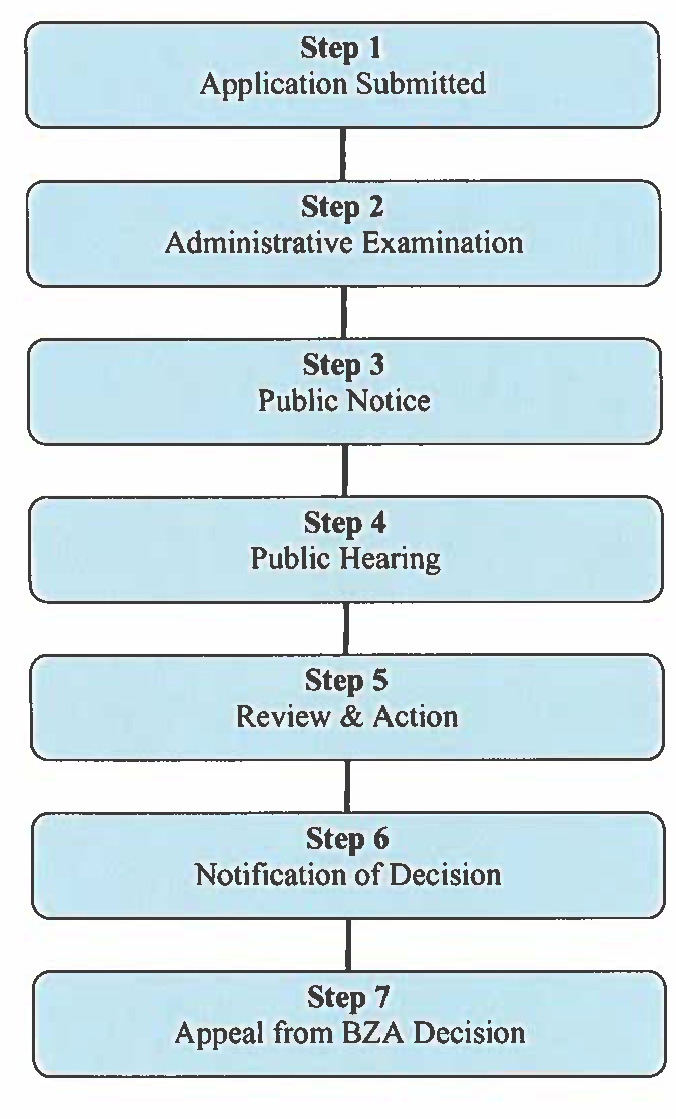
This process shall be followed for appeals. See the details following the chart below for each step.
A.
Step 1: Application submitted. The appellant shall submit a completed application and fee in accordance with the schedule of fees not more than 30 days from the decision of the director.
B.
Step 2: Administrative examination. Upon receipt of an application, the director shall examine it for completeness, and shall, within ten days, either return the application for additional information or after preparing the answer and/or case briefing, forward it to the ZBA for review and action.
C.
Step 3: Public notice. Public notice shall include announcing the application for appeal in a county newspaper of general circulation at least 15 days prior to the public hearing where the application will be heard. The notice shall state the nature of the appeal and the time, date, and place of the hearing.
D.
Step 4: Public hearing. The ZBA shall conduct a public hearing on all applications for appeals from decisions of the director and/or compliance officers.
E.
Step 5: Review and action. Appeal applications shall be heard and decided by the ZBA based on information presented by the applicant and the director/compliance officers relative to the specific ordinance provision being appealed.
F.
Step 6: Notification of decision.
1.
All applicants shall be notified in writing of final action.
2.
An approved appeal shall be accompanied by an order of the ZBA.
G.
Step 7: Appeals from ZBA decisions. Any person who may have a substantial interest in any decision of the ZBA may appeal said decision to the county circuit court by filing a written petition with the clerk setting forth plainly, fully, and distinctly wherein such decision is contrary to law. Such appeal shall be filed within 30 days after the decision of the ZBA is rendered.
(Ord. No. 22-O-05, § 2, 5-3-2022)
14.08-7.040. - Variances.
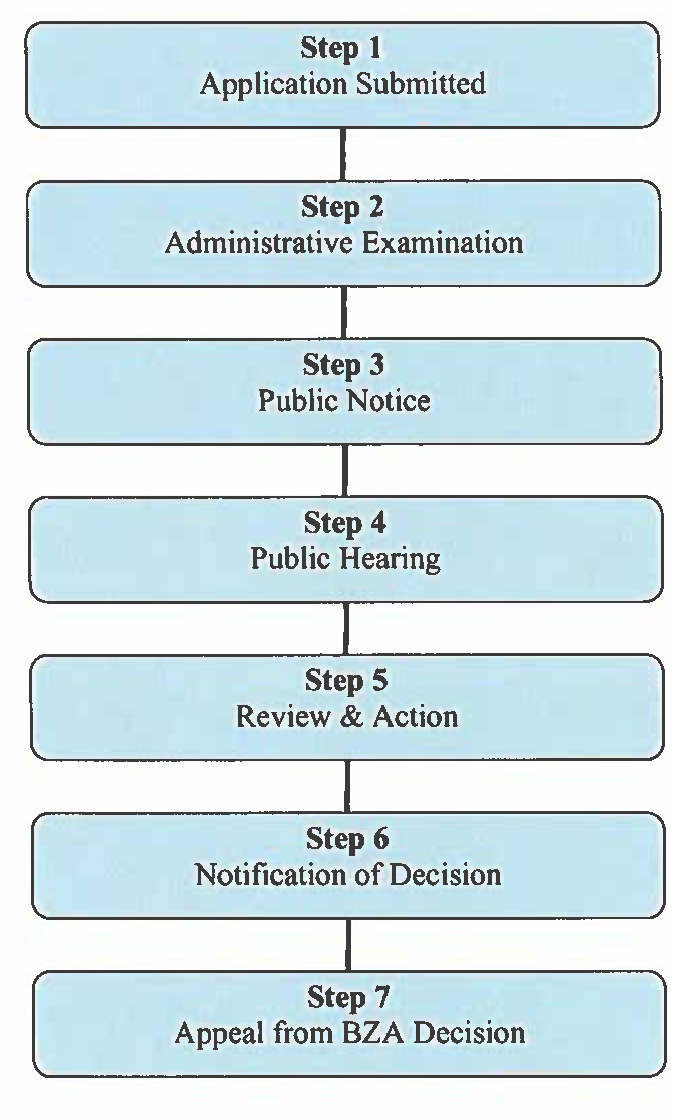
This process shall be followed for variances. See the details following the chart below for each step.
A.
Step 1: Application submitted. The applicant shall submit a completed variance application and fee in accordance with the schedule of fees. Application shall include the written explanation of the hardship, which hardship has not been created by the applicant, which explains why the strict application of the Codes has created the undue hardship and created the need to request a variance. No variance application shall receive a staff recommendation of approval without a legitimate hardship being provided.
B.
Step 2: Administrative examination. Upon receipt of an application, the director shall examine it for completeness, and shall, within ten days, either return the application for additional information or after creating the case briefing, schedule it for review and action by the ZBA at their next regularly scheduled meeting.
C.
Step 3: Public notice.
1.
Public notice shall include announcing the application for a variance in a county newspaper of general circulation at least 15 days prior to the public hearing where the application will be heard. The notice shall state the nature of the change and the time, date, and place of the hearing.
2.
Notice of the public hearing shall be conspicuously posted on the subject property, where notices must be visible from each street that abuts the property.
D.
Step 4: Public hearing. The ZBA shall conduct a public hearing on all applications for variances.
E.
Step 5: Review and action.
1.
Applications for a variance shall be evaluated by the ZBA on the basis of the following conditions:
a.
There are extraordinary and exceptional conditions pertaining to the particular piece of property that would create an undue hardship upon this particular land owner.
b.
These conditions do not generally apply to other properties in the district.
c.
Because of these conditions, the strict application of the regulations to the particular piece of property would effectively prohibit or unreasonably restrict the utilization of the property.
d.
The authorization of a variance will not be of substantial detriment to adjacent property or to the public good, and the character of the district will not be harmed by the granting of the variance.
e.
Explain how the variance is the smallest variance possible that will allow the property owner reasonable utilization of the property as is enjoyed by other properties in the same district.
2.
The ZBA may not grant a variance the effect of which would allow the establishment of a use not otherwise permitted in a zoning district, physically enlarge a nonconforming use of land, or change the zoning district boundaries shown on the zoning map. The fact that property may be utilized more profitably, or otherwise provide a benefit to this property owner not available to other property owners in the same district, should a variance be granted, shall not be considered grounds for a variance.
3.
The ZBA shall not reconsider an application for a variance for the same property, or portion thereof, within one year from the date of final determination and notification.
4.
An approved variance shall lapse and be of no further effect one year after the date the variance was approved by the ZBA unless a completed zoning permit is submitted in accordance with article 14.08-8, or if no zoning permit is required, unless construction has commenced and is being diligently pursued.
5.
One one-year extension of a variance approval may be allowed by the ZBA if construction has commenced and is being diligently pursued. Applications for extensions of variance approvals shall be submitted to the director in writing at least 15 days prior to the expiration of the variance approval.
F.
Step 6: Notification of decisions.
1.
All applicants for variances shall be notified in writing of final action.
2.
An approved variance shall be accompanied by an order of the ZBA to direct the issuance of a permit.
G.
Step 7: Appeals from ZBA decisions. Any person who may have a substantial interest in any decision of the ZBA may appeal said decision to the county circuit court by filing a written petition with the clerk setting forth plainly, fully, and distinctly wherein such decision is contrary to law. Such appeal shall be filed within 30 days after the decision of the ZBA is rendered.
(Ord. No. 22-O-05, § 2, 5-3-2022)
14.08-7.050. - Special exceptions.
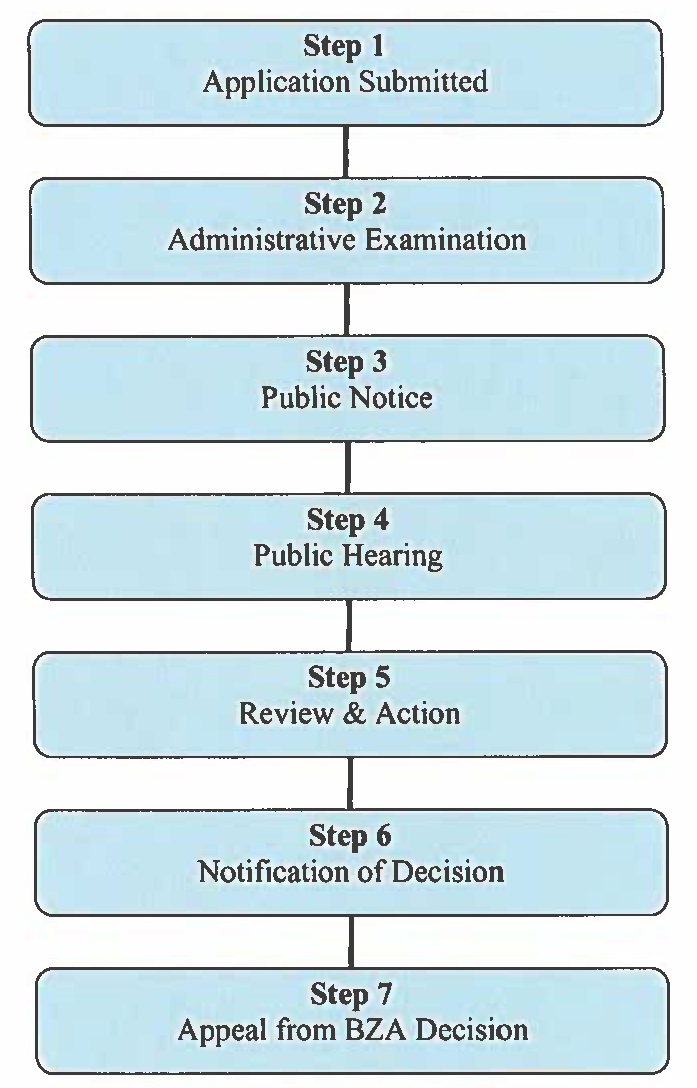
This process shall be followed for special exception uses as listed for each zoning district in article 14.08-2. See the details following the below chart for each step.
A.
Step 1: Application submitted. The applicant shall submit a completed special exception application and fee in accordance with the schedule of fees. Each application for a special exception that involves the construction or addition of building area, land area, or parking area shall be accompanied by a site plan as set forth in section 14.08-8.030(c)2.
B.
Step 2: Administrative examination. Upon receipt of an application, the director shall examine it for completeness, and shall, within ten days, either return the application for additional information or after creating the case briefing, schedule if for review and action by the ZBA at their next regularly scheduled meeting.
C.
Step 3: Public notice.
1.
Public notice shall include announcing the application for a special exception in a county newspaper of general circulation at least 15 days prior to the public hearing where the application will be heard. The notice shall state the nature of the change and the time, date, and place of the hearing.
2.
Notice of the public hearing shall be conspicuously posted on the subject property, where notices must be visible from each street that abuts the property.
D.
Step 4: Public hearing. The ZBA shall conduct a public hearing on all applications for special exceptions.
E.
Step 5: Review and action.
1.
Applications for a special exception shall be evaluated by the ZBA on the basis of the following conditions:
2.
Is it consistent with the recommendations contained in the county comprehensive plan and the character "description" of the underlying zoning district;
F.
Compatibility with existing uses in the vicinity and will not adversely affect the general welfare or character of the immediate community;
G.
Adequate provision is made for such items as: setbacks, buffering to protect adjacent properties from any potential adverse nuisances, such as noise, vibration, dust, glare, odor, traffic congestion and others;
H.
Where applicable, will be developed in a way that will preserve and incorporate any important natural features; and
I.
Vehicular traffic and pedestrian movement on adjacent roads shall not be hindered or endangered.
1.
In granting a special exception, the ZBA may attach other conditions regarding the location, character, or other features of the proposed structure as the ZBA deems necessary to protect established property values in the surrounding area or to promote the public health, safety, or general welfare.
2.
Granting a special exception in one case does not bind the ZBA to grant a special exception in another similar case. Each case stands on its own facts. [Witherspoon v. City of Columbia, 291 SC 44, 351 S.E.2d 903 (1986)].
3.
The ZBA shall not reconsider an application for a special exception for the same property, or portion thereof, within one year from the date of final determination and notification.
4.
An approved special exception shall lapse and be of no further effect one year after the date the special exception was approved by the ZBA unless a completed zoning permit application is submitted in accordance with article 14.08-8, or if no zoning permit is required, unless construction has commenced and is being diligently pursued.
5.
One one-year extension of a special exception approval may be allowed by the ZBA if construction has commenced and is being diligently pursued. Applications for extensions shall be submitted to the director in writing at least 15 days prior to the expiration of the special exception approval.
J.
Step 6: Notification of decisions.
1.
All applicants for special exceptions shall be notified in writing of final action.
2.
An approved special exception shall be accompanied by an order of the ZBA.
K.
Step 7: Appeals from ZBA decisions. Any person who may have a substantial interest in any decision of the ZBA may appeal said decision to the county circuit court by filing a written petition with the clerk setting forth plainly, fully, and distinctly wherein such decision is contrary to law. Such appeal shall be filed within 30 days after the decision of the ZBA is rendered.
(Ord. No. 22-O-05, § 2, 5-3-2022)

