
Colleton County Unincorporated
City Zoning Code
City Zoning Code
ARTICLE 14
08-6. - SIGNS
14.08-6.010. - Purpose and applicability.
A.
This article regulates and controls signs and their placement throughout the county for the following purposes:
1.
To provide an aesthetically pleasing environment which is vital to the economic attractiveness of the county;
2.
To create a more productive, enterprising, and professional business atmosphere;
3.
To allow signs appropriate to the planned character and development of each zoning district;
4.
To ensure that permitted signs do not become a hazard or nuisance;
5.
To maintain the sight triangle and otherwise promote traffic, bicycle and pedestrian safety;
6.
To prevent business and advertising signs from conflicting with public safety signs;
7.
To prevent the overcrowding of land;
8.
To facilitate fire and police protection;
9.
To protect and enhance the value of properties; and
10.
To promote the public safety and general welfare of the residents.
B.
The provisions of this article shall apply to the construction, erection, alteration, demolition, use, type, number, location, size, height, and maintenance of all signs. For all signs requiring a permit, it shall be unlawful for any person to erect. construct, demolish, enlarge, move, remove, or replace any sign, without first obtaining a sign permit from the planning and development department.
(Ord. No. 22-O-05, § 2, 5-3-2022)
14.08-6.020. - General provisions.
A.
Sign design guidelines.
1.
No sign shall be located within a sight (visibility) triangle as defined by this chapter.
2.
When a sign extends over an area where vehicles travel or park, the bottom of the sign structure shall be at least 14 feet above the ground.
3.
When a sign extends over a sidewalk, walkway, or other space accessible to pedestrians, the bottom of the sign structure shall be at least eight feet above the ground.
4.
Signs shall be constructed in accordance with all applicable provisions of the current building and electrical codes, and consist of durable all-weather materials.
5.
Images, logos, graphics, etc., painted on permanent signs or buildings must be performed in a professional and aesthetically pleasing manner. Permits for painted signs will only be issued to companies who are engaged as professional sign painters.
6.
Stacked or double-decked sign faces or side-by-side sign faces shall not be permitted except within 600 feet of the I-95 right-of-way.
7.
Illuminated signs shall not directly shine on abutting properties, simulate traffic control devices or emergency vehicles, intermittently switch on and off, change in intensity or color, or otherwise create the illusion of flashing or movement. A commercial sign within 100 feet of an existing residential structure shall not be illuminated between the hours of 10:00 p.m. and 6:00 a.m.
8.
Billboards are required to be setback no less than ten feet from any property line while all other signs are to be setback no less than five feet, and in no instance shall any part of any sign overhang across a property boundary or obstruct the sight triangle.
B.
Sign measurements.
1.
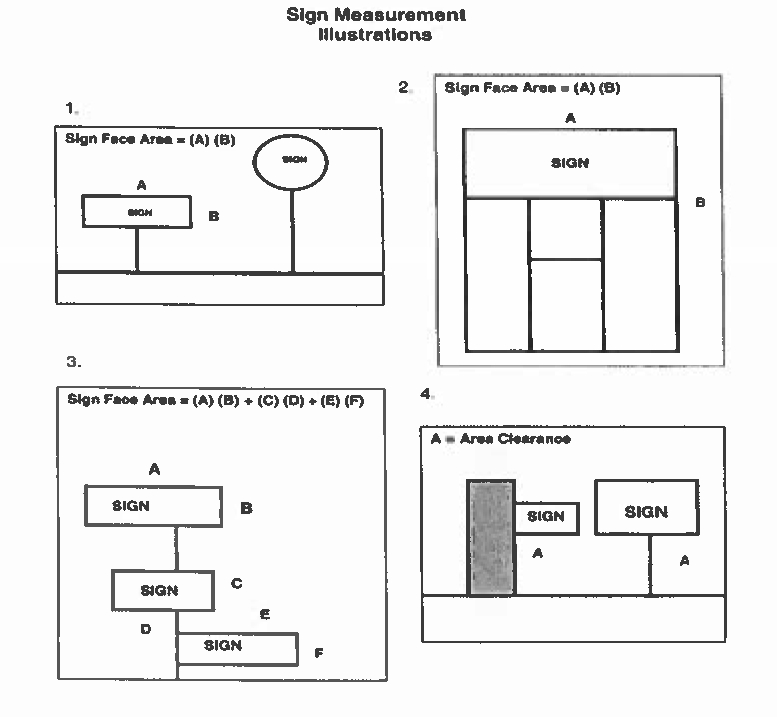
The area of a sign is determined by the outer dimensions of the frame or cabinet surrounding the sign face (Illustration 1). Sign area does not include foundations or supports. Only one side of a double-faced or V-shaped, freestanding sign is counted.
2.
For signage without a frame, the sign area shall include every portion of the sign that contains a sign display, symbol, or decoration.
3.
For signs constructed of individual pieces attached to a wall, sign area is determined by a perimeter drawn around all the pieces (Illustration 2).
4.
For signs containing multiple signage, the sum area of all signage on one side only is counted as one sign face (Illustration 3).
5.
The maximum surface area visible at one time on a round or three-dimensional sign is the sign area.
6.
For signs incorporated into awnings, #2 above applies by measuring the perimeter of the sign display, symbol, or any decorations.
7.
Clearances are measured from the ground directly beneath the sign to the bottom of the sign structure (Illustration 4).
C.
Common signage plan required.
1.
A common signage plan shall be required for any sign permit involving:
a.
Two or more contiguous lots or parcels under the same ownership;
b.
A single lot or parcel with more than one principal use or building or where multiple lots exist which allows for one free-standing sign per lot; and
c.
A PDD (planned development district) project.
2.
The plan shall contain all information required for sign permits generally and all signs shall be consistent with regard to:
a.
Lettering or graphic style;
b.
Lighting;
c.
Location of each sign on the buildings;
d.
Materials; and
e.
Sign proportions.
3.
A common signage plan shall allow a total of one freestanding sign for each lot on each side of each lot which has street frontage.
4.
Once approved by the director, the common signage plan shall become binding on all participating businesses and uses, but it may be amended by filing a revised plan in conformance with the requirements of this chapter.
5.
All common signage plans for properties which contain existing signs shall include a schedule for bringing any nonconforming signs into compliance within three years.
D.
Maintenance and upkeep of signs. All signs and their components shall be kept in a good state of repair, in compliance with all building and electrical codes, and in conformance with the requirements of this chapter (unless deemed a legal nonconforming sign by article 14.08-9). Any sign determined to be unsafe shall require the property owner to be notified and directed to immediately remove the sign or bring it into compliance.
(Ord. No. 22-O-05, § 2, 5-3-2022)
14.08-6.030. - Sign type descriptions.
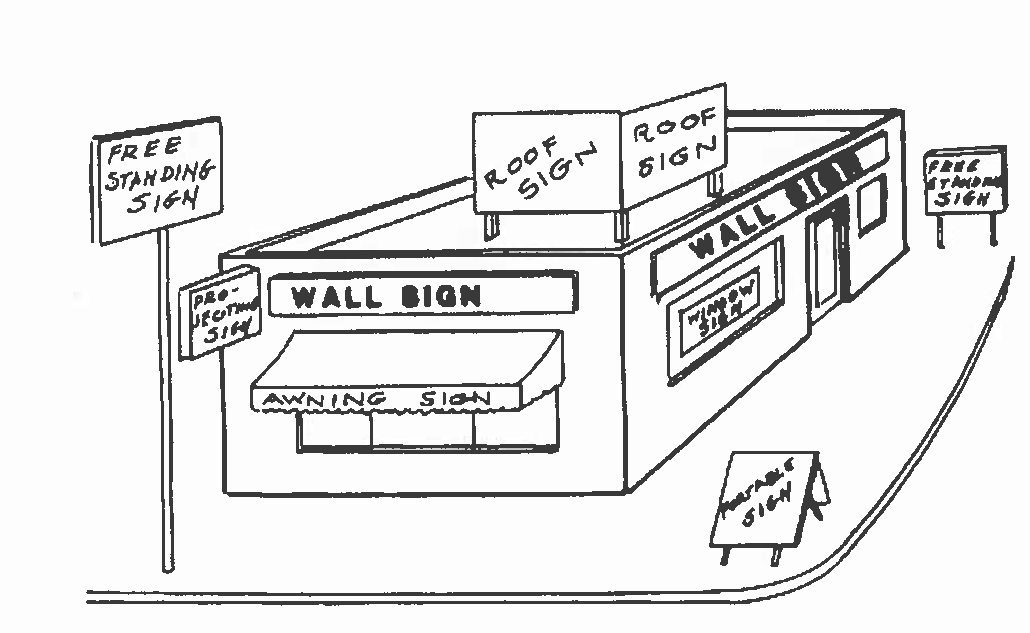
A sign is any communication device, structure, or fixture that incorporates graphics, symbols, or written copy intended to promote the sale of a product, commodity, or service, or to provide direction or identification for a premises or facility. The following are descriptions of the different types of signs regulated by this article:
A.
A-frame sign (sandwich board). A temporary ground sign with two sides attached at the top with hinges that allows the bottom to open up away from each other.
B.
Animated sign. Temporary signage that uses movement or change of lighting to depict action or creates a special effect or scene.
C.
Awning sign. Permanent Signage painted onto or attached to a fabric or canvas awning.
D.
Banner. Temporary signage made of fabric or canvas advertising a special sale or event. A banner may be placed on a building wall or on freestanding stakes or fences.
E.
Billboard (off-premises sign). A large permanent sign which directs attention to a business, commodity, service, or entertainment conducted, sold, or offered at a location other than where the sign is located. These are typically located along interstates and major highways.
F.
Building sign. Any permanent sign attached directly to any part of a building.
G.
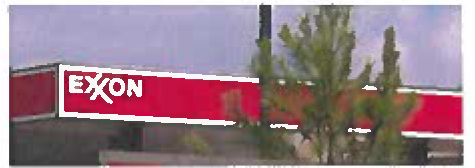
Canopy sign. A permanent sign that is mounted or painted onto or attached to a canopy.
CANOPY SIGN
H.
Changeable copy sign. A temporary or permanent sign or portion thereof with interchangeable characters, letters or illustrations that are changed manually or electronically. Signs with messages that change more than eight times per day are considered animated signs for purposes of this article. Signs where only the time and temperature portion of the sign change are not changeable copy signs for purposes of this article.
I.
Construction sign. A temporary sign indicating that a construction project is taking place which may include the contractor's information and information about the construction project.
J.
Government sign. A temporary or permanent sign posted by local, state, or federal agencies which provide information to the community, including regulatory, traffic, welcome, and wayfinding signs, community bulletin boards, and directory signs.
K.
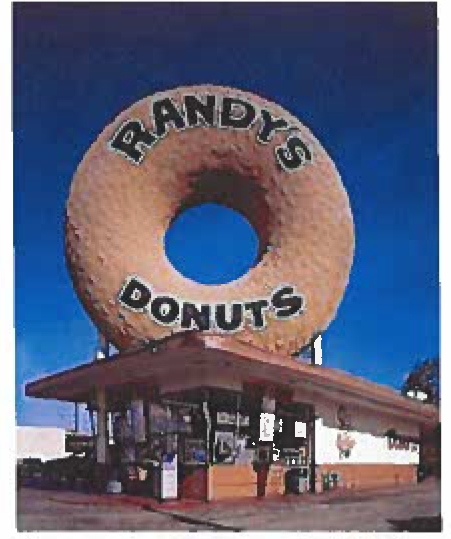
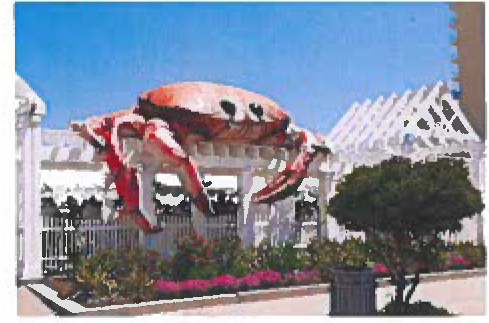
Statuary or Facsimile sign. A permanent three-dimensional object, molded or sculpted to look like an animal, a human figure, or some inanimate object like a donut or an automobile part, which may or may not contain advertising or information about the products or services sold on the premises.
STATUARY SIGN
L.
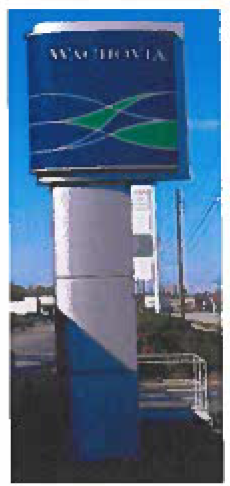
Freestanding on-premises signs. Any permanent, elevated, stand-alone and self-supporting sign located on the same property as the establishment being advertised that is not affixed to a building. An elevated sign supported by a pole is a common freestanding on-premises sign.
FREESTANDING ON-PREMISES SIGN
M.
Identification signs. A permanent sign giving the nature, logo, trademark, or other identifying symbol; address; or any combination thereof for a building, business, development, or establishment on the same property.
IDENTIFICATION SIGN

N.
Illuminated sign. A temporary or permanent sign that is illuminated either internally or externally.
O.
Incidental sign. A permanent informational sign, such as "no parking," "entrance," "loading only," "telephone," and other signs that provide similar directives, which don't contain a commercial message.
P.
Inflatable sign. A temporary three-dimensional object, filled or inflated with air or gas, which may or may not contain commercial advertising that is used to attract attention.
INFLATABLE SIGN
Q.
Legal/warning sign. A permanent sign erected to warn of danger or hazardous conditions or required or specifically authorized for a public purpose by any law, statute or ordinance, such as "No Trespassing," "Private Property" and/or "Towing Enforced."
R.
Marquee signs. A permanent sign painted onto or attached to a marquee (i.e., a movie theater).
S.
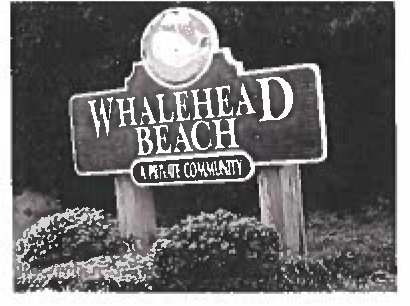
Neighborhood identification sign. A permanent sign identifying the name and located at the entrance of a residential subdivision or neighborhood.
NEIGHBORHOOD IDENTIFICATION SIGN
T.
Occupant/street number sign. A permanent sign affixed to a structure, mailbox, driveway entrance, etc., which serves to identify the address of the structure or occupant.
U.
Pennant. Any lightweight flexible material, which may or may not contain commercial advertising, attached along the length of a rope or wire, designed to move in the wind as a temporary attention-getting device.
V.
Permanent sign. A permanent sign attached to a building, structure or the ground made of materials intended to last for long-term use.
W.
Political sign. A temporary sign announcing or supporting political candidates or issues in connection with any national, state or local election or referendum.
X.
Portable sign. A temporary sign designed to be transported, but not limited by means of wheels.
Y.
Poster sign. A small temporary sign advertising a business or commodity off- premises that is intended to be read by pedestrians.
Z.
Projecting sign. A permanent sign supported by a building that projects outward more than 12 inches.
AA.
Real estate sign. A temporary sign advertising a property for sale or lease.
BB.
Roof sign. A permanent sign mounted on the roof of a building.
CC.
Unspecified, temporary sign. Any temporary sign that cannot be classified as another type of sign that is used for only a short period of time which is not permanently mounted.
DD.
Vehicular sign. A temporary sign not permanently attached to a vehicle parked in a manner solely to attract attention. Magnetic, painted on or wraps and other signs on vehicles are not covered or enforced by these regulations.
EE.
Wall sign. Any permanent sign which displays only one sign face that is attached to a wall of a building.
FF.
Window sign. A temporary sign attached to or visible through a window from outside the building.
(Ord. No. 22-O-05, § 2, 5-3-2022)
14.08-6.040. - Signs allowed by zoning district and special requirements.
Signs not specifically listed in any category in Article 6 as an approved sign type are expressly prohibited.
A.
Noncommercial signs allowed in all zoning districts without a permit.
1.
Government signs.
2.
Identification signs.
3.
Incidental signs.
4.
Legal and warning signs.
5.
Occupant/street number signs.
6.
Political signs (temporary)
7.
Posters (temporary).
8.
Real estate (temporary)
The maximum sign display area for all on-premises signs in the unincorporated areas of Edisto Island shall not exceed 50 square feet, regardless of the zoning district.
B.
There is no height limit for any freestanding or billboard sign within 300feet of I-95.
C.
Resource Conservation (RC-1 and RC-2).
1.
Signs allowed without a permit.
a.
Unspecified temporary signs.
b.
Window signs.
2.
Signs allowed with a permit.
a.
Canopy signs.
b.
Freestanding on-premises signs (excluding billboards).
c.
Neighborhood identification signs.
d.
Wall signs.
3.
Sign characteristics allowed.
a.
Changeable copy.
b.
Illuminated.
E.
Rural Development (RD-1 and RD-2).
1.
Signs allowed without a permit.
a.
A-frame signs (temporary).
b.
Pennants (temporary).
c.
Portable (temporary).
d.
Unspecified temporary signs.
e.
Window signs.
2.
Signs allowed with a permit.
a.
Banner (temporary).
b.
Canopy signs.
c.
Freestanding on-premises signs.
d.
Marquee signs.
e.
Neighborhood identification signs.
f.
Projecting signs.
g.
Wall signs.
h.
Billboard signs, (within 300 feet of I-95 only).
3.
Sign characteristics allowed.
a.
Changeable copy.
b.
illuminated.
F.
Suburban ..... Residential (RS).
1.
Signs allowed without a permit.
a.
Construction signs for residential projects (temporary).
2.
Signs allowed with a permit.
a.
Neighborhood identification signs.
3.
Sign characteristics allowed.
a.
Illuminated.
G.
Community Commercial (CC) and Village Commercial (VC).
1.
Signs allowed without a permit.
a.
A-frame signs (temporary).
b.
Inflatable signs (temporary).
c.
Pennants (temporary).
d.
Portable (temporary).
e.
Unspecified temporary signs.
f.
Window signs.
2.
Signs allowed with a permit.
a.
Banner (temporary).
b.
Billboards.
c.
Canopy signs.
d.
Freestanding on-premises signs.
e.
Marquee signs.
f.
Neighborhood identification signs.
g.
Projecting signs.
h.
Roof Signs
i.
Wall signs.
3.
Sign characteristics allowed.
a.
Changeable copy.
b.
Illuminated.
H.
Urban Development (UD-1 and UD-2).
1.
Signs allowed without a permit.
a.
A-frame signs (temporary).
b.
Inflatable signs (temporary).
c.
Pennants (temporary).
d.
Portable (temporary).
e.
Unspecified temporary signs.
f.
Window signs.
2.
Signs allowed with a permit.
a.
Banner (temporary).
b.
Billboards.
c.
Canopy signs.
d.
Freestanding on-premises signs.
e.
Marquee signs.
f.
Neighborhood identification signs.
g.
Projecting signs.
h.
Roof signs.
i.
Wall signs.
3.
Sign characteristics allowed.
a.
Animated.
b.
Changeable copy.
c.
Illuminated.
I.
Light Industrial (LID), Industrial (ID), and Heavy Industrial (HID).
1.
Signs allowed without a permit.
a.
Window signs.
2.
Signs allowed with a permit.
a.
Canopy signs.
b.
Freestanding on-premises signs.
c.
Marquee signs.
d.
Projecting signs.
e.
Wall signs.
f.
Roof Signs
g.
Billboards.
3.
Sign characteristics allowed.
a.
Changeable copy.
b.
Illuminated.
(Ord. No. 23-O-17, § 1, 11-7-2023)
14.08-6.050. - Sign requirements by type.
A.
Permanent signs.
1.
Billboards:
a.
Maximum area: 378 sq. ft. (672 sq. ft. within 300 feet of I-95).
b.
Maximum height: 36 feet (no height limit within 300 feet of I-95, and where allowed by zoning district).
c.
Maximum number: one sign per 700-foot radius.
2.
Building signs: (includes canopy, marquee, projecting, roof, wall signs and permanent window signs).
a.
Maximum area by district: (see table below)
_____
b.
Maximum height (for roof signs): 12 feet above highest point of roof.
c.
Maximum number: The number of signs is limited only by the maximum allowable sign area.
3.
Freestanding on-premises signs. (Billboards are not considered freestanding signs for this Article)
a.
Maximum area by district:*
*Special Exception approval required where sign area thresholds are requested to be exceeded.
b.
Maximum height by district:*
*No height limit for billboard or freestanding signs within 300 feet of I-95, and where allowed by zoning district.
**Special exception approval required where height thresholds are requested to be exceeded with justification.
c.
Maximum number: One per street frontage of developed lot, except as allowed for common signage plans where multiple lots exist.
4.
Neighborhood identification signs.
B.
Temporary signs.
1.
A-frame signs.
2.
Banners.
3.
Project identification signs.
4.
Inflatable signs.
5.
Pennants.
6.
Political signs.
7.
Portable.
8.
Posters.
9.
Real estate signs.
10.
Unspecified temporary signs.
11.
Window signs (temporary).
(Ord. No. 22-O-05, § 2, 5-3-2022; Ord. No. 23-O-17, § 1, 11-7-2023)
_____
14.08-6.060. - Prohibited signs.
A.
List of prohibited signs. All signs not expressly permitted by this article are prohibited. Such signs include but are not limited to:
1.
Signs painted on or attached to trees, fences posts, utility poles, stationary vehicles, or natural features.
2.
Signs displaying intermittent flashing or rotating lights resembling traffic signals, emergency response vehicles, or warning signals, using the words "stop," "danger," or any other word, phrase, symbol, or character in a manner that might mislead or confuse motorists.
3.
Signs in the public right-of-way except for the following:
a.
Public signs erected by a governmental body;
b.
Informational signs for a public agency or utility regarding its facilities;
c.
Church signs, in accordance with state law;
d.
Historical signs and markers; and
e.
Directional signs of a temporary nature not to exceed three (3) sq. ft. in area and 72 hours in duration for such events as yard sales, special events, public gatherings, etc., provided they are located no closer than 500 feet apart and removed immediately after the advertised event.
4.
Signs which are abandoned and/or no longer correctly direct people or that advertises an inactive business, lessor, owner, product, or service.
5.
Signs which have fallen into disrepair (dilapidated), are unsafe or otherwise structurally unsound and incapable of meeting the minimum safety requirements of the building codes.
6.
Any sign which obstructs the view of pedestrians, bicyclists or motorists using any street, approach to any street intersection, the exiting points of a lot, or which interferes with or obscures any traffic sign, device, or signal.
7.
Any sign located outdoors which obstructs free passage from any fire escape, downspout, window, door, stairway, ladder, or opening intended as a means of ingress or egress or which prohibits light or air.
8.
Any sign located to intentionally deny an adjoining property owner visual access to their existing sign.
9.
Signs placed on property without the written permission from the owner or agent.
10.
Inoperable derelict motor vehicles parked in one location more than 24 hours used as signage.
B.
Remedies for prohibited signs.
1.
In addition to other remedies and enforcement powers of this chapter, the director or his compliance officer(s) shall have the authority to remove and impound any prohibited signs or sign structures.
2.
The owner of an impounded sign or structure may recover same upon the payment of $50.00 for each sign or structure. If it is not claimed within ten days from the date of impoundment, the director shall have the authority to dispose of such sign or sign structure without notification or compensation to the owner.
3.
No provision of this section shall apply to any grandfathered or legal nonconforming sign or sign structure, but they shall be subject to the provisions for nonconforming signs in article 14.08-9.
(Ord. No. 22-O-05, § 2, 5-3-2022)

