
Colleton County Unincorporated
City Zoning Code
City Zoning Code
ARTICLE 14
08-5. - PARKING
14.08-5.010. - Purpose and applicability.
A.
The purpose of this article is to ensure adequate and well-designed parking is provided for new developments.
B.
This article applies to all new commercial developments and the expansion of existing parking areas by more than 50%. Single and two-family residential uses are subject to the minimum parking requirements of section 14.08-5.040(A).
(Ord. No. 22-O-05, § 2, 5-3-2022)
14.08-5.020. - Parking lot surface materials.
A.
All primary front yard off-street commercial parking areas with more than ten spaces shall be paved with concrete, asphalt, County Engineer approved semi-pervious pavers, or other similar material(s). All other parking areas secondary to the primary parking areas, or any parking areas smaller than ten spaces may use gravel, crushed stone, or other County Engineer approved materials, so long as the materials are confined to the parking area, the driveway aprons and access to the site are paved and installed in accordance with SCDOT requirements on state roads, and the handicapped parking spaces are provided in accordance with ADA Standards. Curb and gutters are optional.
B.
Paved parking areas shall have permanent lines demarcating each parking space.
C.
Where less than 20 parking spaces are required, places of worship may use grass as the parking surface, otherwise the requirements outlined in paragraph "A" above shall apply.
(Ord. No. 22-O-05, § 2, 5-3-2022)
14.08-5.030. - General design provisions for parking lots.
A.
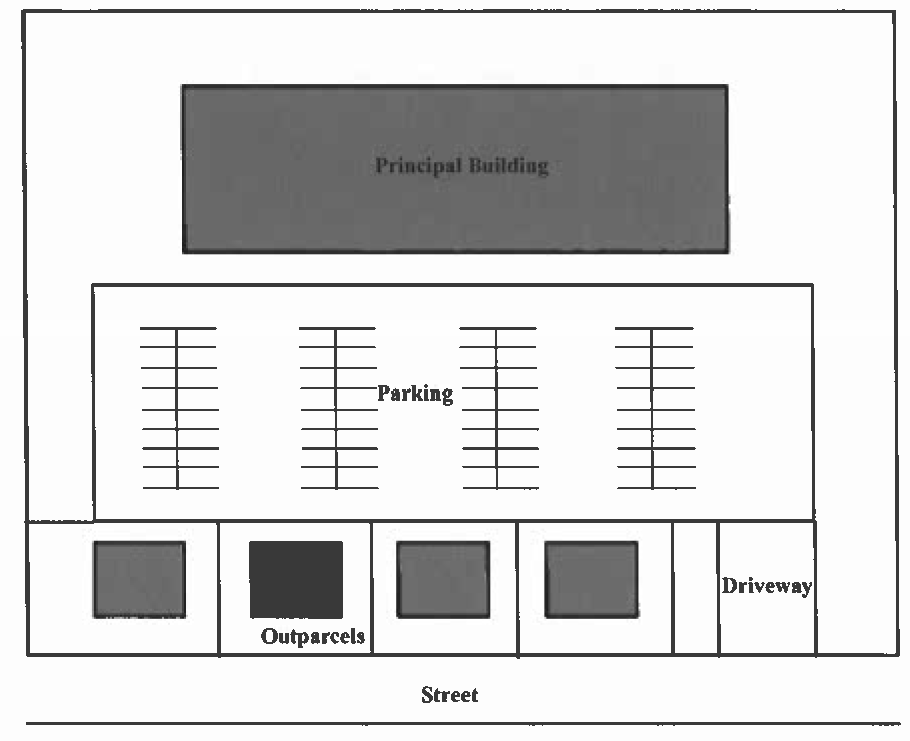
A maximum of two rows of parking spaces may be located in the front yard of the principal building and all other parking shall be located in the rear or side yards. For large-scale developments with large parking areas, parking may be shared and screened with outparcel buildings as shown in the diagram below:
B.
Off-street parking shall be provided on the same lot as the corresponding principal use.
C.
Off-street parking and loading spaces, not to include parking structures, are permitted in all required yards and setback areas, but no closer than five feet to a residential property line and two feet to any other property line, where no required landscape buffers are required.
D.
Off-street parking areas shall be designed to facilitate large sanitation, emergency, and delivery type vehicles.
E.
Off-street parking areas shall be designed to prevent parked vehicles from: parking on or backing onto public rights-of-way, sidewalks or adjacent property; or, hitting any fence, wall, vegetation, utility, or structure.
F.
The size of any single surface parking area shall be limited to a maximum of three acres, unless divided by a street, building, or a landscaped area a minimum of ten feet wide.
G.
No surface parking or circulation driveway is permitted within any required buffer area.
H.
A stormwater management plan shall be provided to minimize off-site stormwater runoff, and not drain into or across public sidewalks or an adjacent property, except into a natural watercourse or a drainage easement. In areas where this condition may be impossible to meet, the director may exempt the developer from this requirement, provided that adequate provision is made for stormwater detention. Stormwater retention is prohibited.
I.
Adequate lighting shall be provided for off-street parking areas used at night. Lighting shall be arranged so that light does not trespass onto, or interfere with traffic or adjacent residential properties.
J.
All off-street parking areas shall be landscaped in accordance with section 14.08- 4.020(C).
K.
Bicycle racks are encouraged for all parking areas with more than 50 spaces, and they may be placed in the front yard.
L.
Adequate vehicle storage for drive-thru lanes shall be provided on-site to prevent vehicles from backing up into any street, public rights-of-way or adjacent properties during peak business hours.
(Ord. No. 22-O-05, § 2, 5-3-2022)
14.08-5.040. - Parking ratios.
A.
Parking ratios by use.
1.
The following are the recommended parking ratios for the uses indicated, except as shown as required. For all other uses, a Parking Plan prepared by a licensed professional engineer, as approved by the director, will be accepted in lieu of the following parking ratios:
2.
The director can authorize a reduction to the minimum number of parking spaces required if the applicant can demonstrate through an engineered Parking Plan that the number of required spaces is excessive.
3.
Where more than one principal use will exist to use the same parking area, an engineered parking plan shall be submitted for approval by the director, to indicate the true number of parking spaces needed for all uses, taking into consideration the peak use hours for all uses, to prevent an underutilized sea of asphalt for the majority of time the parking area is used. Please reference Section 14.08-5.050 - Shared Parking and parking connectivity below.
B.
Parking spaces for the physically disabled.
1.
All commercial uses shall provide the following number of disabled parking spaces and van-accessible disabled parking spaces:
2.
The number of disabled spaces shall be in addition to those standard spaces required.
3.
A minimum of one van-accessible disabled parking space shall be required, plus an additional one for each additional eight regular disabled parking spaces required.
4.
All off-street disabled parking spaces, signage, curb-cuts and ramps shall be designed and located in accordance with the current ADA Design Standards.
(Ord. No. 22-O-05, § 2, 5-3-2022)
14.08-5.050. - Shared parking and parking connectivity.
A.
Shared parking. The joint use of shared off-street parking between two or more uses may be made by contract between all participating uses, as approved by the director, and it shall include at a minimum: a parking plan prepared by a licensed professional engineer; the days and hours of operation and peak hours for all uses; any overflow parking areas that may be utilized; any conflicts in usage time between the uses; and, how any conflicts shall be resolved.
B.
Parking connectivity. Adjacent parking lots shall be interconnected except where topographical issues prevent it. Each participating interconnected parking area may reduce their minimum required parking by five percent. Reductions in excess of five percent shall require a parking plan prepared by a licensed professional engineer.
(Ord. No. 22-O-05, § 2, 5-3-2022)
14.08-5.060. - Standard parking dimensions.
A.
Parking space dimensions.
1.
Each standard parking space, shall be a minimum of 19 feet long by nine feet wide.
2.
Ten percent of the total number of spaces may be compact spaces measuring 18 feet long by 8.5 feet wide.
3.
Parallel spaces shall measure no less than 24 feet long by nine (9) feet wide.
B.
Parking lot dimensions. The following are dimensional standards for all required parking areas:
(Ord. No. 22-O-05, § 2, 5-3-2022)
14.08-5.070. - Loading area requirements.
A.
All uses shall provide off-street loading space sufficient for their requirements and arranged so that no vehicle shall project onto a public right-of-way or sidewalk.
B.
Off-street loading unloading space shall be located on the same lot as the structures they serve.
C.
No area allocated to loading and unloading facilities may be used to satisfy the area requirements for off-street parking, and vice-versa.
D.
Each loading space shall be a minimum of 12 feet wide by 40 feet in length and have a minimum vertical clearance of 14 feet.
14.08-5.080. - Parking lot maintenance.
Off-street parking areas shall be properly maintained and kept in good condition (free from potholes, etc.) with all parking space lines or markings kept clearly visible and distinct.
(Ord. No. 22-O-05, § 2, 5-3-2022)
15.08-5.090. - Commercial driveways.
A.
Where required, landscaping, curbing, or other approved barriers shall be located along boundaries to control vehicle and pedestrian ingress and egress. Off-street parking areas shall be designed so that movement onto a public street is in a forward motion. Ingress and egress driveways to public streets must be located at least 50 feet, measured along the curbline, from the intersection of the nearest curbline.
B.
Driveways shall be no less than 12 feet wide for one-way traffic and 20 feet wide for two-way traffic.
C.
Fourteen-foot-wide driveways are permissible for two-way traffic when:
1.
The driveway is not longer than 50 feet;
2.
The driveway provides access to not more than five parking spaces; and
3.
Sufficient turning radius and storage area is provided so no vehicles back onto a public street.
D.
In no case shall a driveway width exceed 36 feet, except as required by SCDOT.
E.
Driveways shall be as nearly perpendicular to the street right-of-way as possible and in all instances the sight triangle shall be maintained.
F.
Driveways are encouraged to line up with driveways across the street and be shared between adjacent uses wherever possible.
(Ord. No. 22-O-05, § 2, 5-3-2022)

