
Colleton County Unincorporated
City Zoning Code
City Zoning Code
ARTICLE 14
08-4. - LANDSCAPING, BUFFERING, AND ENVIRONMENTAL PROTECTION
14.08-4.010. - Purpose and applicability.
This article regulates the protection, installation, and mandatory long-term management of trees and shrubs to minimize potential nuisances, such as visual impacts, noise, dust, odor, litter, and glare of lights, onto adjacent properties. The appropriate use of existing and supplemental landscaping enhances the appearance of developed properties with natural landscaping. Existing vegetation should be retained wherever possible.
(Ord. No. 22-O-05, § 2, 5-3-2022)
14.08-4.020. - Landscaping types.
This section is designed to specifically address the application of landscaping to varying styles of development to enhance the appearance, health, and financial well-being of the community. The provisions are broken into four landscaping categories:
•
Buffers (Type A)
•
Street yards (Type B)
•
Parking lot landscaping (Type C)
•
Other Screening and landscaping (Type D)
A.
Type A landscaping: Buffers.
1.
Applicability. A buffer shall be required for all new commercial uses adjacent to any existing single or two-family residential use or adjacent to properties zoned RS, CC, VC, UD-1, and UD-2. Properties located in the LID, ID, and HID district shall only comply to type A landscaping requirements for any portion of the property that is adjacent to properties zoned RS, CC, VC, UD-1, and UD-2. The expansion of a commercial use by more than 50 percent of building area or land area also requires compliance with this section.
2.
Buffer location, width, and composition.
a.
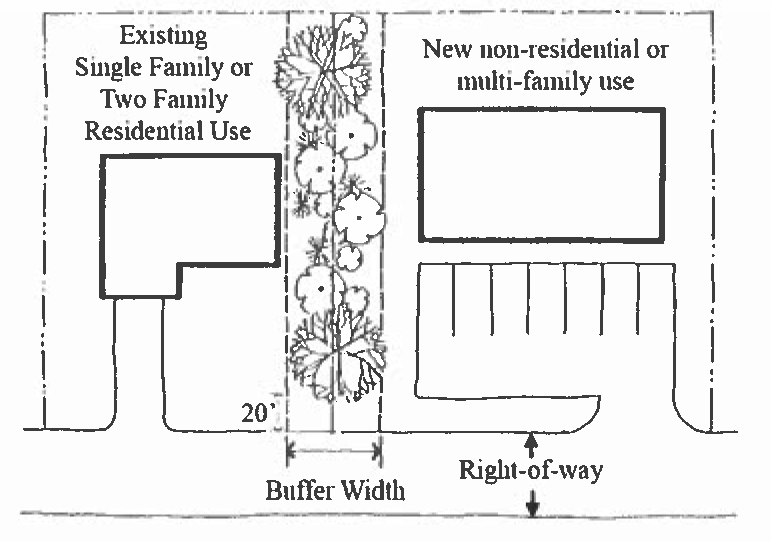
The buffer shall be located entirely on the property of the new or expanding use.
_____
BUFFER LOCATION
_____
b.
The buffer shall begin 20 feet back from the street right-of-way line and extend the length of the property line separating two uses, or 100 feet beyond the end of the use to be buffered.
c.
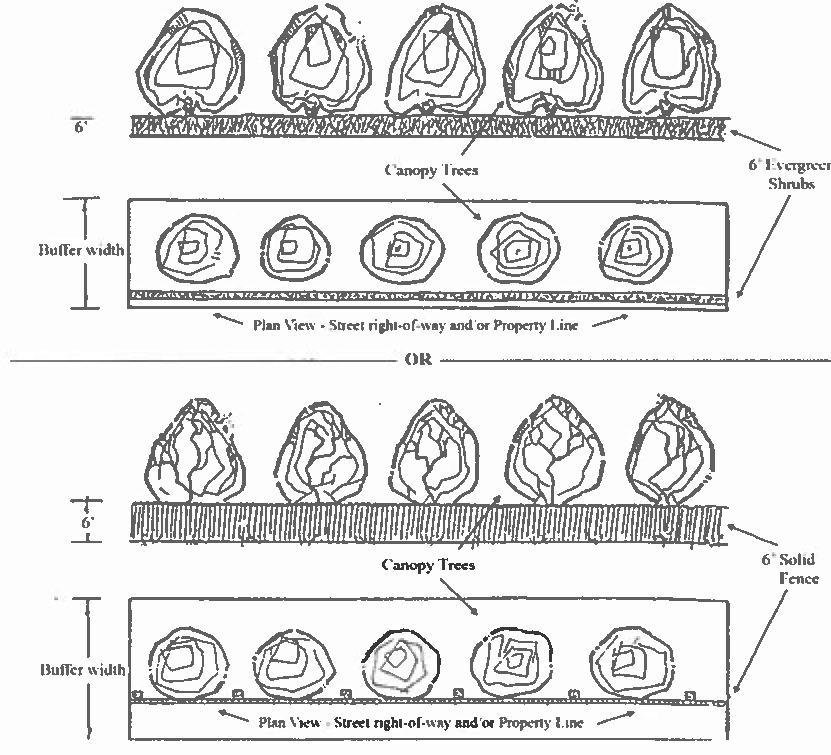
Type A landscaping functions as an opaque or solid screen with a minimum height of six feet.
d.
Shrub plantings shall have no unobstructed openings wider than four feet. At least 75 percent of the required shrubs shall be native evergreen species.
e.
No buildings, parking areas, sanitary containers, utilities, or other paved areas may be located within the required buffer area. A buffer may be used for passive recreation and may be interrupted by access driveways, as long as the sight triangle is adhered to.
f.
Composition of the buffer area may include a wall, solid fence, landscaped berm, planted vegetation, existing vegetation, or any appropriate combination of these elements to be a minimum of six feet high as approved by the director.
g.
The use of existing vegetation to satisfy this requirement is encouraged. Supplemental planting may be required in addition to native materials to meet the screening and opacity requirements.
h.
The following table shows the minimum buffer width and composition for a new or expanding commercial use adjacent to an existing single or two-family residential use or property zoned RS, CC, VC, UD-1, and UD-2. Properties located in the LID, ID, and HID district shall only comply to type A landscaping requirements for any portion of the property that is adjacent to properties zoned RS, CC, VC, UD-1, and UD-2.
*If overhead power lines exist, then a minimum of two ornamental trees may be installed in lieu of each required canopy tree affected.
**A six-foot solid fence or wall may be used in lieu of shrubs for any buffer. Canopy or ornamental trees are still required.
_____
TYPE "A" LANDSCAPING BUFFER
B.
Type B landscaping: Street yard.
1.
Applicability.
a.
A street yard shall be required for all new commercial uses within the CC, VC, UD-1, UD-2, LID, ID, and HID zoning districts. An expansion of an existing commercial use by more than 50 percent of building area or land area also requires compliance with this section.
b.
For districts in which a street yard is not required, landscaping complementary to the site and surroundings is required as approved by the director.
2.
Street yard location, width, and composition.
a.
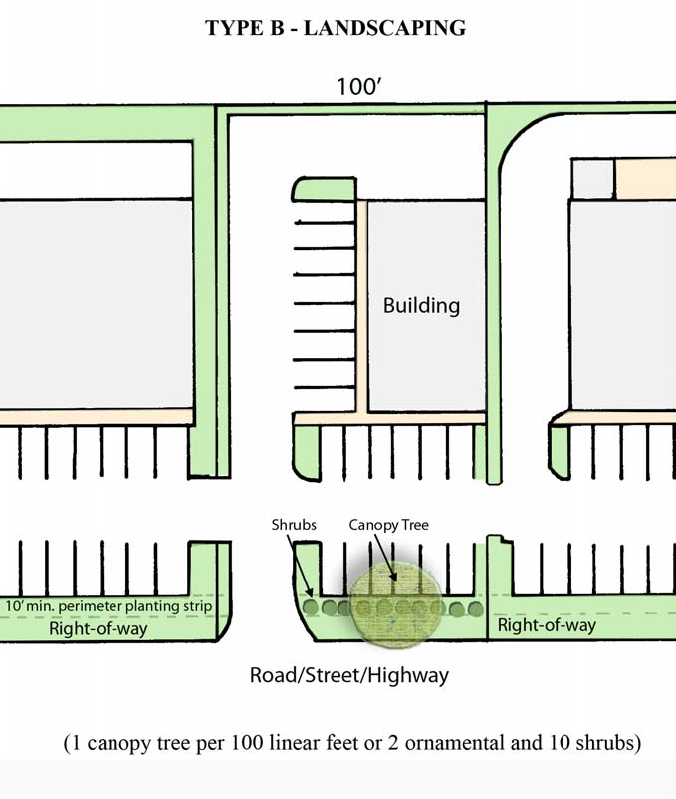
The minimum street yard width is eight feet. The street yard shall be located outside of the right-of-way and on the property side of any required sidewalks.
b.
The minimum height for Type B landscaping adjacent to the street right-of-way is two feet at maturity.
c.
No buildings, parking areas, sanitary containers, items displayed for sale, or utilities may be located within the required street yard area. Driveways may cross the street yard for access to the site.
d.
Composition of the Type B landscaping may include a wall, fence, planted vegetation, existing vegetation, or any appropriate combination thereof.
e.
Shrubs shall be planted at a minimum rate of ten shrubs per 100 linear feet of street frontage (minus driveways). At least 75 percent of the shrubs shall be native evergreen species.
f.
Street trees shall be planted outside the right-of-way within the street yard at a minimum rate of one large maturing (canopy) tree per 100 linear feet, or two small maturing (ornamental) trees in lieu of each required canopy tree where overhead power lines exist.
C.
Type C landscaping (parking lot canopy).
1.
Applicability.
a.
A parking lot canopy is required within all parking lots except automobile sales display areas in the CC, VC, UD-1, UD-2, LID, ID, and HID.
b.
Landscaping between the building and the parking area that is complementary to the site and surroundings is encouraged.
2.
Location and composition.
a.
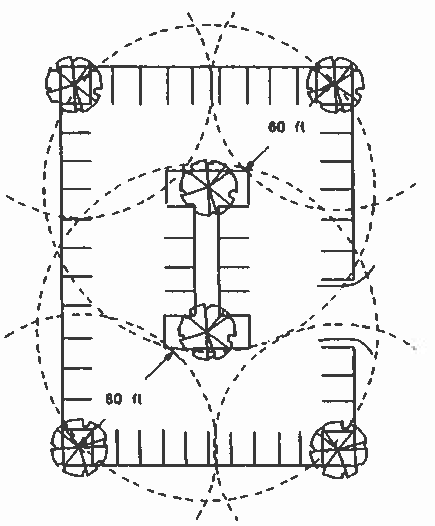
A minimum of one canopy tree shall be located within 60 feet of every parking space. The measurement shall be taken from the base of the tree.
b.
Canopy trees shall be planted in a manner that provides shade for parking areas at maturity. Two ornamental trees shall be used in lieu of each required canopy trees under power lines. The use of existing vegetation to satisfy this requirement is encouraged.
c.
Each planting area shall be a minimum of 49 square feet, with a minimum dimension of seven feet.
D.
Type D - Other screening and landscaping.
1.
Screening shall be required for all open commercial or industrial storage areas (not devoted to retail sales) or trash containers of four or more cubic yards visible from any public street.
2.
Screening shall be accomplished by an opaque or solid divide not less than six feet in height or the height of the object to be screened, whichever is greater.
3.
Screening may be in the form of a berm, wall or fence, or an appropriate amount of landscaping as to provide the necessary amounts of screening as determined by the director to effectively screen the storage from view from any adjacent lot or street right-of-way. Chain-link fence with slats shall not be used to meet the requirement of this section.
(Ord. No. 22-O-05, § 2, 5-3-2022; Ord. No. 23-O-01, § 3, 3-14-2023; Ord. No. 23-O-17, § 1, 11-7-2023)
14.08-4.030. - Landscaping and screening installation, protection, and maintenance.
A.
Fence, wall, and berm standards. Whenever a fence, wall, or berm is being installed, whether part of a screen or not, they shall meet the following requirements:
1.
Fences and walls must have the finished side facing outward. Fences shall be wooden, vinyl, wrought iron or a combination of these materials to achieve the opacity of a solid wall, as approved by the director. Chain-link fences and wood, plastic, or metal chain-link fence slats are expressly prohibited. However, a black or green coated chain-link fence with evergreen hedges is acceptable. Fences shall not be tin, corrugated metal, plywood, wood pallets, or any plastic other than vinyl. Walls must be made of masonry materials such as poured concrete, rock, decorative block, concrete blocks covered with stucco, and/or brick.
2.
No wall or fence used as part of a screen shall be less than six feet tall. All fences and walls are required to obtain a zoning permit prior to construction, regardless of height or location. Fences or walls taller than six feet and shorter than eight feet require a building permit prior to construction. Fences or walls taller than eight feet in height are required to obtain a height variance from the zoning board of appeals prior to obtaining a building permit to construct. The specific hardship, not created by the applicant, explaining why the height variance is being requested, must accompany the variance application.
3.
It is the applicant's responsibility to ensure, for their own protection, that any fence or wall installed near property boundaries is being installed completely on their property, so as not to create an undue civil dispute between property owners. County Staff will not determine if a fence or wall is installed on the correct property, nor will they assist in any way in settling said dispute between parties. These disputes can only be solved by SC licensed surveyors and/or engineers as a civil matter.
4.
Sight-Triangle and visibility at intersections. No fence, wall, berm or landscaping shall block a motorist's visibility, in any direction, from being able to safely see oncoming pedestrian, bicycle or motor vehicle traffic, when attempting to exit a property in accordance with the sight-triangle and visibility at intersections provisions outlined in paragraph H below.
5.
Fence or wall "gate setbacks" required when fronting onto a street or road. Fence or wall gates that allow vehicles to enter or exit a property through a gate, off of a road or highway, require the gate to be setback a minimum of 45 feet from the right-of-way line being crossed, to allow the vehicle and an attached trailer to safely pull completely off of the road or highway before stopping to open or close the gate, so as not to interfere with the flow of traffic on the road or highway.
6.
Where a fence or wall is used as part of a required screen area, any required plantings accompanying the fence or wall shall be located on the street side of such fence or wall, opposite the new development.
7.
All berms shall be grassed and/or planted with other plant materials sufficient to prevent soil erosion. If a specific height for the screen is required, this can be obtained by the berm itself, or a combination of the height of the berm plus the height of the planted vegetation needed to meet that overall height requirement, while also meeting the opacity of a solid fence or wall. No berm shall exceed a slope greater than one foot of rise for every three feet in plane. At least 75 percent of any required shrubs shall be planted on the slope of the berm facing the street, opposite the new development.
B.
Existing vegetation. If existing vegetation is located on the property being developed and it meets the screening requirements for height, width and opacity, further plantings and or improvements shall not be required. If the existing vegetation is deficient in meeting the screening requirements, the developer shall make needed improvements and/or additions as required by the director.
C.
Plant standards and plant installation standards. The following standards shall apply to all new plant material installed as general landscaping or as part of a screen required under these regulations:
1.
All plants and trees installed for general landscaping or as part of a screen fence shall be approved plants that are native to our area as defined by the American Nursery and Landscape Association's current edition of American Standard for Nursery Stock (ANSI Z60,1-2004).
2.
Invasive and/or exotic pest plants listed on the South Carolina Exotic Pest Plants website located at www.SC-eppc.org are expressly forbidden from being planted as part of the general landscaping or screen fence requirements, where doing so could result in fines levied against the property owner.
3.
The minimum required size for a canopy tree at planting shall be two-inch caliper and/or 12 feet in height.
4.
The minimum required size for an understory tree at planting shall be one and one half-inch caliper and/or eight feet in height.
5.
The minimum required large screening shrub shall be the seven gallon container size and/or four to five feet in height.
6.
The minimum required small screening shrub shall be the three gallon container size and/or 18 inches in height.
7.
No large maturing trees shall be planted within 20 feet of an electrical distribution line. This does not include insulated low-voltage lines of 240 volts or less or telephone or cable lines.
8.
All plants shall be installed free from disease, in accordance with generally accepted and recommended planting practices and in areas that ensure the availability of sufficient soil, water, air and sunlight needed to sustain healthy growth.
9.
No plants, and specifically no trees, shall be planted within an easement that could be intrusive to utilities, ingress/egress access to a property, or deleteriously impact proper drainage.
D.
Landscaping maintenance.
1.
The maintenance of all required landscaping shall be the responsibility of the property owner in order to fulfill the purpose for which it is established.
2.
Debris and litter shall be picked-up, and berms, fences, and walls shall be maintained at all times.
3.
Dead plants in the required landscaping shall be replaced promptly and during the growing season and all landscaping shall be protected from damage by erosion, motor vehicles, or pedestrians which could reduce its effectiveness.
4.
Failure to maintain landscaping as outlined in this section shall constitute a code violation which could result in fines and/or imprisonment.
E.
Tree protection.
1.
Trees to be protected.
a.
Any tree, excluding pine trees, measuring 30 inches DBH (diameter breast height) shall constitute a "significant or protected tree" and shall be protected to the extent that no person shall directly or indirectly destroy or remove any tree in violation of the terms of this section.
b.
Ordinary cutting, trimming and maintenance of any tree, and/or the cutting or removal of any tree that the county shall certify as required for public safety is permissible.
c.
The provisions of this section shall apply only to developments that meet any of the following criteria:
i.
Major subdivisions with lot sizes of less than one acre within the RS and UD-1 or UD-2 zoning districts.
ii.
Commercial developments in the UD-1, UD-2, LID, ID or HID zoning districts on lots of ten acres or more.
2.
Tree survey required. As part of the application process for a subdivision preliminary plat or a commercial site plan approval, the applicant shall conduct a tree survey identifying the location of all significant or protected trees and said tree survey must accompany the preliminary plat or site plan review application packet. Said trees shall be shown on a survey plat and in the field be physically marked with brightly colored tape or other markings.
3.
Site design for tree protection.
a.
The design of any commercial development or subdivision shall take into consideration the location of all significant protected trees identified on the tree survey. Lot and site design shall minimize the need to fell significant protected trees, and the site plan shall include the following:
i.
Existing location and size of all significant protected trees;
ii.
Significant protected trees to be removed;
iii.
Significant protected trees to remain;
iv.
Areas to be cleared;
v.
All proposed development structures and improvements.
b.
Where a zoning permit or subdivision approval has not been issued, the destruction of any significant tree, as defined by this section, without prior approval of the director shall be prohibited and constitute a code violation for every tree destroyed and for each day the violation has not been cured.
4.
Tree and root protection during development. During development, a minimum protective zone, marked by barriers, shall be erected at the drip line and maintained around all trees to be retained. Protective zones may be modified from the drip line with an approved mitigation plan acceptable to the director. There shall be no construction, pouring of concrete, paving, grading, operation of equipment or vehicles, or storage of materials within this protected zone.
5.
Tree replacement. Where significant trees have been approved to be removed as part of the zoning permit, or where removal is required due to acts of negligence, or where sites were cleared of significant trees in violation of this section, replacement trees shall be planted in accordance with either method (a.) or (b.) below as required by the director who shall specify the number, species, DBH, and location of replacement trees required:
a.
Combined DBH of replacement trees is equal to the DBH of the trees removed; or
b.
Individual replacement trees are of the largest transplantable DBH available.
F.
Relief from landscaping requirements. In the event that hardships created by the property, and not created by the owner, prevent the strict application of the landscaping requirements from being fulfilled in their entirety, such as topography or an unusually shaped lot, the director may alter the requirements of this section provided the spirit and intent of this article are maintained. Should this occur, the applicant shall submit a plan to the director showing existing site features that would screen the proposed use, plus any additional screening materials the developer may propose to have installed. If the director agrees that the adjusted site plan does meet the intent of these requirements, then the adjusted landscaping shall be installed according to the approved site plan. The mere desire of an owner to make a more intensive use or generate more profits from a greater economic use of the property cannot be grounds for reducing the landscaping requirements, since only a hardship not created by the owner can be accepted.
G.
Sight-triangle and visibility at intersections. No hedge, shrubbery, tree, natural growth, sign, fence, wall, or other obstruction of any kind to vision which prevents a motorist from safely seeing oncoming pedestrian, bicycle and/or vehicular traffic from either direction will be permitted between two feet and nine feet above the center of the street where the projection of the sight triangles intersect the centerline of the street, in accordance with section 14.08-2.010, subsection D - general provisions, paragraph (2)(g). In instances where SCDOT sight triangle provisions are applicable, such regulations shall prevail.
(Ord. No. 22-O-05, § 2, 5-3-2022; Ord. No. 23-O-17, § 1, 11-7-2023)
14.08-4.040. - Environmental protection.
A.
Environmental buffers.
1.
A riparian buffer setback of not less than 30 feet or one-third the depth of a lot or parcel, whichever is less, shall be provided along the banks of all streams, rivers and shorelines. The buffer setback area for tidal waters shall be measured from the mean high tide line. The buffer setback area for rivers and streams shall be measured from the point on a sloped bank where natural vegetative growth begins, or from the edge of the bank if the bank is steep and elevated vertically above the surface of the water.
2.
The buffer area shall remain undeveloped except for piers, docks, utilities, and pervious access paths to the water, as approved by FEM A and Chapter 13.12.
(Ord. No. 22-O-05, § 2, 5-3-2022)

