
Coopersville City Zoning Code
CHAPTER 1210
General Provisions
_____
1210.01 - TITLE.
This chapter shall be officially known, cited, and referred to as the "Site Condominium Ordinance of the City of Coopersville".
(Ord. 381. Passed 2-28-05.)
1210.02 - POLICY.
(1)
Pursuant to authority conferred by the Condominium Act, as amended, and the Home Rule City Act, as amended, all site condominium projects and subdivisions must be approved by the City of Coopersville Council, upon recommendation from the Planning Commission.
(2)
This chapter is intended to facilitate the uniform treatment of site condominium projects and developments within the City.
(3)
This chapter requires preliminary review by the Planning Commission followed by final review and approval by the City Council of site condominium project plans to ensure compliance with this chapter. Site condominium projects may be approved as provided by this chapter in any zoning district for the uses permitted in the zoning district in which the project is located.
(Ord. 381. Passed 2-28-05.)
1210.03 - PURPOSES.
This chapter is adopted for the following purposes:
(1)
To protect and provide for the public health, safety, and welfare of the City residents both existing and future.
(2)
To guide the future growth and development of the City in accordance with the Comprehensive Plan.
(3)
To establish reasonable standards of design and procedures for site condominiums in order to further the orderly layout and use of land, and to ensure proper legal descriptions and monumenting of divided lands.
(4)
To lessen the pollution of air, streams, and ponds; to provide for adequate drainage facilities; to maintain the integrity of the water table, and to encourage the wise management of natural resources throughout the City.
(5)
To create healthy neighborhoods that accommodate and encourage the circulation of non-vehicular traffic, as well as vehicle traffic.
(6)
To provide for open spaces throughout an efficient design and layout of the land.
(7)
To encourage multiple points of access while allowing cul-de-sacs under special circumstances of topography or compatibility with outside development.
(Ord. 381. Passed 2-28-05.)
1210.04 - AUTHORITY.
This chapter is adopted in accordance with Act 59 of the Public Acts of Michigan of 1978, as amended and Act No. 279 of the Public Acts of Michigan of 1909, as amended.
(Ord. 381. Passed 2-28-05.)
1210.05 - JURISDICTION.
(1)
This chapter applies to all site condominium developments, as defined in this chapter located within the corporate limits of the City or lands under joint ownership with another municipality.
(2)
All site condominium subdivisions and developments shall be processed subject to the terms of this chapter and State law.
(3)
No building permit or certificate of occupancy shall be issued for any site condominium unit except in conformity with this chapter.
(Ord. 381. Passed 2-28-05.)
1210.06 - DEFINITIONS.
The following words, terms and phrases, when used in this chapter, shall have the meanings ascribed to them in this section, except where the context clearly indicates a different meaning:
Building envelope means the area of a condominium unit within which the principal building or structure may be constructed, together with any accessory structures, as described in the master deed for the site condominium project. (In a single-family residential site condominium project, for example, the building envelope refers to the area of each condominium unit within which the dwelling and any accessory structures may be built.)
Building site means either:
(1)
The area within the site condominium unit by itself (i.e., exclusive of any appurtenant limited common element), including the area under the building envelope and the area around and contiguous to the building envelope; or
(2)
The area within the condominium unit (as described in subsection (1) of this definition), taken together with any contiguous and appurtenant limited common element. For purposes of determining compliance with the applicable requirements of this chapter, including, without limitation, height, area, yard and density requirements, or with other applicable laws, ordinances or regulations, a "building site" shall be considered to be the equivalent of a "lot".
Condominium Act means Act No. 59 of the Public Acts of Michigan of 1978, as amended.
Exempt change means a change to a site condominium project (other than a major or minor change) that is exempt from review and approval as required for major or minor changes under this chapter. Exempt changes shall be limited to the following:
(1)
A change in the name of the project, in the name of a public or private street within the project, or in the developer of the project;
(2)
A change in the voting rights of co-owners or mortgagees; or
(3)
Any other change in the site condominium project which, as determined by the Planning Commission, does not constitute a major or minor change and will not otherwise change the site configuration, design, layout, topography, or any other aspect of a project which is subject to regulation under this chapter.
Limited common element means an area which is appurtenant to a site condominium unit and which is reserved in the master deed for the site condominium project for the exclusive use of the owner of the site condominium unit.
Major change means a change in the site configuration, design, layout or topography of a site condominium project (or any portion thereof), including any changes that could result in:
(1)
An increase of twenty percent or more in the number of site condominium units;
(2)
A reduction of five percent or more in the area of the building site for any site condominium unit;
(3)
A reduction of five percent or more in the total combined area of the general common elements of the site condominium project;
(4)
A reduction of five percent or more in the total combined area of all limited common elements of the site condominium project; or
(5)
Any other change in the site configuration, design, layout, topography, or other aspect of the project which is subject to regulation under this chapter, including, without limitation, a change in the location of public or private streets and utilities, or in the size, location, area, horizontal boundaries or vertical boundaries of a site condominium unit, and which is determined by the Planning Commission to constitute a major change to the site condominium project.
Minor change means a change in the site configuration, design, layout or topography of a site condominium project (or any portion thereof), including any changes that will result in:
(1)
An increase of less than twenty percent in the number of site condominium units or a decrease in the number of site condominium units;
(2)
A reduction of less than five percent in the area of the building site for any site condominium unit;
(3)
A reduction of less than five percent in the total combined area of the general common elements of the site condominium project;
(4)
A reduction of less than five percent in the total combined area of all limited common elements of the site condominium project; or
(5)
Any other minor variation in the site configuration, design, layout, topography or other aspect of the project which is subject to regulation under this chapter, and which, as determined by the planning commission, does not constitute a major change.
Site condominium project means a plan or project consisting of two or more site condominium units established in compliance with the Condominium Act.
Site condominium project plan means the plans, drawings and information prepared for a site condominium project as required by the Condominium Act and as required by this chapter for review of the project by the Planning Commission and the City Council.
Site condominium unit means a condominium unit established in compliance with the Condominium Act which consists of an area of vacant land and a volume of vacant air space, designed and intended for separate ownership and use as described in the site condominium project master deed, and within which a building or other improvements may be constructed by the condominium unit owner.
Except as otherwise provided by this chapter, the following words and phrases, as well as any other words or phrases used in this chapter which are specifically defined in the Condominium Act, shall conform to the meanings given to them in the Condominium Act: common elements, condominium documents, condominium unit, contractible condominium, convertible area, expandable condominium, general common elements and master deed.
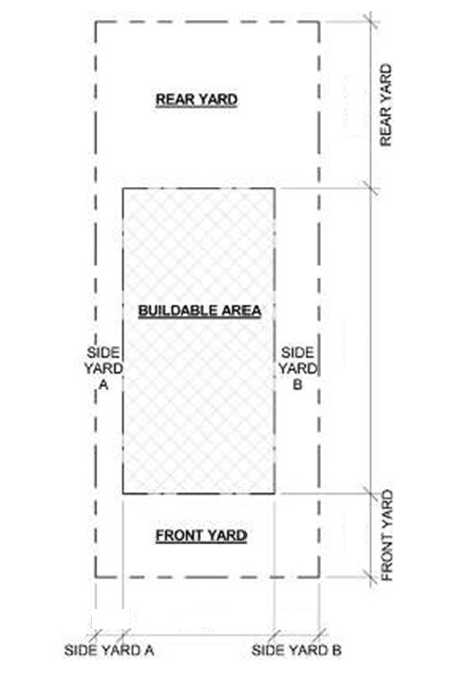
Yard means an open space on the same land with a building or group of buildings, which open space lies between the building or group of buildings and the nearest lot line and is unoccupied and unobstructed from the ground upward, except as otherwise provided herein. Figures 1 and 2 below shows the visual depiction of yard definitions.
(1)
Front: The open space extending the full width of the lot, the uniform depth of which is measured at right angles to the front lot line. On a corner lot the front yard shall be the yard separating the narrowest street frontage from the street.
(2)
Secondary front: On a corner lot, the secondary front yard faces the lot's secondary street. The secondary front yard includes the area from the lot line abutting the secondary street to the face of the building and from the front line of the building (boundary of the front yard) to the rear lot line. The street in which the structure is addressed shall be deemed the front yard.
(3)
Rear: The open area extending across the full width of the lot, the uniform depth of which is measured at right angles to the rear lot line.
(4)
Side: The open unoccupied area between a main building and the side lot lines, extending from the front yard area to the rear yard area. The width of the side yard shall be measured horizontally from and at right angles to the nearest point of the side lot line.
Figure 1 (Corner Lot)
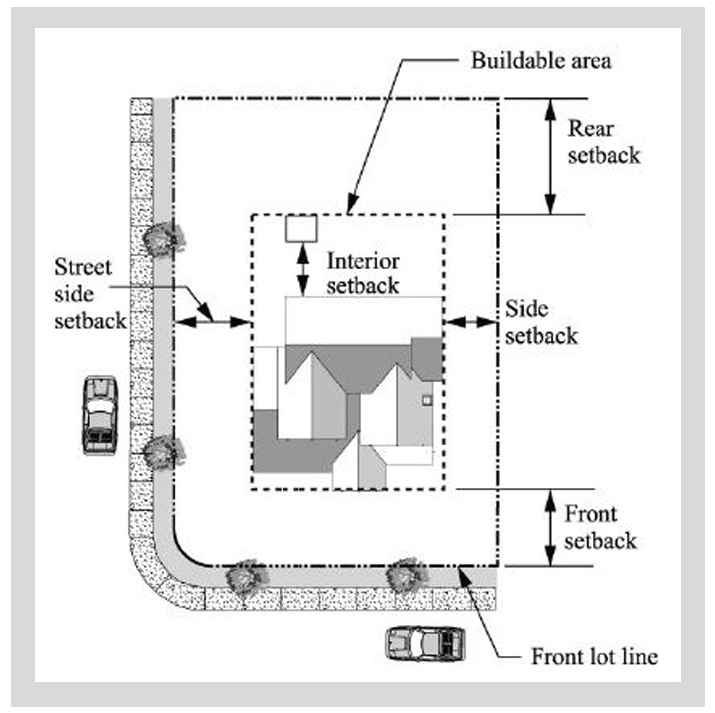
Figure 2 (Regular Lot)
(Ord. 381. Passed 2-28-05; Ord. 486. Passed 5-13-19.)
1210.07 - PRELIMINARY REVIEW.
(a)
Prior to final review and approval of a site condominium project plan by the City Council, a preliminary site condominium project plan shall be reviewed by the Planning Commission in accordance with the procedures, standards and requirements provided by this chapter.
(b)
Application for review and approval of a site condominium project plan shall be initiated by submitting to the Planning Director:
(1)
A minimum of fourteen copies of a preliminary site condominium project plan which complies with the requirements of this chapter.
(2)
A filing fee in accordance with the fee schedule established by resolution of the City Council. The Zoning Administrator shall forward the copies of the preliminary plan to the Planning Commission.
(c)
The Planning Commission shall review the preliminary site condominium project plan in accordance with the standards and requirements contained in this chapter, and in accordance with the following additional standards and requirements:
(1)
In its review of a site condominium project plan, the Planning Commission may consult with the Zoning Administrator, City Attorney, City Engineer, relative fire personnel, City Planning Director or other appropriate persons regarding the adequacy of the proposed common elements and maintenance provisions, use and occupancy restrictions, utility systems, public and private streets, project layout and design, or other aspects of the proposed project.
(2)
Except as otherwise provided herein, the building site for each site condominium unit shall comply with all applicable provisions of the underlying zoning district in which the site condominium project is located, including, without limitation, minimum lot area, minimum lot width, required front, side and rear yards, maximum building height, and public and private street frontage requirements. For example, the area and width of the building site shall be used to determine compliance with the minimum lot area and lot width requirements. Compliance with required front, side and rear yards shall be determined by measuring the distance from the equivalent front, side or rear yard boundaries of the building site to the closest respective front, side or rear boundary of the building envelope. On private roads, the front yard boundary of the building site shall be at least thirty feet from the centerline of the adjoining private street (and this thirty-foot setback shall be required even if a modification is approved under this chapter regarding the width of the private road easement or paved surface of the private road).
(3)
Except with respect to private roads approved for a site condominium project under this chapter, site condominium projects shall comply with all design standards and improvement requirements for platted subdivisions set forth in the City's adopted ordinances, which ordinances are incorporated by reference, provided that references therein to "subdivision" and "lot" shall be construed to mean "site condominium project" and "building site", respectively.
(d)
The City may require, as part of its review process, that portions of the preliminary plan be submitted by the applicant to the County Health Department, County Road Commission, County Drain Commission, State Department of Natural Resources, State Department of Public Health and other appropriate state and county review and enforcement agencies having direct approval or permitting authority over any aspect of the proposed site condominium project.
(e)
After reviewing the preliminary site condominium project plan, the Planning Commission shall prepare a written statement of recommendations regarding the proposed site condominium project, including any suggested or required changes in the plan, and, if the recommendation is to deny approval, the reasons for denial. The Planning Commission shall provide a copy of its written recommendations to the applicant and to the City Council. A recommendation by the Planning Commission to approve (or approve with conditions) a preliminary project plan shall not constitute a final approval of the plan and shall not confer any rights upon any applicant.
(Ord. 381. Passed 2-28-05.)
1210.08 - FINAL REVIEW.
(a)
After receiving the Planning Commission's recommendations on the preliminary plan, the applicant shall submit to the Planning Director a minimum of fifteen copies of a final site condominium development plan which complies with the requirements of this chapter. The Planning Director shall forward the copies of the final plan to the City Council.
(b)
The final site condominium project plan submitted by the applicant shall incorporate all of the recommendations from the City's review of the preliminary plan. Any Commission recommendation not incorporated in the final plan shall clearly be identified in writing along with reasons for those recommendations not being incorporated. Except for identified necessary changes, the final plan shall otherwise be identical to the preliminary plan. Changes made to the plan must be approved and reviewed by the Planning Commission prior to approval of the plan by the City Council.
(c)
After receiving the Planning Commission's recommendations on the final site condominium development plan from the applicant, the City Council shall proceed to review and may approve, deny or approve with conditions the plan in accordance with the standards provided by this chapter.
(d)
As a condition of approval of a final site condominium project plan:
(1)
The City Council may require that a cash deposit, certified check, irrevocable bank letter of credit, or surety bond acceptable to the City Council covering the estimated cost of required improvements associated with the site condominium project for which approval is sought be deposited with the City as provided by State law.
(2)
The City Council may impose additional conditions of approval as provided by section site.
(Ord. 381. Passed 2-28-05.)
1210.09 - CONTENTS OF SITE CONDOMINIUM PLAN.
A complete condominium project plan must include all of the documents and information required by Section 66 of the Condominium Act, including, without limitation:
(a)
A survey plan.
(b)
A floodplain plan, if the project lies within or abuts a floodplain area.
(c)
A utility plan, showing all sanitary sewer, water and storm sewer lines and related easements for installation, repair and maintenance of all utilities.
(d)
The size, location, area and horizontal boundaries of each condominium unit, and the vertical boundaries and volume for each unit comprised of enclosed air space.
(e)
A number assigned to each condominium unit.
(f)
Building sections showing the existing and proposed structures and improvements, including their location on the land. Any proposed structure or improvement shown should be labeled either "must be built" or "need not be built". To the extent that the developer is contractually obligated to deliver utility conduits, buildings, sidewalk, driveways, landscaping and access roads, the same shall be shown and designated as "must be built", but the obligation to deliver such items exists whether or not they are so shown and designated.
(g)
The location of all proposed drains, drainage ditches, ravines, culverts, changes in grade and other natural or artificial drainage facilities or improvement's including, without limitation, a drainage plan showing the general flow of surface water from each building site within the site condominium project to any adjacent building site or lot or to an approved drainage course.
(h)
The nature, location and size of the general and limited common elements (including any information required to be submitted for private roads as provided by City ordinances, building envelopes and building sites).
(i)
The use and occupancy restrictions and maintenance provisions for all general and limited common elements that will be included in the master deed (including, without limitation, the maintenance provisions which will apply to any proposed private roads).
(j)
A narrative describing the overall objectives of the proposed site condominium project, and a copy of the proposed bylaws for the project. The condominium project plan and associated documents and information shall be provided at the level of detail as determined necessary by the Planning Commission for review of a preliminary plan or by the City Council for review of a final plan.
(k)
Such other information as requested by the City.
(Ord. 381. Passed 2-28-05.)
1210.10 - CONSTRUCTION COMPLIANCE WITH APPROVED FINAL SITE CONDOMINIUM PROJECT PLAN.
No buildings or structures shall be constructed nor shall any other site improvements or changes be made on the property in connection with a proposed site condominium project except in compliance with a final site condominium project plan approved by the City Council, including any conditions of approval.
(a)
Commencement of Construction; Issuance of Permits. No construction, grading, tree removal, soil stripping, or other site improvements or changes shall be commenced by any person and no building, construction or grading permit shall be issued by the Building Inspector for a site condominium project until:
(1)
A final site condominium project plan has been approved by the City Council;
(2)
All conditions to commencement of construction imposed by the City Council have been met; and
(3)
All applicable approvals or permits from appropriate County and State review and enforcement agencies have been obtained for the project.
(b)
Consistency With Approved Drainage Plan Required.
(1)
Excavation, construction, erection, conversion or repair of any land, building or structure proposed for a building site within a site condominium project for which a final site plan has been approved shall not occur until a building permit application has been submitted and approved, which application shows that the effect of the proposed work is substantially consistent with the drainage plan approved for the project regarding flow of surface water from the building site to any adjacent building site or lot or to an approved drainage course.
(2)
A certificate of occupancy for the use or occupancy of any building or structure on a building site shall not be issued until the building official determines that the work completed on the building site pursuant to a building permit issued by the City is substantially consistent with the drainage plan approved for the project regarding flow of surface water from the building site to any adjacent building site or lot or to an approved drainage course.
(3)
The requirements of subsections (a) and (b) shall be clearly and legibly reproduced verbatim in the master deed for the site condominium project.
(4)
No work shall be conducted on a building site, except in compliance with the drainage plan approved for the project, and conditions on the building site after completion of the work shall be maintained at all times in compliance with the approved plan.
(5)
This section applies only to building sites within site condominium projects for which a drainage plan has been approved for the site condominium project as provided by this chapter. Any building site for which a drainage plan has not previously been approved under this chapter is subject to the surface water drainage plan requirements under City ordinances.
(Ord. 381. Passed 2-28-05.)
1210.11 - EXPANDABLE OR CONVERTIBLE CONDOMINIUM PROJECTS.
Approval of a final site condominium project plan shall not constitute approval of expandable or convertible portions of a site condominium project unless the expandable or convertible areas were specifically reviewed and approved by the City Council in compliance with the procedures, standards and requirements of this chapter. Any change proposed in connection with a project for which a final site condominium project plan has previously been approved by the City Council shall be subject to review as provided by this section:
(1)
Major Changes. A major change shall be reviewed by the Planning Commission and reviewed and approved, denied, or approved with conditions by the City Council as provided by this chapter for the original review and approval of preliminary and final plans in accordance with the standards provided by this chapter and other applicable procedures, standards and requirements.
(2)
Minor Changes. A minor change shall be reviewed and approved, denied, or approved with conditions by the Planning Commission alone, in accordance with the standards provided by this chapter and other applicable procedures, standards and requirements, without the need for further review and approval by the City Council.
(3)
Exempt Changes. Any change which constitutes an exempt change shall not be subject to review by the City under this chapter, but a copy of the changes proposed, and of any changes subsequently made if at all different than proposed, shall be filed with the Planning Director as soon as the changes are proposed or made.
(Ord. 381. Passed 2-28-05.)
1210.12 - INCORPORATION OF APPROVED PROVISIONS IN MASTER DEED.
All provisions of a final site condominium project plan approved by the City Council as provided by this chapter shall be incorporated by reference in the master deed for the site condominium project, which shall be submitted for review and approval by the City. All major changes to a project shall be incorporated by reference in the master deed. A copy of the master deed as filed with the county register of deeds for recording shall be provided to the City within ten days after filing the plan with the County.
(Ord. 381. Passed 2-28-05.)
1210.13 - PRIVATE ROADS.
In general, private roads may be approved in place of public streets for site condominium projects as part of the site condominium project approval process as provided by this chapter, and subject to the standards and requirements provided by this section. Private roads will be allowed in a site condominium project only under the provisions of the Private Road Ordinance described in the Coopersville Codified Ordinances [Chapter 1030].
(Ord. 381. Passed 2-28-05.)
_____

