
Coopersville City Zoning Code
CHAPTER 1288
Parking and Loading Spaces
_____
1288.01 - OFF-STREET PARKING SPACES REQUIRED.
In all zoning districts, there shall be provided at the time any building is enlarged or increased in capacity, off-street parking spaces for automobiles.
(Ord. 195. Passed 4-9-90.)
1288.02 - NUMBER OF OFF-STREET PARKING SPACES REQUIRED.
A.
In all zoning districts in connection with residential, business, industrial, institutional, recreational and similar uses, space for off-street parking shall be provided in accordance with the following schedule:
(1)
Dwellings, two for each family unit.
(2)
Lodging, rooming and boarding houses, dormitories, fraternity and sorority houses, two for each three guest rooms or each six beds for guests, whichever amount is greater.
(3)
Private clubs, lodges, civic and social clubs, and public meeting halls one space per 250 square feet of gross square footage.
(4)
Hospitals, institutions and clinics, one space for every two beds.
(5)
Sanitariums or convalescent or nursing homes, one space per three beds.
(6)
Hotels, one for each two guest rooms.
(7)
Motels and tourist homes, one for each sleeping room.
(8)
Theaters, auditoriums and stadiums, one for each four seats.
(9)
Dance halls, studios, skating rinks, billiard or pool rooms, assembly halls and convention halls without fixed seats, 1.5 spaces per 200 square feet of gross square footage.
(10)
Bowling alleys, four for each alley.
(11)
Churches, one for each four seats in the main worship unit.
(12)
Community centers, one space per 250 square feet of gross square footage.
(13)
Libraries, museums and post offices, one space per 250 feet of gross square footage. Other uses within these building subject to separate requirements.
(14)
Professional offices and buildings, one for per 200 feet of gross square footage.
(15)
Restaurants and night clubs, grills, taverns, bars, dining rooms, dairy bars and soda fountains, one for each three seats.
(16)
Medical doctors' offices or dental clinics, 1.5 space per 150 feet of gross square footage.
(17)
Banks, business offices and public buildings not specifically mentioned elsewhere, one space per 200 square feet of gross square footage.
(18)
Mortuaries or funeral homes, one space per 100 square feet of gross square footage.
(19)
Drive-in establishments, 1.5 spaces per 100 square feet of gross square footage.
(20)
Retail stores, supermarkets, department stores, or similar retail/service businesses as follows:
(21)
Manufacturing, processing and/or fabricating, manufacturing buildings and/or business offices and/or research laboratories and/or other facilities related but not necessarily connected to a manufacturing or industrial building, 1.5 spaces for every two employees on the largest shift.
(22)
Other uses not specifically mentioned, those provisions for off-street parking facilities for a use which is so mentioned and to which such use is similar in terms of parking demand shall apply; parking standards deemed most similar shall be applied by the Planning Commission.
(23)
In the case of mixed uses in the same building, the amount of parking spaces for each use specified shall be provided and the space for one use shall not be considered as providing required spaces for any other use, except as to churches and auditoriums incidental to public and parochial schools permitted.
(24)
Motor vehicle dealerships or sales lots, one space per 5,000 square feet of gross outdoor square footage, plus one space per sales desk/office, plus three spaces per service bay. A minimum of six spaces shall be required.
(25)
Self-service storage facilities, one space per ten interior access units, one space per fifteen exterior access units, plus one space per 200 square feet of gross square footage of the office area.
B.
Minimum Number of Accessible Parking Spaces.
*One out of every eight accessible spaces.
**Seven out of every eight accessible parking spaces.
(Ord. 195. Passed 4-9-90; Ord. 325. Passed 8-23-99; Ord. 367. Passed 1-13-03; Ord. 488. Passed 5-13-19; Ord. 530. Passed 8-14-23.)
1288.03 - JOINT USE OF FACILITIES.
The provision of common parking facilities for several uses in the same vicinity is encouraged. In such cases, the total space requirement is the sum of the individual requirements at the same time of day.
(Ord. 195. Passed 4-9-90.)
1288.04 - LOCATION OF FACILITIES.
Off-street parking facilities shall be located as specified in this section. When a distance is specified, it shall be the walking distance measured from the nearest point of the parking facility to the nearest normal entrance to the building or use that such facility is required to serve. Property owners shall be responsible to have at all times maintained the minimum standards set forth in this section.
(a)
For all residential buildings and for all nonresidential buildings and uses in residential zones, required parking shall be provided on the premises with the building or use it is required to serve.
(b)
For commercial and all nonresidential buildings and uses in business zones, required parking shall be provided within 300 feet of the building or use it is required to serve.
(c)
For industrial buildings or uses, required parking shall be provided within 1,000 feet of the buildings or uses it Is required to serve.
(d)
No more than sixty percent of all the off-street parking area for any commercial building over 10,000 square feet shall be located between the front facade and within the front yard of the principal building(s) and the primary abutting street. A customer entrance must also be provided for a rear entrance. Exception: The principal building(s) and/or parking lots are screened from view by outlot development with additional tree plantings or other landscaping.
(Ord. 195. Passed 4-9-90; Ord. 373. Passed 10-27-03.)
1288.05 - SIZE OF PARKING SPACES.
Each off-street parking space shall have an area of not less than 200 square feet, exclusive of access drives or aisles and shall be a minimum of ten feet in width.
(Ord. 195. Passed 4-9-90.)
1288.06 - ADDITIONAL REQUIREMENTS FOR PARKING AREAS AND ACCESS DRIVES (DRIVEWAY APPROACHES, DRIVEWAYS).
Every parcel of land hereafter established as an off-street public or private parking area, including a Municipal parking lot, commercial parking lot, automotive sales and/or service lot, single-family dwelling, multiple family dwellings, businesses, industries, public assembly and institutions, shall be developed and maintained in accordance with the following requirements:
(a)
The access drive (driveway approaches, driveways) design, construction material and installation shall conform to the standard practices in the industry and concur with City engineering design standards. The City and its engineer reserve the right to determine whether a deviation from the specified surface materials could be granted.
i.
Construction or alterations to drives (driveway approaches, driveways) shall match existing public infrastructure construction materials.
(b)
In all zoning districts, all access drives (driveway approaches, driveways) on paved streets and off-street parking lots shall be surfaced with asphalt, bituminous aggregate, cement or seal coat and maintained in their entirety so to prevent sand or gravel from entering the street and storm drainage system.
i.
Driveways exceeding one-hundred (100) linear feet shall only be required to surface with asphalt, bituminous aggregate, cement or seal coat the first one-hundred (100) linear feet measured from the public street Right-of-Way.
(c)
It shall be properly graded for drainage, surfaced with concrete or asphalt pavement, and maintained in good condition free of dust, trash and debris. The driveways shall be treated similarly.
(d)
With the exception of single-family dwellings, the parking area and access drive be effectively screened on each side which adjoins or faces premises situated in any R or AG District by a fence of acceptable design, wall or compact evergreen hedge. There shall also be provided on each side and rear which adjoins any R or AG District a greenbelt, ten feet in width, landscaped with lawn and low shrubbery clumps backed up by a solid planting of evergreen trees at least five feet tall and four feet wide.
(e)
With the exception of single-family and other similar dwellings, the parking area and access drive shall not be used for repair, dismantling or servicing of any vehicles.
(f)
It shall be provided with entrances and exits so located as to minimize traffic congestions.
(g)
With the exception of single-family and other similar dwellings, the parking area and access drive shall be provided with wheel or bumper guards so located that no part of any parked vehicle shall extend beyond the parking area.
(h)
Lighting facilities shall be so arranged as to reflect the light away from adjoining properties.
(i)
No part of any public or private parking area, regardless of the number of spaces provided, shall be closer than five feet to the public street or highway right-of-way line.
(j)
With the exception of single-family and other similar dwellings, the parking area and access drive no more than fifty percent of approved spaces by the Planning Commission shall be between the front facade of the building and the street. In the event of a corner lot, a majority of the parking lot shall front with the side street.
(Ord. 195. Passed 4-9-90; Ord. 394. Passed 7-24-06; Ord. 492. Passed 7-8-19.)
1288.07 - OFF-STREET LOADING SPACES.
For every building or addition to an existing building hereafter erected to be occupied by manufacturing, storage, display of goods, retail store or block of stores, wholesale store, market, hotel, hospital, mortuary, laundry, dry cleaning or other similar use requiring the receipt or distribution in vehicles of materials or merchandise, there shall be provided and maintained on the same premises with such building or addition off-street loading spaces in relation to floor areas as follows, plus an area or means adequate for maneuvering, ingress or egress:
(a)
Up to 20,000 square feet, one space;
(b)
Over 20,000 to 50,000 square feet, two spaces;
(c)
Over 50,000 to 100,000 square feet, three spaces; and
(d)
One additional space for each additional 100,000 square feet or fraction thereof.
Each such loading space shall be at least ten feet in width, thirty-five feet in length and fourteen feet in height. No such space shall be located closer than fifty feet to any lot in any residential district.
(Ord. 195. Passed 4-9-90.)
1288.08 - ENHANCED PARKING OPTION.
The design standards dictated by the City of Coopersville guarantee a minimum level of overall aesthetics that is deemed acceptable by the Planning Commission. Alternative parking space requirements and design plans for parking may be allowed by the Planning Commission as long as design plans meet with the intention of the Comprehensive Plan and be justified by some or all of the following criteria:
(a)
Market analysis that suggests proposed design.
(b)
Neighborhood character.
(c)
Positive overall impact on community.
(d)
Conserves greenspace.
(e)
Facilitates traffic safely.
(f)
Encourages more landscaping than required by ordinance.
The availability of vacant or otherwise undeveloped land on the same parcel as shown on the proposed development plan, will remain available to provide additional off-street parking space is subsequently determined to be necessary by the planning commission to meet the parking needs of the development.
The Planning Commission will base its decision on, but not limited to the listed criteria. Other factors such as lighting, size of spaces, and parking lot islands are examples of items that may be alternated to enhance the design over minimum requirements.
(Ord. 367. Passed 1-13-03.)
1288.09 - COMMERCIAL AND INDUSTRIAL DRIVEWAY STANDARDS AND REQUIREMENTS.
1.
Construction plan requirements: Right-of-way and flat work permits shall be accompanied by one set of construction plans.
i.
All driveways, tapers, through lanes, right turn lanes, center left turn lanes, or passing lanes to be constructed, reconstructed, relocated, surfaced, resurfaced, operated, used, or maintained shall include the following dimensions and features:
1.
Widths of all driveways and lanes
2.
Radii of driveway returns and other points of curvature and deflection
3.
Driveway grades and profile view of driveway
4.
Road centerline and edge of pavement grades at fifty-foot intervals or less, or as directed by the County Engineer
5.
Sight distance for the proposed driveway approach
ii.
Distance from existing driveway(s) and proposed driveway(s) to the nearest intersecting street, and distance from edge of driveways to properly lines.
iii.
All roadside features to be constructed within the ROW, including without limitation curb, sidewalks, paths, traffic control devices, manholes, poles, utilities, etc.
2.
Driveway location: The location and spacing of access for commercial/industrial driveways and road approaches is an important element in the planning, design, and operation of roadways. Access points are the main location of crashes and congestion. Their location and spacing directly affect the safety and functional integrity of the roadway. Commercial/industrial driveway location and spacing shall comply with the following diagram shown in Figure 3 and the chart shown in Table 3.
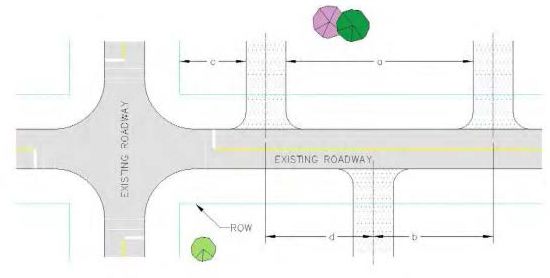
Figure 3. Commercial Driveway Spacing Requirements
i.
Spacing requirements for adjacent driveways (a). Table 3 indicates the desirable access spacing as a function of road type for adjacent commercial driveways. These distances are based on average vehicle acceleration and deceleration considered adequate to maintain good traffic operations. Driveway spacing is measured from edge of driveway to edge of driveway.
ii.
Spacing requirements from driveways on opposite side of road (b) and (d). To minimize turning conflicts, driveways should be either aligned with those directly across the road or offset a sufficient distance from those across the road to achieve the minimum spacing standards listed in Table 3. Driveway spacing is measured from centerline to centerline.
iii.
Spacing requirement from a public road intersection (c). In accordance with AASHTO guidelines, driveways shall not be situated within the functional boundary of intersections. This boundary includes the longitudinal limits of all full width auxiliary lanes. An access point may be allowed within the above boundary only if the entire property frontage is located in this boundary. A driveway shall not be constructed along acceleration or deceleration lanes and tapers, unless no other reasonable access point is available. The City may require an extension of these lanes by the Applicant. Spacing between a road intersection and an access connection shall be sufficient to avoid creating conflicts between driveway traffic movements and road traffic movements at the intersection. Table 3 provides the minimum corner separation dimensions that are measured from the edge of the proposed driveway to the near ROW Line of the intersecting road.
3.
Sight distance requirements: Acceptance of site access onto an existing public road is subject to the field review and recommendations of the City Engineer. Considerations include, but are not limited to, vehicle speed, sight distance, and topography. An area of clear vision, free from obstructions and encroachments, shall be provided. Fences, trees, shrubs, poles, signs, boulders, mailboxes, and other obstacles shall be removed or modified in this area to afford an unobstructed view in both directions of the approaching traffic.
A clear-vision area, as shown in Figure 1 and Table 2, shall be provided at all commercial driveways entering onto a road under the jurisdiction of the City. The City Engineer may request a sight distance diagram to verify safe sight distance for any proposed driveway or private road.
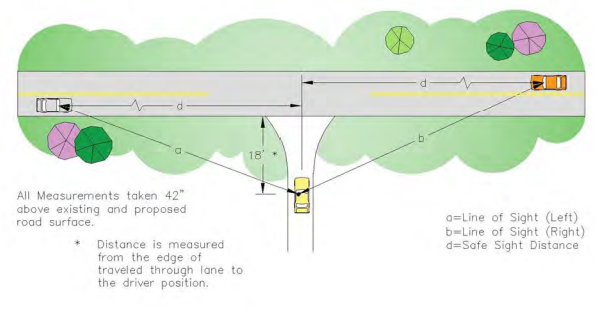
Figure 1. Recommended Minimum Sight Distance
4.
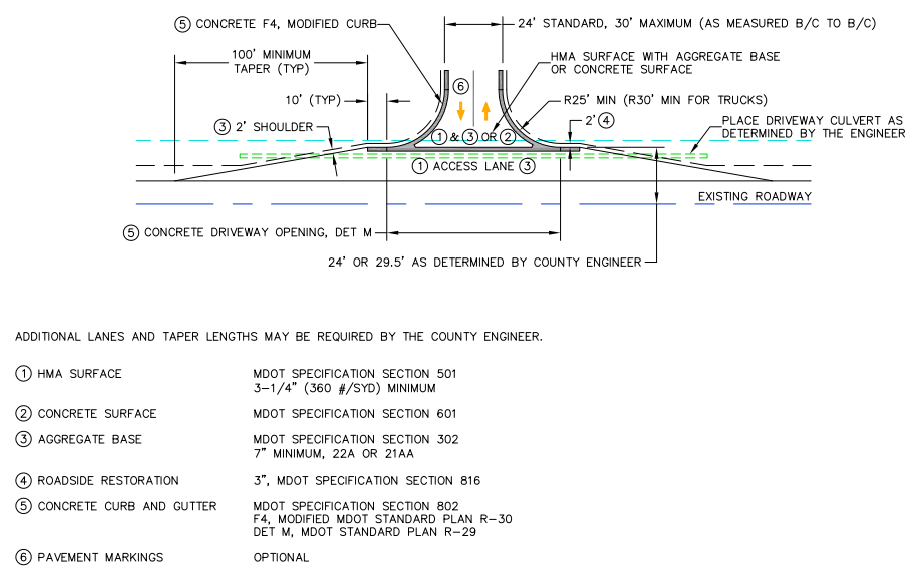
Driveway geometrics: A typical standard commercial/industrial driveway approach consists of a two-way traffic design (See Detail P-3).
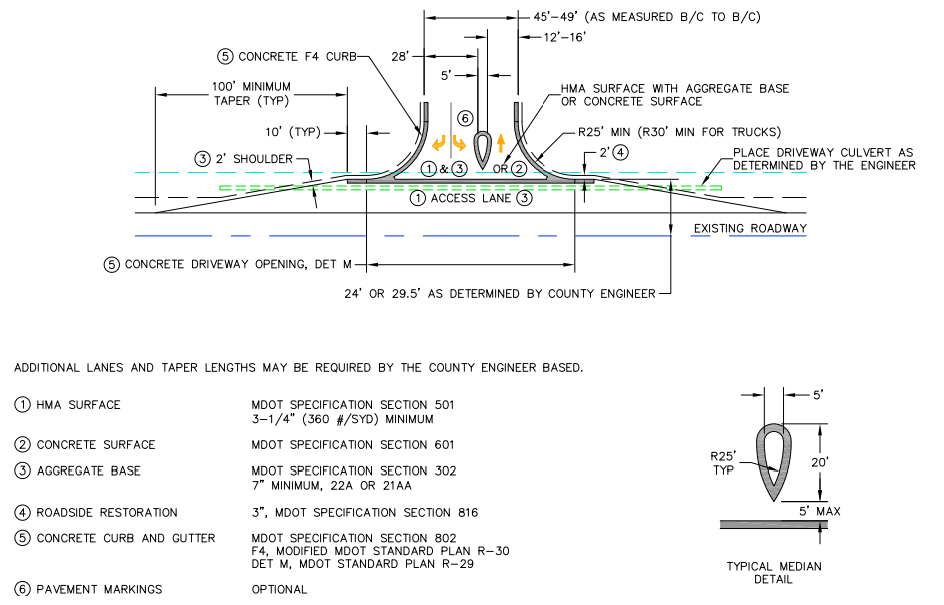
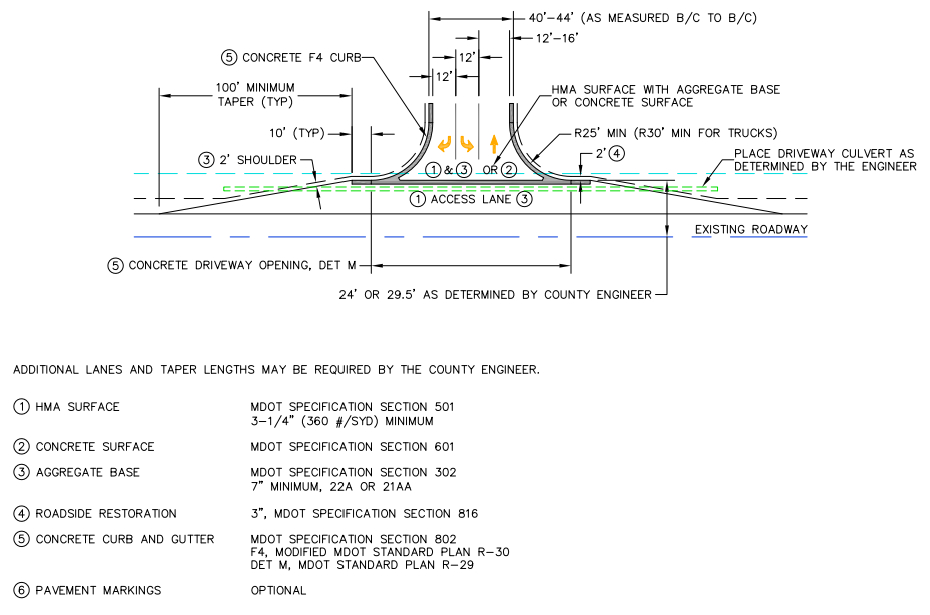
Optional commercial driveway approach designs may be either divided three lanes with a median or a typical three-lane design. A divided commercial driveway shall have a curbed island separating the entering and exiting movements with a dedicated exiting left turn lane (See Detail P-4). A typical three-lane commercial driveway shall be designed with a dedicated exiting left turn lane (See Detail P-5).
A one-way commercial driveway is a special case and may be allowed depending on the site-specific characteristics. A one-way driveway shall either be for entering or exiting and designed to facilitate the desired turning movement and to discourage prohibited movements. The installation and maintenance of directional signs shall be the responsibility of the applicant and shall be shown on the site plan.
i.
Width:
1.
The typical two-lane commercial driveway design shall include one entrance lane and one exit lane, with a maximum total throat width of thirty feet from back-of-curb to back-of-curb. (See Detail P-3).
2.
When larger driveway traffic volumes are expected, two exit lanes will be allowed.
•
The driveway shall be designed with a curbed median dividing the exit lanes from the entrance lane (see Detail P-4) or,
•
The driveway shall be designed with permanent lane lines and arrows to be placed and maintained by the permit holder (see Detail P-5).
•
Exit lane widths shall be twelve feet. Entrance lane widths will vary in design based on vehicle usage and range from twelve feet to a maximum of sixteen feet.
ii.
Radii:
1.
Driveways shall have a minimum twenty-five-foot entrance and exit radius.
2.
When truck traffic is expected, a minimum thirty-foot radius shall be used.
•
The City Engineer may request that commercial vehicle turning templates be graphically placed on the proposed driveway design to verify the appropriate radius.
iii.
Concrete curb and gutter:
Concrete curb and gutter is required for all commercial driveways.
Joint driveways:
1.
When property owners of adjoining properties agree, a joint driveway may be constructed. The driveway shall meet the same requirements regarding commercial driveways.
5.
Driveway construction standards:
Commercial driveways shall meet the following minimum subbase, aggregate base, and concrete curb and gutter requirements listed below:
i.
Subbase - MDOT Spec. 301
Material - Granular Material Class II
Gradation - MDOT Spec. Table 902-3
Thickness - Eighteen-inch minimum
ii.
Aggregate Base Course - MDOT Spec. 302
Material - Dense-graded aggregate 22A or 21AA
Gradation - MDOT Spec. 902-1, minimum twenty-five percent crushed
Thickness - Seven-inch minimum
iii.
Concrete Curb and Gutter - MDOT Spec. 802
MDOT F4-Modified (without reinforcement) or as directed by the City Engineer
Material - MDOT Grade S2
Commercial driveways shall be hard surfaced with either HMA or concrete materials, and meet the following minimum requirements as listed below:
i.
HMA surface - MDOT Spec. 501
Material - HMA mixture LVSP leveling - HMA mixture LVSP surface
Thickness - Three and one-fourth-inch (360#/syd) minimum
Asphalt cement - Performance grade 58-28
ii.
Concrete surface - MDOT Spec. 601
6.
Temporary driveway requirements: A temporary driveway may be allowed by the City Engineer for a maximum six-month period if it is to service a site for a specific function or project.
Temporary driveways and approaches shall meet the same application process and specifications as a commercial/industrial driveway and approach.
(Ord. 495. Passed 10-14-19.)
1288.10 - RESIDENTIAL DRIVEWAY STANDARDS AND REQUIREMENTS.
1.
Permit requirements: Language requiring ROW and flatwork permits.
2.
Driveway location: The location and spacing of access for residential driveways is an important element in the planning, design, and operation of roadways. Access points are the main location of crashes and congestion. Their location and spacing directly affect the safety and functional integrity of the roadway. Residential driveway location and spacing shall comply with the following diagram shown in Figure 4 and the chart shown in Table 4.
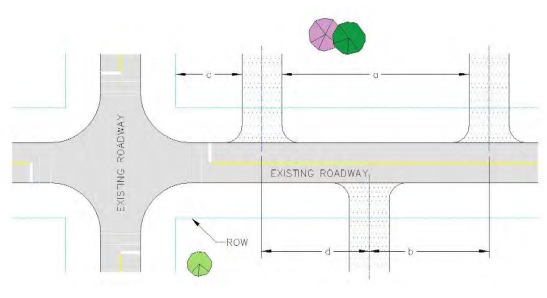
Figure 4. Residential Driveway Spacing Requirements
i.
Spacing requirements for adjacent driveways (a). Table 4 indicates the desirable access spacing as a function of road type for adjacent driveways. These distances are based on average vehicle acceleration and deceleration considered adequate to maintain good traffic operations. Driveway spacing is measured from edge of driveway to edge of driveway.
ii.
Spacing requirements from driveways on opposite side of road (b) and (d). To minimize turning conflicts, driveways should be either aligned with those directly across the road or offset a sufficient distance from those across the road to achieve the minimum spacing standards listed in Table 4. Driveway spacing is measured from centerline to centerline.
iii.
Spacing requirement from a public road intersection (c). In accordance with AASHTO guidelines, driveways shall not be situated within the functional boundary of intersections. This boundary includes the longitudinal limits of all full width auxiliary lanes. An access point may be allowed within the above boundary only if the entire property frontage is located in this boundary.
A driveway shall not be constructed along acceleration or deceleration lanes and tapers, unless no other reasonable access point is available. Spacing between a road intersection and an access connection shall be sufficient to avoid creating conflicts between driveway traffic movements and road movements at the intersection. Table 4 provides the minimum corner separation dimensions that are measured from the edge of the proposed driveway to the near ROW line of the intersecting road.
3.
Sight distance requirements: Acceptance of site access onto an existing public road is subject to the field review and recommendations of the City Engineer. Considerations include, but are not limited to vehicle speed, sight distance, and topography. An area of clear vision, free from obstructions and encroachments, shall be provided. Fences, trees, shrubs, poles, signs, boulders, mailboxes, and other obstacles shall be removed or modified in this area to afford an unobstructed view in both directions of the approaching traffic.
A clear-vision area, as shown in Figure 1 and Table 2, shall be provided at all residential driveways entering onto a road under the jurisdiction of the City. The City Engineer may request a sight distance diagram to verify safe sight distance for any proposed driveway.
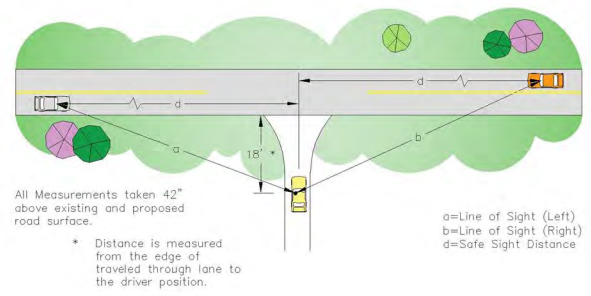
Figure 1. Recommended Minimum Site Distance
4.
Driveway geometrics: A residential driveway approach shall conform to Detail P-8.
The installation and maintenance of directional signs shall be the responsibility of the applicant and shall be shown on the site plan.
i.
Width:
1.
A residential driveway shall have a minimum width of ten feet and maximum width of twenty-four feet as measured by the driveway throat width.
ii.
Radii:
1.
A driveway may have a radius on both sides of the driveway. Each radius shall be a minimum of ten feet and a maximum of twenty feet.
iii.
Flare:
1.
A driveway may have a flare on both sides of the driveway. Each flare shall be ten feet in length and extend fivefrom the driveway along the road edge.
iv.
Joint driveways:
1.
When property owners of adjoining properties agree, a joint driveway may be constructed. The driveway shall meet the same requirements regarding residential driveways.
5.
Driveway construction standards: If the adjacent roadway has a bituminous valley curb or concrete curb and gutter, the residential driveway approach shall be hard surfaced with either HMA or concrete materials. A gravel surface will not be permitted. If the adjacent roadway does NOT have a bituminous valley curb or concrete curb and gutter, the residential driveway approach can be hard surfaced with HMA only. A concrete surface will not be permitted. Recommended Minimum Residential Driveway Construction:
i.
Subbase - MDOT Granular material Class II, twelve inches minimum.
ii.
Aggregate Base - MDOT Dense-graded aggregate 22A, six inches minimum.
iii.
HMA Surface - MDOT HMA 36A, three inches (two lifts) minimum.
iv.
Concrete surface - Minimum five inches.
*Not permitted on adjacent roadways that have no concrete curb or HMA valley curb
6.
Temporary driveway requirements: A temporary driveway may be allowed by the City Engineer for a maximum six-month period if it is to service a site for a specific function or project.
Temporary driveways and approaches shall meet the same application process and specifications as a residential driveway and approach.
TYPICAL COMMERCIAL DRIVEWAY APPROACH
OPTIONAL DIVIDED COMMERCIAL DRIVEWAY APPROACH
TYPICAL THREE-LANE COMMERCIAL DRIVEWAY APPROACH
(Ord. 495. Passed 10-14-19; Ord. 516. Passed 6-13-22.)

