
Coopersville City Zoning Code
CHAPTER 1240
General Provisions and Definitions
_____
1240.01 - SHORT TITLE.
This Title Four of Part Twelve-the Planning and Zoning Code shall be known, referred to and cited as the "City of Coopersville Zoning Ordinance" or just "Zoning Code."
(Ord. 195. Passed 4-9-90.)
1240.02 - PURPOSE.
This Zoning Code shall affect the use and occupancy of all land and every building in the City. This Code has been made in accordance with a land use plan and is designed to lessen congestion in the streets, to secure safety from fire, panic and other dangers, to promote health and the general welfare, to provide adequate light and air, to prevent the overcrowding of land, to avoid undue concentration of population and to facilitate the adequate provision of transportation, water, sewers, schools, parks and other public requirements. These regulations have been made with reasonable consideration, among other things, to the character of the district and its peculiar suitability for particular uses, with a view to conserving property values, encouraging the most appropriate use of land and to be in keeping with the general trend and character of population and building development.
(Ord. 195. Passed 4-9-90.)
1240.03 - SCOPE AND INTERPRETATION.
It is not intended by this Zoning Code to repeal, abrogate, annul or in any way impair or interfere with existing provisions of other laws or ordinances, except those specifically repealed by this Code, or of any private restrictions placed upon property by covenant, deed or other private agreement. Where this Code imposes a greater restriction upon the use of buildings or premises or upon the height of buildings or lot coverage, or requires greater lot areas or larger yards, courts or other open spaces than are imposed or required by such existing provisions of law or ordinance or by such rules, regulations or permits or by such private restrictions, the provisions of this Code shall control.
(Ord. 195. Passed 4-9-90.)
1240.04 - RULES OF CONSTRUCTION.
For the purposes of this Zoning Code, certain terms or words used herein shall be interpreted as follows:
(a)
The word "person" includes a firm, association, organization, partnership, trust, company or corporation as well as an individual.
(b)
Words used in the present tense include the future tense.
(c)
The singular includes the plural.
(d)
The word "lot" includes the words "plot" or "parcel."
(e)
The word "shall" is mandatory.
(f)
The word "may" is permissive.
(g)
The word "used" or "occupied" includes the words "intended, designed or arranged to be used or occupied."
(Ord. 195. Passed 4-9-90.)
1240.05 - DEFINITIONS.
As used in this Zoning Code:
(1)
Access Drive. "Access drive" means a drive providing access to a land use or structure from a public right-of-way.
(2)
Accessory Use or Structure. "Accessory use or structure" means a use or structure on the same lot with, and of a nature customarily incidental and subordinate to, the principal use or structure.
(3)
Alterations, Structural. "Structural alterations" mean any change in the supporting members of a building, such as bearing walls, columns, beams or girders, or any substantial change in the roof.
(4)
Auction Facility. "Auction Facility" is a use which new or used furniture, electronic equipment, appliances or similar items, are sold at auction, whether live or on-line. An auction facility does not include a yard or estate-type sale and similar short-term, temporary uses limited to the sale of household items from the premises where the sale occurs, and does not include an auto auction facility. Items to be auctioned at an auction facility may be stored on site only until purchased.
(Ord. 465. Passed 5-11-15.)
(5)
Automobile Auction Facility. An "Automobile Auction Facility" is a facility where motor vehicles are offered for sale to person who competitively bid on the vehicles being offered for sale.
(Ord. 465. Passed 5-11-15.)
(6)
Automobile Repair, Major. "Major automobile repair" means general repair, rebuilding or reconditioning of engines, motor vehicles or trailers, collision service, including body repair and frame straightening, painting and upholstering, vehicle steam cleaning and undercoating.
(7)
Automobile Repair, Minor. "Minor automobile repair" means minor repairs, incidental replacement of parts and motor service to passenger automobiles and trucks not exceeding two tons capacity, but not including any operation specified under subsection (6) hereof.
(8)
Billboard, Advertising Device or Structure. "Billboard, advertising device or structure" means any structure or portion thereof, including the wall of any building, on which lettered, figured or pictorial matter is displayed and which directs attention to a business, commodity, service or entertainment not necessarily related to uses permitted on the premises upon which the structure is located.
(9)
Building. "Building" means any enclosed structure having a roof supported by columns, walls or other support used for the purpose of housing or storing of persons, animals or chattels or carrying on business activities or other similar uses.
(10)
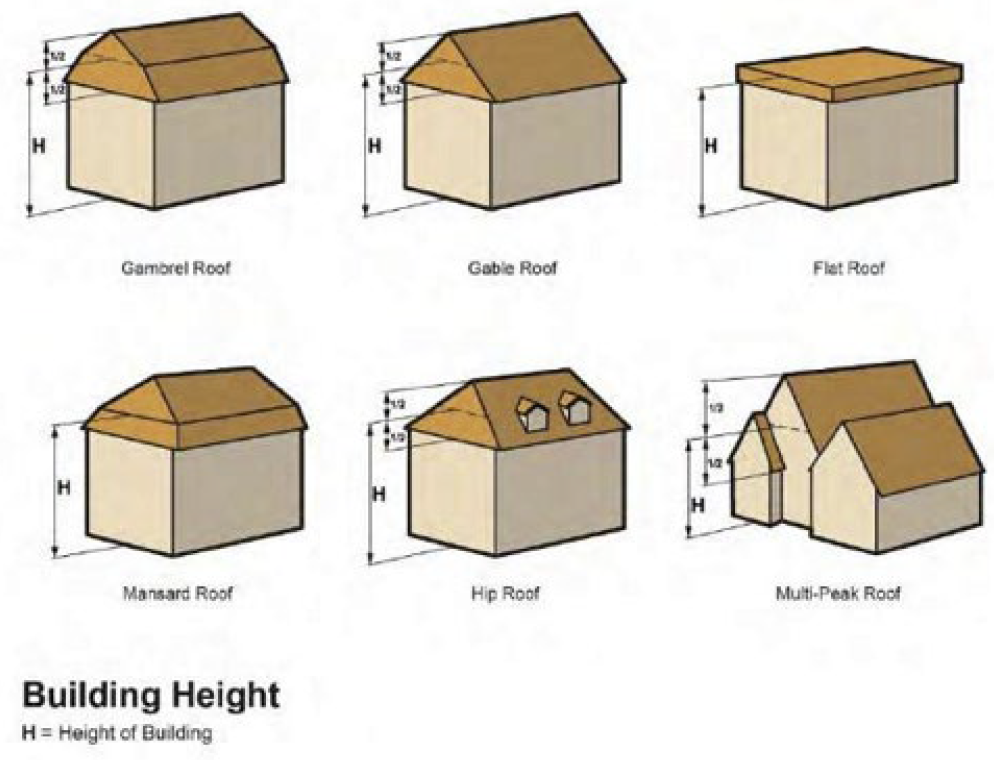
Building Height. "Building height" means a vertical distance measured from the grade plane to the highest point of the roof surface for flat roofs; to the deck line for mansard roofs, and to the average height level between the eaves and ridge for gable, hip, and gambrel roofs.
(11)
Building Line. "Building line" means a horizontal line generally parallel to a front, rear or side lot line which is located at the point of the foundation of a principal building nearest to the front, rear or side lot line.
(12)
Clinic, Dental or Medical. "Dental or medical clinic" means a building in which a group of physicians, dentists, or physicians and dentists or related medical professionals and their allied professional assistants are associated for the purpose of practicing their profession. The clinic may include a medical or dental laboratory. It shall not include inpatient care or operating rooms for major surgery.
(13)
Domestic Animal. "Domestic animal" means any animal which commonly lives with man so as to live and breed in a tame condition.
(14)
Dwelling. "Dwelling" means any building or portion thereof which is occupied in whole or in part as a home, residence or sleeping place, either permanently or temporarily by one or more families.
A.
Dwelling, single-family. "Single-family dwelling" means a detached residential building containing one dwelling unit. A single-family dwelling shall comply with the design standards set forth in Chapter 1280.
B.
Dwelling, two-family. "Two-family dwelling" means a detached residential building containing two dwelling units. A two-family dwelling shall comply with the design standards set forth in Chapter 1280. A two-family dwelling may also be referred to as a "duplex."
C.
Dwelling, multiple-family. "Multiple-family dwelling" means a residential building containing three or more dwelling units. A multiple-family dwelling shall comply with the design standards set forth in Chapter 1280.
D.
Dwelling, mobile home. "Mobile home dwelling" means a manufactured detached residential building, transportable in one or more sections, which is built on a chassis and designed to be used with or without a permanent foundation. A mobile home dwelling may also be referred to as a "manufactured home." This definition does not include modular homes or trailer coaches, wheels, or on a flatbed or other trailer, arriving at the site where it is to be occupied as a dwelling complete and ready for occupancy except for minor and incidental unpacking and assembly operations, location on jacks or other temporary or permanent foundations, connections to utilities and the like. "Mobile home dwelling" does not include travel trailers. No mobile home which does not conform to paragraph (11)A. hereof shall be used for dwelling purposes in the City unless it is located in a mobile home park or a mobile home plat zoned for such use or used for temporary residence purposes as provided in this Zoning Code.
(15)
Dwelling Unit. "Dwelling unit" means one room or a suite of two or more room designed for use or occupancy by one family containing housekeeping facilities.
(16)
Fabrication. "Fabrication" means the stamping, cutting or otherwise shaping of processed materials into useful objects.
(17)
Family. "Family" means a single individual or a number of individuals domiciled together whose relationship is of a continuing nontransient, domestic character and who are cooking and living together as a single, nonprofit housekeeping unit. This shall not include any society, club, fraternity, sorority, association, lodge, coterie, organization or group of students or other individuals whose relationship is of a transitory or seasonal nature or for anticipated limited duration of school terms or other similar determinable periods.
(18)
Farm. "Farm" means a parcel of land which carries on the customary farm operations.
(Ord. 195. Passed 4-9-90.)
(19)
Farm Animals. "Farm animals" means animals that are hoofed and animals that do not commonly live with man so as to live and breed in a tame condition.
(Ord. 216. Passed 10-26-92.)
(20)
Fences. "Fences" means, either for residential, commercial or industrial purposes, metal, wood or masonry structures, or hedges, clumps of shrubs or vegetation, that are placed along a property line for the purpose of defining such property line and/or restricting access to an owner's property.
(Ord. 213. Passed 9-28-92.)
(21)
Floor Area. "Floor area" means the gross floor area of all floors of a building or an addition to an existing building. For all office buildings and for any other building where the principal use thereof includes the basement, the basement floor area shall be included, except that part which contains heating and cooling equipment and other basic utilities.
(22)
General Office. "General office" means a place where a particular kind of business is housed (including retail business) or service supplied, or the directing headquarters of an enterprise or organization. Professional offices, banks and drive-in banks are considered a part of this definition.
(23)
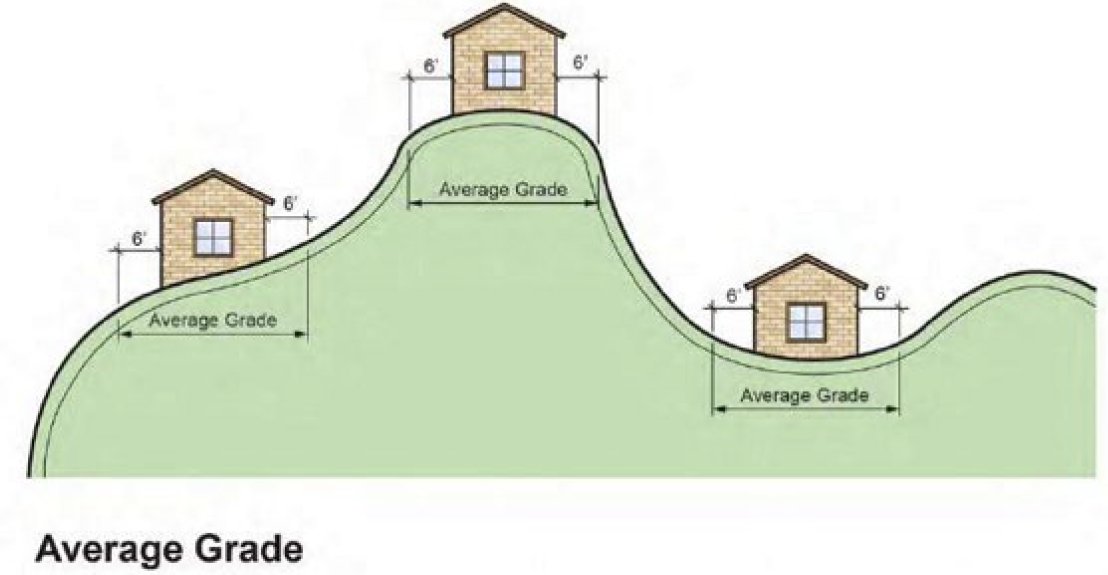
Grade Plane (Average Grade). A reference plane representing the average of finished ground level adjoining the building at exterior walls. Where the finished ground level slopes away from the exterior walls, the reference plane shall be established by the lowest points within the area between the building and the lot line or, where the lot line is more than six feet from the building, between the building and a point six feet from the building.
(24)
Home Occupation. "Home occupation" means a gainful occupation carried on in a dwelling unit as clearly incidental and secondary to the use of the dwelling unit as a dwelling.
(25)
Housekeeping Facilities. "Housekeeping facilities" means independent living facilities for one family only, including permanent provisions for living, sleeping, eating, cooking, electric power and sanitation.
(26)
Junkyard. "Junkyard" means a place where junk, waste, discarded or salvaged materials are bought, sold, exchanged, stored, baled, packed, disassembled or handled, including wrecked motor vehicles, used building materials, structural steel materials and equipment and other manufactured goods that are worn, deteriorated or obsolete.
(27)
Kennel. "Kennel" means the land and/or structure where five or more cats or dogs are boarded, housed or bred for profit.
(28)
Lot. "Lot" means a piece or parcel of land occupied or intended to be occupied by a principal building or a group of such buildings and accessory buildings, or utilized for a principal use and uses accessory thereto, together with such open spaces as required by this Zoning Code and having frontage on a public street.
(29)
Lot Line. "Lot line" means a line bounding a lot or parcel which separates the lot or parcel from another lot or parcel, an existing street right-of-way, an approved private road easement, or an ordinary high water mark.
(30)
Lot Line, Front. "Front lot line" means the lot line which separates the lot from the existing street right-of-way or approved private road easement that provides access to the lot.
(31)
Lot Line, Rear. "Rear lot line" means the lot line opposite and most distant from the front lot line. In the case of a triangular or otherwise irregularly shaped lot or parcel, it means an imaginary line ten feet in length entirely within the lot or parcel, parallel to and at a maximum distance from the front lot line.
(32)
Lot Line, Side. "Side lot line" means any lot line other than a front or rear lot line.
(33)
Medical Marihuana Dispensary. Any for-profit or not-for-profit business, facility, association, entity, use, cooperative, location, or operation, whether fixed or mobile, permanent or temporary, where medical marihuana (also commonly known as marijuana or cannabis) is made available to, sold, used, grown, processed, delivered, or distributed by anyone including one or more of the following:
1.
A primary caregiver (i.e., a person who is at least twenty-one years old and who has agreed to assist with a patient's medical use of marihuana and who has never been convicted of a felony involving illegal drugs, as provided for in Initiated Law No. 1 of the Public Acts of 2008, as amended).
2.
A qualifying patient (i.e., a person who has been diagnosed by a physician as having a debilitating medical condition, as provided for in Initiated Law No. 1 of the Public Acts of 2008, as amended).
3.
Members of the public.
Medical marihuana dispensary shall also include any place, location, facility, or operation, whether fixed or mobile, where medical marihuana is smoked or consumed by three or more persons at one time.
Medical marihuana dispensary shall not include the dispensation of medical marihuana by a primary caregiver personally dispensing to not more than five qualified patients in accordance with Michigan Initiated Law 1 of 2008, as amended, so long as the lawful amount of medical marihuana is delivered to the qualifying patient where the qualifying patient resides and it is done in full compliance with this chapter as well as all other applicable City ordinances and applicable laws, rules and regulations.
(Ord. 450. Passed 7-22-13.)
(34)
Mobile Home Park. "Mobile home park" means a lot, parcel or tract of land used as the site of occupied mobile homes, including any structure, vehicle or enclosure used as part of the equipment of such mobile home park and licensed or licensable under Act 96 of the Public Acts of 1987, as amended.
(35)
Modular Home. "Modular home" means a dwelling which consists of pre-fabricated units transported to the site on a removable undercarriage or flatbed and assembled for permanent location on the lot.
(36)
Motel. "Motel" means a building or group of buildings on the same lot, whether detached or in connected rows, containing sleeping or dwelling units, which may or may not be independently accessible from the outside, with garage or parking space located on the lot and designed for or occupied by automobile travelers. The term includes any buildings or building groups designated as motor lodges, motor inns or by any other title intended to identify them as providing lodging, with or without meals, for compensation.
(37)
Parking Area, Space or Lot. "Parking area, space or lot" means an off-street open area, the principal use of which is for the parking of automobiles, whether for compensation or not, or as an accommodation to clients, customers, visitors or employees. Parking area includes access drives within the actual parking area.
(38)
Planning Director. "Planning Director" means the person designated by Council to administer the provisions of this Zoning Code. He or she may be the City Manager, the Building Inspector or any other officer of the City so designated by Council.
(39)
Pool, Private Swimming. "Private swimming pool" means any artificially constructed basin or other structure for the holding of 500 or more gallons of water for the use by the owner, his family or guests for aquatic sports or recreation.
(40)
Principal Building. "Principal building" means the building occupied by the main use or activity on or intended for the premises, all parts of which building are connected in a substantial manner by common walls and a continuous roof.
(41)
Processing. "Processing" means any operation changing the nature of material, such as its chemical composition or physical qualities. It does not include operations described as fabrication.
(42)
Professional Office. "Professional office" means the office of a member of a recognized profession maintained for the conduct of his or her profession. Such professions shall be limited to medicine, dentistry, law, architecture, engineering, real estate, insurance and other professions which require a similar degree of training and experience. Offices which conduct retail business, provide drive-in service such as banks and savings and loans are not considered professional offices under this definition.
(43)
Public Utility. Except for wireless communication facilities, any person, firm, corporation, municipal department or board duly authorized to furnish and furnishing under state or municipal regulations to the public electricity, gas, steam, communications, telephonic, transportation or water.
(Ord. 317. Passed 2-22-99.)
(44)
Roadside Market Stand. "Roadside market stand" means a temporary structure designed or used for the display and/or sale of agricultural products produced on the premises upon which the stand is located.
(45)
Self-Service Storage Facility, Interior Access. "Self-service storage facility, interior access" means a building or buildings consisting of individual, self-contained units which may be leased or rented for the storage of personal property which allows access to each individual unit via interior doors and is temperature controlled.
(46)
Self-Storage Storage Facility, Exterior Access. "Self-service storage facility, exterior access" means ab building or buildings consisting of individual, self-contained units which may be leased or rented for the storage of personal property which allows access to each individual unit via exterior doors whether or not temperature controlled.
(47)
Setback, Required. "Required setback" means the required minimum horizontal distance between a front, rear, or side lot line and a building line.
(48)
Special Land Use. "Special land use" means a listed use so identified for individual zoning districts which is only permitted in certain locations within the zoning district if it meets established standards as set forth for each use or zoning district. The Planning Commission shall determine if the special land use meets the special land use standards for the particular special land use or zoning district.
(49)
Structure. "Structure" means anything constructed or erected, the use of which requires permanent location on the ground, or attachment to something having a permanent location on the ground.
(50)
Tourist Home. "Tourist home" means a building or part thereof, other than a hotel, boarding house, lodging house or motel, where lodging is provided to transients for compensation, by a resident family in its dwelling. Such transient lodging is subordinate in both use and appearance to use of the dwelling as a dwelling unit. Bed-and-breakfast establishments shall be considered tourist homes.
(51)
Trailer Coach. "Trailer coach" means any movable dwelling or mobile dwelling except a mobile home. Included as trailer coaches are travel trailers, campers, house cars and similar recreation-type equipment used for temporary or recreation dwelling.
(52)
Trailer Coach Park. "Trailer coach park" means an area or premises on which available space is rented, held for rent, or on which free occupancy or camping is permitted for trailer coach owners or users on a temporary basis according to the provisions of Section 5.90 of Act No. 243 of the Public Acts of 1959, as amended.
(53)
Variance, Non-Use. "Non-use variance" means a relaxation or modification of this Zoning Code granted by the Board of Zoning Appeals when strict enforcement of a dimensional requirement contained in this Zoning Code would result in undue hardship owing to circumstances unique to the individual property. A non-use variance typically involves setbacks, height limitations, bulk, lot area, parking spaces and other numerical standards contained in this Zoning Code. A non-use variance may also be referred to as a "dimensional variance."
(54)
Variance, Use. "Use variance" means a relaxation or modification of this Zoning Code granted by the Board of Zoning Appeals which gives permission to use property for a use not otherwise permitted in the zoning district in which the property is located.
(55)
Wireless Communication Facilities:
A.
Wireless Communications Facilities shall mean and include all structures and accessory facilities relating to the use of the radio frequency spectrum for the purpose of transmitting or receiving radio signals. This may include, but shall not be limited to, radio towers, television towers, telephone devices and exchanges, microwave relay facilities, telephone transmission equipment building and commercial mobile radio service facilities.
B.
Attached Wireless Communications Facilities shall mean wireless communication facilities that are affixed to existing structures, such as existing buildings, towers, water tanks, utility poles, and the like. A wireless communication support structure proposed to be newly established shall not be included within this definition.
C.
Wireless Communication Support Structures shall mean structures erected or modified to support wireless communication antennas. Support structures within this definition include, but shall not be limited to, monopoles, lattice towers, light poles, wood poles and guyed towers, or other structures which appear to be something other than a mere support structure.
D.
Wireless Communication Facility Collocation shall mean the location by two or more wireless communication providers of wireless communication facilities on a common structure, tower, or building, with the view toward reducing the overall number of structures required to support wireless communication antennas within the community.
(Ord. 317. Passed 2-22-99)
(56)
Yard, Required. "Required yard" means a required open space on the same lot with a principal building, unoccupied and unobstructed by any building or structure or portion thereof from the ground upward, except as otherwise provided in this Zoning Code.
(57)
Yard, Required Front. "Required front yard" means a required yard extending the full width of the lot, the depth of which is the required setback between the front lot line and the building line.
(58)
Yard, Required Rear. "Required rear yard" means a required yard extending the full width of the lot, the depth of which is the required setback between the rear lot line and the building line.
(59)
Yard, Required Side. "Required side yard" means a required yard extending the full width of the lot, the depth of which is the required setback between the side lot line and the building line.
(60)
Zoning Permit. "Zoning permit" means a written statement issued by the Planning Director authorizing buildings, structures or uses consistent with the requirements of the district in which they may be located.
(Ord. 195. Passed 4-9-90; Ord. 465. Passed 5-11-15; Ord. 525. Passed 8-14-23; Ord. 532. Passed 12-11-23.)
1240.06 - SEPARABILITY CLAUSE.
Should any article, section, subsection, paragraph, sentence or phrase of this Zoning Code be declared by a court of competent jurisdiction to be invalid, such decision shall not affect the validity of the Zoning Code as a whole or any part thereof other than the part so declared to be invalid.
(Ord. 195. Passed 4-9-90.)

