
Coopersville City Zoning Code
CHAPTER 1285
Landscaping Standards
_____
1285.01 - INTENT.
(a)
The intent of this chapter is to promote the public health, safety and welfare by establishing minimum standards for the design, installation and maintenance of landscaping in parking lots, as buffer zones between uses, along roadways and adjacent to buildings. Landscaping is viewed as a critical element contributing to the aesthetics, development, quality, stability of property values and the overall character of the City. The standards of this chapter shall apply to all projects subject to site plan review.
(b)
The standards of this chapter are intended to help achieve a number of aesthetic, functional and environmental objectives, such as to:
(1)
Promote implementation of the City's Comprehensive Plan and Vision Study;
(2)
Provide incentives to preserve quality mature trees rather than planting new but smaller trees;
(3)
Screen headlights to reduce glare and accident potential;
(4)
Integrate various elements of a site;
(5)
Blend inharmonious land uses;
(6)
Screen or filter views between incompatible land uses;
(7)
Help define and separate or unify, as appropriate, various site elements;
(8)
Control soil erosion by slowing the effects of erosive winds or water;
(9)
Moderate harsh or unpleasant sounds;
(10)
Remove air pollutants;
(11)
Control glare and reflection;
(12)
Slow the effects of erosion and stormwater runoff to help prevent flooding;
(13)
Assist in directing safe and efficient traffic flow at driveways and within parking lots;
(14)
Ensure adequate sight distance;
(15)
Ensure sufficient access to fire hydrants;
(16)
Distinguish and separate vehicular and pedestrian circulation;
(17)
Block, divert or channel winds;
(18)
Moderate the effects of climate and to create a more desirable microclimate; and
(19)
Provide reasonable standards to gradually bring into compliance developed sites which existed prior to the adoption of these standards in relation to the extent of improvements, expansion or changes in use.
(c)
The landscape standards of this chapter are considered the minimum necessary to achieve the objectives noted above. In several instances, the standards are intentionally flexible to encourage flexibility and creative design. Applicants are encouraged to provide additional landscaping to improve the function, appearance and value of their property.
(Ord. 266. Passed 6-10-96.)
1285.02 - TYPES OF LANDSCAPING STANDARDS.
This chapter provides minimum standards for four elements of a site:
(a)
Greenbelts. Minimal greenbelts along and within public street rights-of-way and within required parking lot setbacks in all multiple-family, office, commercial and industrial districts.
(b)
Buffer Zones. Required landscaping, walls and screening between various zoning districts.
(c)
Parking Lot Trees. The minimum number of trees within parking lots of various sizes in various zoning districts.
(d)
General Site Landscaping. Standards for placement of landscaping within cul-de-sacs and boulevard medians and to accent buildings.
(Ord. 266. Passed 6-10-96.)
1285.03 - REQUIRED GREENBELTS ALONG AND WITHIN STREET RIGHTS-OF-WAY.
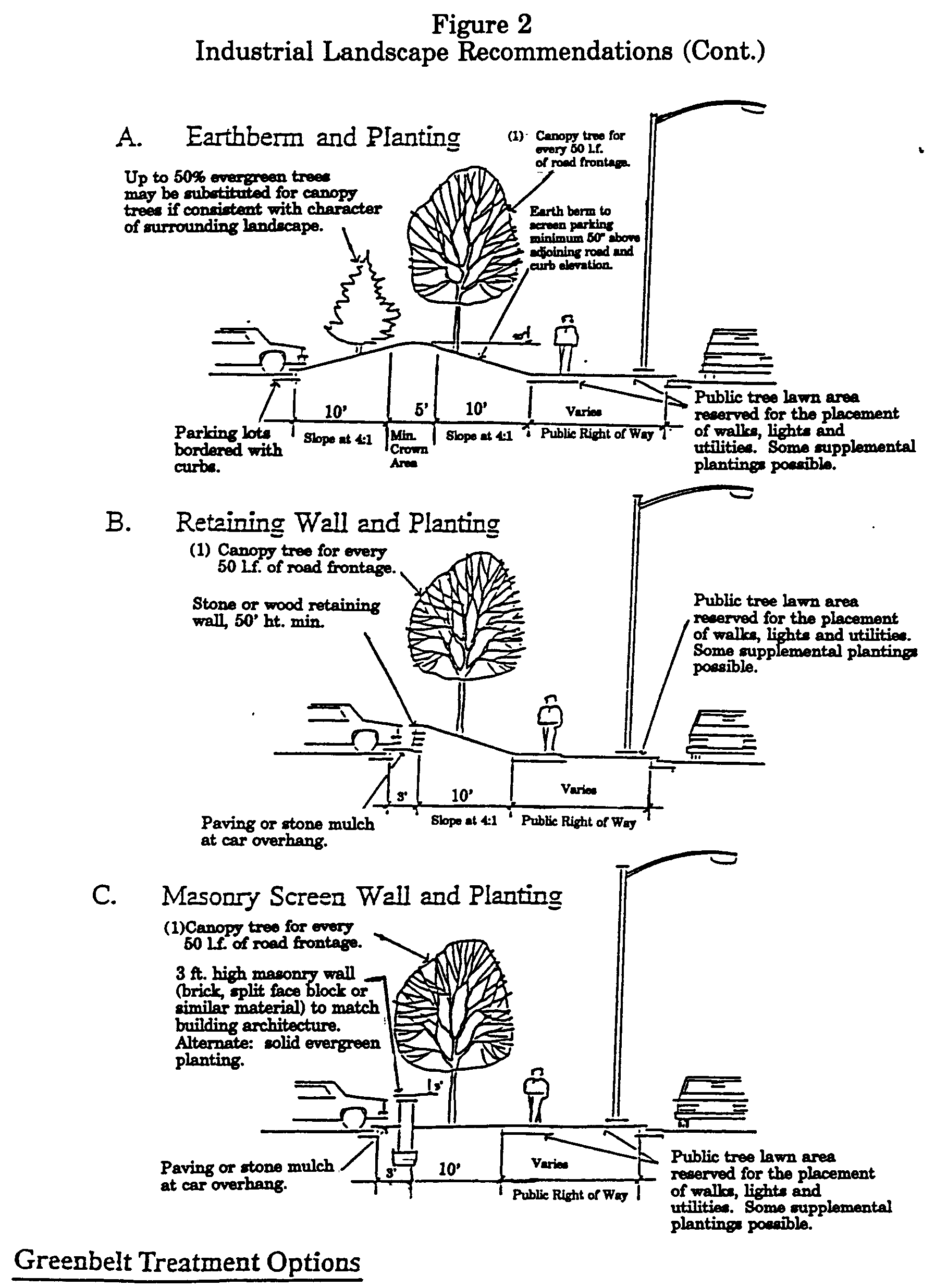
A greenbelt shall be planted along the right-of-way of any public street. The greenbelt shall be within the required parking lot setback; however, but the Planning Commission may allow such planting to be placed anywhere within the front yard if there is no front yard parking. The greenbelt shall meet the following standards. (See also Figure 2 following the text of this chapter):
(a)
The greenbelt shall include only living materials and planting beds, except for approved sidewalks, bikepaths, signs, driveways and essential services.
(b)
The greenbelt shall include one canopy tree per forty linear feet of the frontage, including any openings for driveways, sidewalks or easements. The number of trees required shall be rounded upward in twenty-foot increments (e.g. fifty feet of frontage equals two required trees).
(c)
The Planning Commission may approve the substitution of evergreen trees for up to fifty percent of the required greenbelt trees upon determining evergreens would be consistent with the existing character of the area.
(d)
Greenbelt trees should be arranged to simulate a natural setting such as massings or staggered rows, except where a more formal arrangement is determined to be more consistent with the character of an area.
(e)
Landscaping materials and arrangements shall ensure adequate sight visibility for motorists, adequate clearance for pedestrians and vehicles and accessibility to fire hydrants.
(f)
If there is parking in the front yard, the Planning Commission may require an undulating berm or other solid screen a minimum of two feet, six inches in height, within the greenbelt to help screen the parking lot. The berm shall be designed according to the standards of Section 1285.04(c). Commercial signs shall not be placed on top of the berm unless the berm is continuous along the frontage greenbelt.
(Ord. 266. Passed 6-10-96.)
1285.04 - MINIMUM BUFFER ZONES.
(a)
General Requirements: A buffer zone shall be provided within the setback between the subject site and all adjacent properties according to the table below. The Planning Commission shall determine whether landscaping, a wall or a berm or a combination thereof is needed to attain the screening intended by this section. The height of the wall or berm shall be measured from the surface of the parking area or land on the nonresidential side of the wall. All walls shall meet the standards described in subsection (b) hereof.
A = Two evergreens and four shrubs, or one canopy tree, one evergreen tree and four shrubs, per each twenty linear feet along the property line, rounded upward.
B = One canopy tree and four shrubs, or one evergreen tree and four shrubs, per twenty linear feet along the property line, rounded upward.
(Ord. 290. Passed 1-13-97.)
(b)
Wall Standards. Required walls shall comply with the standards listed below.
(1)
Walls shall be located on the lot line, except where underground utilities interfere and/or where this chapter requires conformance with yard setback lines.
(2)
Walls shall have no openings for vehicular traffic or other purposes, except as otherwise provided in this chapter, unless specifically approved by the Planning Commission.
(3)
Walls shall be constructed of face brick or comparable nonporous facing materials on the exterior sides facing a Residential District.
(4)
Walls shall be durable, weather resistant, rustproof and easily maintainable. Wood or wood products shall be high quality durable materials as approved by the Building Official and the Planning Director. Masonry walls may be constructed with openings which do not, in any square section (height and width), exceed twenty percent of the surface. Where walls are so pierced, the openings shall be so spaced as to maintain the obscuring character required and shall not reduce the minimum height requirement.
(5)
Walls must be maintained in good condition by the property owner.
(c)
Berm Standards. Required berms shall be constructed as landscaped earth mounds with a crest area at least four feet in width. The exterior face of the berm shall be constructed as an earthen slope. The interior face of the berm may be constructed as an earthen slope or retained by means of a wall, terrace or other means acceptable to the Building Official and the Planning Director. Whenever an earthen slope is provided, it shall be constructed with a slope not to exceed one foot of vertical rise to three feet of horizontal distance (1:3); however, the ratio shall be one foot of vertical rise to six feet of horizontal distance (1:6) for any side facing a Single-Family Residential District.
Berm slopes shall be protected from erosion by sodding or seeding. If slopes are seeded, they shall be protected, until the seed germinates and a permanent lawn is established, by a straw mulch, hydroseeding or netting specifically designed to control erosion. The berm area shall be kept free from refuse and debris and shall be planted with shrubs, trees or lawn and shall be maintained in a healthy, growing condition.
(Ord. 266. Passed 6-10-96.)
1285.05 - RESERVED.
Editor's note— Ord. 484, passed Feb. 11, 2019, repealed § 1285.05, which pertained to Minimum Parking Lot Trees and Parking Lot Islands; and derived from Ord. 290, passed Jan. 13, 1997.
1285.06 - GENERAL SITE LANDSCAPING STANDARDS.
(a)
Cul-de-sacs, site entrances and boulevard medians shall be landscaped with species that are tolerant of roadside conditions in western Michigan.
(b)
Landscaping within the site shall be approved by the Planning Commission in consideration of sight distances, the size of the planting area, the location of sidewalks, maintenance of adequate overhead clearance, accessibility to fire hydrants, visibility to approved signs of adjacent uses, compatibility with the visual character of the surrounding area, any maintenance-performance guarantee and curbing around landscaped areas.
(c)
Plantings within fifteen feet of a fire hydrant shall be no taller than six inches at maturity.
(Ord. 266. Passed 6-10-96.)
1285.07 - SPECIFICATIONS FOR PLANT MATERIALS.
All plant material shall be hardy to western Michigan, be free of disease and insects and conform to the American Standard for Nursery Stock of the American Association of Nurserymen. In addition:
(a)
Minimum Sizes. Minimum plant sizes at the time of installation shall be as follows:
(b)
Plant Material Spacing. Planting in informal groupings to create a naturalistic appearance is desirable, to relate to the City's semi-rural visual character and the goals of the Comprehensive Plan. Plant materials shall not be placed closer than four feet from the fence line or property line. Plant materials, used together in informal groupings, shall meet the following on-center spacing requirements:
(c)
Mixing of Species. The overall landscape plan shall not contain more than thirty-three percent of any one plant species. The use of trees native to the area and western Michigan and a mixture of trees from the same species association are encouraged. A botanical genus containing trees native to western Michigan is identified with an asterisk (*) in the list following of suggested (but not required) plant materials:
(d)
Trees Not Permitted. The following trees are not permitted, as they split easily, their wood is brittle and breaks easily, their roots clog drains and sewers, and they are unusually susceptible to disease or insect pests. The Planning Commission, however, may allow trees from this list to be used when associated with an appropriate ecosystem, such as a wetland area.
(Ord. 266. Passed 6-10-96.)
1285.08 - INCENTIVES TO PRESERVE EXISTING TREES.
The standards below are intended to encourage the preservation of quality and mature trees by providing credits toward the required trees for greenbelts and buffer zones and within parking lots.
(a)
Trees intended to be preserved shall be indicated with a special symbol on the site plan and be protected during construction through use of a fence around the drip line.
(b)
All trees over eight inches caliper shall be identified on the site plan, distinguishing those to be preserved and those to be removed.
(c)
To obtain credit, the preserved trees shall be of a high quality and at least two and one half inches caliper. Trees to be preserved shall be counted for credit only if they are located on the developed portion of the site as determined by the Planning Commission.
(d)
The credit for preserved trees shall be as follows:
*Caliper is the diameter measured at a height of four and one-half feet above the natural grade (diameter at breast height, D.B.H.).
(e)
To protect and encourage the continued health of preserved trees, the ground area within the dripline of the trees shall be maintained in vegetative landscape material or previous surface cover. The City may allow sidewalks, bikepaths, vehicular lanes and parking within the dripline upon determining that the setback from the trunk is suitable to reasonably ensure protection of the trees and the public. Storage of soils or other materials during or after construction within the dripline is prohibited.
(f)
If trees are lost within two years after construction the property owner shall replace with trees required before credit was allowed.
(g)
In no case shall the minimum number of required trees be reduced by less than fifty percent through the use of existing tree credits.
(Ord. 266. Passed 6-10-96.)
1285.09 - WAIVER OR MODIFICATION OF STANDARDS FOR SPECIAL CONDITIONS.
The Planning Commission, during site plan review, may determine whether existing landscaping or screening intended to be preserved would provide adequate landscaping and screening. The Planning Commission may also determine that dimensional conditions unique to the parcel would prevent development of required buffer zones, off-street parking area landscaping, greenbelts or required buffer zones. If such determination is made, the Planning Commission may waive or modify the landscaping provisions of this chapter in consideration of, but not limited to, the following:
(a)
Types of and distance to adjacent land uses;
(b)
Future land use designation in the Comprehensive Plan;
(c)
If existing natural vegetation is adequate year-round to provide intended screening;
(d)
If there is an abrupt grade change which precludes the need for buffering;
(e)
If there is an existing wetland or floodplain which will be preserved and provides effective screening;
(f)
If the building placement lessens the need for buffering;
(g)
If building heights and views lessen the need for landscaping;
(h)
If required landscaping would infringe on adequate sight distances for motorists;
(i)
If the applicant proposes fewer plant materials than required, but the overall caliper proposed is greater than required (i.e. fewer, but larger, trees);
(j)
If required landscaping would impose a greater drainage impact on adjacent lands than an alternative design proposed by the applicant.
(Ord. 266. Passed 6-10-96.)
1285.10 - MINIMUM STANDARDS FOR INSTALLATION, IRRIGATION AND MAINTENANCE.
(a)
Time of Planting. Parking lot trees, required greenbelts or plantings shall be planted within six months from the date of completion of the building or improvement. A final certificate of occupancy shall be withheld until planting has been installed and approved. A temporary certificate of occupancy shall be issued in the interim.
(b)
Projects in Phases. For projects developed in phases, the landscape map shall be constructed in phases. The Planning Director shall determine the extent and timing of landscaping within each phase based on the necessity to buffer the proposed development from adjacent uses, the anticipated commencement of subsequent phases and building heights and physical characteristics of the site, such as topography or existing vegetation.
(c)
Material Removal. Tree stakes, guy wires and tree wrap are to be removed after one year.
(d)
Irrigation. All landscaped areas shall be provided with a readily available and acceptable water supply, or with at least one outlet located within 100 feet of all planted material to be maintained.
(e)
Maintenance. Landscaped areas and plant materials required by this chapter shall be kept free from refuse and debris. Plant materials, including lawns, shall be maintained in a healthy growing condition and shall be neat and orderly in appearance. If any plant material required by this chapter dies or becomes diseased, such material shall be replaced within thirty days of written notice from the City or within an extended time period as specified in said notice.
(Ord. 266. Passed 6-10-96.)
1285.11 - PRE-EXISTING SITES.
In any case where a building and/or a parking area is being increased by at least twenty-five percent over the originally approved site plan, or the use is being changed to a more intense use, as determined by the Planning Commission, the site shall be brought into full compliance with the landscape standards set forth in this chapter. In instances where the increase in building and/or parking area is less than twenty-five percent over the original site plan, the extent of new landscaping shall be equal to four percent of compliance for every one percent of increase in building or parking footprint (for example, a building or parking area increase of ten percent requires a forty percent compliance with the landscape standards.
(Ord. 266. Passed 6-10-96.)
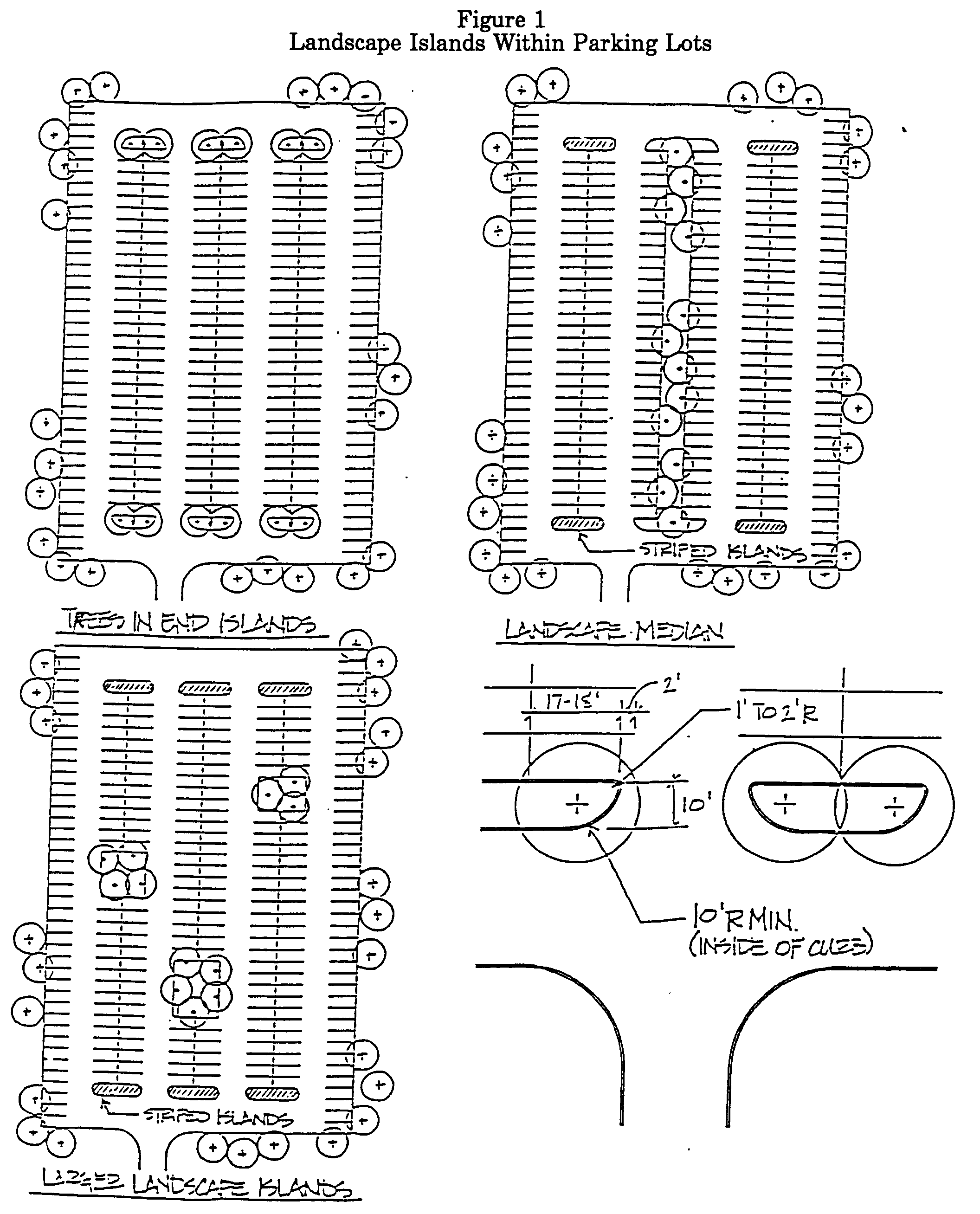
(Ord. 266. Passed 6-10-96.)
Figure 2
Industrial Landscape Recommendations
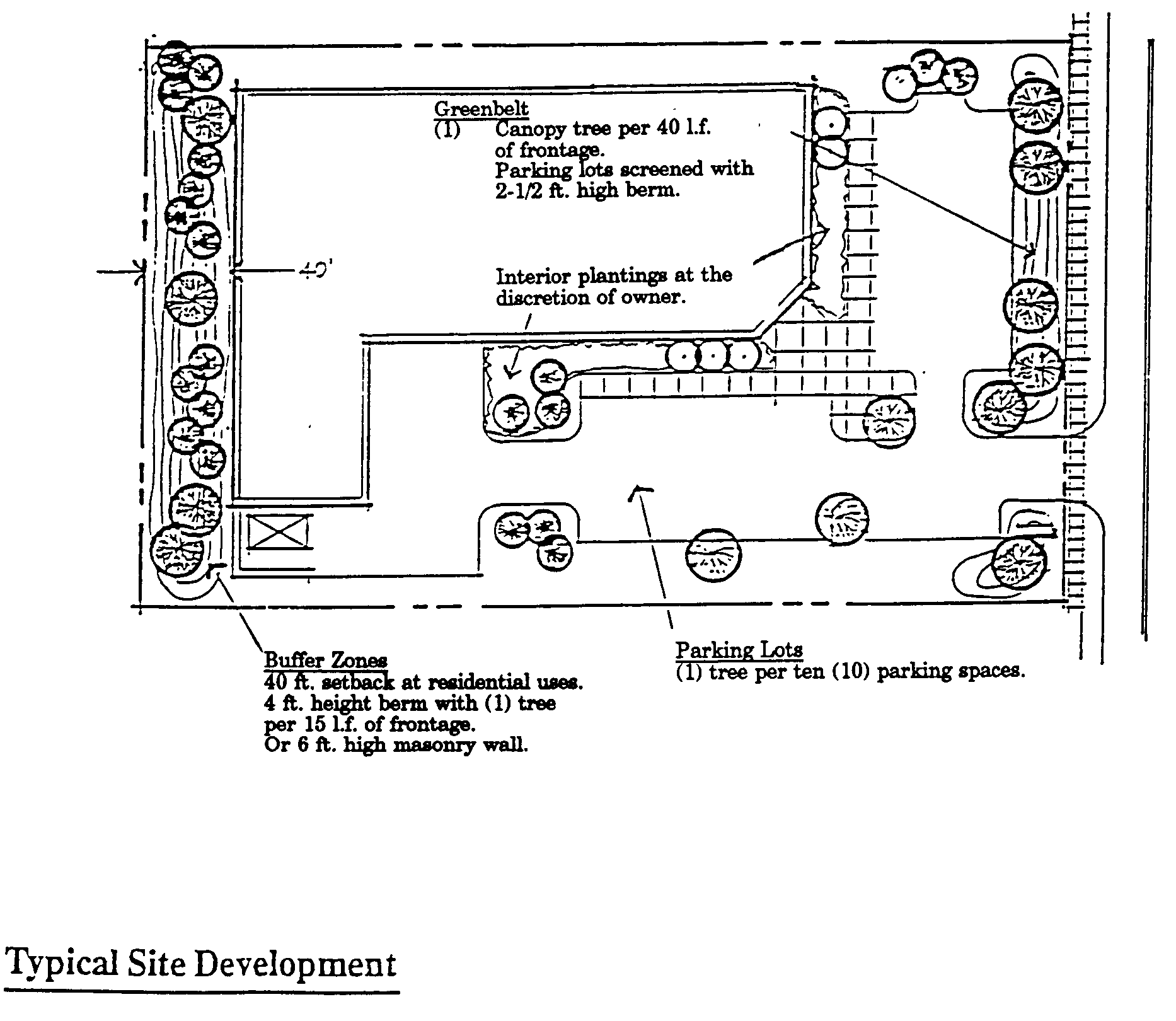
Recommendations for industrial development primarily involve the development of standards to guide the character of landscape improvements on private properties. These recommendations would serve as a framework for the development of a landscape ordinance.
The following drawings illustrate the application of landscape standards on a typical site and several options on the treatment of greenbelt planing areas.
(Ord. 266. Passed 6-10-96.)

