
Corinth City Zoning Code
Subsection 2.06
Special Zoning Districts
2.06.01. - MX-R, Mixed Use Residential
Mixed Use refers to a development style that creates areas which combine a mix of zoning categories within one defined zoning district. For example, residential, restaurants, retail, office and public uses may be allowed in the same building, same lot, same tract, and/or the same block. Benefits of mixed use developments include:
• Flexibility of building spaces over time;
• Revitalizations of commercial districts;
• Development of multi-family housing at appropriate locations;
• Efficiency in provisions of public facilities and services;
• Convenience for residents and workers;
• Reduction in frequency and distance for vehicle trips; and
• Environmental protection.
This district is intended to permit establishment of integrated residential and nonresidential activities where appropriate and desirable, under conditions that assure an acceptable level of harmony among land uses. Residential development should comprise at least seventy-five (75) percent of the Floor Area of the entire development.
A.
Permitted Uses and Use Regulations
1.
See the Use Chart and all applicable regulations in Subsection 2.07.
2.
Seventy-five (75) percent of the Floor Area of the entire development, as shown on a Site Plan shall be for residential uses only.
B.
Dimensional Regulations
1.
See the Residential Dimensional Regulations Chart and all applicable regulations in Subsection 2.08.
2.
Maximum Front Yard Setback. The maximum front yard setback shall be twenty-five (25) feet.
3.
Building Location in Relationship to the Maximum Front Yard Setback. At least seventy-five (75) percent of the front facade of any structure facing a street must be located between the minimum and maximum front yard setback.
C.
Development Standards. See the following sections for development regulations:
1.
See 2.07.07. Accessory Buildings and Uses.
2.
See 2.09.01. Landscaping Regulations.
3.
See 2.09.02. Tree Preservation.
4.
See 2.09.03. Vehicle Parking Regulations.
5.
See 2.09.04. Building Façade Material Standards.
6.
See 2.09.05. Residential Adjacency Standards.
7.
See 2.09.06. Nonresidential Architectural Standards.
8.
See 2.09.07. Lighting and Glare Regulations.
9.
See Subsection 4.01. Sign Regulations.
10.
See Subsection 4.02. Fence and Screening Regulations.
11.
Block lengths shall generally be characterized by smaller, walkable blocks that are connected to each other.
a.
The minimum length of a block shall be 200 feet.
b.
The maximum length of a block shall be 500 feet.
12.
For a building adjacent to an Arterial Street or Major Collector, at least thirty (30) percent of the ground floor must be used for nonresidential uses.
a.
Internal buildings (those that are located behind buildings that are adjacent to arterial, major collector, and collector streets) are not required to have at least thirty (30) percent of the ground floor be used for non-residential uses.
13.
Facades and Building Forms.
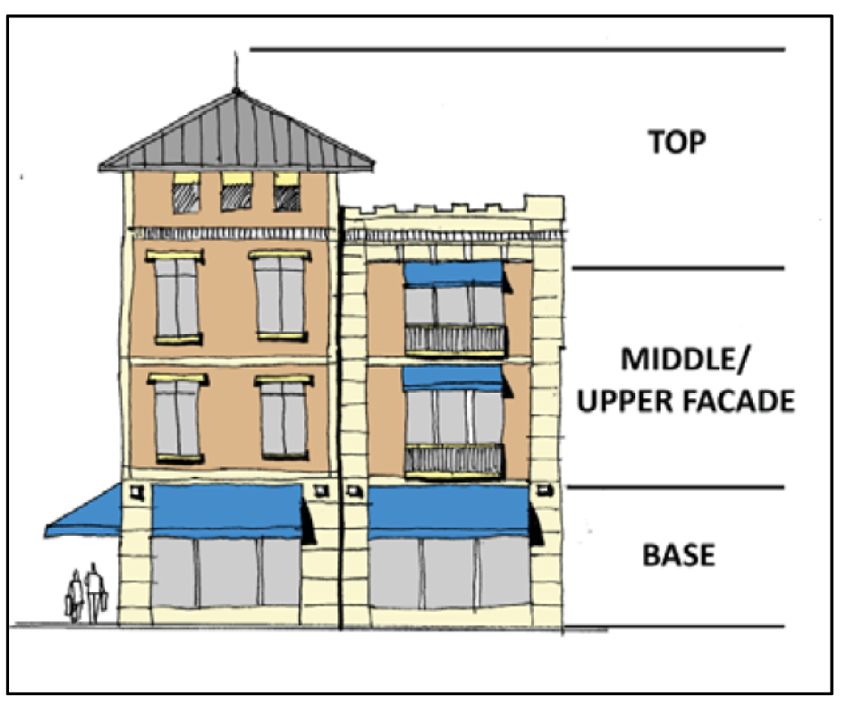
Figure 1: Mixed Use Example
a.
Street facing building facades shall be designed with identifiable first floor, upper façade and top/rooflines.
b.
First floor facades shall be designed with elements such as window bays, recessed entries, awnings, canopies or other similar architectural features.
c.
First floor facades may not exceed twenty (20) feet in height.
d.
The first floor facade heights shall be consistent for individual buildings and not varied in first floor heights, as to form a single horizontal element.
e.
First floor nonresidential uses shall have eighty (80) percent Storefronts in order to provide for pedestrian street scenes, indoor and outdoor views and retail display spaces.
i.
Storefronts shall include a maximum three (3) feet high base (the area under the window), transparent windows and storefront cornice.
f.
Buildings shall reflect a small scale street frontage rhythm, with building bay widths approximately 25—50 feet.
g.
Upper facades shall be designed with a rhythm, a repeating pattern, in architectural elements such as window spacing, façade sections, projections, awnings, window covers, window hoods and balconies.
h.
Each upper façade floor shall be a consistent height and not consist of varied floor heights per individual floors, as to form a single horizontal element per individual floor.
i.
Individual floors shall be identifiable with elements such as material changes, trim, color changes, molding, cornice, belt course, awnings, balconies or other similar architectural features.
j.
To emphasize the community character and pedestrian scales, building facades shall incorporate the following elements:
i.
Architectural Elements: Cornice, piers, columns, frieze, quoin, mullion, fenestration, pilasters, rustication and/or belt course.
ii.
Variation in Wall Plane: Canopies, balconies and/or awnings.
iii.
Change in Materials and Color: Each façade shall incorporate a minimum of 2 separate materials or color changes excluding glazing. Each separate material or color change shall be at least twenty (20) percent of the façade's appearance excluding glazing.
14.
Street Furnishings.
a.
Benches shall be provided along sidewalks at a rate of one (1) bench per one hundred (100) linear feet of sidewalk. Benches shall not be placed or located in the Right-of-Way.
b.
Litter receptacles or planters shall be provided along sidewalks at a rate of one (1) bench per one hundred (100) linear feet of sidewalk.
c.
Street furnishings shall be low maintenance and resistant to vandalism.
d.
Street furnishings shall maintain an unencumbered walkway for pedestrians.
D.
Site Plan Required for Rezoning to the MX-R, Mixed Use Residential District. A Site Plan as outlined in 2.10.08. Site Plans shall be required for all rezoning Applications seeking the MX-R, Mixed Use Residential district designation.
2.06.02. - MX-C, Mixed Use Commercial.
The regulations for this zoning category are intended to create vibrant, mixed-use, urban districts that serve as cultural centers for the City and utilize general development principles to shape redevelopment. Areas of focus to create these cultural centers are the Downtown area and area south of Downtown between I-35E and the Dart/DCTA rail line, Corinth Parkway and Swisher Rd. However, other areas or nodes in the City may also be appropriate for MX-C zoning to create special cultural centers for the City. The following principles serve as the basis for the standards and guidelines contained in this document. Development projects are evaluated with respect to the principles, in addition to the pertinent standards and guidelines.
A.
Permitted Uses and Use Regulations
Only those uses allowed in the Use Chart shall be allowed in the MX-C District and such uses shall be subject to all applicable regulations within Subsection 2.07, Zoning Use Regulations for the MX-C District.

MX-C standards intend to promote a walkable, urban form of development that creates
active and visually interesting public spaces.
B.
Development Principles.
The development principles described in this Section shall apply to any and all zoning related plans or Applications required by the City and submitted in accordance with this UDC. Zoning applications for the MX-C District shall comply with the following general principles:
1.
Promote a pedestrian-oriented urban form. In contrast to conventional zoning standards that place primary emphasis on the regulation of land uses, MX-C standards focus on promoting a walkable, urban form of development. The focus on form promotes buildings that conform to tested urban design principles, and that adapt to changing conditions over time.
2.
Maximize connectivity and access.
Successful mixed-use districts are characterized by a circulation network in which residents, workers, and visitors may conveniently walk, drive, bike, or ride public transportation to destinations within and outside of the district.
Development standards within this District are intended to promote walkable blocks and street designs that balance these transportation modes, and ensure accessibility for all residents and visitors, including those with disabilities.
3.
Require excellence in the design of the public realm and of buildings that front public spaces.
The most successful urban environments are those in which walking down the street is appealing. Streets, plazas, parks and other public spaces within this District should be comfortable and inviting, and buildings fronting those spaces should be active and visually interesting at the pedestrian level.
4.
Promote the preservation and creation of distinctive neighborhoods that provide diverse urban housing options.
Providing a significant number of units within MX-C districts is critical to the success of retail, and a variety of housing types is important for the sustainability of the city.
5.
Support existing businesses.
The MX-C standards should support the success of existing businesses by allowing for a higher density population to be closer to retail and other businesses and by creating a quality of life and sense of community that attracts a workforce that further attracts businesses to the community.
6.
Encourage creativity, architectural diversity, and exceptional design.
The MX-C standards should promote high quality design and are designed to promote flexibility. Standards are intended to support creativity and exceptional design while discouraging uniformity.
7.
Promote sustainable development that minimizes negative impacts on natural resources.
Creating a walkable, mixed-use, high-density, central city district supports sustainable development by providing an alternative to low-density development in peripheral areas. In accordance with sustainable development principles, MX-C district buildings, transportation systems, and public spaces should be designed to minimize negative impacts on air and water quality and promote innovation in environmental design.
C.
Mix of Use Requirements
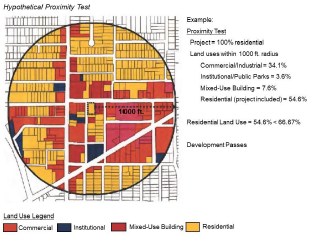
Example of vicinity test for residential development.
The following standards are intended to ensure that developments in the MX-C zoning district include a mix of uses or contributes to the creation of a larger mixed- use area. To receive approval, a development shall comply with the requirements of this Section and shall meet the standards for compliance with the Project Test and/or Vicinity Test, as applicable.
1.
Development of projects for an area of land less than 3 acres in size; 10 percent (10%) Requirement. Except as expressly allowed herein, development of a project upon land less than three (3) acres in size shall incorporate a minimum of 10 percent (10%) of the total square footage for Buildings in the development for commercial uses allowed in the MX-C district. Additionally, the required 10 percent (10%) commercial uses shall be located at ground level. Commercial uses in excess of the minimum 10 percent (10%) may be at ground level and/or upper levels. If the commercial uses within the development do not meet the 10 percent (10%) total square footage requirement of this section, then the Vicinity Test set forth in Subsection 3 below shall apply. If the development passes the Vicinity Test, it will have met the Mix of Use requirement. A conceptual plan shall not be required except as required by subsection 2 below.
Exception to 10 percent (10%) and Vicinity requirement: Developments fronting N. Corinth St. and Corinth Parkway in the downtown area shall meet a higher standard for mix of use to provide for a vibrant urban area. Notwithstanding the foregoing, for a development fronting either N. Corinth St. or Corinth Parkway downtown (N. Corinth St. from Corinth Parkway to Shady Shores and Corinth Parkway from I-35E to Shady Rest Ln.), the mix of use requirement for developments fronting these two streets shall be met if the development incorporates a minimum of sixty percent (60%) of the linear length for commercial uses at the pedestrian level.
2.
Development of a project for an area of land equal to or larger than three (3) acres in size. An Applicant shall submit a land use analysis for approval by the Planning Director showing proposed uses for the project and land uses for existing developments within a one thousand (1000) foot radius of the boundary of the project. The conceptual land use plan must be approved before a building permit application may be filed or accepted. The Planning Director may require a conceptual land use plan for a project less than three (3) acres in size if it is part of a development that is equal to or larger than three (3) acres in size. The conceptual land use plan required by this subsection shall identify uses as within its boundaries and shall illustrate the location and calculated land area of land uses within a one thousand (1000) radius of the development site, using the following land use categories:
•
Residential
•
Commercial/Industrial
•
Institutional/Public Parks
•
Mixed-use buildings (Defined as buildings that incorporate at least 20% residential and 10% non-residential uses)
Parking facilities and private open spaces shall be classified the same as the primary land use they serve.
a.
PROJECT TEST for Developments of land equal to or larger than three (3) acres in size—The land use analysis for developments equal to or larger than three (3) acres in size shall be approved if the plan meets both of the following requirements:
(i)
The uses proposed within the development includes uses within at least two (2) of the land use categories as defined in Section 2 (Residential, Commercial/Industrial, Institutional/Public Parks); and
(ii)
No land use category, other than mixed-use buildings and public parks, occupies greater than two-thirds (⅔) of the proposed development.
3.
VICINITY TEST—Developments that do not comply with the Project Test shall be permitted if:
a.
The Planning Director determines that each of the following conditions have been met:
1)
Each proposed land use within the proposed development site is located within a walking distance that is equal to or greater than one thousand (1,000) feet of a different land use, as measured by the shortest pedestrian route; and
2)
The percentage of land area for any single land use as defined in Section 2 (Residential, Commercial/Industrial, Institutional/Public Parks), other than mixed-use buildings and public parks, within a one thousand (1,000) foot radius of its location within the proposed development site shall not be greater than sixty-six and sixty-seven hundredths percent (66.67%) of the total land area within the radius. The total area of the land within the proposed development shall be included in the calculation of the land use analysis. Undeveloped or agricultural property located within the radius shall not be included in the calculation; or
b.
The Planning Director determines that a developer has demonstrated that the land proposed for the development has unique site conditions (i.e., adjacency to natural features, highways, railroads, etc.) that make compliance with the conditions of the Vicinity Test impractical in some areas of the development site.
Applicants may appeal the Planning Director's determination regarding compliance with the Project Test and/or Vicinity Test and requirement for the mix of uses to City Council for consideration. In addition to consideration of other factors relative to the Comprehensive Plan, zoning, compatibility of uses, and public health, safety and welfare, when considering an appeal from a decision of the Planning Director, the Council shall consider the unique circumstances of the development, including how the development will contribute to the intent of a mixed-use area. The burden of demonstrating such unique circumstances or other basis for appeal shall be borne by the Applicant.
D.
Development Standards
This section includes standards and guidelines related to the orientation and configuration of streets, public spaces, buildings, sites, and parking facilities that are required within the MX-C district. The purpose of these standards and guidelines is to promote high quality, pedestrian oriented, sustainable development that adapts to changing conditions over time, without dictating architectural style. The following principles provide the basis for the development standards. The development principles described in this Section shall apply to any and all zoning related plans or Applications submitted in accordance with this UDC. Zoning applications for the MX-C District shall comply with the following general principles:
1.
Streets and Public Spaces. Streets and public spaces within a development shall comply with the following standards:
a.
All streets and sidewalks shall be designed to promote pedestrian activity and comfort. Sidewalks may serve as the most heavily used public spaces. When new streets are being constructed, the development shall utilize a street grid pattern wherever possible.
b.
The design of street cross sections shall balance the circulation requirements of automobiles, mass transit where available, bicycles and pedestrians. The development shall utilize context-sensitive Complete Streets design strategies to achieve this balance. Complete streets integrate people and places in the design of the public transportation realm to provide safety and comfort for all modes of transportation including pedestrians, bicyclists and vehicles.
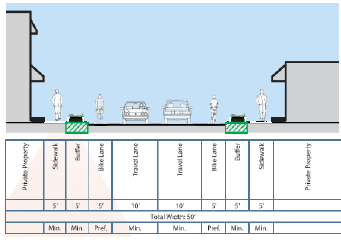
Example cross section of a context sensitive complete street.
c.
Designated road space for bicycles, such as striped bike lanes, on roads that would otherwise be uncomfortable or unsafe for less experienced or slow riders shall be provided.
d.
The design and construction of streets shall emphasize attention to detail and quality construction.
e.
The development shall utilize simple but effective roadside designs to allow easy maintenance.
f.
The development shall provide on-street parking in as many areas as possible to support businesses and calm traffic speeds.
g.
The development shall adhere to time-tested roadside design strategies that create walkable streets, including shade trees and pedestrian lights located along the curb, between the roadway and the walkway.
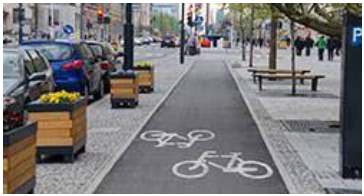
Well-designed streets and sidewalks can take many forms, but create a balance to accommodate
pedestrians, bicyclists and vehicle traffic.
h.
The development shall provide a wide range of public spaces (in addition to comfortable sidewalks), including neighborhood-oriented pocket parks, community gathering spaces and recreational facilities.
i.
The development shall incorporate elements into public spaces that are designed to engage all age groups, including young children and the elderly.
2.
Roadside Elements. All development plans shall comply with the following standards:
3.
Street Trees
a.
Shade trees shall be planted within the street tree/furniture zone and shall be spaced approximately thirty (30) feet apart on-center. Tree/furniture zones shall be a minimum of four (4) wide and shall be exclusive of the required sidewalk width. Where determined necessary by the Planning Director, spacing exceptions may be made to accommodate existing elements such as mature trees, curb cubs, fire hydrants and other infrastructure elements. The Planning Director may require an Applicant to submit a detailed plan showing the tree spacing with existing elements in areas that do not allow the thirty (30) foot spacing.
b.
To maximize survival rates, trees shall be planted to ensure proper drainage and shall be irrigated in accordance with a plan approved by the Planning Director.
c.
Tree grates or low maintenance tree planter systems, such as pervious pavers or planting strips, shall be used.
d.
Street trees shall be pruned to maintain a minimum eight (8) foot clearance over sidewalks, medians, and other pedestrian ways.
e.
Trees shall be planted at the time of development; however, the planting schedule may be extended by written approval of the Planning Director to allow planting during the fall/winter season.
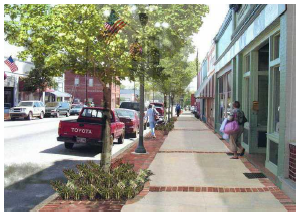
Sidewalks, shade trees, pedestrian lighting and furnishings such as benches and trash
receptacles create a safe and comfortable pedestrian zone.
4.
Pedestrian Way
a.
The pedestrian way shall have walkways a minimum width of six (6) feet and shall comply with ADA and Texas Accessibility Standards, as those standards are amended by Federal or State law.
b.
Paving materials utilized for pedestrian ways shall be attractive and easy to maintain. Concrete, pervious concrete, masonry pavers over concrete base, or any similarly durable materials that meet the City's sidewalk standards shall be allowed.
5.
Pedestrian Lights
a.
For new public and private developments within the District, the Applicant shall provide pedestrian lights within the street tree/furniture zone.
b.
Pedestrian lights shall be located approximately at the midpoint between two (2) trees and shall be spaced a maximum of sixty (60) feet apart. Upon written approval of the Planning Director, spacing exceptions may be made to accommodate mature trees, curb cuts, fire hydrants and other infrastructure elements.
6.
Other Pedestrian Elements
a.
Bike racks, trash bins and seating shall be incorporated into streetscape designs on primary streets and other streets designed for high levels of pedestrian activity. Continuity of style of bike racks, trash bins and seating throughout each neighborhood is encouraged. These elements should be durable, cost effective and easy to maintain.
7.
Downtown Area Walkways
a.
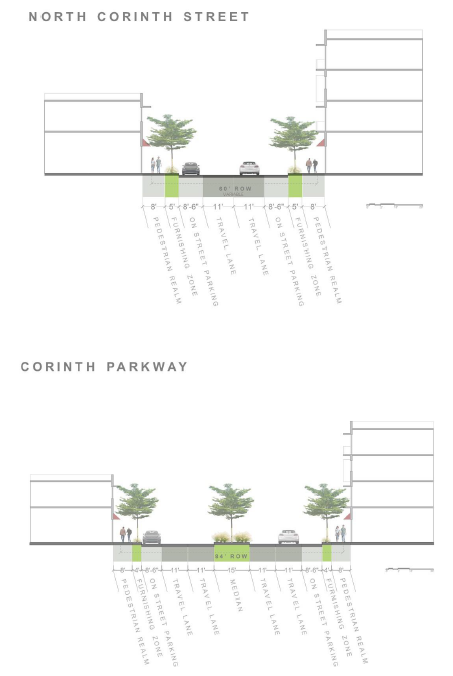
Developments fronting N. Corinth St. from Corinth Parkway to Shady Shores - The pedestrian way shall have walkways of eight (8) feet and shall comply with ADA and Texas Accessibility Standards, as those standards are amended by Federal or State law. The furnishing zone shall be five (5) feet. This street standard requires approximately three (3) feet of privately-owned property to be utilized for a portion of the sidewalk. A public pedestrian access easement shall be required during the platting process for the sidewalk.
b.
Developments fronting Corinth Parkway from I-35E to Shady Rest Ln. - The pedestrian way shall have walkways of eight (8) feet and shall comply with ADA and Texas Accessibility Standards, as those standards are amended by Federal or State law.
Furnishing zone shall be five (5) feet. This street standard requires approximately eight (8) feet of privately-owned property to be utilized for a portion of the sidewalk. A public pedestrian access easement shall be required during the platting process for the sidewalk.
G.
Building Location and Orientation
1.
Base Setback Standards
Building shall be located upon a lot at a location that in relation to the boundaries of its lot complies with the setback standards listed below and graphically illustrated:
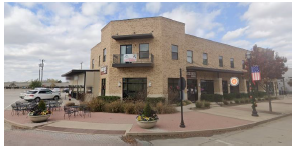
Corner buildings provide a setback with a corner.
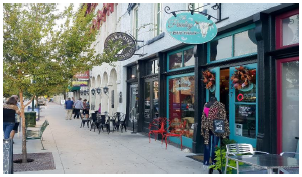
Minimal front setbacks are required and create a sense of place.
2.
Contextual Setback Standards.
The following standards shall apply and shall be collectively referred to as Contextual Setback Standards:
a.
Building front setback. Any building within a development shall have a front setback that is at minimum zero (0) feet and at maximum ten (10) feet.
b.
Buildings fronting public spaces. Buildings that front pocket parks, plazas, or other public spaces may exceed the maximum front setback set forth in Section G(1) above along areas where the parks, plazas or other public spaces are located.
c.
"On-street" parking or public walkways located on private property - If angled, perpendicular, or parallel parking is located on private property but functions the same as public on-street parking, the required front setback shall be measured from the edge of the public walkway. Similarly, if a required public walkway encroaches onto private property, the setback shall be measured from the walkway edge.
d.
Corner buildings - For corner buildings at street and alley intersections that do not include all-way stop signs or traffic signals, a triangular dedication measuring five (5) feet by five (5) feet shall be required. The triangle shall be measured from the property line and shall be designed and maintained so as to be clear of all visibility obstructions.
e.
Interior buildings - Interior buildings may be constructed if the project also includes frontage buildings that are oriented to face public streets. Specifically, buildings may exceed the maximum setback if at least sixty (60) percent of the public street frontage on each block face within the development contains buildings within the maximum setback of twenty (20) feet.
3.
Pedestrian Entrances
a.
Building Entrances. Primary pedestrian building entrances shall be located on the street frontage of the building. If a site's slope presents significant impediments to a street fronting entrance, such as a need for stairs within the public right-of-way, and a proposed entrance from an adjacent side façade would provide a similarly visible and inviting front entrance, the Planning Director may approve an exception administratively. For buildings fronting other public spaces, the primary pedestrian entrance shall be oriented to and accessible from the public space.
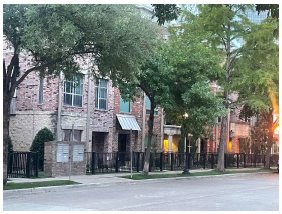
Residential units at street level must have direct pedestrian access with traditional
front doors, patio or stoop, and transition zone.
b.
Individual Retail Entrances - Each retail use with exterior ground level exposure along a street or public space shall have an individual public entry from the street or public space.
c.
Corner Building Entrances - Entrances to corner buildings with ground floor retail uses shall be located at the corner of the building.
d.
Residential Entrances - Apartments, condominiums, manor houses, and townhomes with street level units shall provide individual street-oriented entries for each unit along the primary street frontage. Entries shall incorporate the following:
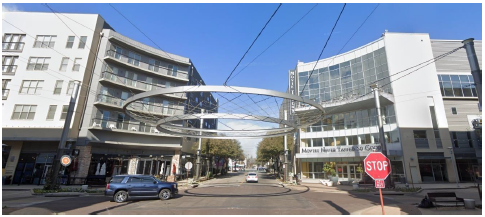
Pedestrian entrances for corner buildings with ground floor uses shall be located
at the corner.
i.
Direct pedestrian access between unit entrance and adjacent public sidewalk;
ii.
Pedestrian protection at entrance with awning, canopy, or building recess;
iii.
Traditional front door, not sliding glass or typical balcony double door;
iv.
Patio or stoop;
v.
Transitional semi-public zone separating unit entrance from sidewalk comprised either landscaped yard area or hardscape zone with planters;
vi.
Delineation between patio/stoop and sidewalk through one of the following:
vii.
Grade transition such as stairs or ramp, if feasible and consistent with grade conditions; and
viii.
Low walls or other vertical delineation between entrance patio and public sidewalk or transitional semi-public zone.
H.
Fencing
1.
Front Yard Perimeter Fencing Prohibited - Conventional gated complexes with perimeter security fencing along public streets are prohibited. Specifically, exterior security fences and gates that are located along public streets, along private streets or walkways that are publicly accessible through a public use easement, or along publicly accessible open space shall not extend beyond building facades; i.e., these fences shall not be located in the area between building facades and the property line.
2.
Privacy fences - A front yard fence or railing not exceeding four (4) feet in height may extend beyond building façades if the fence encloses a private patio, yard, or sidewalk eating area. The fence is not permitted to encroach on a required pedestrian walkway.
I.
Drive-Through Design Standards
1.
Conventional drive-through uses do not support a pedestrian-oriented environment and are inconsistent with the urban redevelopment goals for MX-C districts.
Therefore, a drive-through facility shall only be allowed as approved by Planning Director provided that all of the following criteria is met:
a.
Windows and stacking lanes - Drive-through windows and stacking lanes shall not be located within the front yard setback or along facades that face a street; where possible, they shall be located to the rear of buildings.
b.
Circulation - The design and location of the facility shall not impede vehicular traffic flow and shall not impede pedestrian movement and safety. Driveways shall not be located on the street the development fronts. Shared driveways and/or driveways located off of non-arterial streets shall be used, where possible.
c.
Screening - Architectural elements, landscaping, and/or other screening elements shall be used to minimize the visual impacts of the drive-through facility.
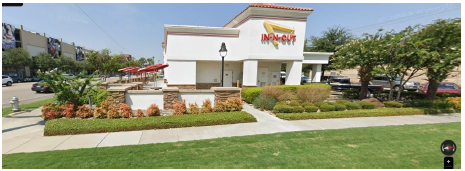
Drive-Through facilities are discouraged but can be designed with the drive through
in the rear.
J.
Sky Bridges
1.
Sky bridges spanning public streets to connect upper floors of opposing buildings often negatively impact street-level pedestrian activity. There may be, however, unique circumstances that would allow for a sky bridge that serves a vital connectivity function without negative street-level impacts. The following criteria must be met for approval of a proposed sky bridge by The Planning Director:
a.
The sky bridge would serve a clear and vital connectivity function that is clearly impractical to achieve through a street level connection; and
b.
The sky bridge would not remove significant pedestrian activity from street level, and the evaluation of potential activity lost should take into account both the potential number of pedestrians lost and any potential lost benefits stemming from pedestrians in that particular area, such as lost benefits to neighborhood safety or neighborhood businesses; and
c.
The sky bridge would not visually obstruct significant view corridors.
K.
Building Height
Height Guideline - Multi-story buildings are encouraged and are consistent with the urban character of the district and are essential in achieving economic and urban design goals for the district.
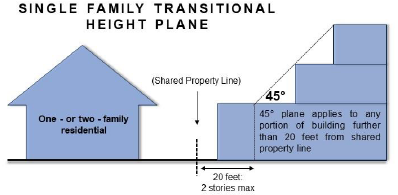
Building Heights shall not exceed five (5) stories as defined in Section 5 of the UDC. Height is measured in stories, not including a raised basement or inhabited attic. Determination of stories shall be as follows: the number of complete stories between the average grade of the frontage line to the eave of a pitched roof or to the surface of a flat roof.
Any portion of a building within twenty (20) feet of the property line of a one (1) story or two (2) story single family home shall not be more than two (2) stories. A forty-five (45) degree transitional height plane shall apply to any portion of a non-single family building further than twenty (20) feet from the property line, as depicted above. Attached or detached single family buildings up to three (3) stories shall be allowed when a minimum twenty (20) foot setback from the property line of either a one (1) or two (2) story single family home is provided.
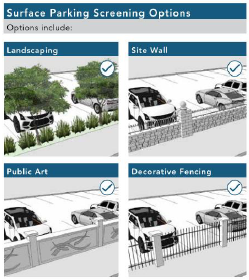
Parking lots at street level shall be screened.
L.
Parking and Driveways
1.
Shared Parking Garages. Shared parking garages are encouraged. Surface parking lots that front streets are discouraged. All site plan options that minimize surface lots along public streets should be explored.
2.
Off-Street Parking Requirement - There shall be no off-street parking requirements within the District except for those properties located within two hundred fifty (250) feet of a one- or two-family zoning district and except for the development of single family and multi-family residential uses. For those properties where off- street parking is required, the requirements in Section 2.09.03 of the UDC, as amended, shall apply but the number required shall be reduced by twenty-five percent (25%).
3.
Surface Parking Cap - The number of off-street spaces shall not exceed one hundred percent (100%) of the total number of required spaces prescribed by Section 2.09.03 of the UDC, as amended, unless a parking study demonstrates the need for additional spaces.
4.
Surface Parking Lots - Parking Lots shall be located behind or to the side of buildings.
a.
Maximum Surface Parking Lot Frontage-
The percentage of parking lot frontage along any street shall not exceed forty percent (40%) of the development site's total frontage length along a development's primary streets defined as the street the development fronts, and 70% of the development site's total frontage length along a development's secondary streets, defined as streets on the side or rear of the development.
Parking lot frontage measurements shall include the combined frontage length of any paved and/or drivable surface that functions as part of a parking lot's circulation, including, but not limited to, drive aisles and parking spaces.
b.
Surface Parking Screening - Parking lots that front a street shall be separated from the sidewalk by a decorative and durable screen that is at minimum three (3) feet and maximum of four (4) feet in height. Screening walls attached to buildings shall be designed as architectural extensions of the building and shall be constructed of the same materials and style as the building to which it is attached.
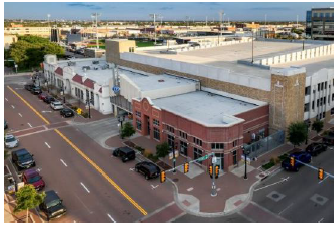
Example of a parking garage with a retail wrap.
c.
Structured Parking and Multi-Level Parking Garages. Structured parking and multi-level parking garages shall be located at the interior of a block or underground where possible. Parking structures shall include podium style single level parking facilities and multilevel garages. Where parking garages are located along public rights of way, they shall be wrapped at the pedestrian level in commercial or residential uses, or spaces adaptable for future commercial use. The amount of street frontage devoted to a parking structure shall be minimized by placing its shortest dimension(s) along the street edge.
d.
Façade design. All parking structure facades that face a public space shall be designed to incorporate architectural elements and materials that complement the building or buildings in the area. Architectural articulation shall be utilized to break up long facades by incorporating façade variation according to Section M.6.b
5.
Driveway Location - Vehicular driveways shall not be located along primary streets within a development if secondary streets are available for that use.
6.
Drop-Off and Loading Areas - On-street drop-off and loading areas support a pedestrian-oriented district and may be approved by the City Engineer.
M.
Architectural Standards
1.
Roofs. Roof slopes for new buildings shall not be greater than 1:12. Sloped roof elements that are not part of the actual roof shall be permitted.
2.
Screening of rooftop equipment - Parapets or other screening elements shall be of sufficient height to conceal mechanical equipment from street-level views.
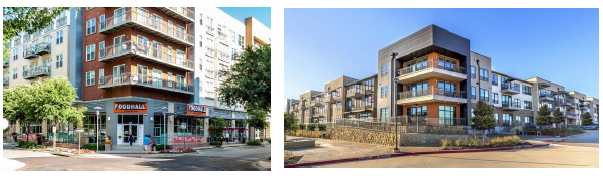
Roof slopes for new buildings shall not be greater than 1:12.
3.
Parallel Frontages - Building facades shall be built parallel to the street frontage, except for chamfered corners.
4.
Entrances facing a pedestrian way shall incorporate elements that protect pedestrians from the sun and rain.
5.
Awnings, Galleries, Arcades, and Balconies
Awnings, canopies, arcades and similar elements shall be incorporated for all ground floor retail uses so as to provide pedestrian protection from weather and to provide visual interest. Where feasible, balconies are encouraged and should be designed as an integral part of the building.
6.
Façades - All standards in this section apply Facades facing public streets and other public spaces (except alleys) Other highly visible Façades that meet any of the following conditions shall also comply with the standards in this section:
a.
Façade variation - Buildings shall, at a minimum, incorporate structural elements that delineate floors.
b.
Façade articulation - Façade articulation shall be incorporated into all buildings through the use of doors, windows, projecting and recessed elements, and variety in materials. Material pattern and/or color shall vary at least every thirty (30) linear feet along each façade.
BUILDING MATERIALS—New building facades facing a public area, excluding an alley, shall utilize the material standards listed below.
Primary materials - brick, stone or stone veneer with cavity wall construction, stucco, glass curtain wall system, metal panels (individual or curtain wall systems), concrete (finish should be to an architectural level), cement composite board, tile.
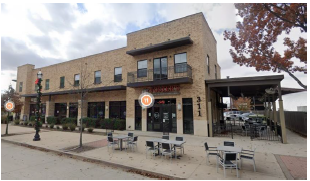
Ground floor transparency creates an inviting façade for commercial uses.
Limited access and trim materials - all Primary Materials listed above, metal (galvanized, painted or ornamental), precast masonry (trim and cornice only), concrete fiber simulated wood siding.
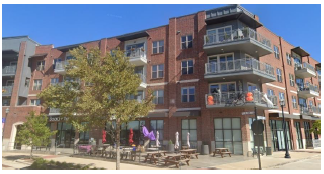
Façade articulation is required through the use of recessed elements, fenestration
and expression of structural elements
Leadership in Energy and Environmental Design (LEED) Buildings—Buildings following the U.S. Green Building Council's LEED certification requirements shall be exempt from building material standards.
Fenestration for Ground Floor Commercial Use—For all newly constructed buildings for which the ground floor is used for commercial use purposes, building facade fronting on publicly accessible streets or other public spaces (except alleys) shall have openings and transparent (not mirrored) glazing that together constitute not less than sixty (60) percent of the horizontal length of each structure between the height of three (3) feet and eight (8) feet above the sidewalk.
Lower-level delineation for nonresidential or mixed-use buildings—Façades oriented to a publicly accessible street or other public space shall include clear delineation between the first or second level and the upper levels with a cornice, canopy, balcony, arcade or other architectural feature.
Screening of Mechanical Equipment
Ground level equipment—All service and delivery areas, trash storage, and mechanical, electronic and communication equipment shall be screened from the adjacent public street view.
Acceptable screening applications include solid architectural or fencing screening and/or planting material. Architectural screening must be proportioned to fully screen equipment and designed and detailed to be fully compatible with building architecture and overall site aesthetic, rather than draw attention to the screen. Planting must be evergreen, shall be a minimum of sixty percent (60%) of the height of the equipment to be screened, and shall be installed appropriately to ensure their survival and achieve full screening of the equipment within two (2) years of planting.
Rooftop equipment—Rooftop equipment shall not be visible from the street or from neighboring properties located at the same level or a lower level. Screening of mechanical, electronic, and communication equipment on the roof shall be organized, proportioned, detailed and colored to be an integral element of the building as seen from points of high elevation, from the street, and adjacent residences.
N.
Tree Preservation and Landscaping
Preservation of Significant Trees
In the MX-C Zoning District, Protected Trees smaller than 20.1 CI and greater than 6 CI shall not be subject to the mitigation requirements of Section 2.09.02 G.3 "Mitigation Requirements for Protected Trees Removed" of the Unified Development Code but shall be eligible for credits authorized under UDC Section 2.09.02 G.4. "Mitigation Requirements for Protected Trees Removed."
Trees In Surface Parking Lots—All new and expanded parking lots shall provide at least forty percent (40%) tree canopy coverage of paved surface parking area (The categorized list of canopy trees provided below shall apply).
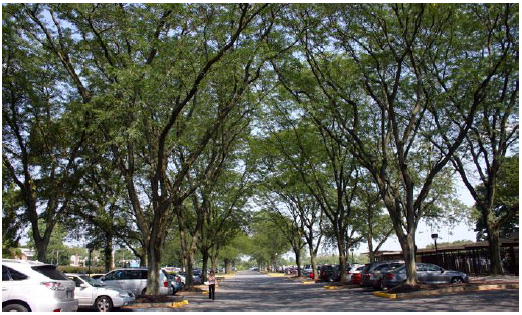
Canopy Trees for Surface Parking Lots.
O.
Comprehensive Building
Signage Plan
Commercial signs on a new development with a uniform façade and more than one storefront, shall relate to each other in terms of height, proportion, color, and background value. Maintaining uniformity among these characteristics reinforces the buildings' façade composition while still retaining each business's identity. A unified sign plan shall be submitted for new developments and redevelopments of vacant buildings.
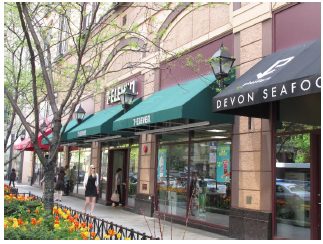
A comprehensive building signage plan is required and should include all planned signage
for a development.
P.
Sign Standards
Intent—The intent of signage standards in MX-C developments is to establish specific standards for business identification while encouraging creative and innovative approaches to signage.
Principles— The sign standards described in this Section shall be applicable to all signage in the MX-C district and shall comply with the following general principles; signage shall:
a.
Encourage excellence in signage, both as a communication tool and as an art form;
b.
Enhance the economic value of the built environment by avoiding visual clutter which is potentially harmful to property values and businesses;
c.
Allow and encourage creative and unique sign designs while preventing cluttered and unattractive streetscapes; and
d.
Ensure signs reinforce the existing and envisioned character of the unique MX-C district.
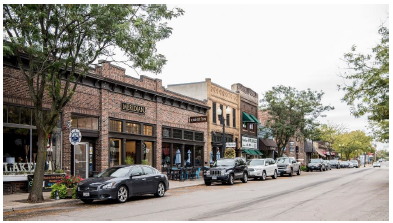
Position signage to emphasize location of storefront openings and align with neighborhood
buildings.
Location and Alignment
a.
Signs shall be positioned to emphasize or accent building elements such as storefront openings or entrances.
b.
Signs shall not be installed in locations that damage or obstruct important architectural features.
c.
Where possible, signs shall be aligned with those on neighboring buildings to promote visual order on the block, to avoid visual clutter and to enhance legibility.
d.
Signage for ground floor occupants shall be located below the second floor window-sills; except that this provisions shall not apply to blade signs.
e.
Signage for occupants located on the second floor and above shall be located on a tenant directory, monument sign or shall be located below second floor window-sills.
Dimensions and Scale
a.
Signs shall be consistent with the human scale of buildings and blocks. Small scale signs are appropriate to smaller scale buildings and pedestrian traffic, while large-scaled signs are typically appropriate to larger scale buildings and vehicular traffic. Well- designed storefronts include pedestrian oriented signage and window displays. Storefront signage shall be consistent with the urban environment where the means of travel is traditionally by foot or by slow moving vehicle.
b.
Signage shall be compatible to the scale of the building, adjacent buildings, the streetscape and adjacent signage.
Material Standards
a.
Signs shall be compatible with or be consistent with the material of the building façade and streetscape.
b.
All permanent signs shall be constructed of quality, durable materials as required in UDC Section 4.01.15.A.
Lighting Standards for Signage
a.
Lighting sources for signage shall be external, shielded, and directed only at the sign. Internal illumination is allowed when the letters themselves, not the background of the sign, are lit.
b.
Animated signs shall be prohibited.
Measurement of Sign Area
a.
Sign area for all signs shall be measured by means of the area of one rectangular or circular shape, whichever shape is most consistent with the sign design, that encloses all sign elements except the support structure.
b.
For signs consisting of individual letters and/or graphics mounted on a building wall or window, the sign area shall be measured by means of the area of one rectangular or circular shape that encloses all of the letters and graphics that constitute the sign.
Prohibited Signs
a.
Rooftop signs (signs placed above the roofline of a building), standard box cabinet wall signs, and animated signs shall be prohibited.
Total Allowable Sign Area for Ground Floor Uses
a.
For wall signs, blade/projecting signs, awning/umbrella signs, canopy signs, marquee signs, plaque signs and banner signs: The total sign area allowed is one and twenty-five one-hundredths (1.25) square feet per linear foot of storefront, defined as the front façade of each business, with a maximum of twenty-five (25) square feet of sign area per storefront being allowed. For storefronts exceeding fifty (50) linear feet, the maximum allowed square footage for signage shall be thirty- five (35) square feet. Maximum allowable sign area for Corner lots and corner storefront shall be calculated on the total of both street facing facades.
b.
Window signs and decals shall be included in the total allowable sign area if the window sign(s) exceed ten percent (10%) of the window space on the storefront.
c.
Shingle signs shall be allowed. The maximum sign area allowed shall be twelve (12) square feet per storefront.
d.
A-frame sign—One A-frame sign shall be allowed per storefront.
Total Allowable Sign Area for Second Floor and Above Uses
a.
Wall signs, blade/projecting signs, awning/umbrella signs, canopy signs, marquee signs, plaque signs and banner signs. The total allowable sign area shall be one -hundred (100) square feet for all of the foregoing sign types combined, and no single sign shall exceed twenty-five (25) square feet. The foregoing sign types shall be located within five (5) feet of an entrance.
b.
Signage for occupants located on the second floor and above shall be located on a tenant directory, monument sign or below second floor window-sills.
Permitted Signs
Wall Sign Standards—Wall signs are signs that are attached to and completely supported by exterior walls. A wall sign shall be placed above first floor windows on a one-story structure or between windows on multiple story structures. The following requirements shall apply to Wall Signs:
a.
One wall sign for each storefront or building façade that fronts a public street or alley is permitted.
b.
Maximum width: sixty-six (66) percent of the linear width of the storefront, not to exceed a maximum square footage listed above.
c.
Letter height: Lettering shall be in proportion to the size of the sign and the width of the storefront. Wider storefronts could have taller letters. As a general rule, the maximum height of a capital letter should be three-fourths (¾) the height of the sign background.
d.
Exposed raceways are prohibited.
e.
Signs on the side or rear building elevations for a ground floor business are permitted, provided that the elevation contains a public entrance.
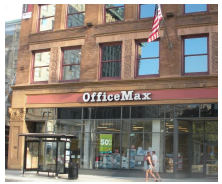
Example of a Wall Sign.
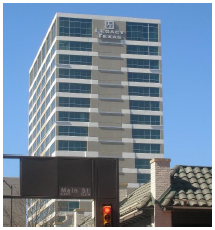
Example of a Building Identification Sign.
Building Identification Signs—Building identification signs are typically located at the top of a building and is often the name of a building or the major tenant. The following requirements shall apply to Building Identification Signs:
a.
The number of signs shall be limited to one (1) sign per building façade and to two (2) signs per building with one message.
b.
Signs on each building façade may include text and/or logo.

Example of a Canopy Sign.
Awning and Canopy Signs—Awning and canopy signs may be painted on or attached to an awning or canopy above a business door or window. The following requirements shall apply to Awning and Canopy Signs:
a.
Awning signs shall be allowed on the shed portion of the awning but shall be located on the valence flap if possible. The flap height should be large enough for letters and symbols to be read easily.
b.
Maximum of one sign per awning or canopy shall be allowed.
c.
Maximum letter height shall be seventy-five (75) percent of the height of the valence flap/shed area.
d.
Minimum valence height: eight (8) inches.
e.
Minimum vertical clearance from sidewalk: eight (8) feet.
f.
Material shall be matte finish canvas, glass, or metal.
g.
Awning shape shall relate to the window or door opening. Barrel shaped awnings shall be used to complement arched windows while rectangular awnings shall be used on rectangular windows.
h.
If lit, awnings shall be externally illuminated.

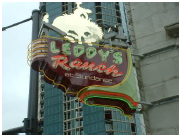
Blade and Projecting Sign Examples.
Projecting and Blade Signs—Projecting signs are two (2) sided signs attached to the façade of a building. Blade signs are two (2) sided signs that are generally vertical in orientation and span multiple floors. Both signs project perpendicular to the storefront or building. The following requirements shall apply to Projecting Signs and Blade Signs:
a.
Minimum vertical clearance: eleven (11) feet.
b.
Projecting sign maximum projection width: forty-eight (48) inches.
c.
Projecting sign maximum height: six (6) feet
d.
Blade sign maximum projection width: three (3) feet
e.
Blade sign maximum height: eight (8) feet
f.
No more than one projecting sign shall be permitted per tenant space frontage at the ground level of a building.
g.
A projecting sign or blade sign shall be located a minimum of twenty-five (25) feet from any other projecting sign or blade sign. When building or storefront width prohibits adherence to this standard, flexibility shall be permitted with review and approval by the Planning Director.
h.
A projecting sign may be erected on a building corner when the building corner adjoins the intersection of two (2) streets. Allocation of sign area from both streets may be used; however, in no case shall the sign exceed the maximum dimensional standards for projecting or blade signs.
i.
Projecting and blade signs shall be located below the window-sills of the third story.
j.
The top of a projecting or blade sign shall not extend above the building eave or top of parapet.
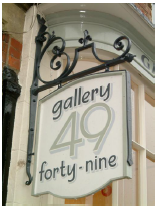
Example of a Shingle Sign.
Shingle Signs—Shingle signs are projecting signs suspended below a marquee or canopy, or from a bracket attached to a wall. They project outward at a ninety (90) degree angle and hang from brackets. A shingle sign is generally intended to be read by pedestrians and by motorists in slow moving vehicles. The following requirements shall apply to Shingle Signs:
a.
Minimum vertical clearance: eight (8) feet.
b.
Maximum projection: forty-eight (48) inches.
c.
Maximum area per sign face: six (6) square feet
d.
Maximum total area: twelve (12) square feet
e.
Location: Shingle signs shall be located within eight (8) feet of an active pedestrian entrance. One (1) per storefront is permitted.
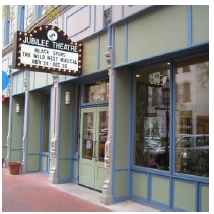
Example of a Marquee Sign.
Marquee Signs—Marquee signs are projecting signs attached to the perimeter or border of a permanently roofed building and are constructed as a part of the building. Marquee signs are usually installed on theaters, cinemas, and performing art facilities. The following requirements shall apply to Marquee Signs:
a.
Sign copy shall be limited to include the facility name for the structure upon which the signs are located and changeable copy related to current and future attractions at that location.
b.
Maximum area for facility name: forty (40) percent of total sign area.
c.
Maximum area for the changeable copy: eighty (80) percent of total sign area.

Example of a Window Sign.
Window Signs and Decals—Window signs are painted on or attached to the inside of a window facing the street. The following requirements shall apply to Marquee Signs:
a.
Window signs shall not completely obscure visibility into or out of the window.
Exceptions may be made for signs that screen utility and office equipment.
b.
A maximum of one (1) window sign is permitted per window-pane or framed window area.
c.
Temporary window signs are allowed to identify special events and sales at that location provided they are removed immediately following the event.
d.
Handwritten, paper, cardboard, and plastic signs are prohibited.
e.
Neon signs are permitted provided that all electrical supply cords, conduit, and electrical transformers are hidden from view through the window.
f.
Maximum area: twenty-five (25) percent of the total transparent glass area of windows parallel to the street excluding the area of all glass doors.
g.
Location: Limited to ground floor window facing the primary street frontage and adjoining parking lot or commercial uses on second floor windows for commercial uses that do not have ground floor occupancy.
h.
Material: High quality, such as vinyl decals, paint, gold- leaf, or neon.
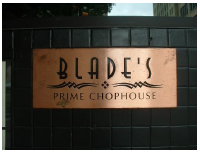
Example of a Plaque Sign.
Plaque Signs—Plaque signs are attached to surfaces adjacent to entries and are smaller versions of wall signs. The following requirements shall apply to Plaque Signs:
a.
Maximum projection: two (2) inches.
b.
Maximum height: two (2) feet.
c.
Maximum width: two (2) feet
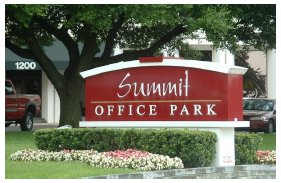
Example of a monument Sign.
Monument Signs—Monument signs are freestanding and are located adjacent to sidewalks. Such signs are typically used for buildings that are separated from adjacent streets by substantial setbacks. The following requirements shall apply to Monument Signs:
a.
Maximum total area: sixty (60) square feet per sign face.
b.
Maximum height: eight (8) feet including base.
c.
Shall be set onto a base or frame, that compliments and is compatible with the building design and materials.
d.
Shall be located in landscaped area and/or provide landscape around the sign and shall have a minimum setback from the public right-of-way of five (5) feet.
e.
Material: Opaque backgrounds with a non-reflective material shall be required.
f.
Lighting: External lighting fixtures designed to complement the appearance of the sign or internal lighting that only illuminates text and logos.
g.
A sign erected on the top of a retaining wall is considered a monument sign. The height of the wall shall be included in the overall height calculation of the retaining wall. In this case, the 5-foot minimum setback is not required.
h.
A sign affixed to the face of a retaining wall or seat wall that is an integral part of a plaza or streetscape design may utilize the sign area allocated to walls signs. In this case, the five (5) foot minimum setback shall not be required.
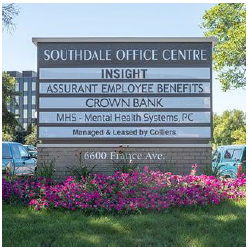
Example of tenant directory sign.
Tenant Directory Signs—Tenant directory signs are used to identify businesses in multitenant buildings that do not have direct frontage onto a public street. The design of the sign shall complement the building's design. Tenant directory signs may be mounted flat against a solid wall within or near a main entrance, or may be incorporated into a freestanding sign.
a.
Maximum sign height: eight (8) feet including sign base.
b.
Maximum letter height: eight (8) inches for building/development name or logo, four (4) inches for all others.
c.
Shall conform to monument sign standards.
d.
Shall orient to the pedestrian area.
e.
Location: May be mounted flat against a solid wall within or near a main entrance or may be incorporated into a freestanding sign located on the property on which the tenants are located.
f.
If lit, shall be externally lit to complement the appearance of the sign, or may be internally lit provided internal lighting only illuminates text and logos.
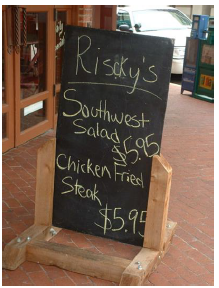
Example of A-frame sign.
A-Frame Sign Standards—Portable A-frame signs are signs and advertising devices that rest on the ground and are not designed to be permanently attached to a building or permanently anchored to the ground. A-frame signs are designed to attract pedestrians, not passing motorists. The following requirements shall apply to A-Frame Signs:
a.
Each business may have one (1) A-frame sign.
b.
A-frame signs shall not encroach into required off- street parking areas, public roadways or alleys, and may not be arranged so as to create site distance conflicts or other traffic hazards.
c.
A-frame signs are allowed on private property or within public rights-of-ways. Signs shall not impede pedestrian, ADA or vehicular access.
d.
A minimum access width of five (5) feet shall be maintained along all sidewalks and building entrances accessible to the public.
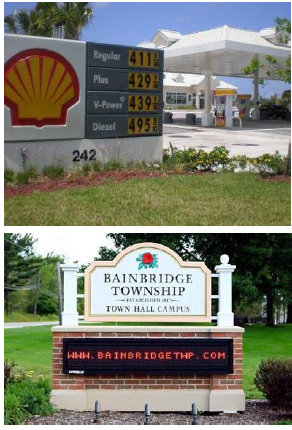
Examples of changeable copy Signs.
Changeable Copy Signs—Changeable copy signs are signs where letters, symbols or numerals or not permanently affixed to the structure, framing or background. This allows the message to change over time. Examples include a bulletin board, or electronic message board. Electronic changeable copy signs are appropriate for the following uses: theaters, hotels, public transit, and gas station pricing signs. The following requirements shall apply to Changeable Copy Signs:
a.
A maximum of twenty-five percent (25%) of the sign face is permitted be devoted to changeable copy.
b.
Changeable copy signs shall not be used to display commercial messages relating to projects or services that are not offered on premise.
c.
Window electronic display sign locations shall not contribute to light pollution for any adjacent residential developments.
d.
On detached signs, electronic changeable copy shall be limited to monument signs.
e.
The message shall not change at a rate faster than one (1) message every twenty (20) seconds. The interval between messages shall be a minimum of one (1) second.
f.
Changeable copy signs shall not contain animation, rolling or running letters or message, flashing lights or displays.
g.
All sound shall prohibited.
Conflict with other UDC provisions: Where there is a direct conflict between the regulations contained in this Chapter governing the MX-C Zoning District and regulations contained in other sections of the UDC, the requirements of this Chapter shall take precedence, and the conflict shall be resolved to provide priority and the greatest meaning to the provisions of this Chapter. Where a conflict is not direct, the provisions shall be interpreted to give meaning to both for the purpose of effecting the purpose and intent of the MX-C zoning District. Subject to the foregoing, all regulations within the UDC shall apply to the MX-C Zoning District, including without limitation, the following sections:
1.
Section 2.07.07. Accessory Buildings and Uses.
2.
Section 2.09.01. Landscaping Regulations.
3.
Section 2.09.02. Tree Preservation.
4.
Section 2.09.03. Vehicle Parking Regulations.
5.
Section 2.09.04. Building Façade Material Standards.
6.
Section 2.09.05. Residential Adjacency Standards.
7.
Section 2.09.07. Lighting and Glare Regulations.
8.
Subsection 4.01. Sign Regulations.
9.
Subsection 4.02. Fence and Screening Regulations.
(Ord. No. 24-04-04-16, § 2.01(Exh. A), 4-4-24; Ord. No. 24-12-19-55, § 2.01(Exh. A), 12-19-24; Ord. No. 25-03-20-12, § 2, 3-20-25)
Editor's note— Ord. No. 24-04-04-16, § 2.01(Exh. A), adopted April 4, 2024, repealed the former § 2.06.02, and enacted a new § 2.06.02 as set out herein. The former § 2.06.02 pertained to similar subject matter and derived from Ord. No. 23-09-21-37, § 2.01, adopted Sep. 21, 2023.
2.06.03. - PD, Planned Development.
The purpose of this district is to encourage quality and better development in the City by allowing flexibility in the planning and development of projects. A PD, Planned Development District may be used to permit new or innovative concepts in land utilization or diversification that could not be achieved through traditional zoning districts. Any combination of residential, commercial, light industrial, public or recreational uses as approved by the City Council may be permitted.
A.
General Description and Purpose
1.
The PD designation shall be used for the following purpose(s):
a.
Master planning;
b.
To carry out specific goals of the Comprehensive Plan, City or public/private partnered special projects;
c.
Development of mixed use, transit-oriented, or traditional neighborhoods with a variety of uses and housing types; and/or
d.
To preserve natural features, open space, and other topographical features of the land.
B.
Base Zoning District
1.
A PD shall contain at least one base zoning district to regulate all uses and development regulations not identified as being modified.
2.
If the standards of the base zoning district are amended, then the most recently amended standards shall apply to a PD district unless the standards have been individually listed within the PD adoption ordinance as being different from the base zoning district.
3.
Base zoning district amendments are applicable to PD districts unless otherwise amended in an approved Planned Development District.
C.
Permitted Uses and Use Regulations
1.
See the Use Chart and all applicable regulations within Subsection 2.07.
2.
See Section 2.10.09. PD, Planned Development Application and Review.
D.
Dimensional Regulations
1.
See Subsection 2.08. Zoning Dimensional Regulations.
2.
See Section 2.10.09. PD, Planned Development Application and Review.
E.
Development Standards
1.
See the Zoning Development Regulations in Subsection 2.09 for all applicable regulations.
2.
See Section 2.10.09. PD, Planned Development Application and Review.
(Ord. No. 18-10-04-31, § 2.01, 10-4-18)

