
Corinth City Zoning Code
Subsection 2.09
Zoning Development Regulations
2.09.01. - Landscaping Regulations
A.
Nonresidential Landscaping Requirements These standards shall apply to all Nonresidential Zoning Districts and Special Zoning Districts. Any area within a PD, Planned Development district containing landscaping standards shall be regulated by the more restrictive standards.
Nonresidential Landscaping shall be required according to the following sections:
1.
Landscaping Along Street Right-of-Way. All commercial, industrial and other nonresidential uses shall comply with the following streetscape requirements:
a.
Landscaped Edge. A landscaped edge shall be provided adjacent to all streets.
i.
The landscaped edge shall be the following minimum widths, exclusive of street Right-of-Way.
(a)
Landscape buffer width adjacent to Arterial Street, Freeway, or Expressway: Twenty (20) feet.
(b)
Landscape buffer width adjacent to Collector Street: Fifteen (15) feet.
(c)
Landscape buffer width adjacent to Local Street: Ten (10) feet.
ii.
Within the landscaped edge, one (1) ornamental tree (2" caliper minimum) shall be planted per every twenty (20) linear feet of landscaped edge. The grouping or clustering of required trees shall be allowed should conflicts arise due to driveway spacing, utilities, drainage facilities, unique topographic conditions, or similar features. Within the Right-of-Way adjacent to the landscaped edge, one (1) shade tree (3" caliper minimum) shall be planted per every thirty (30) linear feet within the parkway (the landscape strip between the sidewalk and curb). The Director of Planning may approve an alternative planting rate or the planting of required shade trees outside of the parkway should conflicts arise due to driveway spacing, existing utilities, existing drainage, unique topographic conditions, or similar features.
iii.
Within the landscaped edge adjacent to TX-DOT Right-of-Way or where the Director of Planning has approved the planting of required shade trees outside of the parkway pursuant to subparagraph (ii) of this Section, one (1) shade tree (3" caliper minimum) shall be planted per every thirty (30) linear feet within the landscaped edge. The grouping or clustering of required trees shall be allowed when conflicts arise due to driveway spacing, utilities, drainage facilities, or similar features, or unique topographic conditions. Within the Right-of-Way adjacent to the landscaped edge, one (1) ornamental tree (2" caliper minimum) shall be planted per every twenty (20) linear feet within the parkway. Alternatively, the Director of Planning may approve the planting of at a minimum one (1) shrub or ornamental grass (3 gallon minimum) per every three (3) linear feet within the parkway.
b.
Vehicle Headlight Screening Abutting the Landscape Edge. Where parking lots, drives, and access easements abut the landscaped edge, opaque evergreen shrubs (5 gallon minimum) shall be planted to form a contiguous buffer along the common boundary line. The required shrubs shall be provided to create a minimum four (4) foot tall screen within two (2) years of the date of planting.
c.
If the parking lot is located 50 feet or more from the street Right-of-Way line, no shrubs or berms will be required unless needed for a headlight screen. (See 2.09.01. A.4 for possible additional landscaping requirements.)
d.
The Applicant is also encouraged to plant a variety of ornamental trees and flowers in addition to the required plantings.
e.
Any permeable surface not occupied by trees, shrubs, planting beds, signs or other permitted fixtures shall be planted with turf or other living ground cover. Crushed granite may be utilized within 2 feet of the back of curb. The Director of Development Services may approve additional areas with an approved landscape plan.
2.
Interior Parking Lot Landscaping. Any nonresidential parking area which contains more than 20 parking spaces shall provide interior landscaping in addition to the required Landscaped Edge (2.09.01. A.1.a):
a.
Interior Parking Lot Landscaping shall include all areas within the paved boundaries of the parking lot as well as planting islands, curbed areas, corner lots, parking spaces and all interior driveways and aisles except those with no parking spaces located on either side.
i.
Landscaped areas outside of the parking lot may not be used to meet the Interior Parking Lot Landscaping requirement.
b.
There shall be ten (10) square feet of Interior Parking Lot Landscaping for each parking space or fraction thereof.
c.
Landscape islands shall be required at a minimum of every ten (10) parking spaces and at the end of each parking row. Each landscape island shall be a minimum of nine (9) feet in width and the depth of each island shall match the depth of the adjacent parking space. Each landscape island must contain at least one (1) shade tree (required 3" caliper minimum) or an ornamental tree (per Table 15: Recommended Plant Material List). The remaining area within the landscape island shall have groundcover consisting of natural landscape materials, such as Native Plantings or Ornamental Grasses with a Rock/Crushed Rock Landscape Base or Mulch Base.
d.
All landscaped areas shall be protected by a raised six (6) inch concrete curb.
i.
Pavement shall not be placed closer than five (5) feet from the trunk of a new tree unless a City approved root barrier is utilized. Existing trees shall be protected with an area equal to the area encompassed by drip lines.
e.
Where an existing parking area is altered or expanded to increase the number of spaces to more than twenty (20), Interior Parking Lot Landscaping shall be provided on the new portion of the lot in accordance with the above standards.
f.
The requirements listed above shall not apply to structured parking garages.
3.
Landscaping for Corner Lots. Corner lots (Lot, Corner) at the intersection of Arterial Streets, Freeways, and Expressways shall comply with the following landscaping requirements in addition to the required plantings for the Landscaped Edge and Interior Parking Lot Landscaping:
a.
A minimum of ten percent (10%) of the site area shall be devoted to landscaping;
b.
A minimum 15-foot wide landscaped edge shall be located along all street Right-of-Way lines beginning at the corner and extending 175 feet or to the closest driveway.
i.
Beyond this point, the landscaped edge may be gradually reduced (over a distance of 25 feet) to match the required landscape edge.
c.
A minimum landscaped area of 900 square feet shall be located at the intersection corner of the lot.
i.
This landscaped area shall be provided within an area measured a minimum distance of 40 feet from the projected corner of the intersection on both sides of the lot.
4.
Landscaping/Screening for Parking Lots Adjacent to Residential Areas. Where parking is within 50 feet of residentially zoned property and is not screened from view by a wall, berm or other screen, a continuous screen of shrubs (5 gallon minimum at the time of planting and planted in planting beds) must be placed adjacent to the parking. The required landscaping shall comply with the following regulations:
a.
The required shrubs shall create a minimum four (4) foot tall screen within two (2) years of the date of planting.
5.
Foundation Plantings for Buildings 50,000 Square Feet or Larger.
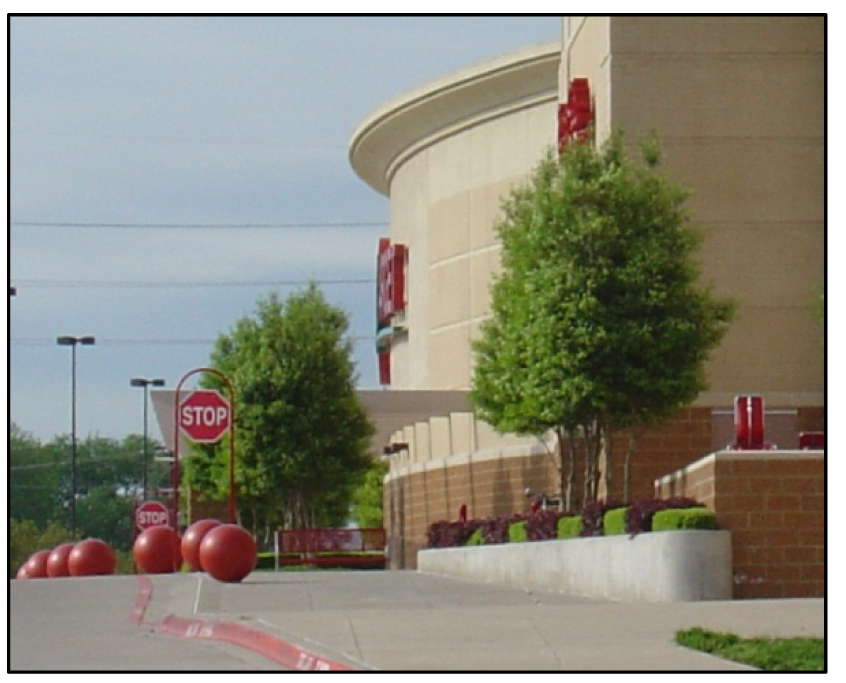
Figure 2: Building with
Foundation Plantings
a.
Foundation plantings are required for buildings or groups of contiguous buildings that are 50,000 square feet or larger.
b.
One large tree [three (3) inch minimum caliper] shall be required for every ten thousand square feet of gross building area.
c.
These trees shall be planted within thirty feet (30') of the front facade.
d.
These plantings are intended to break up the large impervious areas.
e.
Plantings required by this section are in addition to trees required by other sections of this UDC.
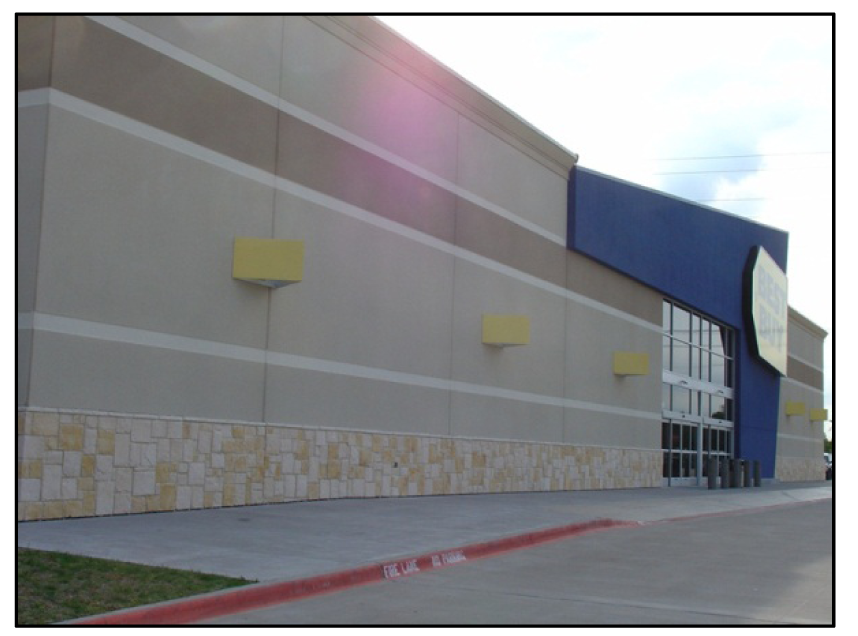
Figure 3: Building without Foundation Plantings
f.
Trees can be grouped or planted in singular form.
g.
These tree plantings should be placed so as not to impede sign visibility or pedestrian safety.
h.
Trees intended for foundation plantings shall meet the following criteria:
i.
Trees planted less than four feet (4') from the back of curb shall be planted in a tree grate with a minimum diameter width of four feet (4').
ii.
Ornamental trees may be substituted for large trees at a building's foundation at the rate of five ornamentals for each required Large Tree (5:1).
(a)
Ornamental trees shall have a minimum size of three (3) inch caliper.
(b)
Multi-trunked trees will be required to meet a three (3) inch requirement based on standard nursery trade specifications.
iii.
Trees may be placed in groups with appropriate spacing for the species.
iv.
The requirements of this section may be reduced if approved by the City Council and when additional pedestrian features; such as, plazas, seating areas, fountains, and outdoor recreation facilities are provided. These facilities must occupy an area equal to or greater than five percent (5%) of the building's total square footage.
6.
Landscaping for Nonresidential Areas Adjacent to Residential Areas. A 20-foot wide landscaped buffer shall be provided adjacent to land zoned for residential uses.
7.
Landscaping for Below-Grade Open Parking Structures in the Front Yard.
a.
Where below grade open parking is provided in the front yard setback of nonresidentially zoned properties, the required landscaping shall comply with the following regulations:
i.
An 18-foot wide landscape edge shall be provided between the below-grade Parking Structure and the street Right-of-Way.
(a)
The landscape edge is exclusive of street Right-of-Way; and
ii.
The 18-foot landscape edge shall include a minimum 36-inch tall berm, measured from the property line after grading.
(a)
The berm shall not exceed a 33 percent slope.
(b)
One shade tree (3 inch caliper minimum) (per Table 15: Recommended Plant Material List) shall be provided for each 50 feet of street frontage within the landscape edge between the below grade open parking and the street Right-of-Way.
8.
Measurement.
a.
Trees with a single trunk shall be measured at 12 inches above the natural ground level.
b.
If the trunk splits into multiple trunks below the 12-inch level, then the multiple trunk trees are measured by the following formula:
(i)
Measure largest trunk circumference at 12 inches above the natural ground level.
(ii)
Remaining trunks, measure circumference at 12 inches above the natural ground level and divided by two.
(iii)
Add subsections (A) and (B) for total circumference, divide total by 3.14 to get caliper.
B.
Residential Landscaping Requirements These standards shall apply to all Residential Zoning Districts. Any area within a PD, Planned Development containing landscaping standards shall be regulated by the more restrictive standards.
Residential Landscaping shall be required according to the following sections:
1.
Multi-Family, Single Family Attached and Retirement Housing Landscaping Requirements.
a.
Landscaped Edge. A landscaped edge shall be provided adjacent to all streets.
i.
The landscaped edge shall be the following minimum widths, exclusive of street Right-of-Way.
(a)
Landscape buffer width adjacent to Arterial Street, Freeway, or Expressway: Twenty (20) feet.
(b)
Landscape buffer width adjacent to Collector Street: Fifteen (15) feet.
(c)
Landscape buffer width adjacent to Local Street: Ten (10) feet.
ii.
Within the landscaped edge, one (1) ornamental tree (2" caliper minimum) shall be planted per every twenty (20) linear feet of landscaped edge. The grouping or clustering of required trees shall be allowed should conflicts arise due to driveway spacing, utilities, drainage facilities, unique topographic conditions, or similar features. Within the Right-of-Way adjacent to the landscaped edge, one (1) shade tree (3" caliper minimum) shall be planted per every thirty (30) linear feet within the parkway (the landscape strip between the sidewalk and curb). The Director of Planning may approve an alternative planting rate or the planting of required shade trees outside of the parkway should conflicts arise due to driveway spacing, existing utilities, existing drainage, unique topographic conditions, or similar features.
iii.
Within the landscaped edge adjacent to TX-DOT Right-of-Way or where the Director of Planning has approved the planting of required shade trees outside of the parkway pursuant to subparagraph (ii) of this Section, one (1) shade tree (3" caliper minimum) shall be planted per every 30 linear feet within the landscaped edge. The grouping or clustering of required trees shall be allowed should conflicts arise due to driveway spacing, utilities, drainage facilities, unique topographic conditions, or similar features. Within the Right-of-Way adjacent to the landscaped edge, one (1) ornamental tree (2" caliper minimum) shall be planted per every twenty (20) linear feet within the parkway. Alternatively, the Director of Planning may approve the planting of at a minimum one (1) shrub or ornamental grass (3 gallon minimum) per every three (3) linear feet within the parkway.
b.
Shrub Buffer for Parking Lots and Drives. Where parking lots and drives abut the landscaped edge, shrubs (5 gallon minimum) shall be planted to form a contiguous buffer along the common boundary line.
i.
The number of required shrubs shall be calculated solely on the area of the required landscaped edge.
ii.
Shrubs shall be planted in planting beds.
iii.
A berm may be placed within the landscaped edge in lieu of the required shrubs unless needed for a headlight screen.
iv.
The berm must be 18 to 40 inches above the average grade of the street and parking lot curbs.
v.
The slope of berm shall not exceed a 33 percent grade.
c.
If the parking lot is located 50 feet or more from the street Right-of-Way line, no shrubs or berms will be required unless needed for a headlight screen.
d.
The Applicant is also encouraged to plant a variety of ornamental trees and flowers in addition to the required plantings.
e.
Any permeable surface not occupied by trees, shrubs, plantings beds, signs or other permitted fixtures shall be planted with turf or other living ground cover.
f.
The Planning and Zoning Commission and the City Council may reduce the width of the required landscaped edge during Site Plan review when the reduction is required for a Public Improvement.
g.
Parking areas shall be landscaped in addition to the required landscaped edge.
i.
Twenty (20) square feet of landscaping for each parking space shall be provided within the paved boundaries including one (1) shade tree (3" caliper minimum) or ornamental tree (per Table 15: Recommended Plant Material List) per ten (10) parking spaces.
h.
All landscaped areas shall be protected by a raised six (6) inch concrete curb.
i.
Pavement shall not be placed closer than five (5) feet from the trunk of a tree unless a staff approved root barrier is utilized.
i.
One (1) shade tree (3" caliper minimum) or ornamental tree per 1,000 square feet of required open space (e.g., required yards) shall be provided.
j.
No site developed prior to the effective date of this section shall be required to conform to the landscaping requirements of this section unless the site is redeveloped or there is a thirty percent (30%) or more increase in the existing square footage of building area and/or reconstruction of the existing parking lot.
k.
Additional Multi-family Landscape Requirements. The multi-family complex shall be landscaped in accordance with 2.09.01. Landscaping Regulations. If more than one apartment building is permitted to be placed upon a single lot, the following areas shall be landscaped:
i.
A twenty (20) foot strip along the front and rear of the buildings as measured from the foundation.
ii.
A fifteen (15) foot strip along all other sides of the buildings as measured from the foundation.
iii.
That area adjacent to building corners determined by extending the front, rear, and side landscape limits to their point of intersection.
iv.
Any additional landscape area that is needed to meet the City's requirements shall be indicated and fully described upon the plat.
2.
Landscaping Requirements for Attached and Detached Single Family Developments.
A.
Perimeter landscaping requirements.
a.
Landscaped Edge. A landscaped edge shall be provided adjacent to all streets which lay on the perimeter of a residential subdivision.
i.
The landscaped edge shall be the following minimum widths, exclusive of street Right-of-Way.
(a)
Landscape buffer width adjacent to Arterial Street, Freeway, or Expressway: Twenty (20) feet.
(b)
Landscape buffer width adjacent to Collector Street: Fifteen (15) feet.
(c)
Landscape buffer width adjacent to Local Street: Ten (10) feet.
ii.
Within the landscaped edge, one (1) ornamental tree (2" caliper minimum) shall be planted per every twenty (20) linear feet of landscaped edge. The grouping or clustering of required trees shall be allowed should conflicts arise due to driveway spacing, utilities, drainage facilities, or similar features, or other unique topographic conditions. Within the Right-of-Way adjacent to the landscaped edge, one (1) shade tree (3" caliper minimum) shall be planted per every thirty (30) linear feet within the parkway (the landscape strip between the sidewalk and curb). The Director of Planning may at their discretion approve an alternative planting rate or the planting of required shade trees outside of the parkway should conflicts arise due to driveway spacing, existing utilities, existing drainage, unique topographic conditions, or similar features.
iii.
Within the landscaped edge adjacent to TX-DOT Right-of-Way or where the Director of Planning has approved the planting of required shade trees outside of the parkway pursuant to subparagraph (ii) of this Section, one (1) shade tree (3" caliper minimum) shall be planted per every thirty (30) linear feet within the landscaped edge. The grouping or clustering of required trees shall be allowed should conflicts arise due to driveway spacing, utilities, drainage facilities, unique topographic conditions, or similar features. Within the Right-of-Way adjacent to the landscaped edge, one (1) ornamental tree (2" caliper minimum) shall be planted per every twenty (20) linear feet within the parkway. Alternatively, the Director of Planning may approve the planting of at a minimum one (1) shrub or ornamental grass (3 gallon minimum) per every three (3') linear feet within the parkway.
b.
Common Open Space. Within the Right-of-Way adjacent to common open space areas, one (1) shade tree (3" caliper minimum) shall be planted per every thirty (30) linear feet within the parkway.
B.
Landscaping requirements for attached and detached Single Family lots.
(a)
Required Landscaping.
(1)
Trees shall be planted to meet the total number of caliper inches referenced in the table below. Each required shade tree shall not be smaller than three (3) caliper inches and each required ornamental tree shall not be smaller than two (2) caliper inches in size.
(2)
For single family detached lots with a width of fifty feet (50') or less, a minimum of one (1) shade tree shall be planted within the parkway along the frontage of each lot. For single family attached lots of any width or single family detached lots with a width greater than fifty feet (50'), one (1) shade tree shall be planted per every thirty (30) linear feet within the parkway along the frontage of such lots. Trees planted within the parkway along the frontage of single family lots may count towards the total number of caliper inches referenced in the table below.
(3)
Within the Right-of-Way adjacent to corner lots, one (1) shade tree shall be planted per every thirty (30) linear feet within the parkway along the side of such lots. Trees planted within the parkway along the side of corner lots do not count towards the total number of caliper inches referenced in the table below.
(4)
A minimum of one (1) ornamental tree shall be located within the front yard of each residential lot. The remaining required trees may be placed in the front or rear yard of each residential lot.
(b)
Location of trees.
(1)
In addition to compliance with all other requirements of the UDC, trees planted within the parkway shall comply with City standards for species, spacing, location, infrastructure clearance, and maintenance.
(2)
Trees shall be placed in a location which does not interfere with overhead and/or underground utility easements.
(3)
Trees shall be spaced so that at mature growth their canopies do not interfere with one another.
(c)
Measurement.
(1)
Trees with a single trunk shall be measured at twelve inches (12") above the natural ground level.
(2)
If the trunk splits into multiple trunks below the twelve-inch (12") level, then the multiple trunk trees shall be measured in accordance with the following formula.
(i)
Measure the circumference of the largest trunk at twelve inches (12") above the natural ground level.
(ii)
Measure the circumference of the remaining trunk(s) at twelve inches (12") above the natural ground level and divide by two (2).
(iii)
Add subsections (i) and (ii) to determine the total circumference and then divide the total circumference by 3.14 to determine the required caliper.
(d)
Additional vegetation requirements.
(1)
Required shrubs shall be a minimum of three (3) gallons in size when planted and shall be planted in the front yard of all residential lots. Shrubs may be substituted with small trees when planted in the front yard.
(2)
Solid vegetative ground cover or lawn shall be required for the entirety of the lot that is not otherwise covered by mulched planter beds, building(s) and/or driveway area(s).
(3)
All landscaping required above shall be planted and be in healthy living condition prior to issuance of the certificate of occupancy for the dwelling(s).
C.
Landscape Maintenance Requirements
1.
All plant material shall be maintained in a healthy and growing condition, and must be replaced with plant material of similar variety and size if damaged, destroyed, or removed.
2.
Landscaped areas shall be kept free of trash, litter, weeds and other such materials or plants not a part of the landscaping.
3.
An automatic irrigation system with rain and freeze sensors is required for all landscaping except for single family residences.
4.
All cut areas front, side, and rear must have sod for erosion control.
5.
Any Developer desiring to install and maintain landscaping materials and irrigation facilities within the City Right-of-Way must first receive written approval from the Director of Public Works.
6.
Replacement of dead landscaping shall occur prior to the issuance of a certificate of occupancy.
D.
Landscaping Incentives: Private Detention and Retention Ponds Designed as Amenities
1.
Incentive. If a private detention or retention pond is designed and maintained according to the following standards, then a ten (10) percent increase in the maximum building area coverage listed in 2.08.05. Nonresidential Dimensional Regulations Chart shall be granted.
2.
Applicability. All nonresidentially zoned land or uses shall be eligible for the incentive.
3.
Standards for Detention and Retention Ponds as Amenities. A private detention or retention pond shall be considered an amenity if it meets the following design considerations:
a.
Located between the building and the street or completely bounded by streets,
b.
Viewable from public space,
c.
Any slope of the pond area does not exceed thirty-three (33) percent,
d.
Accessible by patrons,
e.
Seating area, public art, or fountain,
f.
One tree or planter at least sixteen (16) square feet in size for every two hundred (200) square feet of open space, and be located within or directly adjacent to the open space, and
g.
The Site Plan and plat, if applicable acknowledge the responsibility of the owner or property owners association to maintain the pond.
4.
Example of a Detention/Retention Pond Designed as an Amenity.
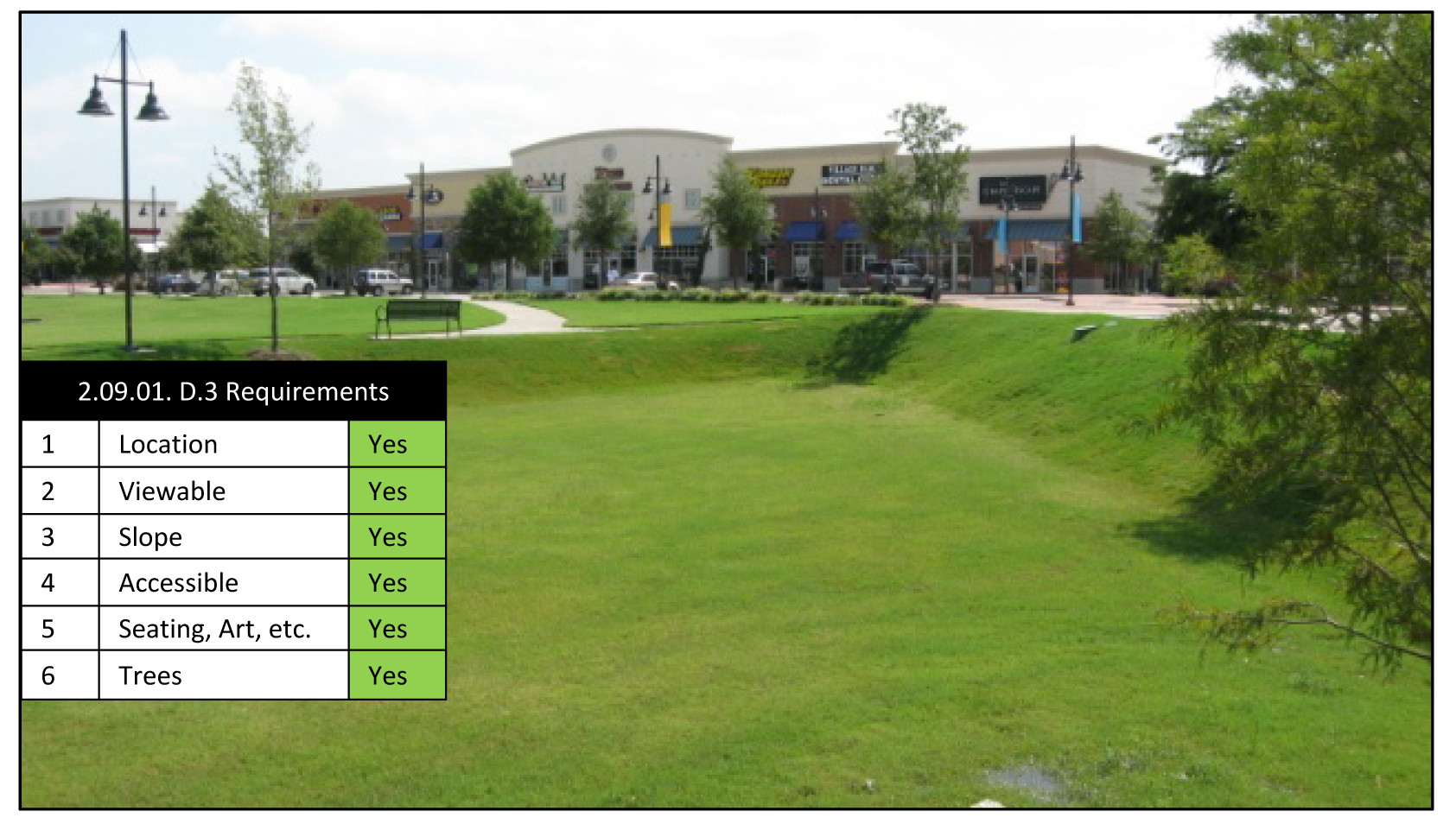
Figure 4: Example of a Detention/Retention Pond Designed as an Amenity
5.
Example of a Detention/Retention Pond not Designed as an Amenity.
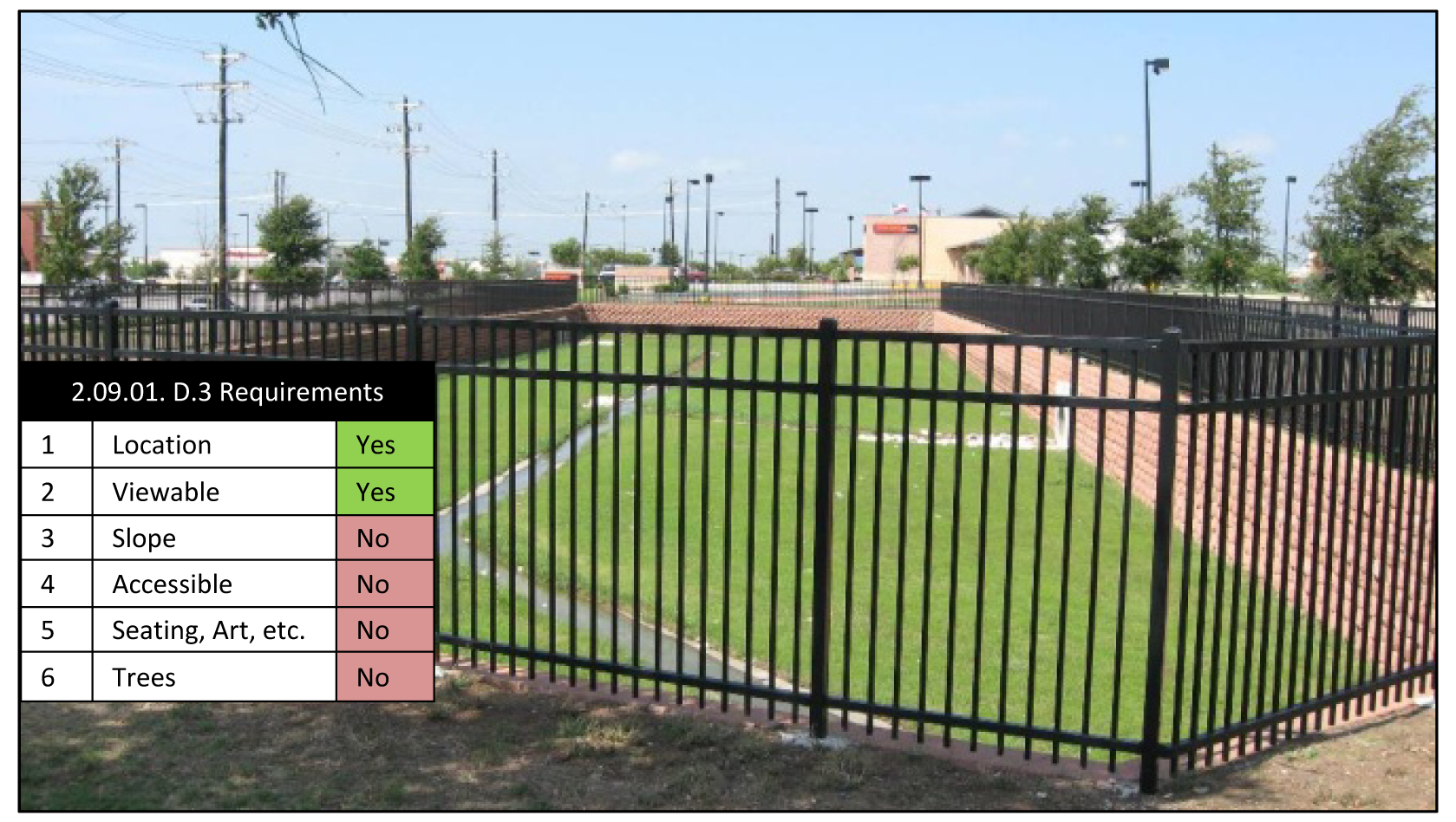
Figure 5: Example of a Detention/Retention Pond not Designed as an Amenity
E.
Approved Plant Materials
1.
The use of artificial plants or turf are expressly prohibited for compliance with this UDC.
2.
Use of drought tolerant plants are encouraged to meet the requirements of this UDC.
3.
The following is the approved plant material list for plant materials required in this UDC:
Table 15: Recommended Plant Material List
* May not be used in Oak Wilt prone area.
F.
Approval of Alternative Landscaping A request for alternative landscaping may be submitted and acted upon in accordance with the accompanying site plan or planned development request. The City Council, or alternatively the Director of Planning and Development if the site plan or planned development amendment meets the criteria for administrative approval, may approve the following, based upon a finding that the proposed alternative meets the spirit and intent of this Section 2.09.01 Landscaping Regulations:
1.
Location or Type of Required Landscape Material.
a.
Alternatives or minor changes to the location or type of required landscape materials due to unusual topographic constraints, sight restrictions, siting requirements, preservation of existing stands of native trees or similar conditions, or in order to maintain consistency of established front yard setbacks.
b.
These minor changes may vary the location of required landscape materials, but may not reduce the amount of required landscape area or the amount of landscape materials.
2.
Required Landscaping Edges and Buffers.
a.
Alternatives or minor changes to the required landscape edges and buffers along a street frontage if immediately adjacent properties on both sides (at side property lines) have a smaller or no landscape buffer strip, in order to maintain consistency between existing parking lot and drive aisle alignments.
b.
If an alternative landscape edge or buffer is granted, an equal amount of landscaped area and trees shall be provided elsewhere on the site as may be deemed appropriate by the City Council.
3.
Landscaping for Nonresidential Areas Adjacent to Residential Areas.
a.
Partial or complete relief from the landscaping buffer requirement within 2.09.01. A.6, if the applicable lot is smaller than two (2) acres.
b.
If an alternative buffer is granted, adequate screening shall be provided to ensure an equivalent buffer effect.
G.
Entryways and Amenity Features within City Right-of-Way
1.
Entryway or amenity features within City Right-of-Way may be developed under the responsibility of a Homeowners' or Property Owners' Association.
a.
Documents shall be submitted, reviewed, and approved by the Director of Planning.
(Ord. No. 18-02-15-06, § 1, 2-15-18; Ord. No. 18-08-16-24, § 2.15, 8-16-18; Ord. No. 19-2-21-06, § 2.01, 2-21-19; Ord. No. 25-05-01-22, §§ 2.01—2.04, 5-1-25; Ord. No. 25-10-16-50, §§ 2.01—2.04, 10-16-25)
2.09.02. - Tree Preservation
A.
Purpose
1.
The purpose of this Section 2.09.02 is to establish regulations for the preservation and replacement of existing Protected Trees within the City of Corinth and to provide protection of trees during construction, development, or redevelopment of a site. In addition, this Section shall further the following public purposes:
a.
Establish a permitting and enforcement process for tree removal;
b.
Encourage the preservation and protection of existing Protected Trees and Protected Tree stands and groves through the application of design principles that consider the environmental context of the site, and which include the preservation of open spaces in the design of undeveloped residential and non-residential developments (Examples of context and environmentally sensitive site design include practices that incorporate linear open space linkages to preserve trees within riparian buffer zones, tree groves or stands, and/or more formal open space greens such as plazas that strategically designed to contain groupings of Protected Trees within residential, non-residential, multi-family or mixed use developments);
c.
Reward context sensitive (environmentally sensitive) site design that preserves existing Protected Trees and associated habitat by offering preservation credits to off-set required replacement rates for Protected Trees that are necessarily removed during construction, development, and redevelopment;
d.
Preserve trees that further the ecological, environmental, and unique aesthetic qualities that make Corinth a special place to live, work, and play;
e.
Preserve and provide for trees that offer shade and windbreaks; reduce the erosive effects of rainfall, protect water resources, mitigate ambient air temperatures and improve air quality;
f.
Provide for open space and more efficient drainage of land thereby reducing the effects of soil erosion;
g.
Prevent the untimely and indiscriminate removal or destruction and clear-cutting of trees that once destroyed may only be regenerated after generations have passed;
h.
Maintain the high quality of life in Corinth by preserving the existing mature Protected Trees as important natural features and to require replanting where preservation is not practical; and
i.
Protect healthy quality trees and promote preservation of habitat and the aesthetic qualities of the city.
j.
Preserve Heritage Trees (40 CI and greater) to the greatest extent possible.
B.
Scope The scope of this Section 2.09.02 includes the removal and mitigation of Protected Trees as further detailed herein.
C.
Definitions For the purposes of this Section 2.09.02. Tree Preservation, the following terms shall have the special meaning ascribed to them below. Special meanings shall govern in case of any conflict with other definitions set forth in the City Code of Ordinances or Unified Development Code.
1.
Building Footprint The actual foundation area of a building including all parts of a main building that rest, directly or indirectly on the ground, including without limitation, attached garages, bay windows with floor space, chimneys, and porches.
2.
Caliper Inch (CI) Measurement around a tree's circumference to determine the diameter of the tree trunk.
3.
Clear-cutting The indiscriminate cutting down or mechanical removal of Trees from a site or tract.
4.
Critical root zone The area of undisturbed natural soil around a tree defined by a concentric circle with a radius equal to the distance from the trunk to the outermost portion of the Drip Line.
5.
Development Any manmade change to improved or unimproved real estate including, but not limited to, buildings and other structures, paving, drainage, utilities, storage, and agricultural activities.
6.
Diameter at Breast Height (DBH) Measurement around a tree's circumference to determine the diameter of the tree trunk on an existing tree located in a natural setting as measured at four and one-half (4½) feet above the natural grade (ground level) in caliper inches. (see Caliper Inch (CI))
7.
Drip Line is the area directly located under the outer circumference of the tree branches. Also known as a tree's Critical Root Zone (CRZ), sometimes also called the Root Protection Zone (RPZ).
8.
Healthy Protected Tree A Protected Tree rated in good or excellent condition as determined by a Certified Arborist and/or Registered Landscape Architect in accordance with accepted industry standards.
9.
Incident A Protected Tree, with at least a 6" DBH that was removed from a site or tract or severely damaged in violation of this section. Note that each Protected Tree affected would represent one incident.
10.
Mitigation The method by which trees are replaced whether through replanting on the subject property, transplanting to another location or same property, or through payment of fee-in-lieu-of replanting approved by the City.
11.
Mitigation Plan The City approved plan of Mitigation for a property (also referred to as Tree Protection/Mitigation Plan).
12.
Owner The individual or business entity holding legal title to real property or a lessee, agent, employee, or other person acting on behalf of, or at the request of the titleholder with authorization to do so.
13.
Planning and Development Director or Planning Director The Planning and Development Director for the City of Corinth or his/her designee.
14.
Property Real property located within the corporate limits of the City of Corinth.
15.
Tree A self-supporting, woody, perennial plant which may have one or more stems or trunks in which case the cumulative total diameter of those trunks shall be calculated in determining whether the trunk of the tree is six inches (6") in diameter or greater.
16.
Tree, dead (or declining) A tree that is dead or in severe decline with substantial structural defects, no remedial options available, and no chance of recovery as determined and documented by a Certified Arborist or Registered Landscape Architect.
17.
Tree, Heritage Any Protected Tree species with 40 CI or greater as measured at DBH.
18.
Tree, Preservation Area Any area designated on a site plan, landscape plan, Planned Development Concept Plan or Plat identified as a location where existing Protected Trees are saved or planted.
19.
Tree, Protected Any tree species other than those specifically identified herein as an "Unprotected Tree" and having a trunk caliper of six inches (6") or more, measured four and one-half (4½) feet above natural grade level (also referred to as measured at DBH).
20.
Tree, Removal Uprooting, severing the main trunk of the tree, or any act which causes, or may reasonably cause, the tree to die, including but not limited to:
a.
Damage inflicted upon the root system by machinery, storage of materials, or soil compaction,
b.
Substantially changing the natural grade above the root system or around the trunk,
c.
Excessive pruning, or
d.
Paving with concrete, asphalt, or other impervious materials in a manner which may reasonably be expected to kill the tree.
21.
Tree, Replacement A Shade Tree (Canopy Tree) as outlined in Table 15: Recommended Plant Material List (Subsection 2.09.01.E.).
22.
Tree, Shade Large trees that provide the overhead structure for shade (canopy tree) typically reaching a height ranging between 20' - 70'+ at maturity as further described and listed in Table 15: Recommended Plant Material List (Subsection 2.09.01.E.).
23.
Tree, Understory Smaller trees (ornamental trees) typically reaching a height of 15' - 30' at maturity. Such trees are typically used for screening and accent elements.
24.
Tree, Unprotected (exempt from Section 2.09.02). Note that the following trees are specifically exempt from the Mitigation provisions of Section 2.09.02 regardless of caliper inches at DBH based on species type; however, a Tree Removal Permit shall be required:
25.
Tree Fund A City administered fund established for collection of fee-in-lieu-of payments paid as Mitigation and may include other contributions made in support tree preservation efforts.
26.
Tree Removal Permit Written authorization by the City provided to an Owner of Property that allows the removal of a Protected Tree in accordance with the provisions of this Section.
27.
UDC or Unified Development Code The Unified Development Code of the City of Corinth Texas, as amended from time to time.
D.
Applicability The terms and provisions of this Section shall apply to all property and development as follows:
1.
All vacant and undeveloped Property.
2.
All Property to be redeveloped.
3.
All developed Property for which a Tree Protection/Mitigation Plan, Landscape Plan or Planned Development has been approved by the City and identifies Trees required to be planted or preserved in accordance with this Section.
E.
Exemptions. Except as expressly provided herein, the terms and provisions of this Section 2.09.02 requiring a Tree Removal Permit and Tree Mitigation shall not apply to a Protected Tree under the following circumstances:
1.
For an existing single-family dwelling or two-family dwelling property (after both initial development and being occupied as a residence), that is contained within a platted lot of record, and the property is not being developed, redeveloped, platted, replatted, or subdivided, a Tree Removal Permit shall not be required for the removal of a Protected Tree. However, if a Tree proposed for removal was required by the Landscape Regulations of the UDC at the time of permitting and/or as required by the provisions of an approved Planned Development district ordinance for the Property, and/or an approved Tree Protection/Mitigation Plan or Landscape Plan, the owner shall replace the tree with a three (3) caliper inch or greater tree of the species outlined on Table 15 - Recommended Plant Material List (Section 2.09.01).
2.
Neither a Tree Removal Permit nor Tree Mitigation is required for the removal of a diseased or dead Protected Tree where the tree is dead, diseased, damaged beyond point of recovery, in danger of falling, or endangers the public, health, safety or welfare as determined by a Certified Arborist, Registered Landscape Architect, or other qualified professional. Note that this exemption shall not apply in instances where the death or damage to the Protected Tree was caused by actions or inaction of the Owner. However, if a Tree proposed for removal was required by the Landscape Regulations of the UDC Ordinance as part of a site plan, Landscape Plan, Tree Protection/Mitigation Plan and/or provisions of an approved Planned Development district Ordinance for the Property, the Owner shall replace the tree with a three (3) caliper inch or greater Protected Tree of the species outlined on Table 15 - Recommended Plant Material List (Subsection 2.09.01).
3.
No Tree Removal Permit shall be required for the removal of a Protected Tree to remedy utility service interruption during an emergency situation. However, if a Tree proposed for removal was required by the Landscape Regulations of the UDC Ordinance as part of a site plan, Landscape Plan, Tree Protection/Mitigation Plan, and/or provisions of an approved Planned Development district Ordinance for the Property, the Owner shall replace the Tree with a three (3) caliper inch or greater Tree of the species outlined on Table 15 - Recommended Plant Material List (Subsection 2.09.01).
4.
Nurseries. All retail, commercial, and/or wholesale nurseries in terms of those trees planted and growing on the premises for sale or intended for sale in the ordinary course of business only are exempt from Tree Mitigation and Tree Removal Permit requirements.
5.
Utility Companies franchised by the City to use or to locate infrastructure within easements or rights-of-way which have been accepted by the City or that are otherwise authorized to provide utility services within the City are exempt from Tree Mitigation and may remove Protected Trees that endanger public safety and welfare by interfering with utility service. However, a Tree Removal Permit is required.
F.
Tree Removal Permit
1.
Tree Removal Permit Required. A Tree Removal Permit shall be required for the removal of a Protected Tree(s) within the City as outlined in this Section, except as expressly exempted by Subsection 2.09.02.E., above. Additionally, no Tree that was required to be planted or preserved as part of an approved site plan, Landscape Plan, Tree Protection/Mitigation Plan, Planned Development district Ordinance or other provision of the UDC may be removed until authorized by the City in accordance with an approved Tree Removal Permit.
2.
Tree Removal Permit Application. An application for a Tree Removal Permit shall be filed and a Tree Removal Permit shall be required in conjunction with the following activities:
a.
A request to remove a Protected Tree(s) or Unprotected Tree(s) six (6) caliper inches or greater;
b.
An application to fill or grade a property, lot, tract, or parcel;
c.
A plat or site plan application;
d.
A request to remove any Tree identified on an approved Landscape Plan for a site plan or plat and/or required by the UDC Landscape Regulation provisions, or a Tree Protection/Mitigation Plan (identified as a mitigation replacement tree), or the landscape regulations of a Planned Development District ordinance for the Property (regardless of tree CI). In such instances, required landscape or mitigation trees 6 CI or over shall be replaced at a 1:1 ratio, and trees less than 6 CI shall be replaced with a three (3) caliper inch tree to satisfy the Landscape Plan, the mitigation replanting requirements of a Tree Protection/Mitigation Plan, UDC requirements and/or PD approval. This request does not pertain to a request to remove a "Protected Trees identified for preservation";
e.
A request to remove any Tree located within a "deeded open space lot," "X Lot" or an area identified on an approved site plan (and associated Landscape Plan) or Tree Protection/Mitigation Plan for the Property as being a "Protected Tree Preservation Area" or identified as a Protected Tree to be preserved. Note that such tree(s) shall be mitigated at the "sliding scale" replacement rate set forth in Subsection 2.09.02.G., based on the CI of the Protected Tree to be removed. Additionally, any Tree Preservation Credits granted for the Protected Tree saved will need to be accounted for in the Permit Application. A request to remove a tree in the above instance may require a PD amendment.
3.
Contents of an Application for Tree Removal Permit. An application for Tree Removal Permit shall consist of the following components, as may be adjusted by the Director of Planning:
a.
A Tree Survey and Tree Protection/Mitigation Plan If there are no Protected Trees on site, then a statement indicating such shall be attested to by a Registered Landscape Architect or Certified Arborist;
b.
Tree Removal Permit Form completed by the Owner;
c.
Application Worksheet;
d.
A summary narrative explaining the reasoning for the proposed Tree removal; and
e.
Application fee per the Fee Schedule shall be paid by the Owner.
4.
Tree Surveys and Tree Protection/Mitigation Plan Requirements.
a.
The Tree Survey and Tree Protection/Mitigation Plan shall be prepared by a Registered Landscape Architect or Certified Arborist and shall be current within one year of the date of the filing of a Tree Removal Permit Application. The above information may be combined on one plan sheet.
b.
The Tree Survey shall at minimum identify the Unprotected Trees (6 CI and greater) and Protected Trees as follows:
i.
Tree Identification Number (graphic location);
ii.
Tree Type (Common and Botanical name of tree);
iii.
Tree Size (Trunk Diameter (Caliper Inches as measured at DBH) used to measure the trunk diameter of an existing tree located in a natural setting, with the point of measurement being four and one-half (4½) feet above the natural grade);
iv.
Condition of Tree (health conditions of the tree rating) shall be based on accepted industry standards as determined by a Certified Arborist and/or Registered Landscape Architect. Protected Trees determined to be dead shall be identified and documented on the Tree Survey, though are not subject to mitigation rates or credits;
v.
Canopy Radius (provided in table and as a graphical representation of the canopy on the plan sheet to consider crown clearance and critical root zone in association to where proposed structures or curbing, etc., can be practically placed within the dripline of a tree shall be considered during site plan, preliminary plat (if preliminary landscape plan provided) and/or at time of Civil Plan review);
vi.
Status (to be Removed or Preserved);
vii.
Replacement Rate Multiplier;
viii.
Mitigation Required (Caliper Inches);
ix.
Credit Multiplier (Caliper Inches, if applicable);
x.
Adjusted Mitigation (Caliper Inches, if applicable);
c.
The Tree Protection/Mitigation Plan shall provide detailed information beyond the requirements of the Tree Survey by graphically identifying Protected Trees to be preserved and those to be removed for the entire Property. Additionally, an accounting of the following items shall be presented in table format on the Tree Protection/Mitigation Plan, provided on a separate 8½" x 11" worksheet and shall also be provided in an Excel Spreadsheet linked to the Tree Survey and Tree Protection/Mitigation Plan assumptions. The format and components of this table may be adjusted as determined by the Director of Planning.
i.
Total Protected Trees CI on Property;
ii.
Total Protected Trees CI to be preserved on Property (including percentage of total CI);
iii.
Total Protected Trees CI to be removed on Property;
iv.
Total Protected Trees CI to be removed on Property with Replacement Rate Multiplier (based on Protected Tree Size Category)
v.
Sliding Scale Credits (if applicable and broken out by CI Category)
vi.
Subtotal CI Mitigation Required;
vii.
___% off "Subtotal CI Mitigation Required" - Standard Deduction Credit (see Table 16-B if applicable); and
viii.
Total Mitigation Required.
d.
The Tree Protection/Mitigation Plan shall also include the calculation of Replacement Tree caliper inches required for Mitigation of Protected Trees to be removed based on the "replacement ratio" options and credits as provided for in Subsection 2.09.02G. and Table 16-A and Table 16-B., and
e.
A Landscape Plan shall be required in conjunction with a Tree Survey and Tree Protection/Mitigation Plan to show the proposed location for Replacement Trees relative to the location of other UDC, or Planned Development District required tree plantings, and Protected Trees to be preserved on site. The Landscape Plan shall clearly distinguish the location of "Replacement Trees" from other landscape plantings as may be required per the UDC, e.g., Subsection 2.09.01, Landscape Regulations, and/or applicable provisions of an approved Planned Development District Ordinance for the Property. Replacement Trees shall measure at least three (3) caliper inches in accordance with the American Standards for Nursery Stock (ANSI Z60.1-2004) at time of planting.
f.
The Tree Survey and Tree Protection/Mitigation Plan (with an associated Landscape Plan) shall be submitted jointly.
5.
Violation. It is considered an Incident and an offense to directly or indirectly, cause, permit or allow the cutting down, destruction, removal, or damaging of a Protected Tree (defined herein), prior to approval of a Tree Removal Permit which includes a Tree Survey and Tree Protection/Mitigation Plan (with an associated Landscape Plan showing the proposed replacement of Protected Trees) and meeting all requirements of this Ordinance.
a.
If an Owner removes, or causes, or allows the removal of a Protected Tree prior to receipt of an approved Tree Removal Permit, such Owner shall mitigate at the increased rate of 5:1 for caliper inches determined to have been removed. The determination of caliper inches removed shall be based upon the most recent aerial photography showing the extent of the existing tree "canopy tree cover" prior to tree removal. In such instances, the entirety of tree canopy coverage removed shall be assumed to be that of Protected Trees with an estimate of the CI for Protected Trees on site to produce the canopy coverage as established by a Certified Arborist or Registered Landscape Architect.
b.
The property Owner in violation shall be responsible for replacement mitigation. A violation of these provisions shall not relieve the Owner from the tree replacement requirements established herein.
6.
Tree Removal Permit Review and Approval Process. The Director of Planning may administratively review and approve a Tree Removal Permit Application subject to mitigation requirements outlined in Subsection 2.09.02.G., herein. Any Tree Removal Permit Application for Property that is "undeveloped land proposed for new development or redevelopment" that does not propose to preserve at least 10% of Healthy Protected Tree CI on site shall require City Council review and approval. In processing the Tree Removal Permit Application, the following shall be considered:
a.
Applicant submits a complete Application and applicable fees.
b.
Contents of the Application are in accordance with Section 2.09.02.F.3., above.
c.
A Protected Tree shall not be removed or transplanted until the following steps have been completed:
i.
The Mitigation requirements of Section 2.09.02.G., have been established and approved for the subject lot, site, tract, or parcel based on an approved Tree Survey and Protection Plan (including a landscape plan showing the location of replacement trees when applicable).
ii.
A Pre-Clearing Conference (may be a component of Preconstruction Meeting) shall be held with appropriate City Staff prior to the authorization for any clearing, grading, and/or construction activities to begin on the Property, including without limitation, on a lot, site, tract, or parcel. The pre-clearing discussion shall include a review of procedures for protection of and for conducting operations on the Property in a manner that provides for the preservation of Protected Trees. This Conference shall be held as part of the Tree Removal Permit process.
iii.
City Construction Inspector has signed off that all Protected Trees to be preserved on the Property have been clearly marked and that protective fencing (orange plastic fencing, minimum of four (4) feet in height, around the Drip Line or Critical Root Zone) has been properly installed per Subsection 2.09.02.H, herein. All protective measures shall be maintained throughout the entire period that construction occurs on the Property.
iv.
Tree Removal Permit has been issued based on compliance with the statements above.
7.
Tree Removal Permit Application. The Director of Planning may determine, at their discretion, to defer a Tree Removal Permit application to City Council for review and approval and/or consideration of Alternative Compliance options.
8.
Appeals/Alternative Compliance. The Mitigation requirements established in the Tree Removal Permit documentation as administratively approved, may be appealed to the City Council under the process established for Alternative Compliance - Tree Preservation whereby the Applicant may complete an alternative proposal application that states the basis for any requested departures from the criteria established in these provisions. The Applicant shall have the burden of demonstrating hardship that justifies the request for an alternative solution (alternative compliance) that is more beneficial to the public good.
G.
Mitigation Requirements for Protected Trees Removed
1.
Calculation of Replacement CI. If it is necessary to remove a Protected Tree, the Applicant shall be required to mitigate the Protected Tree based on the "development type" outlined in Table 16-A-Replacement Rates for Protected Trees. Where the removal of a Protected Tree is unavoidable, the planting of a replacement tree is desired over fee mitigation to promote revegetation and reestablishment of habitat.
2.
Measurement of Existing Protected Trees. All existing tree measurements are in caliper inches as measured at four and one-half (4½) feet DBH above the natural ground level.
3.
4.
Credits for Protected Tree Preservation Efforts. The following Credit Sliding Scale is intended to encourage the preservation of Protected Trees and wildlife habitat through the thoughtful incorporation of such into the overall design of a site. Credits are offered based on the percentage of total Healthy Protected Tree CI preserved on the Property AND preserved in deeded open space lots to remain in perpetuity and cared for by the HOA and/or POA as applicable. Such credits may also be applied to mixed use, multi-family, and non-residential developments where Healthy Protected Tree(s) are preserved and incorporated into the overall site design in a manner that is "context sensitive" and furthers sustainability of natural areas and habitat within park greens, plazas, linear connections, or other such common site amenities that serve to support a gathering space(s) within a development. Note that a 50% credit is the maximum that may be applied to off-set required mitigation resulting from a Heritage Tree removed. Additionally, credits shall not be offered for Healthy Protected Trees located within utility easements and/or drainage easements, or when trees will be required to be removed based on a drainage study. However, credits may be considered for Healthy Protected Trees located within drainage easements provided that no underground and/or surface structures and other appurtenances are located or proposed. In such instances, where such credits may be offered, the CI of the Healthy Protected Trees to be preserved shall not be included in the calculation of the "Saved Healthy Protected Tree Base Credit" percentage as outlined in Table 16-B, below. Healthy Protected Trees preserved within the Floodplain may be considered for credit provided that the area is not to be disturbed, will remain in a natural state, and is incorporated as a natural feature and amenity as part of the site design.
Such Protected Tree preservation shall become a part of the approved Site Plan/Landscape Plan subject to zoning enforcement, shall remain in effect for perpetuity and shall be required to be maintained as part of a POA or HOA bylaws unless amended as allowed by applicable law.
The credit options are outlined below in Table 16-B - Credits for Protected Tree Preservation Efforts
5.
Replacement of Protected Trees.
a.
Protected Trees shall be mitigated by planting Replacement Trees on the same Property from which those Trees have been removed in a CI amount equal to the total CI replacement rates established by applying the criteria outlined in Tables 16-A and 16-B (if applicable).
b.
All Replacement Tree measurements are in CI in accordance with the American Standards for Nursery Stock and each Replacement Tree shall be a minimum of three (3) CI unless otherwise provided herein.
c.
All Replacement Trees shall be selected from the list found in Table 15 - Recommended Plant Material List for Shade Trees or Shade Trees as may be listed in the Texas Smartscape Plant Database if the option is not provided for in Table 15 (see http://www.txsmartscape.com/plant-search/list.php), unless otherwise permitted by the Planning Director based on "similar" plant material.
d.
If any Replacement Tree cannot be located on the same property from which Protected Trees have been removed, the Owner may plant the required CI of Replacement Tree(s) on City owned property and within rights-of-way (as approved by the City in writing and if determined practical by City in its sole discretion).
e.
Where is not practical to replant all or a portion of required mitigation CI due to site constraints, the Applicant may pay a fee-in-lieu of replanting in accordance with the published Fee Schedule (updated annually), as amended. Note that the replanting of trees is the preference of the City and payment of a fee-in-lieu will only be considered when the City determines that no practical alternatives are available.
f.
Timing of replanting and fees. Any approved "fees-in-lieu-of" and/or any approved form of financial guarantee required to assure future tree replanting for phased development, where mass grading is proposed, shall be paid at the time of issuance of Tree Removal Permit (prior to release for construction). The required replanting of mitigation trees shall occur prior to final inspection and any issuance of Acceptance of Public Improvements or Certificate of Occupancy.
g.
The approval of a Tree Removal Permit (including the Tree Protection/Mitigation Plan and associated Landscape Plan) shall constitute a "tree mitigation agreement" between the City and the Owner confirming the Owner's obligation to mitigate the CI of Protected Trees removed from the site. Each replacement tree shall survive in a full healthy state for a period of three (3) years from final inspection by the City. The Owner shall replace any replacement tree that becomes unhealthy or dies during such three (3) year period. This obligation shall be noted in the Tree Removal Permit as an agreement between the Owner and the City. Failure to comply with the mitigation requirements of the approved Tree Removal Permit and this section shall be an offense punishable as a misdemeanor in accordance with the penalty provisions of this Section as the nonexclusive remedy of City.
H.
Tree Protection Measures at Time of Construction All Protected Trees shall be protected by the Owner as follows:
1.
Tag and/or mark trees. Prior to grading, brush removal, or construction, the Owner shall clearly tag or mark all trees to be preserved in accordance with the approved Tree Removal Permit and Tree Protection/Mitigation Plan (and associated approved Landscape Plan)
2.
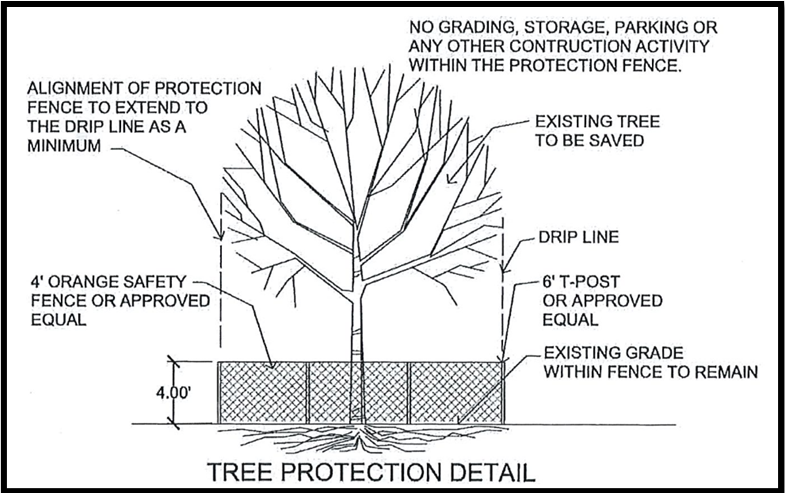
Erect Orange Plastic Fencing and Bark Protection. Before development or redevelopment, the owner shall install an orange plastic mesh fence or equivalent material at least four (4) feet in height around the Drip Line or Critical Root Zone of each Protected Tree or group of Protected Trees to prevent the placement of debris, equipment, or fill within the Drip Line or Critical Root Zone. The fence shall be installed prior to the release of any permit. If the fence is found to be removed, damaged, or altered at any time during construction prior to final inspection or landscape installation, a stop work order may be issued. In addition, for trees that need extra care, bark protection shall also be installed prior to construction start.
Figure H.1 TREE PROTECTION DETAIL
3.
Construction Entrance. Before grading, brush removal, construction, development, or redevelopment, the Owner shall establish a construction entrance that avoids Protected Trees.
4.
Equipment or Materials Disposal. Cleaning equipment or materials and/or the disposal of any waste material, including, but not limited to, paint, oil, solvents, asphalt, concrete, mortar, etc., is prohibited under the canopy or Drip Line of any Protected Tree.
5.
Attachment to Protected Trees. Attachments and wires are prohibited from being attached to any Protected Tree except for cables, tree rods, and similar hardware installed to support the structural integrity of a Protected Tree.
6.
Canopy or Drip Line Protection. The following activities are prohibited within the canopy, Drip Line, or critical root zone of a Protected Tree:
a.
No fill or excavation shall occur within the canopy, Drip Line, or Critical Root Zone of a Protected Tree unless specific measures have been approved in the Tree Protection/Mitigation Plan and/or the associated Landscape Plan as prepared by a Registered Landscape Architect and/or Certified Arborist.
b.
Any plan proposing the use of tree wells or retaining walls within the Drip Line of a tree to be preserved shall be designed by a Registered Landscape Architect. Major changes of grade (6 inches or greater) will require additional measures to maintain proper oxygen and water exchange with the roots.
c.
An approved retaining wall or tree well should not be closer than half the distance between the trunk and the Drip Line and the existing grade maintained around a tree or grouping of trees.
d.
At no time should a retaining wall, pavement, or porous pavement be placed closer than five (5) feet or one (1) foot for every two (2") inches in caliper, whichever is greater, to the trunk of any Protected Tree.
e.
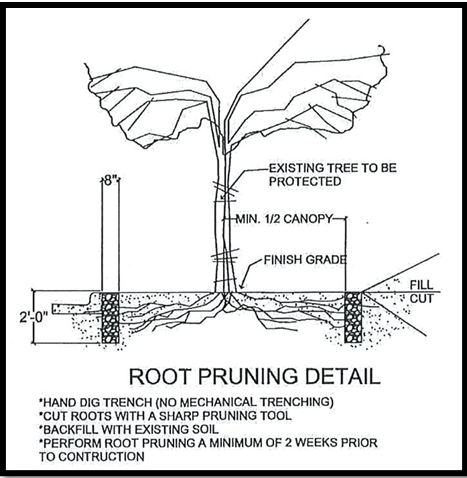
In instances where tree wells or retaining walls are approved, root pruning may be necessary when the critical root zone is to be disturbed. If root pruning is necessary, it shall be completed a minimum of two (2) weeks prior to any construction activity within the Drip Line and in accordance with the provisions outlined in Figure H.2 - Root Pruning Detail
f.
If a patio, sidewalk, drive, parking lot, or other paved surface must be placed within the Drip Line of an existing Protected Tree, material such as a porous paver or other approved construction method that will allow the passage of water and oxygen shall be required.
Figure H.2 ROOT PRUNING DETAIL
7.
Tree Maintenance and Pruning Practices During Construction. All Root Pruning and tree maintenance techniques shall be in conformance with accepted industry standards and shall be performed by or at the direction of a Certified Arborist. No Person may use, allow, or cause to be used any improper or malicious maintenance or pruning techniques which would lead to the death of a tree.
8.
Enforcement and Violations During Construction. Enforcement of the provisions of this Subsection shall be in in accordance with City Approved changes made in the field during the construction process and as shown on the approved Tree Protection/Mitigation Plan (and associated Landscape Plan).
9.
Plan Adjustments During Construction. Plan adjustments during construction will constitute a "field change" and must be approved by the Director of Planning as an amendment to the Tree Removal Permit Tree Protection/Mitigation Plan. Any additional Protected Trees removed shall be subject to the mitigation rate multiplier in Table 16-A. Replacement tree(s) proposed to be added to off-set the mitigation requirements shall be noted on a "revised" Landscape Plan to be included with the approved construction plan set. Any remaining CI mitigation shall be paid at the rate as identified in the current City Fee Schedule along with a refund of any preservation credits received for the Protected Tree to be removed by the field change. Payment in full shall be made prior to issuance of a Revised Tree Removal Permit.
10.
Stop Work Order. The city may issue a "stop-work order" at any time if preservation requirements of this Section are not being met.
11.
Final Inspection.
a.
A final inspection is required. The Owner shall notify the appropriate City Staff for a final inspection before receiving a Certificate of Occupancy and/or acceptance of Public Improvements as may be applicable to the project.
b.
Protected Trees that were identified as being preserved on the Tree Survey and Tree Protection/Mitigation Plan and found to have been damaged beyond salvaging due to lack of compliance with established protection measures shall be mitigated based on the applicable CI Replacement Rate based on Protected Tree Size Category (see Table 16-A)
c.
All replacement trees installed per the approved Landscape Plan or Tree Protection/Mitigation Plan and found to be dead shall be replaced in-kind.
12.
Disposal of Trees Removed. Any trees removed shall be chipped and used for mulch on site or hauled off-site within 72 hours of cutting.
I.
Protected Tree and Replacement Tree Maintenance after Development. If Protected Trees are preserved on site and/or replacement trees are planted to address mitigation and such trees die within a period of three (3) years after completion of construction activities and/or final inspection, whichever occurs later, the owner of the property shall mitigate for the dead trees within six months after death or after written notice by City whichever occurs later. Mitigation shall be provided by Owner at a 1:1 ratio for replacements Trees and at the applicable sliding scale for Protected Trees. Note that should the death of the Protected Tree or replacement tree be caused by actions or inactions of the Owner, the replacement rate multiplier as presented in Table 16-A shall apply and any tree preservation credits granted for Protected Trees saved on site shall be paid in full to the City based on credits documented in the Tree Removal Permit Application approval.
J.
Administration of Tree Fund. The City shall administer the Tree Fund.
1.
Tree funds shall be used for the following purposes:
a.
To purchase trees for planting on and to plant and irrigate trees on public property, including without limitation, public rights-of-way; to preserve in perpetuity wooded portions of public property that remain in a natural state, to perform and maintain a city-wide tree inventory and to educate citizens and developers on the benefits and value of trees.
b.
Fees due to the Tree Fund shall be paid by the property Owner at the time of and as a condition precedent to the issuance of the Tree Removal Permit by City (prior to release of the subject for construction) on all development (including but not limited to Commercial, Industrial, Multi-Family Residential, or Residential and Mixed Use Development), and prior to filing of a Final Plat for all single-family Residential Subdivisions.
c.
No acceptance of public improvements shall be authorized until all replacement trees have been planted and/or the applicable fee-in-lieu-of replacement has been made to the City for deposit into the Tree Fund.
(Ord. No. 15-11-19-23, § I, 11-19-15; Ord. No. 19-2-21-06, § 2.02, 2-21-19; Ord. No. 19-12-05-46, § 2.02, 12-5-19; Ord. No. 22-05-19-22, § 2, 5-19-22; Ord. No. 22-10-20-37, § 2.02—2.06, 10-20-22)
2.09.03. - Vehicle Parking Regulations
A.
Applicability
1.
Except as hereinafter provided, no building or structure or part thereof shall be erected, altered, or converted for any permitted use unless vehicle parking is provided according to the following standards.
2.
Vehicle parking shall be provided on the lot or tract, on an immediately contiguous lot or tract, or within one hundred fifty feet (150') of such building or structure.
3.
An established use lawfully existing at the effective date of this UDC need not provide vehicle parking as hereinafter set forth. No existing vehicle parking in connection with said use, at the effective date of this UDC, may be reduced below the minimum number of spaces as hereinafter required.
B.
General Requirements
1.
Parking Areas and Driveways. Unless otherwise noted, parking areas and driveways shall be curbed, paved concrete and maintained to the City specifications.
2.
Parking Space Dimension. In all zoning districts, all parking spaces shall not be less than nine feet (9') by eighteen feet (18').
3.
Front and Side Entry Garages.
a.
A garage shall be determined to be a front entry or side entry garage based upon which property line (front or side) a driveway crosses.
b.
Front and side entry garage access driveways are permitted where the respective building set back line is a minimum of twenty-five feet (25').
c.
Side entry garages must face a public street private street, alley, public access easement, or private access easement.
4.
Rear Entry Garages.
a.
A garage shall be determined to be a rear entry garage if the driveway crosses the rear property line.
b.
Rear entry garage access driveways are only permitted when access is by means of a public alley, unless the property has double street frontage.
5.
Driveway Access to the Rear Yard.
a.
Access driveways to the rear yard or to an Accessory Building are permitted only from a public alley or by means of the main garage access driveway.
b.
Access to a rear yard or an Accessory Building from a public street by means of an additional driveway is not permitted.
C.
Parking Space Schedule: Residential Uses
1.
In all Single Family districts the minimum off street parking spaces for residential uses shall be two (2) spaces for each dwelling unit.
2.
No off-street parking shall be allowed in any front yard area, except on the paved driveway.
3.
No parking area or vehicle storage space shall be used for the storage or parking of any vehicle with more than two axles.
D.
Parking Space Schedule: Multi-Family Uses
1.
Off-street parking shall be provided behind the front building line in the side or rear yard of the lot or tract of land upon which an Apartment building is constructed.
2.
Adequate off-street parking space shall be provided to meet the requirements of the residents and their guests in each Apartment project, with a minimum of a one parking space per dwelling unit plus one additional parking space per bedroom.
3.
No parking area or vehicle storage space shall be used for the storage or parking of any vehicle with more than two axles.
E.
Parking Space Schedule: Nonresidential Uses Applicable to All Districts Off-street parking spaces shall be provided according to the following. In cases where a use is not listed below, see 2.09.03. G Parking Requirements for New or Unlisted Use.
1.
Bank, Savings and Loan, or Similar Financial Establishment. One space for each three hundred (300) square feet of Floor Area.
2.
Bed and Breakfast Home/Bed and Breakfast Inn. One (1) space per guest room in addition to the requirements for a residential use.
3.
Bowling Alley. Six (6) spaces for each lane.
4.
Car Wash, Full Service or Self-Service. Two (2) parking spaces, plus required stacking for each car wash bay.
5.
Child-care, Kindergartens, Day Schools, and Similar Establishments. One (1) space per eight (8) pupils plus one (1) space per employee.
6.
Church or Other Place of Worship. One (1) space per three (3) seats within the main sanctuary.
7.
Clinics or Doctor's Offices. One (1) space for each three hundred (300) square feet of Floor Area, minimum of five (5).
8.
Commercial Outdoor Amusement. Ten (10) Spaces plus one (1) space for every three (3) persons to be normally accommodated in the establishment.
9.
Convalescent Home or Nursing Home or Assisted Living Facility. One (1) space for each six (6) rooms or beds.
10.
Gasoline Filling or Service Station. Minimum of six (6) spaces, areas adjacent to pumps where vehicles park to refuel shall not be considered a parking space.
11.
Golf Course. Minimum of thirty (30) spaces.
12.
High School, College, University or Trade School. One (1) space for each classroom, laboratory or instruction area, plus one (1) space for each three (3) students accommodated in the institution.
13.
Hospitals. One (1) space for every two (2) beds.
14.
Hotel, Full-Service and Limited Service. One (1) space for each room, unit or guest accommodation.
15.
Institutions of a Philanthropic Nature. Ten (10) spaces plus one (1) space for each employee.
16.
Library or Museum. Ten (10) spaces plus one (1) for each three hundred (300) square feet of Floor Area.
17.
Manufacturing, Processing or Repairing. One (1) space for each two (2) employees or one (1) space for each one thousand (1,000) square feet of Floor Area, whichever is greater.
18.
Offices, General. One (1) space for each three hundred (300) square feet of Floor Area, minimum of five (5) spaces.
19.
Parks. Due to the wide variety of park types and uses, the number of spaces shall be submitted by the applicant and be based on best/current planning parking ratios (recommended sources: Institute of Transportation Engineers [ITE] or the American Planning Association [APA]) and approved by the Director of Planning.
20.
Places of public assembly not listed. One (1) space for each three (3) seats provided.
21.
Recreational, Private or Commercial Area or Building (Other than Listed). One (1) space for every three (3) persons to be normally accommodated in the establishment.
22.
Restaurant. One (1) space for every 100 square feet of floor area including outdoor dining areas.
23.
Restaurant with Outdoor Seating Areas. One (1) space for every three (3) seats under maximum seating arrangements, minimum of five (5) spaces. Outdoor seating areas (may be covered, but not enclosed) under 500 square feet do not have an additional parking requirement.
24.
Retail, Personal or Business Service. One (1) space for each two hundred (200) square feet Floor Area, minimum of five (5) spaces.
25.
RV Park. Two (2) spaces for each recreational vehicle space.
26.
Schools, Elementary, Junior High. One (1) space for each classroom, plus one (1) space for each four (4) seats in any auditorium, gymnasium, or other place of assembly.
27.
Storage or Warehousing. One (1) space for each two (2) employees or one (1) space for each one thousand (1,000) square feet of Floor Area, whichever is greater.
28.
Theaters, meeting rooms, and places of public assembly. One (1) space for every three (3) seats.
29.
Best Practices Parking Ratio. For uses shown in the Use Chart that have atypical standards or single uses which have varying parking needs depending on the function of that specific single use, an applicant may submit a parking ratio based on best planning and transportation practices.
a.
Best Practices Parking Ratio Application.
i.
An applicant shall fully cite the sources used to derive the applicant-submitted parking ratio, possible resources include parking standards materials from the Institute of Transportation Engineers (ITE) or the American Planning Association (APA).
ii.
The Director of Planning shall review the applicant submitted parking ratio to confirm best planning practices for a use.
iii.
The Director of Planning shall approve, modify, or deny the applicant submitted parking ratio.
b.
Parking Ratio Determination in Case where no Application is Submitted. If the applicant does not submit a parking ratio, then the Director of Planning shall determine the parking ratio based on the best/current planning and transportation practices.
F.
Off-Street Parking Regulations
1.
In computing the parking requirements for any building or development, the total parking requirements shall be the sum of the specific parking space requirements for each class of use included in the building or development.
2.
Floor Area of structure devoted to off-street parking of vehicles shall be excluded in computing the off-street parking requirements of any use.
G.
Parking Requirements for New or Unlisted Use Where questions arise concerning the minimum off-street parking requirements for any use not specifically listed, the requirements may be determined by the Director of Planning as those of a similar use.
H.
Alternative Parking Standards In order to provide flexible parking standards and to continue to provide for a sufficient amount of parking spaces, the Director of Development Services may approve Alternative Parking Standards in accordance with the process outlined above in 2.09.03. E.29 Best Practices Parking Ratio.
I.
Circulation and Parking Requirements for all Nonresidential Developments
1.
Applicability. The regulations provided in this section shall apply to all nonresidential development.
2.
Parking Aisles. Parking aisles shall be designed perpendicular to the front of the primary building in the development.
3.
Wheel Stops and/or Bollards. If curbs are not provided, then parking spaces that face and are adjacent to a building or required landscaped area shall utilize wheel stops and/or bollards, within 12 inches from the end of the space.
J.
Parking Space Design Details Each standard off-street surface parking space size shall be in accordance with the design standards as shown on the following illustrations for space size and design.
Figure 6: Parking Space Chart
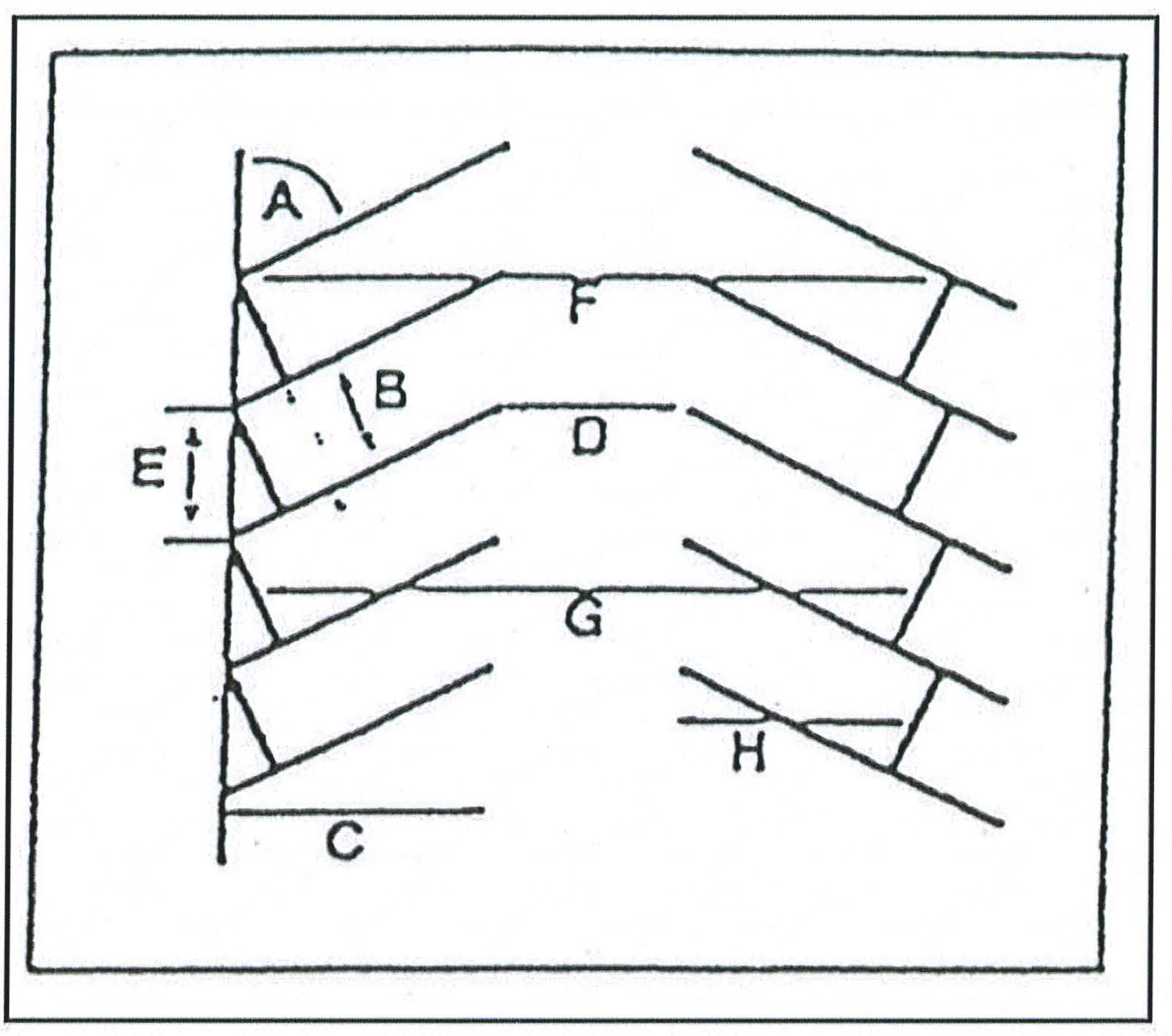
Figure 7: Parking Space Diagram
K.
Electric Vehicle (EV) Parking Spaces Required
1.
Number of EV Spaces Required.
a.
Parking Lots with 50 to 100 Parking Spaces Required.
i.
If a nonresidential use requires 50 to 100 parking spaces, then one (1) electric vehicle (EV) parking space shall be created and reserved for the sole use of electric vehicles only.
b.
Parking Lots with more than 100 Parking Spaces Required.
i.
If a nonresidential use requires more than 100 parking spaces, then two (2) electric vehicle (EV) parking spaces shall be created and reserved for the sole use of electric vehicles only.
c.
The number of EV parking spaces shall be in addition to the minimum number of required parking spaces.
2.
Design of EV Spaces.
a.
All EV parking spaces shall have a sign posted in front of the parking space reading "RESERVED PARKING ELECTRIC VEHICLES ONLY" and shall have pavement markings indicating the space as EV parking.
b.
All EV parking spaces shall have the same dimensions as standard parking spaces.
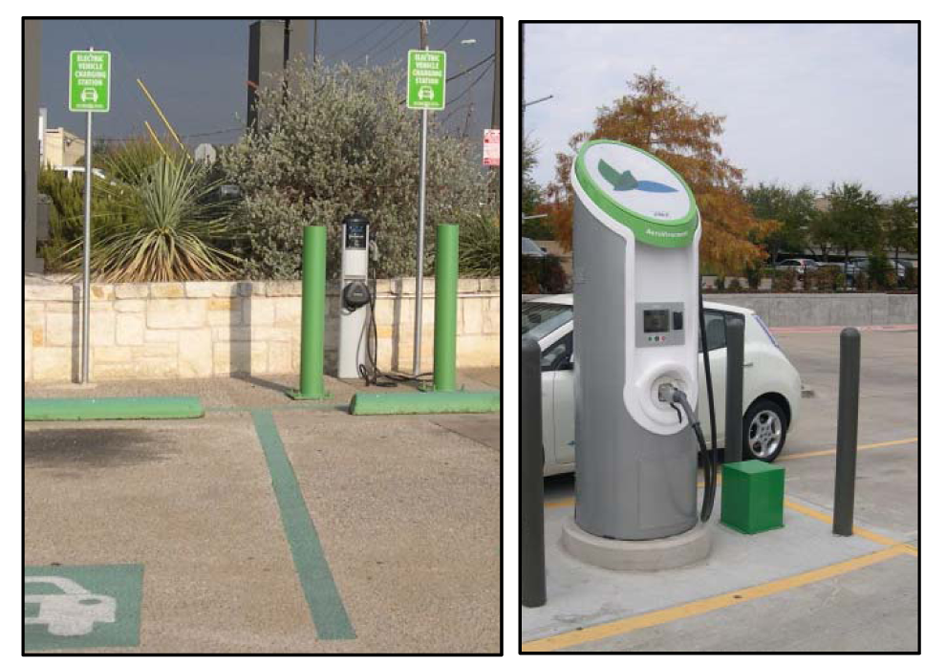
Figure 11: An EV Charger is not required to be installed for EV Parking Spaces
3.
Electric Vehicle (EV) Chargers not Required.
a.
An "Electric Vehicle (EV) Charger" shall be defined as an electrical appliance designed specifically to charge batteries within one or more electric vehicles. Charger styles include pedestal and wall or pole-mounted. Chargers are also called electric vehicle supply equipment (EVSE).
b.
EV parking spaces shall not require the installation of an "Electric Vehicle (EV) Charger."
L.
Vehicle Stacking Requirements
1.
Stacking Space Definition. Stacking spaces provide the ability for vehicles to queue on site prior to receiving a service.
2.
Stacking Space Size and Location. A stacking space shall be a minimum of ten (10) feet in width and twenty (20) feet in length and shall not be located within or interfere with any other circulation driveway, parking space, fire lane, or maneuvering area.
3.
Additional Stacking Space Location Criteria. Stacking spaces shall be provided behind the vehicle bay door, middle of the service window, or middle of the service island, whichever is applicable.
4.
Number of Required Stacking Spaces (All Districts). In all zoning districts, at the time any building or structure is erected or altered, stacking spaces shall be provided in the number and manner set forth in the following list of property uses.
a.
Automated Teller Machine (ATM). Three (3) stacking spaces.
b.
Automobile Oil Change and Similar Establishments. Three (3) stacking spaces per bay.
c.
Car Wash, Full Service. Six (6) stacking spaces per bay.
d.
Car Wash, Self Service (Automated). Three (3) stacking spaces per bay.
e.
Car Wash, Self Service (Open Bay). Two (2) stacking spaces per bay.
f.
Car Wash, Self Service (Drying Areas and Vacuum Islands). Two (2) stacking spaces per drying area and/or vacuum island.
g.
Child-care, Kindergartens, day schools, and similar child training and care establishments. One (1) stacking space per twenty (20) students provided on a through "circular" drive.
h.
Dry Cleaning, Pharmacy, or Other Retail Establishments with a Drive-Through. Three (3) stacking spaces for first service window.
i.
Financial Institution. Five (5) stacking spaces per window or service lane.
j.
Restaurant with Drive-Through. Five (5) stacking spaces for first window, order board, or other stopping point.
k.
Schools, Public or Private. The number of stacking spaces shall be determined during Site Plan review and approved by the Director of Public Works.
5.
Single Stacking Space Required after the Final Window, Order Board, or Stopping Point. A single stacking space shall be provided after the final window, order board, or stopping point to allow vehicles to pull clear of the transaction area prior to entering an intersecting on-site driveway or maneuvering aisle.
6.
Visibility Triangle Requirement for Drive-Through Lanes and Escape Lanes. Buildings and other structures shall have a ten (10) foot visibility triangle at the end point of drive-through lane and escape lane to provide adequate visibility to allow vehicles to safely exit the drive-through lane and escape lane prior to merging into intersecting driveways or maneuvering aisles.
7.
Escape Lane Requirement for Drive-Through Facilities.
a.
An escape lane shall be provided for any use containing a drive-through facility.
b.
An escape lane shall be nine (9) feet in width and shall provide access around the drive-through facility.
c.
An escape lane may be part of a circulation aisle.
M.
Approval of Alternative Compliance A request for Alternative Compliance may be submitted and acted upon in accordance with 2.10.02. Alternative Compliance. The City Council may approve the following, based upon a finding that the proposed alternative meets the spirit and intent of this 2.09.03. Vehicle Parking Regulations.
1.
Alternative Parking Ratio. A parking ratio which differs from that specified within this subsection 2.09.03. Vehicle Parking Regulations, based on a parking study conducted by a certified traffic planner or traffic engineer which sets forth an alternative ratio, which the City Council determines is equivalent, at a minimum, to the standards set forth above.
(Ord. No. 18-08-16-24, §§ 2.10, 2.11, 8-16-18; Ord. No. 23-09-21-37, §§ 2.05, 2.06, 9-21-23)
2.09.04. - Building Façade Material Standards
A.
Definitions The following definitions apply to the provisions of this Article:
Building Code(s) means any and all of the codes adopted by the City of Corinth as set forth in Chapter 150, "Building Regulations" of the Code of Ordinances of the City, as amended, including local amendments thereto, as currently existing or as later adopted or amended.
City means City of Corinth, Texas.
Commercial Building means a building for the use or occupation of people for a public purpose or economic gain, or a residence if the building is a multi-family residence that is not defined as a residential building.
National Model Code means a publication that is developed, promulgated, and periodically updated at a national level by organizations consisting of industry and government fire and building safety officials through a legislative or consensus process and that is intended for consideration by units of government as local law. "National Model Code" includes the International Residential Code, the National Electrical Code and the International Building Code.
Official means an official responsible for enforcement of the City's Zoning Ordinance or Building Codes, as designated by City Charter, ordinance or other authorization of the City.
Residential Building means a building having the character of a one-family or two-family dwelling or a multiple single-family dwelling that is not more than three (3) stories high with separate means of egress, including the accessory structures of the dwelling and that does not have the character of a facility used for the accommodation of transient guests or a structure in which medical, rehabilitative, or assisted living services are provided in connection with the occupancy of the structure.
Zoning Ordinance means the Zoning Ordinance of the City of Corinth, Texas, codified as Appendix "B" to the Code of Ordinances of the City, as currently existing or as later adopted or amended.
B.
Prohibitions on Enforcement
(a)
Notwithstanding any other provision contained in the City's ordinances, regulations or rules to the contrary, an official responsible for enforcement of the City's Zoning Ordinance or Building Codes, as designated by City Charter, ordinance or other authorization of the City, shall not:
(1)
Prohibit or limit, directly or indirectly, the use or installation of a building product or material in the construction, renovation, maintenance, or other alteration of a residential or commercial building if the building product or material is approved for use by a National Model Code published within the last three (3) code cycles that applies to the construction, renovation, maintenance, or other alteration of the building; or
(2)
Enforce a standard for a building product, material, or aesthetic method in construction, renovation, maintenance, or other alteration of a residential or commercial building if the standard is more stringent than a standard for the product, material, or aesthetic method under a National Model Code published within the last three code cycles that applies to the construction, renovation, maintenance, or other alteration of the building.
(b)
An applicant who proposes to use a building material, product or aesthetic method in the construction or alteration of a residential or commercial building that is prohibited or limited by the City's adopted Zoning Ordinance or building codes, as amended, or that is less stringent than the standard established by such Ordinance or building codes, as amended, shall identify each provision in a National Model Code published within the last three code cycles that approves the use of such building material, product or aesthetic method, as a necessary requirement of the application.
(c)
An applicant may agree in writing to employ a building material, product or aesthetic method for use in the construction or alternation of a residential or commercial building that otherwise cannot be enforced under subsection (a).
C.
Exemptions for ordinances, requirements and programs The prohibitions in Section B. above do not apply to the ordinances, requirements or programs of the City or State listed in this Section, and the officials responsible for enforcement of the City's Zoning Ordinance and Building Codes, as designated by City, shall apply all regulations and standards prescribed by such ordinances, requirements or programs listed herein, whether such ordinances, requirements or programs listed herein are currently existing or are hereafter adopted or established by City or State, to the fullest extent therein provided. This Section applies to:
(a)
A local amendment of a Building Code to conform to local concerns if the amendment does not conflict with Sections B(a) or B(b) of this Article;
(b)
A program established by a state agency that requires particular standards, incentives, or financing arrangements in order to comply with requirements of a state or federal funding source or housing program;
(c)
A requirement for a building necessary to consider the building eligible for windstorm and hail insurance coverage under Chapter 2210, Texas Insurance Code, as amended;
(d)
An ordinance or other regulation that regulates outdoor lighting that is adopted for the purpose of reducing light pollution and that: (1) is adopted by a governmental entity that is certified as a Dark Sky Community by the International Dark-Sky Association as part of the International Dark Sky Places Program; or (2) applies to outdoor lighting within five miles of the boundary of a military base in which an active training program is conducted;
(e)
An ordinance that regulates outdoor lighting and is adopted under Subchapter B, Chapter 229, Texas Local Government Code, as amended, or under Subchapter B, Chapter 240, Texas Local Government Code, as amended; or
(f)
Installation of a fire sprinkler protection system under Texas Occupation Code, section 1301.551(i), as amended, or under Texas Health and Safety Code, section 775.045(a)(l), as amended.
D.
Exemptions for Buildings The prohibitions in Section B do not apply to the following buildings, and the officials responsible for enforcement of the City's Zoning Ordinance and Building Codes, as designated by the City, shall apply all regulations and standards prescribed by those ordinances or codes to such buildings, where such provisions are currently existing or hereafter adopted or established by City or State, to the fullest extent therein provided. This Section applies to:
(a)
A building located in a place or area designated for its historical, cultural, or architectural importance and significance by the City which were adopted by the City Council prior to April 1, 2019:
(b)
A building located in a zoning district designated by the City Council after April 1, 2019 for its historical, cultural, or architectural importance and significance by the City, and for which the owner has voluntarily consented in writing to the application of the regulations or standards prohibited by Section 3, including the following zoning districts and any district that may hereafter be created by the City Council for its historical, cultural, or architectural importance and significance;
(c)
A building located in a place or area designated for its historical, cultural, or architectural importance and significance the City may regulate under Section 211.003(b), Texas Local Government Code, as amended, if the City (1) is a certified local government under the National Historic Preservation Act (54 U.S.C. Section 300101 et seq.); or (2) has an applicable landmark ordinance that meets the requirements under the certified local government program as determined by the Texas Historical Commission;
(d)
A building located in an area designated as a historic district on the National Register of Historic Places;
(e)
A building designated as a Recorded Texas Historic Landmark;
(f)
A building designated as a State Archeological Landmark or State Antiquities Landmark;
(g)
A building listed on the National Register of Historic Places or designated as a landmark by a governmental entity;
(h)
A building located in a World Heritage Buffer Zone; and
(i)
A building located in an area designated for development, restoration, or preservation in a main street city under the main street program established under Section 442.014, Texas Local Government Code, as amended.
E.
Appeal An applicant, landowner or other aggrieved person ("Appellant") may appeal the decision of an Official applying a regulation or standard to the construction, renovation, maintenance, or other alteration of a Residential Building or a Commercial Building, when the application of such regulation or standard by the Official is asserted by the Appellant to be prohibited by Section B., and such appeal shall be asserted as follows:
(a)
If the decision applies a requirement of a Building Code, to the Board of Construction Appeals, or if there is no Board of Construction Appeals, to the Zoning Board of Adjustment; or
(b)
If the decision applies a requirement of the Zoning Ordinance, to the Zoning Board of Adjustment.
The appeal shall identify the specific provision or provisions which the Appellant alleges to have been applied in violation of Section B of this Article. The appeal shall be filed, processed and decided in the manner provided for other appeals by the body designated by this Section.
(Ord. No. 18-08-16-24, § 2.16, 8-16-18; Ord. No. 19-08-22-28, § 2.01, 8-22-19)
2.09.05. - Residential Adjacency Standards
A.
Purpose and Intent In order to preserve and protect the integrity of single family residential neighborhoods and in an effort to protect the quiet enjoyment of single family residential properties and to maintain property values, the City has determined that it is necessary and appropriate to adopt specialized regulations for non-single family residential uses and buildings that are constructed adjacent to properties zoned for detached single family residences.
B.
Applicability
1.
The following residential adjacency standards shall apply to all non-single family residential buildings or uses that are immediately adjacent to properties zoned for single family residences.
2.
Non-residential uses separated from single family residential zoning districts by a public right-of-way of at least sixty (60) feet in width shall be exempt from the residential adjacency standards.
3.
Non-residential uses adjacent to Interstate 35 shall be exempt from the residential adjacency standards.
C.
Development Regulations
1.
Landscaping Requirements.
a.
A double row of trees on offset fifty (50) foot centers is planted in a fifteen (15) foot landscape edge, where fifty percent (50%) of the trees are Large Evergreen Trees shall be planted to provide a buffer between the non-residential use and adjacent detached single family zoned properties. Trees shall be three (3) caliper inches diameter at breast height "DBH" and shall be at least ten (10) feet in height.
b.
This exception does not apply to buildings on pad sites (i.e., "out" buildings).
2.
Roof Design Standards.
a.
To screen rooftop mechanical equipment, other appurtenances, and flat or built-up roofs, all structures, including convenience store pumping/charging canopies, having a footprint of six thousand (6,000) square feet or less shall be constructed with a pitched roof.
b.
Those structures having a footprint greater than six thousand (6,000) square feet shall be constructed with either a pitched, parapet, or mansard roof system (enclosed on all sides).
c.
Standing seam metal roofs shall be constructed of a factory-treated, non-metallic, matte finish.
d.
Metal roofs with lapped seamed construction, bituminous built-up roofs, and flat, membrane-type roofs that are visible from a public right-of-way or adjacent single family zoning district are not permitted.
3.
Mechanical Equipment Screening.
a.
This subsection shall apply to equipment on the roof, on the ground or otherwise attached to the building or located on the site.
b.
All buildings must be designed such that no mechanical equipment (HVAC, etc.) or satellite dishes shall be visible from adjacent residential zoning districts or adjacent rights-of-ways.
c.
Rooftop mechanical equipment and/or other rooftop appurtenance screening shall be accomplished by either the construction of:
i.
The roof systems described in 2.09.05. C.2. Roof Design Standards; or,
ii.
An architectural feature which is integral to the building's design and ensures that such equipment is not visible from a public right-of-way.
d.
The fencing or enclosure of individual rooftop mechanical units shall not be permitted, except as described above.
e.
All rooftop mechanical equipment or architectural features described herein shall be shown on the required building elevations on the Site Plan.
4.
Loading and Service Areas.
a.
Loading and service areas shall be located at the side or rear of buildings.
b.
Where visible from the property line> a solid masonry screening wall at least ten feet (10') in height shall be required to screen views of loading docks and loading spaces intended for tractor/semi-trailer delivery.
c.
This 10-foot wall must screen the entire loading dock or space, and any accessory storage containers including but not limited to shipping containers or semi-trailers utilized for the on-site storage of goods.
d.
Screening materials shall utilize similar masonry materials to the building's facades.
e.
The accommodation of adequate access for service delivery trucks may be evaluated to determine the extent of screening required.
5.
Trash Receptacles and Recycling Receptacles.
a.
No trash receptacles or recycling receptacles shall be located within fifty feet (50') of properties zoned for single family residences.
b.
Trash and recycling receptacles shall be four sided with a solid metal gate and shall be located to the side or rear of the principal building.
c.
Trash and recycling receptacles shall be screened by a solid masonry screen at least eight feet (8') in height or equal to the height of the trash or recycling receptacles, whichever is greater, and shall utilize similar masonry materials to the building's facades.
6.
Setbacks/Yards.
a.
A structure may not be built within forty feet (40') feet of the detached single family residentially zoned property line.
(Ord. No. 18-10-04-32, § 2.01, 7-19-18)
2.09.06. - Nonresidential Architectural Standards
A.
Purpose and Intent
1.
This section of the UDC is intended to ensure that all nonresidential buildings shall be compatible with the architectural character and design as described within the Comprehensive Plan in terms of style, mass, material, height, roof design, and other exterior elements.
2.
All buildings shall be finished on all four sides with the same materials (meeting the masonry requirements as set forth below), detailing, and features and with a higher level of finish on the front facades (as set forth in the requirements below).
B.
Applicability All nonresidential buildings shall comply with this section.
C.
Nonresidential Building Orientation Any building (excluding parking garages) within view of a public Right-of-Way shall either face such Right-of-Way or shall have a facade facing such Right-of-Way in keeping with the character of the Front Façade.
D.
Nonresidential Design Elements Requirements
1.
Following is a list of design elements that, based upon the size of a building (see 2.09.06.D.2 below), shall be incorporated into a building's design:
2.
A building's floor area shall determine the minimum number of required design elements implemented in its construction as set forth in the table below:
E.
Nonresidential Front Façade Entry Requirements
1.
A Front Façade shall be articulated and designed to present a distinctive entry presence, emphasizing the building's entry point along the façade.
2.
Each building shall provide a sheltered entry.
F.
Nonresidential Building Articulation Façade depth and height articulation shall be required on the front façade of a building, in accordance with the following requirements:
1.
Depth articulation of at least eighteen (18) inches shall be required for every thirty (30) feet of building façade length. Depth articulation shall apply only below the roofline.
2.
Parapets for flat roofs of at least five (5) feet shall be required for every fifty (50) feet of building façade length.
3.
In Industrial Districts, glazing comprising a minimum of fifteen percent (15%) of the total wall area shall be required on all facades fronting a public street. For Building corners facing a public street, architectural elements and glazing shall be extended around the corner to be consistent with the design of corner elements and facade fronting the public street.
G.
Tripartite Building Design/Composition
1.
Buildings shall incorporate a tripartite building composition (base, middle and top).
2.
The tripartite shall be proportioned to the other elements of the tripartite and the overall structure.
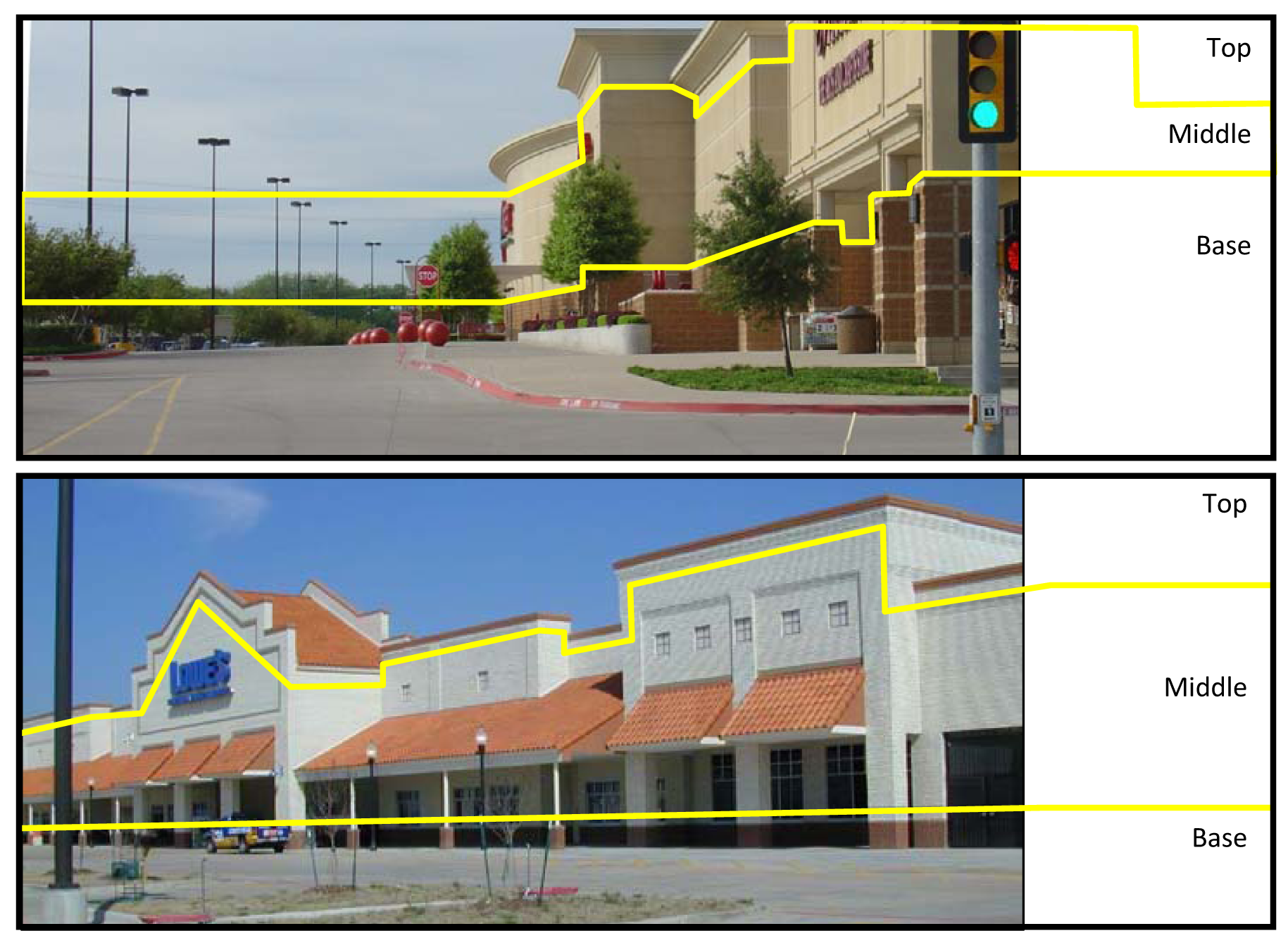
Figure 13: Tripartite Building Design/Composition
H.
Roof Design Standards
1.
All structures shall be constructed with a pitched roof, flat roof with a parapet, true mansard roof, or any combination thereof.
2.
All flat roof surfaces shall be screened from ground level views so that such roof surfaces are not visible.
3.
Parking structure decks shall not be considered roofs.
4.
Roofs of stairwells and elevator machine rooms and other similar spaces shall be exempt from roofing design standards so long as they are not visible from ground level. For the purpose of this paragraph, visible shall be defined as "capable of being seen at a height of six feet (6') while standing at the highest grade on the property line."
I.
Approval of Alternative Compliance A request for Alternative Compliance may be submitted and acted upon in accordance with 2.10.02. Alternative Compliance. The City Council may approve the following, based upon a finding that the proposed alternative meets the spirit and intent of this 2.09.06. Nonresidential Architectural Standards.
1.
Nonresidential Design Elements.
a.
Alternatives to the nonresidential design elements listed in Table 17.
b.
Alternatives shall, in the determination of the City Council, produce a similar or greater level of architectural design than the elements listed in Table 17.
2.
Nonresidential Building Articulation.
a.
Alternative articulation standards which differ from the requirement found in 2.09.06.F may be approved.
b.
Alternative articulation standards shall, in the determination of the City Council, produce a similar or greater level of articulation than the requirement found in 2.09.06.F.
(Ord. No. 25-05-01-22, §§ 2.06, 2.07, 5-1-25)
2.09.07. - Lighting and Glare Regulations
A.
Purpose The purpose of this section is to set forth the minimum criteria for the installation, use and maintenance of outdoor lighting, the purposes of which are to:
1.
Preserve and enhance the lawful nighttime use and enjoyment of property;
2.
Protect drivers and pedestrians on nearby travel ways from disabling glare from non-vehicular light sources that shine directly into their eyes and thereby impair safe travel;
3.
Shield adjacent properties from nuisance glare and trespass light resulting from improperly directed and unshielded light sources;
4.
Preclude or lessen light pollution; and
5.
Promote efficient design and operation with regard to energy conservation.
B.
Definitions
1.
Foot-Candle. The amount of illumination provided by one lumen uniformly distributed on one square foot of surface.
2.
Glare. Light emitting from a luminaire with an intensity great enough to cause annoyance, discomfort or loss in visual performance and visibility.
3.
Illumination. The density of light (luminous flux or lumens) on a surface. It is the quotient of the luminous flux divided by the area of the surface, expressed in foot-candles.
4.
Light Distribution. The luminance at all points on the illuminated surface from specified light sources at specified mounting heights and spacing.
5.
Light Trespass. The unwanted lighting of adjacent properties from light sources intended for the proposed sites.
6.
Lumen. The quantity of luminous flux intercepted by a surface of one square foot, all points of which are one foot from a uniform source of one candela. A one-candela source (i.e., one candlepower) provides 12.57 lumens.
7.
Luminaire. A device or fixture containing a light source and means for directing and controlling the distribution of light from the source.
8.
Luminance. The luminous intensity per unit projected area of a given surface viewed from a given direction for purposes of this UDC expressed in candelas divided by distance squared.
9.
Mounting Height. The vertical distance of the light source from the illuminated plane.
10.
Spacing. The horizontal distance between adjacent light sources.
C.
General Standards All outdoor illumination shall meet the following conditions:
1.
Shielding Required. All roadway, parking lot, and walkway luminaires shall be shielded so that substantially all the directly emitted luminous flux falls within the property line.
2.
Luminous Flux Design. All exterior building floodlights shall be designed or retrofitted with shielding in a manner such that all of the luminous flux falls upon either the surface of the structure to be illuminated or on the ground.
3.
Required Turning Off of Parking Luminaires.
a.
All parking luminaires, except those required for security, shall be extinguished within one hour after the end of business hours and remain extinguished until one hour prior to the commencement of business hours.
b.
Except for reasons of security, a maximum of twenty-five (25) percent of the total luminaires used for parking lot illumination may remain in operation during such period.
4.
Required Turning Off of Building Luminaires.
a.
All exterior building floodlights, except those required for security, shall be extinguished by 10:00 p.m. or within one hour after the end of business hours of the business served, whichever is later, and remain extinguished until one hour prior to the commencement of business hours.
b.
For reasons of security, however, a maximum average level of five foot-candles at entrances and loading docks and one foot-candle on the rest of the structure is permitted.
5.
Required Turning Off of Stadium Luminaires.
a.
All stadium and all other exterior sports arena luminaires used for the purpose of illumination of the playing area shall be extinguished by 10:00 p.m. or immediately after the conclusion of the final event of the day.
b.
The remainder of the facility lighting, except for reasons of security, shall be extinguished at 10:00 p.m. or within one hour after the event, whichever is later, and remains extinguished until one hour prior to the commencement of the next event.
c.
For reasons of security, however, a maximum average level of five foot-candles at an entrance and one foot-candle on the rest of the structure shall be permitted.
6.
No outdoor illumination shall be used in any manner that could interfere with the safe movement of motor vehicles on public streets, including:
a.
Any fixed luminaire not designed for roadway illumination that produces incident or reflected luminous flux that could be disturbing to the operator of a motor vehicle;
b.
Any luminaire that may be confused with or construed as a traffic control device; or
c.
Any blinking, flashing, or changing intensity lights, except for temporary holiday displays.
7.
Compliance for all Illumination. All outdoor illumination shall comply with the requirements of this section.
8.
Strings of Lights Prohibited. No person shall use a string of lights on property with nonresidential uses except for the following:
a.
Strings of lights may only be used if:
i.
They are approved by a Site Plan.
(a)
Such a plan must comply with all of the standards of this section.
(b)
The purpose of such lighting shall be to create ambiance and pleasing pedestrian spaces in an energy efficient manner.
(c)
Low wattage or low voltage fixtures and luminaires are required.
(d)
Such lighting shall be limited to pedestrian areas including plazas, patios, landscape features, and primary entries into buildings.
(e)
No such illumination shall be allowed in any required landscaped setback adjacent to a street; or
ii.
For lighting displays from the last Thursday in November through the last Thursday in January.
b.
Strings of lights permitted under this subsection may be displayed only on a building, on a wall or fence, on trees or shrubs, and on poles, but may not be suspended horizontally between such objects.
i.
For the purposes of this paragraph, "horizontally" means any portion of the suspended string that dips less than forty-five degrees below the horizontal.
ii.
All such strings of lights shall comply with the applicable electrical and building code provisions.
c.
For the purposes of this subsection, "string of lights" means a series of lights attached to a light cord or wires in such a way that they can be moved about and hung in various ways, and whose bulbs are not in lighting fixtures permanently attached to a building or other structure.
9.
Neon lighting.
a.
Neon lighting may be used as a lighting element, provided that the tubes are concealed and are an integral part of the building design.
D.
Exemptions The following uses shall be exempt from the requirements of this section:
1.
Lighting, such as streetlights, traffic signal devices warning, or emergency lights/devices, installed by a governmental agency for traffic safety control purposes on public right-of-way or property.
2.
Lighting that is not subject to this UDC by state or federal law.
3.
Specific exemptions as may be recommended by the Planning and Zoning Commission and/or approved by the City Council during consideration of the Site Plan, provided the Applicant can demonstrate that strict compliance with these provisions would not contrary to the purpose and intent of this Section or that alternatives proposed by the Applicant would satisfy the purposes of this Section at least to an equivalent degree, or, if determined that the Section's provisions restricts illumination to a standard insufficient for safety (per recommended practices adopted by the Illuminating Engineering Society of North America) or other evidence submitted by a professional engineer. The City Council may impose such conditions that it deems appropriate to further the purposes of this Section.
E.
Plans and Submittals
1.
Lighting plans shall be submitted for review and approval concurrently with the Site Plan and shall include a schematic layout of all proposed exterior fixture locations, foot-candle data, and a plot demonstrating intensities and uniformities within the established limitation of this Section.
2.
When requested by the Building Official or Responsible Official, the Applicant shall submit a visual impact photometric plan that demonstrates both light coverage and light spillage resulting from the proposed lighting plan and the provision for adequate measures to mitigate nuisance and unsafe conditions from light pollution and glare both uses or development on site and on adjacent properties.
3.
Should any outdoor light fixture or the type of light source be changed after receiving approval pursuant to the approved Site Plan, the owner, or agents, shall submit a change request to the Building Official for his approval, together with adequate information to assure compliance with this Section.
F.
Lighting Design
1.
Lighting systems, including the placement of luminaries, shall meet the requirements of this UDC.
2.
Luminaires on poles over 42 inches in height and exterior wall-mounted light fixtures shall be high-pressured sodium lights or other light giving a similar soft lighting effect. The Building Official may approve alternate lighting if he finds that it:
a.
Provides at least approximate equivalence to the applicable specific requirements of the UDC; and
b.
Is otherwise satisfactory and complies with the intent of this UDC.
3.
Fully recessed lights in ceilings of canopies or roof overhangs may be of any type provided the level of illumination does not exceed the limitations specified in 2.09.07. G. See Figure 14: Ceiling Light in Canopy or Overhang (below).
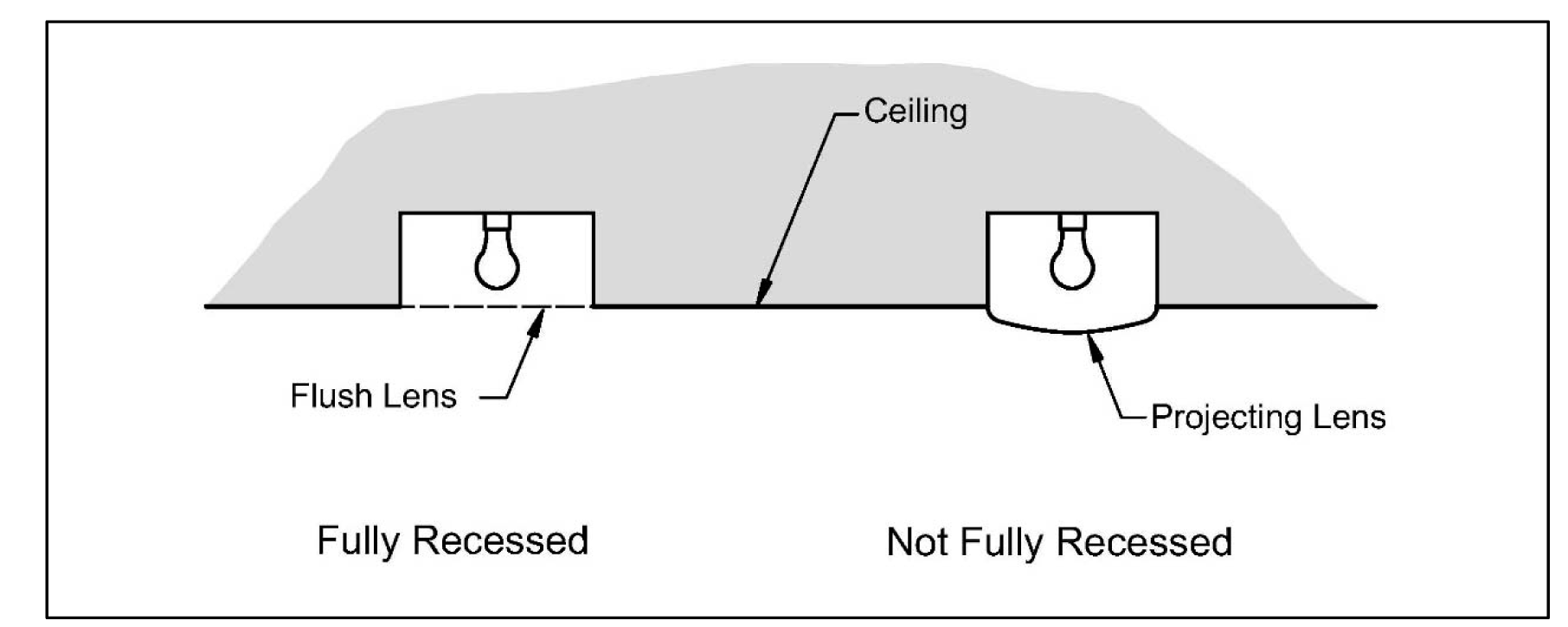
Figure 14: Ceiling Light in Canopy or Overhand
4.
Luminaries causing glare at property lines or in vehicle areas on streets or parking lots are prohibited.
5.
Incandescent bulbs may be used as decorative lighting provided the individual lamps do not exceed 25 watts and do not otherwise conflict with this UDC.
G.
Illumination
1.
Intensity of Illumination. The intensity of Illumination projected from one property to another property is determined by the zoning district classification of the adjacent property and shall not exceed the following intensities, as measured from the property line of the adjacent property:
2.
Maximum Outdoor Illumination Level. The maximum computed or measured outdoor Illumination level on a property shall not exceed 20 foot-candles outdoors at any point, except that lighting under canopies (such as for service stations) shall not exceed 30 foot-candles.
3.
Measurement of Illumination.
a.
Meter required.
i.
Lighting levels of outdoor lighting shall be measured in foot-candles with a direct-reading portable light meter with a color and cosine corrected sensor with multiple scales.
ii.
Reading accuracy should be within ± five percent (5%).
iii.
The meter shall be tested and calibrated by an independent commercial photometric laboratory or manufacturer within one year of date of use as attested to by a certificate issued by such laboratory.
b.
Horizontal method of measurement.
i.
The meter sensor shall be mounted not more than six inches above ground level in a horizontal position.
ii.
Readings shall be taken only after the cell has been exposed to provide a constant reading.
iii.
Measurements shall be made when the meteorological optical range is six miles or further so that measurements will not be adversely affected by atmospheric scatter.
iv.
Measurements shall be made after dark with the existing questioned light sources on, then with the same sources off.
v.
This procedure eliminates the effects of moonlight and other ambient light.
vi.
The difference between the two readings shall be compared to the foot-candle ratings listed in Table 19: Maximum Illumination between Properties (above).
c.
Vertical method of measurement.
i.
The meter sensor shall be mounted at five feet above ground level in a vertical position, perpendicular to the property line and facing the outdoor lighting in question.
ii.
Readings shall be taken only after the cell has been exposed to provide a constant reading. Measurements shall be made after dark with the existing questioned light sources on, then with the same sources off.
iii.
This procedure eliminates the effects of moonlight and other ambient light.
iv.
The difference between the two readings shall be compared to the foot-candle ratings listed in Table 19: Maximum Illumination between Properties (above).
d.
Computation of illumination.
i.
Illumination at a point may be computed in lieu of measurement.
ii.
Computation methods shall consist of a generally accepted Illuminating Engineering Society method, using certified photometric data furnished by the fixture manufacture, lamp manufacturer, photometric laboratory, or other reliable authority satisfactory to the city. Computations shall be based on new, properly seasoned lamps, new and clean fixtures, and at rated voltage and wattage, with ballasts, lenses, shields, diffusers, and other appurtenances in place, and with proper regard taken for mounting height, relative elevation, natural and manmade objects.
H.
Luminance
1.
Limits. The intensity of Luminance projected from one property to another is determined by the zoning district classification of the adjacent property and shall not exceed the following limits:
2.
Calculations (generally).
a.
Because of the lack of a practical means of measuring fixture Luminance in the field, and because of the factors involved in glare, a computational method shall be used to determine compliance with this section.
b.
The point from which luminance calculations shall be made is five feet (5') above ground at the property line of the property adjacent to the property with the outdoor lighting.
3.
Luminance Calculations using Luminaries Photometric Data.
a.
Luminance shall be computed by the formula:
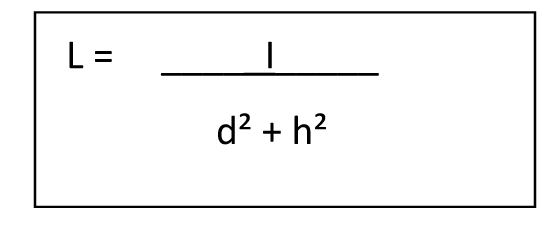
i.
Where "I" is the fixture candlepower in candelas in the direction of the point from which the calculations are to be made,
ii.
"d" is the shortest distance in feet measured horizontally from the property line to a point directly under the luminaries, and
iii.
"h" is the height of the luminaries above the eye level as explained in the illustration below.
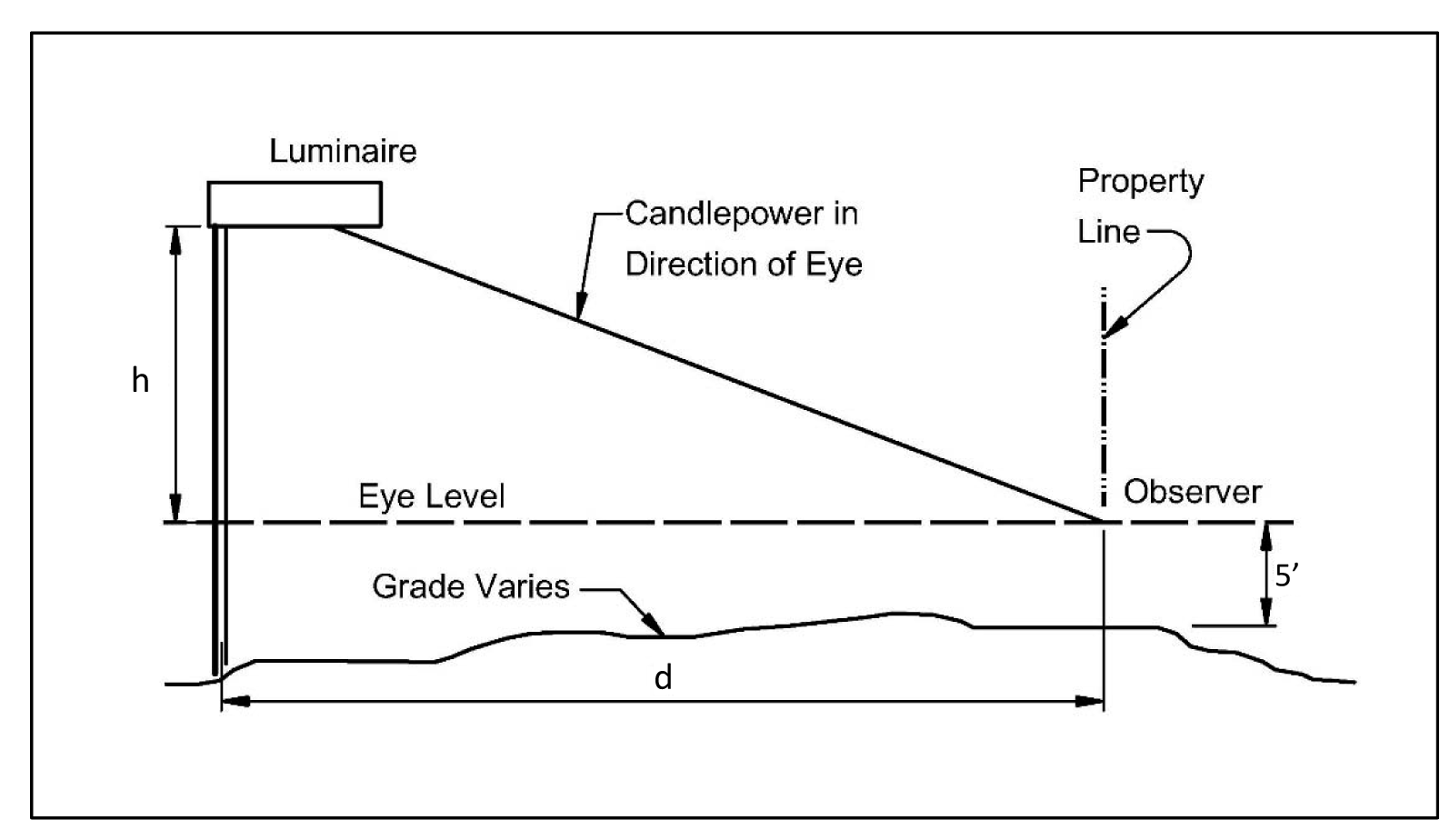
Figure 15: Factors for Luminance Determination
I.
Enforcement
1.
Illumination in Excess of Limits.
a.
If the Illumination, as measured, exceeds the limits stated in the above section, the Illumination shall be reduced until the Illumination is equal to or less than the limits prescribed in Section 2.09.07. G.
b.
This may be accomplished by removal of the light, reduction in the quantity of luminaries, reduction of the wattage of the lamps, shielding the luminaries or aiming of the luminaries.
2.
Luminance in Excess of Limits.
a.
If the Luminance of a luminaries, as calculated, exceeds the limitation in the above section, the Luminance shall be reduced until the Luminance is equal to or less than the limits prescribed in Section 2.09.07. H.
b.
This may be accomplished by reduction of the wattage of the lamps, shielding the luminaries or by re-aiming of the luminaries.
3.
Shielding.
a.
Luminaries shall be aimed in such a manner that the viewer's eye, five feet above ground at or beyond the property line, shall not be exposed to fixture Luminance within the floodlight beam of the luminaries.
b.
If such luminaries cannot be aimed they shall be shielded such that the light source is effectively concealed from view from the adjacent property.
c.
Shielding may be accomplished by louvers, baffles, visors, or shields placed on the luminaries, or by plantings fences, berms, elevation or any other method such that the limitations of Section 2.09.07. H above are met.
J.
Existing Lighting When outdoor lighting lawfully existed on the effective date of this UDC and which does not conform to the provisions of this UDC or when plans for outdoor lighting have been lawfully submitted in connection with an application for a building permit, or site plan before the effective date of this UDC, it shall be deemed a lawful use, subject to the following conditions:
1.
If a person makes any change or addition to an existing lighting system, the change or addition shall conform to the provisions of this UDC; and
2.
If a person makes any change or addition to an existing building that results in an increase in the size of the building by more than twenty (20) percent, the person shall ensure that the existing outdoor lighting shall conform to the provisions of this UDC.
K.
Approval of Alternative Compliance A request for Alternative Compliance may be submitted to vary one (1) or more of the lighting-related regulations cited in subsections 2.09.07. K.1 through 2.09.07. K.4 below. A request for Alternative Compliance may be submitted and acted upon in accordance with 2.10.02. Alternative Compliance. The City Council may approve the following, based upon a finding that the proposed alternative meets the spirit and intent of this 2.09.07. Lighting and Glare Regulations in a manner equivalent or superior to the foregoing standards.
1.
Height of free-standing lighting fixtures;
2.
Style or illumination intensity of lighting fixtures (only if such fixtures are located at least three hundred feet (300') away from a residential zoning district or use);
3.
Maximum wattage of accent lighting; or
4.
Gaseous/electrified building lighting design.

