
Corte Madera City Zoning Code
CHAPTER 18
20 - OFF-STREET PARKING AND LOADING
Sections:
18.20.010 - Purposes.
Requirements and standards for off-street parking facilities and off-street loading facilities are established by this chapter to achieve the following purposes:
(1)
To alleviate or progressively prevent traffic congestion and shortage of curb spaces;
(2)
To ensure that off-street parking and loading facilities are provided incidental to new land uses and major alterations and enlargements of existing land uses in proportion to the need for such facilities created by the particular type of land use;
(3)
To ensure that off-street parking and loading areas are designed in a manner that will ensure maximum efficiency, protect the public safety, and where appropriate, insulate surrounding land uses from their impact.
(Ord. 785 § 3(b) (part), 1994)
18.20.020 - Basic requirements for off-street parking and loading.
The following requirements shall apply:
(1)
At the time of initial occupancy of a site or construction of a structure, off-street parking facilities and off-street loading facilities shall be provided in accord with this chapter, except as prescribed in overlay districts.
(2)
Except for residential property, no existing use of land or structures shall be deemed to be nonconforming solely because of the lack of off-street parking or loading facilities required by this chapter; provided, that facilities being used for off-street parking and loading as of April 30, 1958, or as of the date of construction of the parking or loading facility, whichever is later, shall not be reduced in number to less than that required by this chapter.
(3)
Except for residential, the number of parking spaces or loading berths required for an enlargement of an existing use or structure, or for a change of use, shall be in addition to the number of spaces or berths existing before the enlargement or change of use unless the number of spaces on the site equals or exceeds the number required by this chapter for both the existing use and the change in use or enlargement. Requirements for additional parking shall be based on new additions to square footage only.
(4)
If a residential property contains the off-street parking spaces required by this chapter at the time of construction, or if its deficiency of parking spaces is a legal, nonconforming condition, a project to increase the size of the residence need not provide any additional spaces unless the proposal would cause the residence to violate the height, lot coverage, floor area ratio or other regulation for the zone that effectively limit's the residence's size.
(5)
A parking lot may provide required parking for more than one use if the lot contains at least the sum of the required spaces for the individual uses. Where uses on the same site have different hours of operation, the same parking spaces may be considered to provide required parking for both uses.
(6)
This chapter's requirements for off-street loading facilities may be satisfied by a common truck loading facility; provided, that the total number of berths provided on the site shall not be less than the sum of the individual requirements, and; provided, that an executed copy of a contract between the parties agreeing to joint use of the common truck loading facility is filed with the Community Development Director.
(7)
If, in calculating required parking spaces or loading berths, a fractional number is obtained, one parking space or loading berth shall be provided for a fraction of one-half or more, and no space or berth shall be required for a fraction of less than one-half.
(8)
Each off-street parking area having ten or more spaces shall have landscaped areas equivalent to at least ten percent of the area of the parking lot. Additional landscaping may also be required as is appropriate to the design and function of the parking area.
All landscaped areas shall be equipped with an automatic irrigation system. A landscape plan, showing the locations and varieties of plant materials and specifying provisions for maintenance, shall be submitted for design review approval as prescribed in Chapter 18.30, Design Review.
(Ord. 785 § 3(b) (part), 1994)
(Ord. No. 1038, § 19, 7-16-2024)
18.20.030 - Required number of parking spaces.
Subject to the provisions of Section 18.20.020, off-street parking spaces shall be provided at least in accord with the following schedule:
For a use not specified in the schedule, the same number of off-street parking spaces shall be provided as are required for the most similar specified use.
Additional off-street parking spaces may be required by the planning commission for any use upon a finding that the additional spaces are needed to relieve a shortage of curb spaces, to provide adequate off-street parking for a specific use, to facilitate the free flow of traffic on a street, or to reduce a hazard.
(Ord. 898 § 9, 2007: Ord. 886 § 4, 2004: Ord. 877 § 15, 2003: Ord. 785 § 3(b) (part), 1994; Ord. No. 961, § 7, 12-6-16; Ord. No. 976, § 5, 6-19-2018)
(Ord. No. 992, § 7, 1-21-2020; Ord. No. 1038, § 19, 7-16-2024)
18.20.040 - Required number of off-street bicycle parking spaces.
Bicycle parking spaces shall be required for all new commercial developments or multifamily residential developments, or for additions of over two thousand square feet to existing developments. Required bicycle parking shall be calculated on the basis of new or added square footage only. All bicycle parking spaces to be used after six p.m. shall have adequate security lighting. Bicycle parking spaces shall have minimum dimensions of two feet by six and one-half feet, and shall be designed to permit convenient locking of bicycles.
Bicycle parking spaces shall be provided at least in accord with the following schedule:
18.20.050 - Standards for off-street parking facilities.
Unless specified differently elsewhere in this title, off-street parking facilities provided in accord with this chapter shall be subject to the following conditions, and shall conform with any development standards for parking facilities adopted by resolution of the planning commission consistent with this chapter:
(1)
Except for residential districts, each parking space shall conform to the following minimum dimensions: nine feet by twenty feet for full-size, eight and one-half feet by eighteen feet for compact. No more than thirty percent of total required parking spaces shall be for compact cars. See Figure 16 for parking lot standards.
(2)
Unless otherwise provided, each parking space shall be individually accessible from a street or alley. Tandem parking does not satisfy off-street parking requirements unless tandem parking is expressly authorized by this code.
(3)
Entrances and exits shall be provided at locations approved by the town engineer.
(4)
If the parking area is illuminated, lighting shall be deflected away from neighboring residential sites and adjacent streets.
(5)
In a residential district, a parking area shall not be located in a required front yard, in a required side yard on the street side of a corner lot, or in a required rear yard on a double frontage lot. Required uncovered parking for a residence, multiple dwelling, lodginghouse or apartment hotel may be located in any other required side or rear yard if an equivalent amount of open area at ground level, in addition to the area of the required yard spaces, is provided elsewhere on the site.
(6)
In a professional and administrative office district or in a local commercial, highway commercial or service commercial district, a parking area shall not be located in a required front yard, in a required side yard adjoining the street on a corner lot, or in a required rear yard on a double frontage lot.
(7)
As required by the Uniform Building Code, special provisions for access by the physically handicapped shall be included.
(8)
Notwithstanding subsection (9) of this section, the planning commission may permit a property owner to designate a portion of his required off-street parking area as a "parking reserve" and to place improvements such as landscaping, tennis courts, and the like in the area which are compatible with the future use of the reserve as a parking lot. If the planning commission finds that the reserve is needed for off-street parking for users of the site, the owner shall improve the reserve as a parking lot within one hundred twenty days from the date the finding is made by the planning commission.
(9)
All off-street parking spaces, parking lots and access drives required by this chapter shall be maintained for the duration of the use requiring the parking. No repair work or servicing of vehicles, except for emergency service of stalled vehicles, shall be conducted on any parking space, parking lot or access drive.
(Ord. 886 § 5, 2004; Ord. 785 § 3(b) (part), 1994)
18.20.060 - Off-street parking and loading facilities located on another site.
In a residential district or a professional and administrative office district, off-street parking facilities required by this chapter shall be located on the same site as the use for which the spaces are required.
In a commercial district, light industrial district or public facilities district, off-street parking facilities shall be located on the same site or shall be located no more than eight hundred feet from the site and with reasonable access from the use for which the spaces are required.
In a commercial district, when off-street parking facilities or off-street loading facilities are provided on a site other than the site to be served by the parking or loading facilities, an indenture shall be recorded in the office of the county recorder designating the off-street parking facility or the off-street loading facility and the use or structure to be served, with legal descriptions of both sites, and certifying that the off-street parking facility or the off-street loading facility shall not be used for any other purpose unless the restriction is removed by resolution of the planning commission.
No certificate of occupancy shall be issued until an attested copy of the recorded indenture has been filed with the planning director. Upon submission of satisfactory evidence that other off-street parking facilities or off-street loading facilities have been provided in compliance with the requirements of this chapter or that the use has ceased or the structure has been removed or altered so as to no longer require the off-street parking facility or the off-street loading facility, the planning commission shall, by resolution, remove the restriction.
(Ord. 785 § 3(b) (part), 1994)
18.20.070 - Required number of off-street loading berths.
Off-street loading facilities shall be provided in accord with the following minimum schedule:
(Ord. 785 § 3(b) (part), 1994)
18.20.080 - Standards for off-street loading facilities.
Off-street loading facilities provided in accord with this chapter shall be subject to the following conditions and shall conform to any development standards for loading facilities:
(1)
Each loading berth shall be individually accessible from a street, alley or driveway.
(2)
Entrance and exits shall be provided at locations approved by the town engineer.
(3)
If the loading area is illuminated, lighting shall be deflected away from residential sites, and the light source shall not be visible from off-site.
(4)
A loading area shall not be located in a required front, side or rear yard in any district.
(5)
All loading areas shall be screened from residential districts and from professional and administrative office districts. In addition, the planning commission or zoning administrator may require such screening as is necessary to screen loading facilities from off-site viewing.
(6)
All off-street loading facilities and areas required by this chapter shall be maintained for the duration of the use requiring such areas. No repair work or servicing of vehicles shall be conducted on any loading facility or area.
(Ord. 785 § 3(b) (part), 1994)
18.20.090 - Location of off-street loading facilities.
Off-street facilities prescribed in this chapter may be located on the same site with the use for which the berths are required, or may be located on an adjoining site.
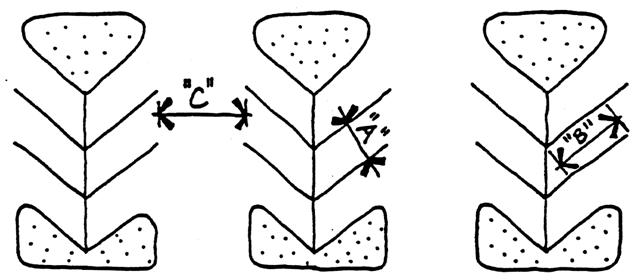
Figure 17
Parking lot layout
(1)
Compact parking spaces shall not exceed thirty percent of the total parking spaces provided.
(2)
Parallel (to the curb) parking spaces shall be twenty feet long by eight feet wide.
(3)
Backout areas shall be provided to accommodate parking spaces located at the end of a parking area, where required for maneuvering.
(Ord. 785 § 3(b) (part), 1994)
18.20.100 - Vehicle parking and storage.
In all residential zoning districts no vehicles of any type whatsoever including but not limited to cars, pick-up trucks, motorcycles, personal watercraft or any other vehicle or vessel described in Section 10.40.062 of this code shall be parked or stored in the front yard of a residential lot/site except in approved or permitted driveways, parking aprons, parking decks, garages and/or carports.
(Ord. 857 § 1, 2000)

