
Corte Madera City Zoning Code
CHAPTER 18
13 - MX MIXED USE DISTRICTS
Sections:
18.13.010 - Purposes for all mixed use districts.
In addition to the objectives prescribed in Section 18.02.030, the mixed use districts are established by this chapter to achieve the following purposes:
(1)
To provide appropriately located areas for retail stores, offices, services, and other commercial uses offering various ranges of commodities and services scaled to meet the needs of a diverse range of customers and employers;
(2)
To provide appropriately located areas for residential uses to meet the demand for housing in close proximity to residential services and amenities, and employment opportunities.
(3)
To ensure adequate light, air, privacy, and open space for each dwelling;
(4)
To provide space for community facilities and institutions which may be appropriately located in mixed use areas;
(5)
To provide adequate space to meet the needs of commercial and residential development, including off-street parking and truck loading areas;
(6)
To minimize traffic congestion and to avoid the overloading of utilities by preventing the construction of buildings of excessive size in relation to the amount of land around them;
(7)
To ensure that the appearance of commercial and residential structures and uses complements existing development and is consistent with the visual character of the town;
(8)
To provide employment opportunities close to home for residents of the Town and the surrounding area, thereby minimizing the length or necessity of vehicular commuting;
(9)
To encourage the production of housing in close proximity to residential services and amenities thereby minimizing the need for vehicular trips;
(10)
To provide adequate pedestrian and bicycle infrastructure in commercial areas to encourage alternative modes of transportation;
(11)
To improve the visual appearance of development from the street by promoting the location of parking to sides and rear of lots and by encouraging landscaping and amenities that facilitate public interaction with and use of private property; and
(12)
To provide predictable building sizes and forms irrespective of use.
(Ord. No. 958, § 6(Exh. A), 10-18-2016)
18.13.020 - Permitted and conditional uses in Mixed Use districts.
(1)
Residential Uses.
(a)
All uses in Section 18.08.020 listed in the Permitted Uses Tables shall be permitted, except that the following uses shall be conditionally permitted:
Single-family dwellings
Multiple dwellings
Residential care facilities as defined in Section 18.04.650
Group homes for six or fewer persons
(b)
All uses in Section 18.08.020 listed in the Conditional Uses Table shall be conditionally permitted.
(2)
Non-residential Uses. The following table indicates permitted (P) and conditionally permitted (C) uses in Mixed Use Districts
____________
1 Uses with an asterisk (*) may not be located in the Neighborhood Zone (see Section 18.13.155).
(Ord. No. 958, § 6(Exh. A), 10-18-2016; Ord. No. 1034, § 7, 6-4-2024; Ord. No. 1038, § 15, 7-16-2024)
____________18.13.030 - Required standards in mixed use districts.
The following conditions shall be required for all permitted uses and conditional uses:
(1)
Except as otherwise provided in the district regulations, required yards adjoining streets may be used for landscaping, including landscape design elements such as benches, art, and water features, access drives, walkways, lighting standards, guard railings and signs, in accord with the provisions of Chapter 18.22, Signs.
(2)
All service areas, refuse collection areas and trash bins shall be completely screened by a landscaped solid fence, landscaped masonry wall or compact evergreen hedge not less than six feet in height, with solid gates, or shall be enclosed within a building.
(3)
All off-street loading facilities shall provide for direct loading or transfer of materials and equipment directly to or from vehicles into a building. All loading facilities shall be screened to limit visual impacts on residential uses either on the same site or adjacent sites, and from public streets.
(4)
All exterior lighting shall be dark sky compliant, and designed, located and lamped in order to prevent overlighting, energy waste, glare, light trespass, and unnecessary skyglow. All parking lot area lights shall be full cutoff luminaires, as certified by the manufacturer, with the light source directed downward and away from residences with the fixture level with the horizontal plane; shall not exceed 20 feet in height; shall be equipped with timers and motion sensors that are utilized to reduce energy use when not necessary. Parking area lights are encouraged to be greater in number, lower in height and lower in light level, as opposed to fewer in number, higher in height and higher in light level. All other luminaires shall be shielded with an opaque material and located or directed so as to not produce glare or direct illumination across a property line. Bollard lighting may be used to light walkways and other landscape features, but shall cast its light downward.
No internally illuminated fascia, wall, roof, awning or other building part shall be allowed. Floodlights are not permitted and all nonessential exterior lighting associated with nonresidential uses shall be turned off within ½ hour after the close of business or when the non-residential use is not in use.
(5)
No use shall be permitted and no process, equipment or material shall be employed which is found by the planning commission to be objectionable to persons residing or working in the vicinity by reason of odor, fumes, dust, smoke, cinders, dirt, refuse, water-carried wastes, noise, vibration, illumination, glare, or heavy truck traffic, or to involve any hazard of fire or explosion.
(6)
All mechanical, heating and air conditioning equipment located on the roof of a structure shall be screened from public view.
(7)
No exterior loudspeaker shall be allowed.
(8)
Recycled water and double piping may be required for any new development.
(9)
All businesses, services and processes shall be conducted entirely within a completely enclosed structure, except off-street parking and loading areas, outdoor dining areas, nurseries, garden supply stores, Christmas-tree-sales lots, and pumpkin patch displays and sales. A use not conducted entirely within a completely enclosed structure may be required by the planning commission to be wholly or partially screened by a solid fence, masonry wall, or compact evergreen hedge not less than six feet in height.
(10)
All products produced on the site of any of the permitted or conditional uses shall be sold primarily at retail on the site where produced.
(11)
Outdoor product displays raised above the ground and not screened from view by a fence, wall, or hedge, and equipment raised into a display position above the peak of the roof, shall not be permitted.
(12)
Convenient, continuous, and safe pedestrian walkways shall be provided for any new development, linking businesses and residential entries to on-site parking areas, and public areas, including public sidewalks.
(13)
A maximum of one access driveway and curb cut shall be permitted per street frontage for all new development
(14)
All landscaped areas shall feature water conserving landscape design and be equipped with an automatic irrigation system and shall comply with the provisions of Section 18.24.110 (Maintenance of Landscaped Areas). A landscape plan, showing the locations and varieties of plants, materials and specifying provisions for maintenance, shall be submitted for design review approval as prescribed in Chapter 18.30, Design Review.
(15)
For all sites that include residential uses, the provisions of 9.36.030 (Specific Maximum Noise Levels) related to R-1-A, R-1, R-2 shall apply to all uses on such site. For all sites that include commercial-only uses, the provisions of 9.36.030 related to Commercial districts shall apply.
(Ord. No. 958, § 6(Exh. A), 10-18-2016)
18.13.040 - Special floor area ratio provisions for hotels in MX districts.
(a)
Notwithstanding the floor area ratio standards of section(s) 18.13.145, the FAR for hotels/motels and any ancillary uses, including, but not limited to, restaurants or conference facilities, on property within MX zoning districts, with a net area of land greater than one acre, may be increased up to .70 FAR (in accordance with the FAR assignment schedule below) if a proposed project meets the following conditions and the Planning Commission makes all of the below findings. The floor area devoted to required parking shall not be counted in the calculation of a project's FAR.
(b)
Notwithstanding the height standards in section(s) 18.12.335 and 18.12.430. the height for hotels and any ancillary uses, including, but not limited to restaurants or conference facilities, may be increased to a maximum of forty-seven feet if a proposed project meets all of the below conditions and the planning commission makes all of the below findings.
(c)
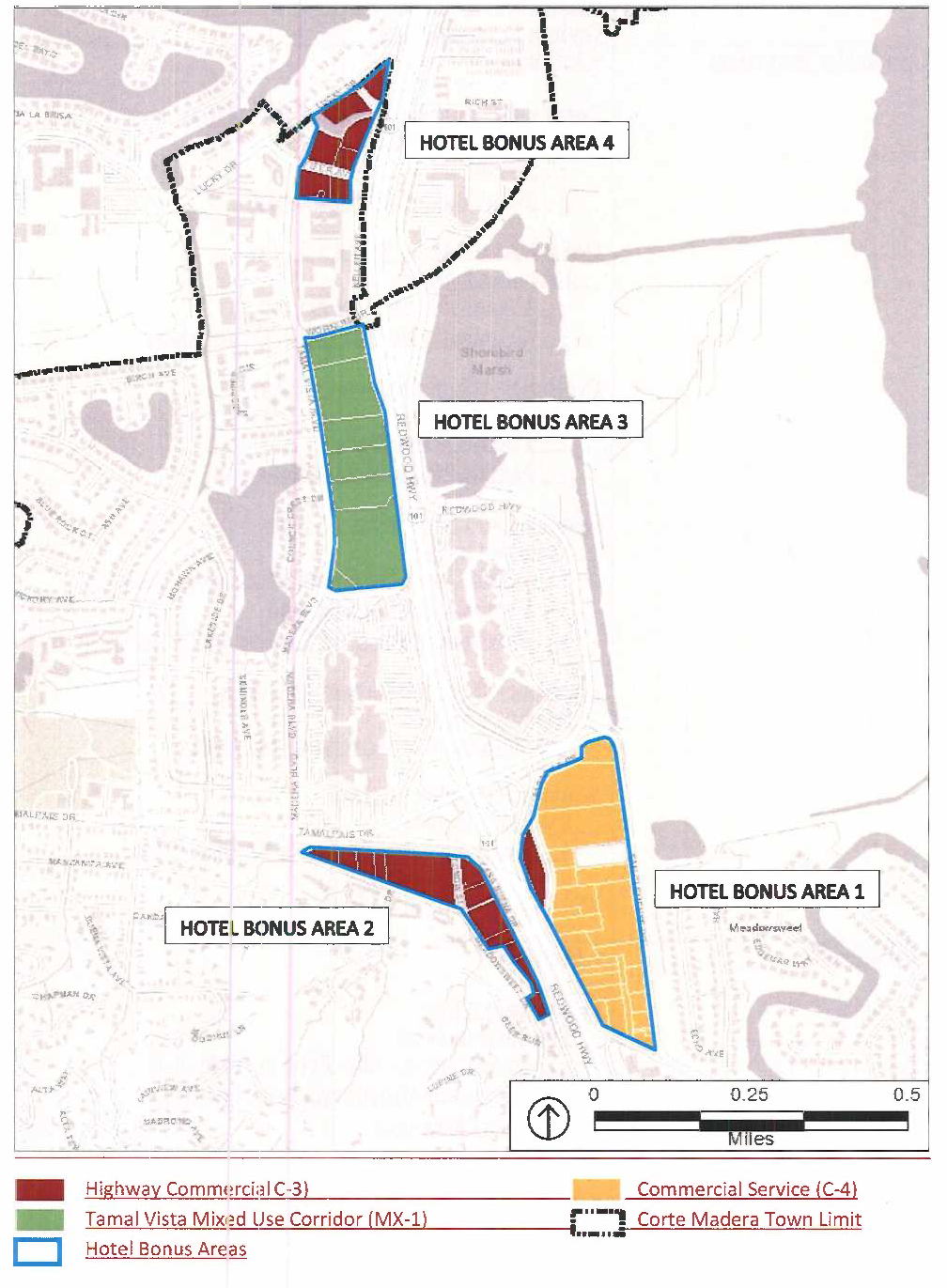
The increased floor area for hotels permitted in this section and in section 18.13.040 shall only be applied to four lots, and no more than two lots in each hotel bonus area. The hotel bonus areas are described in Figure 1.
Conditions:
(1)
A proposed project on a parcel of land located entirely or partially within the special flood hazard area shall meet the town's development requirements for residential construction in a special flood hazard area pursuant to section 16.10.080(3) of the Corte Madera Municipal Code and shall be subject to otherwise applicable requirements of title 16; and
(2)
An applicant seeking to utilize the provisions described in this section shall submit an application for preliminary review with the planning department and the applicant's project shall require a minimum of one public hearing at a study session before the planning commission. A primary purpose of the study session shall be to preliminarily evaluate the proposed project in light of the additional FAR requested, consistent with the findings and additional FAR assignment schedule described in this section; and
(3)
An applicant shall hold at least one applicant-sponsored community meeting to solicit feedback and comments from community members prior to submission of an application for preliminary review.
(4)
The project shall incorporate one or more of the following bird-safe design measures:
(A)
Non-Reflective Glass. No reflective glass shall be used in the building; exterior glass in the building shall have a light reflectance value of less than fifteen percent;
(B)
Fritted Glass. Fritted glass shall be used on upper floors (i.e., above the second floor) to reduce bird strikes. The applicant may substitute other non-reflective glass that is shown to be equally effective in reducing bird strikes.
(C)
Lighting. There shall be no exterior uplighting of the building. All on-site lighting shall be low-level illumination and shielded to reduce spill or glare.
(D)
Tree Screening on Lower Floors. This measure shall not be used by itself unless applicant plants trees of sufficient number and size to screen the windows which they are intended to cover.
(E)
Reduction of Unnecessary Interior Lighting. Energy conservation measures, including automatic sensors to turn off lights when guests are not present in the rooms.
Findings:
(1)
The project provides a significant contribution to the aesthetics of the town's built environment and integration with natural features and incorporates all of the below site and architectural design principles:
(A)
The totality of the project is designed with a coherent, site-specific architectural idea, that harmonizes the relationships between project components and between the project and adjacent buildings, streets, open spaces, and natural setting, through the use of appropriate building scale, massing, fenestration, exterior materials, landscape architecture, and landscaping; and
(B)
The project respects and exhibits natural systems, including ponds and wetlands and other natural features, through building siting, programming, and orientation; and
(C)
The project organizes components of hotel uses and site design to complement and engage the public realm, with particular focus on the pedestrian and bicycle scale and experience;
(D)
The project utilizes building materials, construction techniques, and external finishes for the quality, durability, and aesthetic appeal they provide, rather than the cost savings they may achieve.
(2)
The project incorporates quantifiable environmental sustainability measures as described in the table in paragraph (b)(2) that exceed existing environmental requirements or mitigation measures, and building code requirements in existence at the time of permit application(s), that are intended to minimize energy and water use, solid waste, greenhouse gas emissions, or otherwise improve a project's environmental sustainability. This finding shall be met if a project is assigned additional floor area in the environmental sustainability category pursuant to paragraph (b)(2); and
(3)
The project includes on-site programmatic elements, site planning strategies, and/or operational commitments that encourage public use, community gathering, or supports community health and well-being. This finding shall be met if a project is assigned additional floor area in the community integration category pursuant to paragraph (b)(2); and
(4)
The project includes enhancement of the public realm through upgrades to existing or proposed pedestrian and bicycle infrastructure in excess of that required by environmental mitigation measures or other regulatory requirement. This finding shall be met if a project is assigned additional floor area in the public realm category pursuant to paragraph (b)(2).
(d)
In determining the total amount of additional FAR permitted pursuant to this section, the following FAR assignment schedule shall be used.
FAR Assignment Schedule:
(1)
For each of the above findings, a maximum amount of additional FAR above .34 shall be allocated as follows:
(2)
The following FAR assignment schedule shall be used to assign additional FAR. Examples cited within the community integration and public realm findings are intended to provide guidance related to the type of qualifying program or amenity that may satisfy each category within a finding. The examples are not intended to exclude other potential ways of achieving points under the category listed. the environmental sustainability finding shall be met if a project includes one of the required environmental options.
The maximum FAR for hotels allowed in this section is not intended as a target to be achieved, but rather is the maximum allowable for any lot. The planning commission may approve less than the maximum allowable FAR in order to ensure that proposed development meets the above required findings or findings related to other sections of this title.
Figure 1
Hotel Bonus Area Map
(Ord. No. 995, § 5(Exh. A), 6-16-2020)
18.13.100 - Purpose.
The MX-1 district is intended to implement General Plan land use policies adopted for the Tamal Vista Boulevard commercial area between Madera Boulevard and Wornum Drive and the recommendations of the Tamal Vista Corridor Study Report. The MX-1 district is intended to create a mixed residential and non-residential district, where such uses coexist on a single site or across multiple sites, while reinforcing and supporting existing commercial uses and enhancing the amenities available to surrounding residential communities.
A primary purpose of the district is to facilitate the improvement of the eastern Tamal Vista Boulevard streetscape by ensuring that new development facilitates upgrades to sidewalks and bicycle infrastructure, and add pedestrian scaled development that serves to enhance the vitality and appearance of the adjacent properties. Such improvements are also intended to facilitate greater pedestrian and bicycle traffic along the corridor and provide a suitable means of travel between new and existing residential development and the retail services, shops, and restaurants at the Town Center, thereby reducing otherwise needed vehicle trips.
The MX-1 district is also intended to result in development that is better integrated into the existing residential neighborhoods along Tamal Vista Boulevard by limiting the scale of development closest to Tamal Vista Boulevard, requiring adequate setbacks, and defining a range of commercial uses more appropriate in a residential setting.
(Ord. No. 958, § 6(Exh. A), 10-18-2016)
18.13.105 - Generally.
The regulations set forth in Sections 18.13.110 through 18.13.198 shall apply to the site of a permitted use or a conditional use in the MX-1 district.
(Ord. No. 958, § 6(Exh. A), 10-18-2016)
18.13.110 - Definitions.
(1)
Streetscape Improvement Area. A maximum 20 foot wide area, measured parallel to any property line adjoining the Tamal Vista Boulevard right of way, provided for the purpose of constructing streetscape improvements in accordance with Section 18.13.115.
(2)
Neighborhood Zone. The area of a site between the Streetscape Improvement Area and the Highway Zone.
(3)
Highway Zone. The area of a site measured from a line 125 feet from and parallel to any property line adjoining the Tamal Vista Boulevard right of way to any property line adjoining the Highway 101 right of way. The Highway Zone may be modified in accordance with Section 18.13.175.
(4)
Substantial Remodel. The removal and reconstruction or reconfiguration of more than 50% of a structure, or portion of a structure, measured by the total surface area of exterior walls and roof removed over any consecutive five-year period of time. Removal of a structure which does not include reconstruction or reconfiguration of any portion of such structure shall not be deemed a substantial remodel.
(Ord. No. 958, § 6(Exh. A), 10-18-2016)
18.13.115 - Streetscape.
(a)
For any development that increases the existing floor area on any lot by more than 25 percent, or for reconstruction or reconfiguration of existing buildings that includes a substantial remodel and effects 25 percent or more of the existing gross floor area on a lot, a maximum 20 foot wide area, measured parallel to any property line adjoining the Tamal Vista Boulevard right of way ("Streetscape Improvement Area"), shall be provided for the purposes of providing streetscape improvements. The Town Engineer or his/her designee shall determine the required Streetscape Improvement Area, not to exceed 20 feet in width, necessary to accommodate the required improvements.
(b)
As part of any development meeting the requirements of 18.13.115(a), development of streetscape improvements, including but not limited to, pedestrian and bicycle circulation paths, landscaping, and the undergrounding of utility poles, shall be completed to the satisfaction of the Town Engineer or his/her designee. Streetscape improvements shall be made available for public use and shall provide convenient access to commercial and/or residential property located on the site.
Alternatively, at the sole discretion of the Town Engineer or his/her designee, a Streetscape Improvement Area may be held in reserve, landscaped, and an in-lieu fee collected equal to the estimated cost of otherwise required streetscape improvements, for the sole purpose of constructing streetscape improvements in conjunction with other street improvement projects planned for Tamal Vista Boulevard adjacent to the MX-1 district. Cost estimates shall not include costs associated with realigning the Tamal Vista Boulevard roadbed or curb lines. The cost estimation shall be conducted by a certified construction cost estimator.
Streetscape improvements or an in-lieu fee shall not be required if the Town Engineer or his/her designee determines that adequate streetscape improvements, in conjunction with prior Tamal Vista Boulevard improvement projects, have already been made on the project site or adjacent right of way.
(c)
For the purpose of calculating floor area ratio, residential density, lot coverage, or any other development standard that relies upon a calculation of lot area, the Streetscape Improvement Area shall be included in the total lot area of the site.
(Ord. No. 958, § 6(Exh. A), 10-18-2016)
18.13.120 - Yards adjoining Tamal Vista Boulevard.
(a)
A front or side yard adjoining Tamal Vista Boulevard shall be measured from the eastern boundary of the Streetscape Improvement Area required in Section 18.13.115.
(b)
The minimum required front or side yard adjoining the Streetscape Improvement Area shall be 20 feet.
(c)
The maximum required front yard adjoining the Streetscape Improvement Area shall be 40 feet.
(d)
The uses listed in 18.13.030(1) may be permitted within a required front or side yard adjoining the Streetscape Improvement Area. In addition, publicly accessible seating areas, bicycle parking, and outdoor dining or seating areas limited to 500 square feet, associated with a restaurant, café, grocery store, delicatessen, or other use with food or drink service, may be permitted, provided that if such use requires a conditional use permit pursuant to Section 18.13.115, the outdoor dining or seating area shall also be subject to a conditional use permit.
(e)
Required Front or side yards adjoining the Streetscape Improvement Area shall be generously landscaped with plant materials, including trees, pedestrian pathways, and other features and amenities designed to engage pedestrians and create a comfortable and enjoyable pedestrian environment. Landscape plans shall be reviewed as part of applications for Design Review pursuant to Section 18.13.030(14).
(Ord. No. 958, § 6(Exh. A), 10-18-2016)
18.13.125 - Front yards not adjoining Tamal Vista Boulevard.
Front yards not adjoining Tamal Vista Boulevard shall be 20 feet of which the 10 feet adjoining the property line shall be landscaped with permanently maintained plant materials.
(Ord. No. 958, § 6(Exh. A), 10-18-2016)
18.13.130 - Side yards.
(a)
Where the side property line of a site adjoins property that includes residential uses, the minimum required side yard shall be 20 feet, of which the 10 feet adjoining the property line shall be landscaped with permanently maintained plant materials, including screening elements not less than six feet in height.
The Planning Commission may allow a reduction of the required side yard required in this paragraph to 10 feet, of which a minimum of five feet adjoining the property line shall be landscaped with permanently maintained plant materials, including screening elements not less than six feet in height, provided that it finds that adequate separation - for the purposes of light and air, noise, or other potential incompatible conditions - between commercial and residential uses on adjoining property exists. Such finding shall be made in addition to the findings for Design Review required in Section 18.30.070 and appropriate conditions may be made part of any approved reduction.
A landscaped solid fence or masonry wall not less than six feet in height may be required by the Planning Commission if necessary to adequately screen adjacent uses on adjoining property.
(b)
Where the side property line of a site adjoins property that does not contain residential uses, the minimum required side yard shall be 10 feet, of which a minimum of five feet adjoining the property line shall be landscaped with permanently maintained plant materials, including screening elements not less than six feet in height. In addition, a landscaped solid fence or masonry wall not less than six feet in height may be required by the planning commission if necessary to adequately screen the use.
(c)
For side yards on the street side of a corner lot, the side yard shall be 20 feet of which the 10 feet adjoining the property line shall be landscaped with permanently maintained plant materials, including screening elements not less than six feet in height.
(d)
Side yards shall also be provided in accordance with Sections 18.13.135 (Yards Adjacent to Highway 101), and/or 18.13.120 (Yards adjoining Tamal Vista Boulevard) as applicable.
(Ord. No. 958, § 6(Exh. A), 10-18-2016)
18.13.135 - Yards adjacent to Highway 101.
Where a property line of a site adjoins the Highway 101 right of way, the minimum required rear or side yard shall be 50 feet, of which a minimum of 15 feet adjoining the property line shall be landscaped with permanently maintained plant materials, including screening elements not less than 10 feet in height at time of planting. The Planning Commission may allow a reduction of the required rear yard required in this paragraph to 30 feet, of which a minimum of 10 feet adjoining the property line shall be landscaped with permanently maintained plant materials, including screening elements not less than 10 feet in height at the time of planting, provided that it finds that the reduction of required rear yard is necessary to accommodate special programmatic requirements or superior site planning or project design consistent with the purposes and objectives of this title, and provided that adequate design measures are taken to minimize the visual bulk and mass of any structure when viewed from Highway 101. Such findings shall be made in addition to the findings for Design Review required in Section 18.30.070 and appropriate conditions may be made part of any approved reduction.
(Ord. No. 958, § 6(Exh. A), 10-18-2016)
18.13.140 - Rear yards.
The following rear yards shall be required:
(a)
Where the rear property line of a site adjoins property with residential uses, the minimum required rear yard shall be 35 feet, of which a minimum of 10 feet adjoining the property line shall be landscaped with permanently maintained plant materials, including screening elements not less than six feet in height.
The Planning Commission may allow a reduction of the required rear yard required in this paragraph to 25 feet, of which a minimum of 10 feet adjoining the property line shall be landscaped with permanently maintained plant materials, including screening elements not less than six feet in height, provided that it finds that adequate separation - for the purposes of light and air, noise, or other potential incompatible conditions - between commercial and residential uses on adjoining property exists. Such finding shall be made in addition to the findings for Design Review required in Section 18.30.070 and appropriate conditions may be made part of any approved reduction.
In addition, a landscaped solid fence or masonry wall not less than six feet in height may be required by the planning commission if necessary to adequately screen adjacent uses.
(b)
Where the rear property line of a site adjoins property that does not contain residential uses, the minimum rear yard shall be 25 feet, of which a minimum 10 feet adjoining the property line shall be landscaped with permanently maintained plant materials, including screening elements not less than six feet in height. In addition, a landscaped solid fence or masonry wall not less than six feet in height may be required by the planning commission if necessary to screen the use adequately.
(Ord. No. 958, § 6(Exh. A), 10-18-2016)
18.13.145 - Floor area ratio (FAR) and residential density.
(a)
Gross floor area of all non-residential uses permitted and conditionally permitted in the MX-1 district shall not exceed .34 FAR, except as set forth in section 18.13.040.
(b)
The gross floor area for sites that include residential uses shall not exceed .4 FAR, provided that a minimum .04 FAR includes non-residential uses permitted or conditionally permitted in the MX-1 district and that such uses are located in the Neighborhood Zone, as defined herein. The maximum permitted residential density shall be 15.1 units/acre. For the purpose of calculating residential density, portions of the site developed with non-residential uses shall be included in the calculation of gross area of land. If, after calculating the permitted number of units, a remainder of more than .5 units exists, the total number of units shall be rounded up to the next greater whole number; remainders of .5 units or less, shall be rounded down to the next lower whole number.
(c)
Gross floor area devoted to required parking for either residential or non-residential uses shall not be counted toward FAR.
(Ord. No. 958, § 6(Exh. A), 10-18-2016; Ord. No. 995, 5(Exh. A), 6-16-2020)
18.13.150 - Provisions for increasing residential density and/or floor area ratio.
(a)
Notwithstanding the provisions of section 18.13.145, residential density may be increased to 20.0 units/acre for projects that include senior housing, as defined in California Civil Code Section 51.3 (b)(1), provided that such project include deed restrictions ensuring continued use of the site for senior housing and provided that a minimum .05 FAR includes non-residential uses permitted or conditionally permitted in the MX-1 district.
(b)
Applications to increase density pursuant to the State Density Bonus Law (California Government Code Sections 65915—65918) shall be made in accordance with section 18.24.125.
(c)
Notwithstanding the provisions of section 18.13.145, the FAR for non-residential uses, except for hotels/motels, may be increased up to .5 FAR if the planning commission finds that the increase in FAR is necessary to support the provision of on-site community services by a not-for-profit provider or that the proposed project provides extraordinary on-site amenities for public use and/or enjoyment.
(Ord. No. 958, § 6(Exh. A), 10-18-2016; Ord. No. 995, 5(Exh. A), 6-16-2020)
18.13.155 - Floor area distribution.
(a)
A minimum of one permitted or conditionally permitted non-residential use listed in Section 18.13.020 without an asterisk shall be located in the Neighborhood Zone.
(b)
Any permitted or conditionally permitted non-residential use, any portion of which is located in the Neighborhood Zone, shall be located in an establishment that does not exceed 5,000 gross square feet of floor area. Such establishment shall have a primary entrance opening onto the front yard and areas of transparency facing Tamal Vista Boulevard.
(c)
The Planning Commission may allow an establishment with greater than 5,000 gross square feet of floor area in the Neighborhood Zone, provided that the Commission finds that such use serves to promote the purposes and goals of the MX-1 district, including providing services or activities appropriate in a mixed use area and provided that such use and/or site design, including landscape features, encourages an engaging pedestrian environment. Such finding shall be made in addition to the findings for a conditional use permit required in Section 18.26.050.
(Ord. No. 958, § 6(Exh. A), 10-18-2016)
18.13.160 - Frontage requirements.
For any lot with a front yard adjoining the Streetscape Improvement Area, an establishment meeting the requirements of Section 18.13.155 shall contain a building wall within the maximum required front yard area with a minimum length equal to one-third of the lot's linear Tamal Vista Boulevard street frontage and shall be occupied by a non-residential establishment(s) meeting the requirements of Section 18.13.155. For developments that include residential uses listed in Section 18.13.020, a minimum one-quarter of the lot's linear street frontage adjoining Tamal Vista Boulevard shall be occupied by a non-residential establishment meeting the requirements of Section 18.13.155.
(Ord. No. 958, § 6(Exh. A), 10-18-2016)
18.13.165 - Height.
(a)
No structure in the Neighborhood Zone, as defined herein, shall exceed 25 feet in height or two stories, whichever is lower.
(b)
No structure within the Highway Zone, as defined herein, shall exceed 35 feet in height or three stories, whichever is lower.
(c)
Notwithstanding paragraphs (a) and (b) of this section, the height of a structure may be increased by 5 feet above the maximum permitted height, provided that the Planning Commission finds that the additional height is necessary to accommodate special programmatic requirements or design elements consistent with the purposes and objectives of this District. Such finding shall be made in addition to the findings required for Design Review in Section 18.30.070.
(d)
Additional height allowances permitted by Section 18.24.070 and Section 18.19.040 for certain structures shall be measured from the maximum height permitted in paragraphs (a) and (b) above.
(Ord. No. 958, § 6(Exh. A), 10-18-2016)
18.13.170 - Upper story setbacks.
(a)
In the Neighborhood Zone, any story above the first story shall be setback from the Streetscape Improvement Area a minimum of 10 additional feet beyond the front or side yard required in 18.13.125.
(b)
In the Highway Zone, any story located above the second story or any portion of a building above 25 feet in a two-story building, shall be setback from the rear property line a minimum of 15 additional feet beyond the required rear yard in 18.13.140.
(Ord. No. 958, § 6(Exh. A), 10-18-2016)
18.13.175 - Boundary between neighborhood zone and highway zone.
The boundary between the Neighborhood Zone and Highway Zone may be adjusted by 25 feet if the Planning Commission finds that the adjustment is necessary to accommodate special programmatic requirements, including locational needs of particular uses, or achieve enhanced site planning or design goals, consistent with the purposes and objectives of this District. Such finding shall be made in addition to the findings for Design Review required in Section 18.30.070.
(Ord. No. 958, § 6(Exh. A), 10-18-2016)
18.13.180 - Landscaped areas.
Each off-street parking area having 10 or more spaces shall have landscaped areas equivalent to at least 10 percent of the area of the parking lot. Such additional landscaping may be required as is appropriate to the design and function of the structures.
(Ord. No. 958, § 6(Exh. A), 10-18-2016)
18.13.185 - Off-street parking and loading.
Off-street parking facilities and off-street loading facilities shall be provided for each use as prescribed in the following table:
Notwithstanding the above requirements, a parking plan for shared use of required parking spaces may be provided in accordance with the provisions of Section 18.20.020(4) and 18.20.030 (Required Number of Parking Spaces) related to multiple dwellings. The Planning Commission may require additional parking spaces in accordance with 18.20.030. A parking area shall not be located in a front yard.
(Ord. No. 958, § 6(Exh. A), 10-18-2016)
18.13.190 - Bicycle parking.
Bicycle parking shall be provided in compliance with Section 18.20.040 (Required Number of Off-Street Bicycle Parking Spaces), except that for residential uses, .4 spaces shall be provided per unit, which shall be provided in a secure indoor parking facility for the exclusive use of residential tenants.
(Ord. No. 958, § 6(Exh. A), 10-18-2016)
18.13.192 - Continued affordability.
Prior to approval of building permits, the applicant shall execute an agreement with the Town ensuring the continued affordability of any affordable dwelling units developed in the MX-1 district for a period of 55 years.
(Ord. No. 958, § 6(Exh. A), 10-18-2016)
18.13.193 - Residential open space.
Open space shall be required for residential uses in accordance with Section 18.08.120(b), except that a minimum 50 percent of the required open space shall be common open space accessible to all residents of the development for which common open space is required.
(Ord. No. 958, § 6(Exh. A), 10-18-2016)
18.13.195 - Exceptions for small lots.
For lots with a net area of land less than 20,000 square feet, the provisions of Sections 18.13.155 through 18.13.175 shall not apply.
Alternatively, the maximum height of structures on such lots shall be two stories or 25 feet, whichever is less. The maximum height may be increased 5 feet in accordance with the provisions of 18.13.165(c).
(Ord. No. 958, § 6(Exh. A), 10-18-2016)
18.13.196 - Signs.
No sign, outdoor advertising structure, or display of any kind shall be permitted except as prescribed in Chapter 18.22, Signs.
(Ord. No. 958, § 6(Exh. A), 10-18-2016)
18.13.197 Design - review.
Design review approval is prescribed for applicable projects in accordance with Chapter 18.30.
(Ord. No. 958, § 6(Exh. A), 10-18-2016; Ord. No. 1038, § 15, 7-16-2024)
18.13.198 - General provisions and exceptions.
All uses shall be subject to the general provisions and exceptions prescribed in Chapter 18.24, General Provisions and Exceptions.
(Ord. No. 958, § 6(Exh. A), 10-18-2016)

