
Corte Madera City Zoning Code
CHAPTER 18
24 - GENERAL PROVISIONS AND EXCEPTIONS
Sections:
18.24.010 - Conformity with general plan.
Consistent with state law, all development projects shall conform to the general plan. If the planning director determines that a proposed development is not in conformity with the general plan, the applicant shall be advised of the discrepancies in writing, and of the willingness of the planning department to confer with the applicant to assist in bringing the proposed development into conformity. If the applicant does not desire to participate in such conference, and/or declines to revise the application, the planning director shall not accept the application as complete. The decision of the planning director may be appealed as provided for in Section 18.34.010.
(Ord. 785 § 3(b) (part), 1994)
18.24.020 - Conformity with district regulations.
Except for nonconforming uses described in Chapter 18.32, Nonconforming Uses, Structures and Sites, every site or structure shall be used or designated in conformity with the regulations for the district in which the site or structure is located.
No structure shall be erected, and no existing structure or use shall be moved, altered or enlarged except in conformity with the regulations for the district in which the structure or use is located.
No required yard or open space area related to any structure or use shall be used, encroached upon or reduced in any manner except in conformity with the regulations for the district in which the yard or open space is located, unless a variance is granted as prescribed in Chapter 18.28, Variances, or an exception is granted as prescribed in Chapter 18.18, Special Purpose Overlay Districts.
No lot in one ownership as of April 30, 1958, or at any time thereafter, shall be reduced below the minimum area prescribed for the district in which the lot is located unless a variance is granted as prescribed in Chapter 18.28, Variances.
(Ord. 785 § 3(b) (part), 1994)
(Ord. No. 1038, § 20, 7-16-2024)
18.24.030 - Yard space.
No yard space provided for any structure in compliance with the regulations for the district in which it is located shall be deemed to provide a yard space for any other structure, and no yard on one lot shall be deemed to provide a yard space for a structure on any other lot.
(Ord. 785 § 3(b) (part), 1994)
18.24.040 - Measurement of required yards.
Required yards shall be measured horizontally from the front, side or rear property line, as appropriate to the measurement, to a line parallel thereto at the nearest point of a structure on the lot; provided, that where a property line extends into a public or private right-of-way, required yards shall be measured from the edge of the right-of-way.
On a lot which is not rectangular or approximately rectangular in shape, required yards shall be determined by the zoning administrator, subject to the appeal provisions in Chapter 18.34, Appeals.
(Ord. 785 § 3(b) (part), 1994)
18.24.050 - Exceptions to setback area requirements.
(1)
The following may extend from a building into a required side setback area not more than three feet; provided there is a minimum of three feet of unobstructed horizontal space from any structure to the property line to allow for access: fireplaces, chimneys, trellises, fire escapes, exterior stairways, landings, walkways, and eaves. These may also extend from a building into a required front or rear setback area not more than six feet.
(2)
Porches may extend from a building into a required front or rear setback area not more than six feet.
(3)
Bay windows may extend a maximum of eighteen inches from the face of a building into any setback area.
(4)
Entry gates, such arches, arbors, trellises, or similar structures may be located in the front setback area and may not exceed the following dimensions: eight feet six inches in width, eight feet in height, and four feet in depth.
(5)
Retaining walls used to create a built-up yard for viewing, seating, or playing, patios, walks, driveway aprons and similar features that are three feet or less in height may occupy any required yard.
(6)
In residential districts, ground mounted mechanical devices may occupy any required rear setback area provided that no device may be closer than five feet to a side or rear property line. Such devices may not be located in a required front setback area. Such devices shall meet the requirements of Chapter 9.36, Noise.
(7)
Deck location standards. Decks, not including exterior stairs, walkways, or landings three feet or less in height, within the side or rear setback areas are subject to the following standards. Deck height shall be measured from the finished grade to the decking surface.
(A)
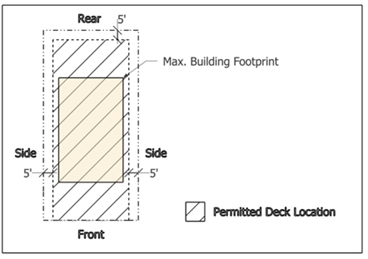
Uncovered decks three feet in height or less may occupy any required yard, provided that no structure shall be closer than five feet to a rear or side property line. See Figure 18.
Figure 18. Permitted location of uncovered deck three feet or less in height.
(B)
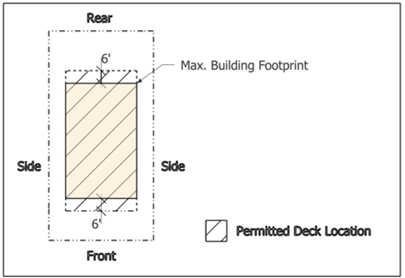
Except as allowed by Section 18.24.050(7)(C), uncovered decks greater than three feet in height may extend from a building into a required front or rear setback area not more than six feet. Decks are subject to the same required side yard setbacks for the main building. See Figure 19.
Figure 19. Permitted location of uncovered deck greater than three feet in height.
(C)
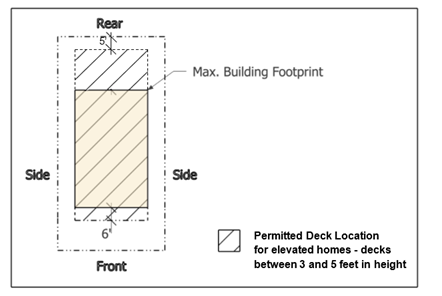
In addition to Section 18.24.050(B), uncovered decks greater than three feet in height but not greater than five feet in height that meet the criteria listed in Section 18.24.080(a) through (e), may occupy the required rear yard, provided that no structure shall be closer than five feet to a rear property line and are subject to the same required side yard setbacks for the main building. See Figure 20.
Figure 20. Permitted location of uncovered deck attached to an elevated home between three and five feet in height.
(8)
Fences in the front setback area.
(A)
Fences four feet or less in height may be located within the front setback area.
(B)
Fences greater than four feet in height but not greater than six feet in height may be located within the front setback area if:
(i)
Design Review approval is granted pursuant to Chapter 18.30; and
(ii)
The applicant can demonstrate, to the satisfaction of the town engineer, that the proposed fence is not within the public right-of-way; and
(iii)
The fence is not within fifty feet of a street intersection; and
(iv)
The fence will not adversely affect sight distance from any public or private road or from any driveway.
(9)
Fences in the rear and side setback areas.
(A)
Fences six feet or less in height may be located within the side and rear setback areas.
(B)
Fences greater than six feet, but not greater than eight feet in height may be located within the rear and side setback areas if:
(i)
The fence is not within fifty feet of a street intersection; and
(ii)
Written approval from all owners of property contiguous with the property line nearest the fence is submitted to the Community Development Director; or
(iii)
Design Review approval is granted pursuant to Chapter 18.30.
(10)
Additional standards for fences built on top of retaining walls.
(A)
A fence built on top of a retaining wall shall be set back a minimum of two feet from the inside edge of the retaining wall when the wall and fence combination is in the front setback area (Figure 20), street side setback area, or rear setback area on a double frontage lot (Figure 21). The fence may be built with a setback of less than two feet to the retaining wall if design review approval is granted pursuant to Chapter 18.30.
(B)
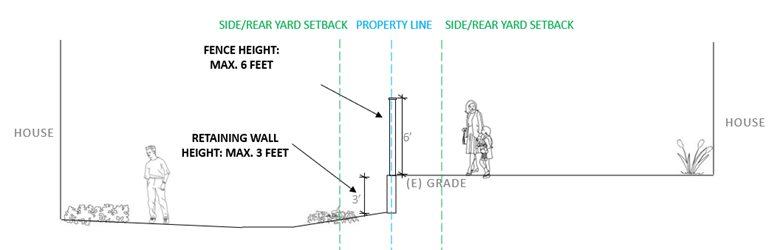
No setback from the retaining wall is required when the wall and fence combination is located in the interior side setback area or rear setback area (Figure 22).
(C)
For a corner lot, a retaining wall and fence combination shall also be approved by the town engineer.
Figure 20. Required setback for fences on top of retaining walls, front yard setback
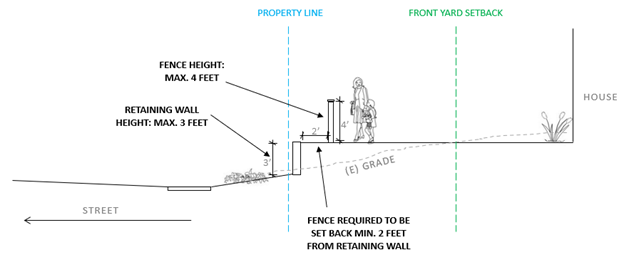
Figure 21. Required setback for fences on top of retaining walls, street side setback and rear yard setback on a double frontage lot.
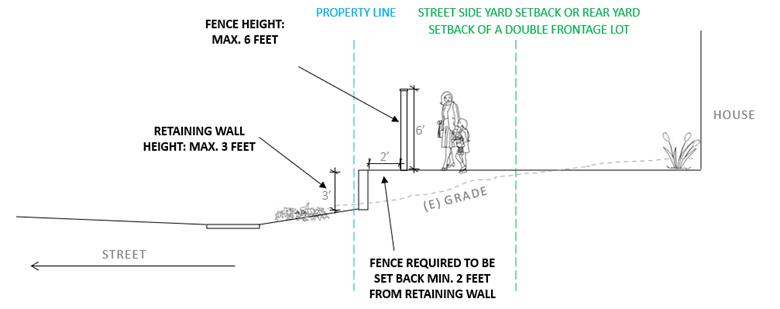
Figure 22. No setback required for retaining walls from interior side or rear setback.
(Ord. 812 § 3 (part), 1997; Ord. 785 § 3(b) (part), 1994)
(Ord. No. 1038, § 20, 7-16-2024; Ord. No. 1046, § 8, 6-17-2025)
18.24.060 - Measurement of height.
"Height of building" means the vertical distance from the finished grade to the highest point of the structure. Maximum height is measured from finished grade to an imaginary plane located the allowed number of feet above and parallel to the finished grade.
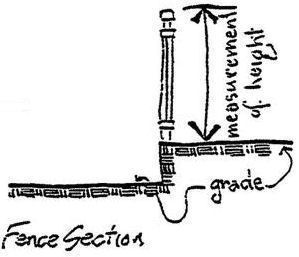
As an exception to the normal procedure for measuring height, the height of a fence or wall used as a fence shall be measured vertically from the natural or finished grade, whichever is higher, at the base of the fence or wall to the top of the fence or wall above that grade. (See Figure 23 and the definitions of "height" and "grade" in Chapter 18.04, Definitions, of this title).
Figure 23
(Ord. No. 910, § 31, 4-21-2009; Ord. No. 1038, § 20, 7-16-2024)
18.24.070 - Exceptions to height limitations.
Towers, spires, cupolas, chimneys, elevator penthouses, water tanks, flagpoles, monuments, scenery lofts, radio and television aerials and antennas, transmission towers, fire towers and similar structures and necessary mechanical appurtenances covering not more than ten percent of the ground area covered by the structure may be erected to a height not more than ten feet above the height limit prescribed by the regulations for the district in which the site is located; provided, that the height limitations specified in this section shall not apply to public utility distribution and transmission lines which are under the jurisdiction of the state Public Utilities Commission.(Ord. 785 § 3(b) (part), 1994)
(Ord. No. 910, § 32, 4-21-2009)
18.24.080 - Measurement of coverage.
Lot Coverage shall be measured by dividing the total square feet of ground area covered by all open or enclosed structures greater than three feet in height, by the net area of land. Required handrails extending less than four feet from the surface of a deck or patio shall not be counted toward the height of an element for purposes of this provision. Eaves projecting three feet or less shall not be counted. Only one-half of the area of uncovered and unenclosed decks fifteen or more feet above the ground shall be counted. Uncovered and unenclosed decks greater than three feet in height but not greater than five in height meeting the criteria of clauses (a) through (e) shall not be counted. Additional lot coverage for uncovered decks shall be allowed in accordance with Section 18.08.220(e)(1), and Section 18.08.220(e)(3).
(a)
The site is located in Flood Zone AE, is on Golden Hind Passage, and its rear property line is contiguous to a waterway;
(b)
The deck is in the rear yard and attached to the primary residence;
(c)
The primary residence's finished floor is a minimum of one foot above base flood elevation and complies with the criteria listed in Section 18.30.015(2) or obtained design review approval;
(d)
The deck is no higher than the finished floor of the first floor of the home and does not exceed five feet in height measured from finished grade to the decking surface; and
(e)
The deck is not closer than five feet to a rear property line and is subject to the same required side yard setbacks for the main building.
(Ord. No. 909, § 3, 4-7-2009; Ord. No. 910, § 33, 4-21-2009; Ord. No. 967, § 6, 9-19-2017; Ord. No. 1046, § 9, 6-17-2025)
18.24.090 - Use permit required for certain structures.
In any district, a use permit secured in the manner prescribed in Chapter 18.26, Conditional Uses, shall be required for a tower, spire, water tank, flagpole, commercial radio or television aerial or antenna, transmission tower, or fire tower, if the structure exceeds the height limit by more than ten feet.
(Ord. 785 § 3(b) (part), 1994)
18.24.100 - Use permit required for speculative grading.
In any district, a use permit secured in the manner prescribed in Chapter 18.26, Conditional Uses, shall be required to extract natural materials or to allow the placement of natural fill materials unless:
(1)
The excavation or placement of fill results in the deposition, relocation of, or removal from the site to placement on another site of less than twenty cubic yards of natural material; or
(2)
The excavation or placement of fill materials is being accomplished pursuant to a development plan or tentative map which has been reviewed and approved by the planning commission.
(Ord. 785 § 3(b) (part), 1994)
18.24.110 - Maintenance of landscaped areas.
Any landscaped area provided in compliance with this title shall feature water-conserving landscape designs and shall be permanently maintained by the property owner, including automatic watering, weeding, pruning, fertilizing, spraying, or other form of insect control, replacement of plant materials as needed, and any other operations needed to ensure proper maintenance. Failure to meet these requirements shall be cause for the issuance of a citation, an order of compliance, nuisance abatement action, and/or the revocation of any land use approval for which the landscape requirements were made a condition of approval. If the respondent refuses to comply with the provisions of the citation and order, legal proceedings may be initiated by the town attorney to obtain compliance when such proceedings are authorized by the town council.
(Ord. 785 § 3(b) (part), 1994)
18.24.115 - Protected Units.
(a)
As used in this section, "Protected Unit" means any residential dwelling unit that is any of the following:
1.
Subject to a recorded covenant, ordinance, or law that restricts rents to levels affordable to persons and families of lower or very low-income within the past five years;
2.
Subject to some form of rent or price control through a public entity's valid exercise of its police power within the past five years;
3.
Occupied by lower or very low-income households within the past five years; or
4.
Withdrawn from rent or lease in accordance with Chapter 12.75 (commencing with Section 7060) of Division 7 of Title 1 the California Government Code within the past 10 years.
(b)
Notwithstanding any other provision of this Code, no project may demolish a protected unit unless it meets the applicable replacement and relocation requirements of Section 66300.6 of the California Government Code.
(c)
Notwithstanding any other provision of this Code, no housing development project may involve the demolition of one or more residential dwelling units unless the project will create at least as many residential dwelling units as will be demolished.
(Ord. No. 1058, § 5, 2-3-2026)
18.24.120 - Affordable housing requirements.
(a)
Purpose and Intent. The purpose of this section is to enhance the public welfare and ensure that new residential and nonresidential development projects within the town contribute to the attainment of affordable housing goals by promoting and increasing, through actual construction and/or alternative equivalent actions, the development of rental and ownership housing units for very low, low, moderate, and above moderate-income households, as provided for in this section.
(b)
Residential Development Projects—General Requirements. Any new residential development project with dwelling units intended or designed for permanent occupancy shall be developed to provide affordable housing units to very low, low, moderate, and above moderate-income households in accordance with the provisions of this section.
(1)
Exemptions. This provision shall be imposed on all residential development projects except that the following shall be exempt from the provisions of this section:
(A)
Projects where a building permit application has been accepted as complete by the town prior to the effective date of this section; however, any extension or modification of such permit after such date shall not be exempt.
(B)
Any application submitted pursuant to Titles 17, 18, or 22 of the Corte Madera Municipal Code that has been deemed complete by the town prior to the effective date of this ordinance.
(C)
Any residential development project that is damaged or destroyed by fire or other natural catastrophe, provided that the rebuilt square footage of the residential portion of the building does not increase upon reconstruction and provided that any affordable units within such residential development project are rebuilt in accordance with any required affordable housing agreements or requirements related to such project.
(D)
Any residential development project of one single-family structure.
(E)
Any accessory dwelling units or junior accessory dwelling units approved by the town of Corte Madera pursuant to Chapter 18.31 of the Corte Madera Municipal Code.
(F)
Residential development projects within the AHE-A, AHE-B, AHMU, and MUGD zoning districts.
(2)
Affordable Housing Units—Percentage Required, In-Lieu Fees, Target Incomes. Residential development projects shall provide affordable housing units and/or pay housing in-lieu fees in accordance with the policies and procedures specified in the town of Corte Madera's Guidelines for the Administration of Affordable Housing Policies, as adopted, and amended from time to time by town council resolution.
(c)
Relationship to Density Bonus. For eligible residential development projects, an applicant may make a separate application for a housing density bonus pursuant to Section 18.24.125 of the Corte Madera Municipal Code.
(d)
Nonresidential Development Projects—General Requirements.
(1)
Nonresidential development shall be required to pay affordable housing impact fees in accordance with Section 3.48.040 of the Corte Madera Municipal Code.
(e)
Affordable Housing Fund. Any housing in-lieu fees paid to the town pursuant to this section shall be placed in the town's affordable housing fund.
(f)
Enforcement. The town attorney is authorized to abate violations and to enforce the provisions of this section and all implementing regulatory agreements and resale controls placed on affordable housing units, by civil action, injunctive relief, and/or other proceeding or method permitted by law, including, without limitation, foreclosure. The remedies provided for herein shall be cumulative and not exclusive and shall not preclude the town from other remedy or relief to which it otherwise would be entitled under law or equity.
(Ord. No. 1020, § 7, 6-7-2022)
Editor's note— Ord. No. 1020, § 7, adopted June 7, 2022, repealed the former § 18.24.120 and enacted a new § 18.24.120 as set out herein. The former § 18.24.120 pertained to affordable housing and derived from Ord. 877 § 16, adopted in 2003; and Ord. No. 948, § 1, adopted Jan. 20, 2015.
18.24.125 - Density bonus.
(a)
Purpose. The purpose of this section is to provide for density bonuses and incentives to developers who comply with California Government Code Sections 65915 through 65918 (State Density Bonus Law). Nothing in this ordinance shall require the town to grant density bonuses, concessions, or incentives beyond those required by state law.
(b)
Definitions. Unless otherwise specified in this section, the definitions found in State Density Bonus Law shall apply to the terms contained herein.
(c)
Applicability. This section shall apply to all zoning districts that permit housing at a prescribed density by the General Plan Land Use Designation and/or zoning district.
(d)
State Density Bonus and Incentives. A developer of a housing development in the town may be permitted a density bonus and incentives in accordance with the provisions of California Government Code Sections 65915 through 65918 (State Density Bonus Law).
(e)
Application Requirements and Review.
1.
An application for a state density bonus, incentive or concession, waiver or modification of a development standard, or a revised parking standard shall be submitted with the first application for approval of a housing development and shall be processed concurrently with all other applications required for the housing development. The application shall be submitted on a form prescribed by the town and shall include, at a minimum, the following information:
i.
A site plan showing the total number and location of all proposed housing units and the number and location of proposed housing units which qualify the housing development for density bonus housing units.
ii.
The manner in which the applicant shall satisfy the affordability requirements for the housing units which qualify the housing development for density bonus units.
iii.
A description of any requested incentives and concessions, waivers or modification of development standards, or modified parking standards. For all incentives and concessions, the application shall include evidence deemed sufficient by the town that the requested incentives and concessions result in identifiable, financially sufficient, and actual cost reductions. For waivers or modifications of development standards, the application shall include evidence deemed sufficient by the town that the waiver or modification is necessary to make the housing units economically feasible and that the development standard from which a waiver or modification is requested will have the effect of precluding the construction of the housing development at the densities to which the applicant is entitled pursuant to this article and with the concessions and incentives permitted by this article.
iv.
If a density bonus is requested for a land donation, the application shall show the location of the land to be dedicated and provide evidence that each of the conditions pursuant to Government Code Section 65915 relating to land donation are met.
v.
If a density bonus or incentive or concession is requested for a child care facility pursuant to Government Code Section 65915, the application shall show the location and square footage of the child care facility and provide evidence that the community lacks adequate child care facilities.
vi.
In accordance with Government Code Section 65915, if the proposed housing development involves the removal or conversion of existing rental dwelling units, or if the property upon which the housing development is proposed has within the past five year period been occupied by rental dwelling units: (1) a description of the housing units to be converted, removed or which were removed; (2) the income of the persons occupying each such unit removed proposed to be converted or proposed to be removed; and (3) the rental rates charged for the immediately preceding five years for each unit proposed to be converted or removed or which was removed within the last five years.
2.
Review and Consideration. An application for a density bonus, incentive or concession, waiver or modification of a development standard, or revised parking standard shall be considered and acted upon by the town body with review authority for the housing development.
3.
Approval. Before approving an application for a density bonus, incentive or concession, or waiver or modification of a development standard, the approval body shall make the following findings:
i.
If the density bonus is based all or in part on a donation of land, the conditions of Government Code Section 65915 relating to land donation are met.
ii.
If the density bonus, incentive or concession is based all or in part on the inclusion of a child care facility, that the conditions included in Government Code Section 65915 relating to child care facilities are met.
iii.
If the incentive or concession includes mixed use development, the finding included in Government Code Section 65915 relating to mixed use projects are met.
iv.
If a waiver or modification of a development standard is requested, the developer has demonstrated, for each requested waiver or modification, that the waiver or modification is necessary to make the housing units economically feasible and that the development standards from which a waiver or modification is requested will have the effect of precluding the construction of a housing development at the densities to which the applicant is entitled pursuant to this section or with the concessions and incentives permitted by this section.
v.
If the proposed housing development involves the removal or conversion of existing rental dwelling units, or if the property upon which the housing development is proposed has within the past five year period been occupied by rental dwelling units, that the conditions included in Government Code Section 65915 relating to existing rental dwelling units which are vacated or demolished are met.
4.
The approval body may deny a concession or incentive if it makes a written finding based upon substantial evidence of any of the following:
i.
The concession or incentive is not required to provide for affordable rents or affordable housing costs as required by this article.
ii.
The concession or incentive would have a specific adverse impact upon public health or safety or the physical environment or on any real property listed in the California Register of Historical Resources, and there is no feasible method to satisfactorily mitigate or avoid the specific adverse impact without rendering the development unaffordable to lower, very low or moderate income households. For purposes of this subsection, "specific adverse impact" means a significant, quantifiable, direct and unavoidable impact, based on objective, identified, written public health or safety standards, policies, or conditions as they existed on the date that the application was deemed complete.
iii.
If the proposed housing development involves the removal or conversion of existing rental dwelling units, or if the property upon which the housing development is proposed has within the past five year period been occupied by rental dwelling units, that the conditions included in Government Code Section 65915 relating to existing rental dwelling units which are vacated or demolished are not met.
iv.
The concession or incentive would be contrary to state or federal law.
5.
The approval body may deny a waiver or reduction of a development standard which would have the effect of physically precluding the construction of the development only if it makes a written finding based upon substantial evidence of either of the following:
i.
The waiver or modification would have a specific adverse impact upon health, safety or the physical environment and there is no feasible method to satisfactorily mitigate or avoid the specific adverse impact without rendering the housing development unaffordable to lower, very low or moderate income households. For purposes of this subsection, "specific adverse impact" means a significant, quantifiable, direct and unavoidable impact, based on objective, identified, written public health or safety standards, policies, or conditions as they existed on the date that the application was deemed complete.
ii.
The waiver or modification would have an adverse impact on any real property listed in the California Register of Historical Resources.
6.
If a density bonus or concession or incentive is based on the provision of child care facilities, the approval body may deny the density bonus or concession or incentive if it finds, based on substantial evidence, that the town already has adequate child care facilities.
(f)
Density Bonus Housing Agreement.
1.
Density Bonus Housing Agreement. An applicant requesting a density bonus shall agree to enter into an affordable housing agreement ("agreement") with the town in the town's standard form of agreement. Execution of the agreement shall be made a condition of approval for any discretionary planning permit for housing developments pursuant to this article and shall be recorded as a restriction on any parcels on which the housing units which qualify the housing development for a density bonus will be constructed.
2.
Recording of Agreement. The agreement shall be recorded prior to the final or parcel map approval, or, where the housing development does not include a map, prior to the issuance of a building permit.
3.
Contents of the Agreement. Each agreement shall include, but not be limited to, the following:
i.
A description of the residential development, including whether the housing units which qualify the housing development for a density bonus will be rented or owner-occupied;
ii.
The number, size and location of the housing units which qualify the housing development for a density bonus;
iii.
Provisions and/or documents for resale restrictions, deeds of trust, right of first refusal or rental restrictions for a minimum of fifty-five years;
iv.
Provisions for monitoring the ongoing affordability of the housing units which qualify the housing development for a density bonus, and the process for qualifying prospective resident households for income eligibility; and
v.
Any additional obligations relevant to the compliance with this section.
4.
Owner-Occupied Agreements. The purchaser of each owner-occupied housing unit which qualified the housing development for a density bonus shall execute the town's standard form agreement, to be recorded against the parcel, and which includes such provisions as the town may require to ensure continued compliance with this section.
5.
Agreements for Child Care Facilities and Land Donations. Density bonus housing agreements for child care facilities and land dedications shall ensure continued compliance with all conditions included in Government Code Section 65915.
(Ord. No. 948, Exh. A, 1-20-2015)
18.24.130 - Handicapped access.
The town may allow one additional dwelling unit for every dwelling unit that is provided with features and fixtures that allow handicapped access, up to a maximum of a twenty-five percent bonus over the allowable base density. The total cumulative bonus allowed for any project shall not exceed the bonus allowed by the state density bonus requirements as found in Government Code Section 65915.
(Ord. 877 § 16, 2003)

