
Corte Madera City Zoning Code
CHAPTER 18
12 - C COMMERCIAL DISTRICTS
Sections:
18.12.010 - Purposes for all commercial districts.
In addition to the objectives prescribed in Section 18.02.030, the commercial districts are established by this chapter to achieve the following purposes:
(1)
To provide appropriately located areas for retail stores, offices, service establishments, and wholesale businesses offering various ranges of commodities and services scaled to meet the needs of the different geographic areas and the various categories of patrons they serve;
(2)
To provide opportunities for residential units in all commercial districts, particularly those intended for occupancy by the elderly or by low-income and/or moderate-income families, to be located in a harmonious relationship with nonresidential uses in certain commercial areas under conditions assuring adequate open space and safety for the occupants;
(3)
To provide space for community facilities and institutions which appropriately may be located in commercial areas;
(4)
To provide adequate space to meet the needs of commercial development, including off-street parking and truck loading areas;
(5)
To minimize traffic congestion and to avoid the overloading of utilities by preventing the construction of buildings of excessive size in relation to the amount of land around them;
(6)
To protect commercial properties from the adverse impacts incidental to certain industrial uses;
(7)
To ensure that the appearance of commercial structures and uses is harmonious with the visual character of the town;
(8)
To provide employment opportunities close to home for residents of the town and the surrounding area.
(Ord. 785 § 3(b) (part), 1994)
_____
18.12.020 - Permitted and conditional uses in commercial districts.
The following schedule indicates by the symbol "X" the permitted and conditional uses in each commercial district.
(Ord. 897 §§ 3, 4, 2006; Ord. 839 § 1, 1999; Ord. 785 § 3(b) (part), 1994)
(Ord. No. 931, §§ 12, 13, 3-20-2012; Ord. No. 935, §§ 1, 2, 9-17-2013; Ord. No. 955, § 4, 4-5-2016; Ord. No. 976, § 5, 6-19-2018; Ord. No. 1014, § 7, 1-18-2022; Ord. No. 1034, § 6, 6-4-2024)
_____
* Uses open for business after eleven p.m. and before six a.m. require a conditional use permit.
--- (2) ---
--- (3) ---
* Special findings are required for these uses as described in Section 18.26.050 of this title.
18.12.030 - Required standards in commercial districts.
The following conditions shall be required for all permitted uses and conditional uses:
(1)
Except as otherwise provided in the district regulations, required yards adjoining streets may be used for landscaping, access drives, walkways, lighting standards, guard railings and signs, in accord with the provisions of Chapter 18.22, Signs.
(2)
All service areas, refuse collection areas and trash bins shall be completely screened by a landscaped solid fence, masonry wall or compact evergreen hedge not less than six feet in height, with solid gates, or shall be enclosed within a building.
(3)
All off-street loading facilities shall provide for direct loading or transfer of materials and equipment directly to or from vehicles into a building or storage yard where exterior storage is permitted.
(4)
All exterior lighting shall be directed toward the property and away from nearby residential districts and adjacent streets. The lighting patterns of each fixture shall be contained within the site and shall be effectively shielded from nearby residential districts. No internally illuminated facia, wall, roof, awning or other building part shall be allowed.
(5)
No use shall be permitted and no process, equipment or material shall be employed which is found by the planning commission to be objectionable to persons residing or working in the vicinity by reason of odor, fumes, dust, smoke, cinders, dirt, refuse, water-carried wastes, noise, vibration, illumination, glare, unsightliness or heavy truck traffic, or to involve any hazard of fire or explosion.
(6)
All mechanical, heating and air conditioning equipment shall be screened from public view.
(7)
On a site adjacent to a residential district, no exterior loudspeaker shall be allowed.
(8)
Recycled water and double piping may be required for any development within a reclamation area.
(9)
In the C-1, C-2 and C-3 districts, all businesses, services and processes shall be conducted entirely within a completely enclosed structure, except off-street parking and loading areas, service stations, tire sales and services, automobile sales and service agencies, used car sales, outdoor dining areas, nurseries, garden supply stores, Christmas-tree-sales lots, and pumpkin patch displays and sales. A use not conducted entirely within a completely enclosed structure may be required by the planning commission to be wholly or partially screened by a solid fence, masonry wall, or compact evergreen hedge not less than six feet in height.
All products produced on the site of any of the permitted or conditional uses shall be sold primarily at retail on the site where produced.
(10)
In the C-4 district, open storage of materials and equipment shall be permitted only within an area surrounded by a landscaped solid fence, masonry wall or compact evergreen hedge not less than six feet in height, with solid gates; provided, that neither the area nor the wall, fence or hedge shall be located in any required front, side or rear yard, and; provided further, that no materials shall be stored to a height greater than six feet.
In addition, a business, service, or process which is not conducted within a completely enclosed structure may be required by the planning commission to be wholly or partially screened by a landscaped solid fence, masonry wall, or compact evergreen hedge not less than six feet in height.
(11)
Outdoor displays raised above the ground and not screened from view by a fence, wall, or hedge, and equipment raised into a display position above the peak of the roof, shall not be permitted.
(12)
Convenient, continuous, and safe pedestrian walkways shall be provided, linking businesses, on-site parking areas, and public areas.
(13)
All landscaped areas shall feature water conserving landscape design and be equipped with an automatic irrigation system. A landscape plan, showing the locations and varieties of plants, materials and specifying provisions for maintenance, shall be submitted for design review approval as prescribed in Chapter 18.30, Design Review.
(14)
Drive-through restaurants shall be located, developed, and operated in compliance with the following standards:
(A)
Vehicular access to the drive-through lane and vehicular circulation within the drive-through lane shall not require vehicular circulation through on-site parking areas or parking lot maneuvering areas.
(B)
A minimum five foot-wide landscaped planter area shall be provided between the drive-through lane and parking areas. Such planter area shall include shade trees.
(Ord. 785 § 3(b) (part), 1994; Ord. No. 976, § 5, 6-19-2018)
18.12.040 - Special yard requirements applicable to commercial districts.
Except as otherwise prescribed by the district regulations, the sites of all permitted uses and conditional uses shall be subject to the following requirements in all commercial districts:
(1)
Side Yards. The following side yards shall be required:
(A)
On a reversed corner lot adjoining property in a residential district, a professional and administrative office district, or a public facilities district, the minimum side yard adjoining the street shall be ten feet.
(B)
Where the side property line of a site adjoins property in a residential district, the minimum side yard adjoining the residential district shall be fifty feet, of which the ten feet adjoining the property line shall be landscaped with permanently maintained plant materials not less than six feet in height. In addition, a landscaped solid fence or masonry wall not less than six feet in height may be required by the planning commission if necessary to adequately screen the use.
(C)
Where the side property line of a site adjoins property in a professional and administrative office district, or a public facilities district, the minimum side yard shall be twenty-five feet, of which five feet adjoining the property line shall be landscaped with permanently maintained plant materials not less than six feet in height. In addition, a landscaped solid fence or masonry wall not less than six feet in height may be required by the planning commission if necessary to adequately screen the use.
(D)
Where the side property line of a site is across a street from a residential district or a professional and administrative office district, the side yard opposite either of the districts shall be ten feet.
(E)
Where the side property line of a site adjoins land designated as open space, the minimum side yard shall be twenty feet.
(F)
Where the side property line of a site adjoins land in any other zoning district the minimum side yard shall be ten feet.
(2)
Rear Yards. The following rear yards shall be required:
(A)
Where the property line of a site adjoins property in a residential district, the minimum rear yard shall be fifty feet, of which the ten feet adjoining the property line shall be landscaped with permanently maintained plant materials not less than six feet in height. In addition, a landscaped solid fence or masonry wall not less than six feet in height may be required by the planning commission if necessary to screen the use adequately.
(B)
Where the rear property line of a site adjoins property in a professional and administrative office district, the minimum rear yard shall be twenty-five feet, of which the five feet adjoining the property line shall be landscaped with permanently maintained plant materials not less than six feet in height. In addition, a landscaped solid fence or masonry wall not less than six feet in height may be required by the planning commission if necessary to screen the use adequately.
(C)
Where the rear property line of a site is across a street from property in a residential district, the minimum rear yard shall be twenty feet.
(D)
Where the rear property line of a site is across a street from property in a professional and administrative office district, the minimum rear yard shall be ten feet.
(E)
Where the rear property line of a site adjoins land designated as open space, the minimum rear yard shall be twenty feet.
(Ord. 785 § 3(b) (part), 1994)
18.12.050 - Special floor area ratio provisions for hotels in the C-3 and C-4 zoning district.
(a)
Notwithstanding the floor area ratio standards in section(s) 18.12.340 and 18.12.435, the FAR for hotels and any ancillary uses, including, but not limited to, restaurants or conference facilities, on lots within the C-3 and C-4 zoning district that have a net area of land greater than one acre, may be increased up to .70 FAR (in accordance with the FAR assignment schedule described in this section) if a proposed project meets all of the below conditions and the planning commission makes all of the below findings. The floor area devoted to required parking shall not be counted in the calculation of a project's FAR.
(b)
Notwithstanding the height standards in section(s) 18.12.335 and 18.12.430. the height for hotels and any ancillary uses, including, but not limited to restaurants or conference facilities, may be increased to a maximum of forty-seven feet if a proposed project meets all of the below conditions and the planning commission makes all of the below findings.
(c)
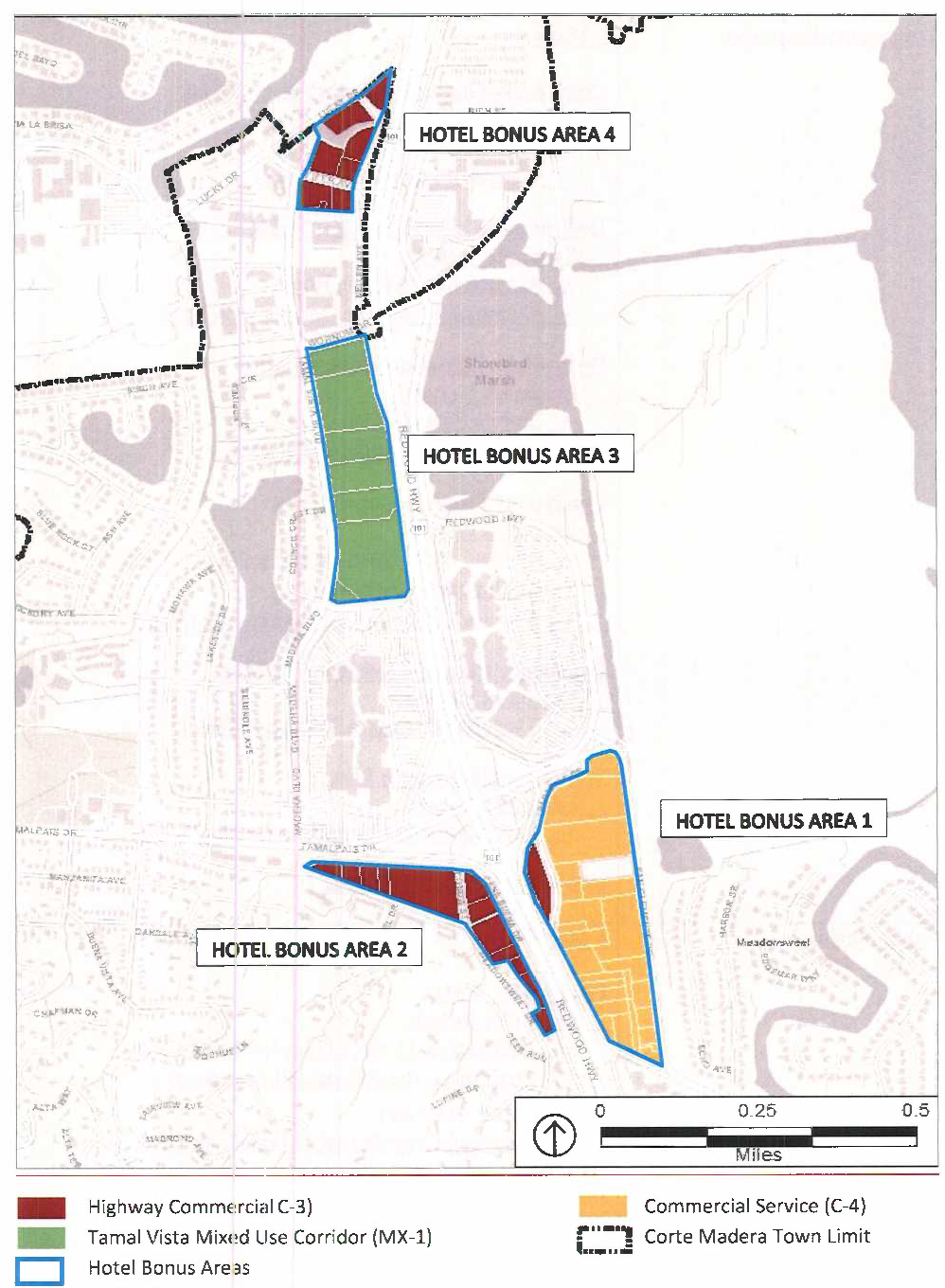
The increased floor area for hotels permitted in this section and in section 18.13.050 shall only be applied to four lots in total, and no more than two lots in each hotel bonus area. The hotel bonus areas are shown in Figure 1.
Conditions:
(1)
A proposed project on a lot located entirely or partially within the special flood hazard area shall meet the town's development requirements for residential construction in a special flood hazard area pursuant to section 16.10.080(3) of the Corte Madera Municipal Code and shall be subject to otherwise applicable requirements of title 16; and
(2)
An applicant seeking to utilize the provisions described in this section shall submit an application for preliminary review with the planning department and the applicant's project shall require a minimum of one public hearing at a study session before the planning commission. A primary purpose of the study session shall be to preliminarily evaluate the proposed project in light of the additional FAR requested, consistent with the findings and additional FAR assignment schedule described in this section; and
(3)
An applicant shall hold at least one applicant-sponsored community meeting to solicit feedback and comments from community members prior to submission of an application for preliminary review.
(4)
The project shall incorporate one or more of the following bird-safe design measures:
(A)
Non-Reflective Glass. No reflective glass shall be used in the building; exterior glass in the building shall have a light reflectance value of less than fifteen percent;
(B)
Fritted Glass. Fritted glass shall be used on upper floors (i.e., above the second floor) to reduce bird strikes. The applicant may substitute other non-reflective glass that is shown to be equally effective in reducing bird strikes.
(C)
Lighting. There shall be no exterior uplighting of the building. All on-site lighting shall be low-level illumination and shielded to reduce spill or glare.
(D)
Tree Screening on Lower Floors. This measure shall not be used by itself unless applicant plants trees of sufficient number and size to screen the windows which they are intended to cover.
(E)
Reduction of Unnecessary Interior Lighting. Energy conservation measures, including automatic sensors to turn off lights when guests are not present in the rooms.
Findings:
(1)
The project provides a significant contribution to the aesthetics of the town's built environment and integration with natural features and incorporates all of the below site and architectural design principles:
(A)
The totality of the project is designed with a coherent, site-specific architectural idea, that harmonizes the relationships between project components and between the project and adjacent buildings, streets, open spaces, and natural setting, through the use of appropriate building scale, massing, fenestration, exterior materials, and landscape design; and
(B)
The project respects and exhibits natural systems, including existing ponds and wetlands and other natural features, through building siting, programming, and orientation; and
(C)
The project organizes components of hotel uses and site design to complement and engage the public realm, with particular focus on the pedestrian and bicycle scale and experience;
(D)
The project utilizes building materials, construction techniques, and external finishes for the quality, durability, and aesthetic appeal they provide, rather than the cost savings they may achieve.
(2)
The project incorporates quantifiable environmental sustainability measures that exceed existing environmental requirements or mitigation measures, and building code requirements in existence at the time of permit application(s), that are intended to minimize energy and water use, solid waste, greenhouse gas emissions, or otherwise improve a project's environmental sustainability. This finding shall be met if a project is assigned additional floor area in the environmental sustainability category pursuant to paragraph (b)(2).
(3)
The project includes on-site programmatic elements, site planning strategies, and/or operational commitments that encourage public use, community gathering, or supports community health and well-being. This finding shall be met if a project is assigned additional floor area in the community integration category pursuant to paragraph (b)(2).
(4)
The project includes enhancement of the public realm through upgrades to existing or proposed pedestrian and bicycle infrastructure in excess of that required by environmental mitigation measures or other regulatory requirement. This finding shall be met if a project is assigned additional floor area in the public realm category pursuant to paragraph (b)(2).
(d)
In determining the total amount of additional FAR permitted pursuant to this section, the following FAR assignment schedule shall be used.
FAR Assignment Schedule:
(1)
For each of the above findings, a maximum amount of additional FAR above .34 shall be allocated as follows:
(2)
The following FAR assignment schedule shall be used to assign additional FAR. Examples cited within the community integration and public realm findings are intended to provide guidance related to the type of qualifying program or amenity that may satisfy each category within a finding. The examples are not intended to exclude other potential ways of achieving points under the category listed. the environmental sustainability finding shall be met if a project includes at least one of the required environmental options.
The maximum FAR for hotels allowed in this section is not intended as a target to be achieved, but rather is the maximum allowable for any lot. The planning commission may approve less than the maximum allowable FAR in order to ensure that proposed development meets the above required findings or findings related to other sections of this title.
Figure 1
Hotel Bonus Area Map
(Ord. No. 995, § 5(Exh. A), 6-16-2020)
18.12.100 - Purpose.
The C-1 district is intended to create and enhance areas for a limited number of retail commercial goods and services which meet the day-to-day needs of local residents. The C-1 districts are located within walking distance or short driving distance of residential areas. Only uses which do not create impacts such as traffic, noise or others incompatible with adjacent residential use, are permitted in the C-1 district. Village Square, the Paradise Shopping Center and the Park Madera Shopping Center are classified as local-serving commercial.
(Ord. 785 § 3(b) (part), 1994)
18.12.105 - Generally.
The regulations set forth in Sections 18.12.105 through 18.12.155 shall apply to the site of a permitted use or a conditional use in the C-1 district.
(Ord. 785 § 3(b) (part), 1994)
18.12.110 - Signs.
No sign, outdoor advertising structure, or display of any kind shall be permitted except as prescribed in Chapter 18.22, Signs.
(Ord. 785 § 3(b) (part), 1994)
18.12.115 - Front yard.
The minimum front yard shall be ten feet, with the following exceptions:
(1)
On a site abutting property in a residential district with frontage on the same street, the minimum front yard shall be fifteen feet;
(2)
Where the front property line of a site is across a street from property in a residential district, the minimum front yard shall be twenty feet.
(Ord. 785 § 3(b) (part), 1994)
18.12.120 - Side yards.
No side yards shall be required except as prescribed in subsection (1) of Section 18.12.040.
(Ord. 785 § 3(b) (part), 1994)
18.12.125 - Rear yard.
No rear yard shall be required except as prescribed in subsection (2) of Section 18.12.040.
(Ord. 785 § 3(b) (part), 1994)
18.12.130 - Floor area ratio.
Gross floor area shall not exceed thirty-four percent of the net site area, exclusive of the floor area devoted to required parking.
(Ord. 785 § 3(b) (part), 1994)
18.12.135 - Height.
No structure shall exceed thirty feet in height, as defined in Section 18.24.060.
(Ord. 785 § 3(b) (part), 1994)
18.12.140 - Landscaped areas.
Not less than five feet of the required front yard adjoining the front property line, not less than five feet of the required side yard on the street side of a corner lot adjoining the side property line, and not less than five feet of the required rear yard adjoining the rear property line of a double frontage lot shall be landscaped and permanently maintained.
Each off-street parking area having ten or more spaces shall have landscaped areas equivalent to at least ten percent of the area of the parking lot. Such additional landscaping may be required as is appropriate to the design and function of the structures.
(Ord. 785 § 3(b) (part), 1994)
18.12.145 - Off-street parking and loading.
Off-street parking facilities and off-street loading facilities shall be provided for each use as prescribed in Chapter 18.20, Off-Street Parking and Loading. A parking area shall not be located in a front yard, side yard adjoining the street on a corner lot, or rear yard of a double frontage lot.
(Ord. 785 § 3(b) (part), 1994)
18.12.150 - Design review.
Design review approval is prescribed for applicable projects in accordance with Chapter 18.30.
(Ord. 785 § 3(b) (part), 1994)
(Ord. No. 1038, § 14, 7-16-2024)
18.12.155 - General provisions and exceptions.
All uses shall be subject to the general provisions and exceptions prescribed in Chapter 18.24, General Provisions and Exceptions.
(Ord. 785 § 3(b) (part), 1994)
18.12.200 - Purpose.
The C-2 district is intended to create and enhance areas where a wide range of retail goods and services are permitted, serving customers from a wide geographic area. Local-serving commercial uses, region-serving commercial uses and some office and personal services are permitted. The C-2 district regulations will be applied to areas with good freeway access to create regional shopping complexes where the retail uses and services are mutually benefitted and enhanced by their close proximity. The Village, Corte Madera Town Center and the Market Place are classified as region-serving commercial.
(Ord. 785 § 3(b) (part), 1994)
18.12.205 - Generally.
The regulations set forth in Sections 18.12.205 through 18.12.255 shall apply to the site of a permitted use or a conditional use in the C-2 district.
(Ord. 785 § 3(b) (part), 1994)
18.12.210 - Signs.
No sign, outdoor advertising structure, or display of any kind shall be permitted except as prescribed in Chapter 18.22, Signs.
(Ord. 785 § 3(b) (part), 1994)
18.12.215 - Front yard.
The minimum front yard shall be sixty feet.
(Ord. 785 § 3(b) (part), 1994)
18.12.220 - Side yards.
No side yards shall be required except as prescribed in subsection (1) of Section 18.12.040, except that on the street side of a corner lot, the minimum side yard shall be sixty feet.
(Ord. 785 § 3(b) (part), 1994)
18.12.225 - Rear yard.
No rear yard shall be required except as prescribed in subsection (2) of Section 18.12.040, except that on a double frontage lot, the minimum rear yard shall be sixty feet.
(Ord. 785 § 3(b) (part), 1994)
18.12.230 - Floor area ratio.
Gross floor area shall not exceed thirty-four percent of the net site area, exclusive of the floor area devoted to required parking.
(Ord. 785 § 3(b) (part), 1994)
18.12.235 - Height.
No structure shall exceed thirty-five feet in height, as defined in Section 18.24.060.
(Ord. 785 § 3(b) (part), 1994)
18.12.240 - Landscaped areas.
Not less than ten feet adjoining the property line of a required front, side, or rear yard adjacent to a street shall be landscaped and permanently maintained. Such additional landscaping may also be required as is appropriate to the design and function of the structure. Each off-street parking area having ten or more spaces shall have landscaped areas equivalent to at least ten percent of the area of the parking lot.
(Ord. 785 § 3(b) (part), 1994)
18.12.245 - Off-street parking and loading.
Off-street parking facilities and off-street loading facilities shall be provided for each use as prescribed in Chapter 18.20, Off-Street Parking and Loading.
(Ord. 785 § 3(b) (part), 1994)
18.12.250 - Design review.
Design review approval is prescribed for applicable projects in accordance with Chapter 18.30.
(Ord. 785 § 3(b) (part), 1994)
(Ord. No. 1038, § 14, 7-16-2024)
18.12.255 - General provisions and exceptions.
All uses shall be subject to the general provisions and exceptions prescribed in Chapter 18.24, General Provisions and Exceptions.
(Ord. 785 § 3(b) (part), 1994)
18.12.300 - Purpose.
The C-3 district is intended to create and enhance areas where automobile associated traveler services are desired. The C-3 district regulations are applied to areas near freeway interchanges or in areas with convenient access to the freeway, and provide for commercial uses which typically are freeway-oriented but do not locate in shopping centers, such as automotive dealers, automotive services, gas stations, restaurants and motels. The areas between Tamal Vista Boulevard and Highway 101, between Casa Buena Drive and Meadowsweet Drive, and in the vicinity of the Lucky Drive exit from the freeway are classified as highway commercial.
(Ord. 785 § 3(b) (part), 1994)
18.12.305 - Generally.
The regulations set forth in Sections 18.12.305 through 18.12.360 shall apply to the site of a permitted use or a conditional use in the C-3 district.
(Ord. 785 § 3(b) (part), 1994)
18.12.310 - Signs.
No sign, outdoor advertising structure, or display of any kind shall be permitted except as prescribed in Chapter 18.22, Signs.
(Ord. 785 § 3(b) (part), 1994)
18.12.315 - Reserved.
Editor's note— Ord. No. 935, § 3, adopted Sept. 17, 2013, repealed § 18.12.315, in its entirety. Former § 18.12.315 pertained to "Net site area for motel or hotel units." See Disposition of Ordinances Table for derivation.
18.12.320 - Front yard.
The minimum front yard shall be twenty feet.
(Ord. 785 § 3(b) (part), 1994)
18.12.325 - Side yards.
No side yard shall be required except as prescribed in subsection (1) of Section 18.12.040, except that on the street side of a corner lot, the minimum side yard shall be twenty feet.
(Ord. 785 § 3(b) (part), 1994)
18.12.330 - Rear yard.
No rear yard shall be required except as prescribed in subsection (2) of Section 18.12.040, except that on a double frontage lot, the minimum rear yard shall be twenty feet.
(Ord. 785 § 3(b) (part), 1994)
18.12.335 - Height.
No structure shall exceed 35 feet in height, as defined in Section 18.24.060.
(Ord. 785 § 3(b) (part), 1994)
18.12.340 - Floor area ratio.
Gross floor area shall not exceed thirty-four percent of the net site area, exclusive of the floor area devoted to required parking, except as set forth in section 18.12.050.
(Ord. 785 § 3(b) (part), 1994)
(Ord. No. 995, § 5(Exh. A), 6-16-2020)
18.12.345 - Landscaped areas.
Not less than ten feet adjoining the property line of a required front, side or rear yard adjacent to a street shall be landscaped and permanently maintained. Each off-street parking area having ten or more spaces shall have landscaped areas equivalent to at least ten percent of the area of the parking lot. Such additional landscaping may also be required as is appropriate to the design and function of the structure.
(Ord. 785 § 3(b) (part), 1994)
18.12.350 - Off-street parking and loading.
Off-street parking facilities and off-street loading facilities shall be provided for each use as prescribed in Chapter 18.20, Off-Street Parking and Loading. A parking area shall not be located in a front yard, side yard adjoining the street on a corner lot, or rear yard on a double frontage lot.
(Ord. 785 § 3(b) (part), 1994)
18.12.355 - Design review.
Design review approval is prescribed for applicable projects in accordance with Chapter 18.30.
(Ord. 785 § 3(b) (part), 1994)
(Ord. No. 1038, § 14, 7-16-2024)
18.12.360 - General provisions and exceptions.
All uses shall be subject to the general provisions and exceptions prescribed in Chapter 18.24, General Provisions and Exceptions.
(Ord. 785 § 3(b) (part), 1994)
18.12.400 - Purpose.
The C-4 district is intended to create and enhance areas where larger scale commercial uses can be located. These uses typically do not locate in shopping centers and may have some adverse impacts if located next to residential areas, but have low vehicle trip generation rates. Locally and regionally serving, these uses are located so as to have convenient access to the freeway. These areas include such land extensive establishments as automobile dealers, building materials sales, and home improvement sales. The area bounded by Paradise Drive and San Clemente Drive is classified as commercial service.
(Ord. 785 § 3(b) (part), 1994)
(Ord. No. 1014, § 8, 1-18-2022)
18.12.405 - Generally.
The regulations set forth in Sections 18.12.405 through 18.12.455 shall apply to the site of a permitted use or a conditional use in the C-4 district.
(Ord. 785 § 3(b) (part), 1994)
18.12.410 - Signs.
No sign, outdoor advertising structure, or display of any kind shall be permitted except as prescribed in Chapter 18.22, Signs, and by any applicable specific plan.
(Ord. 785 § 3(b) (part), 1994)
18.12.415 - Front yard.
The minimum front yard shall be twenty feet.
(Ord. 785 § 3(b) (part), 1994)
18.12.420 - Side yards.
No side yards shall be required except as prescribed in subsection (1) of Section 18.12.040, except that on the street side of a corner lot, the minimum side yard shall be twenty feet.
(Ord. 785 § 3(b) (part), 1994)
18.12.425 - Rear yard.
No rear yard shall be required except as prescribed in subsection (2) of Section 18.12.040, except that on a double frontage lot the minimum rear yard shall be twenty feet.
(Ord. 785 § 3(b) (part), 1994)
18.12.430 - Height.
No structure shall exceed thirty-five feet in height, as defined in Section 18.24.060.
(Ord. 785 § 3(b) (part), 1994)
18.12.435 - Floor area ratio.
Gross floor area shall not exceed thirty-four percent of the net site area, exclusive of the floor area devoted to required parking.
(Ord. 785 § 3(b) (part), 1994)
18.12.440 - Landscaped areas.
Not less than ten feet adjoining the property line of a required front, side, or rear yard adjacent to a street shall be landscaped and permanently maintained. Each off-street parking area having ten or more spaces shall have landscaped areas equivalent to at least ten percent of the area of the parking lot. Such additional landscaping may also be required as is appropriate to the design and function of the structure.
(Ord. 785 § 3(b) (part), 1994)
18.12.445 - Off-street parking and loading.
Off-street parking facilities and off-street loading facilities shall be provided for each use as prescribed in Chapter 18.20, Off-Street Parking and Loading. A parking area shall not be located in a front yard, side yard adjoining the street on a corner lot, or rear yard on a double frontage lot.
(Ord. 785 § 3(b) (part), 1994)
18.12.450 - Design review.
Design review approval is prescribed for applicable projects in accordance with Chapter 18.30.
(Ord. 785 § 3(b) (part), 1994)
(Ord. No. 1038, § 14, 7-16-2024)
18.12.455 - General provisions and exceptions.
All uses shall be subject to Chapter 18.24, General Provisions and Exceptions.
(Ord. 785 § 3(b) (part), 1994)

