
Coweta County Unincorporated
City Zoning Code
City Zoning Code
ARTICLE 6
- EXCEPTIONS AND MODIFICATIONS
Sec. 60. - Lot of record.
In any residential zoning district where the owner of a lot existing at the time of the adoption of this ordinance, or his successor in title thereto, does not own sufficient land to enable him to conform to the minimum lot area or frontage requirements of this ordinance, such lot may be used for a single-family dwelling provided that minimum yard and building setback requirements for the zoning district in which said lot is located are maintained. If such a lot exists in a commercial or industrial district, it may be used for a permitted use subject to the appropriate yard and building setback requirements.
Sec. 61. - Reduction in building setback line.
The building setback and front yard requirements of this ordinance shall not apply to any lot where the average existing building setback line or front yard on lots located wholly or in part within 200 feet on each side of such lot, within the same block and in the same zoning district, and fronting on the same side of the same street as such lot, is less than the minimum required building setback or front yard. In such cases the minimum building setback or front yard on the aforementioned lots [sic], or not less than 15 feet from the street right-of-way, whichever is greater.
Sec. 62. - Height limitation exceptions.
The director of planning shall have the authority to grant height limitation exceptions for office, institutional, commercial, and industrial buildings, and for other structural, architectural, and building design features such as: aerials, belfries, chimneys, church spires, conveyors, cooling towers, cupolas, elevator bulkheads, fire towers, flagpoles, monuments, ornamental domes, towers and spires, radio, television, and telephone towers, silos, smokestacks, transmission lines, water towers, and stand pipes.
An applicant for a height exception shall file the following with the director of planning:
(1)
Completed application signed and dated (application forms are available at the Coweta County Planning Department and at www.coweta.ga.us/resources/planning.html).
(2)
A fee in an amount as set forth in the appendix to this ordinance.
(3)
A denial letter from the Coweta County Building Department indicating the reason(s) for noncompliance.
(4)
Copy of warranty deed for the subject property.
(5)
One set of building or structural plans.
(6)
A conceptual site plan or development plans for the subject site, showing the structure and building locations, and other site features.
The director shall review each application for height exception and render his/her decision in conformance with the following criteria:
(1)
A favorable recommendation is received from the following:
(a)
Coweta County Fire Marshal
(b)
Coweta County Building Official
(c)
Coweta County Airport Manager
(2)
Buildings or structures located within an airport hazard district shall adhere to those standards and procedures as outlined under article 22A, airport hazard district, of this ordinance.
(3)
The height exception is the minimum allowed that will make possible the legal use of the building or structure.
(4)
The height exception will not result in an increase in the number of stories otherwise allowed under the applicable zoning district.
(5)
The maximum height that the director may permit for office, institutional, commercial, and industrial buildings shall be 60 feet, and any building 35 feet or more in height shall be required to install a sprinkler system and other fire safety measures.
(6)
The height of a building will not create a negative shadow impact on any adjoining lot or building.
In deciding upon any application, the director may impose certain conditions necessary to promote and protect the health, safety, and general welfare of the county.
An appeal of an interpretation or of a denial by the director of planning relative to the procedures and criteria set forth under this ordinance section may be submitted to the board of zoning appeals in accordance with the procedures in article 28, criteria for variances and conditional use, of the Coweta County Zoning and Development Ordinance.
Sec. 63. - Yards in group developments.
More than one multifamily, office, institutional, commercial or industrial building may be located upon a lot in a zoning district where such a use would be permitted; but such buildings shall not encroach upon the front, side or rear yards required for the building site. For multifamily buildings the open space between buildings shall not be less than 20 feet for one-story buildings, 30 feet when either building is a two-story building, 40 feet when either building is a three-story building, and 40 feet plus an additional ten feet for each story over three stories when either building is over three stories in height. The minimum dimension perpendicular to the building of the yard upon which any entrance or exit of a dwelling faces will be 20 feet. Except, however, that this section shall not apply to village centers (VC) district.
Sec. 64. - Walls and fences.
The setback requirements of this ordinance shall not prohibit any necessary retaining wall nor prohibit any wall or fence.
Sec. 65. - Temporary buildings.
Upon approval of the building official a temporary building, including an office trailer, for use in connection with a construction project or land subdivision development shall be permitted on the land of the project during the construction period. Temporary buildings shall be removed from the project site immediately upon completion of the project, or prior thereto if so directed by the building inspector.
Sec. 66. - Corner visibility.
There shall be provided an unobstructed view across the triangle formed by joining points measured 20 feet distant along the property line from the intersection of two streets or 15 feet along both the street and alley line from the intersection of a street and an alley. Within said triangle there shall be no sight-obscuring wall, fence or foliage higher than 30 inches above grade or, in the case of trees, foliage lower than eight feet. Vertical measurement shall be made at the top of the curb on the street or alley adjacent to the nearest side of the triangle, or, if no curb exists, from the edge of the nearest traveled way.
Sec. 67. - Parking, storage or use of certain vehicles and equipment.
Any vehicles or equipment normally used for commercial or industrial purposes shall not be parked in the front yard area of any property zoned for residential use.
No recreational vehicle or equipment shall be used for living, sleeping or housekeeping purposes when parked or stored on a residential lot, or in any location not approved for such use.
Automotive vehicles or trailers on [of] any kind or type without current license plates or in an inoperable condition shall not be parked or stored on any residentially zoned property other than in completely enclosed buildings.
Automotive vehicles having more than four wheels, major recreational equipment, school buses or other uses are prohibited from parking on residential streets or within public rights-of-way.
Sec. 68. - Transitional housing shelters.
(1)
Purpose. In the basic recognition of the need for transitional housing shelters in the county, the intent of this transitional housing shelters ordinance is to establish the requirement for a conditional use permit, guidelines for appropriate locations, design standards, and operational standards for such facilities in a manner that promotes the health, safety, and general welfare of the citizens.
(2)
Location. Transitional housing shelters shall be located in geographic areas with access to a wide variety of goods, services, transportation options, employment opportunities, schools, and healthcare facilities in order to aid in the timely transition to self-sufficiency. The proximity of the proposed facility to these amenities shall be demonstrated by the applicant and considered when approving/disapproving a conditional use permit.
(3)
Conditional use permit required. Any applicant desiring to establish a transitional housing shelter must submit an application for a conditional use permit for property within a zoning district which specifically lists transitional housing shelters as a conditional use. This plan shall meet or exceed the requirements set forth in article 28 of the Coweta County Zoning and Development Ordinance. Each application shall specify the population to be served by the shelter (i.e. men, women, families, etc.). After due public hearing before the board of zoning appeals and notice thereof as described in the procedures, the board of commissioners shall approve or disapprove each such proposed facility in accordance with this ordinance along with those criteria set out for conditional use permits in general as described under article 28 of this ordinance. Additionally, the board of commissioners may impose conditions of conditional use permit approval, in addition to these ordinance requirements, as deemed necessary in their judgment.
(4)
Design standards.
A.
All facilities shall comply with state and local fire codes, including occupancy limits.
B.
Applicant shall submit sprinkler plans for the building to the state fire marshal's office for approval prior to any installation/modification.
C.
A commercial kitchen meeting all applicable codes shall be required.
D.
A food service permit shall be required for the commercial kitchen.
E.
Prior to occupancy, the building department and fire marshal shall inspect the facility for compliance with all applicable electrical, life safety, and building codes.
F.
Emergency exits shall be clearly marked.
G.
Sufficient access for emergency personnel and vehicles, as determined by the fire chief and/or fire marshal, 911 department, and the development and engineering department, shall be required. All required drives, including any rear access drives, shall remain open at all times to provide emergency services access.
H.
The applicant shall work with the county, in good faith, to address any concerns such as noise, odor, glare, or other objectionable features.
I.
Additional buffers, beyond what would normally be required by article 25, buffer area and screening requirements, may be specified as a condition of the conditional use permit.
(5)
Operational standards.
A.
Emergency evacuation drills shall be held monthly. Records of these drills shall be made available to the state fire marshal's office and/or Coweta County Fire Marshal's Office on request.
B.
There shall be a minimum of two staff persons on site 24 hours a day, seven days a week at the facility. One additional staff person shall be required in increments of 30 occupants (i.e. 1—30 occupants requires 2 staff persons, 31—60 occupants requires three staff persons, 61—90 occupants requires four staff persons, etc.). Staff must be able to coordinate with emergency response personnel as to the number of people in the facility and the number of people assigned to each individual room and shall be responsible for the accountability of the occupants. An on-site staff person must have access to all records and equipment such that they can be made available for inspection.
C.
All staff shall maintain current first aid and CPR certificates, which shall be made available on request.
D.
There shall be no food preparation (including coffee makers, hot plates, slow cookers, and similar items) in individual rooms or any room other than the commercial kitchen.
E.
The sprinkler system, fire alarm system, and fire extinguishers shall be checked and certified annually. The kitchen hood suppression system shall be checked and certified every six months. All letters of certification shall be maintained on site and available for inspection by the state fire marshal's office and/or Coweta County Fire Marshal's Office on request. Any deficiencies with the sprinkler system, fire alarm system, fire extinguishers, or kitchen hood system shall be repaired immediately.
F.
A program shall be established for weekly checks of all smoke detectors, emergency lights, and exit lights to ensure their proper operation. A log of these checks shall be maintained and made available for review by the state fire marshal's office and/or Coweta County Fire Marshal's Office on request.
G.
No portable space heaters, electric or gas, shall be used in the facility.
H.
There shall be no use of extension cords in the facility.
I.
No smoking shall be permitted in the facility.
J.
All occupants and staff shall submit to drug and criminal background checks and results shall be received prior to admission to the facility. These documents shall be maintained in a fireproof file accessible by Coweta County personnel upon request. No individuals who have been found guilty of a felony within the past five years, who have been found guilty of any sexual offense or domestic violence offense at any time, or who are currently on probation or parole shall be allowed to reside at the facility. Additionally, no resident with a history of arrest or juvenile delinquency shall be allowed to reside at the facility.
K.
Each shelter shall develop a written statement of policies and procedures outlining the responsibilities of the management and of residents. The statement shall include procedures for handling acts which are not consistent with policies of the shelter including, but not limited to, the possession of weapons, controlled substances, and abuses against others.
L.
Operator shall provide written documentation of a structured program which includes job training, counseling, medical care and also requires the occupants to enter into an agreement such that they will actively participate in those programs. Upon refusal of participation, occupant will be required to vacate the premises.
M.
All residents shall be verified as citizens of Coweta County prior to admission.
N.
The facility will only be occupied by families or individuals for a period of 180 days. Anyone occupying the facility beyond a period of 180 days shall provide proof of progress toward self-sufficiency.
O.
The Coweta County Fire Marshal shall have the authority to require any corrections or amended programs as needed to ensure the safety of the residents and operators of the facility and compliance with fire codes.
P.
A log shall be maintained of all residents currently living at the facility and kept updated on a daily basis.
Q.
The county fire marshal shall be granted immediate access to all areas of the facility and accessory buildings to ensure fire safety.
R.
A tenant bill of rights and emergency escape plan shall be posted on the back of the door of each of the resident's rooms. The tenant bill of rights shall, at minimum, contain all items in the sample tenant bill of rights, which shall be available at the Coweta County Planning Department and made available upon request.
S.
Transportation shall be provided to the residents for the purposes related to increasing their level of self-sufficiency, such as, but not limited to, job search/interviews, medical appointments, and schooling.
T.
All residents, other than infants, permitted to reside at the facility shall be ambulatory and capable of self-preservation in the event of an emergency.
U.
A bed, or crib as appropriate, shall be provided for each resident.
(Ord. No. 022-10, 7-20-10)
Sec. 69. - Airports, mineral extraction and racetracks.
In the basic recognition of the unique, dangerous, noxious and noisy nature of certain activities, the intent of this section of the zoning and development ordinance is to assure that those uses will be allowed only under such conditions and at such locations that they will pose no threat to the safety, health or general welfare of the citizens of the county.
Any applicant desiring to establish a private airplane landing field, a helicopter port, a mineral or natural material excavation or extraction operation, or a motor vehicle racetrack, speedway drag strip, mud bog racing strip, or similar use must submit to the board of commissioners, for its consideration, a plan for such proposed use. Said plan shall meet or exceed the requirements for a conceptual site plan as set forth in article 29, section 290. After due public hearing and notice thereof as described in the procedures for rezoning, the board of commissioners shall approve or disapprove each such proposed use in accordance with the following procedures:
(1)
After consideration of the proposed use in light of the applicable standards of review presented in section 294, which are utilized when a zoning map amendment is considered.
(2)
After finding and/or requiring that the following conditions do in fact exist with respect to any proposed private airplane landing field or helicopter port:
(a)
Application for such operation has been approved by the Federal Aviation Administration.
(b)
The site proposed for operation of fixed-wing based aircraft is a minimum of 55 acres in area.
(c)
The threshold (beginning or ending) of any runway is not closer than 500 feet to a public right-of-way or to a property line.
(d)
The sidelines of runways, if any, are located at least 200 feet from property lines.
(e)
The site is not located in close proximity to:
1.
Manufacturing or other uses which produce smoke, fumes, dust or gases, or which may interfere with the safe use of airports.
2.
Buildings or structures of any kind, or any use of land which creates a hazard to the health, safety and/or welfare of the public in the use of the airport.
3.
Any use which interferes with radio communications between the airport/aircraft or between aircraft or which creates difficulty for pilots in distinguishing between airport boundary or signal lights and other unofficial lights or which impairs visibility in the vicinity of the airport or that otherwise endangers the landing or takeoff or maneuvering of aircraft.
4.
Hospitals, schools, churches and similar institutional uses involving a concentration of persons.
(2A)
Permitted hangars, provided that a zoning verification is approved by the planning and zoning department.
(a)
Residential aircraft hangars, with a maximum area of 2,000 square feet, will be allowed provided the requirements of the 2012 International Building Code (and any future amendments), subsection 412.5.1 through subsection 412.5.5 for residential aircraft hangars are met.
(b)
Aircraft hangars, with an area larger than 2,000 square feet, will be allowed provided the requirements of the 2012 International Building Code (and any future amendments), subsection 412.4.1 through subsection 412.4.6 for aircraft hangars are met.
(3)
After finding and/or requiring that any proposed mineral or natural material extraction operation is located in an M industrial district and is located on at least 100 acres of land; that areas extracted shall be entirely enclosed within a fence located at least ten feet back from the edge of any excavation and that said fence shall be of adequate strength and height to be demonstrably capable of excluding children and livestock from such areas; that buildings, machinery and other equipment and appurtenances shall not be any closer than 1,000 feet to any property line; and that the owner or operator shall file comprehensive plans for the reclamation and reuse of the property after operations cease.
After finding and/or requiring that any proposed motor vehicle racetracks, speedways, drag strips, mud bog racing strips and other similar uses shall be located on at least 50 acres of land and that any such use shall be located at least 1,000 feet from any adjoining property line; that fences, walls and other protection devices shall be constructed to an adequate height and strength to protect the viewing public; and that the owner or operator shall file plans showing that security adequate to assure that all state and county regulations, rules, and laws are enforced, and will be provided at all events; and provided further that such use is located in an M industrial district.
(Ord. No. 050-14, 11-18-14)
Sec. 69.1. - Uses allowed in all districts.
The public welfare requiring it, county buildings and/or facilities are exempt from the requirements of this ordinance; and, except as might endanger the public welfare, the following uses are allowed in all districts:
(1)
Improvements, buildings and facilities such as schools, roads, rights-of-way, railroad lines, pipelines, transmission lines and similar elements which are owned and/or operated by government agencies and/or public utilities.
(2)
Signs, subject to the requirements and limitations of the latest Coweta County Sign Ordinance.
Sec. 69.2. - Culvert pipes required.
Except at the break of a hill, on all streets and roads not constructed with curb and gutter, culvert pipes of sufficient diameter, as determined by the public works director, shall be installed by the owner for all driveways providing access to a lot, prior to the issuance of a certificate of occupancy for any development on said lot.
Sec. 69.3. - Mailbox supports.
The use of massive mailbox supports that, when struck, could damage vehicles and cause serious injury to vehicle occupants are prohibited. Heavy metal posts, concrete posts, brick bases, and miscellaneous items such as farm equipment or supports filled with concrete are also prohibited.
Sec. 69.4. - Produce stands.
(1)
Temporary produce stands outside of the quality development corridor overlay district shall not be regulated except through normal business licensing procedures.
(2)
Temporary produce stands located inside the quality development corridor overlay district and permanent produce stands, whether inside or outside the quality development corridor overlay district, must obtain a business license and shall be further regulated as follows:
a.
Temporary produce stands inside the quality development corridor overlay district:
i.
May be approved administratively in the C, commercial, C-2, neighborhood business, C-3 commercial retail, and C-5, commercial convenience store, zoning districts, upon application and accompanying site plan submitted to the planning director. Once a complete application is submitted, an administrative decision shall be made within ten business days.
ii.
A letter from the appropriate transportation agency (State of Georgia or Coweta County) indicating that adequate drive access is available to serve the proposed use, shall be required.
iii.
May be located on an unimproved lot or an improved lot, as an accessory structure. When located on an improved lot, the stand shall not be subject to section 246.2.5(3) and, therefore, may be located between the primary building and the street. No produce stand shall create a nonconforming situation with regard to regulations and standards pertaining to existing uses on the property, including, but not limited to, requirements for buffers, parking, and landscaping.
iv.
Shall not be subject to the provisions of outdoor storage and display and shall not be considered peddling under the provisions of the quality development corridor overlay district.
v.
Maximum duration shall be three consecutive months out of a calendar year per location.
vi.
Canopy shall be required and must be a neutral color such as white, tan, beige, brown, or dark green. Canopy shall be maintained in good condition with no rips, tears or stains, for the duration of the temporary use. Canopy and all other appurtenances shall be removed at the close of business each day.
vii.
Maximum canopy size shall be 400 square feet. Additionally, any other areas to be utilized during the temporary use (i.e., trailer parking, container storage, additional display areas not covered by canopy, etc.) shall be identified on the applicant's site plan.
viii.
The premises of the operation shall be continuously maintained in a clean and orderly fashion for the duration of the use.
ix.
An example of an acceptable temporary produce stand inside the quality development corridor overlay district is provided below.

b.
Permanent produce stands - whether inside or outside the quality development corridor overlay district
i.
Subject to review and approval of a conditional use permit by the board of commissioners, under the provisions of article 28, in the C, commercial, C-2, neighborhood business, C-3, commercial retail, and C-5, commercial convenience store districts.
ii.
A letter from the appropriate transportation agency (State of Georgia or Coweta County) indicating that adequate drive access is available to serve the proposed use, shall be required.
iii.
Must meet applicable architectural requirements contained in article 24, section 246.1 building design. and/or article 26, section 261 quality development corridor overlay district unless otherwise approved as a unique and special use or granted a variance through the normal variance procedures.
iv.
Allowed as an accessory use only and shall be located on an improved lot. Accessory produce stands shall not be subject to section 246.2.5(3) and, therefore may be located between the primary building and the street. No produce stand shall create a non-conforming situation with regard to regulations and standards pertaining to existing uses on the property, including, but not limited to, requirements for buffers, parking, and landscaping.
v.
Shall not be subject to the provisions of outdoor storage and display and shall not be considered peddling under the provisions of the quality development corridor overlay district.
vi.
The premises of the operation shall be continuously maintained in a clean and orderly fashion for the duration of the use.
vii.
An example of an acceptable permanent produce stand is provided below.
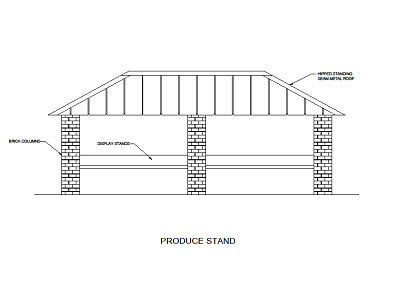
(Ord. No. 019-11, 8-18-11)
Sec. 69.5. - Replacement of a manufactured (or mobile) dwelling with site built dwelling.
(a)
Administrative reduction. An existing manufactured (or mobile) dwelling which meets all of the criteria in section 69.5(a)(1) may be replaced with a dwelling that does not meet the current minimum heated square footage or front yard setback, provided that the new dwelling is no closer to the street than the dwelling being replaced and that the minimum heated square footage is equal to the dwelling being replaced or 1,250 square feet, whichever is larger.
(1)
Eligibility for administrative reduction.
a.
The existing dwelling is located on a lot of record in the RC, Rural Conservation District or the CC, Cedar Creek District with legal access; and
b.
There are no other dwellings on the parcel; and
c.
The existing dwelling is a legal nonconforming use.
(b)
Special use permit. Any applicant desiring to replace an existing manufactured (or mobile) dwelling or group of such dwellings, with a dwelling that meets section 69.5(b)(1)(a) below, which is not eligible under the criteria listed in section 69.5(a)(1) and does not otherwise meet the current ordinance standards, may file an application for a special use permit in accordance with the procedures for rezoning contained in article 29 of this chapter, as well as the review factors contained therein. In granting such approval, the board of commissioners may establish alternative minimum standards which do not increase the overall density nor increase the level of non-conformity.
(1)
Upon approval by the board of commissioners, additional requirements shall be as follows:
a.
Each replacement dwelling must be constructed on a lot of record and cannot be a manufactured (or mobile) dwelling.
b.
The minimum heated square footage of the new dwelling shall be equal to the dwelling being replaced (or) 1,250 heated square feet, whichever is larger.
c.
The new dwelling shall not be located closer to the street than the dwelling being replaced.
d.
Connection to an existing sewer system or sufficient septic system to support the proposed home, as evidenced by approval of the environmental health department, shall be required.
e.
Any additional conditions imposed by action of the board of commissioners.
(Ord. No. 050-21, 12-2-21)
Sec. 69.6. - Private wastewater spray irrigation field facility (P.W.S.I.F.F.).
Purpose. In the basic recognition of the unique nature of certain activities, the intent of this section of this zoning and development ordinance is to assure that private wastewater spray field facilities will be allowed under such conditions and at such locations that they will pose no threat to the safety, health, and general welfare of the citizens of the County. It also serves to establish design standards to ensure proper disposal of treated wastewater and provide continual maintenance of the facilities to ensure the environment is protected. These standards are in addition to those required by the State of Georgia Environmental Protection Division (E.P.D.) in Criteria for Slow Rate Land Treatment and Urban Water Reuse, which is fully incorporated by reference and made part of this ordinance.
Special use permit. Any applicant desiring to establish a private wastewater spray irrigation field facility must submit to the board of commissioners for its consideration, a plan for such proposed use. This plan shall meet or exceed the requirements for a conceptual site plan as set forth in article 29, section 290 of the Coweta County Zoning and Development Ordinance and requirements of E.P.D. After due public hearing and notice thereof as described in the procedures for rezoning, the board of commissioners shall approve or disapprove each such proposed facility in accordance with the following criteria that shall be considered along with those criteria set out for zoning in general as described under article 29 of this ordinance.
Design standards. In accordance with the Coweta County Zoning and Development Ordinance, article 24 (site plan requirements), the following design standards, information, submittals, and procedures shall be required for system approval:
(1)
Prior to the issuance of development permits for construction or operation of any private wastewater spray irrigation field, a detailed site plan, hydrogeologic studies, engineering and operation plans, reports and any required information or data necessary to adequately review design, permits and operation shall be submitted to and approved by the county's development review committee including, but not limited to:
(a)
Coweta County Water and Sewerage Authority.
(b)
Coweta County Environmental Health Department.
(c)
Coweta County Planning Department.
(d)
Coweta County Engineering and Development Department.
(e)
Coweta County Building Department.
(2)
Engineering reports and submittals shall comply with the requirements as delineated in the State of Georgia E.P.D. Criteria for Slow Rate Land Treatment and Urban Water Reuse requirements.
(3)
Copies of engineering reports, monitoring reports, reviews of plans and operations generated by or for Georgia E.P.D. must also be provided to the Coweta County Water and Sewerage Authority. The same documents generated by or for Coweta County officials must be provided to Georgia E.P.D. for their review.
(4)
The irrigation shall be limited to the application rate as determined acceptable by the superintendent of the water and sewer department, and the State of Georgia E.P.D. upon review of the information submitted pursuant to the conditions set forth herein.
(5)
The wastewater shall not be stored or irrigated on areas not totally under the legal control or ownership of the permittee.
(6)
No wastewater retention or detention basins shall be allowed within the area covered by a spray irrigation land application site of a P.W.S.I.F.F., except for stormwater collection or repumping facilities.
(7)
Design development shall include analysis of spray field soil(s) that is done at a frequency of one boring to one-half acre of spray field area. This level of testing will verify soil survey maps and identify the presence of a soil variant within a soil series.
One hundred percent replacement area for all spray fields shall be provided. For each replacement area a soil sampling of one boring for each one-half acre shall be conducted. All information required by E.P.D. in the LAS Guidelines Table 2.2-3 shall be submitted for review. Approved replacement areas shall be designated on the approved site plan.
The design shall provide setback distances between the wetted site area subject to land application and surface waters, wetlands and potable water supply wells to ensure compliance with water quality and drinking water standards, and to protect the public health, safety and welfare. All systems shall be designed to minimize adverse effects resulting from noise, odor, lighting and aerosol drift. Adequate site area shall be provided for operation and maintenance, and for controlling emergency discharges.
The applicant will be required to perform samples of monitoring of wells as indicated by the land application system permit to submit to the Coweta County Water and Sewerage Authority to detect any problems before they affect the surrounding neighbors.
Setbacks shall be 500 feet from the edge of the wetted area to any potable water supply wells that are existing or have been approved by the environmental health department (but not yet constructed). Setback distances from the edge of the wetted area to buildings, floodplains (100 and 500), nonpotable wells, wetlands or to the site property line shall be 300 feet. Setback distances from waters shall be established case-by-case based on compliance with applicable water quality standards or as directed by the State of Georgia E.P.D.
The minimum buffer distances described above shall only be used if, based on review of the soils and hydrogeology of the area, the proposed hydraulic loading rate, quality of the discharge water, expected travel time of the groundwater to the potable water supply wells and surface waters, and similar considerations, there is reasonable assurance that applicable water quality standards will not be violated. A reduction of the minimum buffer distances from wells or surface waters may be considered if it can be shown that the effluent quality exceeds standards for secondary treatment and basic disinfection.
The edge of the wetted perimeter of the land application system shall be at least 300 feet from outdoor public eating, drinking and bathing facilities.
A minimum of 150 feet of all setback areas shall be established as a vegetative buffer as described below.
[(8)
Reserved.]
(9)
An inventory of all potable and nonpotable wells for a distance of 2,500 feet from the parcel property line shall be submitted with the hydrogeologic assessment.
(10)
Any existing well(s) in the spray field site shall have their casings sealed by grout at the top and the bottom of the casing, or the wells will be abandoned in accordance with the Coweta County Health Department and the Georgia Water Well Standards Act.
(11)
A vegetative buffer of a rapid growth variety and dense nature that shall grow to at least 12 feet high and at least 50 feet wide which is within the 150 foot buffer, shall be maintained outside the area where spray irrigation takes place as a buffer along property lines abutting property not owned or controlled by the owner. The vegetative buffer should be planted prior to the operation of the spray field and attain a minimum height of six feet within two years of the planting date. The planting of cedar and/or other evergreens would be effective against wind drift where they would be compatible with the local area. The new plantings will be oriented so the rows will be perpendicular to the fall of the land. This will preclude erosion and allow for better soil assimilation. The buffer is subject to approval by the director of planning. Existing trees, native vegetation or planted vegetation may serve as a buffer.
(12)
No irrigation or other method of disposal shall take place until an operation and maintenance manual is written for the spray field and is approved by the general manager of the Coweta County Water and Sewerage Authority.
(13)
Appropriate warning signs shall be posted every 300 feet around the site to designate the nature of the site use.
(14)
A waste characterization report shall be prepared and submitted for approval by the general manager of the Coweta County Water and Sewerage Authority. The waste characterization report shall recommend parameters to be monitored in the required ground and surface water-monitoring program. Existing ground and surface water quality shall be considered in making recommendations.
(15)
The owner shall provide calculations and a design which demonstrate adequate stormwater facilities to meet the 25-year, 24-hour storm event and requirements of Coweta County Water and Sewerage Authority development standards under saturated soil conditions.
(16)
No irrigation or other methods of disposal shall take place until a detailed hydrogeologic investigation, groundwater modeling study/assessment, and an environmental impact assessment with a groundwater monitoring plan shall be submitted by the owner for review and approval by the general manager of the Coweta County Water and Sewerage Authority and other permitting authorities and agencies as set forth herein. The study shall provide calculations for mass balance, nutrient assimilative capacity, and other appropriate details. The study and associated plan shall demonstrate that the hydraulic application rate at the proposed effluent treatment level shall not degrade off site surface or groundwater quantity or quality. A load test shall be conducted to calibrate the groundwater model to assure the applicability of the assumption's calculations and results of the studies.
(17)
The owner shall:
(a)
Design the spray field to prevent the production of odors resulting from failure of the ground to accept the applied load or anaerobic decomposition of the processing water. Specific prevention features shall include:
1.
Refraining from irrigation of fields until uniform vegetative cover is established over the entire spray area and not until buffers around spray areas have been implemented. Potable water must be used to establish vegetative cover.
2.
Design irrigation to maintain an aerated root zone at least two feet in depth throughout the application area to prevent surface ponding and puddling.
3.
Install piezometers to provide for routine monitoring of water table elevations.
4.
Design irrigation cells on spray field sites to permit daily rotation among a number of cells and prevent prolonged irrigation of any single cell.
5.
Utilize low trajectory, low mist spray heads.
6.
Provide permanent recirculation pumps for immediate repumping from spray field stormwater retention ponds.
7.
Design spray field to minimize an increase of shallow groundwater elevations offsite.
8.
Provide capacity to retain 12 days of average production generated effluent or provide a plan that adequately demonstrates procedures to be implemented during those periods when soil conditions are not conducive to spray field use.
9.
In addition to the automatic shut-down safeguards required by E.P.D., the security system must automatically dial an alert to the owner or operator of the facility when a pump malfunction is occurring or when low pressure is detected. The telecommunication system must be activated whenever a class II operator is off-site.
Operation. The following operational procedures shall be implemented to assure the facility shall operate as designed:
(1)
Necessary precautions shall be taken to prevent over spray or irrigation of county-maintained roadways or public rights-of-way, or adjacent property owners.
(2)
Water quality analysis shall be performed by a laboratory certified by the State of Georgia E.P.D. A quality assurance project plan (Q.A.P.P.) shall be submitted by the owner 45 days prior to the effective date of operation. The plan shall address all sampling and analyses required by ordinance. This Q.A.P.P. must be approved by the superintendent of the water and sewer department prior to operation of the spray field.
(3)
All wastewater shall be retained on the subject property with no off-site runoff permitted pursuant to design standards, condition (15), with the understanding that discharges resulting from rainfall in excess of the design storm is anticipated. If the spray field becomes saturated and runoff is generated, the owner shall immediately notify the general manager of the Coweta County Water and Sewerage Authority and cease using that portion of the spray field until the soil and site conditions are conducive to allow use that can meet the design standards without potential off-site runoff or degradation of surface or groundwater quantity or quality.
(4)
Freshwater flushing of transmission mains shall be performed if system is out of service for a period of one week to prevent line septicity.
(5)
Provide 24-hour phone number of spray field operators to adjacent neighboring property owners.
(6)
The owner shall operate the spray field to prevent the production of odors resulting from facilities operation and/or failure of the ground to accept the applied load or anaerobic decomposition of the processing water. Specific odor prevention operating procedures shall include:
(a)
Provide and utilize, as necessary to control odor, pH neutralization system, or other appropriate procedures or methods.
(b)
Maintain surge tanks at low level during low production (low flow) to minimize detention and prevent fermentation.
(c)
Rotate spray application to maintain at least a two foot aerated soil zone.
(d)
Freshwater flush of transmission lines prior to a prolonged shutdown.
(e)
Perform the following daily checklist:
1.
Inspect all spray field distribution systems for signs of possible leaks or breaks and repair immediately, if needed.
2.
Inspect the entire pipeline for possible transmission leaks or breaks and repair immediately, if needed.
3.
Inspect spray field piezometers to monitor groundwater levels.
4.
Inspect all spray field embankments and ditches and repair as needed.
5.
Inspect recirculation pumps for proper operating condition and repair as needed.
6.
Inspect irrigation pumps for proper operating condition and repair as needed.
7.
Inspect screening equipment for proper operating condition and repair as needed.
8.
Maintain a record of the daily checklist and submit monthly to the general manager of the Coweta County Water and Sewerage Authority.
(7)
In case of objectionable odor generation the owner shall act immediately to identify the source and eliminate the cause of the odor, including modification, as needed, to operating procedures, spray field or system design. The owner shall take whatever steps are necessary to eliminate objectionable odor generation including, if necessary due to the persistent objectionable odors, the acquisition of additional spray field area or spray field relocation.
(8)
In case of disagreement whether or not an objectionable condition is occurring, the owner shall, in cooperation with the general manager of the sewerage authority impanel an "odor panel" using the guidelines developed by the U.S. Environmental Protection Agency (EPA Publication No. AP-40 Appendix B) and to abide by the opinion of the odor panel. The costs associated with the impaneling of the odor panel shall be assessed against the party against whom the odor panel rules.
Urban water reuse spray areas. The permitting procedures, design guidelines, and operating guidelines for private wastewater spray irrigation field facilities set forth in section 69.6 of this ordinance apply to on-site treatment and disposal practices of permitted system operators. The ordinance limits the disposal of reclaimed water to spray fields that are part of the permitted field facility. Conditions of the field facility site determine the water purification standard that E.P.D. requires before spray irrigation of the field can take place. However, advanced treatment technology is now available and can treat wastewater to levels of purity that allow its safe reuse on public access areas. The practice of spray irrigation with highly treated wastewater is encouraged by the State of Georgia because it conserves potable water supplies. The terms "reclaimed water", "highly treated wastewater", and "urban reuse spray area" are defined in article 3, definitions of terms.
The Coweta County Commission recognizes that advanced water treatment technology can be implemented by operators of private wastewater spray irrigation field facilities and that the controlled irrigation of highly treated wastewater onto specific kinds of areas will benefit the community by conserving public supplies of potable water. Therefore, the Coweta County Commission herein sets forth the parameters of such a practice in Coweta County.
(1)
The production and disposal of highly treated wastewater shall follow the design standards set forth in Criteria for Slow Rate Land Treatment and Urban Water Reuse, Section 5; Georgia Department of Natural Resources, Environmental Protection Division as amended except where county requirements are more stringent.
(2)
A special use permit is required to reuse highly treated wastewater and should be sought in tandem with the special use permit required for the private wastewater spray irrigation field facility. No spray irrigation or other method of disposal of highly treated wastewater shall take place until project review under section 69.6 specifications of this ordinance have been completed and site evaluation reports for disposal sites have been reviewed by the development review committee (see design standards (1)(a)—(e)), and not until a permit has been granted for each water reuse spray area.
In addition to the requirements set forth in section 69.6 of this ordinance, the following requirements apply to urban water reuse spray areas and must be met:
(a)
Design development must identify installation of advanced wastewater treatment technology, verification that the system will meet the turbidity requirements for spray irrigation of public access areas, design, location, and capacity of storage for highly treated wastewater and for reject water, the wastewater monitoring and reporting plan, and the operating and site management plan. An operator must be on-site when the plant is in operation and pumping reuse water.
The design development report including the above documentation will be provided by the applicant to the general manager of the Coweta County Water and Sewerage Authority. In addition, any document required by E.P.D. will be required for review by the general manager of the Coweta County Water and Sewerage Authority.
(b)
Each urban reuse spray area must be permitted as a special use. A description of each urban reuse spray area and a copy of the contract between the wastewater field facility operator and the owner of the urban reuse spray area must be submitted for review and approval by the general manager of the Coweta County Water and Sewerage Authority. Disposal of highly treated wastewater will be permitted on a case-by-case basis.
(c)
The special use permit application submitted by the applicant must include a plan for the distribution of highly treated wastewater to the urban water reuse spray area. If holding tanks are required, they must be permitted by the building official. The application must include blue-line drawings showing the proximity of reclaimed water lines and hydrants to existing or proposed domestic water lines and hydrants. The design development report and the site evaluation must show the proximity of public eating, drinking and bathing facilities to the spray areas. Other information as it may be required by staff to review the proposed project must be made available. Plans shall also show the location of storage tanks holding highly treated wastewater and treatment facility storage of reject water. For reject water, an operator must provide a minimum storage capacity equal to three days of flow at the average daily design flow of the treatment facility. The plant must have sufficient excess capacity to assimilate and treat the reject water stored off-line within one week.
One or more design standards (i.e. setbacks or buffers) as specified in section 69.6 or article 24, site plan requirements, of this ordinance that apply to spray irrigation fields on the site of the wastewater treatment field facility may be waived by the board of commissioners in the permitting of water reuse spray areas. Relief of such standards shall not nullify the intent of this ordinance to maintain the public health, safety and general welfare if such relief is granted.
(3)
Disposal of highly treated wastewater into steams is not permitted. Only under extreme circumstances which may occur during prolonged periods of precipitation will the county or E.P.D. recognize the necessity for limited wet weather discharges. Both Coweta County Water and Sewerage Authority and E.P.D. require notice of a spill or bypass within 24 hours of the incident.
(4)
The applicant shall notify the public by posting advisory signs in areas where urban water reuse is practiced. The advisory notices shall characterize the safety of and community benefit of urban water reuse spray area projects. The agencies managing golf courses, recreational areas, or grounds where fountains or impoundments are located might also notate score cards or promotional materials distributed to personnel or patrons stating that reuse is practiced and is beneficial.
Monitoring. The following procedures shall be implemented to assure that facility impacts to ground and surface water quality and quantity are monitored:
(1)
On-site and off-site groundwater shall meet the water quality requirements of the land application system permit issued by the State of Georgia E.P.D.
(2)
A ground and surface water monitoring program and a soil monitoring program shall be developed and implemented prior to the use of lands for reclaimed water disposal. The monitoring shall be in accordance with standards and practices as delineated in the rules and regulations of the State of Georgia's Water Quality Act and the State of Georgia E.P.D. Criteria for Slow Rate Land Treatment and Urban Water Reuse guidelines. The objective of the programs shall be to establish ambient (pre-use) conditions, to monitor the long-range impacts on the ground and surface water system, and to effectively manage soil conditions, crop selection and growth. Surface water sampling locations, well locations and depths shall be adequate to monitor the impacts to adjacent wetlands and floodplains. Plans with adequate justification and ground and surface water modeling analysis for surface water sampling location(s), monitor well location(s), well construction, depth, installation, and numbers shall be submitted to and must be approved by the general manager of the Coweta County Water and Sewerage Authority prior to construction. Installation and development of groundwater monitoring wells required by this ordinance; shall be performed by a licensed well driller with substantial experience in drilling groundwater-monitoring wells. Parameters for chemical analysis, frequency of analysis, and other scheduling pertaining to the monitoring program shall be determined by the general manager of the Coweta County Water and Sewerage Authority. Soil monitoring shall be conducted by a geotechnical engineer and is required annually.
(3)
At the end of each year of data collection a written technical report signed and sealed by a qualified professional engineer must be submitted to the general manager of the Coweta County Water and Sewerage Authority which summarizes and interprets the soil monitoring data, the water quality data, and water level measurements collected from the date of the original special use permit (SUP) issuance. This report shall contain, but is not limited to the following:
(a)
Statistical analyses;
(b)
Tabular and graphical displays of the data including hydrographs and water table contour maps referenced to land surface and/or N.G.V.D. for all monitor wells and surface water stations;
(c)
Trend analysis;
(d)
Comparisons among wells in different zones and/or aquifers;
(e)
Relationships between effluent, surface and groundwater quality including relationship of original baseline water quality;
(f)
Discussion of problems occurring, excessive mounding, and/or discharges off-site during the year;
(g)
Discussion of erratic, missing and/or poorly correlated data; and
(h)
Soil sampling data from borings taken at the rate of one for each one acre and in changing soil series, one boring for each one-half acre.
(4)
Rainfall shall be monitored at the site daily and results included in monthly and annual reports.
(5)
County personnel shall be granted permission to enter all P.W.S.I.F.F. sites to monitor the performance of the system and to determine compliance with this ordinance. The owner shall be notified no later than the morning of the inspection day and shall provide access to all areas.
(6)
The owner shall maintain optimum growth conditions for crops used as vegetative cover. Vigorous agronomic cover crop growth is essential to maintain nitrogen uptake rates assumed in design. Therefore, annual soil evaluation must be conducted to determine if soil supplements are needed. Soil monitoring of wetted field areas shall be conducted according to the guidelines provided in Table 4.2-1 of the LAS Guidelines, as amended, but with the number of borings specified in [subsection] (3)(h) above.
(7)
The owner of the system shall monitor and test a down gradient private potable well quarterly, or as often as complaints indicate. The location of the well shall be determined by hydrogeologic investigation and groundwater modeling study and shall be indicated on the groundwater-monitoring plan supplied by the owner. The location of the well must be approved by the general manager of the Coweta County Water and Sewerage Authority. If at any time test results indicate a violation of drinking water standards, the owner of the system shall immediately retest the well and if the violation is confirmed by a retest, the owner of the system shall hire, at their own expense, an independent groundwater hydrologist subject to the owner of the system and well owner's approval to evaluate the source of the violation and to propose solution(s) to correct the source of the violation. If the results of these investigations show that the problem is due to the spray field operation then the owner of the system, at their sole expense, shall take immediate corrective action as required.
When the final study is complete and approved, the owner shall determine an amount at least equal to 110 percent of the total cost to accomplish the above-stated requirement and with the approval of the general manager of the sewerage authority and the board of county commissioners, provide a security instrument made out to the board of county commissioners to cover the anticipated cost of corrective action. The security instrument shall remain in full effect until released by the county.
Reporting. The following reports and submissions standards shall be implemented to provide the required data necessary to evaluate potential impacts of the facility:
(1)
Reports shall be compiled and shall be filed with the general manager of the Coweta County Water and Sewerage Authority and the State of Georgia E.P.D. on the schedule indicated and shall contain the following information:
(a)
A quarterly report which identifies the average quality of reclaimed water delivered based upon a minimum of one sample per month taken during the reporting period. Parameters to be analyzed shall include but not be limited to those as specified by the general manager of the Coweta County Water and Sewerage Authority and the director of environmental health: suspended solids, pH, specific conductance, and nitrate. These parameters may be modified as deemed necessary by the general manager of the Coweta County Water and Sewerage Authority.
(b)
One year from the date of the execution of the P.W.S.I.F.F. an evaluation will be conducted to determine the benefit and necessity of a quarterly spray field advance use schedule with area and acreage proposed for irrigation or which shall receive reclaimed water shall be submitted to the general manager of the Coweta County Water and Sewerage Authority.
(c)
A quarterly report which identifies the areas irrigated or which received reclaimed water over the quarter preceding shall be submitted to the general manager of the Coweta County Water and Sewerage Authority.
(d)
A quarterly report which indicates the specified and metered volume of reclaimed water applied or used over the preceding quarter shall be submitted to the general manager of the Coweta County Water and Sewerage Authority.
(e)
A quarterly map which indicates the depth to and elevation of the water table.
(f)
A quarterly report stating the results of quarterly tests of the monitor well described above in monitoring (7) shall be submitted to the sgeneral manager of the Coweta County Water and Sewerage Authority.
(2)
Conditions as altered and amended which pertain to the P.W.S.I.F.F.:
(a)
After establishment of the facilities as provided herein, the property shall only be used for the purposes named in this ordinance. Any other proposed use must be specifically authorized by the Coweta County Board of Commissioners.
(b)
No person, firm or corporation shall erect, construct, enlarge, alter, repair, remove, improve, move, convert, or demolish any building structure, or alter the land in any manner within the boundaries of the P.W.S.I.F.F. without first submitting the necessary plans in accordance with article 26 of the zoning and development ordinance of Coweta County and obtaining approval from the building official upon obtaining the permits required from the other appropriate governmental agencies.
(c)
This amendment shall inure to the benefit of, and shall constitute a covenant running with the land and the terms, conditions, and provisions hereof, and shall be binding upon the present owner and any successor, and shall be subject to each condition herein set out.
(d)
Construction and operation of the proposed use shall always comply with the regulations of this and other governmental agencies.
(e)
The transfer of ownership or lease of any P.W.S.I.F.F. shall include in the transfer or lease agreement, a provision that the purchaser or lessee is made aware of the conditions pertaining to the P.W.S.I.F.F. and agrees to be bound by these conditions. The purchaser or lessee may request a change from the existing plans and conditions by following procedures contained in section 69.6 of the Coweta County Zoning and Development Ordinance, as amended. The trust indenture signed with Coweta County must be amended to reflect the change in ownership.
Application of ordinance. This ordinance is not intended to regulate or change the current manner of development or sewer systems in the county.
Privately owned alternative wastewater treatment systems shall be allowed in Coweta County if the following conditions are met:
(1)
A special use permit must be obtained through the Coweta County Board of Commissioners;
(2)
The system is approved by the Coweta County Water and Sewerage Authority upon a finding that the proposed system complies with all applicable ordinances of Coweta County and all applicable laws and regulations of the State of Georgia and the United States;
(3)
The system shall be clearly described in an application to the Coweta County Water and Sewerage Authority. The description shall include the method proposed to safely treat and dispose of wastewater; the impact, if any, the system will have on ground and surface water in the surrounding area; the expected useful life of said system; and any other information as may be requested from time to time by the Coweta County Water and Sewerage Authority.
(4)
A security instrument acceptable in form by the county attorney and issued to the board of commissioners to cover operation and maintenance costs for a minimum period of 24 months shall be provided by the owner. The cost shall be determined by a qualified professional engineer with training and experience in the area of wastewater management and said cost shall meet the approval of the general manager of the Coweta County Water and Sewerage Authority. The security instrument shall remain in full effect until released by the county. The county may require extension of the security instrument if problems arise during the 24-month period.
Provisions governing the transfer of said system to Coweta County. For a P.W.S.I.F.F. systems, if there are decisions by the owner(s) to shut down the system or to not make the necessary repairs as required to properly maintain the system, and to assure uninterrupted service and to provide relief for the property owners if there is suspension of service or improper operation by the owner, Coweta County Board of Commissioners may require the following:
(1)
The transfer of said system to the Coweta County Water and Sewerage Authority with the following documentation:
(a)
A deed of conveyance. To secure county acceptance of the private wastewater spray irrigation field facility, the current owner must submit to the Coweta County Water and Sewerage Authority all documentation and guarantees as specified herein and as required by the general manager of the Coweta County Water and Sewerage Authority. Such documentation and guarantees may include, but are not necessarily limited to a final plat identifying all property, equipment, and appurtenances related to the operation of the facility or other acceptable instrumentation approved by the general manager of the Coweta County Water and Sewerage Authority.
(b)
The transfer of said system shall further provide an estimated cost for the maintenance and operation of the system for a period of 30 years including projected capital expenditures and maintenance cost for that time period. These cost analyses shall be made by a person that is competent, based on training and experience, to make sure projections.
(c)
All required documentation and guarantees must be submitted by the current owner to the water and sewer superintendent by 9:00 a.m. no later than 11 days prior to the meeting date of the Coweta County Board of Commissioners when acceptance of such facility is to be considered.
Deed of Conveyance
State of Georgia
County of Coweta
Private Wastewater Spray Irrigation Facility
Personally appeared before the undersigned authority (Name of current owner of system) who, being first duly sworn and deposed on oath, says as follows:
1.
That current owner has recently completed a wastewater spray irrigation facility on the property of (owner of property upon which system was installed) Located in Land Lot _______, District _______, Coweta County Georgia.
2.
That all bills for labor and materials have been paid in full in the amount of $_____.
3.
That no person or persons have any claim or lien because of said system except as follows: _____ .
4.
This affidavit is made to allow Coweta County to accept the ownership of said system for the benefit to the tax payers of Coweta County.
In witness thereof, an affidavit has hereto been set his or her hand and seals this _______ day of _______, ___.
Attest:
(Ord. No. 035-08, 11-18-08)
Sec. 69.8. - Reserved.
Editor's note— Ord. No. 021-20, adopted May 19, 2020, repealed App. A, § 69.8, which pertained to decentralized wastewater treatment network systems (D.W.T.N.S.) and derived from Ord. of 5-10-07; and Ord. No. 011-16, adopted April 12, 2016.
Sec. 69.9. - Special events, festivals, and tourism activities.
(1)
Purpose. In the basic recognition of the unique nature of certain activities, the intent of this section is to minimize the impact of special events, festivals and other tourism activities, to establish a fair and efficient process for review and approval of applications, to assure an integrated and comprehensive review of the impact of the proposed activity. Since special events, festivals and tourism activities may be located in areas not traditionally considered appropriate for commercial activity, a case-by-case review is necessary to assure that they are only allowed under such conditions and at such locations that they will pose no threat to the health, safety, and general welfare of the citizens of the county.
(2)
Applicability.
a.
This ordinance shall apply to special events, festivals, or tourism activities (as described in item b. below) which occur on private property.
b.
Specific uses regulated under this ordinance include the following:
1.
Artist retreats;
2.
Bed and breakfast lodging;
3.
Banquet, catering, and reception halls;
4.
Concerts or theatrical productions;
5.
Exhibits (such as dog shows, gun shows, and art);
6.
Facility tours;
7.
Festivals;
8.
Gift shops as an accessory to other uses on this list;
9.
Historic reenactments;
10.
Museums;
11.
Rallies;
12.
Rodeos;
13.
Tea rooms;
14.
Weddings; and
15.
Similar uses, as determined by the planning director.
c.
This ordinance shall not govern private gatherings, parties, or other similar type entertainments hosted by a property owner in their own residential building, structure or land for the enjoyment and benefit of the owner or current resident, without compensation, and otherwise permitted under the county's ordinances.
d.
This ordinance shall not govern church events when located on property with a conditional use permit for a church (or on property with a legal nonconforming church use); however, all other relevant sections of the Coweta County Zoning and Development Ordinance shall still apply.
e.
This ordinance shall not prohibit the establishment or continuance of normal residential use of the property, where otherwise permitted by the Coweta County Zoning and Development Ordinance and other laws governing such use.
(3)
Special use permit required.
a.
Any applicant desiring to establish a special event, festival, or tourism activity must file an application for a special use permit and a plan for such proposed use with the planning department, in accordance with the procedures for rezoning contained in article 29 of the Coweta County Zoning and Development Ordinance. This plan shall meet or exceed the requirements for a conceptual site plan as set forth in article 29, section 290 of the Coweta County Zoning and Development Ordinance. The specific use and any related activity anticipated by the applicant must be delineated within the request; and approval shall be limited to the uses and activities as detailed. After due public hearing and notice thereof, the board of commissioners shall approve or disapprove each such proposed use in accordance with this ordinance, the criteria set out for zoning in general as described under article 29 of this ordinance, as well as the following additional review factors:
1.
Whether or not quiet enjoyment of surrounding property will be adversely affected by the applicant's specified activities (including the intensity, frequency, and duration of those activities);
2.
Whether or not adequate provisions are made for waste disposal, parking, traffic, and security;
3.
Whether or not the intensity of the use is appropriate in light of the surrounding land uses and the nature of the property; and
4.
Whether the times and hours of operation will adversely affect the use of the adjoining properties.
b.
Revocation. If at any time after a special use permit has been issued, the planning official finds that the conditions imposed and the agreements made have not been or are not being fulfilled by the holder of the special use permit, the permit shall be cancelled; and the operation of such use must be discontinued.
(4)
Infrastructure.
a.
The property shall be served by public highways and streets adequate to serve the traffic created by the use, and entrances to the property shall not create a traffic hazard.
b.
The property shall be served by adequate public safety, refuse disposal, sewerage disposal, and on-site security.
(5)
Design standards.
a.
A traffic analysis may be required, as determined by the director of the development and engineering department.
b.
The design of the facilities and grounds shall meet all requirements of the Coweta County Fire Department, as well as all applicable state and federal regulations.
c.
During the special use permit review, the intensity of the proposed use, and the potential impact on the surrounding neighborhood, including the aesthetic impact of strict enforcement of the development standards, shall be considered. This consideration shall in turn govern the applicability of the following development standards, which, unless noted as a requirement of the special use permit, shall be waived:
1.
Paved drives.
2.
Paved parking areas.
3.
Building design criteria.
4.
Landscaping requirements.
d.
A pre-development site plan and an as-built site plan, as indicated in article 24, development regulations shall be required.
e.
Buffers, when deemed necessary, shall be established in accordance with article 25, buffer area and screening requirements, except that the width and location of the required buffer areas shall be established during the special use permit process. In determining buffer requirements, consideration, at minimum, shall be given to the following:
1.
Location of proposed activities within the site,
2.
Proximity to adjacent residential land uses, and
3.
Noise and light expected to be generated by the proposed use.
(6)
Operational standards.
a.
Alcohol shall be permitted only when provided through a licensed alcohol caterer or where the location qualifies for an alcohol license pursuant to chapter 6, article IV, section 6-91 et seq. of the Coweta County Code of Ordinances, and only in areas delineated and approved as a part of the special use permit.
b.
Restroom facilities, both temporary and permanent, shall meet the requirements of the environmental health department.
c.
Lighting, temporary or permanent, shall be established in such a manner that adjacent properties are not adversely affected, and that no direct light is cast upon adjacent properties or roadways.
d.
No use permitted under this ordinance shall exceed a noise level of 45 dBa, as measured at the property line; however, the decibel level may be otherwise set, based upon the uniqueness of the property or application specifics, through conditions attached to the special use permit by the board of commissioners.
e.
Refuse collection. Adequate refuse collection containers and services shall be provided for large events, such as, but not limited to, concerts, festivals, rallies, weddings and wedding receptions.
(Ord. No. 009-11, 6-21-11; Ord. No. 036-13, 11-19-13)

