
Daly City City Zoning Code
CHAPTER 17
32 - SIGNS*
17.32.010 - Uniform Sign Code—Adopted.
There is adopted by the city, for the purpose of providing minimum standards to safeguard life, health, property and public welfare by regulating and controlling the design, quality of materials, construction, location, electrification and maintenance of all signs and sign structures not located entirely within a building, that certain code designated as the Uniform Sign Code, 1994 Edition, published by the International Conference of Building Officials, a copy of which is on file in the office of the city clerk for public record and inspection, subject, however, to the amendments, additions and deletions set forth in this chapter, and from the date on which this ordinance codified in this chapter shall take effect, the provisions thereof shall be controlling within the limits of the city.
(Ord. 1249 § 3 (part), 1997)
17.32.020 - Section 103.3—Deleted.
Section 103.3 of the Uniform Sign Code, 1994 Edition, is deleted.
(Ord. 1249 § 3 (part), 1997)
17.32.030 - Section 202—Amended.
Section 202 of the Uniform Sign Code, 1994 Edition, is amended by adding the following definitions thereto:
A BOARD: A portable sign capable of standing without support.
AREA OF SIGN: The entire area within a single, continuous perimeter composed of squares or rectangles which enclose the extreme limits of the advertising message, together with any frame or other material, color, or condition which forms an integral part of the display and is used to differentiate such sign from the wall or background against which it is placed; excluding the necessary supports or uprights upon which such sign is placed. Where a sign has two or more faces, the area of all faces shall be included in determining the area of the sign, except that only one face of a double-faced sign shall be considered in determining the sign area, provided both faces are parallel and the distance between faces does not exceed two feet.
Further, where a sign consists only of individual letters, numbers, or symbols and is painted on or attached fiat against the wall of a building and where such individual components are without integrated background definition and are not within a circumscribed frame area, the total area of the sign shall be the sum of the areas of the squares or rectangles surrounding each individual sign component.
(Ord. 1249 § 3 (part), 1997)
17.32.040 - Section 203—Amended.
Section 203 of the Uniform Sign Code, 1994 Edition is amended by adding the following definition thereto:
BILLBOARD: Any sign, other than a directional sign, which directs attention to a business, commodity, product, service, or activity, sold, offered or made available elsewhere than upon the premises whereon the sign is located.
(Ord. 1249 § 3 (part), 1997)
17.32.050 - Section 205—Amended.
Section 205 of the Uniform Sign Code, 1994 Edition is amended by adding the following definition thereto:
DIRECTIONAL SIGN: Any sign which is designed, erected and maintained for the purpose of directing persons to a place, structure or activity not located on the same premises as the sign.
(Ord. 1249 § 3 (part), 1997)
17.32.060 - Section 206—Amended.
Section 206 of the Uniform Sign Code, 1994 Edition is amended by adding the following definition thereto:
ERECT: To build, construct, attach, hang, place, suspend, or affix, including the painting or otherwise applying of wall signs.
(Ord. 1249 § 3 (part), 1997)
17.32.070 - Section 207—Amended.
Section 207 of the Uniform Sign Code, 1994 Edition is amended by adding the following definitions thereto:
FACE: The surface of the sign upon, against, or through which the message is displayed or illustrated on the sign.
FACE OF BUILDING: The exposed side of any exterior wall of a building, excluding structural-projections.
FACE SIGN: Any sign painted or mounted on a wall or of solid construction located as to be approximately parallel with the face of a building, including a "V" type sign which does not extend more than 18″ from the face of a building or structure.
FREESTANDING: Any sign in a fixed location which is self-supporting on the ground, or on one or more poles or upright members which are in no part attached to any building, excluding "A"-board signs.
(Ord. 1249 § 3 (part), 1997)
17.32.080 - Section 208.2—Added.
A new section is added to the Uniform Sign Code, 1994 Edition, to be numbered Section 208.2, to provide for the addition of the following definition:
Sec. 208.2.-I
ILLUMINATED SIGN: Any sign which has characters, letters, figures, designs or outline illumination by electric lights or luminous tubes on, within or attached to the sign or by a light source removed therefrom.
(Ord. 1249 § 3 (part), 1997)
17.32.090 - Section 210—Amended.
Section 210 of the Uniform Sign Code, 1994 Edition, is amended by adding the following definition thereto:
MARQUEE SIGN: Any sign attached to or supported by a marquee.
(Ord. 1249 § 3 (part), 1997)
17.32.100 - Section 211.1—Added.
A new section is added to the Uniform Sign Code, 1994 Edition, to be numbered Section 211.1, to provide for the addition of the following definitions:
Sec. 211.1-O
OFF-PREMISES SIGN: A sign, such as a billboard, which advertises goods or services which are available elsewhere than upon the premises whereon the sign is located, excluding direction signs.
ON-PREMISES SIGN: A sign that carries only advertisements strictly incidental to a lawful use of the premises on which it is located, including signs indicating the business transacted, services rendered, goods sold or produced on the premises, name of the business, name of the person, firm or corporation occupying the premises.
OUTDOOR ADVERTISING SIGN: (See BILLBOARD)
(Ord. 1249 § 3 (part), 1997)
17.32.110 - Section 212—Amended.
Section 212 of the Uniform Sign Code, 1994 Edition, is amended by adding the following definition thereto:
PRIMARY LOT FRONTAGE: That single dimension of a parcel abutting a public right-of-way and providing-for the most important approach to the parcel or occupancy thereon.
(Ord. 1249 § 3 (part), 1997)
17.32.120 - Section 214—Amended.
Section 214 of the Uniform Sign Code, 1994 Edition, is amended by adding the following definition thereto:
SECONDARY LOT FRONTAGE: Any dimension of a parcel abutting a public right-of-way other than, "primary lot frontage."
(Ord. 1249 § 3 (part), 1997)
17.32.130 - Section 217—Amended.
Section 217 of the Uniform Sign Code, 1994 Edition, is amended by adding the following to the definition of Wall sign.
WALL SIGN: (See FACE SIGN).
(Ord. 1249 § 3 (part), 1997)
17.32.140 - Section 403.6—Deleted.
Section 403.6 of the Uniform Sign Code, 1994 Edition, is deleted.
(Ord. 1249 § 3 (part), 1997)
17.32.150 - Exempt signs.
The following signs shall be exempt from regulation under this chapter:
A.
Advertising media located entirely within a completely enclosed building and which is not intended to be viewed primarily from the exterior of the building;
B.
Traffic highway markers and railroad crossing or danger signals;
C.
Any sign posted pursuant to and in discharge of any governmental function by public officials in performance of their duties, including traffic and street name signs as well as notices, emblems or other forms of identification and signs required by law;
D.
Signs used by public utilities for the safety, welfare or convenience of the public;
E.
Flags of any nation or political subdivision, of any fraternal, religious or other organization of a civic character;
F.
Holiday greetings, decorations and displays, excluding advertising signs disguised as seasonal decorations;
G.
Temporary display posters in connection with civic, political, noncommercial, health, welfare and safety programs posted in or on private residences or within commercial display windows.
(Ord. 1249 § 3 (part), 1997)
17.32.160 - General regulations.
The prohibitions contained in this section shall apply to all signs and all zoning districts, regardless of designation, of the city:
A.
Any illuminated sign or lighting device shall employ only lights emitting a light of constant intensity and no sign shall be illuminated by or contain flashing, intermittent, rotating or moving light or lights. In no event shall an illuminated or lighting device be so placed or directed or beamed upon a public street, highway, sidewalk or adjacent premises so as to cause glare or reflection that may constitute a traffic hazard or nuisance.
Public service signs such as the time-temperature type, are exempted from this prohibition.
B.
No signs shall have any mechanical or moving parts; rotating signs, with the exception of public-service signs, are specifically prohibited.
C.
No sign or part thereof shall contain or consist of banners, posters, pennants, ribbons, streamers, spinners or other similar moving, fluttering or revolving devices. The devices, as well as strings of lights, shall not be utilized for the purposes of advertising or attracting attention when not part of a sign. No sign, A-board, advertising structure or merchandise display shall be placed upon or attached to the ground on any portion of the public street, sidewalk or right-of-way except as permitted by this chapter.
D.
No sign erected or maintained in the window of a building, visible from any public or private street or highway, shall occupy more than twenty-five percent of the area of the window. Window signs must be located on the inside of the windows or painted on the windows.
E.
No portable or temporary sign shall be placed on the front or face of a building or on any premises, except as provided in this section.
F.
No outdoor advertising structure, sign or other advertising structure shall be erected, constructed, relocated or maintained, regardless of the zone or district in which it is located if such structure or sign is designed to have or has the advertising thereon maintained primarily to be viewed from a main traveled roadway of a landscaped freeway or of a scenic highway or the ingress or egress of ramps thereto; however, such prohibition shall not apply to:
1.
Signs and/or structures erected, constructed, relocated or maintained pursuant to a relocation agreement with a sign owner which is approved by the city council following a determination that such relocation agreement will benefit the community. Such relocation agreement shall comply with the provisions of California State Business and Professions Code Sections 5412 and 5443.4; and
2.
This shall not apply to any sign or advertising structure which is painted or maintained on a building on which the advertising sign is limited to:
a.
The name of the building whereon the sign is located;
b.
The name of the person, firm or corporation occupying the building, and type of business conducted by such person, film or corporation;
c.
The name of the product manufactured on the premises;
d.
Advertising which is strictly incidental and subordinate to a lawful use of the premises on which it is located, including signs advertising services rendered or goods sold on the premises, but no such advertising or signs shall exceed twenty square feet in area. This exception shall not be construed as permitting signs indicating the trade name, merchandise or service of any person or corporation who pays a consideration for the privilege of placing, maintaining or using any portion of the sign or painting advertising to the owner or occupant on which it is located.
G.
No roof signs are permitted, except when integral with the architecture of the building, such as mansard roof or building fascia, and subject to the following conditions:
1.
No higher than the ground sign permitted;
2.
May not extend above the roof peak.
H.
Projecting signs are permitted only for commercial activities having a building frontage of twenty feet or more, provided:
1.
A sign may not extend about the sill of the lowest window of any residentially occupied floor or floors;
2.
A sign shall not exceed the maximum height of the zoned district in which located;
3.
The maximum clearance from the face of wall to sign shall not be greater than one foot;
4.
The sign shall be prohibited where a ground sign is located on the same parcel;
5.
The sign shall neither extend over the public right-of-way, nor to less than three feet from face of curb.
I.
Signs on Public Property. No person, except a duly authorized public officer or employee, shall post, mount, affix or fasten any sign, card, banner, handbill, poster, advertisement or notice of any kind, or cause the same to be done, on any publicly-owned curb, sidewalk, streetlight, pole, bench, fence, hydrant, bridge, wall, tree, sidewalk, traffic control device, parking meter, street, alley, place or property, except as specifically permitted by this chapter.
(Ord. 1249 § 3 (part), 1997)
(Ord. No. 1371, §§ 2, 3, 10-28-2013)
17.32.170 - Permitted signs in all districts.
A.
The following signs are permitted in any zoned district without a sign permit:
1.
Real estate signs advertising the sale, lease or rental of the premises upon which the sign is located shall be limited to one sign per property or business and shall not exceed four square feet in a residential zone or twelve square feet in any other zoning district. Real estate signs shall be placed on the offered property and shall be removed within thirty days after the sale, rental or lease of the subject property. A-frames used for real estate purposes shall be allowed in addition to the limitations set forth in this subsection. Such signs shall be allowed off the site, provided they are removed by sundown each day and are limited to the minimum number necessary for directional purposes. A-frames may identify the owner or agent's name, address and telephone number but shall not otherwise be used to identify or advertise real estate offices or businesses;
2.
Signs denoting the name and address of the occupants of the premises; the sign not to exceed one square foot in area;
3.
Signs denoting the architect, engineer or contractor placed on premises where construction, repair or renovation is in progress; the signs not to exceed thirty-two square feet in area, except sixteen square feet in R-1 and R-2 districts;
4.
Bulletin boards not over twelve square feet in area for public, charitable or religious institutions when the same are located entirely on the premises of such institutions;
5.
Memorial signs or tablets, names of buildings and date of erection, when cut into any masonry surface or when constructed of bronze or other incombustible materials;
6.
Occupational signs denoting only the name and profession of an occupant in a commercial or public institutional building, not to exceed two square feet in area.
B.
The following signs are permitted in any zoned district but require a sign permit, as provided in this chapter:
1.
Subdivision real estate directional signs in accord with the following standards:
a.
One portal or entry sign not to exceed three hundred square feet and limited to two faces,
b.
Interior directional signs not to exceed seventy square feet per individual face and limited to four faces,
c.
Number of signs shall be limited: one sign per primary traffic direction change and two advertising signs not to exceed one hundred fifty square feet each per "on-site" model home area,
d.
Signs shall be permitted only in advance of (not more than sixty days) and during such time as developer maintains a sales office on site,
e.
Advertising signs other than at model home sites, which are within five hundred feet and visible from occupied residences shall be removed within three months after residences are occupied;
2.
Signs for apartment complexes in accord with the following standards:
a.
One low-scale permanent name identification sign not to exceed thirty-two square feet,
b.
One building sign to advertise name of property and "No Renting" not to exceed fifty square feet.
(Ord. 1249 § 3 (part), 1997)
17.32.180 - Temporary signs.
Temporary signs may be permitted, provided a sign permit is obtained from the department of economic and community development.
A.
General Provisions. Application for a sign permit shall indicate size and purpose. The office of the city planner shall issue a permit in accord with the following standards, restrictions and provisions:
1.
Commercial, Promotional or Sales Signs:
a.
Are permitted for a period not to exceed the immediate seven days prior to the event, promotion or sales and continued through to include the event, promotion or sale but not to exceed a total of thirty days;
b.
Shall not be placed without consent of owner, trustee, tenant or other person responsible for property for each and every location, and applicant so attests on the application;
c.
Each sign or poster or display shall not exceed twelve square feet;
d.
Promotional off-site signs shall not be permitted more than one time in any twelve-month period for the same business or commercial enterprise;
e.
A returnable faithful performance deposit in the form of one hundred dollars cash shall be deposited with the department of finance for each permit.
2.
Eleemosynary Signs, Displays and Announcements. No permit shall be required for the erection of any sign by any bona fide religious, charitable, educational or eleemosynary organization, unless the organization shall fail, upon demand of the department of economic and community development, to verify its status as such type of organization. In the event of the failure of the organization to so verify its status, then the other applicable provisions of this section shall apply.
3.
Searchlights, defined as "an apparatus containing a source of light and a reflector that projects the light produced in a concentrated, far-reaching beam"; it is, in most cases, mounted on a swivel so that the beam can be directed.
a.
A searchlight is permitted only during the course of the event, promotion or sale which it is intended to publicize;
b.
A searchlight may remain in operation for the duration of the particular event, promotion or sale except that no individual searchlight permit shall be valid for a period in excess of seven days;
c.
Under no circumstances shall a searchlight remain in operation later than the hour of ten p.m.;
d.
A searchlight shall not be placed without consent of the owner, trustee, tenant or other person responsible for the property at each and every proposed location and applicant so attests on the application;
e.
A searchlight shall not be permitted more than once in any six-month period for the same business, commercial enterprise, religious, charitable, educational or eleemosynary organization;
f.
A returnable faithful performance deposit in the sum of one hundred dollars cash shall be deposited with the department of finance for each permit. An exception to this requirement shall be made in the case of bona fide religious, charitable, educational or eleemosynary organizations;
g.
Removal of a searchlight and the return or forfeiture of the required cash deposit shall be governed by the provisions of subsection (B) of this section.
B.
Removal, Return or Forfeiture of Cash Deposit.
1.
All temporary signs permitted under the provisions of this section shall be removed not later than five days following the termination of permit. Upon satisfactory showing to the city planner of such removal, the city planner shall authorize the department of finance to return in full the cash deposit for each permit so obtained;
2.
If all signs are not removed pursuant to subsection (B)(1) of this section, the department of economic and community development shall notify the applicant by certified, first class mail, and such signs shall be removed not later than fifteen days following the termination of permit. Upon removal of signs within such fifteen-day period, the city planner shall authorize the department of finance to return one-half of the cash deposit, whether or not the mailed notice was received by applicant;
3.
If all signs are not removed pursuant to subsections (B)(1) or (B)(2) of this section, the department of economic and community development shall notify the applicant, by certified, first class mail, of violation of the city's zoning ordinance and direct such signs to be removed or be held subject to the provisions of Chapter 17.50 of this title and the total cash deposited shall be forfeited.
(Ord. 1249 § 3 (part), 1997)
17.32.190 - (Reserved).
(Ord. 1249 § 3 (part), 1997)
17.32.200 - Permitted signs in commercial and industrial districts.
A.
Permit and Fee. Any sign designated in this section may not be installed until a sign permit application has been submitted to, reviewed and approved by the planning and zoning division. A nonrefundable filing fee, to be established by the city council by resolution, shall accompany an application for a sign permit. In order to approve an application, the planning and zoning division must determine that all requirements of this chapter are met. The planning and zoning division shall approve with modifications or disapprove any application for a sign permit.
B.
Other standards for any sign within areas affected by a redevelopment project area, the requirements in this section shall be superseded by standards set forth within the guidelines of the approved plan for such project area and subsequently by standards, specifications and all other applicable requirements set forth within an adopted final plan of the redevelopment agency for such project area and any subsequent amendments thereto.
C.
Criteria. The office of planning shall consider, but not be limited to, the following criteria in performing the review of sign applications:
1.
Is the sign consistent with the purpose and intent of this chapter and the Uniform Sign Code?
2.
Is the size of the sign proportionate to the building and site it serves; is the height, size and shape of the sign in proper relation to the height, size and shape of the building and the site, and the distance from which the passing public primarily views the signs?
3.
Is the appearance of the sign in harmony with the premises on which it is to be located and with other properties in the vicinity? Is the sign architecturally a part of the building rather than a feature independent of or in conflict with the design of the building? Is the shape, letter type, material, type of color and type of illumination compatible to the use, enhancing to the premises and to other properties in the vicinity?
4.
Signs for projects located in areas included in a specific plan, or for which design guidelines for signs have been adopted, shall conform to those requirements.
D.
Adjustments of Specifications. The office of planning, when reviewing sign applications in cases where the applicant requests one or more deviations from the requirements set forth in this chapter, may allow adjustments within the items listed below, provided it enters on the application, findings consistent with the purpose of this chapter:
1.
Additional area for any of the following reasons:
a.
To allow a sign to be in proper scale with its building or use,
b.
To overcome a disadvantage because of an exceptional setback,
c.
To achieve an effect which is essentially architectural, sculptural or graphic art,
d.
To allow a sign compatible with other conforming signs in the vicinity;
2.
Additional height: to compensate for distance or difference in elevation from primary viewing angles to overcome obstructions to visibility (wires, poles, trees, conforming signs or other property);
3.
Additional number: to compensate for inadequate visibility or to facilitate good design balance;
4.
Variation in type: to provide compatibility with architecture of structures on the site and improve the overall appearance of the site.
E.
C-O Office Commercial Districts. In the C-O office commercial district, the following signs may be erected or maintained for each business entity subject to the requirements in this subsection:
1.
Single-faced wall sign(s) which shall not protrude above or beyond a wall and shall not exceed in length seventy-five percent of the building frontage for each commercial entity;
2.
Directional signs for off-street parking and loading facilities with the area for each sign not exceeding four square feet;
3.
One ground sign located in a landscaped area not to exceed a height of six feet.
The total aggregate sign area for each business entity shall not exceed one-quarter square foot per lineal foot of primary frontage with a permitted minimum of twenty-five square feet and a maximum allowable of seventy-five square feet.
F.
All Other Commercial, Industrial or Other Zoned Districts. In all other districts zoned commercial, industrial or any other comparable classification, the following signs may be erected or maintained subject to the requirements in this subsection:
1.
Single-faced wall sign(s) which shall not protrude above or beyond a wall and shall not exceed in length seventy-five percent of the building frontage;
2.
One pedestrian-oriented sign suspended from an overhanging architectural feature, the sign not to exceed ten square feet and placed at a minimum height of eight feet above the sidewalk;
3.
A ground sign, which is low-mounted and located within a landscaped area, as an alternate to other types of signs; said sign may not exceed a height of six feet and may be placed in the required setback or yard areas;
4.
Ground signs mounted on a pole are permitted only if the property has a minimum primary lot frontage of fifty feet; no portion of subject sign may encroach upon the public right-of-way; the height of the sign shall not exceed twenty-two feet, the maximum face area shall not exceed seventy-five square feet;
5.
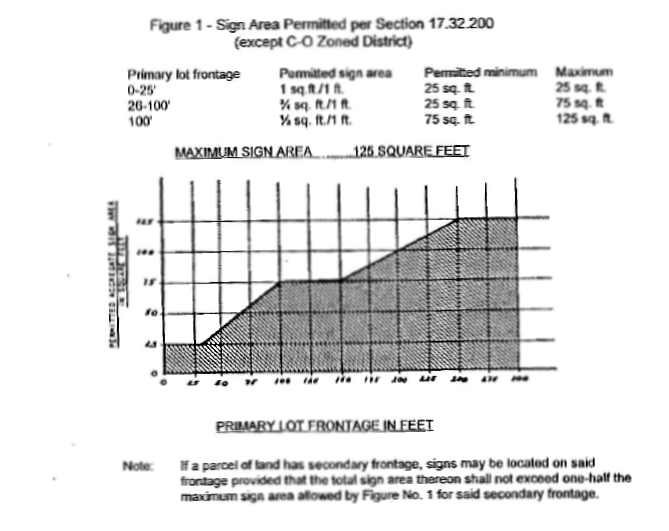
The total face area of the aforementioned signs shall not exceed the permitted area as shown on Figure 1, which is made a part of this section by reference; the maximum face area permitted for each business entity is one hundred twenty-five square feet; if parcels of land have secondary frontage, signs may be located on the frontage; provided, that the total sign area thereon shall not exceed one-half the maximum sign area allowed by Figure 1, for the secondary frontage.
G.
Shopping Centers. For shopping centers, an owner or owners may file for a use permit under the procedures stipulated in the zoning ordinance to establish specific requirements for ground sign and for the exterior signs on individual business. In lieu of a "master" use permit, all exterior signs of a shopping center must conform to the requirements of this section.
(Ord. 1249 § 3 (part), 1997)
17.32.210 - Off-premises signs.
Off-premises signs, such as billboards and outdoor advertising structures, shall be permitted only within commercially or industrially zoned areas (exclusive of office-commercial zoned districts) and shall be completely excluded from areas in or adjacent to residentially zoned areas and shall be subject to the following conditions:
A.
All off-premises signs shall require a use permit.
B.
Off-premises signs may be mounted on the blank or side walls of structures not constituting frontage and not covering exits or windows or otherwise interfering with the architectural exterior treatment of structures. Signs shall be structurally developed so as to be aesthetically acceptable. Whenever possible, off-premises signs shall be of a low-level type situated in a landscaped or planted area and developed with aesthetic consideration to surrounding or adjacent properties, regardless of zone or use.
C.
Off-premises signs shall not exceed a ratio of one sign face or structure per three hundred linear feet of a block along each side of a commercially or industrially zoned street frontage.
D.
Off-premises signs shall not be permitted which are primarily viewed from the landscaped federal interstate highway, a landscaped freeway, or from any designated scenic highway; however, such prohibition shall not apply to signs and/or structures erected, constructed, relocated or maintained pursuant to a relocation agreement with a sign owner, approved by the city council following a determination that such relocation agreement will benefit the community. Such relocation agreement shall comply with the provisions of California State Business and Professions Code Sections 5412 and 5443.5.
E.
Off-premises signs shall not constitute a nuisance either by their location or by their visible condition to surrounding or adjacent properties regardless of zone and use.
F.
Off-premises signs shall not be permitted to be mounted on a roof nor to extend above a roof line of a building on which said sign is mounted.
G.
Digital billboard signs are off-premise signs utilizing digital message technology, capable of changing the static message or copy on the sign electronically. A digital billboard may be internally or externally illuminated. Notwithstanding the prohibition of digital billboards within the city, the city council may approve a relocation agreement that authorizes the construction of digital billboards on commercial or industrial zones areas subject to the issuance of a use permit and subject to the following conditions:
(1)
Operational Limitations. Such displays shall contain static messages only, and shall not have movement, or the appearance or optical illusion of movement during the static display period, on any part of the sign structure, design, or pictorial segment of the sign, including the movement or appearance of movement. Each static message shall not include flashing, lighting or the varying of light intensity.
(2)
Minimum Display Time. Each message on the sign must be displayed for a minimum of eight seconds. Transition or blank screen time between one still image and the next may not exceed one second.
(3)
Digital billboards shall not operate at brightness levels of more than 0.3 foot candles above ambient light, as measured using a foot candle meter at a pre-set distance.
(4)
The pre-set distances to measure the foot candles impact vary with the expected viewing distances of each size sign. For a sign with a nominal face size of fourteen feet by forty-eight feet, the measurement distance to measure from is two hundred and fifty feet.
(5)
Digital billboards shall not exceed a face size of six hundred and eighty square feet, regardless of zoning district. A sign structure may contain one or two faces of this size, with only one face facing a specific direction.
(6)
Each display must have a light sensing device that will adjust the brightness as ambient light conditions change.
(7)
The technology currently being deployed for digital billboards is LED (light emitting diode), but there may alternate, preferred and superior technology available in the future. Any other technology that operates under the maximum brightness set forth in subsection (G)(3) of this section, shall not require an ordinance change for approval, unless the director of economic and community development finds it in the best interest of the public to do so. The city shall expedite any required approvals for technology that is superior in energy efficiency over previous generations or types.
(8)
The digital billboard shall be operated with systems and monitoring in place to either turn the display off or show a "full black" image on the display in the event of a malfunction.
(9)
Owners of digital billboards are encouraged to coordinate with law enforcement and emergency management authorities to display, when appropriate, regional emergency information important to the traveling public including, but not limited to amber alerts or emergency management information.
(10)
Digital billboards operating in compliance with this section shall not be considered as containing flashing or intermittent light.
(Ord. 1249 § 3 (part), 1997)
(Ord. No. 1371, §§ 4, 5, 10-28-2013)
17.32.220 - Variances.
In order to reduce practical difficulties and unnecessary hardships, inconsistent with the intent of this chapter, the planning commission may grant variances pursuant to procedures in the zoning ordinance with respect to the regulations prescribed relating in this chapter to the height, area, location or number of signs in accordance with the procedures described in this section, when the following circumstances are found to apply:
A.
That the grant of any variance shall be subject to such conditions as will assure that the adjustment thereby authorized shall not constitute a grant of special privilege inconsistent with the limitations upon other properties in the vicinity and district in which the subject property is situated; and
B.
Because of special circumstances applicable to the subject property, including size, shape, topography, street frontage, location or surrounding land use; the size or height of the building on which the sign is to be located; the classification of the street or highway on which the sign is located or designed primarily to be viewed from, the strict application of zoning regulations is found to deprive subject property of privileges enjoyed by other properties in the vicinity and under identical zone classification.
(Ord. 1249 § 3 (part), 1997)
17.32.230 - Procedures for appeals.
A.
Determination of the city planner shall become a final decision except that in all cases, any applicant or party who has filed a request for notice with the city planner shall have the right to appeal the decision of the city planner to the planning commission, in writing, within fifteen days following the rendering of any decision by the city planner.
B.
The commission shall hold a public hearing on any such appeal. Notice of such public hearing shall be given in the manner as provided for by Section 65.854 of the Government Code of the state of California.
C.
In considering such an appeal, the commission, using the regulations, criteria and design standards as set forth in this chapter, except as to variances, may approve, modify or reverse the decision of the city planner insofar as such action may, in its judgment, be necessary to carry out the general purposes of this chapter. The determination of the commission shall become effective seven days after the date of mailing of decision unless appealed to the city council in accordance with the procedures set forth in subsection (D) of this section.
D.
Within seven days following the date of mailing the decision by the planning commission under subsection (C) of this section, an appeal may be taken to the city council by the applicant or any other interested party. An appeal shall be made, in writing, and shall be filed with the city clerk within the seven-day period. Upon receipt of such appeal, the city council, at its next regularly scheduled meeting, following receipt of such appeal, shall set the matter for hearing pursuant to Section 65.856 of the Government Code of the state of California. The city council may affirm, reverse or modify the decision of the planning commission and may impose such conditions as the facts warrant. The decision of the council shall be final.
(Ord. 1249 § 3 (part), 1997)
17.32.240 - Enforcement violation—Penalty.
A.
All departments and public employees of Daly City who are vested with the duty or authority to issue permits or licenses, shall conform to the provisions of this chapter and shall issue no permit or license for uses, structures or purposes in conflict with the provisions of this chapter and any such permit or license issued in conflict with the provisions of this chapter shall be null and void.
B.
It shall be the duty of the office of planning to enforce the provisions of this chapter pertaining to the erection, construction, reconstruction, moving, conversion, alteration or addition to any sign or sign structure. Any sign or sign structure erected, altered, moved or maintained contrary to the provisions of this chapter and any use of any land, building or premises established, conducted, operated or maintained contrary to the provisions of this chapter shall be declared to be unlawful and a public nuisance, and the city attorney, upon order of the city council, immediately shall commence action or proceedings for the abatement and removal in the manner provided by law and shall take such other steps and shall apply to such courts as may have jurisdiction to grant such relief as will abate and remove such sign or structure, and restrain and enjoin any person, firm or corporation from erecting, building, maintaining or using any such sign or sign structure or using any premises contrary to the provisions of this chapter.
(Ord. 1249 § 3 (part), 1997)

