
Daly City City Zoning Code
CHAPTER 17
58 - C-MU—COMMERCIAL MIXED-USE DISTRICT
17.58.010 - General provisions.
To intent of the C-MU commercial mixed-use district is to allow and provide regulatory incentives and/or requirements for developers to construct buildings which contain a high density of housing and/or a vertical mix of uses (e.g., retail or restaurant uses) at the street level and office or residential uses at levels above the street.
(Ord. No. 1469, § 1, 12-11-2023)
17.58.020 - Applicability.
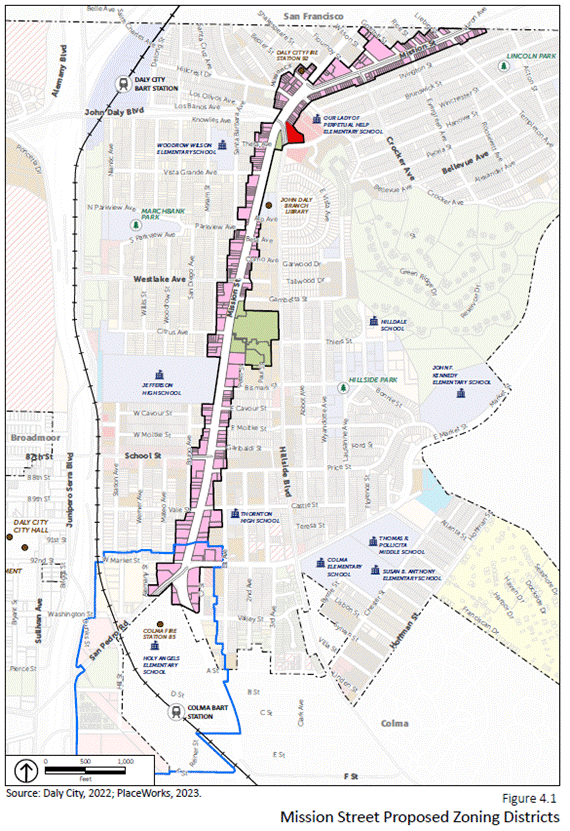
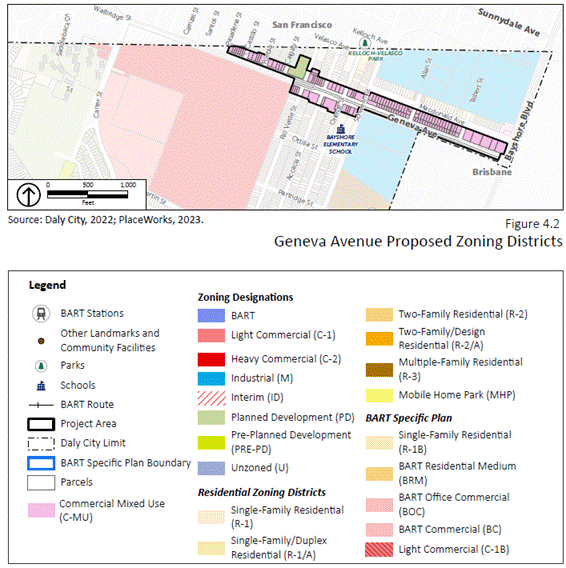
This chapter and the regulations contained herein apply to the entire city and more specifically lands identified on the zoning map in the C-MU commercial mixed use zoning district, which may be amended, from time to time. This district generally includes parcels fronting Mission Street and Geneva Avenue and includes certain parcels within the BART Station Area Specific Plan intended for mixed-use development. The requirements of this section and objective design standards shall apply to any building permit application received after this ordinance has become effective.
17.58.030 - Permitted uses.
Permitted Uses
The following structures and uses are permitted in the C-MU district without the requirement for a use permit:
Residential Uses: Multiple-family dwellings (two or more units), when constructed in conjunction with retail, office, or other non-residential uses at the street level; group home/boarding house; rest home; live/work residential units; accessory dwelling units (per city standards).
Non-residential Uses: Animal grooming not involving overnight boarding; athletic clubs and health studios; assembly uses, including churches, lodges, and social and meeting halls; business and trade schools; childcare facilities and play gyms; hotels, including extended stay hotels; movie theaters and complexes; offices uses, including professional offices, medical and dental offices, and medical clinics; payday lending establishments subject to the separation requirements contained in Chapter 17.40.080; personal service uses, including nail and hair salons, massage businesses where employees are licensed by the State of California; pharmacies; restaurants that do not provide a drive-through window; retail uses, including alcohol sales, not specified as requiring a use permit; seasonal temporary uses (e.g., Christmas tree lots); smoke shops and tobacco store businesses subject to the separation requirements contained in Chapter 17.40.070.
Accessory Uses: The following uses are permitted in the C-MU district when accessory to or commenced concurrently with or subsequent to permitted uses: other accessory uses and structures customarily appurtenant to a multi-family residential permitted use when in compliance with Title 25 of the California Administrative Code; food sales on temporary basis, including farmers markets and food truck sales when subordinate to an existing use on the same parcel; vehicle charging facilities not required by the Green Building Standard Code when proposed on the same parcel as a primary use.
Conditional Uses
The following structures and uses are permitted in the C-MU district upon first receiving approval of a use permit, subject to the requirements of Chapter 17.44: animal hospitals and kennels; businesses whose principal use is for the operation of amusement devices, i.e., arcades; emergency medical care, including urgent care clinics and hospitals; food sales on temporary basis, including farmers markets and food truck sales when not subordinate to an existing use on the same parcel; pharmacies providing a drive-through window; vehicle or equipment rental; and vehicle storage.
Prohibited Uses
The following uses shall not be allowed in the C-MU district: automotive dealers and auto retail, sales, and repair, unless previously operating on the same site prior to January 1, 2008; retailers where more than ten percent of the store stock retail value is products that are firearms, such as handguns and long guns, to individuals in an open shopping format, or firearm parts, or any business that engages in the repair of firearms and/or firearm parts; car wash and detailing shops; manufacturing uses; outdoor retail sales; parking lots not associated with a primary use, including vehicle charging facilities not required by the Green Building Standard Code; restaurants providing a drive-through window, including operational and physical expansions thereto; service stations, including operational and physical expansions thereto; single-family attached/detached residential uses.
Nonconforming Uses
As required by Chapter 17.42 "Nonconforming Uses" of the Daly City Zoning Ordinance, existing nonconforming uses within the C-MU district shall be permitted to continue or remain until there has been a structural alteration, an enlargement or increase in space occupied, change in the nonconforming use, moving of said nonconforming building, abandonment or discontinuance of the nonconforming use, damage pursuant to Section 17.42.060, or the use has been determined to be a nuisance by the city council, with the following exception: single family residential buildings, and accessory structures, and accessory dwelling units on the same property, that existing on the date of the C-MU zone district adoption shall, for the purpose of the zoning ordinance, be considered conforming land uses and modifications to such structures shall be subject to the regulations applicable to single-family homes in the R-1 single family district. Furthermore, modifications and updates to the underground storage tanks and parking lot layouts associated with a service station necessary to ensure compliance with local, state, and federal law. Otherwise, the nonconforming use shall be changed to a conforming use and the nonconforming use cannot thereafter be reestablished.
(Ord. No. 1469, § 1, 12-11-2023)
17.58.040 - Height regulations.
No new structure in the C-MU district shall exceed 15 stories or 175 feet in height, as measured according to DCMC 17.04.010—Definitions—Building Height. Fifteen additional feet may be permitted for elevator shafts and rooftop mechanical equipment. The minimum height of any new structure in the C-MU district shall be three stories or thirty feet. Any new buildings abutting lots zoned R-1 (single-family residential district) or R-1/A (single-family/duplex residential district) and over three stories or thirty feet high (whichever is lesser), shall adhere to the transitional height requirements in the C-MU objective design standards.
Building height is measured from the curb at the centerline of the building to the building's highest point. See Section 17.40.040 of the Daly City Zoning Ordinance for building height exceptions. For building structures with a flat roof, the height of the building shall be measured to the roof, not the parapet. Stair and elevator towers at the building roof may exceed the maximum building height by up to ten feet.
(Ord. No. 1469, § 1, 12-11-2023; Ord. No. 1476, § 9, 11-12-2024)
17.58.050 - Lot area and lot width.
For the purpose of subdividing land, the minimum lot area in the C-MU district shall be ten thousand square feet. This regulation shall not apply to lot assemblages and mergers.
For the purpose of subdividing land, the minimum lot width in the C-MU district shall be one hundred feet. This regulation shall not apply to lot assemblages and mergers.
The proposed lot area and lot width are higher than the minimum lot areas and widths required within other city zoning districts to 1) encourage lot mergers or the assemblage of smaller contiguous parcels to develop a larger residential or mixed-use project and 2) prohibit sites larger than 10,000 square feet to subdivide into sites smaller than 10,000 square feet.
(Ord. No. 1469, § 1, 12-11-2023)
17.58.060 - Lot coverage.
A minimum of fifty percent of the lot is required to be covered by new buildings and structures in the C-MU district, not including stormwater treatment structures, carports, and accessory structures. A maximum of 100 percent of the lot shall be allowed to be covered by buildings and structures in the C-MU district. New buildings abutting lots zoned R-1 (single-family residential district) or R-1/A (single-family/duplex residential district) and over three stories or 30 feet high (whichever is lesser) shall follow the transitional height requirements and yard requirements in the C-MU objective design standards.
(Ord. No. 1469, § 1, 12-11-2023)
17.58.070 - Usable open space requirements.
The requirements for usable open space shall follow the city's existing requirements in Section 17.38.020 of the zoning ordinance or requiring one hundred fifty square feet of usable open space for each dwelling unit. However, the C-MU district shall allow flexibility in which the one hundred fifty square feet calculation may include private open space for the dwelling unit (i.e., decks and balconies), shared open space for the building's occupants (i.e., terraces, roof decks, etc.), and publicly accessible open space on the ground floor. All private open space shall be improved as usable amenity space to the satisfaction of the planning division.
(Ord. No. 1469, § 1, 12-11-2023)
17.58.080 - Yard requirements.
All structures in the C-MU district shall be subject to the following regulations:
A.
Minimum Front Yard. Minimum front yard shall be dependent on the existing sidewalk width along the primary building frontage to create a minimum of a ten-foot sidewalk if the primary building frontage is along Mission Street and a ten-foot sidewalk if the primary building frontage is along Geneva Avenue. Any new sidewalk within the property line will require a public right-of-way easement or dedication to the city.
B.
Maximum Front Yard. The building structure shall be set back no more than ten feet from the property line. The setback space may be used for landscape or usable open space but not parking. Larger setbacks are allowed where needed for usable public gathering space, driveways, or garage entries.
C.
Minimum Rear Yard. No requirement. If the building structure is abutting lots zoned R-1 (single-family residential district) or R-1/A (single-family/duplex residential district) and over three stories or thirty feet high (whichever is lesser), the project must adhere to C-MU objective design standards that address context sensitivity.
D.
Minimum Side Yard. No requirement. If the building structure is abutting lots zoned R-1 (single-family residential district) or R-1/A (single-family/duplex residential district) and over three stories or thirty feet high (whichever is lesser), the project must adhere to C-MU objective design standards that address context sensitivity.
(Ord. No. 1469, § 1, 12-11-2023)
17.58.090 - Parking.
Parking shall for new construction adhere to Chapter 17.34—Off-Street Parking and Loading, unless otherwise superseded by state law. Applications for new development seeking parking reductions pursuant to state law shall provide an analysis as to how the proposal qualifies for the parking reduction sought as part of a complete application.
(Ord. No. 1469, § 1, 12-11-2023)
17.58.100 - Compliance with comprehensive airport land use compatibility plan.
Within the Mission Street corridor, all property transfers shall provide a real state disclosure to the land purchaser that the property being transacted is located within both Airport Influence Area (AIA) A & B boundaries for San Francisco International Airport and that, due to the property's proximity to the airport, the property may be subject to some of the annoyances or inconveniences associated with proximity to airport operations. The disclosure shall be provided in title documents acknowledged by the property purchaser. Failure to provide this disclosure shall be considered a violation of this chapter.
(Ord. No. 1469, § 1, 12-11-2023)
17.58.110 - Objective design standards and conformity review.
Construction of all new buildings, additions of full or partial floors or additional building height to existing buildings shall conform to the objective design standards (ODS) adopted by the city council. The intention of the ODS is that they be implemented using no personal or subjective judgment by the planning division staff. The objectives design standards shall provide guidance for site design, building design, context sensitivity, and landscaping.
Not less than one hundred eighty (180) days prior to the submittal of any building permit for construction subject to the ODS, the applicant shall request conformity review from the planning division staff to ensure that the project for which the permit is sought is in conformance with the ODS. Upon receipt of the conformity review submittal, the planning division staff shall determine if the project conforms to the ODS. Within forty-five calendar days of the submittal, the planning division shall provide the applicant with its written findings and recommendations. The applicant shall consider any recommendations made by the planning division staff and shall resubmit the project for re-review, if necessary. Within thirty calendar days of the re-submittal, the planning division staff shall provide the applicant with the written findings and recommendations. All subsequent re-reviews of the design review consultant shall be allotted the same thirty-day review.
Should the applicant fail to address the recommendations of the planning division staff, the planning division shall not approve the release of any building permit to construct the project. Should the applicant disagree with the recommendations of the planning division staff, the applicant may appeal the specific recommendations with which the applicant disagrees to the city council, which shall consider the appeal within thirty calendar days. This consideration shall occur without public notice to adjacent property owners. The city council may not itself request review of the project.
The conformity review process outlined in this section shall be a review of the ODS only and shall not include review by other city departments/divisions, which shall instead be conducted at the time of building permit submittal.
(Ord. No. 1469, § 1, 12-11-2023)
(Ord. No. 1469, § 1, 12-11-2023)

