
Daly City City Zoning Code
CHAPTER 17
34 - OFF-STREET PARKING AND LOADING
17.34.010 - Regulations generally.
A.
The standards contained in this chapter shall apply to all new structures, new property developments or new additions to existing structures for which a building permit is issued after the effective date of the ordinance codified in this chapter. These standards may be modified if a development is located in an area covered by a specific plan, if the development conforms to the standards specified therein. Design guidelines approved by the city council may modify design standards for parking.
B.
Any of the following provisions notwithstanding, the redevelopment agency may, at its discretion, establish parking standards which deviate from the specific requirements of this section.
C.
There shall be provided in all districts at the time of construction of any new building, or any enlargement of or addition to any existing building, off-street parking spaces in accord with the standards and requirements of this section. Where the computation of an off-street parking requirement results in a fraction, said fraction shall be rounded to the next higher whole number.
D.
All required parking areas shall be readily available to the employees, customers and/or residents of the facility in question. No fee shall be charged for the use of those spaces required by the applicable provisions of this section. A fee may, however, be charged for the utilization of any spaces provided over and above the required number.
E.
In the case of mixed use developments, the city planner may grant an administrative variance to the cumulative off-street parking requirement which would normally apply if the individual activities within a single complex were considered separately. In no event shall an administrative variance be issued which reduces the overall off-street parking standard by more than twenty percent. To qualify for a reduction, a mixed use complex shall be under one management. The following types of mixed use developments shall be eligible for consideration:
1.
Commercial office/multiple-family residential;
2.
Commercial office/retail and/or service commercial (applies to shopping centers only);
3.
Hotel or motel/retail or service commercial;
4.
Bowling alley/retail or service commercial;
5.
Industrial/retail or service commercial.
The city planner shall consider the types of activities proposed and the ratio of floor areas involved, the section of the city within which the project would be located, and any other pertinent factors in determining what, if any, reduction in the off-street parking requirement may be warranted.
F.
In the following types of developments, up to twenty percent of the required off-street parking spaces may be designated for "small cars only":
1.
Commercial offices;
2.
Multiple-family residential.
(Section 17.34.030 details specific standards for "small car" parking spaces.)
G.
Except for single-family homes and duplexes, each required off-street parking space shall be provided with access to or from an aisle or driveway. Tandem parking in single-family homes is acceptable. In addition, only two of the required off-street parking spaces in a duplex need to have individual access to or from an aisle or driveway.
H.
Any building permit application for a structure requiring off-street parking or an application for a separate parking facility shall provide a plot plan drawn to scale demonstrating compliance with all applicable provisions of this section.
I.
A mandated building setback area may be used to fulfill an off-street parking requirement, subject to the following requirements:
1.
The property has an existing legal curb cut accommodating the required parking;
2.
An automatic garage door opener is installed and maintained in working condition; and
3.
The garage and driveway are maintained in a usable condition and are not used for storage of material, equipment or inoperable vehicles if such storage necessitates parking a resident's vehicle on the street. Whenever the garage or driveway is available, residents are required to use them.
4.
A parking space in a side-by-side or double-wide configuration has not or is not being eliminated.
J.
All off-street parking areas shall be surfaced with plant-mix asphalt, concrete, or other surfacing as approved by the city engineer, and the city planner.
K.
Off-street parking, when used to complement a legally conforming land use, may be allowed in any residential zoned district upon first securing a use permit. This shall not be construed as permitting the storage or sale of vehicles in any residential zoned district.
L.
Off-street parking spaces required by this chapter shall at all times be maintained in a usable condition. Said off-street parking spaces shall not be utilized for storage of materials or equipment if such storage necessitates the parking of the property owner's/tenant's vehicles outside the required parking area.
(Ord. 1232 § 5, 1996; Ord. 1202 § 6, 1994; Ord. 1159 § 1, 1992; Ord. 885 § 2 (part), 1978: Ord. 635 § 17.1, 1965)
17.34.020 - Schedule of parking requirements.
A.
Single-Dwelling Residential—New dwellings and additions to existing dwellings resulting in one thousand five hundred square feet or less of habitable space in the dwelling shall require the provision of two parking spaces; new dwellings and additions to existing dwellings resulting between one thousand five hundred one square feet and two thousand square feet of habitable space in the dwelling shall require the provision of three parking spaces; new dwellings and additions to existing dwellings resulting between two thousand and one square feet and two thousand five hundred square feet of habitable space in the dwelling shall require the provision of four parking spaces; and new dwellings and additions to existing dwellings resulting in over two thousand five hundred square feet of habitable space in the dwelling shall require the provision of six parking spaces. Driveway areas in front of the dwelling's garage may be counted toward meeting the parking requirement if the measurement between the back of the sidewalk and face of the dwelling's garage door is not less than nineteen feet long, unless a garage door recess is provided pursuant to subsection (H). Up to three of the required parking spaces required by this section may be provided in tandem.
Irrespective of the number of resulting square feet, the conversion of non-habitable space into habitable space in existing dwellings which does not expand the existing building envelope of the dwelling shall be required to provide at least two parking spaces meeting the parking dimensions specified in Section 17.34.030, unless the dwelling has no garage or existing structural obstructions prevent the provision of the two fully-dimensioned parking spaces, in which case no parking spaces shall be required for the interior improvements. In no instance shall an existing side-by-side parking configuration be eliminated;
B.
Duplex (two-family residential)—two spaces per unit totaling four spaces per structure;
C.
Emergency Homeless Shelter—0.75 covered or uncovered parking spaces per employee;
D.
Multiple-Dwelling Residential, including condominiums—one space for each studio unit. One and one-half spaces for each one-bedroom unit. Two spaces for each two-bedroom or larger unit. Apartment complexes and condominiums designed and intended for the exclusive occupancy of low income elderly persons, shall provide at least one-fourth the normally required amount of off-street parking. Apartment complexes and condominiums designed and intended for the exclusive occupancy of low income persons or families other than the elderly shall provide at least three-fourths the normally required number of spaces;
E.
Mobilehome Parks—one space for each mobile home, said space to be located on the individual trailer site, plus one space per site for guest parking, the latter to be grouped in common area;
F.
Boardinghouses—one space per rentable room plus one space for every two hundred square feet of kitchen area and administrative office space;
G.
Hotels and Motels—one space per room plus one space for each three hundred feet of lobby area and administrative office space;
H.
Nursing Homes, Convalescent Hospitals and Similar Uses—one space for every four hundred square feet of gross floor area;
I.
Clubs, Lodges and Other Assembly Buildings, Including Churches and Theaters—one space for every six permanent seats in the main auditorium. If there are to be no permanent seats, then the off-street parking requirement shall be one space for every two hundred square feet of assembly area. Ancillary uses such administrative offices, classrooms, and multi-purpose spaces shall be exempt from the requirement for parking, up to two thousand five hundred square feet;
J.
Banks and Business or Professional Offices—one space for each three hundred square feet of gross floor area up to twenty-one thousand feet; thereafter, one space for each two hundred square feet of gross floor area;
K.
Fast Food Restaurant or Drive-in—one space per seventy-five square feet of gross floor area;
L.
Other Restaurants—one space per one hundred twenty-five square feet of gross floor area;
M.
Mortuary—one space for each three hundred fifty square feet of gross floor area;
N.
Bowling Alley—two and one-half spaces for each bowling lane;
O.
Service Station—five spaces;
P.
Service Station with Accessory Use—two spaces for the service station: retail accessory use will require an additional one space per three hundred square feet of gross floor area. Car wash accessory uses will require an additional five spaces. Automated car wash queuing lanes may be considered for inclusion in the required parking under a use permit, or at the discretion of the economic and community development director when a use permit is not required if it can be demonstrated that the queuing lanes would not encroach into the drive aisles, ROW or designated parking areas. If more than one accessory use is proposed, then up to fifty percent of the fuel dispensary parking spaces may be considered for inclusion in the required parking under a use permit, or at the discretion of the economic and community development director when a use permit is not required;
Q.
Self-service Gasoline Station—two spaces;
R.
New and/or Used Car Sales—one space per two thousand square feet of total site area;
S.
Auto Service and Repair—one space per seven hundred fifty square feet of gross floor area;
T.
Bulky Merchandise Retail Stores (e.g., furniture)—one space per seven hundred fifty square feet of gross floor area;
U.
All Other Retail or Service Commercial—one space for each three hundred square feet of gross floor area up to twenty-one thousand square feet; thereafter, one space for each two hundred square feet of gross floor area;
V.
Manufacturing, Public Utility, Warehousing—one space per fifteen hundred square feet of gross site or building area, whichever is greater, unless a more appropriate standard for a specific use is determined through use permit procedures;
W.
Day Care Centers, including Preschools, Nursery Schools and Private Elementary Schools—one space for each employee, plus one space for every ten children;
X.
For Uses Not Listed—the city planner shall establish a parking standard based upon the requirements for similar uses. If the city planner is unable to establish a parking requirement in this manner, the parking standard shall be determined by the planning commission.
(Ord. 1027 § 4, 1985; Ord. 903 § 1, 2, 1979; Ord. 885 § 2 (part), 1978: Ord. 635 § 17.2, 1965)
(Ord. No. 1359, §§ 1, 2, 9-12-2011; Ord. No. 1378, § 2, 5-27-2014; Ord. No. 1412, § 3, 2-13-2017; Ord. No. 1427, § 1, 4-8-2019)
17.34.030 - Off-street parking design standards.
A.
Required full size off-street parking spaces shall be of usable shape and shall not be less than eight and one-half feet wide and nineteen feet long.
1.
Permitted small car spaces shall be not less than sixteen feet long and eight and one-half feet wide;
2.
Small car spaces shall be clearly marked, "SMALL CAR ONLY";
3.
Where walls are adjacent to both sides of a parking space, the minimum width of said space shall be ten feet;
4.
End parking spaces, when parallel to a wall or barrier, shall maintain a minimum width of twelve feet. Variations from this standard shall be subject to the approval of the city planner.
B.
The following diagram and table illustrate minimum parking dimensions:
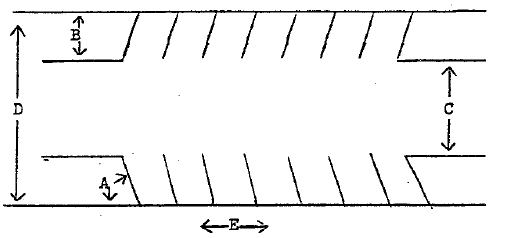
Parallel Parking: Ten-foot minimum aisles, one aisle required per traffic direction. Eight foot six inches by twenty-four feet minimum size parking space (regular). Small car minimum size space eight foot six inches by twenty foot.
C.
Entrances and exits shall be clearly marked.
D.
The number of curb cuts for access shall be kept to a minimum and shall be located as far as is reasonably possible away from street intersections. In no event shall a curb cut extend into a curb return area a distance greater than ten percent of the total curb return length. The following curb cut and driveway standards shall apply:
1.
Residential Parking—single-family homes, duplex and two-family homes shall have a maximum curb cut width of eight feet for single car wide driveways. A curb cut leading to garages arranged in a side-by-side configuration shall have a maximum width of fourteen feet. The width of the driveway shall not exceed the width of the garage entrance by more than six inches on either side of said entrance. All other residential uses shall have a minimum eight feet for each traffic lane, maximum width of twelve feet for each traffic lane. Contiguous paving may not be placed next to the driveway so that it could be used for parking, unless constructed in conformity with Section 17.34.050 below.
E.
Bumper guards and wheel stops shall be provided where needed.
F.
All new retail and/or service commercial developments required to provide in excess of ten off-street parking spaces shall furnish at least one conveniently located and distinctly marked "Handicapped Parking" space. Any residential development which provided units designed for handicapped persons shall provide one handicapped parking space for each such unit. All "Handicapped Parking" spaces shall be at least twelve feet in width.
G.
The following standards shall only apply to "outdoor" off-street parking:
1.
All outdoor parking areas shall be illuminated. Light standards shall be no more than twenty feet high and shall be oriented to reflect away from any adjoining residential properties;
2.
Outdoor parking areas on or adjacent to residentially zoned or utilized property shall be setback from adjoining lot lines by a landscaped buffer not less than three feet wide;
3.
Any parking lot having eleven spaces or more shall provide landscaping on at least two percent of the interior lot area which shall be in addition to the minimum paved area required. Said landscaping shall be irrigated and continuously maintained;
4.
Site plans for all outdoor, off-street parking areas shall be reviewed and approved by the city planner and the city engineer. Said plans shall illustrate drainage patterns, landscaping and irrigation, parking space and aisle dimensions, lot lighting and pavement materials.
H.
Required garage parking spaces in single dwellings and duplexes shall comply with the following dimension requirements:
1.
For new construction, single-car-width garage doors shall provide a minimum eight-foot opening and double-car-width garage doors shall provide a minimum fourteen-foot opening.
2.
Where walls are proposed on both sides of a garage parking space, the interior dimension for each parking space shall be ten feet wide and nineteen feet deep, centered on the back of the garage door. The interior space dimension for side-by-side parking shall be seventeen feet wide and nineteen feet deep, centered on the back of the garage door, except in duplexes where the garage shall be twenty feet wide and nineteen feet deep.
3.
The interior dimension for a garage providing two required parking spaces in tandem may be reduced to thirty-eight feet;
4.
In instances where an existing garage measure less than thirty-eight feet, the garage dimension may be reduced to nineteen feet if either the existing distance from the face of the garage door to the back of sidewalk measures nineteen feet or the garage door is recessed so as to provide a driveway space not less than nineteen feet in length, measured from the back of the sidewalk. The nineteen-foot dimension may be reduced to sixteen feet if achieving the nineteen-foot dimension would require a garage door recess of more than six feet. In no case shall a permit be issued that results in a parking space dimension that is less than sixteen feet from the back of the sidewalk to the face of the garage door. All parking spaces created pursuant to this section by shall be considered toward meeting required parking.
5.
All required garage parking spaces shall be accessed by an overhead garage door with automatic garage door opener, installed and maintained in working condition. Garage doors which swing out, roll, and cannot otherwise be accessed in an automated fashion shall not be permitted.
Parking spaces shall be approved clear of all permanent and appliance obstructions, including in-swinging doors and required trash/recyclable bin storage areas. Appliances such as water heaters, furnaces, and washer and dryers shall be assumed to have a thirty-six-inch dimension from the face of adjacent sheetrock. Parking spaces provided in excess of the mandated minimum number of spaces (optional parking space) may be reduced to sixteen feet in length and may not be subsequently eliminated.
(Ord. 1232 § 6, 1996; Ord. 903 § 3, 1979; Ord. 885 § 2 (part), 1978: Ord. 635 § 17.3, 1965)
17.34.040 - Off-street loading.
Every hotel, laundry or dry cleaning establishment, retail or wholesale store, manufacturing or storage facility or any other use similarly requiring the receipt or distribution of materials or merchandise in which the gross floor area of the use exceeds ten thousand square feet, shall provide and maintain one off-street loading space.
(Ord. 635 § 18, 1965)
17.34.050 - Contiguous front yard paving.
A.
Replacement of existing front yard lawn or landscaping with hardscape (e.g., concrete, pavers, etc.) shall be allowed on any property with a single dwelling or duplex, subject to the following requirements:
1.
On parcels wider than twenty-five feet, at least twenty-five percent of the front yard shall be retained as landscape or xeriscape. For the purpose of compliance with this section, the front yard shall be defined as the area between in front of the dwelling and the back of sidewalk, including the public right-of-way.
2.
Paving of any portion of the public right-of-way shall require the issuance of an encroachment permit by the engineering division. The application for encroachment permit shall demonstrate compliance with the above landscape/xeriscape requirement. The engineering division shall have the ability require the replacement of the utility box serving the dwelling with a box rated for vehicular traffic, if one does not already exist.
3.
All hardscape not subject to the one-time exemption provided in this section shall incorporate pavers, integral colored concrete, or any combination thereof. Integral concrete shall colored be brown or a color complementary to the dwelling situated upon the lot.
4.
Paving on properties not served by an existing, legal vehicular curb-cut shall incorporate a permanent vertical barrier or other concrete cut-out pattern preventing the hardscape area from being used to park a vehicle. The permanent vertical barrier shall consist of a poured concrete curb not less than six inches in height and bricks and/or pavers set in poured concrete with an exposed surface not less than six inches.
B.
Any single dwelling or duplex property with contiguous front yard paving which has been installed as of July 1, 2017, shall be considered legal and non-conforming, and shall be exempt from the requirements of this section provided the dwelling owner has secured a non-conformity finding from the planning division by a date set by city council resolution. Any front yard pavement not granted a nonconformity finding shall be brought into conformance with these regulations upon issuance of any building permit for work exceeding a valuation set by city council resolution.
C.
Paving, terracing, and/or filling of any yard shall not be counted toward lot coverage. Placing removable rock material in any front yard area shall be exempt from this section.
17.34.060 - Minimum parking lot and parking garage driveway dimensions.
The following dimensions shall be required for driveways accessing parking lots and garages:
A.
For driveways providing access to twenty or fewer parking spaces, one-way travel may be allowed. The minimum one-way driveway dimension will be twelve feet, clear of all obstructions (e.g., building support columns).
B.
For driveways providing access to twenty-one or more parking spaces, two-way travel shall be required. For driveways providing access to between twenty-one and fifty spaces, the minimum two-way driveway dimension shall be at least eighteen feet, clear of all obstructions. For driveways providing access to more than fifty spaces, the driveway dimension shall be at least twenty-four feet, clear of all obstructions.
All required driveway dimensions shall be subject to final determination by the city's traffic engineer. In determining the driveway minimum dimensions for a specific development proposal, the traffic engineer's final determination may consider the driveway length, adjacent street traffic conditions, inside/outside vehicle visibility, inside/outside turning radii, the quantity of non-residential floor area served by the driveway, or any other factor(s) useful in determining the safety of an acceptable driveway dimension.

