
Debary City Zoning Code
CHAPTER 11
SIGN REGULATIONS
Sec. 11.1.- Purpose and intent.
The purpose of these sign regulations shall be to ensure adequate means of communications through signage, while maintaining the attractive visual appearance of the City, preserving property values, protecting vehicular and pedestrian safety, and promoting the general health, safety, and general welfare of the citizens of DeBary. The requirements of this chapter are designed to:
(a)
Promote and protect the public health, safety, and general welfare of the citizens of the City by regulating and limiting the existing and proposed posting, display, erection, use, and maintenance of signs, billboards, posters, bulletins, and other advertising structures within the City;
(b)
Promote low profile signage of high quality in order to protect property values, create a more attractive economic and business climate, enhance and protect the physical appearance of the community, preserve the scenic and natural beauty of the City, and provide a more enjoyable and pleasing community;
(c)
Protect and maintain visual integrity of roadway corridors within the City by establishing a maximum amount of signage on any one site, by reducing clutter, and by restricting the location and providing setbacks for all signs;
(d)
Improve vehicular and pedestrian safety, reduce visual distractions, obstructions, and hazards;
(e)
Provide more open space, curb the deterioration of natural beauty, and avoid visual pollution by regulating and limiting the existing proposed posting, display, erection, use, and maintenance of signs, billboards, posters, bulletins, and other advertising structures within the City;
(f)
Enhance the appearance of the physical environment by requiring that signage be designed as an integral architectural feature of the site and structure which the signage is intended to identify, and sited in a manner which is sensitive to the existing natural and built environment;
(g)
Provide for signage which satisfies the need of the business community for visibility, identification, and communication, and which fosters civic pride and community spirit by maximizing the positive impact of development; and
(h)
Establish procedures for removal of nonconforming signs, maintenance of existing signs, and enforcement of these regulations.
(Ord. No. 02-12, § 2(exh. A), 9-5-2012)
Sec. 11.2. - Substitution of non-commercial speech for commercial speech.
Notwithstanding anything contained in this chapter or Code to the contrary, any sign erected pursuant to the provisions of this chapter or Code with a commercial message may, at the option of the owner, contain a non-commercial message unrelated to the business located on the premises where the sign is erected. The non-commercial message may occupy the entire sign face or any portion thereof. The sign face may be changed from commercial to non-commercial messages, or from one non-commercial message to another, as frequently as desired by the owner of the sign, provided that the sign is not a prohibited sign or sign type and provided that the size, height, setback, and other dimensional criteria contained in this chapter and Code have been satisfied.
(Ord. No. 07-13, § 2(Exh. A), 8-7-2013)
Sec. 11.3. - Severability.
(a)
Generally. If any part, section, subsection, paragraph, subparagraph, sentence, phrase, clause, term, or word of this chapter concerning sign regulation is declared unconstitutional or invalid by the valid judgment or decree of any court of competent jurisdiction, the declaration of such unconstitutionality or invalidity shall not affect any other part, section, subsection, paragraph, subparagraph, sentence, phrase, clause, term, or word of this chapter.
(b)
Severability where less speech results. Without diminishing or limiting in any way the declaration of severability set forth in subsection (a), or elsewhere in this chapter, this Code, or any adopting ordinance, if any part, section, subsection, paragraph, subparagraph, sentence, phrase, clause, term, or word of this chapter is declared unconstitutional or invalid by the valid judgment or decree of any court of competent jurisdiction, the declaration of such unconstitutionality or invalidity shall not affect any other part, section, subsection, paragraph, subparagraph, sentence, phrase, clause, term, or word of this chapter, even if such severability would result in a situation where there would be less speech, whether by subjecting previously exempt signs to permitting or otherwise.
(c)
Severability of provisions pertaining to prohibited signs. Without diminishing or limiting in any way the declaration of severability set forth in subsection (a) or elsewhere in this chapter, this Code, or any adopting ordinance, if any part, section, subsection, paragraph, subparagraph, sentence, phrase, clause, term, or word of this chapter or any other law is declared unconstitutional or invalid by the valid judgment or decree of any court of competent jurisdiction, the declaration of such unconstitutionality or invalidity shall not affect any other part, section, subsection, paragraph, subparagraph, sentence, phrase, clause, term, or word of this chapter that pertains to prohibited signs, including specifically those signs and sign-types prohibited and not allowed under Sec. 11.6 of this chapter. Furthermore, if any part, section, subsection, paragraph, subparagraph, sentence, phrase, clause, term, or word of Sec. 11.6 is declared unconstitutional or invalid by the valid judgment or decree of any court of competent jurisdiction, the declaration of such unconstitutionality or invalidity shall not affect any other part, section, subsection, paragraph, subparagraph, sentence, phrase, clause, term, or word of Sec. 11.6, thereby ensuring that as many prohibited sign-types as may be constitutionally prohibited continue to be prohibited.
(Ord. No. 07-13, § 2(Exh. A), 8-7-2013)
Sec. 11.4. - General provisions; applicability.
(a)
No person shall erect or maintain a sign, and no property owner shall allow a sign to be erected or maintained on their property except in conformity with these regulations.
(b)
A permit shall be required for the erection of any sign except as provided in Sec. 11.5, and Sec. 11.7. A sign permit may be issued in conjunction with the approval of a development plan showing the necessary information or pursuant to a separate application made to the City Manager. The erection of a sign shall also require building and electrical permits as appropriate, subject to the provisions of the applicable regulations.
(c)
Inspections of the sign and/or sign structure are required as provided for under building permit and electrical permit regulations.
(d)
A permit shall be required for change of copy of an existing sign and/or for any sign when the use of the premises changes; however, no permit will be required for change of copy on a changeable message, electronic message center or reader board sign.
(e)
Signs shall be located a minimum of ten feet from any side property line and five feet from all other property lines.
(Ord. No. 02-12, § 2(exh. A), 9-5-2012; Ord. No. 07-13, § 2(Exh. A), 8-7-2013)
Sec. 11.5. - Exempt signs.
The following signs are permitted in all zoning classifications and districts and are exempt from the permitting process with certain conditions, where applicable, as noted:
(a)
Signs of two square feet or less and having no individual letters, symbols, logos or designs in excess of eight inches in vertical or horizontal dimension.
(b)
Signs erected by or under the authorization of a governmental body, including special events, legal notices, identification signs, and traffic, directional or regulatory signs.
(c)
Flags complying with the terms of the sign regulations.
(d)
Signs on vehicles not specifically prohibited by Sec. 11.6(h).
(e)
Legal notices.
(f)
Instructional/Warning signs four square feet or less.
(g)
Yard signs of two square feet in area or less which are located on the property, pursuant to Sec. 11.7.
(Ord. No. 02-12, § 2(exh. A), 9-5-2012; Ord. No. 03-17, § 2(Exh. A), 3-1-2017)
Sec. 11.6. - Prohibited signs.
The following signs shall be prohibited:
(a)
Animated signs including swinging signs, lights or illuminations that flash, move, rotate, scintillate, blink, flicker, or vary in intensity or color; and signs with visible moving, revolving, or rotating parts or visible mechanical movement of any description or other apparent visible movement achieved by electrical, electronic, or mechanical means, message center signs, and excepting: electronic/LED message signs expressly permitted by the Overlay District Sign Regulations and electronic signs that display static images of prices only where the price/image only changes once per 24-hour and time, and temperature signs with a complete time and/or temperature sequence span of four to eight seconds.
(b)
Snipe signs.
(c)
Signs which prevent free ingress to or egress from any door, window or fire escape.
(d)
Signs attached to a standpipe or fire escape.
(e)
Signs or other advertising structures which by reason of position, shape or color interfere, obstruct, or may be confused with any authorized traffic control device or emergency vehicle signal.
(f)
Signs, except public signs, that are placed or erected on or over a public right-of-way. Signs on public property or rights-of-way shall be removed immediately and may be removed by the City or its agent without notice.
(g)
A-frame signs, unless specifically allowed in an overlay district.
(h)
Signs not permanently attached to or painted on vehicles or mobile trailers in the public right-of-way, or within 50 feet and in plain view from the public right-of-way.
(i)
Strings of flashing or twinkling light bulbs used on nonresidential structures for commercial purposes, other than event decorations. Event decorations must be removed no later than 14 days following the event.
(j)
Signs, commonly referred to as wind signs, consisting of one or more banners, pennants, ribbons, spinners, streamers or captive balloons, or other devices fastened in such a manner as to move upon being subjected to pressure by wind, and including inflatable signs.
(k)
Billboards, except signs that are expressly permitted by state or federal law; provided that such signs are in strict conformity with all current state and federal standards and in B-6 (Highway Interchange Commercial) and I-1 (Light Industrial) zoning classifications in the vicinity of the Interstate highway only.
(l)
Roof signs.
(m)
Abandoned signs.
(n)
Signs erected on private utility facilities or rights-of-way.
(o)
Handbills, including any signs, circulars, dodgers or other advertising which are distributed or placed on any public or private property in such a manner that the same may be blown, carried by water or otherwise scattered by the elements, or so as to constitute litter. Also, any handbills or other form of advertising matter distributed by throwing or placing the same on or into any vehicle within the City.
(p)
Signs having fluorescent colors.
(q)
Signs which are accessory to an otherwise unpermitted or unlicensed business or land use.
(r)
Any other type or kind of sign which does not comply with the terms, conditions and provisions contained in the sign regulations or which supplement the sign regulations.
(s)
Off-premises signs, except billboards as noted above.
(t)
Signs mounted on rocks or other natural features or affixed to trees.
(u)
Handheld and human signs within the right-of-way.
(Ord. No. 02-12, § 2(exh. A), 9-5-2012; Ord. No. 07-13, § 2(Exh. A), 8-7-2013)
Sec. 11.7. - Temporary signs.
The following signs may be permitted on a temporary basis, as provided below. Such signs shall not count toward the restrictions on the number or total area of permitted permanent signs. A sign permit may be required for a temporary sign, as indicated below.
(a)
Construction sites (sign permit required). Construction/development sites may display temporary signs as follows. Permits for temporary construction site signs may not be approved until permits are issued for site preparation or construction.
(1)
Size: Shall not exceed an area of 16 square feet and a height of six feet.
(2)
Location: Each sign shall be at least 20 feet from side and rear property lines and at least five feet from rights-of-way. For subdivisions, they shall be located at the principal street entrance of the subdivision.
(3)
Number: Two signs are allowed per builder, one per street frontage. In Planned Unit Developments having multiple sub-phases containing varying residential unit types, one additional development sign may be permitted no farther than 150 feet from the principal entrance of the Planned Unit Development.
(4)
Duration:
a.
May remain through site preparation and actual construction and shall be removed within five business days following the issuance of a certificate of occupancy, completion, or abandonment of work, whichever occurs first.
b.
Subdivisions under development may keep the sign for a period of one year, subject to renewal upon reapplication. The City Manager may approve the renewal only after determination that the promotion of the subdivision is active. All signs must be removed from the premises within 30 days of the date on which the project is completed or suspended.
(b)
Yard signs (no permit required). Yard signs shall not be posted on or over any public property, including any street right-of-way.
(1)
Yard signs in residential classifications shall be limited cumulatively to six square feet in area and three feet in height. Each such sign shall be located at least five feet from any right-of-way or property line, sidewalk, driveway entrance, or intersecting street right-of-way. No such sign shall be illuminated or attached to any tree or utility post.
(2)
Yard signs in nonresidential classifications shall be limited cumulatively to eight square feet and three feet in height. Each such sign shall be located at least five feet from any right-of-way or property line, sidewalk, driveway entrance, or intersecting street right-of-way. No such sign shall be illuminated or attached to any tree or utility post. Duration shall be limited to 30 days.
(3)
During tropical storm or hurricane warnings, all yard signs must be removed by an applicant to protect the public from signs becoming flying projectiles.
(c)
Temporary window signs (sign permit required). Total signage on any one façade may not cover more than 20% of the total surface area of the transparent portion of all windows and doors.
(d)
Special events (sign permit required). Temporary signs used in conjunction with any public, charitable, education, religious or other special event or function may be installed subject to compliance with the following conditions. The City Council may waive these limitations and may impose other conditions as necessary to meet the purpose and intent of this Code.
(1)
Duration: Such signs shall be placed not more than 44 days prior to the event and must be removed no later than five days after termination of the event. A maximum of three separate occasions or special events may be permitted within any calendar year. Notwithstanding, any new business or relocation of any existing business within the city shall be allowed special event signs not to exceed 30 days.
(2)
Commercial, industrial, mixed-use, and multi-family residential properties with less than 100 feet of frontage shall be permitted a total of 32 square feet of sign area. Properties of more than 100 feet of frontage shall be permitted a total of 64 square feet of sign area. Professionally made banners and pennants may be used. Banner signs, however, may not be hung on utility poles or vehicles. Inflatable signs are prohibited.
(3)
Single-family or duplex zoning classifications shall be limited cumulatively to six square feet in area and three feet in height. Each such sign shall be located at least five feet from any right-of-way or property line, sidewalk, driveway entrance, or intersecting street right-of-way. No such sign shall be illuminated or attached to any tree or utility post.
(Ord. No. 02-12, § 2(Exh. A), 9-5-2012; Ord. No. 03-17, § 2(Exh. A), 3-1-2017)
Sec. 11.8. - General sign standards.
(a)
Rules for interpreting sign calculations.
(1)
Determining the number of signs. For the purpose of determining the number of signs, a sign shall be considered to be a single display surface or display device containing elements organized, related, and composed to form a unit.
(2)
Computation of sign area. The surface area of a sign shall be computed by including the entire rectangular area enclosing the extreme limits of the writing, representation, emblem, or other display, together with any material or color forming the display or used to differentiate the sign from the backdrop or structure against which it is placed, but not including any supporting posts under two feet in diameter.
(3)
Multisided signs. With respect to three-dimensional or multisided signs, the surface area shall be computed by including the total of all faces designed either to attract attention or communicate information. However, a double-faced sign shall not be deemed a multisided sign provided said faces of each sign are not separated by more than two feet and they have the same size and shape. Where the two faces of a sign are not parallel (as with a vee-shaped sign), the area may be calculated as the area of only one face.
(4)
Total sign surface area. Unless otherwise provided, the total surface area devoted to all signs on any lot shall not exceed the limitations established in these regulations and all signs except temporary signs shall be included in this calculation.
(b)
Construction and maintenance. All signs shall comply with all applicable standards of the building code, fire code, health code, electrical code, and all other applicable codes. All signs within the City limits including all supports, braces, guys and anchors shall be kept in good repair. The owner of any sign shall keep it in good repair, which includes restoring, repainting or replacement of a worn or damaged legally existing sign to its original condition. The Building Official may order the removal by and at the expense of the owner or lessee of any sign that is not properly maintained. The repainting, changing of parts and preventive maintenance of signs not normally requiring a building permit shall be permitted provided, however, that the maintenance is consistent with the originally approved sign plan and otherwise in conformance with this chapter.
(c)
Signs not to constitute a traffic hazard. No sign shall be placed at any location in the City where it may interfere with or obstruct a motorist's view, or be confused with any authorized traffic sign, signal or device. The City Manager shall have the authority to refuse the erection or to order the removal of any sign, if any signs constituting an obstruction to motorists or pedestrians or otherwise are viewed to be impediments to traffic safety or traffic flow.
(d)
Signs not to encroach electric utility clear zone. No sign shall be placed closer than eight feet horizontally from the nearest part of any utility pole which supports electrical transmission lines. No sign shall be placed closer than eight feet horizontally or vertically from the nearest part of any electric transmission line. If the City's electrical code is now or hereafter more restrictive than the provisions of this section, the most restrictive provisions shall prevail.
(e)
Illuminated signs.
(1)
Shielded light source. The light from any illuminated signs, or from any light source, shall be shaded, shielded or directed so that the light intensity or brightness shall neither adversely affect the surrounding premises nor impede safe vision of operators of vehicles moving on streets or parking areas.
(2)
Exposed lighting restrictions. No signs shall have exposed fluorescent lighting, exposed neon, fluorescent paint, or be phosphorescent. All unexposed neon shall be approved by a testing laboratory and shall meet the criteria established below. Similarly, illuminated tubing or strings of lights that outline property lines, sales areas, or similar areas are prohibited, excepting holiday observance signs. Limitations on brightness and intensity shall be as follows:
Table 11 - 1: Sign Illumination Standards
(3)
Neon signs. Neon signs and decorative neon may be permitted in the same manner as for a wall sign. The area calculation for such sign shall be based on the entire area within which the sign is displayed. Neon signs and decorative neon suspended behind windows and visible from the right-of-way shall be included in the total permitted wall sign area. Exposed neon tubing shall be prohibited.
(f)
Sign height. No part of any sign affixed to a building shall exceed the height of the building to which the sign is affixed. The height of the building shall be measured exclusive of elevator shafts and/or air conditioning condensing units and/or cooling towers. No sign shall project over motor vehicle use or storage areas. The height of ground signs is controlled by the use classification as described herein.
(g)
Sign separation. Distance requirements in the regulations shall be measured from the nearest part of any sign (or its structure) to the nearest point of the closest applicable restricting line or point of separation (including distance between signs) or height limitation.
(h)
Appearance of signs. Shape, color, lettering, location, lighting, and arrangement of signs shall be harmonious with the building design and surrounding landscape. Every sign shall have good scale and good proportion in its design and in its visual relationship to buildings, surroundings, and other signs.
(i)
Flags. No more than three flags or insignias may be displayed on any site. Flag poles shall not exceed 35 feet in height. The maximum height from top to bottom of any flag shall be 20% of the total height of the flagpole, or in absence of a flagpole, 20% of the distance from the top of the flag or insignia to the ground.
(j)
Monument sign design.
(1)
Vertical structure supports for monument signs shall be concealed in an enclosed base. The width of the enclosed base shall be equal to at least two-thirds of the horizontal width of the sign surface. No copy area shall extend or be placed on the base of the sign.
(2)
The base shall be of a low maintenance finish which is compatible with the architectural style of the principal building limited to split face block, stone, finished metal, synthetic EFIS stucco or brick.
(3)
Monument signs shall be set back at least ten feet from any side property line and five feet from all other property lines.
(4)
New monument signs shall be encased in a landscape planter at least two feet in height or a landscaped area of no less than four feet wide on each side of the sign. The planter or landscape area may contain any combination of low-lying shrubs, ground cover and flowers. Location of monument signage shall not take the place of or interfere with the required tree within any required landscape island.
(Ord. No. 02-12, § 2(exh. A), 9-5-2012)
Sec. 11.9. - Residential district signs.
(a)
Multiple-family structures of ten units or less. A single sign per street frontage shall be permitted, provided the sign has a maximum area not exceeding ten square feet, and shall not be higher than five feet. These signs require permits. Freestanding warning signs, which do not require a permit, shall be a maximum of five feet in height.
(b)
Multiple-family structures of more than ten units and mobile home parks or approved nonresidential uses in residential classifications. A single sign per street frontage shall be permitted. The sign shall have a maximum area not exceeding 24 square feet and shall not be higher than five feet. These signs require permits. Freestanding warning signs, which do not require a permit, shall be a maximum of five feet in height.
(c)
Subdivision entrance.
(1)
Two permanent monument signs may be erected at each principal entranceway to a residential subdivision provided each sign shall not exceed a copy area of 32 square feet. Two additional entranceway sign shall be permitted for each secondary entrance serving a residential subdivision. Such sign must be located wholly within the property line of the subdivision and shall not be located within any right-of-way.
(2)
Walls, fences, gates or ornamental devices constructed as an integral part of a subdivision sign may be permitted in conjunction with the development of a subdivision provided such construction meets the following:
a.
The plans for the subdivision sign and ornamental devices in connection therewith shall be submitted with the application/plans for the subdivision infrastructure improvements. If a wall and/or fence is not detailed with final engineering plans, a site plan will be required with applicable fees.
b.
The combined subdivision entrance sign copy, as permitted by this subsection, and all associated entry appurtenances shall not exceed an aggregate area of 32 square feet and shall not exceed an overall vertical height limitation of ten feet above grade level.
c.
When placed on the face of a wall or other entry embellishment, the subdivision sign copy shall be limited to a vertical dimension of four feet. No subdivision entrance sign, wall or other ornamental device shall be constructed which interferes with the line of sight of motorists approaching or exiting a subdivision.
d.
Prior to construction of any subdivision sign, a sign permit/building permit shall be obtained all with the appropriate permit fees.
(d)
Public uses and non-residential uses authorized by special exception shall be permitted one monument sign not to exceed six feet in height and 48 square feet in sign area. Such signs shall not have a changeable copy area.
(Ord. No. 02-12, § 2(exh. A), 9-5-2012)
Sec. 11.10. - Public/institutional district signs.
(a)
Ground signs. One sign shall be permitted per street frontage or per each 300 feet of street frontage, whichever is greater. Furthermore, where two or more ground signs are placed along a single street frontage, such signs shall be separated by a minimum distance of 48 feet. The maximum copy area of any single sign shall not exceed 48 square feet and shall not be higher than eight feet. These signs require permits.
(b)
Wall signs. The cumulative wall sign area shall not exceed 10% of the square footage of any one facade. Wall signs may be affixed to only those facades of a building that are exposed to a street. No such sign shall exceed the height of the building. Permanent window signs shall count as permanent signage whether placed on the interior or the exterior of a window or door.
(c)
Freestanding warning signs shall be located a minimum of five feet within all property lines and shall not exceed five feet in height.
(Ord. No. 02-12, § 2(exh. A), 9-5-2012)
Sec. 11.11. - Commercial, office, industrial, and mixed-use district signs.
(a)
Ground/monument signs. One monument sign shall be permitted per street frontage or per each 300 feet of street frontage, whichever is greater. Furthermore, where two or more ground signs are placed along a single street frontage, such signs shall be separated by a minimum distance of 48 feet. The maximum background/copy area of any single sign shall not exceed 48 square feet and maximum height shall be eight feet. Monument signs may be internally or externally illuminated. Ground or monument signs located adjacent to drive-thru lanes, shall not be greater than 48 square feet in area and shall be limited to a maximum of two.
(b)
Pylon/pole signs. Pole signs may be allowed through Special Exception in the B-6 Interstate Commercial Zoning District on Dirksen Drive. Additionally, a pole or pylon sign may be substituted for a monument sign in other non-residential districts where the City Council determines that there is no practical way to locate a monument sign on the property due to the requirements for vehicular movement, pedestrian or vehicular safety, or aesthetics of the development. In such a case, the City Council may grant a waiver on a case-by-case basis to allow an existing pole sign to remain in lieu of a required monument sign. A new pole sign approved under this section shall not exceed 15 feet in height and shall have a ground clearance of ten feet minimum. The square footage of copy area of such a pole sign may not exceed the maximum permitted square footage of a monument sign.
(c)
Wall signs. The maximum allowable wall sign area shall be 1 1/2 square feet per one linear foot of building frontage only with a maximum sign copy area of 80 square feet for any one sign. In the case of double frontage or corner lots, the maximum allowable sign area may be transferred to the non-entry facade only where the same or similar facade treatment is used on both front and side, and the copy area does not exceed one-third of the total copy area permitted. Maximum sign vertical dimension shall not exceed 25% of the building height.
Wall signs may be placed in whole or in part upon a parapet, but shall not extend above or be mounted upon the top of a parapet. One identification sign may be attached to the sides or front of a marquee or hung under a marquee at a business entrance, in which case the sign shall not exceed three square feet in area, shall maintain a 7-foot 6-inch minimum clearance above the sidewalk or ground level and shall not extend beyond the marquee's perimeter. A wall sign shall not project from the wall on which it is mounted more than 12 inches.
(d)
Gas stations may also attach signs on the canopy structure over the gasoline pumps islands. Such signs shall not exceed 16 square feet in total area.
(e)
Wall signs shall be made of the following materials: acrylic, alumalite, aluminum and MDO (Multiply Density Overlay-exterior plywood panels that have a resin impregnated fiber overlay and that has been fused on the surface of the panel). The edges of MDO signs must also be treated with an end cap product. Vinyl sheet and non-MDO wood signs are prohibited. Channel lettering, vinyl letters that appear to be painted on with a minimum thickness of four mil, and plastic coated and painted Styrofoam may be used for lettering and design on wall signs.
(f)
Projecting/blade sign substituted for ground signs and wall signs. A projecting or blade sign may be substituted for an allowed ground sign or for an allowed wall sign, respectively. The maximum allowable size for a projecting sign substituting for a ground sign shall not exceed 24 square feet or the allowable amount of wall sign area, whichever is less. The maximum allowable area for a projecting sign substituting for a wall sign is six square feet per sign face. When a projecting sign is utilized, no other wall signs shall be permitted. Projecting signs shall not project above the roofline, parapet wall, or eave, whichever is applicable. Projecting signs shall not project more than 36 inches from the wall of a building and shall not overhang or encroach into any parking area, driveway, or public right-of-way. Projecting signs shall provide a minimum clearance of eight feet over any pedestrian way. No sign or part of a sign or its supporting structure shall cover any window or part of a window. No projecting sign or supporting structure shall be located in such a manner as to obstruct window light and vision.
(g)
Awning signs. Awnings signs shall be allowed provided that:
(1)
On single occupant property, one awning sign may be allowed in lieu of wall signage permitted on the wall which the awning is attached.
(2)
On a multi-occupant property, one awning sign may be allowed over each separate occupant entrance, in lieu of other wall signs.
(3)
The maximum area of an awning sign shall not exceed 10% of the total awning face front and side area.
(h)
Window and door signs. A maximum of 20% of the glass area of a window or door may contain window signage. Window signage must be professionally made and present an attractive visual appearance. Window and door signage may not obstruct view of the cashier/payment area from view from the outside and may not be placed in the upper one-third of storefront windows.
(Ord. No. 02-12, § 2(exh. A), 9-5-2012; Ord. No. 07-13, § 2(Exh. A), 8-7-2013)
Sec. 11.12. - Agricultural district signs.
(a)
Single-family residences may have one sign, not exceeding two square feet each, for each single-family residence. These signs do not require permits.
(b)
Approved nonresidential uses shall be allowed one ground sign per street frontage. The ground sign shall have a maximum sign area of 24 square feet and shall not be higher than five feet above the level of the street frontage. These signs shall require permits.
(Ord. No. 02-12, § 2(exh. A), 9-5-2012)
Sec. 11.13. - Overlay district signs.
Signs within the Overlay Districts defined in Chapter 5 shall comply with the citywide standards in addition to the following:
(a)
Signage in the Transit Oriented Development (TOD) District.
(1)
Except as specifically listed below, all other signage and sign standards must comply with this chapter, as amended. If there are discrepancies, the greater restriction shall apply.
(2)
Signs within the TOD Core and Outside the TOD Core shall comply with the following standards:
a.
Wall (building) signs.
i.
Commercial uses (retail, office and restaurant): One sign per tenant space; area to be calculated at 0.5 square feet per linear foot of public street frontage with a maximum of 30 square feet.
ii.
Second floor commercial uses may also be permitted one second floor wall sign per tenant space per public street frontage; area to be calculated at 0.25 square feet per linear foot of second floor frontage along that public street.
iii.
Live-work and home occupations: One sign limited to an area of eight square feet maximum.
iv.
May encroach a maximum of 12 inches on to a sidewalk while maintaining a vertical clearance of eight feet from the finished sidewalk.
v.
Wall signs should not obscure windows, grille work, piers, pilasters, and ornamental features. Typically, wall signs should be centered on horizontal surfaces (i.e., over a storefront opening).
vi.
Wall signs may be internally or externally lit. Cutoff fixtures shall be angled toward the face of the wall sign and shall complement the design of the building through style, material and color.
Figure 11 - 1: Wall Signs
b.
Window signs.
i.
Limited to 30% of the window area.
ii.
The following shall be exempt from this limitation:
• Addresses, closed/open signs, hours of operation, credit card logos, real estate signs, and now hiring signs.
• Mannequins and storefront displays of merchandise sold.
Figure 11 - 2: Window Signs
c.
Blade signs.
i.
Shall be permitted for all commercial uses only (retail, restaurant, and office).
ii.
Maximum six square feet per sign face.
iii.
May encroach a maximum of three feet over a public sidewalk/R-O-W.
iv.
Blade signs may be attached to the building or hung under the soffit of an arcade or under a canopy/awning while maintaining a vertical clearance of eight feet from the finished sidewalk.
Figure 11 - 3: Blade Signs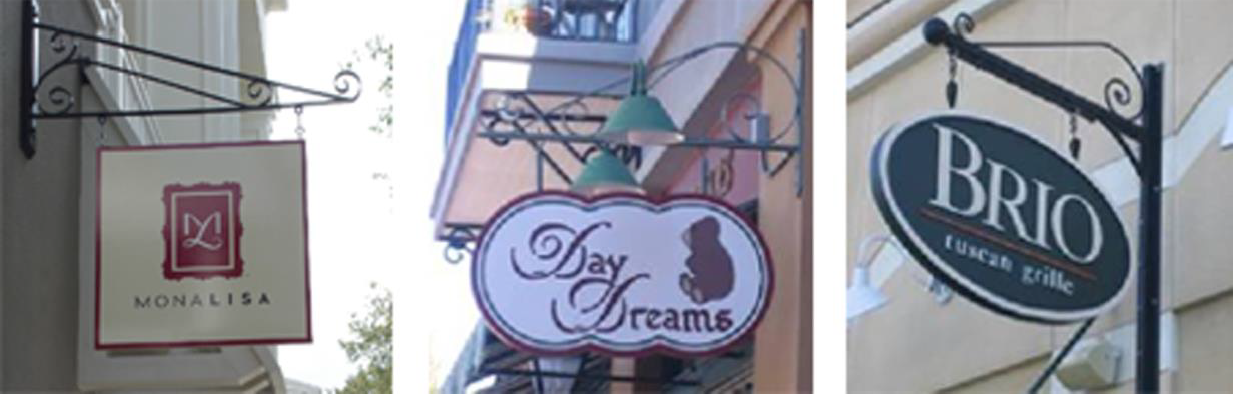
d.
Awning signs.
i.
The character height shall not exceed two-thirds of the height of the face (vertical or near vertical part) of the awning.
ii.
When possible, signs shall be horizontally and vertically centered on the face of the awning.
Figure 11 - 4: Awning Signs
e.
Canopy signs.
i.
The placement of this type of sign shall be limited to the canopy face length.
ii.
No sign shall project beyond the perimeter of the canopy.
iii.
The sign shall not exceed one square foot per lineal foot of canopy face length.
Figure 11 - 5: Canopy Signs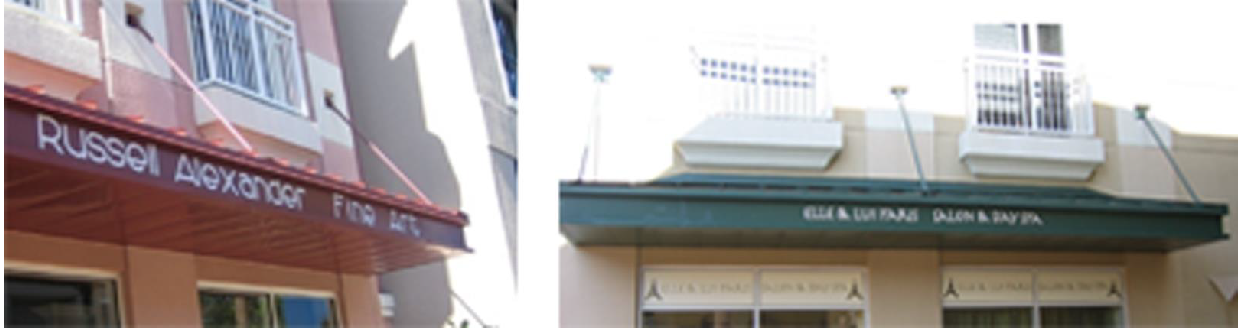
f.
Menu board signs.
i.
One menu board shall be allowed per street address.
ii.
Menu boards shall not exceed eight square feet in size and shall be positioned so as to be adjacent to the restaurant or business listed on the board and information on the board shall advertise exclusively the goods and services of the business and be placed in a manner which is clearly visible to pedestrian traffic.
iii.
Said menu boards shall not be placed in the city's right-of-way.
iv.
All standing menu signs shall be removed at the end of each business day.
v.
All wall menu signs shall be securely anchored to wall.
Figure 11 - 6: Menu Board Signs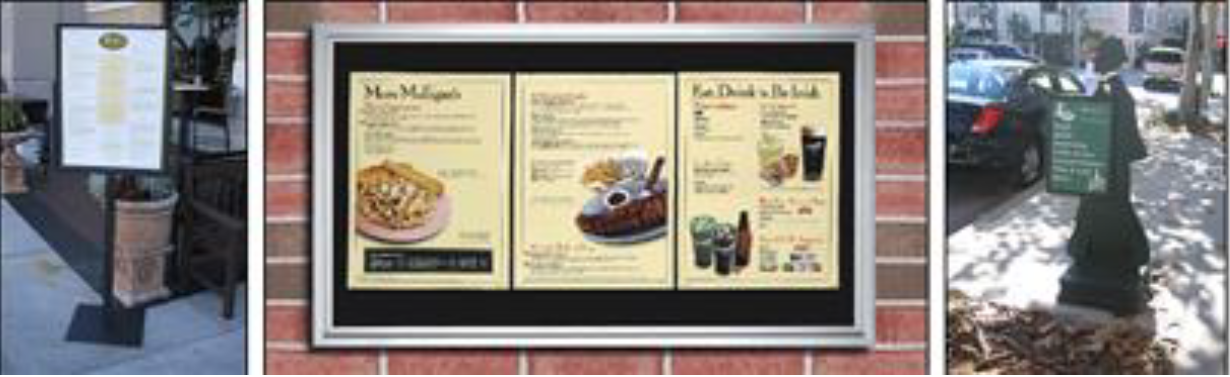
g.
Wayfinding signs.
i.
All public way-finding signs along state, county and city roads shall comply with the Federal Highway Administration, Manual on Uniform Traffic Control Devices (MUTCD) and all other local permitting agencies (FDOT and Volusia County).
ii.
Internal development wayfinding signs may provide location maps, directions, general information and special notices to add liveliness of the development. The signs shall be designed to match the site architecture and be integrated into the layout of pedestrian circulation areas. The maximum size shall be eight square feet mounted on pedestrian light poles or individual decorative poles.
Figure 11 - 7: Wayfinding Signs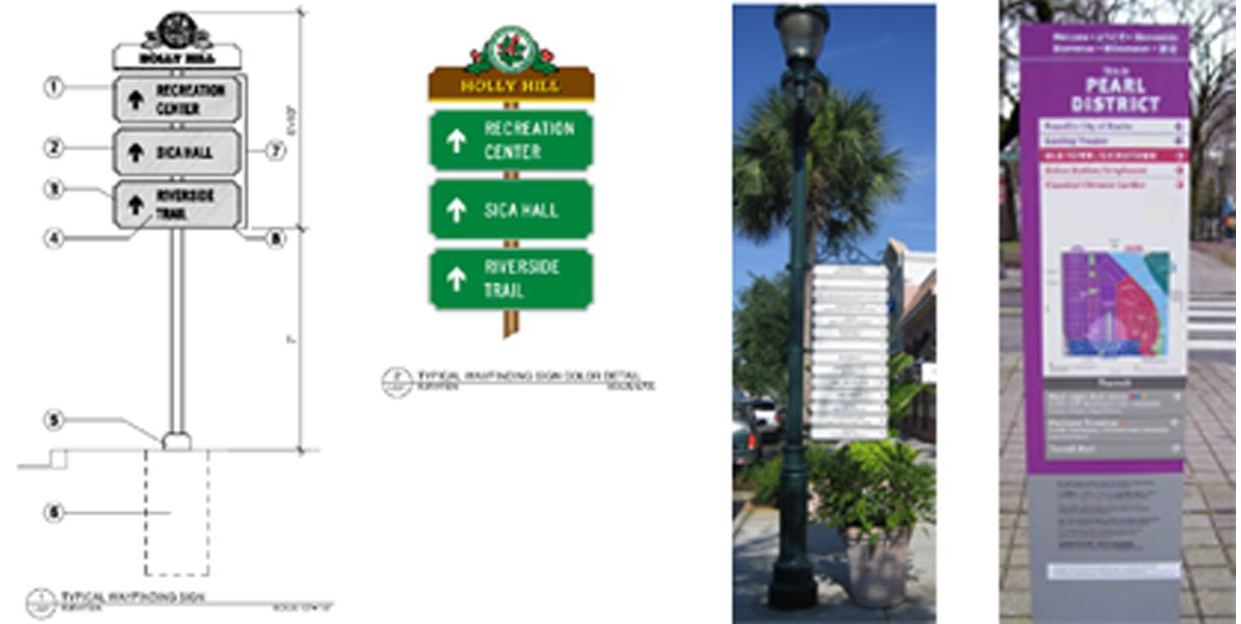
(b)
Signage in the Form-Based Code Overlay Districts.
(1)
Signage in Street Segment SS-2 shall meet the standards of subsection (a) of this section.
(2)
Monument signs.
a.
Monument signs shall not be permitted in Street Segments SS-2 and SS-3 as depicted on Figure 5-3 in Sec. 5.19, except as provided in Sec. 11.15.
b.
Design standards. Vertical structure supports for monument signs shall be concealed in an enclosed base. The width of the enclosed base shall be equal to at least two-thirds of the horizontal width of the sign surface. No copy area shall extend or be placed on the base of the sign.
c.
Construction materials. The base shall be of a low maintenance finish which is compatible with the architectural style of the principal building limited to split face block, stone, finished metal, synthetic EFIS stucco or brick. Monument signs made of wood or vinyl sheets shall be prohibited.
d.
Illumination. Monument signs may be internally illuminated pursuant to Section 11.8(e). They may also be externally illuminated with a burial fixture or hidden within a planter bed. The light source should not be able to be seen from adjoining properties or roads.
e.
Setbacks. New signs shall be erected at least ten feet from any side property line and five from all other property lines.
f.
Landscaping. New monument signs shall be encased in a landscape planter at least two feet in height or a landscaped area of no less than four feet wide on each side of the sign. The planter or landscape area may contain any combination of low lying shrubs, ground cover and flowers.
g.
All signs shall be erected above the enclosed base of the sign and no sign shall be mounted directly in front or to the rear of the base.
(3)
Electronic message center signs are permitted in place of a manual changeable copy board sign. Electronic message center signs shall not be permitted in Street Segments SS-2 and SS-3 as depicted on Figure 5-3 in Sec. 5.19.
Except as specified in an approved comprehensive sign plan or planned development agreement, electronic message center signs shall meet the following design, construction, location, and operational standards:
a.
Only one sign is permitted within the same development or contiguous parcel of property under single ownership, control, or use. For purposes of this section, property is contiguous where it is separated only by a public road.
b.
Off-site advertisement is prohibited.
c.
Signs must be set back at least five feet from the front property line and ten feet from side property lines.
d.
The display screen shall not be oriented toward or face a residential zoning district.
e.
Signs must be constructed as monument signs and have landscaping provided around the base of the sign.
f.
The display screen must be integral to the design of the sign structure and shall not be the dominant element. The display screen area shall not exceed 50% of the sign face. The display area shall apply towards the maximum amount of signage permitted per each site regardless of whether it is illuminated or utilized.
g.
The sign may display one or more static messages. Message changes are permitted only through dissolve, fade, or other subtle transitions and frame effects that do not have the appearance of moving text or images. The individual messages shall not have movement or the appearance or optical illusion of movement.
h.
Sign copy may change only at intervals of no less than 30 seconds. Continuous scrolling, animation, or flashing of lights is prohibited. A notarized affidavit shall be provided with the sign permit application stating the sign will be constructed and operated in compliance with City code, and that it will not flash, move, rotate, scintillate, blink, flicker, or vary in intensity or color.
i.
The display screen area shall provide a high-resolution picture quality with pixel spacing of 16 millimeters or less.
j.
A photometric plan outlining the proposed illumination levels in foot-candles or a certification of compliance from the sign manufacturer shall be provided with the sign permit, which shall demonstrate/certify that illumination levels will not exceed 0.3 foot-candles (Lux meter) above ambient light levels, as measured from a preset distance depending on sign area. Measuring distance shall be determined with the following formula: The square root of the product of the sign area and 100.
Example using a 48 square foot sign: Measurement Distance = √ (48 Sq. Ft. x 100) = 69.3'
k.
Automatic dimming controls such as photocell technology shall be installed to automatically dim the electronic display area as ambient light conditions change.
l.
A malfunctioning sign must be turned off or display a blank screen.
m.
Electronic message center signs shall not be added to, or used to change or expand any nonconforming sign.
n.
An information sheet shall be submitted as part of the sign permit application which includes the manufacturing specifications of the display screen being installed, along with contact information of the property owner, sign contractor and the display screen maintenance provider.
Sec. 11.14. - Sign program for multi-tenant developments.
All tenant wall signage and tenant panels in ground and monument signs within a multi-tenant development, including shopping centers, industrial complexes and office complexes, shall comply with the additional requirements of this section.
(a)
Sign program required.
(1)
Any development intended or designed for multi-tenant use shall establish a sign program identifying the overall sign specifications (not exceeding the provisions of this Code) and allocating signage for individual tenant use.
(2)
Signage for tenants in multi-tenant developments without approved signage programs, but with an established pattern of sign style, location and size, shall be required to conform with such pattern. An established pattern shall be identified as the predominant style, location and size utilized by a minimum of 50% of the tenants.
(3)
In multi-tenant developments where no established pattern exists, the owner of the development shall be required to submit a sign program to the City for approval prior to issuance of any new sign permits. Such program shall address size, location, style, and materials.
(b)
Multi-tenant sign standards.
(1)
Wall signs. The maximum allowable wall sign area shall be one square foot per one linear foot of tenant frontage with a maximum sign copy area of 80 square feet for any one sign. In the case of double frontage tenants, sign area may be transferable to the non-entry facade only where the same or similar facade treatment is used on both front and side, and the copy area does not exceed one-third of the total copy area permitted for the tenant. Maximum sign height shall not exceed 25% of the building height. Wall signs shall not be located on the rear of a multi-tenant building, or the sides of a multi-tenant building when such display would orient the sign to a residential zoned area.
(2)
Monument signs. Multi-tenant developments are allowed a monument sign subject to the design standards of Sec. 11.8.
(Ord. No. 02-12, § 2(exh. A), 9-5-2012)
Sec. 11.15. - Nonconforming signs.
Any lawfully existing permanent sign which was made non-conforming by the adoption of these regulations or any subsequent amendments of these sign regulations may continue in existence unless it becomes abandoned (as defined in Chapter 2) or destroyed. Nonconforming signs shall be removed from the premises or brought into compliance by October 1, 2030. A nonconforming sign use may be continued until October 1, 2030, provided the sign shall not be enlarged or increased in any way from its lawful size at the time of the adoption of these regulations; however, this restriction does not apply to the change of copy (face changes) or changeable copy signs. This section shall not apply to the provisions of Sec. 11.13(b)(2)a for developed properties that do not meet the setback requirements of the Street Segment SS-2. There may be a change of tenancy or ownership of a nonconforming sign without the loss of nonconforming status.
(a)
Abandoned signs shall be removed by the owner, agent or person in charge of the premises within 30 days after receipt of written notification by the Code Enforcement Officer. If the sign is not removed in a timely manner, the violation may be referred to the Special Magistrate.
(b)
Any nonconforming sign which is destroyed or damaged to the extent of 50% or more of the background/copy area, or is altered or replaced, shall not be altered, replaced or reinstalled unless and until it shall have been made to conform to the provisions of this Code.
(Ord. No. 02-12, § 2(exh. A), 9-5-2012; Ord. No. 12-17, § 2, 10-4-2017)

