
Detroit City Zoning Code
ARTICLE XIII
INTENSITY AND DIMENSIONAL STANDARDS
Sec. 50-13-221. - Distance measurements.
Except where linear measurement is indicated, for zoning purposes, all distances shall be measured radially. In other words, for regulatory purposes, the minimum distance between two points shall be the length of an imaginary straight line joining those points. Linear measurement is defined in Section 50-13-283 of this Code and radial measurement is defined in Section 50-16-361 of this Code. (See Figure 50-12-127.)
(Code 1984, § 61-13-141; Ord. No. 11-05, § 1(61-13-141), eff. 5-28-2005)
Sec. 50-13-222. - Lot measurement and requirements.
(a)
Lot area/site area. Lot or site area refers to the amount of horizontal land area that is contained inside the lot lines of a lot or site. Public rights-of-way and easements for street purposes shall not be included in calculating lot size, except where specifically indicated in this article.
(b)
Lot width. Lot width refers to the horizontal distance between side lot lines. Lot width shall be measured at right angles to the lot depth at points 20 feet from the front lot line and 20 feet from the rear lot line.
(c)
Lot depth. Lot depth means the horizontal distance from the midpoint of the front lot line to the midpoint of the rear lot line, or to the most distant point on any other lot line where there is no rear lot line.
(d)
Lot or property line, front. Front lot or property line means the line dividing a lot from a street. On a corner lot, the shorter street line shall be considered the front lot line, provided, that for a lot comprised of more than one lot of record, the front lot line shall be the same as indicated on the plat for the individual parcels which comprise the lot. Where a zoning lot is bounded on two opposite sides by public streets, the zoning lot line fronting on the street that has the wider right-of-way shall be the front zoning lot line. For unusual circumstances, not addressed in this subsection, the enforcing official shall designate which shall be the front lot line.
(e)
Lot or property line, rear. Rear lot or property line means that lot line that is parallel to, and most distant from, the front lot line of the lot. In the case of a triangular, or irregular lot, a line 20 feet in length, entirely within the lot, parallel to and at the maximum possible distance from the street lot line, shall be considered to be the rear lot line.
(Code 1984, § 61-13-142; Ord. No. 11-05, § 1(61-13-142), eff. 5-28-2005)
Sec. 50-13-223. - Measurement of setbacks.
Required setbacks shall be measured as the distance between the nearest lot line and the nearest part of the foundation of a building or structure along a line at right angles to the lot line. Where no minimum front, side, or rear setbacks are specified, the setback line shall be coterminous with the corresponding lot line. Allowable projections into setback areas shall not be utilized for the measurement of setbacks.
(Code 1984, § 61-13-143; Ord. No. 11-05, § 1(61-13-143), eff. 5-28-2005)
Sec. 50-13-224. - Setback requirements.
(a)
Except as provided for in Section 50-13-24 of this Code for single- and two-family dwellings, setbacks shall be provided as required under each zoning district, subject to administrative adjustment as provided for in Section 50-4-122 of this Code.
(b)
Setbacks shall be unobstructed from the ground level to the sky, except as permitted in Section 50-13-226 of this Code.
(Code 1984, § 61-13-144; Ord. No. 11-05, § 1(61-13-144), eff. 5-28-2005)
Sec. 50-13-225. - Location of required setbacks.
Except as specified in this section, all setbacks allocated to a building or dwelling group shall be located on the same zoning lot as such building or dwelling group:
(1)
Alley as part of lot. Where a zoning lot abuts an alley, one-half of the width of said alley shall be considered a part of such zoning lot for the purpose of computing the area of said zoning lot for a residential land use. Where a zoning lot abuts an alley, one-half of the width of said alley may be considered a part of such zoning lot for purposes of computing the depth or width of any setback adjacent to such alley for a residential land use, provided, that at least four feet of each required side setback and 20 feet of the rear setback shall be part of the zoning lot independent of such adjoining alley;
(2)
Street as part of required setback.
a.
Except for setbacks adjacent to off-street parking areas, and for setbacks required by Subsection (1) of this section, where a zoning lot abuts a public street along its side zoning lot line, any portion of the adjoining one-half of said street shall be deemed to supply a part of the required side setback adjacent to such street, provided, that a least four feet of the required side setback shall be part of the zoning lot independent of such adjoining street;
b.
Where a zoning lot is bounded on two opposite sides by public streets, the zoning lot line fronting on the street that has the wider right-of-way shall be the front zoning lot line. Where both street rights-of-way are of equal width, the enforcing official shall designate one to be the front zoning lot line. In such cases, one-half of the width of the public street opposite the front zoning lot line shall be deemed to supply a part of the required rear setback, provided, that at least 20 feet of such required rear setback shall be part of the zoning lot independent of such adjoining street.
(Code 1984, § 61-13-145; Ord. No. 11-05, § 1(61-13-145), eff. 5-28-2005)
Sec. 50-13-226. - Features allowed within required setbacks.
Trees, shrubs, flowers, fences, walls, hedges, and other landscape features may be located within any required setback. In addition, the following table lists features that may be located within any required setbacks, subject to the specific limitations that are delineated:
(1)
Fences. See Section 50-14-381 of this Code.
(2)
Porches (enclosed). Front and rear porches may project not more than eight feet into required front and rear setbacks subject to applicable sections of Chapter 8, Article II, of this Code, Building Code, that pertain to such existing porches:
a.
Such structures are subject to the approval of the Buildings, Safety Engineering, and Environmental Department after receipt of a report and recommendation from the Planning and Development Department. Such report and recommendation shall be submitted within 15 working days of the receipt of the requires from the Buildings, Safety Engineering, and Environmental Department, after which time the Buildings, Safety Engineering, and Environmental Department may proceed with or without said report and recommendation. The Planning and Development Department may recommend changes and or special conditions to the proposed structures, and recommend approval of the proposed structure as adjusted. The Planning and Development Department shall review and determine the following:
1.
That the proposed structure is compatible with the existing structure and surrounding area; and
2.
That the proposed structure does not alter or damage significant architectural elements of the existing residential structure.
b.
Such structure shall be erected and maintained in accordance with the following criteria (Note: Front and rear porches that do not project into a required setback are not subject to the following criteria.):
1.
The structure shall be enclosed with screen panels or windows, or a combination thereof. The structure may be enclosed with kickplates not exceeding 42 inches in height above the floor of the porch. Existing opaque materials, not exceeding 42 inches in height above the floor of the existing porch, shall be permitted;
2.
The structure shall not be enclosed in any way by opaque materials, with the exception of railings, kickplates, or existing opaque material, none of which may exceed 42 inches in height above the floor of the existing porch;
3.
The exterior of the entire structure shall be maintained in a color consistent with the existing residential structure or with the surrounding residential neighborhood; and
4.
The structure shall not be weather-insulated, or have any heating system installed which makes such structure habitable year round, or usable as a general living area.
(3)
Ramps. Ramps for persons with disabilities subject to applicable provisions of the Chapter 8, Article IL of this Code, Building Code, are permitted in rear setbacks and may project into required front and side setbacks by right. In no instance shall any part of such ramps be located nearer than two feet to any property line. Such structures shall be erected and maintained in accordance with the following criteria:
a.
Ramps for persons with disabilities, which project into the required front or side setbacks and are constructed of material other than masonry or concrete or pressure-treated wood or pre-treated synthetics, shall be painted or treated to match the color of the exterior trim or siding of the principal building or painted to blend with the exterior landscaping of the lot;
b.
Open areas underneath ramps for persons with disabilities shall be screened from view by appropriate shrubbery or raised flower beds or raised berm areas, or their equivalent; and
c.
In addition to handrails or guardrails as required by Chapter 8, Article II, of this Code, Building Code, ramps for persons with disabilities shall be provided with a top rail that covers the exposed tops of the support posts or piers.
(Code 1984, § 61-13-146; Ord. No. 11-05, § 1(61-13-146), eff. 5-28-2005; Ord. No. 34-05, § 1(61-13-146), eff. 12-6-2005; Ord. No. 44-06, § 1(61-13-146), eff. 12-21-2006; Ord. No. 2020-12, § 1, eff. 12-9-2020)
Sec. 50-13-227. - Front setback; corner lots.
The front setback of a corner lot shall be measured from the side of the lot that is designated as the "front." On a corner lot, only one street line shall be considered as a front line, which shall be the shorter street frontage. The term "front setback" is defined in Section 50-16-382 of this Code; the term "corner lot" is defined in Section 50-16-284 of this Code.
(Code 1984, § 61-13-147; Ord. No. 11-05, § 1(61-13-147), eff. 5-28-2005)
Sec. 50-13-228. - Contextual front setbacks.
Regardless of the minimum front setback requirements of this article, applicants shall be allowed to use a "contextual" front setback for non-residential purposes. (For residential purposes, see Section 50-13-23 of this Code.) A "contextual" front setback may fall at any point between the required front setback and the front setback that exists on a lot, which is adjacent and oriented to the same street as the subject lot. Where the subject lot is a corner lot, the "contextual" setback may fall at any point between the required front setback and the front setback that exists on the lot, which is adjacent and oriented to the same street as the subject lot. Where lots on either side of the subject lot are vacant, the setback that "exists" on such vacant lots shall be interpreted as the minimum required front setback, which applies to the vacant lot. This provision shall not be interpreted as requiring a greater front setback than imposed by the underlying zoning district, and shall not be interpreted as allowing setbacks to be reduced to a level that results in right-of-way widths dropping below established minimums.
(Code 1984, § 61-13-148; Ord. No. 11-05, § 1(61-13-148), eff. 5-28-2005)
Sec. 50-13-229. - Side setback; Formula A and Formula B.
(a)
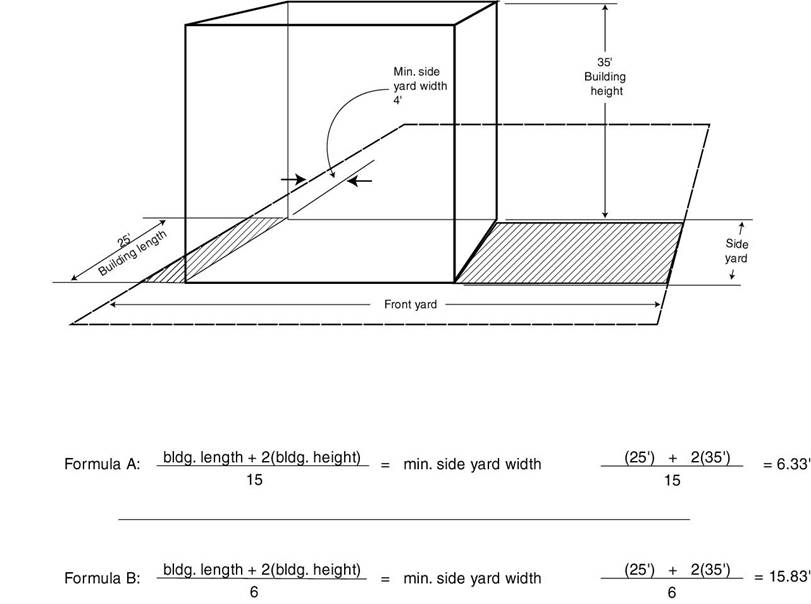
In many instances, side setback requirements are determined through the use of the following formula:
(1)
Formula "A" for determining each required side setback shall be computed by adding the length of the building in feet, as measured in overall dimensions along the adjoining zoning lot line, to twice the height of the building in feet, and dividing the resulting sum by 15.
(2)
Formula "B" for determining each required side setback shall be computed by adding the length of the building in feet, as measured in overall dimensions along the adjoining zoning lot line, to twice the height of the building in feet, and dividing the resulting sum by six. However, in no instance shall a side setback be less than five feet.
(b)
The term "side setback" is defined in Section 50-16-382 of this Code. See Figure 50-13-229.
Figure 50-13-229
(For Informational Purposes Only)
Setback Formulas
(Code 1984, § 61-13-149; Ord. No. 11-05, § 1(61-13-149), eff. 5-28-2005)
Sec. 50-13-230. - Side setback reduction for offsets.
The part of the overall length of a building which, through offset or break, is located a distance from the side zoning lot line, not less than twice the width of the side setback which would otherwise be required for a building of its overall length and height, need not be considered as part of the building length in determining the required width of side setback.
(Code 1984, § 61-13-150; Ord. No. 11-05, § 1(61-13-150), eff. 5-28-2005)
Sec. 50-13-231. - Rear setback; definition.
The term "rear setback" means a setback that is required from the rear lot line and that extends the full width of the lot.
(Code 1984, § 61-13-151; Ord. No. 11-05, § 1(61-13-151), eff. 5-28-2005)
Sec. 50-13-232. - Height measurement.
The height of a building is the vertical distance from the grade plane at the center of the front of the building to the highest point of the structure, for a flat roof or mansard roof, and to the mean height level (midpoint) between eaves and ridge for gables, hip, and gambrel roofs.
(Code 1984, § 61-13-152; Ord. No. 11-05, § 1(61-13-152), eff. 5-28-2005; Ord. No. 20-05, § 1(61-13-152), eff. 5-29-2005)
Sec. 50-13-233. - Exceptions to height regulations.
The following exceptions to height regulations shall apply:
(1)
Penthouses, elevator penthouses, scenery lofts, towers, cupolas, steeples, domes, flag poles, aircraft beacons, and antennas for which a building permit is not required, and chimneys, stacks, tanks, and roof structures that are used for ornamental or mechanical purposes where located on a roof and collectively not exceeding 30 percent in gross area of the roof area, need not be included in determining the height of a building or structure;
(2)
Antennas for which a building permit is required need not be included in determining the height of a building or structure in the B5 and B6 Districts, or in any industrial zoning district, or in any PCA, TM, or SD2 District;
(3)
Parapet walls may extend not more than five feet above the allowable height of a building; and
(4)
Where located in a residential district or in the B1, B2, B3, or B4 business districts, Category B radio antennas and towers may exceed the allowable height regulations on accessory structures, provided, that in no case shall the radio tower exceed applicable FCC height limitations or a height of 75 feet from established grade, whichever is less.
(Code 1984, § 61-13-153; Ord. No. 11-05, § 1(61-13-153), eff. 5-28-2005)
Sec. 50-13-234. - Contextual height.
Regardless of the maximum height limit imposed by this article, applicants shall be allowed to use a "contextual" height limit. The allowed "contextual" height may fall at any point between the maximum height limit and the height of a building, which exists on a lot that is adjacent to the subject lot. Where the subject lot is a corner lot, the "contextual" height may fall at any point between the maximum height limit and the building height, which exists on the lot that is adjacent to the subject lot. Where lots on either side of the subject lot are vacant, the height that "exists" on such vacant lots shall be interpreted as the maximum height limit that applies to the vacant lot. This provision shall not be interpreted as requiring lower maximum heights than imposed by the underlying zoning district.
(Code 1984, § 61-13-154; Ord. No. 11-05, § 1(61-13-154), eff. 5-28-2005)
Sec. 50-13-235. - Compliance with federal height regulations.
In all instances, the height of new development shall comply with height requirements established by the Federal Aviation Administration and codified at 14 CFR 77.
(Code 1984, § 61-13-155; Ord. No. 11-05, § 1(61-13-155), eff. 5-28-2005)
Sec. 50-13-236. - Bulk measurement and requirements; lot coverage.
Lot coverage means the portion of a site that is covered by principal and accessory buildings and structures, as measured from the outside of the building or structure at ground level, and expressed as a percentage of total site area.
(Code 1984, § 61-13-156; Ord. No. 11-05, § 1(61-13-156), eff. 5-28-2005)
Sec. 50-13-237. - Bulk measurement and requirements; floor area ratio.
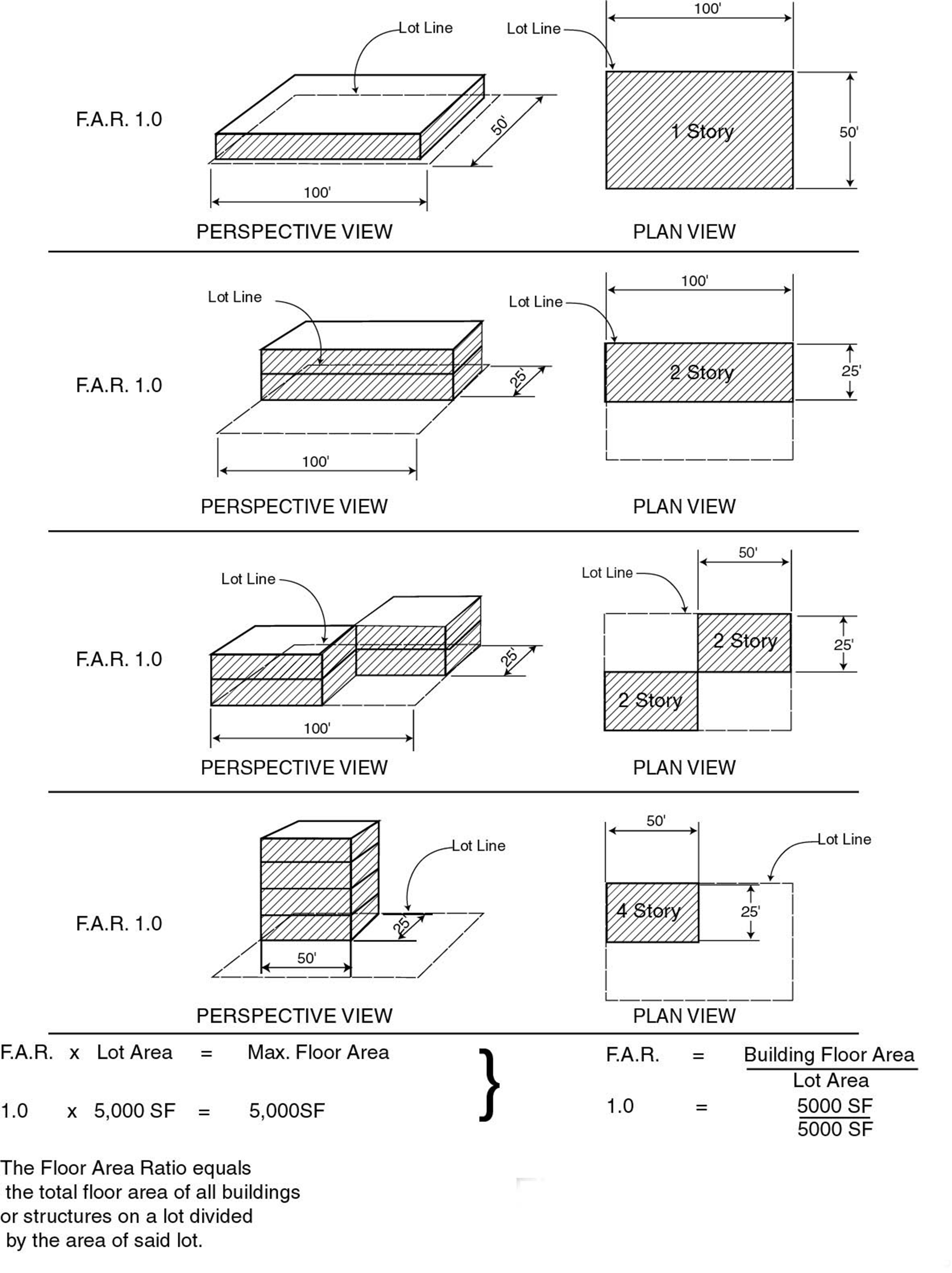
The floor area ratio (FAR) shall be used to determine the maximum amount of floor area which may be built on a zoning lot. The maximum permitted floor area shall be determined by multiplying the zoning lot area, in square feet, by the floor area ratio (FAR) factor (see Figure 50-13-237). The resulting amount, which is the maximum permitted floor area, shall include all the floor areas of all the floors of a building on the zoning lot, measured from the exterior faces of exterior walls or from the centerlines of party walls and shall include elevator shafts and stairwells at each floor, interior balconies and mezzanines, and enclosed porches, but need not include the following areas:
(1)
Areas below the first or ground floor not used as a living room, a dining room, a kitchen, or sleeping accommodations;
(2)
Attic space that provides structural headroom of less than seven feet, six inches;
(3)
Unenclosed steps;
(4)
Any floor area that is devoted exclusively and permanently to noncommercial recreational use, but not to exceed 15 percent of the entire floor area of the building;
(5)
Any floor area, on or above the first or ground floor, that is devoted exclusively and permanently to the housing of building service equipment, including heating, air conditioning, mechanical, electrical, or similar equipment;
(6)
Exterior terraces, balconies and mezzanines, breezeways, and open porches;
(7)
Any space that is devoted exclusively to off-street parking or loading where said space is an integral part of a principal building, unless said building is a parking structure;
(8)
Floor spaces which are not more than 20 feet above grade plane and in accessory parking structures.
Figure 50-13-237
(For Informational Purposes Only)
Floor Area Ratio
(Code 1984, § 61-13-157; Ord. No. 11-05, § 1(61-13-157), eff. 5-28-2005; Ord. No. 20-05, § 1(61-13-157), eff. 5-29-2005)
Sec. 50-13-238. - Bulk measurement and requirements; floor area ratio bonus where adjacent to a large public open space.
The floor area ratio may be increased by 50 percent in all instances where, for at least 50 feet, the zoning lot abuts, or is across a street, alley, easement, or other public right-of-way from, a park or other public open space, excluding a street right-of-way, which is not less than five acres in area and not less than 200 feet deep, measured perpendicularly to the common zoning lot or parcel line.
(Code 1984, § 61-13-158; Ord. No. 11-05, § 1(61-13-158), eff. 5-28-2005)
Sec. 50-13-239. - Recreational space requirements.
The following recreational space requirements shall apply:
(1)
The recreational space ratio (RSR) shall be used to determine the minimum required amount of recreational space to be provided on a zoning lot. As used in this section, gross floor area shall include all the floor areas of all the floors of a building or buildings on the zoning lot, measured from the exterior faces of exterior walls or from the centerlines of party walls and shall include elevator shafts and stairwells at each floor, interior balconies and mezzanines, and enclosed porches, but need not include any area that is devoted exclusively to off-street parking or loading where said area is an integral part of the principal building, floor areas in accessory parking structures, or any area described in Section 50-13-237(1) through (6) of this Code. Required recreational space shall be determined by multiplying the gross floor area of all existing and proposed structures by the RSR. The resulting amount, which is the minimum required recreational space, shall include only that part of the ground area of a zoning lot which:
a.
Is devoted to outdoor recreational space, greenery, or service space for household activities that are normally carried on outdoors; and
b.
Is not devoted to private roadways that are open to vehicular transportation, driveways, accessory off-street parking space or aisles, or accessory off-street loading berths; and
c.
Contains no structures on the ground except:
1.
Open porches;
2.
Terraces;
3.
Recreational equipment;
4.
Clotheslines;
5.
Arbors, trellises, walls or fences, bird baths, ornamental features, window boxes or other planting boxes;
6.
Flagpoles;
7.
Seating;
d.
Is accessible to the occupants of all dwelling units within the structure; and
e.
Is located in a side or rear setback and has a minimum dimension of 18 feet where the development served has nine or fewer dwelling or rooming units, or is so located and has a minimum dimension of 25 feet where the development served has ten or more dwelling or rooming units, or is so located and has a minimum dimension of 25 feet where the development served has ten or more dwelling or rooming units. All required recreational spaces shall comply with the minimum dimension delineated in this article and said dimension shall be measured along a perpendicular line drawn from any point on one side of the recreational space to the opposite side; and
f.
Is unobstructed between the ground and the sky, except that not more than 25 percent of the total recreational space provided on any zoning lot may be roofed, and in such case not more than 50 percent of the perimeter of the roofed section shall be enclosed. The provisions of this subsection may only be modified as provided Article IV, Division 6, of this chapter.
(2)
Recreational space on a roof, or private balcony, private patio, or similar private area may be substituted for ground recreational space in accordance with the following:
a.
Substitution of roof space. Each square foot of recreational space on a roof may be substituted for one square foot of ground recreational space provided, that the following conditions are met:
1.
Minimum dimension. Such recreational space on a roof shall have a minimum dimension of 15 feet, measured from inside of parapet or railing to inside of parapet or railing, or to the exterior face of any wall or other obstruction projecting above roof level;
2.
No obstructions. Such recreational space on a roof shall be free of all obstructions, except for arbors, trellises, window boxes or other planting boxes, awnings or canopies, flagpoles, plumbing or air vents, recreational or clothes drying equipment;
3.
Design and safety precautions. Such recreational space on a roof shall be suitably surfaced and shall be protected by a parapet or railing in accordance with Chapter 8, Article II, of this Code, Building Code; and
4.
Accessibility. Such recreational space shall be accessible to the occupants of all dwelling units within the structure.
b.
Substitution of private balcony, private patio, or similar private area. Each square foot of recreational space on a private balcony, private patio, or similar private area, as determined by the enforcing official, may be substituted for one square foot of ground or roof recreational space provided, that the following conditions are met:
1.
Minimum dimension and area. Such areas shall have a minimum dimension of four feet, six inches, measured perpendicularly from one side to the other side, and a minimum net area of 22½ square feet;
2.
No obstructions. Such areas shall be free of all obstructions, except arbors, trellises, window boxes or other planting boxes, awnings or canopies, recreational or clothes drying equipment; and
3.
Safety precautions. Such areas shall be protected in accordance with Chapter 8, Article II, of this Code, Building Code.
c.
At least 50 percent of the total required recreational space shall be accessible to all residents and shall be provided on the ground or roof and, where a portion of the recreational space is provided on a private balcony or similar area, the minimum dimension of the required ground or roof space may only be adjusted as provided for in Article IV, Division 6, of this chapter, provided, that in no instance shall the minimum ground or roof dimension be less than 12 feet;
d.
The formula is as follows: minimum recreational space equals gross floor area times recreational space ratio.
(Code 1984, § 61-13-159; Ord. No. 11-05, § 1(61-13-159), eff. 5-28-2005; Ord. No. 20-06, § 1(61-13-159), eff. 8-10-2006)
Sec. 50-13-251. - In general.
This division presents options for residential development patterns that may be undertaken as alternatives to the dimensional requirements that are set out in Divisions 1 and 2 of this article. Pursuant to Article III, Division 5, of this chapter, all development options that are set out in this division must be approved during site plan review. These alternative development options may be further limited or modified by other applicable provisions of this chapter.
(Code 1984, § 61-13-171; Ord. No. 11-05, § 1(61-13-171), eff. 5-28-2005; Ord. No. 20-06, § 1(61-13-171), eff. 8-10-2006; Ord. No. 2020-21, § 1, eff. 8-8-2020)
Sec. 50-13-252. - Auto courts.
Within residential zoning districts, up to four single-family dwelling units may share a single driveway access to a public street through the use of an auto court layout, provided, that the following conditions are met:
(1)
Shared driveways shall be surfaced with concrete, not asphalt, and shall be dedicated to a property owners' association, which is responsible for maintaining the shared driveway, and has the authority to enforce payment of dues from individual homeowners in order to do so. The property owner's association shall be created and the shared driveway shall be dedicated to the association before a Certificate of Occupancy is issued for any dwelling unit that uses the shared driveway;
(2)
Individual driveways that lead from the shared driveway to each dwelling unit shall be at least 25 feet long, as measured between the front of the garage or carport and the closest edge of the shared driveway;
(3)
The design of the auto court shall permit a passenger vehicle to back out of an individual driveway and turn 90 degrees in either direction without any portion of the vehicle:
a.
Leaving the share driveway or the individual driveway where the vehicle is exiting; or
b.
Entering on or over the individual driveways of any other residence. The American Association of State Highway and Transportation Officials turning template for a "P" design vehicle shall be used to confirm that this standard is met;
(4)
The auto court must comply with off-street parking requirements that are applicable to single-family dwellings and with the following additional requirements:
a.
No parking or vehicle storage shall be permitted on the shared driveway; and
b.
One common, off-street parking space shall be provided for each auto court.
(Code 1984, § 61-13-172; Ord. No. 11-05, § 1(61-13-172), eff. 5-28-2005)
Sec. 50-13-253. - Multi-building, multi-family developments.
Development parcels that contain two or more primary structures with any use other than a single-family detached residential unit shall comply with the following:
(1)
Section 50-14-397 of this Code; and
(2)
Yards for two or more buildings per lot. The following requirements shall apply to a public or private group housing development when two or more attached groups of townhouses, garden apartment buildings, apartment houses, terraces, or mixture of housing types are located on the same lot:
a.
The minimum horizontal distance between buildings, that is, front to front, rear to rear, or front to rear, as the case may be, shall be 40 feet for buildings one story in height, and shall be increased by not less than five feet for every story added. The minimum distance between buildings may be decreased by as much as ten feet toward one end where it is increased by a similar distance at the other;
b.
The horizontal distance between the ends of buildings shall be 20 feet or more for one- or two-story dwellings. Where the end of one building is opposite the face or rear of another building, the minimum horizontal distance between them shall be 30 feet for buildings one story in height. These distances shall be increased by not less than five feet for every story added;
c.
The front, side, and rear setbacks shall be computed as required by the zoning district; and
d.
The required front, side, or rear setback of one building may not serve as the required front, side, or rear setback of a second building.
(Code 1984, § 61-13-173; Ord. No. 11-05, § 1(61-13-173), eff. 5-28-2005; Ord. No. 44-06, § 1(61-13-173), eff. 12-21-2006; Ord. No. 13-11, § 1(61-13-173), eff. 8-23-2011)
Sec. 50-13-254. - Lots of less than 5,000 square feet (small lots).
Lots of less than 5,000 square feet that are intended for development of single-family detached houses are referred to as "small lots," and are permitted in some zoning districts in order to encourage creative site designs for smaller lots as provided in Section 50-13-255 and Section 50-13-256 of this Code.
(Code 1984, § 61-13-174; Ord. No. 11-05, § 1(61-13-174), eff. 5-28-2005)
Sec. 50-13-255. - Small lot development; design objective.
The objective of the small lot single-family design standards is to provide housing for individuals and families who seek convenience and a minimized home maintenance lifestyle. The small lot site plan shall be specifically designed to provide adequate light and air between units, adequate drainage between lots, interior and exterior privacy, open space relief on the individual lot, innovative and architecturally interesting home design, attractive streetscapes, and adequate parking.
(Code 1984, § 61-13-175; Ord. No. 11-05, § 1(61-13-175), eff. 5-28-2005)
Sec. 50-13-256. - Small lot development standards.
All small lots shall comply with the standards in the following table:
(Code 1984, § 61-13-176; Ord. No. 11-05, § 1(61-13-176), eff. 5-28-2005)
Sec. 50-13-257. - Zero lot line development; in general.
In a zero lot line development, houses are shifted to one side of their lot. This provides for greater usable yard space on each lot. These developments require that planning for all of the house locations be done at the same time. Because the exact location of each house is predetermined, greater flexibility in site development is possible while ensuring that the single-family detached character is maintained.
(Code 1984, § 61-13-177; Ord. No. 11-05, § 1(61-13-177), eff. 5-28-2005)
Sec. 50-13-258. - Zero lot line development; applicability.
Zero lot line developments are allowed by right in any residential district as an alternative residential development option.
(Code 1984, § 61-13-178; Ord. No. 11-05, § 1(61-13-178), eff. 5-28-2005)
Sec. 50-13-259. - Zero lot line development; review and approval.
Review for compliance with the standards of Section 50-13-260 and Section 50-13-261 of this Code that involve zero lot line development shall occur during the platting process or in the preliminary stages of site condominium development. Restrictions that ensure the minimum distance between houses and any required easements must be recorded on the deeds of the applicable lots. Proof of such recordation must be submitted as part of the building permit application.
(Code 1984, § 61-13-179; Ord. No. 11-05, § 1(61-13-179), eff. 5-28-2005)
Sec. 50-13-260. - Zero lot line development; setbacks.
The side building setback on one side of the house may be reduced to zero. This reduction does not apply to the street side setback or to the interior side setback that is adjacent to lots, which are not part of the zero lot line project.
(Code 1984, § 61-13-180; Ord. No. 11-05, § 1(61-13-180), eff. 5-28-2005)
Sec. 50-13-261. - Zero lot line development; additional standards.
The following additional zero lot line development standards shall apply:
(1)
Distance between houses. The minimum distance between all buildings in the development must be equal to twice the minimum required side setbacks that are specified in the underlying zoning district. A deed restriction must be recorded on the deed of each applicable lot to ensure continued compliance with this setback;
(2)
Eaves. The eaves on the side of a house with a reduced setback may project a maximum of 24 inches over the adjacent property line. In this case, an easement for the eave projection must be recorded on the deed for the lot where the projection occurs; and
(3)
Maintenance easement. An easement to allow for maintenance or repair is required where the eaves or side wall of a house are within four feet of the adjacent property line. The easement on the adjacent property must provide at least ten feet of unobstructed space between the furthermost project of the structure and be wide enough to allow five feet between the eaves or side wall and the edge of the easement.
(Code 1984, § 61-13-181; Ord. No. 11-05, § 1(61-13-181), eff. 5-28-2005)
Sec. 50-13-1. - Residential Districts in general.
All principal structures in residential districts shall be subject to the intensity and dimensional standards set forth in the tables in Section 50-13-2 through Section 50-13-7 of this Code, unless undertaken through one or more of the alternative residential development options set forth in Division 3 of this article or where the structure is located on a zoning lot abutting a Traditional Main Street, in which case the setback shall be as specified in Section 50-14-432 of this Code. These intensity and dimensional standards may be further limited or modified by other applicable sections of this chapter. Additional general standards that are applicable to the residential districts are set forth immediately following the tables in Section 50-13-2 through Section 50-13-7 of this Code. Additional specific standards and exceptions are located in Subdivisions I and J, of this division. Rules of measurement and exceptions are set forth in Division 2 of this article.
(Code 1984, § 61-13-1; Ord. No. 11-05, § 1(61-13-1), eff. 5-28-2005; Ord. No. 20-05, § 1(61-13-1), eff. 5-29-2005; Ord. No. 23-13, § 1(61-13-1), eff. 8-28-2013)
Sec. 50-13-2. - R1 District.
Intensity and dimensional standards within the R1 Single-Family Residential District are as follows:
(Code 1984, § 61-13-2; Ord. No. 11-05, § 1(61-13-2), eff. 5-28-2005; Ord. No. 34-05, § 1(61-13-2), eff. 12-6-2005; Ord. No. 38-14, § 1(61-13-2), eff. 10-16-2014)
Sec. 50-13-3. - R2 District.
Intensity and dimensional standards within the R2 Two-Family Residential District are as follows:
(Code 1984, § 61-13-3; Ord. No. 11-05, § 1(61-13-3), eff. 5-28-2005; Ord. No. 34-05, § 1(61-13-3), eff. 12-6-2005; Ord. No. 38-14, § 1(61-13-3), eff. 10-16-2014)
Sec. 50-13-4. - R3 District.
Intensity and dimensional standards in the R3 Low Density Residential District are as follows:
(Code 1984, § 61-13-4; Ord. No. 11-05, § 1(61-13-4), eff. 5-28-2005; Ord. No. 34-05, § 1(61-13-4), eff. 12-6-2005; Ord. No. 44-06, § 1(61-13-4), eff. 12-21-2006; Ord. No. 38-14, § 1(61-13-4), eff. 10-16-2014)
Sec. 50-13-5. - R4 District.
Intensity and dimensional standards within the R4 Thoroughfare Residential District are as follows:
(Code 1984, § 61-13-5; Ord. No. 11-05, § 1(61-13-5), eff. 5-28-2005; Ord. No. 34-05, § 1(61-13-5), eff. 12-6-2005; Ord. No. 38-14, § 1(61-13-5), eff. 10-16-2014)
Sec. 50-13-6. - R5 District.
Intensity and dimensional standards within the R5 Medium Density Residential District are as follows:
(Code 1984, § 61-13-6; Ord. No. 11-05, § 1(61-13-6), eff. 5-28-2005; Ord. No. 34-05, § 1(61-13-6), eff. 12-6-2005; Ord. No. 38-14, § 1(61-13-6), eff. 10-16-2014)
Sec. 50-13-7. - R6 District.
Intensity and dimensional standards within the R6 High Density Residential District are as follows:
(Code 1984, § 61-13-7; Ord. No. 11-05, § 1(61-13-7), eff. 5-28-2005; Ord. No. 34-05, § 1(61-13-7), eff. 12-6-2005; Ord. No. 38-14, § 1(61-13-7), eff. 10-16-2014)
Sec. 50-13-21. - Lot size requirements.
Lot size requirements are specified for each zoning district in this article. In addition, the following general regulations are applicable to all residential zoning districts:
(1)
No use shall be established on a lot platted and recorded on or after December 22, 1968, which is of less area or width than prescribed in this section for such use in the zoning district where it is to be located. This provision shall not apply where approvals have been given for the division of recorded lots in accordance with Chapter 24 of this Code, Land Division and Subdivision. If parts of two or more parcels of land, any part of which was platted and identified as a single unit on a plat officially approved and recorded prior to December 22, 1968, are combined to create a zoning lot upon which a building for residential purposes is to be built, the ensuing zoning lots shall be no smaller in width or area than the larger or largest of such parcels which were platted and identified as a single unit on a plat officially approved and recorded prior to December 22, 1968, provided, that no zoning lot so created need be larger than the minimum size as specified for the district where it is located;
(2)
In the R1, R2, R3, R4, R5 and R6 Districts, a single-family detached dwelling, parsonage, rectory, or parish house may be established on a lot of record on December 22, 1968, regardless of the size of the lot, provided, that all other requirements of this chapter are met;
(3)
In the R2, R3, R4, R5, and R6 Districts, a two-family dwelling may be established on a lot of record on December 22, 1968, of a lesser width or area than the required, provided, that all other requirements of the district where it is located are met. In no instance, shall a two-family dwelling be established on a lot having a width of less than 40 feet or an area of less than 4,000 square feet;
(4)
In the R3, R4, R5, and R6 Districts, a multiple-family dwelling may be established on a lot of record on December 22, 1968, of a lesser width or area than that required, provided, that all other requirements of the district where the dwelling is located are met. In no instance, shall a multiple-family dwelling be established on a lot having a width of less than 50 feet or an area of less than 6,000 square feet;
(5)
Unless otherwise specified, lot width shall be measured at a distance of 20 feet from the front line of the subject zoning lot.
(Code 1984, § 61-13-11; Ord. No. 11-05, § 1(61-13-11), eff. 5-28-2005)
Sec. 50-13-22. - Traffic safety sight area.
In order to provide a clear line of sight for the drivers of approaching motor vehicles, the following requirements shall apply:
(1)
On a corner lot in the R1, R2, R3, R4, R5, R6, and residential PD Districts, no opaque fence, wall, hedge, or other structure, shrubbery, mounds of earth or other visual obstruction over 36 inches in height above the nearest street curb elevation shall be erected, placed, planted, or allowed to grow within the "clear vision triangle," as described in Subsection (3) of this section;
(2)
Subsection (1) of this section shall not apply to public utility poles; trees trimmed to the trunk to a line at least six feet above the level of the intersection; saplings or plant species of open growth habits and not planted in the form of a hedge, which are so planted and trimmed as to leave a clear and unobstructed cross view during all seasons; supporting members of appurtenances to permanent structures existing on the date this section became effective, which is May 28, 2005; and official warning signs or signals;
(3)
The "clear vision triangle" is that area formed by extending the two curb lines a distance of 45 feet from their point of intersection and connecting these points with an imaginary line, thereby making a triangle;
(4)
In cases where streets do not intersect at approximately right angles, the Department of Public Works Traffic Engineering Division shall have the authority to vary these requirements as it deems necessary to provide safety for both vehicular and pedestrian traffic, provided, that site distance in excess of 275 feet shall not be required.
(5)
See Section 50-14-381 of this Code.
(Code 1984, § 61-13-12; Ord. No. 11-05, § 1(61-13-12), eff. 5-28-2005; Ord. No. 2020-12, § 1, eff. 12-9-2020)
Sec. 50-13-23. - Exceptions to the required depth of front setbacks.
Front setbacks of zoning lots used for residential purposes shall be increased or may be reduced in accordance with the following conditions:
(1)
In the event one or both of the existing abutting residential dwellings has been erected at the rear one-half of the zoning lot, said dwelling shall be disregarded for purposes of computing the required front setback and said zoning lot shall be considered to be vacant for purposes of this section;
(2)
In cases wherein residential dwellings that have a front setback greater than 20 feet in depth have been erected on both sides of a zoning lot, the required front setback of the zoning lot to be built upon shall be at least as large as the smaller front setback of the adjacent residential dwellings;
(3)
In cases where residential dwellings, that have front setbacks of less than 20 feet or more than 20 feet in depth, have been erected on one or both sides of a subject lot, except as regulated in Subsection (2) of this section, the required front setback of the zoning lot is to be reduced or increased in accordance with the following rules:
a.
In cases where the zoning lot to be built upon is situated between two zoning lots, both of which have been built upon, and either or both of which has a front setback less than 20 feet or more than 20 feet in depth, the center point of the front wall of the proposed structure shall be located on, or to the rear of, a straight line drawn between the center points of the front walls of the existing buildings on these two zoning lots;
b.
In such cases where the zoning lot to be built upon has a lot on one side not built upon, but there is a zoning lot on the other side already built upon with a front setback less than 20 feet or more than 20 feet in depth, the required minimum depth of the front setback for the lot to be built upon shall be determined as follows: A straight line shall be drawn between the center point of the front wall of the existing building and a point 20 feet inside of the front lot line and 80 feet distant from the zoning lot to be built upon and on the other side thereof. The center point of the front wall of the proposed building shall be located on or to the rear of this line; and
c.
In such cases where the zoning lot to be built upon is bounded on one side by a street or alley and on the other side by a zoning lot already built upon with a front setback less than 20 feet or more than 20 feet in depth, the required minimum depth of the front setback for the zoning lot to be built upon shall be equal to the existing depth of the front setback on the adjoining lot.
(Code 1984, § 61-13-13; Ord. No. 11-05, § 1(61-13-13), eff. 5-28-2005)
Sec. 50-13-24. - Special provisions for side setbacks for single- or two-family dwellings.
The following special provisions for side setbacks shall apply for single- or two-family dwellings:
(1)
Side setbacks on zoning lots of less than minimum width. The required combined width of side setbacks may be reduced by six inches for each foot or major fraction thereof by which the width of such lot is less than that required, provided, that the combined width of both side setbacks shall not be less than ten feet, six inches, nor shall the width of either side setback be less than three feet;
(2)
Side setbacks on zoning lots abutting an alley and whose width is less than 35 feet. The required combined width of side setbacks may be reduced by nine-tenths of a foot for each foot or major fraction thereof by which the width of such lot is less than 35 feet, provided, that the combined width of both side setbacks shall not be less than six feet, and that the width of either side setback shall not be less than three feet, provided further, that in no instance shall a two-family dwelling be established on a lot having a width of less than 40 feet or an area of less than 4,000 square feet;
(3)
Side setback. Each zoning lot upon which a two-family dwelling is placed or erected where the dwelling units are located one behind the other, shall provide minimum side setbacks of not less than ten feet on each side; and
(4)
See also "Alternative Residential Development Options," Division 3 of this article.
(Code 1984, § 61-13-14; Ord. No. 11-05, § 1(61-13-14), eff. 5-28-2005)
Sec. 50-13-25. - Rear and side setback exceptions for multiple-family dwellings.
The following rear and side setback exceptions shall apply for multiple-family dwellings:
(1)
Rear setback. Each zoning lot upon which a multiple-family dwelling is placed or erected where the only entrance of a unit within the building opens directly on a rear yard, shall provide a rear yard of not less than 45 feet, and the five feet nearest the building shall not be used for vehicular parking. Where the balance of the yard is utilized for vehicular parking purposes, the five feet or greater space shall be separated from the parking area by precast concrete wheel stops or their equivalent, at least six inches in height, and located on the parking area not less than three feet from the edge of the five feet or greater space. Firmly implanted bumper guards that are located at the edge of the parking area may be substituted for the above-required wheel stops;
(2)
Side setback. Where any side setback is used in whole or in part for vehicular parking, the five feet nearest the principal building shall not be used for vehicular parking or driveway purposes, and this five feet or greater space shall be separated from the balance of the setback by a barrier as described in Subsection (1) of this section;
(3)
Side setback. Except as provided for in 50-13-181 of this Code, each zoning lot upon which a multiple-family dwelling is placed or erected where the only entrance of a unit within the structure opens directly on a side yard not abutting a street, shall provide a side setback of not less than 20 feet; and
(4)
The provisions with respect to parking in Article XIV, Division 1, Subdivision I (off-street parking area design); Article XIV, Division 1, Subdivision E (use of accessory parking lots and areas); and Article XIV, Division 2, Subdivision C, of this chapter (off-street parking areas) shall also apply.
(Code 1984, § 61-13-15; Ord. No. 11-05, § 1(61-13-15), eff. 5-28-2005; Ord. No. 44-06, § 1(61-13-15), eff. 12-21-2006)
Sec. 50-13-26. - Special provisions for cemeteries.
Where a cemetery abuts or is across a street, alley, or easement from property zoned R1, R2, R3, R4, R5, R6, or residential PD, a 20-foot setback shall be provided subject to the following conditions:
(1)
That no burials be permitted in said setback;
(2)
That said setback be landscaped with grass and trees, shrubs, or other ornamental horticultural materials; and
(3)
That said setback be maintained in a neat and orderly condition at all times.
(Code 1984, § 61-13-16; Ord. No. 11-05, § 1(61-13-16), eff. 5-28-2005)
Sec. 50-13-27. - Mobile home park.
Mobile home parks must have at least 100 feet of frontage on a major thoroughfare and each mobile home space must be at least 30 feet wide as measured at a point 20 feet from the primary access drive.
(Code 1984, § 61-13-17; Ord. No. 11-05, § 1(61-13-17), eff. 5-28-2005)
Sec. 50-13-28. - Lofts.
The setback requirements for "all other uses" in the R3, R4, R5, and R6 Districts do not apply to lofts.
(Code 1984, § 61-13-18; Ord. No. 20-05, § 1(61-13-18), eff. 5-29-2005)
Sec. 50-13-29. - Setback requirements; lot area and lot width requirements.
The setback requirements, the lot area requirements, and the lot width requirements for residential uses and public, civic, and institutional uses do not apply where such a use is established in an existing building, provided, that any expansion of such use shall comply with applicable setback requirements.
(Code 1984, § 61-13-19; Ord. No. 34-05, § 1(61-13-19), eff. 12-6-2005)
Sec. 50-13-41. - Business Districts in general.
All primary structures in business districts shall be subject to the intensity and dimensional standards that are set out in the tables in Section 50-13-42 through Section 50-13-47 of this Code, except where the structure is located on a zoning lot abutting a Traditional Main Street, in which case the setback shall be as specified in Section 50-14-432 of this Code. These intensity and dimensional standards may be further limited or modified by other applicable sections of this chapter. Additional general standards applicable to the business districts are set forth immediately following the table in Subdivision D of this division. Additional specific standards and exceptions are located in Subdivisions I and J of this division. Rules of measurement and exceptions are set forth in Division 2 of this article.
(Code 1984, § 61-13-21; Ord. No. 11-05, § 1(61-13-21), eff. 5-28-2005; Ord. No. 20-05, § 1(61-13-21), eff. 5-29-2005; Ord. No. 23-13, § 1(61-13-21), eff. 8-28-2013)
Sec. 50-13-42. - B1 District.
Intensity and dimensional standards in the B1 Restricted Business District are as follows:
(Code 1984, § 61-13-22; Ord. No. 11-05, § 1(61-13-22), eff. 5-28-2005; Ord. No. 34-05, § 1(61-13-22), eff. 12-6-2005; Ord. No. 38-14, § 1(61-13-22), eff. 10-16-2014)
Sec. 50-13-43. - B2 District.
Intensity and dimensional standards in the B2 Local Business and Residential District are as follows:
(Code 1984, § 61-13-23; Ord. No. 11-05, § 1(61-13-23), eff. 5-28-2005; Ord. No. 34-05, § 1(61-13-23), eff. 12-6-2005; Ord. No. 37-17, § 1(61-13-23), eff. 2-6-2018)
Sec. 50-13-44. - B3 District.
Intensity and dimensional standards in the B3 Shopping District are as follows:
(Code 1984, § 61-13-24; Ord. No. 11-05, § 1(61-13-24), eff. 5-28-2005; Ord. No. 34-05, § 1(61-13-24), eff. 12-6-2005; Ord. No. 26-12, § 1(61-13-24), eff. 11-21-2012; Ord. No. 2023-6, § 1, eff. 3-8-2023)
Sec. 50-13-45. - B4 District.
Intensity and dimensional standards in the B4 General Business District are as follows:
(Code 1984, § 61-13-25; Ord. No. 11-05, § 1(61-13-25), eff. 5-28-2005; Ord. No. 34-05, § 1(61-13-25), eff. 12-6-2005; Ord. No. 26-12, § 1(61-13-25), eff. 11-21-2012; Ord. No. 37-17, § 1(61-13-25), eff. 2-6-2018; Ord. No. 2023-6, § 1, eff. 3-8-2023)
Sec. 50-13-46. - B5 District.
Intensity and dimensional standards in the B5 Major Business District are as follows:
(Code 1984, § 61-13-26; Ord. No. 11-05, § 1(61-13-26), eff. 5-28-2005; Ord. No. 26-12, § 1(61-13-26), eff. 11-21-2012; Ord. No. 37-17, § 1(61-13-26), eff. 2-6-2018)
Sec. 50-13-47. - B6 District.
Intensity and dimensional standards in the B6 General Services District are as follows:
(Code 1984, § 61-13-27; Ord. No. 11-05, § 1(61-13-27), eff. 5-28-2005; Ord. No. 26-12, § 1(61-13-27), eff. 11-21-2012; Ord. No. 26-16, § 1(61-13-27), eff. 8-11-2016; Ord. No. 2023-6, § 1, eff. 3-8-2023)
Sec. 50-13-61. - Lot size requirements.
Lot width shall be measured at the front line of the zoning lot, except for residential uses where lot width shall be measured at a distance of 20 feet from the front zoning lot line.
(Code 1984, § 61-13-31; Ord. No. 11-05, § 1(61-13-31), eff. 5-28-2005)
Sec. 50-13-62. - Setback requirements; lot area and lot width requirements.
(a)
Where a dwelling unit is erected, located, or placed above another type of use in a B2 or B4 District, no setbacks shall be required for the dwelling unit, except a rear setback which may begin at the lowest floor occupied for dwelling purposes.
(b)
The setback requirements for "all other residential and public, civic and institutional uses" in the B1, B2, B3, and B4 Districts do not apply to lofts;
(c)
The setback requirements for "all other residential uses and public, civic, and institutional uses" do not apply to "residential uses combined in structures with permitted commercial uses" on land zoned B2, B3, or B4 in designated Traditional Main Street Overlay Areas, as provided in Section 50-11-382 of this Code.
(d)
The setback requirements, the lot area requirements, and the lot width requirements for residential uses and public, civic, and institutional uses do not apply where such a use is established in an existing building, provided, that any expansion of such use shall comply with applicable setback requirements.
(Code 1984, § 61-13-32; Ord. No. 11-05, § 1(61-13-32), eff. 5-28-2005; Ord. No. 20-05, § 1(61-13-32), eff. 5-29-2005; Ord. No. 34-05, § 1(61-13-32), eff. 12-6-2005)
Sec. 50-13-63. - B3 and B4 District height limitations.
The following provisions shall apply to B3 and B4 Districts:
(1)
The maximum height for each principal use in the B3 and B4 Districts shall not exceed 35 feet;
(2)
Where the zoning lot fronts on a street which is 80 feet or more in width and is designated by the Detroit Master Plan of Policies as a major or secondary thoroughfare, and where the outer most point of the proposed building on said zoning lot is 40 feet or more from the nearest point of the lot line of all R1, R2, and R3 Districts, the maximum height may be increased, as a matter of right, one foot for each one foot of street width greater than 80 feet, provided, that in no case shall the building exceed 80 feet in height; and
(3)
Where the zoning lot fronts on a street which is 80 feet or more in width and is designated by the Detroit Master Plan of Policies as a major or secondary thoroughfare, and where the zoning lot abuts, is adjacent to, or across an alley from any zoning district other than an R1, R2, R3 or residential PD District, the maximum height may be increased, by right, one foot for each one foot of street width greater than 80 feet, regardless of the location of the proposed structure, provided, that in no case shall the building exceed 80 feet in height.
(Code 1984, § 61-13-33; Ord. No. 11-05, § 1(61-13-33), eff. 5-28-2005; Ord. No. 34-05, § 1(61-13-33), eff. 12-6-2005; Ord. No. 2020-12, § 1, eff. 12-9-2020)
Sec. 50-13-81. - Industrial Districts in general.
All primary structures in industrial districts shall be subject to the intensity and dimensional standards that are set out in the tables in Section 50-13-82 through Section 50-13-86 of this Code, except where the structure is located on a zoning lot abutting a Traditional Main Street, in which case the setback shall be as specified in Section 50-14-432 of this Code. These intensity and dimensional standards may be further limited or modified by other applicable sections of this chapter. Additional general standards applicable to the industrial districts are set forth immediately following the tables in Subdivision F of this division. Additional specific standards and exceptions are located in Subdivisions I and J of this division. Rules of measurement and exceptions are set forth in Division 2 of this article.
(Code 1984, § 61-13-41; Ord. No. 11-05, § 1(61-13-41), eff. 5-28-2005; Ord. No. 20-05, § 1(61-13-41), eff. 5-29-2005; Ord. No. 34-05, § 1(61-13-41), eff. 12-6-2005; Ord. No. 23-13, § 1(61-13-41), eff. 8-28-2013)
Sec. 50-13-82. - M1 District.
Intensity and dimensional standards in the M1 Limited Industrial District are as follows:
(Code 1984, § 61-13-42; Ord. No. 11-05, § 1(61-13-42), eff. 5-28-2005; Ord. No. 34-05, § 1(61-13-42), eff. 12-6-2005; Ord. No. 26-12, § 1(61-13-42), eff. 11-21-2012; Ord. No. 2023-6, § 1, eff. 3-8-2023)
Sec. 50-13-83. - M2 District.
Intensity and dimensional standards in the M2 Restricted Industrial District are as follows:
(Code 1984, § 61-13-43; Ord. No. 11-05, § 1(61-13-43), eff. 5-28-2005; Ord. No. 34-05, § 1(61-13-43), eff. 12-6-2005; Ord. No. 26-12, § 1(61-13-43), eff. 11-21-2012; Ord. No. 2023-4, § 1, eff. 2-4-2023)
Sec. 50-13-84. - M3 District.
Intensity and dimensional standards in the M3 General Industrial District are as follows:
(Code 1984, § 61-13-44; Ord. No. 11-05, § 1(61-13-44), eff. 5-28-2005; Ord. No. 34-05, § 1(61-13-44), eff. 12-6-2005; Ord. No. 26-12, § 1(61-13-44), eff. 11-21-2012)
Sec. 50-13-85. - M4 District.
Intensity and dimensional standards in the M4 Intensive Industrial District are as follows:
(Code 1984, § 61-13-45; Ord. No. 11-05, § 1(61-13-45), eff. 5-28-2005; Ord. No. 34-05, § 1(61-13-45), eff. 12-6-2005; Ord. No. 26-12, § 1(61-13-45), eff. 11-21-2012; Ord. No. 2023-6, § 1, eff. 3-8-2023)
Sec. 50-13-86. - M5 District.
Intensity and dimensional standards in the M5 Special Industrial District are as follows:
(Code 1984, § 61-13-46; Ord. No. 11-05, § 1(61-13-46), eff. 5-28-2005; Ord. No. 34-05, § 1(61-13-46), eff. 12-6-2005; Ord. No. 26-12, § 1(61-13-46), eff. 11-21-2012)
Sec. 50-13-101. - M1 District height.
The maximum height for each principal use shall not exceed 35 feet, provided, that:
(1)
Where the zoning lot fronts on a street which is 80 feet or more in width and is designated by the Detroit Master Plan of Policies as a major or secondary thoroughfare, and where the outermost point of the proposed building on said zoning lot is 40 feet or more from the nearest point of the lot line of all R1, R2, and R3 Districts, the maximum height may be increased by-right, one foot for each one foot of street width greater than 80 feet, provided, that in no case shall the building exceed 80 feet in height; and
(2)
Where the zoning lot fronts on a street which is 80 feet or more in width and is designated by the Detroit Master Plan of Policies as a major or secondary thoroughfare, and where the zoning lot abuts or is adjacent to, or across an alley from, any zoning district other than an R1, R2 or R3 District, the maximum height may be increased, by right, one foot for each one foot of street width greater than 80 feet, regardless of the location of the proposed structure, provided, that in no case shall the building exceed 80 feet in height.
(Code 1984, § 61-13-51; Ord. No. 11-05, § 1(61-13-51), eff. 5-28-2005; Ord. No. 2020-12, § 1, eff. 12-9-2020)
Sec. 50-13-102. - No minimum setback requirements.
Except as provided for in Section 50-13-103 of this Code, no front, rear, or side setbacks shall be required in industrial districts.
(Code 1984, § 61-13-52; Ord. No. 11-05, § 1(61-13-52), eff. 5-28-2005)
Sec. 50-13-103. - Setback requirements for boundary lot lines.
Setbacks shall be provided in industrial districts where abutting or across a street or alley from land zoned R1, R2, R3, R4, R5, R6, TM, or residential PD District in accordance with the following:
(1)
Where an industrial district is separated by a public street from the front yard of lots zoned R1, R2, R3, R4, R5, R6, TM, or residential PD, there shall be provided a 20-foot setback in such industrial district where contiguous to the street separating such lots zoned R1, R2, R3, R4, R5, R6, TM, or residential PD District; provided, that where the lots or parcels of land in the industrial district measure less than 100 feet from the property line along said separating right-of-way to the property line opposite therefrom, the required setback may be reduced one foot in depth for each one foot, or fraction thereof, by which the maximum depth of such lot or parcel is less than 100 feet, all as indicated on a plat of record in the case of subdivided property, or a deed of record in the case of unsubdivided property, as recorded as of December 22, 1968, provided, that in no instance shall the setback be reduced by more than 15 feet;
(2)
Where an industrial district is separated by a public street from the side setback of lots R1, R2, R3, R4, R5, R6, TM, or residential PD, there shall be provided a ten-foot setback in such industrial district where contiguous to the street separating such lots zoned R1, R2, R3, R4, R5, R6, TM, or residential PD; provided, that where the lots or parcels of land in the industrial district measure less than 100 feet from the property line along said separating street to the property line opposite therefrom, the required setback may be reduced one foot in depth for each one foot, or fraction thereof, by which the maximum depth of such lot or parcel is less than 100 feet, all as indicated on a plat of record in the case of subdivided property, or a deed of record in the case of unsubdivided property, as recorded as of December 22, 1968, provided, that in no instance shall the setback be reduced by more than five feet;
(3)
Where an industrial district abuts or is across an alley from land zoned R1, R2, R3, R4, R5, R6, TM, or residential PD, there shall be provided a 20-foot setback in such industrial district where contiguous to the lot line separating the districts, provided, that where the lots or parcels of land in the industrial district measure less than 100 feet from the property line, along said residential district to the opposite property line, the required setback may be reduced one foot in depth for each one foot, or fraction thereof, by which the maximum depth of such lot or parcel is less than 100 feet, all as indicated on a plat of record in the case of subdivided property, or a deed of record in the case of unsubdivided property, as recorded as of December 22, 1968, provided, that in no instance shall the setback be reduced by more than ten feet; and
(4)
Nothing in this section shall prevent the alteration, improvement, or increase in bulk of a structure existing as of December 22, 1968, provided, that any addition resulting in an increase in coverage of ground area by the structure shall conform to the following requirements:
a.
Where the addition exceeds the existing structure in dimensions along a street, alley, or other public right-of-way, or abuts land zoned R1, R2, R3, R4, R5, R6, TM, or residential PD, such addition shall conform to the provisions of this section; and
b.
Where the addition is less than or equal to the existing structure in dimensions along a street, alley, or other public right-of-way, or abuts land zoned R1, R2, R3, R4, R5, R6, TM, or residential PD, the minimum setback of the addition shall be not less than the setback of the existing structure, provided, that where the existing structure exceeds the setback requirements of this section, the addition shall be subject only to the minimum setback requirements of this section; and
(5)
All portions of the setbacks that are required in Subsections (1) through (4) of this section shall be kept free of refuse and debris and all portions not used for access shall be landscaped in accordance with Article XIV, Division 2, of this chapter.
(Code 1984, § 61-13-53; Ord. No. 11-05, § 1(61-13-53), eff. 5-28-2005)
Sec. 50-13-121. - Special purpose zoning districts in general.
All primary and accessory structures in special purpose and overlay districts shall be subject to the intensity and dimensional standards that are set out in the tables in Section 50-13-122 through Section 50-13-133 of this Code, except where the structure is located on a zoning lot abutting a Traditional Main Street, the setback shall be as specified in Section 50-14-432 of this Code. Additional general standards applicable to the special purpose and overlay districts are set forth immediately following the table in Subdivision H of this division. Additional specific standards and exceptions are located in Subdivisions I and J of this division. Rules of measurement and exceptions are set out in Division 2 of this article.
(Code 1984, § 61-13-61; Ord. No. 11-05, § 1(61-13-61), eff. 5-28-2005; Ord. No. 20-05, § 1(61-13-61), eff. 5-29-2005; Ord. No. 23-13, § 1(61-13-61), eff. 8-28-2013)
Sec. 50-13-122. - PD District.
Intensity and dimensional standards in the PD Planned Development District are as follows:
(Code 1984, § 61-13-62; Ord. No. 11-05, § 1(61-13-62), eff. 5-28-2005)
Sec. 50-13-123. - P1 District.
Intensity and dimensional standards in the P1 Open Parking District are as follows:
(Code 1984, § 61-13-63; Ord. No. 11-05, § 1(61-13-63), eff. 5-28-2005)
Sec. 50-13-124. - PC District.
Intensity and dimensional standards in the PC Public Center District are as follows:
(Code 1984, § 61-13-64; Ord. No. 11-05, § 1(61-13-64), eff. 5-28-2005)
Sec. 50-13-125. - PCA District.
Intensity and dimensional standards in the PCA Restricted Central Business District are as follows:
(Code 1984, § 61-13-65; Ord. No. 11-05, § 1(61-13-65), eff. 5-28-2005)
Sec. 50-13-126. - TM District.
Intensity and dimensional standards in the TM Transitional-Industrial District are as follows:
(Code 1984, § 61-13-66; Ord. No. 11-05, § 1(61-13-66), eff. 5-28-2005; Ord. No. 26-12, § 1(61-13-66), eff. 11-21-2012; Ord. No. 2023-6, § 1, eff. 3-8-2023)
Sec. 50-13-127. - PR District.
Intensity and dimensional standards in the P1 Open Parking District are as follows:
(Code 1984, § 61-13-67; Ord. No. 11-05, § 1(61-13-67), eff. 5-28-2005)
Sec. 50-13-128. - W1 District.
Intensity and dimensional standards in the W1 Waterfront-Industrial District are as follows:
(Code 1984, § 61-13-68; Ord. No. 11-05, § 1(61-13-68), eff. 5-28-2005)
Sec. 50-13-129. - MKT District.
Intensity and dimensional standards in the MKT Market and Distribution District are as follows:
(Ord. No. 2022-17, § 1, eff. 10-4-2022)
Editor's note— Ord. No. 2022-17, § 1, effective October 4, 2022, repealed § 50-13-129 and enacted a new § 50-13-129 as set out herein. Former § 50-13-129 pertained to SD1 District and derived from § 61-13-69 of the 1984 Detroit City Code; Ord. No. 11-05, § 1(61-13-69), effective May 28, 2005; Ord. No. 23-14, § 1(61-13-69), effective July 24, 2014; Ord. No. 38-14, § 1(61-13-69), effective October 16, 2014; Ord. No. 13-15, § 1(61-13-69), effective July 11, 2015; and Ord. No. 20-19, § 1(61-13-69), effective August 7, 2019.
Sec. 50-13-130. - SD1 District.
Intensity and dimensional standards in the SD1 Special Development District, Residential/Commercial, are as follows:
(Ord. No. 2022-17, § 1, eff. 10-4-2022)
Editor's note— Ord. No. 2022-17, § 1, effective October 4, 2022, repealed § 50-13-130 and enacted a new § 50-13-130 as set out herein. Former § 50-13-130 pertained to SD2 District and derived from § 61-13-70 of the 1984 Detroit City Code; Ord. No. 11-05, § 1(61-13-70), effective May 28, 2005; Ord. No. 34-05, § 1(61-13-70), effective December 6, 2005; and Ord. No. 23-14, § 1(61-13-69), effective July 24, 2014.
Sec. 50-13-131. - SD2 District.
Intensity and dimensional standards in the SD2 Special Development District, Commercial/Residential, are as follows:
(Ord. No. 2022-17, § 1, eff. 10-4-2022)
Editor's note— Ord. No. 2022-17, § 1, effective October 4, 2022, repealed § 50-13-131 and enacted a new § 50-13-131 as set out herein. Former § 50-13-131 pertained to SD3 District and derived from § 61-13-71 of the 1984 Detroit City Code; Ord. No. 11-05, § 1(61-13-71), effective May 28, 2005; and Ord. No. 38-14, § 1(61-13-71), effective October 16, 2014.
Sec. 50-13-132. - SD4 District.
Intensity and dimensional standards in the SD4 Special Development District, Riverfront Mixed Use, are as follows:
(Code 1984, § 61-13-72; Ord. No. 11-05, § 1(61-13-72), eff. 5-28-2005; Ord. No. 24-07, § 1(61-13-72), eff. 7-24-2007)
Sec. 50-13-133. - SD5 District.
Intensity and dimensional standards in the SD5 Special Development District, Casinos, are as follows:
(Code 1984, § 61-13-73; Ord. No. 11-05, § 1(61-13-73), eff. 5-28-2005)
Sec. 50-13-151. - P1 District setback requirements.
In the P1 District, the following setback requirements shall apply:
(1)
Front setback. Where the P1 District is contiguous to property zoned R1, R2, R3, R4, R5, R6, or residential PD which has common frontage on the same block with the P1 District, a front setback equal to the front setback of the abutting lot shall be provided, excepting in those instances where residential structures have been erected on the rear one-half of the zoning lot. In such instances, and in those cases where the abutting lot or parcel is vacant, a front setback of 20 feet in depth shall be provided. Where the P1 District is across a street and opposite a Residentially-zoned district, and the lots in said residential district front upon such street, a front setback shall be provided between the parking or storage area and said street, that is not less than 20 feet in width;
(2)
Side setback. Where the P1 District is contiguous to, or across a public right-of-way from, side zoning lot lines of property zoned in a residential district classification, a side setback shall be provided between the parking or storage area and said zoning lot line or between the parking or storage area and said public right-of-way, that is not less than ten feet in depth.
(Code 1984, § 61-13-81; Ord. No. 11-05, § 1(61-13-81), eff. 5-28-2005)
Sec. 50-13-152. - TM District height requirements.
Development in the TM District shall comply with the standards provided in Section 50-13-101 of this Code.
(Code 1984, § 61-13-82; Ord. No. 11-05, § 1(61-13-82), eff. 5-28-2005)
Sec. 50-13-153. - Alterations and expansions in the TM District.
Nothing in this section shall prevent the alteration, improvement or increase in bulk of a structure that exists at the time of the rezoning of the land to a TM District classification, provided, that any addition resulting in an increase in coverage of ground area by the structure shall conform to the following requirements:
(1)
Where the addition exceeds the existing structure in dimensions along a street, alley or other public right-of-way, or abuts property having a residential use, such addition shall conform to the provisions of this section;
(2)
Where the addition is less than or equal to the existing structure in dimensions along a street, alley or other right-of-way, or abuts property having a residential use, the minimum setback of the addition shall be not less than the setback of the existing structure, provided, that where the existing structure exceeds the setback requirements of this section, the addition shall be subject only to the minimum setback requirements of this section; and
(3)
All portions of the above-required setbacks shall be kept free of refuse and debris and all portions not used for access shall be landscaped with lawn or other ornamental horticultural materials, which are to be maintained in a healthy, neat, and orderly condition at all times. Where necessary to maintain the lawn or other ornamental horticultural materials, a water bibb or other means of supplying water shall be provided.
(Code 1984, § 61-13-83; Ord. No. 11-05, § 1(61-13-83), eff. 5-28-2005)
Sec. 50-13-154. - Setbacks for boundary lot lines in the TM District.
Setbacks shall be provided in TM Districts when abutting or across a street or alley, from property zoned R1, R2, R3, R4, R5, R6 or residential PD in accordance with the following:
(1)
Where an industrial use is separated by a public street from the front yard of lots that have a residential use, there shall be provided a 20-foot setback in such TM District when contiguous to the street separating such residential or residential PD District and the TM District;
(2)
Where an industrial use is separated by a public street from the side yard of lots that has a residential use, there shall be provided a ten-foot setback in such TM District when contiguous to the street separating such residential or residential PD District and the TM District;
(3)
Where an industrial use abuts property that has a residential use, there shall be provided a 20-foot setback in such TM District when contiguous to the lot line separating the districts; and
(4)
No off-street parking or off-street loading shall be permitted in the setback areas that are required by this section, provided, that driveways to parking and loading facilities may be permitted through these setbacks.
(Code 1984, § 61-13-84; Ord. No. 11-05, § 1(61-13-84), eff. 5-28-2005)
Sec. 50-13-155. - Bulk and height limitations in the TM District.
Except as otherwise specified in Section 50-13-126 of this Code, the building bulk and height limitations for principal and accessory uses in the TM District shall be as follows:
(1)
No building or structure within 100 feet of an existing residential use shall exceed 35 feet in height, excepting that in the event there is an existing building or structure of greater height between the parcel in question and the existing residential use within 100 feet, or in the event there is an adjacent residential structure greater than 35 feet in height, the proposed building or structure shall be permitted to a height not to exceed by more than five feet the height of the adjacent or intervening building or structure, provided, that in no case shall the height or bulk of the proposed building or structure exceed the limitations set forth in this chapter for the identical use in the district where it is first permitted by right;
(2)
Buildings or structures or uses of land, which are farther than 100 feet from existing residential uses, shall conform to the bulk and height limitations that have been established in the district where they are first permitted by right.
(Code 1984, § 61-13-85; Ord. No. 11-05, § 1(61-13-85), eff. 5-28-2005)
Sec. 50-13-156. - W1 District requirements.
In the W1 District, the following provisions regarding setbacks shall apply:
(1)
A setback of 20 feet shall be provided where a W1 District abuts, or is separated by a street or alley from, land zoned R1, R2, R3, R4, R5, R6, or residential PD; and
(2)
In all other zoning districts, only a front setback of ten feet shall be provided for primary structures.
(Code 1984, § 61-13-86; Ord. No. 11-05, § 1(61-13-86), eff. 5-28-2005)
Sec. 50-13-157. - MKT District requirements.
(a)
Setbacks. Land zoned MKT in the area bounded by Superior Street to the north, Chene Street to the east, Wilkins Street to the south, and the Dequindre Cut Greenway/Dequindre Street to the west, excluding properties abutting Dubois Street, are subject to the following setback requirements:
(1)
Side setback from Dequindre Cut Greenway. Any zoning lot for which a side lot line abuts the Dequindre Cut Greenway must provide a ten-foot setback from such side lot line;
(2)
Front setback from Superior Street. Any zoning lot for which the front lot line abuts Superior Street must provide a 25-foot setback from Superior Street;
(3)
Side setback from SD2 Districts. Any zoning lot that is adjacent to or across an alley from land zoned SD2 must provide a side setback from such SD2 District of 50 feet if the width of the zoning lot is at least 100 feet or ten feet if the width of the zoning lot is not more than 100 feet. This standard is eligible only for administrative adjustment from the Planning and Development Department;
(4)
Side setback from public streets. Any zoning lot for which a side lot line is adjacent to a public street must provide a side setback from such public street of 40 feet if the width of the zoning lot is at least 100 feet or ten feet if the width of the zoning lot is not more than 100 feet;
(5)
Setback from residential zoning district. Any zoning lot that is adjacent to or across an alley from a residential zoning district must provide a side setback from such public street of 50 feet if the width of the zoning lot is at least 100 feet or ten feet if the width of the zoning lot is not more than 100 feet; and
(6)
Adjustments and waivers. The dimensions of the setbacks described in Subsections (a)(1) through (5) of this section may be adjusted by up to ten percent with approval by the Planning and Development Department upon its finding that such adjustment would not negatively impact the setback's effectiveness for screening or buffering purposes. The setback requirements set forth in this section may not be waived by Board of Zoning Appeals.
(b)
Development standards for setback areas. The setbacks described in Subsection (a) of this section must be developed in accordance with the following standards:
(1)
The setback must be planted with vegetative material along its entire length;
(2)
The vegetative material must provide a minimum of 75 percent opacity on a year-round basis beginning one year after planting;
(3)
The vegetative material must be a minimum of ten feet tall beginning two years after planting; and
(4)
The vegetative material must be located within ten feet of:
a.
The property line adjacent to or across an alley from the Dequindre Cut Greenway or Superior Street, as applicable; or
b.
The property line adjacent to or across an alley from land zoned SD2; or
c.
Adjacent to any public street or the Dequindre Cut Greenway/Dequindre Street; or
d.
Adjacent to or across an alley from a residential zoning district.
e.
The Planning and Development Department may approve an alternative location upon finding that such alternate will provide screening that is at least as effective as specified in this subsection in which case the alternative location approved by the Planning and Development Department controls.
(c)
Height Limitations near Eastern Market Sheds. To prevent new structures or additions to existing structures from overwhelming the Eastern Market sheds, zoning lots within the following areas are subject to a height limit of 55 feet, except that such height limit does not apply to zoning lots for which a food products manufacturing, processing, or distribution use comprises a minimum of 60 percent of the ground floor area:
(1)
The area bounded by Russell Street, Wilkins Street, Orleans Street, and the Fisher Freeway Service Drive;
(2)
The area abutting the east side of Orleans Street between Alfred Street and the alley north of and parallel to Gratiot Avenue; and
(3)
The area abutting the west side of Russell Street between Alfred Street and Napolean (Fisher Freeway Service Drive), the height limit applies to only the easternmost 60 feet of the lot.
(d)
Height limitations near residential properties. To limit the scale of new development in areas that are near existing residential development, buildings on land zoned MKT in the area bounded by Superior Street to the north, Chene Street to the east, Wilkins Street to the south, and Dequindre Cut Greenway/Dequindre Street to the west, excluding properties abutting Dubois Street, are limited to 50 feet in height. The height limits set forth in this subsection may not be waived by the Board of Zoning Appeals.
(Ord. No. 2022-17, § 1, eff. 10-4-2022)
Editor's note— Ord. No. 2022-17, § 1, effective October 4, 2022, repealed § 50-13-157 and enacted a new § 50-13-157 as set out herein. Former § 50-13-157 pertained to SD4 District and derived from § 61-13-87 of the 1984 Detroit City Code; Ord. No. 11-05, § 1(61-13-87), effective May 28, 2005, and Ord. No. 24-07, § 1(61-13-87), effective July 24, 2007, and re-enacted as § 50-13-158.
Sec. 50-13-158. - SD4 District requirements.
In the SD4 District, the following additional provisions shall apply:
(1)
Building bulk requirement and height limitation. The maximum floor area ratio (FAR) shall be 4.5. Any parking structure, or part thereof, that is used as a podium for high-rise or medium-rise structures shall not be included in computing the floor area ratio. Notwithstanding this floor area ratio (FAR) requirement, the maximum height of buildings shall not exceed 110 feet; and
(2)
The minimum lot size requirement may be modified subject to Section 50-11-313 of this Code, provided, that the floor area ratio (FAR) and maximum height may only be granted a variance of up to 20 percent by the Board of Zoning Appeals.
(Ord. No. 2022-17, § 1, eff. 10-4-2022)
Editor's note— See editor's note, § 50-13-157.
Sec. 50-13-171. - Antennas.
Where the zoning district height limitation, as provided for in this division conflicts with the height limitations for antennas that are specified in Article XII, Division 3, Subdivision G, of this chapter, the provisions of Article XII, Division 3, Subdivision G, of this chapter shall control. The zoning district height limitations shall not apply to Category D antenna towers.
(Code 1984, § 61-13-91; Ord. No. 11-05, § 1(61-13-91), eff. 5-28-2005)
Sec. 50-13-172. - Marinas.
For structures accessory to marina uses, the following minimum requirements shall be observed:
(1)
Front setback: 20 feet; and
(2)
Side setbacks: 20 feet each.
(Code 1984, § 61-13-92; Ord. No. 11-05, § 1(61-13-92), eff. 5-28-2005)
Sec. 50-13-173. - Motor vehicle filling station.
The minimum lot width and lot area requirements for motor vehicle filling stations are specified in the tables of Section 50-13-174 through Section 50-13-176 of this Code. For zoning purposes, a "pump island" shall be considered a fueling position where not more than two vehicles may be fueled simultaneously. On zoning lots abutting a Traditional Main Street, the lot width of a motor vehicle filling station shall not exceed 120 feet on the Traditional Main Street, shall not exceed a total lot area of 16,000 square feet, and shall not exceed a total of four pump islands.
(Code 1984, § 61-13-93; Ord. No. 11-05, § 1(61-13-93), eff. 5-28-2005; Ord. No. 23-13, § 1(61-13-93), eff. 8-28-2013)
Sec. 50-13-174. - Motor vehicle filling station; lot width/lot area requirements, stations not exceeding 600 square feet in gross floor area, excluding those on a Traditional Main Street.
Lot width and lot area requirements for motor vehicle filling stations not exceeding 600 square feet in gross floor area are as follows:
(Code 1984, § 61-13-94; Ord. No. 11-05, § 1(61-13-94), eff. 5-28-2005; Ord. No. 23-13, § 1(61-13-94), eff. 8-28-2013)
Sec. 50-13-175. - Motor vehicle filling station; lot width/lot area requirements, stations exceeding 600 square feet in gross floor area, excluding those on a Traditional Main Street.
Lot width and lot area requirements for motor vehicle filling stations exceeding 600 square feet in gross floor area are as follows:
(Code 1984, § 61-13-95; Ord. No. 11-05, § 1(61-13-95), eff. 5-28-2005; Ord. No. 23-13, § 1(61-13-95), eff. 8-28-2013)
Sec. 50-13-176. - Motor vehicle filling station; lot width/lot area requirements, stations exceeding 600 square feet in gross floor area and including restaurant service, excluding those on a Traditional Main Street.
Lot width and lot area requirements for motor vehicle filling stations not exceeding 600 square feet in gross floor area, and including restaurant service, are as follows:
(Code 1984, § 61-13-96; Ord. No. 11-05, § 1(61-13-96), eff. 5-28-2005; Ord. No. 23-13, § 1(61-13-96), eff. 8-28-2013)
Sec. 50-13-177. - Motor vehicle filling station; lot coverage.
Not more than 40 percent of the lot for a motor vehicle filling station may be covered by buildings, pump islands, and other structures and fixtures, excluding canopies.
(Code 1984, § 61-13-97; Ord. No. 11-05, § 1(61-13-97), eff. 5-28-2005)
Sec. 50-13-178. - Motor vehicle filling station; building setback.
Any building or structure for a motor vehicle filling station shall be set back a minimum of 40 feet from all street right-of-way lines, and a minimum of ten feet from all property lines that abut any residential or residential Planned Development (PD) District or Transitional Industrial (TM) District. This setback requirement does not apply to buildings or structures located on zoning lots abutting a Traditional Main Street, where principal buildings or structures shall be built to the front lot line. This provision shall not apply to fuel pumps and pump islands, attached or detached canopies, compressed air connections, and similar equipment.
(Code 1984, § 61-13-98; Ord. No. 11-05, § 1(61-13-98), eff. 5-28-2005; Ord. No. 23-13, § 1(61-13-98), eff. 8-28-2013)
Sec. 50-13-179. - Motor vehicle filling station; equipment setback.
Gasoline pumps, diesel pumps, and pump islands for a motor vehicle filling station shall be set back a minimum of 20 feet from any street right-of-way line and all property lines, and shall be subject to compliance with Article I of Chapter 18 of this Code, Detroit Fire Prevention and Protection Code. Compressed air connections, similar equipment, and kerosene pumps shall be set back a minimum of 15 feet from any street right-of-way line and all property lines, and shall be subject to Article I of Chapter 18 of this Code, Detroit Fire Prevention and Protection Code. Kerosene pumps shall be located so as to be visible by the attendant and shall be set back at least ten feet from any building.
(Code 1984, § 61-13-99; Ord. No. 11-05, § 1(61-13-99), eff. 5-28-2005; Ord. No. 44-06, § 1(61-13-99), eff. 12-21-2006)
Sec. 50-13-180. - Motor vehicle filling station; maneuvering area.
There shall be adequate turning radius on the site of a motor vehicle filling station for passenger vehicles, delivery tankers and other delivery vehicles to maneuver without the need to stack, stand, or drive on public sidewalks or back into a public street.
(Code 1984, § 61-13-100; Ord. No. 11-05, § 1(61-13-100), eff. 5-28-2005; Ord. No. 34-05, § 1(61-13-100), eff. 12-6-2005; Ord. No. 44-06, § 1(61-13-100), eff. 12-21-2006)
Sec. 50-13-181. - Multiple-family dwellings.
Multiple-family dwellings in the R2 District shall have minimum side setbacks of ten feet which shall be increased by one foot for each five feet, or part thereof, where the structure exceeds 50 feet in overall dimension along the side setback. Further, a side setback shall be provided that is not less than 30 feet for multiple-family dwellings which contain principal or secondary entrances to one or more dwelling units along the side setback.
(Code 1984, § 61-13-101; Ord. No. 11-05, § 1(61-13-101), eff. 5-28-2005)
Sec. 50-13-182. - Parking lots or parking areas.
Parking lots and parking areas shall be subject to the following requirements:
(1)
Where the zoning lot upon which the parking lot or parking area is to be located is bounded on one side by a street or alley and on the other side by a zoning lot already built upon with a front setback, the required minimum depth of the front setback for the parking lot or parking area shall be equal to the existing front setback on the adjoining lot, except as provided for in Section 50-14-223(b) of this Code;
(2)
A side setback at least ten feet wide shall be provided on each side, except no side setback is required on the side which abuts an alley or non-residentially-zoned property;
(3)
In the R1, R2, and R3 Districts only, where a zoning lot abuts, or is separated by an alley or easement along its side zoning lot line from, a business or industrial zoning district, a parking lot or parking area may be allowed on a conditional basis in certain situations that are specified in Section 50-12-299(9) of this Code, provided, that it does not exceed 70 feet in width and not more than 8,500 square feet in area; and
(4)
See also Article XIV, Division 1, Subdivision I, of this chapter.
(Code 1984, § 61-13-102; Ord. No. 11-05, § 1(61-13-102), eff. 5-28-2005)
Sec. 50-13-183. - Parking structures.
No setback need be provided for parking structures if either of the following exists:
(1)
Where the parking structure is separated from a non-residential land use by a public alley, easement, or railroad right-of-way; or
(2)
Where the zoning lot line abuts, for at least one-half of its length, a building that conforms as to use, which has no setback at the point of abutment.
(Code 1984, § 61-13-103; Ord. No. 11-05, § 1(61-13-103), eff. 5-28-2005)
Sec. 50-13-184. - Religious institutions; residential uses and public, civic, or institutional uses.
There shall be no setback requirements, lot area requirements, or lot width requirements where an existing building, or portion thereof, is converted to a residential use, chapel, church, mosque, synagogue, or temple, or to any other public, civic, or institutional use.
(Code 1984, § 61-13-104; Ord. No. 11-05, § 1(61-13-104), eff. 5-28-2005; Ord. No. 34-05, § 1(61-13-104), eff. 12-6-2005)
Sec. 50-13-185. - Single-family dwellings and religious residential facilities.
Single-family dwellings and religious residential facilities shall be subject to the following requirements:
(1)
The combined area occupied by all buildings used as, or accessory to, single-family dwellings or religious residential facilities, shall not exceed 35 percent of the area of the zoning lot (see Figure 50-13-185(a)), provided, that on zoning lots of less than 4,000 square feet in area on land zoned R1, R2, R3, R4, R5, or R6, the allowable percentage of lot coverage may be increased by one percent for each 100 square feet where the area of the zoning lot is less than 4,000 square feet, with a maximum coverage that is not in excess of 45 percent (see Figure 50-13-185(b)); and
(2)
Additional "small lot" development standards are stated in Section 50-13-254 of this Code.
Figure 50-13-185(a)
(For Informational Purposes Only)
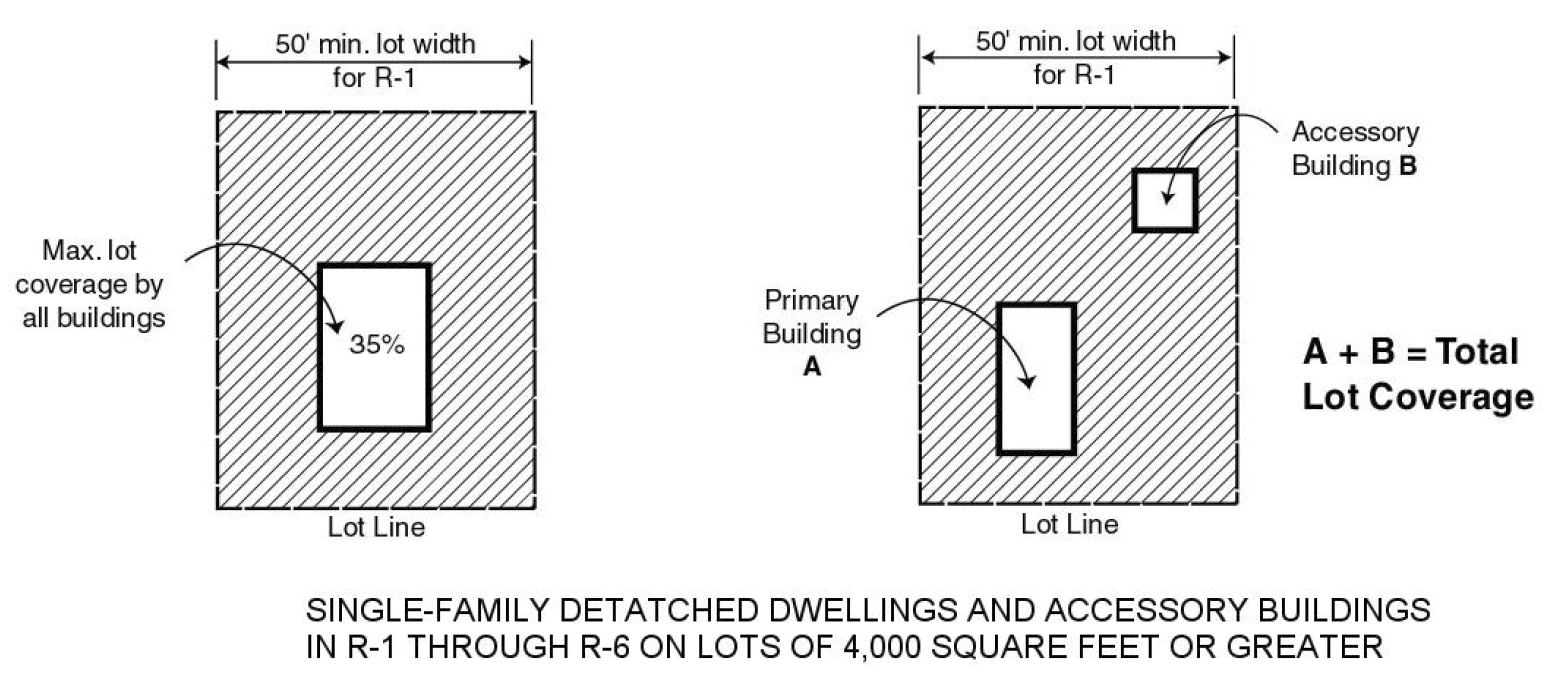
Figure 50-13-185(b)
(For Informational Purposes Only)
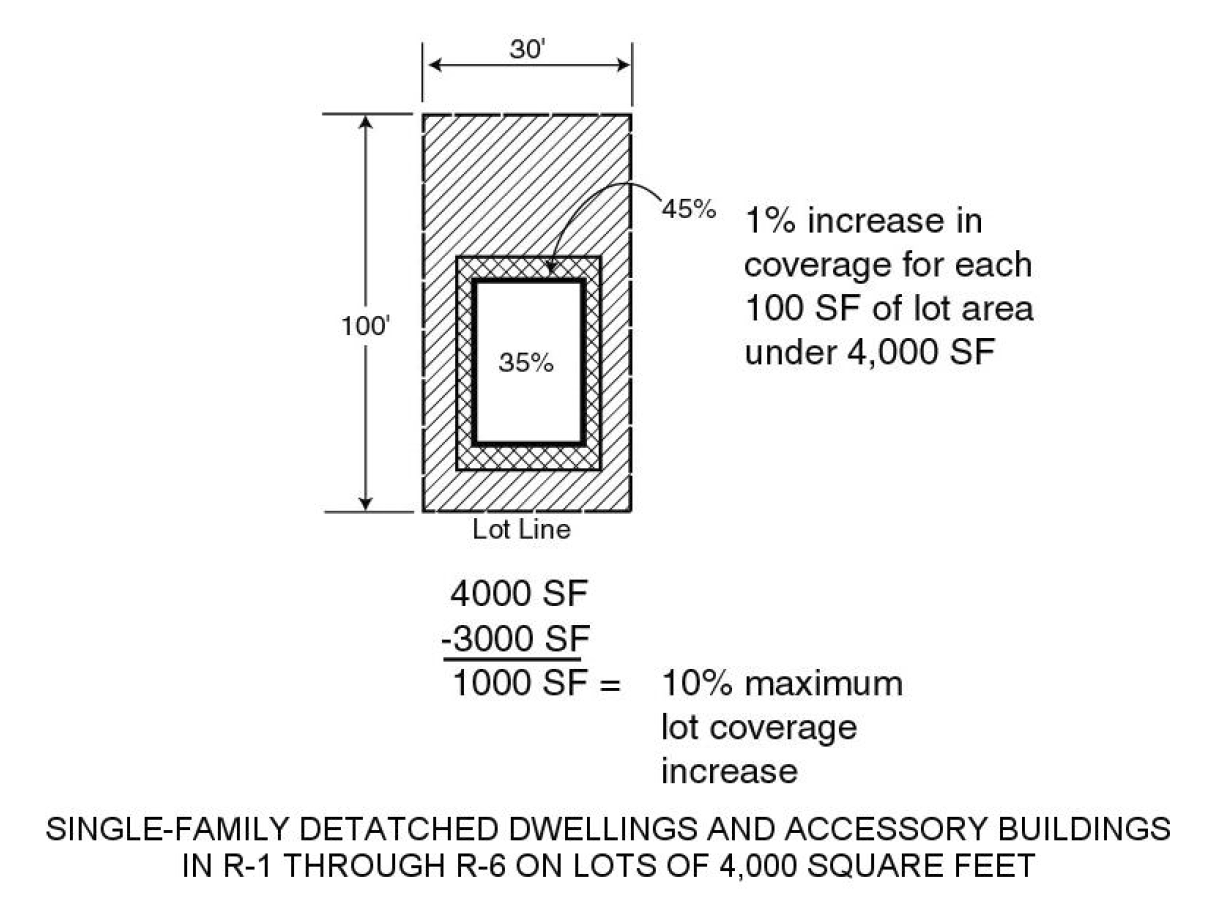
(Code 1984, § 61-13-105; Ord. No. 11-05, § 1(61-13-105), eff. 5-28-2005)
Sec. 50-13-186. - Townhouses.
Townhouses shall be subject to the following requirements:
(1)
In the R2 District, a maximum of eight townhouses shall be permitted in any group of attached townhouses;
(2)
In the R3 District, a maximum of ten townhouses shall be permitted in any group of attached townhouses;
(3)
In the R2, R3, and R4 Districts, the following minimum dimensional standards shall apply to individual townhouses: 2,000 square feet of lot area and 20 feet width;
(4)
In the R5, R6, B1, B2, B4, and B5 Districts, the following minimum dimensional standards shall apply to individual townhouses: 1,800 square feet of lot area and 18 feet width;
(5)
In all zoning districts, setback requirements shall be applied only on those sides of a dwelling unit which have exposed walls;
(6)
Townhouse developments exceeding 12 units are subject to site plan review as provided for in Section 50-3-113 of this Code.
(Code 1984, § 61-13-106; Ord. No. 11-05, § 1(61-13-106), eff. 5-28-2005; Ord. No. 23-14, § 1(61-13-106), eff. 7-24-2014)
Sec. 50-13-187. - Two-family dwellings.
(a)
The combined area occupied by all buildings used for two-family dwellings and accessory buildings on land zoned R2, R3, R4, R5, and R6 shall not exceed 35 percent of the area of the zoning lot. (See Figure 50-13-187(a)).
(b)
On zoning lots of less than 4,300 square feet in area, the allowable percentage of lot coverage may be increased by one percent for each 100 square feet by which the area of the zoning lot is less than 4,300 square feet, with a maximum coverage of 45 percent. (See Figure 50-13-187(b)).
Figures 50-13-187(a) and (b)
(For Informational Purposes Only)
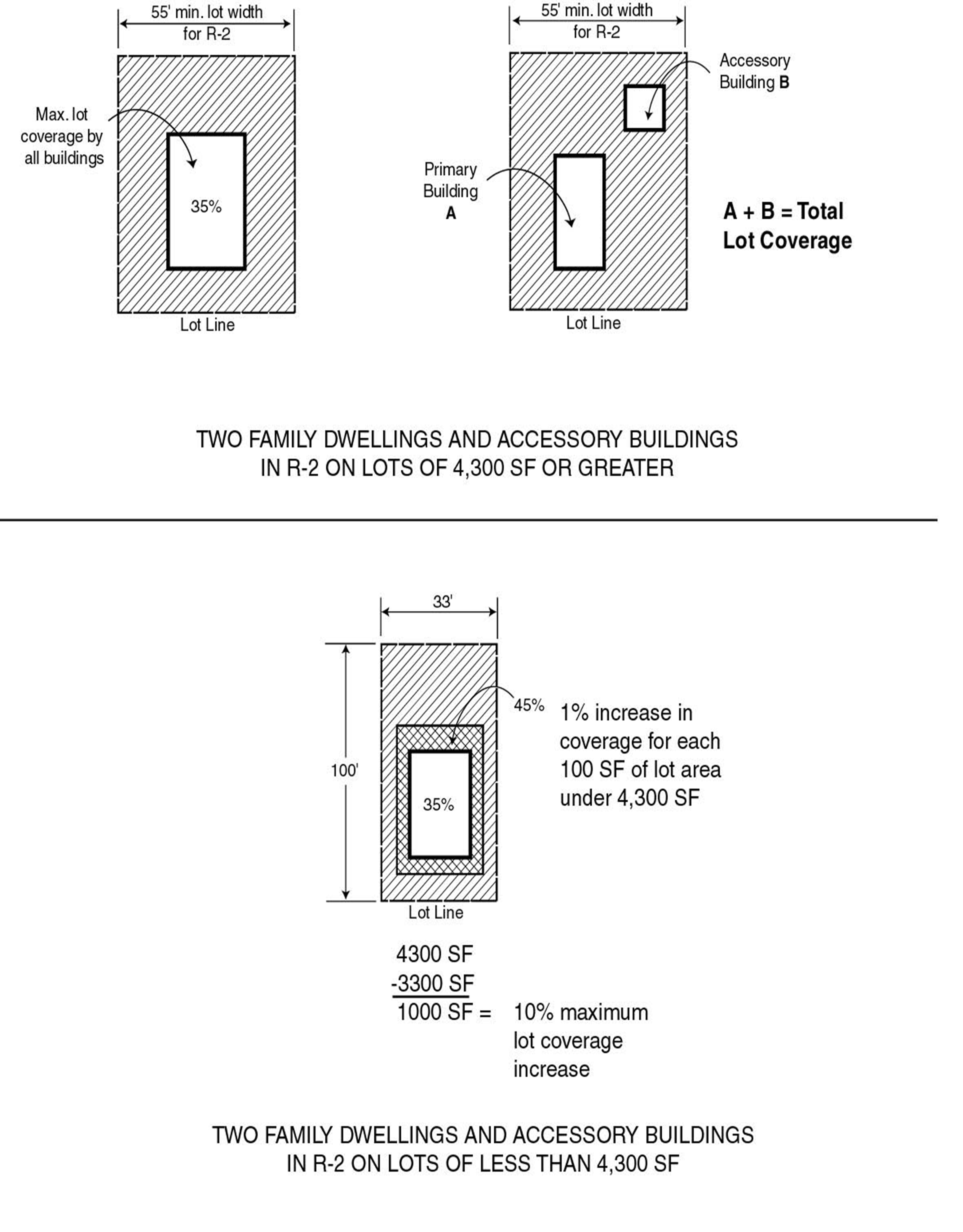
(Code 1984, § 61-13-107; Ord. No. 11-05, § 1(61-13-107), eff. 5-28-2005)
Sec. 50-13-201. - Cubical content standard.
All uses that are located in the B5, PC, and PCA Districts, other than townhouses and rooming houses, shall be subject to the following cubical content provisions (see Figure 50-13-201):
(1)
No building or structure, or part thereof, shall be erected, altered, or enlarged to such a size or height that the cubical content of such building or structure above the grade plan shall exceed the volume of a block or prism having a height equal to three times the width of the widest street abutting the zoning lot upon which the building or structure is located or to be located, and a base equal to the area of the zoning lot, provided, that towers may be erected over and above the cubical content limit where:
a.
The greatest horizontal dimension of the tower does not exceed 60 feet;
b.
The total gross area of all such towers on any one building or structure at any one horizontal plane does not exceed 25 percent of the area of the zoning lot upon which the building or structure is situated; and
c.
Each tower shall be at least 60 feet from any other tower on the same building or structure.
(2)
Enclosed vehicular parking or loading areas are excluded from the volume computations of this section.
Figure 50-13-201
(For Informational Purposes Only)
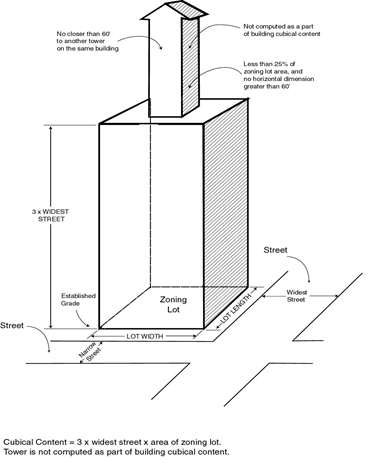
(Code 1984, § 61-13-121; Ord. No. 11-05, § 1(61-13-121), eff. 5-28-2005; Ord. No. 20-05, § 1(61-13-121), eff. 5-29-2005)
Sec. 50-13-202. - Adjustments to cubical content.
(a)
Section 50-13-203 and Section 50-13-204 of this Code may allow for an increase of cubical content in certain situations.
(b)
The cubical content permitted in Section 50-13-201 of this Code may be increased further according to the provisions for administrative adjustments in Section 50-4-122 of this Code.
(c)
In the PC and PCA Districts, any adjustment to the cubical content standard in Section 50-13-201 of this Code shall include the review process specified in Section 50-11-66 of this Code for the PC District and in Section 50-11-96 of this Code for the PCA District.
(Code 1984, § 61-13-122; Ord. No. 11-05, § 1(61-13-122), eff. 5-28-2005)
Sec. 50-13-203. - Cubical content; maximum street width.
For the purpose of determining the permissible cubical content of any building or structure, a street that is more than 150 feet in width shall be considered to have a width of 150 feet.
(Code 1984, § 61-13-123; Ord. No. 11-05, § 1(61-13-123), eff. 5-28-2005)
Sec. 50-13-204. - Cubical content; park as part of street.
Where a zoning lot abuts upon a public street for the full width or depth of the lot and there is a public park or other permanent public open space bordering on such street opposite such zoning lot, a part of such park or open space may be considered as a portion of the street for the purpose of determining the permissible cubical content of a building on such zoning lot, provided, that the augmented width of such street shall not be more than 150 feet.
(Code 1984, § 61-13-124; Ord. No. 11-05, § 1(61-13-124), eff. 5-28-2005)
Sec. 50-13-205. - Excess height.
No building or structure, or part thereof, shall be erected or altered to a height exceeding 80 feet, provided, that in any portion of an M4, M5, or W1 Districts which is 150 feet or more from all R1, R2, R3, R4, R5, R6 and residential PD Districts, there shall be no limitation on the height of buildings or structures.
(Code 1984, § 61-13-125; Ord. No. 11-05, § 1(61-13-125), eff. 5-28-2005)
Sec. 50-13-206. - Dimensional standards for accessory structures.
Most accessory uses will take place within the primary structure on a site. Accessory uses that take place in separate, accessory structures shall comply with the requirements of Section 50-13-207 through Section 50-13-211 of this Code. The requirements of this section shall apply in all districts unless otherwise expressly stated. See also Article XII, Division 5, of this chapter.
(Code 1984, § 61-13-126; Ord. No. 11-05, § 1(61-13-126), eff. 5-28-2005)
Sec. 50-13-207. - Location of accessory buildings and structures.
In residential districts and in the B1 and B2 business districts, all accessory buildings and structures, including category "B" and category "C" antennas for which a building permit is required, shall be built in the rear yard except where built as part of the principal building, or except where said antennas do not exceed 28 square feet in area or six feet in dish diameter, in which case they may be erected on the roof. Accessory buildings and structures shall be considered a part of the principal building where the distance between structures is solidly covered by a breezeway, portico, or similar architectural device that is at least four feet in width. See Section 50-13-226 of this Code for the setback of accessory buildings and structures from lot lines.
(Code 1984, § 61-13-127; Ord. No. 11-05, § 1(61-13-127), eff. 5-28-2005; Ord. No. 44-06, § 1(61-13-127), eff. 12-21-2006)
Sec. 50-13-208. - Accessory buildings or structures in rear setback; setbacks from principal buildings.
Unless otherwise specified, accessory buildings or structures shall be subject to the following requirements:
(1)
No detached accessory building or structure in an R1 or R2 District shall occupy more than 50 percent of the area of the required rear setback area;
(2)
No detached accessory building or structure in an R1 or R2 District shall be located closer than ten feet to any principal building, or any porch or deck of that principal building; and
(3)
No detached accessory building or structure shall be located closer than ten feet to any single- or two-family dwelling in any zoning district.
(Code 1984, § 61-13-128; Ord. No. 11-05, § 1(61-13-128), eff. 5-28-2005)
Sec. 50-13-209. - Height of accessory buildings.
(a)
No detached accessory building or structure in any R1 or R2 District shall exceed the height of the principal building or structure, or 15 feet, whichever is less.
(b)
The height of buildings accessory to single-family and two-family detached dwellings shall be limited to one story, and shall not exceed 15 feet.
(Code 1984, § 61-13-129; Ord. No. 11-05, § 1(61-13-129), eff. 5-28-2005)
Sec. 50-13-210. - Corner-lot regulations.
In residential districts where an accessory building is located on a corner lot, said building shall be set back not less than ten feet from the side lot line abutting the street.
(Code 1984, § 61-13-130; Ord. No. 11-05, § 1(61-13-130), eff. 5-28-2005)
Sec. 50-13-211. - Use-specific requirements.
In the R1, R2, R3, R4, R5, R6, SD1, and SD2 Districts, the following use-specific standards shall apply to accessory structures:
(1)
Accessory structures in parks, including club houses, bath houses, or similar structures on the grounds of non-profit golf courses, swimming pools, tennis courts, or similar non-profit uses, shall have 15-foot front and side setbacks and a 30-foot rear setback;
(2)
Accessory structures in cemeteries, warehouses, storage or maintenance buildings, mausoleums, crematories, or columbaria, shall be located not less than 150 feet from the nearest residential property line;
(3)
Stadiums or grandstands in athletic fields shall have seating facilities located not less than 150 feet from the nearest private residential property line; and
(4)
No public outdoor swimming pool shall be constructed less than 40 feet from any property line abutting, or across an alley from, private property that is zoned R1, R2, R3, R4, R5, R6, or residential PD, other than a railroad right-of-way.
(Code 1984, § 61-13-131; Ord. No. 11-05, § 1(61-13-131), eff. 5-28-2005)

