
Detroit City Zoning Code
ARTICLE XVI
RULES OF CONSTRUCTION AND DEFINITIONS
Sec. 50-16-1. - Internal references.
References to the term "section" shall include the section referred to and any further subsections contained therein.
(Code 1984, § 61-16-1; Ord. No. 11-05, § 1(61-16-1), eff. 5-28-2005; Ord. No. 24-08, § 1(61-16-1), eff. 11-1-2008)
Sec. 50-16-2. - Meanings and intent.
All provisions, terms, phrases and expressions that are contained in this chapter shall be construed according to the purpose and intent which are set out in Section 50-1-4 and Section 50-1-5 of this Code. See also "Written Interpretations," Article IV, Division 4, of this chapter.
(Code 1984, § 61-16-2; Ord. No. 11-05, § 1(61-16-2), eff. 5-28-2005)
Sec. 50-16-3. - Headings, illustrations, and text.
In case of any difference of meaning or implication between the text of this chapter and any heading, drawing, table, figure, or illustration, the text shall control.
(Code 1984, § 61-16-3; Ord. No. 11-05, § 1(61-16-3), eff. 5-28-2005)
Sec. 50-16-4. - Lists and examples.
Unless otherwise specifically indicated, lists of items or examples that use terms such as "including," "such as," or similar language are intended to provide examples, and are not to be exhaustive lists of all possibilities.
(Code 1984, § 61-16-4; Ord. No. 11-05, § 1(61-16-4), eff. 5-28-2005)
Sec. 50-16-5. - Computation of time.
References to days are calendar days, unless otherwise stated. The time where an act is to be done shall be computed by excluding the first day and including the last day. Where the last day is a Saturday, Sunday, or holiday which is observed by the City, such day shall be excluded.
(Code 1984, § 61-16-5; Ord. No. 11-05, § 1(61-16-5), eff. 5-28-2005)
Sec. 50-16-6. - References to other regulations, publications, and documents.
Wherever reference is made to a resolution, ordinance, statute, regulation, or document, it shall be construed as a reference to the most recent edition of such regulation, as amended, resolution, ordinance, statute, regulation, or document, unless otherwise specifically stated.
(Code 1984, § 61-16-6; Ord. No. 11-05, § 1(61-16-6), eff. 5-28-2005)
Sec. 50-16-7. - Delegation of authority.
Wherever a provision appears in this chapter that requires department director, agency head, or another officer or employee of the City to perform an act or duty, such provision shall be construed as authorizing the department director, agency head, or other officer to delegate that responsibility to others over whom they have authority.
(Code 1984, § 61-16-7; Ord. No. 11-05, § 1(61-16-7), eff. 5-28-2005)
Sec. 50-16-8. - Technical and non-technical terms.
Words and phrases shall be construed according to the common and approved usage of English, but technical words and phrases that may have acquired a peculiar and appropriate meaning in law shall be construed and understood according to such meaning.
(Code 1984, § 61-16-8; Ord. No. 11-05, § 1(61-16-8), eff. 5-28-2005)
Sec. 50-16-9. - References to public officials, bodies, and agencies.
References to public officials, bodies, and agencies are those of the City, unless otherwise indicated.
(Code 1984, § 61-16-9; Ord. No. 11-05, § 1(61-16-9), eff. 5-28-2005)
Sec. 50-16-10. - "Use" and "used."
The phrase "used for" includes "arranged for," "designed for," "intended for," "maintained for," and "occupied for." The term "use" as a verb, shall be construed as if followed by the words "or is intended, arranged, designed, built, altered, converted, rented, or leased to be used."
(Code 1984, § 61-16-10; Ord. No. 11-05, § 1(61-16-10), eff. 5-28-2005)
Sec. 50-16-11. - "Person."
The word "person" includes an individual, a firm, a partnership, a corporation, or any other legal entity.
(Code 1984, § 61-16-11; Ord. No. 11-05, § 1(61-16-11), eff. 5-28-2005)
Sec. 50-16-12. - Mandatory and discretionary terms.
The words "shall," "will," and "must" are mandatory terms. The words "may" and "should" are advisory and discretionary terms.
(Code 1984, § 61-16-12; Ord. No. 11-05, § 1(61-16-12), eff. 5-28-2005)
Sec. 50-16-13. - Conjunctions.
Unless the context clearly suggests the contrary, conjunctions shall be interpreted as follows:
(1)
The term "and" indicates that all connected items, conditions, provisions, or events apply; and
(2)
The term "or" indicates that one or more of the connected items, conditions, provisions, or events may apply.
(Code 1984, § 61-16-13; Ord. No. 11-05, § 1(61-16-13), eff. 5-28-2005)
Sec. 50-16-14. - Tenses and plurals.
Words that are used in one tense, being past, present, or future, include all other tenses, unless the context clearly indicates otherwise. The singular includes the plural, and the plural includes the singular.
(Code 1984, § 61-16-14; Ord. No. 11-05, § 1(61-16-14), eff. 5-28-2005)
Sec. 50-16-101. - Definitions and usage.
This division includes definitions for use categories and many specialized words and terms that are used in this chapter. All words and terms that are not defined in this article shall be given their common, ordinary meanings, as the context may reasonably suggest.
(Code 1984, § 61-16-21; Ord. No. 11-05, § 1(61-16-21), eff. 5-28-2005)
Sec. 50-16-111. - Words and terms (Aa—Ag).
For the purposes of this chapter, the following words and phrases beginning with the letters "Aa" through "Ag," shall have the meaning respectively ascribed to them by this section:
| Term | Definition |
| Abut or abutting | Having a common border with. |
| Access drive | A paved surface that provides vehicular access from a public street to a parking area or parking garage or pedestrian pick-up/drop-off area. |
| Accessory building or accessory structure |
A building or structure that:
(1) Is subordinate to and services a principal building or a principal use legally existing on the same zoning lot; (2) Is subordinate in area, extent and purpose to the principal building or principal use; and (3) Contributes to the comfort, convenience or necessity of the occupants, business or industry of the principal structure or principal use served. |
| Accessory parking | See "Parking, accessory." |
| Accessory use |
A use that:
(1) Is incidental and subordinate to and devoted exclusively to a principal building or a principal use legally existing on the same zoning lot; (2) Is subordinate in area, extent and purpose to the principal building or principal use; and (3) Contributes to the comfort, convenience or necessity of the occupants, business or industry of the principal structure or principal use served. |
| Addition | Construction or alteration that increases the square footage, number of dwelling units, bulk or other extent of a building or structure, but the term "addition" does not apply in a situation where, for example, all but one wall of an existing building is demolished for the purposes of reconstructing the building with a larger footprint and containing a greater gross floor area. For regulatory purposes, such a situation is considered as demolition and new construction. |
| Adjacent | Same as "abut or abutting" |
| Adult-use marijuana establishment | A location where a licensee operates one of the following commercial entities or activities under the authority of the Michigan Regulation and Taxation of Marihuana Act, being MCL 333.27951 et seq. (MRTMA"): grower, processor, retailer, secure transporter, safety compliance facility, marijuana microbusiness, excess marijuana grower, marijuana event organizer, temporary marijuana event, designated marijuana consumption establishment, or any other type of marijuana-related business licensed to operate in accordance with the MRTMA. |
| Adult bookstore or adult video store |
A commercial establishment which, as one of its principal business activities, offers
for sale or rental for any form of consideration any one or more of the following:
books, magazines, periodicals or other printed matter, or photographs, films, motion
pictures, video cassettes, compact discs, digital video discs, slides, or other visual
representations, which are characterized by their emphasis upon the display of "specified
sexual activities" or "specified anatomical areas;" or instruments, devices, or paraphernalia,
which are designed or marketed primarily for stimulation of human genital organs or
anus, including, but not limited to, dildos, vibrators, penis pumps, cock rings, anal
beads, butt plugs, and physical representations of the human genital organs; but not
including condoms or other items primarily intended for protection against sexually-transmitted
diseases or for preventing pregnancy. A "principal business activity" exists where
the commercial establishment meets any one or more of the following criteria:
(1) At least 35 percent of the establishment's displayed merchandise consists of said items; or (2) At least 35 percent of the establishment's revenues derive from the sale or rental, for any form of consideration, of said items; or (3) The establishment maintains at least 35 percent of its floor space for the display, sale, and/or rental of said items (aisles and walkways used to access said items shall be included in "floor space" maintained for the display, sale, or rental of said items); or (4) The establishment maintains at least 500 square feet of its floor space for the display, sale, and/or rental of said items (aisles and walkways used to access said items shall be included in "floor space" maintained for the display, sale, or rental of said items) and regularly advertises itself or holds itself out, by using "adult," "adults-only," "XXX," "sex," "erotic," "novelties," or substantially similar language, as an establishment that caters to adult sexual interests; or (5) The establishment maintains an "adult arcade," which means any place to which the public is permitted or invited wherein coin-operated or slug-operated or electronically, electrically, or mechanically controlled still or motion picture machines, projectors, or other image-producing devices are regularly maintained to show images to five or fewer persons per machine at any one time, and where the images so displayed are characterized by their emphasis upon matter exhibiting "specified sexual activities" or "specified anatomical areas." |
| Adult cabaret | A nightclub, bar, juice bar, restaurant, bottle club, or similar commercial establishment, regardless of whether alcoholic liquor is served, which regularly features live conduct characterized by semi-nude persons. An establishment shall not avoid classification as an adult cabaret by offering or featuring nudity. |
| Adult day care | A facility, whether in a private home or institutional setting, providing temporary care and supervision for persons 18 years of age or older. Care is provided for periods of less than 24 hours a day. |
| Adult foster care facility | An establishment that provides supervision, assistance, protection or personal care, in addition to room and board, to seven or more adults. An adult foster care facility is other than a nursing home, a home for the aged, a mental hospital for mental patients, or a pre-release adjustment center. |
| Adult motion picture theater | A commercial establishment where films, motion pictures, videocassettes, slides, or similar photographic reproductions, which are characterized by their emphasis upon the display of "specified sexual activity" or "specified anatomical areas" are regularly shown to more than five persons for any form of consideration. |
| Adult use or adult use/sexually-oriented business (use category) |
Sexually-oriented businesses, including the following:
• Adult bookstore or adult video store • Adult cabaret • Adult motion picture theater • Semi-nude model studio (See Section 50-16-381) |
(Code 1984, § 61-16-31; Ord. No. 11-05, § 1(61-16-31), eff. 5-28-2005; Ord. No. 20-05, § 1(61-16-31), eff. 5-29-2005; Ord. No. 34-05, § 1(61-16-31), eff. 12-6-2005; Ord. No. 01-10, § 1(61-16-31), eff. 4-1-2010; Ord. No. 2021-9, § 1, eff. 4-3-2021)
Sec. 50-16-112. - Words and terms (Ah—Am).
For the purposes of this chapter, the following words and phrases beginning with the letters "Ah" through "Am," shall have the meaning respectively ascribed to them by this section:
| Term | Definition |
| Airport | A landing area, runway, or other facility designed, used, or intended to be used for the landing or taking off of aircraft, including all necessary taxiways, aircraft storage and tie-down areas, hangars, and other necessary buildings and open spaces. |
| Airport elevation, established | The elevation above mean sea level of the highest point of the usable airport landing area. |
| Airport imaginary surfaces | Horizontal surfaces "A" and "B" (See Section 50-16-243 of this Code.) |
| Airport reference point | A point selected or approved by the Federal Aviation Administration as the approximate center of the landing area. |
| Alley | A thoroughfare or way, not more than 30 feet wide, that affords only a secondary means of access to abutting property and that is not intended for general traffic circulation. |
| Alteration | Construction that changes a structure or building. Structural alterations are any change in the supporting members of a building such as bearing walls, columns, beams or girders, or any substantial change in the height or footprint of the structure, the roof and/or exterior walls, including reconstruction or replacement. See also "Structural alterations." |
| Amusement park | A park or place, unenclosed in whole or in part, operating any scenic railways, ferris wheels, merry-go-rounds, puppet shows, concession stands or any other shows and entertainments of similar character. |
(Code 1984, § 61-16-32; Ord. No. 11-05, § 1(61-16-32), eff. 5-28-2005; Ord. No. 01-10, § 1(61-16-32), eff. 4-1-2010)
Sec. 50-16-113. - Words and terms (An—As).
For the purposes of this chapter, the following words and phrases beginning with the letters "An" through "As," shall have the meaning respectively ascribed to them by this section:
| Term | Definition |
| Antenna | Any system of wires, poles, rods, reflecting discs, or similar devices, together with any supporting structure, used for the reception and/or transmission of electromagnetic waves. |
| Antenna—Category A | Television antennas not 28 square feet in area or six feet in dish diameter, customarily though not exclusively erected for residential use, such as micro-wave-receiving antennas, and dipole "rod and mast" VHF-UHF antennas, hereinafter referred to as "conventional" television antennas. |
| Antenna—Category B | Radio antennas and antenna towers, such as amateur radio antennas for ham/shortwave operations, and fixed-station antennas for business-band radio, citizens band radio, general mobile radio service and two-way radio. |
| Antenna—Category C | Dish antennas, such as satellite television antennas, also known as satellite dishes, earth stations, television receive-only (TVRO) antennas, earth terminals, and earth terminal antennas; other parabolic dish antennas and parabolic reflectors exceeding six feet in diameter including, but not limited to, microwave-receiving antennas and studio-to-transmitter-link (STL) antennas. |
| Antennas—Category D | Antenna towers and poles exceeding 75 feet in height from established grade, customarily though not necessarily housing multiple antennas, such as radio broadcasting towers, television broadcasting towers, micro-wave antenna towers, studio-to-transmitter links, and other communications antennas, including antennas for cellular telephone systems. |
| Approach Surfaces | [1] Instrument approach surfaces and non-instrument approach surfaces having a runway at least 5,000 feet in length; and [2] non-instrument approach surface having a runway with a length of 2,000 feet or more up to, but not including, 5,000 feet in length. Instrument Approach Surface and Non-Instrument Approach Surfaces are defined in Section 50-16-262 and Section 50-16-322 of this Code. |
| Aquaculture | The cultivation of marine or freshwater food fish, shellfish, or plants under controlled conditions. |
| Aquaponics | The integration of aquaculture with hydroponics, in which the waste products from fish are treated and then used to fertilize hydroponically growing plants. |
| Arcade | A place, premises or establishment or room set aside in a retail or commercial establishment where three or more coin-operated amusement devices are located, defined herein as a machine or device operated by means of the insertion of a coin, token or similar object, for the purpose of amusement or skill and for the playing of which a fee is charged. The term "arcade" does not include vending machines in which are not incorporated gaming or amusement features, coin-operated mechanical music devices, or mechanical motion picture devices. The definition shall not apply to coin-operated amusement devices owned or leased to establishments that are properly licensed for sale of beer or alcoholic liquor for consumption on the premises. |
| Arena | An enclosed structure with tiers of seats rising around a sports field, playing court, or public exhibition area. Arenas are typically used for sports, entertainment and other public gathering purposes, such as athletic events, concerts, conventions, circuses, and conferences. |
| Articles Pyrotechnic | Pyrotechnic devices for professional use that are similar to consumer fireworks in chemical composition and construction but not intended for consumer use, that meet the weight limit for consumer fireworks but are not labeled as such, and that are classified as UN0431 or UN0432 under 49 CFR 172.101. |
| Ash | The residue from the burning of wood, coal, coke or other combustible materials including incinerator ash and residue. |
| Assembly (Use Category) |
Activities or structures, generally of a commercial nature that draw members of the
general public to specific events or shows.
Examples include the following uses: • Assembly hall • Banquet facility • Dance hall, public • Private club • Private lodge • Rental hall |
| Assembly hall | An enclosed place of assembly for the exclusive use of the owners of the facility or by the members of the association or organization controlling the premises. Such facility shall not be available for rental to the general public. Assembly halls are typically accessory to private clubs and private lodges and are located in a non-residential building. |
| Assessed valuation | Assessed valuation means the assessed valuation in the records of the Assessor of the City. With respect to exempt properties for which the assessed valuation is zero, an independent valuation from a reputable source, subject to review and acceptance by the Buildings, Safety Engineering, and Environmental Department, may be presented by the owner as the basis for determinations required by this chapter. |
| Assisted living facility | A residential care facility designed primarily for older people who typically have no serious health problems but who may have chronic or debilitating conditions requiring assistance with daily activities. Permitted services include, but are not limited to, staff-supervised meals, housekeeping and personal care, medication supervision, and social activities. Both private and shared sleeping rooms may be provided. Facilities providing regular care under supervision of physicians are not considered assisted living facilities. |
(Code 1984, § 61-16-33; Ord. No. 11-05, § 1(61-16-33), eff. 5-28-2005; Ord. No. 44-06, § 1(61-16-33), eff. 12-21-2006; Ord. No. 10-13, § 1(61-16-33), eff. 4-16-2013; Ord. No. 38-14, § 1(61-16-33), eff. 10-16-2014; Ord. No. 18-18, § 1(61-16-33), eff. 8-30-2018)
Sec. 50-16-114. - Words and terms (At—Az).
For the purposes of this chapter, the following words and phrases beginning with the letters "At" through "Az," shall have the meaning respectively ascribed to them by this section:
| Term | Definition |
|
Auditorium or stadium
(use category) |
Activities or structures that draw large numbers of people to specific events or show.
Activities are generally of a spectator nature, although participatory events can
also be classified as auditorium or stadium uses.
Examples include the following uses: • Armory • Auditorium, public • Convention or exhibit building • Office, public only • Outdoor entertainment facility • Race track, motor vehicle • Sports arena • Stadium • Other similar venues for major entertainment events |
| Authorized local official | A Detroit police officer, or other City employee or agent, who is authorized to issue blight violations in accordance with Chapter 3, Article II, of this Code, Enforcement of Blight Violations. |
|
Aviation and surface
transportation facilities (use category) |
Facilities for the landing and takeoff of flying vehicles, including loading and unloading
areas. Aviation facilities may be improved or unimproved. Aviation and Surface Transportation
Facilities also include passenger terminals for aircraft, bus, rail and cable car
service.
Examples include the following uses: • Aircraft landing areas for winged aircraft • Heliports • Passenger transportation terminal • Tunnel or bridge plaza and terminal, vehicular Private helicopter landing facilities that are accessory to another use, are considered accessory uses, provided, that they are subject to all the regulations and approval criteria for helicopter landing facilities. |
(Code 1984, § 61-16-34; Ord. No. 11-05, § 1(61-16-34), eff. 5-28-2005)
Sec. 50-16-131. - Words and terms (Ba—Bg)
For the purposes of this chapter, the following words and phrases beginning with the letters "Ba" through "Bg," shall have the meaning respectively ascribed to them by this section:
| Term | Definition |
| Banquet facility | An establishment that consists of an enclosed hall, building, or portion of any building, regularly available for the purpose of holding banquets, dinners, entertainment, luncheons, sports events, or other similar activity or events, pursuant to a "use agreement" and that is licensed by the Michigan Liquor Control Commission for the sale and consumption of alcoholic liquor on the premises. The term "use agreement" means a contract or agreement between a banquet facility licensee and a person for the use of a designated portion or space of the premises for an activity or event and where the operation of the banquet facility remains under the exclusive control of the banquet facility licensee. |
| Bake shop, retail | Retail bakeries not exceeding 4,000 square feet in gross floor area where baked goods are prepared on the premises for consumption off the premises. Such baked goods shall primarily consist of breads, rolls, cakes, and cookies. |
| Basement | A space having one-half or more of its floor-to-ceiling height above the average level of the adjoining ground and with a floor-to-ceiling height of not less than seven feet. |
| Bed and breakfast inn |
A single-family dwelling that meets both of the following criteria:
(1) Has ten or fewer sleeping rooms, including sleeping rooms occupied by the innkeeper, one or more of which are available for rent to transient tenants; and (2) Serves breakfast at no extra cost to its transient tenants. |
| Berm | A man-made landscape feature generally consisting of a linear, raised mound of soil covered with grass lawn or other permanent, living ground cover. Temporary soil stockpiles and retaining walls are not berms. |
(Code 1984, § 61-16-41; Ord. No. 11-05, § 1(61-16-41), eff. 5-28-2005; Ord. No. 38-14, § 1(61-16-41), eff. 10-16-2014; Ord. No. 37-17, § 1(61-16-41), eff. 2-6-2018)
Sec. 50-16-132. - Words and terms (Bh—Bz).
For the purposes of this chapter, the following words and phrases beginning with the letters "Bh" through "Bz," shall have the meaning respectively ascribed to them by this section:
| Term | Definition |
| Blight violation | Any unlawful act, or any omission or failure to act, which is designated by this chapter as a blight violation pursuant to Section 41(4) of the Michigan Home Rule City Act, being MCL 117.41(4). |
| Blight violation determination |
A determination that:
(1) An alleged violator is responsible for one or more blight violations as a result of the admission of responsibility for the allegation(s) in a blight violation notice; or (2) After an administrative hearing that a person is or is not responsible for one or more blight violations; or (3) As a result of a decision and order of default for failing to appear as directed by the blight violation notice, or other notice regarding one or more blight violations, at a scheduled appearance at the Blight Administrative Hearings Bureau under Chapter 3, Article II, of this Code, Enforcement of Blight Violations, in accordance with Section 4q(8)(c) of the Michigan Home Rule City Act, being MCL 117.4q(8)(c). |
| Blight violation notice |
A written violation notice prepared by an authorized local official which directs
an alleged violator:
(1) To pay the civil fines specified in the notice, including any required fees or costs, for one or more blight violations in accordance with the fines, fees, or costs specified in this Code, and (2) To appear at the Blight Administrative Hearings Bureau under Chapter 3, Article II, of this Code, Enforcement of Blight Violations, regarding the occurrence or existence of one or more blight violations pursuant to Section 4q(8) of the Michigan Home Rule City Act, being MCL 117.4q(8). |
| Blight violation proceeding | An administrative process that results in a blight violation determination. |
| Block | A tract of land bounded by streets or by a combination of streets, public parks, cemeteries, railroad rights-of-way, harbor lines, center lines of waterways, or corporate boundary lines of the City. |
| Block face | All lots abutting both sides of a street between two intersecting streets. |
| Board | The word, "Board," means the Board of Zoning Appeals of the City. |
| Body art facility | A personal services establishment where in accordance with Chapter 20, Article III, of this Code, an individual performs one or more of the following for compensation: 1) tattooing; 2) branding; or 3) body piercing. For zoning purposes, precious metal and gem dealers that are licensed under Chapter 41, Article III, of this Code, other retail stores, or clinics, which provide this service as an incidental and accessory use of the land, shall not be classified as a body art facility. |
| Brewery | A facility licensed by the Michigan Liquor Control Commission that annually manufactures not less than 60,000 barrels of beer. |
| Brewpub | A facility licensed as such by the Michigan Liquor Control Commission, in conjunction with a Class "C" tavern, Class "A" hotel, or Class "B" hotel, that annually manufactures and sells therein in total not more than 18,000 barrels of beer only for consumption therein. |
| Bridge plaza and terminal, vehicular | Property immediately contiguous to a vehicular bridge where motor vehicles enter and exit the bridge. Certain uses and activities, if oriented and available exclusively to bridge traffic, shall be considered incidental and accessory to the vehicular bridge plaza and terminal: toll booths, inspection and weigh stations, customs and immigration facilities, duty-free retail stores, motor vehicle filling stations, and uses similar to these. |
| Building | A structure, either temporary or permanent, having a roof and enclosing walls on all sides and used or built for the shelter or enclosure of persons, animals, or property of any kind. |
| Building, existing | Whenever this chapter refers to an "existing building," it means a building that was constructed prior to April 9, 1998, which was the effective date of Ord. No. 09-98. |
| Building, height of | (See, Height of building.) |
| Building or construction contractor | A building or construction contractor is a person or firm engaged in the practice of assembling parts and materials to construct buildings or other structures, but not including persons or firms, such as concrete producers, who supply and/or deliver parts or materials to a construction site without direct involvement in construction, other than delivery and deposit of the construction parts and/or materials. |
| Bulk solid material | Has the meaning defined in Section 42-1-1 of this Code. |
| Bulk solid material outdoor storage facility | A facility for the open storage of bulk solid material other than carbonaceous material. |
| Bus | A motor vehicle other than a school bus that is designed for carrying 16 or more passengers, including the driver. |
(Code 1984, § 61-16-42; Ord. No. 11-05, § 1(61-16-42, 61-16-152, 61-16-181), eff. 5-28-2005; Ord. No. 24-08, § 1(61-16-42), eff. 11-1-2008; Ord. No. 13-11, § 1(61-16-42), eff. 8-23-2011; Ord. No. 2020-12, § 1, eff. 12-9-2020; Ord. No. 2022-12, § 1, eff. 5-31-2022)
Sec. 50-16-151. - Words and terms (Ca—Cg).
For the purposes of this chapter, the following words and phrases beginning with the letters "Ca" through "Cg," shall have the meaning respectively ascribed to them by this section:
| Term | Definition |
| Cabaret | An establishment open to the public which sells or serves alcoholic beverages for consumption on the premises with or without food and also provides entertainment. Establishments commonly referred to as "nightclubs" shall be considered "cabarets" for zoning purposes, except for those nightclubs, bars, juice bars, restaurants, bottle clubs, or similar commercial establishment, which regularly feature live conduct characterized by semi-nudity, which are classified as "adult cabarets." Further, cabarets are classified as Group "A" Cabaret, Group "B" Cabaret, or Group "C" Cabaret. (See also, Section 50-16-222 of this Code.) |
| Car wash | See, Motor Vehicle Washing and Steam Cleaning. |
| Carbonaceous bulk solid material | Has the meaning defined in Section 42-1-2 of this Code. |
| Carbonaceous bulk solid material facility | Has the meaning defined in Section 42-1-2 of this Code. |
| Carbonaceous material | Has the meaning defined in Section 42-1-2 of this Code. |
| Carport | A roofed structure providing space for the parking or storage of motor vehicles and open on three sides. |
| Casino | The premises where gaming is conducted and includes all buildings, improvements, equipment, and facilities used or maintained in connection with such gaming. |
| Casino complex | A casino and all buildings, hotel structures, recreational or entertainment facilities, restaurants or other dining facilities, bars and lounges, required on-site parking, retail stores, and other amenities that are connected with, or operated in such an integral manner as to form part of, the same operation, whether on the same tract of land or otherwise. |
| Cellar | A space with less than one-half of its floor-to-ceiling height above the average finished grade of the adjoining ground or with a floor-to-ceiling height of less than seven feet. |
| Cemetery | Property used for the interring of the body or cremated remains of the dead. Cemeteries may contain mausoleums, crematories, or columbaria. |
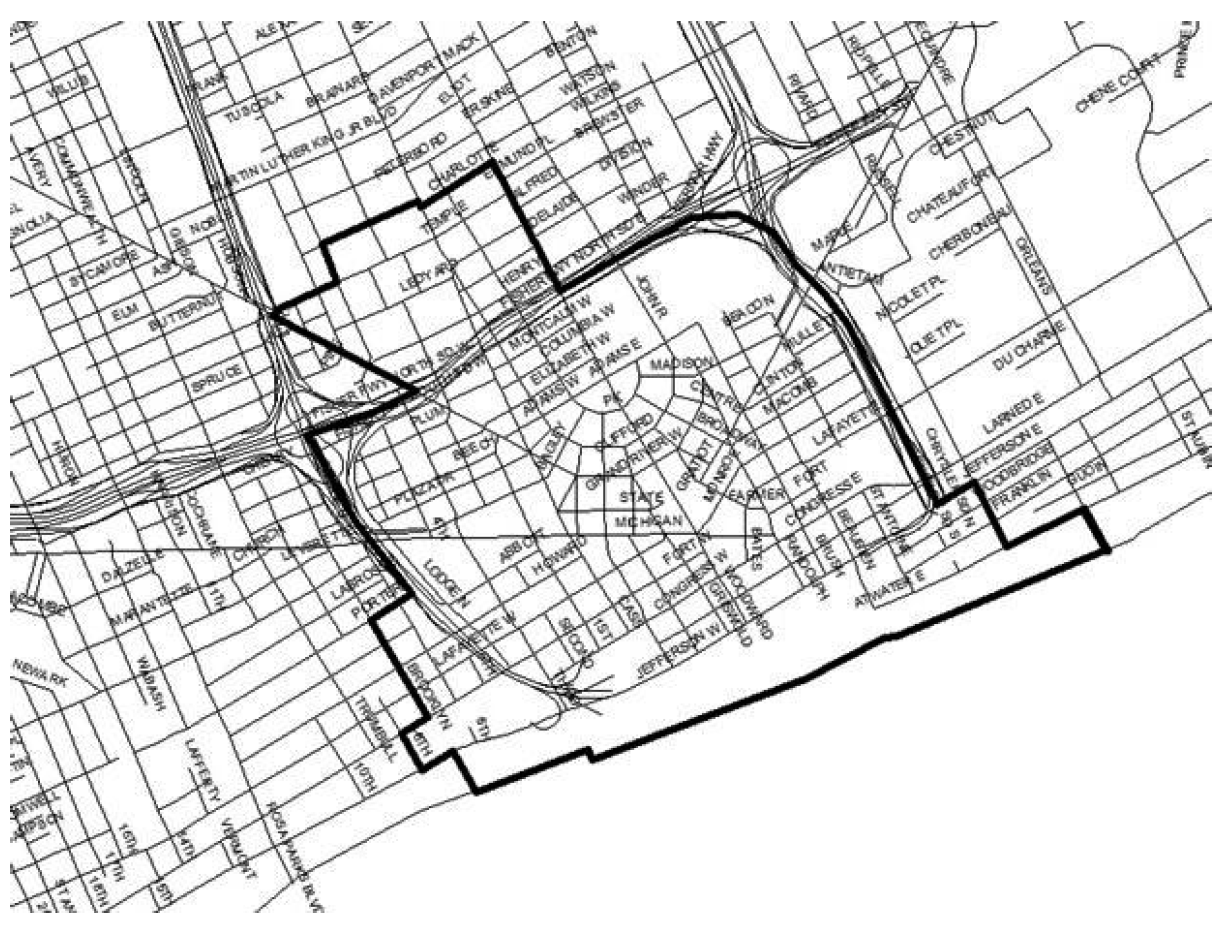
| Central Business District | The portion of the City of Detroit within the area bounded by the Detroit River, and the center lines of Brooklyn Avenue (extended), West Jefferson Avenue, Eighth Street, West Fort Street, Brooklyn Avenue, Porter Street, John C. Lodge Freeway (M-10), Fisher Freeway (I-75), Third Street, West Grand River, Temple Avenue, Fourth Street, Charlotte Street, Woodward Avenue, Fisher Freeway (I-75), Chrysler Freeway (I-375), East Jefferson Avenue, Rivard Street, Atwater Street, and Riopelle Street extended to the Detroit River. The boundaries of the Central Business District are depicted in Figure 50-16-151 of this Code. |
Figure 50-16-151
Boundaries of Central Business District
(For Informational Purposes Only)
(Code 1984, § 61-16-51; Ord. No. 11-05, § 1(61-16-51), eff. 5-28-2005; Ord. No. 44-06, § 1(61-16-51), eff. 12-21-2006; Ord. No. 01-10, § 1(61-16-51), eff. 4-1-2010; Ord. No. 13-15, § 1(61-16-51), eff. 7-11-2015; Ord. No. 37-17, § 1(61-16-51), eff. 2-6-2018; Ord. No. 2022-12, § 1, eff. 5-31-2022)
Sec. 50-16-152. - Words and terms (Ch—Cm).
For the purposes of this chapter, the following words and phrases, beginning with the letters "Ch" through "Cm," shall have the meaning respectively ascribed to them by this section:
| Term | Definition |
| Change of use or occupancy | The discontinuance of one land use and its replacement by a different land use. Also, the addition of a land use to the operation of an existing land use; for example, the addition of a cabaret to a Class C bar constitutes a change of use or occupancy. A mere change of ownership shall not constitute a change of use or occupancy. |
| Child care home and center |
A facility licensed by the Michigan Department of Licensing and Regulatory Affairs,
other than a private residence or home, receiving one or more preschool or school
age children for care for periods of less than 24 hours a day, and where the parents
or guardians are not immediately available to the child. Child Care Center or Day
Care Center includes a facility that provides care for not less than two consecutive
weeks, regardless of the number of hours of care per day. The facility is generally
described as a Child Care Center, Day Care Center, "Head Start" program, Day Nursery,
Nursery School, Parent Cooperative Preschool, Play Group, or Drop-In Center. Child
Care Center or Day Care Center does not include any of the following:
(1) A Sunday school, a vacation bible school, or a religious instructional class that is conducted by a religious organization where children are in attendance for not longer than three hours per day for an indefinite period, or not longer than eight hours per day for a period not to exceed four weeks during a 12-month period; (2) A facility operated by a religious organization where children are cared for not longer than three hours while persons responsible for the children are attending religious services; (3) Family day care home, group day care home, foster family home, foster family group home. |
| Child caring institution | A child care facility licensed by the Michigan Department of Licensing and Regulatory Affairs, other than a juvenile correctional facility, that is organized for the purpose of receiving minor children for care, maintenance, and supervision, usually on a 24-hour basis, in buildings maintained by the institution for that purpose, and operates throughout the year. An educational program may be provided, but the educational program shall not be the primary purpose of the facility. Child Caring Institution includes a Maternity Home for the care of unmarried mothers who are minors and an Agency Group Home that is described as a Small Child Caring Institution owned, leased, or rented by a licensed agency providing care for more than four but less than 13 minor children. Child Caring Institution also includes institutions for mentally retarded or emotionally disturbed minor children. Child caring institution does not include a hospital, nursing home, home for the aged, boarding school, adult foster care family home, adult foster care small group home, family day care home, group day care home, foster family home, or foster family group home. |
| City | The word "City" means the City of Detroit. |
| Clear vision triangle | That area formed by extending the two curb lines a distance of 45 feet from their point of intersection, and connecting these points with an imaginary line, thereby making a triangle |
(Code 1984, § 61-16-52; Ord. No. 11-05, § 1(61-16-52), eff. 5-28-2005; Ord. No. 34-05, § 1(61-16-52), eff. 12-6-2005; Ord. No. 44-06, § 1(61-16-52), eff. 12-21-2006)
Sec. 50-16-153. - Words and terms (Cn—Cs).
For the purposes of this chapter, the following words and phrases, beginning with the letters "Cn" through "Cs," shall have the meaning respectively ascribed to them by this section:
| Term | Definition |
| Coffee house | Any room, place, or building where the serving of coffee is the principal business and where tables and chairs are provided for the use of patrons to play table games and for other similar activities, but where alcoholic liquor is not provided. |
| Coal | Has the meaning defined in Section 42-1-2 of this Code. |
| Coke | Has the meaning defined in Section 42-1-2 of this Code. |
| Co-location (marijuana) | A practice where more than one licensee is authorized by the State of Michigan to operate a medical marijuana facility or an adult-use marijuana establishment in one building in accordance with the applicable rules promulgated by the State of Michigan and the license requirements of Chapter 20, Article VI, of this Code. |
| Commercial parking | See, Parking, Commercial. |
| Commercial vehicle | See, Vehicle, Commercial. |
| Common area, general | That portion of a site condominium project designed and intended for joint ownership and maintenance by the condominium association as described in the condominium master deed. |
| Common area, limited | That portion of a site condominium project designed and intended for separate ownership, but outside the building setbacks for the zoning district the property is located in as described in the master deed. |
| Community service (use category) |
Uses of a public, non-profit, or charitable nature generally providing a local service
to people of the community. Generally, they provide the service on-site or have employees
at the site on a regular basis. The service is ongoing, not just for special events.
Community services or facilities that have membership provisions are open to the general
public to join at any time, for instance, any senior citizen could join a senior center.
The use may provide special counseling, education, or training of a public, non-profit
or charitable nature.
Examples include the following uses: • Customs office; • Fire or police station, post office, courthouse and similar public building; • Governmental service agency; • Neighborhood center, non-profit; • Substance abuse service facility; Private lodges, private clubs, and private or commercial athletic or health clubs are classified as retail sales and service. Public parks and recreation are classified as parks and open space. |
| Compost | Relatively stable decomposed organic matter for use in agricultural and other growing practices usually consisting of materials such as grass, leaves, yard waste, worms, and also including raw and uncooked kitchen food wastes, but specifically excluding bones, meat, fat, grease, oil, raw manure, and milk products. |
| Concert café | Any establishment, which provides food with music or entertainment, but does not serve alcoholic liquor. Concert cafes shall be regulated the same as "theaters" for zoning purposes. |
| Condominium Act | MCL 559.101 et seq. |
| Condominium master deed | The document recorded as part of a condominium subdivision to which are attached as exhibits and incorporated by reference the approved bylaws for the condominium subdivision and the condominium subdivision plan. |
| Condominium project, commercial, office or industrial | A plan or project consisting of not less than two condominium units if established and approved in conformance with the Condominium Act, being MCL 559.101 et seq. |
| Condominium subdivision | A division of land on the basis of condominium ownership, pursuant to the Michigan Condominium Act and which is not subject to the Michigan Land Division Act, being MCL 560.101 et seq. Also known as a site condominium. |
| Condominium subdivision plan | The drawings attached to the condominium master deed for a condominium subdivision, which describe the size, location, area, horizontal and vertical boundaries, and volume of each condominium unit contained in the condominium subdivision as well as the nature, location, and size of common elements. |
| Condominium unit | That portion of a condominium project or condominium subdivision which is designed and intended for separate ownership and use, as described in the condominium master deed, regardless of whether intended for residential, office, industrial, business, or recreational use as a time-share unit, or any other type of use. The owner of a condominium unit also owns a share of the common elements. The term "condominium unit" shall be equivalent to the term "lot," for purposes of determining compliance of the site condominium subdivision with the provisions of this chapter pertaining to minimum lot size, minimum lot width, and maximum lot coverage. |
| Conforming land uses | Any land use located in a zoning district where the land use is permitted either by-right or as a conditional use and not otherwise prohibited in that district. |
| Conical surface | A surface sloping upward and outward to an altitude of 150 feet above the established heliport elevation at a slope ratio of one to eight beginning at the heliport elevation on the perimeter of a circle of 200 feet radius centered on each helipad. |
| Construction refuse | Waste from building construction, alteration, demolition or repair, and dirt from excavations. |
| Contractor yard, landscape or construction | A yard used for the outdoor storage of a construction or landscape contractor's vehicles, equipment and materials, including plant materials and contained soil. |
| Controlled uses |
Any or the following:
(1) Arcades; (2) Specially designated merchant's (SDM) establishments and/or specially designated distributor's (SDD) establishments; and (3) Pool halls. |
| Convalescent, nursing, or rest home | Establishment primarily engaged in the providing of in-patient nursing care, other than a private home, where seven or more older adults or disabled persons receive on-going care and supervision. (Same as "convalescent home" or "rest home.") These are facilities that provide a full range of 24-hour direct medical, nursing, and other health services by registered nurses, licensed practical nurses, and nurses' aides prescribed by a resident's physician. They are designed for older adults or disabled persons who need health care supervision, but not hospitalization. Emphasis is on nursing care, but restorative therapies may be provided. Specialized nursing services such as intravenous feeds or medication, tube feeding, injected medication, daily wound care, rehabilitation services, and monitoring of unstable conditions may also be provided. |
| Crematory | A building or structure within which the remains of deceased persons are, or are intended to be, cremated. |
(Code 1984, § 61-16-53; Ord. No. 11-05, § 1(61-16-53), eff. 5-28-2005; Ord. No. 10-13, § 1(61-16-53), eff. 4-16-2013; Ord. No. 37-17, § 1(61-16-53), eff. 2-6-2018; Ord. No. 20-18, § 1(61-3-353), eff. 10-14-2018; Ord. No. 2021-9, § 1, eff. 4-3-2021; Ord. No. 2022-12, § 1, eff. 5-31-2022; Ord. No. 2023-41, § 1, eff. 12-30-2023)
Sec. 50-16-154. - Words and terms (Ct—Cz).
For the purposes of this chapter, the following words and phrases, beginning with the letters "Ct" through "Cz," shall have the meaning respectively ascribed to them by this section:
| Term | Definition |
| Cultural center | The portion of the City within the area bounded by the center lines of the Edsel Ford Freeway, Brush Street, Forest Avenue, and the John C. Lodge Freeway. |
| Cul-de-sac | A street ending in a turn-around, designed, and intended as a permanent or temporary terminus. |
| Cultivate (marihuana) | All phases of growth of marijuana from seed to harvest, or preparing, packaging or repackaging, labeling, or relabeling of any form of marijuana. |
| Customer service center | A facility, other than a retail store, operated by a public or private utility, at which customers of the utility may make bill payments, obtain product or service information, or conduct similar business. |
(Code 1984, § 61-16-54; Ord. No. 11-05, § 1(61-16-54), eff. 5-28-2005; Ord. No. 44-06, § 1(61-16-54), eff. 12-21-2006; Ord. No. 31-15, § 1(61-16-54), eff. 3-1-2016; Ord. No. 20-18, § 1(61-3-353), eff. 10-14-2018; Ord. No. 2021-9, § 1, eff. 4-3-2021)
Sec. 50-16-171. - Words and terms (Da—Dg).
For the purposes of this chapter, the following words and phrases, beginning with the letters "Da" through "Dg," shall have the meaning respectively ascribed to them by this section:
| Term | Definition |
| Dance hall, public | A place, enclosed or unenclosed, building or that portion of a building that is used for public dances where the public is invited or allowed and where a monetary contribution, donation, or fee is made or paid. |
| Dance studio | Any school of dancing or any place where dancing of any type of style shall be taught. (Does not include any establishment distinguished or characterized by an emphasis on "specified sexual activities" or "specified anatomical areas.") |
| Day care (use category) |
Uses that provide care, protection and supervision for children or adults on a regular
basis away from their primary residence for less than 24 hours per day.
Examples include the following uses: • Adult day care center; • Child care center; • Group day care home; • Family day care home. |
| Debris | The remains of something broken down or destroyed. |
| Deciduous | A plant with foliage that is shed annually. |
| Decision-making body | The entity that is authorized to finally approve or deny an application or permit required under this chapter. |
| Dedication | The transfer of property interests from private to public ownership for a public purpose. The transfer may be of fee-simple interest or of a less than fee interest, including an easement. |
| Designated marijuana consumption establishment | A location where a licensee that is licensed as a designated marijuana consumption establishment under the Michigan Regulation and Taxation of Marihuana Act (MRTMA), and as a designated consumption establishment under Chapter 20, Article VI, of this Code, Medical Marijuana Facilities and Adult-Use Marijuana Establishments, operates a commercial entity, which allows adults 21 years of age and older to consume marijuana products at a commercial location designated by the state operating license. |
| Developer | The legal or beneficial owner or the representative thereof, of a lot or parcel of any land proposed for inclusion in a development, including the holder of an option or contract to purchase. The developer performs all functions necessary to obtain land control and financing to construct or rehabilitate a property and expects to assume all the risks and rewards upon completion of the project. |
| Development | The division of a parcel of land into two or more parcels; the construction, reconstruction, conversion, structural alteration, relocation, or enlargement of any buildings; any use or change in use of any buildings or land; any extension of any use of land or any clearing, grading, excavation or other movement of land, for which permission may be required pursuant to this chapter. |
(Code 1984, § 61-16-61; Ord. No. 11-05, § 1(61-16-61), eff. 5-28-2005; Ord. No. 24-08, § 1(61-16-61), eff. 11-1-2008; Ord. No. 44-06, § 1(61-16-61), eff. 12-21-2006; Ord. No. 2021-9, § 1, eff. 4-3-2021)
Sec. 50-16-172. - Words and terms (Dh—Dz).
For the purposes of this chapter, the following words and phrases, beginning with the letters "Dh" through "Dz," shall have the meaning respectively ascribed to them by this section:
| Term | Definition |
| Dish antenna | An antenna consisting of a radiation element that transmits or receives signals generated as electrical light, or sound energy supported by a structure that may or may not provide a reflective component to the radiating dish, usually in a circular shape with a parabolic curve design constructed of a solid or open mesh surface. |
| Dormitory | A building used as group living quarters for a student body or religious order as an accessory use to a college, university, boarding school, convent, monastery, or similar institutional use. |
| Driveway | That portion of the zoning lot that has been so designated, designed and improved as to afford a suitable means and a direct route for vehicular access to the private parking garage or to a rear yard parking area. Semicircular driveways are addressed in Section 50-14-286(5) of this Code. |
| Drug-free zone |
An area that is within 1,000 radial feet of a zoning lot of:
• A child care center, as defined in Section 50-16-152 of this Code; • An educational institution, as defined in Section 50-16-191 of this Code; • A library, as defined in Section 50-16-283 of this Code; • An outdoor recreation facility, as defined in Section 50-16-324 of this Code, other than parkways and parklots; • A school, as defined in Section 50-16-381 of this Code; • A youth activity center, as defined in Section 50-16-462 of this Code; or • Public housing, as defined in 42 USC 1437a(b)(1). |
| Dwelling | Any building, or part thereof, that is designed for or occupied, in whole or in part, as the home, residence, or sleeping place of one or more persons, either continuously, permanently, temporarily, or transiently. |
| Dwelling unit | A building, or part thereof, that is designed and used for residential occupancy by a single "family" and that includes exclusive sleeping, cooking, eating, and sanitation facilities. |
(Code 1984, § 61-16-62; Ord. No. 11-05, § 1(61-16-62), eff. 5-28-2005; Ord. No. 13-11, § 1(61-16-62), eff. 8-23-2011; Ord. No. 37-17, § 1(61-16-62), eff. 2-6-2018; Ord. No. 20-18, § 1(61-3-353), eff. 10-14-2018; Ord. No. 2021-9, § 1, eff. 4-3-2021)
Sec. 50-16-191. - Words and terms (Ea—Ez).
For the purposes of this chapter, the following words and phrases, beginning with the letters "Ea" through "Ez," shall have the meaning respectively ascribed to them by this section:
| Term | Definition |
| Educational institution | Educational institution is a post-secondary institution such as a college, university, or community college. For zoning purposes, educational institution does not include K-12 schools, business colleges, trade schools, or penal or correctional institutions. |
| Efficiency unit | A dwelling unit containing not more than one room or enclosed floor space arranged for living, eating, and sleeping purposes not including bathrooms, water closets, laundry rooms, pantries, foyers, hallways, and other accessory floor spaces. |
| Emergency shelter |
A facility that provides congregate style temporary lodging with or without meals
and ancillary services on the premises to primarily the homeless for more than four
weeks in any calendar year.
An emergency shelter shall be considered a different land use than adult foster care facilities, designated transitional housing, nursing homes, pre-release adjustment centers, temporary emergency shelters, or warming centers. Emergency shelters are subject to licensing by the Buildings, Safety Engineering, and Environmental Department Business License Center. |
| Employee recruitment center | Establishments that recruit people to fill temporary employment positions with other businesses or agencies. Typical uses include day labor recruitment centers and temporary employment agencies where prospective employees come to the site. |
| Equivalent licenses (marijuana) |
Any of the following pairs of licenses held by a single licensee:
• A marijuana grower license, of any class, issued under the Michigan Regulation and Taxation of Marihuana Act (MRTMA), and a grower license, of any class, issued under the Michigan Medical Marihuana Facilities Licensing Act (MMFLA); • A marijuana processor license issued under the MRTMA and a processor license under the MMFLA; • A marijuana retailer license issued under the MRTMA and a provisioning center license issued under the MMFLA; • A secure transporter license issued under the MRTMA and a secure transporter license issued under the MMFLA; or • A safety compliance facility license issued under the MRTMA and a safety compliance facility license issued under the MMFLA. |
| Erected | The word "erected" includes built, constructed, reconstructed, altered, moved upon, or any physical operation on the premises required for the building or structure. Excavations, fill, drainage, paving, and the like, shall be considered a part of erection. |
| Evergreen | A plant with foliage that persists and remains green year-round. |
(Code 1984, § 61-16-71; Ord. No. 11-05, § 1(61-16-71), eff. 5-28-2005; Ord. No. 2021-9, § 1, eff. 4-3-2021)
Sec. 50-16-201. - Words and terms (Fa—Fg).
For the purposes of this chapter, the following words and phrases, beginning with the letters "Fa" through "Fg," shall have the meaning respectively ascribed to them by this section:
| Term | Definition |
| Family |
(1) One person, or a group of two or more persons living together, and interrelated
by bonds of consanguinity, marriage, legal adoption, or guardianship, and occupying
the whole or part of a dwelling as a separate housekeeping unit with a common and
a single set of culinary facilities. The persons thus constituting a family may also
include domestic servants employed solely on the premises. It may also include not
more than four foster children provided, that the home is licensed as a foster home
by the State of Michigan.
(2) Two persons, interrelated by bonds of consanguinity, marriage, legal adoption, or guardianship, and one person not so interrelated, occupying the whole or part of a dwelling as a separate housekeeping unit with a common and a single set of culinary facilities. (3) Two persons not interrelated by bonds of consanguinity, marriage, legal adoption, or guardianship, provided, that such group lives together and occupies a dwelling as a single housekeeping unit with a single set of culinary facilities, and provided, that both members of the group have full access to all portions of the dwelling. A dwelling occupied under this definition shall not be operated as a rooming house or an adult foster care home or child caring institution. See also "functional family." |
| Family day care home | A licensed day care center as an accessory use in a residential dwelling unit where at least one but fewer than seven minor children are received for care and supervision for periods of less than 24 hours a day, unattended by a parent or legal guardian, except children related to an adult member of the family by blood, marriage, or adoption. The term "family day care home" includes a home that gives care to an unrelated minor child for more than four weeks during a calendar year. For the purpose of this definition, the term "private home" means a private residence where the licensee or registrant permanently resides as a member of the household, which residency shall not be contingent upon caring for children. Notwithstanding its status as an accessory use, a family day care home requires a permit. A family day care home may not operate unless also licensed by the Michigan Department of Human Services. |
| Family, functional | A group of persons that does not otherwise meet the definition of "family," living in a dwelling unit as a single housekeeping unit and intended to live together as a group for the indefinite future. This definition shall not include any private club, fraternity, hotel, motel, rooming house or any other group of persons whose association is temporary or commercial in nature. (See Section 50-12-157 of this Code for specific use regulations that may apply to dwelling units occupied by a functional family.) |
| Farm stand | A temporary structure, accessory to an urban garden or urban farm for the display and sale of vegetables or produce, flowers, orchard products, locally-produced packaged food products and similar non-animal products grown of produced on the general property of the urban garden or urban farm upon which the stand is located. |
| Farmers' market | A pre-designed non-municipality-owned or -operated area, with or without temporary structures, where vendors and individuals who have raised the vegetables or produce or have taken the same on consignment for retail sale, sell vegetables or produce, flowers, orchard products, locally-produced packaged food products and/or animal agricultural products. |
(Code 1984, § 61-16-81; Ord. No. 11-05, § 1(61-16-81), eff. 5-28-2005; Ord. No. 34-05, § 1(61-16-81), eff. 12-6-2005; Ord. No. 10-13, § 1(61-16-81), eff. 4-16-2013)
Sec. 50-16-202. - Words and terms (Fh—Fz).
For the purposes of this chapter, the following words and phrases, beginning with the letters "Fh" through "Fz," shall have the meaning respectively ascribed to them by this section:
| Term | Definition |
| Financial services center | A facility, other than a bank, savings and loan association, or credit union, at which the principal business is service to the public for check cashing, the sale of money orders, the transfer of funds by wire, cable, or electronic medium, or similar financial services. |
| Firearms dealer | A person engaged in the wholesale or retail sale of firearms, the repair of firearms, or the creation or fitting of special barrels, stocks, or trigger mechanisms for firearms. |
| Firearms dealership | A place of business of a firearms dealer. A firearms dealership shall be defined as only those establishments principally engaged in the display or sale of firearms or ammunition. A firearms dealership is not a store of a generally recognized retail nature that may include firearms or ammunition as an incidental and accessory use. |
| Fireworks | As likewise defined in Section 18-1-62 of this Code, any composition or device, except for a starting pistol, a flare gun or a flare, designed for the purpose of producing a visible or audible effect, by combustion, deflagration, or detonation which consists of consumer fireworks, low-impact fireworks, pyrotechnic articles, display fireworks, firebombs, and special effects. |
| Fireworks, consumer | Fireworks devices that are designed to produce visible effects by combustion, that are required to comply with the construction, chemical composition, and labeling regulations promulgated by the United States Consumer Product Safety Commission under 16 CFR Parts 1500 and 1507, and that are listed in APA Standard 871, 3.1.2, 3.1.3, or 3.5 but does not include low-impact fireworks. |
| Fireworks, display | Large fireworks devices that are made from explosive materials intended for use in fireworks displays and designed to produce a visible or audible effect by combustion, deflagration, or detonation as provided for in 27 CFR 555.11, 49 CFR 172, and APA Standard 87-1, 4.1. |
| Flight obstruction area | All areas of land or water below airport or heliport imaginary surfaces. |
| Floodplain | Definition provided in Section 50-14-524 of this Code. |
| Floor area | The sum of the gross area for each of a building's stories under roof measured from the exterior limits or faces of the building. |
| Floor area ratio (FAR) | The total floor area of all buildings or structures on a lot divided by the area of said lot. (See also Section 50-13-237 of this Code.) |
|
Food and beverage service
(use category) |
Uses that:
(1) Offer food and non-alcoholic beverages for on- or off-site consumption; (2) Offer food and alcoholic liquor for on-site consumption; or (3) Offer alcoholic liquor and non-alcoholic beverages for on-site consumption. Examples include the following uses: • Brewpub; • Establishment for the sale of beer or alcoholic liquor for consumption on the premises (commonly referred to as "bars" or "taverns"); • Microbrewery; • Restaurant, carry-out or fast-food; • Restaurant, standard; • Small distillery; • Small winery. |
| Food catering establishment | A food preparation facility from which prepared meals are delivered by the caterers for consumption off the premises. Unlike carry-out restaurants which may offer delivery service, food catering establishments are primarily geared toward providing food service for events or larger gatherings rather than a family meal. |
| Front (of building) | The exterior wall of a building that faces the front lot line. |
(Code 1984, § 61-16-82; Ord. No. 11-05, § 1(61-16-82), eff. 5-28-2005; Ord. No. 13-11, § 1(61-16-82), eff. 8-23-2011; Ord. No. 37-17, § 1(61-16-82), eff. 2-6-2018)
Sec. 50-16-221. - Words and terms (Ga—Gm).
For the purposes of this chapter, the following words and phrases, beginning with the letters "Ga" through "Gm," shall have the meaning respectively ascribed to them by this section:
| Term | Definition |
| Garage, private (accessory to residential dwelling unit) | An accessory building or portion of a principal building not over one story or 15 feet in height designed or used for the storage of not more than five passenger vehicles or recreational equipment. |
| Garbage | Putrescible solid waste that consists of rejected food waste being the waste accumulation of animal, fruit or vegetable matter intended for or used as food or utilized for preparation, cooking, dealing in or storing of meat, fish, fowl, fruit or vegetables, and of animal and fowl excrement. |
| Gateway radial thoroughfare |
Those major radial streets, within and leading to the Central Business District, upon
which the Detroit Master Plan of Policies has generally proposed a rezoning from B4
(General Business) district to a Special Development zoning district, are hereby designated
Gateway Radial Thoroughfares. The five Gateway Radial Thoroughfares are designated
as:
(1) Woodward Avenue between Euclid Avenue and the Fisher Freeway (I-75); (2) Grand River Avenue between the Edsel Ford Freeway (I-94) and Cass Avenue; (3) Gratiot Avenue between Mount Elliott Avenue and Randolph Street/Broadway Avenue; (4) Michigan Avenue between the Jeffries Freeway (I-96) and the John C. Lodge Freeway (M-10); and (5) East Jefferson Avenue between Water Works Park (Garland Avenue/Marquette Ave.) and the Chrysler Freeway (I-375). |
(Code 1984, § 61-16-91; Ord. No. 11-05, § 1(61-16-91), eff. 5-28-2005)
Sec. 50-16-222. - Words and terms (Gn—Gz).
For the purposes of this chapter, the following words and phrases, beginning with the letters "Gn" through "Gz," shall have the meaning respectively ascribed to them by this section:
| Term | Definition |
| Governmental service agency | A facility, generally operated by an agency of the government, that provides assistance, benefits, licenses, or advisory services to members of the public. These services may include counseling, legal aid, vocational rehabilitation, aid to the disabled, welfare, or other social services. |
| Grade, established | For purposes of regulating and determining the height or bulk of a building or structure, the term "established grade" shall mean the elevation of the sidewalk grade as fixed by the City. In those cases where no sidewalk exists or when the natural level of the ground is higher or lower than the grade established by the City Engineer, the average natural level of the ground shall be taken as the established grade. |
| Grade, existing or natural | The vertical elevation of the existing ground surface prior to excavation or filling. |
| Grade plane | A reference plane representing the average of finished ground level adjoining the building at exterior walls. Where the finished ground level slopes away from the exterior walls, the reference plane shall be established by the lowest points within the area between the building and the lot line or, where the lot line is more than six feet from the building, between the building and a point six feet from the building. |
| Greenhouse | A building or structure whose roof and sides are made largely of glass or other transparent or translucent material and in which the temperature and humidity can be regulated for the cultivation of plants for personal use and/or for subsequent sale. A greenhouse may or may not be a permanent structure. Garden centers are not greenhouses. Garden centers, which may include a nursery or greenhouse as an accessory use, import most of the items sold — items such as plants, potting soil, and garden equipment. Garden centers shall be considered "stores of a generally recognized retail nature" for regulatory purposes |
| Gross floor area | The sum of the gross horizontal floor areas including: Areas occupied by fixtures and equipment for display or sale of merchandise, and mezzanines and other partial floor areas. Such area shall be measured from the exterior faces of exterior walls or from the centerline of walls separating two buildings or structures, excluding stairwells at each floor, elevator shafts as each floor, floors or parts of floors devoted exclusively to vehicular parking or loading, and all floors below the first or ground floor, except when used for or intended to be used for service by customers, patrons, clients, patients, or tenants. |
| Group "A" cabaret | An establishment open to the public which sells or serves alcoholic liquor for consumption on the premises with or without food, and either allows dancing with or without live entertainment, or provides three or more live entertainers at one time with or without dancing. |
| Group "B" cabaret | An establishment which sells or serves alcoholic liquor for consumption on the premises with or without food, and is a club, as defined within Section 107(5) of the Michigan Liquor Control Code of 1998, being MCL 436.1107(5), which is licensed by the Michigan Liquor Control Commission. |
| Group "C" cabaret | An establishment open to the public which sells or serves alcoholic liquor for consumption on the premises with or without food, provides only one or two entertainers at one time, and does not allow dancing. |
| Group day care home | An accessory use to a private home, licensed by the Michigan Department of Human Services, where more than six but not more than 12 minor children are given care and supervision for periods of less than 24 hours a day unattended by a parent or legal guardian, except children related to an adult member of the family by blood, marriage, or adoption. Group day care home includes a home that gives care to an unrelated minor child for more than four weeks during a calendar year. Notwithstanding its status as an accessory use, a group day care home requires a permit. |
| Group living (use category) | Residential occupancy of a dwelling unit by a group of people who do not meet the definition of the term "household living." The size of the group may be larger than the average size of a family. Tenancy is arranged on a monthly or longer basis. Uses where tenancy may be arranged for a shorter period are not considered residential. They are considered to be a form of transient lodging (see the retail sales and service and community service categories). Generally, group living structures have a common eating area for residents. The residents may receive care, training, or treatment as long as the care givers also reside at the site. Examples include the following uses: • Adult foster care facility; • Assisted living facility; • Convalescent, nursing, or rest home; • Emergency shelter; • Fraternity or sorority house; • Home for the aged; • Residential substance abuse service facility; • Rooming house; • Shelter for survivors of domestic violence. Lodging where tenancy may be arranged for periods of less than 30 days is to be considered a hotel or motel use and classified in the retail sales and service category. Lodging where the residents meet the definition of a "family" and where tenancy is arranged on a month-to-month basis, or for a longer period is classified as household living. Facilities for people who are under judicial detainment and under the supervision of sworn officers are included in the detention facilities category. |
(Code 1984, § 61-16-92; Ord. No. 11-05, § 1(61-16-92), eff. 5-28-2005; Ord. No. 20-05, § 1(61-16-92), eff. 5-29-2005; Ord. No. 34-05, § 1(61-16-92), eff. 12-6-2005; Ord. No. 01-10, § 1(61-16-92), eff. 4-1-2010; Ord. No. 10-13, § 1(61-16-92), eff. 4-16-2013; Ord. No. 2022-5, § 1, eff. 3-23-2022)
Sec. 50-16-241. - Words and terms (Ha—Hg).
For the purposes of this chapter, the following words and phrases, beginning with the letters "Ha" through "Hg," shall have the meaning respectively ascribed to them by this section:
| Term | Definition |
| Handcrafted goods | A good or item created or produced by a craftsperson where the starting materials are significantly altered or enhanced by the craftsperson and the handcrafted components functionally and/or aesthetically dominate any non-handcrafted (commercial) components. |
| Hazardous substance |
Any of the following:
(1) A chemical or other material which is or may become injurious to the public health, safety, or welfare or to the environment; (2) The term "hazardous substance" as defined in the Comprehensive Environmental Response, Compensation and Liability Act of 1980, as amended, being 42 USC 9601; (3) The term "hazardous waste" as defined in the Natural Resources and Environmental Protection Act of 1994, as amended, being MCL 324.11103; or the term "petroleum" as defined in the Natural Resources and Environmental Protection Act of 1994, as amended, being MCL 324.21303(d)(ii). |
| Hazardous waste | Waste or a combination of waste and other discarded material including solid, liquid, semisolid, or contained gaseous material that because of its quantity, quality, concentration, or physical, chemical, or infectious characteristics may cause or significantly contribute to an increase in mortality or increase in serious irreversible illness or serious incapacitating, but reversible illness, or pose a substantial present or potential hazard to human health or the environment if improperly treated, stored, transported, disposed of, or otherwise managed. Hazardous waste does not include material that is solid or dissolved material in domestic sewage discharge, or industrial discharge that is a point source subject to permits under Section 402 of the Clean Water Act of 1977, being 33 USC 1342, or is a source material, special nuclear material, or by-product material as defined by the Atomic Energy Act of 1954, being 42 USC 2011 to 2282. |
| Hazardous waste facility | A facility or a part of a facility that is used for the treatment, storage, or disposal of hazardous waste. |
| Health club | Gymnasiums (except public), private clubs (athletic, health, or recreational), reducing salons, and weight control establishments. For zoning purposes, a public bathhouse shall be regulated as a health club. |
| Height (of buildings) | The vertical distance from the grade plane at the center of the front of the building to the highest point of the roof surface if a flat roof, to the deck line for mansard roofs, and to the mean height level between eaves and ridge for gabled, hip, and gambrel roofs. |
| Helipad | An area on a heliport for the landing or takeoff of helicopters. |
| Heliport | An area designed, used, or intended to be used for the landing or taking off of helicopters, including all necessary helicopter storage and tie-down areas, hangars, and other necessary buildings and open spaces. |
| Heliport elevation, established | The elevation above mean sea level of the highest point of the usable heliport landing area. |
| Heliport imaginary surface | See Conical surface, Section 50-16-153 of this Code. |
| Heliport reference point | A point selected or approved by the Federal Aviation Administration as the approximate center of the heliport. |
(Code 1984, § 61-16-101; Ord. No. 11-05, § 1(61-16-101), eff. 5-28-2005; Ord. No. 20-05, § 1(61-16-101), eff. 5-29-2005; Ord. No. 01-10, § 1(61-16-101), eff. 4-1-2010; Ord. No. 08-12, § 1(61-16-101), eff. 6-5-2012)
Sec. 50-16-242. - Words and terms (Hh—Hm).
For the purposes of this chapter, the following words and phrases, beginning with the letters "Hh" through "Hm," shall have the meaning respectively ascribed to them by this section:
| Term | Definition |
| High-frequency transit corridor |
High-frequency transit corridors consist of:
• Corridor No. 1 consisting of: Vernor Highway between Riverside and 21st Street; 21st Street between Vernor Highway and Bagley; Bagley between 21st Street and Trumbull; Trumbell between Bagley and West Lafayette; and West Lafayette between Trumbull and Griswold. • Corridor No. 2 consisting of: Michigan between Woodward and Wyoming. • Corridor No. 3 consisting of: Grand River between Woodward and Five Points. • Corridor No. 4 consisting of: Woodward between Eight Mile and East Jefferson. • Corridor No. 5 consisting of: Van Dyke between Eight Mile and East Lafayette; and East Lafayette between Van Dyke and Randolph. • Corridor No. 6 consisting of: Gratiot between Woodward and Eight Mile. • Corridor No. 7 consisting of: Lahser between Grand River and Seven Mile; Seven Mile between Lahser and Morang; Morang between Seven Mile and Harper; Harper between Morang and Moross; and Moross between Harper and Mack. • Corridor No. 8 consisting of: Warren between Edward N. Hines and Greenfield and between McDonald and Mack; and Forest between Dequindre and Cadillac. • Corridor No. 9 consisting of: East and West Jefferson between Washington and Alter. • Corridor No. 10 consisting of: Greenfield between Paul and Eight Mile. |
| High/medium-impact manufacturing or processing |
Examples include:
• Automatic screw machine operations; • Automobile accessory manufacture (not including tires, heat treating, or foundry work); • Automotive, agricultural or other heavy machinery manufacturing (not including heat treating); • Bolt or nut manufacture (not including heat treating); • Book publishing, printing or engraving; • Brake debonding; • Brewing or distilling of liquors; • Brewery; • Buffing shop; • Business machines or equipment manufacture; • Can, barrel, drum or pail manufacture; • Canning factories, excluding fish products; • Die casting; • Disinfectant or insecticide manufacture; • Distilling of alcoholic products not including small distillery or small winery, which are defined in Section 50-16-384 of this Code; • Electric fixtures, batteries, or other electrical apparatus; manufacture but excluding battery rebuilding; • Emery cloth or sandpaper manufacture; • Furniture manufacture; • Heating or ventilating apparatus manufacture or assembly • Mattress manufacture; • Millwork, lumber or planing mills; • Monument works; • Painting or varnishing shops; • Paper box or cardboard products manufacture; • Plastic products manufacture; • Plating or anodizing; • Replating; • Sheet metal works; • Tire recapping; and • Wrought iron, custom decorative shops. |
| High-impact manufacturing or processing |
Examples include:
• Abrasives manufacture; • Acetylene manufacture; • Annealing or heat treating plants; • Balls or bearings manufacture; • Battery rebuilding; • Bed spring manufacture; • Bleaching powder manufacture; • Boiler manufacture; • Bolts or nuts manufacture; • Crick or building block manufacture; • Candle manufacture; • Carbonic gas manufacture or storage; • Carbonic ice manufacture; • Cattle or sheep dip manufacture; • Cellophane or celluloid manufacture; • Ceramic products manufacture; • Chlorine gas manufacture; • Clay products manufacture; • Concrete batching plants; • Concrete pipe or concrete pipe products manufacture; • Dextrine manufacture; • Dyestuffs manufacture; • Engine manufacture; • Felt manufacture; • Glass manufacture; • Glucose manufacture; • Graphite manufacture; • Gutta percha manufacture or treatment; • Ink manufacture (from basic substance); • Jute fabrication; • Meat products manufacturing or processing; • Pharmaceutical products manufacture; • Phenol manufacture; • Pyroxylin plastic manufacture or processing; • Roofing materials manufacture excluding tar products; • Rope manufacture; • Rug manufacture; • Shoe polish manufacture; • Soap manufacture; • Starch manufacture; • Sugar refining; • Terra cotta manufacture; • Tire manufacture; • Turpentine manufacture; • Wall board manufacture; • Wire manufacture; and • Yeast manufacture. |
(Code 1984, § 61-16-102; Ord. No. 11-05, § 1(61-16-102), eff. 5-28-2005; Ord. No. 37-17, § 1(61-16-102), eff. 2-6-2018; Ord. No. 18-18, § 1(61-16-102), eff. 8-30-2018; Ord. No. 2022-12, § 1, eff. 5-31-2022)
Sec. 50-16-243. - Words and terms (Hn—Hz).
For the purposes of this chapter, the following words and phrases, beginning with the letters "Hn" through "Hz," shall have the meaning respectively ascribed to them by this section:
| Term | Definition |
| Home for the aged | A supervised personal care facility, other than a hotel, adult foster care facility, hospital, nursing home, or county medical care facility that provides room, board, and supervised personal care to 21 or more unrelated, non-transient, individuals 60 years of age or older that is licensed by the Michigan Department of Licensing and Regulatory Affairs. If the facility is operated in conjunction with and as a distinct part of a licensed nursing home, a home for the aged includes a supervised personal care facility for 20 or fewer individuals 60 years of age or older. |
| Home occupation | A business, profession, occupation or trade, conducted within a dwelling unit by a resident of the dwelling unit. Such occupation is incidental and subordinate to use of the dwelling for residential purposes. |
| Hookah | A type of water pipe used to smoke tobacco or other legal non-tobacco smoking products or substances, in which air is heated by charcoal or burning embers and passed through the tobacco or other substance to form smoke, and the smoke then passes through a water-filled chamber where it is filtered and cooled, and then inhaled through a tube and mouthpiece by one or more users during a smoking session. At the end of a smoking session, the used water is discarded and the water chamber is refilled for the next session. The term "hookah" may also be referred to as a water pipe, narghile, argileh, goza, or hubble bubble. |
| Hoophouse or high tunnel | An unheated structure whose roof and sides are made of transparent or translucent material (not glass) for the purpose of the cultivation of plants for personal use and/or for subsequent sale. |
| Horizontal surface "A" | A circular plane, 150 feet above the established airport elevation and having a radius of 15,000 feet from the airport reference point. |
| Horizontal surface "B" | A nearly rectangular plane, 200 feet above ground level, and longitudinally centered on the extended centerline of the major north-south runway at Detroit City Airport. Said plane begins at the periphery of horizontal surface "A," extends in both northerly and southerly directions to the City limits, and is four miles wide (that is, two miles on either side of the extended runway centerline). |
| Hospice | Facilities providing in-patient care for individuals suffering from a terminal illness. |
| Hospital (use category) | Uses providing medical or surgical care to patients and offering overnight care. Examples include medical centers, hospitals, and hospices. Uses that provide exclusive care and planned treatment or training for psychiatric, alcohol, or drug problems, where patients are residents of the program, are classified in the group living category. Medical clinics or offices that provide care where patients are generally not kept overnight are classified as offices. |
| Hotel | A building, or part of a building, or a group of buildings, on a single zoning lot, designed for or primarily occupied by transients, that contains more than ten rooming or dwelling units, and where fewer than 25 percent of said units are independently accessible from the outside without the necessity of passing through the main lobby of the building. The term "hotel" includes any such building or building group that is designated by the operator as a motor lodge, motor inn, or any other title intended for identification as providing lodging for compensation, and that is with or without a general kitchen and public dining room for the use of the occupants. Hotels are subject to licensing by the Buildings, Safety Engineering, and Environmental Department Business License Center in accordance with Chapter 36, Article I, of this Code, Public Accommodations. |
| House trailer | Same as trailer coach. See Recreational vehicle. (See Section 50-16-361 of this Code.) |
| Household living (use category) |
Residential occupancy of a dwelling unit by a "family." Tenancy is arranged on a month-to-month
or longer basis. Uses where tenancy may be arranged for a shorter period are not considered
residential. Examples include the following uses:
• Loft; • Mobile home park; • Multiple-family dwelling; • Residential use combined in structures with permitted commercial uses; • Single-room-occupancy housing (SRO), non-profit; • Single-family detached dwelling; • Single- or two-family dwelling combined in structures with permitted commercial uses; • Townhouses; • Two-family dwelling. Lodging in a dwelling unit or where less than two-thirds of the units are rented on a monthly or longer basis is considered a hotel, motel, public lodging house, or rooming house/boarding house use. |
| Hydroponics | A method of growing plants without soil, using mineral nutrient solutions or water, or in an inert medium such as perlite, gravel, or mineral wool. |
(Code 1984, § 61-16-103; Ord. No. 11-05, § 1(61-16-103), eff. 5-28-2005; Ord. No. 10-13, § 1(61-16-103), eff. 4-16-2013; Ord. No. 2023-36, § 1, eff. 3-5-2024)
Sec. 50-16-261. - Words and terms (Ia—Im).
For the purposes of this chapter, the following words and phrases, beginning with the letters "Ia" through "Im," shall have the meaning respectively ascribed to them by this section:
| Term | Definition |
| Impervious surface | Any hard-surfaced, man-made area that does not readily absorb or retain water, including, but not limited to, building roofs, parking, driveway areas, graveled areas, sidewalks and paved recreation areas. |
| Improvements | As defined in MCL 125.3102(l), improvements means those features and actions associated with a project which are considered necessary by the body or official granting zoning approval to protect natural resources or the health, safety, and welfare of the residents of the City, and future users or inhabitants of the proposed project or project area, including roadways, lighting, utilities, sidewalks, screening, and draining. The term "improvements" does not include the entire project which is the subject of zoning approval. |
(Code 1984, § 61-16-111; Ord. No. 11-05, § 1(61-16-111), eff. 5-28-2005; Ord. No. 44-06, § 1(61-16-111), eff. 12-21-2006; Ord. No. 01-10, § 1(61-16-111), eff. 4-1-2010)
Sec. 50-16-262. - Words and terms (In—Iz).
For the purposes of this chapter, the following words and phrases, beginning with the letters "In" through "Iz," shall have the meaning respectively ascribed to them by this section:
| Term | Definition |
| Incidental |
(1) Occurring as a minor accompaniment; or
(2) In the context of zoning and land use, an activity or item that occupies or involves not more than ten percent of a whole, such as gross floor area or inventory, is considered as an incidental use of the land, while an activity or item that occupies or involves more than ten percent of a whole is considered a principal use of the land. |
| Industrial service (use business category) |
Uses engaged in the repair or servicing of industrial, or consumer machinery, equipment,
products or byproducts. Firms that service consumer goods do so by mainly providing
centralized services for separate retail outlets. Contractors and building maintenance
services and similar uses perform services off site. Few customers, especially the
general public, come to the site. Examples include the following uses:
• Blueprinting shop; • Boiler repairing; • Contractor, yard, landscaping or construction; • Junkyard; • Laundry, industrial; • Lumber yard; • Machine shop; • Outdoor storage yard; • Research facilities; • Tires, used, sales and/or service; • Towing service storage yard; • Trade services, general; • Truck stop; • Welding shop. |
| Institutional living (use by category) |
Occupancy of an institutional structure (not a dwelling unit) by a group of people
who do not meet the definition of the term "household living." Care givers may or
may not reside at the site.
Examples include the following uses: •Boarding school •Child caring institution •Dormitory •Penal or correctional institution; detention facility •Pre-release adjustment center |
| Intensification of use |
An intensification of use occurs where a use is added to an existing land use without
the physical expansion of the building, structure, lot, or gross floor area.
As an example: where a conditional use, regulated use, controlled use, or nonconforming use that occupies a single-story building were to add an additional use under the same roof, and that additional use is reached through the same entrance as the original use and the additional use is not separated from the original use by a tenant separation wall, then it would be considered an intensification of the original use even though the gross floor area had not been increased, provided, that, where a land use that occupies a single-story building were to subdivide its floor area by a tenant separation wall and were to provide a separate entrance from the outside to the subdivided space, it would not be considered an intensification of the original use, but rather the establishment of a new principal use at a different address. |
| Intermodal freight terminal | The site at which freight is transferred between railroad flat cars and trucks, typically involving containers or trailers. |
| Instrument approach surface and non-instrument approach surface having a runway at least 5,000 feet in length | A plane longitudinally centered on the extended runway centerline beginning at each end of the runway and extending 500 feet outward at the elevation of the approach ends of the runway and then sloping upward at a slope ratio of one to 40 to an altitude of 150 feet above the established airport elevation. The instrument approach area surface is 1,000 feet wide for the first 500 feet and then expands uniformly to a width of 3,100 feet at a distance of 6,500 feet from the end of the runway. |
| Intensity of land use |
The intensity of a land use shall be based on the zoning district where the specified
land use initially appears in this chapter as a use permitted as a matter of right.
For example, a land use first listed as a matter of right use in Article X of this chapter (industrial zoning districts) shall be deemed more intensive than a land use first listed as a matter of right use in Article IX of this chapter (business districts), and a land use first listed as a matter of right use in Article IX of this chapter shall be more intensive than a land use first listed as a matter of right use in Article VIII of this chapter (residential districts). Similarly, within a given article, zoning districts bearing a higher number shall be deemed more intensive than districts bearing a lower number; for example, a use first permitted as a matter of right in the M4 District shall be deemed more intensive than a use first permitted as a matter of right in the M2 District. For a land use not permitted in any zoning district as a matter of right, but exclusively as a conditional use, the intensity of that land use in comparison to another shall be determined according to the zoning districts where the two land uses are first conditionally permitted. |
(Code 1984, § 61-16-112; Ord. No. 11-05, § 1(61-16-112), eff. 5-28-2005; Ord. No. 20-05, § 1(61-16-112), eff. 5-29-2005; Ord. No. 34-05, § 1(61-16-112), eff. 12-6-2005; Ord. No. 01-10, § 1(61-16-112), eff. 4-1-2010; Ord. No. 13-11, § 1(61-16-112), eff. 8-23-2011; Ord. No. 04-12, § 1(61-16-112), eff. 3-30-2012; Ord. No. 10-13, § 1(61-16-112), eff. 4-16-2013; Ord. No. 2023-6, § 1, eff. 3-8-2023)
Sec. 50-16-263. - Words and terms (Ja—Jz).
For the purposes of this chapter, the following words and phrases, beginning with the letters "Ja" through "Jz," shall have the meaning respectively ascribed to them by this section:
| Term | Definition |
| Junkyard |
An open area where waste or scrap materials are bought, sold, exchanged, stored, baled,
packed, disassembled, or handled, including, but not limited to, scrap iron or other
metals, paper, rubber, rags, lumber, tires, or bottles.
A "junkyard" also includes any outdoor storage yard of used vehicle parts dealers as defined in Section 50-16-421 of this Code, scrap metal dealers, and automobile dismantling and wrecking yards as well as the storage yards of the following operators licensed by the Michigan Department of State, Bureau of Automotive Regulation, Licensing Section: Class C, Used Vehicle Parts Dealer; Class E, distressed Vehicle Transporter; and Class F, Vehicle Scrap Metal Processor, but excludes uses established entirely within enclosed buildings. |
(Code 1984, § 61-16-113; Ord. No. 11-05, § 1(61-16-113), eff. 5-28-2005)
Sec. 50-16-281. - Words and terms (Ka—Kz).
For the purposes of this chapter, the following words and phrases, beginning with the letters "Ka" through "Kz," shall have the meaning respectively ascribed to them by this section:
| Term | Definition |
| Kennel, commercial | Any facility except a duly licensed pet shop wherein three or more licensable dogs or other household animals are boarded, confined, kept or maintained for remuneration for the purpose of breeding, boarding, sale, sporting, or any commercial or training purposes. |
(Code 1984, § 61-16-121; Ord. No. 11-05, § 1(61-16-121), eff. 5-28-2005; Ord. No. 24-08, § 1(61-16-121), eff. 11-1-2008)
Sec. 50-16-282. - Words and terms (La—Lg).
For the purposes of this chapter, the following words and phrases, beginning with the letters "La" through "Lg," shall have the meaning respectively ascribed to them by this section:
| Term | Definition |
| Landscaped area | The portion of a site that is planted with landscaping. |
| Landscaping | Any combination of living plants, such as trees, shrubs, vines, groundcover, flowers, or grass. |
| Laundry | An establishment, including laundromats, that caters primarily to the general public, as opposed to an industrial laundry. |
| Laundry, industrial | An establishment that caters primarily to business and industry rather than the general public. |
(Code 1984, § 61-16-122; Ord. No. 11-05, § 1(61-16-122), eff. 5-28-2005)
Sec. 50-16-283. - Words and terms (Lh—Lm).
For the purposes of this chapter, the following words and phrases, beginning with the letters "Lh" through "Lm," shall have the meaning respectively ascribed to them by this section:
| Term | Definition |
| Library (use category) | Libraries house collections of books, magazines or other material that are loaned to the general public without charge. Examples include public libraries. |
| Licensee (marijuana) | A person holding a state operating license issued by the State of Michigan and a business license issued by the City to operate a medical marijuana facility or an adult-use marijuana establishment. |
| Linear measurement | Linear measurement between two uses shall be based on the distance, measured along the centerline of the roadway abutting the zoning lots on which the uses are located, at points perpendicular to the outermost portions of the uses closest to each other. This spacing requirement applies regardless of the side of the roadway on which the use is located. |
| Light duty vehicle repair establishment | An establishment that performs substantial repairs of vehicles with gross vehicle weight ratings of up to 10,000 pounds typically requiring overnight storage of such vehicles. |
| Light duty vehicle service establishment | An establishment that performs routine maintenance and other limited services for vehicles with gross vehicle weight ratings of up to 10,000 pounds typically on a same-day basis. |
| Lithographing | A printing process in which the image to be printed is rendered on a flat surface, as on sheet zinc or aluminum, and treated to retain ink while the non-image areas are treated to repel ink. For zoning purposes, silk screening may be permitted wherever lithographing is permitted. |
(Code 1984, § 61-16-123; Ord. No. 11-05, § 1(61-16-123), eff. 5-28-2005; Ord. No. 37-17, § 1(61-16-123), eff. 2-6-2018; Ord. No. 2021-9, § 1, eff. 4-3-2021; Ord. No. 2023-6, § 1, eff. 3-8-2023)
Sec. 50-16-284. - Words and terms (Ln—Lz).
For the purposes of this chapter, the following words and phrases, beginning with the letters "Ln" through "Lz," shall have the meaning respectively ascribed to them by this section:
| Term | Definition |
| Lodging house, public | A commercial establishment or place where five or more members of the public, whether travelers or not, are charged for or pay for sleeping quarters in the form of cots or beds in the same room. |
| Loft | A dwelling unit in a building originally constructed for other than primarily residential use containing one or more rooms or enclosed floor space arranged for living, eating, sleeping and/or home occupations; such units shall include bathroom and kitchen facilities as required by applicable codes. |
| Lot | Same as "Zoning lot." (See Lot, zoning.) |
| Lot area | The area contained within the boundary lines of a lot, excluding any street, easement for street purposes, or street right-of-way. |
| Lot, corner | A lot of which at least two sides abut (for their full length) upon a street, provided, that the two sides intersect at an angle of not more than 135 degrees. Where a lot is on a curve, if tangents through the extreme points of the street line of such lot make an interior angle of not more than 135 degrees, it is a corner lot. In the case of a corner lot with a curved street line, the corner shall be considered to be that point on the street line nearest to the point of intersection of the tangent herein described. (See Figure 50-16-284.) |
| Lot, interior | A lot other than a corner lot, with only one frontage on a street. (See Figure 50-16-284.) |
| Lot line | A line bounding a lot that divides one lot from another lot or from a street or any other public or private space. |
| Lot line, boundary | A lot line that separates a property in one zoning district from a property in a different zoning district. |
| Lot line, front | The line dividing a lot from a street. On a corner lot, the shorter street line shall be considered the front lot line; provided, that for a lot comprised of more than one lot of record, the front lot line shall be the same as indicated on the plat for the individual parcels comprising the lot. In unusual circumstances the Planning and Development Department shall designate which shall be the front lot line. Where a zoning lot is bounded on two opposite sides by public streets, the zoning lot line fronting on the street having the wider right-of-way shall be the front zoning lot line. |
| Lot line, rear | That lot line that is parallel to and most distant from the front lot line of the lot; in the case of a triangular, or an irregular lot, a line 20 feet in length, entirely within the lot, parallel to and at the maximum possible distance from, the street lot line shall be considered to be the rear lot line. In the case of corner lots, the rear lot line shall be opposite the lot line along which the lot takes access to a street. |
| Lot line, side | A lot line other than the front lot line or rear lot line. |
| Lot of record | A lot that is part of a subdivision, the plat of which has been recorded in the office of the County Register of Deeds; or a parcel of land, the deed of which is recorded in the office of the County Register of Deeds. |
| Lot, through | A lot other than a corner lot with frontage on more than one street. (See Figure 50-16-284.) |
| Lot width | Refers to the horizontal distance between side lot lines. Lot width shall be measured at right angles to the lot depth at points 20 feet from the front lot line and 20 feet from the rear lot line. |
| Lot, zoning |
A single tract of land located within a single block that at the time of filing for
a building permit is designated by its owner or developer as a tract to be used, developed,
or built upon as a unit under single or unified ownership or control. Such lot shall
have frontage on a street, or permanent means of access to a street, other than an
alley, and may consist of:
(1) A single lot of record; (2) A portion of a lot of record; (3) A combination of complete lots of record, of complete lots of record and portions of lots of record, or of portions of lots of record; (4) A parcel of land described by metes and bounds. |
|
Figure 50-16-284
(For Informational Purposes Only) Lot Types, Example 1 and Example 2 | |
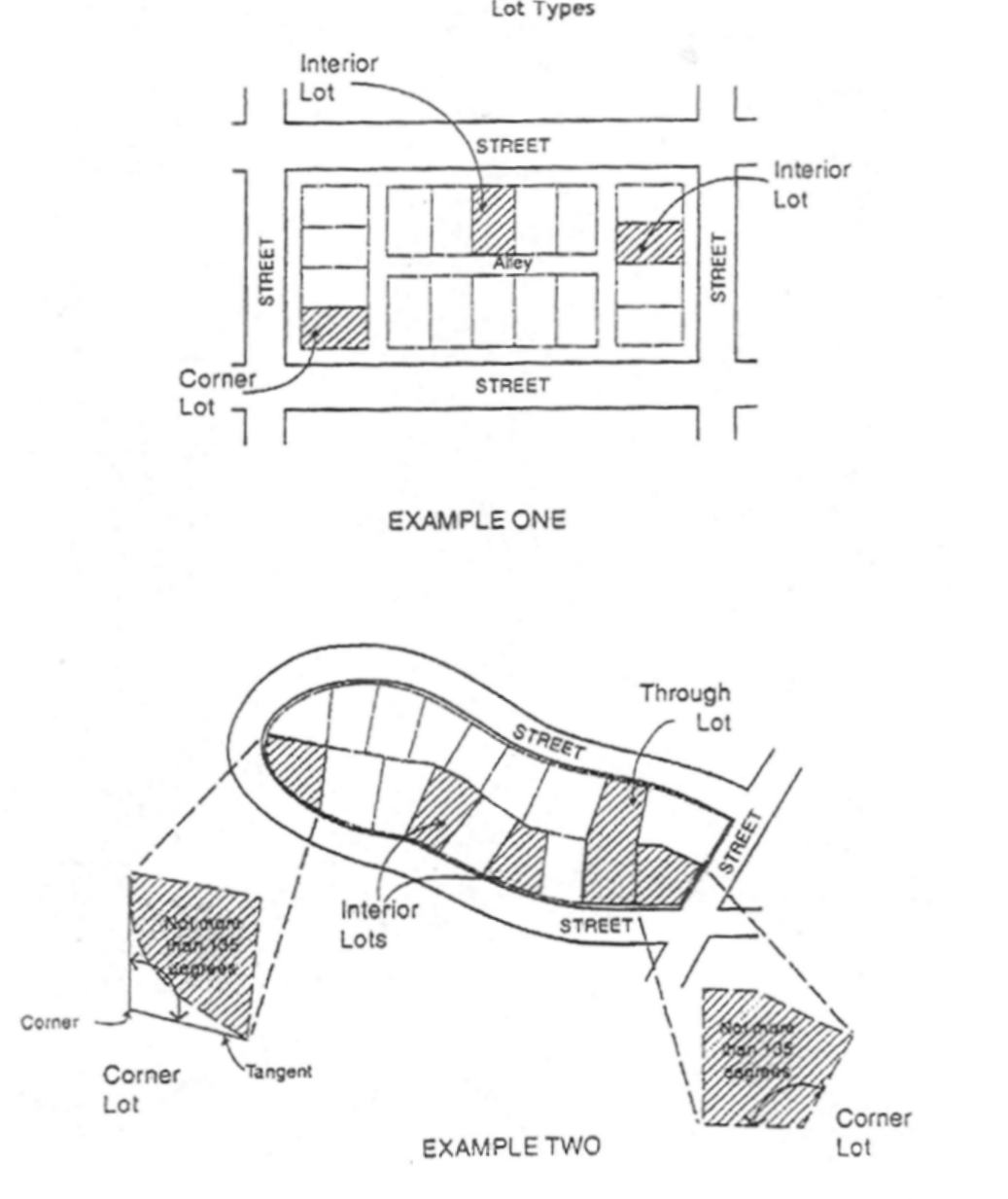 | |
|
Low/medium-impact
manufacturing or processing |
Examples include:
• Art needlework (factory); • Assembly of small parts; • Awnings, cloth, custom manufacture or assembly; • Bleaching powder compounding (blending of materials only and not involving chemicals manufacturing); • Bookbinding; • Braces, orthopedic manufacture; • Broom manufacture; • Canvas goods manufacture; • Cigar or cigarette manufacture; • Cinema production or development; • Clock or watch manufacture; • Coffee roasting; • Display designer's or builder's shops; • Dog or cat food cannery or manufacture excluding rendering or the use of fish products; • Door, sash, or trim manufacture; • Draperies manufacture; • Electric equipment assembly; • Flag or banner manufacture; • Furs: manufacture, cutting, or assembly; • Glass blowing; • Glass laminating; • Heating or ventilating apparatus assembly (not including fabrication or sheet metal ductwork); • Industrial laundry; • Ink or paint products compounding, cold mix only; • Knit goods manufacture; • Leather goods manufacture or fabrication; • Mattress manufacturing; • Paper or cardboard box forming or assembly, excluding corrugating; • Pattern shop; • Plastic products forming or molding; • Vending machine assembly; • Wire rope assembly. |
| Low-impact fireworks | Ground and hand-held sparkling devices as the phrase is defined under APA Standard 87-1, 3.1, 3.1.1.1 to 3.1.1.8, and 3.5. |
| Low-impact manufacturing or processing |
Examples include:
• Bakeries; • Bottling of alcoholic products; • Creameries; • Food products manufacturing or processing, but excluding slaughtering or rendering; • Manufacturing of musical instruments, toys, novelties, metal or rubber stamps, or other small molded rubber products; • Soda water or soft drink manufacturing or bottling establishments. |
(Code 1984, § 61-16-124; Ord. No. 11-05, § 1(61-16-124), eff. 5-28-2005; Ord. No. 23-14, § 1(61-16-124), eff. 7-24-2014)
Sec. 50-16-301. - Words and terms (Ma—Mg).
For the purposes of this chapter, the following words and phrases, beginning with the letters "Ma" through "Mg," shall have the meaning respectively ascribed to them by this section:
| Term | Definition |
| Manufactured housing unit | A transportable, factory-built structure that is manufactured in accordance with the Federal Manufactured Housing Construction and Safety Standards Act of 1974, being 42 USC 5401, and that is designed to be used as a single dwelling unit. |
| Manufacturing and Production (use category) |
Uses involved in the manufacturing, processing, fabrication, packaging, or assembly
of goods. Natural, man-made, raw, secondary, or partially completed materials may
be used. Products may be finished or semi-finished and are generally made for the
wholesale market, for transfer to other plants, or to order for firms or consumers.
Goods are generally not displayed or sold on site but, if so, are a subordinate part
of sales. Relatively few customers come to the manufacturing site. Examples include
the following uses:
• Very high-impact manufacturing or processing; • High-impact manufacturing or processing; • High/medium-impact manufacturing or processing; • Low/medium-impact manufacturing or processing; • Low-impact manufacturing or processing. Manufacturing of goods to be sold primarily on site and to the general public are classified as retail sales and service. Manufacture and production of goods from composting organic material are classified as waste-related uses. |
| Manufacturing or Processing | See Manufacturing and production (use category). |
| Marina |
A facility that offers service to the public or members of the marina for docking,
loading, or other servicing of recreational watercraft. Accessory uses include the
following, provided, they are for owners, crews, and guests:
• Boat storage; • Food and beverage facilities, including those for consumption of beer or alcoholic liquor on the premises; and • Retail facilities. |
| Marihuana or marijuana | That term as defined in Section 3 of the Michigan Regulation and Taxation of Marihuana Act, being MCL 333.27953. |
| Marijuana grower facility | A location where a licensee that is licensed as a marijuana grower under the Michigan Regulation and Taxation of Marihuana Act (MRTMA) or a grower under the Michigan Medical Marihuana Facilities Licensing Act (MMFLA), and under Chapter 20, Article VI, of this Code, Medical Marijuana Facilities and Adult-Use Marijuana Establishments, operates a commercial entity located in this state that cultivates, dries, trims, or cures and packages marijuana for sale or transfer to a medical marijuana facility or adult-use marijuana establishment. |
| Marijuana microbusiness | A location where a licensee that is licensed as a marijuana microbusiness under the Michigan Regulation and Taxation of Marihuana Act (MRTMA) and Chapter 20, Article VI, of this Code, Medical Marijuana Facilities and Adult-Use Marijuana Establishments, operates a commercial entity that cultivates not more than 150 marijuana plants, or more as allowed by the State of Michigan, processes and packages marijuana, and sells or otherwise transfers marijuana to individuals who are 21 years of age or older or to a marijuana safety compliance facility, but not to medical marijuana facilities or to other adult-use marijuana establishments. |
| Marijuana processor facility | A location where a licensee that is licensed as a marijuana processer under the Michigan Regulation and Taxation of Marihuana Act (MRTMA) or under the Michigan Medical Marihuana Facilities Licensing Act (MMFLA) and under Chapter 20, Article VI, of this Code, Medical Marijuana Facilities and Adult-Use Marijuana Establishments, operates a commercial entity located in the State of Michigan that obtains marijuana from a medical marijuana facility or adult-use marijuana establishment and processes marijuana for sale and transfer in packaged form to a medical marijuana facility or adult-use marijuana establishment. |
| Marijuana retailer establishment | A location where a licensee that is licensed as a marijuana retailer under the Michigan Regulation and Taxation of Marihuana Act (MRTMA) and Chapter 20, Article VI, of this Code, Medical Marijuana Facilities and Adult-Use Marijuana Establishments, operates a commercial entity that obtains marijuana from adult-use marijuana establishments and sells or transfers marijuana to individuals who are 21 years of age or older and to other adult-use marijuana establishments. |
| Marijuana retail/provisioning facility | A marijuana retailer establishment or a medical marijuana provisioning center facility. |
| Marijuana safety compliance facility | A location where a licensee that is licensed as a safety compliance facility under the Michigan Regulation and Taxation of Marihuana Act (MRTMA) or the Michigan Medical Marihuana Facilities Licensing Act (MMFLA) and under Chapter 20, Article VI, of this Code, Medical Marijuana Facilities and Adult-Use Marijuana Establishments, operates a commercial entity located in the State of Michigan that tests marijuana for contaminants and potency or as required by the MRTMA or the MMFLA for a primary caregiver, medical marijuana facility, or adult-use marijuana establishment. |
| Marijuana secure transporter facility | A location where a licensee that is licensed as a secure transporter facility under the Michigan Regulation and Taxation of Marihuana Act (MRTMA) or the Michigan Medical Marihuana Facilities Licensing Act (MMFLA) and under Chapter 20, Article VI, of this Code, Medical Marijuana Facilities and Adult-Use Marijuana Establishments, operates a commercial entity located in the State of Michigan that stores marijuana and transports marijuana between medical marijuana facilities or adult-use marijuana establishments for a fee. |
| Massage facility | An establishment where a massage therapist who is licensed under Part 179A of the Michigan Public Health Code, being MCL 333.17951 through 333.17969, provides massage therapy in compliance with applicable provisions of Chapter 20, Article V, of this Code, Massage Facilities and Massage Schools. |
| Master deed | The condominium document recording the condominium project as approved by the City, to which is attached as exhibits and incorporated by reference the approved bylaws for the project and the approved condominium subdivision plan for the project. |
| Master Plan | The official "Master Plan of Policies" of the City, as referenced in the Journal of City Council, August 5, 1992, Pages 1784-1787, as amended. The Master Plan of Policies specifies three levels of roadway under the "transportation" designation of the City future general land use map: freeways, major thoroughfares, and secondary thoroughfares. |
| Measurement | See "Linear measurement" and "Radial measurement". |
| Medical marijuana | Any marijuana intended for medical use which meets all requirements for medical marijuana contained in Article III of this chapter, the Michigan Medical Marihuana Act (MMMA), the Medical Marihuana Facilities Licensing Act (MMFLA), and any other applicable law, but does not include marijuana in any form inconsistent with the definition of usable marijuana under either the MMMA or the MMFLA. |
| Medical marijuana facility | A location in the State of Michigan where a licensee operates any one of the following commercial entities under the authority of the Michigan Medical Marihuana Facilities Licensing Act (MMFLA): grower, processor, provisioning center, secure transporter, or safety compliance facility, but does not include a non-commercial location used by a primary caregiver to assist a qualifying patient connected to the caregiver through the State of Michigan's formal registration process in accordance with the Michigan Medical Marihuana Act (MMMA). |
| Medical marijuana provisioning center facility | A location where a licensee that is licensed as a provisioning center under the Michigan Medical Marihuana Facilities Licensing Act (MMFLA) and Chapter 20, Article VI, of this Code operates a commercial entity located in the State of Michigan that purchases marijuana from a grower or processor and sells, supplies, or provides marijuana to qualifying patients, directly or through the patients' registered primary caregivers of patients and includes any commercial property where medical marijuana is sold at retail to qualifying patients or primary caregivers but does not include a medical marijuana caregiver center for purposes of this chapter. |
| Medium/heavy duty vehicle or equipment repair establishment | An establishment that performs any type of service or repair of vehicles with gross vehicle weight ratings over 10,000 pounds regardless of whether such service or repair is typically completed on a same-day basis or requires overnight on-site storage of such vehicles. |
| Mercado | Open air sales of new retail goods, produce, handcrafts, and the like. For zoning purposes, a mercado shall be considered the same as a store of a generally recognized retail nature whose primary business is the selling of new merchandise. |
(Code 1984, § 61-16-131; Ord. No. 11-05, § 1(61-16-131), eff. 5-28-2005; Ord. No. 01-10, § 1(61-16-131), eff. 4-1-2010; Ord. No. 13-11, § 1(61-16-131), eff. 8-23-2011; Ord. No. 31-15, § 1(61-16-131), eff. 3-1-2016; Ord. No. 37-17, § 1(61-16-131), eff. 2-6-2018; Ord. No. 20-18, § 1(61-16-131), eff. 10-14-2018; Ord. No. 2021-9, § 1, eff. 4-3-2021; Ord. No. 2023-6, § 1, eff. 3-8-2023)
Sec. 50-16-302. - Words and terms (Mh—Mm).
For the purposes of this chapter, the following words and phrases, beginning with the letters "Mh" through "Mm," shall have the meaning respectively ascribed to them by this section:
| Term | Definition |
| Michigan Medical Marihuana Act or MMMA | Initiated Law 1 of 2008, being MCL 333.26421 et seq. |
| Michigan Medical Marihuana Facilities Licensing Act or "MMFLA" | Public Act 281 of 2016, being MCL 333.27101 et seq. |
| Michigan Planning Enabling Act | The Michigan Planning Enabling Act, being MCL 125.3801 et seq. |
| Michigan Regulation and Taxation of Marihuana Act or "MRTMA" | Initiated Law 1 of 2018, being MCL 333.27954 et seq. |
| Michigan Zoning Enabling Act | The Michigan Planning Enabling Act, being MCL 333.3101 et seq. |
| Microbrewery | A facility licensed as such by the Michigan Liquor Control Commission that annually produces in total less than 60,000 barrels of beer and that may include therein the licensed brewery premises. |
| Microwave-receiving antenna | An antenna, usually parabolic or quasi-parabolic in shape, the purpose of which is to receive signals transmitted from terrestrial transmitters. |
| Mixed-use building | A mixed-use building includes at least one use from at least two of the following general land use headings in the same building: Residential Uses as specified in Article XII, Division 1, Subdivision B; Public, Civic and Institutional Uses as specified in Article XII, Division 1, Subdivision C; Retail, Service and Commercial uses as specified in Article XII, Division 1, Subdivision D; Manufacturing and Industrial Uses as specified in Article XII, Division 1, Subdivision E. A building shall also be deemed to be mixed-use where it includes both: (a) An "Office, business or professional" and (b) Any other retail use(s) specified in Section 50-12-62 [Food and Beverage Service], Section 50-12-66 [Recreation/entertainment indoor], Section 50-12-69 [Retail sales and service; sales-oriented] or Section 50-12-70 [Retails sales and service; service-oriented]. |
(Code 1984, § 61-16-132; Ord. No. 11-05, § 1(61-16-132), eff. 5-28-2005; Ord. No. 13-11, § 1(61-16-132), eff. 8-23-2011; Ord. No. 23-14, § 1(61-16-132), eff. 7-24-2014; Ord. No. 31-15, § 1(61-16-132), eff. 3-1-2016; Ord. No. 20-18, § 1(61-16-132), eff. 10-14-2018; Ord. No. 2021-9, § 1, eff. 4-3-2021; Ord. No. 2022-12, § 1, eff. 5-31-2022)
Sec. 50-16-303. - Words and terms (Mn—Ms).
For the purposes of this chapter, the following words and phrases, beginning with the letters "Mn" through "Ms," shall have the meaning respectively ascribed to them by this section:
| Term | Definition |
| Mobile home park | A parcel or tract of land under the control of a person upon which three or more mobile homes are located on a continual, non-recreational basis and which is offered to the public for that purpose regardless of whether a charge is made therefor, together with any building, structure, enclosure, street, equipment, or facility used or intended for use incident to the occupancy of a mobile home. |
| Mobile home | A structure, transportable in one or more sections, which is built on a chassis and designed to be used as a dwelling unit with or without permanent foundation, when connected to the required utilities, and includes the plumbing, heating, air-conditioning, and electrical systems contained in the structure. The term "mobile home" shall not include pick-up campers, travel trailers, motor homes, recreational vehicles, manufactured housing units, recreational units, converted buses, tent trailers, or other transportable structures designed for temporary use. Structures that comply with the Federal Manufactured Housing Construction and Safety Standards Act of 1974, being 42 USC 5401, are not considered mobile homes, but are instead considered "manufactured housing units." |
| Modular housing unit | A dwelling unit that consists of building materials commonly used in on-site construction but which are pre-constructed off-site into units and transported to the site on a removable undercarriage or flat bed and assembled for permanent location on the lot. |
| Motel | A building, or part of a building, or a group of buildings, on a single zoning lot, designed for or primarily occupied by transients that contains more than ten rooming or dwelling units where 25 percent or more of said units are independently accessible from the outside without the necessity of passing through the main lobby of the building. The term "motel" includes any such building or building group that is designated by the operator as a motor lodge, motor inn, or any other title intended for identification as providing lodging for compensation and that is with or without a general kitchen and public dining room for the use of the occupants. Motels are subject to licensing by the Buildings, Safety Engineering, and Environmental Department Business License Center in accordance with Chapter 36, Article I, of this Code, Public Accommodations. |
| Motorcycle club | An association of motorcyclists organized for social or recreational purposes, for the promotion of some common object, or as any place of assembly located in a building where five or more motorcyclists periodically or regularly engage in social, recreational, or promotional activities and generally use motorcycles as the primary means of transportation to and from the place of assembly. |
| Motor vehicle | Every vehicle that is self-propelled, but does not include an electric patrol vehicle being operated in compliance with the Michigan Electric Patrol Vehicle Act, being MCL 257.1571 et seq. |
| Motor vehicle filling station | Any premises where gasoline or other fuel for motor vehicles is sold on a retail basis which offers either full service (for example, offering employee-dispensed fuel, window cleaning, and/or oil checking), or self-service (no such services offered). Light maintenance services such as engine tune-ups, lubrication, or motor vehicle minor repairs are permitted when operated in conjunction with a motor vehicle filling station. Automotive body or fender bumping or painting, and major motor repairing are specifically disallowed from operating in conjunction with a motor vehicle filling station. References to "gas stations" mean "motor vehicle filling stations." |
| Motor vehicle washing and steam cleaning | An establishment primarily engaged in cleaning motor vehicles, whether self-service, automatic or by hand, that may provide detailing as an accessory use. References to "car wash" mean "motor vehicle washing and steam cleaning." |
| Motor vehicles, new or used, storage of | Storage of new or used motor vehicles, accessory to a salesroom or sales lot for operable new or used motor vehicles, but excluding towing service storage yards. For zoning purposes, such storage lots are not considered parking lots. |
(Code 1984, § 61-16-133; Ord. No. 11-05, § 1(61-16-133), eff. 5-28-2005; Ord. No. 34-05, § 1(61-16-133), eff. 12-6-2005; Ord. No. 44-06, § 1(61-16-133), eff. 12-21-2006; Ord. No. 04-12, § 1(61-16-133), eff. 3-30-2012; Ord. No. 2023-6, § 1, eff. 3-8-2023)
Sec. 50-16-304. - Words and terms (Mt—Mz).
For the purposes of this chapter, the following words and phrases, beginning with the letters "Mt" through "Mz," shall have the meaning respectively ascribed to them by this section:
| Term | Definition |
| Multiple-family dwelling | A structure, located on a single lot, containing three or more dwelling units, each of which is designed for or occupied by one family only, with separate housekeeping and cooking facilities for each. Multiple-family dwelling for the elderly is defined as any such housing regulated by the U.S. Department of Housing and Urban Development under its program pursuant to Section 202 of the Housing Act of 1959, as amended, being 12 USC 1701 et seq. |
| Multi-tenant development | A non-residential development having at least three tenants operating at least three businesses or services. |
| Museum (use category) | Museums are engaged in the collection, display or preservation of objects of community and cultural interest in one or more of the arts and sciences. Examples include fine art museums, natural history museums, and science and technology museums. Also included in this use category are public aquariums and outdoor art exhibition grounds and sculpture gardens. |
(Code 1984, § 61-16-134; Ord. No. 11-05, § 1(61-16-134), eff. 5-28-2005)
Sec. 50-16-321. - Words and terms (Na—Nm).
For the purposes of this chapter, the following words and phrases, beginning with the letters "Na" through "Nm," shall have the meaning respectively ascribed to them by this section:
| Term | Definition |
| Neighborhood center (non-profit) | A center that is recognized by the United States Internal Revenue Service as holding a non-profit tax-exempt status, and whose primary purpose is to provide recreational amenities, craft areas, meeting space, community kitchen facilities, cultural, and/or leisure activities, other similar space, and related administrative offices for the use of the residents of the immediate neighborhood and their guests. Examples include facilities such as senior citizen centers, youth activity centers, and community centers. |
| New Center Major Commercial Area |
The New Center Major Commercial Area consists of:
• All zoning lots within the area bounded by the John C. Lodge Freeway (M-10) Service Drive, the east/west alley first north of West Grand Boulevard, Third Street, Lothrop Avenue, Second Avenue, West Bethune Avenue, Woodward Avenue, and the Michigan Consolidated railroad tracks; • All zoning lots abutting the east side of Woodward Avenue between East Bethune Avenue and the Michigan Consolidated railroad tracks; • All zoning lots abutting the west side of Second Avenue between Lothrop and West Bethune Avenues. |
| Nightclub | For zoning purposes, a use commonly known as a nightclub shall be classified either as a "cabaret" if alcoholic liquor is served, or a "concert café" if alcoholic liquor is not served. |
(Code 1984, § 61-16-141; Ord. No. 11-05, § 1(61-16-141), eff. 5-28-2005; Ord. No. 18-18, § 1(61-16-141), eff. 8-30-2018)
Sec. 50-16-322. - Words and terms (Nn—Nz).
For the purposes of this chapter, the following words and phrases, beginning with the letters "Nn" through "Nz," shall have the meaning respectively ascribed to them by this section:
| Term | Definition |
|
Non-instrument approach
surface having a runway with a length of 2,000 feet or more up to, but not including, 5,000 feet in length | A plane longitudinally centered on the extended runway centerline beginning at each end of the runway and extending 500 feet outward at the elevation of the approach end of the runway and then sloping upward at a slope ratio of one to 40 to an altitude of 150 feet above the established airport elevation. The non-instrument approach area surface is 500 feet wide for the first 500 feet and then expands uniformly to a width of 2,600 feet at a distance of 6,500 feet from the end of the runway. |
| Nonconforming lots | Lots or land parcels that were legally created but which no longer comply with the minimum area or width standards of the underlying zoning district. (See Article XIII of this chapter.) |
| Nonconforming structure | Structures that were legally established but which no longer comply with the intensity and dimensional standards in Article XIII of this chapter. |
| Nonconforming use | Uses that were legally established but which do not appear in, or are specifically excluded from, the listings of uses permitted by right or conditionally in the zoning district where they are located. Also, uses that were legally established but were subsequently prohibited through the provisions of an overlay area as indicated in Article XI, Division 14, of this chapter shall be considered nonconforming uses. |
| Nonconformity | A "nonconforming use," nonconforming structure," or "nonconforming lot." |
| Non-profit | See Not-for-profit. |
|
Non-profit neighborhood
center | See Neighborhood center (non-profit). |
| Not-for-profit | An organization recognized by the United States Internal Revenue Service as holding a non-profit tax-exempt status. |
| Nudity | The showing of the human male or female genitals, pubic area, vulva, anus, or anal area with less than a fully opaque covering. |
| Nursing home | See Convalescent, nursing or rest home. |
(Code 1984, § 61-16-142; Ord. No. 11-05, § 1(61-16-142), eff. 5-28-2005; Ord. No. 01-10, § 1(61-16-142), eff. 4-1-2010)
Sec. 50-16-323. - Words and terms (Oa—Os).
For the purposes of this chapter, the following words and phrases, beginning with the letters "Oa" through "Os," shall have the meaning respectively ascribed to them by this section:
| Term | Definition |
| Office (use category) |
Use characterized by activities conducted in an office setting and generally focusing
on business, government/public, professional, or health care, services.
Examples include the following uses: • Massage facility; • Medical, dental or physical therapy clinic; • Office, business or professional; • Plasma donation center; • Radio or television station; • Recording studio or photo studio or video studio, no assembly hall. Offices that are part of and located with a principal use in another category are considered accessory to the firm's primary activity. Headquarters offices, when in conjunction with, or adjacent to, a principal use in another category, are considered part of the other category. |
| Open space | An area on a zoning lot not covered by a principal or accessory building. |
| Orchard | The establishment, care, and harvesting of more than ten fruit- or nut-bearing trees. The products of an orchard may or may not be for commercial purposes. An orchard as a principal use is considered an urban farm. |
| Ordinance No. 390-G | The Official Zoning Ordinance of the City of Detroit, effective December 22, 1968 and remained in effect with amendments until repealed and superseded by this chapter through Ordinance No. 11-05. |
(Code 1984, § 61-16-143; Ord. No. 11-05, § 1(61-16-143), eff. 5-28-2005; Ord. No. 34-05, § 1(61-16-143), eff. 12-6-2005; Ord. No. 10-13, § 1(61-16-143), eff. 4-16-2013)
Sec. 50-16-324. - Words and terms (Ot—Oz).
For the purposes of this chapter, the following words and phrases, beginning with the letters "Ot" through "Oz," shall have the meaning respectively ascribed to them by this section:
| Term | Definition |
| Outdoor entertainment facility | An unenclosed facility, sometimes referred to as an amphitheater, having fixed seating at which public entertainments such as concerts and theatrical performances are presented. |
| Outdoor recreation facility | The use of land for the purposes of a golf course; skating rink (ice skating, roller skating, roller blading, skate boarding, and similar activities), park, playfield, playground, parklot, parkway, playlot; swimming pool; and/or tennis court. |
| Outdoor storage yard | The use of land for the principal purpose of outdoor storage of equipment, supplies, or other items or goods, but excluding uses more specifically defined in this article. On-site outdoor storage of materials by a principal land use shall be considered an accessory use, subject to the accessory use provisions in Article XII, Division 5, of this chapter. |
| Owner | The person having the right of legal title or beneficial interest in or a contractual right to purchase a parcel of land. For the purpose of providing notices required by this chapter, the owner is the person who last paid taxes on any parcel as identified by property tax records. |
(Code 1984, § 61-16-144; Ord. No. 11-05, § 1(61-16-144), eff. 5-28-2005)
Sec. 50-16-341. - Words and terms (Pa—Pg).
For the purposes of this chapter, the following words and phrases, beginning with the letters "Pa" through "Pg," shall have the meaning respectively ascribed to them by this section:
| Term | Definition |
| Parcel | A continuous portion of land that is assigned a unique identification number by the Office of the Assessor. |
| Park | Land that is improved for, or intended to be improved for, passive or recreational uses, or to be preserved as open spaces, including, but not limited to, major parks and small (neighborhood) parks, is so designated, and is under the jurisdiction and control of the Recreation Department. |
| Park and open space (use category) |
Uses of land involving natural areas, large areas consisting mostly of vegetative
landscaping or outdoor recreation, or public squares. Such lands tend to have few
structures.
Examples include the following uses: • Cemeteries, including mausoleums, crematories, or columbaria; • Golf course; • Skating rink; • Park, playfield, playground, parklot, parkway and playlot; • Swimming pool; • Tennis court. |
| Park, major | A large open area which preserves the natural scenic beauty of a woodland, meadow, river valley or lake front, is so designated, and is under the control of the Recreation Department. |
| Park, small (or neighborhood) | A heavily landscaped area intended for ornamental rather than active recreation or picnic use. |
| Parking | The temporary standing or placement of operable motor vehicles, that bear valid and current license plate or registration sticker as required by the Michigan Secretary of State and that are currently used to transport people, goods, or materials in the conduct of normal daily activities. |
| Parking, accessory |
A parking lot or parking area shall be deemed "accessory" where such lot is operated
in conjunction with a specific land use, no fee is charged for parking in the lot
or area, and is located no farther than the maximum distance specified in Article
XIV, Division 1, Subdivision B, of this chapter and Article XIV, Division 1, Subdivision
C, of this chapter for said land use.
A parking lot or parking area shall likewise be deemed "accessory" where such lot is operated in conjunction with a specific land use, a fee is charged for parking in the lot or area, not more than 110 percent of parking spaces required for that land use in Article XIV, Division 1, Subdivision B, of this chapter and Article XIV, Division 1, Subdivision C, of this chapter is actually provided, and is located no farther than the maximum distance specified in Article XIV, Division 1, Subdivision B, of this chapter and Article XIV, Division 1, Subdivision C, of this chapter for said land use. |
| Parking, commercial (use category) |
For purposes of this chapter, commercial parking may operate in three different manners:
1) Facilities providing off-street parking that are not accessory to a specific use and charge a fee, shall be deemed "commercial" parking. 2) Paid accessory parking. A parking facility shall likewise be deemed "commercial" when a fee is charged, the parking facility is operated in conjunction with a specific land use; and when the accessory parking lot provides more than 110 percent of the off-street parking spaces required for that land use in Article XIV, Division 1, Subdivision B, of this chapter and Article XIV, Division 1, Subdivision C, of this chapter. 3) Remote accessory parking. Where a parking lot or parking area is operated in conjunction with a specific land use but is located farther than the maximum distance specified for said land use in Article XIV, Division 1, Subdivision B, of this chapter and Article XIV, Division 1, Subdivision C, of this chapter, it shall likewise be deemed "commercial." Examples include the following uses: • Parking lot or parking area for operable private passenger vehicles; • Park-and-ride facilities (transit-based); • Parking structure. |
| Parking garage, private | A structure or part thereof, designed, used or intended to be used for the parking and storage of fewer than six private passenger vehicles or recreational equipment items, as defined in Section 50-16-361 of this Code. |
| Parking structure | A structure, typically having at least two levels of parking, for the storage of more than five operable, licensed private passenger vehicles. |
| Parking, valet | Parking where the vehicle is parked and retrieved by an attendant. |
| Parklot | Landscaped triangles, street entrances or remnant parcels which have been landscaped for ornamental purposes, are generally dedicated for such purposes in subdivision plats, are so designated, and are under the jurisdiction and control of the Recreation Department. |
| Parkway | A broad roadway bordered and often divided with landscaped areas consisting of tree plants, bushes, and/or grass, is so designated, and is under the jurisdiction and control of the Recreation Department. |
| Passenger vehicle, private | See Vehicle, private passenger. |
| Pawnshop | The premises at which a pawnbroker purchases personal property or other valuable thing on condition of selling the same back again at a stipulated price; also, the premises at which a pawnbroker loans money on deposit, or pledge of personal property, or other valuable thing, other than securities or printed evidence of indebtedness. Pawnbrokers are licensed in accordance with Chapter 41, Article II, of this Code. |
| PBB | Polybrominated biphenyl. |
| PCB | The class of chlorinated biphenyl, terphenyl, higher polyphenyl, or mixtures of these compounds produced by replacing two or more hydrogen atoms on the biphenyl, terphenyl, or higher polyphenyl molecule with chlorine atoms. "PCB" shall not include chlorinated biphenyls, terphenyls, higher polyphenyls, or mixtures of these compounds that have functional groups attached other than chlorine unless that functional group on the chlorinated biphenyls, terphenyls, higher polyphenyls, or mixtures thereof is determined to be dangerous to the public health, safety and welfare under Part 147, Subpart 1, of the Michigan Natural Resources and Environmental Protection Act, being MCL 324.14701 et seq. |
| Personal service establishment | Includes barber shops, beauty shops, dry cleaning or laundry pick-up stations, nail salons, shoe repair shops, shoeshine stand or parlor. |
| Pet crematory | Any land, place, structure, or facility used or intended to be used for the cremation of pets. |
(Code 1984, § 61-16-151; Ord. No. 11-05, § 1(61-16-151), eff. 5-28-2005; Ord. No. 20-05, § 1(61-16-151), eff. 5-29-2005; Ord. No. 44-06, § 1(61-16-151), eff. 12-21-2006; Ord. No. 24-08, § 1(61-16-151), eff. 11-1-2008; Ord. No. 13-11, § 1(61-16-151), eff. 8-23-2011; Ord. No. 37-17, § 1(61-16-151), eff. 2-6-2018; Ord. No. 2023-41, § 1, eff. 12-30-2023)
Sec. 50-16-342. - Words and terms (Ph—Pm).
For the purposes of this chapter, the following words and phrases, beginning with the letters "Ph" through "Pm," shall have the meaning respectively ascribed to them by this section:
| Term | Definition |
| Photocopying or computing self-service establishment | This use is permitted as a retail store, but separately regulated for off-street parking as provided for in Section 50-14-59 of this Code. |
| Pickup truck | A four-wheel motor vehicle, usually having an enclosed front cab and an open body with low sides and a tailgate. A pickup truck may have an enclosure, cap, cover, or box over the rear exterior bed. |
| Planning Enabling Act | The Michigan Planning Enabling Act, being MCL 125.3801 et seq. |
| Plasma donation center | A facility at which individuals donate plasma or other blood products in return for monetary or other consideration. |
| Playfield | Land that is designed for major field sports, for example, baseball, football, soccer, tennis, and softball, which requires more area than is available on a playground, is so designated, and is under the jurisdiction and control of the Recreation Department. |
| Playground | Land that is designed and maintained primarily for the recreational use of children aged five to 14 including, but not limited to, central and junior playgrounds, is so designated, and is under the jurisdiction and control of the Recreation Department. |
| Playlot | Land that is designed and maintained primarily for the recreational use of small children aged one to eight, is so designated, and is under the jurisdiction and control of the Recreation Department. |
(Code 1984, § 61-16-152; Ord. No. 11-05, § 1(61-16-152), eff. 5-28-2005; Ord. No. 13-11, § 1(61-16-152), eff. 8-23-2011; Ord. No. 37-17, § 1(61-16-152), eff. 2-6-2018)
Sec. 50-16-343. - Words and terms (Pn—Ps).
For the purposes of this chapter, the following words and phrases, beginning with the letters "Pn" through "Ps," shall have the meaning respectively ascribed to them by this section:
| Term | Definition |
| Police Department authorized abandoned vehicle yards | See Towing service storage yard. |
| Pool |
Pool room means a commercial establishment, except for one that has a Class C Bar
License or a Tavern License, where a pool table game, or games, are operated.
Pool table means a table that is surrounded by any elastic ledge or cushion, with or without pockets, and with balls that are impelled by a cue. Pool table game means any of several games played on a pool table including all forms of the game known as Carom Billiards, Pocket Billiards and English Billiards, all other games played on a pool table, the games known as Fifteen Ball Pool, Eight ball Pool, Bottle Pool, and Pea Pool, and all other games played on a so-called pool table, or on a so-called pigeon-hole table. |
| Porch | A covered or uncovered entrance to a building or a roofed structure projecting from the exterior wall or walls of a principal structure and supported by piers, posts or columns and commonly open to weather. |
| Porch, enclosed | A porch enclosed with screen panels or storm windows; opaque materials used in such enclosed area shall be limited to a maximum height of 42 inches above the floor of the porch. |
| Porch, unenclosed | A porch that is not closed in any way by glass, opaque panel, or any other material, and has no enclosing features higher than 42 inches above the floor of the porch except the roof, roof supports, and railing. |
| Precious metal and gem dealer | A building, structure, premises, or part thereof, that is open to the public for the ordinary course of repeated and recurrent transactions of buying or receiving precious items, namely jewelry, precious gems, or items containing gold, silver, or platinum as these terms are defined in Section 41-3-1 of this Code. |
| Pre-release adjustment center | An establishment that provides shelter, supervisory and social services to convicts in a pre-release parole preparation program, as authorized by the Michigan Corrections Commission under authority of the Michigan Corrections Code of 1953, being MCL 791.201 et seq., or by the Federal Bureau of Prisons under authority of P.L. 91:492, as amended. |
| Primary caregiver | An individual registered with the state in compliance with the General Rules of the Michigan Department of Community Health, the Michigan Medical Marihuana Act, Initiated Law 1 of 2008, being MCL 333.26421 et seq. |
| Principal building | The building occupied or designed for the principal use. |
| Principal use | The main use to which a premises is devoted. |
| Private club | An association, whether incorporated or unincorporated, organized for a common purpose to pursue common goals, interests or activities, not including associations organized for a commercial or business purpose; said private club is characterized by certain membership qualifications, payment of fees and dues, regular meetings, and a constitution and bylaws. |
(Code 1984, § 61-16-153; Ord. No. 11-05, § 1(61-16-153), eff. 5-28-2005; Ord. No. 24-08, § 1(61-16-153), eff. 11-1-2008; Ord. No. 13-11, § 1(61-16-153), eff. 8-23-2011; Ord. No. 04-12, § 1(61-16-153), eff. 3-30-2012; Ord. No. 31-15, § 1(61-16-153), eff. 3-1-2016)
Sec. 50-16-344. - Words and terms (Pt—Pz).
For the purposes of this chapter, the following words and phrases, beginning with the letters "Pt" through "Pz," shall have the meaning respectively ascribed to them by this section:
| Term | Definition |
| Public accommodation (use category) |
Uses involving the provision of overnight lodging (rooms), with or without meal service.
Examples include the following uses: • Bed and breakfast inn; • Hotel; • Lodginghouse, public; • Motel. Hotels, restaurants and other services that are part of a truck stop are considered accessory to the truck stop, which is classified as an industrial service use. |
| Public center open use | Open (unenclosed) land uses normally associated with public centers. |
(Code 1984, § 61-16-154; Ord. No. 11-05, § 1(61-16-154), eff. 5-28-2005)
Sec. 50-16-361. - Words and terms (Qa—Qz and Ra—Rec).
For the purposes of this chapter, the following words and phrases, beginning with the letters "Qa" through "Qz" and "Ra" through "Rec," shall have the meaning respectively ascribed to them by this section:
| Term | Definition |
| Race track, motor vehicle | An unenclosed facility, having a permanent track or course or oval for the racing of motor vehicles. The term, "motor vehicle race track," does not include go-cart tracks. |
| Radial measurement | Radial measurement between two points is a straight line connecting two points, drawn irrespective of intervening property lines, rights-of-way or natural or built environment. When notification is required to be given within a 300-foot radius of a rectangular zoning lot, for example, all points 300 feet distant from the lot lines are connected to create an oval-like shape. Similarly, when a land use is prohibited within a specified distance from a given point all points at the specified distance are connected to create an oval-like shape, as illustrated in Figure 50-12-127. |
| Railroad facility (use category) |
Facilities owned or operated by railroad companies or rail companies.
Examples include the following uses: • Railroad rights-of-way, not including storage tracks, yards, or buildings. |
| Rainwater catchment system | A method of catching rainwater runoff from the roof of a structure into rain gutters that channel into a rain barrel, drum, or cistern. |
| Reception window | That area within the direct line between a land-based antenna and an orbiting satellite or that area within the direct line between a microwave-receiving antenna and a terrestrial transmitter. |
| Recreation center | A facility under the jurisdiction and control of the Recreation Department that is created primarily to benefit minors through the use of organized educational, social, and/or recreational activities. |
| Recreation, indoor commercial | Indoor commercial uses such as bowling alleys, basketball courts, archery ranges, golf domes and ranges, tennis facilities, ice/roller skating rinks, laser tag facilities, paint ball facilities, and the like. Although part of the use category, indoor recreation and entertainment, indoor firearms target practice ranges shall not be regulated as the land use known as indoor commercial recreation. |
| Recreation and entertainment, indoor (use category) |
Commercial uses that provide continuous recreation or entertainment-oriented activities
in an enclosed setting. Such uses are distinguished from "assembly" uses by the fact
that they are operated on a continuous basis, rather than for specific events.
Examples include the following uses: • Arcade; • Cabaret; • Casinos; • Casino complex; • Commercial recreation, indoor; • Firearms target practice range, indoor; • Health club; • Pool hall; • Smoking lounge, cigar; • Smoking lounge, other; • Theater and concert cafe, excluding drive-in theaters. |
| Recreation and entertainment, outdoor (use category) |
Large, generally commercial uses that provide continuous recreation or entertainment-oriented
activities and that primarily take place outdoors. They may take place in a number
of structures that are arranged together in an outdoor setting.
Examples include the following uses: • Amusement park; • Baseball/softball/soccer or other athletic complexes that include outdoor lighting of playing or activity areas; • Drive-in theater; • Go-cart track; • Golf course, miniature; • Golf driving range; • Rebound tumbling center. Golf courses are classified as parks and open spaces. Uses that draw large numbers of people to periodic events, rather than on a continuous basis, are classified as major entertainment events. (See Auditorium or stadium use category.) |
| Recreational equipment | Items such as boats, snowmobiles, off-road vehicles, dune buggies, jet skis, or other similar items. |
| Recreational space ratio | The total recreational space on a zoning lot divided by the gross floor area of all structures on the zoning lot. |
| Recreational vehicle | Includes motor homes, pickup campers, and trailer coaches. The term "motor home" means a motor vehicle constructed or altered to provide living quarters, including permanently installed cooking and sleeping facilities, and used for recreation, camping, or other noncommercial use. The term "pickup camper" means a non-self-propelled recreational vehicle, without wheels for road use, that is designed to rest all of its weight upon, and be attached to, a motor vehicle, and is primarily intended for use as temporary living quarters in connection with recreational, camping, or travel purposes. A pickup camper does not include truck covers or caps consisting of walls and a roof or have floors and facilities for using the camper as a dwelling. The term "trailer coach" means every vehicle primarily designed and used as temporary living quarters for recreational, camping, or travel purposes and drawn by another vehicle. |
| Recycling center | A lot or parcel of land, with or without buildings, upon which wastes are recovered in a process designed to provide an acceptable reuse of all or part of the waste. This use includes, but is not limited to, facilities for processing or recycling metal, wire, concrete, roofing materials, drywall, asphalt, siding, insulation, wood, demolition debris, paper, and glass. A recycling center does not include storage containers or processing activity located on the premises of a residential, commercial, or manufacturing use that is used solely for the recycling of material generated by that property, business, or manufacturer. |
(Code 1984, § 61-16-161; Ord. No. 11-05, § 1(61-16-161), eff. 5-28-2005; Ord. No. 10-13, § 1(61-16-161), eff. 4-16-2013; Ord. No. 37-17, § 1(61-16-161), eff. 2-6-2018; Ord. No. 2023-36, § 1, eff. 3-5-2024)
Sec. 50-16-362. - Words and terms (Red—Rm).
For the purposes of this chapter, the following words and phrases, beginning with the letters "Red" through "Rm," shall have the meaning respectively ascribed to them by this section:
| Term | Definition |
| Refuse | Putrescible and nonputrescible solid waste, except body wastes, including garbage, rubbish, ash, incinerator ash, incinerator residue, and solid market, industrial and construction refuse. |
| Regulated use |
Any of the following
(1) Brewpub, microbrewery, or small distillery or small winery that serves alcohol for consumption on the premises, that is located outside the Central Business District, the MKT District, and the SD2 District except if operating in conjunction with and located on the same zoning lot as a standard restaurant; (2) Cabaret; (3) Dance hall, public, outside the Central Business District; (4) Establishment for the sale of beer or alcoholic liquor for consumption on the premises, outside the Central Business District and the MKT, SD1, SD2 and SD5 Districts, provided, that any establishment for the sale of beer or alcoholic liquor for consumption on the premises that operates in conjunction with and is located on the same zoning lot as a standard restaurant, as defined in this section, shall not be considered a regulated use; (5) Lodging house, public; (6) Motel; (7) Pawnshop; and (8) Plasma donation center. |
| Religious institutions (use category) | Uses primarily engaged in providing meeting areas for religious activities. Typical examples include chapels, churches, mosques, synagogues, and temples. Affiliated preschools are classified as day care uses. Affiliated schools are classified as schools. |
| Religious residential facilities | Rectories, parsonages, monasteries, convents, seminaries, religious retreats, and the like. |
| Rental hall | Any enclosed hall, building, or portion of any building regularly available for rental, lease or loan for the purpose of public assembly, banquets, luncheons, entertainment or sports events, whether such assemblies are public or private, or subject to an admission fee. The term "rental hall" does not include "public dance hall." |
| Rental merchandise store | A store whose primary business is the rental of household or personal merchandise originally stocked as new merchandise, such as videocassette and/or DVD recordings, household appliances, formal attire, and other articles stored and displayed within the store or showroom. For zoning purposes, a rental merchandise store shall be regulated the same as a "store of a generally recognized retail nature whose primary business is the sale of new merchandise," provided, that a car rental facility shall be regulated in the same manner as a sales room or sales lot for new or used operable motor vehicles. |
| Repeat offense | A second, or any subsequent, determination regarding a blight violation notice that is made within a one calendar-year period for the same blight violation, except for a determination by an administrative hearings officer that a person is not responsible for a blight violation. |
| Residential substance abuse service facility | An establishment in a residential setting used for the treatment of persons having drug or alcohol abuse problems. The establishment may or may not dispense compounds or prescription medicines to individuals depending upon the severity of their drug or alcohol abuse problems. |
| Residential use combined in structures with permitted commercial uses | This land use allows for residential apartments with permitted commercial uses in a commercial building occupied by a use permitted in the given zoning district as indicated in the use tables in Article XII, Division 1, Subdivision D, of this chapter. As examples, a doctor's office in an R5 or R6 District may also include a residential unit on a by-right basis and a hardware store in a B2, B3, B4, B5, or B6 District may rent out apartments on its second floor. |
| Rest home | See Convalescent, nursing or rest home. |
| Restaurant, carry-out |
An establishment for the sale of foods, frozen desserts, or beverages to the customer
in a ready-to-consume state, and whose design or method of operation includes both
of the following characteristics:
(1) Foods, frozen desserts, or beverages are usually served in edible or disposable containers; (2) The consumption of foods, frozen desserts, or beverages within the restaurant building, within a motor vehicle parked upon the premises, or at other facilities on the premises outside the restaurant building, is posted as being prohibited, and such prohibition is strictly enforced by the restaurateur. |
| Restaurant, fast-food |
An establishment for the sale of foods, frozen desserts, or beverages to the customer
in a ready-to-consume state for consumption either within the restaurant building
or for carryout with consumption off the premises, whose delivery of food to the customer
may include service via a drive-up or outdoor walk-up pass-through window, and whose
design or principal method of operation includes both of the following characteristics:
(1) Foods, frozen desserts, or beverages are usually served in edible or disposable containers; (2) The consumption of foods, frozen desserts, or beverages within a motor vehicle parked upon the premises, or at other facilities on the premises outside the restaurant building other than designated and approved outdoor eating areas, is posted as being prohibited, and such prohibition is strictly enforced by the restaurateur. |
| Restaurant, standard |
An establishment for the sale of foods, frozen desserts, or beverages to the customer
in a ready-to-consume state, and whose design or principal method of operation includes
one or both of the following characteristics:
(1) Customers are normally provided with an individual menu, are served foods, frozen desserts, or beverages by a restaurant employee at the same table or counter at which said items are consumed; (2) A cafeteria-type operation where foods, frozen desserts, or beverages generally are consumed within the restaurant building. |
| Retail sales and service, occupant-oriented (use category) |
Ancillary and accessory uses to principal multi-family, office, or employment uses.
They are involved in providing goods and services to residents or employees of the
principal use and to visitors to the site.
Examples include the following uses: • Retail sales and personal service in multiple-residential structures; • Retail sales and personal service in business and professional offices. |
| Retail sales and service, sales-oriented (use category) |
Uses involved in the sale, lease or rent of new or used products to the general public.
Examples include the following uses: • Store of a generally recognized retail nature whose primary business is the sale of new merchandise; • Bake shop, retail; • Firearms dealership; • Garden center; • Kennel, commercial; • Motor vehicles, new or used, salesroom or sales lot; • Motorcycles, retail sales, rental or service; • Pawnshop; • Pet shop; • Poultry or small game (storage or killing for direct, retail sale on the premises or for wholesale trade); • Precious metal and gem dealer; • Produce or food market, wholesale; • Specially designated distributor's (SDD) establishment; • Specially designated merchant's (SDM) establishment; • Tobacco retail store; • Trailer coaches, or boat sale or rental, open air display; • Trailers, pneumatic-tired utility type, cement mixers: sales, rental, or service (outdoor); • Used goods dealer. Sales, rental, or leasing of heavy trucks and equipment or manufactured housing units are classified as wholesale sales. |
| Retail sales and service, service-oriented (use category) |
Uses providing retail consumer services to the general public.
Examples include the following uses: • Animal-grooming shop; • Automated teller machine (without drive-through facilities); • Automated teller machine (with drive-through facilities); • Bank (without drive-through facilities); • Bank (with drive-through facilities); • Barber or beauty shop; • Body art facility; • Business college or commercial trade school; • Customer service center; • Dry cleaning, laundry, or laundromat; • Employee recruitment center; • Financial services center; • Food stamp distribution center (no drive-through window); • Food stamp distribution center (with drive-through window); • Mortuary or funeral home; • Nail salon; • Printing or engraving shop; • School or studio of dance, gymnastics, music, art, or cooking; • Shoe repair shop; • Veterinary clinic for small animals. |
| Review body | The entity that is authorized to recommend approval or denial of an application or permit required under this chapter. |
| Right-of-way | A strip of land occupied or intended to be occupied by a street, crosswalk, railroad, sanitary or storm sewer, electric transmission line, oil or gas pipeline, or for any other similar use as may be designated. |
(Code 1984, § 61-16-162; Ord. No. 11-05, § 1(61-16-162), eff. 5-28-2005; Ord. No. 01-10, § 1(61-16-162), eff. 4-1-2010; Ord. No. 13-11, § 1(61-16-162), eff. 8-23-2011; Ord. No. 10-13, § 1(61-16-162), eff. 4-16-2013; Ord. No. 38-14, § 1(61-16-162), eff. 10-16-2014; Ord. No. 13-15, § 1(61-16-162), eff. 7-11-2015; Ord. No. 37-17, § 1(61-16-162), eff. 2-6-2018; Ord. No. 2020-21, § 1, eff. 8-8-2020; Ord. No. 2022-17, § 1, eff. 10-4-2022; Ord. No. 2023-36, § 1, eff. 3-5-2024)
Sec. 50-16-363. - Words and terms (Rn-Rz).
For the purposes of this chapter, the following words and phrases, beginning with the letters "Rn" through "Rz," shall have the meaning respectively ascribed to them by this section:
| Term | Definition |
| Rooming house |
A dwelling, occupied by the owner or the owner's agent, consisting of:
(1) Not more than two dwelling units; and (2) Not more than ten rooming units without cooking or kitchen accommodations for individuals leasing or renting rooms. |
| Rooming unit | A room rented as sleeping and living quarters but without cooking facilities and with or without an individual bathroom. In a suite of rooms without cooking facilities, each room which provides sleeping accommodations shall be counted as one rooming unit for purposes of this chapter. |
| Rubbish | Nonputrescible solid waste, excluding ash, consisting of both combustible and noncombustible waste such as paper, cardboard, cans, yard clippings and leaves, wood, glass, bedding, crockery, rubber, rags, leather, straw, scrap tires, vehicle parts, furniture and appliances. |
(Code 1984, § 61-16-163; Ord. No. 11-05, § 1(61-16-163), eff. 5-28-2005)
Sec. 50-16-381. - Words and terms (Sa—Sd).
For the purposes of this chapter, the following words and phrases, beginning with the letters "Sa" through "Sd," shall have the meaning respectively ascribed to them by this section:
| Term | Definition |
| Satellite television antenna | A device incorporating a reflective surface that is solid open mesh, or bar configured and is in the shape of a shallow dish, cone, horn, or cornucopia. Such device shall be used to transmit and/or receive radio or electromagnetic waves between terrestrially and/or orbitally based uses and includes, but is not limited to, what are commonly referred to as satellite earth stations, TVROs, and satellite microwave antennas. |
| School building adaptive reuses |
Any of 19 uses listed below and located within a building originally constructed as
a school that is otherwise not permitted as a by-right or conditional use on land
zoned R1 and/or R2 and/or R3 and/or R4 and/or R5 and/or R6. School building adaptive reuses, residential: (1) Assisted living facility, where located on a major thoroughfare; (2) Boarding school and dormitory, where located on a major thoroughfare; (3) Convalescent, nursing, or rest home, where located on a major thoroughfare; (4) Loft; (5) Multiple-family dwelling; School building adaptive reuses—public, civic, and institutional: (6) Adult day care center; (7) Child care center; (8) Educational institution; (9) Governmental service agency; (10) Library; (11) Museum; School building adaptive reuses—retail, service, and commerical: (12) Business college or commercial trade school; (13) Medical or dental clinic, physical therapy clinic, or massage facility; (14) Office, business or professional; (15) Radio or television station; (16) Recording studio or photo studio or video studio, no assembly hall; (17) Recreation, indoor commercial and health club; (18) School or studio of dance, gymnastics, music, art, or cooking; (19) Youth hostel/hostel, where located on a major thoroughfare. |
| Schools (use category) |
Public or private schools at the primary, elementary, middle, junior high, or high
school level that provide state-mandated basic education. Examples include public
and private daytime (elementary, junior high and senior high) schools, and military
academies.
Charter schools are public schools. Preschools are classified as day care uses, provided, that a preschool "Head Start" program shall be considered as an accessory use where located on the premises of an operating school. (See also Section 50-12-512 of this Code.) Business and trade schools are classified as retail sales and service. Boarding schools are classified as institutional living uses. |
| Scrap metal recycling facility | A location where a business purchases ferrous or nonferrous metal that is intended for recycling or reuse. For zoning purposes, these facilities are regulated as junkyards. |
| Scrap processing facility | A location where machinery and equipment is used to process and manufacture iron, steel, nonferrous metals, paper, plastic, or glass into prepared grades of products suitable for consumption by recycling mills, foundries, and other scrap processors pursuant to the Section 3 of the Michigan Secondhand Dealer and Junk Dealers Act, being MCL 445.403, and in Section 3 of the Michigan Scrap Metal Regulatory Act, being MCL 445.423. For zoning purposes, these facilities are regulated as junkyards. |
| Scrap tire processing or recycling facility | The storing, buying, or otherwise acquiring scrap tires, and reducing their volume by shredding or otherwise facilitating recycling or resource recovery techniques for scrap tires. |
| Scrap tire storage facility | A premises used for the storage of scrap tires, whether indoors or outdoors, provided, that duly authorized retail tire dealerships may temporarily store only those scrap tires, which are incidental and accessory to normal retail operations and are awaiting removal for disposal or processing. |
| Scrap tires | Scrap tires are continuous solid or pneumatic rubber coverings that were manufactured to encircle a wheel for use in the operation of any motorized vehicle and are no longer being used for their original intended purpose. |
| Screening | A method of reducing the impact of noise and/or unsightly visual intrusions with less offensive or more harmonious elements, such as berms, plants, opaque fences, walls, or any appropriate combination. |
(Code 1984, § 61-16-171; Ord. No. 11-05, § 1(61-16-171), eff. 5-28-2005; Ord. No. 44-06, § 1(61-16-171), eff. 12-21-2006; Ord. No. 01-10, § 1(61-16-171), eff. 4-1-2010; Ord. No. 21-12, § 1(61-16-171), eff. 11-2-2012; Ord. No. 2023-6, § 1, eff. 3-8-2023)
Sec. 50-16-382. - Words and terms (Se—Sh).
For the purposes of this chapter, the following words and phrases, beginning with the letters "Se" through "Sh," shall have the meaning respectively ascribed to them by this section:
| Term | Definition |
| Semi-nude or semi-nudity | The showing of the male or female buttocks, or the showing of the female breast below a horizontal line across the top of the areola and extending across the width of the breast at that point, but does not mean the showing of any portion of the cleavage of female breasts exhibited by a bikini, dress, blouse, skirt, leotard, or similar wearing apparel. |
| Semi-nude model - studio | A place where persons regularly appear in a state of semi-nudity for money or any form of consideration in order to be observed, sketched, drawn, painted, sculptured, photographed, or similarly depicted by other persons. This definition does not apply to any place where persons appearing in a state of semi-nudity did so in a class operated: (1) By a college, junior college, or university supported entirely or partly by taxation; (2) By a private college or university which maintains and operates educational programs in which credits are transferable to a college, junior college, or university supported entirely or partly by taxation; or (3) In a structure: a. Which has no sign visible from the exterior of the structure and no other advertising that indicates a semi-nude person is available for viewing; and b. Where, in order to participate in a class, a student must enroll at least three days in advance of the class. |
| Semi-trailer | Every vehicle without motive power, other than a pole-trailer, which is designed for carrying persons or property and for being drawn by a motor vehicle and which is so constructed that some part of its weight and that of its load rests upon or is carried by another vehicle. |
| Setback | The required minimum horizontal distance between the nearest part of the structure or the building line and the related front, side, or rear lot lines. Setbacks are open from the ground to the sky, except as otherwise expressly allowed by this chapter. |
| Setback, front | A setback that is required from the front lot line (extending the full width of the lot). |
| Setback, rear | A setback that is required from the rear lot line (extending the full width of the lot). On a corner lot, this rear setback shall extend only to the side setback abutting the street. |
| Setback, side | A setback that is required from the side lot line (extending from the front building line of the principal building to the rear building line of the principal building). |
| Sexually-oriented business | An adult bookstore or adult video store, an adult cabaret, an adult motion picture theater, or a semi-nude model studio. |
| Shade tree | A deciduous tree (rarely an evergreen) planted primarily for its high crown of foliage. |
| Shelter for survivors of domestic violence | A residential facility providing temporary accommodation and support to survivors of domestic violence with or without their minor children. Such shelter shall be operated by a non-profit, charitable, or religious agency that meets the pre-contract standards of the Michigan Domestic and Sexual Violence Prevention and Treatment Board. Such shelter shall be considered a different land use than an adult foster care facility, a pre-release adjustment center, and a substance abuse service facility. For confidentiality and security of their locations, such shelters shall be permitted on a matter of right basis in certain zoning districts. Shelters for survivors of domestic violence are subject to licensing by the Buildings, Safety Engineering, and Environmental Department Business License Center. |
| Show-cause hearings | A hearing before a designated hearing officer to show cause why a specific action should not be taken. (See also Section 50-5-73 of this Code.) |
| Shrub | A woody plant, smaller than a tree, consisting of several small stems from the ground or small branches near the ground; may be deciduous or evergreen. |
(Code 1984, § 61-16-172; Ord. No. 11-05, § 1(61-16-172), eff. 5-28-2005; Ord. No. 34-05, § 1(61-16-172), eff. 12-6-2005; Ord. No. 01-10, § 1(61-16-172), eff. 4-1-2010; Ord. No. 13-11, § 1(61-16-172), eff. 8-23-2011; Ord. No. 21-12, § 1(61-16-172), eff. 11-2-2012; Ord. No. 2022-5, § 1, eff. 3-23-2022)
Sec. 50-16-383. - Words and terms (Si—Sl).
For the purposes of this chapter, the following words and phrases, beginning with the letters "Si" through "Sl," shall have the meaning respectively ascribed to them by this section:
| Term | Definition |
| Sign | Any letter, figure, character, mark, plane, point, marquee sign, design, poster, pictorial, picture, stroke, stripe, line, trademark, reading matter, or illuminated service that shall be constructed, placed, attached, painted, erected, fastened, or manufactured in any manner whatsoever, so that the same shall be used for the attraction of the public to any place, subject, person, firm, corporation, public performance, article, machine, or merchandise, whatsoever, that is displayed in any manner whatsoever outdoors. Every sign shall be classified and conform to the requirements of such classification as set forth in Chapter 8, Article II, of this Code, Building Code, including Section 8-2-21 of this Code. Additions to Appendix H, and this article. A "sign" shall not include any display of official court or public agency notices, nor shall it included the flag, emblem, or insignia of a nation, political unit, school, or religious group. The term "sign" also does not include any non-illuminated, non-commercial, painted art mural. |
| Single-family detached dwelling | A detached dwelling unit, located on a single lot with no other dwelling units, designed for or occupied by one family only. |
| Single-room-occupancy housing, non-profit | Service-enhanced, single-room housing, provided by an entity recognized by the Internal Revenue Service as holding non-profit, tax-exempt status, which housing is primarily for individuals residing without children, such individuals being capable of independent living, whose dwelling units may or may not provide separate sanitary and food-preparation facilities, and sometimes operates as a hotel although permanent residency is an anticipated feature of the housing. For zoning purposes, non-profit SRO housing is not: adult foster care, a community mental health facility or "fairweather lodge" or other similar semi-independent living facility, a pre-release adjustment center, a residential substance abuse service facility, a rooming house, public lodging house, or emergency shelter for the homeless. |
| Site plan | One or more maps and drawing or reports containing all of the information required to be shown for such property as part of the site plan review process in Article III, Division 5, of this chapter. |
| Slope ratio | A numerical expression of a stand relationship of height to horizontal distance. |
(Code 1984, § 61-16-173; Ord. No. 11-05, § 1(61-16-173), eff. 5-28-2005; Ord. No. 34-05, § 1(61-16-173), eff. 12-6-2005; Ord. No. 24-08, § 1(61-16-173), eff. 11-1-2008; Ord. No. 13-11, § 1(61-16-173), eff. 8-23-2011; Ord. No. 23-13, § 1(61-16-173), eff. 8-28-2013; Ord. No. 2020-12, § 1, eff. 12-9-2020)
Sec. 50-16-384. - Words and terms (Sm—Ss).
For the purposes of this chapter, the following words and phrases, beginning with the letters "Sm" through "Ss," shall have the meaning respectively ascribed to them by this section:
| Term | Definition |
| Small distillery | A facility operated by a manufacturer of spirits licensed in Michigan by the Michigan Liquor Control Commission as a small distiller, annually manufacturing not more than 60,000 gallons of spirits, of all brands combined. |
| Small lot | Any residential lot less than 50 feet in width and 5,000 square feet in area. |
| Small winery | A facility operated by a small winemaker licensed in Michigan by the Michigan Liquor Control Commission for the manufacturing or bottling of not more than 50,000 gallons of wine in one calendar year. |
| Smoking lounge, cigar | An establishment, or area within an establishment, that constitutes a "cigar bar" as defined by Section 12601 of the Michigan Smoke-Free Indoor Air Law, being MCL 333.12601. Smoking lounge, cigar, does not include smoking lounge, other, medical marijuana facilities, or adult-use marijuana establishments as defined by this article. |
| Smoking lounge, other | A retail establishment that constitutes a "tobacco specialty retail store" as defined by Section 12601 of the Michigan Smoke-Free Indoor Air Law, being MCL 333.12601, and that is designated wholly or in part for the on-premises smoking of tobacco products or non-tobacco smoking products or substances, which may include the on-premises use of hookah as defined by this article. Smoking lounge, other, does not include tobacco retail store, smoking lounge, cigar, medical marijuana facilities, or adult-use marijuana establishments as defined by this article. |
| Snack food | Prepared and commercially prepackaged non-potentially hazardous food. |
| Solar generation station | An energy generation facility in excess of one acre comprised of one or more freestanding, ground-mounted devices that capture and convert solar energy into electrical energy for use in locations other than where it is generated. (Also known as "solar farm.") |
| Solid waste | Includes garbage, rubbish, ash, incinerator ash, incinerator residue, street cleanings, municipal and industrial sludges, solid commercial and solid industrial waste, and animal waste, but does not include human body waste, liquid or other waste regulated by statute, ferrous or nonferrous scrap directed to a scrap metal processor or to a re-user of ferrous or nonferrous products, and slag or slag products directed to a slag processor or to a re-user of slag or slag products. |
| Special effects | A combination of chemical elements or chemical compounds capable of burning independently of the oxygen of the atmosphere, and designed and intended to produce an audible, visual, mechanical, or thermal effect as an integral part of a motion picture, radio, television, theatrical, or opera production or live entertainment. |
| Specially designated distributor's (SDD) establishment | A retail establishment, consisting of less than 15,000 square feet of gross floor area, licensed by the Michigan Liquor Control Commission to distribute alcoholic liquor in the original package for consumption off the premises, which alcoholic liquor is other than beer and other than wine under 20 percent alcohol by volume; an SDD is also any retail establishment, regardless of size, where more than ten percent of the usable retail space is utilized for the display or distribution of alcoholic liquor other than beer and other than wine under 20 percent alcohol by volume, for consumption off the premises. |
| Specially designated merchant's (SDM) establishment | A retail establishment, consisting of less than 15,000 square feet of gross floor area, utilized for the distribution of alcoholic liquor, licensed by the Michigan Liquor Control Commission to sell beer and/or wine for consumption off the premises; an SDM is also any retail establishment, regardless of size, where more than ten percent of the usable retail space is utilized for the display or distribution of alcoholic liquor and is licensed to sell beer and/or wine for consumption off the premises. |
| Specified anatomical areas |
Specified anatomical areas means and includes less than completely and opaquely covered:
(1) Female breasts below a point immediately above the top of the areola; (2) Male or female buttocks; (3) Male or female genitals and pubic area; and (4) A penis in a discernibly erect state, even if completely and opaquely covered. |
| Specified sexual activity |
Specified sexual activity means any of the following:
(1) Intercourse, oral copulation, masturbation or sodomy; or (2) Excretory functions as a part of or in connection with any of the activities described in Subsection (1) of this definition. |
(Code 1984, § 61-16-174; Ord. No. 11-05, § 1(61-16-174), eff. 5-28-2005; Ord. No. 34-05, § 1(61-16-174), eff. 12-6-2005; Ord. No. 01-10, § 1(61-16-174), eff. 4-1-2010; Ord. No. 13-11, § 1(61-16-174), eff. 8-23-2011; Ord. No. 08-12, § 1(61-16-174), eff. 6-5-2012; Ord. No. 13-16, § 1(61-16-174), eff. 5-20-2016; Ord. No. 37-17, § 1(61-16-174), eff. 2-6-2018; Ord. No. 2023-36, § 1, eff. 3-5-2024)
Sec. 50-16-385. - Words and terms (St—Sz).
For the purposes of this chapter, the following words and phrases, beginning with the letters "St" through "Sz," shall have the meaning respectively ascribed to them by this section:
| Term | Definition |
| Stadium | Any structure with tiers of seats rising around a sports field, playing court, or public exhibition area. Stadiums are primarily used for sports and athletic events. Entertainment and other public gathering purposes, such as concerts and conferences, may be permitted as an incidental use of a stadium. The term "stadium" does not include motor vehicle race tracks or outdoor entertainment facilities. |
|
State-licensed residential
facility | A structure constructed for residential purposes that is licensed by the state pursuant to the Michigan Adult Foster Care Facility Licensing Act, being MCL 400.701 to 400.737 or the Michigan Child Care Licensing Act, being MCL 722.111 to 722.128, which provides resident services for six or fewer persons under 24-hour supervision or care for persons in need of that supervision or care. Adult foster care homes for six or fewer adults and child caring institutions for six or fewer minors shall be considered state-licensed residential facilities. |
|
Store of a generally
recognized retail nature whose primary business is the sale of new merchandise | Includes but is not limited to: commercial art galleries; retail stores; stores, other than secondhand stores, for the rental of household or personal merchandise originally stocked as new merchandise, such as videocassette recordings, household appliances, formal attire, and other articles stored and displayed within the store or showroom; establishments for self-service photocopying and related services. For zoning and licensing purposes, used books, magazines, records, CDs, videos, or DVDs should be regulated as if the items were new merchandise. |
| Story | That part of a building included between the surface of any floor and the surface of the next floor or of the roof next above. When the vertical distance from the established grade at the center of the front of the building to the ceiling of a story partially below such grade exceeds five feet, then the basement or cellar constituting the story partially below grade shall be counted as a story. |
| Story, half | A story that is situated within a sloping roof, the area of which at a height of four feet above the floor does not exceed two-thirds of the floor area directly below it. |
| Street | A thoroughfare that affords a principal means of access to abutting property. |
| Street, principal | The busier of two streets abutting a zoning lot. |
| Street tree | A species of tree particularly suited to the requirements of the street environment. |
| Structural alterations | Any change in the supporting members of a building such as bearing walls, columns, beams or girders, or any substantial change in the height or footprint of the structure, the roof, and/or exterior walls, including reconstruction or replacement. See also Alterations. |
| Structure | Anything constructed, erected, placed or otherwise composed of parts; joined together in some definite manner; any construction. |
| Structure, accessory | See Accessory structure. |
| Structure, principal | The structure occupied or designed for the principal use. |
| Substance abuse service facility | An establishment used for the treatment of persons having drug or alcohol abuse problems on an outpatient basis. The establishment may or may not dispense compounds or prescription medicines to individuals depending upon the severity of their drug or alcohol abuse problems. A generally recognized pharmacy or licensed hospital dispensing prescription medicines shall not be considered a substance abuse service facility. |
(Code 1984, § 61-16-175; Ord. No. 11-05, § 1(61-16-175), eff. 5-28-2005; Ord. No. 20-05, § 1(61-16-175), eff. 5-29-2005; Ord. No. 34-05, § 1(61-16-175), eff. 12-6-2005; Ord. No. 24-08, § 1(61-16-175), eff. 11-1-2008; Ord. No. 01-10, § 1(61-16-175), eff. 4-1-2010; Ord. No. 10-13, § 1(61-16-175), eff. 4-16-2013)
Sec. 50-16-401. - Words and terms (Ta—Tm).
For the purposes of this chapter, the following words and phrases, beginning with the letters "Ta" through "Tm," shall have the meaning respectively ascribed to them by this section:
| Term | Definition |
| Telecommunications facility (use category) | All devices, equipment, machinery, structures or supporting elements necessary to produce nonionizing electromagnetic radiation within the range of frequencies from 100 KHz to 300 GHz and operating as a discrete unit to produce a signal or message. Facilities may be self-supporting, guyed, mounted on poles, other structures, light posts, power poles, or buildings. Facilities shall also include intertie and interconnection translators, connections from over-the-air to cable, fiber optic, or other landline transmission system. Examples include category A, B, C and D antennas. "Private telecommunications buildings" or "telecom hotel" is also included in this use category. Radio and television broadcast facilities for public/government utilities or public safety facilities are classified as basic utilities. |
| Theater | A building or part of a building devoted to showing motion pictures, or for dramatic, musical or live performances. A theater typically has fixed seating. |
| Tires, used, sales and/or service | A tire sales and/or service facility shall be deemed a "Used tire sales and/or service" facility, and not a retail store, when used tires comprise more than ten percent of the facility's inventory. |
(Code 1984, § 61-16-181; Ord. No. 11-05, § 1(61-16-181), eff. 5-28-2005)
Sec. 50-16-402. - Words and terms (Tn—Tz).
For the purposes of this chapter, the following words and phrases, beginning with the letters "Tn" through "Tz," shall have the meaning respectively ascribed to them by this section:
| Term | Definition |
| Tobacco retail store | A retail establishment in which the primary purpose is the retail sale of "tobacco products" and "smoking paraphernalia" as defined by Section 12601 of the Michigan Smoke-Free Indoor Air Law, being MCL 333.12601, and that is not designated wholly or in part for the on-premises smoking of tobacco products or non-tobacco smoking products or substances. Tobacco retail store does not include smoking lounge, cigar, smoking lounge, other, medical marijuana facilities, or adult-use marijuana establishments, as defined by this article, a tobacco department or section of a larger commercial establishment, or any establishment with any type of liquor, food, or restaurant license. |
| Towing service storage yard | Any private storage lot or yard of a towing enterprise where inoperable or distressed motor vehicles are temporarily held for retrieval or redemption by their owner, whether or not such enterprise is a contractor for a Police Department precinct. Such storage yards shall not function as a junkyard; no stripping or dismantling, or outdoor storage of parts is permitted; no sale of used vehicle parts is permitted; no stacking of vehicles is permitted. Towing service storage yards shall be considered a principal use of the land except when same vehicles are awaiting repairs or service at a facility located on the same zoning lot, in which case they operate as an accessory use of this land. Any land use previously classified as a "Police Department authorized abandoned vehicle storage yard" shall be considered a "towing service storage yard" without need for issuance of any additional permit or change of use. |
| Townhouse | One of three or more attached single-family dwelling units, each having its own entrance, and each extending from the basement to the roof and having no side yards except end units which have one side yard. |
| Toxic substance disposal facility | A facility that disposes of, destroys, or incinerates "PCB," or "PBB" substances, in accordance with the Toxic Substances Control Act of 1976, being 15 USC 2601 et seq., and Section 324.20120a of the Michigan Resources and Environmental Protection Act, being MCL 324.20120a. |
| Trade services, general | Offices or shops for plumbing, electrical, heating or air conditioning, cabinet-making, carpenter, and furniture repair or upholstering shops, furniture and/or carpet and/or rug cleaning establishments, and similar uses. |
| Traditional Main Street Overlay Area | An area, designated by this chapter, as being or having the potential to be, a high quality, pedestrian-scale, walkable area with a traditional urban atmosphere. |
| Transfer station | An intermediate destination for nonhazardous solid waste materials where refuse awaiting transportation to a disposal site is transferred from one type of vehicle to another. May include the separation of different types of waste and aggregation of smaller shipments with larger ones, and compaction to reduce the bulk of the waste. |
| Trailer | Every vehicle, without motive power, other than a pole trailer, which is designed for carrying property or persons and for being drawn by a motor vehicle, and is so constructed that no part of its weight rests upon the towing vehicle. |
| Transitional housing |
Typically refers to rental housing for persons whose most recent address has been
a homeless shelter and who anticipate finding a permanent residence after leaving
the transitional housing facility and after accumulating funds for a rental security
deposit. Unlike residents of emergency shelters who may move after 30 days, transitional
housing residents may spend many months before relocating.
Transitional housing may differ from typical apartment house living insofar as the residents may be expected or may be able to avail themselves of counseling or life skills training or job training on the premises. When transitional housing offers space for three or more families and provides separate housekeeping and cooking facilities for each, it should be regulated as any other multiple-family dwelling, provided, that when residents are not free to come and go because the program is part of a correctional program, the facility should be regulated as a prerelease adjustment center. When residents require supervision, assistance, protection or personal care, the facility should be regulated as an adult foster care facility. When the facility offers congregate style temporary lodging primarily to the homeless, it should be regulated as an emergency shelter. When the facility offers sleeping quarters in the form of cots or beds in the same room, it should be regulated as a public lodging house. When the transitional housing facility includes a residential substance abuse treatment program, it shall be regulated as a residential substance abuse service facility. When the facility provides sleeping accommodations in ten or fewer rooms or dwelling units that lack separate housekeeping and cooking facilities in each unit, it should be regulated as a rooming house. |
| Transitional surfaces | Transitional surfaces exist adjacent to each runway as indicated on the Flight Obstruction Area Map on file at the Buildings, Safety Engineering, and Environmental Department. These surfaces begin at the centerline of the runways and extend outward, at the elevation of the runway, for 500 feet in the case of instrument runways, and for 250 feet in the case of non-instrument runways, and then slope upward and outward one foot vertically for each seven feet horizontally to the point where they intersect horizontal surface "A." Further, transitional surfaces exist adjacent to all approach surfaces and extend the entire length of the approach surfaces, beginning at the edges and extending upward and outward at the same 1:7 slope ratio to the point where they intersect horizontal surface "A." |
| Tree | A large woody plant having one or several self-supporting stems or trunks and numerous branches. Trees may be classified as deciduous or evergreen. |
| Tree farm | Any parcel of land used to raise or harvest more than ten trees for wood products, Christmas trees, or for transplant, where forest products are sold on site or transported to market. A tree farm as a principal use is considered an urban farm. |
| Truck stop |
Any premises where diesel fuel for motor vehicles is sold on a retail basis, providing
adequate maneuvering room and access for fueling facilities to be simultaneously used
by at least three semi-trailer trucks, and which provides at least one of the following:
(1) An off-street parking area proportioned for at least three semi-trailer trucks; (2) A motor vehicle washing and steam cleaning facility adequately sized to service tractor trucks; (3) A truck scale; or (4) Commercial shower facilities. |
| Tunnel plaza and terminal, vehicular | That property immediately contiguous to a vehicular tunnel where motor vehicles enter and exit the tunnel. Certain uses and activities, if oriented and available exclusively to tunnel traffic, shall be considered incidental and accessory to the vehicular bridge plaza and terminal: toll booths, inspection and weigh stations, customs and immigration facilities, duty-free retail stores, motor vehicle filling stations, and similar uses. |
| Two-family dwelling | A structure, located on one lot, containing two dwelling units, each of which is designed for or occupied by one family only, with separate housekeeping and cooking facilities for each. |
(Code 1984, § 61-16-182; Ord. No. 11-05, § 1(61-16-182), eff. 5-28-2005; Ord. No. 20-05, § 1(61-16-182), eff. 5-29-2005; Ord. No. 04-12, § 1(61-16-182), eff. 3-30-2012; Ord. No. 10-13, § 1(61-16-182), eff. 4-16-2013; Ord. No. 37-17, § 1(61-16-182), eff. 2-6-2018; Ord. No. 2020-12, § 1, eff. 12-9-2020; Ord. No. 2023-36, § 1, eff. 3-5-2024)
Sec. 50-16-421. - Words and terms (Ua—Us).
For the purposes of this chapter, the following words and phrases, beginning with the letters "Ua" through "Us," shall have the meaning respectively ascribed to them by this section:
| Term | Definition |
| Underground storage tank | A tank or combination of tanks, including underground pipes connected to the tank or tanks, which is, was, or may have been used to contain hazardous substances, and the volume of which, including the volume of the underground pipes connected to the tank or tanks, is ten percent or more beneath the surface of the ground. |
| Urban farm | A zoning lot, as defined in section 50-16-284 of this Code, over one acre, used to grow and harvest food crops and/or non-food crops for personal or group use. An orchard or tree farm that is a principal use is considered an urban farm. An urban farm may be divided into plots for cultivation by one or more individuals and/or groups or may be cultivated by individuals and/or groups collectively. The products of an urban farm may or may not be for commercial purposes. |
| Urban garden | A zoning lot, as defined in this article, up to one acre of land, used to grow and harvest food or non-food crops for personal or group use. The products of an urban garden may or may not be for commercial purposes. |
| Use | The purpose or activity for which land, or any structure thereon, is designed, arranged or intended, or for which it is occupied or maintained. |
| Use, accessory | See Accessory use. |
| Use, principal | See Principal use. |
| Used vehicle parts sales | A location used for the business of buying, selling, or delivering used vehicle parts, when used vehicle parts comprise more than ten percent of the facility's inventory. |
| Used goods dealer |
A building, structure, premises, or part thereof, including a flea market, that is
open to the public for buying, exchanging, bartering, offering for sale, or keeping
with the intention of selling secondhand articles of any kind, except:
(1) For books, magazines, records, CDs, or DVDs, which under this chapter and Chapter 41, Article VII, of this Code are considered to be new merchandise; and (2) For those articles, which are governed by Chapter 41, Article I, of this Code, Junk Dealers, Junk Vehicles, and Junk Collectors; Chapter 41, Article II, of this Code, Pawnbrokers; Chapter 41, Article III, of this Code, Precious Metal and Gem Dealers; Chapter 41, Article IV, of this Code, Scrap Metal Dealers; Chapter 41, Article V, of this Code, Used Building Materials Dealers; and Chapter 41, Article VI, of this Code, Used Motor Vehicle Dealers, Used Vehicle Parts Dealers, and Automobile Dismantling and Wrecking Yards. |
(Code 1984, § 61-16-191; Ord. No. 11-05, § 1(61-16-191), eff. 5-28-2005; Ord. No. 10-13, § 1(61-16-191), eff. 4-16-2013; Ord. No. 2023-6, § 1, eff. 3-8-2023)
Sec. 50-16-422. - Words and terms (Ut—Uz).
For the purposes of this chapter, the following words and phrases, beginning with the letters "Ut" through "Uz," shall have the meaning respectively ascribed to them by this section:
| Term | Definition |
| Utilities, basic (use category) |
Infrastructure services that need to be located in or near the area where the service
is provided. Basic utilities uses generally do not regularly have employees at the
site. Services may be public or privately provided.
Examples include the following uses: • Electric transformer station; • Gas regulator station; • Residential-area utility facilities, public; • Solar generation station; • Telephone exchange building. Services where people are generally present are classified as community service, offices, or safety services. Utility offices where employees or customers are generally present are classified as offices. Bus barns are classified as warehouse and freight movement. Wireless communications facilities and other similar installations not regulated by the Michigan Public Service Commission are not considered basic utilities for zoning purposes. |
| Utilities, major (use category) |
Major, areawide infrastructure services that typically have employees at the site.
Services may be public or privately provided.
Examples include the following uses: • Water works, reservoir, pumping station, or filtration plant; • Power or heating plant with fuel storage on site; • Steam generating plant. |
| Utility, government | A government-operated enterprise for providing an essential public service, including the Detroit Water and Sewerage Department and the Public Lighting Department. |
| Utility, public | A private enterprise regulated by the Michigan Public Service Commission, with an exclusive franchise for providing an essential public service, including DTE Energy and AT&T (land line service, not wireless). Wireless telecommunications carriers are not public utilities. |
(Code 1984, § 61-16-192; Ord. No. 11-05, § 1(61-16-192), eff. 5-28-2005; Ord. No. 13-11, § 1(61-16-192), eff. 8-23-2011; Ord. No. 13-16, § 1(61-16-192), eff. 5-20-2016)
Sec. 50-16-441. - Words and terms (Va—Vg).
For the purposes of this chapter, the following words and phrases, beginning with the letters "Va" through "Vg," shall have the meaning respectively ascribed to them by this section:
| Term | Definition |
| Van | A multi-purpose enclosed motor vehicle having a box-like shape, rear and/or side doors, and side panels often with windows, used for the transportation of property or persons. |
| Vehicle | A device in, upon, or by which any person or property is, or may be, transported, or drawn, upon a public highway except devices used exclusively upon stationary rails or tracks, or exclusively moved by human power. |
| Vehicle, commercial | A motor vehicle that is used for the transportation of passengers for hire, or constructed or used for transportation of goods, wares, or merchandise and/or a motor vehicle that is designed or constructed and used primarily for pulling other vehicles and does not carry any part of the weight of the vehicle which is being pulled. |
| Vehicle preparation | Consists of quick lube service, light bulb replacement, fuse replacement and tire rotation. All other functions constitute work performed either by a "light duty vehicle repair establishment," or by a "light duty vehicle service establishment," as defined in Section 50-16-283 of this Code. |
| Vehicle, private passenger | Every motor vehicle, other than a bus, commercial vehicle, or taxicab that is designed, used, or maintained primarily for the transportation of people on ordinary roads and that has a valid and current license plate. For purposes of this chapter, pick-up trucks and vans shall be considered private passenger vehicles. |
| Vehicle, recreational | Includes motor homes, pickup campers, and trailer coaches. |
| Vehicle repair and service (use category) |
Uses servicing passenger vehicles, light and medium trucks and other consumer motor
vehicles such as motorcycles, boats and recreational vehicles.
Examples include the following uses: • Light duty vehicle repair; • Light duty vehicle service; • Motor vehicle filling station; • Motor vehicle washing and steam cleaning; • Motor vehicles, new or used: storage lots accessory to salesroom or sales lot for new or used motor vehicles. Repair and service of industrial vehicles and equipment and of heavy trucks; towing and vehicle storage; and vehicle wrecking and salvage are classified as industrial service. |
| Very high-impact manufacturing or processing |
Examples include:
• Acid manufacture; • Acoustical material manufacture; • Airplane manufacture; • Alkali manufacture; • Asphalt manufacture; • Automobile body plant; • Beryllium storage, handling, or processing; • Bituminous concrete manufacture; • Bulk solid material outdoor storage facility; • Carbide manufacture; • Carbonaceous bulk solid material facility; • Cement, lime, gypsum, or plaster of Paris manufacture; • Ceramic glaze or porcelain enamel frit manufacture; • Charcoal or fuel briquette manufacture; • Cement, lime, gypsum, or plaster of Paris manufacture; • Ceramic glaze or porcelain enamel frit manufacture; • Charcoal or fuel briquette manufacture; • Chemical manufacture (from raw substances); • Coal yard; • Coke oven; • Crushing, grading, and screening of rock, stone, slag, clay, or concrete; • Distillation of coal, petroleum, bones, tar, or refuse; • Dog or cat food cannery or manufacture; • Drop forge plants; • Fertilizer manufacture; • Fish oil or meal manufacture; • Fish smoking, curing, canning, or cleaning; • Foundry, ferrous or non-ferrous; • Glue manufacture (using animal products); • Insulation manufacture; • Lampblack manufacturing; • Linoleum manufacture; • Paint, enamel, oil, shellac, lacquer, varnish, or synthetic resin manufacture; • Paper manufacturing or reclaiming; • Petroleum refining or processing; • Radio isotope fabrication or use; • Smelting or refining of metals or ores; • Stamping or pressing plants; • Steel barrel, drum, or pail renovation or reclaiming; • Steel mills; • Tanning, curing, or storage of raw hides or skins; • Tar products manufacture; • Wool pulling. |
(Code 1984, § 61-16-201; Ord. No. 11-05, § 1(61-16-201), eff. 5-28-2005; Ord. No. 26-12, § 1(61-16-201), eff. 11-21-2012; Ord. No. 2022-12, § 1, eff. 5-31-2022; Ord. No. 2023-6, § 1, eff. 3-8-2023)
Sec. 50-16-442. - Words and terms (Vh—Vz).
For the purposes of this chapter, the following words and phrases, beginning with the letters "Vh" through "Vz," shall have the meaning respectively ascribed to them by this section:
| Term | Definition |
| Vicinity | Surrounding area. |
| Violation | Any act which is made or declared to be unlawful by the City in accordance with this chapter, or any omission or failure to act where the act is required by the City in accordance with this chapter. |
| Violator | A person who is responsible for a blight violation. |
(Code 1984, § 61-16-202; Ord. No. 11-05, § 1(61-16-202), eff. 5-28-2005)
Sec. 50-16-461. - Words and terms (Wa—Wz).
For the purposes of this chapter, the following words and phrases, beginning with the letters "Wa" through "Wz," shall have the meaning respectively ascribed to them by this section:
| Term | Definition |
| Warehouse and freight movement (use category) |
Uses involved in the storage, or movement of goods for themselves or other firms.
Goods are generally delivered to other firms or the final consumer, except for some
will-call pickups. There is little on-site sales activity with the customer present.
Examples include the following uses: • Cold storage plant; • Containerized freight yard; • Elevators, grain; • Explosives storage; • Feed or grain mill; • Fuel dock; • Intermodal freight terminal; • Railroad transfer or storage tracks; • Steel warehousing; • Tank storage of bulk oil or gasoline; • Trucking terminal, transfer building, recreational vehicle storage yard, and open area for the parking of operable trucks; • Vending machine commissary; • Wholesaling, warehousing, storage buildings, or public storage facilities. Uses that involve the transfer or storage of solid or liquid wastes are classified as waste-related uses. Mini-warehouses and self-service storage facilities shall be considered a "storage building" use. |
| Waste-related use (use category) |
Uses that receive solid or liquid wastes from others for disposal on the site or for
transfer to another location, uses that collect sanitary wastes, or uses that manufacture
or produce goods or energy from the composting of organic material.
Examples include the following uses: • Garbage, offal, or dead animal reduction; • Hazardous waste facility; • Incinerator plant; • Radioactive waste handling; • Recycling center; • Rendering plant; • Scrap tire processing or recycling facility; • Scrap tire storage facility; • Sewage disposal; • Transfer station for garbage, refuse, or rubbish; • Waste/scrap materials: indoor storage, handling, and/or transfer. |
| Water-related facility (use category) |
Uses that must be located on or near water in order to operate.
Examples include the following uses: • Boat terminal (passenger and common carrier); • Docks (waterway shipping, freight); • Marinas (for privately owned pleasure craft); • Ferry terminal. |
(Code 1984, § 61-16-211; Ord. No. 11-05, § 1(61-16-211), eff. 5-28-2005; Ord. No. 2023-6, § 1, eff. 3-8-2023)
Sec. 50-16-462. - Words and terms (Xa—Xz and Ya—Yz and Za—Zz).
For the purposes of this chapter, the following words and phrases, beginning with the letters "Xa" through "Xz" and "Ya" through "Yz" and "Za" through "Zz," shall have the meaning respectively ascribed to them by this section:
| Term | Definition |
| Yard | The actual (as opposed to required) open area that exists between a lot line and a building or structure. See also "Setback." |
| Yard, front | A yard extending across the full width of the lot between the front lot line and the nearest part of the principal building or structure. |
| Yard, rear | A yard extending across the full width of the lot between the rear lot line and the nearest part of the principal building or structure. |
| Yard, side | A yard extending from the front yard to the rear yard between the side lot line and the nearest part of the principal building or structure, excepting permitted encroachments. |
| Youth activity center |
A type of nonprofit neighborhood center whose primary purpose is to provide education,
recreational, cultural, and/or leisure activities for minors, but excludes:
(1) an arcade, as defined In Section 50-16-113 of this Code; (2) a health club; (3) a medical facility; (4) a public dance hall, as defined In Section 50-16-171 of this Code; (5) a rehabilitation facility; (6) a rental hall, as defined In Section 50-16-362 of this Code; (7) a residential facility; (8) a restaurant, as defined in Section 50-16-362 of this Code; and (9) a school. |
| Youth hostel/hostel | An overnight lodging facility, in a building originally constructed for other than use as a single-family or two-family dwelling, offering temporary lodging and services related to hosteling that is operated, managed, or maintained under sponsorship of a non-profit or for-profit organization, providing beds for rent on a daily basis in individual rooms or dormitories, and typically characterized by low cost, shared use of a self-service kitchen, common areas, sleeping rooms, and bathroom facilities. This use does not Include emergency shelters, rooming houses, single-room-occupancy housing, pre release adjustment centers, or "halfway houses." |
| Zoning Enabling Act | The Michigan Zoning Enabling Act, being MCL 125.3101 et seq. |
| Zoning grant | A written decision and order of the Buildings, Safety Engineering, and Environmental Department or the Board of Zoning Appeals approving a use or other requested action. |
(Code 1984, § 61-16-212; Ord. No. 11-05, § 1(61-16-212), eff. 5-28-2005; Ord. No. 01-10, § 1(61-16-212), eff. 4-1-2010; Ord. No. 13-11, § 1(61-16-212), eff. 8-23-2011; Ord. No. 2019-42, § 1, eff. 12-24-2019)

