
Detroit City Zoning Code
ARTICLE XIV
DEVELOPMENT STANDARDS
DIVISION 1. - OFF-STREET PARKING, LOADING, AND ACCESS[16]
Cross reference— Off-street parking, Ch. 33.
DIVISION 2. - LANDSCAPING, SCREENING, AND FENCING[17]
Cross reference— Landscape gardening, tree work, and sale of nursery stock, § 16-3-41 et seq.
DIVISION 5. - FLOODPLAINS AND HAZARD AREAS[18]
Cross reference— Environment generally, Ch. 16.
Federal law references—National Flood Insurance, 42 USC 4001 et seq.; disaster relief, 42 USC 5121 et seq.
State Law reference— Soil erosion and sedimentation control, MCL 324.8101 et seq.; soil conservation districts law, MCL 324.9301 et seq.; building and construction in floodplain, MCL 324.3108; subdivision within or abutting floodplain, plat requirements, MCL 560.138; subdivision within floodplain, conditions for approval, MCL 560.194.
DIVISION 6. - AIRPORT AND HELIPORT HAZARDS[19]
Cross reference— Aviation generally, Ch. 6.
State Law reference— Michigan Aeronautics Code, MCL 259.1 et seq.; Michigan Airport Zoning Act, MCL 259.431 et seq.
DIVISION 7. - OPERATIONAL PERFORMANCE STANDARDS[20]
Cross reference— Environment generally, Ch. 16; health generally, Ch. 20.
DIVISION 8. - PERFORMANCE GUARANTEE[21]
State Law reference— Performance guarantee, MCL 125.3505.
Sec. 50-14-491. - Applicability of traffic impact study requirement.
The following provisions apply to traffic impact studies:
(1)
A traffic impact study shall be required for all developments that have the potential to generate 200 or more peak-hour vehicle trips that are in the peak direction, or more than 2,000 average daily vehicle trips;
(2)
The Planning and Development Department shall also be authorized to require a traffic impact study where the Planning and Development Department determines that the proposed development poses the potential for a measurable adverse impact on the surrounding road system or on traffic safety in the immediate vicinity; and
(3)
For developments in the SD5 District, see Article XI, Division 13, of this chapter.
(Code 1984, § 61-14-351; Ord. No. 11-05, § 1(61-14-351), eff. 5-28-2005)
Sec. 50-14-492. - Study scope.
Where a traffic impact study is required, the type and scope of the study shall be determined during a scoping meeting with the Planning and Development Department. The Planning and Development Department may also solicit assistance from representatives of, or request assessments from other City departments and agencies. The elements to be determined during the scoping session shall include the following seven items:
(1)
The possible types of reports include: a letter report, full traffic impact analysis report, or special report, such as a sight distance survey;
(2)
The points of access, key streets, and key intersections that may be affected by development of the subject tract, constitute the impact area. Traffic recorder and turning movement assessment locations shall be determined;
(3)
Periods of analysis may include: daily traffic, a.m. hours, p.m. hours, or weekend peak hours;
(4)
Scenarios for analysis include: existing conditions, opening year conditions with and without development, and ten years after opening with and without development;
(5)
The process for determining trip generation and distribution includes: trip generation category, diversion assumptions, and distribution assumptions;
(6)
The rate of growth assumed in background traffic assumptions; and
(7)
Future developments in the area, which have been approved or are under review.
(Code 1984, §§ 61-14-350—61-14-359; Ord. No. 11-05, § 1(61-14-350—61-14-359), eff. 5-28-2005; Ord. No. 34-05, § 1(61-14-352), eff. 12-6-2005)
Sec. 50-14-493. - Environmental emissions analysis.
An environmental analysis may be required by the Planning and Development Department in consultation with the Buildings, Safety Engineering, and Environmental Department Environmental Affairs Division.
(Code 1984, § 61-14-360; Ord. No. 11-05, § 1(61-14-360), eff. 5-28-2005)
Sec. 50-14-494. - Traffic study elements.
A letter report, or special report, shall only include those elements that are agreed upon in the scoping meeting. A full traffic impact study shall include the elements that are specified in Section 50-14-495 through Section 50-14-498 of this Code.
(Code 1984, § 61-14-361; Ord. No. 11-05, § 1(61-14-361), eff. 5-28-2005)
Sec. 50-14-495. - Existing condition survey.
(a)
Street system description. The street system shall be described including geometric features, lane usage, traffic control, signage, sight distances and adjacent uses and curb cuts.
(b)
Traffic volumes. Existing traffic volumes shall be provided for the impact area including both Average Annual Daily Traffic (AADT) and "Design" peak hour volumes. AADT may be derived from current counts of the Michigan Department of Transportation, where available, and peak hour volumes shall be derived from field counts. Data shall be adjusted for daily and seasonal variations. Turning movement counts for the peak hours shall be provided for critical intersections. Peak hour periods shall be as determined at the scoping meeting.
(c)
Capacity analysis. Existing capacity of signalized and unsignalized intersections.
(d)
Other. Depending upon the type and scale of the project, other items may be required at the discretion of the Planning and Development Department. These may include, but are not limited to: queue length analysis, pedestrian counts, accident data, both 50th and 85th percentile traffic speeds, and stopping sight distances.
(Code 1984, § 61-14-362; Ord. No. 11-05, § 1(61-14-362), eff. 5-28-2005)
Sec. 50-14-496. - Future without development.
Capacity analysis is to be provided for the opening year and for the subsequent ten years for key intersections, and roadway segments where appropriate, without the development but including any planned developments. The analysis shall be based upon the Highway Capacity Manual or other methodologies approved in advance by the Department of Public Works Traffic Engineering Division.
(Code 1984, § 61-14-363; Ord. No. 11-05, § 1(61-14-363), eff. 5-28-2005)
Sec. 50-14-497. - Future with development.
(a)
Projections of the daily and peak hour traffic generation of the project shall be made using the latest edition of the Institute of Transportation Engineers (ITE) Trip Generation Report, unless the Department of Public Works Traffic Engineering Division determines that locally derived data will provide more accurate forecasts. Data from similar facilities may be used where the information is not available from ITE.
(b)
The projected trips shall be distributed onto the road network as agreed in the scoping meeting.
(c)
Capacity analysis for the opening year and for the subsequent ten years for key intersections, and roadway segments where appropriate.
(d)
Special analysis as may be required to determine the need for signalization, minimum safe sight distances, gap analysis, turning radius requirements, queue length analysis, turning lane length analysis, curb cut locations, or similar requirements.
(Code 1984, § 61-14-364; Ord. No. 11-05, § 1(61-14-364), eff. 5-28-2005)
Sec. 50-14-498. - Mitigation plan.
Where the analysis indicates that the project will create deficiencies in the impact area, improvements shall be recommended which shall include projected cost estimates. The design of improvements shall be in accordance with specifications of the Department of Public Works Traffic Engineering Division and, where appropriate, the Michigan Department of Transportation. Where the Department of Public Works Traffic Engineering Division determines that a mitigation plan is not adequate to address the traffic impacts of the project, such determination may serve as a basis for denial of the site plan.
(Code 1984, § 61-14-365; Ord. No. 11-05, § 1(61-14-365), eff. 5-28-2005)
Sec. 50-14-499. - Consultants.
The Planning and Development Department may require that an independent consultant be hired to perform required traffic impact studies or to review all or part of a study prepared by the applicant's consultants. The Planning and Development Department is authorized to enter into and administer contracts for such consultants as follows:
(1)
The Planning and Development Department shall determine the scope of services to be performed by the independent consultant and receive a cost estimate of such services;
(2)
The applicant shall provide to the Planning and Development Department an amount equal to the estimate which shall be deposited in an escrow or special account set up for this purpose. Any funds not used for the independent consultant shall be returned without interest to the applicant in a timely manner; and
(3)
The Planning and Development Department may require additional fees for the independent review where: the Planning and Development Department expands the scope of the required review; the applicant substantially amends the application; additional meetings that involve the consultants are requested by the applicant; the consultant's appearance is requested at meetings beyond those initially anticipated; or the consultant's attendance is required at meetings with regional, state or federal agencies, or boards, which were not anticipated in the earlier scope of services.
(Code 1984, § 61-14-366; Ord. No. 11-05, § 1(61-14-366), eff. 5-28-2005)
Sec. 50-14-521. - Intent.
The regulations of this division are intended to control the use of land in flood hazard areas in order to comply with the provisions of the National Flood Insurance Act of 1968, being 42 USC 4001 et seq., and the rules and regulations promulgated at 44 CFR 60.3(c) in furtherance of this program by the United States Federal Emergency Management Agency (FEMA), and to reduce injury to persons and property which result from flood conditions in the City. The specific objectives of the regulations include:
(1)
Protection of human life, health, and property from the dangerous and damaging effects of flood conditions;
(2)
Minimization of public expenditures for flood control projects, rescue and relief efforts in the aftermath of flooding, repair of flood-damaged public facilities and utilities, and the redevelopment of flood-damaged homes, neighborhoods, commercial, and industrial areas;
(3)
Prevention of private and public economic loss and social disruption as a result of flood conditions;
(4)
Maintenance of stable development patterns that are not susceptible to the blighting influence of flood damage;
(5)
Ensuring that the public has access to information which indicates the location of land areas subject to periodic flooding; and
(6)
Preserving and enhancing the ability of floodplains to carry and discharge a base flood.
(Code 1984, § 61-14-371; Ord. No. 11-05, § 1(61-14-371), eff. 5-28-2005)
Sec. 50-14-522. - Conflicting provisions.
In instances where the regulations of this division conflict with other regulations of this chapter, the more restrictive provisions shall prevail.
(Code 1984, § 61-14-372; Ord. No. 11-05, § 1(61-14-372), eff. 5-28-2005)
Sec. 50-14-523. - Exemption of historic structures.
The reconstruction, rehabilitation, or restoration of any structure that is listed in the National Register of Historic Places or the Michigan State Register of Historic Sites, or any structure which is located in an historic district that is listed in the National Register of Historic Places or the Michigan State Register of Historic Sites, or located within a City designated historic district shall be exempt from the provisions of this division.
(Code 1984, § 61-14-373; Ord. No. 11-05, § 1(61-14-373), eff. 5-28-2005)
Sec. 50-14-524. - Definitions.
The definitions included in the following subsections shall be used solely for the purpose of interpreting and administering the floodplain and hazard area provisions of this division:
(Code 1984, § 61-14-374; Ord. No. 11-05, § 1(61-14-374), eff. 5-28-2005)
Sec. 50-14-525. - Delineation of the Flood Hazard Overlay Area.
The flood hazard area shall overlay existing zoning districts that are delineated on the official zoning map. The boundaries of the flood hazard area shall coincide with the boundaries of the areas that are indicated as within the limits of the 100-year flood in the flood insurance rate maps on file at the Department of Public Works City Engineering Division and/or the Buildings, Safety Engineering, and Environmental Department Environmental Affairs Division. The flood insurance rate maps are hereby adopted by reference and declared to be a part of this chapter.
(Code 1984, § 61-14-375; Ord. No. 11-05, § 1(61-14-375), eff. 5-28-2005)
Sec. 50-14-526. - Mapping disputes.
(a)
Where disputes arise as to the location of the flood hazard area boundaries, the Board of Zoning Appeals shall resolve the dispute and establish the located boundary, after receipt of a report and recommendation from the Buildings, Safety Engineering, and Environmental Department Environmental Affairs Division. In all cases, the decision of the Board of Zoning Appeals shall be based upon the most current floodplain studies that were issued by the Federal Emergency Management Agency. Where Federal Emergency Management Agency information is not available, the best available floodplain information shall be utilized.
(b)
Where a dispute involves an allegation that the boundary is incorrect as mapped and Federal Emergency Management Agency floodplain studies are being questioned, the Board of Zoning Appeals shall modify the boundary of the flood hazard area or the areas that define the floodway only upon receipt of an official letter of map amendment issued by the Federal Emergency Management Agency.
(c)
All parties to a flood insurance rate map dispute may submit technical evidence to the Board of Zoning Appeals.
(Code 1984, § 61-14-376; Ord. No. 11-05, § 1(61-14-376), eff. 5-28-2005)
Sec. 50-14-527. - Floodplain development permit.
In addition to any permit that is required by the Buildings, Safety Engineering, and Environmental Department, development in a floodplain requires the following:
(1)
No development of any kind or type shall occur or be commenced in a flood hazard area until a floodplain development permit is first obtained from and issued by the Buildings, Safety Engineering, and Environmental Department Environmental Affairs Division. Such permits from the department are conditioned upon review and recommendation from the Floodplain Management Review Committee as transmitted by the Buildings, Safety Engineering, and Environmental Department Environmental Affairs Division (See Section 50-2-33 of this Code);
(2)
No building permit shall be issued for development in a flood hazard area, unless:
a.
All of the applicable standards, requirements and provisions that are contained in this chapter and in Chapter 8, Article II, of this Code, Building Code, are met; and
b.
All necessary floodplain development permits have been issued by appropriate local, state and federal authorities, including, but not limited to, a floodplain permit, from the Michigan Department of Natural Resources pursuant to Section 3104 of the Michigan Natural Resources and Environmental Protection Act, being MCL 324.3104. Where a floodplain development permit cannot be issued prior to the issuance of a building permit, a letter from the issuing agency which indicates an intent to issue a floodplain development permit, contingent only upon proof of zoning compliance, shall be acceptable; and
(3)
No structure, building, or edifice of any kind that is located in a flood hazard area shall be occupied until a Certificate of Occupancy is first obtained from, and issued by, the Buildings, Safety Engineering, and Environmental Department.
(Code 1984, § 61-14-377; Ord. No. 11-05, § 1(61-14-377), eff. 5-28-2005)
Sec. 50-14-528. - General standards for flood hazard reduction.
The following general standards for flood hazard reduction shall also apply:
(1)
All new construction and substantial improvements within a flood hazard area, including the placement of prefabricated buildings, mobile homes and manufactured housing units, shall be:
a.
Designed and anchored to prevent flotation, collapse, or lateral movement of the structure;
b.
Constructed with materials and utility equipment that are resistant to flood damage; and
c.
Constructed by methods and practices that minimize flood damage.
(2)
All new and replacement water supply systems shall be designed and constructed to prevent infiltration of floodwaters into the system;
(3)
All new and replacement sanitary sewage systems shall be designed and constructed to prevent infiltration of floodwaters into the systems and discharges from systems into floodwaters. On-site waste disposal systems shall be located to avoid impairment to the system or contamination from the system during flooding;
(4)
All public utilities and facilities shall be designed, constructed, and located so as not to contribute to flooding, or be affected by flooding;
(5)
Adequate drainage shall be provided to reduce exposure to flood hazards;
(6)
The Floodplain Management Review Committee shall review development proposals on private property to determine compliance with the standards in this division. Development proposals within public rights-of-way shall be reviewed by the Department of Public Works and other appropriate City departments. Compliance with the standards of this section shall be certified by a registered professional engineer or architect;
(7)
Land shall not be divided in a manner that creates parcels or lots which cannot be used in conformance with the requirements of this division;
(8)
The flood-carrying capacity of any altered or relocated watercourse, that is not subject to state or federal regulations, shall not be diminished;
(9)
Available flood hazard data from federal, state, or other sources shall be reasonably utilized in meeting the standards of this division. Data furnished by the Federal Emergency Management Agency shall take precedence over data from other sources; and
(10)
Floodwater elevations for the Rouge River floodway, as derived from the flood insurance study, are as specified in the following table. These numbers are for reference only. For specific and current floodwater elevations, developers are advised to undertake their own hydrologic studies.
1
North American Vertical Datum of 1988 (NAVD 88).
2
Elevations for points between locations may be obtained by interpolation.
(Code 1984, § 61-14-378; Ord. No. 11-05, § 1(61-14-378), eff. 5-28-2005; Ord. No. 24-08, § 1(61-14-378), eff. 11-1-2008)
Sec. 50-14-529. - Specific base flood elevation standards.
The standards of this section shall apply in all flood hazard areas:
(1)
All new construction and substantial improvements of residential structures shall have the lowest floor, including the basement, elevated to or above the base flood level. The most recent base flood elevation data that was received from the Federal Emergency Management Agency shall take precedence over data from other sources;
(2)
All new construction and substantial improvements of non-residential structures shall either:
a.
Have the lowest floor, including the basement, elevated to or above the base flood level; or
b.
Be constructed so that the structure below base flood level, together with attendant utility and sanitary facilities, is watertight with walls substantially impermeable to the passage of water and with structural components having the capability of resisting hydrostatic and hydrodynamic loads and effects of buoyancy. A registered professional engineer or architect shall certify that the standards of this subsection are satisfied, and that the floodproofing methods which are employed are adequate to withstand the flood depths, pressures, velocities, impact and uplift forces, and other factors which are associated with a base flood in the location of the structure. Such certification shall be submitted with the floodplain development permit application and shall indicate the elevation to which the structure is floodproofed; and
(3)
Construction along the Rouge River shall be governed by the table that is set forth in Section 50-14-528(10) of this Code.
(Code 1984, § 61-14-379; Ord. No. 11-05, § 1(61-14-379), eff. 5-28-2005)
Sec. 50-14-530. - Mobile home and manufactured housing unit standards.
The following standards shall also apply to mobile homes and manufactured housing units in floodplains:
(1)
All mobile homes and manufactured housing units, that are established after July 6, 1981, shall be anchored to resist flotation, collapse, or lateral movement by providing over-the-top and frame ties in accordance with the following specifications:
a.
Over-the-top ties shall be provided at each of the four corners of mobile homes and manufactured housing units, with two additional ties per side at intermediate locations, except that, on mobile homes and manufactured housing units which are less than 50 feet in length, one tie per side shall be required;
b.
Frame ties shall be provided at each corner of the home with five additional ties per side at intermediate points, except that on mobile homes and manufactured housing units which are less than 50 feet in length, four ties per side shall be required;
c.
All components of the anchoring system shall be capable of carrying a force of 4,800 pounds; and
d.
All additions to mobile homes and manufactured housing units shall be similarly anchored.
(2)
Prior to the issuance of a building permit under this division, all applicants shall file, with the Department of Public Works Traffic Engineering Division, an evacuation plan which indicates that alternative development, when combined with all other existing and anticipated development, will not harmfully increase the water surface elevation of a base flood. In determining whether a harmful increase will occur, compliance with Section 3104 of the Michigan National Resources and Environmental Protection Act, being MCL 324.3104. Zone A, with respect to the Rouge River, shall be considered the floodway; and
(3)
Mobile homes and manufactured housing units that are located within the special flood hazard area, which are identified on the Flood Insurance Rate Map, as delineated in Section 8-2-18 of this Code under Chapter 8, Article II, Building Code, shall be constructed in accordance with the following standards:
a.
All mobile homes and manufactured housing units shall be placed on stands or lots which are elevated on compacted fill or on pilings so that the lowest floor of mobile homes and manufactured housing units will be at or above the base flood level;
b.
Adequate surface drainage away from all structures and access for mobile homes and manufactured housing units hauler shall be provided;
c.
In the instance of elevation on pilings, lots shall be large enough to permit steps. Piling foundations shall be placed in stable soil no more than ten feet apart, and reinforcement shall be provided for piers that are more than six feet above ground level; and
d.
In mobile home/manufactured housing unit parks and mobile home/manufactured housing unit subdivisions that exist on July 6, 1981, where repair, reconstruction or improvement of streets, utilities and pads equals or exceeds 50 percent of the value of the streets, utilities and pads before the repair, compliance with the standards of Subsection (3) of this section shall be required.
(Code 1984, § 61-14-380; Ord. No. 11-05, § 1(61-14-380), eff. 5-28-2005)
Sec. 50-14-531. - Standards for areas of shallow flooding.
The standards of this section shall apply in areas of shallow flooding that are denoted as AO Zones on the flood insurance rate map:
(1)
All new construction and substantial improvements of residential structures shall have the lowest floor, including the basement, elevated above the crown of the nearest street to, or above the depth number that is specified on, the flood insurance rate map;
(2)
All new construction and substantial improvements of non-residential structures shall either:
a.
Have the lowest floor, including the basement, elevated above the crown of the nearest street to, or above the depth number that is specified on, the flood insurance rate map; or
b.
Be floodproofed together with attendant utility and sanitary facilities to the level that is specified in Subsection (2)a of this section in accordance with the standards in Section 50-14-529(2)b of this Code.
(Code 1984, § 61-14-381; Ord. No. 11-05, § 1(61-14-381), eff. 5-28-2005)
Sec. 50-14-532. - Floodway protection standards.
New construction, substantial improvements and all other development, including fill, shall be prohibited within Zone A on the Rouge River, except where it is demonstrated to the satisfaction of the Buildings, Safety Engineering, and Environmental Department Environmental Affairs Division that the cumulative effect of the proposed development when combined with all other existing and anticipated development will not harmfully increase the water surface elevation of a base flood. In determining whether a harmful increase will occur, compliance with Part 31, Water Resources Protection, of the Michigan Natural Resources and Environmental Protection Act, being MCL 324.3101 et seq., shall be required. Zone A, with respect to the Rouge River, shall be considered the floodway.
(Code 1984, § 61-14-382; Ord. No. 11-05, § 1(61-14-382), eff. 5-28-2005; Ord. No. 13-11, § 1(61-14-382), eff. 8-23-2011)
Sec. 50-14-533. - Flood hazard area modifications.
Requests for modifications to flood hazard area standards shall be considered by the Board of Zoning Appeals as provided for in Section 50-4-133 through Section 50-4-135 of this Code.
(Code 1984, § 61-14-383; Ord. No. 11-05, § 1(61-14-383), eff. 5-28-2005)
Sec. 50-14-534. - No guarantee of safety for flood damage.
Approval of development or the use of land under this division shall not be considered a guarantee or warranty of safety from flood damage. This chapter does not imply that areas outside the flood hazard area will be free from flood damage.
(Code 1984, § 61-14-384; Ord. No. 11-05, § 1(61-14-384), eff. 5-28-2005)
Sec. 50-14-551. - In general.
The requirements of this division regulate the height of buildings and structures in the vicinity of airports and heliports, and require the marking or lighting of new and existing airport and heliport hazards. See also Michigan Aeronautics Code, being MCL 259.1 et seq., and the Michigan Airport Zoning Act, being MCL 259.431 et seq.
(Code 1984, § 61-14-401; Ord. No. 11-05, § 1(61-14-401), eff. 5-28-2005; Ord. No. 24-08, § 1(61-14-401), eff. 11-1-2008)
Sec. 50-14-552. - Conflicting provisions.
In instances where the requirements of this division conflict with other requirements of this chapter, the more restrictive provision shall control.
(Code 1984, § 61-14-402; Ord. No. 11-05, § 1(61-14-402), eff. 5-28-2005)
Sec. 50-14-553. - Definitions.
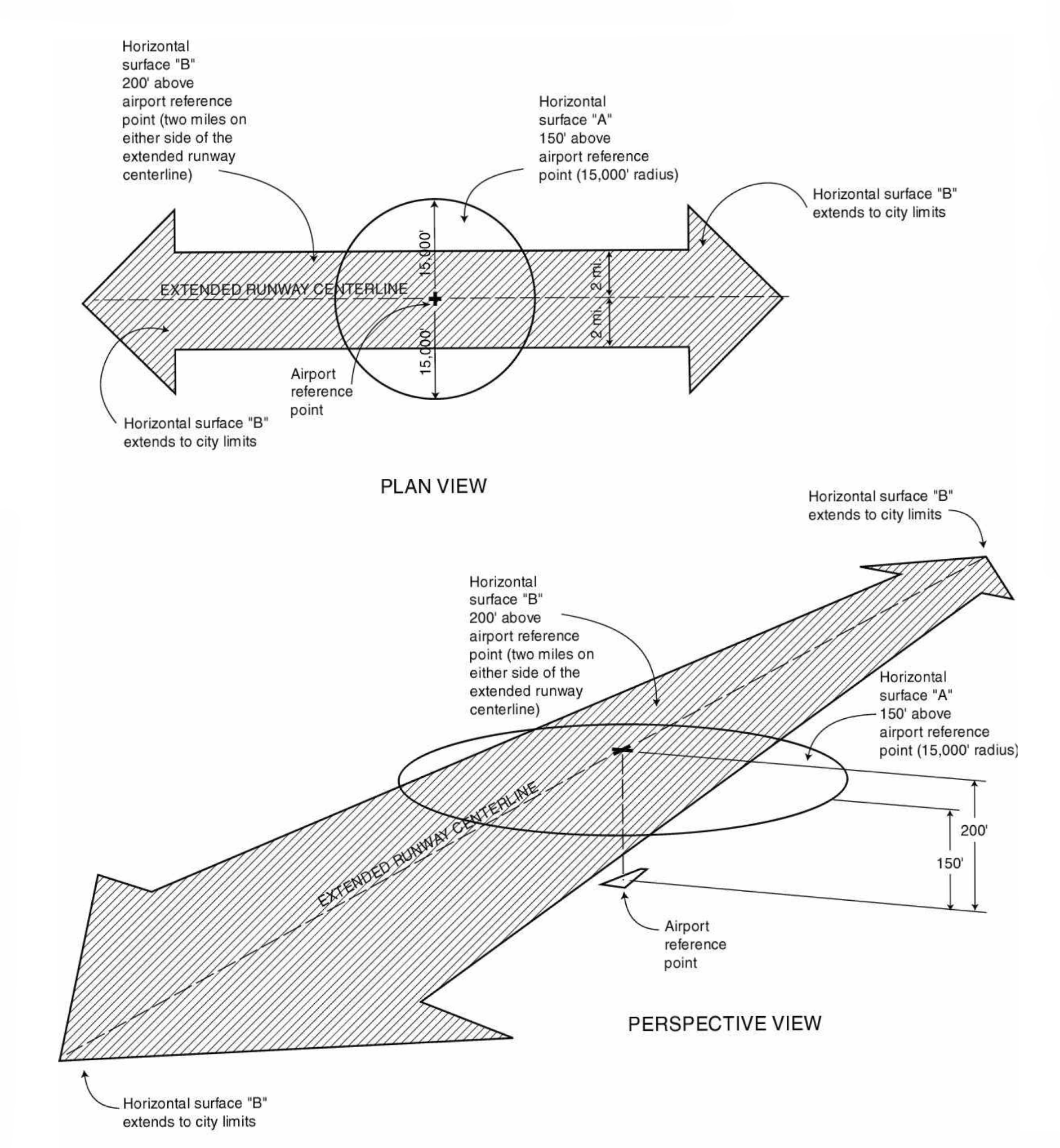
See Article XVI, Division 2, of this chapter for the definitions of the terms "airport," "airport elevation (established)," "airport imaginary surfaces," "airport reference point," "approach surfaces," "conical surface," "flight obstruction area," "helipad," "heliport," "heliport elevation (established)," "heliport imaginary surfaces," "heliport reference point," "horizontal surface 'A,'" "horizontal surface 'B,'" and "slope ratio." (See Figure 50-14-523.)
Figure 50-14-523
(For Informational Purposes Only)
Airport Imaginary Surface
(Code 1984, § 61-14-403; Ord. No. 11-05, § 1(61-14-403), eff. 5-28-2005)
Sec. 50-14-554. - Designation of areas.
All areas that are regulated by this division shall be designated on the flight obstruction area map by the letters "A," "B," or "AA." The flight obstruction area map is hereby adopted and incorporated by reference into this chapter and is on file at the Buildings, Safety Engineering, and Environmental Department.
(Code 1984, § 61-14-404; Ord. No. 11-05, § 1(61-14-404), eff. 5-28-2005)
Sec. 50-14-555. - "A" Districts.
"A" Districts shall include those parts of flight obstruction areas that lie generally beneath the airport horizontal surface "A," except for the airport approach and transitional surfaces and the heliport conical surface.
(Code 1984, § 61-14-405; Ord. No. 11-05, § 1(61-14-405), eff. 5-28-2005)
Sec. 50-14-556. - "B" Districts.
"B" Districts shall include those parts of flight obstruction areas that lie generally beneath the Detroit City Airport horizontal surface "B."
(Code 1984, § 61-14-406; Ord. No. 11-05, § 1(61-14-406), eff. 5-28-2005)
Sec. 50-14-557. - "AA" Districts.
"AA" Districts shall include those parts of flight obstruction areas that lie generally beneath the airport approach and transitional surfaces and the heliport conical surface.
(Code 1984, § 61-14-407; Ord. No. 11-05, § 1(61-14-407), eff. 5-28-2005)
Sec. 50-14-558. - Permitted uses.
Uses shall be allowed within the "A," "B" and "AA" Districts in accordance with the use regulations of the underlying zoning district and other applicable regulations of this chapter, provided, that the following uses shall not be permitted in the "AA" District:
(1)
Schools, except commercially operated vocational or trade schools; and
(2)
Hospitals, sanitariums, and convalescent, nursing, or rest homes.
(Code 1984, § 61-14-408; Ord. No. 11-05, § 1(61-14-408), eff. 5-28-2005)
Sec. 50-14-559. - Height of buildings or other structures.
Unless otherwise expressly stated in this division, no building or other structure hereafter constructed or any existing building or other structure hereafter relocated, enlarged, or reconstructed shall project into any airport approach, or transitional, horizontal or heliport conical surface.
(Code 1984, § 61-14-409; Ord. No. 11-05, § 1(61-14-409), eff. 5-28-2005)
Sec. 50-14-560. - Permitted projections within any flight obstruction area.
Nothing in this division shall be construed as prohibiting the construction or maintenance of any building or other structure, within any flight obstruction area, to a height up to 35 feet above established grade.
(Code 1984, § 61-14-410; Ord. No. 11-05, § 1(61-14-410), eff. 5-28-2005)
Sec. 50-14-561. - Marking or lighting of new or existing hazards to air navigation.
The following requirements shall apply with respect to hazards to air navigation:
(1)
The owner of any building or other structure that exceeds the permitted height on December 22, 1968, shall permit the installation, operation, and maintenance of such markers or lights which are deemed necessary by the Airport Department to indicate the presence of such air navigation hazard to the operators of aircraft in the vicinity of the airport or heliport; and
(2)
Structures that are erected after December 22, 1968, which are deemed a hazard to aircraft by the Airport Department shall be lighted or marked in accordance with the obstruction marking and lighting requirements of the Federal Aviation Administration. Such marking or lighting shall be installed and maintained by the owner of the structure.
(Code 1984, § 61-14-411; Ord. No. 11-05, § 1(61-14-411), eff. 5-28-2005)
Sec. 50-14-562. - Appeals.
As provided for in Section 50-4-131(3) of this Code, appeals of provisions from Airport and Heliport Hazards shall be considered by the Board of Zoning Appeals, provided, that prior to making any decision, the Board shall notify the Airport Department of the appeal and of the time and place of the public hearing and shall give due consideration to any report or recommendation received from the Airport Department regarding that department's interests in the matter.
(Code 1984, § 61-14-412; Ord. No. 11-05, § 1(61-14-412), eff. 5-28-2005)
Sec. 50-14-581. - Applicability.
Unless otherwise expressly exempted in this chapter, all non-residential uses in all zoning districts that cause off-site impacts on uses in the R1, R2, R3, R4, R5, R6, B1, B2, B3, B4, B5, B6, nonindustrial PD, P1, PC, PCA, TM, PR, SD1, SD2, SD3, SD4, and SD5 Districts shall comply with the standards of this division.
(Code 1984, § 61-14-421; Ord. No. 11-05, § 1(61-14-421), eff. 5-28-2005)
Sec. 50-14-582. - Exemptions.
The operational performance standards of this division do not apply to machinery, equipment, and facilities that were at the site and in compliance with existing regulations on December 22, 1968. Any new or additional machinery, equipment, and facilities shall comply with the standards of this division. Where there is any question about when the equipment was brought to the site, documentation is the responsibility of the proprietor of the use.
(Code 1984, § 61-14-422; Ord. No. 11-05, § 1(61-14-422), eff. 5-28-2005)
Sec. 50-14-583. - Relationship to other regulations.
The operational performance standards of this division are in addition to regulations of this chapter, of the Michigan Department of Environment, Great Lakes, and Energy Air Quality Division, and of Part 55 of the Michigan Natural Resources and Environmental Protection Act, being MCL 324.5501 through 324.5542.
(Code 1984, § 61-14-423; Ord. No. 11-05, § 1(61-14-423), eff. 5-28-2005)
Sec. 50-14-584. - Air quality.
The emission of dust, dirt, or smoke shall comply with all state and federal regulations.
(Code 1984, § 61-14-424; Ord. No. 11-05, § 1(61-14-424), eff. 5-28-2005)
State Law reference— Air pollution control, MCL 324.5501 et seq.
Sec. 50-14-585. - Combustibles and explosives.
The use, handling, storage, and transportation of combustibles and explosives shall be approved by the Fire Marshal and comply with all applicable state and federal laws.
(Code 1984, § 61-14-425; Ord. No. 11-05, § 1(61-14-425), eff. 5-28-2005)
State Law reference— Michigan Explosives Act of 1970, MCL 29.41 et seq.; crimes related to explosives and bombs, MCL 750.200 et seq.
Sec. 50-14-586. - Gases.
The escape or emission of any gas that is noxious, injurious, or destructive is unlawful. In addition, the use, handling, storage, and transportation of gases shall be approved by the Fire Marshal and shall comply with all applicable state and federal regulations, including the Federal Emergency Planning and Community Right-To-Know Act of 1986 (EPCRA), being 42 USC 11001 et seq.
(Code 1984, § 61-14-426; Ord. No. 11-05, § 1(61-14-426), eff. 5-28-2005)
Sec. 50-14-587. - Noise.
The following noise standards shall generally apply:
(1)
General. The City's noise standards are provided for in Article I of Chapter 16 of this Code, Environment;
(2)
Outdoor paging systems and speakers. Outdoor paging systems and speakers shall not be located within 150 feet of land that is zoned R1, R2, R3, R4, R5, R6 or residential PD, or within 150 feet of the property line of a lot where a school or licensed child care center is located. This standard shall not apply to face-to-face, drive-up teller windows or remote teller systems where all of the following conditions exist:
a.
Cashiers and customers have direct, face-to-face contact;
b.
Drive aisles are adjacent to the primary structure; and
c.
The remote appliance is located under a porte cochere attached to the primary building.
(Code 1984, § 61-14-427; Ord. No. 11-05, § 1(61-14-427), eff. 5-28-2005)
Sec. 50-14-588. - Vibration.
The following vibration standard shall generally apply:
(1)
Vibration standard. Continuous, frequent, or repetitive vibrations which produce earthborn vibrations that exceed the following displacements:
Note: In general, this standard means that a person of normal sensitivities should not be able to feel sustained vibration when located on R-zoned property.
(2)
Exceptions.
a.
Vibrations from temporary construction and vehicles that leave the site, such as trucks, trains, airplanes and helicopters, are exempt; and
b.
Vibrations lasting less than five minutes per day are also exempt.
(3)
Measurement. Seismic or electronic vibration measuring equipment may be used for measurements when there are doubts about the level of vibration.
(Code 1984, § 61-14-428; Ord. No. 11-05, § 1(61-14-428), eff. 5-28-2005)
Sec. 50-14-589. - Odor.
The following odor standard shall generally apply:
(1)
Odor standard. Continuous, frequent, or repetitive odors detectable after the odorous air has been diluted with five or more volumes of odor-free air shall be a violation of these standards;
(2)
Exceptions.
a.
An odor that is detected for less than 15 minutes per day is exempt;
b.
No violation shall occur where the person who, or the business which, causes or allows the emission of odorous air contaminants is employing the best available treatment, maintenance, and control that is currently available to maintain the lowest possible emission of odorous gases.
(Code 1984, § 61-14-429; Ord. No. 11-05, § 1(61-14-429), eff. 5-28-2005)
Sec. 50-14-590. - Glare.
The following glare standard shall generally apply:
(1)
Glare standard. Glare is illumination that is caused by all types of lighting and from high temperature processes such as welding or metallurgical refining. Glare may not directly, or indirectly from reflection, cause illumination on other properties that is in excess of a measurement of 0.5 foot-candles of light;
(2)
Strobe lights. Strobe lights that are visible from another property are not allowed.
(Code 1984, § 61-14-430; Ord. No. 11-05, § 1(61-14-430), eff. 5-28-2005)
Sec. 50-14-591. - Measurements of impacts.
The following requirements with respect to the measurement of impacts shall also apply:
(1)
Measurements for compliance with these standards are made from the property line or within the property of the affected site. Measurements may be made at ground level or at habitable levels of buildings; and
(2)
Where the City does not have the equipment or expertise to measure and evaluate a specific complaint, it may request assistance from another agency or may contract with an independent expert to perform such measurements. The City may accept measurements that are made by an independent expert who is hired by the operator of the off-site impact source. Where the City contracts to have measurements made and no violation is found, the City will bear the expense, if any, of the measurements. Where a violation is found, City expenses will be charged to the violator. Nonpayment of the costs is a violation of this chapter and enforced through Article V of this chapter.
(Code 1984, § 61-14-431; Ord. No. 11-05, § 1(61-14-431), eff. 5-28-2005)
Sec. 50-14-592. - Impact mitigation plan.
Where unavoidable circumstances require that portions of a phased project must be left in an unfinished state over a period longer than one year, or any development project has been left in an unfinished state over a period longer than one year, an impact mitigation plan that addresses erosion, security, storage, and appearance of the site shall be submitted to the Director of the Planning and Development Department to review for departmental approval.
(Code 1984, § 61-14-432; Ord. No. 11-05, § 1(61-14-432), eff. 5-28-2005)
Sec. 50-14-593. - Documentation in advance.
(a)
The Buildings, Safety Engineering, and Environmental Department is authorized to require documentation in advance that a proposed use will conform to the standards of this division, in which case all of the following additional information is required of the applicant prior to development approval:
(1)
A description of the use or activity regarding processes, materials used, storage, waste disposal, types of machinery and other such items as related to off-site impacts, provided, that the applicant is not required to reveal any trade secret that would cause any secret manufacturing procedure, compound or product to become public knowledge and available to competitors;
(2)
An explanation of any mechanisms or techniques that are proposed to restrict any hazardous or nuisance effects, including the type and location of any abatement devices and recording instruments to measure conformance with the required standard; and
(3)
An evaluation and explanation which is certified by a registered engineer or architect, as appropriate, that the proposed activity can comply with the operational performance standards or standards in question.
(b)
Where a permit application is subject to consideration by an advisory review committee, as provided in Article II, Division 6, of this chapter, the advisory review committee is also authorized to require such documentation. Where a permit application is subject to site plan review, as provided in Article III, Division 5, of this chapter, the appropriate review body is also authorized to require such documentation.
(Code 1984, § 61-14-433; Ord. No. 11-05, § 1(61-14-433), eff. 5-28-2005; Ord. No. 13-11, § 1(61-14-433), eff. 8-23-2011)
Sec. 50-14-611. - Intent and scope of requirements.
To ensure compliance with this chapter and any conditions imposed thereunder, the Buildings, Safety Engineering, and Environmental Department or the Board of Zoning Appeals, as applicable, may require that a performance guarantee in the form of a certified check, irrevocable bank letter of credit, or surety bond that is acceptable to the Law Department, be deposited with the City to ensure faithful completion of improvements and/or to abate any nuisance associated with the operation or upon abandonment of a use. (See definition of the term "improvements" in Section 50-16-261 of this Code.)
(Code 1984, § 61-14-441; Ord. No. 11-05, § 1(61-14-441), eff. 5-28-2005)
Sec. 50-14-612. - General requirements.
The performance guarantee shall meet the following requirements:
(1)
The performance guarantee shall be in the form of a certified check, surety bond, or performance bond which names the property owner as the obligor and the City as the obligee;
(2)
The performance guarantee shall be submitted at the time of issuance of the permit that authorizes the activity or project. Where appropriate, based on the type of performance guarantee that is submitted, the City shall deposit the funds in an interest-bearing account in a financial institution where the City regularly conducts business;
(3)
The amount of the performance guarantee shall be sufficient to cover the estimated cost of the improvements for which the performance guarantee is required. The applicant shall provide an itemized schedule of estimated costs to complete all such improvements;
(4)
A performance guarantee may also be required for junkyards, towing service storage yards, and those waste-related uses that are specified in Section 50-12-84 of this Code in an amount sufficient to abate any nuisances which remain in the event of abandonment. The exact amount of the performance guarantee shall be determined by the Buildings, Safety Engineering, and Environmental Department;
(5)
The entire performance guarantee, including interest accrued, shall be returned to the applicant following inspection by the Buildings, Safety Engineering, and Environmental Department and a determination that the required improvements have been completed satisfactorily. The performance guarantee may be released to the applicant in proportion to the work that is completed on various elements, provided, that a minimum of ten percent shall be held back on each element until satisfactory completion of the entire project, provided further, that in the case of a performance guarantee which is required under Subsection (4) of this section, the performance guarantee may be retained by the City until the use is changed or abandoned, and the Buildings, Safety Engineering, and Environmental Department has determined that any nuisances that remain on the property have been abated.
(Code 1984, § 61-14-442; Ord. No. 11-05, § 1(61-14-442), eff. 5-28-2005)
Sec. 50-14-613. - Unsatisfactory completion of improvements.
Whenever required improvements are not installed or maintained within the stipulated time or in accordance with the standards that are set forth in this chapter, the City may complete the necessary improvements that remain or contract with an independent developer to do so, and assess all costs of completing said improvements against the performance bond or other surety, including any interest which has accrued on said bond or surety. Prior to completing said improvements, the City shall notify the owner, site plan review applicant, or other firm or individual responsible for completion of the required improvements.
(Code 1984, § 61-14-443; Ord. No. 11-05, § 1(61-14-443), eff. 5-28-2005)
Sec. 50-14-631. - In general.
Abandoned or vacated non-residential uses shall comply with the standards of this division.
(Code 1984, § 61-14-451; Ord. No. 11-05, § 1(61-14-451), eff. 5-28-2005)
Sec. 50-14-632. - Premises to be secured and maintained.
During the period where a use is vacated, closed, or otherwise not opened for business for more than 30 consecutive days, the owner, franchise holder, or lessee shall be subject to complying with the following regulations:
(1)
Vehicular parking and storage shall be prohibited at all times anywhere on the premises and the owner, franchise holder, or lessee shall post notice on the premises, which advises that all parked or stored vehicles are subject to ticketing and removal by the City at vehicle owner's expense. In addition, the owner, franchise holder, lessee, or other person in possession, is subject to ticketing where unlawfully parked or stored vehicles are permitted on the premises by consent of owner, franchise holder, lessee, or other person in possession;
(2)
The ground shall be kept free of rubbish and debris, and the grass, if any, shall be well kept and cut as necessary so as to present a neat and attractive appearance at all times; and
(3)
The owner shall maintain a record of the name and address of the person or firm who cleaned the premises and removed the debris. Such record shall be made available to the inspectors of the Department of Public Works, and each entry shall be kept for at least one year.
(Code 1984, § 61-14-452; Ord. No. 11-05, § 1(61-14-452), eff. 5-28-2005)
Sec. 50-14-633. - Closure of ingress and egress required.
Within 60 days of such closing, all curb cuts across driveway entrances and all other points of ingress and egress to the premises shall be closed to vehicular traffic by properly placed and secured precast concrete wheel stops or the equivalent, as may be approved by the appropriate City department.
(Code 1984, § 61-14-453; Ord. No. 11-05, § 1(61-14-453), eff. 5-28-2005)
Sec. 50-14-634. - Presumption of abandonment.
A use that is vacated, closed, or not opened for business for a period of six months shall be presumed abandoned. Permits for uses that have been abandoned are subject to the provisions of Section 50-3-24 of this Code.
(Code 1984, § 61-14-454; Ord. No. 11-05, § 1(61-14-454), eff. 5-28-2005; Ord. No. 01-10, § 1(61-14-454), eff. 4-1-2010; Ord. No. 18-18, § 1(61-14-454), eff. 8-30-2018)
Sec. 50-14-1. - Purpose.
The purpose of these regulations is to ensure that the off-street parking, loading and access demands that are associated with development will be met without adversely affecting traffic patterns, nearby land uses, and surrounding neighborhoods. In recognition of the fact that different transportation access-based solutions will be appropriate in different areas of the City and for different types of development, the standards set out in this division allow flexibility in dealing with vehicle parking, loading, and access issues.
(Code 1984, § 61-14-1; Ord. No. 11-05, § 1(61-14-1), eff. 5-28-2005)
Sec. 50-14-2. - Applicability.
The general development standards of this article shall apply in the following situations:
(1)
New development. Unless otherwise expressly stated, the parking, loading and access standards of this division shall apply to all new buildings constructed and all new uses established in all zoning districts;
(2)
Expansions and increases in intensity. Unless otherwise expressly stated, the parking, loading, and access standards of this division shall apply where an existing structure or use is expanded or enlarged, through the addition of dwelling units, floor area, seating capacity, employees or other units of measurement that are used for establishing off-street parking and loading requirements. Additional off-street parking and loading spaces shall be required only to serve the enlarged or expanded area, and not the entire building or use; and
(3)
Change of use. Except as provided for in Subdivision F of this division, off-street parking and loading facilities shall be provided for any change of use that, based on the off-street parking schedules of Subdivisions B and C of this division or the off-street loading schedule of Subdivision D of this division, would result in a requirement for more parking or loading spaces than the former use. Additional parking or loading spaces shall be required only in proportion to the extent of the change, and not for the entire building or use.
(Code 1984, § 61-14-2; Ord. No. 11-05, § 1(61-14-2), eff. 5-28-2005)
Sec. 50-14-3. - No reduction below minimums.
The number of parking and loading spaces that exist on a site shall not be reduced below the minimum requirements of this division. Unless additional parking and loading spaces are provided to meet the minimum requirements of this division, any change in use to a use that requires more parking or loading spaces than exist on the subject site shall be a violation of this chapter.
(Code 1984, § 61-14-3; Ord. No. 11-05, § 1(61-14-3), eff. 5-28-2005)
Sec. 50-14-4. - Damage or destruction.
The following requirements shall apply in the event of damage or destruction:
(1)
Where a conforming or nonconforming building or use that does not comply with current off-street parking and/or loading regulations is damaged by fire, collapse, explosion, or act of God and the cost of reconstruction does not exceed 60 percent of the assessed valuation, as defined in Section 50-16-113 of this Code, of the building or structure at the time such damage occurred, all parking and loading spaces that existed at the time of damage or destruction shall be restored or continued in operation; or
(2)
Where the cost of reconstruction of said building or use exceeds 60 percent of the assessed valuation, as defined in Section 50-16-113 of this Code, of the building or structure at the time such damage occurred, off-street parking and loading shall be provided in the amount required for new construction at the date the application for reconstruction is approved.
(Code 1984, § 61-14-4; Ord. No. 11-05, § 1(61-14-4), eff. 5-28-2005; Ord. No. 44-06, § 1(61-14-4), eff. 12-21-2006)
Sec. 50-14-5. - Effect on nonconforming status.
A use that was legally established shall not be deemed nonconforming solely as a result of providing fewer than the minimum number of off-street parking or loading spaces which are required by this division.
(Code 1984, § 61-14-5; Ord. No. 11-05, § 1(61-14-5), eff. 5-28-2005)
Sec. 50-14-6. - Joint use.
Off-street parking and loading facilities that are provided for one use shall not be considered as providing required parking or loading facilities for any other use, except as otherwise allowed under the shared parking provisions of Section 50-14-159 of this Code.
(Code 1984, § 61-14-6; Ord. No. 11-05, § 1(61-14-6), eff. 5-28-2005)
Sec. 50-14-7. - Off-street parking exemptions, reductions, and allowances.
(a)
Off-street parking. The following exemptions and allowances to the off-street parking requirements shall apply:
(1)
Uses in the B5, MKT, and PC Districts, in the Central Business District, or in the New Center Major Commercial Area as defined in Section 50-16-321 of this Code, shall be exempt from the off-street parking requirements of Subdivisions B and C of this division;
(2)
For retail, service, and commercial uses specified in Article XII, Division 1, Subdivision D, of this chapter with the exception of those uses in Section 50-12-71 of this Code, Vehicle Repair and Service, and in Motor Vehicles, Used, Salesroom or Sales Lots, specified in Section 50-12-69 of this Code, Retail Sales and Service, Sales-Oriented, located on zoning lots abutting a Traditional Main Street Overlay Area or on land zoned SD1 or SD2, or where located within 0.50 miles of a high-frequency transit corridor as defined in Section 50-16-242 of this Code, the maximum distance that off-street parking shall be provided from the principal use specified in Subdivision B of this division may be increased to 1,320 feet where the applicant can show to the satisfaction of the Planning and Development Department that a "district approach" to parking is being used in the Traditional Main Street Overlay Area or other area nearby. To show a district approach to parking, the applicant shall provide the following:
a.
A signage plan to show how the business will direct customers and employees to the off-site parking lot, including parking signage and wayfinding;
b.
A plan for who will manage and maintain the off-site parking facility, including safety and security measures; and
c.
Where the parking area or parking structure is owned by someone other than the applicant, a shared parking agreement shall be required according to Section 50-14-156 and Section 50-14-159 of this Code;
(3)
No additional off-street parking, beyond that already provided, shall be required for structures erected prior to April 9, 1998, other than religious institutions, that do not exceed 3,000 square feet of gross floor area; and
(4)
When a use located in a structure erected prior to April 9, 1998, expands into an existing adjacent structure erected prior to April 9, 1998, and the total gross floor area of the combined structures does not exceed 4,000 square feet, no additional off-street parking shall be required.
(b)
Additional off-street parking reductions. These are set forth in Section 50-14-153 and Section 50-14-163 of this Code.
(c)
Credit for on-street parking. Within the Woodward and Grand River/Lahser Traditional Main Street Overlay Areas, any on-street parking space adjacent to a use, each such space consisting of not less than 23 feet of contiguous linear permissible on-street parking that is immediately adjacent to the use, may be counted as one space against applicable off-street parking requirements for such use.
(Code 1984, § 61-14-7; Ord. No. 11-05, § 1(61-14-7), eff. 5-28-2005; Ord. No. 34-05, § 1(61-14-7), eff. 12-6-2005; Ord. No. 13-11, § 1(61-14-7), eff. 8-23-2011; Ord. No. 23-13, § 1(61-14-7), eff. 8-28-2013; Ord. No. 23-14, § 1(61-14-7), eff. 7-24-2014; Ord. No. 18-18, § 1(61-14-7), eff. 8-30-2018; Ord. No. 2020-21, § 1, eff. 8-8-2020; Ord. No. 2022-17, § 1, eff. 10-4-2022)
Sec. 50-14-8. - Accessory parking lot defined.
A parking lot or parking area shall be deemed "accessory" where such lot or area:
(1)
Is operated in conjunction with a specific land use;
(2)
Is not farther than the maximum distance for said land use that is specified in Subdivision B or C of this division; and
(3)
As indicated in Section 50-16-341 of this Code, in certain instances, a fee may be charged for accessory parking.
(Code 1984, § 61-14-8; Ord. No. 11-05, § 1(61-14-8), eff. 5-28-2005)
Sec. 50-14-9. - Rules for computing parking and loading requirements.
The rules in Section 50-14-10 through Section 50-14-16 of this Code shall apply when computing the number of parking and loading spaces that are required under this division.
(Code 1984, § 61-14-9; Ord. No. 11-05, § 1(61-14-9), eff. 5-28-2005)
Sec. 50-14-10. - Rules for computing parking and loading requirements; fractions.
When calculation of the number of required spaces results in a fractional number, a fraction of less than one-half shall be disregarded and a fraction of one-half or more shall be rounded to the next highest whole number.
(Code 1984, § 61-14-10; Ord. No. 11-05, § 1(61-14-10), eff. 5-28-2005)
Sec. 50-14-11. - Rules for computing parking and loading requirements; distances.
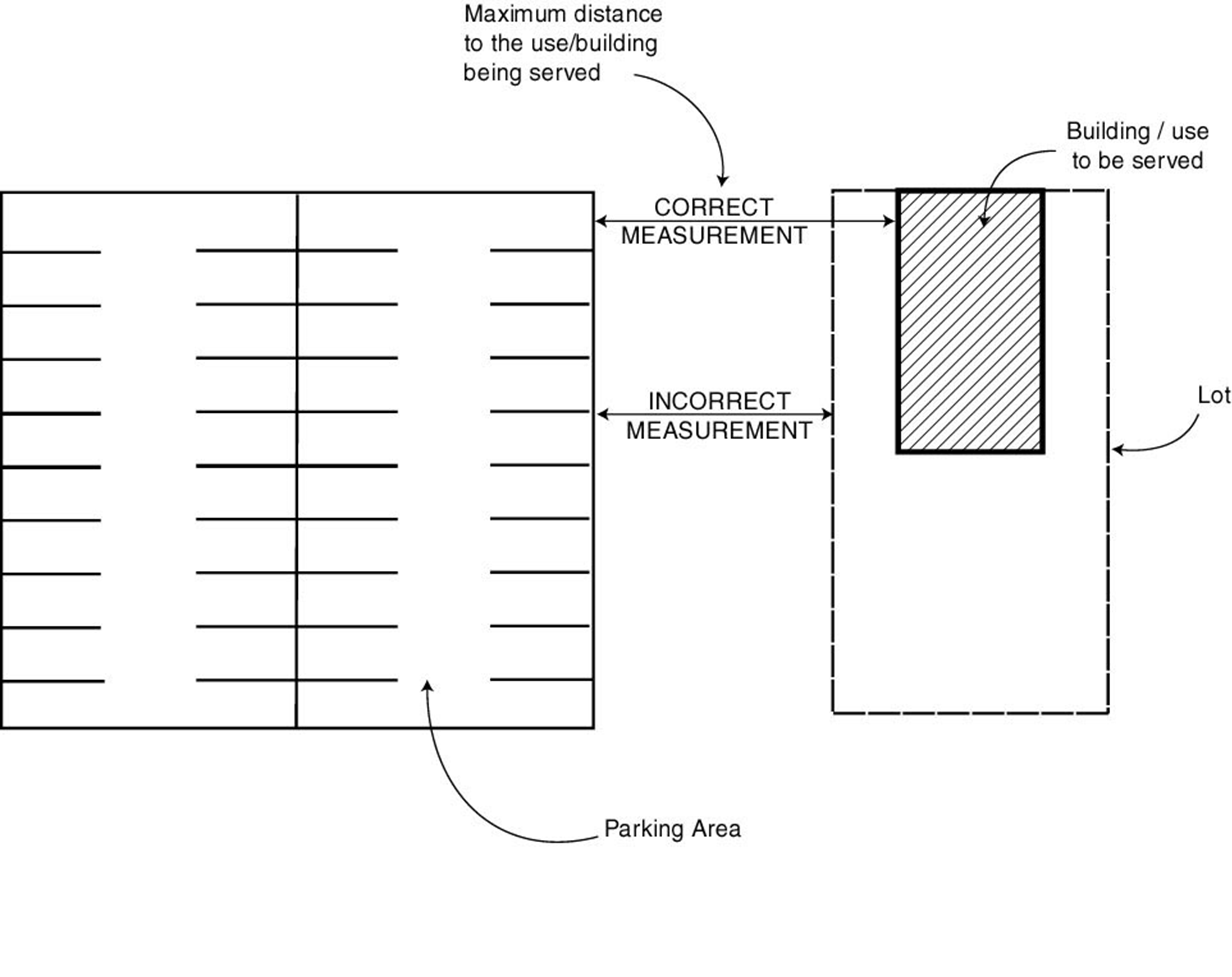
Distances shall be measured between the nearest point of the off-street parking facility and the nearest point of the building or use to be served. (See Figure 50-14-11.)
Figure 50-14-11
(For Informational Purposes Only)
Measuring Distance between Parking Area and Use Served
(Code 1984, § 61-14-11; Ord. No. 11-05, § 1(61-14-11), eff. 5-28-2005)
Sec. 50-14-12. - Multiple uses.
When two or more uses or separate establishments are located within the same development, such as a strip mall, off-street parking shall be provided for each use or separate establishment unless a shared parking plan is approved under Section 50-14-159 of this Code. Where one or more use within a multi-use development are of a size that would otherwise exempt them from compliance with off-street parking requirements, only one such exemption shall be permitted to be taken for the entire development. (For such developments having 50,000 or more square feet of gross floor area, see Section 50-14-91(2) of this Code.
(Code 1984, § 61-14-12; Ord. No. 11-05, § 1(61-14-12), eff. 5-28-2005)
Sec. 50-14-13. - Gross floor area.
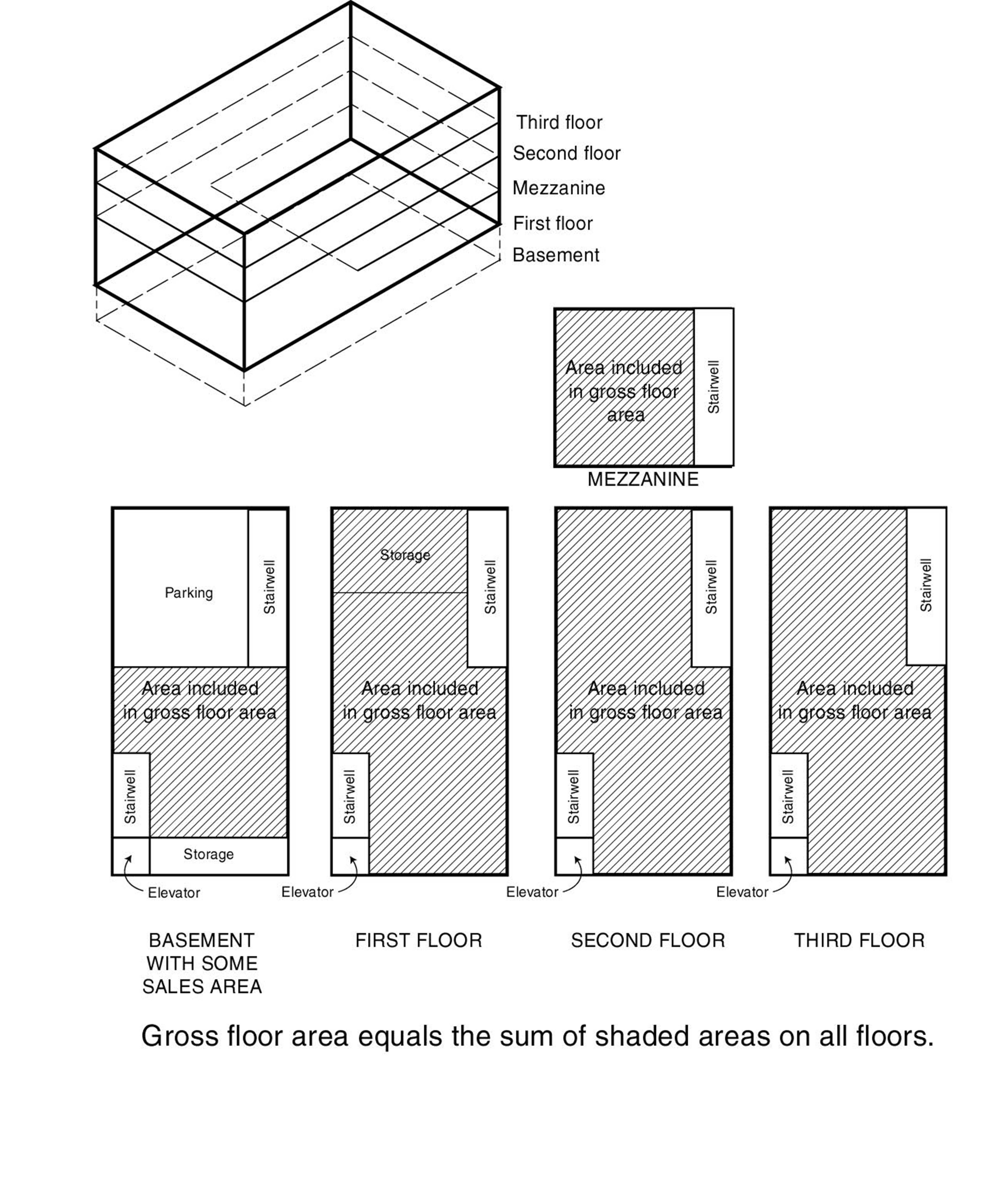
Unless otherwise expressly stated, all square footage-based off-street parking and loading standards shall be computed on the basis of the sum of the gross horizontal floor areas of all the floors of a building or structure, measured from the exterior faces of exterior walls or from the centerline of walls separating two buildings or structures, but excluding stairwells and elevator shafts at each floor, floors or parts of floors devoted exclusively to vehicular parking or loading, and all floors below the first or ground floor except where used for or intended to be used for service to the public as customers, patrons, clients, patients, or tenants, including areas occupied by fixtures and equipment that are used for display or sale of merchandise. (See Figure 50-14-13.)
Figure 50-14-13
(For Informational Purposes Only)
Gross Floor Area
(Code 1984, § 61-14-13; Ord. No. 11-05, § 1(61-14-13), eff. 5-28-2005)
Sec. 50-14-14. - Rules for computing parking and loading requirements; bench seating.
When seating consists of benches, pews or other similar seating facilities, each 20 linear inches of seating space shall be counted as one seat.
(Code 1984, § 61-14-14; Ord. No. 11-05, § 1(61-14-14), eff. 5-28-2005)
Sec. 50-14-15. - Employees, students, residents, and occupants.
For the purpose of computing parking requirements based on the number of employees, students, residents or occupants, calculations shall be based on the largest number of persons working on any single shift, the maximum enrollment or the maximum fire-rated or licensed capacity, whichever is applicable. In hospitals, bassinets shall not be counted as beds.
(Code 1984, § 61-14-15; Ord. No. 11-05, § 1(61-14-15), eff. 5-28-2005)
Sec. 50-14-16. - New and unlisted uses.
Upon receiving a development application for a use not listed in the parking and loading schedules of this division, the Buildings, Safety Engineering, and Environmental Department shall apply the standards of the listed use that is deemed most similar to the use proposed, or require that a parking study be submitted pursuant to Section 50-14-164 of this Code.
(Code 1984, § 61-14-16; Ord. No. 11-05, § 1(61-14-16), eff. 5-28-2005)
Sec. 50-14-17. - Ingress and egress.
Points of vehicular ingress and egress shall be approved by Department of Public Works Traffic Engineering Division in accordance with the provisions of Chapter 43, Article VI, of this Code, Sidewalks and Driveways. Where ingress and egress is provided from a county road or state highway, approval shall be obtained from the appropriate jurisdiction.
(Code 1984, § 61-14-17; Ord. No. 13-11, § 1(61-14-17), eff. 8-23-2011)
Sec. 50-14-31. - In general.
Off-street parking spaces shall be provided in accordance with the requirements of Schedule A. In lieu of complying with the standards of Schedule A, an applicant may request approval of an alternative parking plan, pursuant to Subdivision F of this division. In some cases, the applicable off-street parking space requirement in Schedule A refers to Schedule B or Schedule C. Those schedules follow "Schedule A."
(Code 1984, § 61-14-21; Ord. No. 11-05, § 1(61-14-21), eff. 5-28-2005)
Sec. 50-14-32. - Residential uses.
Residential uses shall provide off-street parking as cited in Section 50-14-33 through Section 50-14-35 of this Code.
(Code 1984, § 61-14-22; Ord. No. 11-05, § 1(61-14-22), eff. 5-28-2005; Ord. No. 21-12, § 1(61-14-22), eff. 11-2-2012; Ord. No. 23-14, § 1(61-14-22), eff. 7-24-2014; Ord. No. 18-18, § 1(61-14-22), eff. 8-30-2018)
Sec. 50-14-33. - Group living.
Off-street parking regulations for group living facilities are as follows:
(Code 1984, § 61-14-23; Ord. No. 11-05, § 1(61-14-23), eff. 5-28-2005; Ord. No. 21-12, § 1(61-14-23), eff. 11-2-2012; Ord. No. 2022-5, § 1, eff. 3-23-2022)
Sec. 50-14-34. - Household living.
Off-street parking regulations for household living are as follows:
(Code 1984, § 61-14-24; Ord. No. 11-05, § 1(61-14-24), eff. 5-28-2005; Ord. No. 21-12, § 1(61-14-24), eff. 11-2-2012; Ord. No. 23-14, § 1(61-14-24), eff. 7-24-2014; Ord. No. 37-17, § 1(61-14-24), eff. 2-6-2018; Ord. No. 18-18, § 1(61-14-24), eff. 8-30-2018; Ord. No. 2020-21, § 1, eff. 8-8-2020)
Sec. 50-14-35. - Institutional living.
Off-street parking regulations for institutional living facilities are as follows:
(Code 1984, § 61-14-25; Ord. No. 11-05, § 1(61-14-25), eff. 5-28-2005; Ord. No. 21-12, § 1(61-14-25), eff. 11-2-2012)
Sec. 50-14-36. - Public, civic, and institutional uses.
Public, civic and institutional uses shall provide off-street parking as cited in Section 50-14-37 through Section 50-14-47 of this Code.
(Code 1984, § 61-14-26; Ord. No. 11-05, § 1(61-14-26), eff. 5-28-2005; Ord. No. 21-12, § 1(61-14-26), eff. 11-2-2012)
Sec. 50-14-37. - Auditorium or stadium.
Off-street parking regulations for auditorium or stadium facilities are as follows:
(Code 1984, § 61-14-27; Ord. No. 11-05, § 1(61-14-27), eff. 5-28-2005)
Sec. 50-14-38. - Community service.
Off-street parking regulations for community service facilities are as follows:
(Code 1984, § 61-14-28; Ord. No. 11-05, § 1(61-14-28), eff. 5-28-2005; Ord. No. 21-12, § 1(61-14-28), eff. 11-2-2012)
Sec. 50-14-39. - Day care.
Off-street parking regulations for day care facilities are as follows:
(Code 1984, § 61-14-29; Ord. No. 11-05, § 1(61-14-29), eff. 5-28-2005; Ord. No. 21-12, § 1(61-14-29), eff. 11-2-2012)
Sec. 50-14-40. - Hospital.
Off-street parking regulations for hospital facilities are as follows:
(Code 1984, § 61-14-30; Ord. No. 11-05, § 1(61-14-30), eff. 5-28-2005)
Sec. 50-14-41. - Library.
Off-street parking regulations for library facilities are as follows:
(Code 1984, § 61-14-31; Ord. No. 11-05, § 1(61-14-31), eff. 5-28-2005; Ord. No. 21-12, § 1(61-14-31), eff. 11-2-2012)
Sec. 50-14-42. - Museum.
Off-street parking regulations for museum facilities are as follows:
(Code 1984, § 61-14-32; Ord. No. 11-05, § 1(61-14-32), eff. 5-28-2005; Ord. No. 21-12, § 1(61-14-32), eff. 11-2-2012)
Sec. 50-14-43. - Park and open space.
Off-street parking regulations for parks and open spaces are as follows:
(Code 1984, § 61-14-33; Ord. No. 11-05, § 1(61-14-33), eff. 5-28-2005)
Sec. 50-14-44. - Religious institution.
Off-street parking regulations for religious institutions are as follows:
(Code 1984, § 61-14-34; Ord. No. 11-05, § 1(61-14-34), eff. 5-28-2005)
Sec. 50-14-45. - Schools.
Off-street parking regulations for schools are as follows:
(Code 1984, § 61-14-35; Ord. No. 11-05, § 1(61-14-35), eff. 5-28-2005; Ord. No. 21-12, § 1(61-14-35), eff. 11-2-2012; Ord. No. 37-17, § 1(61-14-35), eff. 2-6-2018)
Sec. 50-14-46. - Utility, basic.
Off-street parking regulations for basic utility facilities are as follows:
(Code 1984, § 61-14-36; Ord. No. 11-05, § 1(61-14-36), eff. 5-28-2005)
Sec. 50-14-47. - Utility, major.
Off-street parking regulations for major utility facilities are as follows:
(Code 1984, § 61-14-37; Ord. No. 11-05, § 1(61-14-37), eff. 5-28-2005)
Sec. 50-14-48. - Retail, service, and commercial uses.
Retail, service and commercial uses shall provide off-street parking as cited in Section 50-14-49 through Section 50-14-60 of this Code.
(Code 1984, § 61-14-38; Ord. No. 11-05, § 1(61-14-38), eff. 5-28-2005; Ord. No. 01-10, § 1(61-14-38), eff. 4-1-2010; Ord. No. 13-11, § 1(61-14-38), eff. 8-23-2011; Ord. No. 21-12, § 1(61-14-38), eff. 11-2-2012; Ord. No. 10-13, § 1(61-14-38), eff. 4-16-2013; Ord. No. 23-14, § 1(61-14-38), eff. 7-24-2014; Ord. No. 23-16, § 1(61-14-38), eff. 7-22-2016; Ord. No. 18-18, § 1(61-14-38), eff. 8-30-2018)
Sec. 50-14-49. - Retail, service, and commercial uses located on land zoned SD1 or SD2.
Off-street parking regulations for retail, service, and commercial uses located on land zoned SD1 or SD2 are as follows:
(Code 1984, § 61-14-39; Ord. No. 23-14, § 1(61-14-39), eff. 7-24-2014; Ord. No. 18-18, § 1(61-14-39), eff. 8-30-2018; Ord. No. 2020-21, § 1, eff. 8-8-2020)
Sec. 50-14-50. - Assembly.
Off-street parking regulations for assembly facilities are as follows:
(Code 1984, § 61-14-40; Ord. No. 11-05, § 1(61-14-40), eff. 5-28-2005)
Sec. 50-14-51. - Food and beverage service.
Off-street parking regulations for food and beverage facilities are as follows:
(Code 1984, § 61-14-41; Ord. No. 11-05, § 1(61-14-41), eff. 5-28-2005; Ord. No. 13-11, § 1(61-14-41), eff. 8-23-2011; Ord. No. 37-17, § 1(61-14-41), eff. 2-6-2018; Ord. No. 18-18, § 1(61-14-41), eff. 8-30-2018)
Sec. 50-14-52. - Office.
Off-street parking regulations for offices are as follows:
(Code 1984, § 61-14-42; Ord. No. 11-05, § 1(61-14-42), eff. 5-28-2005; Ord. No. 34-05, § 1(61-14-42), eff. 12-6-2005; Ord. No. 21-12, § 1(61-14-42), eff. 11-2-2012)
Sec. 50-14-53. - Parking, commercial.
Off-street parking regulations for commercial parking facilities are as follows:
(Code 1984, § 61-14-43; Ord. No. 11-05, § 1(61-14-43), eff. 5-28-2005)
Sec. 50-14-54. - Public accommodation.
Off-street parking regulations for public accommodations are as follows:
(Code 1984, § 61-14-44; Ord. No. 11-05, § 1(61-14-44), eff. 5-28-2005; Ord. No. 13-11, § 1(61-14-44), eff. 8-23-2011; Ord. No. 21-12, § 1(61-14-44), eff. 11-2-2012)
Sec. 50-14-55. - Recreation and entertainment, indoor.
Off-street parking regulations for indoor recreation and entertainment facilities are as follows:
(Code 1984, § 61-14-45; Ord. No. 11-05, § 1(61-14-45), eff. 5-28-2005; Ord. No. 21-12, § 1(61-14-45), eff. 11-2-2012; Ord. No. 23-16, § 1(61-14-45), eff. 7-22-2016; Ord. No. 2023-36, § 1, eff. 3-5-2024)
Sec. 50-14-56. - Recreation, outdoor.
Off-street parking regulations for outdoor recreation facilities are as follows:
(Code 1984, § 61-14-46; Ord. No. 11-05, § 1(61-14-46), eff. 5-28-2005)
Sec. 50-14-57. - Retail sales and service (occupant-oriented).
Off-street parking regulations for occupant-oriented retail sales and service facilities are as follows:
(Code 1984, § 61-14-47; Ord. No. 11-05, § 1(61-14-47), eff. 5-28-2005)
Sec. 50-14-58. - Retail sales and service (sales-oriented).
Off-street parking regulations for sales-oriented retail sales and service facilities are as follows:
(Code 1984, § 61-14-48; Ord. No. 11-05, § 1(61-14-48), eff. 5-28-2005; Ord. No. 10-13, § 1(61-14-48), eff. 4-16-2013; Ord. No. 37-17, § 1(61-14-48), eff. 2-6-2018; Ord. No. 18-18, § 1(61-14-48), eff. 8-30-2018; Ord. No. 2023-36, § 1, eff. 3-5-2024)
Sec. 50-14-59. - Retail sales and service (service-oriented).
Off-street parking regulations for service-oriented retail sales and service facilities are as follows:
(Code 1984, § 61-14-49; Ord. No. 11-05, § 1(61-14-49), eff. 5-28-2005; Ord. No. 21-12, § 1(61-14-49), eff. 11-2-2012; Ord. No. 37-17, § 1(61-14-49), eff. 2-6-2018; Ord. No. 18-18, § 1(61-14-49), eff. 8-30-2018)
Sec. 50-14-60. - Vehicle repair and service.
Off-street parking regulations for vehicle repair and service facilities are as follows:
(Code 1984, § 61-14-50; Ord. No. 11-05, § 1(61-14-50), eff. 5-28-2005; Ord. No. 2023-6, § 1, eff. 3-8-2023)
Sec. 50-14-61. - Manufacturing and industrial uses.
Manufacturing and industrial uses shall provide off-street parking as cited in Section 50-14-62 through Section 50-14-65 of this Code.
(Code 1984, § 61-14-51; Ord. No. 11-05, § 1(61-14-51), eff. 5-28-2005; Ord. No. 04-12, § 1(61-14-51), eff. 3-30-2012; Ord. No. 10-13, § 1(61-14-51), eff. 4-16-2013)
Sec. 50-14-62. - Industrial service.
Off-street parking regulations for industrial service facilities are as follows:
(Code 1984, § 61-14-52; Ord. No. 11-05, § 1(61-14-52), eff. 5-28-2005; Ord. No. 04-12, § 1(61-14-52), eff. 3-30-2012; Ord. No. 10-13, § 1(61-14-52), eff. 4-16-2013)
Sec. 50-14-63. - Manufacturing and production.
Off-street parking regulations for manufacturing and production facilities are as follows:
(Code 1984, § 61-14-53; Ord. No. 11-05, § 1(61-14-53), eff. 5-28-2005; Ord. No. 2019-38, § 1, eff. 11-27-2019)
Sec. 50-14-64. - Warehouse and freight movement.
Off-street parking regulations for warehouse and freight movement facilities are as follows:
(Code 1984, § 61-14-54; Ord. No. 11-05, § 1(61-14-54), eff. 5-28-2005; Ord. No. 2023-6, § 1, eff. 3-8-2023)
Sec. 50-14-65. - Waste-related use.
Off-street parking regulations for waste-related facilities are as follows:
(Code 1984, § 61-14-55; Ord. No. 11-05, § 1(61-14-55), eff. 5-28-2005)
Sec. 50-14-66. - Other uses.
These other specified uses shall provide off-street parking as cited in Section 50-14-67 through Section 50-14-74 of this Code.
(Code 1984, § 61-14-56; Ord. No. 11-05, § 1(61-14-56), eff. 5-28-2005; Ord. No. 31-15, § 1(61-14-56), eff. 3-1-2016; Ord. No. 20-18, § 1(61-14-56), eff. 10-14-2018)
Sec. 50-14-67. - Adult uses/sexually-oriented businesses.
Off-street parking regulations for adult uses and sexually-oriented businesses are as follows:
(Code 1984, § 61-14-57; Ord. No. 11-05, § 1(61-14-57), eff. 5-28-2005; Ord. No. 01-10, § 1(61-14-57), eff. 4-1-2010)
Sec. 50-14-68. - Aviation and surface transportation facilities.
Off-street parking regulations for aviation and surface transportation facilities are as follows:
(Code 1984, § 61-14-58; Ord. No. 11-05, § 1(61-14-58), eff. 5-28-2005; Ord. No. 01-10, § 1(61-14-58), eff. 4-1-2010)
Sec. 50-14-69. - Medical marijuana facilities and adult-use marijuana establishments.
Off-street parking regulations for medical marijuana facilities and adult-use marijuana establishments are as follows:
(Code 1984, § 61-14-58.5; Ord. No. 31-15, § 1(61-14-58.5), eff. 3-1-2016; Ord. No. 20-18, § 1(61-14-58.5, 61-14-58.75), eff. 10-14-2018; Ord. No. 2021-9, § 1, eff. 4-3-2021)
Sec. 50-14-70. - Public center open uses.
Off-street parking regulations for public center open uses are as follows:
(Code 1984, § 61-14-59; Ord. No. 11-05, § 1(61-14-59), eff. 5-28-2005; Ord. No. 01-10, § 1(61-14-59), eff. 4-1-2010)
Sec. 50-14-71. - Railroad facilities.
Off-street parking regulations for railroad facilities are as follows:
(Code 1984, § 61-14-60; Ord. No. 11-05, § 1(61-14-60), eff. 5-28-2005; Ord. No. 01-10, § 1(61-14-60), eff. 4-1-2010)
Sec. 50-14-72. - Telecommunications facilities.
Off-street parking regulations for telecommunications facilities are as follows:
(Code 1984, § 61-14-61; Ord. No. 11-05, § 1(61-14-61), eff. 5-28-2005; Ord. No. 01-10, § 1(61-14-61), eff. 4-1-2010)
Sec. 50-14-73. - Water-related facilities.
Off-street parking regulations for water-related facilities are as follows:
(Code 1984, § 61-14-62; Ord. No. 11-05, § 1(61-14-62), eff. 5-28-2005; Ord. No. 01-10, § 1(61-14-62), eff. 4-1-2010)
Sec. 50-14-74. - Multiple-family dwelling for the elderly.
In the event a multiple-family dwelling for the elderly should convert to a general population multiple-family dwelling, the full off-street parking requirement for multiple-family dwellings must be satisfied.
(Code 1984, § 61-14-63; Ord. No. 11-05, § 1(61-14-63), eff. 5-28-2005)
Sec. 50-14-91. - Schedule "B" off-street parking for retail uses.
Off-street parking spaces for Schedule B uses shall be provided in accordance with the following standards. The nearest point of the off-street parking facility shall not be more than 100 feet from the building or use to be served:
(1)
General retail.
(2)
Shopping center retail (two or more stores organized or operating as a unit, and consisting of not less than 50,000 square feet of gross floor area).
(Code 1984, § 61-14-71; Ord. No. 11-05, § 1(61-14-71), eff. 5-28-2005)
Sec. 50-14-92. - Schedule C.
Because Schedule C uses have widely varying parking demands, it is difficult to specify a single requirement. The off-street parking requirement for such uses shall be established by the Planning and Development Department based on estimates of parking demand, which may include recommendations of the Institute of Traffic Engineers (ITE), data collected from uses that are the same or comparable to the proposed use, or other relevant information. The Planning and Development Department may require that a parking study be prepared at the applicant's expense. Said study shall provide analysis and justification for the proposed number of spaces to be provided. Parking studies shall document the source of data used to develop the recommendations. The Planning and Development Department shall review the submitted study along with any other traffic engineering and planning data that are appropriate and establish the off-street parking or loading requirements for the use proposed.
(Code 1984, § 61-14-72; Ord. No. 11-05, § 1(61-14-72), eff. 5-28-2005)
Sec. 50-14-111. - Off-street loading schedule and exemptions.
(a)
Off-street loading spaces shall be provided on the same zoning lot in accordance with the following schedule and with Subdivision J of this division. An open, adjacent alley may be credited toward one off-street loading space for retail, service, or commercial uses if access for loading into the building is available in the rear and the alley is not less than 18 feet wide.
(b)
The following uses shall be exempt from off-street loading requirements: Docks (water-related facilities); major and minor motor vehicle services, and outdoor recreation uses.
(Code 1984, § 61-14-81; Ord. No. 11-05, § 1(61-14-81), eff. 5-28-2005; Ord. No. 23-13, § 1(61-14-81), eff. 8-28-2013)
Sec. 50-14-112. - Residential uses.
Regulations regarding off-loading spaces for residential uses are as follows:
(Code 1984, § 61-14-82; Ord. No. 11-05, § 1(61-14-82), eff. 5-28-2005)
Sec. 50-14-113. - Public, civic, and institutional uses.
Regulations regarding off-loading spaces for public, civic, and institutional uses are as follows:
(Code 1984, § 61-14-83; Ord. No. 11-05, § 1(61-14-83), eff. 5-28-2005)
Sec. 50-14-114. - Retail, service, and commercial uses.
Regulations regarding off-loading spaces for retail, service, and commercial uses are as follows:
(Code 1984, § 61-14-84; Ord. No. 11-05, § 1(61-14-84), eff. 5-28-2005; Ord. No. 13-11, § 1(61-14-84), eff. 8-23-2011; Ord. No. 26-12, § 1(61-14-84), eff. 11-21-2012)
Sec. 50-14-115. - Manufacturing and industrial uses.
Regulations regarding off-loading spaces for manufacturing and industrial uses are as follows:
(Code 1984, § 61-14-85; Ord. No. 11-05, § 1(61-14-85), eff. 5-28-2005)
Sec. 50-14-116. - Other uses.
Regulations regarding off-loading spaces for other uses are as follows:
(Code 1984, § 61-14-86; Ord. No. 11-05, § 1(61-14-86), eff. 5-28-2005)
Sec. 50-14-117. - Portable waste containers in loading and unloading areas of commercial establishments.
As required by Section 42-2-53(e)(1) of this Code, all loading and unloading areas shall be provided with an adequate number of portable containers for solid waste. In all cases, a minimum of one portable container shall be required at all such sites. The number of portable containers required for each such area shall be governed by the need to maintain a clean, neat and sanitary premises as directed by the Director of the Department of Public Works. The orientation of such containers for solid waste shall take into account the access route and approach of waste hauling vehicles servicing the premises.
(Code 1984, § 61-14-87; Ord. No. 20-05, § 1(61-14-87), eff. 5-29-2005; Ord. No. 34-05, § 1(61-14-87), eff. 12-6-2005; Ord. No. 44-06, § 1(61-14-87), eff. 12-21-2006)
Sec. 50-14-131. - Accessory parking required.
Except as exempted in Section 50-14-7 of this Code, off-street parking areas shall be provided in accordance with Subdivisions B and C of this division. Such accessory parking lots and parking areas are for the parking of licensed, operable, private passenger vehicles, as defined in Section 50-16-341 of this Code, except trucks and trailers other than panel trucks, pickup trucks, school buses and those motor vehicles necessary and accessory to the operation of the use, provided, that uses that are subject to site plan review and also involve commercial vehicle fleets, shall provide space for fleet parking in addition to the required off-street parking, which is intended for employees, customers, patrons, or visitors.
(Code 1984, § 61-14-91; Ord. No. 11-05, § 1(61-14-91), eff. 5-28-2005)
Sec. 50-14-132. - Certain usage prohibited.
(a)
Accessory parking lots and parking areas shall not be used as towing service storage yards as defined in Section 50-16-402 of this Code.
(b)
Accessory parking lots and parking areas shall not be used for:
(1)
Vending, except as provided for in Section 50-12-458 and Section 50-12-557 of this Code;
(2)
The display or storage of goods, supplies, or materials, except as provided for in Section 50-12-458 and Section 50-12-557 of this Code;
(3)
Motor vehicle repair or service work of any kind.
(c)
See Subdivision K of this division.
(Code 1984, § 61-14-92; Ord. No. 11-05, § 1(61-14-92), eff. 5-28-2005; Ord. No. 04-12, § 1(61-14-92), eff. 3-30-2012)
Sec. 50-14-133. - Permitted structures.
No buildings, other than those for the shelter of attendants, shall be erected or placed upon off-street parking areas. Attendant buildings may have a maximum gross floor area of 50 square feet and a maximum height of 15 feet. No more than two attendant buildings shall be permitted on the site of an off-street parking area and no other structure shall be erected or placed on the premises unless expressly allowed by this chapter.
(Code 1984, § 61-14-93; Ord. No. 11-05, § 1(61-14-93), eff. 5-28-2005)
Sec. 50-14-134. - Permit requirements.
(a)
Accessory parking lots or parking areas, that are located on the same zoning lot as the use they serve, do not require a separate land use permit.
(b)
Accessory parking lots or parking areas, located on a zoning lot that is separate from the use they serve, but not farther than the maximum distance specified in Subdivisions B and C of this division, shall require a land use permit for the accessory parking, separate from the permit for the use it serves.
(c)
Remote accessory parking, as provided in Section 50-14-137 of this Code, requires a land use permit, separate from the permit for the use it serves.
(Code 1984, § 61-14-94; Ord. No. 11-05, § 1(61-14-94), eff. 5-28-2005)
Sec. 50-14-135. - License requirements.
Any accessory parking lot for which a fee is charged to the user shall be identified as "paid accessory parking" for permit purposes and shall be licensed by the Buildings, Safety Engineering, and Environmental Department Business License Center in accordance with Chapter 32, Article I, of this Code, Off-Street Parking.
(Code 1984, § 61-14-95; Ord. No. 11-05, § 1(61-14-95), eff. 5-28-2005)
Sec. 50-14-136. - Commercial parking lots.
For zoning purposes, parking lots that are not operated exclusively as accessory parking and for which a fee is charged, are commercial parking lots. In accordance with Chapter 32, Article I, of this Code, Off-Street Parking, the Buildings, Safety Engineering, and Environmental Department Business License Center shall license all commercial parking lots.
(Code 1984, § 61-14-96; Ord. No. 11-05, § 1(61-14-96), eff. 5-28-2005)
Sec. 50-14-137. - Remote accessory parking.
Parking, which is provided in conjunction with a principal use that is located farther than the maximum distance specified in Subdivisions B and C of this division and for which a fee is not charged, shall be considered "remote accessory parking." Remote accessory parking shall be permitted in the same manner as commercial parking, but is not subject to licensing by the Buildings, Safety Engineering, and Environmental Department Business License Center.
(Code 1984, § 61-14-97; Ord. No. 11-05, § 1(61-14-97), eff. 5-28-2005)
Sec. 50-14-138. - Valet parking.
Valet parking shall not relieve a land use from providing the minimum number of off-street parking spaces with properly sized vehicle stalls and specified aisle widths as would apply to a "self-park" plan or layout.
(Code 1984, § 61-14-98; Ord. No. 11-05, § 1(61-14-98), eff. 5-28-2005)
Sec. 50-14-151. - Scope.
An alternative parking plan represents a proposal to meet vehicle parking and transportation access needs by means other than providing parking in accordance with the ratios that are established in Subdivisions B and C of this division or by providing an alternative to the off-street parking area design standards of Subdivision I of this division. Alternative parking plans may not be used to reduce required setbacks, landscaping, or screening of off-street parking areas.
(Code 1984, § 61-14-101; Ord. No. 11-05, § 1(61-14-101), eff. 5-28-2005)
Sec. 50-14-152. - Applicability.
Applicants who are unable to provide the required number of off-street parking spaces within the maximum distance that is specified in Subdivisions B and C of this division may seek approval of an alternative parking plan in accordance with the standards of this subdivision in lieu of requesting a parking variance from the Board of Zoning Appeals.
(Code 1984, § 61-14-102; Ord. No. 11-05, § 1(61-14-102), eff. 5-28-2005)
Sec. 50-14-153. - Waiver of off-street parking requirements for uses or buildings minimally deficient.
(a)
In general. Where the Buildings, Safety Engineering, and Environmental Department determines that:
(1)
A building or use requires no variance or other action under the jurisdiction of the Board of Zoning Appeals, other than the parking deficiency; and
(2)
The building or use can provide at least 80 percent of the required off-street parking spaces; then, upon request of the petitioner and in conjunction with the Municipal Parking Department and the Department of Public Works Traffic Engineering Division, the department may grant a waiver of the off-street parking requirements, not exceeding ten parking spaces or 20 percent of the required off-street parking requirement, whichever is less. Such waiver shall not be granted unless, in the judgment of the Buildings, Safety Engineering, and Environmental Department, with the sign-off of the Municipal Parking Department and the Department of Public Works Traffic Engineering Division, the waiver of the parking requirement for the building or use involved is not injurious to the adjacent or surrounding areas by creating or increasing traffic congestion or by disrupting traffic circulation, provided, that, in those instances where a building or use is subject to site plan review, the Planning and Development Department has sole authority to consider such waiver.
(b)
Traditional Main Street Overlay Areas.
(1)
Applicability. In addition to the parking waiver granted for buildings not exceeding 3,000 square feet under Section 50-14-7(3) of this Code, in a Traditional Main Street Overlay Area, as provided in Section 50-11-382 of this Code, the Planning and Development Department may grant a waiver of the off-street parking requirements for the first 3,000 square feet of pedestrian-oriented retail, service, or commercial uses. The Planning and Development Department shall have authority to consider such waiver, ensuring that the waiver will not be injurious to the adjacent or surrounding areas by creating or increasing traffic congestion or by disrupting traffic circulation.
(2)
Eligibility. In order to qualify for the waiver, the following criteria shall be met:
a.
The pedestrian-oriented use shall fall into one of the following use categories:
1.
Section 50-12-62 of this Code, Food and beverage service;
2.
Section 50-12-69 of this Code, Retail sales and service, sales-oriented; and
3.
Section 50-12-70 of this Code, Retail sales and service, service-oriented, except motor vehicle sales, motorcycle sales, and any use with drive-up or drive-through facilities.
b.
New buildings must comply with all of the requirements in the Traditional Main Street Overlay standards, as specified in Section 50-14-432 through Section 50-14-450 of this Code, except that only the provisions of Subsections (b)(2)c.1., (b)(2)c.2., and (b)(2)c.3. of this section shall apply to the East Warren and West Warren Traditional Main Street Overlay Areas and the portion of the Grand River/Lahser Traditional Main Street Overlay Area between Greenfield and Woodmont and between Evergreen and Lahser, and to the Van Dyke Traditional Main Street Overlay Area.
c.
Except for within the East Warren and West Warren Traditional Main Street Overlay Areas and the portion of the Grand River/Lahser Traditional Main Street Overlay Area between Greenfield and Woodmont, and between Evergreen and Lahser, and to the Van Dyke Traditional Main Street Overlay Area, new uses in existing buildings shall be eligible for this waiver only if, at a minimum, the building complies with the following standards from Division 3, Subdivision C, of this article:
1.
The front façade of the building is located on the lot line facing the Traditional Main Street or set back a maximum of ten feet in accordance with the standards in Section 50-14-432 of this Code;
2.
The street level façade of the building has a minimum of 60 percent transparency according to Section 50-14-436 of this Code; and
3.
The building has an active entry way located on the façade facing the Traditional Main Street, according to Section 50-14-439 of this Code.
d.
In the case where one building or development contains multiple retail, service or commercial uses, the total number of spaces that may be waived for a building or development using this waiver shall not exceed 45 spaces.
(c)
SD1/SD2 Areas. In addition to the parking waiver granted for buildings under 3,000 square feet per Section 50-14-7(3) of this Code, on properties zoned SD1 or SD2, the Planning and Development Department may grant a waiver of the off-street parking requirements, for the first 3,000 square feet of pedestrian-oriented retail, service, or commercial uses. The Planning and Development Department shall have authority to consider such waiver, ensuring that the waiver will not be injurious to the adjacent or surrounding areas by creating or increasing traffic congestion or by disrupting traffic circulation. In the case where one building or development contains multiple retail, service or commercial uses, the total number of spaces that may be waived for a building or development using this waiver shall not exceed 45 spaces.
(d)
Additional parking reductions and waivers. Additional parking reductions and waivers are set forth in Section 50-14-7 and Section 50-14-163 of this Code.
(Code 1984, § 61-14-103; Ord. No. 11-05, § 1(61-14-103), eff. 5-28-2005; Ord. No. 20-05, § 1(61-14-103), eff. 5-29-2005; Ord. No. 44-06, § 1(61-14-103), eff. 12-21-2006; Ord. No. 23-13, § 1(61-14-103), eff. 8-28-2013; Ord. No. 23-14, § 1(61-14-103), eff. 7-24-2014; Ord. No. 37-17, § 1(61-14-103), eff. 2-6-2018; Ord. No. 2020-21, § 1, eff. 8-8-2020)
Sec. 50-14-154. - Alternative parking plan review and approval procedure and criteria.
Alternative parking plans shall require review and approval in accordance with the conditional use procedures of Article III, Division 7, of this chapter, provided, that no conditional use hearing shall be held at the Buildings, Safety Engineering, and Environmental Department for an alternative parking plan where the building or use in question requires a variance or some other action, that is unrelated to parking, and is under the jurisdiction of the Board of Zoning Appeals. In order to approve an alternative parking plan, a decision-making body must determine that the proposed plan will do at least as good of a job protecting surrounding neighborhoods, maintaining traffic circulation patterns, and promoting quality urban design as would strict compliance with otherwise applicable off-street parking standards.
(Code 1984, § 61-14-104; Ord. No. 11-05, § 1(61-14-104), eff. 5-28-2005)
Sec. 50-14-155. - Contents.
Alternative parking plans shall be submitted in a form that is developed by the Buildings, Safety Engineering, and Environmental Department and made available to the public. At a minimum, such plans shall detail the type of alternative proposed and the rationale behind the proposal.
(Code 1984, § 61-14-105; Ord. No. 11-05, § 1(61-14-105), eff. 5-28-2005)
Sec. 50-14-156. - Recording.
Approved alternative parking plans, as set out in this subdivision, shall be recorded with the County Register of Deeds as part of the land use grant. No building permits or certificates of occupancy shall be issued until proof of recordation of the agreement has been presented to the Buildings, Safety Engineering, and Environmental Department.
(Code 1984, § 61-14-106; Ord. No. 11-05, § 1(61-14-106), eff. 5-28-2005)
Sec. 50-14-157. - Violations and revocation.
Any modification or waiver of off-street parking that is approved under an alternative parking plan shall remain valid only as long as the conditions warranting the modification or waiver exist. Where the conditions that warranted the modification or waiver cease to exist, a show-cause hearing shall be held pursuant to Section 50-5-73 of this Code. At the hearing, the petitioner shall show cause why the alternative parking plan approval or other waiver or modification granted prior to adoption of the alternative parking plan provisions of this subdivision should not be revoked. Revocation of an alternative parking plan shall not preclude other remedies and enforcement actions which are available under this chapter. Specifically, violations of an approved alternative parking plan shall be considered violations of this chapter and subject to the enforcement and penalty provisions of Section 50-5-27 of this Code.
(Code 1984, § 61-14-107; Ord. No. 11-05, § 1(61-14-107), eff. 5-28-2005)
Sec. 50-14-158. - Eligible alternatives.
A number of specific parking and access alternatives are set out in Section 50-14-159 through Section 50-14-163 and Section 50-14-165 of this Code.
(Code 1984, § 61-14-108; Ord. No. 11-05, § 1(61-14-108), eff. 5-28-2005; Ord. No. 34-05, § 1(61-14-108), eff. 12-6-2005)
Sec. 50-14-159. - Shared parking.
It is the City's stated intention to encourage the efficient use of land and resources by allowing users, wherever feasible, to share off-street parking facilities. Where a theater, concert café, religious institution, bowling alley, dance hall, or establishments for the sale and consumption of alcoholic liquor on the premises can provide at least 50 percent of the required off-street parking, decision-making bodies may authorize a reduction in the number of required off-street parking spaces when such use is in the immediate vicinity of another use, such as a bank, business office, retail store, personal service shop, household equipment or furniture shop, manufacturing building, and similar uses, which have different peak parking demands or different operating hours. Shared parking shall be subject to the following standards:
(1)
Location. Shared off-street parking spaces shall be located within the distance that is specified in parking Schedules A, B and C of Subdivisions B and C of this division or as approved pursuant to the remote parking provisions of Section 50-14-160 of this Code;
(2)
Zoning classification. Shared parking facilities may be located in any zoning district that allows commercial parking lots;
(3)
Required study and analysis. The applicant shall submit a shared parking analysis to the decision-making body clearly demonstrating the feasibility of shared parking. At a minimum, the study shall address the size and type of the proposed development, the composition of tenants, the anticipated rate of parking turnover and the anticipated peak parking and traffic loads for all uses that will be sharing off-street parking spaces; and
(4)
Shared parking agreement. A shared parking plan, that is duly recorded, as specified in Section 50-14-156 of this Code, shall be enforced through written agreement, which consists of a permanent property easement, lease, or memorandum of lease among the owners of record. The agreement shall specify that the shared parking agreement may be revoked by the parties to the agreement only where off-street parking is provided pursuant to Subdivisions B and C of this division or where another alternative parking plan is approved.
(Code 1984, § 61-14-109; Ord. No. 11-05, § 1(61-14-109), eff. 5-28-2005)
Sec. 50-14-160. - Remote parking.
For land use that requires off-street parking of 100 or more spaces, decision-making bodies may permit all or a portion of required off-street parking to be located beyond the otherwise applicable distance requirements established in parking Schedule A of Subdivisions B and C of this division, subject to the standards of this section:
(1)
Location. The maximum distance limitation that is specified in Subdivision B of this division may be waived by the decision-making body where adequate assurances are made that van or shuttle service will be operated between the remote lot and the principal use;
(2)
Zoning classification. Remote parking facilities may be located in any zoning district that allows commercial parking lots; and
(3)
Remote parking agreement. Where a remote parking area is not under the same ownership as the principal use served, a remote parking plan, that is duly recorded, as specified in Section 50-14-156 of this Code, shall be enforced through written agreement, which consists of a permanent property easement, lease, or memorandum of lease among the owners of record. The agreement shall specify that the remote parking agreement may be revoked by the parties to the agreement only where off-street parking is provided pursuant to Subdivisions B and C of this division, or where another alternative parking plan is approved.
(Code 1984, § 61-14-110; Ord. No. 11-05, § 1(61-14-110), eff. 5-28-2005)
Sec. 50-14-161. - Parking assessment districts.
Where the City Council has established off-street parking facilities by special assessment district, all or a portion of the off-street parking spaces that are required in Subdivisions B and C of this division may be waived when the subject building or use is located within the boundaries of the special assessment district, or other district that City Council may determine. The decision-making body, with the assistance of the Department of Public Works Traffic Engineering Division, and the Municipal Parking Department, shall determine to what extent and on which lots the required parking may be waived. In no event shall the total number of such waived parking spaces exceed the total number provided on the publicly owned parking facility.
(Code 1984, § 61-14-111; Ord. No. 11-05, § 1(61-14-111), eff. 5-28-2005)
Sec. 50-14-162. - Valet parking.
Valet parking may satisfy off-street parking requirements without the need for an alternative parking plan, provided, that where such valet parking lot is located farther than the maximum distance specified in Subdivisions B and C of this division or where the parking stalls or aisles are smaller than the dimensions that are specified in Section 50-14-231 and Section 50-14-232 of this Code, valet parking may only be considered when part of an alternative parking plan.
(Code 1984, § 61-14-112; Ord. No. 11-05, § 1(61-14-112), eff. 5-28-2005)
Sec. 50-14-163. - Credit for public parking.
Where City public parking lots directly abut or are within 100 feet of a site that is proposed for occupancy, such City public parking areas may be credited to the amount of off-street parking required by this article, provided, that no other land use has claimed credit for the same City public parking lot. For properties zoned SD1 or SD2, City public parking lots within 1,320 feet of the site proposed for occupancy may be used toward the required amount of off-street parking. A shared parking agreement shall be duly recorded with the Municipal Parking Department.
(Code 1984, § 61-14-113; Ord. No. 11-05, § 1(61-14-113), eff. 5-28-2005; Ord. No. 23-13, § 1(61-14-113), eff. 8-28-2013; Ord. No. 23-14, § 1(61-14-113), eff. 7-24-2014)
Sec. 50-14-164. - Transportation Demand Management Plan.
The decision-making body may authorize a reduction in the number of required off-street parking spaces for large developments or uses, which otherwise are required to provide more than 250 parking spaces, that institute and commit to maintain a Transportation Demand Management program, in accordance with the standards of this section:
(1)
Required study. The applicant shall submit a study to the decision-making body which clearly indicates the types of proposed transportation demand management activities and measures. The study shall be provided in a form that is developed by the Department of Public Works Traffic Engineering Division and made available to the public; and
(2)
Transportation management activities. There shall be no limitation on the types of transportation management activities for which reductions may be granted from otherwise required off-street parking ratios. The following measures shall serve as a guide to eligible transportation management activities:
a.
Posting and distribution of information. The distribution and posting of information from transit agencies and other sources of alternative transportation may be cause for a reduction in otherwise applicable off-street parking requirements;
b.
Transportation Coordinator. The appointment of a Transportation Coordinator with responsibility for disseminating information on ride-sharing and other transportation options may be cause for a reduction in otherwise applicable off-street parking requirements. In addition to acting as liaisons, Transportation Coordinators must be available to attend meetings and training sessions with the City or transit providers;
c.
Off-peak work hours. Employers, that institute off-peak work schedules to allow employees to arrive at times other than the peak morning commute period, may be eligible for a reduction in otherwise applicable off-street parking requirements. The peak morning commute period is defined as 7:30 a.m. through 9:00 a.m.;
d.
Preferential parking. The provision of specially marked spaces for each registered car pool and van pool may be cause for a reduction in otherwise applicable off-street parking requirements; and
e.
Financial incentives. The provision of cash or in-kind financial incentives for employees who commute by car pool, van pool, or transit may be cause for a reduction in otherwise applicable parking requirements.
(Code 1984, § 61-14-114; Ord. No. 11-05, § 1(61-14-114), eff. 5-28-2005)
Sec. 50-14-165. - Vehicle lift systems.
When providing required off-street parking, vehicle lift systems in parking lots may be considered as an alternative parking plan.
(Code 1984, § 61-14-115; Ord. No. 34-05, § 1(61-14-115), eff. 12-6-2005)
Sec. 50-14-181. - Accessible parking spaces required.
A portion of the total number of required off-street parking spaces in each off-street parking area shall be specifically designated, located, and reserved for use by persons with physical disabilities. In the event the requirements of this state for accessible parking should specify a greater number of accessible parking spaces, the state requirements shall supersede those of the City.
(Code 1984, § 61-14-121; Ord. No. 11-05, § 1(61-14-121), eff. 5-28-2005; Ord. No. 34-05, § 1(61-14-121), eff. 12-6-2005)
Sec. 50-14-182. - Number of spaces.
(a)
The minimum number of accessible spaces to be provided shall be a portion of the total number of off-street parking spaces required as determined from the following schedule. Parking spaces reserved for persons with disabilities shall be counted toward fulfilling off-street parking standards. These standards may not be varied or waived by the City. These standards shall only be changed or waived by the Michigan Barrier Free Design Board in accordance with Section 5 of the Michigan Utilization of Public Facilities by Physically Limited Act, being MCL 125.1355, and Sections 3a and 16 of the Michigan Stille-DeRossett-Hale Single State Construction Code Act, being MCL 125.1503a and MCL 125.1516.
(b)
Hospital outpatient facilities. As specified in Chapter 8, Article II, of this Code, Building Code, at least ten percent, but not less than one, of care recipient and visitor parking spaces provided to serve hospital outpatient facilities shall be accessible.
(c)
Rehabilitation facilities and outpatient physical therapy facilities. As specified in Chapter 8, Article II, of this Code, Building Code, at least 20 percent, but not less than one, of care recipient and visitor parking spaces serving rehabilitation facilities specializing in treating conditions that affect mobility and outpatient physical therapy facilities shall be accessible.
(Code 1984, § 61-14-122; Ord. No. 11-05, § 1(61-14-122), eff. 5-28-2005; Ord. No. 44-06, § 1(61-14-122), eff. 12-21-2006; Ord. No. 37-17, § 1(61-14-122), eff. 2-6-2018)
Sec. 50-14-183. - Minimum dimensions.
All parking spaces that are reserved for persons with disabilities shall comply with the parking space dimension standards of this subdivision, provided, that access aisles shall be provided immediately abutting such spaces, as specified in Section 50-14-184 through Section 50-14-186 of this Code.
(Code 1984, § 61-14-123; Ord. No. 11-05, § 1(61-14-123), eff. 5-28-2005)
Sec. 50-14-184. - Car-accessible spaces.
Car-accessible spaces shall have at least a five-foot-wide access aisle that abuts the designated parking space.
(Code 1984, § 61-14-124; Ord. No. 11-05, § 1(61-14-124), eff. 5-28-2005)
Sec. 50-14-185. - Van-accessible spaces.
Van-accessible spaces shall have at least an eight-foot-wide access aisle that abuts the designated parking space.
(Code 1984, § 61-14-125; Ord. No. 11-05, § 1(61-14-125), eff. 5-28-2005)
Sec. 50-14-186. - Accessible space signage.
Signage that indicates accessible parking spaces shall be in accordance with Chapter 8, Article II, of this Code, Building Code.
(Code 1984, § 61-14-126; Ord. No. 11-05, § 1(61-14-126), eff. 5-28-2005; Ord. No. 20-05, § 1(61-14-126), eff. 5-29-2005)
Sec. 50-14-201. - In general.
The vehicle stacking standards of this subdivision shall apply, unless otherwise expressly modified by the Planning and Development Department. Any land use that provides drive-up or drive-through service shall be subject to site plan review as required in Section 50-3-113(6) of this Code. Appropriate number, design, and layout of stacking spaces and areas are illustrated in Figures 50-14-201(A) and 50-14-201(B).
Figure 50-14-201(A)
(For Informational Purposes Only)
Stacking Area Without Order Box
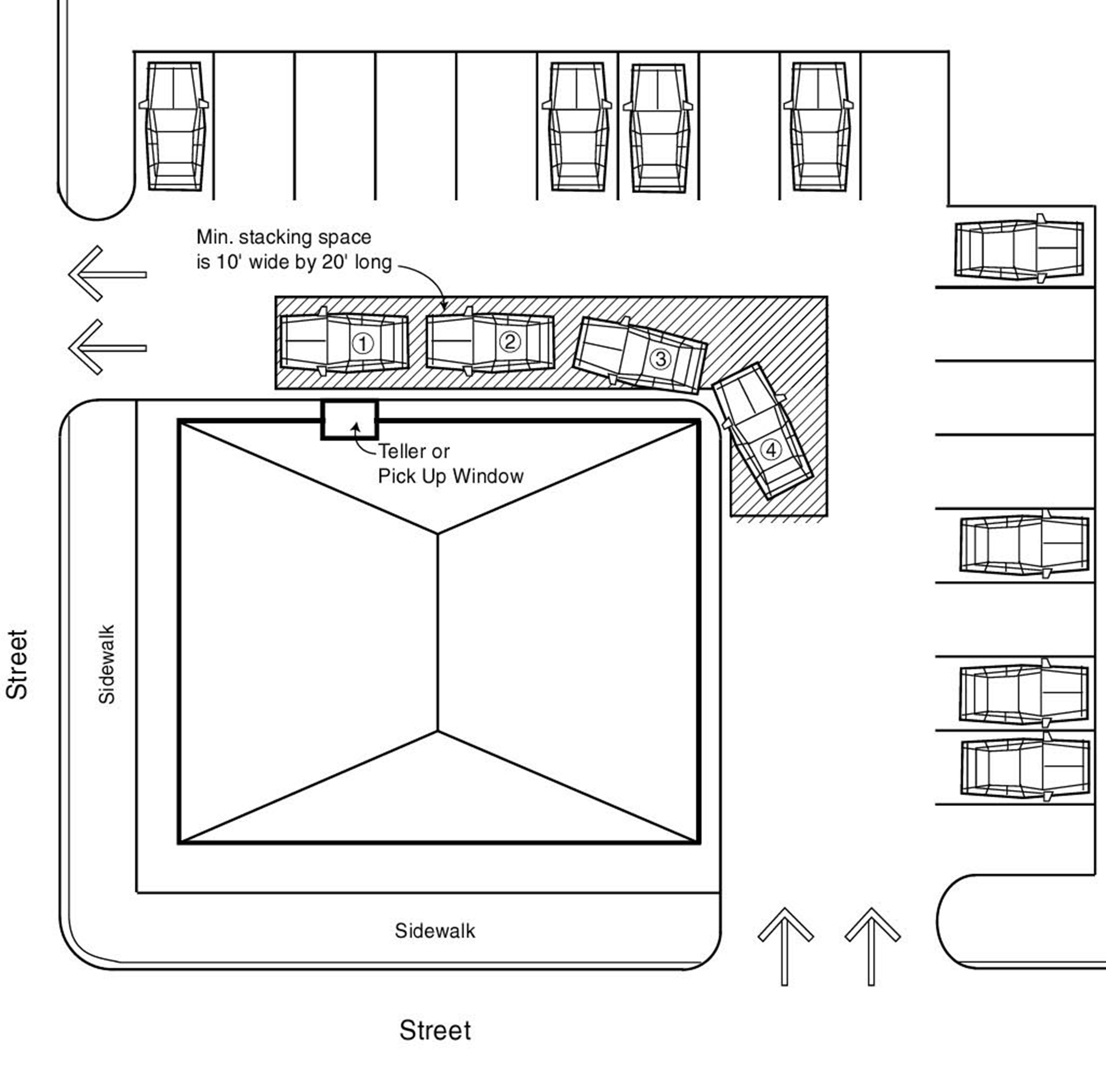
Figure 50-14-201(B)
(For Informational Purposes Only)
Stacking Area With Order Box
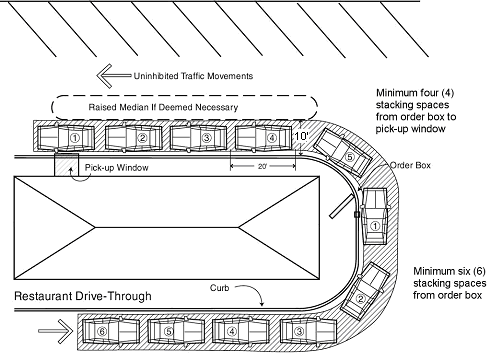
(Code 1984, § 61-14-131; Ord. No. 11-05, § 1(61-14-131), eff. 5-28-2005; Ord. No. 34-05, § 1(61-14-131), eff. 12-6-2005; Ord. No. 44-06, § 1(61-14-131), eff. 12-21-2006)
Sec. 50-14-202. - Minimum number of spaces.
Off-street stacking spaces shall be provided as follows:
*If the restaurant drive-through has more than one order box, the minimum number of stacking spaces may be allocated among all of the order boxes.
**If the restaurant drive-through has more than one pick-up window, the minimum number of stacking spaces may be allocated among all of the pick-up windows.
(Code 1984, § 61-14-132; Ord. No. 11-05, § 1(61-14-132), eff. 5-28-2005; Ord. No. 44-06, § 1(61-14-132), eff. 12-21-2006; Ord. No. 37-17, § 1(61-14-132), eff. 2-6-2018)
Sec. 50-14-203. - Design and layout.
(a)
Required stacking spaces are subject to the following design and layout standards:
(1)
Size. Stacking spaces must be a minimum of ten feet by 20 feet in size;
(2)
Location. Stacking spaces may not impede on- or off-site traffic movements or movements into or out of off-street parking spaces. (See also Figure 50-14-201(B));
(3)
Design. Where deemed necessary by the Planning and Development Department for traffic movement and safety, stacking spaces must be separated from other internal driveways by raised medians or other fixed barriers.
(b)
Stacking requirements that are unique to motor vehicle washing and steam cleaning establishment (car washes) are further specified in Section 50-12-296 of this Code.
(c)
An "escape lane" or aisle, measuring ten feet in width shall be provided adjacent to the stacking lane where deemed appropriate by the Planning and Development Department.
(Code 1984, § 61-14-133; Ord. No. 11-05, § 1(61-14-133), eff. 5-28-2005; Ord. No. 44-06, § 1(61-14-133), eff. 12-21-2006)
Sec. 50-14-204. - Voice transmission device.
Devices for the transmission or broadcasting of voices or music shall be so directed or muffled so as to prevent the sound or music from being audible beyond the boundaries of the site.
(Code 1984, § 61-14-134; Ord. No. 11-05, § 1(61-14-134), eff. 5-28-2005)
Sec. 50-14-221. - General design principles.
Except as provided for in Section 50-2-241 of this Code, the location, design and improvement standards of this subdivision shall apply to all off-street surface parking lots and areas, both for accessory parking and commercial parking, whether on-site, nearby or remote. See also Division 2, Subdivision C, of this article.
(Code 1984, § 61-14-141; Ord. No. 11-05, § 1(61-14-141), eff. 5-28-2005)
Sec. 50-14-222. - Design approval.
Off-street parking lots and parking areas shall be designed with an appropriate means of vehicular access to a street or alley in a manner which will least interfere with traffic movement and shall be subject to the approval of the Department of Public Works Traffic Engineering Division.
(Code 1984, § 61-14-142; Ord. No. 11-05, § 1(61-14-142), eff. 5-28-2005)
Sec. 50-14-223. - Layout and setback.
(a)
Layout. There shall be safe, adequate, and convenient arrangement of pedestrian pathways, bikeways, roads, driveways, and off-street parking and loading spaces within off-street parking areas. Streets, pedestrian walks, parking areas, and open space shall be designed as integral parts of an overall site design, which shall be properly related to existing and proposed buildings, adjacent uses, and landscaped areas.
(b)
Front setback. Where the side zoning lot line of a parking area is contiguous to, or across an alley from, land that is zoned R1, R2, R3, R4, R5, R6, or residential PD, a front setback equal to the front yard of the abutting lot shall be provided, except in those instances where residential structures have been erected on the rear one-half of the zoning lot. In such instances, and in those cases where the abutting lot or parcel is vacant, a front setback of 20 feet in depth shall be provided.
(c)
Accessibility. Accessible parking spaces, and loading areas and spaces, shall be designed, located, and allocated in accordance with this chapter.
(Code 1984, § 61-14-143; Ord. No. 11-05, § 1(61-14-143), eff. 5-28-2005; Ord. No. 34-05, § 1(61-14-143), eff. 12-6-2005; Ord. No. 44-06, § 1(61-14-143), eff. 12-21-2006)
Sec. 50-14-224. - Striping.
To facilitate movement and to help maintain an orderly parking arrangement, all parking spaces shall be clearly striped. The width of the parking stall shall be computed from the centers of the striping.
(Code 1984, § 61-14-144; Ord. No. 11-05, § 1(61-14-144), eff. 5-28-2005)
Sec. 50-14-225. - Appearance.
The materials used in the design of paving, lighting fixtures, retaining walls, fences, curbs, and benches shall be of good appearance, easily maintained, and indicative of their function.
(Code 1984, § 61-14-145; Ord. No. 11-05, § 1(61-14-145), eff. 5-28-2005)
Sec. 50-14-226. - Drainage.
All off-street parking, loading, and other vehicle circulation areas shall be graded and continuously maintained and designed to preclude the free flow of stormwater across or onto adjacent lots, properties, public streets, or alleys. Compliance with Chapter 8, Article V, of this Code, Plumbing Code, is required.
(Code 1984, § 61-14-146; Ord. No. 11-05, § 1(61-14-146), eff. 5-28-2005)
Sec. 50-14-227. - Reserved.
Editor's note— Ord. No. 2020-12, § 1, effective December 9, 2020, repealed Sec. 50-14-227, Signage. Former Sec. 50-14-227 pertained to signage; off-street parking area design and derived from Sec. 61-14-147 of the 1984 Detroit City Code and Ord. No. 11-05, § 1(61-14-147), effective May 28, 2005.
Sec. 50-14-228. - Maintenance.
Parking lots shall be maintained in a safe operating condition so as not to create a hazard or nuisance. All materials that are used in the design of paving, lighting fixtures, retaining walls, fences, curbs and benches shall be continuously maintained and kept free of debris and hazards in accordance with Chapter 8, Article XV, of this Code, Property Maintenance Code.
(Code 1984, § 61-14-148; Ord. No. 11-05, § 1(61-14-148), eff. 5-28-2005)
Sec. 50-14-229. - Traditional Main Street Overlay Areas, SD1, and SD2.
In designated Traditional Main Street Overlay Areas and on land zoned SD1 and SD2, no parking may be located between the front façade of a primary structure and the street.
(Code 1984, § 61-14-149; Ord. No. 11-05, § 1(61-14-149), eff. 5-28-2005; Ord. No. 20-05, § 1(61-14-149), eff. 5-29-2005; Ord. No. 23-14, § 1(61-14-149), eff. 7-24-2014)
Sec. 50-14-230. - Surfacing.
Areas used for off-street parking, loading, circulation, or vehicle display shall be surfaced with concrete, asphalt, paving blocks, brick, other similar materials, or pervious surfacing which are intended for outdoor motor vehicle use. Notwithstanding Section 32-1-102 of this Code, the use of gravel, slag, or cinder shall be prohibited, provided, that the Buildings, Safety Engineering, and Environmental Department shall be authorized to approve the use of this material within off-street parking areas for temporary uses as provided for in Article XII, Division 6, Subdivision B, of this chapter.
(Code 1984, § 61-14-150; Ord. No. 11-05, § 1(61-14-150), eff. 5-28-2005; Ord. No. 37-17, § 1(61-14-150), eff. 2-6-2018)
Sec. 50-14-231. - Dimensions.
(a)
General. All off-street parking spaces, including those in required accessory parking areas, commercial parking lots, and parking structures shall measure not less than nine feet by 20 feet, exclusive of unusable space and drives or aisles which give access to the space. Parallel parking spaces shall measure ten feet by 23 feet. Notwithstanding this subsection, accessible parking spaces may be eight feet in width, provided, that they otherwise comply with Subdivision G of this division. Notwithstanding Section 50-4-132(2) of this Code, the nine-foot width of a parking space may not be reduced by the Buildings, Safety Engineering, and Environmental Department as an administrative adjustment or by the Board of Zoning Appeals as a dimensional variance.
(b)
Reduction for planter overhangs. Where a parking space abuts a landscape island or planter, the front two feet of the required parking space length may overhang the planter, provided, that wheel stops or curbing with a minimum height of six inches are provided to protect the landscaped area.
(Code 1984, § 61-14-151; Ord. No. 11-05, § 1(61-14-151), eff. 5-28-2005; Ord. No. 20-05, § 1(61-14-151), eff. 5-29-2005; Ord. No. 44-06, § 1(61-14-151), eff. 12-21-2006; Ord. No. 37-17, § 1(61-14-151), eff. 2-6-2018)
Sec. 50-14-232. - Aisle widths.
Aisle widths that adjoin off-street parking spaces shall comply with the following dimensional standards (see also Figure 50-14-232):
Note: The enforcing official shall interpolate aisle widths for all parking arrangements not covered here.
Figure 50-14-232
(For Informational Purposes Only)
Aisle Widths
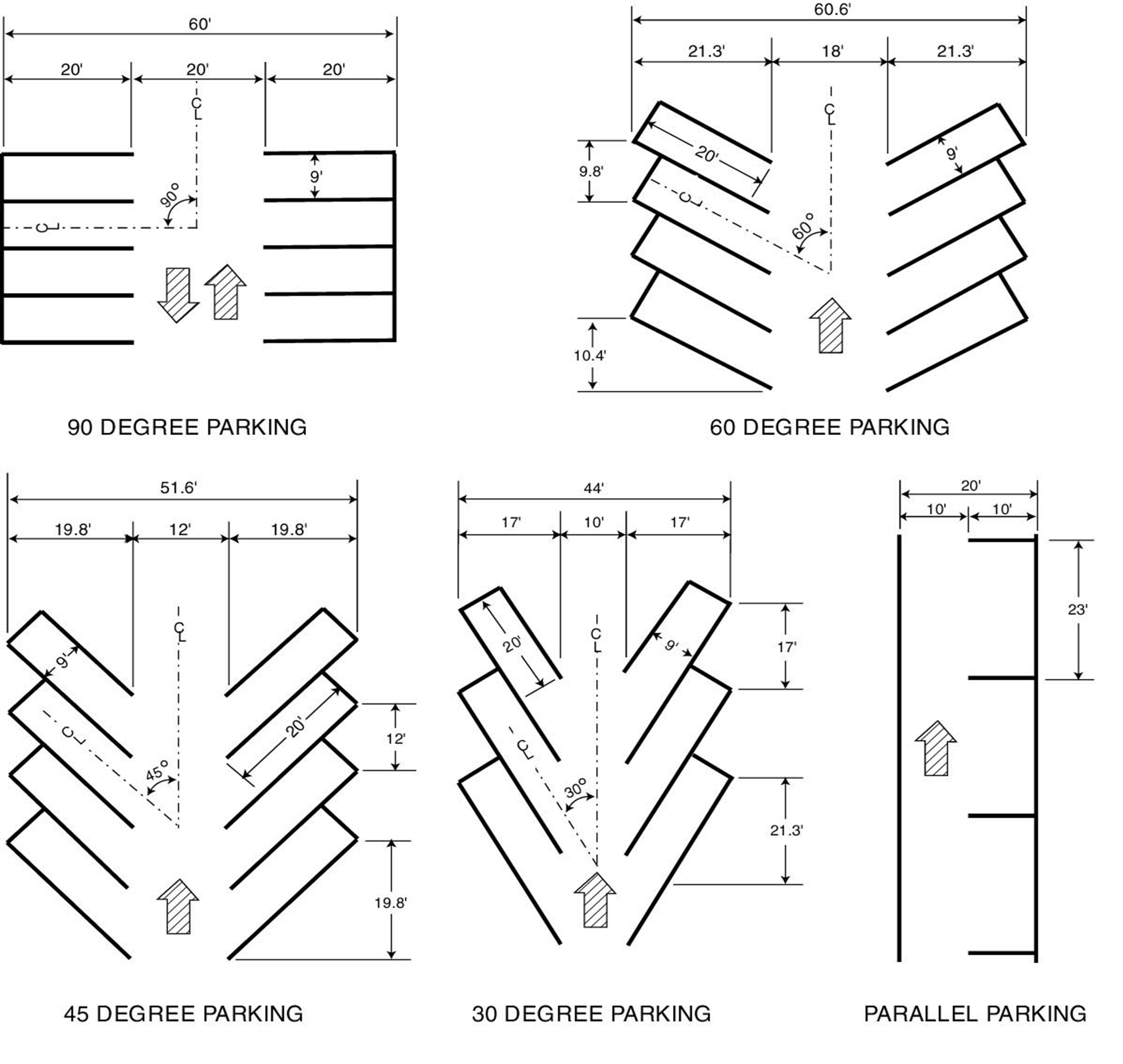
(Code 1984, § 61-14-152; Ord. No. 11-05, § 1(61-14-152), eff. 5-28-2005; Ord. No. 34-05, § 1(61-14-152), eff. 12-6-2005)
Sec. 50-14-233. - Wheel stops and curbs.
Wheel stops or curbing that are at least six inches in height shall be installed at the head of parking spaces to protect walls, fences, sidewalks, poles, structures, or pedestrian walkways. Along the boundaries of landscaped areas, all curbs shall be at least six inches in height and constructed of continuous concrete, granite, or other approved material of similar durability and appearance and shall contain inlets at appropriate intervals to allow stormwater infiltration from the open parking area. Asphalt curbs shall not be allowed. Where wheel stops are used interior to the parking lot or parking area, they shall be placed a minimum of 2½ feet from the head of parking spaces.
(Code 1984, § 61-14-153; Ord. No. 11-05, § 1(61-14-153), eff. 5-28-2005; Ord. No. 44-06, § 1(61-14-153), eff. 12-21-2006; Ord. No. 37-17, § 1(61-14-153), eff. 2-6-2018)
Sec. 50-14-234. - Pedestrian walkway.
Where parking is proposed immediately adjacent to a building, a pedestrian walkway, that is not less than five feet in width, shall be provided to separate the parking area from the building served. This provision shall not apply to single- and two-family dwellings.
(Code 1984, § 61-14-154; Ord. No. 11-05, § 1(61-14-154), eff. 5-28-2005; Ord. No. 13-11, § 1(61-14-154), eff. 8-23-2011)
Sec. 50-14-235. - Landscaping and screening.
Off-street parking areas shall be landscaped and screened from view in accordance with the standards of Division 2, Subdivision C, of this article.
(Code 1984, § 61-14-155; Ord. No. 11-05, § 1(61-14-155), eff. 5-28-2005; Ord. No. 44-06, § 1(61-14-155), eff. 12-21-2006)
Sec. 50-14-236. - Lighting.
Lighting shall be arranged and designed so that no source of light is directed toward any lots used or zoned for residential use. All reasonable measures shall be taken to ensure that off-site spillover of light and nightglow are minimized to the greatest extent possible. Lighting shall be designed to shield public streets and all other adjacent lands from distracting glare, or hazardous interference of any kind. Parking, loading, and other vehicular use areas shall not be lighted at any time other than the hours of operation of the use that the parking is intended to serve, except for necessary security lighting. Unless a more specific standard is required for a specific use or type of development elsewhere in this chapter, lighting shall be designed to provide:
(1)
Between two and five foot-candles of light as measured at five feet above grade throughout the parking lot or parking structure which serve a residential use;
(2)
Between two and ten foot-candles of light as measured at five feet above grade:
a.
Throughout the parking lot which serves a commercial, industrial, or mixed use;
b.
Throughout the parking lot that is a principal use of the property; and
c.
Within any parking structure.
(Code 1984, § 61-14-156; Ord. No. 11-05, § 1(61-14-156), eff. 5-28-2005)
Sec. 50-14-237. - Parking area ingress and egress.
Points of ingress and egress shall be approved by the Department of Public Works Traffic Engineering Division to ensure that entering and exiting vehicles do not disrupt on-site or off-site vehicle and pedestrian circulation patterns. Where ingress and egress is provided from a County road or state highway, approval shall be obtained from the appropriate jurisdiction.
(Code 1984, § 61-14-157; Ord. No. 11-05, § 1(61-14-157), eff. 5-28-2005; Ord. No. 13-11, § 1(61-14-157), eff. 8-23-2011)
Sec. 50-14-238. - Maneuvering.
The layout of the parking area shall be designed so as to preclude the need to maneuver, or stand, or park a vehicle on the sidewalk or public street in order to allow entry to, or exit of, another vehicle. An area for backing up or maneuvering to an adjacent aisle shall be provided at the end of a parking lot row.
(Code 1984, § 61-14-158; Ord. No. 11-05, § 1(61-14-158), eff. 5-28-2005)
Sec. 50-14-261. - General design principles.
Except as provided for in Section 50-2-241 of this Code, the location, design and improvement standards of this subdivision shall apply to all off-street loading areas. (See also Section 50-14-366 of this Code.) The layout of the off-street loading area shall be designed so as to preclude the need to maneuver, or stand, or park a vehicle on the sidewalk or public street in order to allow entry to, or exit of, another vehicle.
(Code 1984, § 61-14-161; Ord. No. 11-05, § 1(61-14-161), eff. 5-28-2005; Ord. No. 44-06, § 1(61-14-161), eff. 12-21-2006)
Sec. 50-14-262. - Vehicular access.
Each required off-street loading berth shall be designed with an appropriate means of vehicular access to a street or alley in a manner which will least interfere with traffic movement and shall be subject to the approval of the Department of Public Works Traffic Engineering Division.
(Code 1984, § 61-14-162; Ord. No. 11-05, § 1(61-14-162), eff. 5-28-2005)
Sec. 50-14-263. - Turning radius.
There shall be adequate turning radius on site for delivery trucks and other long vehicles to maneuver without the need to back into a public street, as provided for in the following table, which is based on most current AASHTO, Geometric Design of Highways and Streets.
(Code 1984, § 61-14-163; Ord. No. 11-05, § 1(61-14-163), eff. 5-28-2005)
Sec. 50-14-264. - Surfacing.
At a minimum, all open off-street loading areas shall be improved with a compacted macadam base that is not less than seven inches thick, and surfaced with at least two inches of asphaltic concrete or other comparable, all-weather, dustless material of similar thickness and durability.
(Code 1984, § 61-14-164; Ord. No. 11-05, § 1(61-14-164), eff. 5-28-2005)
Sec. 50-14-265. - Landscaping and screening.
Off-street loading areas shall be landscaped and screened from view in accordance with the standards of Division 2, Subdivision C, of this article.
(Code 1984, § 61-14-165; Ord. No. 11-05, § 1(61-14-165), eff. 5-28-2005)
Sec. 50-14-266. - Change of use or condition; loading spaces, number and size.
With respect to the number and size of loading spaces, the following requirements shall apply in the event of change of use or condition:
(1)
Whenever there is any change in use of a building, structure, or parcel of land, or an increase or decrease in gross floor area, which would justify an increase or decrease in the required number of off-street loading berths, more berths shall, or fewer berths may, be supplied on the basis of the adjusted needs as determined by the requirements of Subdivision D of this division;
(2)
Where no berths were previously required, the total number of berths required for the use or structure shall be supplied as required in Subsection (3) of this section; and
(3)
Where a new use requires a loading space size that is larger than presently exists, the existing loading space size, when not less than ten feet by 25 feet, shall be deemed to satisfy the requirements of this chapter.
(Code 1984, § 61-14-166; Ord. No. 11-05, § 1(61-14-166), eff. 5-28-2005)
Sec. 50-14-267. - Loading spaces do not satisfy parking requirements.
Off-street loading spaces shall not be counted toward satisfying the off-street parking space requirements of Subdivisions B and C of this division.
(Code 1984, § 61-14-167; Ord. No. 11-05, § 1(61-14-167), eff. 5-28-2005)
Sec. 50-14-281. - In general.
Except as provided for in Section 50-2-241 of this Code, the standards of this subdivision shall apply in addition to Section 50-13-226 of this Code. In the event of conflict, the provisions of this subdivision shall prevail.
(Code 1984, § 61-14-171; Ord. No. 11-05, § 1(61-14-171), eff. 5-28-2005)
Sec. 50-14-282. - Parking of commercial vehicles on land zoned R1, R2, R3, R4, R5, R6, and residential PD.
The off-street parking of commercial vehicles as defined in Section 50-16-441 of this Code, on land zoned R1, R2, R3, R4, R5, R6, and residential PD, shall be subject to the following:
(1)
Pick-up trucks, vans, and private passenger vehicles as defined in Section 50-16-341 of this Code, bearing private or commercial license plates, may be parked on any zoning lot, unless such vehicle has been substantially modified to primarily perform a specific commercial or industrial task. "Substantially modified" includes the addition of a cherry picker, hoist, crane, to name a few, but does not include the attachment of snowplows, standard commercial racks, or enclosure, caps, covers, or boxes over the exterior bed, used for holding or carrying items such as ladders, tools, or supplies, among other items.
(2)
No bus, limousine, or other commercial vehicle, not specified in Subsection (1) of this section, may be parked on any zoning lot. This prohibition shall not apply in the following situations:
a.
For the loading or unloading, delivery, or pick-up of goods, wares, merchandise, or passengers;
b.
For the rendering of business or commercial service by licensed contractors or service establishments for such period as is necessary to complete such service; and
c.
For the rendering of emergency services by an authorized emergency vehicle, government agency, or public utility.
(Code 1984, § 61-14-172; Ord. No. 11-05, § 1(61-14-172), eff. 5-28-2005; Ord. No. 37-17, § 1(61-14-172), eff. 2-6-2018)
Sec. 50-14-283. - Parking of other vehicles on land zoned R1, R2, R3, R4, R5, R6, and residential PD.
The off-street parking of vehicles, other than those specified in Section 50-14-282 of this Code, on land zoned R1, R2, R3, R4, R5, R6, and residential PD, shall be subject to the following:
(1)
No trailer, greater than eight feet in length, or semi-trailer may be parked on any zoning lot;
(2)
Where the Michigan Secretary of State requires a valid and current license plate or registration sticker to use or transport the recreational equipment, recreational vehicles and recreational equipment that are parked outdoors shall bear and properly display a valid and current license plate or registration sticker at all times;
(3)
Parking or storage of recreational vehicles or recreational equipment shall be allowed where located in a garage or in the rear yard, provided, that a recreational vehicle may be temporarily parked outside of the rear yard in the driveway for loading/unloading purposes for a period that is not to exceed 24 hours;
(4)
No recreational vehicle or recreational equipment shall be parked or stored closer than three feet to any side or any rear lot line; and
(5)
Recreational vehicles are also subject to Section 46-4-19 of this Code.
(Code 1984, § 61-14-173; Ord. No. 11-05, § 1(61-14-173), eff. 5-28-2005; Ord. No. 37-17, § 1(61-14-173), eff. 2-6-2018)
Sec. 50-14-284. - Additional parking standards for certain vehicles on land zoned R1 and R2.
In addition to the standards that are specified in Section 50-8-26, Section 50-8-56, Section 50-14-282, and Section 50-14-283 of this Code, the following standards shall apply to land zoned R1 and R2:
(1)
Not more than one taxicab or recreational vehicle may be parked outdoors on any zoning lot and shall be limited to the rear yard;
(2)
Not more than one boat may be parked or stored on any zoning lot;
(3)
Recreational vehicles are also subject to Section 46-4-19 of this Code.
(Code 1984, § 61-14-174; Ord. No. 11-05, § 1(61-14-174), eff. 5-28-2005)
Sec. 50-14-285. - Construction equipment.
Construction equipment shall not be stored on lots, except during the period of permitted construction on the subject parcel.
(Code 1984, § 61-14-175; Ord. No. 11-05, § 1(61-14-175), eff. 5-28-2005)
Sec. 50-14-286. - Location of off-street parking on land zoned R1 and R2.
The following requirements, with respect to the location of off-street parking in the R1 and R2 Districts, shall apply:
(1)
In the R1 and R2 Districts, off-street parking of operable private passenger vehicles on zoning lots that contain single-family or two-family dwellings shall be permitted only:
a.
In garages;
b.
On approved parking areas in the rear yard as specified in Subsection (3) of this section;
c.
On approved driveways as defined in Section 50-16-172 of this Code, in only one side yard and the continuation of that side yard into the front yard to the property line. There shall be not more than one driveway per residential dwelling unit, except as provided for in Subsection (5) of this section; or
d.
On semicircular drives, as specified in Subsection (5) of this section;
(2)
In R1 and R2 Districts, off-street parking on the site of an allowed non-residential use shall not be allowed within required front or side setbacks;
(3)
In R1 and R2 Districts, where dwelling units are built without an attached garage, a solid paved access shall be required from the street or alley to a garage or paved parking area and the solid paved access shall follow the most direct route from the street to any garage or paved parking area on the lot. Where no garage is provided, the paved parking area shall be located completely within the rear yard area and shall have maximum dimensions of 20 feet by 30 feet and shall not cover more than 50 percent of the rear yard. No parking shall be permitted on lawns or other unpaved areas on residential lots. The required parking area and access shall be paved with an asphaltic or Portland cement binder or solid paver;
(4)
In R1 and R2 Districts, where dwelling units are built with an attached garage, a solid paved access shall be provided from the street, or, where applicable, the alley, to the attached garage. The access shall be paved with an asphaltic or Portland cement binder or solid paver;
(5)
In R1 and R2 Districts, semicircular drives, or other drives with more than one point of access to a street shall be permitted only on zoning lots having a lot width of at least 60 feet and a front yard having at least 2,100 square feet;
(6)
See Figure 50-14-286 and Section 50-8-27 and Section 50-8-57 of this Code for additional regulations; see also Section 46-4-16 of this Code; and
(7)
Off-street parking on the site of an allowed multiple-family dwelling or non-residential use shall be allowed only in the rear yard or in not more than one of the side yards. (See also Section 50-13-25 of this Code.)
Figure 50-14-286
(For Informational Purposes Only)
Location of Parking in R1 and R2
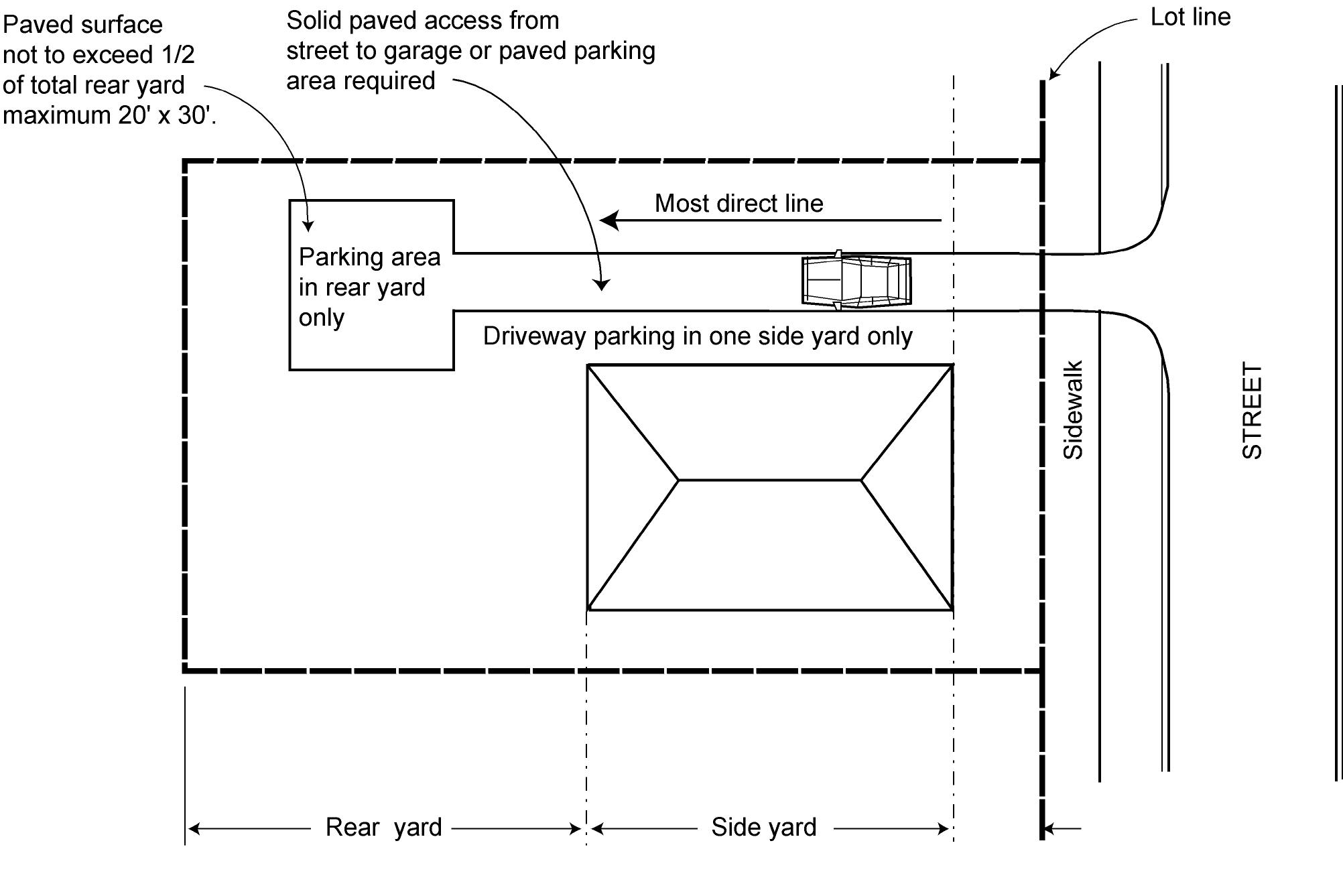
(Code 1984, § 61-14-176; Ord. No. 11-05, § 1(61-14-176), eff. 5-28-2005; Ord. No. 38-14, § 1(61-14-176), eff. 10-16-2014; Ord. No. 13-15, § 1(61-14-176), eff. 7-11-2015)
Sec. 50-14-287. - R-3, R-4, R-5 and R6 Districts.
Off-street parking on land zoned R3, R4, R5, and R6 shall also be subject to the following:
(1)
In R3, R4, R5, and R6 Districts, off-street parking on the site of an allowed multiple-family dwelling or non-residential use shall be allowed only in the rear yard or in not more than one of the side yards (See also Section 50-13-25 of this Code);
(2)
Single- and two-family dwellings in the R3, R4, R5, and R6 Districts shall abide by Section 50-14-286 of this Code;
(3)
Zoning lots in the R3, R4, R5, and R6 Districts that are used exclusively for parking purposes and not in conjunction with a building on the same zoning lot shall be landscaped and screened in accordance with Division 2, Subdivision C, of this article; and
(4)
See Figure 50-14-287.
Figure 50-14-287
(For Informational Purposes Only)
Open Parking Areas for Multi-Family and Permitted Non-Residential Uses in R3, R4,
R5, and R6 Districts
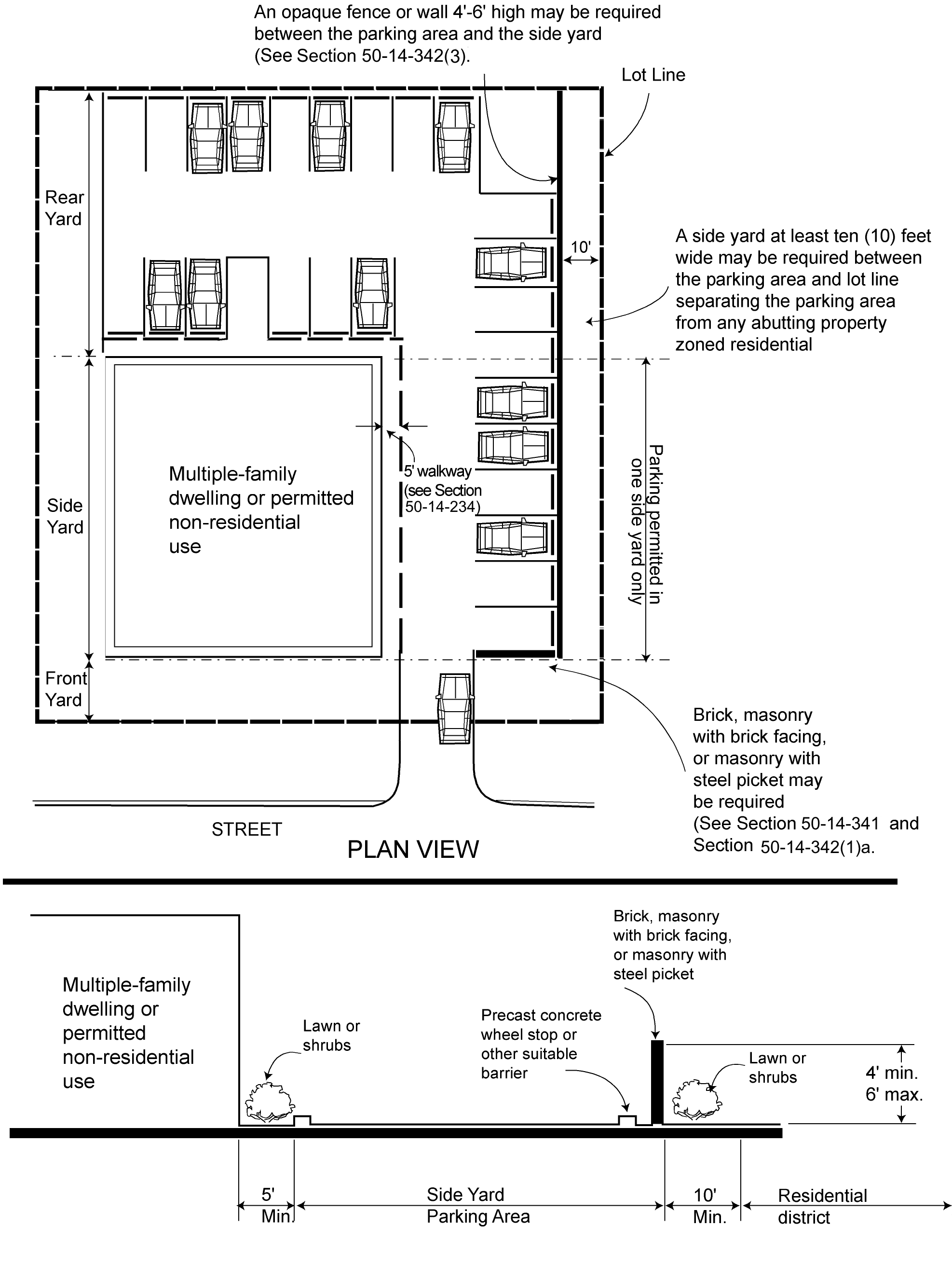
(Code 1984, § 61-14-177; Ord. No. 11-05, § 1(61-14-177), eff. 5-28-2005; Ord. No. 44-06, § 1(61-14-177), eff. 12-21-2006)
Sec. 50-14-288. - Off-street parking on corner lots in R3, R4, R5, and R6 Districts.
Setback provisions for off-street parking on corner lots in R3, R4, R5, and R6 Districts are specified as follows (See also Section 50-13-22 of this Code and Figure 50-14-288):
(1)
Front setback. A front setback equal to the front yard of the abutting structure shall be provided. Where the abutting structure is located on the rear one-half of the lot or where the abutting lot is vacant, a front setback of at least 20 feet shall be provided between the parking area and the front lot line; and
(2)
Side setback. A side setback of at least five feet shall be provided between the parking area and the side lot line that is adjacent to the street, provided, that where the side lot line is substantially a continuation of the front lot line of a Residentially-zoned lot to its rear, the required street side setback shall be at least ten feet.
Figure 50-14-288
(For Informational Purposes Only)
Parking Areas on Corner Lots in R3, R4, R5, and R6 Districts
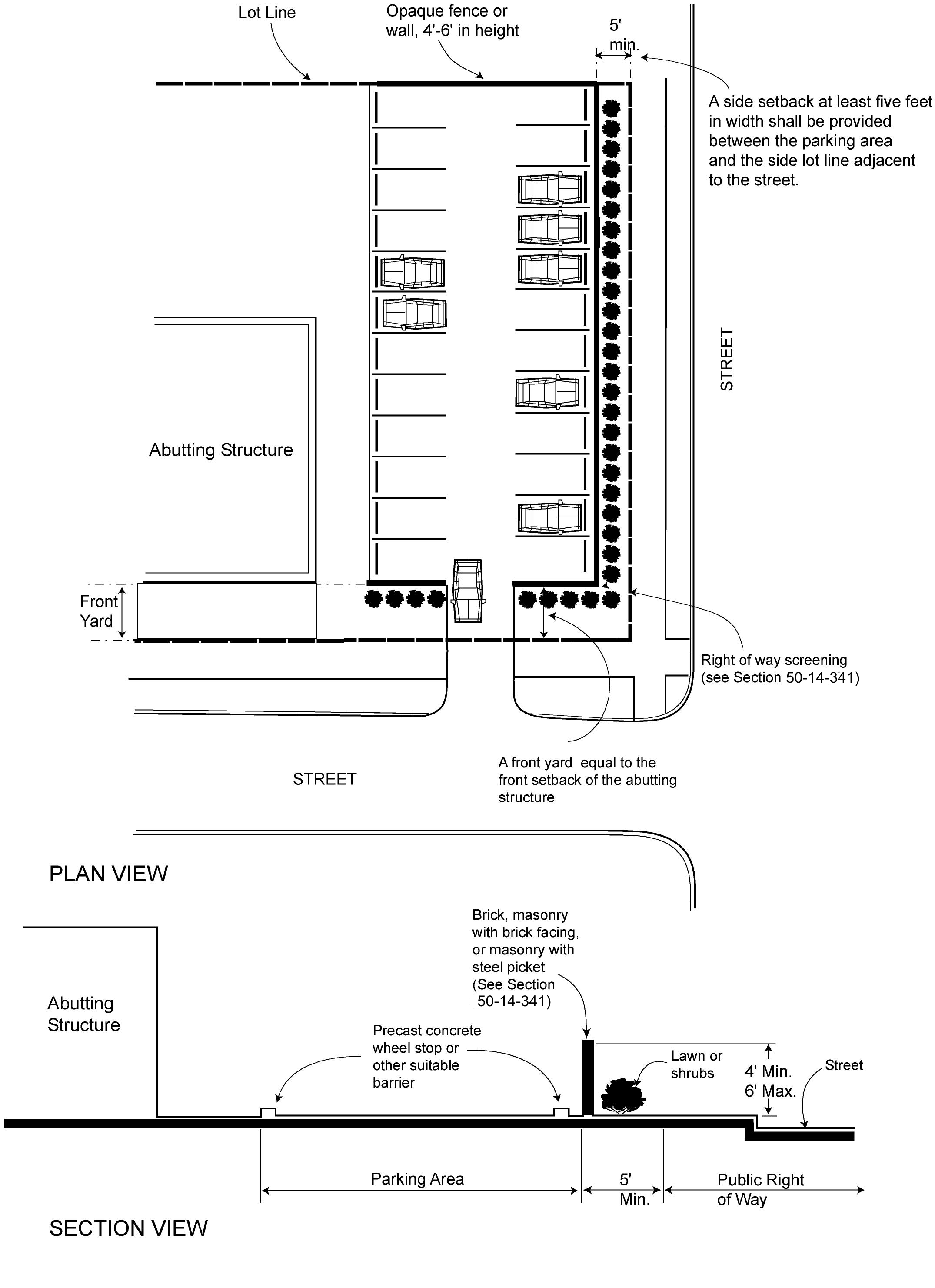
(Code 1984, § 61-14-178; Ord. No. 11-05, § 1(61-14-178), eff. 5-28-2005)
Sec. 50-14-301. - Purpose.
The landscaping and screening standards of this division are intended to do the following:
(1)
Encourage the planting of appropriate new vegetation and the preservation of existing vegetation to enhance the built environment and to protect and sustain the natural environment;
(2)
Reduce potential nuisances by requiring a visual screen between uses to mitigate the adverse effects of wind and air turbulence, heat, noise, motor vehicle headlight glare and other artificial light intrusion, and other adverse impacts associated with adjoining or nearby uses; and
(3)
Improve the appearance of on-premises parking, vehicular-use areas, and property abutting public rights-of-way.
(Code 1984, § 61-14-191; Ord. No. 11-05, § 1(61-14-191), eff. 5-28-2005)
Sec. 50-14-302. - Applicability.
Except as provided for in Section 50-2-241 of this Code and unless otherwise expressly stated, the landscaping and screening standards of this division shall apply in the following instances:
(1)
The construction of any principal building;
(2)
The addition to, or enlargement of, any principal building by more than ten percent;
(3)
The addition to, or enlargement of, any principal building by more than 2,000 square feet;
(4)
The construction or installation of any surface parking area that contains five or more off-street parking spaces or the addition of five or more off-street parking spaces to any existing surface parking lot or parking area;
(5)
Alterations to any structure or improvements to the land for which a building permit is required, where the cost of such work exceeds 60 percent of the assessed valuation, as defined in Section 50-16-113 of this Code, of the property; and
(6)
Change of use of the property to a more intensive use.
(Code 1984, § 61-14-192; Ord. No. 11-05, § 1(61-14-192), eff. 5-28-2005; Ord. No. 44-06, § 1(61-14-192), eff. 12-21-2006)
Sec. 50-14-303. - Exemptions.
The following shall be expressly exempt from all landscaping and screening standards of this division:
(1)
The construction of a single-family or two-family dwelling, provided, that the applicable provisions of Division 3, Subdivision A, of this article shall apply; and
(2)
Repair or enlargement of a single-family or two-family dwelling.
(Code 1984, § 61-14-193; Ord. No. 11-05, § 1(61-14-193), eff. 5-28-2005; Ord. No. 44-06, § 1(61-14-193), eff. 12-21-2006)
Sec. 50-14-321. - In general.
The requirements of this subdivision apply to all developments subject to landscaping or screening standards.
(Code 1984, § 61-14-201; Ord. No. 11-05, § 1(61-14-201), eff. 5-28-2005)
Sec. 50-14-322. - Plant materials.
The selection of plant materials shall be based upon the City's climate and soils. The selection of native and indigenous plant materials is strongly encouraged.
(Code 1984, § 61-14-202; Ord. No. 11-05, § 1(61-14-202), eff. 5-28-2005)
Sec. 50-14-323. - Plant quality and type.
All plants shall conform to "American Nurserymen's" standards, with coherent root ball or wrapped roots, of a height, leaf density and spread appropriate to the species. No one species of tree or shrub may make up more than 50 percent of the total plantings.
(Code 1984, § 61-14-203; Ord. No. 11-05, § 1(61-14-203), eff. 5-28-2005)
Sec. 50-14-324. - Prohibited tree species.
The planting of the following tree species shall be prohibited, except upon special review and approval by the Recreation Department:
(Code 1984, § 61-14-204; Ord. No. 11-05, § 1(61-14-204), eff. 5-28-2005)
Sec. 50-14-325. - Plant size.
The following requirements shall apply with respect to plant size, except upon special review and approval by the Recreation Department:
(1)
Shrubs. Shrubs planted to meet the landscaping and screening standards of this subdivision shall have a minimum size equal to or greater than a Number 3 container and have a minimum height of 18 inches at the time of planting. Where shrubs are used to meet landscaping or screening standards, at least 50 percent shall be evergreen; and
(2)
Trees. Deciduous trees that are installed to meet the standards of this subdivision shall have a minimum diameter of two inches, which is measured 12 inches above the root ball, and a clear stem of at least five feet. Evergreen trees shall have a minimum height of five feet at time of planting.
(Code 1984, § 61-14-205; Ord. No. 11-05, § 1(61-14-205), eff. 5-28-2005; Ord. No. 20-05, § 1(61-14-205), eff. 5-29-2005)
Sec. 50-14-326. - Ground treatment.
All unpaved areas shall be landscaped using one or any combination of the treatments specified in this section. Landscaped areas shall present a finished appearance and reasonably complete coverage upon planting. The following standards shall apply to the design of ground treatment:
(1)
Ground cover. Ground cover that is appropriate for the area may be planted in lieu of turf grass. Ground cover shall be of a size and spacing to provide a minimum of 50 percent coverage after the first full growing season and complete coverage at maturity. Edging shall be provided for all ground cover;
(2)
Mulch. Mulch shall be installed and maintained at a minimum depth of two inches and a maximum depth of four inches on all planted areas, except where ground cover plants are fully established. Mulch may be used as a permanent ground treatment in those landscape designs where ground cover or grass is inappropriate; however, not more than 25 percent of the unpaved area shall consist of mulch;
(3)
Grass seed and sod. Turf areas shall be planted with species that are suitable as permanent lawns in the City. Turf areas shall be sodded or seeded. In areas where grass seed is used, maintenance shall be provided until coverage is complete, and complete coverage shall be provided after the first full growing season; and
(4)
Cobblestone, pavers, and rocks. Cobblestone, pavers, and rocks may be used in addition to the ground treatments that are set out in Subsections (1) through (3) of this section, provided, that not more than ten percent of the unpaved area shall consist of cobblestone, pavers, and rocks.
(Code 1984, § 61-14-206; Ord. No. 11-05, § 1(61-14-206), eff. 5-28-2005; Ord. No. 13-11, § 1(61-14-206), eff. 8-23-2011)
Sec. 50-14-327. - Installation, maintenance, and replacement.
The following requirements shall apply with respect to installation, maintenance, and replacement of landscaping:
(1)
Installation. All landscaping shall be installed according to sound nursery practices in a manner that is designed to encourage vigorous growth. Shrubs and trees shall not be installed within car overhang or door swing areas. All landscape material shall be healthy and in place prior to issuance of a final Certificate of Occupancy. A temporary Certificate of Occupancy may be issued prior to installation of required landscaping where written assurances and financial guarantees are submitted which ensure that planting will take place when planting season arrives (see also Division 8 of this article);
(2)
Maintenance and replacement. Trees, shrubs, fences, walls, and other landscape features that are depicted on plans approved by the City shall be considered as elements of the project in the same manner as parking, building materials, and other details are elements of the plan. The land owner, or successors in interest, or agent, if any, shall be jointly and severally responsible for the following:
a.
Regular maintenance of all landscaping in good condition and in a way that presents a healthy, neat, and orderly appearance. All landscaping shall be maintained free from disease, pests, weeds, and litter. This maintenance shall include weeding, watering, fertilizing, pruning, mowing, edging, mulching or other maintenance as needed and in accordance with acceptable horticultural practices;
b.
The repair or replacement of required landscape structures, including, but not limited to, walls and fences, to a structurally sound condition;
c.
Where necessary, the regular maintenance, repair, and/or replacement, of any landscaping required by this division; and
d.
Continuous maintenance of the site;
e.
Where constructing new landscape planting areas on surfaces which were previously covered by pavement or structures, all existing asphalt, base rock or other impervious material shall be removed to the depth of the native soil and clean soil shall be used to backfill the planting area; and
f.
Trees in, or adjacent to, parking areas and streets shall be salt-resistant.
(3)
Visibility and accessibility. Landscaping materials and arrangement shall ensure adequate sight visibility for motorists, adequate clearance for pedestrians and vehicles, and accessibility to fire hydrants. All hedges and any other type of opaque screening that is maintained or placed within 20 feet of the front public sidewalk shall be limited to three feet in height above the grade of the public sidewalk. For corner lots, see Section 50-13-22 of this Code.
a.
Shrubs and trees shall not be installed within car overhang or door swing areas; and
b.
Trees in, or adjacent to, parking areas and streets shall be salt resistant.
(Code 1984, § 61-14-207; Ord. No. 11-05, § 1(61-14-207), eff. 5-28-2005)
Sec. 50-14-328. - Irrigation.
The following landscape irrigation requirements shall apply:
(1)
Required landscaped areas shall be irrigated as necessary to maintain required plant materials in good and healthy condition;
(2)
All landscaped areas shall be provided with a readily available water supply. Water outlets (hose bibbs) shall be provided within 100 feet of all required plant material unless a subsurface irrigation system is used; and
(3)
Irrigation systems shall be continuously maintained in working order and shall be designed to prevent overlap of water zones and to prevent watering of impervious areas.
(Code 1984, § 61-14-208; Ord. No. 11-05, § 1(61-14-208), eff. 5-28-2005)
Sec. 50-14-341. - Right-of-way screening.
Screening along the right-of-way shall be provided as follows:
(1)
Off-street parking areas that are visible from a public street shall include a landscape buffer strip with a minimum width of five feet between the off-street parking area and the right-of-way, provided, that where the parking area is across a public street, not exceeding 60 feet in width, from a dwelling unit on land zoned residential, the provisions of Section 50-14-342(1)a of this Code shall supersede. The following shall be provided:
a.
At least one tree shall be provided for each 30 linear feet of landscape buffer. Trees shall be planted in the buffer strip or between the sidewalk and street curb. Trees must have a minimum nonpaved planting area of 18 square feet, with a minimum depth of five feet. In cases where there is an existing pattern of trees along the street, new trees shall be the same species and planted according to the existing tree spacing and pattern to the greatest extent possible, except where such existing trees are included in the list of prohibited tree species in Section 50-14-324 of this Code. Trees provided to meet the standards of this subsection shall not be planted more than 50 feet apart. (See Figure 50-14-341(1)a.)
b.
Vegetation, a berm, or masonry wall forming a continuous screen at least 30 inches, but not more than 36 inches, in height, shall be located within the landscape buffer that is immediately adjacent to the parking area. Berms shall be constructed with slopes no steeper than one foot vertical for each three feet horizontal (33 percent slope). (See Figure 50-14-341(1)b.) Opaque screening, such as the following, is acceptable:
1.
A brick wall;
2.
A masonry wall with brick facing;
3.
A masonry wall with decorative metal fence topping;
4.
A concrete wall with brick design;
5.
A stone wall;
6.
Vegetative screening material that is designed to provide 75 percent opacity on a year-round basis beginning one year after planting along the full required height and length of the screening buffer; or
7.
Other opaque wall which, in the determination of the Planning and Development Department, is both suitable for the site and compatible with, and similar to, the building frontages nearest the parking area.
(2)
In instances where it is not practical to provide a five-foot landscaped buffer strip, a wrought iron-style ornamental fence may be erected, subject to review and approval by the Planning and Development Department.
Figure 50-14-341(1)a
(For Informational Purposes Only)
Isometric View of Tree Spacing
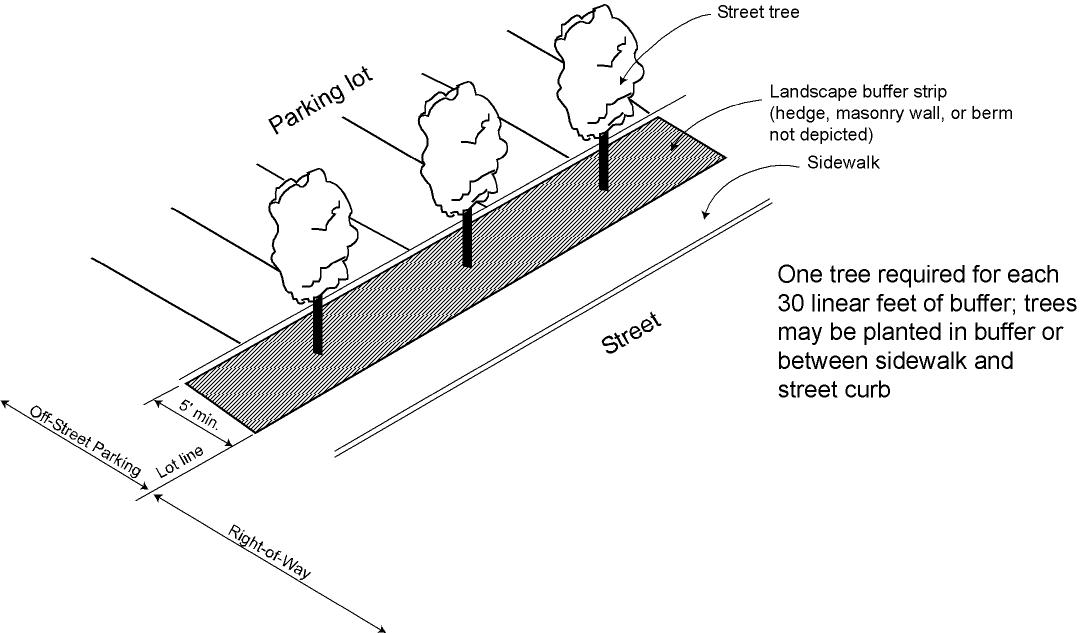
Figure 50-14-341(1)b
(For Informational Purposes Only)
Right-of-Way Screening Alternatives
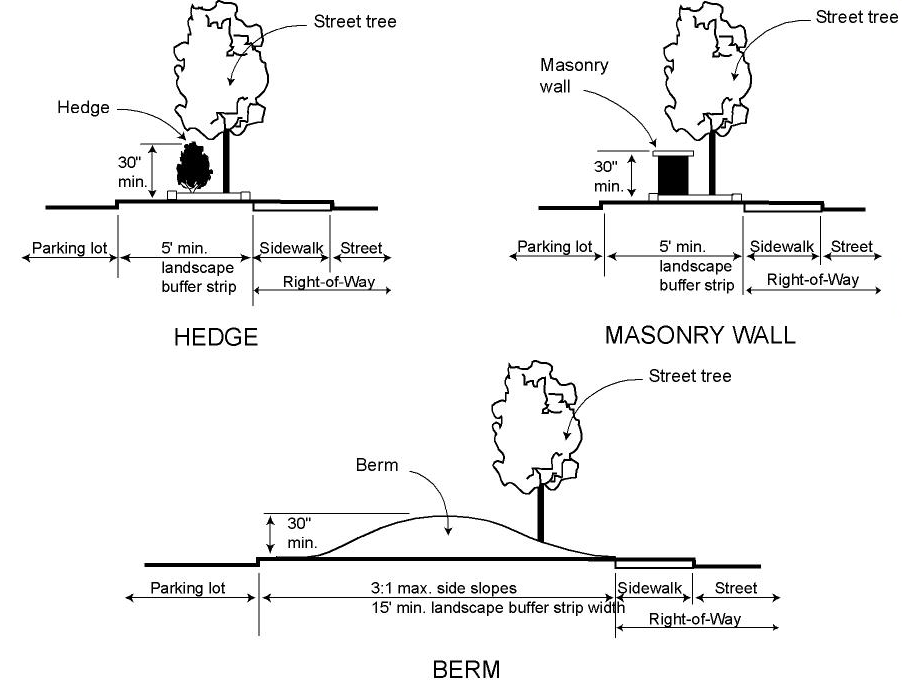
(Code 1984, § 61-14-221; Ord. No. 11-05, § 1(61-14-221), eff. 5-28-2005; Ord. No. 20-05, § 1(61-14-221), eff. 5-29-2005; Ord. No. 34-05, § 1(61-14-221), eff. 12-6-2005; Ord. No. 37-17, § 1(61-14-221), eff. 2-6-2018)
Sec. 50-14-342. - Residential screening.
Screening from land zoned residential shall be provided as follows:
(1)
Abutting Residentially-zoned lots containing dwelling units.
a.
Where a zoning lot that has a dwelling unit on land zoned R1, R2, R3, R4, R5, R6, or residential PD and abuts, or is located across an alley or public street not exceeding 60 feet in width from, a parking area visible from the residential lot, an opaque wall shall be placed at the edge of the parking area to screen the parking area. Opaque screening, such as the following, is acceptable:
1.
A brick wall;
2.
A masonry wall with brick facing;
3.
A masonry wall with decorative metal fence topping;
4.
A concrete wall with brick design;
5.
A stone wall; or
6.
Other opaque wall which, in the determination of the Planning and Development Department, is both suitable for the site and compatible with, and similar to, the building frontages nearest the parking area.
b.
The nearest parking space, drive aisle, or other paved surface within the parking area shall be located at least ten feet from the abutting residential lot. Said setback area shall be landscaped. (See Figure 50-14-342.)
Figure 50-14-342
(For Informational Purposes Only)
Screening Abutting Residential Lots Containing Dwelling Units
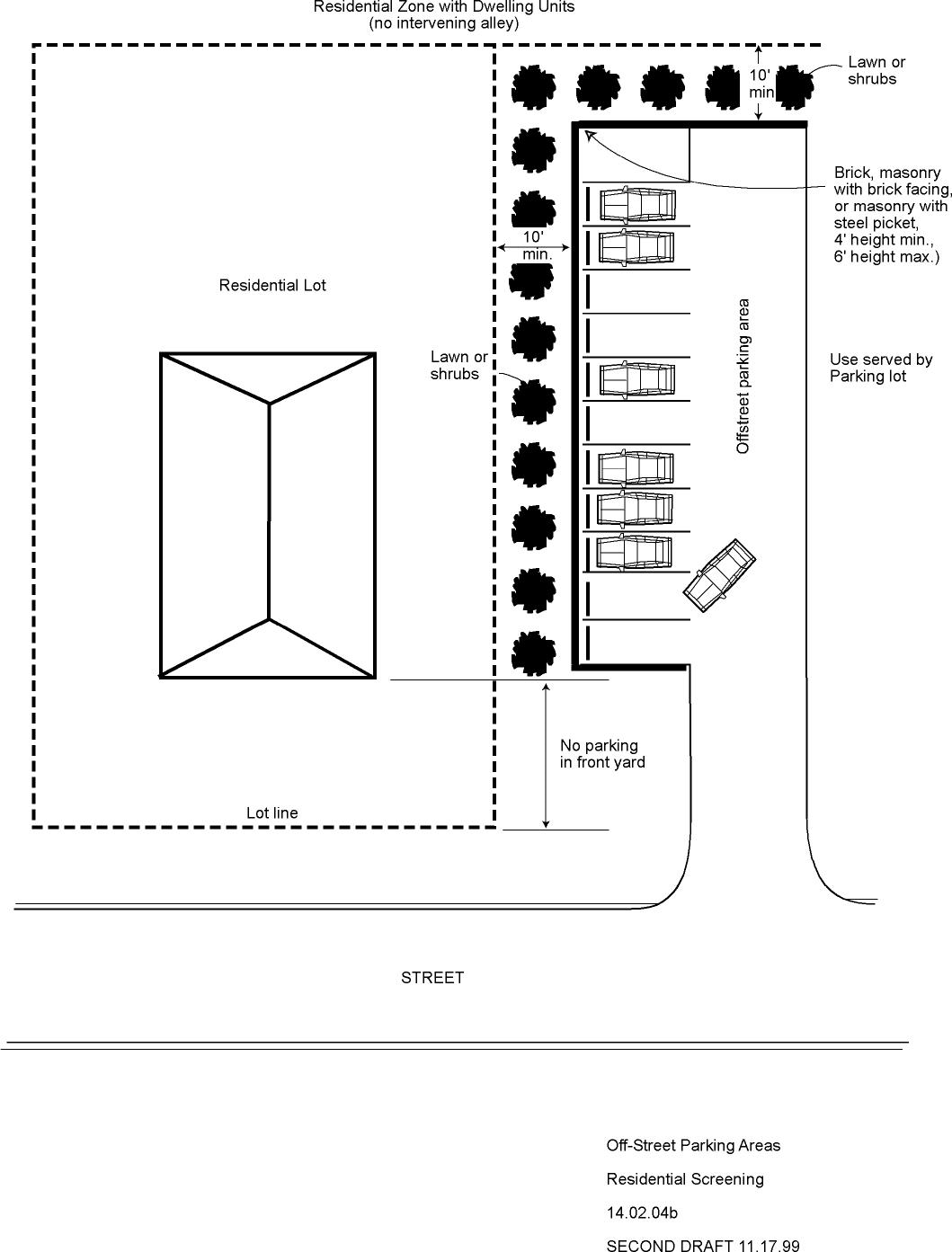
(2)
Abutting Residentially-zoned lots not containing dwelling units.
a.
Where a lot on land zoned R1, R2, R3, R4, R5, R6, or residential PD does not contain a dwelling unit and abuts, or is located across an alley or public street not exceeding 60 feet in width from, a parking area visible from the residential lot, an opaque wall, that is placed at the edge of the parking area, is required to screen the parking area. Opaque screening, such as the following, is acceptable:
1.
A brick wall;
2.
A masonry wall with brick facing;
3.
A masonry wall with decorative metal fence topping;
4.
A concrete wall with brick design;
5.
A stone wall; or
6.
Other opaque wall which, in the determination of the Planning and Development Department, is both suitable for the site and compatible with, and similar to, the building frontages nearest the parking area.
b.
The nearest parking space, drive aisle, or other paved surface within the parking area shall be located at least five feet from the abutting residential lot. Said setback area shall be landscaped.
(3)
Wall specifications. All walls or fences that are required under this section shall be at least four feet in height, with a maximum height of six feet, as measured from the surface of the parking area. Walls and fences shall be maintained in a neat and orderly appearance at all times, and shall have only such openings as are required for ingress and egress.
(4)
Exception. Where the alley serves as the only direct access to the parking spaces, such as where parking spaces are located between a building wall and the alley, or where the alley provides the required off-street loading area, and the Planning and Development Department determines that the placement of screening would prevent access to the parking spaces or loading area, the Department may waive the screening or allow it to be pierced as necessary.
(Code 1984, § 61-14-222; Ord. No. 11-05, § 1(61-14-222), eff. 5-28-2005; Ord. No. 20-05, § 1(61-14-222), eff. 5-29-2005; Ord. No. 23-13, § 1(61-14-222), eff. 8-28-2013; Ord. No. 37-17, § 1(61-14-222), eff. 2-6-2018)
Sec. 50-14-343. - Interior landscaping.
Off-street parking areas for operable, private passenger vehicles, which have a capacity of 25 or more parking spaces, shall contain landscaped areas that are located entirely within the edges of the off-street parking area in accordance with Figure 50-14-343, and that serve to break up the expanse of pavement and manage stormwater. A raised curb must edge the landscaped area, must be at least six inches in height, and must contain inlets at appropriate intervals to allow stormwater infiltration from the open parking area. The following additional requirements apply:
(1)
Within the interior of the off-street parking area, interior landscaped areas shall be provided at the following rate:
Note: Area of off-street parking area excludes a paved area that is designed to be used exclusively for vehicle access between the street and the off-street parking area. It shall include the area of all aisles and driveways within the limits of the off-street parking area;
(2)
To be credited toward meeting the requirements of this section, each interior landscaped area shall have a minimum area of at least 150 square feet, a minimum dimension of seven feet in any direction, and include at least one shade tree;
(3)
Any landscaped area located out-side the edges of the off-street parking area shall not be counted toward satisfying this interior landscaping requirement;
(4)
The total number of trees required to be planted in the interior of an off-street parking area shall be calculated and provided at a rate of one shade tree for each 250 square feet, or fraction thereof, of required interior landscaped area; and
(5)
Required interior landscaped areas must maximize effective stormwater management by incorporating:
a.
Curbs at the edge of the required interior landscaped areas to protect plants;
b.
Landscaped areas installed at a lower grade than the parking lot pavement; and
c.
Curbing with openings to allow drainage from the pavement to enter and percolate into the ground in the landscaped areas.
Figure 50-14-343
(For Informational Purposes Only)
Parking Lot Interior Landscaping for Lots Having at Least 25 Spaces
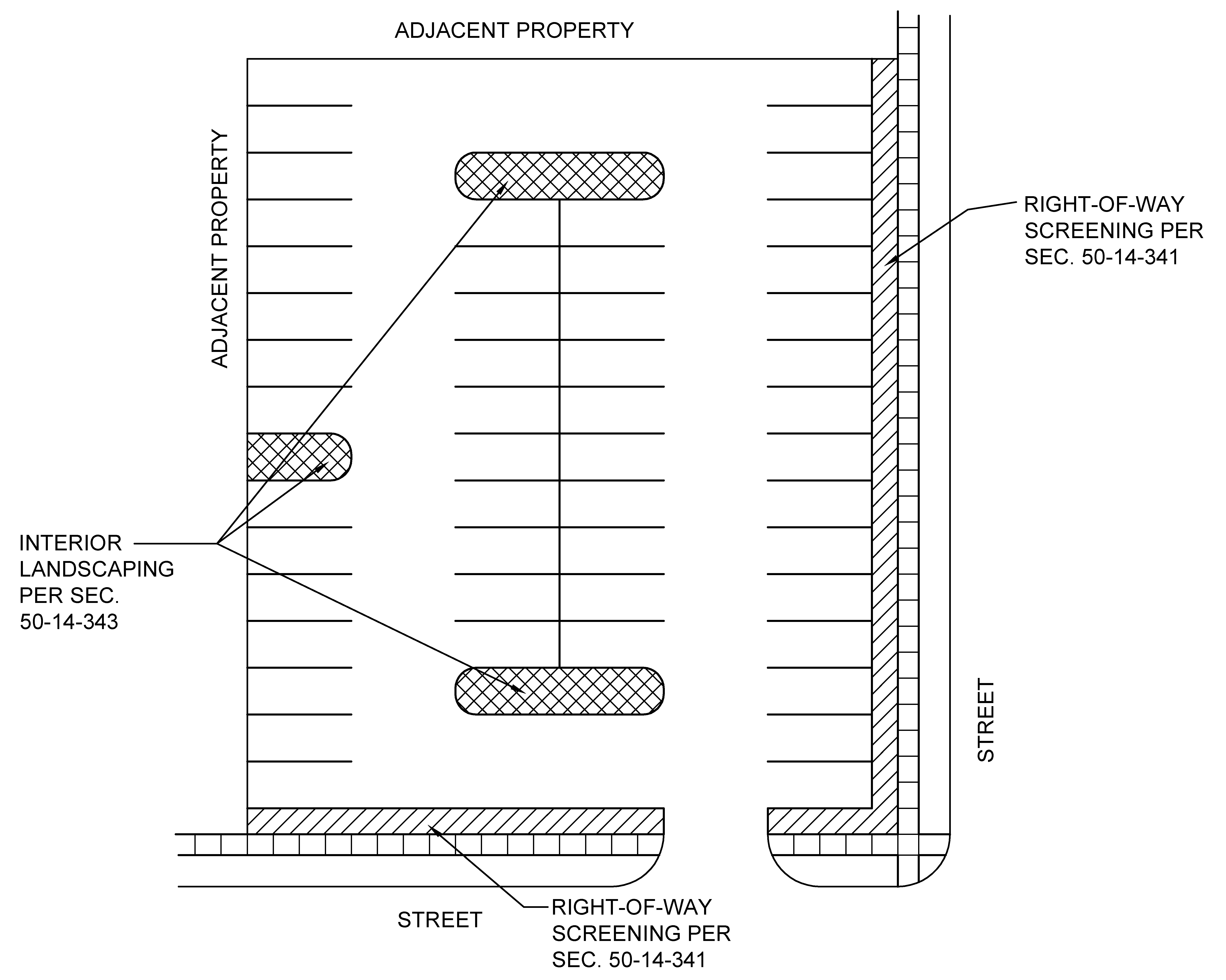
(Code 1984, § 61-14-223; Ord. No. 11-05, § 1(61-14-223), eff. 5-28-2005; Ord. No. 34-05, § 1(61-14-223), eff. 12-6-2005; Ord. No. 13-11, § 1(61-14-223), eff. 8-23-2011; Ord. No. 37-17, § 1(61-14-223), eff. 2-6-2018; Ord. No. 18-18, § 1(61-14-223), eff. 8-30-2018)
Sec. 50-14-344. - Quality.
All off-street parking areas that are contained in this subdivision shall adhere to the quality standards of Subdivision B of this division.
(Code 1984, § 61-14-224; Ord. No. 11-05, § 1(61-14-224), eff. 5-28-2005)
Sec. 50-14-345. - Parking structures.
Landscaping shall be provided as part of parking structure design, and be subject to site plan review.
(Code 1984, § 61-14-225; Ord. No. 11-05, § 1(61-14-225), eff. 5-28-2005)
Sec. 50-14-361. - Open space landscaping.
Any portion of a developed zoning lot that is not used for the location of buildings, structures, accessory uses, off-street parking, loading areas, sidewalks, or similar features shall be landscaped as provided in Section 50-14-326 of this Code.
(Code 1984, § 61-14-231; Ord. No. 11-05, § 1(61-14-231), eff. 5-28-2005; Ord. No. 13-11, § 1(61-14-231), eff. 8-23-2011)
Sec. 50-14-362. - Landscaping of required setbacks.
Where certain land uses require a setback from a public street, at least one tree shall be provided for each 30 linear feet of lot width. Trees shall be planted in the setback area or, if not practicable, between the sidewalk and street curb. Trees must have a minimum planting area of 18 square feet. Trees provided to meet this standard shall not be planted more than 50 feet apart.
(Code 1984, § 61-14-232; Ord. No. 11-05, § 1(61-14-232), eff. 5-28-2005)
Sec. 50-14-363. - Screening.
Screening shall be provided as set out in Section 50-14-364 through Section 50-14-366 of this Code.
(Code 1984, § 61-14-233; Ord. No. 11-05, § 1(61-14-233), eff. 5-28-2005)
Sec. 50-14-364. - Screening of refuse receptacles and waste removal areas.
Refuse receptacles and waste removal areas, including trash cans, trash compactors, and dumpsters shall be screened from view of street rights-of-way and from view of residential or commercial zoning districts by a masonry wall enclosure with an opaque gate. To the extent possible, the waste removal area shall be located to the rear of the building. The enclosure and gate shall have a minimum height of at least one foot higher than the refuse receptacles or waste container. All refuse and waste storage areas shall be surfaced with concrete that is not less than six inches in depth. All trash enclosures and other service spaces shall incorporate at least one of the predominant colors that are found on the primary structure of the site and be similar in material. (See Figure 50-14-364.) This provision does not apply to those residential structures using Courville containers as provided in Chapter 42, Article II, Division 3, of this Code, Placement, Storage, and Maintenance of Approved Containers.
Figure 50-14-364
(For Informational Purposes Only)
Screening
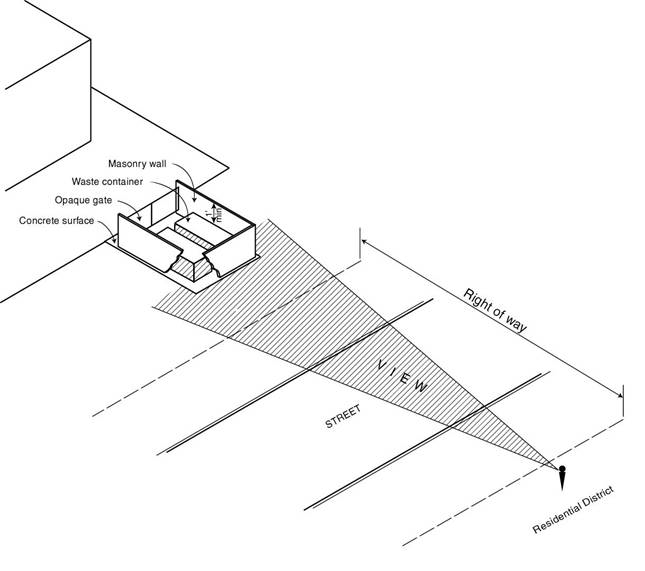
(Code 1984, § 61-14-234; Ord. No. 11-05, § 1(61-14-234), eff. 5-28-2005; Ord. No. 13-11, § 1(61-14-234), eff. 8-23-2011)
Sec. 50-14-365. - Screening of open storage areas.
Open storage of any goods, materials, products, or equipment shall be screened from view of street rights-of-way and from view of land zoned R1, R2, R3, R4, R5, R6, and residential PD in accordance with Section 50-14-367 of this Code. Screening is not required for permitted outdoor sales areas. This provision shall not apply to the R1, R2, R3, R4, R5, R6, and B1 Districts, except where involving a prohibited commercial or industrial use under jurisdiction of the Board of Zoning Appeals.
(Code 1984, § 61-14-235; Ord. No. 11-05, § 1(61-14-235), eff. 5-28-2005)
Sec. 50-14-366. - Screening of loading docks, service yards, and exterior work areas.
Service yards, loading docks, exterior work areas, and truck maneuvering areas shall be screened from view of street rights-of-way and from view of land zoned R1, R2, R3, R4, R5, R6, and residential PD, in accordance with Section 50-14-367 of this Code, except where an opening is required for vehicle access.
(Code 1984, § 61-14-236; Ord. No. 11-05, § 1(61-14-236), eff. 5-28-2005)
Sec. 50-14-367. - Materials and methods; landscaping, fencing, and screening.
Unless otherwise expressly stated, required screening may be provided in the form of new or existing natural plantings, walls and fences, topographic changes, buildings, horizontal separation, or a combination, according to the provisions of this subdivision, provided, that in all cases screening must block the views of the area being screened. Required screening shall comply with the eight standards that are specified in Section 50-14-368 through Section 50-14-375 of this Code.
(Code 1984, § 61-14-237; Ord. No. 11-05, § 1(61-14-237), eff. 5-28-2005)
Sec. 50-14-368. - Fences and walls.
The following requirements shall apply with respect to fences and walls:
(1)
Walls or fences shall be opaque, and the finished side of the fence or wall shall be placed on the outside of the screened area;
(2)
Fences, walls, and gates shall be constructed of standard building materials that are customarily used for wall and fence construction, such as brick, stone, concrete masonry, stucco, concrete, or wood. Scrap or "recycled" material shall not be used. Recycled garage doors, sheet metal, and plywood are expressly prohibited as fencing material;
(3)
Razor wire and electric fencing shall not be allowed in any residential, business, or special zoning district classification; and
(4)
See also Section 8-2-20 in Chapter 8, Article II, of this Code, Building Code, and Sections 8-15-34, 8-15-107, 8-15-108, 8-15-109, and 8-15-201 in Chapter 8, Article XV, of this Code, Property Maintenance Code.
(Code 1984, § 61-14-238; Ord. No. 11-05, § 1(61-14-238), eff. 5-28-2005)
Sec. 50-14-369. - Topographic changes.
Changes in topography, such as changes in grade or earthen berms, may be used to provide required screening. The slope of the topographical change shall be of a grade that is suitable for maintenance and soil stability. All slopes are to be landscaped.
(Code 1984, § 61-14-239; Ord. No. 11-05, § 1(61-14-239), eff. 5-28-2005)
Sec. 50-14-370. - Buildings.
Buildings or structures on the same site may be used for screening, as long they are not erected for the sole purpose of screening and meet all other requirements of this chapter.
(Code 1984, § 61-14-240; Ord. No. 11-05, § 1(61-14-240), eff. 5-28-2005)
Sec. 50-14-371. - Horizontal separation.
Distance between a use or object to be screened and the adjoining property or public right-of-way may be used in combination with landscaping to provide required screening where the intent of this division is met. Horizontal separation alone will rarely provide suitable screening, except on very large zoning lots.
(Code 1984, § 61-14-241; Ord. No. 11-05, § 1(61-14-241), eff. 5-28-2005)
Sec. 50-14-372. - Height.
Required screening shall be at least as tall as the object to be screened, and no taller than eight feet, except as may be specified in Section 50-14-341(1)b of this Code. There shall be no maximum height for trees or plants used as screening materials. The height of a required wall may be tapered at the end of said wall that is closest to a public street to ensure visibility of cross traffic.
(Code 1984, § 61-14-242; Ord. No. 11-05, § 1(61-14-242), eff. 5-28-2005)
Sec. 50-14-373. - Opacity.
The screen shall be designed and installed so that the object being screened is not visible through the screen.
(Code 1984, § 61-14-243; Ord. No. 11-05, § 1(61-14-243), eff. 5-28-2005)
Sec. 50-14-374. - Location of screening.
Any screening required by this division must be located within the property lines of the lot that contains the area that is required to be screened.
(Code 1984, § 61-14-244; Ord. No. 11-05, § 1(61-14-244), eff. 5-28-2005)
Sec. 50-14-375. - Compatibility.
For non-residential uses, retaining walls, screening, accessory structures, and other opaque features that provide screening shall incorporate at least one of the predominant colors that is found on the primary structure on the site and be similar in material.
(Code 1984, § 61-14-245; Ord. No. 11-05, § 1(61-14-245), eff. 5-28-2005)
Sec. 50-14-376. - Street trees.
Notwithstanding the exemption in Section 50-14-303 of this Code, the developer of any new residential subdivision shall install street trees. Such plantings shall be consistent with planting standards that are maintained by the Recreation Department, which specify soil depth, irrigation requirements, tree grates, staking, and other planting details. Street trees shall be salt-resistant.
(Code 1984, § 61-14-246; Ord. No. 11-05, § 1(61-14-246), eff. 5-28-2005)
Sec. 50-14-377. - Incentives to preserving existing trees.
The City encourages the preservation of quality and mature trees by providing credits toward the required landscaping as follows:
(1)
Trees intended to be preserved shall be indicated with a special symbol on the site plan and be protected during construction through use of a fence around the drip line. To obtain credit, the preserved trees shall be of a high quality and at least 2½ inches caliper. Trees to be preserved shall be counted for credit only where they are located on the developed portion of the site as determined by the review body or individual. Credit for existing trees is subject to review and approval by the Recreation Department; and
(2)
The credit for preserved trees shall be as follows. Any preserved trees receiving credit, which are lost within two years after construction, shall be replaced with trees of a high quality and at least 2½ inches caliper.
(Code 1984, § 61-14-247; Ord. No. 11-05, § 1(61-14-247), eff. 5-28-2005)
Sec. 50-14-378. - Alternative compliance.
Applicants who wish to demonstrate that the intent of this division can be more effectively met, in whole or in part, through alternative means, may request approval of an alternative compliance landscape plan in accordance with this subdivision. Where approved, an alternative compliance landscape plan shall be substituted, in whole or in part, for a landscape plan meeting the express terms of this subdivision. Alternative compliance is not a departure, variance or a waiver. The proposed solution must meet or exceed the intended purpose of applicable landscaping and screening requirements.
(Code 1984, § 61-14-248; Ord. No. 11-05, § 1(61-14-248), eff. 5-28-2005)
Sec. 50-14-379. - Alternative compliance; procedure.
Alternative compliance landscape plans shall be prepared and submitted in accordance with the site plan review procedures of Article III, Division 5, of this chapter. The plan shall be clearly labeled as an "Alternative Compliance Landscape Plan," and shall clearly identify the proposed modifications and alternatives. The Landscape Design Unit of the Recreation Department shall assist in the review of such plans in accordance with Section 50-3-151 of this Code.
(Code 1984, § 61-14-249; Ord. No. 11-05, § 1(61-14-249), eff. 5-28-2005)
Sec. 50-14-380. - Alternative compliance; review criteria.
In reviewing proposed alternative compliance landscape plans, favorable consideration shall be given to exceptional landscape designs that attempt to preserve and incorporate existing vegetation and to plans that demonstrate innovative design and use of plant materials. Alternative compliance landscape plans may be approved upon a finding that any of the following circumstances exist on the proposed building site or surrounding properties:
(1)
Natural land characteristics or existing vegetation on the proposed development site would achieve the intent of this division; or
(2)
Innovative landscaping or architectural design is employed on the proposed development site to achieve a screening effect that is equivalent to the screening standards of this division; or
(3)
The required landscaping or screening would be ineffective at maturity due to topography or the location of improvements on the site; or
(4)
The proposed alternative represents a plan that is as good or better than a plan prepared in strict compliance with the other requirements of this division.
(Code 1984, § 61-14-250; Ord. No. 11-05, § 1(61-14-250), eff. 5-28-2005)
Sec. 50-14-381. - Fences.
The following requirements shall apply with regard to fences:
(1)
Partition fences between houses. The respective owners of all lots in the City shall construct and maintain partition fences between their own and next adjoining lots in such manner as stated in this section, except that by mutual consent of adjoining owners such fences between dwellings may be omitted. All owners of lots shall be responsible for the rebuilding, care and upkeep of all fences that are contiguous to, or bordering upon, streets and alleys and also all fences that mark dividing lines between lots as specified in this section. The partition fence, to be erected and maintained, shall mean only that portion between the rear of the house and the alley or rear lot line;
(2)
Materials to be used. Except for screen walls and opaque walls as may be required in this division, all fences, constructed or reconstructed, shall be of 1⅝-inch iron pipe or two-inch angle irons embedded in concrete in the ground, or four-inch wood posts, or four-inch reinforced concrete posts or any other member of equal stability sunk in the soil at least three feet and that has a height above the average grade of the two adjoining lots of not less than two feet. On the posts shall be properly fastened woven wire, boards, metal or other approved materials. The junction of the post and boards or wire shall always be considered the lot line. The Buildings, Safety Engineering, and Environmental Department shall not be responsible for the establishing or locating the correct lot line between lots;
(3)
How constructed. The house numbering system of the City shall govern the side of the fence upon which the posts shall be placed. Posts of all fences shall be placed on the side of the fence leading to the higher number as assigned by the City, except only the fences on East and West Grand Boulevard and Outer Drive shall be governed as though the Grand Boulevard and Outer Drive were numbered as on parallel streets. The lot owner upon whose property the posts are located shall be responsible for building and maintaining the front half of the fence to be built, and the rear half of the opposite fence, notwithstanding that any previous ordinances are contrary. The posts of easement fences shall be placed on the side of the fence with the higher street number and the lot owner upon whose property the posts are located shall be responsible for building and maintaining the half of the fence adjacent to the next higher street number;
(4)
Fence height.
a.
In general. Fences between adjoining lots and on streets, alleys, and easements shall not be less than two feet in height or more than eight feet in height, except fences enclosing industrial or commercial properties may be 12 feet in height; and
b.
Single- and two-family dwellings. Notwithstanding Subsection (4)a of this section, the height of any fence that abuts the front yard of a single-family dwelling or two-family dwelling shall not exceed four feet, except that opaque fences shall not exceed three feet, provided, that in the event a deed restriction or historic district provision, which specifies front yard fencing in excess of four feet in height, a higher fence may be erected as so specified or required. The height of any fence that abuts the side yards or rear yard of a single-family dwelling or two-family dwelling shall not exceed six feet. Uses, on a lot adjoining the lot of a single-family dwelling or two-family dwelling, shall observe the preceding height limitations for any fence separating said use from the single- or two-family dwelling.
(5)
Barbed wire.
a.
On land zoned in a business or industrial district classification, fences of six feet or greater height may have barbed wire attached to arms or brackets which extend inward over private property, but no such barbed wire shall be placed at any point closer to the ground than six feet; and
b.
Notwithstanding Subsection (5)a of this section, no single-family dwelling or two-family dwelling may attach barbed wire to any fence. No use, on a lot adjoining the lot of a single-family dwelling or two-family dwelling, may attach barbed wire to any fence that separates said use from the single- or two-family dwelling.
(6)
Razor wire and electrified fencing. Razor wire and electrified fencing shall not be allowed in any residential, business, or special zoning district classification. Where permitted, razor wire shall not be placed at any point closer to the ground than six feet.
(See also Section 8-2-20 in Chapter 8, Article II, of this Code, Building Code, and Sections 8-15-34, 8-15-107, 8-15-108, 8-15-109, and 8-15-201 in Chapter 8, Article XV, of this Code, Property Maintenance Code.)
(Code 1984, § 61-14-251; Ord. No. 11-05, § 1(61-14-251), eff. 5-28-2005; Ord. No. 20-05, § 1(61-14-251), eff. 5-29-2005; Ord. No. 44-06, § 1(61-14-251), eff. 12-21-2006)
Sec. 50-14-391. - In general.
Except as provided for in Section 50-2-241 of this Code, the architectural and site design standards of this subdivision shall apply to all residential development.
(Code 1984, § 61-14-261; Ord. No. 11-05, § 1(61-14-261), eff. 5-28-2005)
Sec. 50-14-392. - Yard areas.
To the maximum extent practicable, the front yard, side yard, and the unpaved area between the sidewalk and the street paving shall be covered with turf grass or vegetative ground cover that is installed in accordance with the installation and maintenance standards of Section 50-14-327 of this Code. The rear yard shall be fine graded to ensure proper grades and drainage to the maximum extent practicable. All construction debris shall be removed. A site drawing that indicates proposed site development shall be submitted with the building permit application.
(Code 1984, § 61-14-262; Ord. No. 11-05, § 1(61-14-262), eff. 5-28-2005)
Sec. 50-14-393. - Attached garages for single- and two-family dwellings.
The openings for attached garages shall comprise no more than 40 percent of the width of the front façade of any single-family or two-family dwelling, including the attached garage. All front-loading garages, ones that face streets, shall be set back at least four feet from the front façade of the dwelling unit. See Division 1, Subdivision K, of this article for off-street parking and driveway regulations.
(Code 1984, § 61-14-263; Ord. No. 11-05, § 1(61-14-263), eff. 5-28-2005; Ord. No. 13-11, § 1(61-14-263), eff. 8-23-2011)
Sec. 50-14-394. - Residential compatibility requirements.
The residential design standards of this subdivision are intended to ensure that dwelling units, which are constructed on blocks that have been substantially developed, are generally compatible with existing dwelling units on those blocks. The regulations apply where at least 50 percent of the residential lots along both block faces of a block contain occupied dwelling units. The requirements of this subdivision are minimal. Residential developers are encouraged to build to the highest standards practicable.
(Code 1984, § 61-14-264; Ord. No. 11-05, § 1(61-14-264), eff. 5-28-2005)
Sec. 50-14-395. - Residential compatibility requirement; floor area.
(a)
Single-family dwelling units. To the maximum extent practicable, the floor area of a proposed dwelling unit shall be no less than 90 percent and not more than 135 percent of the average floor area of other single-family dwelling units within 200 feet of the subject lot, along both sides of the street of the same block.
(b)
Two-family dwelling units. To the maximum extent practicable, the floor area of a proposed dwelling unit shall be no less than 90 percent and not more than 135 percent of the average floor area of other two-family dwelling units within 200 feet of the subject lot, along both sides of the street of the same block.
(Code 1984, § 61-14-265; Ord. No. 11-05, § 1(61-14-265), eff. 5-28-2005)
Sec. 50-14-396. - Residential compatibility requirement; appearance.
(a)
To the maximum extent practicable, new single-family and two-family dwelling units shall be constructed to be generally compatible with other existing dwelling units of the same type on the same block face within 200 feet. This provision may be satisfied by constructing the subject dwelling unit so that at least three of the six features, which are delineated in this section, are similar to the majority of other dwelling units within 200 feet on the block face on both sides of the street. (See Figure 50-14-396.) As an example, where there are 15 other single-family or two-family dwelling units within 200 feet of the proposed infill dwelling unit, any of the six features specified in this section that appear on a majority of those 15 dwellings, or eight of 15, should be considered as a "common style." Where a common style is shared for each of the six features, then the infill dwelling should exhibit three of those six features. Where a common style is shared for five of the features, then the infill dwelling should exhibit three of those five. Where a common style is shared for four of the features, then the infill dwelling should exhibit three of those four. Where a common style is shared for only one or two or three of the features, then the features of the infill dwelling should be similar to each of those. The six features are:
(1)
Roof style and overhang, including, but not limited to, gable, mansard, hip, A-frame, flat;
(2)
Garage orientation and design, whether attached or detached;
(3)
Building massing including, but not limited to, ranch with two-story attached garage; two-story with attached garage; bungalow;
(4)
Front porches, whether present or not;
(5)
Exterior building material; or
(6)
Pattern of window and door openings including, but not limited to, central door and three windows; offset door and four windows.
(b)
As indicated in Section 50-14-394 of this Code, this provision shall not apply to infill situations on block faces where fewer than 50 percent of the residential lots contain occupied dwelling units.
Figure 50-14-396
(For Informational Purposes Only)
Appearance and Compatibility
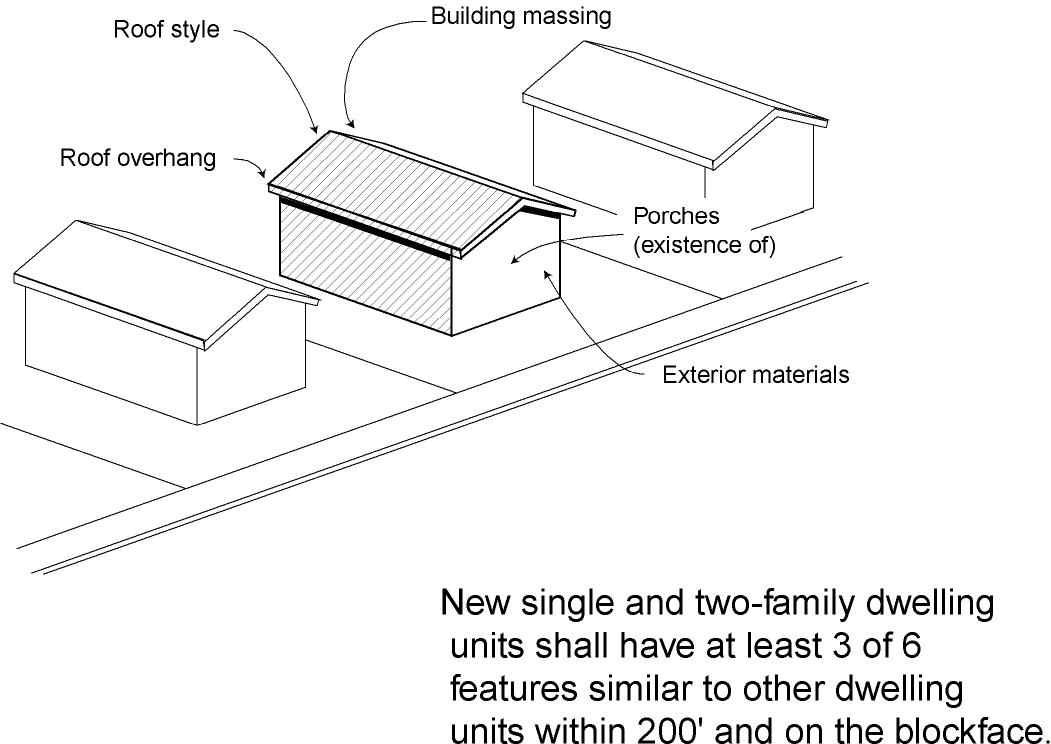
(Code 1984, § 61-14-266; Ord. No. 11-05, § 1(61-14-266), eff. 5-28-2005)
Sec. 50-14-397. - Multi-building, multi-family developments.
Development parcels that contain two or more primary structures, which contain multiple-family dwellings shall meet the following five standards:
(1)
Primary access to and from multi-family areas shall be oriented towards predominantly non-single-family residential streets. Where necessary, secondary and emergency access can be provided onto such streets;
(2)
Development sites of ten acres or more shall include a minimum of one public street or private drive that is built to City standards, is continuous through the site, and connects to a public street on both ends (a "through-driveway"). Development sites of 20 acres or more shall include a minimum of two through-driveways: one shall connect public streets bounding the development site generally on the north and south, and the other shall connect public streets bounding the development site generally on the east and west. No perpendicular parking or garages may be accessed directly from through-driveways;
(3)
Sidewalks or walkways shall be designed and installed so that:
a.
Each primary access to a residential unit;
b.
Each primary access to a non-residential building; and
c.
Each area of parking spaces or carports accommodating more than five cars ("key facilities") has direct access to a system of sidewalks which are defined as follows:
1.
Each system of sidewalks shall connect each of the key facilities:
(i)
To each other;
(ii)
To any system of sidewalks along the perimeter streets around the development site; and
(iii)
To any sidewalks on adjacent properties that extend to the boundary of such properties without requiring the pedestrian to walk across grass or through parking lots or streets, except at properly designed crossing areas as defined in Subsection (3)b of this section, to make those connections;
2.
Each point where the system of sidewalks crosses a parking lot or street shall be clearly marked through the use of change in paving materials, height, or distinctive colors; and
3.
Sidewalk connections shall be provided between:
(i)
Any sidewalk along a perimeter street around each development; and
(ii)
The sidewalk system within each development with a maximum spacing distance of 1,320 feet along the perimeter. In doing so, pedestrians along the perimeter sidewalks shall be able to find a sidewalk connection into the interior sidewalk system without walking more than 1,320 feet along the perimeter.
(4)
All multiple-family residential developments with parking lots, or with internal streets or walkways, shall provide lighting so that the following amounts of light are provided, as measured five feet above grade throughout the area: pedestrian paths, one-half to one foot-candle, and parking areas, two to five foot-candles; and
(5)
In all multiple-family residential developments, all lighting fixtures shall use cutoff-downcast fixtures with a minimum angle of 90 degrees from the horizontal. See also Section 50-2-241 of this Code.
(Code 1984, § 61-14-267; Ord. No. 11-05, § 1(61-14-267), eff. 5-28-2005; Ord. No. 20-05, § 1(61-14-267), eff. 5-29-2005)
Sec. 50-14-398. - Other residential development standards.
The following additional standards shall also apply to residential development:
(1)
Where a new residential development incorporates private streets, they shall be designed to meet the City standards for street width, gutters, sidewalks, and the area between sidewalk and curb for comparable public streets;
(2)
Residential lot shapes should be simple and rectilinear, or wedge-shaped where located at the end of a cul-de-sac. The creation of new flag lots or irregularly shaped lots is discouraged, unless it is necessary to match the existing pattern of surrounding lots;
(3)
All mechanical equipment, including gas and electric meters, shall be architecturally screened from view where located on the street side of a house;
(4)
Phased projects shall be designed so that each phase is completed in its functional, traffic, parking, visual, drainage and landscaping aspects;
(5)
Circulation systems shall be designed to avoid conflicts between vehicular, bicycle, and pedestrian traffic;
(6)
Where the dwelling unit does not have a basement, a crawl space is permitted in accordance with Chapter 8, Article VII, of this Code, Residential Code. Alternatively, construction on slab may be permitted where the distance from the finished floor to the floor joists of the second floor is not less than eight feet; additionally, construction on slab may be permitted for a single-story dwelling where the distance from the finished floor to the ceiling is not less than eight feet; and
(7)
All reasonable measures shall be taken to ensure that the off-site spillover of light and nightglow are minimized to the greatest extent possible.
(Code 1984, § 61-14-268; Ord. No. 11-05, § 1(61-14-268), eff. 5-28-2005; Ord. No. 13-11, § 1(61-14-268), eff. 8-23-2011)
Sec. 50-14-399. - Accessible routes and entrances.
Accessible routes and entrances shall be designed and located in accordance with 1966 PA 1, MCL 125.1351 et seq., unless otherwise exempted under Chapter 8, Article VII, of this Code, Residential Code.
(Code 1984, § 61-14-269; Ord. No. 34-05, § 1(61-14-269), eff. 12-6-2005; Ord. No. 44-06, § 1(61-14-269), eff. 12-21-2006)
Sec. 50-14-411. - In general.
Except as provided for in Section 50-2-241 of this Code, the architectural and site design standards of this subdivision shall apply to all non-residential development.
(Code 1984, § 61-14-271; Ord. No. 11-05, § 1(61-14-271), eff. 5-28-2005)
Sec. 50-14-412. - Applicability.
The design standards of this subdivision shall apply to non-residential uses that are located in residential and business zoning districts, the SD1, SD2, SD4 Districts, and nonindustrial Planned Developments (PDs). The requirements of this subdivision are minimal. Non-residential developers are encouraged to build to the highest standards practicable. See also "Operational and Performance Standards" in Division 7 of this article.
(Code 1984, § 61-14-272; Ord. No. 11-05, § 1(61-14-272), eff. 5-28-2005)
Sec. 50-14-413. - Site design.
The following site design standards shall apply to non-residential development:
(1)
Service functions, such as shipping/receiving, and trash removal shall be integrated into the circulation pattern in a manner that minimizes conflicts with vehicles and pedestrians;
(2)
Phased projects shall be designed so that each phase is completed in its functional, traffic, parking, visual, drainage, and landscaping aspects;
(3)
All non-residential developments with parking lots, or with internal streets or walkways, shall provide lighting so that the following amounts of light are provided, as measured five feet above grade throughout the area: pedestrian paths, one-half to one foot-candle; parking and loading areas, two to ten foot-candles; and vehicular path, one to two foot-candles;
(4)
Approved address numbers shall be provided so that they are legible to the public from the street fronting the property;
(5)
In commercial developments of 20,000 square feet or more, service and loading areas should be separated from main circulation and parking areas and away from public streets.
(Code 1984, § 61-14-273; Ord. No. 11-05, § 1(61-14-273), eff. 5-28-2005)
Sec. 50-14-414. - Quality of materials.
The following "quality of materials" standards shall apply to non-residential development:
(1)
Rear and side façades of all non-residential buildings that face a public street, park, playground, or other public open space shall incorporate the same quality of materials, trim levels, and degree of articulation which are found predominantly on the front façade of the building. Parking, service, or other open spaces at the rear of the structure shall be maintained in a neat and orderly condition;
(2)
Where the principal entrance of a freestanding building is on the side elevation or at the corner of the front and side elevations, as suggested in Figure 50-14-415(c), that side elevation shall include the same quality of materials, trim levels, and degree of articulation as those found on the front façade;
(3)
To the maximum extent practicable, concrete finishes or precast concrete panels (tilt walls) shall not be used as exterior building materials unless they are exposed aggregate, hammered, embossed, patterned, imprinted, sandblasted, or covered with a cement-based acrylic coating;
(4)
To the maximum extent practicable, metal panel systems, used as an exterior building material, should be a minimum thickness of U.S. Standard 18 gauge metal. Corrugated (ribbed) metal panels and siding shall be prohibited on all exterior walls, except as a method of screening mechanical roof top equipment; and
(5)
To the maximum extent practicable, mirrored glass with a reflectance greater than 40 percent shall not be used to cover more than 40 percent of the exterior walls of any building.
(Code 1984, § 61-14-274; Ord. No. 11-05, § 1(61-14-274), eff. 5-28-2005)
Sec. 50-14-415. - Building orientation.
Except as otherwise expressly required or unless necessary to avoid site access through an alley adjacent to a residential zoning district, the front or side façade shall face the public street that abuts the front property line and, to the maximum extent practicable, be set back not more than 60 feet from said street. To the maximum extent practicable, the main entrance shall face the public street that abuts the front property line or face a connecting walkway with a direct pedestrian connection to the public street that abuts the front property line. Examples of possible building orientations are suggested in, but not limited to, Figures 50-14-415(a), (b), and (c).
Possible Building Orientations
Figure 50-14-415(a)
(For Informational Purposes Only)
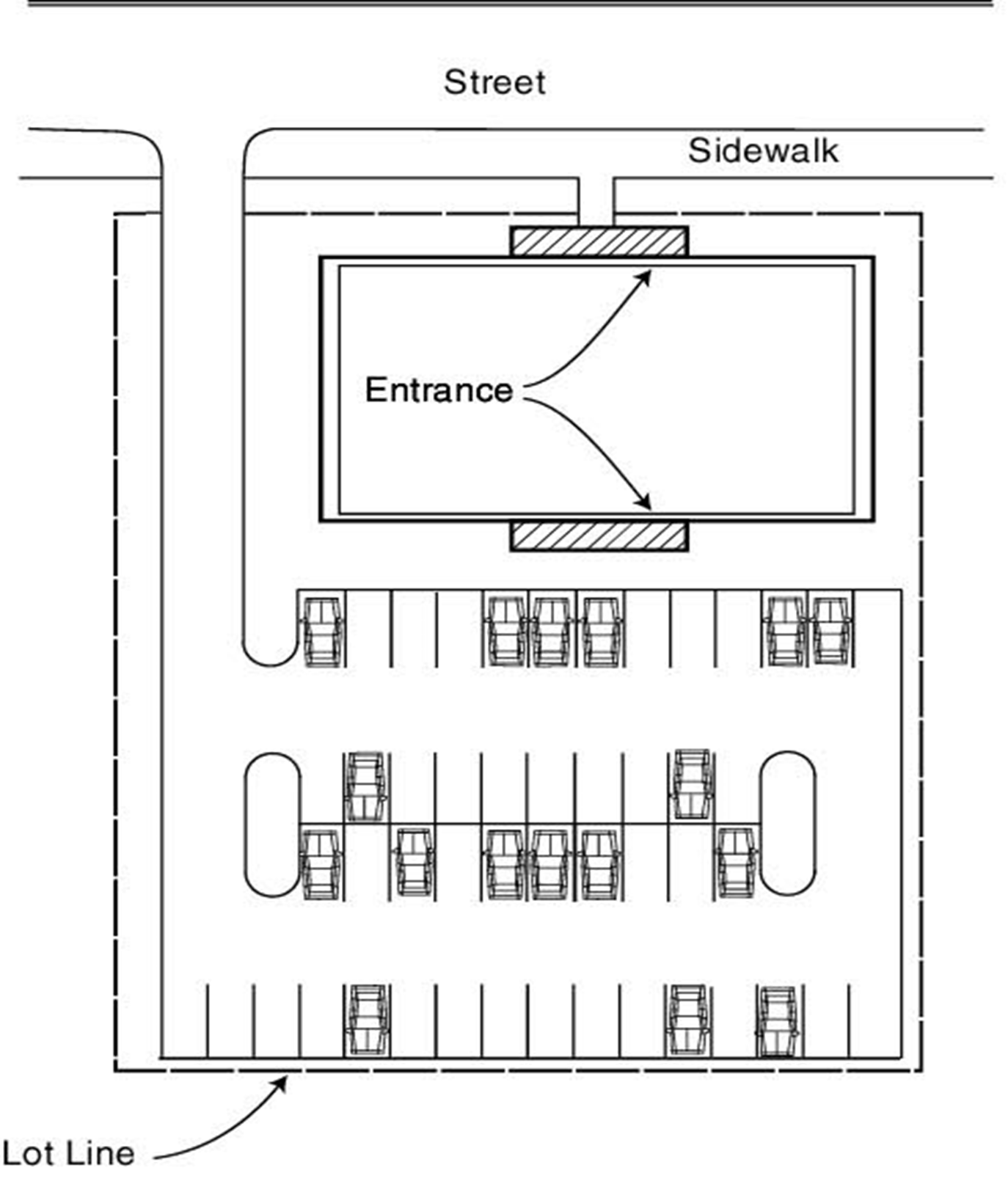
Figure 50-14-415(b)
(For Informational Purposes Only)
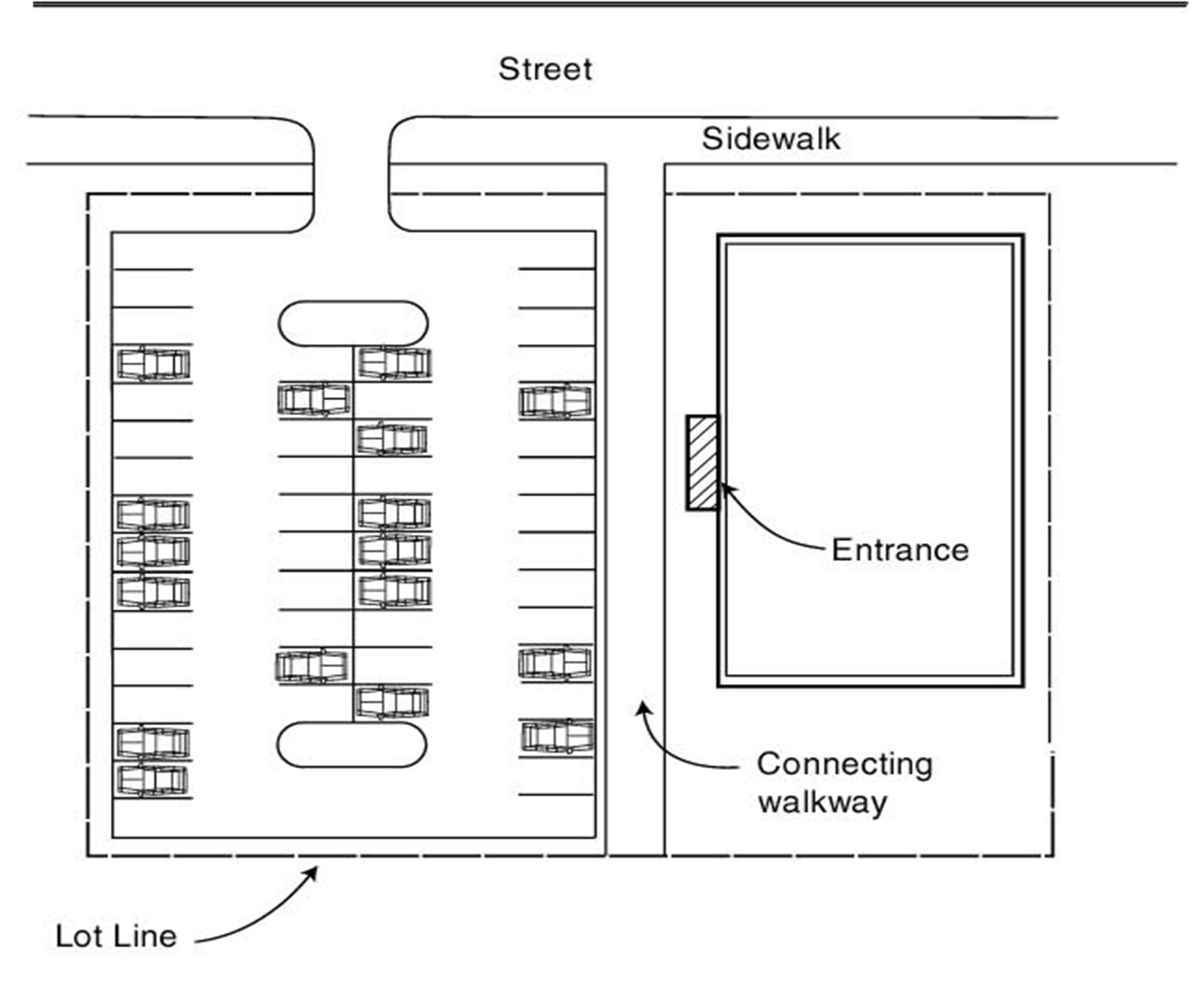
Figure 50-14-415(c)
(For Informational Purposes Only)
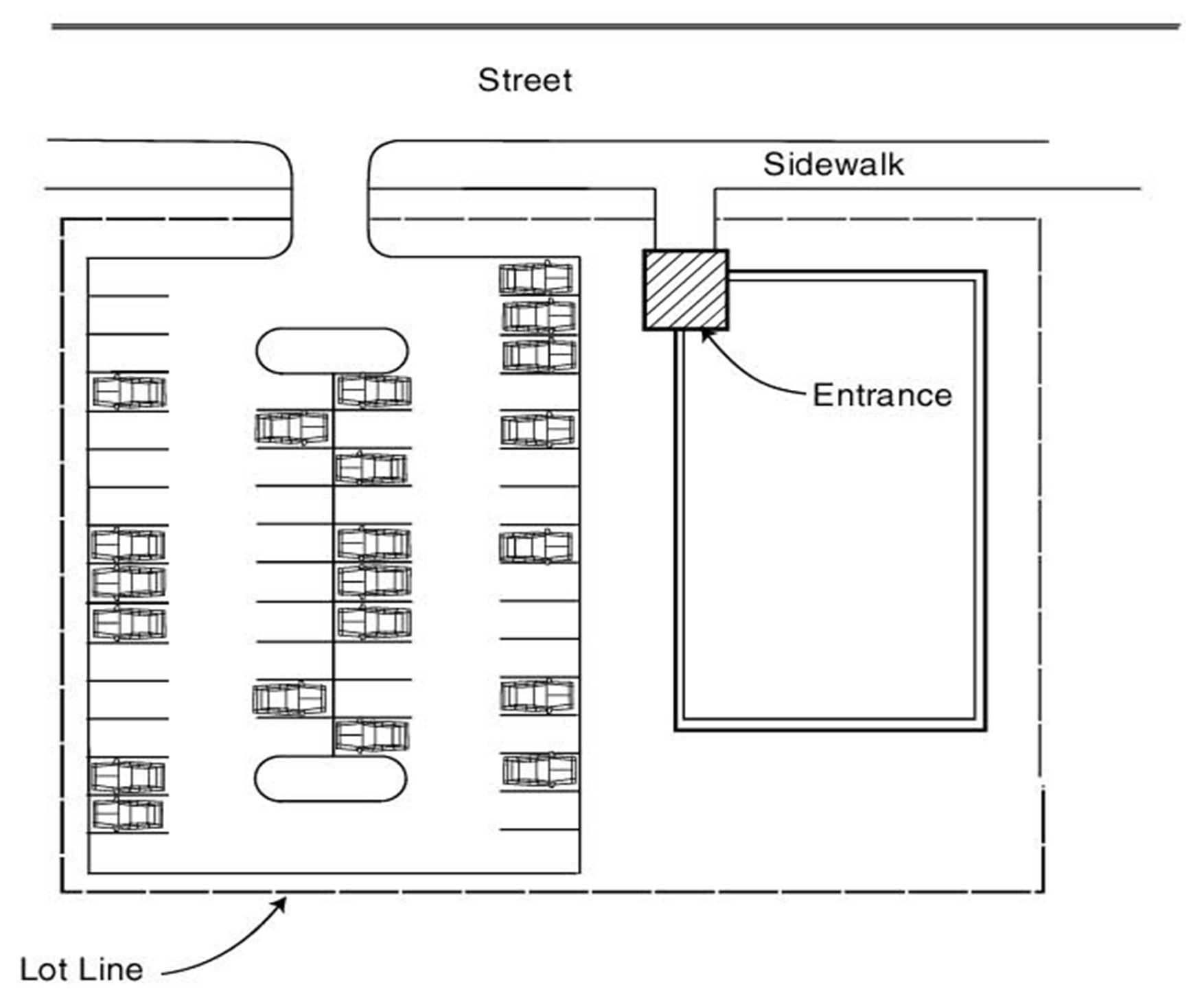
(Code 1984, § 61-14-275; Ord. No. 11-05, § 1(61-14-275), eff. 5-28-2005)
Sec. 50-14-416. - Mechanical, electrical, and telecommunications equipment screening.
(a)
All roof-mounted, building-mounted, and ground-mounted mechanical, electrical, and telecommunications equipment shall be screened from view or isolated so as not to be visible, within 150 feet of the zoning lot on which the equipment is located:
(1)
From land zoned R1, R2, R3, R4, R5, R6, or residential PD, measured at a point five feet above grade (see Figure 50-14-416(a)(1)); or
(2)
From any public right-of-way, measured at a point five feet above grade (see Figure 50-14-416(a)(2)).
(b)
Where used, roof screens shall be coordinated with the building to maintain a unified appearance and to effectively conceal or camouflage the equipment. This provision shall not require that screening be taller than the objects being screened.
Mechanical, Electrical and Telecommunications Equipment Screening
Figure 50-14-416(a)(1)
(For Informational Purposes Only)
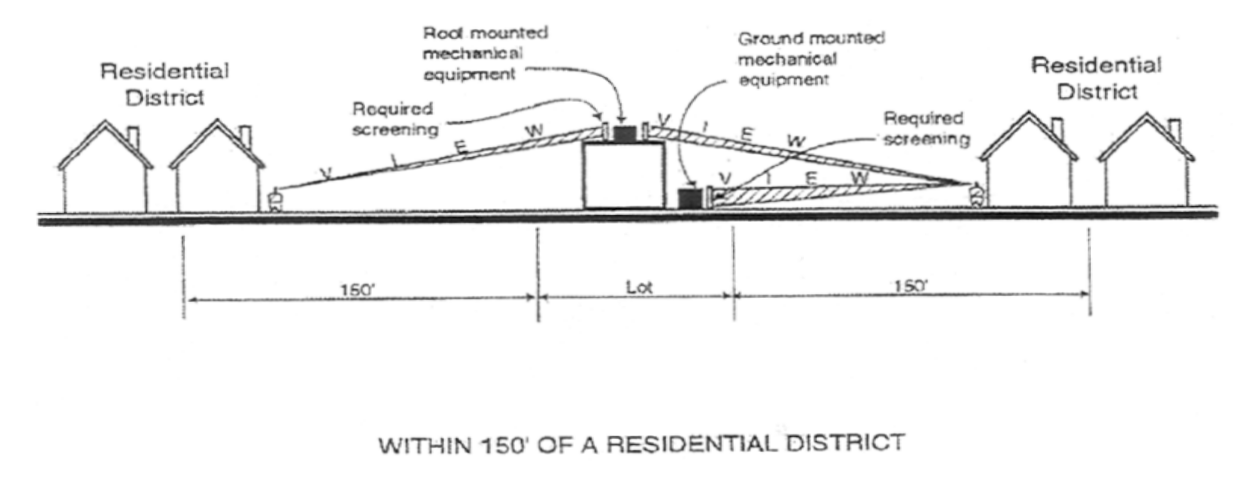
Figure 50-14-416(a)(2)
(For Informational Purposes Only)
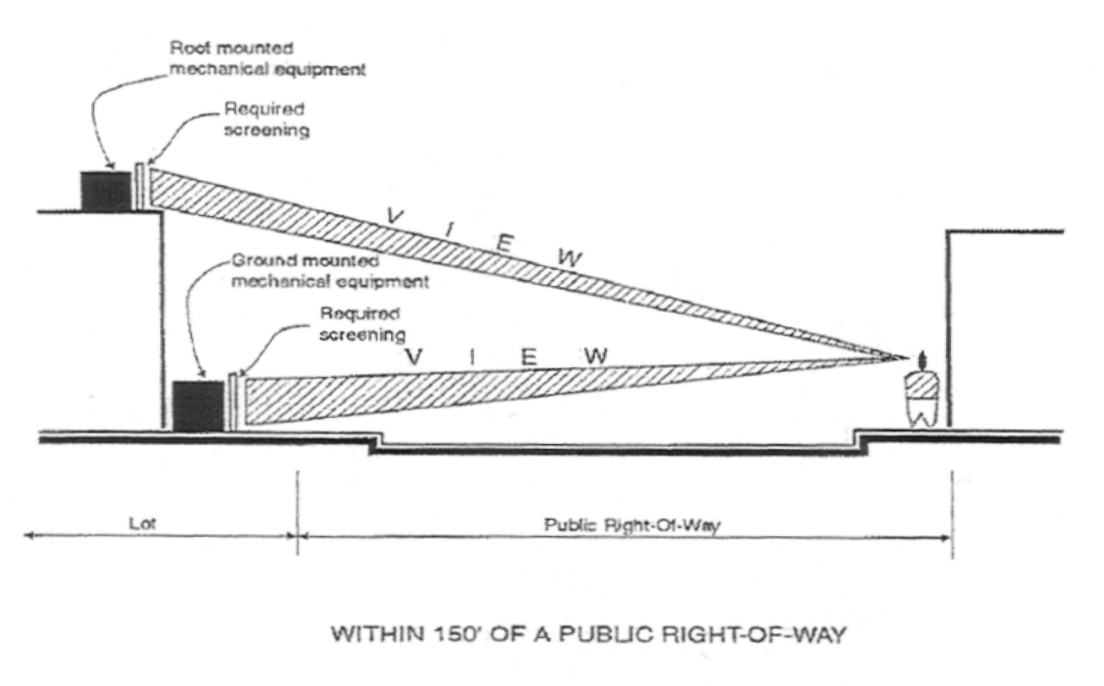
(Code 1984, § 61-14-276; Ord. No. 11-05, § 1(61-14-276), eff. 5-28-2005; Ord. No. 13-11, § 1(61-14-276), eff. 8-23-2011)
Sec. 50-14-417. - Intensity of façade colors.
It is the policy of the City that the following provisions shall guide the intensity of façade colors for non-residential development:
(1)
Façade colors should be of low reflectance, subtle, neutral or earth tone colors. The use of high intensity colors, metallic colors, black or fluorescent colors is discouraged;
(2)
Building trim may feature brighter colors, but neon tubing is discouraged as an accent material;
(3)
Color should be considered in the context of the entire commercial corridor;
(4)
How sunlight strikes the building should be considered when choosing color for the façade;
(5)
Color should be used to bring together the elements of the entire façade, from the cornice to the entrance door; and
(6)
Color should complement, respond to, and enhance the architectural character and detailing of a building.
(Code 1984, § 61-14-277; Ord. No. 11-05, § 1(61-14-277), eff. 5-28-2005; Ord. No. 20-05, § 1(61-14-277), eff. 5-29-2005)
Sec. 50-14-418. - General illumination standard.
All reasonable measures shall be taken to ensure that the off-site spillover of light and nightglow are minimized to the greatest extent possible.
(Code 1984, § 61-14-278; Ord. No. 11-05, § 1(61-14-278), eff. 5-28-2005)
Sec. 50-14-419. - Accessible routes and entrances.
Accessible routes and entrances shall be designed and located in accordance with 1966 PA 1, MCL 125.1351 et seq., unless otherwise exempted under Chapter 8, Article VII, of this Code, Residential Code.
(Code 1984, § 61-14-279; Ord. No. 34-05, § 1(61-14-279), eff. 12-6-2005)
Sec. 50-14-431. - Traditional Main Street Overlay Area applicability and exceptions; design review.
(a)
Applicability.
(1)
The requirements of this subdivision apply to any new development within the Traditional Main Street Overlay Area as designated in Article XI, Division 14, Subdivision B, of this chapter.
(2)
Alteration of any structure within the Traditional Main Street Overlay that affects the exterior appearance of a building elevation visible from a public right-of-way or public space shall be subject to design review by the Planning and Development Department under the design standards of this subdivision. While the City may benefit if all the design standards of this subdivision were met where existing properties are altered, such a strict application of the design standards might disadvantage property owners or discourage them from improving their buildings. The recommended solution is to establish two thresholds to gauge the extent of remodeling and set requirements based on what is practical and reasonable for that level of improvement.
a.
If 50 percent or more of an elevation of a building or structure subject to design review is altered, the building or structure shall be subject to the applicable requirements that do not involve repositioning the building or structure, or reconfiguring site development as determined by the Planning and Development Department;
b.
If less than 50 percent of an elevation of a building or structure subject to design review is altered, the requirement is only that the proposed improvements meet the applicable standards of this subdivision; for example, if a property owner decides to replace a building façade's siding, then the siding shall meet the applicable exterior building materials standards, but elements such as building modulation would not be required.
(3)
For the purpose of this subdivision, the term "commercial" shall mean retail, service, and commercial uses listed in Article XII, Division 1, Subdivision D, of this chapter.
(4)
Notwithstanding the provisions in Subsection (a) of this section, the requirements of this subdivision do not apply to land zoned R1, R2, R3, R4, R5, R6, or residential PD within a Traditional Main Street Overlay Area.
(b)
Design review. The Buildings, Safety Engineering, and Environmental Department shall not approve a permit application for any work relating to a zoning lot within a Traditional Main Street Overlay Area, unless the Planning and Development Department has verified that such work is consistent with design standards of this subdivision.
(Code 1984, § 61-14-281; Ord. No. 11-05, § 1(61-14-281), eff. 5-28-2005; Ord. No. 20-05, § 1(61-14-281), eff. 5-29-2005; Ord. No. 23-13, § 1(61-14-281), eff. 8-28-2013; Ord. No. 2022-12, § 1, eff. 5-31-2022)
Sec. 50-14-432. - Site design standards; building site relationship; placement and orientation.
(a)
The objectives of this section are:
(1)
To line streets with buildings and/or other architectural site features in order to create a pedestrian friendly built-environment; and
(2)
To create a pedestrian-friendly setting that directly relates buildings and active uses such as shopping and dining to the street, and maintains the continuity of street wall.
(b)
To achieve the objectives of this section, the following standards shall apply:
(1)
Notwithstanding the front yard set-back requirements in Article XIII, Division 1, of this chapter, the front façade of buildings shall be placed on the lot line facing the Traditional Main Street. A setback, which does not exceed ten feet, may be provided for religious institutions, residential buildings, or restaurants with an outside dining area; the area between the façade and the lot line shall feature pedestrian-oriented space, such as plaza or widened sidewalk, or landscaping that consists of a combination of groundcover, shrubs and/or trees that provide seasonal interest; the landscaping shall be designed so that visibility is maintained between the street and the ground-floor windows;
(2)
On corner lots, buildings shall be located at the corner, placed on the lot line of both streets. (See also Section 50-14-438, Building Design Standards—Corner Lot Buildings, and Section 50-14-449, Parking Design Standards—Parking Areas.)
(3)
Rear Setback.
a.
If a street or alley is to the rear of a single-story building, a minimum rear setback is not required. If no street or alley is present, single-story buildings shall have a minimum rear setback of ten feet.
b.
Where a single- or two-family dwelling is located across a street or alley from the rear of a multi-story building, the multi-story building shall have a rear setback of ten feet: where a street or alley is not present to separate the rear of a multi-story building from a single- or two-family dwelling, the multi-story building shall have a rear setback of 20 feet.
c.
Buildings containing dwelling units, other than single- or two-family dwellings, shall have a rear setback of ten feet if a street or alley is present at the rear and 20 feet if a street or alley is not present.
(Code 1984, § 61-14-282; Ord. No. 11-05, § 1(61-14-282), eff. 5-28-2005; Ord. No. 23-13, § 1(61-14-282), eff. 8-28-2013; Ord. No. 2020-21, § 1, eff. 8-8-2020)
Sec. 50-14-433. - Site design standards; fencing.
(a)
The objectives of this section are:
(1)
To promote the perception of Traditional Main Street Overlay Areas as safe commercial areas;
(2)
To provide for an enjoyable pedestrian experience; and
(3)
To architecturally integrate fences and screens to enhance the design of the main buildings associated with the project to the greatest extent possible.
(b)
To achieve the objectives of this section, the following standards shall apply:
(1)
The use of barbed wire is not permitted for any residential use, for any public, civic, and institutional use, or for any retail, service, and commercial use that is listed in the use table of Article XII, Division 1, of this chapter;
(2)
Fences must allow for a clear view of oncoming vehicular and pedestrian traffic at street corners, driveways, alleys, or similar locations;
(3)
Fences exceeding three feet in height along street frontages at the front lot line are subject to a three-foot wide landscaped area with trees and landscaping between the sidewalk and the fence;
(4)
No fence facing a Traditional Main Street shall exceed six feet in height. Opaque fences or walls facing a Traditional Main Street shall not exceed three feet in height, except as specified for screening purposes according to Section 50-14-372 of this Code;
(5)
Fences must be similar or complementary to the colors and finishes of the exterior of the associated building; and
(6)
The following materials and styles are prohibited for fences facing a Traditional Main Street unless the Planning and Development Department determines such to be appropriate and compatible with the building nearest the fence:
a.
Chain link;
b.
Plastic;
c.
Picket-style;
d.
Plywood;
e.
Recycled materials;
f.
Sheet metal; and
g.
Vinyl.
(Code 1984, § 61-14-283; Ord. No. 11-05, § 1(61-14-283), eff. 5-28-2005; Ord. No. 20-05, § 1(61-14-283), eff. 5-29-2005; Ord. No. 23-13, § 1(61-14-283), eff. 8-28-2013; Ord. No. 2022-12, § 1, eff. 5-31-2022)
Sec. 50-14-434. - Building design—Style.
In support of the standards of this subdivision, it is the policy of the City to encourage design styles that are dominant and representative of, and relevant to, the architectural history, culture, and regional significance of the area without compromising innovative and contemporary interpretation of these styles.
(Code 1984, § 61-14-284; Ord. No. 11-05, § 1(61-14-284), eff. 5-28-2005; Ord. No. 20-05, § 1(61-14-284), eff. 5-29-2005; Ord. No. 23-13, § 1(61-14-284), eff. 8-28-2013)
Sec. 50-14-435. - Building design standards—Massing, scale, and form.
(a)
The objective of this section is to continue the prevalent urban form of traditional main streets and to integrate new developments and additions into the character of traditional main streets.
(b)
To achieve the objectives of this section, the following standards shall apply:
(1)
Buildings shall be a minimum of two stories or 20 feet in height.
(2)
For building containing a commercial use, the typical traditional building width of 20 feet to a maximum of 40 feet shall be expressed with a minimum of one of the following architectural articulation and traditional façade elements that are repeated every 20 to 40 feet, including, but not limited to, the following:
a.
Distinctive window patterns at intervals less than the articulation interval;
b.
Recessed entryway on the street level façade;
c.
Parapet or cornice on the upper level façade;
d.
Change of roofline that is visible from the street;
e.
Change in building material or siding style with a change in building plane;
f.
Other design treatments that satisfy the intent of the standard, as determined by the site plan review body.
(3)
Buildings at the intersection of two streets are subject to the standards for corner lots, as provided in Section 50-14-438 of this Code.
(Code 1984, § 61-14-285; Ord. No. 11-05, § 1(61-14-285), eff. 5-28-2005; Ord. No. 20-05, § 1(61-14-285), eff. 5-29-2005; Ord. No. 23-13, § 1(61-14-285), eff. 8-28-2013)
Sec. 50-14-436. - Building design standards—Façade and architectural details.
(a)
For purposes of this subdivision, the term "street level façade" means the first story of a multi-story building or the first 13 feet of the façade above grade plane;
(b)
The objectives of this section are:
(1)
To provide street level façades on Traditional Main Streets with maximum visibility and transparency between active interior uses and the outside;
(2)
To create façades with ratios of solids (wall surfaces) to voids (openings for windows and doors) that express traditional fenestration patterns; and
(3)
To require fenestration patterns, surface delineations, textures, material expressions, and architectural details that relate to the human scale.
(c)
To achieve the objectives of this section, the following standards shall apply:
(1)
For all buildings located on lots abutting a Traditional Main Street that contain a commercial use and all other buildings located on the front property line, a minimum of 60 percent of the street level façade along Traditional Main Streets, major thoroughfares, or secondary thoroughfares between two and eight feet above the grade plane shall consist of transparent windows and doors; all other façades of buildings on lots abutting a Traditional Main Street that face a public street, other than a major or secondary thoroughfare, shall consist of transparent windows or doors covering at least 40 percent of the façade between four and eight feet above the grade plane. On the East Warren, West Warren, Van Dyke, and Grand River between Greenfield and Woodmont and between Evergreen or Lahser Traditional Main Street Overlay Areas, a minimum of 50 percent of the street level façade along Traditional Main Streets, major thoroughfares, or secondary thoroughfares between two and eight feet above the grade plane shall consist of transparent windows and doors;
(2)
For all buildings, a minimum of 40 percent of the upper level façade along a Traditional Main Street shall consist of openings for windows or window wall system;
(3)
Façades with a public entrance that do not face a public street shall consist of transparent windows or doors covering at least 30 percent of the façade between four and eight feet above the grade plane;
(4)
Transparent doors and windows shall be defined as those having glass that can be seen through from the right-of-way into the establishment. The glass shall have a minimum visible transmittance rating of 0.68, according to the National Fenestration Rating Council. Glass that obscures visibility shall not be considered transparent. Reflective or mirrored glass and glass block are prohibited; and
(5)
Eighty percent of the transparent area required in Subsection (1) of this section shall be visually unobstructed by signs, advertisements, window screens, security grilles, and other permanent window coverings. The display of merchandise items in display windows is not restricted by this provision.
(Code 1984, § 61-14-286; Ord. No. 20-05, § 1(61-14-286), eff. 5-29-2005; Ord. No. 23-13, § 1(61-14-286), eff. 8-28-2013; Ord. No. 2020-21, § 1, eff. 8-8-2020)
Sec. 50-14-437. - Building design standards—Drive-up and drive-through facilities.
Drive-up and drive-through facilities, including, but not limited to, restaurants and banks, are prohibited on zoning lots abutting a Traditional Main Street, except where the Planning and Development Department determines that the proposed development complies with all of the other requirements of the Traditional Main Street standards and is allowed by the underlying zoning designation or where located on the East Warren, West Warren, Van Dyke, and Grand River between Evergreen and Lahser or between Woodmont and Greenfield, or Lahser Traditional Main Street Overlay Areas. Driveways or vehicle stacking areas shall not be located between the building and the Traditional Main Street. No more than one driveway/curb cut shall be allowed on the Traditional Main Street.
(Code 1984, § 61-14-287; Ord. No. 20-05, § 1(61-14-287), eff. 5-29-2005; Ord. No. 23-13, § 1(61-14-287), eff. 8-28-2013; Ord. No. 2020-21, § 1, eff. 8-8-2020)
Sec. 50-14-438. - Building design standards—Corner lot buildings.
(a)
The objectives of this section are:
(1)
To require design continuity and uniform overall building façade for corner lot buildings; and
(2)
To further relate buildings to their context and the street space, and to increase pedestrian linkages between intersecting streets.
(b)
To achieve the objectives of this section, the following standards shall apply:
(1)
Buildings occupying corner lots shall be treated as buildings facing two major or secondary thoroughfares, except where one of the streets is used primarily as a local street to residential areas, subject to provisions of Section 50-14-436(c)(1) of this Code;
(2)
At the intersection of two Traditional Main Streets or at the intersection of a Traditional Main Street and a major thoroughfare, the primary active building entrance of commercial buildings shall either be located at the corner of the two streets or two entrances shall be provided, one on each Traditional Main Street or major thoroughfare. If the entrance is located at the corner, a notched or cropped building corner with pedestrian-oriented space at the entrance is encouraged;
(3)
A distinctive architectural feature shall be provided to distinguish the corner of new buildings at the intersection of two Traditional Main Streets and at the intersection of a Traditional Main Street and a major thoroughfare; such a feature includes, but is not limited to, the following, subject to the provisions of Section 50-14-436 of this Code:
a.
Entryway canopy, marquee, or awning;
b.
Bay window or turret;
c.
Distinctive use of materials, sculpture, or artwork; or
d.
Distinctive roof line.
(Code 1984, § 61-14-288; Ord. No. 20-05, § 1(61-14-288), eff. 5-29-2005; Ord. No. 23-13, § 1(61-14-288), eff. 8-28-2013)
Sec. 50-14-439. - Building design standards—Entryways.
(a)
The objectives of this section are:
(1)
To enliven the public sidewalks by increasing the accessibility and visibility of building activities to the public; and
(2)
To create identifiable building entryway to users through architectural means.
(b)
To achieve the objectives of this section, the following standards shall apply:
(1)
Entryways to building lobbies, and to all uses that are open to the public, shall be emphasized through changes in plane (such as a recessed entryway), differentiation in material and/or color, greater level of detail, or enhanced lighting;
(2)
All buildings facing a Traditional Main Street shall have a minimum of one active entryway located on the façade facing the Traditional Main Street. Where a building has multiple businesses facing the Traditional Main Street, each business shall have a minimum of one entryway located on the façade of the building facing the Traditional Main Street;
(3)
Doors used for utility or mechanical rooms shall be located away from the sidewalk of any major or secondary thoroughfare; and
(4)
The solar performance of entryway doors that are predominantly glass shall be the same as the storefront design.
(Code 1984, § 61-14-289; Ord. No. 20-05, § 1(61-14-289), eff. 5-29-2005; Ord. No. 23-13, § 1(61-14-289), eff. 8-28-2013)
Sec. 50-14-440. - Building design standards—Materials.
(a)
The objectives of this section are:
(1)
To reinforce durable and traditional building materials consistent with urban context; and
(2)
To encourage the use of durable construction materials.
(b)
The standards of Subsection (c) of this section do not apply to the East Warren, West Warren, Grand River between Evergreen and Lahser or between Woodmont and Greenfield, or Lahser Traditional Main Street Overlay Areas.
(c)
To achieve the objectives of this section, the following standards shall apply, subject to Subsection (b) of this section:
(1)
Within the Grand River, Livernois/West McNichols, East Jefferson, Woodward, Grand Boulevard, Michigan, and Vernor/Springwells Overlay Areas, a minimum of 80 percent of any building façade that faces a public street, excluding window and door openings, shall consist of the following building materials: masonry (preferably brick), stone, or porcelain;
(2)
Within the West Seven Mile and the Bagley/Vernor Overlay Areas, a minimum of 30 percent of any building façade that faces a public street, excluding window and door openings, shall consist of the following building materials: masonry (preferably brick), stone, or porcelain;
(3)
For buildings within the Traditional Main Street Overlay Areas, the following materials are prohibited on any façade facing a Traditional Main Street, major thoroughfare, or secondary thoroughfare: vinyl or plywood siding, corrugated fiberglass, non-corrugated and highly reflective sheet metal, corrugated metal panels such as those used for roof decking or shipping containers, painted or unfinished concrete block, rough-textured concrete block, and split-face block;
(4)
Exterior Insulation and Finish System (EIFS) and other similar troweled finishes shall be trimmed in wood or masonry and shall not be located within the first two feet of the grade plane;
(5)
Building materials that are neither delineated in Subsection (b)(1) or (2) of this section nor prohibited in Subsection (b)(3) or (4) of this section may only be used upon consideration and recommendation of the Design Review Advisory Committee; and
(6)
Accent building materials that may be used include, but are not limited to: architectural metals such as stainless steel, copper, clear or color anodized aluminum; other pre-finished metal; finished or painted exterior-grade wood.
(Code 1984, § 61-14-290; Ord. No. 20-05, § 1(61-14-290), eff. 5-29-2005; Ord. No. 23-13, § 1(61-14-290), eff. 8-28-2013; Ord. No. 2020-21, § 1, eff. 8-8-2020)
Sec. 50-14-441. - Building design standards—Color and finish.
(a)
The objective of this section is to reinforce traditional color palettes and analogous colors of permanent building materials; and to establish a positive district character by achieving continuity and coordination in colors and finishes.
(b)
The standards of Subsection (c) of this section do not apply on the East Warren, West Warren, Van Dyke, Grand River between Evergreen and Lahser or between Woodmont and Greenfield, or Lahser Traditional Main Street Overlay Areas.
(c)
To achieve the objective of this section, the following standards shall apply, subject to Subsection (b) of this section:
(1)
The following standards shall apply to the cleaning of all exterior masonry, including brick, stone, stucco, terra cotta, ceramic tile and cement exterior finish materials:
a.
The application, by use of a stream of pressurized water or air, of abrasive substances such as sand, ground slag, volcanic ash, crushed walnut or almond shells, rice husks, ground corncobs, ground coconut shells, crushed eggshells, silica flour, synthetic particles, glass beads, microballoons, or baking soda shall not be permitted;
b.
The use of tools and equipment such as wire brushes, rotary wheels, power sanding disks, rotary sanders, or belt sanders, shall not be permitted;
c.
Chemical cleaning is permissible provided that the cleaning method proposed is not one that is known to cause damage to the type of material that is being cleaned; and
d.
High pressure liquid cleaning will be permitted if it is shown (by means of a test patch no greater than nine square feet and located in an inconspicuous area) that the proposed amount of pressure will not cause abrasive damage to the materials it is to clean.
(2)
The exterior of every principal structure and accessory structure shall be maintained in good repair. All surfaces, with the exception of masonry, porcelain, architectural metals, brick or stone material, shall be kept painted or protected with approved coating or material. Masonry, porcelain, brick, or stone buildings that are not currently painted should be left natural and should not be painted. Buildings with painted brick prior to May 29, 2005, may be repainted or may have the paint removed as a means of maintaining the surface in good repair; and
(3)
Applied finishes, such as concrete and stucco, shall be fine and smooth textured.
(Code 1984, § 61-14-291; Ord. No. 20-05, § 1(61-14-291), 5-29-2005; Ord. No. 23-13, § 1(61-14-291), eff. 8-28-2013; Ord. No. 2020-21, § 1, eff. 8-8-2020)
Sec. 50-14-442. - Building design standards—Awnings, canopies and marquees.
(a)
The objective of this section is to enhance the scale and design of facades; to complement the streetscape; and to contribute to district identity, integrity and visual continuity by achieving a comfortable and attractive pedestrian environment.
(b)
To achieve the objectives of this section, the following standards shall apply:
(1)
The bottom of any awning or canopy shall be at least eight feet, six inches above grade plane;
(2)
Awnings and canopies shall not project more than one-half the width of the sidewalk, or more than ten feet, six inches;
(3)
All marquees, awnings, and canopies shall he supported entirely on the building on which they are erected, and there shall be no posts, brackets, or other obstacles located on public property;
(4)
Vinyl and plastic materials for awnings and canopies are prohibited: however, woven man-made materials that are similar to canvas may be used with the approval and review of the Design Review Advisory Committee;
(5)
Internally illuminated canopies, marquees, or awnings are prohibited, including gas station canopies; and
(6)
Continuous awnings along blank walls are prohibited.
(Code 1984, § 61-14-292; Ord. No. 20-05, § 1(61-14-292), eff. 5-29-2005; Ord. No. 23-13, § 1(61-14-292), eff. 8-28-2013; Ord. No. 2020-12, § 1, eff. 12-9-2020)
Sec. 50-14-443. - Building design standards—Lighting.
(a)
The objective of this section is to improve the character and safety of the pedestrian environment.
(b)
To achieve the objectives of this section, the following standards shall apply:
(1)
Lighting fixtures shall be located, aimed, and shielded so as not to produce:
a.
Light spill into the night sky;
b.
Glare and spillage of light into residential areas, adjacent properties, or rights-of-ways; or
c.
Distracting reflections;
(2)
Flashing lights, such as strobe lights and LED "rope lights," are not permitted;
(3)
Neon tubing around windows is prohibited, except in the Vernor/Springwells and Bagley/Vernor Overlay Areas; and
(4)
Wall mounted decorative lighting, such as wall sconces, is encouraged.
(Code 1984, § 61-14-293; Ord. No. 20-05, § 1(61-14-293), eff. 5-29-2005; Ord. No. 23-13, § 1(61-14-293), eff. 8-28-2013; Ord. No. 2020-21, § 1, eff. 8-8-2020)
Sec. 50-14-444. - Building design standards—Blank walls.
(a)
In general. For purposes of this subdivision, a blank wall is a portion of a ground floor wall (including building façades 13 feet high from the grade plane) with a surface area of 300 square feet or greater that does not include a transparent window or transparent door. Blank walls are only permitted where abutting an alley or along a side lot line that does not abut a right-of-way or parking lot.
(b)
The objective of this section is to enhance the pedestrian experience through architecture by adding visual interest, character, and architectural details to otherwise blank walls.
(c)
The standards of Subsection (d) of this section do not apply to the East Warren, West Warren, Van Dyke, Grand River between Evergreen and Lahser or between Woodmont and Greenfield, or Lahser Traditional Main Street Overlay Areas.
(d)
To achieve the objectives of this section, blank walls (treated or untreated) on any building facing a Traditional Main Street are prohibited subject to Subsection (c) of this section. All other blank walls adjacent to a public right-of-way or on a façade with a public entrance shall be treated with one or more of the following methods subject to Subsection (c) of this section:
(1)
Architectural details and structural bay expression that provide vertical relief, such as a pier or pilaster spaced at a maximum of 20 feet; for large blank wall areas over 400 square feet, the architectural details shall be accompanied with landscape screening according to Subsection (d)(3) of this section;
(2)
A horizontal band, 12 to 16 inches wide, such as a middle cornice or a reveal band at the façade's mid-point of the same material as the façade; for large blank wall areas over 400 square feet, the architectural details shall be accompanied with landscape screening according to Subsection (d)(3) of this section;
(3)
Landscaping that will obscure or screen at least 50 percent of the blank wall's surface within four years; landscaping shall include a combination of evergreen and deciduous trees and shrubs; vines can also be used to contribute to the landscape screening; turf or other groundcover are allowed, but will not contribute to the screening requirement; or
(4)
Artwork such as mosaic, mural, sculpture, or relief over at least 50 percent of the blank wall surface; the artwork shall be subject to review by the Design Review Advisory Committee.
(Code 1984, § 61-14-294; Ord. No. 20-05, § 1(61-14-294), eff. 5-29-2005; Ord. No. 23-13, § 1(61-14-294), eff. 8-28-2013; Ord. No. 2020-21, § 1, eff. 8-8-2020)
Sec. 50-14-445. - Building design standards—Security roll-down doors and grilles.
(a)
The objectives of this section are:
(1)
To promote the perception of main streets districts as safe commercial areas; and
(2)
To deter crime, but foster pride and positive perception about main streets, by relying on discrete security measures such as security glass, alarms, lighting, and police notification systems.
(b)
The standards of Subsection (c) of this section do not apply to the East Warren, West Warren, Van Dyke, Grand River between Evergreen and Lahser or between Woodmont and Greenfield, or Lahser Traditional Main Street Overlay Areas.
(c)
To achieve the objectives of this section, the following standards shall apply, subject to Subsection (b) of this section:
(1)
For all projects that involve new construction, security roll-down grilles shall be designed and recessed into the interior of the window system;
(2)
For retrofit projects, when it is not feasible to install a security grille into the interior of the window system, an exterior roll-down grille may be used. The roll-down grille box shall be as inconspicuous as possible, as follows:
a.
An encased-type roll-down grille box shall be located on the exterior above the display windows and transom; and
b.
The exterior box shall be painted or finished a color to match the building's color scheme. The exterior box shall be concealed by an awning;
(3)
At least 30 percent of the exterior roll-down grille area shall be decorative, open-slat, and transparent; and
(4)
Permanent grilles over the exterior of windows or doors are prohibited.
(Code 1984, § 61-14-295; Ord. No. 20-05, § 1(61-14-295), eff. 5-29-2005; Ord. No. 23-13, § 1(61-14-295), eff. 8-28-2013; Ord. No. 2020-21, § 1, eff. 8-8-2020)
Sec. 50-14-446. - Building design standards—Utilities, service areas, and rooftop mechanical equipment.
(a)
The objectives of this section are:
(1)
To screen mechanical equipment from public view;
(2)
To reduce bulk, visual clutter, and noise impact of rooftop mechanical equipment; and
(3)
To enhance the overall appearance of buildings and their relationship to the skyline.
(b)
To achieve the objectives of this section, the following standards shall apply:
(1)
Parapets used to screen rooftop mechanical equipment shall not exceed six feet in height; and
(2)
A mansard roof profile shall not be used to provide screening for rooftop mechanical equipment; and
(3)
Utility meters and other service utility apparatus shall be located and designed to not be visible to the public. If such elements are mounted in a location visible from the street, they shall be screened with vegetation or by architectural features.
(Code 1984, § 61-14-296; Ord. No. 20-05, § 1(61-14-296), eff. 5-29-2005; Ord. No. 23-13, § 1(61-14-296), eff. 8-28-2013)
Sec. 50-14-447. - Building design standards—Architecturally and historically significant buildings; renovation, addition and maintenance of existing buildings.
(a)
The objectives of this section are:
(1)
To preserve architecturally, historically significant, and structurally sound buildings that form traditional main streets; and
(2)
To maintain the architectural character and integrity of existing well-designed buildings in Traditional Main Street Overlay Areas;
(b)
To achieve the objectives of this section, the following standards shall apply:
(1)
The architectural and historic character of a property should be retained and preserved; traditional building elements such as original window framing, doors and windows, hardware, transom or base panel item or building wall material such as brick, stone or metal, should be removed only where necessary, and replaced with identical material; where such replacement is not possible, a replacement item may be used, provided it is similar to the original in color, texture, and profile, or otherwise compatible with the architecture and historic character of the district;
(2)
Where, in accordance with Chapter 21, Article II, of this Code, Historic Districts and Landmarks, a building or buildings are designated as a local historic district, or are recommended to be designated as a local historic district, all rehabilitation, repair, and maintenance shall be reviewed and approved by the Historic District Commission; and
(3)
Where buildings are on the National Register of Historic Places as historically significant buildings, or have been recommended to be on the National Register, it is encouraged that all rehabilitation, repair and maintenance be consistent with the Secretary of the Interior's Standards for Rehabilitation and reviewed by the Historic District Commission.
(Code 1984, § 61-14-297; Ord. No. 20-05, § 1(61-14-297), eff. 5-29-2005; Ord. No. 23-13, § 1(61-14-297), eff. 8-28-2013)
Sec. 50-14-448. - Reserved.
Editor's note— Ord. No. 2023-41, § 1, effective December 30, 2023, repealed § 50-14-448. Former § 50-14-448 pertained to building design standards—vacant structures and derived from § 61-14-298 of the 1984 Detroit City Code; Ord. No. 20-05, § 1(61-14-298), effective May 29, 2005; Ord. No. 23-13, § 1(61-14-298), effective August 28, 2013; and Ord. No. 2020-21, § 1, effective August 8, 2020.
Sec. 50-14-449. - Parking design standards and reductions—Parking areas.
(a)
Surface parking.
(1)
The objectives of this subsection are:
a.
To line streets with buildings and/or other architectural site features to maintain a continuous street wall;
b.
To promote a pedestrian-oriented environment, where building storefronts line the main streets rather than parking lots; and
c.
To mask the visual clutter of parked cars and to provide uniform elements of screening.
(2)
To achieve the objectives of Subsection (a)(1) of this section, the following standards shall apply:
a.
No parking area may be placed between the façade of a primary structure and the Traditional Main Street. Parking areas shall be located to the rear of the building, except as may otherwise be provided in this section;
b.
Where, as determined by the Planning and Development Department, that locating the parking behind the building is not feasible, the parking may be located on the side of the building; however, no more than 50 percent of the street frontage of the development on a Traditional Main Street shall be occupied by parking, aisles, or drives.
c.
On corner lots, parking areas shall not be located at the corner;
d.
Off-street parking areas that are adjacent to a public street shall include a landscape buffer strip with a minimum width of five feet between the off-street parking area and the street. The landscape buffer strip shall include the following:
1.
A wall immediately adjacent to the parking area, forming a continuous screen at least 30 inches, but not more than 36 inches, in height. The wall shall be:
(i)
A brick wall;
(ii)
A masonry wall with brick facing;
(iii)
A concrete wall with brick design;
(iv)
A stone wall; or
(v)
Other opaque screen which, in the determination of the Planning and Development Department, is both suitable for the site and compatible with, and similar to, the building frontages nearest the parking area;
2.
A combination of evergreen and deciduous vegetation, including trees, shrubs, and groundcover, shall be planted between the wall and the sidewalk. At least one tree shall be provided for each 30 linear feet of landscape buffer. At least one shrub shall be provided per 20 square feet of landscaped area. Vegetation shall comply with the standards in Division 2 of this article; and
3.
In instances where the applicant can prove that the five-foot landscape buffer strip would prevent the applicant from being able to provide the minimum number of required parking spaces, the 30- to 36-inch wall required in Subsection (a)(2)d.1 of this section may be erected without the additional landscaping, subject to review and approval by the Planning and Development Department.
e.
To protect the screen wall, wheel stops and curbs shall be placed in compliance with Section 50-14-233 of this Code;
f.
To protect the screen wall at the parking entry and exit points, two 30-inch high bollards shall be placed on either side of the wall;
g.
The minimum lighting levels for parking lots shall be provided in compliance with Section 50-14-236 and Section 50-14-413(3) of this Code;
h.
Light fixtures shall be maintained in good operating condition and with the required light levels to provide illumination from dusk until two hours after the end of business hours; and
i.
Lighting fixtures shall be located, aimed, and shielded so that they do not produce light spill into the night sky, onto adjacent properties, or onto adjacent rights-of-way.
(b)
Parking structures.
(1)
The objective of this subsection is to enliven parking structures with active uses and to architecturally integrate them to their district.
(2)
To achieve the objectives of this subsection, the following standards shall apply for parking structures located within Traditional Main Street Overlay Areas:
a.
Commercial space or other space oriented to pedestrian traffic shall be provided on the ground floor of a parking structure for at least 60 percent of the length of the ground facing a Traditional Main Street or a major or secondary thoroughfare. Where the parking structure abuts more than one street, the priority shall be to place the ground floor commercial space facing the Traditional Main Street. The applicant shall determine whether the ground floor commercial space or other space oriented to pedestrian traffic, faces one or more than one street;
b.
The parking structure façade shall be designed so that no ramp structure or sloping deck is expressed on building façades facing public streets; and
c.
Parking structures are subject to the design standards for materials as provided in Section 50-14-440 of this Code, color and finish as provided in Section 50-14-441 of this Code, and signage as provided in Section 50-14-450 of this Code.
(c)
Parking reductions. Parking reductions may be granted as provided for in Section 50-14-7 and Section 50-14-153 of this Code.
(Code 1984, § 61-14-299; Ord. No. 20-05, § 1(61-14-299), eff. 5-29-2005; Ord. No. 34-05, § 1(61-14-299), eff. 12-6-2005; Ord. No. 23-13, § 1(61-14-299), eff. 8-28-2013; Ord. No. 2020-21, § 1, eff. 8-8-2020)
Sec. 50-14-450. - Signage and communication elements design standards.
(a)
The objective of this section is to reach a visual balance between the objective of businesses to draw pedestrian attention and the goal of creating an attractive district free of visual clutter by integrating signage into the overall design of the storefront.
(b)
To achieve the objective of this section, the following signage standards shall apply for all buildings with a commercial use on a lot abutting a Traditional Main Street, except for the East Warren, West Warren, Van Dyke, Grand River between Evergreen and Lahser or between Woodmont and Greenfield, or Lahser Traditional Main Street Overlay Areas:
(1)
Signage shall comply with the provisions of Article VI of this chapter and Chapter 4 of this Code, Advertising;
(2)
Signage shall be designed to architecturally fit within the overall design of the building and the site;
(3)
Signage shall be located so that it does not conceal architectural details and features;
(4)
Signage material shall consist of, but is not limited to, painted metal, glass, finished wood or other architectural metal such as copper, bronze, stainless steel or cast aluminum. Unpainted, non-architectural metals or unfinished wood are prohibited;
(5)
Signage, including design, material, painting and construction, shall be professionally made;
(6)
Signage material substrate shall consist of, but is not limited to, aluminum, painted metal, weather resistant painted wood, or durable non-glare acrylic or composite material. Unpainted or unfinished metals or unpainted wood are prohibited as signage material substrate;
(7)
Dimensional letters shall be made of metal such as copper, bronze, stainless steel, cast aluminum, or durable nonglare acrylic;
(8)
New pylon signs are prohibited. New ground mounted monument signs shall be limited to a maximum height of 12 feet.
(9)
New roof signs are prohibited.
(10)
The bottom of projecting sign shall be a minimum of eight feet, six inches above the sidewalk. The projecting sign shall not project more than one-half of the width of the sidewalk, or more than four feet from the wall of the building on which the sign is placed, whichever is less. Projecting signs shall be placed as close as practicable to the center of the building facade, and in no case shall adjacent projecting signs be closer than 15 feet.
(11)
Each business shall be allowed one professionally-prepared window sign not exceeding ten square feet or 20 percent of the area of a window, whichever is less, for every 30 linear feet of transparent window or door area along the length of the building. Any such sign shall neither require a permit nor count toward the maximum allowed sign area.
(12)
Illumination of signage shall be provided by external lighting, including wall sconces, extended arm light fixtures, sign bands, and halo illumination. Internal illumination of signs is prohibited, with the following exceptions:
a.
One neon window sign shall be allowed per business, but shall not exceed the overall size allowed for window signs. The neon window sign shall require a permit. Neon lights shall not flash on and off. Neon signs shall not be used for the advertisement of products.
b.
LED lighting shall only be allowed for gas station pricing signs.
c.
Within the Grand River/Lahser, Bagley/Vernor, and East Jefferson Overlay Areas, signs with internally illuminated channel letters are allowed.
d.
Within the Woodward Overlay Area, neon wall signs may be allowed, subject to the review and approval of the Design Review Advisory Committee.
e.
Marquees for theaters may be internally illuminated but may not be animated.
(13)
Animated signs and signs that incorporate flashing or moving lights are prohibited.
(c)
In achieving the objective of this section, satellite dishes and antennas shall be located in the rear roof space and away from public view, except where location is needed elsewhere to avoid obstruction of the satellite signal.
(Code 1984, § 61-14-300; Ord. No. 20-05, § 1(61-14-300), eff. 5-29-2005; Ord. No. 23-13, § 1(61-14-300), eff. 8-28-2013; Ord. No. 2020-12, § 1, eff. 12-9-2020; Ord. No. 2020-21, § 1, eff. 8-8-2020)
Sec. 50-14-461. - In general.
The requirements of this subdivision apply to any "Major Corridor Overlay Area" as designated in Article XI, Division 14, Subdivision C, of this chapter.
(Code 1984, § 61-14-301; Ord. No. 11-05, § 1(61-14-301), eff. 5-28-2005)
Sec. 50-14-471. - In general.
The additional requirements of this subdivision apply to any retail, commercial, office, or mixed use development that contains at least one single-story retail building with at least 50,000 square feet of gross floor area, and is predominantly occupied by one large user, except, as part of the site plan review process, such requirements may be varied as an administrative adjustment as specified in Section 50-4-122 of this Code.
(Code 1984, § 61-14-341; Ord. No. 11-05, § 1(61-14-341), eff. 5-28-2005)
Sec. 50-14-472. - Pedestrian meeting place.
Each large retail center shall include at least one outdoor pedestrian plaza, that is equal in size to five percent of the gross floor area of the large retail center. Said pedestrian plaza shall contain seating and be centrally located to provide convenient access to the greatest number of users possible.
(Code 1984, § 61-14-342; Ord. No. 11-05, § 1(61-14-342), eff. 5-28-2005)
Sec. 50-14-473. - Bus stops.
Any bus stop facilities that are located on the zoning lot of the large retail center shall be built to the specifications of the Department of Transportation and shall include a passenger shelter which is sized to accommodate anticipated usage. A minimum of one shade tree with a mature height of at least 35 feet shall be installed within ten feet of each bus stop.
(Code 1984, § 61-14-343; Ord. No. 11-05, § 1(61-14-343), eff. 5-28-2005)
Sec. 50-14-474. - Landscaping, additional.
In addition to the provisions of Section 50-14-341(1)a of this Code, the following landscaping provisions shall apply:
(1)
The width of the required landscaped buffer strip between any off-street parking areas and adjacent public rights-of-way shall be increased to 20 feet;
(2)
In addition to other applicable tree and shrub requirements, a minimum of 30 percent of the buffer shall have plant material, such as flowers and/or ground cover other than grass;
(3)
Where the landscape buffer abuts a right-of-way that separates the large retail center from land zoned R1, R2, R3, R4, R5, R6, or residential PD, the Planning and Development Department may require a deeper landscaped buffer than 20 feet and may require screening in the buffer in excess of 36 inches in height as part of site plan review; and
(4)
The Planning and Development Department may also specify the mixture of plantings in the landscaped area as part of the site plan review.
(Code 1984, § 61-14-344; Ord. No. 11-05, § 1(61-14-344), eff. 5-28-2005)
Sec. 50-14-475. - Delivery routes.
Truck delivery and circulation routes should be separated from customer circulation through the site. Generally, delivery and service activities should be designed to avoid access from the residential streets adjacent to the large retail center.
(Code 1984, § 61-14-345; Ord. No. 11-05, § 1(61-14-345), eff. 5-28-2005)
Sec. 50-14-476. - Additional architectural requirements.
The following additional architectural requirements shall also apply to large retail centers:
(1)
Each building façade, that is greater than 100 feet in length, shall have a repeating pattern which shall include no less than three instances of:
a.
Color change;
b.
Texture change;
c.
Material module change; or
d.
Expression of an architectural or structural bay through a change in plane no less than 12 inches in width, such as an offset, reveal, or projecting rib.
At least one of the elements shall repeat horizontally at an interval of no more than 30 feet;
(2)
Ground floor façades that face public streets shall have arcades, display windows, fascias, entry areas, wall plane projections or recesses, awnings or other such features along no less than 60 percent of the horizontal length of the ground floor façade; and
(3)
Each single story retail building with at least 50,000 square feet of gross floor area, that is predominantly occupied by one large user, shall have highly visible customer entrances which feature a combination of at least two of the following elements:
a.
Roof overhang, raised cornice parapet, or peaked roof form;
b.
Recessed or projecting wall sections;
c.
Arcades;
d.
Outdoor windows;
e.
Display windows;
f.
Architectural details such as tile work; and
g.
Integral planters or wing walls that incorporate landscaped areas and/or seating areas.
(Code 1984, § 61-14-346; Ord. No. 11-05, § 1(61-14-346), eff. 5-28-2005)

