
Dunnellon City Zoning Code
ARTICLE II
DEFINITIONS
Section 2.1 - General.
For the purposes of the zoning code, certain terms used herein are herewith defined. When not inconsistent with the context, words used in the present tense include the future, words in the singular number include the plural, and words in the plural number include the singular number. The word "shall" is always mandatory and not merely directory. The word "building" shall include the word "structure." The word "used" shall include arranged, assigned, constructed, altered, converted, rented, leased, or intended to be used. The word "land" shall include water surface and land under water.
Section 2.2 - Terms defined.
Accessory building or structure. A subordinate building or structure on the same lot with, or a part of, the main building which is occupied by, or devoted to, an accessory use.
Accessory use. A use naturally and customarily incidental to, subordinate to, and subservient to the main use of the premises.
Alteration. Alter or alteration shall mean any change in size, shape, character, occupancy, or use of a building or structure.
Board of adjustment. The planning commission shall serve as the board of adjustment. All references to the board of adjustment shall mean the planning commission functioning in that capacity.
Building. Any structure, either temporary or permanent, having a roof, and used or built for the shelter or enclosure of persons, animals, chattels, or property of any kind. This definition shall include tents, awnings, or vehicles situated on private property and serving in any way the function of a building.
Cabana. A structure to be used for residential purposes, constructed as an addition to a mobile home.
Carport. A private garage not completely enclosed by walls and doors.
Change of occupancy. The term "change of occupancy" shall mean a discontinuance of an existing use and the substitution therefor of a use of a different kind or class. Change of occupancy is not intended to include a change of tenants or proprietors unless accompanied by a change in the type of use.
Community development manager shall mean the officer of the city to whom the duty of enforcing the terms of the zoning code is assigned.
Completely enclosed building. A building separated on all sides from adjacent open space, or from other buildings or other structures, by a permanent roof and by exterior walls or party walls, pierced only by windows and normal entrance or exit doors.
Coverage. That percentage of the lot area covered or occupied by buildings or roofed portions of structures.
Development. The definition set forth in F.S. § 380.04, is hereby incorporated by reference.
Development permit. Any building permit, zoning permit, subdivision approval, rezoning, certification special exception, variance, or any other official action having the effect of permitting the development of land.
Development order. Any order granting, denying, or granting with conditions an application for a development permit.
Erected. The word "erected" includes built, constructed, reconstructed, moved upon or any physical operation on the premises required for building. Excavations, fill, drainage, and the like shall be considered a part of erection.
Family. One person, or a group of two or more persons living together and interrelated by bonds of blood, marriage, or legal adoption, occupying the whole or part of a dwelling as a separate housekeeping unit with a single set of culinary facilities. The persons thus constituting a family may also include gratuitous guests and domestic servants.
Florida friendly yards. Landscaping techniques and use of plants adapted to Florida's soil and climate conditions. These techniques are intended to reduce the amount of water and fertilizers.
Frontage of a building. Shall mean the side or wall of a building approximately parallel and nearest to a street. When on a corner, frontage of a building shall be determined by the community development manager.
Full cutoff. A light fixture which cuts off all upward transmission of light.
Green building and development. See sustainable building and development.
Gross floor area. The area within the inside perimeter of the exterior walls with no deduction for corridors, stairs, closets, thickness of walls, columns or other features, exclusive of areas open and unobstructed to the sky. Gross floor area does not include interior parking spaces, loading spaces for motor vehicles, or any space where the floor-to-ceiling height is less than six feet.
Height of building. The vertical distance from the established grade at the center of the front of the building to the highest point of the roof surface for a flat roof, to the deck line for a mansard roof and the mean height level between eaves and ridge for gable, hip and gambrel roofs. Building height does not include towers, cupolas, steeples, domes, flagpoles, antennas, chimneys, and similar appurtenances, ornamental features or mechanical equipment.
LEED—Leadership in energy and environmental design. A green building rating system that provides a set of integrated, measurable goals for the design, construction and operation of offices, schools, hospitals and homes developed by the U.S. Green Building Council.
LEED certification. Provides independent, third-party verification that a building project meets the highest green building and performance measures.
Lot. A parcel or tract of land designated and identified as a single unit of area in a subdivision plat or described by metes and bounds and officially recorded in the files of the clerk of the court. All lots that do not qualify as a lot of record shall comply with all requirements of this code. Any reference to "plot" shall mean "lot" as applied in this code.
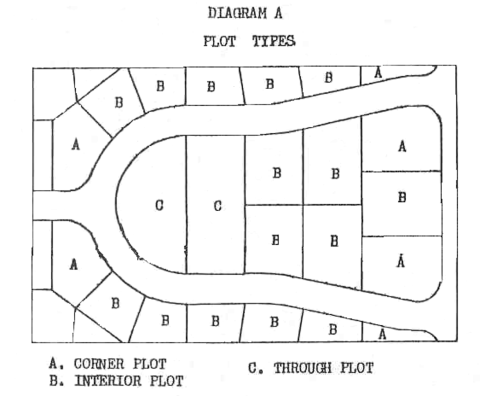
Lot, corner. A corner lot is a lot of which at least two adjacent sides abut for their full length upon a street, provided that two sides intersect at an interior angle of not more than 135 degrees. Where a lot is on a curve, if tangents through the intersection of the lot lines with the street lines make an interior angle of not more than 135 degrees, such a lot is a corner lot. In the case of a corner lot with a curved street line, the corner shall be considered to be that point on the street line nearest to the point of intersection of the tangents herein described. See lots marked A in lot types diagram.
See section 9.2 for special provisions for mobile home parks.
See section 3.5 for lots platted before the effective date of this code.
Lot depth. The mean horizontal distance between the front and rear lot lines.
Lot, interior. A lot other than a corner lot with only one frontage on a street. See lots marked B in lot types diagram.
Lot line, front. The line dividing a lot from a street or base building line, whichever will result in a lesser depth of lot. On a corner lot both street lot lines shall be considered to be front lot lines for the purpose of determining required front yard depth. On through lots both front lot lines as above defined shall be considered to be front lot lines for the purpose of determining required yards.
Lot line, rear. The lot line opposite and most distant from the front lot line. In the case of a triangular or gore-shaped lot line wherein the two side lot lines converge in the rear, the rear lot line shall be considered to be a line ten feet in length within the lot parallel to and at the maximum distance from the front lot line.
Lot line, side. Any lot line other than a front or rear lot line. A side lot line separating a lot from a street is called a side street lot line. A side lot line separating a lot from another lot or lots is called an interior or side lot line.
Lot line, street or alley. A lot line separating the lot from a street or alley.
Lot, reversed frontage. A lot extending between and having frontage on a major traffic street and a minor traffic street and with no vehicular access from the major traffic street.
Lot, through. A lot abutting on two streets, not at their intersection, if any, which may be either a corner or interior plat. See lots marked C in lot types diagram.
Lot width. The horizontal distances between the side lot lines at the depth of the required front yard.
Lot of record. The definition of a lot of record as set forth in the city comprehensive plan is incorporated and adopted by reference.
Low impact development. An innovative approach to stormwater management that uses techniques to mitigate negative impacts of development on receiving bodies of water.
Marijuana. All parts of any plant of the genus Cannabis, whether growing or not; the seeds thereof; the resin extracted from any part of the plant; and every compound, manufacture, salt, derivative, mixture, or preparation of the plant or its seeds or resin, including low-THC cannabis.
Medical marijuana treatment center. A facility licensed by the state department of health to cultivate, process, transport, or dispense marijuana or marijuana delivery devices.
Medical marijuana treatment center dispensary. A facility that is operated by a medical marijuana treatment center or other organization or business holding all necessary licenses and permits from which marijuana, cannabis, cannabis-based products, or cannabis plants are delivered, purchased, possessed, or dispensed for medical purposes and operated in accordance with all local, federal and state laws. Physicians authorized by state law to order low-THC cannabis, as defined in Florida Statutes, for patients' medical use are not included in the definition of "medical marijuana dispensary."
Nonconforming structure. A structure lawfully established prior to the effective date of these regulations, or any amendment thereto, which does not conform to the current code in regard to setbacks, building height or any regulatory code standard regarding its location and size.
Nonconforming use. A use of a structure or premises lawfully established prior to the effective date of these regulations, or any amendment thereto, which is not a permitted or special exception use in the district in which it is located.
Nonconforming design element. Nonconforming design element includes an existing development condition or characteristic, other than those addressed as nonconforming structures or related to the use of land, which was lawfully established prior to the effective date of these regulations, or any amendment thereto, and does not conform to the applicable current code standards. Such nonconforming design elements include, but are not limited to, impervious surfaces, drainage retention, parking, driveways, aisles, buffers, landscaping and similar characteristics. Nonconforming design does not include lot area or lot dimensions.
Occupied. The word "occupied" includes arranged, designed, built, altered, converted to, rented or leased, or intended to be occupied.
Person. The word "person" includes association, firm, co-partnership, or corporation.
Porch. A roofed-over space attached to the outside of an exterior wall or a building, which has no enclosure other than the exterior walls of such building. Open mesh screening shall not be considered an enclosure.
Remodeling, redecorating, or refinishing. Any change, removal, replacement, or addition to walls, floors, ceilings, and roof surfaces or coverings which do not support any beam, ceiling, floor load, bearing partition, columns, exterior walls, stairways, roofs or other structural elements of a building or a structure.
Room. An un-subdivided portion of the interior of a dwelling, excluding bathrooms, kitchens, closets, hallways, and service porches.
Service building. A building housing separate toilet and bathing facilities for men and women and also having laundry facilities and slop water closets.
Setback. The minimum distance between the street line, or base building line, and the front line or side line of the building or any projection thereof, excluding projections specifically permitted.
Sign. See article 11 for all sign definitions.
Street. A public thoroughfare which affords means of access to abutting property which definition shall include roads, boulevards, avenues and streets on recorded subdivision, but shall not include alleys. Private roadways on approved plats or by recorded instruments shall be included.
Structural alteration. Any change, except for repair or replacement, in supporting members of a building or structure such as bearing walls, columns, beams or girders.
Structure. Anything constructed or erected, which requires location on the ground or attached to something having a location on the ground.
Substantial improvement. An improvement to a nonconforming structure or structure utilized for a nonconforming use which cumulatively with all previous improvements to the structure after the effective of this code, or amendment thereto, exceeds 50 percent of the assessment value of the structure, as determined by comparing the assessed valuation of the improved structure to the assessed value of the structure on the date on which it became nonconforming. Substantial improvement limitations apply regardless of whether any or all of the cumulative improvements were proposed for economic reasons, due to damage from a fire, storm or other catastrophic event, or for any other reason, except that an applicant may exclude any costs incurred for compliance with laws regarding accessibility by disable persons or required to comply with laws regarding public safety or sanitation.
Sustainable building and development. Use of natural resources without destroying the ecological balance of an area. As used in sustainable buildings and developments, these techniques are energy efficient, minimize waste through recycling and reuse of materials, and attempt to balance cost, environmental, societal, and human benefits during design, construction, and operation.
Variance. A modification of, or deviation from, these regulations which are authorized and approved by the zoning commission after it finds that the literal application of the provisions of the zoning code would cause unnecessary hardship or practical difficulty in the use or development of a specific lot or building.
Visibility triangle. The area of land described as either of the following:
(a)
The triangular area of property on each side of a driveway formed by the intersection of the driveway and the public right-of-way line and the third side being a line connecting the ends of the two other sides; or
(b)
The triangular area of property located at a corner formed by the intersection of two or more public rights-of-way with two sides of the triangular area along the abutting public right-of-way lines, measured from their point of intersection, and the third side being a line connecting the ends of the two other sides.
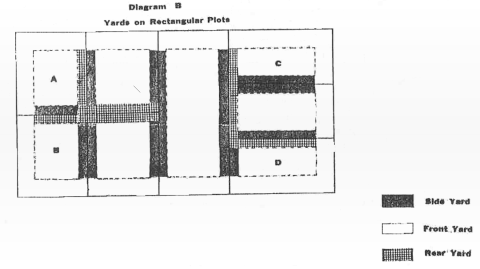
Yard. A space on the same lot with a structure or use, open and unobstructed from the ground to the sky except by encroachments specifically permitted in section 3.10. Yard measurements shall be the minimum horizontal distances. Yards shall extend and be measured inward from the respective lot lines. See yard diagram for details.
Yard, front. A yard extending across the full width of the lot between the front lot lines and the nearest line of the main use or main building on the lot. See yard diagram for details.
Yard, rear. A yard extending across the full width of the lot between the rear lot line and the nearest line of the main building. See yard diagram for details.
Yard, required. Shall mean the minimum yard required by the zoning code. Any yard space supplied in excess of the minimum amount specified shall not be deemed to be a required yard. See yard diagram for details.
Yard, side. A yard extending from the front yard to the rear yard between the side lot line and the nearest line of any building or use on the lot. The width of a side yard shall be the shortest distance between the side lot line and the nearest use or building on the lot. See yard diagram for details.
Zoning district, residential. Includes R-1, R-1A, R-1B, R-3, R-5 and MH. A-1 shall be considered a residential district when developed as a conservation subdivision.
Zoning district, business. Includes B-2, B-3, B-4, B-5 and B-6. The RBO and NBR categories allow a mix of commercial and residential uses. Unless specifically stated otherwise, these districts shall be considered business districts for the purpose of applying applicable code provisions.
(Ord. No. 2017-13, § 2, 11-13-2017)

