
Ecorse City Zoning Code
ARTICLE 10
- LAND DEVELOPMENT OPTIONS
10.1.1. - Site plan review.
Site plan review and approval is required for all uses except detached single-family residential uses, in accordance with article 8.
10.1.2. - General development standards
All manufactured home developments shall meet the following required conditions:
A.
All developments shall comply with the Mobile Home Commission Act, Public Act 96 of 1987 of the State of Michigan, as amended.
B.
There shall not be less than three hundred sixty (360) square feet of floor space within each mobile home for the first two (2) occupants, and an additional one hundred (100) square feet of floor space for each occupant over two (2).
C.
There shall be provided for each development a recreation area equal in size to at least two hundred (200) square feet per mobile home site. The recreation area shall be no longer than one and one-half (1½) times its width. Such area shall be graded, developed, sodded and maintained by the management, so as to provide recreation for the residents of the development.
D.
The front yard, and any side yard adjacent to a street shall be landscaped within six (6) months, and the entire manufactured housing development shall be maintained in a good, clean presentable condition at all times.
E.
No business of any kind shall be conducted in any development except for separate, permanent structures that contain facilities such as the management's office, laundry and dry cleaning facilities, or similar uses which are designed to serve only the residents of the development.
F.
There shall be no storage of any kind under homes unless provided with skirting.
G.
The development site shall be enclosed by a masonry wall four (4) feet eight (8) inches high adjacent to all abutting properties and public rights-of-way, and/or a fifteen (15) foot wide buffer with adequate vegetated screen.
H.
All fences, other than greenbelt surrounding the development, shall be uniform in height, and shall not exceed thirty (30) inches in height, and shall be constructed in such a manner as to provide firemen access to all sides of each home.
I.
Sites shall be provided with a concrete apron of not less than ten (10) feet wide by fifty (50) feet long and six (6) inches in depth.
10.1.3. - Area, height, bulk, and placement requirements.
Manufactured home developments and the placement of individual manufactured homes shall comply with all requirements of the Manufactured Housing Commission of the State of Michigan and the standards that follow:
A.
Maximum height. No structure shall exceed twenty-five (25) feet or two (2) stories.
B.
Minimum development site area. Manufactured housing developments shall be permitted only on sites of five (5) acres or more.
C.
Minimum lot area. Each site shall be at least three thousand (3,000) square feet, exclusive of drives, open spaces, or other open areas specifically for development occupancy.
D.
Minimum lot width. Each site shall have a minimum width of thirty-five (35) feet.
E.
Setbacks. The minimum setbacks within the development shall be as follows:
F.
Yard requirements. Each site shall have the following minimum yard requirements:
G.
The development site shall be enclosed by a masonry wall four (4) feet eight (8) inches high adjacent to all abutting properties and public rights-of-way, and/or a fifteen (15) foot wide vegetated screen with adequate obscuring plant material.
10.1.4. - Access and circulation.
A.
The development shall have frontage on, and direct access to a major arterial street.
B.
Lots shall abut a service drive constructed of concrete, designed, and graded for property drainage, and have widths as scheduled below:
C.
Manufactured home developments shall provide an approved entrance road not less than thirty (30) feet wide, contingent upon city engineer and the appropriate Wayne County Road Department approval.
D.
All service drives and parallel parking spaces shall be clearly marked.
E.
Parking. Each site shall provide parking as follows:
F.
Sidewalks. The development shall be designed to provide sidewalks from the entrance of each site to all required service facilities. Sidewalks shall be of concrete construction and a minimum of thirty-six (36) inches wide.
10.1.5. - Utilities.
A.
Arrangements shall be made for all local distribution lines for telephone or electric services, exclusive of main supply and perimeter feed lines when located on section or quarter section lines, to be placed entirely underground throughout the development area, provided, however, that when a manufactured home development overlaps a section or quarter section line, main supply and perimeter feed lines located on such section or quarter section line shall be placed underground.
B.
Conduits or cables shall be placed within private easements provided to the service companies by the proprietor and/or developer or within public ways. Those telephone and electrical facilities placed in dedicated public ways shall be planned so as not to conflict with other underground utilities. All telephone and electrical facilities shall be constructed in accordance with standards of construction approved by the Michigan Public Service Commission.
C.
Street and yard lights sufficient to permit safe movement of vehicles and pedestrians at night shall be provided, and shall be so located and shaded as to direct the light away from adjacent properties.
10.1.6. - Review and approval.
The procedures for review and approval of a manufacture home development shall be the same as those for a special land use permit approval under article 9, include the applicable special land use permit standards.
10.2.1. - Intent and purpose.
The purpose of this section is to regulate projects that divide real property under a contractual arrangement known as a condominium. New condominium projects and conversion condominium projects shall conform to the requirements of this ordinance and all other applicable regulations of the City and the Condominium Act, Public Act 59 of 1978 of the State of Michigan, as amended. Each condominium project shall be reviewed in a manner consistent with like projects within the underlying zoning district. A site condominium project shall be considered equivalent to a platted subdivision for the purposes of enforcing the site and building standards of the city. It is the intent to regulate site condominium projects and other condominium projects in a manner consistent with a traditional subdivision plat, except that the review procedures within the following sections shall apply.
10.2.2. - General requirements.
A.
Compliance with federal, state and local laws. All condominium projects shall comply with all applicable federal, state and local laws and ordinances. No condominium documents shall conflict with the standards of this ordinance.
B.
Condominium lots. For all purposes of this ordinance, each site condominium lot or unit lot shall be considered the equivalent of a platted lot of record as defined in this ordinance and shall comply with all applicable regulations for the zoning district in which it is located. The relocation of the boundaries or any other change in the dimensions of a condominium lot or unit lot shall be considered an amendment to the condominium documents of the project and the related site plan.
C.
Area computation. Any area within a public or private street right-of-way shall not be included in the computation of the minimum area of a condominium lot or in determination of dwelling density for a site.
D.
Condominium units.
1.
Single-family detached units. In the case of a condominium project in which the condominium units are intended for detached single-family residential purposes, not more than one single-family dwelling unit shall be proposed or constructed on a condominium lot, nor shall any dwelling unit be located on a condominium lot with any other principal use. The condominium unit shall be considered a lot under this ordinance.
2.
Attached or multiple residential units. A condominium project created by the construction of multiple or attached residential units containing individually owned condominium units and in the case of the conversion of existing multi-family or attached units into individual condominium units, the buildings and units shall meet all requirements of the underlying zoning district.
3.
Nonresidential condominium units. A nonresidential condominium project, either new building construction or the conversion of existing building(s) into individual condominium units, the buildings shall meet all bulk and area requirements of the underlying zoning district and the use shall meet all requirements of this ordinance.
E.
Subdivision requirements. The substantive requirements for streets, sidewalks, utilities, storm drainage and subdivision lot layout and design as set forth in the Subdivision Control/Land Division Act, Public Act 288 of 1967 of the State of Michigan, as amended, and subdivision regulations of the city, are intended to apply to all site condominium projects.
F.
Conversion condominiums. All conversion condominium projects shall be subject to the provisions of this ordinance and shall require site plan approval by the planning commission prior to the occupancy of any converted condominium unit. The site plan submitted for a conversion project shall include all existing conditions and clearly identify all proposed site changes. The city planning commission will review the site plan for a condominium conversion as a new site plan and may modify any previous site plan approval. Approval of a conversion condominium site plan shall be subject to site plan requirements and review of the planning commission.
G.
Setbacks. Yard setback requirements as specified in article 3 shall be measured from the perimeter of the condominium lot to the appropriate part of a structure.
H.
Utility connections. Each condominium unit shall be separately connected to any available community or public water supply and/or sanitary sewer system. This requirement may be waived by city council for cause upon recommendation of the city engineer.
I.
Easement for utilities. The site condominium subdivision plan shall include all necessary easements granted to the City of Ecorse, for the purposes of constructing, operating, inspecting, maintaining, repairing, altering, replacing and/or removing pipelines, mains, conduits and other installations of a similar character for the purpose of providing public utilities, including conveyance of sewage, water and storm water run-off across, through and under the property subject to said easement, and excavating and refilling ditches and trenches necessary for the location of said structure.
J.
Relocation of lot boundaries. Relocation of condominium lot boundaries, if allowed in the condominium documents, as permitted in section 48 of the Condominium Act, shall comply with the requirements of article 3 and shall be subject to the site plan review procedures stated in article 8.
K.
Resulting lots. Each condominium lot formed by the relocation of an existing condominium lot boundaries, as permitted by section 49 of the Condominium Act, shall comply with the requirements of the city zoning ordinance article 3 and shall be subject to the procedures stated in article 8.
L.
Monuments and lot irons. Monuments shall be set at all boundary corners and deflection points and at all roads right-of-way intersection corners and deflection points. Lot irons shall be set at all condominium lot corners and deflection points of condominium lot lines. The city may require a performance guarantee as outlined in article 12 to ensure the setting of monuments and lot irons is completed.
M.
Roads in condominium projects. All condominium projects shall require direct access and direct connection to a public road from the project site. All public or private roads within a condominium project shall conform to the standards and specifications of this ordinance and those established by the Wayne County Department of Public Services and/or the city council for road design and maintenance.
N.
Notice of proposed action. The notification requirements stated in section 71, of the Condominium Act shall be filed with the City of Ecorse and other listed agencies.
10.2.3. - Condominium application requirements.
Site condominium applications shall meet all the requirements of a site plan review in section 8.3, and may require the following:
A.
Ownership interests. All persons with an ownership interest in the land on which the condominium project will be located, including a description of the nature of each entity's interest (for example, fee owner, option holder, lessee, or land contract vendee).
B.
Condominium regulations. All deed restrictions or other regulations proposed to be included in the condominium documents in the nature of restrictive covenants which regulate the layout, use and maintenance of public or common areas, accessory structures, payment of assessments, and enforcement of condominium regulations. These items shall be physically incorporated as part of the site plan through detail sheets attached with the plan.
C.
Cross sections of any proposed roads, drive aisles and/or paved area.
D.
All condominium documents as defined in this ordinance.
E.
All necessary easement documents showing the dedication of land areas for the purposes of constructing, operating, inspecting, maintaining, repairing, altering, replacing, and/or removing pipelines, mains, conduits and other installations of a similar character for the purpose of providing public utilities, including conveyance of sewage, water and storm water run-off across, through and under the property subject to said easement, and excavating and refilling ditches and trenches necessary for the location of said structures.
F.
Optional requirements.
1.
A market study, traffic impact study, and/or environmental impact assessment, if requested by the planning commission or city council.
2.
A pattern book or design guidelines manual if requested by the planning commission or city council.
10.2.4. - Application submission procedures.
The procedures for application submittal for a special land use permit shall follow those outlined is section 8.4.
10.2.5. - Condominium development standards.
10.2.6. - Approval, conditions, and denial.
The planning commission shall follow the procedures in section 9.6 for review and action regarding a condominium development application.
10.2.7. - Record of actions.
All decisions on a condominium development shall be recorded consistent with the requirements of section 8.7 with the addition that the development agreement, final site plans, and condominium regulations for an approved condominium development be recorded at the Wayne County Register of Deeds Office and evidence of the record by submitted to the city clerk within forty-five (45) days.
10.2.8. - Expiration, revocation, and reapplication.
The standards and procedures for expiration and revocation of an approved condominium development, or the reapplication for a condominium development that has been denied either wholly or in part shall be the same as those for site plan review in section 8.8.
10.2.9. - Amendments and modifications.
The standards and procedures for amendments or modifications of an approved condominium development shall be the same as those for site plan review in section 8.9, with the exception that a major amendment to an approved condominium development will require a new public hearing following the standards and process in section 8.9.
10.2.10. - Fees and performance guarantees.
Fees and performance guarantees associated with the review and approval of a condominium development application shall be consistent with the requirements in article 12.
10.3.1. - Intent and purpose.
A.
The planned unit development (PUD) option is intended to allow, with city approval, private or public development which is consistent with the goals and objectives of the City of Ecorse Master Plan and Future Land Use Map.
B.
The development allowed under this section shall be considered as an optional means of development only on terms agreeable to the city.
C.
Use of the PUD option will allow flexibility in the control of land development by encouraging innovation through an overall, comprehensive development plan to provide variety in design and layout; to achieve economy and efficiency in the use of land, natural resources, energy and in the provision of public services and utilities; to encourage useful open spaces suited to the needs of the parcel in question; to provide proper housing including workforce housing; or to provide employment, service and shopping opportunities suited to the needs of the residents of the city.
D.
It is further intended the PUD may be used to allow nonresidential uses of residentially zoned areas; to allow residential uses of nonresidential zoned areas; to permit densities or lot sizes which are different from the applicable district and to allow the mixing of land uses that would otherwise not be allowed; provided other community objectives are met and the resulting development would promote the public health, safety and welfare, reduce sprawl, and be consistent with the City of Ecorse Master Plan and Future Land Use Plan Map.
E.
It is further intended the development will be laid out so the various land uses and building bulk will relate to one another and to adjoining existing and planned uses in such a way that they will be compatible, with no material adverse impact of one use on another.
F.
The number of dwelling units for the PUD development shall not exceed the number of dwelling units allowed under the underlying zoning district.
10.3.2. - Uses permitted.
A.
A land use plan shall be proposed for the area to be included within the PUD. The land use plan shall be defined primarily by the City of Ecorse Zoning Ordinance Districts that are most applicable to the various land use areas of the PUD.
B.
Uses permitted and uses permitted subject to special land use permit approval in this ordinance may be allowed within the districts identified on the PUD plan, except that some uses may be specifically prohibited from districts designated on the PUD plan. Alternatively, the city may allow uses not permitted in the district if specifically noted on the PUD plan. Conditions applicable to uses subject to special land use permit approval shall be used as guidelines for design and layout but may be varied by the planning commission provided such conditions are indicated on the PUD plan.
10.3.3. - Height, bulk, density and area standards.
The standards about height, bulk, density, and setbacks of each district shall be applicable within each district area designated on the plan except as specifically modified and noted on the PUD plan.
10.3.4. - Application submission procedures.
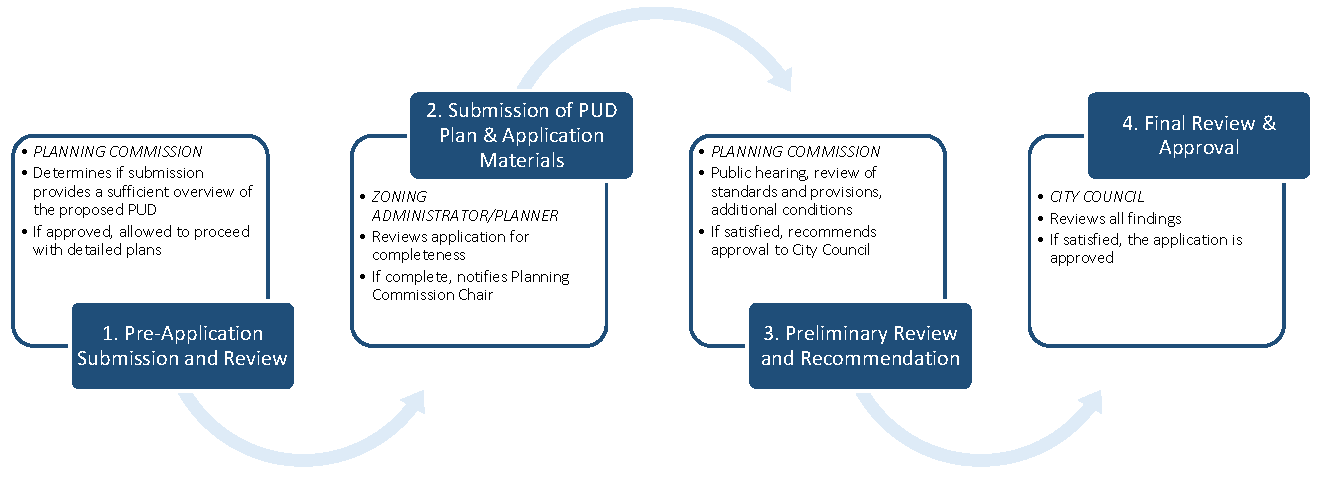
The PUD application submission and review procedures follow four (4) primary steps: 1) pre-application submission and review, 2) submission of PUD plan and application materials, 3) planning commission review and recommended approval or denial of the PUD, and 4) city council final review and approval or denial of the PUD.
A.
Application requirements. PUD applications shall meet all the requirements of a site plan review in section 8.4, and may require the following:
1.
A market study, traffic impact study, and/or environmental impact assessment, if requested by the planning commission or city council.
2.
A pattern book or design guidelines manual if requested by the planning commission or city council.
B.
Completeness review. An application shall have completeness review performed consistent with section 8.4.3.
C.
Technical review. An application shall have technical review performed consistent with section 8.4.4.
10.3.5. - Pre-application submission and review.
A.
Any person owning or controlling land in the city may make application for consideration of a PUD. Such application shall be made by presenting a request for a preliminary determination to whether a development proposal qualifies for the PUD option.
B.
The request shall be submitted to the city and the submission shall include the information required below.
1.
Proof the qualifying standards in this section are or will be met.
2.
A conceptual land use plan containing enough detail to explain the role of open space; location of land use areas, streets providing access to the site, pedestrian and vehicular circulation within the site; dwelling unit density and types; and buildings or floor areas contemplated, as applicable.
3.
A plan to protect natural features or preservation of open space or greenbelts.
4.
A storm water management plan incorporating low impact development (LID) water quality technologies, such as, but not limited to, rain gardens, rooftop gardens, vegetated swales, cisterns, permeable pavers, porous pavement, and filtered storm water structures.
5.
The planning commission shall review the applicant's request for qualification. If approved, the applicant may then continue to prepare a PUD plan on which a final determination will be made.
C.
Based on the documentation presented, the planning commission shall make a preliminary determination about whether a development proposal is consistent with the intent and purpose in section 10.3.1 and qualifies for the PUD option under the qualifying standards in section 10.3.4. If approved, the applicant may then continue to prepare a PUD plan and application on which a final determination will be made. An approved request for qualification is not a guarantee for final PUD approval.
10.3.6. - Qualifying standards.
Planned unit development proposals shall meet the following qualifying standards to be considered under the PUD land development option:
A.
The properties are zoned FR, MFR, NMU, CC, C, or LI or PSP districts.
B.
The use of this option shall not be for the sole purpose of avoiding the applicable zoning requirements. Any permission given for any activity, building, or use not normally allowed shall result in an improvement to the public health, safety and welfare in the area affected.
C.
The PUD shall not be used where the same land use objectives can be carried out by the application of conventional zoning provisions or standards. Problems or constraints presented by applicable zoning provisions shall be identified in the PUD application.
D.
The PUD option may be effectuated only when the proposed land use will not materially add service and facility loads beyond those considered in the City of Ecorse Master Plan, and other public agency plans, unless the proponent can prove to the sole satisfaction of the city that such added loads will be accommodated or mitigated by the proponent as part of the PUD.
E.
The PUD shall not be allowed solely as a means of increasing density or as a substitute for a variance request; such objectives should be pursued through the normal zoning process by seeking a zoning change or variance.
F.
The PUD must meet, as a minimum, four (4) of the following eight (8) objectives of the city.
1.
To permanently preserve open space or natural features because of their exceptional characteristics, or because they can provide a permanent transition or buffer between land uses.
2.
To permanently establish land use patterns which are compatible, or which will protect existing or planned uses.
3.
To accept dedication or set aside open space areas for public use in perpetuity.
4.
To provide alternative uses for parcels which can provide transition buffers to residential areas.
5.
To promote the goals and objectives of the City of Ecorse Master Plan.
6.
To foster the aesthetic appearance of the city through quality building design and site development, provide trees and landscaping beyond minimum requirements; the preservation of unique and/or historic sites or structures; and the provision of open space or other desirable features of a site beyond minimum requirements.
7.
To bring about redevelopment of sites where an orderly change of use or requirements is determined to be desirable.
8.
To provide a diverse mix of housing options, price points and opportunities to rent or purchase.
10.3.7. - Application submission and review.
The application, reports, and drawings shall be filed in paper and digital format. Printed drawings shall be on twenty-four (24) inch by thirty-six (36) inch sheets. All drawings shall be provided to the city in AutoCadTM, MicroStation, or similar site civil/architectural drawing format requested by the planning commission. Other graphics and exhibits, text and tabular information shall be provided in Adobe Acrobat™ "pdf" format. All drawings shall be created at a scale not smaller than one inch equals one hundred (100) feet, unless otherwise approved by the city.
A.
A proposed PD plan application shall be submitted to the city for review that contains the following:
1.
A boundary survey of the exact acreage prepared by a registered land surveyor or civil engineer.
2.
A topographic map of the entire area at a contour interval of not more than two (2) feet. This map shall show all major stands of trees, bodies of water, wetlands and unbuildable areas.
3.
A proposed development plan showing the following, but not limited to:
a)
Land use areas represented by the zoning districts listed as FR, MFR, NMU, CC, C, or LI or PSP of this ordinance.
b)
A circulation plan including vehicular circulation patterns, major drives and location of vehicular access, parking areas, non-motorized circulation patterns, pedestrian and bicycle facilities, and cross sections of public and private streets.
c)
Transition treatment, including minimum building setbacks to land adjoining the PD and between different land use areas within the PD.
d)
The general location of nonresidential buildings and parking areas, estimated floor areas, building coverage and number of stories or height.
e)
The general location of residential unit types and densities and lot sizes by area.
f)
The general location and type of all low impact development (LID) storm water management technologies.
g)
Location of all wetlands, water and watercourses, proposed water detention areas and depth to groundwater.
h)
The boundaries of open space areas that are to be preserved or reserved and an indication of the proposed ownership.
i)
A schematic landscape treatment plan for open space areas, streets and border/transition areas to adjoining properties.
j)
A preliminary grading plan, showing the extent of grading and delineating any areas, which are not to be graded or disturbed.
k)
A public or private water distribution, storm and sanitary sewer plan.
l)
Elevations of the proposed buildings using traditional building materials shall be used. Materials such as exterior insulation finish system (EIFS), fluted concrete masonry units, concrete panels, panel brick, and scored concrete masonry unit block are not considered traditional building materials.
m)
A written statement explaining in detail the full intent of the applicant, showing dwelling unit types or uses contemplated and resultant population, floor area, parking and supporting documentation, including the intended schedule of development.
4.
A market study, traffic impact study, and/or environmental impact assessment, if requested by the planning commission or city council.
5.
A pattern book or design guidelines manual if requested by the planning commission or city council.
B.
The zoning administrator and/or planner will review the PUD plan application for completeness. Once deemed complete, the zoning administrator and/or planner will conduct a technical review of the application. Upon completion of the technical review, the city zoning administrator and/or planner shall notify the planning commission chair who will place the application on the agenda for a preliminary review by the planning commission.
10.3.8. - Planning commission review and recommendation.
The review of a PUD application by the planning commission shall follow the procedures below:
A.
Review. Upon notification from the city zoning administrator and/or planner of a complete PUD plan application and technical review, the planning commission shall review the proposed PUD plan and make a determination about the proposal's qualification for the PUD option and for adherence to the following objectives and requirements:
1.
The proposed PUD adheres to the conditions for qualification of the PUD option and promotes the land use goals and objectives of the city.
2.
All applicable provisions of this article shall be met. If any provision of this article shall be in conflict with the provisions of any other section of this article, the provisions of this section shall apply to the lands embraced within a PUD area.
3.
There will be at the time of development, an acceptable means of disposing of sanitary sewage and of supplying the development with water and the road network, storm water drainage system, and other public infrastructure and services are satisfactory.
B.
Public hearing. The planning commission shall hold a public hearing on the PUD plan and shall give notice as provided in article 12.
C.
Finding of facts. After the review and public hearing, the planning commission shall adopt a finding of fact relative to the PUD under consideration as the basis of their recommendation to approve or deny the application, along with any applicable conditions.
D.
Recommendation. The planning commission shall submit its recommendation to the city council along with the technical review and finding of facts for final determination.
10.3.9. - City council review and approval.
A.
Determination. Upon receipt of the technical review, finding of facts and recommendation of the planning commission, the city council shall review the application and make a determination to approve or deny the application, and any applicable conditions.
B.
PUD development agreement. If the city council approves the application, it shall direct the city attorney to prepare a PUD development agreement setting forth the conditions on which such approval is based. The PUD development agreement shall:
1.
Be signed by the mayor and the applicant.
2.
Become effective on execution after its approval.
3.
Be recorded at the Wayne County Register of Deeds' office by the applicant who shall provide a copy of the record to the city within forty-five (45) days.
4.
Limit the development and uses that may take place in such area to those expressly permitted under the PUD Development Agreement unless otherwise amended following the procedures in this section.
10.3.10. - Submission of final site plans.
Before any land use permits are issued for the PUD, final site plans for the project area shall be submitted to the city for review and approval by the planning commission of the following:
A.
Review and approval of site plans shall comply with article 8, as well as this section except as otherwise modified in the approved plan and PUD development agreement.
B.
Before approving of any final site plans, the planning commission shall decide that:
1.
All portions of the project area shown on the approved plan for the PUD for use by the public or the residents of lands within the PUD have been committed to such uses under the PUD development agreement;
2.
The final site plans are in conformity with the approved development agreement and plan for the PUD;
3.
Provisions have been made under the PUD development agreement to provide for the financing of any improvements shown on the project area plan for open spaces and common areas which are to be provided by the applicant and that maintenance of such improvements is assured under the PUD development agreement.
C.
A dimensionally stable copy of the as-built drawings shall be submitted to the city clerk and a second dimensionally stable copy shall be recorded with the Wayne County Register of Deeds.
10.3.11. - Termination and expiration.
An approved PUD development agreement may be terminated or expire in the following ways:
A.
An applicant or the applicant's successors or assigns may choose to terminate a PUD development agreement, before any development within the area involved, by filing with the city and recording at the Wayne County Register of Deeds an affidavit so stating. The approval of the plan under the PUD development agreement shall terminate on such recording.
B.
No approved plan under a PUD development agreement shall be terminated after development begins except with the approval of the city council and of all parties in interest in the land.
C.
Within one year following execution of the PUD development agreement by the city council, final approved site plans for an area embraced within the PUD must be filed with the city. If such plans have not been filed within the one year period, the right to develop the approved plan under the PUD development agreement shall be automatically terminated unless an extension is requested in writing by the applicant and authorized by the city council. The city council may authorize an extension of up to one year.
D.
If development of approved final site plans is not substantially completed in three (3) years after approval, further final submittals under the PUD shall stop until the part in question is completed or cause can be shown for not completing same.
10.3.12. - Fees and performance guarantees.
Fees and performance guarantees associated with the review and approval of a PUD application shall be consistent with the requirements in article 12.
10.3.13. - Interpretation of approval.
Approval of a PUD under this section shall be considered an optional method of development and improvement of property subject to the mutual agreement of the city and the applicant.
10.3.14. - Amendments to planned development plan.
Proposed amendments or changes to an approved PUD plan and/or PUD contract shall be presented to the planning commission and shall decide whether the proposed modification is of minor or major nature based on section 8.9.
A.
Minor amendment. If determined to be a minor amendment, the planning commission may review and approve or deny the request. The PUD development agreement shall be modified to reflect any approved minor amendment.
B.
Major amendment. If determined to be a major amendment, the planning commission shall hold a public hearing consistent with the requirements in article 12 as part of its review and make a recommendation to the city council to approve or deny the request. The city council shall have the final determination to approve or deny a major amendment request. The PUD development agreement shall be modified to reflect any approved major amendment.

