
Ecorse City Zoning Code
ARTICLE 6
- SITE DEVELOPMENT STANDARDS
6.1.- Intent and purpose.
The purpose of the regulations contained in this article is to protect the public health, safety, and general welfare; to promote harmonious and orderly development; and to foster civic beauty by improving the appearance, character and economic value of civic, commercial and industrial development.
6.6. - Sidewalks.
For new construction, sidewalks shall be required in accordance with city standards along all city streets. The standard shall not apply to industrial parks and in those situations specifically exempted by the planning commission.
A.
All front entrances in the MFR, NMU, CC, C, LI, GI, and PSP districts shall have a direct paved pedestrian connection with the sidewalk along the street right-of-way.
B.
Internal circulation within all developments shall be provided directly by paved pedestrian connections between parking areas and buildings, and between buildings.
6.2.1. - Intent and purpose.
The intent and purpose of the provisions in this section are to:
A.
Improve the visual image of the city and properties abutting public rights-of-way, thereby reducing conditions which lead to community blight;
B.
Requiring buffering between conflicting land uses and zoning districts;
C.
Promote public health, safety and general welfare by reducing noise and air pollution, light glare, soil erosion and thermal heating of the environment;
D.
Protect and preserve the appearance, character and value of the surrounding neighborhoods and parks; and
E.
Promote the use of native plant materials while discouraging the use of invasive plant materials.
6.2.2. - Applicability.
All uses that require site plan review and that abut either SFR, MFR, FR, and MH zoning districts, and/or rights-of-way shall be subject to the requirements of this section.
A.
Landscape plan required.
1.
All new uses requiring a site plan review;
2.
Additions to existing structures that increase the floor area by more than twenty (25) percent;
3.
Expansions or contractions of nonconforming sites that do not meet the landscape requirements of this section.
B.
Exceptions.
1.
The reconstruction of an existing structure of which fifty (50) percent or less of the floor area was destroyed or ruined by flooding, fire, wind, storm, or act of nature, and where the reconstruction will not result in an increase in size of the structure, parking facilities, or paved areas;
2.
Interior remodeling or façade improvements that do not result in an increase in size of the structure, parking facilities, or paved areas; and
3.
Any use, building, or structure for which only a change of use is requested, and which requires no structural modifications that increase its volume or scale.
C.
Application. All applicable projects shall submit a landscape plan as part of the site plan review process that contains the following:
1.
Plan scale equal to that of the site plan and a north arrow;
2.
Existing and proposed topography;
3.
Location and type of all existing vegetation and wetlands;
4.
Location and size of all proposed plant materials;
5.
Zoning district classification of adjacent properties;
6.
Planting list for all proposed landscape materials indicating botanical and common names, sizes, root condition and quantities;
7.
Vegetation inventory created by a forester, landscape architect, or other person having similar recognized skills and/or experience that includes the approximate location and extent of existing vegetation, significant tree stands or woodlands, location and size of vegetation proposed to be retained as credit towards landscape requirements, and identification of any invasive species.
6.2.3. - Standards and criteria.
A.
Planting materials.
1.
Plant material shall be healthy, free of insects and diseases and physical damage.
2.
Unless otherwise specified, the minimum size for plant materials installed shall be as follows:
Planting Standards
3.
Caliber of trunk shall be measured twelve (12) inches above the ground.
4.
Native plants are encouraged. Invasive plant species and those deemed by the city to be susceptible to disease, storm damage or other undesirable characteristics are prohibited.
B.
Fractional requirements. Where any calculation of required plant materials in this ordinance results in a fractional requirement, such requirement shall be rounded up to the next highest whole number.
C.
Ground cover. All areas not covered by buildings, parking areas, driveways, walkways, pedestrian plazas or other pedestrian-oriented impervious surfaces or water features shall be replanted with ground cover at a minimum. Ground cover may include:
1.
Maintained lawn area;
2.
Non-invasive wildflowers, vines, grasses, rushes sedges or ferns;
3.
Wood chips, mulch or rock provided this type of material does not exceed twenty (20) percent of the total of any individual landscaped area.
D.
Plant substitutions. The zoning administrator may approve minor revisions to the landscape plans due to seasonal planting problems and/or lack of plant availability. Minor revisions may be approved only when there is no reduction in the quality of plant material, no significant change in size or location of plant material, the new plant material is compatible with the area, and the new plant material is of the same general category (i.e., deciduous or evergreen trees) as the material being replaced.
E.
Invasive species management. An applicant shall develop a removal and/or management strategy for invasive species identified on the vegetation inventory.
F.
Site design. Landscape areas must be protected from vehicular traffic through the use of concrete curbs, vehicle stops, or other permanent barriers. Protecting significant trees requires locating buildings, roads, and sidewalks in areas of the site which will minimize tree destruction, as well as establishing protected root zones (i.e. tree root buffer zones) to protect vegetation during road widening, sidewalk construction, and cut-and-fill activities.
G.
Utilities. Where overhead and underground utilities are present, consideration shall be given to the location and mature height of species. Adjustments to the location of required planting areas may be approved by the planning commission to avoid conflict with such utilities provided the intent of the planting or screening requirements are maintained.
H.
Maintenance. All required landscaped areas shall be maintained in a healthy condition and kept orderly in appearance. Irrigation shall be provided to all required landscaping by means of a piped underground system. The planning commission may waive the irrigation requirements if no additional planting is required, or if a reliable source of water is not reasonably available, so as long as the suitable alternative is presented that will ensure the health of the landscaping.
I.
Time period. Required landscaping shall be installed prior to the issuance of an occupancy permit. If a development is completed during the off-season when plants cannot be installed, the developer shall submit a performance guarantee equal to the materials and labor for the required landscaping to ensure installation at the beginning of the next planting season.
J.
Replacement. When trees or shrubs planted in accordance with the requirements of this section die or are removed for any reason, they must be replaced during the next suitable planting season in a manner, quantity and size approved by the zoning administrator.
6.2.4. - Landscape buffers and screening.
A.
Screening materials. Effective screening shall be provided as required between incompatible land uses. The planning commission shall make the final determination on the required screening method based on site conditions and the specific land use. Screening materials may include the following separately, or a combination thereof:
1.
Vegetated screens. Vegetated screens shall consist of evergreen trees planted no more than fifteen (15) feet apart and can be reasonably expected to achieve a complete visual barrier at a minimum height of six (6) feet in three (3) years. Deciduous trees may be incorporated for plant diversity provided the effectiveness of the screen is achieved.
2.
Berms. Berms shall be constructed with slopes no greater than one foot of vertical rise for every three (3) feet of horizontal run with at least a two (2) feet flat surface on top and sodded to provide adequate protection against erosion. Berms shall be landscaped with one deciduous or evergreen and six (6) shrubs for every forty (40) lineal feet. Clustering of trees and shrubs is allowed upon approval of the planning commission.
3.
Obscuring walls or fences. Obscuring walls or fences shall be a constructed of durable materials and placed inside and along the property lines. The planning commission has the authority to require specific materials based on the site conditions and the nature of the use. Walls and fences shall include one vine or shrub for every ten (10) lineal feet, planted on the exterior face of the structure.
4.
Green belts. Green belts shall occupy a prescribed buffer zone and consist of vegetated ground cover, along with one deciduous or evergreen tree and six (6) shrubs for every forty (40) lineal feet. Clustering of trees and shrubs is allowed upon approval of the planning commission.
B.
Screening required. The table below provides the instances when screening is required, along with applicable dimensions and buffer zones.
Landscape Buffer and Screening Requirements
6.2.5. - Right-of-way landscaping.
Properties zoned C, MFR, LI, GI, and PSP shall provide right-of-way landscaping along the street frontage that meets the following standards:
A.
A landscape buffer shall be established along the right-of-way at a minimum width of five (5) feet.
B.
The landscape buffer shall include one deciduous tree and six (6) shrubs for every fifty (50) feet of frontage. For frontage less than twenty (20) feet, only one deciduous tree shall be required. Trees shall be evenly spaced, but shrubs may be clustered.
6.2.6. - Lot landscaping.
In addition to any required buffer or right-of-way landscaping requirements, the following landscaping requirements shall apply:
A.
All unpaved or undeveloped portions of a lot shall be planted with grass, ground cover, or shrubs.
B.
All properties zoned C, MFR, LI, GI, or PSP shall provide one tree per four thousand (4,000) square feet of unpaved or undeveloped lot area for the first twenty-four thousand (24,000) square feet, and one tree per six thousand (6,000) square feet of unpaved or undeveloped lot area over twenty-four thousand (24,000) square feet.
C.
Trees may be grouped or evenly distributed.
6.2.7. - Existing vegetation.
A.
Preservation. Existing deciduous trees, evergreens, flowering trees, and shrubs shall be protected and incorporated into the site plan wherever feasible.
B.
Credit. Existing vegetation may be credited as detailed below for the purpose of calculating landscaping compliance provided that the plants are in healthy growing condition, are at least the minimum size, and are the appropriate species.
Existing Landscaping Credit Ratio
C.
Protection of vegetation.
1.
Preserved trees shall be protected with high visibility barriers around the protected root zone. The protected root zone shall be a radius one and one-half (1½) feet from the trunk for every one inch of the tree caliper.
2.
Barriers shall not be supported by the trees.
3.
No grading, demolition, trenching, operation or storage of equipment, or other activity shall occur in the protected root zone.
4.
Where the zoning administrator determines that irreparable damage has occurred to a tree credited for preservation, the tree shall be removed and replaced in size and quantity as required in this section and having been given credit for.
6.3.1. - General requirements.
The following standards shall apply to any required off-street parking areas:
A.
Use. Off-street parking, loading, or stacking areas shall only be used for their intended purpose. All other uses are prohibited.
B.
Location.
1.
All off-street parking areas shall be on the same lot as the use it serves or within three hundred (300) feet, measured from the closest point of the building to the nearest point of the off-street parking area.
2.
Except one-, two-, three- and four-family residential dwellings without improved alley access, no off-street parking areas shall be located in the front yard on any lot.
C.
Setbacks.
Off-Street Parking, Stacking and Loading Area Setbacks
D.
Screening and landscaping.
1.
Off-street parking areas located in a side yard in the NMU, CC, and C districts shall be screened from the street with a forty two (42) inch high brick or masonry wall setback five (5) feet from the public street right-of-way. The outside of the wall shall include one shrub for every five (5) lineal feet of street frontage. This requirement also applies to side streets when parking areas have frontage on two (2) streets.
2.
Off-street parking areas for uses other than one-, two-, three- or four-family residential dwellings that are adjacent to, or across the alley from, a residential use or zoning district shall be screened with a six (6) foot high obscuring wall made of durable masonry materials.
3.
Off-street parking areas for uses in the LI and GI districts shall be screened where visible from the public right-of-way with a green belt as prescribed in section 6.2.4.
E.
Treed islands. All off-street parking areas with ten (10) or more parking spaces outside of the LI and GI zoning districts shall provide treed islands into the parking lot design satisfying the following standards:
1.
Single-loaded aisles shall have one treed island containing one canopy tree at both ends of each row. The minimum dimensions for each island shall be nine (9) feet by eighteen (18) feet.
2.
Double-loaded aisles shall have one treed island containing two (2) canopy trees at both ends of each row. The minimum dimensions for each island shall be twelve (12) feet by thirty-six (36) feet.
3.
In addition to the above required treed islands, additional treed islands shall be provided at a ratio of one treed island per ten (10) parking spots and shall be evenly distributed throughout the off-street parking area. The treed islands shall contain one canopy tree each and shall have the minimum dimensions of nine (9) feet by eighteen (18) feet.
4.
Treed islands shall be surrounded by a concrete curb at a height of six (6) inches. In addition to the required canopy tree(s), the interior of the islands shall be vegetated with turf and may be used for storm water management, however, snow storage is prohibited.
F.
Defined area. Off-street parking areas and loading zones shall include painted lines, vehicle stops, or other delineating features to clearly define parking and loading spaces.
G.
Dimensions. Off-street parking areas shall be designed to the following minimum standards:
Dimensional Standards for Parking Spaces and Aisles
H.
Surfacing. Parking surfaces shall be durable and dustless materials such as asphalt, concrete, brick, stone, or pavers.
I.
Drainage. All off-street parking areas shall utilize low impact development (LID) water quality technologies to collect and treat storm water on site as required for site plan review.
J.
Curbs and vehicle stops. All off-street parking areas shall include curbs or vehicle stops to prevent vehicles from overhanging into or over public rights-of-way, sidewalks, adjacent areas or landscape areas.
K.
Barrier-free parking. Off-street parking areas shall provide barrier-free spaces in compliance with the State Building Code and the Americans with Disabilities Act (ADA), as applicable.
L.
Exterior lighting. New or redeveloped off-street parking, stacking and loading areas shall comply with the standards of section 6.4.
M.
Maintenance. All parking areas shall be maintained in good condition and kept free of debris and garbage.
N.
Completion. All off-street parking, stacking and loading areas indicated on a site plan shall be fully completed before the issuance of building certificate of occupancy. In the case of phased developments, only the off-street parking, stacking and loading areas associated with a given phase of development shall be required to be completed.
6.3.2. - Parking requirements.
A.
Maximum parking. To minimize excessive areas of pavement which detracts from the aesthetics of the city and contributes to high rates of stormwater runoff, this ordinance establishes a maximum number of parking spaces for each use. There are no minimum parking requirements except where specifically required in this ordinance. The planning commission, or zoning administrator in cases of administrative review, may grant an increase of up to twenty-five (25) percent of the maximum number of parking spaces if:
1.
The applicant can demonstrate to the planning commission's satisfaction, or zoning administrator's satisfaction in cases of administrative review, the additional parking is necessary based on documented evidence of actual use or anticipated demand.
2.
The increase in parking will have no undue burden on neighboring property owners and/or natural features.
3.
In granting a request to exceed the maximum number of parking spaces, the additional spaces shall be constructed of pervious pavement, pavers, or similar pervious material acceptable to the planning commission, or zoning administrator in cases of administrative review.
B.
Calculating parking requirements. The following rules shall be applied when calculating the maximum number parking spaces:
1.
Measurements based on square feet shall be calculated by usable floor area as defined in this ordinance.
2.
The number of employees shall be based on the maximum number needed for the largest shift.
3.
Requirements based on the number of seats shall use a measurement of twenty four (24) inches of bench or pew space or twenty-five (25) square feet of floor as one seat.
4.
Occupancy shall mean legal occupancy as determined by the fire department or other authorized agency.
C.
Use not specified. The maximum number of parking spaces for uses not specified shall be determined by the planning commission.
Maximum Number of Parking Spaces
6.3.3. - Access.
A.
All off-street parking, loading and stacking areas shall be arranged for convenient access and safety of pedestrians, bicyclists, and vehicles.
B.
Adequate ingress and egress shall be provided by clearly defined driveways. Backing into public street rights-of-way shall be prohibited.
C.
Where a parking area abuts an improved alley, access shall be obtained from the alley. The planning commission, or zoning administrator in cases of administrative review, may waive this requirement if a practical difficulty has been presented that prevents the requirement from being satisfied.
D.
Where a parking area has no access to an alley, or the alley has not been maintained or improved for access, but has access two (2) or more streets, access shall be from the street with the lower traffic volume. The planning commission, or zoning administrator in cases of administrative review, may waive this requirement if a practical difficulty has been presented that prevents the requirement from being satisfied.
E.
Access to off-street parking areas for nonresidential uses shall not be permitted across lots that are residential in use or in a residential zoning district.
F.
Cross access management.
1.
All off-street parking areas not accessed by an alley shall be designed to allow internal vehicle circulation between adjacent lots by providing a location for cross access on the site plan.
2.
A cross access agreement shall be recorded with the Wayne County Register of Deeds prior to the issuance of a building certificate of occupancy.
3.
The planning commission may waive this requirement if deemed impractical during site plan review due to topography, natural features, or vehicular safety factors if appropriate bicycle and pedestrian connections are provided between adjacent developments and uses.
(Ord. of 5-31-22(2))
6.3.4. - Loading zones.
A.
In all zoning districts, every building or portion thereof that is occupied by a use requiring the receipt and distribution of materials or merchandise by vehicles shall provide and maintain adequate off-street loading zones.
B.
Location.
1.
On site loading zones shall only be located in rear yards.
2.
Loading zones shall not interfere with the normal movement of pedestrians and vehicles in the public street rights-of-way, internal drives, and off-street parking areas.
3.
Loading zones shall be designed for the largest vehicle intended to serve the use, with adequate turning radii, maneuverability, and loading space.
4.
Developments with rear alley access may use the alley as a loading zone.
C.
Loading space requirements. The minimum number of loading zone spaces shall be provided as described below:
Number of Loading Zone Spaces Required
1.
If a single loading space is required and an alley is present, the alley may be used in lieu of a dedicated off-street loading zone.
D.
Refuse containers. All refuse containers stored in an off-street parking area or loading zone shall be screened on three (3) sides with a masonry wall and opaque gate. The screening shall be a minimum of six (6) feet high, but tall enough to completely screen the refuse container.
E.
Administrative waiver. The building official may approve a modification to the loading zone location or space requirements where it has been determined that another measure or location would be more appropriate due to site constraints or the number or type of deliveries experienced by a particular use.
6.4.1. - Intent.
The provisions of this section are intended to control the use of outdoor, artificial illuminating devices emitting rays into the night sky by:
A.
Encouraging good lighting practices such that lighting systems are designed to save energy and money;
B.
Minimizing glare;
C.
Protecting the use and enjoyment of surrounding property; and
D.
Increasing night time safety, utility, security and productivity.
6.4.2. - Exemptions.
The following uses and activities shall be exempt from the standards of this section, provided they do not create glare perceptible to persons operating motor vehicles in the public right-of-way:
A.
New technology. The building official may grant exceptions to the material, light source, or method of installation standards in this section in consideration of any new state-of-the-art technology, so long as the exception still meets all other applicable standards of this section.
B.
Residential lighting. Low intensity residential decorative lighting, such as porch lights or low-level façade and landscape lighting, provided any such lights are directed toward the residential building or land.
C.
Holiday decorations. Provided the decorative exterior lighting shall not include searchlights, floodlights, or stroboscopic lights.
D.
Neon lights. Displayed in windows or part of an approved sign.
E.
Flag lighting. Luminaires used for the illumination of the flag of the United States of America.
F.
Temporary lighting. Associated with an approved temporary event permitted by this ordinance.
G.
Fossil fuels. Outdoor light fixtures producing light from the combustion of fossil fuels, such as kerosene lanterns and gas lamps.
H.
Statutory authority. Circumstances where federal or state laws, rules or regulations take precedence over the provisions of this section, or where fire, police, emergency, or repair personnel need light for temporary or emergency situations, or lighting that is only activated at the time of power outages.
6.4.3. - Shielding and filtration.
A.
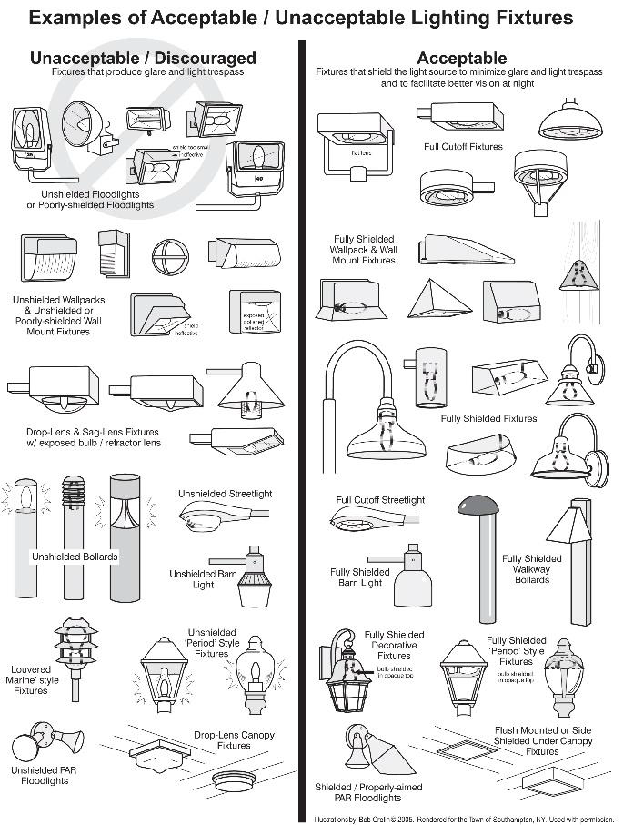
All nonexempt exterior lighting shall by hooded and/or louvered to provide a glare free area beyond the property line and beyond any public right-of-way.
B.
All lighting fixtures shall have one hundred (100) percent cut-off shielding that prevents light from being emitted above a horizontal plane the lowest direct light emitting part of the luminaire.
C.
Light sources shall be located as to minimize the hazards of glare, and all poles or standards used to support outdoor light fixtures shall be coated with a material that minimizes glare for the light source.
6.4.4. - Illumination.
Illumination levels within a site shall ensure that a site is adequately, but not excessively lit, in order to provide visibility, safety, and security without unnecessarily contributing to light pollution and negatively impacting neighboring properties.
A.
Intensity. The maximum intensity of light within any site shall not exceed the following standards, measured in foot-candles (fc) at grade:
Maximum Lighting Intensity
1.
Exceptions. Outdoor vehicle dealerships may permit a maximum lighting intensity of twenty (20) foot-candles for paved display areas. Fuel station canopy lights may permit a maximum lighting intensity of twenty (20) foot-candles under the canopy provided that all light fixtures shall be recessed into the structure. All other site lighting shall be in compliance with this ordinance.
B.
Color temperature. All exterior lighting shall emit light measuring three thousand five hundred (3,500) K or warmer (between zero (0) K and three thousand five hundred (3,500) K) on the Kelvin scale.
6.4.5. - Exterior lighting site standards.
A.
Hours of operation. All exterior lighting shall be equipped with automatic timing devices and shall be shut off between the hours of 10:00 pm and sunrise, except for lighting necessary for security purposes or for uses that continue after 10:00 pm.
B.
Pole height. The maximum pole height for exterior lighting shall not exceed twenty-seven (27) feet, or the maximum height of the principal building, whichever is less.
C.
Wall packs. Wall pack lighting shall be limited to above points of ingress and egress on side and rear facades for security purposes.
D.
Prohibitions. The following light sources and fixtures shall be prohibited:
1.
Unshielded luminous tube (neon), fluorescent or LED lighting used as accent lighting on facades.
2.
Metal halide.
3.
Mercury vapor.
4.
High pressure sodium.
5.
Halogen.
6.
Animated, flashing or moving lights.
7.
Laser sources of light.
8.
Search lights.
6.5.1. - Intent and purpose.
The intent of this section is to regulate the location, size, construction, and manner of display of signs and outdoor advertising in order to minimize their harmful effects on the public health, safety, welfare, and traffic safety. While this section recognizes that signs and outdoor advertising are necessary to promote commerce and public information, it also recognizes that the failure to regulate them may lead to poor identification of individual business, deterioration and blight of the business and residential areas of the city, conflicts between different types of land use, and reduction in traffic safety to pedestrians and motorists. To achieve its intended purpose, this section has the following objectives:
A.
To prevent the placement of signs in a manner that will conceal or obscure signs or adjacent businesses;
B.
To keep the number of signs and sign messages at the level reasonably necessary to identify a business and its products;
C.
To keep signs within a reasonable scale with respect to the buildings they identify;
D.
To reduce visual distractions and obstructions to motorists traveling along, entering or leaving streets;
E.
To promote a quality manner of display which enhances the character of the city;
F.
To prevent the proliferation of temporary signs which might promote visual blight; and
G.
Promote economic development by allowing a fair opportunity for each property owner to attractively display their message in a clean and clear way.
6.5.2. - General requirements.
A.
Permit required. Prior to the erection or structural alteration of sign, a sign permit shall be secured from the building official. Exceptions to the permit requirements of this subsection shall include:
1.
Address signs bearing only the property numbers, post box numbers, name of occupants, or other identification of the premises, limited to one per building entrance and two (2) square feet of area.
2.
Historical signs designated by the state or federal government, limited to ten (10) square feet per parcel.
3.
Government signs erected on behalf or pursuant to the authorization of a government body, including street signs, legal notices, informational signs, and regulatory signs.
B.
Design and condition. All signs and sign structures shall be properly maintained and kept in a good state of repair.
C.
Right-of-way. No sign shall be placed in the right-of-way except permitted awning, canopy and marquee signs with approval by the agency managing the right-of-way. Small temporary signs in the NMU and CC districts may be placed on the sidewalk during business hours in accordance with the provisions of this section, and provided the small temporary sign still allows four (4) feet of unobstructed sidewalk clearance.
D.
Traffic interference. No sign shall be erected or maintained which simulates or imitates in size, color, lettering, or design any traffic sign or signal or other word, phrase, symbol, or character in such manner as to interfere with, mislead, confuse or create a visual impediment or safety hazard to pedestrian or vehicular traffic.
E.
The standards in this section shall not be applicable to any sign not visible from a public right-of-way.
6.5.3. - Sign measurements.
A.
Surface area.
1.
Signs shall not exceed the maximum allowable area permitted in this section for sign type and district or use. When not limited to one sign of a specific type, the maximum area shall be determined by the cumulative total of all the signs of a specific type.
2.
The area of a sign shall mean the area of all lettering, wording, and accompanying designs, logos, and symbols. The area of a sign shall not include any supporting framework, bracing or trim which is incidental to the display, provided that it does not contain any lettering, wording, or symbols.
3.
Where the sign consists of individual letters, designs, or symbols attached to a building, awning, wall, or window, the area shall be that of the smallest rectangle which encompasses all of the letters, designs, and symbols.
4.
Signs that consist of, or have attached to them, one or more three-dimensional or irregularly-shaped objects, shall have a sign area of the sum of two (2) adjacent vertical sign faces of the smallest cube encompassing the sign or object.
5.
Only one face of a double-sided sign will be used to determine the area of the sign.
6.
For V-shaped signs, either horizontally or vertically oriented, with interior angles greater than ninety (90) degrees the sign area is the sum of both sign faces; otherwise, the area is the same as for double-sided signs.
B.
Height.
1.
Sign height shall be measured as the distance from the highest portion of the sign to the mean finished grade at the base of the sign.
2.
Clearance for projecting, awning, and canopy/marquee signs shall be measured as the smallest vertical distance between finished grade and the lowest point of the sign, including any framework or other structural elements.
3.
The permitted maximum height for all signs is determined by the sign type and the zoning district or use in which the sign is located.
6.5.4. - Illumination.
Internal and external illumination of signs shall be permitted for all signs except where limited or prohibited in this section, subject to the following:
A.
All illumination shall be concentrated on the area of the sign or landscape feature and directed or shielded so as to not interfere with the vision of persons on the adjacent streets or adjacent property.
B.
No sign shall be illuminated by other than electrical means or devices, and wiring shall be installed underground in accordance with the National Electrical Code.
C.
All illumination shall be limited to eight hundred (800) lumens and a color temperature measuring three thousand five hundred (3,500) K or warmer (between zero (0) K and three thousand five hundred (3,500) K) on the Kelvin scale.
D.
Internally illuminated signs shall have a dark background and light lettering.
E.
No sign shall include reflective materials.
6.5.5. - Freestanding signs.

A.
Definition. A sign supported by structures or supports that are placed on, or anchored in, the ground; and that is independent and detached from any building or other structure.
B.
Regulations.
1.
Freestanding ground signs shall be supported and permanently placed by embedding, anchoring, or connecting the sign in such a manner as to incorporate it into the landscape or architectural design scheme.
2.
No freestanding sign may occupy an area designated for parking, loading, walkways, driveways, fire lane, easement, cartway of the right-of-way or other areas required to remain unobstructed.
6.5.6. - Wall signs.
A.
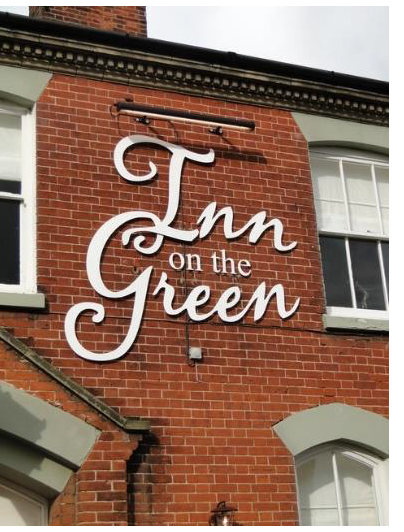
Definition. A building-mounted sign, which is either attached to, displayed on, or painted on an exterior wall in a manner parallel with the wall surface. A sign installed on a false or mansard roof is also considered a wall sign. Also known as a fascia sign, parallel wall sign, or band sign.
B.
Regulations.
1.
No portion of a wall sign shall extend out more than twelve (12) inches from the building wall on which it is affixed.
6.5.7. - Awning signs.

A.
Definition. A cloth, plastic, or other nonstructural covering that projects from a wall for the purpose of shielding a doorway or window. An awning is either permanently attached to a building or can be raised or retracted to a position against the building when not in use.
B.
Regulations.
1.
An awning without lettering or other advertising shall not be regulated as an awning sign.
2.
Awning signs shall only be allowed on the first floor.
3.
Awning signs must be centered within or over architectural elements such as windows or doors.
4.
Letters or numerals shall be located only on the front and side vertical faces of the awning.
5.
Logos or emblems are permitted on the top or angled portion of the awning up to a maximum of three (3) square feet. No more than one emblem or logo is permitted on any one awning.
6.
First floor awning signs shall be a minimum of eight (8) feet above the finished grade.
7.
Any ground-floor awning projecting into a street right-of-way must be retractable and shall not extend closer than six (6) feet from the curb line.
8.
Awnings above the ground floor may be fixed, provided they do not project more than four (4) feet from the face of the building.
6.5.8. - Canopy/marquee signs.

A.
Definition. A sign on a structure other than an awning made of fabric, metal, or other material that is either supported by columns or posts affixed to the ground and may also be connected to a building, or supported by and projecting from a building, and providing protection from the elements.
B.
Regulations.
1.
Signage shall only be allowed on the valance area of a canopy or marquee.
2.
Shall not extend closer than six (6) feet from the curb line. Any canopy or marquee sign projecting into the street right-of-way shall receive approval from the governing right-of-way agency prior to being issued a land use permit.
3.
Shall be a minimum of eight (8) feet above the finished grade.
6.5.9. - Projecting signs.

A.
Definition. A building-mounted, double-sided sign with the two (2) faces generally perpendicular to the building wall, not to include signs located on a canopy, awning, or marquee.
B.
Regulations.
1.
No portion of a projecting signs shall project more than four (4) feet from the face of the building.
2.
Projecting signs shall be a minimum of eight (8) feet above the finished grade.
3.
Illumination is prohibited.
4.
Projecting signs under an arcade, canopy or covered porch outside of the right-of-way shall not count towards the maximum square footage allowed.
6.5.10. - Window signs.

A.
Definition. Any sign that is applied, painted, or affixed to a window, or placed inside a window, within three (3) feet of the glass, facing the outside of the building, and easily seen from the outside. Customary displays of merchandise or objects and material without lettering behind a store window are not considered signs.
B.
Regulations.
1.
Illumination shall be prohibited except for neon signs in nonresidential zoning districts.
2.
Translucent or semi-transparent window signs shall be counted toward the total area limits.
6.5.11. - Electronic message signs.
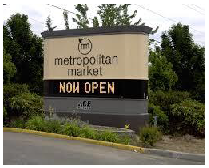
Electronic message signs are subject to the following regulations in addition to all other requirements established in this section:
A.
Definition. A sign capable of displaying words, symbols, figures or images that can be electronically or mechanically changed by remote or automatic means, including animated graphics and video.
B.
Regulations.
1.
Sign type. Electronic message signs are permitted in the form of freestanding and wall signs.
2.
Height. Electronic message signs shall have the same height limits as freestanding or wall signs for a given district or use.
3.
Area. Electronic message signs shall not exceed thirty (30) percent of the total sign area of a freestanding or wall sign for a given district or use.
4.
Maximum number. The maximum number of electronic message signs per parcel shall be limited to one. Electronic message signs occupying both sides of a free standing sign shall be counted as one electronic message sign.
5.
Message display.
a)
Electronic message signs that contain animation, streaming video, or text or images which flash, pulsate, move, or scroll is prohibited. Each complete message must fit on one screen.
b)
The content of an electronic message sign shall transition by changing instantly, with no transition graphics, such as fading in or out.
c)
Each message shall be of the same light intensity.
d)
All messages shall have a dark background with light message content.
e)
The message shall not change at an interval less than thirty (30) seconds.
f)
Electronic message signs shall contain a default design which shall freeze the sign message in one position if a malfunction should occur.
6.
The addition of an electronic message sign into an existing conforming sign shall require a land use permit. The addition of an electronic message sign into an existing nonconforming sign shall be prohibited.
6.5.12. - Small temporary signs.

A.
Definition. A type of non-permanent, sign that is located on private property that can be displayed for a limited duration of time and is not intended to be a permanent display.
B.
Regulations.
1.
Small temporary signs may be permitted in the right-of-way in the Downtown Commercial (DC) District subject to all applicable standards of this ordinance, but shall be removed at the close of business each day.
6.5.13. - Large temporary signs.
A.
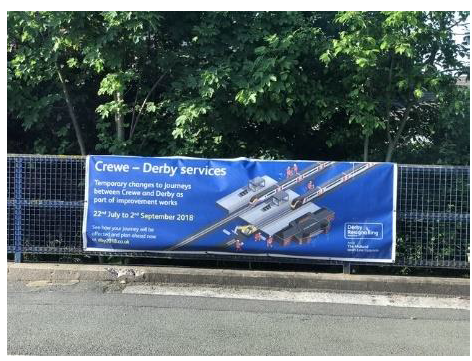
Definition. A type of non-permanent sign, permitted to be larger than a small temporary sign, that is located on private property that can be displayed for a limited duration of time and is not intended to be a permanent display.
B.
Regulations.
1.
Shall be located no closer to the side property line than the principal building.
2.
Large temporary signs may be displayed up to a maximum of thirty (30) consecutive days, two (2) times per year.
6.5.14. - Flags.

A.
Definition. Any sign printed or painted on cloth, plastic, canvas, or other like material with distinctive colors, patterns, or symbols attached to a pole or staff and anchored along only one edge or supported or anchored at only two (2) corners.
B.
Regulations.
1.
Each flag shall be limited in size to three (3) feet by five (5) feet.
2.
Poles shall be limited in height to thirty (30) feet.
6.5.15. - Billboards.

A.
Definition. An outdoor sign whose message directs attention to a specific business, product, service, event or activity, or other commercial or noncommercial activity, or contains a non-commercial message about something that is not sold, produced, manufactured, furnished, or conducted on the premises upon which the sign is located.
B.
Findings. The city has made the following determinations related to billboards:
1.
The placement of signs on lots or structures in the city that exceed the maximum permitted standards of this section for free-standing signs would result in visual pollution and obstructions of light and air for adjoining lots and uses.
2.
Billboard signs are not appropriate in areas zoned for residential uses because the intense nature of the display activity would be harmful to residential property values and incompatible with residential neighborhood quality of life.
3.
Billboard signs are not appropriate in the city's commercial districts because such signs would be out-of-scale with the structures and limited commercial character of the districts, incompatible with abutting residential uses, and harmful to the promotion of commerce in the districts.
4.
Unrestricted display of billboard signs along the arterial streets and thoroughfares in the city would create visual clutter, compete for the visual space of the right-of-way, and negatively impact commercial corridors.
C.
Regulations.
1.
Location. All billboards shall be:
a)
Limited to C, LI and GI districts.
b)
Located at least five hundred (500) feet from any residential or PSP zoning district.
2.
Spacing and setbacks. All billboards shall meet the following spacing and setback requirements:
a)
Setback at least one hundred (100) feet from any existing freestanding sign.
b)
Setback a minimum of fifty (50) feet from any property line.
c)
Setback at least five hundred (500) feet from any school, religious institution, hospital, cemetery or government building.
d)
Minimum spacing between billboards shall be one thousand four hundred (1,400) feet.
3.
Illumination. All illuminated billboards shall meet the following standards:
a)
Except billboards containing electronic message signs as regulated below, all billboards shall be externally illuminated with downward facing, shielded light fixtures.
b)
Billboard illumination shall be limited to a maximum of four thousand two hundred (4,200) candelas per meter squared beginning one hour after sunrise and continuing until one hour before sunset, and not greater than two hundred (200) candelas per meter squared all other times.
c)
Electronic message signs shall be permitted to occupy the entire allowable area of the billboard, but shall meet all the message display standards in section 6.5.4. Electronic message signs shall be prohibited from being incorporated into any nonconforming billboard.
6.5.16. - Permitted signs and standards.
The table below indicates the time, place and manner in which permitted sign types are allowed. All applicable standards of this ordinance shall be met unless provided otherwise.
Permitted Sign Types—Time, Place, and Manner
6.5.17. - Prohibited signs.
The following signs shall be prohibited in the city:
A.
No sign or banner shall be placed across any public right-of-way except by permission of the city.
B.
Signs incorporating any manner of flashing, strobe, or moving lights, with the exception of approved electronic message signs.
C.
Animated signs. A sign employing actual motion or the illusion of motion. Animated signs, which are differentiated from changeable signs as defined and regulated by this code, include the following types:
1.
Environmentally activated. Animated signs or devices motivated by wind, thermal changes, or other natural environmental input. Includes spinners, pinwheels, pennant strings, feather flags, and/or other devices or displays that respond to naturally occurring external motivation.
2.
Mechanically activated. Animated signs characterized by repetitive motion and/or rotation activated by a mechanical system powered by electric motors or other mechanically induced means.
3.
Flashing. Animated signs or animated portions of signs whose illumination is characterized by a repetitive cycle in which the period of illumination is either the same as or less than the period of non-illumination. For the purposes of this ordinance, flashing will not be defined as occurring if the cyclical period between on-off phases of illumination exceeds one hour. This prohibition shall not apply to permitted electronic message signs.
D.
Signs on park-type benches, trees or utility poles.
E.
Inflatable signs.
F.
Roof signs.
G.
Pole- or pylon-mounted signs.
H.
Portable and vehicle signs parked primarily for the purpose of attracting attention to the message contained within.
I.
Any sign unlawfully installed, erected or maintained.
J.
Signs that completely block the view of other signs.
K.
Any additional signage for a business that has an existing nonconforming sign.
L.
Signs that contain statements, words, or pictures of an obscene, indecent or immoral character such as will offend public morals or decency.
M.
Signs located on entry or exit doors, or fences.
6.5.18. - Nonconforming signs.
A legal nonconforming sign may be continued and shall be maintained in good condition, including replacement faces, but it shall not be:
A.
Expanded, altered or changed from a manual changeable letter sign to electronic changeable copy sign so as to increase the degree of nonconformity of the sign.
B.
Re-established after its discontinuance for two hundred seventy-five (275) days.
C.
Continued in use after cessation or change of the business or activity to which the sign pertains, unless the planning commission decides by a majority vote that:
1.
The existing sign has significant historical and aesthetic value which positively contributes to the character of the Ecorse community, by virtue of its design and construction.
2.
The existing sign will not cause undue confusion to motorists and patrons if co-located on the same site with the signage of the currently operating business.
D.
Re-established after damage or destruction if the estimated cost of reconstruction exceeds fifty (50) percent of the appraised replacement cost, as determined by the building official.
6.5.19. - Permit application and approval process.
A.
Application and approval. Application forms for a sign permit to erect, alter or move a sign shall contain or have attached thereto the following information at a minimum:
1.
Name, address, and telephone number of the applicant.
2.
Location of building, structure, or lot to which or upon which the sign or other advertising structure is to be attached or erected.
3.
If proposed to be attached to a building, its proposed location on the building.
4.
A sketch or scale drawing with dimensions of the sign, location on the lot, illumination source and method of construction and attachment to the building or placement in the ground.
5.
Name of person, firm, or corporation erecting the sign.
6.
Written consent of the owner of the building, structure, or lot to which or upon which the sign is to be erected.
7.
Other information as the building official shall require establishing compliance with this section.
8.
For temporary signs, the specific dates that the sign is to be displayed.
B.
It shall be the duty of the building official, upon the filing of an application for a sign permit, to examine the plans and specifications and other data and the premises upon which it is proposed to erect the sign. If the proposed sign meets all ordinance requirements, the building official shall issue the sign permit within fifteen (15) days of receipt of a fully completed application.
C.
Administrative decisions made by the building official, which relate to signs, may be appealed to the zoning board of appeals in accordance with the procedures of article 11 of this ordinance.
D.
Revocation and extensions of sign permits.
1.
Any sign or other advertising structure regulated by this ordinance which is unsafe or insecure, or is a menace to the public, or has been constructed or erected, or is otherwise not in compliance with this ordinance shall be a violation of this ordinance.
2.
If the work associated with a sign authorized under a sign permit is not completed within one year after the date of issuance, the permit shall become null and void. However, the building official may grant a three (3) month extension without payment of an additional fee if the extension is requested prior to the original sign permit becoming null and void.
6.5.20. - Removal of unsafe, unlawful or abandoned signs.
A.
Unsafe or unlawful signs.
1.
Upon written notice by [the] building official, the owner, person, or firm maintaining a sign shall remove the sign when it becomes unsafe, is in danger of falling, or it becomes so deteriorated that it no longer serves a useful purpose of communication, or it is determined by [the] building official to be a nuisance, or it is deemed unsafe by [the] building official, or it is unlawfully erected in violation of any of the provisions of this ordinance. The city may remove or cause to be removed the sign at the expense of the owner and/or lessee in the event of the owner of the person or firm maintaining the sign has not complied with the terms of the notice within thirty (30) days of the date of the notice. In the event of immediate danger, the city may remove the sign immediately upon the issuance of notice to the owner, person, or firm maintaining the sign.
B.
Abandoned signs.
1.
It shall be the responsibility of the owner of any property upon which an abandoned sign is located to remove such sign within one hundred eighty (180) days of the sign becoming abandoned as defined in this ordinance. Removal of an abandoned sign shall include the removal of the entire sign including the sign face, supporting structure, and structural trim.
2.
Where the owner of the property on which an abandoned sign is located fails to remove such sign in one hundred (180) days the city may remove such sign. Any expense directly incurred in the removal of such sign shall be charged to the owner of the property. Where the owner fails to pay, the city may file a lien upon the property for the purpose of recovering all reasonable costs associated with the removal of the sign.
C.
Abandoned businesses; removal of signs.
1.
The sign face, along with posts, columns, or supports of freestanding signs, shall be taken down and removed from the property. If a freestanding sign is in good condition and is conforming, the sign may remain, provided the sign face panels are replaced with attractive, neutral panels that are properly affixed to the sign structure as intended by the manufacturer.
2.
The sign face and supporting structures of projecting, roof or wall signs shall be taken down and removed from the property.
3.
The sign face of painted wall signs shall be removed by painting over the wall sign in such a manner as to completely cover up and hide from sight the sign in question.
4.
All window signs shall be cleaned from the glass.
D.
Removal required; exemption.
1.
In the event a business ceases operation for a period of time in excess of ninety (90) days, the sign owner or lessee, or the property owner, shall immediately remove any sign identifying or advertising said business or any product sold thereby; provided, however, this requirement shall not apply where, under the provisions of this chapter, an existing conforming sign may be altered to advertise a new business or product sold thereby, and there is evidence that a new business will be in operation on the premises within ninety (90) days.
E.
Notice to remove.
1.
Upon failure of the sign owner or lessee, or property owner, to comply with this section, the building director shall issue a written notice to the sign owner and any lessee and to the property owner, which notice shall state that such sign shall be removed within ten (10) days.
F.
Removal by city; costs.
1.
If the sign owner or lessee, or property owner, fails to comply with such written notice to remove, the building director is hereby authorized to cause removal of such sign, and any expense incidental to such removal shall be charged to the owner of the property upon which the sign is located and shall constitute a lien upon the property.
6.7.1. - Intent and purpose.
The shape, placement, mass, design, composition and quality of the built environment are important elements in reinforcing a comfortable, human-scale environment, maintaining the city's attractiveness and economic vitality, and providing a unique sense of place in the City of Ecorse. Accordingly, it is the purpose of this section to:
A.
Maintain the visual environment Jefferson Avenue corridor and surrounding properties, protect the general welfare, and ensure that the city's property values, appearance, character, and economic well-being are preserved through appropriate design and appearance standards.
B.
Encourage creativity, imagination, innovation, and variety in architectural design and building composition.
C.
Preserve the unique heritage, history, and architectural character of existing buildings in the city as these buildings are renovated and re-used, and as changes and improvements are made.
D.
Reinforce and support a healthy, pedestrian-oriented development pattern in the city's business districts through minimum facade transparency requirements, complementary and appropriate use of scale, massing, and architectural details.
E.
Establish standards for the use of exterior building facade materials for the purpose of promoting harmony in the physical relationships between buildings.
6.7.2. - Applicability.
A.
The standards in this section shall apply within the Corridor Core (CC) Zoning District.
B.
The provisions of the section shall apply to all planned buildings and all alterations, renovations, expansions or other work that includes exterior changes to existing buildings subject to site plan review per article 8.
C.
This section is not intended to supersede or supplant established building and fire code regulations, nor to regulate the quality, durability, maintenance, performance, load capacity, or fire resistance characteristics or workmanship of building materials.
6.7.3. - Dimensional standards.
Corridor Core (CC) District Dimensional Standards
6.7.4. - Architectural standards.
Building construction, alterations, renovations and expansions, and other work subject to the provisions of this section shall comply with the following general requirements:
A.
Roof designs. Flat and pitched roofs may be permitted subject to the standards below.
1.
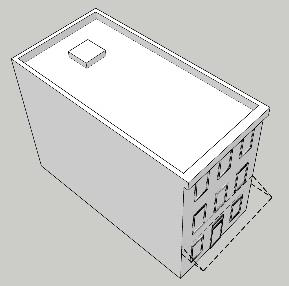
Flat roofs.
-
Flat roofs shall be enclosed on all sides by a parapet wall at a minimum height of forty-two (42) inches above the roof surface, or as required, to conceal rooftop mechanical equipment.
-
Parapet walls shall not be used in determining building height.
2.
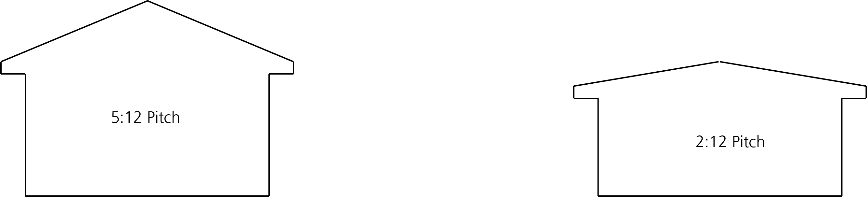
Pitched roofs.
-
Pitched roofs shall be symmetrically sloped at a pitch no less than 5:12.
-
Roofs for porches and attached sheds may be pitched no less than 2:12.
-
Pitched roof materials shall be limited to slate, terra cotta, cedar shingles, standing seam panels, or dimensional asphalt shingles.
-
Dimensional asphalt shingle colors shall be limited to dark green, dark red, and dark gray.
B.
Facades. Decorative and functional architectural features, details and ornamentation (such as arches, colonnades, columns, pilasters, detailed trim, brick bands, contrasting courses of material, cornices or porches) shall be incorporated into all building facades at a scale appropriate to the size and bulk of the building, as determined by the planning commission.
1.
Façade materials, colors and textures.
-
Exterior finish materials on all facades shall be limited to brick, cut stone, wood siding, cementitious siding or shingles, and/or Portland Cement stucco.
-
Vinyl siding and E.I.F.S or other synthetic stucco or rusticated elements shall be prohibited.
-
Fine and smooth textured surfaces shall be required when using materials such as pre-cast concrete, textured block, or stucco for exterior cladding.
-
Façade materials may be combined on each façade only horizontally (one above the other, not side-by-side), with the heavier material below the lighter material.
-
The natural color of primary façade materials such as stone or brick shall dominate the majority of the façade surface as its base color.
-
Accent colors shall be permitted on architectural elements such as pilasters, horizontal bands/expression lines, cornices, and window frames to compliment the base color and allow for color variety.
2.
Façade composition.
-
Flat roof buildings shall have a front façade composed of three (3) distinct parts, a base, a shaft, and a capital, similar to a column.
º
The base may be minimally achieved through a storefront of facade design, materials and colors below the expression line from that of the rest of the façade.
º
The shaft would be the consistent façade design, materials, and colors between the base and the capital.
º
The capital may be achieved through a cornice line, cap or crown at the top of the front façade.
3.
Façade variation.
-
Front façades sixty (60) feet wide or wider shall incorporate wall offsets of at least two (2) feet in depth (projections or recesses) a minimum of every twenty (20) feet. Such features and design elements may include, but are not limited to the following (see illustration):
º
Projections, bays or recesses, not exceeding ten (10) feet in depth.
º
Enhanced ornamentation and architectural detailing.
º
Variations in building height or window patterns.
º
Distinctively shaped roof forms, detailed parapets, and cornice lines.
4.
Rear and side facades.
-
Where a side or rear facade is visible from a public street, or if parking is located at the side or rear of a building, the facade shall include windows, building materials, and architectural features similar to those present on the front facade of the building.
C.
Public entrances and wall openings. Public entrances shall be emphasized with framing devices such as peaked roof forms, porches, overhangs, archways, larger door openings, display windows, accent colors, tile, moldings, pedestrian-scale lighting, and similar devices.
1.
Location.
-
All buildings shall have at least one public entrance that faces a public street right-of-way. Secondary public entrances shall be permitted on the rear or side facade, including additional access for uses in a multi-tenant building.
2.
Setback.
-
Front entrances shall be recessed a minimum of three (3) feet six (6) inches from the property line to facilitate a door zone that does not conflict with users along the right-of-way.
3.
Non-traditional entrances.
-
Roll top garage doors and cantilever folding doors may be used to create open storefronts or secondary entrances into quasi-public spaces such as outdoor dining areas.
-
Such entrances shall be a minimum of sixty (60) percent transparent. The transparent element on such doors may be used to satisfy the first floor transparency requirements.
4.
Wall openings.
-
All wall openings, including porches, galleries, arcades, and windows (with exception of ground floor store fronts), shall be square or vertical in proportion.
-
Excluding storefronts at grade, wall openings shall be punched through an opaque façade and not exceed fifty (50) percent of the total building wall area, with each façade being calculated separately.
D.
Windows and transparency. Buildings with frontage on a public or private right-of-way, street, sidewalk, public park, or plaza shall be designed to encourage and complement a pedestrian-scale environment, with window openings and facade transparency subject to the following:
1.
In general.
-
All window glass shall have a minimum transparency of eighty (80) percent.
-
All windows, including street level storefront windows, shall be recessed between four (4) and eight (8) inches to provide a shadow line and accentuate exterior wall thickness and, correspondingly, employ exterior wall thickness sufficient enough to do so.
-
Windows shall be prohibited on side facades unless the building is set back a minimum of five (5) feet from the property line, or the street facing side façade on a corner lot.
-
Windows shall be arranged into proportionally spaced horizontal window lines, and establish a balanced pattern of vertical or square window bays.
-
Windows other than those along the storefront on masonry construction buildings shall include:
º
A concrete or stone header, or brick soldier course at a minimum height of eight (8) inches.
º
A concrete, stone, or brick sill at a minimum height of four (4) inches that extends beyond the width of the window a minimum of one inch on each side.
-
Window other than those along the storefront on non-masonry construction buildings shall include:
º
A minimum five and one-half (5½) inch tall top casing with a minimum one and one-sixteenth (1 1/16 ) thick drip cap or crown.
º
A minimum three and one-half (3½) inch wide trim and casing width on either side of the window.
º
A minimum one and one-half (1½) inch thick window sill.
2.
Street level façade.
-
A minimum of sixty (60) percent ground floor front facades shall be composed of glass between two (2) and ten (10) feet above finished grade.
-
A minimum of eighty (80) of the ground floor front façade windows shall be maintained as free from visual obstructions such as signs, logos, advertisements, window screens, blinds or window coverings.
-
Ground floor storefront window frames shall be set between fifteen (15) and thirty (30) inches above finished grade to provide durability and to accommodate traditional main street building features such as base panels, sills, and display windows.
3.
Upper level façade.
-
A minimum of forty (40) percent of the upper level front facades and street facing side facades on corner lots shall be composed of glass.
-
All upper level windows shall be operable and capable of being opened, or shaded with a canopy or awning if not operable.
E.
Awnings. Awnings shall be allowed subject to the following standards:
1.
Purpose.
-
Awnings shall be primarily designed to protect pedestrians, display windows, and public entrances from the weather; and to add color and visual interest to the street level façade. The use of awnings along blank walls shall be prohibited, except approved retractable awnings designed to cover outdoor seating and/or dining areas.
2.
Maintenance.
-
Awnings shall be kept in good repair to maintain the original appearance and ensure public safety.
3.
Materials.
-
The awning shall be constructed of durable materials such as canvas, metal, or glass. The use of plastic panels, rigid fiberglass or other similar materials as covering materials shall be prohibited.
4.
Design.
-
Awnings shall be of a shed, concave or A-frame design style. All other awning design or shape styles shall be prohibited.
-
Internally illuminated awning shall be prohibited.

5.
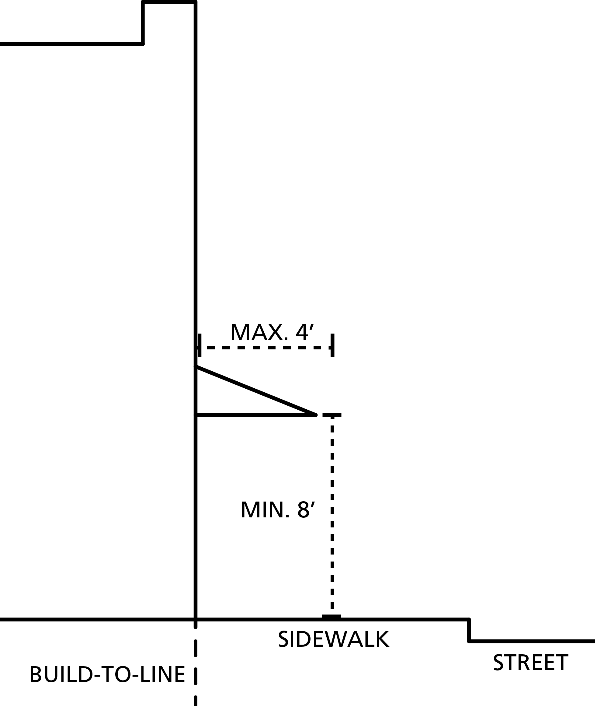
Projections and clearance.
-
Awnings shall maintain a minimum clearance of eight (8) feet above finished grade.
-
Permanent awnings shall not project more than four (4) feet from the façade of the building.
-
Retractable awnings may extend farther than four (4) feet from the façade of the building on the ground floor if approved by the building official.
-
Awnings proposed to project or overhang into a public right-of-way shall be subject to applicable road agency approval prior to installation.
F.
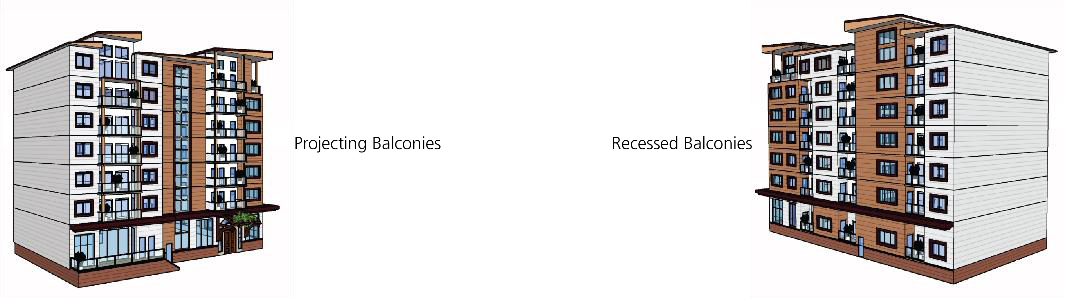
Balconies. Balconies may be recessed or projecting, shall be made of painted wood or decorative iron or steel, and allowed on upper level facades subject to the standards below:
1.
Front facade.
-
Front façade balconies shall be limited to recessed-style balconies.
2.
Side façade, interior lot.
-
Projecting balconies shall be allowed on the side façade of interior lots but shall be set back a minimum of five (5) feet from the side property line.
-
Recessed balconies shall be allowed on the side façade of interior lots if the building is setback a minimum of five (5) feet from the side property line.
3.
Side façade, corner lot (street side).
-
The side façade opposite of the street side shall be subject to the standards applicable to balconies on the side façade of interior lots above.
-
Projecting balconies shall not extend more than four (4) feet into the public right-of-way.
-
Balconies proposed to project into a public right-of-way shall be subject to applicable road agency approval prior to installation.
4.
Rear façade.
-
Balconies on the rear façade shall not project into a public right-of-way.
-
Projecting balconies shall be a minimum of ten (10) feet from the rear property line.
-
Buildings utilizing recessed balconies shall be a minimum of ten (10) feet.
G.
Expression line.
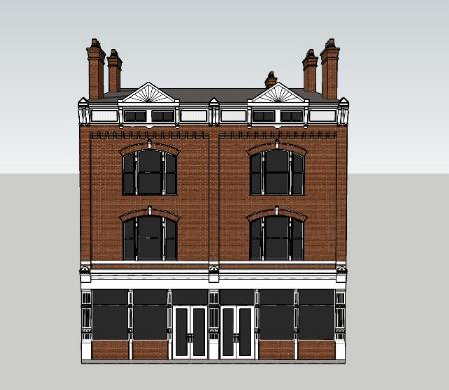
-
The street level facade of any building shall be distinguished from the remainder of the building with a horizontal expression line on the façade located between the highest point of the street level and the bottom edge of any second floor windows.
-
The expression line shall be incorporated into the façade as a permanent design element and shall be created by a change in building material, architectural design, setback, recess, projection, cornices, belt courses, corbelling, molding, stringcourses or other sculptured design element.
H.
Security and safety equipment.
-
Exterior security gates or roll-down security doors shall be prohibited. Link or grill type security devices shall be permitted only if installed on the interior of the building, within the window or door frames. Such security equipment shall be recessed and completely concealed during regular business hours, and shall be predominantly transparent to allow maximum visibility of the interior. Fire escapes shall not be permitted on a building's front facade, except where the village building official determines that no other option is available to provide the required means of egress.
6.7.5. - Façade preservation.
Significant architectural details on existing buildings shall not be destroyed or obscured during façade renovations, which shall be further subject to the following:
A.
The pattern and proportions of existing window and door openings, vertical lines of columns and piers, and horizontal lines of spandrels, cornices, and other primary structural elements shall be maintained.
B.
Only that portion of an existing building proposed to be altered shall be subject to the standards of this section, provided that the planning commission shall consider the proposed alteration within the context of the overall building architecture, the character of adjacent buildings, and the purpose of this section.
C.
Expansions and renovations. The planning commission may approve the continuation of existing wall materials for an expansion or renovation of an existing building, provided that the overall design and architectural character of the expansion is consistent with the existing building and the purpose of this section.
6.7.6. - Alternative designs or materials.
To encourage creativity, imagination, innovation, and variety in architectural design, the planning commission may waive or modify the requirements of this section upon determining that the proposed architectural design or exterior façade material meets all of the following conditions:
A.
The proposed design or material is consistent with the purposes of this section.
B.
The proposed design or material would enhance the character of the building, and would be equal or superior to designs or materials permitted by this section.
C.
The proposed design or material would be in harmony with the character of adjacent buildings and the surrounding district.

