
Ecorse City Zoning Code
ARTICLE 14
- DEFINITIONS
14.1.- Rules of construction.
For the purposes of this ordinance, certain terms, or words used herein shall be interpreted as follows:
A.
The particular shall control the general.
B.
All words used in the present tense shall include the future.
C.
All words in the singular number include the plural number and all words in the plural number include the singular number, unless the context clearly indicates the contrary.
D.
The word "shall" is always mandatory and not discretionary and the word "may" is permissive.
E.
The masculine gender includes the feminine and neuter.
F.
All measurements shall be to the nearest integer, unless otherwise specified herein.
G.
The words "used" or "occupied" includes the words "intended," "designed," "arranged to be used or occupied" and "maintained."
H.
The word "building" includes the word "structure." The word "structure" includes the word "building." A "building" or "structure" includes any part thereof. The word "dwelling" includes "residence." The word "build" includes the words "erect" and "construct."
I.
The word "person" includes "corporation," "copartnership," "partnership," "association," "incorporated association," "individual," or any similar entity.
J.
Whenever a word or term defined hereafter appears in the text of the zoning regulations, its meaning shall be construed as defined herein. Words or terms not herein defined shall have the meaning customarily assigned to them.
K.
Unless the context clearly indicates the contrary, where a regulation involves two (2) or more items, conditions, provisions, or events connected by the conjunction "and," "or," or "either/or" the conjunction shall be interpreted as follows:
L.
"And" indicates that all the connected items, conditions, provisions, or events shall apply.
M.
"Or" indicates that the connected items, conditions, provisions or events may apply singly or in any combination.
N.
"Either/or" indicates that the connected items, conditions, provisions or events shall apply singly but not in combination.
O.
Unless the context clearly indicates to the contrary, where an illustration accompanies any item within this ordinance, the written text shall have precedence over said illustrations.
P.
The intent, when spelled out in a section, dictates the meaning of any regulation.
14.2. - Definitions.
Whenever used in this ordinance, the following words and phrases shall have the meaning ascribed to them in this section:
14.2.1. - "A" terms.
Accessory building or structure: A building or structure, that is clearly incidental to, customarily found in connection with, subordinate to, and is located on the same zoning lot as the principal building and/or structure to which it is exclusively related.
Accessory dwelling unit: See Dwelling unit, accessory.
Accessory use: A use that is clearly incidental to, customarily found in connection with, subordinate to, and is located on the same zoning lot as the principal use to which it is exclusively related.
Adult day care facility: A facility, other than a private residence, receiving at least three (3) but not more than twelve (12) adults to be provided with care for periods of less than twenty-four (24) hours a day.
Adult day care home: A private residence receiving fewer than six (6) adults or more adults to be provided with care for periods of less than twenty-four (24) hours a day.
Adult foster care congregate facility: An adult foster care facility with the approved capacity to receive more than twenty (20) adults to be provided with foster care.
Adult foster care facility: A home or facility that provides foster care to adults. Subject to the limitations of the Adult Foster Care Facility Licensing Act, Michigan Public Act 218 of 1979, as amended.
Adult foster care family home: A private residence with the approved capacity to receive at least three (3) but not more than six (6) adults to be provided with foster care. The adult foster care family home licensee must be a member of the household and an occupant of the residence.
Adult foster care large group home: An adult foster care facility with the approved capacity to receive at least thirteen (13) but not more than twenty (20) adults to be provided with foster care.
Adult foster care small group home: An adult foster care facility with the approved capacity to receive at least three (3) but not more than twelve (12) adults to be provided with foster care.
Alley: Any dedicated public vehicular or pedestrian way affording a secondary means of access between or behind buildings, that affords a secondary means of access to abutting property, and not intended for general traffic circulation.
Alterations: Any change, addition, or modification in construction to a structure or type of occupancy, or in the structural members of a building, such as walls or partitions, columns, beams or girders, the completed act of which may be referred to herein as "altered" or "reconstructed."
Amusement park: A commercially operated park with a predominance of outdoor games and activities for entertainment, including motorized rides, water slides, miniature golf, batting cages, and the like.
Apartment: A room or suite of rooms in a multiple family building, in which each suite is arranged, intended, and designed to be occupied as a residence of a single-family or individual, and which has only one complete kitchen and at least one complete bathroom.
Apartment, studio: An efficiency unit is a type of multiple-family or apartment dwelling unit consisting of one principal room, plus bathroom and kitchen facilities, hallways, closets, and/or a dining alcove located directly off the principal room.
Architectural features: The components of construction, either permanent or temporary, that are an integrated part of a structure or attached to a structure and constitute a portion of the exterior design, including, but not limited to: arches, transoms, windows, moldings, columns, capitals, dentils, lintels, parapets, pilasters, sills, cornices, cupolas, awnings, and canopies.
Assembly facility: A meeting place at which the public or membership groups are assembled regularly or occasionally, indoors or outdoors as a principal or accessory use, including but not limited to schools, churches, theaters, auditoriums, funeral homes, stadiums, lecture halls, lodge rooms, conference rooms, convention centers, dining halls, and similar places of assembly.
Assisted living facility: A structure providing housing and limited services such as nursing, recreation, and meals to individuals who are partially able to provide services to themselves.
Attached wireless telecommunication facility—Antennae: Any wireless telecommunication facility affixed to an existing structure, such as a building, tower, water tank, utility pole, etc., utilized to receive and transmit federally or state licensed telecommunications services via duly licensed segments of the radio frequency spectrum. This definition shall not include support structures.
Attic: The area located between the ceiling of the highest habitable floor and the roof of the structure.
Automobile: Every vehicle that is self-propelled.
Automobile major repair: General repair, rebuilding, or reconditioning of engines, motor vehicles, or trailers; collision service, including body frame or fender straightening or repair; overall painting or paint shop; vehicle steam cleaning and oil change. Automotive major repair also includes an establishment that provides for the removal and temporary storage (less than seven (7) days) of vehicles, but does not include the disposal, permanent disassembly, or salvage, or the accessory storage of motor and/or recreational vehicles.
Automobile minor repair: The replacement of any part or repair of any part that does not require removal of the engine head or pan, engine transmission or differential; incidental body and fender work, minor painting and upholstering service. Above stated is applied to passenger automobiles and trucks not in excess of seven thousand (7,000) pounds gross weight.
Automobile sales and rentals: Storage and display for sale of more than two (2) motor vehicles or any type of trailer provided the trailer is unoccupied, and where repair or body work is incidental to the operation of the new or used vehicle sales. Motor vehicles sales includes motor vehicle retail or wholesale sales.
Automobile service station: Any place where motor vehicle fuel is sold and dispensed as either a principal or incidental activity or where car washing services are sold. Where the sale and dispensing of vehicle fuel is the principal activity, accessory activities may include the retail sale of lubricants, tires, batteries, motor vehicle accessories and supplies, including minor installation services or repairs customarily incidental thereto, and sale of convenience goods, food and beverages.
14.2.2. - "B" terms.
Bar: See Drinking establishment.
Basement: That portion of a building below the first or ground-floor level and having less than four (4) feet of clearance from its ceiling to the average finished grade of the building perimeter. A basement shall not be considered a story for the purposes of determining building height. A basement shall not be counted as a story. This definition shall include a cellar that may be below grade with an entrance separate from the principal building.
Bedroom: A room designed or used in whole or part for sleeping purposes and has a closet and window.
Berm: An earthen mound designed to provide visual interest on a site, screen undesirable views, reduce noise, or fulfill other such purposes.
Board of zoning appeals: See Zoning board of appeals.
Boarding house or rooming house: A building, other than a hotel, where for compensation or by pre-arrangement for definite periods of time, lodging or lodging and meals are provided for three (3) or more persons. A rooming house shall be deemed a boarding house for the purposes of these zoning regulations.
Boat launch: Facility to launch and retrieve recreational boats from a trailer. Some are limited to hand launching of canoes. Most ramps have breakwater protection from large waves, parking lots, a courtesy dock to assist in launching, toilets, refuse containers, lighting, and telephones.
Brewery: A state-licensed facility or facilities that manufactures beer and is owned or controlled by a state-licensed brewer, as defined and regulated by the Michigan Liquor Control Commission.
Building: A structure enclosed within exterior walls, built, erected and framed of a combination of materials, whether portable or fixed, having a roof, to form a structure for the shelter of persons, animals, or property.
Building, accessory: See Accessory building, or structure.
Building, principal (main): A building or, where the context so indicates, a group of buildings that are permanently affixed to the land and that are built, used, designed or intended for the shelter or enclosure of the principal use of the parcel.
Building, temporary: A building that is not of a permanent construction that is not affixed to the property, and is permitted to exist for a specific reason for a specific time.
Building envelope: The area of a lot that is defined by the minimum setback requirements within which building construction is permitted by the terms of this ordinance.
Building height, feet: The vertical distance measured from the average finished grade at the building wall to the highest measurable point on a building based on roof design and defines in section 3.3.
Building height, stories: The vertical distance measured as the number of individual floors in a building that can be occupied. Stories does not include basements or unfinished attics as defined in this ordinance, permitted rooftop patios, or architectural features such as cupulas, steeple, etc.
Building inspector: The city official(s) designated by the city council to administer and enforce the building codes of the city.
Building line: A line parallel to the front lot line at the minimum required front setback line.
Build-to-line: An alignment established a certain distance from the curb line to a line along which the building shall be built. Front porches and handicap ramps shall be exempt from build-to line requirements, and must occur behind the property line.
Bungalow court: Three (3) or more detached one-family or two-family structures with separate ground floor entrances arranged around a common court that opens onto a street.
Business services: An establishment providing services to business establishments on a fee or contract basis, including but not limited to advertising services, business equipment and furniture sales or rental, or protective services. This term includes but is not limited to an employment agency, photocopy center, commercial photography studio, or mailing service. This term does not include maintenance, repair and office uses such as accounting, advertising, architectural design, city planning, environmental analysis, insurance, interior design, investment, landscape design, law, management consulting, title research, and real estate.
14.2.3. - "C" terms.
Cellar: See Basement.
Cemetery: Land used for the burial of the dead, including a columbarium, crematorium, and/or mausoleum.
Central cleaning facility: A facility where textile materials, including but not limited to clothing and rugs, are dropped off directly by the customer or gathered at satellite locations for cleaning and future delivery or pick up.
Change of occupancy: A discontinuance of an existing use and the substitution therefor of a use of a different kind or class. Change of occupancy is not intended to include a change of tenants or proprietors unless accompanied by a change in the type of use.
Child care center: A facility, other than a private residence, receiving one or more children under thirteen (13) years of age for care for periods of less than twenty-four (24) hours a day, where the parents or guardians are not immediately available to the child. Child care center incudes a facility that provides care for not less than two (2) consecutive weeks, regardless of the number of hours of care per day. The facility is generally described as a child care center, day care center, day nursery, nursery school, parent cooperative preschool, play group, before- or after-school program, or drop-in center. Child care center does not include those uses excluded under "Child Care Center" in the Child Care Organization Act (1973 PA 116, MCL 722.111(1)(h)).
Church: See Religious institution.
City council: The city council of the City of Ecorse, Wayne County, Michigan.
City planner: The city planner is the person or firm designated by the city council and planning commission to advise the city council, planning commission, and city staff on planning, zoning, land use, housing, and other related planning and development issues. The city planner may be a consultant or an employee of the city.
Clinic, medical or dental: An establishment for examination and treatment of human patients who are treated by a group of physicians, dentists or similar professionals on the site and the patients are not lodged overnight. A medical clinic may incorporate customary laboratories and pharmacies incidental to or necessary for its operation or the service of its patients, but may not include facilities for overnight patient care or major surgery.
Club or fraternal organization: A group of persons organized for the purposes of participating in and/or for the promulgation of sports, arts, sciences, literature, politics, or the like, but not operated for profit or to espouse beliefs or further activity that is not in conformance with the Constitution of the United States or any laws or ordinances. The facilities owned or used by such organization may be referred to as a "club" in this ordinance.
College: A post-secondary educational institution for higher learning that grants associate or bachelor's degrees and may also have research facilities and/or professional schools that grant master and doctoral degrees. This may also include community colleges that grant associate or bachelor's degrees or certificates of completion in business or technical fields.
Collocate: To install, mount, maintain, modify, operate, or replace wireless facilities on or adjacent to a wireless support structure or utility pole. Collocate does not include make-ready work or the installation of a new utility pole or new wireless support structure.
Commercial entertainment, indoors: Predominantly spectator uses conducted within an enclosed building. Typical uses include motion picture theaters and concert or music halls.
Commercial entertainment, outdoors: Predominantly spectator uses conducted in open or partially enclosed or screened facilities. Typical uses include sports arenas, motor vehicle or animal racing facilities, and outdoor amusement parks.
Commercial use: The use of property for retail sales or similar businesses where goods or services are provided directly to the consumer. As used in these regulations, "commercial use" shall not include industrial, manufacturing, or wholesale businesses.
Commercial vehicle: Any motorized vehicle that requires a registration plate with the secretary of state motor vehicle division that either:
1.
Bears signage advertising a business, service or product;
2.
Has, in public view or outside of the confines of the vehicle, tools, equipment, supplies or any materials used in a commercial enterprise;
3.
Exceeds the size of a standard full size pickup truck or van;
4.
Construction and/or service equipment.
5.
By virtue of any equipment, such as ladders, roof shingling or tarring equipment, grass cutting equipment, snow plows, or other equipment attached to the vehicle or exposed within any exterior bed of the vehicle, would appear to an ordinarily observant person to be for use in carrying on a trade or business.
Commercial zoning districts: A zoning district primarily established for commercial land uses. Commercial zoning districts shall include those zoned NMU, CC and C.
Comprehensive development plan: See Master plan.
Condominium: A condominium is a system of separate ownership of individual units in multi-unit projects according to Public Act 59 of 1978, as amended. In addition to the interest acquired in a particular unit, each unit owner is also a tenant in common in the underlying fee interest and in the spaces and building parts used in common by all the unit owners. For the purposes of this ordinance, condominium terms shall be defined as follows:
1.
Condominium Act: Shall mean Michigan Public Act 59 of 1978, as amended.
2.
Condominium lot: That portion of the land area of a site condominium project designed and intended to function similar to a platted subdivision lot for purposes of determining minimum yard setback requirements and other requirements set forth in the schedule of dimensional requirements of this ordinance.
3.
Condominium subdivision plan: Drawings and information that show the size, location, area, and boundaries of each condominium unit, building locations, the nature, location, and approximate size of common elements, and other information required by section 66 of [the] Condominium [Act], as amended.
4.
Condominium unit: That portion of the condominium project designed and intended for separate ownership and use, as described in the master deed for the condominium project.
5.
Common elements: Portions of the condominium project other than the condominium units.
6.
Contractible condominium: A condominium project from which any portion of the submitted land or buildings may be withdrawn pursuant to provisions in the condominium documents and in accordance with this ordinance and the Condominium Act.
7.
Conversion condominium: A condominium project containing condominium units some or all of which were occupied before the establishment of the condominium project.
8.
Convertible area: A unit or a portion of the common elements of the condominium project referred to in the condominium documents within which additional condominium units or general or limited common elements may be created pursuant to provisions in the condominium documents and in accordance with this ordinance and the Condominium Act.
9.
Expandable condominium: A condominium project to which additional land may be added pursuant to express provision in the condominium documents and in accordance with this ordinance and the Condominium Act.
10.
General common elements: Common elements other than the limited common elements, intended for the common use of all co-owners.
11.
Limited common elements: Portions of the common elements reserved in the master deed for the exclusive use of less than all co-owners.
12.
Master deed: The condominium document recording the condominium project to which are attached as exhibits and incorporated by reference the by-laws for the project and the condominium subdivision plan.
13.
Site condominium project: A condominium project designed to function in a similar manner, or as an alternative to a platted subdivision. A residential site condominium project shall be considered as equivalent to a platted subdivision for purposes of regulation in this ordinance.
Contractor establishments: Establishments primarily engaged in retailing new building material, and home and garden equipment and supplies from a fixed point-of-sale location. May include display equipment designed to handle lumber and related products and garden equipment and supplies kept either indoors or outdoors under covered areas. The staff is usually highly knowledgeable in the use of the specific products being retailed in the construction, repair, maintenance and improvement of the home and associated grounds.
Contractor storage yard: A site on which is stored equipment, tools, vehicles, building materials, and other appurtenances used in or associated with building or construction trades. A contractor's yard may include outdoor or indoor storage, or a combination of both.
Convalescent home: See Nursing home.
Cottage court: See Bungalow court.
Court: An open, uncovered, unoccupied space, other than a yard, partially or wholly surrounded on at least two (2) sides by building walls. A court having at least one side open to a street, alley, yard, or other permanent open space is an outer court. Any other court is an inner court.
Cultural center: A use providing for display, performance, or enjoyment of heritage, history, or the arts. This use includes but is not limited to museums, arts performance venues, cultural centers, or interpretive sites, but does not include commercially-operated theatres.
Curb cut: The entrance to or exit from a property provided for vehicular traffic to or from a public or private thoroughfare.
14.2.4. - "D" terms.
Data processing facility: An establishment primarily involved in the compiling, storage, and maintenance of documents, records, and other types of information in digital form utilizing a mainframe computer. This term does not include general business offices, computer-related sales establishments, and business or personal services.
Deck: A platform that is typically attached to a house and used for outdoor leisure activities.
Density: The number of dwelling units allowed per acre of land.
1.
Gross density: The number of units per acre of total land being developed.
2.
Net density: The number of units per acre of land devoted to residential use.
Detention basin: A man-made or natural water collector facility designed to collect surface water in order to impede its flow and to release the water gradually at a rate not greater than that prior to the development of the property, onto natural or man-made outlets. Also referred to as a retention basin.
Development: The construction of a new building reconstruction of an existing building, or improvement of a structure on a parcel or lot, the relocation of an existing building to another lot, or the improvement of open land for a new use.
Distillery: A state-licensed facility or facilities that manufactures spirits and is owned or controlled by a state-licensed distiller, as defined and regulated by the Michigan Liquor Control Commission.
Distribution center: A use that typically involves both warehouse and office/administration functions, where short and/or long term storage takes place in connection with the distribution operations of a wholesale or retail supply business.
Drinking establishments: A commercial enterprise whose primary activity is the sale of alcoholic beverages to be consumed on the premises. Drinking establishments include bars, taverns, night clubs, private clubs, bottle clubs, and similar facilities serving alcoholic liquor. Drinking establishments may also include the incidental sale of prepared food and live performances.
Drive-in: A business establishment so developed that its retail or service character is dependent on providing a driveway approach or parking spaces for motor vehicles so as to serve patrons while in the motor vehicle rather than within a building or structure.
Drive-through: A business establishment whose method of operation involves the delivery of a product or service directly to a customer inside a motor vehicle, typically through a window or other appurtenance to a building.
Driveway: A passageway of definite width designed primarily for use by motor vehicles over private property, leading from a street or other public way to a garage or parking area. A horseshoe shape drive or a "T" shaped drive located within a front yard is included within this definition.
Duplex: A building designed as a single structure, containing two (2) separate dwelling units, each of which is designed to be occupied as a separate permanent residence for one family.
Dwelling: Any building, or part thereof: containing sleeping, kitchen and bathroom facilities designed for and occupied by an individual or one family. In no case shall a travel trailer, motor home, automobile, tent or other portable building not defined as a recreational vehicle be considered a dwelling. In the case of mixed occupancy where a building is occupied in part as a dwelling unit, the part so occupied shall be deemed a dwelling unit for the purposes of this ordinance.
Dwelling, multiple-family: A building designed for and occupied by two (2) or more families living independently in separate dwelling units.
Dwelling, one-family or single-family: An independent, detached residential dwelling designed for and used or held ready for use by one family only.
Dwelling unit: One or more rooms, along with bathroom and kitchen facilities, designed as a self-contained unit for occupancy by an individual or one family for living, bathing, cooking, and sleeping purposes.
Dwelling unit, accessory: A dwelling unit that is accessory to and typically contained within a conventional single-family dwelling and is occupied either by an individual or family as their permanent residence.
14.2.5. - "E" terms.
Easement: A right-of-way granted, but not dedicated, for limited use of private land for a public or quasi-public purpose and within which the owner of the property shall not erect any permanent structures.
Eatery establishments: See Restaurants.
Educational institutions: Use of land or a building or buildings as or for an institution not for profit but for the establishment and maintenance of a public or private college, secondary or elementary school or other educational institution for the academic instruction and cultivation of the mind and/or the inculcation of a clearer sense of moral and spiritual values. This does not include an institution or organization directed primarily to the physical training or development of physical or manipulative skills, or for-profit schools.
Efficiency unit: See Apartment, studio.
Elementary school: A primary educational institution that serves students in grades kindergarten, first, second, third, fourth, fifth, or sixth, and may include a pre-school or pre-kindergarten program.
Energy generation facility: Any energy system, including supply elements, furnaces, burners, tanks, boilers, related controls, and energy-distribution components, which uses any source of energy other than solar or windmills. These sources include but are not limited to gas, oil, coal, and nuclear materials.
Enforcement official: The enforcement official is the person or persons with the responsibility for enforcing and administering requirements of applicable sections of these zoning regulations. The enforcement official may be referred to as the building official, building official, or other appropriate party so designated by the city council. Such titles do not refer to a specific individual, but generally to the office, department, or city official(s) most commonly associated with the administration of the regulation being referenced.
Engineer, city: The person or firm authorized by the city to advise the city administrator, city council, and planning commission on drainage, grading, paving, storm water management and control, utilities, and other related site engineering and civil engineering issues. The city engineer may be a consultant or an employee of the city.
Equipment rental establishments: An establishment providing the rental of tools, lawn and garden equipment, construction equipment, party supplies and similar goods and equipment, including storage and incidental maintenance.
Erected: Built, constructed, altered, reconstructed, moved upon, or any physical operations on the premises that are required for construction, excavation, fill, drainage, and the like, shall be considered a part of erection.
Excavation: The removal or movement of soil, sand, stone, gravel, or fill dirt on or from any parcel except common household gardening, farming and general ground care.
Extractive industry: The extraction of minerals, including solids, such as coal and ores; liquids, such as crude petroleum; and gases, such as natural gases. The term also includes quarrying; well operation; milling, such as crushing, screening, washing and flotation; and other preparation customarily done at the extraction site or as a part of the extractive activity, subject to the standards of the Michigan Zoning Enabling Act, Public Act 110 of 2006 of the State of Michigan.
14.2.6. - "F" terms.
Family:
1.
One or more persons related by blood, marriage, or legal adoption plus up to a total of three (3) additional persons not so related who are either domestic servants or gratuitous guests, occupying a single dwelling unit and living as a single nonprofit housekeeping unit; or
2.
A collective number of individuals living together in one dwelling unit, under a relationship that is continuing, non-transient, and domestic character, who cook and live as a single, nonprofit housekeeping unit. This definition shall not include any society, club, fraternity, sorority, association, lodge, coterie, organization or group of students or other individuals whose domestic relationship is of a transitory or seasonal nature or for an anticipated limited duration of a school term or terms or other similar determinable period.
Family child care home: A state licensed facility in a dwelling unit in which one but less than seven (7) minor children are received for care and supervision for periods of less than twenty-four (24) hours a day, unattended by legal guardian, except children related to an adult member of the family by blood, marriage or adoption. Family child care home also includes a home that gives care to an unrelated child for more than four (4) weeks during a calendar year.
Fence: An artificially constructed barrier of wood, wire, metal, or any other material or combination of materials, used to prevent or control entrance, confine within, mark a boundary, or constitute an obstruction to human passage regardless of the component material.
Fill: The deposit or dumping of any matter onto or into the ground, except for common household gardening, farming, and general ground care.
Financial services: Any trust company, savings bank, industrial bank, savings and loan association, building and loan association, commercial bank, credit union, federal association, investment company, or other business association, which is chartered under federal or state law, solicits, receives, or accepts money or its equivalent on deposit and loans money as a regular business.
Flood plain: Is deemed to mean that area of land adjoining a natural watercourse within the city that is subject to either periodic flooding as established by the profiles in the most current report of a flood insurance study by the Federal Emergency Management Agency (FEMA) as flood hazard areas (i.e., lands within the 100-year flood boundary). A flood plain shall not necessarily include a drainage district established by the county or city.
Floor area, gross: The total area of a building measured by taking the outside dimensions of the building at each floor level intended for occupancy or storage and summing the total square footage.
Floor area, usable: The gross horizontal floor areas of all the floors of a building or structure and of all accessory buildings that have the potential to become usable for human habitation measured from the interior face of the exterior walls. Such floor area that is used or intended to be used principally for dedicated storage, mechanical equipment rooms, unfinished attics, enclosed porches, light and ventilation shafts, public corridors, public stairwells, utility rooms or restrooms shall be excluded from the computation of useable floor area.
For-profit schools: A school established to provide for the teaching of industrial, clerical, managerial, or artistic skills. This definition applies to schools that are owned and operated privately for profit and that do not offer a complete educational curriculum.
Foster care: The provision of supervision, personal care, and protection in addition to room and board, for twenty-four (24) hours a day, five (5) or more days a week, and for two (2) or more consecutive weeks for compensation provided at a single address. Providing room under a landlord and tenant arrangement does not, by itself, exclude a person from the licensure requirement under the Adult Foster Care Facility Licensing Act, Michigan Public Act 218 of 1979, as amended.
Foster child: A child unrelated to a family by blood or adoption with which he or she lives for the purposes of care and/or education.
Foster family group home: A private home in which more than four (4) but fewer than seven (7) minor children, who are not related to an adult member of the household by blood or marriage, or who are not placed in a household under the Michigan adoption code, chapter X, of the probate code of 1939 (1939 PA 288, MCL 710.21 to 710.70) are provided care for twenty-four (24) hours a day, for four (4) or more days a week, for two (2) or more consecutive weeks, unattended by a parent, legal guardian, or legal custodian.
Foster family home: A private home in which one but not more than four (4) minor children, who are not related to an adult member of the household by blood or marriage, or who are not placed in a household under the Michigan adoption code, chapter X, of the probate code of 1939 (1939 PA 288, MCL 710.21 to 710.70) are provided care for twenty-four (24) hours a day, for four (4) or more days a week, for two (2) or more consecutive weeks, unattended by a parent, legal guardian, or legal custodian.
Fraternal organization: See Club.
Freight terminal: A heavy distribution transfer facility for pick-up and distribution utilizing railroad or trucking modes of transit.
Frontage: The portion of any property that abuts a private or public street or a waterway. A comer lot and a through lot have frontage on both abutting private or public streets or a waterway and a street.
Funeral home: An establishment where the dead are prepared for burial or cremation and where wakes or funerals may be held. May also be referred to as a mortuary.
14.2.7. - "G" terms.
Garage, private: An accessory building designed or used for the storage or parking of motor driven vehicles, boats, and similar vehicles owned and used by the occupants of the building to which it is accessory. Private garages do not have public repair facilities. A private garage may be either attached to or detached from the principal structures, but shall be located on the same lot as the principal structure.
Gasoline service station: See Automobile service station.
Grade: The ground elevation established for regulating the number of stories and the height of a buildings or structures. The building grade shall be the level of the ground adjacent to the walls of the building if the finished grade is level. If the ground is not entirely level, the grade shall be determined by averaging the elevation of the ground for each face of the dwelling.
Greenhouses: A space, building or structure, or combination thereof, for the storage of live trees, shrubs or plants offered for wholesale and retail sale on the premises including products used for gardening or landscaping. The definition of greenhouse within the meaning of this ordinance does not include any space, building or structure used for the sale of fruits, vegetables or Christmas trees.
Group child care home: A private home in which more than six (6) but not more than twelve (12) minor children are given care and supervision for periods of less than twenty-four (24) hours a day unattended by a parent or legal guardian, except children related to an adult member of the family by blood, marriage, or adoption. Group day care home includes a home that gives care to an unrelated minor child for more than four (4) weeks during a calendar year.
14.2.8. - "H" terms.
Hazardous materials and chemicals: All highly flammable materials or products that may react to cause a fire or explosion hazard; or that because of their toxicity, flammability, or liability for explosion render firefighting abnormally dangerous or difficult. This also includes flammable liquids or gases that are chemically unstable and that may spontaneously form explosive compounds or undergo spontaneous reactions of explosive violence or with sufficient evolution of heat to be a fire hazard. Hazardous materials and chemicals shall include flammable solids, corrosive liquids, radioactive materials, oxidizing materials, potentially explosive chemicals, highly toxic materials, and poisonous gases that have a degree of hazard rating in the health, flammability or reactivity of three (3) or four (4) as ranked by NFPA 704 and as adopted by the city and/or all items that are regulated as hazardous materials under Act 451 of 1994, as amended (MCLA 324.101—324.90106).
Healthcare services: A clinic, business or institution that offers any type of healthcare to the public which requires as a condition precedent to the rendering of such care the obtaining of a license or other legal authorization. By way of example, without limiting the generality of this definition, healthcare services include services rendered by chiropractors, dentists, osteopaths, physicians, dieticians, surgeons, podiatrists, physical therapists, counselors, and psychiatrists. Healthcare services does not include a hospital.
Height of building: See Building height.
Home occupation: A use incidental and secondary to a property's primary residential use. A home occupation use shall not change the residential character of the property or the neighborhood and shall meet all applicable legal requirements.
Hospital: An institution that is licensed by the State of Michigan to provide in-patient and outpatient medical and surgical services for the sick and injured, and that may include such related facilities as laboratories, medical testing services, training facilities, central service facilities, and staff offices, staff dormitories, or other staff living accommodations, cafeterias and giftshops.
Hotel: A building occupied as a more or less temporary lodging place for individuals with or without meals in rooms consisting of a minimum of one bedroom and a bath, that are occupied for hire, and typically providing services such as maid service, telephone and secretarial or desk service, the use of furniture, a dining room and general kitchen.
14.2.9. - "I" terms.
Impervious surface: Any material which prevents, impedes, or slows infiltration or absorption of storm water directly into the ground at the rate of absorption of vegetation-bearing soils, including building, asphalt, concrete, gravel, and other surfaces.
Indoor recreation center: An establishment that provides indoor exercise facilities and indoor court sports facilities, and that may include spectator seating in conjunction with the sports facilities. For the purposes of this ordinance, a bowling establishment shall be considered a type of indoor recreation center.
Industrial park: A tract of land, the control and administration of which are vested in a single body, suitable for industrial use because of location, topography, proper zoning, availability of utilities, and accessibility to transportation. The uses permitted may be regulated by protective minimum restrictions (covenants), including the size of the site, parking, and loading regulations, and building setback lines from front, side, and rear yards that may be more restrictive than this ordinance.
Industrial zoning districts: A zoning district primarily established for industrial land uses. Industrial zoning districts shall include those zoned LI and GI.
Ingress and egress: As used in this ordinance, "ingress and egress" generally is used in reference to a driveway that allows vehicles to enter or leave a parcel of property, or to a sidewalk that allows pedestrians to enter or leave a parcel of property, a building, or another location.
Institutional zoning districts: A zoning district primarily established for public or institutional land uses. Institutional zoning districts shall include those zoned PSP.
14.2.10. - "J" terms.
Junior high school: A primary educational institution which embraces not more than the first year of high school with not more than the upper two (2) elementary grades.
Junk: Any motor vehicles, machinery, appliances, products or merchandise with parts missing, or other scrap materials that are damaged, deteriorated, or are in a condition that prevents their use for the purpose for which the product was manufactured.
Junk yard: See Salvage yard.
14.2.11. - "K" terms.
Kennel: Any premises, except where accessory to an agricultural use, where three (3) or more domestic animals, such as dogs and cats, are boarded, trained, bred or sold.
14.2.12. - "L" terms.
Library: A public, nonprofit facility in which literary, musical, artistic, or reference materials such as but not limited to books, manuscripts, computers, recordings, or films are kept for use by or loaning to patrons of the facility, but are not normally offered for sale, and may include community gathering space.
Live/work units: A single unit (e.g. studio, loft, one-bedroom) consisting of both a residential and commercial/office component that is occupied by the same resident as their primary residence.
Loading space: A space that is safely and conveniently located on the same lot as the building being served, or group of buildings, for the temporary parking of delivery vehicles while loading and unloading merchandise or materials.
Lodge: See Club.
Lot (or zoning lot): For the purposes of enforcing this ordinance, a lot is defined as a piece of land under single ownership or control that is sufficient in size to meet the minimum requirements for use, coverage, area, setbacks, access, and open space as required herein. Single ownership may include ownership by an individual, a corporation, a partnership, an incorporated association, joint tenancy, or any similar entity. A lot shall have frontage on a dedicated road or, if permitted by the regulations set forth herein, on an approved private road. A lot may consist of any of the following:
1.
Single lot of record.
2.
Portion of a lot of record.
3.
Combination of lots of record, or portion(s) thereof.
4.
Condominium lot.
5.
Parcel or tract of land described by metes and bounds.
Lot, contiguous: Lots adjoining or abutting each other. Lots separated by a right-of-way, road easement or natural or man-made barrier shall not be considered contiguous.
Lot, corner: A lot abutting on and at the intersection of two (2) or more streets. For the purposes of this definition, the "street" lot line shall be the line separating the lot from the street or road right-of-way.
Lot, interior: Any lot other than a corner lot with only one lot line fronting a street.
Lot, through or lot, double frontage: Any interior lot having frontage on two more or less parallel streets or a waterway and street(s) as distinguished from a corner lot. In the case of a row of double frontage lots, one street shall be designated as the front lot line for all lots in the plat and in the request for a zoning compliance permit. If there are existing buildings in the same block fronting on one or more of the streets or waterway, the required minimum front yard setback shall be observed on the street or waterway where buildings presently front.
Lot area, gross: The net lot area plus one-half (½) of the area of any public right-of-way area or private road easement immediately adjacent to or abutting the lot.
Lot area, net: The total horizontal area within the lot lines of the lot, exclusive of any abutting public street right-of-way or private road easements, or the area of any lake or river. The net lot area shall be used in determining compliance with minimum lot area standards.
Lot coverage: The part or percentage of the lot that is occupied by all buildings and/or structures. The percentage is determined by dividing the ground floor area of all buildings and structures on a lot by the net lot area.
Lot depth: The horizontal distance between the front street line and rear lot line, measured along the median between the side lot lines.
Lot lines: The lines bounding a lot as defined herein:
1.
Front lot line: In the case of an interior lot, is that line separating said lot from the public or private right-of-way. In the case of a comer lot, or double frontage lot, is that line separating said lot from the road that is designated as the front on the plat, or that is designated as the front of the site plan review application or request for a building permit, subject to approval by the planning commission, building official, or zoning administrator. On a flag lot, the front lot line shall be the interior lot line parallel to and nearest the street from which access is obtained.
2.
Rear lot line: That lot line opposite and most distant from the front lot line. In the case of irregular, triangular, wedge-shaped or a lot pointed at the rear, the rear lot line shall be an imaginary line parallel to the front lot line, not less than ten (10) feet long, lying farthest from the front lot line and wholly within the lot. In cases in which the rear lot line definition cannot be easily applied, the zoning administration shall designate the rear lot line.
3.
Side lot line: Any lot line other than the front lot line or rear lot line. A side lot line separating a lot from a street is a side street lot line. A side lot line separating a lot from another lot or lots in an interior side lot line. In cases in which the side lot line definition cannot be easily applied, the zoning administration shall designate the side lot line(s).
Lot of record: A parcel of land, the dimensions of which are shown on a plat, document or other formal map on file with the county register of deeds or in common use by the city or county officials, and which actually exists as so shown, or a lot or parcel described by metes and bounds, and accuracy of which is attested to by a land surveyor (registered and licensed in the State of Michigan) and likewise so recorded with the county register of deeds. A lot of record may also be identified to a sidewall or tax parcel identification number.
Lot width: The straight-line distance between the side lot lines, measured at the two (2) points where the front yard setback line intersects the side lot lines.
Lounge: See Drinking establishment.
Low impact development (LID) storm water management: LID includes a variety of practices that mimic or preserve natural drainage processes to manage storm water. LID practices typically retain rain water and encourage it to soak into the ground rather than allowing it to run off into ditches and storm drains where it would otherwise contribute to flooding and pollution problems. Examples include, but are not limited to rain gardens, rooftop gardens, vegetated swales, cisterns, permeable pavers, porous pavement, and filtered storm water structures.
14.2.13. - "M" terms.
Main access drive: Any private street designed to provide access from a public street or road to a mobile home park, apartment or condominium complex, or other private property development.
Major thoroughfare: See Street.
Manufactured home: A manufactured home is a structure that is transportable in one or more sections. In traveling mode, the home is eight (8) feet or more in width and forty (40) feet or more in length. A manufactured home is designed and constructed to the federal manufactured construction and safety standards and is so labeled. When erected on site, the home is at least four hundred (400) square feet, built and remains on a permanent chassis, designed to be used as a dwelling with a permanent foundation built to Federal Housing Authority criteria, designed for occupancy as a principal residence by a single-family.
Manufactured home development: A parcel or tract of land under the control of a person upon which three (3) or more mobile homes are located on a continual non-recreational basis and that is offered to the public for that purpose regardless of whether a charge is made therefore, together with any building, structure, enclosure, street, equipment, or facility used or intended for use incident to the occupancy of a mobile home, subject to conditions set forth in the Mobile Home Commission Rules and Michigan Public Act 96 of 1987, as amended.
Manufactured home lot: An area within a mobile home park that is designated for the exclusive use of a specific mobile home.
Manufacturing, food: Establishments that transform agricultural products into products for intermediate or final consumption, distinguished by the raw materials (generally of animal or vegetable origin) processed into food products. The food products manufactured in these establishments are typically sold to wholesalers or retailers for distribution to consumers.
Manufacturing, heavy: The manufacturing, assembly, fabrication, packaging or compounding of extracted or raw materials. These activities or processes would necessitate the use or storage of large volumes of highly flammable, toxic matter or explosive materials needed for the manufacturing process. These activities may involve outdoor operations as part of their manufacturing process, and have the potential to produce noise, dust, glare, odors or vibrations beyond the property line.
Manufacturing, light: The act of processing, assembling, fabricating, treating and packaging of raw or unfinished materials into a more complete or finished product, and incidental storage sales and distribution of such products, which may be perceived to have a relatively limited to moderate potential for adverse effect on surrounding properties and the environment, including noise, vibration, pollution, odor, and aesthetics.
Marijuana facilities: The term marijuana facilities, shall encompass all use classes specifically defined and authorized by the State of Michigan Medical Marijuana Act, MCL 333.26421 et seq.; the Marijuana Facilities Licensing Act, MCL 333.27101 et seq. and the Marijuana Tracking Act, MCL 333.27901 et seq. and Michigan Regulation and Taxation of Marijuana Act, MCL 333.27951 et seq. and all other applicable rules promulgated by the State of Michigan as may be amended. Marijuana establishments and facilities include the following use classes:
1.
Marijuana grower means a person licensed to cultivate marijuana and sell or otherwise transfer marijuana to marijuana establishments. Growers shall be subdivided into six (6) classes based on state licensing standards.
2.
Medical Class A — Five hundred (500) marijuana plants.
3.
Medical Class B — One thousand (1,000) marijuana plants.
4.
Medical Class C — One thousand five hundred (1,500) marijuana plants.
5.
Recreational Class A — One hundred (100) marijuana plants.
6.
Recreational Class B — Five hundred (500) marijuana plants.
7.
Recreational Class C — Two thousand (2,000) marijuana plants.
8.
Marijuana microbusiness means a person licensed to cultivate not more than one hundred fifty (150) marijuana plants; process and package marijuana; and sell or otherwise transfer marijuana to individuals who are twenty-one (21) years of age or older or to a marijuana safety compliance facility, but not to other marijuana establishments.
9.
Marijuana processor means a person licensed to obtain marijuana from marijuana establishments; process and package marijuana; and sell or otherwise transfer marijuana to marijuana establishments.
10.
Marijuana adult use retailer means a person licensed to obtain marijuana from marijuana establishments and to sell or otherwise transfer marijuana to marijuana establishments and to individuals who are twenty-one (21) years of age or older.
11.
Marijuana secure transporter means a person licensed to obtain marijuana from marijuana establishments in order to transport marijuana to marijuana establishments.
12.
Marijuana safety compliance facility means a person licensed to test marijuana, including certification for potency and the presence of contaminants.
13.
Provisioning center means a licensee that is a commercial entity located in this state that purchases marijuana from a grower or processor and sells, supplies, or provides marijuana to registered qualifying patients, directly or through the patients' registered primary caregivers. Provisioning center includes any commercial property where marijuana is sold at retail to registered qualifying patients or registered primary caregivers. A noncommercial location used by a primary caregiver to assist a qualifying patient connected to the caregiver through the department's marijuana registration process in accordance with the Michigan Medical Marijuana Act is not a provisioning center for purposes of this act.
Marina: Waterfront establishments whose business is offering the sale or rental of boats and marine sporting equipment and the servicing, repair, or storage of same. Such establishments may also provide travelift services, slip rental, gasoline, sanitary pumpout service, boat launches, and food, drink and transient lodging accommodations.
Marine shipping facilities: An establishment composed of fixed or floating structures, including moorings, used for the purpose of berthing buoyant vessels on a commercial basis for the purpose of loading and unloading goods and materials, which may include on-site storage facilities. A marine shipping facility does not include a marina, boat livery, or boat yard.
Master plan: Any plan adopted or amended under this Michigan Planning Enabling Act, Michigan Public Act 33 of 2008, as amended. This includes, but is not limited to, a plan prepared by a planning commission authorized by the act and used to satisfy the requirement of section 203(1) of the Michigan Zoning Enabling Act, 2006 PA 110, MCL 125.3203, regardless of whether it is entitled a master plan, basic plan, county plan, development plan, guide plan, land use plan, municipal plan, city plan, plan, or any other term.
Mezzanine: An intermediate floor or levels between the floor and the ceiling of any story with an aggregate floor area of not more than one-third (⅓) of the floor area of such story in which the level or levels are located.
Micro-brewery: A state-licensed facility or facilities that manufactures beer and is owned or controlled by a state-licensed micro brewer, as defined and regulated by the Michigan Liquor Control Commission.
Mobile home: See Manufactured home.
Mobile home park: See Manufactured home development.
Modular home: A stick-built home prefabricated in a manufacturing facility and delivered on site for installation and without their own towing mechanisms or chassis. Modular homes are installed on a permanent foundation and are not movable. Individual components, or modules, of a modular home may be placed end-to-end, side-by-side, or stacked. For the purpose of this ordinance, modular homes shall be allowed in any residential zoning district, subject to all other applicable standards.
Mosque: See Church.
Motel: See Hotel.
Motor vehicle: See Automobile.
Municipality: The City of Ecorse, Wayne County, Michigan.
Museum: A building having public significance by reason of its architecture or former use or occupancy or a building serving as a repository for a collection of natural, scientific, or literary curiosities or objects of interest, or works of art, and arranged, intended, and designed to be used by members of the public for viewing, with or without an admission charge, and which may include as an accessory use the sale of goods to the public as gifts or for their own use.
14.2.14. - "N" terms.
Natural features: Natural features shall include soils, wetlands, floodplain, water bodies and channels, topography, trees and other types of vegetative cover, and geologic formations.
Nonconforming lot: A lot that fails to meet the requirements for area, height, yards, buffer, or other bulk standards and regulations, generally applicable in the district because of a change in the applicable zoning district regulations, annexation, condemnation of a portion of the lot, or other governmental action.
Nonconforming site: A lot, parcel, or development site that was lawfully established but that does not comply with the standards of article 3, or other applicable site standards of this ordinance.
Nonconforming structure: A structure that was lawfully erected but that no longer complies with all the regulations applicable to the zoning district in which the structure is located.
Nonconforming use: A use that was lawfully established but that no longer complies with the use regulations applicable to the zoning district in which the property is located.
Nonresidential zoning district: A zoning district primarily established for land uses other than dwellings. Nonresidential zoning districts shall include those zoned NMU, CC, C, LI, GI, and PSP.
Nuisance: Any offensive, annoying, or disturbing practice or object, that prevents the free use of one's property, or that renders its ordinary use or physical occupation uncomfortable. Nuisance commonly involves continuous or recurrent acts that give offense to the senses, violate the laws of decency, obstruct reasonable and comfortable use of property, or endangers life and health.
Nursery: See Greenhouse.
Nursing home: A home for the care of the aged, infirm, or those suffering from bodily disorders, wherein two (2) or more persons are housed or lodged and furnished with nursing care. Such facilities are licensed in accordance with Michigan Public Acts 139 of 1956, as amended.
14.2.15. - "O" terms.
Obscuring wall: Shall mean a structure of definite height and location to serve as an opaque screen in carrying out the requirements of this ordinance.
Occupied: Used in any manner. Includes the meaning of intent, design, or arranged for occupancy.
Off-site parking facility: A public or private off-street parking facility designed or intended to provide peripheral collection and storage of vehicles including accessory structures such as passenger shelters. Off-site parking facilities may be surface lots or parking structures.
Open space: That part of a parcel, including courts and/or yards, that is open and unobstructed from its lowest level to the sky, and is accessible to all residents upon the zoning lot.
Outdoor dining: A porch, patio, deck, or other area of land used for seated dining only which is not within the interior building walls of a restaurant or eatery.
Outdoor storage: The keeping of any goods, junk, material, merchandise or vehicles in the same place for more than twenty-four (24) hours in an unroofed area.
Outside display: The outdoor standing or placement of immediately usable goods that are available for sale, lease or rental and that are displayed in such manner as to be readily accessible for inspection and removal by the potential customer.
14.2.16. - "P" Terms.
Parcel: A continuous area, tract, or acreage of land that has not been divided or subdivided according to the provisions of the Land Division Control Act (PA 288 of 1967, as amended) or the Condominium Act (PA 59 of 1978, as amended) and has frontage on a public street.
Parking facility: A principal use of a property intended for the temporary storage vehicles that is conveniently located to numerous off-site destinations, publicly or privately operated with or without a fee for use, and in the form of a surface lot, parking structure, or underground lot.
Parking lot, off-street: An area within a lot or parcel that provides vehicular parking spaces along with adequate drives and aisles for maneuvering, so as to provide safe and convenient access for entrance and exit and for parking of more than three (3) vehicles.
Parking space: An area of definite length and width. Said area shall be exclusive of drives, aisles or entrances giving access thereto, and shall be fully accessible for the storage or parking of permitted vehicles.
Performance guarantee: A financial guarantee to ensure that specific improvements, facilities, construction or activities required or authorized by this ordinance will be completed in compliance with the ordinance, regulations, and/or approved plans and specifications of the development.
Permitted use: A permitted use is a use that may be lawfully established in a particular district or districts provided it conforms with all requirements, regulations, and standards of such district and this ordinance.
Person: An individual, trustee, executor, fiduciary, corporation, firm, partnership, association, organization, or other legal entity acting as a unit.
Personal services: Enterprises serving individual necessities, such as barber shops, beauty salons and spas, clothing rental, self-service laundromats, dry cleaning drop-off/pick-up establishments, marriage bureaus, massage services by masseurs/masseuses, personal laundry and dry cleaning establishments, pressing, dyeing, tailoring, shoe repair, photographic studios, tattoo parlors, and travel agencies.
Pervious surface: A surface that permits full or partial absorption of storm water.
Pet: A domesticated dog, cat, bird, gerbil, hamster, guinea pig, turtle, fish, rabbit, or other similar animal that is commonly available and customarily kept for pleasure or companionship.
Planned unit development (PUD): A specific parcel of land or several contiguous parcels of land, for which a comprehensive physical plan meeting the requirements of this ordinance, establishing functional use areas, density patterns, a fixed network of streets (where necessary), provisions for public utilities, drainage and other essential services has been approved by the city council which has been, is being, or will be developed under the approved plan.
Planning commission: The planning commission of the City of Ecorse, Wayne County, Michigan as designated in the Michigan Planning Enabling Act, Public Act 33 or 2008.
Plot plan: A plan that is prepared according to requirements stated in this ordinance, containing required information required for a plot plan. A plot plan is less detailed than a formal site plan. A plot plan is generally used for discussion or conceptual purposes in advance of a formal site plan submission. A plot plan does not substitute for a formal site plan.
Principal building: A building in which is conducted the principal use of the lot upon which it is situated.
Principal use: The principal use is the main use of land and buildings and the main purpose for which land and buildings exist.
Privacy screen: An artificially constructed barrier of wood, wire, metal or any other material or combination of materials, commonly used in fence construction. A privacy screen is intended to screen a selected use or area in a private residential yard.
Private street or road: See Street.
Professional services: A business that offers any type of individual service to the public which requires as a condition precedent to the rendering of such service the obtaining of a license or other legal authorization. By way of example, and without limiting the generality of this definition, professional services include services rendered by certified public accountants, public accountants, engineers, architects, attorneys at law, and life insurance agents. Professional services shall not include healthcare or financial services, or veterinarian clinics.
Property line: The line separating a piece of property from the street right-of-way and the lines separating a parcel of property from the parcels next to it. See also Lot line.
Protected root zone: The area surrounding the trunk of a tree established with a radius of one and one-half (1.5) feet for every one inch caliper of trunk where to grading, cutting, storing or materials, or moving of machinery may occur.
Public safety official: The public safety official refers generally to the persons who perform police, fire fighting, and other public safety functions for the city.
Public use: Basic services usually furnished by local government or public utility, but which also may be provided by private enterprise to support the development of the community. Public uses may be categorized as one of the following:
1.
Critical: Such as, but not limited to fire station, ambulance services, police station, etc., and associated facilities.
2.
Essential: The erection, construction, alteration, or maintenance by public utilities or municipal or governmental agencies of underground or overhead gas, electrical, steam, communications, supply, or disposal systems including poles, wires, mains, drains, sewers, pipes, traffic signals, hydrants, and other similar equipment and accessories in connection therewith, which are necessary for the furnishing of adequate service by such public utilities or municipal or other governmental agencies for the public health, safety or general welfare.
3.
Supporting: Such as, but not limited to, city hall, library, civic center, park, public recreational facility, community center, official government offices, authority office, post office, special events approved by the city, etc., and associated facilities.
Public utility: A person, firm, or corporation, municipal department, board or commission duly authorized to furnish and furnishing under federal, state or municipal regulations to the public: gas, steam, electricity, sewage service or treatment, communication services, cable television services, telegraph, transportation or water.
14.2.17. - "Q" terms.
Quadplex: A building designed as a single structure, containing four (4) separate dwelling units, each of which is designed to be occupied as a separate permanent residence for one family.
14.2.18. - "R" terms.
Railroad freight terminal: A heavy rail facility for freight pick-up or distribution; may include intermodal distribution facilities for truck or shipping transport.
Recreational facility: An entity which receives a fee, whether by membership or daily passes, in return for the provision of some active recreational activity including but not limited to: Gymnastic facilities, indoor soccer, bike and skate parks, racquet clubs, tennis and pickle ball courts, physical fitness facilities, swimming pools, athletic fields, yoga, spinning, martial arts, and other similar activities related to personal or team athletics, exercise, fitness and including their ancillary support services.
Recreational land: Any public or privately owned lot or land that is utilized for recreation activities such as, but not limited to, sports fields, camping, swimming, picnicking, hiking, and nature trails.
Recreational unit: A tent, or vehicular-type structure, primarily designed as temporary living quarters for recreational camping or travel use, which either has its own mode of power or is mounted on or drawn by another vehicle which is self-powered. A tent means a collapsible shelter of canvas or other fabric stretched and sustained by poles and used for camping outdoors. Recreational unit shall include travel trailer, camping trailers, motor home, truck camper, slide-in-camper, and chassis-mount camper, watercrafts, snowmobiles, special terrain vehicles, off-road vehicles and utility trailers.
Recreational vehicle: A recreational unit as defined in this ordinance that is not a tent.
Recycling collection station: An accessory use, structure, or enclosed area that serves as a neighborhood drop-off point for temporary storage of recyclable materials. A recycling collection point may also include a facility for the temporary collection of used clothing and household goods.
Recycling facility: A facility that accepts recyclable materials and may perform some processing activities. The principal function is to separate and store materials that are ready for shipment to end-use markets, such as paper mills, aluminum smelters, or plastic remanufacturing plants. The presence of power-driven processing equipment distinguishes a processing facility from a collection facility. The facility receives and processes only residential and commercial recyclables.
Religious institution: A place of worship or religious assembly with related facilities such as the following in any combination: Rectory or convent, private school, meeting hall, offices for administration of the institution, licensed child or adult day care, playground, cemetery.
Research and development facility: An establishment which conducts research, development, or controlled production of high-technology electronic, industrial, or scientific products or commodities for sale or laboratories conducting educational or medical research or testing. This term includes but is not limited to a biotechnology firm or a manufacturer of nontoxic computer components.
Residential zoning district: A zoning district primarily established for dwellings as a land use. Residential zoning districts shall include those zoned SFR, FR, MFR, and MH.
Restaurant: Any establishment where food and drink are prepared, served, and consumed and whose design or principal method of operation is characterized by customers making a selection off a menu and being served their food and drink by a restaurant employee at the same table or counter at which said items are consumed, but may also offer take-out service.
Retail, department: Establishments that have separate departments for general lines of new merchandise, such as apparel, jewelry, home furnishings, and toys, with no one merchandise line predominating, or retail establishments exceeding eight thousand (8,000) square feet. Department stores may sell perishable groceries, such as fresh fruits, vegetables, and dairy products, but such sales are insignificant. Department stores may have separate checkout areas in each department, central customer checkout areas, or both.
Retail, food and beverage: Establishments that retail food and beverage merchandise from fixed point-of-sale locations and have special equipment (e.g., freezers, refrigerated display cases, refrigerators) for displaying food and beverage goods. They have staff trained in the processing and preparing of food products to guarantee the proper storage and sanitary conditions required by regulatory authority. Includes grocery stores, specialty food stores, and beer, wine and liquor stores.
Retail, general: Establishments primarily engaged in retailing new or used goods in general merchandise stores (except department stores, contractor establishments, and wholesale activities). These establishment retail a general line of new or used merchandise, such as apparel, automotive parts, dry goods, hardware, housewares or home furnishings, and other lines in limited amounts, with none of the lines predominating.
Retail, products produced onsite: Establishments that retail products other than food and beverage produced onsite. The products produced onsite may not be sold onsite exclusively, but may also be distributed to other locations for retail.
Right-of-way: The strip of land over which an easement exists to allow facilities such as streets, roads, highways, and power lines to be built.
Road: See Street.
Rowhouse: A series of dwelling units, attached in a row, separated from each other by an unpierced wall extending from basement to roof.
14.2.19. - "S" terms.
Salvage yard: An open area where waste, used or second hand material is bought and sold, exchanged, stored, baled, packed, disassembled, or handled including but not limited to junk, scrap iron and other metals, paper, rags, rubber tires, bottles. A salvage yard includes automobile wrecking yards and includes any area of more than two hundred (200) square feet for storage, keeping or abandonment of junk, or a lot on which three (3) or more inoperable automobiles are stored but does not include uses established entirely within enclosed buildings.
Self-storage facility: A building or group of buildings divided into separate compartments used to meet the temporary storage needs of small businesses, apartment dwellers, and other residential uses; and may include climate controlled facilities.
Semi-public use: Uses operated by recognized religious, philanthropic, educational or other charitable institutions on a nonprofit basis and in which goods, merchandise and services are not provided for sale on the premises.
Semi-trailer: A trailer, that may be enclosed or not enclosed, having wheels generally only at the rear, and supported in front by a truck tractor, towing vehicle, or dolly.
Senior high school: A secondary educational institution that includes ninth, tenth, eleventh, or twelfth grades.
Senior living facility: Licensed personal care facilities, other than hotels, adult foster care homes, hospitals, nursing homes, or county medical care facilities, that provide supervised personal care to twenty-one (21) or more individuals who are age sixty (60) or older. Homes that are operated in conjunction with and as a distinct part of a licensed nursing home may serve twenty (20) or fewer adults.
Setback: The horizontal distance between a front, side or rear lot line and the nearest supporting member of a structure on the lot. The minimum required setback is the minimum distance between a front, side or rear lot line or setback measurement line and the nearest supporting member of a structure in order to conform to the required yard setback provisions of this ordinance (see definition of Yard).
Sexually oriented business: A business or commercial enterprise engaging in any of the following, or other similar uses:
1.
Adult arcade: Any place to which the public is permitted or invited wherein coin-operated or slug-operated electronically or mechanically controlled still or motion picture machines, projectors, or other image-producing devices are maintained to show images to five (5) or fewer persons per machine at any one time and where the images so displayed are distinguished or characterized by depicting or describing of specified sexual activities or specified anatomical areas.
2.
Adult bookstore or adult video store: A commercial establishment that, as one of its principal business purposes, offers for sale or rental for any form of consideration one or more of the following:
a)
Books, magazines, periodicals or other printed matter or photographs, films, motion picture, video cassettes or video reproductions, slides or other visual representations or media which depict or describe specified sexual activities or specified anatomical areas; or
b)
Instruments, devices, or paraphernalia that are designed for use in connection with specified sexual activities.
A commercial establishment may have other principal business purposes that do not involve the offering for sale or rental of material depicting or describing specified sexual activities or specified anatomical areas and still be categorized as an adult bookstore or adult video store. The sale of such material shall be deemed to constitute a principal business purpose of an establishment if it occupies twenty-five (25) percent or more of the floor area or visible inventory within the establishment.
3.
Adult cabaret: A nightclub, bar, restaurant, or similar commercial establishment that regularly features any of the following:
a)
Persons who appear in a state of nudity;
b)
Live performances that are characterized by the exposure of specified anatomical areas or by specified sexual activities;
c)
Films, motion pictures, video cassettes, slides, other photographic reproductions or visual media that are characterized by the depiction or description of specified sexual activities or specified anatomical areas; or
d)
Persons who engage in lewd, lascivious, or erotic dancing or performances that are intended for the sexual interests or titillation of an audience or customers.
4.
Adult motel: A hotel, motel or similar commercial establishment that:
a)
Offers accommodation to the public for any form of consideration and provides patrons with closed-circuit television transmissions, films, motion pictures, video cassettes, slides, other photographic reproductions or visual media that are characterized by the depiction or description of specified sexual activities or specified anatomical areas and has a sign visible from the public right-of-way that advertises the availability of any of the above;
b)
Offers a sleeping room for rent for a period of time that is less than twelve (12) hours; or
c)
Allows a tenant or occupant of a sleeping room to sub-rent the room for a period of time that is less than twelve (12) hours.
1.
Adult motion picture theater: A commercial establishment which for any form of consideration, regularly and primarily shows films, motion pictures, video cassettes, slides, or other photographic reproductions or visual media that are characterized by depiction or description of specified sexual activities or specified anatomical areas.
2.
Adult theater: A theater, concert hall, auditorium, or similar commercial establishment that regularly features a person or persons who appear in a state of nudity or live performances that are characterized by exposure of specified anatomical areas or by specified sexual activities.
3.
Nude model studio: Any place where a person who displays specified anatomical areas is provided to be observed, sketched, drawn, painted, sculptured, photographed, or similarly depicted by other persons who pay money or any form of consideration, but does not include an educational institution funded, chartered, or recognized by the State of Michigan.
4.
Nudity or a state of nudity: Knowingly or intentionally displaying in a public place, or for payment or promise of payment by any person including, but not limited to payment of an admission fee, any individual's genitals or anus with less than a fully opaque covering, or a female individual's breast with less than a fully opaque covering of the nipple and areola. Public nudity does not include any of the following:
a)
A woman's breastfeeding of a baby whether or not the nipple or areola is exposed during or incidental to the feeding.
b)
Material as defined in section 2 of Act No. 343 of the Public Acts of 1984, being MCL 752.362.
c)
Sexually explicit visual material as defined in section 3 of Act No. 33 of Public Acts of 1978, being MCL 722.673.
5.
Specified anatomical areas: Means and includes any of the following:
a)
Less than completely and opaquely covered:
i.
Human genitals;
ii.
Pubic region;
iii.
Buttocks;
iv.
Female breast below a point immediately above the top of the areola.
b)
Human male genitals in a discernible turgid state even if completely or opaquely covered.
6.
Specified sexual activities: Means and includes any of the following:
a)
Human genitals in a state of sexual arousal;
b)
Acts of or simulated acts of human masturbation, sexual intercourse, sodomy, bestiality, fellatio or cunnilingus;
c)
Fondling or other erotic touching of human genitals, pubic region, buttocks or female breast; or
d)
Excretory functions as part of or in connection with any of the activities set forth in subsections 1—3 above.
Sign: Any device, structure, fixture, painting, emblem, or visual that uses words, graphics, colors, illumination, symbols, numbers, or letters for the purpose of communicating a message. Sign includes the sign faces as well as any sign supporting structure. See article 6 for definitions of individual sign types.
Sign, abandoned: A sign which has not identified or advertised a current business, service, owner, product, or activity for a period of at least one hundred eighty (180) days, in the case of billboard signs, or at least three hundred sixty (360) days in the case of all other signs.
Small cell wireless facility: Means a wireless facility that meets both of the following requirements: Each antenna is located inside an enclosure of not more than six (6) cubic feet in volume or, in the case of an antenna that has exposed elements, the antenna and all of its exposed elements would fit within an imaginary enclosure of not more than six (6) cubic feet. All other wireless equipment associated with the facility is cumulatively not more than twenty-five (25) cubic feet in volume. The following types of associated ancillary equipment are not included in the calculation of equipment volume: Electric meters, concealment elements, telecommunications demarcation boxes, grounding equipment, power transfer switches, cut-off switches, and vertical cable runs for the connection of power and other services.
Small distillery: A state-licensed facility or facilities that manufactures spirits and is owned or controlled by a state-licensed small distiller, as defined and regulated by the Michigan Liquor Control Commission.
Small winery: A state-licensed facility or facilities that manufactures wine and is owned or controlled by a state-licensed small wine maker, as defined and regulated by the Michigan Liquor Control Commission.
Solar energy collection system, commercial: A ground- or roof-mounted solar installation used to distribute generated energy primarily through the utility grid, but may also be utilized to meet on-site energy demand.
Solar energy collection system, personal: A ground- or roof-mounted solar installation used to distribute generated energy primarily on-site for consumption, however, excess energy output may be delivered to the power grid with or without compensation.
Solar installations, ground-mounted: A private system installed on the ground of a parcel as a principal or accessory use that converts sunlight into electricity or thermal energy, whether by photovoltaics, concentrating solar thermal devices, or any other various experimental solar technologies. The primary purpose is for consumption of generated energy on site.
Solar installations, roof-mounted: A private system installed on the roof of a building as an accessory use that converts sunlight into electricity or thermal energy, whether by photovoltaics, concentrating solar thermal devices, or any other various experimental solar technologies. The primary purpose is for consumption of generated energy on site.
Solid waste transfer facility: A place or facility where nonhazardous, nonrecyclable solid waste materials are taken from a collection vehicle, temporarily stored or stockpiled, and ultimately placed in a transportation unit for movement to another facility.
Special event: An occurrence or noteworthy happening of seasonal, civic, or religious importance, that is organized and sponsored by a non-profit community group, congregation, organization, club or society, and that offers a distinctive service to the community, such as public entertainment, community education, civic celebration, or cultural or community enrichment. Special events typically run for a defined short period (less than two (2) weeks) and are unlike the customary or usual activities generally associated with the property where the special event is to be located.
Special land use: Special land uses are uses, either public or private, that possess unique characteristics and therefore cannot be properly classified as a use permitted by right in a particular zoning district or districts. Special land uses include regulated land uses. After due consideration of the impact of each such proposed use upon the neighboring land and of the public need for the particular use at the proposed location, such special land uses may by permitted following review and approval, subject to the terms of this ordinance.
Stacked flat: A series of dwelling units stacked vertically. Dwelling units may occupy more than one floor of the building, and more than one dwelling unit may occupy each floor.
Story: That part of a building included between the surface of one floor and the surface of the next floor or the roof next above it. A story shall not include a basement, unhabitable attic or mezzanine as defined herein.
Street: Any public or private thoroughfare or right-of-way, other than a public or private alley, dedicated to or designed for travel and access to any land, lot or parcel, whether designated as a road, avenue, highway, boulevard, drive lane, place, court, or any similar designation. Various types of streets are defined as follows:
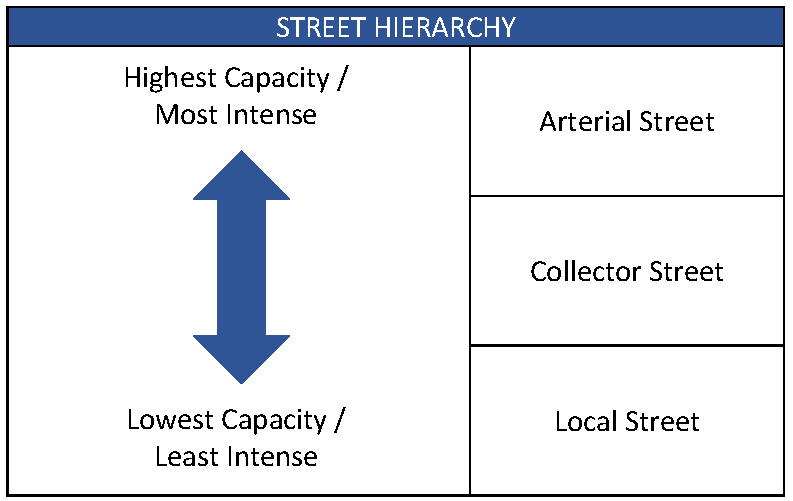
1.
Private street: Any street that is to be privately maintained and has not been accepted for maintenance by the City of Ecorse, Wayne County, the State of Michigan, the federal government, or any other governmental unit, but that meets the requirements of this ordinance or has been approved as a private road by the city under any prior ordinance. A new private road must be a minimum of thirty (30) feet in width.
2.
Public street: Any street or portion of a road that has been dedicated to and accepted for maintenance by the City of Ecorse, Wayne County, State of Michigan, the federal government or any other governmental unit.
3.
Arterial street: A street that carries a high volume of traffic and serves as an avenue for circulation of traffic into, out of, or around the city. An arterial road may also be a major thoroughfare.
4.
Collector street: A street whose principal function is to carry traffic between local streets and arterial streets but may also provide direct access to abutting properties.
5.
Cul-de-sac: A street that terminates in a vehicular turnaround.
6.
Major thoroughfare: See Arterial street.
7.
Local street: A street whose principal function is to provide access to abutting properties.
Street lot line: A dividing line between the street and a lot, also known as the right-of-way line or front property line.
Structural addition: Any alteration that changes the location of an exterior wall of a building or modifies the area of a building.
Structure: anything constructed or erected, the use of which requires location on the ground or attachment to something having location on the ground and extending at least nine (9) inches above the ground surface. Structures include, but are not limited to, principal and accessory buildings, towers, decks, fences, privacy screens, walls, antennae, swimming pools, and signs.
Subdivision plat: The division of a tract of land for the purpose of sale or building development, in accordance with the Land Division Act, Michigan Public Act 288 of 1967, as amended, and the municipal land division regulations.
Support laboratory: A facility for scientific laboratory analysis of natural resources, medical resources, and manufactured materials. The scientific analysis is generally performed for an outside customer, to support the work of that customer. This category includes environmental laboratories for the analysis of air, water, and soil; medical or veterinary laboratories for the analysis of blood, tissue, or other human medical or animal products. Forensic laboratories for analysis of evidence in support of law enforcement agencies would also be included in this category.
Synagogue: See Religious institution.
Swimming pool: Any permanent, non-portable structure or container, located either partially or totally below grade, designed to hold water to a depth of greater than twenty-four (24) inches, intended for swimming or bathing. A swimming pool shall be considered an accessory structure for purposes of computing lot coverage.
14.2.20. - "T" terms.
Tasting room: Means any of the following:
1.
A location on the manufacturing premises of a brewer or micro brewer where the brewer or micro brewer may provide samples of or sell at retail for consumption on or off the premises, or both, beer it manufactures.
2.
A location on or off the manufacturing premises of a wine maker or small wine maker where the wine maker or small wine maker may provide samples of or sell at retail for consumption on or off the premises, or both, shiners, wine it manufactured, or, for a small wine maker only, wine it bottled.
3.
A location on or off the manufacturing premises of a distiller or small distiller where the distiller or small distiller may provide samples of or sell at retail for consumption on or off the premises, or both, spirits it manufactured.
4.
A location on the manufacturing premises of a mixed spirit drink manufacturer where the mixed spirit drink manufacturer may provide samples of or sell at retail for consumption on or off the premises, or both, mixed spirit drinks it manufactured.
5.
A location on or off the manufacturing premises of a brandy manufacturer where the brandy manufacturer may provide samples of or sell at retail for consumption on or off the premises, or both, brandy it manufactured.
Tavern: See Drinking establishment.
Temporary use or building: A use or building permitted to exist for a limited period under conditions and procedures provided for in this ordinance.
Theater: An outdoor area, building or part of a building devoted to showing motion pictures, or for dramatic, dance, musical, or other live performances.
Thoroughfare: See Street.
Townhouse: See Rowhouse.
Transfer station: A building, structure, or area designed and used for persons changing transportation modes or routes.
Transit stop: A facility located at selected points along transit routes for passenger pickup, drop off, or transfer, but excluding areas for vehicle repair or storage, which are defined as a public service facility, or bus stops or shelters.
Transportation equipment storage: A lot intended to store fleet vehicles, either inside or outside, when not in use.
Triplex: A building designed as a single structure, containing three (3) separate dwelling units, each of which is designed to be occupied as a separate permanent residence for one family.
14.2.21. - "U" terms.
University: See College.
Usable floor area: See Floor area, usable.
Use: The principal purpose for which land or a building is arranged, designed or intended, or for which land or a building is or may be occupied.
Utility pole: Means a pole or similar structure that is or may be used in whole or in part for cable or wireline communications service, electric distribution, lighting, traffic control, signage, or a similar function, or a pole or similar structure that meets the height requirements and is designed to support small cell wireless facilities. Utility pole does not include a sign pole less than fifteen (15) feet in height above ground.
Utility trailer: A small trailer that is not self-propelled that is designed to be pulled by an automobile, van, or pick-up truck.
14.2.22. - "V" terms.
Variance: A modification of the literal provisions of the zoning ordinance granted by the zoning board of appeals when strict enforcement of the zoning ordinance would cause practical difficulties or unnecessary hardship owing to circumstances unique to the individual property on which the variance is granted.
Vehicle: See Automobile.
Veterinary services: A place where animals or pets are given medical or surgical treatment and are cared for during the time of such treatment. Use as a kennel shall be limited to short-time boarding and shall be only incidental to such hospital use.
14.2.23. - "W" terms.
Wall: An upright structure, typically constructed of wood, masonry, or stone materials, that encloses, divides, or protects an area.
Warehousing and distribution: A use engaged in storage, wholesale, and distribution of manufactured products, supplies, and equipment, excluding bulk storage of materials that are inflammable or explosive or that present hazards or conditions commonly recognized as offensive. May include frequent, heavy truck traffic, open storage of materials, or nuisances such as dust, noise and odors, and wholesale activities, but does not include onsite manufacturing.
Wholesale activities: Activities primarily engaged in selling and/or distributing merchandise to retailers; to industrial, commercial, institutional, or professional business users, or to other wholesalers; or acting as agents or brokers and buying merchandise for, or selling merchandise to, such individuals or companies. This is not considered a general commercial use.
Wind energy collection system: Any device or assemblage which converts wind energy into electricity through the use of a wind turbine generator which may include turbines, blades, towers and supporting structures and such directly connected facilities as generators, alternators, inverters, batteries and associated electrical equipment. This does not include wiring to connect the wind energy system to the grid.
Wind energy collection system, commercial: A wind energy collection system established as an accessory or principal use to distribute generated energy primarily through the utility grid, but may also be utilized to meet on-site energy demand.
Wind energy collection system, personal: A wind energy collection system established as an accessory use to distribute generated energy primarily on-site for consumption, however, excess energy output may be delivered to the power grid with or without compensation.
Winery: A state-licensed facility or facilities that manufactures wine and is owned or controlled by a state-licensed wine maker, as defined and regulated by the Michigan Liquor Control Commission.
Wireless communication equipment: The set of equipment and network components used in the provision of wireless communication services, including, but not limited to, antennas, transmitters, receivers, base stations, equipment shelters, cabinets, emergency generators, power supply cables, coaxial and fiber optic cables, but excluding wireless communications support structures.
Wireless support structure: Means a freestanding structure designed to support or capable of supporting small cell wireless facilities. Wireless support structure does not include a utility pole.
Wireless telecommunication facility: All facilities, structural, attached, accessory or otherwise, related to the use of the radio frequency spectrum for the purposes of transmitting or receiving radio signals and may include, but is not limited to: Radio and television towers; telephone devices and exchanges; microwave relay towers; telephone transmission equipment buildings; and commercial mobile radio service facilities. Not included within this definition are: Citizen band radio facilities; short wave facilities; ham and amateur radio facilities; television reception antennae; satellite dishes; and governmental facilities that are subject to state and federal Jaw or regulations that preempt municipal regulatory authority.
Wireless telecommunication support structure—Tower: Any wireless telecommunication facility erected or modified to support attached wireless telecommunication facilities, or other antennae or facilities, including supporting lines, cables, wires, braces and masts intended primarily for the purpose of mounting an attached wireless telecommunication facility or similar apparatus above grade. This includes, but is not limited to, any ground or roof-mounted pole, monopole, lattice tower, light pole, utility pole, wood pole, guyed wire tower, spire, other similar structure or combination thereof, or other structures that appear to be something other than a mere support structure.
14.2.24. - "Y" terms.
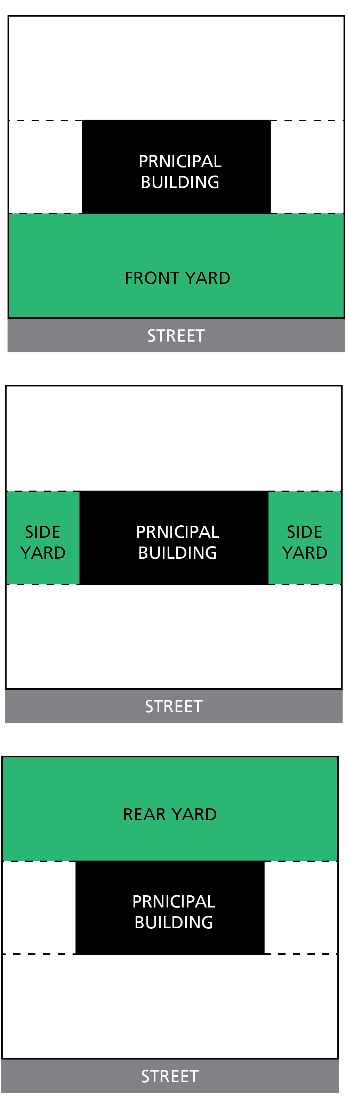
Yard: The open space on the same lot with a main building, unoccupied and unobstructed from the ground (grade) upward except as otherwise provided in this ordinance, and as defined herein. The minimum required setback is the minimum depth of a front, rear or side yard necessary to conform to the required yard setback provisions of this ordinance.
1.
Front yard: An open space extending the full width of the lot, the depth of which is the minimum horizontal distance between the front lot line and the nearest point of the main building. Unless otherwise specified, each yard with street frontage shall be considered a yard.
2.
Side yard: An open space between a principal building and the side lot line, extending from the front yard to the rear yard, the width of which is the horizontal distance from the nearest point on the side lot line to the nearest point of the principal building.
3.
Rear yard: An open space extending the full width of the lot the depth of which is the minimum horizontal distance between the rear lot line and the nearest point of the main building. In the case of a comer lot, the rear yard may be opposite either street frontage, but each lot shall only have one rear yard.
14.2.25. - "Z" terms.
Zoning board of appeals: The body appointed pursuant to the provisions of Michigan Zoning Enabling Act, Public Act 110 of 2006, as amended, to serve as the zoning board of appeals for the City of Ecorse.
Zoning district: A portion of the incorporated area of the city within which on a uniform basis, certain uses of land and buildings are permitted and within which certain yards, open spaces, lot areas, and other requirements are established under the provisions of this ordinance.

