
Ecorse City Zoning Code
ARTICLE 7
- SUPPLEMENTAL USE STANDARDS
7.1.- Intent and purpose.
It is the purpose of this article to provide regulations for miscellaneous and other requirements that may or may not apply in all zoning districts. In addition to the applicable standards elsewhere in this ordinance, the following standards apply to specific uses:
7.2. - Accessory dwelling units.
Accessory dwelling units (ADUs) are intended to provide flexible housing options in the city by allowing homeowners to establish a second dwelling unit on their property. ADUs are subject to the following standards:
A.
ADUs shall be limited to permitted districts and properties with single-family dwelling units as the principle use. ADUs shall be subordinate to the single-family dwelling unit.
B.
The owner of the property shall live on site, either in the principle dwelling unit or the accessory dwelling unit.
C.
ADUs shall have their own separate entrance, kitchen, sleeping area, and full bathroom facilities.
D.
ADUs may be attached to the single-family dwelling unit and may occupy a basement, ground floor or upper floor of the principle dwelling, or may occupy a separate, detached accessory building.
E.
All ADUs shall meet applicable building and fire codes.
F.
Building materials and designs used on detached ADUs or additions to the principle dwelling for an attached ADU, shall be of similar style as that of the principle dwelling.
G.
The minimum size living shall be three hundred (300) square feet.
H.
The maximize size shall not exceed eight hundred (800) square feet, or the size of the principle dwelling unit, whichever is less.
7.3. - Automobile and vehicle major repair.
A.
Minimum lot area. The minimum lot area required shall be twenty thousand (20,000) square feet.
B.
Minimum lot width. The minimum lot width shall be one hundred (100) feet.
C.
Minimum setback. Buildings shall comply with the setback requirements for the district in which they are located. However, a minimum setback of sixty (60) feet shall be maintained on all sides that abut property that is zoned or used for residential purposes.
D.
Ingress and egress. Ingress and egress drives shall be a minimum of thirty-one (31) feet and a maximum of forty (40) feet in width. No more than one such drive or curb opening shall be permitted for every seventy-five (75) feet of frontage (or fraction thereof) along any street. The nearest edge of any such drive shall be located at least twenty-five (25) feet from the nearest point of any property zoned for residential use. Curb openings for drives shall not be permitted where the drive would create a safety hazard or traffic nuisance because of its location in relation to other ingress and egress drives, its location in relation to the traffic generated by other buildings or uses or its location near vehicular entrances or crossings.
E.
Curbs. A curb of at least six (6) inches in height shall be installed to prevent vehicles from being driven onto or pared with any part of the vehicle extending within two (2) feet of abutting landscaped areas, sidewalks, streets, buildings, or adjoining property.
F.
Layout. Lubrication equipment, automobile wash equipment, hoists, pits, and other equipment shall be enclosed entirely within a building. Adequate vehicle parking and stacking spaces shall conform to the requirements of this ordinance.
G.
Outside storage. Inoperable or partially dismantled vehicles may be stored outside for a period not exceeding fourteen (14) days, provided that such vehicles are stored in the rear yard within an obscuring wall. No inoperable or partially dismantled vehicle is to be parked in a space made available or designated at employee or customer parking.
H.
Vehicle sales and storage. The storage, sale, or rental of new or used cars, trucks, trailers, and any other vehicles on the premises is prohibited.
7.4. - Automobile and vehicle minor repair.
A.
Minimum lot area. The minimum lot area required shall be twenty thousand (20,000) square feet.
B.
Minimum lot width. The minimum lot width shall be one hundred (100) feet.
C.
Minimum setback. Buildings shall comply with the setback requirements for the district in which they are located. However, a minimum setback of forty (40) feet shall be maintained on all sides that abut property that is zoned or used for residential purposes.
D.
Ingress and egress. Ingress and egress drives shall be a minimum of thirty-one (31) feet and a maximum of forty (40) feet in width. No more than one such drive or curb opening shall be permitted for every seventy-five (75) feet of frontage (or fraction thereof) along any street. The nearest edge of any such drive shall be located at least twenty-five (25) feet from the nearest point of any property zoned for residential use. Curb openings for drives shall not be permitted where the drive would create a safety hazard or traffic nuisance because of its location in relation to other ingress and egress drives, its location in relation to the traffic generated by other buildings or uses or its location near vehicular entrances or crossings.
E.
Curbs. A curb of at least six (6) inches in height shall be installed to prevent vehicles from being driven onto or pared with any part of the vehicle extending within two (2) feet of abutting landscaped areas, sidewalks, streets, buildings, or adjoining property.
F.
Layout. Lubrication equipment, automobile wash equipment, hoists, pits, and other equipment shall be enclosed entirely within a building. Adequate vehicle parking and stacking spaces shall conform to the requirements of this ordinance.
G.
Outside storage. Inoperable or partially dismantled vehicles may be stored outside for a period not exceeding forty-eight (48) hours, provided that such vehicles are stored in the rear yard within an obscuring wall.
H.
Vehicle sales and storage. The storage, sale, or rental of new or used cars, trucks, trailers, and any other vehicles on the premises is prohibited.
I.
Parking and circulation.
1.
There shall be a minimum of two (2) parking spaces for each repair bay in the facility.
2.
Each parking space shall be a minimum of one hundred fifty (150) square feet.
3.
All parking spaces shall be fully designated by appropriate striping.
4.
Drive lanes shall provide for sufficient space to allow for reasonable ingress and egress from such parking spaces.
5.
All vehicles parked in the parking lots of the automobile and vehicle minor repair establishment shall be fully licensed and registered, and displaying a valid license plate.
6.
No vehicle shall be parked in the parking lot for a period of greater than ten (10) days.
7.
The owner shall not allow the parking of any vehicle outside of the designated parking spaces.
8.
No vehicle shall be parked in the parking lot of the automobile and vehicle minor repair establishment in excess of the number of duly authorized spaces.
9.
No vehicle shall be parked at the automobile and vehicle minor repair establishment in violation of the foregoing regulations.
7.5. - Automobile service stations.
A.
Minimum lot area. The minimum lot area shall be ten thousand (10,000) square feet.
B.
Ingress and egress. The curb cuts for ingress and egress to a service station shall not be permitted at such locations that will tend to create traffic hazards in the streets immediately adjacent thereto and shall meet the following standards:
1.
Entrances and exits shall be no less than twenty-five (25) feet from a street intersection (measured from the roadway) or from adjacent residential property and subject to other ordinances of the city.
2.
Entrances and exits shall not face abutting residentially zoned or used property.
3.
Adequate vehicle parking and stacking spaces shall be provided as required.
4.
Sufficient space shall be provided on the lot so that vehicles do not enter or exit the service buildings directly from an adjacent street or alley. All maneuvering areas, stacking lanes, and exit aprons shall be located within the service station property. Streets and alleys shall not be used for maneuvering or parking by vehicles to be serviced.
5.
Exit lanes shall be sloped to drain water back to the service station building or to drainage grates on site.
C.
Equipment. Lubrication equipment, automobile wash equipment, hoists, pits, and other equipment shall be enclosed entirely within a building. Vacuum activities shall be located at least twenty-five (25) feet from adjacent residentially zoned or used property.
D.
Vehicle sales and storage. The storage, sale, or rental of new or used cars, trucks, trailers, and any other vehicles on the premises is prohibited.
7.6. - Bungalow/cottage courts.
Bungalow or cottage courts shall be designed to meet the following development standards:
|
Development
Standards |
SFR -
Single-Family Residential |
FR - Flexible
Residential |
Examples
(for illustrative purposes only) |
|---|---|---|---|
| Lot Occupation | 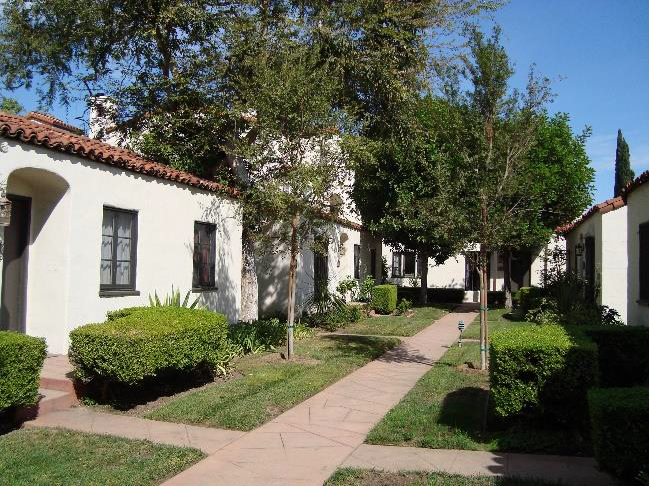 | ||
| Front Setback | 25' | 25' | |
| Side Setback | 5' | 5' | |
| Rear Setback | 15' | 15' | |
| Setback Between Units | 5' | 5' | |
| Minimum Lot Size | 1,500 sq. ft./du | 1,000 sq. ft./du | |
| Building Requirements | |||
| Minimum Square Feet | 400 sq. ft. | 300 sq. ft. | |
| Maximum Square Feet | 1,000 sq. ft. | 800 sq. ft. | |
| Minimum Number of Buildings | 3 | 5 | |
| Maximum Number of Buildings | 9 | — | |
| Maximum Finish Floor Elevation Above Grade | 18" | 18" | |
| Entrance | Each unit shall have an entrance facing the court with direct sidewalk connectivity from the unit to the street. | 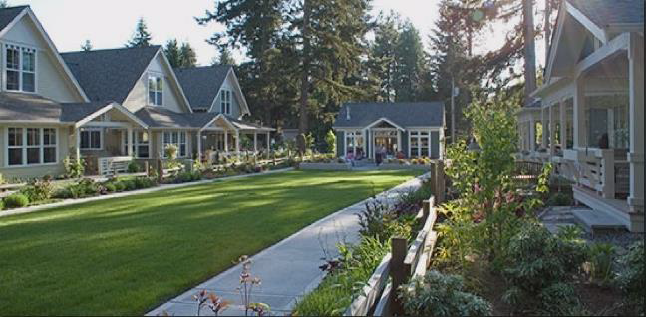 | |
| Parking | Parking prohibited between dwelling units and court. | ||
| Required Open Space/Court | |||
| Minimum Area | 400 sq. ft./du | 400 sq. ft./du | |
| Limitations | Required setbacks, storm water management facilities, driveways and parking stalls shall not be included in the minimum open space calculations. | ||
| Orientation | Each court shall open directly to a street. | ||
7.7. - Child care centers.
A.
An outdoor play area shall be required at a ratio of one hundred (100) square feet for every one child cared for, and shall be a minimum of at least one thousand (1,000) square feet.
B.
The outdoor play area shall be fenced in with a fence of at least four (4) feet tall. Furthermore, the outdoor play area shall be screened with either an opaque fence or landscaping at least four (4) feet tall at the time of planting.
7.8. - Contractor storage yards.
A.
No equipment or materials shall be stored in the required front, side or rear setbacks.
B.
If a building exists on a parcel, the outdoor storage of equipment and materials shall only occur in the side or rear yards.
C.
An opaque fence or masonry wall with a minimum height of six (6) feet shall surround all areas designated for the outdoor storage of equipment and materials. The finished side of any fence or wall shall face adjacent properties.
7.9. - Convalescent and nursing homes.
A.
The site shall be so developed as to create a land to building ratio on the lot or parcel whereby for each one bed in the convalescent home there shall be provided not less than one thousand five hundred (1,500) square feet of open space. The one thousand five hundred (1,500) square feet of land area per bed shall provide for landscaping, setting, off-street parking, service drives, loading space, yard requirements, employee facilities, and any space required for accessory uses. The one thousand five hundred (1,500) square foot requirement is over and above the building coverage area.
B.
No building shall be closer than forty (40) feet from any property line.
7.10. - Drive-in or drive-through services.
A.
Ingress and egress points shall be located no closer than sixty (60) feet from the intersection of any two (2) streets (measured from the nearest right-of-way line). Driveways shall be limited to one per parcel.
B.
Devices for the transmission of voices shall be so directed or muffled as to prevent sound from being audible beyond the boundaries of the site.
C.
A drive-through window shall provide stacking spaces for each drive-through window.
7.12. - Home occupations.
Home occupations shall be allowed in any single-family dwelling unit subject to the following standards:
A.
Home occupations shall be conducted entirely within the dwelling unit, attached or detached garage, or accessory building.
B.
No more than twenty-five (25) percent of the dwelling unit's ground floor area shall be devoted to the home occupation.
C.
Home occupations located within an attached or detached garage, or accessory building, may utilize the entire floor area for the home occupation.
D.
Only the occupants of the dwelling unit shall be engaged in the home occupation.
E.
The appearance of the principal structure shall not be altered, nor shall the home occupation be conducted in a manner which would cause the premises to differ from its residential character either by the use of sounds, noises, or vibration.
F.
No outdoor display or storage of materials, goods, supplies, or equipment used in the home occupation shall be permitted on the premises.
G.
No home occupation shall require internal or external alterations or involve construction features or the use of electrical or mechanical equipment that would change the fire rating of the structure.
H.
No home occupation shall cause an increase in the use of any utility (water, sewer, electricity, trash removal, etc.) that would exceed the average usage by residences in the neighborhood.
I.
The home occupation may increase vehicular traffic flow and parking by no more than two (2) additional vehicles at a time.
J.
There shall be no deliveries to or from a home occupation with a vehicle larger than fifteen thousand (15,000) pounds with not more than two (2) axles.
K.
In no case shall a home occupation be open to the public earlier than 8:00 a.m., nor later than 7:00 p.m.
L.
A home occupation shall not create noise, dust, vibration, smell, smoke, glare, electrical interference, fire hazard, or any other hazard or nuisance to any greater or more frequent extent than would normally be generated in a similarly zoned district.
7.13. - Hospitals.
A.
All hospitals shall be developed only on sites consisting of at least five (5) acres in area, and shall not be permitted on a lot or lots of record.
B.
The proposed site shall have at least one property line abutting a major thoroughfare.
C.
The minimum distance of any main or accessory building from bounding lot lines or streets shall be at least forty (40) feet for front, rear, and side yards for all two (2) story structures. For every story above two (2), the minimum yard distance shall be increased by at least ten (10) feet.
D.
All ingress and egress to the off-street parking area, for guest, employees, staff, as well as any other uses of the facilities, shall be directly from a major thoroughfare.
7.14. - Hotels and motels.
A.
Each unit shall contain not less than two hundred (200) square feet of floor area.
B.
No guest shall establish permanent residence at a hotel or motel for more than thirty (30) days within any calendar year.
C.
Rental units with kitchens and with suites may be permitted as part of a hotel or motel and are subject to the following:
1.
Units shall be functionally and architecturally integrated components of the motel reflecting common access ways, services, parking, and open space.
2.
Units shall be designed primarily for overnight lodging and shall not be configured or include improvements which would typically be found only in dwellings.
7.15. - Kennels.
The boarding, breeding, raising, grooming, or training of three or more dogs, cats, or other household pets of any age either 1) not owned by the owner or occupant of the premises, or 2) for commercial gain may be permitted through special land use approval, provided the following requirements are met:
A.
Minimum lot area. Such activity shall be permitted only on a parcel of land not less than five (5) acres in area and provided, further, that such parcel shall not abut or be adjacent to any lot or parcel which is part of a recorded residential subdivision.
B.
Enclosures. All animals shall be kept in pens or cages designed, constructed and maintained so as to be harmonious and appropriate in appearance with the character of the general area in which located, and such use will not affect the character of the same area in a negative way.
C.
Enclosure setbacks. All pens or cages shall be located not less than one hundred (100) feet from any property line, and all animals shall be kept therein or within a building. No animal shall be allowed to run at large.
D.
Noise and odor. Such activity shall be conducted so as not to be detrimental to any person, property or the general welfare by reason of excessive noise or odor.
E.
Nuisance prohibited. The keeping of the animals described in this subsection shall not constitute a nuisance to persons living in the surrounding area. Upon receipt of a written complaint filed by a neighbor with the city stating the animals constitute a nuisance, the zoning board of appeals shall hold a hearing with notice to all property owners within three hundred (300) feet of the property where the animals are kept. The zoning board of appeals shall determine if in fact the animals do constitute a nuisance.
F.
If the zoning board of appeals determines that the animals have and will likely continue to constitute a nuisance, the animals shall not be kept on the property after the date set by the zoning board of appeals. If, in the opinion of the zoning board of appeals, there is reason to believe that reasonable measures will be taken to alleviate the nuisance associated with the animals, the zoning board of appeals may issue a permit, renewable yearly, for the keeping of such animals with or without restrictions. If a hearing is held and a determination is made, the matter may not be reviewed again on a complaint of a neighbor unless there has been a change of circumstances.
G.
No person shall allow animals under such person's control or ownership to constitute a nuisance. The violation of this subsection may be prosecuted in the district court or may be enjoined in the circuit court. Notwithstanding anything to the contrary in this ordinance, this subsection shall not be a limitation on, lessen the effect of, or interfere with any other city ordinance pertaining to animals, and the enforcement of it.
7.16. - Manufactured homes on individual lots.
A manufactured home newly sited on an individual lot shall meet the standards for minimum lot size, yard setbacks, and minimum floor area for the district in which it is located and shall meet the following additional standards:
A.
Manufactured homes shall be attached to an approved permanent foundation or basement and shall be anchored using a system that meets the Michigan Manufactured Housing Commission requirements.
B.
The wheels, axles and towing assembly shall be removed from a manufactured home before the unit is attached to the foundation. Additionally, no manufactured home shall have any exposed undercarriage or chassis.
C.
Manufactured homes shall be installed according to the United States Department of Housing and Urban Development (HUD) regulations entitled "Manufactured Home Installation Standards," and the construction of the unit shall comply with the United States Department of Housing and Urban Development (HUD) regulations entitled "Manufactured Home Construction and Safety Standards," being 24 CFR part 3280, as amended.
D.
Manufactured homes shall not be attached to each other. Additions, new roofs and accessory buildings may be attached to a manufactured home.
E.
No manufactured home shall be located or placed in the City of Ecorse without prior completion of site preparation to include electric, water, sewage disposal and foundation to meet the current HUD rules and regulations and district health department regulations.
F.
Manufactured homes shall not be used as accessory buildings.
7.17. - Marinas or boat launches.
A.
The marina site shall be physically separated from any adjacent industrial uses by fencing a minimum six (6) feet in height.
B.
A separate entry/egress drive shall be provided, which shall not cross through any property used or intended for industrial uses.
C.
On-site restroom facilities shall be provided per code for all marinas.
D.
Any marina, which permits boaters to overnight in their moored or docked boats, must provide shower/washing facilities as prescribed by the planning commission.
E.
Docks and mooring shall be physically separated from adjacent industrial/commercial waterfront uses and shipping channels.
F.
Proposed docks and moorings shall not interfere with the passage of boats into or out of adjacent or nearby marinas, and will not be so located as to be a hazard or obstacle to the normal movement of boats in Detroit River.
G.
The planning commission may modify or waive those site requirements listed in subsections A—D above upon a demonstration of hardship or a compelling need or justification.
7.18. - Marijuana facilities.
A.
These standards shall apply to all marijuana facilities, unless otherwise noted.
B.
Marijuana related activities shall comply at all times and in all circumstances with the Michigan Medical Marijuana Act, Marijuana facilities Licensing Act, the Marijuana Tracking Act, the Michigan Regulation and Taxation of Marijuana Act and all State of Michigan regulations for the transfer of marijuana, the General Rules of the Michigan Department of Community Health, and the city's adult use marihuana ordinance, as they may be amended from time to time.
C.
All marijuana facilities shall comply with all zoning regulations and shall obtain structural, electrical, plumbing, and mechanical licenses and inspections to meet current state construction codes, and shall obtain a certificate of occupancy prior to any operation or occupancy of said establishment or facility.
D.
Site plan approval and special approval land use approval shall be required for all marijuana facilities.
E.
The applicant location shall meet all applicable written and duly promulgated standards of the city and, prior to opening, shall demonstrate to the city that it meets the rules and regulations promulgated by the medical/recreational marijuana licensing council and obtain a certificate of occupancy.
F.
The facility location shall conform to all standards of the zoning district in which it is located.
G.
Facilities are not permitted within a five hundred (500) foot radius of any primary, intermediate or secondary school measured by the shortest possible line from the property edges.
H.
Facilities are not permitted within a four hundred (400) foot radius of any religious institution, park, or civic building, measured by the shortest possible line from the property edges.
I.
Facilities are not permitted within a one thousand (1,000) foot radius of properties fronting on West Jefferson Avenue, measured by the shortest possible line from the property edges. Adult use retail and provisioning centers are further limited to the Southfield Road in the Commercial (C) District only.
J.
Colocation of use classes on one site is permitted when consistent with state standards and all collocated uses are permitted in the zoning district.
K.
Hours of operation permitted for retail, provisioning centers, and microbusinesses: Monday—Saturday: 9:00 a.m.—9:00 p.m.; Sunday: 10:00 a.m.—6:00 p.m.
L.
All activity related to the marijuana establishment or facility shall be done indoors.
M.
All establishments and facilities must ensure that any water emanating from the establishment or facility meets or exceeds all applicable state and local environmental standards.
N.
No required water supply and sanitary sewerage facilities shall be erected, altered, or moved upon a lot or premises and used in whole or in part for a marijuana facility unless it shall be provided with a safe, sanitary and potable water supply and with a safe and effective means of collection, treatment, and article 7, Supplemental Use Standards City of Ecorse Zoning Ordinance disposal of human excreta and domestic, commercial, and industrial waste. All such installations and facilities shall conform to the minimum requirements Wayne County, and any applicable statutes, ordinances, or regulations.
O.
Security cameras shall be installed and maintained. Security cameras, which include recordings and all recordkeeping, shall comply with all state requirements. All security cameras shall have at least one hundred twenty (120) concurrent hours of digitally recorded documentation. The security cameras shall be in operation twenty-four (24) hours a day, seven (7) days a week, and shall be set to maintain the record of the prior one hundred twenty (120) hours of continuous operation. An alarm system is required that is operated and monitored by a recognized security company. A security plan shall be provided and approved by the chief of police.
P.
Exterior lighting shall be required for security purposes, but in accordance with the provisions of the zoning ordinance.
Q.
Marijuana facilities are not permitted to operate in a manner that results in adverse impacts on adjacent property; including excessive odor, traffic, noise, or loitering. The city may place reasonable conditions on facilities to ensure operation consistent with community norms. Failure to comply with city regulations or conditions of approval shall be cause to revoke a local license. Odor for growers and processors shall be regulated as follows:
1.
The building shall be equipped with an activated carbon filtration system for odor control and air scrubbing to ensure that air leaving the building through an exhaust vent first passes through an activated carbon filter.
2.
The filtration system shall consist of one or more fans and activated carbon filters. At a minimum, the fan(s) shall be sized for cubic feet per minute (CFM) equivalent to the volume of the building (length multiplied by width multiplied by height) divided by three (3). The filter(s) shall be rated for the applicable CFM.
3.
The filtration system shall be maintained in working order and shall be in use. The filters shall be changed a minimum of once every three hundred sixty-five (365) days, or according to manufacturer recommendations, whichever is less.
4.
Negative air pressure shall be maintained inside the building.
5.
Doors and windows shall remain closed, except for the minimum length of time needed to allow people to ingress or egress the building.
6.
An alternative odor control system is permitted if the applicant submits and the city accepts a report by a mechanical engineer licensed by the State of Michigan demonstrating the alternative system will control odor as well or better than the activated carbon filtration system otherwise required. The city may hire an outside expert, at the cost of the applicant, to review the alternative system design and advise as to its comparability and whether in the opinion of the expert it should be accepted.
7.
Secure transporters and safety compliance facilities shall also be required to submit plans for odor control for approval if in the opinion the planning commission such plans are required for the protection of the city and its residents.
R.
If the marijuana establishment or facility ceases operation for a length of time of ninety (90) days or greater, the special approval land use shall expire.
S.
Marijuana drive-through retail establishments and provisioning centers shall be prohibited.
T.
All marijuana shall be contained within a structure that meets all applicable building code requirements in an enclosed, locked area. A floor plan shall be provided with the site plan application.
U.
Application for a local marijuana facilities permit shall be made to the city clerk, or a designee. The application shall be made using forms provided by the city clerk, or a designee, for a marijuana facilities permit. The application shall be signed by the applicant verifying the truth and accuracy of all information and representations. Applications including information and documentation provided pursuant to an application shall be subject to the confidentiality rules of the State of Michigan. In article 7, Supplemental Use Standards, City of Ecorse Zoning Ordinance addition to information and submittals, the application shall include payment of application fee in an amount set by the city council. Applications shall be filed according to licensing regulations, procedures, and fees established by the city council, and may be amended.
V.
A state license is required for all marijuana establishments and facilities.
W.
Prior to issuance of a certificate of occupancy, an authorized marijuana establishment or facility shall comply with the following regulations and shall only be operated as long as it remains in compliance with all such ordinances:
1.
Compliance with state and city licensing and permitting requirements and proof of issuance of a state operating license and compliance with all rules promulgated thereunder is filed with the city.
2.
Compliance with all city zoning regulations with written approval from the city.
3.
Compliance with all city construction and building ordinances and applicable police power ordinances.
X.
Inspections may be made by the city official's designee to confirm the marijuana facility is operating in accordance with applicable laws including, but not limited to, state law and city ordinances.
Y.
The premises shall be open for inspection upon request by the code enforcement officer, building official, fire department and law enforcement officials for compliance with all applicable laws and rules, during the stated hours of operation/use and as such other times as anyone is present on the premises.
Z.
The penalties and fees collected by the city for marijuana establishments and facilities shall be the maximum permissible by the State of Michigan unless otherwise established by the city council.
7.19. - Outdoor dining.
Outdoor dining service operated by a restaurant or other food establishment which sells food for immediate consumption may be permitted, subject to the following conditions:
A.
Outdoor seating/dining shall be included as part of an approved site plan.
B.
An outdoor cafe shall be allowed during normal operating hours of the establishment.
C.
An outdoor cafe may not be in operation on property adjacent to a residentially zoned district between the hours of 12:00 a.m. and 7:00 a.m.
D.
The exterior of the premises shall be kept clean, orderly, and maintained. Exterior food preparation may be permitted if approved by the health department but shall be prohibited from occurring in any public right-of-way.
E.
Any outdoor seating located within the public right-of-way must be approved by the planning commission.
7.20. - Outdoor storage of materials and equipment.
A.
Any outdoor storage shall be screened from view from a public street and from adjoining properties by an enclosure consisting of a wall or fence not less than the height of the equipment, vehicles and all materials to be stored or eight (8) feet, whichever is less. Whenever such open storage is adjacent to a residential district whether immediately abutting or across a right-of-way from such district, there shall be provided an obscuring masonry wall or wood fence of at least six (6) feet in height.
B.
Such masonry wall or wood fence shall be repaired, maintained, and kept in good condition by the owners.
C.
When screening is required for outdoor storage of refuse or waste, an enclosure constructed of masonry material and sturdy obscuring wood gates shall be provided. The enclosure shall be at least six (6) feet in height or equal to the height of the receptacle or waste material being stored, whichever is greater. If the enclosure is in a conspicuous location or visible from a public road or residential zoning district, the planning commission or official approving the site plan may specify the type and/or appearance of masonry material to be used to construct the enclosure.
7.21. - Private recreations facilities, indoors or outdoors.
A.
In those instances where the proposed site is not to be situated on a lot or lots of record, the proposed site shall have one property line abutting a major thoroughfare and the site shall be so planned as to provide ingress and egress directly onto said major thoroughfare.
1.
Front, side and rear yards shall be at least seventy-five (75) feet wide, except on those sides adjacent to nonresidential districts, and shall be landscaped in trees, shrubs, grass and terrace areas. All such landscaping shall be maintained in a healthy condition. There shall be no parking or structure permitted in these yards, except for required entrance drives and those walls and/or fences used to obscure the use from abutting residential districts.
2.
Whenever a swimming pool is constructed under this ordinance, said pool area shall be provided with a protective fence, six (6) feet in height, and entry shall be provided by means of a controlled gate or turnstile.
3.
Off-street parking shall be provided so as to accommodate at least one-fourth (¼) of the member families and/or individual members. By-laws of the organization shall be provided to the planning commission in order to establish the membership involved in computing parking requirements.
4.
All storm and sanitary sewer plans shall be provided and shall be reviewed and approved by the city engineer prior to the issuance of a building permit.
B.
The off-street parking and general site layout and its relationship to all adjacent lot lines shall be reviewed by the planning commission, who may impose any reasonable restrictions or requirements so as to insure that contiguous residential areas will be adequately protected.
7.22. - Public or private parking facilities.
A.
Ingress and egress. Exits from points of ingress and egress shall not face residential zoning districts or uses.
B.
Surface parking lots. All public or private surface parking lots shall be completely screened on all sides with a landscape hedge, masonry wall or opaque fence that shall have a minimum height of four (4) feet six (6) inches.
C.
Parking structures. Parking structures in which all parking is completely enclosed within a structure shall be exempt the screening requirements of surface parking lots. The architecture of the parking structure shall be consistent and/or compatible with the development of the surrounding neighborhood.
7.23. - Religious institutions.
A.
The site shall be located to as to provide ingress and egress directly onto a major thoroughfare or secondary road;
B.
The principal building(s) shall be setback fifteen (15) feet from abutting properties zoned for residential use;
C.
Buildings greater than the maximum height allowed in this article may be allowed provided front, side and rear yard setbacks shall increase above minimum requirements by one foot for each one foot of building that exceeds the maximum height allowed.
7.25. - Self-storage facilities.
A.
Minimum lot area. The minimum lot area for self-storage shall be two (2) acres.
B.
Self-storage facilities shall provide for storage only and shall not be used as a place of residence or conducting business.
C.
All storage must be completely contained within an enclosed building.
D.
The exterior of any self-storage facility shall be of finished quality and design, compatible with the design of structures on surrounding property.
E.
Circulation.
1.
All one-way driveways shall be designed with one ten (10) foot wide loading/unloading lane and one eleven (11) foot travel lane.
2.
All two-way driveways shall be designed with one ten (10) foot wide loading/unloading lane and two (2) ten (10) foot travel lanes.
3.
The parking lanes may be eliminated if the driveway does not serve storage units. Signs and painted lines shall be used to indicate parking and traffic direction throughout the site.
7.26. - Senior assisted living facilities.
A.
All senior assisted living facilities shall be provided as a planned development and shall provide for the following:
1.
Cottage type dwellings and/or apartment type dwelling units.
2.
Common services containing, but not limited to, central dining rooms, recreational rooms, central lounge, and/or workshops.
7.27. - Sexually oriented businesses.
The purpose and intent of the section of this ordinance pertaining to the regulation of sexually oriented businesses is to regulate the location and operation of, but not to exclude, sexually oriented businesses within the city, and to minimize their negative secondary effects. It is recognized that sexually oriented businesses, because of their very nature, have serious objectionable operational characteristics which cause negative secondary effects upon nearby residential, educational, religious, and other similar public and private uses. The regulation of sexually oriented businesses is necessary to ensure that their negative secondary effects will not contribute to the blighting and downgrading of surrounding areas and will not negatively impact the health, safety, and general welfare of city residents. The provisions of this ordinance are not intended to offend the guarantees of the First Amendment to the United States Constitution or to deny adults access to sexually oriented businesses and their products, or to deny sexually oriented businesses access to their intended market. Neither is it the intent of this ordinance to legitimatize activities which are prohibited by city ordinances, state, or federal law. If any portion of this ordinance relating to the regulation of sexually oriented businesses or referenced in those sections is found to be invalid or unconstitutional by a court of competent jurisdiction, the city intends said portion to be disregarded, reduced, and/or revised so as to be recognized to the fullest extent possible by law. The city further states that it would have passed and adopted what remains of any portion of this ordinance relating to regulation of sexually oriented businesses following the removal, reduction, or revision of any portion so found to be invalid or unconstitutional.
A.
No sexually oriented business shall be greater than five thousand (5,000) square feet.
B.
No sexually oriented business shall be established on a parcel within five hundred (500) feet of any residence, public or private school, church, public park, state licensed child care facility, or residential zoning district.
C.
No sexually oriented business shall be permitted in a location in which any principal or accessory structure, including signs, is within one thousand (1,000) feet of any principal or accessory structure of another sexually-oriented business.
D.
For the purpose of this section, measurements shall be made in a straight line in all directions without regard to intervening structures or objects, from the closest part of any structure, including signs and roof overhangs, used in conjunction with the sexually oriented business to the closest point on a property boundary or right-of-way associated with any of the land use(s) or zoning district identified in subsection B above.
E.
The proposed use shall conform to all specific density and setback regulations of the zoning district in which it is located.
F.
The proposed use must meet all applicable written and duly promulgated standards of the City of Ecorse and other governments or governmental agencies having jurisdiction, and that to the extent required, the approval of these governments and/or governmental agencies has been obtained or is reasonably assured.
G.
The outdoor storage of garbage and refuse shall be contained, screened from view and located so as not to be visible from neighboring properties or adjacent roadways.
H.
Any sign or signs proposed for the sexually oriented business must comply with the provisions of this ordinance, and shall not otherwise include photographs, silhouettes, drawings, or pictorial representations of any type, or include animated or flashing illumination.
I.
Entrances to the proposed sexually oriented business must be posted on both the exterior and interior walls in a location clearly visible to those entering and exiting the business, and using lettering no less than two (2) inches in height that: 1) "persons under the age of eighteen (18) are not permitted to enter the premises," and 2) "No alcoholic beverages of any type are permitted within the premises unless specifically allowed pursuant to a license duly issued by the Michigan Liquor Control Commission."
J.
No product or service for sale or gift, or any picture or other representation of any product or service or gift, shall be displayed so as to be visible from the nearest adjoining sidewalk, street, or a neighboring property.
K.
Hours of operation shall be limited to 12:00 p.m. (noon) to 12:00 a.m. (midnight).
L.
Any booth, room, or cubicle available in any sexually oriented business, excepting an adult motel, used by patrons for the viewing of any entertainment characterized by the showing of specified anatomical areas or specified sexual activities:
1.
Shall be handicap accessible to the extent required by the Americans With Disabilities Act;
2.
Shall be unobstructed by any door, lock, or other entrance and exit control device;
3.
Has at least one side totally open to a public, lighted aisle so that there is an unobstructed view at all times from the adjoining aisle of any occupant;
4.
Is illuminated such that a person of normal visual acuity looking into the booth, room or cubicle from its entrance adjoining the public lighted aisle can clearly determine the number of people within;
5.
Has no holes or openings in any interior or exterior walls not relating to utility, ventilation, or temperature control services or otherwise required by any governmental building code or authority.
7.28. - Veterinary services.
A.
All activities shall be conducted within a completely enclosed building.
B.
All buildings shall be set back at least fifty (50) feet from abutting residential zoning districts or uses.
C.
The commercial boarding of animals is prohibited.
D.
Treatment shall be limited to domesticated animals considered as pets.
7.11.1. - Elementary, junior high, and senior high schools.
A.
Elementary, junior high and senior high schools shall offer courses in general education curriculum.
B.
Shall not be operated for profit.
7.11.2. - Colleges and universities.
A.
Any use permitted herein shall be developed only on sites of at least five (5) acres in area and shall not be permitted on any portion of a recorded subdivision plat.
B.
All ingress to and egress from the site shall be directly onto a major thoroughfare.
C.
No building other than a structure for residential purposes shall be closer than seventy-five (75) feet to any property line.
7.24.1. - Intent and purpose.
The intent and purpose of this section is to allow residents and business owners to generate renewable energy sources to reduce their reliance on fossil fuel-based energy sources, reduce energy utility costs, and to mitigate any negative effects such systems may have on neighboring properties, citizens of the City of Ecorse, economic opportunities, and visitors.
7.24.2. - Personal solar energy collection systems (SECS).
Personal solar energy collection systems (SECS) with a rated capacity of no more than ten (10) kW shall be permitted an accessory use to distribute generated energy primarily on site for consumption, however, excess energy output may be delivered to the power grid, subject to the following standards:
A.
Ground mounted personal SECS.
1.
Height. Ground mounted personal SECS shall not exceed the height of an allowed accessory structure within the zoning district when oriented at maximum tilt.
2.
Placement. Ground mounted personal SECS must meet the accessory structure setback and height requirements for the zoning district in which it is installed.
3.
Coverage. Ground mounted personal SECS may not exceed the area restrictions placed on accessory structures within the subject zoning district.
4.
Visibility. Ground mounted personal SECS shall be screened from view to the extent possible without reducing their efficiency. Screening may include walls, fences, or landscaping.
B.
Roof or building mounted personal SECS.
1.
Height. Roof or building mounted personal SECS shall not exceed the maximum allowed height in any zoning district. For purposes for height measurement, solar systems other than building-integrated solar systems shall be considered to be mechanical devices and are restricted consistent with other building-mounted mechanical devices.
2.
Placement.
a)
The collector surface and mounting devices for roof or building mounted personal SECS shall not extend beyond the required setbacks or height requirements for the zoning district in which it is installed.
b)
Building mounted personal SECS shall be prohibited from being located on any front façade.
c)
Building or roof mounted personal SECS shall be allowed on any principal or accessory structure.
3.
Coverage. Building or roof mounted personal SECS shall be allowed to cover the entire roof or façade where permitted to be installed.
4.
Visibility. Building or roof mounted personal SECS shall be designed to blend into the architecture of the building or be screened from routine view from public rights-of-way other than alleys or railroad rights-of-way. The color of the solar collector is not required to be consistent with other roofing materials. Building integrated solar systems shall be allowed regardless of visibility, provided the building component in which the system is integrated meets all required setback, land use or performance standards for the zoning district in which the building is located.
7.24.3. - Commercial solar energy collection systems (SECS).
Commercial solar energy collection systems (SECS) with a rated capacity of ten (10) kW or more shall be permitted as an accessory or principal use to distribute generated energy on site or commercially through the power grid system subject to the following standards:
A.
Ground mounted commercial SECS.
1.
Height. The maximum height of a ground mounted commercial SECS shall be sixteen (16) feet above grade at maximum tilt.
2.
Placement. Ground mounted commercial SECS shall be setback a minimum of fifty (50) feet from all property lines and public rights-of-way, and fifty (200) feet from any residential zoning district or use.
3.
Coverage. Ground mounted commercial SECS shall not count towards maximum lot coverage requirements for the zoning district in which they are located.
4.
Visibility. Ground mounted commercial SECS shall be screened on all sides with a vegetated screen or green belt at a minimum height of eight (8) feet.
5.
Number. There shall be no limit to the number of ground mounted commercial SECS on a given property.
B.
Roof or building mounted commercial SECS.
1.
Height. The maximum height of a roof or building mounted commercial SECS shall not exceed the maximum allowed height in any zoning district. For purposes for height measurement, solar systems other than building-integrated solar systems shall be considered to be mechanical devices and are restricted consistent with other building-mounted mechanical devices.
2.
Placement. The collector surface and mounting devices for roof or building mounted personal SECS shall not extend beyond the required setbacks or height requirements for the zoning district in which it is installed.
3.
Coverage. Building or roof mounted personal SECS shall be allowed to cover the entire roof or façade where permitted to be installed.
4.
Visibility. Building or roof mounted personal SECS shall be designed to blend into the architecture of the building or be screened from routine view from public rights-of-way other than alleys or railroad rights-of-way. The color of the solar collector is not required to be consistent with other roofing materials. Building integrated solar systems shall be allowed regardless of visibility, provided the building component in which the system is integrated meets all required setback, land use or performance standards for the zoning district in which the building is located.
5.
Number. There shall be no limit to the number of ground mounted commercial SECS on a given property.
7.24.4. - Solar energy conversion system approval standards.
In addition to all applicable district, site plan review and special land use approval standards, the following approval standards shall apply to all SECS:
A.
Safety. Emergency and normal shutdown procedures shall be identified with the application, along with any potential hazards to adjacent properties, public rights-of-way and to the general public that may be created. A security fence (height and material to be proposed and reviewed/approved through the special land use approval process) shall be placed around the perimeter of ground mounted commercial SECS and electrical equipment. Knox boxes and keys shall be provided at locked entrances for security personnel access.
B.
Visual impact. SECS shall be located or placed so that concentrated solar glare shall not be directed toward or onto nearby properties or rights-of-way at any time of the day. Support structures shall be of a single, nonreflective matte finish of similar design, size, operation, and appearance throughout the project. No lettering, company insignia, advertising, or graphics shall be on any part of the structure. The applicant shall avoid state or federal scenic areas and significant visual resources listed in the master plan or in local, state or federal historic registers.
C.
Noise. Have a maximum noise production rating of fifty (50) dBA and shall conform to this standard under normal operating conditions as measured at any property line.
D.
Electromagnetic and telecommunication interference. All SECS shall not interfere with electromagnetic or telecommunication systems.
E.
Lighting. Have no installed or accessory lighting, unless required by federal or state regulations.
F.
Intent to install. Prior to the installation or erection of a SECS, the operator must provide evidence showing their regular electrical service provider has been informed of the customer's intent to install an interconnected, customer-owned generator. Off-grid systems shall be exempt from this requirement.
G.
Signs. A commercial SECS operator is required to provide a single posting, not to exceed four (4) square feet, at the entrance of a commercial secs prohibiting trespassing, warning of high voltage, and providing the emergency contact information for the operator.
H.
Feeder lines. Any lines accompanying a SECS, other than those contained within the SECS structure or those attached to on-site structures by leads, shall be buried within the interior of the subject parcel, unless there are existing lines in the area which the lines accompanying a SECS can be attached.
I.
Construction codes and interconnection standards. Utility systems shall comply with all applicable state construction and electrical codes and local building permit requirements, Federal Aviation Administration requirements, the Michigan Airport Zoning Act (Public Act 23 of 1950, MCL 259.431 et seq.), the Michigan Tall Structures Act (Public Act 259 of 1959, MCL 259.481 et seq.), applicable utility, Michigan Public Service Commission, and Federal Energy Regulatory Commission interconnection standards. The minimum FAA lighting standards shall not be exceeded. All tower lighting required by the FAA shall be shielded to the extent possible to reduce glare and visibility from the ground.
7.24.5. - Personal wind energy conversion systems (WECS).
Personal wind energy conversion systems (WECS) with a rated capacity of no more than one hundred (100) kW shall be permitted as an accessory use to distribute generated energy primarily on site for consumption, however, excess energy output may be delivered to the power grid, subject to the following standards:
A.
Ground mounted personal WECS.
1.
Height. Personal WECS shall have a total height, including tower and blade to its highest point of travel, of no more than sixty (60) feet above the average finished grade of the lot.
2.
Placement.
a)
Shall not be located between a principal structure and a public street, unless the city determines that such a location would lessen the visibility of the personal WECS or would lessen the negative impacts of such a WECS on nearby properties.
b)
Have a minimum setback distance from the base of the monopole of one times the height from any property line, public right-of-way, electric substation, transmission line, or other WECS.
3.
Number. One personal WECS shall be allowed on a single lot up to one acre in size, and one per each additional five (5) acres.
B.
Roof mounted personal WECS.
1.
Height. Total height of not more than twenty-five (25) feet, measured from the top of the roof to the blade tip at its highest point of travel.
2.
Placement. Roof mounted WECS must be erected above the roof of a building or structure. The mounts associated with the WECS may extend onto the side of the building or structure.
3.
Number. No more than three (3) roof mounted small WECS shall be installed on any rooftop.
7.24.6. - Commercial wind energy conversion systems (WECS).
Commercial wind energy conversion systems (WECS) with a rated capacity of one hundred (100) kW or more shall be permitted as an accessory or principal use to distribute generated energy on site or commercially through the power grid system subject to the following standards:
A.
Ground mounted commercial WECS.
1.
Height. Commercial WECS shall have a total height, including tower and blade to its highest point of travel, of no more than one hundred twenty-five (125) feet.
2.
Placement.
a)
Shall not be located between a principal structure and a public street, unless the city determines that such a location would lessen the visibility of the commercial WECS or would lessen the negative impacts of such a WECS on nearby properties.
b)
Have a minimum setback distance from the base of the monopole of one times the height from any property line, electric substation, transmission line, or other WECS. In addition, the setback distance must be increased by twenty-five (25) feet from any property that is zoned or planned for residential.
c)
Have a minimum setback distance from the base of the monopole of one and one-half (1½) times the height from any public right-of-way, occupied structure, or public use area.
d)
Have a minimum setback distance from the base of the monopole of six hundred (600) feet from any property designated as a public park.
3.
Number. One large WECS shall be allowed on a single lot of one to five (5) acre(s). All other larger parcels will be limited to one large WECS per five (5) acres of land area.
B.
Roof mounted commercial WECS.
1.
Height. Total height of not more than twenty-five (25) feet, measured from the top of the roof to the blade tip at its highest point of travel.
2.
Placement. Roof mounted WECS must be erected above the roof of a building or structure. The mounts associated with the WECS may extend onto the side of the building or structure.
3.
Number. The maximum number of roof mounted commercial WECS shall be approved through the special land use permit process.
7.24.7. - Wind energy conversion system approval standards.
In addition to all applicable district, site plan review and special land use approval standards, the following approval standards shall apply to all WECS:
A.
Safety. All WESC shall have an automatic braking, governing, or feathering system to prevent uncontrolled rotation or over speeding. All wind towers shall have lightning protection. If a tower is supported by guy wires, the wires shall be clearly visible to a height of at least six (6) feet above the guy wire ground anchors. The site shall be designed to prevent unauthorized access to electrical and mechanical components and shall have access doors that are kept securely locked at all times when service personnel are not present. All spent lubricants and cooling fluids shall be properly and safely removed in a timely manner from the site of the wind energy system.
B.
Visual impact. A WESC project shall use tubular towers with all components of the system finished in a single, nonreflective matte finish of similar design, size, operation, and appearance throughout the project. No lettering, company insignia, advertising, or graphics shall be on any part of the tower, hub, or blades. Nacelles may have lettering that exhibits the manufacturer's and/or owner's identification. The applicant shall avoid state or federal scenic areas and significant visual resources listed in the master plan or in local, state or federal historic registers.
C.
Environmental impact. The applicant shall have a third party, qualified professional conduct an analysis to identify and assess any potential impacts on the natural environment including, but not limited to, wetlands and other fragile ecosystems, historical sites and birds and wildlife. The applicant shall take appropriate measures to minimize, eliminate or mitigate adverse impacts identified in the analysis. The applicant shall identify and evaluate the significance of any net effects or concerns that shall remain after mitigation efforts. The applicant shall comply with applicable parts of the Michigan Natural Resources and Environmental Protection Act (Act 451 of 1994, MCL 324.101 et seq.)
D.
Noise. Have a maximum noise production rating of fifty (50) dBA and shall conform to this standard under normal operating conditions as measured at any property line.
E.
Electromagnetic interference.
1.
No WESC shall be installed in any location where its proximity to existing fixed broadcast, retransmission, or reception antennas for radio, television, or wireless phone or other personal communication systems would produce electromagnetic interference with signal transmission or reception unless the applicant provides a replacement signal to the affected party that shall restore reception to at least the level present before operation of the wind energy system.
2.
No WESC shall be installed in any location within the line of sight of an existing microwave communications link where operation of the wind energy system is likely to produce electromagnetic interference in the link's operation, unless the interference is insignificant.
F.
Shadow flicker. The applicant shall conduct an analysis on potential shadow flicker at occupied structures. The analysis shall identify the locations of shadow flicker that may be caused by the project and the expected durations of the flicker at these locations from sunrise to sunset over the course of a year. The analysis shall identify problem areas where shadow flicker may affect the occupants of the structures and describe measures that shall be taken to eliminate or mitigate the effects.
G.
Lighting. Have no installed or accessory lighting, unless required by federal or state regulations.
H.
Intent to install. Prior to the installation or erection of a WECS, the operator must provide evidence showing their regular electrical service provider has been informed of the customer's intent to install an interconnected, customer-owned generator. Off-grid systems shall be exempt from this requirement.
I.
Signs. A WECS operator is required to provide a single posting, not to exceed four (4) square feet, at the base of a WECS prohibiting trespassing, warning of high voltage, and providing the emergency contact information for the operator.
J.
Feeder lines. Any lines accompanying a WECS, other than those contained within the WECS' tower or those attached to on-site structures by leads, shall be buried within the interior of the subject parcel, unless there are existing lines in the area which the lines accompanying a WECS can be attached.
K.
Clearance. Rotor blades or airfoils must maintain at least twenty (20) feet of clearance between their lowest point and the ground.
L.
Blade design. The blade design and materials must be engineered to insure safe operation in an urban area.
M.
Construction codes, towers, and interconnection standards. Utility systems including towers shall comply with all applicable state construction and electrical codes and local building permit requirements, Federal Aviation Administration requirements, the Michigan Airport Zoning Act (Public Act 23 of 1950, MCL 259.431 et seq.), the Michigan Tall Structures Act (Public Act 259 of 1959, MCL 259.481 et seq.), applicable utility, Michigan Public Service Commission, and Federal Energy Regulatory Commission interconnection standards. The minimum FAA lighting standards shall not be exceeded. All tower lighting required by the FAA shall be shielded to the extent possible to reduce glare and visibility from the ground.
7.24.8. - Abandonment.
A.
All personal SECS or WECS that is allowed to remain in a nonfunctional or inoperative state for a period of twelve (12) consecutive months, and which is not brought in operation within the time specified by the city, shall be presumed abandoned and may be declared a public nuisance subject to removal at the expense of the operator.
B.
All commercial SECS or WECS shall submit with their special land use application a decommissioning and final reclamation plan after the anticipated useful life or abandonment/termination of the project. This includes supplying evidence of an agreement with the underlying property owner that ensures proper removal of all equipment and restoration of the site within six (6) months of decommissioning or abandonment of the project. To ensure proper removal of the project upon abandonment/termination, a bond, letter of credit or cash surety shall be:
1.
In an amount approved by the city council to be no less than the estimated cost of removal and may include a provision for inflationary cost adjustments;
2.
Based on an estimate prepared by the engineer for the applicant, subject to approval of the city council;
3.
Provided to the city prior to the issuance of a land use permit;
4.
Used in the event the owner of the project or the underlying property owner fails to remove or repair any defective, abandoned or terminated project. The city, in addition to any other remedy under this ordinance, may pursue legal action to abate the violation by seeking to remove the project and recover any and all costs, including attorney fees.
7.29.1. - Intent and purpose.
The purpose of this section is to establish guidelines for the siting of towers and antennas for wireless communication uses, with the exception of small cell wireless facilities as defined in this ordinance and regulated in section 7.28. The intent of this section is to:
A.
Encourage the location of towers in nonresidential areas and minimize the total number of towers throughout the city;
B.
Promote the joint use of new and existing tower sites to minimize adverse visual impact of towers and antennas through careful design, siting, landscaping, and camouflaging techniques; and
C.
Enhance the ability of the providers of wireless communications services to provide their services to the community quickly, effectively, and efficiently.
7.29.2. - Applicability.
A.
This section applies to all construction and expansion of wireless communication facilities.
B.
Amateur radio and receive-only antennas. This section shall not govern any tower, or the installation of any antenna, that is less than seventy (70) feet high, including building height, and is owned and operated by a federally-licensed amateur radio station operator or is used exclusively for receive-only antennas.
7.29.3. - Collocated antenna.
A.
Review and approval. The zoning administrator may review and approve the collocation of wireless communication equipment under the following conditions:
1.
Installing an antenna on an existing structure other than a tower that already has existing antennas (such as a building, sign, light pole, water tower, or other free standing nonresidential structure), provided the addition does not extend above the highest point of the building or structure by more than thirty (30) feet or fifty (50) percent of the height of the existing structure, whichever is less, (except single-family detached dwellings and their accessory structures) in all zoning districts.
2.
Installing an antenna on an existing structure other than a tower that does not have existing antennas (such as a building, sign, light pole, water tower, or other free standing nonresidential structure), provided the addition does not extend above the highest point of the existing structure by more than thirty (30) feet or fifty (50) percent of the height of the existing building or structure, whichever is less.
3.
Installing an antenna on an existing tower of any height, including the placement of additional buildings or other supporting equipment used in connection with that antenna, provided the additional height of the antenna adds no more than twenty (20) feet to the height of the existing tower.
7.29.4. - Freestanding/tower.
All new freestanding/tower wireless communication facilities in applicable districts as a principal or accessory use shall require special land use approval subject to the following standards:
A.
Inventory of existing sites.
1.
An applicant for a tower and/or an antenna shall provide an inventory of its existing towers, antennas, or sites approved for towers and antennas that are within the city, or outside of the city serving areas within the city. The inventory shall include latitudinal and longitudinal location coordinates and the coverage area of the proposed tower or antenna, whether within or near the city's jurisdiction, including specific information about the design and height of each tower.
2.
The city may share this information, provided that the city is not, by sharing that information, in any way representing or warranting that these sites are available or suitable for tower or antenna construction.
B.
Availability of suitable existing towers or other structures. No new tower shall be permitted unless the applicant demonstrates to the reasonable satisfaction of the planning commission that no existing tower or structure can accommodate the applicant's proposed antenna. Evidence may consist of any of the following.
1.
No existing towers or structures are within the geographic area required to meet the applicant's engineering and coverage requirements.
2.
Existing towers or structures are not of sufficient height to meet the applicant's engineering requirements.
3.
Existing towers or structures do not have sufficient structural strength to support the applicant's proposed antenna and related equipment.
4.
The applicant's proposed antenna would cause electromagnetic interference with the antenna(s) on the existing towers or structures, or the antenna(s) on the existing towers or structures would cause interference with the applicant's proposed antenna.
5.
The fees, costs, or contractual provisions required by the owner in order to share an existing tower or structure or to adapt an existing tower or structure for sharing are unreasonable, meaning when the costs exceed new tower development.
6.
The applicant demonstrates that there are other limiting factors that render existing towers and structures unsuitable.
C.
Measurement. For purposes of measurement, tower and antenna setbacks and separation distances shall be applied to all facilities whether inside or outside the city's boundaries.
D.
Setbacks.
1.
Towers shall be located so that there is a sufficient radius of land around the tower so that its collapse shall be contained on the property where located. Accessory buildings shall follow the minimum setback requirements of the zoning district.
2.
Antennas installed on building rooftops shall be setback from the edge of the roof at least one foot for each foot of antenna height as measured from the top of the roof (or parapet, if one exists) to the highest point of the antenna.
E.
Separation.
1.
Towers shall be set back at least three hundred (300) feet from any off-site residential structure.
2.
Towers over ninety (90) feet in height shall not be within one-quarter (¼) of a mile of any existing tower that is over ninety (90) feet high. Tower separation shall be measured by following a straight line from the portion of the base of the proposed tower that is closest to the base of the pre-existing tower.
F.
Height. Where permitted, monopoles shall not be higher than one hundred ninety-five (195) feet. Any tower and/or antenna placement adjacent to a residential zoning district that requires lighting shall use a continuous red beacon at night.
G.
Location and design.
1.
Collocation.
a)
Towers shall be constructed to accommodate at least four (4) antenna platform levels. A statement by the applicant and/or a structural analysis sealed by an engineer affirming that the construction of the wireless communications facility will accommodate collocation of additional antennas for future users shall be provided.
b)
Collocation terms, including rates for compatible providers shall be included in the application. Terms shall be consistent with the market for metropolitan Detroit and applicants shall submit a signed statement agreeing to permit co-location consistent with those rates.
c)
Two (2) equipment shelters shall be allowed per site. Multiple shelters integrated into one shall be considered a single shelter. No single provider shall occupy more than two hundred fifty (250) square feet of interior floor space.
2.
Design.
a)
Where visible from a public street, the design of equipment shelters and related structures including shall use colors, landscaping, materials screening, and textures that have the finish and appearance to blend into the character of the neighborhood and surrounding buildings so as to make the antenna and related equipment as visually unobtrusive as possible.
b)
Visible cabling and wiring, antenna and supporting electrical and mechanical equipment, must be a neutral color that is identical to, or closely compatible with, the color of the supporting structure so as to make the antenna and related equipment as visually unobtrusive as practicable.
c)
Stealth equipment is permitted to be used as a wireless communication tower for areas where special sensitivity to neighboring properties is necessary.
3.
No advertising or business signs shall be allowed.
4.
Wireless communications facilities shall be located and designed to not obstruct or significantly diminish views of the Detroit River from public streets and public property.
H.
Fencing and landscaping.
1.
Security fencing or a wall not less than six (6) feet nor more than eight (8) feet high shall enclose towers and related appurtenances.
2.
Wireless communication facilities and equipment shall be placed on a site where existing vegetation is preserved to the maximum extent possible.
3.
Landscaping consisting of evergreen vegetation with a minimum planted height of six (6) feet placed densely so as to form a screen, shall be placed completely around the wireless communications facility at ground level, except as required to access the facility. Where appropriate, existing landscaping can be used to satisfy this requirement. Landscaping shall be installed on the outside of any fencing.
4.
Administrative departure. The planning commission may waive or alter the landscape requirements and/or require a different type of screen or wall depending upon the location.
I.
Review and approval. In addition to the review considerations of this section, article 8 and article 9, the planning commission shall consider the following factors in recommending approval of applications for towers and antennas and may attach conditions consistent with these factors.
1.
Tower or antenna height;
2.
Proximity of the tower or antenna to residential structures and Residential zoning district boundaries;
3.
Nature of uses on adjacent and nearby properties;
4.
Surrounding topography;
5.
Surrounding tree coverage and foliage;
6.
Tower or antenna design, with particular reference to design characteristics that have the effect of reducing or eliminating visual obtrusiveness;
7.
Proposed ingress and egress; and
8.
Availability of suitable existing towers, other structures, or alternative technologies not requiring the use of towers or structures.
7.29.5. - Building permits, state and federal requirements.
A.
Building permits.
1.
Structures covered under this section shall require a building permit prior to the erection, expansion, including an increase in height, or relocation. The application for a permit shall include construction drawings showing the proposed method of installation, including details of structural support, footing, foundation, guys, braces, anchors, and other information as required by the city's building official to ensure proper engineering practice.
2.
A site plan and other illustration drawn to scale shall be provided showing the lot or parcel on which the structure is to be erected, all structures on site, all structures within two hundred (200) feet of the site, all structural elements, and all other relevant information.
3.
The permit shall include twenty-four (24) hour emergency contact information and contact information for the entities with responsibility for the wireless communications facilities described in the application. Contact information for the tower owner, operator, and emergency contact shall be kept current and on file with the city at all times.
B.
State and federal requirements. Towers and antennas shall meet or exceed current standards and regulations of the Federal Aviation Administration (FAA), the Federal Communications Commission (FCC) and any other federal or state agency with the authority to regulate towers and antennas. If those standards and regulations are changed, then the owners of the towers and antennas shall bring them into compliance within the time mandated by the controlling federal and state agency. Failure to bring towers and antennas into compliance shall constitute grounds for removal of the structure at the owner's expense.
7.29.6. - Removal of facilities.
A.
Any tower or antenna that is not operated for a continuous period of one year or more shall be considered to be abandoned, and the owner shall remove the same within ninety (90) days of receipt of notice of the determination. Failure to remove an abandoned tower or antenna after this time period shall be grounds to remove the tower or antenna at the owner's expense.
B.
The owner of a facility shall provide a performance guarantee adequate to secure the cost of removing an antenna, antenna array, or tower that has been abandoned. In the event of a transfer of ownership, the seller shall be responsible for notifying the buyer of this requirement and for notifying the city of the transfer.
C.
Damaged or destroyed nonconforming facilities.
1.
Notwithstanding this section, nonconforming wireless communications facilities that are damaged or destroyed by an act of nature may be rebuilt without having to first obtain approvals otherwise required by this section, provided that any other permits applicable to construction or reconstruction must be obtained.
2.
The type, height, and location of the wireless communications facility shall be the same as the original approved facility and constructed in accordance with currently applicable building codes.
3.
Permits for construction shall be obtained within one hundred eighty (180) days from the date the facility is damaged or destroyed, and reconstruction shall be started within six (6) months from the time of damage and shall be continued until completed.
4.
If no permit for construction is obtained, or if an issued permit expires, the facility shall be deemed abandoned.
7.30.1. - Intent and purpose.
A.
Increase investment in wireless networks that will benefit the citizens of this state by providing better access to emergency services, advanced technology, and information.
B.
Increase investment in wireless networks that will enhance the competitiveness of the region in the global economy.
C.
Encourage the deployment of advanced wireless services by streamlining the process for the permitting, construction, modification, maintenance, and operation of wireless facilities in the public rights-of-way.
D.
Allow wireless services providers and wireless infrastructure providers access to the public rights-of-way.
7.30.2. - General provisions.
The co-location of a small cell wireless facility and associated support structure within a public right-of-way ("ROW") is not subject to zoning reviews or approvals under this ordinance to the extent exempt from such reviews under Act 365 of 2018, as amended ("Act 365").
A.
Co-location of a small cell wireless facility or installation of an associated support structure shall require that the wireless provider apply for and obtain a permit from the city consistent with the Code.
B.
No wireless providers shall attach, alter, or modify a city-owned pole or wireless support structure without entering into a license agreement with the city.
C.
Small cell wireless facilities and associated support structures non-exempt from zoning reviews are only permitted in accordance with the provisions of this zoning ordinance and Act 365, and upon application for and receipt from the city of a permit consistent with the Code.
D.
The approval of a small cell wireless facility authorizes the co-location of a small cell wireless facility but does not authorize the installation, placement, modification, or operation of a wireline in the ROW.
7.30.3. - Exempt small cell wireless facilities.
Small cell wireless facility siting is a permitted use in the ROW in all zoning districts and not subject to zoning regulation if it complies with the following requirements:
A.
The small cell wireless facility will be co-located on an existing wireless communications support structure or wireless communication equipment.
B.
The proposed co-location will shall comply with the following:
1.
Not exceed forty (40) feet or increase the overall height of the wireless communication support structure by more than five (5) feet above a utility pole or wireless support structure on which the small cell wireless facility is collocated.
2.
A wireless provider shall comply with design and/or concealment requirements in a commercial zoning district so that the equipment and small cell wireless facility is compatible with the character of its surroundings.
3.
The size is not to exceed the definition of small cell wireless facility as an enclosure of six (6) cubic feet and associated equipment cumulatively is no more than twenty-five (25) cubic feet in volume, per Act 365 of 2018.
4.
Enclosure must contain all parts of the equipment and parts of the small cell wireless facility, must be a neutral and uniform color and made of a material that does not conflict with the aesthetics of its surroundings.
5.
A co-location in a public ROW shall not inhibit other utility installations.
6.
Small cell wireless facilities shall not be permitted on any building that is on the National Register of Historic Places pursuant of 47 C.F.R 1.1307(a)(4).
7.30.4. - Nonexempt small cell wireless facilities; site plan review process.
Small cell wireless facilities are subject to a site plan review if it does not comply with section 7.29.3 and shall be subject to all of the following requirements as codified in Public Act 365 of 2018:
A.
Within thirty (30) days after receiving an application under this section, the city shall notify the applicant in writing whether the application is complete. If the application is incomplete, the notice shall clearly and specifically delineate all missing documents or information. The notice tolls the running of the thirty (30) day period.
B.
The running of the time period tolled under subsection A (above) resumes when the applicant makes a supplemental submission in response to the city's notice of incompleteness. If a supplemental submission is inadequate, the city shall notify the applicant not later than ten (10) days after receiving the supplemental submission that the supplemental submission did not provide the information identified in the original notice delineating missing documents or information. The time period may be tolled in the case of second or subsequent notices under the procedures identified in subsection A. Second or subsequent notices of incompleteness may not specify missing documents or information that was not delineated in the original notice of incompleteness.
C.
The planning commission shall approve or deny the application and notify the applicant in writing within ninety (90) days after an application for a modification of a wireless support structure or installation of a small cell wireless facility is received or one hundred (150) days after an application for a new wireless support structure is received. The time period for approval may be extended by mutual agreement between the applicant and the city. If the city fails to comply with this subsection, the application is considered to be approved subject to the condition that the applicant provide the planning commission not less than fifteen (15) days' advance written notice that the applicant will be proceeding with the work pursuant to this automatic approval.
D.
Co-location of small cell wireless facilities shall commence within one year of permit issuance and shall be activated for use no later than one year from the permit issuance date. Failure to commence collocation within one year of permit issuance shall void said permit. A small cell wireless facility not activated within one year of permit issuance shall be considered abandoned and shall be removed from the public right-of-way at the wireless provider's sole expense.
7.30.5. - Wireless communication equipment.
Wireless communication equipment (but not a wireless communication support structure) is a permitted use and allowed in all zoning districts. Wireless communication equipment does not have to be related to the principal use of the site. Wireless communications equipment is not subject to zoning review and approval if all of the following requirements are met pursuant of Public Act 366 of 2018:
A.
The wireless communications equipment will be co-located on an existing wireless communications support structure or in an existing equipment compound.
B.
The existing wireless communications support structure or existing equipment compound is in compliance with this ordinance or was approved by the appropriate zoning body or official for the city.
C.
The proposed co-location will not do any of the following, if it does not comply with these requirements, it is subject to the site plan review process:
1.
Increase the overall height of the wireless communications support structure by more than twenty (20) feet or ten (10) percent of its original height, whichever is greater;
2.
Increase the width of the wireless communications support structure by more than the minimum necessary to permit co-location;
3.
Increase the area of the existing equipment compound to greater than two thousand five hundred (2,500) square feet.
D.
The proposed co-location complies with the terms and conditions of any previous final approval of the wireless communications support structure or equipment compound by the appropriate zoning body or official of the city.
E.
Notwithstanding the foregoing, wireless communications equipment otherwise exempt must still comply with all other applicable codes including a requirement that the building inspector determines that the co-location will not adversely impact the structure to which it is attached.
F.
Any equipment placed in a residential district shall not be erected at a height that requires lighting.
G.
Wireless communications equipment that is not attached to an existing structure or becomes unattached due to abandonment, removal, or relocation of an existing structure (thus requiring the installation of a new wireless communications support structure), is subject to site plan review consistent with this ordinance.
7.30.6. - Design.
Small cell wireless facilities requiring the installation of a new pole or wireless support structure in residential, historic, and downtown districts shall comply with the following design and concealment standards:
A.
If possible, poles, and wireless support structures shall be designed to accommodate small cell wireless facilities for multiple wireless services providers.
B.
Poles shall be located a minimum of fifteen (15) feet from any tree, measured to the tree-trunk center. Additionally, eighty (80) percent of the protected root zone shall remain undisturbed. This minimum separation shall not apply for a new pole that replaces an existing pole, where the new pole is installed in the same place as, or immediate vicinity of, the existing pole.
C.
Poles shall be designed pursuant to city standards or the applicable utility's standard, and function as street light poles, utility poles, or traffic signal poles in consultation with the city or the applicable utility and shall be incorporated into the applicable utility or signaling system.
D.
Poles shall comply with the following height regulations:
1.
In residential districts, poles shall not exceed thirty-three (33) feet in height from ground level.
2.
In the CC district, poles shall not exceed ten (10) percent of an adjacent building or exceed forty (40) feet in height from ground level, whichever is less.
3.
In all other districts, poles shall not exceed forty (40) feet in height from ground level.
E.
Poles shall be designed and installed with materials and appearance consistent with existing poles in the adjacent public way, unless materials and appearance are prescribed by other ordinance, law, or city requirements. Poles shall be aesthetically pleasing, consistent with the local character of the area and shall not detract from the streetscape.
F.
Antenna shall be installed within the pole and not visible. If any antenna cannot be installed within the pole and made not visible, then it shall extend vertically from the pole or be flush-mounted to the side of the pole and shall be designed to be an architecturally compatible extension of the pole. The diameter of the antenna shall be consistent with the diameter of the pole, not including other appurtenances or extensions from the pole, or the base to which the pole is mounted. The antenna shall not extend more than five (5) feet above the top of the pole.
G.
To the extent practicable, all accessory cables and equipment shall be installed within the pole or placed underground as required by this section.
H.
New utility poles and ground mounted equipment shall be installed at least three hundred (300) feet from any existing or proposed utility pole or ground mounted equipment. Any wireless provider desiring to install poles less than three hundred (300) feet apart shall demonstrate to the city's satisfaction that the wireless provider could not serve a location without the desired placement.
7.30.7. - Maintenance.
All wireless providers shall repair all damage to the ROW caused by the activities of the wireless provider while occupying, constructing, installing, mounting, maintaining, modifying, operating, or replacing small cell wireless facilities, utility poles, or wireless support structures in the ROW and to return the ROW to its original condition. If the wireless provider fails to make the repairs required by the city within sixty (60) days after written notice, the city may make those repairs and charge the wireless provider the reasonable, documented cost of the repairs.
7.30.8. - Permit application process.
The applicant shall seek a ROW access permit from the building department to co-locate a small cell wireless facility or install, modify, or replace a utility pole on which a small cell wireless facility will be collocated as required by all ROW users. To obtain this permit, an applicant is subject to all of the following:
A.
An application for a permit is subject to all of the following requirements:
1.
Name of the company and contact information;
2.
Applicant name and contact information;
3.
Map of georeferenced location(s) of where the company is proposing the installation(s) of a supporting structure and/or small cell wireless facility;
4.
Parcel identification number and property ownership for parcels located within seventy (75) feet of the proposed facility;
5.
Distance from the proposed facilities and the nearest property line, roadways, rights-of-way, and utilities within the rights-of-way;
6.
Zone and adjacent zones;
7.
Dimensions of all proposed installations and height on the utility pole or support structure where a small cell wireless facility will be mounted;
8.
For deployments in the DC or residential districts, documentation of compliance with design and location requirements;
9.
An inventory of any existing and approved small cell wireless facilities, poles, and wireless support structures that are within the jurisdiction of the city;
10.
For all new poles, replacement poles, and wireless support structures, a certification by the wireless provider and a structural analysis sealed by a licensed engineer attesting that the towers and structures will accommodate co-location of additional antennas, including the extent of such collocation space;
11.
For all new poles, replacement poles, and wireless structures, demonstration of compliance with ANSI/TIA 222-G-2 standards;
12.
For all new poles, replacement poles, and wireless support structures, a statement from a licensed engineer why no current existing towers or structures are adequate to provide the services planned with the wireless facility;
13.
Copy of all other permits related to the deployment, including any applicable METRO Act application and permit;
14.
Documentation showing adequate insurance, including the city named as an additional insured;
15.
A performance bond meeting the requirements of this section;
16.
Attestation that the small cell wireless facility will be operational for use by a wireless service provider within one year after the permit issuance date;
17.
Site/structure remediation plan for restoring the public ROW after removal of wireless facilities or equipment;
18.
Provide the estimated radius of service the small cell wireless facility will provide;
19.
Material used to enclose small cell wireless facility and associated equipment;
20.
Photo of installations;
21.
Work plans for the amount of time and type of disturbance will be caused to the public ROW;
22.
Certification of compliance with FCC radio frequency emission regulations;
23.
Detailed description of the activities the applicant needs to accomplish:
a)
Construct a utility pole or support structure;
b)
Install small cell wireless facility on an existing pole;
24.
Any additional information requested by the city.
B.
Within twenty-five (25) days after receiving an application, the city building department shall notify the applicant in writing whether the application is complete. If the application is incomplete, the notice shall clearly and specifically delineate all missing documents or information. The notice tolls the running of the time for approving or denying an application.
C.
The running of time period tolled resumes when the applicant makes a supplemental submission in response to the city's notice of incompleteness. If a supplemental submission is inadequate, the city shall notify the applicant in writing not later than ten (10) days after receiving the supplemental submission that the supplemental submission did not provide the information identified in the original notice delineating missing documents or information. The time period may be tolled in the case of second or subsequent notices under the procedures identified in section 7.21.4 or subsequent notices of incompleteness may not specify missing documents or information that was not delineated in the original notice of incompleteness.
D.
The city building department may require an applicant to include an attestation that the small cell wireless facilities will be operational for use by a wireless services provider within one year after the permit issuance date, unless the city building department and the applicant agree to extend this period or delay is caused by lack of commercial power or communications transport facilities to the site.
7.30.9. - Alternative siting and decommission.
A.
Upon receiving an application to place a new utility pole, the city building department may propose an alternate location within the ROW or on property or structures owned or controlled by the city within seventy (75) feet of the proposed location to either place the new utility pole or co-locate on an existing structure. The applicant shall use the alternate location if, as determined by the applicant, the applicant has the right to do so on reasonable terms and conditions and the alternate location does not impose unreasonable technical limits or significant additional costs.
B.
Before discontinuing its use of a small cell wireless facility, utility pole, or wireless support structure, a wireless provider shall notify the city building department in writing. The notice shall specify when and how the wireless provider intends to remove the small cell wireless facility, utility pole, or wireless support structure. If the wireless provider does not complete the removal within forty-five (45) days after the discontinuance of use, the CITY may complete the removal and assess the costs of removal against the wireless provider's performance bond. If the city incurs costs that exceed the performance bond, then the wireless provider shall reimburse the city within thirty (30) days. A permit under this section for a small cell wireless facility expires upon removal of the small cell wireless facility.
7.30.10. - Basis for denial for a permit.
The city building department shall deny a completed application for a proposed co-location of a small cell wireless facility or installation, modification, or replacement of a utility pole that meets the height requirements if the proposed activity would do any of the following:
A.
Materially interfere with the safe operation of traffic control equipment.
B.
Materially interfere with sight lines or clear zones for transportation or pedestrians, any small cell wireless facility should be mounted at least ten (10) feet high.
C.
Materially interfere with compliance with the Americans with Disabilities Ordinance of 1990, Public Law 101-36, or similar federal, state, or local standards regarding pedestrian access or movement.
D.
Materially interfere with maintenance or full unobstructed use of public utility infrastructure under the jurisdiction of an authority.
E.
Materially interfere with maintenance or full unobstructed use of the drainage infrastructure as it was originally designed.
F.
Not be located a reasonable distance from the drainage infrastructure to ensure maintenance under the Drain Code of 1956, 1956 PA 40, MCL 280.1 to 280.630, and access to the drainage infrastructure.
G.
Fail to comply with reasonable, nondiscriminatory, written spacing requirements of general applicability adopted by ordinance or otherwise that apply to the location of ground-mounted equipment and new utility poles and that do not prevent a wireless provider from serving any location.
H.
Fail to comply with all other applicable codes.
I.
Fail to meet reasonable, objective, written stealth or concealment criteria for small cell wireless facilities applicable in a historic district, downtown, or residential district, as specified in an ordinance or otherwise and nondiscriminatory applied to all other occupants of the ROW, including electric utilities, incumbent or competitive local exchange carriers, fiber providers, cable television operators, and the city.
7.30.11. - Insurance and bonding.
A.
The wireless provider shall furnish proof of insurance in an amount and form satisfactory to the city, naming the city as an additional insured. Such insurance shall cover a period of not less than the term of this permit and shall provide that it cannot be cancelled without thirty (30) days advance written notice to the city.
B.
Before any work under a permit issued pursuant to this article may commence, a wireless provider shall furnish to the city a performance bond in the form of an irrevocable bank letter of credit form or surety bond form approved by city, in the amount of one thousand dollars ($1,000.00) per small cell wireless facility included in the application for a permit, to provide for the reasonable costs of removal of abandoned or improperly maintained small cell wireless facility, to repair the ROW, or to recoup unpaid rates or fees.
7.30.12. - Labeling.
A small cell wireless facility for which a permit is issued shall be labeled with the name of the wireless provider, emergency contact telephone number, and information that identifies the small cell wireless facility and its location.
7.30.13. - Appeals.
The applicant may appeal any city determinations related to this ordinance to the highest elected body of the city or the circuit court in the judicial circuit where the city is located.

