
Edwardsville City Zoning Code
CHAPTER 1228
LANDSCAPING AND SCREENING
1228.01 - Purpose.
The purposes of this chapter are as follows:
(a)
To achieve communitywide goal of developing the visual appeal of public/private open space as stated in the city's comprehensive plan.
(b)
To assist in stabilizing the city's ecological balance by contributing to the process of air purification, oxygen regeneration, ground water recharge, and stormwater runoff retardation, while at the same time aiding in noise, glare, wind, and heat abatement.
(c)
To provide buffering between single-family land uses and multiple-family, office, commercial, and industrial land uses.
(d)
To ensure that the local stock of trees and other vegetation is replenished.
(e)
To safeguard and enhance property values and to protect public and private investment.
(f)
To preserve and protect the unique identity and environment of the city and preserve the economic base available to the city by such factors.
(g)
To promote the preservation of larger existing trees that provide a valuable amenity to the urban environment, and once destroyed, can only be fully replaced after generations.
(h)
To protect the public health, safety and general welfare.
(i)
To provide a minimum amount of landscape material to achieve the above objectives. However, flexibility in landscape design and landscaping efforts that reasonably exceed the minimum requirements of this chapter are encouraged.
1228.02 - Applicability.
(a)
It is the intent of this chapter that the terms and conditions set forth herein shall be equally applied throughout the community.
(b)
The landscaping requirements set forth in this chapter shall apply to all zoning districts as specified herein.
(c)
All landscaping plans are subject to review and comment by the building official and/or the city's landscape consultant. Only the building official may accept, reject or modify plans that are submitted for review and approval.
1228.03 - Landscape plan.
Submittal requirements:
(a)
Building permit requirements: All building permit applications for every developed zoning lot except those lots that are located within a single-family zoning district and not subject to a duly issued special use permit or zoning lots developed for single-family use, must be accompanied by three copies of a landscape plan that reflects all the information required herein.
(b)
Occupancy permit requirements:
(1)
Compliance with the terms and conditions of this chapter is required prior to the issuance of an occupancy permit. However, temporary or conditional occupancy permits may be issued to developers, upon written request, at the discretion of the city's landscaping consultant or building official for the following reasons:
A.
When developments or projects subject to city building permit requirements are otherwise complete during the months of December, January, February, or March, and/or
B.
When developments or projects subject to building permit requirements have been or will likely be adversely affected by unreasonable weather conditions, or
C.
When other conditions beyond the control of the developer have been substantiated as adversely affecting completion of landscaping requirements; however,
(2)
Temporary or conditional occupancy permits may be provided for a period not longer than from the date of eligibility to May 31 immediately following; and
(3)
Temporary or conditional permits may he renewed or extended at 90-day intervals, but shall not exceed a combined total of one year.
(4)
Any person in violation of this provision shall be considered in violation of the BOCA National Building Code as adopted by the city.
1228.04 - Zoning variances, special use permits and planned unit developments.
Petitions for changes:
(a)
Persons having petitioned the appropriate body of the city for a variance in building or zoning codes, a special use permit or planned unit development authorization shall include with such petition a written explanation thoroughly summarizing the net difference the petition, if approved, will have on landscaping obligations described herein.
(b)
At no time may a proposed change result in a 20 percent or greater reduction in total landscaping points as determined in subsequent sections herein.
(c)
Nothing herein is intended to negate, reduce or replace additional requirements set forth in the land development chapter or the codified ordinances of the city.
1228.05 - Performance standards.
All landscape plans shall comply with the following performance standards:
(a)
Landscaping shall not hinder the vision of motorists and pedestrians where unobstructed visibility is reasonably necessary for safe movement while entering, leaving or moving within the developed site or adjacent property.
(b)
Landscaping materials shall be selected and placed in such a manner that they do not interfere, obstruct or damage existing utilities.
(c)
Landscaping materials shall be selected and placed so that the safe use of surrounding properties is not inhibited.
(d)
Landscaping shall be selected and placed with consideration for the ultimate growth that will be achieved over time.
(e)
Landscaping with thorns, berries, and other potentially harmful plant characteristics shall be carefully placed to avoid possible harm to persons and property on and off the developed site.
(f)
Existing weak-wooded trees shall be maintained so as to prevent limb breakage that has significant and apparent potential for causing harm to property or life.
(g)
Where maintenance or repair of utilities within an easement causes damage to landscaping, restoration of the landscape within a reasonable period of time shall be the property owner's responsibility.
(Ord. No. 5969-3-15, § 2, 3-3-2015)
1228.06 - Calculation of minimum requirements.
Point system:
(a)
Landscaping calculation: The amount of all required landscaping shall be calculated by utilizing the point system described herein. Should the building official or city landscaping consultant determine the site has unusual constraints, limited flexibility will be given to the total points for landscaping as required by this chapter.
(b)
Formula for calculation: The landscaping requirements of this chapter shall be based on formulas found herein. Should calculations result in a fraction of one-half or greater, the fraction shall be rounded up to the next whole number. The resulting number shall be the minimum landscaping points to be provided.
(c)
Point allocations: The following point allocations shall apply for all required landscaping:
(d)
Front and corner side yard landscaping: All developed zoning lots except those lots that are located within a single-family zoning district and not subject to a special use permit or zoning lots developed for single-family use, shall provide front and if it is a corner lot, corner side yard landscaping as provided in this section. (Duplexes, townhouses, and condominiums shall not be considered single-family.)
(1)
The number of points that must be achieved through landscaping for front and corner side yards shall be based on the overall length of the lot frontage as measured along the property line, then divided by two. The quotient of that division shall be the number of points required for front and corner side yards, respectively.
(2)
One-half of the points for front and corner side yard landscaping must be achieved by utilizing plants from the tree classification and one-half must be from the shrub classification as set forth above.
(3)
Front and corner side yard landscaping shall be planted in their respective areas, reasonably defined by a line from the nearest corner of the proposed building to the nearest corner of the lot. Where there is additional area between a parking lot and a building, all or some of the required landscaping may be planted within such area.
1228.07 - Parking lot landscaping.
(a)
The number of points that must be achieved for parking lots through landscaping shall be equal to the total number of parking spaces provided. The points shall be achieved through the use of any combination of trees and/or shrubs, but evergreen trees shall not be planted within interior curbed islands.
(1)
When a parking lot has less than 50 vehicle spaces or parking provisions only along a single aisle, landscaping may be placed within interior curbed parking islands and/or within ten feet of the perimeter of the parking lot.
(2)
When a parking lot has 50 or more parking spaces, one-half of the required points shall consist of shade trees planted in curbed islands within the interior of the parking lot so as to interrupt large expanses of pavement and to provide shading within the interior of parking lots.
(b)
A parking lot for 50 or more parking spaces with one or more internal parking row(s) shall have internal curbed islands the total area of which shall equal four percent of the total parking area including all paved and loading areas.
(c)
Parking lot islands shall be curbed with concrete or a functionally equivalent material that must be approved by the building official. The following materials are not considered functional equivalents to concrete curbs and are unacceptable for use as curbs:
(1)
Landscape timbers.
(2)
Railroad ties.
(3)
Wood/lumber.
(4)
Concrete wheel stops.
(5)
Asphalt curbing.
(6)
Rocks and boulders.
(d)
The minimum area for planting all types of trees within parking lots shall not be less than 150 square feet.
(e)
Shade trees and intermediate trees shall not be planted in any area with a width of less than five feet.
(f)
Shrubs shall not be planted in areas having a width of less than three feet.
(g)
Loading areas are utilized in the calculation of front and corner side yard landscaping requirements when the loading area is not subject to the requirements of a transitional buffer yard as set forth below.
1228.08 - Transitional buffer yard requirement and landscaping.
(a)
Transitional bufferyard: The owner and/or developer of any nonresidential lot which abuts or is within 50 feet of any residential zoning lot or district shall be required to provide a transitional buffer yard (TBY) unless otherwise relieved of this requirement by ordinance. The owner and/or developer of any multi-family zoning lot that abuts or is within 50 feet of any single-family residential district shall also be required to provide a TBY. Public local access and secondary roads (per Table SA "Street Design Specifications" in the Land Development Code) private roadways, and/or easements of access which may be situated on the boundary line between zoning districts shall not be construed as relief from the requirement for a non-residential or multi-family property from adhering to the TBY requirements of this section. In instances where zoning district boundaries are situated on streets classified as collector or arterial roadways (as defined in Table SA) the landscaping provisions of Section 1228.06 and 1228.07 shall apply.
(1)
Depth or width of yard: The owner/developer of the lot, as described above, is required to have a TBY that is ten percent of the lot width or depth, whichever is more applicable due to the impact on adjacent property: However, no TBY shall be less than ten feet and not required to be more than 25 feet of the required yard dimension for the applicable zoning district, whichever is more stringent.
(2)
Reduction of TBY requirements: In cases where a transitional buffer yard is required, the building official shall have authority to reduce the TBY requirements by no more than 20 percent.
(3)
Prohibited material in TBY: Any TBY required pursuant to this chapter shall be maintained as a planted or landscaped area only. No driveways, refuse containers, storage areas, aisleways, vehicular maneuvering areas, sidewalks, or structures of any form shall be located within the TBY. However, if an emergency exit into the TBY is required by code, a concrete pad of no more than 25 square feet or as required by said building codes maybe placed at grade level immediately outside the required exit.
(4)
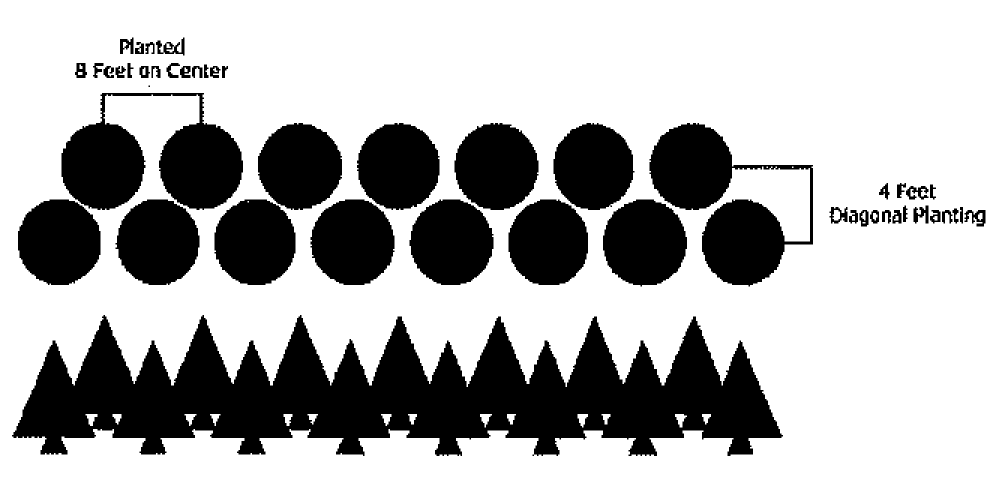
Berms, landscaping, fences and walls in the TBY: Transitional buffer yards shall be comprised of one or more of the following: A landscape berm, evergreen plantings, a wall, or solid fence. Whichever single type or combination of these alternatives are used, this screen shall be at least six feet high and of sufficient density to completely block the view from the adjacent residential property. If a wall or fence is selected, landscaping shall be placed on the exterior portion (the side of the fence facing adjacent property owners) of the fence or wall on eight-foot centers at a height of six feet in order to break up the profile of the fence or wall.
If only evergreen plantings are used, the TBY must achieve a 100 percent screen to a height of six feet upon installation. To achieve this appearance, a staggered spacing approach should be utilized as shown below.
(b)
Use of evergreens: All TBY landscaping shall be evergreen trees.
(c)
Irrigation: All plant materials within the transitional buffer yard shall be fully sprinkled and/or irrigated to insure proper growth and high-quality, long-term appearance.
(d)
Maintenance and replacement: All plantings in association with TBY requirements shall be properly maintained and/or replaced if determined necessary by the public works director or his/her designee. All landscaping installed to replace dead or dying evergreens shall be replaced with planting of equal height and width to what remains or ten feet in height, whichever is less. For example, if an evergreen tree is removed and the other evergreens in the TBY are 11 feet tall, the replacement evergreen must be at least ten feet tall.
The property owner is solely responsible for the maintenance and replacement of the fence, wall, berm and/or landscaping, In instances where the building official has determined that the TBY is not being properly maintained, steps may be taken by the city to compel compliance with this section, including, but not limited to 1) a lien placed on the property; 2) water service to the property shut off; and/or 3) liquor licenses being suspended or not renewed. Such action will be determined through the city's municipal court process.
(e)
Variances and appeals regarding transitional buffer yards (TBY): Property owners and/ or building tenants who are unable to comply with the provisions of this section may file a landscape screening variance application with the city planner which will be forwarded to the city council.
The city council shall, upon review of an application for variance or appeal, and upon making a finding of fact that owing to special conditions, a literal enforcement of the provisions of this chapter is not possible due to topographical or natural land feature concerns, may vary the conditions of this chapter. The council may consider both full and partial variances in relation to a required TBY.
(1)
Variances for TBYs: Application process: An application for landscape screening variance shall be forwarded to the administrative and community services committee (ACS) of the city council for consideration, and notice given to the applicant of the date and time of the meeting at which the variance is to be considered. ACS shall make a recommendation to the city council. The city council shall then approve or deny the application within 30 days of the receipt of the ACS recommendation.
A.
Standard for variances in transitional buffer yards: In determining whether to grant a full or partial landscape screening variance, council may take into account the following considerations:
1.
Will strict adherence to this section result in the TBY being rendered ineffective due to topographical issues in which it would be located? For example, the TBY would be placed in a low lying area where trees or fencing of at least six feet in height does not screen the intended use. Or alternatively, is the non-residential or multiple family use located on a topographically elevated area where it is effectively not visible from adjacent property for which the TBY is intended?
2.
Is there natural vegetation located between the use which requires a TBY and property required to be screened which effectively provides a year-round landscape screen?
3.
Will strict adherence to this section result in the TBY blocking access to a public right-of-way or private access easement such as an alleyway or private drive?
4.
Will strict adherence to this section result in the TBY detrimentally restrict access to planned or existing easements of any kind, including but not limited to drainage, utility or pedestrian easements?
5.
Will strict adherence to this section present public safety concerns? For example, will the fire lane access requirements as a result of required TBY?
6.
Are there alternatives available which insure that adjoining residential uses will be screened at an equal or greater level compared to the provisions of this section?
7.
Will granting a variance result in the failure to achieve the stated purposes of Chapter 1228?
B.
The city council shall not grant any variance unless, based upon evidence presented to them, they determine that:
1.
The proposed variance is consistent with the intent and purpose of this chapter (as described in Section 1228.01), and that adjacent property owners as described in Section 1228.08(a) will not cause injury to the area in which the transitional buffer yard and landscaping is located; and
2.
The proposed variance is the minimum deviation from the requirements that will alleviate the difficulties/hardship while protecting the broader public interest.
(2)
Appeals concerning transitional buffer yards (TBY): Any person aggrieved by any decision or order of the zoning administrator in any matter related to the interpretation or enforcement of any provision of this chapter may appeal to the city council. Every such appeal shall be made and treated in accordance with Illinois law and the provisions of this section.
A.
Filing and record transmittal: Appeals shall be made within 45 days of the decision by the zoning administrator by filing with the city clerk a written notice of appeal specifying the grounds for appeal. The city clerk shall forward copies of the notice to the zoning administrator and the chairman of ACS within five business days. The ACS chairman shall place the matter on the agenda for the next regularly scheduled meeting of the committee, as provided by law. The zoning administrator shall transmit to ACS all records of the case and reasons for the decision. ACS shall make a recommendation to the city council.
B.
Stay of further proceedings: An appeal stays all further action on the matter being appealed unless the zoning administrator certifies to the council, after the notice of appeal has been filed with him, that for reasons stated in the certificate, a stay would cause imminent peril to life or property. In such case, further action shall not be stayed unless the circuit court grants a restraining order for cause, and so notifies the administrator.
C.
Decision by the city council: The city council, after receipt of the recommendation from ACS, shall render a decision in not more than 30 days. The council may reverse or affirm, wholly or partly, or may modify or amend the decision or order appealed from, the extent and manner that they deem appropriate. In so doing, the council has all the power of the administrator and shall publish said decision by resolution.
(Ord. No. 5969-3-15, § 2, 3-3-2015; Ord. No. 6006-04-16, § 2, 4-19-2016)
1228.09 - Reserved.
Editor's note— Ord. No. 5969-3-15, § 2, adopted Mar. 3, 2015, deleted § 1228.09, which pertained to screening of activity areas and derived from the zoning ordinance adopted and amended through Ord. No. 5895-2-13, adopted Feb. 19, 2013.
1228.10 - Incentive for preserving existing landscaping.
(a)
Existing landscaping that is in a vigorous growing condition and is not specifically prohibited by this chapter may count toward meeting the point requirements of this chapter. The same point value will be applied toward the total points for each tree preserved but five additional points will be awarded for larger trees:
1228.11 - Ground cover requirements.
(a)
All yards shall be planted and maintained with a vegetative ground cover such as sod or seed. Other low growing plants (evergreen plants with a mature height of one foot or less) may also be utilized.
(1)
Low growing broadleaf evergreen plants: When low growing broadleaf evergreen plants such as Pachysandra, Vinca minor, and purple leaf wintercreeper are utilized to meet the ground cover requirements, they shall be planted together in continuous beds with a weed barrier fabric applied, mulched with shredded hardwood bark or cypress mulch and be spaced in such a way that they are solid within two years of the date a certificate of occupancy is issued by the city or additional plantings may be required by the building official as deemed necessary to meet this requirement.
(2)
Weed barrier and bark: Creeping junipers may have a weed barrier fabric applied and may be mulched with shredded hardwood bark or cypress mulch and must meet the same coverage timeline as stated for broadleaf evergreen ground covers.
(3)
Mulching requirements: All required shrubs and trees shall have a weed barrier fabric applied and be mulched and maintained with shredded hardwood bark, cypress, or rock beds. All beds adjacent to parking lots should have a weed barrier applied with hardwood or cypress mulch; gravel is not allowed.
(4)
Sod: Sod shall be placed from the back of the curb and front edge of the sidewalk or a distance of three feet from the back of curb where no sidewalk exists.
(b)
For purposes of this section, all references to weed barrier fabric shall be an approved ultraviolet light resistant, nonwoven geotextile fabric with a minimum mass (weight) of 60 g/m 2 (1.75 oz./sq. yd.).
1228.12 - Appeal of the building official's review.
(a)
Initial denial by the building official will require that the petitioner amend the plan and resubmit.
(b)
Following a second denial and within a period of ten days, the petitioner may appeal in writing to the zoning board. Said board may uphold, reverse or amend the denial and the board's decision shall be final within the purview of this chapter.
1228.13 - Minor adjustments to previously approved landscape plan.
(a)
If a petitioner desires to adjust a plan after it has been approved, proposed changes must be submitted in writing to the building official. However, no adjustments may be made to the transitional buffer yard screening without administrative and community services committee review and council approval.
(b)
The building official shall have the authority to approve the proposed amendment or state that the request must be processed through the administrative and community services committee and the city council.
(Ord. No. 5969-3-15, § 2, 3-3-2015)
1228.14 - Documentation.
All communications relating to landscape applications shall be made part of the building permit record.
1228.15 - Content of landscape plan.
Required elements of landscape plan:
(a)
The following information must be shown of the required landscape plan:
(1)
North arrow (approximate), scale (approximate), date of preparation and revisions, name of designer/drafter;
(2)
Approximate location of all buildings, structures, and pavement that are proposed or will remain on-site;
(3)
Approximate location of all existing or proposed watercourses, ponds, lakes;
(4)
Approximate location, size, and common name of any existing trees or shrubs that are to remain;
(5)
Approximate location of all landscaping that is proposed for the site including any trees, shrubs, ground cover, ornamental grasses, and flower beds (plants should be represented on the drawing at approximately one-half of their mature size);
(6)
Approximate location of any existing or proposed signs, walls, fences, berms (approximately one foot contour intervals), site furniture, lights, fountains, and sculptures on the site;
(7)
Approximate location of all property lines;
(8)
Approximate location of all curb lines of existing or proposed streets, alleys, and parking lots;
(9)
Approximate location of all sidewalks that are proposed for the site or currently adjoin the site;
(10)
Approximate location of all existing and proposed easements;
(11)
Elevation drawings (side views) of proposed structures showing the proposed landscaping for front and corner side lots (where applicable);
(12)
Any additional information that the building official determines is necessary to adequately review the proposal.
(b)
Sketches and drawings required and as set forth in this section are not required to be of a professional nature or prepared by professional individuals.
(c)
Sketches and drawings shall include or be accompanied by a plant list that describes the common name, quantity and size at installation (planting) of each proposed plant.
1228.16 - Plant material.
(a)
Plant selection: Plant materials provided in conformance with the provisions of this chapter shall have been grown in a nursery that complies with the propagation standards of the American Association of Nurserymen. All plant materials shall be capable of withstanding the extremes of individual site microclimates.
(b)
Prohibited trees: The following weak-wooded and generally undesirable trees, for urban conditions, shall be prohibited for use in meeting any of the requirements of this chapter:
(1)
Ailanthus (tree-of-heaven).
(2)
Box elder.
(3)
Bradford pear.
(4)
European mountain ash.
(5)
European white birch.
(6)
Mulberry.
(7)
Poplar.
(8)
Purple leaf plum.
(9)
Russian olive.
(10)
Siberian elm.
(11)
Silver maple.
(12)
Willow.
(13)
Sweet gum.
1228.17 - Landscape maintenance.
(a)
Responsibility: The owner of the premises shall be responsible for the watering, maintenance, repair, and replacement of all landscaping, fences and other visual barriers including refuse disposal area screens which have died (in the case of plant material) or fallen into disrepair (in the case of fences).
(b)
Plant materials: All required plant materials shall be maintained in a healthy, vigorous growing condition, and neat and orderly appearance. They shall be replaced as necessary, and shall be kept free of refuse and debris.
(c)
Fences and walls: All fences, walls and other barriers shall be maintained in good repair, meaning structurally sound and attractive in appearance. All fences, required or otherwise, shall have the finished face directed toward residential property, where a residential property is adjacent to or across from the subject site.
1228.18 - Penalty.
Noncompliance with maintenance standards: A property owner or developer, notified by the building official, and determined as in violation of the provisions of this chapter shall be granted a reasonable time period (subject to uniform and practical guidelines established by the building official) within which to establish or reestablish compliance. If said violation is not corrected within the given period of time, the property owner shall be subject to a fine as set forth in section 1-10 of this Code.

